UNICEF/WHO Breastfeeding Promotion and Support in a Baby-Friendly Hospital – 20 hour Course 2006
BABY-FRIENDLY HOSPITAL INITIATIVE
Revised, Updated and Expanded for Integrated Care
“Maternity”,
1963,
©
2003
Estate
of
Pablo
Picasso/Artists
Rights
Society
(ARS),
New
York
UNICEF/WHO Breastfeeding Promotion and Support in a Baby-Friendly Hospital – 20 hour Course 2006
Global Strategy for
Infant and Young Child Feeding
The aim of the Global Strategy is to improve
– through optimal feeding – the nutritional
status, growth and development, health, and
thus the survival of infants and young children.
It supports exclusive breastfeeding for 6 months,
with timely, adequate, safe and appropriate
complementary feeding, while continuing
breastfeeding for two years and beyond.
It also supports maternal nutrition, and social
and community support.
1/1
UNICEF/WHO Breastfeeding Promotion and Support in a Baby-Friendly Hospital – 20 hour Course 2006
The aim of the
Baby Friendly Hospital Initiative
To implement
the Ten Steps to Successful Breastfeeding
and
to end the distribution of free and low-cost
supplies of breastmilk substitutes
to health facilities.
1/2
UNICEF/WHO Breastfeeding Promotion and Support in a Baby-Friendly Hospital – 20 hour Course 2006
Course Aims
The aim of this course is that
every staff member will confidently
support mothers with early and exclusive
breastfeeding,
and that this facility moves towards
achieving Baby-friendly designation.
1/3
UNICEF/WHO Breastfeeding Promotion and Support in a Baby-Friendly Hospital – 20 hour Course 2006
3/1
Original
illustration
by
Jenny
Corkery
UNICEF/WHO Breastfeeding Promotion and Support in a Baby-Friendly Hospital – 20 hour Course 2006
Infant Feeding Recommendation
for HIV-positive Women
When replacement feeding is acceptable,
feasible, affordable, sustainable and safe,
avoidance of all breastfeeding
by HIV-infected mothers is recommended.
Otherwise, exclusive breastfeeding
is recommended during the first months
of life and then should be discontinued
as soon as it is feasible.
3/2
UNICEF/WHO Breastfeeding Promotion and Support in a Baby-Friendly Hospital – 20 hour Course 2006
4/1
Original
illustration
by
Jenny
Corkery
UNICEF/WHO Breastfeeding Promotion and Support in a Baby-Friendly Hospital – 20 hour Course 2006
The overall aim of the
International Code of Marketing
of Breastmilk Substitutes
is the safe and adequate nutrition
of all infants.
4/2
UNICEF/WHO Breastfeeding Promotion and Support in a Baby-Friendly Hospital – 20 hour Course 2006
Skin to Skin Contact and
Early Breastfeeding
5/1
©UNICEF
C107-2
UNICEF/WHO Breastfeeding Promotion and Support in a Baby-Friendly Hospital – 20 hour Course 2006
Skin to Skin Contact and
Early Breastfeeding
5/2
UNICEF/HQ92-0369/
Roger
Lemoyne,
Thailand
UNICEF/WHO Breastfeeding Promotion and Support in a Baby-Friendly Hospital – 20 hour Course 2006
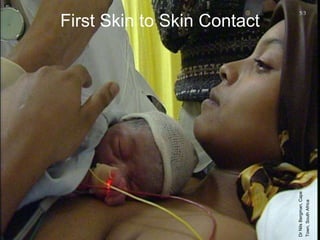
First Skin to Skin Contact
5/3
Dr
Nils
Bergman,
Cape
Town,
South
Africa
UNICEF/WHO Breastfeeding Promotion and Support in a Baby-Friendly Hospital – 20 hour Course 2006
Parts of the Breast
6/1
Adapted
from
Breastfeeding
Counselling:
a
training
course,
WHO/CHD/93.4,
UNICEF/NUT/93.2
UNICEF/WHO Breastfeeding Promotion and Support in a Baby-Friendly Hospital – 20 hour Course 2006
Helping the Oxytocin Reflex 6/2
Breastfeeding
Counselling:
a
training
course,
WHO/CHD/93.4,
UNICEF/NUT/93.2
UNICEF/WHO Breastfeeding Promotion and Support in a Baby-Friendly Hospital – 20 hour Course 2006
What can you see?
Good attachment Poor attachment
6/3
Breastfeeding
Counselling:
a
training
course,
WHO/CHD/93.4,
UNICEF/NUT/93.2
UNICEF/WHO Breastfeeding Promotion and Support in a Baby-Friendly Hospital – 20 hour Course 2006
What can you see?
Good attachment Poor attachment
6/4
Breastfeeding
Counselling:
a
training
course,
WHO/CHD/93.4,
UNICEF/NUT/93.2
UNICEF/WHO Breastfeeding Promotion and Support in a Baby-Friendly Hospital – 20 hour Course 2006
Breastfeeding Positions
7/1
In line
Close
Supported
Facing
Breastfeeding
Counselling:
a
training
course,
WHO/CHD/93.4,
UNICEF/NUT/93.2
UNICEF/WHO Breastfeeding Promotion and Support in a Baby-Friendly Hospital – 20 hour Course 2006
BREASTFEED OBSERVATION AID
Mother's name _______________________________ Date ___________________
Baby's name _________________________________ Baby's age ______________
Signs that breastfeeding is going well: Signs of possible difficulty:
GENERAL
Mother: Mother:
 Mother looks healthy  Mother looks ill or depressed
 Mother relaxed and comfortable  Mother looks tense and uncomfortable
 Signs of bonding between mother and baby  No mother/baby eye contact
Baby: Baby:
 Baby looks healthy  Baby looks sleepy or ill
 Baby calm and relaxed  Baby is restless or crying
 Baby reaches or roots for breast if hungry  Baby does not reach or root
BREASTS
 Breasts look healthy  Breasts look red, swollen, or sore
 No pain or discomfort  Breast or nipple painful
Breast well supported with fingers away from nipple  Breasts held with fingers on areola
BABY’S POSITION
 Baby’s head and body in line  Baby’s neck and head twisted to feed
 Baby held close to mother’s body  Baby not held close
 Baby’s whole body supported  Baby supported by head and neck only
 Baby approaches breast, nose to nipple  Baby approaches breast, lower lip/chin to nipple
BABY’S ATTACHMENT
 More areola seen above baby’s top lip  More areola seen below bottom lip
 Baby’s mouth open wide  Baby’s mouth not open wide
 Lower lip turned outwards  Lips pointing forward or turned in
 Baby’s chin touches breast  Baby’s chin not touching breast
SUCKLING
 Slow, deep sucks with pauses  Rapid shallow sucks
 Cheeks round when suckling  Cheeks pulled in when suckling
 Baby releases breast when finished  Mother takes baby off the breast
Mother notices signs of oxytocin reflex  No signs of oxytocin reflex noticed
Notes:
7/2
UNICEF/WHO Breastfeeding Promotion and Support in a Baby-Friendly Hospital – 20 hour Course 2006
Assess a
Breastfeed
7/3
©UNICEF
C107-5
UNICEF/WHO Breastfeeding Promotion and Support in a Baby-Friendly Hospital – 20 hour Course 2006
©UNICEF
C107-7
Wide Open
Mouth
7/4
UNICEF/WHO Breastfeeding Promotion and Support in a Baby-Friendly Hospital – 20 hour Course 2006
Assess a
Breastfeed
7/5
©UNICEF
C107-9
UNICEF/WHO Breastfeeding Promotion and Support in a Baby-Friendly Hospital – 20 hour Course 2006
Assess a
Breastfeed
7/6
UNICEF/HQ91-0168/
Betty
Press,
Kenya
UNICEF/WHO Breastfeeding Promotion and Support in a Baby-Friendly Hospital – 20 hour Course 2006
8/1
9/1
Original
illustration
by
Jenny
Corkery
UNICEF/WHO Breastfeeding Promotion and Support in a Baby-Friendly Hospital – 20 hour Course 2006
Case study
9/2
UNICEF/HQ91-0168/
Betty
Press,
Kenya
“Sleeping all the time”
“Refusing” the breast
3 stools in week
12% under birth weight
Bottle with honey and
water twice yesterday
2 weeks old
Healthy at birth
Discharged Day 2
Case study
Breastfeeding
Counselling:
a
training
course,
WHO/CHD/93.4,
UNICEF/NUT/93.2
UNICEF/WHO Breastfeeding Promotion and Support in a Baby-Friendly Hospital – 20 hour Course 2006
Kangaroo
Mother Care
10/1
Dr
Nils
Bergman,
Cape
Town,
South
Africa
UNICEF/WHO Breastfeeding Promotion and Support in a Baby-Friendly Hospital – 20 hour Course 2006
Kangaroo
Mother
Care
Dr
Nils
Bergman,
Cape
Town,
South
Africa 10/2
UNICEF/WHO Breastfeeding Promotion and Support in a Baby-Friendly Hospital – 20 hour Course 2006
Positioning a
preterm
infant
10/3
UNICEF/HQ93-0287/
Roger
Lemoyne,
China
UNICEF/WHO Breastfeeding Promotion and Support in a Baby-Friendly Hospital – 20 hour Course 2006
Twins Grow
Well on
Breastmilk
UNICEF/HQ92-0260/
Lauren
Goodsmith,
Mauritania
10/4
UNICEF/WHO Breastfeeding Promotion and Support in a Baby-Friendly Hospital – 20 hour Course 2006
DANCER Hand
Position
10/5
©UNICEF
C107-21
UNICEF/WHO Breastfeeding Promotion and Support in a Baby-Friendly Hospital – 20 hour Course 2006
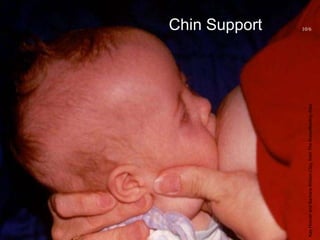
Chin Support 10/6
Kay
Hoover
and
Barbara
Wilson-Clay,
from
The
Breastfeeding
Atlas
UNICEF/WHO Breastfeeding Promotion and Support in a Baby-Friendly Hospital – 20 hour Course 2006
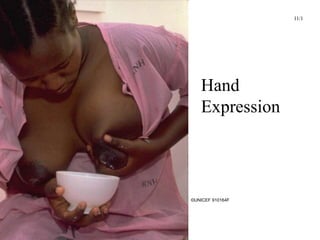
Hand
Expression
11/1
©UNICEF 910164F
UNICEF/WHO Breastfeeding Promotion and Support in a Baby-Friendly Hospital – 20 hour Course 2006
Cup Feeding
11/2
Promoting
breastfeeding
in
health
facilities:
A
short
course
for
administrators
and
policy
makers
WHO/NUT/96.3,
Wellstart
International
UNICEF/WHO Breastfeeding Promotion and Support in a Baby-Friendly Hospital – 20 hour Course 2006
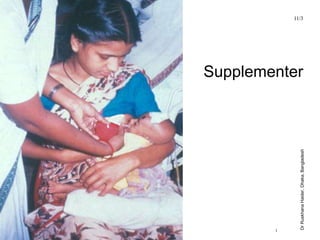
Supplementer
11/3
Dr
Ruskhana
Haider,
Dhaka,
Bangladesh
UNICEF/WHO Breastfeeding Promotion and Support in a Baby-Friendly Hospital – 20 hour Course 2006
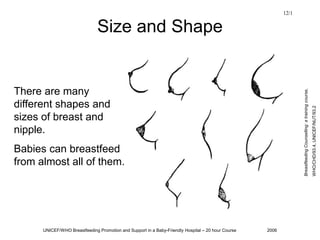
Size and Shape
There are many
different shapes and
sizes of breast and
nipple.
Babies can breastfeed
from almost all of them.
12/1
Breastfeeding
Counselling:
a
training
course,
WHO/CHD/93.4,
UNICEF/NUT/93.2
UNICEF/WHO Breastfeeding Promotion and Support in a Baby-Friendly Hospital – 20 hour Course 2006
Full Breast
UNICEF
C-107-19
12/2
UNICEF/WHO Breastfeeding Promotion and Support in a Baby-Friendly Hospital – 20 hour Course 2006
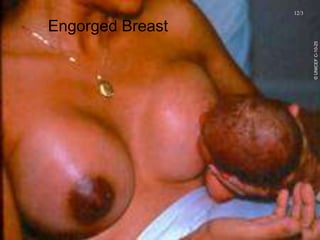
Engorged Breast
©
UNICEF
C-10-25
12/3
UNICEF/WHO Breastfeeding Promotion and Support in a Baby-Friendly Hospital – 20 hour Course 2006
Mastitis
12/4
©UNICEF
C107-39
UNICEF/WHO Breastfeeding Promotion and Support in a Baby-Friendly Hospital – 20 hour Course 2006
Sore Nipple
12/5
©UNICEF
C107-31
UNICEF/WHO Breastfeeding Promotion and Support in a Baby-Friendly Hospital – 20 hour Course 2006
Sore
Nipple
12/6
©UNICEF
C107-32
UNICEF/WHO Breastfeeding Promotion and Support in a Baby-Friendly Hospital – 20 hour Course 2006
Syringe method for inverted nipples
12/7
Breastfeeding
Counselling:
a
training
course,
WHO/CHD/93.4,
UNICEF/NUT/93.2
UNICEF/WHO Breastfeeding Promotion and Support in a Baby-Friendly Hospital – 20 hour Course 2006
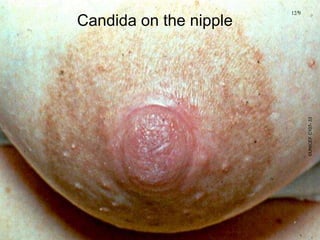
Candida on the nipple
12/8
©UNICEF
C107-34
UNICEF/WHO Breastfeeding Promotion and Support in a Baby-Friendly Hospital – 20 hour Course 2006
Candida on the nipple
12/9
©UNICEF
C107-
33
UNICEF/WHO Breastfeeding Promotion and Support in a Baby-Friendly Hospital – 20 hour Course 2006
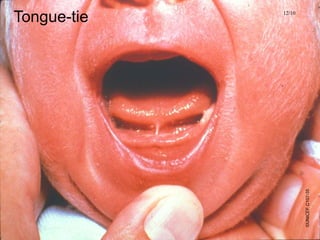
Tongue-tie 12/10
©UNICEF
C107-35
UNICEF/WHO Breastfeeding Promotion and Support in a Baby-Friendly Hospital – 20 hour Course 2006
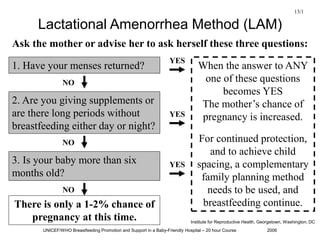
Lactational Amenorrhea Method (LAM)
13/1
Institute for Reproductive Health, Georgetown, Washington, DC
1. Have your menses returned?
2. Are you giving supplements or
are there long periods without
breastfeeding either day or night?
3. Is your baby more than six
months old?
Ask the mother or advise her to ask herself these three questions:
There is only a 1-2% chance of
pregnancy at this time.
YES
NO
NO
NO
YES
YES
When the answer to ANY
one of these questions
becomes YES
The mother’s chance of
pregnancy is increased.
For continued protection,
and to achieve child
spacing, a complementary
family planning method
needs to be used, and
breastfeeding continue.
UNICEF/WHO Breastfeeding Promotion and Support in a Baby-Friendly Hospital – 20 hour Course 2006
UNICEF/WHO/UNAIDS
Infant Feeding Recommendation for
HIV-positive Women
When replacement feeding is acceptable,
feasible, affordable, sustainable and safe,
(AFASS) avoidance of all breastfeeding
by HIV-infected mothers is recommended.
Otherwise, exclusive breastfeeding is
recommended during the first months of
life and should be then discontinued
as soon as it is feasible.
13/2
UNICEF/WHO Breastfeeding Promotion and Support in a Baby-Friendly Hospital – 20 hour Course 2006
14/1
Original
illustration
by
Jenny
Corkery
UNICEF/WHO Breastfeeding Promotion and Support in a Baby-Friendly Hospital – 20 hour Course 2006
Course Aims
The aim of this course is that
every staff member will confidently support
mothers to succeed
with early and exclusive breastfeeding,
and that this facility moves towards
achieving Baby-Friendly designation.
15/1
UNICEF/WHO Breastfeeding Promotion and Support in a Baby-Friendly Hospital – 20 hour Course 2006
Where are we
now?
Developing a Plan:
Step One
15/2
UNICEF/WHO Breastfeeding Promotion and Support in a Baby-Friendly Hospital – 20 hour Course 2006
Where do we
want to be?
15/3
Developing a Plan:
Step Two
UNICEF/WHO Breastfeeding Promotion and Support in a Baby-Friendly Hospital – 20 hour Course 2006
Developing a Plan:
Step Three
15/4
How will
we get
there?
UNICEF/WHO Breastfeeding Promotion and Support in a Baby-Friendly Hospital – 20 hour Course 2006
How will we know if
we are there?
Developing a Plan:
Step Four
15/5
UNICEF/WHO Breastfeeding Promotion and Support in a Baby-Friendly Hospital – 20 hour Course 2006
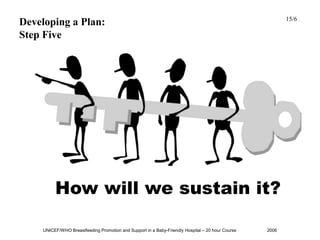
How will we sustain it?
15/6
Developing a Plan:
Step Five

mcn-bfhi-section-3.3.ppt

  • 1.
    UNICEF/WHO Breastfeeding Promotionand Support in a Baby-Friendly Hospital – 20 hour Course 2006 BABY-FRIENDLY HOSPITAL INITIATIVE Revised, Updated and Expanded for Integrated Care “Maternity”, 1963, © 2003 Estate of Pablo Picasso/Artists Rights Society (ARS), New York
  • 2.
    UNICEF/WHO Breastfeeding Promotionand Support in a Baby-Friendly Hospital – 20 hour Course 2006 Global Strategy for Infant and Young Child Feeding The aim of the Global Strategy is to improve – through optimal feeding – the nutritional status, growth and development, health, and thus the survival of infants and young children. It supports exclusive breastfeeding for 6 months, with timely, adequate, safe and appropriate complementary feeding, while continuing breastfeeding for two years and beyond. It also supports maternal nutrition, and social and community support. 1/1
  • 3.
    UNICEF/WHO Breastfeeding Promotionand Support in a Baby-Friendly Hospital – 20 hour Course 2006 The aim of the Baby Friendly Hospital Initiative To implement the Ten Steps to Successful Breastfeeding and to end the distribution of free and low-cost supplies of breastmilk substitutes to health facilities. 1/2
  • 4.
    UNICEF/WHO Breastfeeding Promotionand Support in a Baby-Friendly Hospital – 20 hour Course 2006 Course Aims The aim of this course is that every staff member will confidently support mothers with early and exclusive breastfeeding, and that this facility moves towards achieving Baby-friendly designation. 1/3
  • 5.
    UNICEF/WHO Breastfeeding Promotionand Support in a Baby-Friendly Hospital – 20 hour Course 2006 3/1 Original illustration by Jenny Corkery
  • 6.
    UNICEF/WHO Breastfeeding Promotionand Support in a Baby-Friendly Hospital – 20 hour Course 2006 Infant Feeding Recommendation for HIV-positive Women When replacement feeding is acceptable, feasible, affordable, sustainable and safe, avoidance of all breastfeeding by HIV-infected mothers is recommended. Otherwise, exclusive breastfeeding is recommended during the first months of life and then should be discontinued as soon as it is feasible. 3/2
  • 7.
    UNICEF/WHO Breastfeeding Promotionand Support in a Baby-Friendly Hospital – 20 hour Course 2006 4/1 Original illustration by Jenny Corkery
  • 8.
    UNICEF/WHO Breastfeeding Promotionand Support in a Baby-Friendly Hospital – 20 hour Course 2006 The overall aim of the International Code of Marketing of Breastmilk Substitutes is the safe and adequate nutrition of all infants. 4/2
  • 9.
    UNICEF/WHO Breastfeeding Promotionand Support in a Baby-Friendly Hospital – 20 hour Course 2006 Skin to Skin Contact and Early Breastfeeding 5/1 ©UNICEF C107-2
  • 10.
    UNICEF/WHO Breastfeeding Promotionand Support in a Baby-Friendly Hospital – 20 hour Course 2006 Skin to Skin Contact and Early Breastfeeding 5/2 UNICEF/HQ92-0369/ Roger Lemoyne, Thailand
  • 11.
    UNICEF/WHO Breastfeeding Promotionand Support in a Baby-Friendly Hospital – 20 hour Course 2006 First Skin to Skin Contact 5/3 Dr Nils Bergman, Cape Town, South Africa
  • 12.
    UNICEF/WHO Breastfeeding Promotionand Support in a Baby-Friendly Hospital – 20 hour Course 2006 Parts of the Breast 6/1 Adapted from Breastfeeding Counselling: a training course, WHO/CHD/93.4, UNICEF/NUT/93.2
  • 13.
    UNICEF/WHO Breastfeeding Promotionand Support in a Baby-Friendly Hospital – 20 hour Course 2006 Helping the Oxytocin Reflex 6/2 Breastfeeding Counselling: a training course, WHO/CHD/93.4, UNICEF/NUT/93.2
  • 14.
    UNICEF/WHO Breastfeeding Promotionand Support in a Baby-Friendly Hospital – 20 hour Course 2006 What can you see? Good attachment Poor attachment 6/3 Breastfeeding Counselling: a training course, WHO/CHD/93.4, UNICEF/NUT/93.2
  • 15.
    UNICEF/WHO Breastfeeding Promotionand Support in a Baby-Friendly Hospital – 20 hour Course 2006 What can you see? Good attachment Poor attachment 6/4 Breastfeeding Counselling: a training course, WHO/CHD/93.4, UNICEF/NUT/93.2
  • 16.
    UNICEF/WHO Breastfeeding Promotionand Support in a Baby-Friendly Hospital – 20 hour Course 2006 Breastfeeding Positions 7/1 In line Close Supported Facing Breastfeeding Counselling: a training course, WHO/CHD/93.4, UNICEF/NUT/93.2
  • 17.
    UNICEF/WHO Breastfeeding Promotionand Support in a Baby-Friendly Hospital – 20 hour Course 2006 BREASTFEED OBSERVATION AID Mother's name _______________________________ Date ___________________ Baby's name _________________________________ Baby's age ______________ Signs that breastfeeding is going well: Signs of possible difficulty: GENERAL Mother: Mother:  Mother looks healthy  Mother looks ill or depressed  Mother relaxed and comfortable  Mother looks tense and uncomfortable  Signs of bonding between mother and baby  No mother/baby eye contact Baby: Baby:  Baby looks healthy  Baby looks sleepy or ill  Baby calm and relaxed  Baby is restless or crying  Baby reaches or roots for breast if hungry  Baby does not reach or root BREASTS  Breasts look healthy  Breasts look red, swollen, or sore  No pain or discomfort  Breast or nipple painful Breast well supported with fingers away from nipple  Breasts held with fingers on areola BABY’S POSITION  Baby’s head and body in line  Baby’s neck and head twisted to feed  Baby held close to mother’s body  Baby not held close  Baby’s whole body supported  Baby supported by head and neck only  Baby approaches breast, nose to nipple  Baby approaches breast, lower lip/chin to nipple BABY’S ATTACHMENT  More areola seen above baby’s top lip  More areola seen below bottom lip  Baby’s mouth open wide  Baby’s mouth not open wide  Lower lip turned outwards  Lips pointing forward or turned in  Baby’s chin touches breast  Baby’s chin not touching breast SUCKLING  Slow, deep sucks with pauses  Rapid shallow sucks  Cheeks round when suckling  Cheeks pulled in when suckling  Baby releases breast when finished  Mother takes baby off the breast Mother notices signs of oxytocin reflex  No signs of oxytocin reflex noticed Notes: 7/2
  • 18.
    UNICEF/WHO Breastfeeding Promotionand Support in a Baby-Friendly Hospital – 20 hour Course 2006 Assess a Breastfeed 7/3 ©UNICEF C107-5
  • 19.
    UNICEF/WHO Breastfeeding Promotionand Support in a Baby-Friendly Hospital – 20 hour Course 2006 ©UNICEF C107-7 Wide Open Mouth 7/4
  • 20.
    UNICEF/WHO Breastfeeding Promotionand Support in a Baby-Friendly Hospital – 20 hour Course 2006 Assess a Breastfeed 7/5 ©UNICEF C107-9
  • 21.
    UNICEF/WHO Breastfeeding Promotionand Support in a Baby-Friendly Hospital – 20 hour Course 2006 Assess a Breastfeed 7/6 UNICEF/HQ91-0168/ Betty Press, Kenya
  • 22.
    UNICEF/WHO Breastfeeding Promotionand Support in a Baby-Friendly Hospital – 20 hour Course 2006 8/1 9/1 Original illustration by Jenny Corkery
  • 23.
    UNICEF/WHO Breastfeeding Promotionand Support in a Baby-Friendly Hospital – 20 hour Course 2006 Case study 9/2 UNICEF/HQ91-0168/ Betty Press, Kenya “Sleeping all the time” “Refusing” the breast 3 stools in week 12% under birth weight Bottle with honey and water twice yesterday 2 weeks old Healthy at birth Discharged Day 2 Case study Breastfeeding Counselling: a training course, WHO/CHD/93.4, UNICEF/NUT/93.2
  • 24.
    UNICEF/WHO Breastfeeding Promotionand Support in a Baby-Friendly Hospital – 20 hour Course 2006 Kangaroo Mother Care 10/1 Dr Nils Bergman, Cape Town, South Africa
  • 25.
    UNICEF/WHO Breastfeeding Promotionand Support in a Baby-Friendly Hospital – 20 hour Course 2006 Kangaroo Mother Care Dr Nils Bergman, Cape Town, South Africa 10/2
  • 26.
    UNICEF/WHO Breastfeeding Promotionand Support in a Baby-Friendly Hospital – 20 hour Course 2006 Positioning a preterm infant 10/3 UNICEF/HQ93-0287/ Roger Lemoyne, China
  • 27.
    UNICEF/WHO Breastfeeding Promotionand Support in a Baby-Friendly Hospital – 20 hour Course 2006 Twins Grow Well on Breastmilk UNICEF/HQ92-0260/ Lauren Goodsmith, Mauritania 10/4
  • 28.
    UNICEF/WHO Breastfeeding Promotionand Support in a Baby-Friendly Hospital – 20 hour Course 2006 DANCER Hand Position 10/5 ©UNICEF C107-21
  • 29.
    UNICEF/WHO Breastfeeding Promotionand Support in a Baby-Friendly Hospital – 20 hour Course 2006 Chin Support 10/6 Kay Hoover and Barbara Wilson-Clay, from The Breastfeeding Atlas
  • 30.
    UNICEF/WHO Breastfeeding Promotionand Support in a Baby-Friendly Hospital – 20 hour Course 2006 Hand Expression 11/1 ©UNICEF 910164F
  • 31.
    UNICEF/WHO Breastfeeding Promotionand Support in a Baby-Friendly Hospital – 20 hour Course 2006 Cup Feeding 11/2 Promoting breastfeeding in health facilities: A short course for administrators and policy makers WHO/NUT/96.3, Wellstart International
  • 32.
    UNICEF/WHO Breastfeeding Promotionand Support in a Baby-Friendly Hospital – 20 hour Course 2006 Supplementer 11/3 Dr Ruskhana Haider, Dhaka, Bangladesh
  • 33.
    UNICEF/WHO Breastfeeding Promotionand Support in a Baby-Friendly Hospital – 20 hour Course 2006 Size and Shape There are many different shapes and sizes of breast and nipple. Babies can breastfeed from almost all of them. 12/1 Breastfeeding Counselling: a training course, WHO/CHD/93.4, UNICEF/NUT/93.2
  • 34.
    UNICEF/WHO Breastfeeding Promotionand Support in a Baby-Friendly Hospital – 20 hour Course 2006 Full Breast UNICEF C-107-19 12/2
  • 35.
    UNICEF/WHO Breastfeeding Promotionand Support in a Baby-Friendly Hospital – 20 hour Course 2006 Engorged Breast © UNICEF C-10-25 12/3
  • 36.
    UNICEF/WHO Breastfeeding Promotionand Support in a Baby-Friendly Hospital – 20 hour Course 2006 Mastitis 12/4 ©UNICEF C107-39
  • 37.
    UNICEF/WHO Breastfeeding Promotionand Support in a Baby-Friendly Hospital – 20 hour Course 2006 Sore Nipple 12/5 ©UNICEF C107-31
  • 38.
    UNICEF/WHO Breastfeeding Promotionand Support in a Baby-Friendly Hospital – 20 hour Course 2006 Sore Nipple 12/6 ©UNICEF C107-32
  • 39.
    UNICEF/WHO Breastfeeding Promotionand Support in a Baby-Friendly Hospital – 20 hour Course 2006 Syringe method for inverted nipples 12/7 Breastfeeding Counselling: a training course, WHO/CHD/93.4, UNICEF/NUT/93.2
  • 40.
    UNICEF/WHO Breastfeeding Promotionand Support in a Baby-Friendly Hospital – 20 hour Course 2006 Candida on the nipple 12/8 ©UNICEF C107-34
  • 41.
    UNICEF/WHO Breastfeeding Promotionand Support in a Baby-Friendly Hospital – 20 hour Course 2006 Candida on the nipple 12/9 ©UNICEF C107- 33
  • 42.
    UNICEF/WHO Breastfeeding Promotionand Support in a Baby-Friendly Hospital – 20 hour Course 2006 Tongue-tie 12/10 ©UNICEF C107-35
  • 43.
    UNICEF/WHO Breastfeeding Promotionand Support in a Baby-Friendly Hospital – 20 hour Course 2006 Lactational Amenorrhea Method (LAM) 13/1 Institute for Reproductive Health, Georgetown, Washington, DC 1. Have your menses returned? 2. Are you giving supplements or are there long periods without breastfeeding either day or night? 3. Is your baby more than six months old? Ask the mother or advise her to ask herself these three questions: There is only a 1-2% chance of pregnancy at this time. YES NO NO NO YES YES When the answer to ANY one of these questions becomes YES The mother’s chance of pregnancy is increased. For continued protection, and to achieve child spacing, a complementary family planning method needs to be used, and breastfeeding continue.
  • 44.
    UNICEF/WHO Breastfeeding Promotionand Support in a Baby-Friendly Hospital – 20 hour Course 2006 UNICEF/WHO/UNAIDS Infant Feeding Recommendation for HIV-positive Women When replacement feeding is acceptable, feasible, affordable, sustainable and safe, (AFASS) avoidance of all breastfeeding by HIV-infected mothers is recommended. Otherwise, exclusive breastfeeding is recommended during the first months of life and should be then discontinued as soon as it is feasible. 13/2
  • 45.
    UNICEF/WHO Breastfeeding Promotionand Support in a Baby-Friendly Hospital – 20 hour Course 2006 14/1 Original illustration by Jenny Corkery
  • 46.
    UNICEF/WHO Breastfeeding Promotionand Support in a Baby-Friendly Hospital – 20 hour Course 2006 Course Aims The aim of this course is that every staff member will confidently support mothers to succeed with early and exclusive breastfeeding, and that this facility moves towards achieving Baby-Friendly designation. 15/1
  • 47.
    UNICEF/WHO Breastfeeding Promotionand Support in a Baby-Friendly Hospital – 20 hour Course 2006 Where are we now? Developing a Plan: Step One 15/2
  • 48.
    UNICEF/WHO Breastfeeding Promotionand Support in a Baby-Friendly Hospital – 20 hour Course 2006 Where do we want to be? 15/3 Developing a Plan: Step Two
  • 49.
    UNICEF/WHO Breastfeeding Promotionand Support in a Baby-Friendly Hospital – 20 hour Course 2006 Developing a Plan: Step Three 15/4 How will we get there?
  • 50.
    UNICEF/WHO Breastfeeding Promotionand Support in a Baby-Friendly Hospital – 20 hour Course 2006 How will we know if we are there? Developing a Plan: Step Four 15/5
  • 51.
    UNICEF/WHO Breastfeeding Promotionand Support in a Baby-Friendly Hospital – 20 hour Course 2006 How will we sustain it? 15/6 Developing a Plan: Step Five