""~ McGill
Faculty o: [ouca:•O"l
McG " Un•vcrs ty
3700 McTav•sh Street
rvo, real. PO. Canada ·l3A 1Y2
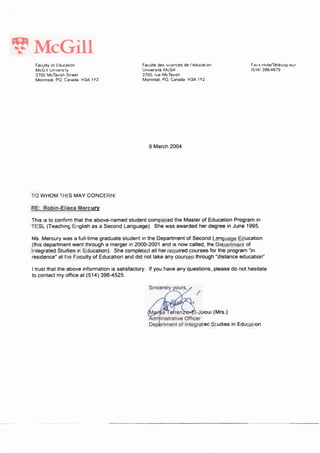
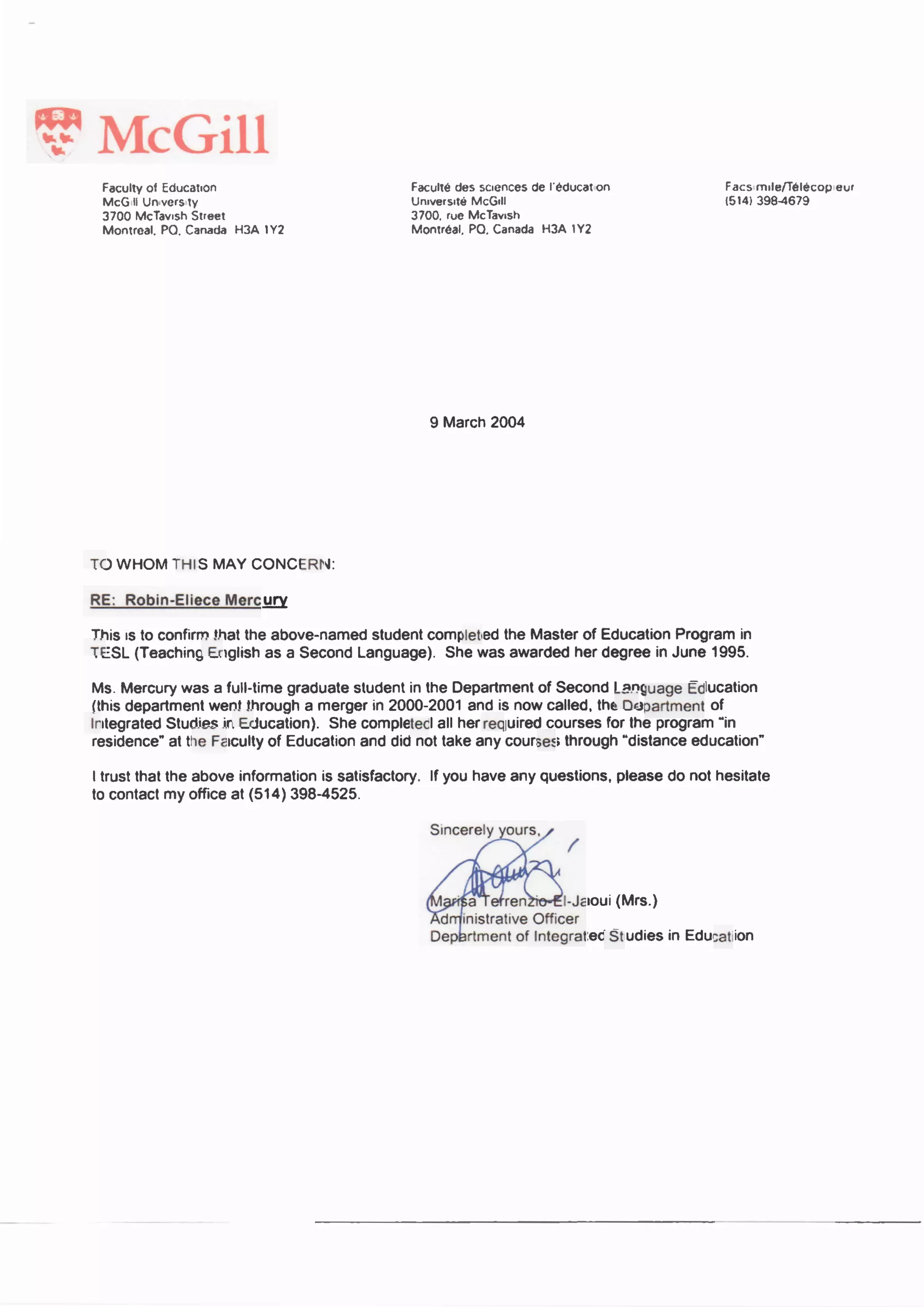
TO WHOM THIS MAY CONCERN :
RE: Robin-Eiiece Mercury
Facvlte des sc.cnccs de l'educat on
UPtvers•te McGtll
3700. rt..c McTavosh
~ontrcal . PO. Canada H3A · Y2
9 March 2004
r de:, mtlefTelecop eur
(5 141398-4679
This IS to confirm that the above-named student completed the Master of Education Program in
TESL (Teaching English as a Second Language). She was awarded her degree in June 1995.
Ms. Mercury was a full-time graduate student in the Department of Second Language Education
(this department went through a merger in 2000-2001 and is now called, the Department of
Integrated Studies 1n Education). She completed all her required courses for the program win
residence" at the Faculty of Educat1on and did not take any courses through "distance education"
I trust that the above information is satisfactory. If you have any questions, please do not hesitate
to contact my office at (514) 398-4525.
I
a ren 1-Jaoui (Mrs.)
inistrative Officer
Dep rtment of Integrated Studies in Education
"McGill
Faculty of Education
McGill University
3700 McTavish Street
Montreal, PO, Canada H3A 1Y2
Faculte des sciences de I'education
Universite McGill
3700, rue McTavish
Montreal. PO, Canada H3A 1Y2
Facsimile/Telecopieur·
(514) 398-4679
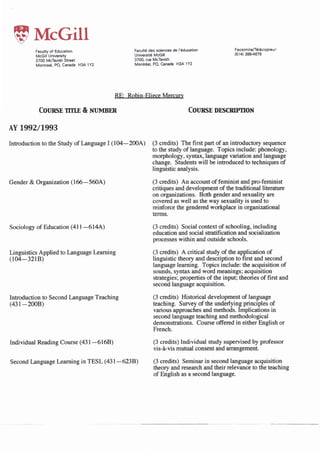
RE: Robin-Eliece MerCUQ'
COURSE 1lTLE &NUMBER
AY 1992/1993
Introduction to the Study of Language I (104-200A)
Gender & Organization (166-560A)
Sociology of Education (411-614A)
Linguistics Applied to Language Learning
(104-3218)
Introduction to Second Language Teaching
(431-2008)
Individual Reading Course (431-6168)
Second Language Learning in TESL (431-6238)
COURSE DFSCRIPTION
(3 credits) The first part of an introductory sequence
to the study of language. Topics include: phonology,
morphology, syntax, language variation and language
change. Students will be introduced to techniques of
linguistic analysis.
(3 credits) An account of feminist and pro-feminist
critiques and development of the traditional literature
on organizations. Both gender and sexuality are
covered as well as the way sexuality is used to
reinforce the gendered workplace in organizational
terms.
(3 credits) Social context of schooling, including
education and social stratification and socialization
processes within and outside schools.
(3 credits) A critical study of the application of
linguistic theory and description to first and second
language learning. Topics include: the acquisition of
sounds, syntax and word meanings; acquisition
strategies; properties of the input; theories of first and
second language acquisition.
(3 credits) Historical development of language
teaching. Survey of the underlying principles of
various approaches and methods. Implications in
second language teaching and methodological
demonstrations. Course offered in either English or
French.
(3 credits) Individual study supervised by professor
vis-a-vis mutual consent and arrangement.
(3 credits) Seminar in second language acquisition
theory and research and their relevance to the teaching
of English as a second language.
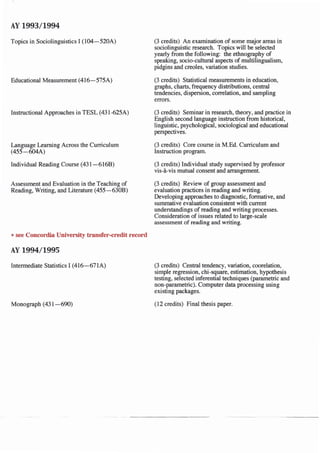
AY 1993/1994
Topics in Sociolinguistics I (104-520A)
Educational Measurement (416-575A)
Instructional Approaches in TESL (431-625A)
Language Learning Across the Curriculum
(455-604A)
Individual Reading Course (431-6168)
Assessment and Evaluation in the Teaching of
Reading, Writing, and Literature (455-6308)
*see Concordia University transfer-credit record
AY 1994/1995
Intermediate Statistics I (416-671A)
Monograph (431-690)
(3 credits) An examination of some major areas in
sociolinguistic research. Topics will be selected
yearly from the following: the ethnography of
speaking, socio-cultural aspects of multilingualism,
pidgins and creoles, variation studies.
(3 credits) Statistical measurements in education,
graphs, charts, frequency distributions, central
tendencies, dispersion, correlation, and sampling
errors.
(3 credits) Seminar in research, theory, and practice in
English second language instruction from historical,
linguistic, psychological, sociological and educational
perspectives.
(3 credits) Core course in M.Ed. Curriculum and
Instruction program.
(3 credits) Individual study supervised by professor
vis-a-vis mutual consent and arrangement.
(3 credits) Review of group assessment and
evaluation practices in reading and writing.
Developing approaches to diagnostic, formative, and
summative evaluation consistent with current
understandings of reading and writing processes.
Consideration of issues related to large-scale
assessment of reading and writing.
(3 credits) Central tendency, variation, coorelation,
simple regression, chi-square, estimation, hypothesis
testing, selected inferential techniques (parametric and
non-parametric). Computer data processing using
existing packages.
(12 credits) Final thesis paper.
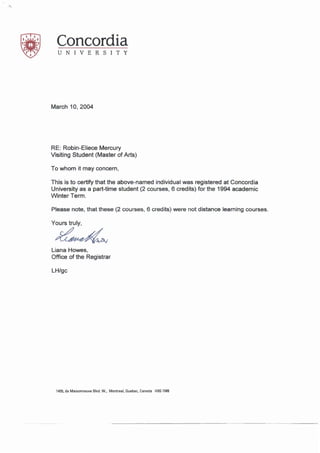
Concordia
UNIVERSITY
March 10, 2004
RE: Robin-Eiiece Mercury
Visiting Student (Master of Arts)
To whom it may concern,
This is to certify that the above-named individual was registered at Concordia
University as a part-time student (2 courses, 6 credits) for the 1994 academic
Winter Term.
Please note, that these (2 courses, 6 credits) were not distance learning courses.
Yours truly,
~
Liana Howes,
Office of the Registrar
LH/gc
1455, de Maisonneuve Blvd. W., Montreal, Quebec, Canada H3G1MB
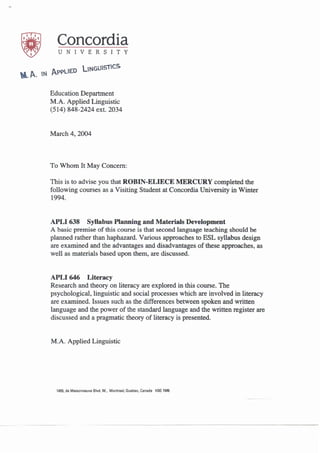
Concordia
UNIVERSITY
'N APP
UEO ltNGUSTCS.
tl .~-
Education Department
M.A. Applied Linguistic
(514) 848-2424 ext. 2034
March 4, 2004
To Whom It May Concern:
This is to advise you that ROBIN-ELIECE MERCURY completed the
following courses as a Visiting Student at Concordia University in Winter
1994.
APLI 638 Syllabus Planning and Materials Development
A basic premise of this course is that second language teaching should be
planned rather than haphazard. Various approaches to ESL syllabus design
are examined and the advantages and disadvantages of these approaches, as
well as materials based upon them, are discussed.
APLI 646 Literacy
Research and theory on literacy are explored in this course. The
psychological, linguistic and social processes which are involved in literacy
are examined. Issues such as the differences between spoken and written
language and the power of the standard language and the written register are
discussed and a pragmatic theory of literacy is presented.
M.A. Applied Linguistic
1455, de Maisonneuve Blvd.W., Montreal, Quebec, Canada H3G 1MB

McGill Attestation & Course Descriptions

  • 1.
    ""~ McGill Faculty o:[ouca:•O"l McG " Un•vcrs ty 3700 McTav•sh Street rvo, real. PO. Canada ·l3A 1Y2 TO WHOM THIS MAY CONCERN : RE: Robin-Eiiece Mercury Facvlte des sc.cnccs de l'educat on UPtvers•te McGtll 3700. rt..c McTavosh ~ontrcal . PO. Canada H3A · Y2 9 March 2004 r de:, mtlefTelecop eur (5 141398-4679 This IS to confirm that the above-named student completed the Master of Education Program in TESL (Teaching English as a Second Language). She was awarded her degree in June 1995. Ms. Mercury was a full-time graduate student in the Department of Second Language Education (this department went through a merger in 2000-2001 and is now called, the Department of Integrated Studies 1n Education). She completed all her required courses for the program win residence" at the Faculty of Educat1on and did not take any courses through "distance education" I trust that the above information is satisfactory. If you have any questions, please do not hesitate to contact my office at (514) 398-4525. I a ren 1-Jaoui (Mrs.) inistrative Officer Dep rtment of Integrated Studies in Education
  • 2.
    "McGill Faculty of Education McGillUniversity 3700 McTavish Street Montreal, PO, Canada H3A 1Y2 Faculte des sciences de I'education Universite McGill 3700, rue McTavish Montreal. PO, Canada H3A 1Y2 Facsimile/Telecopieur· (514) 398-4679 RE: Robin-Eliece MerCUQ' COURSE 1lTLE &NUMBER AY 1992/1993 Introduction to the Study of Language I (104-200A) Gender & Organization (166-560A) Sociology of Education (411-614A) Linguistics Applied to Language Learning (104-3218) Introduction to Second Language Teaching (431-2008) Individual Reading Course (431-6168) Second Language Learning in TESL (431-6238) COURSE DFSCRIPTION (3 credits) The first part of an introductory sequence to the study of language. Topics include: phonology, morphology, syntax, language variation and language change. Students will be introduced to techniques of linguistic analysis. (3 credits) An account of feminist and pro-feminist critiques and development of the traditional literature on organizations. Both gender and sexuality are covered as well as the way sexuality is used to reinforce the gendered workplace in organizational terms. (3 credits) Social context of schooling, including education and social stratification and socialization processes within and outside schools. (3 credits) A critical study of the application of linguistic theory and description to first and second language learning. Topics include: the acquisition of sounds, syntax and word meanings; acquisition strategies; properties of the input; theories of first and second language acquisition. (3 credits) Historical development of language teaching. Survey of the underlying principles of various approaches and methods. Implications in second language teaching and methodological demonstrations. Course offered in either English or French. (3 credits) Individual study supervised by professor vis-a-vis mutual consent and arrangement. (3 credits) Seminar in second language acquisition theory and research and their relevance to the teaching of English as a second language.
  • 3.
    AY 1993/1994 Topics inSociolinguistics I (104-520A) Educational Measurement (416-575A) Instructional Approaches in TESL (431-625A) Language Learning Across the Curriculum (455-604A) Individual Reading Course (431-6168) Assessment and Evaluation in the Teaching of Reading, Writing, and Literature (455-6308) *see Concordia University transfer-credit record AY 1994/1995 Intermediate Statistics I (416-671A) Monograph (431-690) (3 credits) An examination of some major areas in sociolinguistic research. Topics will be selected yearly from the following: the ethnography of speaking, socio-cultural aspects of multilingualism, pidgins and creoles, variation studies. (3 credits) Statistical measurements in education, graphs, charts, frequency distributions, central tendencies, dispersion, correlation, and sampling errors. (3 credits) Seminar in research, theory, and practice in English second language instruction from historical, linguistic, psychological, sociological and educational perspectives. (3 credits) Core course in M.Ed. Curriculum and Instruction program. (3 credits) Individual study supervised by professor vis-a-vis mutual consent and arrangement. (3 credits) Review of group assessment and evaluation practices in reading and writing. Developing approaches to diagnostic, formative, and summative evaluation consistent with current understandings of reading and writing processes. Consideration of issues related to large-scale assessment of reading and writing. (3 credits) Central tendency, variation, coorelation, simple regression, chi-square, estimation, hypothesis testing, selected inferential techniques (parametric and non-parametric). Computer data processing using existing packages. (12 credits) Final thesis paper.
  • 4.
    Concordia UNIVERSITY March 10, 2004 RE:Robin-Eiiece Mercury Visiting Student (Master of Arts) To whom it may concern, This is to certify that the above-named individual was registered at Concordia University as a part-time student (2 courses, 6 credits) for the 1994 academic Winter Term. Please note, that these (2 courses, 6 credits) were not distance learning courses. Yours truly, ~ Liana Howes, Office of the Registrar LH/gc 1455, de Maisonneuve Blvd. W., Montreal, Quebec, Canada H3G1MB
  • 5.
    Concordia UNIVERSITY 'N APP UEO ltNGUSTCS. tl.~- Education Department M.A. Applied Linguistic (514) 848-2424 ext. 2034 March 4, 2004 To Whom It May Concern: This is to advise you that ROBIN-ELIECE MERCURY completed the following courses as a Visiting Student at Concordia University in Winter 1994. APLI 638 Syllabus Planning and Materials Development A basic premise of this course is that second language teaching should be planned rather than haphazard. Various approaches to ESL syllabus design are examined and the advantages and disadvantages of these approaches, as well as materials based upon them, are discussed. APLI 646 Literacy Research and theory on literacy are explored in this course. The psychological, linguistic and social processes which are involved in literacy are examined. Issues such as the differences between spoken and written language and the power of the standard language and the written register are discussed and a pragmatic theory of literacy is presented. M.A. Applied Linguistic 1455, de Maisonneuve Blvd.W., Montreal, Quebec, Canada H3G 1MB