Professor Darryn McEvoy
   Leader of the Climate Change Adaptation Program,
        Global Cities Institute, RMIT University

                      Deputy Director,
Victorian Centre for Climate Change Adaptation (VCCCAR)

  Solutions and future directions: YVW, August 2011
Outline of presentation
1. Climate change: the great contemporary dilemma
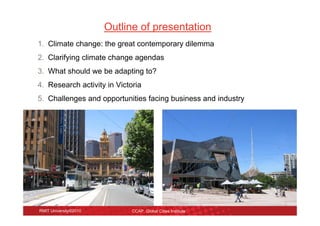
2. Clarifying climate change agendas
3. What should we be adapting to?
4. Research activity in Victoria
5. Challenges and opportunities facing business and industry


RMIT University©2010         CCAP, Global Cities Institute
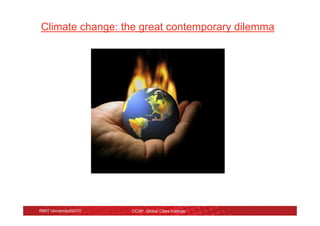
Climate change: the great contemporary dilemma


RMIT University©2010   CCAP, Global Cities Institute
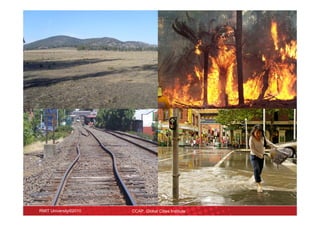
Current day impacts


RMIT University©2010   CCAP, Global Cities Institute
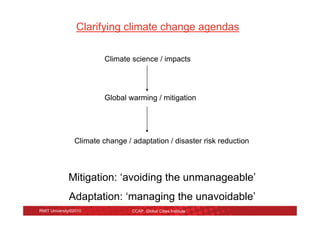
Clarifying climate change agendas

                         Climate science / impacts


                         Global warming / mitigation


                Climate change / adaptation / disaster risk reduction


             Mitigation: ‘avoiding the unmanageable’
              Adaptation: ‘managing the unavoidable’
RMIT University©2010             CCAP, Global Cities Institute
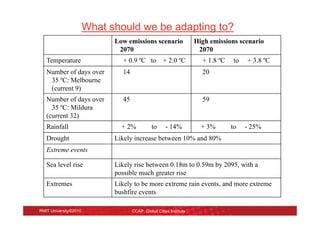
What should we be adapting to?
                             Low emissions scenario                 High emissions scenario
                              2070                                   2070
   Temperature                  + 0.9 ºC to         + 2.0 ºC          + 1.8 ºC    to   + 3.8 ºC
   Number of days over         14                                     20
    35 ºC: Melbourne
    (current 9)
   Number of days over         45                                     59
     35 ºC: Mildura
   (current 32)
   Rainfall                    + 2%           to      - 14%           + 3%       to    - 25%
   Drought                   Likely increase between 10% and 80%
   Extreme events

   Sea level rise            Likely rise between 0.18m to 0.59m by 2095, with a
                             possible much greater rise
   Extremes                  Likely to be more extreme rain events, and more extreme
                             bushfire events

RMIT University©2010                CCAP, Global Cities Institute
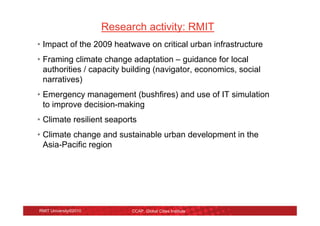
Research activity: RMIT
• Impact of the 2009 heatwave on critical urban infrastructure
• Framing climate change adaptation – guidance for local
  authorities / capacity building (navigator, economics, social
  narratives)
• Emergency management (bushfires) and use of IT simulation
  to improve decision-making
• Climate resilient seaports
• Climate change and sustainable urban development in the
  Asia-Pacific region


RMIT University©2010         CCAP, Global Cities Institute
Research activity: Victorian Centre for Climate
        Change Adaptation Research (VCCCAR)


2010                                  2011

Scenarios                             Responding to the urban heat
                                      island
Resilient urban systems               Enhancing Water Infrastructure
                                      Provision with Climate Change
                                      Uncertainty
Integrated land management            Learning from Indigenous and
                                      traditional community knowledge
Framing adaptation                    Design-led decision support for
                                      regional climate adaptation


  RMIT University©2010    CCAP, Global Cities Institute
‘Think tank’ activity: VCCCAR

• Adapting aspirations and
  expectations on the coastal
  suburban and regional fringe
• Gippsland climate change and
  adaptation study
• Regional Business Development in a
  Variable and Changing Climate:
  Strategies for Central Victoria


RMIT University©2010            CCAP, Global Cities Institute
Challenges
• Means and variability in
  climate will be different in the
  future, and spatially /
  regionally differentiated
• How to cope, and make
  decisions, under conditions of
  uncertainty
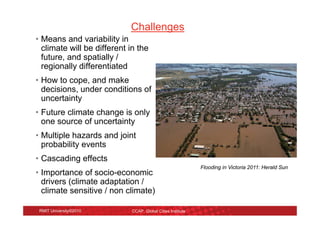
• Future climate change is only
  one source of uncertainty
• Multiple hazards and joint
  probability events
• Cascading effects
                                                             Flooding in Victoria 2011: Herald Sun
• Importance of socio-economic
  drivers (climate adaptation /
  climate sensitive / non climate)

 RMIT University©2010        CCAP, Global Cities Institute
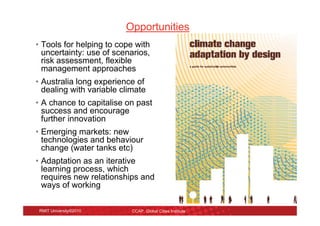
Opportunities
• Tools for helping to cope with
  uncertainty: use of scenarios,
  risk assessment, flexible
  management approaches
• Australia long experience of
  dealing with variable climate
• A chance to capitalise on past
  success and encourage
  further innovation
• Emerging markets: new
  technologies and behaviour
  change (water tanks etc)
• Adaptation as an iterative
  learning process, which
  requires new relationships and
  ways of working

 RMIT University©2010      CCAP, Global Cities Institute
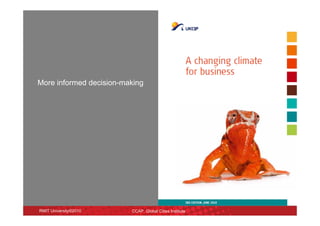
More informed decision-making


RMIT University©2010     CCAP, Global Cities Institute
Thanks for your attention

Darryn.mcevoy@rmit.edu.au

McEvoy_YVW_2011

  • 1.
    Professor Darryn McEvoy Leader of the Climate Change Adaptation Program, Global Cities Institute, RMIT University Deputy Director, Victorian Centre for Climate Change Adaptation (VCCCAR) Solutions and future directions: YVW, August 2011
  • 2.
    Outline of presentation 1.Climate change: the great contemporary dilemma 2. Clarifying climate change agendas 3. What should we be adapting to? 4. Research activity in Victoria 5. Challenges and opportunities facing business and industry RMIT University©2010 CCAP, Global Cities Institute
  • 3.
    Climate change: thegreat contemporary dilemma RMIT University©2010 CCAP, Global Cities Institute
  • 4.
    Current day impacts RMIT University©2010 CCAP, Global Cities Institute
  • 5.
    Clarifying climate changeagendas Climate science / impacts Global warming / mitigation Climate change / adaptation / disaster risk reduction Mitigation: ‘avoiding the unmanageable’ Adaptation: ‘managing the unavoidable’ RMIT University©2010 CCAP, Global Cities Institute
  • 6.
    What should webe adapting to? Low emissions scenario High emissions scenario 2070 2070 Temperature + 0.9 ºC to + 2.0 ºC + 1.8 ºC to + 3.8 ºC Number of days over 14 20 35 ºC: Melbourne (current 9) Number of days over 45 59 35 ºC: Mildura (current 32) Rainfall + 2% to - 14% + 3% to - 25% Drought Likely increase between 10% and 80% Extreme events Sea level rise Likely rise between 0.18m to 0.59m by 2095, with a possible much greater rise Extremes Likely to be more extreme rain events, and more extreme bushfire events RMIT University©2010 CCAP, Global Cities Institute
  • 7.
    Research activity: RMIT •Impact of the 2009 heatwave on critical urban infrastructure • Framing climate change adaptation – guidance for local authorities / capacity building (navigator, economics, social narratives) • Emergency management (bushfires) and use of IT simulation to improve decision-making • Climate resilient seaports • Climate change and sustainable urban development in the Asia-Pacific region RMIT University©2010 CCAP, Global Cities Institute
  • 8.
    Research activity: VictorianCentre for Climate Change Adaptation Research (VCCCAR) 2010 2011 Scenarios Responding to the urban heat island Resilient urban systems Enhancing Water Infrastructure Provision with Climate Change Uncertainty Integrated land management Learning from Indigenous and traditional community knowledge Framing adaptation Design-led decision support for regional climate adaptation RMIT University©2010 CCAP, Global Cities Institute
  • 9.
    ‘Think tank’ activity:VCCCAR • Adapting aspirations and expectations on the coastal suburban and regional fringe • Gippsland climate change and adaptation study • Regional Business Development in a Variable and Changing Climate: Strategies for Central Victoria RMIT University©2010 CCAP, Global Cities Institute
  • 10.
    Challenges • Means andvariability in climate will be different in the future, and spatially / regionally differentiated • How to cope, and make decisions, under conditions of uncertainty • Future climate change is only one source of uncertainty • Multiple hazards and joint probability events • Cascading effects Flooding in Victoria 2011: Herald Sun • Importance of socio-economic drivers (climate adaptation / climate sensitive / non climate) RMIT University©2010 CCAP, Global Cities Institute
  • 11.
    Opportunities • Tools forhelping to cope with uncertainty: use of scenarios, risk assessment, flexible management approaches • Australia long experience of dealing with variable climate • A chance to capitalise on past success and encourage further innovation • Emerging markets: new technologies and behaviour change (water tanks etc) • Adaptation as an iterative learning process, which requires new relationships and ways of working RMIT University©2010 CCAP, Global Cities Institute
  • 12.
    More informed decision-making RMITUniversity©2010 CCAP, Global Cities Institute
  • 13.
    Thanks for yourattention Darryn.mcevoy@rmit.edu.au