The McDonald’s
Way!
Presented by Group 1:
Nilesh Bhatt
Harsh Narula
Vinny Wadhawan
Vineet chauhan
Hitender Singh Khanna
Dileep Kumar
History
 McDonald's is the world's largest
chain of fast food restaurant
 McDonald's has been around since
1955, started by Ray Kroc in Des
Plaines lllinois
 Kroc had bought the previous
company from Dick and Maurice
(Mac) McDonald, who opened their
restaurant in 1940.
Facts
 McDonald's can be found in 119 Countries and territories around the
world.
 Head McDonald's Plaza, is located in Oak Brook, Illinois.
 They serve almost 54 million people each day.
 More McDonald's food is sold in the United States than in any other
area, which means that it is McDonald's largest market.
 Europe is McDonald's second largest market.
 Company provides a central source of supply for food items and
standardized menu.
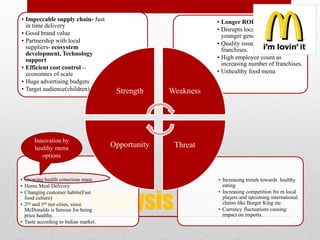
SWOT Analysis
• Increasing trends towards healthy
eating
• Increasing competition fro m local
players and upcoming international
chains like Burger King etc.
• Currency fluctuations causing
impact on imports.
• Growing health conscious mass
• Home Meal Delivery
• Changing customer habits(Fast
food culture)
• 2nd and 3rd tier cities, since
McDonalds is famous for being
price healthy.
• Taste according to Indian market.
• Longer ROI
• Disrupts local eating habit in the
younger generation.
• Quality issues in some
franchises.
• High employee count as
increasing number of franchises.
• Unhealthy food menu
• Impeccable supply chain- Just
in time delivery
• Good brand value
• Partnership with local
suppliers- ecosystem
development, Technology
support
• Efficient cost control –
economies of scale
• Huge advertising budgets
• Target audience(children) Strength Weakness
ThreatOpportunity
Innovation by
healthy menu
options
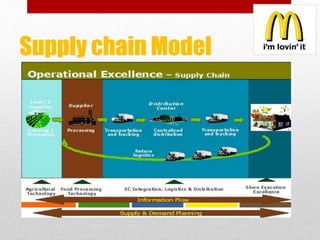
Supply chain Model
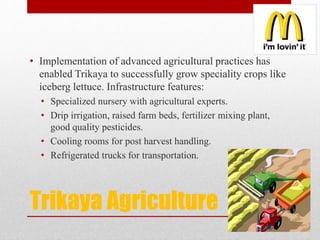
Trikaya Agriculture
• Implementation of advanced agricultural practices has
enabled Trikaya to successfully grow speciality crops like
iceberg lettuce. Infrastructure features:
• Specialized nursery with agricultural experts.
• Drip irrigation, raised farm beds, fertilizer mixing plant,
good quality pesticides.
• Cooling rooms for post harvest handling.
• Refrigerated trucks for transportation.
Vista Processed Foods
• A JV between OSI Industries Inc., and McDonald’s India
Pvt. Ltd.
• Produces a range of frozen chicken and vegetable foods.
• Plant at Taloja, Maharashtra. Infrastructure details:
• Separate processing lines for chicken and vegetable roods.
• Capability to produce frozen foods at -35 degrees to retain
total freshness.
• International standards, procedures and support services.
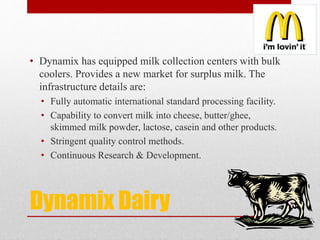
Dynamix Dairy
• Dynamix has equipped milk collection centers with bulk
coolers. Provides a new market for surplus milk. The
infrastructure details are:
• Fully automatic international standard processing facility.
• Capability to convert milk into cheese, butter/ghee,
skimmed milk powder, lactose, casein and other products.
• Stringent quality control methods.
• Continuous Research & Development.
Radhakrishna Foodland
• Provides high range of services including procurement, quality
inspection, storage, inventory management, deliveries, data
collection, recording and reporting. Strong points:
• A one-stop shop for all distribution management services.
• Dry and cold storage facility to store and transport perishable
products at temperatures up to -22 degrees.
• Effective process control for minimum
distribution cost.
Summary
• Market success of McDonald’s can be credited to their strong and very
effective supply-chain.
• Maintain affordability with the help of efficient supply chain.
• Huge amount of stress on innovation and cost cutting.
• Complementary success model.
• Technological advances equips suppliers to venture out in different areas and
grow.
• Few supplier model provides them more volumes to be able to cut costs.
• Intensive supply chain model, extensive market research.
• Stringent food standards encourages suppliers to maintain high quality to
minimize rejections.
• Encourages domestic cultivation to cut import costs.
Hope you enjoyed your
bite!
Thank you!

McDonald's Supply Chain

  • 1.
    The McDonald’s Way! Presented byGroup 1: Nilesh Bhatt Harsh Narula Vinny Wadhawan Vineet chauhan Hitender Singh Khanna Dileep Kumar
  • 2.
    History  McDonald's isthe world's largest chain of fast food restaurant  McDonald's has been around since 1955, started by Ray Kroc in Des Plaines lllinois  Kroc had bought the previous company from Dick and Maurice (Mac) McDonald, who opened their restaurant in 1940.
  • 3.
    Facts  McDonald's canbe found in 119 Countries and territories around the world.  Head McDonald's Plaza, is located in Oak Brook, Illinois.  They serve almost 54 million people each day.  More McDonald's food is sold in the United States than in any other area, which means that it is McDonald's largest market.  Europe is McDonald's second largest market.  Company provides a central source of supply for food items and standardized menu.
  • 4.
    SWOT Analysis • Increasingtrends towards healthy eating • Increasing competition fro m local players and upcoming international chains like Burger King etc. • Currency fluctuations causing impact on imports. • Growing health conscious mass • Home Meal Delivery • Changing customer habits(Fast food culture) • 2nd and 3rd tier cities, since McDonalds is famous for being price healthy. • Taste according to Indian market. • Longer ROI • Disrupts local eating habit in the younger generation. • Quality issues in some franchises. • High employee count as increasing number of franchises. • Unhealthy food menu • Impeccable supply chain- Just in time delivery • Good brand value • Partnership with local suppliers- ecosystem development, Technology support • Efficient cost control – economies of scale • Huge advertising budgets • Target audience(children) Strength Weakness ThreatOpportunity Innovation by healthy menu options
  • 5.
  • 6.
    Trikaya Agriculture • Implementationof advanced agricultural practices has enabled Trikaya to successfully grow speciality crops like iceberg lettuce. Infrastructure features: • Specialized nursery with agricultural experts. • Drip irrigation, raised farm beds, fertilizer mixing plant, good quality pesticides. • Cooling rooms for post harvest handling. • Refrigerated trucks for transportation.
  • 7.
    Vista Processed Foods •A JV between OSI Industries Inc., and McDonald’s India Pvt. Ltd. • Produces a range of frozen chicken and vegetable foods. • Plant at Taloja, Maharashtra. Infrastructure details: • Separate processing lines for chicken and vegetable roods. • Capability to produce frozen foods at -35 degrees to retain total freshness. • International standards, procedures and support services.
  • 8.
    Dynamix Dairy • Dynamixhas equipped milk collection centers with bulk coolers. Provides a new market for surplus milk. The infrastructure details are: • Fully automatic international standard processing facility. • Capability to convert milk into cheese, butter/ghee, skimmed milk powder, lactose, casein and other products. • Stringent quality control methods. • Continuous Research & Development.
  • 9.
    Radhakrishna Foodland • Provideshigh range of services including procurement, quality inspection, storage, inventory management, deliveries, data collection, recording and reporting. Strong points: • A one-stop shop for all distribution management services. • Dry and cold storage facility to store and transport perishable products at temperatures up to -22 degrees. • Effective process control for minimum distribution cost.
  • 10.
    Summary • Market successof McDonald’s can be credited to their strong and very effective supply-chain. • Maintain affordability with the help of efficient supply chain. • Huge amount of stress on innovation and cost cutting. • Complementary success model. • Technological advances equips suppliers to venture out in different areas and grow. • Few supplier model provides them more volumes to be able to cut costs. • Intensive supply chain model, extensive market research. • Stringent food standards encourages suppliers to maintain high quality to minimize rejections. • Encourages domestic cultivation to cut import costs.
  • 11.
    Hope you enjoyedyour bite! Thank you!