K.VAITHEESWARAN
ADVOCATE &TAX CONSULTANT
‘VENKATAGIRI’
Flat No.8/3 & 8/4, Ground Floor,
No.8 (Old No.9), Sivaprakasam Street,
T. Nagar, Chennai - 600 017, India
Tel.: 044 + 2433 1029 / 4048
402, Front Wing,
House of Lords,
15/16, St. Marks Road,
Bangalore – 560 001, India
Tel : 080 22244854/ 41120804
Mobile: 98400-96876
E-mail : vaithilegal@yahoo.co.in / vaithilegal@gmail.com
www.vaithilegal.com
 VAT driven local purchases
 Cost driven CST purchases
 Duty burden on imports
 Complex State Laws
 Ever changing tax landscape
 Different decisions on the same issue
 Border controls
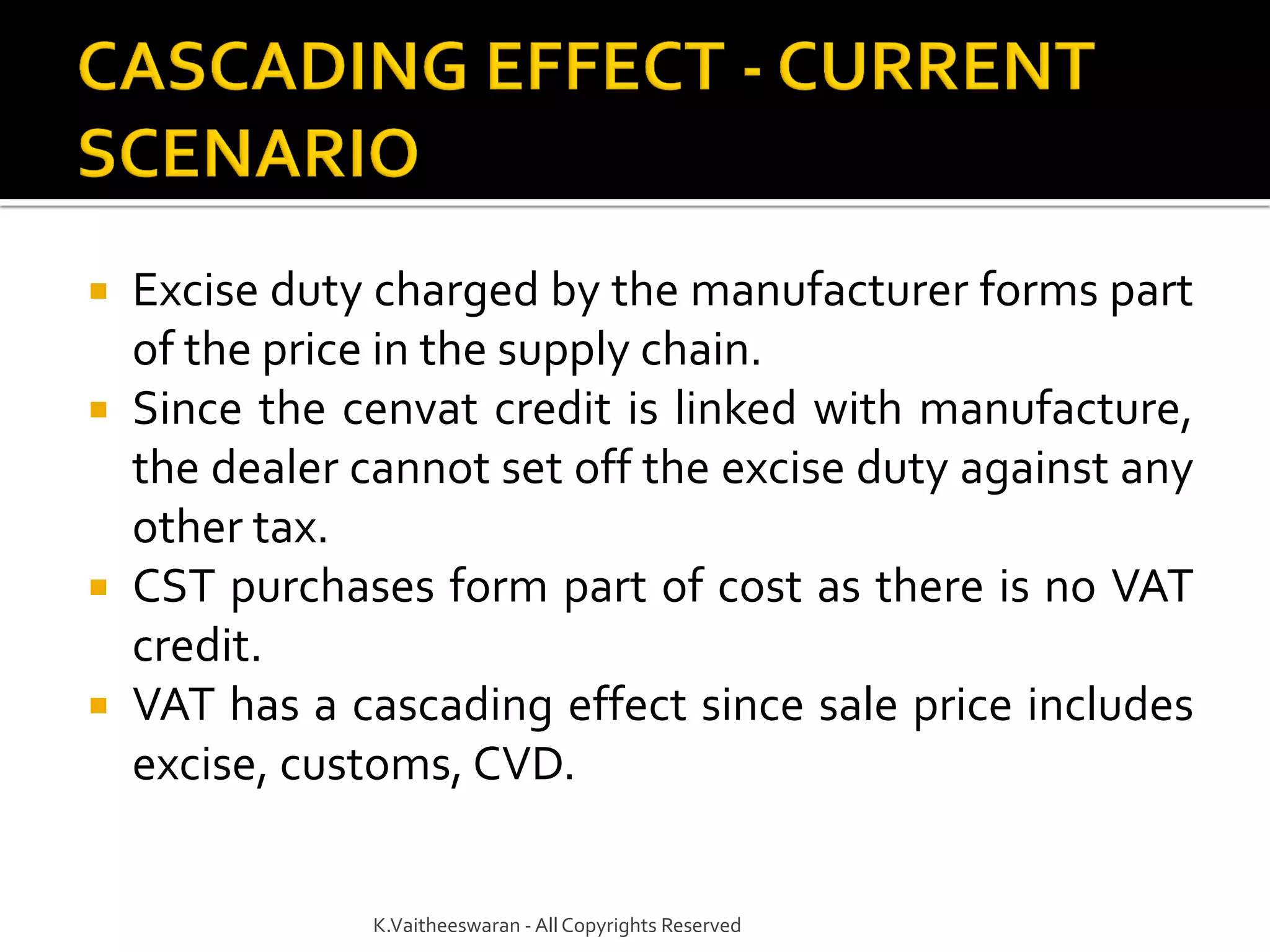
 Excise duty charged by the manufacturer forms part
of the price in the supply chain.
 Since the cenvat credit is linked with manufacture,
the dealer cannot set off the excise duty against any
other tax.
 CST purchases form part of cost as there is no VAT
credit.
 VAT has a cascading effect since sale price includes
excise, customs, CVD.
K.Vaitheeswaran - AllCopyrights Reserved
 Constitution 101st Amendment Act.
 GST Council
 New system of indirect taxation moving away from Entries in the Union
and State List.
 Major role to be played by the GST Council.
 CGST Act, 2017; IGSTAct 2017; GST (Compensation to States) Act 2017;
and UnionTerritory GST Act, 2017 passed by the Parliament and received
the assent of the President on 12.04.2017.
 Taxation LawsAmendment Bill, 2017.
 SGSTAct to be passed by 29 States and Rules issued.
 Telangana SGSTAct, 2017 passed by the Legislature.
 IT infrastructure should be in place.
 01.07.2017.
 Significance of 16.09.2017.
K.Vaitheeswaran - AllCopyrights Reserved
 Path breaking tax reform
 Harmonization of taxes
 Elimination of tax as a cost
 Possible elimination of unwanted business structures
 Long way to go
 Too many compromises
 Complex legal structure
 Not a simple law
 Huge potential for conflict
K.Vaitheeswaran - AllCopyrights Reserved
 It extends to the whole of India except the State of Jammu
and Kashmir.
 Article 370 only refers to matters in the Union list and
Concurrent list.
 GST is a levy under Article 246A independent of the entries.
 Excise Duty applicable to J&K from 1986
 CST applicable to J&K from 1956
 Act shall come into force from a date to be notified and
different dates can be notified for different provisions
 Central tax means the CGST levied under Section 9
 CGST on
 all intra-State supplies of goods or services or both except on the supply of
alcoholic liquor
 On the value determined under Section 17
 At such rates not exceeding 20% as may be notified by the Government on
the recommendations of the Council
 Collected in such manner as may be prescribed and shall be paid by the
taxable person
 A levy through legislation without a schedule of goods or services
 Notification would be critical
 CGST on petroleum / HSD / petrol / natural gas and ATF from such date
as may be notified by the Government on the recommendations of the
Council
K.Vaitheeswaran
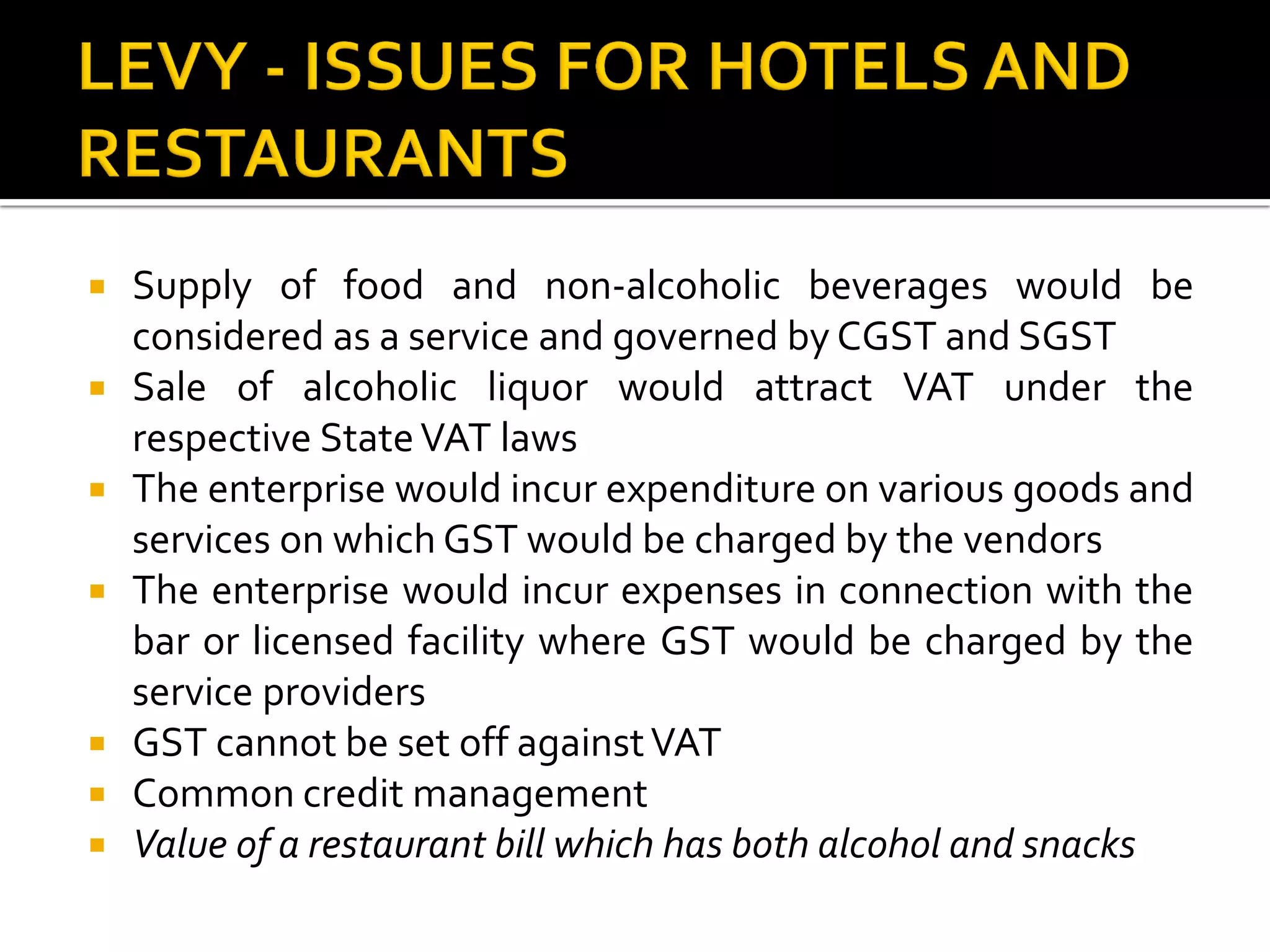
 Supply of food and non-alcoholic beverages would be
considered as a service and governed by CGST and SGST
 Sale of alcoholic liquor would attract VAT under the
respective StateVAT laws
 The enterprise would incur expenditure on various goods and
services on which GST would be charged by the vendors
 The enterprise would incur expenses in connection with the
bar or licensed facility where GST would be charged by the
service providers
 GST cannot be set off againstVAT
 Common credit management
 Value of a restaurant bill which has both alcohol and snacks
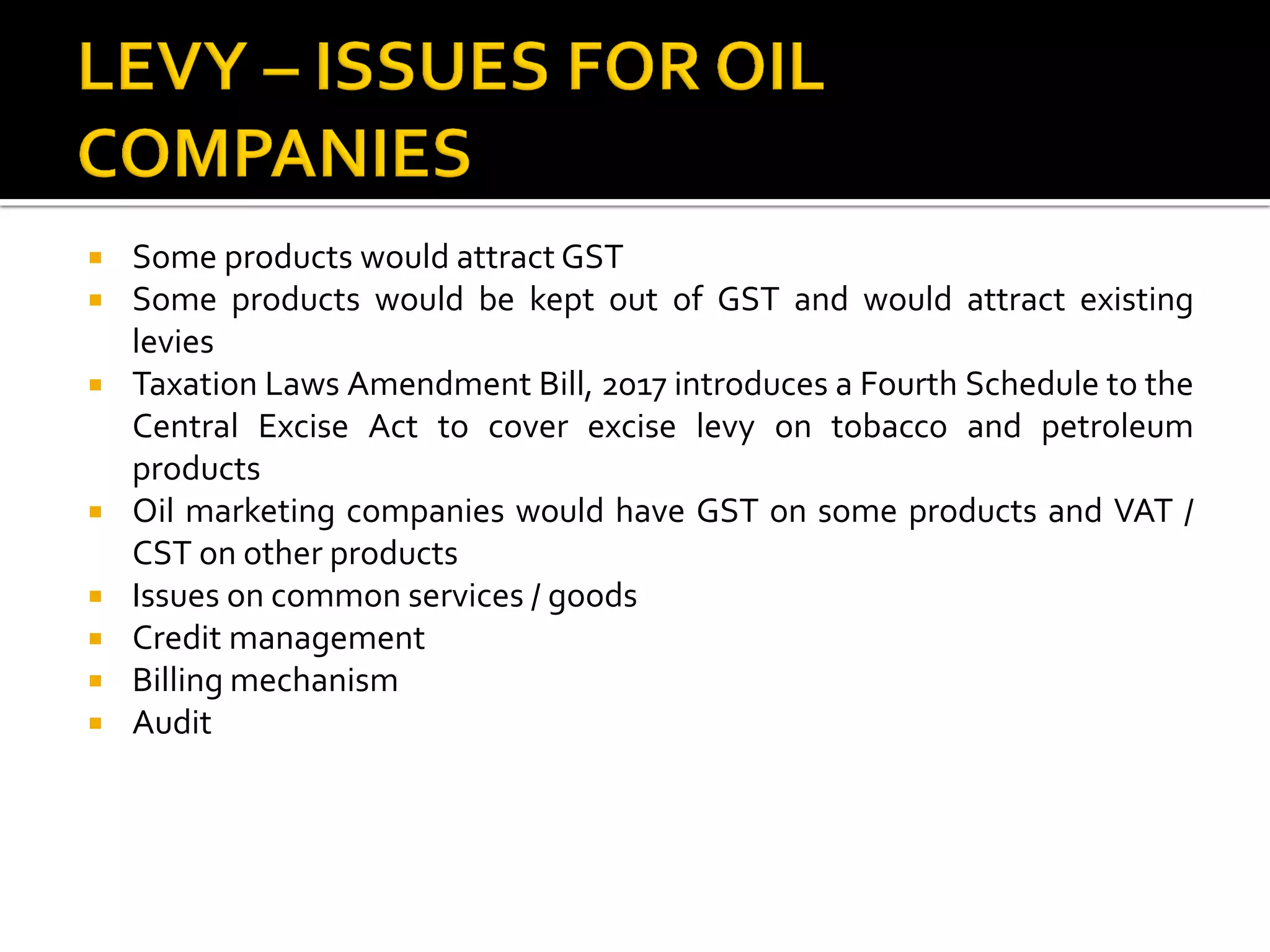
 Some products would attract GST
 Some products would be kept out of GST and would attract existing
levies
 Taxation Laws Amendment Bill, 2017 introduces a Fourth Schedule to the
Central Excise Act to cover excise levy on tobacco and petroleum
products
 Oil marketing companies would have GST on some products and VAT /
CST on other products
 Issues on common services / goods
 Credit management
 Billing mechanism
 Audit
 Supply includes
 All forms of supply of goods or services or both such as
sale, transfer, barter, exchange, license, rental, lease or
disposal made or agreed to be made for a consideration
by a person in the course or furtherance of business.
 Import of service for a consideration and whether or not
in the course or furtherance of business.
 Activities specified in Schedule-I – made or agreed to be
made without a consideration.
 Activities to be treated as supply of goods or supply of
services referred to in Schedule - II
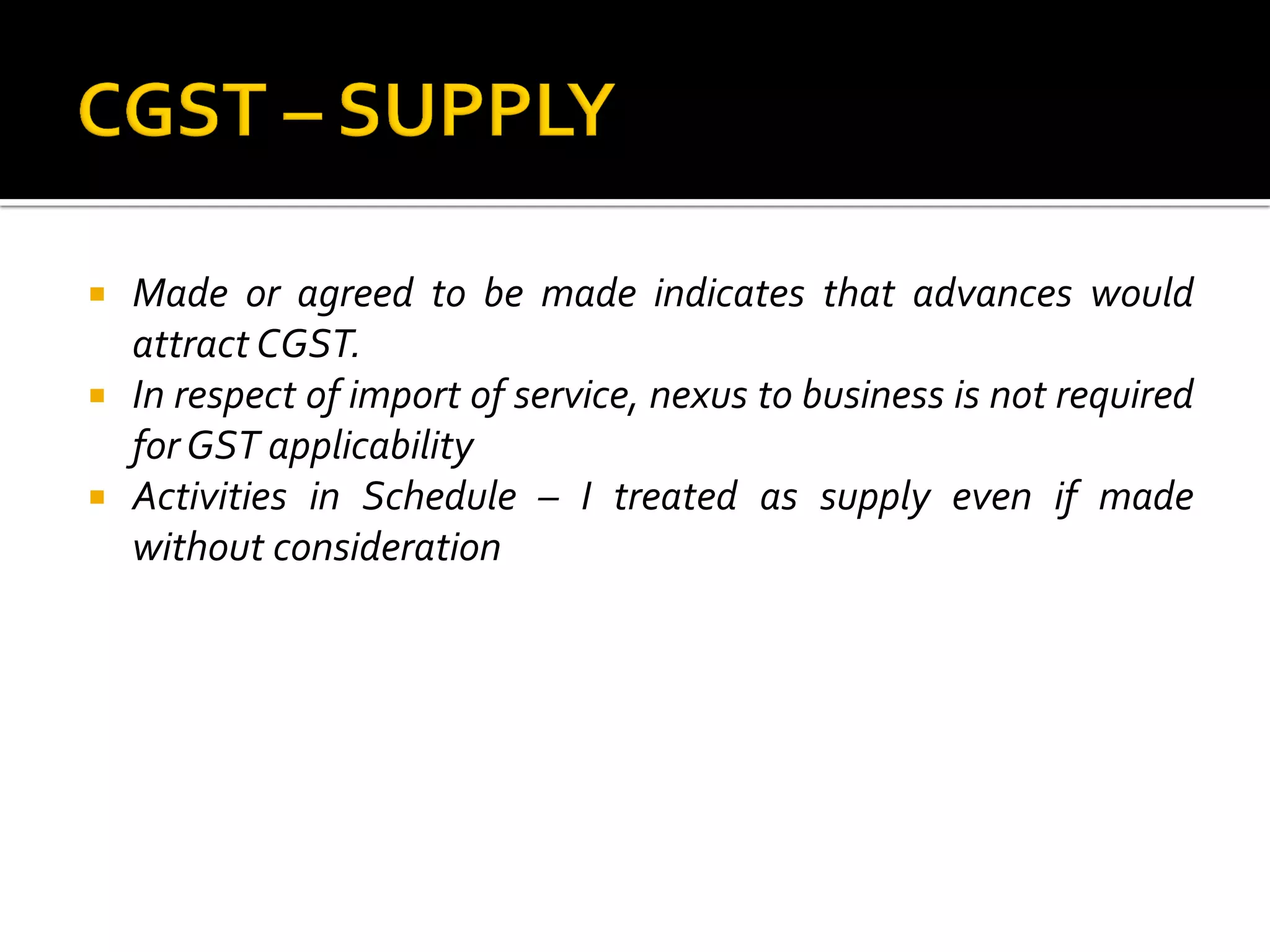
 Made or agreed to be made indicates that advances would
attract CGST.
 In respect of import of service, nexus to business is not required
for GST applicability
 Activities in Schedule – I treated as supply even if made
without consideration
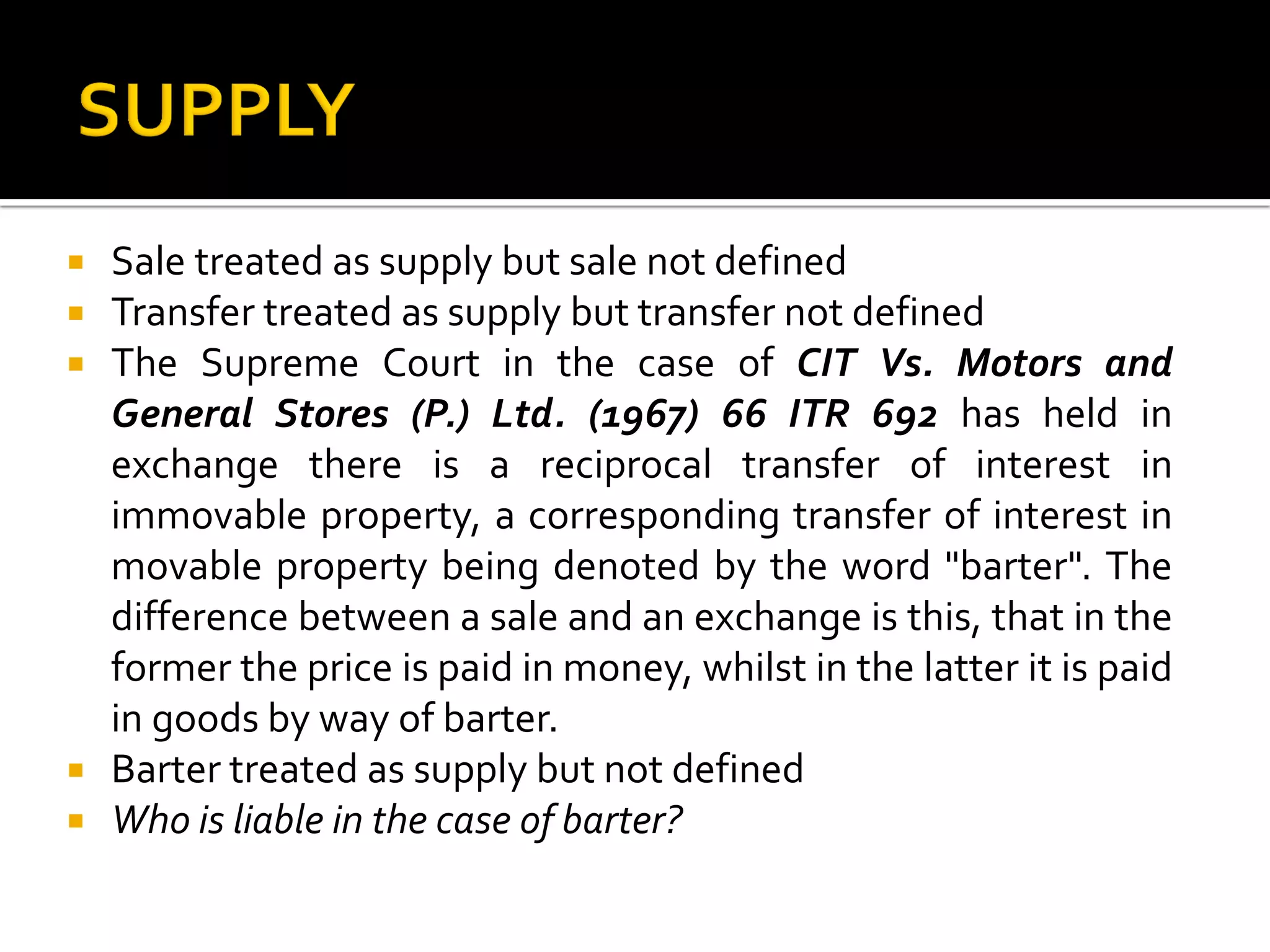
 Sale treated as supply but sale not defined
 Transfer treated as supply but transfer not defined
 The Supreme Court in the case of CIT Vs. Motors and
General Stores (P.) Ltd. (1967) 66 ITR 692 has held in
exchange there is a reciprocal transfer of interest in
immovable property, a corresponding transfer of interest in
movable property being denoted by the word "barter". The
difference between a sale and an exchange is this, that in the
former the price is paid in money, whilst in the latter it is paid
in goods by way of barter.
 Barter treated as supply but not defined
 Who is liable in the case of barter?
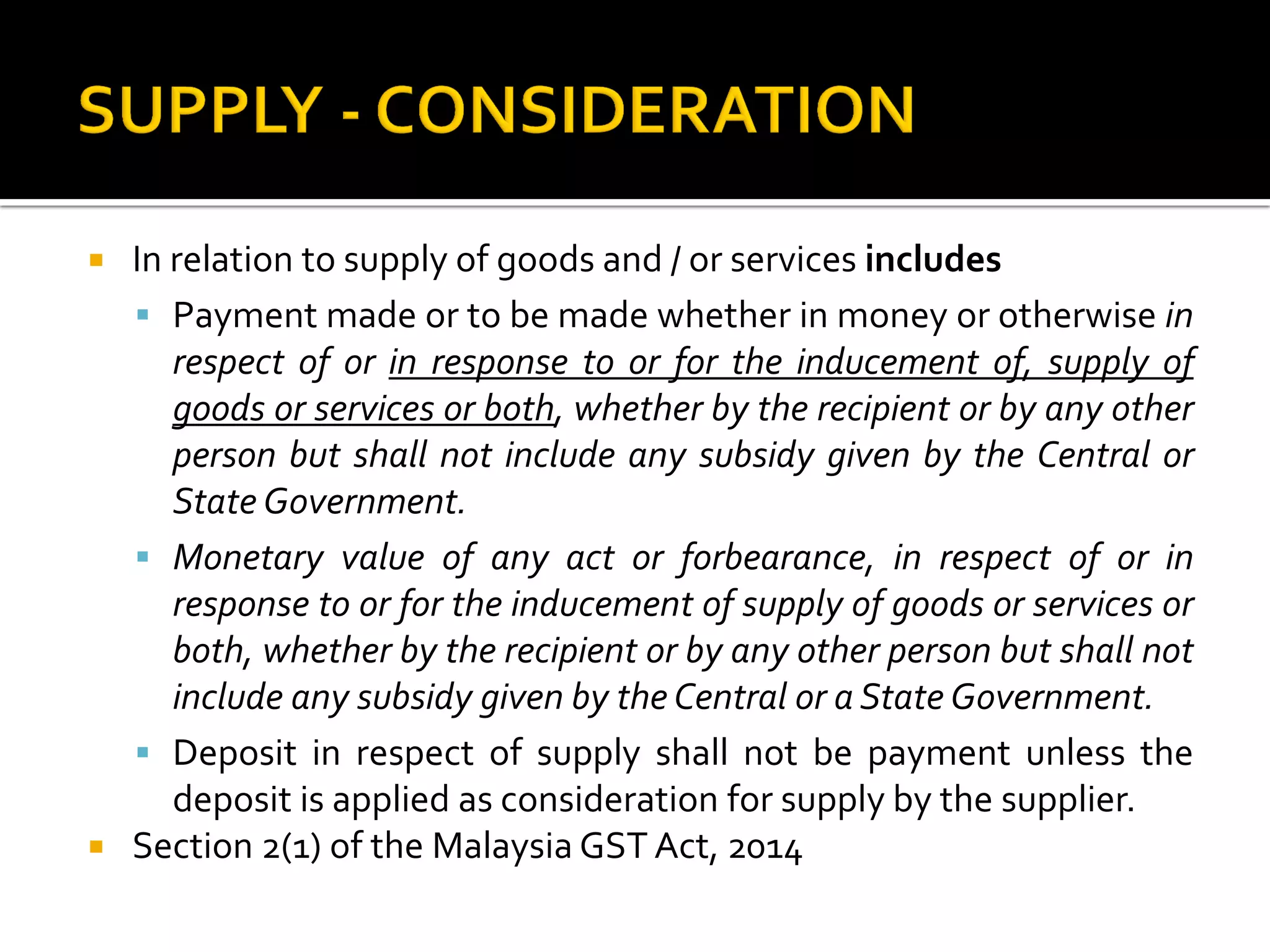
 In relation to supply of goods and / or services includes
 Payment made or to be made whether in money or otherwise in
respect of or in response to or for the inducement of, supply of
goods or services or both, whether by the recipient or by any other
person but shall not include any subsidy given by the Central or
State Government.
 Monetary value of any act or forbearance, in respect of or in
response to or for the inducement of supply of goods or services or
both, whether by the recipient or by any other person but shall not
include any subsidy given by the Central or a State Government.
 Deposit in respect of supply shall not be payment unless the
deposit is applied as consideration for supply by the supplier.
 Section 2(1) of the Malaysia GST Act, 2014
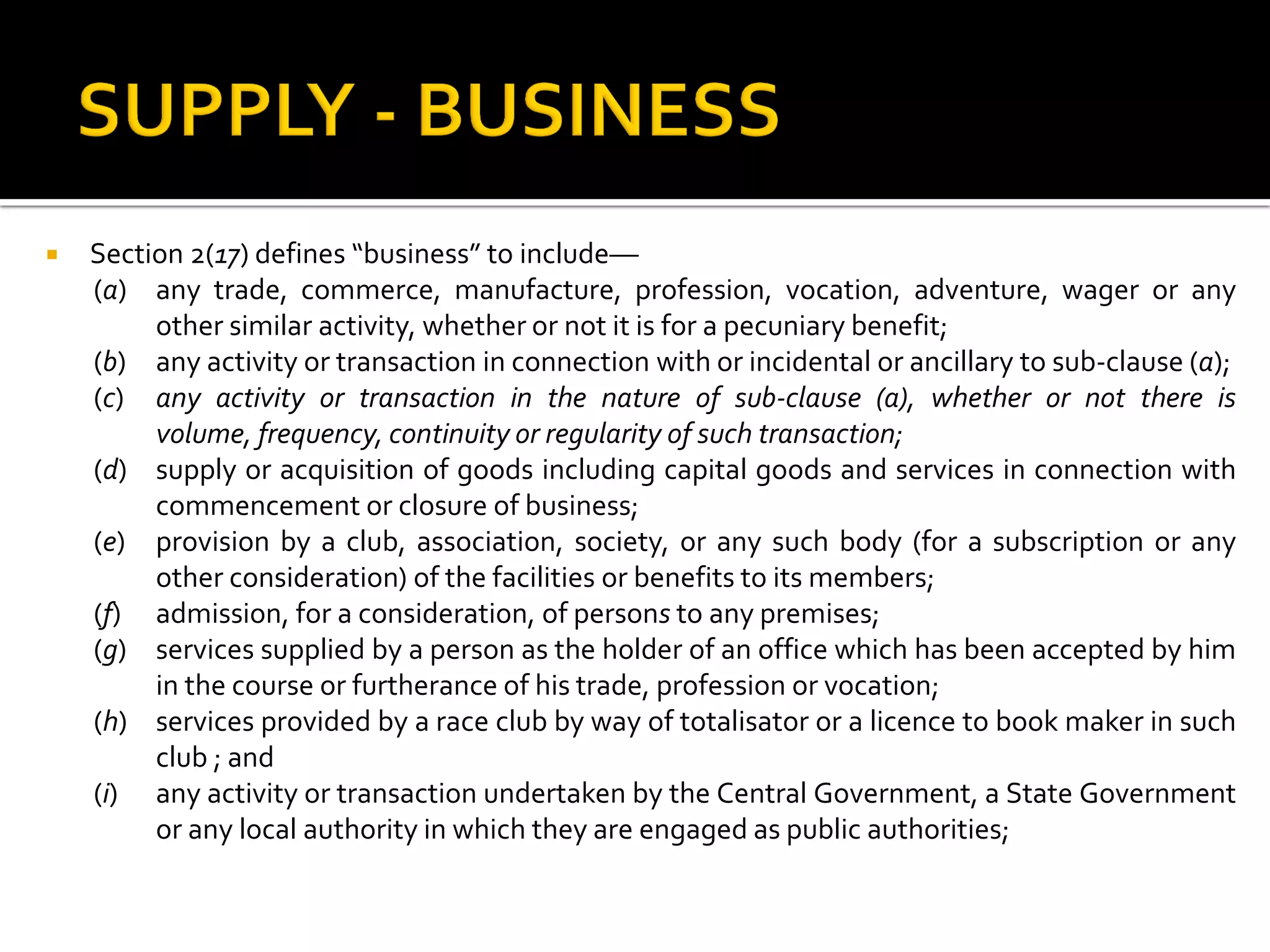
 Section 2(17) defines “business” to include––
(a) any trade, commerce, manufacture, profession, vocation, adventure, wager or any
other similar activity, whether or not it is for a pecuniary benefit;
(b) any activity or transaction in connection with or incidental or ancillary to sub-clause (a);
(c) any activity or transaction in the nature of sub-clause (a), whether or not there is
volume, frequency, continuity or regularity of such transaction;
(d) supply or acquisition of goods including capital goods and services in connection with
commencement or closure of business;
(e) provision by a club, association, society, or any such body (for a subscription or any
other consideration) of the facilities or benefits to its members;
(f) admission, for a consideration, of persons to any premises;
(g) services supplied by a person as the holder of an office which has been accepted by him
in the course or furtherance of his trade, profession or vocation;
(h) services provided by a race club by way of totalisator or a licence to book maker in such
club ; and
(i) any activity or transaction undertaken by the Central Government, a State Government
or any local authority in which they are engaged as public authorities;
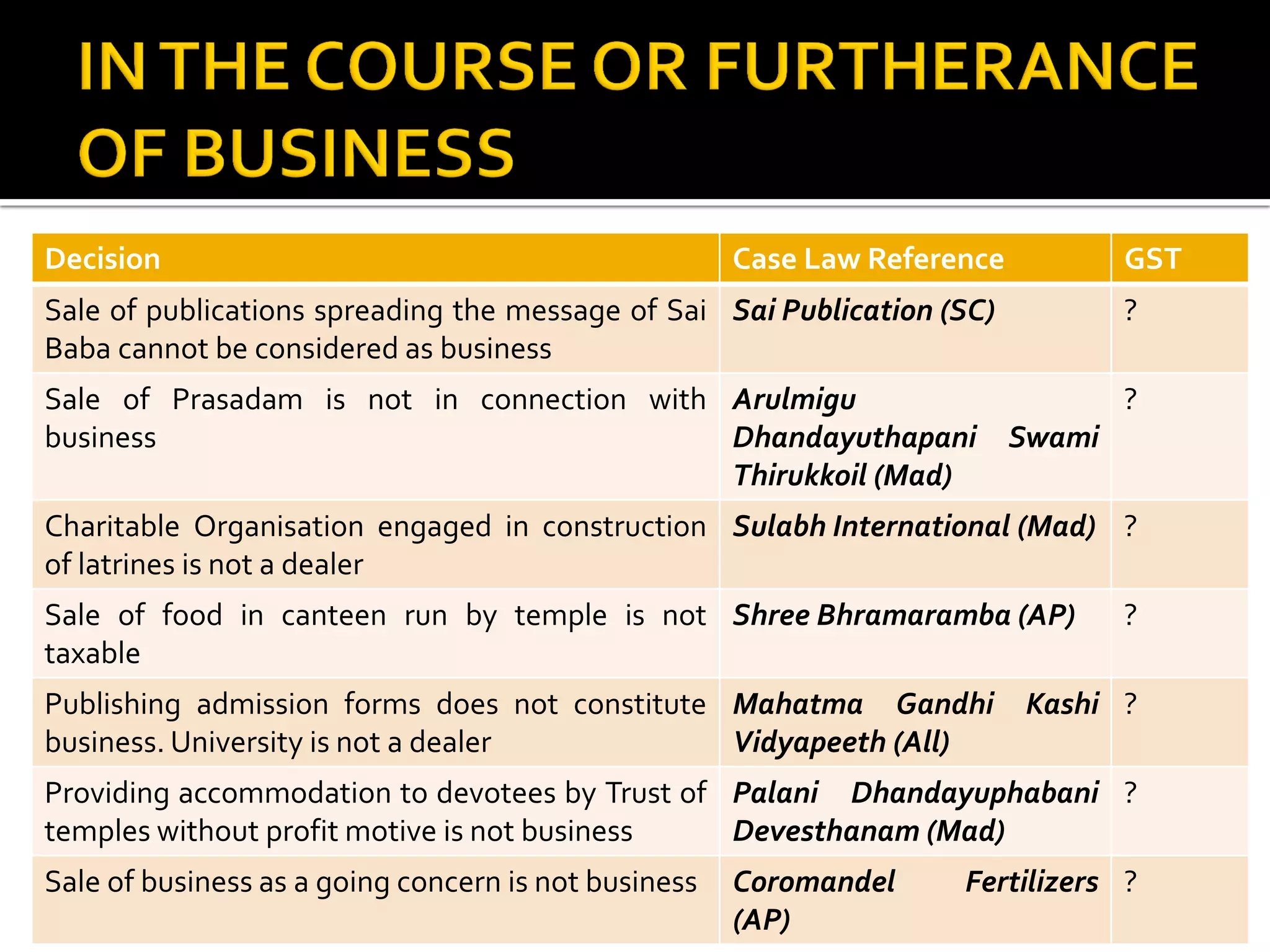
Decision Case Law Reference GST
Sale of publications spreading the message of Sai
Baba cannot be considered as business
Sai Publication (SC) ?
Sale of Prasadam is not in connection with
business
Arulmigu
Dhandayuthapani Swami
Thirukkoil (Mad)
?
Charitable Organisation engaged in construction
of latrines is not a dealer
Sulabh International (Mad) ?
Sale of food in canteen run by temple is not
taxable
Shree Bhramaramba (AP) ?
Publishing admission forms does not constitute
business. University is not a dealer
Mahatma Gandhi Kashi
Vidyapeeth (All)
?
Providing accommodation to devotees by Trust of
temples without profit motive is not business
Palani Dhandayuphabani
Devesthanam (Mad)
?
Sale of business as a going concern is not business Coromandel Fertilizers
(AP)
?
TRANSACTION EXISTING PROPOSED
Manufacture and removal within a State ED CGST + SGST
Manufacture and removal inter-State ED IGST
Manufacture and sale within the State ED +VAT CGST + SGST
Manufacture and inter-State sale ED + CST IGST
Sale by a trader within a State VAT CGST + SGST
Sale by a trader – inter-State CST IGST
Barter Not taxable* Taxable
Exchange Not taxable* Taxable
License – Royalty – Local ServiceTax CGST + SGST
License – Royalty – inter-State ServiceTax IGST
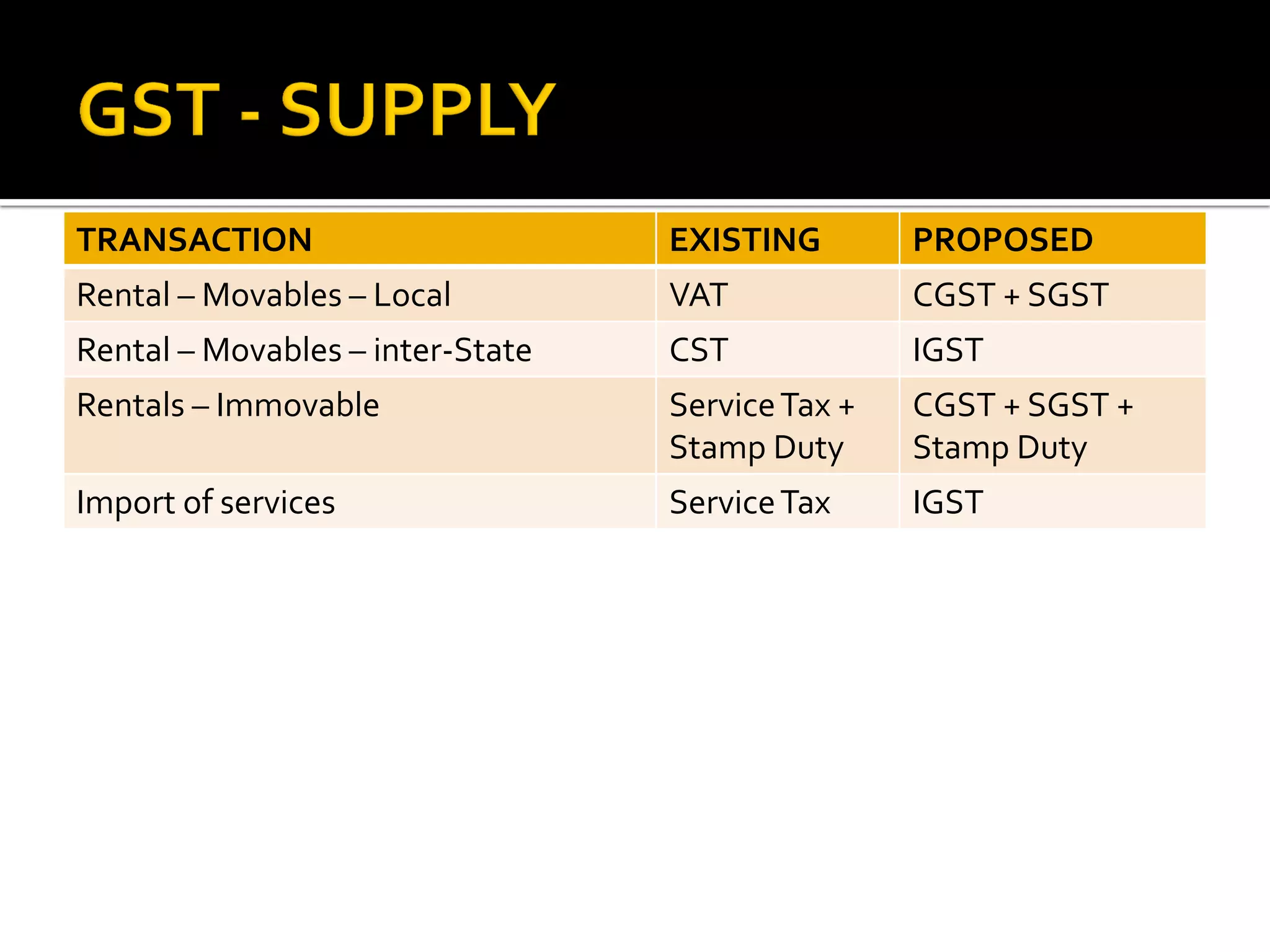
TRANSACTION EXISTING PROPOSED
Rental – Movables – Local VAT CGST + SGST
Rental – Movables – inter-State CST IGST
Rentals – Immovable ServiceTax +
Stamp Duty
CGST + SGST +
Stamp Duty
Import of services ServiceTax IGST
 Permanent transfer / disposal of business assets where ITC has been
availed on such assets.
 Supply of goods or services or both between related persons or between
distinct persons as specified in Section 25, when made in the course or
furtherance of business.
 Provided gifts not exceeding Rs. 50,000 in value in a financial year by an employer to an
employee shall not be treated as supply of goods or services or both
 Supply of goods by principal to agent where the agent undertakes to
supply such goods on behalf of principal.
 Supply of goods by agent to principal where the agent undertakes to
receive such goods on behalf of the principal.
 Import of services by a taxable person from a related person or from any
of his other establishments outside India, in the course or furtherance of
business.
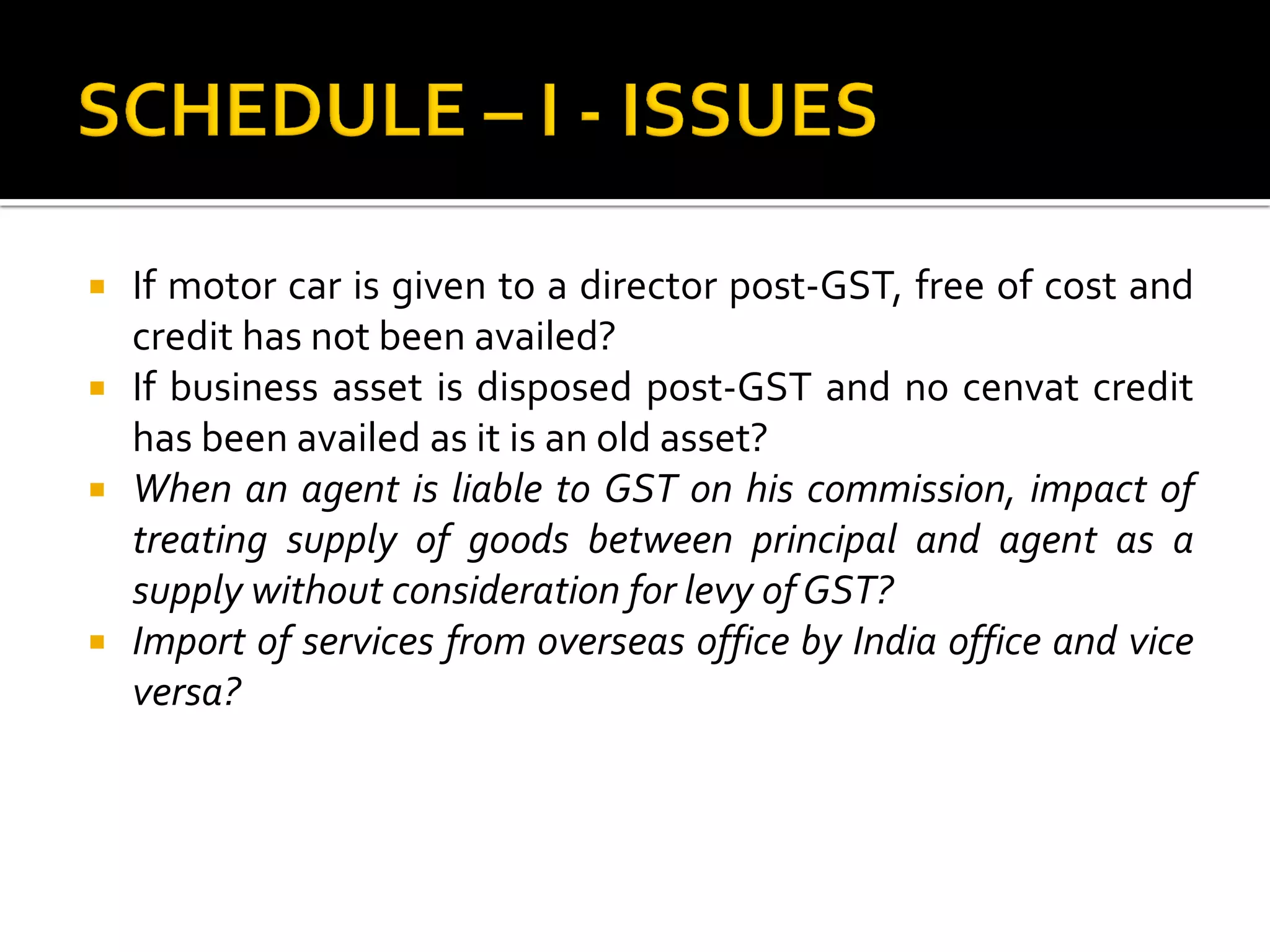
 If motor car is given to a director post-GST, free of cost and
credit has not been availed?
 If business asset is disposed post-GST and no cenvat credit
has been availed as it is an old asset?
 When an agent is liable to GST on his commission, impact of
treating supply of goods between principal and agent as a
supply without consideration for levy of GST?
 Import of services from overseas office by India office and vice
versa?
 Supply of goods between factory and depots
 Supply of goods between depot and another depot
 Supply of services by marketing office to head office
 Supply of services by corporate office to other offices
 Inter-Unit supply of goods or services
 Concept of cost allocation
 Concept of taxable supplies of goods and services within the
organisation
 Inter-Unit billing
 Payment of tax
 Input tax credits
 Compliance requirements
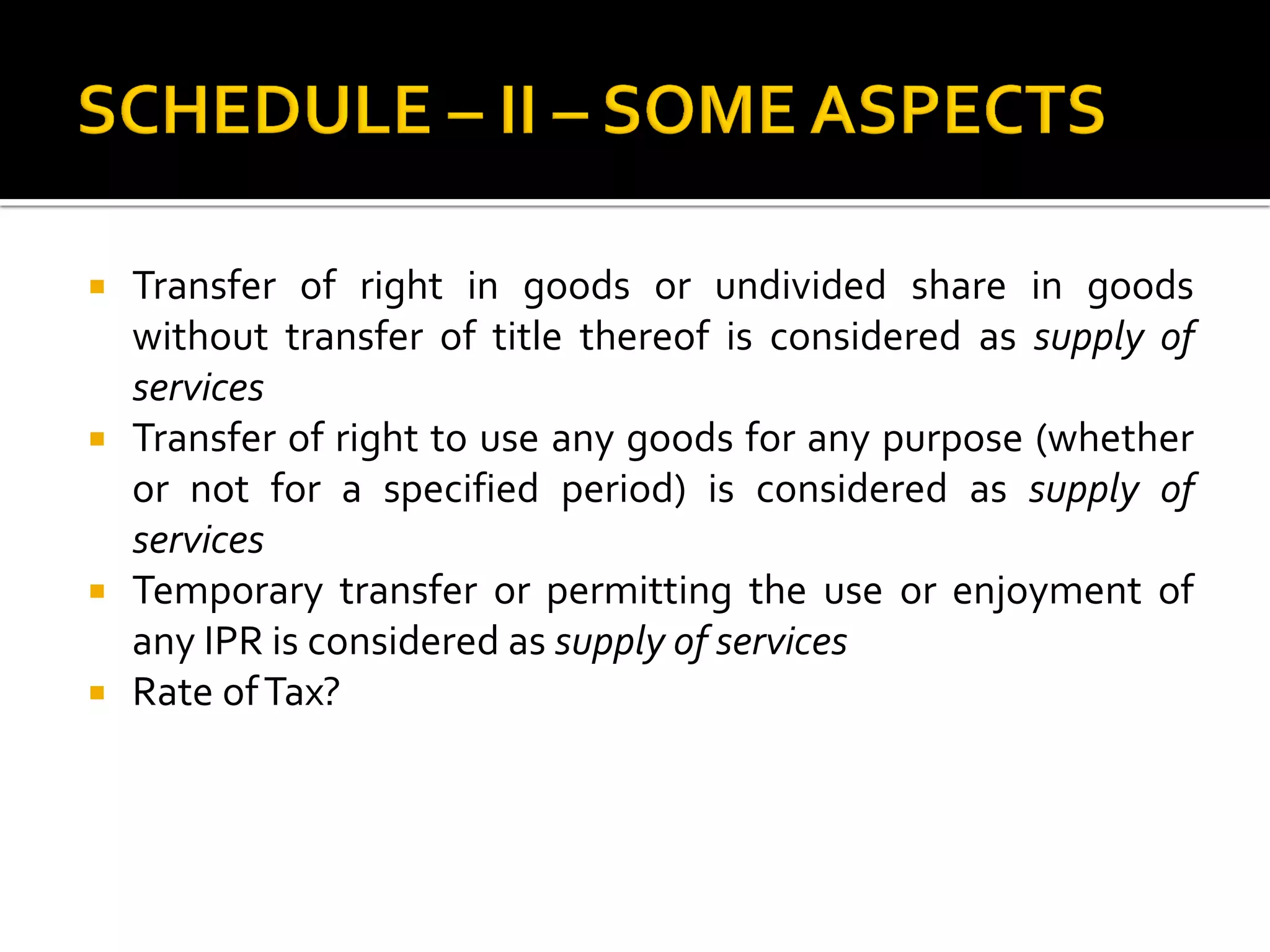
 Transfer of right in goods or undivided share in goods
without transfer of title thereof is considered as supply of
services
 Transfer of right to use any goods for any purpose (whether
or not for a specified period) is considered as supply of
services
 Temporary transfer or permitting the use or enjoyment of
any IPR is considered as supply of services
 Rate ofTax?
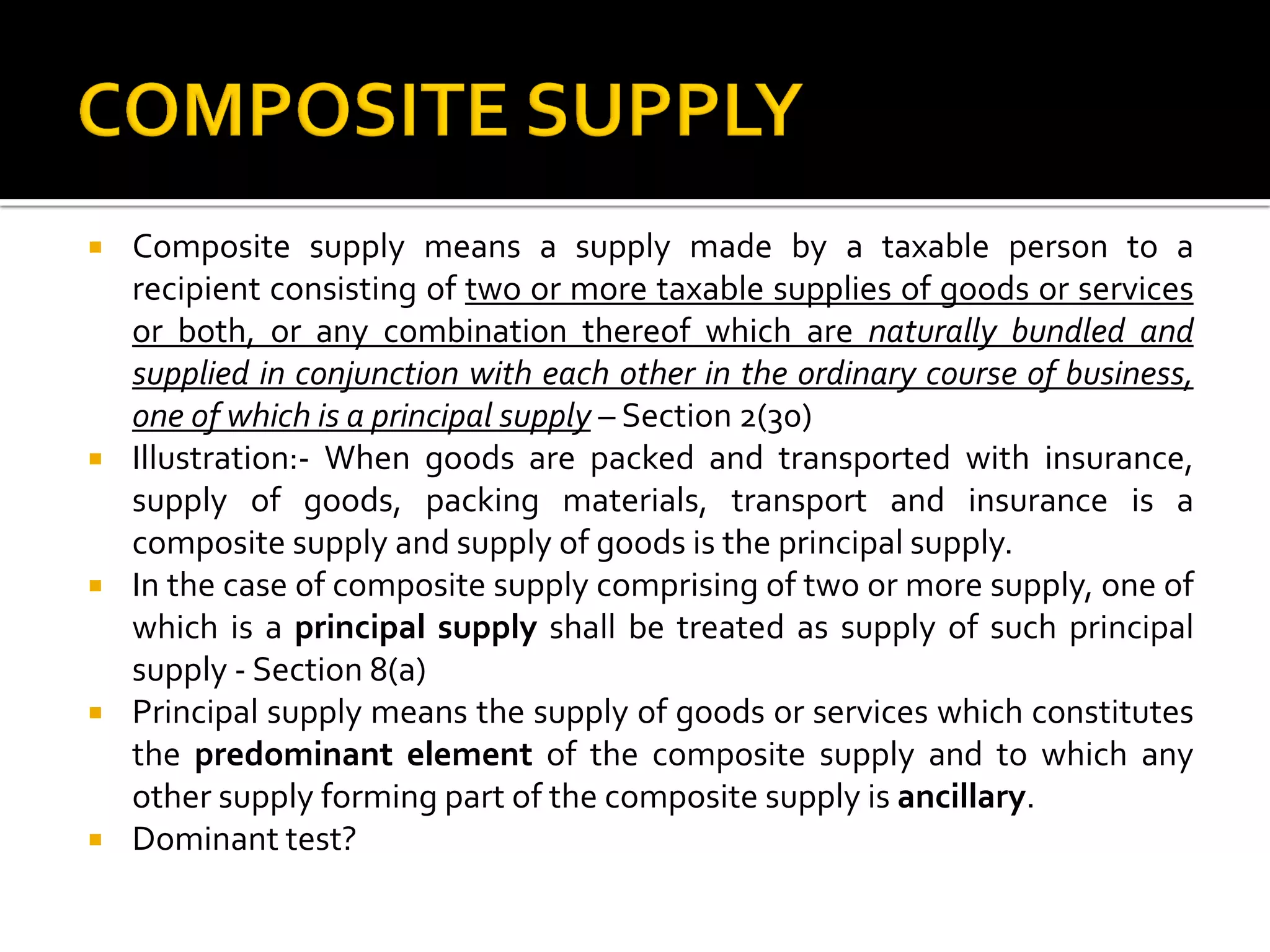
 Composite supply means a supply made by a taxable person to a
recipient consisting of two or more taxable supplies of goods or services
or both, or any combination thereof which are naturally bundled and
supplied in conjunction with each other in the ordinary course of business,
one of which is a principal supply – Section 2(30)
 Illustration:- When goods are packed and transported with insurance,
supply of goods, packing materials, transport and insurance is a
composite supply and supply of goods is the principal supply.
 In the case of composite supply comprising of two or more supply, one of
which is a principal supply shall be treated as supply of such principal
supply - Section 8(a)
 Principal supply means the supply of goods or services which constitutes
the predominant element of the composite supply and to which any
other supply forming part of the composite supply is ancillary.
 Dominant test?
 When a consumer buys a television set and he also gets
warranty and a maintenance contract with the TV, this supply
is a composite supply. In this example, supply of TV is the
principal supply, warranty and maintenance service are
ancillary.
 Composite supply shall be treated as supply of the principal
supply.
 Mixed supply would be treated as supply of that particular
goods or services which attracts the highest rate of tax.
 Software Development
 Software Licensing
 Design
 Testing
 Implementation
 AMC
 Comprehensive contracts
 Composite Supply?
 Mixed Supply ?
 Difference between Goods and Services
 Different Place of Supply provisions forGoods and Services
 Nature of contract
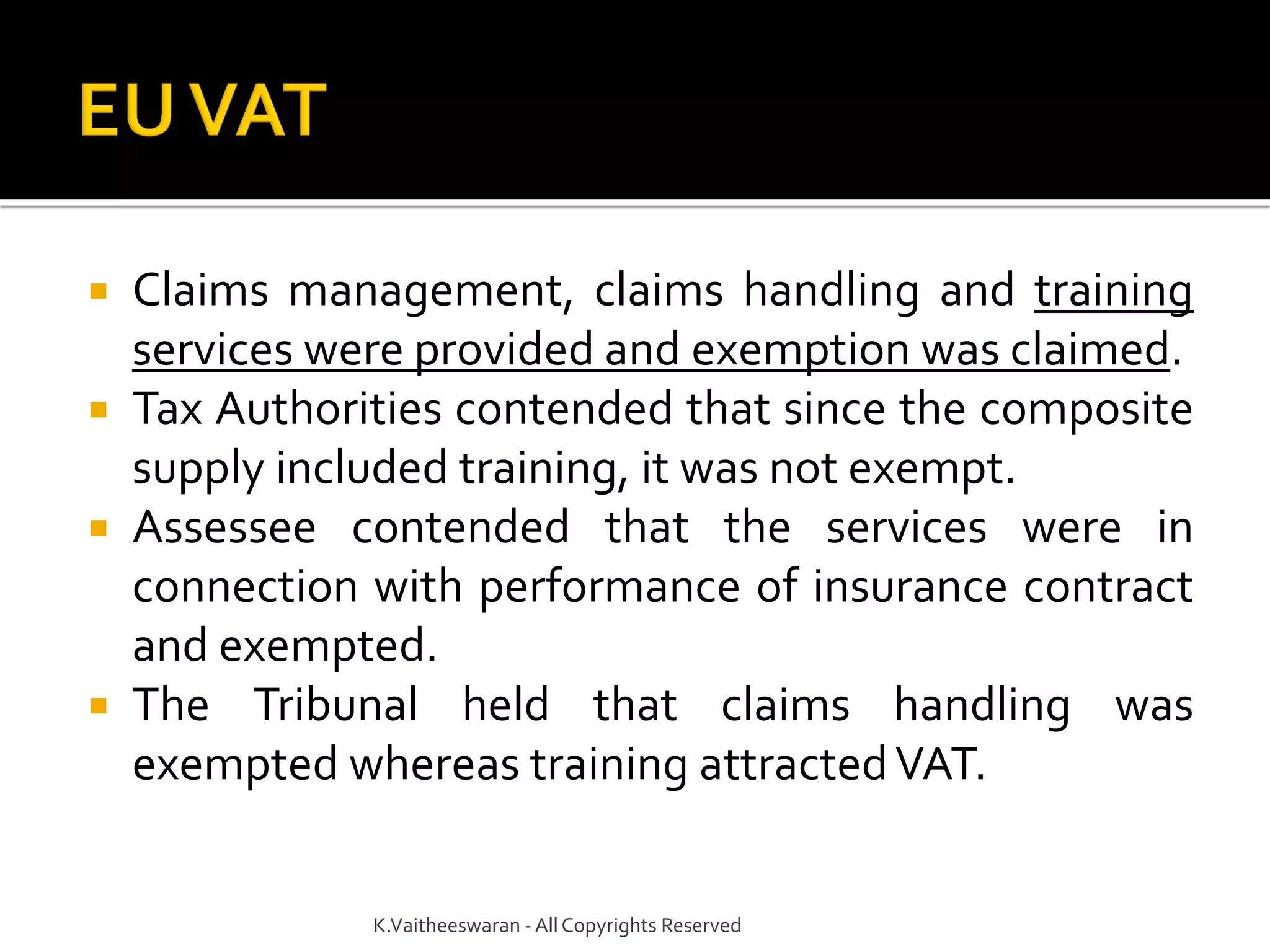
 Claims management, claims handling and training
services were provided and exemption was claimed.
 Tax Authorities contended that since the composite
supply included training, it was not exempt.
 Assessee contended that the services were in
connection with performance of insurance contract
and exempted.
 The Tribunal held that claims handling was
exempted whereas training attractedVAT.
K.Vaitheeswaran - AllCopyrights Reserved
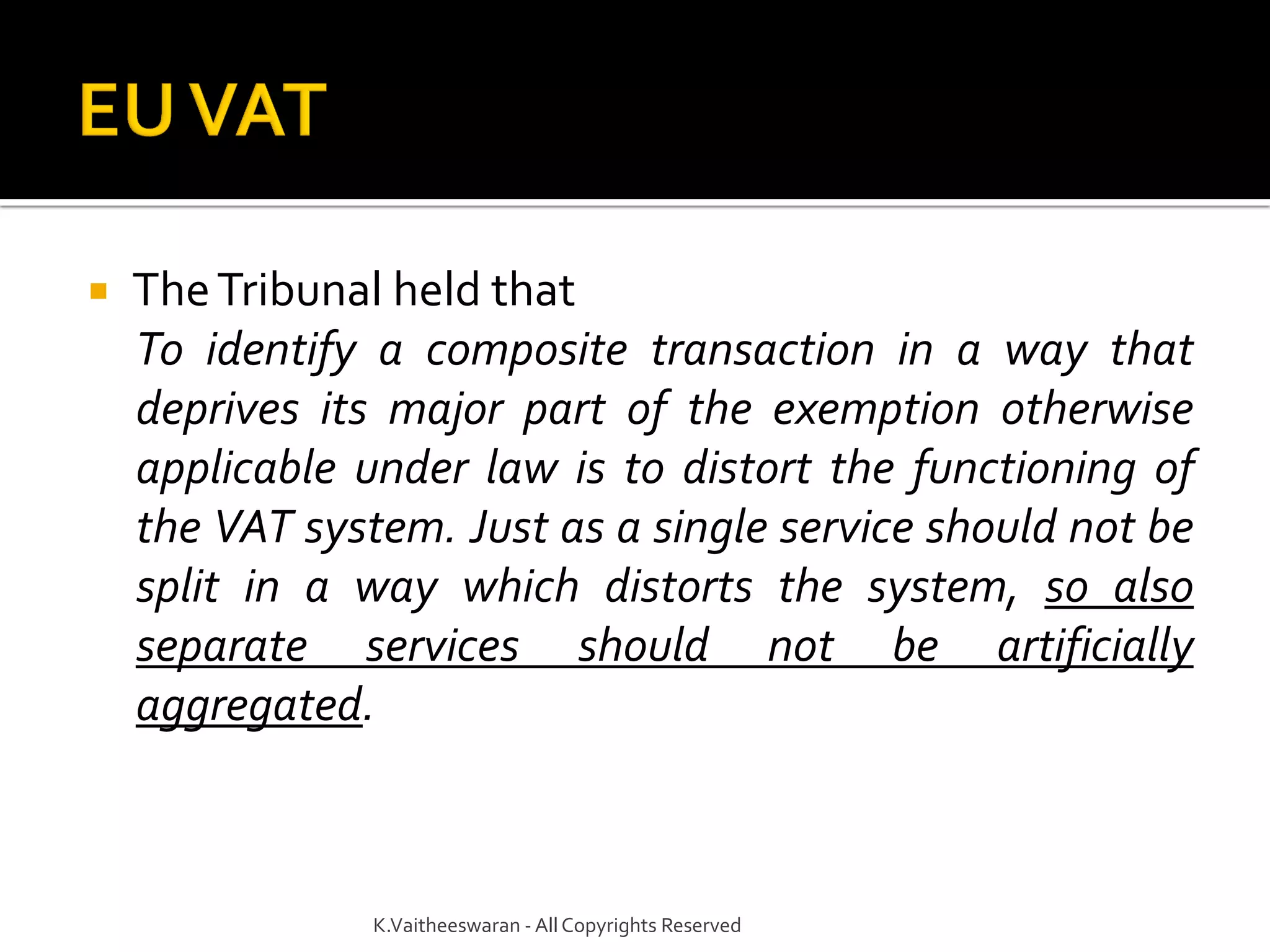
 TheTribunal held that
To identify a composite transaction in a way that
deprives its major part of the exemption otherwise
applicable under law is to distort the functioning of
the VAT system. Just as a single service should not be
split in a way which distorts the system, so also
separate services should not be artificially
aggregated.
K.Vaitheeswaran - AllCopyrights Reserved
 On payment of £ 16 a customer whose credit cards
were lost or stolen would be indemnified upto £ 750
against claims.
 An insurance broker was engaged to arrange for an
appropriate insurance policy and VAT was not paid
on the payments received from customers for this
service on the ground that it is exempted.
K.Vaitheeswaran - AllCopyrights Reserved
 The ECJ held that
“A supply which constitutes a single service from an economic
point of view should not be artificially split. There was a single
supply in particular in cases where one or more elements are to
be regarded as constituting the principal service whilst one or
more elements are to be regarded by contrast as ancillary
service which share the same treatment of the principal
service. A service must be regarded as ancillary to a
principal service if it does not constitute for customers an
aim in itself but a means of better enjoying the principal
service supplied.”
K.Vaitheeswaran - AllCopyrights Reserved
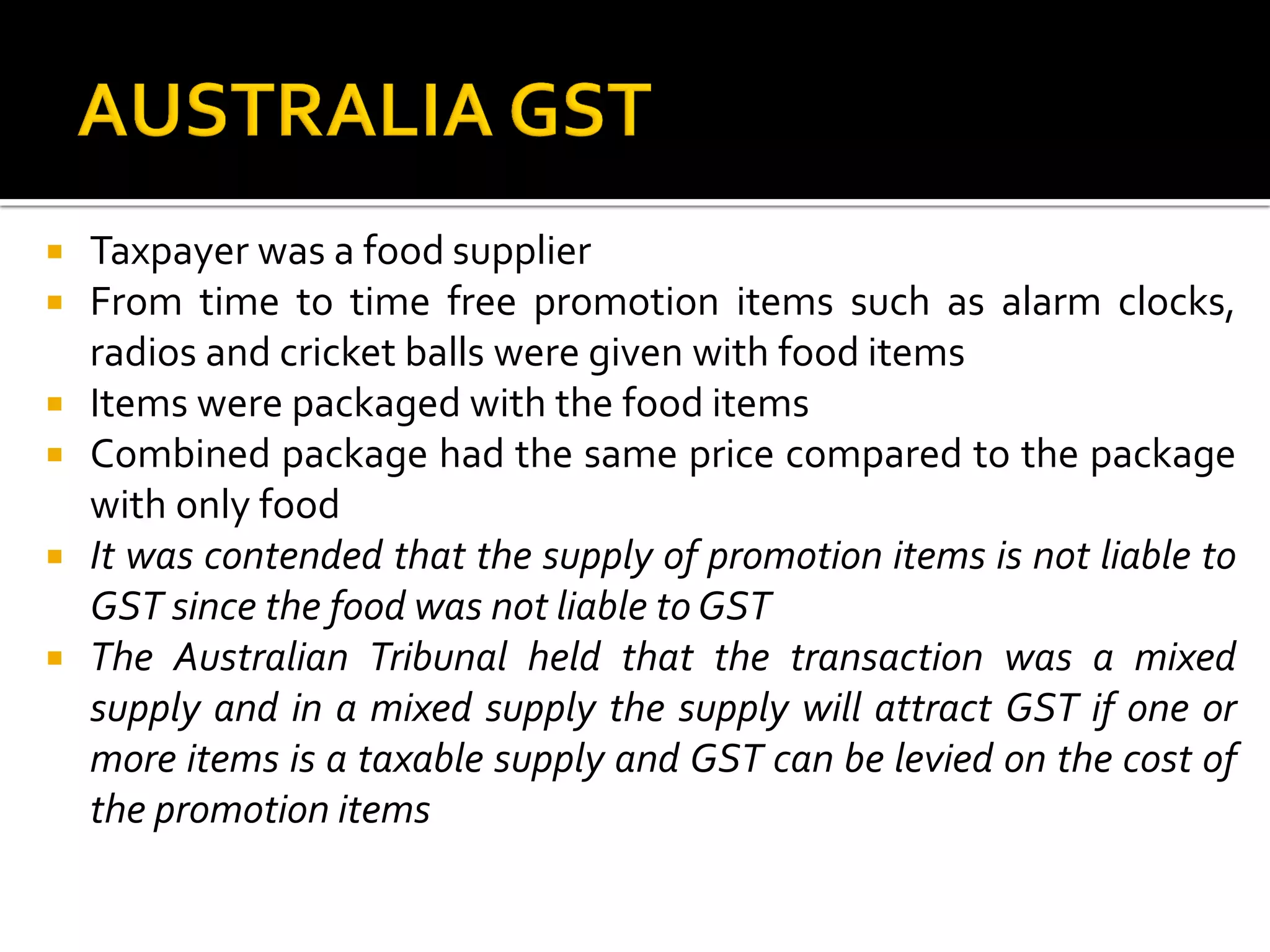
 Taxpayer was a food supplier
 From time to time free promotion items such as alarm clocks,
radios and cricket balls were given with food items
 Items were packaged with the food items
 Combined package had the same price compared to the package
with only food
 It was contended that the supply of promotion items is not liable to
GST since the food was not liable to GST
 The Australian Tribunal held that the transaction was a mixed
supply and in a mixed supply the supply will attract GST if one or
more items is a taxable supply and GST can be levied on the cost of
the promotion items
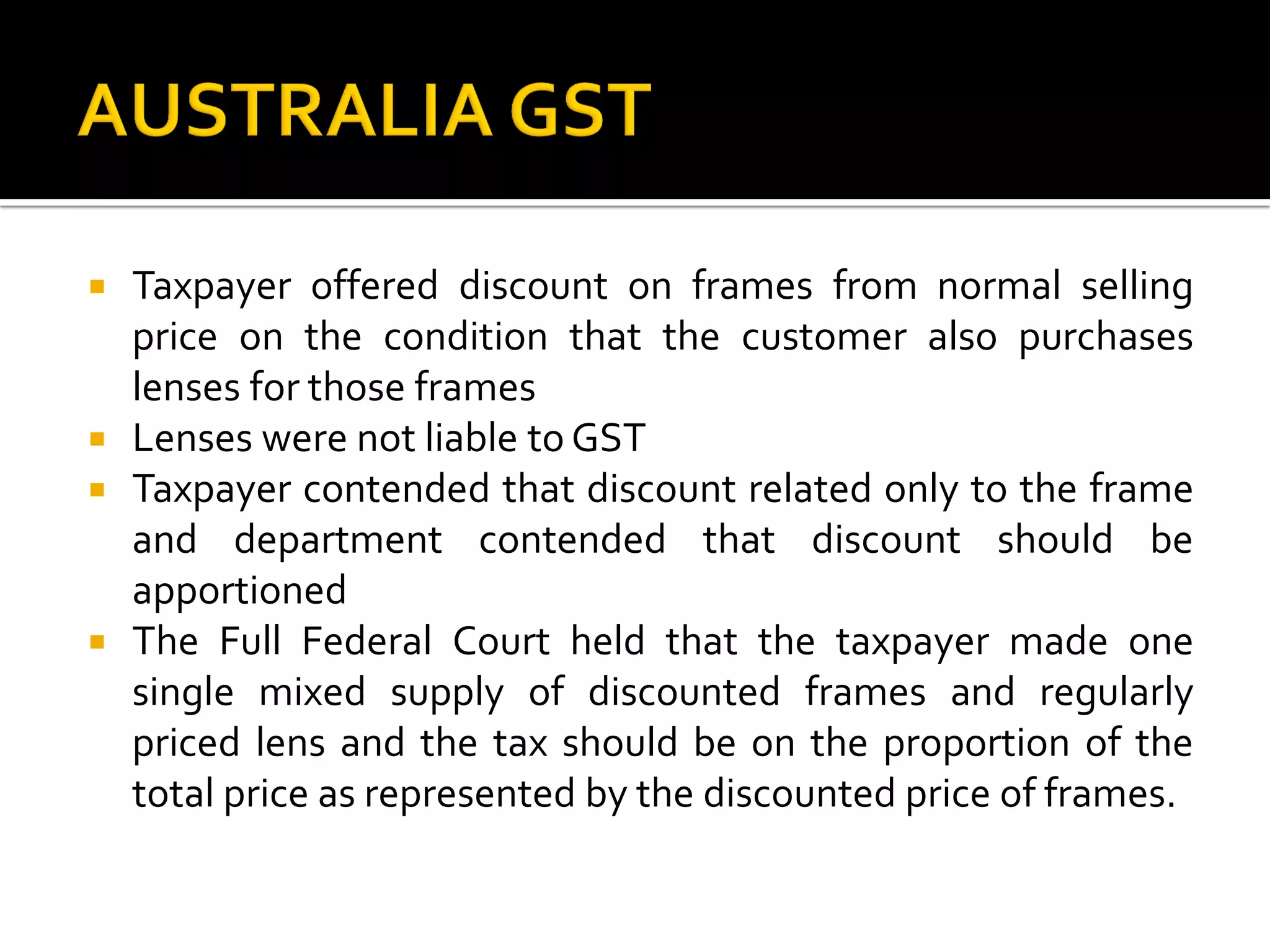
 Taxpayer offered discount on frames from normal selling
price on the condition that the customer also purchases
lenses for those frames
 Lenses were not liable to GST
 Taxpayer contended that discount related only to the frame
and department contended that discount should be
apportioned
 The Full Federal Court held that the taxpayer made one
single mixed supply of discounted frames and regularly
priced lens and the tax should be on the proportion of the
total price as represented by the discounted price of frames.
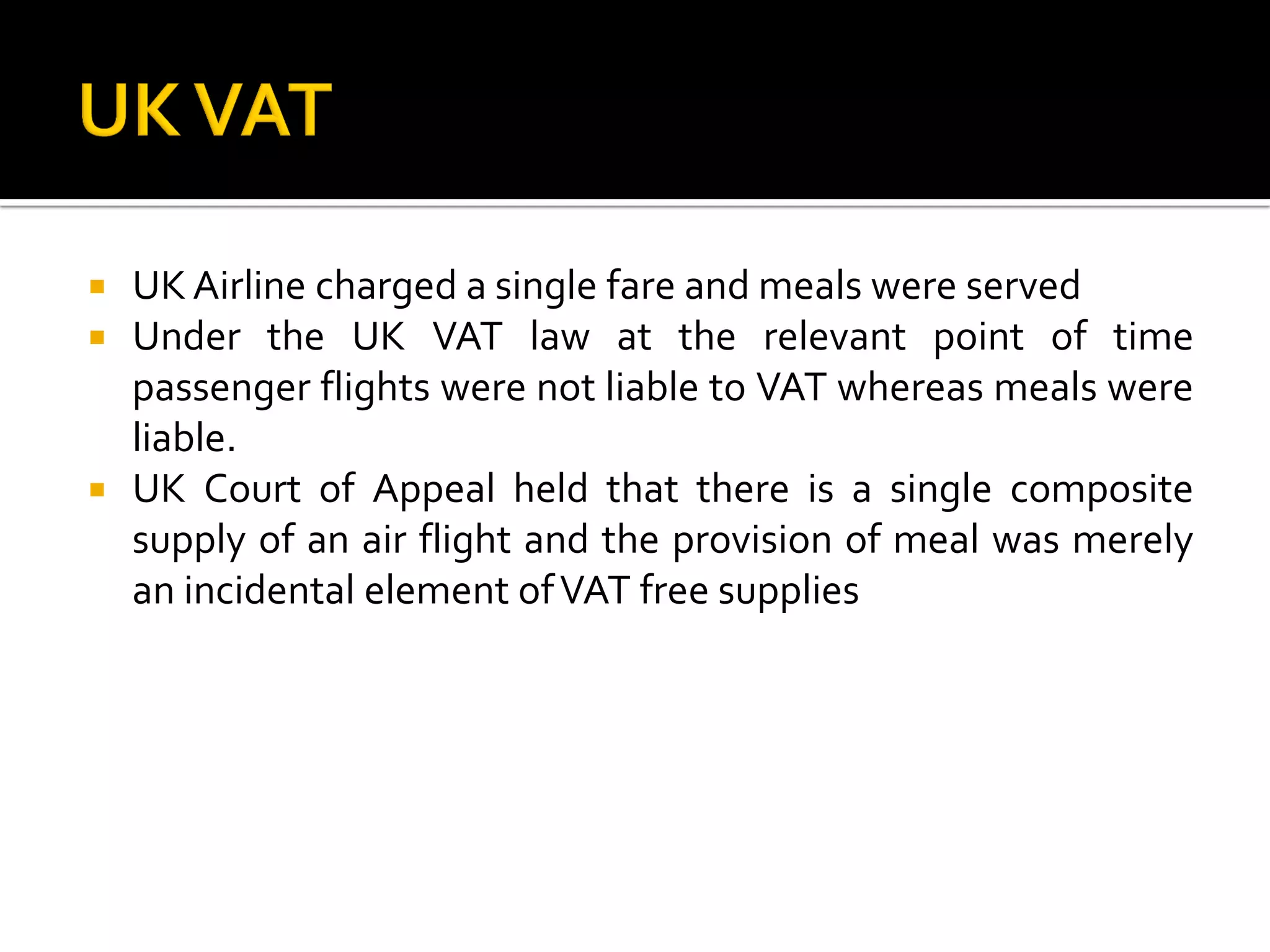
 UK Airline charged a single fare and meals were served
 Under the UK VAT law at the relevant point of time
passenger flights were not liable to VAT whereas meals were
liable.
 UK Court of Appeal held that there is a single composite
supply of an air flight and the provision of meal was merely
an incidental element ofVAT free supplies
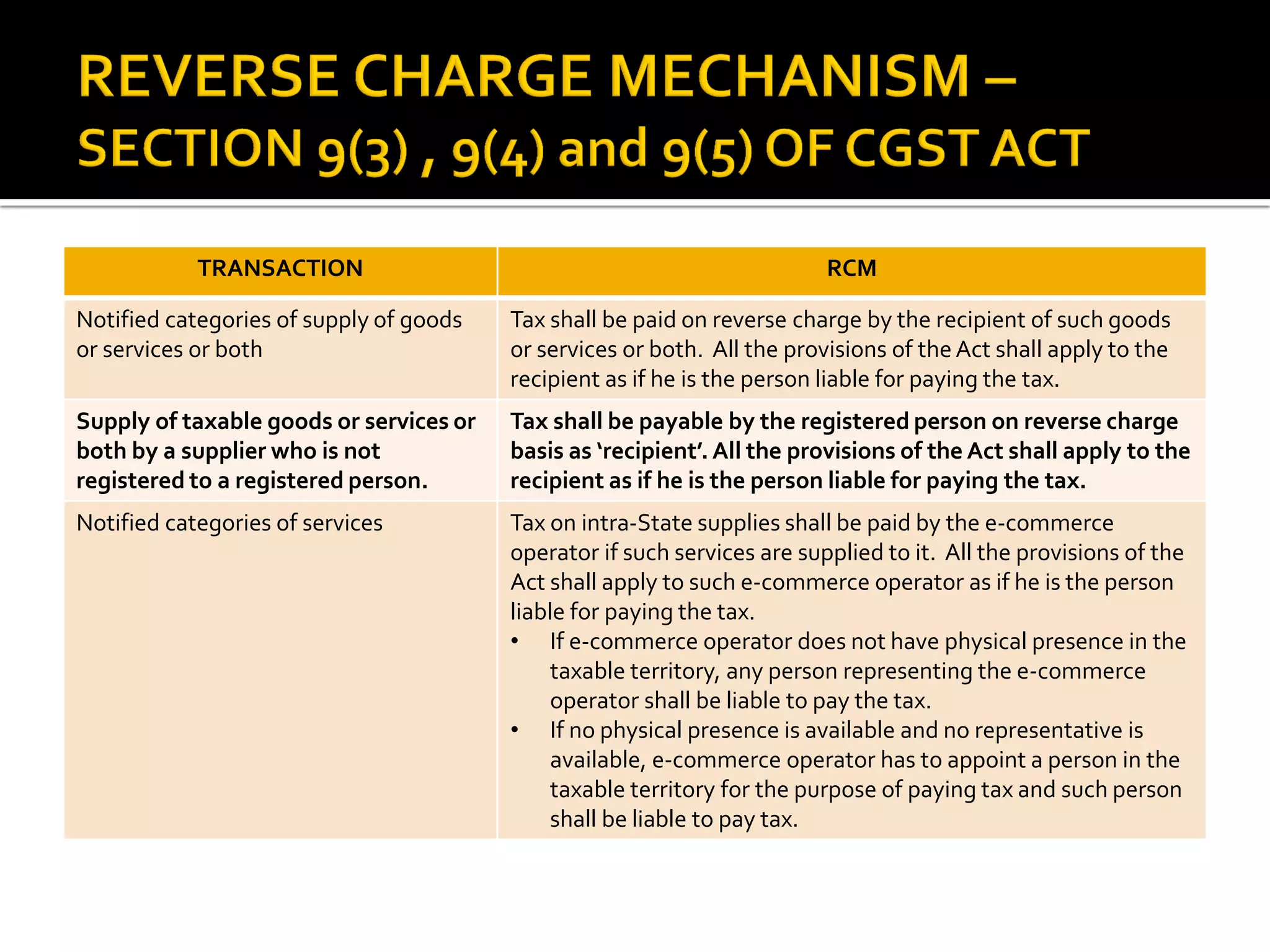
TRANSACTION RCM
Notified categories of supply of goods
or services or both
Tax shall be paid on reverse charge by the recipient of such goods
or services or both. All the provisions of theAct shall apply to the
recipient as if he is the person liable for paying the tax.
Supply of taxable goods or services or
both by a supplier who is not
registered to a registered person.
Tax shall be payable by the registered person on reverse charge
basis as ‘recipient’. All the provisions of the Act shall apply to the
recipient as if he is the person liable for paying the tax.
Notified categories of services Tax on intra-State supplies shall be paid by the e-commerce
operator if such services are supplied to it. All the provisions of the
Act shall apply to such e-commerce operator as if he is the person
liable for paying the tax.
• If e-commerce operator does not have physical presence in the
taxable territory, any person representing the e-commerce
operator shall be liable to pay the tax.
• If no physical presence is available and no representative is
available, e-commerce operator has to appoint a person in the
taxable territory for the purpose of paying tax and such person
shall be liable to pay tax.
 Supply of goods or services or both – tax to be paid on RCM
basis by the recipient in respect of special categories notified
 Where the goods or services or both are supplied by a
supplier who is not registered, recipient has to pay CGST on
reverse charge basis
 Wider than purchase tax on goods
 Shifting of liability to the registered recipient when the law
requires the supplier to pay tax
 Will threshold exemption become illusory?
 Decision on whether goods or service shifts to the recipient?
 If the rate of tax is different, the complexities would increase
 Decision on composite supply or mixed supply shifts to
recipient
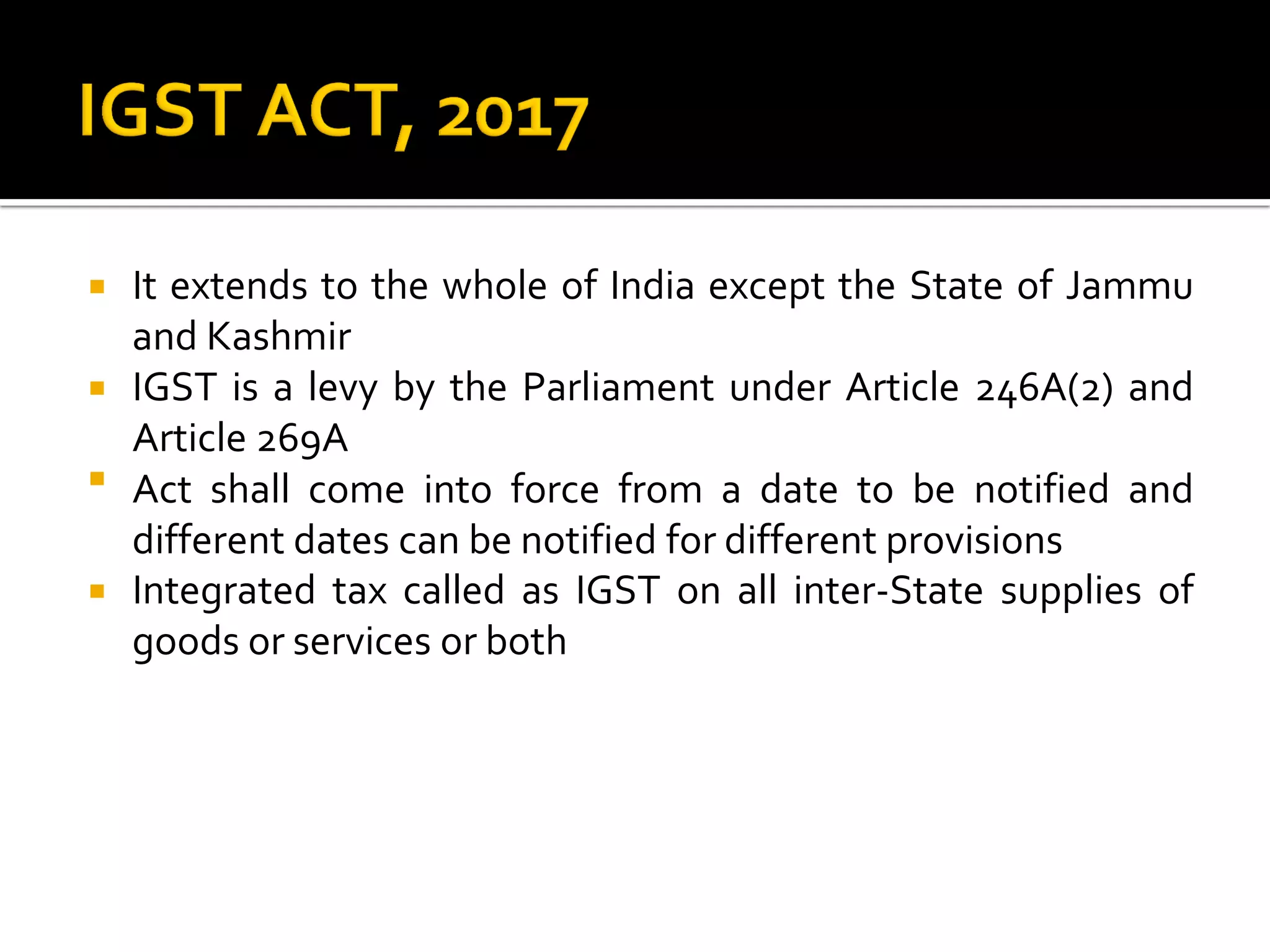
 It extends to the whole of India except the State of Jammu
and Kashmir
 IGST is a levy by the Parliament under Article 246A(2) and
Article 269A
 Act shall come into force from a date to be notified and
different dates can be notified for different provisions
 Integrated tax called as IGST on all inter-State supplies of
goods or services or both
 Integrated tax means the IGST levied under Section 5 of the IGST Act
 IGST on
 all inter-State supplies of goods or services or both except on the supply of alcoholic
liquor
 On the value determined under Section 15 of the CGST Act
 At such rates not exceeding 40% as may be notified by the Government on the
recommendations of the Council
 Collected in such manner as may be prescribed and shall be paid by the taxable person
 CGST on petroleum / HSD / petrol / natural gas and ATF from such date as may be
notified by the Government on the recommendations of the Council
 IGST on goods imported into India shall be levied and collected as per Section
3 of the Customs Tariff Act on the value determined under the said Act at the
point when customs duties are levied under Section 12 of the Customs Act
 Notification would be critical
 What would be the IGST rate?
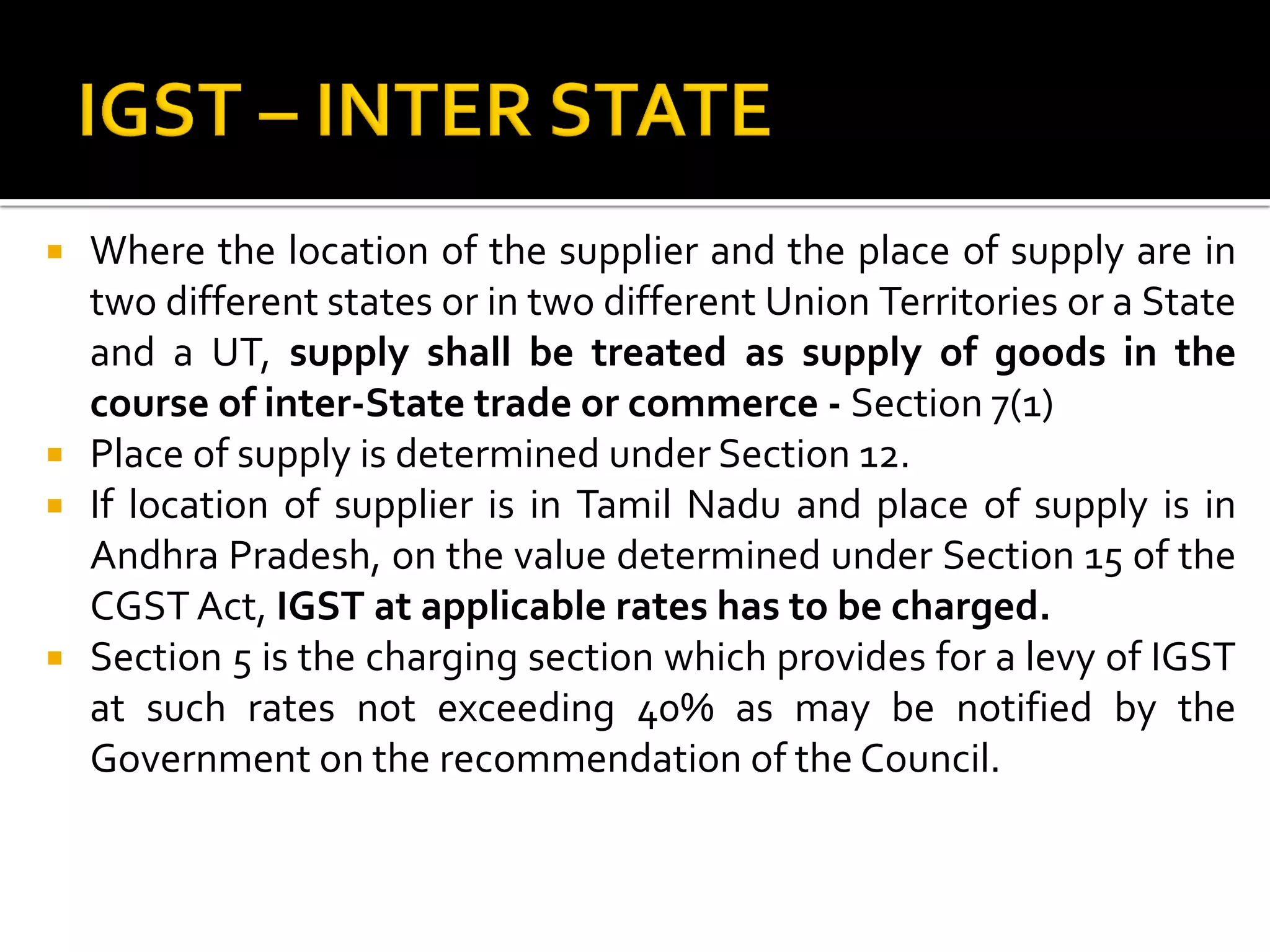
 Where the location of the supplier and the place of supply are in
two different states or in two different Union Territories or a State
and a UT, supply shall be treated as supply of goods in the
course of inter-State trade or commerce - Section 7(1)
 Place of supply is determined under Section 12.
 If location of supplier is in Tamil Nadu and place of supply is in
Andhra Pradesh, on the value determined under Section 15 of the
CGST Act, IGST at applicable rates has to be charged.
 Section 5 is the charging section which provides for a levy of IGST
at such rates not exceeding 40% as may be notified by the
Government on the recommendation of the Council.
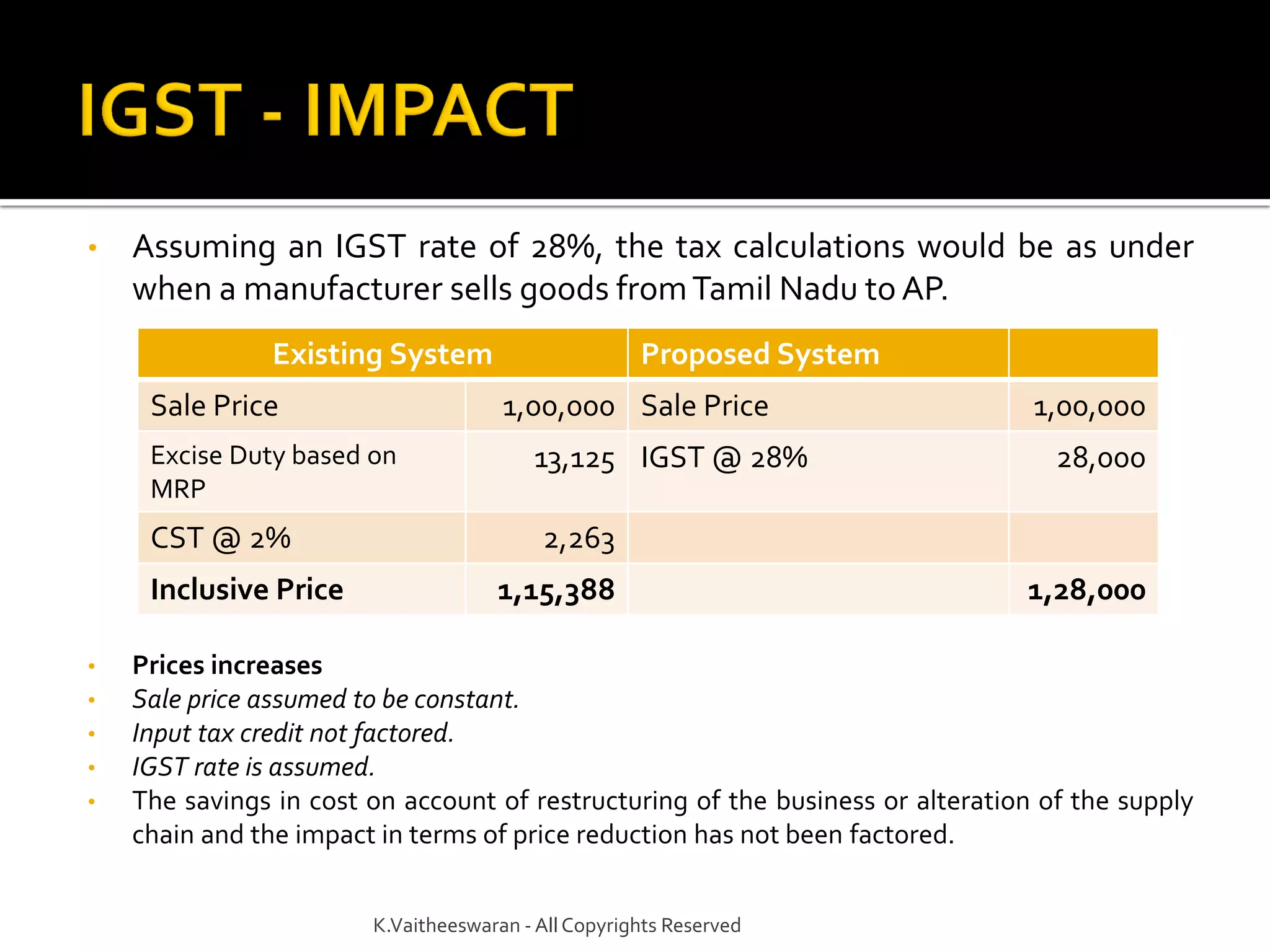
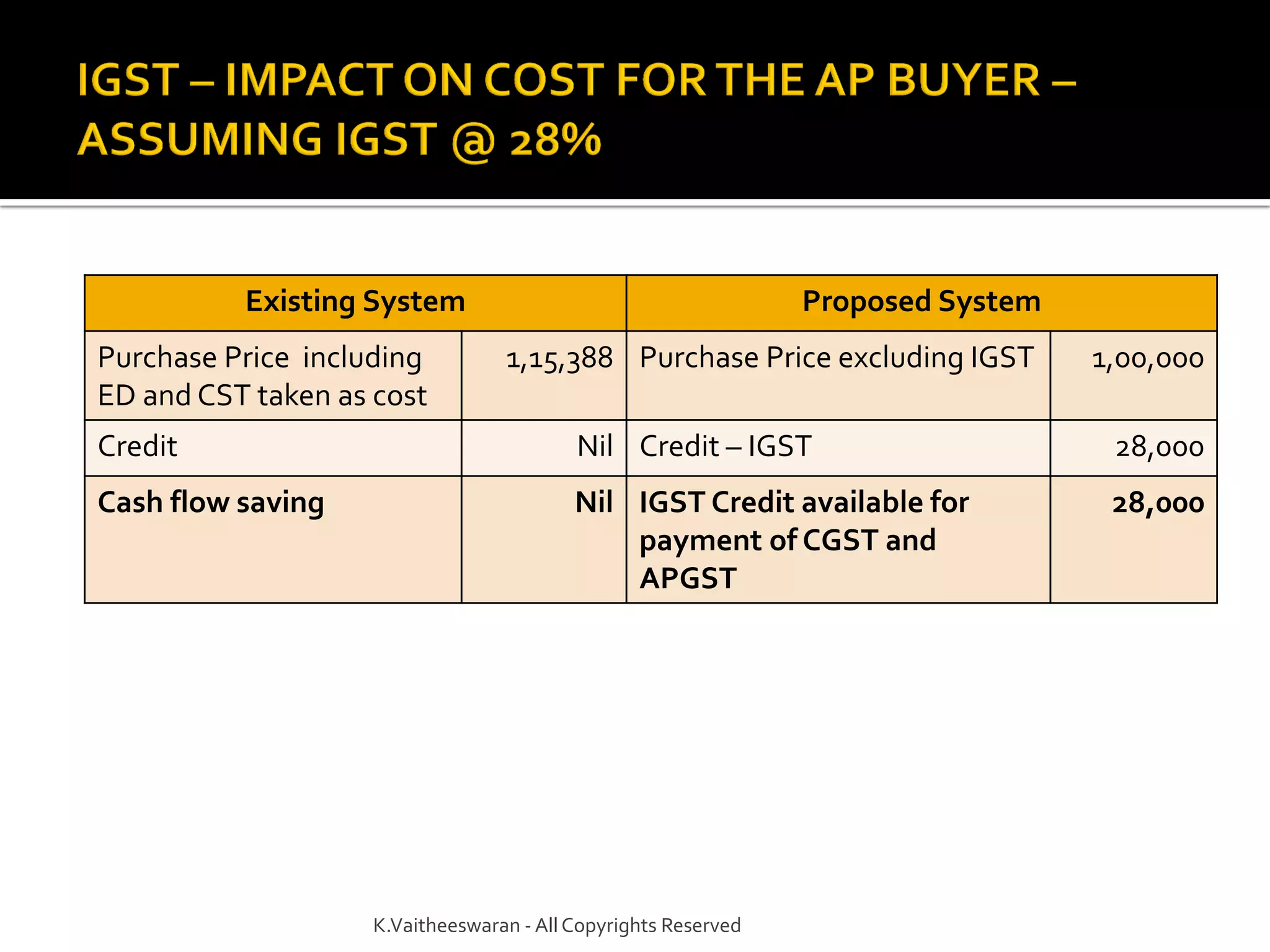
• Assuming an IGST rate of 28%, the tax calculations would be as under
when a manufacturer sells goods fromTamil Nadu to AP.
• Prices increases
• Sale price assumed to be constant.
• Input tax credit not factored.
• IGST rate is assumed.
• The savings in cost on account of restructuring of the business or alteration of the supply
chain and the impact in terms of price reduction has not been factored.
K.Vaitheeswaran - AllCopyrights Reserved
Existing System Proposed System
Sale Price 1,00,000 Sale Price 1,00,000
Excise Duty based on
MRP
13,125 IGST @ 28% 28,000
CST @ 2% 2,263
Inclusive Price 1,15,388 1,28,000
K.Vaitheeswaran - AllCopyrights Reserved
Existing System Proposed System
Purchase Price including
ED and CST taken as cost
1,15,388 Purchase Price excluding IGST 1,00,000
Credit Nil Credit – IGST 28,000
Cash flow saving Nil IGST Credit available for
payment of CGST and
APGST
28,000
 IGST as an additional duty of customs
 IGST at the time of payment of customs duties
 Cascading effect?
 Procedure for payment of IGST
 Whether Icegate would be integrated with GSTN?
 If a customs broker has to discharge IGST, whose GSTN has to be
referred to?
 How will the importer get the credit through the portal
mechanism?
 If customs broker claims reimbursement on pure agency concept,
which GSTN should be referred to by the third party vendor of
services?
K.Vaitheeswaran - AllCopyrights Reserved
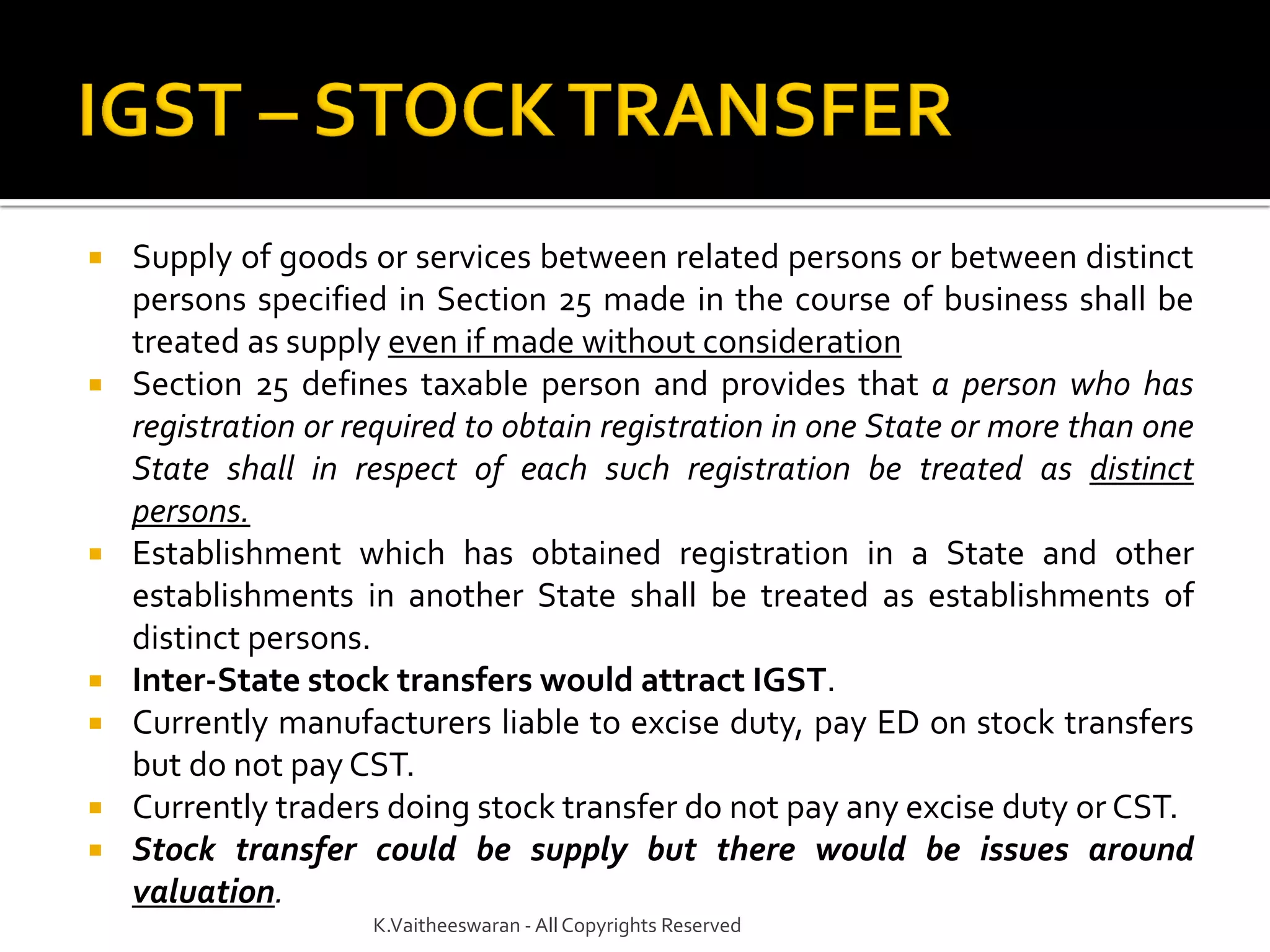
 Supply of goods or services between related persons or between distinct
persons specified in Section 25 made in the course of business shall be
treated as supply even if made without consideration
 Section 25 defines taxable person and provides that a person who has
registration or required to obtain registration in one State or more than one
State shall in respect of each such registration be treated as distinct
persons.
 Establishment which has obtained registration in a State and other
establishments in another State shall be treated as establishments of
distinct persons.
 Inter-State stock transfers would attract IGST.
 Currently manufacturers liable to excise duty, pay ED on stock transfers
but do not pay CST.
 Currently traders doing stock transfer do not pay any excise duty or CST.
 Stock transfer could be supply but there would be issues around
valuation.
K.Vaitheeswaran - AllCopyrights Reserved
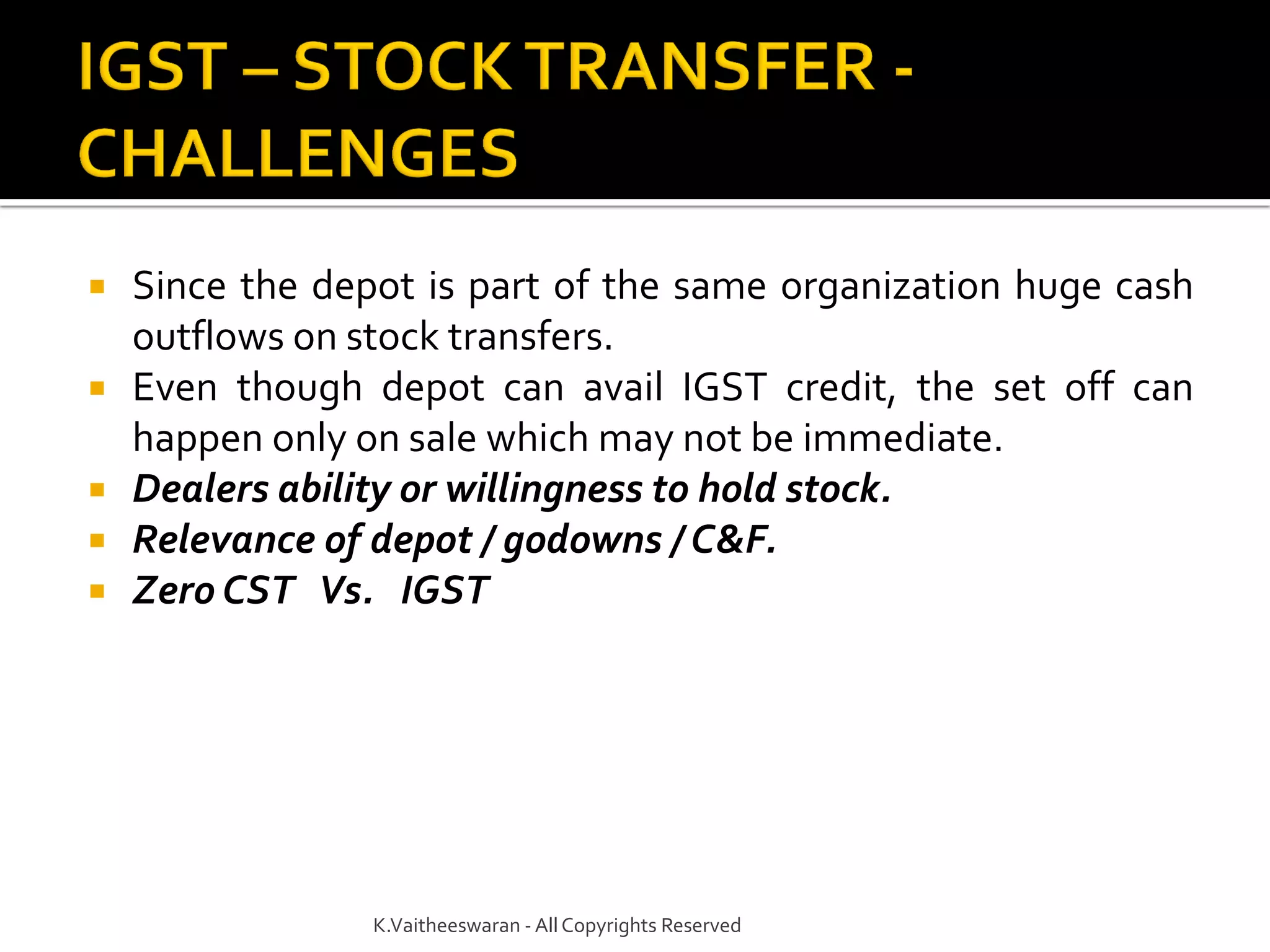
 Since the depot is part of the same organization huge cash
outflows on stock transfers.
 Even though depot can avail IGST credit, the set off can
happen only on sale which may not be immediate.
 Dealers ability or willingness to hold stock.
 Relevance of depot / godowns / C&F.
 Zero CST Vs. IGST
K.Vaitheeswaran - AllCopyrights Reserved
TRANSACTION RCM
Notified categories of supply of goods
or services or both
Tax shall be paid on reverse charge by the recipient of such goods
or services or both. All the provisions of theAct shall apply to the
recipient as if he is the person liable for paying the tax.
Supply of taxable goods or services or
both by a supplier who is not registered
to a registered person.
Tax shall be payable by the registered person on reverse charge
basis as ‘recipient’. All the provisions of theAct shall apply to the
recipient as if he is the person liable for paying the tax.
Notified categories of services Tax on intra-State supplies shall be paid by the e-commerce
operator if such services are supplied to it. All the provisions of the
Act shall apply to such e-commerce operator as if he is the person
liable for paying the tax.
• If e-commerce operator does not have physical presence in the
taxable territory, any person representing the e-commerce
operator shall be liable to pay the tax.
• If no physical presence is available and no representative is
available, e-commerce operator has to appoint a person in the
taxable territory for the purpose of paying tax and such person
shall be liable to pay tax.
 Exports of goods or services or both
 Supply of goods and / or services to a SEZ developer or a SEZ
unit is treated as zero-rated supply
 Credit of input tax is available.
 Refund of credit for supply of goods or services or both under
bond or letter of undertaking without payment of IGST.
 Payment of IGST on supply of goods and or services or both claim
of refund of IGST.
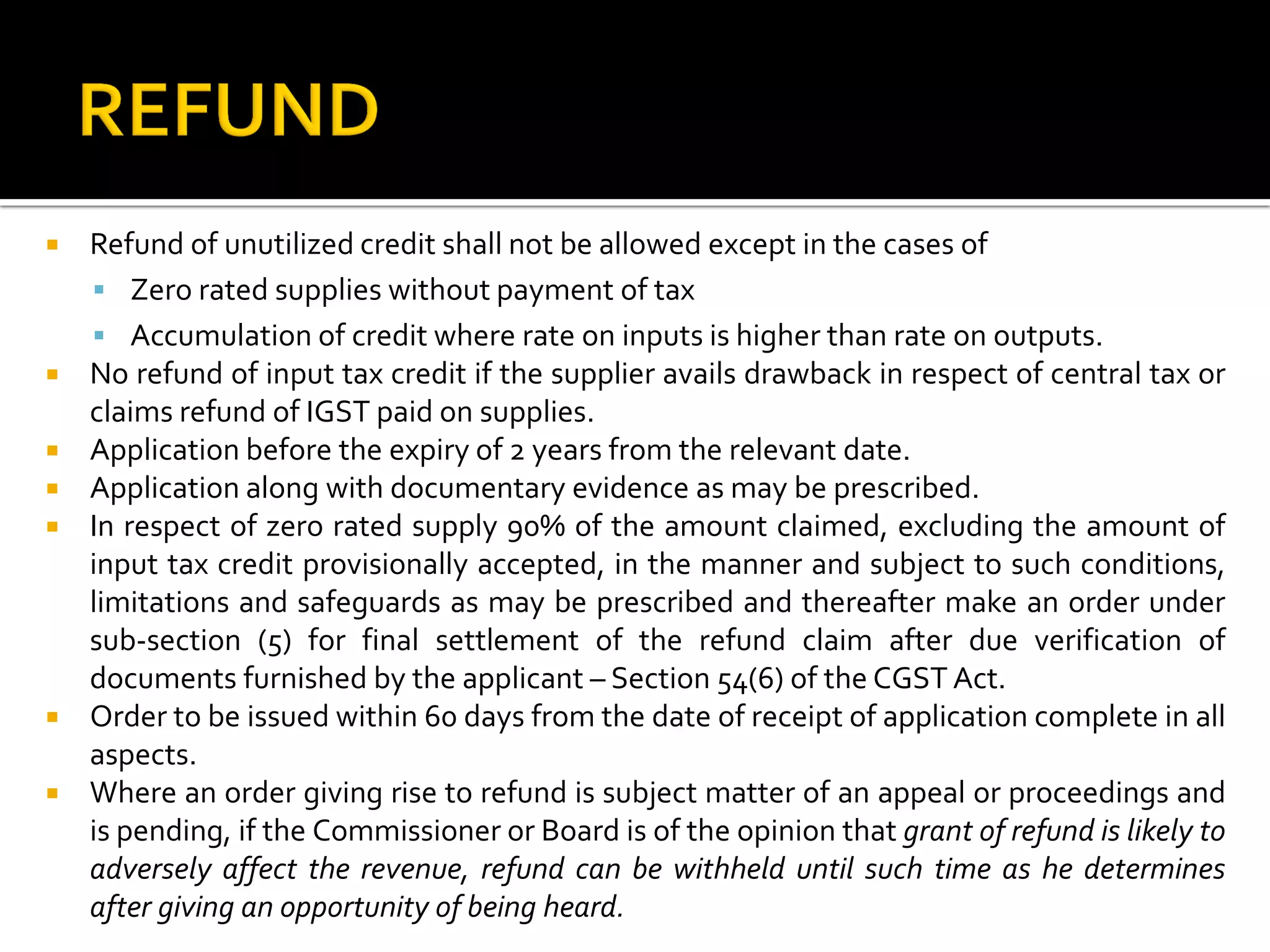
 Refund of unutilized credit shall not be allowed except in the cases of
 Zero rated supplies without payment of tax
 Accumulation of credit where rate on inputs is higher than rate on outputs.
 No refund of input tax credit if the supplier avails drawback in respect of central tax or
claims refund of IGST paid on supplies.
 Application before the expiry of 2 years from the relevant date.
 Application along with documentary evidence as may be prescribed.
 In respect of zero rated supply 90% of the amount claimed, excluding the amount of
input tax credit provisionally accepted, in the manner and subject to such conditions,
limitations and safeguards as may be prescribed and thereafter make an order under
sub-section (5) for final settlement of the refund claim after due verification of
documents furnished by the applicant – Section 54(6) of the CGST Act.
 Order to be issued within 60 days from the date of receipt of application complete in all
aspects.
 Where an order giving rise to refund is subject matter of an appeal or proceedings and
is pending, if the Commissioner or Board is of the opinion that grant of refund is likely to
adversely affect the revenue, refund can be withheld until such time as he determines
after giving an opportunity of being heard.
 Significant inter-State sales.
 CST charged has been a cost to the customer and a factor in price
negotiation.
 Better pricing due to availability of credit for the buyer.
 Review of depots and godowns created across the country and possible
scaling down of such depots.
 Major savings on CST purchases since IGST would qualify as a credit as
against CST 2% which is a cost.
 Increased credit on services due to elimination of the concept of
manufacture.
 Elimination of cascading effect.
 Cost savings on account of business review.
 Cash outflow on account of new provisions such as tax on advances;
reverse charge even on supply of goods; higher rate.
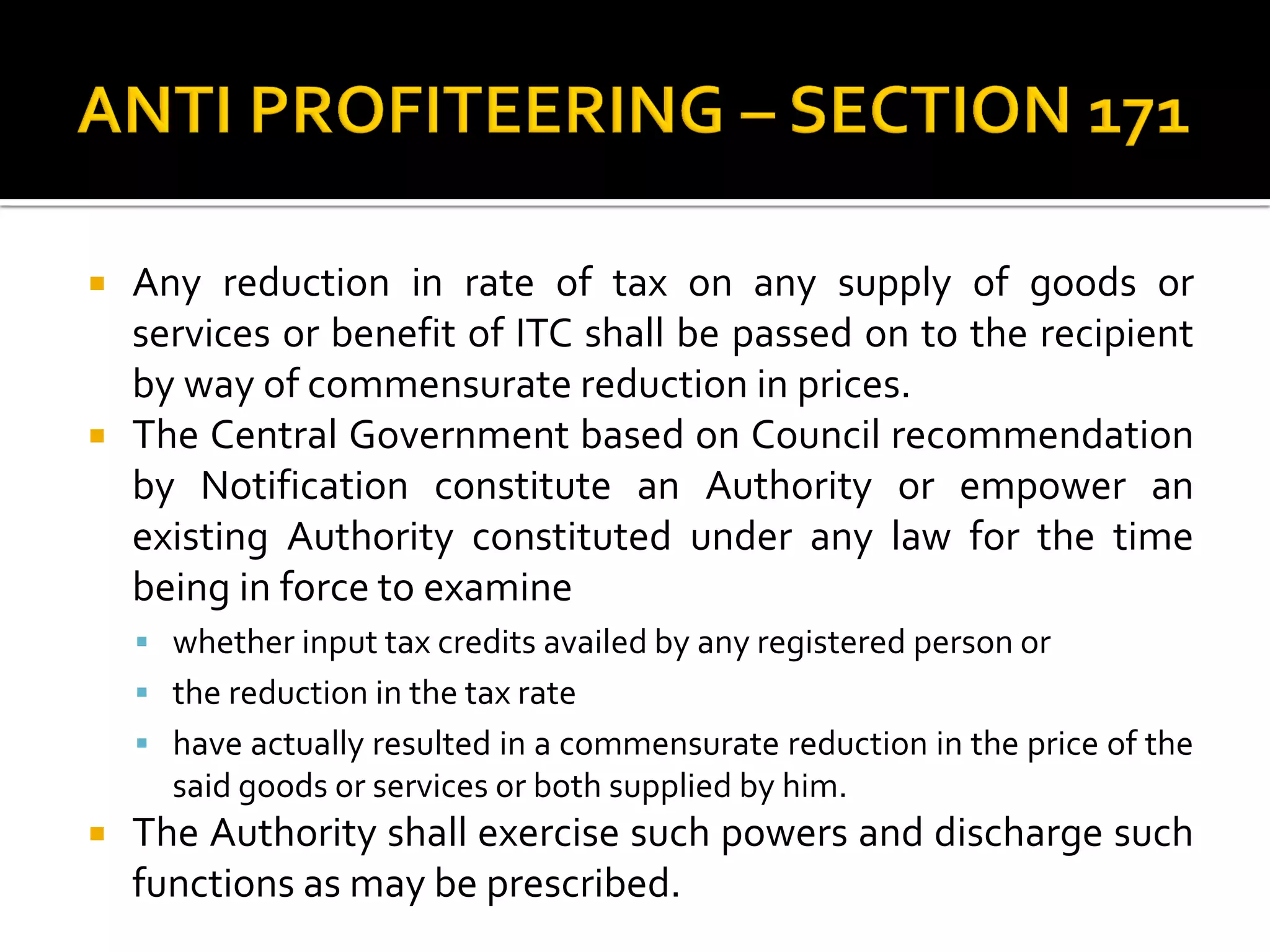
 Any reduction in rate of tax on any supply of goods or
services or benefit of ITC shall be passed on to the recipient
by way of commensurate reduction in prices.
 The Central Government based on Council recommendation
by Notification constitute an Authority or empower an
existing Authority constituted under any law for the time
being in force to examine
 whether input tax credits availed by any registered person or
 the reduction in the tax rate
 have actually resulted in a commensurate reduction in the price of the
said goods or services or both supplied by him.
 The Authority shall exercise such powers and discharge such
functions as may be prescribed.
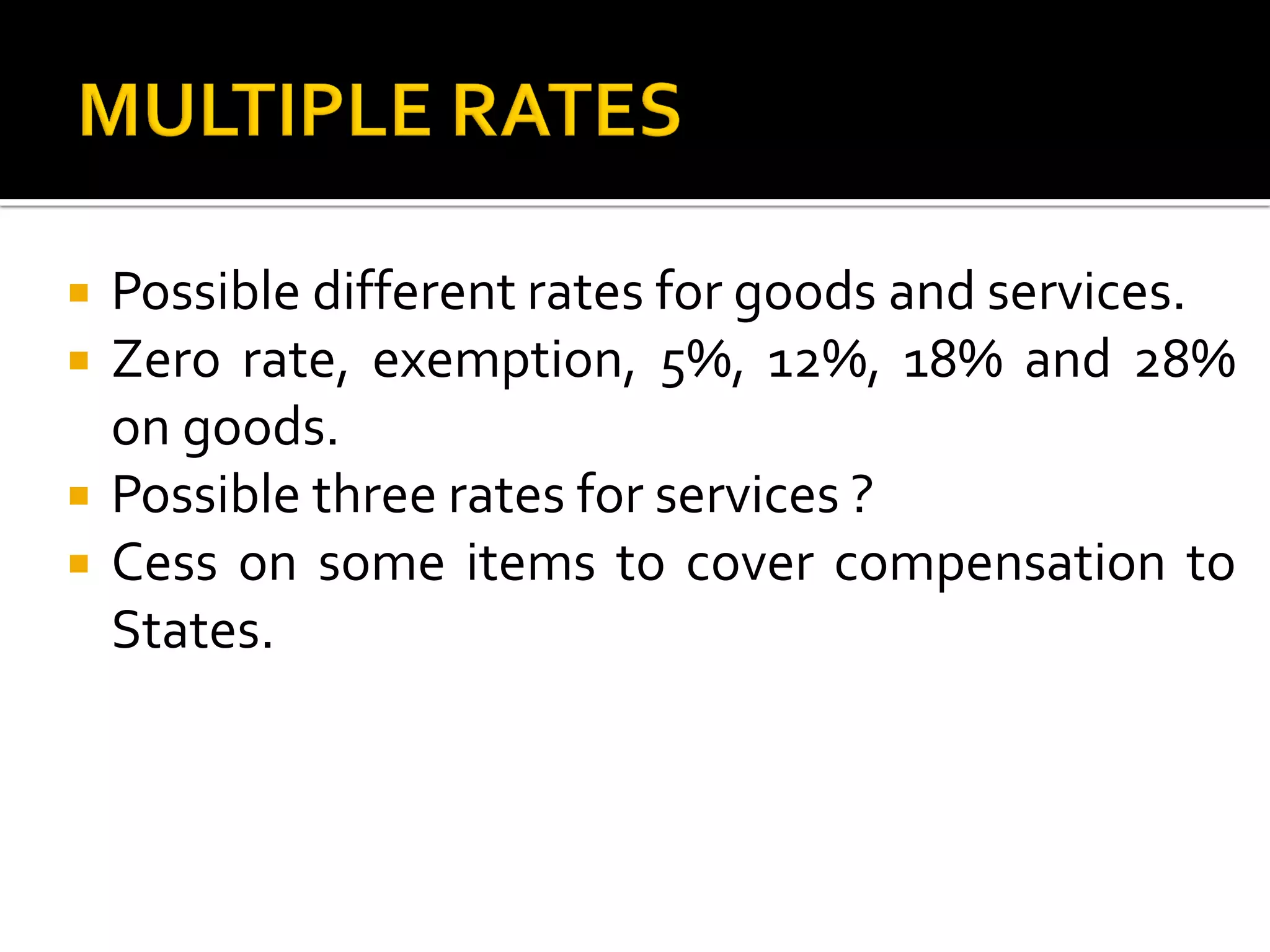
 Possible different rates for goods and services.
 Zero rate, exemption, 5%, 12%, 18% and 28%
on goods.
 Possible three rates for services ?
 Cess on some items to cover compensation to
States.
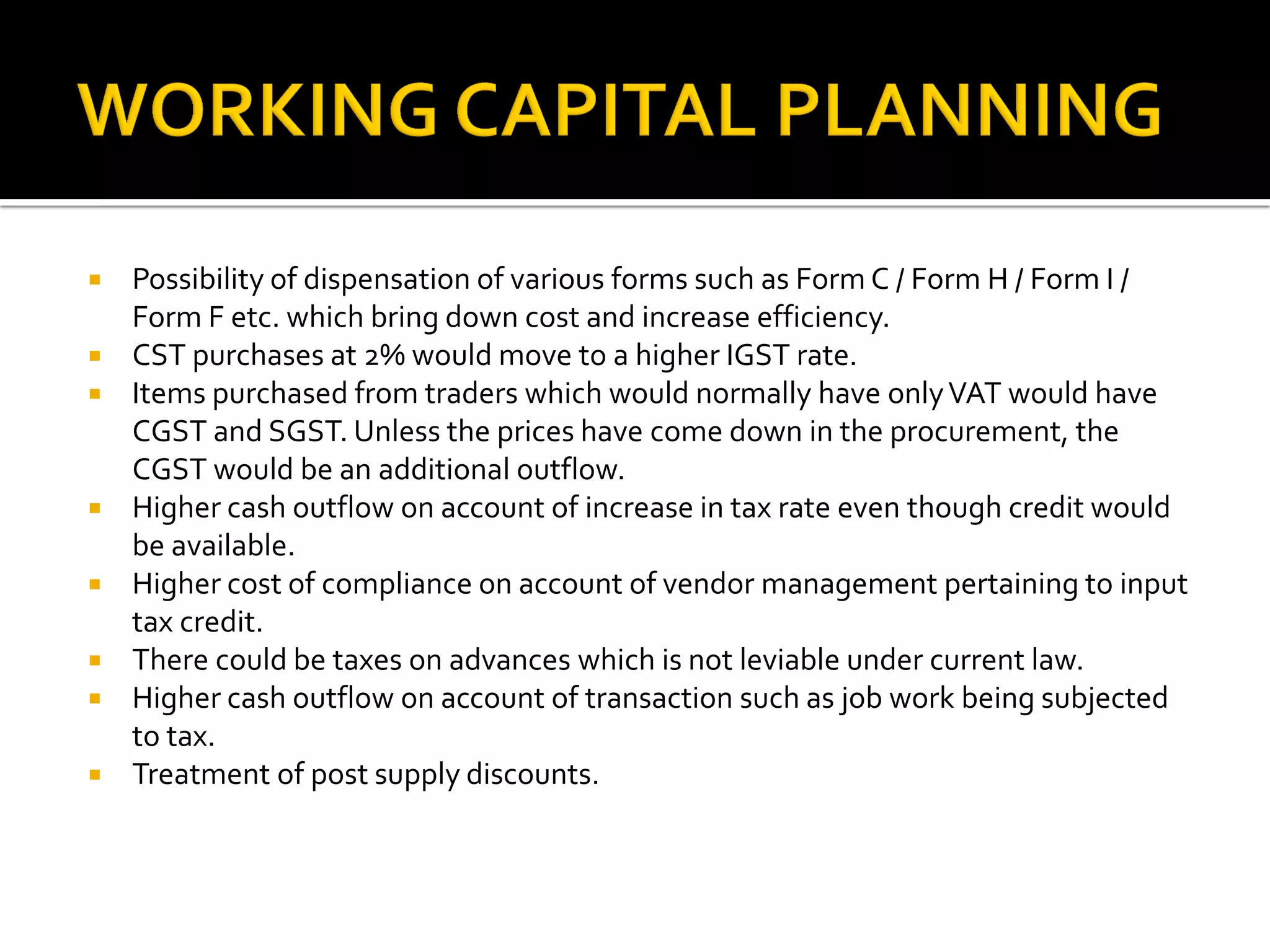
 Possibility of dispensation of various forms such as Form C / Form H / Form I /
Form F etc. which bring down cost and increase efficiency.
 CST purchases at 2% would move to a higher IGST rate.
 Items purchased from traders which would normally have onlyVAT would have
CGST and SGST. Unless the prices have come down in the procurement, the
CGST would be an additional outflow.
 Higher cash outflow on account of increase in tax rate even though credit would
be available.
 Higher cost of compliance on account of vendor management pertaining to input
tax credit.
 There could be taxes on advances which is not leviable under current law.
 Higher cash outflow on account of transaction such as job work being subjected
to tax.
 Treatment of post supply discounts.
 Lead time
 Awareness
 IT systems
 Identification of roles and responsibilities
 Long term contracts
 Quoting for projects
 Transition
 Change in concepts
K.Vaitheeswaran - AllCopyrights Reserved
NOTHING IS
PERMANENT
EVERYTHING
IS SUBJECT TO
CHANGE
BEING IS
ALWAYS
BECOMING.
BUDDHA
K.Vaitheeswaran – All Copyrights Reserved
K.VAITHEESWARAN
ADVOCATE &TAX CONSULTANT
‘VENKATAGIRI’
Flat No.8/3 & 8/4, Ground Floor,
No.8 (Old No.9), Sivaprakasam Street,
T. Nagar, Chennai - 600 017, India
Tel.: 044 + 2433 1029 / 4048
402, Front Wing,
House of Lords,
15/16, St. Marks Road,
Bangalore – 560 001, India
Tel : 080 22244854/ 41120804
Mobile: 98400-96876
E-mail : vaithilegal@yahoo.co.in vaithilegal@gmail.com
www.vaithilegal.com

GST - Levy - Supply - Business Impact

  • 1.
    K.VAITHEESWARAN ADVOCATE &TAX CONSULTANT ‘VENKATAGIRI’ FlatNo.8/3 & 8/4, Ground Floor, No.8 (Old No.9), Sivaprakasam Street, T. Nagar, Chennai - 600 017, India Tel.: 044 + 2433 1029 / 4048 402, Front Wing, House of Lords, 15/16, St. Marks Road, Bangalore – 560 001, India Tel : 080 22244854/ 41120804 Mobile: 98400-96876 E-mail : vaithilegal@yahoo.co.in / vaithilegal@gmail.com www.vaithilegal.com
  • 2.
     VAT drivenlocal purchases  Cost driven CST purchases  Duty burden on imports  Complex State Laws  Ever changing tax landscape  Different decisions on the same issue  Border controls
  • 3.
     Excise dutycharged by the manufacturer forms part of the price in the supply chain.  Since the cenvat credit is linked with manufacture, the dealer cannot set off the excise duty against any other tax.  CST purchases form part of cost as there is no VAT credit.  VAT has a cascading effect since sale price includes excise, customs, CVD. K.Vaitheeswaran - AllCopyrights Reserved
  • 4.
     Constitution 101stAmendment Act.  GST Council  New system of indirect taxation moving away from Entries in the Union and State List.  Major role to be played by the GST Council.  CGST Act, 2017; IGSTAct 2017; GST (Compensation to States) Act 2017; and UnionTerritory GST Act, 2017 passed by the Parliament and received the assent of the President on 12.04.2017.  Taxation LawsAmendment Bill, 2017.  SGSTAct to be passed by 29 States and Rules issued.  Telangana SGSTAct, 2017 passed by the Legislature.  IT infrastructure should be in place.  01.07.2017.  Significance of 16.09.2017. K.Vaitheeswaran - AllCopyrights Reserved
  • 5.
     Path breakingtax reform  Harmonization of taxes  Elimination of tax as a cost  Possible elimination of unwanted business structures  Long way to go  Too many compromises  Complex legal structure  Not a simple law  Huge potential for conflict K.Vaitheeswaran - AllCopyrights Reserved
  • 6.
     It extendsto the whole of India except the State of Jammu and Kashmir.  Article 370 only refers to matters in the Union list and Concurrent list.  GST is a levy under Article 246A independent of the entries.  Excise Duty applicable to J&K from 1986  CST applicable to J&K from 1956  Act shall come into force from a date to be notified and different dates can be notified for different provisions
  • 7.
     Central taxmeans the CGST levied under Section 9  CGST on  all intra-State supplies of goods or services or both except on the supply of alcoholic liquor  On the value determined under Section 17  At such rates not exceeding 20% as may be notified by the Government on the recommendations of the Council  Collected in such manner as may be prescribed and shall be paid by the taxable person  A levy through legislation without a schedule of goods or services  Notification would be critical  CGST on petroleum / HSD / petrol / natural gas and ATF from such date as may be notified by the Government on the recommendations of the Council K.Vaitheeswaran
  • 8.
     Supply offood and non-alcoholic beverages would be considered as a service and governed by CGST and SGST  Sale of alcoholic liquor would attract VAT under the respective StateVAT laws  The enterprise would incur expenditure on various goods and services on which GST would be charged by the vendors  The enterprise would incur expenses in connection with the bar or licensed facility where GST would be charged by the service providers  GST cannot be set off againstVAT  Common credit management  Value of a restaurant bill which has both alcohol and snacks
  • 9.
     Some productswould attract GST  Some products would be kept out of GST and would attract existing levies  Taxation Laws Amendment Bill, 2017 introduces a Fourth Schedule to the Central Excise Act to cover excise levy on tobacco and petroleum products  Oil marketing companies would have GST on some products and VAT / CST on other products  Issues on common services / goods  Credit management  Billing mechanism  Audit
  • 10.
     Supply includes All forms of supply of goods or services or both such as sale, transfer, barter, exchange, license, rental, lease or disposal made or agreed to be made for a consideration by a person in the course or furtherance of business.  Import of service for a consideration and whether or not in the course or furtherance of business.  Activities specified in Schedule-I – made or agreed to be made without a consideration.  Activities to be treated as supply of goods or supply of services referred to in Schedule - II
  • 11.
     Made oragreed to be made indicates that advances would attract CGST.  In respect of import of service, nexus to business is not required for GST applicability  Activities in Schedule – I treated as supply even if made without consideration
  • 12.
     Sale treatedas supply but sale not defined  Transfer treated as supply but transfer not defined  The Supreme Court in the case of CIT Vs. Motors and General Stores (P.) Ltd. (1967) 66 ITR 692 has held in exchange there is a reciprocal transfer of interest in immovable property, a corresponding transfer of interest in movable property being denoted by the word "barter". The difference between a sale and an exchange is this, that in the former the price is paid in money, whilst in the latter it is paid in goods by way of barter.  Barter treated as supply but not defined  Who is liable in the case of barter?
  • 13.
     In relationto supply of goods and / or services includes  Payment made or to be made whether in money or otherwise in respect of or in response to or for the inducement of, supply of goods or services or both, whether by the recipient or by any other person but shall not include any subsidy given by the Central or State Government.  Monetary value of any act or forbearance, in respect of or in response to or for the inducement of supply of goods or services or both, whether by the recipient or by any other person but shall not include any subsidy given by the Central or a State Government.  Deposit in respect of supply shall not be payment unless the deposit is applied as consideration for supply by the supplier.  Section 2(1) of the Malaysia GST Act, 2014
  • 14.
     Section 2(17)defines “business” to include–– (a) any trade, commerce, manufacture, profession, vocation, adventure, wager or any other similar activity, whether or not it is for a pecuniary benefit; (b) any activity or transaction in connection with or incidental or ancillary to sub-clause (a); (c) any activity or transaction in the nature of sub-clause (a), whether or not there is volume, frequency, continuity or regularity of such transaction; (d) supply or acquisition of goods including capital goods and services in connection with commencement or closure of business; (e) provision by a club, association, society, or any such body (for a subscription or any other consideration) of the facilities or benefits to its members; (f) admission, for a consideration, of persons to any premises; (g) services supplied by a person as the holder of an office which has been accepted by him in the course or furtherance of his trade, profession or vocation; (h) services provided by a race club by way of totalisator or a licence to book maker in such club ; and (i) any activity or transaction undertaken by the Central Government, a State Government or any local authority in which they are engaged as public authorities;
  • 15.
    Decision Case LawReference GST Sale of publications spreading the message of Sai Baba cannot be considered as business Sai Publication (SC) ? Sale of Prasadam is not in connection with business Arulmigu Dhandayuthapani Swami Thirukkoil (Mad) ? Charitable Organisation engaged in construction of latrines is not a dealer Sulabh International (Mad) ? Sale of food in canteen run by temple is not taxable Shree Bhramaramba (AP) ? Publishing admission forms does not constitute business. University is not a dealer Mahatma Gandhi Kashi Vidyapeeth (All) ? Providing accommodation to devotees by Trust of temples without profit motive is not business Palani Dhandayuphabani Devesthanam (Mad) ? Sale of business as a going concern is not business Coromandel Fertilizers (AP) ?
  • 16.
    TRANSACTION EXISTING PROPOSED Manufactureand removal within a State ED CGST + SGST Manufacture and removal inter-State ED IGST Manufacture and sale within the State ED +VAT CGST + SGST Manufacture and inter-State sale ED + CST IGST Sale by a trader within a State VAT CGST + SGST Sale by a trader – inter-State CST IGST Barter Not taxable* Taxable Exchange Not taxable* Taxable License – Royalty – Local ServiceTax CGST + SGST License – Royalty – inter-State ServiceTax IGST
  • 17.
    TRANSACTION EXISTING PROPOSED Rental– Movables – Local VAT CGST + SGST Rental – Movables – inter-State CST IGST Rentals – Immovable ServiceTax + Stamp Duty CGST + SGST + Stamp Duty Import of services ServiceTax IGST
  • 18.
     Permanent transfer/ disposal of business assets where ITC has been availed on such assets.  Supply of goods or services or both between related persons or between distinct persons as specified in Section 25, when made in the course or furtherance of business.  Provided gifts not exceeding Rs. 50,000 in value in a financial year by an employer to an employee shall not be treated as supply of goods or services or both  Supply of goods by principal to agent where the agent undertakes to supply such goods on behalf of principal.  Supply of goods by agent to principal where the agent undertakes to receive such goods on behalf of the principal.  Import of services by a taxable person from a related person or from any of his other establishments outside India, in the course or furtherance of business.
  • 19.
     If motorcar is given to a director post-GST, free of cost and credit has not been availed?  If business asset is disposed post-GST and no cenvat credit has been availed as it is an old asset?  When an agent is liable to GST on his commission, impact of treating supply of goods between principal and agent as a supply without consideration for levy of GST?  Import of services from overseas office by India office and vice versa?
  • 20.
     Supply ofgoods between factory and depots  Supply of goods between depot and another depot  Supply of services by marketing office to head office  Supply of services by corporate office to other offices  Inter-Unit supply of goods or services  Concept of cost allocation  Concept of taxable supplies of goods and services within the organisation  Inter-Unit billing  Payment of tax  Input tax credits  Compliance requirements
  • 21.
     Transfer ofright in goods or undivided share in goods without transfer of title thereof is considered as supply of services  Transfer of right to use any goods for any purpose (whether or not for a specified period) is considered as supply of services  Temporary transfer or permitting the use or enjoyment of any IPR is considered as supply of services  Rate ofTax?
  • 22.
     Composite supplymeans a supply made by a taxable person to a recipient consisting of two or more taxable supplies of goods or services or both, or any combination thereof which are naturally bundled and supplied in conjunction with each other in the ordinary course of business, one of which is a principal supply – Section 2(30)  Illustration:- When goods are packed and transported with insurance, supply of goods, packing materials, transport and insurance is a composite supply and supply of goods is the principal supply.  In the case of composite supply comprising of two or more supply, one of which is a principal supply shall be treated as supply of such principal supply - Section 8(a)  Principal supply means the supply of goods or services which constitutes the predominant element of the composite supply and to which any other supply forming part of the composite supply is ancillary.  Dominant test?
  • 23.
     When aconsumer buys a television set and he also gets warranty and a maintenance contract with the TV, this supply is a composite supply. In this example, supply of TV is the principal supply, warranty and maintenance service are ancillary.  Composite supply shall be treated as supply of the principal supply.  Mixed supply would be treated as supply of that particular goods or services which attracts the highest rate of tax.
  • 24.
     Software Development Software Licensing  Design  Testing  Implementation  AMC  Comprehensive contracts  Composite Supply?  Mixed Supply ?  Difference between Goods and Services  Different Place of Supply provisions forGoods and Services  Nature of contract
  • 25.
     Claims management,claims handling and training services were provided and exemption was claimed.  Tax Authorities contended that since the composite supply included training, it was not exempt.  Assessee contended that the services were in connection with performance of insurance contract and exempted.  The Tribunal held that claims handling was exempted whereas training attractedVAT. K.Vaitheeswaran - AllCopyrights Reserved
  • 26.
     TheTribunal heldthat To identify a composite transaction in a way that deprives its major part of the exemption otherwise applicable under law is to distort the functioning of the VAT system. Just as a single service should not be split in a way which distorts the system, so also separate services should not be artificially aggregated. K.Vaitheeswaran - AllCopyrights Reserved
  • 27.
     On paymentof £ 16 a customer whose credit cards were lost or stolen would be indemnified upto £ 750 against claims.  An insurance broker was engaged to arrange for an appropriate insurance policy and VAT was not paid on the payments received from customers for this service on the ground that it is exempted. K.Vaitheeswaran - AllCopyrights Reserved
  • 28.
     The ECJheld that “A supply which constitutes a single service from an economic point of view should not be artificially split. There was a single supply in particular in cases where one or more elements are to be regarded as constituting the principal service whilst one or more elements are to be regarded by contrast as ancillary service which share the same treatment of the principal service. A service must be regarded as ancillary to a principal service if it does not constitute for customers an aim in itself but a means of better enjoying the principal service supplied.” K.Vaitheeswaran - AllCopyrights Reserved
  • 29.
     Taxpayer wasa food supplier  From time to time free promotion items such as alarm clocks, radios and cricket balls were given with food items  Items were packaged with the food items  Combined package had the same price compared to the package with only food  It was contended that the supply of promotion items is not liable to GST since the food was not liable to GST  The Australian Tribunal held that the transaction was a mixed supply and in a mixed supply the supply will attract GST if one or more items is a taxable supply and GST can be levied on the cost of the promotion items
  • 30.
     Taxpayer offereddiscount on frames from normal selling price on the condition that the customer also purchases lenses for those frames  Lenses were not liable to GST  Taxpayer contended that discount related only to the frame and department contended that discount should be apportioned  The Full Federal Court held that the taxpayer made one single mixed supply of discounted frames and regularly priced lens and the tax should be on the proportion of the total price as represented by the discounted price of frames.
  • 31.
     UK Airlinecharged a single fare and meals were served  Under the UK VAT law at the relevant point of time passenger flights were not liable to VAT whereas meals were liable.  UK Court of Appeal held that there is a single composite supply of an air flight and the provision of meal was merely an incidental element ofVAT free supplies
  • 32.
    TRANSACTION RCM Notified categoriesof supply of goods or services or both Tax shall be paid on reverse charge by the recipient of such goods or services or both. All the provisions of theAct shall apply to the recipient as if he is the person liable for paying the tax. Supply of taxable goods or services or both by a supplier who is not registered to a registered person. Tax shall be payable by the registered person on reverse charge basis as ‘recipient’. All the provisions of the Act shall apply to the recipient as if he is the person liable for paying the tax. Notified categories of services Tax on intra-State supplies shall be paid by the e-commerce operator if such services are supplied to it. All the provisions of the Act shall apply to such e-commerce operator as if he is the person liable for paying the tax. • If e-commerce operator does not have physical presence in the taxable territory, any person representing the e-commerce operator shall be liable to pay the tax. • If no physical presence is available and no representative is available, e-commerce operator has to appoint a person in the taxable territory for the purpose of paying tax and such person shall be liable to pay tax.
  • 33.
     Supply ofgoods or services or both – tax to be paid on RCM basis by the recipient in respect of special categories notified  Where the goods or services or both are supplied by a supplier who is not registered, recipient has to pay CGST on reverse charge basis  Wider than purchase tax on goods  Shifting of liability to the registered recipient when the law requires the supplier to pay tax  Will threshold exemption become illusory?  Decision on whether goods or service shifts to the recipient?  If the rate of tax is different, the complexities would increase  Decision on composite supply or mixed supply shifts to recipient
  • 35.
     It extendsto the whole of India except the State of Jammu and Kashmir  IGST is a levy by the Parliament under Article 246A(2) and Article 269A  Act shall come into force from a date to be notified and different dates can be notified for different provisions  Integrated tax called as IGST on all inter-State supplies of goods or services or both
  • 36.
     Integrated taxmeans the IGST levied under Section 5 of the IGST Act  IGST on  all inter-State supplies of goods or services or both except on the supply of alcoholic liquor  On the value determined under Section 15 of the CGST Act  At such rates not exceeding 40% as may be notified by the Government on the recommendations of the Council  Collected in such manner as may be prescribed and shall be paid by the taxable person  CGST on petroleum / HSD / petrol / natural gas and ATF from such date as may be notified by the Government on the recommendations of the Council  IGST on goods imported into India shall be levied and collected as per Section 3 of the Customs Tariff Act on the value determined under the said Act at the point when customs duties are levied under Section 12 of the Customs Act  Notification would be critical  What would be the IGST rate?
  • 37.
     Where thelocation of the supplier and the place of supply are in two different states or in two different Union Territories or a State and a UT, supply shall be treated as supply of goods in the course of inter-State trade or commerce - Section 7(1)  Place of supply is determined under Section 12.  If location of supplier is in Tamil Nadu and place of supply is in Andhra Pradesh, on the value determined under Section 15 of the CGST Act, IGST at applicable rates has to be charged.  Section 5 is the charging section which provides for a levy of IGST at such rates not exceeding 40% as may be notified by the Government on the recommendation of the Council.
  • 38.
    • Assuming anIGST rate of 28%, the tax calculations would be as under when a manufacturer sells goods fromTamil Nadu to AP. • Prices increases • Sale price assumed to be constant. • Input tax credit not factored. • IGST rate is assumed. • The savings in cost on account of restructuring of the business or alteration of the supply chain and the impact in terms of price reduction has not been factored. K.Vaitheeswaran - AllCopyrights Reserved Existing System Proposed System Sale Price 1,00,000 Sale Price 1,00,000 Excise Duty based on MRP 13,125 IGST @ 28% 28,000 CST @ 2% 2,263 Inclusive Price 1,15,388 1,28,000
  • 39.
    K.Vaitheeswaran - AllCopyrightsReserved Existing System Proposed System Purchase Price including ED and CST taken as cost 1,15,388 Purchase Price excluding IGST 1,00,000 Credit Nil Credit – IGST 28,000 Cash flow saving Nil IGST Credit available for payment of CGST and APGST 28,000
  • 40.
     IGST asan additional duty of customs  IGST at the time of payment of customs duties  Cascading effect?  Procedure for payment of IGST  Whether Icegate would be integrated with GSTN?  If a customs broker has to discharge IGST, whose GSTN has to be referred to?  How will the importer get the credit through the portal mechanism?  If customs broker claims reimbursement on pure agency concept, which GSTN should be referred to by the third party vendor of services? K.Vaitheeswaran - AllCopyrights Reserved
  • 41.
     Supply ofgoods or services between related persons or between distinct persons specified in Section 25 made in the course of business shall be treated as supply even if made without consideration  Section 25 defines taxable person and provides that a person who has registration or required to obtain registration in one State or more than one State shall in respect of each such registration be treated as distinct persons.  Establishment which has obtained registration in a State and other establishments in another State shall be treated as establishments of distinct persons.  Inter-State stock transfers would attract IGST.  Currently manufacturers liable to excise duty, pay ED on stock transfers but do not pay CST.  Currently traders doing stock transfer do not pay any excise duty or CST.  Stock transfer could be supply but there would be issues around valuation. K.Vaitheeswaran - AllCopyrights Reserved
  • 42.
     Since thedepot is part of the same organization huge cash outflows on stock transfers.  Even though depot can avail IGST credit, the set off can happen only on sale which may not be immediate.  Dealers ability or willingness to hold stock.  Relevance of depot / godowns / C&F.  Zero CST Vs. IGST K.Vaitheeswaran - AllCopyrights Reserved
  • 43.
    TRANSACTION RCM Notified categoriesof supply of goods or services or both Tax shall be paid on reverse charge by the recipient of such goods or services or both. All the provisions of theAct shall apply to the recipient as if he is the person liable for paying the tax. Supply of taxable goods or services or both by a supplier who is not registered to a registered person. Tax shall be payable by the registered person on reverse charge basis as ‘recipient’. All the provisions of theAct shall apply to the recipient as if he is the person liable for paying the tax. Notified categories of services Tax on intra-State supplies shall be paid by the e-commerce operator if such services are supplied to it. All the provisions of the Act shall apply to such e-commerce operator as if he is the person liable for paying the tax. • If e-commerce operator does not have physical presence in the taxable territory, any person representing the e-commerce operator shall be liable to pay the tax. • If no physical presence is available and no representative is available, e-commerce operator has to appoint a person in the taxable territory for the purpose of paying tax and such person shall be liable to pay tax.
  • 44.
     Exports ofgoods or services or both  Supply of goods and / or services to a SEZ developer or a SEZ unit is treated as zero-rated supply  Credit of input tax is available.  Refund of credit for supply of goods or services or both under bond or letter of undertaking without payment of IGST.  Payment of IGST on supply of goods and or services or both claim of refund of IGST.
  • 45.
     Refund ofunutilized credit shall not be allowed except in the cases of  Zero rated supplies without payment of tax  Accumulation of credit where rate on inputs is higher than rate on outputs.  No refund of input tax credit if the supplier avails drawback in respect of central tax or claims refund of IGST paid on supplies.  Application before the expiry of 2 years from the relevant date.  Application along with documentary evidence as may be prescribed.  In respect of zero rated supply 90% of the amount claimed, excluding the amount of input tax credit provisionally accepted, in the manner and subject to such conditions, limitations and safeguards as may be prescribed and thereafter make an order under sub-section (5) for final settlement of the refund claim after due verification of documents furnished by the applicant – Section 54(6) of the CGST Act.  Order to be issued within 60 days from the date of receipt of application complete in all aspects.  Where an order giving rise to refund is subject matter of an appeal or proceedings and is pending, if the Commissioner or Board is of the opinion that grant of refund is likely to adversely affect the revenue, refund can be withheld until such time as he determines after giving an opportunity of being heard.
  • 47.
     Significant inter-Statesales.  CST charged has been a cost to the customer and a factor in price negotiation.  Better pricing due to availability of credit for the buyer.  Review of depots and godowns created across the country and possible scaling down of such depots.  Major savings on CST purchases since IGST would qualify as a credit as against CST 2% which is a cost.  Increased credit on services due to elimination of the concept of manufacture.  Elimination of cascading effect.  Cost savings on account of business review.  Cash outflow on account of new provisions such as tax on advances; reverse charge even on supply of goods; higher rate.
  • 48.
     Any reductionin rate of tax on any supply of goods or services or benefit of ITC shall be passed on to the recipient by way of commensurate reduction in prices.  The Central Government based on Council recommendation by Notification constitute an Authority or empower an existing Authority constituted under any law for the time being in force to examine  whether input tax credits availed by any registered person or  the reduction in the tax rate  have actually resulted in a commensurate reduction in the price of the said goods or services or both supplied by him.  The Authority shall exercise such powers and discharge such functions as may be prescribed.
  • 49.
     Possible differentrates for goods and services.  Zero rate, exemption, 5%, 12%, 18% and 28% on goods.  Possible three rates for services ?  Cess on some items to cover compensation to States.
  • 50.
     Possibility ofdispensation of various forms such as Form C / Form H / Form I / Form F etc. which bring down cost and increase efficiency.  CST purchases at 2% would move to a higher IGST rate.  Items purchased from traders which would normally have onlyVAT would have CGST and SGST. Unless the prices have come down in the procurement, the CGST would be an additional outflow.  Higher cash outflow on account of increase in tax rate even though credit would be available.  Higher cost of compliance on account of vendor management pertaining to input tax credit.  There could be taxes on advances which is not leviable under current law.  Higher cash outflow on account of transaction such as job work being subjected to tax.  Treatment of post supply discounts.
  • 51.
     Lead time Awareness  IT systems  Identification of roles and responsibilities  Long term contracts  Quoting for projects  Transition  Change in concepts K.Vaitheeswaran - AllCopyrights Reserved
  • 52.
    NOTHING IS PERMANENT EVERYTHING IS SUBJECTTO CHANGE BEING IS ALWAYS BECOMING. BUDDHA K.Vaitheeswaran – All Copyrights Reserved
  • 53.
    K.VAITHEESWARAN ADVOCATE &TAX CONSULTANT ‘VENKATAGIRI’ FlatNo.8/3 & 8/4, Ground Floor, No.8 (Old No.9), Sivaprakasam Street, T. Nagar, Chennai - 600 017, India Tel.: 044 + 2433 1029 / 4048 402, Front Wing, House of Lords, 15/16, St. Marks Road, Bangalore – 560 001, India Tel : 080 22244854/ 41120804 Mobile: 98400-96876 E-mail : vaithilegal@yahoo.co.in vaithilegal@gmail.com www.vaithilegal.com