Image encryption by One time
padding
Introduction
 Diverse usage of images
 Need to be transmitted securely over internet
 One time pad or vernam cipher
 Large random key space
 Highly secure and efficient
 Other types: RSA, El gamal
 Triple DES, Blow fish
Algorithm
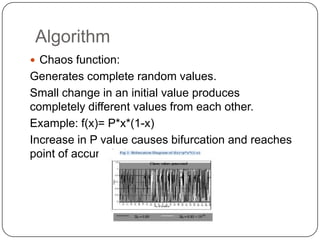
 Chaos function:
Generates complete random values.
Small change in an initial value produces
completely different values from each other.
Example: f(x)= P*x*(1-x)
Increase in P value causes bifurcation and reaches
point of accumulation.
Generation of one time pads
 Starting value for the iterations
 Number for decimal places of the mantissa that
are to be supported
 Number of iterations after which the first value
can be picked
 Number of iterations to be maintained between 2
values picked.
Encryption methodology
 Global parameters
Indexed key table is built. Key of length 8 has 256
indexes.
 Secret parameters
4 Conditions. Shared using Diffie hellmann or RSA.
 Uses the secret parameters and run the chaotic
function.
 Every pixel of the image is XOR’ed with the
secret key.
Analysis
 Key space analysis
Large key space -> secure against brute force
 Statistical analysis
Histogram analysis
Correlation coefficient analysis
 Execution time
Not computational time complex
 Key sensitivity analysis
Avalanche effect.
Digital Image encryption based on
chaos and improved DES
Introduction
 Images over Internet.
 Many image encryption algorithms
 Chaos based image encryption
 Fast and highly secure image encryption
 Problem: Limited accuracy
 DES encryption: not for image encryption
 Chaos + improved DES: better encryption system
DES + Chaotic encryption
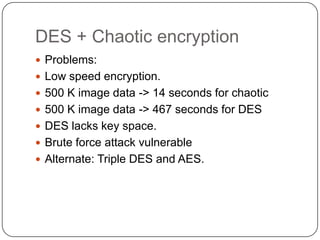
 Problems:
 Low speed encryption.
 500 K image data -> 14 seconds for chaotic
 500 K image data -> 467 seconds for DES
 DES lacks key space.
 Brute force attack vulnerable
 Alternate: Triple DES and AES.
Improved DES + Chaotic
encryption
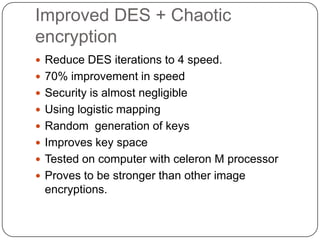
 Reduce DES iterations to 4 speed.
 70% improvement in speed
 Security is almost negligible
 Using logistic mapping
 Random generation of keys
 Improves key space
 Tested on computer with celeron M processor
 Proves to be stronger than other image
encryptions.
Image encryption based on Henon
chaotic system
Introduction
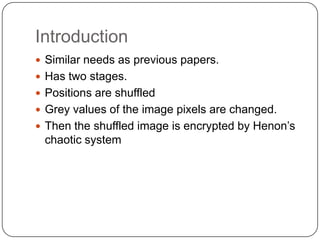
 Similar needs as previous papers.
 Has two stages.
 Positions are shuffled
 Grey values of the image pixels are changed.
 Then the shuffled image is encrypted by Henon’s
chaotic system
Arnold cat map
 Is a 2 D chaotic mapping system
 Shuffles the positions in an image.
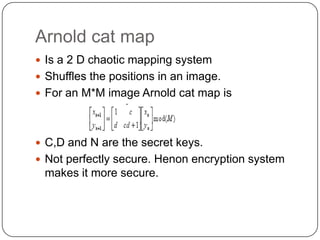
 For an M*M image Arnold cat map is
 C,D and N are the secret keys.
 Not perfectly secure. Henon encryption system
makes it more secure.
Henon encryption system
 Discovered in 1978.
 3 step process:
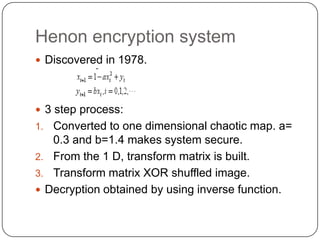
1. Converted to one dimensional chaotic map. a=
0.3 and b=1.4 makes system secure.
2. From the 1 D, transform matrix is built.
3. Transform matrix XOR shuffled image.
 Decryption obtained by using inverse function.
Comparison
 Image encryption by one time padding
Uses vernam cipher. Large random key space and
images are securely transmitted
 Image encryption by chaos system + improved
DES
Uses chaos system and ¼ th size of DES along
with logistic mapping for random generation of
keys.
 Image encryption by Henon chaotic system
Shuffles the image and uses henon encryption
system to make the image secure.
Conclusion
 Various types of image encryption techniques.
 Few of them are widely used and few of them are
still questionable.
 One time padding, Improved DES and Henon
encryption on images.
 Widely accepted -> One time padding image
encryption.
References
 Image encryption on chaos and improved DES
http://ieeexplore.ieee.org/stamp/stamp.jsp?tp=&arn
umber=5346839
 Image encryption on one time pads
http://ieeexplore.ieee.org/stamp/stamp.jsp?tp=&arn
umber=5591643
 Image encryption on Henon chaotic system
http://ieeexplore.ieee.org/stamp/stamp.jsp?tp=&arn
umber=5054653

Mc (1)

  • 1.
    Image encryption byOne time padding
  • 2.
    Introduction  Diverse usageof images  Need to be transmitted securely over internet  One time pad or vernam cipher  Large random key space  Highly secure and efficient  Other types: RSA, El gamal  Triple DES, Blow fish
  • 3.
    Algorithm  Chaos function: Generatescomplete random values. Small change in an initial value produces completely different values from each other. Example: f(x)= P*x*(1-x) Increase in P value causes bifurcation and reaches point of accumulation.
  • 4.
    Generation of onetime pads  Starting value for the iterations  Number for decimal places of the mantissa that are to be supported  Number of iterations after which the first value can be picked  Number of iterations to be maintained between 2 values picked.
  • 5.
    Encryption methodology  Globalparameters Indexed key table is built. Key of length 8 has 256 indexes.  Secret parameters 4 Conditions. Shared using Diffie hellmann or RSA.  Uses the secret parameters and run the chaotic function.  Every pixel of the image is XOR’ed with the secret key.
  • 6.
    Analysis  Key spaceanalysis Large key space -> secure against brute force  Statistical analysis Histogram analysis Correlation coefficient analysis  Execution time Not computational time complex  Key sensitivity analysis Avalanche effect.
  • 7.
    Digital Image encryptionbased on chaos and improved DES
  • 8.
    Introduction  Images overInternet.  Many image encryption algorithms  Chaos based image encryption  Fast and highly secure image encryption  Problem: Limited accuracy  DES encryption: not for image encryption  Chaos + improved DES: better encryption system
  • 9.
    DES + Chaoticencryption  Problems:  Low speed encryption.  500 K image data -> 14 seconds for chaotic  500 K image data -> 467 seconds for DES  DES lacks key space.  Brute force attack vulnerable  Alternate: Triple DES and AES.
  • 10.
    Improved DES +Chaotic encryption  Reduce DES iterations to 4 speed.  70% improvement in speed  Security is almost negligible  Using logistic mapping  Random generation of keys  Improves key space  Tested on computer with celeron M processor  Proves to be stronger than other image encryptions.
  • 11.
    Image encryption basedon Henon chaotic system
  • 12.
    Introduction  Similar needsas previous papers.  Has two stages.  Positions are shuffled  Grey values of the image pixels are changed.  Then the shuffled image is encrypted by Henon’s chaotic system
  • 13.
    Arnold cat map Is a 2 D chaotic mapping system  Shuffles the positions in an image.  For an M*M image Arnold cat map is  C,D and N are the secret keys.  Not perfectly secure. Henon encryption system makes it more secure.
  • 14.
    Henon encryption system Discovered in 1978.  3 step process: 1. Converted to one dimensional chaotic map. a= 0.3 and b=1.4 makes system secure. 2. From the 1 D, transform matrix is built. 3. Transform matrix XOR shuffled image.  Decryption obtained by using inverse function.
  • 15.
    Comparison  Image encryptionby one time padding Uses vernam cipher. Large random key space and images are securely transmitted  Image encryption by chaos system + improved DES Uses chaos system and ¼ th size of DES along with logistic mapping for random generation of keys.  Image encryption by Henon chaotic system Shuffles the image and uses henon encryption system to make the image secure.
  • 16.
    Conclusion  Various typesof image encryption techniques.  Few of them are widely used and few of them are still questionable.  One time padding, Improved DES and Henon encryption on images.  Widely accepted -> One time padding image encryption.
  • 17.
    References  Image encryptionon chaos and improved DES http://ieeexplore.ieee.org/stamp/stamp.jsp?tp=&arn umber=5346839  Image encryption on one time pads http://ieeexplore.ieee.org/stamp/stamp.jsp?tp=&arn umber=5591643  Image encryption on Henon chaotic system http://ieeexplore.ieee.org/stamp/stamp.jsp?tp=&arn umber=5054653