Project Study Report on
Strategic Intent of Milma
With special reference to
Thiruvananthapuram Dairy
(A Division of Thiruvananthapuram Regional
Co-operative Milk Producers’ Union Ltd)
Project Study report submitted in partial fulfillment of requirement
for the award of degree of
Master of Business Administration of Kerala University
Submitted by
Alexander T C
Register No. 401
Under the Guidance of
Faculty Guide Project Guide
Institute of Management in Kerala,
University of Kerala,
Kariyavattom
Thiruvananthapuram-6950581
Kerala State
PH: 0471-2301145, 2301513 Ext: 286/296
Email: contact@imk.ac.in
1. Dr. J. Rajan. M.Com .PhD,
Director & Faculty –Strategic Management
IMK- University of Kerala
2. Dr. Rajan Nair, M.Com, PhD,
Faculty- Marketing Management
IMK- University of Kerala
Mr. G. Rajesh,
Manager- Marketing
Thiruvananthapuram Dairy
TRCMPU Ltd.
2 | P a g e
Project Report _Alexander_T_C_ _MBA_ E_ Batch_2010-2012_IMK_UoK_
I. Project Title
Project Study Report on
Strategic Intent of Milma
With special reference to
Thiruvananthapuram Dairy
- A Division of TRCMPU Ltd.
(Thiruvananthapuram Regional
Co-operative Milk Producers’ Union Ltd )
3 | P a g e
Project Report _Alexander_T_C_ _MBA_ E_ Batch_2010-2012_IMK_UoK_
II. Declaration
I declare that the Organization Study report entitled “Strategic
Intent of Milma With special reference to Thiruvananthapuram
Dairy ” submitted by me for the award of degree of Master of
Business Administration of the University of Kerala is my own work.
The report has not been submitted for the award of any other degree of
this university or any other university.
Alexander T C
Register No.3001
(Name & Signature of Student)
Place: Thiruvananthapuram
Dated: 14th
December 2012
4 | P a g e
Project Report _Alexander_T_C_ _MBA_ E_ Batch_2010-2012_IMK_UoK_
III. Certificate of the Organization
THIRUVANANTHAPURAM DAIRY
(ISO 9001:2008 Certified)
Post Box No.4 Ambalathara, Poonthura P O, Thiruvananthapuram 695026
Telephone: +91-471-2381410, 2382562, 2381228, 2384148, 2382982
Email: milmatd@gmail.com
No.TD/PER/36/92/Vol.13/3268 05.12.2012
CERTIFICATE
This is to certify that Mr Alexander T C , MBA student of Institute of
Management in Kerala University of Kerala, Tvm has successfully completed the
project work titled “Strategic Intent of Milma With special reference to
Thiruvananthapuram Dairy ” for 45 days starting from 17.09.2012 to 31.10.2012
as per of his MBA curriculum.
We wish him all success for future endeavors
SD/-
Manager (HRD)
5 | P a g e
Project Report _Alexander_T_C_ _MBA_ E_ Batch_2010-2012_IMK_UoK_
IV. Certificate of the Institution
This is to certify that the Project Study report titled
“Strategic Intent of Milma With special reference to
Thiruvananthapuram Dairy ” submitted here is a bonafide record of
the work done by Mr Alexander T C (Register No 401), under my
guidance in partial fulfillment of the requirement for the award of the
Degree in Master of Business Administration of the University of
Kerala and this work has not been submitted by him for the award of any
other degree or title of recognition earlier
Director Faculty Guide
Dr Rajan Nair
6 | P a g e
Project Report _Alexander_T_C_ _MBA_ E_ Batch_2010-2012_IMK_UoK_
V. Acknowledgement
Here I acknowledge my sincere appreciation to all those who
stood by me to make this study report a success. I must acknowledge
special thanks to the management, especially to Sri. Baby Joseph,
Managing Director, TRCMPU Ltd, Mr B S Jyothi, General Manager
(I/C), Mr. G. Rajesh , Manager – Marketing , Mr K Polachan ,
Manager –HR and all the other Section Heads and staff Members of
Thiruvananthapuram Dairy for their whole hearted support and
contributions to make this report meaningful and relevant.
I am much thankful to Dr. J Rajan, Director-IMK, faculty
members and staff of IMK for their support and guidance throughout
the programme. Also special salutes to my faculty guide Dr. Rajan Nair
for his valuable reviews and suggestions that made this report
presentable.
Finally a word acknowledging my whole hearted thanks to
my wife Beena and our kids Emy and Ann for their constant support
throughout the last two years to help me complete my MBA
programme and complete the project work.
7 | P a g e
Project Report _Alexander_T_C_ _MBA_ E_ Batch_2010-2012_IMK_UoK_
VI. Contents
Sq.# Page Description Page #
I. Title Page 2
II. Declaration 3
III. Certificate of the Organization 4
IV. Certificate of the Institution 5
V. Acknowledgement 6
VI. Contents 7
VII. List of Tables & Charts 8
VIII. Executive Summary 13
IX. Chapter 1. Introduction 18
IX.01 Statement of the Problem 22
IX.02 Review Literature 23
IX.03 Objectives 25
IX.04 Research Design 26
1X.04.01 Type Of Research Design 28
1X.04.02 Date Collection From Secondary Sources 29
1X.04.03 Date Collection From Primary Sources 30
1X.04.04 Sampling Techniques 31
1X.04.05 Scaling Techniques 33
1X.04.06 Data Analysis Tools & Techniques 36
IX.05 Scope of the Study 43
IX.06 Limitations 44
IX.07 Chapterisation 45
X. Chapter 2. Industry Profile 46
XI. Chapter 3. Company Profile 56
XI.01 Name, Location & Address 57
XI.02 History 58
XI.03 Management 59
XI.04 Strategic Intent 60
XI.05 Products 61
XI.06 Organizational Structure 62
XII. Chapter 4. Data Analysis Interpretation 74
XII.01XII.01 Part–1 Data Analysis &Interpretation – Customers’ 75
XII.02 Part–2 Data Analysis & Interpretation – Farmers’ 112
XIII. Chapter 5 ETOP ,OCP & SAP Analysis 156
XIV. Chapter 6. Findings , Conclusions & Suggestions 160
XV. Findings 160
XVI. Conclusions 171
XVII. Suggestions 173
XVIII. Bibliography 175
XIX. Appendix 176
8 | P a g e
Project Report _Alexander_T_C_ _MBA_ E_ Batch_2010-2012_IMK_UoK_
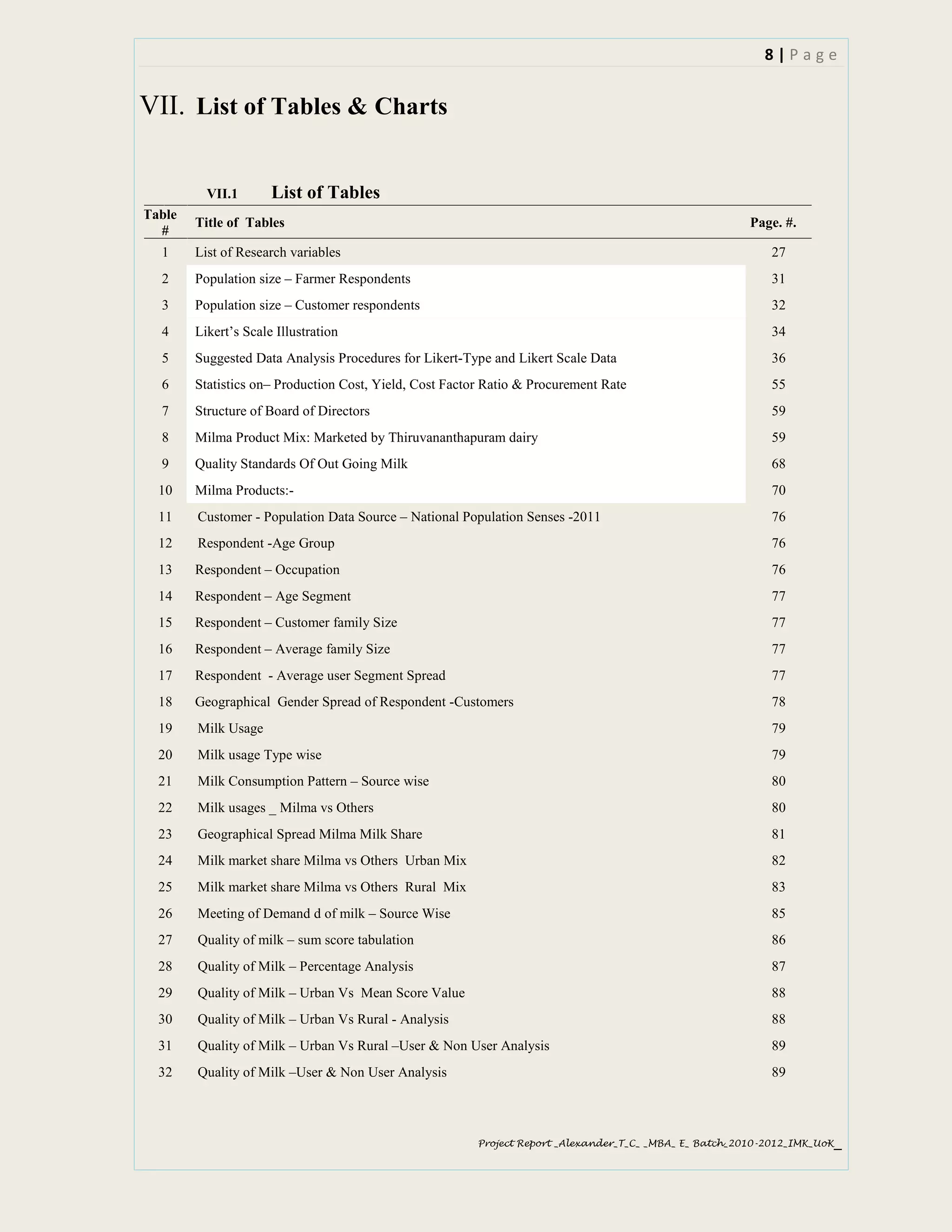
VII. List of Tables & Charts
VII.1 List of Tables
Table
#
Title of Tables Page. #.
1 List of Research variables 27
2 Population size – Farmer Respondents 31
3 Population size – Customer respondents 32
4 Likert’s Scale Illustration 34
5 Suggested Data Analysis Procedures for Likert-Type and Likert Scale Data 36
6 Statistics on– Production Cost, Yield, Cost Factor Ratio & Procurement Rate 55
7 Structure of Board of Directors 59
8 Milma Product Mix: Marketed by Thiruvananthapuram dairy 59
9 Quality Standards Of Out Going Milk 68
10 Milma Products:- 70
11 Customer - Population Data Source – National Population Senses -2011 76
12 Respondent -Age Group 76
13 Respondent – Occupation 76
14 Respondent – Age Segment 77
15 Respondent – Customer family Size 77
16 Respondent – Average family Size 77
17 Respondent - Average user Segment Spread 77
18 Geographical Gender Spread of Respondent -Customers 78
19 Milk Usage 79
20 Milk usage Type wise 79
21 Milk Consumption Pattern – Source wise 80
22 Milk usages _ Milma vs Others 80
23 Geographical Spread Milma Milk Share 81
24 Milk market share Milma vs Others Urban Mix 82
25 Milk market share Milma vs Others Rural Mix 83
26 Meeting of Demand d of milk – Source Wise 85
27 Quality of milk – sum score tabulation 86
28 Quality of Milk – Percentage Analysis 87
29 Quality of Milk – Urban Vs Mean Score Value 88
30 Quality of Milk – Urban Vs Rural - Analysis 88
31 Quality of Milk – Urban Vs Rural –User & Non User Analysis 89
32 Quality of Milk –User & Non User Analysis 89
9 | P a g e
Project Report _Alexander_T_C_ _MBA_ E_ Batch_2010-2012_IMK_UoK_
33 Quality of Milk - Chi Square test for Association –Observed value Table 90
34 Quality of Milk - Chi Square test for Association –Expected value Table 90
35 Price of Milk – Percentage Analysis and Mean score value 91
36 Price of Milk - Chi Square test - Users vs Non Users - Observed value Table 92
37 Price of Milk - Chi Square test - Users Vs Non users –Expected value Table 92
38 Price of Milk - Chi Square test Users Vs Non Users –Value Tabulation 92
39 Price of Milk – Urban Vs Rural - Analysis 93
40 Price of Milk - Chi Square test - Urban vs Rural - Observed value Table 94
41 Price of Milk - Chi Square test - Urban vs Rural –Expected value Table 94
42 Price of Milk - Chi Square test - Urban vs Rural –Value Tabulation 95
43 Price of Milk - Acceptance – Overall rating 96
44 Brand Loyalty - Urban Vs Rural User –Non user Analysis 96
45 Brand Loyalty - Urban Vs Rural User – Non User Percentage & Mean Score 98
46 Market Access – Urban Vs Rural Analysis 99
47 Market Access - Urban Vs Rural User –Non User –Percentage & Mean Score 101
48 Market Access - User – Non user - Mean Score Value 101
49 Market Access – Urban Vs Rural - User Non user - Analysis 102
50 Market awareness – Percentage Score 102
51 Market awareness – Mean Score value 103
52 Market Awareness – Urban vs Rural Analysis 104
53 Market Awareness – user Vs Non User - Analysis 105
54 Value Expectation – Urban Vs Rural Analysis 105
55 Value Expectation – Urban Vs Rural User – Non User Analysis 106
56 Value Expectation – Percentage & Mean Score Value 107
57 Value Expectation Urban Vs Rural Divide Analysis 108
58 Overall Rating by Customer -Level of Satisfaction - Users 108
59 Overall Rating by Customer -Level of Satisfaction - Non Users 109
60 Overall Rating by Customer -User Non user Percentage & Mean Score Value 110
61 Farmers Survey Sample - Statistics 113
62 Farming Pattern In terms of No of Animals Owned 114
63 Strength of farmers - based on No of Animals Owned 114
64 Daily Per Animal production Level 115
65 Milk Yield Per Animal 115
66 Age Distribution Of farmers 116
67 Age & experience of farmers 117
68 Farming Potential _ Survey Score 117
69 Statistics on Milk production –Consumption & Procurement 118
70 Hypothetical Case -1 : Analysis on Milk Pouring Strategy & Profit Margin 121
10 | P a g e
Project Report _Alexander_T_C_ _MBA_ E_ Batch_2010-2012_IMK_UoK_
71 Hypothetical Case -2 : Analysis on Milk Pouring Strategy & Profit Margin 122
72 Hypothetical Case -3 : Analysis on Milk Pouring Strategy & Profit Margin 123
73 Hypothetical Case -4 : Analysis on Milk Pouring Strategy & Profit Margin 124
74 Hypothetical Case Analysis – Summary Table 125
75 Acceptance of Milma Management - Percentage & Mean Score Value 127
76 Public relation & Communication - Percentage & Mean Score Value 128
77 Acceptance of Organization - Percentage & Mean Score Value 129
78 Dairy Farming Prospectus & Dependency - Percentage & Mean Score Value 130
79 Milk production Enhancement Programme - Percentage & Mean Score Value 131
80 Farmers’ reliance on Milma - Percentage & Mean Score Value 132
81 Hypothetical Case Analysis – Summary Table 133
82 Remunerative price - Percentage & Mean Score Value 134
83 Role pf Primary APCOS - Analysis - Percentage & Mean Score Value 135
84 Overall rating Acceptance rating on Performance of Milma 136
85 Survey Score – Farmers’ Acceptance rating of Milma 137
86 Reasons for Mixed Poring strategy - Mean Score value 138
87 Reasons for Mixed Poring strategy – percentage Analysis Value 139
88 Reasons for Mixed Poring strategy – Reasons Wise % Score 139
89 MPEP’s – Usefulness - Scheme Wise Acceptance Score 141
90 MPEP – production Incentive - % Score & Mean Score Value 142
91 MPEP – Cattle feed Fodder Supply - % Score & Mean Score Value 143
92 MPEP – Veterinary Service - % Score & Mean Score Value 144
93 MPEP – Calf Adoption - % Score & Mean Score Value 145
94 MPEP – Free cattle Insurance & Feed - % Score & Mean Score Value 146
95 MPEP – Artificial Insemination - % Score & Mean Score Value 147
96 MPEP Cattle Fodder Cultivation - % Score & Mean Score Value 148
97 MPEP – Merit Scholarship & Awards - % Score & Mean Score Value 149
98 MPEP – Gosureksha & Gosamwarthini Campaign - % Score & Mean Score 150
99 MPEP – Personal Accident Insurance - % Score & Mean Score Value 151
100 MPEP Interest Free Loan Using Revolving Fund - % Score & Mean Score Value 152
101 MPEP – Cattle Insurance - % Score & Mean Score Value 153
102 Overall Rating of MPEP’s 154
103 Farmers’ Survey MPEP item Wise % Score & Mean Score – Malayalam 155
104 Farmers’ Survey MPEP item Wise % Score & Mean Score - English 155
105 ETOP – Environmental Threats & Opportunity Profile 157
106 OCP – Organizational Capability Profile 158
107 SAP - Strategic Advantage Profile 158
11 | P a g e
Project Report _Alexander_T_C_ _MBA_ E_ Batch_2010-2012_IMK_UoK_
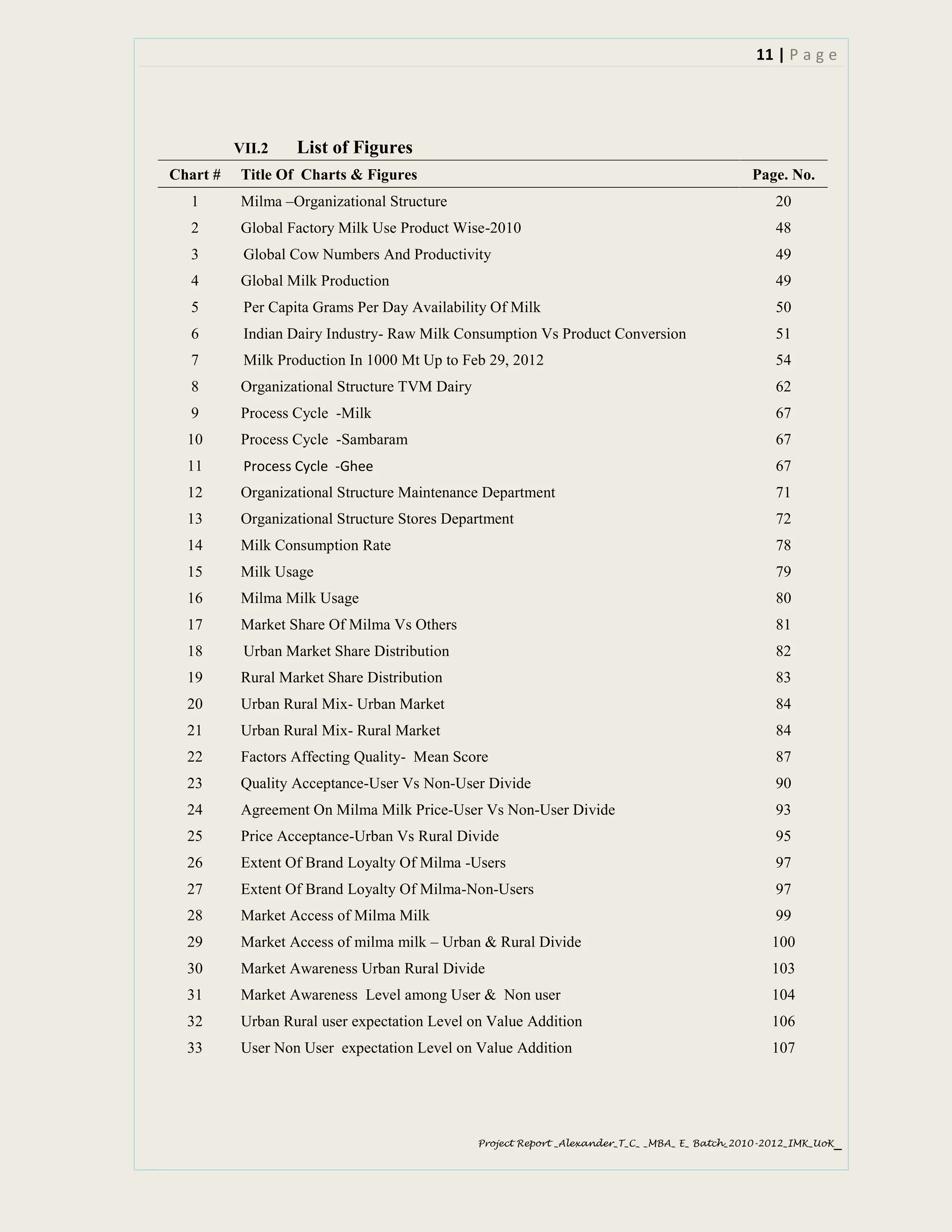
VII.2 List of Figures
Chart # Title Of Charts & Figures Page. No.
1 Milma –Organizational Structure 20
2 Global Factory Milk Use Product Wise-2010 48
3 Global Cow Numbers And Productivity 49
4 Global Milk Production 49
5 Per Capita Grams Per Day Availability Of Milk 50
6 Indian Dairy Industry- Raw Milk Consumption Vs Product Conversion 51
7 Milk Production In 1000 Mt Up to Feb 29, 2012 54
8 Organizational Structure TVM Dairy 62
9 Process Cycle -Milk 67
10 Process Cycle -Sambaram 67
11 Process Cycle -Ghee 67
12 Organizational Structure Maintenance Department 71
13 Organizational Structure Stores Department 72
14 Milk Consumption Rate 78
15 Milk Usage 79
16 Milma Milk Usage 80
17 Market Share Of Milma Vs Others 81
18 Urban Market Share Distribution 82
19 Rural Market Share Distribution 83
20 Urban Rural Mix- Urban Market 84
21 Urban Rural Mix- Rural Market 84
22 Factors Affecting Quality- Mean Score 87
23 Quality Acceptance-User Vs Non-User Divide 90
24 Agreement On Milma Milk Price-User Vs Non-User Divide 93
25 Price Acceptance-Urban Vs Rural Divide 95
26 Extent Of Brand Loyalty Of Milma -Users 97
27 Extent Of Brand Loyalty Of Milma-Non-Users 97
28 Market Access of Milma Milk 99
29 Market Access of milma milk – Urban & Rural Divide 100
30 Market Awareness Urban Rural Divide 103
31 Market Awareness Level among User & Non user 104
32 Urban Rural user expectation Level on Value Addition 106
33 User Non User expectation Level on Value Addition 107
12 | P a g e
Project Report _Alexander_T_C_ _MBA_ E_ Batch_2010-2012_IMK_UoK_
34 Customer Function over all Mean Score 109
35 Overall Customer Function rating 110
36 Overall Customer Function Rating – Urban & Rural User Divide 111
37 Overall Customer Function Rating – Non User Urban & Rural Divide 111
38 Overall Customer Function Rating – User Non User Divide 111
39 Milk Flow - Per Day Per Animal 119
40 Acceptance of Milma Management 127
41 Public Relation and Communication 129
42 Acceptance of the Organization 129
43 Dairy farming Prospects 130
44 Milk Production Enhancement 131
45 Farmers reliance on Milma 132
46 Remunerative Price 134
47 Role of Primary Apcos 135
48 Overall Rating of Performance 136
49 Major reasons for Milk Diversion 139
50 Production Incentive - % Score 142
51 Cattle feed & Fodder Supply - 143
52 Veterinary service 144
53 Calf Adoption 145
54 Free Insurance & Feed 146
55 Artificial Insemination 147
56 Cattle Fodder Cultivation 148
57 Merit Scholarship & Awards 149
58 Gosureksha & Gosamwarthani Campaign 150
59 Personal Accident Insurance 151
60 Interest Free Loan Using Revolving Fund 152
61 Cattle Insurance 153
62 Overall MPEP Rating 154
13 | P a g e
Project Report _Alexander_T_C_ _MBA_ E_ Batch_2010-2012_IMK_UoK_
VIII. Executive Summary
A 45 day long Project study is carried out in Part fulfillment of the
two years MBA Programme offered by Institute of Management In Kerala, University
Of Kerala. The management subject area selected for this study is Strategic
Management. The broad problem area identified is the Strategic Intent of Milma that
vouches socio-economic end benefits to member farmers. To this end milma has set the
objective of “Farmer’s Prosperity through Customer Satisfaction”.
With in the identified broad problem area, this study attempts to find
an answer to question, whether milma could strike a balance between its twin objectives
of providing remunerative price to farmers by supply of competitively priced good
quality milk & milk products to its potential customers?
The term milma is the brand name owned by Kerala state
cooperative Milk Marketing Federation Ltd, which is an apex to the 3 Regional Milk
Producers Unions in Kerala. Thiruvananthapuram dairy is one of the Business Unit and
this study is limited within the operational area of Thiruvananthapuram dairy.
70 % of the milk production and consumption happens within an
unorganized sector and only 30% is in the organized sector. Therefore this study has a
major constrain of being conducted within the organized sector. Analysis of data shows a
huge gap between milk demand and supply as explained below. The estimated demand
in the district of Thiruvananthapuram is 10.91 Lakhs Liters. Milma processes average 2
Lakhs Litters a day. i.e 18 % of the demand. Total Market share of milma is 51 % on an
average in both urban & rural areas. That takes total Demand jointly met by milma and
others to 35%. The remaining 65 % of the milk is not covered in this study.
Based on the above stated objectives this study has analyzed and
matched the level of satisfaction of the farmers and customers and thereby asses the
efficiency of milma in balancing their interests. Units of Analysis are the Member Dairy
Farmers. The satisfaction level of Customers is put to test in terms of the various
14 | P a g e
Project Report _Alexander_T_C_ _MBA_ E_ Batch_2010-2012_IMK_UoK_
aspects of its customer’s functions namely Quality, Price Market Awareness., And Brand
Loyalty, and Product Access & Value Expectation.
Similarly the level of satisfaction of farmers is put in to test by
mean of their Acceptance of Management of Milma. Public Relations & Communication,
Acceptance of the Organization, Dairy Farming Dependency as Livelihood, Political
Involvement, Milk Production Enhancement Programme, Reliance On Milma For
Marketing Produces, Remunerative Price, Role Of Primary APCOS.
This research is done in an Exploratory Research Method as
there are no known or published earlier studies on the area of strategic intent of milma.
Being an exploratory research, much importance is given to primary sources for
collection of data. The data collection is done mainly by way of structured questionnaires
survey this study being an exploratory one in nature, relay basically on descriptive
statistics to measure the level of satisfaction or agreement of the respondent to a given
statement. Therefore an ordinal scaling technique is opted and specifically Likert’s Five
Point Scale is selected. The responses obtained are analyzed for their percentage of
Strong or mere agreement or disagreement or neutrality to a given statement. The % score
is corroborated with a mean Score value. Where ever required a test of association is
done using Chi Square Test.
The survey results shows that milma milk is enjoying s comfortable 70 %
market share in the urban area and 30 % in Rural. This amount to a total market share of
51 %. Quality of milma milk is found satisfactory. Milma need to improve a lot to fulfill
its stated objectives on customer functions. Milma has to take the leverage of its
competitive advantage of image of Govt Backed Co-operative label and a strong Brand
Loyalty.
Milma customers are quality conscious rather than price sensitive. 50
% of the users are favoring value addition and willing to pay a premium for value.
Therefore milma has to offer product differentiation by maintaining a balance between its
15 | P a g e
Project Report _Alexander_T_C_ _MBA_ E_ Batch_2010-2012_IMK_UoK_
price and costs. On an emergent strategic perspective milma has to adopt a differentiation
strategy to earn better returns to help farmers with remunerative price for their produce.
On the other side, milma is a failure in terms of protecting the interest of the
farmers. Of the total available marketable surplus of milk production, milma could
procure only 45 % of the milk production of its member farmers. The major constrain
that prevent the farmers pour their entire marketable surplus to milma is the milk value
factor.
Farmers are following a mixed pouring strategy that helps them cover the
loss to some extent. A hypothetical case analysis shows that a farmer who pours his entire
marketable surplus to milma at the prevailing rate will end up in a loss of Rs. 6.75 per
liter. By diverting 25 % of the milk, he could bring down the loss to Rs. 3.18 per Litre.
If milma could pay an expected price of Rs35/- a liter, farmer could gain Rs.1.09. A
farmer who obtain the expected price of Rs 35/- per Liter, if continue a mixed pouring
strategy could gain up to Rs.3.31 per liter.
Majority of the farmers are highly dissatisfied on the Input assistance
provided by milma. The major area of their concern is availability of cattle feed and its
souring price. Out of the 12 Milk production Enhancement programmes (MPEP), tested
for satisfaction level, all except for Production Incentive Scheme, failed utterly.
Therefore its time milma think wisely to revamp its MPEP’s.
Another area of concern is the depletion of farming community. The
majority of the farmers are in their 50’s and above. With an average life expectancy of 60
Years in Kerala, this lot of farmers will be extinct within 10 years time. So its high time
milma has to have the wisdom and vision to equip itself either to help develop a new
generation of farmers, especially rural women or go for back ward integration.
16 | P a g e
Project Report _Alexander_T_C_ _MBA_ E_ Batch_2010-2012_IMK_UoK_
This study concludes that its time milma has to do a strategic analysis
of its business level strategies and see possibilities to adopt an emergent strategic
approach. Strategy Management is a continuous process. Except for the core
vision or intent, strategies in the business level and operational level are to be
constantly reviewed to have a strategic fit and be aligned with the vision of the
organization.
Being a parallel to both capitalist and socialist form of economy, Co-
operatives are a viable solution to the evils of both. Therefore keeping in line
with the co-operative principles, milma can reformulate its business level and
operational level strategies to help farmers prosper while keeping the customer
lot satisfied with better customer functions and alternative technology.
17 | P a g e
Project Report _Alexander_T_C_ _MBA_ E_ Batch_2010-2012_IMK_UoK_
Chapter 1
IX.00 Introduction
IX.01 Statement of the Problem
IX.02 Review Literature
IX.03 Objectives
IX.04 Research Design
1X.04.01 Type Of Research Design
1X.04.02 Date Collection from Secondary Sources
1X.04.03 Date Collection from Primary Sources
1X.04.04 Sampling Techniques
1X.04.05 Scaling Techniques
1X.04.06 Data Analysis Tools & Techniques
IX.05 Scope of the Study
IX.06 Limitations
IX.07 Chapterisation
18 | P a g e
Project Report _Alexander_T_C_ _MBA_ E_ Batch_2010-2012_IMK_UoK_
1X.00 Introduction
“Living Is Purposeful Existence”. Purpose has to be value based.
Existence of a living entity becomes fruitful only when it succeeds in achieving the
purpose it strives for. Success can’t be an accident or a spontaneous happening. Only
deliberate action will make things happen to be successful. Acting is responding to
changes in the environment. Response has to be proactive rather than reactive. In
order to be proactive one has to communicate with the environment continuously.
Success gives growth. Growth means enhancement of capabilities in terms of
resources. Growth becomes meaningful when the enhanced capabilities help Create
and delivers value to the stake holders and to the environment as a whole. Therefore
the ultimate test of meaningful existence is the enhanced capability of an entity to
create and deliver value to its stake holders. This holds true for individuals as well as
organizations including business organizations.
The purpose that an organization or an individual strives for is called its
Strategic Intent. The strategic Intent of a firm can be expressed in a hierarchical way
at each of its organizational level. In the corporate level the strategic Intent could be
expressed as a whole in the form of Vision and Mission Statement of the
Organization. In the business level, i.e. in Strategic Business Unit Level, this could be
expressed as the Business Definition and Business Model.
Vision: - “A well conceived vision consists of two major components; Core
Ideology & Envisioned Future “(Collins & Porras 1996). The core ideology has to remain
consistent despite the changes in environmental vectors like technology, competition
or management fads. The core ideology has to rest on the core values and core
purpose of the organization. The envisioned future also has two components namely a
Long Term Audacious Goal and a vivid description of what it looks like when that
goal is achieved.
19 | P a g e
Project Report _Alexander_T_C_ _MBA_ E_ Batch_2010-2012_IMK_UoK_
Mission: - When vision is a view of what an organization wish to be, mission is
what an organization is and why it exists. Mission is the tasks or steps undertaken to
achieve the vision. The mission of an organization answers three fundamental
philosophical business related questions; “what is our business?” , “What will it
be?” & “What it should be?”(Peter F Drucker). The mission of an organization is
therefore defined as “purpose or reason for organization’s existence” (Hunger & Wheelen
1999). The Mission Statement has to enlighten the insiders and outsiders about what the
organization stands for.
Business Definition: - In the business unit level the Strategic Intent of an
organization can be expressed in terms of the business definition. A business can be
defined in three dimensions namely Customer Group, Customer Functions and
Alternative Technology (Derek Abell). A clear business definition helps indicate the
choice of objectives, help choose the best strategic Alternatives, facilitate functional
policy implementation and suggest appropriate organizational Structure. Customer
Groups are the segments of customers which is one of the most important aspects of
defining the business. Customer Functions are the utility and value associated with the
products and services. Alternative Technology is the technology that helps creating
value bearing goods and services.
Business Model: - This is the representation of the core logic and strategic choices
of a firm that create and capture value within a value network. A business model is the
real life application of business strategies of an organization and they prescribe how to
implement the strategies and register growth in terms of money value.
This research study on the strategic Intent of milma is to analyze and
review the vision of “Farmers Prosperity through Customer Satisfaction” giving
special emphasis to the business definition of Thiruvananthapuram dairy, one of the
Strategic Business Unit (SBU) of Thiruvananthapuram Regional Co-operative Milk
producers Union Limited (TRCMPU Ltd) This study measure the operational
efficiency of Thiruvananthapuram Dairy in providing remunerative price to farmers
by way of providing good quality milk to customers at competitive price.
“Milma”, as it is popularly known by the brand name itself, is a 3- tier
Dairy Industry organizational set up in Co-Operative Sector (Figure 01). This 3-tier
20 | P a g e
Project Report _Alexander_T_C_ _MBA_ E_ Batch_2010-2012_IMK_UoK_
system consists of an Apex Body having three affiliated Regional Producers’ Unions,
comprised of primary level Anand Patten Co-Operative Societies having dairy
farmer-members.
Figure 1
As per clause 3.0 (3.1) of the bye law of TRCMPU Ltd, i.e at the corporate
level, the prime objective, shall be “to carry out activities conducive to the socio
economic development of the milk producers by effectively organizing production,
processing and marketing of commodities as per the direction of the Federation”.
The Kerala Sate Co-Operative Milk Marketing Federation Ltd
(KCMMF Ltd), the apex body of producers’ union, set its fundamental prime
objectives as “to carry out activities for promoting production, procurement,
processing and marketing of milk and milk products for economic development of
the farming community”. Also it aim allied activities conducive for the promotion of
dairy industry, promotion and protection of milch animals and economic betterment of
those engaged in milk production without prejudicing the prime objective.
As per its stated motto, milma is committed to achieve “Farmers Prosperity
through Consumer Satisfaction”. Therefore the prime intent of Milma can be
21 | P a g e
Project Report _Alexander_T_C_ _MBA_ E_ Batch_2010-2012_IMK_UoK_
concluded as is to strive for the socio- economic benefits of the dairy farmers in Kerala.
To this end milma must be able to support the farmers with effective Milk Production
Enhancement Programmes (MPEP’s) and should obtain better remunerative price for the
producers of its member – farmers. This is possible only if milma could add value to the
procured milk and provide good quality milk and milk products to potential customers at
competitive price.
It is in this context, this study is initiated and a problem area of the strategic
Intent of Milma is identified and attempts to find an answer to question, whether milma
could strike a balance between its twin objectives of providing remunerative price to
farmers by supply of competitively priced good quality milk & milk products to its
potential customers?
22 | P a g e
Project Report _Alexander_T_C_ _MBA_ E_ Batch_2010-2012_IMK_UoK_
1X.01 Statement of the Problem
Milma is a Co-operative form of business organization.
Being a Co-operative form of entity, the shareholding Member Farmers are the major
beneficiaries and prime intent of milma as stipulated in its by- law is the socio-economic
uplift of this group. This legally stipulated corporate intent of milma could be achieved
only by of serving the customer group with value bearing customer functions.
The above objective of milma is very well stated in the business slogan
“Farmers Prosperity through Consumer Satisfaction”. This stated business slogan
imposes a dual responsibility on milma. On one end it is obliged to procure the produce
of farmers and provide remunerative price and on the other end is has to profitably
market quality milk and value added milk products to its customers at competitive price.
It is in this context, the specific problem of this study is identified.
The specific problem identified is the “Conflict Of
Interests Of Stake Holding Member Farmers And Customers And
The Ability Of Milma To Strike A Balance Between The Two” and the
back drop of identifying this problem is as stated below.
23 | P a g e
Project Report _Alexander_T_C_ _MBA_ E_ Batch_2010-2012_IMK_UoK_
1X.02 Literature Review
This part of my report presents a summary of the literature search done on the
published data in relation to my research area of Strategic Management covering strategic
Intent of milma and the question of balancing the interests of stake holders and customers
in line with the stated intent of the organization.
Literature Review is nothing but an interpretation and synthesis of published
data. It has to be involved of locating, reading and evaluating published materials
including casual observations and opinions related to the research area.
As per a previous study, conducted by a team of dairy and livestock experts
headed by Dr. Unnithan, former Managing Director of Kerala Livestock Development
Board Ltd., the Dairy farmers in Kerala are the highest paid when comparing to the other
states in India. But even then the price level is not sufficient enough to set off the
mismatch between the production cost and the procurement price. But taking the
procurement price beyond that of the neighboring states is not in the best interests of the
producer or the consumer.
With regard to the market price of milk sold by milma, the report
states that the customers in Kerala are found paying no more than what their counter parts
in the neighboring states pay. The report categorically recommends that Milma, being is a
collective enterprise of resource-poor milk producers, should have all the rights to decide
the price of what they produce and survive in a free and competing market economy.
In contradiction to the above recommendation for freedom of pricing
policy, study further suggests that the government has to allow moderate incentives to
the dairy sector to function in a free-market economy, avoiding all forms of government
price control and monopoly.
24 | P a g e
Project Report _Alexander_T_C_ _MBA_ E_ Batch_2010-2012_IMK_UoK_
The above previous study caution than increase in prices, which is
inevitable to sustain local production, needs to be carefully balanced with production
incentives from the government, as provided by many States and countries.
The same study report put forward a Procurement pricing policy linked to the
consumer price index (CPI) for a hassle-free and scientific price adjustment. Accordingly
the report suggests an Index-based pricing, based on four aspects:
a. Feeding Cost,
b. Wage Rates,
c. Bank Rate Of Interest
d. CPI
The measures mooted by the panel include subsidizing cattle feed,
supply of straw of paddy and wheat and promotion of fodder cultivation. The report says
the cost of milk production during summer is more than that in the rainy season, calling
for a differential pricing of milk and providing special packages and services for summer
management of dairy cattle. The committee suggests that promotion of medium-sized
dairy farms of 10 or more cows and empowering them to take up dairying as a profession
should find priority in the development plans of the government and Milma.
A comparison of the operating margins between the procurement and
the consumer prices shows that the margin received by Milma is one of the lowest of
those received by such agencies in the country.
25 | P a g e
Project Report _Alexander_T_C_ _MBA_ E_ Batch_2010-2012_IMK_UoK_
1X.03 Objectives
1. Examine the operational efficiency of milma in providing
remunerative price to its member farmers for their milk
produces.
2. Examine the operational efficiency of milma in providing
competitively priced good quality milk to potential customers.
26 | P a g e
Project Report _Alexander_T_C_ _MBA_ E_ Batch_2010-2012_IMK_UoK_
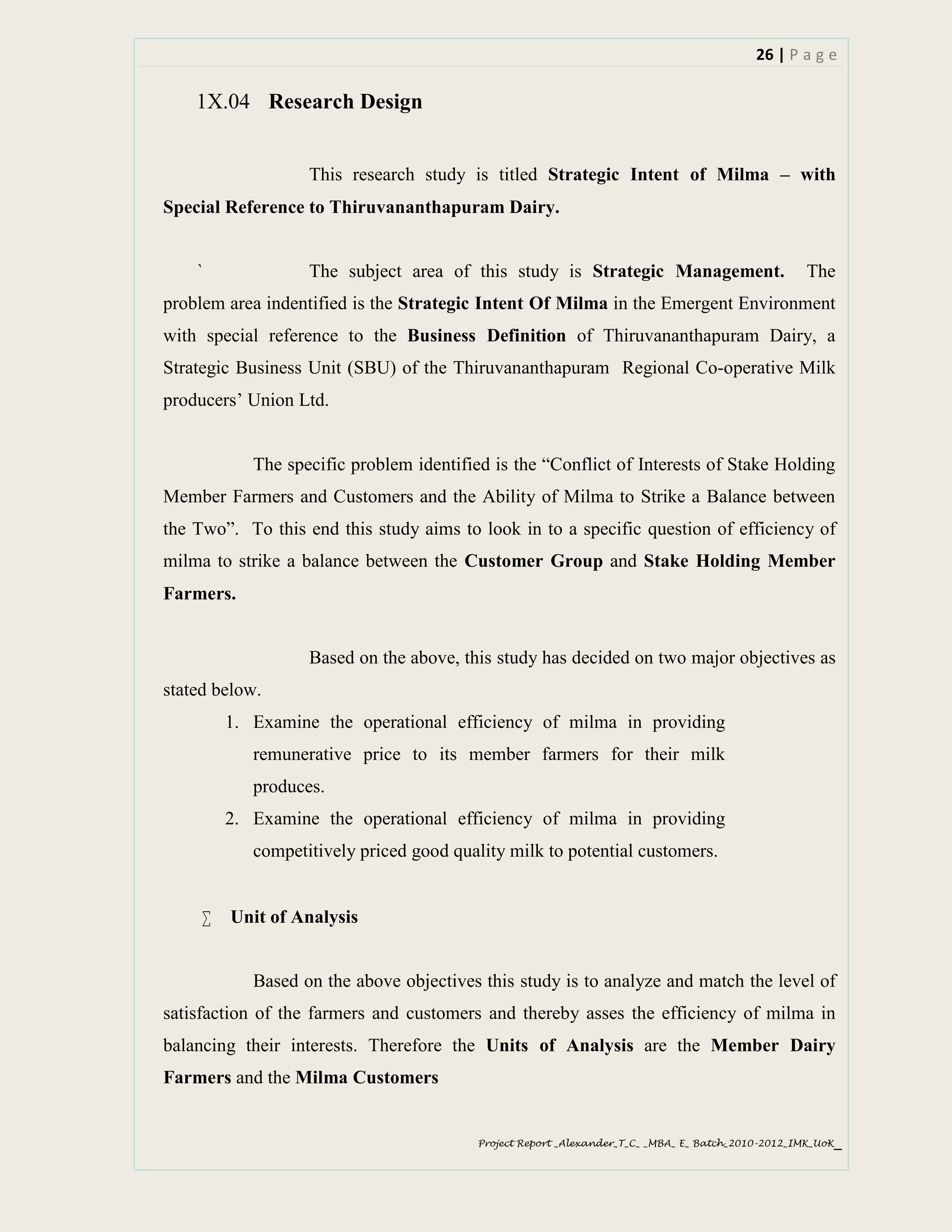
1X.04 Research Design
This research study is titled Strategic Intent of Milma – with
Special Reference to Thiruvananthapuram Dairy.
` The subject area of this study is Strategic Management. The
problem area indentified is the Strategic Intent Of Milma in the Emergent Environment
with special reference to the Business Definition of Thiruvananthapuram Dairy, a
Strategic Business Unit (SBU) of the Thiruvananthapuram Regional Co-operative Milk
producers’ Union Ltd.
The specific problem identified is the “Conflict of Interests of Stake Holding
Member Farmers and Customers and the Ability of Milma to Strike a Balance between
the Two”. To this end this study aims to look in to a specific question of efficiency of
milma to strike a balance between the Customer Group and Stake Holding Member
Farmers.
Based on the above, this study has decided on two major objectives as
stated below.
1. Examine the operational efficiency of milma in providing
remunerative price to its member farmers for their milk
produces.
2. Examine the operational efficiency of milma in providing
competitively priced good quality milk to potential customers.
 Unit of Analysis
Based on the above objectives this study is to analyze and match the level of
satisfaction of the farmers and customers and thereby asses the efficiency of milma in
balancing their interests. Therefore the Units of Analysis are the Member Dairy
Farmers and the Milma Customers
27 | P a g e
Project Report _Alexander_T_C_ _MBA_ E_ Batch_2010-2012_IMK_UoK_
 Variables
The study of level of satisfaction of farmers and customer is based on the
following variables which are identified relevant to the problem. These variables are
proposed to be studied by way of questionnaire survey based on Likert’s Scale method.
List of variables identified relevant to the problem are as shown in Table (1)
Table 1 Variables Brought Under Study
Research Variables Related To
Farmers
Research Variables Related To
Customers
1. Acceptance Of Management Of
Milma
1. Quality Of Milk
2. Public Relations &
Communication
2. Price Of Milk
3. Acceptance Of The Organization
3. Market Awareness On Milma
Products
4. Dairy Farming Dependency As
Livelihood
4. Brand Loyalty To Milma Products
5. Political Involvement 5. Product Access
6. Milk Production Enhancement
Programme
6. Value Expectation
7. Reliance On Milma For
Marketing Produces
8. Remunerative Price
9. Role Of Primary APCOS
28 | P a g e
Project Report _Alexander_T_C_ _MBA_ E_ Batch_2010-2012_IMK_UoK_
1X.04.01 Type Of Research Design
The topic of this research comes under Strategic Management and the
problem area identified is the Strategic Intent of Milma.
This research is done in an Exploratory Research Method as there
are no known or published earlier studies on the area of strategic intent of milma. Hence
no hypothesis or preposition is possible on the problem area. Therefore this study aims to
look in to patterns and ideas or prepositions rather than a hypothesis which can be tested
and proved true or false to be accepted or rejected.
 Research Process
The research approach adopted in this study has the following stages
1. Decide on strategic management as research subject
2. Identification of problem area of strategic intent on milma at corporate level
3. Located a specific problem in businesses Definition of Thiruvananthapuram dairy
4. Decided on exploratory research as no previous study could be traced
5. Identified two specific objectives ;one related to farmers and other on customers
6. Identified nine relevant variables in relation to farmers and six in relation to
customers
7. Decided on Survey method for collection of data
8. survey completed using questionnaire carrying questions related the identified
variables
9. Data analysis and interpretation
10. Preparation of report
 Period of Study:
This study is conducted for period of 45 days starting from 15th
September 2012 to 31st t
October 2012.
 Mode of Study:
The study is conducted in person by field survey method and personnel
interviews. The Farmers and Customers are surveyed by way of printed structured
questionnaire which is prepared based on identified variables.
In addition to the stake holding member farmers and customers, the
Board of Directors, Managers and CEO’s of APCOS and dairy Officials etc are
interviewed personally in an unstructured manner.
29 | P a g e
Project Report _Alexander_T_C_ _MBA_ E_ Batch_2010-2012_IMK_UoK_
1X.04.02 Date Collection From Secondary Sources:
This Study is done on exploratory research method as there is no
published and known document available on the specific problem of this study. Therefore
the secondary data collection is solely resorted only for gathering financial,
organizational and managerial data. The statistical data on the population of units of
analysis is also collected by way of secondary sources.
1. Annual Reports of KCMMF Ltd
2. Annual Report of TRCMPU Ltd
3. Audit Report
4. Bye Laws
5. Web Site
6. Company Brochures
7. Published Data
8. Statistical Data from Government Department
30 | P a g e
Project Report _Alexander_T_C_ _MBA_ E_ Batch_2010-2012_IMK_UoK_
1X.04.03 Date Collection from Primary Sources
Being an exploratory research, much importance is given to primary sources
for collection of data. The data collection is done mainly by way of structured
questionnaires survey. The major sources resorted for primary data collection is as
follows.
Primary Sources for Data Collection By Way Of Structured Questionnaire:
1. Dairy Farmer Members of APCOS , namely Idchakkaplammoodu
KUCS, Kallyam KUCS & Vellanad KUCS
2. Customers Residing Within Thiruvananthapuram Corporation and
Neighboring Municipalities and Grama Panchayats.
Primary Sources for Data Collection By Way Of Unstructured Interview:
1. CEO’s / Secretaries of APCOS stated above
2. Members of Board of Directors of TRCMPU Ltd
3. CEO of TRCMPU Ltd
4. CEO of Thiruvananthapuram Dairy
5. Functional Managers of Thiruvananthapuram Dairy
6. Manager- P& I of TRCMPU Ltd
7. Government Officials of Dairy Development Department
8. Chairman & CEO of Farmers Welfare Board
31 | P a g e
Project Report _Alexander_T_C_ _MBA_ E_ Batch_2010-2012_IMK_UoK_
1X.04.04 Sampling Techniques
A sample is made up of the members of a population. Population
refers to the body of people or to any other collection of items under consideration for the
purpose of the research. The individual member or item of a population under study is
called a Unit of Analysis. A sample is said to be a Good Sample when it satisfies the
following aspects.
 Chosen At Random
 Large Enough To Cover The Study
 Unbiased.
 Sampling Of Farmers.
In the selection of respondent farmers, a random sampling method is adopted
to avoid instances of being biased. The three Primary Milk Co-operative Societies are
selected in random to avoid being biased. Once the Primary societies are selected in
random, the members of such societies are covered in full to avoid being biased in
selecting only one section or group of members within that society. The size of the
population and sample is as follows.
Table 2
Dairy Farmer - Respondents (In Numbers)
1 Total Dairy Farmer Population in Kerala 8,06,599
Total Dairy Farmer Population in Thiruvananthapuram
District
(As Per Statistics For 2009-2010 Availed From Dairy Development Board)
66,935
3 Random Sample Size Taken 100
32 | P a g e
Project Report _Alexander_T_C_ _MBA_ E_ Batch_2010-2012_IMK_UoK_
 Sampling of Customers.
In the selection of respondent customers also random sampling method is
adopted since the population is very large and scattered. The customers are among
the general public so that respondent are selected randomly as and where available
in group. Such locations identified are mainly offices, factories and social and
religious gatherings. This study has resorted mainly offices and factories and family
and friends circles to locate customer respondents.
The size of the population and sample is as shown in the table (2) below
Table 3 -Sampling of Customers - Population Estimate
Customer - Respondents
(Source – National Population Senses -2011 )
Population Of Thiruvananthapuram District 3,307,284 Nos.
Rural Population 1,528,030 Nos.
Urban Population 1,779,254 Nos.
No Of Families In The District 7.85 Lakhs
Average Size Of A Family In The District 4.19 Nos.
Total No. Of Members In The Families 33.60 Lakhs
Estimated Daily Consumption Per Person 0.350 ml
Estimated Daily Consumption of a 4.19 member
Family
1.470 ml
Estimated Output Of TVM Dairy A Day 2,00,000 litres
Estimated No. Of User Families (2,00,000/1.470) 136054 Nos.
Random Sample Size 117 Nos.
33 | P a g e
Project Report _Alexander_T_C_ _MBA_ E_ Batch_2010-2012_IMK_UoK_
1X.04.05 Scaling Technique
This study being an exploratory one in nature, relay basically on descriptive
statistics to measure the level of satisfaction or agreement of the respondent to a given
statement. Therefore an ordinal scaling technique is opted and specifically Likert’s Five
Point Scale is selected. Ordinal scale observations are ranked in some measure of
magnitude. Numbers assigned to groups express a "greater than" relationship; however,
how much greater is not implied. The numbers only indicate the order. Examples of ordinal
scale measures include letter grades, rankings, and achievement (low, medium, high).
Other scaling methods available are as follows
 Nominal scale: In the nominal scale, observations are assigned to categories based
on equivalence. Numbers associated with the categories serve only as labels. Examples of
nominal scale data include gender, eye color, and race.
 Interval scales: - Interval scale data also use numbers to indicate order and reflect a
meaningful relative distance between points on the scale. Interval scales do not have an
absolute zero. An example of an interval scale is the IQ standardized test.
 Ratio scale; - A ratio scale also uses numbers to indicate order and reflects a
meaningful relative distance between points on the scale. A ratio scale does have an
absolute zero. Examples of ratio measures include age and years of experience.
A Likert scale is a psychometric scale commonly involved in research that
employs questionnaires. It is the most widely used approach to scaling responses in survey
research, such that the term is often used interchangeably with rating scale, or more
accurately the Likert-type scale, even though the two are not synonymous.
34 | P a g e
Project Report _Alexander_T_C_ _MBA_ E_ Batch_2010-2012_IMK_UoK_
The scale is named after its inventor, psychologist Rensis Likert .Likert
distinguished between a scale proper, which emerges from collective responses to a set of
items (usually eight or more), and the format in which responses are scored along a range.
Technically speaking, a Likert scale refers only to the former.
The difference between these two concepts has to do with the distinction
Likert made between the underlying phenomenon being investigated and the means of
capturing variation those points to the underlying phenomenon. When responding to a
Likert questionnaire item, respondents specify their level of agreement or disagreement on
a symmetric agrees-disagree scale for a series of statements. Thus, the range captures the
intensity of their feelings for a given item while the results of analysis of multiple items (if
the items are developed appropriately) reveals a pattern that has scaled properties of the
kind Likert identified.
In descriptive statistics the difficulty of measuring attitudes, character, and
personality traits lies in the procedure for transferring these qualities into a quantitative
measure for data analysis purposes. In response to this difficulty Likert (1932) developed a
procedure for measuring attitudinal scales. The original Likert scale used a series of
questions with five response alternatives:
Table 4 Likert’s Scale Illustration
Response
Strongly
Approve
Approve Undecided Disapprove
Strongly
Disapprove
Mean
Score
Individual or
Group
Sum Score
X1 X2 X3 X4 X5
∑X
n
5 Point
Weightage 5 4 3 2 1
(Where n= No.
of Responses )
Score X1 x 5 X2 x 4 X3 x 3 X4 x 2 X5 x 1
35 | P a g e
Project Report _Alexander_T_C_ _MBA_ E_ Batch_2010-2012_IMK_UoK_
Responses from the series of questions are used to create an
attitudinal measurement scale. Data analysis is based on the composite score from the
series of questions that represented the attitudinal scale. A Likert scale is composed of a
series of multiple, generally four or more, Likert-type items that are combined into a single
composite score/variable during the data analysis process. Combined, the items are used to
provide a quantitative measure of a character or an attitude. An example of the Likert
scaling used in this study is shown in Table (3) above.
36 | P a g e
Project Report _Alexander_T_C_ _MBA_ E_ Batch_2010-2012_IMK_UoK_
1X.04.06 Data Analysis Tools & techniques
1. Analyzing Likert Response Items
To properly analyze Likert data, one must understand the measurement scale
represented by each. Numbers assigned to Likert-type items express a "greater than"
relationship; however, how much greater is not implied. Because of these conditions,
Likert-type items fall into the ordinal measurement scale. Descriptive statistics
recommended for ordinal measurement scale items include a mode or median for central
tendency and frequencies for variability. Additional analysis procedures appropriate for
ordinal scale items include the chi-square measure of association, Kendall Tau B, and
Kendall Tau C.
Likert scale data, on the other hand, are analyzed at the interval measurement
scale. Likert scale items are created by calculating a composite score (sum or mean) from
four or more type Likert-type items; therefore, the composite score for Likert scales
should be analyzed at the interval measurement scale. Descriptive statistics recommended
for interval scale items include the mean for central tendency and standard deviations for
variability. Additional data analysis procedures appropriate for interval scale items would
include the Pearson's r, t-test, ANOVA, and regression procedures. Table 3 provides
examples of data analysis procedures for Likert-type and Likert scale data.
Table 5 Suggested Data Analysis Procedures for Likert-Type and Likert Scale Data
Suggested Data Analysis Procedures for Likert-Type and Likert Scale Data
Likert-Type Data Likert Scale Data
Central Tendency Median Or Mode Mean
Variability Frequencies Standard Deviation
Associations Kendall tau B or C Pearson's r
Other Statistics Chi-square ANOVA, t-test, Regression
Source :- Journal of Extension (JOE) www.joe.org Harry N. Boone, Jr. Deborah A. Boone West Virginia University, USA
37 | P a g e
Project Report _Alexander_T_C_ _MBA_ E_ Batch_2010-2012_IMK_UoK_
2. Analysis of Stand Alone Individual Questions with Likert’s Response
Option:-
The data analysis decision for Likert items is made at the
questionnaire development stage itself. Where there are a series of individual questions
which can stand alone and that have Likert response options to be answered by the
respondents, then the data has to be taken as Likert’s Type items and Modes, medians,
and frequencies are the appropriate statistical tools to use.
3. Analysis of Combination Questions with Likert’s Response Option:-
Whereas if a series of Likert-type questions that when combined
describe an attitude, it is to be taken as a Likert scale and the sum data can be described
by using the means and standard deviations. If you feel a need to report the individual
items that make up the scale, only use Likert-type statistical procedures. Keep in mind
that once the decision between Likert-type and Likert scale has been made, the decision
on the appropriate statistics will fall into place.
An important distinction must be made between a Likert scale and a Likert
item. The Likert scale is the sum of responses on several Likert items. Because Likert
items are often accompanied by a visual analog scale (e.g., a horizontal line, on which a
subject indicates his or her response by circling or checking tick-marks), the items are
sometimes called scales themselves. This is the source of much confusion; it is better,
therefore, to reserve the term Likert scale to apply to the summed scale, and Likert item
to refer to an individual item.
Likert scaling is a bipolar scaling method, measuring either positive or
negative response to a statement. Sometimes an even-point scale is used, where the
middle option of "Neither agree nor disagree" is not available. This is sometimes called a
"forced choice" method, since the neutral option is removed. [7] The neutral option can
be seen as an easy option to take when a respondent is unsure, and so whether it is a true
38 | P a g e
Project Report _Alexander_T_C_ _MBA_ E_ Batch_2010-2012_IMK_UoK_
neutral option is questionable. A 1987 study found negligible differences between the use
of "undecided" and "neutral" as the middle option in a 5-point Likert scale. [8]
Likert scales may be subject to distortion from several causes. And some of
the problems are as follows.
1. Respondents may avoid using extreme response categories (central
tendency bias);
2. agree with statements as presented (acquiescence bias);
3. Try to portray them in a more favorable light (social desirability
bias).
The above problems can be avoided by designing a scale with balanced
keying having an equal number of positive and negative statements .The positively
keyed items will balance acquiescence on negatively keyed items.
4. Scoring and analysis
After the questionnaire is completed, each item may be analyzed
separately or in some cases item responses may be summed to create a score for a group
of items. Hence, Likert scales are often called Summative Scales.
Whether individual Likert items can be considered as interval-level
data, or whether they should be treated as ordered-categorical data is the subject of
considerable disagreement in the literature. With strong convictions on what are the most
applicable methods. This disagreement can be traced back, in many respects, to the extent
to which Likert items are interpreted as being ordinal data.
There are two primary considerations in this discussion. First, Likert
scales are arbitrary. The value assigned to a Likert item has no objective numerical basis,
either in terms of measure theory or scale (from which a distance metric can be
39 | P a g e
Project Report _Alexander_T_C_ _MBA_ E_ Batch_2010-2012_IMK_UoK_
determined). The value assigned to each Likert item is simply determined by the
researcher designing the survey, who makes the decision based on a desired level of
detail. However, by convention Likert items tend to be assigned progressive positive
integer values. Likert scales typically range from 2 to 10 – with 5 or 7 being the most
common. Further, this progressive structure of the scale is such that each successive
Likert item is treated as indicating a ‘better’ response than the preceding value. (This may
differ in cases where reverse ordering of the Likert Scale is needed).
The second, and possibly more important point, is whether the
‘distance’ between each successive Likert item is equivalent, which is inferred
traditionally. For example, in the above five-point Likert Scale, the inference is that the
‘distance’ between items 1 and 2 is the same as between items 3 and 4. In terms of good
research practice, an equidistant presentation by the researcher is important; otherwise it a
bias in the analysis may result. For example, a four-point Likert Scale–Poor, Average,
Good, Very Good–is unlikely to have all equidistant items since there is only one item
that can receive a below average rating. This would arguably bias any result in favor of a
positive outcome. On the other hand, even if a researcher presents what he or she believes
is an equidistant scale, it may not be interpreted as such by the respondent.
A good Likert scale, as above, will present symmetry of Likert items about a
middle category that have clearly defined linguistic qualifiers for each item. In such
symmetric scaling, equidistant attributes will typically be more clearly observed or, at
least, inferred. It is when a Likert scale is symmetric and equidistant that it will behave
more like an interval-level measurement. So while a Likert scale is indeed ordinal, if well
presented it may nevertheless approximate an interval-level measurement.
This can be beneficial since, if it was treated just as an ordinal scale, then
some valuable information could be lost if the ‘distance’ between Likert items were not
available for consideration. The important idea here is that the appropriate type of
analysis is dependent on how the Likert scale has been presented.
40 | P a g e
Project Report _Alexander_T_C_ _MBA_ E_ Batch_2010-2012_IMK_UoK_
Given the Likert Scale's ordinal basis, summarizing the central
tendency of responses from a Likert scale by using either the median or the mode is best,
with ‘spread’ measured by quartiles or percentiles. Non-parametric tests should be
preferred for statistical inferences, such as chi-squared test, Mann–Whitney test, Wilcox
on signed-rank test, or Kruskal–Wallis test While some commentators consider that
parametric analysis is justified for a Likert scale using the Central Limit Theorem, this
should be reserved for when the Likert scale has suitable symmetry and equidistance so
an interval-level measurement can be approximated and reasonably inferred.
Responses to several Likert questions may be summed, providing that
all questions use the same Likert scale and that the scale is a defensible approximation to
an interval scale, in which case they may be treated as interval data measuring a latent
variable. If the summed responses fulfill these assumptions, parametric statistical tests
such as the Analysis Of Variance can be applied. These can be applied only when 4 to 8
Likert questions (preferably closer to 8) are summed.
Data from Likert scales are sometimes converted to binomial data by
combining all agree and disagree responses into two categories of "accept" and "reject".
The chi-squared, Cochran Q, or McNamara test is common statistical procedures used
after this transformation. Consensus Based Assessment (CBA) can be used to create
an objective standard for Likert scales in domains where no generally accepted or
objective standard exists. Consensus based assessment (CBA) can be used to refine or
even validate generally accepted standards.
41 | P a g e
Project Report _Alexander_T_C_ _MBA_ E_ Batch_2010-2012_IMK_UoK_
Analysis Method Adopted: -
Based on the above discussion the Likert’s Scale Data is
analyzed using the following methods.
1. Percentage Analysis: -
Percentage is a statistic which summarizes the data by
describing the proportion or part in every 100. In this method the Percentage
Relative frequency is calculated using the following formula.
Percentage Relative Frequency =
∑
2. Mean Score Analysis: -
This is a Measure of Central Tendency Using the Mean Score
of a frequency distribution. In this method a large frequency distribution can be
represented by a single value. The formula used for calculating the Mean Score
is as follows.
=
∑
Where ̅ = Mean Score
X = Each Observation
∑X = Sum of each Observed Value
n = Total Number of Observations
3. Chi Square Test: -
Chi Square test is a Non Parametric Technique which is used
to assess the statistical significance of a finding by testing the contingency
(uncertainty of occurrence) or goodness of fit.
42 | P a g e
Project Report _Alexander_T_C_ _MBA_ E_ Batch_2010-2012_IMK_UoK_
In this method frequency data from two situations is used to
match the differences. There will be a difference between the two sets of data.
The test involves two hypotheses namely Null Hypothesis and Alternate
Hypothesis denoted by H0 and H1 respectively. The null hypothesis will state
that the two variable are independent one another and the alternate hypothesis
state that they are associated.
The chi square test will find out whether there are any significant
differences between the actual (observed) frequencies and the hypothesized
(expected) frequencies. The idea is to test whether the difference is due to any
underlying universal differences or by merely to chance. The methodology of
Chi Square test is as follows.
a) Set up H0 and H1
b) Set table of observed frequencies (O) and total rows and columns
c) Calculate the Estimated frequency (E) using the formula ( Row total
x Column Total ) / Grand Total and set the value in table form
d) Find 2
using the formula ∑
( )
,
e) If O & E agrees, the Test Statistic 2
will have low value.
f) A high value of Test Statistic 2
denote poor agreement of O & E
g) Find out the 5% critical value , beyond which null hypothesis to be
rejected for accepting the alternate one, using the formula
v= (r-1) (c-1) where; v = Degree of Freedom
r= No. of Rows excluding totals
c= No. of columns excluding totals
43 | P a g e
Project Report _Alexander_T_C_ _MBA_ E_ Batch_2010-2012_IMK_UoK_
1X.05 Scope of the Study
Scope tells what are inside and help to know what are outside. This study
being conducted as the part of MBA programme Curriculum, has limited scope as stated
below.
i. Conduct a 45 days Study on the Strategic Intent of Milma with
reference to its Thiruvananthapuram Dairy Plant.
ii. Examine the level of satisfaction of existing & potential milma
Customers coming under the operational area of
Thiruvananthapuram dairy
iii. Examine the level of satisfaction of APCOS Member farmers
coming under the operational area of Thiruvananthapuram dairy
on performance of milma in providing remunerative price,
production inputs.
iv. Critically evaluate the strategic Intent of milma using SWOT,
ETOP and SAP Techniques
44 | P a g e
Project Report _Alexander_T_C_ _MBA_ E_ Batch_2010-2012_IMK_UoK_
1X.06 Limitations
1. This is study on strategic intent of milma as a whole is conducted with special
reference to Thiruvananthapuram Dairy only. Since organizational set up and
area of operation of milma is spread all over Kerala, this study has to be
restricted within Thiruvananthapuram District only.
2. Farmer respondents are selected based on cluster method and only three
different location could be fully covered for farmer survey
3. Farmers being a scattered lot could be contacted only when they come to the
collection centres for pouring milk. When contacted many of the farmers
were reluctant to express freely in the APCOS premises.
4. Directors of APCOS were not available for interviews and hence only the
CEO’s of the Societies are interviewed. Hence personal interviews with
Directors not attempted.
45 | P a g e
Project Report _Alexander_T_C_ _MBA_ E_ Batch_2010-2012_IMK_UoK_
1X.07 Chapterisation
Chapter 1:
Introduction - Includes the General introduction to this study
and the Statement of the Problem, Review Literature, Objectives,
Research Design, and Scope of the Study & Limitations.
Chapter 2
Industry Profile including briefs on Co-operatives and Dairy
Co-operatives in India
Chapter 3
Company Profile – including Apex federation and member
Unions and their structure
Chapter 4 Data Analysis & Interpretation
Chapter 5 ETOP , OCP & SAP Analysis
Chapter 6 Findings Conclusions & Suggestions
46 | P a g e
Project Report _Alexander_T_C_ _MBA_ E_ Batch_2010-2012_IMK_UoK_
Chapter 2.
VIII. Industry Profile
47 | P a g e
Project Report _Alexander_T_C_ _MBA_ E_ Batch_2010-2012_IMK_UoK_
X. Industry Profile:-
The Dairy Industry Profile is analyzed in three levels namely;
1. Global Level
2. National level
3. State Level
1.0 Global Level:-
The Dairy Industry is one of the largest and most dynamic global
agricultural industries. Dairy farming is an agricultural activity that refers to the
production of milk from farm animals. The dairy industry encompasses businesses from
the farm gate through to food manufacturing. And dairy products include any food
product originally derived from animal milk.
1.1 Industry Segmentation:-
Raw fluid milk is the initial product produced in any dairy operation,
irrespective of size, structure or source. This milk is consumed ‘as is’, or can be then
processed into an increasing number of food products for human consumption. Such
processing usually either involves heating, drying or separating the raw milk. Processed
dairy products include:
At a global level, one third of total dairy milk production is consumed as fluid milk with
the remaining two thirds processed. Cheeses account for around half of dairy products,
followed by butters (nearly 30%) and the remainder consumed as powders (skim or
whole milk).
48 | P a g e
Project Report _Alexander_T_C_ _MBA_ E_ Batch_2010-2012_IMK_UoK_
Figure: 2 Global Factory Milk Use by Product (2010)
1.2 Geographical Segmentation:-
The European Union is the largest dairy producing region, with annual
(cow) milk production in 2010 of 134 million tonnes, followed by the US (86million
tonnes), India (47.7million tonnes) and Russia (32.8million tonnes). India has the
largest dairy cattle herd with 38.5 million cows, followed by the EU-27 with
23.7million cows. Indian milk yields are notably inferior to the standards set in the
developed world. India is the world’s most significant consumer of ‘fluid’ milk with
annual consumption of 47.1million tonnes in 2010 vs the EU-27’s 33.7 million tonnes
and 27.9 million tonnes in the US. The majority of India’s milk production is consumed
as ‘fluid’ milk rather than processed in other products as is the case in other regions.
49 | P a g e
Project Report _Alexander_T_C_ _MBA_ E_ Batch_2010-2012_IMK_UoK_
1.3 Industry Performance:-
The dairy industry, unlike many other agricultural industries, has had an
inconsistent growth profile. Global dairy cow numbers fell from a peak of 174 million
head in 1984 to 139 million head by the mid 1990’s. Cow milk production declined from
441 million tons in 1990 to 370 million tons by 1997, representing a total decline of 17%
over 7 years. Despite the growth at 1.7% pa over the past decade, current global level at
439.4 million tones is below the 1990 peak.
The growth in the dairy industry over the past decade has not been with without some
challenges: The grain price spike of 2007/08 pressured production margins and resulted
in a moderation in cow productivity (via reduced volumes of grain fed to animals). The
Global Financial Crisis resulted in further herd liquidation (3% contraction in the 2 years
from 2007 to 2009), which caused a 1% decline in total cow milk production over the
period
Figure3:-Global Cow Numbers & Productivity:-
1.4 Global Milk Production:-
Figure4:- Share of Cow Milk within Total Milk Production
50 | P a g e
Project Report _Alexander_T_C_ _MBA_ E_ Batch_2010-2012_IMK_UoK_
2.0 National Level:-
India, the world's largest milk producer, accounts for around 20 per cent of
global milk production, with most of it consumed domestically. India ranks first in the
world in milk production, which went up from 17 million tons in 1950-51 to 121.84
million tons in 2010-11.
The per capita availability of milk has also increased from 112 grams per
day in 1968-69 to 281 grams in 2010-11. However, world average per capita availability
was 284 grams per day in 2009-10 compared to 273 grams per day for India. The Indian
dairy sector acquired substantial growth momentum from the Ninth Plan onwards,
achieving an annual output of 121.84 million tones of milk during 2010-11 (Table
8.10).
This represents sustained growth in the availability of milk and milk products for
the growing population of the country. Dairying has become an important secondary
source of income for millions of rural families and has assumed an important role in
providing employment and income-generating opportunities. Andhra Pradesh, Bihar,
Haryana, Gujarat, Madhya Pradesh, Maharashtra, Rajasthan and Uttar Pradesh are the
leading milk producing states in the country
Tables-1 :-Milk Production & Per Capita Availability of Milk:-Last updated: Feb
29, 2012
Year
Production (Million
Tonnes)
Per Capita Availability
(gms/day)
1991-92 55.7 178
1992-93 58.0 182
1993-94 60.6 187
0
50
100
150
200
250
300
Figure: 5- Per Capita Grams per Day Availability of Milk Vs. Milk Production of
in Million Tones
50 | P a g e
Project Report _Alexander_T_C_ _MBA_ E_ Batch_2010-2012_IMK_UoK_
2.0 National Level:-
India, the world's largest milk producer, accounts for around 20 per cent of
global milk production, with most of it consumed domestically. India ranks first in the
world in milk production, which went up from 17 million tons in 1950-51 to 121.84
million tons in 2010-11.
The per capita availability of milk has also increased from 112 grams per
day in 1968-69 to 281 grams in 2010-11. However, world average per capita availability
was 284 grams per day in 2009-10 compared to 273 grams per day for India. The Indian
dairy sector acquired substantial growth momentum from the Ninth Plan onwards,
achieving an annual output of 121.84 million tones of milk during 2010-11 (Table
8.10).
This represents sustained growth in the availability of milk and milk products for
the growing population of the country. Dairying has become an important secondary
source of income for millions of rural families and has assumed an important role in
providing employment and income-generating opportunities. Andhra Pradesh, Bihar,
Haryana, Gujarat, Madhya Pradesh, Maharashtra, Rajasthan and Uttar Pradesh are the
leading milk producing states in the country
Tables-1 :-Milk Production & Per Capita Availability of Milk:-Last updated: Feb
29, 2012
Year
Production (Million
Tonnes)
Per Capita Availability
(gms/day)
1991-92 55.7 178
1992-93 58.0 182
1993-94 60.6 187
Figure: 5- Per Capita Grams per Day Availability of Milk Vs. Milk Production of
in Million Tones
50 | P a g e
Project Report _Alexander_T_C_ _MBA_ E_ Batch_2010-2012_IMK_UoK_
2.0 National Level:-
India, the world's largest milk producer, accounts for around 20 per cent of
global milk production, with most of it consumed domestically. India ranks first in the
world in milk production, which went up from 17 million tons in 1950-51 to 121.84
million tons in 2010-11.
The per capita availability of milk has also increased from 112 grams per
day in 1968-69 to 281 grams in 2010-11. However, world average per capita availability
was 284 grams per day in 2009-10 compared to 273 grams per day for India. The Indian
dairy sector acquired substantial growth momentum from the Ninth Plan onwards,
achieving an annual output of 121.84 million tones of milk during 2010-11 (Table
8.10).
This represents sustained growth in the availability of milk and milk products for
the growing population of the country. Dairying has become an important secondary
source of income for millions of rural families and has assumed an important role in
providing employment and income-generating opportunities. Andhra Pradesh, Bihar,
Haryana, Gujarat, Madhya Pradesh, Maharashtra, Rajasthan and Uttar Pradesh are the
leading milk producing states in the country
Tables-1 :-Milk Production & Per Capita Availability of Milk:-Last updated: Feb
29, 2012
Year
Production (Million
Tonnes)
Per Capita Availability
(gms/day)
1991-92 55.7 178
1992-93 58.0 182
1993-94 60.6 187
Figure: 5- Per Capita Grams per Day Availability of Milk Vs. Milk Production of
in Million Tones
51 | P a g e
Project Report _Alexander_T_C_ _MBA_ E_ Batch_2010-2012_IMK_UoK_
A study conducted by ASSOCHAM titled, “Indian Dairy Industry: The
Way Ahead” says;
 Milk production is likely to climb to 190 million tons in 2015 from current
123 million tones.
 60 % of milk is consumed in liquid form, and 40 % is used in the form of
butter, clarified butter (desi ghee), cheese, curd, paneer, ice cream, dairy
whiteners and traditional sweets.
 Annual Growth rate is 10 % and Indian dairy industry is predominantly
controlled by the unorganized sector, which accounts for nearly 85 %
 Eight crore rural families are engaged in dairy production and the rural
market consumes over half of the total milk produced.
 The major causes behind the of lowering retail consumption of milk and
escalating milk prices in the domestic market are
a. Upward spiral in prices
b. Lack of proper chilling facilities and cold storage infrastructures
c. Absence of a transparent milk pricing system.
d. Lack of fodder resulting in low yield from cattle
Figure6:- Indian Dairy Industry: Raw Milk Consumption Vs Product Conversion
40%
51 | P a g e
Project Report _Alexander_T_C_ _MBA_ E_ Batch_2010-2012_IMK_UoK_
A study conducted by ASSOCHAM titled, “Indian Dairy Industry: The
Way Ahead” says;
 Milk production is likely to climb to 190 million tons in 2015 from current
123 million tones.
 60 % of milk is consumed in liquid form, and 40 % is used in the form of
butter, clarified butter (desi ghee), cheese, curd, paneer, ice cream, dairy
whiteners and traditional sweets.
 Annual Growth rate is 10 % and Indian dairy industry is predominantly
controlled by the unorganized sector, which accounts for nearly 85 %
 Eight crore rural families are engaged in dairy production and the rural
market consumes over half of the total milk produced.
 The major causes behind the of lowering retail consumption of milk and
escalating milk prices in the domestic market are
a. Upward spiral in prices
b. Lack of proper chilling facilities and cold storage infrastructures
c. Absence of a transparent milk pricing system.
d. Lack of fodder resulting in low yield from cattle
Figure6:- Indian Dairy Industry: Raw Milk Consumption Vs Product Conversion
60%
40%
Whole Milk
Consumption
Product
Conversion
51 | P a g e
Project Report _Alexander_T_C_ _MBA_ E_ Batch_2010-2012_IMK_UoK_
A study conducted by ASSOCHAM titled, “Indian Dairy Industry: The
Way Ahead” says;
 Milk production is likely to climb to 190 million tons in 2015 from current
123 million tones.
 60 % of milk is consumed in liquid form, and 40 % is used in the form of
butter, clarified butter (desi ghee), cheese, curd, paneer, ice cream, dairy
whiteners and traditional sweets.
 Annual Growth rate is 10 % and Indian dairy industry is predominantly
controlled by the unorganized sector, which accounts for nearly 85 %
 Eight crore rural families are engaged in dairy production and the rural
market consumes over half of the total milk produced.
 The major causes behind the of lowering retail consumption of milk and
escalating milk prices in the domestic market are
a. Upward spiral in prices
b. Lack of proper chilling facilities and cold storage infrastructures
c. Absence of a transparent milk pricing system.
d. Lack of fodder resulting in low yield from cattle
Figure6:- Indian Dairy Industry: Raw Milk Consumption Vs Product Conversion
Whole Milk
Consumption
Product
Conversion
52 | P a g e
Project Report _Alexander_T_C_ _MBA_ E_ Batch_2010-2012_IMK_UoK_
2..1 National Dairy Plan (NDP):-
Despite the initiated growth by White Revolution in 1970s, Indian dairy
industry marked a drop in milk production with annual production decreasing to 3.8
per cent in the 2000s from 4.3 per cent in the 1990s. India currently produces 120
million tons of milk per annum. But as per government estimates, by 2021-22, the
demand is expected to be for 180 million tons This implies that for the next ten years
from now, production would have to grow at 5.5 per cent year on year. To achieve this
India would have to primarily find ways of boosting the productivity of its milk
animals from a daily average of 3.4 Kg to 6. 0 Kg, which is the global standard.
. To meet the growing demand and accelerate dairy development in the
country, the National Dairy Development Board (NDDB) is all set to launch a National
Dairy Plan (NDP) aimed at improving animal productivity, strengthen /expand
infrastructure for milk procurement at the village level and enhance milk processing
capacity. The World Bank funds will help the National Dairy Support Project
operationalize the first phase of the NDP’s work aimed at enhancing animal
productivity and improving the access of farmers to organized milk marketing channels.
The Project will cover some 40,000 villages across 14 major dairying states and is
expected to directly benefit around 1.7 million rural milk producing households. The
major focus of NDP will be to Increasing Milk Production by way of
 Improved Genetic Quality Of Dairy Herd
 Optimal Use of Feed and Fodder.
 Support Long-Term Investments In Animal Breeding,
 Extensive Training Of Dairy Farmers And
 Doorstep Delivery of Artificial Insemination.
 Promote Balanced Animal Feed And Nutrition
53 | P a g e
Project Report _Alexander_T_C_ _MBA_ E_ Batch_2010-2012_IMK_UoK_
2..2 Dairy Co-operative Sector in India
Dairy Cooperatives account for the major share of processed liquid milk marketed in
the country. Milk is processed and marketed by 170 Milk Producers' Cooperative Unions,
which federate into 15 State Cooperative Milk Marketing Federations. The Dairy Board's
programmes and activities seek to strengthen the functioning of Dairy Cooperatives, as
producer-owned and controlled organizations. NDDB supports the development of dairy
cooperatives by providing them financial assistance and technical expertise, ensuring a better
future for India's farmers. Over the years, brands created by cooperatives have become
synonymous with quality and value. The Major Indian Brands those that have earned
domestic customer confidence are;
 Amul Gujarat,
 Vijaya Andra Pradesh,
 Verka Punjab,
 Saras Rajasthan.
 Nandini Karnataka,
 Milma Kerala and
 Gokul Kolhapur ;
Some of the major Dairy Cooperative Federations include:
1. Andhra Pradesh Dairy Development Cooperative Federation Ltd (APDDCF)
2. Bihar State Cooperative Milk Producers' Federation Ltd (COMPFED)
3. Gujarat Cooperative Milk Marketing Federation Ltd (GCMMF)
4. Haryana Dairy Development Cooperative Federation Ltd. (HDDCF)
5. Himachal Pradesh State Cooperative Milk Producers' Federation Ltd (HPSCMPF)
6. Karnataka Cooperative Milk Producers' Federation Ltd (KMF)
7. Kerala State Cooperative Milk Marketing Federation Ltd (KCMMF)
8. Madhya Pradesh State Cooperative Dairy Federation Ltd (MPCDF)
9. Maharashtra Rajya Sahakari Maryadit Dugdh Mahasangh (Mahasangh)
10. Orissa State Cooperative Milk Producers' Federation Ltd (OMFED)
11. Pradeshik Cooperative Dairy Federation Ltd (UP) (PCDF)
12. Punjab State Cooperative Milk Producers' Federation Ltd (MILKFED)
13. Rajasthan Cooperative Dairy Federation Ltd (RCDF)
14. Tamilnadu Cooperative Milk Producers' Federation Ltd (TCMPF)
15. West Bengal Cooperative Milk Producers' Federation Ltd. (WBCMPF)
54 | P a g e
Project Report _Alexander_T_C_ _MBA_ E_ Batch_2010-2012_IMK_UoK_
3.0 State Level:-
3.1 Milk Production
As per the statistics published by Department of Animal Husbandry, Dairying &
Fisheries, Ministry of Agriculture, GoI, Kerala stands 13th
in Milk production with 26,
45,000 Tonnes Per Annum.
Figure:7:- Estimates of Milk Production - State wise in 1000 MT - last updated: Feb 29, 2012
3.2 Production cost statistics in Kerala
The high cost of production ad low Milk production Yield have rendered
dairy production in the State uneconomic and non-remunerative owing to which several
farmers had left dairying.
Milk is a critical component of the daily diet and food chain and hence,
sustaining internal production is of strategic importance to the food security of the State. This
underscores the significance of identifying and developing such areas as priority milk sheds
through focussed dairy development programmes.The actual cost of production is far in
excess of the procurement price of Rs.18.63 for cow's milk with fat at 3.5 per cent and solid
not fat at 8.5 per cent fixed in the State.
Kerala – 26, 45,000 Tonnes
54 | P a g e
Project Report _Alexander_T_C_ _MBA_ E_ Batch_2010-2012_IMK_UoK_
3.0 State Level:-
3.1 Milk Production
As per the statistics published by Department of Animal Husbandry, Dairying &
Fisheries, Ministry of Agriculture, GoI, Kerala stands 13th
in Milk production with 26,
45,000 Tonnes Per Annum.
Figure:7:- Estimates of Milk Production - State wise in 1000 MT - last updated: Feb 29, 2012
3.2 Production cost statistics in Kerala
The high cost of production ad low Milk production Yield have rendered
dairy production in the State uneconomic and non-remunerative owing to which several
farmers had left dairying.
Milk is a critical component of the daily diet and food chain and hence,
sustaining internal production is of strategic importance to the food security of the State. This
underscores the significance of identifying and developing such areas as priority milk sheds
through focussed dairy development programmes.The actual cost of production is far in
excess of the procurement price of Rs.18.63 for cow's milk with fat at 3.5 per cent and solid
not fat at 8.5 per cent fixed in the State.
Kerala – 26, 45,000 Tonnes
54 | P a g e
Project Report _Alexander_T_C_ _MBA_ E_ Batch_2010-2012_IMK_UoK_
3.0 State Level:-
3.1 Milk Production
As per the statistics published by Department of Animal Husbandry, Dairying &
Fisheries, Ministry of Agriculture, GoI, Kerala stands 13th
in Milk production with 26,
45,000 Tonnes Per Annum.
Figure:7:- Estimates of Milk Production - State wise in 1000 MT - last updated: Feb 29, 2012
3.2 Production cost statistics in Kerala
The high cost of production ad low Milk production Yield have rendered
dairy production in the State uneconomic and non-remunerative owing to which several
farmers had left dairying.
Milk is a critical component of the daily diet and food chain and hence,
sustaining internal production is of strategic importance to the food security of the State. This
underscores the significance of identifying and developing such areas as priority milk sheds
through focussed dairy development programmes.The actual cost of production is far in
excess of the procurement price of Rs.18.63 for cow's milk with fat at 3.5 per cent and solid
not fat at 8.5 per cent fixed in the State.
Kerala – 26, 45,000 Tonnes
55 | P a g e
Project Report _Alexander_T_C_ _MBA_ E_ Batch_2010-2012_IMK_UoK_
Nearly 48 per cent of the overall cost is on feed, 32 per cent on labour, 12 per
cent on maintenance of cows during the non-lactating period and the remaining eight per cent
on breeding and health cover, interest on investment in cows and loss in value of cows during
lactation. The average gross cost of production of milk across the two seasons — the flush
and lean seasons — and the statistics are as follows.
Table 6:- Statistics on– Production Cost, Yield, Cost Factor Ratio & Procurement Rate
Source: Dairy Expert Committee report by N.R. Unnithan appointed by KCMMF
Production Cost In Rupees
Region Flush Season Lean Season
Malabar Region 28.49 27.75
Ernakulam Region 25.01 24.48
Thiruvananthapuram 26.88 26.64
State Average 26.75 26.27
Region Milk Yield
in Liters Per day
Malabar Region 7.39
Ernakulam Region 9.20
Thiruvananthapuram 9.46
State Average
Production Cost factors Factor %
Cost Of Feed 48%
Labour Cost 32 %
Rearing &Maintenance Non Lactating Period 12 %
Breeding,
Health Cover
Interest On Investment &
Loss In Value Of Cows During Lactation.
08 %
Region
Milk Procurement Price
in Rs.
State Average (3.5% Fat & 8.5 SNF) 18.63
56 | P a g e
Project Report _Alexander_T_C_ _MBA_ E_ Batch_2010-2012_IMK_UoK_
Chapter 3.
XI. Company Profile
XI.01 Name, Location & Address
XI.02 History
XI.03 Strategic Intent
XI.04 Products
XI.05 Organizational Structure
57 | P a g e
Project Report _Alexander_T_C_ _MBA_ E_ Batch_2010-2012_IMK_UoK_
XII. Company Profile
XI.01 Name, Location & Address:
“Thiruvananthapuram Dairy” (hereinafter referred to as “the Plant”) is a
division of Thiruvananthapuram Regional Co-operative Milk Producer’s Union
Limited- TRCMPU Ltd (hereinafter referred to as “the Union”) and is the first
Dairy plant in Kerala.
The plant is located in Ambalathara Village of Thiruvananthapuram
District, Kerala State and situated on Thiruvananthapuram - Kovalam road nearly
5 Kilometers away from Thiruvananthapuram Central Railway Station and 6 Km
from Thiruvananthapuram International Air Port.
The Registered Office Address of the plant is as follows.
General Manager,
Thiruvananthapuram Dairy,
Poonthura P.O., Ambalathara, Thiruvananthapuram.
Telephone: +91-471-2381410, 2382562, 2381228, 2384148, 2382982
Email: milmatd@gmail.com
The plant is located in a 13 acre plot area housing the Dairy Plant,
Administrative Building and Storage Facilities etc. Total of 270 personnel are
employed directly and 150 indirectly. The plant is having 3 Lakhs Litter milk
processing capacity and is the highest capacitated plant under the Union. The
procurement and marketing net work is spread out in the whole of
Thiruvananthapuram district teaming up with 148 Member Societies and 10 numbers
of own outlets and nearly 800 milk supply agents and 200 customer institutions.
Carrying vehicles including milk tankers covering and
58 | P a g e
Project Report _Alexander_T_C_ _MBA_ E_ Batch_2010-2012_IMK_UoK_
XI.02 History
Thiruvananthapuram Dairy originally established in 1980
under the ownership of Kerala Sate Cooperative Milk Marketing Federation Ltd
(KCMMF Ltd), an apex body of Milk Producer’s Union in the state, was transferred to the
ownership of TRCMPU Ltd in 1985. The plant is one among the three dairy plants owned
by the Union. The other two dairy plants are located at Kollam and Pathanamthitta
Districts in Kerala.
Thiruvananthapuram Regional Co-operative Milk Producers' Union Ltd
(TRCMPU) was registered in 1985, as a Regional Milk Union having 4 Southern
Districts of Kerala viz, Thiruvananthapuram, Kollam, Alappuzha and Pathanamthitta as
its area of operation. TRCMPU was formed by dividing the area of operation of Kerala
Milk Marketing Federation, formed for implementing Operation Flood II project in
1980, in to two regional Unions viz Ernakulam Regional Co-operative Milk Producers'
Union Ltd (ERCMPU Ltd ) with 4 northern districts under OF II area, and TRCMPU.
59 | P a g e
Project Report _Alexander_T_C_ _MBA_ E_ Batch_2010-2012_IMK_UoK_
XI.03 Management:
The Thiruvananthapuram Dairy being a division of TRCMPU Ltd. is being
governed by the Board of Directors of the TRCMPU with executive power vested with the
General Manager for Management of the day to day affairs of the Dairy plant.
The Board of Directors:
Vide Clause 19.1 of the Bye law, an elected board of Directors, of not more
than 18 members, is responsible for the governance of the Union and the structure of the
Board of directors will be as follows.
Table 7 : Structure of Board of Directors
# Member Type No.
1 General Constituency 14
2 Women Constituency 03
3 SC/ST Constituency 01
Total 18
60 | P a g e
Project Report _Alexander_T_C_ _MBA_ E_ Batch_2010-2012_IMK_UoK_
XI.04 Strategic Intent
The strategic Intent or the objectives of the Union and that of the
Thiruvananthapuram Dairy being a division of the union, as stated in their Bye-Laws
under Clause 3.0 are as follows.
Tables:-5
3.0 Objectives
3.1 The objectives of the union shall be to carry out activities conducive to the socio economic
development of the milk producers by effectively organizing production, processing and
marketing of commodities as per the direction of the Federation.
Of the above, the prime objective “socio economic development of
the milk producers” and the extent of meeting the same through the procurement
strategy of milma is emphasized in this study and put to analysis to find the efforts by
Thiruvananthapuram Dairy to its fulfillment.
To this end, the strategic Intent along with the relevant sub clauses as per
bye law provisos are analyzed and matched with the production enhancement and input
programmes at The Thiruvananthapuram dairy Level and the corresponding
performance growth in Produced & Procured Milk Quantity, Value Addition efforts and
distribution of resultant benefits to the member milk producers.
61 | P a g e
Project Report _Alexander_T_C_ _MBA_ E_ Batch_2010-2012_IMK_UoK_
XI.05 Products
Table 8 : Milma Product Mix: Marketed by Thiruvananthapuram dairy
Product Name Product Description Packing Unit Price
1 Mila Smart Milk 1.5 % fat & 9.0% SNF 500 gm 13.50
2 Toned Milk-Homogenized Milk 3.0 % Fat & 8.5% SNF 500 gm 15.00
3 Milma Jersey Milk 3.5 % Fat & 8.5 % SNF 500gm 15.00
4 Milma Rich Plus Milk 3.8 % Fat & 9.0% SNF 500gm 16.00
5 Ghee Golden Color Ghee 50 ml 21.50
6 Ghee Golden Color Ghee 100ml 40.00
7 Ghee Golden Color Ghee –Pet Jar 200ml 76.00
8 Ghee Golden Color Ghee –Pet Jar 500ml 175.00
9 Ghee Golden Color Ghee –Pet Jar 1 Ltr 330.00
10 Ghee Golden Color Ghee 2 Ltr 645.00
11 Ghee Golden Color Ghee 5ltr 1600.00
12 Butter Natural Golden Salted/Unsalted 100 gm 30.00
13 Butter Natural Golden Salted/Unsalted 500 gm 145.00
14 Cassata Milcream 120 ml 20.00
15 Chocó bar Milcream 60 ml 12.00
16 Delite Milcream 120 ml 25.00
17 Kulfi Milcream 60 ml 18.00
18 Chocolate Milcream 100 ml 22.00
19 Curd Cultured 500 gm 17.00
20 Sambaram Traditional 200 ml 5.00
21 Peda Milk Based Sweet 15 gm 5.00
22 Peda Milk Based Sweet 150 gm 50.00
23 Paneer Coagulated Milk 100gm 26.00
24 Paneer Coagulated Milk 1 Kg 230.00
25 Dairy Whitener Skimmed Milk Powder 200 gm 150.00
26 Dairy Whitener Skimmed Milk Powder 500 gm 62.00
27 Milk Lolly Pasteurized Milk & added Sugar Per Piece 3.00
28 Milk Beats Chocolate Per Piece 10.00
29 Chocó Beats Chocolate Per Piece 10.00
30 Milma Krispy Chocolate Per Piece 5.00
31 Milky Thunder Chocolate Per Piece 5.00
32 Chocó Chat Chocolate Per Piece 2.00
33 Milma Mango UHT Tech Drink 200ml 12.00
34 Milma Mango UHT Tech Drink 500ml 28.00
35 Milma Mango UHT Tech Drink 1 Ltr 48.00
36 Milma Plus Sterilized Flavoured Milk 200ml 20.00
37 Ice candy Water Based Lolly Per Piece 2.00
38 Yoghurt Milk - Fermented with Lactobacillus Bacteria 100 ml 15.00
39 Shrikand Lactic Fermented Curd Per Pack 16.00
40 Drinking Water Filtered Potable Water 1 Ltr 12.00
41 Palada Mix Traditional Payasam Mix 200gm 50.00
Source: Marketing Cell, Thiruvananthapuram Dairy
62 | P a g e
Project Report _Alexander_T_C_ _MBA_ E_ Batch_2010-2012_IMK_UoK_
XI.06 Organizational Structure
Thiruvananthapuram Dairy being the dairy plant fully owned by TRCMPU
Ltd is under the control of the Board of Directors of the Union. The Kerala State Co-
operative Milk marketing Federation being the Apex Body for Dairy Co-operative Unions in
Kerala , having all registered milk unions in the state as its members has a self assigned
role to advise ,guide and control the Milk Unions in all aspects of management ,supervisions
and audit functions as stipulated under clause 3.2.7 of its bye laws is exercising supervisory
powers on the Union.
The administration of the Dairy plant is entrusted with the General Manager
of the plant and has the hierarchical span of control as Shown in Figure-11
Figure-8:- Organizational Structure of Tvm Dairy
62 | P a g e
Project Report _Alexander_T_C_ _MBA_ E_ Batch_2010-2012_IMK_UoK_
XI.06 Organizational Structure
Thiruvananthapuram Dairy being the dairy plant fully owned by TRCMPU
Ltd is under the control of the Board of Directors of the Union. The Kerala State Co-
operative Milk marketing Federation being the Apex Body for Dairy Co-operative Unions in
Kerala , having all registered milk unions in the state as its members has a self assigned
role to advise ,guide and control the Milk Unions in all aspects of management ,supervisions
and audit functions as stipulated under clause 3.2.7 of its bye laws is exercising supervisory
powers on the Union.
The administration of the Dairy plant is entrusted with the General Manager
of the plant and has the hierarchical span of control as Shown in Figure-11
Figure-8:- Organizational Structure of Tvm Dairy
62 | P a g e
Project Report _Alexander_T_C_ _MBA_ E_ Batch_2010-2012_IMK_UoK_
XI.06 Organizational Structure
Thiruvananthapuram Dairy being the dairy plant fully owned by TRCMPU
Ltd is under the control of the Board of Directors of the Union. The Kerala State Co-
operative Milk marketing Federation being the Apex Body for Dairy Co-operative Unions in
Kerala , having all registered milk unions in the state as its members has a self assigned
role to advise ,guide and control the Milk Unions in all aspects of management ,supervisions
and audit functions as stipulated under clause 3.2.7 of its bye laws is exercising supervisory
powers on the Union.
The administration of the Dairy plant is entrusted with the General Manager
of the plant and has the hierarchical span of control as Shown in Figure-11
Figure-8:- Organizational Structure of Tvm Dairy
63 | P a g e
Project Report _Alexander_T_C_ _MBA_ E_ Batch_2010-2012_IMK_UoK_
XI.06.1 Functional Departments
Thiruvananthapuram Dairy Plant is having the following 9 functional departments
under the unity of command of General Manager.
1) Office of the General Manager
2) Finance & Accounts Department
3) Human Resource Department
4) Procurement & Inputs Department
5) Production Department
6) Products Department
7) Quality Control Department
8) Marketing Department
9) Purchase & Stores Department
10) Maintenance Department
The span of control and their functional roles in discharging the internal
management and roles and responsibilities in the day to day activities are discussed below.
64 | P a g e
Project Report _Alexander_T_C_ _MBA_ E_ Batch_2010-2012_IMK_UoK_
1. Office of the General Manager
 Staff Pattern
2. Finance & Accounts Department
Staff Pattern:-
 Functions
Finance is the life blood of a business and management of Finance and
Accounts has its prominence in every organization. The Finance and Accounting
function of a business organization is included of the following activities
 Financial Planning & Controlling
 Sourcing of Funds
 Working Capital Management
Accounts Manager
Accounts Officer
Asst. Accounts Officer
Senior / Junior
Superintendent
Senior/junior
Assistants
65 | P a g e
Project Report _Alexander_T_C_ _MBA_ E_ Batch_2010-2012_IMK_UoK_
 Book Keeping & Accounting
 Audit & Inspection
3. Human Resource Department
Staff Pattern:-
In a modern Total Quality environment, Personnel are considered as Core
Assets of the firm and enhancement of individual and group capabilities is considered to be
the key area of concern of HRM – Human Resource Management. The Functions of an
HR Department in this regard can have two aspects.
 Personnel Management: It deals with Recruitment, Selection, Placements,
Remuneration, Transfer and Termination.
 Human Resource Development: HRD has a humane side and it is more concerned
with the well being of employees.
An ideal HRM system must have an approach proactive to the wants and needs of
workers. Such an approach will help create mutual trust, confidence, motivation and
good interpersonal and industrial relations. The goal redefined for HRM is to retain a
contended, highly motivated work force that help the organization retain customers and
thus help earn profit. The HRM function in Thiruvananthapuram dairy is largely
Personnel oriented and HRD activates are being organized in the Union level.
66 | P a g e
Project Report _Alexander_T_C_ _MBA_ E_ Batch_2010-2012_IMK_UoK_
4. Procurement & Inputs Department
 Staff Pattern
 Importance of P& I Department:-
The Procurement & Inputs (P&I) Department is assigned of helping the member
farmers in achieving high yield milk production through Milk Production Enhancement
Programmes at farm level and optimal procurement of milk from farmers’ societies.
 Milk Production Enhancement Programmes :- The major Milk Production
Enhancement Initiatives are;
1. Artificial Insemination
2. Feed and Fodder Programme
3. Total Mixed Ration Programme
4. Heifer Development Programme
5. Farm Support Programme
6. Decentralized Veterinary Units
7. Procurement of Milk by Societies / Union
8. Insurance Schemes
9. Women Cattle Care Programme
10. Co-operative Development / Institution Building Programme
11. Awards and scholarships
67 | P a g e
Project Report _Alexander_T_C_ _MBA_ E_ Batch_2010-2012_IMK_UoK_
5. Production & Products Department
 Staff Pattern
 The Milk Processing Cycle:-
Figure9-Process Flow for Packed Milk for Retailing
 Milk Products:-
1. Curd:
2. Sambaram:
3. Ghee-
Figure: 10-Production process of sambaram-flow chart
Figure11-Production process of ghee- flow chart
Start Receiving the cream Testingof cream(FAT %) Heating (120 0c)
Pumping ghee to settingtankClarification of ghee to cansLabeling of cans
Seedingof cans Shiftingof cans to ghee store End
68 | P a g e
Project Report _Alexander_T_C_ _MBA_ E_ Batch_2010-2012_IMK_UoK_
6. Quality Control Department
Quality policy:-
The quality policy as stated by the organization is as follows.
QUALITY POLICY
TRCMPU in Thiruvananthapuram Dairy are committed
to comply with requirements and continually improve effectiveness
of the Quality Management system and to enhance the satisfaction
of customers and milk producers by providing consistent quality
products and services through implementation of Quality
Management System.
Functions of Quality Control Departments
The main function of quality control department is the inspection of
incoming milk of each society and outgoing products. Inspection is mainly conducted
in order to make sure that the production is carried out as per their standards.
1. Quality Standards Of Out Going Milk
Table 9: - Milk Quality
Products FAT% SNF%
Toned Milk 3.00 8.50
Homogenized Milk 3.00 8.50
Milma Rich 4.50 9.00
69 | P a g e
Project Report _Alexander_T_C_ _MBA_ E_ Batch_2010-2012_IMK_UoK_
7. Marketing Department :-
1. Functions of Marketing Department
Marketing is one of the three key functional areas of TRCMPU Ltd. and it is
the only functional area responsible for generating income for the Union. Marketing
comprises of the following two broad areas.
1. Marketing of Fresh Products.
Marketing of Fresh Products like packed whole milk an Curd, is a major
responsibility being carried out by the marketing. The Marketing activities in the dairy
can be broadly classified into
(1) Distribution Management and
(2) Market Development Activities.
2. Marketing of Long Life products.
.
 Market Development And Supply Management
 Study New Markets
 Identifying Marketing Problem And Measures To Solve The Problem
 Finding New Customers
 Canvas For Bulk Orders
 Increasing Sale And Networking
Marketing Personnel:-
The Marketing Officers are to lead the field operations and assisted by
Assistant Marketing Officers and Market Organizers. Assistant Marketing Officer
concerned with activities regarding supply management. That means the distribution
of milk and milk products giving details to the production departments about how
much to produced to next day. He is also responsible about the marketing accounting
and market development activities. The whole operation of marketing in the plant
level and it’s planning and control is the responsibility of Manager – Marketing.
70 | P a g e
Project Report _Alexander_T_C_ _MBA_ E_ Batch_2010-2012_IMK_UoK_
Milma Products:-
Table 10 Milma Products:-
Product Packing Product Description
1 Mila Smart 500 gm Milk 1.5 % fat & 9.0% SNF
2 Milk-Homogenized 500 gm Milk 3.0 % Fat & 8.5% SNF
3 Milma Jersey 500gm Milk 3.5 % Fat & 8.5 % SNF
4 Milma Rich Plus 500gm Milk 3.8 % Fat & 9.0% SNF
5 Ghee 50 ml Golden Color Ghee
6 Ghee 100ml Golden Color Ghee
7 Ghee 200ml Golden Color Ghee –Pet Jar
8 Ghee 500ml Golden Color Ghee –Pet Jar
9 Ghee 1 Ltr Golden Color Ghee –Pet Jar
10 Ghee 2 Ltr Golden Color Ghee
11 Ghee 5ltr Golden Color Ghee
12 Butter 100 gm Natural Golden Salted/Unsalted
13 Butter 500 gm Natural Golden Salted/Unsalted
14 Cassata 120 ml Milcream
15 Chocó bar 60 ml Milcream
16 Delite 120 ml Milcream
17 Kulfi 60 ml Milcream
18 Chocolate 100 ml Milcream
19 Curd 500 gm Cultured
20 Sambaram 200 ml Traditional
21 Peda 15 gm Milk Based Sweet
22 Peda 150 gm Milk Based Sweet
23 Paneer 100gm Coagulated Milk
24 Paneer 1 Kg Coagulated Milk
25 Dairy Whitener 200 gm Skimmed Milk Powder
26 Dairy Whitener 500 gm Skimmed Milk Powder
27 Milk Lolly Per Piece Pasteurized Milk & added Sugar
28 Milk Beats Per Piece Chocolate
29 Chocó Beats Per Piece Chocolate
30 Milma Krispy Per Piece Chocolate
31 Milky Thunder Per Piece Chocolate
32 Chocó Chat Per Piece Chocolate
33 Milma Mango 200ml UHT Tech Drink
34 Milma Mango 500ml UHT Tech Drink
35 Milma Mango 1 Ltr UHT Tech Drink
36 Milma Plus 200ml Sterilized Flavoured Milk
37 Ice candy Per Piece Water Based Lolly
38 Yoghurt 100 ml Milk - Fermented with Lactobacillus Bacteria
39 Shrikand Per Pack Lactic Fermented Curd
40 Drinking Water 1 Ltr Filtered Potable Water
41 Palada Mix 200gm Traditional Payasam Mix
42 Cattle Feed 100kg Bag Mash & Pellet form of cattle feed
71 | P a g e
Project Report _Alexander_T_C_ _MBA_ E_ Batch_2010-2012_IMK_UoK_
8. Maintenance Department:-
Figure: 12-Organizational Structure of Maintenance Department:-
2. Functions:-
Major Functions of Maintenance Department
1) Maintenance of Plant Equipments and Machineries
2) Conduct Periodic Efficiency test for Equipments
3) Management of Effluent Treatment Plant
4) Ensure Continuous Power Supply to Dairy Plant
5) Timely repair works of Plant, Equipment and Machineries
6) Maintenance of Buildings
7) Monitor Consumption of Furnace Oil & Lubricants
8) Over all in charge of Vehicles Including Personnel
9) Render Technical advice to Other departments
Manager
Maintenance
Assistant
manager
Maintenance
Deputy
Engineer
Technical
superintendent
Plant Technician
72 | P a g e
Project Report _Alexander_T_C_ _MBA_ E_ Batch_2010-2012_IMK_UoK_
9. Purchase & Stores Department
Figure: 13 Organizational Structure of Stores Department
The major function of Store Manager is to make available the required
materials as per the 5R’S
i.e.
6.03.a.01 Right Price
6.03.a.02 Right Quality
6.03.a.03 Right Quantity
6.03.a.04 Right Time
6.03.a.05 Right Source
A systematic and proper control of store keeping functioning are essential for
ensuring discipline ,availability of articles at required time adequate storage in store
keeping records.
Major functions of stores department are;
 Receiving of material and recording of receipts.
 Arranging inspection and proper storage and preservation of receipts.
 Issue of storage items to user departments
 Preparation of various report
73 | P a g e
Project Report _Alexander_T_C_ _MBA_ E_ Batch_2010-2012_IMK_UoK_
Chapter 4.
XII Data Analysis & Interpretation –
Objective Wise
XII.01 Part–1. Data Analysis & Interpretation – Customers’
XII.02 Part–2. Data Analysis & Interpretation – Farmers’
74 | P a g e
Project Report _Alexander_T_C_ _MBA_ E_ Batch_2010-2012_IMK_UoK_
XII. Data Analysis & Interpretation – Objective Wise
In commensurate with the twin objectives of this study relevant data are
collected from dairy farmers and customers separately. The collected data in respect
of farmers and customers are analyzed and interpreted individually for finding their
satisfaction level Using Likert’s 5 Point Scale Analysis.
This report contains the analysis and interpretation in to two distinct parts,
namely Part –I & Part-II.
Part -I contains the analysis and interpretation of data collected in relation
to customers and Part -II is covered with the analysis and its interpretation of data
collected in relation to Farmers.
75 | P a g e
Project Report _Alexander_T_C_ _MBA_ E_ Batch_2010-2012_IMK_UoK_
Part -1
Data Analysis &
Interpretation
In Relation To Customers
76 | P a g e
Project Report _Alexander_T_C_ _MBA_ E_ Batch_2010-2012_IMK_UoK_
1. Characteristics Of Respondent - Customers Samples :-
1.1 Demographic Characteristics of Respondent Customers:
Table 11 Customer - Population Data Source – National Population Senses -2011
Customer - Respondents
(Source – National Population Senses -2011 )
Population Of Thiruvananthapuram District 33,07,284 Nos.
Rural Population 15,28,030 Nos.
Urban Population 17,79,254 Nos.
No Of Families In The District 7.85 Lakhs
Average Size Of A Family In The District 4.19 Nos.
Majority i.e 73 % of the respondent customers is of 35
years and above. The concentrated occupation of 78 % respondents is employed group.
The average family size of Respondent- customer group is 4.20 members per family and
the 45.30 % of the families are 4 member families. The combination of gown up and
children in an average family is 71 % and 29 %.
Table 12
Table 13
Respodents' Age Group
Bloew 25 5 4.27%
25 To 35 27 23.08%
35 To 45 43 36.75%
45 To 60 34 29.06%
60 Above 8 6.84%
Total 117 100.00%
Respondents' Occupations
Agriculturists 1 0.85%
Home Makers 19 16.24%
Enployees 91 77.78%
Business Persons 4 3.42%
Students 2 1.71%
Total 117 100.00%
77 | P a g e
Project Report _Alexander_T_C_ _MBA_ E_ Batch_2010-2012_IMK_UoK_
Table 14
Table 15
Table 16
Table 17
Of the total respondent, 50 % of respondents are from
urban and 50 % are from rural locations. Of the total respondents 55% are males and 45%
are females. Rural respondents are comprised of 62 % Males and 38% females. Urban lot
is of 47%Males & 53% Females. Among urban respondents 69 % are Milma Users and
Non Users are 31%. In Rural, there are 52% Users and 48% Non users. All together there
are 61% milma users and 39% other than milma users.
Respodents Age Segment
35 Below 29 24.79%
35 & Above 88 75.21%
Total 117 100.00%
Respodent- Customers Family Size
One Member 1 0.85%
Two Member 8 6.84%
Three Member 20 17.09%
Four Member 53 45.30%
Five Member 20 17.09%
Five Member Above 15 12.82%
Total Familes 117 100.00%
End User Age Segment Spread
Grown Ups 349 71.08%
Children 142 28.92%
Total 491 100.00%
Customer Average Family Size
Total Number of Members 491
Total Number of Families 117
Average Family Member Size (491/117) 4.20
End User Age Segment Spread
Grown Ups 349 71.08%
Children 142 28.92%
Total 491 100.00%
Customer Average Family Size
Total Number of Members 491
Total Number of Families 117
Average Family Member Size (491/117) 4.20
78 | P a g e
Project Report _Alexander_T_C_ _MBA_ E_ Batch_2010-2012_IMK_UoK_
Table 18: Geographical Gender Spread of Respondent -Customers
Geographical Gender Spread of Respondent -Customers
Urban Vs. Rural
Urban 59 50.43%
Rural 58 49.57%
Total 117 100.00%
Rural Male Vs Female
Rural Male 36 62.07%
Rural Female 22 37.93%
Total 58 100.00%
Urban Male Vs Female
Urban Male 28 47.46%
Urban Female 31 52.54%
Total 59 100.00%
Urban Users Vs Non Users
Urban Users 41 69.49%
Urban Non Users 18 30.51%
Total 59 100.00%
Rural Users Vs Non Users
Rural Users 30 51.72%
Rural Non Users 28 48.28%
Total 58 100.00%
1.2 Milk Consumption Rate:-
Hose hold consumption of milk per person is 332 ml a day. Consumption
per person in Rural areas is 352 ml and in urban areas 314ml.
Figure 14
0.28
0.3
0.32
0.34
0.36
Urban Rural Average
Per Person Milk Consumption In Ltrs
Series1 0.352 0.314 0.332
ConsumptionInLiters
Milk Consumption Rate
79 | P a g e
Project Report _Alexander_T_C_ _MBA_ E_ Batch_2010-2012_IMK_UoK_
Tea/Coffie
Making
57%
Food Drink
29%
Others
14%
Milk Usage Pattern
1.3 Milk Usage:-
Of total house hold milk consumption, 57 % of is used for Tea
(Coffee) making and only 29 % is taken as a food drink. 14 % of milk is used for
other purposes including Curd preparation, medicinal purpose and cooking dishes such
as Payasam etc.
2..1 Market Players & Market Share - Analysis
Market Share of Milma Milk In Terms Of Use:
The market share of milma milk 50.31 %. Of the total Milma Milk, 56%
of milk is consumed for tea making and only 27.50 % is taken as a Food Drink. 13.50 %
of milma milk is being consumed for other purposes.
Milk Usage
Use Qty Ltrs %
Tea/Coffie Making 93.100 57.12%
Food Drink 47.750 29.29%
Others 22.150 13.59%
Total 163.000 100.00%
Milk Usage - Milk Type Wise
Production Function
Milk Usage Location Wise Cover Milk Pure Milk
% %
Tea Making Urban Users 69.72% 30.28%
Rural Users 46.54% 53.46%
All users 57.68% 42.32%
Food Drink Urban Users 61.24% 38.76%
Rural Users 21.64% 78.36%
All users 43.04% 56.96%
Other Uses Urban Users 92.37% 7.63%
Rural Users 64.43% 35.57%
All users 80.14% 19.86%
Product Type Wise Consumption RateCustomer Group
Table 19
Table 20 Figure 15
80 | P a g e
Project Report _Alexander_T_C_ _MBA_ E_ Batch_2010-2012_IMK_UoK_
Figure 16
Table 21
Table 22
2..2 Market Share Of Milk-In Terms of Meeting Demand :-
Of the total household demand of milk in Thiruvananthapuram district,
50.31 % of the demand is met by milma. Among the balance of players only the Local
Farmers enjoys a double figure (17.18 %) market share. The rest of the players all
0.00%
10.00%
20.00%
30.00%
40.00%
50.00%
60.00%
%
Tea Making 55.73%
Food Drink 27.50%
OtherUse 16.77%Percentage
Milma Milk Usage
Milk Consumption Pattern - Source Wise
Milk Sources
Qty % Qty % Qty % Qty %
Milma 45.700 55.73% 22.550 27.50% 13.750 16.77% 82.00 50.31
Local Farmers 18.350 65.54% 7.000 25.00% 2.650 9.46% 28.00 17.18
Govt Farms 3.500 70.00% 1.500 30.00% - 0.00% 5.00 3.07
Pvt Farms 6.500 61.90% 4.000 2.45% - 0.00% 10.50 6.44
Cycle Vendors 1.800 40.00% 2.450 54.44% 0.250 5.56% 4.50 2.76
Self Farming 3.750 50.00% 2.250 30.00% 1.500 20.00% 7.50 4.60
Other Dairies 5.000 83.33% 0.000 0.00% 1.000 16.67% 6.00 3.68
Mixed Sources 8.500 43.59% 8.000 41.03% 3.000 15.38% 19.50 11.96
Total 93.100 57.12% 47.750 29.29% 22.150 13.59% 163.00 100.00
TotalTea Making Food Drink Other Use
Milk Usage & Sources - Milma Vs. Others
Mik Usage
Qty % Qty % Qty %
Tea Making 93.100 57.12% 45.700 55.73% 47.400 58.52%
Food Drink 47.750 29.29% 22.550 27.50% 25.200 31.11%
OtherUse 22.150 13.59% 13.750 16.77% 8.400 10.37%
All Use 163.000 100.00% 82.000 50.31% 81.000 49.69%
All Milma Others
Sources
81 | P a g e
Project Report _Alexander_T_C_ _MBA_ E_ Batch_2010-2012_IMK_UoK_
together constitute 19.56 % and the remaining 11.96 % of the market share is an
inconsistent segment randomly shared by all players.
In this Mixed Sector of 11.96 %, consumers show an inconsistent buying
behaviour, especially in the rural areas where customers randomly changes the source of
milk. Of the 50% of the market enjoyed by milma milk, 70 % of the milma milk is
consumed in urban areas whereas only 30 % of the market is in rural areas.
Table 23
2..3 Market Share of Milma Milk Vs. Others – Urban Mix :-
Milma enjoys a clear upper hand in the Urban Market with 70 % of
the milk share. Next to milma, in tune with the overall trend in the district, only Local
Farmers singly enjoys a double figure of 15.66 %. The rest of the 4 players comprising
Government Farms, Cycle Vendors, Private Farms And Dairies Other Than Milma are all
Source Wise - Geographical Spread of Milk Market Share
Milk Sources Market Share Total Consumption
Urban % Rural % Qty %
Milma 58.000 69.88% 24.000 30.00% 82.000 50.31%
Local Farmers 13.000 15.66% 15.000 18.75% 28.000 17.18%
Govt Farms 4.000 4.82% 1.000 1.25% 5.000 3.07%
Pvt Farms 1.000 1.20% 9.500 11.88% 10.500 6.44%
Cycle Vendors 1.500 1.81% 3.000 3.75% 4.500 2.76%
Self Farming 2.000 2.41% 5.500 6.88% 7.500 4.60%
Other Dairies - 0.00% 6.000 7.50% 6.000 3.68%
Mixed Sources 3.500 4.22% 16.000 20.00% 19.500 11.96%
Total 83.000 100.00% 80.000 100.00% 163.000 100%
0.00%
10.00%
20.00%
30.00%
40.00%
50.00%
60.00%
Milma Local
Farmers
Pvt Farms Self
Farming
Other
Dairies
Govt
Farms
Cycle
Vendors
Mixed
Sources
50.31% 17.18% 6.44% 4.60% 3.68% 3.07% 2.76% 11.96%
MarketShare%
Market Share of Milma Vs. Others
Figure 17
82 | P a g e
Project Report _Alexander_T_C_ _MBA_ E_ Batch_2010-2012_IMK_UoK_
together enjoys 7.83 % of the market stake as shown below. Even in the urban area a small
sector of 2.41 % is still resorting to own milch animal rearing for meeting their milk
requirement. In a Mixed Segment, 4.22 % of the demand of milk is met in an inconsistent
manner, where consumers show no specific pattern in sourcing milk.
Table 24
Figure 18
2..4 Market Share of Milma Milk Vs. Others – Rural Mix :-
In the rural market, milma is in a low profile, though it is the single largest
player in the market meeting 30% of the demand. Local Farmers and Private Dairy Farms are the
next 2 digit market players with 18.75 % and 11.88 % respectively. Dairies Other Than Milma,
Market Player
P Milma 69.88%
P Local Farmers 15.66%
Govt Farms 4.82%
Cycle Vendors 1.81%
Private Dairy Farms 1.20%
Dairies Other than Milma 0.00%
P Small Players 7.83%
P Self Farming 2.41%
P Mixed Sources 4.22%
Urban Share
0.00%
10.00%
20.00%
30.00%
40.00%
50.00%
60.00%
70.00%
Milma Local
Farmers
Govt
Farms
Self
Farming
Cycle
Vendors
Pvt Farms Other
Dairies
Mixed
Sources
Series2 69.88% 15.66% 4.82% 2.41% 1.81% 1.20% 0.00% 4.22%
MarketSharein%
Urban Market share Distribution
83 | P a g e
Project Report _Alexander_T_C_ _MBA_ E_ Batch_2010-2012_IMK_UoK_
Cycle Vendors and Govt. Farms altogether constitute a 12.50 % share and animals owned by
consumers meet 6.88% of the demand.
20 % of the rural market is still remaining open to the players, where the
customers shown no consistency in resorting to a single player.
Table 25
Figure 19
Market Player Rural Share
P Milma 30.00%
P Local Farmers 18.75%
P Private Dairy Farms 11.88%
Dairies Other than Milma 7.50%
Cycle Vendors 3.75%
Govt Farms 1.25%
P Small Players 19.38%
P Self Farming 6.88%
P Mixed Sources 20.00%
0
0.05
0.1
0.15
0.2
0.25
0.3
Milma Local
Farmers
Pvt Farms Other
Dairies
Self
Farming
Cycle
Vendors
Govt
Farms
Mixed
Sources
Series3
Series4 30.00% 18.75% 11.88% 7.50% 6.88% 3.75% 1.25% 20.00%
MarketShare%
Rural Market Share Distribution
84 | P a g e
Project Report _Alexander_T_C_ _MBA_ E_ Batch_2010-2012_IMK_UoK_
2..5 Urban Rural Mix In A Glance;-
Urban Market
Figure 20
Rural Market
Figure 21
69.88%
15.66%
4.82%
2.41%
1.81%
1.20%
0.00%
4.22%
Milma
Local Farmers
Govt Farms
Self Farming
CycleVendors
Pvt Farms
Other Dairies
Mixed Sources
Series2
30.00%
18.75%
11.88%
7.50%
6.88%
3.75%
1.25%
20.00%
Milma
LocalFarmers
Pvt Farms
OtherDairies
SelfFarming
CycleVendors
Govt Farms
MixedSources
Series4 Series3
85 | P a g e
Project Report _Alexander_T_C_ _MBA_ E_ Batch_2010-2012_IMK_UoK_
Table 26
2. Data Analysis & Interpretation - Variable Wise
The variables identified as relevant to assess the level of agreement
on the efficiency of milma in providing remunerative price to farmers and quality milk
at competitive price to customers are converted in to simple questions for being
responded in Likert’s 5 Point scale model. The survey questions are grouped under
each variable and the customer agreement level on each variable is obtained on a 5
points scale and the percentage analysis is done. The result obtained is further
corroborated by subjecting the data to Likert’s 5 Point Scale analysis to locate the mean
score of the responses.
The Variables Put In to analysis is as follows.
3.1 Quality
3.2 Price
3.3 Brand Loyalty
3.4 Market Access
3.5 Market Awareness
3.6 Value expectation
Source Wise- Market Share in meeting the deamnd for Milk
Milma 69.88% 30.00% 50.31%
Local Farmers 15.66% 18.75% 17.18%
Govt Farms 4.82% 1.25% 3.07%
Pvt Farms 1.20% 11.88% 6.44%
Cycle Vendors 1.81% 3.75% 2.76%
Self Farming 2.41% 6.88% 4.60%
Other Dairies 0.00% 7.50% 3.68%
Mixed Sources 4.22% 20.00% 11.96%
Total 100.00% 100.00% 100.00%
Milk Sources
Urban Rural Total
Contribution %
86 | P a g e
Project Report _Alexander_T_C_ _MBA_ E_ Batch_2010-2012_IMK_UoK_
3.1 Quality of Milma Milk :-
The quality of milma milk has put in to test before the customers in terms
of the following quality aspects
 Superiority of Brand
 Sachet Milk whether Healthy & Safe
 Pure Milk Equivalency
 Instances Of Spoilage & Attribute of Reconstituted Milk
All Reponses to the Likert’s scale Questions are grouped on the
basis of above factors and summed to find out the summed Score. Based on the
Tabulated Likert Scale Points the percentage score and Mean Score for each quality
factor is arrived is shown in the table ().
Table 27
The analysis indicates a favorable 3.5 above score for both the
“Superiority of Brand” (3.79) & “Health and safety” (3.60). But “Equivalency
with Pure Milk” is in a gray area with a middle level score of 3.08. The score on
“Instances of Spoilage & Attribute of Reconstituted Milk” together made a score
of 3.33 which caused an eclipse effect on the high score earned on account of Brand
Quality and Health and Safety Aspect.
87 | P a g e
Project Report _Alexander_T_C_ _MBA_ E_ Batch_2010-2012_IMK_UoK_
One of the major attribute that made overall quality fall below 3.50
is the customer perception of Non Equivalency of Milma Milk to Pure Milk, which
has a lowest score of 3.08.
Figure 22
3
1. Sum Score on Quality:-
The sum score on the test variable Quality of Milma Milk is arrived at
3.30 as shown in the Figure – 4
Table 258
While 13.25 % of the respondents strongly agreed to the quality of
milma milk 34.70 % registered mere satisfaction. Only 4.36% strongly disagreed to
the quality of milma milk, a 22.82 % of the respondents disagreed only in a lesser
level. ¼th
of the respondents i.e. 24.87% took a neutral position. The First two
-
0.50
1.00
1.50
2.00
2.50
3.00
3.50
4.00
∑X / n
Superiority Over Other Brands 3.79
Healthy & Safe 3.60
Spoilage &Reconsitued Milk 3.33
Equvalecy to Pure Fresh Milk 3.08
MeanScore Factors AffectedTheQuality Mean Score
87 | P a g e
Project Report _Alexander_T_C_ _MBA_ E_ Batch_2010-2012_IMK_UoK_
One of the major attribute that made overall quality fall below 3.50
is the customer perception of Non Equivalency of Milma Milk to Pure Milk, which
has a lowest score of 3.08.
Figure 22
3
1. Sum Score on Quality:-
The sum score on the test variable Quality of Milma Milk is arrived at
3.30 as shown in the Figure – 4
Table 258
While 13.25 % of the respondents strongly agreed to the quality of
milma milk 34.70 % registered mere satisfaction. Only 4.36% strongly disagreed to
the quality of milma milk, a 22.82 % of the respondents disagreed only in a lesser
level. ¼th
of the respondents i.e. 24.87% took a neutral position. The First two
-
0.50
1.00
1.50
2.00
2.50
3.00
3.50
4.00
∑X / n
Superiority Over Other Brands 3.79
Healthy & Safe 3.60
Spoilage &Reconsitued Milk 3.33
Equvalecy to Pure Fresh Milk 3.08
MeanScore Factors AffectedTheQuality Mean Score
87 | P a g e
Project Report _Alexander_T_C_ _MBA_ E_ Batch_2010-2012_IMK_UoK_
One of the major attribute that made overall quality fall below 3.50
is the customer perception of Non Equivalency of Milma Milk to Pure Milk, which
has a lowest score of 3.08.
Figure 22
3
1. Sum Score on Quality:-
The sum score on the test variable Quality of Milma Milk is arrived at
3.30 as shown in the Figure – 4
Table 258
While 13.25 % of the respondents strongly agreed to the quality of
milma milk 34.70 % registered mere satisfaction. Only 4.36% strongly disagreed to
the quality of milma milk, a 22.82 % of the respondents disagreed only in a lesser
level. ¼th
of the respondents i.e. 24.87% took a neutral position. The First two
-
0.50
1.00
1.50
2.00
2.50
3.00
3.50
4.00
∑X / n
Superiority Over Other Brands 3.79
Healthy & Safe 3.60
Spoilage &Reconsitued Milk 3.33
Equvalecy to Pure Fresh Milk 3.08
MeanScore Factors AffectedTheQuality Mean Score
88 | P a g e
Project Report _Alexander_T_C_ _MBA_ E_ Batch_2010-2012_IMK_UoK_
categories when put together give 48% % in favour of quality of milma milk and only
27% disapproved the quality.
2. Differential Analysis - Urban vs. Rural Respondents
The total responses when differentiated on the basis of Urban &
Rural segments, the mean score on agreement on quality aspect of milma milk is found to
be 3.27 & 3.32 respectively. The Two segments show not much difference and more or
less uniform response and satisfaction level is expressed.
The mean score of both the Urban & Rural segments indicate a
strong need of improvement in the overall quality of milma milk. The mean of score
indicate that there is no substantial difference in opinion on quality aspect of milma milk
among urban & Rural Customers. Hence the reason poor market share in rural area can
not to be attributed to the quality factor.
Table 29
Table 30
89 | P a g e
Project Report _Alexander_T_C_ _MBA_ E_ Batch_2010-2012_IMK_UoK_
3. Differential Analysis on Quality - Users Vs. Non Users:-
Of the total Respondent Participated in the survey, 61 % of them are found
using milma milk and 39 % found not using milma milk. When analyzed the Users &
Non Users of Urban and rural separately, the following results obtained.
The level of agreement on quality by Urban User –Non User proportion is
found to be 52%:31% and the same for rural user-Non User is 59%:33%. This shows a
substantial divide among User & Non users in Urban and in rural individually.
The Likert’s Scale score for users and Non users in Urban is obtained as
3.40 & 2.85. The Mean score for user and Non Users in rural is obtained as 3.50 & 3.04.
Table 31
When Users and Non users are taken in whole, the two
segments found evidently differing on quality satisfaction level. The Percentage Score for
agreement to quality level is 55%:33% . The Likert’s Scale means score (3.44) shows
that Level of satisfaction of Urban Customers quality improvement and the Mean Score
of 2.97 of Non users shows poor quality.
Table 32
90 | P a g e
Project Report _Alexander_T_C_ _MBA_ E_ Batch_2010-2012_IMK_UoK_
 Null Hypothesis - Ho: - There is no agreement among Milma users &Non
users on acceptance of quality level of milma milk.
 Alternate Hypothesis .H1:- There is agreement among Milma users &Non
users on acceptance of quality level of milma milk.
Table 33 Observed Frequencies (O)
Table 34 Expected Frequencies (E)
ℎ = = ∑
( )
= 38.836
Table value for a 5 % of Level of Significance at 4 Degree of Freedom is 9.49
ℎ 38.836 ℎ ℎ ℎ 9.49 ,
Since the table value is greater than table value, the Null Hypothesis is rejected
and the alternative hypothesis is accepted.
User Group
Strongly
Agree Agree Neutral Disagree
Strongly
Disagree Col. Total
User 128 316 172 174 20 810
Non User 10 30 34 42 14 130
Row Total 138 346 206 216 34 940
User Group
Strongly
Agree Agree Neutral Disagree
Strongly
Disagree Col. Total
Urban 119 298 178 186 29 810
Rural 19 48 28 30 5 130
Row Total 138 346 206 216 34 940
Figure 23
91 | P a g e
Project Report _Alexander_T_C_ _MBA_ E_ Batch_2010-2012_IMK_UoK_
The Chi Squire Test result shows a significant association among
Users and Non users in assessing the quality level of milma quality.
3.2 Price
The second variable, namely price is put to test based on two statements, which
are negating one another.
 The price of milma milk is much higher than price of other milk sold in market
 Based on prevailing cost level of commodities, cost of milma milk is reasonable.
The sum score on the Likert Scale Points received on the above are
classified on the basis of urban and rural users and non users. The analysis is done in
3 ways i.e. Urban vs. Rural, User Vs Non Users & overall. The final analysis table is
as shown in the table (5)
Table 35
1. Divide on Price Acceptance - User vs Non User
While 44 % of Users nodded yes to acceptance of Milma
Milk price, only 29 % on Non Users shared the same view. But on disagreement of price,
both shared similar view with 34% and 32% respectively. The disagreement on price
issue among users and non users is supported by the Mean score of 3.12 & 2.99.
The above issue of Difference of Opinion of Price of Milk among Users
and Non Users is further put under chi square test and the result is as follows.
DATA TABLE
Variable Customer Group
Sample
Size n
Strongly
Agree
Agree Neutral Disagree
Strongly
Disagree
%Total ?X ?X/n
Urban Users 46 92 10.87 33.70 19.57 28.26 7.61 100.00 287 3.12
Rural Users 35 70 5.71 37.14 25.71 25.71 5.71 100.00 218 3.11
Total user Score 81 162 8.64 35.19 22.22 27.16 6.79 505 3.12
Urban Non Users 13 26 7.69 23.08 38.46 19.23 11.54 100.00 77 2.96
Rural Non Users 23 46 10.87 17.39 39.13 26.09 6.52 100.00 138 3.00
Total Non user Score 36 72 9.72 19.44 38.89 23.61 8.33 215 2.99
Price Sum Score 117 234 8.97 30.34 27.35 26.07 7.26 100.00 720 3.08
PERCENTAGE ANALYSIS
LIKERT'S 5
POINT
ANALYSIS
Price
92 | P a g e
Project Report _Alexander_T_C_ _MBA_ E_ Batch_2010-2012_IMK_UoK_
 Null Hypothesis - Ho: - There is difference of opinion among Milma users
&Non users on acceptance of prevailing price of the milk.
 Alternate Hypothesis .H1:- There is no difference of opinion among Milma users
& Non users on acceptance of prevailing price of the milk.
Table 36 -Observed Frequencies (O)
Table 37 -Expected Frequencies (E)
Table38
ℎ = = ∑
( )
= 9.470
Table value for a 5 % of Level of Significance at 4 Degree of Freedom is 9.488
9.488 > ℎ 9.470
Since the table value of 9.488 is greater than observed value of
9.470, the Null Hypothesis is accepted and there is significant difference of
opinion on price acceptance among users and non users.
User Group
Strongly
Agree Agree Neutral Disagree
Strongly
Disagree Col. Total
Milma 81 14 57 36 44 232
Other Than Milma 36 7 14 28 17 102
Row Total 117 21 71 64 61 334
User Group
Strongly
Agree Agree Neutral Disagree
Strongly
Disagree Col. Total
Milma 81 15 49 44 42 232
Other Than Milma 36 6 22 20 19 102
Row Total 117 21 71 64 61 334
O E O-E (O-E)
2
(O-E)
3/
E
81 81 -0.27 0.07 0.001
14 15 -0.59 0.34 0.024
57 49 7.68 59.02 1.197
36 44 -8.46 71.49 1.608
44 42 1.63 2.65 0.063
36 36 0.27 0.07 0.002
7 6 0.59 0.34 0.054
14 22 -7.68 59.02 2.722
28 20 8.46 71.49 3.658
17 19 -1.63 2.65 0.142
334 334 0 334 9.470
93 | P a g e
Project Report _Alexander_T_C_ _MBA_ E_ Batch_2010-2012_IMK_UoK_
Therefore there is evidence for difference of opinion among Milma
Users & Non Users on acceptance prevailing price of the milma milk.
Figure 24
2. Divide on Price Acceptance – Urban Vs Rural
The data on price acceptance, segregated on the basis of Urban – Rural
population, as per table shown below. It is found that 41.46 % of the Urban and 37.07 %
of the Rural accept the price level. 35.34% of the urban and 31.89% of the rural
expressed have displeasure and think price of milma milk is high.
Table 39
The above issue of Difference of Opinion of Price of Milk among
Urban and Rural Users is further put under chi square test and the result is as follows.
-
5.00
10.00
15.00
20.00
25.00
30.00
35.00
40.00
Total user Score Total Non user Score
Strongly Agree 8.64 9.72
Agree 35.19 19.44
Neutral 22.22 38.89
Disagree 27.16 23.61
Strongly Disagree 6.79 8.33
PercentageScore
AgreementOn Milma Milk Price - User Non user Divide
DATA TABLE
Variable Customer Group n Strongly
Agree
Agree Neutral Disagree
Strongly
Disagree
%Total ?X ?X/n
Price Urban Users 92 10.87 33.70 19.57 28.26 7.61 100.00 287 3.12
Urban Non Users 26 7.69 23.08 38.46 19.23 11.54 100.00 77 2.96
Urban 118 10.17 31.36 23.73 26.27 8.47 100.00 364 3.08
Rural Users 70 5.71 37.14 25.71 25.71 5.71 100.00 218 3.11
Rural Non Users 46 10.87 17.39 39.13 26.09 6.52 100.00 138 3.00
Rural 116 7.76 29.31 31.03 25.86 6.03 100.00 356 3.07
Price Sum Score 234 8.97 30.34 27.35 26.07 7.26 100.00 720 3.08
PERCENTAGE ANALYSIS
LIKERT'S 5
POINT
ANALYSIS
94 | P a g e
Project Report _Alexander_T_C_ _MBA_ E_ Batch_2010-2012_IMK_UoK_
 Null Hypothesis - Ho = There is no difference of opinion among in Urban &
Rural Milma users on acceptance of prevailing price of the milk.
 Alternate Hypothesis .H1= There is difference of opinion among in Urban &
Rural Milma users on acceptance of prevailing price of the milk.
Table 40 Observed Frequencies (O)
Table 41 Estimated Frequencies (E):
ℎ = = ∑
( )
= 2.084
Table value for a 5 % of Level of Significance at 4 Degree of Freedom is 9.488
ℎ 2.084 < 9.488
Since the test statistic has low value than the table value of 9.488
the Null Hypothesis is accepted and there is no significant difference of opinion
on price acceptance among Urban and Rural customers.
User Group
Strongly
Agree Agree Neutral Disagree
Strongly
Disagree Col. Total
Urban 12 37 28 31 10 118
Rural 9 34 36 30 7 116
Row Total 21 71 64 61 17 234
User Group
Strongly
Agree Agree Neutral Disagree
Strongly
Disagree Col. Total
Urban 11 36 32 31 9 118
Rural 10 35 32 30 8 116
Row Total 21 71 64 61 17 234
O E O-E (O-E)
2
(O-E)
3/
E
12 11 1.41 1.99 0.188
37 36 1.20 1.43 0.040
28 32 -4.27 18.26 0.566
31 31 0.24 0.06 0.002
10 9 1.43 2.04 0.238
9 10 -1.41 1.99 0.191
34 35 -1.20 1.43 0.041
36 32 4.27 18.26 0.576
30 30 -0.24 0.06 0.002
7 8 -1.43 2.04 0.242
234 234 0 234 2.084
95 | P a g e
Project Report _Alexander_T_C_ _MBA_ E_ Batch_2010-2012_IMK_UoK_
. The chi square test results indicate that there is no significant divide
among Urban & Rural customers on price acceptance.
Figure 25
The Percentage Score & mean score on price variable are analyzed on
urban and rural sector separately; The Percentage score supported with Likert score
indicate that the prevailing price of milma milk is not fully acceptable. The Score of
urban and rural are 3.08 & 3.07... The results show no significant divide on the response
to milma milk price The Chi Square test conducted substantiate the mean score indication
that there is no conflict of opinion towards price of milma milk in urban and rural area.
3. Price Acceptance – Overall Rating
Table 42
The sum score indicate that the price of milma milk is not fully acceptable
to the respondents in whole. But there is a difference of opinion between users and non
users. While 44 % of Users nodded yes to acceptance of Milma Milk price, only 29 % on
Non Users shared the same view and there is evidence for difference in view among users
and non users.
-
5.00
10.00
15.00
20.00
25.00
30.00
35.00
Strongly Agree Agree Neutral Disagree Strongly Disagree
Urban 10.17 31.36 23.73 26.27 8.47
Rural 7.76 29.31 31.03 25.86 6.03
PercenatgeScore
Price Acceptance - Urban Vs Rural Divide
Customer
Group
Strongly
Agree
Agree Neutral Disagree
Strongly
Disagree
Mean
Score
Users . . . . . 3.12
Non -Users . . . . . 2.09
Total 8.97 30.34 27.35 26.07 7.26 3.08
96 | P a g e
Project Report _Alexander_T_C_ _MBA_ E_ Batch_2010-2012_IMK_UoK_
3.3 Brand Loyalty
The brand loyalty of the customers is put into test by way of seeking
response to 4 statements which meant to convey the following.
 There is no milk option other than milma
 Milma is the cherished goodness of Kerala
 Willing to buy if sold under milma brand
 A regular user of milma products.
The responses received are analyzed under summation analysis method of
Likert’s scale, as presented in the table ().
Table 43
The brand loyalty among the urban and rural is analyzed and the findings
are as shown below as per Table44
Table 44
DATA TABLE
Variable Customer Group n Strongly
Agree
Agree Neutral Disagree
Strongly
Disagree
%Total ∑X ∑X/n
Urban Users 184 20.65 34.24 16.30 19.57 9.24 100.00 621 3.38
Rural Users 140 10.71 42.86 17.14 22.86 6.43 100.00 460 3.29
Users 324 16.36 37.96 16.67 20.99 8.02 100.00 1081 3.34
Urban Non Users 52 1.92 26.92 36.54 26.92 7.69 100.00 150 2.88
Rural Non Users 92 8.70 18.48 28.26 28.26 16.30 100.00 253 2.75
Non users 144 6.25 21.53 31.25 27.78 13.19 100.00 403 2.80
All Samples Total 468 13.25 32.91 21.15 23.08 9.62 100.00 1484 3.17
PERCENTAGE ANALYSIS
LIKERT'S 5
POINT
ANALYSIS
Brand
Loyalty
DATA TABLE
Variable Customer Group
Strongly
Agree
Agree Neutral Disagree
Strongly
Disagree
?X/n
Users 16.36 37.96 16.67 20.99 8.02 3.34
Non users 6.25 21.53 31.25 27.78 13.19 2.80
Total 13.25 32.91 21.15 23.08 9.62 3.17
PERCENTAGE ANALYSIS
LIKERT'S 5
POINT
ANALYSIS
Brand
Loyalty
97 | P a g e
Project Report _Alexander_T_C_ _MBA_ E_ Batch_2010-2012_IMK_UoK_
Figure 26
Among milma users, the strongly agreeing (16%) and a mere
agreeing (38%) sectors jointly constitute 54% of the brand loyalty level of milma. The
Disagree and strongly disagree segment jointly constitute 29% of the switch over –
ready customers. 17% of the users are in border line casting neither allegiance nor
aversion to milma.
Figure 27
Among Non users, 28 % of the segment shows loyalty, but this loyalty is
not seen translated in regular product consumption. The existence of this “Non-user but
16%
38%17%
21%
8%
Extent of Brand Loylaty of Milma Users
Strongly Agree
Agree
Neutral
Disagree
Strongly Disagree
6%
22%
31%
28%
13%
Extent of Brand Loyalty of Milma- Non users
Strongly Agree
Agree
Neutral
Disagree
Strongly Disagree
98 | P a g e
Project Report _Alexander_T_C_ _MBA_ E_ Batch_2010-2012_IMK_UoK_
Brand Loyal” segment can be substantiated by the of Milk market share of the Mixed
Sources reported by customers to meet the 24% of their milk demand.
3.4 Market Access
Market access is a crucial aspect for a product to enjoy its desired
market share. Market access that comes under the “Place” attribute of a product is hence
made a part of 5 P’s of Product Market Mix.
Market access of milma milk is tested for determining the
acceptance level among the customers by way of making two negative statements based
on the following two aspects.
 Availability of Milma Milk In Desired Time
 Availability of Milma Milk In Desired Quantity
The scale order of the Likert’s scale point originally obtained is reversed
for further analysis as the original statement was asked in a negative sense. The reversed
data is tabulated for arriving percentage score and mean score as shown in the table ()
Table 45
The overall percentage score obtained is as follows.
Those agreed to good or moderate access - 39 %
Those Disagreed to Good Access - 46 %
Those neither agreed nor disagreed - 15 %
DATA TABLE
Variable Customer Group
Sample
Size n
Strongly
Agree
Agree Neutral Disagree
Strongly
Disagree
%Total ?X ?X/n
Urban Users 46 92 10.87 42.39 8.70 26.09 11.96 100.00 289 3.14
Urban Non Users 13 26 7.69 19.23 30.77 34.62 7.69 100.00 74 2.85
Urban 59 118 10.17 37.29 13.56 27.97 11.02 100.00 363 3.08
Rural Users 35 70 4.29 30.00 11.43 45.71 8.57 100.00 193 2.76
Rural Non Users 23 46 4.35 19.57 26.09 39.13 10.87 100.00 123 2.67
Rural 58 116 4.31 25.86 17.24 43.10 9.48 100.00 316 2.72
Total 176 234 7.26 31.62 15.38 35.47 10.26 100.00 679 2.90
PERCENTAGE ANALYSIS
LIKERT'S 5 POINT
ANALYSIS
Market
Access
99 | P a g e
Project Report _Alexander_T_C_ _MBA_ E_ Batch_2010-2012_IMK_UoK_
Figure 28
Considering the 50 % market share of milma, the 46 % of
customers expressing dissatisfaction on market access can be interpreted in two ways.
Either milma has a discontented lot of customers in terms of the “place” aspect of milma
Milk or the other half of 50% of the market share is not amenable to milma because of
poor market access. In either case, the Mean Score 2.90 (Table ()) is showing poor
market access for Milma Milk.
Table 46
-
5.00
10.00
15.00
20.00
25.00
30.00
35.00
40.00
%
Strongly Agree 7.26
Agree 31.62
Neutral 15.38
Disagree 35.47
Strongly Disagree 10.26
PercentageScore
Market Access of Milma Milk
DATA TABLE
Variable Customer Group
Sample
Size n
Strongly
Agree
Agree Neutral Disagree
Strongly
Disagree
%Total ?X ?X/n
Urban 59 118 10.17 37.29 13.56 27.97 11.02 100.00 363 3.08
Rural 58 116 4.31 25.86 17.24 43.10 9.48 100.00 316 2.72
Total 176 234 7.26 31.62 15.38 35.47 10.26 100.00 679 2.90
PERCENTAGE ANALYSIS
LIKERT'S 5 POINT
ANALYSIS
Market
Access
100 | P a g e
Project Report _Alexander_T_C_ _MBA_ E_ Batch_2010-2012_IMK_UoK_
1. Market Access of Milma Milk – Urban Vs. Rural Divide:-
When data pertaining to Urban and Rural respondents analyzed
separately, a distinct divide on the acceptance level of market access has come up
evidently.
Of the total urban customers, 47% showed satisfaction and 39 % showed
dissatisfaction on market access. Only 13.56 % abstained from a clear division.
Among Rural customers the overall mean score is only 2.72, which
indicate a below average level of acceptance for the market access of milma milk. . This
score very well stands supported by the percentage score obtained. Only 30% of the Rural
appreciated the market access of milma. 53% of the customer in rural sector showed
dissatisfaction on reaching milma milk in terms of quantity and time. 17.24 % stood in
the gray area.
Figure 29
-
5.00
10.00
15.00
20.00
25.00
30.00
35.00
40.00
45.00
Urban Rural
Strongly Agree 10.17 4.31
Agree 37.29 25.86
Neutral 13.56 17.24
Disagree 27.97 43.10
Strongly Disagree 11.02 9.48
PercentageScore
Market Access ofMilma Milk -
Urban Vs Rural Divide
101 | P a g e
Project Report _Alexander_T_C_ _MBA_ E_ Batch_2010-2012_IMK_UoK_
2. Market Access of Milma Milk – User Vs. Non User Divide:-
Data Collected in respect of the variable “Market Access” when analyzed
for any possible agreement among users and Non users, following results are obtained.
Table 47
The level of agreement and disagreement among users is found in an equal proportion i.e
45 % each. There for the over rating of poor access stand true for users and non users in
their agreement.
Table 48
Agree Disagree Neutral Total
Users 45 % 45% 10% 100 % 2.98
Non users 25 % 47 % 28 % 100 % 2.74
Sum Score 39 % 46 % 15 % 100 % 2.90
DATA TABLE
Variable Customer Group
Strongly
Agree
Agree Neutral Disagree
Strongly
Disagree
%Total ∑X/n
Urban Users 10.87 42.39 8.70 26.09 11.96 100.00 3.14
Rural Users 4.29 30.00 11.43 45.71 8.57 100.00 2.76
Users 8.02 37.04 9.88 34.57 10.49 100.00 2.98
Urban Non Users 7.69 19.23 30.77 34.62 7.69 100.00 2.85
Rural Non Users 4.35 19.57 26.09 39.13 10.87 100.00 2.67
Non Users 5.56 19.44 27.78 37.50 9.72 100.00 2.74
Total 7.26 31.62 15.38 35.47 10.26 100.00 2.90
PERCENTAGE ANALYSIS
LIKERT'S 5
POINT
ANALYSIS
Market
Access
102 | P a g e
Project Report _Alexander_T_C_ _MBA_ E_ Batch_2010-2012_IMK_UoK_
3.5 Market Awareness
Market awareness is put into test mainly on the
basis of two statements as follows.
 There Are Many Brands Available Other Than Milma
 Multiple Fat Variant Milk Is Available Under Milma Brand
The response to the above two statements are tabulated and analyzed to arrive the
following percentage s scores s and mean score values.
1. Percentage Score
Table 49
The above Percentage Scores indicate strong market awareness among the
customers. It shows a handsome 32% strong agreements and 53 % general agreements.
Of the total customers 85 % of them are well aware of milma milk variants and only 15%
constitute both the disagreeing and neutral segments.
2. Likert Scale – Mean Score
Table50
A Mean score of 4.12 obtained on Likert’s Score, is very well
corroborate with the percentage score of 85 % favoring good market awareness.
A B C D E n
Fully
Agree
Agree Nuetral Disagree
Fully
Disagree
%Total
Market Awareness
Total 74 125 26 8 1 234 31.62 53.42 11.11 3.42 0.43 100
POINTS PERCENTAGE
Variable
A B C D E n X1 X2 X3 X4 X5 ∑X ∑X / n
Market Awareness AX5 BX4 CX3 DX2 EX1
Total 74 125 26 8 1 234 370 500 78 16 1 965 4.12
POINTS LIKERT'S 5 POINT ANALYSIS -
Variable
103 | P a g e
Project Report _Alexander_T_C_ _MBA_ E_ Batch_2010-2012_IMK_UoK_
3. Market Awareness – Urban & Rural Divide:-
Both the urban and rural segments maintain the same level of
satisfaction with 86 % and 83.50 % of satisfaction level respectively. In the urban
sector only 6 % found disagreeing with market knowledge of milma products and 8 %
are found neutral.
In Rural segment, a nominal 2 % found stand against the claim of
good market knowledge of milma while 14.50% found in the gray area.
Table 51
DATA TABLE
Variable Customer Group
Strongly
Agree
Agree Neutral Disagree
Strongly
Disagree
∑X/n
Urban 29.66 56.78 7.63 5.08 0.85 4.09
Rural 33.62 50.00 14.66 1.72 - 4.16
Total 31.62 53.42 11.11 3.42 0.43 4.12
PERCENTAGE ANALYSIS
LIKERT'S 5
POINT
ANALYSIS
Market
Awareness
-
10.00
20.00
30.00
40.00
50.00
60.00
Urban Rural Total
Strongly Agree 29.66 33.62 31.62
Agree 56.78 50.00 53.42
Neutral 7.63 14.66 11.11
Disagree 5.08 1.72 3.42
Strongly Disagree 0.85 - 0.43
PercentageScore
Market Awareness Level In Urban & Rural
Figure 30
104 | P a g e
Project Report _Alexander_T_C_ _MBA_ E_ Batch_2010-2012_IMK_UoK_
4. Market Awareness – User – Non User Divide:-
The rate of agreement with market awareness of milma milk of Users
(88%) and Non Users (78%) shows only a 10 % difference of opinion. The opposing
segment together with neutral responses constitutes only 12 % among Urbans and 22 %
among the rurals.
Table 52
DATA TABLE
Variable Customer Group
Strongly
Agree
Agree Neutral Disagree
Strongly
Disagree
%Total ∑X/n
Users 32.72 55.56 8.02 3.70 - 100.00 4.17
Non Users 29.17 48.61 18.06 2.78 1.39 100.00 4.01
Total 31.62 53.42 11.11 3.42 0.43 100.00 4.12
PERCENTAGE ANALYSIS
LIKERT'S 5
POINT
ANALYSIS
Market
Awareness
-
10.00
20.00
30.00
40.00
50.00
60.00
Users Non Users Total
Strongly Agree 32.72 29.17 31.62
Agree 55.56 48.61 53.42
Neutral 8.02 18.06 11.11
Disagree 3.70 2.78 3.42
Strongly Disagree - 1.39 0.43
∑X/n 4.17 4.01 4.12
PercentageScore
Market Awareness Level among
MilmaUsers & Non Users
Figure 31
105 | P a g e
Project Report _Alexander_T_C_ _MBA_ E_ Batch_2010-2012_IMK_UoK_
3.6 Value Expectation
The value expectation of customers, in respect of value added milk
from milma, is attempted to put to test by way of two statements as follows.
 I Will Go For “Ready To Drink Milk” If Made Available.
 I Won’t Mind Paying A Bit More For Value Added Milk
The sum score obtained for the above two is as follows.
Table 53
The response to the proposal of value added milk is poor among both
urban and rural segments. All together there are only 35 % respondents stood positively
with the option of introducing pasteurized ready to drink milk. Of the rest, 44 %
disagreed with the proposal that include the 13% who registered their strong reservation
on the idea and 21 % of respondents stood neutral. The neutrals are a significant lot as
if milma could win them; the idea of value added milk will have 56 % takers.
Table 54
DATA TABLE
Variable
Customer
Group
n Strongly
Agree
Agree Neutral Disagree
Strongly
Disagree
%Total ∑X ∑X/n
Urban 118 7.63 30.51 11.86 37.29 12.71 100.00 334 2.83
Rural 116 4.31 27.59 30.17 24.14 13.79 100.00 330 2.84
Total 234 5.98 29.06 20.94 30.77 13.25 100.00 664 2.84
PERCENTAGE ANALYSIS
LIKERT'S 5 POINT
ANALYSIS
Likert's
Score
Value
Expectation
DATA TABLE
Variable Customer Group
Sample
Size n Strongly
Agree
Agree Neutral Disagree
Strongly
Disagree
∑X ∑X/n
Urban Users 46 92 9.78 36.96 7.61 36.96 8.70 278 3.02
Rural Users 35 70 7.14 28.57 28.57 25.71 10.00 208 2.97
Users 81 162 8.64 33.33 16.67 32.10 9.26 486 3.00
Urban Non Users 13 26 - 7.69 26.92 38.46 26.92 56 2.15
Rural Non Users 23 46 - 26.09 32.61 21.74 19.57 122 2.65
Non users 36 72 - 19.44 30.56 27.78 22.22 178 2.47
Total 117 234 5.98 29.06 20.94 30.77 13.25 664 2.84
PERCENTAGE ANALYSIS
LIKERT'S 5 POINT
ANALYSIS
Value
Expectation
106 | P a g e
Project Report _Alexander_T_C_ _MBA_ E_ Batch_2010-2012_IMK_UoK_
1. Urban & Rural Divide on Value expectation
Table55
General unfavorable Attitude towards the proposal for value added milk
remains in the same trends when urban and rural scores analyzed separately. Among
Urbans, while 38% voted for, 32% of the rurals stood with them. But on the majority
side, 50 % of the Urbans and 38 % of Rurals are standing against the value addition
proposal. The mid fielders is constituted of 30 % of rurals and 12 % of Urbans
Figure 32
DATA TABLE
Variable Customer Group
Strongly
Agree
Agree Neutral Disagree
Strongly
Disagree
∑X/n
Urban 7.63 30.51 11.86 37.29 12.71 2.83
Rural 4.31 27.59 30.17 24.14 13.79 2.84
Total 5.98 29.06 20.94 30.77 13.25 2.84
PERCENTAGE ANALYSIS
LIKERT'S 5
POINT
ANALYSIS
Value
Expectation
-
5.00
10.00
15.00
20.00
25.00
30.00
35.00
40.00
Urban Rural Total
Strongly Agree 7.63 4.31 5.98
Agree 30.51 27.59 29.06
Neutral 11.86 30.17 20.94
Disagree 37.29 24.14 30.77
Strongly Disagree 12.71 13.79 13.25
PercentageTotal
Urban & Rural User Expectation
On Value Added Milk
107 | P a g e
Project Report _Alexander_T_C_ _MBA_ E_ Batch_2010-2012_IMK_UoK_
2. User – Non User Divide on Value expectation
Table56
Among milma users, 42 % agreed with the proposal
and 41 % disagreed. 17% is undecided.
Among Non Users, quite naturally, there are no strong supporters and 50
% is standing against the proposal. Only 19 % of the non users registered a general
agreement to the proposal of value added milk. The remaining 31% is undecided.
Figure 33
DATA TABLE
Variable Customer Group
Sample
Size n Strongly
Agree
Agree Neutral Disagree
Strongly
Disagree
%Total ∑X ∑X/n
Urban Users 46 92 9.78 36.96 7.61 36.96 8.70 100.00 278 3.02
Urban Non Users 13 26 - 7.69 26.92 38.46 26.92 100.00 56 2.15
Urban 59 118 7.63 30.51 11.86 37.29 12.71 100.00 334 2.83
Rural Users 35 70 7.14 28.57 28.57 25.71 10.00 100.00 208 2.97
Rural Non Users 23 46 - 26.09 32.61 21.74 19.57 100.00 122 2.65
Rural 58 116 4.31 27.59 30.17 24.14 13.79 100.00 330 2.84
Total 117 234 5.98 29.06 20.94 30.77 13.25 100.00 664 2.84
PERCENTAGE ANALYSIS
LIKERT'S 5 POINT
ANALYSIS
Value
Expectation
-
5.00
10.00
15.00
20.00
25.00
30.00
35.00
Users Non users Total
Strongly Agree 8.64 - 5.98
Agree 33.33 19.44 29.06
Neutral 16.67 30.56 20.94
Disagree 32.10 27.78 30.77
Strongly Disagree 9.26 22.22 13.25
PercentageTotal
User & Non User Expectation
On Value Added Milk
108 | P a g e
Project Report _Alexander_T_C_ _MBA_ E_ Batch_2010-2012_IMK_UoK_
3.7 Overall Rating By Customers
Based on the constituent variable wise analysis, a final picture of satisfaction
level of respondents is arrived as follows.
 Level of Satisfaction of Milma Users
Table57
 Level of Satisfaction of Milma Non_Users
Table 58
DATA TABLE -Milma
_Non Users
Sl No Variable To Be Analysed Strogly Agree Agree Neutral Disagree
Strongly
Disagree
Mean Score
(∑X/n )
1 Quality 8% 25% 33% 26% 9% 2.97
2 Brand Loyalty 6% 22% 31% 28% 13% 2.80
3 Price 10% 19% 39% 24% 8% 2.99
4 Market Access 6% 19% 28% 38% 10% 2.74
5 Market Awarnes 29% 49% 18% 3% 1% 4.01
6 Value Expectation 0% 19% 31% 28% 22% 2.47
7 All Variable Score 9% 25% 31% 25% 10% 2.97
PERCENTAGE ANALYSIS
LIKERT'S 5
POINT ANALYSIS
DATA TABLE_Milma _
User
Sl No Variable To Be Analysed Strogly Agree Agree Neutral Disagree
Strongly
Disagree
Mean Score
(∑X/n )
1 Quality 16% 39% 21% 21% 2% 3.44
2 Brand Loyalty 16% 38% 17% 21% 8% 3.34
3 Price 9% 35% 22% 27% 7% 3.12
4 Market Access 8% 37% 10% 35% 10% 2.98
5 Market Awarnes 33% 56% 8% 4% 0% 4.17
6 Value Expectation 9% 33% 17% 32% 9% 3.00
7 All Variable Score 15% 39% 18% 22% 5% 3.38
PERCENTAGE ANALYSIS
LIKERT'S 5
POINT ANALYSIS
109 | P a g e
Project Report _Alexander_T_C_ _MBA_ E_ Batch_2010-2012_IMK_UoK_
1. Summed Mean Score
The summed mean score of 3.25 shows need of improvement
in the customer functions of milma. When analyzing the Urban & Rural segments separately,
though urban score (3.35) come above that of rural (3.07), both are lying in the “Need to
Improve” region of Likert’s’ Scale.
Figure 34
2. Percentage score:-
The Overall percentage score on Customer Functions of
Thiruvananthapuram Dairy is analyzed for chances of divide between Urban Vs Rural and
User Vs Non User segments.
1. Urban Vs Rural Table 59
2.90
2.95
3.00
3.05
3.10
3.15
3.20
3.25
3.30
3.35
3.40
Urban Rural Total
∑X/n 3.35 3.07 3.25
MeanScore
Mean Score - ∑X/n
Sector For Against Neutral
Urban 54 % 28 % 18%
Rural 38 % 53 % 9 %
110 | P a g e
Project Report _Alexander_T_C_ _MBA_ E_ Batch_2010-2012_IMK_UoK_
Figure 35
2. User Vs Non User:-
Table 60
DATA TABLE
Variable Customer Group
Strongly
Agree
Agree Neutral Disagree
Strongly
Disagree
∑X/n
Urban Users 17.39 37.25 16.50 23.12 5.73 3.37
Rural Users 14.71 36.48 18.90 23.92 5.98 3.30
Users Total 16.18 36.90 17.59 23.48 5.84 3.34
Urban Non Users 10.70 28.99 31.32 21.98 7.00 3.14
Rural Non Users 9.09 24.90 32.81 23.52 9.68 3.00
Non users 9.90 26.96 32.06 22.75 8.33 3.07
Total 13.95 33.37 22.73 23.22 6.73 3.25
Over All
Customer
Function
Rating
PERCENTAGE ANALYSIS
LIKERT'S 5
POINT
ANALYSIS
110 | P a g e
Project Report _Alexander_T_C_ _MBA_ E_ Batch_2010-2012_IMK_UoK_
Figure 35
2. User Vs Non User:-
Table 60
DATA TABLE
Variable Customer Group
Strongly
Agree
Agree Neutral Disagree
Strongly
Disagree
∑X/n
Urban Users 17.39 37.25 16.50 23.12 5.73 3.37
Rural Users 14.71 36.48 18.90 23.92 5.98 3.30
Users Total 16.18 36.90 17.59 23.48 5.84 3.34
Urban Non Users 10.70 28.99 31.32 21.98 7.00 3.14
Rural Non Users 9.09 24.90 32.81 23.52 9.68 3.00
Non users 9.90 26.96 32.06 22.75 8.33 3.07
Total 13.95 33.37 22.73 23.22 6.73 3.25
Over All
Customer
Function
Rating
PERCENTAGE ANALYSIS
LIKERT'S 5
POINT
ANALYSIS
110 | P a g e
Project Report _Alexander_T_C_ _MBA_ E_ Batch_2010-2012_IMK_UoK_
Figure 35
2. User Vs Non User:-
Table 60
DATA TABLE
Variable Customer Group
Strongly
Agree
Agree Neutral Disagree
Strongly
Disagree
∑X/n
Urban Users 17.39 37.25 16.50 23.12 5.73 3.37
Rural Users 14.71 36.48 18.90 23.92 5.98 3.30
Users Total 16.18 36.90 17.59 23.48 5.84 3.34
Urban Non Users 10.70 28.99 31.32 21.98 7.00 3.14
Rural Non Users 9.09 24.90 32.81 23.52 9.68 3.00
Non users 9.90 26.96 32.06 22.75 8.33 3.07
Total 13.95 33.37 22.73 23.22 6.73 3.25
Over All
Customer
Function
Rating
PERCENTAGE ANALYSIS
LIKERT'S 5
POINT
ANALYSIS
111 | P a g e
Project Report _Alexander_T_C_ _MBA_ E_ Batch_2010-2012_IMK_UoK_
Figure 36
Figure 37
Figure 38
-
5.00
10.00
15.00
20.00
25.00
30.00
35.00
40.00
Urban Users Rural Users
Strongly Agree 17.39 14.71
Agree 37.25 36.48
Neutral 16.50 18.90
Disagree 23.12 23.92
Strongly Disagree 5.73 5.98
∑X/n 3.37 3.30
PercentageScore
Over All Rating -By Users - Urban - Rural Divide
-
5.00
10.00
15.00
20.00
25.00
30.00
35.00
Urban Non Users Rural Non Users
Strongly Agree 10.70 9.09
Agree 28.99 24.90
Neutral 31.32 32.81
Disagree 21.98 23.52
Strongly Disagree 7.00 9.68
∑X/n 3.14 3.00
PercentageScore
Over All Rating -By Non Users -
Urban - Rural Divide
-
5.00
10.00
15.00
20.00
25.00
30.00
35.00
40.00
Users Total Non users
Strongly Agree 16.18 9.90
Agree 36.90 26.96
Neutral 17.59 32.06
Disagree 23.48 22.75
Strongly Disagree 5.84 8.33
∑X/n 3.34 3.07
PercentageScore
Over All Rating - User &. Non User -
Divide
112 | P a g e
Project Report _Alexander_T_C_ _MBA_ E_ Batch_2010-2012_IMK_UoK_
Part -2
Data Analysis &
Interpretation
In Relation To Farmers
113 | P a g e
Project Report _Alexander_T_C_ _MBA_ E_ Batch_2010-2012_IMK_UoK_
1. Farmers survey - Statistics
Table 61
Survey Sample Statistics on Farmers - 100 Nos.
Farmer Locations Visited
1 Idichakkaplamoodu KUCS (Apcos)
2 Kalllayam KUCS (Apcos)
3 Vellanad KUCS (Apcos)
# Description Value
1 Noo. Of Sample Farmers Interviewd 100 Nos.
2 No of Milch Animal owned 206 Nos.
3 Average Annual Milching Days Per Animal 260 Days
4 Average Daily Recurring Cost Per Animal 205.00Rs.
5 Total Milk production By Respondent Farmers 1884.000 Litres
6 Total Daily Milk Consumption by Farmers 204.000 Litres
7 Total Daily Dispoable Surplus of Milk 1680.000 Litres
8 Total Milk Quantity Diverted for Local Sale 416.000 Litres
9 Total Milk Procured By APCOS 1264.000 Litres
10 Total Milk Procured & Sold Locally By APCOS @ 40 % 505.600 Litres
11 Total Milk Procured & Sent to Milma By APCOS @ 60% 758.400 Litres
12 Average Daily Milk Quantity Milma Failed to Procure 921.600 Litres
13 Average Per Litre Rate Paid by Milma 26.95Rs.
14 Average Per Litre Rate Expectation of farmers 34.35Rs.
114 | P a g e
Project Report _Alexander_T_C_ _MBA_ E_ Batch_2010-2012_IMK_UoK_
2. Characteristics Of Respondent - Farmers Samples
1. Farmer Groups Based On Animals Owned
The respondent farmer lot is analyzed for the number of the animals
owned by them. 38 % of the farmers own only single animal. Two animal owners
are 35 %. 17 % comes in 3 animal owner groups and 7 % owns 4 animals. There
only 3% farmers who owns 5 or above number of animals.
The above facts indicate that 73 % of the farmers in the district are
marginal farmers having 1 0r 2 milch animals. The analysis shows that, on an
average 2.06 Numbers of Milch Animals are owned by a single farmer.
Table 62
Table 63
Grouping of Farmers based on Animals Owned Strength %
1-Animal Farmers 38 %
2-Animal Farmers 35 %
3-Animal Farmers 17 %
4-Animal Farmers 7 %
5 Above-Animal Farmers 3 %
Total 100 %
Farming Pattern In terms of No. of Animals Owned
No. of Animals Farmer Count Animal Count
Average
Per Head
Animal
1 38 38
2 35 70
3 17 51
4 7 28
5 & Above 3 19
Total 100 206 2.06
115 | P a g e
Project Report _Alexander_T_C_ _MBA_ E_ Batch_2010-2012_IMK_UoK_
2. Milk Production Rate – Per Farmer & Per Animal:-
Milk Yield differs from animal to animal and is generally a multi factorial
variable depending on many factors including Breed, climatic Changes, Feed Quality,
Stage of Lactation and General Health of the animal. The overall effect of the above
factors will reflect in the milk yield. Therefore the an average current yield rate is assed
at four level scale like 5 L Below → 5 To 10 L → 10 To 15 L →15 L Above .
70 % of the farmers and 64 % of the animals are found lying in the 5 To 10 Liter
range. The next major group is 10 to 15 Liter a day group. There only 3 % farmers and
2% 3 % animals and 2 % farmers in the 15 Liters & Above Group.
Table 64
The analysis shows that the average yield per animal in the district is 9.15
Liters. An earlier study by a team of experts appointed by milma also arrived at an
average of 9.40 Liters. Average Productivity per farmer is 18.840 Liters
Table 65
Daily Milk Production Quantity Vs. Number of Animal & Farmers
Daily Per Animal Production Level
Per
Farmer
Animal
Count % Count % Count
< 5 Litres 4 1.94% 3 3.00% 1.33
5 To 10 Litres Below 132 64.08% 70 70.00% 1.89
10 Litre To 15 Litres Below 64 31.07% 25 25.00% 2.56
15Litres & Above 6 2.91% 2 2.00% 3.00
Total 206 100.00% 100 100.00% 2.06
Animals Farmers
Milk Yiled Rate Per Animal
Farm Size In terms
of No. of Animals
Animal Count
Milk Production In
Liters
Average
Per Head
Animal
1 38 439
2 70 674
3 51 338
4 28 253
5 10 70
9 9 110
Total 206 1884 9.15
116 | P a g e
Project Report _Alexander_T_C_ _MBA_ E_ Batch_2010-2012_IMK_UoK_
3. Age Wise Segregation Of Farmer Lot:-
The eldest farmer is 75 years old and the youngest is 23 years. . The analysis of
demographic data on age of farmers shows that 83 % of the farmers are in the group of
45 & above of which 65 % are males and 35% are females. 17% are below 45 and this
lot has male-female parity. The new generation farmers though less in numbers,
shows a positive indication of increasing number of women farmers and potential for
promoting micro level women farmers .
Table 66
The average age of farmers in 55 and average experience is 32
Years. Therefore is can be assumed that an average farmer started engaging in dairy
farming at the age of 23 will acquire an experience of 30 plus years by the time he
reaches age of 55. The data table below on experience of farmers analyzed on age
group wise, 47 % of the Farmers are 56 above old and 36 % is between the age of 45
and 55. Only 17 % of the farmers in their mid 40 are of below.
Age Distribution of Farmers
Age Group Male % Female % Total %
30 & Down 2 3.17% 0 0.00% 2 2.00%
31-35 1 1.59% 2 5.41% 3 3.00%
36-40 2 3.17% 2 5.41% 4 4.00%
41-45 4 6.35% 4 10.81% 8 8.00%
46-50 4 6.35% 9 24.32% 13 13.00%
51-55 16 25.40% 9 24.32% 25 25.00%
56-60 4 6.35% 7 18.92% 11 11.00%
61-65 18 28.57% 2 5.41% 20 20.00%
66-70 7 11.11% 1 2.70% 8 8.00%
71 & ABove Up 5 7.94% 1 2.70% 6 6.00%
Total 63 100.00% 37 100.00% 100
Abstract
UP TO 45 9 14.29% 8 21.62% 17.00 17.00%
46 TO 55 20 31.75% 18 48.65% 38.00 38.00%
55 ABOVE 34 53.97% 11 29.73% 45.00 45.00%
Total 63 100.00% 37 100.00% 100.00
117 | P a g e
Project Report _Alexander_T_C_ _MBA_ E_ Batch_2010-2012_IMK_UoK_
Studies show that the life expectancy in Kerala is 60 years. This
when read along with the above assumption and the data table figures, revels that 47 %
of the farmer lot will be extinct by next 5 years and another 36 % within 10 years
time? From the current lot only 17 % of the farmers will be left in the farms after 10
years.
Table 67
3. Prospects of Dairy Farming:-
The data analysis shows that 64 % of the farmers are confident of
bringing their children in to dairy farming. The Likert Scale score on this aspect is as
follows.
Table 68
Age Group and Years of Experience
Age Group
No. of
Farmers
Average
Age
Total
Experince (In Years)
Average
Expereince (In Years)
30 Down 2 12 6
31-45 15 145 10
46-55 36 630 18
56-65 33 794 24
65 Above 14 478 34
Total 100 55 2059 21
Fully
Agree Agree Neutral Disagree
Fully
Disagree
Fsâ a¡Ä¡v £ocIrjnbnÂ
Gsd XmXv]crw D­v 38.00 26.00 13.00 10.00 13.00
Farming Potential
118 | P a g e
Project Report _Alexander_T_C_ _MBA_ E_ Batch_2010-2012_IMK_UoK_
4. Statistics on Milk Production, Consumption and
Procurement:-
The data on milk production and procurement are
analyzed for arriving the production, consumption and procurement details and the
analysis results are as detailed in table () below.
Table 69
Milk Production , Consumption and Procurement Statstics
1 Milk Production Statstics
Description Value
Average Per day Production Per Farmer 18.840 Litres
Average Milk Yield Per Day Per Animal 9.146 Litres
Average No. of Animal Per farmer 2.06 Nos.
2 Milk Consumption Statstics
Description Value
Average Per Animal Milk Consumed By Farmer Family 0.990 Litres
Average Per Animal Disposable Milk Available with Farmer 8.155 Litres
Total Milk Produced Per Animal 9.146 Litres
3 Milk Procurement Statstics
Description Value
Average Per Animal Disposable Milk Available 8.155 Litres
Average Per Animal Milk Diverted By Farmers 2.019 Litres
Average Per Animal Milk Poured to APCOS By Farmers 6.136 Litres
Average Per Animal Milk Procured & Sold by APCOS 2.454 Litres
Average Per Animal Milk Procured & Sent to Milma by APCOS 3.682 Litres
Average Per Animal Milk Milma Fails to Procure 4.474 Litres
% of Milk Procured By APCOS 75.24 %
% of Milk Diversion By Farmers 24.76 %
% of Milk Diversion By APCOS 30.10 %
% of Milk Procured by Milma 45.14 %
% of Disposable Milk of APCOS Farmers Milma Fails to Procure 54.86 %
119 | P a g e
Project Report _Alexander_T_C_ _MBA_ E_ Batch_2010-2012_IMK_UoK_
Based on the data analysis the following, facts are found out. An average farmer own 2.06
animals and produce 18.840 Liters of milk per day. The yield of his animal is 9.15 Liters a
day. Out of the 9.15 Liters obtained a day per animal, the farmer family consumes 0. 990
liters and keep the remaining 8.155 liters as disposable surplus for procurement.
Out of the total production 9.150 Liters .990 Liters (11 %) is
consumed by farmer. The remaining 8.155 Liters (89% is available for disposal. Out of the
disposable surplus of 8.155 Liters of milk, 6.136 Liters (75.24%) are poured in the Primary
(APCOS) Milk Society as a Member and divert the remaining 2.019 liters (24.76%) to other
parties. Only 3.682 Liters per animal Out of the disposable surplus of 8.155 Liters per
animal could be procured by milma. . This comes to a mere 45 % of the disposable surplus
of the farmer. Milma fails to procure a good portion of the surplus milk to the tune 55 % per
animal.
Figure 39
11%
22%
27%
40%
Milk Flow - Per Day Per Animal
Self Consumtion Milk Diverted By Farmers
Milk Procured & Sold by APCOS Milk Procured & Sent to Milma by APCOS
120 | P a g e
Project Report _Alexander_T_C_ _MBA_ E_ Batch_2010-2012_IMK_UoK_
5. Pricing Options & Income out of Milk Sales :-
The data made available in this study are analyzed and made
use in calculating the possible derivable income out of sale of milk adopting different
strategies including the current and hypothetical one. This is intended to test various pricing
options and calculate the loss or gain out of such a policy. The study is done based on three
instances. One is the current prevailing selling pattern and the other three hypothetic.
Case -1
Hypothetical Case Of Farmer Pouring Entire Surplus Milk
To Milma Accepting The Prevailing Rate Rs. 27/- Per
Liter Offered By Milma
Case-2
The Prevailing Mixed Strategy Of Pouring To APCOS,
Milma And Third Party
Case-3
Hypothetical Case Of Farmer Pouring Entire Surplus Milk
To Milma For The Expected Average Price Of Rs.35/- Per
Liter
Case -4
Hypothetical case of a farmer who continue to follow a
mixed strategy despite allowing his expected price
Each of the above cases is analyzed with the obtained data as
follows. In this analysis, only the variable cost of production is reckoned. The variable
cost is taken solely on the basis of self assessment of farmers that is personally expressed
by the respondent farmers. Based on the individual assessment value, the average daily
cost per an animal is arrived at Rs. 205/- . Milk yield of an animal is estimated as 9.150
Liters a day. Therefore the per liter rearing cost per animal is arrived at Rs.22.40.
A previous expert study in the year 2011, found out that the
average cost of production varies from Rs.26.88 to Rs. 26.64 Between flush and lean
season in Thiruvananthapuram district. In the state level this is in the range of Rs.26.75 ↔
Rs. 26.27. Since the Opinion cost of farmer is less than that of the researched figure, the
opinion cost of Rs.22.40 is taken for the calculation purpose . This is done according to
least cost principle followed in Cost Accounting
121 | P a g e
Project Report _Alexander_T_C_ _MBA_ E_ Batch_2010-2012_IMK_UoK_
Table 70
Case -1
Hypothetical Case Of Farmer Pouring Entire Surplus Milk
To Milma Accepting The Prevailing Rate Rs. 27/- Per
Liter Offered By Milma
1 Average Daily Disposable Surplus Per Animal 8.16 Litres
2 Average Daily Disposable Surplus Per 2.06 Animal 16.80 Litres
3 Average Milching Days Per Animal 260.00 Days
4
Average annual Milk poured to Milma by an average farmer
having 2.06 animals
4,367.82 Litres
5 Average Per Litre Rate Pid by Milma 26.95Rs.
6 Average Annual Sales Proceeds to farmer paid by milma 1,17,712.70Rs.
7 Annual Saving on Milk Produced and Consumed @Rs.27/- 6,938.97Rs.
8 Average Annual Sales Proceeds to farmer 1,24,651.67Rs.
9 Average Daily Recurring Cost Per Animal 205.00Rs.
10 Average Annual Recurring Cost for 2.06 aninmls 1,54,139.50Rs.
11 Annual Loss Incurred By Farmer (10-8) 29,487.83Rs.
Per Litre Loss Incurred by Farmer who relay only Milma 6.75Rs.
122 | P a g e
Project Report _Alexander_T_C_ _MBA_ E_ Batch_2010-2012_IMK_UoK_
Table 71
Case-2
The Prevailing Mixed Strategy Of Pouring To APCOS,
Milma And Third Party
1 Average Daily Disposable Surplus Per Animal 8.16 Litres
2
Average annual (260 Days) Disposable Surplus Per Farmer
having 2.06 animals
4,367.82 Litres
3 Milk Diverted & Sold by farmer @ Rs.35.00 1,081.47 Litres
4 Milk Diverted & Sold by APCOS @ Rs.28.00 1,314.71 Litres
5 Milk sold to Milma @Rs. 27.00 1,971.63 Litres
6 Annual Sales Proceeds for local sales @ Rs.35.00 43,258.87Rs.
7 Annual Sales Proceeds for APCOS sales @ Rs.28.00 36,811.97Rs.
8 Annual Sales Proceeds for Milma sales @ Rs.27.00 53,234.09Rs.
9 Total Sales proceeds by adopting mixed pouring strategy 1,33,304.93Rs.
10 Annual Saving on Milk Produced and Consumed @Rs.27/- 6,949.80Rs.
11 Average Annual Sales Proceeds to farmer 1,40,254.73Rs.
12 Average Daily Recurring Cost Per Animal 205.00Rs.
13 Average Annual Recurring Cost for 2.06 aninmls 1,54,139.50Rs.
14 Annual Loss Incurred By Farmer (13-11) 13,884.77Rs.
Per Litre Loss Incurred by Farmer who partly relay milma 3.18Rs.
123 | P a g e
Project Report _Alexander_T_C_ _MBA_ E_ Batch_2010-2012_IMK_UoK_
Table 72
Case-3
Hypothetical Case Of Farmer Pouring Entire Surplus Milk
To Milma For The Expected Average Price Of Rs.35/- Per
Liter
1 Average Daily Disposable Surplus Per Animal 8.16 Litres
2 Average Daily Disposable Surplus Per 2.06 Animal 16.80 Litres
3 Average Milching Days Per Animal 260.00 Days
4
Average annual Milk poured to Milma by an average farmer
having 2.06 animals
4,367.82 Litres
5 Average Per Litre Rate Pid by Milma 34.35Rs.
6 Average Annual Sales Proceeds to farmer paid by milma 1,50,034.55Rs.
7 Annual Saving on Milk Produced and Consumed @Rs.34.35/- 8,844.29Rs.
8 Average Annual Sales Proceeds to farmer 1,58,878.84Rs.
9 Average Daily Recurring Cost Per Animal 205.00Rs.
10 Average Annual Recurring Cost for 2.06 aninmls 1,54,139.50Rs.
11 Annual Surplus earned By Farmer (10-8) 4,739.34Rs.
Per Litre Susplus earned by Farmer who relay only milma 1.09Rs.
124 | P a g e
Project Report _Alexander_T_C_ _MBA_ E_ Batch_2010-2012_IMK_UoK_
Case -4
Hypothetical case of a farmer who continue to
follow a mixed strategy despite allowing his
expected price
Table 73
1 Average Daily Disposable Surplus Per Animal 8.16 Litres
2
Average annual (260 Days) Disposable Surplus Per Farmer
having 2.06 animals
4,367.82 Litres
3 Milk Diverted & Sold by farmer @ Rs.40.00 1,081.47 Litres
4 Milk Diverted & Sold by APCOS @ Rs.36.00 1,314.71 Litres
5 Milk sold to Milma @Rs. 35.00 1,971.63 Litres
6 Annual Sales Proceeds for local sales @ Rs.40.00 43,258.87Rs.
7 Annual Sales Proceeds for APCOS sales @ Rs.36.00 47,329.68Rs.
8 Annual Sales Proceeds for Milma sales @ Rs.35.00 69,007.16Rs.
9 Total Sales proceeds by adopting mixed pouring strategy 1,59,595.70Rs.
10 Annual Saving on Milk Produced and Consumed @Rs.35/- 9,009.00Rs.
11 Average Annual Sales Proceeds to farmer 1,68,604.70Rs.
12 Average Daily Recurring Cost Per Animal 205.00Rs.
13 Average Annual Recurring Cost for 2.06 aninmls 1,54,139.50Rs.
14 Annual ProfitEarned By Farmer (13-11) 14,465.20Rs.
Per Litre Surplus Earned by Farmer who obtain his
expected price and contune to follow a mixed startegy
3.31Rs.
125 | P a g e
Project Report _Alexander_T_C_ _MBA_ E_ Batch_2010-2012_IMK_UoK_
From the above caluculations , it s found that a farmer who continue
to obatin the prevailing milk value from milma and continue to follow the current mixed
pouring stategywill sustains a loss of Rs.3.18 Per Liter.
If he pour his entire milk production to milma at the prevailing rate
of Rs.27/- Per Liter , his loss will go upto Rs.6.75 / Liter . and his additional loss on
account of relying milma entirely , will be Rs.3.57 / Liter . Which means that a farmer if
forced to pour his entire milk to milma at the prevailing rate , his loss per liter will be more
than twice than what he suffer now.
If farmer is allowed of his expected price of milk at Rs.35/- Per Liter, and
opt to pour the entire susplus milk to milma, he could make a surplus of Rs.1.09 Per Liter.
On the contrary, if the farmer obtain his expected price and he go on continue
his mixed pouring stategy, he will be earing Rs. 3.31 Per Liter.
The above four cases are summarized in the table below.
Table 74
Case # Price Status Pouring Strategy Gain/Loss Amount
1 Curent Rate Rs.27/- Pour Milma Fully Loss Rs.6.75
2 Current Rate Rs.27/- Mixed Pouring Loss Rs.3.18
3 Expected Rate Rs.35/- Pour Milma Fully Gain Rs.1.09
4 Expected Rate Rs.35/- Mixed Pouring Gain Rs.3.31
The portion that milma receives from its member owner farmers is
only half of what they produce. The above calculations indicate that at the prevailing rate,
farmer can not be foreced to pour their entire surplus to milma. But if milma can provide a
price in parity to their average expectation, milma can sucesssffuly collect a substantail
portion of their surplus millk , if not fully. But by doing so milma has to ensure that the
surplus milk is not being diverted by farmers and take undue price advantge .
126 | P a g e
Project Report _Alexander_T_C_ _MBA_ E_ Batch_2010-2012_IMK_UoK_
6. Data Analysis – Objective –Variable Wise:-
The farmers suvey is done in such manner as to test the relevent variables that are
identifed in relation to the follwing aspects of the objective of this study
1. Over All Satisfaction Of Farmers On Milma Operations
2. Reasons For Not Pouring Milk Fully To Milma
3. Farmers Rating On The Production Enhance Ment Programmes
1. The Extent Of Satisfaction Level Of Farmers With Regard To The Following Set Of
Variables .
1) Acceptance of Milma Management Style
2) Public realtions and Communication
3) Acceptanc eof the Organization in Whole
4) Dairy farming Prospectes and dependecny on farimg a livilihood
5) Ploilicatial Incliation
6) Milk prpduction enhance emnt Programmes
7) Reliance on Milma for marketing Prodcues.
8) Remunerative price
9) Role of primary APCOS
2. The Reasons For Not Pouring Milk Fully To Milma Is Explored By Putting The
Folowing Reasons .
1) Non Receipt Of Payment In Time
2) Milk Diverted Will Help Get Good Price
3) Woprking Primary APCOS Noit Satisfactory
4) Wighing Of Milk Not Trasparent
5) Fat Readning Is Manupluated To Reduce Milk Value
3. Farmers Rating On The Production Enhancement Programmes
1) Artificail Insemination
2) Feed
3) Vetrinary Service
4) Fodder
5) Personnel Accident Insraucne
6) Calf Adoption
7) Free Feed & Cattle Insurance
8) Merit Scholership & Awards
9) Prodction Incentive
10) Interest Free Loan
127 | P a g e
Project Report _Alexander_T_C_ _MBA_ E_ Batch_2010-2012_IMK_UoK_
6.01. Variable Analaysis–For Testing Satisfaction Level Of Farmers:_
6.01.1. Acceptance of Milma management
The Management Style of Milma is acknowledged as acceptable to
52% of the farmers while 23 % disagreed. Balance of 26% found reluctant to express
their opinion. Out of the satisfied lot 22 % stogly support the mangeemnt style . The
percentage score of 52 % of favourables is substaiated by the e Mean score value of 3.43
thsat indiate a satisfactory level of maangement. But the score lie below 3.50 and that
indicate there is a need for improvement.
Table 75
Figure 40
DATATABLE Mean Score
VariableTested
Fully
Agree
Agree Neutral Disagree
Fully
Disagree
%
Total
SUM ∑X/n
∑X
AcceptanceofManagementofMilma 400 22.00 29.75 25.50 14.50 8.25 100 1371 3.43
LIKERT'S
SCALE
POINTS
PERCENTAGESCORE
n
0.00
5.00
10.00
15.00
20.00
25.00
30.00
Acceptance of Management of Milma
Fully Agree
Agree
Neutral
Disagree
Fully Disagree
128 | P a g e
Project Report _Alexander_T_C_ _MBA_ E_ Batch_2010-2012_IMK_UoK_
6.01.2. Public relation & Communication
Public Relation and Communication of milma officials with farmers is found
to be very weak point of milma. 59 % of the farmers registered their unhappiness with the
distance kept by officials in listening to their grievances. Of the unhappy lot of 59 %, 36 %
have strongly registered their dissatisfaction. Only 32 % expressed satisfaction and 9.50% are
not sure of their stand.
The mean score of 2.51 strongly supports the percentage value and
indicate below average performance of Public Relation & Communication functions.
Table 76
Figure 41
DATA TABLE Mean Score
Variable Tested
Fully
Agree
Agree Neutral Disagree
Fully
Disagree
%
Total SUM ∑ X/ n
∑ X
Public Relation & Communication 200 13.50 18.00 9.50 23.50 35.50 100 501 2.51
LIKERT'S
SCALE
POINTS
PERCENTAGE SCORE
n
0.00
5.00
10.00
15.00
20.00
25.00
30.00
35.00
40.00
Public Relation & Communication
Fully Agree
Agree
Neutral
Disagree
Fully Disagree
129 | P a g e
Project Report _Alexander_T_C_ _MBA_ E_ Batch_2010-2012_IMK_UoK_
6.01.3. Acceptance of the Organization
Despite the strong reservation on the management style of milma, 60
% of the farmers have expressed their acceptance of milma as an organization of their own.
Only 21 % expressed their doubt about claiming ownership of milma. 19 % took a middle
position indicating doubt about their stake in the organization. Even though 60 % are voted in
favour, it is a matter of worry that 40 % are still not taking an organization of their own in to
confidence .
Even in the 60% of satisfied lot 33 % are not strong supporters of the
organization. Therefore, except a 27 % of strong believers the rest of the farmers are to be
taken in to confidence by milma to do justice its co-operative label.
The Mean Score of 3.55 shows an above average acceptance by
member farmers.
Table 77
Figure 42
DATA TABLE Mean Score
Variable Tested
Fully
Agree
Agree Neutral Disagree
Fully
Disagree
%
Total SUM ∑ X/ n
∑ X
Acceptance of Organization 200 27.00 33.00 19.00 9.50 11.50 100 709 3.55
LIKERT'S
SCALE
POINTS
PERCENTAGE SCORE
n
0.00
5.00
10.00
15.00
20.00
25.00
30.00
35.00
Acceptance of Organization
Fully Agree
Agree
Neutral
Disagree
Fully Disagree
130 | P a g e
Project Report _Alexander_T_C_ _MBA_ E_ Batch_2010-2012_IMK_UoK_
6.01.4. Dairy Farming Prospects & Dependency As A Livelihood
Even though demographic data indicated a concentration of farmer’s
lot in the age category of 55 years and above, a good number of farmers believe that their
children will follow their footsteps and will continue dairy farming. Also the majority of
farmers are depending the industry for their livelihood. This segment of farmers will come
around a handsome 72 %. The mean score value is 39.93 and is a strong support for the
percentage score arrived.
Table 78
Figure 43
DATA TABLE Mean Score
Variable Tested
Fully
Agree
Agree Neutral Disagree
Fully
Disagree
%
Total SUM ∑ X/ n
∑ X
Dairy Farming Prospects & Dependency
as Livelihood
200 48.50 23.50 9.00 10.00 9.00 100 785 3.93
LIKERT'S
SCALE
POINTS
PERCENTAGE SCORE
n
0.00
5.00
10.00
15.00
20.00
25.00
30.00
35.00
40.00
45.00
50.00
Dairy Farming Prospects & Dependency as
Livelihood
Fully Agree
Agree
Neutral
Disagree
Fully Disagree
131 | P a g e
Project Report _Alexander_T_C_ _MBA_ E_ Batch_2010-2012_IMK_UoK_
6.01.5. Milk production Enhancement Programmes (MPEP’s)
This variable is analyzed in two sessions. A detailed discussion is
followed under the Sub Head 6.03. . In this session only an initial test is done to assess
the level of general agreement to the assistance provided by milma for milk production
enhancement. While 40 % agreed to the usefulness of the programmes, 34.50% farmers
disagreed to it. But a group of 25.50% expressed their ignorance of the production
enhancement support provided by milma. This indicates a good amount of in efficiency in
implementing the Procurement & Input programmes.
A mean score of 3.06 clearly underline lack of effective implementation of
MPEP’s of Milma.
Table 79
Figure 44
DATA TABLE Mean Score
Variable Tested
Fully
Agree
Agree Neutral Disagree
Fully
Disagree
%
Total SUM ∑ X/ n
∑ X
Milk Production Enhancement
Programmes
200 15.50 24.50 25.50 19.50 15.00 100 612 3.06
LIKERT'S
SCALE
POINTS
PERCENTAGE SCORE
n
0.00
5.00
10.00
15.00
20.00
25.00
30.00
Milk Production Enhancement
Programmes
Fully Agree
Agree
Neutral
Disagree
Fully Disagree
132 | P a g e
Project Report _Alexander_T_C_ _MBA_ E_ Batch_2010-2012_IMK_UoK_
6.01.6. Farmers’ Reliance on Milma
Proving the belief in Milma, 48 % farmers expressed their reliance on
milma for marketing their produces. Only 34.50% are confident of going ahead with dairy
farming even without milma. A helpless 17.50% of farmers are also there, seeking the
assurance of milma in providing them market for their produces. Therefore percentage score
on this variable can be interpreted in a different manner. Milma has a 48 % of dependent
farmers to be maintained and another 17.50 % who shy away lacking confidence.
The mean score of 3.17 support the % score of 48
Table 80
Figure 45
DATA TABLE Mean Score
Variable Tested
Fully
Agree
Agree Neutral Disagree
Fully
Disagree
%
Total SUM ∑ X/ n
∑ X
Reliance on Milma for Marketing
Produces
600 21.67 26.17 17.67 16.50 18.00 100 1902 3.17
LIKERT'S
SCALE
POINTS
PERCENTAGE SCORE
n
0.00
5.00
10.00
15.00
20.00
25.00
30.00
Reliance on Milma for Marketing
Produces
Fully Agree
Agree
Neutral
Disagree
Fully Disagree
133 | P a g e
Project Report _Alexander_T_C_ _MBA_ E_ Batch_2010-2012_IMK_UoK_
6.01.7. Remunerative Price:-
Measurement of the success of milma in providing
remunerative price to its member farmers is one of the core objectives of this study. Data on
this variable is analyzed in two ways. Questionnaire survey
1) Cost Analysis method using Cost Factors , Milk value and Production Yield
2) Likert’s Scale Attitude Measurement method.
In the first method, the loss or gain of farmer is analyzed for a given milk
value and pouring strategy. The result showed that the current milk value of milma is not
beneficial to farmers. On the other hand the pouring strategy of farmers is not beneficial to
milma either. With the current pattern of pooling milk by farmers among various parties,
Milma gets only 40% share of the whole production (or 45 % of the Surplus produce).
Table 81
A farmer, who pours his entire surplus to milma, will sustain a loss of
Rs. 6.75 per liter. Even a milk value level not less than 35/- and will help the farmer make a
nominal gain of Rs.1/- Per liter. Only a mixed pouring strategy with milk value payment at
Rs35/- can help the farmer gain a minimum of Rs.3/- per Liter.
The above outcome showing an insufficiency in the milk value currently
offered by milma , is substantiated with the result of percentage analysis and Mean score
value or Likert’s Scores.
Case # Price Status Pouring Strategy Gain/Loss Amount
1 Current Rate Rs.27/- Pour Milma Fully Loss Rs.6.75
2 Current Rate Rs.27/- Mixed Pouring Loss Rs.3.18
3 Expected Rate Rs.35/-Pour Milma Fully Gain Rs.1.09
4 Expected Rate Rs.35/-Mixed Pouring Gain Rs.3.31
134 | P a g e
Project Report _Alexander_T_C_ _MBA_ E_ Batch_2010-2012_IMK_UoK_
The percentage analysis shows that 50% of the farmers are not satisfied with
the current rate. Only 37 % is expressed satisfaction on the prevailing rate. Another 13% is
confused over the price issue. Thus only 37 % can be located as satisfied lot of farmers with
the current milk vale payment rate of milma. The remaining 63% is either dissatisfied or
confused.
The above scenario is very well corroborated with a mean score 2.67, which
lies below the average level.
Table 82
Figure 46
DATA TABLE Mean Score
Variable Tested
Fully
Agree
Agree Neutral Disagree
Fully
Disagree
%
Total SUM ∑ X/ n
∑ X
Remunerative Price 400 13.50 23.00 13.25 17.50 32.75 100 1068 2.67
LIKERT'S
SCALE
POINTS
PERCENTAGE SCORE
n
0.00
5.00
10.00
15.00
20.00
25.00
30.00
35.00
Remunerative Price
Fully Agree
Agree
Neutral
Disagree
Fully Disagree
135 | P a g e
Project Report _Alexander_T_C_ _MBA_ E_ Batch_2010-2012_IMK_UoK_
6.01.8. Role of Primary APCOS
Primary APCOS are an inevitable part of milma and they are the micro
level constituent element of the organization enjoying direct participation of farmers. Any
flaw in the management at this level may be attributed to the whole of milma. Therefore as
the part of assessing satisfaction level of farmers on performance of milma, an assessment of
role of Primary Milk Societies are also done as it is in this level a farmer continually interacts
with the system.
This study result shows that 51 % of the farmers are keeping a high
esteem on their milk society. Only 24 % expressly disagreed with the role of APCOS in
helping the farmers. Another 25% are in the gray area about the APCOS. In a highly
politically stimulated environment in Kerala, this lot could be interpreted as those who do not
wish to disturb the lake .
Table 83
Figure 47
DATA TABLE Mean Score
Variable Tested
Fully
Agree
Agree Neutral Disagree
Fully
Disagree
%
Total SUM ∑ X/ n
∑ X
Role of Primary APCOS 200 24.00 27.00 25.00 14.00 10.00 100 682 3.41
LIKERT'S
SCALE
POINTS
PERCENTAGE SCORE
n
-
5.00
10.00
15.00
20.00
25.00
30.00
Role of Primary APCOS
Fully Agree
Agree
Neutral
Disagree
Fully Disagree
136 | P a g e
Project Report _Alexander_T_C_ _MBA_ E_ Batch_2010-2012_IMK_UoK_
6.01.9. Overall rating of Performance of Milma
The sum Score of 3.15, of all the individual Likert’s Score arrived for
each variables, indicate that the overall performance level of milma is on an average level.
Only 46% is acknowledging in favour of milma. The remaining 54 % is either dissatisfied or
not sure. A detailed score is as shown in Table ().
Table 84
Figure 48
DATA TABLE Mean Score
Variable Tested
Fully
Agree
Agree Neutral Disagree
Fully
Disagree
%
Total SUM ∑ X/ n
∑ X
Over All Acceptance Rating 2500 21.32 25.04 19.32 15.76 18.56 100 7,870 3.15
LIKERT'S
SCALE
POINTS
PERCENTAGE SCORE
n
-
5.00
10.00
15.00
20.00
25.00
30.00
Over All Rating
Fully Agree
Agree
Neutral
Disagree
Fully Disagree
137 | P a g e
Project Report _Alexander_T_C_ _MBA_ E_ Batch_2010-2012_IMK_UoK_
Table 85
Variable Tested
Fully
Agree
Agree Neutral Disagree
Fully
Disagree
Mean
Score
Q10 ]mÂkwLw`cWkanXn bYmÀ°IÀjIsc {]Xnn[mw sN¿p¶p 28.00 30.00 17.00 17.00 8.00 3.53
Q11 klIcW{]Ømamb anÂabpsS {]hÀ¯w Xr]vXnIcamWv 12.00 35.00 26.00 18.00 9.00 3.23
Q13 ]m kwL§Ä Pm[n]XrcoXnbn BWv {]hÀ¯n¡p¶Xv 26.00 26.00 33.00 6.00 9.00 3.54
Q23 anÂa £ocIÀjIÀ¡v tZmjIcamb Hcp CSne¡mcmWv 22.00 28.00 26.00 17.00 7.00 3.41
Acceptance of Management of Milma 22.00 29.75 25.50 14.50 8.25 3.43
Q07 anÂa DtZymKØcpambn tcn«v nc´c k_À¡w ]peÀ¯p¶p 10.00 15.00 12.00 29.00 34.00 2.38
Q08 anÂa DtZymKØsc tcn«v _Ôs¸Sm³ Ignbmdnà 17.00 21.00 7.00 18.00 37.00 2.63
Public Relation & Communication 13.50 18.00 9.50 23.50 35.50 2.51
Q16 tIcfw IWnI­pWcp¶ ·Xs¶ BWv anÂa 30.00 35.00 23.00 8.00 4.00 3.79
Q17 anÂabpsS ]mepw ]mepXv]¶§fpw Rm³hm§n D]tbmKn¡mdp­v 24.00 31.00 15.00 11.00 19.00 3.30
Acceptance of Organization 27.00 33.00 19.00 9.50 11.50 3.55
Q14 £ocIrjn am{XamWv Fsâ GIhcpamamÀ¤w 59.00 21.00 5.00 10.00 5.00 4.19
Q15 Fsâ a¡Ä¡v £ocIrjnbn Gsd XmXv]crw D­v 38.00 26.00 13.00 10.00 13.00 3.66
Dairy Farming Prospects & Dependency as Livelihood 48.50 23.50 9.00 10.00 9.00 3.93
Q25 Fsâ cmjv{Sobhnizmk§Ä ta A`n{]mb§sf kzm[on¨n«p­v 4.00 6.00 46.00 14.00 30.00 2.40
Political Inclination 4.00 6.00 46.00 14.00 30.00 2.40
Q04 anÂa Fn¡v I¶pImenIrjn¡pÅ FÃmklmbhpw ÂIp¶p 13.00 23.00 20.00 27.00 17.00 2.88
Q06 £ocIÀjIs klmbn¡m³ anÂa Bhirambh sN¿p¶p­v 18.00 26.00 31.00 12.00 13.00 3.24
Milk Production Enhancement Programmes 15.50 24.50 25.50 19.50 15.00 3.06
Q01 anÂa DÅXnmemWv Rm³ £ocIÀjI³ BbXv 44.00 29.00 9.00 10.00 8.00 3.91
Q02 anÂa CÃ F¦nepw Rm³ £ocIÀjI³ BbnXpScpw 17.00 24.00 20.00 23.00 16.00 3.03
Q05 Fn¡v ]mÂhnÂ]]bv¡v anÂasb IqSmsX aäv amc¤Mfpw D­v 17.00 24.00 23.00 20.00 16.00 3.06
Q12 IpSpXÂ ]mÂkw`cWþkwkvIcWþhn]W Øm]§fmhiyamWv 6.00 6.00 18.00 29.00 41.00 2.07
Q18 IÀjIcpsS ]menv hn]Wn Is­¯pIbmWv anÂabpsS e£yw 33.00 51.00 12.00 2.00 2.00 4.11
Q21 anÂabnsænepw DXv]mZn¸¡p¶ ]m FÃmbnt¸mgpw hnägn¡mw 13.00 23.00 24.00 15.00 25.00 2.84
Reliance on Milma for Marketing Produces 21.67 26.17 17.67 16.50 18.00 3.17
Q03 anÂa Fsâ ]menv ymbamb Ãhne e`ram¡p¶p 17.00 36.00 8.00 23.00 16.00 3.15
Q19 P§Ä¡v Ipdªhnebv¡v ]m ÂImpÅ _m[rX anÂabv¡nà 33.00 34.00 16.00 6.00 11.00 3.72
Q20 Bp]mXnIhne e`n¨m apgph³ ]mepw anÂabvIv ÂIpw 2.00 1.00 10.00 20.00 67.00 1.51
Q22 DXv]mZtm]m[nIÄ¡v ]Icw à ]m hne am{Xw X¶m aXn. 2.00 21.00 19.00 21.00 37.00 2.30
Remunerative Price 13.50 23.00 13.25 17.50 32.75 2.67
Q09 FÃmklmbhpw ]mÂkwLw hgnbmWv e`n¡p¶Xv 37.00 32.00 15.00 10.00 6.00 3.84
Q24 {]mYanI£ockwL§fpsS {]hÀ¯w IÀjIÀ¡v KpWIcaÃ. 11.00 22.00 35.00 18.00 14.00 2.98
Role of Primary APCOS 24.00 27.00 25.00 14.00 10.00 3.41
Over All Acceptance Rating 21.32 25.04 19.32 15.76 18.56 3.15
138 | P a g e
Project Report _Alexander_T_C_ _MBA_ E_ Batch_2010-2012_IMK_UoK_
6.02. Reasons For Adopting A Mixed Pouring Policy By Farmers:-
The members of primary milk societies are bound by their by-law to
pour milk regularly to the society and a defaulted member is prevented many exercising his
rights in full as a member. A defaulted member can even be removed from the membership
of the society. In addition to this binding force, there are many lures that attract a farmer
member to pour milk to the society.
In the current milk value level, many farmers who divert a good share
of their surplus produce from milma profitably; pour a nominal portion of their milk in the
APCOS membership sake only. Even though the survey results shows only 25 % diversion,
a high level of diversion is to be suspected when the overall rating by farmers shows a 46 %
satisfaction level and a mean score of 3.15.
The above conclusion could be well established, on the basis of the
following Likert’s Scale score obtained in response to a separate questionnaire on reasons of
milk diversion .The result is tabulated as shown in table No ().
Table 86
The analysis result shows that the major reason for not pouring the entire
production to milma is the factor of low milk value only. The reasons stated for their
responses were rejected and the mean score obtained for reasons other than low milk value is
between 2.18 and 2.51, whereas the mean score obtained for the reason of low milk value is
3.71.
Milk Value
Payment Not
Prompt
Low Milk
Value
Ineffectivenes
s of Primary
APCOS
Poor Access
to Collection
Centre
Weighment
Difference
Incorrect Fat
Reading
Fully Agree 19.00 46.00 9.00 7.00 4.00 11.00
Agree 3.00 17.00 6.00 11.00 8.00 10.00
Neutral 24.00 13.00 36.00 21.00 31.00 32.00
Disagree 18.00 10.00 19.00 25.00 16.00 12.00
Fully Disagree 36.00 14.00 30.00 36.00 41.00 35.00
Mean Score 2.51 3.71 2.45 2.28 2.18 2.50
139 | P a g e
Project Report _Alexander_T_C_ _MBA_ E_ Batch_2010-2012_IMK_UoK_
Likert score and accept –reject %level of the score for each stated reasons are
shown in the table () an Table ()
Table 87
Figure 49
Table 88
Milk Value
Payment Not
Prompt
Low Milk
Value
Ineffectivenes
s of Primary
APCOS
Poor Access
to Collection
Centre
Weighment
Difference
Incorrect Fat
Reading
Agree 22.00 63.00 15.00 18.00 12.00 21.00
Neutral 24.00 13.00 36.00 21.00 31.00 32.00
Disagree 54.00 24.00 49.00 61.00 57.00 47.00
-
5.00
10.00
15.00
20.00
25.00
30.00
35.00
40.00
45.00
50.00
Low Milk Value
Fully Agree 46.00
Agree 17.00
Neutral 13.00
Disagree 10.00
Fully Disagree 14.00
AxisTitle
Major Reason for Milk Diversion - Low Milk Value
1 ]qÀ®ambpw tbmPn¡n¶p
2 tbmPn¡n¶p
3 tbmPn¡pItbm hntbmPn¡Itbm sN¿p¶nÃ
4 hntbmPn¡n¶p
5 ]qÀ®ambpw hntbmPn¡n¶p
Statement
Number {]kvXmh Total 1 2 3 4 5 %Total ∑X ∑X/n
1 IrXyambn bYmkab¯v hne e`n¡mdnà 100 19.00 3.00 24.00 18.00 36.00 100 251 2.51
2 ]pdsa ÂInbm DbÀ¶ hne e`n¡pw 100 46.00 17.00 13.00 10.00 14.00 100 371 3.71
3 kwL¯nsâ {]hÀ¯w Xr]vXnIcw Aà 100 9.00 6.00 36.00 19.00 30.00 100 245 2.45
4 ]m kab¯v kwL¯n F¯n¡mpÅ kuIcyanà 100 7.00 11.00 21.00 25.00 36.00 100 228 2.28
5 ]m Af¶v FSp¡p¶Xn kpXmcrXbnà 100 4.00 8.00 31.00 16.00 41.00 100 218 2.18
6 sImgp¸vp]mXw Ipd¨v ImWn¨v hneIpdbv¡mdp­v 100 11.00 10.00 32.00 12.00 35.00 100 250 2.50
Sun Score 600 16.00 9.17 26.17 16.67 32.00 100 1563 2.61
n PERCENTAGE
LIKERT'S 5
POINT
ANALYSIS -
MEAN SCORE
VALUE
DXv]mZn¸n¡p¶ ]m ]qÀ®ambn anÂabv¡v ÂIm³ Ignbm¯Xnv ImcWw
140 | P a g e
Project Report _Alexander_T_C_ _MBA_ E_ Batch_2010-2012_IMK_UoK_
6.03. Analysis of the Milk production Enhancement Programmes
(MPEP’s ) of Milma:-
Another variable that took in to consideration for measuring the level
of satisfaction of farmers is the effectiveness of Milk Production Enhancement programme
otherwise known as MPEP’s. The MPEP’s are implementing under the supervision of
Procurement & Input Department of Milma. The efficiency of these programmes can be
very well measured by assessing the satisfaction level of the beneficiary farmers.
In this study the level of satisfaction of farmer on MPEP Benefits are
attempted to measure by obtaining the level of agreement of farmers on each individual
MPEP’s by naming one after another in order to respond in a Likert’s 5 point Scale
Measure.
The MPEP’s taken as Test Variables are as follows.
 Artificial Insemination
 Cattle Feed Supply
 Veterinary Services
 Other Assistance
 Fodder
 Personal Insurance
 Calf Adoption
 Cattle Insurance
 Merit Scholarship
 Production Incentive
 Interest Free Loan
In the Likert’s Scale each of the above variables is presented as a
statement to be commented on. The response in a 5 Point scale is sought by giving the
following 5 choices to express their satisfaction Level.
141 | P a g e
Project Report _Alexander_T_C_ _MBA_ E_ Batch_2010-2012_IMK_UoK_
1) Never Heard
2) Heard But Not Obtained
3) Obtained But Not Useful
4) Useful But Not Sufficient
5) Very Well Useful
The Percentage Score and Mean Score obtained for each item are
tabulated as shown in table ()
Table 89
Based on the above scores each variable are analyzed and the
results and observations are presented and interpreted as follows.
Artificial
Insemination
Cattle Feed
Veterinety
Service
Other
Assistance
Fodder
Personal
Insurance
Calf
Adoption
Cattle
Insurance
Merit
Scholership
Production
Incentive
Interest Free
Loan
Never Heard 38.00 17.00 21.00 40.00 29.00 39.00 35.00 26.00 38.00 25.00 42.00
Heard But Not Obtained 24.00 34.00 29.00 16.00 37.00 31.00 23.00 35.00 24.00 10.00 35.00
Obtained But Not Usefull 14.00 15.00 22.00 31.50 16.00 16.00 20.00 22.00 20.00 19.00 8.00
Useful But Not Sufficent 13.00 28.00 16.00 5.00 11.00 8.00 10.00 6.00 9.00 25.00 5.00
Very Well Usefull 11.00 6.00 12.00 9.00 7.00 6.00 12.00 11.00 9.00 21.00 10.00
Mean Score 3.65 3.28 3.31 3.76 3.70 3.89 3.59 3.59 3.73 2.93 3.94
142 | P a g e
Project Report _Alexander_T_C_ _MBA_ E_ Batch_2010-2012_IMK_UoK_
6.03.a Analysis & Interpretation of Data on Test Variables
in relation to MPEP’s:-
1) Production Incentive:-
Table 90
The Production Incentive programme or Bonus as it is popularly known
among farmers in is rated as satisfied. 25 % never heard of the programme and 10 are
neither aware of the same but nor benefited. 46% are responded as useful.
Figure 50
In Put Programme (MPEP)
Very
Well
Usefull
Useful
But Not
Sufficent
Obtained
But Not
Usefull
Heard
But Not
Obtained
Never
Heard
Mean
Score
1 Production Incentive 21.00 25.00 19.00 10.00 25.00 3.07
-
5.00
10.00
15.00
20.00
25.00
Production Incentive
Never Heard 25.00
Heard But Not Obtained 10.00
Obtained But Not Usefull 19.00
Useful But Not Sufficent 25.00
Very Well Usefull 21.00
Mean Score 3.07
PercentageScore
143 | P a g e
Project Report _Alexander_T_C_ _MBA_ E_ Batch_2010-2012_IMK_UoK_
2) Cattle Feed & Fodder Supply
Table 91
The Fodder Supply programme is rated very poor as 17% farmers are not
heard of the programme, 34% of farmers are heard of it but never obtained the service.
15% of farmers obtained the service and found not useful. The total of 94 % of the
farmers is not benefited from the programme. Only 6% of the farmers are found
benefited from the programme.
Figure 51
In Put Programme (MPEP)
Very
Well
Usefull
Useful
But Not
Sufficent
Obtained
But Not
Usefull
Heard
But Not
Obtained
Never
Heard
Mean
Score
2 Cattle Feed & Fodder Supply 6.00 28.00 15.00 34.00 17.00 2.72
-
5.00
10.00
15.00
20.00
25.00
30.00
35.00
Cattle Feed & Fodder Supply
Never Heard 17.00
Heard But Not Obtained 34.00
Obtained But Not Usefull 15.00
Useful But Not Sufficent 28.00
Very Well Usefull 6.00
Mean Score 2.72
PercentageScore
144 | P a g e
Project Report _Alexander_T_C_ _MBA_ E_ Batch_2010-2012_IMK_UoK_
3) Veterinary Service
Table 92
The Veterinary Service programme is rated poor as 21% farmers are not heard
of the programme, 29% of farmers are heard of it but never obtained the service. 22%
of farmers obtained the service and found not useful. The total of 72% of the farmers is
not benefited from the programme. Only 28% of the farmers are found benefited from
the programme.
Figure 52
In Put Programme (MPEP)
Very
Well
Usefull
Useful
But Not
Sufficent
Obtained
But Not
Usefull
Heard
But Not
Obtained
Never
Heard
Mean
Score
3 Decentralised Veterinety Service 12.00 16.00 22.00 29.00 21.00 2.69
-
5.00
10.00
15.00
20.00
25.00
30.00
Decentralised Veterinety Service
Never Heard 21.00
Heard But Not Obtained 29.00
Obtained But Not Usefull 22.00
Useful But Not Sufficent 16.00
Very Well Usefull 12.00
Mean Score 2.69
PercentageScore
145 | P a g e
Project Report _Alexander_T_C_ _MBA_ E_ Batch_2010-2012_IMK_UoK_
4) Calf Adoption
Table 93
The Calf Adoption programme is rated poor as 35% farmers are not
heard of the programme, 23% of farmers are heard of it but never obtained the
service. 20% of farmers obtained the service and found not useful. The total of 78%
of the farmers is not benefited from the programme. Only 22% of the farmers are
found benefited from the programme.
Figure 53
In Put Programme (MPEP)
Very
Well
Usefull
Useful
But Not
Sufficent
Obtained
But Not
Usefull
Heard
But Not
Obtained
Never
Heard
Mean
Score
4 Calf Adoption 12.00 10.00 20.00 23.00 35.00 2.41
-
5.00
10.00
15.00
20.00
25.00
30.00
35.00
Calf Adoption
Never Heard 35.00
Heard But Not Obtained 23.00
Obtained But Not Usefull 20.00
Useful But Not Sufficent 10.00
Very Well Usefull 12.00
Mean Score 2.41
PercentageScore
146 | P a g e
Project Report _Alexander_T_C_ _MBA_ E_ Batch_2010-2012_IMK_UoK_
5) Free Cattle Insurance & Feed
Table 94
The Free Cattle feed & Cattle Insurance programme is rated poor as
26% farmers are not heard of the programme, 35% of farmers are heard of it but
never obtained the service. 22% of farmers obtained the service and found not useful.
The total of 66% of the farmers is not benefited from the programme. Only 18% of
the farmers are found benefited from the programme.
Figure 54
In Put Programme (MPEP)
Very
Well
Usefull
Useful
But Not
Sufficent
Obtained
But Not
Usefull
Heard
But Not
Obtained
Never
Heard
Mean
Score
5 Free Insurance & Feed 11.00 6.00 22.00 35.00 26.00 2.41
-
5.00
10.00
15.00
20.00
25.00
30.00
35.00
Free Insurance & Feed
Never Heard 26.00
Heard But Not Obtained 35.00
Obtained But Not Usefull 22.00
Useful But Not Sufficent 6.00
Very Well Usefull 11.00
Mean Score 2.41
PercentageScore
147 | P a g e
Project Report _Alexander_T_C_ _MBA_ E_ Batch_2010-2012_IMK_UoK_
6) Artificial Insemination
Table 95
The artificial insemination programme is rated poor as 38 % farmers
are not heard of the programme, 24% of farmers are heard of it but never obtained the
service. 14% of farmers obtained the service and found not useful. The total of 76% of
the farmers is not benefited from the programme. Only 24% of the farmers are found
benefited from the programme.
Figure 55
In Put Programme (MPEP)
Very
Well
Usefull
Useful
But Not
Sufficent
Obtained
But Not
Usefull
Heard
But Not
Obtained
Never
Heard
Mean
Score
6 Artificial Insemination 11.00 13.00 14.00 24.00 38.00 2.35
-
5.00
10.00
15.00
20.00
25.00
30.00
35.00
40.00
Artificial Insemination
Never Heard 38.00
Heard But Not Obtained 24.00
Obtained But Not Usefull 14.00
Useful But Not Sufficent 13.00
Very Well Usefull 11.00
Mean Score 2.35
PercentageScore
148 | P a g e
Project Report _Alexander_T_C_ _MBA_ E_ Batch_2010-2012_IMK_UoK_
7) Cattle Fodder Cultivation
Table 96
The Cattle fodder cultivation programme is rated poor as 29 % farmers
are not heard of the programme, 37% of farmers are heard of it but never obtained the
service. 16% of farmers obtained the service and found not useful. The total of 82% of
the farmers is not benefited from the programme. Only 18% of the farmers are found
benefited from the programme.
Figure 56
In Put Programme (MPEP)
Very
Well
Usefull
Useful
But Not
Sufficent
Obtained
But Not
Usefull
Heard
But Not
Obtained
Never
Heard
Mean
Score
7 Cattle Fodder Cultivation 7.00 11.00 16.00 37.00 29.00 2.30
-
5.00
10.00
15.00
20.00
25.00
30.00
35.00
40.00
Cattle Fodder Cultivation
Never Heard 29.00
Heard But Not Obtained 37.00
Obtained But Not Usefull 16.00
Useful But Not Sufficent 11.00
Very Well Usefull 7.00
Mean Score 2.30
PercentageScore
149 | P a g e
Project Report _Alexander_T_C_ _MBA_ E_ Batch_2010-2012_IMK_UoK_
8) Merit Scholarships & Awards
Table 97
The Merit Award and Education Scholarship programme is rated poor
as 38% farmers are not heard of the programme, 24% of farmers are heard of it but
never obtained the service. 20% of farmers obtained the service and found not useful.
The total of 82% of the farmers is not benefited from the programme. Only 18% of
the farmers are found benefited from the programme.
Figure 57
In Put Programme (MPEP)
Very
Well
Usefull
Useful
But Not
Sufficent
Obtained
But Not
Usefull
Heard
But Not
Obtained
Never
Heard
Mean
Score
8 Merit Scholership 9.00 9.00 20.00 24.00 38.00 2.27
-
5.00
10.00
15.00
20.00
25.00
30.00
35.00
40.00
Merit Scholership
Never Heard 38.00
Heard But Not Obtained 24.00
Obtained But Not Usefull 20.00
Useful But Not Sufficent 9.00
Very Well Usefull 9.00
Mean Score 2.27
PercentageScore
150 | P a g e
Project Report _Alexander_T_C_ _MBA_ E_ Batch_2010-2012_IMK_UoK_
9) Gosureksha & Gosamwarthini Campaign
Table 98
The Gosureksha & Gosamwarthini Campaign programme is
rated poor as 37% farmers are not heard of the programme, 22% of farmers
are heard of it but never obtained the service. 28% of farmers obtained the service
and found not useful. The total of 87% of the farmers is not benefited from the
programme. Only 13% of the farmers are found benefited from the
programme.
Figure 58
In Put Programme (MPEP)
Very
Well
Usefull
Useful
But Not
Sufficent
Obtained
But Not
Usefull
Heard
But Not
Obtained
Never
Heard
Mean
Score
9
GOSUREKSHA & GOSAMWARDHINI
Campaign
9.00 4.00 28.00 22.00 37.00 2.26
-
5.00
10.00
15.00
20.00
25.00
30.00
35.00
40.00
GOSUREKSHA & GOSAMWARDHINI
Campaign
Never Heard 37.00
Heard But Not Obtained 22.00
Obtained But Not Usefull 28.00
Useful But Not Sufficent 4.00
Very Well Usefull 9.00
Mean Score 2.26
PercentageScore
151 | P a g e
Project Report _Alexander_T_C_ _MBA_ E_ Batch_2010-2012_IMK_UoK_
10) Personal Accident Insurance
Table 99
The Personal Accident Insurance claim programme is rated very poor
as 43% farmers are not heard of the programme, 10% of farmers are heard of it but
never obtained the service. 35% of farmers obtained the service and found not useful.
The total of 88% of the farmers is not benefited from the programme. Only 12% of
the farmers are found benefited from the programme.
Figure 59
In Put Programme (MPEP)
Very
Well
Usefull
Useful
But Not
Sufficent
Obtained
But Not
Usefull
Heard
But Not
Obtained
Never
Heard
Mean
Score
10 Farmers' Personal Insurance 6.00 6.00 35.00 10.00 43.00 2.22
-
5.00
10.00
15.00
20.00
25.00
30.00
35.00
40.00
45.00
Farmers' Personal Insurance
Never Heard 43.00
Heard But Not Obtained 10.00
Obtained But Not Usefull 35.00
Useful But Not Sufficent 6.00
Very Well Usefull 6.00
Mean Score 2.22
PercentageScore
152 | P a g e
Project Report _Alexander_T_C_ _MBA_ E_ Batch_2010-2012_IMK_UoK_
11) Interest Free Loan Using Revolving Fund
Table 100
The Interest free Loan programme implemented through creating a
revolving fund in the primary APCOS is rated very poor as 39% farmers are not heard
of the programme, 31% of farmers are heard of it but never obtained the service. 16%
of farmers obtained the service and found not useful. The total of 86% of the farmers is
not benefited from the programme. Only 14% of the farmers are found benefited from
the programme.
Figure 60
In Put Programme (MPEP)
Very
Well
Usefull
Useful
But Not
Sufficent
Obtained
But Not
Usefull
Heard
But Not
Obtained
Never
Heard
Mean
Score
11 Interest Free Loan 6.00 8.00 16.00 31.00 39.00 2.11
-
5.00
10.00
15.00
20.00
25.00
30.00
35.00
40.00
Interest Free Loan
Never Heard 39.00
Heard But Not Obtained 31.00
Obtained But Not Usefull 16.00
Useful But Not Sufficent 8.00
Very Well Usefull 6.00
Mean Score 2.11
PercentageScore
153 | P a g e
Project Report _Alexander_T_C_ _MBA_ E_ Batch_2010-2012_IMK_UoK_
12) Cattle Insurance
Table 101
The Cattle Insurance programme is rated poor as 42% farmers are not heard
of the programme, 35% of farmers are heard of it but never obtained the service. 8%
of farmers obtained the service and found not useful. The total of 85% of the farmers
is not benefited from the programme. Only 15% of the farmers are found benefited
from the programme.
Figure 61
In Put Programme (MPEP)
Very
Well
Usefull
Useful
But Not
Sufficent
Obtained
But Not
Usefull
Heard
But Not
Obtained
Never
Heard
Mean
Score
12 Cattle Insurance 10.00 5.00 8.00 35.00 42.00 2.06
-
5.00
10.00
15.00
20.00
25.00
30.00
35.00
40.00
45.00
Cattle Insurance
Never Heard 42.00
Heard But Not Obtained 35.00
Obtained But Not Usefull 8.00
Useful But Not Sufficent 5.00
Very Well Usefull 10.00
Mean Score 2.06
PercentageScore
154 | P a g e
Project Report _Alexander_T_C_ _MBA_ E_ Batch_2010-2012_IMK_UoK_
6.03.b Overall Rating of MPEP’s of Milma:_
The rating on individual items as per table () , are summarized as shown in
the Table () below. Except the Milk Bonus programme , no Procuremtn& Input
Programmes implemented under the MPEP’s could win the confidence of farmers and that it
self expalins the low pouring share of milma and a discontent lot of farmers.
Table 102
Figure 62
The MPEP‘s of milma in whole can be analyzed as follows.
Of the total respondent farmers, 33 % farmers replied that they
never hear of the MPEP’s. 26 % of the farmers are heard of the programme but never
benefited from it. 20 % of farmers availed the facilities and benefits but found not useful.
Thus the total discontented lot becomes 76 %. , that is more than 2/3rd
of the farmers. Only
10 % of the farmers are found happy with the MPEP‘s of milma.
In Put Programme (MPEP)
Very
Well
Usefull
Useful
But Not
Sufficent
Obtained
But Not
Usefull
Heard
But Not
Obtained
Never
Heard
Mean
Score
Overall Rating 10.00 11.75 19.58 26.17 32.50 2.41
-
5.00
10.00
15.00
20.00
25.00
30.00
35.00
Overall Rating of MPEP's
Never Heard 32.50
Heard But Not Obtained 26.17
Obtained But Not Usefull 19.58
Useful But Not Sufficent 17.75
Very Well Usefull 10.00
PercentageScore
Overall MPEP Rating
155 | P a g e
Project Report _Alexander_T_C_ _MBA_ E_ Batch_2010-2012_IMK_UoK_
Table 103
Table 104
IÀjIÀ¡mbn anÂa ÂInhcp¶ Xmsg ]dbp¶ ]²XnIsfIpdn¨v
1 AdnhnÃ
2 Adnhp­v ]s£ {]tbmPw e`n¡p¶nÃ
3 {]tbmPw e`n¡p¶p ]s£ KpWIcw AÃ
4 hfsc KpWIcw BWv ]s£ ]qÀ®ambpw e`n¡p¶nÃ
5 ]q˨ambpw {]tbmPIcw BWv
Statement
Number {]kvXmh 1 2 3 4 5 %Total
Mean
Score
11 kwL§Ä hgnbpÅ DXv]mZI C³skâohv 21.00 25.00 19.00 10.00 25.00 100 3.07
2 ]pÃv, ImenXoähnXcWw 6.00 28.00 15.00 34.00 17.00 100 2.72
3 hntI{µnIrX/{]mYanI arKNnInÕm kzIcrw 12.00 16.00 22.00 29.00 21.00 100 2.69
8 I¶pIp«n/s]¬InSmcn Zs¯Sp¡Â 12.00 10.00 20.00 23.00 35.00 100 2.41
9 Idh]ip¡Ä¡v kzPy Xoä, C³jzd³kv ]²Xn 11.00 6.00 22.00 35.00 26.00 100 2.41
1 Ir{Xna _oP[m]²Xn 11.00 13.00 14.00 24.00 38.00 100 2.35
6 Xoä]p Irjn hnIkw 7.00 11.00 16.00 37.00 29.00 100 2.30
10 a¡Ä¡pÅ ]Tklmbw/ kvtImfÀjn¸v / AhmÀUv 9.00 9.00 20.00 24.00 38.00 100 2.27
5 tKmkpc£m]²Xn 9.00 4.00 28.00 22.00 37.00 100 2.26
4 tKmkwh²nn Iymw]pIÄ 6.00 6.00 35.00 10.00 43.00 100 2.22
7 IÀjIÀ¡pÅ A]IS C³jzd³kv ]²Xn 6.00 8.00 16.00 31.00 39.00 100 2.11
12 ]ip¡sfhm§p¶XnpÅ ]eniclnX hmbv]m 10.00 5.00 8.00 35.00 42.00 100 2.06
10.00 11.75 19.58 26.17 32.50 100 2.41
Farmers Survey- Tabulation Sheet
PERCENTAGE SCORE LIKERT'S
5 POINT
All 5 Response sought is negative hence the score are
reversed for analysis pupose.
In Put Programme (MPEP)
Very
Well
Usefull
Useful
But Not
Sufficent
Obtained
But Not
Usefull
Heard
But Not
Obtained
Never
Heard
Mean
Score
1 Production Incentive 21.00 25.00 19.00 10.00 25.00 3.07
2 Cattle Feed & Fodder Supply 6.00 28.00 15.00 34.00 17.00 2.72
3 Decentralised Veterinety Service 12.00 16.00 22.00 29.00 21.00 2.69
4 Calf Adoption 12.00 10.00 20.00 23.00 35.00 2.41
5 Free Insurance & Feed 11.00 6.00 22.00 35.00 26.00 2.41
6 Artificial Insemination 11.00 13.00 14.00 24.00 38.00 2.35
7 Cattle Fodder Cultivation 7.00 11.00 16.00 37.00 29.00 2.30
8 Merit Scholership 9.00 9.00 20.00 24.00 38.00 2.27
9 GOSUREKSHA & GOSAMWARDHINI Campaign 9.00 4.00 28.00 22.00 37.00 2.26
10 Farmers' Personal Insurance 6.00 6.00 35.00 10.00 43.00 2.22
11 Interest Free Loan 6.00 8.00 16.00 31.00 39.00 2.11
12 Cattle Insurance 10.00 5.00 8.00 35.00 42.00 2.06
Overall Rating 10.00 11.75 19.58 26.17 32.50 2.41
156 | P a g e
Project Report _Alexander_T_C_ _MBA_ E_ Batch_2010-2012_IMK_UoK_
Chapter 5
X11. ETOP, OCP & SAP Analysis
157 | P a g e
Project Report _Alexander_T_C_ _MBA_ E_ Batch_2010-2012_IMK_UoK_
XII. ETOP ,OCP & SAP Analysis
XII.1. ETOP
Table 105
Environmental
Sector
Nature
of
Impact
Impact on Sector
↑→ ↓
Market
↑
The current market share of milma is 50 % of the total
and the fragmented other half is an opportunity rather
than a threat. Value addition is Poor. With a strong
Brand Loyalty ,can go high in value creation.
Suppliers
↓
The depleting Local Milk sources are a major threat.
Within the coming 10 years current generation of
farmers may exhaust and in the new generation more
than 50% is women farmers. Unless milma formulate
their procurement strategy wisely for the next 20 years
or above , availability of milk will be a major threat
Technology
↓
The existing technology is the conventional chilling &
Pasteurization process that can help make maximum one
day shelf life for milk. If milma wait to be a late
adaptor, a rival can easily occupy the space before
milma could.
Economy
→
Since the market spread is within in kerala, any national
or global economic volatility is no immediate threat for
milma.
Regulatory
↓
The Food safety Act is stipulating a new array of
standards for food and food products. Milma can
convert this threat in to an opportunity by initiating the
reforms.
Political
↓
In policy formulation process the co-operative outfit,
make milma easily amenable to political pressure.
Socio- Cultural
→ No Major Impacts
International
→ No Major Impacts
158 | P a g e
Project Report _Alexander_T_C_ _MBA_ E_ Batch_2010-2012_IMK_UoK_
XII.2. OCP Analysis
Table 106
XII.3. SAP Analysis
Table 107
Organizational Capability Factors
Weakness Normal Strength
(-)5 0 (+)5
Marketing - 0 -
Finance - 0 -
Human Resources -5 - -
Operation - 0 -
Information -5 - -
General Management - 0 -
-10 0 -
Organizational
Capability
Factors
Nature Of
Impact
Competitive
Strengths Or Weaknesses
Marketing
→ Passive marketing. Lack Promotional
Strategy. Logistics is the Major activity.
Finance
↓
Weakened Accounting Department. Costing
is Alien. Poor user quality in information
System.
Human
Resources ↓
Poor HRD – Highly dissatisfied worker lot.
Line and Staff divide is More. Disparity in
Pay structure. Poor Work Culture.
Operation
→ Gradual Technology Upgrading. Slow
Implementation phase. Later Adopter
Information
↓ No Progress Beyond TPS level. Poor user
quality - Lack effective reporting System
General
Management ↓ Documentation Quality poor – lack effective
inter departmental Co-ordination -
159 | P a g e
Project Report _Alexander_T_C_ _MBA_ E_ Batch_2010-2012_IMK_UoK_
Chapter – 6
XIII. Findings , Conclusions &Suggestions
160 | P a g e
Project Report _Alexander_T_C_ _MBA_ E_ Batch_2010-2012_IMK_UoK_
XIII. Findings
On analyzing and interpreting the data collected in this study, the following
findings are arrived. Since the Analysis of variables pertaining to the customer and farmers
are done separately, the findings are also presented in parts. Thus the findings are grouped in
to three parts, namely;
Part –I General Findings On
- Customer Features
- Milk Market
- Dairy Farmer- Supplier Features
- Milk Procurement – Features
Part –II Findings on Level of Customer Satisfaction
Part –III Findings on Level of Member –Farmer Satisfaction
161 | P a g e
Project Report _Alexander_T_C_ _MBA_ E_ Batch_2010-2012_IMK_UoK_
Part 1 - General Findings:-
A. Customer Features:-
1. The average family size of customer group is 4.20 members a family and the
45.30% of the families are 4 of members. A family on an average constituted of 71
% of gown up and 29 % children.
2. Total market share of milma milk is 50.31 %. In urban area 70 % of milk needs is
met my milma and in the rural areas it is 30 %.
3. Out of total milk consumption in the district, 59 % is consumed for Tea or Coffee
making and 29% is taken a Food Drink and the 12 % for other purposes.
4. Of the total Milma Milk Consumed, 56% of milk is consumed for tea making and
only 27.50 % is taken as a Food Drink. 16.77 % of milma milk is being consumed
for other purposes.
5. Average milk consumption per person is 330 ml. The consumption per person in
Rural areas is 352 ml and in urban areas 314ml.
B. Milk Market :-
1. The total population in the district is 33.07 Lakhs. With the average family size of
4.02 members, there will be 8.22 Lakhs Families. On an average of per person
consumption of 330ml a day, the total demand a day is estimated to be 10.91 Lakhs
Liters.
2. As per this study the total estimated market share of milma is 51.41Estimated
Consumption per person is of the total household demand of milk in
Thiruvananthapuram district, 50.31 % of the demand is met by milma. Among the
balance of players only the Local Farmers enjoys a double figure (17.18 %) market
share. The rest of the players all together constitute 19.56 % and the remaining
11.96 % of the market share is an inconsistent segment randomly shared by all
players.
162 | P a g e
Project Report _Alexander_T_C_ _MBA_ E_ Batch_2010-2012_IMK_UoK_
3. Of the total milk demand in the urban areas, milma meets 70%. Local farmers who
caters 17% of the demand is the only source that comes next to milma with a
double digit market share
4. Of the total milk demand in the rural areas milma meets only 30%. Local farmers
cater 19% of the demand, while private Dairies meet12 % of the demand. 19.38 % is
jointly met by Cycle Vendors, Govt farms and other dairies. 7% of the rural needs
are met by own farming.
5. In Rural 20 % of the demand is met from a mixed lot of sources. The customers in
this segment resort to the any available milk source.
C. Dairy Farmer Features
1. The average age of farmers in 55 and average experience is 32 Years.
2. 47 % of the Farmers are 56 above old and 36 % is between the age of 45 and 55.
3. With the average life expectancy of 60 years in kerala, 47 % of the farmer lot will
be extinct by next 5 years and another 36 % within 10 years time from the current
lot only 17 % of the farmers will be left in the farms after 10 years...
4. The data analysis shows that 64 % of the farmers are confident of their children
having a flair for dairy farming.
5. As per official statistics as on 31.03.2009 , of Dairy development Department, Govt
of Kerala, on dairy farmers in kerala, the farmer population in the District is 67,000
Nos.
6. As per Annual report of TRCMPU Ltd for the period 2010.-2011, the total number
of Member farmer in the Union are 2.80 Lakhs and of which only 0.32 Lakhs are
pouring members. That makes the total pouring members to only 11.30% of the
members.
7. At the rate of only 11.30% of pouring members, of the total 0.67 Lakhs farmers in
Thiruvananthapuram District, an estimated 7600 farmers are pouring farmers. As
per Statistics available with TRCMPU Ltd, the active Pouring members are ……..
Nos.
163 | P a g e
Project Report _Alexander_T_C_ _MBA_ E_ Batch_2010-2012_IMK_UoK_
8. An average farmer own 2.06 animals and produce 18.840 Liters of milk per day.
The yield of his animal is 9.15 Liters a day.
9. Out of the 9.150 Liters obtained a day per animal, the farmer family consumes 0.
990 liters and keep the remaining 8.160 liters per animal as disposable surplus for
procurement.
10. Since an average farmer owns 2.06 animals, the total disposable surplus per farmer a
day is arrived at 16.800 Liters.
D. Milk Procurement Statistics
1. Out of the total production 9.150 Liters .990 Liters (11 %) is consumed by farmer.
The remaining 8.155 Liters (89%) is available for disposal.
2. Out of the disposable surplus of 8.155 Liters of milk, 6.136 Liters (75.24%) are
poured in the Primary (APCOS) Milk Society as a Member and divert the remaining
2.019 liters (24.76%) to other parties.
3. Only 3.682 Liters per animal Out of the disposable surplus of 8.155 Liters per
animal could be procured by milma. . This comes to a mere 45 % of the disposable
surplus of the farmer. .
4. Per farmer disposable surplus a day is 16.800 liters. Therefore estimated total daily
disposable surplus for 7600 farmers in the district is 1.28 Lakhs Liters.
5. Out of the total per animal procurement of APCOS (6.140 Ltr), 3.700 Liters (60 %)
is sent to milma and 2.400 Liters (40%) per animal is locally sold by APCOS.
6. The Net per Animal effective procurement of milma is estimated as 40 % of the
Gross Production or 45% of the Disposable Surplus Milk or 60% of the APCOS
Procurement
7. Milma fails to procure on an average of 55% of the disposable surplus milk
available with its member farmer.
8. At the rate of 8.155 Liters (89% of Total production) of disposable surplus per
animal, the total disposable surplus milk per day is estimated to be 1.14 Lakhs liters.
9. The net effective average daily procurement by milma is estimated to be
164 | P a g e
Project Report _Alexander_T_C_ _MBA_ E_ Batch_2010-2012_IMK_UoK_
10. Out of the total available surplus of 1.14 Lakhs Litres, milma procures on an
average 45%, i.e. 51, 300 Liters a day.
11. The average daily procurement by Thiruvananthapuram dairy as per Annual report
of TRCMPU Ltd for the periods 2009-2010 is 79845 Liters and for 2010-2011 is
63,699 Liters. It shows a downward trend of 20% fall.
12. Based on the above annual decline trend of 20 %, the projected procurement for
2011-2012 is 51,000 Liters.
13. The daily average estimated procurement for current period as arrived by this
study is 51,300 Liters a day
14. Milma fails to procure 55 % of the disposable surplus milk and it is estimated to be
to be 62, 700 Liters a day.
Part –II Findings on Level of Customer Satisfaction:-
1. On overall quality of milma milk, while 13.25 % of the respondents strongly agreed,
a mere satisfaction is registered by 34.70% taking total acceptance to 48 %.
2. Only 4.36% strongly disagreed to the quality of milma milk, while 22.82 % of the
respondents disagreed in a lesser level, thus taking the total dissatisfaction to 27 %.
3. One fourth of the respondents i.e. 25% took a neutral position taking the total of
those either oppose or abstain from supporting (or opposing) quality of milma milk
to 52%. This 50-50 customer satisfaction level is substantiated with a Likert’s mean
score of 3.30 which indicate a need for overall l quality improvement.
4. Customer satisfaction on quality aspect of milma milk when assessed for users only,
only 55 % expressed their agreement to milma quality while 24 % stood against and
21% took a neutral position.
5. There is no significance different in the opinion of users and Non Users of Milk
6. The quality of milma milk is registered a good score (3.79) in relation to its
superiority over other rival milk available in the market. Also regarding the Health
and safety aspect of the milk has scored a decent score of 3.60
165 | P a g e
Project Report _Alexander_T_C_ _MBA_ E_ Batch_2010-2012_IMK_UoK_
7. The advantage on account of Market Upper hand over rivals and Health & safety
aspect, is got eclipsed by the negatives on account of image of reconstituted milk
and instances of frequent spoilage while boiling.
8. 49 % of the customers believe that milma milk get frequently spoiled and its is made
by way of reconstitution of milk powder.
9. Price of Milk milma is acceptable to 39 % of the customers and 27 % are not
seriously bothered of the of the price as they took a neutral stand. Only 34%
consider the price high.
10. Within the user segment, response to price issue is mixed with 42 % each casted for
and against with 16% abstain. Therefore price seems not a major issue.
11. Therefore there is evidence for difference of opinion among Milma Users & Non
Users on acceptance prevailing price of the milma milk.
12. . The chi square test results indicate that there is no significant divide among Urban
& Rural customers on price acceptance.
13. 54 % of customers are Milma Brand Loyal. The other segment jointly constitutes
29% of the switch over – ready customers and 17% of the users are in border line
casting neither allegiance nor aversion to milma.
14. There is an equal divide among milma users about availability of milma milk.
15. 85 % of the customers have good awareness on Milma milk variants.
16. There are only 34 % takers for value added milk to be consumed as food drink. 44
% disagreed with the proposal that include the 13% who registered their strong
reservation on the idea and 21 % of respondents stood neutral. The neutrals are a
significant lot as if milma could win them; the idea of value added milk will have 56
% takers. Among milma users there is an equal divide on accepting value added
food drink milk.
17. The satisfaction level of milma customers is only just above average. Only 57% of
the urban and 38% of the rural are satisfied over milma milk. Mean time 28% of
urban and 53 % of rural users are not in agreement on milma customer functions.
166 | P a g e
Project Report _Alexander_T_C_ _MBA_ E_ Batch_2010-2012_IMK_UoK_
Part –III Findings on Level of Member –Farmer
Satisfaction
A. The Organization , Management & Dependency
1. Public Relation and Communication of milma officials with farmers is a critical
weakness of milma in building confidence and coordinating the supply chain. Only
32% expressed their happiness over having access over milma officials for
grievance se hearing and information flow.
2. The Management Style of Milma is acknowledged as acceptable to 52% of the
farmers while 23 % disagreed.
3. Despite the strong reservation on the management style of milma, 60 % of the
farmers have expressed their acceptance of milma as an organization of their own.
Only 21 % expressed their doubt about claiming ownership of milma
4. The Management Style of Milma is acknowledged as acceptable to 52% of the
farmers while 23 % disagreed
5. 26% of farmers found reluctant to express their opinion on Mnagement and the
organization. Out of the satisfied lot 22 % strongly support the mangeemnt style.
6. A majority of farmers that come around a handsome 72 %.are depending the dairy
farming for their livelihood.
7. Milma has a 48 % of dependent farmers to be maintained and another 17.50 % who
shy away lacking confidence.
8. When 48 % farmers expressed their reliance on milma for marketing their products,
only 34.50% are confident of going ahead with dairy farming even without milma.
9. A helpless 17.50% of farmers are also there, seeking the assurance of milma in
providing them market for their produces
10. This study result shows that 51 % of the farmers are keeping a high esteem on their
milk society. Only 24 % expressly disagreed with the role of apcos in helping the
farmers. Another 25% are in the gray area about the APCOS.
167 | P a g e
Project Report _Alexander_T_C_ _MBA_ E_ Batch_2010-2012_IMK_UoK_
11. Among member farmers, only 46% is acknowledging in favour of milma. The
remaining 54 % is either dissatisfied or not sure of performance of milma.
B. Milk Value
1. The percentage analysis shows that 50% of the farmers are not satisfied with the
current rate.
2. Only 37 % is expressed satisfaction on the prevailing rate. Another 13% is confused
over the price issue. T
3. Hues only 37 % can be located as satisfied lot of farmers with the current milk vale
payment rate of milma. The remaining 63% is either dissatisfied or confused.
4. The analysis of research data shows that the major reason for not pouring the entire
production to milma is the factor of low milk value only.
5. The analysis result shows that the major reason for not pouring the entire production
to milma is the factor of low milk value only.
6. Very data result shows that the major reason for not pouring the entire production to
milma is the factor of low milk value only.
7. A farmer continuing a mixed pouring stategy and contune to obtain the prevailing
milk price from milma sustains a loss of Rs.3.18 per liter.
8. If he pour his entire milk production to milma at the prevailing rate of Rs.27/- per
Liter , his loss will go upto Rs.6.75 . and his additional loss on account of relying
milma entirely , will be Rs.3.57 per liter .
9. If farmer is allowed an expected price of milk at Rs.35/-, and opt to pour the
entire susplus milk to milma, he could make a surplus of Rs.1.09 per liter.
10. A Farmer if obtain his expected price and he go on continue his mixed pouring
stategy, he will be earing Rs. 3.31 Per liter.
11. In the current milk value level, many farmers who divert a good share of their
surplus produce from milma profitably; pour a nominal portion of their milk in the
APCOS membership sake only. Even though the survey results shows only 25 %
168 | P a g e
Project Report _Alexander_T_C_ _MBA_ E_ Batch_2010-2012_IMK_UoK_
diversion, a high level of diversion is to be suspected when the overall rating by
farmers shows a 46 % satisfaction level
C. Production Enhancement Programmes :-
1. The Production Incentive programme or Bonus as it is popularly known among
farmers in is rated as satisfied. 25 % never heard of the programme and 10 are
neither aware of the same but nor benefited. 46% are responded as useful.
2. The Fodder Supply programme is rated very poor as 17% farmers are not heard of
the programme, 34% of farmers are heard of it but never obtained the service. 15%
of farmers obtained the service and found not useful. The total of 94 % of the
farmers is not benefited from the programme. Only 6% of the farmers are found
benefited from the programme.
3. The Veterinary Service programme is rated poor as 21% farmers are not heard of the
programme, 29% of farmers are heard of it but never obtained the service. 22% of
farmers obtained the service and found not useful. The total of 72% of the farmers is
not benefited from the programme. Only 28% of the farmers are found benefited
from the programme.
4. The Calf Adoption programme is rated poor as 35% farmers are not heard of the
programme, 23% of farmers are heard of it but never obtained the service. 20% of
farmers obtained the service and found not useful. The total of 78% of the farmers
is not benefited from the programme. Only 22% of the farmers are found benefited
from the programme.
.
5. The Calf Adoption programme is rated poor as 35% farmers are not heard of the
programme, 23% of farmers are heard of it but never obtained the service. 20% of
farmers obtained the service and found not useful. The total of 78% of the farmers is
169 | P a g e
Project Report _Alexander_T_C_ _MBA_ E_ Batch_2010-2012_IMK_UoK_
not benefited from the programme. Only 22% of the farmers are found benefited
from the programme.
6. The artificial insemination programme is rated poor as 38 % farmers are not heard of
the programme, 24% of farmers are heard of it but never obtained the service. 14%
of farmers obtained the service and found not useful. The total of 76% of the
farmers is not benefited from the programme. Only 24% of the farmers are found
benefited from the programme.
7. The Cattle fodder cultivation programme is rated poor as 29 % farmers are not heard
of the programme, 37% of farmers are heard of it but never obtained the service.
16% of farmers obtained the service and found not useful. The total of 82% of the
farmers is not benefited from the programme. Only 18% of the farmers are found
benefited from the programme.
8. The Merit Award and Education Scholarship programme is rated poor as 38%
farmers are not heard of the programme, 24% of farmers are heard of it but never
obtained the service. 20% of farmers obtained the service and found not useful. The
total of 82% of the farmers is not benefited from the programme. Only 18% of the
farmers are found benefited from the programme.
9. The Gosureksha & Gosamwarthini Campaign programme is rated poor as 37%
farmers are not heard of the programme, 22% of farmers are heard of it but never
obtained the service. 28% of farmers obtained the service and found not useful.
The total of 87% of the farmers is not benefited from the programme. Only 13%
of the farmers are found benefited from the programme.
10. The Personal Accident Insurance claim programme is rated very poor as 43%
farmers are not heard of the programme, 10% of farmers are heard of it but never
obtained the service. 35% of farmers obtained the service and found not useful. The
total of 88% of the farmers is not benefited from the programme. Only 12% of
the farmers are found benefited from the programme.
170 | P a g e
Project Report _Alexander_T_C_ _MBA_ E_ Batch_2010-2012_IMK_UoK_
11. The Interest free Loan programme implemented through creating a revolving fund in
the primary APCOS is rated very poor as 39% farmers are not heard of the
programme, 31% of farmers are heard of it but never obtained the service. 16% of
farmers obtained the service and found not useful. The total of 86% of the farmers is
not benefited from the programme. Only 14% of the farmers are found benefited
from the programme.
12. The Cattle Insurance programme is rated poor as 42% farmers are not heard of the
programme, 35% of farmers are heard of it but never obtained the service. 8% of
farmers obtained the service and found not useful. The total of 85% of the farmers
is not benefited from the programme. Only 15% of the farmers are found
benefited from the programme.
13. Of the total respondent farmers, 33 % farmers replied that they never hear of the
MPEP’s. 26 % of the farmers are heard of the programme but never benefited from
it. 20 % of farmers availed the facilities and benefits but found not useful. Thus the
total discontented lot becomes 76 %. , that is more than 2/3rd
of the farmers. Only 10
% of the farmers are found happy with the MPEP‘s of milma.
14.
15. 40 % of famers agreed to the to the usefulness of the programmes. 34.50%
farmers disagreed to it. A group of 25.50% expressed their ignorance of the
production enhancement support provided by milma. The Overall score indicate a
lack of commitment in implementing the Procurement & Input programmes.
171 | P a g e
Project Report _Alexander_T_C_ _MBA_ E_ Batch_2010-2012_IMK_UoK_
XIV. Conclusions
This study aimed to examine the strategic Intent of Milma
in the prevailing environment, in relation to the business level strategy
implementation of Thiruvananthapuram dairy. The study is designed in such
way as to concentrate on two objectives as a measure of success of
implementation of business level strategy of Thiruvananthapuram dairy,
which is a SBU of TRCMPU Ltd.
The set objectives are to study the efficiency of milma in providing
remunerative price to its member farmers and providing good quality milk
to its customer at competitive price. The satisfaction level of farmers and
Customers are decided as the measure of efficiency
The satisfaction level of Customer s is measured mainly in terms of
the Quality, Price, Brand Loyalty, Market Access, Market Awareness and
Value Expectation on Milma Milk. The study shows that the level of
satisfaction of customer is just average. The statistical score indicate that
quantity and other product functions need improvement.
On the other side the level of satisfaction of farmers is very poor
and milma seems failed in working towards the prosperity of farmers.
Despite the dissatisfaction the farmers are keeping a high esteem on milma
as their organization and are highly relaying the industry for their
livelihood.
Therefore it’s time for milma to work towards evaluating its
Business strategies to re align it with the grand strategy. Milma has to take
172 | P a g e
Project Report _Alexander_T_C_ _MBA_ E_ Batch_2010-2012_IMK_UoK_
an emergent strategic approach at operational level especially in marketing,
and operations.
Marketing function is in sole shrunk to Logistical aspect
only. Product Development and Promotion are to be made aggressive. The
whole of the value chain need to be maintained without break. Possibility
on Differential pricing for pure Milk and reconstituted milk need to be
explored. . The attribute of Reconstituted milk along with instances of
spoilage rate are the major obstacles to take leverage on the high level of
Brand Loyalty and quality acceptance.
Presentation is another area of concern. Quality is some
things to be felt and sensed. . It must make the Customer feel the quality
continuously.
Finance and Production departments must join hands to
ensure proper costing to arrive the optimal milk value level to take
advantage of economies of scale. Milma fails to procure 25 to 30 % of local
production that is being diverted over and above the APCOS sale.
With regard to the depleting dairy farmer lot, Milma has to
think one step ahead of time for filling the vacuum. The trend shows a
promising increase in number of women farmers in their 30’s. Women Co-
operatives can be well developed to meet this end.
173 | P a g e
Project Report _Alexander_T_C_ _MBA_ E_ Batch_2010-2012_IMK_UoK_
XV. Suggestions
1.1 Suggestions to Improve Customer Satisfaction.
1. There is a mismatch between customer expectation and management
perception on the quality function of milma milk. Milk by nature is highly
perishable and time restrained in availability. Therefore the very basic value
creation expected from a Dairy Processor is Increased Shelf Life and Removal
of Time Constraints on availability. Milma seems lag in both. It time milma
has to find alternate technology to contain the issues of market access, instances
of spoilage.
2. There is no major issue on quality of milk. But the study revealed that there is
a perception among public that milma milk is not pure milk and it’s largely
prepared by reconstitution of milk Powder. This aspect need to be looked in to
by marketing and Production department joining with the Quality department.
3. Price of Milma Milk seems not a major issue with the customers. There is a
demand uncertainty and market is too large to cater by the current players.
Milma enjoys brand loyalty and customer response to value expectation is in
Win-Win stage. Therefore Milma can adopt a focused differentiation pricing
strategy and can increase the sales by introducing more product differentiation
and premium pricing.
4. Milk as a Food Drink is not seems popular among the Customers and there are
medical reasons assigned to it. Still 27% of Milma milk is consumed as a food
drink and 30% of the total marketed milk is consumed as food drink. Therefore
potential for milk being introduced as a pleasure food can be explored.
174 | P a g e
Project Report _Alexander_T_C_ _MBA_ E_ Batch_2010-2012_IMK_UoK_
1.2 Suggestions to Improve Farmer Satisfaction.
1. The supply chain net work of milma lacks co-ordination both in terms of flow
of information and products/services. Another flaw is the conflicts of objectives
of partners. The farmer members of milma are a discontented partner of the
supply chain of milma. Milma, Apcos and farmers are aiming to implement
conflicting business objectives, which in total negating the strategic intent of
farmer’s prosperity. Therefore milma has to adopt a holistic approach in
streamlining the supply chain and the immediate step it can adopt is to win the
confidence of farmer through effective communication. To this end the field
staff has to be equipped with enough soft skills to translate farmers’
commitment on milma to pouring quantities.
2. Among variable cost factors on animal rearing cost, cost of cattle feed is the
major concern. The feed component seems highly critical in deciding the
profitability of farmers. Expect for Production Incentives, all other Milk
Production Enhancement Programmes are stand unattractive and in effective.
The fund applications on these programmes can be made focused for providing
cattle feed.
3. Under paid Milk Value is the sole reason for farmers to divert 25% of their
disposable surplus . Farmers’ lot has no other reasons for milk diversion.
Farmers’ expected milk value is Rs.35/- . Milma can work out the option of
allowing this expected milk value to lure the farmers to pour their entire
disposable surplus to milma.
175 | P a g e
Project Report _Alexander_T_C_ _MBA_ E_ Batch_2010-2012_IMK_UoK_
XVII. Bibliography
# References
1
Registered Bye Laws Of KCMMF Ltd
(As Amended Up To 12-10-2011)
2
Registered Bye Laws Of TRCMPU Ltd
(As Amended Up To 31-08-2011)
3 25th
Annual General Body Report Of TRCMPU Ltd -25.06.2011
4
Study Report - Market Potential For Milma Curd At
Thiruvananthapuram Dairy By Sri S R Nagendran On 12/2010
5 Strategic Management & Business Policy By Azhar Kazmi
6 Proactive Procurement – Burt David & Modarres B
7
Koontz, Harold, Weihrich, Heinz (2008), “Essentials
of Principles of Management” New Delhi: Tata Mc-Graw Hill.
8
Kotler, Philip, and Keller, Kevin Lane (2009), “Marketing
Management”, New Delhi: Pearson Education.
9
P Gopalakrishnan (2010) “Purchasing And Materials
Management”, New Delhi: Tata Mc-Graw Hill.
10
Kothari C R, Research Methodology- Methods & Techniques,
New Age International Publishers, New Delhi, 2006
11
Business research , A Practical Guide for Undergraduates and
Post graduates students By Jill Hussey & Roger Hussey 10th
edition, 2006
176 | P a g e
Project Report _Alexander_T_C_ _MBA_ E_ Batch_2010-2012_IMK_UoK_
XVIII. Appendix
# Description of Appended Document Page
1 Registration Certificate of TRCMPU Ltd 89
2 Location map of Thiruvananthapuram Dairy 90
3 Audited & Published Balance Sheet 2007-2008 91
4
Audited & Published Trading & manufacturing Account -
2007-2008
92
5 Audited & Published Profit & Loss Account -2007-2008 93
177 | P a g e
Project Report _Alexander_T_C_ _MBA_ E_ Batch_2010-2012_IMK_UoK_
1. Location map of Thiruvananthapuram Dairy
Towards Bye Pass Kovalam/ VizhijamFrom Thampanoor/East Fort 4KM
Thiruvananthapuram
Dairy Plant,
Ambalathara
AMBALATHARA
TEMPLE
To Kaladi
Towards Railway/Bus Station
178 | P a g e
Project Report _Alexander_T_C_ _MBA_ E_ Batch_2010-2012_IMK_UoK_
1. Audited & Published Balance Sheet As On 31.03.2010
2. Tentative Balance Sheet As on 31.03.2011
Amount As At
31.03.2009
Liabilities
Amount As At
31.03.2010
Amount As At
31.03.2009
Assets
Amount As At
31.03.2010
Rs. 1,00,46,038.00 NDDB Loan Rs. 84,44,574.00 Rs. 2,05,337.50 Cash In Hand 88,014.25
Rs. 2,17,75,633.91 NDDB Grant Rs. 2,17,75,633.91 Rs. 758.00 Stamps 835.00
Rs. 1,70,978.99 Capital Reserves Rs. 1,70,978.99 Rs. 46,66,216.97 Cash At Bank 69,95,634.13
Rs. 19,08,86,374.12 Reserves & Provisions Rs. 20,64,74,421.23 Rs. 15,97,00,852.79 Fixed Assets 18,52,06,196.27
Rs. 10,35,18,933.33 Inter Unit Transfer - Due By Rs. 1,68,50,674.29 Rs. 13,26,73,510.52 Inter Unit Transfer - Due To 2,91,12,243.76
Rs. 7,14,09,327.65 Adjusting Heads - Due By Rs. 4,91,11,226.32 Rs. 8,72,17,361.63 Adjusting Heads- Due To 9,52,39,677.44
Rs. 5,71,00,591.76 Undistributed Profit Rs. 5,71,00,591.76 Rs. 1,41,037.50 Deficit Stock 1,41,037.50
Rs. - Subsidy Rs. 1,98,000.00 Rs. 2,54,005.33 Damaged Stock 2,73,806.14
Rs. - Interest Provision Rs. 50,00,000.04 Rs. 6,38,259.47 Dead Stock 6,76,591.55
Rs. 3,69,94,334.66 Closing Stock 2,69,86,628.09
Rs. - NDDB Term Loan 20,910.00
Rs. - Net Profit Up to 31.03.2010 Rs. - Rs. 3,24,16,203.39 Net Loss Up to 31.03.2010 2,03,84,526.41
Rs. 45,49,07,877.76 Total Rs. 36,51,26,100.54 Rs. 45,49,07,877.76 Total Rs. 34,47,41,574.13
Sd/-
Concurrent Auditor
Thiruvananthapuram Dairy ,Post Box No.4 Ambalathara, Poonthura P O , Thiruvananthapuram -695026
A Unit of Thiruvananthapuram Regional Milk Producers' Union Ltd, Pattom
BALANCE SHEET AS AT 31.03.2010
Amount As At
31.03.2010
Liabilities Amount As At 31.03.2011
Amount As At
31.03.2010
Assets Amount As At 31.03.2011
Rs. 84,44,574.00 NDDB Loan Rs. 55,47,629.00 88,014.25 Cash In Hand Rs. 2,69,86,628.09
Rs. 2,17,75,633.91 NDDB Grant Rs. 2,17,75,633.91 835.00 Stamps Rs. 2,03,84,526.41
Rs. 1,70,978.99 Capital Reserves Rs. 1,70,978.99 69,95,634.13 Cash At Bank Rs. -
Rs. 20,64,74,421.23 Reserves & Provisions Rs. 21,89,69,709.60 18,52,06,196.27 Fixed Assets Rs. -
Rs. 1,68,50,674.29 Inter Unit Transfer - Due By Rs. 2,70,13,675.21 2,91,12,243.76 Inter Unit Transfer - Due To Rs. -
Rs. 4,91,11,226.32 Adjusting Heads - Due By Rs. 4,49,49,206.87 9,52,39,677.44 Adjusting Heads- Due To Rs. 1,24,95,288.37
Rs. 5,71,00,591.76 Undistributed Profit Rs. 5,71,00,591.76 1,41,037.50 Deficit Stock Rs. 4,75,72,556.46
Rs. 1,98,000.00 Subsidy Rs. 1,98,000.00 2,73,806.14 Damaged Stock Rs. 3,66,70,154.60
Rs. 50,00,000.04 Interest Provision Rs. 3,21,41,504.17 6,76,591.55 Dead Stock Rs. 9,17,524.00
20,910.00 NDDB Term Loan Rs. -
2,69,86,628.09 Closing Stock Rs. 3,46,79,296.77
Rs. - Net Profit Up to 31.03.2011 Rs. - 2,03,84,526.41 Net Loss Up to 31.03.2011 Rs. 9,94,73,110.68
Rs. 36,51,26,100.54 Rs. 40,78,66,929.51 36,51,26,100.54 27,91,79,085.38
Thiruvananthapuram Dairy ,Post Box No.4 Ambalathara, Poonthura P O , Thiruvananthapuram -695026
A Unit of Thiruvananthapuram Regional Milk Producers' Union Ltd, Pattom
BALANCE SHEET AS AT 31.03.2011
179 | P a g e
Project Report _Alexander_T_C_ _MBA_ E_ Batch_2010-2012_IMK_UoK_
3. Audited Trading & Manufacturing Account 2009-2010
4. Audited Profit & Loss Account 2009-2010
A/c Code Debit Particulars
Schedul
eNo.
Amount A/c Code Credit Particulars
Schedul
eNo.
Amount
Opening Stock as at 01.04.2009 Rs. 3,69,94,334.66 Sales Rs. 1,58,99,25,910.06
Raw Material Consumed Rs. 1,19,41,62,667.35 Stock Transfer - Outwards Rs. 2,86,81,657.37
Stock Transfer _ Inwards Rs. 4,35,34,059.80 Closing Stock as at 31..03.2010 Rs. 2,69,86,628.09
Others Charges Rs. 4,57,90,203.24 Damaged Stock - Marketing Section Rs. 19,800.81
Trading Expesnes Rs. 4,01,11,064.19 Dead Stock Rs. 38,332.08
Selling Expesnes Rs. 7,57,23,973.18
Freight & Carriages Rs. 7,29,44,315.93
Wages & Allowances Rs. 6,78,88,771.16
Total Rs. 1,57,71,49,389.51 Total Rs. 1,64,56,52,328.41
Gross Profit Rs. 6,85,02,938.90 Gross Loss Rs. -
Grand Total Rs. 1,64,56,52,328.41 Grand Total Rs. 1,64,56,52,328.41
Sd/-
Concurrent Auditor
Thiruvananthapuram Dairy ,Post Box No.4 Ambalathara, Poonthura P O , Thiruvananthapuram -695026
A Unit of Thiruvananthapuram Regional Milk Producers' Union Ltd, Pattom
TRADING & MANUFACTURING ACCOUNT
For the Period from 01.04.2009 To 31.03.2010
Schedule No. Expenditure Amount Schedule No. Income Amount
Establishment & Contingencies Gross Profit Rs. 6,85,02,938.90
Salaries & Benefits Rs. 3,13,54,982.39 Misc. Income Rs. 31,87,303.46
Administrative Expesnes Rs. 1,22,26,230.88
Taxes & Licenses Rs. 4,89,305.00
Depreciation Charged Rs. 1,55,29,192.43
Damaged Stock Rs. 19,800.81
Dead Stock Rs. 38,332.08
Deficit Stock Rs. 721.79
Total Rs. 5,96,58,565.38 Total Rs. 7,16,90,242.36
Profit Rs. 1,20,31,676.98 Loss Rs. -
Grand Total Rs. 7,16,90,242.36 Grand Total Rs. 7,16,90,242.36
Net Loss Brought Forward from Previous year 3,24,16,203.39 Net Profit Brought Forward from Previous year Rs. -
Net Loss Brought Forward for Current year Rs. - Net Profit Brought Forward for current year Rs. 1,20,31,676.98
Net Profit Rs. - Net Loss Rs. 2,03,84,526.41
Total 3,24,16,203.39 Total 3,24,16,203.39
Sd/-
Concurrent Auditor
Thiruvananthapuram Dairy ,Post Box No.4 Ambalathara, Poonthura P O , Thiruvananthapuram -695026
A Unit of Thiruvananthapuram Regional Milk Producers' Union Ltd, Pattom
PROFIT & LOSS ACCOUNT
For the Period from 01.04.2009 To 31.03.2010
180 | P a g e
Project Report _Alexander_T_C_ _MBA_ E_ Batch_2010-2012_IMK_UoK_
► End Report ◄

MBA -Project Study Report

  • 1.
    Project Study Reporton Strategic Intent of Milma With special reference to Thiruvananthapuram Dairy (A Division of Thiruvananthapuram Regional Co-operative Milk Producers’ Union Ltd) Project Study report submitted in partial fulfillment of requirement for the award of degree of Master of Business Administration of Kerala University Submitted by Alexander T C Register No. 401 Under the Guidance of Faculty Guide Project Guide Institute of Management in Kerala, University of Kerala, Kariyavattom Thiruvananthapuram-6950581 Kerala State PH: 0471-2301145, 2301513 Ext: 286/296 Email: contact@imk.ac.in 1. Dr. J. Rajan. M.Com .PhD, Director & Faculty –Strategic Management IMK- University of Kerala 2. Dr. Rajan Nair, M.Com, PhD, Faculty- Marketing Management IMK- University of Kerala Mr. G. Rajesh, Manager- Marketing Thiruvananthapuram Dairy TRCMPU Ltd.
  • 2.
    2 | Pa g e Project Report _Alexander_T_C_ _MBA_ E_ Batch_2010-2012_IMK_UoK_ I. Project Title Project Study Report on Strategic Intent of Milma With special reference to Thiruvananthapuram Dairy - A Division of TRCMPU Ltd. (Thiruvananthapuram Regional Co-operative Milk Producers’ Union Ltd )
  • 3.
    3 | Pa g e Project Report _Alexander_T_C_ _MBA_ E_ Batch_2010-2012_IMK_UoK_ II. Declaration I declare that the Organization Study report entitled “Strategic Intent of Milma With special reference to Thiruvananthapuram Dairy ” submitted by me for the award of degree of Master of Business Administration of the University of Kerala is my own work. The report has not been submitted for the award of any other degree of this university or any other university. Alexander T C Register No.3001 (Name & Signature of Student) Place: Thiruvananthapuram Dated: 14th December 2012
  • 4.
    4 | Pa g e Project Report _Alexander_T_C_ _MBA_ E_ Batch_2010-2012_IMK_UoK_ III. Certificate of the Organization THIRUVANANTHAPURAM DAIRY (ISO 9001:2008 Certified) Post Box No.4 Ambalathara, Poonthura P O, Thiruvananthapuram 695026 Telephone: +91-471-2381410, 2382562, 2381228, 2384148, 2382982 Email: milmatd@gmail.com No.TD/PER/36/92/Vol.13/3268 05.12.2012 CERTIFICATE This is to certify that Mr Alexander T C , MBA student of Institute of Management in Kerala University of Kerala, Tvm has successfully completed the project work titled “Strategic Intent of Milma With special reference to Thiruvananthapuram Dairy ” for 45 days starting from 17.09.2012 to 31.10.2012 as per of his MBA curriculum. We wish him all success for future endeavors SD/- Manager (HRD)
  • 5.
    5 | Pa g e Project Report _Alexander_T_C_ _MBA_ E_ Batch_2010-2012_IMK_UoK_ IV. Certificate of the Institution This is to certify that the Project Study report titled “Strategic Intent of Milma With special reference to Thiruvananthapuram Dairy ” submitted here is a bonafide record of the work done by Mr Alexander T C (Register No 401), under my guidance in partial fulfillment of the requirement for the award of the Degree in Master of Business Administration of the University of Kerala and this work has not been submitted by him for the award of any other degree or title of recognition earlier Director Faculty Guide Dr Rajan Nair
  • 6.
    6 | Pa g e Project Report _Alexander_T_C_ _MBA_ E_ Batch_2010-2012_IMK_UoK_ V. Acknowledgement Here I acknowledge my sincere appreciation to all those who stood by me to make this study report a success. I must acknowledge special thanks to the management, especially to Sri. Baby Joseph, Managing Director, TRCMPU Ltd, Mr B S Jyothi, General Manager (I/C), Mr. G. Rajesh , Manager – Marketing , Mr K Polachan , Manager –HR and all the other Section Heads and staff Members of Thiruvananthapuram Dairy for their whole hearted support and contributions to make this report meaningful and relevant. I am much thankful to Dr. J Rajan, Director-IMK, faculty members and staff of IMK for their support and guidance throughout the programme. Also special salutes to my faculty guide Dr. Rajan Nair for his valuable reviews and suggestions that made this report presentable. Finally a word acknowledging my whole hearted thanks to my wife Beena and our kids Emy and Ann for their constant support throughout the last two years to help me complete my MBA programme and complete the project work.
  • 7.
    7 | Pa g e Project Report _Alexander_T_C_ _MBA_ E_ Batch_2010-2012_IMK_UoK_ VI. Contents Sq.# Page Description Page # I. Title Page 2 II. Declaration 3 III. Certificate of the Organization 4 IV. Certificate of the Institution 5 V. Acknowledgement 6 VI. Contents 7 VII. List of Tables & Charts 8 VIII. Executive Summary 13 IX. Chapter 1. Introduction 18 IX.01 Statement of the Problem 22 IX.02 Review Literature 23 IX.03 Objectives 25 IX.04 Research Design 26 1X.04.01 Type Of Research Design 28 1X.04.02 Date Collection From Secondary Sources 29 1X.04.03 Date Collection From Primary Sources 30 1X.04.04 Sampling Techniques 31 1X.04.05 Scaling Techniques 33 1X.04.06 Data Analysis Tools & Techniques 36 IX.05 Scope of the Study 43 IX.06 Limitations 44 IX.07 Chapterisation 45 X. Chapter 2. Industry Profile 46 XI. Chapter 3. Company Profile 56 XI.01 Name, Location & Address 57 XI.02 History 58 XI.03 Management 59 XI.04 Strategic Intent 60 XI.05 Products 61 XI.06 Organizational Structure 62 XII. Chapter 4. Data Analysis Interpretation 74 XII.01XII.01 Part–1 Data Analysis &Interpretation – Customers’ 75 XII.02 Part–2 Data Analysis & Interpretation – Farmers’ 112 XIII. Chapter 5 ETOP ,OCP & SAP Analysis 156 XIV. Chapter 6. Findings , Conclusions & Suggestions 160 XV. Findings 160 XVI. Conclusions 171 XVII. Suggestions 173 XVIII. Bibliography 175 XIX. Appendix 176
  • 8.
    8 | Pa g e Project Report _Alexander_T_C_ _MBA_ E_ Batch_2010-2012_IMK_UoK_ VII. List of Tables & Charts VII.1 List of Tables Table # Title of Tables Page. #. 1 List of Research variables 27 2 Population size – Farmer Respondents 31 3 Population size – Customer respondents 32 4 Likert’s Scale Illustration 34 5 Suggested Data Analysis Procedures for Likert-Type and Likert Scale Data 36 6 Statistics on– Production Cost, Yield, Cost Factor Ratio & Procurement Rate 55 7 Structure of Board of Directors 59 8 Milma Product Mix: Marketed by Thiruvananthapuram dairy 59 9 Quality Standards Of Out Going Milk 68 10 Milma Products:- 70 11 Customer - Population Data Source – National Population Senses -2011 76 12 Respondent -Age Group 76 13 Respondent – Occupation 76 14 Respondent – Age Segment 77 15 Respondent – Customer family Size 77 16 Respondent – Average family Size 77 17 Respondent - Average user Segment Spread 77 18 Geographical Gender Spread of Respondent -Customers 78 19 Milk Usage 79 20 Milk usage Type wise 79 21 Milk Consumption Pattern – Source wise 80 22 Milk usages _ Milma vs Others 80 23 Geographical Spread Milma Milk Share 81 24 Milk market share Milma vs Others Urban Mix 82 25 Milk market share Milma vs Others Rural Mix 83 26 Meeting of Demand d of milk – Source Wise 85 27 Quality of milk – sum score tabulation 86 28 Quality of Milk – Percentage Analysis 87 29 Quality of Milk – Urban Vs Mean Score Value 88 30 Quality of Milk – Urban Vs Rural - Analysis 88 31 Quality of Milk – Urban Vs Rural –User & Non User Analysis 89 32 Quality of Milk –User & Non User Analysis 89
  • 9.
    9 | Pa g e Project Report _Alexander_T_C_ _MBA_ E_ Batch_2010-2012_IMK_UoK_ 33 Quality of Milk - Chi Square test for Association –Observed value Table 90 34 Quality of Milk - Chi Square test for Association –Expected value Table 90 35 Price of Milk – Percentage Analysis and Mean score value 91 36 Price of Milk - Chi Square test - Users vs Non Users - Observed value Table 92 37 Price of Milk - Chi Square test - Users Vs Non users –Expected value Table 92 38 Price of Milk - Chi Square test Users Vs Non Users –Value Tabulation 92 39 Price of Milk – Urban Vs Rural - Analysis 93 40 Price of Milk - Chi Square test - Urban vs Rural - Observed value Table 94 41 Price of Milk - Chi Square test - Urban vs Rural –Expected value Table 94 42 Price of Milk - Chi Square test - Urban vs Rural –Value Tabulation 95 43 Price of Milk - Acceptance – Overall rating 96 44 Brand Loyalty - Urban Vs Rural User –Non user Analysis 96 45 Brand Loyalty - Urban Vs Rural User – Non User Percentage & Mean Score 98 46 Market Access – Urban Vs Rural Analysis 99 47 Market Access - Urban Vs Rural User –Non User –Percentage & Mean Score 101 48 Market Access - User – Non user - Mean Score Value 101 49 Market Access – Urban Vs Rural - User Non user - Analysis 102 50 Market awareness – Percentage Score 102 51 Market awareness – Mean Score value 103 52 Market Awareness – Urban vs Rural Analysis 104 53 Market Awareness – user Vs Non User - Analysis 105 54 Value Expectation – Urban Vs Rural Analysis 105 55 Value Expectation – Urban Vs Rural User – Non User Analysis 106 56 Value Expectation – Percentage & Mean Score Value 107 57 Value Expectation Urban Vs Rural Divide Analysis 108 58 Overall Rating by Customer -Level of Satisfaction - Users 108 59 Overall Rating by Customer -Level of Satisfaction - Non Users 109 60 Overall Rating by Customer -User Non user Percentage & Mean Score Value 110 61 Farmers Survey Sample - Statistics 113 62 Farming Pattern In terms of No of Animals Owned 114 63 Strength of farmers - based on No of Animals Owned 114 64 Daily Per Animal production Level 115 65 Milk Yield Per Animal 115 66 Age Distribution Of farmers 116 67 Age & experience of farmers 117 68 Farming Potential _ Survey Score 117 69 Statistics on Milk production –Consumption & Procurement 118 70 Hypothetical Case -1 : Analysis on Milk Pouring Strategy & Profit Margin 121
  • 10.
    10 | Pa g e Project Report _Alexander_T_C_ _MBA_ E_ Batch_2010-2012_IMK_UoK_ 71 Hypothetical Case -2 : Analysis on Milk Pouring Strategy & Profit Margin 122 72 Hypothetical Case -3 : Analysis on Milk Pouring Strategy & Profit Margin 123 73 Hypothetical Case -4 : Analysis on Milk Pouring Strategy & Profit Margin 124 74 Hypothetical Case Analysis – Summary Table 125 75 Acceptance of Milma Management - Percentage & Mean Score Value 127 76 Public relation & Communication - Percentage & Mean Score Value 128 77 Acceptance of Organization - Percentage & Mean Score Value 129 78 Dairy Farming Prospectus & Dependency - Percentage & Mean Score Value 130 79 Milk production Enhancement Programme - Percentage & Mean Score Value 131 80 Farmers’ reliance on Milma - Percentage & Mean Score Value 132 81 Hypothetical Case Analysis – Summary Table 133 82 Remunerative price - Percentage & Mean Score Value 134 83 Role pf Primary APCOS - Analysis - Percentage & Mean Score Value 135 84 Overall rating Acceptance rating on Performance of Milma 136 85 Survey Score – Farmers’ Acceptance rating of Milma 137 86 Reasons for Mixed Poring strategy - Mean Score value 138 87 Reasons for Mixed Poring strategy – percentage Analysis Value 139 88 Reasons for Mixed Poring strategy – Reasons Wise % Score 139 89 MPEP’s – Usefulness - Scheme Wise Acceptance Score 141 90 MPEP – production Incentive - % Score & Mean Score Value 142 91 MPEP – Cattle feed Fodder Supply - % Score & Mean Score Value 143 92 MPEP – Veterinary Service - % Score & Mean Score Value 144 93 MPEP – Calf Adoption - % Score & Mean Score Value 145 94 MPEP – Free cattle Insurance & Feed - % Score & Mean Score Value 146 95 MPEP – Artificial Insemination - % Score & Mean Score Value 147 96 MPEP Cattle Fodder Cultivation - % Score & Mean Score Value 148 97 MPEP – Merit Scholarship & Awards - % Score & Mean Score Value 149 98 MPEP – Gosureksha & Gosamwarthini Campaign - % Score & Mean Score 150 99 MPEP – Personal Accident Insurance - % Score & Mean Score Value 151 100 MPEP Interest Free Loan Using Revolving Fund - % Score & Mean Score Value 152 101 MPEP – Cattle Insurance - % Score & Mean Score Value 153 102 Overall Rating of MPEP’s 154 103 Farmers’ Survey MPEP item Wise % Score & Mean Score – Malayalam 155 104 Farmers’ Survey MPEP item Wise % Score & Mean Score - English 155 105 ETOP – Environmental Threats & Opportunity Profile 157 106 OCP – Organizational Capability Profile 158 107 SAP - Strategic Advantage Profile 158
  • 11.
    11 | Pa g e Project Report _Alexander_T_C_ _MBA_ E_ Batch_2010-2012_IMK_UoK_ VII.2 List of Figures Chart # Title Of Charts & Figures Page. No. 1 Milma –Organizational Structure 20 2 Global Factory Milk Use Product Wise-2010 48 3 Global Cow Numbers And Productivity 49 4 Global Milk Production 49 5 Per Capita Grams Per Day Availability Of Milk 50 6 Indian Dairy Industry- Raw Milk Consumption Vs Product Conversion 51 7 Milk Production In 1000 Mt Up to Feb 29, 2012 54 8 Organizational Structure TVM Dairy 62 9 Process Cycle -Milk 67 10 Process Cycle -Sambaram 67 11 Process Cycle -Ghee 67 12 Organizational Structure Maintenance Department 71 13 Organizational Structure Stores Department 72 14 Milk Consumption Rate 78 15 Milk Usage 79 16 Milma Milk Usage 80 17 Market Share Of Milma Vs Others 81 18 Urban Market Share Distribution 82 19 Rural Market Share Distribution 83 20 Urban Rural Mix- Urban Market 84 21 Urban Rural Mix- Rural Market 84 22 Factors Affecting Quality- Mean Score 87 23 Quality Acceptance-User Vs Non-User Divide 90 24 Agreement On Milma Milk Price-User Vs Non-User Divide 93 25 Price Acceptance-Urban Vs Rural Divide 95 26 Extent Of Brand Loyalty Of Milma -Users 97 27 Extent Of Brand Loyalty Of Milma-Non-Users 97 28 Market Access of Milma Milk 99 29 Market Access of milma milk – Urban & Rural Divide 100 30 Market Awareness Urban Rural Divide 103 31 Market Awareness Level among User & Non user 104 32 Urban Rural user expectation Level on Value Addition 106 33 User Non User expectation Level on Value Addition 107
  • 12.
    12 | Pa g e Project Report _Alexander_T_C_ _MBA_ E_ Batch_2010-2012_IMK_UoK_ 34 Customer Function over all Mean Score 109 35 Overall Customer Function rating 110 36 Overall Customer Function Rating – Urban & Rural User Divide 111 37 Overall Customer Function Rating – Non User Urban & Rural Divide 111 38 Overall Customer Function Rating – User Non User Divide 111 39 Milk Flow - Per Day Per Animal 119 40 Acceptance of Milma Management 127 41 Public Relation and Communication 129 42 Acceptance of the Organization 129 43 Dairy farming Prospects 130 44 Milk Production Enhancement 131 45 Farmers reliance on Milma 132 46 Remunerative Price 134 47 Role of Primary Apcos 135 48 Overall Rating of Performance 136 49 Major reasons for Milk Diversion 139 50 Production Incentive - % Score 142 51 Cattle feed & Fodder Supply - 143 52 Veterinary service 144 53 Calf Adoption 145 54 Free Insurance & Feed 146 55 Artificial Insemination 147 56 Cattle Fodder Cultivation 148 57 Merit Scholarship & Awards 149 58 Gosureksha & Gosamwarthani Campaign 150 59 Personal Accident Insurance 151 60 Interest Free Loan Using Revolving Fund 152 61 Cattle Insurance 153 62 Overall MPEP Rating 154
  • 13.
    13 | Pa g e Project Report _Alexander_T_C_ _MBA_ E_ Batch_2010-2012_IMK_UoK_ VIII. Executive Summary A 45 day long Project study is carried out in Part fulfillment of the two years MBA Programme offered by Institute of Management In Kerala, University Of Kerala. The management subject area selected for this study is Strategic Management. The broad problem area identified is the Strategic Intent of Milma that vouches socio-economic end benefits to member farmers. To this end milma has set the objective of “Farmer’s Prosperity through Customer Satisfaction”. With in the identified broad problem area, this study attempts to find an answer to question, whether milma could strike a balance between its twin objectives of providing remunerative price to farmers by supply of competitively priced good quality milk & milk products to its potential customers? The term milma is the brand name owned by Kerala state cooperative Milk Marketing Federation Ltd, which is an apex to the 3 Regional Milk Producers Unions in Kerala. Thiruvananthapuram dairy is one of the Business Unit and this study is limited within the operational area of Thiruvananthapuram dairy. 70 % of the milk production and consumption happens within an unorganized sector and only 30% is in the organized sector. Therefore this study has a major constrain of being conducted within the organized sector. Analysis of data shows a huge gap between milk demand and supply as explained below. The estimated demand in the district of Thiruvananthapuram is 10.91 Lakhs Liters. Milma processes average 2 Lakhs Litters a day. i.e 18 % of the demand. Total Market share of milma is 51 % on an average in both urban & rural areas. That takes total Demand jointly met by milma and others to 35%. The remaining 65 % of the milk is not covered in this study. Based on the above stated objectives this study has analyzed and matched the level of satisfaction of the farmers and customers and thereby asses the efficiency of milma in balancing their interests. Units of Analysis are the Member Dairy Farmers. The satisfaction level of Customers is put to test in terms of the various
  • 14.
    14 | Pa g e Project Report _Alexander_T_C_ _MBA_ E_ Batch_2010-2012_IMK_UoK_ aspects of its customer’s functions namely Quality, Price Market Awareness., And Brand Loyalty, and Product Access & Value Expectation. Similarly the level of satisfaction of farmers is put in to test by mean of their Acceptance of Management of Milma. Public Relations & Communication, Acceptance of the Organization, Dairy Farming Dependency as Livelihood, Political Involvement, Milk Production Enhancement Programme, Reliance On Milma For Marketing Produces, Remunerative Price, Role Of Primary APCOS. This research is done in an Exploratory Research Method as there are no known or published earlier studies on the area of strategic intent of milma. Being an exploratory research, much importance is given to primary sources for collection of data. The data collection is done mainly by way of structured questionnaires survey this study being an exploratory one in nature, relay basically on descriptive statistics to measure the level of satisfaction or agreement of the respondent to a given statement. Therefore an ordinal scaling technique is opted and specifically Likert’s Five Point Scale is selected. The responses obtained are analyzed for their percentage of Strong or mere agreement or disagreement or neutrality to a given statement. The % score is corroborated with a mean Score value. Where ever required a test of association is done using Chi Square Test. The survey results shows that milma milk is enjoying s comfortable 70 % market share in the urban area and 30 % in Rural. This amount to a total market share of 51 %. Quality of milma milk is found satisfactory. Milma need to improve a lot to fulfill its stated objectives on customer functions. Milma has to take the leverage of its competitive advantage of image of Govt Backed Co-operative label and a strong Brand Loyalty. Milma customers are quality conscious rather than price sensitive. 50 % of the users are favoring value addition and willing to pay a premium for value. Therefore milma has to offer product differentiation by maintaining a balance between its
  • 15.
    15 | Pa g e Project Report _Alexander_T_C_ _MBA_ E_ Batch_2010-2012_IMK_UoK_ price and costs. On an emergent strategic perspective milma has to adopt a differentiation strategy to earn better returns to help farmers with remunerative price for their produce. On the other side, milma is a failure in terms of protecting the interest of the farmers. Of the total available marketable surplus of milk production, milma could procure only 45 % of the milk production of its member farmers. The major constrain that prevent the farmers pour their entire marketable surplus to milma is the milk value factor. Farmers are following a mixed pouring strategy that helps them cover the loss to some extent. A hypothetical case analysis shows that a farmer who pours his entire marketable surplus to milma at the prevailing rate will end up in a loss of Rs. 6.75 per liter. By diverting 25 % of the milk, he could bring down the loss to Rs. 3.18 per Litre. If milma could pay an expected price of Rs35/- a liter, farmer could gain Rs.1.09. A farmer who obtain the expected price of Rs 35/- per Liter, if continue a mixed pouring strategy could gain up to Rs.3.31 per liter. Majority of the farmers are highly dissatisfied on the Input assistance provided by milma. The major area of their concern is availability of cattle feed and its souring price. Out of the 12 Milk production Enhancement programmes (MPEP), tested for satisfaction level, all except for Production Incentive Scheme, failed utterly. Therefore its time milma think wisely to revamp its MPEP’s. Another area of concern is the depletion of farming community. The majority of the farmers are in their 50’s and above. With an average life expectancy of 60 Years in Kerala, this lot of farmers will be extinct within 10 years time. So its high time milma has to have the wisdom and vision to equip itself either to help develop a new generation of farmers, especially rural women or go for back ward integration.
  • 16.
    16 | Pa g e Project Report _Alexander_T_C_ _MBA_ E_ Batch_2010-2012_IMK_UoK_ This study concludes that its time milma has to do a strategic analysis of its business level strategies and see possibilities to adopt an emergent strategic approach. Strategy Management is a continuous process. Except for the core vision or intent, strategies in the business level and operational level are to be constantly reviewed to have a strategic fit and be aligned with the vision of the organization. Being a parallel to both capitalist and socialist form of economy, Co- operatives are a viable solution to the evils of both. Therefore keeping in line with the co-operative principles, milma can reformulate its business level and operational level strategies to help farmers prosper while keeping the customer lot satisfied with better customer functions and alternative technology.
  • 17.
    17 | Pa g e Project Report _Alexander_T_C_ _MBA_ E_ Batch_2010-2012_IMK_UoK_ Chapter 1 IX.00 Introduction IX.01 Statement of the Problem IX.02 Review Literature IX.03 Objectives IX.04 Research Design 1X.04.01 Type Of Research Design 1X.04.02 Date Collection from Secondary Sources 1X.04.03 Date Collection from Primary Sources 1X.04.04 Sampling Techniques 1X.04.05 Scaling Techniques 1X.04.06 Data Analysis Tools & Techniques IX.05 Scope of the Study IX.06 Limitations IX.07 Chapterisation
  • 18.
    18 | Pa g e Project Report _Alexander_T_C_ _MBA_ E_ Batch_2010-2012_IMK_UoK_ 1X.00 Introduction “Living Is Purposeful Existence”. Purpose has to be value based. Existence of a living entity becomes fruitful only when it succeeds in achieving the purpose it strives for. Success can’t be an accident or a spontaneous happening. Only deliberate action will make things happen to be successful. Acting is responding to changes in the environment. Response has to be proactive rather than reactive. In order to be proactive one has to communicate with the environment continuously. Success gives growth. Growth means enhancement of capabilities in terms of resources. Growth becomes meaningful when the enhanced capabilities help Create and delivers value to the stake holders and to the environment as a whole. Therefore the ultimate test of meaningful existence is the enhanced capability of an entity to create and deliver value to its stake holders. This holds true for individuals as well as organizations including business organizations. The purpose that an organization or an individual strives for is called its Strategic Intent. The strategic Intent of a firm can be expressed in a hierarchical way at each of its organizational level. In the corporate level the strategic Intent could be expressed as a whole in the form of Vision and Mission Statement of the Organization. In the business level, i.e. in Strategic Business Unit Level, this could be expressed as the Business Definition and Business Model. Vision: - “A well conceived vision consists of two major components; Core Ideology & Envisioned Future “(Collins & Porras 1996). The core ideology has to remain consistent despite the changes in environmental vectors like technology, competition or management fads. The core ideology has to rest on the core values and core purpose of the organization. The envisioned future also has two components namely a Long Term Audacious Goal and a vivid description of what it looks like when that goal is achieved.
  • 19.
    19 | Pa g e Project Report _Alexander_T_C_ _MBA_ E_ Batch_2010-2012_IMK_UoK_ Mission: - When vision is a view of what an organization wish to be, mission is what an organization is and why it exists. Mission is the tasks or steps undertaken to achieve the vision. The mission of an organization answers three fundamental philosophical business related questions; “what is our business?” , “What will it be?” & “What it should be?”(Peter F Drucker). The mission of an organization is therefore defined as “purpose or reason for organization’s existence” (Hunger & Wheelen 1999). The Mission Statement has to enlighten the insiders and outsiders about what the organization stands for. Business Definition: - In the business unit level the Strategic Intent of an organization can be expressed in terms of the business definition. A business can be defined in three dimensions namely Customer Group, Customer Functions and Alternative Technology (Derek Abell). A clear business definition helps indicate the choice of objectives, help choose the best strategic Alternatives, facilitate functional policy implementation and suggest appropriate organizational Structure. Customer Groups are the segments of customers which is one of the most important aspects of defining the business. Customer Functions are the utility and value associated with the products and services. Alternative Technology is the technology that helps creating value bearing goods and services. Business Model: - This is the representation of the core logic and strategic choices of a firm that create and capture value within a value network. A business model is the real life application of business strategies of an organization and they prescribe how to implement the strategies and register growth in terms of money value. This research study on the strategic Intent of milma is to analyze and review the vision of “Farmers Prosperity through Customer Satisfaction” giving special emphasis to the business definition of Thiruvananthapuram dairy, one of the Strategic Business Unit (SBU) of Thiruvananthapuram Regional Co-operative Milk producers Union Limited (TRCMPU Ltd) This study measure the operational efficiency of Thiruvananthapuram Dairy in providing remunerative price to farmers by way of providing good quality milk to customers at competitive price. “Milma”, as it is popularly known by the brand name itself, is a 3- tier Dairy Industry organizational set up in Co-Operative Sector (Figure 01). This 3-tier
  • 20.
    20 | Pa g e Project Report _Alexander_T_C_ _MBA_ E_ Batch_2010-2012_IMK_UoK_ system consists of an Apex Body having three affiliated Regional Producers’ Unions, comprised of primary level Anand Patten Co-Operative Societies having dairy farmer-members. Figure 1 As per clause 3.0 (3.1) of the bye law of TRCMPU Ltd, i.e at the corporate level, the prime objective, shall be “to carry out activities conducive to the socio economic development of the milk producers by effectively organizing production, processing and marketing of commodities as per the direction of the Federation”. The Kerala Sate Co-Operative Milk Marketing Federation Ltd (KCMMF Ltd), the apex body of producers’ union, set its fundamental prime objectives as “to carry out activities for promoting production, procurement, processing and marketing of milk and milk products for economic development of the farming community”. Also it aim allied activities conducive for the promotion of dairy industry, promotion and protection of milch animals and economic betterment of those engaged in milk production without prejudicing the prime objective. As per its stated motto, milma is committed to achieve “Farmers Prosperity through Consumer Satisfaction”. Therefore the prime intent of Milma can be
  • 21.
    21 | Pa g e Project Report _Alexander_T_C_ _MBA_ E_ Batch_2010-2012_IMK_UoK_ concluded as is to strive for the socio- economic benefits of the dairy farmers in Kerala. To this end milma must be able to support the farmers with effective Milk Production Enhancement Programmes (MPEP’s) and should obtain better remunerative price for the producers of its member – farmers. This is possible only if milma could add value to the procured milk and provide good quality milk and milk products to potential customers at competitive price. It is in this context, this study is initiated and a problem area of the strategic Intent of Milma is identified and attempts to find an answer to question, whether milma could strike a balance between its twin objectives of providing remunerative price to farmers by supply of competitively priced good quality milk & milk products to its potential customers?
  • 22.
    22 | Pa g e Project Report _Alexander_T_C_ _MBA_ E_ Batch_2010-2012_IMK_UoK_ 1X.01 Statement of the Problem Milma is a Co-operative form of business organization. Being a Co-operative form of entity, the shareholding Member Farmers are the major beneficiaries and prime intent of milma as stipulated in its by- law is the socio-economic uplift of this group. This legally stipulated corporate intent of milma could be achieved only by of serving the customer group with value bearing customer functions. The above objective of milma is very well stated in the business slogan “Farmers Prosperity through Consumer Satisfaction”. This stated business slogan imposes a dual responsibility on milma. On one end it is obliged to procure the produce of farmers and provide remunerative price and on the other end is has to profitably market quality milk and value added milk products to its customers at competitive price. It is in this context, the specific problem of this study is identified. The specific problem identified is the “Conflict Of Interests Of Stake Holding Member Farmers And Customers And The Ability Of Milma To Strike A Balance Between The Two” and the back drop of identifying this problem is as stated below.
  • 23.
    23 | Pa g e Project Report _Alexander_T_C_ _MBA_ E_ Batch_2010-2012_IMK_UoK_ 1X.02 Literature Review This part of my report presents a summary of the literature search done on the published data in relation to my research area of Strategic Management covering strategic Intent of milma and the question of balancing the interests of stake holders and customers in line with the stated intent of the organization. Literature Review is nothing but an interpretation and synthesis of published data. It has to be involved of locating, reading and evaluating published materials including casual observations and opinions related to the research area. As per a previous study, conducted by a team of dairy and livestock experts headed by Dr. Unnithan, former Managing Director of Kerala Livestock Development Board Ltd., the Dairy farmers in Kerala are the highest paid when comparing to the other states in India. But even then the price level is not sufficient enough to set off the mismatch between the production cost and the procurement price. But taking the procurement price beyond that of the neighboring states is not in the best interests of the producer or the consumer. With regard to the market price of milk sold by milma, the report states that the customers in Kerala are found paying no more than what their counter parts in the neighboring states pay. The report categorically recommends that Milma, being is a collective enterprise of resource-poor milk producers, should have all the rights to decide the price of what they produce and survive in a free and competing market economy. In contradiction to the above recommendation for freedom of pricing policy, study further suggests that the government has to allow moderate incentives to the dairy sector to function in a free-market economy, avoiding all forms of government price control and monopoly.
  • 24.
    24 | Pa g e Project Report _Alexander_T_C_ _MBA_ E_ Batch_2010-2012_IMK_UoK_ The above previous study caution than increase in prices, which is inevitable to sustain local production, needs to be carefully balanced with production incentives from the government, as provided by many States and countries. The same study report put forward a Procurement pricing policy linked to the consumer price index (CPI) for a hassle-free and scientific price adjustment. Accordingly the report suggests an Index-based pricing, based on four aspects: a. Feeding Cost, b. Wage Rates, c. Bank Rate Of Interest d. CPI The measures mooted by the panel include subsidizing cattle feed, supply of straw of paddy and wheat and promotion of fodder cultivation. The report says the cost of milk production during summer is more than that in the rainy season, calling for a differential pricing of milk and providing special packages and services for summer management of dairy cattle. The committee suggests that promotion of medium-sized dairy farms of 10 or more cows and empowering them to take up dairying as a profession should find priority in the development plans of the government and Milma. A comparison of the operating margins between the procurement and the consumer prices shows that the margin received by Milma is one of the lowest of those received by such agencies in the country.
  • 25.
    25 | Pa g e Project Report _Alexander_T_C_ _MBA_ E_ Batch_2010-2012_IMK_UoK_ 1X.03 Objectives 1. Examine the operational efficiency of milma in providing remunerative price to its member farmers for their milk produces. 2. Examine the operational efficiency of milma in providing competitively priced good quality milk to potential customers.
  • 26.
    26 | Pa g e Project Report _Alexander_T_C_ _MBA_ E_ Batch_2010-2012_IMK_UoK_ 1X.04 Research Design This research study is titled Strategic Intent of Milma – with Special Reference to Thiruvananthapuram Dairy. ` The subject area of this study is Strategic Management. The problem area indentified is the Strategic Intent Of Milma in the Emergent Environment with special reference to the Business Definition of Thiruvananthapuram Dairy, a Strategic Business Unit (SBU) of the Thiruvananthapuram Regional Co-operative Milk producers’ Union Ltd. The specific problem identified is the “Conflict of Interests of Stake Holding Member Farmers and Customers and the Ability of Milma to Strike a Balance between the Two”. To this end this study aims to look in to a specific question of efficiency of milma to strike a balance between the Customer Group and Stake Holding Member Farmers. Based on the above, this study has decided on two major objectives as stated below. 1. Examine the operational efficiency of milma in providing remunerative price to its member farmers for their milk produces. 2. Examine the operational efficiency of milma in providing competitively priced good quality milk to potential customers.  Unit of Analysis Based on the above objectives this study is to analyze and match the level of satisfaction of the farmers and customers and thereby asses the efficiency of milma in balancing their interests. Therefore the Units of Analysis are the Member Dairy Farmers and the Milma Customers
  • 27.
    27 | Pa g e Project Report _Alexander_T_C_ _MBA_ E_ Batch_2010-2012_IMK_UoK_  Variables The study of level of satisfaction of farmers and customer is based on the following variables which are identified relevant to the problem. These variables are proposed to be studied by way of questionnaire survey based on Likert’s Scale method. List of variables identified relevant to the problem are as shown in Table (1) Table 1 Variables Brought Under Study Research Variables Related To Farmers Research Variables Related To Customers 1. Acceptance Of Management Of Milma 1. Quality Of Milk 2. Public Relations & Communication 2. Price Of Milk 3. Acceptance Of The Organization 3. Market Awareness On Milma Products 4. Dairy Farming Dependency As Livelihood 4. Brand Loyalty To Milma Products 5. Political Involvement 5. Product Access 6. Milk Production Enhancement Programme 6. Value Expectation 7. Reliance On Milma For Marketing Produces 8. Remunerative Price 9. Role Of Primary APCOS
  • 28.
    28 | Pa g e Project Report _Alexander_T_C_ _MBA_ E_ Batch_2010-2012_IMK_UoK_ 1X.04.01 Type Of Research Design The topic of this research comes under Strategic Management and the problem area identified is the Strategic Intent of Milma. This research is done in an Exploratory Research Method as there are no known or published earlier studies on the area of strategic intent of milma. Hence no hypothesis or preposition is possible on the problem area. Therefore this study aims to look in to patterns and ideas or prepositions rather than a hypothesis which can be tested and proved true or false to be accepted or rejected.  Research Process The research approach adopted in this study has the following stages 1. Decide on strategic management as research subject 2. Identification of problem area of strategic intent on milma at corporate level 3. Located a specific problem in businesses Definition of Thiruvananthapuram dairy 4. Decided on exploratory research as no previous study could be traced 5. Identified two specific objectives ;one related to farmers and other on customers 6. Identified nine relevant variables in relation to farmers and six in relation to customers 7. Decided on Survey method for collection of data 8. survey completed using questionnaire carrying questions related the identified variables 9. Data analysis and interpretation 10. Preparation of report  Period of Study: This study is conducted for period of 45 days starting from 15th September 2012 to 31st t October 2012.  Mode of Study: The study is conducted in person by field survey method and personnel interviews. The Farmers and Customers are surveyed by way of printed structured questionnaire which is prepared based on identified variables. In addition to the stake holding member farmers and customers, the Board of Directors, Managers and CEO’s of APCOS and dairy Officials etc are interviewed personally in an unstructured manner.
  • 29.
    29 | Pa g e Project Report _Alexander_T_C_ _MBA_ E_ Batch_2010-2012_IMK_UoK_ 1X.04.02 Date Collection From Secondary Sources: This Study is done on exploratory research method as there is no published and known document available on the specific problem of this study. Therefore the secondary data collection is solely resorted only for gathering financial, organizational and managerial data. The statistical data on the population of units of analysis is also collected by way of secondary sources. 1. Annual Reports of KCMMF Ltd 2. Annual Report of TRCMPU Ltd 3. Audit Report 4. Bye Laws 5. Web Site 6. Company Brochures 7. Published Data 8. Statistical Data from Government Department
  • 30.
    30 | Pa g e Project Report _Alexander_T_C_ _MBA_ E_ Batch_2010-2012_IMK_UoK_ 1X.04.03 Date Collection from Primary Sources Being an exploratory research, much importance is given to primary sources for collection of data. The data collection is done mainly by way of structured questionnaires survey. The major sources resorted for primary data collection is as follows. Primary Sources for Data Collection By Way Of Structured Questionnaire: 1. Dairy Farmer Members of APCOS , namely Idchakkaplammoodu KUCS, Kallyam KUCS & Vellanad KUCS 2. Customers Residing Within Thiruvananthapuram Corporation and Neighboring Municipalities and Grama Panchayats. Primary Sources for Data Collection By Way Of Unstructured Interview: 1. CEO’s / Secretaries of APCOS stated above 2. Members of Board of Directors of TRCMPU Ltd 3. CEO of TRCMPU Ltd 4. CEO of Thiruvananthapuram Dairy 5. Functional Managers of Thiruvananthapuram Dairy 6. Manager- P& I of TRCMPU Ltd 7. Government Officials of Dairy Development Department 8. Chairman & CEO of Farmers Welfare Board
  • 31.
    31 | Pa g e Project Report _Alexander_T_C_ _MBA_ E_ Batch_2010-2012_IMK_UoK_ 1X.04.04 Sampling Techniques A sample is made up of the members of a population. Population refers to the body of people or to any other collection of items under consideration for the purpose of the research. The individual member or item of a population under study is called a Unit of Analysis. A sample is said to be a Good Sample when it satisfies the following aspects.  Chosen At Random  Large Enough To Cover The Study  Unbiased.  Sampling Of Farmers. In the selection of respondent farmers, a random sampling method is adopted to avoid instances of being biased. The three Primary Milk Co-operative Societies are selected in random to avoid being biased. Once the Primary societies are selected in random, the members of such societies are covered in full to avoid being biased in selecting only one section or group of members within that society. The size of the population and sample is as follows. Table 2 Dairy Farmer - Respondents (In Numbers) 1 Total Dairy Farmer Population in Kerala 8,06,599 Total Dairy Farmer Population in Thiruvananthapuram District (As Per Statistics For 2009-2010 Availed From Dairy Development Board) 66,935 3 Random Sample Size Taken 100
  • 32.
    32 | Pa g e Project Report _Alexander_T_C_ _MBA_ E_ Batch_2010-2012_IMK_UoK_  Sampling of Customers. In the selection of respondent customers also random sampling method is adopted since the population is very large and scattered. The customers are among the general public so that respondent are selected randomly as and where available in group. Such locations identified are mainly offices, factories and social and religious gatherings. This study has resorted mainly offices and factories and family and friends circles to locate customer respondents. The size of the population and sample is as shown in the table (2) below Table 3 -Sampling of Customers - Population Estimate Customer - Respondents (Source – National Population Senses -2011 ) Population Of Thiruvananthapuram District 3,307,284 Nos. Rural Population 1,528,030 Nos. Urban Population 1,779,254 Nos. No Of Families In The District 7.85 Lakhs Average Size Of A Family In The District 4.19 Nos. Total No. Of Members In The Families 33.60 Lakhs Estimated Daily Consumption Per Person 0.350 ml Estimated Daily Consumption of a 4.19 member Family 1.470 ml Estimated Output Of TVM Dairy A Day 2,00,000 litres Estimated No. Of User Families (2,00,000/1.470) 136054 Nos. Random Sample Size 117 Nos.
  • 33.
    33 | Pa g e Project Report _Alexander_T_C_ _MBA_ E_ Batch_2010-2012_IMK_UoK_ 1X.04.05 Scaling Technique This study being an exploratory one in nature, relay basically on descriptive statistics to measure the level of satisfaction or agreement of the respondent to a given statement. Therefore an ordinal scaling technique is opted and specifically Likert’s Five Point Scale is selected. Ordinal scale observations are ranked in some measure of magnitude. Numbers assigned to groups express a "greater than" relationship; however, how much greater is not implied. The numbers only indicate the order. Examples of ordinal scale measures include letter grades, rankings, and achievement (low, medium, high). Other scaling methods available are as follows  Nominal scale: In the nominal scale, observations are assigned to categories based on equivalence. Numbers associated with the categories serve only as labels. Examples of nominal scale data include gender, eye color, and race.  Interval scales: - Interval scale data also use numbers to indicate order and reflect a meaningful relative distance between points on the scale. Interval scales do not have an absolute zero. An example of an interval scale is the IQ standardized test.  Ratio scale; - A ratio scale also uses numbers to indicate order and reflects a meaningful relative distance between points on the scale. A ratio scale does have an absolute zero. Examples of ratio measures include age and years of experience. A Likert scale is a psychometric scale commonly involved in research that employs questionnaires. It is the most widely used approach to scaling responses in survey research, such that the term is often used interchangeably with rating scale, or more accurately the Likert-type scale, even though the two are not synonymous.
  • 34.
    34 | Pa g e Project Report _Alexander_T_C_ _MBA_ E_ Batch_2010-2012_IMK_UoK_ The scale is named after its inventor, psychologist Rensis Likert .Likert distinguished between a scale proper, which emerges from collective responses to a set of items (usually eight or more), and the format in which responses are scored along a range. Technically speaking, a Likert scale refers only to the former. The difference between these two concepts has to do with the distinction Likert made between the underlying phenomenon being investigated and the means of capturing variation those points to the underlying phenomenon. When responding to a Likert questionnaire item, respondents specify their level of agreement or disagreement on a symmetric agrees-disagree scale for a series of statements. Thus, the range captures the intensity of their feelings for a given item while the results of analysis of multiple items (if the items are developed appropriately) reveals a pattern that has scaled properties of the kind Likert identified. In descriptive statistics the difficulty of measuring attitudes, character, and personality traits lies in the procedure for transferring these qualities into a quantitative measure for data analysis purposes. In response to this difficulty Likert (1932) developed a procedure for measuring attitudinal scales. The original Likert scale used a series of questions with five response alternatives: Table 4 Likert’s Scale Illustration Response Strongly Approve Approve Undecided Disapprove Strongly Disapprove Mean Score Individual or Group Sum Score X1 X2 X3 X4 X5 ∑X n 5 Point Weightage 5 4 3 2 1 (Where n= No. of Responses ) Score X1 x 5 X2 x 4 X3 x 3 X4 x 2 X5 x 1
  • 35.
    35 | Pa g e Project Report _Alexander_T_C_ _MBA_ E_ Batch_2010-2012_IMK_UoK_ Responses from the series of questions are used to create an attitudinal measurement scale. Data analysis is based on the composite score from the series of questions that represented the attitudinal scale. A Likert scale is composed of a series of multiple, generally four or more, Likert-type items that are combined into a single composite score/variable during the data analysis process. Combined, the items are used to provide a quantitative measure of a character or an attitude. An example of the Likert scaling used in this study is shown in Table (3) above.
  • 36.
    36 | Pa g e Project Report _Alexander_T_C_ _MBA_ E_ Batch_2010-2012_IMK_UoK_ 1X.04.06 Data Analysis Tools & techniques 1. Analyzing Likert Response Items To properly analyze Likert data, one must understand the measurement scale represented by each. Numbers assigned to Likert-type items express a "greater than" relationship; however, how much greater is not implied. Because of these conditions, Likert-type items fall into the ordinal measurement scale. Descriptive statistics recommended for ordinal measurement scale items include a mode or median for central tendency and frequencies for variability. Additional analysis procedures appropriate for ordinal scale items include the chi-square measure of association, Kendall Tau B, and Kendall Tau C. Likert scale data, on the other hand, are analyzed at the interval measurement scale. Likert scale items are created by calculating a composite score (sum or mean) from four or more type Likert-type items; therefore, the composite score for Likert scales should be analyzed at the interval measurement scale. Descriptive statistics recommended for interval scale items include the mean for central tendency and standard deviations for variability. Additional data analysis procedures appropriate for interval scale items would include the Pearson's r, t-test, ANOVA, and regression procedures. Table 3 provides examples of data analysis procedures for Likert-type and Likert scale data. Table 5 Suggested Data Analysis Procedures for Likert-Type and Likert Scale Data Suggested Data Analysis Procedures for Likert-Type and Likert Scale Data Likert-Type Data Likert Scale Data Central Tendency Median Or Mode Mean Variability Frequencies Standard Deviation Associations Kendall tau B or C Pearson's r Other Statistics Chi-square ANOVA, t-test, Regression Source :- Journal of Extension (JOE) www.joe.org Harry N. Boone, Jr. Deborah A. Boone West Virginia University, USA
  • 37.
    37 | Pa g e Project Report _Alexander_T_C_ _MBA_ E_ Batch_2010-2012_IMK_UoK_ 2. Analysis of Stand Alone Individual Questions with Likert’s Response Option:- The data analysis decision for Likert items is made at the questionnaire development stage itself. Where there are a series of individual questions which can stand alone and that have Likert response options to be answered by the respondents, then the data has to be taken as Likert’s Type items and Modes, medians, and frequencies are the appropriate statistical tools to use. 3. Analysis of Combination Questions with Likert’s Response Option:- Whereas if a series of Likert-type questions that when combined describe an attitude, it is to be taken as a Likert scale and the sum data can be described by using the means and standard deviations. If you feel a need to report the individual items that make up the scale, only use Likert-type statistical procedures. Keep in mind that once the decision between Likert-type and Likert scale has been made, the decision on the appropriate statistics will fall into place. An important distinction must be made between a Likert scale and a Likert item. The Likert scale is the sum of responses on several Likert items. Because Likert items are often accompanied by a visual analog scale (e.g., a horizontal line, on which a subject indicates his or her response by circling or checking tick-marks), the items are sometimes called scales themselves. This is the source of much confusion; it is better, therefore, to reserve the term Likert scale to apply to the summed scale, and Likert item to refer to an individual item. Likert scaling is a bipolar scaling method, measuring either positive or negative response to a statement. Sometimes an even-point scale is used, where the middle option of "Neither agree nor disagree" is not available. This is sometimes called a "forced choice" method, since the neutral option is removed. [7] The neutral option can be seen as an easy option to take when a respondent is unsure, and so whether it is a true
  • 38.
    38 | Pa g e Project Report _Alexander_T_C_ _MBA_ E_ Batch_2010-2012_IMK_UoK_ neutral option is questionable. A 1987 study found negligible differences between the use of "undecided" and "neutral" as the middle option in a 5-point Likert scale. [8] Likert scales may be subject to distortion from several causes. And some of the problems are as follows. 1. Respondents may avoid using extreme response categories (central tendency bias); 2. agree with statements as presented (acquiescence bias); 3. Try to portray them in a more favorable light (social desirability bias). The above problems can be avoided by designing a scale with balanced keying having an equal number of positive and negative statements .The positively keyed items will balance acquiescence on negatively keyed items. 4. Scoring and analysis After the questionnaire is completed, each item may be analyzed separately or in some cases item responses may be summed to create a score for a group of items. Hence, Likert scales are often called Summative Scales. Whether individual Likert items can be considered as interval-level data, or whether they should be treated as ordered-categorical data is the subject of considerable disagreement in the literature. With strong convictions on what are the most applicable methods. This disagreement can be traced back, in many respects, to the extent to which Likert items are interpreted as being ordinal data. There are two primary considerations in this discussion. First, Likert scales are arbitrary. The value assigned to a Likert item has no objective numerical basis, either in terms of measure theory or scale (from which a distance metric can be
  • 39.
    39 | Pa g e Project Report _Alexander_T_C_ _MBA_ E_ Batch_2010-2012_IMK_UoK_ determined). The value assigned to each Likert item is simply determined by the researcher designing the survey, who makes the decision based on a desired level of detail. However, by convention Likert items tend to be assigned progressive positive integer values. Likert scales typically range from 2 to 10 – with 5 or 7 being the most common. Further, this progressive structure of the scale is such that each successive Likert item is treated as indicating a ‘better’ response than the preceding value. (This may differ in cases where reverse ordering of the Likert Scale is needed). The second, and possibly more important point, is whether the ‘distance’ between each successive Likert item is equivalent, which is inferred traditionally. For example, in the above five-point Likert Scale, the inference is that the ‘distance’ between items 1 and 2 is the same as between items 3 and 4. In terms of good research practice, an equidistant presentation by the researcher is important; otherwise it a bias in the analysis may result. For example, a four-point Likert Scale–Poor, Average, Good, Very Good–is unlikely to have all equidistant items since there is only one item that can receive a below average rating. This would arguably bias any result in favor of a positive outcome. On the other hand, even if a researcher presents what he or she believes is an equidistant scale, it may not be interpreted as such by the respondent. A good Likert scale, as above, will present symmetry of Likert items about a middle category that have clearly defined linguistic qualifiers for each item. In such symmetric scaling, equidistant attributes will typically be more clearly observed or, at least, inferred. It is when a Likert scale is symmetric and equidistant that it will behave more like an interval-level measurement. So while a Likert scale is indeed ordinal, if well presented it may nevertheless approximate an interval-level measurement. This can be beneficial since, if it was treated just as an ordinal scale, then some valuable information could be lost if the ‘distance’ between Likert items were not available for consideration. The important idea here is that the appropriate type of analysis is dependent on how the Likert scale has been presented.
  • 40.
    40 | Pa g e Project Report _Alexander_T_C_ _MBA_ E_ Batch_2010-2012_IMK_UoK_ Given the Likert Scale's ordinal basis, summarizing the central tendency of responses from a Likert scale by using either the median or the mode is best, with ‘spread’ measured by quartiles or percentiles. Non-parametric tests should be preferred for statistical inferences, such as chi-squared test, Mann–Whitney test, Wilcox on signed-rank test, or Kruskal–Wallis test While some commentators consider that parametric analysis is justified for a Likert scale using the Central Limit Theorem, this should be reserved for when the Likert scale has suitable symmetry and equidistance so an interval-level measurement can be approximated and reasonably inferred. Responses to several Likert questions may be summed, providing that all questions use the same Likert scale and that the scale is a defensible approximation to an interval scale, in which case they may be treated as interval data measuring a latent variable. If the summed responses fulfill these assumptions, parametric statistical tests such as the Analysis Of Variance can be applied. These can be applied only when 4 to 8 Likert questions (preferably closer to 8) are summed. Data from Likert scales are sometimes converted to binomial data by combining all agree and disagree responses into two categories of "accept" and "reject". The chi-squared, Cochran Q, or McNamara test is common statistical procedures used after this transformation. Consensus Based Assessment (CBA) can be used to create an objective standard for Likert scales in domains where no generally accepted or objective standard exists. Consensus based assessment (CBA) can be used to refine or even validate generally accepted standards.
  • 41.
    41 | Pa g e Project Report _Alexander_T_C_ _MBA_ E_ Batch_2010-2012_IMK_UoK_ Analysis Method Adopted: - Based on the above discussion the Likert’s Scale Data is analyzed using the following methods. 1. Percentage Analysis: - Percentage is a statistic which summarizes the data by describing the proportion or part in every 100. In this method the Percentage Relative frequency is calculated using the following formula. Percentage Relative Frequency = ∑ 2. Mean Score Analysis: - This is a Measure of Central Tendency Using the Mean Score of a frequency distribution. In this method a large frequency distribution can be represented by a single value. The formula used for calculating the Mean Score is as follows. = ∑ Where ̅ = Mean Score X = Each Observation ∑X = Sum of each Observed Value n = Total Number of Observations 3. Chi Square Test: - Chi Square test is a Non Parametric Technique which is used to assess the statistical significance of a finding by testing the contingency (uncertainty of occurrence) or goodness of fit.
  • 42.
    42 | Pa g e Project Report _Alexander_T_C_ _MBA_ E_ Batch_2010-2012_IMK_UoK_ In this method frequency data from two situations is used to match the differences. There will be a difference between the two sets of data. The test involves two hypotheses namely Null Hypothesis and Alternate Hypothesis denoted by H0 and H1 respectively. The null hypothesis will state that the two variable are independent one another and the alternate hypothesis state that they are associated. The chi square test will find out whether there are any significant differences between the actual (observed) frequencies and the hypothesized (expected) frequencies. The idea is to test whether the difference is due to any underlying universal differences or by merely to chance. The methodology of Chi Square test is as follows. a) Set up H0 and H1 b) Set table of observed frequencies (O) and total rows and columns c) Calculate the Estimated frequency (E) using the formula ( Row total x Column Total ) / Grand Total and set the value in table form d) Find 2 using the formula ∑ ( ) , e) If O & E agrees, the Test Statistic 2 will have low value. f) A high value of Test Statistic 2 denote poor agreement of O & E g) Find out the 5% critical value , beyond which null hypothesis to be rejected for accepting the alternate one, using the formula v= (r-1) (c-1) where; v = Degree of Freedom r= No. of Rows excluding totals c= No. of columns excluding totals
  • 43.
    43 | Pa g e Project Report _Alexander_T_C_ _MBA_ E_ Batch_2010-2012_IMK_UoK_ 1X.05 Scope of the Study Scope tells what are inside and help to know what are outside. This study being conducted as the part of MBA programme Curriculum, has limited scope as stated below. i. Conduct a 45 days Study on the Strategic Intent of Milma with reference to its Thiruvananthapuram Dairy Plant. ii. Examine the level of satisfaction of existing & potential milma Customers coming under the operational area of Thiruvananthapuram dairy iii. Examine the level of satisfaction of APCOS Member farmers coming under the operational area of Thiruvananthapuram dairy on performance of milma in providing remunerative price, production inputs. iv. Critically evaluate the strategic Intent of milma using SWOT, ETOP and SAP Techniques
  • 44.
    44 | Pa g e Project Report _Alexander_T_C_ _MBA_ E_ Batch_2010-2012_IMK_UoK_ 1X.06 Limitations 1. This is study on strategic intent of milma as a whole is conducted with special reference to Thiruvananthapuram Dairy only. Since organizational set up and area of operation of milma is spread all over Kerala, this study has to be restricted within Thiruvananthapuram District only. 2. Farmer respondents are selected based on cluster method and only three different location could be fully covered for farmer survey 3. Farmers being a scattered lot could be contacted only when they come to the collection centres for pouring milk. When contacted many of the farmers were reluctant to express freely in the APCOS premises. 4. Directors of APCOS were not available for interviews and hence only the CEO’s of the Societies are interviewed. Hence personal interviews with Directors not attempted.
  • 45.
    45 | Pa g e Project Report _Alexander_T_C_ _MBA_ E_ Batch_2010-2012_IMK_UoK_ 1X.07 Chapterisation Chapter 1: Introduction - Includes the General introduction to this study and the Statement of the Problem, Review Literature, Objectives, Research Design, and Scope of the Study & Limitations. Chapter 2 Industry Profile including briefs on Co-operatives and Dairy Co-operatives in India Chapter 3 Company Profile – including Apex federation and member Unions and their structure Chapter 4 Data Analysis & Interpretation Chapter 5 ETOP , OCP & SAP Analysis Chapter 6 Findings Conclusions & Suggestions
  • 46.
    46 | Pa g e Project Report _Alexander_T_C_ _MBA_ E_ Batch_2010-2012_IMK_UoK_ Chapter 2. VIII. Industry Profile
  • 47.
    47 | Pa g e Project Report _Alexander_T_C_ _MBA_ E_ Batch_2010-2012_IMK_UoK_ X. Industry Profile:- The Dairy Industry Profile is analyzed in three levels namely; 1. Global Level 2. National level 3. State Level 1.0 Global Level:- The Dairy Industry is one of the largest and most dynamic global agricultural industries. Dairy farming is an agricultural activity that refers to the production of milk from farm animals. The dairy industry encompasses businesses from the farm gate through to food manufacturing. And dairy products include any food product originally derived from animal milk. 1.1 Industry Segmentation:- Raw fluid milk is the initial product produced in any dairy operation, irrespective of size, structure or source. This milk is consumed ‘as is’, or can be then processed into an increasing number of food products for human consumption. Such processing usually either involves heating, drying or separating the raw milk. Processed dairy products include: At a global level, one third of total dairy milk production is consumed as fluid milk with the remaining two thirds processed. Cheeses account for around half of dairy products, followed by butters (nearly 30%) and the remainder consumed as powders (skim or whole milk).
  • 48.
    48 | Pa g e Project Report _Alexander_T_C_ _MBA_ E_ Batch_2010-2012_IMK_UoK_ Figure: 2 Global Factory Milk Use by Product (2010) 1.2 Geographical Segmentation:- The European Union is the largest dairy producing region, with annual (cow) milk production in 2010 of 134 million tonnes, followed by the US (86million tonnes), India (47.7million tonnes) and Russia (32.8million tonnes). India has the largest dairy cattle herd with 38.5 million cows, followed by the EU-27 with 23.7million cows. Indian milk yields are notably inferior to the standards set in the developed world. India is the world’s most significant consumer of ‘fluid’ milk with annual consumption of 47.1million tonnes in 2010 vs the EU-27’s 33.7 million tonnes and 27.9 million tonnes in the US. The majority of India’s milk production is consumed as ‘fluid’ milk rather than processed in other products as is the case in other regions.
  • 49.
    49 | Pa g e Project Report _Alexander_T_C_ _MBA_ E_ Batch_2010-2012_IMK_UoK_ 1.3 Industry Performance:- The dairy industry, unlike many other agricultural industries, has had an inconsistent growth profile. Global dairy cow numbers fell from a peak of 174 million head in 1984 to 139 million head by the mid 1990’s. Cow milk production declined from 441 million tons in 1990 to 370 million tons by 1997, representing a total decline of 17% over 7 years. Despite the growth at 1.7% pa over the past decade, current global level at 439.4 million tones is below the 1990 peak. The growth in the dairy industry over the past decade has not been with without some challenges: The grain price spike of 2007/08 pressured production margins and resulted in a moderation in cow productivity (via reduced volumes of grain fed to animals). The Global Financial Crisis resulted in further herd liquidation (3% contraction in the 2 years from 2007 to 2009), which caused a 1% decline in total cow milk production over the period Figure3:-Global Cow Numbers & Productivity:- 1.4 Global Milk Production:- Figure4:- Share of Cow Milk within Total Milk Production
  • 50.
    50 | Pa g e Project Report _Alexander_T_C_ _MBA_ E_ Batch_2010-2012_IMK_UoK_ 2.0 National Level:- India, the world's largest milk producer, accounts for around 20 per cent of global milk production, with most of it consumed domestically. India ranks first in the world in milk production, which went up from 17 million tons in 1950-51 to 121.84 million tons in 2010-11. The per capita availability of milk has also increased from 112 grams per day in 1968-69 to 281 grams in 2010-11. However, world average per capita availability was 284 grams per day in 2009-10 compared to 273 grams per day for India. The Indian dairy sector acquired substantial growth momentum from the Ninth Plan onwards, achieving an annual output of 121.84 million tones of milk during 2010-11 (Table 8.10). This represents sustained growth in the availability of milk and milk products for the growing population of the country. Dairying has become an important secondary source of income for millions of rural families and has assumed an important role in providing employment and income-generating opportunities. Andhra Pradesh, Bihar, Haryana, Gujarat, Madhya Pradesh, Maharashtra, Rajasthan and Uttar Pradesh are the leading milk producing states in the country Tables-1 :-Milk Production & Per Capita Availability of Milk:-Last updated: Feb 29, 2012 Year Production (Million Tonnes) Per Capita Availability (gms/day) 1991-92 55.7 178 1992-93 58.0 182 1993-94 60.6 187 0 50 100 150 200 250 300 Figure: 5- Per Capita Grams per Day Availability of Milk Vs. Milk Production of in Million Tones 50 | P a g e Project Report _Alexander_T_C_ _MBA_ E_ Batch_2010-2012_IMK_UoK_ 2.0 National Level:- India, the world's largest milk producer, accounts for around 20 per cent of global milk production, with most of it consumed domestically. India ranks first in the world in milk production, which went up from 17 million tons in 1950-51 to 121.84 million tons in 2010-11. The per capita availability of milk has also increased from 112 grams per day in 1968-69 to 281 grams in 2010-11. However, world average per capita availability was 284 grams per day in 2009-10 compared to 273 grams per day for India. The Indian dairy sector acquired substantial growth momentum from the Ninth Plan onwards, achieving an annual output of 121.84 million tones of milk during 2010-11 (Table 8.10). This represents sustained growth in the availability of milk and milk products for the growing population of the country. Dairying has become an important secondary source of income for millions of rural families and has assumed an important role in providing employment and income-generating opportunities. Andhra Pradesh, Bihar, Haryana, Gujarat, Madhya Pradesh, Maharashtra, Rajasthan and Uttar Pradesh are the leading milk producing states in the country Tables-1 :-Milk Production & Per Capita Availability of Milk:-Last updated: Feb 29, 2012 Year Production (Million Tonnes) Per Capita Availability (gms/day) 1991-92 55.7 178 1992-93 58.0 182 1993-94 60.6 187 Figure: 5- Per Capita Grams per Day Availability of Milk Vs. Milk Production of in Million Tones 50 | P a g e Project Report _Alexander_T_C_ _MBA_ E_ Batch_2010-2012_IMK_UoK_ 2.0 National Level:- India, the world's largest milk producer, accounts for around 20 per cent of global milk production, with most of it consumed domestically. India ranks first in the world in milk production, which went up from 17 million tons in 1950-51 to 121.84 million tons in 2010-11. The per capita availability of milk has also increased from 112 grams per day in 1968-69 to 281 grams in 2010-11. However, world average per capita availability was 284 grams per day in 2009-10 compared to 273 grams per day for India. The Indian dairy sector acquired substantial growth momentum from the Ninth Plan onwards, achieving an annual output of 121.84 million tones of milk during 2010-11 (Table 8.10). This represents sustained growth in the availability of milk and milk products for the growing population of the country. Dairying has become an important secondary source of income for millions of rural families and has assumed an important role in providing employment and income-generating opportunities. Andhra Pradesh, Bihar, Haryana, Gujarat, Madhya Pradesh, Maharashtra, Rajasthan and Uttar Pradesh are the leading milk producing states in the country Tables-1 :-Milk Production & Per Capita Availability of Milk:-Last updated: Feb 29, 2012 Year Production (Million Tonnes) Per Capita Availability (gms/day) 1991-92 55.7 178 1992-93 58.0 182 1993-94 60.6 187 Figure: 5- Per Capita Grams per Day Availability of Milk Vs. Milk Production of in Million Tones
  • 51.
    51 | Pa g e Project Report _Alexander_T_C_ _MBA_ E_ Batch_2010-2012_IMK_UoK_ A study conducted by ASSOCHAM titled, “Indian Dairy Industry: The Way Ahead” says;  Milk production is likely to climb to 190 million tons in 2015 from current 123 million tones.  60 % of milk is consumed in liquid form, and 40 % is used in the form of butter, clarified butter (desi ghee), cheese, curd, paneer, ice cream, dairy whiteners and traditional sweets.  Annual Growth rate is 10 % and Indian dairy industry is predominantly controlled by the unorganized sector, which accounts for nearly 85 %  Eight crore rural families are engaged in dairy production and the rural market consumes over half of the total milk produced.  The major causes behind the of lowering retail consumption of milk and escalating milk prices in the domestic market are a. Upward spiral in prices b. Lack of proper chilling facilities and cold storage infrastructures c. Absence of a transparent milk pricing system. d. Lack of fodder resulting in low yield from cattle Figure6:- Indian Dairy Industry: Raw Milk Consumption Vs Product Conversion 40% 51 | P a g e Project Report _Alexander_T_C_ _MBA_ E_ Batch_2010-2012_IMK_UoK_ A study conducted by ASSOCHAM titled, “Indian Dairy Industry: The Way Ahead” says;  Milk production is likely to climb to 190 million tons in 2015 from current 123 million tones.  60 % of milk is consumed in liquid form, and 40 % is used in the form of butter, clarified butter (desi ghee), cheese, curd, paneer, ice cream, dairy whiteners and traditional sweets.  Annual Growth rate is 10 % and Indian dairy industry is predominantly controlled by the unorganized sector, which accounts for nearly 85 %  Eight crore rural families are engaged in dairy production and the rural market consumes over half of the total milk produced.  The major causes behind the of lowering retail consumption of milk and escalating milk prices in the domestic market are a. Upward spiral in prices b. Lack of proper chilling facilities and cold storage infrastructures c. Absence of a transparent milk pricing system. d. Lack of fodder resulting in low yield from cattle Figure6:- Indian Dairy Industry: Raw Milk Consumption Vs Product Conversion 60% 40% Whole Milk Consumption Product Conversion 51 | P a g e Project Report _Alexander_T_C_ _MBA_ E_ Batch_2010-2012_IMK_UoK_ A study conducted by ASSOCHAM titled, “Indian Dairy Industry: The Way Ahead” says;  Milk production is likely to climb to 190 million tons in 2015 from current 123 million tones.  60 % of milk is consumed in liquid form, and 40 % is used in the form of butter, clarified butter (desi ghee), cheese, curd, paneer, ice cream, dairy whiteners and traditional sweets.  Annual Growth rate is 10 % and Indian dairy industry is predominantly controlled by the unorganized sector, which accounts for nearly 85 %  Eight crore rural families are engaged in dairy production and the rural market consumes over half of the total milk produced.  The major causes behind the of lowering retail consumption of milk and escalating milk prices in the domestic market are a. Upward spiral in prices b. Lack of proper chilling facilities and cold storage infrastructures c. Absence of a transparent milk pricing system. d. Lack of fodder resulting in low yield from cattle Figure6:- Indian Dairy Industry: Raw Milk Consumption Vs Product Conversion Whole Milk Consumption Product Conversion
  • 52.
    52 | Pa g e Project Report _Alexander_T_C_ _MBA_ E_ Batch_2010-2012_IMK_UoK_ 2..1 National Dairy Plan (NDP):- Despite the initiated growth by White Revolution in 1970s, Indian dairy industry marked a drop in milk production with annual production decreasing to 3.8 per cent in the 2000s from 4.3 per cent in the 1990s. India currently produces 120 million tons of milk per annum. But as per government estimates, by 2021-22, the demand is expected to be for 180 million tons This implies that for the next ten years from now, production would have to grow at 5.5 per cent year on year. To achieve this India would have to primarily find ways of boosting the productivity of its milk animals from a daily average of 3.4 Kg to 6. 0 Kg, which is the global standard. . To meet the growing demand and accelerate dairy development in the country, the National Dairy Development Board (NDDB) is all set to launch a National Dairy Plan (NDP) aimed at improving animal productivity, strengthen /expand infrastructure for milk procurement at the village level and enhance milk processing capacity. The World Bank funds will help the National Dairy Support Project operationalize the first phase of the NDP’s work aimed at enhancing animal productivity and improving the access of farmers to organized milk marketing channels. The Project will cover some 40,000 villages across 14 major dairying states and is expected to directly benefit around 1.7 million rural milk producing households. The major focus of NDP will be to Increasing Milk Production by way of  Improved Genetic Quality Of Dairy Herd  Optimal Use of Feed and Fodder.  Support Long-Term Investments In Animal Breeding,  Extensive Training Of Dairy Farmers And  Doorstep Delivery of Artificial Insemination.  Promote Balanced Animal Feed And Nutrition
  • 53.
    53 | Pa g e Project Report _Alexander_T_C_ _MBA_ E_ Batch_2010-2012_IMK_UoK_ 2..2 Dairy Co-operative Sector in India Dairy Cooperatives account for the major share of processed liquid milk marketed in the country. Milk is processed and marketed by 170 Milk Producers' Cooperative Unions, which federate into 15 State Cooperative Milk Marketing Federations. The Dairy Board's programmes and activities seek to strengthen the functioning of Dairy Cooperatives, as producer-owned and controlled organizations. NDDB supports the development of dairy cooperatives by providing them financial assistance and technical expertise, ensuring a better future for India's farmers. Over the years, brands created by cooperatives have become synonymous with quality and value. The Major Indian Brands those that have earned domestic customer confidence are;  Amul Gujarat,  Vijaya Andra Pradesh,  Verka Punjab,  Saras Rajasthan.  Nandini Karnataka,  Milma Kerala and  Gokul Kolhapur ; Some of the major Dairy Cooperative Federations include: 1. Andhra Pradesh Dairy Development Cooperative Federation Ltd (APDDCF) 2. Bihar State Cooperative Milk Producers' Federation Ltd (COMPFED) 3. Gujarat Cooperative Milk Marketing Federation Ltd (GCMMF) 4. Haryana Dairy Development Cooperative Federation Ltd. (HDDCF) 5. Himachal Pradesh State Cooperative Milk Producers' Federation Ltd (HPSCMPF) 6. Karnataka Cooperative Milk Producers' Federation Ltd (KMF) 7. Kerala State Cooperative Milk Marketing Federation Ltd (KCMMF) 8. Madhya Pradesh State Cooperative Dairy Federation Ltd (MPCDF) 9. Maharashtra Rajya Sahakari Maryadit Dugdh Mahasangh (Mahasangh) 10. Orissa State Cooperative Milk Producers' Federation Ltd (OMFED) 11. Pradeshik Cooperative Dairy Federation Ltd (UP) (PCDF) 12. Punjab State Cooperative Milk Producers' Federation Ltd (MILKFED) 13. Rajasthan Cooperative Dairy Federation Ltd (RCDF) 14. Tamilnadu Cooperative Milk Producers' Federation Ltd (TCMPF) 15. West Bengal Cooperative Milk Producers' Federation Ltd. (WBCMPF)
  • 54.
    54 | Pa g e Project Report _Alexander_T_C_ _MBA_ E_ Batch_2010-2012_IMK_UoK_ 3.0 State Level:- 3.1 Milk Production As per the statistics published by Department of Animal Husbandry, Dairying & Fisheries, Ministry of Agriculture, GoI, Kerala stands 13th in Milk production with 26, 45,000 Tonnes Per Annum. Figure:7:- Estimates of Milk Production - State wise in 1000 MT - last updated: Feb 29, 2012 3.2 Production cost statistics in Kerala The high cost of production ad low Milk production Yield have rendered dairy production in the State uneconomic and non-remunerative owing to which several farmers had left dairying. Milk is a critical component of the daily diet and food chain and hence, sustaining internal production is of strategic importance to the food security of the State. This underscores the significance of identifying and developing such areas as priority milk sheds through focussed dairy development programmes.The actual cost of production is far in excess of the procurement price of Rs.18.63 for cow's milk with fat at 3.5 per cent and solid not fat at 8.5 per cent fixed in the State. Kerala – 26, 45,000 Tonnes 54 | P a g e Project Report _Alexander_T_C_ _MBA_ E_ Batch_2010-2012_IMK_UoK_ 3.0 State Level:- 3.1 Milk Production As per the statistics published by Department of Animal Husbandry, Dairying & Fisheries, Ministry of Agriculture, GoI, Kerala stands 13th in Milk production with 26, 45,000 Tonnes Per Annum. Figure:7:- Estimates of Milk Production - State wise in 1000 MT - last updated: Feb 29, 2012 3.2 Production cost statistics in Kerala The high cost of production ad low Milk production Yield have rendered dairy production in the State uneconomic and non-remunerative owing to which several farmers had left dairying. Milk is a critical component of the daily diet and food chain and hence, sustaining internal production is of strategic importance to the food security of the State. This underscores the significance of identifying and developing such areas as priority milk sheds through focussed dairy development programmes.The actual cost of production is far in excess of the procurement price of Rs.18.63 for cow's milk with fat at 3.5 per cent and solid not fat at 8.5 per cent fixed in the State. Kerala – 26, 45,000 Tonnes 54 | P a g e Project Report _Alexander_T_C_ _MBA_ E_ Batch_2010-2012_IMK_UoK_ 3.0 State Level:- 3.1 Milk Production As per the statistics published by Department of Animal Husbandry, Dairying & Fisheries, Ministry of Agriculture, GoI, Kerala stands 13th in Milk production with 26, 45,000 Tonnes Per Annum. Figure:7:- Estimates of Milk Production - State wise in 1000 MT - last updated: Feb 29, 2012 3.2 Production cost statistics in Kerala The high cost of production ad low Milk production Yield have rendered dairy production in the State uneconomic and non-remunerative owing to which several farmers had left dairying. Milk is a critical component of the daily diet and food chain and hence, sustaining internal production is of strategic importance to the food security of the State. This underscores the significance of identifying and developing such areas as priority milk sheds through focussed dairy development programmes.The actual cost of production is far in excess of the procurement price of Rs.18.63 for cow's milk with fat at 3.5 per cent and solid not fat at 8.5 per cent fixed in the State. Kerala – 26, 45,000 Tonnes
  • 55.
    55 | Pa g e Project Report _Alexander_T_C_ _MBA_ E_ Batch_2010-2012_IMK_UoK_ Nearly 48 per cent of the overall cost is on feed, 32 per cent on labour, 12 per cent on maintenance of cows during the non-lactating period and the remaining eight per cent on breeding and health cover, interest on investment in cows and loss in value of cows during lactation. The average gross cost of production of milk across the two seasons — the flush and lean seasons — and the statistics are as follows. Table 6:- Statistics on– Production Cost, Yield, Cost Factor Ratio & Procurement Rate Source: Dairy Expert Committee report by N.R. Unnithan appointed by KCMMF Production Cost In Rupees Region Flush Season Lean Season Malabar Region 28.49 27.75 Ernakulam Region 25.01 24.48 Thiruvananthapuram 26.88 26.64 State Average 26.75 26.27 Region Milk Yield in Liters Per day Malabar Region 7.39 Ernakulam Region 9.20 Thiruvananthapuram 9.46 State Average Production Cost factors Factor % Cost Of Feed 48% Labour Cost 32 % Rearing &Maintenance Non Lactating Period 12 % Breeding, Health Cover Interest On Investment & Loss In Value Of Cows During Lactation. 08 % Region Milk Procurement Price in Rs. State Average (3.5% Fat & 8.5 SNF) 18.63
  • 56.
    56 | Pa g e Project Report _Alexander_T_C_ _MBA_ E_ Batch_2010-2012_IMK_UoK_ Chapter 3. XI. Company Profile XI.01 Name, Location & Address XI.02 History XI.03 Strategic Intent XI.04 Products XI.05 Organizational Structure
  • 57.
    57 | Pa g e Project Report _Alexander_T_C_ _MBA_ E_ Batch_2010-2012_IMK_UoK_ XII. Company Profile XI.01 Name, Location & Address: “Thiruvananthapuram Dairy” (hereinafter referred to as “the Plant”) is a division of Thiruvananthapuram Regional Co-operative Milk Producer’s Union Limited- TRCMPU Ltd (hereinafter referred to as “the Union”) and is the first Dairy plant in Kerala. The plant is located in Ambalathara Village of Thiruvananthapuram District, Kerala State and situated on Thiruvananthapuram - Kovalam road nearly 5 Kilometers away from Thiruvananthapuram Central Railway Station and 6 Km from Thiruvananthapuram International Air Port. The Registered Office Address of the plant is as follows. General Manager, Thiruvananthapuram Dairy, Poonthura P.O., Ambalathara, Thiruvananthapuram. Telephone: +91-471-2381410, 2382562, 2381228, 2384148, 2382982 Email: milmatd@gmail.com The plant is located in a 13 acre plot area housing the Dairy Plant, Administrative Building and Storage Facilities etc. Total of 270 personnel are employed directly and 150 indirectly. The plant is having 3 Lakhs Litter milk processing capacity and is the highest capacitated plant under the Union. The procurement and marketing net work is spread out in the whole of Thiruvananthapuram district teaming up with 148 Member Societies and 10 numbers of own outlets and nearly 800 milk supply agents and 200 customer institutions. Carrying vehicles including milk tankers covering and
  • 58.
    58 | Pa g e Project Report _Alexander_T_C_ _MBA_ E_ Batch_2010-2012_IMK_UoK_ XI.02 History Thiruvananthapuram Dairy originally established in 1980 under the ownership of Kerala Sate Cooperative Milk Marketing Federation Ltd (KCMMF Ltd), an apex body of Milk Producer’s Union in the state, was transferred to the ownership of TRCMPU Ltd in 1985. The plant is one among the three dairy plants owned by the Union. The other two dairy plants are located at Kollam and Pathanamthitta Districts in Kerala. Thiruvananthapuram Regional Co-operative Milk Producers' Union Ltd (TRCMPU) was registered in 1985, as a Regional Milk Union having 4 Southern Districts of Kerala viz, Thiruvananthapuram, Kollam, Alappuzha and Pathanamthitta as its area of operation. TRCMPU was formed by dividing the area of operation of Kerala Milk Marketing Federation, formed for implementing Operation Flood II project in 1980, in to two regional Unions viz Ernakulam Regional Co-operative Milk Producers' Union Ltd (ERCMPU Ltd ) with 4 northern districts under OF II area, and TRCMPU.
  • 59.
    59 | Pa g e Project Report _Alexander_T_C_ _MBA_ E_ Batch_2010-2012_IMK_UoK_ XI.03 Management: The Thiruvananthapuram Dairy being a division of TRCMPU Ltd. is being governed by the Board of Directors of the TRCMPU with executive power vested with the General Manager for Management of the day to day affairs of the Dairy plant. The Board of Directors: Vide Clause 19.1 of the Bye law, an elected board of Directors, of not more than 18 members, is responsible for the governance of the Union and the structure of the Board of directors will be as follows. Table 7 : Structure of Board of Directors # Member Type No. 1 General Constituency 14 2 Women Constituency 03 3 SC/ST Constituency 01 Total 18
  • 60.
    60 | Pa g e Project Report _Alexander_T_C_ _MBA_ E_ Batch_2010-2012_IMK_UoK_ XI.04 Strategic Intent The strategic Intent or the objectives of the Union and that of the Thiruvananthapuram Dairy being a division of the union, as stated in their Bye-Laws under Clause 3.0 are as follows. Tables:-5 3.0 Objectives 3.1 The objectives of the union shall be to carry out activities conducive to the socio economic development of the milk producers by effectively organizing production, processing and marketing of commodities as per the direction of the Federation. Of the above, the prime objective “socio economic development of the milk producers” and the extent of meeting the same through the procurement strategy of milma is emphasized in this study and put to analysis to find the efforts by Thiruvananthapuram Dairy to its fulfillment. To this end, the strategic Intent along with the relevant sub clauses as per bye law provisos are analyzed and matched with the production enhancement and input programmes at The Thiruvananthapuram dairy Level and the corresponding performance growth in Produced & Procured Milk Quantity, Value Addition efforts and distribution of resultant benefits to the member milk producers.
  • 61.
    61 | Pa g e Project Report _Alexander_T_C_ _MBA_ E_ Batch_2010-2012_IMK_UoK_ XI.05 Products Table 8 : Milma Product Mix: Marketed by Thiruvananthapuram dairy Product Name Product Description Packing Unit Price 1 Mila Smart Milk 1.5 % fat & 9.0% SNF 500 gm 13.50 2 Toned Milk-Homogenized Milk 3.0 % Fat & 8.5% SNF 500 gm 15.00 3 Milma Jersey Milk 3.5 % Fat & 8.5 % SNF 500gm 15.00 4 Milma Rich Plus Milk 3.8 % Fat & 9.0% SNF 500gm 16.00 5 Ghee Golden Color Ghee 50 ml 21.50 6 Ghee Golden Color Ghee 100ml 40.00 7 Ghee Golden Color Ghee –Pet Jar 200ml 76.00 8 Ghee Golden Color Ghee –Pet Jar 500ml 175.00 9 Ghee Golden Color Ghee –Pet Jar 1 Ltr 330.00 10 Ghee Golden Color Ghee 2 Ltr 645.00 11 Ghee Golden Color Ghee 5ltr 1600.00 12 Butter Natural Golden Salted/Unsalted 100 gm 30.00 13 Butter Natural Golden Salted/Unsalted 500 gm 145.00 14 Cassata Milcream 120 ml 20.00 15 Chocó bar Milcream 60 ml 12.00 16 Delite Milcream 120 ml 25.00 17 Kulfi Milcream 60 ml 18.00 18 Chocolate Milcream 100 ml 22.00 19 Curd Cultured 500 gm 17.00 20 Sambaram Traditional 200 ml 5.00 21 Peda Milk Based Sweet 15 gm 5.00 22 Peda Milk Based Sweet 150 gm 50.00 23 Paneer Coagulated Milk 100gm 26.00 24 Paneer Coagulated Milk 1 Kg 230.00 25 Dairy Whitener Skimmed Milk Powder 200 gm 150.00 26 Dairy Whitener Skimmed Milk Powder 500 gm 62.00 27 Milk Lolly Pasteurized Milk & added Sugar Per Piece 3.00 28 Milk Beats Chocolate Per Piece 10.00 29 Chocó Beats Chocolate Per Piece 10.00 30 Milma Krispy Chocolate Per Piece 5.00 31 Milky Thunder Chocolate Per Piece 5.00 32 Chocó Chat Chocolate Per Piece 2.00 33 Milma Mango UHT Tech Drink 200ml 12.00 34 Milma Mango UHT Tech Drink 500ml 28.00 35 Milma Mango UHT Tech Drink 1 Ltr 48.00 36 Milma Plus Sterilized Flavoured Milk 200ml 20.00 37 Ice candy Water Based Lolly Per Piece 2.00 38 Yoghurt Milk - Fermented with Lactobacillus Bacteria 100 ml 15.00 39 Shrikand Lactic Fermented Curd Per Pack 16.00 40 Drinking Water Filtered Potable Water 1 Ltr 12.00 41 Palada Mix Traditional Payasam Mix 200gm 50.00 Source: Marketing Cell, Thiruvananthapuram Dairy
  • 62.
    62 | Pa g e Project Report _Alexander_T_C_ _MBA_ E_ Batch_2010-2012_IMK_UoK_ XI.06 Organizational Structure Thiruvananthapuram Dairy being the dairy plant fully owned by TRCMPU Ltd is under the control of the Board of Directors of the Union. The Kerala State Co- operative Milk marketing Federation being the Apex Body for Dairy Co-operative Unions in Kerala , having all registered milk unions in the state as its members has a self assigned role to advise ,guide and control the Milk Unions in all aspects of management ,supervisions and audit functions as stipulated under clause 3.2.7 of its bye laws is exercising supervisory powers on the Union. The administration of the Dairy plant is entrusted with the General Manager of the plant and has the hierarchical span of control as Shown in Figure-11 Figure-8:- Organizational Structure of Tvm Dairy 62 | P a g e Project Report _Alexander_T_C_ _MBA_ E_ Batch_2010-2012_IMK_UoK_ XI.06 Organizational Structure Thiruvananthapuram Dairy being the dairy plant fully owned by TRCMPU Ltd is under the control of the Board of Directors of the Union. The Kerala State Co- operative Milk marketing Federation being the Apex Body for Dairy Co-operative Unions in Kerala , having all registered milk unions in the state as its members has a self assigned role to advise ,guide and control the Milk Unions in all aspects of management ,supervisions and audit functions as stipulated under clause 3.2.7 of its bye laws is exercising supervisory powers on the Union. The administration of the Dairy plant is entrusted with the General Manager of the plant and has the hierarchical span of control as Shown in Figure-11 Figure-8:- Organizational Structure of Tvm Dairy 62 | P a g e Project Report _Alexander_T_C_ _MBA_ E_ Batch_2010-2012_IMK_UoK_ XI.06 Organizational Structure Thiruvananthapuram Dairy being the dairy plant fully owned by TRCMPU Ltd is under the control of the Board of Directors of the Union. The Kerala State Co- operative Milk marketing Federation being the Apex Body for Dairy Co-operative Unions in Kerala , having all registered milk unions in the state as its members has a self assigned role to advise ,guide and control the Milk Unions in all aspects of management ,supervisions and audit functions as stipulated under clause 3.2.7 of its bye laws is exercising supervisory powers on the Union. The administration of the Dairy plant is entrusted with the General Manager of the plant and has the hierarchical span of control as Shown in Figure-11 Figure-8:- Organizational Structure of Tvm Dairy
  • 63.
    63 | Pa g e Project Report _Alexander_T_C_ _MBA_ E_ Batch_2010-2012_IMK_UoK_ XI.06.1 Functional Departments Thiruvananthapuram Dairy Plant is having the following 9 functional departments under the unity of command of General Manager. 1) Office of the General Manager 2) Finance & Accounts Department 3) Human Resource Department 4) Procurement & Inputs Department 5) Production Department 6) Products Department 7) Quality Control Department 8) Marketing Department 9) Purchase & Stores Department 10) Maintenance Department The span of control and their functional roles in discharging the internal management and roles and responsibilities in the day to day activities are discussed below.
  • 64.
    64 | Pa g e Project Report _Alexander_T_C_ _MBA_ E_ Batch_2010-2012_IMK_UoK_ 1. Office of the General Manager  Staff Pattern 2. Finance & Accounts Department Staff Pattern:-  Functions Finance is the life blood of a business and management of Finance and Accounts has its prominence in every organization. The Finance and Accounting function of a business organization is included of the following activities  Financial Planning & Controlling  Sourcing of Funds  Working Capital Management Accounts Manager Accounts Officer Asst. Accounts Officer Senior / Junior Superintendent Senior/junior Assistants
  • 65.
    65 | Pa g e Project Report _Alexander_T_C_ _MBA_ E_ Batch_2010-2012_IMK_UoK_  Book Keeping & Accounting  Audit & Inspection 3. Human Resource Department Staff Pattern:- In a modern Total Quality environment, Personnel are considered as Core Assets of the firm and enhancement of individual and group capabilities is considered to be the key area of concern of HRM – Human Resource Management. The Functions of an HR Department in this regard can have two aspects.  Personnel Management: It deals with Recruitment, Selection, Placements, Remuneration, Transfer and Termination.  Human Resource Development: HRD has a humane side and it is more concerned with the well being of employees. An ideal HRM system must have an approach proactive to the wants and needs of workers. Such an approach will help create mutual trust, confidence, motivation and good interpersonal and industrial relations. The goal redefined for HRM is to retain a contended, highly motivated work force that help the organization retain customers and thus help earn profit. The HRM function in Thiruvananthapuram dairy is largely Personnel oriented and HRD activates are being organized in the Union level.
  • 66.
    66 | Pa g e Project Report _Alexander_T_C_ _MBA_ E_ Batch_2010-2012_IMK_UoK_ 4. Procurement & Inputs Department  Staff Pattern  Importance of P& I Department:- The Procurement & Inputs (P&I) Department is assigned of helping the member farmers in achieving high yield milk production through Milk Production Enhancement Programmes at farm level and optimal procurement of milk from farmers’ societies.  Milk Production Enhancement Programmes :- The major Milk Production Enhancement Initiatives are; 1. Artificial Insemination 2. Feed and Fodder Programme 3. Total Mixed Ration Programme 4. Heifer Development Programme 5. Farm Support Programme 6. Decentralized Veterinary Units 7. Procurement of Milk by Societies / Union 8. Insurance Schemes 9. Women Cattle Care Programme 10. Co-operative Development / Institution Building Programme 11. Awards and scholarships
  • 67.
    67 | Pa g e Project Report _Alexander_T_C_ _MBA_ E_ Batch_2010-2012_IMK_UoK_ 5. Production & Products Department  Staff Pattern  The Milk Processing Cycle:- Figure9-Process Flow for Packed Milk for Retailing  Milk Products:- 1. Curd: 2. Sambaram: 3. Ghee- Figure: 10-Production process of sambaram-flow chart Figure11-Production process of ghee- flow chart Start Receiving the cream Testingof cream(FAT %) Heating (120 0c) Pumping ghee to settingtankClarification of ghee to cansLabeling of cans Seedingof cans Shiftingof cans to ghee store End
  • 68.
    68 | Pa g e Project Report _Alexander_T_C_ _MBA_ E_ Batch_2010-2012_IMK_UoK_ 6. Quality Control Department Quality policy:- The quality policy as stated by the organization is as follows. QUALITY POLICY TRCMPU in Thiruvananthapuram Dairy are committed to comply with requirements and continually improve effectiveness of the Quality Management system and to enhance the satisfaction of customers and milk producers by providing consistent quality products and services through implementation of Quality Management System. Functions of Quality Control Departments The main function of quality control department is the inspection of incoming milk of each society and outgoing products. Inspection is mainly conducted in order to make sure that the production is carried out as per their standards. 1. Quality Standards Of Out Going Milk Table 9: - Milk Quality Products FAT% SNF% Toned Milk 3.00 8.50 Homogenized Milk 3.00 8.50 Milma Rich 4.50 9.00
  • 69.
    69 | Pa g e Project Report _Alexander_T_C_ _MBA_ E_ Batch_2010-2012_IMK_UoK_ 7. Marketing Department :- 1. Functions of Marketing Department Marketing is one of the three key functional areas of TRCMPU Ltd. and it is the only functional area responsible for generating income for the Union. Marketing comprises of the following two broad areas. 1. Marketing of Fresh Products. Marketing of Fresh Products like packed whole milk an Curd, is a major responsibility being carried out by the marketing. The Marketing activities in the dairy can be broadly classified into (1) Distribution Management and (2) Market Development Activities. 2. Marketing of Long Life products. .  Market Development And Supply Management  Study New Markets  Identifying Marketing Problem And Measures To Solve The Problem  Finding New Customers  Canvas For Bulk Orders  Increasing Sale And Networking Marketing Personnel:- The Marketing Officers are to lead the field operations and assisted by Assistant Marketing Officers and Market Organizers. Assistant Marketing Officer concerned with activities regarding supply management. That means the distribution of milk and milk products giving details to the production departments about how much to produced to next day. He is also responsible about the marketing accounting and market development activities. The whole operation of marketing in the plant level and it’s planning and control is the responsibility of Manager – Marketing.
  • 70.
    70 | Pa g e Project Report _Alexander_T_C_ _MBA_ E_ Batch_2010-2012_IMK_UoK_ Milma Products:- Table 10 Milma Products:- Product Packing Product Description 1 Mila Smart 500 gm Milk 1.5 % fat & 9.0% SNF 2 Milk-Homogenized 500 gm Milk 3.0 % Fat & 8.5% SNF 3 Milma Jersey 500gm Milk 3.5 % Fat & 8.5 % SNF 4 Milma Rich Plus 500gm Milk 3.8 % Fat & 9.0% SNF 5 Ghee 50 ml Golden Color Ghee 6 Ghee 100ml Golden Color Ghee 7 Ghee 200ml Golden Color Ghee –Pet Jar 8 Ghee 500ml Golden Color Ghee –Pet Jar 9 Ghee 1 Ltr Golden Color Ghee –Pet Jar 10 Ghee 2 Ltr Golden Color Ghee 11 Ghee 5ltr Golden Color Ghee 12 Butter 100 gm Natural Golden Salted/Unsalted 13 Butter 500 gm Natural Golden Salted/Unsalted 14 Cassata 120 ml Milcream 15 Chocó bar 60 ml Milcream 16 Delite 120 ml Milcream 17 Kulfi 60 ml Milcream 18 Chocolate 100 ml Milcream 19 Curd 500 gm Cultured 20 Sambaram 200 ml Traditional 21 Peda 15 gm Milk Based Sweet 22 Peda 150 gm Milk Based Sweet 23 Paneer 100gm Coagulated Milk 24 Paneer 1 Kg Coagulated Milk 25 Dairy Whitener 200 gm Skimmed Milk Powder 26 Dairy Whitener 500 gm Skimmed Milk Powder 27 Milk Lolly Per Piece Pasteurized Milk & added Sugar 28 Milk Beats Per Piece Chocolate 29 Chocó Beats Per Piece Chocolate 30 Milma Krispy Per Piece Chocolate 31 Milky Thunder Per Piece Chocolate 32 Chocó Chat Per Piece Chocolate 33 Milma Mango 200ml UHT Tech Drink 34 Milma Mango 500ml UHT Tech Drink 35 Milma Mango 1 Ltr UHT Tech Drink 36 Milma Plus 200ml Sterilized Flavoured Milk 37 Ice candy Per Piece Water Based Lolly 38 Yoghurt 100 ml Milk - Fermented with Lactobacillus Bacteria 39 Shrikand Per Pack Lactic Fermented Curd 40 Drinking Water 1 Ltr Filtered Potable Water 41 Palada Mix 200gm Traditional Payasam Mix 42 Cattle Feed 100kg Bag Mash & Pellet form of cattle feed
  • 71.
    71 | Pa g e Project Report _Alexander_T_C_ _MBA_ E_ Batch_2010-2012_IMK_UoK_ 8. Maintenance Department:- Figure: 12-Organizational Structure of Maintenance Department:- 2. Functions:- Major Functions of Maintenance Department 1) Maintenance of Plant Equipments and Machineries 2) Conduct Periodic Efficiency test for Equipments 3) Management of Effluent Treatment Plant 4) Ensure Continuous Power Supply to Dairy Plant 5) Timely repair works of Plant, Equipment and Machineries 6) Maintenance of Buildings 7) Monitor Consumption of Furnace Oil & Lubricants 8) Over all in charge of Vehicles Including Personnel 9) Render Technical advice to Other departments Manager Maintenance Assistant manager Maintenance Deputy Engineer Technical superintendent Plant Technician
  • 72.
    72 | Pa g e Project Report _Alexander_T_C_ _MBA_ E_ Batch_2010-2012_IMK_UoK_ 9. Purchase & Stores Department Figure: 13 Organizational Structure of Stores Department The major function of Store Manager is to make available the required materials as per the 5R’S i.e. 6.03.a.01 Right Price 6.03.a.02 Right Quality 6.03.a.03 Right Quantity 6.03.a.04 Right Time 6.03.a.05 Right Source A systematic and proper control of store keeping functioning are essential for ensuring discipline ,availability of articles at required time adequate storage in store keeping records. Major functions of stores department are;  Receiving of material and recording of receipts.  Arranging inspection and proper storage and preservation of receipts.  Issue of storage items to user departments  Preparation of various report
  • 73.
    73 | Pa g e Project Report _Alexander_T_C_ _MBA_ E_ Batch_2010-2012_IMK_UoK_ Chapter 4. XII Data Analysis & Interpretation – Objective Wise XII.01 Part–1. Data Analysis & Interpretation – Customers’ XII.02 Part–2. Data Analysis & Interpretation – Farmers’
  • 74.
    74 | Pa g e Project Report _Alexander_T_C_ _MBA_ E_ Batch_2010-2012_IMK_UoK_ XII. Data Analysis & Interpretation – Objective Wise In commensurate with the twin objectives of this study relevant data are collected from dairy farmers and customers separately. The collected data in respect of farmers and customers are analyzed and interpreted individually for finding their satisfaction level Using Likert’s 5 Point Scale Analysis. This report contains the analysis and interpretation in to two distinct parts, namely Part –I & Part-II. Part -I contains the analysis and interpretation of data collected in relation to customers and Part -II is covered with the analysis and its interpretation of data collected in relation to Farmers.
  • 75.
    75 | Pa g e Project Report _Alexander_T_C_ _MBA_ E_ Batch_2010-2012_IMK_UoK_ Part -1 Data Analysis & Interpretation In Relation To Customers
  • 76.
    76 | Pa g e Project Report _Alexander_T_C_ _MBA_ E_ Batch_2010-2012_IMK_UoK_ 1. Characteristics Of Respondent - Customers Samples :- 1.1 Demographic Characteristics of Respondent Customers: Table 11 Customer - Population Data Source – National Population Senses -2011 Customer - Respondents (Source – National Population Senses -2011 ) Population Of Thiruvananthapuram District 33,07,284 Nos. Rural Population 15,28,030 Nos. Urban Population 17,79,254 Nos. No Of Families In The District 7.85 Lakhs Average Size Of A Family In The District 4.19 Nos. Majority i.e 73 % of the respondent customers is of 35 years and above. The concentrated occupation of 78 % respondents is employed group. The average family size of Respondent- customer group is 4.20 members per family and the 45.30 % of the families are 4 member families. The combination of gown up and children in an average family is 71 % and 29 %. Table 12 Table 13 Respodents' Age Group Bloew 25 5 4.27% 25 To 35 27 23.08% 35 To 45 43 36.75% 45 To 60 34 29.06% 60 Above 8 6.84% Total 117 100.00% Respondents' Occupations Agriculturists 1 0.85% Home Makers 19 16.24% Enployees 91 77.78% Business Persons 4 3.42% Students 2 1.71% Total 117 100.00%
  • 77.
    77 | Pa g e Project Report _Alexander_T_C_ _MBA_ E_ Batch_2010-2012_IMK_UoK_ Table 14 Table 15 Table 16 Table 17 Of the total respondent, 50 % of respondents are from urban and 50 % are from rural locations. Of the total respondents 55% are males and 45% are females. Rural respondents are comprised of 62 % Males and 38% females. Urban lot is of 47%Males & 53% Females. Among urban respondents 69 % are Milma Users and Non Users are 31%. In Rural, there are 52% Users and 48% Non users. All together there are 61% milma users and 39% other than milma users. Respodents Age Segment 35 Below 29 24.79% 35 & Above 88 75.21% Total 117 100.00% Respodent- Customers Family Size One Member 1 0.85% Two Member 8 6.84% Three Member 20 17.09% Four Member 53 45.30% Five Member 20 17.09% Five Member Above 15 12.82% Total Familes 117 100.00% End User Age Segment Spread Grown Ups 349 71.08% Children 142 28.92% Total 491 100.00% Customer Average Family Size Total Number of Members 491 Total Number of Families 117 Average Family Member Size (491/117) 4.20 End User Age Segment Spread Grown Ups 349 71.08% Children 142 28.92% Total 491 100.00% Customer Average Family Size Total Number of Members 491 Total Number of Families 117 Average Family Member Size (491/117) 4.20
  • 78.
    78 | Pa g e Project Report _Alexander_T_C_ _MBA_ E_ Batch_2010-2012_IMK_UoK_ Table 18: Geographical Gender Spread of Respondent -Customers Geographical Gender Spread of Respondent -Customers Urban Vs. Rural Urban 59 50.43% Rural 58 49.57% Total 117 100.00% Rural Male Vs Female Rural Male 36 62.07% Rural Female 22 37.93% Total 58 100.00% Urban Male Vs Female Urban Male 28 47.46% Urban Female 31 52.54% Total 59 100.00% Urban Users Vs Non Users Urban Users 41 69.49% Urban Non Users 18 30.51% Total 59 100.00% Rural Users Vs Non Users Rural Users 30 51.72% Rural Non Users 28 48.28% Total 58 100.00% 1.2 Milk Consumption Rate:- Hose hold consumption of milk per person is 332 ml a day. Consumption per person in Rural areas is 352 ml and in urban areas 314ml. Figure 14 0.28 0.3 0.32 0.34 0.36 Urban Rural Average Per Person Milk Consumption In Ltrs Series1 0.352 0.314 0.332 ConsumptionInLiters Milk Consumption Rate
  • 79.
    79 | Pa g e Project Report _Alexander_T_C_ _MBA_ E_ Batch_2010-2012_IMK_UoK_ Tea/Coffie Making 57% Food Drink 29% Others 14% Milk Usage Pattern 1.3 Milk Usage:- Of total house hold milk consumption, 57 % of is used for Tea (Coffee) making and only 29 % is taken as a food drink. 14 % of milk is used for other purposes including Curd preparation, medicinal purpose and cooking dishes such as Payasam etc. 2..1 Market Players & Market Share - Analysis Market Share of Milma Milk In Terms Of Use: The market share of milma milk 50.31 %. Of the total Milma Milk, 56% of milk is consumed for tea making and only 27.50 % is taken as a Food Drink. 13.50 % of milma milk is being consumed for other purposes. Milk Usage Use Qty Ltrs % Tea/Coffie Making 93.100 57.12% Food Drink 47.750 29.29% Others 22.150 13.59% Total 163.000 100.00% Milk Usage - Milk Type Wise Production Function Milk Usage Location Wise Cover Milk Pure Milk % % Tea Making Urban Users 69.72% 30.28% Rural Users 46.54% 53.46% All users 57.68% 42.32% Food Drink Urban Users 61.24% 38.76% Rural Users 21.64% 78.36% All users 43.04% 56.96% Other Uses Urban Users 92.37% 7.63% Rural Users 64.43% 35.57% All users 80.14% 19.86% Product Type Wise Consumption RateCustomer Group Table 19 Table 20 Figure 15
  • 80.
    80 | Pa g e Project Report _Alexander_T_C_ _MBA_ E_ Batch_2010-2012_IMK_UoK_ Figure 16 Table 21 Table 22 2..2 Market Share Of Milk-In Terms of Meeting Demand :- Of the total household demand of milk in Thiruvananthapuram district, 50.31 % of the demand is met by milma. Among the balance of players only the Local Farmers enjoys a double figure (17.18 %) market share. The rest of the players all 0.00% 10.00% 20.00% 30.00% 40.00% 50.00% 60.00% % Tea Making 55.73% Food Drink 27.50% OtherUse 16.77%Percentage Milma Milk Usage Milk Consumption Pattern - Source Wise Milk Sources Qty % Qty % Qty % Qty % Milma 45.700 55.73% 22.550 27.50% 13.750 16.77% 82.00 50.31 Local Farmers 18.350 65.54% 7.000 25.00% 2.650 9.46% 28.00 17.18 Govt Farms 3.500 70.00% 1.500 30.00% - 0.00% 5.00 3.07 Pvt Farms 6.500 61.90% 4.000 2.45% - 0.00% 10.50 6.44 Cycle Vendors 1.800 40.00% 2.450 54.44% 0.250 5.56% 4.50 2.76 Self Farming 3.750 50.00% 2.250 30.00% 1.500 20.00% 7.50 4.60 Other Dairies 5.000 83.33% 0.000 0.00% 1.000 16.67% 6.00 3.68 Mixed Sources 8.500 43.59% 8.000 41.03% 3.000 15.38% 19.50 11.96 Total 93.100 57.12% 47.750 29.29% 22.150 13.59% 163.00 100.00 TotalTea Making Food Drink Other Use Milk Usage & Sources - Milma Vs. Others Mik Usage Qty % Qty % Qty % Tea Making 93.100 57.12% 45.700 55.73% 47.400 58.52% Food Drink 47.750 29.29% 22.550 27.50% 25.200 31.11% OtherUse 22.150 13.59% 13.750 16.77% 8.400 10.37% All Use 163.000 100.00% 82.000 50.31% 81.000 49.69% All Milma Others Sources
  • 81.
    81 | Pa g e Project Report _Alexander_T_C_ _MBA_ E_ Batch_2010-2012_IMK_UoK_ together constitute 19.56 % and the remaining 11.96 % of the market share is an inconsistent segment randomly shared by all players. In this Mixed Sector of 11.96 %, consumers show an inconsistent buying behaviour, especially in the rural areas where customers randomly changes the source of milk. Of the 50% of the market enjoyed by milma milk, 70 % of the milma milk is consumed in urban areas whereas only 30 % of the market is in rural areas. Table 23 2..3 Market Share of Milma Milk Vs. Others – Urban Mix :- Milma enjoys a clear upper hand in the Urban Market with 70 % of the milk share. Next to milma, in tune with the overall trend in the district, only Local Farmers singly enjoys a double figure of 15.66 %. The rest of the 4 players comprising Government Farms, Cycle Vendors, Private Farms And Dairies Other Than Milma are all Source Wise - Geographical Spread of Milk Market Share Milk Sources Market Share Total Consumption Urban % Rural % Qty % Milma 58.000 69.88% 24.000 30.00% 82.000 50.31% Local Farmers 13.000 15.66% 15.000 18.75% 28.000 17.18% Govt Farms 4.000 4.82% 1.000 1.25% 5.000 3.07% Pvt Farms 1.000 1.20% 9.500 11.88% 10.500 6.44% Cycle Vendors 1.500 1.81% 3.000 3.75% 4.500 2.76% Self Farming 2.000 2.41% 5.500 6.88% 7.500 4.60% Other Dairies - 0.00% 6.000 7.50% 6.000 3.68% Mixed Sources 3.500 4.22% 16.000 20.00% 19.500 11.96% Total 83.000 100.00% 80.000 100.00% 163.000 100% 0.00% 10.00% 20.00% 30.00% 40.00% 50.00% 60.00% Milma Local Farmers Pvt Farms Self Farming Other Dairies Govt Farms Cycle Vendors Mixed Sources 50.31% 17.18% 6.44% 4.60% 3.68% 3.07% 2.76% 11.96% MarketShare% Market Share of Milma Vs. Others Figure 17
  • 82.
    82 | Pa g e Project Report _Alexander_T_C_ _MBA_ E_ Batch_2010-2012_IMK_UoK_ together enjoys 7.83 % of the market stake as shown below. Even in the urban area a small sector of 2.41 % is still resorting to own milch animal rearing for meeting their milk requirement. In a Mixed Segment, 4.22 % of the demand of milk is met in an inconsistent manner, where consumers show no specific pattern in sourcing milk. Table 24 Figure 18 2..4 Market Share of Milma Milk Vs. Others – Rural Mix :- In the rural market, milma is in a low profile, though it is the single largest player in the market meeting 30% of the demand. Local Farmers and Private Dairy Farms are the next 2 digit market players with 18.75 % and 11.88 % respectively. Dairies Other Than Milma, Market Player P Milma 69.88% P Local Farmers 15.66% Govt Farms 4.82% Cycle Vendors 1.81% Private Dairy Farms 1.20% Dairies Other than Milma 0.00% P Small Players 7.83% P Self Farming 2.41% P Mixed Sources 4.22% Urban Share 0.00% 10.00% 20.00% 30.00% 40.00% 50.00% 60.00% 70.00% Milma Local Farmers Govt Farms Self Farming Cycle Vendors Pvt Farms Other Dairies Mixed Sources Series2 69.88% 15.66% 4.82% 2.41% 1.81% 1.20% 0.00% 4.22% MarketSharein% Urban Market share Distribution
  • 83.
    83 | Pa g e Project Report _Alexander_T_C_ _MBA_ E_ Batch_2010-2012_IMK_UoK_ Cycle Vendors and Govt. Farms altogether constitute a 12.50 % share and animals owned by consumers meet 6.88% of the demand. 20 % of the rural market is still remaining open to the players, where the customers shown no consistency in resorting to a single player. Table 25 Figure 19 Market Player Rural Share P Milma 30.00% P Local Farmers 18.75% P Private Dairy Farms 11.88% Dairies Other than Milma 7.50% Cycle Vendors 3.75% Govt Farms 1.25% P Small Players 19.38% P Self Farming 6.88% P Mixed Sources 20.00% 0 0.05 0.1 0.15 0.2 0.25 0.3 Milma Local Farmers Pvt Farms Other Dairies Self Farming Cycle Vendors Govt Farms Mixed Sources Series3 Series4 30.00% 18.75% 11.88% 7.50% 6.88% 3.75% 1.25% 20.00% MarketShare% Rural Market Share Distribution
  • 84.
    84 | Pa g e Project Report _Alexander_T_C_ _MBA_ E_ Batch_2010-2012_IMK_UoK_ 2..5 Urban Rural Mix In A Glance;- Urban Market Figure 20 Rural Market Figure 21 69.88% 15.66% 4.82% 2.41% 1.81% 1.20% 0.00% 4.22% Milma Local Farmers Govt Farms Self Farming CycleVendors Pvt Farms Other Dairies Mixed Sources Series2 30.00% 18.75% 11.88% 7.50% 6.88% 3.75% 1.25% 20.00% Milma LocalFarmers Pvt Farms OtherDairies SelfFarming CycleVendors Govt Farms MixedSources Series4 Series3
  • 85.
    85 | Pa g e Project Report _Alexander_T_C_ _MBA_ E_ Batch_2010-2012_IMK_UoK_ Table 26 2. Data Analysis & Interpretation - Variable Wise The variables identified as relevant to assess the level of agreement on the efficiency of milma in providing remunerative price to farmers and quality milk at competitive price to customers are converted in to simple questions for being responded in Likert’s 5 Point scale model. The survey questions are grouped under each variable and the customer agreement level on each variable is obtained on a 5 points scale and the percentage analysis is done. The result obtained is further corroborated by subjecting the data to Likert’s 5 Point Scale analysis to locate the mean score of the responses. The Variables Put In to analysis is as follows. 3.1 Quality 3.2 Price 3.3 Brand Loyalty 3.4 Market Access 3.5 Market Awareness 3.6 Value expectation Source Wise- Market Share in meeting the deamnd for Milk Milma 69.88% 30.00% 50.31% Local Farmers 15.66% 18.75% 17.18% Govt Farms 4.82% 1.25% 3.07% Pvt Farms 1.20% 11.88% 6.44% Cycle Vendors 1.81% 3.75% 2.76% Self Farming 2.41% 6.88% 4.60% Other Dairies 0.00% 7.50% 3.68% Mixed Sources 4.22% 20.00% 11.96% Total 100.00% 100.00% 100.00% Milk Sources Urban Rural Total Contribution %
  • 86.
    86 | Pa g e Project Report _Alexander_T_C_ _MBA_ E_ Batch_2010-2012_IMK_UoK_ 3.1 Quality of Milma Milk :- The quality of milma milk has put in to test before the customers in terms of the following quality aspects  Superiority of Brand  Sachet Milk whether Healthy & Safe  Pure Milk Equivalency  Instances Of Spoilage & Attribute of Reconstituted Milk All Reponses to the Likert’s scale Questions are grouped on the basis of above factors and summed to find out the summed Score. Based on the Tabulated Likert Scale Points the percentage score and Mean Score for each quality factor is arrived is shown in the table (). Table 27 The analysis indicates a favorable 3.5 above score for both the “Superiority of Brand” (3.79) & “Health and safety” (3.60). But “Equivalency with Pure Milk” is in a gray area with a middle level score of 3.08. The score on “Instances of Spoilage & Attribute of Reconstituted Milk” together made a score of 3.33 which caused an eclipse effect on the high score earned on account of Brand Quality and Health and Safety Aspect.
  • 87.
    87 | Pa g e Project Report _Alexander_T_C_ _MBA_ E_ Batch_2010-2012_IMK_UoK_ One of the major attribute that made overall quality fall below 3.50 is the customer perception of Non Equivalency of Milma Milk to Pure Milk, which has a lowest score of 3.08. Figure 22 3 1. Sum Score on Quality:- The sum score on the test variable Quality of Milma Milk is arrived at 3.30 as shown in the Figure – 4 Table 258 While 13.25 % of the respondents strongly agreed to the quality of milma milk 34.70 % registered mere satisfaction. Only 4.36% strongly disagreed to the quality of milma milk, a 22.82 % of the respondents disagreed only in a lesser level. ¼th of the respondents i.e. 24.87% took a neutral position. The First two - 0.50 1.00 1.50 2.00 2.50 3.00 3.50 4.00 ∑X / n Superiority Over Other Brands 3.79 Healthy & Safe 3.60 Spoilage &Reconsitued Milk 3.33 Equvalecy to Pure Fresh Milk 3.08 MeanScore Factors AffectedTheQuality Mean Score 87 | P a g e Project Report _Alexander_T_C_ _MBA_ E_ Batch_2010-2012_IMK_UoK_ One of the major attribute that made overall quality fall below 3.50 is the customer perception of Non Equivalency of Milma Milk to Pure Milk, which has a lowest score of 3.08. Figure 22 3 1. Sum Score on Quality:- The sum score on the test variable Quality of Milma Milk is arrived at 3.30 as shown in the Figure – 4 Table 258 While 13.25 % of the respondents strongly agreed to the quality of milma milk 34.70 % registered mere satisfaction. Only 4.36% strongly disagreed to the quality of milma milk, a 22.82 % of the respondents disagreed only in a lesser level. ¼th of the respondents i.e. 24.87% took a neutral position. The First two - 0.50 1.00 1.50 2.00 2.50 3.00 3.50 4.00 ∑X / n Superiority Over Other Brands 3.79 Healthy & Safe 3.60 Spoilage &Reconsitued Milk 3.33 Equvalecy to Pure Fresh Milk 3.08 MeanScore Factors AffectedTheQuality Mean Score 87 | P a g e Project Report _Alexander_T_C_ _MBA_ E_ Batch_2010-2012_IMK_UoK_ One of the major attribute that made overall quality fall below 3.50 is the customer perception of Non Equivalency of Milma Milk to Pure Milk, which has a lowest score of 3.08. Figure 22 3 1. Sum Score on Quality:- The sum score on the test variable Quality of Milma Milk is arrived at 3.30 as shown in the Figure – 4 Table 258 While 13.25 % of the respondents strongly agreed to the quality of milma milk 34.70 % registered mere satisfaction. Only 4.36% strongly disagreed to the quality of milma milk, a 22.82 % of the respondents disagreed only in a lesser level. ¼th of the respondents i.e. 24.87% took a neutral position. The First two - 0.50 1.00 1.50 2.00 2.50 3.00 3.50 4.00 ∑X / n Superiority Over Other Brands 3.79 Healthy & Safe 3.60 Spoilage &Reconsitued Milk 3.33 Equvalecy to Pure Fresh Milk 3.08 MeanScore Factors AffectedTheQuality Mean Score
  • 88.
    88 | Pa g e Project Report _Alexander_T_C_ _MBA_ E_ Batch_2010-2012_IMK_UoK_ categories when put together give 48% % in favour of quality of milma milk and only 27% disapproved the quality. 2. Differential Analysis - Urban vs. Rural Respondents The total responses when differentiated on the basis of Urban & Rural segments, the mean score on agreement on quality aspect of milma milk is found to be 3.27 & 3.32 respectively. The Two segments show not much difference and more or less uniform response and satisfaction level is expressed. The mean score of both the Urban & Rural segments indicate a strong need of improvement in the overall quality of milma milk. The mean of score indicate that there is no substantial difference in opinion on quality aspect of milma milk among urban & Rural Customers. Hence the reason poor market share in rural area can not to be attributed to the quality factor. Table 29 Table 30
  • 89.
    89 | Pa g e Project Report _Alexander_T_C_ _MBA_ E_ Batch_2010-2012_IMK_UoK_ 3. Differential Analysis on Quality - Users Vs. Non Users:- Of the total Respondent Participated in the survey, 61 % of them are found using milma milk and 39 % found not using milma milk. When analyzed the Users & Non Users of Urban and rural separately, the following results obtained. The level of agreement on quality by Urban User –Non User proportion is found to be 52%:31% and the same for rural user-Non User is 59%:33%. This shows a substantial divide among User & Non users in Urban and in rural individually. The Likert’s Scale score for users and Non users in Urban is obtained as 3.40 & 2.85. The Mean score for user and Non Users in rural is obtained as 3.50 & 3.04. Table 31 When Users and Non users are taken in whole, the two segments found evidently differing on quality satisfaction level. The Percentage Score for agreement to quality level is 55%:33% . The Likert’s Scale means score (3.44) shows that Level of satisfaction of Urban Customers quality improvement and the Mean Score of 2.97 of Non users shows poor quality. Table 32
  • 90.
    90 | Pa g e Project Report _Alexander_T_C_ _MBA_ E_ Batch_2010-2012_IMK_UoK_  Null Hypothesis - Ho: - There is no agreement among Milma users &Non users on acceptance of quality level of milma milk.  Alternate Hypothesis .H1:- There is agreement among Milma users &Non users on acceptance of quality level of milma milk. Table 33 Observed Frequencies (O) Table 34 Expected Frequencies (E) ℎ = = ∑ ( ) = 38.836 Table value for a 5 % of Level of Significance at 4 Degree of Freedom is 9.49 ℎ 38.836 ℎ ℎ ℎ 9.49 , Since the table value is greater than table value, the Null Hypothesis is rejected and the alternative hypothesis is accepted. User Group Strongly Agree Agree Neutral Disagree Strongly Disagree Col. Total User 128 316 172 174 20 810 Non User 10 30 34 42 14 130 Row Total 138 346 206 216 34 940 User Group Strongly Agree Agree Neutral Disagree Strongly Disagree Col. Total Urban 119 298 178 186 29 810 Rural 19 48 28 30 5 130 Row Total 138 346 206 216 34 940 Figure 23
  • 91.
    91 | Pa g e Project Report _Alexander_T_C_ _MBA_ E_ Batch_2010-2012_IMK_UoK_ The Chi Squire Test result shows a significant association among Users and Non users in assessing the quality level of milma quality. 3.2 Price The second variable, namely price is put to test based on two statements, which are negating one another.  The price of milma milk is much higher than price of other milk sold in market  Based on prevailing cost level of commodities, cost of milma milk is reasonable. The sum score on the Likert Scale Points received on the above are classified on the basis of urban and rural users and non users. The analysis is done in 3 ways i.e. Urban vs. Rural, User Vs Non Users & overall. The final analysis table is as shown in the table (5) Table 35 1. Divide on Price Acceptance - User vs Non User While 44 % of Users nodded yes to acceptance of Milma Milk price, only 29 % on Non Users shared the same view. But on disagreement of price, both shared similar view with 34% and 32% respectively. The disagreement on price issue among users and non users is supported by the Mean score of 3.12 & 2.99. The above issue of Difference of Opinion of Price of Milk among Users and Non Users is further put under chi square test and the result is as follows. DATA TABLE Variable Customer Group Sample Size n Strongly Agree Agree Neutral Disagree Strongly Disagree %Total ?X ?X/n Urban Users 46 92 10.87 33.70 19.57 28.26 7.61 100.00 287 3.12 Rural Users 35 70 5.71 37.14 25.71 25.71 5.71 100.00 218 3.11 Total user Score 81 162 8.64 35.19 22.22 27.16 6.79 505 3.12 Urban Non Users 13 26 7.69 23.08 38.46 19.23 11.54 100.00 77 2.96 Rural Non Users 23 46 10.87 17.39 39.13 26.09 6.52 100.00 138 3.00 Total Non user Score 36 72 9.72 19.44 38.89 23.61 8.33 215 2.99 Price Sum Score 117 234 8.97 30.34 27.35 26.07 7.26 100.00 720 3.08 PERCENTAGE ANALYSIS LIKERT'S 5 POINT ANALYSIS Price
  • 92.
    92 | Pa g e Project Report _Alexander_T_C_ _MBA_ E_ Batch_2010-2012_IMK_UoK_  Null Hypothesis - Ho: - There is difference of opinion among Milma users &Non users on acceptance of prevailing price of the milk.  Alternate Hypothesis .H1:- There is no difference of opinion among Milma users & Non users on acceptance of prevailing price of the milk. Table 36 -Observed Frequencies (O) Table 37 -Expected Frequencies (E) Table38 ℎ = = ∑ ( ) = 9.470 Table value for a 5 % of Level of Significance at 4 Degree of Freedom is 9.488 9.488 > ℎ 9.470 Since the table value of 9.488 is greater than observed value of 9.470, the Null Hypothesis is accepted and there is significant difference of opinion on price acceptance among users and non users. User Group Strongly Agree Agree Neutral Disagree Strongly Disagree Col. Total Milma 81 14 57 36 44 232 Other Than Milma 36 7 14 28 17 102 Row Total 117 21 71 64 61 334 User Group Strongly Agree Agree Neutral Disagree Strongly Disagree Col. Total Milma 81 15 49 44 42 232 Other Than Milma 36 6 22 20 19 102 Row Total 117 21 71 64 61 334 O E O-E (O-E) 2 (O-E) 3/ E 81 81 -0.27 0.07 0.001 14 15 -0.59 0.34 0.024 57 49 7.68 59.02 1.197 36 44 -8.46 71.49 1.608 44 42 1.63 2.65 0.063 36 36 0.27 0.07 0.002 7 6 0.59 0.34 0.054 14 22 -7.68 59.02 2.722 28 20 8.46 71.49 3.658 17 19 -1.63 2.65 0.142 334 334 0 334 9.470
  • 93.
    93 | Pa g e Project Report _Alexander_T_C_ _MBA_ E_ Batch_2010-2012_IMK_UoK_ Therefore there is evidence for difference of opinion among Milma Users & Non Users on acceptance prevailing price of the milma milk. Figure 24 2. Divide on Price Acceptance – Urban Vs Rural The data on price acceptance, segregated on the basis of Urban – Rural population, as per table shown below. It is found that 41.46 % of the Urban and 37.07 % of the Rural accept the price level. 35.34% of the urban and 31.89% of the rural expressed have displeasure and think price of milma milk is high. Table 39 The above issue of Difference of Opinion of Price of Milk among Urban and Rural Users is further put under chi square test and the result is as follows. - 5.00 10.00 15.00 20.00 25.00 30.00 35.00 40.00 Total user Score Total Non user Score Strongly Agree 8.64 9.72 Agree 35.19 19.44 Neutral 22.22 38.89 Disagree 27.16 23.61 Strongly Disagree 6.79 8.33 PercentageScore AgreementOn Milma Milk Price - User Non user Divide DATA TABLE Variable Customer Group n Strongly Agree Agree Neutral Disagree Strongly Disagree %Total ?X ?X/n Price Urban Users 92 10.87 33.70 19.57 28.26 7.61 100.00 287 3.12 Urban Non Users 26 7.69 23.08 38.46 19.23 11.54 100.00 77 2.96 Urban 118 10.17 31.36 23.73 26.27 8.47 100.00 364 3.08 Rural Users 70 5.71 37.14 25.71 25.71 5.71 100.00 218 3.11 Rural Non Users 46 10.87 17.39 39.13 26.09 6.52 100.00 138 3.00 Rural 116 7.76 29.31 31.03 25.86 6.03 100.00 356 3.07 Price Sum Score 234 8.97 30.34 27.35 26.07 7.26 100.00 720 3.08 PERCENTAGE ANALYSIS LIKERT'S 5 POINT ANALYSIS
  • 94.
    94 | Pa g e Project Report _Alexander_T_C_ _MBA_ E_ Batch_2010-2012_IMK_UoK_  Null Hypothesis - Ho = There is no difference of opinion among in Urban & Rural Milma users on acceptance of prevailing price of the milk.  Alternate Hypothesis .H1= There is difference of opinion among in Urban & Rural Milma users on acceptance of prevailing price of the milk. Table 40 Observed Frequencies (O) Table 41 Estimated Frequencies (E): ℎ = = ∑ ( ) = 2.084 Table value for a 5 % of Level of Significance at 4 Degree of Freedom is 9.488 ℎ 2.084 < 9.488 Since the test statistic has low value than the table value of 9.488 the Null Hypothesis is accepted and there is no significant difference of opinion on price acceptance among Urban and Rural customers. User Group Strongly Agree Agree Neutral Disagree Strongly Disagree Col. Total Urban 12 37 28 31 10 118 Rural 9 34 36 30 7 116 Row Total 21 71 64 61 17 234 User Group Strongly Agree Agree Neutral Disagree Strongly Disagree Col. Total Urban 11 36 32 31 9 118 Rural 10 35 32 30 8 116 Row Total 21 71 64 61 17 234 O E O-E (O-E) 2 (O-E) 3/ E 12 11 1.41 1.99 0.188 37 36 1.20 1.43 0.040 28 32 -4.27 18.26 0.566 31 31 0.24 0.06 0.002 10 9 1.43 2.04 0.238 9 10 -1.41 1.99 0.191 34 35 -1.20 1.43 0.041 36 32 4.27 18.26 0.576 30 30 -0.24 0.06 0.002 7 8 -1.43 2.04 0.242 234 234 0 234 2.084
  • 95.
    95 | Pa g e Project Report _Alexander_T_C_ _MBA_ E_ Batch_2010-2012_IMK_UoK_ . The chi square test results indicate that there is no significant divide among Urban & Rural customers on price acceptance. Figure 25 The Percentage Score & mean score on price variable are analyzed on urban and rural sector separately; The Percentage score supported with Likert score indicate that the prevailing price of milma milk is not fully acceptable. The Score of urban and rural are 3.08 & 3.07... The results show no significant divide on the response to milma milk price The Chi Square test conducted substantiate the mean score indication that there is no conflict of opinion towards price of milma milk in urban and rural area. 3. Price Acceptance – Overall Rating Table 42 The sum score indicate that the price of milma milk is not fully acceptable to the respondents in whole. But there is a difference of opinion between users and non users. While 44 % of Users nodded yes to acceptance of Milma Milk price, only 29 % on Non Users shared the same view and there is evidence for difference in view among users and non users. - 5.00 10.00 15.00 20.00 25.00 30.00 35.00 Strongly Agree Agree Neutral Disagree Strongly Disagree Urban 10.17 31.36 23.73 26.27 8.47 Rural 7.76 29.31 31.03 25.86 6.03 PercenatgeScore Price Acceptance - Urban Vs Rural Divide Customer Group Strongly Agree Agree Neutral Disagree Strongly Disagree Mean Score Users . . . . . 3.12 Non -Users . . . . . 2.09 Total 8.97 30.34 27.35 26.07 7.26 3.08
  • 96.
    96 | Pa g e Project Report _Alexander_T_C_ _MBA_ E_ Batch_2010-2012_IMK_UoK_ 3.3 Brand Loyalty The brand loyalty of the customers is put into test by way of seeking response to 4 statements which meant to convey the following.  There is no milk option other than milma  Milma is the cherished goodness of Kerala  Willing to buy if sold under milma brand  A regular user of milma products. The responses received are analyzed under summation analysis method of Likert’s scale, as presented in the table (). Table 43 The brand loyalty among the urban and rural is analyzed and the findings are as shown below as per Table44 Table 44 DATA TABLE Variable Customer Group n Strongly Agree Agree Neutral Disagree Strongly Disagree %Total ∑X ∑X/n Urban Users 184 20.65 34.24 16.30 19.57 9.24 100.00 621 3.38 Rural Users 140 10.71 42.86 17.14 22.86 6.43 100.00 460 3.29 Users 324 16.36 37.96 16.67 20.99 8.02 100.00 1081 3.34 Urban Non Users 52 1.92 26.92 36.54 26.92 7.69 100.00 150 2.88 Rural Non Users 92 8.70 18.48 28.26 28.26 16.30 100.00 253 2.75 Non users 144 6.25 21.53 31.25 27.78 13.19 100.00 403 2.80 All Samples Total 468 13.25 32.91 21.15 23.08 9.62 100.00 1484 3.17 PERCENTAGE ANALYSIS LIKERT'S 5 POINT ANALYSIS Brand Loyalty DATA TABLE Variable Customer Group Strongly Agree Agree Neutral Disagree Strongly Disagree ?X/n Users 16.36 37.96 16.67 20.99 8.02 3.34 Non users 6.25 21.53 31.25 27.78 13.19 2.80 Total 13.25 32.91 21.15 23.08 9.62 3.17 PERCENTAGE ANALYSIS LIKERT'S 5 POINT ANALYSIS Brand Loyalty
  • 97.
    97 | Pa g e Project Report _Alexander_T_C_ _MBA_ E_ Batch_2010-2012_IMK_UoK_ Figure 26 Among milma users, the strongly agreeing (16%) and a mere agreeing (38%) sectors jointly constitute 54% of the brand loyalty level of milma. The Disagree and strongly disagree segment jointly constitute 29% of the switch over – ready customers. 17% of the users are in border line casting neither allegiance nor aversion to milma. Figure 27 Among Non users, 28 % of the segment shows loyalty, but this loyalty is not seen translated in regular product consumption. The existence of this “Non-user but 16% 38%17% 21% 8% Extent of Brand Loylaty of Milma Users Strongly Agree Agree Neutral Disagree Strongly Disagree 6% 22% 31% 28% 13% Extent of Brand Loyalty of Milma- Non users Strongly Agree Agree Neutral Disagree Strongly Disagree
  • 98.
    98 | Pa g e Project Report _Alexander_T_C_ _MBA_ E_ Batch_2010-2012_IMK_UoK_ Brand Loyal” segment can be substantiated by the of Milk market share of the Mixed Sources reported by customers to meet the 24% of their milk demand. 3.4 Market Access Market access is a crucial aspect for a product to enjoy its desired market share. Market access that comes under the “Place” attribute of a product is hence made a part of 5 P’s of Product Market Mix. Market access of milma milk is tested for determining the acceptance level among the customers by way of making two negative statements based on the following two aspects.  Availability of Milma Milk In Desired Time  Availability of Milma Milk In Desired Quantity The scale order of the Likert’s scale point originally obtained is reversed for further analysis as the original statement was asked in a negative sense. The reversed data is tabulated for arriving percentage score and mean score as shown in the table () Table 45 The overall percentage score obtained is as follows. Those agreed to good or moderate access - 39 % Those Disagreed to Good Access - 46 % Those neither agreed nor disagreed - 15 % DATA TABLE Variable Customer Group Sample Size n Strongly Agree Agree Neutral Disagree Strongly Disagree %Total ?X ?X/n Urban Users 46 92 10.87 42.39 8.70 26.09 11.96 100.00 289 3.14 Urban Non Users 13 26 7.69 19.23 30.77 34.62 7.69 100.00 74 2.85 Urban 59 118 10.17 37.29 13.56 27.97 11.02 100.00 363 3.08 Rural Users 35 70 4.29 30.00 11.43 45.71 8.57 100.00 193 2.76 Rural Non Users 23 46 4.35 19.57 26.09 39.13 10.87 100.00 123 2.67 Rural 58 116 4.31 25.86 17.24 43.10 9.48 100.00 316 2.72 Total 176 234 7.26 31.62 15.38 35.47 10.26 100.00 679 2.90 PERCENTAGE ANALYSIS LIKERT'S 5 POINT ANALYSIS Market Access
  • 99.
    99 | Pa g e Project Report _Alexander_T_C_ _MBA_ E_ Batch_2010-2012_IMK_UoK_ Figure 28 Considering the 50 % market share of milma, the 46 % of customers expressing dissatisfaction on market access can be interpreted in two ways. Either milma has a discontented lot of customers in terms of the “place” aspect of milma Milk or the other half of 50% of the market share is not amenable to milma because of poor market access. In either case, the Mean Score 2.90 (Table ()) is showing poor market access for Milma Milk. Table 46 - 5.00 10.00 15.00 20.00 25.00 30.00 35.00 40.00 % Strongly Agree 7.26 Agree 31.62 Neutral 15.38 Disagree 35.47 Strongly Disagree 10.26 PercentageScore Market Access of Milma Milk DATA TABLE Variable Customer Group Sample Size n Strongly Agree Agree Neutral Disagree Strongly Disagree %Total ?X ?X/n Urban 59 118 10.17 37.29 13.56 27.97 11.02 100.00 363 3.08 Rural 58 116 4.31 25.86 17.24 43.10 9.48 100.00 316 2.72 Total 176 234 7.26 31.62 15.38 35.47 10.26 100.00 679 2.90 PERCENTAGE ANALYSIS LIKERT'S 5 POINT ANALYSIS Market Access
  • 100.
    100 | Pa g e Project Report _Alexander_T_C_ _MBA_ E_ Batch_2010-2012_IMK_UoK_ 1. Market Access of Milma Milk – Urban Vs. Rural Divide:- When data pertaining to Urban and Rural respondents analyzed separately, a distinct divide on the acceptance level of market access has come up evidently. Of the total urban customers, 47% showed satisfaction and 39 % showed dissatisfaction on market access. Only 13.56 % abstained from a clear division. Among Rural customers the overall mean score is only 2.72, which indicate a below average level of acceptance for the market access of milma milk. . This score very well stands supported by the percentage score obtained. Only 30% of the Rural appreciated the market access of milma. 53% of the customer in rural sector showed dissatisfaction on reaching milma milk in terms of quantity and time. 17.24 % stood in the gray area. Figure 29 - 5.00 10.00 15.00 20.00 25.00 30.00 35.00 40.00 45.00 Urban Rural Strongly Agree 10.17 4.31 Agree 37.29 25.86 Neutral 13.56 17.24 Disagree 27.97 43.10 Strongly Disagree 11.02 9.48 PercentageScore Market Access ofMilma Milk - Urban Vs Rural Divide
  • 101.
    101 | Pa g e Project Report _Alexander_T_C_ _MBA_ E_ Batch_2010-2012_IMK_UoK_ 2. Market Access of Milma Milk – User Vs. Non User Divide:- Data Collected in respect of the variable “Market Access” when analyzed for any possible agreement among users and Non users, following results are obtained. Table 47 The level of agreement and disagreement among users is found in an equal proportion i.e 45 % each. There for the over rating of poor access stand true for users and non users in their agreement. Table 48 Agree Disagree Neutral Total Users 45 % 45% 10% 100 % 2.98 Non users 25 % 47 % 28 % 100 % 2.74 Sum Score 39 % 46 % 15 % 100 % 2.90 DATA TABLE Variable Customer Group Strongly Agree Agree Neutral Disagree Strongly Disagree %Total ∑X/n Urban Users 10.87 42.39 8.70 26.09 11.96 100.00 3.14 Rural Users 4.29 30.00 11.43 45.71 8.57 100.00 2.76 Users 8.02 37.04 9.88 34.57 10.49 100.00 2.98 Urban Non Users 7.69 19.23 30.77 34.62 7.69 100.00 2.85 Rural Non Users 4.35 19.57 26.09 39.13 10.87 100.00 2.67 Non Users 5.56 19.44 27.78 37.50 9.72 100.00 2.74 Total 7.26 31.62 15.38 35.47 10.26 100.00 2.90 PERCENTAGE ANALYSIS LIKERT'S 5 POINT ANALYSIS Market Access
  • 102.
    102 | Pa g e Project Report _Alexander_T_C_ _MBA_ E_ Batch_2010-2012_IMK_UoK_ 3.5 Market Awareness Market awareness is put into test mainly on the basis of two statements as follows.  There Are Many Brands Available Other Than Milma  Multiple Fat Variant Milk Is Available Under Milma Brand The response to the above two statements are tabulated and analyzed to arrive the following percentage s scores s and mean score values. 1. Percentage Score Table 49 The above Percentage Scores indicate strong market awareness among the customers. It shows a handsome 32% strong agreements and 53 % general agreements. Of the total customers 85 % of them are well aware of milma milk variants and only 15% constitute both the disagreeing and neutral segments. 2. Likert Scale – Mean Score Table50 A Mean score of 4.12 obtained on Likert’s Score, is very well corroborate with the percentage score of 85 % favoring good market awareness. A B C D E n Fully Agree Agree Nuetral Disagree Fully Disagree %Total Market Awareness Total 74 125 26 8 1 234 31.62 53.42 11.11 3.42 0.43 100 POINTS PERCENTAGE Variable A B C D E n X1 X2 X3 X4 X5 ∑X ∑X / n Market Awareness AX5 BX4 CX3 DX2 EX1 Total 74 125 26 8 1 234 370 500 78 16 1 965 4.12 POINTS LIKERT'S 5 POINT ANALYSIS - Variable
  • 103.
    103 | Pa g e Project Report _Alexander_T_C_ _MBA_ E_ Batch_2010-2012_IMK_UoK_ 3. Market Awareness – Urban & Rural Divide:- Both the urban and rural segments maintain the same level of satisfaction with 86 % and 83.50 % of satisfaction level respectively. In the urban sector only 6 % found disagreeing with market knowledge of milma products and 8 % are found neutral. In Rural segment, a nominal 2 % found stand against the claim of good market knowledge of milma while 14.50% found in the gray area. Table 51 DATA TABLE Variable Customer Group Strongly Agree Agree Neutral Disagree Strongly Disagree ∑X/n Urban 29.66 56.78 7.63 5.08 0.85 4.09 Rural 33.62 50.00 14.66 1.72 - 4.16 Total 31.62 53.42 11.11 3.42 0.43 4.12 PERCENTAGE ANALYSIS LIKERT'S 5 POINT ANALYSIS Market Awareness - 10.00 20.00 30.00 40.00 50.00 60.00 Urban Rural Total Strongly Agree 29.66 33.62 31.62 Agree 56.78 50.00 53.42 Neutral 7.63 14.66 11.11 Disagree 5.08 1.72 3.42 Strongly Disagree 0.85 - 0.43 PercentageScore Market Awareness Level In Urban & Rural Figure 30
  • 104.
    104 | Pa g e Project Report _Alexander_T_C_ _MBA_ E_ Batch_2010-2012_IMK_UoK_ 4. Market Awareness – User – Non User Divide:- The rate of agreement with market awareness of milma milk of Users (88%) and Non Users (78%) shows only a 10 % difference of opinion. The opposing segment together with neutral responses constitutes only 12 % among Urbans and 22 % among the rurals. Table 52 DATA TABLE Variable Customer Group Strongly Agree Agree Neutral Disagree Strongly Disagree %Total ∑X/n Users 32.72 55.56 8.02 3.70 - 100.00 4.17 Non Users 29.17 48.61 18.06 2.78 1.39 100.00 4.01 Total 31.62 53.42 11.11 3.42 0.43 100.00 4.12 PERCENTAGE ANALYSIS LIKERT'S 5 POINT ANALYSIS Market Awareness - 10.00 20.00 30.00 40.00 50.00 60.00 Users Non Users Total Strongly Agree 32.72 29.17 31.62 Agree 55.56 48.61 53.42 Neutral 8.02 18.06 11.11 Disagree 3.70 2.78 3.42 Strongly Disagree - 1.39 0.43 ∑X/n 4.17 4.01 4.12 PercentageScore Market Awareness Level among MilmaUsers & Non Users Figure 31
  • 105.
    105 | Pa g e Project Report _Alexander_T_C_ _MBA_ E_ Batch_2010-2012_IMK_UoK_ 3.6 Value Expectation The value expectation of customers, in respect of value added milk from milma, is attempted to put to test by way of two statements as follows.  I Will Go For “Ready To Drink Milk” If Made Available.  I Won’t Mind Paying A Bit More For Value Added Milk The sum score obtained for the above two is as follows. Table 53 The response to the proposal of value added milk is poor among both urban and rural segments. All together there are only 35 % respondents stood positively with the option of introducing pasteurized ready to drink milk. Of the rest, 44 % disagreed with the proposal that include the 13% who registered their strong reservation on the idea and 21 % of respondents stood neutral. The neutrals are a significant lot as if milma could win them; the idea of value added milk will have 56 % takers. Table 54 DATA TABLE Variable Customer Group n Strongly Agree Agree Neutral Disagree Strongly Disagree %Total ∑X ∑X/n Urban 118 7.63 30.51 11.86 37.29 12.71 100.00 334 2.83 Rural 116 4.31 27.59 30.17 24.14 13.79 100.00 330 2.84 Total 234 5.98 29.06 20.94 30.77 13.25 100.00 664 2.84 PERCENTAGE ANALYSIS LIKERT'S 5 POINT ANALYSIS Likert's Score Value Expectation DATA TABLE Variable Customer Group Sample Size n Strongly Agree Agree Neutral Disagree Strongly Disagree ∑X ∑X/n Urban Users 46 92 9.78 36.96 7.61 36.96 8.70 278 3.02 Rural Users 35 70 7.14 28.57 28.57 25.71 10.00 208 2.97 Users 81 162 8.64 33.33 16.67 32.10 9.26 486 3.00 Urban Non Users 13 26 - 7.69 26.92 38.46 26.92 56 2.15 Rural Non Users 23 46 - 26.09 32.61 21.74 19.57 122 2.65 Non users 36 72 - 19.44 30.56 27.78 22.22 178 2.47 Total 117 234 5.98 29.06 20.94 30.77 13.25 664 2.84 PERCENTAGE ANALYSIS LIKERT'S 5 POINT ANALYSIS Value Expectation
  • 106.
    106 | Pa g e Project Report _Alexander_T_C_ _MBA_ E_ Batch_2010-2012_IMK_UoK_ 1. Urban & Rural Divide on Value expectation Table55 General unfavorable Attitude towards the proposal for value added milk remains in the same trends when urban and rural scores analyzed separately. Among Urbans, while 38% voted for, 32% of the rurals stood with them. But on the majority side, 50 % of the Urbans and 38 % of Rurals are standing against the value addition proposal. The mid fielders is constituted of 30 % of rurals and 12 % of Urbans Figure 32 DATA TABLE Variable Customer Group Strongly Agree Agree Neutral Disagree Strongly Disagree ∑X/n Urban 7.63 30.51 11.86 37.29 12.71 2.83 Rural 4.31 27.59 30.17 24.14 13.79 2.84 Total 5.98 29.06 20.94 30.77 13.25 2.84 PERCENTAGE ANALYSIS LIKERT'S 5 POINT ANALYSIS Value Expectation - 5.00 10.00 15.00 20.00 25.00 30.00 35.00 40.00 Urban Rural Total Strongly Agree 7.63 4.31 5.98 Agree 30.51 27.59 29.06 Neutral 11.86 30.17 20.94 Disagree 37.29 24.14 30.77 Strongly Disagree 12.71 13.79 13.25 PercentageTotal Urban & Rural User Expectation On Value Added Milk
  • 107.
    107 | Pa g e Project Report _Alexander_T_C_ _MBA_ E_ Batch_2010-2012_IMK_UoK_ 2. User – Non User Divide on Value expectation Table56 Among milma users, 42 % agreed with the proposal and 41 % disagreed. 17% is undecided. Among Non Users, quite naturally, there are no strong supporters and 50 % is standing against the proposal. Only 19 % of the non users registered a general agreement to the proposal of value added milk. The remaining 31% is undecided. Figure 33 DATA TABLE Variable Customer Group Sample Size n Strongly Agree Agree Neutral Disagree Strongly Disagree %Total ∑X ∑X/n Urban Users 46 92 9.78 36.96 7.61 36.96 8.70 100.00 278 3.02 Urban Non Users 13 26 - 7.69 26.92 38.46 26.92 100.00 56 2.15 Urban 59 118 7.63 30.51 11.86 37.29 12.71 100.00 334 2.83 Rural Users 35 70 7.14 28.57 28.57 25.71 10.00 100.00 208 2.97 Rural Non Users 23 46 - 26.09 32.61 21.74 19.57 100.00 122 2.65 Rural 58 116 4.31 27.59 30.17 24.14 13.79 100.00 330 2.84 Total 117 234 5.98 29.06 20.94 30.77 13.25 100.00 664 2.84 PERCENTAGE ANALYSIS LIKERT'S 5 POINT ANALYSIS Value Expectation - 5.00 10.00 15.00 20.00 25.00 30.00 35.00 Users Non users Total Strongly Agree 8.64 - 5.98 Agree 33.33 19.44 29.06 Neutral 16.67 30.56 20.94 Disagree 32.10 27.78 30.77 Strongly Disagree 9.26 22.22 13.25 PercentageTotal User & Non User Expectation On Value Added Milk
  • 108.
    108 | Pa g e Project Report _Alexander_T_C_ _MBA_ E_ Batch_2010-2012_IMK_UoK_ 3.7 Overall Rating By Customers Based on the constituent variable wise analysis, a final picture of satisfaction level of respondents is arrived as follows.  Level of Satisfaction of Milma Users Table57  Level of Satisfaction of Milma Non_Users Table 58 DATA TABLE -Milma _Non Users Sl No Variable To Be Analysed Strogly Agree Agree Neutral Disagree Strongly Disagree Mean Score (∑X/n ) 1 Quality 8% 25% 33% 26% 9% 2.97 2 Brand Loyalty 6% 22% 31% 28% 13% 2.80 3 Price 10% 19% 39% 24% 8% 2.99 4 Market Access 6% 19% 28% 38% 10% 2.74 5 Market Awarnes 29% 49% 18% 3% 1% 4.01 6 Value Expectation 0% 19% 31% 28% 22% 2.47 7 All Variable Score 9% 25% 31% 25% 10% 2.97 PERCENTAGE ANALYSIS LIKERT'S 5 POINT ANALYSIS DATA TABLE_Milma _ User Sl No Variable To Be Analysed Strogly Agree Agree Neutral Disagree Strongly Disagree Mean Score (∑X/n ) 1 Quality 16% 39% 21% 21% 2% 3.44 2 Brand Loyalty 16% 38% 17% 21% 8% 3.34 3 Price 9% 35% 22% 27% 7% 3.12 4 Market Access 8% 37% 10% 35% 10% 2.98 5 Market Awarnes 33% 56% 8% 4% 0% 4.17 6 Value Expectation 9% 33% 17% 32% 9% 3.00 7 All Variable Score 15% 39% 18% 22% 5% 3.38 PERCENTAGE ANALYSIS LIKERT'S 5 POINT ANALYSIS
  • 109.
    109 | Pa g e Project Report _Alexander_T_C_ _MBA_ E_ Batch_2010-2012_IMK_UoK_ 1. Summed Mean Score The summed mean score of 3.25 shows need of improvement in the customer functions of milma. When analyzing the Urban & Rural segments separately, though urban score (3.35) come above that of rural (3.07), both are lying in the “Need to Improve” region of Likert’s’ Scale. Figure 34 2. Percentage score:- The Overall percentage score on Customer Functions of Thiruvananthapuram Dairy is analyzed for chances of divide between Urban Vs Rural and User Vs Non User segments. 1. Urban Vs Rural Table 59 2.90 2.95 3.00 3.05 3.10 3.15 3.20 3.25 3.30 3.35 3.40 Urban Rural Total ∑X/n 3.35 3.07 3.25 MeanScore Mean Score - ∑X/n Sector For Against Neutral Urban 54 % 28 % 18% Rural 38 % 53 % 9 %
  • 110.
    110 | Pa g e Project Report _Alexander_T_C_ _MBA_ E_ Batch_2010-2012_IMK_UoK_ Figure 35 2. User Vs Non User:- Table 60 DATA TABLE Variable Customer Group Strongly Agree Agree Neutral Disagree Strongly Disagree ∑X/n Urban Users 17.39 37.25 16.50 23.12 5.73 3.37 Rural Users 14.71 36.48 18.90 23.92 5.98 3.30 Users Total 16.18 36.90 17.59 23.48 5.84 3.34 Urban Non Users 10.70 28.99 31.32 21.98 7.00 3.14 Rural Non Users 9.09 24.90 32.81 23.52 9.68 3.00 Non users 9.90 26.96 32.06 22.75 8.33 3.07 Total 13.95 33.37 22.73 23.22 6.73 3.25 Over All Customer Function Rating PERCENTAGE ANALYSIS LIKERT'S 5 POINT ANALYSIS 110 | P a g e Project Report _Alexander_T_C_ _MBA_ E_ Batch_2010-2012_IMK_UoK_ Figure 35 2. User Vs Non User:- Table 60 DATA TABLE Variable Customer Group Strongly Agree Agree Neutral Disagree Strongly Disagree ∑X/n Urban Users 17.39 37.25 16.50 23.12 5.73 3.37 Rural Users 14.71 36.48 18.90 23.92 5.98 3.30 Users Total 16.18 36.90 17.59 23.48 5.84 3.34 Urban Non Users 10.70 28.99 31.32 21.98 7.00 3.14 Rural Non Users 9.09 24.90 32.81 23.52 9.68 3.00 Non users 9.90 26.96 32.06 22.75 8.33 3.07 Total 13.95 33.37 22.73 23.22 6.73 3.25 Over All Customer Function Rating PERCENTAGE ANALYSIS LIKERT'S 5 POINT ANALYSIS 110 | P a g e Project Report _Alexander_T_C_ _MBA_ E_ Batch_2010-2012_IMK_UoK_ Figure 35 2. User Vs Non User:- Table 60 DATA TABLE Variable Customer Group Strongly Agree Agree Neutral Disagree Strongly Disagree ∑X/n Urban Users 17.39 37.25 16.50 23.12 5.73 3.37 Rural Users 14.71 36.48 18.90 23.92 5.98 3.30 Users Total 16.18 36.90 17.59 23.48 5.84 3.34 Urban Non Users 10.70 28.99 31.32 21.98 7.00 3.14 Rural Non Users 9.09 24.90 32.81 23.52 9.68 3.00 Non users 9.90 26.96 32.06 22.75 8.33 3.07 Total 13.95 33.37 22.73 23.22 6.73 3.25 Over All Customer Function Rating PERCENTAGE ANALYSIS LIKERT'S 5 POINT ANALYSIS
  • 111.
    111 | Pa g e Project Report _Alexander_T_C_ _MBA_ E_ Batch_2010-2012_IMK_UoK_ Figure 36 Figure 37 Figure 38 - 5.00 10.00 15.00 20.00 25.00 30.00 35.00 40.00 Urban Users Rural Users Strongly Agree 17.39 14.71 Agree 37.25 36.48 Neutral 16.50 18.90 Disagree 23.12 23.92 Strongly Disagree 5.73 5.98 ∑X/n 3.37 3.30 PercentageScore Over All Rating -By Users - Urban - Rural Divide - 5.00 10.00 15.00 20.00 25.00 30.00 35.00 Urban Non Users Rural Non Users Strongly Agree 10.70 9.09 Agree 28.99 24.90 Neutral 31.32 32.81 Disagree 21.98 23.52 Strongly Disagree 7.00 9.68 ∑X/n 3.14 3.00 PercentageScore Over All Rating -By Non Users - Urban - Rural Divide - 5.00 10.00 15.00 20.00 25.00 30.00 35.00 40.00 Users Total Non users Strongly Agree 16.18 9.90 Agree 36.90 26.96 Neutral 17.59 32.06 Disagree 23.48 22.75 Strongly Disagree 5.84 8.33 ∑X/n 3.34 3.07 PercentageScore Over All Rating - User &. Non User - Divide
  • 112.
    112 | Pa g e Project Report _Alexander_T_C_ _MBA_ E_ Batch_2010-2012_IMK_UoK_ Part -2 Data Analysis & Interpretation In Relation To Farmers
  • 113.
    113 | Pa g e Project Report _Alexander_T_C_ _MBA_ E_ Batch_2010-2012_IMK_UoK_ 1. Farmers survey - Statistics Table 61 Survey Sample Statistics on Farmers - 100 Nos. Farmer Locations Visited 1 Idichakkaplamoodu KUCS (Apcos) 2 Kalllayam KUCS (Apcos) 3 Vellanad KUCS (Apcos) # Description Value 1 Noo. Of Sample Farmers Interviewd 100 Nos. 2 No of Milch Animal owned 206 Nos. 3 Average Annual Milching Days Per Animal 260 Days 4 Average Daily Recurring Cost Per Animal 205.00Rs. 5 Total Milk production By Respondent Farmers 1884.000 Litres 6 Total Daily Milk Consumption by Farmers 204.000 Litres 7 Total Daily Dispoable Surplus of Milk 1680.000 Litres 8 Total Milk Quantity Diverted for Local Sale 416.000 Litres 9 Total Milk Procured By APCOS 1264.000 Litres 10 Total Milk Procured & Sold Locally By APCOS @ 40 % 505.600 Litres 11 Total Milk Procured & Sent to Milma By APCOS @ 60% 758.400 Litres 12 Average Daily Milk Quantity Milma Failed to Procure 921.600 Litres 13 Average Per Litre Rate Paid by Milma 26.95Rs. 14 Average Per Litre Rate Expectation of farmers 34.35Rs.
  • 114.
    114 | Pa g e Project Report _Alexander_T_C_ _MBA_ E_ Batch_2010-2012_IMK_UoK_ 2. Characteristics Of Respondent - Farmers Samples 1. Farmer Groups Based On Animals Owned The respondent farmer lot is analyzed for the number of the animals owned by them. 38 % of the farmers own only single animal. Two animal owners are 35 %. 17 % comes in 3 animal owner groups and 7 % owns 4 animals. There only 3% farmers who owns 5 or above number of animals. The above facts indicate that 73 % of the farmers in the district are marginal farmers having 1 0r 2 milch animals. The analysis shows that, on an average 2.06 Numbers of Milch Animals are owned by a single farmer. Table 62 Table 63 Grouping of Farmers based on Animals Owned Strength % 1-Animal Farmers 38 % 2-Animal Farmers 35 % 3-Animal Farmers 17 % 4-Animal Farmers 7 % 5 Above-Animal Farmers 3 % Total 100 % Farming Pattern In terms of No. of Animals Owned No. of Animals Farmer Count Animal Count Average Per Head Animal 1 38 38 2 35 70 3 17 51 4 7 28 5 & Above 3 19 Total 100 206 2.06
  • 115.
    115 | Pa g e Project Report _Alexander_T_C_ _MBA_ E_ Batch_2010-2012_IMK_UoK_ 2. Milk Production Rate – Per Farmer & Per Animal:- Milk Yield differs from animal to animal and is generally a multi factorial variable depending on many factors including Breed, climatic Changes, Feed Quality, Stage of Lactation and General Health of the animal. The overall effect of the above factors will reflect in the milk yield. Therefore the an average current yield rate is assed at four level scale like 5 L Below → 5 To 10 L → 10 To 15 L →15 L Above . 70 % of the farmers and 64 % of the animals are found lying in the 5 To 10 Liter range. The next major group is 10 to 15 Liter a day group. There only 3 % farmers and 2% 3 % animals and 2 % farmers in the 15 Liters & Above Group. Table 64 The analysis shows that the average yield per animal in the district is 9.15 Liters. An earlier study by a team of experts appointed by milma also arrived at an average of 9.40 Liters. Average Productivity per farmer is 18.840 Liters Table 65 Daily Milk Production Quantity Vs. Number of Animal & Farmers Daily Per Animal Production Level Per Farmer Animal Count % Count % Count < 5 Litres 4 1.94% 3 3.00% 1.33 5 To 10 Litres Below 132 64.08% 70 70.00% 1.89 10 Litre To 15 Litres Below 64 31.07% 25 25.00% 2.56 15Litres & Above 6 2.91% 2 2.00% 3.00 Total 206 100.00% 100 100.00% 2.06 Animals Farmers Milk Yiled Rate Per Animal Farm Size In terms of No. of Animals Animal Count Milk Production In Liters Average Per Head Animal 1 38 439 2 70 674 3 51 338 4 28 253 5 10 70 9 9 110 Total 206 1884 9.15
  • 116.
    116 | Pa g e Project Report _Alexander_T_C_ _MBA_ E_ Batch_2010-2012_IMK_UoK_ 3. Age Wise Segregation Of Farmer Lot:- The eldest farmer is 75 years old and the youngest is 23 years. . The analysis of demographic data on age of farmers shows that 83 % of the farmers are in the group of 45 & above of which 65 % are males and 35% are females. 17% are below 45 and this lot has male-female parity. The new generation farmers though less in numbers, shows a positive indication of increasing number of women farmers and potential for promoting micro level women farmers . Table 66 The average age of farmers in 55 and average experience is 32 Years. Therefore is can be assumed that an average farmer started engaging in dairy farming at the age of 23 will acquire an experience of 30 plus years by the time he reaches age of 55. The data table below on experience of farmers analyzed on age group wise, 47 % of the Farmers are 56 above old and 36 % is between the age of 45 and 55. Only 17 % of the farmers in their mid 40 are of below. Age Distribution of Farmers Age Group Male % Female % Total % 30 & Down 2 3.17% 0 0.00% 2 2.00% 31-35 1 1.59% 2 5.41% 3 3.00% 36-40 2 3.17% 2 5.41% 4 4.00% 41-45 4 6.35% 4 10.81% 8 8.00% 46-50 4 6.35% 9 24.32% 13 13.00% 51-55 16 25.40% 9 24.32% 25 25.00% 56-60 4 6.35% 7 18.92% 11 11.00% 61-65 18 28.57% 2 5.41% 20 20.00% 66-70 7 11.11% 1 2.70% 8 8.00% 71 & ABove Up 5 7.94% 1 2.70% 6 6.00% Total 63 100.00% 37 100.00% 100 Abstract UP TO 45 9 14.29% 8 21.62% 17.00 17.00% 46 TO 55 20 31.75% 18 48.65% 38.00 38.00% 55 ABOVE 34 53.97% 11 29.73% 45.00 45.00% Total 63 100.00% 37 100.00% 100.00
  • 117.
    117 | Pa g e Project Report _Alexander_T_C_ _MBA_ E_ Batch_2010-2012_IMK_UoK_ Studies show that the life expectancy in Kerala is 60 years. This when read along with the above assumption and the data table figures, revels that 47 % of the farmer lot will be extinct by next 5 years and another 36 % within 10 years time? From the current lot only 17 % of the farmers will be left in the farms after 10 years. Table 67 3. Prospects of Dairy Farming:- The data analysis shows that 64 % of the farmers are confident of bringing their children in to dairy farming. The Likert Scale score on this aspect is as follows. Table 68 Age Group and Years of Experience Age Group No. of Farmers Average Age Total Experince (In Years) Average Expereince (In Years) 30 Down 2 12 6 31-45 15 145 10 46-55 36 630 18 56-65 33 794 24 65 Above 14 478 34 Total 100 55 2059 21 Fully Agree Agree Neutral Disagree Fully Disagree Fsâ a¡Ä¡v £ocIrjnbn Gsd XmXv]crw D­v 38.00 26.00 13.00 10.00 13.00 Farming Potential
  • 118.
    118 | Pa g e Project Report _Alexander_T_C_ _MBA_ E_ Batch_2010-2012_IMK_UoK_ 4. Statistics on Milk Production, Consumption and Procurement:- The data on milk production and procurement are analyzed for arriving the production, consumption and procurement details and the analysis results are as detailed in table () below. Table 69 Milk Production , Consumption and Procurement Statstics 1 Milk Production Statstics Description Value Average Per day Production Per Farmer 18.840 Litres Average Milk Yield Per Day Per Animal 9.146 Litres Average No. of Animal Per farmer 2.06 Nos. 2 Milk Consumption Statstics Description Value Average Per Animal Milk Consumed By Farmer Family 0.990 Litres Average Per Animal Disposable Milk Available with Farmer 8.155 Litres Total Milk Produced Per Animal 9.146 Litres 3 Milk Procurement Statstics Description Value Average Per Animal Disposable Milk Available 8.155 Litres Average Per Animal Milk Diverted By Farmers 2.019 Litres Average Per Animal Milk Poured to APCOS By Farmers 6.136 Litres Average Per Animal Milk Procured & Sold by APCOS 2.454 Litres Average Per Animal Milk Procured & Sent to Milma by APCOS 3.682 Litres Average Per Animal Milk Milma Fails to Procure 4.474 Litres % of Milk Procured By APCOS 75.24 % % of Milk Diversion By Farmers 24.76 % % of Milk Diversion By APCOS 30.10 % % of Milk Procured by Milma 45.14 % % of Disposable Milk of APCOS Farmers Milma Fails to Procure 54.86 %
  • 119.
    119 | Pa g e Project Report _Alexander_T_C_ _MBA_ E_ Batch_2010-2012_IMK_UoK_ Based on the data analysis the following, facts are found out. An average farmer own 2.06 animals and produce 18.840 Liters of milk per day. The yield of his animal is 9.15 Liters a day. Out of the 9.15 Liters obtained a day per animal, the farmer family consumes 0. 990 liters and keep the remaining 8.155 liters as disposable surplus for procurement. Out of the total production 9.150 Liters .990 Liters (11 %) is consumed by farmer. The remaining 8.155 Liters (89% is available for disposal. Out of the disposable surplus of 8.155 Liters of milk, 6.136 Liters (75.24%) are poured in the Primary (APCOS) Milk Society as a Member and divert the remaining 2.019 liters (24.76%) to other parties. Only 3.682 Liters per animal Out of the disposable surplus of 8.155 Liters per animal could be procured by milma. . This comes to a mere 45 % of the disposable surplus of the farmer. Milma fails to procure a good portion of the surplus milk to the tune 55 % per animal. Figure 39 11% 22% 27% 40% Milk Flow - Per Day Per Animal Self Consumtion Milk Diverted By Farmers Milk Procured & Sold by APCOS Milk Procured & Sent to Milma by APCOS
  • 120.
    120 | Pa g e Project Report _Alexander_T_C_ _MBA_ E_ Batch_2010-2012_IMK_UoK_ 5. Pricing Options & Income out of Milk Sales :- The data made available in this study are analyzed and made use in calculating the possible derivable income out of sale of milk adopting different strategies including the current and hypothetical one. This is intended to test various pricing options and calculate the loss or gain out of such a policy. The study is done based on three instances. One is the current prevailing selling pattern and the other three hypothetic. Case -1 Hypothetical Case Of Farmer Pouring Entire Surplus Milk To Milma Accepting The Prevailing Rate Rs. 27/- Per Liter Offered By Milma Case-2 The Prevailing Mixed Strategy Of Pouring To APCOS, Milma And Third Party Case-3 Hypothetical Case Of Farmer Pouring Entire Surplus Milk To Milma For The Expected Average Price Of Rs.35/- Per Liter Case -4 Hypothetical case of a farmer who continue to follow a mixed strategy despite allowing his expected price Each of the above cases is analyzed with the obtained data as follows. In this analysis, only the variable cost of production is reckoned. The variable cost is taken solely on the basis of self assessment of farmers that is personally expressed by the respondent farmers. Based on the individual assessment value, the average daily cost per an animal is arrived at Rs. 205/- . Milk yield of an animal is estimated as 9.150 Liters a day. Therefore the per liter rearing cost per animal is arrived at Rs.22.40. A previous expert study in the year 2011, found out that the average cost of production varies from Rs.26.88 to Rs. 26.64 Between flush and lean season in Thiruvananthapuram district. In the state level this is in the range of Rs.26.75 ↔ Rs. 26.27. Since the Opinion cost of farmer is less than that of the researched figure, the opinion cost of Rs.22.40 is taken for the calculation purpose . This is done according to least cost principle followed in Cost Accounting
  • 121.
    121 | Pa g e Project Report _Alexander_T_C_ _MBA_ E_ Batch_2010-2012_IMK_UoK_ Table 70 Case -1 Hypothetical Case Of Farmer Pouring Entire Surplus Milk To Milma Accepting The Prevailing Rate Rs. 27/- Per Liter Offered By Milma 1 Average Daily Disposable Surplus Per Animal 8.16 Litres 2 Average Daily Disposable Surplus Per 2.06 Animal 16.80 Litres 3 Average Milching Days Per Animal 260.00 Days 4 Average annual Milk poured to Milma by an average farmer having 2.06 animals 4,367.82 Litres 5 Average Per Litre Rate Pid by Milma 26.95Rs. 6 Average Annual Sales Proceeds to farmer paid by milma 1,17,712.70Rs. 7 Annual Saving on Milk Produced and Consumed @Rs.27/- 6,938.97Rs. 8 Average Annual Sales Proceeds to farmer 1,24,651.67Rs. 9 Average Daily Recurring Cost Per Animal 205.00Rs. 10 Average Annual Recurring Cost for 2.06 aninmls 1,54,139.50Rs. 11 Annual Loss Incurred By Farmer (10-8) 29,487.83Rs. Per Litre Loss Incurred by Farmer who relay only Milma 6.75Rs.
  • 122.
    122 | Pa g e Project Report _Alexander_T_C_ _MBA_ E_ Batch_2010-2012_IMK_UoK_ Table 71 Case-2 The Prevailing Mixed Strategy Of Pouring To APCOS, Milma And Third Party 1 Average Daily Disposable Surplus Per Animal 8.16 Litres 2 Average annual (260 Days) Disposable Surplus Per Farmer having 2.06 animals 4,367.82 Litres 3 Milk Diverted & Sold by farmer @ Rs.35.00 1,081.47 Litres 4 Milk Diverted & Sold by APCOS @ Rs.28.00 1,314.71 Litres 5 Milk sold to Milma @Rs. 27.00 1,971.63 Litres 6 Annual Sales Proceeds for local sales @ Rs.35.00 43,258.87Rs. 7 Annual Sales Proceeds for APCOS sales @ Rs.28.00 36,811.97Rs. 8 Annual Sales Proceeds for Milma sales @ Rs.27.00 53,234.09Rs. 9 Total Sales proceeds by adopting mixed pouring strategy 1,33,304.93Rs. 10 Annual Saving on Milk Produced and Consumed @Rs.27/- 6,949.80Rs. 11 Average Annual Sales Proceeds to farmer 1,40,254.73Rs. 12 Average Daily Recurring Cost Per Animal 205.00Rs. 13 Average Annual Recurring Cost for 2.06 aninmls 1,54,139.50Rs. 14 Annual Loss Incurred By Farmer (13-11) 13,884.77Rs. Per Litre Loss Incurred by Farmer who partly relay milma 3.18Rs.
  • 123.
    123 | Pa g e Project Report _Alexander_T_C_ _MBA_ E_ Batch_2010-2012_IMK_UoK_ Table 72 Case-3 Hypothetical Case Of Farmer Pouring Entire Surplus Milk To Milma For The Expected Average Price Of Rs.35/- Per Liter 1 Average Daily Disposable Surplus Per Animal 8.16 Litres 2 Average Daily Disposable Surplus Per 2.06 Animal 16.80 Litres 3 Average Milching Days Per Animal 260.00 Days 4 Average annual Milk poured to Milma by an average farmer having 2.06 animals 4,367.82 Litres 5 Average Per Litre Rate Pid by Milma 34.35Rs. 6 Average Annual Sales Proceeds to farmer paid by milma 1,50,034.55Rs. 7 Annual Saving on Milk Produced and Consumed @Rs.34.35/- 8,844.29Rs. 8 Average Annual Sales Proceeds to farmer 1,58,878.84Rs. 9 Average Daily Recurring Cost Per Animal 205.00Rs. 10 Average Annual Recurring Cost for 2.06 aninmls 1,54,139.50Rs. 11 Annual Surplus earned By Farmer (10-8) 4,739.34Rs. Per Litre Susplus earned by Farmer who relay only milma 1.09Rs.
  • 124.
    124 | Pa g e Project Report _Alexander_T_C_ _MBA_ E_ Batch_2010-2012_IMK_UoK_ Case -4 Hypothetical case of a farmer who continue to follow a mixed strategy despite allowing his expected price Table 73 1 Average Daily Disposable Surplus Per Animal 8.16 Litres 2 Average annual (260 Days) Disposable Surplus Per Farmer having 2.06 animals 4,367.82 Litres 3 Milk Diverted & Sold by farmer @ Rs.40.00 1,081.47 Litres 4 Milk Diverted & Sold by APCOS @ Rs.36.00 1,314.71 Litres 5 Milk sold to Milma @Rs. 35.00 1,971.63 Litres 6 Annual Sales Proceeds for local sales @ Rs.40.00 43,258.87Rs. 7 Annual Sales Proceeds for APCOS sales @ Rs.36.00 47,329.68Rs. 8 Annual Sales Proceeds for Milma sales @ Rs.35.00 69,007.16Rs. 9 Total Sales proceeds by adopting mixed pouring strategy 1,59,595.70Rs. 10 Annual Saving on Milk Produced and Consumed @Rs.35/- 9,009.00Rs. 11 Average Annual Sales Proceeds to farmer 1,68,604.70Rs. 12 Average Daily Recurring Cost Per Animal 205.00Rs. 13 Average Annual Recurring Cost for 2.06 aninmls 1,54,139.50Rs. 14 Annual ProfitEarned By Farmer (13-11) 14,465.20Rs. Per Litre Surplus Earned by Farmer who obtain his expected price and contune to follow a mixed startegy 3.31Rs.
  • 125.
    125 | Pa g e Project Report _Alexander_T_C_ _MBA_ E_ Batch_2010-2012_IMK_UoK_ From the above caluculations , it s found that a farmer who continue to obatin the prevailing milk value from milma and continue to follow the current mixed pouring stategywill sustains a loss of Rs.3.18 Per Liter. If he pour his entire milk production to milma at the prevailing rate of Rs.27/- Per Liter , his loss will go upto Rs.6.75 / Liter . and his additional loss on account of relying milma entirely , will be Rs.3.57 / Liter . Which means that a farmer if forced to pour his entire milk to milma at the prevailing rate , his loss per liter will be more than twice than what he suffer now. If farmer is allowed of his expected price of milk at Rs.35/- Per Liter, and opt to pour the entire susplus milk to milma, he could make a surplus of Rs.1.09 Per Liter. On the contrary, if the farmer obtain his expected price and he go on continue his mixed pouring stategy, he will be earing Rs. 3.31 Per Liter. The above four cases are summarized in the table below. Table 74 Case # Price Status Pouring Strategy Gain/Loss Amount 1 Curent Rate Rs.27/- Pour Milma Fully Loss Rs.6.75 2 Current Rate Rs.27/- Mixed Pouring Loss Rs.3.18 3 Expected Rate Rs.35/- Pour Milma Fully Gain Rs.1.09 4 Expected Rate Rs.35/- Mixed Pouring Gain Rs.3.31 The portion that milma receives from its member owner farmers is only half of what they produce. The above calculations indicate that at the prevailing rate, farmer can not be foreced to pour their entire surplus to milma. But if milma can provide a price in parity to their average expectation, milma can sucesssffuly collect a substantail portion of their surplus millk , if not fully. But by doing so milma has to ensure that the surplus milk is not being diverted by farmers and take undue price advantge .
  • 126.
    126 | Pa g e Project Report _Alexander_T_C_ _MBA_ E_ Batch_2010-2012_IMK_UoK_ 6. Data Analysis – Objective –Variable Wise:- The farmers suvey is done in such manner as to test the relevent variables that are identifed in relation to the follwing aspects of the objective of this study 1. Over All Satisfaction Of Farmers On Milma Operations 2. Reasons For Not Pouring Milk Fully To Milma 3. Farmers Rating On The Production Enhance Ment Programmes 1. The Extent Of Satisfaction Level Of Farmers With Regard To The Following Set Of Variables . 1) Acceptance of Milma Management Style 2) Public realtions and Communication 3) Acceptanc eof the Organization in Whole 4) Dairy farming Prospectes and dependecny on farimg a livilihood 5) Ploilicatial Incliation 6) Milk prpduction enhance emnt Programmes 7) Reliance on Milma for marketing Prodcues. 8) Remunerative price 9) Role of primary APCOS 2. The Reasons For Not Pouring Milk Fully To Milma Is Explored By Putting The Folowing Reasons . 1) Non Receipt Of Payment In Time 2) Milk Diverted Will Help Get Good Price 3) Woprking Primary APCOS Noit Satisfactory 4) Wighing Of Milk Not Trasparent 5) Fat Readning Is Manupluated To Reduce Milk Value 3. Farmers Rating On The Production Enhancement Programmes 1) Artificail Insemination 2) Feed 3) Vetrinary Service 4) Fodder 5) Personnel Accident Insraucne 6) Calf Adoption 7) Free Feed & Cattle Insurance 8) Merit Scholership & Awards 9) Prodction Incentive 10) Interest Free Loan
  • 127.
    127 | Pa g e Project Report _Alexander_T_C_ _MBA_ E_ Batch_2010-2012_IMK_UoK_ 6.01. Variable Analaysis–For Testing Satisfaction Level Of Farmers:_ 6.01.1. Acceptance of Milma management The Management Style of Milma is acknowledged as acceptable to 52% of the farmers while 23 % disagreed. Balance of 26% found reluctant to express their opinion. Out of the satisfied lot 22 % stogly support the mangeemnt style . The percentage score of 52 % of favourables is substaiated by the e Mean score value of 3.43 thsat indiate a satisfactory level of maangement. But the score lie below 3.50 and that indicate there is a need for improvement. Table 75 Figure 40 DATATABLE Mean Score VariableTested Fully Agree Agree Neutral Disagree Fully Disagree % Total SUM ∑X/n ∑X AcceptanceofManagementofMilma 400 22.00 29.75 25.50 14.50 8.25 100 1371 3.43 LIKERT'S SCALE POINTS PERCENTAGESCORE n 0.00 5.00 10.00 15.00 20.00 25.00 30.00 Acceptance of Management of Milma Fully Agree Agree Neutral Disagree Fully Disagree
  • 128.
    128 | Pa g e Project Report _Alexander_T_C_ _MBA_ E_ Batch_2010-2012_IMK_UoK_ 6.01.2. Public relation & Communication Public Relation and Communication of milma officials with farmers is found to be very weak point of milma. 59 % of the farmers registered their unhappiness with the distance kept by officials in listening to their grievances. Of the unhappy lot of 59 %, 36 % have strongly registered their dissatisfaction. Only 32 % expressed satisfaction and 9.50% are not sure of their stand. The mean score of 2.51 strongly supports the percentage value and indicate below average performance of Public Relation & Communication functions. Table 76 Figure 41 DATA TABLE Mean Score Variable Tested Fully Agree Agree Neutral Disagree Fully Disagree % Total SUM ∑ X/ n ∑ X Public Relation & Communication 200 13.50 18.00 9.50 23.50 35.50 100 501 2.51 LIKERT'S SCALE POINTS PERCENTAGE SCORE n 0.00 5.00 10.00 15.00 20.00 25.00 30.00 35.00 40.00 Public Relation & Communication Fully Agree Agree Neutral Disagree Fully Disagree
  • 129.
    129 | Pa g e Project Report _Alexander_T_C_ _MBA_ E_ Batch_2010-2012_IMK_UoK_ 6.01.3. Acceptance of the Organization Despite the strong reservation on the management style of milma, 60 % of the farmers have expressed their acceptance of milma as an organization of their own. Only 21 % expressed their doubt about claiming ownership of milma. 19 % took a middle position indicating doubt about their stake in the organization. Even though 60 % are voted in favour, it is a matter of worry that 40 % are still not taking an organization of their own in to confidence . Even in the 60% of satisfied lot 33 % are not strong supporters of the organization. Therefore, except a 27 % of strong believers the rest of the farmers are to be taken in to confidence by milma to do justice its co-operative label. The Mean Score of 3.55 shows an above average acceptance by member farmers. Table 77 Figure 42 DATA TABLE Mean Score Variable Tested Fully Agree Agree Neutral Disagree Fully Disagree % Total SUM ∑ X/ n ∑ X Acceptance of Organization 200 27.00 33.00 19.00 9.50 11.50 100 709 3.55 LIKERT'S SCALE POINTS PERCENTAGE SCORE n 0.00 5.00 10.00 15.00 20.00 25.00 30.00 35.00 Acceptance of Organization Fully Agree Agree Neutral Disagree Fully Disagree
  • 130.
    130 | Pa g e Project Report _Alexander_T_C_ _MBA_ E_ Batch_2010-2012_IMK_UoK_ 6.01.4. Dairy Farming Prospects & Dependency As A Livelihood Even though demographic data indicated a concentration of farmer’s lot in the age category of 55 years and above, a good number of farmers believe that their children will follow their footsteps and will continue dairy farming. Also the majority of farmers are depending the industry for their livelihood. This segment of farmers will come around a handsome 72 %. The mean score value is 39.93 and is a strong support for the percentage score arrived. Table 78 Figure 43 DATA TABLE Mean Score Variable Tested Fully Agree Agree Neutral Disagree Fully Disagree % Total SUM ∑ X/ n ∑ X Dairy Farming Prospects & Dependency as Livelihood 200 48.50 23.50 9.00 10.00 9.00 100 785 3.93 LIKERT'S SCALE POINTS PERCENTAGE SCORE n 0.00 5.00 10.00 15.00 20.00 25.00 30.00 35.00 40.00 45.00 50.00 Dairy Farming Prospects & Dependency as Livelihood Fully Agree Agree Neutral Disagree Fully Disagree
  • 131.
    131 | Pa g e Project Report _Alexander_T_C_ _MBA_ E_ Batch_2010-2012_IMK_UoK_ 6.01.5. Milk production Enhancement Programmes (MPEP’s) This variable is analyzed in two sessions. A detailed discussion is followed under the Sub Head 6.03. . In this session only an initial test is done to assess the level of general agreement to the assistance provided by milma for milk production enhancement. While 40 % agreed to the usefulness of the programmes, 34.50% farmers disagreed to it. But a group of 25.50% expressed their ignorance of the production enhancement support provided by milma. This indicates a good amount of in efficiency in implementing the Procurement & Input programmes. A mean score of 3.06 clearly underline lack of effective implementation of MPEP’s of Milma. Table 79 Figure 44 DATA TABLE Mean Score Variable Tested Fully Agree Agree Neutral Disagree Fully Disagree % Total SUM ∑ X/ n ∑ X Milk Production Enhancement Programmes 200 15.50 24.50 25.50 19.50 15.00 100 612 3.06 LIKERT'S SCALE POINTS PERCENTAGE SCORE n 0.00 5.00 10.00 15.00 20.00 25.00 30.00 Milk Production Enhancement Programmes Fully Agree Agree Neutral Disagree Fully Disagree
  • 132.
    132 | Pa g e Project Report _Alexander_T_C_ _MBA_ E_ Batch_2010-2012_IMK_UoK_ 6.01.6. Farmers’ Reliance on Milma Proving the belief in Milma, 48 % farmers expressed their reliance on milma for marketing their produces. Only 34.50% are confident of going ahead with dairy farming even without milma. A helpless 17.50% of farmers are also there, seeking the assurance of milma in providing them market for their produces. Therefore percentage score on this variable can be interpreted in a different manner. Milma has a 48 % of dependent farmers to be maintained and another 17.50 % who shy away lacking confidence. The mean score of 3.17 support the % score of 48 Table 80 Figure 45 DATA TABLE Mean Score Variable Tested Fully Agree Agree Neutral Disagree Fully Disagree % Total SUM ∑ X/ n ∑ X Reliance on Milma for Marketing Produces 600 21.67 26.17 17.67 16.50 18.00 100 1902 3.17 LIKERT'S SCALE POINTS PERCENTAGE SCORE n 0.00 5.00 10.00 15.00 20.00 25.00 30.00 Reliance on Milma for Marketing Produces Fully Agree Agree Neutral Disagree Fully Disagree
  • 133.
    133 | Pa g e Project Report _Alexander_T_C_ _MBA_ E_ Batch_2010-2012_IMK_UoK_ 6.01.7. Remunerative Price:- Measurement of the success of milma in providing remunerative price to its member farmers is one of the core objectives of this study. Data on this variable is analyzed in two ways. Questionnaire survey 1) Cost Analysis method using Cost Factors , Milk value and Production Yield 2) Likert’s Scale Attitude Measurement method. In the first method, the loss or gain of farmer is analyzed for a given milk value and pouring strategy. The result showed that the current milk value of milma is not beneficial to farmers. On the other hand the pouring strategy of farmers is not beneficial to milma either. With the current pattern of pooling milk by farmers among various parties, Milma gets only 40% share of the whole production (or 45 % of the Surplus produce). Table 81 A farmer, who pours his entire surplus to milma, will sustain a loss of Rs. 6.75 per liter. Even a milk value level not less than 35/- and will help the farmer make a nominal gain of Rs.1/- Per liter. Only a mixed pouring strategy with milk value payment at Rs35/- can help the farmer gain a minimum of Rs.3/- per Liter. The above outcome showing an insufficiency in the milk value currently offered by milma , is substantiated with the result of percentage analysis and Mean score value or Likert’s Scores. Case # Price Status Pouring Strategy Gain/Loss Amount 1 Current Rate Rs.27/- Pour Milma Fully Loss Rs.6.75 2 Current Rate Rs.27/- Mixed Pouring Loss Rs.3.18 3 Expected Rate Rs.35/-Pour Milma Fully Gain Rs.1.09 4 Expected Rate Rs.35/-Mixed Pouring Gain Rs.3.31
  • 134.
    134 | Pa g e Project Report _Alexander_T_C_ _MBA_ E_ Batch_2010-2012_IMK_UoK_ The percentage analysis shows that 50% of the farmers are not satisfied with the current rate. Only 37 % is expressed satisfaction on the prevailing rate. Another 13% is confused over the price issue. Thus only 37 % can be located as satisfied lot of farmers with the current milk vale payment rate of milma. The remaining 63% is either dissatisfied or confused. The above scenario is very well corroborated with a mean score 2.67, which lies below the average level. Table 82 Figure 46 DATA TABLE Mean Score Variable Tested Fully Agree Agree Neutral Disagree Fully Disagree % Total SUM ∑ X/ n ∑ X Remunerative Price 400 13.50 23.00 13.25 17.50 32.75 100 1068 2.67 LIKERT'S SCALE POINTS PERCENTAGE SCORE n 0.00 5.00 10.00 15.00 20.00 25.00 30.00 35.00 Remunerative Price Fully Agree Agree Neutral Disagree Fully Disagree
  • 135.
    135 | Pa g e Project Report _Alexander_T_C_ _MBA_ E_ Batch_2010-2012_IMK_UoK_ 6.01.8. Role of Primary APCOS Primary APCOS are an inevitable part of milma and they are the micro level constituent element of the organization enjoying direct participation of farmers. Any flaw in the management at this level may be attributed to the whole of milma. Therefore as the part of assessing satisfaction level of farmers on performance of milma, an assessment of role of Primary Milk Societies are also done as it is in this level a farmer continually interacts with the system. This study result shows that 51 % of the farmers are keeping a high esteem on their milk society. Only 24 % expressly disagreed with the role of APCOS in helping the farmers. Another 25% are in the gray area about the APCOS. In a highly politically stimulated environment in Kerala, this lot could be interpreted as those who do not wish to disturb the lake . Table 83 Figure 47 DATA TABLE Mean Score Variable Tested Fully Agree Agree Neutral Disagree Fully Disagree % Total SUM ∑ X/ n ∑ X Role of Primary APCOS 200 24.00 27.00 25.00 14.00 10.00 100 682 3.41 LIKERT'S SCALE POINTS PERCENTAGE SCORE n - 5.00 10.00 15.00 20.00 25.00 30.00 Role of Primary APCOS Fully Agree Agree Neutral Disagree Fully Disagree
  • 136.
    136 | Pa g e Project Report _Alexander_T_C_ _MBA_ E_ Batch_2010-2012_IMK_UoK_ 6.01.9. Overall rating of Performance of Milma The sum Score of 3.15, of all the individual Likert’s Score arrived for each variables, indicate that the overall performance level of milma is on an average level. Only 46% is acknowledging in favour of milma. The remaining 54 % is either dissatisfied or not sure. A detailed score is as shown in Table (). Table 84 Figure 48 DATA TABLE Mean Score Variable Tested Fully Agree Agree Neutral Disagree Fully Disagree % Total SUM ∑ X/ n ∑ X Over All Acceptance Rating 2500 21.32 25.04 19.32 15.76 18.56 100 7,870 3.15 LIKERT'S SCALE POINTS PERCENTAGE SCORE n - 5.00 10.00 15.00 20.00 25.00 30.00 Over All Rating Fully Agree Agree Neutral Disagree Fully Disagree
  • 137.
    137 | Pa g e Project Report _Alexander_T_C_ _MBA_ E_ Batch_2010-2012_IMK_UoK_ Table 85 Variable Tested Fully Agree Agree Neutral Disagree Fully Disagree Mean Score Q10 ]mÂkwLw`cWkanXn bYmÀ°IÀjIsc {]Xnn[mw sN¿p¶p 28.00 30.00 17.00 17.00 8.00 3.53 Q11 klIcW{]Ømamb anÂabpsS {]hÀ¯w Xr]vXnIcamWv 12.00 35.00 26.00 18.00 9.00 3.23 Q13 ]m kwL§Ä Pm[n]XrcoXnbn BWv {]hÀ¯n¡p¶Xv 26.00 26.00 33.00 6.00 9.00 3.54 Q23 anÂa £ocIÀjIÀ¡v tZmjIcamb Hcp CSne¡mcmWv 22.00 28.00 26.00 17.00 7.00 3.41 Acceptance of Management of Milma 22.00 29.75 25.50 14.50 8.25 3.43 Q07 anÂa DtZymKØcpambn tcn«v nc´c k_À¡w ]peÀ¯p¶p 10.00 15.00 12.00 29.00 34.00 2.38 Q08 anÂa DtZymKØsc tcn«v _Ôs¸Sm³ Ignbmdnà 17.00 21.00 7.00 18.00 37.00 2.63 Public Relation & Communication 13.50 18.00 9.50 23.50 35.50 2.51 Q16 tIcfw IWnI­pWcp¶ ·Xs¶ BWv anÂa 30.00 35.00 23.00 8.00 4.00 3.79 Q17 anÂabpsS ]mepw ]mepXv]¶§fpw Rm³hm§n D]tbmKn¡mdp­v 24.00 31.00 15.00 11.00 19.00 3.30 Acceptance of Organization 27.00 33.00 19.00 9.50 11.50 3.55 Q14 £ocIrjn am{XamWv Fsâ GIhcpamamÀ¤w 59.00 21.00 5.00 10.00 5.00 4.19 Q15 Fsâ a¡Ä¡v £ocIrjnbn Gsd XmXv]crw D­v 38.00 26.00 13.00 10.00 13.00 3.66 Dairy Farming Prospects & Dependency as Livelihood 48.50 23.50 9.00 10.00 9.00 3.93 Q25 Fsâ cmjv{Sobhnizmk§Ä ta A`n{]mb§sf kzm[on¨n«p­v 4.00 6.00 46.00 14.00 30.00 2.40 Political Inclination 4.00 6.00 46.00 14.00 30.00 2.40 Q04 anÂa Fn¡v I¶pImenIrjn¡pÅ FÃmklmbhpw ÂIp¶p 13.00 23.00 20.00 27.00 17.00 2.88 Q06 £ocIÀjIs klmbn¡m³ anÂa Bhirambh sN¿p¶p­v 18.00 26.00 31.00 12.00 13.00 3.24 Milk Production Enhancement Programmes 15.50 24.50 25.50 19.50 15.00 3.06 Q01 anÂa DÅXnmemWv Rm³ £ocIÀjI³ BbXv 44.00 29.00 9.00 10.00 8.00 3.91 Q02 anÂa Cà F¦nepw Rm³ £ocIÀjI³ BbnXpScpw 17.00 24.00 20.00 23.00 16.00 3.03 Q05 Fn¡v ]mÂhnÂ]]bv¡v anÂasb IqSmsX aäv amc¤Mfpw D­v 17.00 24.00 23.00 20.00 16.00 3.06 Q12 IpSpX ]mÂkw`cWþkwkvIcWþhn]W Øm]§fmhiyamWv 6.00 6.00 18.00 29.00 41.00 2.07 Q18 IÀjIcpsS ]menv hn]Wn Is­¯pIbmWv anÂabpsS e£yw 33.00 51.00 12.00 2.00 2.00 4.11 Q21 anÂabnsænepw DXv]mZn¸¡p¶ ]m FÃmbnt¸mgpw hnägn¡mw 13.00 23.00 24.00 15.00 25.00 2.84 Reliance on Milma for Marketing Produces 21.67 26.17 17.67 16.50 18.00 3.17 Q03 anÂa Fsâ ]menv ymbamb Ãhne e`ram¡p¶p 17.00 36.00 8.00 23.00 16.00 3.15 Q19 P§Ä¡v Ipdªhnebv¡v ]m ÂImpÅ _m[rX anÂabv¡nà 33.00 34.00 16.00 6.00 11.00 3.72 Q20 Bp]mXnIhne e`n¨m apgph³ ]mepw anÂabvIv ÂIpw 2.00 1.00 10.00 20.00 67.00 1.51 Q22 DXv]mZtm]m[nIÄ¡v ]Icw à ]m hne am{Xw X¶m aXn. 2.00 21.00 19.00 21.00 37.00 2.30 Remunerative Price 13.50 23.00 13.25 17.50 32.75 2.67 Q09 FÃmklmbhpw ]mÂkwLw hgnbmWv e`n¡p¶Xv 37.00 32.00 15.00 10.00 6.00 3.84 Q24 {]mYanI£ockwL§fpsS {]hÀ¯w IÀjIÀ¡v KpWIcaÃ. 11.00 22.00 35.00 18.00 14.00 2.98 Role of Primary APCOS 24.00 27.00 25.00 14.00 10.00 3.41 Over All Acceptance Rating 21.32 25.04 19.32 15.76 18.56 3.15
  • 138.
    138 | Pa g e Project Report _Alexander_T_C_ _MBA_ E_ Batch_2010-2012_IMK_UoK_ 6.02. Reasons For Adopting A Mixed Pouring Policy By Farmers:- The members of primary milk societies are bound by their by-law to pour milk regularly to the society and a defaulted member is prevented many exercising his rights in full as a member. A defaulted member can even be removed from the membership of the society. In addition to this binding force, there are many lures that attract a farmer member to pour milk to the society. In the current milk value level, many farmers who divert a good share of their surplus produce from milma profitably; pour a nominal portion of their milk in the APCOS membership sake only. Even though the survey results shows only 25 % diversion, a high level of diversion is to be suspected when the overall rating by farmers shows a 46 % satisfaction level and a mean score of 3.15. The above conclusion could be well established, on the basis of the following Likert’s Scale score obtained in response to a separate questionnaire on reasons of milk diversion .The result is tabulated as shown in table No (). Table 86 The analysis result shows that the major reason for not pouring the entire production to milma is the factor of low milk value only. The reasons stated for their responses were rejected and the mean score obtained for reasons other than low milk value is between 2.18 and 2.51, whereas the mean score obtained for the reason of low milk value is 3.71. Milk Value Payment Not Prompt Low Milk Value Ineffectivenes s of Primary APCOS Poor Access to Collection Centre Weighment Difference Incorrect Fat Reading Fully Agree 19.00 46.00 9.00 7.00 4.00 11.00 Agree 3.00 17.00 6.00 11.00 8.00 10.00 Neutral 24.00 13.00 36.00 21.00 31.00 32.00 Disagree 18.00 10.00 19.00 25.00 16.00 12.00 Fully Disagree 36.00 14.00 30.00 36.00 41.00 35.00 Mean Score 2.51 3.71 2.45 2.28 2.18 2.50
  • 139.
    139 | Pa g e Project Report _Alexander_T_C_ _MBA_ E_ Batch_2010-2012_IMK_UoK_ Likert score and accept –reject %level of the score for each stated reasons are shown in the table () an Table () Table 87 Figure 49 Table 88 Milk Value Payment Not Prompt Low Milk Value Ineffectivenes s of Primary APCOS Poor Access to Collection Centre Weighment Difference Incorrect Fat Reading Agree 22.00 63.00 15.00 18.00 12.00 21.00 Neutral 24.00 13.00 36.00 21.00 31.00 32.00 Disagree 54.00 24.00 49.00 61.00 57.00 47.00 - 5.00 10.00 15.00 20.00 25.00 30.00 35.00 40.00 45.00 50.00 Low Milk Value Fully Agree 46.00 Agree 17.00 Neutral 13.00 Disagree 10.00 Fully Disagree 14.00 AxisTitle Major Reason for Milk Diversion - Low Milk Value 1 ]qÀ®ambpw tbmPn¡n¶p 2 tbmPn¡n¶p 3 tbmPn¡pItbm hntbmPn¡Itbm sN¿p¶nà 4 hntbmPn¡n¶p 5 ]qÀ®ambpw hntbmPn¡n¶p Statement Number {]kvXmh Total 1 2 3 4 5 %Total ∑X ∑X/n 1 IrXyambn bYmkab¯v hne e`n¡mdnà 100 19.00 3.00 24.00 18.00 36.00 100 251 2.51 2 ]pdsa ÂInbm DbÀ¶ hne e`n¡pw 100 46.00 17.00 13.00 10.00 14.00 100 371 3.71 3 kwL¯nsâ {]hÀ¯w Xr]vXnIcw Aà 100 9.00 6.00 36.00 19.00 30.00 100 245 2.45 4 ]m kab¯v kwL¯n F¯n¡mpÅ kuIcyanà 100 7.00 11.00 21.00 25.00 36.00 100 228 2.28 5 ]m Af¶v FSp¡p¶Xn kpXmcrXbnà 100 4.00 8.00 31.00 16.00 41.00 100 218 2.18 6 sImgp¸vp]mXw Ipd¨v ImWn¨v hneIpdbv¡mdp­v 100 11.00 10.00 32.00 12.00 35.00 100 250 2.50 Sun Score 600 16.00 9.17 26.17 16.67 32.00 100 1563 2.61 n PERCENTAGE LIKERT'S 5 POINT ANALYSIS - MEAN SCORE VALUE DXv]mZn¸n¡p¶ ]m ]qÀ®ambn anÂabv¡v ÂIm³ Ignbm¯Xnv ImcWw
  • 140.
    140 | Pa g e Project Report _Alexander_T_C_ _MBA_ E_ Batch_2010-2012_IMK_UoK_ 6.03. Analysis of the Milk production Enhancement Programmes (MPEP’s ) of Milma:- Another variable that took in to consideration for measuring the level of satisfaction of farmers is the effectiveness of Milk Production Enhancement programme otherwise known as MPEP’s. The MPEP’s are implementing under the supervision of Procurement & Input Department of Milma. The efficiency of these programmes can be very well measured by assessing the satisfaction level of the beneficiary farmers. In this study the level of satisfaction of farmer on MPEP Benefits are attempted to measure by obtaining the level of agreement of farmers on each individual MPEP’s by naming one after another in order to respond in a Likert’s 5 point Scale Measure. The MPEP’s taken as Test Variables are as follows.  Artificial Insemination  Cattle Feed Supply  Veterinary Services  Other Assistance  Fodder  Personal Insurance  Calf Adoption  Cattle Insurance  Merit Scholarship  Production Incentive  Interest Free Loan In the Likert’s Scale each of the above variables is presented as a statement to be commented on. The response in a 5 Point scale is sought by giving the following 5 choices to express their satisfaction Level.
  • 141.
    141 | Pa g e Project Report _Alexander_T_C_ _MBA_ E_ Batch_2010-2012_IMK_UoK_ 1) Never Heard 2) Heard But Not Obtained 3) Obtained But Not Useful 4) Useful But Not Sufficient 5) Very Well Useful The Percentage Score and Mean Score obtained for each item are tabulated as shown in table () Table 89 Based on the above scores each variable are analyzed and the results and observations are presented and interpreted as follows. Artificial Insemination Cattle Feed Veterinety Service Other Assistance Fodder Personal Insurance Calf Adoption Cattle Insurance Merit Scholership Production Incentive Interest Free Loan Never Heard 38.00 17.00 21.00 40.00 29.00 39.00 35.00 26.00 38.00 25.00 42.00 Heard But Not Obtained 24.00 34.00 29.00 16.00 37.00 31.00 23.00 35.00 24.00 10.00 35.00 Obtained But Not Usefull 14.00 15.00 22.00 31.50 16.00 16.00 20.00 22.00 20.00 19.00 8.00 Useful But Not Sufficent 13.00 28.00 16.00 5.00 11.00 8.00 10.00 6.00 9.00 25.00 5.00 Very Well Usefull 11.00 6.00 12.00 9.00 7.00 6.00 12.00 11.00 9.00 21.00 10.00 Mean Score 3.65 3.28 3.31 3.76 3.70 3.89 3.59 3.59 3.73 2.93 3.94
  • 142.
    142 | Pa g e Project Report _Alexander_T_C_ _MBA_ E_ Batch_2010-2012_IMK_UoK_ 6.03.a Analysis & Interpretation of Data on Test Variables in relation to MPEP’s:- 1) Production Incentive:- Table 90 The Production Incentive programme or Bonus as it is popularly known among farmers in is rated as satisfied. 25 % never heard of the programme and 10 are neither aware of the same but nor benefited. 46% are responded as useful. Figure 50 In Put Programme (MPEP) Very Well Usefull Useful But Not Sufficent Obtained But Not Usefull Heard But Not Obtained Never Heard Mean Score 1 Production Incentive 21.00 25.00 19.00 10.00 25.00 3.07 - 5.00 10.00 15.00 20.00 25.00 Production Incentive Never Heard 25.00 Heard But Not Obtained 10.00 Obtained But Not Usefull 19.00 Useful But Not Sufficent 25.00 Very Well Usefull 21.00 Mean Score 3.07 PercentageScore
  • 143.
    143 | Pa g e Project Report _Alexander_T_C_ _MBA_ E_ Batch_2010-2012_IMK_UoK_ 2) Cattle Feed & Fodder Supply Table 91 The Fodder Supply programme is rated very poor as 17% farmers are not heard of the programme, 34% of farmers are heard of it but never obtained the service. 15% of farmers obtained the service and found not useful. The total of 94 % of the farmers is not benefited from the programme. Only 6% of the farmers are found benefited from the programme. Figure 51 In Put Programme (MPEP) Very Well Usefull Useful But Not Sufficent Obtained But Not Usefull Heard But Not Obtained Never Heard Mean Score 2 Cattle Feed & Fodder Supply 6.00 28.00 15.00 34.00 17.00 2.72 - 5.00 10.00 15.00 20.00 25.00 30.00 35.00 Cattle Feed & Fodder Supply Never Heard 17.00 Heard But Not Obtained 34.00 Obtained But Not Usefull 15.00 Useful But Not Sufficent 28.00 Very Well Usefull 6.00 Mean Score 2.72 PercentageScore
  • 144.
    144 | Pa g e Project Report _Alexander_T_C_ _MBA_ E_ Batch_2010-2012_IMK_UoK_ 3) Veterinary Service Table 92 The Veterinary Service programme is rated poor as 21% farmers are not heard of the programme, 29% of farmers are heard of it but never obtained the service. 22% of farmers obtained the service and found not useful. The total of 72% of the farmers is not benefited from the programme. Only 28% of the farmers are found benefited from the programme. Figure 52 In Put Programme (MPEP) Very Well Usefull Useful But Not Sufficent Obtained But Not Usefull Heard But Not Obtained Never Heard Mean Score 3 Decentralised Veterinety Service 12.00 16.00 22.00 29.00 21.00 2.69 - 5.00 10.00 15.00 20.00 25.00 30.00 Decentralised Veterinety Service Never Heard 21.00 Heard But Not Obtained 29.00 Obtained But Not Usefull 22.00 Useful But Not Sufficent 16.00 Very Well Usefull 12.00 Mean Score 2.69 PercentageScore
  • 145.
    145 | Pa g e Project Report _Alexander_T_C_ _MBA_ E_ Batch_2010-2012_IMK_UoK_ 4) Calf Adoption Table 93 The Calf Adoption programme is rated poor as 35% farmers are not heard of the programme, 23% of farmers are heard of it but never obtained the service. 20% of farmers obtained the service and found not useful. The total of 78% of the farmers is not benefited from the programme. Only 22% of the farmers are found benefited from the programme. Figure 53 In Put Programme (MPEP) Very Well Usefull Useful But Not Sufficent Obtained But Not Usefull Heard But Not Obtained Never Heard Mean Score 4 Calf Adoption 12.00 10.00 20.00 23.00 35.00 2.41 - 5.00 10.00 15.00 20.00 25.00 30.00 35.00 Calf Adoption Never Heard 35.00 Heard But Not Obtained 23.00 Obtained But Not Usefull 20.00 Useful But Not Sufficent 10.00 Very Well Usefull 12.00 Mean Score 2.41 PercentageScore
  • 146.
    146 | Pa g e Project Report _Alexander_T_C_ _MBA_ E_ Batch_2010-2012_IMK_UoK_ 5) Free Cattle Insurance & Feed Table 94 The Free Cattle feed & Cattle Insurance programme is rated poor as 26% farmers are not heard of the programme, 35% of farmers are heard of it but never obtained the service. 22% of farmers obtained the service and found not useful. The total of 66% of the farmers is not benefited from the programme. Only 18% of the farmers are found benefited from the programme. Figure 54 In Put Programme (MPEP) Very Well Usefull Useful But Not Sufficent Obtained But Not Usefull Heard But Not Obtained Never Heard Mean Score 5 Free Insurance & Feed 11.00 6.00 22.00 35.00 26.00 2.41 - 5.00 10.00 15.00 20.00 25.00 30.00 35.00 Free Insurance & Feed Never Heard 26.00 Heard But Not Obtained 35.00 Obtained But Not Usefull 22.00 Useful But Not Sufficent 6.00 Very Well Usefull 11.00 Mean Score 2.41 PercentageScore
  • 147.
    147 | Pa g e Project Report _Alexander_T_C_ _MBA_ E_ Batch_2010-2012_IMK_UoK_ 6) Artificial Insemination Table 95 The artificial insemination programme is rated poor as 38 % farmers are not heard of the programme, 24% of farmers are heard of it but never obtained the service. 14% of farmers obtained the service and found not useful. The total of 76% of the farmers is not benefited from the programme. Only 24% of the farmers are found benefited from the programme. Figure 55 In Put Programme (MPEP) Very Well Usefull Useful But Not Sufficent Obtained But Not Usefull Heard But Not Obtained Never Heard Mean Score 6 Artificial Insemination 11.00 13.00 14.00 24.00 38.00 2.35 - 5.00 10.00 15.00 20.00 25.00 30.00 35.00 40.00 Artificial Insemination Never Heard 38.00 Heard But Not Obtained 24.00 Obtained But Not Usefull 14.00 Useful But Not Sufficent 13.00 Very Well Usefull 11.00 Mean Score 2.35 PercentageScore
  • 148.
    148 | Pa g e Project Report _Alexander_T_C_ _MBA_ E_ Batch_2010-2012_IMK_UoK_ 7) Cattle Fodder Cultivation Table 96 The Cattle fodder cultivation programme is rated poor as 29 % farmers are not heard of the programme, 37% of farmers are heard of it but never obtained the service. 16% of farmers obtained the service and found not useful. The total of 82% of the farmers is not benefited from the programme. Only 18% of the farmers are found benefited from the programme. Figure 56 In Put Programme (MPEP) Very Well Usefull Useful But Not Sufficent Obtained But Not Usefull Heard But Not Obtained Never Heard Mean Score 7 Cattle Fodder Cultivation 7.00 11.00 16.00 37.00 29.00 2.30 - 5.00 10.00 15.00 20.00 25.00 30.00 35.00 40.00 Cattle Fodder Cultivation Never Heard 29.00 Heard But Not Obtained 37.00 Obtained But Not Usefull 16.00 Useful But Not Sufficent 11.00 Very Well Usefull 7.00 Mean Score 2.30 PercentageScore
  • 149.
    149 | Pa g e Project Report _Alexander_T_C_ _MBA_ E_ Batch_2010-2012_IMK_UoK_ 8) Merit Scholarships & Awards Table 97 The Merit Award and Education Scholarship programme is rated poor as 38% farmers are not heard of the programme, 24% of farmers are heard of it but never obtained the service. 20% of farmers obtained the service and found not useful. The total of 82% of the farmers is not benefited from the programme. Only 18% of the farmers are found benefited from the programme. Figure 57 In Put Programme (MPEP) Very Well Usefull Useful But Not Sufficent Obtained But Not Usefull Heard But Not Obtained Never Heard Mean Score 8 Merit Scholership 9.00 9.00 20.00 24.00 38.00 2.27 - 5.00 10.00 15.00 20.00 25.00 30.00 35.00 40.00 Merit Scholership Never Heard 38.00 Heard But Not Obtained 24.00 Obtained But Not Usefull 20.00 Useful But Not Sufficent 9.00 Very Well Usefull 9.00 Mean Score 2.27 PercentageScore
  • 150.
    150 | Pa g e Project Report _Alexander_T_C_ _MBA_ E_ Batch_2010-2012_IMK_UoK_ 9) Gosureksha & Gosamwarthini Campaign Table 98 The Gosureksha & Gosamwarthini Campaign programme is rated poor as 37% farmers are not heard of the programme, 22% of farmers are heard of it but never obtained the service. 28% of farmers obtained the service and found not useful. The total of 87% of the farmers is not benefited from the programme. Only 13% of the farmers are found benefited from the programme. Figure 58 In Put Programme (MPEP) Very Well Usefull Useful But Not Sufficent Obtained But Not Usefull Heard But Not Obtained Never Heard Mean Score 9 GOSUREKSHA & GOSAMWARDHINI Campaign 9.00 4.00 28.00 22.00 37.00 2.26 - 5.00 10.00 15.00 20.00 25.00 30.00 35.00 40.00 GOSUREKSHA & GOSAMWARDHINI Campaign Never Heard 37.00 Heard But Not Obtained 22.00 Obtained But Not Usefull 28.00 Useful But Not Sufficent 4.00 Very Well Usefull 9.00 Mean Score 2.26 PercentageScore
  • 151.
    151 | Pa g e Project Report _Alexander_T_C_ _MBA_ E_ Batch_2010-2012_IMK_UoK_ 10) Personal Accident Insurance Table 99 The Personal Accident Insurance claim programme is rated very poor as 43% farmers are not heard of the programme, 10% of farmers are heard of it but never obtained the service. 35% of farmers obtained the service and found not useful. The total of 88% of the farmers is not benefited from the programme. Only 12% of the farmers are found benefited from the programme. Figure 59 In Put Programme (MPEP) Very Well Usefull Useful But Not Sufficent Obtained But Not Usefull Heard But Not Obtained Never Heard Mean Score 10 Farmers' Personal Insurance 6.00 6.00 35.00 10.00 43.00 2.22 - 5.00 10.00 15.00 20.00 25.00 30.00 35.00 40.00 45.00 Farmers' Personal Insurance Never Heard 43.00 Heard But Not Obtained 10.00 Obtained But Not Usefull 35.00 Useful But Not Sufficent 6.00 Very Well Usefull 6.00 Mean Score 2.22 PercentageScore
  • 152.
    152 | Pa g e Project Report _Alexander_T_C_ _MBA_ E_ Batch_2010-2012_IMK_UoK_ 11) Interest Free Loan Using Revolving Fund Table 100 The Interest free Loan programme implemented through creating a revolving fund in the primary APCOS is rated very poor as 39% farmers are not heard of the programme, 31% of farmers are heard of it but never obtained the service. 16% of farmers obtained the service and found not useful. The total of 86% of the farmers is not benefited from the programme. Only 14% of the farmers are found benefited from the programme. Figure 60 In Put Programme (MPEP) Very Well Usefull Useful But Not Sufficent Obtained But Not Usefull Heard But Not Obtained Never Heard Mean Score 11 Interest Free Loan 6.00 8.00 16.00 31.00 39.00 2.11 - 5.00 10.00 15.00 20.00 25.00 30.00 35.00 40.00 Interest Free Loan Never Heard 39.00 Heard But Not Obtained 31.00 Obtained But Not Usefull 16.00 Useful But Not Sufficent 8.00 Very Well Usefull 6.00 Mean Score 2.11 PercentageScore
  • 153.
    153 | Pa g e Project Report _Alexander_T_C_ _MBA_ E_ Batch_2010-2012_IMK_UoK_ 12) Cattle Insurance Table 101 The Cattle Insurance programme is rated poor as 42% farmers are not heard of the programme, 35% of farmers are heard of it but never obtained the service. 8% of farmers obtained the service and found not useful. The total of 85% of the farmers is not benefited from the programme. Only 15% of the farmers are found benefited from the programme. Figure 61 In Put Programme (MPEP) Very Well Usefull Useful But Not Sufficent Obtained But Not Usefull Heard But Not Obtained Never Heard Mean Score 12 Cattle Insurance 10.00 5.00 8.00 35.00 42.00 2.06 - 5.00 10.00 15.00 20.00 25.00 30.00 35.00 40.00 45.00 Cattle Insurance Never Heard 42.00 Heard But Not Obtained 35.00 Obtained But Not Usefull 8.00 Useful But Not Sufficent 5.00 Very Well Usefull 10.00 Mean Score 2.06 PercentageScore
  • 154.
    154 | Pa g e Project Report _Alexander_T_C_ _MBA_ E_ Batch_2010-2012_IMK_UoK_ 6.03.b Overall Rating of MPEP’s of Milma:_ The rating on individual items as per table () , are summarized as shown in the Table () below. Except the Milk Bonus programme , no Procuremtn& Input Programmes implemented under the MPEP’s could win the confidence of farmers and that it self expalins the low pouring share of milma and a discontent lot of farmers. Table 102 Figure 62 The MPEP‘s of milma in whole can be analyzed as follows. Of the total respondent farmers, 33 % farmers replied that they never hear of the MPEP’s. 26 % of the farmers are heard of the programme but never benefited from it. 20 % of farmers availed the facilities and benefits but found not useful. Thus the total discontented lot becomes 76 %. , that is more than 2/3rd of the farmers. Only 10 % of the farmers are found happy with the MPEP‘s of milma. In Put Programme (MPEP) Very Well Usefull Useful But Not Sufficent Obtained But Not Usefull Heard But Not Obtained Never Heard Mean Score Overall Rating 10.00 11.75 19.58 26.17 32.50 2.41 - 5.00 10.00 15.00 20.00 25.00 30.00 35.00 Overall Rating of MPEP's Never Heard 32.50 Heard But Not Obtained 26.17 Obtained But Not Usefull 19.58 Useful But Not Sufficent 17.75 Very Well Usefull 10.00 PercentageScore Overall MPEP Rating
  • 155.
    155 | Pa g e Project Report _Alexander_T_C_ _MBA_ E_ Batch_2010-2012_IMK_UoK_ Table 103 Table 104 IÀjIÀ¡mbn anÂa ÂInhcp¶ Xmsg ]dbp¶ ]²XnIsfIpdn¨v 1 Adnhnà 2 Adnhp­v ]s£ {]tbmPw e`n¡p¶nà 3 {]tbmPw e`n¡p¶p ]s£ KpWIcw Aà 4 hfsc KpWIcw BWv ]s£ ]qÀ®ambpw e`n¡p¶nà 5 ]qÀ®ambpw {]tbmPIcw BWv Statement Number {]kvXmh 1 2 3 4 5 %Total Mean Score 11 kwL§Ä hgnbpÅ DXv]mZI C³skâohv 21.00 25.00 19.00 10.00 25.00 100 3.07 2 ]pÃv, ImenXoähnXcWw 6.00 28.00 15.00 34.00 17.00 100 2.72 3 hntI{µnIrX/{]mYanI arKNnInÕm kzIcrw 12.00 16.00 22.00 29.00 21.00 100 2.69 8 I¶pIp«n/s]¬InSmcn Zs¯Sp¡Â 12.00 10.00 20.00 23.00 35.00 100 2.41 9 Idh]ip¡Ä¡v kzPy Xoä, C³jzd³kv ]²Xn 11.00 6.00 22.00 35.00 26.00 100 2.41 1 Ir{Xna _oP[m]²Xn 11.00 13.00 14.00 24.00 38.00 100 2.35 6 Xoä]p Irjn hnIkw 7.00 11.00 16.00 37.00 29.00 100 2.30 10 a¡Ä¡pÅ ]Tklmbw/ kvtImfÀjn¸v / AhmÀUv 9.00 9.00 20.00 24.00 38.00 100 2.27 5 tKmkpc£m]²Xn 9.00 4.00 28.00 22.00 37.00 100 2.26 4 tKmkwh²nn Iymw]pIÄ 6.00 6.00 35.00 10.00 43.00 100 2.22 7 IÀjIÀ¡pÅ A]IS C³jzd³kv ]²Xn 6.00 8.00 16.00 31.00 39.00 100 2.11 12 ]ip¡sfhm§p¶XnpÅ ]eniclnX hmbv]m 10.00 5.00 8.00 35.00 42.00 100 2.06 10.00 11.75 19.58 26.17 32.50 100 2.41 Farmers Survey- Tabulation Sheet PERCENTAGE SCORE LIKERT'S 5 POINT All 5 Response sought is negative hence the score are reversed for analysis pupose. In Put Programme (MPEP) Very Well Usefull Useful But Not Sufficent Obtained But Not Usefull Heard But Not Obtained Never Heard Mean Score 1 Production Incentive 21.00 25.00 19.00 10.00 25.00 3.07 2 Cattle Feed & Fodder Supply 6.00 28.00 15.00 34.00 17.00 2.72 3 Decentralised Veterinety Service 12.00 16.00 22.00 29.00 21.00 2.69 4 Calf Adoption 12.00 10.00 20.00 23.00 35.00 2.41 5 Free Insurance & Feed 11.00 6.00 22.00 35.00 26.00 2.41 6 Artificial Insemination 11.00 13.00 14.00 24.00 38.00 2.35 7 Cattle Fodder Cultivation 7.00 11.00 16.00 37.00 29.00 2.30 8 Merit Scholership 9.00 9.00 20.00 24.00 38.00 2.27 9 GOSUREKSHA & GOSAMWARDHINI Campaign 9.00 4.00 28.00 22.00 37.00 2.26 10 Farmers' Personal Insurance 6.00 6.00 35.00 10.00 43.00 2.22 11 Interest Free Loan 6.00 8.00 16.00 31.00 39.00 2.11 12 Cattle Insurance 10.00 5.00 8.00 35.00 42.00 2.06 Overall Rating 10.00 11.75 19.58 26.17 32.50 2.41
  • 156.
    156 | Pa g e Project Report _Alexander_T_C_ _MBA_ E_ Batch_2010-2012_IMK_UoK_ Chapter 5 X11. ETOP, OCP & SAP Analysis
  • 157.
    157 | Pa g e Project Report _Alexander_T_C_ _MBA_ E_ Batch_2010-2012_IMK_UoK_ XII. ETOP ,OCP & SAP Analysis XII.1. ETOP Table 105 Environmental Sector Nature of Impact Impact on Sector ↑→ ↓ Market ↑ The current market share of milma is 50 % of the total and the fragmented other half is an opportunity rather than a threat. Value addition is Poor. With a strong Brand Loyalty ,can go high in value creation. Suppliers ↓ The depleting Local Milk sources are a major threat. Within the coming 10 years current generation of farmers may exhaust and in the new generation more than 50% is women farmers. Unless milma formulate their procurement strategy wisely for the next 20 years or above , availability of milk will be a major threat Technology ↓ The existing technology is the conventional chilling & Pasteurization process that can help make maximum one day shelf life for milk. If milma wait to be a late adaptor, a rival can easily occupy the space before milma could. Economy → Since the market spread is within in kerala, any national or global economic volatility is no immediate threat for milma. Regulatory ↓ The Food safety Act is stipulating a new array of standards for food and food products. Milma can convert this threat in to an opportunity by initiating the reforms. Political ↓ In policy formulation process the co-operative outfit, make milma easily amenable to political pressure. Socio- Cultural → No Major Impacts International → No Major Impacts
  • 158.
    158 | Pa g e Project Report _Alexander_T_C_ _MBA_ E_ Batch_2010-2012_IMK_UoK_ XII.2. OCP Analysis Table 106 XII.3. SAP Analysis Table 107 Organizational Capability Factors Weakness Normal Strength (-)5 0 (+)5 Marketing - 0 - Finance - 0 - Human Resources -5 - - Operation - 0 - Information -5 - - General Management - 0 - -10 0 - Organizational Capability Factors Nature Of Impact Competitive Strengths Or Weaknesses Marketing → Passive marketing. Lack Promotional Strategy. Logistics is the Major activity. Finance ↓ Weakened Accounting Department. Costing is Alien. Poor user quality in information System. Human Resources ↓ Poor HRD – Highly dissatisfied worker lot. Line and Staff divide is More. Disparity in Pay structure. Poor Work Culture. Operation → Gradual Technology Upgrading. Slow Implementation phase. Later Adopter Information ↓ No Progress Beyond TPS level. Poor user quality - Lack effective reporting System General Management ↓ Documentation Quality poor – lack effective inter departmental Co-ordination -
  • 159.
    159 | Pa g e Project Report _Alexander_T_C_ _MBA_ E_ Batch_2010-2012_IMK_UoK_ Chapter – 6 XIII. Findings , Conclusions &Suggestions
  • 160.
    160 | Pa g e Project Report _Alexander_T_C_ _MBA_ E_ Batch_2010-2012_IMK_UoK_ XIII. Findings On analyzing and interpreting the data collected in this study, the following findings are arrived. Since the Analysis of variables pertaining to the customer and farmers are done separately, the findings are also presented in parts. Thus the findings are grouped in to three parts, namely; Part –I General Findings On - Customer Features - Milk Market - Dairy Farmer- Supplier Features - Milk Procurement – Features Part –II Findings on Level of Customer Satisfaction Part –III Findings on Level of Member –Farmer Satisfaction
  • 161.
    161 | Pa g e Project Report _Alexander_T_C_ _MBA_ E_ Batch_2010-2012_IMK_UoK_ Part 1 - General Findings:- A. Customer Features:- 1. The average family size of customer group is 4.20 members a family and the 45.30% of the families are 4 of members. A family on an average constituted of 71 % of gown up and 29 % children. 2. Total market share of milma milk is 50.31 %. In urban area 70 % of milk needs is met my milma and in the rural areas it is 30 %. 3. Out of total milk consumption in the district, 59 % is consumed for Tea or Coffee making and 29% is taken a Food Drink and the 12 % for other purposes. 4. Of the total Milma Milk Consumed, 56% of milk is consumed for tea making and only 27.50 % is taken as a Food Drink. 16.77 % of milma milk is being consumed for other purposes. 5. Average milk consumption per person is 330 ml. The consumption per person in Rural areas is 352 ml and in urban areas 314ml. B. Milk Market :- 1. The total population in the district is 33.07 Lakhs. With the average family size of 4.02 members, there will be 8.22 Lakhs Families. On an average of per person consumption of 330ml a day, the total demand a day is estimated to be 10.91 Lakhs Liters. 2. As per this study the total estimated market share of milma is 51.41Estimated Consumption per person is of the total household demand of milk in Thiruvananthapuram district, 50.31 % of the demand is met by milma. Among the balance of players only the Local Farmers enjoys a double figure (17.18 %) market share. The rest of the players all together constitute 19.56 % and the remaining 11.96 % of the market share is an inconsistent segment randomly shared by all players.
  • 162.
    162 | Pa g e Project Report _Alexander_T_C_ _MBA_ E_ Batch_2010-2012_IMK_UoK_ 3. Of the total milk demand in the urban areas, milma meets 70%. Local farmers who caters 17% of the demand is the only source that comes next to milma with a double digit market share 4. Of the total milk demand in the rural areas milma meets only 30%. Local farmers cater 19% of the demand, while private Dairies meet12 % of the demand. 19.38 % is jointly met by Cycle Vendors, Govt farms and other dairies. 7% of the rural needs are met by own farming. 5. In Rural 20 % of the demand is met from a mixed lot of sources. The customers in this segment resort to the any available milk source. C. Dairy Farmer Features 1. The average age of farmers in 55 and average experience is 32 Years. 2. 47 % of the Farmers are 56 above old and 36 % is between the age of 45 and 55. 3. With the average life expectancy of 60 years in kerala, 47 % of the farmer lot will be extinct by next 5 years and another 36 % within 10 years time from the current lot only 17 % of the farmers will be left in the farms after 10 years... 4. The data analysis shows that 64 % of the farmers are confident of their children having a flair for dairy farming. 5. As per official statistics as on 31.03.2009 , of Dairy development Department, Govt of Kerala, on dairy farmers in kerala, the farmer population in the District is 67,000 Nos. 6. As per Annual report of TRCMPU Ltd for the period 2010.-2011, the total number of Member farmer in the Union are 2.80 Lakhs and of which only 0.32 Lakhs are pouring members. That makes the total pouring members to only 11.30% of the members. 7. At the rate of only 11.30% of pouring members, of the total 0.67 Lakhs farmers in Thiruvananthapuram District, an estimated 7600 farmers are pouring farmers. As per Statistics available with TRCMPU Ltd, the active Pouring members are …….. Nos.
  • 163.
    163 | Pa g e Project Report _Alexander_T_C_ _MBA_ E_ Batch_2010-2012_IMK_UoK_ 8. An average farmer own 2.06 animals and produce 18.840 Liters of milk per day. The yield of his animal is 9.15 Liters a day. 9. Out of the 9.150 Liters obtained a day per animal, the farmer family consumes 0. 990 liters and keep the remaining 8.160 liters per animal as disposable surplus for procurement. 10. Since an average farmer owns 2.06 animals, the total disposable surplus per farmer a day is arrived at 16.800 Liters. D. Milk Procurement Statistics 1. Out of the total production 9.150 Liters .990 Liters (11 %) is consumed by farmer. The remaining 8.155 Liters (89%) is available for disposal. 2. Out of the disposable surplus of 8.155 Liters of milk, 6.136 Liters (75.24%) are poured in the Primary (APCOS) Milk Society as a Member and divert the remaining 2.019 liters (24.76%) to other parties. 3. Only 3.682 Liters per animal Out of the disposable surplus of 8.155 Liters per animal could be procured by milma. . This comes to a mere 45 % of the disposable surplus of the farmer. . 4. Per farmer disposable surplus a day is 16.800 liters. Therefore estimated total daily disposable surplus for 7600 farmers in the district is 1.28 Lakhs Liters. 5. Out of the total per animal procurement of APCOS (6.140 Ltr), 3.700 Liters (60 %) is sent to milma and 2.400 Liters (40%) per animal is locally sold by APCOS. 6. The Net per Animal effective procurement of milma is estimated as 40 % of the Gross Production or 45% of the Disposable Surplus Milk or 60% of the APCOS Procurement 7. Milma fails to procure on an average of 55% of the disposable surplus milk available with its member farmer. 8. At the rate of 8.155 Liters (89% of Total production) of disposable surplus per animal, the total disposable surplus milk per day is estimated to be 1.14 Lakhs liters. 9. The net effective average daily procurement by milma is estimated to be
  • 164.
    164 | Pa g e Project Report _Alexander_T_C_ _MBA_ E_ Batch_2010-2012_IMK_UoK_ 10. Out of the total available surplus of 1.14 Lakhs Litres, milma procures on an average 45%, i.e. 51, 300 Liters a day. 11. The average daily procurement by Thiruvananthapuram dairy as per Annual report of TRCMPU Ltd for the periods 2009-2010 is 79845 Liters and for 2010-2011 is 63,699 Liters. It shows a downward trend of 20% fall. 12. Based on the above annual decline trend of 20 %, the projected procurement for 2011-2012 is 51,000 Liters. 13. The daily average estimated procurement for current period as arrived by this study is 51,300 Liters a day 14. Milma fails to procure 55 % of the disposable surplus milk and it is estimated to be to be 62, 700 Liters a day. Part –II Findings on Level of Customer Satisfaction:- 1. On overall quality of milma milk, while 13.25 % of the respondents strongly agreed, a mere satisfaction is registered by 34.70% taking total acceptance to 48 %. 2. Only 4.36% strongly disagreed to the quality of milma milk, while 22.82 % of the respondents disagreed in a lesser level, thus taking the total dissatisfaction to 27 %. 3. One fourth of the respondents i.e. 25% took a neutral position taking the total of those either oppose or abstain from supporting (or opposing) quality of milma milk to 52%. This 50-50 customer satisfaction level is substantiated with a Likert’s mean score of 3.30 which indicate a need for overall l quality improvement. 4. Customer satisfaction on quality aspect of milma milk when assessed for users only, only 55 % expressed their agreement to milma quality while 24 % stood against and 21% took a neutral position. 5. There is no significance different in the opinion of users and Non Users of Milk 6. The quality of milma milk is registered a good score (3.79) in relation to its superiority over other rival milk available in the market. Also regarding the Health and safety aspect of the milk has scored a decent score of 3.60
  • 165.
    165 | Pa g e Project Report _Alexander_T_C_ _MBA_ E_ Batch_2010-2012_IMK_UoK_ 7. The advantage on account of Market Upper hand over rivals and Health & safety aspect, is got eclipsed by the negatives on account of image of reconstituted milk and instances of frequent spoilage while boiling. 8. 49 % of the customers believe that milma milk get frequently spoiled and its is made by way of reconstitution of milk powder. 9. Price of Milk milma is acceptable to 39 % of the customers and 27 % are not seriously bothered of the of the price as they took a neutral stand. Only 34% consider the price high. 10. Within the user segment, response to price issue is mixed with 42 % each casted for and against with 16% abstain. Therefore price seems not a major issue. 11. Therefore there is evidence for difference of opinion among Milma Users & Non Users on acceptance prevailing price of the milma milk. 12. . The chi square test results indicate that there is no significant divide among Urban & Rural customers on price acceptance. 13. 54 % of customers are Milma Brand Loyal. The other segment jointly constitutes 29% of the switch over – ready customers and 17% of the users are in border line casting neither allegiance nor aversion to milma. 14. There is an equal divide among milma users about availability of milma milk. 15. 85 % of the customers have good awareness on Milma milk variants. 16. There are only 34 % takers for value added milk to be consumed as food drink. 44 % disagreed with the proposal that include the 13% who registered their strong reservation on the idea and 21 % of respondents stood neutral. The neutrals are a significant lot as if milma could win them; the idea of value added milk will have 56 % takers. Among milma users there is an equal divide on accepting value added food drink milk. 17. The satisfaction level of milma customers is only just above average. Only 57% of the urban and 38% of the rural are satisfied over milma milk. Mean time 28% of urban and 53 % of rural users are not in agreement on milma customer functions.
  • 166.
    166 | Pa g e Project Report _Alexander_T_C_ _MBA_ E_ Batch_2010-2012_IMK_UoK_ Part –III Findings on Level of Member –Farmer Satisfaction A. The Organization , Management & Dependency 1. Public Relation and Communication of milma officials with farmers is a critical weakness of milma in building confidence and coordinating the supply chain. Only 32% expressed their happiness over having access over milma officials for grievance se hearing and information flow. 2. The Management Style of Milma is acknowledged as acceptable to 52% of the farmers while 23 % disagreed. 3. Despite the strong reservation on the management style of milma, 60 % of the farmers have expressed their acceptance of milma as an organization of their own. Only 21 % expressed their doubt about claiming ownership of milma 4. The Management Style of Milma is acknowledged as acceptable to 52% of the farmers while 23 % disagreed 5. 26% of farmers found reluctant to express their opinion on Mnagement and the organization. Out of the satisfied lot 22 % strongly support the mangeemnt style. 6. A majority of farmers that come around a handsome 72 %.are depending the dairy farming for their livelihood. 7. Milma has a 48 % of dependent farmers to be maintained and another 17.50 % who shy away lacking confidence. 8. When 48 % farmers expressed their reliance on milma for marketing their products, only 34.50% are confident of going ahead with dairy farming even without milma. 9. A helpless 17.50% of farmers are also there, seeking the assurance of milma in providing them market for their produces 10. This study result shows that 51 % of the farmers are keeping a high esteem on their milk society. Only 24 % expressly disagreed with the role of apcos in helping the farmers. Another 25% are in the gray area about the APCOS.
  • 167.
    167 | Pa g e Project Report _Alexander_T_C_ _MBA_ E_ Batch_2010-2012_IMK_UoK_ 11. Among member farmers, only 46% is acknowledging in favour of milma. The remaining 54 % is either dissatisfied or not sure of performance of milma. B. Milk Value 1. The percentage analysis shows that 50% of the farmers are not satisfied with the current rate. 2. Only 37 % is expressed satisfaction on the prevailing rate. Another 13% is confused over the price issue. T 3. Hues only 37 % can be located as satisfied lot of farmers with the current milk vale payment rate of milma. The remaining 63% is either dissatisfied or confused. 4. The analysis of research data shows that the major reason for not pouring the entire production to milma is the factor of low milk value only. 5. The analysis result shows that the major reason for not pouring the entire production to milma is the factor of low milk value only. 6. Very data result shows that the major reason for not pouring the entire production to milma is the factor of low milk value only. 7. A farmer continuing a mixed pouring stategy and contune to obtain the prevailing milk price from milma sustains a loss of Rs.3.18 per liter. 8. If he pour his entire milk production to milma at the prevailing rate of Rs.27/- per Liter , his loss will go upto Rs.6.75 . and his additional loss on account of relying milma entirely , will be Rs.3.57 per liter . 9. If farmer is allowed an expected price of milk at Rs.35/-, and opt to pour the entire susplus milk to milma, he could make a surplus of Rs.1.09 per liter. 10. A Farmer if obtain his expected price and he go on continue his mixed pouring stategy, he will be earing Rs. 3.31 Per liter. 11. In the current milk value level, many farmers who divert a good share of their surplus produce from milma profitably; pour a nominal portion of their milk in the APCOS membership sake only. Even though the survey results shows only 25 %
  • 168.
    168 | Pa g e Project Report _Alexander_T_C_ _MBA_ E_ Batch_2010-2012_IMK_UoK_ diversion, a high level of diversion is to be suspected when the overall rating by farmers shows a 46 % satisfaction level C. Production Enhancement Programmes :- 1. The Production Incentive programme or Bonus as it is popularly known among farmers in is rated as satisfied. 25 % never heard of the programme and 10 are neither aware of the same but nor benefited. 46% are responded as useful. 2. The Fodder Supply programme is rated very poor as 17% farmers are not heard of the programme, 34% of farmers are heard of it but never obtained the service. 15% of farmers obtained the service and found not useful. The total of 94 % of the farmers is not benefited from the programme. Only 6% of the farmers are found benefited from the programme. 3. The Veterinary Service programme is rated poor as 21% farmers are not heard of the programme, 29% of farmers are heard of it but never obtained the service. 22% of farmers obtained the service and found not useful. The total of 72% of the farmers is not benefited from the programme. Only 28% of the farmers are found benefited from the programme. 4. The Calf Adoption programme is rated poor as 35% farmers are not heard of the programme, 23% of farmers are heard of it but never obtained the service. 20% of farmers obtained the service and found not useful. The total of 78% of the farmers is not benefited from the programme. Only 22% of the farmers are found benefited from the programme. . 5. The Calf Adoption programme is rated poor as 35% farmers are not heard of the programme, 23% of farmers are heard of it but never obtained the service. 20% of farmers obtained the service and found not useful. The total of 78% of the farmers is
  • 169.
    169 | Pa g e Project Report _Alexander_T_C_ _MBA_ E_ Batch_2010-2012_IMK_UoK_ not benefited from the programme. Only 22% of the farmers are found benefited from the programme. 6. The artificial insemination programme is rated poor as 38 % farmers are not heard of the programme, 24% of farmers are heard of it but never obtained the service. 14% of farmers obtained the service and found not useful. The total of 76% of the farmers is not benefited from the programme. Only 24% of the farmers are found benefited from the programme. 7. The Cattle fodder cultivation programme is rated poor as 29 % farmers are not heard of the programme, 37% of farmers are heard of it but never obtained the service. 16% of farmers obtained the service and found not useful. The total of 82% of the farmers is not benefited from the programme. Only 18% of the farmers are found benefited from the programme. 8. The Merit Award and Education Scholarship programme is rated poor as 38% farmers are not heard of the programme, 24% of farmers are heard of it but never obtained the service. 20% of farmers obtained the service and found not useful. The total of 82% of the farmers is not benefited from the programme. Only 18% of the farmers are found benefited from the programme. 9. The Gosureksha & Gosamwarthini Campaign programme is rated poor as 37% farmers are not heard of the programme, 22% of farmers are heard of it but never obtained the service. 28% of farmers obtained the service and found not useful. The total of 87% of the farmers is not benefited from the programme. Only 13% of the farmers are found benefited from the programme. 10. The Personal Accident Insurance claim programme is rated very poor as 43% farmers are not heard of the programme, 10% of farmers are heard of it but never obtained the service. 35% of farmers obtained the service and found not useful. The total of 88% of the farmers is not benefited from the programme. Only 12% of the farmers are found benefited from the programme.
  • 170.
    170 | Pa g e Project Report _Alexander_T_C_ _MBA_ E_ Batch_2010-2012_IMK_UoK_ 11. The Interest free Loan programme implemented through creating a revolving fund in the primary APCOS is rated very poor as 39% farmers are not heard of the programme, 31% of farmers are heard of it but never obtained the service. 16% of farmers obtained the service and found not useful. The total of 86% of the farmers is not benefited from the programme. Only 14% of the farmers are found benefited from the programme. 12. The Cattle Insurance programme is rated poor as 42% farmers are not heard of the programme, 35% of farmers are heard of it but never obtained the service. 8% of farmers obtained the service and found not useful. The total of 85% of the farmers is not benefited from the programme. Only 15% of the farmers are found benefited from the programme. 13. Of the total respondent farmers, 33 % farmers replied that they never hear of the MPEP’s. 26 % of the farmers are heard of the programme but never benefited from it. 20 % of farmers availed the facilities and benefits but found not useful. Thus the total discontented lot becomes 76 %. , that is more than 2/3rd of the farmers. Only 10 % of the farmers are found happy with the MPEP‘s of milma. 14. 15. 40 % of famers agreed to the to the usefulness of the programmes. 34.50% farmers disagreed to it. A group of 25.50% expressed their ignorance of the production enhancement support provided by milma. The Overall score indicate a lack of commitment in implementing the Procurement & Input programmes.
  • 171.
    171 | Pa g e Project Report _Alexander_T_C_ _MBA_ E_ Batch_2010-2012_IMK_UoK_ XIV. Conclusions This study aimed to examine the strategic Intent of Milma in the prevailing environment, in relation to the business level strategy implementation of Thiruvananthapuram dairy. The study is designed in such way as to concentrate on two objectives as a measure of success of implementation of business level strategy of Thiruvananthapuram dairy, which is a SBU of TRCMPU Ltd. The set objectives are to study the efficiency of milma in providing remunerative price to its member farmers and providing good quality milk to its customer at competitive price. The satisfaction level of farmers and Customers are decided as the measure of efficiency The satisfaction level of Customer s is measured mainly in terms of the Quality, Price, Brand Loyalty, Market Access, Market Awareness and Value Expectation on Milma Milk. The study shows that the level of satisfaction of customer is just average. The statistical score indicate that quantity and other product functions need improvement. On the other side the level of satisfaction of farmers is very poor and milma seems failed in working towards the prosperity of farmers. Despite the dissatisfaction the farmers are keeping a high esteem on milma as their organization and are highly relaying the industry for their livelihood. Therefore it’s time for milma to work towards evaluating its Business strategies to re align it with the grand strategy. Milma has to take
  • 172.
    172 | Pa g e Project Report _Alexander_T_C_ _MBA_ E_ Batch_2010-2012_IMK_UoK_ an emergent strategic approach at operational level especially in marketing, and operations. Marketing function is in sole shrunk to Logistical aspect only. Product Development and Promotion are to be made aggressive. The whole of the value chain need to be maintained without break. Possibility on Differential pricing for pure Milk and reconstituted milk need to be explored. . The attribute of Reconstituted milk along with instances of spoilage rate are the major obstacles to take leverage on the high level of Brand Loyalty and quality acceptance. Presentation is another area of concern. Quality is some things to be felt and sensed. . It must make the Customer feel the quality continuously. Finance and Production departments must join hands to ensure proper costing to arrive the optimal milk value level to take advantage of economies of scale. Milma fails to procure 25 to 30 % of local production that is being diverted over and above the APCOS sale. With regard to the depleting dairy farmer lot, Milma has to think one step ahead of time for filling the vacuum. The trend shows a promising increase in number of women farmers in their 30’s. Women Co- operatives can be well developed to meet this end.
  • 173.
    173 | Pa g e Project Report _Alexander_T_C_ _MBA_ E_ Batch_2010-2012_IMK_UoK_ XV. Suggestions 1.1 Suggestions to Improve Customer Satisfaction. 1. There is a mismatch between customer expectation and management perception on the quality function of milma milk. Milk by nature is highly perishable and time restrained in availability. Therefore the very basic value creation expected from a Dairy Processor is Increased Shelf Life and Removal of Time Constraints on availability. Milma seems lag in both. It time milma has to find alternate technology to contain the issues of market access, instances of spoilage. 2. There is no major issue on quality of milk. But the study revealed that there is a perception among public that milma milk is not pure milk and it’s largely prepared by reconstitution of milk Powder. This aspect need to be looked in to by marketing and Production department joining with the Quality department. 3. Price of Milma Milk seems not a major issue with the customers. There is a demand uncertainty and market is too large to cater by the current players. Milma enjoys brand loyalty and customer response to value expectation is in Win-Win stage. Therefore Milma can adopt a focused differentiation pricing strategy and can increase the sales by introducing more product differentiation and premium pricing. 4. Milk as a Food Drink is not seems popular among the Customers and there are medical reasons assigned to it. Still 27% of Milma milk is consumed as a food drink and 30% of the total marketed milk is consumed as food drink. Therefore potential for milk being introduced as a pleasure food can be explored.
  • 174.
    174 | Pa g e Project Report _Alexander_T_C_ _MBA_ E_ Batch_2010-2012_IMK_UoK_ 1.2 Suggestions to Improve Farmer Satisfaction. 1. The supply chain net work of milma lacks co-ordination both in terms of flow of information and products/services. Another flaw is the conflicts of objectives of partners. The farmer members of milma are a discontented partner of the supply chain of milma. Milma, Apcos and farmers are aiming to implement conflicting business objectives, which in total negating the strategic intent of farmer’s prosperity. Therefore milma has to adopt a holistic approach in streamlining the supply chain and the immediate step it can adopt is to win the confidence of farmer through effective communication. To this end the field staff has to be equipped with enough soft skills to translate farmers’ commitment on milma to pouring quantities. 2. Among variable cost factors on animal rearing cost, cost of cattle feed is the major concern. The feed component seems highly critical in deciding the profitability of farmers. Expect for Production Incentives, all other Milk Production Enhancement Programmes are stand unattractive and in effective. The fund applications on these programmes can be made focused for providing cattle feed. 3. Under paid Milk Value is the sole reason for farmers to divert 25% of their disposable surplus . Farmers’ lot has no other reasons for milk diversion. Farmers’ expected milk value is Rs.35/- . Milma can work out the option of allowing this expected milk value to lure the farmers to pour their entire disposable surplus to milma.
  • 175.
    175 | Pa g e Project Report _Alexander_T_C_ _MBA_ E_ Batch_2010-2012_IMK_UoK_ XVII. Bibliography # References 1 Registered Bye Laws Of KCMMF Ltd (As Amended Up To 12-10-2011) 2 Registered Bye Laws Of TRCMPU Ltd (As Amended Up To 31-08-2011) 3 25th Annual General Body Report Of TRCMPU Ltd -25.06.2011 4 Study Report - Market Potential For Milma Curd At Thiruvananthapuram Dairy By Sri S R Nagendran On 12/2010 5 Strategic Management & Business Policy By Azhar Kazmi 6 Proactive Procurement – Burt David & Modarres B 7 Koontz, Harold, Weihrich, Heinz (2008), “Essentials of Principles of Management” New Delhi: Tata Mc-Graw Hill. 8 Kotler, Philip, and Keller, Kevin Lane (2009), “Marketing Management”, New Delhi: Pearson Education. 9 P Gopalakrishnan (2010) “Purchasing And Materials Management”, New Delhi: Tata Mc-Graw Hill. 10 Kothari C R, Research Methodology- Methods & Techniques, New Age International Publishers, New Delhi, 2006 11 Business research , A Practical Guide for Undergraduates and Post graduates students By Jill Hussey & Roger Hussey 10th edition, 2006
  • 176.
    176 | Pa g e Project Report _Alexander_T_C_ _MBA_ E_ Batch_2010-2012_IMK_UoK_ XVIII. Appendix # Description of Appended Document Page 1 Registration Certificate of TRCMPU Ltd 89 2 Location map of Thiruvananthapuram Dairy 90 3 Audited & Published Balance Sheet 2007-2008 91 4 Audited & Published Trading & manufacturing Account - 2007-2008 92 5 Audited & Published Profit & Loss Account -2007-2008 93
  • 177.
    177 | Pa g e Project Report _Alexander_T_C_ _MBA_ E_ Batch_2010-2012_IMK_UoK_ 1. Location map of Thiruvananthapuram Dairy Towards Bye Pass Kovalam/ VizhijamFrom Thampanoor/East Fort 4KM Thiruvananthapuram Dairy Plant, Ambalathara AMBALATHARA TEMPLE To Kaladi Towards Railway/Bus Station
  • 178.
    178 | Pa g e Project Report _Alexander_T_C_ _MBA_ E_ Batch_2010-2012_IMK_UoK_ 1. Audited & Published Balance Sheet As On 31.03.2010 2. Tentative Balance Sheet As on 31.03.2011 Amount As At 31.03.2009 Liabilities Amount As At 31.03.2010 Amount As At 31.03.2009 Assets Amount As At 31.03.2010 Rs. 1,00,46,038.00 NDDB Loan Rs. 84,44,574.00 Rs. 2,05,337.50 Cash In Hand 88,014.25 Rs. 2,17,75,633.91 NDDB Grant Rs. 2,17,75,633.91 Rs. 758.00 Stamps 835.00 Rs. 1,70,978.99 Capital Reserves Rs. 1,70,978.99 Rs. 46,66,216.97 Cash At Bank 69,95,634.13 Rs. 19,08,86,374.12 Reserves & Provisions Rs. 20,64,74,421.23 Rs. 15,97,00,852.79 Fixed Assets 18,52,06,196.27 Rs. 10,35,18,933.33 Inter Unit Transfer - Due By Rs. 1,68,50,674.29 Rs. 13,26,73,510.52 Inter Unit Transfer - Due To 2,91,12,243.76 Rs. 7,14,09,327.65 Adjusting Heads - Due By Rs. 4,91,11,226.32 Rs. 8,72,17,361.63 Adjusting Heads- Due To 9,52,39,677.44 Rs. 5,71,00,591.76 Undistributed Profit Rs. 5,71,00,591.76 Rs. 1,41,037.50 Deficit Stock 1,41,037.50 Rs. - Subsidy Rs. 1,98,000.00 Rs. 2,54,005.33 Damaged Stock 2,73,806.14 Rs. - Interest Provision Rs. 50,00,000.04 Rs. 6,38,259.47 Dead Stock 6,76,591.55 Rs. 3,69,94,334.66 Closing Stock 2,69,86,628.09 Rs. - NDDB Term Loan 20,910.00 Rs. - Net Profit Up to 31.03.2010 Rs. - Rs. 3,24,16,203.39 Net Loss Up to 31.03.2010 2,03,84,526.41 Rs. 45,49,07,877.76 Total Rs. 36,51,26,100.54 Rs. 45,49,07,877.76 Total Rs. 34,47,41,574.13 Sd/- Concurrent Auditor Thiruvananthapuram Dairy ,Post Box No.4 Ambalathara, Poonthura P O , Thiruvananthapuram -695026 A Unit of Thiruvananthapuram Regional Milk Producers' Union Ltd, Pattom BALANCE SHEET AS AT 31.03.2010 Amount As At 31.03.2010 Liabilities Amount As At 31.03.2011 Amount As At 31.03.2010 Assets Amount As At 31.03.2011 Rs. 84,44,574.00 NDDB Loan Rs. 55,47,629.00 88,014.25 Cash In Hand Rs. 2,69,86,628.09 Rs. 2,17,75,633.91 NDDB Grant Rs. 2,17,75,633.91 835.00 Stamps Rs. 2,03,84,526.41 Rs. 1,70,978.99 Capital Reserves Rs. 1,70,978.99 69,95,634.13 Cash At Bank Rs. - Rs. 20,64,74,421.23 Reserves & Provisions Rs. 21,89,69,709.60 18,52,06,196.27 Fixed Assets Rs. - Rs. 1,68,50,674.29 Inter Unit Transfer - Due By Rs. 2,70,13,675.21 2,91,12,243.76 Inter Unit Transfer - Due To Rs. - Rs. 4,91,11,226.32 Adjusting Heads - Due By Rs. 4,49,49,206.87 9,52,39,677.44 Adjusting Heads- Due To Rs. 1,24,95,288.37 Rs. 5,71,00,591.76 Undistributed Profit Rs. 5,71,00,591.76 1,41,037.50 Deficit Stock Rs. 4,75,72,556.46 Rs. 1,98,000.00 Subsidy Rs. 1,98,000.00 2,73,806.14 Damaged Stock Rs. 3,66,70,154.60 Rs. 50,00,000.04 Interest Provision Rs. 3,21,41,504.17 6,76,591.55 Dead Stock Rs. 9,17,524.00 20,910.00 NDDB Term Loan Rs. - 2,69,86,628.09 Closing Stock Rs. 3,46,79,296.77 Rs. - Net Profit Up to 31.03.2011 Rs. - 2,03,84,526.41 Net Loss Up to 31.03.2011 Rs. 9,94,73,110.68 Rs. 36,51,26,100.54 Rs. 40,78,66,929.51 36,51,26,100.54 27,91,79,085.38 Thiruvananthapuram Dairy ,Post Box No.4 Ambalathara, Poonthura P O , Thiruvananthapuram -695026 A Unit of Thiruvananthapuram Regional Milk Producers' Union Ltd, Pattom BALANCE SHEET AS AT 31.03.2011
  • 179.
    179 | Pa g e Project Report _Alexander_T_C_ _MBA_ E_ Batch_2010-2012_IMK_UoK_ 3. Audited Trading & Manufacturing Account 2009-2010 4. Audited Profit & Loss Account 2009-2010 A/c Code Debit Particulars Schedul eNo. Amount A/c Code Credit Particulars Schedul eNo. Amount Opening Stock as at 01.04.2009 Rs. 3,69,94,334.66 Sales Rs. 1,58,99,25,910.06 Raw Material Consumed Rs. 1,19,41,62,667.35 Stock Transfer - Outwards Rs. 2,86,81,657.37 Stock Transfer _ Inwards Rs. 4,35,34,059.80 Closing Stock as at 31..03.2010 Rs. 2,69,86,628.09 Others Charges Rs. 4,57,90,203.24 Damaged Stock - Marketing Section Rs. 19,800.81 Trading Expesnes Rs. 4,01,11,064.19 Dead Stock Rs. 38,332.08 Selling Expesnes Rs. 7,57,23,973.18 Freight & Carriages Rs. 7,29,44,315.93 Wages & Allowances Rs. 6,78,88,771.16 Total Rs. 1,57,71,49,389.51 Total Rs. 1,64,56,52,328.41 Gross Profit Rs. 6,85,02,938.90 Gross Loss Rs. - Grand Total Rs. 1,64,56,52,328.41 Grand Total Rs. 1,64,56,52,328.41 Sd/- Concurrent Auditor Thiruvananthapuram Dairy ,Post Box No.4 Ambalathara, Poonthura P O , Thiruvananthapuram -695026 A Unit of Thiruvananthapuram Regional Milk Producers' Union Ltd, Pattom TRADING & MANUFACTURING ACCOUNT For the Period from 01.04.2009 To 31.03.2010 Schedule No. Expenditure Amount Schedule No. Income Amount Establishment & Contingencies Gross Profit Rs. 6,85,02,938.90 Salaries & Benefits Rs. 3,13,54,982.39 Misc. Income Rs. 31,87,303.46 Administrative Expesnes Rs. 1,22,26,230.88 Taxes & Licenses Rs. 4,89,305.00 Depreciation Charged Rs. 1,55,29,192.43 Damaged Stock Rs. 19,800.81 Dead Stock Rs. 38,332.08 Deficit Stock Rs. 721.79 Total Rs. 5,96,58,565.38 Total Rs. 7,16,90,242.36 Profit Rs. 1,20,31,676.98 Loss Rs. - Grand Total Rs. 7,16,90,242.36 Grand Total Rs. 7,16,90,242.36 Net Loss Brought Forward from Previous year 3,24,16,203.39 Net Profit Brought Forward from Previous year Rs. - Net Loss Brought Forward for Current year Rs. - Net Profit Brought Forward for current year Rs. 1,20,31,676.98 Net Profit Rs. - Net Loss Rs. 2,03,84,526.41 Total 3,24,16,203.39 Total 3,24,16,203.39 Sd/- Concurrent Auditor Thiruvananthapuram Dairy ,Post Box No.4 Ambalathara, Poonthura P O , Thiruvananthapuram -695026 A Unit of Thiruvananthapuram Regional Milk Producers' Union Ltd, Pattom PROFIT & LOSS ACCOUNT For the Period from 01.04.2009 To 31.03.2010
  • 180.
    180 | Pa g e Project Report _Alexander_T_C_ _MBA_ E_ Batch_2010-2012_IMK_UoK_ ► End Report ◄