Mayer’s 12 Principles of
Multimedia
Terry Gagich
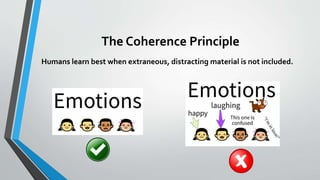
The Coherence Principle
Humans learn best when extraneous, distracting material is not included.
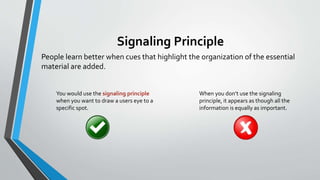
Signaling Principle
People learn better when cues that highlight the organization of the essential
material are added.
You would use the signaling principle
when you want to draw a users eye to a
specific spot.
When you don’t use the signaling
principle, it appears as though all the
information is equally as important.
Redundancy Principle
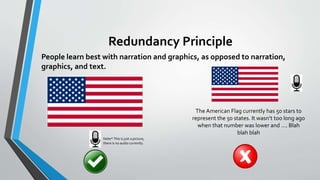
People learn best with narration and graphics, as opposed to narration,
graphics, and text.
Note* This is just a picture,
there is no audio currently.
The American Flag currently has 50 stars to
represent the 50 states. It wasn’t too long ago
when that number was lower and …. Blah
blah blah
Spatial Contiguity Principle
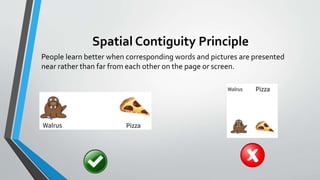
People learn better when corresponding words and pictures are presented
near rather than far from each other on the page or screen.
Temporal Contiguity Principle
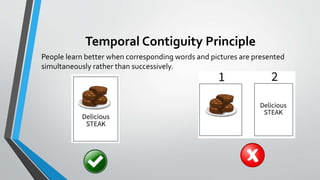
People learn better when corresponding words and pictures are presented
simultaneously rather than successively.
Segmenting Principle
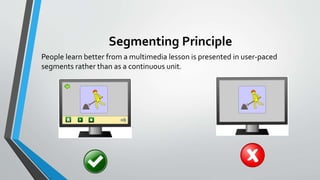
People learn better from a multimedia lesson is presented in user-paced
segments rather than as a continuous unit.
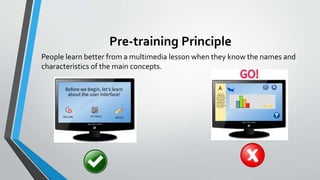
Pre-training Principle
People learn better from a multimedia lesson when they know the names and
characteristics of the main concepts.
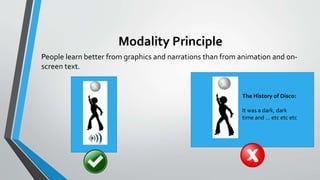
Modality Principle
People learn better from graphics and narrations than from animation and on-
screen text.
The History of Disco:
It was a dark, dark
time and … etc etc etc
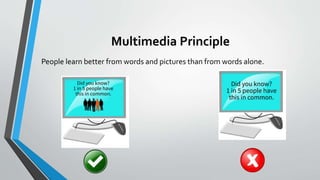
Multimedia Principle
People learn better from words and pictures than from words alone.
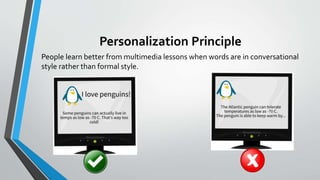
Personalization Principle
People learn better from multimedia lessons when words are in conversational
style rather than formal style.
Voice Principle
People learn better when the narration in multimedia lessons is spoken in a
friendly human voice rather than a machine voice.
When narrating, it’s better
to use a friendly human
voice than a robotic one.
A. Robot.Voice. Can.
Seem. Cold. And. Not.
Pleasant.To. Listen.To.
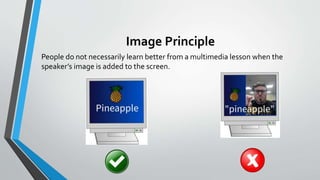
Image Principle
People do not necessarily learn better from a multimedia lesson when the
speaker’s image is added to the screen.

Mayer’s 12 Principles of Multimedia.pptx

  • 1.
    Mayer’s 12 Principlesof Multimedia Terry Gagich
  • 2.
    The Coherence Principle Humanslearn best when extraneous, distracting material is not included.
  • 3.
    Signaling Principle People learnbetter when cues that highlight the organization of the essential material are added. You would use the signaling principle when you want to draw a users eye to a specific spot. When you don’t use the signaling principle, it appears as though all the information is equally as important.
  • 4.
    Redundancy Principle People learnbest with narration and graphics, as opposed to narration, graphics, and text. Note* This is just a picture, there is no audio currently. The American Flag currently has 50 stars to represent the 50 states. It wasn’t too long ago when that number was lower and …. Blah blah blah
  • 5.
    Spatial Contiguity Principle Peoplelearn better when corresponding words and pictures are presented near rather than far from each other on the page or screen.
  • 6.
    Temporal Contiguity Principle Peoplelearn better when corresponding words and pictures are presented simultaneously rather than successively.
  • 7.
    Segmenting Principle People learnbetter from a multimedia lesson is presented in user-paced segments rather than as a continuous unit.
  • 8.
    Pre-training Principle People learnbetter from a multimedia lesson when they know the names and characteristics of the main concepts.
  • 9.
    Modality Principle People learnbetter from graphics and narrations than from animation and on- screen text. The History of Disco: It was a dark, dark time and … etc etc etc
  • 10.
    Multimedia Principle People learnbetter from words and pictures than from words alone.
  • 11.
    Personalization Principle People learnbetter from multimedia lessons when words are in conversational style rather than formal style.
  • 12.
    Voice Principle People learnbetter when the narration in multimedia lessons is spoken in a friendly human voice rather than a machine voice. When narrating, it’s better to use a friendly human voice than a robotic one. A. Robot.Voice. Can. Seem. Cold. And. Not. Pleasant.To. Listen.To.
  • 13.
    Image Principle People donot necessarily learn better from a multimedia lesson when the speaker’s image is added to the screen.