Maximum Clique Detection Algorithm Abhishek Kona (06 CO 05)  Nishkarsh Swarnkar (06 CO 42)
Problem Statement “ Given a graph, find the largest set of vertices such that any two vertices in the set are connected by an edge” One of the 21 original NP-complete problems introduced by Karp in 1972.
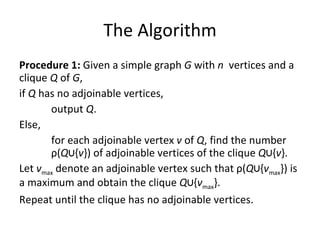
The Algorithm Procedure 1:  Given a simple graph  G  with  n   vertices and a clique  Q  of  G , if  Q  has no adjoinable vertices, output  Q . Else, for each adjoinable vertex  v  of  Q , find the number  ρ( Q ∪{ v }) of adjoinable vertices of the clique  Q ∪{ v }. Let  v max  denote an adjoinable vertex such that  ρ( Q ∪{ v max }) is a maximum and obtain the clique  Q ∪{ v max }. Repeat until the clique has no adjoinable vertices.
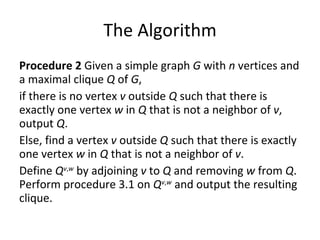
The Algorithm Procedure 2  Given a simple graph  G  with  n  vertices and a maximal clique  Q  of  G ,  if there is no vertex  v  outside  Q  such that there is exactly one vertex  w  in  Q  that is not a neighbor of  v , output  Q .  Else, find a vertex  v  outside  Q  such that there is exactly one vertex  w  in  Q  that is not a neighbor of  v . Define  Q v , w  by adjoining  v  to  Q  and removing  w  from  Q . Perform procedure 3.1 on  Q v , w  and output the resulting clique.
The Algorithm Algorithm  Given as input a simple graph  G  with  n  vertices labeled 1, 2, …,  n , search for a clique of size at least  k . At each stage, if the clique obtained has size at least  k , then stop.  Part I.  For  i  = 1, 2, ...,  n  in turn Initialize the clique  Q i  = { i }. Perform procedure 3.1 on  Q i . For  r  = 1, 2, ...,  k  perform procedure 3.2 repeated  r  times. The result is a maximal clique  Q i . Part II.  For each pair of maximal cliques  Q i ,  Q j  found in Part I Initialize the clique  Q i ,  j  =  Q i ∩ Q j  . Perform procedure 3.1 on  Q i ,  j . For  r  = 1, 2, ...,  k  perform procedure 3.2 repeated  r  times. The result is a maximal clique  Q i ,  j .
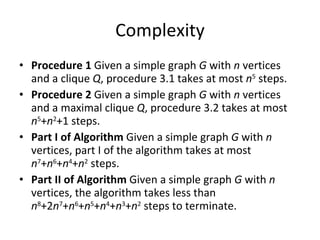
Complexity Procedure 1  Given a simple graph  G  with  n  vertices and a clique  Q , procedure 3.1 takes at most  n 5  steps. Procedure 2  Given a simple graph  G  with  n  vertices and a maximal clique  Q , procedure 3.2 takes at most  n 5 + n 2 +1 steps. Part I of Algorithm  Given a simple graph  G  with  n  vertices, part I of the algorithm takes at most  n 7 + n 6 + n 4 + n 2  steps. Part II of Algorithm  Given a simple graph  G  with  n  vertices, the algorithm takes less than  n 8 +2 n 7 + n 6 + n 5 + n 4 + n 3 + n 2  steps to terminate.
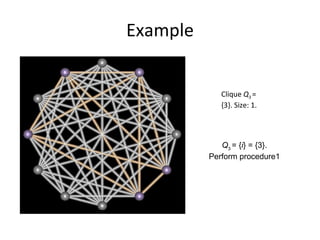
Example Q 3  = { i } = {3}. Perform procedure1    Clique  Q 3  = {3}. Size: 1.
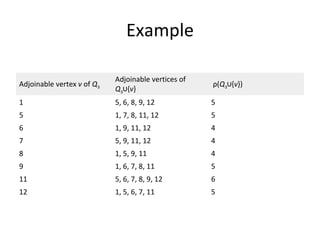
Example Adjoinable vertex  v  of  Q 3 Adjoinable vertices of  Q 3 ∪{ v }   ρ( Q 3 ∪{ v }) 1 5, 6, 8, 9, 12  5 5 1, 7, 8, 11, 12 5 6 1, 9, 11, 12  4 7 5, 9, 11, 12  4 8 1, 5, 9, 11 4 9 1, 6, 7, 8, 11 5 11 5, 6, 7, 8, 9, 12  6 12 1, 5, 6, 7, 11  5
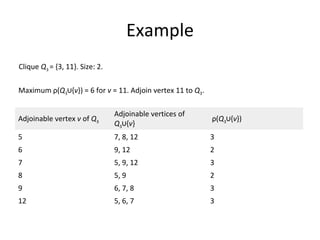
Example Adjoinable vertex  v  of  Q 3 Adjoinable vertices of  Q 3 ∪{ v }   ρ( Q 3 ∪{ v }) 5 7, 8, 12 3 6 9, 12 2 7 5, 9, 12 3 8 5, 9 2 9 6, 7, 8 3 12 5, 6, 7 3 Maximum  ρ( Q 3 ∪{ v }) = 6 for  v  = 11. Adjoin vertex 11 to  Q 3 .  Clique  Q 3  = {3, 11}. Size: 2.
Example Maximum  ρ( Q 3 ∪{ v }) = 3 for  v  = 5. Adjoin vertex 5 to  Q 3 .  Clique  Q 3  = {3, 5, 11}. Size: 3. Adjoinable vertex  v  of  Q 3 Adjoinable vertices of  Q 3 ∪{ v }   ρ( Q 3 ∪{ v }) 7 12 1 8 None 0 12 7 1 Maximum  ρ( Q 3 ∪{ v }) = 1 for  v  = 7. Adjoin vertex 7 to  Q 3 .   Clique  Q 3  = {3, 5, 7, 11}. Size: 4.
Example We obtain a maximal clique  Q 3  = {3, 5, 7, 11, 12} Adjoinable vertex  v  of  Q 3 Adjoinable vertices of  Q 3 ∪{ v }   ρ( Q 3 ∪{ v }) 12 None 0 Maximum  ρ( Q 3 ∪{ v }) = 0 for  v  = 12. Adjoin vertex 12 to  Q 3 .

Maximum clique detection algorithm

  • 1.
    Maximum Clique DetectionAlgorithm Abhishek Kona (06 CO 05) Nishkarsh Swarnkar (06 CO 42)
  • 2.
    Problem Statement “Given a graph, find the largest set of vertices such that any two vertices in the set are connected by an edge” One of the 21 original NP-complete problems introduced by Karp in 1972.
  • 3.
    The Algorithm Procedure1: Given a simple graph G with n vertices and a clique Q of G , if Q has no adjoinable vertices, output Q . Else, for each adjoinable vertex v of Q , find the number ρ( Q ∪{ v }) of adjoinable vertices of the clique Q ∪{ v }. Let v max denote an adjoinable vertex such that ρ( Q ∪{ v max }) is a maximum and obtain the clique Q ∪{ v max }. Repeat until the clique has no adjoinable vertices.
  • 4.
    The Algorithm Procedure2 Given a simple graph G with n vertices and a maximal clique Q of G , if there is no vertex v outside Q such that there is exactly one vertex w in Q that is not a neighbor of v , output Q . Else, find a vertex v outside Q such that there is exactly one vertex w in Q that is not a neighbor of v . Define Q v , w by adjoining v to Q and removing w from Q . Perform procedure 3.1 on Q v , w and output the resulting clique.
  • 5.
    The Algorithm Algorithm Given as input a simple graph G with n vertices labeled 1, 2, …, n , search for a clique of size at least k . At each stage, if the clique obtained has size at least k , then stop. Part I. For i = 1, 2, ..., n in turn Initialize the clique Q i = { i }. Perform procedure 3.1 on Q i . For r = 1, 2, ..., k perform procedure 3.2 repeated r times. The result is a maximal clique Q i . Part II. For each pair of maximal cliques Q i , Q j found in Part I Initialize the clique Q i , j = Q i ∩ Q j . Perform procedure 3.1 on Q i , j . For r = 1, 2, ..., k perform procedure 3.2 repeated r times. The result is a maximal clique Q i , j .
  • 6.
    Complexity Procedure 1 Given a simple graph G with n vertices and a clique Q , procedure 3.1 takes at most n 5 steps. Procedure 2 Given a simple graph G with n vertices and a maximal clique Q , procedure 3.2 takes at most n 5 + n 2 +1 steps. Part I of Algorithm Given a simple graph G with n vertices, part I of the algorithm takes at most n 7 + n 6 + n 4 + n 2 steps. Part II of Algorithm Given a simple graph G with n vertices, the algorithm takes less than n 8 +2 n 7 + n 6 + n 5 + n 4 + n 3 + n 2 steps to terminate.
  • 7.
    Example Q 3 = { i } = {3}. Perform procedure1   Clique Q 3 = {3}. Size: 1.
  • 8.
    Example Adjoinable vertex v of Q 3 Adjoinable vertices of Q 3 ∪{ v }   ρ( Q 3 ∪{ v }) 1 5, 6, 8, 9, 12  5 5 1, 7, 8, 11, 12 5 6 1, 9, 11, 12  4 7 5, 9, 11, 12  4 8 1, 5, 9, 11 4 9 1, 6, 7, 8, 11 5 11 5, 6, 7, 8, 9, 12  6 12 1, 5, 6, 7, 11  5
  • 9.
    Example Adjoinable vertex v of Q 3 Adjoinable vertices of Q 3 ∪{ v }   ρ( Q 3 ∪{ v }) 5 7, 8, 12 3 6 9, 12 2 7 5, 9, 12 3 8 5, 9 2 9 6, 7, 8 3 12 5, 6, 7 3 Maximum ρ( Q 3 ∪{ v }) = 6 for v = 11. Adjoin vertex 11 to Q 3 . Clique Q 3 = {3, 11}. Size: 2.
  • 10.
    Example Maximum ρ( Q 3 ∪{ v }) = 3 for v = 5. Adjoin vertex 5 to Q 3 . Clique Q 3 = {3, 5, 11}. Size: 3. Adjoinable vertex v of Q 3 Adjoinable vertices of Q 3 ∪{ v }   ρ( Q 3 ∪{ v }) 7 12 1 8 None 0 12 7 1 Maximum ρ( Q 3 ∪{ v }) = 1 for v = 7. Adjoin vertex 7 to Q 3 .  Clique Q 3 = {3, 5, 7, 11}. Size: 4.
  • 11.
    Example We obtaina maximal clique Q 3 = {3, 5, 7, 11, 12} Adjoinable vertex v of Q 3 Adjoinable vertices of Q 3 ∪{ v }   ρ( Q 3 ∪{ v }) 12 None 0 Maximum ρ( Q 3 ∪{ v }) = 0 for v = 12. Adjoin vertex 12 to Q 3 .