1 Maximizing Value
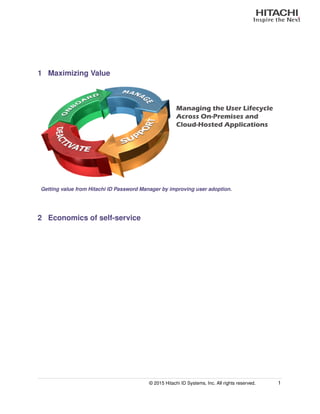
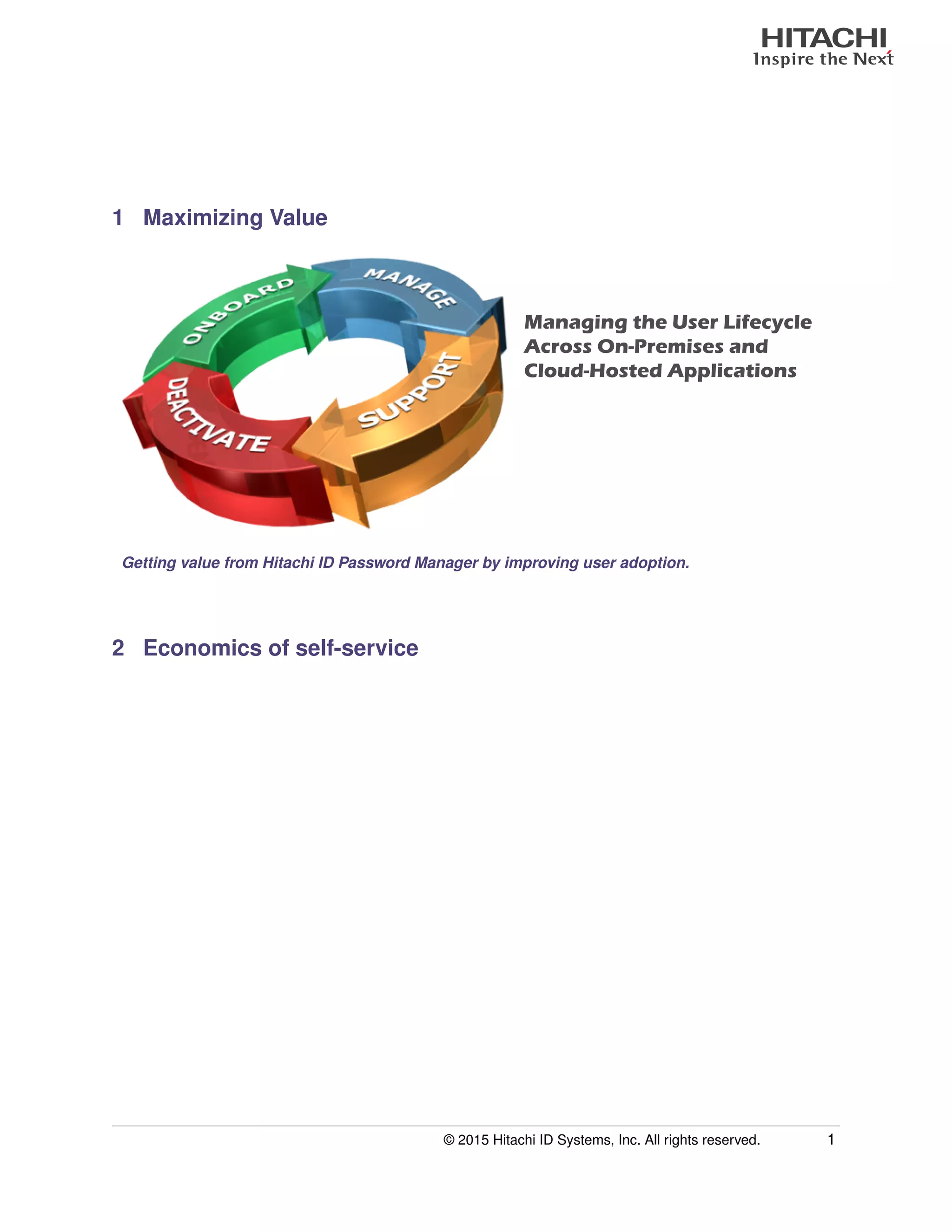
Managing the User Lifecycle
Across On-Premises and
Cloud-Hosted Applications
Getting value from Hitachi ID Password Manager by improving user adoption.
2 Economics of self-service
© 2015 Hitachi ID Systems, Inc. All rights reserved. 1
Slide Presentation
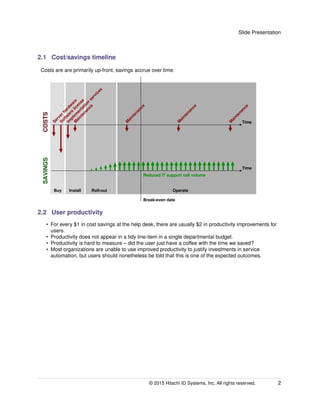
2.1 Cost/savings timeline
Costs are are primarily up-front, savings accrue over time.
M
aintenance
Im
plem
entation
services
Softw
are
license
Serverhardw
are
M
aintenance
M
aintenance
M
aintenance
Buy Install Roll-out Operate
COSTSSAVINGS
Time
Time
Break-even date
Reduced IT support call volume
2.2 User productivity
• For every $1 in cost savings at the help desk, there are usually $2 in productivity improvements for
users.
• Productivity does not appear in a tidy line-item in a single departmental budget.
• Productivity is hard to measure – did the user just have a coffee with the time we saved?
• Most organizations are unable to use improved productivity to justify investments in service
automation, but users should nonetheless be told that this is one of the expected outcomes.
© 2015 Hitachi ID Systems, Inc. All rights reserved. 2
Slide Presentation
2.3 Maximizing return
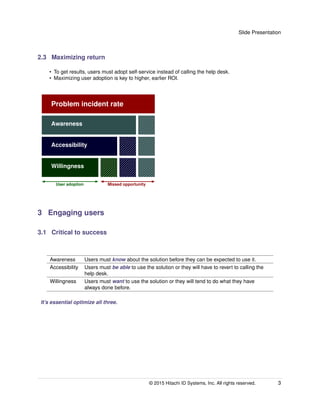
• To get results, users must adopt self-service instead of calling the help desk.
• Maximizing user adoption is key to higher, earlier ROI.
Problem incident rate
Awareness
Accessibility
Willingness
User adoption Missed opportunity
3 Engaging users
3.1 Critical to success
Awareness Users must know about the solution before they can be expected to use it.
Accessibility Users must be able to use the solution or they will have to revert to calling the
help desk.
Willingness Users must want to use the solution or they will tend to do what they have
always done before.
It’s essential optimize all three.
© 2015 Hitachi ID Systems, Inc. All rights reserved. 3
Slide Presentation
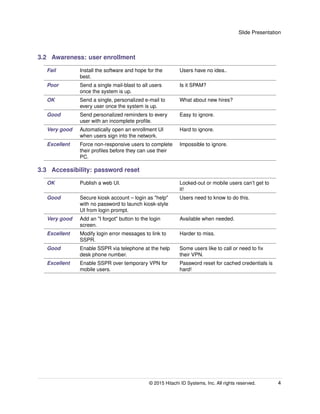
3.2 Awareness: user enrollment
Fail Install the software and hope for the
best.
Users have no idea..
Poor Send a single mail-blast to all users
once the system is up.
Is it SPAM?
OK Send a single, personalized e-mail to
every user once the system is up.
What about new hires?
Good Send personalized reminders to every
user with an incomplete profile.
Easy to ignore.
Very good Automatically open an enrollment UI
when users sign into the network.
Hard to ignore.
Excellent Force non-responsive users to complete
their profiles before they can use their
PC.
Impossible to ignore.
3.3 Accessibility: password reset
OK Publish a web UI. Locked-out or mobile users can’t get to
it!
Good Secure kiosk account – login as "help"
with no password to launch kiosk-style
UI from login prompt.
Users need to know to do this.
Very good Add an "I forgot" button to the login
screen.
Available when needed.
Excellent Modify login error messages to link to
SSPR.
Harder to miss.
Good Enable SSPR via telephone at the help
desk phone number.
Some users like to call or need to fix
their VPN.
Excellent Enable SSPR over temporary VPN for
mobile users.
Password reset for cached credentials is
hard!
© 2015 Hitachi ID Systems, Inc. All rights reserved. 4
Slide Presentation
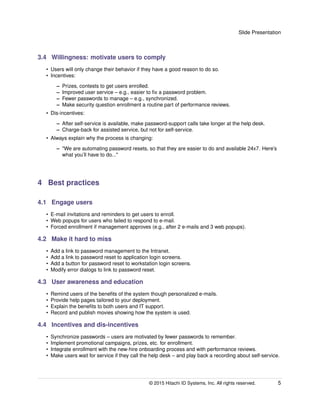
3.4 Willingness: motivate users to comply
• Users will only change their behavior if they have a good reason to do so.
• Incentives:
– Prizes, contests to get users enrolled.
– Improved user service – e.g., easier to fix a password problem.
– Fewer passwords to manage – e.g., synchronized.
– Make security question enrollment a routine part of performance reviews.
• Dis-incentives:
– After self-service is available, make password-support calls take longer at the help desk.
– Charge-back for assisted service, but not for self-service.
• Always explain why the process is changing:
– "We are automating password resets, so that they are easier to do and available 24x7. Here’s
what you’ll have to do..."
4 Best practices
4.1 Engage users
• E-mail invitations and reminders to get users to enroll.
• Web popups for users who failed to respond to e-mail.
• Forced enrollment if management approves (e.g., after 2 e-mails and 3 web popups).
4.2 Make it hard to miss
• Add a link to password management to the Intranet.
• Add a link to password reset to application login screens.
• Add a button for password reset to workstation login screens.
• Modify error dialogs to link to password reset.
4.3 User awareness and education
• Remind users of the benefits of the system though personalized e-mails.
• Provide help pages tailored to your deployment.
• Explain the benefits to both users and IT support.
• Record and publish movies showing how the system is used.
4.4 Incentives and dis-incentives
• Synchronize passwords – users are motivated by fewer passwords to remember.
• Implement promotional campaigns, prizes, etc. for enrollment.
• Integrate enrollment with the new-hire onboarding process and with performance reviews.
• Make users wait for service if they call the help desk – and play back a recording about self-service.
© 2015 Hitachi ID Systems, Inc. All rights reserved. 5
Slide Presentation
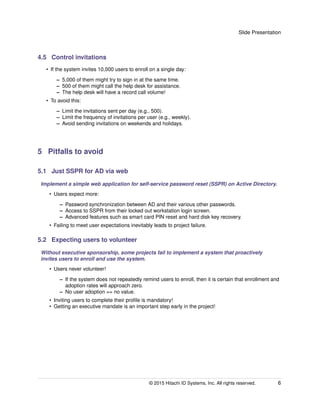
4.5 Control invitations
• If the system invites 10,000 users to enroll on a single day:
– 5,000 of them might try to sign in at the same time.
– 500 of them might call the help desk for assistance.
– The help desk will have a record call volume!
• To avoid this:
– Limit the invitations sent per day (e.g., 500).
– Limit the frequency of invitations per user (e.g., weekly).
– Avoid sending invitations on weekends and holidays.
5 Pitfalls to avoid
5.1 Just SSPR for AD via web
Implement a simple web application for self-service password reset (SSPR) on Active Directory.
• Users expect more:
– Password synchronization between AD and their various other passwords.
– Access to SSPR from their locked out workstation login screen.
– Advanced features such as smart card PIN reset and hard disk key recovery.
• Failing to meet user expectations inevitably leads to project failure.
5.2 Expecting users to volunteer
Without executive sponsorship, some projects fail to implement a system that proactively
invites users to enroll and use the system.
• Users never volunteer!
– If the system does not repeatedly remind users to enroll, then it is certain that enrollment and
adoption rates will approach zero.
– No user adoption == no value.
• Inviting users to complete their profile is mandatory!
• Getting an executive mandate is an important step early in the project!
© 2015 Hitachi ID Systems, Inc. All rights reserved. 6
Slide Presentation
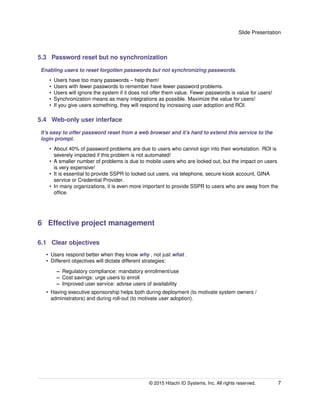
5.3 Password reset but no synchronization
Enabling users to reset forgotten passwords but not synchronizing passwords.
• Users have too many passwords – help them!
• Users with fewer passwords to remember have fewer password problems.
• Users will ignore the system if it does not offer them value. Fewer passwords is value for users!
• Synchronization means as many integrations as possible. Maximize the value for users!
• If you give users something, they will respond by increasing user adoption and ROI.
5.4 Web-only user interface
It’s easy to offer password reset from a web browser and it’s hard to extend this service to the
login prompt.
• About 40% of password problems are due to users who cannot sign into their workstation. ROI is
severely impacted if this problem is not automated!
• A smaller number of problems is due to mobile users who are locked out, but the impact on users
is very expensive!
• It is essential to provide SSPR to locked out users, via telephone, secure kiosk account, GINA
service or Credential Provider.
• In many organizations, it is even more important to provide SSPR to users who are away from the
office.
6 Effective project management
6.1 Clear objectives
• Users respond better when they know why , not just what .
• Different objectives will dictate different strategies:
– Regulatory compliance: mandatory enrollment/use
– Cost savings: urge users to enroll
– Improved user service: advise users of availability
• Having executive sponsorship helps both during deployment (to motivate system owners /
administrators) and during roll-out (to motivate user adoption).
© 2015 Hitachi ID Systems, Inc. All rights reserved. 7
Slide Presentation
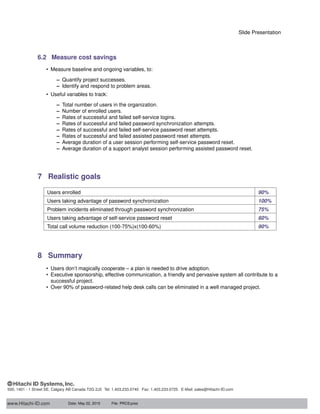
6.2 Measure cost savings
• Measure baseline and ongoing variables, to:
– Quantify project successes.
– Identify and respond to problem areas.
• Useful variables to track:
– Total number of users in the organization.
– Number of enrolled users.
– Rates of successful and failed self-service logins.
– Rates of successful and failed password synchronization attempts.
– Rates of successful and failed self-service password reset attempts.
– Rates of successful and failed assisted password reset attempts.
– Average duration of a user session performing self-service password reset.
– Average duration of a support analyst session performing assisted password reset.
7 Realistic goals
Users enrolled 90%
Users taking advantage of password synchronization 100%
Problem incidents eliminated through password synchronization 75%
Users taking advantage of self-service password reset 60%
Total call volume reduction (100-75%)x(100-60%) 90%
8 Summary
• Users don’t magically cooperate – a plan is needed to drive adoption.
• Executive sponsorship, effective communication, a friendly and pervasive system all contribute to a
successful project.
• Over 90% of password-related help desk calls can be eliminated in a well managed project.
www.Hitachi-ID.com
500, 1401 - 1 Street SE, Calgary AB Canada T2G 2J3 Tel: 1.403.233.0740 Fax: 1.403.233.0725 E-Mail: sales@Hitachi-ID.com
Date: May 22, 2015 File: PRCS:pres

Maximizing Value

  • 1.
    1 Maximizing Value Managingthe User Lifecycle Across On-Premises and Cloud-Hosted Applications Getting value from Hitachi ID Password Manager by improving user adoption. 2 Economics of self-service © 2015 Hitachi ID Systems, Inc. All rights reserved. 1
  • 2.
    Slide Presentation 2.1 Cost/savingstimeline Costs are are primarily up-front, savings accrue over time. M aintenance Im plem entation services Softw are license Serverhardw are M aintenance M aintenance M aintenance Buy Install Roll-out Operate COSTSSAVINGS Time Time Break-even date Reduced IT support call volume 2.2 User productivity • For every $1 in cost savings at the help desk, there are usually $2 in productivity improvements for users. • Productivity does not appear in a tidy line-item in a single departmental budget. • Productivity is hard to measure – did the user just have a coffee with the time we saved? • Most organizations are unable to use improved productivity to justify investments in service automation, but users should nonetheless be told that this is one of the expected outcomes. © 2015 Hitachi ID Systems, Inc. All rights reserved. 2
  • 3.
    Slide Presentation 2.3 Maximizingreturn • To get results, users must adopt self-service instead of calling the help desk. • Maximizing user adoption is key to higher, earlier ROI. Problem incident rate Awareness Accessibility Willingness User adoption Missed opportunity 3 Engaging users 3.1 Critical to success Awareness Users must know about the solution before they can be expected to use it. Accessibility Users must be able to use the solution or they will have to revert to calling the help desk. Willingness Users must want to use the solution or they will tend to do what they have always done before. It’s essential optimize all three. © 2015 Hitachi ID Systems, Inc. All rights reserved. 3
  • 4.
    Slide Presentation 3.2 Awareness:user enrollment Fail Install the software and hope for the best. Users have no idea.. Poor Send a single mail-blast to all users once the system is up. Is it SPAM? OK Send a single, personalized e-mail to every user once the system is up. What about new hires? Good Send personalized reminders to every user with an incomplete profile. Easy to ignore. Very good Automatically open an enrollment UI when users sign into the network. Hard to ignore. Excellent Force non-responsive users to complete their profiles before they can use their PC. Impossible to ignore. 3.3 Accessibility: password reset OK Publish a web UI. Locked-out or mobile users can’t get to it! Good Secure kiosk account – login as "help" with no password to launch kiosk-style UI from login prompt. Users need to know to do this. Very good Add an "I forgot" button to the login screen. Available when needed. Excellent Modify login error messages to link to SSPR. Harder to miss. Good Enable SSPR via telephone at the help desk phone number. Some users like to call or need to fix their VPN. Excellent Enable SSPR over temporary VPN for mobile users. Password reset for cached credentials is hard! © 2015 Hitachi ID Systems, Inc. All rights reserved. 4
  • 5.
    Slide Presentation 3.4 Willingness:motivate users to comply • Users will only change their behavior if they have a good reason to do so. • Incentives: – Prizes, contests to get users enrolled. – Improved user service – e.g., easier to fix a password problem. – Fewer passwords to manage – e.g., synchronized. – Make security question enrollment a routine part of performance reviews. • Dis-incentives: – After self-service is available, make password-support calls take longer at the help desk. – Charge-back for assisted service, but not for self-service. • Always explain why the process is changing: – "We are automating password resets, so that they are easier to do and available 24x7. Here’s what you’ll have to do..." 4 Best practices 4.1 Engage users • E-mail invitations and reminders to get users to enroll. • Web popups for users who failed to respond to e-mail. • Forced enrollment if management approves (e.g., after 2 e-mails and 3 web popups). 4.2 Make it hard to miss • Add a link to password management to the Intranet. • Add a link to password reset to application login screens. • Add a button for password reset to workstation login screens. • Modify error dialogs to link to password reset. 4.3 User awareness and education • Remind users of the benefits of the system though personalized e-mails. • Provide help pages tailored to your deployment. • Explain the benefits to both users and IT support. • Record and publish movies showing how the system is used. 4.4 Incentives and dis-incentives • Synchronize passwords – users are motivated by fewer passwords to remember. • Implement promotional campaigns, prizes, etc. for enrollment. • Integrate enrollment with the new-hire onboarding process and with performance reviews. • Make users wait for service if they call the help desk – and play back a recording about self-service. © 2015 Hitachi ID Systems, Inc. All rights reserved. 5
  • 6.
    Slide Presentation 4.5 Controlinvitations • If the system invites 10,000 users to enroll on a single day: – 5,000 of them might try to sign in at the same time. – 500 of them might call the help desk for assistance. – The help desk will have a record call volume! • To avoid this: – Limit the invitations sent per day (e.g., 500). – Limit the frequency of invitations per user (e.g., weekly). – Avoid sending invitations on weekends and holidays. 5 Pitfalls to avoid 5.1 Just SSPR for AD via web Implement a simple web application for self-service password reset (SSPR) on Active Directory. • Users expect more: – Password synchronization between AD and their various other passwords. – Access to SSPR from their locked out workstation login screen. – Advanced features such as smart card PIN reset and hard disk key recovery. • Failing to meet user expectations inevitably leads to project failure. 5.2 Expecting users to volunteer Without executive sponsorship, some projects fail to implement a system that proactively invites users to enroll and use the system. • Users never volunteer! – If the system does not repeatedly remind users to enroll, then it is certain that enrollment and adoption rates will approach zero. – No user adoption == no value. • Inviting users to complete their profile is mandatory! • Getting an executive mandate is an important step early in the project! © 2015 Hitachi ID Systems, Inc. All rights reserved. 6
  • 7.
    Slide Presentation 5.3 Passwordreset but no synchronization Enabling users to reset forgotten passwords but not synchronizing passwords. • Users have too many passwords – help them! • Users with fewer passwords to remember have fewer password problems. • Users will ignore the system if it does not offer them value. Fewer passwords is value for users! • Synchronization means as many integrations as possible. Maximize the value for users! • If you give users something, they will respond by increasing user adoption and ROI. 5.4 Web-only user interface It’s easy to offer password reset from a web browser and it’s hard to extend this service to the login prompt. • About 40% of password problems are due to users who cannot sign into their workstation. ROI is severely impacted if this problem is not automated! • A smaller number of problems is due to mobile users who are locked out, but the impact on users is very expensive! • It is essential to provide SSPR to locked out users, via telephone, secure kiosk account, GINA service or Credential Provider. • In many organizations, it is even more important to provide SSPR to users who are away from the office. 6 Effective project management 6.1 Clear objectives • Users respond better when they know why , not just what . • Different objectives will dictate different strategies: – Regulatory compliance: mandatory enrollment/use – Cost savings: urge users to enroll – Improved user service: advise users of availability • Having executive sponsorship helps both during deployment (to motivate system owners / administrators) and during roll-out (to motivate user adoption). © 2015 Hitachi ID Systems, Inc. All rights reserved. 7
  • 8.
    Slide Presentation 6.2 Measurecost savings • Measure baseline and ongoing variables, to: – Quantify project successes. – Identify and respond to problem areas. • Useful variables to track: – Total number of users in the organization. – Number of enrolled users. – Rates of successful and failed self-service logins. – Rates of successful and failed password synchronization attempts. – Rates of successful and failed self-service password reset attempts. – Rates of successful and failed assisted password reset attempts. – Average duration of a user session performing self-service password reset. – Average duration of a support analyst session performing assisted password reset. 7 Realistic goals Users enrolled 90% Users taking advantage of password synchronization 100% Problem incidents eliminated through password synchronization 75% Users taking advantage of self-service password reset 60% Total call volume reduction (100-75%)x(100-60%) 90% 8 Summary • Users don’t magically cooperate – a plan is needed to drive adoption. • Executive sponsorship, effective communication, a friendly and pervasive system all contribute to a successful project. • Over 90% of password-related help desk calls can be eliminated in a well managed project. www.Hitachi-ID.com 500, 1401 - 1 Street SE, Calgary AB Canada T2G 2J3 Tel: 1.403.233.0740 Fax: 1.403.233.0725 E-Mail: sales@Hitachi-ID.com Date: May 22, 2015 File: PRCS:pres