DIGITAL SERVICES EXPERT GUIDANCE INFORMATION TECHNOLOGY
Process Automation
for An Unpredictable Tomorrow
Process Automation for
An Unpredictable Tomorrow
As organizations cope with rapidly changing
work environments and buying behaviors,
Process Automation is beginning to get the
attention it
deserves.Companies the world over are starting
to grasp how technology can meet the needs of
staff to improve job satisfaction and productivity.
Understanding how Business Process Automation
works, and its myriad benefits, should drive any
digital transformation project. Once the
advantages of automation and the associated risk
factors are known, it’s important to define the
business objectives and goals so Process
Automation can frame the path
to success.
This paper
will:
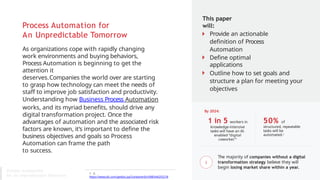
By 2024:
1 in 5 workers in
knowledge-intensive
tasks will have an AI-
enabled “digital
coworker.”1
50% of
structured, repeatable
tasks will be
automated.2
The majority of companies without a digital
transformation strategy believe they will
begin losing market share within a year.
Provide an actionable
definition of Process
Automation
Define optimal
applications
Outline how to set goals and
structure a plan for meeting your
objectives
Process Automation
for An Unpredictable Tomorrow
1 - 2.
https://www.idc.com/getdoc.jsp?containerId=EMEA44255218
Process Automation employs
technology to automate repetitive
workflows that require little to no
human interaction.
Before beginning the Process Automation
journey, we need to understand the key
drivers impacting your investment and
resource decisions. What are you solving
for, and how will this affect the people in
your organization? It is of paramount
importance that you address the most
critical issues as there is likely to be
disruption, budget impact and mission
creep in the absence of clear direction.
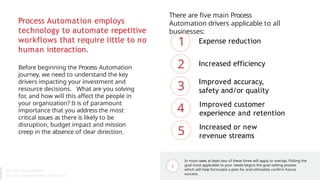
There are five main Process
Automation drivers applicable to all
businesses:
Expense reduction
Increased efficiency
Improved accuracy,
safety and/or quality
Improved customer
experience and retention
Increased or new
revenue streams
1
2
3
4
5
In most cases at least two of these three will apply or overlap. Picking the
goal most applicable to your needs begins the goal setting process
which will help formulate a plan for and ultimately confirm future
success.
Process Automation
for An Unpredictable Tomorrow
GOALS
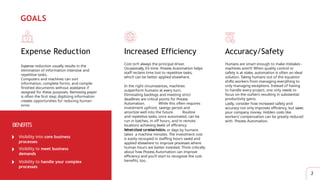
Expense Reduction
Expense reduction usually results in the
elimination of information intensive and
repetitive tasks.
Computers and machines can sort
information, complete forms, and compile
finished documents without assistance if
assigned for these purposes. Removing paper
is often the first step; digitizing information
creates opportunities for reducing human
error.
Increased Efficiency
Cost isn’t always the principal driver.
Occasionally, it’s time. Process Automation helps
staff reclaim time lost to repetitive tasks,
which can be better applied elsewhere.
In the right circumstances, machines
outperform humans at every turn.
Eliminating backlogs and meeting strict
deadlines are critical points for Process
Automation. While this often requires
investment upfront, savings persist and
amortize well into the future. Routine
and repetitive tasks, once automated, can be
run in batches, in off hours, and in remote
locations achieving levels of efficiency
heretofore unattainable.
What used to take hours or days by humans
takes a machine minutes. The investment cost
is easily recouped in staffing hours saved and
applied elsewhere to improve processes where
human hours are better invested. Think critically
about how Process Automation can improve
efficiency and you’ll start to recognize the cost
benefits, too.
Accuracy/Safety
Humans are smart enough to make mistakes -
machines aren’t! When quality control or
safety is at stake, automation is often an ideal
solution. Taking humans out of the equation
shifts workers from managing everything to
only managing exceptions. Instead of having
to handle every project, one only needs to
focus on the outliers resulting in substantial
productivity gains.
Lastly, consider how increased safety and
accuracy not only improves efficiency, but saves
your company money. Hidden costs like
workers’ compensation can be greatly reduced
with Process Automation.
BENEFITS
Visibility into core business
processes
Visibility to meet business
demands
Visibility to handle your complex
processes
3
GOALS (CONT.)
Improved customer
experience and
retention
Customers look to your company for
answers. Process Automation allows your
staff to return actionable, accurate results to
customers quickly.
Smart, self-guided service portals are
another key benefit Process Automation and
a data transformation strategy can deliver.
Whenever possible, allowing customers to
find answers themselves alleviates your staff
from performing routine tasks customers
formerly requested. The
ability to quickly access documents and get
answers any time is a huge advantage for
everyone.
Increased or new
revenue streams
Process Automation frees up time in everyone’s
day, which can be used to pursue or support
new lines of business that drive revenue.
Support staff will have more bandwidth for new
ventures.
Because Process Automation helps return better,
faster service to customers, proving value is
simpler. As your company is able to scale-up
what it offers, it may be smart to evaluate your
cost structure for customers.
The speed and efficiency of Process Automation
mean staff can work smart, not hard.
Identifying where your company can adjust
roles and responsibilities may increase overall
efficiency without adding to the company
headcount or payroll. Increasing the company
headcount to meet customer demands also
increase spending; working smart reduces the
chance of increased staffing cost while helping
drive revenue elsewhere.
4
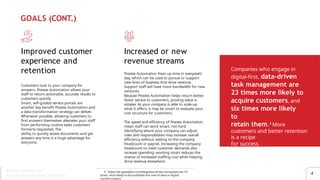
Companies who engage in
digital-first, data-driven
task management are
23 times more likely to
acquire customers, and
six times more likely
to
retain them.3
More
customers and better retention
is a recipe
for success.
3. https://uk.sganalytics.com/blog/data-driven-companies-are-19-
times- more-likely-to-be-profitable-the-role-of-data-in-digital-
transformation/
Process Automation
for An Unpredictable Tomorrow
With these goals in mind, where
are your greatest opportunities
for Process Automation?
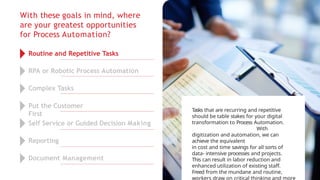
Tasks that are recurring and repetitive
should be table stakes for your digital
transformation to Process Automation.
With
digitization and automation, we can
achieve the equivalent
in cost and time savings for all sorts of
data- intensive processes and projects.
This can result in labor reduction and
enhanced utilization of existing staff.
Freed from the mundane and routine,
workers draw on critical thinking and more
Routine and Repetitive Tasks
RPA or Robotic Process Automation
Complex Tasks
Put the Customer
First
Self Service or Guided Decision Making
Reporting
Document Management
With these goals in mind, where
are your greatest opportunities
for Process Automation?
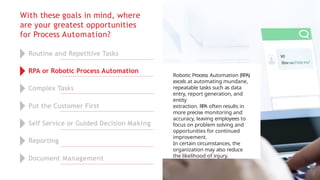
Robotic Process Automation (RPA)
excels at automating mundane,
repeatable tasks such as data
entry, report generation, and
entity
extraction. RPA often results in
more precise monitoring and
accuracy, leaving employees to
focus on problem solving and
opportunities for continued
improvement.
In certain circumstances, the
organization may also reduce
the likelihood of injury.
Routine and Repetitive Tasks
RPA or Robotic Process Automation
Complex Tasks
Put the Customer First
Self Service or Guided Decision Making
Reporting
Document Management
With these goals in mind, where
are your greatest opportunities
for Process Automation?
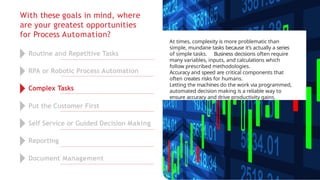
At times, complexity is more problematic than
simple, mundane tasks because it’s actually a series
of simple tasks. Business decisions often require
many variables, inputs, and calculations which
follow prescribed methodologies.
Accuracy and speed are critical components that
often creates risks for humans.
Letting the machines do the work via programmed,
automated decision making is a reliable way to
ensure accuracy and drive productivity gains.
Routine and Repetitive Tasks
RPA or Robotic Process Automation
Complex Tasks
Put the Customer First
Self Service or Guided Decision Making
Reporting
Document Management
With these goals in mind, where
are your greatest opportunities
for Process Automation?
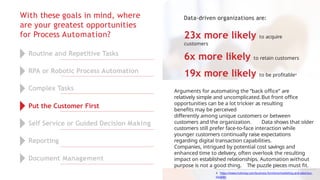
Arguments for automating the “back office” are
relatively simple and uncomplicated.But front office
opportunities can be a lot trickier as resulting
benefits may be perceived
differently among unique customers or between
customers and the organization. Data shows that older
customers still prefer face-to-face interaction while
younger customers continually raise expectations
regarding digital transaction capabilities.
Companies, intrigued by potential cost savings and
enhanced time to delivery, often overlook the resulting
impact on established relationships. Automation without
purpose is not a good thing. The puzzle pieces must fit.
4. https://www.mckinsey.com/business-functions/marketing-and-sales/our-
insights
23x more likely to acquire
customers
6x more likely to retain customers
19x more likely to be profitable4
Data-driven organizations are:
Routine and Repetitive Tasks
RPA or Robotic Process Automation
Complex Tasks
Put the Customer First
Self Service or Guided Decision Making
Reporting
Document Management
With these goals in mind, where
are your greatest opportunities
for Process Automation?
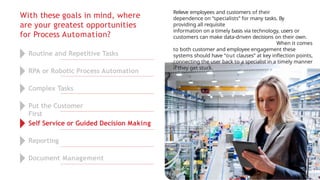
Relieve employees and customers of their
dependence on “specialists” for many tasks. By
providing all requisite
information on a timely basis via technology, users or
customers can make data-driven decisions on their own.
When it comes
to both customer and employee engagement these
systems should have “out clauses” at key inflection points,
connecting the user back to a specialist in a timely manner
if they get stuck.
Routine and Repetitive Tasks
RPA or Robotic Process Automation
Complex Tasks
Put the Customer
First
Self Service or Guided Decision Making
Reporting
Document Management
With these goals in mind, where
are your greatest opportunities
for Process Automation?
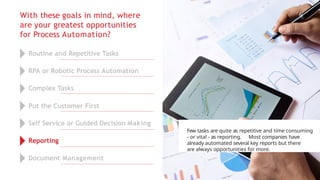
Few tasks are quite as repetitive and time consuming
- or vital - as reporting. Most companies have
already automated several key reports but there
are always opportunities for more.
Routine and Repetitive Tasks
RPA or Robotic Process Automation
Complex Tasks
Put the Customer First
Self Service or Guided Decision Making
Reporting
Document Management
With these goals in mind, where
are your greatest opportunities
for Process Automation?
It is remarkable how often we still print
out documents for signature, only to
rescan and email them to someone else.
The loss in time is obvious and
straightforward, but there are security
and access privileges to consider as well as
proper archiving and retrieval. Every
time a document is printed,
confidentiality is compromised. Further,
misplaced documents can “disappear”
when improperly filed or ignored.
Automating document workflows keep
everything on a rules-based assembly line
that automatically routes information,
prompts personnel for signature and tags,
and stores information for future retrieval
by those
with access.
Routine and Repetitive Tasks
RPA or Robotic Process Automation
Complex Tasks
Put the Customer First
Self Service or Guided Decision Making
Reporting
Document Management
TIME TO PLAN
Now that you know which tasks are
best suited to automation and how to
go about setting goals, we can get
specific. Putting people first is your
best first step in the process. Planning
your automation initiative in phases so
that those affected will be able to
adjust in “bite-sized” increments helps
reduce anxiety and improves adoption
of newly implemented processes.
Consider the need
to:
Interview key stakeholders to compile specific
automation goals in measurable terms relating to
expected cost reductions, increased efficiencies
and/or improved accuracy/safety.
Define development phases, including go/no
go options.
Build change management strategies into
the process
What is the human backup plan in case of
failure during rollout/implementation?
Define adoption goals:
How will teams receive training and
education?
Should changes be piloted to a
smaller group initially?
What does successful adoption look
like?
Process Automation
for An Unpredictable Tomorrow
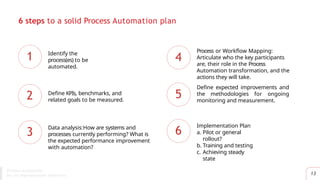
6 steps to a solid Process Automation plan
1 Identify the
process(es) to be
automated.
2 Define KPIs, benchmarks, and
related goals to be measured.
3
Data analysis:How are systems and
processes currently performing? What is
the expected performance improvement
with automation?
4
Process or Workflow Mapping:
Articulate who the key participants
are, their role in the Process
Automation transformation, and the
actions they will take.
5
Define expected improvements and
the methodologies for ongoing
monitoring and measurement.
6
Implementation Plan
a. Pilot or general
rollout?
b. Training and testing
c. Achieving steady
state
Process Automation
for An Unpredictable Tomorrow 13
GETTING STARTED
The perceived costs of Process Automation can be
intimidating, but doing nothing gets you nowhere. Consider
the increasing cost of staffing-up to perform custom duties
versus the future savings associated with automation.
This analysis is a critical first step and results in the
identification of expense reduction and/or increased
productivity opportunity.
Moreover, customer expectations regarding competitive
pricing, immediate service, and speed are only increasing.
T
o that point, Process Automation is arguably a competitive
necessity.
With that said, Business Process Analysis is a skillset that
should not be left to novices. Organizations looking to
achieve significant improvements should consider third party
expertise with proven methodologies who bring experience
and a fresh outlook that is unencumbered by “the way we
always have done it”.
CASE STUDIES
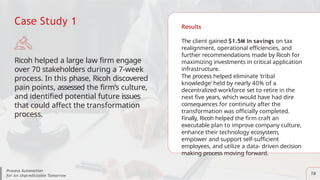
Case Study 1
Ricoh helped a large law firm engage
over 70 stakeholders during a 7-week
process. In this phase, Ricoh discovered
pain points, assessed the firm’s culture,
and identified potential future issues
that could affect the transformation
process.
Results
The client gained $1.5M in savings on tax
realignment, operational efficiencies, and
further recommendations made by Ricoh for
maximizing investments in critical application
infrastructure.
The process helped eliminate ‘tribal
knowledge’ held by nearly 40% of a
decentralized workforce set to retire in the
next five years, which would have had dire
consequences for continuity after the
transformation was officially completed.
Finally, Ricoh helped the firm craft an
executable plan to improve company culture,
enhance their technology ecosystem,
empower and support self-sufficient
employees, and utilize a data- driven decision
making process moving forward.
Process Automation
for An Unpredictable Tomorrow 16
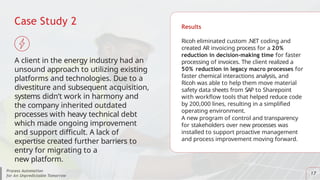
Case Study 2
A client in the energy industry had an
unsound approach to utilizing existing
platforms and technologies. Due to a
divestiture and subsequent acquisition,
systems didn’t work in harmony and
the company inherited outdated
processes with heavy technical debt
which made ongoing improvement
and support difficult. A lack of
expertise created further barriers to
entry for migrating to a
new platform.
Results
Ricoh eliminated custom .NET coding and
created AR invoicing process for a 20%
reduction in decision-making time for faster
processing of invoices. The client realized a
50% reduction in legacy macro processes for
faster chemical interactions analysis, and
Ricoh was able to help them move material
safety data sheets from SAP to Sharepoint
with workflow tools that helped reduce code
by 200,000 lines, resulting in a simplified
operating environment.
A new program of control and transparency
for stakeholders over new processes was
installed to support proactive management
and process improvement moving forward.
Process Automation
for An Unpredictable Tomorrow
17
At Ricoh, we bring over 80 years’ experience
streamlining and simplifying business processes,
keeping your workers connected with the data they
need. In
addition to keeping you connected and ensuring
business continuity, we draw on the latest
technologies and best practices to automate your
workflows and streamline operations releasing
resources to fuel your organization’s continued
growth.
18
DIGITAL SERVICES EXPERT GUIDANCE INFORMATION TECHNOLOGY
This document is for informational purposes only and this document and any related services or products described herein are not intended to provide any legal, regulatory, compliance, or other
similar advice. You are solely responsible for ensuring your own compliance with all legal, regulatory, compliance, or other similar obligations. While care has been taken to ensure the accuracy of
this information, Ricoh makes no representation or warranties about the accuracy, completeness or adequacy of the information contained herein, and shall not be liable for any errors or
omissions in these materials. Actual results will vary depending upon use of the products and services and the conditions and factors affecting performance. The only warranties for Ricoh products
and services are as set forth in the express warranty statements accompanying them.

Enhance Efficiency with Process Automation Services from Ricoh Canada

  • 1.
    DIGITAL SERVICES EXPERTGUIDANCE INFORMATION TECHNOLOGY Process Automation for An Unpredictable Tomorrow
  • 2.
    Process Automation for AnUnpredictable Tomorrow As organizations cope with rapidly changing work environments and buying behaviors, Process Automation is beginning to get the attention it deserves.Companies the world over are starting to grasp how technology can meet the needs of staff to improve job satisfaction and productivity. Understanding how Business Process Automation works, and its myriad benefits, should drive any digital transformation project. Once the advantages of automation and the associated risk factors are known, it’s important to define the business objectives and goals so Process Automation can frame the path to success. This paper will: By 2024: 1 in 5 workers in knowledge-intensive tasks will have an AI- enabled “digital coworker.”1 50% of structured, repeatable tasks will be automated.2 The majority of companies without a digital transformation strategy believe they will begin losing market share within a year. Provide an actionable definition of Process Automation Define optimal applications Outline how to set goals and structure a plan for meeting your objectives Process Automation for An Unpredictable Tomorrow 1 - 2. https://www.idc.com/getdoc.jsp?containerId=EMEA44255218
  • 3.
    Process Automation employs technologyto automate repetitive workflows that require little to no human interaction. Before beginning the Process Automation journey, we need to understand the key drivers impacting your investment and resource decisions. What are you solving for, and how will this affect the people in your organization? It is of paramount importance that you address the most critical issues as there is likely to be disruption, budget impact and mission creep in the absence of clear direction. There are five main Process Automation drivers applicable to all businesses: Expense reduction Increased efficiency Improved accuracy, safety and/or quality Improved customer experience and retention Increased or new revenue streams 1 2 3 4 5 In most cases at least two of these three will apply or overlap. Picking the goal most applicable to your needs begins the goal setting process which will help formulate a plan for and ultimately confirm future success. Process Automation for An Unpredictable Tomorrow
  • 4.
    GOALS Expense Reduction Expense reductionusually results in the elimination of information intensive and repetitive tasks. Computers and machines can sort information, complete forms, and compile finished documents without assistance if assigned for these purposes. Removing paper is often the first step; digitizing information creates opportunities for reducing human error. Increased Efficiency Cost isn’t always the principal driver. Occasionally, it’s time. Process Automation helps staff reclaim time lost to repetitive tasks, which can be better applied elsewhere. In the right circumstances, machines outperform humans at every turn. Eliminating backlogs and meeting strict deadlines are critical points for Process Automation. While this often requires investment upfront, savings persist and amortize well into the future. Routine and repetitive tasks, once automated, can be run in batches, in off hours, and in remote locations achieving levels of efficiency heretofore unattainable. What used to take hours or days by humans takes a machine minutes. The investment cost is easily recouped in staffing hours saved and applied elsewhere to improve processes where human hours are better invested. Think critically about how Process Automation can improve efficiency and you’ll start to recognize the cost benefits, too. Accuracy/Safety Humans are smart enough to make mistakes - machines aren’t! When quality control or safety is at stake, automation is often an ideal solution. Taking humans out of the equation shifts workers from managing everything to only managing exceptions. Instead of having to handle every project, one only needs to focus on the outliers resulting in substantial productivity gains. Lastly, consider how increased safety and accuracy not only improves efficiency, but saves your company money. Hidden costs like workers’ compensation can be greatly reduced with Process Automation. BENEFITS Visibility into core business processes Visibility to meet business demands Visibility to handle your complex processes 3
  • 5.
    GOALS (CONT.) Improved customer experienceand retention Customers look to your company for answers. Process Automation allows your staff to return actionable, accurate results to customers quickly. Smart, self-guided service portals are another key benefit Process Automation and a data transformation strategy can deliver. Whenever possible, allowing customers to find answers themselves alleviates your staff from performing routine tasks customers formerly requested. The ability to quickly access documents and get answers any time is a huge advantage for everyone. Increased or new revenue streams Process Automation frees up time in everyone’s day, which can be used to pursue or support new lines of business that drive revenue. Support staff will have more bandwidth for new ventures. Because Process Automation helps return better, faster service to customers, proving value is simpler. As your company is able to scale-up what it offers, it may be smart to evaluate your cost structure for customers. The speed and efficiency of Process Automation mean staff can work smart, not hard. Identifying where your company can adjust roles and responsibilities may increase overall efficiency without adding to the company headcount or payroll. Increasing the company headcount to meet customer demands also increase spending; working smart reduces the chance of increased staffing cost while helping drive revenue elsewhere. 4 Companies who engage in digital-first, data-driven task management are 23 times more likely to acquire customers, and six times more likely to retain them.3 More customers and better retention is a recipe for success. 3. https://uk.sganalytics.com/blog/data-driven-companies-are-19- times- more-likely-to-be-profitable-the-role-of-data-in-digital- transformation/ Process Automation for An Unpredictable Tomorrow
  • 6.
    With these goalsin mind, where are your greatest opportunities for Process Automation? Tasks that are recurring and repetitive should be table stakes for your digital transformation to Process Automation. With digitization and automation, we can achieve the equivalent in cost and time savings for all sorts of data- intensive processes and projects. This can result in labor reduction and enhanced utilization of existing staff. Freed from the mundane and routine, workers draw on critical thinking and more Routine and Repetitive Tasks RPA or Robotic Process Automation Complex Tasks Put the Customer First Self Service or Guided Decision Making Reporting Document Management
  • 7.
    With these goalsin mind, where are your greatest opportunities for Process Automation? Robotic Process Automation (RPA) excels at automating mundane, repeatable tasks such as data entry, report generation, and entity extraction. RPA often results in more precise monitoring and accuracy, leaving employees to focus on problem solving and opportunities for continued improvement. In certain circumstances, the organization may also reduce the likelihood of injury. Routine and Repetitive Tasks RPA or Robotic Process Automation Complex Tasks Put the Customer First Self Service or Guided Decision Making Reporting Document Management
  • 8.
    With these goalsin mind, where are your greatest opportunities for Process Automation? At times, complexity is more problematic than simple, mundane tasks because it’s actually a series of simple tasks. Business decisions often require many variables, inputs, and calculations which follow prescribed methodologies. Accuracy and speed are critical components that often creates risks for humans. Letting the machines do the work via programmed, automated decision making is a reliable way to ensure accuracy and drive productivity gains. Routine and Repetitive Tasks RPA or Robotic Process Automation Complex Tasks Put the Customer First Self Service or Guided Decision Making Reporting Document Management
  • 9.
    With these goalsin mind, where are your greatest opportunities for Process Automation? Arguments for automating the “back office” are relatively simple and uncomplicated.But front office opportunities can be a lot trickier as resulting benefits may be perceived differently among unique customers or between customers and the organization. Data shows that older customers still prefer face-to-face interaction while younger customers continually raise expectations regarding digital transaction capabilities. Companies, intrigued by potential cost savings and enhanced time to delivery, often overlook the resulting impact on established relationships. Automation without purpose is not a good thing. The puzzle pieces must fit. 4. https://www.mckinsey.com/business-functions/marketing-and-sales/our- insights 23x more likely to acquire customers 6x more likely to retain customers 19x more likely to be profitable4 Data-driven organizations are: Routine and Repetitive Tasks RPA or Robotic Process Automation Complex Tasks Put the Customer First Self Service or Guided Decision Making Reporting Document Management
  • 10.
    With these goalsin mind, where are your greatest opportunities for Process Automation? Relieve employees and customers of their dependence on “specialists” for many tasks. By providing all requisite information on a timely basis via technology, users or customers can make data-driven decisions on their own. When it comes to both customer and employee engagement these systems should have “out clauses” at key inflection points, connecting the user back to a specialist in a timely manner if they get stuck. Routine and Repetitive Tasks RPA or Robotic Process Automation Complex Tasks Put the Customer First Self Service or Guided Decision Making Reporting Document Management
  • 11.
    With these goalsin mind, where are your greatest opportunities for Process Automation? Few tasks are quite as repetitive and time consuming - or vital - as reporting. Most companies have already automated several key reports but there are always opportunities for more. Routine and Repetitive Tasks RPA or Robotic Process Automation Complex Tasks Put the Customer First Self Service or Guided Decision Making Reporting Document Management
  • 12.
    With these goalsin mind, where are your greatest opportunities for Process Automation? It is remarkable how often we still print out documents for signature, only to rescan and email them to someone else. The loss in time is obvious and straightforward, but there are security and access privileges to consider as well as proper archiving and retrieval. Every time a document is printed, confidentiality is compromised. Further, misplaced documents can “disappear” when improperly filed or ignored. Automating document workflows keep everything on a rules-based assembly line that automatically routes information, prompts personnel for signature and tags, and stores information for future retrieval by those with access. Routine and Repetitive Tasks RPA or Robotic Process Automation Complex Tasks Put the Customer First Self Service or Guided Decision Making Reporting Document Management
  • 13.
    TIME TO PLAN Nowthat you know which tasks are best suited to automation and how to go about setting goals, we can get specific. Putting people first is your best first step in the process. Planning your automation initiative in phases so that those affected will be able to adjust in “bite-sized” increments helps reduce anxiety and improves adoption of newly implemented processes. Consider the need to: Interview key stakeholders to compile specific automation goals in measurable terms relating to expected cost reductions, increased efficiencies and/or improved accuracy/safety. Define development phases, including go/no go options. Build change management strategies into the process What is the human backup plan in case of failure during rollout/implementation? Define adoption goals: How will teams receive training and education? Should changes be piloted to a smaller group initially? What does successful adoption look like? Process Automation for An Unpredictable Tomorrow
  • 14.
    6 steps toa solid Process Automation plan 1 Identify the process(es) to be automated. 2 Define KPIs, benchmarks, and related goals to be measured. 3 Data analysis:How are systems and processes currently performing? What is the expected performance improvement with automation? 4 Process or Workflow Mapping: Articulate who the key participants are, their role in the Process Automation transformation, and the actions they will take. 5 Define expected improvements and the methodologies for ongoing monitoring and measurement. 6 Implementation Plan a. Pilot or general rollout? b. Training and testing c. Achieving steady state Process Automation for An Unpredictable Tomorrow 13
  • 15.
    GETTING STARTED The perceivedcosts of Process Automation can be intimidating, but doing nothing gets you nowhere. Consider the increasing cost of staffing-up to perform custom duties versus the future savings associated with automation. This analysis is a critical first step and results in the identification of expense reduction and/or increased productivity opportunity. Moreover, customer expectations regarding competitive pricing, immediate service, and speed are only increasing. T o that point, Process Automation is arguably a competitive necessity. With that said, Business Process Analysis is a skillset that should not be left to novices. Organizations looking to achieve significant improvements should consider third party expertise with proven methodologies who bring experience and a fresh outlook that is unencumbered by “the way we always have done it”.
  • 16.
  • 17.
    Case Study 1 Ricohhelped a large law firm engage over 70 stakeholders during a 7-week process. In this phase, Ricoh discovered pain points, assessed the firm’s culture, and identified potential future issues that could affect the transformation process. Results The client gained $1.5M in savings on tax realignment, operational efficiencies, and further recommendations made by Ricoh for maximizing investments in critical application infrastructure. The process helped eliminate ‘tribal knowledge’ held by nearly 40% of a decentralized workforce set to retire in the next five years, which would have had dire consequences for continuity after the transformation was officially completed. Finally, Ricoh helped the firm craft an executable plan to improve company culture, enhance their technology ecosystem, empower and support self-sufficient employees, and utilize a data- driven decision making process moving forward. Process Automation for An Unpredictable Tomorrow 16
  • 18.
    Case Study 2 Aclient in the energy industry had an unsound approach to utilizing existing platforms and technologies. Due to a divestiture and subsequent acquisition, systems didn’t work in harmony and the company inherited outdated processes with heavy technical debt which made ongoing improvement and support difficult. A lack of expertise created further barriers to entry for migrating to a new platform. Results Ricoh eliminated custom .NET coding and created AR invoicing process for a 20% reduction in decision-making time for faster processing of invoices. The client realized a 50% reduction in legacy macro processes for faster chemical interactions analysis, and Ricoh was able to help them move material safety data sheets from SAP to Sharepoint with workflow tools that helped reduce code by 200,000 lines, resulting in a simplified operating environment. A new program of control and transparency for stakeholders over new processes was installed to support proactive management and process improvement moving forward. Process Automation for An Unpredictable Tomorrow 17
  • 19.
    At Ricoh, webring over 80 years’ experience streamlining and simplifying business processes, keeping your workers connected with the data they need. In addition to keeping you connected and ensuring business continuity, we draw on the latest technologies and best practices to automate your workflows and streamline operations releasing resources to fuel your organization’s continued growth. 18
  • 20.
    DIGITAL SERVICES EXPERTGUIDANCE INFORMATION TECHNOLOGY This document is for informational purposes only and this document and any related services or products described herein are not intended to provide any legal, regulatory, compliance, or other similar advice. You are solely responsible for ensuring your own compliance with all legal, regulatory, compliance, or other similar obligations. While care has been taken to ensure the accuracy of this information, Ricoh makes no representation or warranties about the accuracy, completeness or adequacy of the information contained herein, and shall not be liable for any errors or omissions in these materials. Actual results will vary depending upon use of the products and services and the conditions and factors affecting performance. The only warranties for Ricoh products and services are as set forth in the express warranty statements accompanying them.