[MM.DD..YY] [PRESENTER]
Nov 19, 2011 Building results-oriented web projects
Maximize Results:
The Lean
Agile Approach
flickr.com/photos/cuppini/2719863711
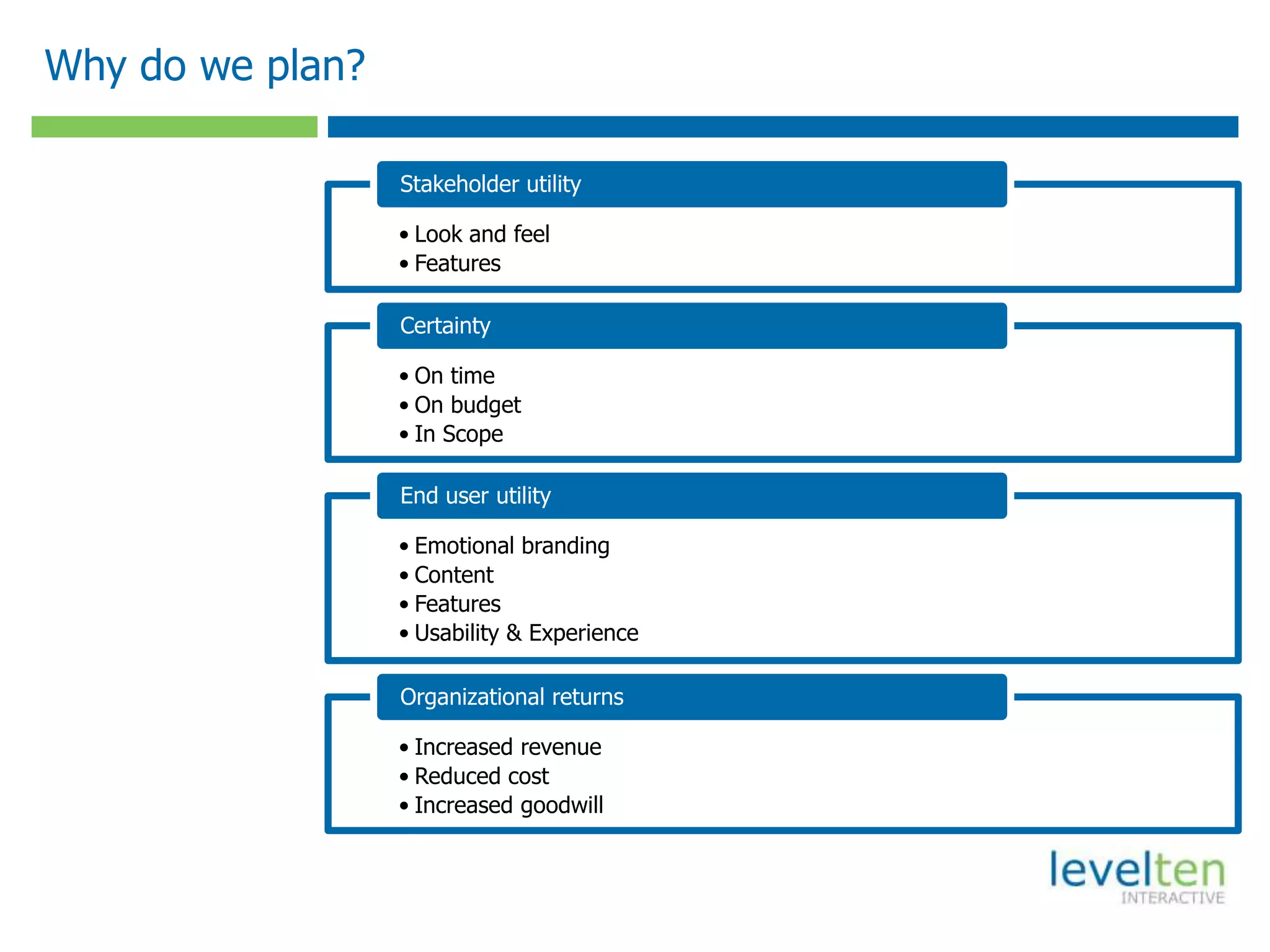
Why do we plan?
• Look and feel
• Features
Stakeholder utility
• On time
• On budget
• In Scope
Certainty
• Emotional branding
• Content
• Features
• Usability & Experience
End user utility
• Increased revenue
• Reduced cost
• Increased goodwill
Organizational returns
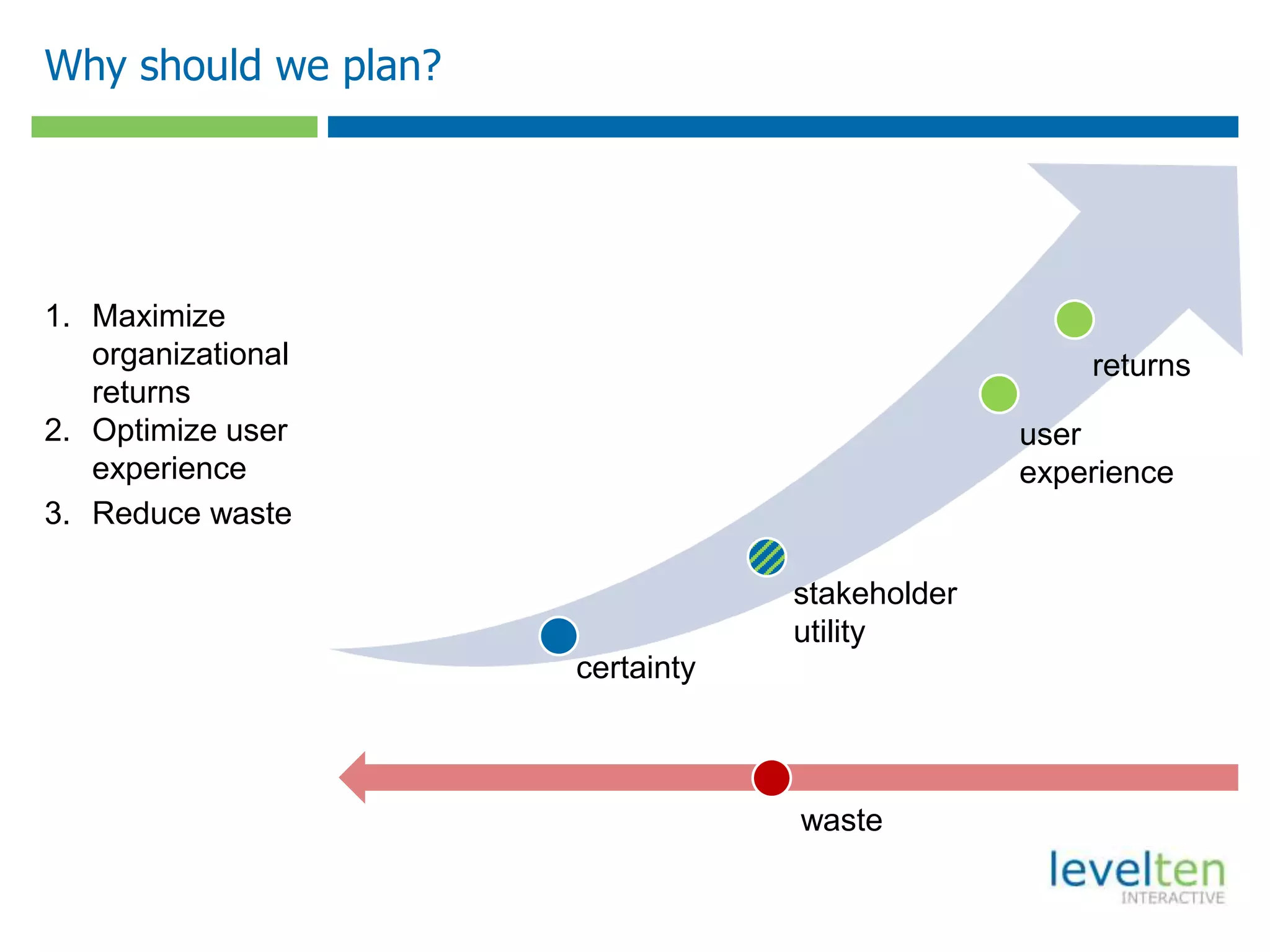
Why should we plan?
certainty
stakeholder
utility
user
experience
returns
waste
1. Maximize
organizational
returns
2. Optimize user
experience
3. Reduce waste
process
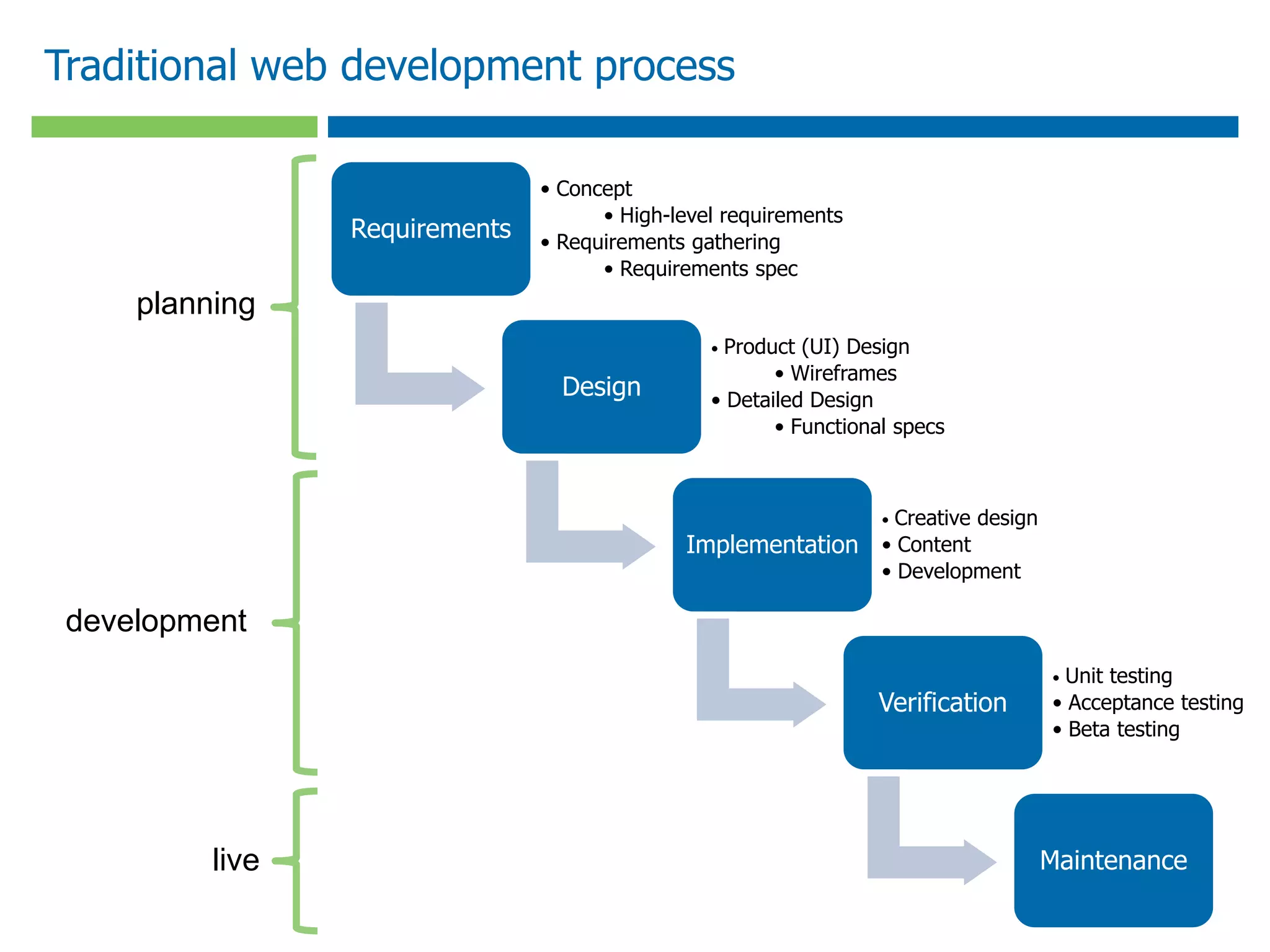
Traditional web development process
Requirements
• Concept
• High-level requirements
• Requirements gathering
• Requirements spec
Design
• Product (UI) Design
• Wireframes
• Detailed Design
• Functional specs
Implementation
• Creative design
• Content
• Development
Verification
• Unit testing
• Acceptance testing
• Beta testing
Maintenance
planning
development
live
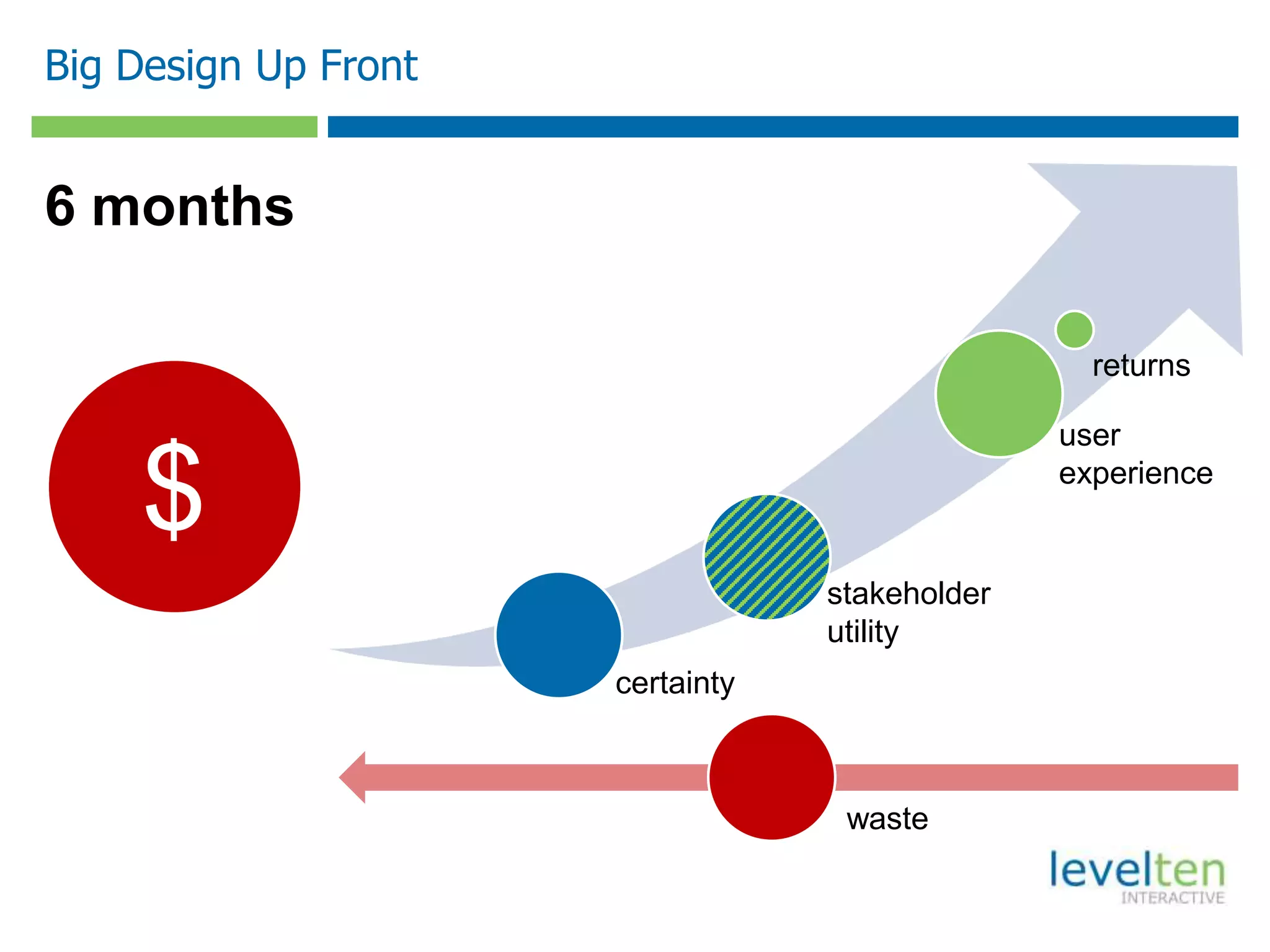
Big Design Up Front
certainty
stakeholder
utility
user
experience
returns
waste
6 months
$
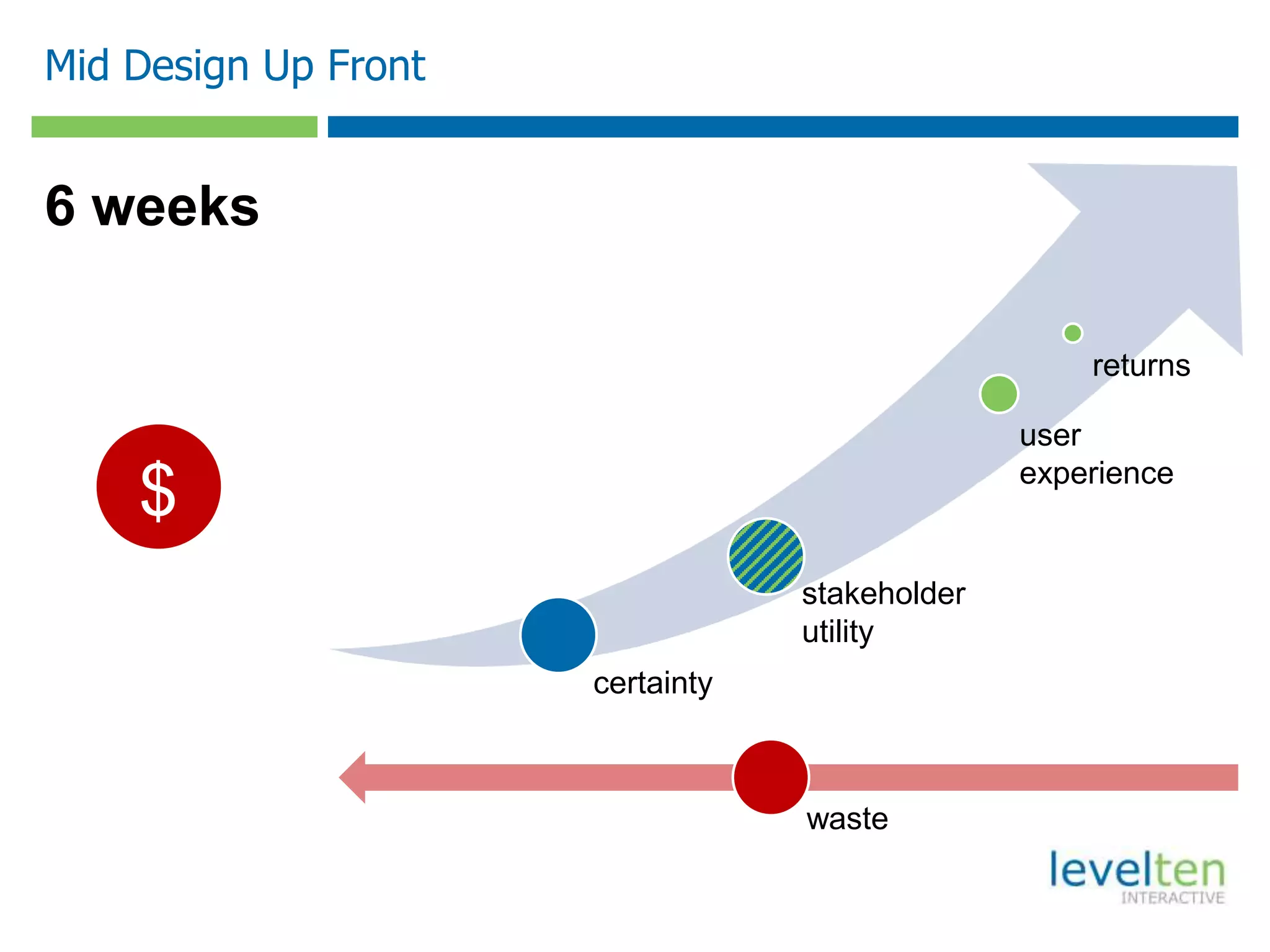
Mid Design Up Front
certainty
stakeholder
utility
user
experience
returns
waste
6 weeks
$
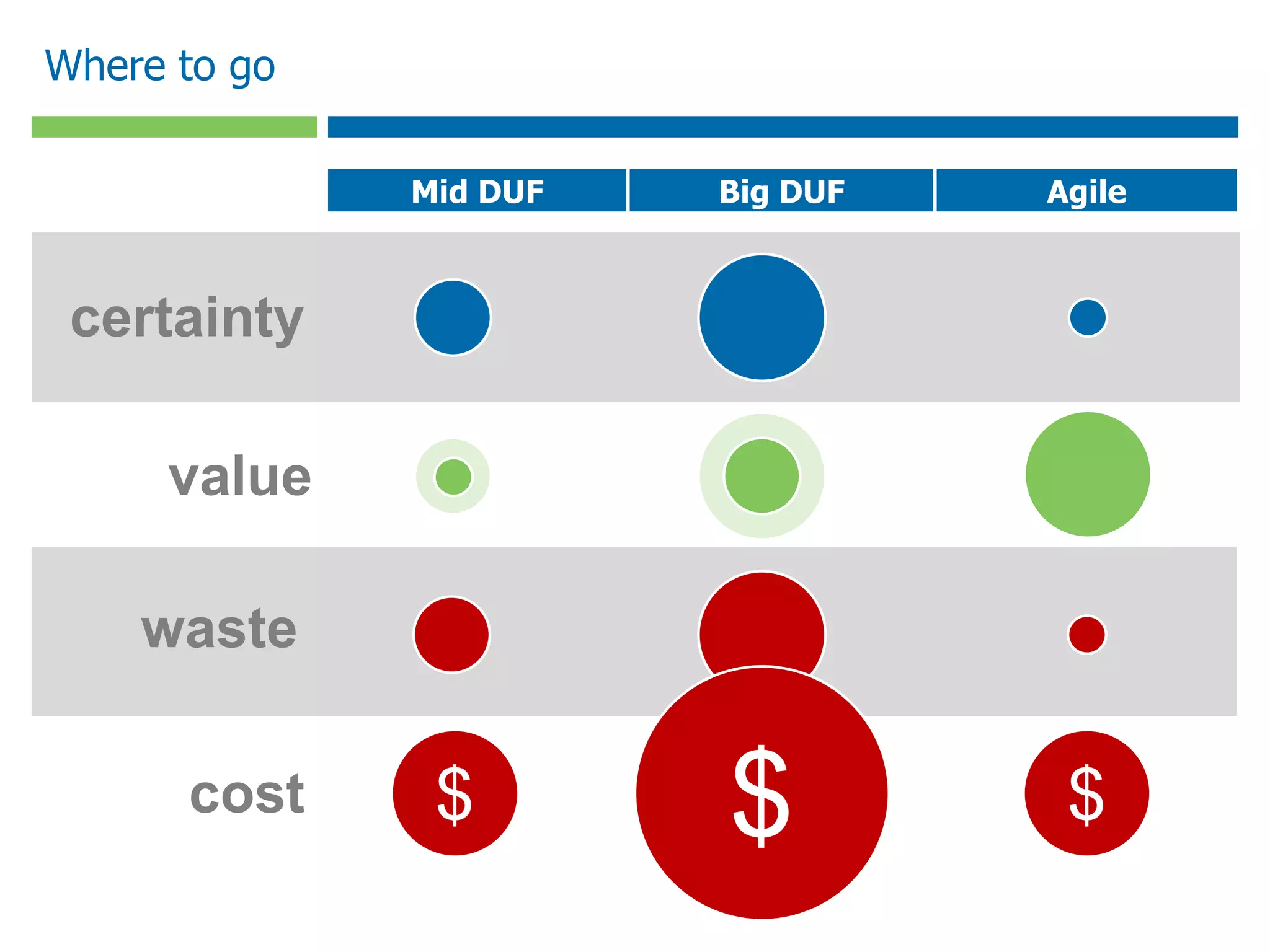
Where to go
certainty
$
value
waste
cost $ $
AgileBig DUFMid DUF
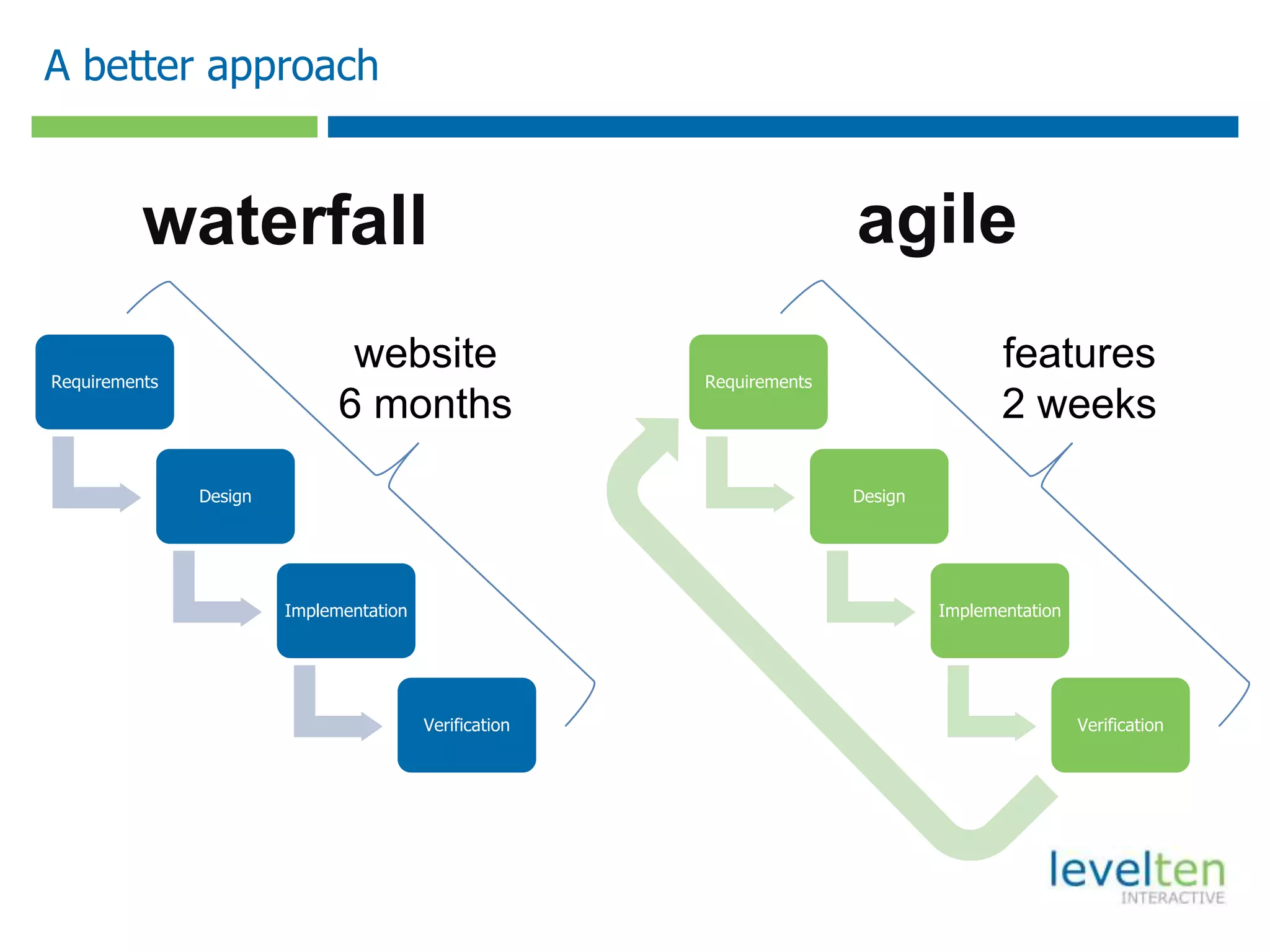
A better approach
Requirements
Design
Implementation
Verification
website
6 months
waterfall
Requirements
Design
Implementation
Verification
features
2 weeks
agile
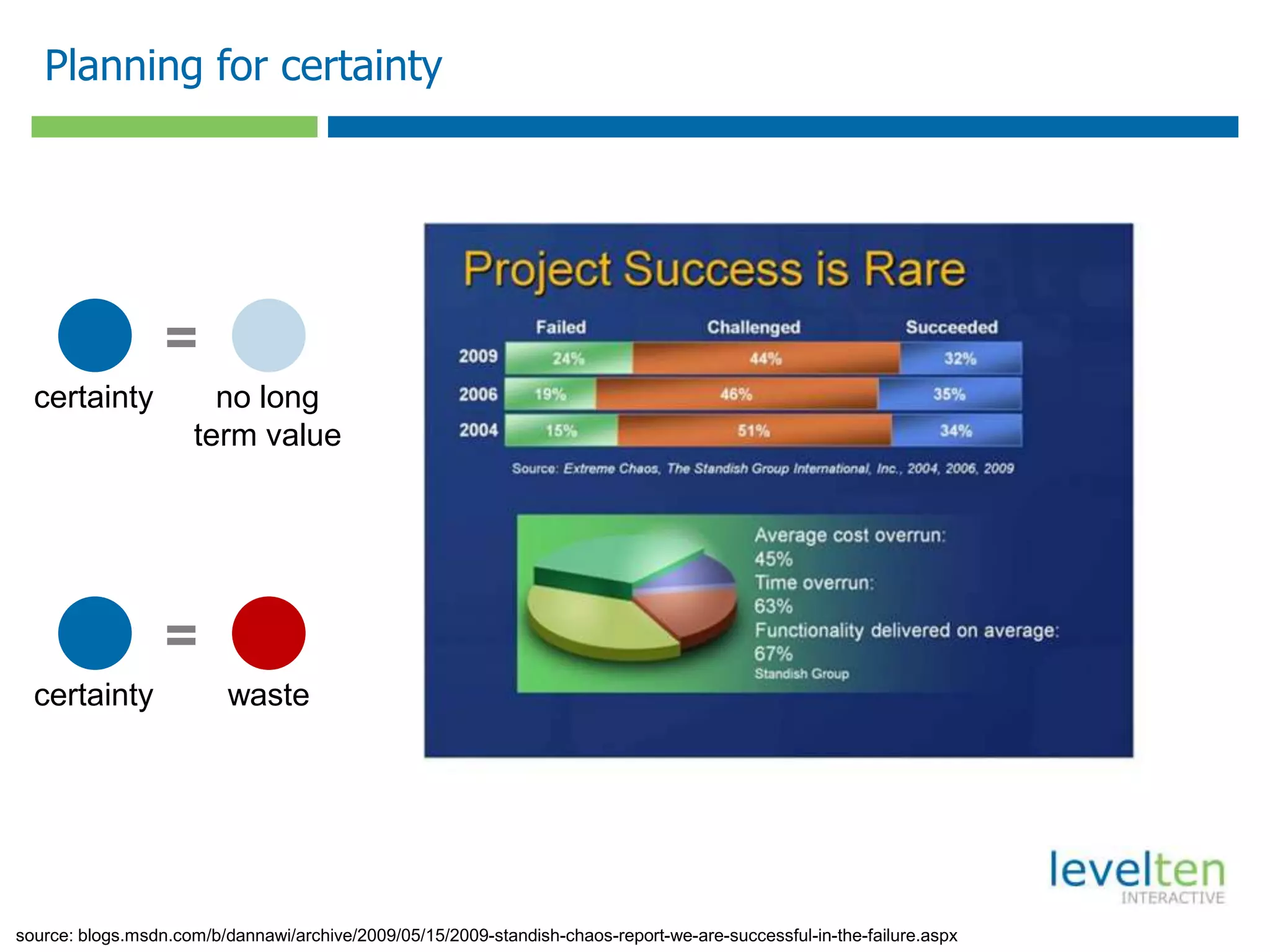
Planning for certainty
source: blogs.msdn.com/b/dannawi/archive/2009/05/15/2009-standish-chaos-report-we-are-successful-in-the-failure.aspx
certainty waste
=
certainty no long
term value
=
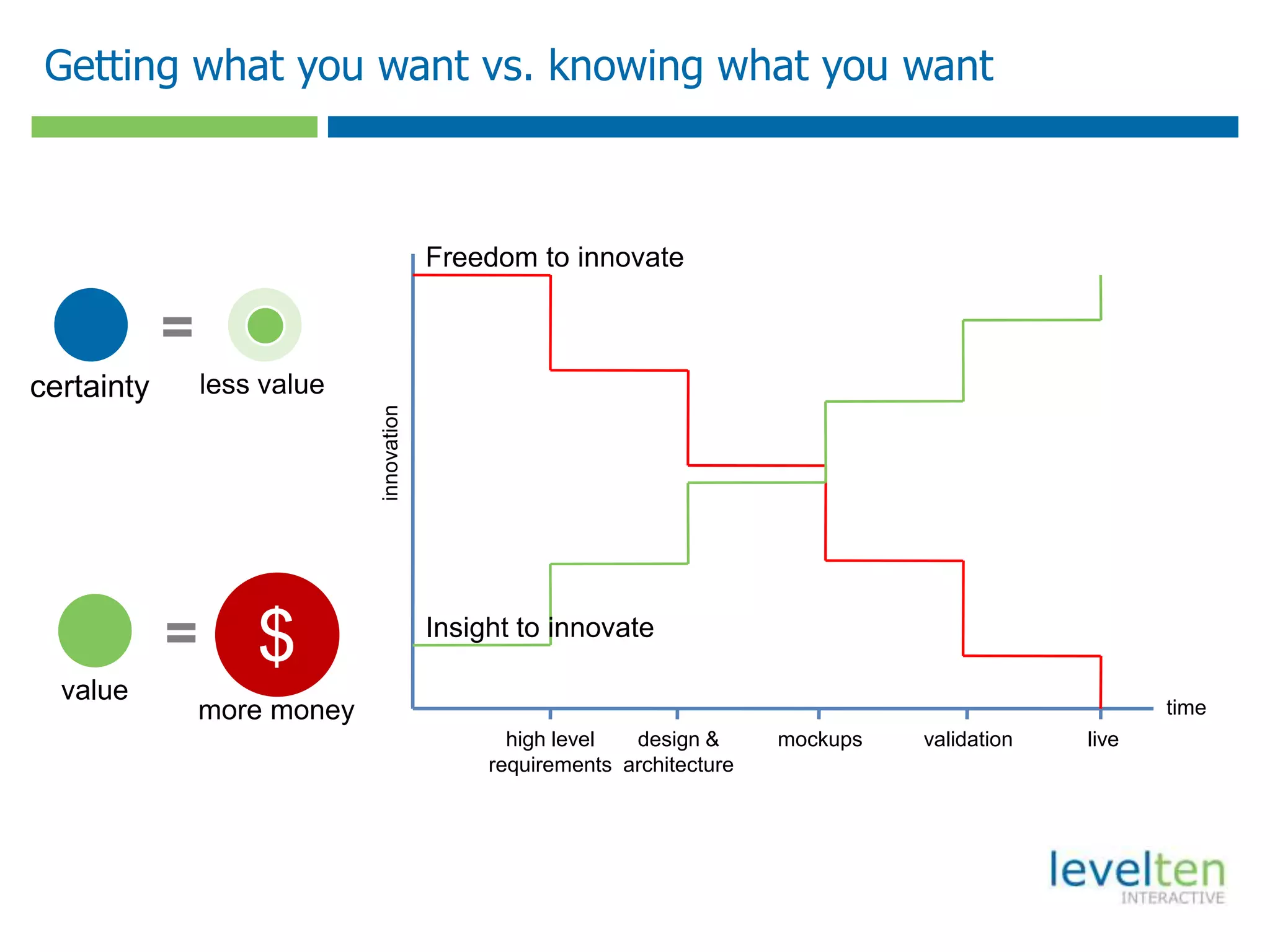
Getting what you want vs. knowing what you want
time
innovation
high level
requirements
design &
architecture
mockups validation live
Freedom to innovate
Insight to innovate
certainty less value
=
value
more money
= $
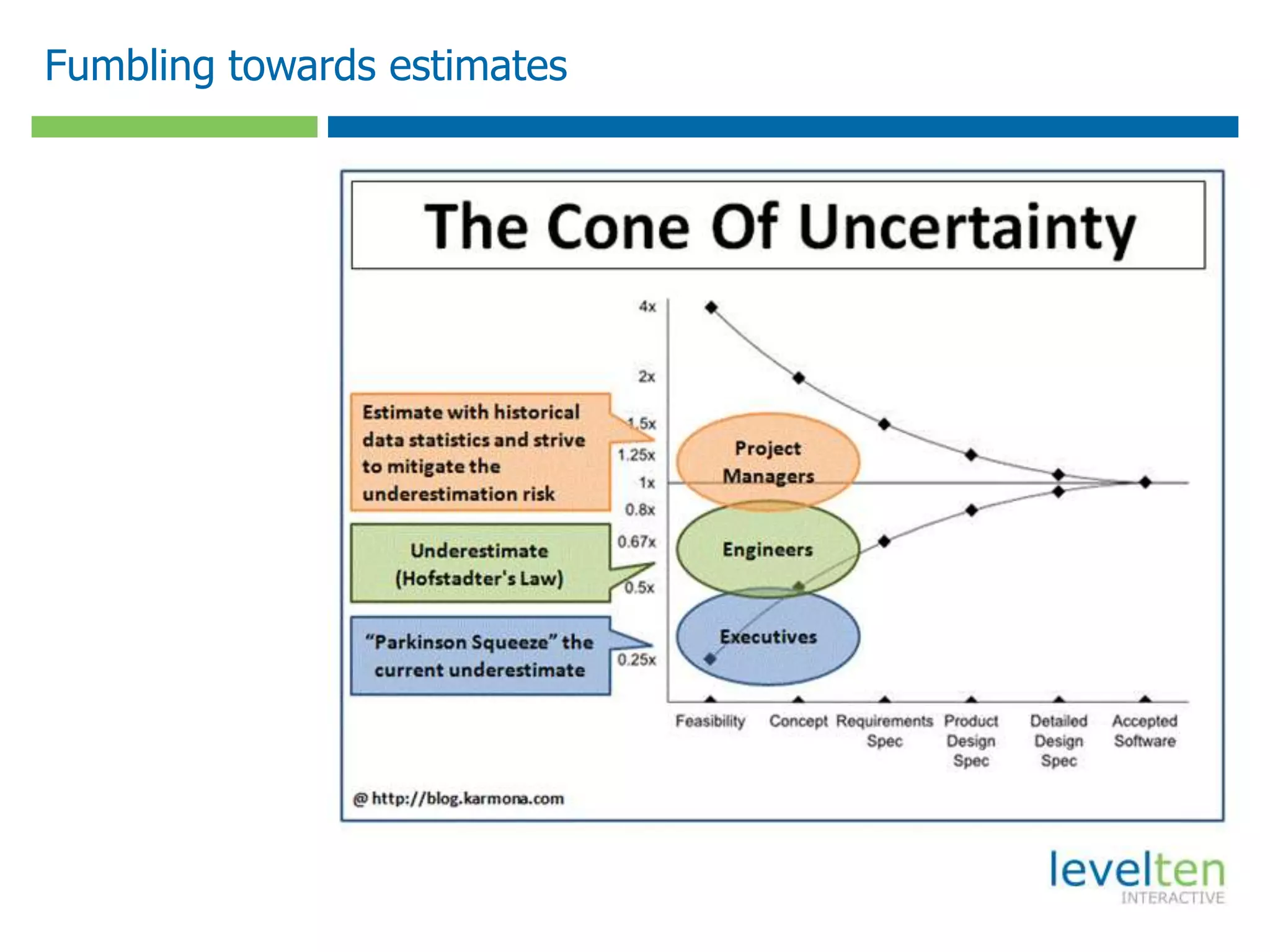
Fumbling towards estimates
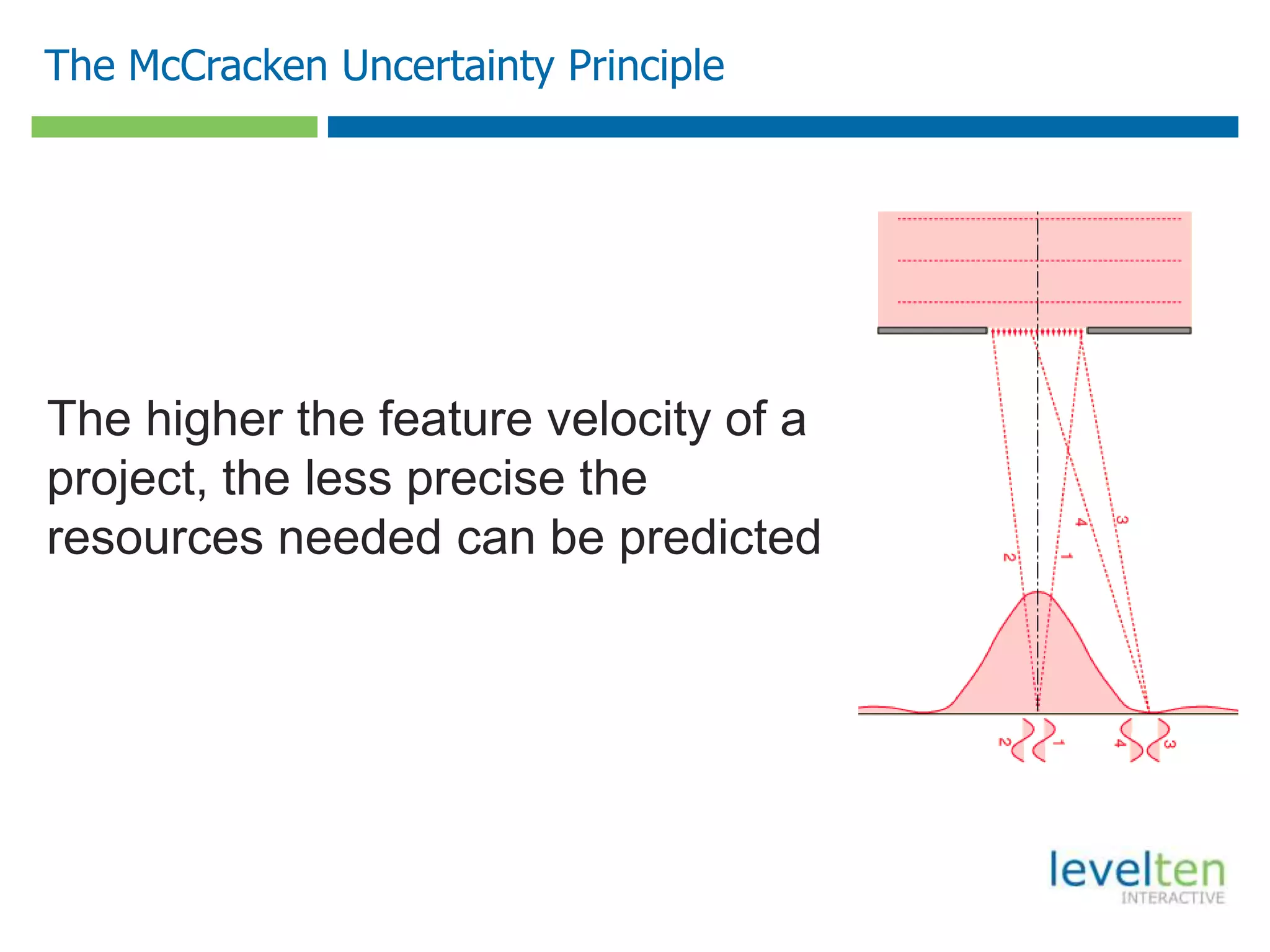
The McCracken Uncertainty Principle
The higher the feature velocity of a
project, the less precise the
resources needed can be predicted
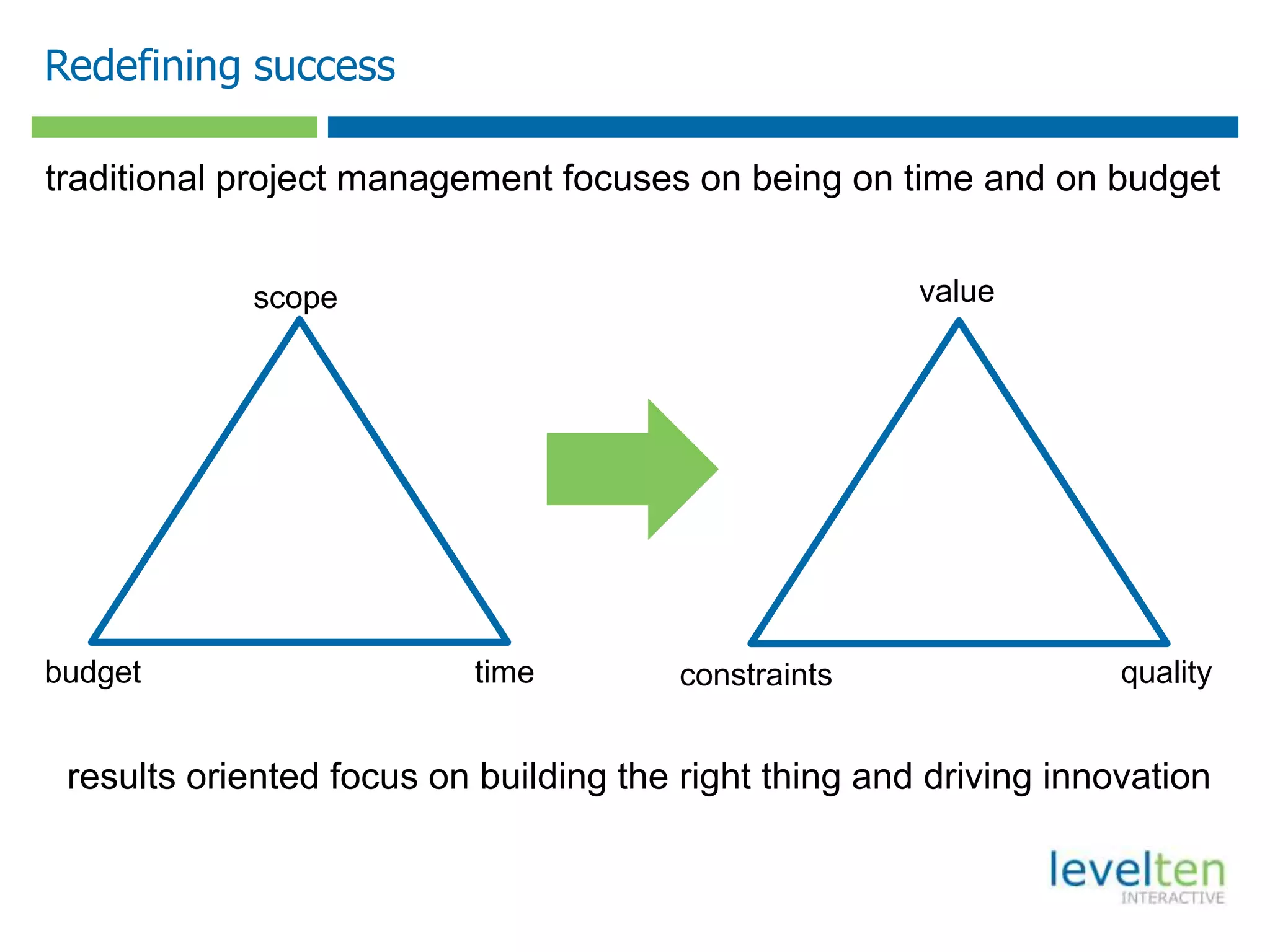
Redefining success
traditional project management focuses on being on time and on budget
scope
timebudget
value
constraints quality
results oriented focus on building the right thing and driving innovation
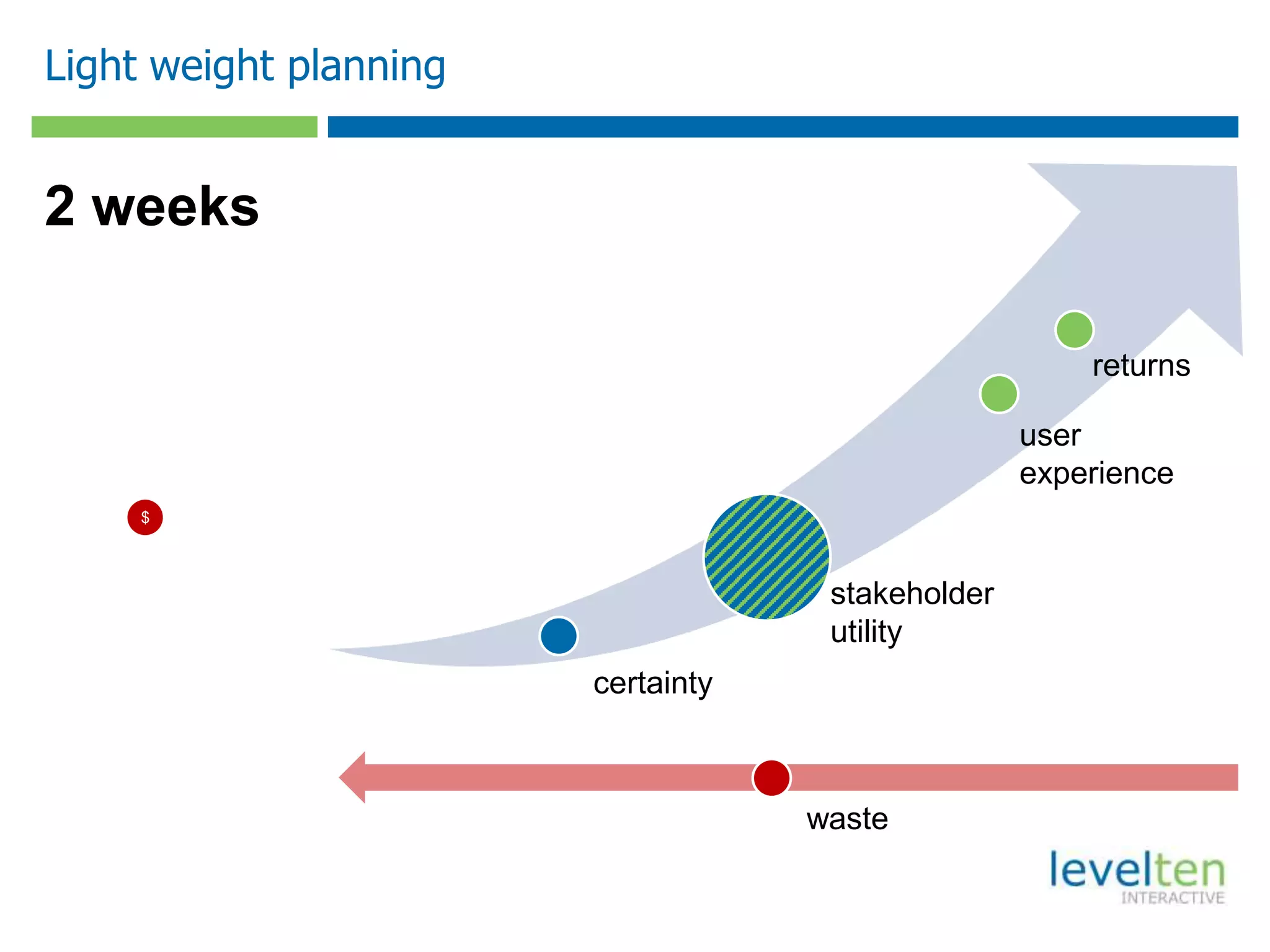
Light weight planning
certainty
stakeholder
utility
user
experience
returns
waste
2 weeks
$
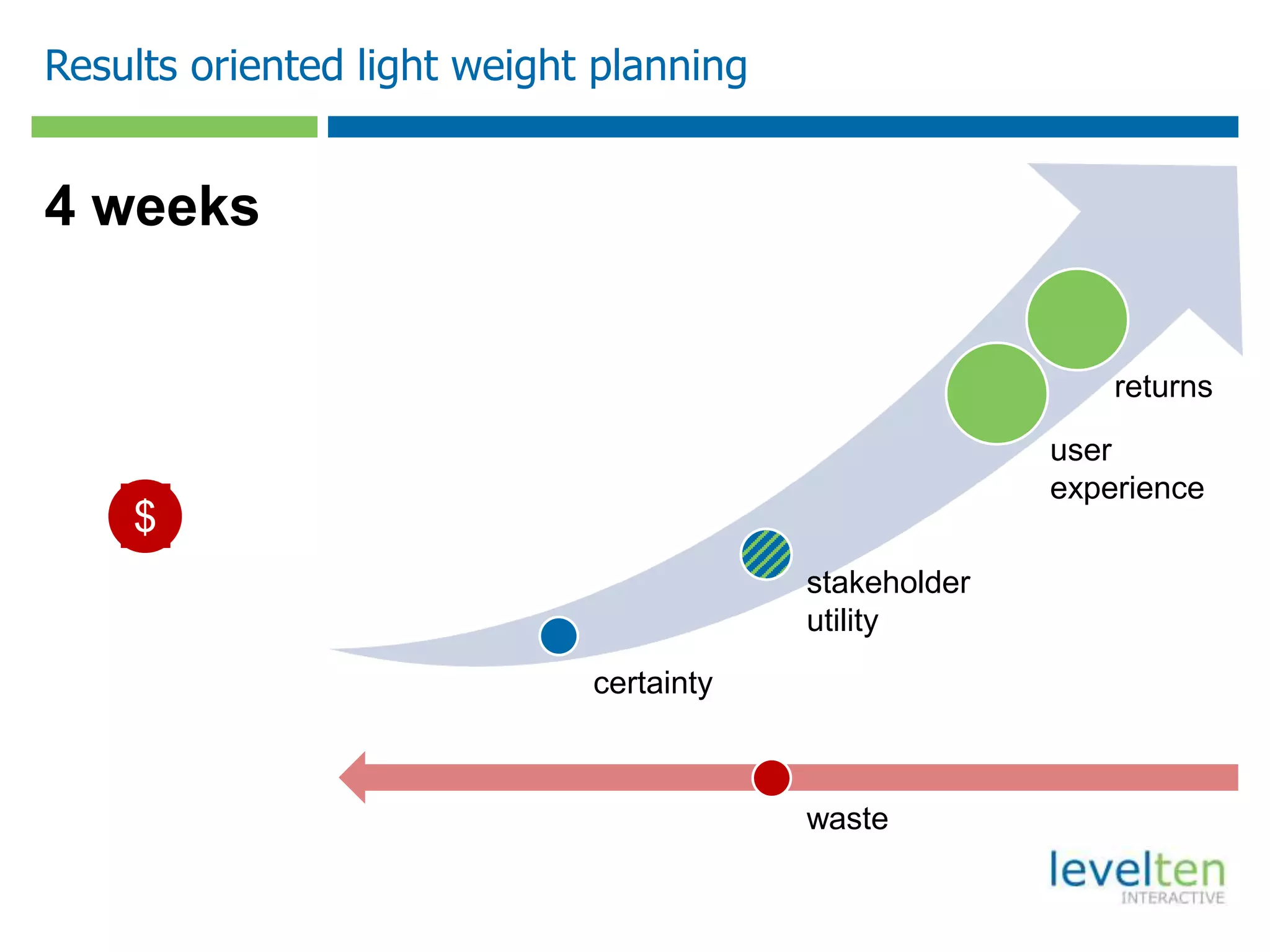
Results oriented light weight planning
certainty
stakeholder
utility
user
experience
returns
waste
4 weeks
$
$
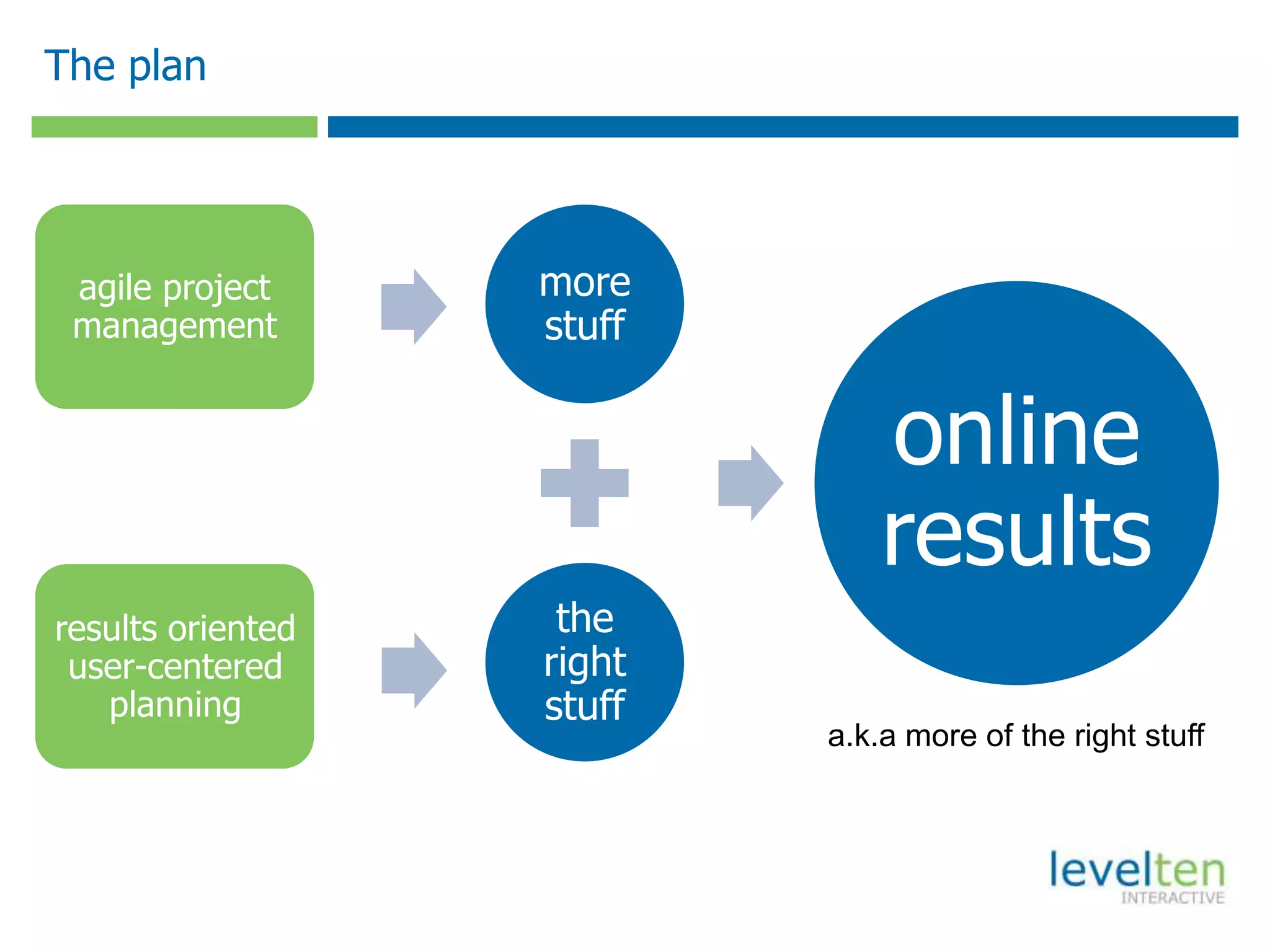
The plan
online
results
a.k.a more of the right stuff
agile project
management
results oriented
user-centered
planning
more
stuff
the
right
stuff
mindset
title
adopt a results
oriented vision
flickr.com/photos/airiklopez/7028608799
1.
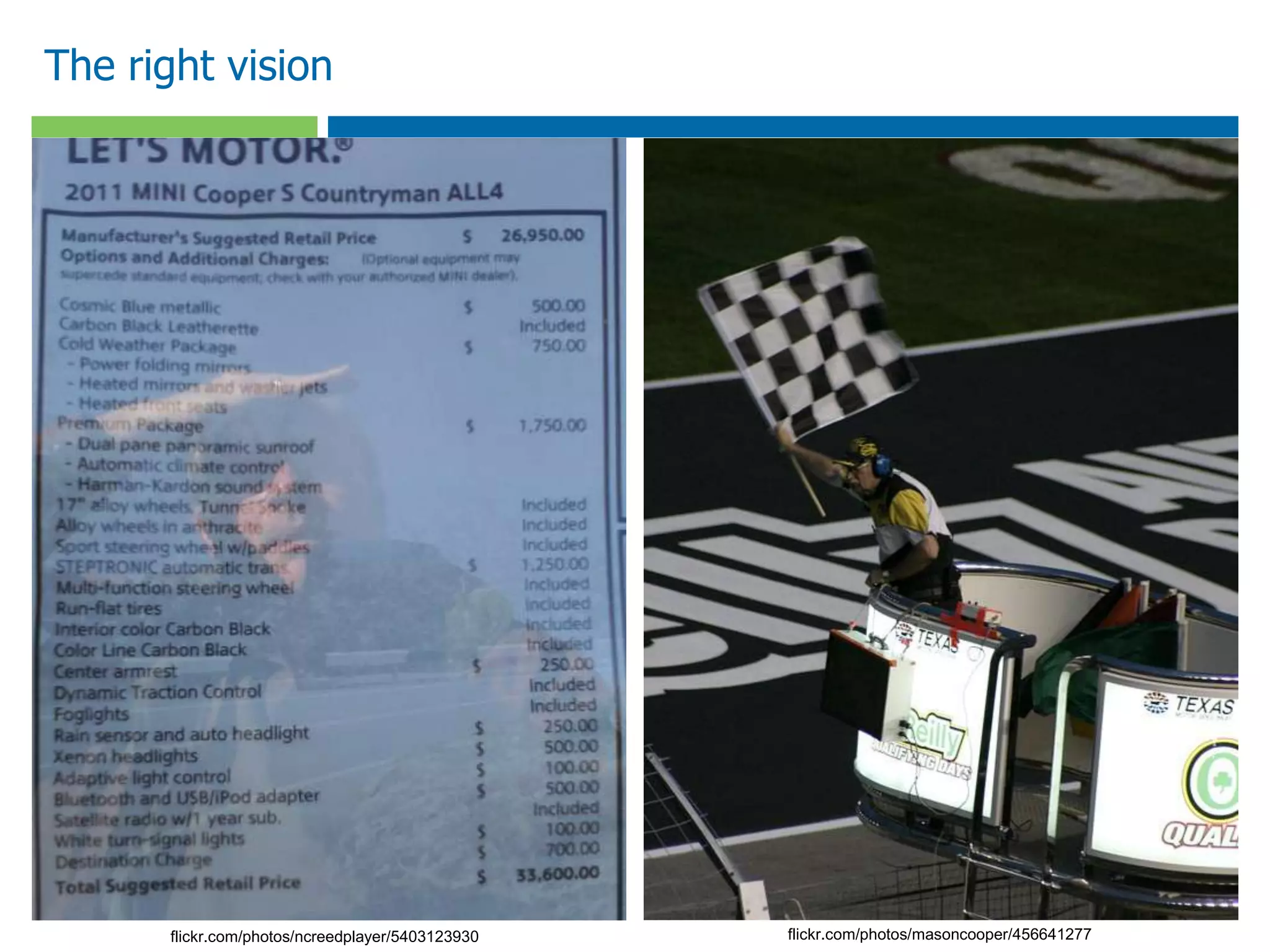
The right vision
flickr.com/photos/ncreedplayer/5403123930 flickr.com/photos/masoncooper/456641277
Do only what provides the most value
only do what
provides the most
value
1i.
flickr.com/photos/whiskeytango/2098182380
title
be user
centric
2.
flickr.com/photos/havovubu/3728604649
title
listen2i.
title
engage
& delight
2ii.
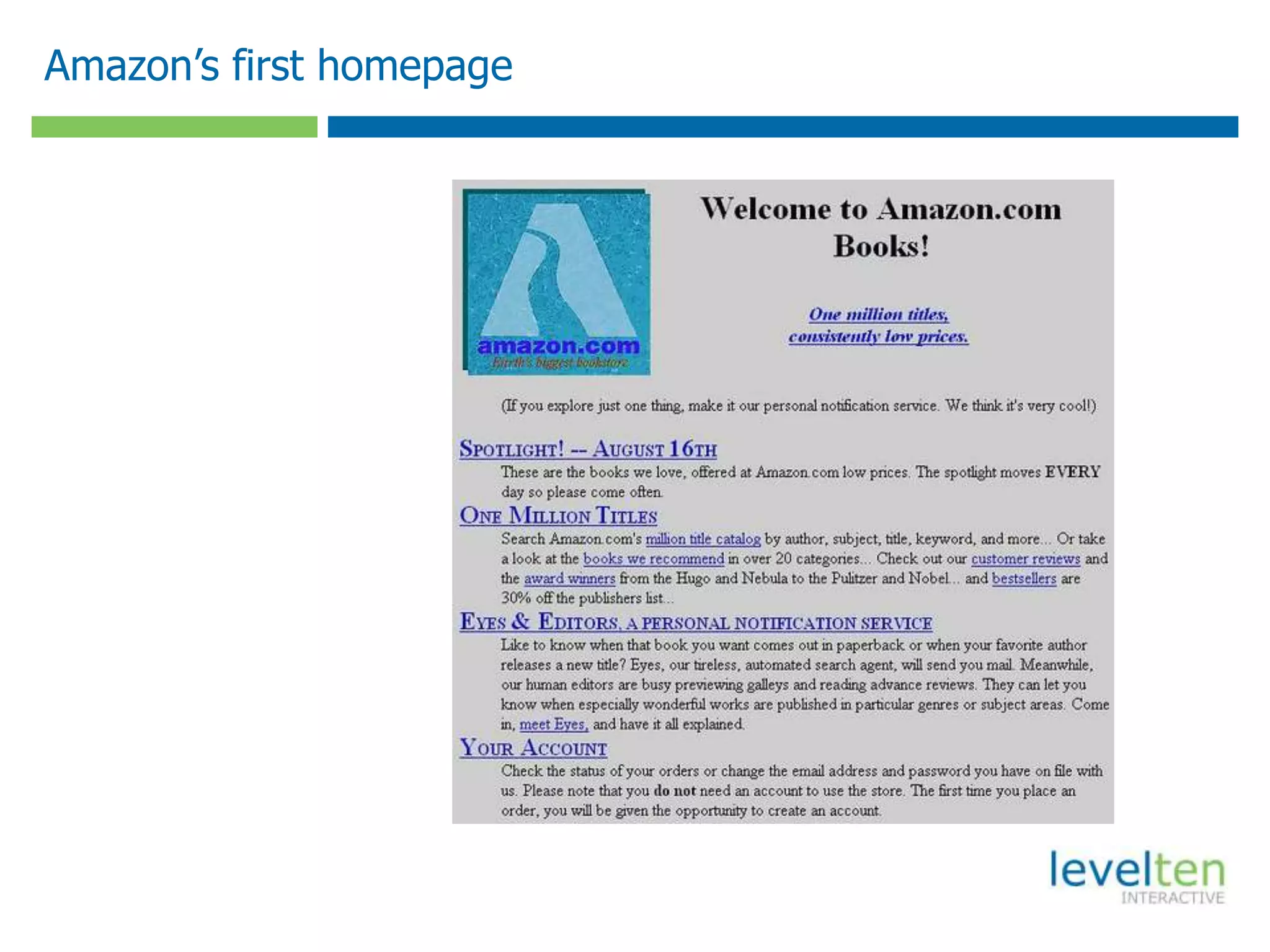
Amazon’s first homepage
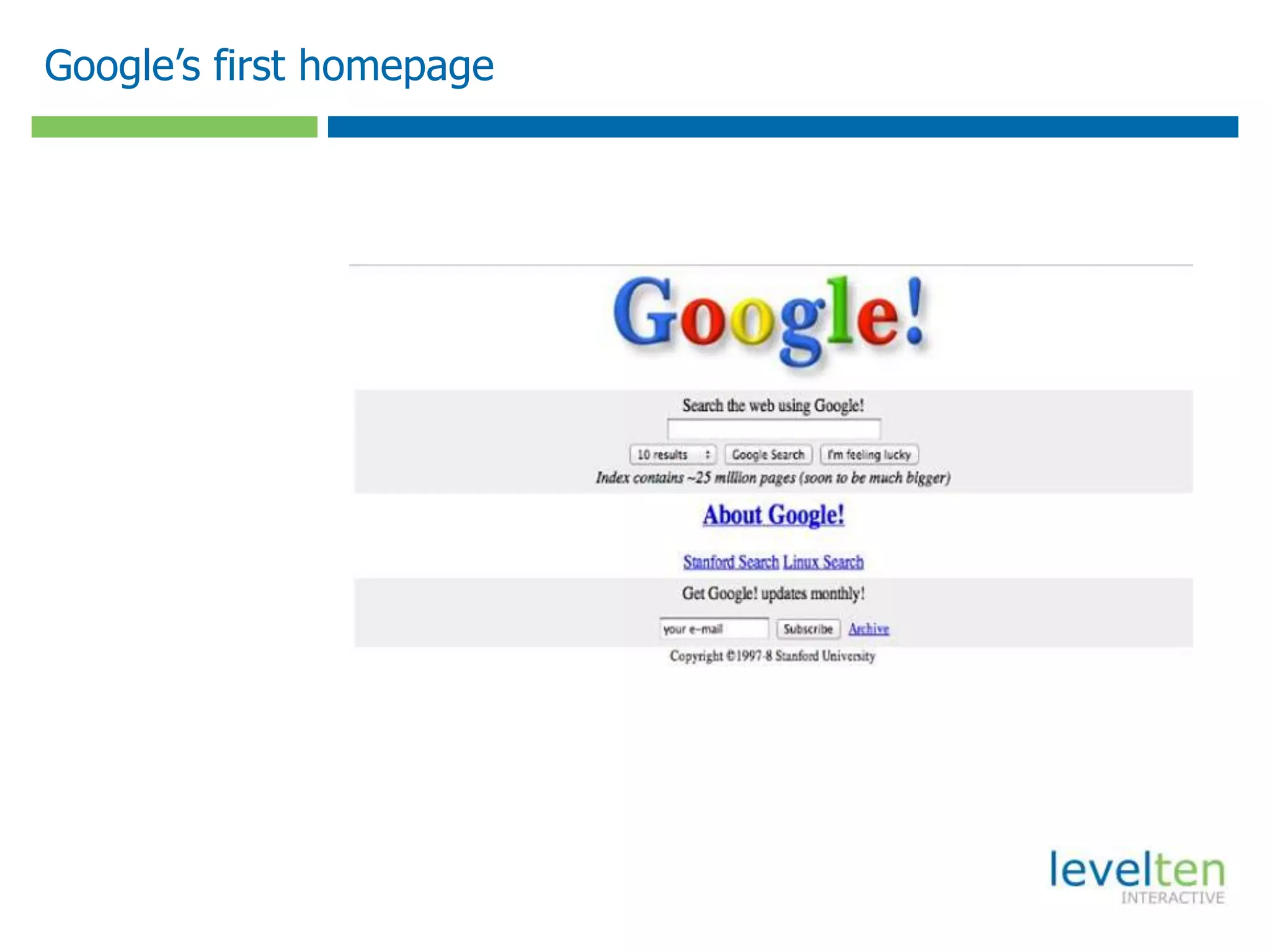
Google’s first homepage
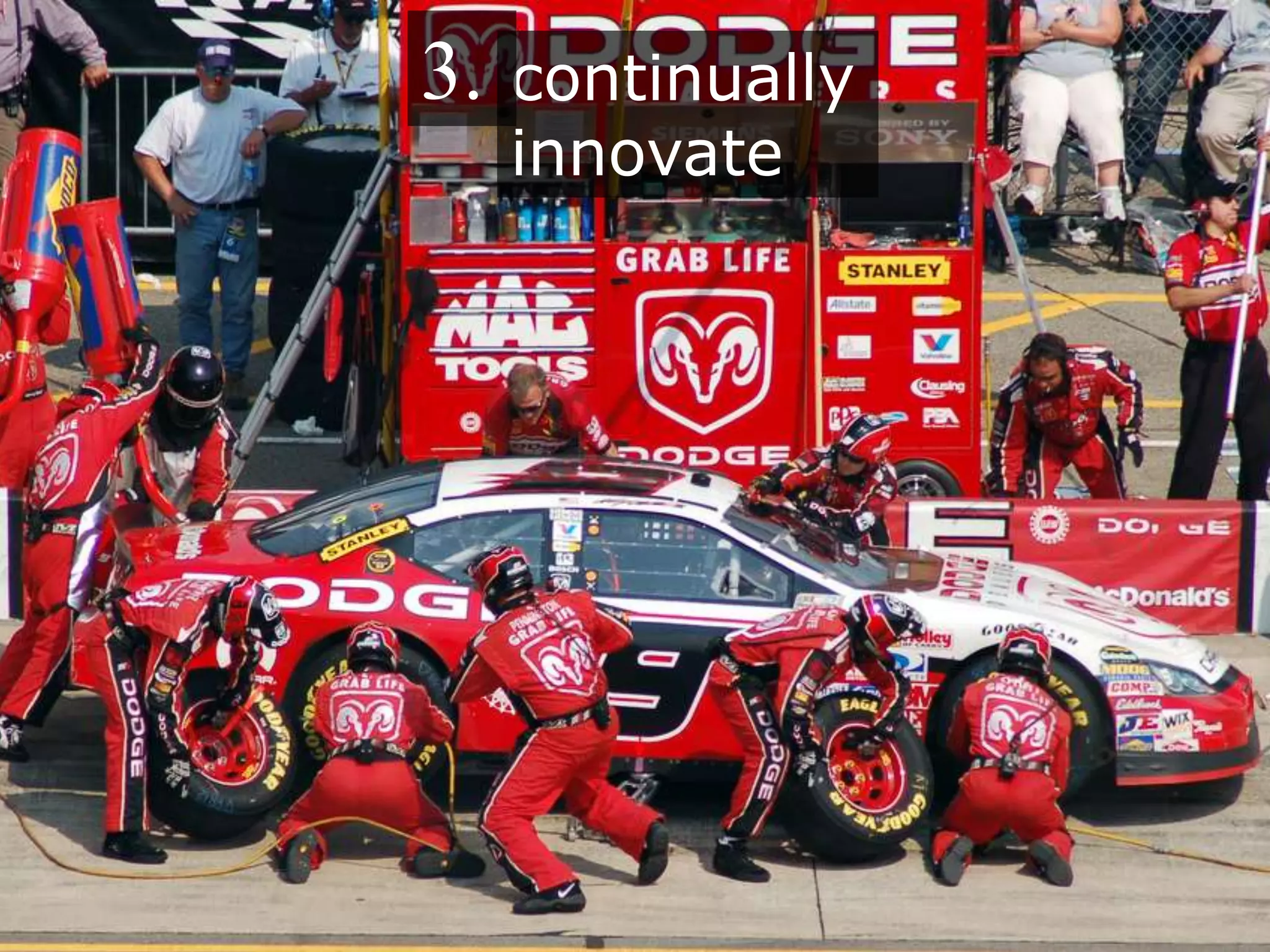
title continually
innovate
3.
title
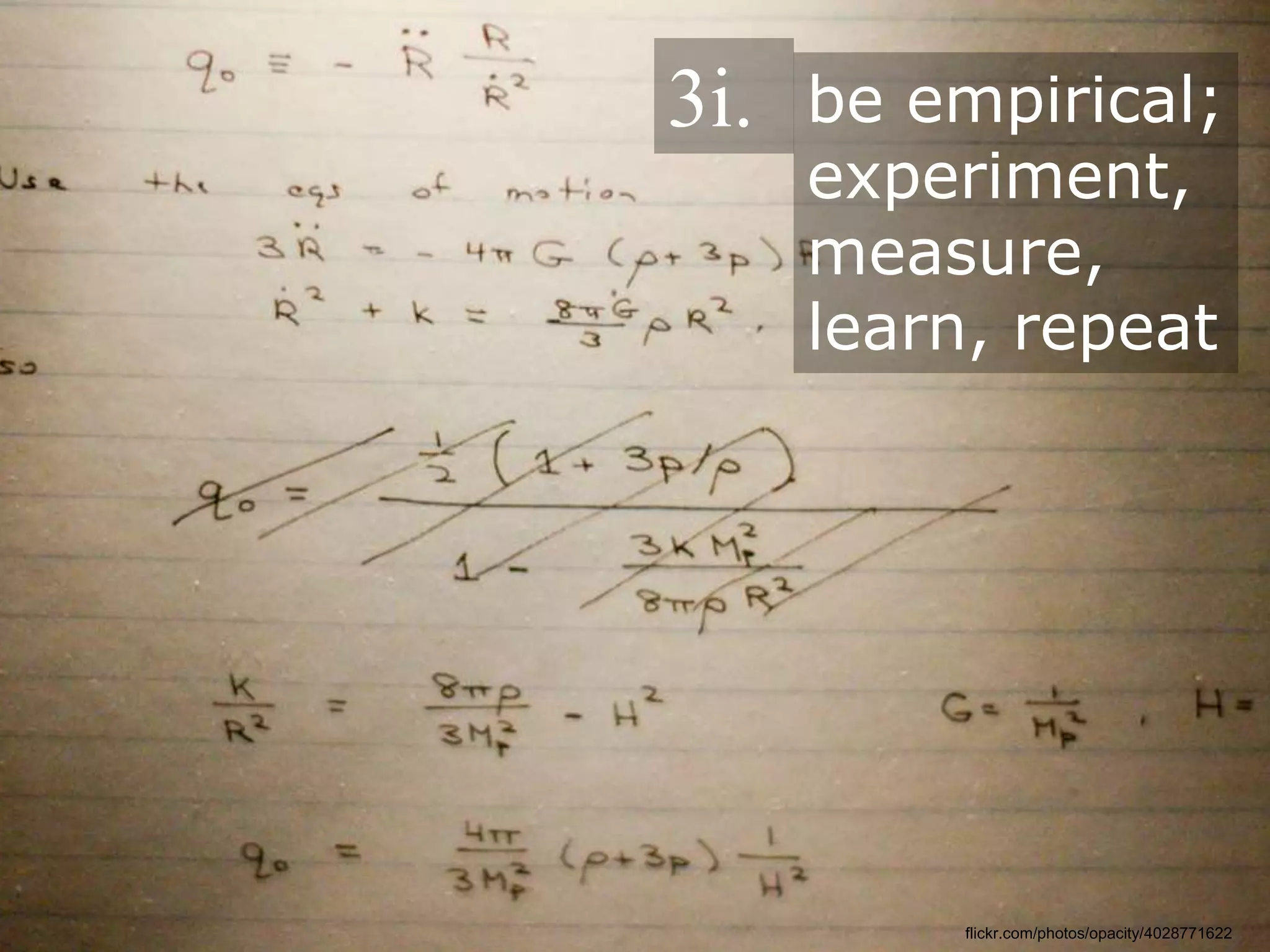
be empirical;
experiment,
measure,
learn, repeat
3i.
flickr.com/photos/opacity/4028771622
title
Be lean:
Launch MVPs
3ii.
flickr.com/photos/opacity/4028771622
planning
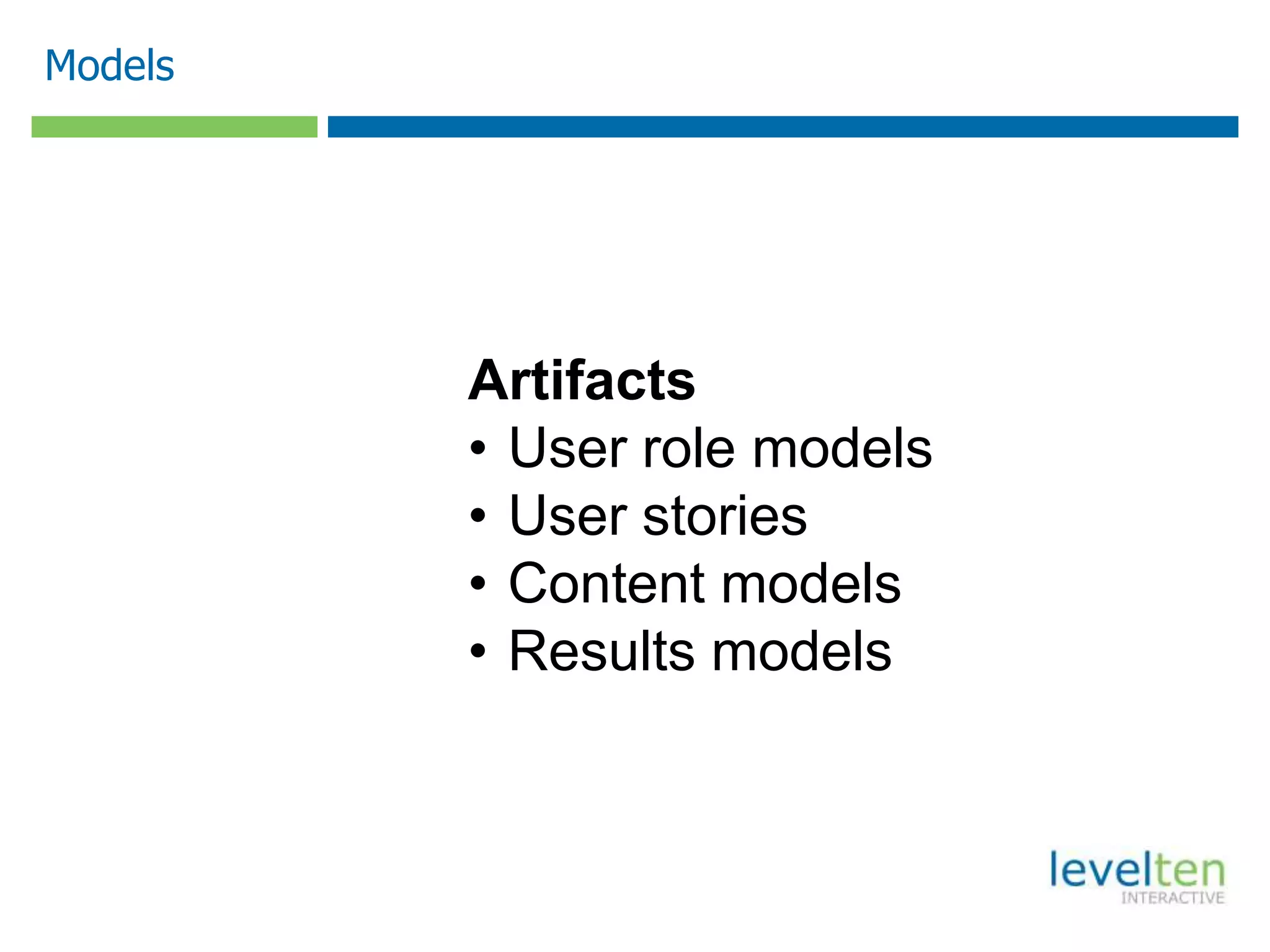
Models
Artifacts
• User role models
• User stories
• Content models
• Results models
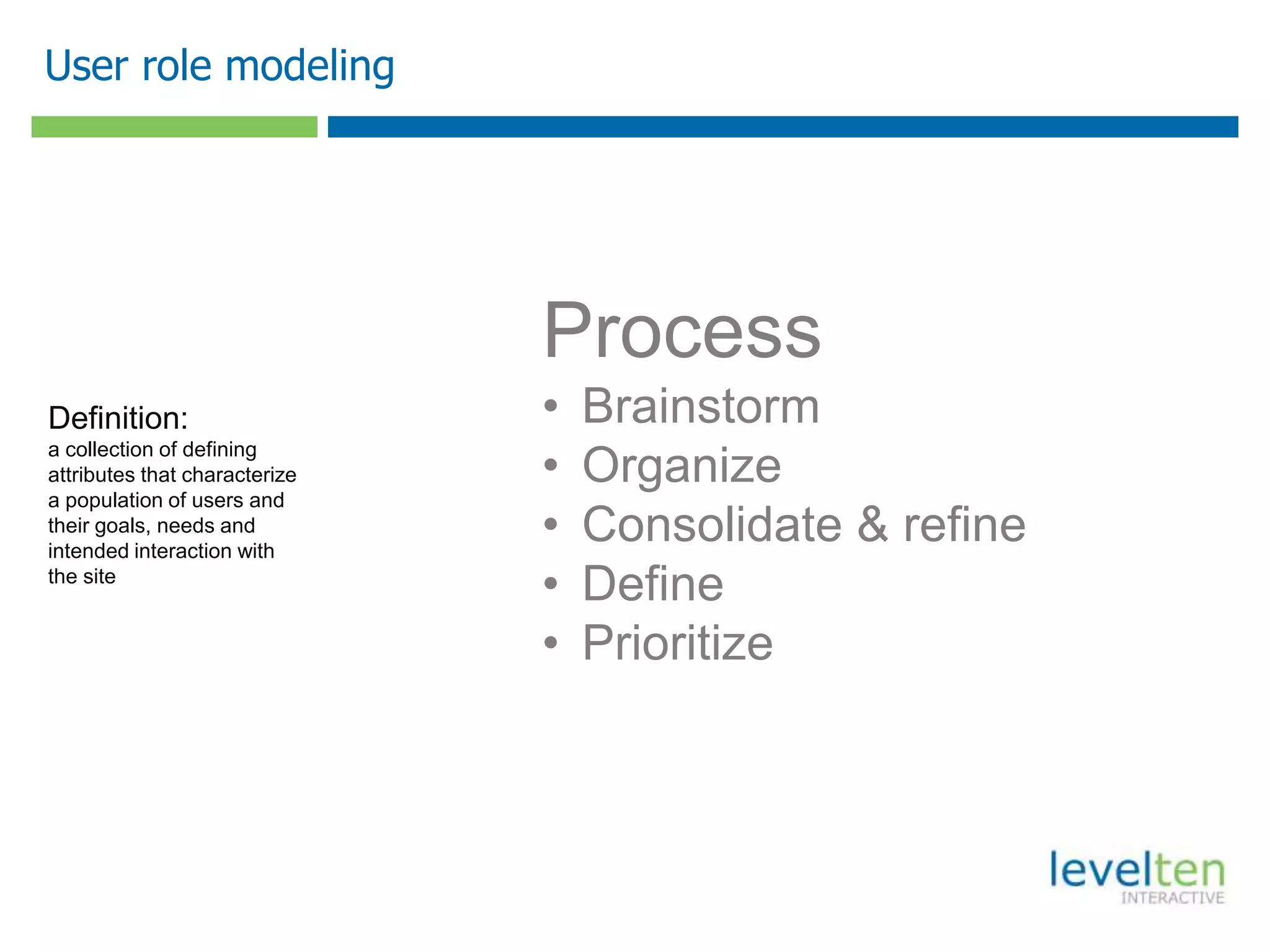
User role modeling
Process
• Brainstorm
• Organize
• Consolidate & refine
• Define
• Prioritize
Definition:
a collection of defining
attributes that characterize
a population of users and
their goals, needs and
intended interaction with
the site
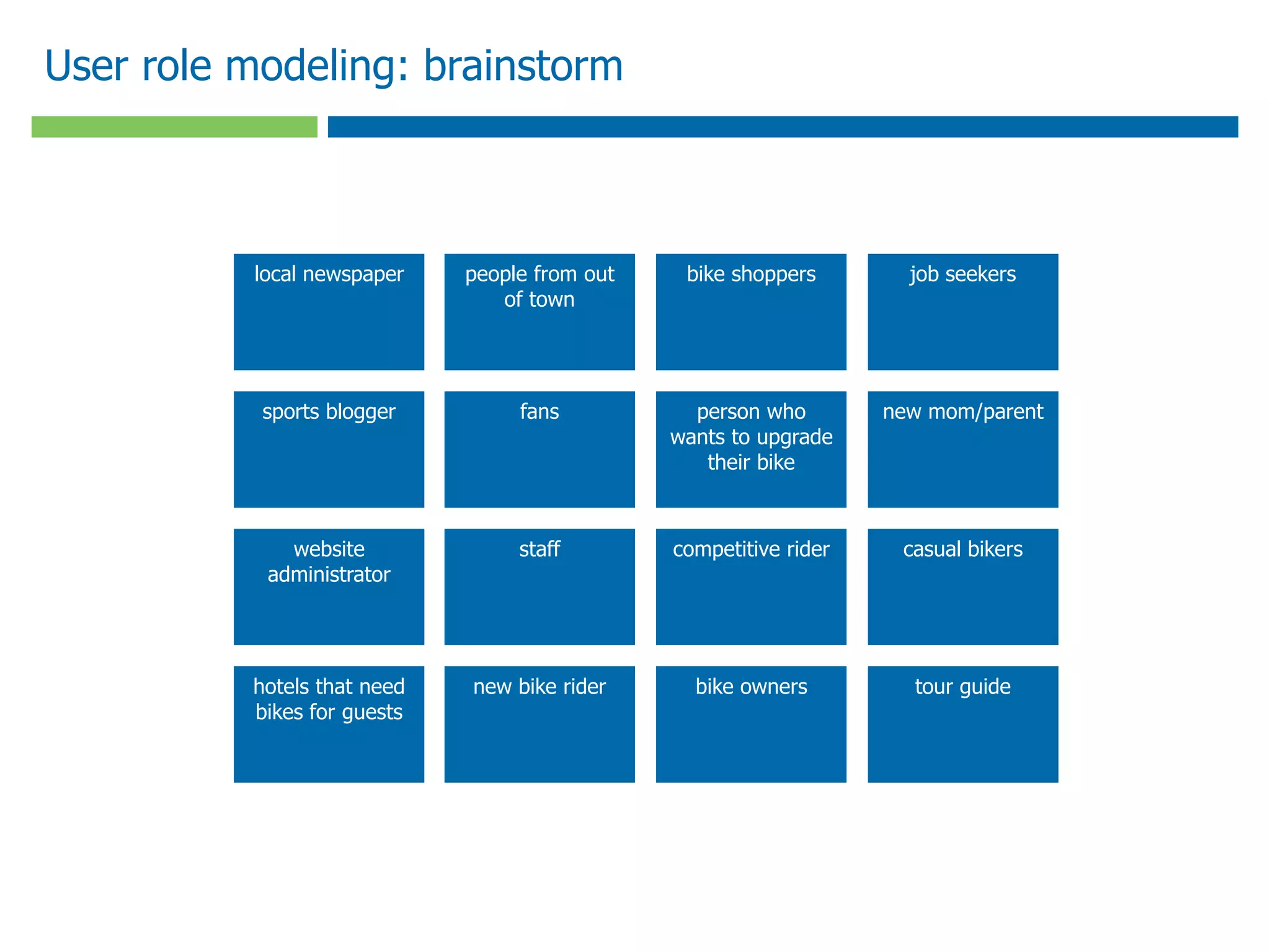
User role modeling: brainstorm
local newspaper
sports blogger
website
administrator
hotels that need
bikes for guests
people from out
of town
fans
staff
new bike rider
bike shoppers
person who
wants to upgrade
their bike
competitive rider
bike owners
job seekers
new mom/parent
casual bikers
tour guide
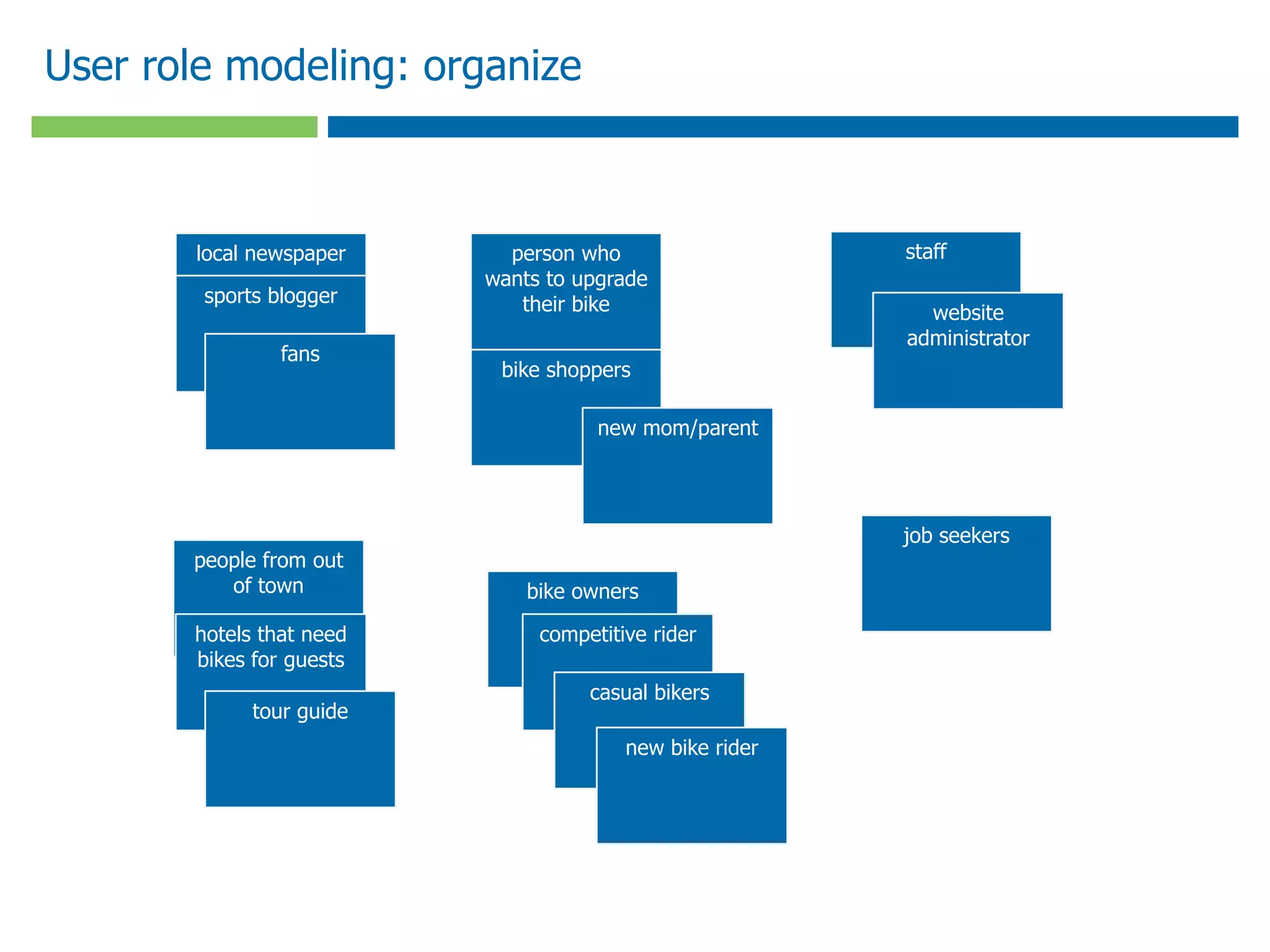
User role modeling: organize
local newspaper
sports blogger
people from out
of town
fans
staff
bike shoppers
person who
wants to upgrade
their bike
bike owners
job seekers
new mom/parent
website
administrator
hotels that need
bikes for guests
tour guide
competitive rider
casual bikers
new bike rider
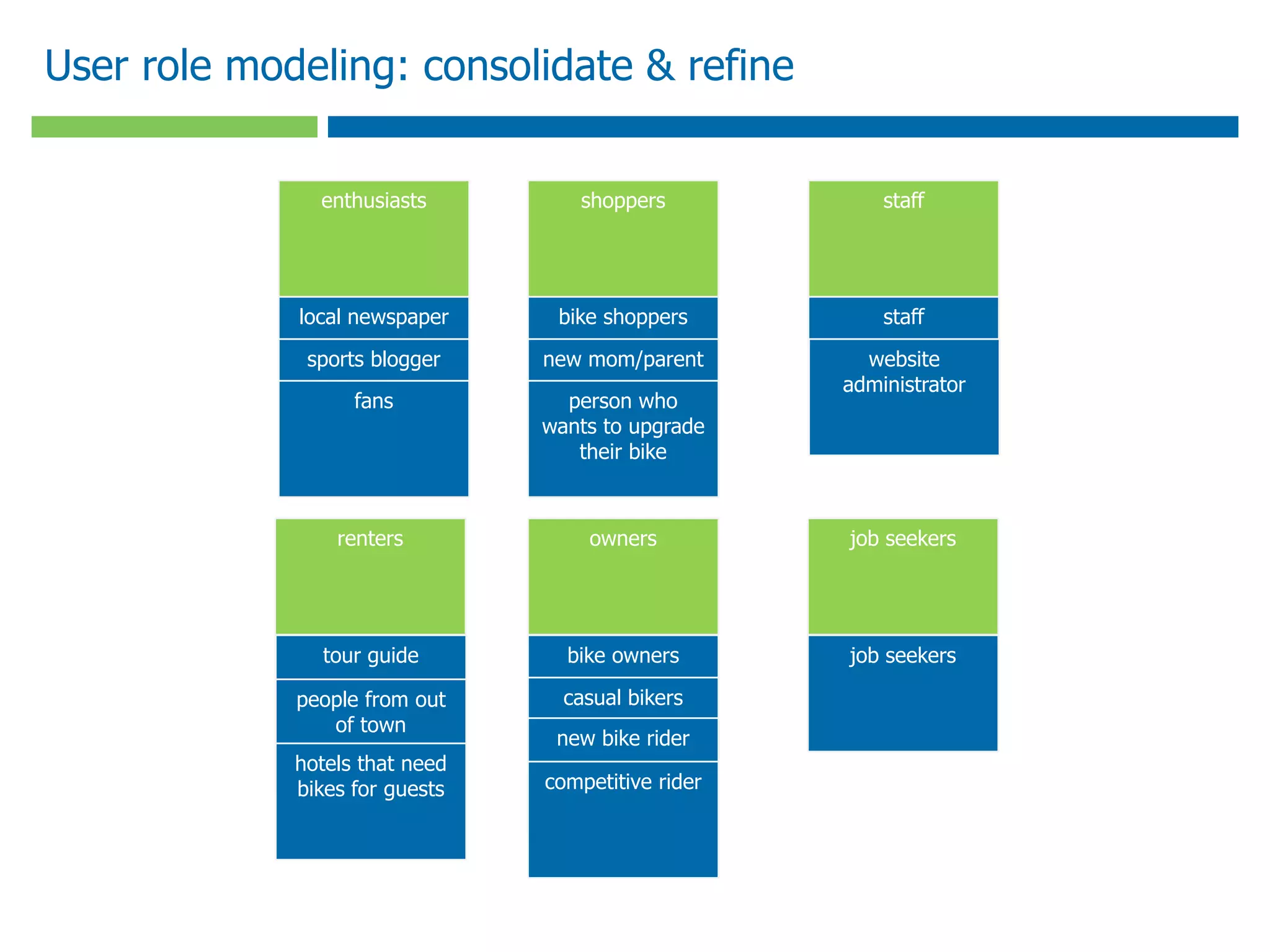
User role modeling: consolidate & refine
local newspaper
sports blogger
fans
staffbike shoppers
bike owners job seekers
new mom/parent website
administrator
tour guide
casual bikers
new bike rider
person who
wants to upgrade
their bike
enthusiasts shoppers staff
renters
people from out
of town
hotels that need
bikes for guests
owners
competitive rider
job seekers
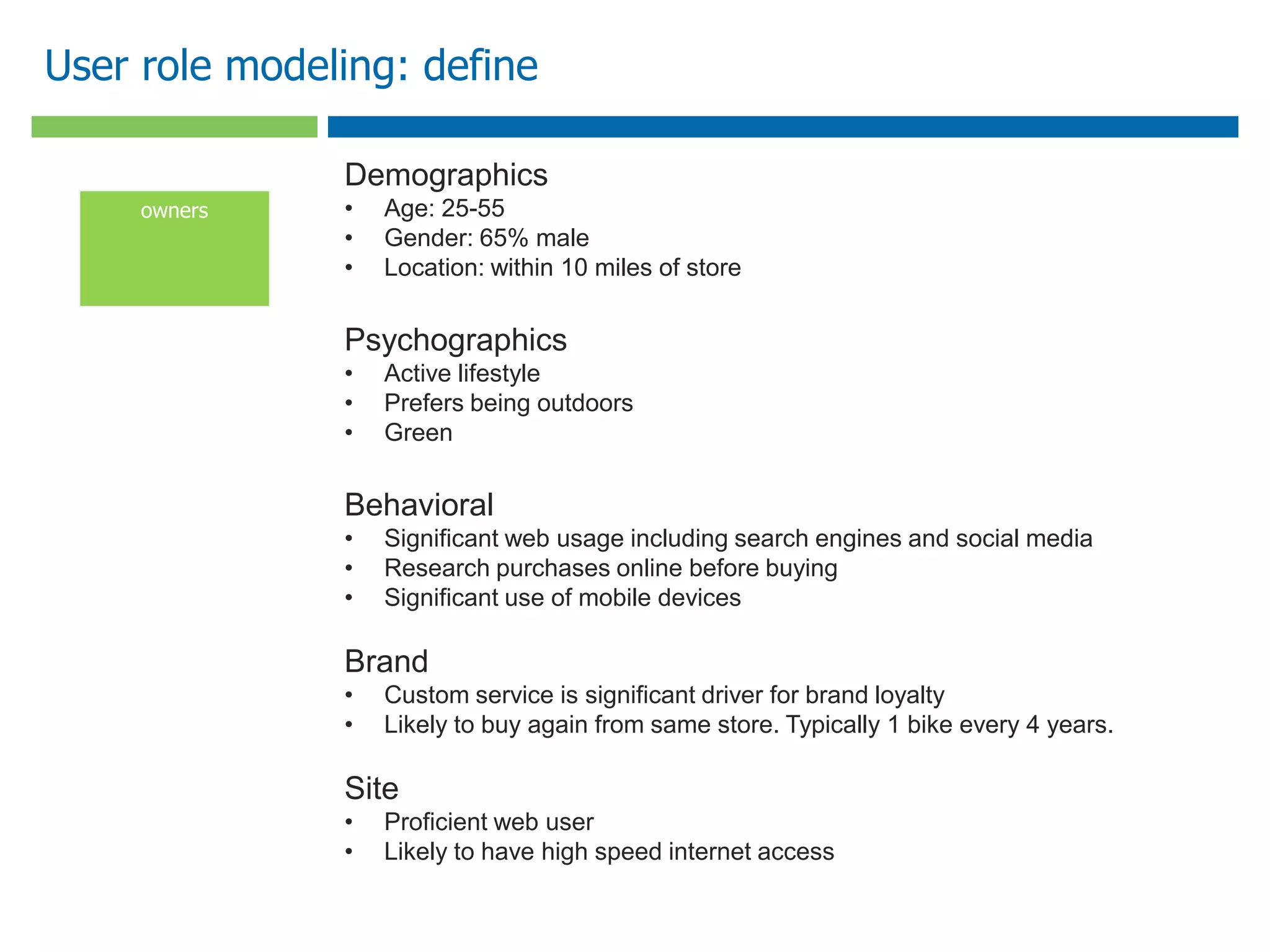
User role modeling: define
owners
Demographics
• Age: 25-55
• Gender: 65% male
• Location: within 10 miles of store
Psychographics
• Active lifestyle
• Prefers being outdoors
• Green
Behavioral
• Significant web usage including search engines and social media
• Research purchases online before buying
• Significant use of mobile devices
Brand
• Custom service is significant driver for brand loyalty
• Likely to buy again from same store. Typically 1 bike every 4 years.
Site
• Proficient web user
• Likely to have high speed internet access
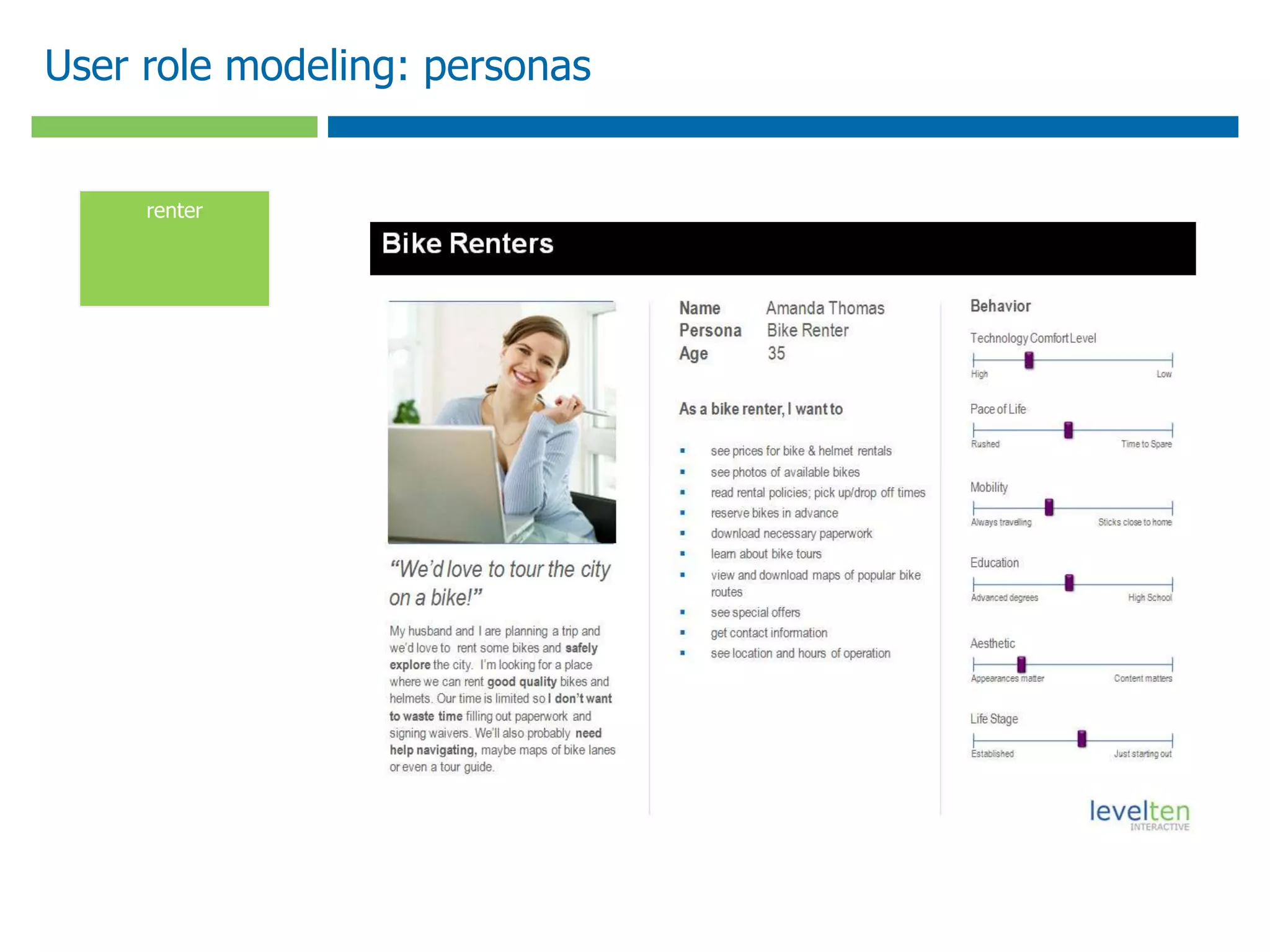
User role modeling: personas
renter
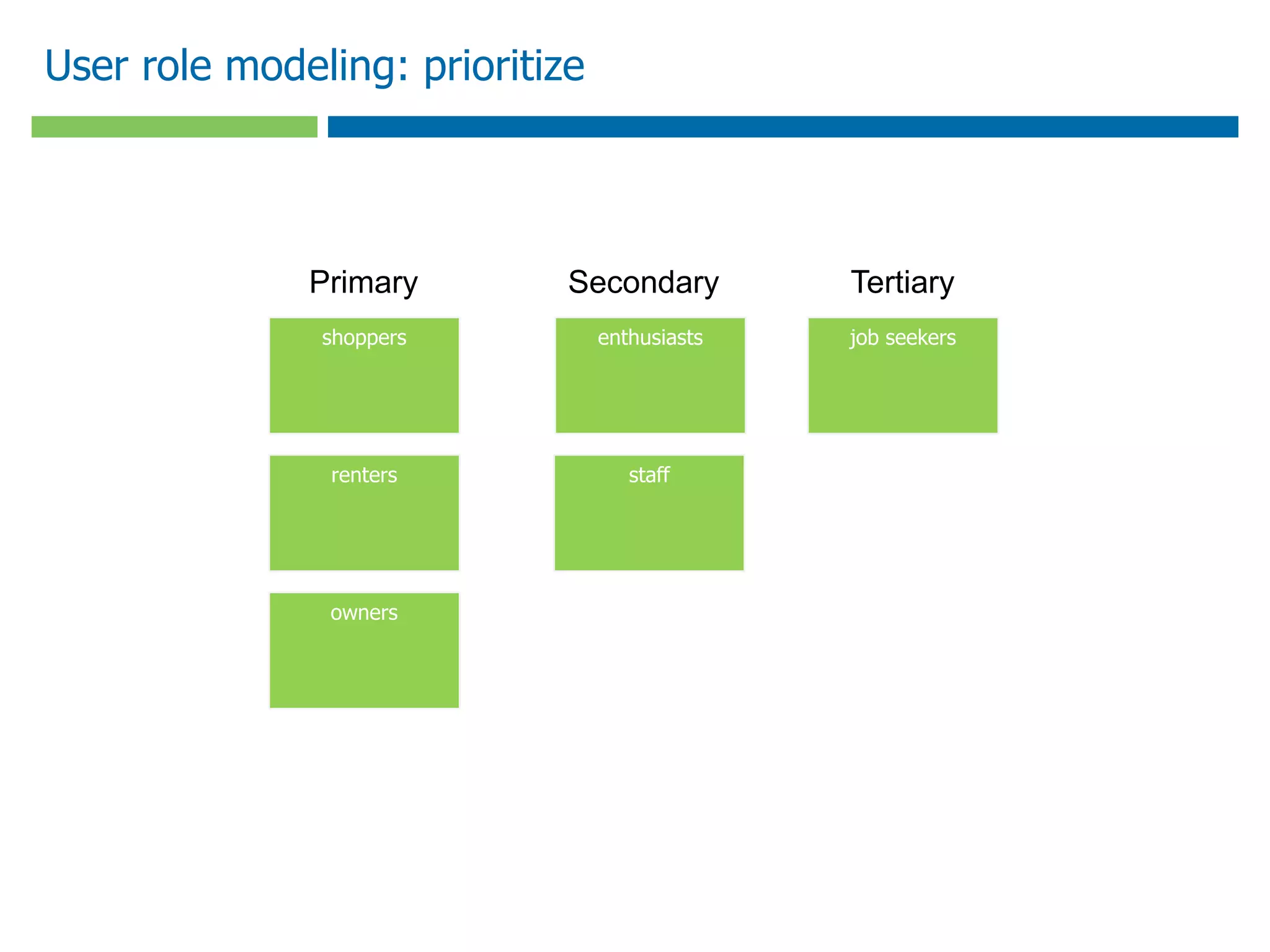
User role modeling: prioritize
enthusiastsshoppers
staffrenters
owners
job seekers
Primary Secondary Tertiary
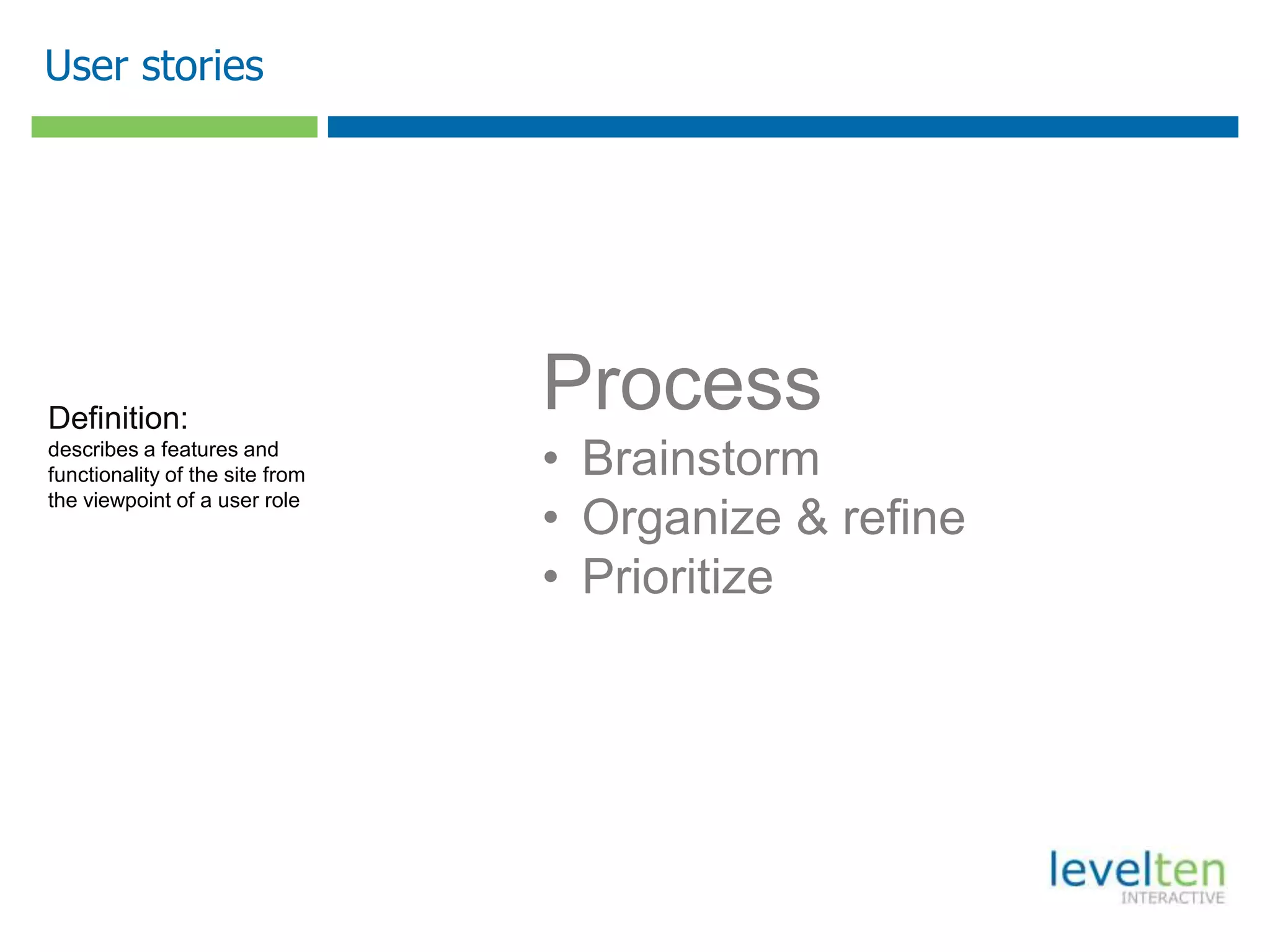
User stories
Process
• Brainstorm
• Organize & refine
• Prioritize
Definition:
describes a features and
functionality of the site from
the viewpoint of a user role
Trawling for requirements
User stories: format
As a [user role]
I want [a feature or goal]
so that [a benefit or reason]
* so that is optional
A user story is a documented
requirement and a note to discuss later
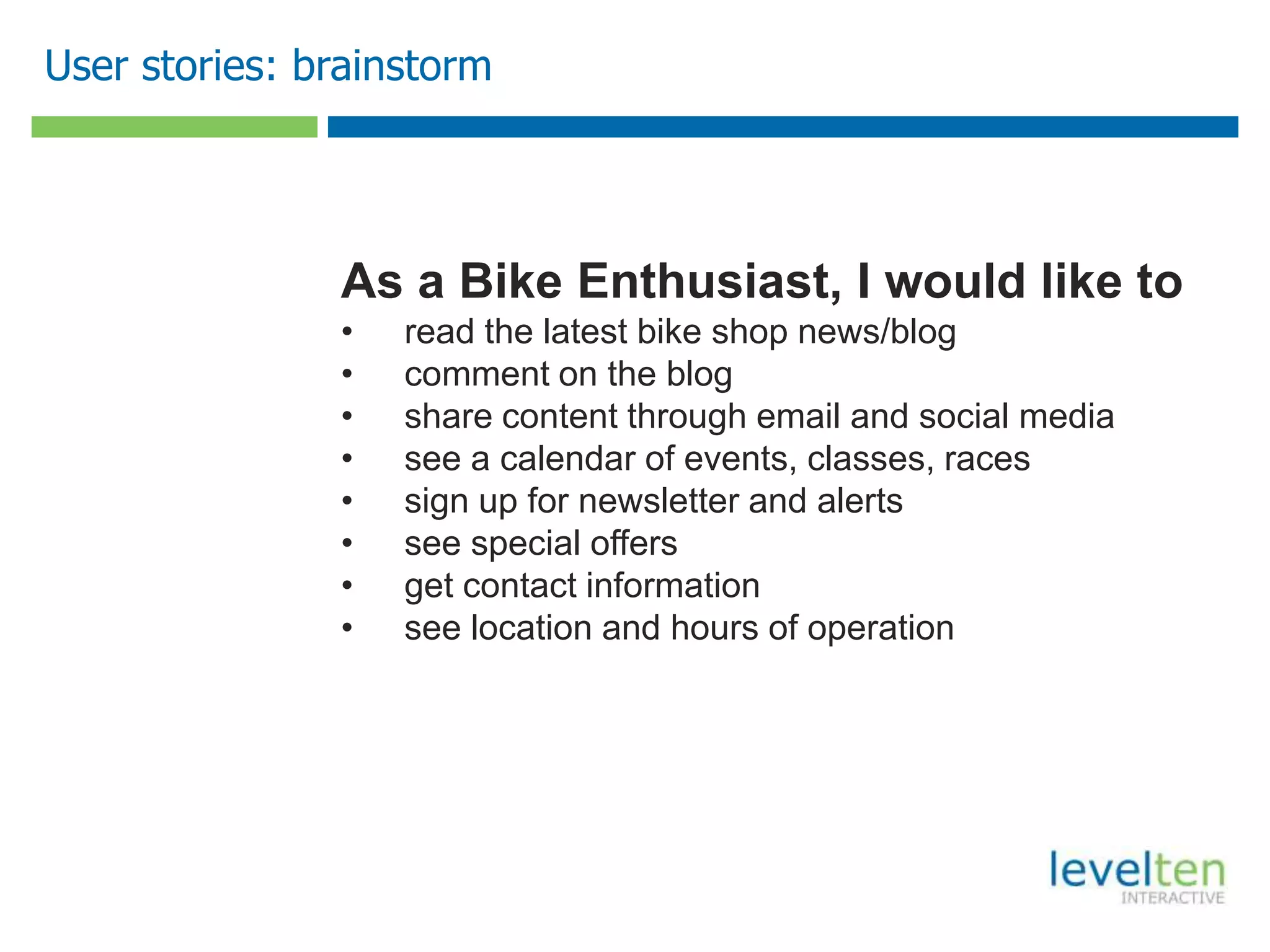
User stories: brainstorm
As a Bike Enthusiast, I would like to
• read the latest bike shop news/blog
• comment on the blog
• share content through email and social media
• see a calendar of events, classes, races
• sign up for newsletter and alerts
• see special offers
• get contact information
• see location and hours of operation
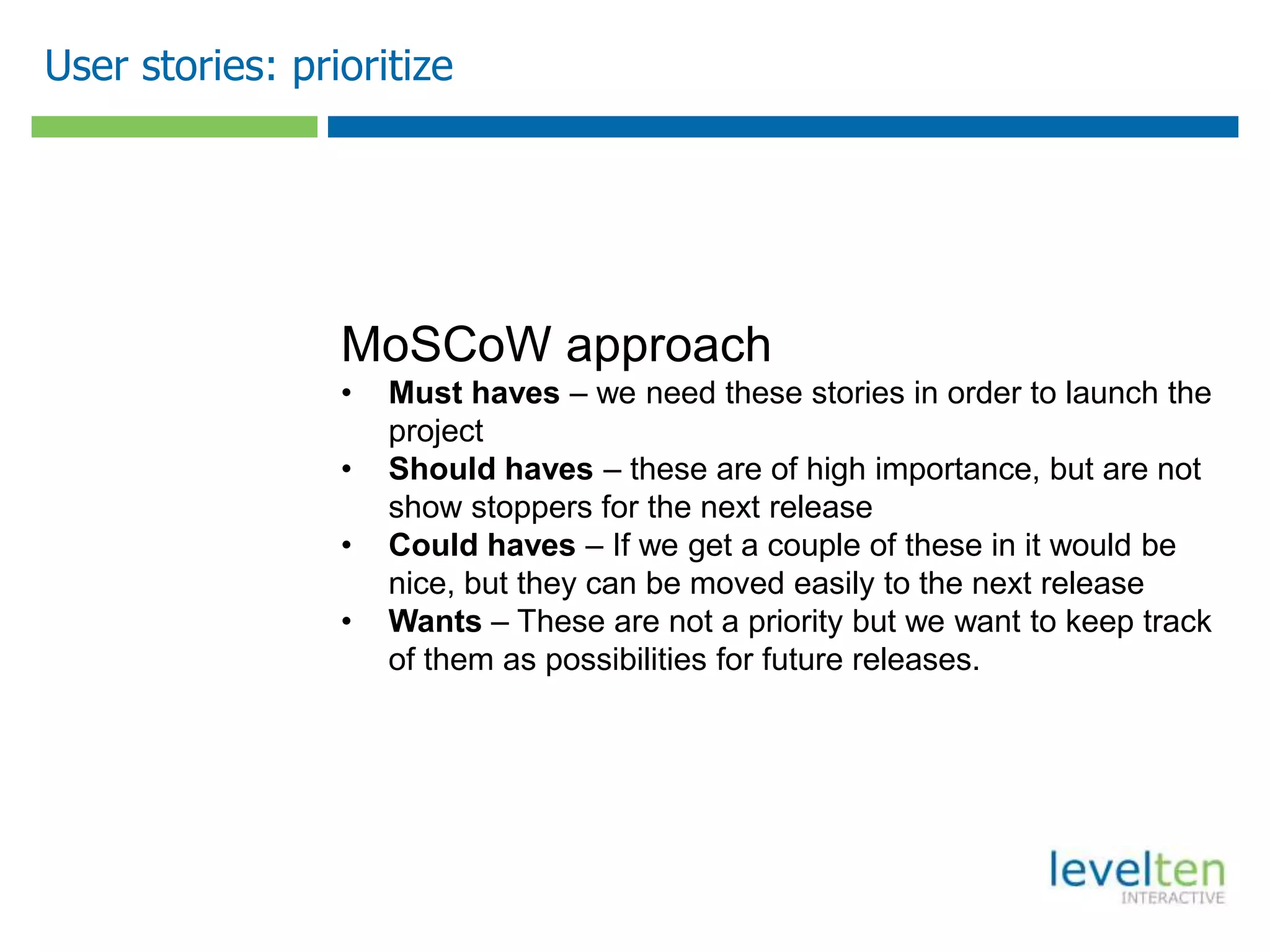
User stories: prioritize
MoSCoW approach
• Must haves – we need these stories in order to launch the
project
• Should haves – these are of high importance, but are not
show stoppers for the next release
• Could haves – If we get a couple of these in it would be
nice, but they can be moved easily to the next release
• Wants – These are not a priority but we want to keep track
of them as possibilities for future releases.
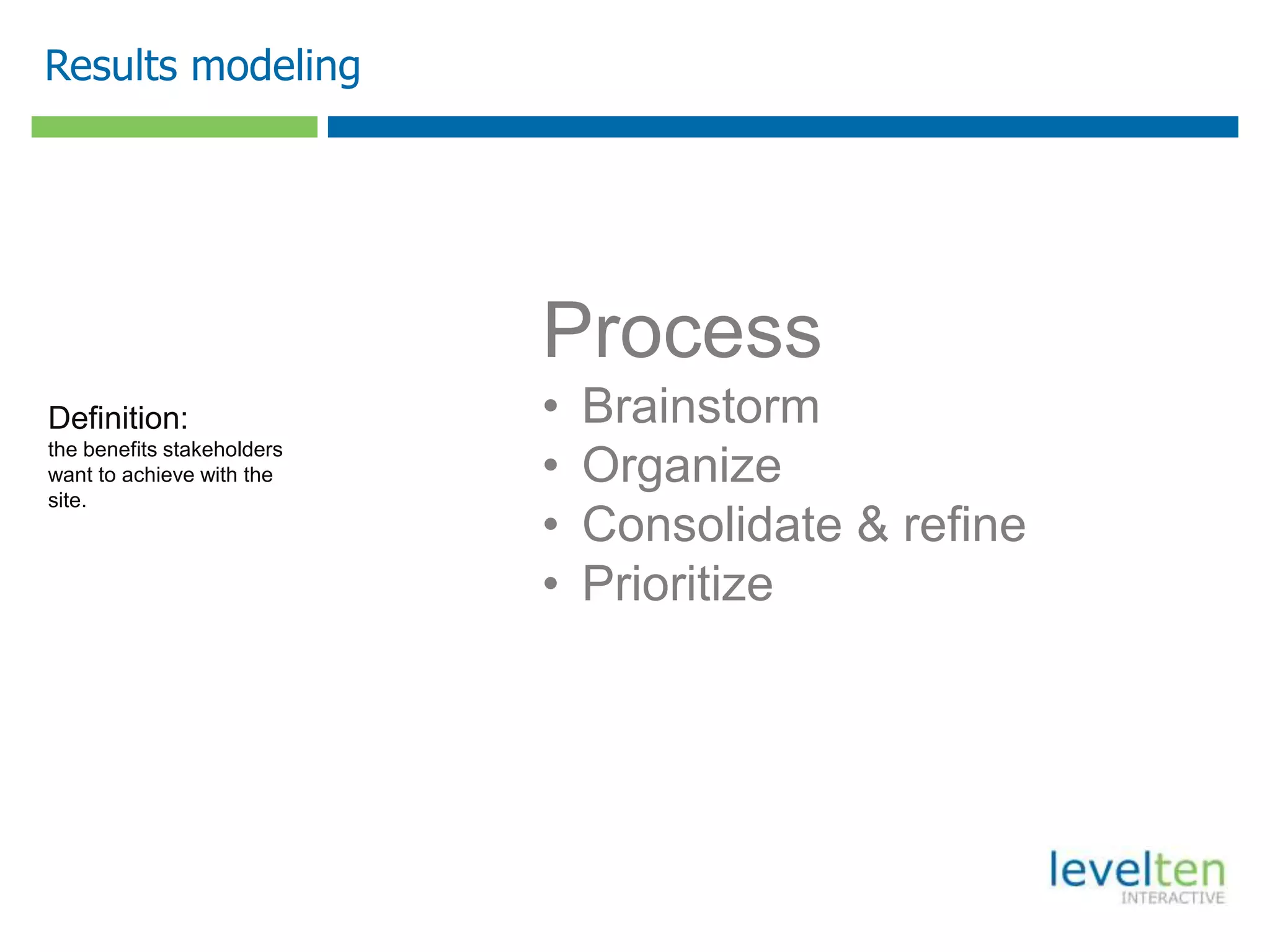
Results modeling
Process
• Brainstorm
• Organize
• Consolidate & refine
• Prioritize
Definition:
the benefits stakeholders
want to achieve with the
site.
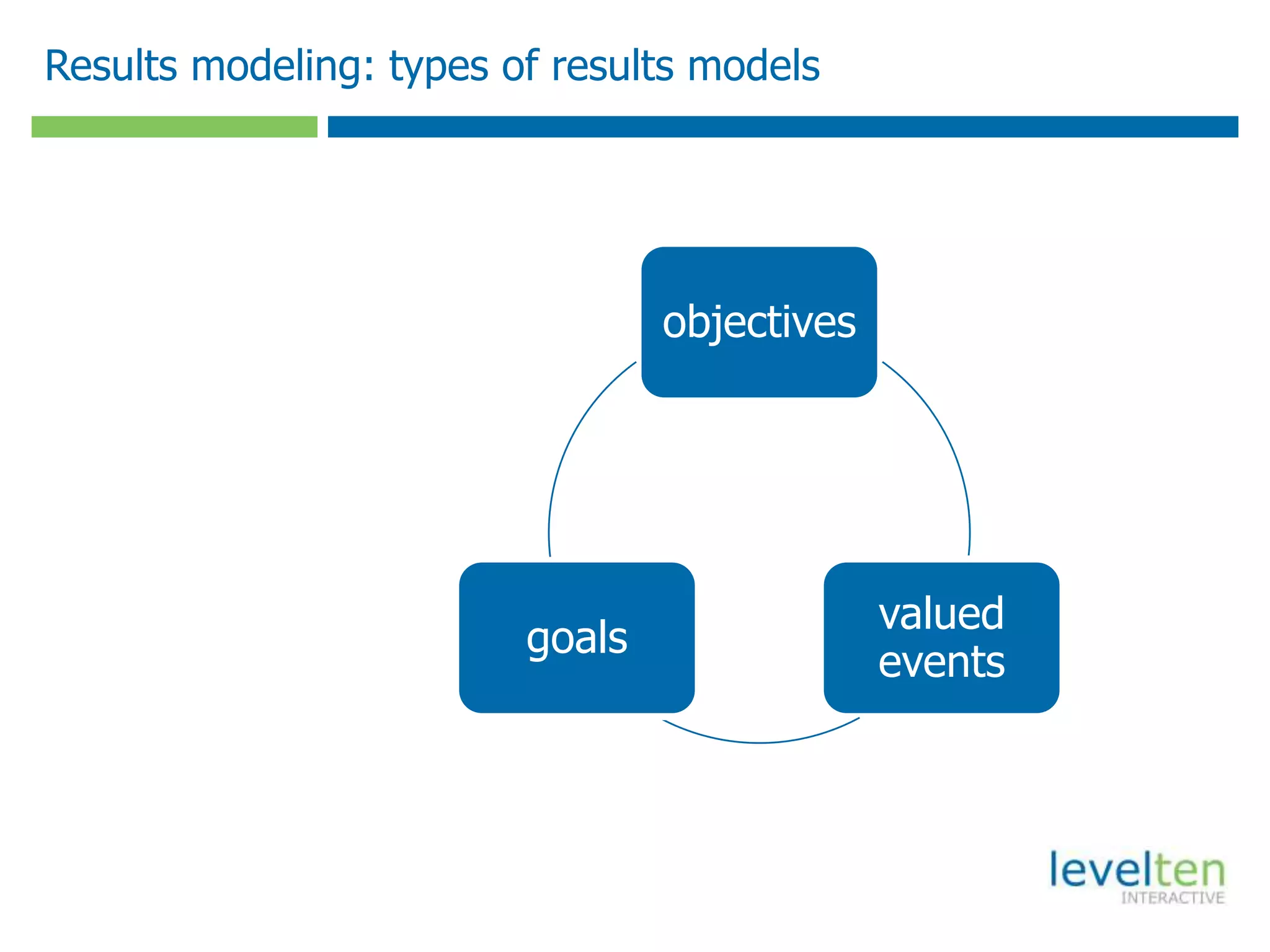
Results modeling: types of results models
objectives
valued
events
goals
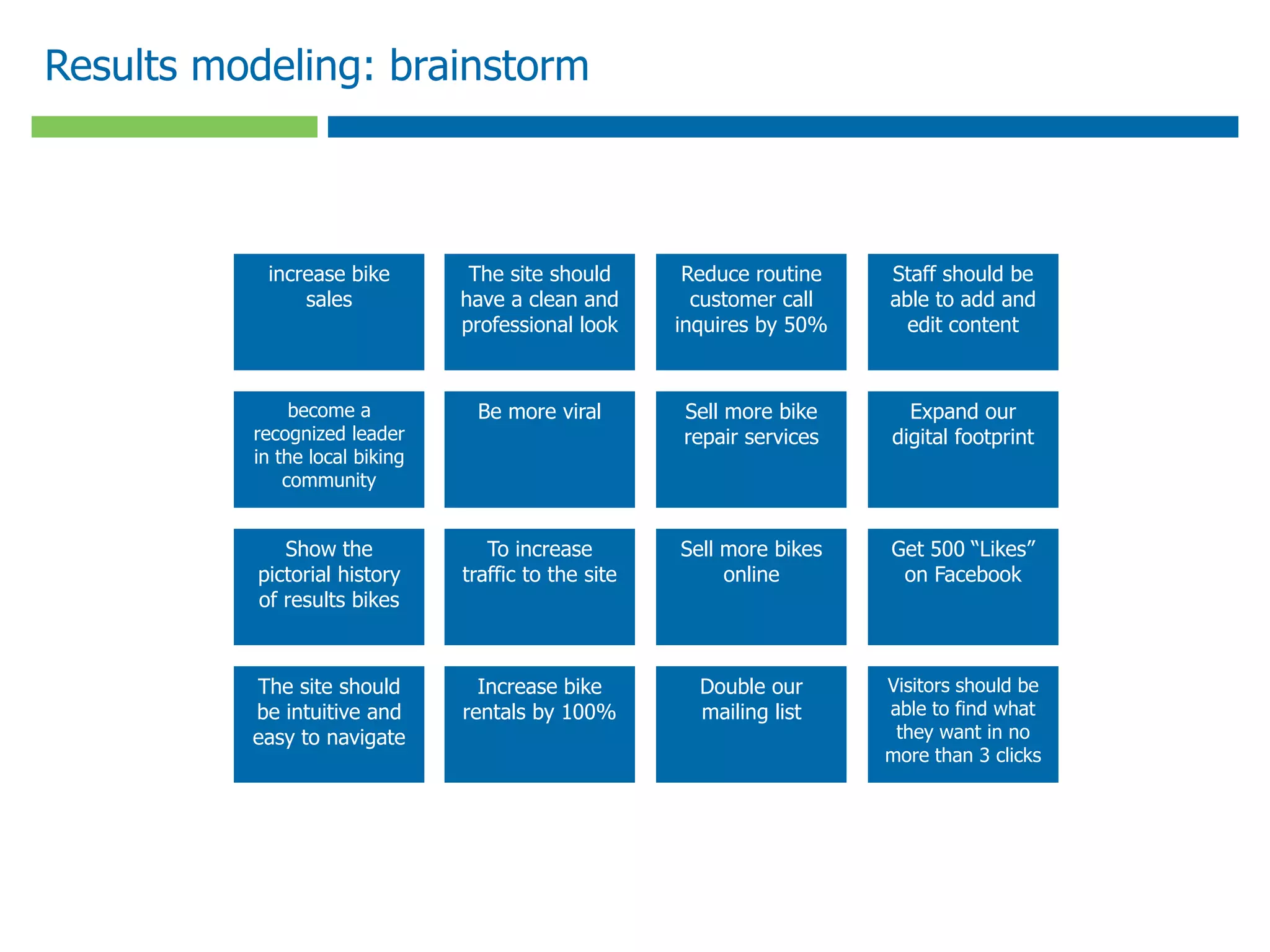
Results modeling: brainstorm
increase bike
sales
become a
recognized leader
in the local biking
community
Show the
pictorial history
of results bikes
The site should
be intuitive and
easy to navigate
The site should
have a clean and
professional look
Be more viral
To increase
traffic to the site
Increase bike
rentals by 100%
Reduce routine
customer call
inquires by 50%
Sell more bike
repair services
Sell more bikes
online
Double our
mailing list
Staff should be
able to add and
edit content
Expand our
digital footprint
Get 500 “Likes”
on Facebook
Visitors should be
able to find what
they want in no
more than 3 clicks
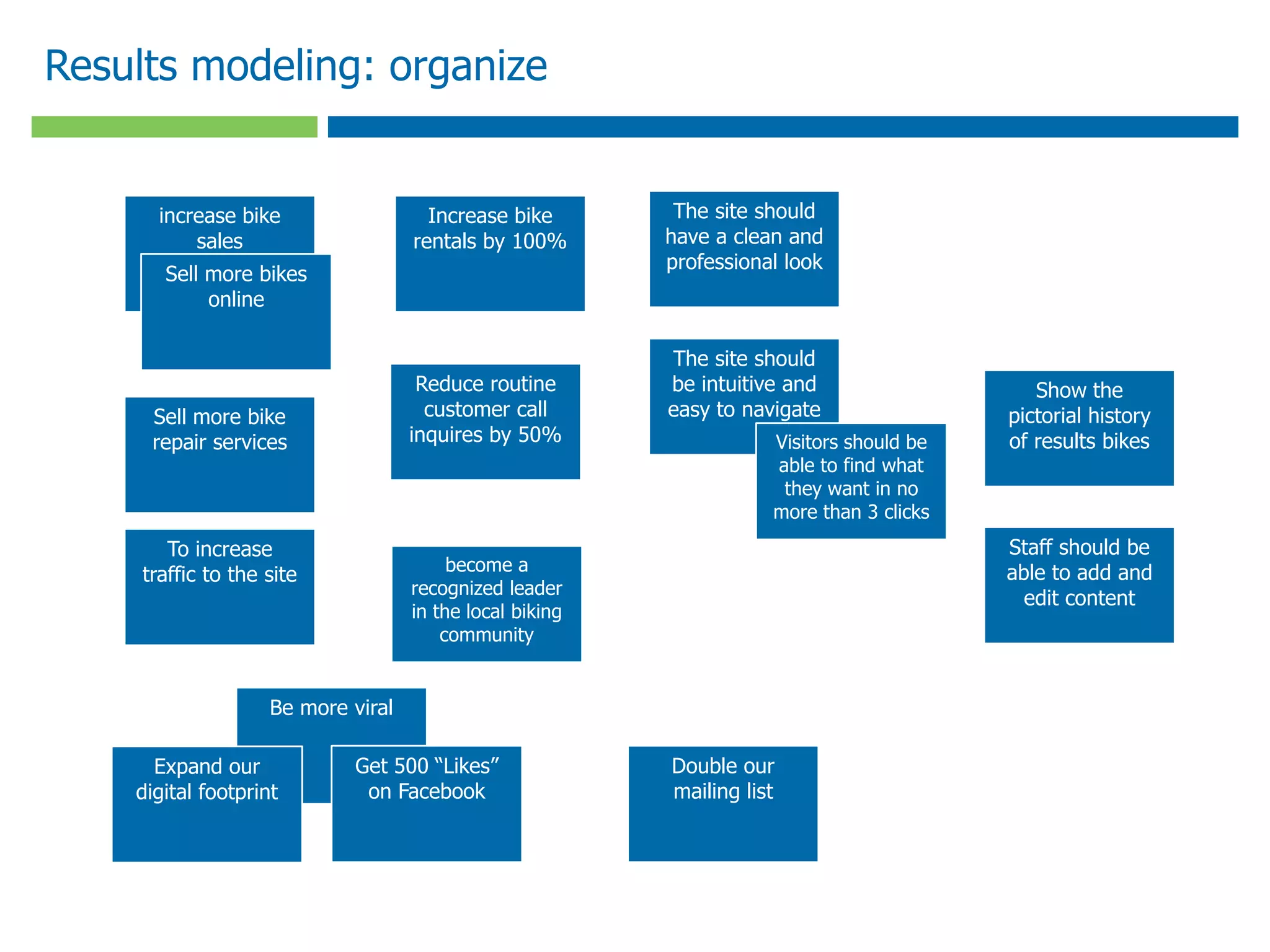
Results modeling: organize
increase bike
sales
become a
recognized leader
in the local biking
community
Show the
pictorial history
of results bikes
The site should
be intuitive and
easy to navigate
The site should
have a clean and
professional look
Be more viral
To increase
traffic to the site
Increase bike
rentals by 100%
Reduce routine
customer call
inquires by 50%
Sell more bike
repair services
Sell more bikes
online
Double our
mailing list
Staff should be
able to add and
edit content
Expand our
digital footprint
Get 500 “Likes”
on Facebook
Visitors should be
able to find what
they want in no
more than 3 clicks
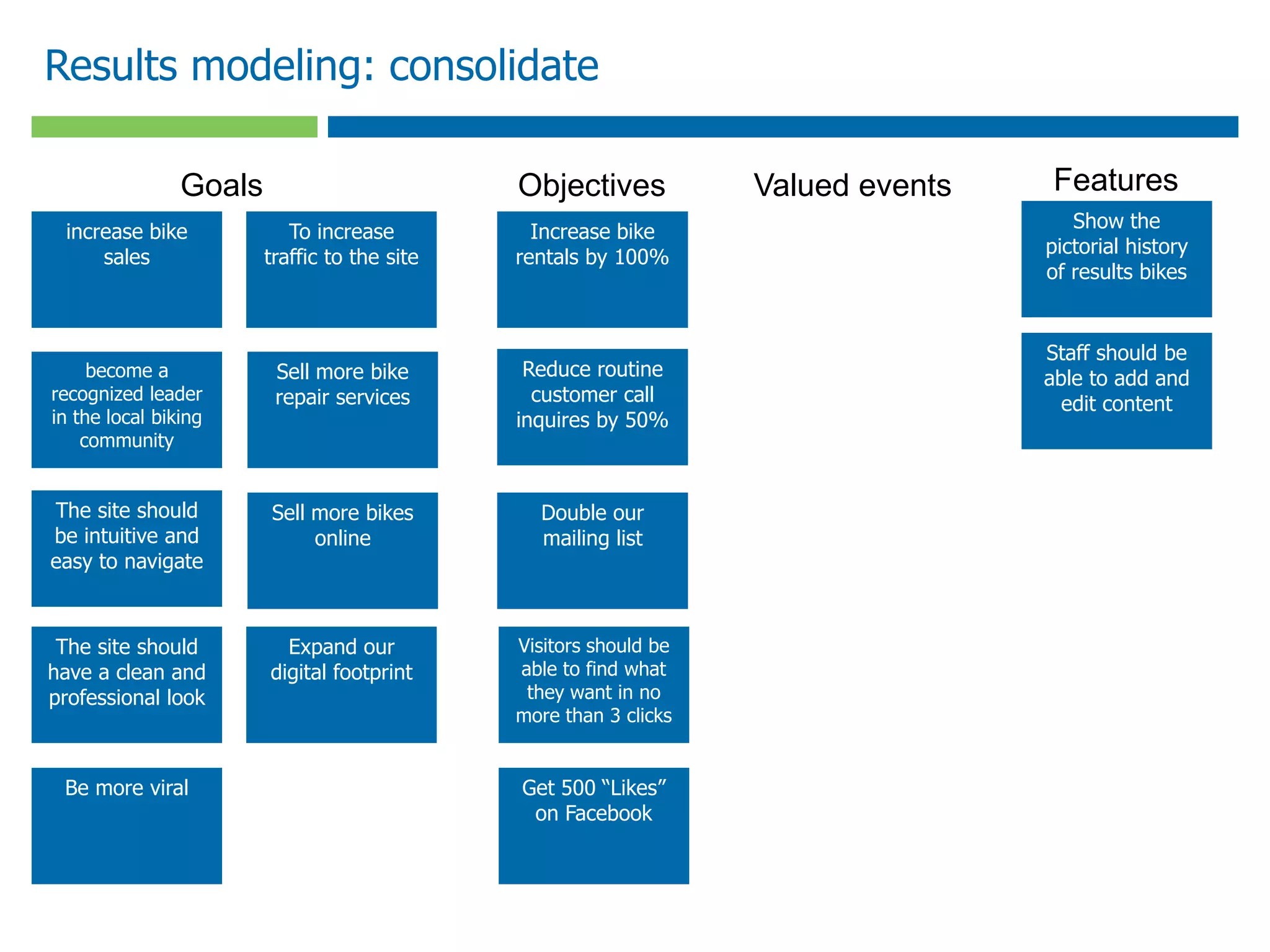
Results modeling: consolidate
increase bike
sales
become a
recognized leader
in the local biking
community
Show the
pictorial history
of results bikes
The site should
be intuitive and
easy to navigate
The site should
have a clean and
professional look
Be more viral
To increase
traffic to the site
Increase bike
rentals by 100%
Reduce routine
customer call
inquires by 50%
Sell more bike
repair services
Sell more bikes
online
Double our
mailing list
Staff should be
able to add and
edit content
Expand our
digital footprint
Get 500 “Likes”
on Facebook
Visitors should be
able to find what
they want in no
more than 3 clicks
Goals Objectives FeaturesValued events
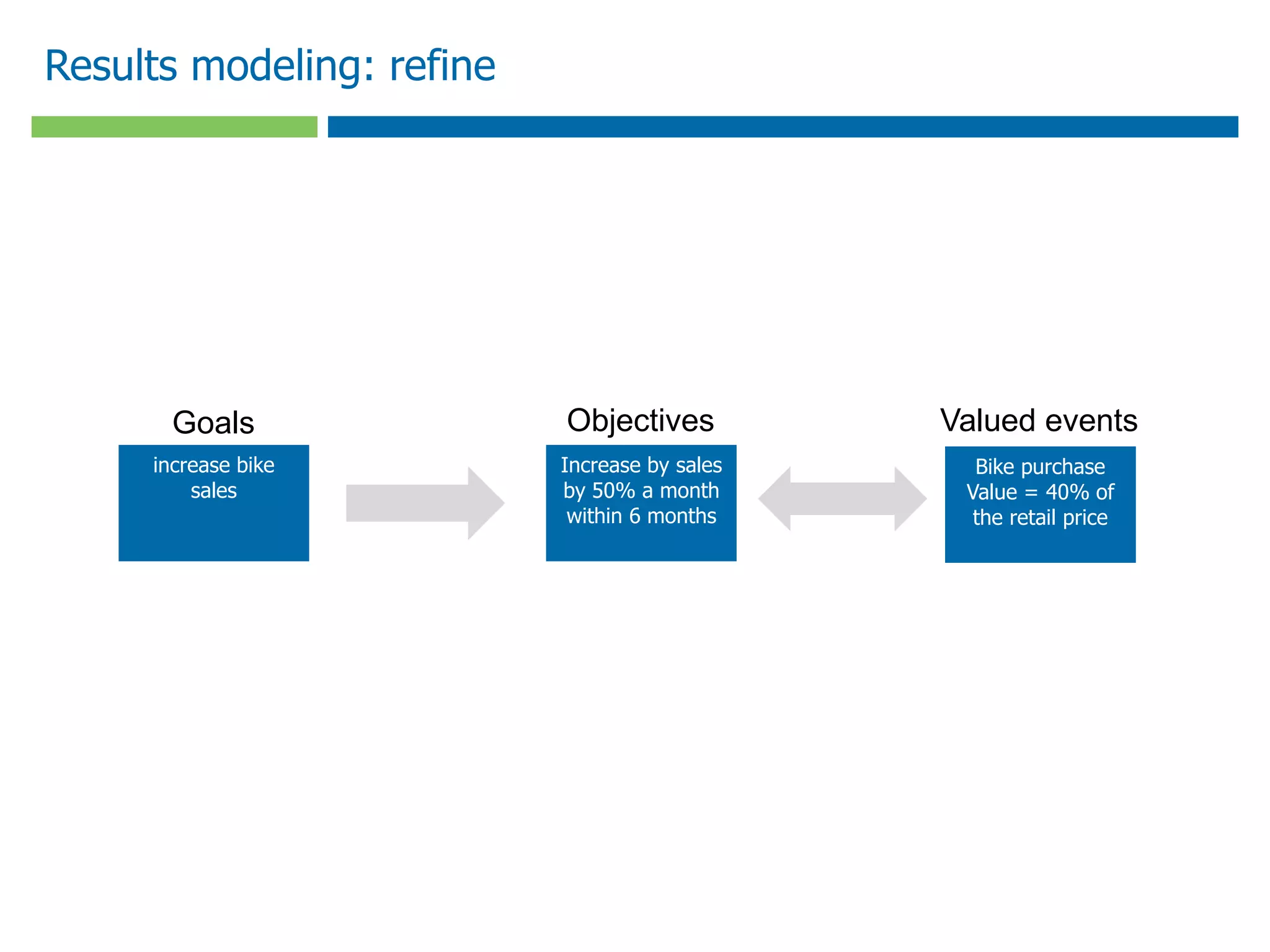
Results modeling: refine
increase bike
sales
Goals Objectives Valued events
Increase by sales
by 50% a month
within 6 months
Bike purchase
Value = 40% of
the retail price
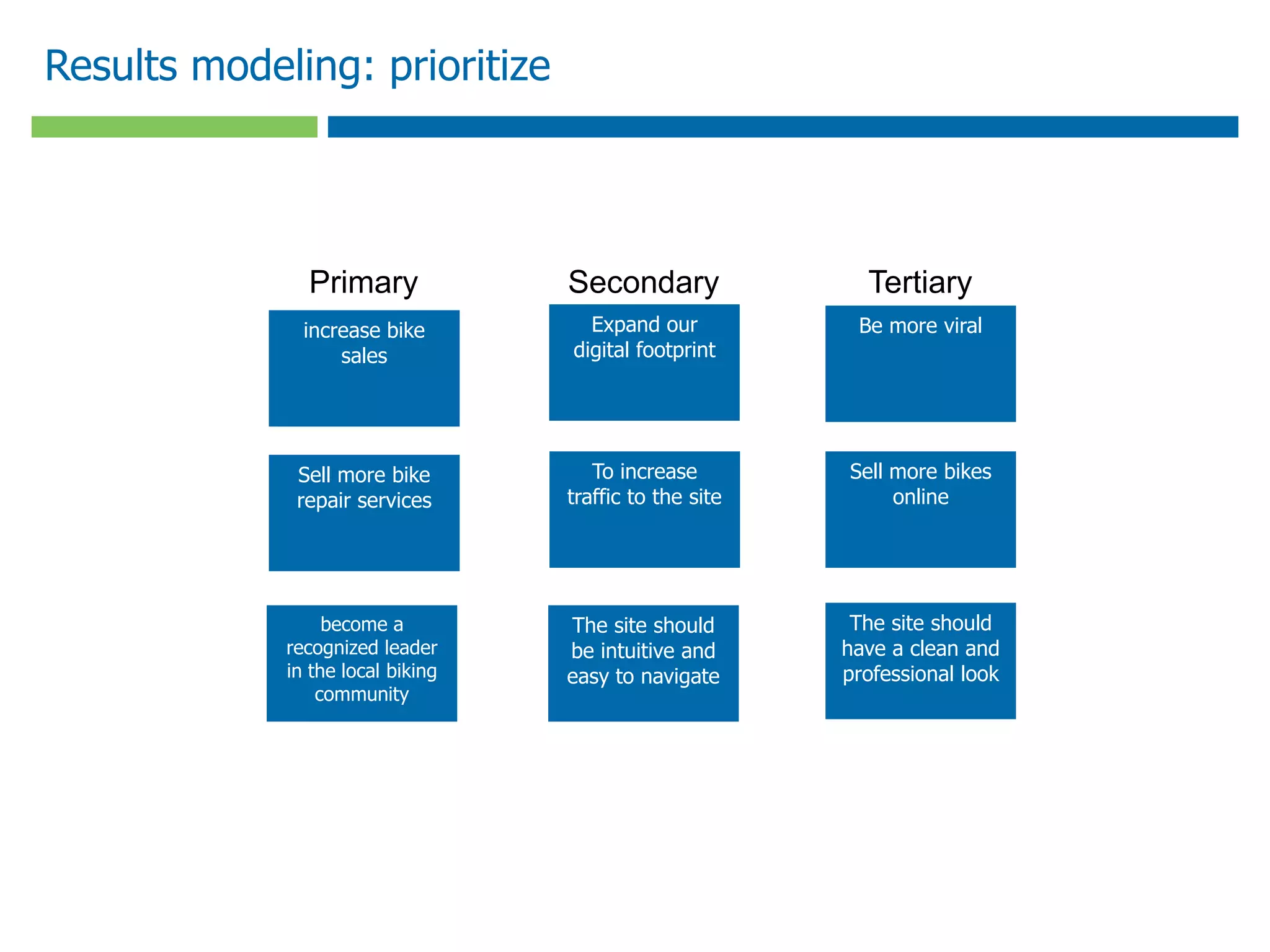
Results modeling: prioritize
increase bike
sales
become a
recognized leader
in the local biking
community
The site should
be intuitive and
easy to navigate
The site should
have a clean and
professional look
Be more viral
To increase
traffic to the site
Sell more bike
repair services
Sell more bikes
online
Expand our
digital footprint
Primary Secondary Tertiary
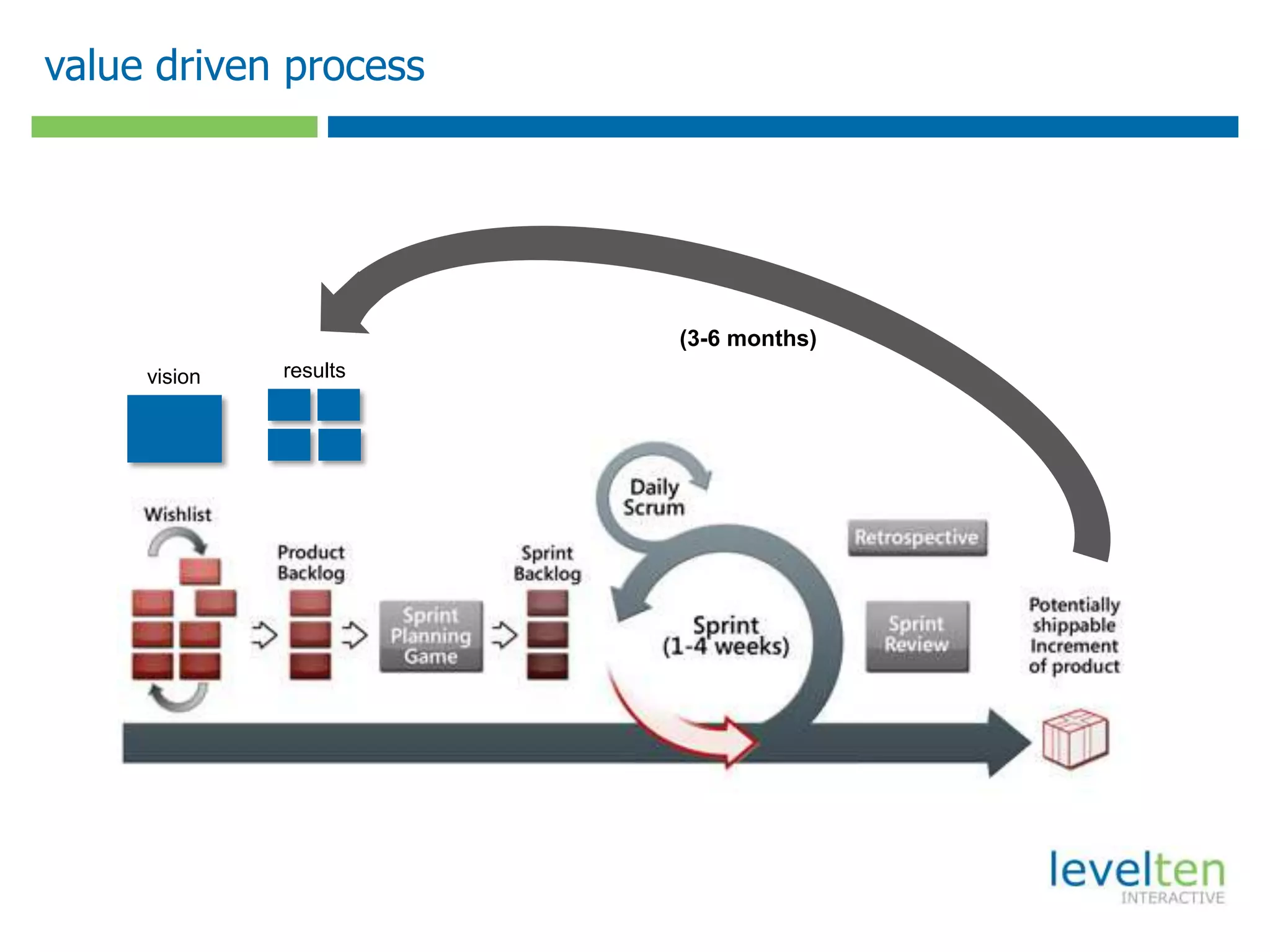
value driven process
resultsvision
(3-6 months)
iterating
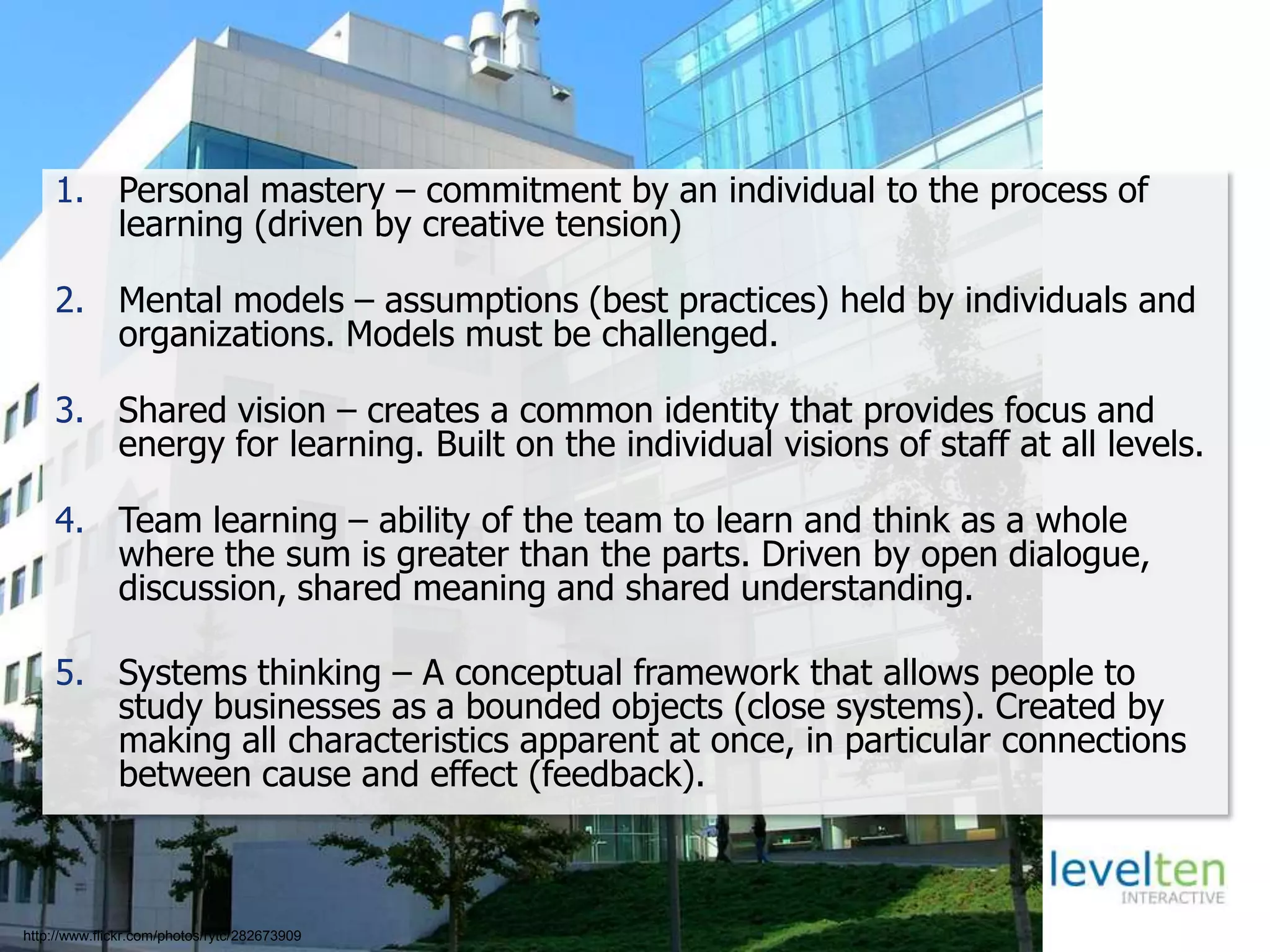
Five Disciplines of a Learning Organizations
1. Personal mastery – commitment by an individual to the process of
learning (driven by creative tension)
2. Mental models – assumptions (best practices) held by individuals and
organizations. Models must be challenged.
3. Shared vision – creates a common identity that provides focus and
energy for learning. Built on the individual visions of staff at all levels.
4. Team learning – ability of the team to learn and think as a whole
where the sum is greater than the parts. Driven by open dialogue,
discussion, shared meaning and shared understanding.
5. Systems thinking – A conceptual framework that allows people to
study businesses as a bounded objects (close systems). Created by
making all characteristics apparent at once, in particular connections
between cause and effect (feedback).
http://www.flickr.com/photos/rytc/282673909
How Scrum drives innovation
•Personal mastery
•Learning accountability: held accountable to the team on a daily and sprintly
basis
•Cannot do things half way; must meet the definition of done
• Mental models
•Challenged and adapted on a regular basis in sprint retros
•Allows and encourages frequent observation
•Shared vision
•Develops from sprint planning and backlog grooming
•Tuned in daily standups
•Team learning
•Paired development; work is highly collaborative.
•Dialoging is encouraged in sprint planning, daily standups and sprint retros
•Systems thinking
•Sprint reviews enable continuous inspection and adaption on the product
•Sprint retro enables continuous inspection and adaption on the process
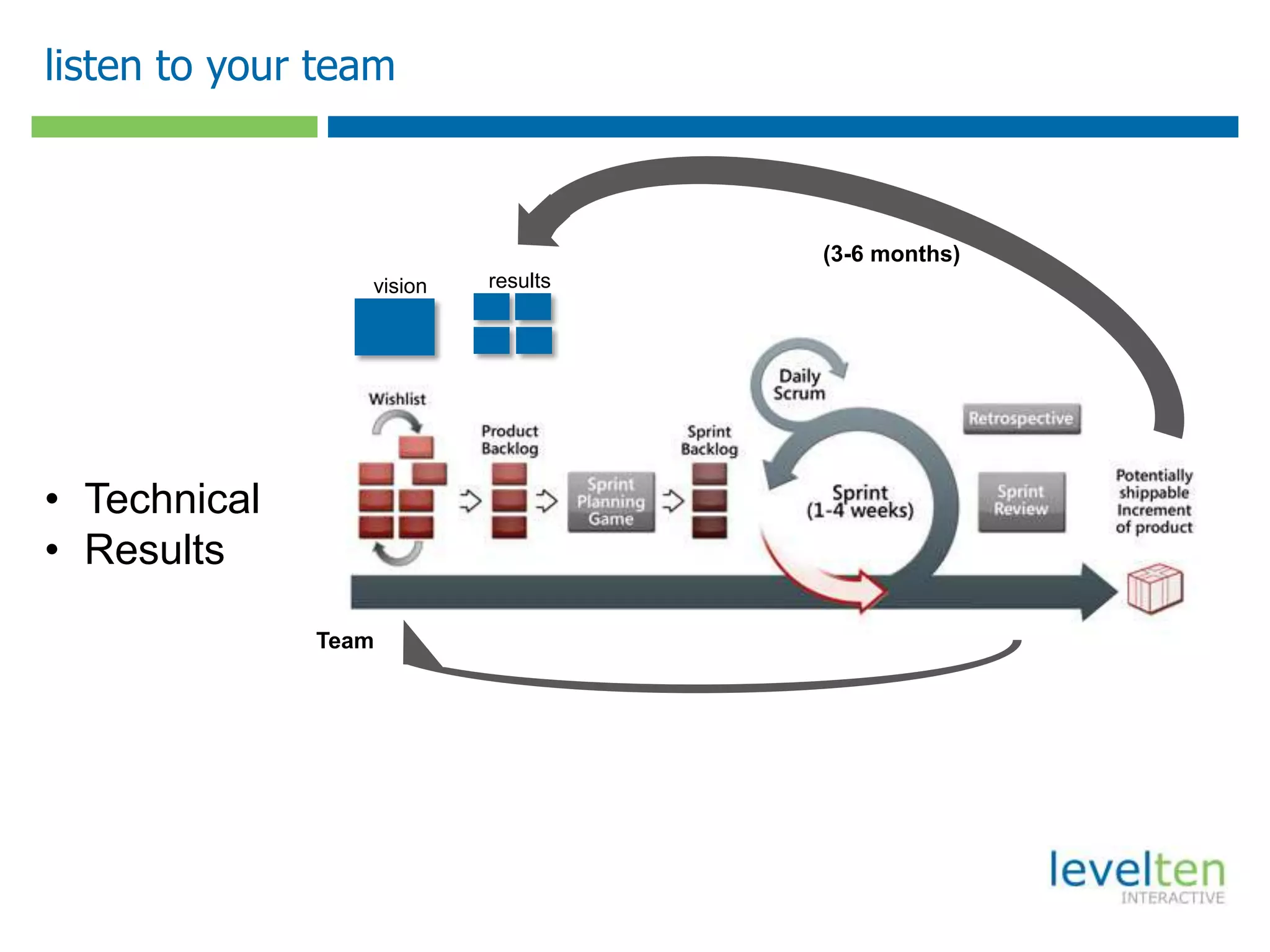
listen to your team
resultsvision
(3-6 months)
• Technical
• Results
Team
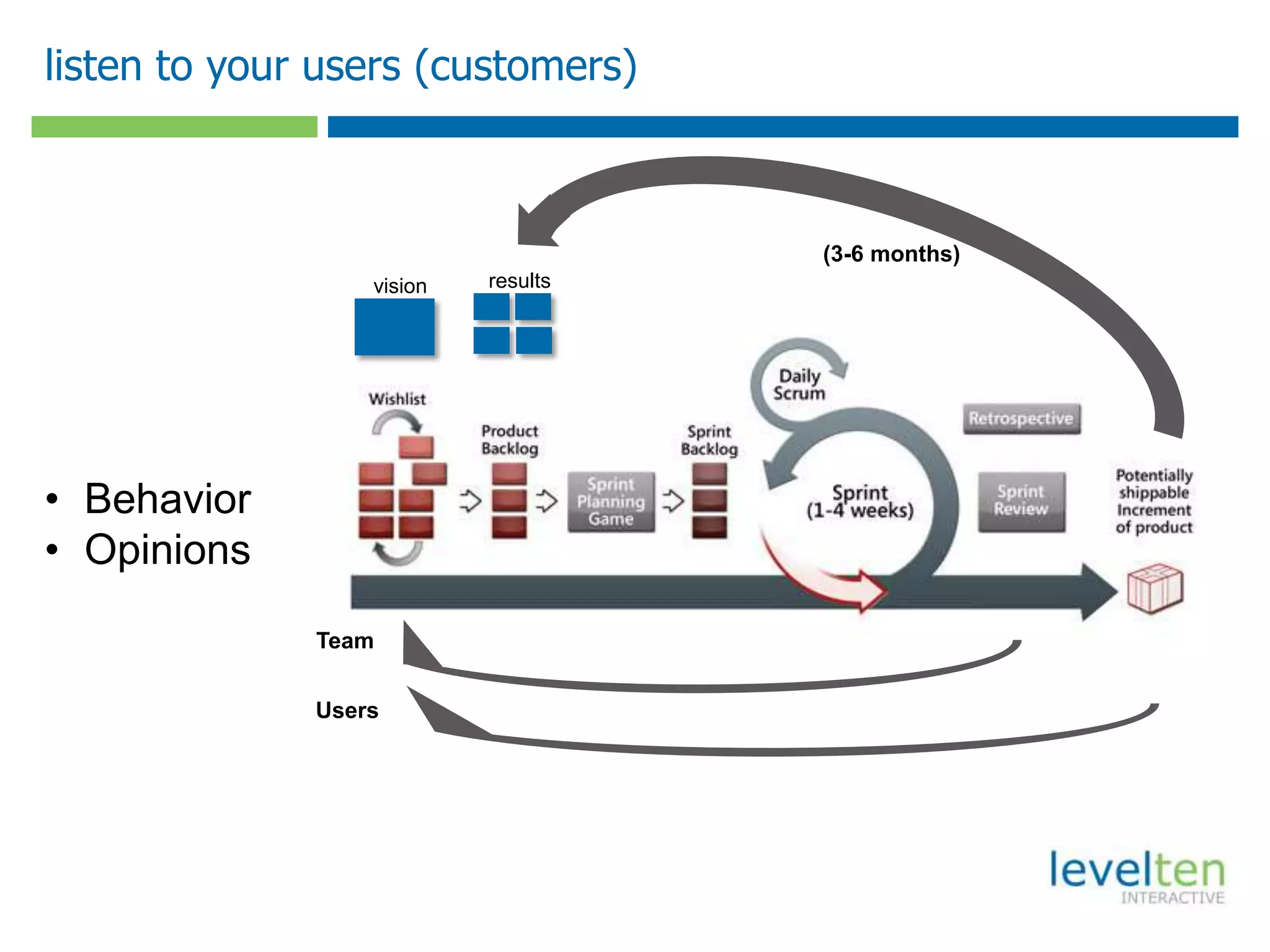
listen to your users (customers)
resultsvision
(3-6 months)
• Behavior
• Opinions
Team
Users
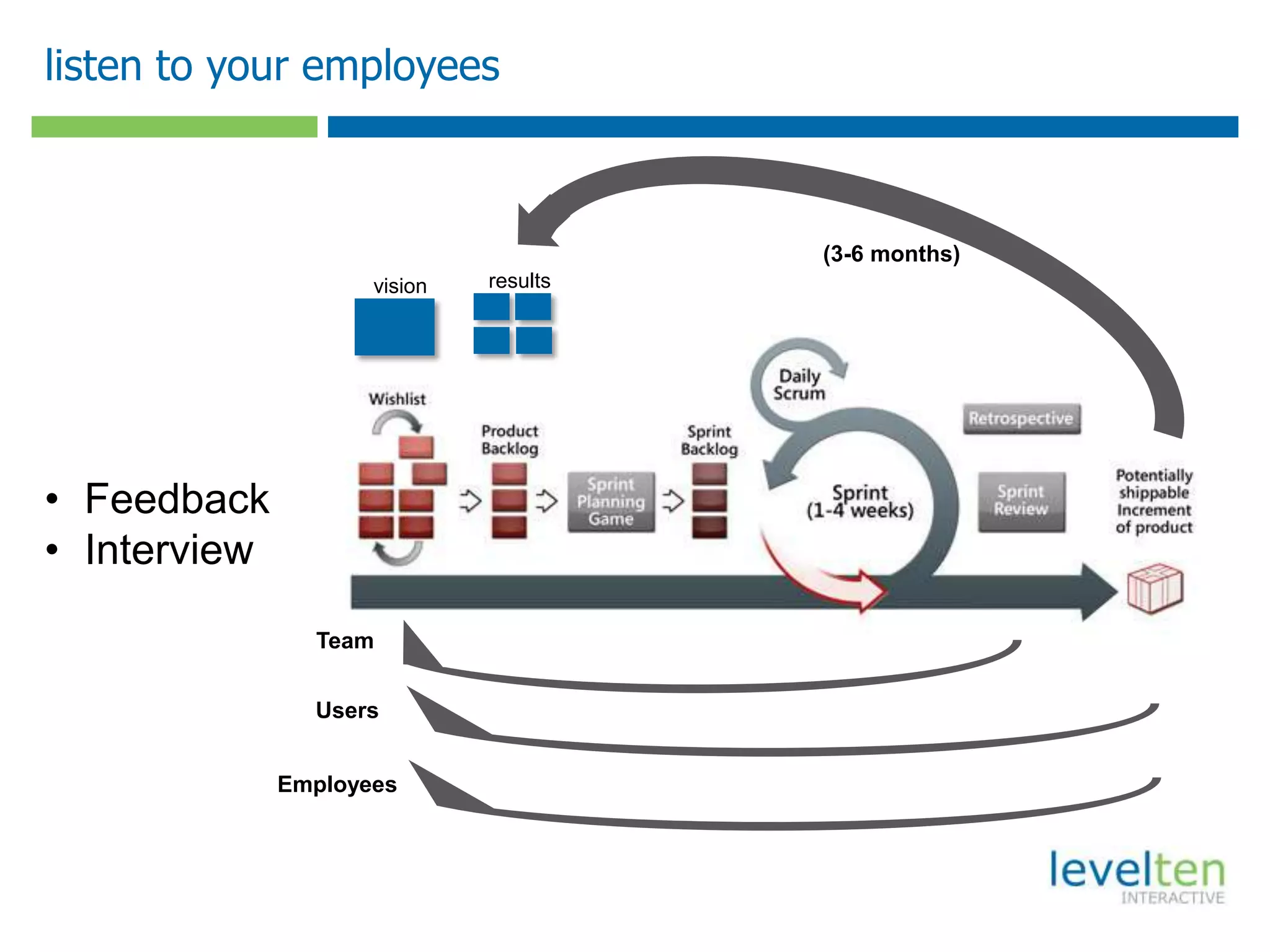
listen to your employees
resultsvision
(3-6 months)
• Feedback
• Interview
Team
Users
Employees
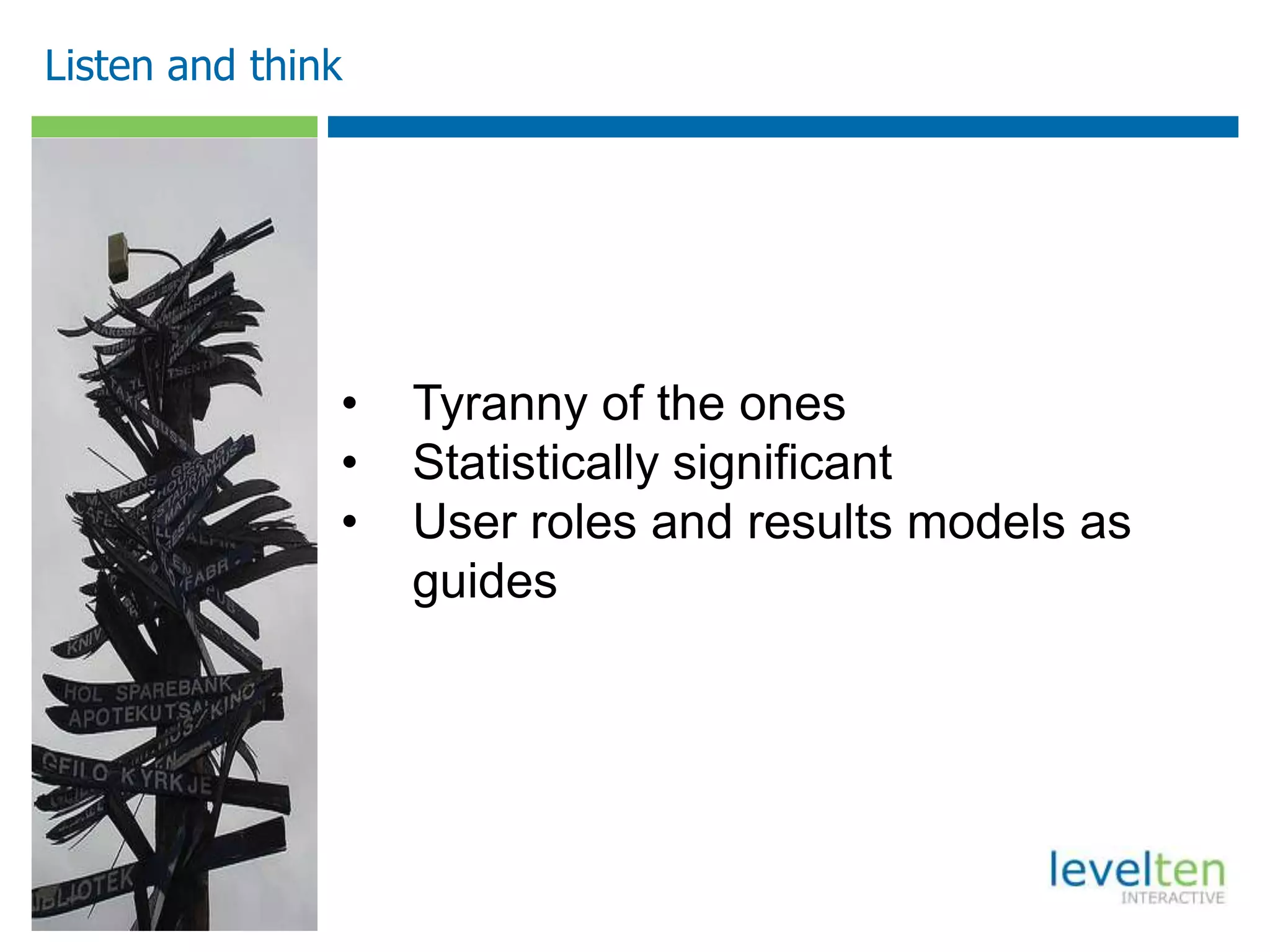
Listen and think
• Tyranny of the ones
• Statistically significant
• User roles and results models as
guides
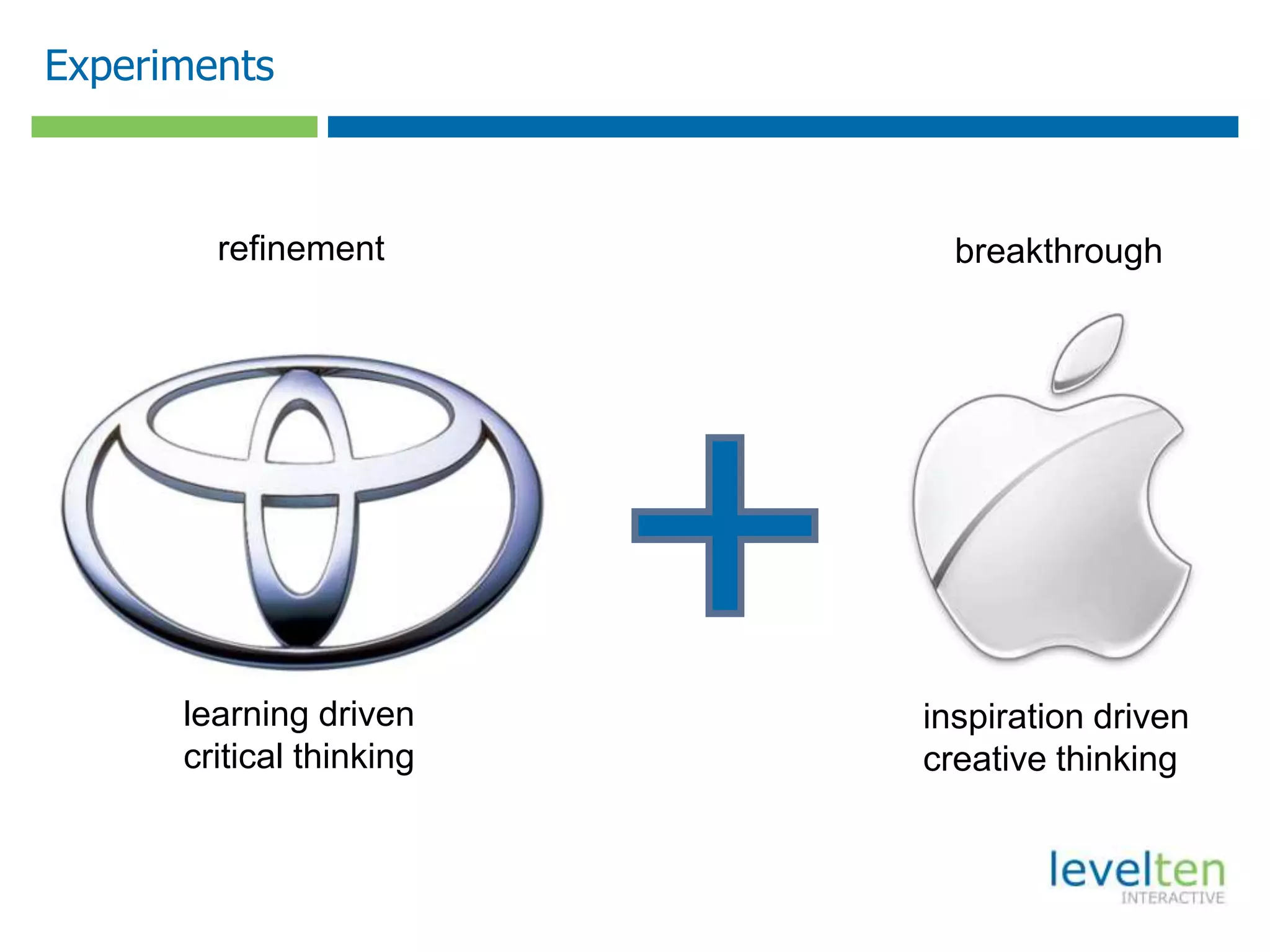
Experiments
refinement
learning driven
critical thinking
breakthrough
inspiration driven
creative thinking
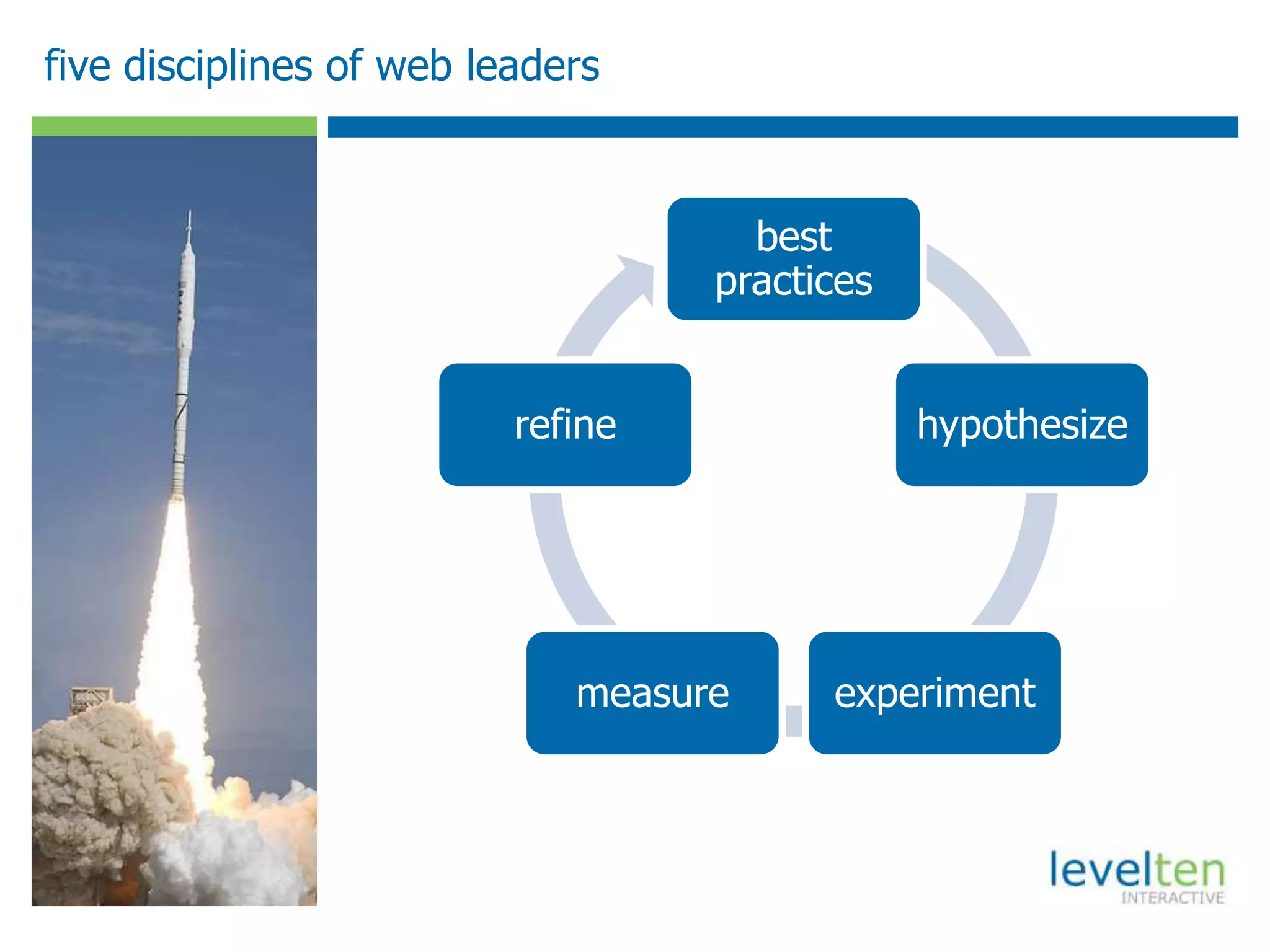
five disciplines of web leaders
best
practices
hypothesize
experimentmeasure
refine
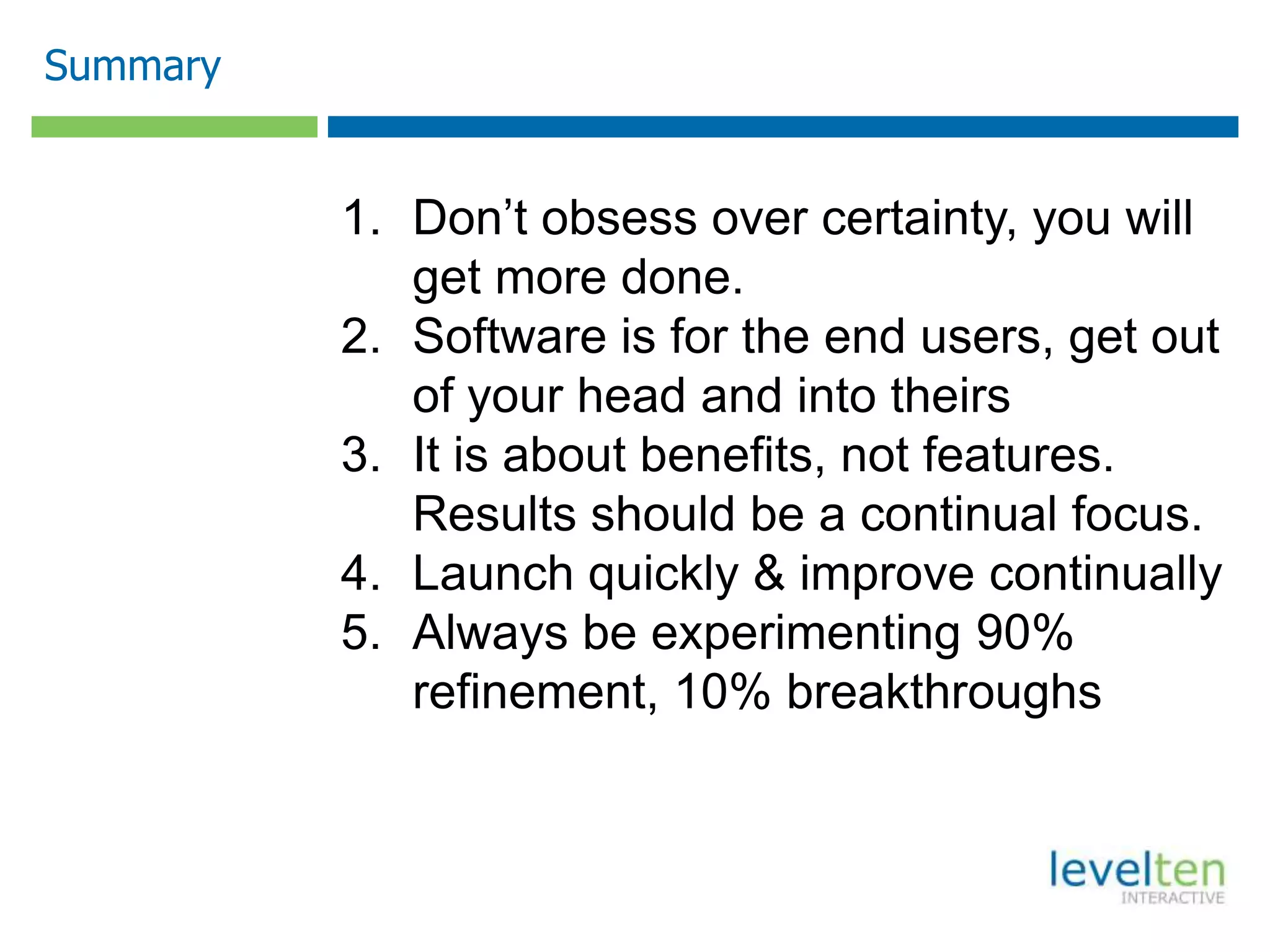
Summary
1. Don’t obsess over certainty, you will
get more done.
2. Software is for the end users, get out
of your head and into theirs
3. It is about benefits, not features.
Results should be a continual focus.
4. Launch quickly & improve continually
5. Always be experimenting 90%
refinement, 10% breakthroughs
thank you!
Tom McCracken
LevelTen Interactive
Director
Phone: 214.887.8586
Email: tom@leveltendesign.com
Twitter: @levelten_tom
Blog: getlevelten.com/blog/tom
LinkedIn: linkedin.com/in/tommccracken

Maximizing Results: The lean approach to driving innovation, user delight, and business value.

  • 1.
    [MM.DD..YY] [PRESENTER] Nov 19,2011 Building results-oriented web projects Maximize Results: The Lean Agile Approach flickr.com/photos/cuppini/2719863711
  • 2.
    Why do weplan? • Look and feel • Features Stakeholder utility • On time • On budget • In Scope Certainty • Emotional branding • Content • Features • Usability & Experience End user utility • Increased revenue • Reduced cost • Increased goodwill Organizational returns
  • 4.
    Why should weplan? certainty stakeholder utility user experience returns waste 1. Maximize organizational returns 2. Optimize user experience 3. Reduce waste
  • 5.
  • 6.
    Traditional web developmentprocess Requirements • Concept • High-level requirements • Requirements gathering • Requirements spec Design • Product (UI) Design • Wireframes • Detailed Design • Functional specs Implementation • Creative design • Content • Development Verification • Unit testing • Acceptance testing • Beta testing Maintenance planning development live
  • 7.
    Big Design UpFront certainty stakeholder utility user experience returns waste 6 months $
  • 8.
    Mid Design UpFront certainty stakeholder utility user experience returns waste 6 weeks $
  • 9.
  • 10.
    A better approach Requirements Design Implementation Verification website 6months waterfall Requirements Design Implementation Verification features 2 weeks agile
  • 11.
    Planning for certainty source:blogs.msdn.com/b/dannawi/archive/2009/05/15/2009-standish-chaos-report-we-are-successful-in-the-failure.aspx certainty waste = certainty no long term value =
  • 12.
    Getting what youwant vs. knowing what you want time innovation high level requirements design & architecture mockups validation live Freedom to innovate Insight to innovate certainty less value = value more money = $
  • 13.
  • 14.
    The McCracken UncertaintyPrinciple The higher the feature velocity of a project, the less precise the resources needed can be predicted
  • 15.
    Redefining success traditional projectmanagement focuses on being on time and on budget scope timebudget value constraints quality results oriented focus on building the right thing and driving innovation
  • 16.
  • 17.
    Results oriented lightweight planning certainty stakeholder utility user experience returns waste 4 weeks $ $
  • 18.
    The plan online results a.k.a moreof the right stuff agile project management results oriented user-centered planning more stuff the right stuff
  • 19.
  • 20.
    title adopt a results orientedvision flickr.com/photos/airiklopez/7028608799 1.
  • 21.
    The right vision flickr.com/photos/ncreedplayer/5403123930flickr.com/photos/masoncooper/456641277
  • 22.
    Do only whatprovides the most value only do what provides the most value 1i. flickr.com/photos/whiskeytango/2098182380
  • 23.
  • 24.
  • 25.
  • 26.
  • 27.
  • 28.
  • 29.
  • 30.
  • 31.
  • 32.
    Models Artifacts • User rolemodels • User stories • Content models • Results models
  • 33.
    User role modeling Process •Brainstorm • Organize • Consolidate & refine • Define • Prioritize Definition: a collection of defining attributes that characterize a population of users and their goals, needs and intended interaction with the site
  • 34.
    User role modeling:brainstorm local newspaper sports blogger website administrator hotels that need bikes for guests people from out of town fans staff new bike rider bike shoppers person who wants to upgrade their bike competitive rider bike owners job seekers new mom/parent casual bikers tour guide
  • 35.
    User role modeling:organize local newspaper sports blogger people from out of town fans staff bike shoppers person who wants to upgrade their bike bike owners job seekers new mom/parent website administrator hotels that need bikes for guests tour guide competitive rider casual bikers new bike rider
  • 36.
    User role modeling:consolidate & refine local newspaper sports blogger fans staffbike shoppers bike owners job seekers new mom/parent website administrator tour guide casual bikers new bike rider person who wants to upgrade their bike enthusiasts shoppers staff renters people from out of town hotels that need bikes for guests owners competitive rider job seekers
  • 37.
    User role modeling:define owners Demographics • Age: 25-55 • Gender: 65% male • Location: within 10 miles of store Psychographics • Active lifestyle • Prefers being outdoors • Green Behavioral • Significant web usage including search engines and social media • Research purchases online before buying • Significant use of mobile devices Brand • Custom service is significant driver for brand loyalty • Likely to buy again from same store. Typically 1 bike every 4 years. Site • Proficient web user • Likely to have high speed internet access
  • 38.
    User role modeling:personas renter
  • 39.
    User role modeling:prioritize enthusiastsshoppers staffrenters owners job seekers Primary Secondary Tertiary
  • 40.
    User stories Process • Brainstorm •Organize & refine • Prioritize Definition: describes a features and functionality of the site from the viewpoint of a user role
  • 41.
  • 42.
    User stories: format Asa [user role] I want [a feature or goal] so that [a benefit or reason] * so that is optional A user story is a documented requirement and a note to discuss later
  • 43.
    User stories: brainstorm Asa Bike Enthusiast, I would like to • read the latest bike shop news/blog • comment on the blog • share content through email and social media • see a calendar of events, classes, races • sign up for newsletter and alerts • see special offers • get contact information • see location and hours of operation
  • 44.
    User stories: prioritize MoSCoWapproach • Must haves – we need these stories in order to launch the project • Should haves – these are of high importance, but are not show stoppers for the next release • Could haves – If we get a couple of these in it would be nice, but they can be moved easily to the next release • Wants – These are not a priority but we want to keep track of them as possibilities for future releases.
  • 45.
    Results modeling Process • Brainstorm •Organize • Consolidate & refine • Prioritize Definition: the benefits stakeholders want to achieve with the site.
  • 46.
    Results modeling: typesof results models objectives valued events goals
  • 47.
    Results modeling: brainstorm increasebike sales become a recognized leader in the local biking community Show the pictorial history of results bikes The site should be intuitive and easy to navigate The site should have a clean and professional look Be more viral To increase traffic to the site Increase bike rentals by 100% Reduce routine customer call inquires by 50% Sell more bike repair services Sell more bikes online Double our mailing list Staff should be able to add and edit content Expand our digital footprint Get 500 “Likes” on Facebook Visitors should be able to find what they want in no more than 3 clicks
  • 48.
    Results modeling: organize increasebike sales become a recognized leader in the local biking community Show the pictorial history of results bikes The site should be intuitive and easy to navigate The site should have a clean and professional look Be more viral To increase traffic to the site Increase bike rentals by 100% Reduce routine customer call inquires by 50% Sell more bike repair services Sell more bikes online Double our mailing list Staff should be able to add and edit content Expand our digital footprint Get 500 “Likes” on Facebook Visitors should be able to find what they want in no more than 3 clicks
  • 49.
    Results modeling: consolidate increasebike sales become a recognized leader in the local biking community Show the pictorial history of results bikes The site should be intuitive and easy to navigate The site should have a clean and professional look Be more viral To increase traffic to the site Increase bike rentals by 100% Reduce routine customer call inquires by 50% Sell more bike repair services Sell more bikes online Double our mailing list Staff should be able to add and edit content Expand our digital footprint Get 500 “Likes” on Facebook Visitors should be able to find what they want in no more than 3 clicks Goals Objectives FeaturesValued events
  • 50.
    Results modeling: refine increasebike sales Goals Objectives Valued events Increase by sales by 50% a month within 6 months Bike purchase Value = 40% of the retail price
  • 51.
    Results modeling: prioritize increasebike sales become a recognized leader in the local biking community The site should be intuitive and easy to navigate The site should have a clean and professional look Be more viral To increase traffic to the site Sell more bike repair services Sell more bikes online Expand our digital footprint Primary Secondary Tertiary
  • 52.
  • 53.
  • 54.
    Five Disciplines ofa Learning Organizations 1. Personal mastery – commitment by an individual to the process of learning (driven by creative tension) 2. Mental models – assumptions (best practices) held by individuals and organizations. Models must be challenged. 3. Shared vision – creates a common identity that provides focus and energy for learning. Built on the individual visions of staff at all levels. 4. Team learning – ability of the team to learn and think as a whole where the sum is greater than the parts. Driven by open dialogue, discussion, shared meaning and shared understanding. 5. Systems thinking – A conceptual framework that allows people to study businesses as a bounded objects (close systems). Created by making all characteristics apparent at once, in particular connections between cause and effect (feedback). http://www.flickr.com/photos/rytc/282673909
  • 55.
    How Scrum drivesinnovation •Personal mastery •Learning accountability: held accountable to the team on a daily and sprintly basis •Cannot do things half way; must meet the definition of done • Mental models •Challenged and adapted on a regular basis in sprint retros •Allows and encourages frequent observation •Shared vision •Develops from sprint planning and backlog grooming •Tuned in daily standups •Team learning •Paired development; work is highly collaborative. •Dialoging is encouraged in sprint planning, daily standups and sprint retros •Systems thinking •Sprint reviews enable continuous inspection and adaption on the product •Sprint retro enables continuous inspection and adaption on the process
  • 56.
    listen to yourteam resultsvision (3-6 months) • Technical • Results Team
  • 57.
    listen to yourusers (customers) resultsvision (3-6 months) • Behavior • Opinions Team Users
  • 58.
    listen to youremployees resultsvision (3-6 months) • Feedback • Interview Team Users Employees
  • 59.
    Listen and think •Tyranny of the ones • Statistically significant • User roles and results models as guides
  • 60.
  • 61.
    five disciplines ofweb leaders best practices hypothesize experimentmeasure refine
  • 62.
    Summary 1. Don’t obsessover certainty, you will get more done. 2. Software is for the end users, get out of your head and into theirs 3. It is about benefits, not features. Results should be a continual focus. 4. Launch quickly & improve continually 5. Always be experimenting 90% refinement, 10% breakthroughs
  • 63.
    thank you! Tom McCracken LevelTenInteractive Director Phone: 214.887.8586 Email: tom@leveltendesign.com Twitter: @levelten_tom Blog: getlevelten.com/blog/tom LinkedIn: linkedin.com/in/tommccracken

Editor's Notes

  • #2 Whenever I present I always like to get a feel for who is in the room.How many people here are owners of Drupal website?How many are builders of Drupal websites?How many are thinking about getting into Drupal?How many have done SEO on a Drupal site?How many people are new to Drupal SEO?How many people don’t even know what SEO is?
  • #3 You might be saying wow that is a lot of planning. Why is it important to do that planning
  • #5 So the question is how to you get to the top of the food chain?[do the speel]
  • #6 There is a
  • #8 This is how a traditional process for building a website. Or I should say, this is how a traditional website is supposed to be planned. Many larger sites are planned this way, but often to save cost steps might be skipped.
  • #9 Our first web project at LevelTen back in 1999 was truly a big design up front. Planning took 6 months. Numerous meetings, interviews, surveys, user focus groups, wireframes, UML based functional specs.
  • #10 Then then 2001 recession hit. People no longer wanted to spend six figures on project planning. The shift was on to compressed planning phases. I call this mid design up front. The primary focus of MDUF was quickly gathering the stakeholders requirements and engineering just enough to get a reasonable estimate for budgets and timelines.
  • #13 So how successful do you think these the big and midsized design up front process was at brining projects in on time, on budget, and in scope?[show slide]Pretty horrible. The average project is 45% over budget, 63% late and missing 1/3 of the originally promised features.…We already know that we are not getting long term value from the certainty we are generating. But it turns out that we are not even getting certainty. Which of course means we are spending time that is actually just a waste.
  • #14 There is another significant problem with traditional waterfall processes. We force stakeholders to make the big decisions when they know the least amount about the best solution. So certainty also means that stakeholders get less of what they want.So how do we fix these problems? How do we get better certainty in our projects with more accurate estimates, understand better what the stakeholders want? More planning right?
  • #15 So here is the typical project. Stakeholder recognizes that people like Facebook. Thinks, ah ha, what if we had a company extranet like Facebook, people would like us. Puts together a few pages of things facebook does, mashes in some linkedin, Twitter, and YouTube. Sends the project out for bit to a half dozen companies.
  • #17 Install DAMP, import OE Core
  • #18 You might be saying wow that is a lot of planning. Why is it important to do that planning
  • #20 Agile processes are
  • #21 It powers some of the world’s top websites such as whitehouse.gov, The Economist and Examiner, all of Sony / BMG’s mission websites.
  • #24 So the question is how to you get to the top of the food chain?[do the speel]
  • #35 It powers some of the world’s top websites such as whitehouse.gov, The Economist and Examiner, all of Sony / BMG’s mission websites.
  • #36 It powers some of the world’s top websites such as whitehouse.gov, The Economist and Examiner, all of Sony / BMG’s mission websites.
  • #37 It powers some of the world’s top websites such as whitehouse.gov, The Economist and Examiner, all of Sony / BMG’s mission websites.
  • #38 It powers some of the world’s top websites such as whitehouse.gov, The Economist and Examiner, all of Sony / BMG’s mission websites.
  • #39 It powers some of the world’s top websites such as whitehouse.gov, The Economist and Examiner, all of Sony / BMG’s mission websites.
  • #40 It powers some of the world’s top websites such as whitehouse.gov, The Economist and Examiner, all of Sony / BMG’s mission websites.
  • #41 It powers some of the world’s top websites such as whitehouse.gov, The Economist and Examiner, all of Sony / BMG’s mission websites.
  • #42 It powers some of the world’s top websites such as whitehouse.gov, The Economist and Examiner, all of Sony / BMG’s mission websites.
  • #43 It powers some of the world’s top websites such as whitehouse.gov, The Economist and Examiner, all of Sony / BMG’s mission websites.
  • #44 It powers some of the world’s top websites such as whitehouse.gov, The Economist and Examiner, all of Sony / BMG’s mission websites.
  • #45 There is a general perception that website requirements are something that exist somewhere out in the ethos and all we have to do is go out and gather them. The reality is that not all requirements are known at the beginning of a project. Most certainly not the best ways of build things is understood at the beginning of a project.The process we are going to use for rapid, light-weight requirements gathering is like trawling for fish. We start by casting out a wide net with a wide mesh. We are looking to quickly capture the big, most important requirements. We can then later use a finer mesh net to capture more detailed requirements.The important thing to remember is that agile requirements are not something that is done once at the beginning of a project and set in stone. The are revisited periodically throughout the project and iterated over. Don’t waste time adding details till just befom you really need it.Robertson and Robertson (1999) from User Stories Applied p 43
  • #46 It powers some of the world’s top websites such as whitehouse.gov, The Economist and Examiner, all of Sony / BMG’s mission websites.
  • #47 It powers some of the world’s top websites such as whitehouse.gov, The Economist and Examiner, all of Sony / BMG’s mission websites.
  • #48 It powers some of the world’s top websites such as whitehouse.gov, The Economist and Examiner, all of Sony / BMG’s mission websites.
  • #49 It powers some of the world’s top websites such as whitehouse.gov, The Economist and Examiner, all of Sony / BMG’s mission websites.
  • #50 It powers some of the world’s top websites such as whitehouse.gov, The Economist and Examiner, all of Sony / BMG’s mission websites.
  • #51 It powers some of the world’s top websites such as whitehouse.gov, The Economist and Examiner, all of Sony / BMG’s mission websites.
  • #52 It powers some of the world’s top websites such as whitehouse.gov, The Economist and Examiner, all of Sony / BMG’s mission websites.
  • #53 It powers some of the world’s top websites such as whitehouse.gov, The Economist and Examiner, all of Sony / BMG’s mission websites.
  • #54 It powers some of the world’s top websites such as whitehouse.gov, The Economist and Examiner, all of Sony / BMG’s mission websites.
  • #55 It powers some of the world’s top websites such as whitehouse.gov, The Economist and Examiner, all of Sony / BMG’s mission websites.
  • #56 Backlog is constantly reprioritize so that the most valuable tasks are done first. The job of agile is to fuel the backlog with innovative ideas and be excellent at executing.Artifacts:Product backlog, sprint backlog, sprint burndown, releaseburndownTimeboxes: Sprint planning, sprint, daily standup/scrum, sprint review, sprint retro, release planning
  • #60 Backlog is constantly reprioritize so that the most valuable tasks are done first. The job of agile is to fuel the backlog with innovative ideas and be excellent at executing.Artifacts:Product backlog, sprint backlog, sprint burndown, releaseburndownTimeboxes: Sprint planning, sprint, daily standup/scrum, sprint review, sprint retro, release planning
  • #61 Backlog is constantly reprioritize so that the most valuable tasks are done first. The job of agile is to fuel the backlog with innovative ideas and be excellent at executing.Artifacts:Product backlog, sprint backlog, sprint burndown, releaseburndownTimeboxes: Sprint planning, sprint, daily standup/scrum, sprint review, sprint retro, release planning
  • #62 Backlog is constantly reprioritize so that the most valuable tasks are done first. The job of agile is to fuel the backlog with innovative ideas and be excellent at executing.Artifacts:Product backlog, sprint backlog, sprint burndown, releaseburndownTimeboxes: Sprint planning, sprint, daily standup/scrum, sprint review, sprint retro, release planning
  • #63 It powers some of the world’s top websites such as whitehouse.gov, The Economist and Examiner, all of Sony / BMG’s mission websites.
  • #64 There are two sides to innovation. The first is emboded in the concept of Kaizen, which is Japanese for continual improvement.
  • #65 TODO: discuss customer champion pyramid
  • #66 It powers some of the world’s top websites such as whitehouse.gov, The Economist and Examiner, all of Sony / BMG’s mission websites.