Maximizing Effectiveness – A weekend of Ah-Ha’s

When the board of a busy, 2,000 member international organization meets face to face
only once a year, productivity is a priority. With a tight agenda laid out in front of them,
the APTi Board of Directors knew they had to maximize their results at the annual
meeting in January at the Fairmont Hotel in Dallas, Texas, site of the 2009 August
Conference. How could they improve their productivity?

To that end, I was asked by the APTi board of directors to kick-off our meeting with a
two hour teambuilding session using the new Klein Group Instrument (KGI). As APTi’s
Finance Director and a qualified KGI facilitator, I have a personal interest in seeing the
APTi Board perform at the highest level of effectiveness and was confident that
dedicating a few hours to the new Klein Group Instrument would enable us to do just
that.
The KGI is a new assessment tool that provides practical and actionable insights into
group behavior for individuals within a group and, through an optional Group Profile,
insights about the group itself. The tool measures how often we use each of the nine
elements of group success as determined by the KGI’s developer, Robert Klein. [see
sidebar Klein Group Instrument Scales and subscales].
The KGI allows users to take the assessment from the perspective of a particular group
they are part of. This means that a user may have KGI results for multiple groups with
each result indicating the different behaviors an individual uses in each group they
participate in. The assessment provides easily implementable suggestions to help
individuals expand and refine their small group skills.
A typical introductory session might be four to eight hours. However, I was able to rely
on the group’s considerable facilitation skills and familiarity with assessments to provide
us with actionable insights within a shortened time frame at both an individual level and
team level. The group strongly affirmed that the session was very successful and that we
had a new framework through which we could manage ourselves and our team processes
better.
Individual Insights
I began the session with a brief background of the KGI, a description of the model, and
definitions of terminology since it uses common words, e.g. leadership, initiative, in
specific ways. Then each participant read through and validated their individual reports
and discussed the results with a partner. The basic measurements are how frequently one
uses each of nine group skills. It was clear from the very animated discussions that
everybody was quite engaged by the assessment.
While there were many unique “a-ha” moments, a couple of themes emerged. One theme
was people affirming how different they function on the board than they do in other
groups. One person who fit this theme was Karla Edwards, the newly appointed interim
Director of Training, who had previously been through a KGI workshop as part of a
work-related teambuilding session. Her prior results were reflective of her preferred
group behaviors in a job that requires more interpersonal focus as opposed to task focus.
This time, however, her higher scores on Task Analysis were indicative of the need to
determine what is needed in a new role. Her individual KGI report contained suggestions
for ways to expand her influence on the team in that area.
Another theme was people like Past President Jane Kise, who were functioning in this
group not only in ways different from other groups but in ways outside of her
psychological type preferences. Jane said that the KGI identified the source of the stress
she felt in her role as leader of this particular group which required her to demonstrate
more Assertiveness and less Interpersonal Focus. In other words, she said that she had to
operate outside of her INFJ preferences by acting more Extraverted in managing the
group and less Feeling in her decision making.
A common theme for all was finding suggestions for improvement in areas that our
profiles indicated we found challenging. For example, my low score on Initiative
accurately reflects my tendency to be quite reserved in the early stages of a discussion. I
am far more comfortable speaking up only after I’ve had time to analyze what others are
saying. This fits my top strength of Perspective Taking which is the ability to understand
other’s positions or concerns. I determined that I could be more effective in the group by
sometimes allowing others to take a perspective on my thoughts earlier in the process
rather than always commenting on theirs.
Group Insights
We used the KGI Group Profile to provide us with composite scores of the board, ranges
of individual scores on each of the nine subscales and to identify our team strengths and
challenges. The Group Profile also made suggestions for how we could improve our
group processes and performance.
What we saw about ourselves was only surprising because of how definitive and accurate
the results were. [see sidebar Enablers/Inhibitors] As a group, we have a great deal of
energy for generating ideas. However, we have much less energy for creating processes
and accountability for selecting specific ideas to implement and bringing those ideas to
closure. While this could have been inferred from a group type table, these behaviors
were more directly stated by the KGI in terms of specific aspects of group strengths and
challenges. Less type-related but also clear from the Group Profile was that there were
few individuals on the team who frequently took the initiative to shift the group from
ideation to implementation.
In order use these insights to remove its inhibitors to effectiveness, the group participated
in an exercise that played to its strengths. On flipcharts, the group brainstormed answers
to two questions:
   How can we coordinate tasks with each other in a more effective way?
   How can we support each other more as a team AND still make difficult decisions?
Not only were the suggestions contained in the KGI Group Profile helpful to us as a team
but each board member was able to go back to their own Individual Profile to find
specific suggestions of how they can manage themselves to bring better balance to the
groups strengths.
The Impetus to Change
A concrete outcome for our session was that Suzanne Brue, Jane Kise and Jennifer Selby-
Long, APTi’s current president, past president and president-elect, respectively, reviewed
the list of flip chart items and proposed a set of actions to help the board coordinate tasks
more effectively and support an improved decision-making process. Two broad themes
that came out of the KGI process was that we had to better manage idea generation so
that we focus more directly on what could actually be accomplished with the time and
resources available; and anyone in the group could exercise leadership by calling for
action, i.e. asking or being more specific about the action being proposed, what the
deadline is and who is responsible. This is not innovative thinking to be sure, but it is a
constant reminder to be consciously balancing our processes and not revert into strong,
comfortable and energizing patterns of behavior that actually inhibit our effectiveness.
The group started putting these suggestions into practice immediately and continued to do
so through the weekend. Several board members told me that it was one of the most
effective meetings they had ever been a part of. A recent monthly teleconference was no
less successful as the board continued to operate at improved levels of effectiveness
driven by the individual and group KGI insights.
On behalf of the APTi Board of Directors, I’d like to thank Bob Klein for his sharing his
knowledge prior to the meeting on how he goes about analyzing the Group Profile; and
for his time debriefing Katherine Hirsh and myself on the outcomes from using the
instrument. I’d also like to thank CAPT for giving us both individual and group level
reports. Finally, I’d like to thank the APTI board for allowing to me to facilitate the
session with them, for their high level of energy and engagement during the KGI session
and for applying what we learned throughout the weekend. I am confident we are better
as a team and hopefully better as team members because of this wonderful new
assessment tool.
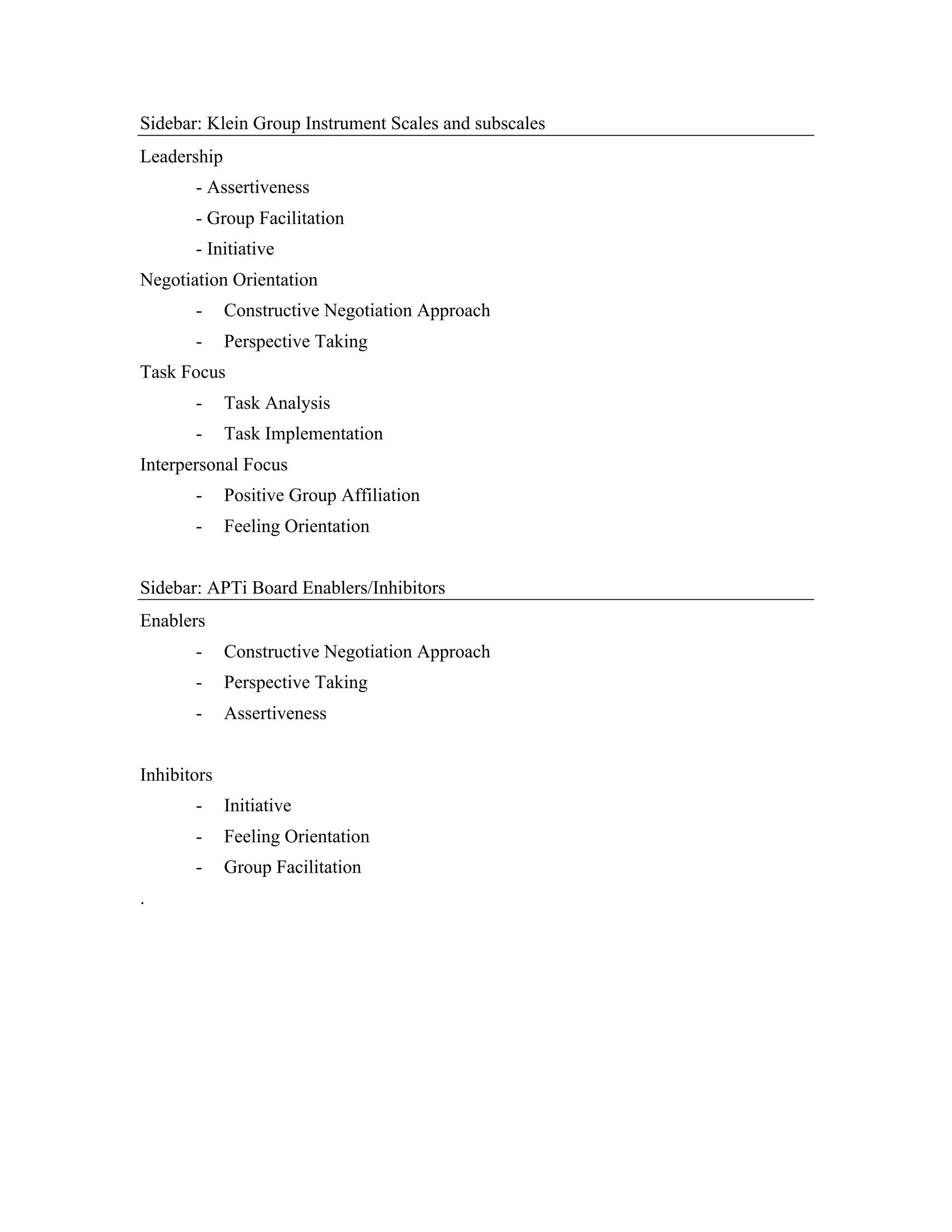
Sidebar: Klein Group Instrument Scales and subscales
Leadership
       - Assertiveness
       - Group Facilitation
       - Initiative
Negotiation Orientation
       -     Constructive Negotiation Approach
       -     Perspective Taking
Task Focus
       -     Task Analysis
       -     Task Implementation
Interpersonal Focus
       -     Positive Group Affiliation
       -     Feeling Orientation


Sidebar: APTi Board Enablers/Inhibitors
Enablers
       -     Constructive Negotiation Approach
       -     Perspective Taking
       -     Assertiveness


Inhibitors
       -     Initiative
       -     Feeling Orientation
       -     Group Facilitation
.

Maximizing effectiveness – Teambuilding with the Klein Group Instrument

  • 1.
    Maximizing Effectiveness –A weekend of Ah-Ha’s When the board of a busy, 2,000 member international organization meets face to face only once a year, productivity is a priority. With a tight agenda laid out in front of them, the APTi Board of Directors knew they had to maximize their results at the annual meeting in January at the Fairmont Hotel in Dallas, Texas, site of the 2009 August Conference. How could they improve their productivity? To that end, I was asked by the APTi board of directors to kick-off our meeting with a two hour teambuilding session using the new Klein Group Instrument (KGI). As APTi’s Finance Director and a qualified KGI facilitator, I have a personal interest in seeing the APTi Board perform at the highest level of effectiveness and was confident that dedicating a few hours to the new Klein Group Instrument would enable us to do just that. The KGI is a new assessment tool that provides practical and actionable insights into group behavior for individuals within a group and, through an optional Group Profile, insights about the group itself. The tool measures how often we use each of the nine elements of group success as determined by the KGI’s developer, Robert Klein. [see sidebar Klein Group Instrument Scales and subscales]. The KGI allows users to take the assessment from the perspective of a particular group they are part of. This means that a user may have KGI results for multiple groups with each result indicating the different behaviors an individual uses in each group they participate in. The assessment provides easily implementable suggestions to help individuals expand and refine their small group skills. A typical introductory session might be four to eight hours. However, I was able to rely on the group’s considerable facilitation skills and familiarity with assessments to provide us with actionable insights within a shortened time frame at both an individual level and team level. The group strongly affirmed that the session was very successful and that we had a new framework through which we could manage ourselves and our team processes better. Individual Insights I began the session with a brief background of the KGI, a description of the model, and definitions of terminology since it uses common words, e.g. leadership, initiative, in specific ways. Then each participant read through and validated their individual reports and discussed the results with a partner. The basic measurements are how frequently one uses each of nine group skills. It was clear from the very animated discussions that everybody was quite engaged by the assessment. While there were many unique “a-ha” moments, a couple of themes emerged. One theme was people affirming how different they function on the board than they do in other groups. One person who fit this theme was Karla Edwards, the newly appointed interim Director of Training, who had previously been through a KGI workshop as part of a work-related teambuilding session. Her prior results were reflective of her preferred group behaviors in a job that requires more interpersonal focus as opposed to task focus. This time, however, her higher scores on Task Analysis were indicative of the need to
  • 2.
    determine what isneeded in a new role. Her individual KGI report contained suggestions for ways to expand her influence on the team in that area. Another theme was people like Past President Jane Kise, who were functioning in this group not only in ways different from other groups but in ways outside of her psychological type preferences. Jane said that the KGI identified the source of the stress she felt in her role as leader of this particular group which required her to demonstrate more Assertiveness and less Interpersonal Focus. In other words, she said that she had to operate outside of her INFJ preferences by acting more Extraverted in managing the group and less Feeling in her decision making. A common theme for all was finding suggestions for improvement in areas that our profiles indicated we found challenging. For example, my low score on Initiative accurately reflects my tendency to be quite reserved in the early stages of a discussion. I am far more comfortable speaking up only after I’ve had time to analyze what others are saying. This fits my top strength of Perspective Taking which is the ability to understand other’s positions or concerns. I determined that I could be more effective in the group by sometimes allowing others to take a perspective on my thoughts earlier in the process rather than always commenting on theirs. Group Insights We used the KGI Group Profile to provide us with composite scores of the board, ranges of individual scores on each of the nine subscales and to identify our team strengths and challenges. The Group Profile also made suggestions for how we could improve our group processes and performance. What we saw about ourselves was only surprising because of how definitive and accurate the results were. [see sidebar Enablers/Inhibitors] As a group, we have a great deal of energy for generating ideas. However, we have much less energy for creating processes and accountability for selecting specific ideas to implement and bringing those ideas to closure. While this could have been inferred from a group type table, these behaviors were more directly stated by the KGI in terms of specific aspects of group strengths and challenges. Less type-related but also clear from the Group Profile was that there were few individuals on the team who frequently took the initiative to shift the group from ideation to implementation. In order use these insights to remove its inhibitors to effectiveness, the group participated in an exercise that played to its strengths. On flipcharts, the group brainstormed answers to two questions: How can we coordinate tasks with each other in a more effective way? How can we support each other more as a team AND still make difficult decisions? Not only were the suggestions contained in the KGI Group Profile helpful to us as a team but each board member was able to go back to their own Individual Profile to find specific suggestions of how they can manage themselves to bring better balance to the groups strengths.
  • 3.
    The Impetus toChange A concrete outcome for our session was that Suzanne Brue, Jane Kise and Jennifer Selby- Long, APTi’s current president, past president and president-elect, respectively, reviewed the list of flip chart items and proposed a set of actions to help the board coordinate tasks more effectively and support an improved decision-making process. Two broad themes that came out of the KGI process was that we had to better manage idea generation so that we focus more directly on what could actually be accomplished with the time and resources available; and anyone in the group could exercise leadership by calling for action, i.e. asking or being more specific about the action being proposed, what the deadline is and who is responsible. This is not innovative thinking to be sure, but it is a constant reminder to be consciously balancing our processes and not revert into strong, comfortable and energizing patterns of behavior that actually inhibit our effectiveness. The group started putting these suggestions into practice immediately and continued to do so through the weekend. Several board members told me that it was one of the most effective meetings they had ever been a part of. A recent monthly teleconference was no less successful as the board continued to operate at improved levels of effectiveness driven by the individual and group KGI insights. On behalf of the APTi Board of Directors, I’d like to thank Bob Klein for his sharing his knowledge prior to the meeting on how he goes about analyzing the Group Profile; and for his time debriefing Katherine Hirsh and myself on the outcomes from using the instrument. I’d also like to thank CAPT for giving us both individual and group level reports. Finally, I’d like to thank the APTI board for allowing to me to facilitate the session with them, for their high level of energy and engagement during the KGI session and for applying what we learned throughout the weekend. I am confident we are better as a team and hopefully better as team members because of this wonderful new assessment tool.
  • 4.
    Sidebar: Klein GroupInstrument Scales and subscales Leadership - Assertiveness - Group Facilitation - Initiative Negotiation Orientation - Constructive Negotiation Approach - Perspective Taking Task Focus - Task Analysis - Task Implementation Interpersonal Focus - Positive Group Affiliation - Feeling Orientation Sidebar: APTi Board Enablers/Inhibitors Enablers - Constructive Negotiation Approach - Perspective Taking - Assertiveness Inhibitors - Initiative - Feeling Orientation - Group Facilitation .