Maus Notes Part I
Create a new Cornell style page in your notebook titled Maus Notes Part I.
This is item 18 in your table of contents.
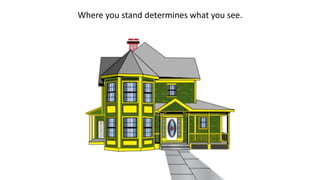
Where you stand determines what you see.
• Point of view (POV) — refers to the method of narration used in a
short story, novel, narrative poem, or work of nonfiction.
Kinds of Narrators
Real People
“God-like”
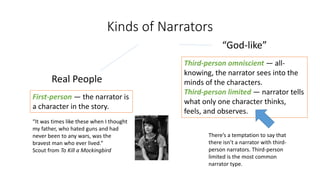
First-person — the narrator is
a character in the story.
Third-person omniscient — all-
knowing, the narrator sees into the
minds of the characters.
Third-person limited — narrator tells
what only one character thinks,
feels, and observes.
“It was times like these when I thought
my father, who hated guns and had
never been to any wars, was the
bravest man who ever lived.”
Scout from To Kill a Mockingbird
There’s a temptation to say that
there isn’t a narrator with third-
person narrators. Third-person
limited is the most common
narrator type.
Narrative Powers
Omniscient narrators can
• Be invisible
• Read characters’ minds
• Know what will happen
• Be trusted to tell the truth
Omniscient narrators don’t have
names or lives.
A “real” person has to
• Be there or be told
• Make inferences or guesses
• Only know after the fact
• Can’t always be trusted
Real people have names and lives
Third-person omniscient
“The year that Buttercup was born, the most beautiful woman in the
world was a French scullery maid named Annette. Annette worked in
Paris for the Duke and Duchess de Guiche, and it did not escape the
Duke’s notice that someone extraordinary was polishing the pewter.
The Duke’s notice did not escape the notice of the Duchess either, who
was not very beautiful, but plenty smart. The Duchess set about
studying Annette and shortly found her adversary’s tragic flaw.”
From The Princess Bride
Third-person limited
“But Aunt Petunia and Uncle Vernon were both looking at Harry
suspiciously, so he decided he’d better skip dessert and escape the
table as soon as he could.
Outside in the hall, he leaned against the wall, breathing deeply.
It had been a long time since he’d lost control and made something
explode. He couldn’t afford to let it happen again. The Hogsmeade
form wasn’t the only thing at stake — if he carried on like that, he’d be
in trouble with the Ministry of Magic.”
From Harry Potter and the Prisoner of Azkaban
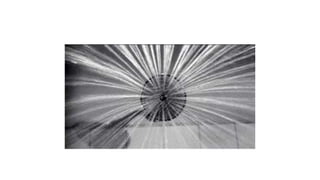
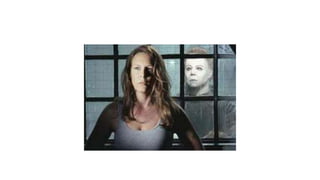
Whose eyes are we looking through?
Whose central nervous system?
Real person? Omniscient?
• Characterization — the way a writer creates and develops characters’
personalities. Four basic methods:
1. The writer may make direct comments about the character’s personality or
nature through the voice of the narrator.
2. The writer may describe the character’s physical appearance.
3. The writer may present the character’s thoughts, speech, and actions.
4. The writer may present thoughts, speech, and actions of other characters in
response to a character.
Characterization
She answered the door in a hurry, still putting her earrings in and
telling me to come in for a moment. I entered what looked like an
abandoned war zone with clothes and shoes scattered across the floor,
dirty plates with crusty tomato sauce and hardened fettucini noodles
dusted with old crumbs of buttered bread piled on the table, and
magazines piled haphazardly on every spare surface.
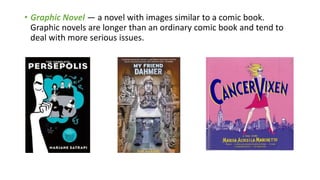
• Graphic Novel — a novel with images similar to a comic book.
Graphic novels are longer than an ordinary comic book and tend to
deal with more serious issues.
Elements
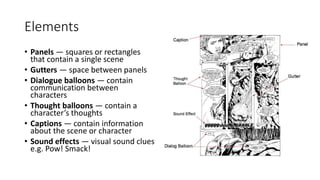
• Panels — squares or rectangles
that contain a single scene
• Gutters — space between panels
• Dialogue balloons — contain
communication between
characters
• Thought balloons — contain a
character’s thoughts
• Captions — contain information
about the scene or character
• Sound effects — visual sound clues
e.g. Pow! Smack!
How to read a graphic novel
Left  right
Words
(boxes, then dialogue
bubbles)
picture
Dialogue Balloons
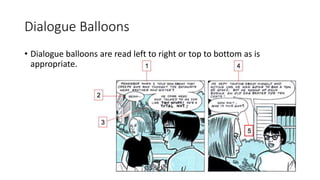
• Dialogue balloons are read left to right or top to bottom as is
appropriate.
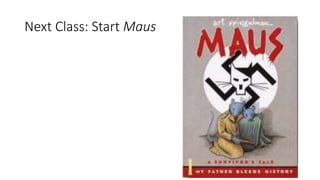
Next Class: Start Maus

Maus Notes Part I

  • 1.
    Maus Notes PartI Create a new Cornell style page in your notebook titled Maus Notes Part I. This is item 18 in your table of contents.
  • 2.
    Where you standdetermines what you see.
  • 3.
    • Point ofview (POV) — refers to the method of narration used in a short story, novel, narrative poem, or work of nonfiction.
  • 4.
    Kinds of Narrators RealPeople “God-like” First-person — the narrator is a character in the story. Third-person omniscient — all- knowing, the narrator sees into the minds of the characters. Third-person limited — narrator tells what only one character thinks, feels, and observes. “It was times like these when I thought my father, who hated guns and had never been to any wars, was the bravest man who ever lived.” Scout from To Kill a Mockingbird There’s a temptation to say that there isn’t a narrator with third- person narrators. Third-person limited is the most common narrator type.
  • 5.
    Narrative Powers Omniscient narratorscan • Be invisible • Read characters’ minds • Know what will happen • Be trusted to tell the truth Omniscient narrators don’t have names or lives. A “real” person has to • Be there or be told • Make inferences or guesses • Only know after the fact • Can’t always be trusted Real people have names and lives
  • 6.
    Third-person omniscient “The yearthat Buttercup was born, the most beautiful woman in the world was a French scullery maid named Annette. Annette worked in Paris for the Duke and Duchess de Guiche, and it did not escape the Duke’s notice that someone extraordinary was polishing the pewter. The Duke’s notice did not escape the notice of the Duchess either, who was not very beautiful, but plenty smart. The Duchess set about studying Annette and shortly found her adversary’s tragic flaw.” From The Princess Bride
  • 7.
    Third-person limited “But AuntPetunia and Uncle Vernon were both looking at Harry suspiciously, so he decided he’d better skip dessert and escape the table as soon as he could. Outside in the hall, he leaned against the wall, breathing deeply. It had been a long time since he’d lost control and made something explode. He couldn’t afford to let it happen again. The Hogsmeade form wasn’t the only thing at stake — if he carried on like that, he’d be in trouble with the Ministry of Magic.” From Harry Potter and the Prisoner of Azkaban
  • 8.
    Whose eyes arewe looking through? Whose central nervous system? Real person? Omniscient?
  • 13.
    • Characterization —the way a writer creates and develops characters’ personalities. Four basic methods: 1. The writer may make direct comments about the character’s personality or nature through the voice of the narrator. 2. The writer may describe the character’s physical appearance. 3. The writer may present the character’s thoughts, speech, and actions. 4. The writer may present thoughts, speech, and actions of other characters in response to a character.
  • 14.
    Characterization She answered thedoor in a hurry, still putting her earrings in and telling me to come in for a moment. I entered what looked like an abandoned war zone with clothes and shoes scattered across the floor, dirty plates with crusty tomato sauce and hardened fettucini noodles dusted with old crumbs of buttered bread piled on the table, and magazines piled haphazardly on every spare surface.
  • 15.
    • Graphic Novel— a novel with images similar to a comic book. Graphic novels are longer than an ordinary comic book and tend to deal with more serious issues.
  • 16.
    Elements • Panels —squares or rectangles that contain a single scene • Gutters — space between panels • Dialogue balloons — contain communication between characters • Thought balloons — contain a character’s thoughts • Captions — contain information about the scene or character • Sound effects — visual sound clues e.g. Pow! Smack!
  • 17.
    How to reada graphic novel Left  right Words (boxes, then dialogue bubbles) picture
  • 18.
    Dialogue Balloons • Dialogueballoons are read left to right or top to bottom as is appropriate.
  • 19.

Editor's Notes

  • #7 Stopped here during first period
  • #16 Graphic novels use text and pictures to present information; they differ from comics in that they usually contain stand-alone stories with complex plots. Persepolis – Persepolis is an autobiographical graphic novel by Marjane Satrapi depicting her childhood up to her early adult years in Iran during and after the Islamic revolution. My Friend Dahmer – In My Friend Dahmer, a haunting and original graphic novel, writer-artist Backderf creates a surprisingly sympathetic portrait of a disturbed young man struggling against the morbid urges emanating from the deep recesses of his psyche—a shy kid, a teenage alcoholic, and a goofball who never quite fit in with his classmates. Cancer Vixen — a memoir about dealing with breast cancer
  • #17 Stopped here period 4 — review comic elements
  • #20 Stopped here 3rd Period — go over the elements on the persepolis comic and the direction of reading.