Try to come up with examples and/or
definitions with a partner.
1. Allegory
2. Metaphor
3. Allusion
4. Personification
5. Symbolism
6. Theme
7. Irony
8. Foreshadowing
9. Flashback
10. Simile
Maus I—My Father Bleeds History
Overview
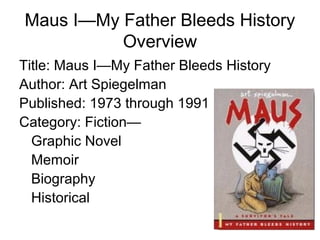
Title: Maus I—My Father Bleeds History
Author: Art Spiegelman
Published: 1973 through 1991
Category: Fiction—
Graphic Novel
Memoir
Biography
Historical
Maus I—My Father Bleeds History
About the Author
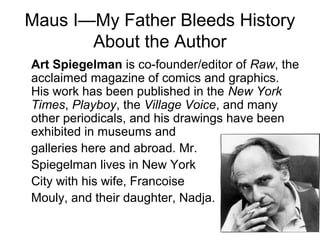
Art Spiegelman is co-founder/editor of Raw, the
acclaimed magazine of comics and graphics.
His work has been published in the New York
Times, Playboy, the Village Voice, and many
other periodicals, and his drawings have been
exhibited in museums and
galleries here and abroad. Mr.
Spiegelman lives in New York
City with his wife, Francoise
Mouly, and their daughter, Nadja.
Maus I—My Father Bleeds History
Summary
Maus is a story within a story: Art Spiegelman,
the son of two survivors of the Holocaust, tells
how he interviewed his father Vladek about his
Holocaust experience, and it tells the story of the
father's persecution and survival. It is written in a
comic book format, with various types of animals
representing the various nationalities and
religions (however, Jews are mice, no matter
what nationality they are).
Maus I—My Father Bleeds History
General Characters
Maus I
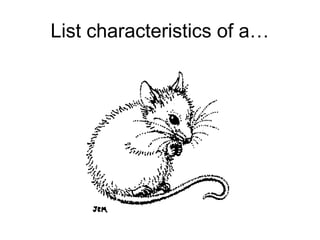
• The Jews are represented by mice.
• The Germans are represented by cats.
• The Americans are represented by dogs.
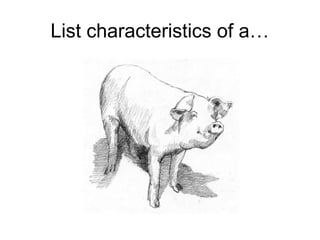
• The Poles are represented by pigs.
Maus II
• The Roma (Gypsies) are represented as gypsy
moths.
• The British are represented by fish.
• The child of a Jew and a German is shown as a
mouse with cat stripes.
List characteristics of a…
Maus I—My Father Bleeds History
Major Characters
Mr./Ms.
Zylberberg
Lucia
Greenberg
Vladek
Spiegelman
Anja
Spiegelman
Mala
Spiegelman
Richieu
Spiegelman
Art
Spiegelman
Francoise
Spiegelman
Maus I—My Father Bleeds History
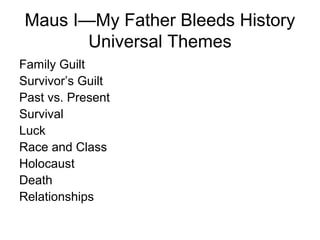
Universal Themes
Family Guilt
Survivor’s Guilt
Past vs. Present
Survival
Luck
Race and Class
Holocaust
Death
Relationships

Maus overview

  • 1.
    Try to comeup with examples and/or definitions with a partner. 1. Allegory 2. Metaphor 3. Allusion 4. Personification 5. Symbolism 6. Theme 7. Irony 8. Foreshadowing 9. Flashback 10. Simile
  • 2.
    Maus I—My FatherBleeds History Overview Title: Maus I—My Father Bleeds History Author: Art Spiegelman Published: 1973 through 1991 Category: Fiction— Graphic Novel Memoir Biography Historical
  • 3.
    Maus I—My FatherBleeds History About the Author Art Spiegelman is co-founder/editor of Raw, the acclaimed magazine of comics and graphics. His work has been published in the New York Times, Playboy, the Village Voice, and many other periodicals, and his drawings have been exhibited in museums and galleries here and abroad. Mr. Spiegelman lives in New York City with his wife, Francoise Mouly, and their daughter, Nadja.
  • 4.
    Maus I—My FatherBleeds History Summary Maus is a story within a story: Art Spiegelman, the son of two survivors of the Holocaust, tells how he interviewed his father Vladek about his Holocaust experience, and it tells the story of the father's persecution and survival. It is written in a comic book format, with various types of animals representing the various nationalities and religions (however, Jews are mice, no matter what nationality they are).
  • 5.
    Maus I—My FatherBleeds History General Characters Maus I • The Jews are represented by mice. • The Germans are represented by cats. • The Americans are represented by dogs. • The Poles are represented by pigs. Maus II • The Roma (Gypsies) are represented as gypsy moths. • The British are represented by fish. • The child of a Jew and a German is shown as a mouse with cat stripes.
  • 6.
  • 7.
  • 8.
  • 9.
  • 10.
    Maus I—My FatherBleeds History Major Characters Mr./Ms. Zylberberg Lucia Greenberg Vladek Spiegelman Anja Spiegelman Mala Spiegelman Richieu Spiegelman Art Spiegelman Francoise Spiegelman
  • 11.
    Maus I—My FatherBleeds History Universal Themes Family Guilt Survivor’s Guilt Past vs. Present Survival Luck Race and Class Holocaust Death Relationships