SELF STUDY REPORT
Page 1/117 01-07-2020 02:11:53
FOR
1st
CYCLE OFACCREDITATION
MAHARAJAAGRASEN UNIVERSITY
ATAL SHIKSHA KUNJ KALUJHANDA NEAR BAROTIWALATEHSIL BADDI
DISTT. SOLAN
174103
www.mau.ac.in
SubmittedTo
NATIONAL ASSESSMENT AND ACCREDITATION COUNCIL
BANGALORE
June 2019
1. EXECUTIVE SUMMARY
1. INTRODUCTION
Maharaja Agrasen University (MAU) derives its name from Maharaja Agrasen, born during the last stages of
Dwapar Yuga in the Mahabharat epic era who established the Kingdom of Agroha, near Hissar in Haryana,
about 5000 years ago. The University established in the year 2013 and was inaugurated by Shri Pranab
Mukherjee, Hon'ble President of India. The visionary idea of Pandit Madan Mohan Malviya, whose name is
linked with higher education in India, forms the foundation principle of this University. The university is
sponsored by Maharaja Agrasen Technical Education Society (MATES), a pioneer in the field of technical and
professional education. The objective of the MATES is to contribute to the society quality education at a
reasonable cost by establishing a centre of knowledge which fosters equality, integrity and excellence. The
University is situated in the pollution free environment of Shivalik foothills near Kasauli and Pinjore Gardens.
The University envisions itself as an emerging Center of Excellence. It offers an atmosphere for the
development of character with enriched virtues and noble ideals for its students. The holistic system of
education in the university is designed to draw out the knowledge, values and wisdom present in a latent form
in every student. The University not merely prepare students for being awarded degrees but nurture the values
required for self-realization.
Within a very short span of time the University has been able to maintain its presence felt not only in Himachal
Pradesh but in the neighbouring states also. It has made tremendous progress on all fronts, be it education,
research, sports, extra-curricular or outreach activities. This achievement of the University has been appreciated
by a consortium of 25 chairpersons of industry who conferred CCI Technology Excellence Award 2014 in the
category of Best Emerging Private University of India. It has also been adjudged by “Higher Education
Review” as the University of the Year 2015” in the category of “Research & Development”. The University
with its vast resource pool and enormous potential is sure to set new trends and break new grounds which will
be setting the pattern to be followed by the posterity.
Vision
To be globally recognized as a centre of excellence for Research and Innovation, Entrepreneurship and
Disseminating Knowledge by providing Value Based Education to produce professional leaders to serve the
society.
The University aspires to become a University of the first choice for students, teachers and research
community, which is recognized for providing excellent opportunities for global success. The University
endeavors to be acknowledged as a value-based campus where the faculty, students and the staff are creative
and actively engaged in scholarly activities of relevance to the community at large.
Mission
To prepare the students to be life-long learners and groom them as professional leaders with strong,
analytical, leadership skills and above all good human beings with civility, humility, integrity and excellence
so as to be successful and contended in the present Competitive World.
Page 2/117 01-07-2020 02:11:54
The mission of the University is to contribute to the society through imparting vibrant, innovative learning and
research at the highest international levels by providing intellectual environment built on a commitment to
free and open enquiry. Committed to the cause of holistic development of students, the University endeavours
to foster equality, initiative, integrity, and excellence while maintaining highest level of consciousness,
civility and humility. The focus is on personality development and judicious mix of academics with extra-
curricular activities and social service.
1.2 Strength, Weakness, Opportunity and Challenges(SWOC)
Institutional Strength
Qualified, committed and motivated faculty members
Faculty Development Programmes, Workshops and Webinars are conducted to enhance skills of the
faculty.
Excellent ambience with state-of-the-art infrastructure within a sprawling green campus.
Pro-active approach of learning-by-doing.
Memorandum of Understanding (MOUs) with industry, R&D centers and foreign universities.
Research oriented faculty members.
Faculties are having research publications in peer reviewed high impact factor International and
National journals.
Well established library with online access to journals and learning resources.
Excellent campus placement record.
Well placed alumni in reputed industries.
Campus-Wide-Networking through ERPsolution
Wi-Fi enabled campus.
Established Industry-Academia Interface enabling continuous interaction between the Students and
Industry.
Students are encouraged to pursue innovative projects and to participate in National Events.
Ample opportunity for the students to participate and organize co-curricular activities.
Institutional Weakness
University is located in a rural area.
Transport connectivity is limited and thus it is not well connected to the cities where mostly recreational
facilities exist.
Frequent change of faculty members mainly due to rural location of University.
No financial support from Government funding agencies since the University does not have 12 (b)
Status.
Limited number of Alumni.
Institutional Opportunity
Availability of industry base in surrounding areas, implying scope for collaboration in respect of student
internships, joint consultancy, projects, industrial visits and guest talks.
Improving quality of instruction by supplementing with e-learning.
Page 3/117 01-07-2020 02:11:55
Institutionalizing services to community by making use of technology
Transforming research & development into patentable products.
Utilizing alumni network in institution building.
To start industry specific programmes.
Availability of abundant space for horizontal expansion.
Institutional Challenge
Low Admissions due to geographical disadvantages.
Difficulty in generating adequate funds for research activities.
Competition with many Universities/Colleges which have established in the area in the recent years.
1.3 CRITERIA WISE SUMMARY
Curricular Aspects
The University has sharp focus on employability of students in all programmes and courses having well-defined
objectives in alliance with the institutional mission. Programmes are relevant to local/regional/national and
global needs with futuristic view. The University provides Academic flexibility to help the students in the
matter of skill development, academic mobility and progression to higher studies. Students are provided with
flexible Choice Based Credit System having access to excellent curricular and co-curricular opportunities for
enhancing academic acumen, employability and entrepreneurial skills. Ample choices are offered to the
students by integrating the core courses with discipline centric, interdisciplinary/multidisciplinary electives and
ability enhancement courses in curricula to meet student interests and aspirations.
Curriculum review and development requirements are done regularly. Results of outcome assessment and stake
holders, feedback serve as input for continuous development.
Courses relevant to gender sensitivity, professional ethics and human values are integrated in many
programmes. To address the global concerns and issue of gender and environment, special lectures are
organized for which subject experts are invited periodically. Some Value-addition courses like Communication
Skills and Personality Development Programme are imparted for holistic development of students.
The University implements curriculum effectively by framing academic calendar, activities calendar, seminars,
industrial visits, guest lectures, and workshops. The overall curriculum structure of the institutions includes
lesson plans, students interactive sessions, projects preparation and presentations, collaborative learning
processes and feedback mechanism. Our curriculum also includes orientation and induction programs and also
maintains ‘mentor-mentee’ ratio by approximately 1:15 for optimum effectiveness.
The students are encouraged to undertake internships, projects, field work, etc. for practical work and ‘hands
on’ practice for skill development. The University has signed MoUs with various research institutes and
industrial houses to enhance the research skills, smoothening and brightening prospects of employment of the
students.
At present, the University provides 17 Under Graduate, 12 Post Graduate, 01 Diploma, and 13 Doctoral
programmes. Programme outcomes are assessed using direct and/or indirect methods to identify
Page 4/117 01-07-2020 02:13:12
educational and operational gaps and hassles for preparing action plan to reduce or eliminate shortcomings
and effect further improvements.
Page 5/117 01-07-2020 02:13:12
Teaching-learning and Evaluation
The University is committed to provide flexible and conducive environment to the faculty and students to
make the teaching, learning and evaluation process effective and efficient. University has optimally
maintained the teacher-students ratio (1:13) in order to facilitate student centric learning environment. At the
beginning of every new session, an orientation program is conducted for the newly admitted students to give
an overview about the syllabi of the respective programme, examination system and promotion rules. The
program Outcomes (POs), Program Specific Outcomes (PSOs) and Course Outcomes (COs) of respective
programmes are displayed on the University’s website and their attainment is measured by the respective
School of the University. A mentor (teacher) is assigned to group of 15-16 students which conduct meeting
and counseling sessions with the students to resolve their personal and course work related problems. There is
a provision for the continuous mode of assessment, in which the teacher evaluates the student, based upon
his/her punctuality, student-teacher interaction, and other activities. In addition to conventional teaching
methods, innovative and ICT-based teaching-learning methods are adopted. Industrial visits are organized for
students in order to make them aware with the industrial culture, job oriented skills as per industry
requirements and to enhance their practical skills. The University periodically organizes expert talks from
industry and academia to apprise students of the latest in the industry. In order to improve the communication
and soft skills of the students, curriculum of all schools include Personality Development Programs (PDPs).
The final year results are declared within 30 working days from the last day of examination so that the
students can take admissions to higher classes on time or get employed. There is central evaluation of answer
sheets to maintain the secrecy and transparency. The university is running syllabi under Choice Based Credit
System (CBCS) to ensure the outcome based curriculum and to promote employability. As per the
requirement of the industry, the syllabi are modified from time to time.
Research, Innovations and Extension
The University has well-defined policy guidelines for promotion of research, innovations and extension
activities. An IPR cell has been constitued to promote research activities. Faculty members have published 302
papers in International and National Journals. Total 38 Books have been published by the faculty from different
schools. 193 papers have been published in National and International Conferences by the faculty members.
118 publications have been included in the citation index. 76 publications are there in h-index. 1 patent has
been awarded and 3 patents have been filed by the University. 67 research fellows have enrolled in Ph.D
programmes during the last five years.
University has the research facilities like Central Instrumentation Centre, Museum, Studios and Research
Statistical Database like DELNET and Manupatra for promotion of research. 3 research projects have been
funded by government and non-government agencies during the last five years. University is a Member of
Chandigarh Region Innovation and Knowledge Cluster (CRIKC). CRIKC aims to foster and sustain close
academic alliances between institutions of higher education and research in the Chandigarh region. 133 expert
talks, workshops and seminars have been conducted on Industry Academia Innovative practices and 2 on
Intellectual Property Rights (IPR) during the last five years. 19 awards for innovation have been won by
institution, teachers, research scholars and students during the last five years.
University has well-defined policy guidelines on consultancy which includes revenue sharing between the
University and individual. University organizes and participates in various extension activities with a dual
objective of not only sensitizing students about various social issues but also contribute to community and
strengthen community participation. NSS unit of the University takes part in various initiatives like Organizing
camps, Swachh Bharat initiatives, Blood donation camps, Awareness programmes etc. Blood donation camps
in the University are regular feature whereby students and staff donate blood for the noble cause. University has
10 MoUs with other institutions like CDSL, ICAR, IATC Siemens, H.P. National Law University, Shimla,
Xeam Ventures, Groupe Inseec, France and Ghana Technology University College (GTUC).
Infrastructure and Learning Resources
Maharaja Agrasen University is one among the premier institutes in Himachal Pradesh state in the un-aided
sector established in 2013 by Maharaja Agrasen Technical Educational Society (MATES). MATES is a
charitable non-profit organization dedicated to the society.
Maharaja Agrasen University envisions itself as an emerging Center of Excellence. University has its vision for
social transformation and upliftment of rural masses through education , training and research. The campus of
University is clean, green, safe and secure.
The University has well-furnished infrastructure having classrooms with teaching aids such as LCD projectors,
computer centre, well equipped laboratories, seminar halls and open air theatre.
University encourages students to participate in the technical and cultural activities like Technical festivals,
Fresher’s, Annual Sports meet, Annual Festivals, Farewells etc. to exhibit and hone talents. Amenities and
facilities such as well-maintained lawns, ramp & lift facility, CCTV surveillance at all strategic locations,
generators, RO water purifiers, canteen , mess and ATM of Union Bank are available.
University is having Training and placement Cell, medical facility with well equipped ambulance, transport
facility, girls and boys common rooms, well equipped indoor sports facilities and play grounds, girls and boys
hostels.
University has spacious and well-furnished library equipped with all kinds of text books, references books,
magazines and reputed national and international Journals, with separate reading rooms, digital library with
access to e-journals, e-books, case studies, articles and research papers.
University believes in periodical and preventive maintenance. A professional team is in place to look after the
cleanliness of the university. The university has various departments to look after maintenance such as
horticulture, civil maintenance, electrical and IT maintenance( computer/software/network related issues) etc.
Proper checks , periodic inspections, review, grievances redressal, suggestion box, feedback from students,
alumni, parents, do help in up-keeping and maintaining the conducive learning environment of the campus.
The University provides active programs for online courses of SWAYAM. The faculty is encouraged to
develop e-Content for e-PG Pathshala, MOOC etc. which are developed and made available to the students.
The University is also having facilities like IQAC, Grievance Redressal Unit and Anti Ragging Cell.
Page 6/117 01-07-2020 02:13:12
Student Support and Progression
The University recognizes that the growth of students cannot be limited to the sphere of academics alone and in
order to evolve into a complete human being, they need to go through a multi-faceted development process.
Considering this, University has a well-established student support system for financial assistance, capability
enhancement, development, progression and alumni engagement etc.
The students are given timely information about getting benefits of various scholarship schemes offered by the
Government and they are availing different scholarships under various Government schemes. The University
offers financial assistance to deserving students in the form of fee concessions etc. The University has
established a platform to develop academic, personal and administrative skills among the students. For this, the
University has a well defined student support and mentoring system. It offers personal counseling, skill
enhancement and development schemes for the students (coaching classes for competitive examinations,
remedial classes, career counseling, soft skill development, etc.). The counseling cell of the respective schools
provides behavioural and emotional counseling and guides the students whereever they have psycho-social
conflicts and helps them adjust amiably with others.
The University provides information to the students regarding its vision and mission, infrastructure, courses
being offered, extension/cultural/sports activities to be organized throughout the year. Also they are motivated
and encouraged to take part in various institutional/regional cocurricular activities so as to unravel their talents
and fill confidence in them. All other relevant information is provided through the prospectus and website.
University has a student council with fair representation of both girls and boys to conduct various activities
throughout the year.
It has a mechanism for timely redressal of student grievances. University has anti-ragging committees at school
as well as at university level which monitors student interactions effectively.
Governance, Leadership and Management
Governance of the University is wholly democratic and participative, involving all stakeholders in decision
making for quality improvement and sustenance in all spheres of the University. Therefore it has decentralized
all its activities, initiatives and decision making processes by involving all officers of the University at various
levels.
Page 7/117 01-07-2020 02:13:12
The University has a well-defined organisational structure at hierarchy. It functions through various bodies such
as Advisory Board, Governing Body, Board of Management, Academic Council, Finance Committee,
Admission Committee, Examination Committee, Boards of Studies, Grievance Redressal Committee, Anti-
Ragging Committee, Alumni Committee, Staff Welfare Committee and IQAC. These committees review the
progress in various matters and accordingly take necessary and timely action for ensuring excellence in
respective areas.
External members are part of various Councils and Committees for enhancing the broader base and bringing
transparency and fairness in the system. The Finance Committee approves the Annual Budget and takes final
decisions on all key issues related to revenue and expenditure of the University. The Academic Council,
comprising senior faculty members and external experts from academia and industry, is chaired by the Vice
Chancellor and implements all the decisions of governing body and reviews programmes, policies and strategic
implementations. The directors of respective school are informed about the decisions and policies in time and
they have full freedom and flexibility to execute all the policies. The director of each School involves HoDs
and all faculty members in effective curriculum development and its implementation.
Students are also made members of different Cells/Clubs so as to get their active participation in various
programs. In order to achieve academic excellence, the university is offering need-based and value-based
academic programmes of studies which are interdisciplinary in approach. Most of the activities of the
University are coordinated with the help of ICT. ERP system is in place to ensure optimum use of resources
through automation. All information related to examination, course plans, attendance, study notes, time table
etc is uploaded on their ERP account. The University has various welfare schemes and a systematic
performance appraisal scheme both for teaching and non-teaching staff.
Institutional Values and Best Practices
The University is sensitive to gender equity and parity. Sensitization programmes are organized regularly.
Safety and security, common room, counselling facilities are provided to students.
Sexual Harassment Prevention committee of the university is instructed to ensure justified and fast decisions in
case any sexual harassment issue is reported to it.
University has adopted environment friendly practices and taken steps for energy conservation through
renewable sources of energy. Energy consumption is continuously monitored for improvement.
University follows eco-friendly practices like waste management, paperless and plastic free
campus. Rain water harvesting system is deployed in campus through recharging rain water in bore-
wells.
The University has eco-friendly Green and Clean campus.
To minimize damage to the environment, University provides subsidized transport facility to staff and students.
The University has strong commitment to differently abled people and provides facilities like ramps, lifts,
special washrooms, wheel chair, medical facility etc. to Divyangjan.
University has demonstrated sensitivity to environmental issues by incorporating courses in curriculum and also
Page 8/117 01-07-2020 02:13:12
by organizing activities to sensitize students.
University is located in rural area and has effectively dealt situatedness through initiatives and activities to
engage local community.
Code of conduct Handbook and Core values literature exist at the University level. University runs courses on
human values and professional ethics. Professional programmes are run as per respective statutory/regulatory
guidelines.
To celebrate glorious heritage, culture and traditions, University organizes and celebrates all important days of
national/international importance and conducts a large number of activities to promote universal values.
University has organized more than 110 activities related to promotion of values beside national festivals.
University maintains complete transparency by involving all stakeholders in financial, academic and
administrative functions. The University gives financial support to economically backward students and
facilities to differently abled students to achieve their dreams.
University has implemented ERP and Faculty Advancement Programs as best practices.
University conducted sponsered computer education program for girls belonging to economically weaker
sections of the nearby villages. It is also running a mobile dispensary service (in collaboration with ONGC) in
nearby villages in order to provide medical facilities at their door steps.
Page 9/117 01-07-2020 02:13:12
Establishment Details
Establishment Date of the University 13-07-2012
Status Prior to Establishment,If applicable
Page 10/117 01-07-2020 02:13:12
Type of University
Type of University Unitary
Name and Address of the University
Name MAHARAJA AGRASEN UNIVERSITY
Address Atal Shiksha Kunj Kalujhanda Near Barotiwala
Tehsil Baddi Distt. Solan
City Kalujhanda Barotiwala Baddi Distt Solan
State Himachal pradesh
Pin 174103
Website www.mau.ac.in
Contacts for Communication
Designation Name Telephone with
STD Code
Mobile Fax Email
Vice
Chancellor
Rakesh
Kumar Gupta
0172-2708927 7832929255 0172-277279
1
registrar@mau.ac.i
n
Registrar V K Vats 0172-2545766 7832929200 0172-256970
6
vc@mau.ac.in
Nature of University
Nature of University State Private University
2. PROFILE
1. BASIC INFORMATION
Recognition Details
Date of Recognition as a University by UGC or Any Other National Agency :
Under Section Date View Document
2f of UGC 25-02-2013 View Document
12B of UGC
Page 11/117 01-07-2020 02:13:12
University with Potential for Excellence
Is the University Recognised as a University with
Potential for Excellence (UPE) by the UGC?
No
Location, Area and Activity of Campus
Campus Address Location* Campus Built up Program Date of Date of
Type Area in Area in mes Establishment Recognition
Acres sq.mts. Offered by
UGC/MHRD
Main Atal Rural 12.65 70146 Forty
campus Shiksha Three
Kunj Ka
lujhanda
Near Ba
rotiwala
Tehsil
Baddi
Distt.
Solan
2.2 ACADEMIC INFORMATION
Furnish the Details of Colleges of University
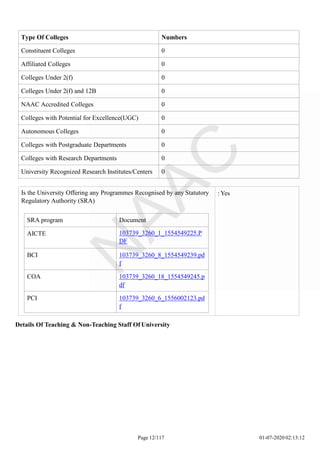
Type Of Colleges Numbers
Constituent Colleges 0
Affiliated Colleges 0
Colleges Under 2(f) 0
Colleges Under 2(f) and 12B 0
NAAC Accredited Colleges 0
Colleges with Potential for Excellence(UGC) 0
Autonomous Colleges 0
Colleges with Postgraduate Departments 0
Colleges with Research Departments 0
University Recognized Research Institutes/Centers 0
Is the University Offering any Programmes Recognised by any Statutory
Regulatory Authority (SRA)
SRA program Document
AICTE 103739_3260_1_1554549225.P
DF
BCI 103739_3260_8_1554549239.pd
f
COA 103739_3260_18_1554549245.p
df
PCI 103739_3260_6_1556002123.pd
f
: Yes
Page 12/117 01-07-2020 02:13:12
Details Of Teaching & Non-Teaching Staff Of University
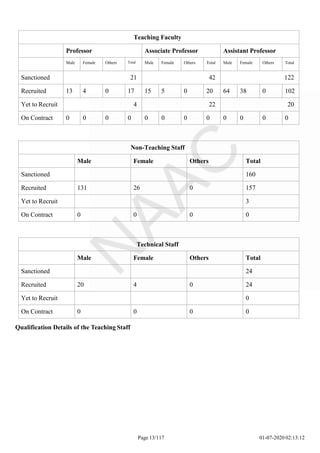
Teaching Faculty
Professor Associate Professor Assistant Professor
Male Female Others Total Male Female Others Total Male Female Others Total
Sanctioned 21 42 122
Recruited 13 4 0 17 15 5 0 20 64 38 0 102
Yet to Recruit 4 22 20
On Contract 0 0 0 0 0 0 0 0 0 0 0 0
Page 13/117 01-07-2020 02:13:12
Non-Teaching Staff
Male Female Others Total
Sanctioned 160
Recruited 131 26 0 157
Yet to Recruit 3
On Contract 0 0 0 0
Technical Staff
Male Female Others Total
Sanctioned 24
Recruited 20 4 0 24
Yet to Recruit 0
On Contract 0 0 0 0
Qualification Details of the Teaching Staff
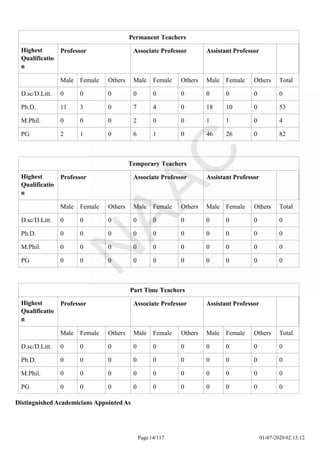
Permanent Teachers
Highest
Qualificatio
n
Professor Associate Professor Assistant Professor
Male Female Others Male Female Others Male Female Others Total
D.sc/D.Litt. 0 0 0 0 0 0 0 0 0 0
Ph.D. 11 3 0 7 4 0 18 10 0 53
M.Phil. 0 0 0 2 0 0 1 1 0 4
PG 2 1 0 6 1 0 46 26 0 82
Page 14/117 01-07-2020 02:13:12
Temporary Teachers
Highest
Qualificatio
n
Professor Associate Professor Assistant Professor
Male Female Others Male Female Others Male Female Others Total
D.sc/D.Litt. 0 0 0 0 0 0 0 0 0 0
Ph.D. 0 0 0 0 0 0 0 0 0 0
M.Phil. 0 0 0 0 0 0 0 0 0 0
PG 0 0 0 0 0 0 0 0 0 0
Part Time Teachers
Highest
Qualificatio
n
Professor Associate Professor Assistant Professor
Male Female Others Male Female Others Male Female Others Total
D.sc/D.Litt. 0 0 0 0 0 0 0 0 0 0
Ph.D. 0 0 0 0 0 0 0 0 0 0
M.Phil. 0 0 0 0 0 0 0 0 0 0
PG 0 0 0 0 0 0 0 0 0 0
Distinguished Academicians AppointedAs
Does the University offer any Integrated Programmes? Yes
Total Number of Integrated Programme 2
Page 15/117 01-07-2020 02:13:12
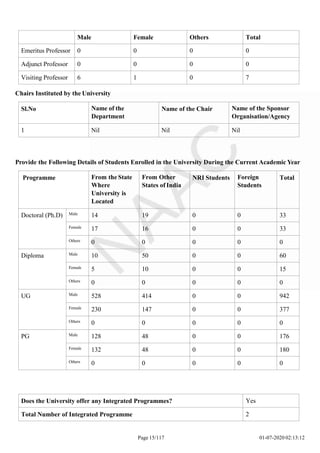
Male Female Others Total
Emeritus Professor 0 0 0 0
Adjunct Professor 0 0 0 0
Visiting Professor 6 1 0 7
Chairs Instituted by the University
Sl.No Name of the
Department
Name of the Chair Name of the Sponsor
Organisation/Agency
1 Nil Nil Nil
Provide the Following Details of Students Enrolled in the University During the Current Academic Year
Programme From the State
Where
University is
Located
From Other
States of India
NRI Students Foreign
Students
Total
Doctoral (Ph.D) Male 14 19 0 0 33
Female 17 16 0 0 33
Others 0 0 0 0 0
Diploma Male 10 50 0 0 60
Female 5 10 0 0 15
Others 0 0 0 0 0
UG Male 528 414 0 0 942
Female 230 147 0 0 377
Others 0 0 0 0 0
PG Male 128 48 0 0 176
Female 132 48 0 0 180
Others 0 0 0 0 0
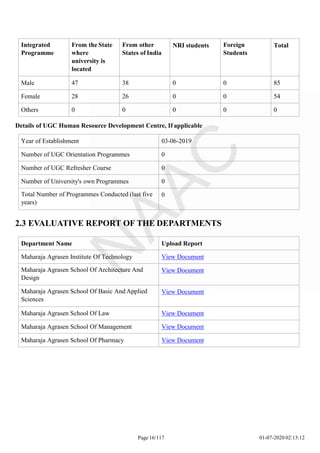
Integrated
Programme
From the State
where
university is
located
From other
States of India
NRI students Foreign
Students
Total
Male 47 38 0 0 85
Female 28 26 0 0 54
Others 0 0 0 0 0
Page 16/117 01-07-2020 02:13:12
Details of UGC Human Resource Development Centre, If applicable
Year of Establishment 03-06-2019
Number of UGC Orientation Programmes 0
Number of UGC Refresher Course 0
Number of University's own Programmes 0
Total Number of Programmes Conducted (last five
years)
0
2.3 EVALUATIVE REPORT OF THE DEPARTMENTS
Department Name Upload Report
Maharaja Agrasen Institute Of Technology View Document
Maharaja Agrasen School Of Architecture And
Design
View Document
Maharaja Agrasen School Of Basic And Applied
Sciences
View Document
Maharaja Agrasen School Of Law View Document
Maharaja Agrasen School Of Management View Document
Maharaja Agrasen School Of Pharmacy View Document
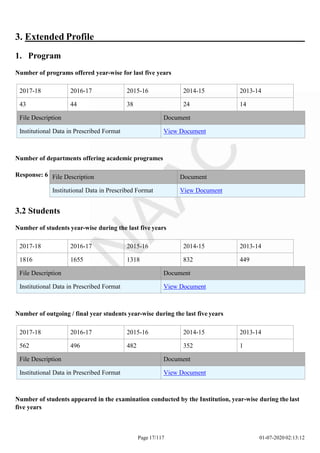
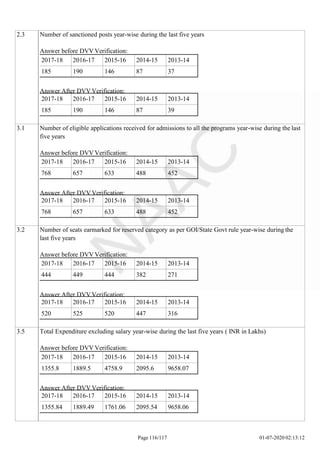
2017-18 2016-17 2015-16 2014-15 2013-14
562 496 482 352 1
File Description Document
Institutional Data in Prescribed Format View Document
Page 17/117 01-07-2020 02:13:12
2017-18 2016-17 2015-16 2014-15 2013-14
43 44 38 24 14
File Description Document
Institutional Data in Prescribed Format View Document
3. Extended Profile
1. Program
Number of programs offered year-wise for last five years
Number of departments offering academic programes
Response: 6 File Description Document
Institutional Data in Prescribed Format View Document
3.2 Students
Number of students year-wise during the last five years
2017-18 2016-17 2015-16 2014-15 2013-14
1816 1655 1318 832 449
File Description Document
Institutional Data in Prescribed Format View Document
Number of outgoing / final year students year-wise during the last five years
Number of students appeared in the examination conducted by the Institution, year-wise during the last
five years
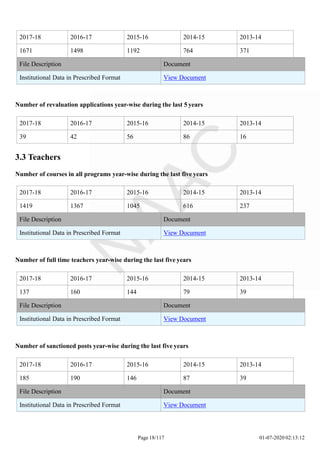
2017-18 2016-17 2015-16 2014-15 2013-14
185 190 146 87 39
File Description Document
Institutional Data in Prescribed Format View Document
Page 18/117 01-07-2020 02:13:12
2017-18 2016-17 2015-16 2014-15 2013-14
1671 1498 1192 764 371
File Description Document
Institutional Data in Prescribed Format View Document
Number of revaluation applications year-wise during the last 5 years
2017-18 2016-17 2015-16 2014-15 2013-14
39 42 56 86 16
3.3 Teachers
Number of courses in all programs year-wise during the last five years
2017-18 2016-17 2015-16 2014-15 2013-14
1419 1367 1045 616 237
File Description Document
Institutional Data in Prescribed Format View Document
Number of full time teachers year-wise during the last five years
2017-18 2016-17 2015-16 2014-15 2013-14
137 160 144 79 39
File Description Document
Institutional Data in Prescribed Format View Document
Number of sanctioned posts year-wise during the last five years
2017-18 2016-17 2015-16 2014-15 2013-14
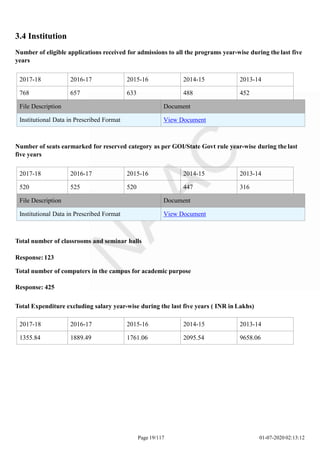
1355.84 1889.49 1761.06 2095.54 9658.06
Page 19/117 01-07-2020 02:13:12
2017-18 2016-17 2015-16 2014-15 2013-14
768 657 633 488 452
File Description Document
Institutional Data in Prescribed Format View Document
3.4 Institution
Number of eligible applications received for admissions to all the programs year-wise during the last five
years
Number of seats earmarked for reserved category as per GOI/State Govt rule year-wise during the last
five years
2017-18 2016-17 2015-16 2014-15 2013-14
520 525 520 447 316
File Description Document
Institutional Data in Prescribed Format View Document
Total number of classrooms and seminar halls
Response: 123
Total number of computers in the campus for academic purpose
Response: 425
Total Expenditure excluding salary year-wise during the last five years ( INR in Lakhs)
4. Quality Indicator Framework(QIF)
Criterion 1 - CurricularAspects
1. Curriculum Design and Development
1.Curricula developed /adopted have relevance to the local/ national / regional/global
developmental needs with learning objectives including program outcomes, program specific
outcomes and course outcomes of all the program offered by the University
Response:
The University is committed towards offering programs with global impact for quality education ensuring
equity and excellence in teaching and research.
The University focuses strongly on developing and adopting quality Curriculum. The opinions are sought
from the external experts(industry and academic) and are incorporated in the curriculum in order to meet
the industry expectations. A systematic approach is adopted in developing and designing curriculum for all
courses. Values are imparted through Human Values and Ethics in curriculum. The course contents are
prepared under the guidelines of UGC, Statutory Regulatory Authorities, curriculum prescribed for CBSE-
NET and the demand of Industry which reduces the gap between Industry and academia. The University
has adopted Choice Based Credit System (CBCS) since 2015. Programme outcomes, programme specific
outcomes and course outcomes are clearly mentioned in our curriculum.
The annual course review:-
Need Assessment: The courses are designed by the concerned faculty members and reviewed at different
levels by receiving the inputs from various stakeholders. The University has an effective Training and
Placement Cell, which collects information about corporate expectations and passes on to IQAC to make
necessary changes in the syllabi to enhance the employability of the students.
The modification process:-
• Feedback: The feedback about the curriculum is collected by IQAC from :-
i.Teaching Faculty: -Teachers teaching a particular course, give their suggestions for omitting /adding in
the existing curriculum.
ii. Outgoing/Old students: - Final year/Old students give suggestions about the existing curriculum.
iii. External Experts: -Suggestions from experts from Industry or Academia are sought and incorporated.
LISTING OF PROGRAMMES/COURSES
•IQAC analyses the feedback forms and passes on its recommendations and feedback forms to the
concerned Director for further processing.
•A list of programmes / courses for modification is prepared along with ideas from other institutions of
national / international repute, experts from industries. Discussions are held with senior faculty and
experts.
•Initial Curriculum Drafting: In the departmental meetings the proposed curriculum is thoroughly
discussed with objectives and contents.
•B.O.S: Each Department has its own Board of Studies. The director sends the proposed changes in
curriculum to B.O.S (comprising expert from University or industry) for its perusal to discuss the
curriculum and gives its approval with / without modifications.
• The curriculum approved by B.O.S is sent to the Academic Council for its approval.
Page 20/117 01-07-2020 02:13:12
Many National and international conferences are organized by different schools, where researchers,
distinguished universities and industry experts meet, interchange their ideas. The University has produced
graduates, post graduates and researchers with required skills to meet industry expectation. The university
encourages entrepreneurs who proved to be job providers instead of job seekers. Only in 5/6 years the
university has made significant progress in producing successful entrepreneurs and has become first choice
of students in this area. Our curriculum is a blend of knowledge, skill and creativity. This enables our
students to make decisions at personal / professional level.
File Description Document
Any additional information View Document
Link for Additional Information View Document
Page 21/117 01-07-2020 02:13:12
1.1.2 Percentage of programs where syllabus revision was carried out during the last five years
Response: 67.44
1.1.2.1 How many programs were revised out of total number of programs offered during the last five
years
Response: 29
1.1.2.2 Number of all programs offered by the institution during the last five years
Response: 43
File Description Document
Minutes of relevant Academic Council/BOS
meeting
View Document
Details of program syllabus revision in last 5 years View Document
1.1.3 Average percentage of courses having focus on Employability/ Entrepreneurship/ Skill
development during the last five years
Response: 68.66
1.1.3.1 Number of courses having focus on employability/ entrepreneurship/ skill development year-wise
during the last five years
2017-18 2016-17 2015-16 2014-15 2013-14
1063 943 693 417 155
File Description Document
Program/ Curriculum/ Syllabus of the courses View Document
Minutes of the Boards of Studies/ Academic
Council meetings with approvals for these courses
View Document
Average percentage of courses having focus on
employability/ entrepreneurship
View Document
Page 22/117 01-07-2020 02:13:12
1.2 Academic Flexibility
1.2.1 Percentage of new Courses introduced out of the total number of courses across all Programs
offered during last five years
Response: 14.09
1.2.1.1 How many new courses are introduced within the last five years
Response: 200
1.2.1.2 Number of courses offered by the institution across all programs during the last five years
Response: 1419
File Description Document
Minutes of relevant Academic Council/BOS
meetings
View Document
Institutional data in prescribed format View Document
1.2.2 Percentage of programs in which Choice Based Credit System (CBCS)/Elective course system
has been implemented
Response: 88.37
1.2.2.1 Number of programmes in which CBCS/ Elective course system implemented.
Response: 38
File Description Document
Minutes of relevant Academic Council/BOS
meetings
View Document
Institutional data in prescribed format View Document
1.3 Curriculum Enrichment
1.3.1 Institution integrates cross cutting issues relevant to Gender, Environment and Sustainability,
Human Values and Professional Ethics into the Curriculum
Response:
The courses on Environmental studies, Human values& Ethics are part and parcel of curriculum of many
UG and PG programmes offered by the University. They also carry compulsory credits.
Human Values and Professional Ethics
It is in response to a long- felt and urgent need to integrate value education with decision making skills of
the professionals. It focuses on ethical concerns common to human service situations. The issues in
professional ethics are analysed in the context of right understanding with the main focus on the
enhancement of ethical competence of the professionals. These courses comprise of class room teaching
and discussions on real life decision making situations. In our endeavour to provide holistic education, we
offer several extra and co-curricular programs to inculcate human values and professional ethics. For
professional ethics the university ensures that all research papers written by the faculty are free from
plagiarism. To ensure the same we use Anti Plagiarism Software.
Gender Sensitivity
We have Antiragging and Sexual Harassment prevention committees to keep check on ragging and sexual
harassment cases. The university has formed various committees to check ragging and gender related
issues. The University regularly organizes seminars /talks on gender equality, women empowerment .NSS
volunteers are actively engaged in programmes which are socially relevant.
Environmental Studies
We have incorporated the courses related to environmental education under various programmes. These
courses make the students aware about the environmental degradation from the hands of mankind and why
to keep environment healthy is the necessity of mankind. Wherever it is possible we expose our students
towards environmental concerns. In order to keep our students abreast about the environment and its
sustainability issues, a number of activities such as seminars, workshops, guest lectures, industrial visits
and tree plantation drives are held on a regular basis. We also celebrate Environment Day, Science Day,
Earth Day, Water Day `etc. to keep the momentum going on for such initiatives.
File Description Document
Upload the list and description of the courses which
address the Gender, Environment and Sustainability,
Human Values and Professional Ethics into the
Curriculum
View Document
Page 23/117 01-07-2020 02:13:12
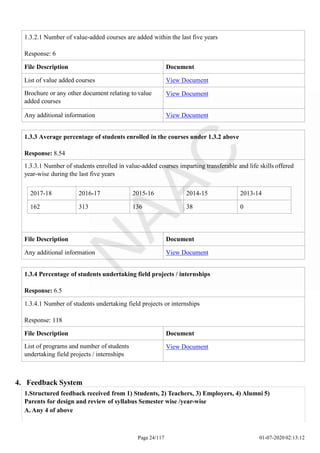
1.3.2 Number of value-added courses imparting transferable and life skills offered during the last
five years
Response: 6
1.3.2.1 Number of value-added courses are added within the last five years
Response: 6
File Description Document
List of value added courses View Document
Brochure or any other document relating to value
added courses
View Document
Any additional information View Document
Page 24/117 01-07-2020 02:13:12
2017-18 2016-17 2015-16 2014-15 2013-14
162 313 136 38 0
1.3.3 Average percentage of students enrolled in the courses under 1.3.2 above
Response: 8.54
1.3.3.1 Number of students enrolled in value-added courses imparting transferable and life skills offered
year-wise during the last five years
File Description Document
Any additional information View Document
1.3.4 Percentage of students undertaking field projects / internships
Response: 6.5
1.3.4.1 Number of students undertaking field projects or internships
Response: 118
File Description Document
List of programs and number of students
undertaking field projects / internships
View Document
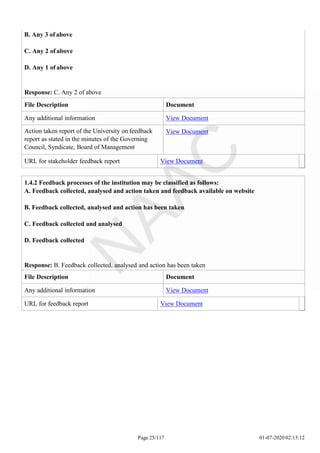
4. Feedback System
1.Structured feedback received from 1) Students, 2) Teachers, 3) Employers, 4) Alumni 5)
Parents for design and review of syllabus Semester wise /year-wise
A. Any 4 of above
B. Any 3 of above
C. Any 2 of above
D. Any 1 of above
Response: C. Any 2 of above
File Description Document
Any additional information View Document
Action taken report of the University on feedback
report as stated in the minutes of the Governing
Council, Syndicate, Board of Management
View Document
URL for stakeholder feedback report View Document
Page 25/117 01-07-2020 02:13:12
1.4.2 Feedback processes of the institution may be classified as follows:
A. Feedback collected, analysed and action taken and feedback available on website
B. Feedback collected, analysed and action has been taken
C. Feedback collected and analysed
D. Feedback collected
Response: B. Feedback collected, analysed and action has been taken
File Description Document
Any additional information View Document
URL for feedback report View Document
Criterion 2 - Teaching-learning and Evaluation
2.1 Student Enrollment and Profile
Page 26/117 01-07-2020 02:13:12
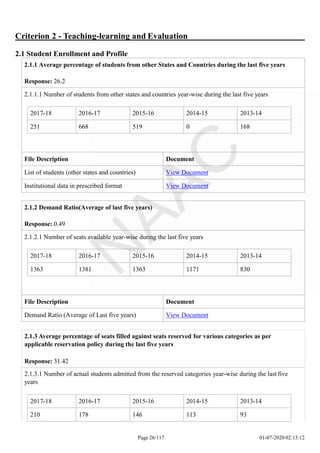
2017-18 2016-17 2015-16 2014-15 2013-14
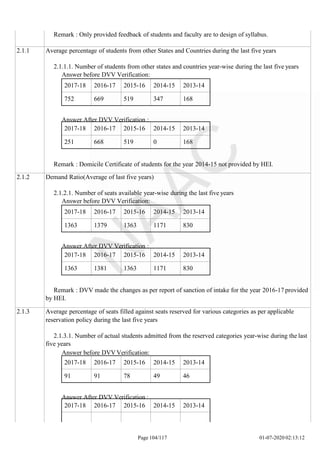
251 668 519 0 168
2.1.1 Average percentage of students from other States and Countries during the last five years
Response: 26.2
2.1.1.1 Number of students from other states and countries year-wise during the last five years
File Description Document
List of students (other states and countries) View Document
Institutional data in prescribed format View Document
2017-18 2016-17 2015-16 2014-15 2013-14
1363 1381 1363 1171 830
2.1.2 Demand Ratio(Average of last five years)
Response: 0.49
2.1.2.1 Number of seats available year-wise during the last five years
File Description Document
Demand Ratio (Average of Last five years) View Document
2.1.3 Average percentage of seats filled against seats reserved for various categories as per
applicable reservation policy during the last five years
Response: 31.42
2.1.3.1 Number of actual students admitted from the reserved categories year-wise during the last five
years
2017-18 2016-17 2015-16 2014-15 2013-14
210 178 146 113 93
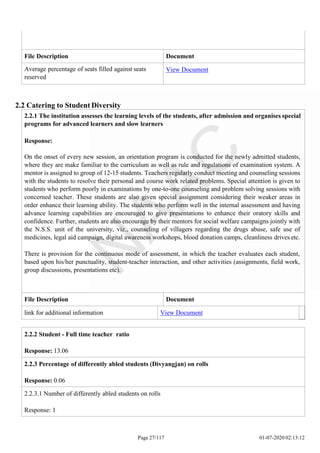
2.2.2 Student - Full time teacher ratio
Response: 13.06
2.2.3 Percentage of differently abled students (Divyangjan) on rolls
Response: 0.06
2.2.3.1 Number of differently abled students on rolls
Response: 1
Page 27/117 01-07-2020 02:13:12
File Description Document
Average percentage of seats filled against seats
reserved
View Document
2.2 Catering to Student Diversity
2.2.1 The institution assesses the learning levels of the students, after admission and organises special
programs for advanced learners and slow learners
Response:
On the onset of every new session, an orientation program is conducted for the newly admitted students,
where they are make familiar to the curriculum as well as rule and regulations of examination system. A
mentor is assigned to group of 12-15 students. Teachers regularly conduct meeting and counseling sessions
with the students to resolve their personal and course work related problems. Special attention is given to
students who perform poorly in examinations by one-to-one counseling and problem solving sessions with
concerned teacher. These students are also given special assignment considering their weaker areas in
order enhance their learning ability. The students who perform well in the internal assessment and having
advance learning capabilities are encouraged to give presentations to enhance their oratory skills and
confidence. Further, students are also encourage by their mentors for social welfare campaigns jointly with
the N.S.S. unit of the university, viz., counseling of villagers regarding the drugs abuse, safe use of
medicines, legal aid campaign, digital awareness workshops, blood donation camps, cleanliness drives etc.
There is provision for the continuous mode of assessment, in which the teacher evaluates each student,
based upon his/her punctuality, student-teacher interaction, and other activities (assignments, field work,
group discussions, presentations etc).
File Description Document
link for additional information View Document
File Description Document
List of students(differently abled) View Document
Institutional data in prescribed format View Document
Page 28/117 01-07-2020 02:13:12
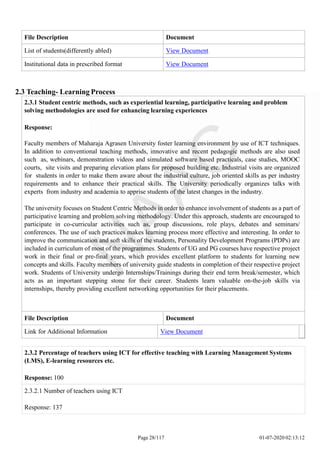
2.3 Teaching- Learning Process
2.3.1 Student centric methods, such as experiential learning, participative learning and problem
solving methodologies are used for enhancing learning experiences
Response:
Faculty members of Maharaja Agrasen University foster learning environment by use of ICT techniques.
In addition to conventional teaching methods, innovative and recent pedagogic methods are also used
such as, webinars, demonstration videos and simulated software based practicals, case studies, MOOC
courts, site visits and preparing elevation plans for proposed building etc. Industrial visits are organized
for students in order to make them aware about the industrial culture, job oriented skills as per industry
requirements and to enhance their practical skills. The University periodically organizes talks with
experts from industry and academia to apprise students of the latest changes in the industry.
The university focuses on Student Centric Methods in order to enhance involvement of students as a part of
participative learning and problem solving methodology. Under this approach, students are encouraged to
participate in co-curricular activities such as, group discussions, role plays, debates and seminars/
conferences. The use of such practices makes learning process more effective and interesting. In order to
improve the communication and soft skills of the students, Personality Development Programs (PDPs) are
included in curriculum of most of the programmes. Students of UG and PG courses have respective project
work in their final or pre-final years, which provides excellent platform to students for learning new
concepts and skills. Faculty members of university guide students in completion of their respective project
work. Students of University undergo Internships/Trainings during their end term break/semester, which
acts as an important stepping stone for their career. Students learn valuable on-the-job skills via
internships, thereby providing excellent networking opportunities for their placements.
File Description Document
Link for Additional Information View Document
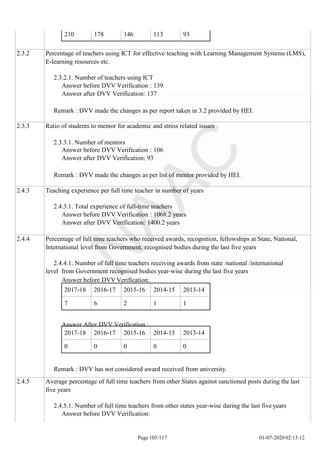
2.3.2 Percentage of teachers using ICT for effective teaching with Learning Management Systems
(LMS), E-learning resources etc.
Response: 100
2.3.2.1 Number of teachers using ICT
Response: 137
File Description Document
List of teachers (using ICT for teaching) View Document
Provide link for webpage describing the " LMS/
Academic management system"
View Document
Page 29/117 01-07-2020 02:13:12
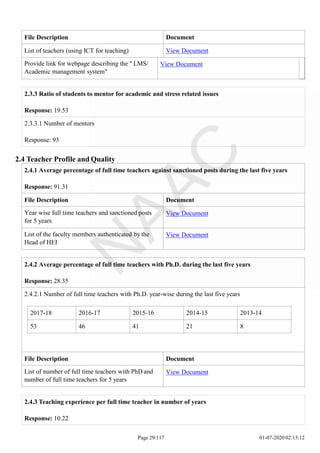
2.3.3 Ratio of students to mentor for academic and stress related issues
Response: 19.53
2.3.3.1 Number of mentors
Response: 93
2.4 Teacher Profile and Quality
2.4.1 Average percentage of full time teachers against sanctioned posts during the last five years
Response: 91.31
File Description Document
Year wise full time teachers and sanctioned posts
for 5 years
View Document
List of the faculty members authenticated by the
Head of HEI
View Document
2017-18 2016-17 2015-16 2014-15 2013-14
53 46 41 21 8
2.4.2 Average percentage of full time teachers with Ph.D. during the last five years
Response: 28.35
2.4.2.1 Number of full time teachers with Ph.D. year-wise during the last five years
File Description Document
List of number of full time teachers with PhD and
number of full time teachers for 5 years
View Document
2.4.3 Teaching experience per full time teacher in number of years
Response: 10.22
2017-18 2016-17 2015-16 2014-15 2013-14
0 0 0 0 0
Page 30/117 01-07-2020 02:13:12
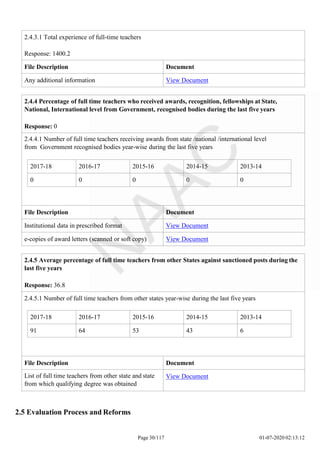
2.4.4 Percentage of full time teachers who received awards, recognition, fellowships at State,
National, International level from Government, recognised bodies during the last five years
Response: 0
2.4.4.1 Number of full time teachers receiving awards from state /national /international level
from Government recognised bodies year-wise during the last five years
File Description Document
Institutional data in prescribed format View Document
e-copies of award letters (scanned or soft copy) View Document
2017-18 2016-17 2015-16 2014-15 2013-14
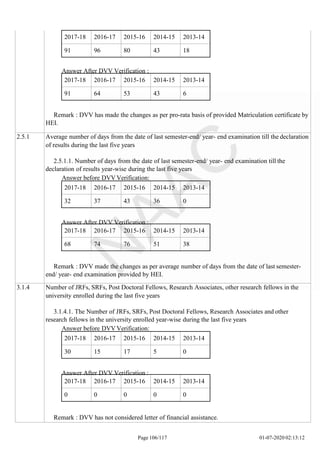
91 64 53 43 6
2.4.5 Average percentage of full time teachers from other States against sanctioned posts during the
last five years
Response: 36.8
2.4.5.1 Number of full time teachers from other states year-wise during the last five years
File Description Document
List of full time teachers from other state and state
from which qualifying degree was obtained
View Document
2.4.3.1 Total experience of full-time teachers
Response: 1400.2
File Description Document
Any additional information View Document
2.5 Evaluation Process and Reforms
2017-18 2016-17 2015-16 2014-15 2013-14
68 74 76 51 38
Page 31/117 01-07-2020 02:13:12
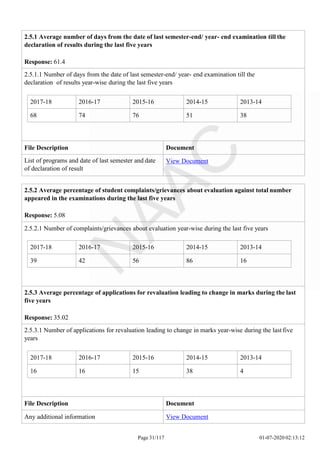
2.5.1 Average number of days from the date of last semester-end/ year- end examination till the
declaration of results during the last five years
Response: 61.4
2.5.1.1 Number of days from the date of last semester-end/ year- end examination till the
declaration of results year-wise during the last five years
File Description Document
List of programs and date of last semester and date
of declaration of result
View Document
2017-18 2016-17 2015-16 2014-15 2013-14
39 42 56 86 16
2017-18 2016-17 2015-16 2014-15 2013-14
16 16 15 38 4
2.5.2 Average percentage of student complaints/grievances about evaluation against total number
appeared in the examinations during the last five years
Response: 5.08
2.5.2.1 Number of complaints/grievances about evaluation year-wise during the last five years
2.5.3 Average percentage of applications for revaluation leading to change in marks during the last
five years
Response: 35.02
2.5.3.1 Number of applications for revaluation leading to change in marks year-wise during the last five
years
File Description Document
Any additional information View Document
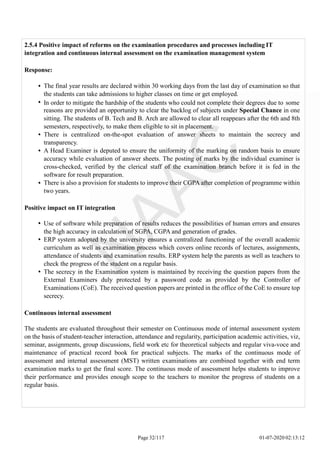
2.5.4 Positive impact of reforms on the examination procedures and processes including IT
integration and continuous internal assessment on the examination management system
Response:
The final year results are declared within 30 working days from the last day of examination so that
the students can take admissions to higher classes on time or get employed.
In order to mitigate the hardship of the students who could not complete their degrees due to some
reasons are provided an opportunity to clear the backlog of subjects under Special Chance in one
sitting. The students of B. Tech and B. Arch are allowed to clear all reappears after the 6th and 8th
semesters, respectively, to make them eligible to sit in placement.
There is centralized on-the-spot evaluation of answer sheets to maintain the secrecy and
transparency.
A Head Examiner is deputed to ensure the uniformity of the marking on random basis to ensure
accuracy while evaluation of answer sheets. The posting of marks by the individual examiner is
cross-checked, verified by the clerical staff of the examination branch before it is fed in the
software for result preparation.
There is also a provision for students to improve their CGPA after completion of programme within
two years.
Positive impact on IT integration
Use of software while preparation of results reduces the possibilities of human errors and ensures
the high accuracy in calculation of SGPA, CGPA and generation of grades.
ERP system adopted by the university ensures a centralized functioning of the overall academic
curriculum as well as examination process which covers online records of lectures, assignments,
attendance of students and examination results. ERP system help the parents as well as teachers to
check the progress of the student on a regular basis.
The secrecy in the Examination system is maintained by receiving the question papers from the
External Examiners duly protected by a password code as provided by the Controller of
Examinations (CoE). The received question papers are printed in the office of the CoE to ensure top
secrecy.
Continuous internal assessment
The students are evaluated throughout their semester on Continuous mode of internal assessment system
on the basis of student-teacher interaction, attendance and regularity, participation academic activities, viz,
seminar, assignments, group discussions, field work etc for theoretical subjects and regular viva-voce and
maintenance of practical record book for practical subjects. The marks of the continuous mode of
assessment and internal assessment (MST) written examinations are combined together with end term
examination marks to get the final score. The continuous mode of assessment helps students to improve
their performance and provides enough scope to the teachers to monitor the progress of students on a
regular basis.
Page 32/117 01-07-2020 02:13:12
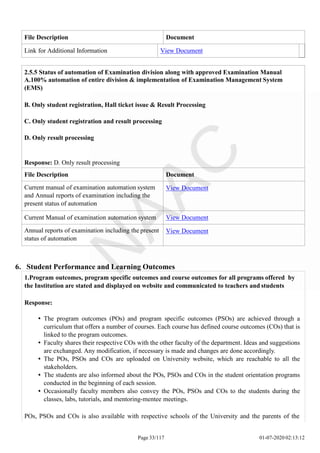
2.5.5 Status of automation of Examination division along with approved Examination Manual
A.100% automation of entire division & implementation of Examination Management System
(EMS)
B. Only student registration, Hall ticket issue & Result Processing
C. Only student registration and result processing
D. Only result processing
Response: D. Only result processing
File Description Document
Current manual of examination automation system
and Annual reports of examination including the
present status of automation
View Document
Current Manual of examination automation system View Document
Annual reports of examination including the present
status of automation
View Document
Page 33/117 01-07-2020 02:13:12
File Description Document
Link for Additional Information View Document
6. Student Performance and Learning Outcomes
1.Program outcomes, program specific outcomes and course outcomes for all programs offered by
the Institution are stated and displayed on website and communicated to teachers and students
Response:
The program outcomes (POs) and program specific outcomes (PSOs) are achieved through a
curriculum that offers a number of courses. Each course has defined course outcomes (COs) that is
linked to the program outcomes.
Faculty shares their respective COs with the other faculty of the department. Ideas and suggestions
are exchanged. Any modification, if necessary is made and changes are done accordingly.
The POs, PSOs and COs are uploaded on University website, which are reachable to all the
stakeholders.
The students are also informed about the POs, PSOs and COs in the student orientation programs
conducted in the beginning of each session.
Occasionally faculty members also convey the POs, PSOs and COs to the students during the
classes, labs, tutorials, and mentoring-mentee meetings.
POs, PSOs and COs is also available with respective schools of the University and the parents of the
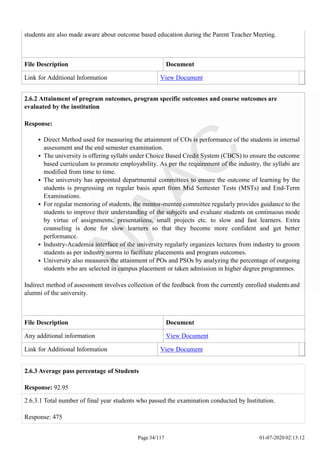
students are also made aware about outcome based education during the Parent Teacher Meeting.
File Description Document
Link for Additional Information View Document
2.6.2 Attainment of program outcomes, program specific outcomes and course outcomes are
evaluated by the institution
Response:
Direct Method used for measuring the attainment of COs is performance of the students in internal
assessment and the end semester examination.
The university is offering syllabi under Choice Based Credit System (CBCS) to ensure the outcome
based curriculum to promote employability. As per the requirement of the industry, the syllabi are
modified from time to time.
The university has appointed departmental committees to ensure the outcome of learning by the
students is progressing on regular basis apart from Mid Semester Tests (MSTs) and End-Term
Examinations.
For regular mentoring of students, the mentor-mentee committee regularly provides guidance to the
students to improve their understanding of the subjects and evaluate students on continuous mode
by virtue of assignments, presentations, small projects etc. to slow and fast learners. Extra
counseling is done for slow learners so that they become more confident and get better
performance.
Industry-Academia interface of the university regularly organizes lectures from industry to groom
students as per industry norms to facilitate placements and program outcomes.
University also measures the attainment of POs and PSOs by analyzing the percentage of outgoing
students who are selected in campus placement or taken admission in higher degree programmes.
Indirect method of assessment involves collection of the feedback from the currently enrolled studentsand
alumni of the university.
File Description Document
Any additional information View Document
Link for Additional Information View Document
Page 34/117 01-07-2020 02:13:12
2.6.3 Average pass percentage of Students
Response: 92.95
2.6.3.1 Total number of final year students who passed the examination conducted by Institution.
Response: 475
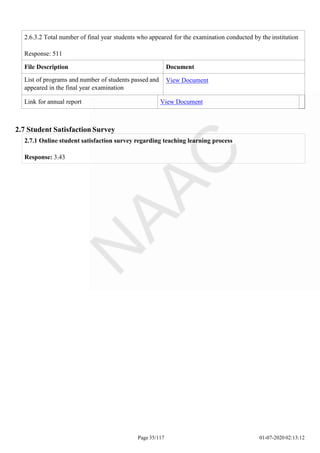
2.6.3.2 Total number of final year students who appeared for the examination conducted by the institution
Response: 511
File Description Document
List of programs and number of students passed and
appeared in the final year examination
View Document
Link for annual report View Document
Page 35/117 01-07-2020 02:13:12
2.7 Student Satisfaction Survey
2.7.1 Online student satisfaction survey regarding teaching learning process
Response: 3.43
Criterion 3 - Research, Innovations and Extension
3.1 Promotion of Research and Facilities
Page 36/117 01-07-2020 02:13:12
3.1.1 The institution has a well defined policy for promotion of research and the same is uploaded on
the institutional website
Response: Yes
File Description Document
Minutes of the Governing Council/ Syndicate/Board
of Management related to research promotion policy
adoption
View Document
URL of Policy document on promotion of
research uploaded on website
View Document
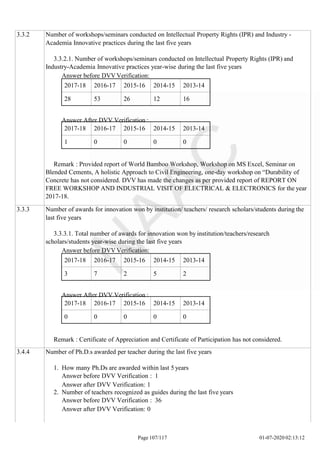
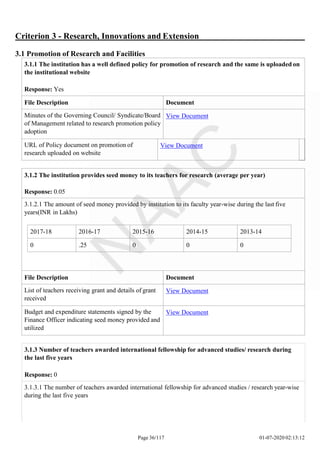
2017-18 2016-17 2015-16 2014-15 2013-14
0 .25 0 0 0
3.1.2 The institution provides seed money to its teachers for research (average per year)
Response: 0.05
3.1.2.1 The amount of seed money provided by institution to its faculty year-wise during the last five
years(INR in Lakhs)
File Description Document
List of teachers receiving grant and details of grant
received
View Document
Budget and expenditure statements signed by the
Finance Officer indicating seed money provided and
utilized
View Document
3.1.3 Number of teachers awarded international fellowship for advanced studies/ research during
the last five years
Response: 0
3.1.3.1 The number of teachers awarded international fellowship for advanced studies / research year-wise
during the last five years
2017-18 2016-17 2015-16 2014-15 2013-14
0 0 0 0 0
Page 37/117 01-07-2020 02:13:12
File Description Document
List of teachers and their international fellowship
details
View Document
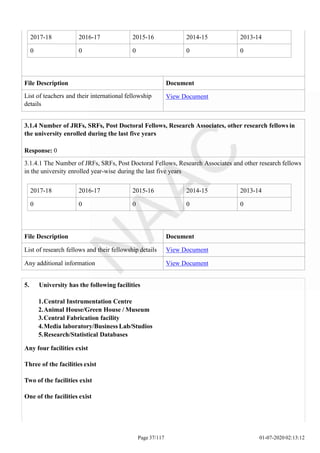
2017-18 2016-17 2015-16 2014-15 2013-14
0 0 0 0 0
3.1.4 Number of JRFs, SRFs, Post Doctoral Fellows, Research Associates, other research fellows in
the university enrolled during the last five years
Response: 0
3.1.4.1 The Number of JRFs, SRFs, Post Doctoral Fellows, Research Associates and other research fellows
in the university enrolled year-wise during the last five years
File Description Document
List of research fellows and their fellowship details View Document
Any additional information View Document
5. University has the following facilities
1.Central Instrumentation Centre
2.Animal House/Green House / Museum
3.Central Fabrication facility
4.Media laboratory/Business Lab/Studios
5.Research/Statistical Databases
Any four facilities exist
Three of the facilities exist
Two of the facilities exist
One of the facilities exist
3.1.6 Percentage of departments with UGC-SAP, CAS, DST-FIST, DBT, ICSSR and other similar
recognition by government agency
Response: 83.33
3.1.6.1 The Number of departments with UGC-SAP, CAS, DST-FIST ,DBT,ICSSR and other similar
recognition by government agency
Response: 5
File Description Document
List of departments and award details View Document
e-version of departmental recognition award letters View Document
Page 38/117 01-07-2020 02:13:12
Response: Any four facilities exist
File Description Document
List of facilities provided by the university and their
year of establishment
View Document
Link to videos and photographs geotagged View Document
3.2 Resource Mobilization for Research
2017-18 2016-17 2015-16 2014-15 2013-14
0 0 0 0 0
3.2.1 Grants for research projects sponsored by the non-government sources such as industry,
corporate houses, international bodies, endowments,Chairs in the institution during the last five
years (INR in Lakhs)
Response: 0
3.2.1.1 Total Grants for research projects sponsored by the non-government sources such as industry,
corporate houses, international bodies, endowments, Chairs in the institution year-wise during the last five
years(INR in Lakhs)
File Description Document
List of project and grant details View Document
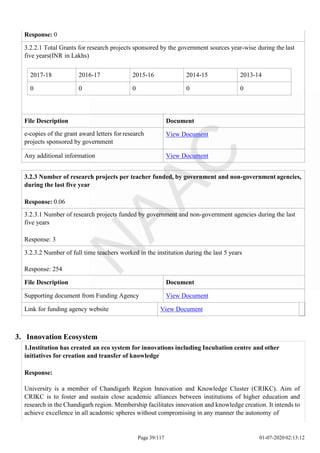
3.2.2 Grants for research projects sponsored by the government sources during the last five years
2017-18 2016-17 2015-16 2014-15 2013-14
0 0 0 0 0
Page 39/117 01-07-2020 02:13:12
Response: 0
3.2.2.1 Total Grants for research projects sponsored by the government sources year-wise during the last
five years(INR in Lakhs)
File Description Document
e-copies of the grant award letters for research
projects sponsored by government
View Document
Any additional information View Document
3.2.3 Number of research projects per teacher funded, by government and non-government agencies,
during the last five year
Response: 0.06
3.2.3.1 Number of research projects funded by government and non-government agencies during the last
five years
Response: 3
3.2.3.2 Number of full time teachers worked in the institution during the last 5 years
Response: 254
File Description Document
Supporting document from Funding Agency View Document
Link for funding agency website View Document
3. Innovation Ecosystem
1.Institution has created an eco system for innovations including Incubation centre and other
initiatives for creation and transfer of knowledge
Response:
University is a member of Chandigarh Region Innovation and Knowledge Cluster (CRIKC). Aim of
CRIKC is to foster and sustain close academic alliances between institutions of higher education and
research in the Chandigarh region. Membership facilitates innovation and knowledge creation. It intends to
achieve excellence in all academic spheres without compromising in any manner the autonomy of
participating institutions. It further encourages pooling of research facilities of participating institutions.
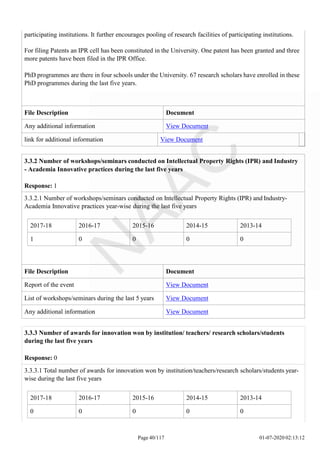
For filing Patents an IPR cell has been constituted in the University. One patent has been granted and three
more patents have been filed in the IPR Office.
PhD programmes are there in four schools under the University. 67 research scholars have enrolled in these
PhD programmes during the last five years.
File Description Document
Any additional information View Document
link for additional information View Document
Page 40/117 01-07-2020 02:13:12
2017-18 2016-17 2015-16 2014-15 2013-14
1 0 0 0 0
3.3.2 Number of workshops/seminars conducted on Intellectual Property Rights (IPR) and Industry
- Academia Innovative practices during the last five years
Response: 1
3.3.2.1 Number of workshops/seminars conducted on Intellectual Property Rights (IPR) and Industry-
Academia Innovative practices year-wise during the last five years
File Description Document
Report of the event View Document
List of workshops/seminars during the last 5 years View Document
Any additional information View Document
3.3.3 Number of awards for innovation won by institution/ teachers/ research scholars/students
during the last five years
Response: 0
3.3.3.1 Total number of awards for innovation won by institution/teachers/research scholars/students year-
wise during the last five years
2017-18 2016-17 2015-16 2014-15 2013-14
0 0 0 0 0
3.4.2 The institution provides incentives to teachers who receive state, national and international
recognition/awards
Response: No
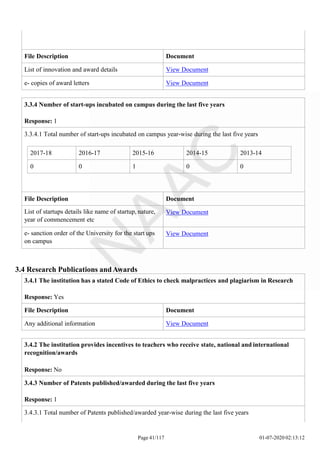
3.4.3 Number of Patents published/awarded during the last five years
Response: 1
3.4.3.1 Total number of Patents published/awarded year-wise during the last five years
Page 41/117 01-07-2020 02:13:12
2017-18 2016-17 2015-16 2014-15 2013-14
0 0 1 0 0
3.3.4 Number of start-ups incubated on campus during the last five years
Response: 1
3.3.4.1 Total number of start-ups incubated on campus year-wise during the last five years
File Description Document
List of startups details like name of startup, nature,
year of commencement etc
View Document
e- sanction order of the University for the start ups
on campus
View Document
File Description Document
List of innovation and award details View Document
e- copies of award letters View Document
3.4 Research Publications andAwards
3.4.1 The institution has a stated Code of Ethics to check malpractices and plagiarism in Research
Response: Yes
File Description Document
Any additional information View Document
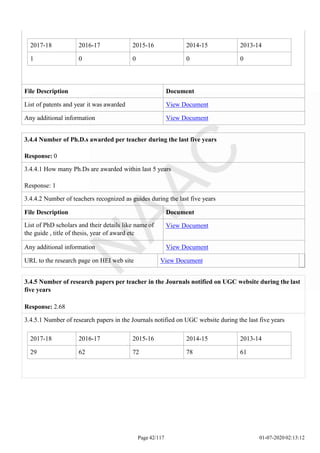
2017-18 2016-17 2015-16 2014-15 2013-14
1 0 0 0 0
Page 42/117 01-07-2020 02:13:12
File Description Document
List of patents and year it was awarded View Document
Any additional information View Document
3.4.4 Number of Ph.D.s awarded per teacher during the last five years
Response: 0
3.4.4.1 How many Ph.Ds are awarded within last 5 years
Response: 1
3.4.4.2 Number of teachers recognized as guides during the last five years
File Description Document
List of PhD scholars and their details like name of
the guide , title of thesis, year of award etc
View Document
Any additional information View Document
URL to the research page on HEI web site View Document
3.4.5 Number of research papers per teacher in the Journals notified on UGC website during the last
five years
Response: 2.68
3.4.5.1 Number of research papers in the Journals notified on UGC website during the last five years
2017-18 2016-17 2015-16 2014-15 2013-14
29 62 72 78 61
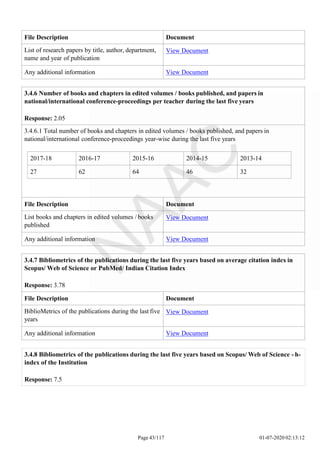
2017-18 2016-17 2015-16 2014-15 2013-14
27 62 64 46 32
Page 43/117 01-07-2020 02:13:12
3.4.6 Number of books and chapters in edited volumes / books published, and papers in
national/international conference-proceedings per teacher during the last five years
Response: 2.05
3.4.6.1 Total number of books and chapters in edited volumes / books published, and papers in
national/international conference-proceedings year-wise during the last five years
File Description Document
List books and chapters in edited volumes / books
published
View Document
Any additional information View Document
3.4.7 Bibliometrics of the publications during the last five years based on average citation index in
Scopus/ Web of Science or PubMed/ Indian Citation Index
Response: 3.78
File Description Document
BiblioMetrics of the publications during the last five
years
View Document
Any additional information View Document
File Description Document
List of research papers by title, author, department,
name and year of publication
View Document
Any additional information View Document
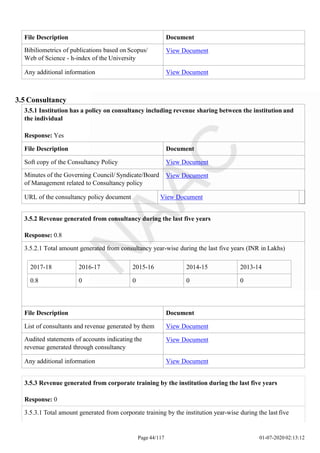
3.4.8 Bibliometrics of the publications during the last five years based on Scopus/ Web of Science - h-
index of the Institution
Response: 7.5
File Description Document
Bibiliometrics of publications based on Scopus/
Web of Science - h-index of the University
View Document
Any additional information View Document
Page 44/117 01-07-2020 02:13:12
3.5 Consultancy
3.5.1 Institution has a policy on consultancy including revenue sharing between the institution and
the individual
Response: Yes
File Description Document
Soft copy of the Consultancy Policy View Document
Minutes of the Governing Council/ Syndicate/Board
of Management related to Consultancy policy
View Document
URL of the consultancy policy document View Document
2017-18 2016-17 2015-16 2014-15 2013-14
0.8 0 0 0 0
3.5.2 Revenue generated from consultancy during the last five years
Response: 0.8
3.5.2.1 Total amount generated from consultancy year-wise during the last five years (INR in Lakhs)
File Description Document
List of consultants and revenue generated by them View Document
Audited statements of accounts indicating the
revenue generated through consultancy
View Document
Any additional information View Document
3.5.3 Revenue generated from corporate training by the institution during the last five years
Response: 0
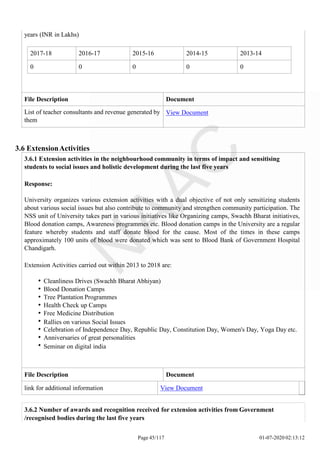
3.5.3.1 Total amount generated from corporate training by the institution year-wise during the last five
2017-18 2016-17 2015-16 2014-15 2013-14
0 0 0 0 0
years (INR in Lakhs)
File Description Document
List of teacher consultants and revenue generated by
them
View Document
3.6 ExtensionActivities
3.6.1 Extension activities in the neighbourhood community in terms of impact and sensitising
students to social issues and holistic development during the last five years
Response:
University organizes various extension activities with a dual objective of not only sensitizing students
about various social issues but also contribute to community and strengthen community participation. The
NSS unit of University takes part in various initiatives like Organizing camps, Swachh Bharat initiatives,
Blood donation camps, Awareness programmes etc. Blood donation camps in the University are a regular
feature whereby students and staff donate blood for the cause. Most of the times in these camps
approximately 100 units of blood were donated which was sent to Blood Bank of Government Hospital
Chandigarh.
Extension Activities carried out within 2013 to 2018 are:
Cleanliness Drives (Swachh Bharat Abhiyan)
Blood Donation Camps
Tree Plantation Programmes
Health Check up Camps
Free Medicine Distribution
Rallies on various Social Issues
Celebration of Independence Day, Republic Day, Constitution Day, Women's Day, Yoga Day etc.
Anniversaries of great personalities
Seminar on digital india
File Description Document
link for additional information View Document
Page 45/117 01-07-2020 02:13:12
3.6.2 Number of awards and recognition received for extension activities from Government
/recognised bodies during the last five years
2017-18 2016-17 2015-16 2014-15 2013-14
0 0 0 0 0
Page 46/117 01-07-2020 02:13:12
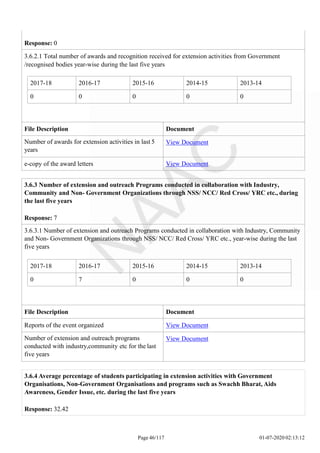
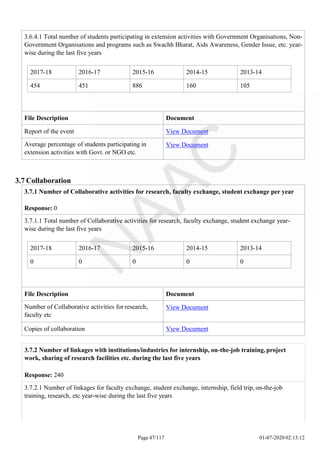
Response: 0
3.6.2.1 Total number of awards and recognition received for extension activities from Government
/recognised bodies year-wise during the last five years
File Description Document
Number of awards for extension activities in last 5
years
View Document
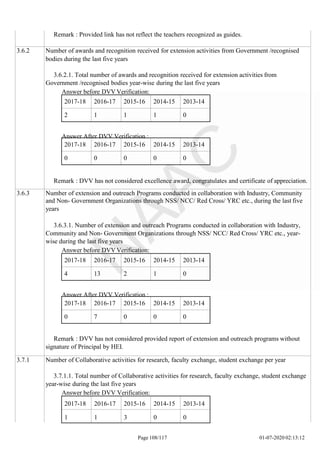
e-copy of the award letters View Document
2017-18 2016-17 2015-16 2014-15 2013-14
0 7 0 0 0
3.6.3 Number of extension and outreach Programs conducted in collaboration with Industry,
Community and Non- Government Organizations through NSS/ NCC/ Red Cross/ YRC etc., during
the last five years
Response: 7
3.6.3.1 Number of extension and outreach Programs conducted in collaboration with Industry, Community
and Non- Government Organizations through NSS/ NCC/ Red Cross/ YRC etc., year-wise during the last
five years
File Description Document
Reports of the event organized View Document
Number of extension and outreach programs
conducted with industry,community etc for the last
five years
View Document
3.6.4 Average percentage of students participating in extension activities with Government
Organisations, Non-Government Organisations and programs such as Swachh Bharat, Aids
Awareness, Gender Issue, etc. during the last five years
Response: 32.42
2017-18 2016-17 2015-16 2014-15 2013-14
454 451 886 160 105
Page 47/117 01-07-2020 02:13:12
3.6.4.1 Total number of students participating in extension activities with Government Organisations, Non-
Government Organisations and programs such as Swachh Bharat, Aids Awareness, Gender Issue, etc. year-
wise during the last five years
File Description Document
Report of the event View Document
Average percentage of students participating in
extension activities with Govt. or NGO etc.
View Document
3.7 Collaboration
2017-18 2016-17 2015-16 2014-15 2013-14
0 0 0 0 0
3.7.1 Number of Collaborative activities for research, faculty exchange, student exchange per year
Response: 0
3.7.1.1 Total number of Collaborative activities for research, faculty exchange, student exchange year-
wise during the last five years
File Description Document
Number of Collaborative activities for research,
faculty etc
View Document
Copies of collaboration View Document
3.7.2 Number of linkages with institutions/industries for internship, on-the-job training, project
work, sharing of research facilities etc. during the last five years
Response: 240
3.7.2.1 Number of linkages for faculty exchange, student exchange, internship, field trip, on-the-job
training, research, etc year-wise during the last five years
2017-18 2016-17 2015-16 2014-15 2013-14
130 60 37 13 0
Page 48/117 01-07-2020 02:13:12
File Description Document
e-copies of linkage related Document View Document
Details of linkages with institutions/industries for
internship
View Document
2017-18 2016-17 2015-16 2014-15 2013-14
5 4 0 1 0
3.7.3 Number of functional MoUs with institutions of National/ International importance, Other
Institutions, Industries, Corporate houses etc., during the last five years (only functional MoUs with
ongoing activities to be considered)
Response: 10
3.7.3.1 Number of functional MoUs with institutions of national, international importance, other
universities, industries, corporate houses etc. year-wise during the last five years (only functional MoUs
with ongoing activities to be considered)
File Description Document
e-copies of the MoUs with institution/ industry/
corporate house
View Document
Details of functional MoUs with institutions of
national, international importance,other universities
etc during the last five years
View Document
Criterion 4 - Infrastructure and Learning Resources
1. Physical Facilities
1.The institution has adequate facilities for teaching - learning. viz., classrooms, laboratories,
computing equipment, etc
Response:
The University has excellent infrastructural facilities/learning resources as per the curriculum
requirements and norms of statutory/regulatory bodies. The University campus consists of six schools.
Every school is equipped with its own high-tech computing resources internet and Wi-Fi connectivity.
The University has fourair-conditioned Seminar Halls which are fully equipped with computers,
projector screens microphones and Wi-Fi internet connectivity. Where seminars, ICT workshops and
special lectures are conducted
All schools of the University have well-furnished adequate number of air conditioned class rooms and
tutorial rooms for effective delivery of lectures and tutorials.
All laboratories of the University are well equipped with high-tech equipments and latest specialized
software as per AICTE and UGC norms, to perform the curriculum-oriented practical’s and minor/major
projects. In addition to regular curriculum students are motivated to carry out research activities as per
their area of interest.
The University has well equipped English Language Lab with LCD Projector facility, computers, and
relevant software installed on 25 computers. These indeed make students to read, listen and speak English
in a better way, which help them to prepare for group discussion, debates and interviews.
To facilitate the learning University has a Central Library which is equipped with all kinds of text books,
references books, magazines and reputed National and International Journals. In addition to this some of
the schools of University have their independent departmental libraries, where the seminar reports, thesis,
reference books and text books related to various subjects are kept for the benefits of faculty and students.
The University has a dedicated team for the maintenance of computer systems, software and network
related issues. The University has an ERP facility which is accessible any time any place, to automate the
attendance system, and provides a proper communication between students, faculty and University
Administration.
The University consists of two boys hostel with a total capacity of 511 boys and a girl’s hostel with a total
capacity of 199 girls. The University is also equipped with 2 lifts, one in the administration block and other
in the C block for the facilitation of staff and students. Apart from this the university also consists of 2
ramps expanded in total area of 843 square meter and 3 wheelchairs for the convenience of physically
handicapped students.
At the end of every academic session the members of the University management, Vice Chancellor,
Directors and the Head of the department assess the need of infrastructure for availing the sufficient
facilities for teaching in the forthcoming session.
Page 49/117 01-07-2020 02:13:12
File Description Document
Any additional information View Document
Link for Additional Information View Document
4.1.2 The institution has adequate facilities for sports, games (indoor, outdoor),gymnasium, yoga
centre etc., and cultural activities
Response:
The University encompasses a well-maintained campus. University Management believes in the all-round
holistic development of students. Sports are an integral part of the curriculum. Multiple sports facilities like
basketball/volleyball/ badminton/table tennis/ carom/chess etc are provided to the students within the
campus. The university is committed to create a balanced atmosphere of academic, cultural and sports
activities for the overall personality development of students. Various sports competitions such as Inter
departmental, Inter University, etc help in developing team spirit in students. Their interpersonal
relationship is enhanced in a very healthy manner. We have spacious and well-equipped Sports rooms,
where students/teachers can play In-door games like table tennis, chess, caroms etc. Well qualified sports
officer is appointed to train students and to organize various sports competitions in the University.
Various teams are formed to take part in university, state, inter university and national level
competitions.
Sports events are conducted at the interdepartmental level in an academic year and the winners are
awarded. The outdoor games such as badminton, volley ball, cricket, kabaddi, etc., are practiced
and played by the students.
Cultural Activities:
Students are encouraged to participate in the cultural events held in the University like Technical
festivals, Fresher’s, Annual Sports meet, Annual Festivals, Annual Day, Farewells etc. to exhibit
and hone talents. University is having an auditorium and amphitheatre with a capacity of 2000.
Students are encouraged to participate in Inter- School level competitions like dances, skits,
mimicries, etc.
Different schools are having Clubs/Committees for overall personality development of students
namely: Literacy & Cultural Committee, Sports Committee etc. have been formed, which plays an
excellent role in over all development of the students.
File Description Document
Any additional information View Document
link for additional information View Document
Page 50/117 01-07-2020 02:13:12
4.1.3 Percentage of classrooms and seminar halls with ICT - enabled facilities such as smart class,
LMS, etc
Response: 30.89
4.1.3.1 Number of classrooms and seminar halls with ICT facilities
Response: 38
File Description Document
Number of classrooms and seminar halls with ICT
enabled facilities
View Document
Any additional information View Document
Link for additional information which is optional View Document
Page 51/117 01-07-2020 02:13:12
2017-18 2016-17 2015-16 2014-15 2013-14
27.79 142.23 124.19 211.79 8549
4.1.4 Average percentage of budget allocation, excluding salary for infrastructure augmentation
during the last five years.
Response: 23.05
4.1.4.1 Budget allocation for infrastructure augmentation, excluding salary year-wise during the last
five years (INR in Lakhs)
File Description Document
Audited utilization statements View Document
2. Library as a Learning Resource
1. Library is automated using Integrated Library Management System (ILMS)
Response:
The Libraries at Maharaja Agarsen University have more like integrated knowledge resource centers’ that
are stacked with 19,835 books till July 2018, Inspite of these we have donated and specimen books,
periodicals, national and international journal, Covering all aspects of academic studies and research
materials. MAU libraries have 22 Magazine and 16 news papers.
Book Details:
Management = 2722
Applied Science = 1914
Pharmacy = 2517
Law = 2028
Forensic Science = 118
Hotel management & Tourism = 1131
Engineering = 7799
Architecture = 1438
Vivekananda = 168
Maharaja Agrasen University is also member of DELNET since 2014. DELNET offers 2390 full text e-
journals, e-books and articles for many other steams. All MAU students are registered on NDL (National
Digital Library) NDL having 10 Million items have been authored by 3 lakh authors and all items are
available in more than 70 languages. NDL is an initiative of Ministry of human resource development
(MHRD). We are also member of world e- library and Bhartvani. We have large collection of CDs number
about 450. MAU library timing is 9:00 to 5:00 O’clock and during examination days we extend this timing
as per the demand of library users. The library staff is always on the alert so that available working
materials in the collection are not over looked.
Registers are provided to maintain daily usage of library by teachers and students. Feedback from users is
used for enrichment of the special collection.
MAU libraries are automated using open source software “KOHA” Description
Description of ILMS (Integrated learning management system)
• Name of ILMS Software – KOHA
• Nature of Automation - fully
• Version -18.05.08.000
• OS Version – Linux Koha Server 4.15.0-47
• Year of automation-2013-2014
Library building has provision for both individual and group studies making room for interaction,
discussion and quiet studies. Adequate space is provided for browsing and quiet reading. MAU library
have also Separate reading area for research scholars and faculty member for quiet studies. Library has
open Access facility for student, faculty member and staff. All buildings of different libraries have fire
detection alarms and OPAC/web OPAC is main tool to provide access to the library collection. MAU
library has his own OPAC page from where user can get any information about library books. IP address of
that page is following 192.168.1.17 accessible in university campus.
Other facilities are given below
• Free Wi-Fi, internet access, free downloads are also provided by
Page 52/117 01-07-2020 02:13:12
MAU libraries
• AC facility has been provided in all libraries.
• Organization of books exhibition/Displays of new books
• Book reservation facility is also available
The Library makes all efforts to acquire use full books including rare books, reports, thesis, other
knowledge resources to enrich itsCollection.Like other holdings of library, the collection of rare books,
novels, fiction also support to enhance the teaching learning process.
File Description Document
link for additional information View Document
Page 53/117 01-07-2020 02:13:12
4.2.2 Collection of rare books, manuscripts, special reports or any other knowledge resource for
library enrichment
Response:
The University has the practice of collecting and maintaining rare books, manuscripts, special reports or
any other knowledge resources for the benefit of students and faculty which helps students and faculty in
knowledge enhancement, research and exploring new things apart from the standard books.
Details of Collection of some of the rare books are as follows:
Name of the book Name of the publisher Name of the author No. Of copie s Y
p
2016 Mount batten Macmillan Vincent, Trevor 1 1
2017 The forbidden city News week (New York) Roderick MacFarquhar 1 1
2016 Enchanted world magical
justice
Time life books Inc.
(Chicago)
Constable, George 1 1
2017 Power and the glory
(century of motor racing)
BBC books (London) Rendall, Ivan 1 1
2016 World of still water Readers digest (New York)Gibbons, Robert 1 1
2017 People and places in search
of the far east
Reader’s digest (New
York)
Walker, Richard 1 1
2017 What works on wall street Mc Graw hill (New York) Shaughnessy, James 1 1
2016 Bollywood: behind the
scenes
Marshall (Singapore) Bradley, Nicholas 1 2
2014 University Hand book 2014,
33rd Edition
Association of Indian
Universities
Members AIU, Vol 1. A-
K, Vol 2. L-Z
2 2
2017 Narender Modi: A
Charismatic and Visionary
Statesman
UK Publisher &
Distribution Ltd, London
Dr. Adish C Aggarwala,
Ms. Sarah J. Marchington
1 2
2018 University Hand book 2018,
34th Edition
Association of Indian
Universities
Members AIU, Vol 1. A-L,
Vol 2. M-Z
2 2
Print Details:
Books Back Volumes Theses/ Dissertations/Training Reports/Projec ts
Training Reports
1. 1. 1. 1. 1.
File Description Document
link for additional information View Document
Page 54/117 01-07-2020 02:13:12
4.2.3 Does the institution have the following
1.e-journals
2.e-ShodhSindhu
3.Shodhganga Membership
4.e-books
5.Databases
Any 4 of the above
Any 3 of the above
4.2.5 Availability of remote access to e-resources of the library
Response: Yes
File Description Document
Any additional information View Document
Page 55/117 01-07-2020 02:13:12
Any 2 of the above
Any 1 of the above
Response: Any 3 of the above
File Description Document
Details of subscriptions like e-journals,e-
ShodhSindhu,Shodhganga Membership etc
View Document
Any additional information View Document
2017-18 2016-17 2015-16 2014-15 2013-14
8.44 11.78 17.92 26.36 4.78
4.2.4 Average annual expenditure for purchase of books and journals during the last five years
(INR in Lakhs)
Response: 13.86
4.2.4.1 Annual expenditure for purchase of books and journals year-wise during the last five years (INR
in Lakhs)
File Description Document
Details of annual expenditure for purchase of books
and journals during the last five years
View Document
Audited statements of accounts View Document
4.2.6 Percentage per day usage of library by teachers and students
Response: 4.92
4.2.6.1 Number of teachers and students using library per day over last one year
7. E-content is developed by teachers :
1.For e-PG-Pathshala
2.For CEC (Under Graduate)
3.For SWAYAM
4.For other MOOCs platform
5.For NPTEL/NMEICT/any other Government Initiatives
6.For Institutional LMS
Any 5 of the above
Any 4 of the above
Any 3 of the above
Any 2 of the above
Response: Any 2 of the above
File Description Document
Details of e-content developed by teachers for e-PG-
Pathshala, CEC (UG)
View Document
Give links or upload document of e-content
developed
View Document
Page 56/117 01-07-2020 02:13:12
Response: 96
File Description Document
Any additional information View Document
3. IT Infrastructure
1. Institution frequently updates its IT facilities including Wi-Fi
Response:
The University adopts policies and strategies for adequate technology deployment and maintenance. The
ICT facilities and other learning resources are adequately available in the institution for academic and
administrative purposes. The staff and students have access to technology and information retrieval on
current and relevant issues. The University deploys and employs ICTs for teaching-learning process.
The University continuously keeps upgrading the internet bandwidth and other related equipments. As the
teaching-learning process require the frequent usage of online resources like MOOCS/SPOKEN
TUTUORAL/NPTEL/Webinars etc.
The University keeps upgrading the software packages and also purchases software’s currently being used
in the industry to make the students industry ready. The University continuously upgrades multimedia
facilities like audio-visual equipment and also having Webinar center which facilitates the video
conference for effective learning process. In addition to this the departments of the institution are equipped
with latest projectors for effective teaching through video lectures. For better visualization of the subject
topics, the faculty is encouraged to use the ICT facilities. Also, the students are encouraged to use ICT
facilities in learning process. The University class rooms are equipped with overhead projectors, which
makes the teaching learning process more effective and livelier.
File Description Document
link for additional information View Document
Page 57/117 01-07-2020 02:13:12
4.3.2 Student - Computer ratio
Response: 4.27
File Description Document
Any additional information View Document
4.3.3 Available bandwidth of internet connection in the Institution (Lease line)
?1 GBPS
500 MBPS - 1 GBPS
50 MBPS-250 MBPS
250 MBPS-500 MBPS
Response: 50 MBPS-250 MBPS
File Description Document
Any additional information View Document
4.3.4 Facilities for e-content development such as Media Centre, Recording facility, Lecture
Capturing System (LCS)
Response: Yes
File Description Document
Facilities for e-content development such as Media
Centre, Recording facility,LCS
View Document
Any additional information View Document
Link to photographs View Document
Page 58/117 01-07-2020 02:13:12
4.4 Maintenance of Campus Infrastructure
2017-18 2016-17 2015-16 2014-15 2013-14
600.14 830.89 755.17 653.30 449.37
4.4.1 Average Expenditure incurred on maintenance of physical facilities and academic support
facilities excluding salary component, as a percentage during the last five years
Response: 33.39
4.4.1.1 Expenditure incurred on maintenance of physical facilities and academic support facilities
excluding salary component year-wise during the last five years (INR in Lakhs)
File Description Document
Details about assigned budget and expenditure on
physical facilities and academic facilities
View Document
Audited statements of accounts. View Document
4.4.2 There are established systems and procedures for maintaining and utilizing physical, academic
and support facilities - laboratory, library, sports complex, computers, classrooms etc.
Response:
Having adequate infrastructure is not enough for effective institutional functioning, but regular
maintenance and periodic replenishment of infrastructure is essential. It is necessary that the institution
must have the sufficient resources allocated for regular upkeep of the infrastructure and there are effective
mechanisms for the upkeep of the infrastructure facilities and promotes the optimum use of the same.
The University has the structured system for creation and maintaining of infrastructure to facilitate
effective teaching and learning. The University has the policy of replacing or upgrading the existing
equipment’s/systems to meet the changes in the syllabus made by the university from time to time. The
University has an estate officer and other supporting staff to look after the maintenance of infrastructure
like buildings, classrooms, laboratories, hostels etc.The University has a sewerage treatment plant, where
the treated water could be used for irrigation purposes. Many initiatives have been undertaken to improve
the physical ambience in the University. There has been tree plantation drives in the University to enhance
its green cover. University has its own committees to ensure the proper look after the infrastructure. Those
are as follows:
1.Technical committee: Roles & Responsibilities of technical committee are as follows:
Planning and conduction of technical lectures & seminars.
Conduction of workshop and conferences.
Technical committee will advise on technical aspects of policy development and producing or
advising on technical guidance.
Technical committee will work to strengthen academic research.
It will provide guidance, advise & responses on technical matters in accordance with theuniversity
charter.
1.Transport committee: A committee has also been constituted for the day to day maintenance of
the University vehicles.
Functions & Procedure of the committee:The full-fledged Transport committee functions in University
with 18 buses to provide transport facility to students and staff from various places. This is a boon for the
day scholars and hostlers coming from different localities as they can reach the campus in time.
Maintenance of the buses: The following are the functions of the committee:
Proper upkeep and maintenance of the buildings.
Maintenance of the lawns and surroundings.
Carrying out minor repairs of furniture, electrical and sanitary fittings.
Maintenance of the roads, water tanks and other services in the campus.
Obtaining necessary clearance certificates, insurance, permits etc. for the University vehicles from
RTA.
Routine checking of the condition of the vehicles.
Appointment of well trained and experienced drivers.
Ensuring safety requirements like operation of speed governors, fire extinguishers etc.
1.Maintenance Committee: A committee has also been constituted for other day to day
Maintenance.
Functions & Procedure of the committee:
Maintenance of Diesel Generators. Maintenance of UPS systems and its batteries.
Maintenance of Building and equipment earthing.
Measurement of earth resistance at regular intervals, ensuring the proper earth connection for
various equipments in the labs and classrooms.
The members will check the working condition of all the equipment at the end of each academic
year and report any deficiencies found.
Sweepers and a supervisor are also regularly allotted to every area of the university, who looks after
the hygiene of the college with respect to cleaning of floors, corridors, classrooms, toilets etc.
The University is a HT consumer of H.P. Power Transmission Corporation Ltd. with dedicated 11
Page 59/117 01-07-2020 02:13:12
KV feeder line and has the connectivity through an exclusive 1000 KVA transformer to sustain the
voltage fluctuations. The two generators (125 KVA & 63 KVA) available in the University help in
continuous power supply without any hindrance. The computer systems and other sensitive
equipment are supported with twelve UPS and fifty Off-Line UPS systems so that power failure
should not cause any damage. University has trained staff for maintenance of UPS. Earthing pits
are also regularly checked and maintained as per the norms. All precautions are taken to protect the
precision equipment by providing voltage stabilizers and individual MCB’s. The University
ensures the timely servicing of RO purifiers, so that clean drinking water is available to students
round the clock.
University Security is looked after by a trained staff under the supervision of Chief Security Officer
and controlled by Security Officer in three shifts round the clock. Security guards are on duty at the
University main gate, parking areas, and at all academic blocks and Hostels etc.
54 Fire Extinguishers are placed at various locations of University for Emergency and entire
buildings of the University campus are fitted with hydrant system.
File Description Document
Any additional information View Document
link for additional information View Document
Page 60/117 01-07-2020 02:13:12
Criterion 5 - Student Support and Progression
5.1 Student Support
Page 61/117 01-07-2020 02:13:12
2017-18 2016-17 2015-16 2014-15 2013-14
8 9 5 4 3
5.1.1 Average percentage of students benefited by scholarships and freeships provided by the
Government during the last five years
Response: 0.5
5.1.1.1 Number of students benefited by scholarships and freeships provided by the Government year-wise
during the last five years
File Description Document
Upload self attested letter with the list of students
sanctioned scholarships
View Document
Average percentage of students benefited by
scholarships and freeships provided by the
Government during the last five years
View Document
2017-18 2016-17 2015-16 2014-15 2013-14
0 0 0 0 0
5.1.2 Average percentage of students benefited by scholarships, freeships, etc. provided by the
institution besides government schemes during the last five years
Response: 0
5.1.2.1 Total number of students benefited by scholarships, freeships, etc provided by the institution
besides government schemes year-wise during the last five years
File Description Document
Any additional information View Document
3. Number of capability enhancement and development schemes –
1.Guidance for competitive examinations
2.Career Counselling
3.Soft skill development
4.Remedial coaching
5.Language lab
6.Bridge courses
7.Yoga and Meditation
8.Personal Counselling
7 or more of the above
Any 6 of the above
Any 5 of the above
Any 4 of the above
Response: 7 or more of the above
File Description Document
Details of capability enhancement and development
schemes
View Document
Link to Institutional website View Document
Page 62/117 01-07-2020 02:13:12
2017-18 2016-17 2015-16 2014-15 2013-14
0 0 0 0 0
5.1.4 Average percentage of students benefited by guidance for competitive examinations and career
counselling offered by the institution during the last five years
Response: 0
5.1.4.1 Number of students benefited by guidance for competitive examinations and career counselling
offered by the institution year-wise during the last five years
File Description Document
Number of students benefited by guidance for
competitive examinations and career counselling
during the last five years
View Document
Any additional information View Document
5.1.5 The institution has an active international students cell to cater to the requirements of foreign
students
Response:
Maharaja Agrasen University has established International Student Cell (MAU-ISC) which was constituted
through a resolution passed in the meeting of Board of Management which was held on 2nd Nov. 2017.
The international cell in the university was established with a motive to provide international standards
academic services to the foreign students who would be interested to join the university. All the processes
that relate to the international collaborations for joint-academic programs; internships; semester exchange
program; summer and winter schools shall be under the preview of MAU-ISC. The aim of the MAU-ISC is
as follow:
To offer world class learning and research facilities.
To offer foreign students an opportunity to pursue ‘quality’ education at a nominal cost.
To provide a healthy atmosphere to international students in order to hone their skills.
Keeping it in view with the aim, the University is building an 'exclusive' International Students Hostel with
facilities of global standards. The facilities that will be made available to the international students are as
under:
The MAU-ISC shall provide guidance to aspirants seeking assistance for student exchange
programme, Indian scholarships, government schemes related to VISA and other events of concern
to the international students.
This cell will help the international students in getting Residential Permit.
Mentoring and staff support will be extended to all international students to mix up in the university
environment and broaden their understanding and knowledge about university policies, university
officials, faculty, support staff, students and the management.
File Description Document
Link for Additional Information View Document
Page 63/117 01-07-2020 02:13:12
5.1.6 The institution has a transparent mechanism for timely redressal of student grievances
including sexual harassment and ragging cases
Response: Yes
5.2.2 Percentage of student progression to higher education (previous graduating batch)
Response: 25.64
5.2.2.1 Number of outgoing students progressing to higher education
Response: 131
File Description Document
Upload supporting data for student/alumni View Document
Details of student progression to higher education View Document
Page 64/117 01-07-2020 02:13:12
File Description Document
Minutes of the meetings of student redressal
committee, prevention of sexual harassment
committee and Anti Ragging committee
View Document
Details of student grievances including sexual
harassment and ragging cases
View Document
Any additional information View Document
5.2 Student Progression
2017-18 2016-17 2015-16 2014-15 2013-14
171 214 21 25 0
5.2.1 Average percentage of placement of outgoing students during the last five years
Response: 17.01
5.2.1.1 Number of outgoing students placed year-wise during the last five years
File Description Document
Self attested list of students placed View Document
Details of student placement during the last five
years
View Document
Any additional information View Document
5.2.3 Average percentage of students qualifying in State/ National/ International level examinations
2017-18 2016-17 2015-16 2014-15 2013-14
3 4 0 0 0
Page 65/117 01-07-2020 02:13:12
2017-18 2016-17 2015-16 2014-15 2013-14
40 95 0 0 0
during the last five years (eg: NET/ SLET/ GATE/ GMAT/ CAT/ GRE/ TOEFL/ Civil Services/State
government examinations)
Response: 2.34
5.2.3.1 Number of students qualifying in state/ national/ international level examinations (eg: NET/ SLET/
GATE/ GMAT/ CAT/ GRE/ TOEFL/ Civil services/ State government examinations) year-wise during the
last five years
5.2.3.2 Number of students appearing in state/ national/ international level examinations (eg:
NET/SLET/GATE/GMAT/CAT, GRE/TOEFL/ Civil Services/State government examinations) year-wise
during the last five years
File Description Document
Upload supporting data for the same View Document
Number of students qualifying in state/ national/
international level examinations during the last five
years
View Document
Any additional information View Document
5.3 Student Participation andActivities
5.3.1 Number of awards/medals for outstanding performance in sports/cultural activities at
national/international level (award for a team event should be counted as one) during the last five
years
Response: 0
5.3.1.1 Number of awards/medals for outstanding performance in sports/cultural activities at
national/international level (award for a team event should be counted as one) year-wise during the last
five years
2017-18 2016-17 2015-16 2014-15 2013-14
0 0 0 0 0
Page 66/117 01-07-2020 02:13:12
File Description Document
Number of awards/medals for outstanding
performance in sports/cultural activities at
national/international level during the last five years
View Document
e-copies of award letters and certificates View Document
5.3.2 Presence of an active Student Council & representation of students on academic &
administrative bodies/committees of the institution
Response:
Student’s voice significantly contributes to the growth and development of the university. Therefore, it is
important that students shall be given the opportunity to express their views on various issues of concern in
the university system. It is equally important that they are listened to and encouraged to take an active part
in promoting the aims and objectives of the university. MAU has established the Central Students Council
(CSC) at university level and School Students Council (SSC) in its each school. MAU facilitates the
students to actively participate in various activities through student council. Keeping in view, the
academics and cultural involvement of the students, the teacher incharge of the particular class
recommends the names of the students to be nominated as Class Representatives (CR) in the School
Student Council to the Director of the concerned school. Out of these class representatives, the Director at
his/ her discretion nominates two members to the Central Students Council (CSC).
The nominated class representatives participate and inform the class about the University activities
related to academics, co-curricular & extra-curricular activities. MAU-SSC has the members from all the
departments of the school and they significantly contribute towards various tasks assigned. Students’
council acts as the motivator for other students to take part in the activities conducted by the University.
Students’ council is a strong connecting link between faculty, students and administrative office. Student
Council provides necessary support to the council members in organizing and coordinating the events. It
encourages the students to develop their leadership skills through various activities viz. organize Fresher’s
Party, Farewell Party, MAU Annual Fest, National and International event celebrations, social awareness
programmes etc. The class representatives are helpful in ensuring the participation of their classmates in
various academic, cultural and sports activities conducted by the concerned School.
Composition of Central Students Council:
The Dean, Student’s Welfare (DSW) will be the Head of the Students Council. The Student Council will
have an Executive Committee which consist of the following Office Bearers,
Presidents
Vice President
Secretary
Joint Secretary
Members to be nominated from amongst Department Representatives from each school.
Objectives of MAU Central Student Council (CSC):
To facilitate communication among students, management and staff.
To create and promote an environment conducive to educational and personal development.
To develop policies in a fair, open, and consistent manner.
To promote friendship and respect amongst student fraternity.
To work for the overall development of the University.
To smoothly conduct academic, cultural events and sports activities of the university every
year. To organize any activity to improve the knowledge and skills of the campus students.
To help the administration in smooth conduct of student activities in the campus.
File Description Document
Link for Aditional Information View Document
Page 67/117 01-07-2020 02:13:12
2017-18 2016-17 2015-16 2014-15 2013-14
3 01 01 03 02
5.3.3 Average number of sports and cultural activities / competitions organised at the institution
level per year
Response: 2
5.3.3.1 Number of sports and cultural activities / competitions organised at the institution level year-
wise during the last five years
File Description Document
Report of the event View Document
Number of sports and cultural activities /
competitions organised per year
View Document
5.4 Alumni Engagement
5.4.1 The Alumni Association/Chapters (registered and functional) contributes significantly to the
development of the institution through financial and non financial means during the last five years
Response:
To cherish links with the former students of Maharaja Agrasen University (MAU) for mutual pride and
enrichment, MAU created an Alumni Relation Committee in 2017. University has established alumni
relation committee to maintain regular communication with MAU Alumni.
The main objectives of the MAU Alumni Relation Committee is to:
Establish a link with the MAU alumni and enroll them as members;.
Raise various endowment funds and award stipends out of it to the deserving students on need-cum-
merit basis;
Institute and disburse scholarships, fellowships, medals, awards, etc. to the meritorious students of
the university out of the corpus of the Association;
Arrange get together of the alumni and social/cultural functions of the alumni;
Send emails and birthday greeting cards to its members to impart personal touch and interaction
with them;
Honour distinguished alumni of MAU, who have brought national/global acclaim in their
respective domains;
Alumni meet is conducted once in a year, that provides a platform to the alumni to give suggestions
with reference to the functioning and infrastructure. Alumni meets are also held so that alumni can
share their industry experiences with the students which enable them to prepare for the competitive
world. Some of the significant contributions of Alumni Relation Committee includes:
Organizing industrial/ laboratory visits for educational purpose.
Procuring the ‘on the job training’ and placements to the junior batches.
It is also planning to send e-mails; birthday greetings, to alumni for maintaining personal touch and
contact with alumni. It has further plans to organize get-togethers, social and cultural functions for the
alumni and honor distinguished alumni who have brought acclaim in their domains.
File Description Document
Link for Additional Information View Document
Page 68/117 01-07-2020 02:13:12
5.4.2 Alumni contribution during the last five years (INR in Lakhs)
? 100 Lakhs
50 Lakhs -100 Lakhs
20 Lakhs -50 Lakhs
5 Lakhs -20 Lakhs
2017-18 2016-17 2015-16 2014-15 2013-14
1 0 0 0 0
Page 69/117 01-07-2020 02:13:12
5.4.3 Number of Alumni Association / Chapters meetings held during the last five years
Response: 1
5.4.3.1 Number of Alumni Association /Chapters meetings held year-wise during the last five years
File Description Document
Report of the event View Document
Number of Alumni Association / Chapters meetings
conducted during the last five years
View Document
Response: <5 Lakhs
File Description Document
Any additional information View Document
Alumni association audited statements View Document
Criterion 6 - Governance, Leadership and Management
1. Institutional Vision and Leadership
1.The governance of the institution is reflective of an effective leadership in tune with the vision
and mission of the University
Response:
The University came into existence on 15th January, 2013 through the Himachal Pradesh Private
Universities (Establishment and Regulation) Act, 2012. It is sponsored by Maharaja Agrasen Technical
Education Society (MATES), a pioneer in the field of technical and professional education. The mission of
MATES is to serve the society through cost effecting quality education at nominal cost.
Vision of the University
To be globally recognized as a centre of excellence for Research and Innovation, Entrepreneurship and
Disseminating Knowledge by providing Value Based Education to produce professional leaders to serve
the society.
Mission of the University
To prepare the students to be life-long learners and groom them as professional leaders with strong,
analytical, leadership skills and above all good human beings with civility, humility, integrity and
excellence so as to be successful and contended in the present Competitive World.
The University is focused on:
Academics and Research
Infrastructure Development
Entrepreneurial Development
Skills Development
E-Governance & QualityAssurance
Social Responsibility
The qualified and competent administration of the university is providing effective leadership and
management at various levels:
University Level
School Level
Department Level
Class Level
Course Level
The involvement of the leadership is achieved through well-defined systems and organisational
structure. The University has different bodies for governance and well defined Policies, Regulations
& Guidelines. These bodies consist of distinguished offices and academic personal who make
ceaseless efforts to take care of the general management and to achieve academic excellence, their
Page 70/117 01-07-2020 02:13:12
implementation and continuous improvement. University Regulations & Policy Guidelines are the
instruments through which all the academic, research & administrative activities are administered
and monitored for effective implementation, thus ensuring quality and continuous improvement at
the University level.
The Administrative structure of the university includes Chancellor, Pro-Chancellor, Vice
Chancellor, Registrar, Dean Academic Affairs, Dean Research, Deans & Directors of various
Schools etc.
The Vice Chancellor, as the Principal Executive and Academic Officer steers the University in the
fulfillment of its vision, mission and its objectives. He leads the faculty and supporting staff at all
levels through developing Strategic Plans and setting up goals, fixing responsibilities and review
mechanism through strategic plans.
The faculty and staff members are involved by the University leadership in developing and
implementing the management systems at various levels on rotation basis. The faculty members are
nominated to various statutory bodies and committees of the University for decision making and
managing the various functioning of the University. Regular inputs are taken from the faculty and
staff through meetings of the faculty where brain storming sessions are held for continuous
improvement of the system.
For developing transparency in the functioning of the University such as Admission, Academics,
Examination, Purchase, HR, Industry Interaction and Placements, Finance, Administration,
Maintenance, etc., the faculty members from different Schools of the University are invited to give
their innovative ideas and suggestions.
The Leadership ensures the compliance of academic and administrative processes and procedures through
regular systematic academic audits and checks.
File Description Document
Link for Additional Information View Document
Page 71/117 01-07-2020 02:13:12
2. The institution practices decentralization and participative management
Response:
The University believes in participative management approach. Therefore it has decentralized all its
activities, initiatives and decision making processes by involving Deans, Directors, HODs, Class
Coordinators and other faculty members at all levels. The various committees are in place to review the
progress in various functions and accordingly take necessary & timely steps for ensuring excellence in
respective areas.
All the Schools of the University function under the direct supervision of the Vice-Chancellor and Project
In-charge. Day-to-day administrative and academic activities of the Schools are taken care of by the
Registrar and Directors respectively. Examination related activities of the various Schools are supervised
by the Controller of Examinations. The following committees are in place to decentralize the academic
and administrative activities at School levels:
1.Academic Committee
2.Administrative Committee
3.Technical Committee
4.Departmental Research Committee
Role & Responsibilities of the Academic Committee
The Academic Committee is responsible to complete the following tasks:
To review the content of syllabi from time to time.
To recommend a panel of examiners to conduct viva-voce/practical to the Vice Chancellor for
approval.
Allocation of teaching work load of the concerned faculty of the department.
To give requisition for purchase of books, subscriptions of journals/magazines to the librarian.
To provide necessary inputs for research to the faculty and students of the departments.
To recommend the names of the editors and editorial board for Magazine and Journals of the
various Schools of the University to the Vice Chancellor.
To give suggestions for organizing conferences, seminars, symposia etc. in the School.
Role & Responsibilities of the Administrative Committee
The Administrative Committee performs the following functions:
To guide the students in admission counseling.
To give suggestions to the Director on various administrative matters of general interest.
To assist the Director for maintaining discipline in the School.
To arrange induction and training programmes for the students.
To provide support for various academic and non academic activities of the School.
Role & Responsibilities of the Technical Committee
The Technical Committee performs the following functions:
To provide requisition for the purchase of new equipments, furniture, software etc. from time to
time.
To check physically all purchased articles and tally the same with the inventory register.
To periodically monitor the maintenance of equipment and other items and also to make the
arrangement for their repair or disposal, whenever needed.
To check stock taking of different materials used in the labs and the library of the School.
Role & Responsibilities of the Departmental Research Committee
The Departmental Research Committee performs the following functions:
To develop and implement research strategies.
To review research proposals and finalize the topic of research.
To guide research scholars to develop the research design and methodology of the research.
To periodically review and guide research work of the research scholars.
To suggest corrective measures if the progress of the research scholar is unsatisfactory.
Page 72/117 01-07-2020 02:13:12
These Committees work under the chairmanship of the Dean/Director of each Schools on rotation basis.
File Description Document
Link for Additional Information View Document
Page 73/117 01-07-2020 02:13:12
2. Strategy Development and Deployment
1. Perspective/Strategic plan and Deployment documents are available in the institution
Response:
The University has a perspective Strategic Plan and deployment document after taking into
consideration the set Objectives, Broad-Based Goals aligned with the Vision and Mission statement of
the University:
Aims and Objectives of the University:
In pursuing visionary goal of becoming a leading University located on the soil of Himachal Pradesh, it
aims to:
Achieve excellence in higher education by offering need-based and value-based academic
programmes of studies which are interdisciplinary in approach.
Impart quality education, ensure sound learning and to provide extensive corporate exposure to the
students for their holistic development.
Meet the global benchmarks in terms of educational facilities, physical infrastructure and
research environment.
Maintain the highest standards in teaching and learning, complacent care and the
extracurricular programme.
Take appropriate measures for promoting innovations in teaching-learning process, inter-
disciplinary studies and research.
Construct an International Hostel for attract foreign students.
Seek to retain charitable status by aiming to foster activities deemed to generate public welfare as
a consequence.
Enhance the quality of teaching and learning.
Broad Based Goals –
The University has set Broad-Based Goals for 2013-18:
MAU will be in the top universities of India, as measured by the quality and impact of research
output, and its ability to attract high-quality students and world-class researchers from across the
globe.
To expand its horizons vertically and horizontally by introducing time based and need based
courses.
To introduce Choice Based Credit System (CBCS) linking the academics with employability.
To start Skill Based Courses for the vertical mobility of the students.
To become a world leader in niche areas and engage several new avenues for cutting-edge research.
To promote International Strategic Partnerships and Collaborations with leading Universities.
To undertake extension work with NGOs, State Govt., Central Govt., and other agencies in the
areas of gender equality, economic self-reliance of women, girl education, social exploitation,
aids awareness etc. for solving problems of the society.
To set up its Entrepreneurship Development Centre to cater to the needs of domestic and
International business.
To endeavour for enhancing consultancy services through its faculty.
To serve as an intellectual gateway to foreign students based on ground breaking research of global
impact and attract enrolment of foreign students.
To strengthen tie ups with industry, alumni and society.
There is a strong mechanism to achieve the targets set through five year Strategic Plans keeping in view
accountability process comprising review, evaluation, reporting and, whereever necessary, re-planning
is done. The outcomes of the first five Strategic Plan ( 2013-18) were reviewed in May-June 2018 for
developing Five Year Strategic Plan for 2018-23 in consultation with the Vice Chancellor, Project
Incharge, Deans, Directors, HoDs and all faculty members of the various Schools.
File Description Document
Link for Additional Information View Document
Strategic Plan and deployment documents on the
website
View Document
6.2.2 Organizational structure of the University including governing body, administrative setup, and
functions of various bodies, service rules, procedures, recruitment, promotional policies as well as
grievance redressal mechanism
Response:
The University functions through various bodies such as the Advisory Board, the Governing Body, the
Board of Management, the Academic Council, University Deans, Directors of the Schools, Heads of
Departments, and various sub committees of the Schools.
The various officers of the University responsible for administration:
Chancellor
Pro-Chancellor
Vice Chancellor
Dean AcademicAffairs
Registrar
Dean Research
Dean Student Welfare
Directors of Schools
Page 74/117 01-07-2020 02:13:12
Finance Officer
Controller of Examinations
Deputy Registrars
Heads of Departments etc.
Apart from it, the Act and the Statute of the University provide for various Authorities of the University to
provide policy framework and direction for the functioning of the University and for fulfillment of its
objectives:
Academic Council
Finance Committee
Admission Committee
Examination Committee
Boards of Studies
Grievance Redressal Committee
Anti-Ragging Committee
Alumni Committee
Staff Welfare Committee
IQAC
1. The functions of various Committees/ Boards are defined in the University Act.
2. The role and responsibilities of various bodies are well defined in order to ensure role clarity and
accountability.
3. External members are part of various Councils and Committees for enhancing the broader base and
bringing transparency and fairness in the system.
4. In addition to the above, each School has a number of students and Faculty Committees/ Clubs for
decentralized management of activities/ affairs for better functioning and effective learning of the
students.
5. Service Rules, Promotion Policies, Welfare Schemes and Grievance Redressal Mechanism are in
place.
6. The University has well-structured system for professional development of the faculty and staff.
Achievements of faculty and staff are recognized by giving financial and non-financial incentives.
7. The Grievances of the faculty and staff are redressed timely to keep their motivation level high
and for their higher performance efficiency and satisfaction.
8. The objectives of the recruitment policy of the University are excellence, equity and procedural
fairness. The resume of the candidates is scrutinized as per UGC norms and the candidates with
higher merit are invited for the interview. A panel for interview is selected by the Vice Chancellor.
9. The annual Appraisal of teaching staff is carried out on the basis of academic contributions of every
faculty member every year. The academic research publications, contribution of the faculty in
overall development, participation in events and activities etc. are also some of the important
considerations for the appraisal.
The Promotion/Appraisal Form (which is to be received from the P.A. to Vice Chancellor) has to be filled
by the faculty and then appears before the Committee, Chaired by the Vice Chancellor, and give the
presentation about his/her academic achievements during the year. The Director of the School also gives
his/her remarks after the presentation and Vice Chancellor takes the final decision about the appraisal in
salary.
Page 75/117 01-07-2020 02:13:12
3. Implementation of e-governance in areas of operation
1.Planning and Development
2.Administration
3.Finance and Accounts
4.Student Admission and Support
5.Examination
All 5 of the above
Any 4 of the above
Any 3 of the above
Any 2 of the above
Response: All 5 of the above
File Description Document
Screen shots of user interfaces View Document
ERP Document View Document
Details of implementation of e-governance in areas
of operation Planning and
Development,Administration etc
View Document
File Description Document
Link to Organogram of the University webpage View Document
Link for Additional Information View Document
6.2.4 Effectiveness of various bodies/cells/committees is evident through minutes of meetings and
implementation of their resolutions
Response:
The University has a number of Key Committees at various levels for effective functioning of the
University and decision making, as stated in the key indicator 6.2.2.
All the committees/bodies regularly meet to consider the various agenda points and issues and also
discuss their resolution.
All the decisions of meetings are recorded as minutes of meetings and signed by each of the
member present in the meeting.
Whenever the meetings are conducted, the members review the decisions of the last meeting so
that critical appraisal can be done for the pending work.
Page 76/117 01-07-2020 02:13:12
File Description Document
Any additional information View Document
Link for Additional Information View Document
Page 77/117 01-07-2020 02:13:12
6.3 Faculty Empowerment Strategies
6.3.1 The institution has effective welfare measures for teaching and non-teaching staff
Response:
The University has various welfare schemes in place for teaching and non-teaching staff. The primary
objective of the welfare schemes is to fulfill the professional and personal needs of the teaching and
non- teaching staff.
Following Welfare Schemes are available for teaching and non-teaching staff of the University:
In-house dispensary where medicines and consultation with specialist doctor is provided free of
cost.
Transportation facility at a very nominal cost.
Free uniforms are provided to drivers, gardeners and security guards.
Free Wi-Fi facility is provided to all staff members.
Academic leaves for attending conferences, seminars and delivering expert lectures etc.
Duty leave for attending the meetings of statutory bodies or Govt. regulatory bodies and agencies.
Interest Free Loan to the faculty for meeting their requirements faculty like purchasing of laptop.
Free Corporate mobile connections are provided to all the staff members.
Mess facility at a very nominal rate.
EPF facility for Class IV employees.
Medical Leave
Yoga Camps
Free Psychological Counselling from the expert
Financial Incentives for participating in National/International Conferences.
The Vice Chancellor personally reviews these facilities from time to time and get the feedback from
the faculty members. So that steps are enlighted for the improvement of these facilities.
File Description Document
Any additional information View Document
Link for Additional Information View Document
6.3.2 Average percentage of teachers provided with financial support to attend conferences /
workshops and towards membership fee of professional bodies during the last five years
2017-18 2016-17 2015-16 2014-15 2013-14
0 2 0 0 0
Page 78/117 01-07-2020 02:13:12
Response: 0.25
6.3.2.1 Number of teachers provided with financial support to attend conferences / workshops and towards
membership fee of professional bodies year-wise during the last five years
File Description Document
Details of teachers provided with financial support
to attend conferences,workshops etc during the last
five years
View Document
Any additional information View Document
2017-18 2016-17 2015-16 2014-15 2013-14
8 3 0 0 0
6.3.3 Average number of professional development / administrative training programs organized by
the University for teaching and non teaching staff during the last five years
Response: 2.2
6.3.3.1 Total number of professional development / administrative training programs organized by the
Institution for teaching and non teaching staff year-wise during the last five years
File Description Document
Reports of Academic Staff College or similar
centers
View Document
Details of professional development / administrative
training programs organized by the University for
teaching and non teaching staff
View Document
6.3.4 Average percentage of teachers attending professional development programs viz., Orientation
Program, Refresher Course, Short Term Course, Faculty Development Program during the last five
years
Response: 29.26
6.3.4.1 Total number of teachers attending professional development programs, viz., Orientation Program,
2017-18 2016-17 2015-16 2014-15 2013-14
105 53 5 16 5
Page 79/117 01-07-2020 02:13:12
Refresher Course, Short Term Course, Faculty Development Programs year-wise during the last five years
File Description Document
IQAC report summary View Document
Details of teachers attending professional
development programs during the last five years
View Document
6.3.5 Institution has Performance Appraisal System for teaching and non-teaching staff
Response:
The University has well defined procedure/system for performance appraisal of Teaching and Non-
Teaching staff. Every employee’s performance is assessed after completion of one year of service.
Systematic evaluation of the performance of employee is done to assess the ability of a person for his/her
further growth and development. There are different parameters to assess the performance of Teaching
and Non-Teaching staff.
The University has been strictly following the policies and procedures in consonance with UGC
and HPPERC guidelines and has developed a strategy to retain the employees for longer period by
clearly defining their roles and responsibilities.
Each teaching and non-teaching staff member is required to fill up and submit an appraisal form
highlighting his/her achievements in the past one year, followed by a presentation and discussion
with the appraisal committee (comprising the Vice-Chancellor, Director of the School and HoD of
the Department).
The appraisal is done by the committee based on the achievements of the staff in the
preceding year.
The due weightage is given for the contributions made by the employee for the overall growth of
the University through his/her academic excellence, research publications, resource lectures at
National/International Conferences/Seminars and any other research activities.
The appraisal of the Non-Teaching staff is done on the basis of their punctuality, efficiency,
timeliness and involvement in completing the assigned work.
File Description Document
Link for Additional Information View Document
4. Financial Management and Resource Mobilization
1. Institution conducts internal and external financial audits regularly
Response:
The University has a mechanism for internal and external audit. It has a full-time Finance Officer to
ensure maintenance of annual accounts and preparation of balance sheet of the University and audit
thereof.
The University has also a separate internal audit department, consisting of qualified chartered accountants
and experienced audit personnel. The University’s finances are regularly audited by the qualified
independent auditors.
File Description Document
Any additional information View Document
Link for Additional Information View Document
Page 80/117 01-07-2020 02:13:12
2017-18 2016-17 2015-16 2014-15 2013-14
2 0 0 0 0
6.4.2 Funds / Grants received from non-government bodies, individuals, Philanthropists during the
last five years (not covered in Criterion III) (INR in Lakhs)
Response: 2
6.4.2.1 Total Grants received from non-government bodies, individuals, philanthropists year-wise during
the last five years (INR in Lakhs)
File Description Document
Details of Funds / Grants received from non-
government bodies during the last five years
View Document
Any additional information View Document
Annual statements of accounts View Document
6.4.3 Institutional strategies for mobilisation of funds and the optimal utilisation of resources
Response:
The University is funded and supported by MATES (Maharaja Agrasen Technical Education Society) - a
non profit educational trust and receives no grants or donations from anywhere else. As a self-financed
University, the resource mobilization is mainly through fee/funds deposits. Other sources of financial
revenue include:
1. Research Project grants
2. Participation fee charged for various conferences, seminars organized by the University.
3. Sponsorships for various events, conferences, seminars, etc.
4. Training
5. Online Exams
Under the University Act the Finance Committee is the Principal Financial Body of the University. The
Finance Officer prepares annual estimates of income and expenditure based on inputs from different
Schools and other Sub-Committees. It also makes its annual budget which is put up to the Finance
Committee, Board of Mangement and Governing Body for consideration and approval.
Procedure to prepare annual estimates of Income and expenditure
1. All Schools and departments prepare their requisitions and annual financial plans based on
academic planning and submit the same to Finance Officer through their Administrative
Committee.
2. The Finance Officer after going through the proposals, forward it to the Finance Committee.
3. The proposed budget is examined and approved by the finance committee of the University for the
academic year.
4. The approved budgets of the finance committee are put up to the Board of Mangement and then to
the Governing Body for final approval.
5. The administrative and financial approvals are taken from the Vice Chancellor, as per
University policy and guidelines.
File Description Document
Link for Additional Information View Document
5. Internal Quality Assurance System
1.Internal Quality Assurance Cell (IQAC) has contributed significantly for institutionalizing the
quality assurance strategies and processes
Response:
The IQAC of the University has been established as a quality sustenance measure. Since quality
enhancement is a continuous process, the IQAC has makes consistent efforts to set the new benchmarks
and to realizing the goals of quality enhancement and sustenance in academic and administrative
activities.
The decisions of the IQAC are taken only after considering various aspects of the problem and in-
depth discussion among its members, who are taken from each School of the University.
The Internal Quality Assurance Cell (IQAC) of MAU is actively engaged in promotion and
maintenance of quality. It plans and coordinates the execution procedures for academic audit of
every department for the existing courses and suggests for modification etc., if any corrective
measures wherever required
The IQAC takes into consideration the best teaching practices and the evaluation criteria of
the teaching and non-teaching staff and also frame the rules and regulations of various
regulatory
Page 81/117 01-07-2020 02:13:12
bodies.
It suggests various parameters that need to be taken for the improvement of overall academic
and administrative systems of the University. It also forwards it’s the observations of the
academic auditors to various Schools of the University to improve day to day teaching-learning
aspect and other process.
It submits the minutes of its meetings along with observations, suggestions, if any and resolutions
to the respective statutory committees for further processing. The cell undertakes all the activities
in coordination with the Directors of the Schools and administrative officers of the University.
File Description Document
Link for Additional Information View Document
Page 82/117 01-07-2020 02:13:12
2.The institution reviews its teaching learning process, structures & methodologies of operations
and learning outcomes at periodic intervals through IQAC set up as per norms
Response:
1. The IQAC continuously reviews the teaching-learning processes. The IQACs are supported by a
robust system of continuous review of teaching-learning processes through dedicated Departmental
Committees.
2. The Academic Calendar, Course Syllabus, Course Session Plan, Time-table etc are made
available to the students before the commencement of the semester.
3. Daily monitoring of conduct of the classes is done by the Heads of each department and Directors
of the concerned Schools. The Vice Chancellor also regularly visits the Schools and checks the
proper conduct of the classes.
Regular meetings of the faculty are held with the HoDs to review the course delivery and student learning
progress. Feedback from students, teachers and alumani is also taken through Feedback Form and
corrective measures are taken accordingly to improve the teaching-learning processes. The Directors of the
various Schools conduct MST exams and comprehensive examination results are shared with Class
Coordinators, HODs, Director and University IQAC to review the teaching-learning processes.
File Description Document
Any additional information View Document
Link for Additional Information View Document
6.5.3 Average number of quality initiatives by IQAC for promoting quality culture per year
Response: 0
6.5.3.1 Number of quality initiatives by IQAC for promoting quality year-wise for the last five years
2017-18 2016-17 2015-16 2014-15 2013-14
0 0 0 0 0
Page 83/117 01-07-2020 02:13:12
File Description Document
Number of quality initiatives by IQAC per year for
promoting quality culture
View Document
Any additional information View Document
IQAC link View Document
4. Quality assurance initiatives of the institution include
1.Regular meeting of Internal Quality Assurance Cell (IQAC); timely submission of Annual
Quality Assurance Report (AQAR) to NAAC; Feedback collected, analysed and used for
improvements
2.Academic Administrative Audit (AAA) and initiation of follow up action
3.Participation in NIRF
4.ISO Certification
5.NBA or any other quality audit
Any 4 of the above
Any 3 of the above
Any 2 of the above
Any 1 of the above
Response: Any 1 of the above
File Description Document
Details of Quality assurance initiatives of the
institution
View Document
Any additional information View Document
Annual reports of University View Document
6.5.5 Incremental improvements made during the preceding five years (in case of first cycle) Post
accreditation quality initiatives (second and subsequent cycles)
Response:
The University has adopted an effective internal and external quality enhancement mechanism. The
Internal academic and administrative processes are monitored continuously and are audited periodically
through a robust IQAC of the University. The University also undergoes external quality audits of its
processes by HPPERC which is a statutory body established by the Govt of Himachal Pradesh. The reports
of these bodies form an input to the Internal Quality Assurance processes thus resulting in improvement.
Major Incremental Improvement during the preceding five years:
The University bagged “2nd CCI Technology Education Excellence Award 2014” held at Gujarat
Technological University.
University approved by UGC in the Commission Meeting No. 511 (1.02 (a) (iii)) dated
21/12/2015.
Adjudged “University of the Year 2015” by the Higher Education Review.
Increase in the enrolment of students year after year.
Increase in the number of faculty every year.
Adoption of ‘Choice Based Credit System’ in most of the programmes to enhance employability.
Departmental Research Committees of the various Schools have been established.
Increase in the number of Research Scholars in various Schools under Ph.D Programme.
Project worth Rs. 32 Lakhs awarded to the university under CSR Scheme by Rashtriya Ispat
Nigam Vishakapatanam on “Corporate Social Responsibility: Free Computer Education to
poor Girl Students”.
A well-defined online grievance redressal mechanism has been developed.
School wise libraries have been established along with Central Library with all facilities and
resources.
Organizing Alumni meets and also inviting them for guest lectures, orientation and classroom
lectures.
Parents’ Meeting etc.
File Description Document
Link for Additional Information View Document
Page 84/117 01-07-2020 02:13:12
Criterion 7 - Institutional Values and Best Practices
7.1 Institutional Values and Social Responsibilities
Page 85/117 01-07-2020 02:13:12
2017-18 2016-17 2015-16 2014-15 2013-14
4 6 2 1 1
7.1.1 Number of gender equity promotion programs organized by the institution during the last five
years
Response: 14
7.1.1.1 Number of gender equity promotion programs organized by the institution year-wise during the last
five years
File Description Document
Report of the event View Document
List of gender equity promotion programs organized
by the institution
View Document
7.1.2 Institution shows gender sensitivity in providing facilities such as
a) Safety and Security
b) Counselling
c) Common Room
Response:
Maharaja Agrasen University safeguards the interests of the students, faculty and staff irrespective of their
gender. True spirit of education is being practiced in the University i.e. no discrimination against caste,
creed, religion and gender including transgender. The University provides safety, security & counselling
facilities to both male and female students /staff.
a) Safety and Security
It is a treat to be at the campus of Maharaja Agrasen University specially its hostels ensuring the students a
home away from their homes. There are separate hostel facilities for boys and girls in the university
campus to meet their requirements and provide them with the best hospitality. Total capacity of the girls
hostel is 90 rooms which include single/double and triple sharing rooms. It can accommodate upto 200
students.
The girls hostel has:
A Common room with indoor games and TV
Separate GYM facility for girls
24 X7 Security
Daily attendance of the resident students in the girls hostel is taken at 6 pm during winters and 7 pm during
summers. Leave to any hosteller is sanctioned by the Warden on the recommendation of the Director of
the concerned school & written or telephonic consent of the parents.
The University provides safe and sound campus as it has a well gated campus guarded by security guards
24X7.The check-ins and check-outs of all the vehicles of the university, visitors & students are properly
recorded. No student/staff member is allowed to leave the premises during working hours without written
permission from the authorized person(s).
The campus, buildings, corridors, classrooms, washrooms have good lighting. The entire campus is under
CCTV surveillance day and night.
Safe and subsidized transport facility is provided by University for both students and staff.
Sexual Harassment Prevention Committee/Gender Sensitization Cell and Anti Ragging Committee have
been constituted to promote gender sensitivity in the institution and create a harmonious atmosphere on
campus.
An Anti-Ragging committee comprising of staff members ensure that menace of ragging never creeps in
the campus. There is proper display of anti ragging messages along with phone numbers of the anti
Ragging Committee members at various places within the campus.
b) Counselling
An effective mentoring system is adopted to keep track of the progress of students and counsel them
accordingly. Fifteen to twenty students are attached to each faculty mentor who maintains the record of
students and counsels them accordingly for academic and personal guidance. The mentor is normally
appointed amongst the teachers teaching that particular class of the students.
A qualified counsellor also visits the campus twice a month to hold counseling sessions with the students
and staff. The counselor is also available on phone if required.
c) Common Room
The University has well-furnished separate Common Rooms for both Girls and Boys in every school.
Indoor games facility is available in these common rooms.
File Description Document
Any additional information View Document
Link for Additional Information View Document
Page 86/117 01-07-2020 02:13:12
7.1.3 Percentage of annual power requirement of the Institution met by the renewable energy
sources
Response: 49.73
7.1.3.1 Annual power requirement met by renewable energy sources (in KWH)
Response: 401500
7.1.3.2 Total annual power requirement (in KWH)
Response: 807280
File Description Document
Details of power requirement of the university met
by renewable energy sources
View Document
Any additional information View Document
Page 87/117 01-07-2020 02:13:12
7.1.4 Percentage of annual lighting power requirements met through LED bulbs
Response: 25
7.1.4.1 Annual lighting power requirement met through LED bulbs (in KWH)
Response: 73000
7.1.4.2 Annual lighting power requirement (in KWH)
Response: 292000
File Description Document
Details of lighting power requirements met through
LED bulbs
View Document
Any additional information View Document
7.1.5 Waste Management steps including:
• Solid waste management
• Liquid waste management
• E-waste management
Response:
Solid waste management
Liquid waste management
E-waste management
The university lays special emphasis on the upkeep of its campus. The students are given encouragement
and incentives to keep the campus clean They are also advised to strictly follow the norms relating to
waste management. Besides this the university has taken effective steps for waste management. It makes
consistent efforts to reduce pollution by safe disposal of its garbage.
Solid Waste Management:
1.There is a provision for communicating through online ERP facility on which faculty can upload
soft copies of notes and daily attendance .As a result the use of paper has been minimized.
2.Chemicals are completely consumed and their packaging materials are properly disposed of.
3.The hazardous chemicals (Solid Chemicals) are disposed of safely by the use of bleaching powder.
4.Separate bins have been provided for non biodegradable waste and biodegradable waste. These
have been kept at strategic locations in the university campus. The students are advised not to
bring plastic items in the campus.
5.Sale of plastic water bottles is prohibited in the campus.
6.Food in the university mess is prepared in appropriate quantity to minimize its wastage. Leftover
food, if any, is sent to animal shelters and under no circumstances it is thrown in the waste bins.
7.Waste material like cartons, cardboard, empty containers etc. are sold to the vendors at regular
intervals.
Liquid Waste Management:
1.Proper sewerage system is in place in the university.
The kitchen sinks, dishwashers, floor drains, toilets ,washrooms and laboratories are properly connected
to sewers. Installed Septic tank is used to collect the liquid/semi liquid waste material. This waste is
passed on to the Treatment Plant for separating the liquid from solids. The solid waste is used to
manufacture manure, to be used later on in the university lawns/gardens. The clean water is used for
watering the plants & lawns.
2. Paper towels are available in all the laboratories. These towels are made of cellulose fibers which
are highly absorbent and are eco friendly.
3. Use of self prepared cleansing agents like chromic acids is encouraged in the labs so as to reduce the
use of packed detergents in the laboratories.
4. Water sprinklers are installed in the garden area to reduce and optimize the consumption of water.
e-Waste Management
Flip flops, memory chips, motherboard, compact discs, cartridges etc installed in electronic equipments
such as Computers, TV, Phones, Printers, and Photocopy machines are recycled properly. The university
follows optimum utilization of the electronic items to reduce e-wastage.
Page 88/117 01-07-2020 02:13:12
File Description Document
Any additional information View Document
Link for Additional Information View Document
7.1.6 Rain water harvesting structures and utilization in the campus
Response:
Rainwater harvesting
Rainwater Harvesting System consists of an elaborate network of rainwater harvesting wells spread all
over the campus. There are five rain harvesting points in the campus. Located in the front lawn of the
Architecture Block, Examination Centre, Pharmacy Block, International Boys Hostel ,and behind Boys
Hostel.
Rain water harvesting structures and utilization on the campus:
Waste water from the campus is used for gravity induced drip irrigation for lawns.
File Description Document
Any additional information View Document
Link for Additional Information View Document
Page 89/117 01-07-2020 02:13:12
7.1.7 Green Practices
• Students, staff using
a) Bicycles
b) Public Transport
c) Pedestrian friendly roads
• Plastic-free campus
• Paperless office
• Green landscaping with trees and plants
Response:
Green Practices
The students/ staff are constantly encouraged to use :
1.Bicycles
2.Public Transport
3.Pedestrian Friendly Roads
Plastic free campus
Paperless office
Green landscaping with trees and plants
The university makes every effort towards adoption of green practices, to comply with the global needs .
Often, the staff members educate the students to take care of environment for better living.
Public transport
The students are encouraged to use university/public transport facilities-for their day-to-day commutation.
1. Approximately 40% of students- particularly from rural areas use university/public transport facilities.
2. Approximately 5-10% of students and staff members use pedestrian friendly roads for commuting to
/from their residences.
Plastic Free Campus
Effective measures have been taken to make the campus free from the use of plastic. Awareness drives
are frequently conducted by different schools to apprise the students/employees about the the evil effects
of plastic goods on human health. In case any student or staff member brings any plastic item in the
campus, he/she is instructed to dump it in the trash box provided for this purpose .
Plastic free Posters/Banners highlighting the importance of keeping the campus green and free from
plastic have been put up at various places within the campus.
Paperless office
The University has modernized the offices in the campus with appropriate equipments and auxiliaries to
make it paperless in the near future in compliance with global trend.
Cleanliness & Green landscaping with trees and plants
The university management has placed green and blue dustbins at appropriate places in the entire campus.
As a result of its vigorous efforts to promote cleanliness the university participated in the ‘SWACHHTA’
Ranking 2017 of Higher Educational Institutions organized by Ministry of HRD, Government of India &
shortlisted for final selection.
The NSS unit of the university periodically checks the level of cleanliness at the campus. The NSS
volunteers also take special initiatives to clean the campus and plant saplings at various places in the
campus. They also organize various Tree Plantation Programs in the university as well as in the
surrounding villages to promote tree plantation and create awareness about safeguarding trees and forests.
The plantation program includes plantation of various types of ornamental and medicinal wild plants of
different species. This program helps in maintaining eco-friendly environment within the university as well
as surrounding areas.
The management, staff and students make every effort to see that green practices are followed in the real
sense.
Page 90/117 01-07-2020 02:13:12
Solar panels with average daily production capacity of 2000 KWH are operational on the roof tops of the
buildings of the university.
Initiatives to reduce carbon consumption
1.Students and Staff members are regularly apprised of the ill effects of the pollution that is caused by
excessive use of vehicles.
2. They are encouraged to follow car- pool system and to use public transport/university transport.
3. Designated parking area is marked near the entrance of the university to maintain the air quality.
File Description Document
Any additional information View Document
Link for Additional Information View Document
Page 91/117 01-07-2020 02:13:12
2017-18 2016-17 2015-16 2014-15 2013-14
1.41 2.56 9.00 25.64 90.07
7.1.8 Average percentage expenditure on green initiatives and waste management excluding salary
component during the last five years
Response: 0.52
7.1.8.1 Total expenditure on green initiatives and waste management excluding salary component
year- wise during the last five years(INR in Lakhs)
File Description Document
Green audit report View Document
Details of expenditure on green initiatives and waste
management during the last five years
View Document
Any additional information View Document
7.1.9 Differently abled (Divyangjan) Friendliness Resources available in the institution:
1.Physical facilities
2.Provision for lift
3.Ramp / Rails
4.Braille Software/facilities
5.Rest Rooms
6.Scribes for examination
7.Special skill development for differently abled students
8.Any other similar facility (Specify)
A. 7 and more of the above
B. At least 6 of the above
C. At least 4 of the above
D. At least 2 of the above
Response: B. At least 6 of the above
File Description Document
Resources available in the institution for
Divyangjan
View Document
Any additional information View Document
link to photos and videos of facilities for
Divyangjan
View Document
Page 92/117 01-07-2020 02:13:12
2017-18 2016-17 2015-16 2014-15 2013-14
3 0 0 0 0
7.1.10 Number of Specific initiatives to address locational advantages and disadvantages during the
last five years
Response: 3
7.1.10.1 Number of specific initiatives to address locational advantages and disadvantages year-wise
during the last five years
File Description Document
Number of Specific initiatives to address locational
advantages and disadvantages
View Document
Any additional information View Document
7.1.11 Number of initiatives taken to engage with and contribute to local community during the last
five years (Not addressed elsewhere)
2017-18 2016-17 2015-16 2014-15 2013-14
4 4 1 1 0
Page 93/117 01-07-2020 02:13:12
Response: 10
7.1.11.1 Number of initiatives taken to engage with and contribute to local community year-wise
during the last five years
File Description Document
Report of the event View Document
7.1.12
Code of conduct handbook exists for students, teachers, governing body, administration including
Vice Chancellor / Director / Principal /Officials and support staff
Response: Yes
File Description Document
Any additional information View Document
URL to Handbook on code of conduct for
students and teachers , manuals and brochures on
human values and professional ethics
View Document
7.1.13 Display of core values in the institution and on its website
Response: Yes
File Description Document
Any additional information View Document
Provide URL of website that displays core values View Document
7.1.14 The institution plans and organizes appropriate activities to increase consciousness about
national identities and symbols; Fundamental Duties and Rights of Indian citizens and other
constitutional obligations
Response: Yes
7.1.15 The institution offers a course on Human Values and professional ethics
Response: Yes
File Description Document
Any additional information View Document
Provide link to Courses on Human Values and
professional ethics on Institutional website
View Document
Page 94/117 01-07-2020 02:13:12
7.1.16 The institution functioning is as per professional code of prescribed / suggested by statutory
bodies / regulatory authorities for different professions
Response: Yes
File Description Document
Any additional information View Document
Provide URL of supporting documents to prove
institution functions as per professional code
View Document
File Description Document
Details of activities organized to increase
consciousness about national identities and symbols
View Document
Any additional information View Document
7.1.17 Number of activities conducted for promotion of universal values (Truth, Righteous conduct,
Love, Non-Violence and peace); national values, human values, national integration, communal
harmony and social cohesion as well as for observance of fundamental duties during the last five
years
Response: 36
7.1.17.1 Number of activities conducted for promotion of universal values (Truth, Righteous conduct,
Love, Non-Violence and peace); national values, human values, national integration, communal harmony
and social cohesion as well as for observance of fundamental duties year-wise during the last five years
2017-18 2016-17 2015-16 2014-15 2013-14
14 10 3 5 4
File Description Document
List of activities conducted for promotion of
universal values
View Document
Any additional information View Document
Page 95/117 01-07-2020 02:13:12
7.1.18 Institution organizes national festivals and birth / death anniversaries of the great Indian
personalities
Response:
1.The university organizes various national festivals such as Lohri, Holi, Dussehra, Diwali, Basant
Panchmi, Baisakhi etc.
2.It celebrates important national days such as Independence Day, Republic Day, Gandhi Jayanti ,
Teachers Day, Youth Day etc. with abundant enthusiasm and patriotic fervor. Theme based
activities and events are organized to celebrate National Unity Day, National Education Day,
Engineers Day.
3.Teachers Day is celebrated to mark birth anniversary of Dr. Sarvepalli Radhakrishnan.
4.To pay homage to Rashtarapita Mahatma Gandhi ji on Martyrs day 30th January a two-minute
silence is observed throughout the University at 11 a.m.
5.On Shaheedi Divas (Death Anniversary) the University pays homage to Bhagat Singh, Sukhdev
and Rajguru .
6.The University also celebrates birth anniversary of Swami Vivekanada, Subhash Chandra Bose,
Bhagat Singh and Maharaja Agrasen every year.
7.1.19 The institution maintains complete transparency in its financial, academic, administrative and
auxiliary functions
Response:
Formulation of development objectives, directives and guidelines with specific plans for implementation
by aligning the academic and administrative aspects improves the overall quality of the institutional
provisions.
The functions of the university and its academic and administrative units are governed by the principles
of participation, professionalism and transparency. Authority has maintained transparency in
appointments/ engagement of staff and concentrate on preparing crystal-clear, fair admission and
examination policies. Complete transparency is maintained with respect to fee structure and deserving
students are offered fee concession too.
https://www.mau.ac.in/Fee-Structure
The university promotes grades, attendance etc., courses offered and curriculum, progress of courses,
details of assignments (student ERP link: http://edusys.ind.in/). Make efforts to decentralize the powers
pertaining to academic, administrative and financial setup. There is suitable rewards and encouragement
for students and faculty for their commendable contribution/achievement but at the same time there is
punishment for the offenders for breaking norms/ misconduct/ mischief. Internal Quality Assurance Cell
(IQAC) of the university has been established for proper planning, guiding and monitoring the quality
assurance and quality enhancement activities. University has evolved a quality system for awareness
generation and constant action to improve the academic and administrative performance which includes
gathering of feedbacks from students, alumni and stakeholders on quality-related issues of university.
Regular evaluation of academic and administrative performance is carried out for accessing academic and
administrative performance. The institution has developed strategies for mobilizing resources and ensures
transparency in financial management of the institution. Budgeting and optimum utilization of finance as
well as mobilization of resources are the key issues handled by the university management. The Budget
Process which is a collaborative process is as follows: Departmental Budget Templates are circulated to
collect the Budget Requirements for the forthcoming year. The respective HODs of the departments then
submit the requirements in the Standardized format which are consolidated. The various heads of the
budget include the department capital requirements, staff cost based on the manpower plan, student &
faculty related expenses, event expenses, research & development, administrative expenses including lab
consumables, repairs & maintenance & other infrastructure related expenses, etc.
Page 96/117 01-07-2020 02:13:12
2. Best Practices
1. Describe at least two institutional best practices (as per NAAC Format)
Response:
1.Title of the Practice –Enterprise Resource Planning (ERP) System: on - line academic
management system.
2.Objectives of the Practice - To standardize & automate various processes across all the schools of
University to ensure transparency, accuracy and reliability for better access to information and
continual improvement. Enterprise Resource Planning (ERP) is the one kind of web application
which integrates all the modules and functionalities of University system on a single system that
can be handled by the administrative head and access by the students, faculties and parents with
valid user id and password.
The purpose is to design software for university database which contains up to date & accurate information
of the university. That should improve efficiency and flexibility of university record management and to
provide a common and simple platform for everyone to access the student’s information.
3.The Context - University offers programmes in various disciplines which are run under different
schools in the campus. ERP system enables students, parents and teachers to interact seamlessly in an
environment where efficiency and personalized educational experiences propel desired outcomes.
Generic software packages, such as ERP systems, cover the fullest range of organizational activities and
processes and are adopted with the aim of achieving substantial cost savings as well as improved access to
“tried and tested” solutions, new releases, and an opportunity to update procedures and align them with
perceived “best practice”.
4. The Practice- ERP is a web based application which features a centralized storage structure with role
based access. This helps administrators, faculty, parents and students to access data from anywhere and
anytime on web using https://www.mau.ac.in/
The ERP system in the university presently consists of four panels:-
a. Admin Panel
b. Staff Panel
c. Parents Panel
d. Student Panel
a. Admin Panel:
The Admin has the complete right to view any report, download the report in excel format. The Admin can
check the attendance of teaching and non-teaching staff & students. More accounts can be created using
this panel. Admin can upload the notices, circular, office order etc.
b. Staff Panel:
Staff Panel is further divided into two panels i.e., non-teaching and teaching panel.
In non-teaching panel user can only see his/her attendance or the circulars, notices etc. uploaded by the
admin.
Teaching panel is for teaching staff where teacher can perform day to day activity in regard with students
such as:
1.Student Attendance
2.Class tests
3.Assignments
4.Syllabus
5.Staff Diary
6.Lectures
7.Sessional marks (auto calculation of internal marks)
8.Communications (i.e. Send Email, Receive Email, events , Newsletter, Remarks, Calendar,
Discussions, Grievance, Office Orders, Notices, Misc.)
9.Circulars
10.Student Leave
. c. Parents Panel:
Parents are provided with ID and passwords and with the help of the provided credentials parents can have
a daily check on the performance of their ward. It could be in the form of their attendance, results, leave
details etc. Parents can check which teacher is teaching what subject and also communicate with them.
d. Student Panel:
Page 97/117 01-07-2020 02:13:12
Students can check all the relevant details uploaded by the teacher but can’t modify it. Students can view
their attendance either in percentage or in graph format and can approach to the concern teacher regarding
any issue. Students need not to go anywhere for their time table, notes, syllabus or any other things as they
are available online on ERP.
5.Evidence of Success - With an ERP system it has become evident platform where students get the
information they require, faculty facilitate teaching and learning in the classroom or online, and
departmental staff have the information and support to be more effective.
6. Problems Encountered and Resources Required
The ERP system is to be regularly updated and enhanced to meet the changing needs of the users and
stakeholders. The success of the ERP depends on the skills and experience of the workforce, including
education and how to make the system work properly.
1.Title of the Practice : Faculty Advancement Program
2.Objectives of the Practice- To promote the quality of teaching and learning through a three
pronged policy that aims at personal, professional and holistic growth of teachers. thereby
facilitating their role as educators and mentors for grooming the future citizens with right
understanding, approach and skills. Along with various faculty enrichment programs, the
university conducts Orientation Programs with the following objectives:
To upgrade their information and knowledge To
inculcate and promote professional approach To
enhance technological proficiency
To familiarize them with the quality research
To develop their expertise in content designing and delivery
To sensitize them towards societal responsibilities
To develop sensitivity in showing extra care and concern for the disadvantaged students.
3. The Context - A number of factors have brought quality teaching to the forefront of higher education
policies. Almost every educational organization has experienced significant growth of student strength in
recent decades and the student profile has also become more diverse. As a result higher education faces
bigger challenges and expectations from students, parents and employers to account for the performance
and worth of teachers.
Experience shows that nurturing quality teaching is a multi-level effort. Support for quality teaching takes
place at three inter-dependent levels:
At the University level: It includes the right policy making like setting up of Internal Quality
Assurance Cell.
Program Level: It comprises actions to determine , design and develop, effective content and
delivery program.
Individual level: It includes initiatives that help teachers accomplish their tasks, encouraging them
to innovate and to accomplish and maintain improvements in student learning and adopt a student
oriented focus.
Page 98/117 01-07-2020 02:13:12
These three levels are indispensable and inter-dependent. However, supporting quality
teaching at the program level is the key to guarantee enhancement in quality teaching at all levels across
the institution.
Support for quality teaching can be manifested through a broad range of activities that are likely to
improve the quality of the teaching process, of the program content, as well as the learning conditions of
students.
Education is currently undergoing a remarkable change that demands from the faculty members that they
update their knowledge and keep themselves informed of the latest developments. The institutions as a
result are keen to have professional development of the faculty. But the truth is that professional
development of teachers is often disengaged from the educational objectives of the programs – even
though the support provided may be in response to a particular request received from the faculty.
Therefore, a well-designed professional development program needs to be developed ,which is an
outcome of a mutual reflection on the quality of teaching and learning and is in tune with the university
values, identity and faculty expectations.
4.The Practice- Since its inception the university has maintained an uninterrupted tradition of organizing
faculty development and enhancement programs every year. The collaborative practice not only provides
a solid foundation for determining the pedagogical competencies that the teachers require to develop and
the support they need but also helps to build joint commitment across the faculty to improve the quality
of teaching.
The faculty development program includes workshops, interactive sessions and motivational lectures
from eminent persons from academia and industry on topics like Role of Information and
Communication Technology in Teaching, Sharing Best Practices of the top institutions of international
repute, Spiritual Qualities of Teachers, Team Building Capacity of Teachers in the Global Perspective ,
Interpersonal Effectiveness, Art of Living , Holistic Transmission of Knowledge etc..These initiatives
accustom the teachers with updated Teaching –Learning Practices and also the need for cultivating right
attitude apart from instilling a research aptitude for promoting personal and professional progression.
To sustain high teaching quality the teachers are regularly sent to participate in national & international
seminars, conferences, workshops ,refresher/orientation courses so that they keep themselves abreast of
the latest developments in their domain areas. The teachers are also encouraged by the university
management to upgrade their qualifications and enrich their research profiles through publication of books,
articles and paper presentations.
The university also conducts National and International Conferences , Seminars, Workshops, Symposia
etc. to get the best of academic and industry perspectives on current topics. The members of the faculty
also benefit from regular workshops/guest lectures by academicians of national and international repute.
Eminent experts from the industry are also invited to enrich the staff on multidimensional roles that they
need to play as teachers and role models.
5.Evidence of Success- The best practices adopted by the university- faculty advancement programs are
indicative of the rich academic traditions of the University. The positive outcomes of these programs are
reflected through the various initiatives taken by the faculty and the management towards a relevant,
Page 99/117 01-07-2020 02:13:12
enriched and holistic teaching -learning experience. The evidence of success is also seen in the
achievement of the targets / benchmarks / distinctions mentioned below:
Academic Flexibility with the initiation of Autonomy.
Industry relevant curriculum with thrust on employability skills.
Word of mouth publicity by the Alumni.
,,Emergence of the university as a trusted name for discipline & value-based holistic education.
Excellent Training and placement of the students in reputed organizations.
Involvement of faculty in SWAYAM under MOOCS.
Participation of the faculty in various academic events.
Recognition in the form of awards and certification of teachers in national and international
academic events. 6. Problems Encountered and Resources
Required
The university has given faculty advancement its utmost priority. But it being a self financed university,
has the financial constraints in the implementation/adoption of high quality Teaching–Learning and
Evaluation resources pose a major challenge.
Apart from the financial challenges, availability of qualified and competent human resource is the other
limitation. Improvement of teacher quality has psychological dimensions like individual teacher’s self
motivation and openness to the development program. The right attitudes/response to the FDPs not only
depends on individual teachers but also deans, heads of the programs and other team leaders who are
drivers of change.
File Description Document
Any additional information View Document
Link for Additional Information View Document
Page 100/117 01-07-2020 02:13:12
3. Institutional Distinctiveness
1.Describe/Explain the performance of the institution in one area distinctive to its vision, priority
and thrust
Response:
The University is committed to contribute towards the growth of a healthy society. In the concept note of
the university, it is highlighted that the University will:
Promote ‘Excellence’ by harmonizing formal education with commitment to the service to humanity. It
will broaden the educational opportunities of local children and assist talented students from disadvantaged
backgrounds to access higher educational opportunities. Keeping this vision at the forefront Maharaja
Agrasen University is focused to deliver towards the benefit of the humanity.
1.The University is committed to act for the benefit of the society as it firmly believes that for the
harmonious growth of the society, it is the duty of every individual and organization to work
tirelessly for the upliftment of the under-privileged and downtrodden sections of the society .As a
part of its commitment ,the University intends to provide free computer education to girls
belonging to economically weaker sections of the nearby villages (our partner in this noble cause is
Rashtriya Ispat Nigam, Vishakhapatnam).Every year programmes are organized to impart
knowledge of computer to the girls of socially deprived sectors. In the week long (25thApril to 1st
May 2017) Computer awareness programme 55 girls of the nearby villages were benefited . The
programme helped the girls to understand the basics of computers, its functioning and operation.
2.The University firmly believes in inclusive growth of one and all. It is running a mobile dispensary
service (in collaboration with ONGC) in the nearby villages in order to provide medical facilities at
their door steps. As a part of this mobile dispensary a qualified MBBS Doctor and a dispenser go
to the neighboring villages and after examining the patients, gives them the medicines free of cost
. Last year medicines worth Rs.3,00,000 (appx.) were provided to the patients. Local The
residents of the adjoining villages have been immensely benefitted from this mobile medical van
service as the doctor and the medicines are now available at their doorstep.
https://www.mau.ac.in/Medicare-Center
File Description Document
Any additional information View Document
Link for Additional Information View Document
Page 101/117 01-07-2020 02:13:12
5. CONCLUSION
Additional Information :
The Institute has well qualified and experienced faculty. All departments of the University conduct Seminars,
Workshops, FDP & Techno fest to lift technical knowledge, skills and self learning. Many of our faculty
members have published number of research articles in National and International journals in various fields. A
few have presented research papers in National and International conferences. University has in its credit MoUs
with other institutions like CDSL, ICAR, Red Hat India, H.P. National Law University, Shimla, Groupe Inseec,
France and Ghana Technology University College (GTUC). The competitions like Hackathon motivate students
to become global leaders and also to look into the welfare of the society. The University team has won First
prize in Hackathon 2019 under Ministry of Ayush. One of our teams has been shortlisted in Hackathon –
Hardware category under Ministry of Water Resources. We have established Institution Innovation Cell (IIC)
and have organized various value added activities run by MHRD. University is a Member of Chandigarh
Region Innovation and Knowledge Cluster (CRIKC). CRIKC aspires to promote and sustain good academic
alliances between institutions of higher education and research.
Concluding Remarks :
Maharaja Agrasen University has been established with the vision to emerge as a global hub of knowledge
creation and research with development in various fields. With this vision University has developed various
Schools where value added courses have been offered. The University has always shown keen interest in
collaborations with Industries and other world class Universities.
University provides plenty opportunities to the students to develop their career plans and goals. University
believes in giving back to the society and getting involved with social upliftment. Students are involved in
various social awareness programs and environmental friendly practices. To emerge students in continuous
dialogue with academicians, industry leaders and policy makers, the University organizes various conferences,
seminars, faculty development programs, panel discussions and workshops. Along with academic activities, the
University also organizes Annual day Functions, Music concerts, various technical & non-technical
competitions and sports events. Our University continuously encourages students for various cultural and sports
activities. University volleyball team has won more than 29 prizes since 2014. Our University is Divyanjan
friendly which promotes inclusive learning. We also offer exposure to enhance practical knowledge, skill
development activities, various training and placement HR sessions to make our students industry made.
Thus applying for NAAC is a step towards self introspection leading to further development of the University
towards excellence. We are looking forward to the visit of the team of NAAC experts not only to showcase our
quality ideas but also to seek suggestions and advice for making further improvements.
Page 102/117 01-07-2020 02:13:12
6.ANNEXURE
1.Metrics Level Deviations
Page 103/117 01-07-2020 02:13:12
2017-18 2016-17 2015-16 2014-15 2013-14
192 263 136 38 0
2017-18 2016-17 2015-16 2014-15 2013-14
162 313 136 38 0
Metric ID Sub Questions and Answers before and after DVV Verification
1.1.2 Percentage of programs where syllabus revision was carried out during the last five years 1.1.2.1.
How many programs were revised out of total number of programs offered during the last five years
Answer before DVV Verification : 29
Answer after DVV Verification: 29
1.1.2.2. Number of all programs offered by the institution during the last five years
Answer before DVV Verification : 53
Answer after DVV Verification: 43
Remark : DVV has counted one program once for a year.
1.3.2 Number of value-added courses imparting transferable and life skills offered during the last five years
1.3.2.1. Number of value-added courses are added within the last five years
Answer before DVV Verification : 17
Answer after DVV Verification: 6
1.3.3 Average percentage of students enrolled in the courses under 1.3.2 above
1.3.3.1. Number of students enrolled in value-added courses imparting transferable and life skills
offered year-wise during the last five years
Answer before DVV Verification:
Answer After DVV Verification :
1.3.4 Percentage of students undertaking field projects / internships
1.3.4.1. Number of students undertaking field projects or internships
Answer before DVV Verification : 400
Answer after DVV Verification: 118
Remark : DVV made the changes as per pro-rata bases of provided certificate by HEI.
1.4.1 Structured feedback received from 1) Students, 2) Teachers, 3) Employers, 4) Alumni 5) Parents for
design and review of syllabus Semester wise /year-wise
Answer before DVV Verification : A. Any 4 of above
Answer After DVV Verification: C. Any 2 of above
2017-18 2016-17 2015-16 2014-15 2013-14
752 669 519 347 168
Page 104/117 01-07-2020 02:13:12
2017-18 2016-17 2015-16 2014-15 2013-14
251 668 519 0 168
2017-18 2016-17 2015-16 2014-15 2013-14
1363 1379 1363 1171 830
2017-18 2016-17 2015-16 2014-15 2013-14
1363 1381 1363 1171 830
2017-18 2016-17 2015-16 2014-15 2013-14
91 91 78 49 46
Remark : Only provided feedback of students and faculty are to design of syllabus.
2.1.1 Average percentage of students from other States and Countries during the last five years
2.1.1.1. Number of students from other states and countries year-wise during the last five years
Answer before DVV Verification:
Answer After DVV Verification :
Remark : Domicile Certificate of students for the year 2014-15 not provided by HEI.
2.1.2 Demand Ratio(Average of last five years)
2.1.2.1. Number of seats available year-wise during the last five years
Answer before DVV Verification:
Answer After DVV Verification :
Remark : DVV made the changes as per report of sanction of intake for the year 2016-17 provided
by HEI.
2.1.3 Average percentage of seats filled against seats reserved for various categories as per applicable
reservation policy during the last five years
2.1.3.1. Number of actual students admitted from the reserved categories year-wise during the last
five years
Answer before DVV Verification:
Answer After DVV Verification :
2017-18 2016-17 2015-16 2014-15 2013-14
210 178 146 113 93
Page 105/117 01-07-2020 02:13:12
2017-18 2016-17 2015-16 2014-15 2013-14
7 6 2 1 1
2017-18 2016-17 2015-16 2014-15 2013-14
0 0 0 0 0
2.3.2 Percentage of teachers using ICT for effective teaching with Learning Management Systems (LMS),
E-learning resources etc.
2.3.2.1. Number of teachers using ICT
Answer before DVV Verification : 139
Answer after DVV Verification: 137
Remark : DVV made the changes as per report taken in 3.2 provided by HEI.
2.3.3 Ratio of students to mentor for academic and stress related issues
2.3.3.1. Number of mentors
Answer before DVV Verification : 106
Answer after DVV Verification: 93
Remark : DVV made the changes as per list of mentor provided by HEI.
2.4.3 Teaching experience per full time teacher in number of years
2.4.3.1. Total experience of full-time teachers
Answer before DVV Verification : 1068.2 years
Answer after DVV Verification: 1400.2 years
2.4.4 Percentage of full time teachers who received awards, recognition, fellowships at State, National,
International level from Government, recognised bodies during the last five years
2.4.4.1. Number of full time teachers receiving awards from state /national /international
level from Government recognised bodies year-wise during the last five years
Answer before DVV Verification:
Answer After DVV Verification :
Remark : DVV has not considered award received from university.
2.4.5 Average percentage of full time teachers from other States against sanctioned posts during the last
five years
2.4.5.1. Number of full time teachers from other states year-wise during the last five years
Answer before DVV Verification:
2017-18 2016-17 2015-16 2014-15 2013-14
91 96 80 43 18
Page 106/117 01-07-2020 02:13:12
2017-18 2016-17 2015-16 2014-15 2013-14
91 64 53 43 6
2017-18 2016-17 2015-16 2014-15 2013-14
32 37 43 36 0
2017-18 2016-17 2015-16 2014-15 2013-14
68 74 76 51 38
2017-18 2016-17 2015-16 2014-15 2013-14
30 15 17 5 0
2017-18 2016-17 2015-16 2014-15 2013-14
0 0 0 0 0
Answer After DVV Verification :
Remark : DVV has made the changes as per pro-rata basis of provided Matriculation certificate by
HEI.
2.5.1 Average number of days from the date of last semester-end/ year- end examination till the declaration
of results during the last five years
2.5.1.1. Number of days from the date of last semester-end/ year- end examination till the
declaration of results year-wise during the last five years
Answer before DVV Verification:
Answer After DVV Verification :
Remark : DVV made the changes as per average number of days from the date of last semester-
end/ year- end examination provided by HEI.
3.1.4 Number of JRFs, SRFs, Post Doctoral Fellows, Research Associates, other research fellows in the
university enrolled during the last five years
3.1.4.1. The Number of JRFs, SRFs, Post Doctoral Fellows, Research Associates and other
research fellows in the university enrolled year-wise during the last five years
Answer before DVV Verification:
Answer After DVV Verification :
Remark : DVV has not considered letter of financial assistance.
2017-18 2016-17 2015-16 2014-15 2013-14
28 53 26 12 16
Page 107/117 01-07-2020 02:13:12
2017-18 2016-17 2015-16 2014-15 2013-14
1 0 0 0 0
2017-18 2016-17 2015-16 2014-15 2013-14
3 7 2 5 2
2017-18 2016-17 2015-16 2014-15 2013-14
0 0 0 0 0
3.3.2 Number of workshops/seminars conducted on Intellectual Property Rights (IPR) and Industry -
Academia Innovative practices during the last five years
3.3.2.1. Number of workshops/seminars conducted on Intellectual Property Rights (IPR) and
Industry-Academia Innovative practices year-wise during the last five years
Answer before DVV Verification:
Answer After DVV Verification :
Remark : Provided report of World Bamboo Workshop, Workshop on MS Excel, Seminar on
Blended Cements, A holistic Approach to Civil Engineering, one-day workshop on “Durability of
Concrete has not considered. DVV has made the changes as per provided report of REPORT ON
FREE WORKSHOP AND INDUSTRIAL VISIT OF ELECTRICAL & ELECTRONICS for the year
2017-18.
3.3.3 Number of awards for innovation won by institution/ teachers/ research scholars/students during the
last five years
3.3.3.1. Total number of awards for innovation won by institution/teachers/research
scholars/students year-wise during the last five years
Answer before DVV Verification:
Answer After DVV Verification :
Remark : Certificate of Appreciation and Certificate of Participation has not considered.
3.4.4 Number of Ph.D.s awarded per teacher during the last five years
1. How many Ph.Ds are awarded within last 5 years
Answer before DVV Verification : 1
Answer after DVV Verification: 1
2. Number of teachers recognized as guides during the last five years
Answer before DVV Verification : 36
Answer after DVV Verification: 0
Page 108/117 01-07-2020 02:13:12
2017-18 2016-17 2015-16 2014-15 2013-14
2 1 1 1 0
2017-18 2016-17 2015-16 2014-15 2013-14
0 0 0 0 0
2017-18 2016-17 2015-16 2014-15 2013-14
4 13 2 1 0
2017-18 2016-17 2015-16 2014-15 2013-14
0 7 0 0 0
Remark : Provided link has not reflect the teachers recognized as guides.
3.6.2 Number of awards and recognition received for extension activities from Government /recognised
bodies during the last five years
3.6.2.1. Total number of awards and recognition received for extension activities from
Government /recognised bodies year-wise during the last five years
Answer before DVV Verification:
Answer After DVV Verification :
Remark : DVV has not considered excellence award, congratulates and certificate of appreciation.
3.6.3 Number of extension and outreach Programs conducted in collaboration with Industry, Community
and Non- Government Organizations through NSS/ NCC/ Red Cross/ YRC etc., during the last five
years
3.6.3.1. Number of extension and outreach Programs conducted in collaboration with Industry,
Community and Non- Government Organizations through NSS/ NCC/ Red Cross/ YRC etc., year-
wise during the last five years
Answer before DVV Verification:
Answer After DVV Verification :
Remark : DVV has not considered provided report of extension and outreach programs without
signature of Principal by HEI.
3.7.1 Number of Collaborative activities for research, faculty exchange, student exchange per year
3.7.1.1. Total number of Collaborative activities for research, faculty exchange, student exchange
year-wise during the last five years
Answer before DVV Verification:
2017-18 2016-17 2015-16 2014-15 2013-14
1 1 3 0 0
2017-18 2016-17 2015-16 2014-15 2013-14
0 0 0 0 0
Page 109/117 01-07-2020 02:13:12
2017-18 2016-17 2015-16 2014-15 2013-14
300 500 500 700 8500
2017-18 2016-17 2015-16 2014-15 2013-14
27.79 142.23 124.19 211.79 8549
2017-18 2016-17 2015-16 2014-15 2013-14
8.89 12.19 18.33 26.76 5.22
2017-18 2016-17 2015-16 2014-15 2013-14
8.44 11.78 17.92 26.36 4.78
Answer After DVV Verification :
Remark : Relevant document not provided by HEI.
4.1.4 Average percentage of budget allocation, excluding salary for infrastructure augmentation during the
last five years.
4.1.4.1. Budget allocation for infrastructure augmentation, excluding salary year-wise during the
last five years (INR in Lakhs)
Answer before DVV Verification:
Answer After DVV Verification :
Remark : DVV made the changes as per expenditure on Building, Furniture and Fixtures, Office
Equipment and Computer Peripherals in schedule of fixed assets duly signed by CA.
4.2.4 Average annual expenditure for purchase of books and journals during the last five years (INR in
Lakhs)
4.2.4.1. Annual expenditure for purchase of books and journals year-wise during the last five
years (INR in Lakhs)
Answer before DVV Verification:
Answer After DVV Verification :
4.2.6 Percentage per day usage of library by teachers and students
4.2.6.1. Number of teachers and students using library per day over last one year
Answer before DVV Verification : 179
Answer after DVV Verification: 96
2017-18 2016-17 2015-16 2014-15 2013-14
602.13 830.89 755.17 652.12 450.56
Page 110/117 01-07-2020 02:13:12
2017-18 2016-17 2015-16 2014-15 2013-14
600.14 830.89 755.17 653.30 449.37
2017-18 2016-17 2015-16 2014-15 2013-14
1722 1593 1033 701 280
2017-18 2016-17 2015-16 2014-15 2013-14
0 0 0 0 0
Remark : DVV made the changes as per average of students using library 17/7/2017, 3/8/2017,
19/1/2018, 25/9/2017 and 21/12/2017 in logbook.
4.4.1 Average Expenditure incurred on maintenance of physical facilities and academic support facilities
excluding salary component, as a percentage during the last five years
4.4.1.1. Expenditure incurred on maintenance of physical facilities and academic support
facilities excluding salary component year-wise during the last five years (INR in Lakhs)
Answer before DVV Verification:
Answer After DVV Verification :
5.1.2 Average percentage of students benefited by scholarships, freeships, etc. provided by the institution
besides government schemes during the last five years
5.1.2.1. Total number of students benefited by scholarships, freeships, etc provided by the
institution besides government schemes year-wise during the last five years
Answer before DVV Verification:
Answer After DVV Verification :
Remark : Supporting document not provided by HEI.
5.1.4 Average percentage of students benefited by guidance for competitive examinations and career
counselling offered by the institution during the last five years
5.1.4.1. Number of students benefited by guidance for competitive examinations and career
counselling offered by the institution year-wise during the last five years
Answer before DVV Verification:
2017-18 2016-17 2015-16 2014-15 2013-14
262 244 64 28 0
2017-18 2016-17 2015-16 2014-15 2013-14
0 0 0 0 0
Page 111/117 01-07-2020 02:13:12
2017-18 2016-17 2015-16 2014-15 2013-14
228 214 32 28 0
2017-18 2016-17 2015-16 2014-15 2013-14
171 214 21 25 0
2017-18 2016-17 2015-16 2014-15 2013-14
2 5 0 0 0
2017-18 2016-17 2015-16 2014-15 2013-14
3 4 0 0 0
Answer After DVV Verification :
Remark : Placement Certificate and Score card not reflect that the said programs as
“Students benefited”.
5.2.1 Average percentage of placement of outgoing students during the last five years
5.2.1.1. Number of outgoing students placed year-wise during the last five years
Answer before DVV Verification:
Answer After DVV Verification :
Remark : DVV has made the changes as per pro-rata basis of provided certificate of outgoing
students by HEI.
5.2.3 Average percentage of students qualifying in State/ National/ International level examinations during
the last five years (eg: NET/ SLET/ GATE/ GMAT/ CAT/ GRE/ TOEFL/ Civil Services/State
government examinations)
1. Number of students qualifying in state/ national/ international level examinations (eg: NET/
SLET/ GATE/ GMAT/ CAT/ GRE/ TOEFL/ Civil services/ State government examinations)
year-wise during the last five years
Answer before DVV Verification:
Answer After DVV Verification :
2. Number of students appearing in state/ national/ international level examinations (eg:
NET/SLET/GATE/GMAT/CAT, GRE/TOEFL/ Civil Services/State government examinations) year-
wise during the last five years
Answer before DVV Verification:
2017-18 2016-17 2015-16 2014-15 2013-14
2017-18 2016-17 2015-16 2014-15 2013-14
40 95 0 0 0
Page 112/117 01-07-2020 02:13:12
2017-18 2016-17 2015-16 2014-15 2013-14
12 18 10 0 0
2017-18 2016-17 2015-16 2014-15 2013-14
0 0 0 0 0
2017-18 2016-17 2015-16 2014-15 2013-14
18 24 10 12 9
2017-18 2016-17 2015-16 2014-15 2013-14
3 01 01 03 02
40 95 0 0 0
Answer After DVV Verification :
Remark : DVV has made the changes as per provided Score card by HEI for the year 2016-17 and
2017-18.
5.3.1 Number of awards/medals for outstanding performance in sports/cultural activities at
national/international level (award for a team event should be counted as one) during the last
five years
5.3.1.1. Number of awards/medals for outstanding performance in sports/cultural activities at
national/international level (award for a team event should be counted as one) year-wise during
the last five years
Answer before DVV Verification:
Answer After DVV Verification :
5.3.3 Average number of sports and cultural activities / competitions organised at the institution level per
year
5.3.3.1. Number of sports and cultural activities / competitions organised at the institution level
year-wise during the last five years
Answer before DVV Verification:
Answer After DVV Verification :
Remark : DVV has not considered samanvay Fresher Party.
6.3.3 Average number of professional development / administrative training programs organized by the
University for teaching and non teaching staff during the last five years
2017-18 2016-17 2015-16 2014-15 2013-14
9 5 1 0 1
Page 113/117 01-07-2020 02:13:12
2017-18 2016-17 2015-16 2014-15 2013-14
8 3 0 0 0
2017-18 2016-17 2015-16 2014-15 2013-14
119 89 16 12 19
2017-18 2016-17 2015-16 2014-15 2013-14
105 53 5 16 5
2017-18 2016-17 2015-16 2014-15 2013-14
6 3 1 0 0
6.3.3.1. Total number of professional development / administrative training programs organized
by the Institution for teaching and non teaching staff year-wise during the last five years
Answer before DVV Verification:
Answer After DVV Verification :
6.3.4 Average percentage of teachers attending professional development programs viz., Orientation
Program, Refresher Course, Short Term Course, Faculty Development Program during the last five
years
6.3.4.1. Total number of teachers attending professional development programs, viz., Orientation
Program, Refresher Course, Short Term Course, Faculty Development Programs year-wise during the
last five years
Answer before DVV Verification:
Answer After DVV Verification :
Remark : DVV made the changes as per clarification for short term course for 2016-17 provided
by HEI.
6.5.3 Average number of quality initiatives by IQAC for promoting quality culture per year
6.5.3.1. Number of quality initiatives by IQAC for promoting quality year-wise for the last five
years
Answer before DVV Verification:
Answer After DVV Verification :
2017-18 2016-17 2015-16 2014-15 2013-14
0 0 0 0 0
2017-18 2016-17 2015-16 2014-15 2013-14
6 6 3 1 1
Page 114/117 01-07-2020 02:13:12
2017-18 2016-17 2015-16 2014-15 2013-14
4 6 2 1 1
2017-18 2016-17 2015-16 2014-15 2013-14
7 2 1 1 1
2017-18 2016-17 2015-16 2014-15 2013-14
3 0 0 0 0
2017-18 2016-17 2015-16 2014-15 2013-14
10 11 6 8 1
Remark : DVV has not considered workshops and professional development program.
7.1.1 Number of gender equity promotion programs organized by the institution during the last five
years
7.1.1.1. Number of gender equity promotion programs organized by the institution year-wise
during the last five years
Answer before DVV Verification:
Answer After DVV Verification :
Remark : DVV has not considered Legal Aid camp under RTI act and World Health Day.
7.1.10 Number of Specific initiatives to address locational advantages and disadvantages during the last five
years 7.1.10.1. Number of specific initiatives to address locational advantages and disadvantages
year-wise during the last five years
Answer before DVV Verification:
Answer After DVV Verification :
Remark : DVV has not considered initiatives conducted by NSS.
7.1.11 Number of initiatives taken to engage with and contribute to local community during the last five
years (Not addressed elsewhere)
7.1.11.1. Number of initiatives taken to engage with and contribute to local community year-wise
during the last five years
Answer before DVV Verification:
Answer After DVV Verification :
2017-18 2016-17 2015-16 2014-15 2013-14
4 4 1 1 0
Page 115/117 01-07-2020 02:13:12
2017-18 2016-17 2015-16 2014-15 2013-14
20 19 9 8 6
7.1.17 Number of activities conducted for promotion of universal values (Truth, Righteous conduct, Love,
Non-Violence and peace); national values, human values, national integration, communal
harmony and social cohesion as well as for observance of fundamental duties during the last five
years
7.1.17.1. Number of activities conducted for promotion of universal values (Truth, Righteous
conduct, Love, Non-Violence and peace); national values, human values, national integration,
communal harmony and social cohesion as well as for observance of fundamental duties year-wise
during the last five years
Answer before DVV Verification:
Answer After DVV Verification :2017-18 2016-17 2015-16 2014-15 2013-14
14 10 3 5 4
2.Extended Profile Deviations
2017-18 2016-17 2015-16 2014-15 2013-14
511 418 143 46 nil
2017-18 2016-17 2015-16 2014-15 2013-14
562 496 482 352 1
2017-18 2016-17 2015-16 2014-15 2013-14
139 161 145 80 39
ID Extended Questions
1.2 Number of outgoing / final year students year-wise during the last five years
Answer before DVV Verification:
Answer After DVV Verification:
2.2 Number of full time teachers year-wise during the last five years
Answer before DVV Verification:
Answer After DVV Verification:
2017-18 2016-17 2015-16 2014-15 2013-14
137 160 144 79 39
2017-18 2016-17 2015-16 2014-15 2013-14
185 190 146 87 37
Page 116/117 01-07-2020 02:13:12
2017-18 2016-17 2015-16 2014-15 2013-14
185 190 146 87 39
2017-18 2016-17 2015-16 2014-15 2013-14
768 657 633 488 452
2017-18 2016-17 2015-16 2014-15 2013-14
768 657 633 488 452
2017-18 2016-17 2015-16 2014-15 2013-14
444 449 444 382 271
2017-18 2016-17 2015-16 2014-15 2013-14
520 525 520 447 316
2017-18 2016-17 2015-16 2014-15 2013-14
1355.8 1889.5 4758.9 2095.6 9658.07
2.3 Number of sanctioned posts year-wise during the last five years
Answer before DVV Verification:
Answer After DVV Verification:
3.1 Number of eligible applications received for admissions to all the programs year-wise during the last
five years
Answer before DVV Verification:
Answer After DVV Verification:
3.2 Number of seats earmarked for reserved category as per GOI/State Govt rule year-wise during the
last five years
Answer before DVV Verification:
Answer After DVV Verification:
3.5 Total Expenditure excluding salary year-wise during the last five years ( INR in Lakhs)
Answer before DVV Verification:
Answer After DVV Verification:
2017-18 2016-17 2015-16 2014-15 2013-14
1355.84 1889.49 1761.06 2095.54 9658.06
Page 117/117 01-07-2020 02:13:12

Mau

  • 1.
    SELF STUDY REPORT Page1/117 01-07-2020 02:11:53 FOR 1st CYCLE OFACCREDITATION MAHARAJAAGRASEN UNIVERSITY ATAL SHIKSHA KUNJ KALUJHANDA NEAR BAROTIWALATEHSIL BADDI DISTT. SOLAN 174103 www.mau.ac.in SubmittedTo NATIONAL ASSESSMENT AND ACCREDITATION COUNCIL BANGALORE June 2019
  • 2.
    1. EXECUTIVE SUMMARY 1.INTRODUCTION Maharaja Agrasen University (MAU) derives its name from Maharaja Agrasen, born during the last stages of Dwapar Yuga in the Mahabharat epic era who established the Kingdom of Agroha, near Hissar in Haryana, about 5000 years ago. The University established in the year 2013 and was inaugurated by Shri Pranab Mukherjee, Hon'ble President of India. The visionary idea of Pandit Madan Mohan Malviya, whose name is linked with higher education in India, forms the foundation principle of this University. The university is sponsored by Maharaja Agrasen Technical Education Society (MATES), a pioneer in the field of technical and professional education. The objective of the MATES is to contribute to the society quality education at a reasonable cost by establishing a centre of knowledge which fosters equality, integrity and excellence. The University is situated in the pollution free environment of Shivalik foothills near Kasauli and Pinjore Gardens. The University envisions itself as an emerging Center of Excellence. It offers an atmosphere for the development of character with enriched virtues and noble ideals for its students. The holistic system of education in the university is designed to draw out the knowledge, values and wisdom present in a latent form in every student. The University not merely prepare students for being awarded degrees but nurture the values required for self-realization. Within a very short span of time the University has been able to maintain its presence felt not only in Himachal Pradesh but in the neighbouring states also. It has made tremendous progress on all fronts, be it education, research, sports, extra-curricular or outreach activities. This achievement of the University has been appreciated by a consortium of 25 chairpersons of industry who conferred CCI Technology Excellence Award 2014 in the category of Best Emerging Private University of India. It has also been adjudged by “Higher Education Review” as the University of the Year 2015” in the category of “Research & Development”. The University with its vast resource pool and enormous potential is sure to set new trends and break new grounds which will be setting the pattern to be followed by the posterity. Vision To be globally recognized as a centre of excellence for Research and Innovation, Entrepreneurship and Disseminating Knowledge by providing Value Based Education to produce professional leaders to serve the society. The University aspires to become a University of the first choice for students, teachers and research community, which is recognized for providing excellent opportunities for global success. The University endeavors to be acknowledged as a value-based campus where the faculty, students and the staff are creative and actively engaged in scholarly activities of relevance to the community at large. Mission To prepare the students to be life-long learners and groom them as professional leaders with strong, analytical, leadership skills and above all good human beings with civility, humility, integrity and excellence so as to be successful and contended in the present Competitive World. Page 2/117 01-07-2020 02:11:54
  • 3.
    The mission ofthe University is to contribute to the society through imparting vibrant, innovative learning and research at the highest international levels by providing intellectual environment built on a commitment to free and open enquiry. Committed to the cause of holistic development of students, the University endeavours to foster equality, initiative, integrity, and excellence while maintaining highest level of consciousness, civility and humility. The focus is on personality development and judicious mix of academics with extra- curricular activities and social service. 1.2 Strength, Weakness, Opportunity and Challenges(SWOC) Institutional Strength Qualified, committed and motivated faculty members Faculty Development Programmes, Workshops and Webinars are conducted to enhance skills of the faculty. Excellent ambience with state-of-the-art infrastructure within a sprawling green campus. Pro-active approach of learning-by-doing. Memorandum of Understanding (MOUs) with industry, R&D centers and foreign universities. Research oriented faculty members. Faculties are having research publications in peer reviewed high impact factor International and National journals. Well established library with online access to journals and learning resources. Excellent campus placement record. Well placed alumni in reputed industries. Campus-Wide-Networking through ERPsolution Wi-Fi enabled campus. Established Industry-Academia Interface enabling continuous interaction between the Students and Industry. Students are encouraged to pursue innovative projects and to participate in National Events. Ample opportunity for the students to participate and organize co-curricular activities. Institutional Weakness University is located in a rural area. Transport connectivity is limited and thus it is not well connected to the cities where mostly recreational facilities exist. Frequent change of faculty members mainly due to rural location of University. No financial support from Government funding agencies since the University does not have 12 (b) Status. Limited number of Alumni. Institutional Opportunity Availability of industry base in surrounding areas, implying scope for collaboration in respect of student internships, joint consultancy, projects, industrial visits and guest talks. Improving quality of instruction by supplementing with e-learning. Page 3/117 01-07-2020 02:11:55
  • 4.
    Institutionalizing services tocommunity by making use of technology Transforming research & development into patentable products. Utilizing alumni network in institution building. To start industry specific programmes. Availability of abundant space for horizontal expansion. Institutional Challenge Low Admissions due to geographical disadvantages. Difficulty in generating adequate funds for research activities. Competition with many Universities/Colleges which have established in the area in the recent years. 1.3 CRITERIA WISE SUMMARY Curricular Aspects The University has sharp focus on employability of students in all programmes and courses having well-defined objectives in alliance with the institutional mission. Programmes are relevant to local/regional/national and global needs with futuristic view. The University provides Academic flexibility to help the students in the matter of skill development, academic mobility and progression to higher studies. Students are provided with flexible Choice Based Credit System having access to excellent curricular and co-curricular opportunities for enhancing academic acumen, employability and entrepreneurial skills. Ample choices are offered to the students by integrating the core courses with discipline centric, interdisciplinary/multidisciplinary electives and ability enhancement courses in curricula to meet student interests and aspirations. Curriculum review and development requirements are done regularly. Results of outcome assessment and stake holders, feedback serve as input for continuous development. Courses relevant to gender sensitivity, professional ethics and human values are integrated in many programmes. To address the global concerns and issue of gender and environment, special lectures are organized for which subject experts are invited periodically. Some Value-addition courses like Communication Skills and Personality Development Programme are imparted for holistic development of students. The University implements curriculum effectively by framing academic calendar, activities calendar, seminars, industrial visits, guest lectures, and workshops. The overall curriculum structure of the institutions includes lesson plans, students interactive sessions, projects preparation and presentations, collaborative learning processes and feedback mechanism. Our curriculum also includes orientation and induction programs and also maintains ‘mentor-mentee’ ratio by approximately 1:15 for optimum effectiveness. The students are encouraged to undertake internships, projects, field work, etc. for practical work and ‘hands on’ practice for skill development. The University has signed MoUs with various research institutes and industrial houses to enhance the research skills, smoothening and brightening prospects of employment of the students. At present, the University provides 17 Under Graduate, 12 Post Graduate, 01 Diploma, and 13 Doctoral programmes. Programme outcomes are assessed using direct and/or indirect methods to identify Page 4/117 01-07-2020 02:13:12
  • 5.
    educational and operationalgaps and hassles for preparing action plan to reduce or eliminate shortcomings and effect further improvements. Page 5/117 01-07-2020 02:13:12 Teaching-learning and Evaluation The University is committed to provide flexible and conducive environment to the faculty and students to make the teaching, learning and evaluation process effective and efficient. University has optimally maintained the teacher-students ratio (1:13) in order to facilitate student centric learning environment. At the beginning of every new session, an orientation program is conducted for the newly admitted students to give an overview about the syllabi of the respective programme, examination system and promotion rules. The program Outcomes (POs), Program Specific Outcomes (PSOs) and Course Outcomes (COs) of respective programmes are displayed on the University’s website and their attainment is measured by the respective School of the University. A mentor (teacher) is assigned to group of 15-16 students which conduct meeting and counseling sessions with the students to resolve their personal and course work related problems. There is a provision for the continuous mode of assessment, in which the teacher evaluates the student, based upon his/her punctuality, student-teacher interaction, and other activities. In addition to conventional teaching methods, innovative and ICT-based teaching-learning methods are adopted. Industrial visits are organized for students in order to make them aware with the industrial culture, job oriented skills as per industry requirements and to enhance their practical skills. The University periodically organizes expert talks from industry and academia to apprise students of the latest in the industry. In order to improve the communication and soft skills of the students, curriculum of all schools include Personality Development Programs (PDPs). The final year results are declared within 30 working days from the last day of examination so that the students can take admissions to higher classes on time or get employed. There is central evaluation of answer sheets to maintain the secrecy and transparency. The university is running syllabi under Choice Based Credit System (CBCS) to ensure the outcome based curriculum and to promote employability. As per the requirement of the industry, the syllabi are modified from time to time. Research, Innovations and Extension The University has well-defined policy guidelines for promotion of research, innovations and extension activities. An IPR cell has been constitued to promote research activities. Faculty members have published 302 papers in International and National Journals. Total 38 Books have been published by the faculty from different schools. 193 papers have been published in National and International Conferences by the faculty members. 118 publications have been included in the citation index. 76 publications are there in h-index. 1 patent has been awarded and 3 patents have been filed by the University. 67 research fellows have enrolled in Ph.D programmes during the last five years. University has the research facilities like Central Instrumentation Centre, Museum, Studios and Research Statistical Database like DELNET and Manupatra for promotion of research. 3 research projects have been funded by government and non-government agencies during the last five years. University is a Member of Chandigarh Region Innovation and Knowledge Cluster (CRIKC). CRIKC aims to foster and sustain close academic alliances between institutions of higher education and research in the Chandigarh region. 133 expert talks, workshops and seminars have been conducted on Industry Academia Innovative practices and 2 on Intellectual Property Rights (IPR) during the last five years. 19 awards for innovation have been won by
  • 6.
    institution, teachers, researchscholars and students during the last five years. University has well-defined policy guidelines on consultancy which includes revenue sharing between the University and individual. University organizes and participates in various extension activities with a dual objective of not only sensitizing students about various social issues but also contribute to community and strengthen community participation. NSS unit of the University takes part in various initiatives like Organizing camps, Swachh Bharat initiatives, Blood donation camps, Awareness programmes etc. Blood donation camps in the University are regular feature whereby students and staff donate blood for the noble cause. University has 10 MoUs with other institutions like CDSL, ICAR, IATC Siemens, H.P. National Law University, Shimla, Xeam Ventures, Groupe Inseec, France and Ghana Technology University College (GTUC). Infrastructure and Learning Resources Maharaja Agrasen University is one among the premier institutes in Himachal Pradesh state in the un-aided sector established in 2013 by Maharaja Agrasen Technical Educational Society (MATES). MATES is a charitable non-profit organization dedicated to the society. Maharaja Agrasen University envisions itself as an emerging Center of Excellence. University has its vision for social transformation and upliftment of rural masses through education , training and research. The campus of University is clean, green, safe and secure. The University has well-furnished infrastructure having classrooms with teaching aids such as LCD projectors, computer centre, well equipped laboratories, seminar halls and open air theatre. University encourages students to participate in the technical and cultural activities like Technical festivals, Fresher’s, Annual Sports meet, Annual Festivals, Farewells etc. to exhibit and hone talents. Amenities and facilities such as well-maintained lawns, ramp & lift facility, CCTV surveillance at all strategic locations, generators, RO water purifiers, canteen , mess and ATM of Union Bank are available. University is having Training and placement Cell, medical facility with well equipped ambulance, transport facility, girls and boys common rooms, well equipped indoor sports facilities and play grounds, girls and boys hostels. University has spacious and well-furnished library equipped with all kinds of text books, references books, magazines and reputed national and international Journals, with separate reading rooms, digital library with access to e-journals, e-books, case studies, articles and research papers. University believes in periodical and preventive maintenance. A professional team is in place to look after the cleanliness of the university. The university has various departments to look after maintenance such as horticulture, civil maintenance, electrical and IT maintenance( computer/software/network related issues) etc. Proper checks , periodic inspections, review, grievances redressal, suggestion box, feedback from students, alumni, parents, do help in up-keeping and maintaining the conducive learning environment of the campus. The University provides active programs for online courses of SWAYAM. The faculty is encouraged to develop e-Content for e-PG Pathshala, MOOC etc. which are developed and made available to the students. The University is also having facilities like IQAC, Grievance Redressal Unit and Anti Ragging Cell. Page 6/117 01-07-2020 02:13:12
  • 7.
    Student Support andProgression The University recognizes that the growth of students cannot be limited to the sphere of academics alone and in order to evolve into a complete human being, they need to go through a multi-faceted development process. Considering this, University has a well-established student support system for financial assistance, capability enhancement, development, progression and alumni engagement etc. The students are given timely information about getting benefits of various scholarship schemes offered by the Government and they are availing different scholarships under various Government schemes. The University offers financial assistance to deserving students in the form of fee concessions etc. The University has established a platform to develop academic, personal and administrative skills among the students. For this, the University has a well defined student support and mentoring system. It offers personal counseling, skill enhancement and development schemes for the students (coaching classes for competitive examinations, remedial classes, career counseling, soft skill development, etc.). The counseling cell of the respective schools provides behavioural and emotional counseling and guides the students whereever they have psycho-social conflicts and helps them adjust amiably with others. The University provides information to the students regarding its vision and mission, infrastructure, courses being offered, extension/cultural/sports activities to be organized throughout the year. Also they are motivated and encouraged to take part in various institutional/regional cocurricular activities so as to unravel their talents and fill confidence in them. All other relevant information is provided through the prospectus and website. University has a student council with fair representation of both girls and boys to conduct various activities throughout the year. It has a mechanism for timely redressal of student grievances. University has anti-ragging committees at school as well as at university level which monitors student interactions effectively. Governance, Leadership and Management Governance of the University is wholly democratic and participative, involving all stakeholders in decision making for quality improvement and sustenance in all spheres of the University. Therefore it has decentralized all its activities, initiatives and decision making processes by involving all officers of the University at various levels. Page 7/117 01-07-2020 02:13:12
  • 8.
    The University hasa well-defined organisational structure at hierarchy. It functions through various bodies such as Advisory Board, Governing Body, Board of Management, Academic Council, Finance Committee, Admission Committee, Examination Committee, Boards of Studies, Grievance Redressal Committee, Anti- Ragging Committee, Alumni Committee, Staff Welfare Committee and IQAC. These committees review the progress in various matters and accordingly take necessary and timely action for ensuring excellence in respective areas. External members are part of various Councils and Committees for enhancing the broader base and bringing transparency and fairness in the system. The Finance Committee approves the Annual Budget and takes final decisions on all key issues related to revenue and expenditure of the University. The Academic Council, comprising senior faculty members and external experts from academia and industry, is chaired by the Vice Chancellor and implements all the decisions of governing body and reviews programmes, policies and strategic implementations. The directors of respective school are informed about the decisions and policies in time and they have full freedom and flexibility to execute all the policies. The director of each School involves HoDs and all faculty members in effective curriculum development and its implementation. Students are also made members of different Cells/Clubs so as to get their active participation in various programs. In order to achieve academic excellence, the university is offering need-based and value-based academic programmes of studies which are interdisciplinary in approach. Most of the activities of the University are coordinated with the help of ICT. ERP system is in place to ensure optimum use of resources through automation. All information related to examination, course plans, attendance, study notes, time table etc is uploaded on their ERP account. The University has various welfare schemes and a systematic performance appraisal scheme both for teaching and non-teaching staff. Institutional Values and Best Practices The University is sensitive to gender equity and parity. Sensitization programmes are organized regularly. Safety and security, common room, counselling facilities are provided to students. Sexual Harassment Prevention committee of the university is instructed to ensure justified and fast decisions in case any sexual harassment issue is reported to it. University has adopted environment friendly practices and taken steps for energy conservation through renewable sources of energy. Energy consumption is continuously monitored for improvement. University follows eco-friendly practices like waste management, paperless and plastic free campus. Rain water harvesting system is deployed in campus through recharging rain water in bore- wells. The University has eco-friendly Green and Clean campus. To minimize damage to the environment, University provides subsidized transport facility to staff and students. The University has strong commitment to differently abled people and provides facilities like ramps, lifts, special washrooms, wheel chair, medical facility etc. to Divyangjan. University has demonstrated sensitivity to environmental issues by incorporating courses in curriculum and also Page 8/117 01-07-2020 02:13:12
  • 9.
    by organizing activitiesto sensitize students. University is located in rural area and has effectively dealt situatedness through initiatives and activities to engage local community. Code of conduct Handbook and Core values literature exist at the University level. University runs courses on human values and professional ethics. Professional programmes are run as per respective statutory/regulatory guidelines. To celebrate glorious heritage, culture and traditions, University organizes and celebrates all important days of national/international importance and conducts a large number of activities to promote universal values. University has organized more than 110 activities related to promotion of values beside national festivals. University maintains complete transparency by involving all stakeholders in financial, academic and administrative functions. The University gives financial support to economically backward students and facilities to differently abled students to achieve their dreams. University has implemented ERP and Faculty Advancement Programs as best practices. University conducted sponsered computer education program for girls belonging to economically weaker sections of the nearby villages. It is also running a mobile dispensary service (in collaboration with ONGC) in nearby villages in order to provide medical facilities at their door steps. Page 9/117 01-07-2020 02:13:12
  • 10.
    Establishment Details Establishment Dateof the University 13-07-2012 Status Prior to Establishment,If applicable Page 10/117 01-07-2020 02:13:12 Type of University Type of University Unitary Name and Address of the University Name MAHARAJA AGRASEN UNIVERSITY Address Atal Shiksha Kunj Kalujhanda Near Barotiwala Tehsil Baddi Distt. Solan City Kalujhanda Barotiwala Baddi Distt Solan State Himachal pradesh Pin 174103 Website www.mau.ac.in Contacts for Communication Designation Name Telephone with STD Code Mobile Fax Email Vice Chancellor Rakesh Kumar Gupta 0172-2708927 7832929255 0172-277279 1 registrar@mau.ac.i n Registrar V K Vats 0172-2545766 7832929200 0172-256970 6 vc@mau.ac.in Nature of University Nature of University State Private University 2. PROFILE 1. BASIC INFORMATION
  • 11.
    Recognition Details Date ofRecognition as a University by UGC or Any Other National Agency : Under Section Date View Document 2f of UGC 25-02-2013 View Document 12B of UGC Page 11/117 01-07-2020 02:13:12 University with Potential for Excellence Is the University Recognised as a University with Potential for Excellence (UPE) by the UGC? No Location, Area and Activity of Campus Campus Address Location* Campus Built up Program Date of Date of Type Area in Area in mes Establishment Recognition Acres sq.mts. Offered by UGC/MHRD Main Atal Rural 12.65 70146 Forty campus Shiksha Three Kunj Ka lujhanda Near Ba rotiwala Tehsil Baddi Distt. Solan 2.2 ACADEMIC INFORMATION Furnish the Details of Colleges of University
  • 12.
    Type Of CollegesNumbers Constituent Colleges 0 Affiliated Colleges 0 Colleges Under 2(f) 0 Colleges Under 2(f) and 12B 0 NAAC Accredited Colleges 0 Colleges with Potential for Excellence(UGC) 0 Autonomous Colleges 0 Colleges with Postgraduate Departments 0 Colleges with Research Departments 0 University Recognized Research Institutes/Centers 0 Is the University Offering any Programmes Recognised by any Statutory Regulatory Authority (SRA) SRA program Document AICTE 103739_3260_1_1554549225.P DF BCI 103739_3260_8_1554549239.pd f COA 103739_3260_18_1554549245.p df PCI 103739_3260_6_1556002123.pd f : Yes Page 12/117 01-07-2020 02:13:12 Details Of Teaching & Non-Teaching Staff Of University
  • 13.
    Teaching Faculty Professor AssociateProfessor Assistant Professor Male Female Others Total Male Female Others Total Male Female Others Total Sanctioned 21 42 122 Recruited 13 4 0 17 15 5 0 20 64 38 0 102 Yet to Recruit 4 22 20 On Contract 0 0 0 0 0 0 0 0 0 0 0 0 Page 13/117 01-07-2020 02:13:12 Non-Teaching Staff Male Female Others Total Sanctioned 160 Recruited 131 26 0 157 Yet to Recruit 3 On Contract 0 0 0 0 Technical Staff Male Female Others Total Sanctioned 24 Recruited 20 4 0 24 Yet to Recruit 0 On Contract 0 0 0 0 Qualification Details of the Teaching Staff
  • 14.
    Permanent Teachers Highest Qualificatio n Professor AssociateProfessor Assistant Professor Male Female Others Male Female Others Male Female Others Total D.sc/D.Litt. 0 0 0 0 0 0 0 0 0 0 Ph.D. 11 3 0 7 4 0 18 10 0 53 M.Phil. 0 0 0 2 0 0 1 1 0 4 PG 2 1 0 6 1 0 46 26 0 82 Page 14/117 01-07-2020 02:13:12 Temporary Teachers Highest Qualificatio n Professor Associate Professor Assistant Professor Male Female Others Male Female Others Male Female Others Total D.sc/D.Litt. 0 0 0 0 0 0 0 0 0 0 Ph.D. 0 0 0 0 0 0 0 0 0 0 M.Phil. 0 0 0 0 0 0 0 0 0 0 PG 0 0 0 0 0 0 0 0 0 0 Part Time Teachers Highest Qualificatio n Professor Associate Professor Assistant Professor Male Female Others Male Female Others Male Female Others Total D.sc/D.Litt. 0 0 0 0 0 0 0 0 0 0 Ph.D. 0 0 0 0 0 0 0 0 0 0 M.Phil. 0 0 0 0 0 0 0 0 0 0 PG 0 0 0 0 0 0 0 0 0 0 Distinguished Academicians AppointedAs
  • 15.
    Does the Universityoffer any Integrated Programmes? Yes Total Number of Integrated Programme 2 Page 15/117 01-07-2020 02:13:12 Male Female Others Total Emeritus Professor 0 0 0 0 Adjunct Professor 0 0 0 0 Visiting Professor 6 1 0 7 Chairs Instituted by the University Sl.No Name of the Department Name of the Chair Name of the Sponsor Organisation/Agency 1 Nil Nil Nil Provide the Following Details of Students Enrolled in the University During the Current Academic Year Programme From the State Where University is Located From Other States of India NRI Students Foreign Students Total Doctoral (Ph.D) Male 14 19 0 0 33 Female 17 16 0 0 33 Others 0 0 0 0 0 Diploma Male 10 50 0 0 60 Female 5 10 0 0 15 Others 0 0 0 0 0 UG Male 528 414 0 0 942 Female 230 147 0 0 377 Others 0 0 0 0 0 PG Male 128 48 0 0 176 Female 132 48 0 0 180 Others 0 0 0 0 0
  • 16.
    Integrated Programme From the State where universityis located From other States of India NRI students Foreign Students Total Male 47 38 0 0 85 Female 28 26 0 0 54 Others 0 0 0 0 0 Page 16/117 01-07-2020 02:13:12 Details of UGC Human Resource Development Centre, If applicable Year of Establishment 03-06-2019 Number of UGC Orientation Programmes 0 Number of UGC Refresher Course 0 Number of University's own Programmes 0 Total Number of Programmes Conducted (last five years) 0 2.3 EVALUATIVE REPORT OF THE DEPARTMENTS Department Name Upload Report Maharaja Agrasen Institute Of Technology View Document Maharaja Agrasen School Of Architecture And Design View Document Maharaja Agrasen School Of Basic And Applied Sciences View Document Maharaja Agrasen School Of Law View Document Maharaja Agrasen School Of Management View Document Maharaja Agrasen School Of Pharmacy View Document
  • 17.
    2017-18 2016-17 2015-162014-15 2013-14 562 496 482 352 1 File Description Document Institutional Data in Prescribed Format View Document Page 17/117 01-07-2020 02:13:12 2017-18 2016-17 2015-16 2014-15 2013-14 43 44 38 24 14 File Description Document Institutional Data in Prescribed Format View Document 3. Extended Profile 1. Program Number of programs offered year-wise for last five years Number of departments offering academic programes Response: 6 File Description Document Institutional Data in Prescribed Format View Document 3.2 Students Number of students year-wise during the last five years 2017-18 2016-17 2015-16 2014-15 2013-14 1816 1655 1318 832 449 File Description Document Institutional Data in Prescribed Format View Document Number of outgoing / final year students year-wise during the last five years Number of students appeared in the examination conducted by the Institution, year-wise during the last five years
  • 18.
    2017-18 2016-17 2015-162014-15 2013-14 185 190 146 87 39 File Description Document Institutional Data in Prescribed Format View Document Page 18/117 01-07-2020 02:13:12 2017-18 2016-17 2015-16 2014-15 2013-14 1671 1498 1192 764 371 File Description Document Institutional Data in Prescribed Format View Document Number of revaluation applications year-wise during the last 5 years 2017-18 2016-17 2015-16 2014-15 2013-14 39 42 56 86 16 3.3 Teachers Number of courses in all programs year-wise during the last five years 2017-18 2016-17 2015-16 2014-15 2013-14 1419 1367 1045 616 237 File Description Document Institutional Data in Prescribed Format View Document Number of full time teachers year-wise during the last five years 2017-18 2016-17 2015-16 2014-15 2013-14 137 160 144 79 39 File Description Document Institutional Data in Prescribed Format View Document Number of sanctioned posts year-wise during the last five years
  • 19.
    2017-18 2016-17 2015-162014-15 2013-14 1355.84 1889.49 1761.06 2095.54 9658.06 Page 19/117 01-07-2020 02:13:12 2017-18 2016-17 2015-16 2014-15 2013-14 768 657 633 488 452 File Description Document Institutional Data in Prescribed Format View Document 3.4 Institution Number of eligible applications received for admissions to all the programs year-wise during the last five years Number of seats earmarked for reserved category as per GOI/State Govt rule year-wise during the last five years 2017-18 2016-17 2015-16 2014-15 2013-14 520 525 520 447 316 File Description Document Institutional Data in Prescribed Format View Document Total number of classrooms and seminar halls Response: 123 Total number of computers in the campus for academic purpose Response: 425 Total Expenditure excluding salary year-wise during the last five years ( INR in Lakhs)
  • 20.
    4. Quality IndicatorFramework(QIF) Criterion 1 - CurricularAspects 1. Curriculum Design and Development 1.Curricula developed /adopted have relevance to the local/ national / regional/global developmental needs with learning objectives including program outcomes, program specific outcomes and course outcomes of all the program offered by the University Response: The University is committed towards offering programs with global impact for quality education ensuring equity and excellence in teaching and research. The University focuses strongly on developing and adopting quality Curriculum. The opinions are sought from the external experts(industry and academic) and are incorporated in the curriculum in order to meet the industry expectations. A systematic approach is adopted in developing and designing curriculum for all courses. Values are imparted through Human Values and Ethics in curriculum. The course contents are prepared under the guidelines of UGC, Statutory Regulatory Authorities, curriculum prescribed for CBSE- NET and the demand of Industry which reduces the gap between Industry and academia. The University has adopted Choice Based Credit System (CBCS) since 2015. Programme outcomes, programme specific outcomes and course outcomes are clearly mentioned in our curriculum. The annual course review:- Need Assessment: The courses are designed by the concerned faculty members and reviewed at different levels by receiving the inputs from various stakeholders. The University has an effective Training and Placement Cell, which collects information about corporate expectations and passes on to IQAC to make necessary changes in the syllabi to enhance the employability of the students. The modification process:- • Feedback: The feedback about the curriculum is collected by IQAC from :- i.Teaching Faculty: -Teachers teaching a particular course, give their suggestions for omitting /adding in the existing curriculum. ii. Outgoing/Old students: - Final year/Old students give suggestions about the existing curriculum. iii. External Experts: -Suggestions from experts from Industry or Academia are sought and incorporated. LISTING OF PROGRAMMES/COURSES •IQAC analyses the feedback forms and passes on its recommendations and feedback forms to the concerned Director for further processing. •A list of programmes / courses for modification is prepared along with ideas from other institutions of national / international repute, experts from industries. Discussions are held with senior faculty and experts. •Initial Curriculum Drafting: In the departmental meetings the proposed curriculum is thoroughly discussed with objectives and contents. •B.O.S: Each Department has its own Board of Studies. The director sends the proposed changes in curriculum to B.O.S (comprising expert from University or industry) for its perusal to discuss the curriculum and gives its approval with / without modifications. • The curriculum approved by B.O.S is sent to the Academic Council for its approval. Page 20/117 01-07-2020 02:13:12
  • 21.
    Many National andinternational conferences are organized by different schools, where researchers, distinguished universities and industry experts meet, interchange their ideas. The University has produced graduates, post graduates and researchers with required skills to meet industry expectation. The university encourages entrepreneurs who proved to be job providers instead of job seekers. Only in 5/6 years the university has made significant progress in producing successful entrepreneurs and has become first choice of students in this area. Our curriculum is a blend of knowledge, skill and creativity. This enables our students to make decisions at personal / professional level. File Description Document Any additional information View Document Link for Additional Information View Document Page 21/117 01-07-2020 02:13:12 1.1.2 Percentage of programs where syllabus revision was carried out during the last five years Response: 67.44 1.1.2.1 How many programs were revised out of total number of programs offered during the last five years Response: 29 1.1.2.2 Number of all programs offered by the institution during the last five years Response: 43 File Description Document Minutes of relevant Academic Council/BOS meeting View Document Details of program syllabus revision in last 5 years View Document 1.1.3 Average percentage of courses having focus on Employability/ Entrepreneurship/ Skill development during the last five years Response: 68.66 1.1.3.1 Number of courses having focus on employability/ entrepreneurship/ skill development year-wise during the last five years 2017-18 2016-17 2015-16 2014-15 2013-14 1063 943 693 417 155
  • 22.
    File Description Document Program/Curriculum/ Syllabus of the courses View Document Minutes of the Boards of Studies/ Academic Council meetings with approvals for these courses View Document Average percentage of courses having focus on employability/ entrepreneurship View Document Page 22/117 01-07-2020 02:13:12 1.2 Academic Flexibility 1.2.1 Percentage of new Courses introduced out of the total number of courses across all Programs offered during last five years Response: 14.09 1.2.1.1 How many new courses are introduced within the last five years Response: 200 1.2.1.2 Number of courses offered by the institution across all programs during the last five years Response: 1419 File Description Document Minutes of relevant Academic Council/BOS meetings View Document Institutional data in prescribed format View Document 1.2.2 Percentage of programs in which Choice Based Credit System (CBCS)/Elective course system has been implemented Response: 88.37 1.2.2.1 Number of programmes in which CBCS/ Elective course system implemented. Response: 38 File Description Document Minutes of relevant Academic Council/BOS meetings View Document Institutional data in prescribed format View Document 1.3 Curriculum Enrichment
  • 23.
    1.3.1 Institution integratescross cutting issues relevant to Gender, Environment and Sustainability, Human Values and Professional Ethics into the Curriculum Response: The courses on Environmental studies, Human values& Ethics are part and parcel of curriculum of many UG and PG programmes offered by the University. They also carry compulsory credits. Human Values and Professional Ethics It is in response to a long- felt and urgent need to integrate value education with decision making skills of the professionals. It focuses on ethical concerns common to human service situations. The issues in professional ethics are analysed in the context of right understanding with the main focus on the enhancement of ethical competence of the professionals. These courses comprise of class room teaching and discussions on real life decision making situations. In our endeavour to provide holistic education, we offer several extra and co-curricular programs to inculcate human values and professional ethics. For professional ethics the university ensures that all research papers written by the faculty are free from plagiarism. To ensure the same we use Anti Plagiarism Software. Gender Sensitivity We have Antiragging and Sexual Harassment prevention committees to keep check on ragging and sexual harassment cases. The university has formed various committees to check ragging and gender related issues. The University regularly organizes seminars /talks on gender equality, women empowerment .NSS volunteers are actively engaged in programmes which are socially relevant. Environmental Studies We have incorporated the courses related to environmental education under various programmes. These courses make the students aware about the environmental degradation from the hands of mankind and why to keep environment healthy is the necessity of mankind. Wherever it is possible we expose our students towards environmental concerns. In order to keep our students abreast about the environment and its sustainability issues, a number of activities such as seminars, workshops, guest lectures, industrial visits and tree plantation drives are held on a regular basis. We also celebrate Environment Day, Science Day, Earth Day, Water Day `etc. to keep the momentum going on for such initiatives. File Description Document Upload the list and description of the courses which address the Gender, Environment and Sustainability, Human Values and Professional Ethics into the Curriculum View Document Page 23/117 01-07-2020 02:13:12 1.3.2 Number of value-added courses imparting transferable and life skills offered during the last five years Response: 6
  • 24.
    1.3.2.1 Number ofvalue-added courses are added within the last five years Response: 6 File Description Document List of value added courses View Document Brochure or any other document relating to value added courses View Document Any additional information View Document Page 24/117 01-07-2020 02:13:12 2017-18 2016-17 2015-16 2014-15 2013-14 162 313 136 38 0 1.3.3 Average percentage of students enrolled in the courses under 1.3.2 above Response: 8.54 1.3.3.1 Number of students enrolled in value-added courses imparting transferable and life skills offered year-wise during the last five years File Description Document Any additional information View Document 1.3.4 Percentage of students undertaking field projects / internships Response: 6.5 1.3.4.1 Number of students undertaking field projects or internships Response: 118 File Description Document List of programs and number of students undertaking field projects / internships View Document 4. Feedback System 1.Structured feedback received from 1) Students, 2) Teachers, 3) Employers, 4) Alumni 5) Parents for design and review of syllabus Semester wise /year-wise A. Any 4 of above
  • 25.
    B. Any 3of above C. Any 2 of above D. Any 1 of above Response: C. Any 2 of above File Description Document Any additional information View Document Action taken report of the University on feedback report as stated in the minutes of the Governing Council, Syndicate, Board of Management View Document URL for stakeholder feedback report View Document Page 25/117 01-07-2020 02:13:12 1.4.2 Feedback processes of the institution may be classified as follows: A. Feedback collected, analysed and action taken and feedback available on website B. Feedback collected, analysed and action has been taken C. Feedback collected and analysed D. Feedback collected Response: B. Feedback collected, analysed and action has been taken File Description Document Any additional information View Document URL for feedback report View Document
  • 26.
    Criterion 2 -Teaching-learning and Evaluation 2.1 Student Enrollment and Profile Page 26/117 01-07-2020 02:13:12 2017-18 2016-17 2015-16 2014-15 2013-14 251 668 519 0 168 2.1.1 Average percentage of students from other States and Countries during the last five years Response: 26.2 2.1.1.1 Number of students from other states and countries year-wise during the last five years File Description Document List of students (other states and countries) View Document Institutional data in prescribed format View Document 2017-18 2016-17 2015-16 2014-15 2013-14 1363 1381 1363 1171 830 2.1.2 Demand Ratio(Average of last five years) Response: 0.49 2.1.2.1 Number of seats available year-wise during the last five years File Description Document Demand Ratio (Average of Last five years) View Document 2.1.3 Average percentage of seats filled against seats reserved for various categories as per applicable reservation policy during the last five years Response: 31.42 2.1.3.1 Number of actual students admitted from the reserved categories year-wise during the last five years 2017-18 2016-17 2015-16 2014-15 2013-14 210 178 146 113 93
  • 27.
    2.2.2 Student -Full time teacher ratio Response: 13.06 2.2.3 Percentage of differently abled students (Divyangjan) on rolls Response: 0.06 2.2.3.1 Number of differently abled students on rolls Response: 1 Page 27/117 01-07-2020 02:13:12 File Description Document Average percentage of seats filled against seats reserved View Document 2.2 Catering to Student Diversity 2.2.1 The institution assesses the learning levels of the students, after admission and organises special programs for advanced learners and slow learners Response: On the onset of every new session, an orientation program is conducted for the newly admitted students, where they are make familiar to the curriculum as well as rule and regulations of examination system. A mentor is assigned to group of 12-15 students. Teachers regularly conduct meeting and counseling sessions with the students to resolve their personal and course work related problems. Special attention is given to students who perform poorly in examinations by one-to-one counseling and problem solving sessions with concerned teacher. These students are also given special assignment considering their weaker areas in order enhance their learning ability. The students who perform well in the internal assessment and having advance learning capabilities are encouraged to give presentations to enhance their oratory skills and confidence. Further, students are also encourage by their mentors for social welfare campaigns jointly with the N.S.S. unit of the university, viz., counseling of villagers regarding the drugs abuse, safe use of medicines, legal aid campaign, digital awareness workshops, blood donation camps, cleanliness drives etc. There is provision for the continuous mode of assessment, in which the teacher evaluates each student, based upon his/her punctuality, student-teacher interaction, and other activities (assignments, field work, group discussions, presentations etc). File Description Document link for additional information View Document
  • 28.
    File Description Document Listof students(differently abled) View Document Institutional data in prescribed format View Document Page 28/117 01-07-2020 02:13:12 2.3 Teaching- Learning Process 2.3.1 Student centric methods, such as experiential learning, participative learning and problem solving methodologies are used for enhancing learning experiences Response: Faculty members of Maharaja Agrasen University foster learning environment by use of ICT techniques. In addition to conventional teaching methods, innovative and recent pedagogic methods are also used such as, webinars, demonstration videos and simulated software based practicals, case studies, MOOC courts, site visits and preparing elevation plans for proposed building etc. Industrial visits are organized for students in order to make them aware about the industrial culture, job oriented skills as per industry requirements and to enhance their practical skills. The University periodically organizes talks with experts from industry and academia to apprise students of the latest changes in the industry. The university focuses on Student Centric Methods in order to enhance involvement of students as a part of participative learning and problem solving methodology. Under this approach, students are encouraged to participate in co-curricular activities such as, group discussions, role plays, debates and seminars/ conferences. The use of such practices makes learning process more effective and interesting. In order to improve the communication and soft skills of the students, Personality Development Programs (PDPs) are included in curriculum of most of the programmes. Students of UG and PG courses have respective project work in their final or pre-final years, which provides excellent platform to students for learning new concepts and skills. Faculty members of university guide students in completion of their respective project work. Students of University undergo Internships/Trainings during their end term break/semester, which acts as an important stepping stone for their career. Students learn valuable on-the-job skills via internships, thereby providing excellent networking opportunities for their placements. File Description Document Link for Additional Information View Document 2.3.2 Percentage of teachers using ICT for effective teaching with Learning Management Systems (LMS), E-learning resources etc. Response: 100 2.3.2.1 Number of teachers using ICT Response: 137
  • 29.
    File Description Document Listof teachers (using ICT for teaching) View Document Provide link for webpage describing the " LMS/ Academic management system" View Document Page 29/117 01-07-2020 02:13:12 2.3.3 Ratio of students to mentor for academic and stress related issues Response: 19.53 2.3.3.1 Number of mentors Response: 93 2.4 Teacher Profile and Quality 2.4.1 Average percentage of full time teachers against sanctioned posts during the last five years Response: 91.31 File Description Document Year wise full time teachers and sanctioned posts for 5 years View Document List of the faculty members authenticated by the Head of HEI View Document 2017-18 2016-17 2015-16 2014-15 2013-14 53 46 41 21 8 2.4.2 Average percentage of full time teachers with Ph.D. during the last five years Response: 28.35 2.4.2.1 Number of full time teachers with Ph.D. year-wise during the last five years File Description Document List of number of full time teachers with PhD and number of full time teachers for 5 years View Document 2.4.3 Teaching experience per full time teacher in number of years Response: 10.22
  • 30.
    2017-18 2016-17 2015-162014-15 2013-14 0 0 0 0 0 Page 30/117 01-07-2020 02:13:12 2.4.4 Percentage of full time teachers who received awards, recognition, fellowships at State, National, International level from Government, recognised bodies during the last five years Response: 0 2.4.4.1 Number of full time teachers receiving awards from state /national /international level from Government recognised bodies year-wise during the last five years File Description Document Institutional data in prescribed format View Document e-copies of award letters (scanned or soft copy) View Document 2017-18 2016-17 2015-16 2014-15 2013-14 91 64 53 43 6 2.4.5 Average percentage of full time teachers from other States against sanctioned posts during the last five years Response: 36.8 2.4.5.1 Number of full time teachers from other states year-wise during the last five years File Description Document List of full time teachers from other state and state from which qualifying degree was obtained View Document 2.4.3.1 Total experience of full-time teachers Response: 1400.2 File Description Document Any additional information View Document 2.5 Evaluation Process and Reforms
  • 31.
    2017-18 2016-17 2015-162014-15 2013-14 68 74 76 51 38 Page 31/117 01-07-2020 02:13:12 2.5.1 Average number of days from the date of last semester-end/ year- end examination till the declaration of results during the last five years Response: 61.4 2.5.1.1 Number of days from the date of last semester-end/ year- end examination till the declaration of results year-wise during the last five years File Description Document List of programs and date of last semester and date of declaration of result View Document 2017-18 2016-17 2015-16 2014-15 2013-14 39 42 56 86 16 2017-18 2016-17 2015-16 2014-15 2013-14 16 16 15 38 4 2.5.2 Average percentage of student complaints/grievances about evaluation against total number appeared in the examinations during the last five years Response: 5.08 2.5.2.1 Number of complaints/grievances about evaluation year-wise during the last five years 2.5.3 Average percentage of applications for revaluation leading to change in marks during the last five years Response: 35.02 2.5.3.1 Number of applications for revaluation leading to change in marks year-wise during the last five years File Description Document Any additional information View Document
  • 32.
    2.5.4 Positive impactof reforms on the examination procedures and processes including IT integration and continuous internal assessment on the examination management system Response: The final year results are declared within 30 working days from the last day of examination so that the students can take admissions to higher classes on time or get employed. In order to mitigate the hardship of the students who could not complete their degrees due to some reasons are provided an opportunity to clear the backlog of subjects under Special Chance in one sitting. The students of B. Tech and B. Arch are allowed to clear all reappears after the 6th and 8th semesters, respectively, to make them eligible to sit in placement. There is centralized on-the-spot evaluation of answer sheets to maintain the secrecy and transparency. A Head Examiner is deputed to ensure the uniformity of the marking on random basis to ensure accuracy while evaluation of answer sheets. The posting of marks by the individual examiner is cross-checked, verified by the clerical staff of the examination branch before it is fed in the software for result preparation. There is also a provision for students to improve their CGPA after completion of programme within two years. Positive impact on IT integration Use of software while preparation of results reduces the possibilities of human errors and ensures the high accuracy in calculation of SGPA, CGPA and generation of grades. ERP system adopted by the university ensures a centralized functioning of the overall academic curriculum as well as examination process which covers online records of lectures, assignments, attendance of students and examination results. ERP system help the parents as well as teachers to check the progress of the student on a regular basis. The secrecy in the Examination system is maintained by receiving the question papers from the External Examiners duly protected by a password code as provided by the Controller of Examinations (CoE). The received question papers are printed in the office of the CoE to ensure top secrecy. Continuous internal assessment The students are evaluated throughout their semester on Continuous mode of internal assessment system on the basis of student-teacher interaction, attendance and regularity, participation academic activities, viz, seminar, assignments, group discussions, field work etc for theoretical subjects and regular viva-voce and maintenance of practical record book for practical subjects. The marks of the continuous mode of assessment and internal assessment (MST) written examinations are combined together with end term examination marks to get the final score. The continuous mode of assessment helps students to improve their performance and provides enough scope to the teachers to monitor the progress of students on a regular basis. Page 32/117 01-07-2020 02:13:12
  • 33.
    2.5.5 Status ofautomation of Examination division along with approved Examination Manual A.100% automation of entire division & implementation of Examination Management System (EMS) B. Only student registration, Hall ticket issue & Result Processing C. Only student registration and result processing D. Only result processing Response: D. Only result processing File Description Document Current manual of examination automation system and Annual reports of examination including the present status of automation View Document Current Manual of examination automation system View Document Annual reports of examination including the present status of automation View Document Page 33/117 01-07-2020 02:13:12 File Description Document Link for Additional Information View Document 6. Student Performance and Learning Outcomes 1.Program outcomes, program specific outcomes and course outcomes for all programs offered by the Institution are stated and displayed on website and communicated to teachers and students Response: The program outcomes (POs) and program specific outcomes (PSOs) are achieved through a curriculum that offers a number of courses. Each course has defined course outcomes (COs) that is linked to the program outcomes. Faculty shares their respective COs with the other faculty of the department. Ideas and suggestions are exchanged. Any modification, if necessary is made and changes are done accordingly. The POs, PSOs and COs are uploaded on University website, which are reachable to all the stakeholders. The students are also informed about the POs, PSOs and COs in the student orientation programs conducted in the beginning of each session. Occasionally faculty members also convey the POs, PSOs and COs to the students during the classes, labs, tutorials, and mentoring-mentee meetings. POs, PSOs and COs is also available with respective schools of the University and the parents of the
  • 34.
    students are alsomade aware about outcome based education during the Parent Teacher Meeting. File Description Document Link for Additional Information View Document 2.6.2 Attainment of program outcomes, program specific outcomes and course outcomes are evaluated by the institution Response: Direct Method used for measuring the attainment of COs is performance of the students in internal assessment and the end semester examination. The university is offering syllabi under Choice Based Credit System (CBCS) to ensure the outcome based curriculum to promote employability. As per the requirement of the industry, the syllabi are modified from time to time. The university has appointed departmental committees to ensure the outcome of learning by the students is progressing on regular basis apart from Mid Semester Tests (MSTs) and End-Term Examinations. For regular mentoring of students, the mentor-mentee committee regularly provides guidance to the students to improve their understanding of the subjects and evaluate students on continuous mode by virtue of assignments, presentations, small projects etc. to slow and fast learners. Extra counseling is done for slow learners so that they become more confident and get better performance. Industry-Academia interface of the university regularly organizes lectures from industry to groom students as per industry norms to facilitate placements and program outcomes. University also measures the attainment of POs and PSOs by analyzing the percentage of outgoing students who are selected in campus placement or taken admission in higher degree programmes. Indirect method of assessment involves collection of the feedback from the currently enrolled studentsand alumni of the university. File Description Document Any additional information View Document Link for Additional Information View Document Page 34/117 01-07-2020 02:13:12 2.6.3 Average pass percentage of Students Response: 92.95 2.6.3.1 Total number of final year students who passed the examination conducted by Institution. Response: 475
  • 35.
    2.6.3.2 Total numberof final year students who appeared for the examination conducted by the institution Response: 511 File Description Document List of programs and number of students passed and appeared in the final year examination View Document Link for annual report View Document Page 35/117 01-07-2020 02:13:12 2.7 Student Satisfaction Survey 2.7.1 Online student satisfaction survey regarding teaching learning process Response: 3.43
  • 36.
    Criterion 3 -Research, Innovations and Extension 3.1 Promotion of Research and Facilities Page 36/117 01-07-2020 02:13:12 3.1.1 The institution has a well defined policy for promotion of research and the same is uploaded on the institutional website Response: Yes File Description Document Minutes of the Governing Council/ Syndicate/Board of Management related to research promotion policy adoption View Document URL of Policy document on promotion of research uploaded on website View Document 2017-18 2016-17 2015-16 2014-15 2013-14 0 .25 0 0 0 3.1.2 The institution provides seed money to its teachers for research (average per year) Response: 0.05 3.1.2.1 The amount of seed money provided by institution to its faculty year-wise during the last five years(INR in Lakhs) File Description Document List of teachers receiving grant and details of grant received View Document Budget and expenditure statements signed by the Finance Officer indicating seed money provided and utilized View Document 3.1.3 Number of teachers awarded international fellowship for advanced studies/ research during the last five years Response: 0 3.1.3.1 The number of teachers awarded international fellowship for advanced studies / research year-wise during the last five years
  • 37.
    2017-18 2016-17 2015-162014-15 2013-14 0 0 0 0 0 Page 37/117 01-07-2020 02:13:12 File Description Document List of teachers and their international fellowship details View Document 2017-18 2016-17 2015-16 2014-15 2013-14 0 0 0 0 0 3.1.4 Number of JRFs, SRFs, Post Doctoral Fellows, Research Associates, other research fellows in the university enrolled during the last five years Response: 0 3.1.4.1 The Number of JRFs, SRFs, Post Doctoral Fellows, Research Associates and other research fellows in the university enrolled year-wise during the last five years File Description Document List of research fellows and their fellowship details View Document Any additional information View Document 5. University has the following facilities 1.Central Instrumentation Centre 2.Animal House/Green House / Museum 3.Central Fabrication facility 4.Media laboratory/Business Lab/Studios 5.Research/Statistical Databases Any four facilities exist Three of the facilities exist Two of the facilities exist One of the facilities exist
  • 38.
    3.1.6 Percentage ofdepartments with UGC-SAP, CAS, DST-FIST, DBT, ICSSR and other similar recognition by government agency Response: 83.33 3.1.6.1 The Number of departments with UGC-SAP, CAS, DST-FIST ,DBT,ICSSR and other similar recognition by government agency Response: 5 File Description Document List of departments and award details View Document e-version of departmental recognition award letters View Document Page 38/117 01-07-2020 02:13:12 Response: Any four facilities exist File Description Document List of facilities provided by the university and their year of establishment View Document Link to videos and photographs geotagged View Document 3.2 Resource Mobilization for Research 2017-18 2016-17 2015-16 2014-15 2013-14 0 0 0 0 0 3.2.1 Grants for research projects sponsored by the non-government sources such as industry, corporate houses, international bodies, endowments,Chairs in the institution during the last five years (INR in Lakhs) Response: 0 3.2.1.1 Total Grants for research projects sponsored by the non-government sources such as industry, corporate houses, international bodies, endowments, Chairs in the institution year-wise during the last five years(INR in Lakhs) File Description Document List of project and grant details View Document 3.2.2 Grants for research projects sponsored by the government sources during the last five years
  • 39.
    2017-18 2016-17 2015-162014-15 2013-14 0 0 0 0 0 Page 39/117 01-07-2020 02:13:12 Response: 0 3.2.2.1 Total Grants for research projects sponsored by the government sources year-wise during the last five years(INR in Lakhs) File Description Document e-copies of the grant award letters for research projects sponsored by government View Document Any additional information View Document 3.2.3 Number of research projects per teacher funded, by government and non-government agencies, during the last five year Response: 0.06 3.2.3.1 Number of research projects funded by government and non-government agencies during the last five years Response: 3 3.2.3.2 Number of full time teachers worked in the institution during the last 5 years Response: 254 File Description Document Supporting document from Funding Agency View Document Link for funding agency website View Document 3. Innovation Ecosystem 1.Institution has created an eco system for innovations including Incubation centre and other initiatives for creation and transfer of knowledge Response: University is a member of Chandigarh Region Innovation and Knowledge Cluster (CRIKC). Aim of CRIKC is to foster and sustain close academic alliances between institutions of higher education and research in the Chandigarh region. Membership facilitates innovation and knowledge creation. It intends to achieve excellence in all academic spheres without compromising in any manner the autonomy of
  • 40.
    participating institutions. Itfurther encourages pooling of research facilities of participating institutions. For filing Patents an IPR cell has been constituted in the University. One patent has been granted and three more patents have been filed in the IPR Office. PhD programmes are there in four schools under the University. 67 research scholars have enrolled in these PhD programmes during the last five years. File Description Document Any additional information View Document link for additional information View Document Page 40/117 01-07-2020 02:13:12 2017-18 2016-17 2015-16 2014-15 2013-14 1 0 0 0 0 3.3.2 Number of workshops/seminars conducted on Intellectual Property Rights (IPR) and Industry - Academia Innovative practices during the last five years Response: 1 3.3.2.1 Number of workshops/seminars conducted on Intellectual Property Rights (IPR) and Industry- Academia Innovative practices year-wise during the last five years File Description Document Report of the event View Document List of workshops/seminars during the last 5 years View Document Any additional information View Document 3.3.3 Number of awards for innovation won by institution/ teachers/ research scholars/students during the last five years Response: 0 3.3.3.1 Total number of awards for innovation won by institution/teachers/research scholars/students year- wise during the last five years 2017-18 2016-17 2015-16 2014-15 2013-14 0 0 0 0 0
  • 41.
    3.4.2 The institutionprovides incentives to teachers who receive state, national and international recognition/awards Response: No 3.4.3 Number of Patents published/awarded during the last five years Response: 1 3.4.3.1 Total number of Patents published/awarded year-wise during the last five years Page 41/117 01-07-2020 02:13:12 2017-18 2016-17 2015-16 2014-15 2013-14 0 0 1 0 0 3.3.4 Number of start-ups incubated on campus during the last five years Response: 1 3.3.4.1 Total number of start-ups incubated on campus year-wise during the last five years File Description Document List of startups details like name of startup, nature, year of commencement etc View Document e- sanction order of the University for the start ups on campus View Document File Description Document List of innovation and award details View Document e- copies of award letters View Document 3.4 Research Publications andAwards 3.4.1 The institution has a stated Code of Ethics to check malpractices and plagiarism in Research Response: Yes File Description Document Any additional information View Document
  • 42.
    2017-18 2016-17 2015-162014-15 2013-14 1 0 0 0 0 Page 42/117 01-07-2020 02:13:12 File Description Document List of patents and year it was awarded View Document Any additional information View Document 3.4.4 Number of Ph.D.s awarded per teacher during the last five years Response: 0 3.4.4.1 How many Ph.Ds are awarded within last 5 years Response: 1 3.4.4.2 Number of teachers recognized as guides during the last five years File Description Document List of PhD scholars and their details like name of the guide , title of thesis, year of award etc View Document Any additional information View Document URL to the research page on HEI web site View Document 3.4.5 Number of research papers per teacher in the Journals notified on UGC website during the last five years Response: 2.68 3.4.5.1 Number of research papers in the Journals notified on UGC website during the last five years 2017-18 2016-17 2015-16 2014-15 2013-14 29 62 72 78 61
  • 43.
    2017-18 2016-17 2015-162014-15 2013-14 27 62 64 46 32 Page 43/117 01-07-2020 02:13:12 3.4.6 Number of books and chapters in edited volumes / books published, and papers in national/international conference-proceedings per teacher during the last five years Response: 2.05 3.4.6.1 Total number of books and chapters in edited volumes / books published, and papers in national/international conference-proceedings year-wise during the last five years File Description Document List books and chapters in edited volumes / books published View Document Any additional information View Document 3.4.7 Bibliometrics of the publications during the last five years based on average citation index in Scopus/ Web of Science or PubMed/ Indian Citation Index Response: 3.78 File Description Document BiblioMetrics of the publications during the last five years View Document Any additional information View Document File Description Document List of research papers by title, author, department, name and year of publication View Document Any additional information View Document 3.4.8 Bibliometrics of the publications during the last five years based on Scopus/ Web of Science - h- index of the Institution Response: 7.5
  • 44.
    File Description Document Bibiliometricsof publications based on Scopus/ Web of Science - h-index of the University View Document Any additional information View Document Page 44/117 01-07-2020 02:13:12 3.5 Consultancy 3.5.1 Institution has a policy on consultancy including revenue sharing between the institution and the individual Response: Yes File Description Document Soft copy of the Consultancy Policy View Document Minutes of the Governing Council/ Syndicate/Board of Management related to Consultancy policy View Document URL of the consultancy policy document View Document 2017-18 2016-17 2015-16 2014-15 2013-14 0.8 0 0 0 0 3.5.2 Revenue generated from consultancy during the last five years Response: 0.8 3.5.2.1 Total amount generated from consultancy year-wise during the last five years (INR in Lakhs) File Description Document List of consultants and revenue generated by them View Document Audited statements of accounts indicating the revenue generated through consultancy View Document Any additional information View Document 3.5.3 Revenue generated from corporate training by the institution during the last five years Response: 0 3.5.3.1 Total amount generated from corporate training by the institution year-wise during the last five
  • 45.
    2017-18 2016-17 2015-162014-15 2013-14 0 0 0 0 0 years (INR in Lakhs) File Description Document List of teacher consultants and revenue generated by them View Document 3.6 ExtensionActivities 3.6.1 Extension activities in the neighbourhood community in terms of impact and sensitising students to social issues and holistic development during the last five years Response: University organizes various extension activities with a dual objective of not only sensitizing students about various social issues but also contribute to community and strengthen community participation. The NSS unit of University takes part in various initiatives like Organizing camps, Swachh Bharat initiatives, Blood donation camps, Awareness programmes etc. Blood donation camps in the University are a regular feature whereby students and staff donate blood for the cause. Most of the times in these camps approximately 100 units of blood were donated which was sent to Blood Bank of Government Hospital Chandigarh. Extension Activities carried out within 2013 to 2018 are: Cleanliness Drives (Swachh Bharat Abhiyan) Blood Donation Camps Tree Plantation Programmes Health Check up Camps Free Medicine Distribution Rallies on various Social Issues Celebration of Independence Day, Republic Day, Constitution Day, Women's Day, Yoga Day etc. Anniversaries of great personalities Seminar on digital india File Description Document link for additional information View Document Page 45/117 01-07-2020 02:13:12 3.6.2 Number of awards and recognition received for extension activities from Government /recognised bodies during the last five years
  • 46.
    2017-18 2016-17 2015-162014-15 2013-14 0 0 0 0 0 Page 46/117 01-07-2020 02:13:12 Response: 0 3.6.2.1 Total number of awards and recognition received for extension activities from Government /recognised bodies year-wise during the last five years File Description Document Number of awards for extension activities in last 5 years View Document e-copy of the award letters View Document 2017-18 2016-17 2015-16 2014-15 2013-14 0 7 0 0 0 3.6.3 Number of extension and outreach Programs conducted in collaboration with Industry, Community and Non- Government Organizations through NSS/ NCC/ Red Cross/ YRC etc., during the last five years Response: 7 3.6.3.1 Number of extension and outreach Programs conducted in collaboration with Industry, Community and Non- Government Organizations through NSS/ NCC/ Red Cross/ YRC etc., year-wise during the last five years File Description Document Reports of the event organized View Document Number of extension and outreach programs conducted with industry,community etc for the last five years View Document 3.6.4 Average percentage of students participating in extension activities with Government Organisations, Non-Government Organisations and programs such as Swachh Bharat, Aids Awareness, Gender Issue, etc. during the last five years Response: 32.42
  • 47.
    2017-18 2016-17 2015-162014-15 2013-14 454 451 886 160 105 Page 47/117 01-07-2020 02:13:12 3.6.4.1 Total number of students participating in extension activities with Government Organisations, Non- Government Organisations and programs such as Swachh Bharat, Aids Awareness, Gender Issue, etc. year- wise during the last five years File Description Document Report of the event View Document Average percentage of students participating in extension activities with Govt. or NGO etc. View Document 3.7 Collaboration 2017-18 2016-17 2015-16 2014-15 2013-14 0 0 0 0 0 3.7.1 Number of Collaborative activities for research, faculty exchange, student exchange per year Response: 0 3.7.1.1 Total number of Collaborative activities for research, faculty exchange, student exchange year- wise during the last five years File Description Document Number of Collaborative activities for research, faculty etc View Document Copies of collaboration View Document 3.7.2 Number of linkages with institutions/industries for internship, on-the-job training, project work, sharing of research facilities etc. during the last five years Response: 240 3.7.2.1 Number of linkages for faculty exchange, student exchange, internship, field trip, on-the-job training, research, etc year-wise during the last five years
  • 48.
    2017-18 2016-17 2015-162014-15 2013-14 130 60 37 13 0 Page 48/117 01-07-2020 02:13:12 File Description Document e-copies of linkage related Document View Document Details of linkages with institutions/industries for internship View Document 2017-18 2016-17 2015-16 2014-15 2013-14 5 4 0 1 0 3.7.3 Number of functional MoUs with institutions of National/ International importance, Other Institutions, Industries, Corporate houses etc., during the last five years (only functional MoUs with ongoing activities to be considered) Response: 10 3.7.3.1 Number of functional MoUs with institutions of national, international importance, other universities, industries, corporate houses etc. year-wise during the last five years (only functional MoUs with ongoing activities to be considered) File Description Document e-copies of the MoUs with institution/ industry/ corporate house View Document Details of functional MoUs with institutions of national, international importance,other universities etc during the last five years View Document
  • 49.
    Criterion 4 -Infrastructure and Learning Resources 1. Physical Facilities 1.The institution has adequate facilities for teaching - learning. viz., classrooms, laboratories, computing equipment, etc Response: The University has excellent infrastructural facilities/learning resources as per the curriculum requirements and norms of statutory/regulatory bodies. The University campus consists of six schools. Every school is equipped with its own high-tech computing resources internet and Wi-Fi connectivity. The University has fourair-conditioned Seminar Halls which are fully equipped with computers, projector screens microphones and Wi-Fi internet connectivity. Where seminars, ICT workshops and special lectures are conducted All schools of the University have well-furnished adequate number of air conditioned class rooms and tutorial rooms for effective delivery of lectures and tutorials. All laboratories of the University are well equipped with high-tech equipments and latest specialized software as per AICTE and UGC norms, to perform the curriculum-oriented practical’s and minor/major projects. In addition to regular curriculum students are motivated to carry out research activities as per their area of interest. The University has well equipped English Language Lab with LCD Projector facility, computers, and relevant software installed on 25 computers. These indeed make students to read, listen and speak English in a better way, which help them to prepare for group discussion, debates and interviews. To facilitate the learning University has a Central Library which is equipped with all kinds of text books, references books, magazines and reputed National and International Journals. In addition to this some of the schools of University have their independent departmental libraries, where the seminar reports, thesis, reference books and text books related to various subjects are kept for the benefits of faculty and students. The University has a dedicated team for the maintenance of computer systems, software and network related issues. The University has an ERP facility which is accessible any time any place, to automate the attendance system, and provides a proper communication between students, faculty and University Administration. The University consists of two boys hostel with a total capacity of 511 boys and a girl’s hostel with a total capacity of 199 girls. The University is also equipped with 2 lifts, one in the administration block and other in the C block for the facilitation of staff and students. Apart from this the university also consists of 2 ramps expanded in total area of 843 square meter and 3 wheelchairs for the convenience of physically handicapped students. At the end of every academic session the members of the University management, Vice Chancellor, Directors and the Head of the department assess the need of infrastructure for availing the sufficient facilities for teaching in the forthcoming session. Page 49/117 01-07-2020 02:13:12
  • 50.
    File Description Document Anyadditional information View Document Link for Additional Information View Document 4.1.2 The institution has adequate facilities for sports, games (indoor, outdoor),gymnasium, yoga centre etc., and cultural activities Response: The University encompasses a well-maintained campus. University Management believes in the all-round holistic development of students. Sports are an integral part of the curriculum. Multiple sports facilities like basketball/volleyball/ badminton/table tennis/ carom/chess etc are provided to the students within the campus. The university is committed to create a balanced atmosphere of academic, cultural and sports activities for the overall personality development of students. Various sports competitions such as Inter departmental, Inter University, etc help in developing team spirit in students. Their interpersonal relationship is enhanced in a very healthy manner. We have spacious and well-equipped Sports rooms, where students/teachers can play In-door games like table tennis, chess, caroms etc. Well qualified sports officer is appointed to train students and to organize various sports competitions in the University. Various teams are formed to take part in university, state, inter university and national level competitions. Sports events are conducted at the interdepartmental level in an academic year and the winners are awarded. The outdoor games such as badminton, volley ball, cricket, kabaddi, etc., are practiced and played by the students. Cultural Activities: Students are encouraged to participate in the cultural events held in the University like Technical festivals, Fresher’s, Annual Sports meet, Annual Festivals, Annual Day, Farewells etc. to exhibit and hone talents. University is having an auditorium and amphitheatre with a capacity of 2000. Students are encouraged to participate in Inter- School level competitions like dances, skits, mimicries, etc. Different schools are having Clubs/Committees for overall personality development of students namely: Literacy & Cultural Committee, Sports Committee etc. have been formed, which plays an excellent role in over all development of the students. File Description Document Any additional information View Document link for additional information View Document Page 50/117 01-07-2020 02:13:12
  • 51.
    4.1.3 Percentage ofclassrooms and seminar halls with ICT - enabled facilities such as smart class, LMS, etc Response: 30.89 4.1.3.1 Number of classrooms and seminar halls with ICT facilities Response: 38 File Description Document Number of classrooms and seminar halls with ICT enabled facilities View Document Any additional information View Document Link for additional information which is optional View Document Page 51/117 01-07-2020 02:13:12 2017-18 2016-17 2015-16 2014-15 2013-14 27.79 142.23 124.19 211.79 8549 4.1.4 Average percentage of budget allocation, excluding salary for infrastructure augmentation during the last five years. Response: 23.05 4.1.4.1 Budget allocation for infrastructure augmentation, excluding salary year-wise during the last five years (INR in Lakhs) File Description Document Audited utilization statements View Document 2. Library as a Learning Resource 1. Library is automated using Integrated Library Management System (ILMS) Response: The Libraries at Maharaja Agarsen University have more like integrated knowledge resource centers’ that are stacked with 19,835 books till July 2018, Inspite of these we have donated and specimen books, periodicals, national and international journal, Covering all aspects of academic studies and research materials. MAU libraries have 22 Magazine and 16 news papers. Book Details:
  • 52.
    Management = 2722 AppliedScience = 1914 Pharmacy = 2517 Law = 2028 Forensic Science = 118 Hotel management & Tourism = 1131 Engineering = 7799 Architecture = 1438 Vivekananda = 168 Maharaja Agrasen University is also member of DELNET since 2014. DELNET offers 2390 full text e- journals, e-books and articles for many other steams. All MAU students are registered on NDL (National Digital Library) NDL having 10 Million items have been authored by 3 lakh authors and all items are available in more than 70 languages. NDL is an initiative of Ministry of human resource development (MHRD). We are also member of world e- library and Bhartvani. We have large collection of CDs number about 450. MAU library timing is 9:00 to 5:00 O’clock and during examination days we extend this timing as per the demand of library users. The library staff is always on the alert so that available working materials in the collection are not over looked. Registers are provided to maintain daily usage of library by teachers and students. Feedback from users is used for enrichment of the special collection. MAU libraries are automated using open source software “KOHA” Description Description of ILMS (Integrated learning management system) • Name of ILMS Software – KOHA • Nature of Automation - fully • Version -18.05.08.000 • OS Version – Linux Koha Server 4.15.0-47 • Year of automation-2013-2014 Library building has provision for both individual and group studies making room for interaction, discussion and quiet studies. Adequate space is provided for browsing and quiet reading. MAU library have also Separate reading area for research scholars and faculty member for quiet studies. Library has open Access facility for student, faculty member and staff. All buildings of different libraries have fire detection alarms and OPAC/web OPAC is main tool to provide access to the library collection. MAU library has his own OPAC page from where user can get any information about library books. IP address of that page is following 192.168.1.17 accessible in university campus. Other facilities are given below • Free Wi-Fi, internet access, free downloads are also provided by Page 52/117 01-07-2020 02:13:12
  • 53.
    MAU libraries • ACfacility has been provided in all libraries. • Organization of books exhibition/Displays of new books • Book reservation facility is also available The Library makes all efforts to acquire use full books including rare books, reports, thesis, other knowledge resources to enrich itsCollection.Like other holdings of library, the collection of rare books, novels, fiction also support to enhance the teaching learning process. File Description Document link for additional information View Document Page 53/117 01-07-2020 02:13:12 4.2.2 Collection of rare books, manuscripts, special reports or any other knowledge resource for library enrichment Response: The University has the practice of collecting and maintaining rare books, manuscripts, special reports or any other knowledge resources for the benefit of students and faculty which helps students and faculty in knowledge enhancement, research and exploring new things apart from the standard books. Details of Collection of some of the rare books are as follows: Name of the book Name of the publisher Name of the author No. Of copie s Y p 2016 Mount batten Macmillan Vincent, Trevor 1 1 2017 The forbidden city News week (New York) Roderick MacFarquhar 1 1 2016 Enchanted world magical justice Time life books Inc. (Chicago) Constable, George 1 1 2017 Power and the glory (century of motor racing) BBC books (London) Rendall, Ivan 1 1
  • 54.
    2016 World ofstill water Readers digest (New York)Gibbons, Robert 1 1 2017 People and places in search of the far east Reader’s digest (New York) Walker, Richard 1 1 2017 What works on wall street Mc Graw hill (New York) Shaughnessy, James 1 1 2016 Bollywood: behind the scenes Marshall (Singapore) Bradley, Nicholas 1 2 2014 University Hand book 2014, 33rd Edition Association of Indian Universities Members AIU, Vol 1. A- K, Vol 2. L-Z 2 2 2017 Narender Modi: A Charismatic and Visionary Statesman UK Publisher & Distribution Ltd, London Dr. Adish C Aggarwala, Ms. Sarah J. Marchington 1 2 2018 University Hand book 2018, 34th Edition Association of Indian Universities Members AIU, Vol 1. A-L, Vol 2. M-Z 2 2 Print Details: Books Back Volumes Theses/ Dissertations/Training Reports/Projec ts Training Reports 1. 1. 1. 1. 1. File Description Document link for additional information View Document Page 54/117 01-07-2020 02:13:12 4.2.3 Does the institution have the following 1.e-journals 2.e-ShodhSindhu 3.Shodhganga Membership 4.e-books 5.Databases Any 4 of the above Any 3 of the above
  • 55.
    4.2.5 Availability ofremote access to e-resources of the library Response: Yes File Description Document Any additional information View Document Page 55/117 01-07-2020 02:13:12 Any 2 of the above Any 1 of the above Response: Any 3 of the above File Description Document Details of subscriptions like e-journals,e- ShodhSindhu,Shodhganga Membership etc View Document Any additional information View Document 2017-18 2016-17 2015-16 2014-15 2013-14 8.44 11.78 17.92 26.36 4.78 4.2.4 Average annual expenditure for purchase of books and journals during the last five years (INR in Lakhs) Response: 13.86 4.2.4.1 Annual expenditure for purchase of books and journals year-wise during the last five years (INR in Lakhs) File Description Document Details of annual expenditure for purchase of books and journals during the last five years View Document Audited statements of accounts View Document 4.2.6 Percentage per day usage of library by teachers and students Response: 4.92 4.2.6.1 Number of teachers and students using library per day over last one year
  • 56.
    7. E-content isdeveloped by teachers : 1.For e-PG-Pathshala 2.For CEC (Under Graduate) 3.For SWAYAM 4.For other MOOCs platform 5.For NPTEL/NMEICT/any other Government Initiatives 6.For Institutional LMS Any 5 of the above Any 4 of the above Any 3 of the above Any 2 of the above Response: Any 2 of the above File Description Document Details of e-content developed by teachers for e-PG- Pathshala, CEC (UG) View Document Give links or upload document of e-content developed View Document Page 56/117 01-07-2020 02:13:12 Response: 96 File Description Document Any additional information View Document 3. IT Infrastructure 1. Institution frequently updates its IT facilities including Wi-Fi Response: The University adopts policies and strategies for adequate technology deployment and maintenance. The ICT facilities and other learning resources are adequately available in the institution for academic and administrative purposes. The staff and students have access to technology and information retrieval on current and relevant issues. The University deploys and employs ICTs for teaching-learning process. The University continuously keeps upgrading the internet bandwidth and other related equipments. As the teaching-learning process require the frequent usage of online resources like MOOCS/SPOKEN TUTUORAL/NPTEL/Webinars etc.
  • 57.
    The University keepsupgrading the software packages and also purchases software’s currently being used in the industry to make the students industry ready. The University continuously upgrades multimedia facilities like audio-visual equipment and also having Webinar center which facilitates the video conference for effective learning process. In addition to this the departments of the institution are equipped with latest projectors for effective teaching through video lectures. For better visualization of the subject topics, the faculty is encouraged to use the ICT facilities. Also, the students are encouraged to use ICT facilities in learning process. The University class rooms are equipped with overhead projectors, which makes the teaching learning process more effective and livelier. File Description Document link for additional information View Document Page 57/117 01-07-2020 02:13:12 4.3.2 Student - Computer ratio Response: 4.27 File Description Document Any additional information View Document 4.3.3 Available bandwidth of internet connection in the Institution (Lease line) ?1 GBPS 500 MBPS - 1 GBPS 50 MBPS-250 MBPS 250 MBPS-500 MBPS Response: 50 MBPS-250 MBPS File Description Document Any additional information View Document 4.3.4 Facilities for e-content development such as Media Centre, Recording facility, Lecture Capturing System (LCS) Response: Yes
  • 58.
    File Description Document Facilitiesfor e-content development such as Media Centre, Recording facility,LCS View Document Any additional information View Document Link to photographs View Document Page 58/117 01-07-2020 02:13:12 4.4 Maintenance of Campus Infrastructure 2017-18 2016-17 2015-16 2014-15 2013-14 600.14 830.89 755.17 653.30 449.37 4.4.1 Average Expenditure incurred on maintenance of physical facilities and academic support facilities excluding salary component, as a percentage during the last five years Response: 33.39 4.4.1.1 Expenditure incurred on maintenance of physical facilities and academic support facilities excluding salary component year-wise during the last five years (INR in Lakhs) File Description Document Details about assigned budget and expenditure on physical facilities and academic facilities View Document Audited statements of accounts. View Document 4.4.2 There are established systems and procedures for maintaining and utilizing physical, academic and support facilities - laboratory, library, sports complex, computers, classrooms etc. Response: Having adequate infrastructure is not enough for effective institutional functioning, but regular maintenance and periodic replenishment of infrastructure is essential. It is necessary that the institution must have the sufficient resources allocated for regular upkeep of the infrastructure and there are effective mechanisms for the upkeep of the infrastructure facilities and promotes the optimum use of the same. The University has the structured system for creation and maintaining of infrastructure to facilitate effective teaching and learning. The University has the policy of replacing or upgrading the existing equipment’s/systems to meet the changes in the syllabus made by the university from time to time. The University has an estate officer and other supporting staff to look after the maintenance of infrastructure like buildings, classrooms, laboratories, hostels etc.The University has a sewerage treatment plant, where the treated water could be used for irrigation purposes. Many initiatives have been undertaken to improve
  • 59.
    the physical ambiencein the University. There has been tree plantation drives in the University to enhance its green cover. University has its own committees to ensure the proper look after the infrastructure. Those are as follows: 1.Technical committee: Roles & Responsibilities of technical committee are as follows: Planning and conduction of technical lectures & seminars. Conduction of workshop and conferences. Technical committee will advise on technical aspects of policy development and producing or advising on technical guidance. Technical committee will work to strengthen academic research. It will provide guidance, advise & responses on technical matters in accordance with theuniversity charter. 1.Transport committee: A committee has also been constituted for the day to day maintenance of the University vehicles. Functions & Procedure of the committee:The full-fledged Transport committee functions in University with 18 buses to provide transport facility to students and staff from various places. This is a boon for the day scholars and hostlers coming from different localities as they can reach the campus in time. Maintenance of the buses: The following are the functions of the committee: Proper upkeep and maintenance of the buildings. Maintenance of the lawns and surroundings. Carrying out minor repairs of furniture, electrical and sanitary fittings. Maintenance of the roads, water tanks and other services in the campus. Obtaining necessary clearance certificates, insurance, permits etc. for the University vehicles from RTA. Routine checking of the condition of the vehicles. Appointment of well trained and experienced drivers. Ensuring safety requirements like operation of speed governors, fire extinguishers etc. 1.Maintenance Committee: A committee has also been constituted for other day to day Maintenance. Functions & Procedure of the committee: Maintenance of Diesel Generators. Maintenance of UPS systems and its batteries. Maintenance of Building and equipment earthing. Measurement of earth resistance at regular intervals, ensuring the proper earth connection for various equipments in the labs and classrooms. The members will check the working condition of all the equipment at the end of each academic year and report any deficiencies found. Sweepers and a supervisor are also regularly allotted to every area of the university, who looks after the hygiene of the college with respect to cleaning of floors, corridors, classrooms, toilets etc. The University is a HT consumer of H.P. Power Transmission Corporation Ltd. with dedicated 11 Page 59/117 01-07-2020 02:13:12
  • 60.
    KV feeder lineand has the connectivity through an exclusive 1000 KVA transformer to sustain the voltage fluctuations. The two generators (125 KVA & 63 KVA) available in the University help in continuous power supply without any hindrance. The computer systems and other sensitive equipment are supported with twelve UPS and fifty Off-Line UPS systems so that power failure should not cause any damage. University has trained staff for maintenance of UPS. Earthing pits are also regularly checked and maintained as per the norms. All precautions are taken to protect the precision equipment by providing voltage stabilizers and individual MCB’s. The University ensures the timely servicing of RO purifiers, so that clean drinking water is available to students round the clock. University Security is looked after by a trained staff under the supervision of Chief Security Officer and controlled by Security Officer in three shifts round the clock. Security guards are on duty at the University main gate, parking areas, and at all academic blocks and Hostels etc. 54 Fire Extinguishers are placed at various locations of University for Emergency and entire buildings of the University campus are fitted with hydrant system. File Description Document Any additional information View Document link for additional information View Document Page 60/117 01-07-2020 02:13:12
  • 61.
    Criterion 5 -Student Support and Progression 5.1 Student Support Page 61/117 01-07-2020 02:13:12 2017-18 2016-17 2015-16 2014-15 2013-14 8 9 5 4 3 5.1.1 Average percentage of students benefited by scholarships and freeships provided by the Government during the last five years Response: 0.5 5.1.1.1 Number of students benefited by scholarships and freeships provided by the Government year-wise during the last five years File Description Document Upload self attested letter with the list of students sanctioned scholarships View Document Average percentage of students benefited by scholarships and freeships provided by the Government during the last five years View Document 2017-18 2016-17 2015-16 2014-15 2013-14 0 0 0 0 0 5.1.2 Average percentage of students benefited by scholarships, freeships, etc. provided by the institution besides government schemes during the last five years Response: 0 5.1.2.1 Total number of students benefited by scholarships, freeships, etc provided by the institution besides government schemes year-wise during the last five years File Description Document Any additional information View Document 3. Number of capability enhancement and development schemes – 1.Guidance for competitive examinations 2.Career Counselling
  • 62.
    3.Soft skill development 4.Remedialcoaching 5.Language lab 6.Bridge courses 7.Yoga and Meditation 8.Personal Counselling 7 or more of the above Any 6 of the above Any 5 of the above Any 4 of the above Response: 7 or more of the above File Description Document Details of capability enhancement and development schemes View Document Link to Institutional website View Document Page 62/117 01-07-2020 02:13:12 2017-18 2016-17 2015-16 2014-15 2013-14 0 0 0 0 0 5.1.4 Average percentage of students benefited by guidance for competitive examinations and career counselling offered by the institution during the last five years Response: 0 5.1.4.1 Number of students benefited by guidance for competitive examinations and career counselling offered by the institution year-wise during the last five years File Description Document Number of students benefited by guidance for competitive examinations and career counselling during the last five years View Document Any additional information View Document 5.1.5 The institution has an active international students cell to cater to the requirements of foreign students
  • 63.
    Response: Maharaja Agrasen Universityhas established International Student Cell (MAU-ISC) which was constituted through a resolution passed in the meeting of Board of Management which was held on 2nd Nov. 2017. The international cell in the university was established with a motive to provide international standards academic services to the foreign students who would be interested to join the university. All the processes that relate to the international collaborations for joint-academic programs; internships; semester exchange program; summer and winter schools shall be under the preview of MAU-ISC. The aim of the MAU-ISC is as follow: To offer world class learning and research facilities. To offer foreign students an opportunity to pursue ‘quality’ education at a nominal cost. To provide a healthy atmosphere to international students in order to hone their skills. Keeping it in view with the aim, the University is building an 'exclusive' International Students Hostel with facilities of global standards. The facilities that will be made available to the international students are as under: The MAU-ISC shall provide guidance to aspirants seeking assistance for student exchange programme, Indian scholarships, government schemes related to VISA and other events of concern to the international students. This cell will help the international students in getting Residential Permit. Mentoring and staff support will be extended to all international students to mix up in the university environment and broaden their understanding and knowledge about university policies, university officials, faculty, support staff, students and the management. File Description Document Link for Additional Information View Document Page 63/117 01-07-2020 02:13:12 5.1.6 The institution has a transparent mechanism for timely redressal of student grievances including sexual harassment and ragging cases Response: Yes
  • 64.
    5.2.2 Percentage ofstudent progression to higher education (previous graduating batch) Response: 25.64 5.2.2.1 Number of outgoing students progressing to higher education Response: 131 File Description Document Upload supporting data for student/alumni View Document Details of student progression to higher education View Document Page 64/117 01-07-2020 02:13:12 File Description Document Minutes of the meetings of student redressal committee, prevention of sexual harassment committee and Anti Ragging committee View Document Details of student grievances including sexual harassment and ragging cases View Document Any additional information View Document 5.2 Student Progression 2017-18 2016-17 2015-16 2014-15 2013-14 171 214 21 25 0 5.2.1 Average percentage of placement of outgoing students during the last five years Response: 17.01 5.2.1.1 Number of outgoing students placed year-wise during the last five years File Description Document Self attested list of students placed View Document Details of student placement during the last five years View Document Any additional information View Document 5.2.3 Average percentage of students qualifying in State/ National/ International level examinations
  • 65.
    2017-18 2016-17 2015-162014-15 2013-14 3 4 0 0 0 Page 65/117 01-07-2020 02:13:12 2017-18 2016-17 2015-16 2014-15 2013-14 40 95 0 0 0 during the last five years (eg: NET/ SLET/ GATE/ GMAT/ CAT/ GRE/ TOEFL/ Civil Services/State government examinations) Response: 2.34 5.2.3.1 Number of students qualifying in state/ national/ international level examinations (eg: NET/ SLET/ GATE/ GMAT/ CAT/ GRE/ TOEFL/ Civil services/ State government examinations) year-wise during the last five years 5.2.3.2 Number of students appearing in state/ national/ international level examinations (eg: NET/SLET/GATE/GMAT/CAT, GRE/TOEFL/ Civil Services/State government examinations) year-wise during the last five years File Description Document Upload supporting data for the same View Document Number of students qualifying in state/ national/ international level examinations during the last five years View Document Any additional information View Document 5.3 Student Participation andActivities 5.3.1 Number of awards/medals for outstanding performance in sports/cultural activities at national/international level (award for a team event should be counted as one) during the last five years Response: 0 5.3.1.1 Number of awards/medals for outstanding performance in sports/cultural activities at national/international level (award for a team event should be counted as one) year-wise during the last five years
  • 66.
    2017-18 2016-17 2015-162014-15 2013-14 0 0 0 0 0 Page 66/117 01-07-2020 02:13:12 File Description Document Number of awards/medals for outstanding performance in sports/cultural activities at national/international level during the last five years View Document e-copies of award letters and certificates View Document 5.3.2 Presence of an active Student Council & representation of students on academic & administrative bodies/committees of the institution Response: Student’s voice significantly contributes to the growth and development of the university. Therefore, it is important that students shall be given the opportunity to express their views on various issues of concern in the university system. It is equally important that they are listened to and encouraged to take an active part in promoting the aims and objectives of the university. MAU has established the Central Students Council (CSC) at university level and School Students Council (SSC) in its each school. MAU facilitates the students to actively participate in various activities through student council. Keeping in view, the academics and cultural involvement of the students, the teacher incharge of the particular class recommends the names of the students to be nominated as Class Representatives (CR) in the School Student Council to the Director of the concerned school. Out of these class representatives, the Director at his/ her discretion nominates two members to the Central Students Council (CSC). The nominated class representatives participate and inform the class about the University activities related to academics, co-curricular & extra-curricular activities. MAU-SSC has the members from all the departments of the school and they significantly contribute towards various tasks assigned. Students’ council acts as the motivator for other students to take part in the activities conducted by the University. Students’ council is a strong connecting link between faculty, students and administrative office. Student Council provides necessary support to the council members in organizing and coordinating the events. It encourages the students to develop their leadership skills through various activities viz. organize Fresher’s Party, Farewell Party, MAU Annual Fest, National and International event celebrations, social awareness programmes etc. The class representatives are helpful in ensuring the participation of their classmates in various academic, cultural and sports activities conducted by the concerned School. Composition of Central Students Council: The Dean, Student’s Welfare (DSW) will be the Head of the Students Council. The Student Council will have an Executive Committee which consist of the following Office Bearers, Presidents Vice President
  • 67.
    Secretary Joint Secretary Members tobe nominated from amongst Department Representatives from each school. Objectives of MAU Central Student Council (CSC): To facilitate communication among students, management and staff. To create and promote an environment conducive to educational and personal development. To develop policies in a fair, open, and consistent manner. To promote friendship and respect amongst student fraternity. To work for the overall development of the University. To smoothly conduct academic, cultural events and sports activities of the university every year. To organize any activity to improve the knowledge and skills of the campus students. To help the administration in smooth conduct of student activities in the campus. File Description Document Link for Aditional Information View Document Page 67/117 01-07-2020 02:13:12 2017-18 2016-17 2015-16 2014-15 2013-14 3 01 01 03 02 5.3.3 Average number of sports and cultural activities / competitions organised at the institution level per year Response: 2 5.3.3.1 Number of sports and cultural activities / competitions organised at the institution level year- wise during the last five years File Description Document Report of the event View Document Number of sports and cultural activities / competitions organised per year View Document 5.4 Alumni Engagement
  • 68.
    5.4.1 The AlumniAssociation/Chapters (registered and functional) contributes significantly to the development of the institution through financial and non financial means during the last five years Response: To cherish links with the former students of Maharaja Agrasen University (MAU) for mutual pride and enrichment, MAU created an Alumni Relation Committee in 2017. University has established alumni relation committee to maintain regular communication with MAU Alumni. The main objectives of the MAU Alumni Relation Committee is to: Establish a link with the MAU alumni and enroll them as members;. Raise various endowment funds and award stipends out of it to the deserving students on need-cum- merit basis; Institute and disburse scholarships, fellowships, medals, awards, etc. to the meritorious students of the university out of the corpus of the Association; Arrange get together of the alumni and social/cultural functions of the alumni; Send emails and birthday greeting cards to its members to impart personal touch and interaction with them; Honour distinguished alumni of MAU, who have brought national/global acclaim in their respective domains; Alumni meet is conducted once in a year, that provides a platform to the alumni to give suggestions with reference to the functioning and infrastructure. Alumni meets are also held so that alumni can share their industry experiences with the students which enable them to prepare for the competitive world. Some of the significant contributions of Alumni Relation Committee includes: Organizing industrial/ laboratory visits for educational purpose. Procuring the ‘on the job training’ and placements to the junior batches. It is also planning to send e-mails; birthday greetings, to alumni for maintaining personal touch and contact with alumni. It has further plans to organize get-togethers, social and cultural functions for the alumni and honor distinguished alumni who have brought acclaim in their domains. File Description Document Link for Additional Information View Document Page 68/117 01-07-2020 02:13:12 5.4.2 Alumni contribution during the last five years (INR in Lakhs) ? 100 Lakhs 50 Lakhs -100 Lakhs 20 Lakhs -50 Lakhs 5 Lakhs -20 Lakhs
  • 69.
    2017-18 2016-17 2015-162014-15 2013-14 1 0 0 0 0 Page 69/117 01-07-2020 02:13:12 5.4.3 Number of Alumni Association / Chapters meetings held during the last five years Response: 1 5.4.3.1 Number of Alumni Association /Chapters meetings held year-wise during the last five years File Description Document Report of the event View Document Number of Alumni Association / Chapters meetings conducted during the last five years View Document Response: <5 Lakhs File Description Document Any additional information View Document Alumni association audited statements View Document
  • 70.
    Criterion 6 -Governance, Leadership and Management 1. Institutional Vision and Leadership 1.The governance of the institution is reflective of an effective leadership in tune with the vision and mission of the University Response: The University came into existence on 15th January, 2013 through the Himachal Pradesh Private Universities (Establishment and Regulation) Act, 2012. It is sponsored by Maharaja Agrasen Technical Education Society (MATES), a pioneer in the field of technical and professional education. The mission of MATES is to serve the society through cost effecting quality education at nominal cost. Vision of the University To be globally recognized as a centre of excellence for Research and Innovation, Entrepreneurship and Disseminating Knowledge by providing Value Based Education to produce professional leaders to serve the society. Mission of the University To prepare the students to be life-long learners and groom them as professional leaders with strong, analytical, leadership skills and above all good human beings with civility, humility, integrity and excellence so as to be successful and contended in the present Competitive World. The University is focused on: Academics and Research Infrastructure Development Entrepreneurial Development Skills Development E-Governance & QualityAssurance Social Responsibility The qualified and competent administration of the university is providing effective leadership and management at various levels: University Level School Level Department Level Class Level Course Level The involvement of the leadership is achieved through well-defined systems and organisational structure. The University has different bodies for governance and well defined Policies, Regulations & Guidelines. These bodies consist of distinguished offices and academic personal who make ceaseless efforts to take care of the general management and to achieve academic excellence, their Page 70/117 01-07-2020 02:13:12
  • 71.
    implementation and continuousimprovement. University Regulations & Policy Guidelines are the instruments through which all the academic, research & administrative activities are administered and monitored for effective implementation, thus ensuring quality and continuous improvement at the University level. The Administrative structure of the university includes Chancellor, Pro-Chancellor, Vice Chancellor, Registrar, Dean Academic Affairs, Dean Research, Deans & Directors of various Schools etc. The Vice Chancellor, as the Principal Executive and Academic Officer steers the University in the fulfillment of its vision, mission and its objectives. He leads the faculty and supporting staff at all levels through developing Strategic Plans and setting up goals, fixing responsibilities and review mechanism through strategic plans. The faculty and staff members are involved by the University leadership in developing and implementing the management systems at various levels on rotation basis. The faculty members are nominated to various statutory bodies and committees of the University for decision making and managing the various functioning of the University. Regular inputs are taken from the faculty and staff through meetings of the faculty where brain storming sessions are held for continuous improvement of the system. For developing transparency in the functioning of the University such as Admission, Academics, Examination, Purchase, HR, Industry Interaction and Placements, Finance, Administration, Maintenance, etc., the faculty members from different Schools of the University are invited to give their innovative ideas and suggestions. The Leadership ensures the compliance of academic and administrative processes and procedures through regular systematic academic audits and checks. File Description Document Link for Additional Information View Document Page 71/117 01-07-2020 02:13:12 2. The institution practices decentralization and participative management Response: The University believes in participative management approach. Therefore it has decentralized all its activities, initiatives and decision making processes by involving Deans, Directors, HODs, Class Coordinators and other faculty members at all levels. The various committees are in place to review the progress in various functions and accordingly take necessary & timely steps for ensuring excellence in respective areas. All the Schools of the University function under the direct supervision of the Vice-Chancellor and Project In-charge. Day-to-day administrative and academic activities of the Schools are taken care of by the Registrar and Directors respectively. Examination related activities of the various Schools are supervised by the Controller of Examinations. The following committees are in place to decentralize the academic and administrative activities at School levels: 1.Academic Committee
  • 72.
    2.Administrative Committee 3.Technical Committee 4.DepartmentalResearch Committee Role & Responsibilities of the Academic Committee The Academic Committee is responsible to complete the following tasks: To review the content of syllabi from time to time. To recommend a panel of examiners to conduct viva-voce/practical to the Vice Chancellor for approval. Allocation of teaching work load of the concerned faculty of the department. To give requisition for purchase of books, subscriptions of journals/magazines to the librarian. To provide necessary inputs for research to the faculty and students of the departments. To recommend the names of the editors and editorial board for Magazine and Journals of the various Schools of the University to the Vice Chancellor. To give suggestions for organizing conferences, seminars, symposia etc. in the School. Role & Responsibilities of the Administrative Committee The Administrative Committee performs the following functions: To guide the students in admission counseling. To give suggestions to the Director on various administrative matters of general interest. To assist the Director for maintaining discipline in the School. To arrange induction and training programmes for the students. To provide support for various academic and non academic activities of the School. Role & Responsibilities of the Technical Committee The Technical Committee performs the following functions: To provide requisition for the purchase of new equipments, furniture, software etc. from time to time. To check physically all purchased articles and tally the same with the inventory register. To periodically monitor the maintenance of equipment and other items and also to make the arrangement for their repair or disposal, whenever needed. To check stock taking of different materials used in the labs and the library of the School. Role & Responsibilities of the Departmental Research Committee The Departmental Research Committee performs the following functions: To develop and implement research strategies. To review research proposals and finalize the topic of research. To guide research scholars to develop the research design and methodology of the research. To periodically review and guide research work of the research scholars. To suggest corrective measures if the progress of the research scholar is unsatisfactory. Page 72/117 01-07-2020 02:13:12
  • 73.
    These Committees workunder the chairmanship of the Dean/Director of each Schools on rotation basis. File Description Document Link for Additional Information View Document Page 73/117 01-07-2020 02:13:12 2. Strategy Development and Deployment 1. Perspective/Strategic plan and Deployment documents are available in the institution Response: The University has a perspective Strategic Plan and deployment document after taking into consideration the set Objectives, Broad-Based Goals aligned with the Vision and Mission statement of the University: Aims and Objectives of the University: In pursuing visionary goal of becoming a leading University located on the soil of Himachal Pradesh, it aims to: Achieve excellence in higher education by offering need-based and value-based academic programmes of studies which are interdisciplinary in approach. Impart quality education, ensure sound learning and to provide extensive corporate exposure to the students for their holistic development. Meet the global benchmarks in terms of educational facilities, physical infrastructure and research environment. Maintain the highest standards in teaching and learning, complacent care and the extracurricular programme. Take appropriate measures for promoting innovations in teaching-learning process, inter- disciplinary studies and research. Construct an International Hostel for attract foreign students. Seek to retain charitable status by aiming to foster activities deemed to generate public welfare as a consequence. Enhance the quality of teaching and learning. Broad Based Goals – The University has set Broad-Based Goals for 2013-18: MAU will be in the top universities of India, as measured by the quality and impact of research output, and its ability to attract high-quality students and world-class researchers from across the globe. To expand its horizons vertically and horizontally by introducing time based and need based courses. To introduce Choice Based Credit System (CBCS) linking the academics with employability. To start Skill Based Courses for the vertical mobility of the students.
  • 74.
    To become aworld leader in niche areas and engage several new avenues for cutting-edge research. To promote International Strategic Partnerships and Collaborations with leading Universities. To undertake extension work with NGOs, State Govt., Central Govt., and other agencies in the areas of gender equality, economic self-reliance of women, girl education, social exploitation, aids awareness etc. for solving problems of the society. To set up its Entrepreneurship Development Centre to cater to the needs of domestic and International business. To endeavour for enhancing consultancy services through its faculty. To serve as an intellectual gateway to foreign students based on ground breaking research of global impact and attract enrolment of foreign students. To strengthen tie ups with industry, alumni and society. There is a strong mechanism to achieve the targets set through five year Strategic Plans keeping in view accountability process comprising review, evaluation, reporting and, whereever necessary, re-planning is done. The outcomes of the first five Strategic Plan ( 2013-18) were reviewed in May-June 2018 for developing Five Year Strategic Plan for 2018-23 in consultation with the Vice Chancellor, Project Incharge, Deans, Directors, HoDs and all faculty members of the various Schools. File Description Document Link for Additional Information View Document Strategic Plan and deployment documents on the website View Document 6.2.2 Organizational structure of the University including governing body, administrative setup, and functions of various bodies, service rules, procedures, recruitment, promotional policies as well as grievance redressal mechanism Response: The University functions through various bodies such as the Advisory Board, the Governing Body, the Board of Management, the Academic Council, University Deans, Directors of the Schools, Heads of Departments, and various sub committees of the Schools. The various officers of the University responsible for administration: Chancellor Pro-Chancellor Vice Chancellor Dean AcademicAffairs Registrar Dean Research Dean Student Welfare Directors of Schools Page 74/117 01-07-2020 02:13:12
  • 75.
    Finance Officer Controller ofExaminations Deputy Registrars Heads of Departments etc. Apart from it, the Act and the Statute of the University provide for various Authorities of the University to provide policy framework and direction for the functioning of the University and for fulfillment of its objectives: Academic Council Finance Committee Admission Committee Examination Committee Boards of Studies Grievance Redressal Committee Anti-Ragging Committee Alumni Committee Staff Welfare Committee IQAC 1. The functions of various Committees/ Boards are defined in the University Act. 2. The role and responsibilities of various bodies are well defined in order to ensure role clarity and accountability. 3. External members are part of various Councils and Committees for enhancing the broader base and bringing transparency and fairness in the system. 4. In addition to the above, each School has a number of students and Faculty Committees/ Clubs for decentralized management of activities/ affairs for better functioning and effective learning of the students. 5. Service Rules, Promotion Policies, Welfare Schemes and Grievance Redressal Mechanism are in place. 6. The University has well-structured system for professional development of the faculty and staff. Achievements of faculty and staff are recognized by giving financial and non-financial incentives. 7. The Grievances of the faculty and staff are redressed timely to keep their motivation level high and for their higher performance efficiency and satisfaction. 8. The objectives of the recruitment policy of the University are excellence, equity and procedural fairness. The resume of the candidates is scrutinized as per UGC norms and the candidates with higher merit are invited for the interview. A panel for interview is selected by the Vice Chancellor. 9. The annual Appraisal of teaching staff is carried out on the basis of academic contributions of every faculty member every year. The academic research publications, contribution of the faculty in overall development, participation in events and activities etc. are also some of the important considerations for the appraisal. The Promotion/Appraisal Form (which is to be received from the P.A. to Vice Chancellor) has to be filled by the faculty and then appears before the Committee, Chaired by the Vice Chancellor, and give the presentation about his/her academic achievements during the year. The Director of the School also gives his/her remarks after the presentation and Vice Chancellor takes the final decision about the appraisal in salary. Page 75/117 01-07-2020 02:13:12
  • 76.
    3. Implementation ofe-governance in areas of operation 1.Planning and Development 2.Administration 3.Finance and Accounts 4.Student Admission and Support 5.Examination All 5 of the above Any 4 of the above Any 3 of the above Any 2 of the above Response: All 5 of the above File Description Document Screen shots of user interfaces View Document ERP Document View Document Details of implementation of e-governance in areas of operation Planning and Development,Administration etc View Document File Description Document Link to Organogram of the University webpage View Document Link for Additional Information View Document 6.2.4 Effectiveness of various bodies/cells/committees is evident through minutes of meetings and implementation of their resolutions Response: The University has a number of Key Committees at various levels for effective functioning of the University and decision making, as stated in the key indicator 6.2.2. All the committees/bodies regularly meet to consider the various agenda points and issues and also discuss their resolution. All the decisions of meetings are recorded as minutes of meetings and signed by each of the member present in the meeting. Whenever the meetings are conducted, the members review the decisions of the last meeting so that critical appraisal can be done for the pending work. Page 76/117 01-07-2020 02:13:12
  • 77.
    File Description Document Anyadditional information View Document Link for Additional Information View Document Page 77/117 01-07-2020 02:13:12 6.3 Faculty Empowerment Strategies 6.3.1 The institution has effective welfare measures for teaching and non-teaching staff Response: The University has various welfare schemes in place for teaching and non-teaching staff. The primary objective of the welfare schemes is to fulfill the professional and personal needs of the teaching and non- teaching staff. Following Welfare Schemes are available for teaching and non-teaching staff of the University: In-house dispensary where medicines and consultation with specialist doctor is provided free of cost. Transportation facility at a very nominal cost. Free uniforms are provided to drivers, gardeners and security guards. Free Wi-Fi facility is provided to all staff members. Academic leaves for attending conferences, seminars and delivering expert lectures etc. Duty leave for attending the meetings of statutory bodies or Govt. regulatory bodies and agencies. Interest Free Loan to the faculty for meeting their requirements faculty like purchasing of laptop. Free Corporate mobile connections are provided to all the staff members. Mess facility at a very nominal rate. EPF facility for Class IV employees. Medical Leave Yoga Camps Free Psychological Counselling from the expert Financial Incentives for participating in National/International Conferences. The Vice Chancellor personally reviews these facilities from time to time and get the feedback from the faculty members. So that steps are enlighted for the improvement of these facilities. File Description Document Any additional information View Document Link for Additional Information View Document 6.3.2 Average percentage of teachers provided with financial support to attend conferences / workshops and towards membership fee of professional bodies during the last five years
  • 78.
    2017-18 2016-17 2015-162014-15 2013-14 0 2 0 0 0 Page 78/117 01-07-2020 02:13:12 Response: 0.25 6.3.2.1 Number of teachers provided with financial support to attend conferences / workshops and towards membership fee of professional bodies year-wise during the last five years File Description Document Details of teachers provided with financial support to attend conferences,workshops etc during the last five years View Document Any additional information View Document 2017-18 2016-17 2015-16 2014-15 2013-14 8 3 0 0 0 6.3.3 Average number of professional development / administrative training programs organized by the University for teaching and non teaching staff during the last five years Response: 2.2 6.3.3.1 Total number of professional development / administrative training programs organized by the Institution for teaching and non teaching staff year-wise during the last five years File Description Document Reports of Academic Staff College or similar centers View Document Details of professional development / administrative training programs organized by the University for teaching and non teaching staff View Document 6.3.4 Average percentage of teachers attending professional development programs viz., Orientation Program, Refresher Course, Short Term Course, Faculty Development Program during the last five years Response: 29.26 6.3.4.1 Total number of teachers attending professional development programs, viz., Orientation Program,
  • 79.
    2017-18 2016-17 2015-162014-15 2013-14 105 53 5 16 5 Page 79/117 01-07-2020 02:13:12 Refresher Course, Short Term Course, Faculty Development Programs year-wise during the last five years File Description Document IQAC report summary View Document Details of teachers attending professional development programs during the last five years View Document 6.3.5 Institution has Performance Appraisal System for teaching and non-teaching staff Response: The University has well defined procedure/system for performance appraisal of Teaching and Non- Teaching staff. Every employee’s performance is assessed after completion of one year of service. Systematic evaluation of the performance of employee is done to assess the ability of a person for his/her further growth and development. There are different parameters to assess the performance of Teaching and Non-Teaching staff. The University has been strictly following the policies and procedures in consonance with UGC and HPPERC guidelines and has developed a strategy to retain the employees for longer period by clearly defining their roles and responsibilities. Each teaching and non-teaching staff member is required to fill up and submit an appraisal form highlighting his/her achievements in the past one year, followed by a presentation and discussion with the appraisal committee (comprising the Vice-Chancellor, Director of the School and HoD of the Department). The appraisal is done by the committee based on the achievements of the staff in the preceding year. The due weightage is given for the contributions made by the employee for the overall growth of the University through his/her academic excellence, research publications, resource lectures at National/International Conferences/Seminars and any other research activities. The appraisal of the Non-Teaching staff is done on the basis of their punctuality, efficiency, timeliness and involvement in completing the assigned work. File Description Document Link for Additional Information View Document 4. Financial Management and Resource Mobilization 1. Institution conducts internal and external financial audits regularly
  • 80.
    Response: The University hasa mechanism for internal and external audit. It has a full-time Finance Officer to ensure maintenance of annual accounts and preparation of balance sheet of the University and audit thereof. The University has also a separate internal audit department, consisting of qualified chartered accountants and experienced audit personnel. The University’s finances are regularly audited by the qualified independent auditors. File Description Document Any additional information View Document Link for Additional Information View Document Page 80/117 01-07-2020 02:13:12 2017-18 2016-17 2015-16 2014-15 2013-14 2 0 0 0 0 6.4.2 Funds / Grants received from non-government bodies, individuals, Philanthropists during the last five years (not covered in Criterion III) (INR in Lakhs) Response: 2 6.4.2.1 Total Grants received from non-government bodies, individuals, philanthropists year-wise during the last five years (INR in Lakhs) File Description Document Details of Funds / Grants received from non- government bodies during the last five years View Document Any additional information View Document Annual statements of accounts View Document 6.4.3 Institutional strategies for mobilisation of funds and the optimal utilisation of resources Response: The University is funded and supported by MATES (Maharaja Agrasen Technical Education Society) - a non profit educational trust and receives no grants or donations from anywhere else. As a self-financed University, the resource mobilization is mainly through fee/funds deposits. Other sources of financial revenue include:
  • 81.
    1. Research Projectgrants 2. Participation fee charged for various conferences, seminars organized by the University. 3. Sponsorships for various events, conferences, seminars, etc. 4. Training 5. Online Exams Under the University Act the Finance Committee is the Principal Financial Body of the University. The Finance Officer prepares annual estimates of income and expenditure based on inputs from different Schools and other Sub-Committees. It also makes its annual budget which is put up to the Finance Committee, Board of Mangement and Governing Body for consideration and approval. Procedure to prepare annual estimates of Income and expenditure 1. All Schools and departments prepare their requisitions and annual financial plans based on academic planning and submit the same to Finance Officer through their Administrative Committee. 2. The Finance Officer after going through the proposals, forward it to the Finance Committee. 3. The proposed budget is examined and approved by the finance committee of the University for the academic year. 4. The approved budgets of the finance committee are put up to the Board of Mangement and then to the Governing Body for final approval. 5. The administrative and financial approvals are taken from the Vice Chancellor, as per University policy and guidelines. File Description Document Link for Additional Information View Document 5. Internal Quality Assurance System 1.Internal Quality Assurance Cell (IQAC) has contributed significantly for institutionalizing the quality assurance strategies and processes Response: The IQAC of the University has been established as a quality sustenance measure. Since quality enhancement is a continuous process, the IQAC has makes consistent efforts to set the new benchmarks and to realizing the goals of quality enhancement and sustenance in academic and administrative activities. The decisions of the IQAC are taken only after considering various aspects of the problem and in- depth discussion among its members, who are taken from each School of the University. The Internal Quality Assurance Cell (IQAC) of MAU is actively engaged in promotion and maintenance of quality. It plans and coordinates the execution procedures for academic audit of every department for the existing courses and suggests for modification etc., if any corrective measures wherever required The IQAC takes into consideration the best teaching practices and the evaluation criteria of the teaching and non-teaching staff and also frame the rules and regulations of various regulatory Page 81/117 01-07-2020 02:13:12
  • 82.
    bodies. It suggests variousparameters that need to be taken for the improvement of overall academic and administrative systems of the University. It also forwards it’s the observations of the academic auditors to various Schools of the University to improve day to day teaching-learning aspect and other process. It submits the minutes of its meetings along with observations, suggestions, if any and resolutions to the respective statutory committees for further processing. The cell undertakes all the activities in coordination with the Directors of the Schools and administrative officers of the University. File Description Document Link for Additional Information View Document Page 82/117 01-07-2020 02:13:12 2.The institution reviews its teaching learning process, structures & methodologies of operations and learning outcomes at periodic intervals through IQAC set up as per norms Response: 1. The IQAC continuously reviews the teaching-learning processes. The IQACs are supported by a robust system of continuous review of teaching-learning processes through dedicated Departmental Committees. 2. The Academic Calendar, Course Syllabus, Course Session Plan, Time-table etc are made available to the students before the commencement of the semester. 3. Daily monitoring of conduct of the classes is done by the Heads of each department and Directors of the concerned Schools. The Vice Chancellor also regularly visits the Schools and checks the proper conduct of the classes. Regular meetings of the faculty are held with the HoDs to review the course delivery and student learning progress. Feedback from students, teachers and alumani is also taken through Feedback Form and corrective measures are taken accordingly to improve the teaching-learning processes. The Directors of the various Schools conduct MST exams and comprehensive examination results are shared with Class Coordinators, HODs, Director and University IQAC to review the teaching-learning processes. File Description Document Any additional information View Document Link for Additional Information View Document 6.5.3 Average number of quality initiatives by IQAC for promoting quality culture per year Response: 0 6.5.3.1 Number of quality initiatives by IQAC for promoting quality year-wise for the last five years
  • 83.
    2017-18 2016-17 2015-162014-15 2013-14 0 0 0 0 0 Page 83/117 01-07-2020 02:13:12 File Description Document Number of quality initiatives by IQAC per year for promoting quality culture View Document Any additional information View Document IQAC link View Document 4. Quality assurance initiatives of the institution include 1.Regular meeting of Internal Quality Assurance Cell (IQAC); timely submission of Annual Quality Assurance Report (AQAR) to NAAC; Feedback collected, analysed and used for improvements 2.Academic Administrative Audit (AAA) and initiation of follow up action 3.Participation in NIRF 4.ISO Certification 5.NBA or any other quality audit Any 4 of the above Any 3 of the above Any 2 of the above Any 1 of the above Response: Any 1 of the above File Description Document Details of Quality assurance initiatives of the institution View Document Any additional information View Document Annual reports of University View Document 6.5.5 Incremental improvements made during the preceding five years (in case of first cycle) Post accreditation quality initiatives (second and subsequent cycles) Response:
  • 84.
    The University hasadopted an effective internal and external quality enhancement mechanism. The Internal academic and administrative processes are monitored continuously and are audited periodically through a robust IQAC of the University. The University also undergoes external quality audits of its processes by HPPERC which is a statutory body established by the Govt of Himachal Pradesh. The reports of these bodies form an input to the Internal Quality Assurance processes thus resulting in improvement. Major Incremental Improvement during the preceding five years: The University bagged “2nd CCI Technology Education Excellence Award 2014” held at Gujarat Technological University. University approved by UGC in the Commission Meeting No. 511 (1.02 (a) (iii)) dated 21/12/2015. Adjudged “University of the Year 2015” by the Higher Education Review. Increase in the enrolment of students year after year. Increase in the number of faculty every year. Adoption of ‘Choice Based Credit System’ in most of the programmes to enhance employability. Departmental Research Committees of the various Schools have been established. Increase in the number of Research Scholars in various Schools under Ph.D Programme. Project worth Rs. 32 Lakhs awarded to the university under CSR Scheme by Rashtriya Ispat Nigam Vishakapatanam on “Corporate Social Responsibility: Free Computer Education to poor Girl Students”. A well-defined online grievance redressal mechanism has been developed. School wise libraries have been established along with Central Library with all facilities and resources. Organizing Alumni meets and also inviting them for guest lectures, orientation and classroom lectures. Parents’ Meeting etc. File Description Document Link for Additional Information View Document Page 84/117 01-07-2020 02:13:12
  • 85.
    Criterion 7 -Institutional Values and Best Practices 7.1 Institutional Values and Social Responsibilities Page 85/117 01-07-2020 02:13:12 2017-18 2016-17 2015-16 2014-15 2013-14 4 6 2 1 1 7.1.1 Number of gender equity promotion programs organized by the institution during the last five years Response: 14 7.1.1.1 Number of gender equity promotion programs organized by the institution year-wise during the last five years File Description Document Report of the event View Document List of gender equity promotion programs organized by the institution View Document 7.1.2 Institution shows gender sensitivity in providing facilities such as a) Safety and Security b) Counselling c) Common Room Response: Maharaja Agrasen University safeguards the interests of the students, faculty and staff irrespective of their gender. True spirit of education is being practiced in the University i.e. no discrimination against caste, creed, religion and gender including transgender. The University provides safety, security & counselling facilities to both male and female students /staff. a) Safety and Security It is a treat to be at the campus of Maharaja Agrasen University specially its hostels ensuring the students a home away from their homes. There are separate hostel facilities for boys and girls in the university campus to meet their requirements and provide them with the best hospitality. Total capacity of the girls hostel is 90 rooms which include single/double and triple sharing rooms. It can accommodate upto 200 students. The girls hostel has: A Common room with indoor games and TV Separate GYM facility for girls
  • 86.
    24 X7 Security Dailyattendance of the resident students in the girls hostel is taken at 6 pm during winters and 7 pm during summers. Leave to any hosteller is sanctioned by the Warden on the recommendation of the Director of the concerned school & written or telephonic consent of the parents. The University provides safe and sound campus as it has a well gated campus guarded by security guards 24X7.The check-ins and check-outs of all the vehicles of the university, visitors & students are properly recorded. No student/staff member is allowed to leave the premises during working hours without written permission from the authorized person(s). The campus, buildings, corridors, classrooms, washrooms have good lighting. The entire campus is under CCTV surveillance day and night. Safe and subsidized transport facility is provided by University for both students and staff. Sexual Harassment Prevention Committee/Gender Sensitization Cell and Anti Ragging Committee have been constituted to promote gender sensitivity in the institution and create a harmonious atmosphere on campus. An Anti-Ragging committee comprising of staff members ensure that menace of ragging never creeps in the campus. There is proper display of anti ragging messages along with phone numbers of the anti Ragging Committee members at various places within the campus. b) Counselling An effective mentoring system is adopted to keep track of the progress of students and counsel them accordingly. Fifteen to twenty students are attached to each faculty mentor who maintains the record of students and counsels them accordingly for academic and personal guidance. The mentor is normally appointed amongst the teachers teaching that particular class of the students. A qualified counsellor also visits the campus twice a month to hold counseling sessions with the students and staff. The counselor is also available on phone if required. c) Common Room The University has well-furnished separate Common Rooms for both Girls and Boys in every school. Indoor games facility is available in these common rooms. File Description Document Any additional information View Document Link for Additional Information View Document Page 86/117 01-07-2020 02:13:12 7.1.3 Percentage of annual power requirement of the Institution met by the renewable energy
  • 87.
    sources Response: 49.73 7.1.3.1 Annualpower requirement met by renewable energy sources (in KWH) Response: 401500 7.1.3.2 Total annual power requirement (in KWH) Response: 807280 File Description Document Details of power requirement of the university met by renewable energy sources View Document Any additional information View Document Page 87/117 01-07-2020 02:13:12 7.1.4 Percentage of annual lighting power requirements met through LED bulbs Response: 25 7.1.4.1 Annual lighting power requirement met through LED bulbs (in KWH) Response: 73000 7.1.4.2 Annual lighting power requirement (in KWH) Response: 292000 File Description Document Details of lighting power requirements met through LED bulbs View Document Any additional information View Document 7.1.5 Waste Management steps including: • Solid waste management • Liquid waste management • E-waste management Response: Solid waste management Liquid waste management E-waste management
  • 88.
    The university laysspecial emphasis on the upkeep of its campus. The students are given encouragement and incentives to keep the campus clean They are also advised to strictly follow the norms relating to waste management. Besides this the university has taken effective steps for waste management. It makes consistent efforts to reduce pollution by safe disposal of its garbage. Solid Waste Management: 1.There is a provision for communicating through online ERP facility on which faculty can upload soft copies of notes and daily attendance .As a result the use of paper has been minimized. 2.Chemicals are completely consumed and their packaging materials are properly disposed of. 3.The hazardous chemicals (Solid Chemicals) are disposed of safely by the use of bleaching powder. 4.Separate bins have been provided for non biodegradable waste and biodegradable waste. These have been kept at strategic locations in the university campus. The students are advised not to bring plastic items in the campus. 5.Sale of plastic water bottles is prohibited in the campus. 6.Food in the university mess is prepared in appropriate quantity to minimize its wastage. Leftover food, if any, is sent to animal shelters and under no circumstances it is thrown in the waste bins. 7.Waste material like cartons, cardboard, empty containers etc. are sold to the vendors at regular intervals. Liquid Waste Management: 1.Proper sewerage system is in place in the university. The kitchen sinks, dishwashers, floor drains, toilets ,washrooms and laboratories are properly connected to sewers. Installed Septic tank is used to collect the liquid/semi liquid waste material. This waste is passed on to the Treatment Plant for separating the liquid from solids. The solid waste is used to manufacture manure, to be used later on in the university lawns/gardens. The clean water is used for watering the plants & lawns. 2. Paper towels are available in all the laboratories. These towels are made of cellulose fibers which are highly absorbent and are eco friendly. 3. Use of self prepared cleansing agents like chromic acids is encouraged in the labs so as to reduce the use of packed detergents in the laboratories. 4. Water sprinklers are installed in the garden area to reduce and optimize the consumption of water. e-Waste Management Flip flops, memory chips, motherboard, compact discs, cartridges etc installed in electronic equipments such as Computers, TV, Phones, Printers, and Photocopy machines are recycled properly. The university follows optimum utilization of the electronic items to reduce e-wastage. Page 88/117 01-07-2020 02:13:12
  • 89.
    File Description Document Anyadditional information View Document Link for Additional Information View Document 7.1.6 Rain water harvesting structures and utilization in the campus Response: Rainwater harvesting Rainwater Harvesting System consists of an elaborate network of rainwater harvesting wells spread all over the campus. There are five rain harvesting points in the campus. Located in the front lawn of the Architecture Block, Examination Centre, Pharmacy Block, International Boys Hostel ,and behind Boys Hostel. Rain water harvesting structures and utilization on the campus: Waste water from the campus is used for gravity induced drip irrigation for lawns. File Description Document Any additional information View Document Link for Additional Information View Document Page 89/117 01-07-2020 02:13:12 7.1.7 Green Practices • Students, staff using a) Bicycles b) Public Transport c) Pedestrian friendly roads • Plastic-free campus • Paperless office • Green landscaping with trees and plants Response: Green Practices The students/ staff are constantly encouraged to use : 1.Bicycles 2.Public Transport 3.Pedestrian Friendly Roads
  • 90.
    Plastic free campus Paperlessoffice Green landscaping with trees and plants The university makes every effort towards adoption of green practices, to comply with the global needs . Often, the staff members educate the students to take care of environment for better living. Public transport The students are encouraged to use university/public transport facilities-for their day-to-day commutation. 1. Approximately 40% of students- particularly from rural areas use university/public transport facilities. 2. Approximately 5-10% of students and staff members use pedestrian friendly roads for commuting to /from their residences. Plastic Free Campus Effective measures have been taken to make the campus free from the use of plastic. Awareness drives are frequently conducted by different schools to apprise the students/employees about the the evil effects of plastic goods on human health. In case any student or staff member brings any plastic item in the campus, he/she is instructed to dump it in the trash box provided for this purpose . Plastic free Posters/Banners highlighting the importance of keeping the campus green and free from plastic have been put up at various places within the campus. Paperless office The University has modernized the offices in the campus with appropriate equipments and auxiliaries to make it paperless in the near future in compliance with global trend. Cleanliness & Green landscaping with trees and plants The university management has placed green and blue dustbins at appropriate places in the entire campus. As a result of its vigorous efforts to promote cleanliness the university participated in the ‘SWACHHTA’ Ranking 2017 of Higher Educational Institutions organized by Ministry of HRD, Government of India & shortlisted for final selection. The NSS unit of the university periodically checks the level of cleanliness at the campus. The NSS volunteers also take special initiatives to clean the campus and plant saplings at various places in the campus. They also organize various Tree Plantation Programs in the university as well as in the surrounding villages to promote tree plantation and create awareness about safeguarding trees and forests. The plantation program includes plantation of various types of ornamental and medicinal wild plants of different species. This program helps in maintaining eco-friendly environment within the university as well as surrounding areas. The management, staff and students make every effort to see that green practices are followed in the real sense. Page 90/117 01-07-2020 02:13:12
  • 91.
    Solar panels withaverage daily production capacity of 2000 KWH are operational on the roof tops of the buildings of the university. Initiatives to reduce carbon consumption 1.Students and Staff members are regularly apprised of the ill effects of the pollution that is caused by excessive use of vehicles. 2. They are encouraged to follow car- pool system and to use public transport/university transport. 3. Designated parking area is marked near the entrance of the university to maintain the air quality. File Description Document Any additional information View Document Link for Additional Information View Document Page 91/117 01-07-2020 02:13:12 2017-18 2016-17 2015-16 2014-15 2013-14 1.41 2.56 9.00 25.64 90.07 7.1.8 Average percentage expenditure on green initiatives and waste management excluding salary component during the last five years Response: 0.52 7.1.8.1 Total expenditure on green initiatives and waste management excluding salary component year- wise during the last five years(INR in Lakhs) File Description Document Green audit report View Document Details of expenditure on green initiatives and waste management during the last five years View Document Any additional information View Document 7.1.9 Differently abled (Divyangjan) Friendliness Resources available in the institution: 1.Physical facilities 2.Provision for lift 3.Ramp / Rails 4.Braille Software/facilities
  • 92.
    5.Rest Rooms 6.Scribes forexamination 7.Special skill development for differently abled students 8.Any other similar facility (Specify) A. 7 and more of the above B. At least 6 of the above C. At least 4 of the above D. At least 2 of the above Response: B. At least 6 of the above File Description Document Resources available in the institution for Divyangjan View Document Any additional information View Document link to photos and videos of facilities for Divyangjan View Document Page 92/117 01-07-2020 02:13:12 2017-18 2016-17 2015-16 2014-15 2013-14 3 0 0 0 0 7.1.10 Number of Specific initiatives to address locational advantages and disadvantages during the last five years Response: 3 7.1.10.1 Number of specific initiatives to address locational advantages and disadvantages year-wise during the last five years File Description Document Number of Specific initiatives to address locational advantages and disadvantages View Document Any additional information View Document 7.1.11 Number of initiatives taken to engage with and contribute to local community during the last five years (Not addressed elsewhere)
  • 93.
    2017-18 2016-17 2015-162014-15 2013-14 4 4 1 1 0 Page 93/117 01-07-2020 02:13:12 Response: 10 7.1.11.1 Number of initiatives taken to engage with and contribute to local community year-wise during the last five years File Description Document Report of the event View Document 7.1.12 Code of conduct handbook exists for students, teachers, governing body, administration including Vice Chancellor / Director / Principal /Officials and support staff Response: Yes File Description Document Any additional information View Document URL to Handbook on code of conduct for students and teachers , manuals and brochures on human values and professional ethics View Document 7.1.13 Display of core values in the institution and on its website Response: Yes File Description Document Any additional information View Document Provide URL of website that displays core values View Document 7.1.14 The institution plans and organizes appropriate activities to increase consciousness about national identities and symbols; Fundamental Duties and Rights of Indian citizens and other constitutional obligations Response: Yes
  • 94.
    7.1.15 The institutionoffers a course on Human Values and professional ethics Response: Yes File Description Document Any additional information View Document Provide link to Courses on Human Values and professional ethics on Institutional website View Document Page 94/117 01-07-2020 02:13:12 7.1.16 The institution functioning is as per professional code of prescribed / suggested by statutory bodies / regulatory authorities for different professions Response: Yes File Description Document Any additional information View Document Provide URL of supporting documents to prove institution functions as per professional code View Document File Description Document Details of activities organized to increase consciousness about national identities and symbols View Document Any additional information View Document 7.1.17 Number of activities conducted for promotion of universal values (Truth, Righteous conduct, Love, Non-Violence and peace); national values, human values, national integration, communal harmony and social cohesion as well as for observance of fundamental duties during the last five years Response: 36 7.1.17.1 Number of activities conducted for promotion of universal values (Truth, Righteous conduct, Love, Non-Violence and peace); national values, human values, national integration, communal harmony and social cohesion as well as for observance of fundamental duties year-wise during the last five years 2017-18 2016-17 2015-16 2014-15 2013-14 14 10 3 5 4
  • 95.
    File Description Document Listof activities conducted for promotion of universal values View Document Any additional information View Document Page 95/117 01-07-2020 02:13:12 7.1.18 Institution organizes national festivals and birth / death anniversaries of the great Indian personalities Response: 1.The university organizes various national festivals such as Lohri, Holi, Dussehra, Diwali, Basant Panchmi, Baisakhi etc. 2.It celebrates important national days such as Independence Day, Republic Day, Gandhi Jayanti , Teachers Day, Youth Day etc. with abundant enthusiasm and patriotic fervor. Theme based activities and events are organized to celebrate National Unity Day, National Education Day, Engineers Day. 3.Teachers Day is celebrated to mark birth anniversary of Dr. Sarvepalli Radhakrishnan. 4.To pay homage to Rashtarapita Mahatma Gandhi ji on Martyrs day 30th January a two-minute silence is observed throughout the University at 11 a.m. 5.On Shaheedi Divas (Death Anniversary) the University pays homage to Bhagat Singh, Sukhdev and Rajguru . 6.The University also celebrates birth anniversary of Swami Vivekanada, Subhash Chandra Bose, Bhagat Singh and Maharaja Agrasen every year. 7.1.19 The institution maintains complete transparency in its financial, academic, administrative and auxiliary functions Response: Formulation of development objectives, directives and guidelines with specific plans for implementation by aligning the academic and administrative aspects improves the overall quality of the institutional provisions. The functions of the university and its academic and administrative units are governed by the principles of participation, professionalism and transparency. Authority has maintained transparency in appointments/ engagement of staff and concentrate on preparing crystal-clear, fair admission and examination policies. Complete transparency is maintained with respect to fee structure and deserving students are offered fee concession too. https://www.mau.ac.in/Fee-Structure The university promotes grades, attendance etc., courses offered and curriculum, progress of courses, details of assignments (student ERP link: http://edusys.ind.in/). Make efforts to decentralize the powers pertaining to academic, administrative and financial setup. There is suitable rewards and encouragement
  • 96.
    for students andfaculty for their commendable contribution/achievement but at the same time there is punishment for the offenders for breaking norms/ misconduct/ mischief. Internal Quality Assurance Cell (IQAC) of the university has been established for proper planning, guiding and monitoring the quality assurance and quality enhancement activities. University has evolved a quality system for awareness generation and constant action to improve the academic and administrative performance which includes gathering of feedbacks from students, alumni and stakeholders on quality-related issues of university. Regular evaluation of academic and administrative performance is carried out for accessing academic and administrative performance. The institution has developed strategies for mobilizing resources and ensures transparency in financial management of the institution. Budgeting and optimum utilization of finance as well as mobilization of resources are the key issues handled by the university management. The Budget Process which is a collaborative process is as follows: Departmental Budget Templates are circulated to collect the Budget Requirements for the forthcoming year. The respective HODs of the departments then submit the requirements in the Standardized format which are consolidated. The various heads of the budget include the department capital requirements, staff cost based on the manpower plan, student & faculty related expenses, event expenses, research & development, administrative expenses including lab consumables, repairs & maintenance & other infrastructure related expenses, etc. Page 96/117 01-07-2020 02:13:12 2. Best Practices 1. Describe at least two institutional best practices (as per NAAC Format) Response: 1.Title of the Practice –Enterprise Resource Planning (ERP) System: on - line academic management system. 2.Objectives of the Practice - To standardize & automate various processes across all the schools of University to ensure transparency, accuracy and reliability for better access to information and continual improvement. Enterprise Resource Planning (ERP) is the one kind of web application which integrates all the modules and functionalities of University system on a single system that can be handled by the administrative head and access by the students, faculties and parents with valid user id and password. The purpose is to design software for university database which contains up to date & accurate information of the university. That should improve efficiency and flexibility of university record management and to provide a common and simple platform for everyone to access the student’s information. 3.The Context - University offers programmes in various disciplines which are run under different schools in the campus. ERP system enables students, parents and teachers to interact seamlessly in an environment where efficiency and personalized educational experiences propel desired outcomes. Generic software packages, such as ERP systems, cover the fullest range of organizational activities and processes and are adopted with the aim of achieving substantial cost savings as well as improved access to “tried and tested” solutions, new releases, and an opportunity to update procedures and align them with perceived “best practice”.
  • 97.
    4. The Practice-ERP is a web based application which features a centralized storage structure with role based access. This helps administrators, faculty, parents and students to access data from anywhere and anytime on web using https://www.mau.ac.in/ The ERP system in the university presently consists of four panels:- a. Admin Panel b. Staff Panel c. Parents Panel d. Student Panel a. Admin Panel: The Admin has the complete right to view any report, download the report in excel format. The Admin can check the attendance of teaching and non-teaching staff & students. More accounts can be created using this panel. Admin can upload the notices, circular, office order etc. b. Staff Panel: Staff Panel is further divided into two panels i.e., non-teaching and teaching panel. In non-teaching panel user can only see his/her attendance or the circulars, notices etc. uploaded by the admin. Teaching panel is for teaching staff where teacher can perform day to day activity in regard with students such as: 1.Student Attendance 2.Class tests 3.Assignments 4.Syllabus 5.Staff Diary 6.Lectures 7.Sessional marks (auto calculation of internal marks) 8.Communications (i.e. Send Email, Receive Email, events , Newsletter, Remarks, Calendar, Discussions, Grievance, Office Orders, Notices, Misc.) 9.Circulars 10.Student Leave . c. Parents Panel: Parents are provided with ID and passwords and with the help of the provided credentials parents can have a daily check on the performance of their ward. It could be in the form of their attendance, results, leave details etc. Parents can check which teacher is teaching what subject and also communicate with them. d. Student Panel: Page 97/117 01-07-2020 02:13:12
  • 98.
    Students can checkall the relevant details uploaded by the teacher but can’t modify it. Students can view their attendance either in percentage or in graph format and can approach to the concern teacher regarding any issue. Students need not to go anywhere for their time table, notes, syllabus or any other things as they are available online on ERP. 5.Evidence of Success - With an ERP system it has become evident platform where students get the information they require, faculty facilitate teaching and learning in the classroom or online, and departmental staff have the information and support to be more effective. 6. Problems Encountered and Resources Required The ERP system is to be regularly updated and enhanced to meet the changing needs of the users and stakeholders. The success of the ERP depends on the skills and experience of the workforce, including education and how to make the system work properly. 1.Title of the Practice : Faculty Advancement Program 2.Objectives of the Practice- To promote the quality of teaching and learning through a three pronged policy that aims at personal, professional and holistic growth of teachers. thereby facilitating their role as educators and mentors for grooming the future citizens with right understanding, approach and skills. Along with various faculty enrichment programs, the university conducts Orientation Programs with the following objectives: To upgrade their information and knowledge To inculcate and promote professional approach To enhance technological proficiency To familiarize them with the quality research To develop their expertise in content designing and delivery To sensitize them towards societal responsibilities To develop sensitivity in showing extra care and concern for the disadvantaged students. 3. The Context - A number of factors have brought quality teaching to the forefront of higher education policies. Almost every educational organization has experienced significant growth of student strength in recent decades and the student profile has also become more diverse. As a result higher education faces bigger challenges and expectations from students, parents and employers to account for the performance and worth of teachers. Experience shows that nurturing quality teaching is a multi-level effort. Support for quality teaching takes place at three inter-dependent levels: At the University level: It includes the right policy making like setting up of Internal Quality Assurance Cell. Program Level: It comprises actions to determine , design and develop, effective content and delivery program. Individual level: It includes initiatives that help teachers accomplish their tasks, encouraging them to innovate and to accomplish and maintain improvements in student learning and adopt a student oriented focus. Page 98/117 01-07-2020 02:13:12
  • 99.
    These three levelsare indispensable and inter-dependent. However, supporting quality teaching at the program level is the key to guarantee enhancement in quality teaching at all levels across the institution. Support for quality teaching can be manifested through a broad range of activities that are likely to improve the quality of the teaching process, of the program content, as well as the learning conditions of students. Education is currently undergoing a remarkable change that demands from the faculty members that they update their knowledge and keep themselves informed of the latest developments. The institutions as a result are keen to have professional development of the faculty. But the truth is that professional development of teachers is often disengaged from the educational objectives of the programs – even though the support provided may be in response to a particular request received from the faculty. Therefore, a well-designed professional development program needs to be developed ,which is an outcome of a mutual reflection on the quality of teaching and learning and is in tune with the university values, identity and faculty expectations. 4.The Practice- Since its inception the university has maintained an uninterrupted tradition of organizing faculty development and enhancement programs every year. The collaborative practice not only provides a solid foundation for determining the pedagogical competencies that the teachers require to develop and the support they need but also helps to build joint commitment across the faculty to improve the quality of teaching. The faculty development program includes workshops, interactive sessions and motivational lectures from eminent persons from academia and industry on topics like Role of Information and Communication Technology in Teaching, Sharing Best Practices of the top institutions of international repute, Spiritual Qualities of Teachers, Team Building Capacity of Teachers in the Global Perspective , Interpersonal Effectiveness, Art of Living , Holistic Transmission of Knowledge etc..These initiatives accustom the teachers with updated Teaching –Learning Practices and also the need for cultivating right attitude apart from instilling a research aptitude for promoting personal and professional progression. To sustain high teaching quality the teachers are regularly sent to participate in national & international seminars, conferences, workshops ,refresher/orientation courses so that they keep themselves abreast of the latest developments in their domain areas. The teachers are also encouraged by the university management to upgrade their qualifications and enrich their research profiles through publication of books, articles and paper presentations. The university also conducts National and International Conferences , Seminars, Workshops, Symposia etc. to get the best of academic and industry perspectives on current topics. The members of the faculty also benefit from regular workshops/guest lectures by academicians of national and international repute. Eminent experts from the industry are also invited to enrich the staff on multidimensional roles that they need to play as teachers and role models. 5.Evidence of Success- The best practices adopted by the university- faculty advancement programs are indicative of the rich academic traditions of the University. The positive outcomes of these programs are reflected through the various initiatives taken by the faculty and the management towards a relevant, Page 99/117 01-07-2020 02:13:12
  • 100.
    enriched and holisticteaching -learning experience. The evidence of success is also seen in the achievement of the targets / benchmarks / distinctions mentioned below: Academic Flexibility with the initiation of Autonomy. Industry relevant curriculum with thrust on employability skills. Word of mouth publicity by the Alumni. ,,Emergence of the university as a trusted name for discipline & value-based holistic education. Excellent Training and placement of the students in reputed organizations. Involvement of faculty in SWAYAM under MOOCS. Participation of the faculty in various academic events. Recognition in the form of awards and certification of teachers in national and international academic events. 6. Problems Encountered and Resources Required The university has given faculty advancement its utmost priority. But it being a self financed university, has the financial constraints in the implementation/adoption of high quality Teaching–Learning and Evaluation resources pose a major challenge. Apart from the financial challenges, availability of qualified and competent human resource is the other limitation. Improvement of teacher quality has psychological dimensions like individual teacher’s self motivation and openness to the development program. The right attitudes/response to the FDPs not only depends on individual teachers but also deans, heads of the programs and other team leaders who are drivers of change. File Description Document Any additional information View Document Link for Additional Information View Document Page 100/117 01-07-2020 02:13:12 3. Institutional Distinctiveness 1.Describe/Explain the performance of the institution in one area distinctive to its vision, priority and thrust Response: The University is committed to contribute towards the growth of a healthy society. In the concept note of the university, it is highlighted that the University will: Promote ‘Excellence’ by harmonizing formal education with commitment to the service to humanity. It will broaden the educational opportunities of local children and assist talented students from disadvantaged backgrounds to access higher educational opportunities. Keeping this vision at the forefront Maharaja Agrasen University is focused to deliver towards the benefit of the humanity.
  • 101.
    1.The University iscommitted to act for the benefit of the society as it firmly believes that for the harmonious growth of the society, it is the duty of every individual and organization to work tirelessly for the upliftment of the under-privileged and downtrodden sections of the society .As a part of its commitment ,the University intends to provide free computer education to girls belonging to economically weaker sections of the nearby villages (our partner in this noble cause is Rashtriya Ispat Nigam, Vishakhapatnam).Every year programmes are organized to impart knowledge of computer to the girls of socially deprived sectors. In the week long (25thApril to 1st May 2017) Computer awareness programme 55 girls of the nearby villages were benefited . The programme helped the girls to understand the basics of computers, its functioning and operation. 2.The University firmly believes in inclusive growth of one and all. It is running a mobile dispensary service (in collaboration with ONGC) in the nearby villages in order to provide medical facilities at their door steps. As a part of this mobile dispensary a qualified MBBS Doctor and a dispenser go to the neighboring villages and after examining the patients, gives them the medicines free of cost . Last year medicines worth Rs.3,00,000 (appx.) were provided to the patients. Local The residents of the adjoining villages have been immensely benefitted from this mobile medical van service as the doctor and the medicines are now available at their doorstep. https://www.mau.ac.in/Medicare-Center File Description Document Any additional information View Document Link for Additional Information View Document Page 101/117 01-07-2020 02:13:12
  • 102.
    5. CONCLUSION Additional Information: The Institute has well qualified and experienced faculty. All departments of the University conduct Seminars, Workshops, FDP & Techno fest to lift technical knowledge, skills and self learning. Many of our faculty members have published number of research articles in National and International journals in various fields. A few have presented research papers in National and International conferences. University has in its credit MoUs with other institutions like CDSL, ICAR, Red Hat India, H.P. National Law University, Shimla, Groupe Inseec, France and Ghana Technology University College (GTUC). The competitions like Hackathon motivate students to become global leaders and also to look into the welfare of the society. The University team has won First prize in Hackathon 2019 under Ministry of Ayush. One of our teams has been shortlisted in Hackathon – Hardware category under Ministry of Water Resources. We have established Institution Innovation Cell (IIC) and have organized various value added activities run by MHRD. University is a Member of Chandigarh Region Innovation and Knowledge Cluster (CRIKC). CRIKC aspires to promote and sustain good academic alliances between institutions of higher education and research. Concluding Remarks : Maharaja Agrasen University has been established with the vision to emerge as a global hub of knowledge creation and research with development in various fields. With this vision University has developed various Schools where value added courses have been offered. The University has always shown keen interest in collaborations with Industries and other world class Universities. University provides plenty opportunities to the students to develop their career plans and goals. University believes in giving back to the society and getting involved with social upliftment. Students are involved in various social awareness programs and environmental friendly practices. To emerge students in continuous dialogue with academicians, industry leaders and policy makers, the University organizes various conferences, seminars, faculty development programs, panel discussions and workshops. Along with academic activities, the University also organizes Annual day Functions, Music concerts, various technical & non-technical competitions and sports events. Our University continuously encourages students for various cultural and sports activities. University volleyball team has won more than 29 prizes since 2014. Our University is Divyanjan friendly which promotes inclusive learning. We also offer exposure to enhance practical knowledge, skill development activities, various training and placement HR sessions to make our students industry made. Thus applying for NAAC is a step towards self introspection leading to further development of the University towards excellence. We are looking forward to the visit of the team of NAAC experts not only to showcase our quality ideas but also to seek suggestions and advice for making further improvements. Page 102/117 01-07-2020 02:13:12
  • 103.
    6.ANNEXURE 1.Metrics Level Deviations Page103/117 01-07-2020 02:13:12 2017-18 2016-17 2015-16 2014-15 2013-14 192 263 136 38 0 2017-18 2016-17 2015-16 2014-15 2013-14 162 313 136 38 0 Metric ID Sub Questions and Answers before and after DVV Verification 1.1.2 Percentage of programs where syllabus revision was carried out during the last five years 1.1.2.1. How many programs were revised out of total number of programs offered during the last five years Answer before DVV Verification : 29 Answer after DVV Verification: 29 1.1.2.2. Number of all programs offered by the institution during the last five years Answer before DVV Verification : 53 Answer after DVV Verification: 43 Remark : DVV has counted one program once for a year. 1.3.2 Number of value-added courses imparting transferable and life skills offered during the last five years 1.3.2.1. Number of value-added courses are added within the last five years Answer before DVV Verification : 17 Answer after DVV Verification: 6 1.3.3 Average percentage of students enrolled in the courses under 1.3.2 above 1.3.3.1. Number of students enrolled in value-added courses imparting transferable and life skills offered year-wise during the last five years Answer before DVV Verification: Answer After DVV Verification : 1.3.4 Percentage of students undertaking field projects / internships 1.3.4.1. Number of students undertaking field projects or internships Answer before DVV Verification : 400 Answer after DVV Verification: 118 Remark : DVV made the changes as per pro-rata bases of provided certificate by HEI. 1.4.1 Structured feedback received from 1) Students, 2) Teachers, 3) Employers, 4) Alumni 5) Parents for design and review of syllabus Semester wise /year-wise Answer before DVV Verification : A. Any 4 of above Answer After DVV Verification: C. Any 2 of above
  • 104.
    2017-18 2016-17 2015-162014-15 2013-14 752 669 519 347 168 Page 104/117 01-07-2020 02:13:12 2017-18 2016-17 2015-16 2014-15 2013-14 251 668 519 0 168 2017-18 2016-17 2015-16 2014-15 2013-14 1363 1379 1363 1171 830 2017-18 2016-17 2015-16 2014-15 2013-14 1363 1381 1363 1171 830 2017-18 2016-17 2015-16 2014-15 2013-14 91 91 78 49 46 Remark : Only provided feedback of students and faculty are to design of syllabus. 2.1.1 Average percentage of students from other States and Countries during the last five years 2.1.1.1. Number of students from other states and countries year-wise during the last five years Answer before DVV Verification: Answer After DVV Verification : Remark : Domicile Certificate of students for the year 2014-15 not provided by HEI. 2.1.2 Demand Ratio(Average of last five years) 2.1.2.1. Number of seats available year-wise during the last five years Answer before DVV Verification: Answer After DVV Verification : Remark : DVV made the changes as per report of sanction of intake for the year 2016-17 provided by HEI. 2.1.3 Average percentage of seats filled against seats reserved for various categories as per applicable reservation policy during the last five years 2.1.3.1. Number of actual students admitted from the reserved categories year-wise during the last five years Answer before DVV Verification: Answer After DVV Verification : 2017-18 2016-17 2015-16 2014-15 2013-14
  • 105.
    210 178 146113 93 Page 105/117 01-07-2020 02:13:12 2017-18 2016-17 2015-16 2014-15 2013-14 7 6 2 1 1 2017-18 2016-17 2015-16 2014-15 2013-14 0 0 0 0 0 2.3.2 Percentage of teachers using ICT for effective teaching with Learning Management Systems (LMS), E-learning resources etc. 2.3.2.1. Number of teachers using ICT Answer before DVV Verification : 139 Answer after DVV Verification: 137 Remark : DVV made the changes as per report taken in 3.2 provided by HEI. 2.3.3 Ratio of students to mentor for academic and stress related issues 2.3.3.1. Number of mentors Answer before DVV Verification : 106 Answer after DVV Verification: 93 Remark : DVV made the changes as per list of mentor provided by HEI. 2.4.3 Teaching experience per full time teacher in number of years 2.4.3.1. Total experience of full-time teachers Answer before DVV Verification : 1068.2 years Answer after DVV Verification: 1400.2 years 2.4.4 Percentage of full time teachers who received awards, recognition, fellowships at State, National, International level from Government, recognised bodies during the last five years 2.4.4.1. Number of full time teachers receiving awards from state /national /international level from Government recognised bodies year-wise during the last five years Answer before DVV Verification: Answer After DVV Verification : Remark : DVV has not considered award received from university. 2.4.5 Average percentage of full time teachers from other States against sanctioned posts during the last five years 2.4.5.1. Number of full time teachers from other states year-wise during the last five years Answer before DVV Verification:
  • 106.
    2017-18 2016-17 2015-162014-15 2013-14 91 96 80 43 18 Page 106/117 01-07-2020 02:13:12 2017-18 2016-17 2015-16 2014-15 2013-14 91 64 53 43 6 2017-18 2016-17 2015-16 2014-15 2013-14 32 37 43 36 0 2017-18 2016-17 2015-16 2014-15 2013-14 68 74 76 51 38 2017-18 2016-17 2015-16 2014-15 2013-14 30 15 17 5 0 2017-18 2016-17 2015-16 2014-15 2013-14 0 0 0 0 0 Answer After DVV Verification : Remark : DVV has made the changes as per pro-rata basis of provided Matriculation certificate by HEI. 2.5.1 Average number of days from the date of last semester-end/ year- end examination till the declaration of results during the last five years 2.5.1.1. Number of days from the date of last semester-end/ year- end examination till the declaration of results year-wise during the last five years Answer before DVV Verification: Answer After DVV Verification : Remark : DVV made the changes as per average number of days from the date of last semester- end/ year- end examination provided by HEI. 3.1.4 Number of JRFs, SRFs, Post Doctoral Fellows, Research Associates, other research fellows in the university enrolled during the last five years 3.1.4.1. The Number of JRFs, SRFs, Post Doctoral Fellows, Research Associates and other research fellows in the university enrolled year-wise during the last five years Answer before DVV Verification: Answer After DVV Verification : Remark : DVV has not considered letter of financial assistance.
  • 107.
    2017-18 2016-17 2015-162014-15 2013-14 28 53 26 12 16 Page 107/117 01-07-2020 02:13:12 2017-18 2016-17 2015-16 2014-15 2013-14 1 0 0 0 0 2017-18 2016-17 2015-16 2014-15 2013-14 3 7 2 5 2 2017-18 2016-17 2015-16 2014-15 2013-14 0 0 0 0 0 3.3.2 Number of workshops/seminars conducted on Intellectual Property Rights (IPR) and Industry - Academia Innovative practices during the last five years 3.3.2.1. Number of workshops/seminars conducted on Intellectual Property Rights (IPR) and Industry-Academia Innovative practices year-wise during the last five years Answer before DVV Verification: Answer After DVV Verification : Remark : Provided report of World Bamboo Workshop, Workshop on MS Excel, Seminar on Blended Cements, A holistic Approach to Civil Engineering, one-day workshop on “Durability of Concrete has not considered. DVV has made the changes as per provided report of REPORT ON FREE WORKSHOP AND INDUSTRIAL VISIT OF ELECTRICAL & ELECTRONICS for the year 2017-18. 3.3.3 Number of awards for innovation won by institution/ teachers/ research scholars/students during the last five years 3.3.3.1. Total number of awards for innovation won by institution/teachers/research scholars/students year-wise during the last five years Answer before DVV Verification: Answer After DVV Verification : Remark : Certificate of Appreciation and Certificate of Participation has not considered. 3.4.4 Number of Ph.D.s awarded per teacher during the last five years 1. How many Ph.Ds are awarded within last 5 years Answer before DVV Verification : 1 Answer after DVV Verification: 1 2. Number of teachers recognized as guides during the last five years Answer before DVV Verification : 36 Answer after DVV Verification: 0
  • 108.
    Page 108/117 01-07-202002:13:12 2017-18 2016-17 2015-16 2014-15 2013-14 2 1 1 1 0 2017-18 2016-17 2015-16 2014-15 2013-14 0 0 0 0 0 2017-18 2016-17 2015-16 2014-15 2013-14 4 13 2 1 0 2017-18 2016-17 2015-16 2014-15 2013-14 0 7 0 0 0 Remark : Provided link has not reflect the teachers recognized as guides. 3.6.2 Number of awards and recognition received for extension activities from Government /recognised bodies during the last five years 3.6.2.1. Total number of awards and recognition received for extension activities from Government /recognised bodies year-wise during the last five years Answer before DVV Verification: Answer After DVV Verification : Remark : DVV has not considered excellence award, congratulates and certificate of appreciation. 3.6.3 Number of extension and outreach Programs conducted in collaboration with Industry, Community and Non- Government Organizations through NSS/ NCC/ Red Cross/ YRC etc., during the last five years 3.6.3.1. Number of extension and outreach Programs conducted in collaboration with Industry, Community and Non- Government Organizations through NSS/ NCC/ Red Cross/ YRC etc., year- wise during the last five years Answer before DVV Verification: Answer After DVV Verification : Remark : DVV has not considered provided report of extension and outreach programs without signature of Principal by HEI. 3.7.1 Number of Collaborative activities for research, faculty exchange, student exchange per year 3.7.1.1. Total number of Collaborative activities for research, faculty exchange, student exchange year-wise during the last five years Answer before DVV Verification: 2017-18 2016-17 2015-16 2014-15 2013-14 1 1 3 0 0
  • 109.
    2017-18 2016-17 2015-162014-15 2013-14 0 0 0 0 0 Page 109/117 01-07-2020 02:13:12 2017-18 2016-17 2015-16 2014-15 2013-14 300 500 500 700 8500 2017-18 2016-17 2015-16 2014-15 2013-14 27.79 142.23 124.19 211.79 8549 2017-18 2016-17 2015-16 2014-15 2013-14 8.89 12.19 18.33 26.76 5.22 2017-18 2016-17 2015-16 2014-15 2013-14 8.44 11.78 17.92 26.36 4.78 Answer After DVV Verification : Remark : Relevant document not provided by HEI. 4.1.4 Average percentage of budget allocation, excluding salary for infrastructure augmentation during the last five years. 4.1.4.1. Budget allocation for infrastructure augmentation, excluding salary year-wise during the last five years (INR in Lakhs) Answer before DVV Verification: Answer After DVV Verification : Remark : DVV made the changes as per expenditure on Building, Furniture and Fixtures, Office Equipment and Computer Peripherals in schedule of fixed assets duly signed by CA. 4.2.4 Average annual expenditure for purchase of books and journals during the last five years (INR in Lakhs) 4.2.4.1. Annual expenditure for purchase of books and journals year-wise during the last five years (INR in Lakhs) Answer before DVV Verification: Answer After DVV Verification : 4.2.6 Percentage per day usage of library by teachers and students 4.2.6.1. Number of teachers and students using library per day over last one year Answer before DVV Verification : 179 Answer after DVV Verification: 96
  • 110.
    2017-18 2016-17 2015-162014-15 2013-14 602.13 830.89 755.17 652.12 450.56 Page 110/117 01-07-2020 02:13:12 2017-18 2016-17 2015-16 2014-15 2013-14 600.14 830.89 755.17 653.30 449.37 2017-18 2016-17 2015-16 2014-15 2013-14 1722 1593 1033 701 280 2017-18 2016-17 2015-16 2014-15 2013-14 0 0 0 0 0 Remark : DVV made the changes as per average of students using library 17/7/2017, 3/8/2017, 19/1/2018, 25/9/2017 and 21/12/2017 in logbook. 4.4.1 Average Expenditure incurred on maintenance of physical facilities and academic support facilities excluding salary component, as a percentage during the last five years 4.4.1.1. Expenditure incurred on maintenance of physical facilities and academic support facilities excluding salary component year-wise during the last five years (INR in Lakhs) Answer before DVV Verification: Answer After DVV Verification : 5.1.2 Average percentage of students benefited by scholarships, freeships, etc. provided by the institution besides government schemes during the last five years 5.1.2.1. Total number of students benefited by scholarships, freeships, etc provided by the institution besides government schemes year-wise during the last five years Answer before DVV Verification: Answer After DVV Verification : Remark : Supporting document not provided by HEI. 5.1.4 Average percentage of students benefited by guidance for competitive examinations and career counselling offered by the institution during the last five years 5.1.4.1. Number of students benefited by guidance for competitive examinations and career counselling offered by the institution year-wise during the last five years Answer before DVV Verification: 2017-18 2016-17 2015-16 2014-15 2013-14 262 244 64 28 0
  • 111.
    2017-18 2016-17 2015-162014-15 2013-14 0 0 0 0 0 Page 111/117 01-07-2020 02:13:12 2017-18 2016-17 2015-16 2014-15 2013-14 228 214 32 28 0 2017-18 2016-17 2015-16 2014-15 2013-14 171 214 21 25 0 2017-18 2016-17 2015-16 2014-15 2013-14 2 5 0 0 0 2017-18 2016-17 2015-16 2014-15 2013-14 3 4 0 0 0 Answer After DVV Verification : Remark : Placement Certificate and Score card not reflect that the said programs as “Students benefited”. 5.2.1 Average percentage of placement of outgoing students during the last five years 5.2.1.1. Number of outgoing students placed year-wise during the last five years Answer before DVV Verification: Answer After DVV Verification : Remark : DVV has made the changes as per pro-rata basis of provided certificate of outgoing students by HEI. 5.2.3 Average percentage of students qualifying in State/ National/ International level examinations during the last five years (eg: NET/ SLET/ GATE/ GMAT/ CAT/ GRE/ TOEFL/ Civil Services/State government examinations) 1. Number of students qualifying in state/ national/ international level examinations (eg: NET/ SLET/ GATE/ GMAT/ CAT/ GRE/ TOEFL/ Civil services/ State government examinations) year-wise during the last five years Answer before DVV Verification: Answer After DVV Verification : 2. Number of students appearing in state/ national/ international level examinations (eg: NET/SLET/GATE/GMAT/CAT, GRE/TOEFL/ Civil Services/State government examinations) year- wise during the last five years Answer before DVV Verification: 2017-18 2016-17 2015-16 2014-15 2013-14
  • 112.
    2017-18 2016-17 2015-162014-15 2013-14 40 95 0 0 0 Page 112/117 01-07-2020 02:13:12 2017-18 2016-17 2015-16 2014-15 2013-14 12 18 10 0 0 2017-18 2016-17 2015-16 2014-15 2013-14 0 0 0 0 0 2017-18 2016-17 2015-16 2014-15 2013-14 18 24 10 12 9 2017-18 2016-17 2015-16 2014-15 2013-14 3 01 01 03 02 40 95 0 0 0 Answer After DVV Verification : Remark : DVV has made the changes as per provided Score card by HEI for the year 2016-17 and 2017-18. 5.3.1 Number of awards/medals for outstanding performance in sports/cultural activities at national/international level (award for a team event should be counted as one) during the last five years 5.3.1.1. Number of awards/medals for outstanding performance in sports/cultural activities at national/international level (award for a team event should be counted as one) year-wise during the last five years Answer before DVV Verification: Answer After DVV Verification : 5.3.3 Average number of sports and cultural activities / competitions organised at the institution level per year 5.3.3.1. Number of sports and cultural activities / competitions organised at the institution level year-wise during the last five years Answer before DVV Verification: Answer After DVV Verification : Remark : DVV has not considered samanvay Fresher Party. 6.3.3 Average number of professional development / administrative training programs organized by the University for teaching and non teaching staff during the last five years
  • 113.
    2017-18 2016-17 2015-162014-15 2013-14 9 5 1 0 1 Page 113/117 01-07-2020 02:13:12 2017-18 2016-17 2015-16 2014-15 2013-14 8 3 0 0 0 2017-18 2016-17 2015-16 2014-15 2013-14 119 89 16 12 19 2017-18 2016-17 2015-16 2014-15 2013-14 105 53 5 16 5 2017-18 2016-17 2015-16 2014-15 2013-14 6 3 1 0 0 6.3.3.1. Total number of professional development / administrative training programs organized by the Institution for teaching and non teaching staff year-wise during the last five years Answer before DVV Verification: Answer After DVV Verification : 6.3.4 Average percentage of teachers attending professional development programs viz., Orientation Program, Refresher Course, Short Term Course, Faculty Development Program during the last five years 6.3.4.1. Total number of teachers attending professional development programs, viz., Orientation Program, Refresher Course, Short Term Course, Faculty Development Programs year-wise during the last five years Answer before DVV Verification: Answer After DVV Verification : Remark : DVV made the changes as per clarification for short term course for 2016-17 provided by HEI. 6.5.3 Average number of quality initiatives by IQAC for promoting quality culture per year 6.5.3.1. Number of quality initiatives by IQAC for promoting quality year-wise for the last five years Answer before DVV Verification: Answer After DVV Verification : 2017-18 2016-17 2015-16 2014-15 2013-14 0 0 0 0 0
  • 114.
    2017-18 2016-17 2015-162014-15 2013-14 6 6 3 1 1 Page 114/117 01-07-2020 02:13:12 2017-18 2016-17 2015-16 2014-15 2013-14 4 6 2 1 1 2017-18 2016-17 2015-16 2014-15 2013-14 7 2 1 1 1 2017-18 2016-17 2015-16 2014-15 2013-14 3 0 0 0 0 2017-18 2016-17 2015-16 2014-15 2013-14 10 11 6 8 1 Remark : DVV has not considered workshops and professional development program. 7.1.1 Number of gender equity promotion programs organized by the institution during the last five years 7.1.1.1. Number of gender equity promotion programs organized by the institution year-wise during the last five years Answer before DVV Verification: Answer After DVV Verification : Remark : DVV has not considered Legal Aid camp under RTI act and World Health Day. 7.1.10 Number of Specific initiatives to address locational advantages and disadvantages during the last five years 7.1.10.1. Number of specific initiatives to address locational advantages and disadvantages year-wise during the last five years Answer before DVV Verification: Answer After DVV Verification : Remark : DVV has not considered initiatives conducted by NSS. 7.1.11 Number of initiatives taken to engage with and contribute to local community during the last five years (Not addressed elsewhere) 7.1.11.1. Number of initiatives taken to engage with and contribute to local community year-wise during the last five years Answer before DVV Verification: Answer After DVV Verification : 2017-18 2016-17 2015-16 2014-15 2013-14
  • 115.
    4 4 11 0 Page 115/117 01-07-2020 02:13:12 2017-18 2016-17 2015-16 2014-15 2013-14 20 19 9 8 6 7.1.17 Number of activities conducted for promotion of universal values (Truth, Righteous conduct, Love, Non-Violence and peace); national values, human values, national integration, communal harmony and social cohesion as well as for observance of fundamental duties during the last five years 7.1.17.1. Number of activities conducted for promotion of universal values (Truth, Righteous conduct, Love, Non-Violence and peace); national values, human values, national integration, communal harmony and social cohesion as well as for observance of fundamental duties year-wise during the last five years Answer before DVV Verification: Answer After DVV Verification :2017-18 2016-17 2015-16 2014-15 2013-14 14 10 3 5 4 2.Extended Profile Deviations 2017-18 2016-17 2015-16 2014-15 2013-14 511 418 143 46 nil 2017-18 2016-17 2015-16 2014-15 2013-14 562 496 482 352 1 2017-18 2016-17 2015-16 2014-15 2013-14 139 161 145 80 39 ID Extended Questions 1.2 Number of outgoing / final year students year-wise during the last five years Answer before DVV Verification: Answer After DVV Verification: 2.2 Number of full time teachers year-wise during the last five years Answer before DVV Verification: Answer After DVV Verification: 2017-18 2016-17 2015-16 2014-15 2013-14 137 160 144 79 39
  • 116.
    2017-18 2016-17 2015-162014-15 2013-14 185 190 146 87 37 Page 116/117 01-07-2020 02:13:12 2017-18 2016-17 2015-16 2014-15 2013-14 185 190 146 87 39 2017-18 2016-17 2015-16 2014-15 2013-14 768 657 633 488 452 2017-18 2016-17 2015-16 2014-15 2013-14 768 657 633 488 452 2017-18 2016-17 2015-16 2014-15 2013-14 444 449 444 382 271 2017-18 2016-17 2015-16 2014-15 2013-14 520 525 520 447 316 2017-18 2016-17 2015-16 2014-15 2013-14 1355.8 1889.5 4758.9 2095.6 9658.07 2.3 Number of sanctioned posts year-wise during the last five years Answer before DVV Verification: Answer After DVV Verification: 3.1 Number of eligible applications received for admissions to all the programs year-wise during the last five years Answer before DVV Verification: Answer After DVV Verification: 3.2 Number of seats earmarked for reserved category as per GOI/State Govt rule year-wise during the last five years Answer before DVV Verification: Answer After DVV Verification: 3.5 Total Expenditure excluding salary year-wise during the last five years ( INR in Lakhs) Answer before DVV Verification: Answer After DVV Verification: 2017-18 2016-17 2015-16 2014-15 2013-14 1355.84 1889.49 1761.06 2095.54 9658.06
  • 117.