Matter in Our Surroundings
• Chapter 1: NCERT
• Made By –
• Gajendra Verma (Leader)
• Hitanshi Verma (Assistant)
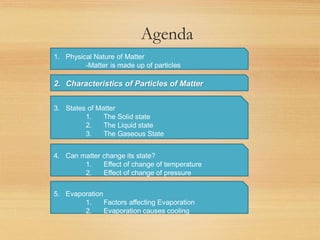
Agenda
1. Physical Nature of Matter
-Matter is made up of particles
2. Characteristics of Particles of Matter
3. States of Matter
1. The Solid state
2. The Liquid state
3. The Gaseous State
4. Can matter change its state?
1. Effect of change of temperature
2. Effect of change of pressure
5. Evaporation
1. Factors affecting Evaporation
2. Evaporation causes cooling
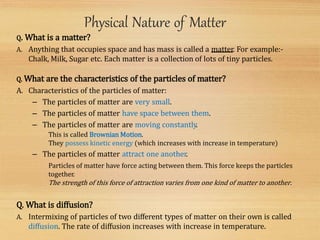
Physical Nature of Matter
Q. What is a matter?
A. Anything that occupies space and has mass is called a matter. For example:-
Chalk, Milk, Sugar etc. Each matter is a collection of lots of tiny particles.
Q. What are the characteristics of the particles of matter?
A. Characteristics of the particles of matter:
– The particles of matter are very small.
– The particles of matter have space between them.
– The particles of matter are moving constantly.
This is called Brownian Motion.
They possess kinetic energy (which increases with increase in temperature)
– The particles of matter attract one another.
Particles of matter have force acting between them. This force keeps the particles
together.
The strength of this force of attraction varies from one kind of matter to another.
Q. What is diffusion?
A. Intermixing of particles of two different types of matter on their own is called
diffusion. The rate of diffusion increases with increase in temperature.
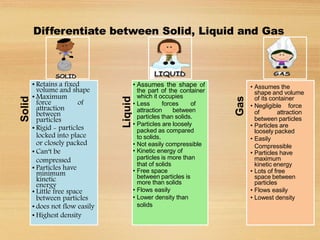
Solid
• Retains a fixed
volume and shape
• Maximum
force of
attraction
between
particles
• Rigid - particles
locked into place
or closely packed
• Can‘t be
compressed
• Particles have
minimum
kinetic
energy
• Little free space
between particles
• does not flow easily
• Highest density
Liquid
• Assumes the shape of
the part of the container
which it occupies
• Less forces of
attraction between
particles than solids.
• Particles are loosely
packed as compared
to solids.
• Not easily compressible
• Kinetic energy of
particles is more than
that of solids
• Free space
between particles is
more than solids
• Flows easily
• Lower density than
solids
Gas
• Assumes the
shape and volume
of its container
• Negligible force
of attraction
between particles
• Particles are
loosely packed
• Easily
Compressible
• Particles have
maximum
kinetic energy
• Lots of free
space between
particles
• Flows easily
• Lowest density
Differentiate between Solid, Liquid and Gas
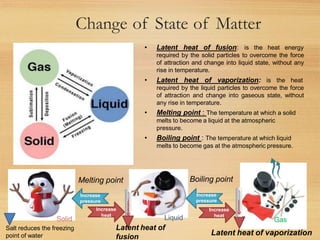
Change of State of Matter
• Latent heat of fusion: is the heat energy
required by the solid particles to overcome the force
of attraction and change into liquid state, without any
rise in temperature.
• Latent heat of vaporization: is the heat
required by the liquid particles to overcome the force
of attraction and change into gaseous state, without
any rise in temperature.
• Melting point : The temperature at which a solid
melts to become a liquid at the atmospheric
pressure.
• Boiling point : The temperature at which liquid
melts to become gas at the atmospheric pressure.
Increase
pressure
Increase
heat
Increase
pressure
Increase
heat
Solid Liquid Gas
Melting point Boiling point
Latent heat of
fusion
Latent heat of vaporization
Salt reduces the freezing
point of water
Evaporation
Q. What is evaporation?
A. Change of liquid into its vapour at any temperature below its boiling point is called
evaporation.
Q. What are the factors that affect evaporation?
A. The rate of evaporation increases with –
• An increase of surface area:
We know that evaporation is a surface phenomenon. If the surface area is
increased, the rate of evaporation increases. For example, while putting
clothes for drying up we spread them out.
• An increase of temperature:
With the increase of temperature, more number of particles get enough kinetic
energy to go into the vapour state.
• A decrease in humidity:
Humidity is the amount of water vapour present in air. The air around us cannot
hold more than a definite amount of water vapour at a given temperature. If the
amount of water in air is already high, the rate of evaporation decreases.
• An increase in wind speed:
It is a common observation that clothes dry faster on a windy day. With the
increase in wind speed, the particles of water vapour move away with the wind,
decreasing the amount of water vapour in the surrounding.
Evaporation
Q. How does evaporation cause cooling?
A. The particles of liquid absorb energy from the surrounding to regain the energy lost
during evaporation. This absorption of energy from the surroundings make the
surroundings cold.
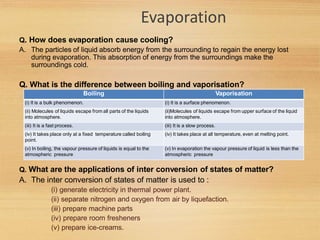
Q. What is the difference between boiling and vaporisation?
Q. What are the applications of inter conversion of states of matter?
A. The inter conversion of states of matter is used to :
(i) generate electricity in thermal power plant.
(ii) separate nitrogen and oxygen from air by liquefaction.
(iii) prepare machine parts
(iv) prepare room fresheners
(v) prepare ice-creams.
Boiling Vaporisation
(i) It is a bulk phenomenon. (i) It is a surface phenomenon.
(ii) Molecules of liquids escape from all parts of the liquids
into atmosphere.
(ii)Molecules of liquids escape from upper surface of the liquid
into atmosphere.
(iii) It is a fast process. (iii) It is a slow process.
(iv) It takes place only at a fixed temperature called boiling
point.
(iv) It takes place at all temperature, even at melting point.
(v) In boiling, the vapour pressure of liquids is equal to the
atmospheric pressure
(v) In evaporation the vapour pressure of liquid is less than the
atmospheric pressure
Effects of pressure on gas:
Liquefaction and Solidification
• The liquefaction of gas by increasing of pressure:
• In general condition, the particles of gas are far from each other. They move independently and rapidly in all
directions. There is a lot of space between the particles of gas. The force of attraction is negligible between
the particles of gas. Because of these characters gas can be compressed a lot.
• When pressure is applied on the gas, its particles come closer to each other. After applying high
pressure, the particles of gas come very close to each other that they start attracting each other.
• The space between the particles of gas also decreases with increase in pressure. While applying
high pressure a lot of heat is evolved, which was used by the particles of gas in movement.
• So, while applying high pressure to compress the gas, temperature is kept low to overcome the
heat released. As they come closer, they lose kinetic energy.
• Finally they get closely packed at a certain high pressure, at this stage they get bonded with
each other and turned into liquid.
• This process is called liquidation or liquefaction of gas.
• Petroleum Gas is compressed to small volumes. At more pressure it turns into liquid, after that it is packed
into cylinders. This is used widely as fuel to cook food in households. Compressed petroleum gas is
commonly known as LPG (Liquefied Petroleum Gas) since it turns into liquid form.
• Oxygen, hydrogen, nitrogen, helium, etc. are compressed to liquefy and used for many purposes.
Liquefied oxygen is used as propellant in spacecraft rockets. Liquefied oxygen is used for industrial and
medical purposes also. Liquefied oxygen is of blue color.
• On further increase in pressure, gas turns into solid – Solidification
• Carbon dioxide is a gas that turns into solid on high pressure. Solid carbon dioxide is known as dry-ice. It
is also known as ‘Cardice’ or ‘Card ice’.
• Dry ice is used in the storage of food.
• On decrease in pressure liquefied gas turns into gas. Solid carbon dioxide (dry ice) turns into gas without
changing into liquid on decrease in pressure and increase of temperature.
Q&A
•
•
Question: Why should we wear cotton clothes in summer?
Answer: During summer, we perspire more because of the mechanism of our body which keeps us cool. We know that
during evaporation, the particles at the surface of the liquid gain energy from the surroundings or body surface and
change into vapour. The heat energy equal to the latent heat of vaporisation is absorbed from the body leaving the body
cool. Cotton, being a good absorber of water helps in absorbing the sweat and exposing it to the atmosphere for easy
evaporation.
•
•
Question: Give reasons for the following observation: The smell of hot sizzling food reaches you
several meters away, but to get the smell from cold food you have to go close.
Answer: Smell of anything comes because of gases emanating from the given thing. The smell reaches to us because
of diffusion of gas. The rate of diffusion increases with increase in temperature. This happens because of higher kinetic
energy due to higher temperature. That is why smell of hot sizzling food reaches to us from several feet. On the other
hand, the kinetic energy of gases emanating from cold food is low because of lower temperature. Due to this, we need
to move closer to a cold food to take its smell.
•
•
Question: A diver is able to cut through water in a swimming pool. Which property of mater does
this observation show?
Answer: Water is also a matter. We know that particles of matter have space between them. In case of fluids, the space
between particles is large enough and due to this it becomes easier for a diver to cut through water in a swimming pool.
•
•
Question: Why do we see water droplets on outer surface of glass containing ice-cold water?
Answer: The water vapour present in the air, on coming in contact with the cold surface of the glass, looses energy and
gets converted into liquid in the form of small water droplets.
THE END…
Thank You
For Watching

Matter in our surroundings

  • 1.
    Matter in OurSurroundings • Chapter 1: NCERT • Made By – • Gajendra Verma (Leader) • Hitanshi Verma (Assistant)
  • 2.
    Agenda 1. Physical Natureof Matter -Matter is made up of particles 2. Characteristics of Particles of Matter 3. States of Matter 1. The Solid state 2. The Liquid state 3. The Gaseous State 4. Can matter change its state? 1. Effect of change of temperature 2. Effect of change of pressure 5. Evaporation 1. Factors affecting Evaporation 2. Evaporation causes cooling
  • 3.
    Physical Nature ofMatter Q. What is a matter? A. Anything that occupies space and has mass is called a matter. For example:- Chalk, Milk, Sugar etc. Each matter is a collection of lots of tiny particles. Q. What are the characteristics of the particles of matter? A. Characteristics of the particles of matter: – The particles of matter are very small. – The particles of matter have space between them. – The particles of matter are moving constantly. This is called Brownian Motion. They possess kinetic energy (which increases with increase in temperature) – The particles of matter attract one another. Particles of matter have force acting between them. This force keeps the particles together. The strength of this force of attraction varies from one kind of matter to another. Q. What is diffusion? A. Intermixing of particles of two different types of matter on their own is called diffusion. The rate of diffusion increases with increase in temperature.
  • 4.
    Solid • Retains afixed volume and shape • Maximum force of attraction between particles • Rigid - particles locked into place or closely packed • Can‘t be compressed • Particles have minimum kinetic energy • Little free space between particles • does not flow easily • Highest density Liquid • Assumes the shape of the part of the container which it occupies • Less forces of attraction between particles than solids. • Particles are loosely packed as compared to solids. • Not easily compressible • Kinetic energy of particles is more than that of solids • Free space between particles is more than solids • Flows easily • Lower density than solids Gas • Assumes the shape and volume of its container • Negligible force of attraction between particles • Particles are loosely packed • Easily Compressible • Particles have maximum kinetic energy • Lots of free space between particles • Flows easily • Lowest density Differentiate between Solid, Liquid and Gas
  • 5.
    Change of Stateof Matter • Latent heat of fusion: is the heat energy required by the solid particles to overcome the force of attraction and change into liquid state, without any rise in temperature. • Latent heat of vaporization: is the heat required by the liquid particles to overcome the force of attraction and change into gaseous state, without any rise in temperature. • Melting point : The temperature at which a solid melts to become a liquid at the atmospheric pressure. • Boiling point : The temperature at which liquid melts to become gas at the atmospheric pressure. Increase pressure Increase heat Increase pressure Increase heat Solid Liquid Gas Melting point Boiling point Latent heat of fusion Latent heat of vaporization Salt reduces the freezing point of water
  • 6.
    Evaporation Q. What isevaporation? A. Change of liquid into its vapour at any temperature below its boiling point is called evaporation. Q. What are the factors that affect evaporation? A. The rate of evaporation increases with – • An increase of surface area: We know that evaporation is a surface phenomenon. If the surface area is increased, the rate of evaporation increases. For example, while putting clothes for drying up we spread them out. • An increase of temperature: With the increase of temperature, more number of particles get enough kinetic energy to go into the vapour state. • A decrease in humidity: Humidity is the amount of water vapour present in air. The air around us cannot hold more than a definite amount of water vapour at a given temperature. If the amount of water in air is already high, the rate of evaporation decreases. • An increase in wind speed: It is a common observation that clothes dry faster on a windy day. With the increase in wind speed, the particles of water vapour move away with the wind, decreasing the amount of water vapour in the surrounding.
  • 7.
    Evaporation Q. How doesevaporation cause cooling? A. The particles of liquid absorb energy from the surrounding to regain the energy lost during evaporation. This absorption of energy from the surroundings make the surroundings cold. Q. What is the difference between boiling and vaporisation? Q. What are the applications of inter conversion of states of matter? A. The inter conversion of states of matter is used to : (i) generate electricity in thermal power plant. (ii) separate nitrogen and oxygen from air by liquefaction. (iii) prepare machine parts (iv) prepare room fresheners (v) prepare ice-creams. Boiling Vaporisation (i) It is a bulk phenomenon. (i) It is a surface phenomenon. (ii) Molecules of liquids escape from all parts of the liquids into atmosphere. (ii)Molecules of liquids escape from upper surface of the liquid into atmosphere. (iii) It is a fast process. (iii) It is a slow process. (iv) It takes place only at a fixed temperature called boiling point. (iv) It takes place at all temperature, even at melting point. (v) In boiling, the vapour pressure of liquids is equal to the atmospheric pressure (v) In evaporation the vapour pressure of liquid is less than the atmospheric pressure
  • 8.
    Effects of pressureon gas: Liquefaction and Solidification • The liquefaction of gas by increasing of pressure: • In general condition, the particles of gas are far from each other. They move independently and rapidly in all directions. There is a lot of space between the particles of gas. The force of attraction is negligible between the particles of gas. Because of these characters gas can be compressed a lot. • When pressure is applied on the gas, its particles come closer to each other. After applying high pressure, the particles of gas come very close to each other that they start attracting each other. • The space between the particles of gas also decreases with increase in pressure. While applying high pressure a lot of heat is evolved, which was used by the particles of gas in movement. • So, while applying high pressure to compress the gas, temperature is kept low to overcome the heat released. As they come closer, they lose kinetic energy. • Finally they get closely packed at a certain high pressure, at this stage they get bonded with each other and turned into liquid. • This process is called liquidation or liquefaction of gas. • Petroleum Gas is compressed to small volumes. At more pressure it turns into liquid, after that it is packed into cylinders. This is used widely as fuel to cook food in households. Compressed petroleum gas is commonly known as LPG (Liquefied Petroleum Gas) since it turns into liquid form. • Oxygen, hydrogen, nitrogen, helium, etc. are compressed to liquefy and used for many purposes. Liquefied oxygen is used as propellant in spacecraft rockets. Liquefied oxygen is used for industrial and medical purposes also. Liquefied oxygen is of blue color. • On further increase in pressure, gas turns into solid – Solidification • Carbon dioxide is a gas that turns into solid on high pressure. Solid carbon dioxide is known as dry-ice. It is also known as ‘Cardice’ or ‘Card ice’. • Dry ice is used in the storage of food. • On decrease in pressure liquefied gas turns into gas. Solid carbon dioxide (dry ice) turns into gas without changing into liquid on decrease in pressure and increase of temperature.
  • 9.
    Q&A • • Question: Why shouldwe wear cotton clothes in summer? Answer: During summer, we perspire more because of the mechanism of our body which keeps us cool. We know that during evaporation, the particles at the surface of the liquid gain energy from the surroundings or body surface and change into vapour. The heat energy equal to the latent heat of vaporisation is absorbed from the body leaving the body cool. Cotton, being a good absorber of water helps in absorbing the sweat and exposing it to the atmosphere for easy evaporation. • • Question: Give reasons for the following observation: The smell of hot sizzling food reaches you several meters away, but to get the smell from cold food you have to go close. Answer: Smell of anything comes because of gases emanating from the given thing. The smell reaches to us because of diffusion of gas. The rate of diffusion increases with increase in temperature. This happens because of higher kinetic energy due to higher temperature. That is why smell of hot sizzling food reaches to us from several feet. On the other hand, the kinetic energy of gases emanating from cold food is low because of lower temperature. Due to this, we need to move closer to a cold food to take its smell. • • Question: A diver is able to cut through water in a swimming pool. Which property of mater does this observation show? Answer: Water is also a matter. We know that particles of matter have space between them. In case of fluids, the space between particles is large enough and due to this it becomes easier for a diver to cut through water in a swimming pool. • • Question: Why do we see water droplets on outer surface of glass containing ice-cold water? Answer: The water vapour present in the air, on coming in contact with the cold surface of the glass, looses energy and gets converted into liquid in the form of small water droplets.
  • 10.