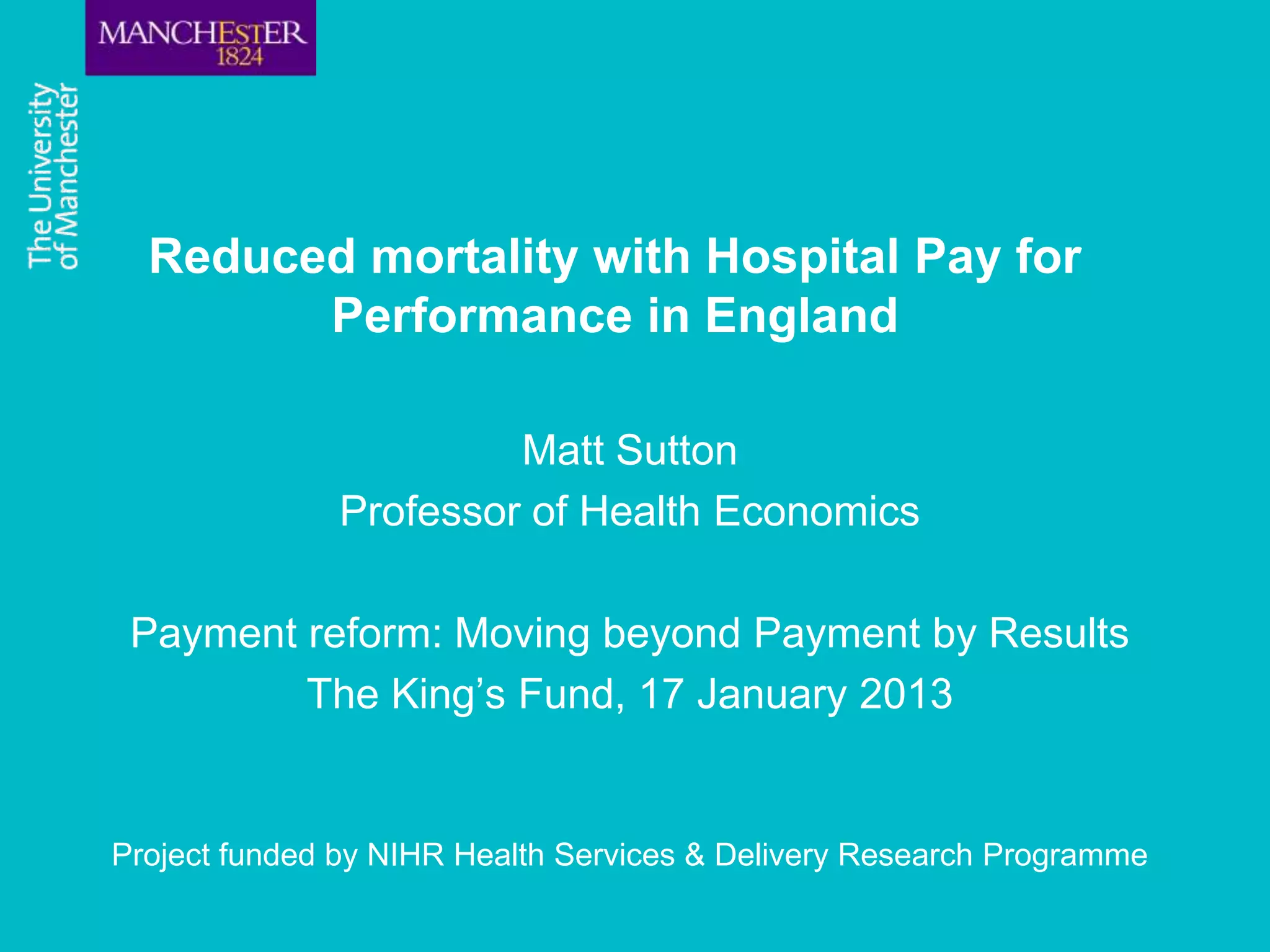
Reduced mortality with Hospital Pay for
        Performance in England

                       Matt Sutton
              Professor of Health Economics

 Payment reform: Moving beyond Payment by Results
         The King’s Fund, 17 January 2013


Project funded by NIHR Health Services & Delivery Research Programme
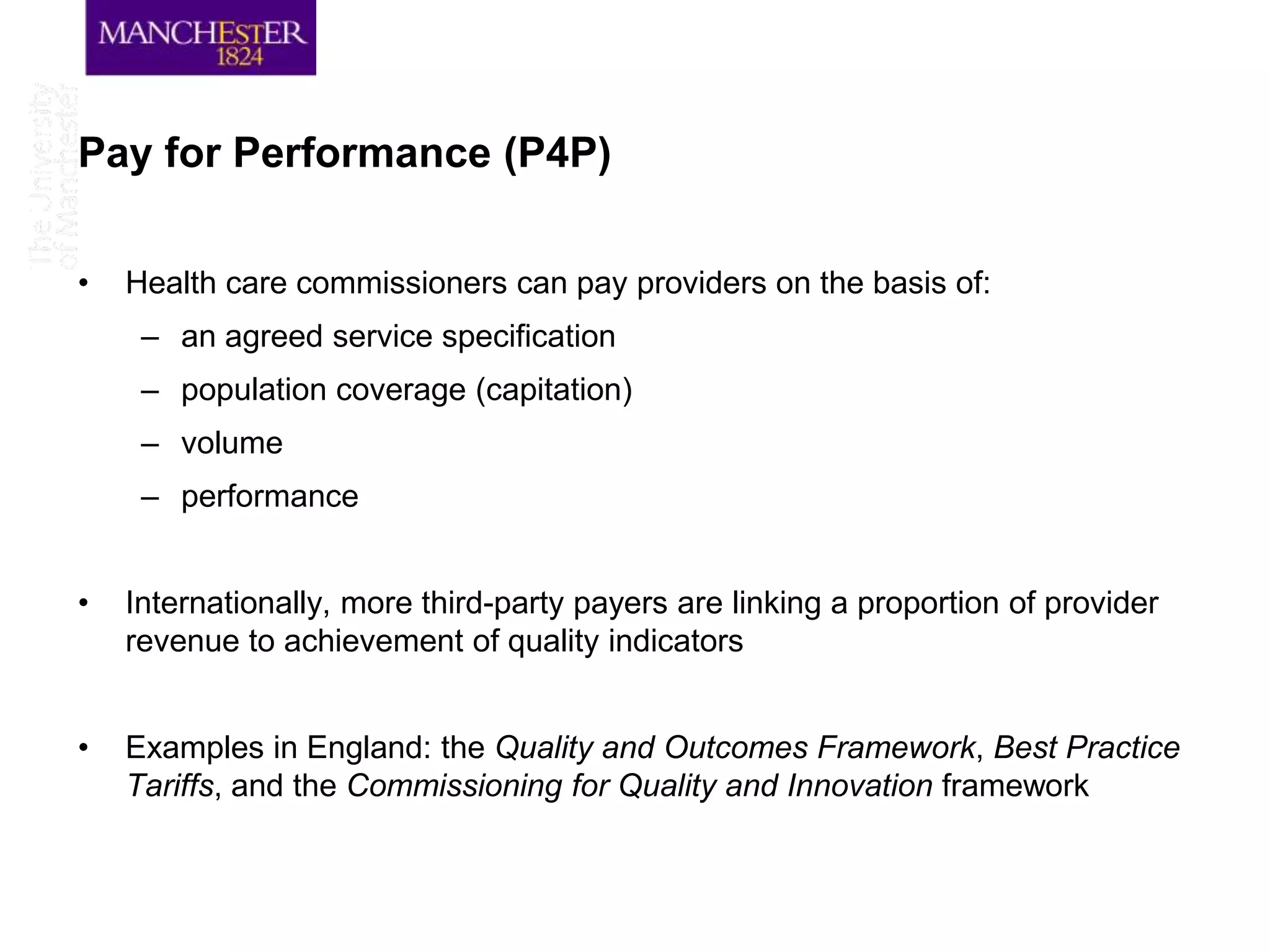
Pay for Performance (P4P)

•   Health care commissioners can pay providers on the basis of:
     – an agreed service specification
     – population coverage (capitation)
     – volume
     – performance


•   Internationally, more third-party payers are linking a proportion of provider
    revenue to achievement of quality indicators


•   Examples in England: the Quality and Outcomes Framework, Best Practice
    Tariffs, and the Commissioning for Quality and Innovation framework
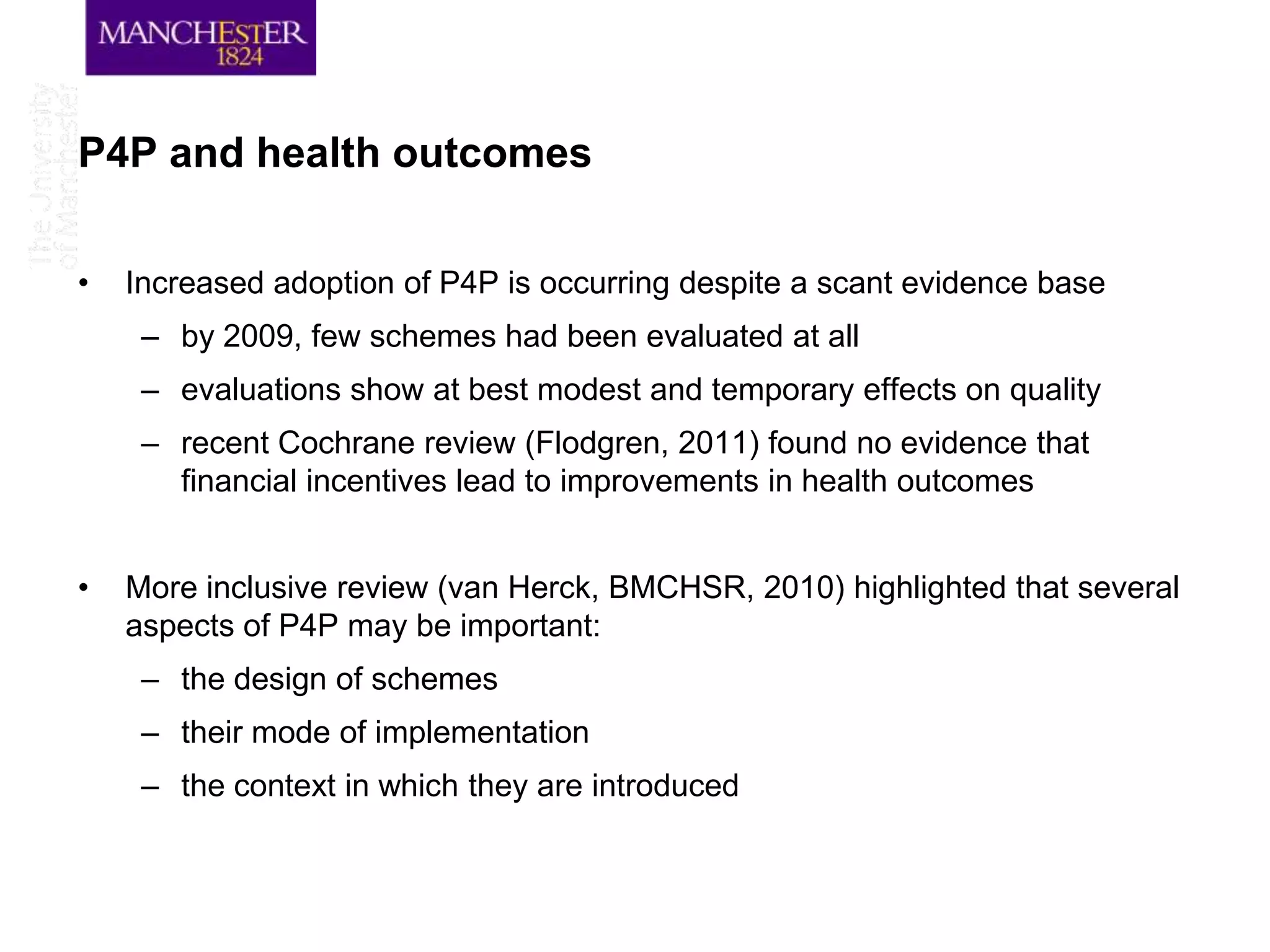
P4P and health outcomes

•   Increased adoption of P4P is occurring despite a scant evidence base
     – by 2009, few schemes had been evaluated at all
     – evaluations show at best modest and temporary effects on quality
     – recent Cochrane review (Flodgren, 2011) found no evidence that
       financial incentives lead to improvements in health outcomes


•   More inclusive review (van Herck, BMCHSR, 2010) highlighted that several
    aspects of P4P may be important:
     – the design of schemes
     – their mode of implementation
     – the context in which they are introduced
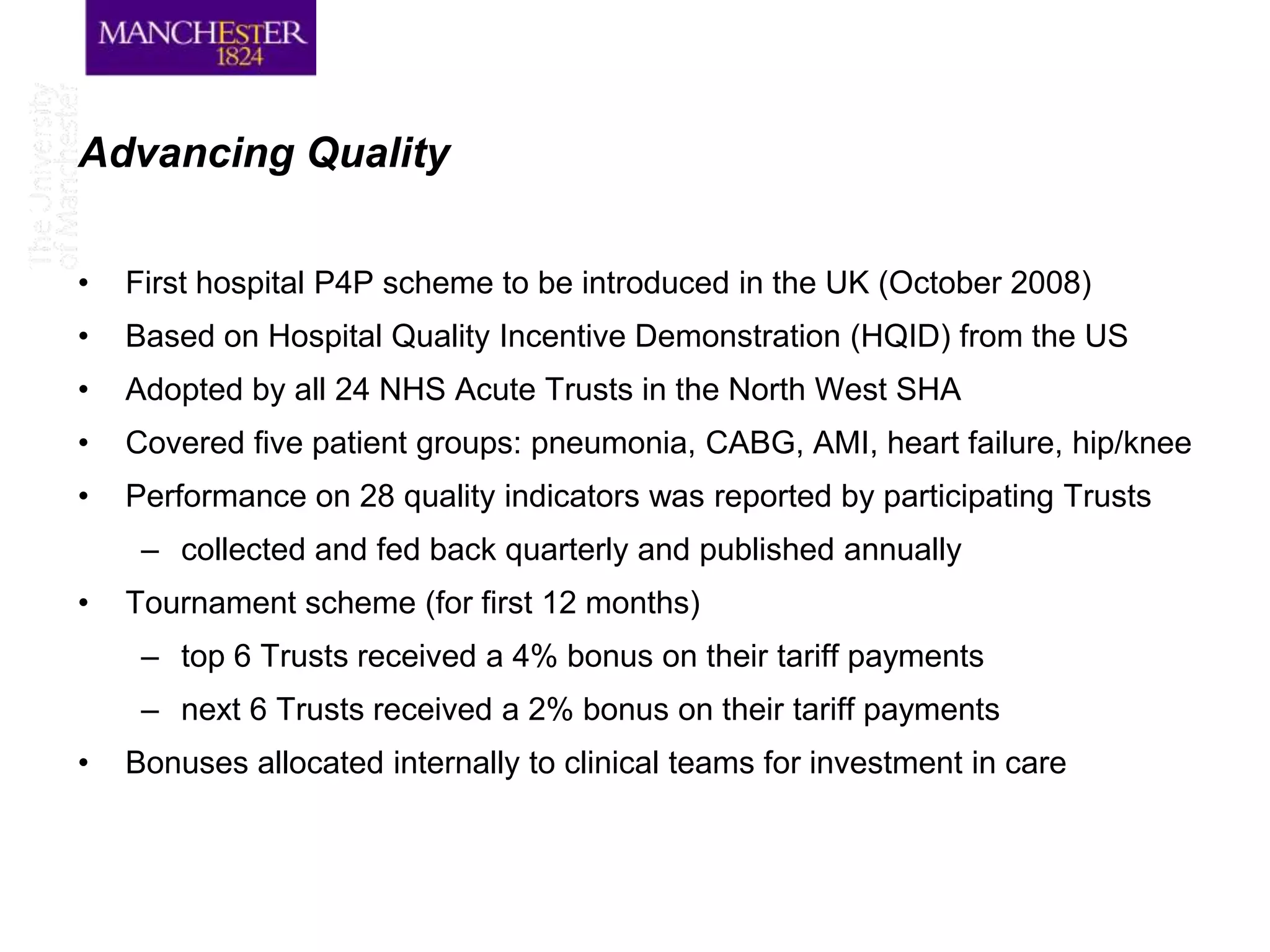
Advancing Quality

•   First hospital P4P scheme to be introduced in the UK (October 2008)
•   Based on Hospital Quality Incentive Demonstration (HQID) from the US
•   Adopted by all 24 NHS Acute Trusts in the North West SHA
•   Covered five patient groups: pneumonia, CABG, AMI, heart failure, hip/knee
•   Performance on 28 quality indicators was reported by participating Trusts
     – collected and fed back quarterly and published annually
•   Tournament scheme (for first 12 months)
     – top 6 Trusts received a 4% bonus on their tariff payments
     – next 6 Trusts received a 2% bonus on their tariff payments
•   Bonuses allocated internally to clinical teams for investment in care
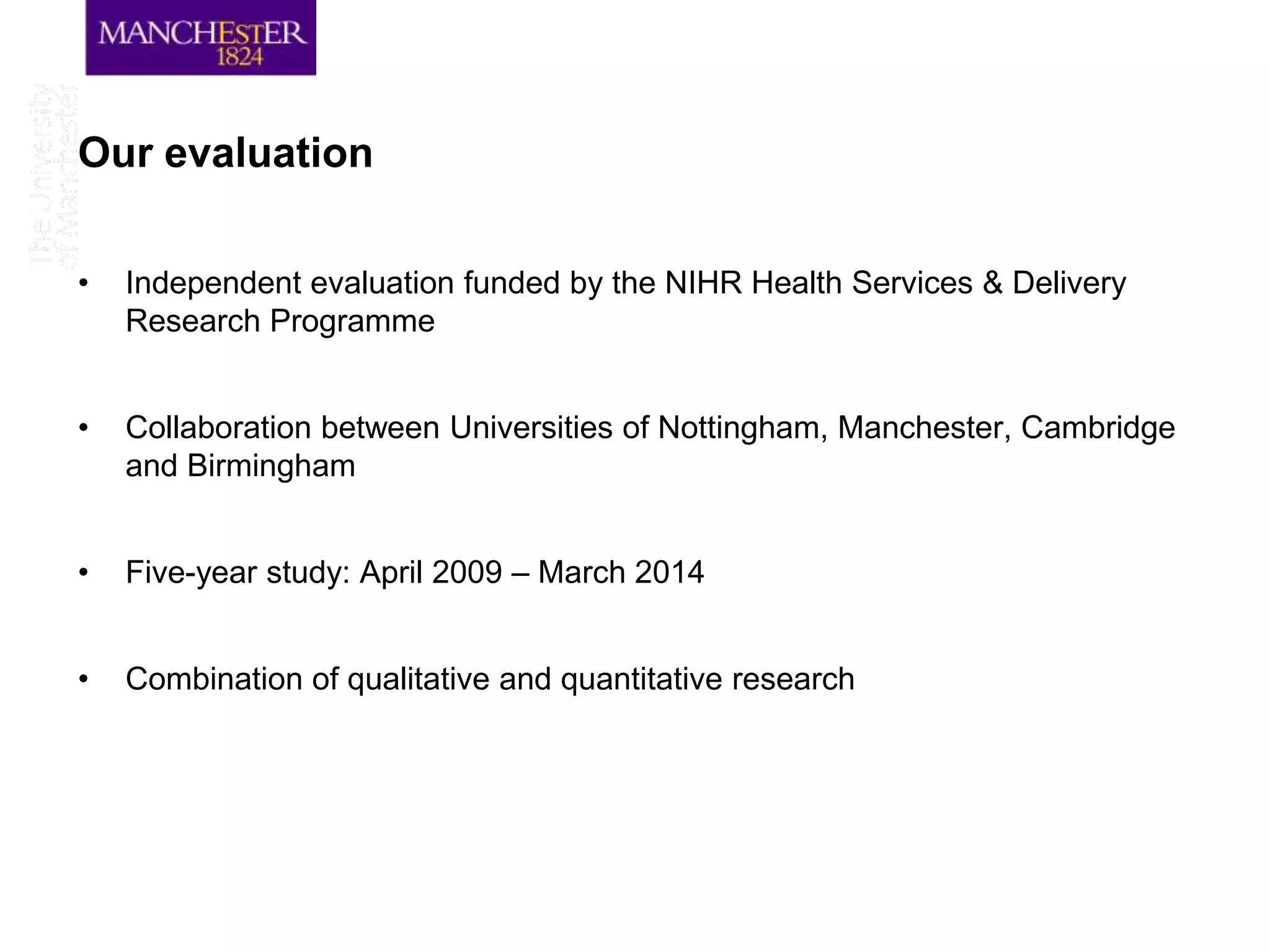
Our evaluation

•   Independent evaluation funded by the NIHR Health Services & Delivery
    Research Programme


•   Collaboration between Universities of Nottingham, Manchester, Cambridge
    and Birmingham


•   Five-year study: April 2009 – March 2014


•   Combination of qualitative and quantitative research
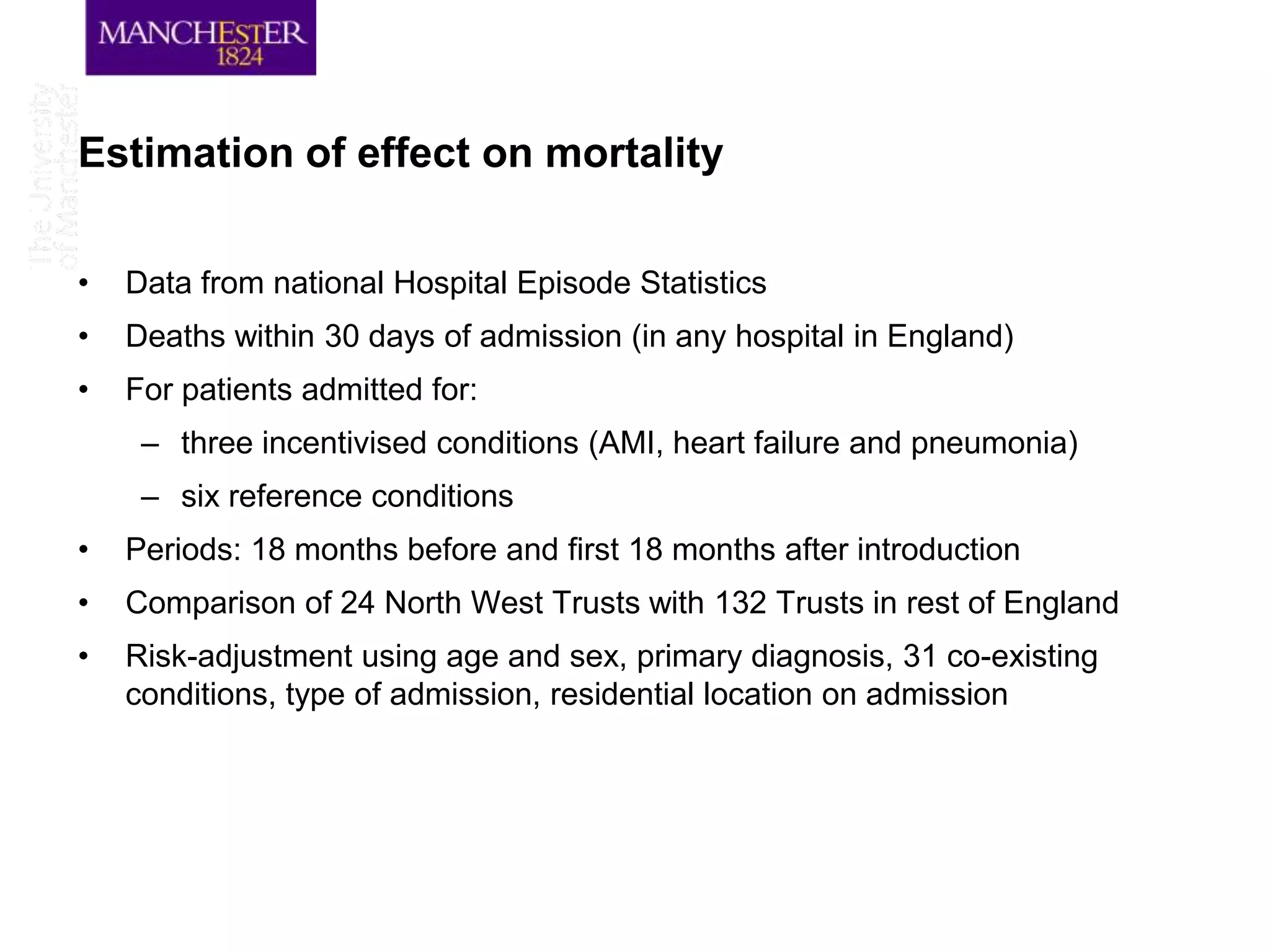
Estimation of effect on mortality

•   Data from national Hospital Episode Statistics
•   Deaths within 30 days of admission (in any hospital in England)
•   For patients admitted for:
     – three incentivised conditions (AMI, heart failure and pneumonia)
     – six reference conditions
•   Periods: 18 months before and first 18 months after introduction
•   Comparison of 24 North West Trusts with 132 Trusts in rest of England
•   Risk-adjustment using age and sex, primary diagnosis, 31 co-existing
    conditions, type of admission, residential location on admission
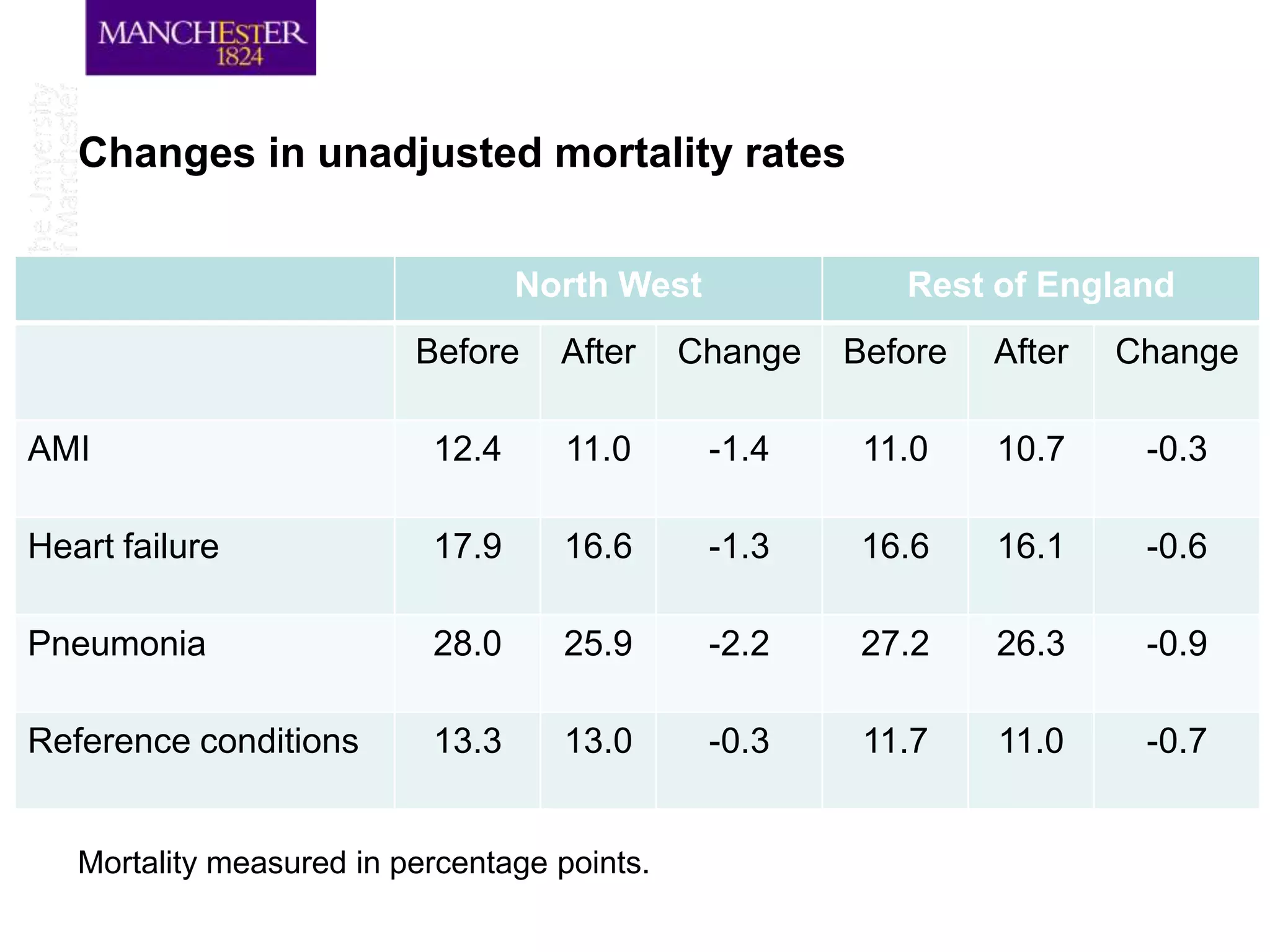
Changes in unadjusted mortality rates


                                  North West              Rest of England
                          Before    After     Change   Before   After   Change

AMI                        12.4      11.0      -1.4     11.0    10.7     -0.3

Heart failure              17.9     16.6       -1.3     16.6    16.1     -0.6

Pneumonia                  28.0     25.9       -2.2     27.2    26.3     -0.9

Reference conditions       13.3     13.0       -0.3     11.7    11.0     -0.7


   Mortality measured in percentage points.
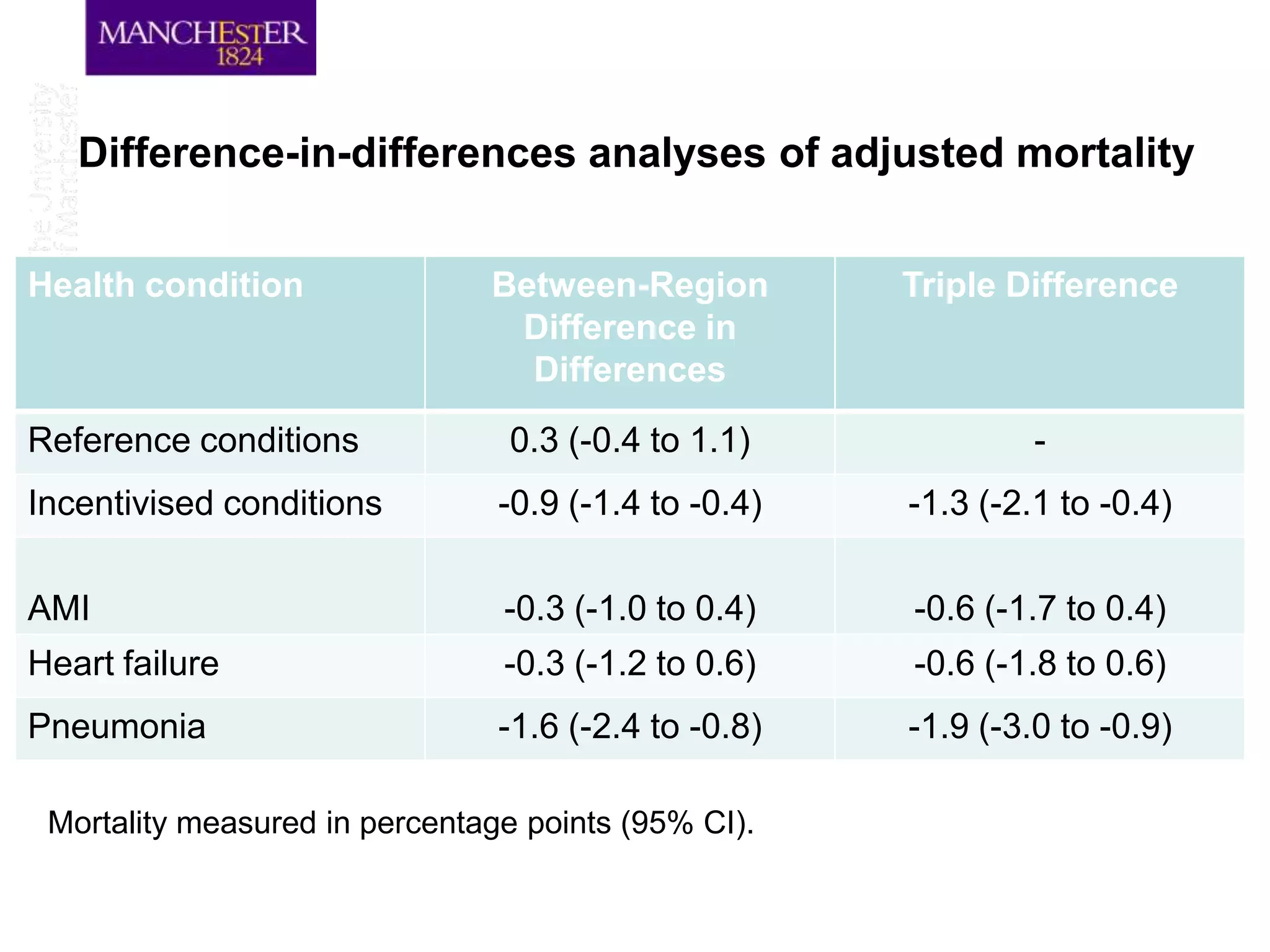
Difference-in-differences analyses of adjusted mortality


Health condition               Between-Region         Triple Difference
                                Difference in
                                 Differences
Reference conditions             0.3 (-0.4 to 1.1)             -
Incentivised conditions         -0.9 (-1.4 to -0.4)   -1.3 (-2.1 to -0.4)

AMI                             -0.3 (-1.0 to 0.4)    -0.6 (-1.7 to 0.4)
Heart failure                   -0.3 (-1.2 to 0.6)    -0.6 (-1.8 to 0.6)
Pneumonia                       -1.6 (-2.4 to -0.8)   -1.9 (-3.0 to -0.9)

 Mortality measured in percentage points (95% CI).
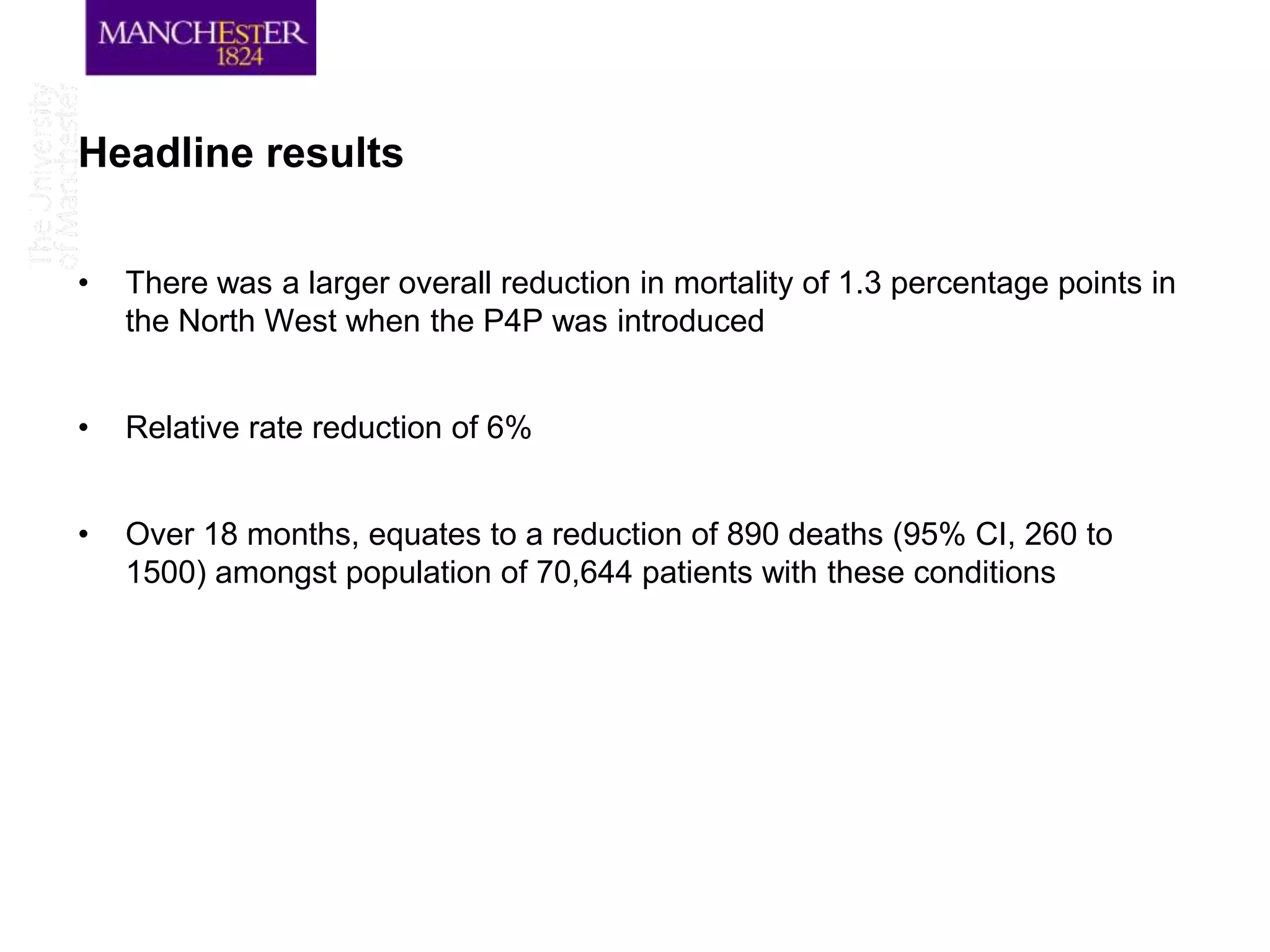
Headline results

•   There was a larger overall reduction in mortality of 1.3 percentage points in
    the North West when the P4P was introduced


•   Relative rate reduction of 6%


•   Over 18 months, equates to a reduction of 890 deaths (95% CI, 260 to
    1500) amongst population of 70,644 patients with these conditions
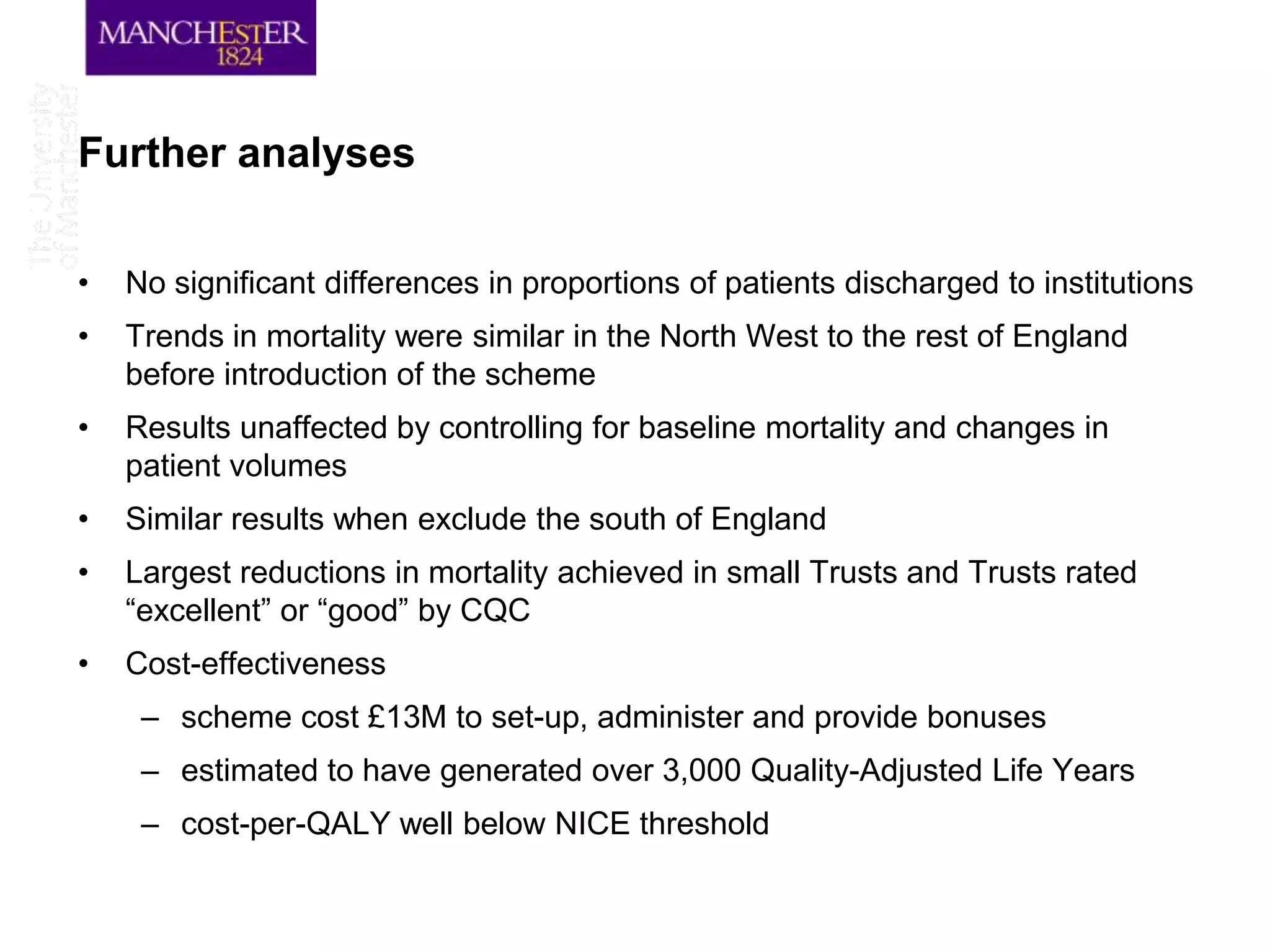
Further analyses

•   No significant differences in proportions of patients discharged to institutions
•   Trends in mortality were similar in the North West to the rest of England
    before introduction of the scheme
•   Results unaffected by controlling for baseline mortality and changes in
    patient volumes
•   Similar results when exclude the south of England
•   Largest reductions in mortality achieved in small Trusts and Trusts rated
    “excellent” or “good” by CQC
•   Cost-effectiveness
     – scheme cost £13M to set-up, administer and provide bonuses
     – estimated to have generated over 3,000 Quality-Adjusted Life Years
     – cost-per-QALY well below NICE threshold
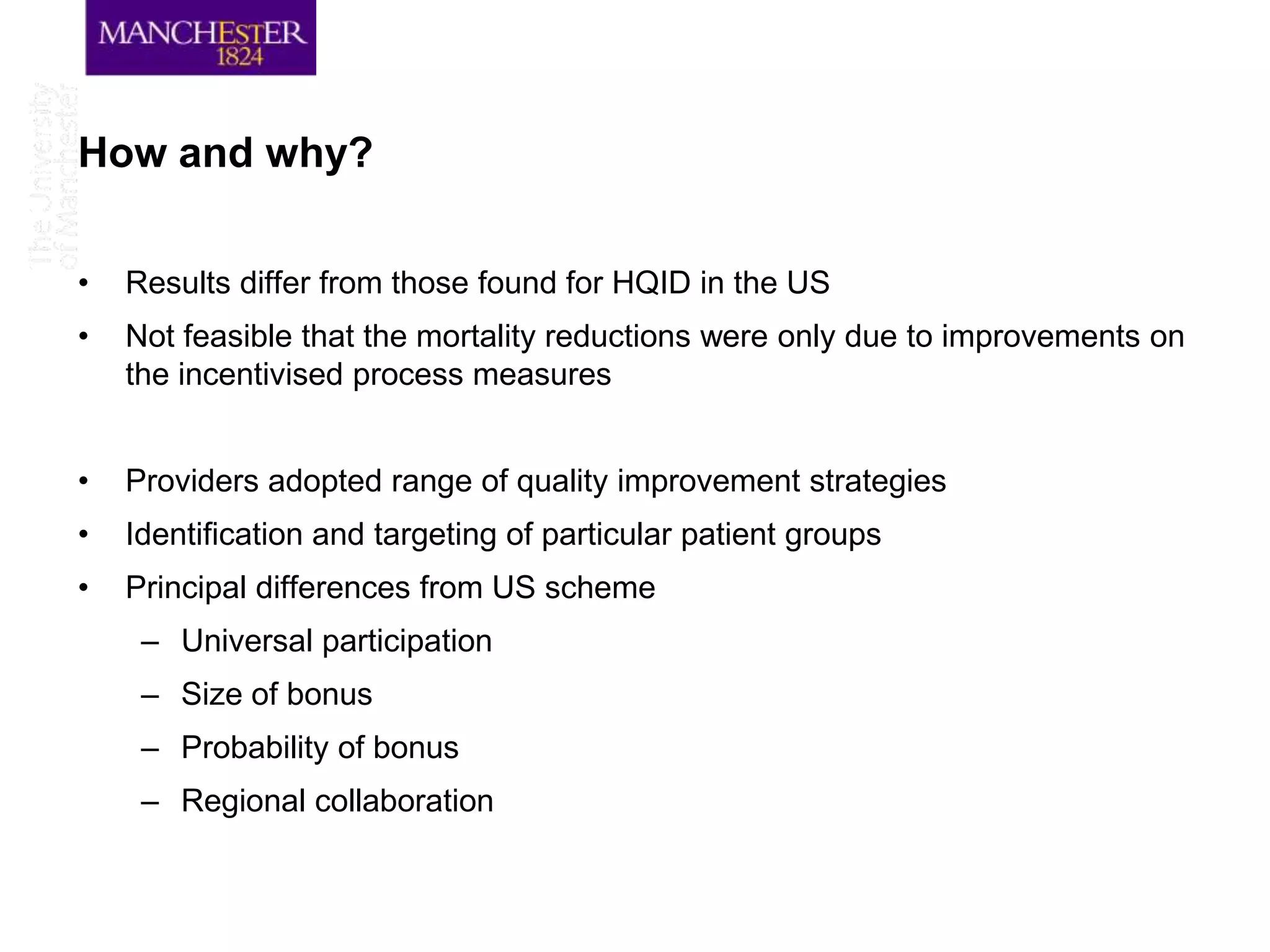
How and why?

•   Results differ from those found for HQID in the US
•   Not feasible that the mortality reductions were only due to improvements on
    the incentivised process measures


•   Providers adopted range of quality improvement strategies
•   Identification and targeting of particular patient groups
•   Principal differences from US scheme
     – Universal participation
     – Size of bonus
     – Probability of bonus
     – Regional collaboration
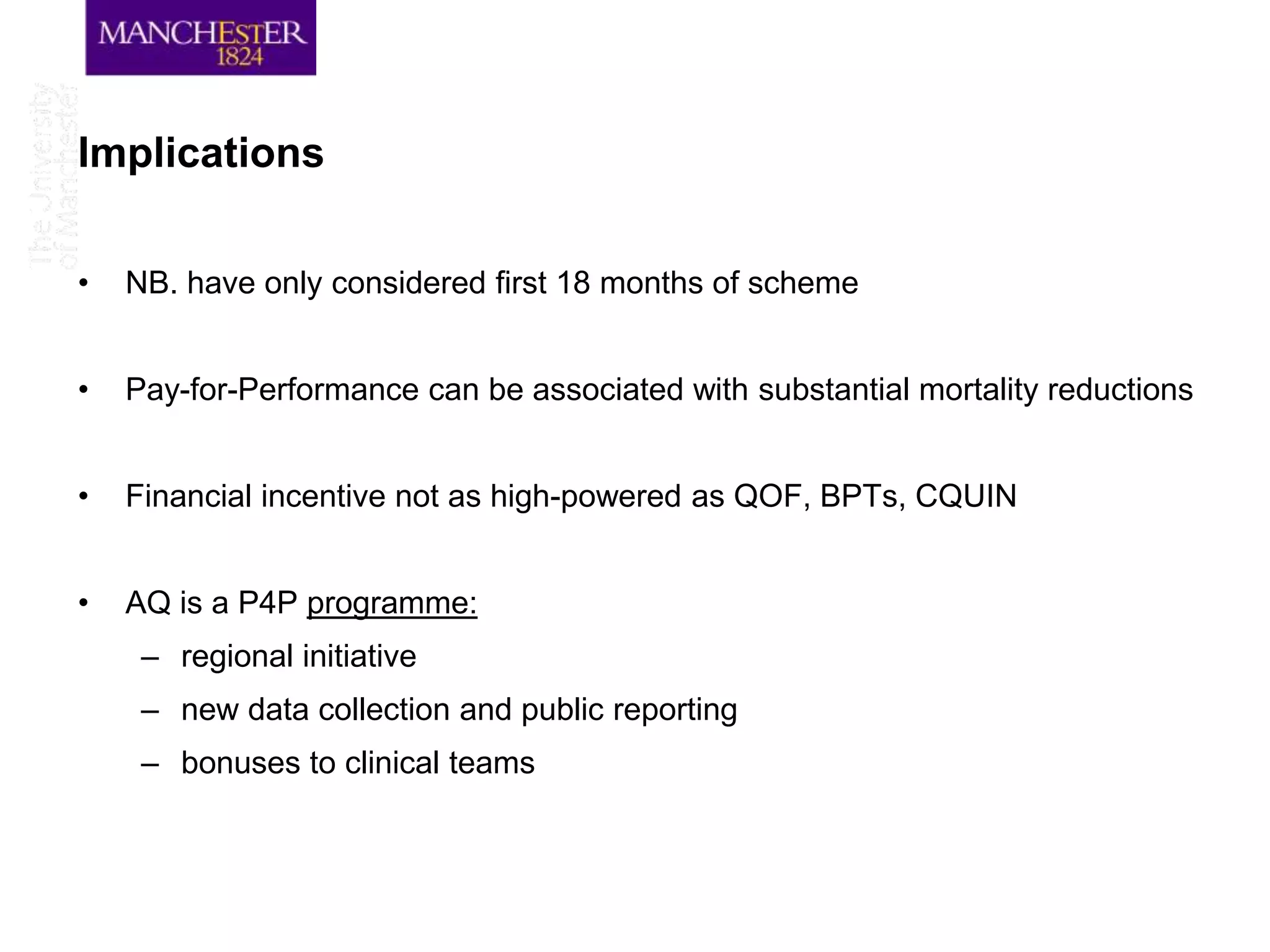
Implications

•   NB. have only considered first 18 months of scheme


•   Pay-for-Performance can be associated with substantial mortality reductions


•   Financial incentive not as high-powered as QOF, BPTs, CQUIN


•   AQ is a P4P programme:
     – regional initiative
     – new data collection and public reporting
     – bonuses to clinical teams
Concluding remarks

•   NW SHA imported a P4P scheme from the US from October 2008
•   Translated to NHS context – universal participation, regional collaboration
•   Associated with a substantial reduction in mortality
•   Cost-effective use of resources in first 18 months
•   Not just direct result of improvements in the incentivised measures
•   A quality improvement programme supported by financial incentives
•   Differs in some potentially important ways from other P4P initiatives
    adopted in the NHS
Reduced mortality with Hospital Pay for
          Performance in England

                       Matt Sutton

                   For more information:
             matt.sutton@manchester.ac.uk
Work published as: Sutton M et al, NEJM 2012; 367: 1821-8.

Matt Sutton: reduced mortality with hospital Pay for Performance in England

  • 1.
    Reduced mortality withHospital Pay for Performance in England Matt Sutton Professor of Health Economics Payment reform: Moving beyond Payment by Results The King’s Fund, 17 January 2013 Project funded by NIHR Health Services & Delivery Research Programme
  • 2.
    Pay for Performance(P4P) • Health care commissioners can pay providers on the basis of: – an agreed service specification – population coverage (capitation) – volume – performance • Internationally, more third-party payers are linking a proportion of provider revenue to achievement of quality indicators • Examples in England: the Quality and Outcomes Framework, Best Practice Tariffs, and the Commissioning for Quality and Innovation framework
  • 3.
    P4P and healthoutcomes • Increased adoption of P4P is occurring despite a scant evidence base – by 2009, few schemes had been evaluated at all – evaluations show at best modest and temporary effects on quality – recent Cochrane review (Flodgren, 2011) found no evidence that financial incentives lead to improvements in health outcomes • More inclusive review (van Herck, BMCHSR, 2010) highlighted that several aspects of P4P may be important: – the design of schemes – their mode of implementation – the context in which they are introduced
  • 4.
    Advancing Quality • First hospital P4P scheme to be introduced in the UK (October 2008) • Based on Hospital Quality Incentive Demonstration (HQID) from the US • Adopted by all 24 NHS Acute Trusts in the North West SHA • Covered five patient groups: pneumonia, CABG, AMI, heart failure, hip/knee • Performance on 28 quality indicators was reported by participating Trusts – collected and fed back quarterly and published annually • Tournament scheme (for first 12 months) – top 6 Trusts received a 4% bonus on their tariff payments – next 6 Trusts received a 2% bonus on their tariff payments • Bonuses allocated internally to clinical teams for investment in care
  • 5.
    Our evaluation • Independent evaluation funded by the NIHR Health Services & Delivery Research Programme • Collaboration between Universities of Nottingham, Manchester, Cambridge and Birmingham • Five-year study: April 2009 – March 2014 • Combination of qualitative and quantitative research
  • 6.
    Estimation of effecton mortality • Data from national Hospital Episode Statistics • Deaths within 30 days of admission (in any hospital in England) • For patients admitted for: – three incentivised conditions (AMI, heart failure and pneumonia) – six reference conditions • Periods: 18 months before and first 18 months after introduction • Comparison of 24 North West Trusts with 132 Trusts in rest of England • Risk-adjustment using age and sex, primary diagnosis, 31 co-existing conditions, type of admission, residential location on admission
  • 7.
    Changes in unadjustedmortality rates North West Rest of England Before After Change Before After Change AMI 12.4 11.0 -1.4 11.0 10.7 -0.3 Heart failure 17.9 16.6 -1.3 16.6 16.1 -0.6 Pneumonia 28.0 25.9 -2.2 27.2 26.3 -0.9 Reference conditions 13.3 13.0 -0.3 11.7 11.0 -0.7 Mortality measured in percentage points.
  • 8.
    Difference-in-differences analyses ofadjusted mortality Health condition Between-Region Triple Difference Difference in Differences Reference conditions 0.3 (-0.4 to 1.1) - Incentivised conditions -0.9 (-1.4 to -0.4) -1.3 (-2.1 to -0.4) AMI -0.3 (-1.0 to 0.4) -0.6 (-1.7 to 0.4) Heart failure -0.3 (-1.2 to 0.6) -0.6 (-1.8 to 0.6) Pneumonia -1.6 (-2.4 to -0.8) -1.9 (-3.0 to -0.9) Mortality measured in percentage points (95% CI).
  • 9.
    Headline results • There was a larger overall reduction in mortality of 1.3 percentage points in the North West when the P4P was introduced • Relative rate reduction of 6% • Over 18 months, equates to a reduction of 890 deaths (95% CI, 260 to 1500) amongst population of 70,644 patients with these conditions
  • 10.
    Further analyses • No significant differences in proportions of patients discharged to institutions • Trends in mortality were similar in the North West to the rest of England before introduction of the scheme • Results unaffected by controlling for baseline mortality and changes in patient volumes • Similar results when exclude the south of England • Largest reductions in mortality achieved in small Trusts and Trusts rated “excellent” or “good” by CQC • Cost-effectiveness – scheme cost £13M to set-up, administer and provide bonuses – estimated to have generated over 3,000 Quality-Adjusted Life Years – cost-per-QALY well below NICE threshold
  • 11.
    How and why? • Results differ from those found for HQID in the US • Not feasible that the mortality reductions were only due to improvements on the incentivised process measures • Providers adopted range of quality improvement strategies • Identification and targeting of particular patient groups • Principal differences from US scheme – Universal participation – Size of bonus – Probability of bonus – Regional collaboration
  • 12.
    Implications • NB. have only considered first 18 months of scheme • Pay-for-Performance can be associated with substantial mortality reductions • Financial incentive not as high-powered as QOF, BPTs, CQUIN • AQ is a P4P programme: – regional initiative – new data collection and public reporting – bonuses to clinical teams
  • 13.
    Concluding remarks • NW SHA imported a P4P scheme from the US from October 2008 • Translated to NHS context – universal participation, regional collaboration • Associated with a substantial reduction in mortality • Cost-effective use of resources in first 18 months • Not just direct result of improvements in the incentivised measures • A quality improvement programme supported by financial incentives • Differs in some potentially important ways from other P4P initiatives adopted in the NHS
  • 14.
    Reduced mortality withHospital Pay for Performance in England Matt Sutton For more information: matt.sutton@manchester.ac.uk Work published as: Sutton M et al, NEJM 2012; 367: 1821-8.