1. TYPES OF MATRICES
PRESENTED BY:
NAME: RANJAN GUPTA
ROLL NO. 221563`
BRANCH : BTECH ( CIVIL )
1. Types of matrices
Identity matrix
The inverse of a matrix
The transpose of a matrix
Symmetric matrix
Orthogonal matrix
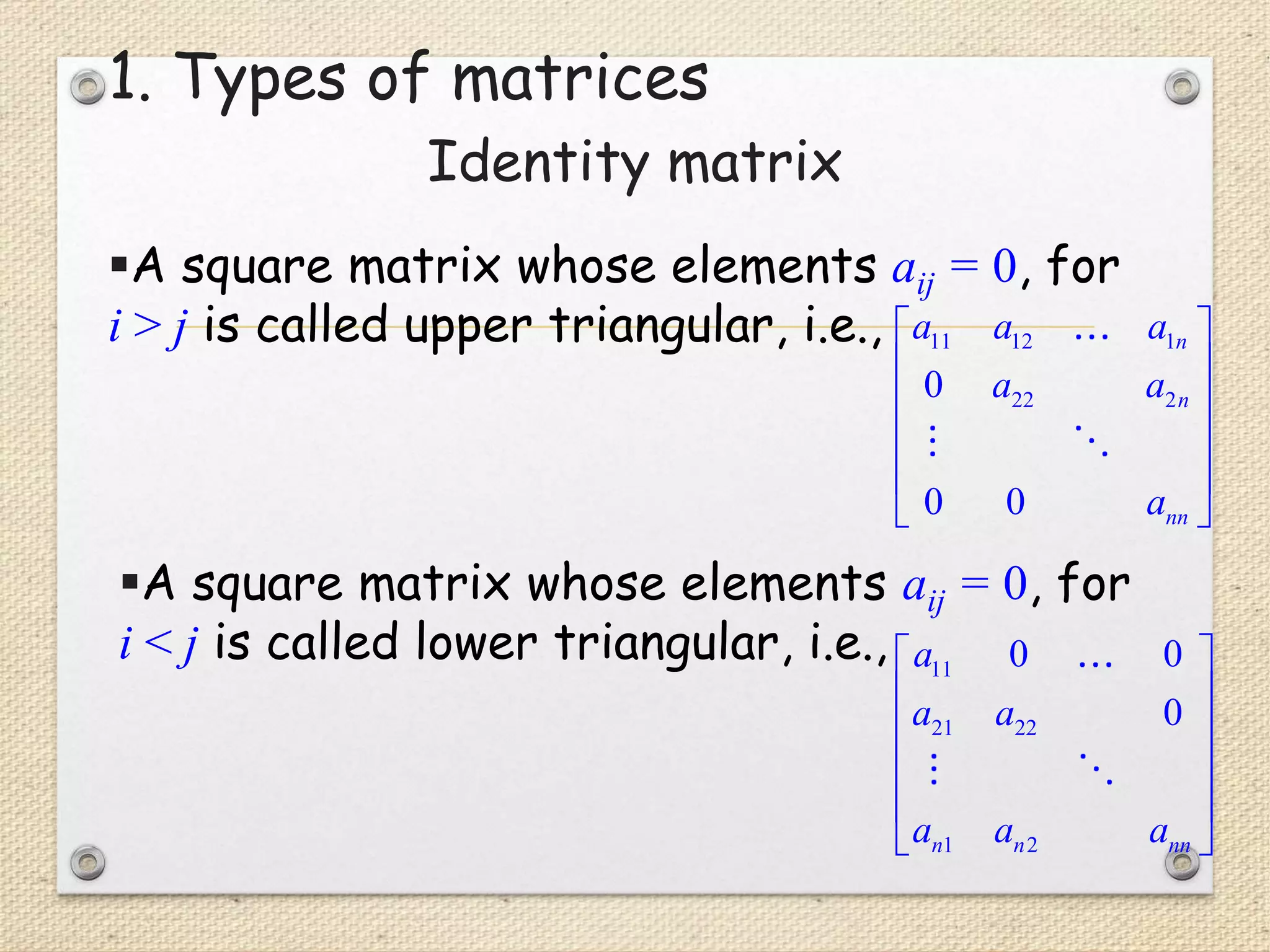
A square matrix whose elements aij = 0, for
i > j is called upper triangular, i.e., 11 12 1
22 2
0
0 0
 
 
 
 
 
 
n
n
nn
a a a
a a
a
A square matrix whose elements aij = 0, for
i < j is called lower triangular, i.e., 11
21 22
1 2
0 0
0
 
 
 
 
 
 
n n nn
a
a a
a a a
Identity matrix
1. Types of matrices
4
Both upper and lower triangular, i.e., aij = 0, for
i  j , i.e., 11
22
0 0
0 0
0 0
 
 
 

 
 
 
nn
a
a
D
a
11 22
diag[ , ,..., ]
 nn
D a a a
Identity matrix
1. Types of matrices
is called a diagonal matrix, simply
In particular, a11 = a22 = … = ann = 1, the
matrix is called identity matrix.
Properties: AI = IA = A
Examples of identity matrices: and
1 0
0 1
 
 
 
1 0 0
0 1 0
0 0 1
 
 
 
 
 
Identity matrix
1. Types of matrices
If matrices A and B such that AB = BA = I,
then B is called the inverse of A (symbol: A-1);
and A is called the inverse of B (symbol: B-1).
The inverse of a matrix
6 2 3
1 1 0
1 0 1
B
 
 
 
 
 
 

 
Show B is the the inverse of matrix A.
1 2 3
1 3 3
1 2 4
A
 
 
  
 
 
Example:
1 0 0
0 1 0
0 0 1
AB BA
 
 
   
 
 
Ans: Note that
1. Types of matrices
The transpose of a matrix
The matrix obtained by interchanging the
rows and columns of a matrix A is called the
transpose of A (write AT).
Example:
The transpose of A is
1 2 3
4 5 6
 
  
 
A
1 4
2 5
3 6
 
 
  
 
 
T
A
For a matrix A = [aij], its transpose AT = [bij],
where bij = aji.
1. Types of matrices
Symmetric matrix
A matrix A such that AT = A is called symmetric,
i.e., aji = aij for all i and j.
A + AT must be symmetric. Why?
Example: is symmetric.
1 2 3
2 4 5
3 5 6
 
 
 
 
 

 
A
A matrix A such that AT = -A is called skew-
symmetric, i.e., aji = -aij for all i and j.
A - AT must be skew-symmetric. Why?
1. Types of matrices
Orthogonal matrix
A matrix A is called orthogonal if AAT = ATA = I,
i.e., AT = A-1
Example: prove that is
orthogonal.
1/ 3 1/ 6 1/ 2
1/ 3 2/ 6 0
1/ 3 1/ 6 1/ 2
 

 
 
 
 
 
 
A
1. Types of matrices
Since, . Hence, AAT = ATA = I.
1/ 3 1/ 3 1/ 3
1/ 6 2/ 6 1/ 6
1/ 2 0 1/ 2
T
A
 
 
 
 
 

 
 

Matrix presentation

  • 1.
    1. TYPES OFMATRICES PRESENTED BY: NAME: RANJAN GUPTA ROLL NO. 221563` BRANCH : BTECH ( CIVIL )
  • 2.
    1. Types ofmatrices Identity matrix The inverse of a matrix The transpose of a matrix Symmetric matrix Orthogonal matrix
  • 3.
    A square matrixwhose elements aij = 0, for i > j is called upper triangular, i.e., 11 12 1 22 2 0 0 0             n n nn a a a a a a A square matrix whose elements aij = 0, for i < j is called lower triangular, i.e., 11 21 22 1 2 0 0 0             n n nn a a a a a a Identity matrix 1. Types of matrices
  • 4.
    4 Both upper andlower triangular, i.e., aij = 0, for i  j , i.e., 11 22 0 0 0 0 0 0              nn a a D a 11 22 diag[ , ,..., ]  nn D a a a Identity matrix 1. Types of matrices is called a diagonal matrix, simply
  • 5.
    In particular, a11= a22 = … = ann = 1, the matrix is called identity matrix. Properties: AI = IA = A Examples of identity matrices: and 1 0 0 1       1 0 0 0 1 0 0 0 1           Identity matrix 1. Types of matrices
  • 6.
    If matrices Aand B such that AB = BA = I, then B is called the inverse of A (symbol: A-1); and A is called the inverse of B (symbol: B-1). The inverse of a matrix 6 2 3 1 1 0 1 0 1 B                Show B is the the inverse of matrix A. 1 2 3 1 3 3 1 2 4 A            Example: 1 0 0 0 1 0 0 0 1 AB BA             Ans: Note that 1. Types of matrices
  • 7.
    The transpose ofa matrix The matrix obtained by interchanging the rows and columns of a matrix A is called the transpose of A (write AT). Example: The transpose of A is 1 2 3 4 5 6        A 1 4 2 5 3 6            T A For a matrix A = [aij], its transpose AT = [bij], where bij = aji. 1. Types of matrices
  • 8.
    Symmetric matrix A matrixA such that AT = A is called symmetric, i.e., aji = aij for all i and j. A + AT must be symmetric. Why? Example: is symmetric. 1 2 3 2 4 5 3 5 6              A A matrix A such that AT = -A is called skew- symmetric, i.e., aji = -aij for all i and j. A - AT must be skew-symmetric. Why? 1. Types of matrices
  • 9.
    Orthogonal matrix A matrixA is called orthogonal if AAT = ATA = I, i.e., AT = A-1 Example: prove that is orthogonal. 1/ 3 1/ 6 1/ 2 1/ 3 2/ 6 0 1/ 3 1/ 6 1/ 2                A 1. Types of matrices Since, . Hence, AAT = ATA = I. 1/ 3 1/ 3 1/ 3 1/ 6 2/ 6 1/ 6 1/ 2 0 1/ 2 T A               