Matrices
A matrix is a rectangular array of real numbers.
           Matrix A has 2 horizontal rows and 3 vertical columns.
                                                3   1 −2 
                                              A=
                                                 7 −1 0.5
                                                          
           Each entry can be identified by its position in the
           matrix.
                         7 is in Row 2 Column 1.
                        -2 is in Row 1 Column 3.
           A matrix with m rows and n columns is of order m × n.
           A is of order 2 × 3.
       If m = n the matrix is said to be a square matrix of order n.
Copyright © by Houghton Mifflin Company, Inc. All rights reserved.   2
Examples: Find the order of each matrix

           2                       3           1          0  A has three rows and
       A = 4
                                   2           1          4  four columns.
                                                             
           1
                                   1           6          2  The order of A is 3 × 4.
                                                             

                                                                     B has one row and five columns.
               B = [ 2 5 2 −1 0]                                     The order of B is 1 × 5.
                                                                     B is called a row matrix.

                                          3 1 
                                        C=     C is a 2 × 2 square matrix.
                                          6 2

Copyright © by Houghton Mifflin Company, Inc. All rights reserved.                                 3
An m × n matrix can be written
                                                    a11             a12   L     a1n 
                                                   a                a22   L     a2 n 
                                     A = ai j  =  21
                                            M
                                                                                      .
                                                                      M           M 
                                                                                     
                                                   am1              am1   am1   amn 

         Two matrices A = [aij] and B = [bij] are equal if they
         have the same order and aij = bij for every i and j.
                        0.5    9  1         
         For example,           = 2       3  since both matrices
                        1     7  0.25 7 
                         4
                                 
                                              
         are of order 2 × 2 and all corresponding entries are equal.
Copyright © by Houghton Mifflin Company, Inc. All rights reserved.                         4
Matrices
           • Write a null matrix or Zero Matrix?
           • Write a column matrix?


Copyright © by Houghton Mifflin Company, Inc. All rights reserved.   5
Matrices
           • Diagonal Matrix – A square matrix whose
             every element other than the diagonal
             elements are ZERO is called a diagonal
             matrix.
           • Diagonal elements – The elements aij are
             called diagonal elements when i=j


Copyright © by Houghton Mifflin Company, Inc. All rights reserved.   6
Matrices
           • Scalar matrix -A diagonal matrix whose
             diagonal elements are equal

           • Identity Matrix (Unit matrix) – A diagonal
             matrix whose diagonal elements are equal
             to one


Copyright © by Houghton Mifflin Company, Inc. All rights reserved.   7
Matrices
           • Triangular matrix – A square matrix whose
             elements below or above the diagonal are
             zero.
           • What is an upper triangular matrix?
           • What is a lower triangular matrix?


Copyright © by Houghton Mifflin Company, Inc. All rights reserved.   8
To add matrices:
           1. Check to see if the matrices have the same order.
           2. Add corresponding entries.
           Example: Find the sums A + B and B + C.
               1 5 
            A= 2 1  B =  2 0 6  C = 3 −3 0 
                             −1 0 −3         3 2 4 
               0 6                                
                    
           A has order 3 × 2 and B has order 2 × 3. So they cannot
           be added. C has order 2 × 3 and can be added to B.
                      2 0 6  3 −3 0  5 −3 6 
               B+C =          + 3 2 4  =  2 2 1 
                      −1 0 −3                   
Copyright © by Houghton Mifflin Company, Inc. All rights reserved.   9
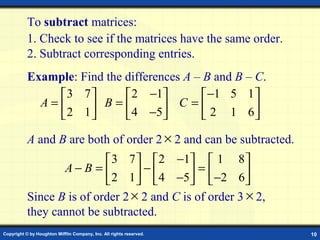
To subtract matrices:
           1. Check to see if the matrices have the same order.
           2. Subtract corresponding entries.
           Example: Find the differences A – B and B – C.
               3 7          2 −1          −1 5 1 
             A=       B =  4 −5 C =  2 1 6 
               2 1                                
           A and B are both of order 2 × 2 and can be subtracted.
                            3 7   2 −1  1 8 
                  A−B =           −  4 −5 =  −2 6 
                           2 1                      
           Since B is of order 2 × 2 and C is of order 3 × 2,
           they cannot be subtracted.
Copyright © by Houghton Mifflin Company, Inc. All rights reserved.   10
If A = [aij] is an m × n matrix and c is a scalar
           (a real number), then the m × n matrix cA = [caij] is the
           scalar multiple of A by c.             2 5 −1
                                                 3 4 0 
           Example: Find 2A and –3A for A =               .
                                                                     2 7
                                                                           2
                                                                             
                                  2(2) 2(5) 2( −1)   4 10 −2 
                           2 A =  2(3) 2(4) 2(0)  = 6 8 0 
                                                             
                                  2(2) 2(7) 2(2)   4 14 4 
                                                             
                     −3(2) −3(5) −3( −1)   −6 −15 3 
               1
              − A =  −3(3) −3(4) −3(0)  =  −9 −12 0 
                                                    
               3
                     −3(2) −3(7) −3(2)   −6 −21 −6 
                                                    
Copyright © by Houghton Mifflin Company, Inc. All rights reserved.               11
Example: Calculate the value of 3A – 2B + C with
                              2 −1    5   2        5   2
                         A = 3 5  B = 1 0  and C = 1 0 
                                                         
                              4 −2 
                                       3 −1 
                                                      3 −1 
                                                             

                                         2 −1     5    2  5   2
                      3 A − 2 B + C = 3  3 5  − 2 1 0  +  1 0 
                                                                
                                         4 −2 
                                                   3 − 1   3 −1 
                                                                  
                         6 −3  10        4  5     2  1 − 5
                      = 9 15 −  2
                                         0  + 1 0  =  8 15 
                                                               
                        12 −6   6 −2   3 −1   9 − 5 
                                                            

Copyright © by Houghton Mifflin Company, Inc. All rights reserved.       12
Multiplication of Matrices
           • The product AB of two matrices A and B is
             defined only when the number of columns
             A is same as the number of rows of B.
           • A = m x n matrix
           • B = n x p matrix.
           • The order of AB is m x p.


Copyright © by Houghton Mifflin Company, Inc. All rights reserved.   13
Multiplication of Matrices
           • AB may not be equal to BA
           • If product AB is defined product BA may
             not be defined.
           • If A is a square matrix then A can be
             multiplied by itself.


Copyright © by Houghton Mifflin Company, Inc. All rights reserved.   14
Transpose of a Matrix
           • Let A be a matrix. The matrix obtained by
             interchanging the rows and columns is
             called the transpose of the matrix A.


Copyright © by Houghton Mifflin Company, Inc. All rights reserved.   15
Symmetric and Skew Symmetric
                      Matrices
           • For a square matrix A if A=AT then it is a
             symmetric matrix.

                For a square matrix A if A= -AT then it is a
                skew symmetric matrix.

                Square matrix A + AT symmetric
                Square matrix A – AT is skew symmetric
Copyright © by Houghton Mifflin Company, Inc. All rights reserved.   16
• If square matrices AB= BA then A,B are
             commutative
           • If square matrices AB=-BA the A,B are anti
             commutative
           • If A2 = A then A is idempotent


Copyright © by Houghton Mifflin Company, Inc. All rights reserved.   17
Determinant of a matrix
           • The square matrix A has a uniquely
             determined determinant associated with the
             matrix.
           • The determinant of a product of a matrix is
             the product of their determinants.


Copyright © by Houghton Mifflin Company, Inc. All rights reserved.   18
Singular and Non singular
                                  matrices
           • A square matrix A is singular if determinant
             A is zero.
           • A square matrix A is non singular is
             determinant A is not equal to Zero.


Copyright © by Houghton Mifflin Company, Inc. All rights reserved.   19
Elementary Operations in matrices.

                  1. Interchange two rows or columns of a matrix.
                 2. Multiply a row or column of a matrix by a non
                 zero constant.
                 3. Add a multiple of one row or column of a matrix
                 to another.


Copyright © by Houghton Mifflin Company, Inc. All rights reserved.    20
What is the use of Elementary
                            operations
           • A sequence of elementary row operations
             transforms the matrix of a system into the
             matrix of another system with the same
             solutions as the original system.
           • Take matrix A X B = AB
           • If we make elementary row operation in AB
             then it is equivalent to making the same
             operation in A and multiplying it with B.
Copyright © by Houghton Mifflin Company, Inc. All rights reserved.   21
An augmented matrix and a coefficient matrix are
             associated with each system of linear equations.

                            2 x + 3 y − z = 12
             For the system 
                             x − 8y       = 16

                                     2 3 - 1                        12
             The augmented matrix is                                  .
                                     1 - 8 0                        16

                                        2 3 −1
             The coefficient matrix is        .
                                       1 −8 0 

Copyright © by Houghton Mifflin Company, Inc. All rights reserved.          22
Example: Apply the elementary row operation R1 ↔ R2
           to the augmented matrix of the system  x + 2 y = 8 .
                                                 
                                                 3x − y = 10

          Row Operation Augmented Matrix                                          System
                                                   1          2          8     x + 2y = 8
                                                   3                           
                                                             -1         10 
                                                                               3x − y = 10
                 R1 ↔ R2                                             ↓                ↓
                                                 3           -1         10    3x − y = 10
                                                 1                            
                                                              2          8     x + 2y = 8

           Note that the two systems are equivalent.
Copyright © by Houghton Mifflin Company, Inc. All rights reserved.                             23
Example: Apply the elementary row operation 3R2
           to the augmented matrix of the system  x + 2 y = 8 .
                                                 
                                                 3x − y = 10

          Row Operation Augmented Matrix                                          System
                                                   1           2         8     x + 2y = 8
                                                   3                           
                                                              -1        10 
                                                                               3x − y = 10
                     3R2                                             ↓               ↓
                                                1             2         8 
                                                9             -3         30
                                                                           

Copyright © by Houghton Mifflin Company, Inc. All rights reserved.                             24
Example: Apply the row operation –3R1 + R2
           to the augmented matrix of the system  x + 2 y = 8 .
                                                 
                                                 3x − y = 10

          Row Operation Augmented Matrix                                           System
                                                   1           2         8      x + 2y = 8
                                                   3                            
                                                              -1        10 
                                                                                3x − y = 10
              –3R1 + R2                                              ↓                  ↓
                                                    1           2          8    x + 2y = 8
                                                    0                          
                                                               -7       - 14   −7 y = −14

Copyright © by Houghton Mifflin Company, Inc. All rights reserved.                              25

Matrices

  • 1.
  • 2.
    A matrix isa rectangular array of real numbers. Matrix A has 2 horizontal rows and 3 vertical columns. 3 1 −2  A=  7 −1 0.5  Each entry can be identified by its position in the matrix. 7 is in Row 2 Column 1. -2 is in Row 1 Column 3. A matrix with m rows and n columns is of order m × n. A is of order 2 × 3. If m = n the matrix is said to be a square matrix of order n. Copyright © by Houghton Mifflin Company, Inc. All rights reserved. 2
  • 3.
    Examples: Find theorder of each matrix 2 3 1 0  A has three rows and A = 4  2 1 4  four columns.  1  1 6 2  The order of A is 3 × 4.  B has one row and five columns. B = [ 2 5 2 −1 0] The order of B is 1 × 5. B is called a row matrix. 3 1  C=  C is a 2 × 2 square matrix. 6 2 Copyright © by Houghton Mifflin Company, Inc. All rights reserved. 3
  • 4.
    An m ×n matrix can be written  a11 a12 L a1n  a a22 L a2 n  A = ai j  =  21    M . M M    am1 am1 am1 amn  Two matrices A = [aij] and B = [bij] are equal if they have the same order and aij = bij for every i and j. 0.5 9  1  For example,  = 2 3  since both matrices 1 7  0.25 7   4      are of order 2 × 2 and all corresponding entries are equal. Copyright © by Houghton Mifflin Company, Inc. All rights reserved. 4
  • 5.
    Matrices • Write a null matrix or Zero Matrix? • Write a column matrix? Copyright © by Houghton Mifflin Company, Inc. All rights reserved. 5
  • 6.
    Matrices • Diagonal Matrix – A square matrix whose every element other than the diagonal elements are ZERO is called a diagonal matrix. • Diagonal elements – The elements aij are called diagonal elements when i=j Copyright © by Houghton Mifflin Company, Inc. All rights reserved. 6
  • 7.
    Matrices • Scalar matrix -A diagonal matrix whose diagonal elements are equal • Identity Matrix (Unit matrix) – A diagonal matrix whose diagonal elements are equal to one Copyright © by Houghton Mifflin Company, Inc. All rights reserved. 7
  • 8.
    Matrices • Triangular matrix – A square matrix whose elements below or above the diagonal are zero. • What is an upper triangular matrix? • What is a lower triangular matrix? Copyright © by Houghton Mifflin Company, Inc. All rights reserved. 8
  • 9.
    To add matrices: 1. Check to see if the matrices have the same order. 2. Add corresponding entries. Example: Find the sums A + B and B + C. 1 5  A= 2 1  B =  2 0 6  C = 3 −3 0    −1 0 −3 3 2 4  0 6        A has order 3 × 2 and B has order 2 × 3. So they cannot be added. C has order 2 × 3 and can be added to B.  2 0 6  3 −3 0  5 −3 6  B+C =   + 3 2 4  =  2 2 1   −1 0 −3     Copyright © by Houghton Mifflin Company, Inc. All rights reserved. 9
  • 10.
    To subtract matrices: 1. Check to see if the matrices have the same order. 2. Subtract corresponding entries. Example: Find the differences A – B and B – C. 3 7   2 −1  −1 5 1  A=  B =  4 −5 C =  2 1 6  2 1      A and B are both of order 2 × 2 and can be subtracted.  3 7   2 −1  1 8  A−B =   −  4 −5 =  −2 6  2 1      Since B is of order 2 × 2 and C is of order 3 × 2, they cannot be subtracted. Copyright © by Houghton Mifflin Company, Inc. All rights reserved. 10
  • 11.
    If A =[aij] is an m × n matrix and c is a scalar (a real number), then the m × n matrix cA = [caij] is the scalar multiple of A by c.  2 5 −1 3 4 0  Example: Find 2A and –3A for A =  . 2 7  2   2(2) 2(5) 2( −1)   4 10 −2  2 A =  2(3) 2(4) 2(0)  = 6 8 0       2(2) 2(7) 2(2)   4 14 4       −3(2) −3(5) −3( −1)   −6 −15 3  1 − A =  −3(3) −3(4) −3(0)  =  −9 −12 0      3  −3(2) −3(7) −3(2)   −6 −21 −6      Copyright © by Houghton Mifflin Company, Inc. All rights reserved. 11
  • 12.
    Example: Calculate thevalue of 3A – 2B + C with  2 −1 5 2 5 2 A = 3 5  B = 1 0  and C = 1 0         4 −2     3 −1     3 −1     2 −1 5 2  5 2 3 A − 2 B + C = 3  3 5  − 2 1 0  +  1 0         4 −2     3 − 1   3 −1       6 −3  10 4  5 2  1 − 5 = 9 15 −  2    0  + 1 0  =  8 15       12 −6   6 −2   3 −1   9 − 5          Copyright © by Houghton Mifflin Company, Inc. All rights reserved. 12
  • 13.
    Multiplication of Matrices • The product AB of two matrices A and B is defined only when the number of columns A is same as the number of rows of B. • A = m x n matrix • B = n x p matrix. • The order of AB is m x p. Copyright © by Houghton Mifflin Company, Inc. All rights reserved. 13
  • 14.
    Multiplication of Matrices • AB may not be equal to BA • If product AB is defined product BA may not be defined. • If A is a square matrix then A can be multiplied by itself. Copyright © by Houghton Mifflin Company, Inc. All rights reserved. 14
  • 15.
    Transpose of aMatrix • Let A be a matrix. The matrix obtained by interchanging the rows and columns is called the transpose of the matrix A. Copyright © by Houghton Mifflin Company, Inc. All rights reserved. 15
  • 16.
    Symmetric and SkewSymmetric Matrices • For a square matrix A if A=AT then it is a symmetric matrix. For a square matrix A if A= -AT then it is a skew symmetric matrix. Square matrix A + AT symmetric Square matrix A – AT is skew symmetric Copyright © by Houghton Mifflin Company, Inc. All rights reserved. 16
  • 17.
    • If squarematrices AB= BA then A,B are commutative • If square matrices AB=-BA the A,B are anti commutative • If A2 = A then A is idempotent Copyright © by Houghton Mifflin Company, Inc. All rights reserved. 17
  • 18.
    Determinant of amatrix • The square matrix A has a uniquely determined determinant associated with the matrix. • The determinant of a product of a matrix is the product of their determinants. Copyright © by Houghton Mifflin Company, Inc. All rights reserved. 18
  • 19.
    Singular and Nonsingular matrices • A square matrix A is singular if determinant A is zero. • A square matrix A is non singular is determinant A is not equal to Zero. Copyright © by Houghton Mifflin Company, Inc. All rights reserved. 19
  • 20.
    Elementary Operations inmatrices. 1. Interchange two rows or columns of a matrix. 2. Multiply a row or column of a matrix by a non zero constant. 3. Add a multiple of one row or column of a matrix to another. Copyright © by Houghton Mifflin Company, Inc. All rights reserved. 20
  • 21.
    What is theuse of Elementary operations • A sequence of elementary row operations transforms the matrix of a system into the matrix of another system with the same solutions as the original system. • Take matrix A X B = AB • If we make elementary row operation in AB then it is equivalent to making the same operation in A and multiplying it with B. Copyright © by Houghton Mifflin Company, Inc. All rights reserved. 21
  • 22.
    An augmented matrixand a coefficient matrix are associated with each system of linear equations. 2 x + 3 y − z = 12 For the system   x − 8y = 16 2 3 - 1 12 The augmented matrix is  . 1 - 8 0 16  2 3 −1 The coefficient matrix is  . 1 −8 0  Copyright © by Houghton Mifflin Company, Inc. All rights reserved. 22
  • 23.
    Example: Apply theelementary row operation R1 ↔ R2 to the augmented matrix of the system  x + 2 y = 8 .  3x − y = 10 Row Operation Augmented Matrix System 1 2 8  x + 2y = 8 3   -1 10   3x − y = 10 R1 ↔ R2 ↓ ↓ 3 -1 10 3x − y = 10 1    2 8  x + 2y = 8 Note that the two systems are equivalent. Copyright © by Houghton Mifflin Company, Inc. All rights reserved. 23
  • 24.
    Example: Apply theelementary row operation 3R2 to the augmented matrix of the system  x + 2 y = 8 .  3x − y = 10 Row Operation Augmented Matrix System 1 2 8  x + 2y = 8 3   -1 10   3x − y = 10 3R2 ↓ ↓ 1 2 8  9 -3 30   Copyright © by Houghton Mifflin Company, Inc. All rights reserved. 24
  • 25.
    Example: Apply therow operation –3R1 + R2 to the augmented matrix of the system  x + 2 y = 8 .  3x − y = 10 Row Operation Augmented Matrix System 1 2 8  x + 2y = 8 3   -1 10   3x − y = 10 –3R1 + R2 ↓ ↓ 1 2 8  x + 2y = 8 0    -7 - 14 −7 y = −14 Copyright © by Houghton Mifflin Company, Inc. All rights reserved. 25