© Mathswatch       Clip 1                                    Place Value

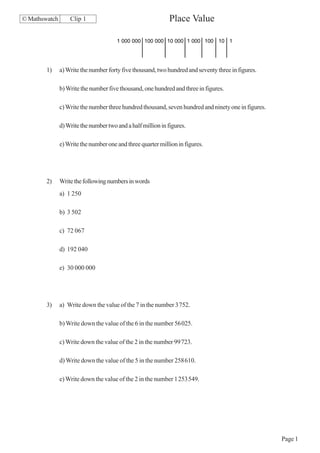
                                       1 000 000 100 000 10 000 1 000 100 10 1


        1)     a) Write the number forty five thousand, two hundred and seventy three in figures.

               b) Write the number five thousand, one hundred and three in figures.

               c) Write the number three hundred thousand, seven hundred and ninety one in figures.

               d) Write the number two and a half million in figures.

               e) Write the number one and three quarter million in figures.


        2)     Write the following numbers in words
               a) 1 250

               b) 3 502

               c) 72 067

               d) 192 040

               e) 30 000 000


        3)     a) Write down the value of the 7 in the number 3 752.

               b) Write down the value of the 6 in the number 56 025.

               c) Write down the value of the 2 in the number 99 723.

               d) Write down the value of the 5 in the number 258 610.

               e) Write down the value of the 2 in the number 1 253 549.


                                                                                                      Page 1
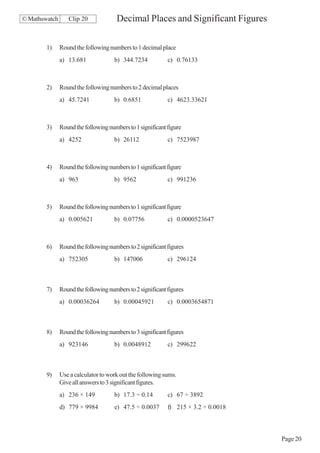
© Mathswatch       Clip 2                             Ordering Decimals

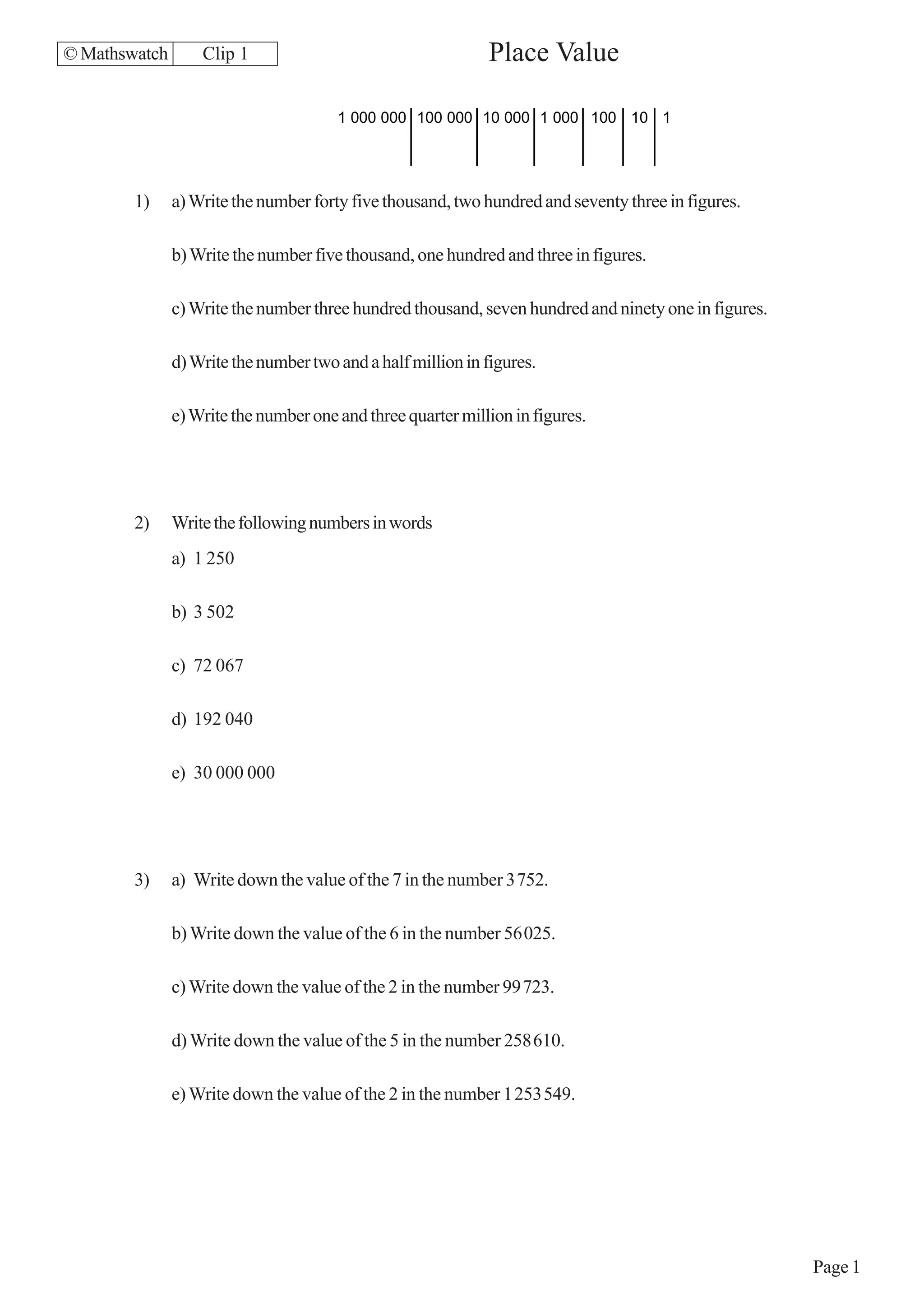
      Put these numbers in order, starting with the smallest:

        1)     74, 57, 38, 8, 61


        2)     39, 84, 11, 128, 24


        3)     76, 102, 12, 140, 73


        4)     3.1, 31, 1.3, 13, 1.03


        5)     0.321, 0.312, 1.04, 1.23


        6)     0.34, 0.047, 0.4, 0.43, 0.403


        7)     0.79, 0.709, 0.97, 0.792


        8)     2.71, 2.074, 2.071, 2.701


        9)     0.875, 0.88, 0.0885, 0.008, 0.11


       10)     3, –2, –7, 10, –1


       11)     –3, –11, 1, –5, 7


       12)     –4, 6, 0, –6, –1


                                                                          Page 2
© Mathswatch       Clip 3            Rounding to the Nearest 10, 100, 1000

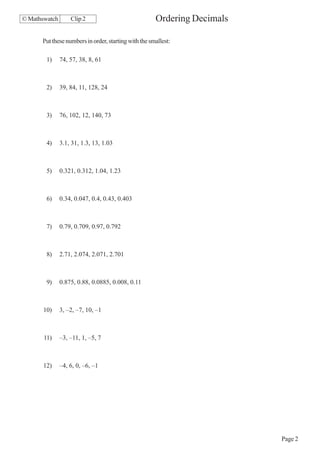
        1)     Round these numbers to the nearest 10:
               a) 26
               b) 62
               c) 75
               d) 231
               e) 797
               f) 5 842
               g) 9 875
               h) 13 758


        2)     Round these numbers to the nearest 100:
               a) 78
               b) 223
               c) 549
               d) 1 450
               e) 1 382
               f) 4 537
               g) 9 193
               h) 17 625


        3)     Round these numbers to the nearest 1000:
               a) 850
               b) 1 455
               c) 3 230
               d) 7 500
               e) 8 455
               f) 9 690
               g) 12 390
               h) 28 910


                                                                             Page 3
© Mathswatch               Clip 4                                         Reading Scales

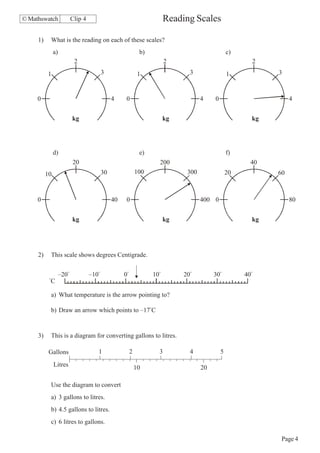
     1)        What is the reading on each of these scales?
               a)                                              b)                                  c)
                            2                                             2                               2
          1                                3                   1                 3                 1           3


     0                                          4     0                               4    0                        4


                           kg                                             kg                              kg


               d)                                              e)                                  f)
                           20                                         200                                 40
          10                               30                 100               300                20          60


     0                                          40    0                               400 0                         80


                           kg                                             kg                              kg


     2)        This scale shows degrees Centigrade.


                    –20°            –10°             0°             10°        20°         30°          40°
           °
               C

               a) What temperature is the arrow pointing to?

               b) Draw an arrow which points to –17°C


     3)        This is a diagram for converting gallons to litres.

           Gallons                     1                  2           3          4             5

                Litres                                        10                      20

               Use the diagram to convert
               a) 3 gallons to litres.
               b) 4.5 gallons to litres.
               c) 6 litres to gallons.

                                                                                                                Page 4
© Mathswatch        Clip 5               Multiply and Divide by Powers of 10

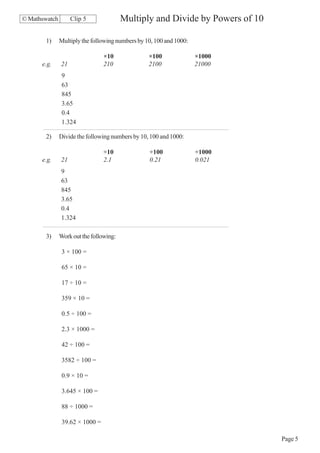
       1)      Multiply the following numbers by 10, 100 and 1000:

                                 ×10              ×100               ×1000
      e.g.     21                210              2100               21000
                9
                63
                845
                3.65
                0.4
                1.324

       2)      Divide the following numbers by 10, 100 and 1000:

                                 ÷10              ÷100               ÷1000
      e.g.     21                2.1              0.21               0.021
               9
               63
               845
               3.65
               0.4
               1.324

       3)      Work out the following:

                3 × 100 =

                65 × 10 =

                17 ÷ 10 =

                359 × 10 =

                0.5 ÷ 100 =

                2.3 × 1000 =

                42 ÷ 100 =

                3582 ÷ 100 =

                0.9 × 10 =

                3.645 × 100 =

                88 ÷ 1000 =

                39.62 × 1000 =

                                                                               Page 5
© Mathswatch        Clip 6                          Negatives in Real Life

        1)     At midnight, the temperature was -7°C.
               By 7am the next morning, the temperature had increased by 6°C.
               a) Work out the temperature at 7am the next morning.

               At midday, the temperature was 3°C.
               b) Work out the difference between the temperature at midday and the temperature at midnight.

               c) Work out the temperature which is halfway between -7°C and 3°C.

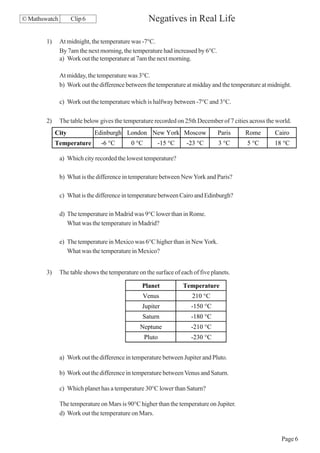
        2)     The table below gives the temperature recorded on 25th December of 7 cities across the world.
             City            Edinburgh London New York Moscow                   Paris    Rome        Cairo
             Temperature        -6 °C       0 °C       -15 °C      -23 °C        3 °C     5 °C       18 °C

               a) Which city recorded the lowest temperature?

               b) What is the difference in temperature between New York and Paris?

               c) What is the difference in temperature between Cairo and Edinburgh?

               d) The temperature in Madrid was 9°C lower than in Rome.
                  What was the temperature in Madrid?

               e) The temperature in Mexico was 6°C higher than in New York.
                  What was the temperature in Mexico?


        3)     The table shows the temperature on the surface of each of five planets.

                                                 Planet           Temperature
                                                 Venus                210 °C
                                                 Jupiter             -150 °C
                                                 Saturn              -180 °C
                                                Neptune              -210 °C
                                                   Pluto             -230 °C


               a) Work out the difference in temperature between Jupiter and Pluto.

               b) Work out the difference in temperature between Venus and Saturn.

               c) Which planet has a temperature 30°C lower than Saturn?

               The temperature on Mars is 90°C higher than the temperature on Jupiter.
               d) Work out the temperature on Mars.


                                                                                                        Page 6
© Mathswatch      Clip 7        Multiplication & Division with Negatives

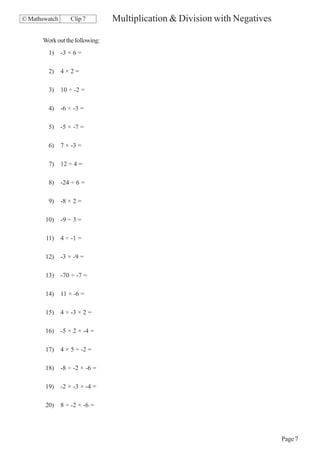
      Work out the following:
        1)     -3 × 6 =

        2)     4×2=

        3)     10 ÷ -2 =

        4)     -6 ÷ -3 =

        5)     -5 × -7 =

        6)     7 × -3 =

        7)     12 ÷ 4 =

        8)     -24 ÷ 6 =

        9)     -8 × 2 =

       10)     -9 ÷ 3 =

       11)     4 ÷ -1 =

       12)     -3 × -9 =

       13)     -70 ÷ -7 =

       14)     11 × -6 =

       15)     4 × -3 × 2 =

       16)     -5 × 2 × -4 =

       17)     4 × 5 ÷ -2 =

       18)     -8 ÷ -2 × -6 =

       19)     -2 × -3 × -4 =

       20)     8 ÷ -2 × -6 =


                                                                           Page 7
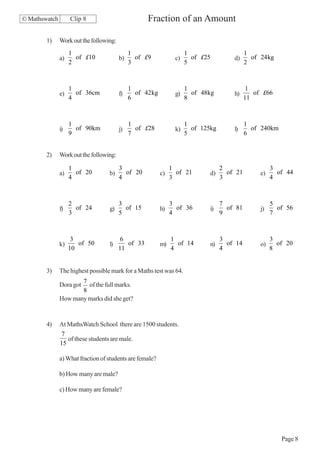
© Mathswatch        Clip 8                          Fraction of an Amount

        1)     Work out the following:
                    1                         1                       1                      1
               a)     of £10             b)     of £9            c)     of £25         d)      of 24 kg
                    2                         3                       5                      2


                    1                         1                       1                      1
               e)     of 36cm            f)     of 42 kg         g)     of 48kg        h)       of £66
                    4                         6                       8                      11


                    1                         1                       1                      1
               i)     of 90km            j)     of £28           k)     of 125kg       l)      of 240km
                    9                         7                       5                      6


        2)     Work out the following:

                    1                    3                      1                  2                   3
               a)     of 20        b)      of 20           c)     of 21       d)     of 21        e)     of 44
                    4                    4                      3                  3                   4


                    2                    3                      3                  7                   5
               f)     of 24        g)      of 15           h)     of 36       i)     of 81        j)     of 56
                    3                    5                      4                  9                   7


                     3                   6                      1                  3                   3
               k)      of 50       l)       of 33          m)     of 14       n)     of 14        o)     of 20
                    10                   11                     4                  4                   8


        3)     The highest possible mark for a Maths test was 64.
                      7
               Dora got of the full marks.
                      8
               How many marks did she get?


        4)     At MathsWatch School there are 1500 students.
               7
                  of these students are male.
               15

               a) What fraction of students are female?

               b) How many are male?

               c) How many are female?


                                                                                                          Page 8
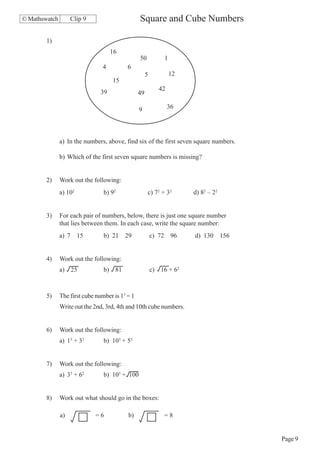
© Mathswatch        Clip 9                       Square and Cube Numbers

        1)
                                     16
                                                 50            1
                                4          6
                                                      5            12
                                     15
                                                             42
                                39               49

                                                 9                36


               a) In the numbers, above, find six of the first seven square numbers.

               b) Which of the first seven square numbers is missing?


        2)     Work out the following:
               a) 102            b) 92                c) 72 + 32        d) 82 – 22


        3)     For each pair of numbers, below, there is just one square number
               that lies between them. In each case, write the square number:
               a) 7 15           b) 21 29                 c) 72 96      d) 130 156


        4)     Work out the following:
               a) 25             b) 81                    c) 16 + 62


        5)     The first cube number is 13 = 1
               Write out the 2nd, 3rd, 4th and 10th cube numbers.


        6)     Work out the following:
               a) 13 + 33        b) 103 + 53


        7)     Work out the following:
               a) 33 + 62        b) 103 + 100


        8)     Work out what should go in the boxes:

               a)            =6            b)                  =8


                                                                                       Page 9
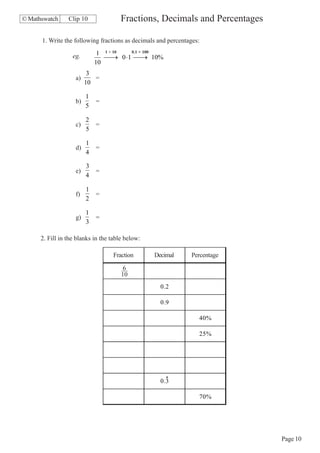
© Mathswatch     Clip 10               Fractions, Decimals and Percentages

      1. Write the following fractions as decimals and percentages:
                              1 1 ÷ 10   0.1 × 100
                   eg.          ⎯ → 0 ⋅ 1 ⎯ → 10%
                                ⎯          ⎯
                             10
                          3
                    a)      =
                         10

                         1
                    b)       =
                         5

                         2
                    c)       =
                         5

                         1
                    d)       =
                         4

                         3
                    e)       =
                         4

                         1
                    f)       =
                         2

                         1
                    g)       =
                         3

      2. Fill in the blanks in the table below:

                                   Fraction       Decimal      Percentage

                                        6
                                       10
                                                    0.2

                                                    0.9

                                                                  40%

                                                                  25%


                                                     .
                                                    0.3

                                                                  70%


                                                                             Page 10
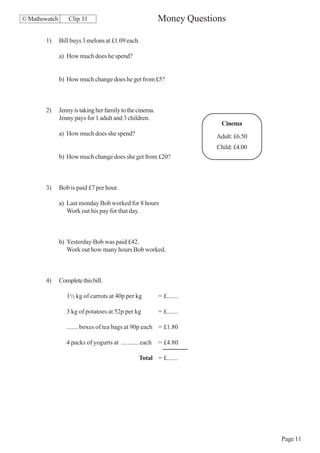
© Mathswatch       Clip 11                                 Money Questions

       1)      Bill buys 3 melons at £1.09 each.

               a) How much does he spend?


               b) How much change does he get from £5?


       2)      Jenny is taking her family to the cinema.
               Jenny pays for 1 adult and 3 children.
                                                                         Cinema
               a) How much does she spend?                              Adult: £6.50
                                                                        Child: £4.00
               b) How much change does she get from £20?


       3)      Bob is paid £7 per hour.

               a) Last monday Bob worked for 8 hours
                  Work out his pay for that day.


               b) Yesterday Bob was paid £42.
                  Work out how many hours Bob worked.


       4)      Complete this bill.

                  1½ kg of carrots at 40p per kg           = £.......

                  3 kg of potatoes at 52p per kg           = £.......

                  ....... boxes of tea bags at 90p each = £1.80

                  4 packs of yogurts at ........... each   = £4.80

                                                  Total = £.......


                                                                                       Page 11
© Mathswatch        Clip 12                                Shading Fractions

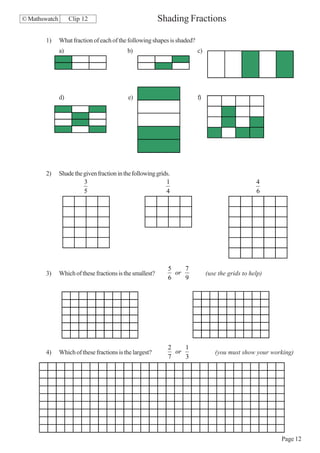
       1)      What fraction of each of the following shapes is shaded?
               a)                           b)                            c)


               d)                           e)                            f)


       2)      Shade the given fraction in the following grids.
                         3                                   1                                     4
                         5                                   4                                     6


                                                              5    7
       3)      Which of these fractions is the smallest?        or             (use the grids to help)
                                                              6    9


                                                              2    1
       4)      Which of these fractions is the largest?         or                (you must show your working)
                                                              7    3


                                                                                                         Page 12
© Mathswatch        Clip 13             Ordering Fractions, Percentages & Decimals

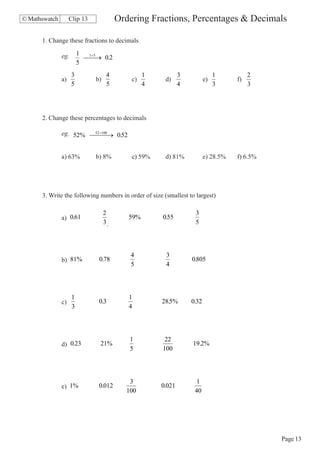
      1. Change these fractions to decimals
                         1
               eg.         ⎯1÷5→ 0.2
                            ⎯
                         5
                     3              4            1           3               1          2
               a)             b)            c)         d)               e)         f)
                     5              5            4           4               3          3


      2. Change these percentages to decimals

               eg. 52% ⎯52 ÷⎯→ 0.52
                         ⎯  100


               a) 63%         b) 8%         c) 59%     d) 81%           e) 28.5%   f) 6.5%


      3. Write the following numbers in order of size (smallest to largest)

                                   2                               3
               a) 0.61                     59%        0.55
                                   3.                              5


                                            4          3
               b) 81%          0.78                              0.805
                                            5          4


                     1                     1
               c)              0.3                   28.5%       0.32
                     3                     4


                                           1          22
               d) 0.23          21%                              19.2%
                                           5         100


                                           3                       1
               e) 1%           0.012                 0.021
                                          100                     40


                                                                                             Page 13
© Mathswatch        Clip 14                       Estimation

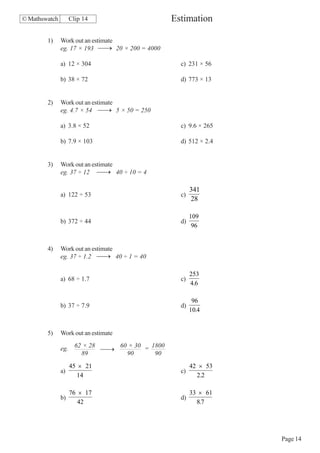
        1)     Work out an estimate
               eg. 17 × 193 ⎯ → 20 × 200 = 4000
                               ⎯

               a) 12 × 304                          c) 231 × 56

               b) 38 × 72                           d) 773 × 13


        2)     Work out an estimate
               eg. 4.7 × 54 ⎯ → 5 × 50 = 250
                               ⎯

               a) 3.8 × 52                          c) 9.6 × 265

               b) 7.9 × 10³                         d) 512 × 2.4


        3)     Work out an estimate
               eg. 37 ÷ 12 ⎯ → 40 ÷ 10 = 4
                              ⎯

                                                         341
               a) 122 ÷ 53                          c)
                                                         28

                                                         109
               b) 372 ÷ 44                          d)
                                                          96


        4)     Work out an estimate
               eg. 37 ÷ 1.2 ⎯ → 40 ÷ 1 = 40
                              ⎯

                                                         253
               a) 68 ÷ 1.7                          c)
                                                         4.6

                                                          96
               b) 37 ÷ 7.9                          d)
                                                         10.4


        5)     Work out an estimate

               eg. 62 × 28 ⎯ → 60 × 30 = 1800
                           ⎯
                     89          90       90
                    45 × 21                              42 × 53
               a)                                   c)
                       14                                  2.2

                    76 × 17                              33 × 61
               b)                                   d)
                       42                                  8.7


                                                                   Page 14
© Mathswatch      Clip 15                   Place Value When Multiplying

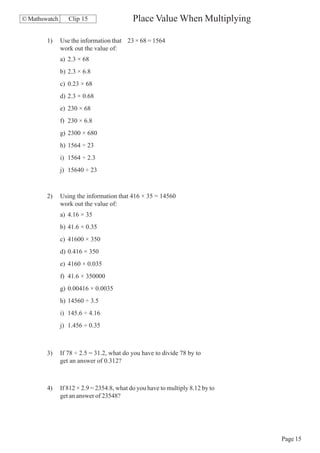
        1)     Use the information that 23 × 68 = 1564
               work out the value of:
               a) 2.3 × 68
               b) 2.3 × 6.8
               c) 0.23 × 68
               d) 2.3 × 0.68
               e) 230 × 68
               f) 230 × 6.8
               g) 2300 × 680
               h) 1564 ÷ 23
               i) 1564 ÷ 2.3
               j) 15640 ÷ 23


        2)     Using the information that 416 × 35 = 14560
               work out the value of:
               a) 4.16 × 35
               b) 41.6 × 0.35
               c) 41600 × 350
               d) 0.416 × 350
               e) 4160 × 0.035
               f) 41.6 × 350000
               g) 0.00416 × 0.0035
               h) 14560 ÷ 3.5
               i) 145.6 ÷ 4.16
               j) 1.456 ÷ 0.35


        3)     If 78 ÷ 2.5 = 31.2, what do you have to divide 78 by to
               get an answer of 0.312?


        4)     If 812 × 2.9 = 2354.8, what do you have to multiply 8.12 by to
               get an answer of 23548?


                                                                                Page 15
© Mathswatch        Clip 16                     Addition and Subtraction

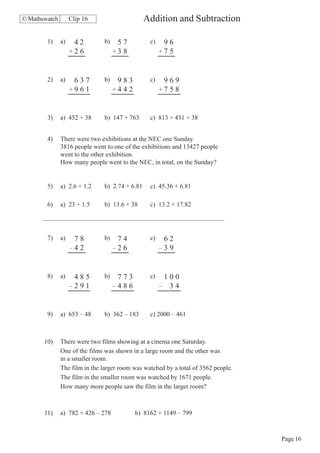
        1)     a)    42        b)    57          c)    96
                    +2 6            +3 8              +7 5


        2)     a)    637       b)    983         c)    969
                    +961            +442              +758


        3)     a) 452 + 38     b) 147 + 763      c) 813 + 431 + 38


        4)     There were two exhibitions at the NEC one Sunday.
               3816 people went to one of the exhibitions and 13427 people
               went to the other exhibition.
               How many people went to the NEC, in total, on the Sunday?


        5)     a) 2.6 + 1.2    b) 2.74 + 6.81    c) 45.36 + 6.81

        6)     a) 23 + 1.5     b) 13.6 + 38      c) 13.2 + 17.82


        7)     a)    78        b)    74          c)    62
                    –42             –26               –39


        8)     a)    485       b)    773         c)    100
                    –291            –486              – 34


        9)     a) 653 – 48     b) 362 – 183      c) 2000 – 461


       10)     There were two films showing at a cinema one Saturday.
               One of the films was shown in a large room and the other was
               in a smaller room.
               The film in the larger room was watched by a total of 3562 people.
               The film in the smaller room was watched by 1671 people.
               How many more people saw the film in the larger room?


       11)     a) 782 + 426 – 278          b) 8162 + 1149 – 799


                                                                                    Page 16
© Mathswatch      Clip 17                              Long Multiplication

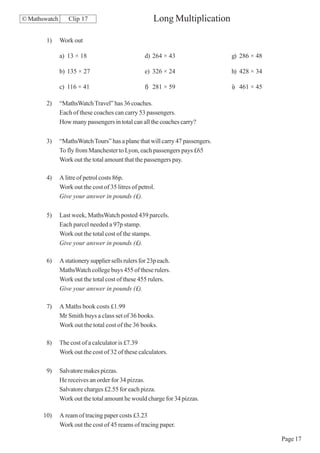
        1)     Work out

               a) 13 × 18                          d) 264 × 43                 g) 286 × 48

               b) 135 × 27                         e) 326 × 24                 h) 428 × 34

               c) 116 × 41                         f) 281 × 59                 i) 461 × 45

        2)     “MathsWatch Travel” has 36 coaches.
               Each of these coaches can carry 53 passengers.
               How many passengers in total can all the coaches carry?

        3)     “MathsWatch Tours” has a plane that will carry 47 passengers.
               To fly from Manchester to Lyon, each passengers pays £65
               Work out the total amount that the passengers pay.

        4)     A litre of petrol costs 86p.
               Work out the cost of 35 litres of petrol.
               Give your answer in pounds (£).

        5)     Last week, MathsWatch posted 439 parcels.
               Each parcel needed a 97p stamp.
               Work out the total cost of the stamps.
               Give your answer in pounds (£).

        6)     A stationery supplier sells rulers for 23p each.
               MathsWatch college buys 455 of these rulers.
               Work out the total cost of these 455 rulers.
               Give your answer in pounds (£).

        7)     A Maths book costs £1.99
               Mr Smith buys a class set of 36 books.
               Work out the total cost of the 36 books.

        8)     The cost of a calculator is £7.39
               Work out the cost of 32 of these calculators.

        9)     Salvatore makes pizzas.
               He receives an order for 34 pizzas.
               Salvatore charges £2.55 for each pizza.
               Work out the total amount he would charge for 34 pizzas.

       10)     A ream of tracing paper costs £3.23
               Work out the cost of 45 reams of tracing paper.

                                                                                             Page 17
© Mathswatch      Clip 18                                 Long Division
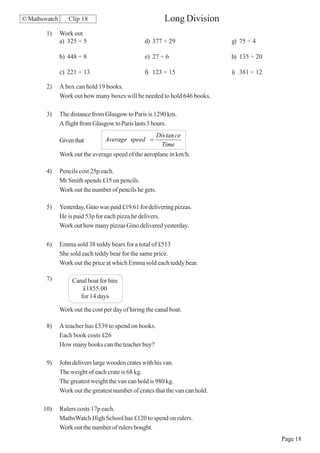
        1)     Work out
               a) 325 ÷ 5                         d) 377 ÷ 29                  g) 75 ÷ 4

               b) 448 ÷ 8                         e) 27 ÷ 6                    h) 135 ÷ 20

               c) 221 ÷ 13                        f) 123 ÷ 15                  i) 381 ÷ 12

        2)     A box can hold 19 books.
               Work out how many boxes will be needed to hold 646 books.

        3)     The distance from Glasgow to Paris is 1290 km.
               A flight from Glasgow to Paris lasts 3 hours.
                                                       Dis tan ce
               Given that         Average speed =
                                                         Time
               Work out the average speed of the aeroplane in km/h.

        4)     Pencils cost 25p each.
               Mr Smith spends £15 on pencils.
               Work out the number of pencils he gets.

        5)     Yesterday, Gino was paid £19.61 for delivering pizzas.
               He is paid 53p for each pizza he delivers.
               Work out how many pizzas Gino delivered yesterday.

        6)     Emma sold 38 teddy bears for a total of £513
               She sold each teddy bear for the same price.
               Work out the price at which Emma sold each teddy bear.

        7)          Canal boat for hire
                        £1855.00
                       for 14 days

               Work out the cost per day of hiring the canal boat.

        8)     A teacher has £539 to spend on books.
               Each book costs £26
               How many books can the teacher buy?

        9)     John delivers large wooden crates with his van.
               The weight of each crate is 68 kg.
               The greatest weight the van can hold is 980 kg.
               Work out the greatest number of crates that the van can hold.

       10)     Rulers costs 17p each.
               MathsWatch High School has £120 to spend on rulers.
               Work out the number of rulers bought.
                                                                                             Page 18
© Mathswatch      Clip 19            Multiplication and Division with Decimals

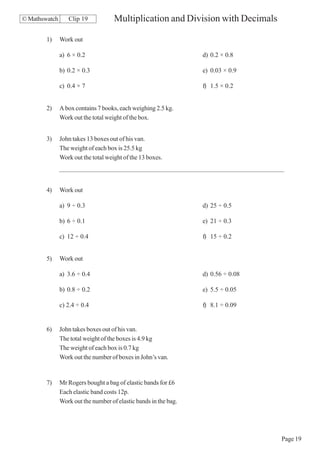
        1)     Work out

               a) 6 × 0.2                                         d) 0.2 × 0.8

               b) 0.2 × 0.3                                       e) 0.03 × 0.9

               c) 0.4 × 7                                         f) 1.5 × 0.2


        2)     A box contains 7 books, each weighing 2.5 kg.
               Work out the total weight of the box.


        3)     John takes 13 boxes out of his van.
               The weight of each box is 25.5 kg
               Work out the total weight of the 13 boxes.


        4)     Work out

               a) 9 ÷ 0.3                                         d) 25 ÷ 0.5

               b) 6 ÷ 0.1                                         e) 21 ÷ 0.3

               c) 12 ÷ 0.4                                        f) 15 ÷ 0.2


        5)     Work out

               a) 3.6 ÷ 0.4                                       d) 0.56 ÷ 0.08

               b) 0.8 ÷ 0.2                                       e) 5.5 ÷ 0.05

               c) 2.4 ÷ 0.4                                       f) 8.1 ÷ 0.09


        6)     John takes boxes out of his van.
               The total weight of the boxes is 4.9 kg
               The weight of each box is 0.7 kg
               Work out the number of boxes in John’s van.


        7)     Mr Rogers bought a bag of elastic bands for £6
               Each elastic band costs 12p.
               Work out the number of elastic bands in the bag.


                                                                                   Page 19
© Mathswatch      Clip 20             Decimal Places and Significant Figures

        1)     Round the following numbers to 1 decimal place
               a) 13.681             b) 344.7234            c) 0.76133


        2)     Round the following numbers to 2 decimal places
               a) 45.7241            b) 0.6851              c) 4623.33621


        3)     Round the following numbers to 1 significant figure
               a) 4252               b) 26112               c) 7523987


        4)     Round the following numbers to 1 significant figure
               a) 963                b) 9562                c) 991236


        5)     Round the following numbers to 1 significant figure
               a) 0.005621           b) 0.07756             c) 0.0000523647


        6)     Round the following numbers to 2 significant figures
               a) 752305             b) 147006              c) 296124


        7)     Round the following numbers to 2 significant figures
               a) 0.00036264         b) 0.00045921          c) 0.0003654871


        8)     Round the following numbers to 3 significant figures
               a) 923146             b) 0.0048912           c) 299622


        9)     Use a calculator to work out the following sums.
               Give all answers to 3 significant figures.
               a) 236 × 149          b) 17.3 ÷ 0.14         c) 67 ÷ 3892
               d) 779 × 9984          e) 47.5 ÷ 0.0037      f) 215 × 3.2 ÷ 0.0018


                                                                                    Page 20
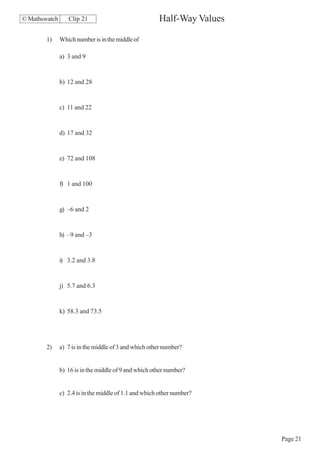
© Mathswatch      Clip 21                              Half-Way Values

        1)     Which number is in the middle of

               a) 3 and 9


               b) 12 and 28


               c) 11 and 22


               d) 17 and 32


               e) 72 and 108


               f) 1 and 100


               g) –6 and 2


               h) –9 and –3


               i) 3.2 and 3.8


               j) 5.7 and 6.3


               k) 58.3 and 73.5


        2)     a) 7 is in the middle of 3 and which other number?


               b) 16 is in the middle of 9 and which other number?


               c) 2.4 is in the middle of 1.1 and which other number?


                                                                         Page 21
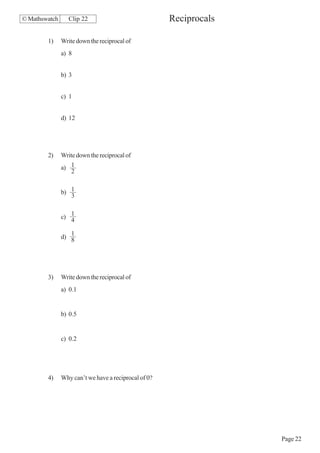
© Mathswatch      Clip 22                             Reciprocals

        1)     Write down the reciprocal of
               a) 8


               b) 3


               c) 1


               d) 12


        2)     Write down the reciprocal of
               a) 1
                  2


               b) 1
                  3


               c) 1
                  4

                  1
               d) 8


        3)     Write down the reciprocal of
               a) 0.1


               b) 0.5


               c) 0.2


        4)     Why can’t we have a reciprocal of 0?


                                                                    Page 22
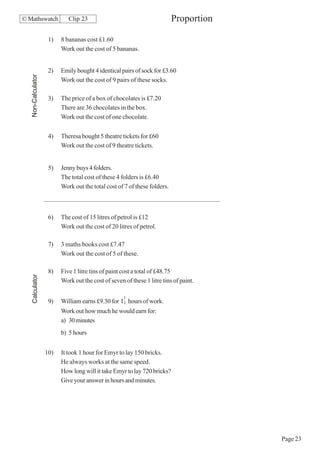
© Mathswatch                 Clip 23                                       Proportion

                     1)   8 bananas cost £1.60
                          Work out the cost of 5 bananas.


                     2)   Emily bought 4 identical pairs of sock for £3.60
   Non-Calculator


                          Work out the cost of 9 pairs of these socks.

                     3)   The price of a box of chocolates is £7.20
                          There are 36 chocolates in the box.
                          Work out the cost of one chocolate.

                     4)   Theresa bought 5 theatre tickets for £60
                          Work out the cost of 9 theatre tickets.


                     5)   Jenny buys 4 folders.
                          The total cost of these 4 folders is £6.40
                          Work out the total cost of 7 of these folders.


                     6)   The cost of 15 litres of petrol is £12
                          Work out the cost of 20 litres of petrol.

                     7)   3 maths books cost £7.47
                          Work out the cost of 5 of these.

                     8)   Five 1 litre tins of paint cost a total of £48.75
   Calculator


                          Work out the cost of seven of these 1 litre tins of paint.

                                                     1
                     9)   William earns £9.30 for 12 hours of work.
                          Work out how much he would earn for:
                          a) 30 minutes
                          b) 5 hours


                    10)   It took 1 hour for Emyr to lay 150 bricks.
                          He always works at the same speed.
                          How long will it take Emyr to lay 720 bricks?
                          Give your answer in hours and minutes.


                                                                                        Page 23
© Mathswatch       Clip 24                                   Distance Tables

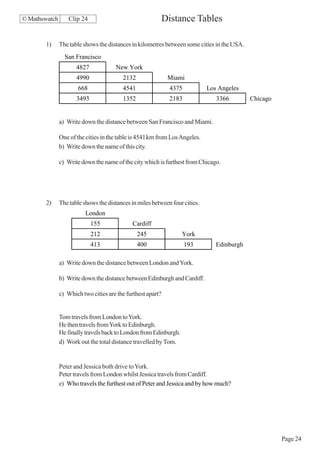
       1)      The table shows the distances in kilometres between some cities in the USA.
                 San Francisco
                      4827            New York
                      4990               2132                 Miami
                      668                4541                  4375          Los Angeles
                      3493               1352                 2183              3366         Chicago


               a) Write down the distance between San Francisco and Miami.

               One of the cities in the table is 4541 km from Los Angeles.
               b) Write down the name of this city.

               c) Write down the name of the city which is furthest from Chicago.


       2)      The table shows the distances in miles between four cities.
                          London
                             155             Cardiff
                             212                245                York
                             413                400                   193       Edinburgh

               a) Write down the distance between London and York.

               b) Write down the distance between Edinburgh and Cardiff.

               c) Which two cities are the furthest apart?


               Tom travels from London to York.
               He then travels from York to Edinburgh.
               He finally travels back to London from Edinburgh.
               d) Work out the total distance travelled by Tom.


               Peter and Jessica both drive to York.
               Peter travels from London whilst Jessica travels from Cardiff.
               e) Who travels the furthest out of Peter and Jessica and by how much?


                                                                                                       Page 24
© Mathswatch      Clip 25                                     Timetables

        1)     Change the following to the 24 hour clock
               a) 4.30 pm                           d) 7.15 pm
               b) 5 am                              e) Quarter past midnight
               c) 10.26 am                          f) Half past noon


        2)     Change the following to the 12 hour clock
               a) 06 35                             d) 19 15
               b) 14 30                             e) 00 50
               c) 12 45                             f) Half past midnight


        3)     What is the difference in hours and minutes between the following
               a) 10.15 pm and 11.30 pm

               b) 14 20 and 17 10

               c) 11.50 pm and 3.20 am

               d) 22 45 and 01 00


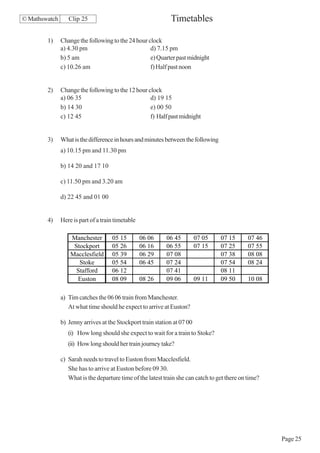
        4)     Here is part of a train timetable

                   Manchester        05 15         06 06    06 45         07 05    07 15       07 46
                    Stockport        05 26         06 16    06 55         07 15    07 25       07 55
                   Macclesfield      05 39         06 29    07 08                  07 38       08 08
                      Stoke          05 54         06 45    07 24                  07 54       08 24
                     Stafford        06 12                  07 41                  08 11
                     Euston          08 09         08 26    09 06         09 11    09 50       10 08

               a) Tim catches the 06 06 train from Manchester.
                  At what time should he expect to arrive at Euston?

               b) Jenny arrives at the Stockport train station at 07 00
                  (i) How long should she expect to wait for a train to Stoke?
                  (ii) How long should her train journey take?

               c) Sarah needs to travel to Euston from Macclesfield.
                  She has to arrive at Euston before 09 30.
                  What is the departure time of the latest train she can catch to get there on time?


                                                                                                       Page 25
© Mathswatch         Clip 26                                          Powers

        1)     Write the following using indices:
               eg. 3 × 3 × 3 × 3 = 34

               a) 2 × 2 × 2 × 2                            d) 12 × 12 × 12 × 12 × 12

               b) 4 × 4 × 4                                e) 3.6 × 3.6

               c) 5 × 5 × 5 × 5 × 5 × 5                    f) 5.2 × 5.2 × 5.2

        2)     Write each of the following as a single power:
               eg. 52 × 54 =56

               a) 62 × 63                                  d) 53 × 5

               b) 74 × 72                                  e) 29 × 23

               c) 93 × 96                                  f) 7.23 × 7.22

        3)     Write each of the following as a single power:
               eg. 75 ÷ 72 = 73

                     5    3
                                                             78
               a) 9 ÷ 9                                    d) 3
                                                             7

                                                                36
               b) 69 ÷ 65                                  e)
                                                                3

                                                                815
               c) 117 ÷ 112                                f)
                                                                84

        4)     Write each of the following as a single power:
                          73 × 78  711
               eg.                = 6 = 75
                             76    7

                     47 × 43                                     92 × 96
               a)                                          b)
                       46                                          94

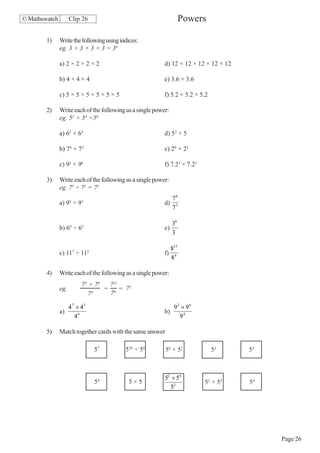
        5)     Match together cards with the same answer

                               57          510 ÷ 56        56 × 52              53     52


                                                           52 × 54
                               58           5×5                             52 × 55    54
                                                             53


                                                                                            Page 26
© Mathswatch      Clip 27                                   Line Graphs
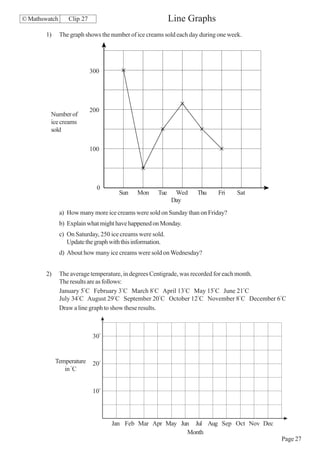
        1)     The graph shows the number of ice creams sold each day during one week.


                            300


                            200
         Number of
         ice creams
         sold

                            100


                              0
                                      Sun     Mon     Tue    Wed    Thu     Fri     Sat
                                                            Day
               a) How many more ice creams were sold on Sunday than on Friday?
               b) Explain what might have happened on Monday.
               c) On Saturday, 250 ice creams were sold.
                  Update the graph with this information.
               d) About how many ice creams were sold on Wednesday?


        2)     The average temperature, in degrees Centigrade, was recorded for each month.
               The results are as follows:
               January 5°C February 3°C March 8°C April 13°C May 15°C June 21°C
               July 34°C August 29°C September 20°C October 12°C November 8°C December 6°C
               Draw a line graph to show these results.


                            30°


             Temperature    20°
                in °C


                            10°


                                   Jan Feb Mar Apr May Jun Jul Aug Sep Oct Nov Dec
                                                         Month
                                                                                          Page 27
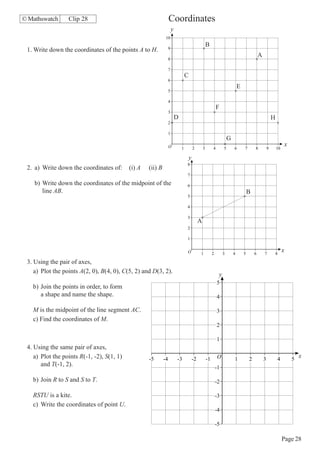
© Mathswatch      Clip 28                                         Coordinates
                                                                      y
                                                              10
                                                                                                   B
 1. Write down the coordinates of the points A to H.              9
                                                                                                                                             A
                                                                  8

                                                                  7
                                                                                  C
                                                                  6
                                                                                                                             E
                                                                  5

                                                                  4
                                                                                                            F
                                                                  3
                                                                          D                                                                              H
                                                                  2

                                                                  1
                                                                                                                     G
                                                                  O                                                                                               x
                                                                              1       2        3        4        5       6       7       8           9       10

                                                                                  y
                                                                                  8
 2. a) Write down the coordinates of:       (i) A   (ii) B
                                                                                  7

    b) Write down the coordinates of the midpoint of the                          6
       line AB.                                                                                                                      B
                                                                                  5

                                                                                  4

                                                                                  3
                                                                                           A
                                                                                  2

                                                                                  1


                                                                                  O        1            2        3       4       5       6       7           8
                                                                                                                                                                  x
 3. Using the pair of axes,
    a) Plot the points A(2, 0), B(4, 0), C(5, 2) and D(3, 2).                                                y
                                                                                                            5
   b) Join the points in order, to form
      a shape and name the shape.                                                                           4

   M is the midpoint of the line segment AC.                                                                3
   c) Find the coordinates of M.
                                                                                                            2

                                                                                                            1
 4. Using the same pair of axes,
    a) Plot the points R(-1, -2), S(1, 1)           -5       -4           -3          -2           -1       O            1           2           3           4        5
                                                                                                                                                                          x
       and T(-1, 2).                                                                                        -1

   b) Join R to S and S to T.                                                                               -2

   RSTU is a kite.                                                                                          -3
   c) Write the coordinates of point U.
                                                                                                            -4

                                                                                                            -5

                                                                                                                                                                  Page 28
© Mathswatch       Clip 29                                  Number Sequences

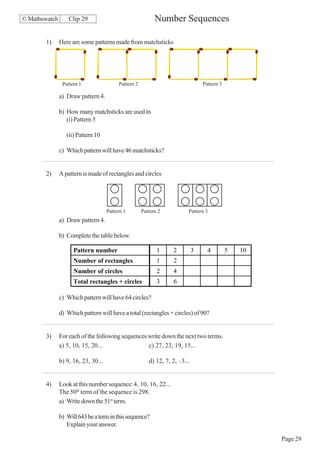
       1)      Here are some patterns made from matchsticks


                Pattern 1                 Pattern 2                               Pattern 3

               a) Draw pattern 4.

               b) How many matchsticks are used in
                  (i) Pattern 5

                  (ii) Pattern 10

               c) Which pattern will have 46 matchsticks?


       2)      A pattern is made of rectangles and circles


                                     Pattern 1        Pattern 2           Pattern 3
               a) Draw pattern 4.

               b) Complete the table below.

                     Pattern number                          1     2          3     4         5   10
                     Number of rectangles                    1     2
                     Number of circles                       2     4
                     Total rectangles + circles              3     6

               c) Which pattern will have 64 circles?

               d) Which pattern will have a total (rectangles + circles) of 90?


       3)      For each of the following sequences write down the next two terms.
               a) 5, 10, 15, 20...                 c) 27, 23, 19, 15...

               b) 9, 16, 23, 30...                       d) 12, 7, 2, –3...


       4)      Look at this number sequence:4, 10, 16, 22...
               The 50th term of the sequence is 298.
               a) Write down the 51st term.

               b) Will 643 be a term in this sequence?
                  Explain your answer.

                                                                                                       Page 29
© Mathswatch      Clip 30                            Number Machines

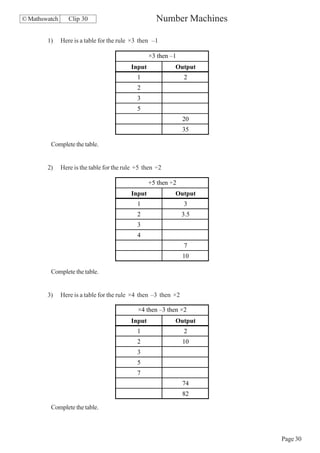
        1)     Here is a table for the rule ×3 then –1

                                                   ×3 then –1
                                           Input            Output
                                              1                  2
                                              2
                                              3
                                              5
                                                                 20
                                                                 35

         Complete the table.


        2)     Here is the table for the rule +5 then ÷2

                                                   +5 then ÷2
                                           Input            Output
                                              1                  3
                                              2                  3.5
                                              3
                                              4
                                                                 7
                                                                 10

         Complete the table.


        3)     Here is a table for the rule ×4 then –3 then ×2

                                              ×4 then –3 then ×2
                                           Input            Output
                                              1                  2
                                              2                  10
                                              3
                                              5
                                              7
                                                                 74
                                                                 82

         Complete the table.


                                                                       Page 30
© Mathswatch       Clip 31                                       Angles

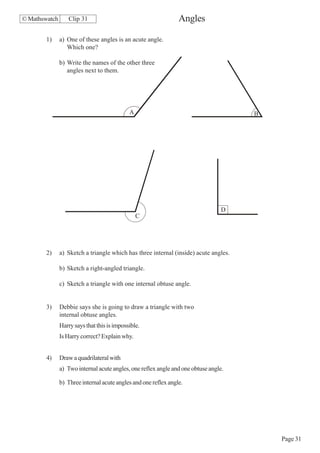
        1)     a) One of these angles is an acute angle.
                  Which one?

               b) Write the names of the other three
                  angles next to them.


                                             A                                        B


                                                                                 D
                                                 C


        2)     a) Sketch a triangle which has three internal (inside) acute angles.

               b) Sketch a right-angled triangle.

               c) Sketch a triangle with one internal obtuse angle.


        3)     Debbie says she is going to draw a triangle with two
               internal obtuse angles.
               Harry says that this is impossible.
               Is Harry correct? Explain why.


        4)     Draw a quadrilateral with
               a) Two internal acute angles, one reflex angle and one obtuse angle.

               b) Three internal acute angles and one reflex angle.


                                                                                          Page 31
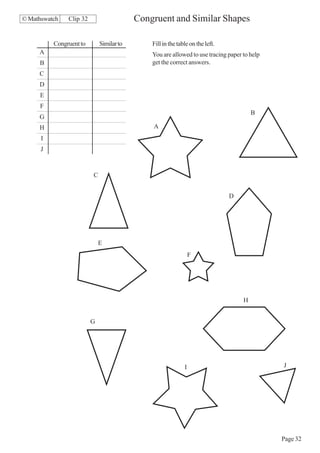
© Mathswatch   Clip 32                    Congruent and Similar Shapes

          Congruent to       Similar to       Fill in the table on the left.
     A                                        You are allowed to use tracing paper to help
     B                                        get the correct answers.
     C
     D
     E
     F
                                                                                       B
     G
     H                                        A
      I
      J


                         C


                                                                               D


                             E
                                                                 F


                                                                                   H


                         G


                                                             I                               J


                                                                                             Page 32
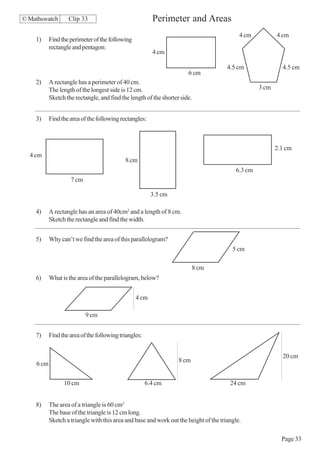
© Mathswatch       Clip 33                               Perimeter and Areas
                                                                                            4 cm          4 cm
    1)     Find the perimeter of the following
           rectangle and pentagon:
                                                         4 cm

                                                                                       4.5 cm               4.5 cm
                                                                       6 cm
    2)     A rectangle has a perimeter of 40 cm.
           The length of the longest side is 12 cm.                                                3 cm
           Sketch the rectangle, and find the length of the shorter side.


    3)     Find the area of the following rectangles:


                                                                                                          2.1 cm
  4 cm
                                            8 cm
                                                                                          6.3 cm
                    7 cm

                                                         3.5 cm

    4)     A rectangle has an area of 40cm2 and a length of 8 cm.
           Sketch the rectangle and find the width.


    5)     Why can’t we find the area of this parallelogram?
                                                                                         5 cm

                                                                          8 cm
    6)     What is the area of the parallelogram, below?


                                                 4 cm

                           9 cm


    7)     Find the area of the following triangles:


                                                                                                            20 cm
                                                                   8 cm
    6 cm


                 10 cm                                 6.4 cm                           24 cm


    8)     The area of a triangle is 60 cm2
           The base of the triangle is 12 cm long.
           Sketch a triangle with this area and base and work out the height of the triangle.

                                                                                                            Page 33
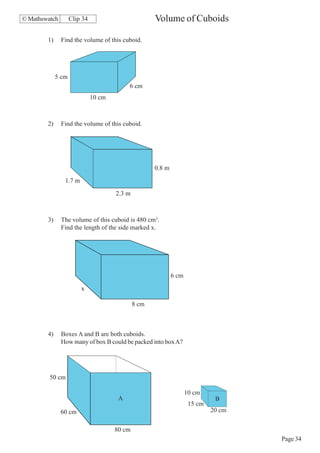
© Mathswatch        Clip 34                          Volume of Cuboids

        1)     Find the volume of this cuboid.


             5 cm
                                           6 cm
                              10 cm


        2)     Find the volume of this cuboid.


                                                     0.8 m
                1.7 m
                                      2.3 m


        3)     The volume of this cuboid is 480 cm3.
               Find the length of the side marked x.


                                                             6 cm

                        x

                                              8 cm


        4)     Boxes A and B are both cuboids.
               How many of box B could be packed into box A?


         50 cm

                                                                    10 cm
                                       A                                      B
                                                                     15 cm
               60 cm                                                         20 cm


                                      80 cm
                                                                                     Page 34
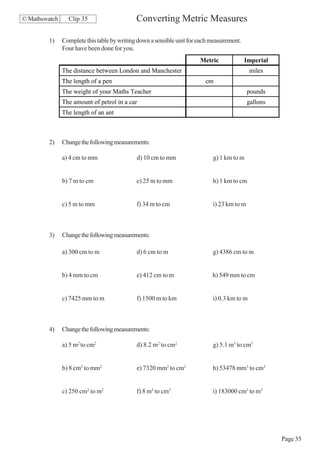
© Mathswatch     Clip 35                     Converting Metric Measures

        1)     Complete this table by writing down a sensible unit for each measurement.
               Four have been done for you.
                                                                       Metric              Imperial
               The distance between London and Manchester                                    miles
               The length of a pen                                       cm
               The weight of your Maths Teacher                                             pounds
               The amount of petrol in a car                                                gallons
               The length of an ant


        2)     Change the following measurements:

               a) 4 cm to mm                 d) 10 cm to mm                 g) 1 km to m


               b) 7 m to cm                  e) 25 m to mm                  h) 1 km to cm


               c) 5 m to mm                  f) 34 m to cm                  i) 23 km to m


        3)     Change the following measurements:

               a) 300 cm to m                d) 6 cm to m                   g) 4386 cm to m


               b) 4 mm to cm                 e) 412 cm to m                 h) 549 mm to cm


               c) 7425 mm to m               f) 1500 m to km                i) 0.3 km to m


        4)     Change the following measurements:

               a) 5 m2 to cm2                d) 8.2 m2 to cm2               g) 5.1 m3 to cm3


               b) 8 cm2 to mm2               e) 7320 mm2 to cm2             h) 53478 mm3 to cm3


               c) 250 cm2 to m2              f) 8 m3 to cm3                 i) 183000 cm3 to m3


                                                                                                      Page 35
© Mathswatch     Clip 36                  Triangles, Quadrilaterals, Polygons
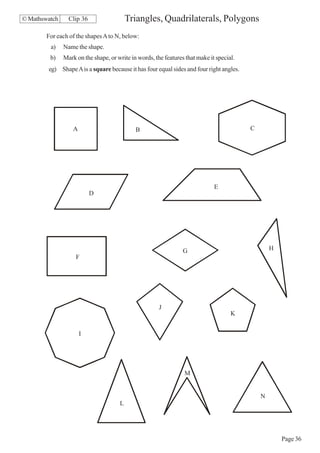
        For each of the shapes A to N, below:
         a)    Name the shape.
         b)    Mark on the shape, or write in words, the features that make it special.
        eg) Shape A is a square because it has four equal sides and four right angles.


                   A                         B                                            C


                                                                              E
                           D


                                                                G                                 H
                                                                G
                    F


                                                       J
                                                                                     K


                       I


                                                                 M


                                                                                              N
                                      L


                                                                                                      Page 36
© Mathswatch        Clip 37                               Names of Solids

        1)     Draw a sketch of each of the following solids:
               a) A cube.
               b) A cylinder.


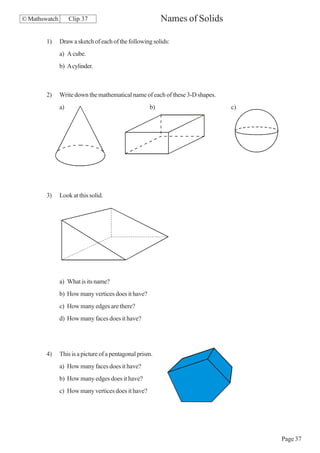
        2)     Write down the mathematical name of each of these 3-D shapes.
               a)                                    b)                        c)


        3)     Look at this solid.


               a) What is its name?
               b) How many vertices does it have?
               c) How many edges are there?
               d) How many faces does it have?


        4)     This is a picture of a pentagonal prism.
               a) How many faces does it have?
               b) How many edges does it have?
               c) How many vertices does it have?


                                                                                    Page 37
© Mathswatch      Clip 38                               Tessellations

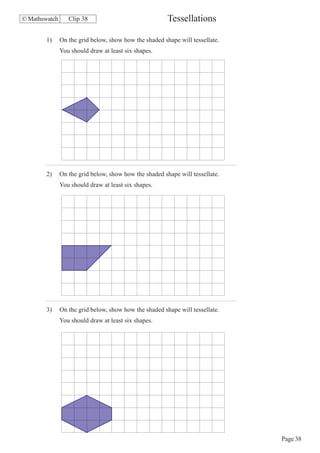
        1)     On the grid below, show how the shaded shape will tessellate.
               You should draw at least six shapes.


        2)     On the grid below, show how the shaded shape will tessellate.
               You should draw at least six shapes.


        3)     On the grid below, show how the shaded shape will tessellate.
               You should draw at least six shapes.


                                                                               Page 38
© Mathswatch      Clip 39                   Isometric Drawing

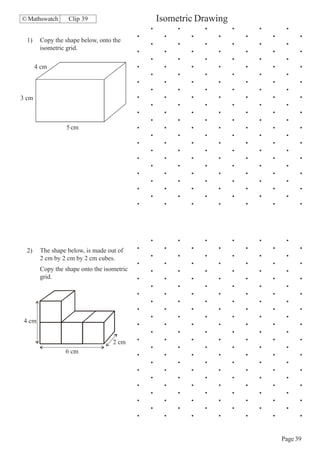
  1)    Copy the shape below, onto the
        isometric grid.

       4 cm


3 cm


                 5 cm


  2)    The shape below, is made out of
        2 cm by 2 cm by 2 cm cubes.
        Copy the shape onto the isometric
        grid.


 4 cm


                                   2 cm
                 6 cm


                                                                Page 39
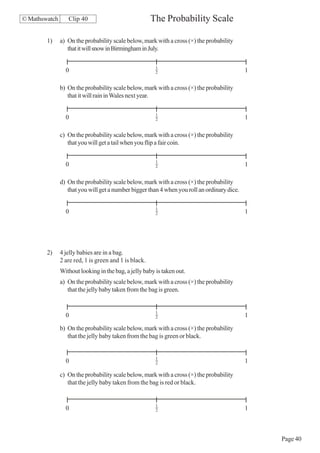
© Mathswatch      Clip 40                              The Probability Scale

        1)     a) On the probability scale below, mark with a cross (×) the probability
                  that it will snow in Birmingham in July.

                                                        1
                 0                                      2                                    1

               b) On the probability scale below, mark with a cross (×) the probability
                  that it will rain in Wales next year.

                                                        1
                 0                                      2                                    1

               c) On the probability scale below, mark with a cross (×) the probability
                  that you will get a tail when you flip a fair coin.

                                                        1
                 0                                      2                                    1

               d) On the probability scale below, mark with a cross (×) the probability
                  that you will get a number bigger than 4 when you roll an ordinary dice.

                                                        1
                 0                                      2                                    1


        2)     4 jelly babies are in a bag.
               2 are red, 1 is green and 1 is black.
               Without looking in the bag, a jelly baby is taken out.
               a) On the probability scale below, mark with a cross (×) the probability
                  that the jelly baby taken from the bag is green.


                                                        1
                 0                                      2                                    1

               b) On the probability scale below, mark with a cross (×) the probability
                  that the jelly baby taken from the bag is green or black.


                                                        1
                 0                                      2                                    1

               c) On the probability scale below, mark with a cross (×) the probability
                  that the jelly baby taken from the bag is red or black.


                                                        1
                 0                                      2                                    1


                                                                                                 Page 40
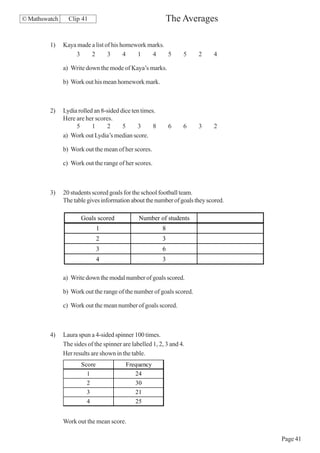
© Mathswatch     Clip 41                                  The Averages

         1)    Kaya made a list of his homework marks.
                   3     2       3      4   1    4     5          5   2     4

               a) Write down the mode of Kaya’s marks.

               b) Work out his mean homework mark.


         2)    Lydia rolled an 8-sided dice ten times.
               Here are her scores.
                    5      1      2     5      3     8       6    6   3     2
               a) Work out Lydia’s median score.

               b) Work out the mean of her scores.

               c) Work out the range of her scores.


         3)    20 students scored goals for the school football team.
               The table gives information about the number of goals they scored.

                      Goals scored             Number of students
                              1                          8
                              2                          3
                              3                          6
                              4                          3

               a) Write down the modal number of goals scored.

               b) Work out the range of the number of goals scored.

               c) Work out the mean number of goals scored.


         4)    Laura spun a 4-sided spinner 100 times.
               The sides of the spinner are labelled 1, 2, 3 and 4.
               Her results are shown in the table.
                      Score              Frequency
                        1                   24
                        2                   30
                        3                   21
                         4                    25


               Work out the mean score.

                                                                                    Page 41
© Mathswatch     Clip 42                                  Pictograms

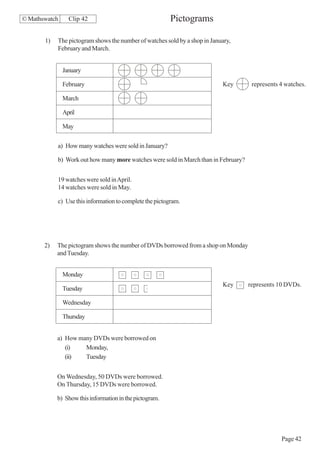
       1)   The pictogram shows the number of watches sold by a shop in January,
            February and March.


               January

               February                                                     Key       represents 4 watches.

               March

               April

               May


            a) How many watches were sold in January?

            b) Work out how many more watches were sold in March than in February?


            19 watches were sold in April.
            14 watches were sold in May.

            c) Use this information to complete the pictogram.


       2)   The pictogram shows the number of DVDs borrowed from a shop on Monday
            and Tuesday.


               Monday
                                                                            Key      represents 10 DVDs.
               Tuesday

               Wednesday

               Thursday


            a) How many DVDs were borrowed on
               (i)   Monday,
               (ii)  Tuesday


            On Wednesday, 50 DVDs were borrowed.
            On Thursday, 15 DVDs were borrowed.

            b) Show this information in the pictogram.


                                                                                                 Page 42
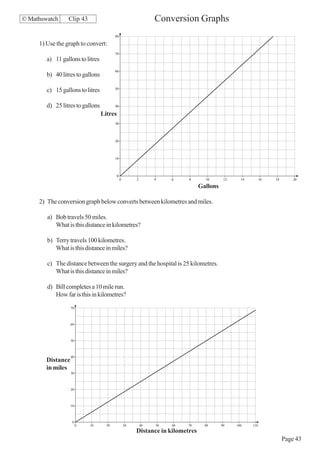
© Mathswatch     Clip 43                                         Conversion Graphs
                                         80

     1) Use the graph to convert:
                                         70
        a) 11 gallons to litres
                                         60
        b) 40 litres to gallons

                                         50
        c) 15 gallons to litres

        d) 25 litres to gallons          40

                                  Litres
                                         30


                                         20


                                         10


                                           0
                                               0        2        4    6    8       10       12     14         16   18       20

                                                                                 Gallons

     2) The conversion graph below converts between kilometres and miles.

        a) Bob travels 50 miles.
           What is this distance in kilometres?

        b) Terry travels 100 kilometres.
           What is this distance in miles?

        c) The distance between the surgery and the hospital is 25 kilometres.
           What is this distance in miles?

        d) Bill completes a 10 mile run.
           How far is this in kilometres?
                   70


                   60


                   50


                   40
        Distance
        in miles
                   30


                   20


                   10


                   0
                        0   10      20             30       40   50   60   70      80      90    100    110
                                                        Distance in kilometres
                                                                                                                        Page 43

#Maths wrkshts

  • 1.
    © Mathswatch Clip 1 Place Value 1 000 000 100 000 10 000 1 000 100 10 1 1) a) Write the number forty five thousand, two hundred and seventy three in figures. b) Write the number five thousand, one hundred and three in figures. c) Write the number three hundred thousand, seven hundred and ninety one in figures. d) Write the number two and a half million in figures. e) Write the number one and three quarter million in figures. 2) Write the following numbers in words a) 1 250 b) 3 502 c) 72 067 d) 192 040 e) 30 000 000 3) a) Write down the value of the 7 in the number 3 752. b) Write down the value of the 6 in the number 56 025. c) Write down the value of the 2 in the number 99 723. d) Write down the value of the 5 in the number 258 610. e) Write down the value of the 2 in the number 1 253 549. Page 1
  • 2.
    © Mathswatch Clip 2 Ordering Decimals Put these numbers in order, starting with the smallest: 1) 74, 57, 38, 8, 61 2) 39, 84, 11, 128, 24 3) 76, 102, 12, 140, 73 4) 3.1, 31, 1.3, 13, 1.03 5) 0.321, 0.312, 1.04, 1.23 6) 0.34, 0.047, 0.4, 0.43, 0.403 7) 0.79, 0.709, 0.97, 0.792 8) 2.71, 2.074, 2.071, 2.701 9) 0.875, 0.88, 0.0885, 0.008, 0.11 10) 3, –2, –7, 10, –1 11) –3, –11, 1, –5, 7 12) –4, 6, 0, –6, –1 Page 2
  • 3.
    © Mathswatch Clip 3 Rounding to the Nearest 10, 100, 1000 1) Round these numbers to the nearest 10: a) 26 b) 62 c) 75 d) 231 e) 797 f) 5 842 g) 9 875 h) 13 758 2) Round these numbers to the nearest 100: a) 78 b) 223 c) 549 d) 1 450 e) 1 382 f) 4 537 g) 9 193 h) 17 625 3) Round these numbers to the nearest 1000: a) 850 b) 1 455 c) 3 230 d) 7 500 e) 8 455 f) 9 690 g) 12 390 h) 28 910 Page 3
  • 4.
    © Mathswatch Clip 4 Reading Scales 1) What is the reading on each of these scales? a) b) c) 2 2 2 1 3 1 3 1 3 0 4 0 4 0 4 kg kg kg d) e) f) 20 200 40 10 30 100 300 20 60 0 40 0 400 0 80 kg kg kg 2) This scale shows degrees Centigrade. –20° –10° 0° 10° 20° 30° 40° ° C a) What temperature is the arrow pointing to? b) Draw an arrow which points to –17°C 3) This is a diagram for converting gallons to litres. Gallons 1 2 3 4 5 Litres 10 20 Use the diagram to convert a) 3 gallons to litres. b) 4.5 gallons to litres. c) 6 litres to gallons. Page 4
  • 5.
    © Mathswatch Clip 5 Multiply and Divide by Powers of 10 1) Multiply the following numbers by 10, 100 and 1000: ×10 ×100 ×1000 e.g. 21 210 2100 21000 9 63 845 3.65 0.4 1.324 2) Divide the following numbers by 10, 100 and 1000: ÷10 ÷100 ÷1000 e.g. 21 2.1 0.21 0.021 9 63 845 3.65 0.4 1.324 3) Work out the following: 3 × 100 = 65 × 10 = 17 ÷ 10 = 359 × 10 = 0.5 ÷ 100 = 2.3 × 1000 = 42 ÷ 100 = 3582 ÷ 100 = 0.9 × 10 = 3.645 × 100 = 88 ÷ 1000 = 39.62 × 1000 = Page 5
  • 6.
    © Mathswatch Clip 6 Negatives in Real Life 1) At midnight, the temperature was -7°C. By 7am the next morning, the temperature had increased by 6°C. a) Work out the temperature at 7am the next morning. At midday, the temperature was 3°C. b) Work out the difference between the temperature at midday and the temperature at midnight. c) Work out the temperature which is halfway between -7°C and 3°C. 2) The table below gives the temperature recorded on 25th December of 7 cities across the world. City Edinburgh London New York Moscow Paris Rome Cairo Temperature -6 °C 0 °C -15 °C -23 °C 3 °C 5 °C 18 °C a) Which city recorded the lowest temperature? b) What is the difference in temperature between New York and Paris? c) What is the difference in temperature between Cairo and Edinburgh? d) The temperature in Madrid was 9°C lower than in Rome. What was the temperature in Madrid? e) The temperature in Mexico was 6°C higher than in New York. What was the temperature in Mexico? 3) The table shows the temperature on the surface of each of five planets. Planet Temperature Venus 210 °C Jupiter -150 °C Saturn -180 °C Neptune -210 °C Pluto -230 °C a) Work out the difference in temperature between Jupiter and Pluto. b) Work out the difference in temperature between Venus and Saturn. c) Which planet has a temperature 30°C lower than Saturn? The temperature on Mars is 90°C higher than the temperature on Jupiter. d) Work out the temperature on Mars. Page 6
  • 7.
    © Mathswatch Clip 7 Multiplication & Division with Negatives Work out the following: 1) -3 × 6 = 2) 4×2= 3) 10 ÷ -2 = 4) -6 ÷ -3 = 5) -5 × -7 = 6) 7 × -3 = 7) 12 ÷ 4 = 8) -24 ÷ 6 = 9) -8 × 2 = 10) -9 ÷ 3 = 11) 4 ÷ -1 = 12) -3 × -9 = 13) -70 ÷ -7 = 14) 11 × -6 = 15) 4 × -3 × 2 = 16) -5 × 2 × -4 = 17) 4 × 5 ÷ -2 = 18) -8 ÷ -2 × -6 = 19) -2 × -3 × -4 = 20) 8 ÷ -2 × -6 = Page 7
  • 8.
    © Mathswatch Clip 8 Fraction of an Amount 1) Work out the following: 1 1 1 1 a) of £10 b) of £9 c) of £25 d) of 24 kg 2 3 5 2 1 1 1 1 e) of 36cm f) of 42 kg g) of 48kg h) of £66 4 6 8 11 1 1 1 1 i) of 90km j) of £28 k) of 125kg l) of 240km 9 7 5 6 2) Work out the following: 1 3 1 2 3 a) of 20 b) of 20 c) of 21 d) of 21 e) of 44 4 4 3 3 4 2 3 3 7 5 f) of 24 g) of 15 h) of 36 i) of 81 j) of 56 3 5 4 9 7 3 6 1 3 3 k) of 50 l) of 33 m) of 14 n) of 14 o) of 20 10 11 4 4 8 3) The highest possible mark for a Maths test was 64. 7 Dora got of the full marks. 8 How many marks did she get? 4) At MathsWatch School there are 1500 students. 7 of these students are male. 15 a) What fraction of students are female? b) How many are male? c) How many are female? Page 8
  • 9.
    © Mathswatch Clip 9 Square and Cube Numbers 1) 16 50 1 4 6 5 12 15 42 39 49 9 36 a) In the numbers, above, find six of the first seven square numbers. b) Which of the first seven square numbers is missing? 2) Work out the following: a) 102 b) 92 c) 72 + 32 d) 82 – 22 3) For each pair of numbers, below, there is just one square number that lies between them. In each case, write the square number: a) 7 15 b) 21 29 c) 72 96 d) 130 156 4) Work out the following: a) 25 b) 81 c) 16 + 62 5) The first cube number is 13 = 1 Write out the 2nd, 3rd, 4th and 10th cube numbers. 6) Work out the following: a) 13 + 33 b) 103 + 53 7) Work out the following: a) 33 + 62 b) 103 + 100 8) Work out what should go in the boxes: a) =6 b) =8 Page 9
  • 10.
    © Mathswatch Clip 10 Fractions, Decimals and Percentages 1. Write the following fractions as decimals and percentages: 1 1 ÷ 10 0.1 × 100 eg. ⎯ → 0 ⋅ 1 ⎯ → 10% ⎯ ⎯ 10 3 a) = 10 1 b) = 5 2 c) = 5 1 d) = 4 3 e) = 4 1 f) = 2 1 g) = 3 2. Fill in the blanks in the table below: Fraction Decimal Percentage 6 10 0.2 0.9 40% 25% . 0.3 70% Page 10
  • 11.
    © Mathswatch Clip 11 Money Questions 1) Bill buys 3 melons at £1.09 each. a) How much does he spend? b) How much change does he get from £5? 2) Jenny is taking her family to the cinema. Jenny pays for 1 adult and 3 children. Cinema a) How much does she spend? Adult: £6.50 Child: £4.00 b) How much change does she get from £20? 3) Bob is paid £7 per hour. a) Last monday Bob worked for 8 hours Work out his pay for that day. b) Yesterday Bob was paid £42. Work out how many hours Bob worked. 4) Complete this bill. 1½ kg of carrots at 40p per kg = £....... 3 kg of potatoes at 52p per kg = £....... ....... boxes of tea bags at 90p each = £1.80 4 packs of yogurts at ........... each = £4.80 Total = £....... Page 11
  • 12.
    © Mathswatch Clip 12 Shading Fractions 1) What fraction of each of the following shapes is shaded? a) b) c) d) e) f) 2) Shade the given fraction in the following grids. 3 1 4 5 4 6 5 7 3) Which of these fractions is the smallest? or (use the grids to help) 6 9 2 1 4) Which of these fractions is the largest? or (you must show your working) 7 3 Page 12
  • 13.
    © Mathswatch Clip 13 Ordering Fractions, Percentages & Decimals 1. Change these fractions to decimals 1 eg. ⎯1÷5→ 0.2 ⎯ 5 3 4 1 3 1 2 a) b) c) d) e) f) 5 5 4 4 3 3 2. Change these percentages to decimals eg. 52% ⎯52 ÷⎯→ 0.52 ⎯ 100 a) 63% b) 8% c) 59% d) 81% e) 28.5% f) 6.5% 3. Write the following numbers in order of size (smallest to largest) 2 3 a) 0.61 59% 0.55 3. 5 4 3 b) 81% 0.78 0.805 5 4 1 1 c) 0.3 28.5% 0.32 3 4 1 22 d) 0.23 21% 19.2% 5 100 3 1 e) 1% 0.012 0.021 100 40 Page 13
  • 14.
    © Mathswatch Clip 14 Estimation 1) Work out an estimate eg. 17 × 193 ⎯ → 20 × 200 = 4000 ⎯ a) 12 × 304 c) 231 × 56 b) 38 × 72 d) 773 × 13 2) Work out an estimate eg. 4.7 × 54 ⎯ → 5 × 50 = 250 ⎯ a) 3.8 × 52 c) 9.6 × 265 b) 7.9 × 10³ d) 512 × 2.4 3) Work out an estimate eg. 37 ÷ 12 ⎯ → 40 ÷ 10 = 4 ⎯ 341 a) 122 ÷ 53 c) 28 109 b) 372 ÷ 44 d) 96 4) Work out an estimate eg. 37 ÷ 1.2 ⎯ → 40 ÷ 1 = 40 ⎯ 253 a) 68 ÷ 1.7 c) 4.6 96 b) 37 ÷ 7.9 d) 10.4 5) Work out an estimate eg. 62 × 28 ⎯ → 60 × 30 = 1800 ⎯ 89 90 90 45 × 21 42 × 53 a) c) 14 2.2 76 × 17 33 × 61 b) d) 42 8.7 Page 14
  • 15.
    © Mathswatch Clip 15 Place Value When Multiplying 1) Use the information that 23 × 68 = 1564 work out the value of: a) 2.3 × 68 b) 2.3 × 6.8 c) 0.23 × 68 d) 2.3 × 0.68 e) 230 × 68 f) 230 × 6.8 g) 2300 × 680 h) 1564 ÷ 23 i) 1564 ÷ 2.3 j) 15640 ÷ 23 2) Using the information that 416 × 35 = 14560 work out the value of: a) 4.16 × 35 b) 41.6 × 0.35 c) 41600 × 350 d) 0.416 × 350 e) 4160 × 0.035 f) 41.6 × 350000 g) 0.00416 × 0.0035 h) 14560 ÷ 3.5 i) 145.6 ÷ 4.16 j) 1.456 ÷ 0.35 3) If 78 ÷ 2.5 = 31.2, what do you have to divide 78 by to get an answer of 0.312? 4) If 812 × 2.9 = 2354.8, what do you have to multiply 8.12 by to get an answer of 23548? Page 15
  • 16.
    © Mathswatch Clip 16 Addition and Subtraction 1) a) 42 b) 57 c) 96 +2 6 +3 8 +7 5 2) a) 637 b) 983 c) 969 +961 +442 +758 3) a) 452 + 38 b) 147 + 763 c) 813 + 431 + 38 4) There were two exhibitions at the NEC one Sunday. 3816 people went to one of the exhibitions and 13427 people went to the other exhibition. How many people went to the NEC, in total, on the Sunday? 5) a) 2.6 + 1.2 b) 2.74 + 6.81 c) 45.36 + 6.81 6) a) 23 + 1.5 b) 13.6 + 38 c) 13.2 + 17.82 7) a) 78 b) 74 c) 62 –42 –26 –39 8) a) 485 b) 773 c) 100 –291 –486 – 34 9) a) 653 – 48 b) 362 – 183 c) 2000 – 461 10) There were two films showing at a cinema one Saturday. One of the films was shown in a large room and the other was in a smaller room. The film in the larger room was watched by a total of 3562 people. The film in the smaller room was watched by 1671 people. How many more people saw the film in the larger room? 11) a) 782 + 426 – 278 b) 8162 + 1149 – 799 Page 16
  • 17.
    © Mathswatch Clip 17 Long Multiplication 1) Work out a) 13 × 18 d) 264 × 43 g) 286 × 48 b) 135 × 27 e) 326 × 24 h) 428 × 34 c) 116 × 41 f) 281 × 59 i) 461 × 45 2) “MathsWatch Travel” has 36 coaches. Each of these coaches can carry 53 passengers. How many passengers in total can all the coaches carry? 3) “MathsWatch Tours” has a plane that will carry 47 passengers. To fly from Manchester to Lyon, each passengers pays £65 Work out the total amount that the passengers pay. 4) A litre of petrol costs 86p. Work out the cost of 35 litres of petrol. Give your answer in pounds (£). 5) Last week, MathsWatch posted 439 parcels. Each parcel needed a 97p stamp. Work out the total cost of the stamps. Give your answer in pounds (£). 6) A stationery supplier sells rulers for 23p each. MathsWatch college buys 455 of these rulers. Work out the total cost of these 455 rulers. Give your answer in pounds (£). 7) A Maths book costs £1.99 Mr Smith buys a class set of 36 books. Work out the total cost of the 36 books. 8) The cost of a calculator is £7.39 Work out the cost of 32 of these calculators. 9) Salvatore makes pizzas. He receives an order for 34 pizzas. Salvatore charges £2.55 for each pizza. Work out the total amount he would charge for 34 pizzas. 10) A ream of tracing paper costs £3.23 Work out the cost of 45 reams of tracing paper. Page 17
  • 18.
    © Mathswatch Clip 18 Long Division 1) Work out a) 325 ÷ 5 d) 377 ÷ 29 g) 75 ÷ 4 b) 448 ÷ 8 e) 27 ÷ 6 h) 135 ÷ 20 c) 221 ÷ 13 f) 123 ÷ 15 i) 381 ÷ 12 2) A box can hold 19 books. Work out how many boxes will be needed to hold 646 books. 3) The distance from Glasgow to Paris is 1290 km. A flight from Glasgow to Paris lasts 3 hours. Dis tan ce Given that Average speed = Time Work out the average speed of the aeroplane in km/h. 4) Pencils cost 25p each. Mr Smith spends £15 on pencils. Work out the number of pencils he gets. 5) Yesterday, Gino was paid £19.61 for delivering pizzas. He is paid 53p for each pizza he delivers. Work out how many pizzas Gino delivered yesterday. 6) Emma sold 38 teddy bears for a total of £513 She sold each teddy bear for the same price. Work out the price at which Emma sold each teddy bear. 7) Canal boat for hire £1855.00 for 14 days Work out the cost per day of hiring the canal boat. 8) A teacher has £539 to spend on books. Each book costs £26 How many books can the teacher buy? 9) John delivers large wooden crates with his van. The weight of each crate is 68 kg. The greatest weight the van can hold is 980 kg. Work out the greatest number of crates that the van can hold. 10) Rulers costs 17p each. MathsWatch High School has £120 to spend on rulers. Work out the number of rulers bought. Page 18
  • 19.
    © Mathswatch Clip 19 Multiplication and Division with Decimals 1) Work out a) 6 × 0.2 d) 0.2 × 0.8 b) 0.2 × 0.3 e) 0.03 × 0.9 c) 0.4 × 7 f) 1.5 × 0.2 2) A box contains 7 books, each weighing 2.5 kg. Work out the total weight of the box. 3) John takes 13 boxes out of his van. The weight of each box is 25.5 kg Work out the total weight of the 13 boxes. 4) Work out a) 9 ÷ 0.3 d) 25 ÷ 0.5 b) 6 ÷ 0.1 e) 21 ÷ 0.3 c) 12 ÷ 0.4 f) 15 ÷ 0.2 5) Work out a) 3.6 ÷ 0.4 d) 0.56 ÷ 0.08 b) 0.8 ÷ 0.2 e) 5.5 ÷ 0.05 c) 2.4 ÷ 0.4 f) 8.1 ÷ 0.09 6) John takes boxes out of his van. The total weight of the boxes is 4.9 kg The weight of each box is 0.7 kg Work out the number of boxes in John’s van. 7) Mr Rogers bought a bag of elastic bands for £6 Each elastic band costs 12p. Work out the number of elastic bands in the bag. Page 19
  • 20.
    © Mathswatch Clip 20 Decimal Places and Significant Figures 1) Round the following numbers to 1 decimal place a) 13.681 b) 344.7234 c) 0.76133 2) Round the following numbers to 2 decimal places a) 45.7241 b) 0.6851 c) 4623.33621 3) Round the following numbers to 1 significant figure a) 4252 b) 26112 c) 7523987 4) Round the following numbers to 1 significant figure a) 963 b) 9562 c) 991236 5) Round the following numbers to 1 significant figure a) 0.005621 b) 0.07756 c) 0.0000523647 6) Round the following numbers to 2 significant figures a) 752305 b) 147006 c) 296124 7) Round the following numbers to 2 significant figures a) 0.00036264 b) 0.00045921 c) 0.0003654871 8) Round the following numbers to 3 significant figures a) 923146 b) 0.0048912 c) 299622 9) Use a calculator to work out the following sums. Give all answers to 3 significant figures. a) 236 × 149 b) 17.3 ÷ 0.14 c) 67 ÷ 3892 d) 779 × 9984 e) 47.5 ÷ 0.0037 f) 215 × 3.2 ÷ 0.0018 Page 20
  • 21.
    © Mathswatch Clip 21 Half-Way Values 1) Which number is in the middle of a) 3 and 9 b) 12 and 28 c) 11 and 22 d) 17 and 32 e) 72 and 108 f) 1 and 100 g) –6 and 2 h) –9 and –3 i) 3.2 and 3.8 j) 5.7 and 6.3 k) 58.3 and 73.5 2) a) 7 is in the middle of 3 and which other number? b) 16 is in the middle of 9 and which other number? c) 2.4 is in the middle of 1.1 and which other number? Page 21
  • 22.
    © Mathswatch Clip 22 Reciprocals 1) Write down the reciprocal of a) 8 b) 3 c) 1 d) 12 2) Write down the reciprocal of a) 1 2 b) 1 3 c) 1 4 1 d) 8 3) Write down the reciprocal of a) 0.1 b) 0.5 c) 0.2 4) Why can’t we have a reciprocal of 0? Page 22
  • 23.
    © Mathswatch Clip 23 Proportion 1) 8 bananas cost £1.60 Work out the cost of 5 bananas. 2) Emily bought 4 identical pairs of sock for £3.60 Non-Calculator Work out the cost of 9 pairs of these socks. 3) The price of a box of chocolates is £7.20 There are 36 chocolates in the box. Work out the cost of one chocolate. 4) Theresa bought 5 theatre tickets for £60 Work out the cost of 9 theatre tickets. 5) Jenny buys 4 folders. The total cost of these 4 folders is £6.40 Work out the total cost of 7 of these folders. 6) The cost of 15 litres of petrol is £12 Work out the cost of 20 litres of petrol. 7) 3 maths books cost £7.47 Work out the cost of 5 of these. 8) Five 1 litre tins of paint cost a total of £48.75 Calculator Work out the cost of seven of these 1 litre tins of paint. 1 9) William earns £9.30 for 12 hours of work. Work out how much he would earn for: a) 30 minutes b) 5 hours 10) It took 1 hour for Emyr to lay 150 bricks. He always works at the same speed. How long will it take Emyr to lay 720 bricks? Give your answer in hours and minutes. Page 23
  • 24.
    © Mathswatch Clip 24 Distance Tables 1) The table shows the distances in kilometres between some cities in the USA. San Francisco 4827 New York 4990 2132 Miami 668 4541 4375 Los Angeles 3493 1352 2183 3366 Chicago a) Write down the distance between San Francisco and Miami. One of the cities in the table is 4541 km from Los Angeles. b) Write down the name of this city. c) Write down the name of the city which is furthest from Chicago. 2) The table shows the distances in miles between four cities. London 155 Cardiff 212 245 York 413 400 193 Edinburgh a) Write down the distance between London and York. b) Write down the distance between Edinburgh and Cardiff. c) Which two cities are the furthest apart? Tom travels from London to York. He then travels from York to Edinburgh. He finally travels back to London from Edinburgh. d) Work out the total distance travelled by Tom. Peter and Jessica both drive to York. Peter travels from London whilst Jessica travels from Cardiff. e) Who travels the furthest out of Peter and Jessica and by how much? Page 24
  • 25.
    © Mathswatch Clip 25 Timetables 1) Change the following to the 24 hour clock a) 4.30 pm d) 7.15 pm b) 5 am e) Quarter past midnight c) 10.26 am f) Half past noon 2) Change the following to the 12 hour clock a) 06 35 d) 19 15 b) 14 30 e) 00 50 c) 12 45 f) Half past midnight 3) What is the difference in hours and minutes between the following a) 10.15 pm and 11.30 pm b) 14 20 and 17 10 c) 11.50 pm and 3.20 am d) 22 45 and 01 00 4) Here is part of a train timetable Manchester 05 15 06 06 06 45 07 05 07 15 07 46 Stockport 05 26 06 16 06 55 07 15 07 25 07 55 Macclesfield 05 39 06 29 07 08 07 38 08 08 Stoke 05 54 06 45 07 24 07 54 08 24 Stafford 06 12 07 41 08 11 Euston 08 09 08 26 09 06 09 11 09 50 10 08 a) Tim catches the 06 06 train from Manchester. At what time should he expect to arrive at Euston? b) Jenny arrives at the Stockport train station at 07 00 (i) How long should she expect to wait for a train to Stoke? (ii) How long should her train journey take? c) Sarah needs to travel to Euston from Macclesfield. She has to arrive at Euston before 09 30. What is the departure time of the latest train she can catch to get there on time? Page 25
  • 26.
    © Mathswatch Clip 26 Powers 1) Write the following using indices: eg. 3 × 3 × 3 × 3 = 34 a) 2 × 2 × 2 × 2 d) 12 × 12 × 12 × 12 × 12 b) 4 × 4 × 4 e) 3.6 × 3.6 c) 5 × 5 × 5 × 5 × 5 × 5 f) 5.2 × 5.2 × 5.2 2) Write each of the following as a single power: eg. 52 × 54 =56 a) 62 × 63 d) 53 × 5 b) 74 × 72 e) 29 × 23 c) 93 × 96 f) 7.23 × 7.22 3) Write each of the following as a single power: eg. 75 ÷ 72 = 73 5 3 78 a) 9 ÷ 9 d) 3 7 36 b) 69 ÷ 65 e) 3 815 c) 117 ÷ 112 f) 84 4) Write each of the following as a single power: 73 × 78 711 eg. = 6 = 75 76 7 47 × 43 92 × 96 a) b) 46 94 5) Match together cards with the same answer 57 510 ÷ 56 56 × 52 53 52 52 × 54 58 5×5 52 × 55 54 53 Page 26
  • 27.
    © Mathswatch Clip 27 Line Graphs 1) The graph shows the number of ice creams sold each day during one week. 300 200 Number of ice creams sold 100 0 Sun Mon Tue Wed Thu Fri Sat Day a) How many more ice creams were sold on Sunday than on Friday? b) Explain what might have happened on Monday. c) On Saturday, 250 ice creams were sold. Update the graph with this information. d) About how many ice creams were sold on Wednesday? 2) The average temperature, in degrees Centigrade, was recorded for each month. The results are as follows: January 5°C February 3°C March 8°C April 13°C May 15°C June 21°C July 34°C August 29°C September 20°C October 12°C November 8°C December 6°C Draw a line graph to show these results. 30° Temperature 20° in °C 10° Jan Feb Mar Apr May Jun Jul Aug Sep Oct Nov Dec Month Page 27
  • 28.
    © Mathswatch Clip 28 Coordinates y 10 B 1. Write down the coordinates of the points A to H. 9 A 8 7 C 6 E 5 4 F 3 D H 2 1 G O x 1 2 3 4 5 6 7 8 9 10 y 8 2. a) Write down the coordinates of: (i) A (ii) B 7 b) Write down the coordinates of the midpoint of the 6 line AB. B 5 4 3 A 2 1 O 1 2 3 4 5 6 7 8 x 3. Using the pair of axes, a) Plot the points A(2, 0), B(4, 0), C(5, 2) and D(3, 2). y 5 b) Join the points in order, to form a shape and name the shape. 4 M is the midpoint of the line segment AC. 3 c) Find the coordinates of M. 2 1 4. Using the same pair of axes, a) Plot the points R(-1, -2), S(1, 1) -5 -4 -3 -2 -1 O 1 2 3 4 5 x and T(-1, 2). -1 b) Join R to S and S to T. -2 RSTU is a kite. -3 c) Write the coordinates of point U. -4 -5 Page 28
  • 29.
    © Mathswatch Clip 29 Number Sequences 1) Here are some patterns made from matchsticks Pattern 1 Pattern 2 Pattern 3 a) Draw pattern 4. b) How many matchsticks are used in (i) Pattern 5 (ii) Pattern 10 c) Which pattern will have 46 matchsticks? 2) A pattern is made of rectangles and circles Pattern 1 Pattern 2 Pattern 3 a) Draw pattern 4. b) Complete the table below. Pattern number 1 2 3 4 5 10 Number of rectangles 1 2 Number of circles 2 4 Total rectangles + circles 3 6 c) Which pattern will have 64 circles? d) Which pattern will have a total (rectangles + circles) of 90? 3) For each of the following sequences write down the next two terms. a) 5, 10, 15, 20... c) 27, 23, 19, 15... b) 9, 16, 23, 30... d) 12, 7, 2, –3... 4) Look at this number sequence:4, 10, 16, 22... The 50th term of the sequence is 298. a) Write down the 51st term. b) Will 643 be a term in this sequence? Explain your answer. Page 29
  • 30.
    © Mathswatch Clip 30 Number Machines 1) Here is a table for the rule ×3 then –1 ×3 then –1 Input Output 1 2 2 3 5 20 35 Complete the table. 2) Here is the table for the rule +5 then ÷2 +5 then ÷2 Input Output 1 3 2 3.5 3 4 7 10 Complete the table. 3) Here is a table for the rule ×4 then –3 then ×2 ×4 then –3 then ×2 Input Output 1 2 2 10 3 5 7 74 82 Complete the table. Page 30
  • 31.
    © Mathswatch Clip 31 Angles 1) a) One of these angles is an acute angle. Which one? b) Write the names of the other three angles next to them. A B D C 2) a) Sketch a triangle which has three internal (inside) acute angles. b) Sketch a right-angled triangle. c) Sketch a triangle with one internal obtuse angle. 3) Debbie says she is going to draw a triangle with two internal obtuse angles. Harry says that this is impossible. Is Harry correct? Explain why. 4) Draw a quadrilateral with a) Two internal acute angles, one reflex angle and one obtuse angle. b) Three internal acute angles and one reflex angle. Page 31
  • 32.
    © Mathswatch Clip 32 Congruent and Similar Shapes Congruent to Similar to Fill in the table on the left. A You are allowed to use tracing paper to help B get the correct answers. C D E F B G H A I J C D E F H G I J Page 32
  • 33.
    © Mathswatch Clip 33 Perimeter and Areas 4 cm 4 cm 1) Find the perimeter of the following rectangle and pentagon: 4 cm 4.5 cm 4.5 cm 6 cm 2) A rectangle has a perimeter of 40 cm. The length of the longest side is 12 cm. 3 cm Sketch the rectangle, and find the length of the shorter side. 3) Find the area of the following rectangles: 2.1 cm 4 cm 8 cm 6.3 cm 7 cm 3.5 cm 4) A rectangle has an area of 40cm2 and a length of 8 cm. Sketch the rectangle and find the width. 5) Why can’t we find the area of this parallelogram? 5 cm 8 cm 6) What is the area of the parallelogram, below? 4 cm 9 cm 7) Find the area of the following triangles: 20 cm 8 cm 6 cm 10 cm 6.4 cm 24 cm 8) The area of a triangle is 60 cm2 The base of the triangle is 12 cm long. Sketch a triangle with this area and base and work out the height of the triangle. Page 33
  • 34.
    © Mathswatch Clip 34 Volume of Cuboids 1) Find the volume of this cuboid. 5 cm 6 cm 10 cm 2) Find the volume of this cuboid. 0.8 m 1.7 m 2.3 m 3) The volume of this cuboid is 480 cm3. Find the length of the side marked x. 6 cm x 8 cm 4) Boxes A and B are both cuboids. How many of box B could be packed into box A? 50 cm 10 cm A B 15 cm 60 cm 20 cm 80 cm Page 34
  • 35.
    © Mathswatch Clip 35 Converting Metric Measures 1) Complete this table by writing down a sensible unit for each measurement. Four have been done for you. Metric Imperial The distance between London and Manchester miles The length of a pen cm The weight of your Maths Teacher pounds The amount of petrol in a car gallons The length of an ant 2) Change the following measurements: a) 4 cm to mm d) 10 cm to mm g) 1 km to m b) 7 m to cm e) 25 m to mm h) 1 km to cm c) 5 m to mm f) 34 m to cm i) 23 km to m 3) Change the following measurements: a) 300 cm to m d) 6 cm to m g) 4386 cm to m b) 4 mm to cm e) 412 cm to m h) 549 mm to cm c) 7425 mm to m f) 1500 m to km i) 0.3 km to m 4) Change the following measurements: a) 5 m2 to cm2 d) 8.2 m2 to cm2 g) 5.1 m3 to cm3 b) 8 cm2 to mm2 e) 7320 mm2 to cm2 h) 53478 mm3 to cm3 c) 250 cm2 to m2 f) 8 m3 to cm3 i) 183000 cm3 to m3 Page 35
  • 36.
    © Mathswatch Clip 36 Triangles, Quadrilaterals, Polygons For each of the shapes A to N, below: a) Name the shape. b) Mark on the shape, or write in words, the features that make it special. eg) Shape A is a square because it has four equal sides and four right angles. A B C E D G H G F J K I M N L Page 36
  • 37.
    © Mathswatch Clip 37 Names of Solids 1) Draw a sketch of each of the following solids: a) A cube. b) A cylinder. 2) Write down the mathematical name of each of these 3-D shapes. a) b) c) 3) Look at this solid. a) What is its name? b) How many vertices does it have? c) How many edges are there? d) How many faces does it have? 4) This is a picture of a pentagonal prism. a) How many faces does it have? b) How many edges does it have? c) How many vertices does it have? Page 37
  • 38.
    © Mathswatch Clip 38 Tessellations 1) On the grid below, show how the shaded shape will tessellate. You should draw at least six shapes. 2) On the grid below, show how the shaded shape will tessellate. You should draw at least six shapes. 3) On the grid below, show how the shaded shape will tessellate. You should draw at least six shapes. Page 38
  • 39.
    © Mathswatch Clip 39 Isometric Drawing 1) Copy the shape below, onto the isometric grid. 4 cm 3 cm 5 cm 2) The shape below, is made out of 2 cm by 2 cm by 2 cm cubes. Copy the shape onto the isometric grid. 4 cm 2 cm 6 cm Page 39
  • 40.
    © Mathswatch Clip 40 The Probability Scale 1) a) On the probability scale below, mark with a cross (×) the probability that it will snow in Birmingham in July. 1 0 2 1 b) On the probability scale below, mark with a cross (×) the probability that it will rain in Wales next year. 1 0 2 1 c) On the probability scale below, mark with a cross (×) the probability that you will get a tail when you flip a fair coin. 1 0 2 1 d) On the probability scale below, mark with a cross (×) the probability that you will get a number bigger than 4 when you roll an ordinary dice. 1 0 2 1 2) 4 jelly babies are in a bag. 2 are red, 1 is green and 1 is black. Without looking in the bag, a jelly baby is taken out. a) On the probability scale below, mark with a cross (×) the probability that the jelly baby taken from the bag is green. 1 0 2 1 b) On the probability scale below, mark with a cross (×) the probability that the jelly baby taken from the bag is green or black. 1 0 2 1 c) On the probability scale below, mark with a cross (×) the probability that the jelly baby taken from the bag is red or black. 1 0 2 1 Page 40
  • 41.
    © Mathswatch Clip 41 The Averages 1) Kaya made a list of his homework marks. 3 2 3 4 1 4 5 5 2 4 a) Write down the mode of Kaya’s marks. b) Work out his mean homework mark. 2) Lydia rolled an 8-sided dice ten times. Here are her scores. 5 1 2 5 3 8 6 6 3 2 a) Work out Lydia’s median score. b) Work out the mean of her scores. c) Work out the range of her scores. 3) 20 students scored goals for the school football team. The table gives information about the number of goals they scored. Goals scored Number of students 1 8 2 3 3 6 4 3 a) Write down the modal number of goals scored. b) Work out the range of the number of goals scored. c) Work out the mean number of goals scored. 4) Laura spun a 4-sided spinner 100 times. The sides of the spinner are labelled 1, 2, 3 and 4. Her results are shown in the table. Score Frequency 1 24 2 30 3 21 4 25 Work out the mean score. Page 41
  • 42.
    © Mathswatch Clip 42 Pictograms 1) The pictogram shows the number of watches sold by a shop in January, February and March. January February Key represents 4 watches. March April May a) How many watches were sold in January? b) Work out how many more watches were sold in March than in February? 19 watches were sold in April. 14 watches were sold in May. c) Use this information to complete the pictogram. 2) The pictogram shows the number of DVDs borrowed from a shop on Monday and Tuesday. Monday Key represents 10 DVDs. Tuesday Wednesday Thursday a) How many DVDs were borrowed on (i) Monday, (ii) Tuesday On Wednesday, 50 DVDs were borrowed. On Thursday, 15 DVDs were borrowed. b) Show this information in the pictogram. Page 42
  • 43.
    © Mathswatch Clip 43 Conversion Graphs 80 1) Use the graph to convert: 70 a) 11 gallons to litres 60 b) 40 litres to gallons 50 c) 15 gallons to litres d) 25 litres to gallons 40 Litres 30 20 10 0 0 2 4 6 8 10 12 14 16 18 20 Gallons 2) The conversion graph below converts between kilometres and miles. a) Bob travels 50 miles. What is this distance in kilometres? b) Terry travels 100 kilometres. What is this distance in miles? c) The distance between the surgery and the hospital is 25 kilometres. What is this distance in miles? d) Bill completes a 10 mile run. How far is this in kilometres? 70 60 50 40 Distance in miles 30 20 10 0 0 10 20 30 40 50 60 70 80 90 100 110 Distance in kilometres Page 43