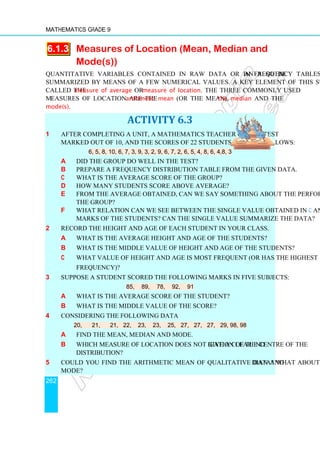
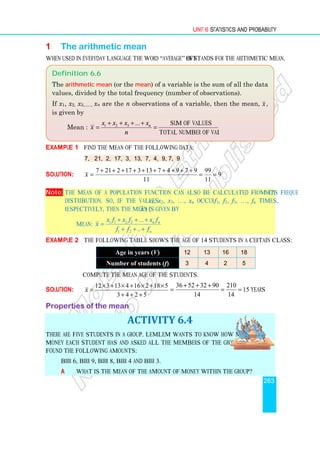
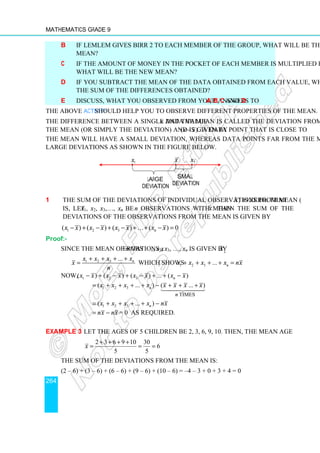
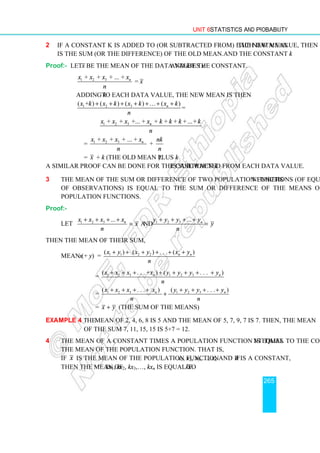
F
E
D
E
RA
L D
E
MO
C
RA
T
I
CRE
P
UB
L
I
CO
FE
T
HI
O
P
I
A
MI
NI
S
T
R
Y O
FE
D
UC
A
T
I
O
N
G
R
A
D
E9
7DNH*RRGDUHRI
7DNH*RRGDUHRI
7DNH*RRGDUHRI
7DNH*RRGDUHRI
7KLV7H[WERRN
7KLV7H[WERRN
7KLV7H[WERRN
7KLV7H[WERRN
 dŚŝƐƚĞdžƚŬŝƐƚŚĞƉƌŽƉĞƌƚLJŽĨLJŽƵƌƐĐŚŽŽů͘
dĂŬĞŐŽŽĚĐĂƌĞŶŽƚƚŽĚĂŵĂŐĞŽƌůŽƐĞŝƚ͘
,ĞƌĞĂƌĞϭϬŝĚĞĂƐƚŽŚĞůƉƚĂŬĞĐĂƌĞŽĨƚŚĞŬ͗
ϭ͘ ŽǀĞƌƚŚĞŬǁŝƚŚƉƌŽƚĞĐƚŝǀĞŵĂƚĞƌŝĂů͕ƐƵĐŚĂƐƉůĂƐƚŝĐ͕ŽůĚ
ŶĞǁƐƉĂƉĞƌƐŽƌŵĂŐĂnjŝŶĞƐ͘
Ϯ͘ ůǁĂLJƐŬĞĞƉƚŚĞŬŝŶĂĐůĞĂŶĚƌLJƉůĂĐĞ͘
ϯ͘ ĞƐƵƌĞLJŽƵƌŚĂŶĚƐĂƌĞĐůĞĂŶǁŚĞŶLJŽƵƵƐĞƚŚĞŬ͘
ϰ͘ ŽŶŽƚǁƌŝƚĞŽŶƚŚĞĐŽǀĞƌŽƌŝŶƐŝĚĞƉĂŐĞƐ͘
ϱ͘ hƐĞĂƉŝĞĐĞŽĨƉĂƉĞƌŽƌĐĂƌĚďŽĂƌĚĂƐĂŬŵĂƌŬ͘
ϲ͘ EĞǀĞƌƚĞĂƌŽƌĐƵƚŽƵƚĂŶLJƉŝĐƚƵƌĞƐŽƌƉĂŐĞƐ͘
ϳ͘ ZĞƉĂŝƌĂŶLJƚŽƌŶƉĂŐĞƐǁŝƚŚƉĂƐƚĞŽƌƚĂƉĞ͘
ϴ͘ WĂĐŬƚŚĞŬĐĂƌĞĨƵůůLJǁŚĞŶLJŽƵƉůĂĐĞŝƚŝŶLJŽƵƌƐĐŚŽŽůďĂŐ͘
ϵ͘ ,ĂŶĚůĞƚŚĞŬǁŝƚŚĐĂƌĞǁŚĞŶƉĂƐƐŝŶŐŝƚƚŽĂŶŽƚŚĞƌƉĞƌƐŽŶ͘
ϭϬ͘ tŚĞŶƵƐŝŶŐĂŶĞǁŬĨŽƌƚŚĞĨŝƌƐƚƚŝŵĞ͕ůĂLJŝƚŽŶŝƚƐďĂĐŬ͘KƉĞŶ
ŽŶůLJĂĨĞǁƉĂŐĞƐĂƚĂƚŝŵĞ͘WƌĞƐƐůŝŐŚƚůLJĂůŽŶŐƚŚĞďŽƵŶĚĞĚŐĞĂƐ
LJŽƵƚƵƌŶƚŚĞƉĂŐĞƐ͘dŚŝƐǁŝůůŬĞĞƉƚŚĞĐŽǀĞƌŝŶŐŽŽĚĐŽŶĚŝƚŝŽŶ͘
MATHEMATICS
STUDENT TEXTBOOK
Authors, Editors and Reviewers:
C.K. Bansal (B.Sc., M.A.)
Rachel Mary Z
Dawod Adem
Kassa Michael
Berhanu Guta
Evaluators:
Tesfaye Ayele
Dagnachew Yalew
Tekeste Woldetensai
FEDERAL DEMOCRATIC REPUBLIC OF ETHIOPIA
MATHEMATICS
STUDENT TEXTBOOK
GRADE
GRADE
GRADE
GRADE 9
9
9
9
Authors, Editors and Reviewers:
(B.Sc., M.A.)
Rachel Mary Z. (B.Sc.)
(M.Sc.)
Kassa Michael (M.Sc.)
Berhanu Guta (Ph.D.)
Tesfaye Ayele
Dagnachew Yalew
Tekeste Woldetensai
FEDERAL DEMOCRATIC REPUBLIC OF ETHIOPIA
MINISTRY OF EDUCATION
MATHEMATICS
STUDENT TEXTBOOK
9
9
9
9
Published E.C. 2002 by the Federal Democratic Republic of Ethiopia,
Ministry of Education, under the General Education Quality
Improvement Project (GEQIP) supported by IDA Credit No. 4535-ET,
the Fast Track Initiative Catalytic Fund and the Governments of Finland,
Italy, Netherlands and the United Kingdom.
© 2010 by the Federal Democratic Republic of Ethiopia, Ministry of Education.
All rights reserved. No part of this book may be reproduced, stored in a retrieval
system or transmitted in any form or by any means including electronic,
mechanical, magnetic or other, without prior written permission of the Ministry
of Education or licensing in accordance with the Federal Democratic Republic of
Ethiopia, Federal Negarit Gazeta, Proclamation No. 410/2004 – Copyright and
Neighbouring Rights Protection.
The Ministry of Education wishes to thank the many individuals, groups and
other bodies involved – directly and indirectly – in publishing this textbook and
the accompanying teacher guide.
Copyrighted materials used by permission of their owners. If you are the owner
of copyrighted material not cited or improperly cited, please contact with the
Ministry of Education, Head Office, Arat Kilo, (PO Box 1367), Addis Ababa,
Ethiopia.
PHOTO CREDIT: p.106 and 292-Encarta Encyclopedia, 2009 edition.
p.126-http:// en.wikipedia.org
p.277-http://en.wikipedia.org
Developed and Printed by
STAR EDUCATIONAL BOOKS DISTRIBUTORS Pvt. Ltd.
24/4800, Bharat Ram Road, Daryaganj,
New Delhi – 110002, INDIA
and
ASTER NEGA PUBLISHING ENTERPRISE
P.O. Box 21073
ADDIS ABABA, ETHIOPIA
under GEQIP Contract No. ET-MoE/GEQIP/IDA/ICB/G01/09.
ISBN 978-99944-2-042-1
U
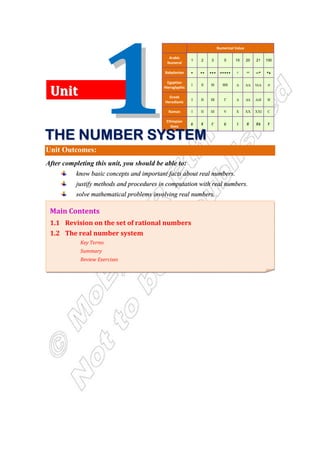
Numerical Value
Arabic
Numeral
1 2 3 5 10 20 21 100
Babylonian        
Egyptian
Hieroglyphic
I II III IIIII Λ ΛΛ IΛΛ ϑ
Greek
Herodianic
Ι ΙΙ ΙΙΙ Γ ∆ ∆∆ ∆∆Ι Η
Roman I II III V X XX XXI C
Ethiopian
Geez
1 2 3 5 0 ! !1 )
Contents
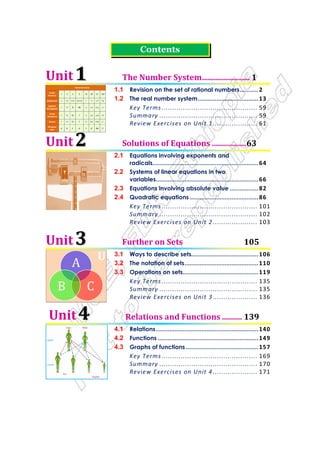
Unit 1
1 The Number System........................ 1
1.1 Revision on the set of rational numbers...........2
1.2 The real number system....................................13
Key Terms ............................................. 59
Summary .............................................. 59
Review Exercises on Unit 1..................... 61
Unit 2
2 Solutions of Equations .................63
2.1 Equations involving exponents and
radicals...............................................................64
2.2 Systems of linear equations in two
variables.............................................................66
2.3 Equations involving absolute value .................82
2.4 Quadratic equations.........................................86
Key Terms ............................................. 101
Summary .............................................. 102
Review Exercises on Unit 2..................... 103
Unit 3
3 Further on Sets 105
3.1 Ways to describe sets........................................106
3.2 The notation of sets............................................110
3.3 Operations on sets.............................................119
Key Terms ............................................. 135
Summary .............................................. 135
Review Exercises on Unit 3..................... 136
Unit 4
4 Relations and Functions .......... 139
4.1 Relations.............................................................140
4.2 Functions ............................................................149
4.3 Graphs of functions ...........................................157
Key Terms ............................................. 169
Summary .............................................. 170
Review Exercises on Unit 4..................... 171
Contents
Unit 5
5 Geometry and Measurement ... 175
5.1 Regular polygons ..............................................176
5.2 Further on congruency and similarity..............190
5.3 Further on trigonometry.....................................210
5.4 Circles.................................................................221
5.5 Measurement.....................................................232
Key Terms ............................................. 243
Summary .............................................. 243
Review Exercises on Unit 5..................... 247
Unit 6
6 Statistics and Probability.......... 249
6.1 Statistical data ...................................................250
6.2 Probability ..........................................................277
Key Terms ............................................. 286
Summary .............................................. 286
Review Exercises on Unit 6..................... 288
Unit 7
7 Vectors in Two Dimensions...... 291
7.1 Introduction to Vectors and scalars.................292
7.2 Representation of a vector ...............................294
7.3 Addition and subtraction of vectors and
multiplication of a vector by a scalar.............. 299
7.4 Position vector of a point ..................................307
Key Terms ............................................. 311
Summary .............................................. 311
Review Exercises on Unit 7..................... 312
Table of Trigonometric Functions...............................313
Numerical Value
Arabic
Numeral
1 2 3 5 10 20 21 100
Babylonian        
Egyptian
Hieroglyphic
I II III IIIII Λ ΛΛ IΛΛ ϑ
Greek
Herodianic
Ι ΙΙ ΙΙΙ Γ ∆ ∆∆ ∆∆Ι Η
Roman I II III V X XX XXI C
Ethiopian
Geez
1 2 3 5 0 ! !1 )
Unit Outcomes:
After completing this unit, you should be able to:
know basic concepts and important facts about real numbers.
justify methods and procedures in computation with real numbers.
solve mathematical problems involving real numbers.
Main Contents
1.1 Revision on the set of rational numbers
1.2 The real number system
Key Terms
Summary
Review Exercises
U
Un
ni
it
t
T
T
T
T
T
T
T
TH
H
H
H
H
H
H
HE
E
E
E
E
E
E
E N
N
N
N
N
N
N
NU
U
U
U
U
U
U
UM
M
M
M
M
M
M
MB
B
B
B
B
B
B
BE
E
E
E
E
E
E
ER
R
R
R
R
R
R
R S
S
S
S
S
S
S
SY
Y
Y
Y
Y
Y
Y
YS
S
S
S
S
S
S
ST
T
T
T
T
T
T
TE
E
E
E
E
E
E
EM
M
M
M
M
M
M
M
Mathematics Grade 9
2
INTRODUCTION
In earlier grades, you have learnt about rational numbers, their properties, and basic
mathematical operations upon them. After a review of your knowledge about rational
numbers, you will continue studying the number systems in the present unit. Here, you
will learn about irrational numbers and real numbers, their properties and basic
operations upon them. Also, you will discuss some related concepts such as
approximation, accuracy, and scientific notation.
1.1 REVISION ON THE SET OF RATIONAL
NUMBERS
ACTIVITY 1.1
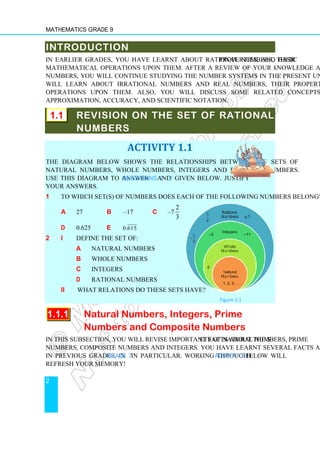
The diagram below shows the relationships between the sets of
Natural numbers, Whole numbers, Integers and Rational numbers.
Use this diagram to answer Questions 1 and 2 given below. Justify
your answers.
1 To which set(s) of numbers does each of the following numbers belong?
a 27 b –17 c –7
2
3
d 0.625 e 0.615
2 i Define the set of:
a Natural numbers
b Whole numbers
c Integers
d Rational numbers
ii What relations do these sets have?
Figure 1.1
1.1.1 Natural Numbers, Integers, Prime
Numbers and Composite Numbers
In this subsection, you will revise important facts about the sets of natural numbers, prime
numbers, composite numbers and integers. You have learnt several facts about these sets
in previous grades, in Grade 7 in particular. Working through Activity 1.2 below will
refresh your memory!
1, 2, 3, . . .
0
–11
–3
0 7
.
3
4
1
2
−
Unit 1 The Number System
3
ACTIVITY 1.2
1 For each of the following statements write 'true' if the statement is
correct or 'false' otherwise. If your answer is 'false', justify by
giving a counter example or reason.
a The set {1, 2, 3, . . .} describes the set of natural numbers.
b The set {1, 2, 3, . . .}⋃{. . . −3, −2, −1} describes the set of integers.
c 57 is a composite number.
d {1} ∩ {Prime numbers} = ∅.
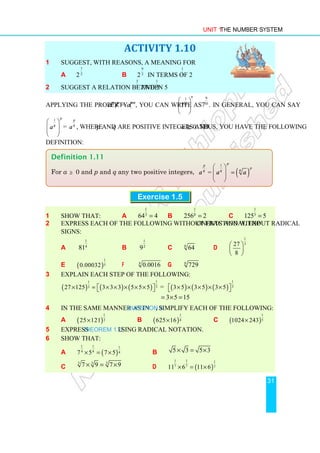
e {Prime numbers}⋃{Composite number} = {1, 2, 3, . . .}.
f {Odd numbers} ∩{Composite numbers} ≠ ∅.
g 48 is a multiple of 12.
h 5 is a factor of 72.
i 621 is divisible by 3.
j {Factors of 24} ∩ {Factors of 87} = {1, 2, 3}.
k {Multiples of 6} ∩ {Multiples of 4} = {12, 24}.
l 2 2
2 3 5
× × is the prime factorization of 180.
2 Given two natural numbers a and b, what is meant by:
a a is a factor of b b a is divisible by b c a is a multiple of b
From your lower grade mathematics, recall that;
 The set of natural numbers, denoted by N, is described by N = {1, 2, 3,…}
 The set of whole numbers, denoted by W, is described by W = {0, 1, 2, 3,…}
 The set of integers, denoted by Z, is described by Z = {...,–3, –2, –1, 0, 1, 2, 3,...}
 Given two natural numbers m and p, m is called a multiple of p if there is a
natural number q such that
m = p × q.
In this case, p is called a factor or divisor of m. We also say m is divisible by p.
Similarly, q is also a factor or divisor of m, and m is divisible by q.
Mathematics Grade 9
4
For example, 621 is a multiple of 3 because 621 = 3 × 207.
Note: 1 is neither prime nor composite.
G r o u p W o r k 1 . 1
1 List all factors of 24. How many factors did you find?
2 The area of a rectangle is 432 sq. units. The measurements
of the length and width of the rectangle are expressed by
natural numbers.
Find all the possible dimensions (length and width) of the rectangle.
3 Find the prime factorization of 360.
The following rules can help you to determine whether a number is divisible by 2, 3, 4,
5, 6, 8, 9 or 10.
Divisibility test
A number is divisible by:
 2, if its unit’s digit is divisible by 2.
 3, if the sum of its digits is divisible by 3.
 4, if the number formed by its last two digits is divisible by 4.
 5, if its unit’s digit is either 0 or 5.
 6, if it is divisible by 2 and 3.
 8, if the number formed by its last three digits is divisible by 8.
 9, if the sum of its digits is divisible by 9.
 10, if its unit’s digit is 0.
Observe that divisibility test for 7 is not stated here as it is beyond the scope of your
present level.
Definition 1.1 Prime numbers and composite numbers
♦
♦
♦ A natural number that has exactly two distinct factors, namely 1
and itself, is called a prime number.
♦
♦
♦ A natural number that has more than two factors is called a
composite number.
Unit 1 The Number System
5
Example 1 Use the divisibility test to determine whether 2,416 is divisible by 2, 3, 4,
5, 6, 8, 9 and 10.
Solution: ♦ 2, 416 is divisible by 2 because the unit’s digit 6 is divisible by 2.
♦ 2,416 is divisible by 4 because 16 (the number formed by the last two digits)
is divisible by 4.
♦ 2,416 is divisible by 8 because the number formed by the last three digits
(416) is divisible by 8.
♦ 2,416 is not divisible by 5 because the unit’s digit is not 0 or 5.
♦ Similarly you can check that 2,416 is not divisible by 3, 6, 9, and 10.
Therefore, 2,416 is divisible by 2, 4 and 8 but not by 3, 5, 6, 9 and 10.
A factor of a composite number is called a prime factor, if it is a prime number. For
instance, 2 and 5 are both prime factors of 20.
Every composite number can be written as a product of prime numbers. To find the prime
factors of any composite number, begin by expressing the number as a product of two
factors where at least one of the factors is prime. Then, continue to factorize each resulting
composite factor until all the factors are prime numbers.
When a number is expressed as a product of its prime factors, the expression is called the
prime factorization of the number.
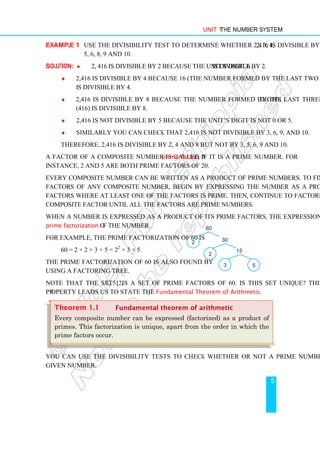
For example, the prime factorization of 60 is
60 = 2 × 2 × 3 × 5 = 22
× 3 × 5.
The prime factorization of 60 is also found by
using a factoring tree.
Note that the set {2, 3, 5} is a set of prime factors of 60. Is this set unique? This
property leads us to state the Fundamental Theorem of Arithmetic.
You can use the divisibility tests to check whether or not a prime number divides a
given number.
Theorem 1.1 Fundamental theorem of arithmetic
Every composite number can be expressed (factorized) as a product of
primes. This factorization is unique, apart from the order in which the
prime factors occur.
2
60
2 30
3 5
15
Mathematics Grade 9
6
Example 2 Find the prime factorization of 1,530.
Solution: Start dividing 1,530 by its smallest prime factor. If the quotient is a
composite number, find a prime factor of the quotient in the same way.
Repeat the procedure until the quotient is a prime number as shown below.
1,530 765
765 255
255 85
85
Prime factors
17
2
3
; and 17 is a prime
3
5 number.
÷ =
÷ =
÷ =
÷ =
↓
Therefore, 1,530 = 2 × 32
× 5 × 17.
1.1.2 Common Factors and Common Multiples
In this subsection, you will revise the concepts of common factors and common
multiples of two or more natural numbers. Related to this, you will also revise the
greatest common factor and the least common multiple of two or more natural numbers.
A Common factors and the greatest common factor
ACTIVITY 1.3
1 Given the numbers 30 and 45,
a find the common factors of the two numbers.
b find the greatest common factor of the two numbers.
2 Given the numbers 36, 42 and 48,
a find the common factors of the three numbers.
b find the greatest common factor of the three numbers.
Given two or more natural numbers, a number which is a factor of all of them is called a
common factor. Numbers may have more than one common factor. The greatest of the
common factors is called the greatest common factor (GCF) or the highest common
factor (HCF) of the numbers.
 The greatest common factor of two numbers a and b is denoted by GCF (a, b).
Example 1 Find the greatest common factor of:
a 36 and 60. b 32 and 27.
Unit 1 The Number System
7
Solution:
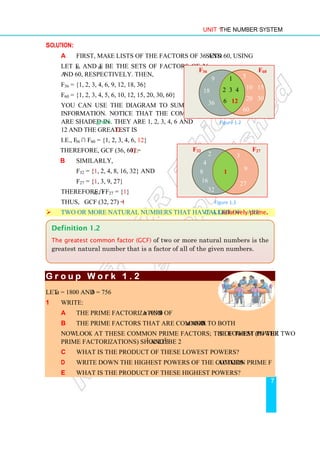
a First, make lists of the factors of 36 and 60, using sets.
Let F36 and F60 be the sets of factors of 36
and 60, respectively. Then,
F36 = {1, 2, 3, 4, 6, 9, 12, 18, 36}
F60 = {1, 2, 3, 4, 5, 6, 10, 12, 15, 20, 30, 60}
You can use the diagram to summarize the
information. Notice that the common factors
are shaded in green. They are 1, 2, 3, 4, 6 and
12 and the greatest is 12.
i.e., F36 ∩ F60 = {1, 2, 3, 4, 6, 12}
Therefore, GCF (36, 60) = 12.
b Similarly,
F32 = {1, 2, 4, 8, 16, 32} and
F27 = {1, 3, 9, 27}
Therefore, F32 ∩ F27 = {1}
Thus, GCF (32, 27) = 1
 Two or more natural numbers that have a GCF of 1 are called relatively prime.
G r o u p W o r k 1 .
G r o u p W o r k 1 . 2
2
2
2
Let a = 1800 and b = 756
1 Write:
a the prime factorization of a and b
b the prime factors that are common to both a and b.
Now look at these common prime factors; the lowest powers of them (in the two
prime factorizations) should be 22
and 32
.
c What is the product of these lowest powers?
d Write down the highest powers of the common prime factors.
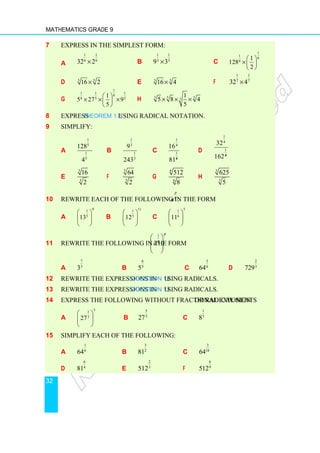
e What is the product of these highest powers?
Definition 1.2
The greatest common factor (GCF) of two or more natural numbers is the
greatest natural number that is a factor of all of the given numbers.
Figure 1.3
F32 F27
2
4
8
16
32
3
9
27
1
Figure 1.2
F36 F60
9
18
36
5
10 15
20 30
60
1
2 3 4
6 12
Mathematics Grade 9
8
2 a Compare the result of 1c with the GCF of the given numbers.
Are they the same?
b Compare the result of 1e with the GCF of the given numbers.
Are they the same?
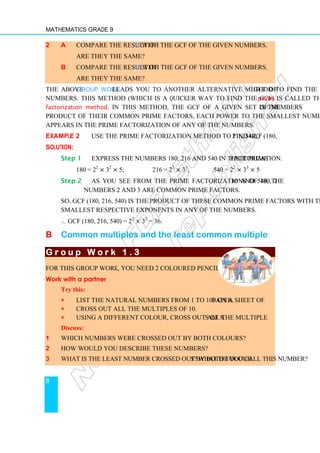
The above Group Work leads you to another alternative method to find the GCF of
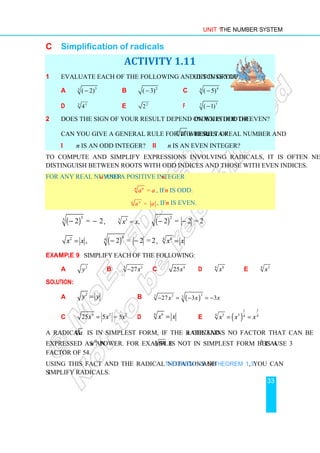
numbers. This method (which is a quicker way to find the GCF) is called the prime
factorization method. In this method, the GCF of a given set of numbers is the
product of their common prime factors, each power to the smallest number of times it
appears in the prime factorization of any of the numbers.
Example 2 Use the prime factorization method to find GCF (180, 216, 540).
Solution:
Step 1 Express the numbers 180, 216 and 540 in their prime factorization.
180 = 22
× 32
× 5; 216 = 23
× 33
; 540 = 22
× 33
× 5
Step 2 As you see from the prime factorizations of 180, 216 and 540, the
numbers 2 and 3 are common prime factors.
So, GCF (180, 216, 540) is the product of these common prime factors with the
smallest respective exponents in any of the numbers.
∴ GCF (180, 216, 540) = 22
× 32
= 36.
B Common multiples and the least common multiple
G r o u p W o r k 1 .
G r o u p W o r k 1 . 3
3
3
3
For this group work, you need 2 coloured pencils.
Work with a partner
Try this:
∗
∗
∗
∗ List the natural numbers from 1 to 100 on a sheet of paper.
∗
∗
∗
∗ Cross out all the multiples of 10.
∗
∗
∗
∗ Using a different colour, cross out all the multiples of 8.
Discuss:
1 Which numbers were crossed out by both colours?
2 How would you describe these numbers?
3 What is the least number crossed out by both colours? What do you call this number?
Unit 1 The Number System
9
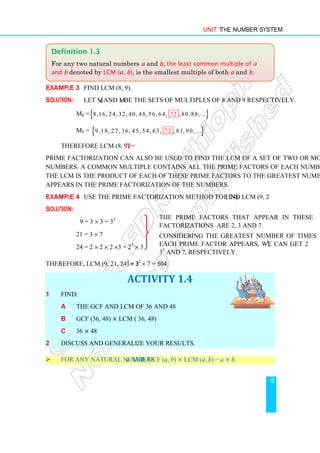
Example 3 Find LCM (8, 9).
Solution: Let M8 and M9 be the sets of multiples of 8 and 9 respectively.
M8 ={ }
8,16, 24, 32, 40, 48, 56, 64, , 80, 88
72 ,...
M9 = { }
9,18, 27, 36, 45, 54, 63, , 81, 90
72 ,...
Therefore LCM (8, 9) = 72
Prime factorization can also be used to find the LCM of a set of two or more than two
numbers. A common multiple contains all the prime factors of each number in the set.
The LCM is the product of each of these prime factors to the greatest number of times it
appears in the prime factorization of the numbers.
Example 4 Use the prime factorization method to find LCM (9, 21, 24).
Solution:
9 = 3 × 3 = 32
21 = 3 × 7
24 = 2 × 2 × 2 ×3 = 23
× 3
Therefore, LCM (9, 21, 24) = 23
× 32
× 7 = 504.
ACTIVITY 1.4
1 Find:
a The GCF and LCM of 36 and 48
b GCF (36, 48) × LCM ( 36, 48)
c 36 × 48
2 Discuss and generalize your results.
 For any natural numbers a and b, GCF (a, b) × LCM (a, b) = a × b.
Definition 1.3
For any two natural numbers a and b, the least common multiple of a
and b denoted by LCM (a, b), is the smallest multiple of both a and b.
The prime factors that appear in these
factorizations are 2, 3 and 7.
Considering the greatest number of times
each prime factor appears, we can get 23
,
32
and 7, respectively.
Mathematics Grade 9
10
1.1.3 Rational Numbers
H
H
H I
I
I S
S
S T
T
T O
O
O R
R
R I
I
I C
C
C A
A
A L
L
L N
N
N O
O
O T
T
T E
E
E :
::
About 5,000 years ago, Egyptians used
hieroglyphics to represent numbers.
The Egyptian concept of fractions was
mostly limited to fractions with numerator
1. The hieroglyphic was placed under the
symbol to indicate the number as a
denominator. Study the examples of
Egyptian fractions.
Recall that the set of integers is given by
Z = {…, – 3, – 2, – 1, 0, 1, 2, 3,…}
Using the set of integers, we define the set of rational numbers as follows:
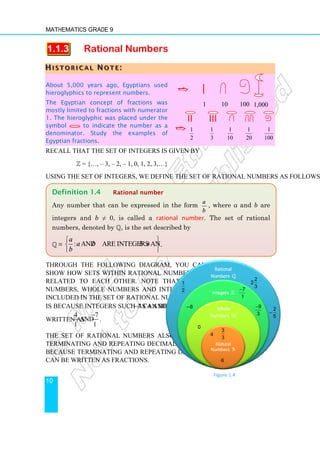
Through the following diagram, you can
show how sets within rational numbers are
related to each other. Note that natural
numbers, whole numbers and integers are
included in the set of rational numbers. This
is because integers such as 4 and −7 can be
written as
4 7
and
1 1
−
.
The set of rational numbers also includes
terminating and repeating decimal numbers
because terminating and repeating decimals
can be written as fractions.
Definition 1.4 Rational number
Any number that can be expressed in the form
a
b
, where a and b are
integers and b ≠ 0, is called a rational number. The set of rational
numbers, denoted by Q, is the set described by
Q = : and are integers and 0
a
a b b
b
 
≠
 
 
.
1,000

1 10 100
 1 1 1 1 1
2 3 10 20 100
4
6
0
2
2
3
3
3
−8
−7
1
−9
3
1
2
−
2
5
Figure 1.4
Unit 1 The Number System
11
For example, −1.3 can be written as 13 29
and 0.29 as
10 100
− −
− .
Mixed numbers are also included in the set of rational numbers because any mixed number
30
45
2 3 5 2
= = .
3 3 5 3
× ×
× ×
can be written as an improper fraction.
For example, 2
2
3
can be written as
8
.
3
When a rational number is expressed as a fraction, it is often expressed in simplest form
(lowest terms). A fraction
a
b
is in simplest form when GCF (a, b) = 1.
Example 1 Write
30
45
in simplest form.
Solution:
30
45
2 3 5 2
= = .
3 3 5 3
× ×
× ×
(by factorization and cancellation)
Hence
30
45
when expressed in lowest terms (simplest form) is
2
.
3
Exercise 1.1
1 Determine whether each of the following numbers is prime or composite:
a 45 b 23 c 91 d 153
2 Prime numbers that differ by two are called twin primes.
i Which of the following pairs are twin primes?
a 3 and 5 b 13 and 17 c 5 and 7
ii List all pairs of twin primes that are less than 30.
3 Determine whether each of the following numbers is divisible by 2, 3, 4, 5, 6, 8, 9
or 10:
a 48 b 153 c 2,470
d 144 e 12,357
4 a Is 3 a factor of 777? b Is 989 divisible by 9?
c Is 2,348 divisible by 4?
5 Find three different ways to write 84 as a product of two natural numbers.
6 Find the prime factorization of:
a 25 b 36 c 117 d 3,825
Mathematics Grade 9
12
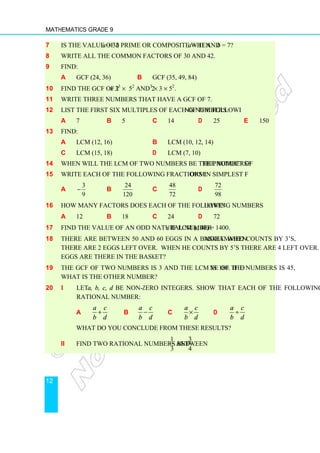
7 Is the value of 2a + 3b prime or composite when a = 11 and b = 7?
8 Write all the common factors of 30 and 42.
9 Find:
a GCF (24, 36) b GCF (35, 49, 84)
10 Find the GCF of 2 × 33
× 52
and 23
× 3 × 52
.
11 Write three numbers that have a GCF of 7.
12 List the first six multiples of each of the following numbers:
a 7 b 5 c 14 d 25 e 150
13 Find:
a LCM (12, 16) b LCM (10, 12, 14)
c LCM (15, 18) d LCM (7, 10)
14 When will the LCM of two numbers be the product of the numbers?
15 Write each of the following fractions in simplest form:
a
3
9
− b
24
120
c
48
72
d
72
98
16 How many factors does each of the following numbers have?
a 12 b 18 c 24 d 72
17 Find the value of an odd natural number x if LCM (x, 40) = 1400.
18 There are between 50 and 60 eggs in a basket. When Mohammed counts by 3’s,
there are 2 eggs left over. When he counts by 5’s there are 4 left over. How many
eggs are there in the basket?
19 The GCF of two numbers is 3 and the LCM is 180. If one of the numbers is 45,
what is the other number?
20 i Let a, b, c, d be non-zero integers. Show that each of the following is a
rational number:
a
a c
b d
+ b
a c
b d
− c
a c
b d
× d
a c
b d
÷
What do you conclude from these results?
ii Find two rational numbers between
1
3
and
3
4
.
Unit 1 The Number System
13
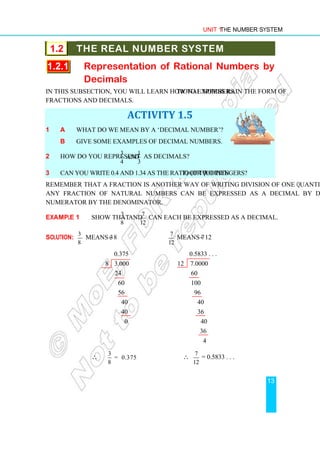
1.2 THE REAL NUMBER SYSTEM
1.2.1 Representation of Rational Numbers by
Decimals
In this subsection, you will learn how to express rational numbers in the form of
fractions and decimals.
ACTIVITY 1.5
1 a What do we mean by a ‘decimal number’?
b Give some examples of decimal numbers.
2 How do you represent
3 1
and
4 3
as decimals?
3 Can you write 0.4 and 1.34 as the ratio (or quotient) of two integers?
Remember that a fraction is another way of writing division of one quantity by another.
Any fraction of natural numbers can be expressed as a decimal by dividing the
numerator by the denominator.
Example 1 Show that
3
8
and
7
12
can each be expressed as a decimal.
Solution:
3
8
means 3 ÷ 8
7
12
means 7 ÷ 12
0.375 0.5833 . . .
8 3.000 12 7.0000
24 60
60 100
56 96
40 40
40 36
0 40
36
4
∴
3
= 0.375
8
∴ 7
12
= 0.5833 . . .
Mathematics Grade 9
14
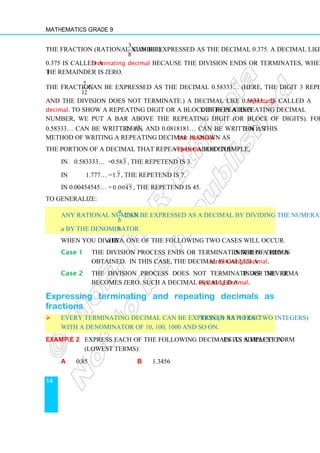
The fraction (rational number)
3
8
can be expressed as the decimal 0.375. A decimal like
0.375 is called a terminating decimal because the division ends or terminates, when
the remainder is zero.
The fraction
7
12
can be expressed as the decimal 0.58333… (Here, the digit 3 repeats
and the division does not terminate.) A decimal like 0.58333... is called a repeating
decimal. To show a repeating digit or a block of repeating digits in a repeating decimal
number, we put a bar above the repeating digit (or block of digits). For example
0.58333… can be written as 0.583 , and 0.0818181… can be written as 0.081. This
method of writing a repeating decimal is known as bar notation.
The portion of a decimal that repeats is called the repetend. For example,
In 0.583333… =0.583 , the repetend is 3.
In 1.777… = 1.7 , the repetend is 7.
In 0.00454545… = 0.0045 , the repetend is 45.
To generalize:
Any rational number
a
b
can be expressed as a decimal by dividing the numerator
a by the denominator b.
When you divide a by b, one of the following two cases will occur.
Case 1 The division process ends or terminates when a remainder of zero is
obtained. In this case, the decimal is called a terminating decimal.
Case 2 The division process does not terminate as the remainder never
becomes zero. Such a decimal is called a repeating decimal.
Expressing terminating and repeating decimals as
fractions
 Every terminating decimal can be expressed as a fraction (a ratio of two integers)
with a denominator of 10, 100, 1000 and so on.
Example 2 Express each of the following decimals as a fraction in its simplest form
(lowest terms):
a 0.85 b 1.3456
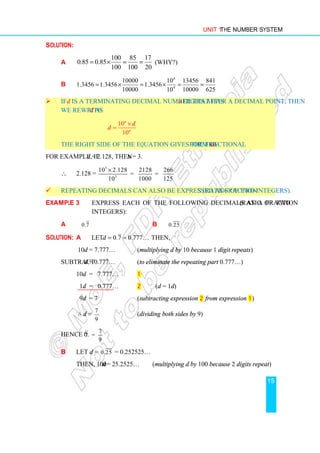
Unit 1 The Number System
15
Solution:
a
100 85 17
0.85 0.85
100 100 20
= × = = (Why?)
b
4
4
10000 10 13456 841
1.3456 1.3456 1.3456
10000 10 10000 625
= × = × = =
 If d is a terminating decimal number that has n digits after a decimal point, then
we rewrite d as
10
10
n
n
d
d
×
=
The right side of the equation gives the fractional form of d.
For example, if d = 2.128, then n = 3.
∴ 2.128 =
3
3
10 2.128 2128 266
= =
10 1000 125
×
 Repeating decimals can also be expressed as fractions (ratios of two integers).
Example 3 Express each of the following decimals as a fraction (ratio of two
integers):
a 0.7 b 0.25
Solution: a Let 0.7 0.777
d = = … then,
10d = 7.777… (multiplying d by 10 because 1 digit repeats)
Subtract d = 0.777… (to eliminate the repeating part 0.777…)
10d = 7.777… 1
1d = 0.777… 2 (d = 1d)
9d = 7 (subtracting expression 2 from expression 1)
∴ d =
7
9
(dividing both sides by 9)
Hence 0.
7
7 =
9
b Let d = 0.25 = 0.252525…
Then, 100d = 25.2525… (multiplying d by 100 because 2 digits repeat)
Mathematics Grade 9
16
100d = 25.252525…
1d = 0.252525…
99d = 25
∴ d =
25
99
So,
25
0.25
99
=
In Example 3a, one digit repeats. So, you multiplied d by 10. In Example 3b, two digits
repeat. So you multiplied d by 100.
The algebra used in the above example can be generalized as follows:
 In general, if d is a repeating decimal with k non-repeating and p repeating digits
after the decimal point, then the formula
( )
10 10
10 10
k p k
k p k
d
d
+
+
−
=
−
is used to change the decimal to the fractional form of d.
Example 4 Express the decimal 0.375 as a fraction.
Solution: Let 0.375
d = , then,
k = 1 (number of non-repeating digits)
p = 2 (number of repeating digits) and
k + p = 1 + 2 = 3.
( )
( )
( )
( )
3 1 3
3
3 1
10 10 10 10 10 10
10 10
10 10 10 10
k p k
k p k
d d d d
d
+
+
− − −
⇒ = = =
−
− −
3
10 0.375 10 0.375
990
× − ×
=
375.75 3.75 372
990 990
−
= =
From Examples 1, 2, 3 and 4, you conclude the following:
i Every rational number can be expressed as either a terminating decimal or a
repeating decimal.
ii Every terminating or repeating decimal represents a rational number.
(subtracting 1d from 100d eliminates the
repeating part 0.2525…)
Unit 1 The Number System
17
Exercise 1.2
1 Express each of the following rational numbers as a decimal:
a
4
9
b
3
25
c
11
7
d
2
5
3
− e
3706
100
f
22
7
2 Write each of the following as a decimal and then as a fraction in its lowest term:
a three tenths b four thousandths
c twelve hundredths d three hundred and sixty nine thousandths.
3 Write each of the following in metres as a fraction and then as a decimal:
a 4 mm b 6 cm and 4 mm c 56 cm and 4 mm
Hint: Recall that 1 metre(m) = 100 centimetres(cm) = 1000 millimetres(mm).
4 From each of the following fractions, identify those that can be expressed as
terminating decimals:
a
5
13
b
7
10
c
69
64
d
11
60
e
11
80
f
17
125
g
5
12
h
4
11
Generalize your observation.
5 Express each of the following decimals as a fraction or mixed number in simplest
form:
a 0.88 b 0.77 c 0.83 d 7.08 e 0.5252 f 1.003
−
6 Express each of the following decimals using bar notation:
a 0.454545… b 0.1345345…
7 Express each of the following decimals without bar notation. (In each case use at
least ten digits after the decimal point)
a 0.13 b 0.305
− c 0.381
8 Verify each of the following computations by converting the decimals to fractions:
a 0.275 0.714 0.989
+ = b 0.6 1.142857 0.476190
− = −
Mathematics Grade 9
18
1.2.2 Irrational Numbers
Remember that terminating or repeating decimals are rational numbers, since they can
be expressed as fractions. The square roots of perfect squares are also rational numbers.
For example, 4 is a rational number since
2
4 = 2 =
1
. Similarly, 0.09 is a rational
number because, 0.09 0.3
= is a rational number.
If x2
= 4, then what do you think is the value of x?
4 2.
x = ± = ± Therefore x is a rational number. What if x2
= 3?
In Figure 1.4 of Section 1.1.3, where do numbers like 2 and 5 fit? Notice what
happens when you find 2 and 5 with your calculator:
If you first press the button 2 and then the square-root
button, you will find 2 on the display.
i.e., 2 : 2 √ = 1.414213562…
5 : 5 √ = 2.236067977…
Note that many scientific calculators, such as Casio ones,
work the same as the written order, i.e., instead of pressing
2 and then the √ button, you press the √ button and then 2.
Before using any calculator, it is always advisable to read
the user’s manual.
Note that the decimal numbers for 2 and 5 do not terminate, nor do they have a
pattern of repeating digits. Therefore, these numbers are not rational numbers. Such
numbers are called irrational numbers. In general, if a is a natural number that is not
a perfect square, then a is an irrational number.
Example 1 Determine whether each of the following numbers is rational or
irrational.
a 0.16666 . . . b 0.16116111611116111116 . . . c π
Solution: a In 0.16666 . . . the decimal has a repeating pattern. It is a
rational number and can be expressed as
1
6
.
b This decimal has a pattern that neither repeats nor terminates. It is an
irrational number.
Study Hint
Most calculators round
answers but some
truncate answers. i.e.,
they cut off at a certain
point, ignoring
subsequent digits.
Unit 1 The Number System
19
c π = 3.1415926… This decimal does not repeat or terminate. It is an
irrational number. (The fraction
22
7
is an approximation to the value of π.
It is not the exact value!).
In Example 1, b and c lead us to the following fact:
 A decimal number that is neither terminating nor repeating is an irrational
number.
1 Locating irrational numbers on the number line
G r o u p W o r k 1 .
G r o u p W o r k 1 . 4
4
4
4
You will need a compass and straight edge to perform the
following:
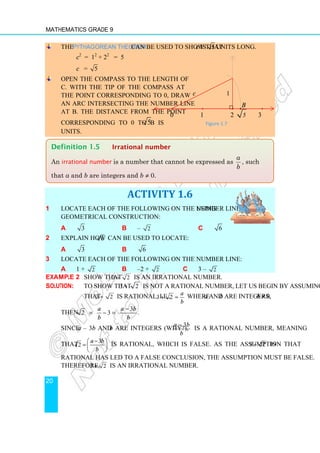
1 To locate 2 on the number line:
Draw a number line. At the point corresponding to 1
on the number line, construct a perpendicular line
segment 1 unit long.
Draw a line segment from the point corresponding to
0 to the top of the 1 unit segment and label it as c.
Use the Pythagorean Theorem to show that c is 2 unit long.
Open the compass to the length of c. With the tip of the compass at the point
corresponding to 0, draw an arc that intersects the number line at B. The distance
from the point corresponding to 0 to B is 2 units.
2 To locate 5 on the number line:
Find two numbers whose squares have a sum of 5. One pair that works is 1 and 2,
since 12
+ 22
= 5.
Draw a number line. At the point corresponding
to 2, on the number line, construct a
perpendicular line segment 1 unit long.
Draw the line segment shown
from the point corresponding to 0
to the top of the 1 unit segment.
Label it as c.
0 1 2 3
Figure 1.6
c 1
2
0 1 2
c 1
1
B
Figure 1.5
Mathematics Grade 9
20
The Pythagorean theorem can be used to show that c is 5 units long.
c2
= 12
+ 22
= 5
c = 5
Open the compass to the length of
c. With the tip of the compass at
the point corresponding to 0, draw
an arc intersecting the number line
at B. The distance from the point
corresponding to 0 to B is 5
units.
ACTIVITY 1.6
1 Locate each of the following on the number line, by using
geometrical construction:
a 3 b – 2 c 6
2 Explain how 2 can be used to locate:
a 3 b 6
3 Locate each of the following on the number line:
a 1 + 2 b –2 + 2 c 3 – 2
Example 2 Show that 3 2
+ is an irrational number.
Solution: To show that 3 2
+ is not a rational number, let us begin by assuming
that 3 2
+ is rational. i.e., 3 2
a
b
+ = where a and b are integers, b ≠ 0.
Then
3
2 3 .
a a b
b b
−
= − =
Since a – 3b and b are integers (Why?),
3
a b
b
−
is a rational number, meaning
that
3
2
a b
b
−
 
=  
 
is rational, which is false. As the assumption that 3 2
+ is
rational has led to a false conclusion, the assumption must be false.
Therefore, 3 2
+ is an irrational number.
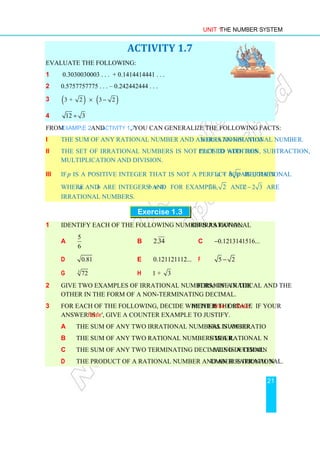
Definition 1.5 Irrational number
An irrational number is a number that cannot be expressed as
a
b
, such
that a and b are integers and b ≠ 0.
0 1 2 3
5
c 1
B
Figure 1.7
Unit 1 The Number System
21
ACTIVITY 1.7
Evaluate the following:
1 0.3030030003 . . . + 0.1414414441 . . .
2 0.5757757775 . . . – 0.242442444 . . .
3 ( ) ( )
3 + 2 3 2
× −
4 12 3
÷
From Example 2 and Activity 1.7, you can generalize the following facts:
i The sum of any rational number and an irrational number is an irrational number.
ii The set of irrational numbers is not closed with respect to addition, subtraction,
multiplication and division.
iii If p is a positive integer that is not a perfect square, then a + b p is irrational
where a and b are integers and b ≠ 0. For example, 3 2
+ and 2 2 3
− are
irrational numbers.
Exercise 1.3
1 Identify each of the following numbers as rational or irrational:
a
5
6
b 2.34 c 0.1213141516...
−
d 0.81 e 0.121121112... f 5 2
−
g 3
72 h 1 + 3
2 Give two examples of irrational numbers, one in the form of a radical and the
other in the form of a non-terminating decimal.
3 For each of the following, decide whether the statement is 'true' or 'false'. If your
answer is 'false', give a counter example to justify.
a The sum of any two irrational numbers is an irrational number.
b The sum of any two rational numbers is a rational number.
c The sum of any two terminating decimals is a terminating decimal.
d The product of a rational number and an irrational number is irrational.
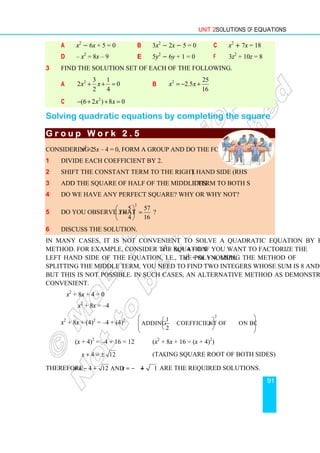
Mathematics Grade 9
22
1.2.3 Real Numbers
In Section 1.2.1, you observed that every rational number is either a terminating
decimal or a repeating decimal. Conversely, any terminating or repeating decimal is a
rational number. Moreover, in Section 1.2.2 you learned that decimals which are
neither terminating nor repeating exist. For example, 0.1313313331… Such decimals
are defined to be irrational numbers. So a decimal number can be a rational or an
irrational number.
It can be shown that every decimal number, be it rational or irrational, can be associated
with a unique point on the number line and conversely that every point on the number
line can be associated with a unique decimal number, either rational or irrational. This is
usually expressed by saying that there exists a one-to-one correspondence between the
sets C and D where these sets are defined as follows.
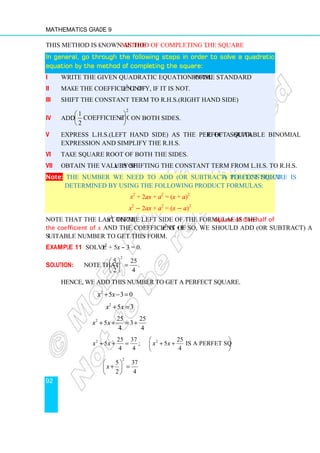
C = {P : P is a point on the number line}
D = {d : d is a decimal number }
The above discussion leads us to the following definition.
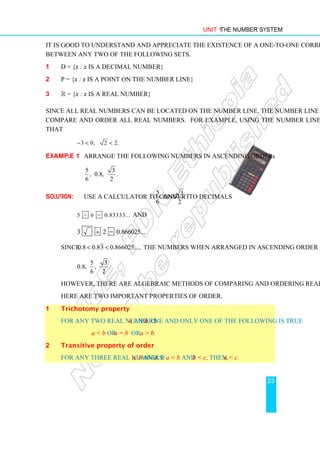
The set of real numbers and its subsets
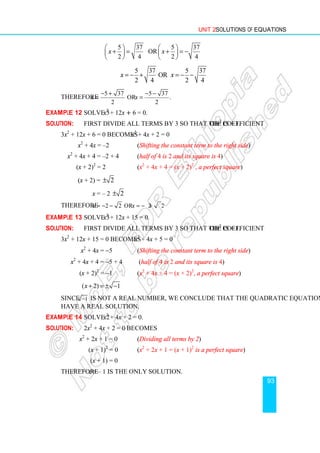
are shown in the adjacent diagram.
From the preceding discussion, you can
see that there exists a one-to-one
correspondence between the set R and
the set C = {P:P is a point on the number
line}.
Definition 1.6 Real numbers
A number is called a real number, if and only if it is either a rational
number or an irrational number.
The set of real numbers, denoted by R, can be described as the union of
the sets of rational and irrational numbers.
R = { x : x is a rational number or an irrational number.}
–4 –1
Whole
Numbers
0 1 2
Integers
-2
Rational Numbers
.
.
0 7
0 4
3
5
19
4
−
. . . .
2
1 0100100010
5
π
−
Irrational Numbers
Real Numbers
Figure 1.8
Unit 1 The Number System
23
It is good to understand and appreciate the existence of a one-to-one correspondence
between any two of the following sets.
1 D = {x : x is a decimal number}
2 P = {x : x is a point on the number line}
3 R = {x : x is a real number}
Since all real numbers can be located on the number line, the number line can be used to
compare and order all real numbers. For example, using the number line you can tell
that
3 0, 2 2.
−  
Example 1 Arrange the following numbers in ascending order:
5 3
, 0.8, .
6 2
Solution: Use a calculator to convert
5
6
and
3
2
to decimals
5 ÷ 6 = 0.83333... and
3 2 = 0.866025...
÷
Since 0.8 0.83 0.866025...,
  the numbers when arranged in ascending order are
5 3
0.8, , .
6 2
However, there are algebraic methods of comparing and ordering real numbers.
Here are two important properties of order.
1 Trichotomy property
For any two real numbers a and b, one and only one of the following is true
a  b or a = b or a  b.
2 Transitive property of order
For any three real numbers a, b and c, if a  b and b  c, then, a  c.
Mathematics Grade 9
24
A third property, stated below, can be derived from the Trichotomy Property and the
Transitive Property of Order.
 For any two non-negative real numbers a and b, if a2
 b2
, then a  b.
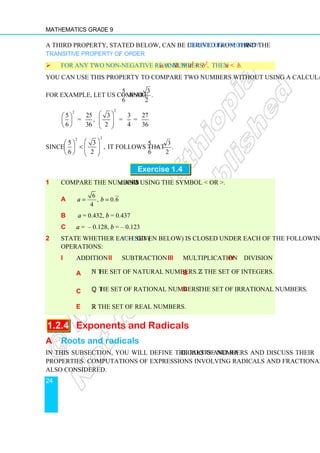
You can use this property to compare two numbers without using a calculator.
For example, let us compare
5
6
and
3
.
2
2
2
5 25 3 3 27
= , = =
6 36 2 4 36
 
 
 
   
   
Since
2
2
5 3
,
6 2
 
 
  
   
   
it follows that
5 3
 .
6 2
Exercise 1.4
1 Compare the numbers a and b using the symbol  or .
a
6
, 0.6
4
a b
= =
b a = 0.432, b = 0.437
c a = – 0.128, b = – 0.123
2 State whether each set (a – e given below) is closed under each of the following
operations:
i addition ii subtraction iii multiplication iv division
a N the set of natural numbers. b Z the set of integers.
c Q the set of rational numbers. d The set of irrational numbers.
e R the set of real numbers.
1.2.4 Exponents and Radicals
A Roots and radicals
In this subsection, you will define the roots and radicals of numbers and discuss their
properties. Computations of expressions involving radicals and fractional exponents are
also considered.
Unit 1 The Number System
25
Roots
H
H
H I
I
I S
S
S T
T
T O
O
O R
R
R I
I
I C
C
C A
A
A L
L
L N
N
N O
O
O T
T
T E
E
E :
::
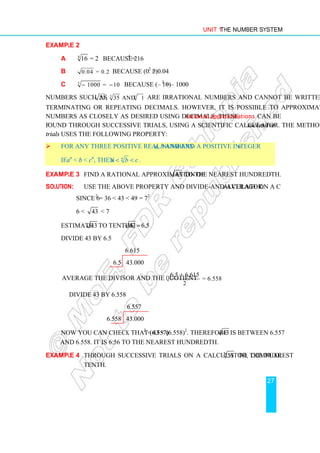
The Pythagorean School of ancient Greece focused on the study of philosophy,
mathematics and natural science. The students, called Pythagoreans, made
many advances in these fields. One of their studies was to symbolize numbers.
By drawing pictures of various numbers, patterns can be discovered. For
example, some whole numbers can be represented by drawing dots arranged
in squares.
•
1
1 × 1
• •
• •
4
2 × 2
• • •
• • •
• • •
9
3 × 3
• • • •
• • • •
• • • •
• • • •
16
4 × 4
• • • • • • • •
• • • • • • • •
• • • • • • • •
• • • • • • • •
• • • • • • • •
• • • • • • • •
• • • • • • • •
• • • • • • • •
64
8 × 8
Numbers that can be pictured in squares of dots are called perfect squares or square
numbers. The number of dots in each row or column in the square is a square root of
the perfect square. The perfect square 9 has a square root of 3, because there are 3 rows
and 3 columns. You say 8 is a square root of 64, because 64 = 8 × 8 or 82
.
Perfect squares also include decimals and fractions like 0.09 and
4
.
9
Since ( )
2
0.3 0.09
=
and
2
2 4
=
3 9
 
 
 
, it is also true that (–8)2
= 64 and (–12)2
= 144.
So, you may say that –8 is also a square root of 64 and –12 is a square root of 144.
The positive square root of a number is called the principal square root.
The symbol , called a radical sign, is used to indicate the principal square root.
Definition 1.7 Square root
For any two real numbers a and b, if a2 = b, then a is a square root of b.
Mathematics Grade 9
26
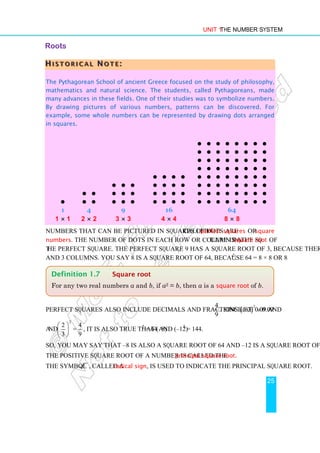
The symbol 25 is read as the principal square root of 25 or just the square root
of 25 and 25
− is read as the negative square root of 25. If b is a positive real
number, b is a positive real number. Negative real numbers do not have square roots in
the set of real numbers since a2
≥ 0 for any number a. The square root of zero is zero.
Similarly, since 43
= 64, you say that 64 is the cube of 4 and 4 is the cube root of 64.
That is written as 3
4 64
= .
The symbol 3
4 64
= is read as the principal cube root of 64 or just the cube root of 64.
 Each real number has exactly one cube root.
(– 3)3
= – 27 so, 3
27 =
− −3 03
= 0 so, 3
0 0.
=
You may now generalize as follows:
Example 1
a – 3 is a cube root of – 27 because (– 3)3
= – 27
b 4 is a cube root of 64 because 43
= 64
i If b  0 and n is even, there is no real nth
root of b, because an even power of any
real number is a non-negative number.
ii The symbol n
is called a radical sign, the expression n
b is called a radical, n
is called the index and b is called the radicand. When no index is written, the
radical sign indicates square root.
Definition 1.9 Principal nth
root
If b is any real number and n is a positive integer greater than 1, then,
the principal nth root of b, denoted by n
b is defined as
the positive root of , if 0.
the negative root of , if 0 and is odd.
0, if 0.
th
th
n
n b b
b n b b n
b
 

= 

 =

Definition 1.8 The nth
root
For any two real numbers a and b, and positive integer n, if an = b, then
a is called an nth
root of b.
Unit 1 The Number System
27
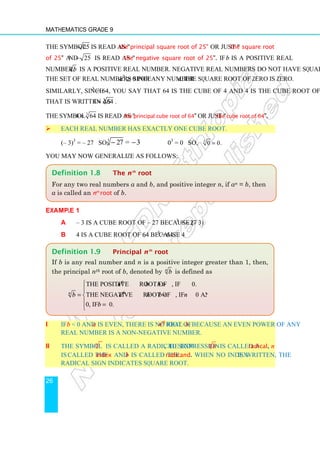
Example 2
a 4
16 = 2 because 24
= 16
b 0.04 = 0.2 because (0. 2)2
= 0.04
c 3
1000 = 10
− − because (– 10)3
= – 1000
Numbers such as 3 3
23, 35 and 10 are irrational numbers and cannot be written as
terminating or repeating decimals. However, it is possible to approximate irrational
numbers as closely as desired using decimals. These rational approximations can be
found through successive trials, using a scientific calculator. The method of successive
trials uses the following property:
 For any three positive real numbers a, b and c and a positive integer n
if an
 b  cn
, then n
a b c
  .
Example 3 Find a rational approximation of 43 to the nearest hundredth.
Solution: Use the above property and divide-and-average on a calculator.
Since 62
= 36  43  49 = 72
6  43  7
Estimate 43 to tenths, 43 6.5
≈
Divide 43 by 6.5
6.615
6.5 43.000
Average the divisor and the quotient
6.5 + 6.615
= 6.558
2
Divide 43 by 6.558
6.557
6.558 43.000
Now you can check that (6.557)2
 43  (6.558)2
. Therefore 43 is between 6.557
and 6.558. It is 6.56 to the nearest hundredth.
Example 4 Through successive trials on a calculator, compute 3
53 to the nearest
tenth.
Mathematics Grade 9
28
Solution:
33
= 27  53  64 = 43
. That is, 33
 53  43
. So 3  3
53  4
Try 3.5: 3.53
= 42.875 So 3.5  3
53  4
Try 3.7: 3.73
= 50.653 So 3.7  3
53  4
Try 3.8: 3.83
= 54.872 So 3.7  3
53  3.8
Try 3.75: 3.753
= 52.734375 So 3.75  3
53  3.8
Therefore, 3
53 is 3.8 to the nearest tenth.
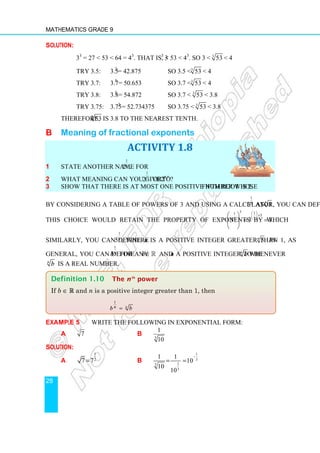
B Meaning of fractional exponents
ACTIVITY 1.8
1 State another name for
1
4
2 .
2 What meaning can you give to
1
2
2 or 0.5
2 ?
3 Show that there is at most one positive number whose fifth root is 2.
By considering a table of powers of 3 and using a calculator, you can define
1
5
3 as 5
3 .
This choice would retain the property of exponents by which
5 1
1 5
5
5
3 3 3.
 
×
 
 
 
= =
 
 
Similarly, you can define
1
5n
, where n is a positive integer greater than 1, as 5.
n
In
general, you can define
1
n
b for any b∈ℝ and n a positive integer to be n
b whenever
n
b is a real number.
Example 5 Write the following in exponential form:
a 7 b 3
1
10
Solution:
a
1
2
7 7
= b
1
3
1
3
3
1 1
10
10
10
−
= =
Definition 1.10 The nth
power
If b ∈ R and n is a positive integer greater than 1, then
1
n
n
b b
=
Unit 1 The Number System
29
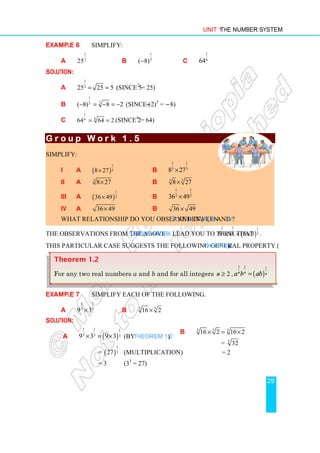
Example 6 Simplify:
a
1
2
25 b
1
3
( 8)
− c
1
6
64
Solution:
a
1
2
25 25 5
= = (Since 52
= 25)
b
1
3
3
( 8) 8 2
− = − = − (Since (−2)3
= −8)
c
1
6
6
64 64 2
= = (Since 26
= 64)
G r o u p W o r k 1 .
G r o u p W o r k 1 . 5
5
5
5
Simplify:
i a ( )
1
3
8 27
× b
1 1
3 3
8 27
×
ii a 3
8 27
× b 3 3
8 27
×
iii a ( )
1
2
36 49
× b
1 1
2 2
36 49
×
iv a 36 49
× b 36 49
×
What relationship do you observe between a and b in i, ii, iii and iv?
The observations from the above Group Work lead you to think that ( )
1 1 1
3 3 3
5 3 5 3
× = × .
This particular case suggests the following general property (Theorem).
Example 7 Simplify each of the following.
a
1 1
3 3
9 3
× b 5
5
16 2
×
Solution:
a ( )
1 1 1
3 3 3
9 3 9 3
× = × (by Theorem 1.2)
= ( )
1
3
27 (multiplication)
= 3 (33
= 27)
b 5
5 5
16 2 16 2
× = ×
= 5
32
= 2
Theorem 1.2
For any two real numbers a and b and for all integers 2
n ≥ , ( )
1 1 1
n n n
a b ab
=
Mathematics Grade 9
30
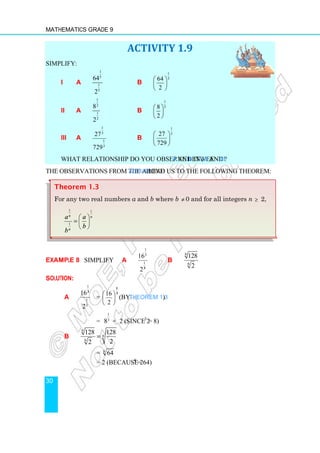
ACTIVITY 1.9
Simplify:
i a
1
5
1
5
64
2
b
1
5
64
2
 
 
 
ii a
1
2
1
2
8
2
b
1
2
8
2
 
 
 
iii a
1
3
1
3
27
729
b
1
3
27
729
 
 
 
What relationship do you observe between a and b in i, ii and iii?
The observations from the above Activity lead us to the following theorem:
Example 8 Simplify a
1
3
1
16
23
b
6
6
128
2
Solution:
a
1
1
3
16
2
3
=
16
2
1
3
 
 
 
(by Theorem 1.3)
=
1
3
8 = 2 (since 23
= 8)
b
6
6
6
128 128
2
2
=
= 6
64
= 2 (because 26
= 64)
Theorem 1.3
For any two real numbers a and b where b ≠ 0 and for all integers n ≥ 2,
1 1
1
n n
n
a a
b
b
 
=  
 
Unit 1 The Number System
31
ACTIVITY 1.10
1 Suggest, with reasons, a meaning for
a 2
7
2
b 2
9
2
in terms of 2
1
2
2 Suggest a relation between 5
3
2
and 5
1
2 .
Applying the property (am
)n
= amn
, you can write
9
1
10
7
 
 
 
as
9
10
7 . In general, you can say
1 p
q
a
 
 
 
 
=
p
q
a , where p and q are positive integers and a ≥ 0. Thus, you have the following
definition:
Exercise 1.5
1 Show that: a
1
3
64 4
= b
1
8
256 2
= c
1
3
125 5
=
2 Express each of the following without fractional exponents and without radical
signs:
a
1
4
81 b
1
2
9 c 6
64 d
1
3
27
8
 
 
 
e ( )
1
5
0.00032 f 4
0.0016 g 6
729
3 Explain each step of the following:
( ) ( ) ( )
1
1
3
3
27 125 3 3 3 5 5 5
× = × × × × ×
 
  = ( ) ( ) ( )
1
3
3 5 3 5 3 5
× × × × ×
 
 
3 5 15
= × =
4 In the same manner as in Question 3, simplify each of the following:
a ( )
1
2
25 121
× b ( )
1
4
625 16
× c ( )
1
5
1024 243
×
5 Express Theorem 1.2 using radical notation.
6 Show that:
a ( )
1 1 1
4 4 4
7 5 7 5
× = × b 5 3 5 3
× = ×
c
3 3 3
7 9 7 9
× = × d ( )
1 1 1
7 7 7
11 6 11 6
× = ×
Definition 1.11
For a ≥ 0 and p and q any two positive integers, ( )
1
=
p
p
p
q
q q
a a a
 
=
 
 
 
Mathematics Grade 9
32
7 Express in the simplest form:
a
1 1
6 6
32 2
× b
1 1
3 3
9 3
× c
1
1
6
6
1
128
2
 
× 
 
d 5
5
16 2
× e 3
3
16 4
× f
1 1
7 7
32 4
×
g
1
1 1 1
8
8 5 5
1
5 27 9
5
 
× × ×
 
 
h 5
3 5 3
1
5 8 4
5
× × ×
8 Express Theorem 1.3 using radical notation.
9 Simplify:
a
1
5
1
5
128
4
b
1
3
1
3
9
243
c
1
4
1
16
814
d
1
4
1
32
1624
e
3
3
16
2
f
5
5
64
2
g
6
6
512
8
h
3
3
625
5
10 Rewrite each of the following in the form
p
q
a :
a
9
1
5
13
 
 
 
b
11
1
5
12
 
 
 
c
5
1
6
11
 
 
 
11 Rewrite the following in the form
1 p
q
a
 
 
 
 
a
7
5
3 b
6
3
5 c
5
6
64 d
2
3
729
12 Rewrite the expressions in Question 10 using radicals.
13 Rewrite the expressions in Question 11 using radicals.
14 Express the following without fractional exponents or radical sign:
a
5
1
3
27
 
 
 
b
5
3
27 c
1
3
8
15 Simplify each of the following:
a
1
6
64 b
3
2
81 c
3
18
64
d
6
4
81 e
2
3
512 f
6
9
512
Unit 1 The Number System
33
C Simplification of radicals
ACTIVITY 1.11
1 Evaluate each of the following and discuss your result in groups.
a 3
3
( 2)
− b 2
( 3)
− c 4
4
( 5)
−
d 5 5
4 e 2
2 f 7
7
( 1)
−
2 Does the sign of your result depend on whether the index is odd or even?
Can you give a general rule for the result of
n n
a where a is a real number and
i n is an odd integer? ii n is an even integer?
To compute and simplify expressions involving radicals, it is often necessary to
distinguish between roots with odd indices and those with even indices.
For any real number a and a positive integer n,
=
n n
a a , if n is odd.
=
n n
a a , if n is even.
( )
5
5
2 = 2
− − , 3 3
,
x x
= ( )
2
2 = 2 = 2
− −
2
,
x x
= ( )
4
4
2 = 2 = 2
− − ,
4
4
x x
=
Example 9 Simplify each of the following:
a 2
y b 3 3
27x
− c 4
25x d 6
6
x e 3
4
x
Solution:
a
2
y y
= b ( )
3
3 3 3
27 3 3
x x x
− = − = −
c 4 2
25 5
x x
= = 5x2
d
6 6
x x
= e ( )
3
1
3 3
4 4
4
x x x
= =
A radical n
a is in simplest form, if the radicand a contains no factor that can be
expressed as an nth
power. For example 3
54 is not in simplest form because 33
is a
factor of 54.
Using this fact and the radical notations of Theorem 1.2 and Theorem 1.3, you can
simplify radicals.
Mathematics Grade 9
34
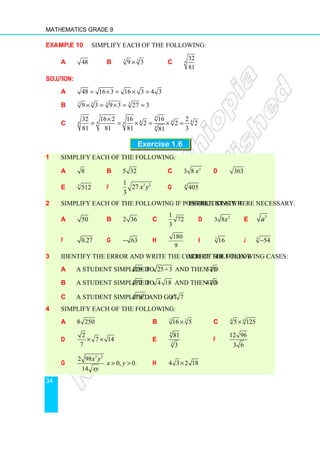
Example 10 Simplify each of the following:
a 48 b 3 3
9 3
× c 4
32
81
Solution:
a 48 16 3 16 3 4 3
= × = × =
b 3 3 3 3
9 3 9 3 27 3
× = × = =
c
4
4 4 4
4 4 4
4
32 16 2 16 16 2
2 2 2
81 81 81 3
81
×
= = × = × =
Exercise 1.6
1 Simplify each of the following:
a 8 b 5 32 c 2
3 8 x d 363
e 3
512 f
3 2
1
27
3
x y g 4
405
2 Simplify each of the following if possible. State restrictions where necessary.
a 50 b 2 36 c
1
72
3
d 2
3 8x e
3
a
f 0.27 g 63
− h
180
9
i 3
16 j 3
54
−
3 Identify the error and write the correct solution each of the following cases:
a A student simplified 28 to 25+3 and then to 5 3
b A student simplified 72 to 4 18 and then to 4 3
c A student simplified 9
7x and got 3
7
x
4 Simplify each of the following:
a 8 250 b 3 3
16 5
× c 4 4
5 125
×
d
2
7 14
7
× × e
3
3
81
3
f
12 96
3 6
g
3 2
2 98
0, 0.
14
x y
x y
xy
  h 4 3 2 18
×
Unit 1 The Number System
35
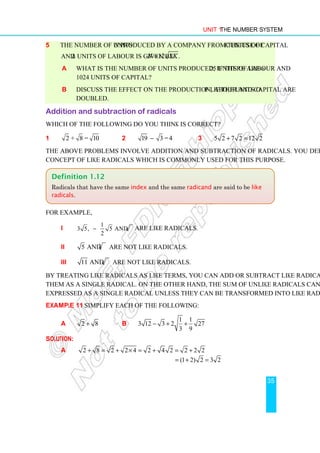
5 The number of units N produced by a company from the use of K units of capital
and L units of labour is given by 12 .
N LK
=
a What is the number of units produced, if there are 625 units of labour and
1024 units of capital?
b Discuss the effect on the production, if the units of labour and capital are
doubled.
Addition and subtraction of radicals
Which of the following do you think is correct?
1 2 + 8 = 10 2 19 3 =4
− 3 5 2 7 2 12 2
+ =
The above problems involve addition and subtraction of radicals. You define below the
concept of like radicals which is commonly used for this purpose.
For example,
i
1
3 5, 5 and 5 are like radicals.
2
− are like radicals.
ii 3
5 and 5 are not like radicals.
iii 11 and 7 are not like radicals.
By treating like radicals as like terms, you can add or subtract like radicals and express
them as a single radical. On the other hand, the sum of unlike radicals cannot be
expressed as a single radical unless they can be transformed into like radicals.
Example 11 Simplify each of the following:
a 2 8
+ b
1 1
3 12 3 2 27
3 9
− + +
Solution:
a 2 8 2 2 4 2 4 2 2 2 2
+ = + × = + = +
(1 2) 2 3 2
= + =
Definition 1.12
Radicals that have the same index and the same radicand are said to be like
radicals.
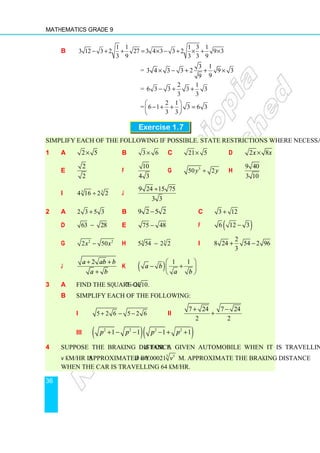
Mathematics Grade 9
36
b
1 1 1 3 1
3 12 3 2 27 3 4 3 3 2 9 3
3 9 3 3 9
− + + = × − + × + ×
=
3 1
3 4 3 3 2 9 3
9
9
× − + + ×
=
2 1
6 3 3 3 3
3 3
− + +
=
2 1
6 1 3 6 3
3 3
 
− + + =
 
 
Exercise 1.7
Simplify each of the following if possible. State restrictions where necessary.
1 a 2 5
× b 3 6
× c 21 5
× d 2 8
x x
×
e
2
2
f
10
4 3
g 3
50 2
y y
÷ h
9 40
3 10
i 3
3
4 16 2 2
÷ j
9 24 15 75
3 3
÷
2 a 2 3 5 3
+ b 9 2 5 2
− c 3 12
+
d 63 28
− e 75 48
− f ( )
6 12 3
−
g 2 2
2 50
x x
− h 3
3
5 54 2 2
− i
2
8 24 54 2 96
3
+ −
j
2
a ab b
a b
+ +
+
k ( ) 1 1
a b
a b
 
− +
 
 
3 a Find the square of 7 2 10.
−
b Simplify each of the following:
i 5 2 6 5 2 6
+ − − ii
7 24 7 24
2 2
+ −
+
iii ( )( )
2 2 2 2
1 1 1 1
p p p p
+ − − − + +
4 Suppose the braking distance d for a given automobile when it is travelling
v km/hr is approximated by 3 5
0.00021
d v
= m. Approximate the braking distance
when the car is travelling 64 km/hr.
Unit 1 The Number System
37
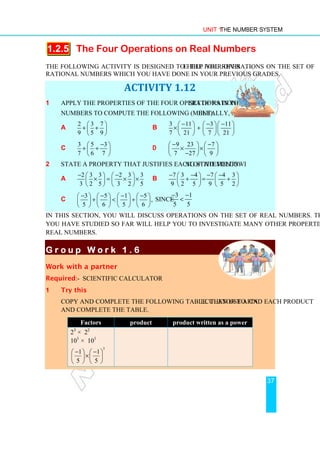
1.2.5 The Four Operations on Real Numbers
The following activity is designed to help you revise the four operations on the set of
rational numbers which you have done in your previous grades.
ACTIVITY 1.12
1 Apply the properties of the four operations in the set of rational
numbers to compute the following (mentally, if possible).
a
2 3 7
9 5 9
 
+ +
 
 
b
3 11 3 11
7 21 7 21
− − −
    
× +
    
    
c
3 5 3
7 6 7
−
 
+ +
 
 
d
9 23 7
7 27 9
− −
   
× ×
   
−
   
2 State a property that justifies each of the following statements.
a
2 3 3 2 3 3
3 2 5 3 2 5
− −
   
× = × ×
   
   
b
7 3 4 7 4 3
9 2 5 9 5 2
− − − −
   
+ = +
   
   
c
3 5 1 5
,
5 6 5 6
− − − −
       
+  +
       
       
since
3 1
5 5
− −

In this section, you will discuss operations on the set of real numbers. The properties
you have studied so far will help you to investigate many other properties of the set of
real numbers.
G r o u p W o r k 1 .
G r o u p W o r k 1 . 6
6
6
6
Work with a partner
Required:- scientific calculator
1 Try this
Copy and complete the following table. Then use a calculator to find each product
and complete the table.
Factors product product written as a power
23
× 22
101
× 101
3
1 1
5 5
− −
   
×
   
   
Mathematics Grade 9
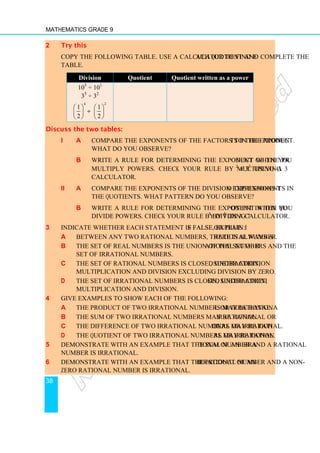
38
2 Try this
Copy the following table. Use a calculator to find each quotient and complete the
table.
Division Quotient Quotient written as a power
105
÷ 101
35
÷ 32
4 2
1 1
2 2
   
÷
   
   
Discuss the two tables:
i a Compare the exponents of the factors to the exponents in the product.
What do you observe?
b Write a rule for determining the exponent of the product when you
multiply powers. Check your rule by multiplying 32
× 33
using a
calculator.
ii a Compare the exponents of the division expressions to the exponents in
the quotients. What pattern do you observe?
b Write a rule for determining the exponent in the quotient when you
divide powers. Check your rule by dividing 75
by 73
on a calculator.
3 Indicate whether each statement is false or true. If false, explain:
a Between any two rational numbers, there is always a rational number.
b The set of real numbers is the union of the set of rational numbers and the
set of irrational numbers.
c The set of rational numbers is closed under addition, subtraction,
multiplication and division excluding division by zero.
d The set of irrational numbers is closed under addition, subtraction,
multiplication and division.
4 Give examples to show each of the following:
a The product of two irrational numbers may be rational or irrational.
b The sum of two irrational numbers may be rational or irrational.
c The difference of two irrational numbers may be rational or irrational.
d The quotient of two irrational numbers may be rational or irrational.
5 Demonstrate with an example that the sum of an irrational number and a rational
number is irrational.
6 Demonstrate with an example that the product of an irrational number and a non-
zero rational number is irrational.
Unit 1 The Number System
39
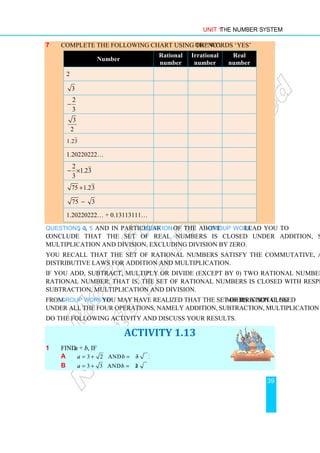
7 Complete the following chart using the words ‘yes’ or ‘no’.
Number
Rational
number
Irrational
number
Real
number
2
3
2
3
−
3
2
1.23
1.20220222…
2
1.23
3
− ×
75 1.23
+
75 − 3
1.20220222… + 0.13113111…
Questions 3, 4, 5 and in particular Question 7 of the above Group Work lead you to
conclude that the set of real numbers is closed under addition, subtraction,
multiplication and division, excluding division by zero.
You recall that the set of rational numbers satisfy the commutative, associative and
distributive laws for addition and multiplication.
If you add, subtract, multiply or divide (except by 0) two rational numbers, you get a
rational number, that is, the set of rational numbers is closed with respect to addition,
subtraction, multiplication and division.
From Group work 1.6 you may have realized that the set of irrational numbers is not closed
under all the four operations, namely addition, subtraction, multiplication and division.
Do the following activity and discuss your results.
ACTIVITY 1.13
1 Find a + b, if
a 3 2 and 3 2
a b
= + = −
b 3 3 and 2 3
a b
= + = +
Mathematics Grade 9
40
2 Find a – b, if
a 3 and 3
a b
= = b 5 and 2
a b
= =
3 Find ab, if
a 3 1 and 3 1
a b
= − = + b 2 3 and 3 2
a b
= =
4 Find a ÷ b, if
a 5 2 and 3 2
a b
= = b 6 6 and 2 3
a b
= =
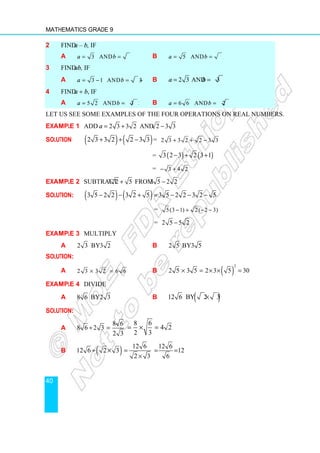
Let us see some examples of the four operations on real numbers.
Example 1 Add 2 3 3 2
a = + and 2 3 3
−
Solution ( ) ( )
2 3 3 2 2 3 3
+ + − = 2 3 3 2 2 3 3
+ + −
= ( ) ( )
3 2 3 2 3 1
− + +
= 3 4 2
− +
Example 2 Subtract 3 2 5
+ from 3 5 2 2
−
Solution: ( ) ( )
3 5 2 2 3 2 5 3 5 2 2 3 2 5
− − + = − − −
= 5(3 1) 2( 2 3)
− + − −
= 2 5 5 2
−
Example 3 Multiply
a 2 3 by 3 2 b 2 5 by 3 5
Solution:
a 2 3 3 2 6 6
× = b ( )
2
2 5 3 5 2 3 5 30
× = × × =
Example 4 Divide
a 8 6 by 2 3 b ( )
12 6 by 2 3
×
Solution:
a
8 6
8 6 2 3
2 3
÷ =
8 6
4 2
2 3
= × =
b ( ) 12 6
12 6 2 3
2 3
÷ × =
×
12 6
12
6
= =
Unit 1 The Number System
41
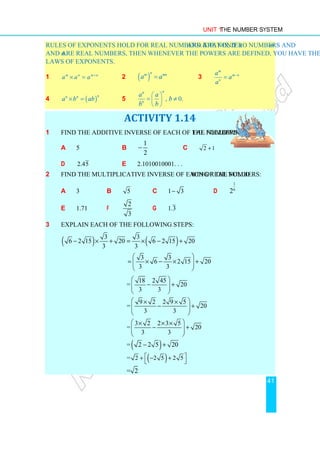
Rules of exponents hold for real numbers. That is, if a and b are nonzero numbers and m
and n are real numbers, then whenever the powers are defined, you have the following
laws of exponents.
1 m n m n
a a a +
× = 2 ( )
n
m mn
a a
= 3
m
m n
n
a
a
a
−
=
4 ( )
n
n n
a b ab
× = 5 , 0.
n
n
n
a a
b
b b
 
= ≠
 
 
ACTIVITY 1.14
1 Find the additive inverse of each of the following real numbers:
a 5 b
1
2
− c 2 1
+
d 2.45 e 2.1010010001. . .
2 Find the multiplicative inverse of each of the following real numbers:
a 3 b 5 c 1 3
− d
1
6
2
e 1.71 f
2
3
g 1.3
3 Explain each of the following steps:
( ) ( )
3 3
6 2 15 20 6 2 15 20
3 3
− × + = × − +
3 3
6 2 15 20
3 3
 
= × − × +
 
 
 
18 2 45
= 20
3 3
 
− +
 
 
 
9 2 2 9 5
= 20
3 3
 
× ×
− +
 
 
 
3 2 2 3 5
= 20
3 3
 
× × ×
− +
 
 
 
( )
= 2 2 5 20
− +
( )
= 2 2 5 2 5
 
+ − +
 
= 2
Mathematics Grade 9
42
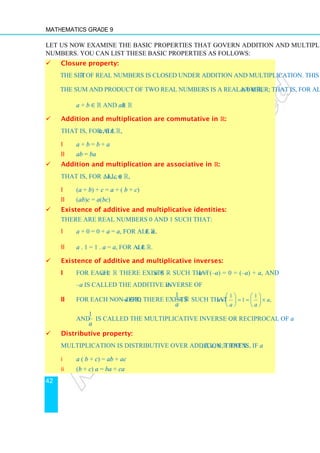
Let us now examine the basic properties that govern addition and multiplication of real
numbers. You can list these basic properties as follows:
 Closure property:
The set R of real numbers is closed under addition and multiplication. This means that
the sum and product of two real numbers is a real number; that is, for all a, b ∈ R,
a + b ∈ R and ab ∈ R
 Addition and multiplication are commutative in ℝ:
That is, for all a, b ∈ R,
i a + b = b + a
ii ab = ba
 Addition and multiplication are associative in ℝ:
That is, for all, a, b, c ∈ R,
i (a + b) + c = a + ( b + c)
ii (ab)c = a(bc)
 Existence of additive and multiplicative identities:
There are real numbers 0 and 1 such that:
i a + 0 = 0 + a = a, for all a ∈ R.
ii a . 1 = 1 . a = a, for all a ∈ R.
 Existence of additive and multiplicative inverses:
i For each a ∈ R there exists –a ∈ R such that a + (–a) = 0 = (–a) + a, and
–a is called the additive inverse of a.
ii For each non-zero a ∈ R, there exists
1
a
∈ℝ such that
1 1
1 ,
a a
a a
× = = ×
   
   
   
and
1
a
is called the multiplicative inverse or reciprocal of a.
 Distributive property:
Multiplication is distributive over addition; that is, if a, b, c, ∈ R then:
i a ( b + c) = ab + ac
ii (b + c) a = ba + ca
Unit 1 The Number System
43
Exercise 1.8
1 Find the numerical value of each of the following:
a ( ) ( ) ( )
3
4 5 3
1 5 2 2
1
4 2 8 64
16
− −
 
× × × ×
 
 
b 176 2 275 1584 891
− + −
c ( )
3 5 1
15 1.04 5 6 5 0.02 300
5 9 18
− + − −
d 5
4
0.0001 0.00032
− e 3 4
2 0.125 0.0016
+
2 Simplify each of the following
a ( )
1
3
216 b
2 3
3 5
2 2
× c
5
1
2
3
 
 
 
d
3
4
1
4
7
49
e
1
1
8
4
3 25
× f
1
4
16 2
÷ g 4 3
7 h
5
5
32
243
3 What should be added to each of the following numbers to make it a rational
number? (There are many possible answers. In each case, give two answers.)
a 5 3
− b 2 5
− − c 4.383383338…
d 6.123456… e 10.3030003…
1.2.6 Limits of Accuracy
In this subsection, you shall discuss certain concepts such as approximation, accuracy in
measurements, significant figures (s.f), decimal places (d.p) and rounding off numbers.
In addition to this, you shall discuss how to give appropriate upper and lower bounds
for data to a specified accuracy (for example measured lengths).
ACTIVITY 1.15
1 Round off the number 28617 to the nearest
a 10,000 b 1000 c 100
2 Write the number i 7.864 ii 6.437 iii 4.56556555…
a to one decimal place b to two decimal places
3 Write the number 43.25 to
a two significant figures b three significant figures
4 The weight of an object is 5.4 kg.
Give the lower and upper bounds within which the weight of the object can lie.
Mathematics Grade 9
44
1 Counting and measuring
Counting and measuring are an integral part of our daily life. Most of us do so for
various reasons and at various occasions. For example you can count the money you
receive from someone, a tailor measures the length of the shirt he/she makes for us, and
a carpenter counts the number of screws required to make a desk.
Counting: The process of counting involves finding out the exact number of things.
For example, you do counting to find out the number of students in a class. The answer
is an exact number and is either correct or, if you have made a mistake, incorrect. On
many occasions, just an estimate is sufficient and the exact number is not required or
important.
Measuring: If you are finding the length of a football field, the weight of a person
or the time it takes to walk down to school, you are measuring. The answers are not
exact numbers because there could be errors in measurements.
2 Estimation
In many instances, exact numbers are not necessary or even desirable. In those
conditions, approximations are given. The approximations can take several forms.
Here you shall deal with the common types of approximations.
A Rounding
If 38,518 people attend a football game this figure can be reported to various levels of
accuracy.
To the nearest 10,000 this figure would be rounded up to 40,000.
To the nearest 1000 this figure would be rounded up to 39,000.
To the nearest 100 this figure would be rounded down to 38,500
In this type of situation, it is unlikely that the exact number would be reported.
B Decimal places
A number can also be approximated to a given number of decimal places (d.p). This
refers to the number of figures written after a decimal point.
Example 1
a Write 7.864 to 1 d.p. b Write 5.574 to 2 d.p.
Solution:
a The answer needs to be written with one number after the decimal point.
However, to do this, the second number after the decimal point also needs to
be considered. If it is 5 or more, then the first number is rounded up.
That is 7.864 is written as 7.9 to 1 d.p
Unit 1 The Number System
45
b The answer here is to be given with two numbers after the decimal point. In
this case, the third number after the decimal point needs to be considered.
As the third number after the decimal point is less than 5, the second
number is not rounded up.
That is 5.574 is written as 5.57 to 2 d.p.
Note that to approximate a number to 1 d.p means to approximate the number to the
nearest tenth. Similarly approximating a number to 2 decimal places means to
approximate to the nearest hundredth.
C Significant figures
Numbers can also be approximated to a given number of significant figures (s.f). In the
number 43.25 the 4 is the most significant figure as it has a value of 40. In contrast, the
5 is the least significant as it only has a value of 5 hundredths. When we desire to use
significant figures to indicate the accuracy of approximation, we count the number of
digits in the number from left to right, beginning at the first non-zero digit. This is
known as the number of significant figures.
Example 2
a Write 43.25 to 3 s.f. b Write 0.0043 to 1 s.f.
Solution:
a We want to write only the three most significant digits. However, the fourth
digit needs to be considered to see whether the third digit is to be rounded
up or not.
That is, 43.25 is written as 43.3 to 3 s.f.
b Notice that in this case 4 and 3 are the only significant digits. The number 4
is the most significant digit and is therefore the only one of the two to be
written in the answer.
That is 0.0043 is written as 0.004 to 1 s.f.
3 Accuracy
In the previous lesson, you have studied that numbers can be approximated:
a by rounding up
b by writing to a given number of decimal place and
c by expressing to a given number of significant figure.
In this lesson, you will learn how to give appropriate upper and lower bounds for data
to a specified accuracy (for example, numbers rounded off or numbers expressed to a
given number of significant figures).
Mathematics Grade 9
46
Numbers can be written to different degrees of accuracy.
For example, although 2.5, 2.50 and 2.500 may appear to represent the same number,
they actually do not. This is because they are written to different degrees of accuracy.
2.5 is rounded to one decimal place (or to the nearest tenths) and therefore any number
from 2.45 up to but not including 2.55 would be rounded to 2.5. On the number line this
would be represented as
As an inequality, it would be expressed as
2.45 ≤ 2.5  2.55
2.45 is known as the lower bound of 2.5, while
2.55 is known as the upper bound.
2.50 on the other hand is written to two decimal places and therefore only numbers from
2.495 up to but not including 2.505 would be rounded to 2.50. This, therefore,
represents a much smaller range of numbers than that being rounded to 2.5. Similarly,
the range of numbers being rounded to 2.500 would be even smaller.
Example 3 A girl’s height is given as 162 cm to the nearest centimetre.
i Work out the lower and upper bounds within which her height can lie.
ii Represent this range of numbers on a number line.
iii If the girl’s height is h cm, express this range as an inequality.
Solution:
i 162 cm is rounded to the nearest centimetre and therefore any measurement
of cm from 161.5 cm up to and not including 162.5 cm would be rounded to
162 cm.
Thus,
lower bound = 161.5 cm
upper bound = 162.5 cm
ii Range of numbers on the number line is represented as
iii When the girl’s height h cm is expressed as an inequality, it is given by
161.5 ≤ h  162.5.
161 161.5 162 162.5 163
2.45
2.4 2.5 2.55 2.6
Unit 1 The Number System
47
Effect of approximated numbers on calculations
When approximated numbers are added, subtracted and multiplied, their sums,
differences and products give a range of possible answers.
Example 4 The length and width of a rectangle are 6.7 cm and 4.4 cm, respectively.
Find their sum.
Solution: If the length l = 6.7 cm and the width w = 4.4 cm
Then 6.65 ≤ l  6.75 and 4.35 ≤ w  4.45
The lower bound of the sum is obtained by adding the two lower bounds.
Therefore, the minimum sum is 6.65 + 4.35 that is 11.00.
The upper bound of the sum is obtained by adding the two upper bounds.
Therefore, the maximum sum is 6.75 + 4.45 that is 11.20.
So, the sum lies between 11.00 cm and 11.20 cm.
Example 5 Find the lower and upper bounds for the following product, given that
each number is given to 1 decimal place.
3.4 × 7.6
Solution:
If x = 3.4 and y = 7.6 then 3.35 ≤ x  3.45 and 7.55 ≤ y  7.65
The lower bound of the product is obtained by multiplying the two lower bounds.
Therefore, the minimum product is 3.35 × 7.55 that is 25.2925
The upper bound of the product is obtained by multiplying the two upper bounds.
Therefore, the maximum product is 3.45 × 7.65 that is 26.3925.
So the product lies between 25.2925 and 26.3925.
Example 6 Calculate the upper and lower bounds to
54.5
,
36.0
given that each of the
numbers is accurate to 1 decimal place.
Solution: 54.5 lies in the range 54.45 ≤ x  54.55
36.0 lies in the range 35.95 ≤ x  36.05
The lower bound of the calculation is obtained by dividing the lower bound of the
numerator by the upper bound of the denominator.
So, the minimum value is 54.45÷36.05. i.e., 1.51 (2 decimal places).
The upper bound of the calculation is obtained by dividing the upper bound of the
numerator by the lower bound of the denominator.
So, the maximum value is 54.55 ÷35.95. i.e., 1.52 (2 decimal places).
Mathematics Grade 9
48
Exercise 1.9
1 Round the following numbers to the nearest 1000.
a 6856 b 74245 c 89000 d 99500
2 Round the following numbers to the nearest 100.
a 78540 b 950 c 14099 d 2984
3 Round the following numbers to the nearest 10.
a 485 b 692 c 8847 d 4 e 83
4 i Give the following to 1 d.p.
a 5.58 b 4.04 c 157.39 d 15.045
ii Round the following to the nearest tenth.
a 157.39 b 12.049 c 0.98 d 2.95
iii Give the following to 2 d.p.
a 6.473 b 9.587 c 0.014 d 99.996
iv Round the following to the nearest hundredth.
a 16.476 b 3.0037 c 9.3048 d 12.049
5 Write each of the following to the number of significant figures indicated in
brackets.
a 48599 (1 s.f) b 48599 (3 s.f) c 2.5728 (3 s.f)
d 2045 (2 s.f) e 0.08562 (1 s.f) f 0.954 (2 s.f)
g 0.00305 (2 s.f) h 0.954 (1 s.f)
6 Each of the following numbers is expressed to the nearest whole number.
i Give the upper and lower bounds of each.
ii Using x as the number, express the range in which the number lies as an
inequality.
a 6 b 83 c 151 d 1000
7 Each of the following numbers is correct to one decimal place.
i Give the upper and lower bounds of each.
ii Using x as the number, express the range in which the number lies as an
inequality.
a 3.8 b 15.6 c 1.0 d 0.3 e –0.2
8 Each of the following numbers is correct to two significant figures.
i Give the upper and lower bounds of each.
ii Using x as the number, express the range in which the number lies as an
inequality.
a 4.2 b 0.84 c 420 d 5000 e 0.045
Unit 1 The Number System
49
9 Calculate the upper and lower bounds for the following calculations, if each of
the numbers is given to 1 decimal place.
a 9.5 ×7.6 b 11.0 × 15.6 c
46.5
32.0
d
25.4
8.2
e
4.9 6.4
2.6
+
10 The mass of a sack of vegetables is given as 5.4 kg.
a Illustrate the lower and upper bounds of the mass on a number line.
b Using M kg for the mass, express the range of values in which it must lie, as
an inequality.
11 The masses to the nearest 0.5 kg of two parcels are 1.5 kg and 2.5 kg. Calculate
the lower and upper bounds of their combined mass.
12 Calculate upper and lower bounds for the perimeter of a school football field
shown, if its dimensions are correct to 1 decimal place.
109.7 m
48.8 m
Figure 1.9
13 Calculate upper and lower bounds for the length marked x cm in the rectangle
shown. The area and length are both given to 1 decimal place.
x
8.4 cm Area = 223.2 cm2
Figure 1.10
1.2.7 Scientific Notation (Standard form)
In science and technology, it is usual to see very large and very small numbers. For
instance:
The area of the African continent is about 30,000,000 km2
.
The diameter of a human cell is about 0.0000002 m.
Very large numbers and very small numbers may sometimes be difficult to work with or
write. Hence you often write very large or very small numbers in scientific notation,
also called standard form.
Mathematics Grade 9
50
Example 1 6
1.86 10
× -
is written in scientific notation.
4 3
8.735 10 and 7.08 10
× × -
are written in scientific notation.
1
14.73 10 , 0.0863 10
× ×
- 4
and 3.864
are not written in standard form (scientific
notation).
ACTIVITY 1.16
1 By what powers of 10 must you multiply 1.3 to get:
a 13? b 130? c 1300?
Copy and complete this table.
13 = 1.3 × 101
130 = 1.3 × 10²
1,300 = 1.3 ×
13,000 =
1,300,000 =
2 Can you write numbers between 0 and 1 in scientific notation, for example
0.00013?
Copy and complete the following table.
13.0 = 1.3 × 10 = 1.3 × 101
1.3 = 1.3 × 1 = 1.3 × 100
0.13 = 1.3 ×
1
10
= 1.3 × 10⁻¹
0.013 = 1.3 ×
1
100
=
0.0013 =
0.00013 =
0.000013 =
0.0000013 =
Note that if n is a positive integer, multiplying a number by 10n
moves its decimal point n
places to the right, and multiplying it by 10−n
moves the decimal point n places to the left.
Times 10 to
a power.
Number from 1 up to
but not including 10.
Unit 1 The Number System
51
Example 2 Express each of the following numbers in scientific notation:
a 243, 900,000 b 0.000000595
Solution:
a 243,900,000 = 2.439 × 10⁸
.
The decimal point moves 8 places to the left.
b 0.000000595 = 5.95 × 10⁻⁷
.
The decimal point moves 7 places to the right.
Example 3 Express 2.483 × 10⁵
in ordinary decimal notation.
Solution: 2.483 × 105
= 2.483 × 100,000 = 248,300.
Example 4 The diameter of a red blood cell is about 7.4 × 10⁻⁴
cm. Write this
diameter in ordinary decimal notation.
Solution: 7.4 × 10–4
= 7.4 × 4
1
10
= 7.4 ×
1
10,000
= 7.4 × 0.0001 = 0.00074.
So, the diameter of a red blood cell is about 0.00074 cm.
Calculators and computers also use scientific notation to display large numbers and
small numbers but sometimes only the exponent of 10 is shown. Calculators use a space
before the exponent, while computers use the letter E.
 The calculator display 5.23 06 means 5.23 × 10⁶
. (5,230,000).
The following example shows how to enter a number with too many digits to fit on the
display screen into a calculator.
Example 5 Enter 0.00000000627 into a calculator.
Solution: First, write the number in scientific notation.
0.00000000627 = 6.27 × 10⁻⁹
Then, enter the number.
6.27 exp 9 /
+ − giving 6.27 – 09
Decimal
notation
Scientific
notation
Calculator
display
Computer
display
250,000 2.5 × 10⁵
2.5 0.5 2.5 E + 5
0.00047 4.7 × 10⁻⁴
4.7 – 04 4.7 E – 4
Definition 1.13
A number is said to be in scientific notation (or standard form), if it is
written as a product of the form
a × 10k
where 1 ≤ a  10 and k is an integer.
Mathematics Grade 9
52
Exercise 1.10
1 Express each of the following numbers in scientific notation:
a 0.00767 b 5,750,000,000 c 0.00083
d 400,400 e 0.054
2 Express each of the following numbers in ordinary decimal notation:
a 4.882 × 10⁵
b 1.19 × 10⁻⁵
c 2.021 × 10²
3 Express the diameter of an electron which is about 0.0000000000004 cm in
scientific notation.
1.2.8 Rationalization
ACTIVITY 1.17
Find an approximate value, to two decimal places, for the following:
i
1
2
ii
2
2
In calculating this, the first step is to find an approximation of 2 in a reference book
or other reference material. (It is 1.414214.) In the calculation of
1
,
2
1 is divided by
1.414214… which is a difficult task. However, evaluating
2
2
as
1.414214
0.707107
2
≈
is easy.
Since
1
2
is equivalent to
2
2
(How?), you see that in order to evaluate an expression
with a radical in the denominator, first you should transform the expression into an
equivalent expression with a rational number in the denominator.
The technique of transferring the radical expression from the denominator to the
numerator is called rationalizing the denominator (changing the denominator into a
rational number).
The number that can be used as a multiplier to rationalize the denominator is called the
rationalizing factor. This is equivalent to 1.
Unit 1 The Number System
53
For instance, if n is an irrational number then
1
n
can be rationalized by multiplying
it by 1.
n
n
= So,
n
n
is the rationalizing factor.
Example 1 Rationalize the denominator in each of the following:
a
5 3
8 5
b
6
3
c 3
3
2
Solution:
a The rationalizing factor is
5
.
5
So,
5 3 5 3 5 5 15
= =
8 5 8 5 5 8 25
×
2
5 15 5 15 15
= = =
8 5 8
8 5 ×
b The rationalizing factor is
3
3
So,
2
6 6 3 6 3 6 3
= = = = 2 3
3
3 3 3 3
×
c The rationalizing factor is
3 2
3 2
2
2
because 3 3 3
2 4 8 2
× = =
So,
3 2 3 3
3 3 3 3
2 3
3 3 2 3 4 3 4
= . = =
2
2 2 2 2
If a radicand itself is a fraction
2
forexample
3
 
 
 
 
, then, it can be written in the
equivalent form
2
3
so that the procedure described above can be applied to rationalize
the denominator. Therefore,
2
2 2 2 3 6 6 6
= = = = =
3 3
3 3 3 9 3
×
In general,
For any non-negative integers a, b (b ≠ 0)
a a a b ab
b b
b b b
= = = .
Mathematics Grade 9
54
Exercise 1.11
Simplify each of the following. State restrictions where necessary. In each case, state
the rationalizing factor you use and express the final result with a rational denominator
in its lowest term.
a
2
2
b
2
6
c
5 2
4 10
d
12
27
e
5
18
f 3
3
2 3
g 3
1
4
h 2
9
a
i
3
3
20
4
j
4
5
More on rationalizations of denominators
ACTIVITY 1.18
Find the product of each of the following:
1 ( )( )
2 3 2 3
+ − 2 ( )( )
5 3 2 5 3 2
+ −
3
1 1
5 3 5 3
2 2
  
− +
  
  
You might have observed that the results of all of the above products are rational
numbers.
This leads you to the following conclusion:
Using the fact that
(a – b) (a + b) = a2
– b2
,
you can rationalize the denominators of expressions such as
1 1 1
, ,
a b a b a b
+ − −
where ,
a b are irrational numbers as follows.
i
( ) ( )
2 2
2
1 1 a b a b a b
a b
a b a b
a b a b
 
− − −
= = =
 
  −
+ −
+   −
ii
( )
2 2
2
1 1 a b a b a b
a b
a b a b a b a b
 
+ + +
= = =
 
  −
− − +
  −
iii
( ) ( ) ( )
2 2
1 1 a b a b a b
a b
a b a b
a b a b
 
+ + +
= = =
 
  −
− +
−   −
Unit 1 The Number System
55
Example 2 Rationalize the denominator of each of the following:
a
5
1 2
−
b
3
6 3 2
+
Solution:
a The rationalizing factor is
1+ 2
1 + 2
So
( )
2
2
5 5(1 2) 5 5 2
1 2 (1 2)(1 2) 1 2
+ +
= =
− − + −
5 + 5 2
= = 5 5 2
1 2
− −
−
b The rationalizing factor is
6 3 2
6 3 2
−
−
So
( )
( )
( ) ( )
2 2
3 6 3 2
3 3 6 3 2
= =
6 + 3 2 6 3 2
6 + 3 2 6 3 2
−
−
− −
( )
3 6 3 2
=
6 18
−
−
= ( )
1
6 3 2
4
− −
3 2 6
4
−
=
Exercise 1.12
Rationalize the denominator of each of the following:
a
1
3 5
−
b
18
5 3
−
c
2
5 3
−
d
3 4
3 2
+
−
e
10
7 2
−
f
3 2 + 3
3 2 2 3
−
g
1
2 3 1
+ −
Mathematics Grade 9
56
1.2.9 Euclid's Division Algorithm
A The division algorithm
ACTIVITY 1.19
1 Is the set of non-negative integers (whole numbers) closed under
division?
2 Consider any two non-negative integers a and b.
a What does the statement a is a multiple of b mean?
b Is it always possible to find a non-negative integer c such that a = bc?
If a and b are any two non-negative integers, then a ÷ b (b ≠ 0) is some non-negative integer
c (if it exists) such that a = bc. However, since the set of non-negative integers is not closed
under division, it is clear that exact division is not possible for every pair of non-negative
integers.
For example, it is not possible to compute 17 ÷ 5 in the set of non-negative integers, as
17 ÷ 5 is not a non-negative integer.
15 = 3 × 5 and 20 = 4 × 5. Since there is no non-negative integer between 3 and 4, and
since 17 lies between 15 and 20, you conclude that there is no non-negative integer c
such that 17 = c × 5.
You observe, however, that by adding 2 to each side of the equation 15 = 3 × 5 you can
express it as 17 = (3 × 5) + 2. Furthermore, such an equation is useful. For instance it
will provide a correct answer to a problem such as: If 5 girls have Birr 17 to share, how
many Birr will each girl get? Examples of this sort lead to the following theorem called
the Division Algorithm.
In the theorem, a is called the dividend, q is called the quotient, b is called the
divisor, and r is called the remainder.
Example 1 Write a in the form b × q + r where 0 ≤ r  b,
a If a = 47 and b = 7 b If a = 111 and b = 3 c If a = 5 and b = 8
Theorem 1.4 Division algorithm
Let a and b be two non-negative integers and b ≠ 0, then there exist
unique non-negative integers q and r, such that,
a = (q × b) + r with 0 ≤ r  b.
Unit 1 The Number System
57
Solution:
a 6 b 37 c 0
7 47 3 111 8 5
42 9 0
5 21 5
q = 6 and r = 5 21 q = 0 and r = 5
∴ 47 = 7 (6) + 5 0 ∴ 5 = 8 (0) + 5.
q = 37 and r = 0
∴ 111 = 3 (37) + 0
Exercise 1.13
For each of the following pairs of numbers, let a be the first number of the pair and b
the second number. Find q and r for each pair such that a = b × q + r, where 0 ≤ r  b:
a 72, 11 b 16, 9 c 11, 18
d 106, 13 e 176, 21 f 25, 39
B The Euclidean algorithm
ACTIVITY 1.20
Given two numbers 60 and 36
1 Find GCF (60, 36).
2 Divide 60 by 36 and find the GCF of 36 and the remainder.
3 Divide 36 by the remainder you got in Step 2. Then, find the GCF of the two
remainders, that is, the remainder you got in Step 2 and the one you got in step 3.
4 Compare the three GCFs you got.
5 Generalize your results.
The above Activity leads you to another method for finding the GCF of two numbers,
which is called Euclidean algorithm. We state this algorithm as a theorem.
Theorem 1.5 Euclidean algorithm
If a, b, q and r are positive integers such that
a = q × b + r, then, GCF (a, b) = GCF (b, r).
Mathematics Grade 9
58
Example 2 Find GCF (224, 84).
Solution: To find GCF (224, 84), you first divide 224 by 84. The divisor and
remainder of this division are then used as dividend and divisor,
respectively, in a succeeding division. The process is repeated until a
remainder 0 is obtained.
The complete process to find GCF (224, 84) is shown below.
Euclidean algorithm
Computation Division algorithm
form
Application of Euclidean
Algorithm
2
84 224
168
56
1
56 84
56
28
2
28 56
56
0
224 = (2 × 84) + 56
84 = (1 × 56) + 28
56 = (2 × 28) + 0
GCF (224, 84) = GCF (84, 56)
GCF (84, 56) = GCF (56, 28)
GCF (56, 28) = 28 (by inspection)
Conclusion GCF (224, 84) = 28.
Exercise 1.14
1 For the above example, verify directly that
GCF (224, 84) = GCF (84, 56) = GCF (56, 28).
2 Find the GCF of each of the following pairs of numbers by using the Euclidean
Algorithm:
a 18; 12 b 269; 88 c 143; 39
d 1295; 407 e 85; 68 f 7286; 1684
Unit 1 The Number System
59
Key Terms
bar notation principal nth
root
composite number principal square root
divisible radical sign
division algorithm radicand
factor rational number
fundamental theorem of arithmetic rationalization
greatest common factor (GCF) real number
irrational number repeating decimal
least common multiple (LCM) repetend
multiple scientific notation
perfect square significant digits
prime factorization significant figures
prime number terminating decimal
Summary
Summary
1 The sets of Natural numbers, Whole numbers, Integers and Rational numbers
denoted by ℕ, W, ℤ, and ℚ, respectively are described by
ℕ = {1, 2, 3,…} W = {0, 1, 2,…} ℤ = {…,−3, −2, −1, 0, 1, 2, 3,…}
: , , 0
a
a b b
b
 
= ∈ ∈ ≠
 
 
ℚ ℤ ℤ
2 a A composite number is a natural number that has more than two factors.
b A prime number is a natural number that has exactly two distinct factors, 1
and itself.
c Prime numbers that differ by two are called twin primes.
d When a natural number is expressed as a product of factors that are all
prime, then the expression is called the prime factorization of the number.
Mathematics Grade 9
60
e Fundamental theorem of arithmetic.
Every composite number can be expressed (factorized) as a product of
primes, and this factorization is unique, apart from the order in which the
prime factors occur.
3 a The greatest common factor (GCF) of two or more numbers is the
greatest factor that is common to all numbers.
b The least common multiple (LCM) of two or more numbers is the smallest
or least of the common multiples of the numbers.
4 a Any rational number can be expressed as a repeating decimal or a
terminating decimal.
b Any terminating decimal or repeating decimal is a rational number.
5 Irrational numbers are decimal numbers that neither repeat nor terminate.
6 The set of real numbers denoted by ℝ is defined by
ℝ = {x: x is rational or x is irrational}
7 The set of irrational numbers is not closed under addition, subtraction,
multiplication and division.
8 The sum of an irrational and a rational number is always an irrational number.
9 For any real number b and positive integer n  1
1
n
n
b b
= (Whenever n
b is a real number)
10 For all real numbers a and b ≠ 0 for which the radicals are defined and for all
integers n ≥ 2:
i n n n
ab a b
= ii
n
n
n
a a
b b
=
11 A number is said to be written in scientific notation (standard notation), if it is
written in the form a × 10k
where 1 ≤ a  10 and k is an integer.
12 Let a and b be two non-negative integers and b ≠ 0, then there exist unique non-
negative integers q and r such that a = (q × b) + r with 0 ≤ r  b.
13 If a, b, q and r are positive integers such that a = q × b + r, then
GCF (a, b) = GCF (b, r).
Unit 1 The Number System
61
Review Exercises on Unit 1
1 Determine whether each of the following numbers is divisible by 2, 3, 4, 5, 6, 8, 9
or 10:
a 533 b 4, 299 c 111
2 Find the prime factorization of:
a 150 b 202 c 63
3 Find the GCF for each set of numbers given below:
a 16; 64 b 160; 320; 480
4 Express each of the following fractions or mixed numbers as a decimal:
a
5
8
b
16
33
c
4
5
9
d
1
3
7
5 Express each of the following decimals as a fraction or mixed number in its
simplest form:
a 0.65 b – 0.075 c 0.16 d 24.54
− e 0.02
−
6 Arrange each of the following sets of rational numbers in increasing order:
a
71 3 23
, ,
100 2 30
− b 3.2,3.22,3.23,3.23
c
2 11 16 67
, , ,
3 18 27 100
7 Write each of the following expressions in its simplest form:
a 180 b
169
196
c 3
250 d 2 3 3 2 180
+ +
8 Give equivalent expression, containing fractional exponents, for each of the
following:
a 15 b a b
+ c 3 x y
− d 4
13
16
9 Express the following numbers as fractions with rational denominators:
a
1
2 +1
b
5
3
c
5
3 7
−
+
d 4
13
16
Mathematics Grade 9
62
10 Simplify
a ( ) ( )
3 7 2 7 12
+ + − b ( ) ( )
2 5 2 5
+ + −
c 2 6 3 54
÷ d ( )
2 3 7 2 7
+ −
11 If 5 2.236 and 10 3.162
≈ ≈ , find the value of 10 20 40 5 80
+ + − −
12 If
2 3
6 ,
3 2 2 3
x y
+
= +
−
find the values of x and y.
13 Express each of the following numbers in scientific notation:
a 7,410,00 b 0.0000648 c 0.002056 d 12.4 × 10⁻⁶
14 Simplify each of the following and give the answer in scientific notation:
a 109
× 10– 6
× 27 b
4 2
7
796 10 10
10
−
−
× ×
c 0.00032 × 0.002
15 The formula 3.56
d h
= km estimates the distance a person can see to the horizon,
where h is the height of the eyes of the person from the ground in metre. Suppose
you are in a building such that your eye level is 20 m above the ground. Estimate
how far you can see to the horizon.
h = 20 m
d
Figure 1.11
Unit Outcomes:
After completing this unit, you should be able to:
identify equations involving exponents and radicals, systems of two linear
equations, equations involving absolute values and quadratic equations.
solve each of these equations.
Main Contents
2.1 Equations involving exponents and radicals
2.2 Systems of linear equations in two variables
2.3 Equations involving absolute value
2.4 Quadratic equations
Key Terms
Summary
Review Exercises
U
Un
ni
it
t
S
S
S
S
S
S
S
SO
O
O
O
O
O
O
OL
L
L
L
L
L
L
LU
U
U
U
U
U
U
UT
T
T
T
T
T
T
TI
I
I
I
I
I
I
IO
O
O
O
O
O
O
ON
N
N
N
N
N
N
N O
O
O
O
O
O
O
OF
F
F
F
F
F
F
F E
E
E
E
E
E
E
EQ
Q
Q
Q
Q
Q
Q
QU
U
U
U
U
U
U
UA
A
A
A
A
A
A
AT
T
T
T
T
T
T
TI
I
I
I
I
I
I
IO
O
O
O
O
O
O
ON
N
N
N
N
N
N
N
Mathematics Grade 9
64
INTRODUCTION
In earlier grades, you have learnt
also learned about linear equations in one variable and the methods to solve them. In the
present unit, we discuss further about equations involving exponents, radicals, and
absolute values. You shall also learn about systems of linear equations in two variables,
quadratic equations in single variable, and the methods to solve them.
2.1 EQUATIONS INVOLVING EXPONENTS
AND RADICALS
Equations are equality of expressions. There are different types of equations that depend
on the variable(s) considered. When the variable in use
is said to be an equation involving exponents.
1 Determine whether or not each of the following is true.
a 24
× 25
= 220
d 2n
× 22
= 22n
2 Express each of the following
a 8 b
The above Activity leads you to revise the rules of exponents
Example 1 Solve each of the following equations.
a 3
x =
Solution:
a 3
x =
2 2
3
x =
x = 9
Therefore x = 9.
b To solve x3
= 8
the nth
root of b
x3
= 8
3
8 2
x = =
INTRODUCTION
you have learnt about algebraic equations and their classification.
about linear equations in one variable and the methods to solve them. In the
present unit, we discuss further about equations involving exponents, radicals, and
shall also learn about systems of linear equations in two variables,
ratic equations in single variable, and the methods to solve them.
EQUATIONS INVOLVING EXPONENTS
AND RADICALS
Equations are equality of expressions. There are different types of equations that depend
on the variable(s) considered. When the variable in use has an exponent
is said to be an equation involving exponents.
ACTIVITY 2.1
er or not each of the following is true.
b (32
)3
= 36
c ( )
1
2 2
5 5
=
e 2x
= 8 is equivalent to x = 3.
following numbers in power form.
27 c 625 d 343
leads you to revise the rules of exponents that you discussed in
Solve each of the following equations.
b 3
8
x = c 2 16
x
=
Squaring both sides
= 8, recall that for any real number a and b, if an
b.
8 2
= =
about algebraic equations and their classification. You
about linear equations in one variable and the methods to solve them. In the
present unit, we discuss further about equations involving exponents, radicals, and
shall also learn about systems of linear equations in two variables,
EQUATIONS INVOLVING EXPONENTS
Equations are equality of expressions. There are different types of equations that depend
exponent other than 1, it
that you discussed in Unit 1.
n
= b, then a is
c To solve 2 16
x
=
In 2x
= 24
, the bases are equal and
Therefore x = 4 is the solution.
Solve each of the following equations
a 2 2
8 2
x x+
=
The following rule is very useful in solving such equations.
Rule: For a  0, ax
= a
Example 2 Solve 2 1 2
3 3
x x
+ −
Solution: By using the rule, since 3  0,
2x + 1 = x – 2. From this we can see that the solution is
Example 3 Solve each of the following equations
a 2 1
8 2
x x+
=
Solution:
a 2 1
8 2
x x+
=
( )
3 2 1
2 2
x x+
=
3 2 1
2 2
x x+
=
3x = 2x + 1
Therefore x = 1.
b 3 3
9 27
x x
−
=
( ) ( )
3 3
2 3
3 3
x x
−
=
( ) ( )
2 3 3 3
3 3
x x
−
=
2 6 9
3 3
x x
−
=
2 6 9
x x
− =
7 6
x = −
Therefore
6
.
7
x = −
c 3 2 5
3 3
x x+
=
( )
1
2 5
3
3 3
x x+
=
Unit 2 Solutions of Equations
2 16
= , first express 4
2 16 as 2 2
x x
= = .
, the bases are equal and hence the exponents must be equal.
= 4 is the solution.
ACTIVITY 2.2
following equations.
b 1
4 2
x x
+
= c 2
5 25 x
=
The following rule is very useful in solving such equations.
ay
, if and only if x = y.
2 1 2
3 3
x x
+ −
=
By using the rule, since 3  0, 2 1 2
3 3
x x
+ −
= , if and only if the exponents
From this we can see that the solution is x = –3.
Solve each of the following equations.
b 3 3
9 27
x x
−
= c 3 2 5
3 3
x x+
=
Expressing 8 as a power of 2
Applying laws of exponents
x x
3 3
x x
Expressing 9 and 27 as powers of 3
)
x x
Applying laws of exponents
Solutions of Equations
65
the exponents must be equal.
if and only if the exponents
Mathematics Grade 9
66
2 5
3
3 3
x
x+
=
2 5
3
x
x
= +
(
3 2 5
= +
x x
x = 6x + 15
−5x = 15
Therefore x = – 3.
1 Solve each of the following equations
a 3 27
x
=
d 5 2 1
81
243
x+
=
g 3
(3 1) 64
x + =
2 Solve ( ) (
2 2
2 3 3 1 .
x x
+ = −
3 Solve each of the following equations
a 2 1 2 1
9 27 81
x x x
− +
=
c 3 4 3 4 1
16 2 64
x x x
+ − +
=
2.2 SYSTEMS OF LINEAR EQUATIONS IN
TWO VARIABLES
Recall that, for real numbers
called a linear equation. The numbers
1 Solve each of the following linear equations
a x – 2 = 7
c 2x = 4
2 How many solutions do you
2 5
)
3 2 5
= +
+ 15
Exercise 2.1
Solve each of the following equations.
b
1
16
4
x
 
=
 
 
c
 
 
 
e 2 2 1
9 27
x x+
= f 16 2
h 3 2 1
81 3
x x
−
=
)
2 2
2 3 3 1 .
x x
+ = −
following equations.
2 1 2 1
x x x
− +
b
2
2 2 3 2
1
9 243
81
x
x x
+
+ − −
 
=
 
 
3 4 3 4 1
16 2 64
x x x
+ − +
SYSTEMS OF LINEAR EQUATIONS IN
TWO VARIABLES
or real numbers a and b, any equation of the form ax + b = 0
he numbers a and b are called coefficients of the equation.
ACTIVITY 2.3
Solve each of the following linear equations.
b x + 7 = 3
d 2x – 5 = 7 e 3x + 5 = 14
How many solutions do you get for each equation?
3 1
1
32
16
x−
 
=
 
 
4 3
16 2
x x
+
=
SYSTEMS OF LINEAR EQUATIONS IN
= 0, where a ≠ 0 is
of the equation.
+ 5 = 14
Observe that each equation has exactly one solution. In general, any linear equation
one variable has one solution.
G r o u p W o r k 2 . 1
Form a group and do the following
1 Solve each of the following equations
a (
7 3 2 3 2
x x
− = +
c (
2 4 2 5
x x
+ = +
2 How many solutions do you get
3 What can you conclude about number of solutions?
From the Group Work, observe that
solutions or no solution.
Linear equations in two variables
We discussed how we solve
ax + b = 0. What do you think the solution is
1 Which of the following are linear equations in two variables?
a 2x – y = 5
d 2x – y2
= 7
2 How many solutions
3 A house was rented for
per m3
.
a Write an equation for the total cost
b If the total cost
an equation.
Definition 2.1
Any equation that can be reduced to the form
and a ≠ 0, is called a linear equation
Unit 2 Solutions of Equations
Observe that each equation has exactly one solution. In general, any linear equation
has one solution.
G r o u p W o r k 2 . 1
Form a group and do the following.
Solve each of the following equations.
)
7 3 2 3 2
− = + b ( ) ( )
3 2 4 2 3 6
x x
− + = − −
)
2 4 2 5
+ = +
How many solutions do you get for each equation?
What can you conclude about number of solutions?
observe that such equations can have one solution, infinite
Linear equations in two variables
discussed how we solve equations with one variable that can be reduced to the
What do you think the solution is, if the equation is given as
ACTIVITY 2.4
Which of the following are linear equations in two variables?
b –x + 7 = y c 2x+3 = 4
e
1 1
6
x y
+ =
How many solutions are there for each of the linear equations in two variables
for Birr 2,000 per month plus Birr 2 for water consumption
rite an equation for the total cost of x-years rent and 200 m3
If the total cost for x-years rent and y m3
of water used is Birr 106
ny equation that can be reduced to the form ax + b = 0, where
linear equation in one variable.
Solutions of Equations
67
Observe that each equation has exactly one solution. In general, any linear equation in
can have one solution, infinite
equations with one variable that can be reduced to the form
if the equation is given as y = ax + b?
of the linear equations in two variables?
irr 2 for water consumption
3
of water used.
irr 106,000 write
where a, b ∈ℝ
Mathematics Grade 9
68
Note that 0,
ax b
+ = is a particular case of y ax b
= + when y = 0. This means, for
different values of y there will be different equations with their own solutions.
An equation of the type cx + dy = e, where c, d and e are arbitrary constants and c ≠ 0,
d ≠ 0, is called a linear equation in two variables. An equation in two variables of
the form cx + dy = e can be reduced to the form y = ax + b.
Example 1
a Give solutions to y = 2x + 1 where y assumes values 0, 1, 2 and 3.
b Plot some of the ordered pairs that make y = 2x + 1 true on the xy-coordinate
system.
Solution:
a Let us consider y = 2x + 1.
When y = 0, the equation becomes 2x + 1 = 0 and its solution is
1
2
x = − .
When y = 1, the equation becomes 2x + 1 = 1 and its solution is x = 0.
When y = 2, the equation becomes 2x + 1 = 2 and its solution is
1
2
x = .
When y = 3, the equation becomes 2x + 1 = 3 and its solution is x = 1.
Observe that for each value of y, there is one corresponding value of x. This relation is
represented by an ordered pair (x, y). The set of all those ordered pairs that satisfy the
equation y = 2x + 1 is the solution to the equation y = 2x + 1.
b From the four particular cases considered
above for y = 2x + 1, where y assumes
values 0, 1, 2 and 3, we can see that the
solution is
( ) ( )
1 1
, 0 , 0, 1 , , 2 , 1, 3
2 2
 
   
−
 
   
   
 
.
Now let us plot these points on the xy-coordinate system.
See that there is a line that passes through them.
In general, since y can have any value, there are infinite
ordered pairs that make the equation y = ax + b true.
The plot of these ordered pairs makes a straight line.
System of linear equations and their solutions
You have discussed solutions to a linear equation in two variables and observed that
there are infinite solutions. Now you will see the joint consideration of two or more
linear equations in two variables.
1 2 3 4 5
-1
-2
-3
-4
-4 -3 -2 -1
5
4
3
2
1 •
•
•
•
x
y
Figure 2.1
Consider the equations y =
1 Determine the values of
–2, –1, 0, 1 and 2.
2 Plot the ordered pairs on
3 What do you observe from the plots of each pair?
4 Discuss what the pair (0, 1) is
Example 2 The following are examples of systems of linear equations in two
variables.
a
2 3 1
2 3
x y
x y
+ =


− =

We now discuss how to solve
Example 3 Determine the solution of the follo
2 3 8
5 2 1
x y
x y
+ =


− =

Solution: The set 0, , 1,2 , 2, , 3, , 4,0
 
     
 
     
     
 
solutions to the linear equation
Definition 2.3
A solution to a system of linear equation
of ordered pairs (x, y)
Definition 2.2
A set of two or more
equations. Systems of two linear equations in two variables are
equations that can be
1 1 1
2 2 2
a x b y c
a x b y c
+ =


+ =

, where
system whose specific values characterize the system and
b1 ≠ 0, a2 ≠ 0 or b2 ≠ 0.
Unit 2 Solutions of Equations
ACTIVITY 2.5
= x + 1 and y = −x + 1.
Determine the values of y for each equation when the value of x is
Plot the ordered pairs on the xy-coordinate system.
What do you observe from the plots of each pair?
what the pair (0, 1) is.
The following are examples of systems of linear equations in two
b
3 2 2
9 6 5
x y
x y
− =


− =

c
3
2 2 6
x y
x y
+ =


+ =

how to solve systems of linear equations.
Determine the solution of the following system of linear equations.
2 3 8
5 2 1
x y
x y
+ =
− =
( ) ( )
8 4 2
0, , 1,2 , 2, , 3, , 4,0
3 3 3
 
     
 
     
     
 
contains some of the
solutions to the linear equation 2x + 3y = 8.
A solution to a system of linear equations in two variables means the set
that satisfy both equations.
A set of two or more linear equations is called a system of linear
Systems of two linear equations in two variables are
represented as
, where 1 2 1 2 1 2
, , , , and
a a b b c c are the parameters of the
system whose specific values characterize the system and a1
0.
Solutions of Equations
69
The following are examples of systems of linear equations in two
2 2 6
wing system of linear equations.
contains some of the
in two variables means the set
system of linear
Systems of two linear equations in two variables are
are the parameters of the
1 ≠ 0 or
Mathematics Grade 9
70
The set ( ) ( )
1 9 19
0, , 1,2 , 2, , 3,7 4,
2 2 2
 
     
−
 
     
     
 
contains some of the solutions to
the linear equation 5x – 2y = 1.
From the definition given above, the solution to the given system of linear
equations should satisfy both equations 2x + 3y = 8 and 5x – 2y = 1.
Therefore, the solution is (1, 2) and it satisfies both equations.
Solution to a system of linear equations in two variables
You saw in Example 3 above that a solution to a system of linear equations is an
ordered pair that satisfies both equations in the system. We obtained it by listing some
ordered pairs that satisfy each of the component equations and selecting the common
one. But it is not easy to list such solutions. So we need to look for another approach
to solving systems of linear equations. These include the graphical method,
substitution method and elimination method.
G r o u p W o r k 2 .
G r o u p W o r k 2 . 2
2
2
2
1 Draw the line of each component equation in the following
systems.
a
1
2 2 4
x y
x y
+ =


− =

b
2 2
4 2 5
x y
x y
− =


− =

c
3
2 2 6
x y
x y
+ =


+ =

2 Do each pair of lines intersect?
3 What can you conclude from these lines and the solutions of each system?
4 In a certain area, the underage marriage rate decreases from 5% to 0.05% in 12
years. By considering the year 1990 as 0, the linear equation y = mx + b is used to
model the underage marriage rate.
a Write the equation of the straight line and determine the year in which under
age marriage rate in that area is 0.001% or below.
b Discuss how to model such cases in your kebele.
When we draw the lines of each of the component equations in a
system of two linear equations,
system of two linear equations, we can observe
we can observe
we can observe
we can observe three possibilities.
three possibilities.
1 The two lines intersect at one point, in which case the system has one solution.
2 The two lines are parallel and never intersect. In this case, we say the system does
not have a solution.
3 The two lines coincide (fit one over the other). In this case, there are infinite
solutions.
We now discuss a few graphical and algebraic
equations in two variables:
elimination method.
Solving system of linear equations by a graphical
method
In this method, we need to draw the line
coordinate system. If the lines intersect, there is one solution,
intersection. If the lines are parallel, the system has
then there are infinite solu
line satisfies both equations in the system.
Solve each system by drawing the graph of each equation in the system.
a
1
2
y x
y x
= +


= +

Example 4 Solve each of the following systems of linear equations
a
2 2 4
3 4 6
x y
x y
− =


+ =

Solution:
a First, draw the graph of each equation.
In the graph, observe that the two lines are
intersecting at (2, 0). Thus, the system has one
solution which is (2, 0).
1 2 3 4
-1
-2
-3
-4
-4 -3 -2 -1
5
4
3
2
1
x + 2y = 4
3x + 6y = 6
y
Figure 2.3
Unit 2 Solutions of Equations
We now discuss a few graphical and algebraic methods to solve a system of linear
: a graphical method, the substitution method
Solving system of linear equations by a graphical
ethod, we need to draw the line of each component equation
. If the lines intersect, there is one solution, that is the point of
intersection. If the lines are parallel, the system has no solution. If the lines coincide
solutions to the system, since every point (ordered pair) on the
line satisfies both equations in the system.
ACTIVITY 2.6
Solve each system by drawing the graph of each equation in the system.
b
2
2
y x
y x
= +


= − −

c
2
2 2 4
x y
x y
+ =


+ =

Solve each of the following systems of linear equations.
b
2 4
3 6 6
x y
x y
+ =


+ =

c
3 5
6 2 10
x y
x y
− =


− =

First, draw the graph of each equation.
In the graph, observe that the two lines are
intersecting at (2, 0). Thus, the system has one
solution which is (2, 0).
b When we draw the line of each
equation, we see that the lines are parallel. This
means the lines do not intersect. Hence the
system does not have a solution.
5
x
Figure 2.3
Figure 2.2
-1
-2
-3
-4
-4 -3 -2 -1
5
4
3
2
1
3x + 4y = 6
y
Solutions of Equations
71
methods to solve a system of linear
the substitution method, and the
Solving system of linear equations by a graphical
of each component equation using the same
the point of their
. If the lines coincide,
since every point (ordered pair) on the
Solve each system by drawing the graph of each equation in the system.
2
2 2 4
3 5
6 2 10
When we draw the line of each component
we see that the lines are parallel. This
means the lines do not intersect. Hence the
Figure 2.2
1 2 3 4 5
2x - 2y = 4
x
y
Mathematics Grade 9
72
c When we draw the line of each component
equation, we see that the lines coincide one over
the other, which shows that the system has
infinite solutions. That is, all points (ordered
pairs) on the line are solutions of the system.
G r o u p W o r k 2 . 3
Form a group and do the following.
Consider the following systems of linear equations in two variables.
a
4 2
3 4 6
x y
x y
+ =


− =

b
2 4
3 3
x y
x y
− + =


− =

1 Solve each by using substitution method.
2 Solve each by using elimination method.
Solving systems of linear equations by the substitution
method
To solve a system of two linear
To solve a system of two linear equations by the substitution metho
equations by the substitution metho
equations by the substitution method
d
d
d,
,
,
,
you
you
you
you follow the following steps
follow the following steps
follow the following steps.
.
.
.
1 Take one of the linear equations from the system and write one of the variables in
terms of the other.
2 Substitute your result into the other equation and solve for the second variable.
3 Substitute this result into one of the equations and solve for the first variable.
Example 5 Solve the system of linear equations given by
2 3 5
5 3 9
x y
x y
− =


+ =

Solution:
Step 1 Take 2x – 3y = 5 and solve for y in terms of x.
2x – 3y = 5 becomes 3y = 2x – 5
Hence
2 5
3 3
y x
= − .
Figure 2.4
6x − 2y = 10
x
y
1 2 3 4 5
-1
-2
-3
-4
-5
-4 -3 -2 -1
4
3
2
1
3x − y = 5
Unit 2 Solutions of Equations
73
Step 2 Substitute
2 5
3 3
y x
= − in 5x + 3y = 9 and solve for x.
2 5
5 3 9
3 3
x x
 
+ − =
 
 
5x + 2x – 5 = 9
7 5 9
x− =
7x = 14
x = 2
Step 3 Substitute x = 2 again into one of the equations and solve for the
remaining variable y.
Choosing 2x – 3y = 5, when we substitute x = 2, we get 2 (2) – 3y = 5
which becomes 4 – 3y = 5
–3y = 1
1
3
y = −
Therefore the solution is 1
2, .
3
 
−
 
 
Example 6 Solve each of the following systems of linear equations.
a
2 4 5
6 12 15
x y
x y
− =


− + = −

b
2 1
3 2 4
x y
x y
− =


− = −

c
4 3 8
3
2 6
2
x y
x y
+ =



− − = −


Solution:
a
2 4 5
6 12 15
x y
x y
− =


− + = −

From 2x – 4y = 5
–4y = –2x + 5
1 5
2 4
y x
= −
Substituting
1 5
2 4
y x
= − in –6x + 12y = –15, we get
1 5
6 12 15
2 4
x x
 
− + − = −
 
 
−6x + 6x −15 = −15
–15 = –15 which is always true.
Therefore, the system has infinite solutions.
Mathematics Grade 9
74
b
2 1
3 2 4
x y
x y
− =


− = −

From 2x – y = 1, we find y = 2x – 1
Substituting: 3x – 2(2x – 1) = – 4
3x – 4x + 2 = – 4
– x = –6
Therefore x = 6.
Substituting x = 6 in 2x – y = 1 gives
12 – y = 1
y = 11
So the solution is (6, 11).
c
4 3 8
3
2 6
2
x y
x y
+ =



− − = −


From 4x + 3y = 8
3 4 8
y x
= − +
4 8
3 3
y x
= − +
Substituting
4 8
3 3
y x
= − + in
3
2 6
2
x y
− − = − gives
3 4 8
2 6
2 3 3
x x
 
− − − + = −
 
 
–2x + 2x – 4 = – 6
–4 = – 6 which is always false.
Therefore, the system has no solution.
Solving systems of linear equations by the elimination
method
To solve a system of two linear equations by
To solve a system of two linear equations by the
the
the
the elimination method
elimination method
elimination method
elimination method,
,
,
, you
you
you
you
follow the following steps.
1 Select one of the variables and make the coefficients of the selected variable equal
but opposite in sign in the two equations.
2 Add the two equations to eliminate the selected variable and solve for the
resulting variable.
3 Substitute this result again into one of the equations and solve for the remaining
variable.
Unit 2 Solutions of Equations
75
Example 7 Solve the system of linear equations given by
2 5
2 3 9
x y
x y
− =


+ =

Solution:
Step 1 Select one of the variables, say y and make the coefficients of y
opposite to one another by multiplying the first equation by 3.
2 5
2 3 9
x y
x y
− =


+ =

is equivalent with
6 3 15
2 3 9
x y
x y
− =


+ =

Step 2 Add the two equations in the system:
6 3 15
2 3 9
x y
x y
− =


+ =

giving 6x – 3y + 2x + 3y = 15 + 9 which becomes
8x = 24.
Therefore x = 3.
Step 3 Substitute x = 3 into one of the original equations and solve for y.
Choosing 2x – y = 5 and replacing x = 3, get 2 (3) – y = 5 from which
–y = 5 – 6
–y = – 1 which is the same as y = 1.
Therefore the solution is (3, 1).
Example 8 Solve each of the following systems of linear equations.
a
7 5 11
3 3 3
x y
x y
+ =


− + = −

b
2 4 8
2 4
x y
x y
− =


− =

c
2 7 9
6 21 6
x y
x y
− =


− + =

Solution:
a
7 5 11
3 3 3
x y
x y
+ =


− + = −

Multiply the first equation by 3 and the second equation by 7 to make the
coefficients of the variable x opposite.
We get
21 15 33
21 21 21
x y
x y
+ =


− + = −

Mathematics Grade 9
76
Adding the two equations
21x + 15y – 21x + 21y = 33 – 21
which becomes 36y = 12
1
3
y =
Substituting
1
3
y = in one of the equations, say 7x + 5y = 11, we get
1
7 5 11
3
x
 
+ =
 
 
5
7 11
3
x = −
28
7
3
x =
28 4
21 3
x = =
Therefore the solution is
4 1
, .
3 3
 
 
 
b
2 4 8
2 4
x y
x y
− =


− =

Multiplying the second equation by –2, we get,
2 4 8
2 4 8
x y
x y
− =


− + = −

Adding the two equations 2x – 4y – 2x + 4y = 8 – 8
We get 0 = 0 which is always true.
Therefore, the system has infinite solutions.
c
2 7 9
6 21 6
x y
x y
− =


− + =

Multiply the first equation by 3 to make the coefficients of the variables opposite.
We get
6 21 27
6 21 6
x y
x y
− =


− + =

Adding the two equations 6x – 21y – 6x + 21y = 27 + 6, we get that
0 = 33 which is always false.
Therefore, the system has no solution.
Solutions of a system of linear equations in two
variables and quotients of coefficients
1 Discuss the solution set to each of the following systems.
a
3 2
2 3
x y
x y
+ =


− =

2 Divide each pair of
each system.
3 Discuss the relationship between the number of solutions and the quotients of
coefficients.
4 Solve the given system of two linear equations
1 1 1
2 2 2
a x b y c
a x b y c
+ =


+ =

; a2, b
From Question 4 of the above
1 If 1 1 1
2 2 2
a b c
a b c
= = the system has infinite solutions. In this case, every ordered pair
that satisfies one of the component equations also satisfies the second. Such
system is said to be dependent
2 If 1 1 1
2 2 2
a b c
a b c
= ≠ the system has no solution
equations do not have
inconsistent.
3 If 1 1
2 2
a b
a b
≠ the system has one solution. This means there is only one ordered pair
that satisfies both equations. In this case
Example 9 Consider the following systems of linear equations.
a
2 3 1
2 3
x y
x y
+ =


− =

By considering the ratio of the coefficients
system has a solution or not.
Unit 2 Solutions of Equations
Solutions of a system of linear equations in two
variables and quotients of coefficients
ACTIVITY 2.7
Discuss the solution set to each of the following systems.
b
2 3
2 4 5
x y
x y
− =


− =

c
2 3 1
4 6 2
x y
x y
+ =


+ =

Divide each pair of corresponding coefficients as
3 1 2
, and
1 2 3
−
Discuss the relationship between the number of solutions and the quotients of
Solve the given system of two linear equations
b2, c2 ≠ 0 in terms of the given coefficients.
of the above Activity, you can reach at the following conclusion.
the system has infinite solutions. In this case, every ordered pair
one of the component equations also satisfies the second. Such
dependent.
the system has no solutions. This means the two component
equations do not have a common solution. In this case, the system is said to be
the system has one solution. This means there is only one ordered pair
both equations. In this case, the system is said to be independent
Consider the following systems of linear equations.
b
3 2 2
9 6 5
x y
x y
− =


− =

c
2 2 6
x y
x y
+ =


+ =

By considering the ratio of the coefficients you can determine whether each
system has a solution or not.
Solutions of Equations
77
Solutions of a system of linear equations in two
2 3 1
4 6 2
3 1 2
1 2 3
(say for 1a) for
Discuss the relationship between the number of solutions and the quotients of
the following conclusion.
the system has infinite solutions. In this case, every ordered pair
one of the component equations also satisfies the second. Such a
the two component
the system is said to be
the system has one solution. This means there is only one ordered pair
independent.
3
2 2 6
x y
x y
+ =
+ =
can determine whether each
Mathematics Grade 9
78
a The ratio of the coefficients gives
2 3
1 2
≠
−
.
Therefore, the system has one solution.
b The ratio of the coefficients gives
3 2 2
9 6 5
−
= ≠
−
.
Therefore, the system has no solution.
c The ratio of the coefficients gives
1 1 3
2 2 6
= = .
Therefore, the system has infinite solutions.
Remark: Before trying to solve a system of linear equations, it is a good idea to check
whether the system has a solution or not.
Word problems leading to a system of linear equations
Systems of linear equations have many real life applications. The real life problems
need to be constructed in a mathematical form as a system of linear equations which
will be solved by the techniques discussed earlier. Here are some examples.
G r o u p W o r k 2 . 4
1 Teshome bought 6 pencils and 2 rubber erasers from a
shop and paid a total of Birr 3. Meskerem also paid a total
of Birr 3 for 4 pencils and 3 rubber erasers.
2 A company has two brands of fertilizers A and B for sell. A cooperative bought
10 quintals of brand A and 27 quintals of brand B fertilizers and paid a total of
Birr 20,000.
Tolosa a successful farm owner, bought 15 quintals of brand A and 9 quintals of
brand B fertilizers from the same company and paid a total of Birr 14,250.
i Represent variables for the cost of:
a Each pencil and each rubber eraser in Question 1.
b Each quintal of fertilizer of brand A and each quintal of fertilizer of
brand B in Question 2.
ii Formulate the mathematical equations representing each of the situations in
Questions 1 and 2 as a system of two linear equations.
iii Solve each system and determine the cost of,
a Each pencil and each rubber eraser in Question 1.
b Each quintal of fertilizer of brand A and each quintal of brand B in
Question 2.
Unit 2 Solutions of Equations
79
Example 10 A farmer collected a total of Birr 11,000 by selling 3 cows and 5 sheep.
Another farmer collected Birr 7,000 by selling one cow and 10 sheep.
What is the price for a cow and a sheep? (Assume all cows have the same
price and also the price of every sheep is the same).
Solution: Let x represent the price of a cow and y the price of a sheep.
Farmer I sold 3 cows for 3x and 5 sheep for 5y collecting a total of Birr 11,000.
Which means, 3x + 5y = 11,000
Farmer II sold 1 cow for x and 10 sheep for 10y collecting a total of Birr 7,000.
Which means, x + 10y = 7,000
When we consider these equations simultaneously, we get the following system of
equations.
3 5 11,000
10 7,000
x y
x y
+ =


+ =

Multiplying the first equation by –2 to make the coefficients of y opposite
6 10 22,000
10 7,000
x y
x y
− − = −


+ =

Adding the equations we get –6x + x – 10y + 10y = –22,000 + 7,000
–5x = –22,000 + 7,000
–5x = –15,000
x = 3,000
Substituting x = 3,000 in one of the equations, say x + 10y = 7,000, we get,
3,000 + 10y = 7,000
10y = 4,000
y = 400
Therefore the solution is (3000, 400) showing that the price for a cow is Birr
3,000 and the price for a sheep is Birr 400.
Example 11 Simon has twin younger brothers. The sum of the ages of the three
brothers is 48 and the difference between his age and the age of one of
his younger brothers is 3. How old is Simon?
Solution: Let x be the age of Simon and y be the age of each of his younger brothers.
The sum of the ages of the three brothers is 48.
So x + y + y = 48
x + 2y = 48.
Mathematics Grade 9
80
The difference between his age and the age of one of his younger brothers is 3
implying
x – y = 3.
To find Simon’s age, we need to solve the system
2 48
3
x y
x y
+ =


− =

Multiplying the second equation by 2 to make the coefficients of y opposite
2 48
2 2 6
x y
x y
+ =


− =

Adding the equations, we get
x + 2x + 2y – 2y = 48 + 6
3x = 54
54
18
3
x = =
Therefore, Simon is 18 years old.
Exercise 2.2
1 Which of the following are linear equations in two variables?
a 5x + 5y = 7 b x + 3xy + 2y = 1 c x = 2y – 7
d y = x2
e
4 3
2
x y
− =
2 The sum of two numbers is 64. Twice the larger number plus five times the
smaller number is 20. Find the two numbers.
3 In a two-digit number, the sum of the digits is 14. Twice the tens digit exceeds
the units digit by one. Find the numbers.
4 Determine whether each of the following systems of equations has one solution,
infinite solutions or no solution.
a
3 7
3 3 1
x y
x y
− =


− + = −

b
2 5 12
5
4
2
x y
x y
+ =



− =


c
3 7
2 3 12
x y
x y
− =


+ =

d
4 3 6
2 3 12
x y
x y
− =


+ =

Unit 2 Solutions of Equations
81
5 Solve each of the following systems of equations by using a graphical method.
a
3 5 11 0
4 2 4
x y
x y
+ − =


− =

b
3 5
3 5
x y
x y
− + =


− =

c
2
6
3
3
12
2
x y
x y

+ =



− − =


d
2 1
7 4 16
x y
x y
− =


+ =

e
0.5 0.25 1
2
x y
x y
+ =


+ =

6 Solve each of the following systems of equations by the substitution method.
a
2 7 14
7
4
2
x y
x y
+ =



+ =


b
5
y x
x y
= −


=

c
2 1
2
3 3
1
3
2
x y
x y

− =



− + = −


d
2 2 3
7 4 17
x y
x y
− + =


+ =

e
3 1
2 5 2
x y
x y
+ =


+ =

7 Solve each of the following systems of equations by the elimination method.
a
3 5
3 5
x y
x y
− + =


+ =

b
4 3 6
2 3 12
x y
x y
− =


+ =

c
2 1
2
3 3
1
3
3
x y
x y

− =



− + = −


d
1
2 5
2
7 4 6
x y
x y

− =


 + =

e
3 1
2 5 2
x y
x y
+ =


+ =

8 Solve
a
3 0.5 6
2 4 2
x y
x y y
− =


− + = +

b
2 3
2
4 5
1
x y
x y

+ = −



 − =


Hint: Let =
a
x
1
and =
b
y
1
9 Find b and c given that the graph of y = x2
+ bx + c passes through (3, 14) and
(–4, 7).
10 A student in a chemistry laboratory has access to two acid solutions. The first
solution is 20% acid and the second solution is 45% acid. (The percentages are by
volume). How many millilitres of each solution should the student mix together to
obtain 100 ml of a 30% acid solution?
Mathematics Grade 9
82
2.3 EQUATIONS INVOLVING ABSOLUTE
VALUE
In previous sections, you worked with equations having variables x or y that can assume
any value. But sometimes it becomes necessary to consider only non-negative values.
For example, if you consider distance, it is always non-negative. The distance a number
x is located on the real line from the origin is a positive number.
From unit one, recall that the set of real numbers can be represented on a line as follows.
From this, it is possible to determine the distance of each point, representing a number,
located far away from the origin or the point representing 0.
Example 1 Let P and Q be points on a number line with coordinates 4 and –4,
respectively. How far are the points P and Q from the origin?
Solution: The distance of P and Q from the origin is the same on the real line.
Note: If X is a point on a number line with coordinate a real number x, then the distance
of X from the origin is called the absolute value of x and is denoted by x .
Example 2 The points represented by numbers 2 and –2 are located on the number
line at an equal distance from the origin. Hence, 2 2 2
= − = .
Example 3 Find the absolute value of each of the following.
a –5 b 7 c –0.5
Solution:
a 5 = 5
− b 7 7
= c 0.5 0.5
− =
In general, the definition of an absolute value is given as follows.
Example 4 Using the definition, determine the absolute value of each of the following.
a 3 b –2 c –0.4
Definition 2.4
The absolute value of a number x, denoted by x , is defined as follows.
if 0
if 0
x x
x
x x
≥

= 
− 

–4 –3 –2 –1 0 1 2 3 4 Number line
Q P
O
Unit 2 Solutions of Equations
83
Solution:
a Since 3  0,  3 = 3 b Since –2  0,  –2 = –(–2) = 2
c –0.4  0, and thus –0.4 = –(–0.4) = 0.4
Note: 1 For any real number x, x=  –x.
2 For any real number x,  x is always non-negative.
We considered absolute value as a distance of a point (representing a number) from the
origin, or the distance between the location of the number and the origin. However, it is
also possible to consider the distance between any other two points on the real line.
Example 5 Find the distance between the points represented by the numbers 3 and 9.
Solution: The distance between the points represented by numbers 3 and 9 is given as
3 9 6 6 or 9 3 6 6.
− = − = − = =
The distance between the location of any two real numbers x and y is x y
− or y x
− .
Note that x y
− = y x
− .
Example 6 5 3 2 2 or 3 5 2 2
− = = − = − = .
Example 7 Evaluate each of the following.
a  2 – 5 b  –3 – 4 c  8 – 3 d  2 – (–5) 
Solution:
a  2 – 5 =  –3 = 3 b  –3 – 4 =  –7 = 7
c  8 – 3 =  5 = 5 d  2 – (–5) =  2 + 5 =  7 = 7
Next, we will discuss equations that involve absolute values and their solutions.
Previously, we saw 3
3
3 =
−
= . So for the equation 3
=
x , it is apparent that x = 3 or
x = −3.
Note: For any non-negative number a;
 x = a means x = a or x = −a.
Example 8
a  x – 2= 3 means x – 2 = 3 or x – 2 = –3
x = 5 or x = –1
b  x + 4  = 5 means x + 4 = 5 or x + 4 = –5
x = 1 or x = – 9
This concept of absolute value is essential in solving various problems. Here we see
how we can solve equations involving absolute values.
Mathematics Grade 9
84
Example 9 Solve  2x – 3 = 5
Solution: Following the definition  2x – 3 = 5 means 2x – 3 = 5 or 2x – 3 = –5,
Solving these linear equations, x = 4 or x = –1.
Example 10 Determine the value of the variable  in each of the following absolute
value equations.
a  x = 4 b  x – 1 = 5 c  –2x + 3 = 4
d  x = –5 e  2x + 3 = –3
Solution:
a  x = 4 means x = 4 or x = – 4
b  x – 1 = 5 means x – 1 = 5 or x – 1 = –5
Therefore x = 6 or x = – 4.
c  –2x + 3 = 4 means –2x + 3 = 4 or –2x + 3 = –4
–2x = 1 or –2x = –7
Therefore
1 7
or .
2 2
x x
−
= =
d Since x is always non-negative, x = –5 has no solution.
e Since x is always non-negative, 2x + 3 = –3 has no solution.
Note: For any real number a;  x =  a means x = a or x = –a.
Example 11 Solve each of the following equations.
a  x – 1 =  2x + 1 b  3x + 2 =  2x – 1
Solution: a  x – 1 =  2x + 1 means x – 1 = 2x + 1 or x – 1 = – (2x + 1)
x – 2x = 1 + 1 or x + 2x = –1 + 1
–x = 2 or 3x = 0
Therefore x = –2 or x = 0.
b  3x + 2 =  2x – 1 means 3x + 2 = 2x – 1 or 3x + 2 = –(2x – 1)
3x – 2x = –1– 2 or 3x + 2x = 1 – 2
x = –3 or 5x = –1
Therefore
1
3 or .
5
x x
= − = −
Example 12 Solve each of the following equations.
a  x – 1 =  x + 1 b  2x + 2 =  2x – 1
Unit 2 Solutions of Equations
85
Solution:
a  x – 1 =  x + 1 means x – 1 = x + 1 or x – 1 = –(x + 1)
x – x = 1 + 1 or x + x = –1 + 1
0 = 2 or 2x = 0
But 0 = 2 is impossible.
Therefore x = 0.
b  2x + 2 =  2x – 1 means 2x + 2 = 2x – 1 or 2x + 2 = –(2x – 1)
2x – 2x = –1 – 2 or 2x + 2x = 1 – 2
0 = –3, or 4x = –1 .
But 0 = –3 is not possible.
Therefore
1
.
4
x = −
Properties of absolute value
For any real numbers  and y;
1 .
x x
≤
2 .
xy x y
=
3
2
.
x x
=
4 x y x y
+ ≤ + (This is called the triangle inequality).
a If  and  are both non-positive or both non-negative, .
x y x y
+ = +
b If one of  or  is positive and the other is negative, | | | |
x y x y
+  +
5 If 0 then
x
x
y
y y
≠ =
6 .
x x x
− ≤ ≤
Exercise 2.3
1 Evaluate each of the following.
a  2 – (–3) b  –4 + 9 c  –5 – 2 d  8 –  3 – 7
2 Solve each of the following equations.
a  x – 5 = –5 b  x – 5 = 5 c  – (2x – 3) = 7
d  3 – 4x = 8 e  x – (3 + 2x) = 6 f  12 – (x + 7) = 3
Mathematics Grade 9
86
3 Solve each of the following equations.
a  5 – x =  3x – 7 b  3x – 2 =  3x – 7
c  5 – 4x =  7 + 3x d  3x + 4 – x + 7 = 0
e  7 – (x + 3)  + 3x – 3 = 0
4 Solve each of the following equations.
a  x – 3 + x – 3 = 9 b  3x + 2 – x – 3 = 5
c  – (2x – 3)  + x = 12 d  4x – 2 = 8 + x – 3
e  5x – (1 – 2x)  – 3 – 2x = 8 f  12 – ( x + 7)  + x – 3 = 3
Hint: Here, for x + a + x + b = c, notice that  x + a takes either x + a or
–(x + a) and also x + b takes either x + b or –(x +b), depending on
whether they are greater than 0 or less than 0. Therefore, you need to
consider four cases to solve such problems!
5 Verify each of the following.
a y x x y
− ≤ + when x = – 2 and y = 3.
b
2
(3 7) 3 7 ,
x x
− = − when x = 5.
2.4 QUADRATIC EQUATIONS
Recall that for real numbers a and b, any equation that can be reduced to the form
ax + b = 0, where a ≠ 0 is called a linear equation.
Following the same analogy, for real numbers a, b and c, any equation that can be
reduced to the form
ax2
+ bx + c = 0, where a ≠ 0 is called a quadratic equation.
x2
+ 3x – 2 = 0, 2x2
– 5x = 3, 3x2
– 6x = 0, (x + 3) (x + 2) = 7 etc, are examples of
quadratic equations.
In this section, you will study solving quadratic equations. You will discuss three major
approaches to solve quadratic equations, namely, the method of factorization, the
method of completing the square, and the general formula. Before you proceed to
solve quadratic equations, you will first discuss the concept of factorization.
Expressions
Expressions are combinations of various terms that are represented as a product of
variables or numbers and variables.
Example 1 x2
+ 2x, 2x2
+ 4x + 2, (x + 1) x2
+ 6x, etc. are expressions.
x2
and 2x are the terms in x2
+ 2x and 2x2
, 4x, and 2 are the terms in 2x2
+ 4x + 2.
Factorizing expressions
1 Multiply each of the following
a x(x + 9)
2 How would it be possible to go back from products to factors?
the following.
a x2
– 9
Factorizing an expression is expressing
Example 2 Factorize 2x2
Solution: The two terms in this expression
factor. Hence
So 2
2 9 (2 9).
x x x x
− = −
Example 3 Factorize 4x2
Solution: 4x2
+ 12x = (4
Example 4 Factorize (2x
Solution: (2x – 1)(3x)
factor.
Factorizing the difference of two squares
If we multiply (x + 2) and (
1 What is 752
– 252
? How would you compute this?
2 What is 2002
– 1002
?
In general,
Example 5 Factorize x2
Solution: x2
– 9 = x2
–
Example 6 Factorize 4x
Solution: 4x2
– 16 = (2
Unit 2 Solutions of Equations
Factorizing expressions
ACTIVITY 2.8
the following.
b (x + 3)(x – 3 ) c (x + 2)(x + 3)
How would it be possible to go back from products to factors? Factorize
b x2
+ 9x c x2
+ 5x + 6
Factorizing an expression is expressing it as a product of its simplest factors.
2
– 9x.
The two terms in this expression, 2x2
and –9x, have x as a common
Hence 2x2
– 9x can be factorized as (2 9).
x x−
2 9 (2 9).
− = −
2
+ 12x.
= (4x)x + 3(4x) = (4x)(x + 3)
x – 1)(3x) + 2(2x – 1).
) + 2(2x – 1) = (2x – 1)(3x + 2) since (2x – 1) is a common
Factorizing the difference of two squares
+ 2) and (x – 2), we see that (x + 2) (x – 2) = x2
– 4 = x2
ACTIVITY 2.9
? How would you compute this?
?
x2
– a2
= (x − a)(x + a).
– 9.
32
= (x – 3)(x + 3)
x2
– 16.
2x)2
– 16 = (2x)2
– 42
= (2x – 4)(2x + 4)
Solutions of Equations
87
+ 3)
Factorize each of
as a product of its simplest factors.
as a common
is a common
2
– 22
.
Mathematics Grade 9
88
Factorizing trinomials
You saw how to factorize expressions that have common factors. You also saw
factorizing the difference of two squares. Now you will see how to factorize a trinomial
ax2
+ bx + c by grouping terms, if you are able to find two numbers p and q such that
p + q = b and pq = ac.
Example 7 Factorize x2
+ 5x + 6.
Solution: Two numbers whose sum is 5 and product 6 are 2 and 3.
So, in the expression, we write 2x + 3x instead of 5x:
x2
+5x + 6 = x2
+ (2x + 3x) + 6 because 2x + 3x = 5x.
= (x2
+ 2x) + (3x + 6) (grouping into two parts)
= ( 2) 3( 2)
x x x
+ + + … (factorizing each part)
( 2)( 3) because ( 2)
x x x
= + + + is a common factor.
Example 8 Factorize x2
+ 4x + 4.
Solution: Two numbers whose sum is 4 and product 4 are 2 and 2. So take 2x + 2x
instead of 4x:
x2
+ 4x + 4 = x2
+ (2x + 2x) + 4 because 2x + 2x = 4x
( ) ( )
2
2 2 4 ....( )
grou
x x x ping
= + + +
( ) ( )
2 2 2 ......
x x x
= + + + (take out the common factor for each group)
( )( )
2 2
x x
= + + = ( )
2
2 .
x +
Such expressions are called perfect squares.
Example 9 Factorize 3x2
– 14x – 5.
Solution: Do you have numbers whose sum is –14 and whose product is 3×–5 = –15?
–15 + 1 = –14 and –15 × 1 = –15. This means you can use –15 and 1 for
grouping, giving
2 2
3 14 5 3 15 5
x x x x x
− − = − + −
2
(3 15 ) ( 5)
x x x
= − + −
3 ( 5) 1( 5)
x x x
= − + −
(3 1)( 5)
x x
= + −
So 2
3 14 5 (3 1)( 5)
x x x x
− − = + −
Factorize each of the following
a 2x2
+ 10x + 12
Solving quadratic equations using the method of
factorization
Let ax2
+ bx + c = 0 be a quadratic equation and let the quadratic polynomial
be expressible as a product of two linear factors, say (
are real numbers such that d
Then ax2
+ bx + c = 0 becomes
(dx + e) (fx + g) = 0
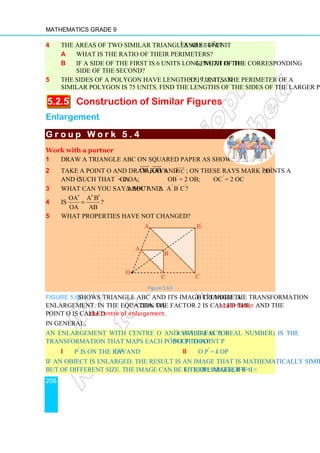
So, dx + e = 0 or fx + g = 0
Therefore
e
x
d
−
= and x
−
=
For example, the equation x2
(x – 2) (x – 3) = 0
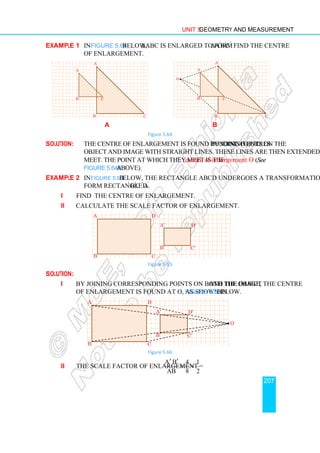
x – 2 = 0 or x – 3 = 0
x = 2 or x = 3
Therefore the solutions of the equation
In order to solve a quadratic equation by
following steps:
following steps:
following steps:
following steps:
i Clear all fractions and square roots (if any).
ii Write the equation in the form
iii Factorize the left hand side into a product of two linear factors.
iv Use the zero-product rule
Zero-product rule: If a
either
Example 10 Solve each of
Unit 2 Solutions of Equations
3 14 5 (3 1)( 5)
x x x x
− − = + − .
ACTIVITY 2.10
the following.
b 2x2
– x – 21 c 5x2
+ 14x + 9
Solving quadratic equations using the method of
= 0 be a quadratic equation and let the quadratic polynomial
be expressible as a product of two linear factors, say (dx + e) and (fx + g
d ≠ 0 and f ≠ 0.
becomes
which gives
e
x
d
−
= or .
g
x
f
−
=
g
f
−
= are possible roots of the quadratic equation
– 5x + 6 = 0 can be expressed as:
3) = 0
3 = 0
= 3
he solutions of the equation x2
– 5x + 6 = 0 are x = 2 and x = 3.
In order to solve a quadratic equation by
In order to solve a quadratic equation by factorization, go through the
factorization, go through the
Clear all fractions and square roots (if any).
Write the equation in the form p (x) = 0.
Factorize the left hand side into a product of two linear factors.
product rule to solve the resulting equation.
and b are two numbers or expressions and if
either a = 0 or b = 0 or both a = 0 and b = 0.
each of the following quadratic equations.
Solutions of Equations
89
+ 9
Solving quadratic equations using the method of
= 0 be a quadratic equation and let the quadratic polynomial ax2
+ bx + c
fx + g) where d, e, f, g
are possible roots of the quadratic equation ax2
+ bx + c = 0.
factorization, go through the
are two numbers or expressions and if ab = 0, then
Mathematics Grade 9
90
a 2
4 16 0
x − = b 2
9 8 0
x x
+ + = c 2x2
– 6x + 7 = 3
Solution:
a 2
4 16 0
x − = is the same as 2 2
(2 ) 4 0
x − =
(2 4)(2 4) 0
x x
− + =
(2 4) 0 or (2 4) 0
x x
− = + =
Therefore, x = 2 or x = –2.
b 2
9 8 0
x x
+ + =
2
8 8 0
x x x
+ + + =
2
( ) (8 8) 0
x x x
+ + + =
( 1) 8( 1) 0
x x x
+ + + =
( 1)( 8) 0
x x
+ + =
( 1) 0 or ( 8) 0
x x
+ = + =
Therefore, x = –1 or x = –8.
c 2x2
– 6x + 7 = 3 is the same as 2x2
– 6x + 4 = 0
2x2
– 6x + 4 = 0 can be expressed as
2
2 2 4 4 0;
x x x
− − + = (–2 and –4 have sum = –6 and product = 8).
2
(2 2 ) (4 4) 0
x x x
− − − =
2 ( 1) 4( 1) 0
x x x
− − − =
(2 4)( 1) 0
x x
− − =
(2 4) 0 or ( 1) 0
x x
− = − =
Therefore, x = 2 or x = 1.
Exercise 2.4
1 Solve each of the following equations.
a (x − 3)(x + 4) = 0 b 2x2
− 6x = 0 c x2
− 3x + 4 = 4
d 2x2
− 8 = 0 e 5x2
= 6x f x2
− 2x − 12 = 7x − 12
g −x2
− 4 = 0 h 2x2
+ 8 = 0
2 Solve each of the following equations.
Unit 2 Solutions of Equations
91
a x2
− 6x + 5 = 0 b 3x2
− 2x − 5 = 0 c x2
+ 7x = 18
d – x2
= 8x – 9 e 5y2
− 6y + 1 = 0 f 3z2
+ 10z = 8
3 Find the solution set of each of the following.
a 2 3 1
2 0
2 4
x x
+ + = b 2 25
2.5
16
x x
= − +
c 2
(6 2 ) 8 0
x x
− + + =
Solving quadratic equations by completing the square
G r o u p W o r k 2 . 5
Considering 2x2
+ 5x – 4 = 0, form a group and do the following.
1 Divide each coefficient by 2.
2 Shift the constant term to the right hand side (RHS).
3 Add the square of half of the middle term to both sides.
4 Do we have any perfect square? Why or why not?
5 Do you observe that
2
5 57
4 16
x
 
+ =
 
 
?
6 Discuss the solution.
In many cases, it is not convenient to solve a quadratic equation by factorization
method. For example, consider the equation x2
+ 8x + 4 = 0. If you want to factorize the
left hand side of the equation, i.e., the polynomial x2
+ 8x + 4, using the method of
splitting the middle term, you need to find two integers whose sum is 8 and product is 4.
But this is not possible. In such cases, an alternative method as demonstrated below is
convenient.
x2
+ 8x + 4 = 0
x2
+ 8x = –4
x2
+ 8x + (4)2
= –4 + (4)2
2
1
Adding Coefficient of on both sides
2
x
 
 
 
 
 
 
 
(x + 4)2
= –4 + 16 = 12 (x2
+ 8x + 16 = (x + 4)2
)
4 12
x + = ± (Taking square root of both sides)
Therefore 4 12 and 4 12
x x
= − + = − − are the required solutions.
Mathematics Grade 9
92
This method is known as the method of completing the square.
In general, go through the following steps in order to solve a quadratic
equation by the method of completing the square:
i Write the given quadratic equation in the standard form.
ii Make the coefficient of x2
unity, if it is not.
iii Shift the constant term to R.H.S.(Right Hand Side)
iv Add
2
1
coefficient of
2
x
 
 
 
on both sides.
v Express L.H.S.(Left Hand Side) as the perfect square of a suitable binomial
expression and simplify the R.H.S.
vi Take square root of both the sides.
vii Obtain the values of x by shifting the constant term from L.H.S. to R.H.S.
Note: The number we need to add (or subtract) to construct a perfect square is
determined by using the following product formulas:
x2
+ 2ax + a2
= (x + a)2
x2
− 2ax + a2
= (x − a)2
Note that the last term, a2
, on the left side of the formulae is the square of one-half of
the coefficient of x and the coefficient of x2
is +1. So, we should add (or subtract) a
suitable number to get this form.
Example 11 Solve x2
+ 5x – 3 = 0.
Solution: Note that
2
5 25
.
2 4
 
=
 
 
Hence, we add this number to get a perfect square.
2
5 3 0
x x
+ − =
2
5 3
x x
+ =
2 25 25
5 3
4 4
x x
+ + = +
2 2
25 37 25
5 ; 5 is a perfet squre.
4 4 4
x x x x
 
+ + = + +
 
 
2
5 37
2 4
x
 
+ =
 
 
Unit 2 Solutions of Equations
93
5 37 5 37
or
2 4 2 4
x x
   
+ = + = −
   
   
5 37 5 37
or
2 4 2 4
x x
= − + = − −
Therefore
5 37 5 37
or .
2 2
x x
− + − −
= =
Example 12 Solve 3x2
+ 12x + 6 = 0.
Solution: First divide all terms by 3 so that the coefficient of x2
is + 1.
3x2
+ 12x + 6 = 0 becomes x2
+ 4x + 2 = 0
x2
+ 4x = –2 (Shifting the constant term to the right side)
x2
+ 4x + 4 = –2 + 4 (half of 4 is 2 and its square is 4)
(x + 2)2
= 2 (x2
+ 4x + 4 = (x + 2)2
, a perfect square)
(x + 2) = 2
±
x = – 2 2
±
Therefore 2 2 or 2 2.
x x
= − − = − +
Example 13 Solve 3x2
+ 12x + 15 = 0.
Solution: First divide all terms by 3 so that the coefficient of x2
is + 1.
3x2
+ 12x + 15 = 0 becomes x2
+ 4x + 5 = 0
x2
+ 4x = −5 (Shifting the constant term to the right side)
x2
+ 4x + 4 = −5 + 4 (half of 4 is 2 and its square is 4)
(x + 2)2
= −1 (x2
+ 4x + 4 = (x + 2)2
, a perfect square)
( 2) 1
x + = ± −
Since 1
− is not a real number, we conclude that the quadratic equation does not
have a real solution.
Example 14 Solve 2x2
+ 4x + 2 = 0.
Solution: 2x2
+ 4x + 2 = 0 becomes
x2
+ 2x + 1 = 0 (Dividing all terms by 2)
(x + 1)2
= 0 (x2
+ 2x + 1 = (x + 1)2
is a perfect square)
(x + 1) = 0
Therefore x = – 1 is the only solution.
Mathematics Grade 9
94
Exercise 2.5
1 Solve each of the following quadratic equations by using the method of
completing the square.
a x2
– 6x + 10 = 0 b x2
– 12x + 20 = 0 c 2x2
– x – 6 = 0
d 2x2
+ 3x – 2 = 0 e 3x2
– 6x + 12 = 0 f x2
– x + 1 = 0
2 Find the solution set for each of the following equations.
a 20x2
+ 10x – 8 = 0 b x2
– 8x + 15 = 0 c 6x2
– x – 2 = 0
d 14x2
+ 43x + 20 = 0 e x2
+ 11x + 30 = 0 f 2x2
+ 8x – 1 = 0
3 Reduce these equations into the form ax2
+ bx + c = 0 and solve.
a x2
= 5x + 7 b 3x2
– 8x = 15 – 2x + 2x2
c x (x – 6) = 6x2
– x – 2 d 2 2
8 9 2 3(2 6 ) 2( 1)
x x x x x
+ + = + + −
e x2
+ 11x + 30 = 2 + 11x (x + 3)
Solving quadratic equations using the quadratic formula
Following the method of completing the square, you next develop a general formula that
can serve for checking the existence of a solution to a quadratic equation, and for
solving quadratic equations.
To derive the general formula for solving ax2
+ bx + c = 0, a ≠ 0, we proceed using the
method of completing the square.
The following Group Work will help you to find the solution formula of the quadratic
equation ax2
+ bx + c = 0, a ≠ 0, by using the completing the square method.
G r o u p W o r k 2 . 6
Consider ax2
+ bx + c = 0, a ≠ 0
1 First divide each term by a.
2 Shift the constant term
c
a
to the right.
3 Add the square of half of the middle term to both sides.
4 Do you have a perfect square?
5 Solve for x by using completing the square.
6 Do you observe that
2
4
2
b b ac
x
a
− ± −
= ?
7 What will be the roots of the quadratic equation ax2
+ bx + c = 0?
For a general quadratic equation of type
of completing the square, you
2
2
4
2
b b ac
r
a
− + −
= .
Therefore, the solution set is
From the above discussions,
In
2
4
2
b b ac
x
a
− ± −
= , discuss the possible conditions
a b2
– 4ac  0
Note: If any quadratic equation
solution is determined by
1 if 2
4 0,
b ac
−  then
2
4
2
b b ac
x
a
− − −
= and
Therefore, the equation has two solutions.
2 if b2
– 4ac = 0 then x
Therefore, the equation has only one solution.
3 if 2
4 0,
b ac
−  then x
Therefore, the equation does not have any real solution.
The expression 2
4
b ac
−
determine the existence of solutions.
Example 15 Using the discriminant
solution(s), and solve if there is a solution
a 3x2
– 5x + 2 = 0
Unit 2 Solutions of Equations
For a general quadratic equation of type ax2
+ bx + c = 0, a ≠ 0, by applying the method
you can conclude that the roots are 1
b b ac
r
− − −
=
the solution set is
2 2
4 4
, .
2 2
b b ac b b ac
a a
 
− − − − + −
 
 
 
 
From the above discussions, what do you observe about 2
4
b ac
− in x
− ± −
=
ACTIVITY 2.11
, discuss the possible conditions for x when,
b b2
– 4ac = 0 c b2
– 4ac  0
f any quadratic equation ax2
+ bx + c = 0, a ≠ 0 has a solution, then the
solution is determined by
2
4
2
b b ac
x
a
− ± −
= and
2
4
2
b b ac
x
a
− ± −
= represents two numbers,
and
2
4
.
2
b b ac
x
a
− + −
=
the equation has two solutions.
2
4
2 2
b b ac b
x
a a
− ± − −
= = is the only solution.
the equation has only one solution.
2
4
2
b b ac
x
a
− ± −
= is not defined in R.
the equation does not have any real solution.
b ac is called the discriminant or discriminator
existence of solutions.
Using the discriminant, check to see if the following equations have
and solve if there is a solution.
+ 2 = 0 b x2
– 8x + 16 = 0 c –
Solutions of Equations
95
applying the method
2
4
2
b b ac
a
− − −
and
2
4
?
2
b b ac
a
− ± −
has a solution, then the
, namely
is the only solution.
discriminator. It helps to
if the following equations have
–2x2
– 4x – 9 = 0
Mathematics Grade 9
96
Solution:
a 3x2
– 5x + 2 = 0; a = 3, b = – 5 and c = 2.
So 2 2
4 ( 5) 4(3)(2) 1 0
b ac
− = − − = 
Therefore, the equation 3x2
– 5x + 2 = 0 has two solutions.
Using the quadratic formula,
2
4
2
b b ac
x
a
− ± −
=
2 2
( 5) ( 5) 4(3)(2) ( 5) ( 5) 4(3)(2)
or
2(3) 2(3)
x x
− − − − − − − + − −
= =
5 25 24 5 25 24
or
6 6
x x
− − + −
= =
5 1 5 1
or
6 6
x x
− +
= =
5 1 5 1
or
6 6
x x
− +
= =
4 6
or
6 6
x x
= =
Therefore
2
or 1.
3
x x
= =
b In x2
– 8x + 16 = 0, a = 1, b = –8 and c = 16
So 2 2
4 ( 8) 4(1)(16) 0
b ac
− = − − =
Therefore, the equation x2
– 8x + 16 = 0 has only one solution.
Using the quadratic solution formula,
2
4
2 2
b b ac b
x
a a
− ± − −
= =
( 8)
4
2(1)
x
− −
= =
Therefore the solution is x = 4.
c In –2x2
– 4x – 9 = 0, a = –2, b = –4 and c = –9
So ( )
2
2
4 4 4( 2)( 9) 56 0
b ac
− = − − − − = − 
Therefore the equation 2
2 4 9 0
x x
− − − = does not have any real solution.
1 Solve each of the following quadratic equations by using the
formula.
a 2
8 15 0
x x
+ + =
d 2
3 2 0
x x
+ − =
2 Find the solution set for each of the following equations
a 2
6 8 0
x x
+ + =
d 2
4 36 81 0
x x
− + =
3 Reduce the equations into the form
a 2 2
3 5 7
x x x
= + −
c 2
2( 6) 6
x x x
− − = −
e 2
4 8 6 2 ( 3) 2
x x x x x
− + = + +
4 A school community had planned to reduce the number of
class room by constructing additional class rooms. However, they constructed 4
less rooms than they planned. As
10 more than they planned. If there are 1200 grade 9 students in the school,
determine the current number of class rooms and the
The relationship between the coefficients of a
quadratic equation and its roots
You have learned how to
equation are sometimes called
ax2
+ bx + c = 0, a ≠ 0 has roots (solutions)
2
1
4
2
b b ac
r
a
− − −
= and
1 If
2
1
4
2
b b ac
r
a
− − −
=
quadratic equation ax
a Find the sum of the roots
b Find the product of the roots
Unit 2 Solutions of Equations
Exercise 2.6
Solve each of the following quadratic equations by using the quadratic solution
8 15 0 b 2
3 12 2 0
x x
− + = c 4 4 1 0
3 2 0 e 2
5 15 45 0
x x
+ + = f 3 4 2 0
Find the solution set for each of the following equations.
6 8 0 b 2
9 30 25 0
x x
+ + = c 9 15 3 0
4 36 81 0
− + = e 2
2 8 0
x x
+ + = f 2 8 1 0
Reduce the equations into the form ax2
+bx + c = 0 and solve.
2 2
x x x
= + − b 2 2
8 2 2
x x x
= + +
2( 6) 6
x x x
− − = − d 2
4 (1 6 ) 2( 1) 4 3
x x x x x
− + + + − = −
4 8 6 2 ( 3) 2
x x x x x
− + = + +
A school community had planned to reduce the number of grade 9
class room by constructing additional class rooms. However, they constructed 4
less rooms than they planned. As the result, the number of students per class was
10 more than they planned. If there are 1200 grade 9 students in the school,
mine the current number of class rooms and the number of students
The relationship between the coefficients of a
quadratic equation and its roots
how to solve quadratic equations. The solutions to a quadratic
equation are sometimes called roots. The general quadratic equation
0 has roots (solutions)
and
2
2
4
2
b b ac
r
a
− + −
= .
ACTIVITY 2.12
b b ac
and
2
2
4
2
b b ac
r
a
− + −
= are roots of the
ax2
+ bx + c = 0, a ≠ 0 then
Find the sum of the roots (r1 + r2).
Find the product of the roots (r1r2).
Solutions of Equations
97
uadratic solution
2
4 4 1 0
x x
− − =
2
3 4 2 0
x x
− − =
2
9 15 3 0
x x
+ − =
2
2 8 1 0
x x
+ + =
4 (1 6 ) 2( 1) 4 3
x x x x x
− + + + − = −
grade 9 students per
class room by constructing additional class rooms. However, they constructed 4
number of students per class was
10 more than they planned. If there are 1200 grade 9 students in the school,
of students per class.
The relationship between the coefficients of a
. The solutions to a quadratic
Mathematics Grade 9
98
2 What relationship do you observe between the sum and product of the roots with
respect to the quotients of the coefficients of ax2
+ bx + c = 0 , namely a, b and c?
3 Test your answer on the quadratic equation 2x2
− 7x + 5 = 0.
The relationship between the sum and product of the roots of a quadratic equation and
its coefficients is stated below and it is called Viete’s theorem.
You can check Viete’s Theorem as follows:
The roots of ax2
+ bx + c = 0 are
2
1
4
2
b b ac
r
a
− − −
= and
2
2
4
2
b b ac
r
a
− + −
=
Their sum is
2 2
1 2
4 4
2 2
b b ac b b ac
r r
a a
− − − − + −
+ = +
( ) ( )
2 2
4 4 2
2 2
b b ac b b ac b b
a a a
− − − + − + − − −
= = =
and their product is
2 2
1 2
4 4
2 2
b b ac b b ac
r r
a a
  
− − − − + −
× =   
  
  
( )
2 2
2 2
( 4 ) 4
4
2
b b ac ac c
a a
a
 
− −  
 
= = =
 
   
 
So the sum of the roots is
b
a
−
and the product of the roots is .
c
a
Example 16 If 3x2
+ 8x + 5 = 0, then find
a The sum of its roots. b The product of its roots.
Solution: In 3x2
+ 8x + 5 = 0, a = 3, b = 8 and c = 5.
Sum of the roots =
8
3
b
a
− −
= and the product of the roots is
5
3
c
a
= .
Theorem 2.1 Viete’s theorem
If the roots of ax2
+ bx + c = 0, a ≠ 0 are
2
1
4
2
b b ac
r
a
− − −
= and
2
2
4
2
b b ac
r
a
− + −
= , then 1 2
b
r r
a
−
+ = and 1 2
c
r r
a
× =
Unit 2 Solutions of Equations
99
Exercise 2.7
1 Determine the sum of the roots of the following equations without solving them.
a x2
– 9x + 1 = 0 b 4x2
+ 11x – 4 = 0 c –3x2
– 9x – 16 = 0
2 Determine the product of the roots of the following equations without solving
them.
a –x2
+ 2x + 9 = 0 b 2x2
+ 7x – 3 = 0 c –3x2
+ 8x + 1 = 0
3 If the sum of the roots of the equation 3x2
+ kx + 1 = 0 is 7, then what is the value
of k?
4 If the product of the roots of the equation kx2
+ 8x + 3 = 0 is 1, then what is the
value of k?
5 If one of the roots of the equation x2
– 4x + k = 0 exceeds the other by 2, then find
the roots and determine the value of k.
6 Determine the value of k so that the equation x2
+ kx + k – 1 = 0 has exactly one
real root.
Word problems leading to quadratic equations
Quadratic equations can be successfully used for solving a number of problems related
to our day-to-day activities.
The following working rule could be useful in solving such problems.
Step 1 Read the given problem carefully and identify the unknown quantity.
Step 2 Define the unknown quantity as the variable x (say).
Step 3 Using the variable x, translate the given problem into a mathematical
statement, i.e., a quadratic equation.
Step 4 Solve the quadratic equation thus formed.
Step 5 Interpret the solution of the quadratic equation, i.e., translate the result
into the language of the given problem.
Remark:
i At times it may happen that, out of the two roots of the quadratic equation, only
one has a meaning for the problem. In such cases, the other root, which does not
satisfy the conditions of the given problem, must be rejected.
ii In case there is a problem involving two or more than two unknown quantities, we
define only one of them as the variable x. The remaining ones can always be
expressed in terms of x, using the condition(s) given in the problem.
Mathematics Grade 9
100
Example 17 The sum of two numbers is 11 and their product is 28. Find the numbers.
Solution: Let x and y be the numbers.
You are given two conditions, x + y = 11 and xy = 28
From xy = 28 you can express y in terms of x, giving
28
y
x
=
Replace
28
y
x
= in 11
x y
+ = to get
28
11
x
x
+ =
Now proceed to solve for x from
28
11
x
x
+ = which becomes
2
28
11
x
x
+
=
x2
+ 28 = 11x
x2
– 11x + 28 = 0, which is a quadratic equation.
Then solving this quadratic equation, you get x = 4 or x = 7.
If x = 4 then from x + y = 11 you get 4 + y = 11 ⇒ y = 7
If x = 7 then from x + y = 11 you get 7 + y = 11 ⇒ y = 4
Therefore, the numbers are 4 and 7.
Example 18 Two different squares have a total area of 274 cm2
and the sum of their
perimeters is 88 cm. Find the lengths of the sides of the squares.
Solution: Let the squares be as given below.
Recall, the area of the smaller square is x2
and area of the bigger square is y2
.
The perimeter of the smaller square is 4x and that of the bigger square is 4y.
So the total area is x2
+ y2
= 274 and the sum of their perimeters is 4x + 4y = 88.
From 4x + 4y = 88 you solve for y and get y = 22 – x.
Substitute y = 22 – x in x2
+ y2
= 274 and get x2
+ (22 – x)2
= 274.
This equation is x2
+ 484 – 44x + x2
= 274 which becomes the quadratic equation
2x2
– 44x + 210 = 0.
Solving this quadratic equation, you get x = 15 or x = 7.
Therefore, the side of the smaller square is 7 cm and the side of the bigger square
is 15 cm.
Figure 2.5
y
y
x
x
1 The area of a rectangle is 21
dimensions of the rectangle.
2 The perimeter of an equilateral triangle is
length of the side of the equilateral triangle.
3 Divide 29 into two parts so that the sum of the squares of the parts is 425.
value of each part.
4 The sum of the squares of two consecutive natural numbers
numbers.
5 A piece of cloth costs Birr 200. If the piece
metre of cloth was Birr 2 less, the cost of the piece would have remained
unchanged. How long is the piece and what is its original price per me
6 Birr 6,500 were divided equally among a certain number of persons. Had there
been 15 more persons, each would have got Birr 30 less. Find the original number
of persons.
7 A person on tour has Birr 360 for his daily expenses. If he extends his tour
days, he has to cut down his daily expense by Birr 3. Find the original duration of
the tour.
8 In a flight of 600 km, an aircraft was slowed down due to bad weather. Its average
speed for the trip was reduced to 200 km/hr and the time increased by 3
Find the duration of the flight.
9 An express train makes a run of 240 km at a certain speed. Another train whose
speed is 12 km/hr less takes an hour longer to cover the same distance. Find the
speed of the express train in km/hr.
Key Terms
absolute value
completing the square
discriminant
elimination method
Unit 2 Solutions of Equations
Exercise 2.8
The area of a rectangle is 21 cm2
. If one side exceeds the other by 4 cm
dimensions of the rectangle.
The perimeter of an equilateral triangle is numerically equal to its area. Find the
side of the equilateral triangle.
Divide 29 into two parts so that the sum of the squares of the parts is 425.
The sum of the squares of two consecutive natural numbers is 313. Find the
A piece of cloth costs Birr 200. If the piece was 5 m longer, and the cost of each
metre of cloth was Birr 2 less, the cost of the piece would have remained
unchanged. How long is the piece and what is its original price per me
Birr 6,500 were divided equally among a certain number of persons. Had there
been 15 more persons, each would have got Birr 30 less. Find the original number
A person on tour has Birr 360 for his daily expenses. If he extends his tour
days, he has to cut down his daily expense by Birr 3. Find the original duration of
In a flight of 600 km, an aircraft was slowed down due to bad weather. Its average
speed for the trip was reduced to 200 km/hr and the time increased by 3
Find the duration of the flight.
An express train makes a run of 240 km at a certain speed. Another train whose
speed is 12 km/hr less takes an hour longer to cover the same distance. Find the
speed of the express train in km/hr.
Key Terms
exponents quadratic equations
factorization quadratic formula
graphical method radicals
linear equations substitution method
Solutions of Equations
101
s the other by 4 cm, find the
equal to its area. Find the
Divide 29 into two parts so that the sum of the squares of the parts is 425. Find the
is 313. Find the
5 m longer, and the cost of each
metre of cloth was Birr 2 less, the cost of the piece would have remained
unchanged. How long is the piece and what is its original price per metre?
Birr 6,500 were divided equally among a certain number of persons. Had there
been 15 more persons, each would have got Birr 30 less. Find the original number
A person on tour has Birr 360 for his daily expenses. If he extends his tour for 4
days, he has to cut down his daily expense by Birr 3. Find the original duration of
In a flight of 600 km, an aircraft was slowed down due to bad weather. Its average
speed for the trip was reduced to 200 km/hr and the time increased by 30 minutes.
An express train makes a run of 240 km at a certain speed. Another train whose
speed is 12 km/hr less takes an hour longer to cover the same distance. Find the
quadratic equations
quadratic formula
substitution method
Mathematics Grade 9
102
Summary
1 Equations are equality of expressions.
2 For a  0, ax
= ay
, if and only if
3 An equation of the type
0, c ≠ 0 is called a linear equation
(infinite points).
4 A system of linear equations is a set of two or more linear equations, and a system
of two linear equations in two variables are equations that
1 1 1
2 2 2
a x b y c
a x b y c
+ =


+ =

5 A solution to a system of linear equation in two variables means the set of ordered
pairs (x, y) that satisfy both the linear equations.
a
1 1 1
2 2 2
a b c
a b c
= = implies the system has infinite solutions.
b
1 1 1
2 2 2
a b c
a b c
= ≠ implies the system has no solutions.
c
1 1
2 2
a b
a b
≠ implies the system has one solution.
6 Geometrically,
a If two lines intersect at one point, the system has one solution.
b If two lines are parallel, and never intersect, the system do
solution.
c If the two lines coincide (fit one over the ot
solutions.
7 A system of linear equation in two variables can be solved in
ways: graphically, by
8 For any real number x
9 For any real number x
10 For any non-negative number
11 For any non-negative number
12 For real numbers a, b
ax2
+ bx + c, where
13 Writing an expression as a product of its simplest factors is called
Summary
Equations are equality of expressions.
if and only if x = y.
An equation of the type cx + dy = e, where c and d are arbitrary constants and
linear equation in two variables, and its solution is a line
A system of linear equations is a set of two or more linear equations, and a system
of two linear equations in two variables are equations that can be represented as
a x b y c
A solution to a system of linear equation in two variables means the set of ordered
that satisfy both the linear equations.
implies the system has infinite solutions.
implies the system has no solutions.
implies the system has one solution.
tersect at one point, the system has one solution.
If two lines are parallel, and never intersect, the system do
If the two lines coincide (fit one over the other), the system has infinite
A system of linear equation in two variables can be solved in any of the following
, by substitution or by elimination.
x, x x
= − .
x, x is always non-negative.
negative number a (a ≥ 0); x = a means x = a or x =
negative number a (a ≥ 0);  x = a means x = a or x
b and c, any equation that can be reduced to the form
, where a ≠ 0 is called a quadratic equation.
expression as a product of its simplest factors is called
are arbitrary constants and d ≠
s, and its solution is a line
A system of linear equations is a set of two or more linear equations, and a system
represented as
A solution to a system of linear equation in two variables means the set of ordered
tersect at one point, the system has one solution.
If two lines are parallel, and never intersect, the system does not have a
her), the system has infinite
of the following
= −a.
x = −a.
, any equation that can be reduced to the form
expression as a product of its simplest factors is called factorizing.
Unit 2 Solutions of Equations
103
14 For real numbers a, b and c, to solve ax2
+ bx + c, where a ≠ 0, the following
methods can be used: factorization, completing the square, or the quadratic
formula.
15 If the roots of ax2
+ bx + c are
2
1
4
2
b b ac
x
a
− − −
= and
2
2
4
2
b b ac
x
a
− + −
=
then 1 2
b
x x
a
+ = − and 1 2
c
x x
a
× = .
Review Exercises on Unit 2
1 Solve each of the following.
a (x − 3)3
= 27 b (2x + 1)2
= 16 c 93x
= 81
d ( )
3
3
2 14
x = e (x – 3)3
= 27(2x – 1)3
2 Solve each of the following linear equations.
a 2(3x − 2) = 3 − x b 4(3 − 2x) = 2(3x − 2)
c (3x – 2) – 3 (2x + 1) = 4 (4x – 3) d
3
4 3 2 1
2
x x
 
− = −
 
 
e ( )
1
2 1 4 4 2
2
x x
 
− = − − +
 
 
3 Without solving, determine the number of solutions to each of the following
systems of linear equations.
a
3 4 5
2 3 3
x y
x y
− =


+ =

b
6 9 7
2 3 13
x y
x y
+ =


+ =

c
4 7
2 8 14
x y
x y
− + =


− = −

4 Applying all the methods for solving systems of linear equations, solve each of
the following.
a
2 3 5
2 3 5
x y
x y
− − =


+ = −

b
3
5 2
2
3 5
x y
x y

= −


 − =

c
0.3 0.4 1
0.2 3
x y
x y
− =


+ =

5 Solve each of the following equations that involve absolute value.
a 2 3 3
x − = b 3 1 7
x − = c
1 7
3
2 2
x
− =
d 7 1
x + = − e 2 0.2 5
x
− = f 2 3 3 1 2
x x
− = −
g 5 3 2
x x
− = + h 2 4 2 2
x x
− = − i 12 2 3 1 0
x x
+ − − =
j 5 12 2 8
x x
− + + = k 3 7 2 1 3 5
x x
− + − =
Mathematics Grade 9
104
6 Factorize the following expressions.
a x2
– 16x b 4x2
+ 16x + 12 c 1 – 4x2
d 12x + 48x2
e x2
+ 11x – 42
7 Solve the following quadratic equations.
a x2
– 16x = –64 b 2x2
+ 8x – 8 = 0
c 4x – 3x2
– 9 = 10x d x2
+ 15x + 31 = 2x – 11
e 7x2
+ x – 5 = 0
8 By computing the discriminant b2
– 4ac for each of the following, determine how
many solutions the equation has.
a x2
– 16x + 24 = 0 b 2x2
+ 8x – 12 = 0
c –4x2
– x – 2 = 0 d 3x2
– 6x + 3 = 0
9 If two roots of a quadratic equation are –2 and 3, determine the quadratic
equation.
10 If the sum of two numbers is 13 and their product is 42, determine the numbers.
11 Almaz has taken two tests. Her average score is 7 (out of ten). The product of her
scores is 45. What did she score in each test?
12 If a and b are roots of 3x2
– 6x + 2 = 0, then find
a a + b b ab c
1 1
a b
+
d
1 1
2 2
a b
+
+ +
e a2
+ b2
f a3
– b3
13 Determine the values of p and q for which (–4, –3) will be solution of the system
26
.
7
px qy
qx py
+ = −


− =

14 An object is thrown vertically upward from a height of ho ft with an initial speed
of vo ft/sec. Its height h (in feet) after t seconds is given by
h = –16t2
+ vot + ho. Given this, if it is thrown vertically upward from the ground
with an initial speed of 64 ft/sec,
a At what time will the height of the ball be 15 ft? (two answers)
b How long will it take for the ball to reach 63 ft?
15 Determine the value of k so that the quadratic equation 4x2
– 2x + k2
– 2k + 1 = 0
can have exactly one solution.
16 The speed of a boat in still water is 15 km/hr. It needs four more hours to travel
63 km against the current of a river than it needs to travel down the river.
Determine the speed of the current of the river.
U
Unit Outcomes:
After completing this unit, you should be able to:
understand additional facts and principles about sets.
apply rules of operations on sets and find the result.
demonstrate correct usage of Venn diagrams in set operations.
apply rules and principles of set theory to practical situations.
Main Contents
3.1 Ways to describe sets
3.2 The notion of sets
3.3 Operations on sets
Key Terms
Summary
Review Exercises
U
Un
ni
it
t
F
F
F
F
F
F
F
FU
U
U
U
U
U
U
UR
R
R
R
R
R
R
RT
T
T
T
T
T
T
TH
H
H
H
H
H
H
HE
E
E
E
E
E
E
ER
R
R
R
R
R
R
R O
O
O
O
O
O
O
ON
N
N
N
N
N
N
N S
S
S
S
S
S
S
SE
E
E
E
E
E
E
ET
T
T
T
T
T
T
TS
S
S
S
S
S
S
S
Mathematics Grade 9
106
INTRODUCTION
In the present unit, you will learn more about sets.
different ways to describe set
you will discuss some operations
set. Finally, you will go through some practical problems related to our daily life
to solve them, using the union and intersection
H
H
H I
I
I S
S
S T
T
T O
O
O R
R
R I
I
I C
C
C A
A
A L
L
L N
N
N O
O
O T
T
T E
E
E
During the latter part of the 19
with mathematical entities called
Cantor found it helpful to borrow a word from common
usage to describe a mathematical idea. The word he
borrowed was set. Born in Russia,
Germany at the age of 11 and lived there
his life. He is known today as the
3.1 WAYS TO DESCRIBE SETS
1 What is a set? What do we mean when
set?
2 Give two members or elements
following sets:
a The set of composite numbers less
b The set of natural numbers that are
c The set of whole numbers between 0 and 1
d The set of real numbers between 0 and 1
e The set of non-negative integers
f The set of integers that satisfy
3 a Describe each of the
b State the number of elements that
c In how many way
4 Which of the sets in Question
a no elements?
c infinitely many elements?
INTRODUCTION
will learn more about sets. Particularly, you
describe sets and their representation through Venn diagram
discuss some operations that, when performed on two sets, give rise to another
go through some practical problems related to our daily life
nion and intersection of sets.
E
E
E :
::
George Cantor (1845-1918)
During the latter part of the 19th
century, while working
with mathematical entities called infinite series, George
Cantor found it helpful to borrow a word from common
usage to describe a mathematical idea. The word he
orrowed was set. Born in Russia, Cantor moved to
11 and lived there for the rest of
his life. He is known today as the originator of set theory.
WAYS TO DESCRIBE SETS
ACTIVITY 3.1
What is a set? What do we mean when we say an element of a
Give two members or elements that belong to each of the
he set of composite numbers less than 10.
natural numbers that are less than 50 and divisible by 3
he set of whole numbers between 0 and 1.
he set of real numbers between 0 and 1.
negative integers.
he set of integers that satisfy (x – 2) (2x + 1) = 2x2
– 3x – 2.
of the sets in Question 2 by another method.
number of elements that belong to each set in Question 2
In how many ways can you describe the sets given in Question 2
Question 2 have
b a finite number of elements?
nfinitely many elements?
will discuss the
representation through Venn diagrams. Also,
give rise to another
go through some practical problems related to our daily life and try
and divisible by 3.
.
Question 2.
Question 2?
a finite number of elements?
Unit 3 Further on Sets
107
3.1.1 Sets and Elements
Set: A Set is any well-defined collection of objects.
When we say that a set is well-defined, we mean that, given an object, we are able to
determine whether the object is in the set or not. For instance, “The collection of all
intelligent people in Africa” cannot form a well-defined set, since we may not agree on
who is an “intelligent person” and who is not.
The individual objects in a set are called the elements or the members. Repeating
elements in a set does not add new elements to the set.
For example, the set {a, a, a} is the same as {a}.
Notation: Generally, we use capital letters to name sets and small letters to represent
elements. The symbol ‘∈’ stands for the phrase ‘is an element of’ (or
‘belongs to’). So, x∈A is read as ‘x is an element of A’ or ‘x belongs to A’.
We write the statement ‘x does not belong to A’ as x∉A.
Since the phrase ‘the set of ’ occurs so often, we use the symbol called brace (or curly
bracket) { }.
For instance, ‘the set of all vowels in the English alphabet is written as
{all vowels in the English alphabet} or {a, e, i, o, u}.
3.1.2 Description of Sets
A set may be described by three methods:
i Verbal method
We may describe a set in words. For instance,
a The set of all whole numbers less than ten or {all whole numbers less than ten}.
b The set of all natural numbers. This can also be written as {all natural numbers}.
ii The listing method (also called roster or enumeration method)
If the elements of a set can be listed, then we can describe the set by listing its elements.
The elements can be listed completely or partially as illustrated in the following
example:
Example 1 Describe (express) each of the following sets using the listing method:
a The set whose elements are a, 2 and 7.
b The set of natural numbers less than 51.
c The set of whole numbers.
d The set of non-positive integers.
e The set of integers.
Mathematics Grade 9
108
Solution:
a First let us name the set by A. Then we can describe the set as
A = {a, 2, 7}
b The natural numbers less than 51 are 1, 2, 3, . . ., 50. So, naming the set as B
we can express B by the listing method as
B = { 1, 2, 3, . . ., 50}
The three dots after the element 3 (called an ellipsis) indicate that the
elements in the set continue in that manner up to and including the last
element 50.
c Naming the set of whole numbers by ॾ, we can describe it as
ॾ = {0, 1, 2, 3, . . . }
The three dots indicate that the elements continue in the given pattern and
there is no last or final element.
d If we name the set by L, then we describe the set as
L = { . . ., –3, –2, –1, 0}
The three dots that precede the numbers indicate that elements continue
from the right to the left in that pattern and there is no beginning element.
e You know that the set of integers is denoted by ℤ and is described by
ℤ = { . . ., –3, –2, –1, 0, 1, 2, 3, . . .}
We use the partial listing method, if listing all elements of a set is difficult or
impossible but the elements can be indicated unambiguously by listing a few of them.
Exercise 3.1
1 Describe each of the following sets using a verbal method:
a A = { 5, 6, 7, 8, 9} b M = {2, 3, 5, 7, 11, 13}
c G = {8, 9, 10, . . .} d E = {1, 3, 5, . . ., 99}
2 Describe each of the following sets using the listing method (if possible):
a The set of prime factors of 72.
b The set of natural numbers that are less than 113 and divisible by 5.
c The set of non-negative integers.
d The set of rational numbers between 2 and 8 .
e The set of even natural numbers.
f The set of integers divisible by 3.
g The set of real numbers between 1 and 3.
iii The set-builder
To each description given in column A
from column B.
A
1 2  x  10 and x
2 x = 2n and n∈ℕ
3 2x + 4 = 0 and x
4 x∈ℕ and 12 is a multiple of
The above Activity leads you
the set-builder method.
For example, A = {3, 4, 5, 6, 7, 8, 9}
Note that “all x such that” may be written as “
Hence we read the above as “set A is the set of all
number between 2 and 10”.
Note that in the above set A the properties
x∈ℕ and 2  x  10.
Example 2 Express each of the following sets using set
a N = {1, 2, 3, . . .}
c B = {integers divisible by 3}
Solution:
a N = {x x ∈ℕ}
b A = {x x∈ℝ and 0 
Note that this set can also
c B = { 3 , for some integer
x x= n n
d Naming the set by S
A = { x
Set A is
Unit 3
uilder method (also known as method of defining property
ACTIVITY 3.2
given in column A, match a set that satisfies it
B
x∈ℕ a {1, 2, 3, 4, 6, 12}
ℕ b {–2}
x is an integer c {2, 4, 6, . . .}
and 12 is a multiple of x d {3, 4, 5, 6, 7, 8, 9}
you to the third useful method for describing sets, known as
, 4, 5, 6, 7, 8, 9} can be described as
such that” may be written as “x”or “x:”.
e read the above as “set A is the set of all elements x such that
.
in the above set A the properties that characterize the elements of the s
each of the following sets using set-builder method
1, 2, 3, . . .} b A = {real numbers between 0 and 1}
integers divisible by 3} d The real solution set of |
and 0  x  1}
Note that this set can also be expressed as A = {x∈ℝ 0  x
}
3 , for some integer
x x= n n or B = { }
3 ∈ℤ
n n
Naming the set by S, we write { }
S = and 1 = 2
∈ −
ℝ
x x x
x | x∈ ℕ and 2  x  10} or {
A | and 2   10
= ∈ℕ
x x x
the set of all x such that
Unit 3 Further on Sets
109
method of defining property)
, 2, 3, 4, 6, 12}
{2, 4, 6, . . .}
, 4, 5, 6, 7, 8, 9}
for describing sets, known as
such that x is a natural
that characterize the elements of the set are
ethod:
A = {real numbers between 0 and 1}
x – 1| = 2
x  1}
}
A | and 2   10
x x x
Mathematics Grade 9
110
1 Which of the following collections
a {x x is an interesting bird}.
c The set of natural numbers less than 100.
2 Which of the following
a 2∈ {–1, 0, 1}
3 Describe each of the following sets by
i the listing method.
a The set of letters in the word mathematics.
b The set of
c The set of whole numbers between 5 and 13.
d The set of even numbers less than 19.
e The set of students in Ethiopia.
f The set of all odd natural numbers.
4 Describe each of the following sets
i a verbal method
a {1, 2, 3,…
d {Tuesday, Thursday}
3.2 THE NOTION OF SETS
3.2.1 Empty Set, Finite
Proper S
1 How many elements does
a A = {xx is a real number whose square is negative one}
b C = {xx∈ ℕ and 2 
d E = {xx is an integer}
2 Compare the sets C, D, E and X given
contained in another?
Exercise 3.2
Which of the following collections are well defined? Justify your answer
is an interesting bird}. b {x x is a good student}
The set of natural numbers less than 100. d {yy is a factor of 13}.
Which of the following are true and which are false?
b a∉{{a, c}} c 6∈ {factors of 24}
Describe each of the following sets by
the listing method. ii the set–builder method.
The set of letters in the word mathematics.
The set of regional states in Ethiopia.
The set of whole numbers between 5 and 13.
The set of even numbers less than 19.
The set of students in Ethiopia.
The set of all odd natural numbers.
Describe each of the following sets by
erbal method. ii the set–builder method.
…, 10} b {1, 3, 5, 7,…} c {5, 10, 15,
{Tuesday, Thursday} e {2, 3, 5, 7, 11,…}
THE NOTION OF SETS
et, Finite Set, Infinite Set, Subset,
Subset
ACTIVITY 3.3
How many elements does each of the following sets have?
is a real number whose square is negative one}
ℕ and 2  x  11} c D = {xx ∈{1, 2, 3}}
is an integer} e X = {2, 4, 6, . . .}
Compare the sets C, D, E and X given in Question 1 above. Which set
?
your answer.
is a good student}.
is a factor of 13}.
{factors of 24}
{5, 10, 15, 20,…}
et, Subset,
{1, 2, 3}}
Which set is
Observe from the above Activity
elements or an unlimited number of elements.
A Empty set
Example 1
a If A = {xx is a real number and
b If B = {xx ≠ x}
B Finite and infinite
Which of the following sets
number of elements?
1 A = {xx∈ℝ and 0 
2 C = {x∈ℕ7  x  7
3 D = {x∈ℕx is a multiple of 3}
4 E = {x∈ℤ2  x  3}
5 M = {x∈ℕx is divisible by 5 and
Your observations from the
Notation: If a set S is finite
Example 2 If S = {–1, 0, 1}
Using this notation, we can say that a set S is finite if
number.
Example 3 Find n (S) if:
a S = { x∈ℝx2
=
Definition 3.2
i A set S is called
negative integer.
ii A set S is called
Definition 3.1
A set that contains no elements is called an
An empty set is denoted by either
Unit 3
Activity that a set may have no elements, a limited number of
elements or an unlimited number of elements.
is a real number and x2
= –1}, A = ∅ (Why?)
}, B = ∅. (Why?)
nfinite sets
ACTIVITY 3.4
Which of the following sets have a finite and which have an infinite
and 0  x  3}
 7100
}
is a multiple of 3}
 3}
is divisible by 5 and x  1014
}
observations from the above Activity lead to the following definition:
If a set S is finite, then we denote the number of elements of S by
1, 0, 1}, then n (S) = 3
we can say that a set S is finite if n (S) = 0 or n
(S) if:
= –1} b S = {x∈ℕx is a factor of 108}
A set S is called finite, if it contains n elements where n
negative integer.
A set S is called infinite, if it is not finite.
no elements is called an empty set, or null set.
empty set is denoted by either ∅ or { }.
Unit 3 Further on Sets
111
a set may have no elements, a limited number of
definition:
then we denote the number of elements of S by n (S).
n (S) is a natural
n is some non-
, or null set.
Mathematics Grade 9
112
Solution:
a n (S) = 0
Example 4
a Let E = {2, 4, 6,
b Let T = {xx is a real number and 0 
C Subsets
What is the relationship between each
1 M = {all students in
vowel};
N = {all students in your
2 A = {1, 3, 5, 7}; B = {1, 2, 3, 4,
3 E = {x∈ℝ(x – 2) (x
Note: If A is not a subset of B, then we denote this by A
Example 5 Let ℤ = {xx
Since each element of
Example 6 Let G = {–1, 0, 1, 2, 3} and H = {0, 1, 2, 3, 4, 5}
–1 ∈G but –1 ∉ H, hence
Note: For any set A
i ∅ ⊆ A
G r o u p W o r k
G r o u p W o r k
G r o u p W o r k
G r o u p W o r k
Given A = {a, b, c}
1 List all the subsets of A.
2 How many subsets have you found?
Definition 3.3
Set A is a subset of set B,
element of B.
b n (S) = 12
Let E = {2, 4, 6,…}. E is infinite.
is a real number and 0  x  1}. T is infinite.
ACTIVITY 3.5
between each of the following pairs of sets?
M = {all students in your class whose names begin with a
N = {all students in your class whose names begin with E}
B = {1, 2, 3, 4, 5, 6, 7, 8}
– 3) = 0}; F = {x∈ℕ1  x  4}
f A is not a subset of B, then we denote this by A⊈ B.
x is an integer}; ℚ = {xx is a rational number}.
Since each element of ℤ is also an element of ℚ, then ℤ ⊆ ℚ
1, 0, 1, 2, 3} and H = {0, 1, 2, 3, 4, 5}
hence G ⊈ H.
ii A ⊆ A
G r o u p W o r k
G r o u p W o r k
G r o u p W o r k
G r o u p W o r k 3 . 1
3 . 1
3 . 1
3 . 1
List all the subsets of A.
How many subsets have you found?
Set A is a subset of set B, denoted by A ⊆ B, if each element of A is an
is a rational number}.
B, if each element of A is an
From Group Work 3.1, you
Example 7 Let M = {–1, 1}. Then subsets of M are
Therefore P(M) = {∅
D Proper subset
Let A = {–1, 0, 1} and B = {
B⊆A. This suggests the definition of
That is, A ⊂ B means A ⊆
Note: For any set A, A is not
Given A = {–1, 0, 1}.
i List all proper subsets of A.
ii How many proper subsets of
You will now investigate the relationship between the number of elements of a given set
and the number of its subsets and proper subsets.
1 Find the number of subsets and proper subsets of each of the
following sets:
a A = ∅ b
Definition 3.5
Set A is said to be a proper subset
subset of B and B is not a subset of A.
Definition 3.4
Let A be any set. The
subsets of A. That is, P(A) = {S|S
Unit 3
you can make the following definition.
1, 1}. Then subsets of M are ∅, {–1}, {1} and M.
∅, {–1}, {1}, M}
ubset
1} and B = {–2, –1, 0, 1}. From these sets, we see that A
definition of a proper subset stated below.
B but B ⊆ A.
A is not a proper subset of itself.
ACTIVITY 3.6
List all proper subsets of A.
How many proper subsets of A have you found?
will now investigate the relationship between the number of elements of a given set
and the number of its subsets and proper subsets.
ACTIVITY 3.7
Find the number of subsets and proper subsets of each of the
B = {0} c C = {–1, 0} d D = {
proper subset of a set B, denoted by A ⊂
subset of B and B is not a subset of A.
Let A be any set. The power set of A, denoted by P(A), is the set
subsets of A. That is, P(A) = {S|S ⊆ A}
Unit 3 Further on Sets
113
1}, {1} and M.
we see that A ⊆ B but
will now investigate the relationship between the number of elements of a given set
D = {–1, 0, 1}
⊂ B, if A is a
is the set of all
Mathematics Grade 9
114
2 Copy and complete the following table:
Set
No. of
elements
Subsets
No. of
subsets
Proper
subsets
No. of
proper
subsets
a ∅ 0 ∅ 1 = 20
- 0 = 20
–1
b {0} 1 ∅, {0} 2 = 21
∅ 1 = 21
–1
c {–1, 0}
d
{–1, 0, 1}
∅, {–1}, {0}, {1}, {–1, 0},
{0, 1}, {–1, 1}, {–1, 0, 1}
7 = 23
– 1
You generalize the result of the above Activity in the form of the following fact.
Fact: If a set A is finite with n elements, then
i The number of subsets of A is 2n
and
ii The number of proper subsets of A is 2n
– 1.
Exercise 3.3
1 For each set in the left column, choose the sets from the right column that are
subsets of it:
i {a, b, c, d} a { }
ii {o, p, k} b {1, 4, 8, 9}
iii Set of letters in the word “book” c {o, k}
iv {2, 4, 6, 8, 10, 12} d {12}
e {6}
2 a If B = {0, 1, 2}, find all subsets of B.
b If B = {0, {1, 2}}, find all subsets of B.
3 State whether each of the following statements is true or false. If it is false, justify
your answer.
a {1, 4, 3} ⊆ {3, 4, 1} b {1, 3, 1, 2, 3, 2} ⊆ {1, 2, 3}
c {4} ⊆ {{4}} d ∅ ⊆ {{4}}
3.2.2 Venn Diagrams, Universal Set
and Equivalent Sets
A Venn diagrams
1 What is the relationship
a W = { 0, 1, 2,…
b W = {0, 1, 2,…
c ℕ = { 1, 2, 3,…
d ℤ = {…,–3, –2,
2 Express the relationship
3 Express the relationship
Compare your diagram with the one given in
To illustrate various relationships that can
pictorial representation called a Venn
These diagrams consist of rectangles and
the sets are written in their resp
For example, the relationship ‘A
Example 1 Represent the following
a A = {a, b, c, d};
b C = {2, 4, 6, 8,…
c E = {2n
n∈ ℕ };
d A = {1, 3, 5, 7, 9}
A
B
Unit 3
Venn Diagrams, Universal Set
and Equivalent Sets
iagrams
ACTIVITY 3.8
relationship between the following pairs of sets?
…} and ℕ = { 1, 2, 3,…}.
…} and ℤ = {…,–3, –2, –1, 0, 1, 2,…}.
2, –1, 0, 1, 2,…} and : , , 0
a
a b b
b
 
= ∈ ≠
 
 
ℚ ℤ
Express the relationship between each pair using a diagram.
relationship of all the sets, W, N, Z and Q using one diagram.
Compare your diagram with the one given in Activity 1.1 of Unit 1.
To illustrate various relationships that can arise between sets, it is often helpful to use a
pictorial representation called a Venn diagram named after John Venn (18
These diagrams consist of rectangles and closed curves, usually circles.
ir respective circles.
the relationship ‘A ⊂ B’ can be illustrated by the following Venn
or
the following pairs of sets using Venn diagrams
}; B = {a, d}
…}; D = {1, 3, 5, 7,…}
ℕ }; F = {2nn∈ ℕ }
5, 7, 9}; B = { 2, 3, 5, 8}; C = { 1, 5, 7}
Figure 3.1
A
B
Unit 3 Further on Sets
115
Venn Diagrams, Universal Sets, Equal
: , , 0
 
 
 
.
using one diagram.
.
it is often helpful to use a
Venn (1834 – 1883).
The elements of
B’ can be illustrated by the following Venn diagram.
of sets using Venn diagrams:
C = { 1, 5, 7}
Mathematics Grade 9
116
Solution:
a b
c d
Figure 3.5
B Universal set
Suppose at a school assembly, the following students are asked to stay behind.
G = {all Grade 9 students}.
I = {all students interested in a school play}.
R = {all class representatives of each class}.
Each set G, I and R is a subset of S = {all students in the school}
In this particular example, S is called the universal set.
Similarly, a discussion is limited to a fixed set of objects and if all the elements to be
discussed are contained in this set, then this “overall” set is called the universal set.
We usually denote the universal set by U. Different people may choose different
universal sets for the same problem.
Example 2 Let R={all red coloured cars in East Africa}; T = {all Toyota cars in East
Africa}
i Choose a universal set U for R and T.
ii Draw a Venn diagram to represent the sets U, R and T.
Solution:
i There are different possibilities for U. Two of these are:
U = {all cars} or U = {all wheeled vehicles}
Figure 3.4
2, 4, 8,
16, . . .
F
6
10
E
12
14
Figure 3.2
a, d
b c
B
A
B
8, 2
A
C
1, 7
9
5
3
2, 4, 6, 8,...
C
1, 3, 5, 7,...
D
Figure 3.3
ii In both cases, the Venn diagram of the
1 Draw Venn diagrams to illustrate the relation
sets:
a A = {1, 9, 2, 7, 4}
b B = {the vowels in the
M = {the first five
c C = {1, 2, 3, 4, 5}
d F = {3, 7, 11, 5, 9}
2 For each of the following
between the sets:
a U = {all animals}
b U = {all people}
C Equal and equivalent
From the following pairs of sets
1 that have the same number of elements.
2 that have exactly the same elements.
a A = {1, 2}; B = {
b E = {−1, 3}; F =
c R = {1, 2, 3}; S = {
d G = {x∈ Nx is a factor of 6}
e X = {1, 1, 3, 2, 3, 1}
Unit 3
the Venn diagram of the sets U, R and T is
Figure 3.6
Exercise 3.4
Draw Venn diagrams to illustrate the relationships between the following pairs of
A = {1, 9, 2, 7, 4}; L = {4, 9, 8, 2}
vowels in the English alphabet}
M = {the first five letters of the English alphabet}
C = {1, 2, 3, 4, 5}; M = {6, 9, 10, 8, 7}
F = {3, 7, 11, 5, 9}; O = {all odd numbers between 2 and 12}
For each of the following, draw a Venn diagram to illustrate the relation
nimals}; C = {all cows}; G ={all goats}
U = {all people}; M = {all males}; B = {all boys}
quivalent sets
ACTIVITY 3.9
the following pairs of sets identify those:
ave the same number of elements.
that have exactly the same elements.
B = {x∈Nx  3}
F =
1 1
,
2 3
 
 
 
S = {a, b, c}
is a factor of 6}; H = {x∈ N6 is a multiple of
X = {1, 1, 3, 2, 3, 1}; Y = {1, 2, 3}
U
U
Unit 3 Further on Sets
117
between the following pairs of
= {all odd numbers between 2 and 12}
draw a Venn diagram to illustrate the relationship
G ={all goats}
B = {all boys}
6 is a multiple of x}
Mathematics Grade 9
118
i Equality of sets
Let us investigate the relationship between the following two sets;
E = {x∈ℝ(x – 2) (x – 3) = 0} and F = {x∈ℕ1  x  4}.
By listing completely the elements of each set, we have E = {2, 3} and F = {2, 3}.
We see that E and F have exactly the same elements. So they are equal.
Is E ⊆ F? Is F ⊆ E?
Example 3 Let A = {1, 2, 3, 4} and B = {1, 4, 2, 3}.
A = B, since these sets contain exactly the same elements.
Note: If A and B are not equal, we write A ≠ B.
Example 4 Let C = {–1, 3, 1} and D = {–1, 0, 1, 2}.
C ≠ D, because 2 ∈ D, but 2 ∉ C.
ii Equivalence of sets
Consider the sets A = {a, b, c} and B = {2, 3, 4}. Even though these two sets are not
equal, they have the same number of elements. So, for each member of set B we can
find a partner in set A.
A = {a, b, c}
B = {2, 3, 4}
The double arrow shows how each element of a set is matched with an element of
another set. This matching could be done in different ways, for example:
A = {a, b, c}
B = {2, 3, 4}
No matter which way we match the sets, each element of A is matched with exactly one
element of B and each element of B is matched with exactly one element of A. We say
that there is a one–to–one correspondence between A and B.
Definition 3.6
Given two sets A and B, if every element of A is also an element of B
and if every element of B is also an element of A, then the sets A and B
are said to be equal. We write this as A = B.
∴ A = B, if and only if A ⊆ B and B ⊆ A.
Unit 3 Further on Sets
119
Example 5 Let A = { 2 , e, π } and B = {1, 2, 3}.
Since n(A) = n(B), A and B are equivalent sets and we write
A ↔ B.
Note that equal sets are always equivalent since each element can be matched with
itself, but equivalent sets are not necessarily equal. For example,
{1, 2} ↔ {a, b} but {1, 2} ≠ {a, b}.
Exercise 3.5
Which of the following pairs represent equal sets and which of them represent
equivalent sets?
1 {a, b} and {2, 4}
2 {∅} and ∅
3 {x∈ ℕx  5} and {2, 3, 4, 5}
4 {1, {2, 4}} and {1, 2, 4}
5 {xx  x} and {x∈ ℕx  1}
3.3 OPERATIONS ON SETS
There are operations on sets as there are operations on numbers. Like the operations of
addition and multiplication on numbers, intersection and union are operations on sets.
3.3.1 Union, Intersection and Difference of Sets
A Union of sets
Definition 3.8
The union of two sets A and B, denoted by A⋃B and read A union B is
the set of all elements that are members of set A or set B or both of the
sets. That is, A⋃B = {x|x∈A or x∈B}
Definition 3.7
Two sets A and B are said to be equivalent, written as A↔B (or A∼B), if
there is a one-to-one correspondence between them.
Observe that two finite sets A and B are equivalent, if and only if
n (A) = n (B)
Mathematics Grade 9
120
The red shaded region of the diagram in the figure
An element common to both sets is listed only once in
the union. For example, if
A⋃B = {a, b, c, d, e, f
Example 1
a {a, b} ⋃ {c, d,
b {1, 2, 3, 4, 5} ⋃
Properties of the union of
Let A = {1, 2, 3, 4}, B = {2
1 Find a A⋃B
What is the relationship
2 Find a A⋃B
What is the relationship
3 Find A ,
∅
∪ what is the relation
The above Activity leads you
For any sets A, B and C
1 Commutative property
2 Associative property
3 Identity property
1 Given A = {1, 2, {3}},
a A⋃B
d A⋃(B⋃C)
2 State whether each of the following statements is true or false
a If x ∈A and x ∉B, then
c If x∉A and x∉B, then
e For any set A, A
shaded region of the diagram in the figure on the right represents A
lement common to both sets is listed only once in
A = {a, b, c, d, e} and
B = {c, d, e, f, g}, then
, f, g}.
, e} = {a, b, c, d, e}
⋃ ∅ = {1, 2, 3, 4, 5}
nion of sets
ACTIVITY 3.10
{2, 4, 6, 8} and C = {3, 4, 5, 6}.
b B⋃A
ship between A⋃B and B⋃A?
b ( )
A B C
∪ ∪ c B C
∪ d
ship between (A⋃B)⋃C and ( )
A B C
∪ ∪ ?
what is the relationship between A ∅
∪ and A?
you to the following properties:
Commutative property A⋃B = B⋃A
Associative property (A⋃B)⋃C = A⋃(B⋃C)
A⋃∅ = A
Exercise 3.6
Given A = {1, 2, {3}}, B = {2, 3} and C = {{3}, 4}, find:
b B⋃C c A⋃C
e (A⋃B)⋃C
ther each of the following statements is true or false:
B, then x ∉ (A⋃B). b If x ∈(A⋃B) and x ∉
B, then x∉(A⋃B). d For any set A, A⋃A = A.
A⋃∅ = A. f If A ⊆ B, then A⋃B = B.
the right represents A ⋃ B.
( )
A B C
∪ ∪
∉ A, then x ∈B.
A = A.
B = B.
Figure 3.7
g For any two sets A and B,
h For any three sets A, B and C
i For any three sets A, B and C,
j If A⋃B = ∅, then A =
3 Using copies of the Venn diagram
a
B Intersection of
Consider the two sets G = {2, 4, 6, 8, 10, 12}
a Draw a Venn diagram
the two sets.
b Shade the region common to both sets
common elements
Using the Venn diagram, A
region:
Example 2 Let S = {a, b
Example 3 Let V = {2, 4, 6,...}
W = {3, 6, 9,...}
Then V ⋂ W = {6, 12, 18,...}
Definition 3.9
The intersection of two sets A and B, denoted by A
intersection B , is the set of all elements
That is, A⋂B = { x|x∈
A B
Unit 3
For any two sets A and B, A ⊆ (A⋃B) and B ⊆ (A⋃B).
three sets A, B and C, if A ⊆ B, and B ⊂ C, then A ⋃ B = C.
For any three sets A, B and C, if A⋃B = C, then B ⊂ C.
, then A = ∅ and B = ∅.
the Venn diagrams below, shade A⋃B.
b c d
Figure 3.8
Intersection of sets
ACTIVITY 3.11
o sets G = {2, 4, 6, 8, 10, 12} and H = {1, 2, 3, 4, 5}.
Draw a Venn diagram that shows the relationship between
Shade the region common to both sets and find their
common elements.
Using the Venn diagram, A⋂ B is represented by the blue shaded
b, c, d} and T = {f, b, d, g}. Then S⋂T = {b, d
Let V = {2, 4, 6,...} ( multiples of 2) and
= {3, 6, 9,...} (multiples of 3).
W = {6, 12, 18,...}, that is, multiples of 6.
The intersection of two sets A and B, denoted by A⋂B and read as 
is the set of all elements common to both set A and set B.
∈A and x∈ B}.
A B
A
B
U
Unit 3 Further on Sets
121
B = C.
d
d}.
B and read as A
common to both set A and set B.
A
B
Figure 3.9
A B
U
Mathematics Grade 9
122
Example 4 Let A = {1, 2, 3} and B = {5, 6,
In the Venn diagram, the sets A and B are disjoint.
Here
Properties of the intersection of
Let U = {0, 1, 2, 3, 4, 5, 6, 7, 8, 9} be
A = {0, 2, 3, 5, 7}, B = {0, 2, 4, 6, 8} and
C = {xx is a factor of 6}
1 Find a A⋂C
What is the relationship
2 Find a A⋂B
What is the relationship
3 Find A⋂U. What is the relation
The above Activity leads you
For any sets A, B and C and
1 Commutative Property:
2 Associative Property:
3 Identity Property:
1 Given A = {a, b, {c}}, B = {
a A⋂B b
2 State whether each of the following statements
a If x∈A and x∉B, then
c If x∉A and x∈B, then
e If A ⊆ B, then A
Definition 3.10
Two or more sets are disjoint if they have no common element.
A and B are disjoint, if and only if A
Let A = {1, 2, 3} and B = {5, 6, 7, 8}, then A ⋂ B =∅.
In the Venn diagram, the sets A and B are disjoint.
A ⋂ B = ∅
ntersection of sets
ACTIVITY 3.12
U = {0, 1, 2, 3, 4, 5, 6, 7, 8, 9} be the universal set and let
B = {0, 2, 4, 6, 8} and
is a factor of 6}
C b C⋂A
ship between A⋂C and C⋂A?
B b (A⋂B) ⋂C c B⋂C d
ship between (A⋂B) ⋂C and A⋂(B⋂C)?
U. What is the relationship between A⋂U and A?
you to the following properties:
and the universal set U
Commutative Property: A⋂B = B⋂A.
Associative Property: (A⋂B)⋂C = A⋂(B⋂C).
A⋂U = A.
Exercise 3.7
}}, B = {b, c} and C = {{c}, d}, find:
A⋂C c B⋂C d A⋂(B⋂
of the following statements is true or false:
B, then x∈(A⋂B). b If x∈(A⋂B), then x
B, then x∈(A⋂B). d For any set A, A⋂A = A.
B, then A⋂B = A.
Two or more sets are disjoint if they have no common element.
A and B are disjoint, if and only if A ⋂ B = ∅.
A
Figure 3.10
d A⋂(B⋂C)
⋂C)
x∈A and x∈B.
A = A.
Two or more sets are disjoint if they have no common element.
B
Figure 3.10
Unit 3 Further on Sets
123
f For any two sets A and B, A⋂B ⊆ A and A⋂B ⊆ B.
g If A⋂B = ∅, then A = ∅ or B = ∅.
h If (A⋃B) ⊆ A, then B⊆A.
i If A⊆B, then A⋂B = B.
j If A⊆B, then A⋂B = ∅.
k If A⊆B, then B'⊆A'.
3 In each Venn diagram below, shade (A⋂B)⋂C.
a b c
d e f
Figure 3.11
C Difference and symmetric difference of sets
i The relative complement (or difference) of two sets
Given two sets A and B, the complement of B relative to A (or the difference between A
and B) is defined as follows.
Note: A – B is sometimes denoted by AB. (read as “A less B”)
A – B and AB are used interchangeably.
Definition 3.11
The relative complement of a set B with respect to a set A (or the
difference between A and B), denoted by A − B, read as A difference B,
is the set of all elements in A that are not in B.
That is, A – B = {x|x∈A and x ∉ B}.
B
A
C
B
C
A
B
C
A
B
C
A
B
C
A
C
B
A
Mathematics Grade 9
124
Using a Venn diagram, A
shading the region in A which is not part of B
Example 5 If A = {x,
a the complement of B relative to A
Solution:
a Note that finding the complement of B relative to A is the same as finding
the relative complement of B with respect to A. That is A
So, AB = {z, w
b BA = { a, b}.
c BB = ∅.
Let A = {0, 2, 3, 5, 7}, B = {0, 2, 4, 6, 8} and
a AB b BA
From the results of the above
sets is neither commutative nor associative.
ii The complement of a
Let U = {all human beings} and F = {all females}
The Venn diagram of these two sets is as
yellow shaded region (in
complement of F, denoted by F
It represents all human beings who
members of U that are not members of F.
Using a Venn diagram, we can represent A' by the shaded region
as shown in Figure 3.14.
Note that for any set A and universal set U
A′ = UA
Definition 3.12
Let A be a subset of a universal set U. The complement (or absolute
complement) of A, denoted by A'
of U that are not in A.
i.e., A' = {x|x∈U and
B can be represented by
shading the region in A which is not part of B.
AB is shaded in light green.
, y, z, w} and B = { a, b, x, y}, then find:
the complement of B relative to A b B A
Note that finding the complement of B relative to A is the same as finding
the relative complement of B with respect to A. That is A
w}.
ACTIVITY 3.13
, B = {0, 2, 4, 6, 8} and C = {1, 2, 3, 6}. Find:
A c (AB)C d A(BC)
above Activity, we can conclude that the relative complement of
sets is neither commutative nor associative.
omplement of a set
Let U = {all human beings} and F = {all females}
The Venn diagram of these two sets is as shown. The
in U but outside F) is called the
of F, denoted by F'.
It represents all human beings who are not female. The members of F
members of U that are not members of F.
we can represent A' by the shaded region
Note that for any set A and universal set U,
A
Let A be a subset of a universal set U. The complement (or absolute
complement) of A, denoted by A', is defined to be the set of all elements
of U that are not in A.
U and x ∉ A}.
Figure 3.1
U
A
U
Figure 3.1
U
c BB
Note that finding the complement of B relative to A is the same as finding
B.
that the relative complement of
are not female. The members of F ' are all those
Let A be a subset of a universal set U. The complement (or absolute
is defined to be the set of all elements
Figure 3.13
F
Figure 3.12
A B
A
Figure 3.14
Unit 3 Further on Sets
125
Example 6 In copies of the Venn diagram on the right,
shade
a AB b (A⋂B)'
c A⋂B' d A'⋃B'
Solution:
a Since AB is the set of all elements in A that
are not in B, we shade the region in A that is
not part of B (shaded in green in Figure 3.16).
A – B is shaded
b First we shade the region A⋂B; then (A⋂B)' is the region outside A⋂B.
A⋂B is the shaded (blue) region. (A⋂B)' is the green shaded region.
c First we shade A with strokes that slant upward to the right (////) and shade
B' with strokes that slant downward to the right ().
Then A⋂B' is the cross-hatched region.
A and B' are shaded A⋂B' is shaded
Note that the region of AB is the same as the region of A⋂B'.
d First we shade A', the region outside A, with strokes that slant upward to the
right (////) and then shade B' with strokes that slant downward to the right ().
U
A B
Figure 3.15
B
A
U
Figure 3.16
Figure 3.17
B
A
U
i
B
A
U
ii
Figure 3.18
i ii
B
A
U
B
A
U
Mathematics Grade 9
126
Then A'⋃B' is the total shaded region.
A' or B' are shaded
Note that the region of (A⋂
Note: When we draw two overlapping circles within a
formed. Every element of the universal set
regions.
I in A and not in B (A
II in B and not in A (BA)
III in both A and B (A ⋂
IV in neither A nor B ((A
From Activity 3.13 and the above
For any two sets A and B, the following properties hold true
1 AB = A ⋂ B'
1 In copies of the same
a (A⋃B)'
2 Generalize the result you got from
H
H
H I
I
I S
S
S T
T
T O
O
O R
R
R I
I
I C
C
C A
A
A L
L
L N
N
N O
O
O T
T
T E
E
E
Augustus De Morgan was the first professor of mathematics at
University College London and a
Mathematical Society.
De Morgan formulated his laws
logic. De Morgan’s laws
theory, mathematical logic
i
A
U
B' is the total shaded region.
B' are shaded A'⋃B' is shaded
⋂B)' is the same as the region A'⋃B'.
When we draw two overlapping circles within a universal set, four regions are
formed. Every element of the universal set U is in exactly one of the following
B)
A)
⋂B)
in neither A nor B ((A⋃B)')
the above examples, you generalize as follows:
, the following properties hold true:
2 (A ⋂ B)' = A' ⋃ B' 3 (AB)⋃B = A
ACTIVITY 3.14
same Venn diagram used in Example 6, shade
b A'⋂B'
Generalize the result you got from Question 1.
E
E
E :
::
Augustus De Morgan (1806-1871)
Augustus De Morgan was the first professor of mathematics at
London and a cofounder of the London
De Morgan formulated his laws during his study of symbolic
logic. De Morgan’s laws have applications in the areas of set
theory, mathematical logic and the design of electrical circuits.
III
A
I II
U
Figure 3.20
Figure 3.19
ii
B
A
U
B' is shaded
universal set, four regions are
is in exactly one of the following
B = A⋃B
B
IV
B
Unit 3 Further on Sets
127
G r o u p
G r o u p
G r o u p
G r o u p W o r k
W o r k
W o r k
W o r k 3 . 2
3 . 2
3 . 2
3 . 2
1 Copy Figure 3.21 and shade the region that represents each
of the following
a (A⋃B)'
b A'⋃B'
c (A⋂B)'
d A'⋂B'
2 Discuss what you have observed from Question 1
The above Group Work leads you to the following law called De Morgan’s law.
Exercise 3.8
1 Given A = {a, b, c} and B = {b, c, d, e} find:
a the relative complement of A with respect to B.
b the complement of B relative to A.
c the complement of A relative to B.
2 In each of the Venn diagrams given below, shade A B.
a b c d
Figure 3.22
3 Determine whether each of the following statements is true or false:
a If x∈A and x∉B then x∈(BA)
b If x ∈ (AB) then x∈A
c BA ⊆ B, for any two sets A and B
A B A
B A B
B
A
Theorem 3.1 De Morgan's law
For any two sets A and B
1 (A⋂B)' = A'⋃B' 2 (A⋃B)' = A'⋂B'
U
A B
Figure 3.21
Mathematics Grade 9
128
d (AB) ⋂ (A⋂B)
e If AB = ∅ then A =
f If A ⊆ B then A
g If A⋂B = ∅ then (A
h (AB) ⋃B = A⋃
i A⋂A' = ∅
4 Let U = {1, 2, 3, . . ., 8, 9} be
and C = { 3, 4, 5, 6}. List the elements of
a A' b
e A'⋂B' f
iii The symmetric
Let A = {a, b, d} and B = {
a A⋂B
d BA
Compare the results of e and
What can you conclude from
The result of the above Activity
Using a Venn diagram, A∆
region in A⋃B that is not part of A
A∆B is the shaded
From Activity 3.15 and the above
A∆B = (A⋃B) (A⋂B) = (A
Note: If A ⋂ B = ∅ then A
Definition 3.13
Let A and B be any two sets. The symmetric difference between A and
B, denoted by A∆B, is the set of all elements
A⋂B. That is A∆B = {
or A
B) ⋂ (BA) = ∅, for any two sets A and B
then A = ∅ and B = ∅
B then AB = ∅
then (AB) = A
⋃B, for any two sets A and B
Let U = {1, 2, 3, . . ., 8, 9} be the universal set and A = {1, 2, 3, 4},
List the elements of each of the following:
B' c (A⋃C)' d (AB)'
(A⋃B)' g (A')' h BC
ymmetric difference between two sets
ACTIVITY 3.15
} and B = {b, d, e}. Then find:
b A⋃B c AB
e (A⋃B)(A⋂B) f (AB) ⋃ (BA)
and f.
What can you conclude from your answers?
Activity leads you to state the following definition.
∆B is illustrated by shading the
B that is not part of A⋂B as shown.
the shaded dark brown region.
above Venn diagram, you observe that
B) = (AB) ⋃ (BA).
then A∆B = A ⋃ B.
Let A and B be any two sets. The symmetric difference between A and
is the set of all elements in A⋃B that are not in
= {x|x∈(A⋃B) and x∉ (A⋂B)}
A∆B = (A⋃B)(A⋂B).
U
A
, B = {2, 4, 6, 8}
i B⋂C'
A)
to state the following definition.
Let A and B be any two sets. The symmetric difference between A and
B that are not in
Figure 3.23
B
Unit 3 Further on Sets
129
Example 7 Let A = {–1, 0, 1} and B = {1, 2}. Find A∆B.
Solution: A⋃B = {–1, 0, 1, 2}; A⋂B = {1 }
∴ A∆B = (A⋃B)(A⋂B) = {–1, 0, 2}
Example 8 Let A = {a, b, c} and B = {d, e}. Find A∆B.
Solution: A⋃B = { a, b, c, d, e}; A⋂B = ∅
∴ A∆B = (A⋃B) ∅ = A⋃B = {a, b, c, d, e}
Distributivity
G r o u p W o r k 3 . 3
1 Given sets A, B and C, shade the region that represents
each of the following
a A ∪ (B ∩ C)
b (A⋃B) ⋂ (A⋃C)
c A⋂ (B⋃C)
d (A ∩ B) ∪ (A ∩ C)
2 Discuss what you have observed
from Question 1.
As you may have noticed from the above Group Work, the following distributive
properties are true:
Distributive properties
For any sets A, B and C
1 Union is distributive over the intersection of sets.
i.e., A⋃ (B⋂C) = (A⋃B) ⋂ (A⋃C).
2 Intersection is distributive over the union of sets.
i.e., A⋂(B⋃C) = (A⋂B) ⋃ (A⋂C).
Exercise 3.9
1 If A⋂B = {1, 0, −1} and A⋂C = {0, −1, 2, 3}, then find A⋂(B⋃C).
2 Simplify each of the following by using Venn diagram or any other property.
a A⋂(A⋃B) b P'⋂(P⋃Q)
c A⋂(A'⋃B) d P⋃(P⋂Q)
Figure 3.24
A
B
C
U
Mathematics Grade 9
130
3.3.2 Cartesian
In this subsection, you will learn how to form a new set
sets by taking the Cartesian
Descartes).
G r o u p W o r k 3 . 4
A six-sided die (a cube) has its fa
1,2,3,4,5 and 6 respectively.
Two such dice are thrown and the numbers on the resulting
upper faces are recorded. F
number on the upper face of the first die is
second die is 1. We call th
the throw of our dice.
List the set of all possible outcomes of throws of our two dice
such that the two numbers:
i A: are both even
ii B: are both odd
iii C: are equal.
iv D: have a sum equal to 8
v E: have a sum equal to 14
vi F: have an even sum
vii G: have the first number 1 and the second number odd
viii H: have a sum less than
For example, A= {(2, 2), (2,
The activity of this Group
ordered pairs.
Ordered pair
An ordered pair is an element (
set. In (x, y), we say that x is the
Such a pair is ordered in the sense that (
Equality of ordered pairs
(a, b) = (c, d), if and only if
Earlier also we have discussed
Cartesian coordinate plane.
where a is the x-coordinate and
Cartesian Product of Sets
will learn how to form a new set of ordered pairs
sets by taking the Cartesian product of the sets (named after the mathematician
G r o u p W o r k 3 . 4
sided die (a cube) has its faces marked with numbers
1,2,3,4,5 and 6 respectively.
Two such dice are thrown and the numbers on the resulting
. For example, (6, 1) means that the
e of the first die is 6 and that of the
second die is 1. We call these ordered pairs, the outcomes of
the set of all possible outcomes of throws of our two dice
are both even.
are both odd.
sum equal to 8.
sum equal to 14.
have an even sum.
have the first number 1 and the second number odd.
sum less than 12.
(2, 4), (2, 6), (4, 2), (4, 4), (4, 6), (6, 2), (6, 4),
Group Work leads you to learn about the sets whose elements are
is an element (x, y) formed by taking x from one set and
is the first element and y is the second element.
pair is ordered in the sense that (x, y) and (y, x) are not equal unless
Equality of ordered pairs
if and only if a = c and b = d.
discussed ordered pairs when we represented
Cartesian coordinate plane. A point P in the plane corresponds to an ordered pair
coordinate and b is the y-coordinate of the point P.
of ordered pairs from two given
the mathematician Rene
, (6, 6)}.
the sets whose elements are
set and y from another
element.
) are not equal unless x = y.
we represented points in the
an ordered pair (a, b)
Unit 3 Further on Sets
131
Example 1 A weather bureau recorded hourly temperatures as shown in the
following table.
Time 9 10 11 12 1 2 3
Temp 61 62 65 69 68 72 76
This data enables us to make seven sentences of the form:
At x o'clock the temperature was y degrees.
That is, using the ordered pair (x, y),the ordered pair (9, 61) means.
At 9 o'clock the temperature was 61 degrees.
So the set of ordered pairs {(9, 61), (10, 62), (11, 65), (12, 69), (1, 68), (2, 72),
(3, 76)} are another form of the data in the table, where the first element of each
pair is time and the second element is the temperature recorded at that time.
Note that the sets A and B in the definition can be the same or different.
Example 2 If A = { 1, 2, 3} and B = { 4, 5}, then
A × B = {(1, 4), (1, 5), (2, 4), (2, 5), (3, 4), (3, 5)}
Example 3 Let A = { a, b}, then form A × A.
Solution: A × A = {(a, a), (a, b), (b, a), (b, b)}.
Example 4 Let A = {–1, 0} and B = {–1, 0, 1}.
Find A × B and illustrate it by means of a diagram.
Solution: A × B = {(–1, –1), (−1, 0), (–1, 1), (0, –1), (0, 0), (0, 1)}
The diagram is as shown in Figure 3.25.
Note: n (A × B) = n (A) × n (B).
Definition 3.14
Given two non-empty sets A and B, the set of all ordered pairs (a, b)
where a∈A and b∈B is called the Cartesian product of A and B, denoted
by A × B (read A cross B).
i.e., A × B = {(a, b)|a ∈A and b∈B}.
A B
–1
0
–1
0
1
Figure 3.25
Mathematics Grade 9
132
1 Let A = {2, 3} and B
a A × B
2 Let A = {a, b} B = {c
a A × (B⋂C)
c (A × B) ⋂ (A ×
From the result of the Activity
For any sets A, B and C
i A × B ≠ B × A, for A
ii n (A × B) = n (A) × n
iii A × (B⋂C) = (A × B)
iv A × (B⋃C) = (A × B)
1 Given A = {2} B = {1, 5}
a A × B
e (A⋃C) × B
2 If B × C = {(1, 1), (1, 2)
a B
3 If n (A × B) = 18 and
4 Let U = {0, 1, 2, 3, 4, 5, 6, 7, 8, 9} be
B = {1, 3, 6, 8} and C = {0, 2, 3, 4, 5}
a A' × C'
5 If (2x + 3, 7) = (7, 3y
3.3.3 Problems Involving Sets
In this subsection, you will learn how to solve problems that
involve sets, in particular the
The number of elements that are either
denoted by n (A⋃B), may not necessarily be
we can see in the Figure 3.2
ACTIVITY 3.16
= {0, 1, 2}. Find:
b B × A c n (A ×
c, d, e} and C = {f, e, c}. Find:
b A × (B⋃C)
× C) d (A × B) ⋃ (A × C)
Activity, you conclude that:
A, for A≠B Cartesian product of sets is not commutative
n (B) = n (B × A). where A and B are finite sets.
B) ⋂ (A × C). Cartesian product is distributive over
intersection.
B) ⋃ (A × C). Cartesian product is distributive over union.
Exercise 3.10
B = {1, 5} C = {−1, 1} find:
b B × A c B × C d
f (A × B) ⋃ (A × C) g
C = {(1, 1), (1, 2), (1, 3), (4, 1), (4, 2), (4, 3)}, find:
b C c C × B
B) = 18 and n (A) = 3 then find n (B).
0, 1, 2, 3, 4, 5, 6, 7, 8, 9} be the universal set and A = {0, 2, 4, 6, 8, 9}
C = {0, 2, 3, 4, 5}. Find:
b B × A' c B × (A'C)
+ 1), find the values of x and y.
Problems Involving Sets
will learn how to solve problems that
the numbers of elements in sets.
The number of elements that are either in set A or set B,
B), may not necessarily be n (A) + n (B) as
Figure 3.26.
Figure 3.2
A
x
U
B)
Cartesian product of sets is not commutative.
are finite sets.
Cartesian product is distributive over
Cartesian product is distributive over union.
d A × (B⋂C)
g B × B
A = {0, 2, 4, 6, 8, 9},
Figure 3.26
B
A
w
y z
Unit 3 Further on Sets
133
In this figure, suppose the number of elements in the closed regions of the Venn
diagram are denoted by x, y, z and w.
n (A) = x + y and n (B) = y + z.
So, n (A) + n (B) = x + y + y + z.
n (A ⋃B) = x + y + z = n (A) +n (B) −y
i.e., n (A⋃B)= n (A) + n (B) – n (A⋂B).
Number of elements in (A⋃B)
For any finite sets A and B, the number of elements that are in A⋃B is
n (A⋃B) = n (A) + n (B) – n (A⋂B).
Note: If A⋂B =∅, then n (A⋃B) = n (A) + n (B).
Example 1 Explain why n (A – B) = n (A) – n (A⋂B).
Solution: From Figure 3.26 above, n (A) = x + y, n (A⋂B) = y
n (A) – n (A⋂B) = (x + y) – y = x,
x is the number of elements in A that are not in B. So, n (A – B) = x.
∴ n (A – B) = x = n (A) – n (A⋂B).
For any finite sets A and B,
n (AB) = n (A) – n (A⋂B)
Example 2 Among 1500 students in a school, 13 students failed in English, 12
students failed in mathematics and 7 students failed in both English and
Mathematics.
i How many students failed in either English or in Mathematics?
ii How many students passed both in English and in Mathematics?
Solution: Let E be the set of students who failed in English, M be the set of students
who failed in mathematics and U be the set of all students in the school.
Then, n (E) = 13, n (M) = 12, n (E⋂M) = 7 and n (U) = 1500.
i n (E⋃M) = n (E) + n (M) – n (E⋂M) = 13 + 12 – 7 = 18.
ii The set of all students who passed in both subjects is U(E⋃M).
n (U(E⋃M)) = n (U) – n (E⋃M)= 1500 – 18 = 1482.
Mathematics Grade 9
134
Exercise 3.11
1 For A = {2, 3, . . . 6} and B = {6, 7, . . . 10} show that:
a n (A⋃B) = n (A) + n (B) – n (A⋂B) b n (A × B) = n (A) × n (B)
c n (A × A) = n (A) × n (A)
2 If n (C ⋂ D) = 8 and n (CD) = 6 then find n (C).
3 Using a Venn diagram, or a formula, answer each of the following:
a Given n (QP) = 4, n (PQ) = 5 and n (P) = 7 find n (Q).
b If n (R' ⋂ S') + n (R'⋂S) = 3, n (R⋂S) = 4 and n (S'⋂R) = 7, find n (U).
4 Indicate whether the statements below are true or false for all finite sets A and B.
If a statement is false give a counter example.
a n (A⋃ B) = n (A) + n (B) b n (A⋂B) = n (A) – n (B)
c If n (A) = n (B) then A = B d If A = B then n(A) = n (B)
e n (A × B) = n (A) ⋅ n (B) f n (A) + n (B) = n (A⋃B) – n (A⋂B)
g n (A'⋃B') = n ((A⋃B)') h n(A⋂B) = n(A⋃B) – n(A⋂B') − n(A'⋂B)
i n(A) + n(A') = n(U)
5 Suppose A and B are sets such that n(A) = 10, n(B) = 23 and n(A⋂B) = 4, then
find:
a n(A ⋃B) b n(AB) c n(A∆B) d n(BA)
6 If A = {x│x is a non-negative integer and x3
= x}, then how many proper subsets
does A have?
7 Of 100 students, 65 are members of a mathematics club and 40 are members of a
physics club. If 10 are members of neither club, then how many students are
members of:
a both clubs? b only the mathematics club?
c only the physics club?
8 The following Venn diagram shows two sets A
and B. If n(A) = 13, n(B) = 8, then find:
a n(A⋃B) b n(U)
c n(BA) d n(A⋂B')
Figure 3.27
U A B
2x + y
3y – x
x + y
2x – y
Key Terms
complement infinite set
disjoint sets intersection
element power set
empty set proper subset
finite set relative complement
Summary
1 A set is a well-defined collection of objects. The objects of a set are called
elements (or members
2 Sets are described in the following ways
a Verbal method
b Listing method
i Partial listing method
c Set-builder method
3 The universal set is a
discussion.
4 The complement of a set A is the set of all elements that are found in the universal
set but not in A.
5 A set S is called finite
where n is a natural number
6 A set A is a subset of B if and only if each element of A is
7 i P (A), the power set of a set A
ii If n (A) = n, then the number of subsets of A is 2
8 Two sets A and B are said to be
9 Two sets A and B are said to be
correspondence between
10 i A set A is a proper subset
and B ⊆ A.
ii If n (A) = n, then the number of proper subsets of A is 2
Unit 3
Key Terms
infinite set set
intersection of sets subset
power set symmetric difference between sets
proper subset union of sets
relative complement universal set
Summary
defined collection of objects. The objects of a set are called
members).
Sets are described in the following ways:
Partial listing method ii Complete listing method
builder method
is a set that contains all elements under consideration
The complement of a set A is the set of all elements that are found in the universal
finite if and only if it is the empty set or has exactly
natural number. Otherwise, it is called infinite.
A set A is a subset of B if and only if each element of A is in set B.
power set of a set A, is the set of all subsets of A.
then the number of subsets of A is 2n
.
Two sets A and B are said to be equal if and only if A⊆ B and B ⊆
Two sets A and B are said to be equivalent if and only if there is a one
correspondence between their elements.
proper subset of set B, denoted by A ⊂ B, if and only if A
, then the number of proper subsets of A is 2n
– 1.
Unit 3 Further on Sets
135
symmetric difference between sets
defined collection of objects. The objects of a set are called its
listing method
consideration in a
The complement of a set A is the set of all elements that are found in the universal
has exactly n elements,
B.
⊆ A.
if and only if there is a one-to-one
if and only if A ⊆ B
1.
Mathematics Grade 9
136
11 Operations on sets; for any sets A and B,
i A ⋃ B = {xx∈A or x ∈ B}.
ii A ⋂ B = {xx∈A and x∈B}.
iii A – B (or AB) = {xx∈A and x∉B}.
iv A∆B = {xx∈(A⋃B) and x∉ (A⋂B)}.
v A × B = {(a, b)a∈A and b∈B}.
12 Properties of union, intersection, symmetric difference and Cartesian product:
For all sets A, B and C:
i Commutative properties
a A⋃B = B⋃A b A⋂B= B⋂A c A∆B = B∆A
ii Associative properties
a A⋃ (B ⋃ C) = (A ⋃ B) ⋃ C c A∆ (B ∆ C) = (A ∆ B) ∆ C
b A⋂ (B ⋂ C) = (A ⋂ B) ⋂ C
iii Identity properties
a A ⋃ ∅ = A b A ⋂ U = A (U is a universal set)
iv Distributive properties
a A ⋃ (B ⋂C) = (A ⋃ B) ⋂ (A ⋃ C)
b A ⋂ (B ⋃ C) = (A ⋂ B) ⋃ (A ⋂ C)
c A × (B ⋃ C) = (A × B) ⋃ (A × C)
d A × (B ⋂ C) = (A × B) ⋂ (A × C)
v De Morgan's Law
a (A ⋃B)' = A' ⋂ B' b (A ⋂ B)' = A' ⋃ B'
vi For any set A
a A ⋃ A' = U b (A')' = A
c A ⋂ A' = ∅ d A × ∅ = ∅
Review Exercises on Unit 3
1 Which of the following are sets?
a The collection of all tall students in your class.
b The collection of all natural numbers divisible by 3.
c The collection of all students in your school.
d The collection of all intelligent students in Ethiopia.
e The collection of all subsets of the set {1, 2, 3, 4, 5}.
Unit 3 Further on Sets
137
2 Rewrite the following statements, using the correct notation:
a B is a set whose elements are x, y, z and w.
b 3 is not an element of set B.
c D is the set of all rational numbers between 2 and 5 .
d H is the set of all positive multiples of 3.
3 Which of the following pairs of sets are equivalent?
a {1, 2, 3, 4, 5} and {m, n, o, p, q}
b {xx is a letter in the word mathematics}and {y∈ℕ1 ≤ y ≤ 11}
c {a, b, c, d, e, f, . . . m} and {1, 2, 3, 4, 5, . . . 13}
4 Which of the following represent equal sets?
A = {a, b, c, d} B = {x, y, z, w}
C = {xx is one of the first four letters in the English alphabet}
D = ∅ E = {0} F = {xx ≠ x} G = {x∈ℤ–1  x  1}
5 If U = {a, b, c, d, e, f, g, h}, A = {b, d, f, h} and B = {a, b, e, f, g, h}, find the
following:
a A' b B' c A⋂B d (A ⋂ B)' e A' ⋂ B'
6 In the Venn diagram given below, write the region labelled by I, II, III and IV in
terms of A and B.
7 For each of Questions a, b and c, copy the following
Venn diagram and shade the regions that represent:
a A ⋂ (B ⋂ C). b A(B ⋂ C).
c A ⋃ (BC).
8 Let U = {0, 1, 2, 3, 4, 5, 6, 7, 8, 9}, A = {1, 2, 3, 4, 5},
B = {0, 2, 1, 6, 8} and C = {3, 6, 9}. Then find:
a A' b BA c A ⋂ C'
d C × (A⋂B) e (BA)×C
Figure 3.29
A
B
C
U
B
II
A
I III
IV
U
Figure 3.28
Mathematics Grade 9
138
9 Suppose B is a proper subset of C,
a If n (C) = 8, what is the maximum number of elements in B?
b What is the least possible number of elements in B?
10 If n (U) = 16, n (A) = 7 and n (B) = 12, find:
a n (A') b n (B')
c greatest n (A⋂B) d least n (A⋃B)
11 In a class of 31 students, 22 students study physics, 20 students study chemistry
and 5 students study neither. Calculate the number of students who study both
subjects.
12 Suppose A and B are sets such that A⋃B has 20 elements, A⋂B has 7 elements,
and the number of elements in B is twice that of A. What is the number of
elements in:
a A? b B?
13 State whether each of the following is finite or infinite:
a {xx is an integer less than 5}
b {xx is a rational number between 0 and 1}
c {xx is the number of points on a 1 cm-long line segment}
d The set of trees found in Addis Ababa.
e The set of “teff” in 1,000 quintals.
f The set of students in this class who are 10 years old.
14 How many letters in the English alphabet precede the letter v? (Think of a shortcut
method).
15 Of 100 staff members of a school, 48 drink coffee, 25 drink both tea and coffee
and everyone drinks either coffee or tea. How many staff members drink tea?
16 Given that set A has 15 elements and set B has 12 elements, determine each of the
following:
a The maximum possible number of elements in A⋃B.
b The minimum possible number of elements in A⋃B.
c The maximum possible number of elements in A⋂B.
d The minimum possible number of elements in A⋂B.
Unit Outcomes:
After completing this unit, you should be able to:
know specific facts about relation and function.
understand the basic concepts and principles about combination of
functions.
sketch graphs of relations and functions (i.e. of linear and quadratic
functions).
Main Contents
4.1 Relations
4.2 Functions
4.3 Graphs of functions
Key Terms
Summary
Review Exercises
U
Un
ni
it
t
R
R
R
R
R
R
R
RE
E
E
E
E
E
E
EL
L
L
L
L
L
L
LA
A
A
A
A
A
A
AT
T
T
T
T
T
T
TI
I
I
I
I
I
I
IO
O
O
O
O
O
O
ON
N
N
N
N
N
N
NS
S
S
S
S
S
S
S A
A
A
A
A
A
A
AN
N
N
N
N
N
N
ND
D
D
D
D
D
D
D F
F
F
F
F
F
F
FU
U
U
U
U
U
U
UN
N
N
N
N
N
N
NC
C
C
C
C
C
C
CT
T
T
T
T
T
T
TI
I
I
I
I
I
I
IO
O
O
O
O
O
O
ON
N
N
N
N
N
N
NS
S
S
S
S
S
S
S
Mathematics Grade 9
140
INTRODUCTION
In our daily life, we come across many patterns that characterize relations such as
brother and sister, teacher and student, etc. Similarly, in mathematics also, we come
across different relations such as number
angle β, set A is subset of set B, and so on. In all these cases, we find that a relation
involves pairs of objects in some specific order. In this unit,
pairs of objects from two sets and then introduce relations between the two objects in
the pair. You also learn here about special relations which will qualify to be functions.
4.1 RELATIONS
G r o u p W o r k 4 . 1
Form a group and do the following
1 Explain and discuss
daily life.
2 Give some examples of relations
3 How do you understand relations in mathematical language?
In our daily life we usually talk about relations between various things.
say someone is the father of
capital city of Ethiopia, Wallia Ibex is endemic to Ethiopia
The Cartesian product of sets is one of the useful ways to describe relations
mathematically. For example, let A = {Addis Ababa, Jimma, Nairobi} and
B = {Ethiopia, Kenya, Sudan}. If
are related by the phrase “x
the set of ordered pairs; {(Addis Ababa, Ethiopia), (Nairobi, Kenya)}. Hence, the given
relation is a subset of A × B.
4.1.1 The Notion of a Relation
In the previous sub-unit,
between any two things with some relating phrase.
to realize the mathematical definition of a
1 Let A = { 1, 2, 4, 6, 7} and B = { 5, 12, 7, 9, 8, 3}
List all ordered pairs (
sentences where x∈A,
INTRODUCTION
come across many patterns that characterize relations such as
brother and sister, teacher and student, etc. Similarly, in mathematics also, we come
across different relations such as number a is less than number b, angle
subset of set B, and so on. In all these cases, we find that a relation
involves pairs of objects in some specific order. In this unit, you will learn how to link
pairs of objects from two sets and then introduce relations between the two objects in
also learn here about special relations which will qualify to be functions.
RELATIONS
G r o u p W o r k 4 . 1
Form a group and do the following.
and discuss the meaning of “relation” in your
Give some examples of relations from your daily life.
understand relations in mathematical language?
In our daily life we usually talk about relations between various things. For example, we
father of another person, 5 is greater than 3, Addis Ababa is the
of Ethiopia, Wallia Ibex is endemic to Ethiopia, etc.
The Cartesian product of sets is one of the useful ways to describe relations
. For example, let A = {Addis Ababa, Jimma, Nairobi} and
B = {Ethiopia, Kenya, Sudan}. If x and y in the ordered pair (x, y), where
x is the capital city of y”, then the relation can be described by
the set of ordered pairs; {(Addis Ababa, Ethiopia), (Nairobi, Kenya)}. Hence, the given
B.
The Notion of a Relation
, you saw relations in a generalized sense,
between any two things with some relating phrase. The following Activity
realize the mathematical definition of a relation.
ACTIVITY 4.1
Let A = { 1, 2, 4, 6, 7} and B = { 5, 12, 7, 9, 8, 3}
List all ordered pairs (x, y) which satisfy each of the following
A, y∈B.
come across many patterns that characterize relations such as
brother and sister, teacher and student, etc. Similarly, in mathematics also, we come
, angle α is greater than
subset of set B, and so on. In all these cases, we find that a relation
will learn how to link
pairs of objects from two sets and then introduce relations between the two objects in
also learn here about special relations which will qualify to be functions.
For example, we
, 5 is greater than 3, Addis Ababa is the
The Cartesian product of sets is one of the useful ways to describe relations
. For example, let A = {Addis Ababa, Jimma, Nairobi} and
where x∈A and y∈B,
”, then the relation can be described by
the set of ordered pairs; {(Addis Ababa, Ethiopia), (Nairobi, Kenya)}. Hence, the given
as relationships
Activity will help you
Unit 4 Relations and Functions
141
a x is greater than y b y is a multiple of x
c The sum of x and y is odd d x is half of y
2 Let A = { 0, 1, 2, 3, 4, 5, 6, 7, 8, 9}
List all ordered pairs (x, y) which satisfy each of the following sentences,
where x, y∈A.
a y is a multiple of x b x is the square of y
c x is less than y d x is a prime factor of y
3 Let U = {x: x is a student in your class}
i In each of the following, list all ordered pairs (x, y) which satisfy the given
sentence where x, y ∈ U.
a x is taller than y b x is younger than y
ii Discuss other ways that you can relate the students in your class.
As you have noticed from the above Activity, each sentence involves what is intuitively
understood to be a relationship. Expressions of the type “is greater than”, “is multiple
of”, “is a factor of”, “is taller than”, etc. which express the relation are referred to as
relating phrases.
From Activity 4.1 you might have observed the following:
i In considering relations between objects, order is often important.
ii A relation establishes a pairing between objects.
Therefore, from a mathematical stand point, the meaning of a relation is more precisely
defined as follows.
Example 1 Let A = { 1, 2, 3, 4} and B = { 1, 3, 5}
i R1 = {(1, 3), (1, 5), (2, 3), (2, 5), (3, 5), (4, 5)}is a relation from A to B
because R1 ⊆ (A × B). Is R1 a relation from B to A? Justify.
Notice that we can represent R1 in the set builder method as
R1 = { (x, y) | x∈A, y∈B, x  y}
ii R2 = {(1, 1), (2, 1), (3, 1), (3, 3), (4, 1), (4, 3)} is a relation from A to B
because R2 ⊆ (A × B).
In the set builder method, R2 is represented by R2 = { (x, y) | x∈A, y∈B, x ≥ y}
Definition 4.1
Let A and B be non-empty sets. A relation R from A to B is any subset of A × B.
In other words, R is a relation from A to B if and only if R ⊆ (A × B).
Mathematics Grade 9
142
Example 2 Let A = {1, 2, 3} then observe that
R1 = {(1, 2), (1, 3), (2, 3)
and R3 = {(x, y) | x,
1 For each of the following relation
a R = {(x, y): x is taller than
b R = {(x, y): y is the square root of
c R = { y
y
x 2
:
)
,
( =
2 Let A = {2, 4, 6} and B = {1, 3, 5}
a R = {(2, 2), (4, 4), (6, 6)} is a relation on A. Express the relation using
builder method.
b Is R = {(2, 1), (2, 3), (2, 5), (1, 2), (3, 4), (5, 6)} a relation from A to B?
Give the reason for your answer.
c If R is a relation from A to B given by
elements of R.
3 If R = {(x, y): y = 2x
the elements of R.
4 Write some ordered pairs that belong to the relation
R = {(x, y): y  2x; x ∈
4.1.2 Domain and Range
Let A = {1, 2, 4, 6, 7} and B =
Let R1 and R2 be relations given by:
R1 = {(x, y) | x∈A, y∈
Represent each of the following sets
a D = { :( , ) R
x x y ∈
c R = { :( , ) R
y x y ∈
Let A = {1, 2, 3} then observe that
= {(1, 2), (1, 3), (2, 3)}, R2 = {(1, 1), (1, 2), (1, 3), (2, 2), (2, 3), (3, 3)}
, y ∈A, x + y is odd} are relations on A.
Exercise 4.1
For each of the following relations, determine the relating phrase:
is taller than y}
is the square root of x}
}
x
2
Let A = {2, 4, 6} and B = {1, 3, 5}
R = {(2, 2), (4, 4), (6, 6)} is a relation on A. Express the relation using
.
Is R = {(2, 1), (2, 3), (2, 5), (1, 2), (3, 4), (5, 6)} a relation from A to B?
reason for your answer.
If R is a relation from A to B given by R = {(x, y): y = x –
+1} is a relation on A, where A = {1, 2, 3, 4, 5, 6}, then list
pairs that belong to the relation given by
∈ℤ and y ∈ℤ}
Domain and Range
ACTIVITY 4.2
B = {5, 12, 7, 9, 8, 3}
be relations given by:
∈B, x  y} and R2 = ( , ) : A, B,
x y x y x y
 
∈ ∈ =
 
 
Represent each of the following sets using complete listing method.
}
1
:( , ) R
∈ b D = { }
2
:( , ) R
x x y ∈
}
1
:( , ) R
∈ d R = { }
2
:( , ) R
y x y ∈
= {(1, 1), (1, 2), (1, 3), (2, 2), (2, 3), (3, 3)}
R = {(2, 2), (4, 4), (6, 6)} is a relation on A. Express the relation using set
Is R = {(2, 1), (2, 3), (2, 5), (1, 2), (3, 4), (5, 6)} a relation from A to B?
– 1}, then list the
+1} is a relation on A, where A = {1, 2, 3, 4, 5, 6}, then list
1
2
x y x y x y
 
∈ ∈ =
 
 
Unit 4 Relations and Functions
143
Observe that in each case, the sets represented by D contain the first coordinates and
sets represented by R contain the second coordinates of the respective relations.
In the above discussion the set of all the first coordinates of the ordered pairs of a
relation R is called the domain of R and the set of all second coordinates of the ordered
pairs of R is called the range of R.
We give the definition of domain and range formally as follows.
Example 1 Given the relation R = {(1, 3), (2, 5), (7, 1), (4, 3)}, find the domain and
range of the relation R.
Solution: Since the domain contains the first coordinates, domain = {1, 2, 7, 4} and
the range contains the second coordinates, range = {3, 5, 1}
Example 2 Given A = {1, 2, 4, 6, 7} and B = {5, 12, 7, 9, 8, 3}
Find the domain and range of the relation R = {(x, y): x∈A, y∈B, x  y}
Solution: If we describe R by complete listing method, we will find
R = {(4, 3), (6, 3), (7, 3), (6, 5), (7, 5)}.
This shows that the domain of R = {4, 6, 7} and the range of R = {3, 5}
Exercise 4.2
1 For the relation given by the set of ordered pairs {(5, 3), (–2, 4), (5, 2), (–2, 3)}
determine the domain and the range.
2 Let A = {1, 2, 3, 4} and R = {(x, y): y = x +1; x, y ∈ A} List the ordered pairs that
satisfy the relation and determine the domain and the range of R.
3 Find the domain and the range of each of the following relations:
a R = { }
( , ):
x y y x
= b R = { }
2
( , ):
x y y x
=
c R = {(x, y) : y is a mathematics teacher in section 9x}
4 Let A = {x: 1 ≤ x  10} and B = {2, 4, 6, 8}. If R is a relation from A to B given
by R = {(x, y): x + y = 12}, then find the domain and the range of R.
Definition 4.2
Let R be a relation from a set A to a set B. Then
i Domain of R = { x : (x, y) belongs to R for some y}
ii Range of R = { y : (x, y) belongs to R for some x}
Mathematics Grade 9
144
4.1.3 Graphs of Relations
By now, you have understood
You will now see how relations
You may graphically represent a relation R from A to B by locating the order
a coordinate system or by using arrows in a diagram displaying the members of both
sets, or as a region on a coordinate system
Discuss the following.
a A coordinate system
b A point on a coordinate system
c A region on a coordinate system
From Unit 3, recall that ℝ
points in the xy-coordinate system
Example 1 Let A = {2, 3,
relation from A to B
Elements of R = {(2,
Domain x = {2, 3, 5} and Range
This relation can be graphically represented as
shown in the adjacent figure.
Alternatively, we use arrows in a diagram displaying the
both sets as shown below.
Graphs of Relations
have understood what a relation is and how it can be described using sets.
relations can be represented through graphs.
may graphically represent a relation R from A to B by locating the order
or by using arrows in a diagram displaying the members of both
coordinate system.
ACTIVITY 4.3
coordinate system (or xy-coordinate system).
coordinate system.
coordinate system.
ℝ × ℝ = {(x, y): x ∈ ℝ and y∈ ℝ} is represented by
coordinate system.
3, 5} and B = {6, 7, 10} and the
relation from A to B be “x is a factor of y.”
, 6), (2, 10), (3, 6), (5, 10)} with
} and Range y = {6, 10}.
This relation can be graphically represented as
shown in the adjacent figure.
arrows in a diagram displaying the relation between the
Figure 4.2
2
3
5
6
7
10
described using sets.
may graphically represent a relation R from A to B by locating the ordered pairs in
or by using arrows in a diagram displaying the members of both
is represented by a set of
Figure 4.1
relation between the members of
Unit 4 Relations and Functions
145
G r o u p W o r k 4 . 2
Form a group and perform each of the following to sketch the
graph of the relation R = {(x, y): x  y, where x and y are real
numbers}
1 Draw the graph of the line y = x on the coordinate system using a broken line.
2 Choose arbitrary ordered pairs, one from one side and the other from another side
of the line(s) and determine which of the pairs satisfy the relation.
3 What do you think will the region that contains the ordered pair satisfying the
relation be?
4 Shade the region which contains points representing the ordered pair satisfying the
relation.
5 Determine the domain and the range of the relation.
In general, t
In general, t
In general, t
In general, to sketch graphs of relations
o sketch graphs of relations
o sketch graphs of relations involving inequalities
involving inequalities
involving inequalities,
,
,
, do the
do the
do the
do the
following:
following:
following:
following:
1 Draw the graph of a line(s) in the relation on the xy-coordinate system.
2 If the relating inequality is ≤ or ≥, use a solid line; if it is  or , use a broken line.
3 Then take arbitrary ordered pairs represented by points, one from one side and the
other from another side of the line(s), and determine which of the pairs satisfy the
relation.
4 The region that contains points representing the ordered pair satisfying the relation
will be the graph of the relation.
Note: A graph of a relation when the relating phrase is an inequality is a region on the
coordinate system.
Example 2 Sketch the graph of the relation
R = {(x, y): y  x, where x and y are real numbers}.
Solution: To sketch the graph,
1 Draw the graph of the line y = x.
2 Since the relation involves y  x, use a broken line.
3 Take points representing ordered pairs, say (0, 4)
and (3, –2) from above and below the line y = x.
4 The ordered pair (0, 4) satisfies the relation.
Hence, the region above the line y = x, where
the point representing (0, 4) is contained, is the
graph of the relation R.
Figure 4.3
x
y
y = x
1 2 3 4 5
1
2
3
4
5
−1
−2
−3
−1
−2
−3
• (3, −2)
• (0, 4)
Mathematics Grade 9
146
Sketch the graph of the relation R = {(
Example 3 Sketch the graph of the relation R = {(
Solution:
1 Draw the graph of the line
2 Since the relating inequality is
3 Select two points
from the other side of the
points with coordinates
Obviously, (0, 5) satisfies
R = {(x, y
4 Shade the region containing
of the relation R = {(
Example 4 Sketch the graph of the
1 Draw the graph of
2 Select two points from inside and outside the
curve, say the point with coordinates
from inside of the curve and (3, 0) from
outside of the curve. Clearly, (0, 2) satisfies
the relation since 2
Hence, the graph of the relation is the shaded part in the
figure (containing the point with coordinates
We have discussed how to
possible to sketch a graph of a relation with two or more relating inequalities. The
approach to sketching the graphs is
intersection of regions. If
intersection.
1 Sketch the graph of each of the following
a R1 = {(x, y): x ≥
c R3 = {(x, y): x ≥
2 What relation did you observe among the graphs of the relations
ACTIVITY 4.4
Sketch the graph of the relation R = {(x, y): y ≤ 2x; x ∈ℝ and y ∈ℝ}
Sketch the graph of the relation R = {(x, y): y ≥ x + 1; x ∈ℝ
Draw the graph of the line y = x + 1.
Since the relating inequality is ≥ use solid line.
two points one from one side and another
from the other side of the line. For example
points with coordinates (0, 5) and (2, 0).
Obviously, (0, 5) satisfies the relation
y): y ≥ x + 1}, as 5 ≥ 0 + 1.
Figure 4.
Shade the region containing the point with coordinates (0, 5)
of the relation R = {(x, y): y ≥ x + 1} is as shown by the shaded region
Sketch the graph of the relation R = {(x, y): y ≥ x2
}.
Draw the graph of y = x2
using solid curve.
two points from inside and outside the
the point with coordinates (0, 2)
from inside of the curve and (3, 0) from
outside of the curve. Clearly, (0, 2) satisfies
the relation since 2 ≥ 02
is true.
Hence, the graph of the relation is the shaded part in the
the point with coordinates (0, 2)).
Figure 4.
sketch graphs of relations involving one inequality.
graph of a relation with two or more relating inequalities. The
approach to sketching the graphs is similar, except that, in such cases
If a relation has the connective “or”, we use union instead of
ACTIVITY 4.5
each of the following relations
≥ 0; x, y∈ℝ} b R2 = {(x, y): y ≥ 0;
≥ 0 and y ≥ 0; x, y∈ℝ}
What relation did you observe among the graphs of the relations R
y
1
2
3
4
5
−1
−2
−3
−1
−2
• (0, 5)
1
2
3
4
5
−1
−2
−3
−1
−2
ℝ and y ∈ℝ}
Figure 4.4
(0, 5). So the graph
by the shaded region.
Figure 4.5
inequality. It is also
graph of a relation with two or more relating inequalities. The
we consider the
we use union instead of
0; x, y∈ℝ}
R1, R2 and R3?
x
y
y = x + 1
1 2 3 4 5
(2, 0)
•
(0, 5)
y = x2
1 2 3 4
(3, 0)
•
1
2
3
4
5
1
2
x
y
• (0, 2)
Unit 4 Relations and Functions
147
To sketch
To sketch
To sketch
To sketch the
the
the
the graph of a relation with two or more inequalities,
graph of a relation with two or more inequalities,
i Using the same coordinate system, sketch the regions of each inequality.
ii Determine the intersection of the regions.
Example 5 Sketch the graph of the relation
R = {(x, y): y ≥ x + 2 and y  –x, x ∈ℝ and y ∈ℝ}.
Solution:
First sketch the graph of the relation
R = {(x, y): y ≥ x + 2, x ∈ℝ and y ∈ℝ}.
Next, on the same diagram, sketch the graph of
R = {(x, y): y  –x, x ∈ℝ and y ∈ℝ}
The two shaded regions have some overlap. The
intersection of the two regions is the graph of the
relation.
Figure 4.7
So, taking only the common region, we obtain the
graph of the relation
R = {(x, y): y ≥ x + 2 and y  –x, x ∈ℝ and y ∈ℝ}
as shown in Figure 4.8.
Figure 4.8
G r o u p W o r k 4 . 3
1 Discuss how you can determine the domain and range of a
relation from its graph.
2 Is there any simple way of finding the domain and range from the graph of a
relation?
It is possible to determine the domain and range of a relation from its graph. The
domain of a relation is the x-coordinate of the set of points through which a vertical
line meets the graph of the relation and the range of a relation is the y-coordinate of
the set of points through which a horizontal line meets the graph of the relation.
Figure 4.6
y = x + 2
1 2 3 4
1
2
3
4
−1
−2
−3
−4
−1
−2
x
y
y = x + 2
1 2 3 4
1
2
3
4
−1
−2
−3
−4
−1
−2
−3
−5
x
y
y = −x
y = x + 2
1 2 3 4
1
2
3
4
−1
−2
−3
−4
−1
−2
5
x
y
y = −x
Mathematics Grade 9
148
Example 6 Find the domain and the range of the relation
R = {(x, y): y ≥ x + 2 and y  – x; x ∈ℝ and y ∈ℝ }.
From the graph sketched above, since any vertical line meets the graph, the
domain of the relation is the set of real numbers, ℝ.
That is, domain of R = ℝ. But not all horizontal lines meet the graph, only those
that pass through y: y  1. Hence, the range of the relation is the set {y: y 1}.
Example 7 Sketch the graph of the following relation and determine its domain and
range.
R = {(x, y): y  2x and y  –x}.
Solution: Sketch the graphs of y  2x and y  –x on same coordinate system.
Note that these two lines divide the coordinate
system into four regions.
Take any points one from each region and check if
they satisfy the relation. Say, (3, 0), (0, 4), (–1, 0)
and (0,–2).
(3, 0) satisfies both inequalities of the relation. So
the graph of the relation is the region that
contains (3, 0).
Hence, Domain of R = {x∈ℝ: x 0}
Range of R = {y: y∈ℝ}.
Exercise 4.3
1 Let A = {2, 3, 5} and B = {6, 10, 15}and R: A → B
a If R = {(x, y): y = 2x + 5}, then plot the points of R on a coordinate system,
and determine the domain and range of the relation.
b Let R = {(x, y): x is a divisor of y}. Plot the points of R on a coordinate
system, and determine the domain and range of the relation.
2 For each of the following relations, sketch the graph and determine the domain
and the range.
a R = {(x, y): y ≥ 3x – 2} b R = {(x, y): y ≥ 2x –1 and y ≤ –2x + 1}
c R = {(x, y): y ≥ 2x –1 and y ≤ 2x –1}
3 From the graph of each of the following relations, represented by the shaded
region, specify the relation and determine the domain and the range:
Figure 4.9
y = 2x
1 2 3 4
1
2
3
4
−1
−2
−3
−4
−1
−2
−3
x
y
y = −x
5
(3, 0)
•
• (0, 4)
(−1, 0)
•
• (0, −2)
Unit 4 Relations and Functions
149
a b
Figure 4.10
4.2 FUNCTIONS
In this section, you shall learn about particular types of relations which are called
functions, the domain and range of a function, and combinations of functions.
Remember that the concept of functions is one of the most important in mathematics.
There are many terms such as ‘map’ or ‘mapping’ used to denote a function.
4.2.1 Functions
G r o u p W o r k 4 . 4
1 Consider the following relations
R1 = {(1, 2), (3, 4), (2, 5), (5, 6), (4, 7)}
R2 = {(1, 2), (3, 2), (2, 5), (6, 5), (4, 7)}
R3 = {(1, 2), (1, 4), (2, 5), (2, 6), (4, 7)}
a What differences do you see between these relations?
b How are the first elements of the coordinates paired with the second
elements of the coordinates?
c In each relation, are there ordered pairs with the same first coordinate?
2 Let R1 = {(x, y): x and y are persons in your kebele where y is the father of x}
R 2 = {(x, y): x and y are persons in your kebele where x is the father of y}
Discuss the difference between these two relations R1 and R2.
y = x + 1
1 2 3 4
1
2
3
4
−1
−2
−3
−4
−1
−2
−3
−4
x
y
5
x = 2
5
y = x
1 2 3 4
1
2
3
4
−1
−2
−3
−4
−1
−2
−3
−4
−5
x
y
5
x = 4
5
Definition 4.3
A function is a relation such that no two ordered pairs have the same
first-coordinates and different second-coordinates.
Mathematics Grade 9
150
Example 1 Consider the relation R = {(1, 2), (7, 8), (4, 3), (7, 6)}
Since 7 is paired with both 8 and 6 the relation R is not a function.
Example 2 Let R = {(1, 2), (7, 8), (4, 3)}. This relation is a function because no
first-coordinate is paired (mapped) with more than one element of the second-
coordinate.
Example 3 Consider the following arrow diagrams.
Figure 4.11
Which of these relations are functions?
Solution: R1 is a function. (Why?)
R2 is not a function because 1 and 3 are both mapped onto two numbers.
R3 is a function. (Why?)
Example 4 The relation R = {(x, y): y is the father of x} is a function because no
child has more than one father.
Example 5 Consider the relation R = {(x, y): y is a grandmother of x}.
This relation is not a function since everybody (x) has two grandmothers.
Domain and range of a function
In Section 4.1.2 you learnt about the domain and range of a relation. As a function is a
special type of a relation, the domain and range of a function are determined in exactly
the same way.
Example 6 For each of the following functions, determine the domain and the range.
a F = {(2, –1), (4, 3), (0, 1)} b F = {(2, –1), (4, 3), (0, –1), (3, 4)}
Solution:
a Domain D = {0, 2, 4} and range R = {–1, 1, 3 }
b Domain D = {0, 2, 3, 4} and range R = {–1, 3, 4}
You will now consider some functions that are defined by a formula.
1
3
5
a
b
R1
1
3
5
4
5
6
7
R2
1
3
5
a
b
c
R3
Example 7 Is the relation R = {(
Solution: This is not a function because numbers for
one number
9 being mapped to
Example 8 Is R = {( , ):
x y y x
Solution: Since for every number there is unique absolute value, each number
mapped to one and only one number
a function.
Notation: If x is an element in the domain of a function
range that is associated with
of x under the function
The notation
Note: f, g and h are the most common letters used to designate a function. But, any
letter of the alphabet can be used.
A function from A to B can sometimes be denoted as
A and the range of f is a subset of B, in which case we say B
elements of A under the function
Example 9 Consider the function R
written as f (
and f (3) = |3| = 3.
Example 10 If R = {(x, y):
1 Consider the following arrow diagram of a function
Find an algebraic rule for
2 For each of the following functions find the domain and the range
a f (x) = 5x – 1
Unit 4 Relations and
Is the relation R = {(x, y): x = y2
} a function?
This is not a function because numbers for x are paired with more than
in y. For example, (9, –3) and (9, 3) satisfy the relation
mapped to both –3 and 3.
}
( , ):
x y y x
= a function?
nce for every number there is unique absolute value, each number
mapped to one and only one number y, so the relation R = {(
is an element in the domain of a function f, then the element in the
range that is associated with x is denoted by f (x) and is called the image
under the function f. This means {( , ): ( )
f x y y f x
= =
The notation f (x) is called function notation. Read f (x) as “
are the most common letters used to designate a function. But, any
letter of the alphabet can be used.
A function from A to B can sometimes be denoted as f: A→B, where the domain of
subset of B, in which case we say B contains the images of the
function f.
Consider the function R = {(x, y): y = x }. Here the rule y
(x) = x As a result of which, f (0) = |0| = 0, f
(3) = |3| = 3.
): y is twice x}, then we can denote this function
ACTIVITY 4.6
Consider the following arrow diagram of a function f.
Figure 4.12
Find an algebraic rule for f.
For each of the following functions find the domain and the range:
b f (x) = x2
c f (x) =
2
3
x −
0
1
2
3
0
6
9
3
f
Relations and Functions
151
are paired with more than
3) and (9, 3) satisfy the relation with
nce for every number there is unique absolute value, each number x is
the relation R = {(x, y): y = x }is
, then the element in the
) and is called the image
}
( , ): ( )
f x y y f x
) as “f of x”.
are the most common letters used to designate a function. But, any
B, where the domain of f is
contains the images of the
= x can be
f (−2) = |−2| = 2
}, then we can denote this function by f (x) = 2x.
:
Mathematics Grade 9
152
Observe that the domain of a function is the set on which the given function is defined.
Example 11 Consider f (x) = 2x + 2.
Since f (x) = 2x + 2 is defined for all x∈ℝ, the domain of the function is the set of
all real numbers. The range is also ℝ since every real number y has a real number
x such that y = f (x) = 2x + 2.
Example 12 Let f (x) = 3
x−
Since the expression in the radical must be non-negative, x – 3 ≥ 0.
This implies x ≥ 3. So the domain is the set D = {x: x ≥ 3}.
Since the value of 3
x − is always non-negative, the range is the set
R = {y: y ≥ 0}.
Example 13 Let A = {1, 2, 3, 4} and B = {3, 4, 5, 7, 9}
If f : A → B is the function given by f (x) = 2x + 1, then find the domain and the
range of f.
Solution: Since f (1) = 3 ∈ B, f (2) = 5 ∈ B, f (3) = 7∈ B and f (4) = 9 ∈ B, the
domain of f is D = {1, 2, 3, 4} and the range of f is R = {3, 5, 7, 9}.
Remark: If f: A → B is a function, then, for any x∈A the image of x under f, f (x) is
called the functional value of f at x. For example, if f (x) = x – 3, then the
functional value of f at x = 5 is f (5) = 5 – 3 = 2. Finding the functional value
of f at x is also called evaluating the function at x.
Example 14 Take f (x) = 3
x − and evaluate:
a f (3) b f (12)
Solution:
a f (3) = 3 3 0 0
− = = b ( ) 12 3 9 3
f x = − = =
Example 15 For the function f (x) = 1– x2
a Find the domain and the range b Evaluate f (2) and f (–1)
Solution:
a The domain of the function is D = {x: x∈ℝ}, since it is defined for all real
numbers. The range is R = {y : y ≤ 1}
b f (2) = 1– (2)2
= 1– 4 = –3 and f (–1) = 1 – (–1)2
= 1–1 = 0.
Unit 4 Relations and Functions
153
Exercise 4.4
1 Determine whether each of the following relations is a function or not, and give
reasons for those that are not functions.
a R = {(–1, 2), (1, 3), (–1, 3)}
b R = {(1, 1), (1, 3), (–1, 3), (2, 1)}
c R = {(x, y): y is the area of triangle x}
d R = {(x, y): x is the area of triangle y}
e R = {(x, y): y is a multiple of x}
f R = {(x, y): y = x2
+ 3}
g R = {(x, y): y  x}
h R = {(x, y): x is the son of y}
2 Is every function a relation? Explain your answer.
3 Find the domain and the range of each of the following functions:
a f (x) = 3 b f (x) = 1 – 3x
c f (x) = 4
x + d f (x) = 1
−
x e f (x) =
x
2
1
4 If f (x) = 2x + 4
x + , evaluate each of the following:
a f (−4) b f (5)
5 Match each of the functions in column A with its corresponding domain in
column B:
A B
1 ( ) 2
f x x
= − a {x: x ≥ 3}
2 f (x) = 2x – 1 b {x: x ≤ 2}
3 f (x) = 3
x − c {x: x ∈ℝ}
6 Match each of the functions in column A with its corresponding range in column B.
A B
1 f (x) = 2 x
− a {y: y ≥ 0}
2 f (x) = 2x – 1 b {y: y ∈ℝ}
3 f (x) = 3
x − c {y: y ≥ 10}
Mathematics Grade 9
154
4.2.2 Combinations of Functions
In this sub-section, you will learn how to find the sum, difference, product and quotient
of two functions, all known as combinations of functions.
G r o u p W o r k 4 . 5
1 Consider the functions f (x) = 3
x − and g(x) = 10 x
−
a Find f + g; f – g; f g and
g
f
.
b Determine the domain and the range of each function.
c Is the domain of f and g the same as the domain of f + g? Is this always true?
A Sum of functions
Suppose f and g are two functions. The sum of these functions is a function which is
defined as f + g, where (f + g)(x) = f (x) + g(x).
Example 1 If f (x) = 2 – x and g(x) = 3x + 2 then the sum of these functions is given by
(f + g)(x) = (2 – x) + (3x + 2) = 2x + 4, which is also a function.
The domain of f = ℝ and the domain of g = ℝ.
The function (f + g)(x) = 2x + 4 has also domain = ℝ.
Example 2 Let f (x) = 2x and g(x) = x
2 . Determine
a the sum f + g b the domain of (f + g)
Solution:
a (f + g)(x) = f (x) + g(x) = 2x + 2x b Domain of f + g = {x: x ≥ 0}.
B Difference of functions
Suppose f and g are two functions. The difference of these functions is also a function,
defined as f – g, where (f – g)(x) = f (x) – g (x).
Example 3 If f (x) = 3x + 2 and g (x) = x – 4, then the difference of these functions is
(f – g)(x) = f (x) – g (x) = (3x + 2) – (x – 4) = 2x + 6 and
the domain of f – g =ℝ.
Example 4 Let f (x) = 2x and g (x) = 1− x . Determine:
a the difference f – g b the domain of f – g
Unit 4 Relations and Functions
155
Solution:
a (f – g)(x) = f (x) – g (x) = 2x – 1− x
b Domain of f − g = {x: x ≤ 1}.
C Product of functions
Suppose f and g are two functions. The product of these functions is also a function,
defined as fg, (fg)(x) = f (x)g(x). Again,
Example 5 If f (x) = 2x and g (x) = 3 – x then the product of these functions
(fg)(x) = f (x) g (x) = (2x) (3 – x) = 6x – 2x2
and
the domain of fg = ℝ.
Note: The domain of the sum, difference and product of functions f and g is the
intersection of the domain of f and of the domain of g.
D Quotients of functions
Suppose f and g are two functions with g ≠ 0. The quotient of these functions is also a
function, defined as
g
f
where
( )
( )
( )
f f x
x
g g x
= .
Example 6 If f (x) = 3 and g (x) = 2 + x then the quotient of these functions
( ) 3
( )
( ) 2
f f x
x
g g x x
= =
+
and the domain of
f
g
= ℝ{–2}.
Example 7 Let f (x) =
2
−
x
x
and g (x) =
x
x
2
3
−
.
1 Find a f + g b f – g c fg d
g
f
and
2 Determine the domain of each function.
Solution:
1 a (f + g)(x) =f (x) + g (x) =
)
2
(
2
6
5
3
2
3
2
2
−
+
−
=
−
+
− x
x
x
x
x
x
x
x
b (f – g)(x) =f (x) – g (x) =
)
2
(
2
6
5
2
3
2
2
−
−
+
=
−
−
− x
x
x
x
x
x
x
x
c (f g)(x) =f (x) g (x) =
)
2
(
2
3
)
2
(
2
)
3
(
2
3
2 −
−
=
−
−
=





 −






− x
x
x
x
x
x
x
x
x
x
Mathematics Grade 9
156
d
f
g
 
 
 
(x) =
)
(
)
(
x
g
x
f
=
6
5
2
3
2
2
2
3
2
2
2
+
−
=






−






−
=
−
−
x
x
x
x
x
x
x
x
x
x
x
2 Domain of f + g = Domain of f – g = Domain of f g
= ℝ{0, 2} or (–∞, 0) ∪ (0, 2) ∪ (2, ∞)
Domain of
g
f
= ℝ{0, 2, 3} or (−∞, 0) ∪ (0, 2) ∪ (2, 3)∪ (3, ∞).
Example 8 Let f (x) = 8 – 3x and g (x) = –x –5. Determine:
a 2f + g b 3g – 2f c (3f)g d
4
3
g
f
Solution:
a 2f (x)+ g (x) = 2(8 – 3x) + (– x – 5) = 11 – 7x
b 3g (x) – 2f (x) = 3(–x – 5) – 2(8 – 3x) = –3x – 15 – 16 + 6x = 3x – 31
c (3f (x))g (x) = 3(8 – 3x)( – x – 5) = 9x2
+ 21x – 120
d
4 ( )
3 ( )
g x
f x
=
4( 5) 4 20
3(8 3 ) 24 9
x x
x x
− − − −
=
− −
Through the above examples, you have seen how to determine the combination of
functions. Now, you shall discuss how to evaluate functional values of combined
functions for given values in the domains in the examples that follow.
Example 9 Let f (x) = 2 – 3x and g(x) = x – 3. Evaluate (4)
f
g
and (f + g)(4)
Solution:
( ) 2 3
( )
( ) 3
f f x x
x
g g x x
−
= =
−
. So (4)
f
g
= 10
3
4
)
4
(
3
2
−
=
−
−
(f + g)(x) = f (x) + g (x) = –2x – 1. So (f + g) (4) = –2(4) – 1 = –9.
Example 10 Let f (x) = x – 1 and g(x) = 3x. Determine:
a (2f+3g)(1) b (3)
2
f
g
Solution:
a (2f + 3g) (1) = 2(1 – 1) + 3(3(1)) = 9 b (3)
2
f
g
=
3 1 2 1
2(3)(3) 18 9
−
= =
Unit 4 Relations and Functions
157
Exercise 4.5
1 If f = {(1, 2), (–3, 2), (2, 5)} and g = {(2, 4), (1, 5), (3, 2)}. Find:
a f + g and f – g b the domain of (f + g)
2 Let f = {(2, 3), (4, 9), (3, −8)} and g = {(1, 2), (2, 5), (3, 10), (4, 17)}. Determine:
a –2f b fg c fg(2) d g2
3 Write down the domain of each function in question number 2.
4 Let f (x) =
1
2
−
x
and g (x) =
3
3
2
2
+
−
x
x
. Find:
a f + g b fg c domain of (f + g) and fg
5 Let f (x) = 3x –3 and g(x) =
1
2
−
x
. Evaluate:
a 2fg (2) b )
3
(
2 







− f
g
f
c (f – g)(4)
6 Is it always possible to deduce the domain of
i f + g ii f – g iii f . g iv
f
g
from the domain of f and g? If your answer is yes, how?
4.3 GRAPHS OF FUNCTIONS
In this section, you will learn how to draw graphs of functions, with special emphasis on
linear and quadratic functions. You will also study some of the important properties of
these graphs.
4.3.1 Graphs of Linear Functions
Example 1 f (x) = 2x +1 is a linear function with a = 2 and b = 1
Example 2 f (x) = 3 is a constant function.
Definition 4.4
If a and b are fixed real numbers, a ≠ 0, then f(x) = ax + b for x ∈ ℝ is
called a linear function. If a = 0, then f(x) = b is called a constant
function. Sometimes linear functions are written as y = ax + b.
Mathematics Grade 9
158
From Section 4.2.1 recall that functions are special types of relations. Hence, a linear
function is also a relation. From the description we used for relations, linear functions
can also be described as
R = {(x, y): y = ax + b; x, y∈ℝ}; or R = {(x, f (x)): f (x) = ax + b; x, y∈ℝ}
What are the properties of linear functions? What do a and b stand for?
Drawing graphs of linear functions will help us to answer these questions. Let us recall
how to evaluate functions:
Example 3 If f (x) = 3x – 1, then f (2) = 3(2) – 1 = 6 – 1 = 5.
You will now evaluate functions at selected points from the domain and then use
these points to draw graphs of linear functions.
Example 4 Consider the linear function f (x) = 2x + 3.
Evaluate the values of the function for the x values in the table below.
x –3 –2 –1 0 1 2 3
f (x)
At x = –3, f (–3) = 2(–3) + 3 = –3 and at x = –2, f (–2) = 2(–2) + 3 = –1.
In the same way, f (–1) = 1; f (0) = 3; f (1) = 5; f (2) = 7; and f (3) = 9. So the table
becomes
x –3 –2 –1 0 1 2 3
f (x) –3 –1 1 3 5 7 9
This table is pairing the values of x and f (x). This is taken as a representative of
R = {(–3, –3), (–2, –1), (–1, 1), (0, 3), (1, 5), (2, 7), (3, 9)}
Now you can plot these points in a coordinate system to draw the graph of the given
function.
Example 5 Draw the graph of the linear function
f (x) = –2x + 3.
Solution:
a First you construct a table of values from the
domain.
x −3 –2 –1 0 1 2 3
f (x) 9 7 5 3 1 –1 –3
Figure 4.13
y = −2x + 3
1 2 3 4
1
2
3
4
−1
−2
−3
−1
−2
−3
−4
x
y
5
9
8
7
6
•
•
•
•
•
•
•
b Now you plot these points on a
these points. This line is the graph of the linear function
(see Figure 4.12
Example 6 Draw the graph of the constant function
f (x) = 2.
Solution: You construct a table of values of the function,
plot the ordered pairs and draw a line through the
points to get the required graph
x –3 –2 –1
f (x) 2 2 2
Write down what you observe
drawn above.
In a linear function f (x) = a
of the graph of the linear function. From the graphs given above
noticed that:
i Graphs of linear function
ii If a  0, then the graph of the linear function
iii If a  0, then the graph of the linear function
iv If a = 0, then the graph of the constant function
v If x = 0, then f
and the graph passes through the ordered pair (0,
y-intercept. It is the point at which the graph
vi If f (x) = 0, then 0 =
of the function
point is called the
the x-axis.
Unit 4 Relations and
lot these points on a coordinate system and draw a line through
these points. This line is the graph of the linear function f (x) =
4.12).
Draw the graph of the constant function
construct a table of values of the function,
plot the ordered pairs and draw a line through the
to get the required graph.
1 0 1 2 3
2 2 2 2
ACTIVITY 4.7
observe from the graphs of the linear functions
ax + b, a is called the coefficient of x. This a
of the graph of the linear function. From the graphs given above, you should have
of linear functions are straight lines.
 0, then the graph of the linear function f (x) = ax + b is increasing,
 0, then the graph of the linear function f (x) = ax + b is decreasing,
= 0, then the graph of the constant function f (x) = b is a horizontal line.
f (0) = b. This means (0, b) lies on the graph of the function
the graph passes through the ordered pair (0, b). This point is called
. It is the point at which the graph intersects the y
) = 0, then 0 = ax + b ⇒
a
b
x
−
= . This means (
a
b
−
, 0) lies on the
of the function and the graph passes through the ordered pair (
the x-intercept. It is the point at which the graph
Figure 4.
1
2
3
4
−1
−2
−3
−1
−2
y
• • • •
Relations and Functions
159
and draw a line through
) = –2x + 3.
a is also the slope
you should have
is increasing,
is decreasing,
is a horizontal line.
the graph of the function,
). This point is called the
y-axis.
lies on the graph
the graph passes through the ordered pair (
a
b
−
, 0). This
. It is the point at which the graph intersects
Figure 4.14
1 2 3 4
x
y
f (x) = 2
• • •
Mathematics Grade 9
160
Example 7 For the linear function f (x) = 7x + 2, determine the y-intercept and the
x-intercept.
Solution: At the y-intercept, x = 0 and f (0) = 2. So the y-intercept is (0, 2).
At the x-intercept y = 0 and 0 = 7x + 2 ⇒
2
7
= −
x . So the x-intercept is (
2
7
− , 0).
Example 8 Is the graph of the linear function f (x) = 2 – 2x increasing or decreasing?
Solution: Since f (x) = 2 – 2x is the same as f (x) = – 2x + 2 and the coefficient of x is
–2, the graph is decreasing.
You have learnt how to use table of values of a linear function to draw its graph. It
is also possible to draw the graph of a linear function by using the x-intercept and
y-intercept.
Example 9 Draw the graph of f (x) = 4x – 4.
Solution: The x-intercept is the ordered pair with
y = 0. That is, (1, 0).
The y-intercept is the ordered pair with x = 0.
That is, (0, –4).
Plot these intercepts on a coordinate system and
draw a line that passes through them.
You can also use the concept of slope for drawing the graph of linear functions.
To draw the graph of a linear function f (x) = ax + b, first mark the y-intercept.
Then from the y-intercept move a units up (if a  0) or a units down (if a  0) and
one unit to the right, and locate a point. Then, draw the line that passes through
the y-intercept and this point. This line is the graph of the linear function.
Example 10 Draw the graph of f (x) = 2x + 1.
Solution: The slope of the graph of the linear function
f (x) = 2x + 1 is 2 and the y-intercept is (0, 1).
If you move 2 units up from the y-intercept
and one unit to the right, you will get the
point (1, 3). So the line that passes through
(0, 1) and (1, 3) is the graph of the function
f (x) = 2x + 1.
Figure 4.15
1 2 3 4
1
2
3
4
−1
−2
−3
−1
−2
−3
−4
−5
x
y
f (x) = 4x − 4
(1, 0)
•
• (0, −4)
Figure 4.16
1 2 3 4
1
2
3
4
−1
−2
−3
−1
−2
−3
−4
x
y
f (x) = 2x + 1
• (1, 3)
• (0, 1)
Unit 4 Relations and Functions
161
Example 11 Draw the graph of the linear function f (x) = –3x + 1.
Solution: The slope of the graph of the linear
function f (x) = –3x + 1 is –3 and
the y-intercept is (0, 1).
If you move 3 units down from the
y-intercept and one unit to the right, you will
get the point (1, –2). Then the line that
passes through (0, 1) and (1, –2) is the graph
of the function f (x) = –3x + 1.
Exercise 4.6
1 Determine whether each of the following is a linear function or not.
a f (x) – 1 = 3x b 3 = x – 2y
c x + y = 1 – 3x d 2x2
– 2x = y
2 Construct tables of values of the following functions for the given domain A:
a f (x) = 2x – 1; A = {–1, 1, 2, 3} b 1
3
−
=
x
y ; A = { –6, –3, 0, 3, 6}
c f (x) = 1 – 3x; A = {–3, –2, –1, 0, 1, 2, 3}
3 Determine the slope, y-intercept and x-intercept of each of the following linear
functions:
a x + y –1 = 0 b f (x) = 3x – 4
c y – 3 = x d f (x) – 5 = 3x
4 State if the graph of each of the following linear functions is increasing or
decreasing:
a 3x – 2 = 2y b y – 2x + 5 = 1
c f (x) – 7 = 2 d f (x) = 4
5 Draw the graph of each of the following by constructing a table of values for
−3 ≤ x ≤ 3:
a y – 3x – 5 = 4 b 4 =4x – 2y
c f (x) = 1 – 7x d y = 1
6 Draw the graph of each of the following by using the intercepts:
a 3x – 5 = y b 4 +2y =4x c f (x) = 3x – 5
7 Draw the graph of each of the following by using the value of slope:
a 3y – 3x – 5 = 4 b f (x) = 4x + 2 c 3x – 4 =5x – 2y
Figure 4.17
1 2 3 4
1
2
3
4
−1
−2
−3
−1
−2
−3
−4
−5
x
y
f (x) = −3x + 1
• (1, −2)
• (0, 1)
5
Mathematics Grade 9
162
4.3.2 Graphs of Quadratic Functions
In the previous sub-section
important properties. In this
graphs and some properties that include the minimum and maximum value of quadratic
functions.
Example 1 f (x) = 2x2
+ 3
Note: Any function that can be reduced to the form
f (x) = ax2
+ bx
Example 2 f (x) = (x – 2)
So f (x) = (x – 2) (x + 2) is a quadratic function with
Let us now draw graphs of quadratic functions by constructing
1 Construct a table of values for
functions, for −3 ≤ x ≤
a f (x) = x2
b
2 Using the tables in Question 1a
Connect those points by smooth curve
3 Discuss the type of graph
The graph of a quadratic function is a curve known as
Example 3 Draw the graph of
Solution: The table of values is
x –2 –1
f (x) –4 –1
The graph is as shown
Write down what you observe from
functions drawn above.
Definition 4.5
A function defined by
called a quadratic function
−1
−2
−3
−4
−
−
−
−
−
•
•
Graphs of Quadratic Functions
section, you have discussed linear functions, their graphs and some
important properties. In this sub-section, you will learn about quadratic functions, their
graphs and some properties that include the minimum and maximum value of quadratic
+ 3x + 2 is a quadratic function with a = 2, b = 3, and
that can be reduced to the form
+ c is also called a quadratic function.
2) (x + 2) can be expressed as f (x) = x2
– 4.
+ 2) is a quadratic function with a = 1, b = 0, and
of quadratic functions by constructing tables of values
ACTIVITY 4.8
table of values for each of the following quadratic
≤ 3:
f (x) = x2
+ 3x + 2 and c f (x) =
Question 1a plot the points (x, x2
) on xy-coordinate system
Connect those points by smooth curves.
Discuss the type of graphs you obtained.
The graph of a quadratic function is a curve known as parabola.
Draw the graph of f (x) = –x2
.
The table of values is
0 1 2
0 –1 –4
shown in Figure 4.18. Figure 4.18
ACTIVITY 4.9
observe from the graphs of the quadratic
A function defined by f(x) = ax2 + bx + c where a, b, c∈ℝ and
quadratic function. a is called the leading coefficient.
f (x) = −x2
1 2 3 4
1
2
1
−1
−2
−3
−4
−5
x
y
•
•
discussed linear functions, their graphs and some
quadratic functions, their
graphs and some properties that include the minimum and maximum value of quadratic
= 3, and c = 2.
= 0, and c = – 4.
of values.
) = –2x2
+ x – 4
coordinate systems.
Figure 4.18
and a ≠ 0 is
.
Unit 4 Relations and Functions
163
f (x) = x2
1 2 3 4
1
2
3
4
−1
−2
−1
−2
x
y
5
(0, 0)
f (x) = 2x2
1 2 3 4
1
2
3
4
−1
−2
−1
−2
x
y
5
(0, 0)
You may have noticed that:
i The graph of the parabola is opened either upward or downward depending
on the sign of the coefficient of x2
.
ii There is a turning point on the graphs.
iii These graphs are symmetrical.
The turning point of the graph of a quadratic function is called the vertex of the parabola
and the vertical line that passes through the vertex is called the axis of the parabola.
Example 4 For the quadratic function f (x) = x2
,
determine the vertex and the axis of the
parabola.
Solution: The graph of the quadratic function f (x) = x2
is as given, the vertex of the parabola is (0, 0)
and the axis of the parabola is the y-axis.
Figure 4.19
Having drawn the graphs of f (x) = x2
and f (x) = –x2
, you shall now examine quadratic
functions of the type f (x) = ax2
+ c for some c ∈ℝ.
G r o u p W o r k 4 . 6
1 Using the same coordinate system, sketch the graphs of
the following quadratic functions by using table of values:
i a f (x) = 3x2
b f (x) = 3x2
– 1 c f (x) = 3x2
+ 1
ii a f (x) = –3x2
b f (x) = –3x2
– 1 c f (x) = –3x2
+ 1
2 Write down your observations from the graphs and discuss in groups.
3 Can you sketch these graphs using some other methods? Explain and discuss.
Sketching graphs of quadratic function using a table of
values
Example 5 Sketch the graph of f (x) = 2x2
.
x –2 –1 0 1 2
f (x) 8 2 0 2 8
Figure 4.20
Mathematics Grade 9
164
Example 6 Sketch the graph of f (x) = 2x2
– 3.
x –2 –1 0 1 2
f(x) 5 –1 –3 –1 5
Example 7 Sketch the graph of f (x) = 2x2
+ 3.
x –2 –1 0 1 2
f(x) 11 5 3 5 11
Observe that the graphs are all parabolas and they all open upward but their vertices are
in different places. Also note that the corresponding values of f (x) = 2x2
+ 3 are 3 units
more than the values of f (x) = 2x2
and the corresponding values of f (x) = 2x2
– 3 are 3
units less than the values of f (x) = 2x2
. Using this, the graphs of the functions of
f (x) = 2x2
– 3 and f (x) = 2x2
+ 3 can be obtained from the graph of f (x) = 2x2
.
This leads us to another way of sketching graphs of quadratic functions.
From graphs of quadratic functions of the form
f (x) = ax2
and f (x) = ax2
+ c, a ≠ 0, c ∈ ℝ, we can summarize:
Case 1: If a  0,
1 The graph opens upward.
2 The vertex is (0, 0) for f (x) = ax2
and (0, c) for f (x) = ax2
+ c.
3 The domain is all real numbers.
4 The range is {y: y ≥ 0} for f (x) = ax2
and {y: y ≥ c} for f (x) = ax2
+ c.
5 The vertical line that passes through the vertex is the axis of the parabola (or
the axis of symmetry).
Figure 4.21
f (x) = 2x2
− 3
1 2 3 4
1
2
3
4
−1
−2
−3
−1
−2
−3
x
y
5
• (0, −3)
Figure 4.22
1 2 3 4
1
2
3
4
−1
−2
−1
x
y
5
8
7
6
f (x) = 2x2
+ 3
•
(0, 3)
Unit 4 Relations and Functions
165
Case 2: If a  0,
1 The graph opens downward.
2 The vertex is (0, 0) for f (x) = ax2
and (0, c) for f (x) = ax2
+ c.
3 The domain is all real numbers.
4 The range is {y: y ≤ 0} for f (x) = ax2
and {y: y ≤ c} for f (x) = ax2
+ c.
5 The vertical line that passes through the vertex is the axis of the parabola (or
the axis of symmetry).
Sketching graphs of quadratic functions, using the
shifting rule
So far we have used tables of values to sketch graphs of quadratic functions. Now we
shall see how to use the shifting rule to sketch the graphs of quadratic functions. As you
have seen in Examples 5, 6 and 7, you can sketch the graph of f (x) = 2x2
+ 3 by shifting
the graph of f (x) = 2x2
by 3 units upward, and the graph of f (x) = 2x2
– 3 can be
obtained by shifting the graph of f (x) = 2x2
by 3 units downward.
Example 8 Sketch the graph of f (x) = x2
–1 and f (x) = x2
+ 1 by shifting
f (x) = x2
and determine the vertex of each graph.
Solution: The graph of f (x) = x2
is as shown in Figure 4.23a.
a b
Figure 4.23
The graph of f (x) = x2
–1 is obtained by shifting the graph of f (x) = x2
by 1 unit
downward giving a vertex at (0, –1); that of f (x) = x2
+ 1 is obtained by shifting
the graph of f (x) = x2
by 1 unit upward, to a vertex at (0, 1). See Figure 4.23b.
Example 9 Sketch the graph of
f (x) = (x – 3)2
and contrast it with the graph of f (x) = x2
.
Solution: By constructing a table of values, you can draw the graph of
f (x) = (x – 3)2
and see that it is a shifting of the graph of f (x) = x2
by 3
units to the right. The vertex of the graph is (3, 0) (See Figure 4.24).
f (x) = x2
1 2 3 4
1
2
3
4
−1
−2
−3
−1
−2
−3
x
y
5
(0, 0)
f (x) = x2
1 2 3 4
1
2
3
4
−1
−2
−3
−1
−2
−3
x
y
5
(0, 0)
(0, −1)
(0, 1)
f (x) = x2
+ 1
f (x) = x2
− 1
Mathematics Grade 9
166
Figure 4.24 Figure 4.25
Example 10 Sketch the graph of
f (x) = (x + 3)2
and contrast it with the graph of f (x) = x2
.
Solution: Using a table of values, you get the graph of f (x) = (x + 3)2
and see
that it is a shifting of the graph of f (x) = x2
by 3 units to the left,
giving a vertex at (–3, 0) (See Figure 4.25).
Let k  0, then the graph of f (x) = (x – k)2
is obtained by shifting the graph of f (x) = x2
by k units to the right and the graph of f (x) = (x + k)2
is obtained by shifting the graph
of f (x) = x2
by k units to the left.
By shifting the graph of f (x) = x2
in the x and y directions you can sketch graphs of
quadratic functions such as
a f (x) = (x + 3)2
+ 2 b f (x) = (x – 3)2
– 2 c f (x) = x2
+ 4x + 2
Example 11 Sketch the graph of f (x) = (x + 3)2
+ 2
Solution: First sketch the graph of f (x) = x2
. To obtain the graph of
f (x) = (x + 3)2
shift the graph of f (x) = x2
to the left by 3 units.
After this, to obtain the graph of f (x) = (x + 3)2
+ 2 shift the graph of f (x) = (x + 3)2
by 2 units upward.
a b c
Figure 4.26
f (x) = x2
1 2 3 4
1
2
3
4
−1
−2
−3
−1
−2
x
y
5
(0, 0)
5 6
f (x) = (x − 3)2
(3, 0)
f (x) = x2
1 2 3 4
1
2
3
4
−1
−2
−3
−4
−1
−2
−5
x
y
5
(0, 0)
f (x) = (x + 3)2
(−3, 0)
f (x) = x2
1 2 3 4
1
2
3
4
−1
−2
−3
−1
−2
x
y
5
(0, 0)
1 2
1
2
3
4
−1
−2
−3
−4
−1
−2
−5
x
y
5
f (x) = (x + 3)2
(−3, 0)
1 2
1
2
3
4
−1
−2
−3
−4
−1
−2
−5
x
y
5
f (x) = (x + 3)2
+ 2
(−3, 2)
6
7
Unit 4 Relations and Functions
167
Example 12 Sketch the graph of f (x) = (x – 3)2
– 2.
Solution: First sketch the graph of f (x) = x2
.
To obtain the graph of f (x) = (x – 3)2
shift the graph of f (x) = x2
to the
right by 3 units so that the vertex is at (3, 0). After this, to obtain the
graph of f (x) = (x – 3)2
– 2, shift the graph of f (x) = (x – 3)2
by 2 units
downward so that the vertex is at (3, –2).
a b c
Figure 4.27
Example 13 Sketch the graph of f (x) = x2
+ 4x + 2.
Solution: In order to sketch the graph of f (x) = x2
+4x+2, first we need to transform
this function into the form of f (x) = (x + k)2
+ c by completing the
square.
Therefore f (x) = x2
+ 4x + 2 can be expressed
f (x) = (x + 2)2
– 2
Now you can sketch the graph of f (x) = (x + 2)2
– 2
as above by shifting the graph of f (x) = x2
by 2 units
to the left and then by 2 units downward.
Figure 4.28
Note:
1 The graph of f (x) = (x + k)2
+ c opens upward.
2 The vertex of the graph of f (x) = (x + k)2
+ c is (–k, c) and the vertex of the graph of
f (x) = (x– k)2
– c is (k, –c). Similarly the vertex of the graph of f (x) = (x + k)2
– c is
(–k, –c) and the vertex of the graph of f (x) = (x – k)2
+ c is (k, c).
Minimum and maximum values of quadratic functions
Suppose you throw a stone upward. The stone turns down after it reaches its maximum
height. Similarly, a parabola turns after it reaches a maximum or a minimum y value.
f (x) = x2
1 2 3 4
1
2
3
4
−1
−2
−1
−2
−3
x
y
5
(0, 0)
1 2 3 4
1
2
3
4
−1
−2
−1
−2
−3
x
y
5
5 6
f (x) = (x − 3)2
(3, 0)
1 2 3 4
1
2
3
4
−1
−2
−1
−2
−3
x
y
5
5 6
f (x) = (x − 3)2
− 2
(3, −2)
1 2
1
2
3
4
−1
−2
−3
−4
−1
−2
−3
−5
x
y
5
f (x) = (x + 2)2
− 2
(−2, −2)
Mathematics Grade 9
168
G r o u p W o r k 4 . 7
1 Let f (x) be a quadratic function. Discuss how to
determine the maximum or minimum value of f (x).
2 Justify your conclusion by considering some parabolas.
Recall that if the leading coefficient of the quadratic function f (x) = ax2
+ bx + c is
positive (a  0), then the graph of the function opens upward (and if a  0, then the
graph opens downward). When the graph of a quadratic function opens upward, the
function has a minimum value, whereas if the graph opens downward, it has a
maximum value. The minimum or the maximum value of a quadratic function is
obtained at the vertex of its graph.
Example 14 The minimum value of a quadratic function expressed as
f (x) = (x + k)2
+ c is c.
Similarly, the maximum value of 2
( ) ( ) is .
f x x k c c
= − + +
Example 15 Sketch the graph of f (x) = x2
+ 6x – 5 and
determine the minimum value of f (x).
Solution: f (x) = x2
+ 6x + 9 – 9 – 5 = (x + 3)2
– 14.
Hence the graph can be sketched by shifting the
graph of f (x) = x2
by 3 units to the left side and
then downward by 14 units.
Hence, the minimum value of f is –14.
In this case, the range of the function is
{y: y ≥ –14} = [–14, ∞).
Example 16 Find the maximum value of the function
f (x) = –x2
+ 6x – 8, and sketch its graph.
Solution: f (x) = –x2
+ 6x – 9 + 9 – 8
= –( x2
– 6x + 9) + 1;
f (x) = –(x – 3)2
+ 1.
The graph of f (x) = –(x – 3)2
+1 has vertex (3, 1)
and hence the maximum value of f is 1.
In this case, the range of the function is
{y: y ≤ 1} = (–∞, 1]
Figure 4.29
2 4 6 8
2
4
6
8
−2
−4
−6
−8
−2
−4
−6
−8
−10
−10
x
y
10
12
−12
−14
f (x) = (x + 3)2
– 14
f (x) = x2
f (x) = (x + 3)2
Figure 4.30
2 4 6 8
2
4
−2
−2
−4
−6
−8
−10
x
y
f (x) = −(x − 3)2
+ 1
1 For each of the following quadratic functions, determine
a f (x) = 2 + 3x –
2 For each of the following quadratic functions
interval –3 ≤ x ≤ 3.
a f (x) = –4x2
3 Sketch the graph for each
of values:
a f (x) = –3x2
4 Find the domain and range of
a f (x) = 3 + 4x –
d f (x) = –3x2
– 2
5 Sketch the graph of each of
rule:
a f (x) = 9x2
+ 1
d f (x) = (x – 2)2
+ 13
6 Find the vertex and the axis of symmetry of the following functions
a f (x) = x2
– 5x + 8
7 Determine the minimum or the maximum
and draw the graphs:
a f (x) = x2
+ 7x –
d f (x) = 4x2
+ 2x
Key Terms
axis of symmetry
combination of functions
constant function
coordinate system
domain
function
Unit 4 Relations and
Exercise 4.7
the following quadratic functions, determine a, b and c
2x2
b f (x) = 3x2
– 4x + 1 c f (x) = (
For each of the following quadratic functions prepare a table of values in the
b f (x) = 3x2
+ 2 c f (x) = 2
for each of the following quadratic functions by constructing table
b f(x) = 7x2
– 3 c f (x) = 2
Find the domain and range of each of the following functions:
x2
b f (x) = x2
+ 2x + 1 c f (x) = (
e f (x) = 3x2
+ 2
each of the following quadratic functions by using the
b f (x) = x2
–3 c f (x) = (
+ 13 e f (x) = (x + 1)2
–7 f f (x) = 4
Find the vertex and the axis of symmetry of the following functions
+ 8 b f (x) = (x – 4)2
– 3 c f (x) =
Determine the minimum or the maximum value of each of the following functions
– 10 b f (x) = x2
+ 4x + 1 c f (x) = 2
+ 4 e f (x) = –x2
– 4x f f (x) =
Key Terms
leading coefficient turning point
combination of functions linear functions vertex
quadratic function x-intercept
relation y-intercept
range
slope
Relations and Functions
169
c:
) = (x – 3)(2 – x)
repare a table of values in the
) = 2x2
– 3x + 2
of the following quadratic functions by constructing tables
) = 2x2
+ 6x + 1
) = (x – 3)(x – 2)
using the shifting
) = (x – 5)2
) = 4x2
+ 7x + 3
Find the vertex and the axis of symmetry of the following functions:
) = x2
– 8x + 3
the following functions
) = 2x2
– 4x + 3
) = –6 – x2
– 4x
turning point
intercept
intercept
Mathematics Grade 9
170
Summary
1 In a relation, two things
2 Mathematically, a relation is a set of ordered pairs. If A and B are two
sets, then the relation from A to B is
phrase.
3 If A and B are any sets and R
or a binary relation between A and B.
or on A.
4 The set {x: (x, y) ∈ R for some
The set {y: (x, y) ∈ R for some
5 A function is a special type of a relation
exactly one unique y-
6 A function from A to B can sometimes be denoted as
of f is A and the range of
the elements of A by the function
7 Let f and g be functions. We define the sum
fg, and the quotient
f
g
f + g : (f + g)(x
f – g : (f – g)(x
8 If a and b are fixed real numbers,
linear function. If a
linear functions are written as
9 In f (x) = ax + b for
y-intercept and 

 −
,
a
b
10 A function defined by
function. a is called the leading coefficient.
Summary
two things are related to each other by a relating phrase.
Mathematically, a relation is a set of ordered pairs. If A and B are two
sets, then the relation from A to B is a subset of A × B that satisf
If A and B are any sets and R ⊆ (A × B), we call R a binary relation from A
ion between A and B.A relation R ⊆ (A × A) is called a relation in
R for some y} is called the domain of the relation R
R for some x} is called the range of the relation R.
unction is a special type of a relation in which each x-coordinate is paired with
-coordinate.
A function from A to B can sometimes be denoted as f: A→B, where the domain
is A and the range of f is a subset of B, in which case B contains the images of
the elements of A by the function f.
functions. We define the sum f + g, the difference f
f
g
as:
x) = f (x) + g (x) fg :(fg)(x) = f (x) g
x) = f( x) – g (x)
( )
: ( ) ; ( ) 0
( )
f f x
x g x
g g x
f
g
= ≠
are fixed real numbers, a ≠ 0, then f (x) = ax + b for x
= 0 then f (x) = b is called a constant function. Sometimes
linear functions are written as y = ax + b.
for a ≠ 0, x∈ℝ, a represents the slope, (0, b



0
, represents the x-intercept.
A function defined by f (x) = ax2
+ bx + c (a, b, c∈ℝ and a ≠ 0) is called quadratic
is called the leading coefficient.
relating phrase.
Mathematically, a relation is a set of ordered pairs. If A and B are two non-empty
B that satisfies the relating
call R a binary relation from A to B
is called a relation in
domain of the relation R.
} is called the range of the relation R.
coordinate is paired with
B, where the domain
subset of B, in which case B contains the images of
f – g, the product
g (x)
: ( ) ; ( ) 0
x g x
= ≠
for x ∈ℝ is called a
is called a constant function. Sometimes
b) represents the
is called quadratic
Unit 4 Relations and Functions
171
11 We can sketch the graph of a linear function by using either a table of values, or
the x- and y-intercepts.
12 We can sketch the graph of a quadratic function by using either a table of values
or the shifting rule.
13 The graph of f (x) = ax2
+ bx + c opens upward if a  0 and downward if a  0.
14 The vertex is the point on a coordinate system at which a graph of a quadratic
function turns either upward or downward.
15 The axis of a parabola (or axis of symmetry) is a vertical line that passes through
the vertex of the parabola.
16 The domain and range of linear functions is the set of all real numbers.
17 The domain of a quadratic function is the set of all real numbers, whereas the
range is;
{y: y ≥ k} if the leading coefficient is positive and k is the value of y at the vertex.
{y: y ≤ k} if the leading coefficient is negative and k is the value of y at the vertex.
18 The maximum or minimum point (depending on the sign of a) of a quadratic
function f (x) = ax2
+ bx + c is ,
2 2
b b
f
a a
 
 
− −
 
 
 
 
.
Review Exercises on Unit 4
1 For the relation {(1, 2), (2, 3), (3, 4), (4, 5), (5, 6)} find the domain and the range.
2 If the domain of the relation R = {(x, y): y = x + 3} is A = {1, 2, 3, 4} then list all
the ordered pairs that are members of the relation and find the range.
3 Let A = {1, 2, 3, 4, 5} and B = {a, b, c}
a Find A × B.
b Determine relations as subsets of A × B such that:
i R1 = {(x, y): x is odd} ii R2 = {(x, y): 1≤ x ≤3}
4 Let A = {1, 2, 3, 4} and B = {2, 4, 5}
a If R is a relation from A to B then, is it true that R is also a relation from B
to A? Explain your answer.
b If R⊆ (A × B) such that R = {(2, 4), (2, 2), (4, 4), (4, 2)}, then is R also a
relation from B to A?
c What can we conclude from b?
Mathematics Grade 9
172
5 Let R = {(x, y): x is taller than y}.
a Does (x, x) belong to the relation? Explain.
b Is it true that if (x, y) belongs to R, then (y, x) also belongs to R?
c If (x, y) and (y, z) belong to R, then is it true that (x, z) belongs to R?
6 Let R = {(x, y): y = x}. Show that each of the statements in Question 5 is true.
7 Find the domain and the range of each of the following relations:
a R = {(x, y): y = 2x} b R = {(x, y): y = x }
c R = {(x, y): x, y ∈{1, 2, 3, 4, 5} and y = 2x – 1}
d R = {(x, y): 4
2
−
= x
y }
8 Sketch the graph of each of the following relations and determine the domain and
the range:
a R = {(x, y): y ≥ – 2x+3} b R = {(x, y): y = 2x + 1}
c R = {(x, y): y  – x + 3} d R = {(x, y): y ≥ x }
e R = {(x, y): y ≤ x and y ≥ 1 – x} f R = {(x, y): y ≤ x and y ≥ 0}
g R = {(x, y): y = x+1 and y = 1 – x}
h R = {(x, y): y ≤ x+1, y ≥ 1 – x and x ≥ 0}
i R = {(x, y): y  x – 2, y ≥–x – 2 and y ≤ 4}
9 For the following graph, specify the relation and write down the domain and
range:
Figure 4.31
x
y
1 2 3 4 5
1
2
3
4
5
−1
−2
−3
−4
−1
−2
−3
−4
−5
(2, 0)
•
(0, 4)
•
(−2, 0)
•
• (0, −2)
Unit 4 Relations and Functions
173
10 Determine whether each of the following relations is a function. If it is not, give a
reason.
a R = {(a, 1), (b, 2), (c, 3)}
b R = {(1,3), (2, 3), (3, 3), (4, 3), (5, 3)}
c R = {(1, 4), (1, 5), (1, 6), (5, 4), (5, 5)}
11 If A = {2, 5, 7} and B ={2, 3, 4, 6}, then is A×B a function? Explain your answer.
12 Let f = {(1, 2), (2, 3), (5, 6), (7, 8)}
a Find the domain and range of f
b Evaluate f (2) and f (5)
13 Let f (x) = 2x + 1 and g (x) = – 3x – 4
i Determine:
a f + g b f – g c fg d
g
f
ii Evaluate:
a (2f + 3g)(1) b (3fg)(3) c )
4
(
2
3
g
f
iii Find the domain of
g
f
:
14 Let f (x) =
x
x
2
4
+
and g(x) =
2 4
.
1
x
x
+
+
i Determine:
a fg b
f
g
c 2f –
g
f
ii Find the domains of
a fg b
f
g
c 2f –
g
f
iii Evaluate
a (f – g)(1) b
f
g
(2) c (2f –
g
f
)(3)
Mathematics Grade 9
174
15 Construct tables of values and sketch the graph of each of the following:
a f (x) = 3x + 2 b x – 2y = 1
c f (x) = 2 – 7x d f (x) = –3x2
–1
e f (x) = 3 – 2x + x2
16 Sketch the graph of each of the following by using x- and y-intercepts:
a f (x) = 7 + 2x b f (x) = 3x – 5
c 3x – y = 4
17 By using shifting rule, sketch the graph of each of the following:
a f (x) = 4x2
– 2x b f (x) = x2
– 8x + 7
c f (x) = 4x + 6 – 3x2
18 For the function f (x) = 3x2
– 5x + 7, determine:
a whether it turns upward or downward
b the vertex
c the axis of symmetry
19 Determine the minimum (or the maximum) value of the following functions:
a f (x) = (x – 4)2
– 5 b f (x) = 2x2
– 6x + 7
c f (x) = 3x2
– 5x + 8 d f (x) = −x2
+ 6x − 5
e f (x) = –2 + 4x − 2x2
20 Determine the range of each of the following functions:
a f (x) = (x + 5)2
+ 3 b f (x) = x2
– 9x + 10
c f (x) = –8 – x2
– 6x d f (x) = –x2
+ 2x + 4
21 A mobile phone technician uses the linear function c (t) = 2t + 15 to determine
the cost of repair, where t is the time in hours and c (t) the cost in Birr. How
much will you pay if it takes him 3 hours to repair your mobile?
22 A real estate sells houses for Birr 200,000 plus Birr 400 per one square metre.
a Find the function that represents the cost of the house that has an area of x m2
.
b Calculate the cost of the house that has an area of 80 m2
.
Unit Outcomes:
After completing this unit, you should be able to:
know basic concepts about regular polygons.
apply postulates and theorems in order to prove congruence and similarity
of triangles.
construct similar figures.
apply the concept of trigonometric ratios to solve problems in practical
situations;
know specific facts about circles.
solve problems on areas of triangles and parallelograms.
Main Contents
5.1 Regular polygons
5.2 Further on congruency and similarity
5.3 Further on trigonometry
5.4 Circles
5.5 Measurement
Key Terms
Summary
Review Exercises
U
Un
ni
it
t
G
G
G
G
G
G
G
GE
E
E
E
E
E
E
EO
O
O
O
O
O
O
OM
M
M
M
M
M
M
ME
E
E
E
E
E
E
ET
T
T
T
T
T
T
TR
R
R
R
R
R
R
RY
Y
Y
Y
Y
Y
Y
Y A
A
A
A
A
A
A
AN
N
N
N
N
N
N
ND
D
D
D
D
D
D
D M
M
M
M
M
M
M
ME
E
E
E
E
E
E
EA
A
A
A
A
A
A
AS
S
S
S
S
S
S
SU
U
U
U
U
U
U
UR
R
R
R
R
R
R
RE
E
E
E
E
E
E
EM
M
M
M
M
M
M
ME
E
E
E
E
E
E
EN
N
N
N
N
N
N
NT
T
T
T
T
T
T
T
Mathematics Grade 9
176
INTRODUCTION
You have learnt several
measurement in your lower grades. In the present unit
geometry and measurement. R
similarity of triangles, radian measure of an angle, trigonometrical ratios, properties of
circles, perimeter and area of a segment and a sector of a circle, areas of plane figures,
and volumes of solid figures
5.1 REGULAR POLYGONS
A Revision on p
The following Activity might help you
studied in previous grades.
1 What is a polygon?
2 Discuss the difference between
polygon.
3 Find the sum of the measures of the interior angles of
a a triangle.
4 Which of the following figures
a b
In other words, a polygon
segments such that no two success
Definition 5.1
A polygon is a simple closed curve
line segments, no two of which in succession are collinear. The line
segments are called the
sides are called the vertices
INTRODUCTION
several concepts, principles and theorems of geometry and
our lower grades. In the present unit, you will learn more about
measurement. Regular polygons and their properties, congruency and
similarity of triangles, radian measure of an angle, trigonometrical ratios, properties of
circles, perimeter and area of a segment and a sector of a circle, areas of plane figures,
ures are the major topics covered in this unit.
REGULAR POLYGONS
polygons
might help you recall important facts about polygons
ACTIVITY 5.1
Discuss the difference between a convex polygon and a concave
Find the sum of the measures of the interior angles of:
b a quadrilateral. c a pentagon
Which of the following figures are polygons?
b c d
Figure 5.1
polygon is a simple closed plane shape consisting of
segments such that no two successive line segments are collinear.
is a simple closed curve, formed by the union of three or more
line segments, no two of which in succession are collinear. The line
segments are called the sides of the polygon and the end points of the
vertices.
concepts, principles and theorems of geometry and
learn more about
egular polygons and their properties, congruency and
similarity of triangles, radian measure of an angle, trigonometrical ratios, properties of
circles, perimeter and area of a segment and a sector of a circle, areas of plane figures,
important facts about polygons that you
a pentagon.
e
shape consisting of straight-line
formed by the union of three or more
line segments, no two of which in succession are collinear. The line
of the polygon and the end points of the
B Interior and e
When reference is made to the angles of a polygon, we usually mean the interior angles. As
the name indicates, an interior angle
1 Draw a diagram to show w
polygon.
2 a How many interior angles does an
b How many diagonals from a vertex can an
c Into how many triangles can an
diagonals from one vertex?
3 What relationships are there
and the number of interior angles of a given
Note that the number of vertices
Number of
sides
3
4
5
6
7
8
9
10
Example 1 In the polygon ABCD
∠DCB is an interior angle;
∠DCF are exterior angles of the polygon
at the vertex C.
(There are two possible exterior angles at a
which are equal.)
Definition 5.2
An angle at a vertex of a polygon
angle at that vertex is called an
side of the polygon and the extended adjacent side.
Unit 5 Geometry and Measurement
exterior angles of a polygon
When reference is made to the angles of a polygon, we usually mean the interior angles. As
interior angle is an angle in the interior of a polygon at a vertex.
ACTIVITY 5.2
Draw a diagram to show what is meant by an interior angle of a
How many interior angles does an n-sided polygon have?
How many diagonals from a vertex can an n-sided polygon have?
Into how many triangles can an n-sided polygon be partitioned by drawing
diagonals from one vertex?
s are there between the number of sides, the number of vertices
and the number of interior angles of a given n-sided polygon?
vertices, angles and sides of a polygon are the same.
Number of interior
angles
Name of polygon
3 Triangle
4 Quadrilateral
5 Pentagon
6 Hexagon
7 Heptagon
8 Octagon
9 Nonagon
10 Decagon
In the polygon ABCD in Figure 5.2,
DCB is an interior angle; ∠BCE and
DCF are exterior angles of the polygon
at the vertex C.
There are two possible exterior angles at any vertex,
An angle at a vertex of a polygon that is supplementary to the interior
angle at that vertex is called an exterior angle. It is formed between one
side of the polygon and the extended adjacent side.
D
A
Figure 5.2
Figure 5.2
Geometry and Measurement
177
When reference is made to the angles of a polygon, we usually mean the interior angles. As
is an angle in the interior of a polygon at a vertex.
polygon have?
sided polygon be partitioned by drawing
between the number of sides, the number of vertices
of a polygon are the same.
Name of polygon
is supplementary to the interior
It is formed between one
B
C E
F
Mathematics Grade 9
178
C The sum of the measures of the interior angles of a
polygon
Let us first consider the sum of the measures of
Draw a fairly large triangle on a sheet of thin cardboard.
Figure 5.3
Now tear the triangle into three pieces, making sure each piece contains one
corner (angle).
Fit these three pieces together
1 Observe that the sum of the three angles is a straight
2 What is the sum of the measures of the
3 Given below are the measures of
with the given angles?
a m (∠A) = 36o
; m (
b m (∠A) = 124o
c m (∠A) = 90o
; m (
Based on observations from the above
Partitioning a polygon into triangles as shown
you to determine the sum of the interior angles of a polygon.
m
n
A
Theorem 5.1 Angle
The sum of the measures of the three interior angles of any triangle is
The sum of the measures of the interior angles of a
first consider the sum of the measures of the interior angles of a triangle.
ACTIVITY 5.3
Draw a fairly large triangle on a sheet of thin cardboard.
Figure 5.4
Now tear the triangle into three pieces, making sure each piece contains one
Fit these three pieces together along a straight line as shown
that the sum of the three angles is a straight angle.
t is the sum of the measures of the interior angles of ∆ABC?
Given below are the measures of ∠A, ∠B and ∠C. Can a triangle ABC be made
the given angles? Explain.
; m (∠B) = 78o
; m (∠C) = 66o
.
; m (∠B) = 56o
; m (∠C) = 20o
.
; m (∠B) = 74o
; m (∠C) = 18o
.
Based on observations from the above Activity, we state the following theorem.
ACTIVITY 5.4
artitioning a polygon into triangles as shown in Figure 5.5 can help
to determine the sum of the interior angles of a polygon.
n
o
B
C m
n
o
Angle sum theorem
The sum of the measures of the three interior angles of any triangle is
The sum of the measures of the interior angles of a
interior angles of a triangle.
Now tear the triangle into three pieces, making sure each piece contains one
in Figure 5.4.
C. Can a triangle ABC be made
, we state the following theorem.
o
The sum of the measures of the three interior angles of any triangle is 180o
.
Complete the following table.
Number of sides of
the polygon
Number of
triangles
3
4
5
6
7
8
n
From the above Activity, you
follows:
From Activity 5.4 and Theorem 5.2
divided into (n – 2) triangles.
sum of the angles of the (n
S = (n − 2
1 Using Figure 5.6, verify the formula
above.
Hint: Angles at a point add up to 360
Theorem 5.2
If the number of sides
of all its interior angles i
Unit 5 Geometry and Measurement
Complete the following table.
Number of
triangles
Sum of interior
angles
1 1 × 180o
2 2 × 180o
3 3 × 180o
__ × 180o
__ × 180o
you can generalize the sum of interior angles of a polygon as
Theorem 5.2, you can also observe that an n-sided polygon can be
2) triangles. Since the sum of interior angles of a triangle is 180
– 2) triangles is given by:
2 ) × 180o.
ACTIVITY 5.5
verify the formula S = (n – 2) × 180o
given
Figure 5.6
Angles at a point add up to 360o
.
A
B
C
D
E
F
G
sides of a polygon is n, then the sum of the measures
of all its interior angles is equal to (n – 2) × 180o
.
S
T
g
a
f
Figure 5.5
Geometry and Measurement
179
the sum of interior angles of a polygon as
sided polygon can be
angles of a triangle is 180o
, the
, then the sum of the measures
P
Q
R
a
b
c
d
e
Figure 5.5
Mathematics Grade 9
180
2 By dividing each of the following figures into triangles, show that the formula
S = (n – 2) × 180o
for the sum of the measures of all interior angles of an n-sided
polygon is valid for each of the following polygons:
a b c d
Figure 5.7
3 In a quadrilateral ABCD, if m(∠A) = 80o
, m(∠B) = 100o
and m(∠D) = 110o
, find
m(∠C).
4 If the measures of the interior angles of a hexagon are
xo
, 2xo
, 60o
, (x + 30)o
, (x – 10)o
and (x + 40)o
, find the value of x.
5 a Let i1, i2, i3 be the measures of the interior angles of the given triangle, and
let e1, e2 and e3 be the measures of the exterior angles, as indicated
in Figure 5.8.
Explain each step in the following:
i1 + e1 = 180o
i2 + e2 = 180o
i3 + e3 = 180o
(i1 + e1) + (i2 + e2) + (i3 + e3) = 180o
+ 180o
+ 180o
(i1 + i2 + i3) + (e1 + e2 + e3) = 3 × 180o
180o
+ e1 + e2 + e3 = 3 × 180o
e1 + e2 + e3 = 3 × 180o
– 180o
= 2 × 180o
e1 + e2 + e3 = 360o
That is, the sum of the measures of the exterior
angles of a triangle, taking one angle at each
vertex, is 360o
.
b Repeat this for the quadrilateral given in Figure 5.9. Find the sum of the
measures of the exterior angles of the quadrilateral. i.e., find e1 + e2 + e3 + e4
c If e1, e2, e3 . . . en are the measures of the exterior angles of an n-sided
polygon, then e1 + e2 + e3 + . . . + en = ______.
6 Show that the measure of an exterior angle of a triangle is equal to the sum of the
measures of the two opposite interior angles.
Figure 5.9
e1
e2
e3
e4
Figure 5.8
e1
e2
e3
i3
i2
i1
Unit 5 Geometry and Measurement
181
5.1.1 Measures of Angles of a Regular Polygon
Suppose we consider a circle with centre O and radius r, and divide the circle into n equal
arcs. (The figure given on the right shows this when n = 8.)
For each little arc, we draw the corresponding chord.
This gives a polygon with vertices P1, P2,…,Pn. Since
the arcs have equal lengths, the chords (which are the
sides of the polygon) are equal. If we draw line
segments from O to each vertex of the polygon, we
get n isosceles triangles. In each triangle, the degree
measure of the central angle O is given by:
( )
360
m O
o
n
∠ = .
Since the vertex angles at O of each isosceles triangle have equal measures, namely
360o
n
, it follows that all the base angles of all the isosceles triangles are also equal.
From this, it follows that the measures of all the angles of the polygon are equal; the
measure of an angle of the polygon is twice the measure of any base angle of any one of
the isosceles triangles. So, the polygon has all of its sides equal and all of its angles
equal. A polygon of this type is called a regular polygon.
Note that the measure of an interior angle of an n-sided regular polygon is S
n
, where
S = (n – 2) × 180o
is the sum of the measures of all of its interior angles. Hence, we have the
following:
The measure of each interior angle of a regular n-sided polygon is
( )
2 180
.
o
n
n
−
A polygon is said to be inscribed in a circle if all of its vertices lie on the circle.
For example, the quadrilateral shown in Figure 5.11 is
inscribed in the circle.
Any regular polygon can be inscribed in a circle.
Because of this, the centre and the radius of a circle can
be taken as the centre and radius of an inscribed regular
polygon.
Definition 5.3
A regular polygon is a convex polygon in which the lengths of all of its
sides are equal and the measures of all of its angles are equal.
Figure 5.10
P1
•
P2
P3
P4
P5 P6
P7
P8 = Pn
r
O
Figure 5.11
A B
C
D
•
•
• •
Mathematics Grade 9
182
Example 1
i Find the measure of each interior angle and each central angle of a regular
polygon with:
a 3 sides b 5 sides
ii Find the measure of each exterior angle of a regular n-sided polygon.
Solution:
i a Since the sum of interior angles of a triangle is
180o
, each interior angle is
180
60 .
3
o
o
=
Recall that a 3-sided regular polygon is an equilateral triangle.
To find the measure of a central angle in a regular n-sided polygon, recall that the
sum of the measures of angles at a point is 360o
. Hence, the sum of the
measures of the central angles is 360o
. (Figure 5.10 illustrates this for n = 8.). So,
the measure of each central angle in an n-sided regular polygon is
360o
n
. From
this, we conclude that the measure of each central angle of an equilateral triangle
is
360
120
3
o
o
= .
b Recall that the sum of all interior angles of a 5-sided
polygon is (5 – 2)×180o
= 3 × 180o
= 540o
. So, the
measure of each interior angle of a regular
pentagon is 540o ÷ 5 = 108o.
Also, the measure of each central angle of a
regular pentagon is
360
5
o
= 72o
.
ii To find the measure of each exterior angle
in a regular n-sided polygon, notice that at
each vertex, the sum of an interior angle
and an exterior angle is 180o
(See Figure 5.13).
Hence each exterior angle will measure
( )
2 180 ( 2)180 360
180 180
o o o
o o
n n n
n n n
−
  − −
− = =
 
 
,
which is the same as the measure of a central angle.
108o
72o
Figure 5.12
Interior
angle
Exterior
angle
Figure 5.13
Unit 5 Geometry and Measurement
183
We can summarize our results about angle measures in regular polygons as follows.
For any regular n-sided polygon:
i Measure of each interior angle =
( )
2 180
.
o
n
n
−
ii Measure of each central angle =
360
.
o
n
iii Measure of each exterior angle =
360
.
o
n
Exercise 5.1
1 In Figure 5.14a, no two line segments that are in succession are collinear, and no
two segments intersect except at their end points. Yet the figure is not a polygon.
Why not?
a b
Figure 5.14
2 Is Figure 5.14b a polygon? How many sides does it have? How many vertices
does it have? What is the sum of the measures of all of its interior angles?
3 ABCD is a quadrilateral such that the measures of three of its interior angles are
given as m(∠D) = 112o
, m(∠C) = 75o
and m(∠B) = 51o
. Find m(∠A).
4 Find the measure of an interior angle of a regular polygon with:
a 10 sides b 20 sides c 12 sides
5 Find the number of sides of a regular polygon, if the measure of each of its
interior angles is:
a 150o
b 160o
c 147.27
o
6 If the measure of a central angle of a regular polygon is 18o
, find the measure of
each of its interior angles.
7 i Can a regular polygon be drawn such that the measure of each exterior angle is:
a 20o
? b 16o
? c 15o
?
In each case, if your answer is no, justify it; if yes, find the number of sides.
Mathematics Grade 9
184
ii Can a regular polygon be drawn such that the measure of each interior angle is
a 144o
?
In each case if your answer is yes
8 ABCDEFGH is a regular octagon; the sides
Find m(∠AND).
9 Figure 5.15 represents part of a regular polygon of which
and R is the centre
complete the following table.
5.1.2 Properties of Regular Polygons
1 Which of the following plane figures can be divided exactly into
two identical parts by drawing a line through them?
words, which of the following plane figures have a line of
symmetry?) Discuss.
a
2 Which of the above figures have more than one line of symmetry?
3 How many lines of symmetry
A
B
C
•
•
•
•
R
Figure 5.15
Can a regular polygon be drawn such that the measure of each interior angle is
b 140o
? c 130o
?
In each case if your answer is yes, find the number of sides; if no,
ABCDEFGH is a regular octagon; the sides AB and DC are produced to meet at N.
represents part of a regular polygon of which AB and
of the circle in which the polygon is inscribed. Copy and
complete the following table.
Number
of sides
m(∠
∠
∠
∠ARB)
or
m(∠
∠
∠
∠BRC)
m(∠
∠
∠
∠ABR)
or
m(∠
∠
∠
∠CBR)
3
4
5
6
45o
9 40o
70o
12
15
18
20
Properties of Regular Polygons
ACTIVITY 5.6
Which of the following plane figures can be divided exactly into
two identical parts by drawing a line through them? (In other
which of the following plane figures have a line of
b c d e
Figure 5.16
Which of the above figures have more than one line of symmetry?
How many lines of symmetry does a regular n-sided polygon have?
B
Can a regular polygon be drawn such that the measure of each interior angle is:
?
justify it.
are produced to meet at N.
and BC are sides,
of the circle in which the polygon is inscribed. Copy and
m (∠
∠
∠
∠ABC)
140o
144o
Which of the above figures have more than one line of symmetry?
sided polygon have?
Unit 5 Geometry and Measurement
185
A figure has a line of symmetry, if it can be folded so
that one half of the figure coincides with the other half.
The Ethiopian flag has a line of symmetry along the black
broken line shown. The right half is a reflection of the left
half, and the centre line is the line of reflection.
The line of reflection is also called the line of symmetry.
A figure that has at least one line of symmetry is called a
symmetrical figure.
Some figures have more than one line of symmetry. In such cases, the lines of
symmetry always intersect at one point.
Note that equilateral triangles, squares and regular pentagons have as many lines of
symmetry as their sides.
Equilateral Triangle Square Regular Pentagon
Figure 5.18
To generalize, a regular n-sided polygon always has n lines of symmetry.
Circumscribed regular polygons
A polygon whose sides are tangent to a circle is said to
circumscribe the circle. For example, the
quadrilateral KLMN circumscribes the circle. The
circle is inscribed in the quadrilateral.
It is possible to circumscribe any n-sided regular
polygon about a circle. The method is shown by
circumscribing a 5-sided polygon, in Figure 5.20.
The idea is that the radii to the points of tangency make 5
congruent angles at the centre whose measures add up to 360o
.
Using a protractor, we construct five radii, making adjacent
central angles of
360
72
5
o
o
= . The radii end at S, R, W, X, Y.
Line segments perpendicular to the radii at their endpoints are
tangent to the circle and form the circumscribed pentagon as
desired.
Can you see how the vertices A, B, C, D, E are determined?
A
B
D
E
C
R
S
Y
X W
O
Figure 5.20
Line of Symmetry
Line of
Symmetry
Figure 5.17
K
L
M
N
Figure 5.19
Mathematics Grade 9
186
Regular polygons have a special relation to circles. A regular polygon can always be
inscribed in or circumscribed about a circle.
This leads us to state the following property about regular polygons:
A circle can always be inscribed in or circumscribed about any given regular polygon.
In Figure 5.20 above, the radius OX of the inscribed circle is the distance from the
centre to the side (CD) of the regular polygon. This distance from the centre to any side
of the polygon, denoted by a, is the same. This distance a is called the apothem of the
regular polygon.
The following example illustrates how to find perimeter, area and apothem.
Example 1 In Figure 5.22, the regular pentagon ABCDE is
inscribed in a circle with centre O and radius r.
Write formulae for the side s, perimeter P,
apothem a and area A of the regular pentagon.
Solution: To solve the problem, join O to the vertices A and
B as shown so that ∆OAB is formed.
∆OAB is an isosceles triangle (why?). Draw the
perpendicular from O to AB . It meets AB at X. ∠AOB is
a central angle of the regular pentagon.
So, m (∠AOB) =
360
72
5
o
o
= .
Now, ∆AOX ≅ ∆BOX (verify this).
Therefore, ∠AOX ≅ ∠BOX.
Therefore, m(∠AOX) = m(∠BOX) = 1
2
m(∠AOB) = 1
2
(72o
) = 36o
.
Let s = AB, the length of the side of the regular pentagon.
Since ∆ AOX ≅ ∆BOX, we have AX XB
≅ . So, AX = 1
2
AB = 1
2
s.
Definition 5.4
The distance a from the centre of a regular
polygon to a side of the polygon is called the
apothem of the polygon. That is, the apothem a
of a regular polygon is the length of the line
segment drawn from the centre of the polygon
perpendicular to the side of the polygon.
Figure 5.21
Regular Pentagon
apothem
a
B
C
E
A
D
O
a
r
X
s
Figure 5.22
Unit 5 Geometry and Measurement
187
Now in the right angled triangle AOX you see that
sin(∠AOX) = AX
AO
. i.e., ( )
1
1 2
sin
2
s
AOB
r
 
∠ =
 
 
sin 36o
=
1
2
s
r
. So s = r sin 36o
Therefore, s = 2r sin 36o
. . . . . . . . . . . . . . . . . . . . . . . . (1)
Perimeter P of the polygon is
P = AB + BC + CD + DE + EA
But since AB = BC = CD = DE = EA = s, we have P = s + s + s + s + s = 5s.
Since from (1) we have s = 2r sin 36o
, the perimeter of the regular pentagon is
P = 5 × 2r sin 36o
∴ P = 10r sin 36o
. . . . . . . . . . . . . . . . . . . . . . . . . . . (2)
To find a formula for the apothem, a, consider ∆AOX
cos(∠AOX) = XO
AO
Since m (∠AOX) = 36o
, XO = a, and AO = r.
cos(36o
) =
a
r
So, a = r cos 36o
. . . . . . . . . . . . . . . . . . . . . . . . (3)
To find the area of the regular pentagon, first we find the area of ∆AOB. Taking
the height and the base of ∆AOB as OX and AB, respectively, we have,
Area of ∆ AOB = 1
2
AB × OX = 1
2
× s × a = 1
2
as
Now the area of the regular pentagon ABCDE = area of ∆AOB + area of ∆BOC + area
of ∆COD + area of ∆ DOE + area of ∆EOA.
Since all these triangles are congruent, the area of each triangle is
1
2
as .
So, the area of the regular pentagon ABCDE = 5 ×
1
2
as
 
 
 
= 1
2
a (5s) = 1
2
aP . . . (4)
Since 36o
=
180
,
5
o
where 5 is the number of sides, we can generalize the above
formulae for any n-sided regular polygon by replacing 36o
by
180
,
o
n
as follows.
1
2
Mathematics Grade 9
188
Example 2
a Find the length of the side of an equilateral triangle if its radius is 12 cm.
b Find the area of a regular hexagon whose radius is 5 cm.
c Find the apothem of a square whose radius is 8 cm.
Solution:
a By the formula, the length of the side is s = 2r sin
180
.
o
n
So, replacing r by 12 and n by 3, we have,
s = 2 ×
o
o
180
12 sin = 2 12 sin 60
3
× × ×
=
3
2 12 12 3 36 6;
2
× × = × = =
3
sin60 .
2
o
 
=
 
 
 
Therefore, the length of the side of the equilateral triangle is 6 cm.
b To find the area of the regular hexagon, we use the formula
A = 1
2
aP, where a is the apothem and P is the perimeter of the regular hexagon.
Therefore,
1 1 180 180
cos 2 sin
2 2
o o
A aP r nr
n n
  
= =   
  
(Substituting formulae for a and P)
=
1 180 180
5 cos 2 6 5sin
2 6 6
o o
   
× × × × ×
   
   
=
1 3 1
5 2 6 5 ;
2 2 2
× × × × × × (cos 30o
=
3
,
2
sin 30o
= 1
2
)
= cm2
75 3
2
Theorem 5.3
Formulae for the length of side s, apothem a, perimeter P and area A of
a regular polygon with n sides and radius r are
1 s = 2r sin
180o
n
3 P = 2nr sin
180o
n
2 a = r cos
180o
n
4 A =
1
2
aP
Unit 5 Geometry and Measurement
189
c To find the apothem of the square, we use the formula a = r cos
180
.
o
n
.
Replacing r by 8 and n by 4, we have
a =
180
8 cos
4
o
= 8 cos 45o
(cos 45o
=
2
2
)
=
2
8
2
× =
16
2
= 2 cm.
Exercise 5.2
1 Which of the capital letters of the English alphabet are symmetrical?
2 Draw all the lines of symmetry on a diagram of a regular:
a hexagon b heptagon c octagon
How many lines of symmetry does each one have?
3 If a regular polygon of n sides has every line of symmetry passing through a
vertex, what can you say about n?
4 State which of the following statements are true and which are false:
a A parallelogram which has a line of symmetry is a rectangle.
b A rhombus which has a line of symmetry must be a square.
c An isosceles triangle with more than one line of symmetry is an equilateral
triangle.
d A pentagon that has more than one line of symmetry must be regular.
5 Show that the length of each side of a regular hexagon is equal to the length of the
radius of the hexagon.
6 Show that the area A of a square inscribed in a circle with radius r is A = 2r2
.
7 Determine whether each of the following statements is true or false:
a The area of an equilateral triangle with apothem 3 cm and side 6 cm is
9 3 cm2
.
b The area of a square with apothem 2 cm and side 2 2 cm is 8 2 cm2
.
8 Find the length of a side and the perimeter of a regular nine-sided polygon with radius
5 units.
Mathematics Grade 9
190
9 Find the length of a side and the perimeter of a regular twelve-sided polygon with
radius 3 cm.
10 Find the ratio of the perimeter of a regular hexagon to its radius and show that the
ratio does not depend on the radius.
11 Find the radius of an equilateral triangle with perimeter 24 units.
12 Find the radius of a square with perimeter 32 units.
13 Find the radius of a regular hexagon with perimeter 48 units.
14 The radius of a circle is 12 units. Find the perimeter of a regular inscribed:
a triangle b heptagon c decagon
5.2 FURTHER ON CONGRUENCY AND
SIMILARITY
Congruency
Today, modern industries produce large numbers of products; often many of these are
the same size and/or shape. To determine these shapes and sizes, the idea of congruency
is very important.
Two plane figures are congruent if they are exact copies of each other.
G r o u p W o r k 5 . 1
1 Look carefully at the figures given below. Make a list of
pairs that appear to be congruent.
a b c d e f g h
i j k l m n o p
Figure 5.23
2 Test whether each pair is, in fact, congruent by tracing one on a thin transparent
paper and placing the tracing on the other.
a d f g h
j k l m n o p
Unit 5 Geometry and Measurement
191
5.2.1 Congruency of Triangles
Triangles that have the same size and shape are called congruent triangles. That is,
the six parts of the triangles (three sides and three angles) are correspondingly
congruent. If two triangles, ∆ABC and ∆DEF are congruent like those given below, then
we denote this as
∆ ABC ≅ ∆DEF.
The notation “≅
≅
≅
≅” means “is congruent to”.
Congruent angles Congruent sides
∠A ≅ ∠D; ∠B ≅ ∠E; ∠C ≅ ∠F AB DE;
≅ BC EF;
≅ AC DF.
≅
Parts of congruent triangles that match are called corresponding parts. For example, in
the triangles above, ∠B corresponds to ∠E and AC corresponds to DF .
Two triangles are congruent when all of the corresponding parts are congruent.
However, you do not need to know all of the six corresponding parts to conclude that
the triangles are congruent. Each of the following Theorems states that three
corresponding parts determine the congruence of two triangles.
C
o
n
g
r
u
e
n
t
t
r
i
a
n
g
l
e
s
Two triangles are congruent if the following corresponding parts of
the triangles are congruent.
three sides
(SSS)
two angles and the
included side (ASA)
two sides and
the included
angle (SAS)
a right angle,
hypotenuse and
a side (RHS)
a b c d
Figure 5.25
A
B
C
D
F
E
Figure 5.24
Mathematics Grade 9
192
Example1 Determine whether each pair of triangles is congruent. If so, write a
congruence statement and state why the triangles are congruent.
Figure 5.26 Figure 5.27
Solution:
For the first two triangles:
(Figure 5.26)
For the last two triangles:
(Figure 5.27)
Since m(∠H) = 90o
and
m(∠Q) = 90o
, ∠H ≅ ∠Q
U V X Y
≅ (given)
Also IH ≅ RQ (given) ∠VUW ≅ ∠YXZ (given)
∠I ≅ ∠R (given) V W Y Z
≅ (given)
∴ ∆ GHI ≅ ∆ PQR (by ASA) So two sides and an angle are congruent. But
the angle is not included between the sides. So
we cannot conclude that the triangles are
congruent.
Example 2 In Figure 5.28, PQRS is a square. A and B are
points on QR and SR, such that QA SB
≅ .
Prove that: ∠ PAQ ≅ ∠PBS
Solution: PQ PS
≅ (sides of a square)
QA SB
≅ (given)
∠Q ≅ ∠S (right angles)
Therefore, ∆PQA ≅ ∆PSB (by SAS).
Therefore, ∠PAQ ≅ ∠PBS (corresponding angles of congruent triangles).
Example 3 Given ∆ABC ≅ ∆RST.
Find the value of y, if m(∠A) = 40o
and m(∠R) = (2y + 10)o
.
Solution: Since ∆ABC≅ ∆RST, the corresponding angles are congruent.
So, ∠A ≅ ∠R.
Therefore, m (∠A) = m(∠R).
i.e., 40o
= (2y + 10)o
. So, y = 15o
.
U
V
W
X
Y
Z
I
G
H
P
Q R
P Q
R
S
A
B
Figure 5.28
Unit 5 Geometry and Measurement
193
Exercise 5.3
1 Check whether the following four triangles are congruent:
Figure 5.29
2 Which of the triangles are congruent to the blue-shaded triangle? Give reasons for
your answer.
Figure 5.30
3 Which of the following pairs of triangles are congruent? For those that are
congruent, state whether the reason is SSS, ASA, SAS or RHS.
a
Figure 5.31
58o
8.2 cm
N
M
L
7 cm
8.2 cm
Q
R
P
7.1 cm
7 cm
58o
7 cm
8.2 cm
B
C
A 7.1 cm
58o
8.2 cm
Y
Z
X
7.1 cm
2.3 cm
1.7 cm 71o
K
P
Q
71o
2.3 cm
B
A
C
2.4 cm 1.7 cm
42o
110o
40o
6 cm
B
A
C
110o
40o
6 cm
P
R
Q
110o
30o
6 cm
X
Y
Z
40o
30o
6 cm
N
M
L
Mathematics Grade 9
194
b
c
4 a ABC is an isosceles triangle with
Prove that ∠ABC
b In Figure 5.34 below, prove that
Figure 5.34
c In Figure 5.35, prove:
d ABC is an isosceles triangle with
meeting BC at X.
e ABCD is a parallelogram. Prove that
Hint: First join AC and use alternate angles.
B
6 cm
30
M
Figure 5.32
Figure 5.33
ABC is an isosceles triangle with AB AC
≅ , and M is the midpoint of
ABC ≅ ∠ACB.
below, prove that ∆BDF is equilateral.
4 Figure 5.35
, prove: If RS QT
≅ then, PQ PR.
≅
ABC is an isosceles triangle with AB AC.
≅ AX is the bisector of
at X. Prove that X is the midpoint of BC.
ABCD is a parallelogram. Prove that ∠ABC ≅ ∠ADC.
First join AC and use alternate angles.
64o
4.5 cm
A
C
cm
2.5 cm
30o
N
R
6
2.5 cm
57o
K
X
8.4 cm
56o
57
N
P
Q
S T
and M is the midpoint of BC .
is the bisector of ∠BAC
4.5 cm
T
6 cm
57o
H
Y
8.4 cm
67o
R
T
Unit 5 Geometry and Measurement
195
5.2.2 Definition of Similar Figures
After an architect finishes the plan of a building, it is usual to prepare a model of the
building. In different areas of engineering, it is usual to produce models of industrial
products before moving to the actual production. What relationships do you see between
the model and the actual product?
Figures that have the same shape but that might have different sizes are called similar.
Each of the following pairs of figures are similar, with one shape being an enlargement
of the other.
a b c d
Figure 5.36
From your Grade 8 mathematics, recall that:
An enlargement is a transformation of a plane figure in which each of the points such as
A, B, C is mapped onto A', B', C' by the same scale factor, k, from a fixed point O. The
distances of A', B', C' from the point O are found by multiplying each of the distances of
A, B, C from O by the scale factor k.
OA' = k × OA OB' = k × OB OC' = k × OC
Figure 5.37
Centre of
enlargement
O•
A
A
C
C′
A′
B′
B
Mathematics Grade 9
196
G r o u p W o r k 5 . 2
1 Answer the following questions based on Figure 5.38.
Figure 5.38
i If a figure is enlarged, do you always get a similar figure?
ii Which of the figures above are similar figures? Discuss.
iii What can you say about the angles B and J?
iv Which of the angles are equal to angle C? Which of the angles are equal to
angle D?
v What other equal angles can you find? Discuss.
vi What can you say about the angles of two similar polygons? Discuss.
2 Figures ABCDE and FGHIJ are similar and
BC 8
=
GH 4
= 2.
Find the ratio of other corresponding sides of ABCDE and FGHIJ.
Figure 5.39
A B
C
D
E
F G
H
J
I
N
M P
O
A
B
D
C
I L
J
K
E
G
H
F
Unit 5 Geometry and Measurement
197
Figure 5.40
3 Two solid figures have the dimensions as shown in Figure 5.40 above. Are the
figures similar? How can you make sure? Discuss.
4 a Is a rectangle of length 6 cm and width 4 cm similar to a rectangle of length
12 cm and width 18 cm?
b Is a triangle, two of whose angles are 85o
and 72o
similar to a triangle two of
whose angles are 23o
and 85o
?
How could you have answered parts a and b of this question without drawing?
Discuss.
From the above Group Work, we may conclude the following.
In similar figures:
i One is an enlargement of the other.
ii Angles in corresponding positions are congruent.
iii Corresponding sides have the same ratio.
In the case of a polygon, the above fact can be stated as:
Similar
polygons
Two polygons of the same number of sides are similar, if their
corresponding angles are congruent and their corresponding sides
have the same ratio.
Example 1
Figure 5.41
4.5 m
1.5 m
0.9 m
3 m
0.9 m 3 m
1 m
0.6 m
2 m
0.6 m
A
B
C
D
0.8 m
1.5 m
0.6 m
1.2 m
1.2 m
2.25 m
0.9 m
1.8 m
W
X
Y
Z
Mathematics Grade 9
198
If quadrilateral ABCD is similar to quadrilateral WXYZ, we write ABCD ∼ WXYZ.
(the symbol ∼ means is similar to).
Corresponding angles of similar polygons are
congruent. You can use a protractor to make
sure the angles have the same measure.
∠A ≅ ∠ W ∠B ≅ ∠X
∠C ≅ ∠ Y ∠D ≅ ∠Z
A special relationship also exists
between the corresponding sides of the
polygons. Compare the ratios of lengths
of the corresponding sides:
AB 0.8 2 BC 1.5 2 CD 0.6 2 DA 1.2 2
, , , .
WX 1.2 3 XY 2.25 3 YZ 0.9 3 ZW 1.8 3
= = = = = = = =
You can see the ratios of the lengths of the corresponding sides are all equal to 2
.
3
Example 2 Referring to Figure 5.42, if ABCDE ∼ HIJKL, then find the lengths of:
a IJ b CD c HL
Solution: Since ABCDE ∼ HIJKL, we have,
AB BC CD DE AE
= = = =
HI IJ JK KL HL
a To find the length of IJ, we use
AB BC
=
HI IJ
5 7
4 x
= (AB = 5, HI = 4, BC = 7, IJ = x)
So, x =
4 7
5.6
5
×
=
Therefore, the length of side IJ is 5.6 m.
b In the same way,
AB CD
HI JK
5
. So, 10.
4 8
a
a
=
= =
Therefore, CD = 10 m.
c
AB AE 5 12
. i.e.,
HI HL 4
So, 9.6.
y
y
= =
=
Therefore, HL = 9.6 m.
Using corresponding angles as a
guide, you can easily identify
the corresponding sides.
AB WX, BC XY
↔ ↔
CD YZ, DA ZW
↔ ↔
(the symbol ↔ means
corresponds to ).
a m
b m
12 m
A
B
C
D
E
5 m 7 m
H
I
J
K
L
y m 8 m
x m
4 m
7 m
Figure 5.42
Unit 5 Geometry and Measurement
199
Exercise 5.4
1 a All of the following polygons are regular. Identify the similar ones.
Figure 5.43
b Explain why regular polygons with the same number of sides are always
similar.
2 Explain why all circles are similar.
3 Decide whether or not each pair of polygons is similar. Explain your reasoning.
a
Figure 5.44
b
Figure 5.45
c
Figure 5.46
A B
C F
D E
K
J
G L
H
I
A
B
C
D E
15 m
45 m
36 m
12 m
24 m
8 m
W
X Y
Z
5 ft
4 ft
4 ft
5 ft
G H
I
J
7 ft
7 ft
5 ft
5 ft
P
Q
R
S
3 in 3 in
3 in
3 in
L
M
N
O
2 in 2 in
2 in
2 in
Mathematics Grade 9
200
5.2.3 Theorems on Similarity of Triangles
You may start this section by recalling the following facts about similarity of triangles.
The following theorems on similarity of triangles will serve as tests to check whether or
not two triangles are similar.
Restatement:
Given ∆ABC and ∆DEF. If AB BC AC
= = ,
DE EF DF
then ∆ABC ∼ ∆DEF.
Figure 5.48
Example 1 Are the two triangles in Figure 5.49 similar?
Solution: Since PQ QR PR 1
= = = ,
ST TU SU 2
∆ PQR ∼ ∆STU (by SSS similarity theorem).
Theorem 5.4 SSS similarity theorem
If the three sides of one triangle are proportional to the three corresponding
sides of another triangle, then the two triangles are similar.
Definition 5.5
Two triangles are said to be similar, if
1 their corresponding sides are proportional
(have equal ratio), and
2 their corresponding angles are congruent.
That is, ∆ABC ∼ ∆DEF if and only if
AB AC BC
DE DF EF
= = and
∠A ≅ ∠D, ∠B ≅ ∠E, ∠C ≅ ∠F
Figure 5.47
A
C
B
F
D
E
Figure 5.49
3
R 5
P
Q
7
S
T U
10
6
14
B
C
A
D
E
F
Unit 5 Geometry and Measurement
201
G r o u p W o r k 5 . 3
1 Investigate if Theorem 5.5 works for two polygons whose
number of sides is greater than 3.
2 Consider a square ABCD and a rhombus PQRS.
Are the ratios:
AB BC CD
, and equal?
PQ QR RS
We now state the second theorem on similarity of triangles, which is called the
side-angle-side (SAS) similarity theorem.
Restatement:
Given two triangles ∆ABC and ∆PQR, if
AB AC
=
PQ PR
and ∠ A ≅ ∠P, then,
∆ABC ∼ ∆PQR.
Example 2 Use the SAS similarity theorem to check whether the given two triangles
are similar.
Solution: Since LN 12
= =2,
PR 6
and also
MN 16
2,
QR 8
= = the corresponding sides
have equal ratios (i.e., they are
proportional).
Also, since m(∠N) = m(∠R), it follows that the included angles of these
proportional sides are congruent.
Therefore, ∆LMN ∼ ∆PQR by the SAS similarity theorem.
Finally, we state the third theorem on similarity of triangles, which is called the
Angle-Angle (AA) similarity theorem.
Theorem 5.5 SAS similarity theorem
Two triangles are similar, if two pairs of corresponding sides of the
two triangles are proportional and if the included angles between
these sides are congruent.
A
B
C
Q
R
P
Figure 5.50
N
M
L
50o
12
16
P
Q
R
50o
6
8
Figure 5.51
Mathematics Grade 9
202
Restatement:
Given two triangles, namely ∆ABC and
∆DEF. If ∠A ≅ ∠D and ∠C ≅ ∠F, then
∆ABC ∼ ∆DEF.
Example 3 In Figure 5.53, determine whether the two
given triangles are similar.
Solution: In ∆ABC and ∆DEC, m(∠B) = m(∠E) = 40o
.
So, i ∠ B ≅ ∠E.
ii ∠ACB ≅ ∠DCE (since they are
vertically opposite angles).
Therefore, ∆ABC ∼ ∆DEC by the AA similarity theorem.
Exercise 5.5
1 State whether each of the following statements is true or false.
a If two triangles are similar, then they are congruent.
b If two triangles are congruent, then they are similar.
c All equilateral triangles are congruent.
d All equilateral triangles are similar.
2 Which of the following pairs of triangles are similar? If they are similar, explain why.
a
Figure 5.54
b
Figure 5.55
F
1.5
2.5
2
H
G
K
5
J
I
4 3
500
N
6
L M
8
50
0
Q
P
O
3 4
Theorem 5.6 AA similarity theorem
If two angles of one triangle are congruent to two corresponding angles
of another triangle, then the two triangles are similar.
Figure 5.53
D
C
E
A
B
40o
40o
Figure 5.52
A C
B
F
D
E
3 The pairs of triangles
a
b
4 In Figure 5.58, prove that
a ∆ ADC ~ ∆ BEC
b ∆ AFE ~ ∆ BFD
5 In Figure 5.59, quadrilateral
and, ∠C is a right angle. Prove that
a
AD DG
EF EB
=
b
AD DG
CG CF
=
5.2.4 Theorems on Similar Plane Figures
Ratio of perimeters and ratio of areas of similar plane
figures
Consider Figure 5.60 given below and
a Show that the two rectangles are similar.
b What is the ratio of the corresponding sides?
c Find the perimeter
d What is the ratio of the two
e What is the ratio of the two areas?
Unit 5 Geometry and Measurement
given below are similar. Find the measures of the
Figure 5.56
Figure 5.57
rove that:
BEC
BFD
quadrilateral DEFG is a square
C is a right angle. Prove that:
Theorems on Similar Plane Figures
Ratio of perimeters and ratio of areas of similar plane
ACTIVITY 5.7
given below and answer the following questions:
Show that the two rectangles are similar.
What is the ratio of the corresponding sides?
perimeter and the area of each rectangle.
What is the ratio of the two perimeters?
What is the ratio of the two areas?
5
F
G
3
I
H
6
E
E
D
6
1
A
B
C
3 4
A
E
Figure
A
C
D E
F
G
Figure 5.59
Geometry and Measurement
203
. Find the measures of the blank sides.
Theorems on Similar Plane Figures
Ratio of perimeters and ratio of areas of similar plane
F
10
B
C
D
F
Figure 5.58
B
Mathematics Grade 9
204
f What is the relationship between the ratio of the corresponding sides and the
ratio of the perimeters?
Figure 5.60
g What is the relationship between the ratio of the corresponding sides and
ratio of the areas?
The results of the Activity lead you to the following theorem.
Proof:-
i Given ∆ABC ∼ ∆PQR.
Then,
AB BC AC
.
PQ QR PR
= =
i.e., .
c a b
n l m
= =
Since the common value of these ratios is k, we have
.
c a b
k
n l m
= = =
So, c = kn, a = kl, b = km.
Now the perimeter of ∆ABC = AB + BC + CA = c + a + b = kn + kl + km.
From this, we obtain c + a + b = kn + kl + km = k (n + l + m)
Therefore, .
c a b
k
n l m
+ +
=
+ +
That is,
Perimeter of ABC
Perimeter of PQR
∆
∆
= k.
This shows that the ratio of their perimeters = the ratio of their corresponding sides.
A B
C
D 9 cm
6 cm
8 cm
12 cm
Q
R
S
P
Theorem 5.7
If the ratio of the lengths of the corresponding sides of two similar
triangles is k, then
i the ratio of their perimeters is k
ii the ratio of their areas is k2.
Q
R
P m
n ℓ
A C
B
a
b
c
Figure 5.61
Unit 5 Geometry and Measurement
205
ii To prove that the ratio of their areas is the square of the ratio of any two
corresponding sides:
Let ∆DEF ∼ ∆XYZ. Then,
DE EF DF
XY YZ XZ
k
= = = .
That is.
' ' '
c a b
k
c a b
= = = .
Let EG be the altitude from E to DF and
YW be the altitude from Y to XZ.
Since ∆DEG and ∆ XYW are right triangles and ∠D ≅ ∠X, we have
∆DEG ∼ ∆XYW (AA similarity)
Therefore, .
' '
h c
k
h c
= =
Now, area of ∆ DEF = 1
2
bh, and area of ∆ XYZ = 1
2
b'h'.
Therefore, 2
1
area of ∆ DEF 2
1
area of ∆ XYZ ' '
' '
2
bh
b h
k k k
b h
b h
= = × = × = .
So, the ratio of their areas is the square of the ratio of their corresponding sides.
Now we state the same fact for any two polygons.
Exercise 5.6
1 Let ABCD and EFGH be two quadrilaterals such that ABCD ∼ EFGH.
If AB = 15 cm, EF = 18 cm and the perimeter of ABCD is 40 cm, find the
perimeter of EFGH.
2 Two triangles are similar. A side of one is 2 units long. The corresponding side of
the other is 5 units long. What is the ratio of:
a their perimeters? b their areas?
3 Two triangles are similar. The sides of one are three times as long as the sides of
the other. What is the ratio of the areas of the smaller to the larger?
Theorem 5.8
If the ratio of the lengths of any two corresponding sides of two similar
polygons is k, then
i the ratio of their perimeters is k.
ii the ratio of their areas is k2.
Figure 5.62
Y
Z
X
a'
b'
c' h'
W
E
F
D
a
b
c
G
h
Mathematics Grade 9
206
4 The areas of two similar triangles are 144 unit2
and 81 unit2
.
a What is the ratio of their perimeters?
b If a side of the first is 6 units long, what is the length of the corresponding
side of the second?
5 The sides of a polygon have lengths 5, 7, 8, 11, and 19 units. The perimeter of a
similar polygon is 75 units. Find the lengths of the sides of the larger polygon.
5.2.5 Construction of Similar Figures
Enlargement
G r o u p W o r k 5 . 4
Work with a partner
1 Draw a triangle ABC on squared paper as shown below.
2 Take a point O and draw rays OA, OB
 

and OC


; on these rays mark points A′
,B′
and C′
such that OA′
= 2 OA; OB′
= 2 OB; OC′
= 2 OC
3 What can you say about ∆ ABC and ∆ A′
B′
C′
?
4 Is
OA A B
OA AB
′ ′ ′
= ?
5 What properties have not changed?
Figure 5.63
Figure 5.63 shows triangle ABC and its image triangle A′
B′
C′
under the transformation
enlargement. In the equation OA′ = 2OA, the factor 2 is called the scale factor and the
point O is called the centre of enlargement.
In general,
An enlargement with centre O and scale factor k (where k is a real number) is the
transformation that maps each point P to point P′
such that
i P′
is on the ray O P


and ii O P′
= k OP
If an object is enlarged, the result is an image that is mathematically similar to the object
but of different size. The image can be either larger, if k  1, or smaller if 0  k 1.
•
O
A
A′
C
B
B′
C′
Unit 5 Geometry and Measurement
207
Example 1 In Figure 5.64 below, ∆ABC is enlarged to form ∆A′
B′
C′
. Find the centre
of enlargement.
a b
Figure 5.64
Solution: The centre of enlargement is found by joining corresponding points on the
object and image with straight lines. These lines are then extended until they
meet. The point at which they meet is the centre of enlargement O (See
Figure 5.64b above).
Example 2 In Figure 5.65 below, the rectangle ABCD undergoes a transformation to
form rectangle A′
B′
C ′
D′
.
i Find the centre of enlargement.
ii Calculate the scale factor of enlargement.
Figure 5.65
Solution:
i By joining corresponding points on both the object and the image, the centre
of enlargement is found at O, as shown in Figure 5.66 below.
Figure 5.66
ii The scale factor of enlargement =
A B 4 1
AB 8 2
′ ′
= =
A′
B′
C′
A
C
B
A′
B′
C′
•
A
C
B
O
A
C
B
D
A′
C′
B′
D′
O
A
C
B
D
A′
C′
B′
D′
•
Mathematics Grade 9
208
If the scale factor of enlargement is greater than 1, then the image is larger than the
object. If the scale factor lies between 0 and 1 then the resulting image is smaller than
the object. In these latter cases, although the image is smaller than the object, the
transformation is still known as an enlargement.
Exercise 5.7
1 Copy the following figures and find:
i the centre of enlargement. ii the scale factor of the enlargement.
a b
c
Figure 5.67
2 Copy and enlarge each of the following figures by a scale factor of:
i 3 ii
1
2
(O is the centre of enlargement).
a b c
Figure 5.68
C′
A′
B′
C
A
B
C′
D′
B′
A′
A
B
C
D
C
B
A
D
B′
C′
D′
A′
•
O
•
O
•
O
Unit 5 Geometry and Measurement
209
5.2.6 Real-Life Problems Using Congruency
and Similarity
The properties of congruency and similarity of triangles can be applied to solve some
real-life problems and also to prove certain geometric properties. For example, see the
following examples.
Example 1 Show that the diagonals of a rectangle are
congruent (Figure 5.69).
Solution: Suppose ABCD is a rectangle (Figure 5.69b).
Then, ABCD is a parallelogram (why?) so that the
opposite sides of ABCD are congruent. In particular,
AB DC
≅ . Consider ∆ABC and ∆DCB.
Clearly, ABC DCB
∠ ≅ ∠ (both are right angles),
Hence,
Hence ABC DCB
∆ ≅ ∆ by the SAS congruence
property. Consequently, AC DB
≅ as desired.
Carpenters use the result of Example 1 when framing rectangular shapes. That is, to
determine whether a quadrilateral is a rectangle, a carpenter can measure opposite sides
to see if they are congruent (if so, the shape is a parallelogram). Then the carpenter can
measure the diagonals to see if they are congruent (if so, the shape is a rectangle).
Example 2 When Ali planted a tree 5 m away from point A, the tree just blocked the
view of a building 50 m away. If the building was 20 m tall, how tall was
the tree?
Solution: Label the figure as shown. Let x be the height of the tree.
We have
BE AE
CD AD
=
5
=
20 50
x
5
20
50
x = × = 2 m
∴ The height of the tree was 2 m.
Exercise 5.8
1 Aweke took 1 hour to cut the grass in a square field of side 30 m. How long will it
take him to cut the grass in a square field of side 120 m?
2 A line from the top of a cliff to the ground just passes over the top of a pole 20 m
high. The line meets the ground at a point 15 m from the base of the pole. If it is
120 m away from this point to the base of the cliff, how high is the cliff?
3 A tree casts a shadow of 30 m. At the same time, a 10 m pole casts a shadow of
12 m. Find the height of the tree.
A B
D C
a
D C
A B
b
Figure 5.69
A
B
C
D
x
E
Figure 5.70
Tree
20m
Building
5m 45m
Mathematics Grade 9
210
5.3 FURTHER ON TRIGONOMETRY
5.3.1 Radian Measure of an Angle
An angle is the union of two rays with a common end point.
Figure 5.71
In general, we associate each angle with a real number called the measure of the
angle. The two measures that are most frequently used are degree and radian.
i Measuring angles in degrees
We know that a right angle contains 90o
, and that a complete rotation can be thought of
as an angle of 360o
. In view of this latter fact, we can define a degree as follows.
 A minute which is denoted by ( ' ), is 1
60
of a degree.
 A second which is denoted by ( '' ), is 1
60
of a minute.
So, we have the following relationship.
1'
=
o o
1 1 1
, 1 = that is 1 =
60 60 3600
′
     
     
     
or 1o
= 60' and 1' = 60''
Calculator Tip
Use your calculator to convert 20o
41'16'', which
is read as 20 degrees, 41 minutes and 16
seconds, into degrees, (as a decimal).
Definition 5.6
A degree, denoted by (o
), is defined as the measure of the central angle
subtended by an arc of a circle equal in length to 1
360
of the
circumference of the circle.
O
A
B
Unit 5 Geometry and Measurement
211
ii Measuring angles in radians
Another unit used to measure angles is the radian. To understand what is meant by a
radian, we again start with a circle. We measure a length equal to the radius r of the
circle along the circumference of the circle, so that arc 
A B is equal to the radius r.
∠AOB is then an angle of 1 radian. We define this as follows.
You know that the circumference of a circle is equal to 2πr. Since an arc of length r
along the circle gives 1 rad, a complete rotation of length 2πr generates an angle of 2π
radians. On the other hand, we know that a complete revolution represents an angle of
360o
. This gives us the following relationship:
1 revolution = 360o
= 2π radians
i.e., 180o
= π radians, from which we obtain,
1 radian =
180
57.3 .
o
o
π
 
≈
 
 
1o
=
180
π
radian ≈ 0.0175 radian.
Therefore, we have the following conversion rules for degrees and radians.
To convert radians to degrees, multiply by
o
180
π
.
To convert degrees to radians multiply by o
180
π
.
Example 1
i Convert each of the following to radians:
a 30o
b 90o
ii Convert each of the following to degrees:
a rad
4
π
b
3
π
rad
Solution:
i a 30o
= o
o
30 rad
180 6
π π
× = . b 90o
= o
o
90
180
π
× =
2
π
rad.
ii a
4
π
rad =
o
o
180
45
4
π
π
× = . b
3
π
rad =
o
o
180
60
3
π
π
× = .
Definition 5.7
A radian (rad) is defined as the measure of the
central angle subtended by an arc of a circle
equal in length to the radius of the circle.
Figure 5.72
1 rad
r
r
r
•
A
O
B
1 rad
Mathematics Grade 9
212
5.3.2 Trigonometrical
angled Triangles
1 What is the meaning of
2 Given right-angled triangles
if m(∠A) = m(∠A'), what can you say about the two triangles?
The answers to these questions
between an angle and the
problems that involve right
Consider the two triangles in
Given m (∠A) = m (∠
i ∠A ≅ ∠A'
ii ∠C ≅ ∠C'
Therefore, ∆ABC ∼
This means AB BC AC
= =
A 'B' B'C' A'C'
From this we get,
1 BC B'C'
=
AB A'B'
OR
'
'
a a
c c
= , b b
c c
=
The fractions or ratios in each of these proportions are called
Sine:- The fractions in proportion
of ∠A (or ∠A') by the hypotenuse of each triangle.
sine of ∠A. It is abbreviated
A
Trigonometrical Ratios to Solve Right
angled Triangles
ACTIVITY 5.8
What is the meaning of a trigonometric ratio?
triangles, ∆ABC and ∆A'B'C',
what can you say about the two triangles?
Figure 5.73
these questions should have lead you to recall the relationships that exist
the sides of a right-angled triangle, which enable
problems that involve right-angled triangles.
onsider the two triangles in Figure 5.73 above.
∠A')
A'
C'
∆A'B'C' (by AA similarity)
AB BC AC
= =
A 'B' B'C' A'C'
BC B'C'
AB A'B'
2
AC A'C'
=
AB A'B'
3 BC B'C'
=
AC A'C'
'
'
b b
c c
= and
'
'
a a
b b
=
The fractions or ratios in each of these proportions are called trigonometric ratios
The fractions in proportion 1 above are formed by dividing the opposite side
A') by the hypotenuse of each triangle. This ratio is called the
It is abbreviated to sin A.
A′
B
C
c′
b′
B
C
a
c
b
to Solve Right-
the relationships that exist
which enable you to solve
BC B'C'
=
AC A'C'
trigonometric ratios.
above are formed by dividing the opposite side
This ratio is called the
B′
C′
a′
Cosine:- The fractions in proportion
∠A (or ∠A') by the
cosine of ∠A.
Tangent:-The fractions in p
∠A (or ∠A') by the
It is abbreviated
The following abbreviations are commonly used.
adj = adjacent side
The above discussion can be summarized and expressed as follows.
sin A =
opp BC
=
hyp AB
;
tan A =
opp BC
=
adj AC
Example 1 In the following right triangle
of sine, cosine and tangent of the acute angles.
Solution:
sin A =
opp BC 3
=
hyp AB 5
=
Similarly, sin B =
opp AC 4
hyp AB 5
tan B =
opp AC 4
adj BC 3
1 Using ruler and compass
which each side is 4 cm long.
perpendicular to BC
a What is m(∠ABD)?
b Find the lengths BD and
c Use these to find sin 30
you notice?
Unit 5 Geometry and Measurement
The fractions in proportion 2 are formed by dividing the adjacent side
A') by the hypotenuse of each triangle. This ratio is called the
It is abbreviated to cos A.
The fractions in proportion 3 are formed by dividing the opposite side
A') by the adjacent side. This ratio is called the tangent of
It is abbreviated to tan A.
The following abbreviations are commonly used.
hyp = hypotenuse opp = opposite
The above discussion can be summarized and expressed as follows.
cos A =
adj AC
=
hyp AB
In the following right triangle, find the values
of sine, cosine and tangent of the acute angles.
opp BC 3
hyp AB 5
= ; cos A =
adj AC 4
=
hyp AB 5
= ; tan A =
opp AC 4
=
hyp AB 5
= ; cos B =
adj BC 3
=
hyp AB 5
=
opp AC 4
=
adj BC 3
=
ACTIVITY 5.9
Using ruler and compasses, draw an equilateral triangle ABC in
cm long. Draw the altitude AD
BC .
ABD)? m(∠BAD) ? Give reasons.
Find the lengths BD and AD (write the answers in simplified
se these to find sin 30o
, tan 30o
, cos 30o
, sin 60o
, tan 60o
, cos 60
A
A
hyp
adj
Geometry and Measurement
213
adjacent side to
This ratio is called the
opposite side of
This ratio is called the tangent of ∠ A.
opposite side.
Figure 5.74
=
opp BC 3
=
adj AC 4
=
simplified radical form).
, cos 60o
. What do
B
C
3
5
4
Figure 5.75
B
C
opp
adj
Mathematics Grade 9
214
Figure 5.76
2 Draw an isosceles triangle ABC in which ∠C is a right angle and AC = 2 cm.
a What is m(∠A)?
b Calculate the lengths AB and BC (leave your answer in radical form).
c Calculate sin 45o
, cos 45o
, tan 45o
.
From the above Activity, you have probably discovered that the values of sine, cosine
and tangent of the angles 30o
, 45o
and 60o
are as summarized in the following table.
∠
∠
∠
∠A 30o
45o
60o
sin A
1
2
2
2
3
2
cos A
3
2
2
2
1
2
tan A
3
3
1 3
The angles 30o
, 45o
and 60o
are called special angles, because they have these exact
trigonometric ratios.
Example 2 A ladder 6 m long leans against a wall and makes an angle of 60o
with
the ground. Find the height of the wall. How far from the wall is the foot
of the ladder?
Solution: Consider ∆ABC in the figure.
m(∠A) = 60o
, m(∠C) = 90o
, m(∠B) = 30o
and AB = 6 m.
We want to find BC and AC.
To find BC, we use
BC
sin60
AB
o
= . But, sin 60o
=
3
2
So,
3 BC
2 6
=
Therefore, BC = 3 3 m, which is the height of the wall.
To find the distance between the foot of the ladder and the wall, we use
cos 60o
= AC
.
AB
cos 60o
=
1
2
and AB = 6.
So,
1 AC
2 6
= which implies AC = 3 m.
In the above example, if the angle that the ladder made with the ground were
50o
, how would you solve the problem?
To solve this problem, you would need trigonometric tables, which give you the
values of sin 50o
and cos 50o
.
60o
wall
ladder
6m
A
B
C
5.3.3 Trigonometrical
Tables
(sin θ, cos θ and tan
In the previous section, we
(namely 30o
, 45o
and 60o
).
trigonometric ratios can be constructed for any angle.
values of trigonometric ratios of acute angles that
advanced arithmetical processes. One such table is
Using the trigonometric table
a cos 50o
b sin 20
If you know the value of one of the trigonometric
of trigonometric ratios to find the angle. The procedure is illustrated in the following
example.
Example 1 Find the measure of the acute angle A
sin o
A = 0.521.
Solution: Referring to the sine column of the
appear there. The two values in the table closest to 0.521 (one smaller and
one larger) are 0.515 and 0.530. These values correspond
respectively.
Note that 0.521 is closer to 0.515
Therefore, m(∠A)= 31
1 Use your trigonometric table to f
correct to the nearest degree,
a sin (A)= 0.92
b cos (A) = 0.984
c tan (A) = 0.3802
2 Use your calculator to find the values.
mode)
Unit 5 Geometry and Measurement
Trigonometrical Values of Angles from
and tan θ, for 0o
≤ θ  180o
)
we created a table of trigonometric ratios for the special angles
). Theoretically, by following the same method
trigonometric ratios can be constructed for any angle. There are tables of approximate
values of trigonometric ratios of acute angles that have already been
advanced arithmetical processes. One such table is included at the end o
ACTIVITY 5.10
rigonometric table, find the value of each of the following:
sin 20o
c tan 10o
d sin 80o
If you know the value of one of the trigonometric ratios of an angle, you can use a table
ratios to find the angle. The procedure is illustrated in the following
the measure of the acute angle A, correct to the nearest degree
= 0.521.
Referring to the sine column of the table, we find that 0.521 does not
appear there. The two values in the table closest to 0.521 (one smaller and
one larger) are 0.515 and 0.530. These values correspond
Note that 0.521 is closer to 0.515, whose value corresponds to 31o
= 31o
(to the nearest degree)
ACTIVITY 5.11
Use your trigonometric table to find the value of the acute angle A,
correct to the nearest degree,.
d sin (A) = 0.981
= 0.984 e cos (A) = 0.422
tan (A) = 0.3802 f tan (A) = 2.410
Use your calculator to find the values.(check your calculator is in degrees
Geometry and Measurement
215
of Angles from
for the special angles
ollowing the same method, a table of
here are tables of approximate
have already been constructed by
at the end of this book.
s of an angle, you can use a table
ratios to find the angle. The procedure is illustrated in the following
correct to the nearest degree, if
we find that 0.521 does not
appear there. The two values in the table closest to 0.521 (one smaller and
one larger) are 0.515 and 0.530. These values correspond to 31o
and 32o
,
o
.
(check your calculator is in degrees
Mathematics Grade 9
216
Using trigonometric ratios, you can now solve right
problems. To solve a right-
when some parts are given. For example, if you are given the length of one side and the
measure of an angle (other than the right angle)
trigonometric ratios to find the required parts.
In short, in solving a right-angle
a the trigonometric ratios of acute angles.
b Pythagoras theorem
opposite to ∠A
of the hypotenuse
Example 2 Find the lengths of the sides indicated by the small letters.
a
Solution:
a sin 51o
= .
2.7
m
So, m = 2.7 sin 51o
= 2.7
b tan 62o
= .
52
n
So, n = 52 tan 62o
= 52
Using Figure 5.78, write each of the following
in terms of the lengths a, b,
1 a sin (∠A)
c tan (∠A)
e sin (∠B)
g tan (∠B)
m
51
o
2.7cm
Using trigonometric ratios, you can now solve right-angled triangles and related
-angled triangle means to find the missing parts of the triangle
when some parts are given. For example, if you are given the length of one side and the
of an angle (other than the right angle), you can use the appropriate
find the required parts.
angled triangle, we need to use
the trigonometric ratios of acute angles.
Pythagoras theorem which is a2
+ b2
= c2
, where a is the length of the side
A, b is the length of the side opposite to ∠B and
hypotenuse.
Find the lengths of the sides indicated by the small letters.
b
Figure 5.77
.
= 2.7 × 0.777 ≈2.1 cm (1 decimal place)
.
= 52 × 1.881 ≈ 98 mm (to the nearest mm)
ACTIVITY 5.12
write each of the following
, c.
b cos (∠A)
d
sin( A)
cos( A)
∠
∠
f cos (∠B)
h
sin( B)
cos( B)
∠
∠
2.7cm
n
62
o
52mm
B
A C
b
c a
Figure 5.78
angled triangles and related
missing parts of the triangle
when some parts are given. For example, if you are given the length of one side and the
you can use the appropriate
is the length of the side
and c is the length
Find the lengths of the sides indicated by the small letters.
52mm
Unit 5 Geometry and Measurement
217
2 a (sin (∠A))2
b (cos (∠A))2
c Write the value of sin2
(∠A) + cos2
(∠A).
Notation: We abbreviate (sin(∠A))2
as sin2
(∠A). Similarly, we write cos2
(∠A) and
tan2
(∠ A) instead of (cos(∠A))2
and (tan(∠A))2
, respectively.
Do you notice any interesting results from the above Activity? State them.
You might have discovered that
1 If m(∠A) + m(∠B) = 90o
, i.e., A and B are complementary angles, then
i sin (∠A) = cos (∠B) ii cos (∠A) = sin (∠B)
2
sin( A)
tan( A)
cos( A)
∠
∠ =
∠
3 sin2
(∠A) + cos2
(∠A) = 1
How can you use the trigonometric table to find the sine, cosine and tangent of
obtuse angles such as 95o
, 129o
, and 175o
?
Such angles are not listed in the table.
Before we consider how to find the trigonometric ratio of obtuse angles, we first
redefine the trigonometric ratios by using directed distance. To do this, we consider the
right angle triangle POA as drawn in Figure 5.79. Angle POA is the anticlockwise angle
from the positive x-axis.
Note that the lengths of the sides can be expressed in terms of the coordinates of point P.
i.e., OA = x, AP = y, and using Pythagoras theorem, we have,
OP = 2 2
x y
+
As a result, the trigonometric ratios of ∠POA can be
expressed in terms of x, y and 2 2
x y
+ , as follows:
sin(∠POA) =
opp
hyp
=
2 2
opp.side AP
= =
hyp OP
y
x y
+
cos(∠POA) =
adj
hyp
=
2 2
adj.side OA
= =
hyp. OP
x
x y
+
tan(∠POA) =
opp AP
adj OA
y
x
= =
i.e., sin(∠POA) =
2 2
y
x y
+
; cos(∠POA) =
2 2
x
x y
+
; tan(∠POA) = y
x
Figure 5.79
y
x
P (x, y)
A
x
O
y
Mathematics Grade 9
218
From the above discussion, it is possible to compute the values of trigonometric ratios
using any point on the terminal side of the angle.
Let us now find the sine and cosine of 129o
using the
table. To do this, we first put 129o
on the xy-plane,
so that its vertex is at the origin and its initial side on
the positive x-axis.
i To find sin 129o
, we first express sin 129o
in
terms of the coordinates of the point P(–a, b).
So, we have,
sin 129o
=
2 2
b
a b
+
.
What acute angle put in the xy-plane has the same y value (that is b)?
If we draw the 51o
∠COQ so that OP = OQ, then we see that
∆BOP ≅ ∆COQ. So we have
BP = CQ and OB = OC
It follows that sin 129o
= sin 51o
. From the table sin 51o
= 0.777.
Hence, sin 129o
= 0.777
Notice that sin 129o
= sin (180o
– 129o
)
This can be generalized as follows.
If θ is an obtuse angle, i.e.,90o
 θ  180o
, then
sin θ = sin (180 – θ) l
ii To find cos 129o
.
Here also we first express cos 129o
in terms of the coordinates of P (–a, b). So,
2 2
cos 129 .
o a
a b
−
=
+
By taking 180o
– 129o
, we find the acute angle 51o
.
Since ∆BOP ≅ ∆COQ, we see that OC = OB, but in the opposite direction. So, the
x value of P is the opposite of the x value of Q. That is a = –a'
Figure 5.80
Q(a', b')
B C
51o
51o
129o
P(–a, b)
O
y
x
Unit 5 Geometry and Measurement
219
Therefore,
2 2
cos 129 cos 51
o o
a
a b
′
= = −
+
From the trigonometric table, you have cos 51o
= 0.629
Therefore, cos 129o
= – 0.629.
This discussion leads you to the following generalization.
If θ is an obtuse angle, then
cos θ = – cos (180o
– θ) II
Example 3 With the help of the trigonometric table, find the approximate values of:
a cos 100o
b sin 163o
c tan 160o
Solution: a Using the rule cos θ = – cos (180º – θ), we obtain;
cos 100o
= – cos (180o
– 100o
) = – cos 80o
From the trigonometric table, we have cos 80o
= 0.174.
Therefore, cos 100o
= – 0.174.
b From the relation sin θ = sin (180 – θ), we have
sin 163o
= sin (180o
– 163o
) = sin 17o
From the table sin 17o
= 0.292
Therefore, sin 163o
= 0.292
c To find tan 160o
,
tan 160o
=
sin160 sin 20 sin 20
cos160 cos20 cos20
o o o
o o o
 
= = − 
−  
= −tan 20o
From the table, we have tan 20o
= 0.364.
Therefore, tan 160o
= –0.364.
To summarize, for a positive obtuse angle θ,
sin θ = sin (180o
− θ)
cos θ = − cos (180o
− θ)
tan θ = − tan (180o
− θ)
Mathematics Grade 9
220
Exercise 5.9
1 i Express each of the following radian measures in degrees:
a
6
π
b π c
3
π
, d 2 e 3
4
π f 5
ii Express each of the following in radian measure:
a 270o
b 150o
c 225o
d 15o
2 Without using a table, find the value of each of the following. (Answers may be
left in radical form.)
a sin
6
π
b tan 3
4
π c cos 150o
d tan 2
3
π
3 In ∆ABC, if m (∠A) = 53o
, AC = 8.3 cm and m (∠C) = 90o
, find BC, correct to
the nearest whole number.
4 A ladder 20 ft long leans against a building, making an angle of 65o
with the
ground. Determine, correct to the nearest ft, how far up the building the ladder
reaches.
5 Express each of the following in terms of the sine or cosine of an acute angle:
a cos 165o
b sin 126o
c cos 3
5
π d sin 139o
6 In each of the following, find the length of the hypotenuse (a):
a b c d
Figure 5.81
7 Find the sine, cosine and tangent of each of the following angles from the table.
a 25o
b 63o
c 89o
d 135o
e 142o
f 173o
8 Use the trigonometric table included at the end of the book to find the degree
measure of ∠P if:
a sin P = 0.83 b cos P = 0.462 c tan P = 0.945
d sin P = e cos P = 0.824
1
4
a
8 m
64
o
a
51
o
6.7 cm
54 mm
47
o
a
a
34
o
1.46 km
5.4 CIRCLES
5.4.1 Symmetrical Properties of Circles
1 What is a circle?
2 What is a line of symmetry?
3 Which of the following figures have a line of symmetry?
a b
Recall that a circle is defined as
same distance from a fixed
the distance is the radius of the circle.
A line segment through the
diameter. A chord of a circle is a line segment whose end points
In Section 5.1.2, you learn
the rest of the figure by folding it about a straight line
symmetrical about A B


, and the straight line
example, each of the followi
A
Unit 5 Geometry and Measurement
CIRCLES
Symmetrical Properties of Circles
ACTIVITY 5.13
What is a line of symmetry?
the following figures have a line of symmetry?
b c d e f
Figure 5.82
defined as the set of points in a given plane, each of which is at
fixed point of the plane. The fixed point is called the
of the circle.
A line segment through the centre of a circle with end points on the circle is
of a circle is a line segment whose end points lie on
learned that if one part of a figure can be made to coincide with
the rest of the figure by folding it about a straight line, A B


, the figure is said
and the straight line A B


is called the line of symmetry
each of the following figures is symmetrical about the line A B


Figure 5.83
O
A
B B
A
B
Geometry and Measurement
221
Symmetrical Properties of Circles
f
each of which is at the
point is called the centre, and
of a circle with end points on the circle is called a
on the circle.
that if one part of a figure can be made to coincide with
the figure is said to be
line of symmetry. For
A B


.
•
Mathematics Grade 9
222
Observe that in a symmetrical figure the length of any line segment or the size of any
angle in one half of the figure is equal to the length of the corresponding line segment or
the size of the corresponding angle in the other half of the figure.
If in the figure on the right, P coincides with Q when the
figure is folded about AB


and if PQ intersects AB


at N
then, ∠PNA coincides with ∠QNA and therefore each is a
right angle and PN = QN.
Therefore,
If P and Q are corresponding points for a line of symmetryAB


, the perpendicular
bisector of PQ is AB


. Conversely, if AB


is the perpendicular bisector of PQ, then P
and Q are corresponding points for the line of symmetry AB


and we say that Q is the
image of P in AB


and P is the image of Q in AB.


In the adjacent figure, O is the centre and A B is a
diameter of the circle. Note that a circle is
symmetrical about its diameter. Therefore, a circle
has an infinite number of lines of symmetry.
We now discuss some properties of a circle, stating them as theorems.
Proof:-
Given: A circle with centre O and a chord PQ whose
midpoint is M.
We want to prove that ∠OMP is a right angle.
Construction: Draw the diameter ST through M. Then the
circle is symmetrical about the line ST. But PM = QM.
So, ST is the perpendicular bisector of PQ.
This completes the proof.
Theorem 5.9
The line segment joining the centre of a circle to the mid-point of a
chord is perpendicular to the chord.
A
P
N
Q
B
Figure 5.84
Figure 5.85
A
B
•
H
K
•O
•
S
P Q
O
•
T
M
Figure 5.86
Proof:-
Given: A circle with
ON drawn from O perpendicular to the chord
shown in the adjacent figure.
We want to prove that AN = NB
Construction: Draw the
Then the circle is symmetrical about
Therefore, PQ is the perpendicular bisector of AB.
1 Prove Theorem 5.10
2 A chord of length 10
centre of a circle. Find the radius
3 A chord of a circle of radius 6
from the centre.
4 AB and CD are equal chords in a circle of radius 5
find their distance from the centre of the circle.
5 Define what you mean by
6 How many tangents are there from an external point to a circle? Discuss how to
compare their lengths
Some other properties of a circle
symmetrical about any diameter
Theorem 5.11
i If two chords of a circle are
the centre.
ii If two chords of a circle are equidistant from the centre
lengths are equal.
Theorem 5.10
The line segment drawn from the
chord bisects the chord.
Unit 5 Geometry and Measurement
circle with centre O, and the line segment
drawn from O perpendicular to the chord AB as
shown in the adjacent figure.
o prove that AN = NB
Draw the diameter PQ through N.
circle is symmetrical about PQ. But PQ ⊥ AB and A and B are on the circle.
Therefore, PQ is the perpendicular bisector of AB.
ACTIVITY 5.14
and 5.11 using congruency of triangles.
A chord of length 10 cm is at a distance of 12 cm from the
Find the radius of the circle.
A chord of a circle of radius 6 cm is 8 cm long. Find the distance of the chord
are equal chords in a circle of radius 5 cm. If each chord is 3
find their distance from the centre of the circle.
Define what you mean by ‘a line tangent to a circle’.
How many tangents are there from an external point to a circle? Discuss how to
lengths.
a circle can also be proved by using the fact that a circle is
diameter.
If two chords of a circle are equal, then they are equidistant
chords of a circle are equidistant from the centre
lengths are equal.
The line segment drawn from the centre of a circle perpendicular to a
chord bisects the chord.
A
Geometry and Measurement
223
AB and A and B are on the circle.
Find the distance of the chord
cm. If each chord is 3 cm,
How many tangents are there from an external point to a circle? Discuss how to
the fact that a circle is
equal, then they are equidistant from
chords of a circle are equidistant from the centre, then their
of a circle perpendicular to a
P
B
O
•
Q
N
Figure 5.87
Mathematics Grade 9
224
Restatement: If TP is a tangent to a circle at P whose centre is O and TQ is another
tangent to this circle at Q, then,
i TP = TQ ii m(∠OTP) = m(∠OTQ)
Proof:-
i ∆OTP and ∆OTQ are right angled triangles with right angles at P and Q
(A radius is perpendicular to a tangent at the point of tangency).
ii Obviously OT = OT
and OP = OQ (why?)
iii ∴ ∆OTP ≅ ∆OTQ (why?)
So, TP = TQ and m(∠OTP) = (∠OTQ), as required.
5.4.2 Angle Properties of Circles
We start this subsection by a review and discussion of some important terms. Referring
to the diagrams in Figure 5.89 will help you to understand some of these terminologies.
(In each circle, O is the centre.)
a b c d
Figure 5.89
A•
•
•
• •
•
•
•
•
•
•
•
B
C
O
•
•
•
•
•
•
•
•
X
A •
•
•
• •
•
•
•
•
•
•
•
B
C
O
•
•
•
•
•
•
•
•
X
A
•
•
•
• •
•
•
•
•
•
•
•
B
C
O
•
•
•
•
•
•
•
•
X
A •
•
•
•
•
•
•
•
•
•
•
•
B
C
O
•
•
•
•
•
•
•
•
X
Theorem 5.12
If two tangent segments are drawn to a circle from an external point,
then,
i the tangents are equal in length, and
ii the line segment joining the centre to the external point bisects
the angle between the tangents.
Figure 5.88
O
P
T
Q
•
Unit 5 Geometry and Measurement
225
 A part of a circle (part of its circumference) between any two points on the circle,
say between A and B, is called an arc and is denoted by 
AB . However, this
notation can be ambiguous since there are two arcs of the circle with A and B as
end points. Therefore, we either use the terms minor arc and major arc or we pick
another point, say X, on the desired arc and then use the notation 
AXB . For
example, in Figure 5.89a, 
AXB is the part of the circle with A and B as its end
points and containing the point X. The remaining part of the circle, i.e., the part
whose end points are A and B but containing C is the arc 
ACB.
 If AB is a diameter of a circle (see Figure 5.89b), then the arc 
ACB 
( )
or AXB is
called a semicircle. Notice that a semicircle is half of the circumference of the
circle. An arc is said to be a minor arc, if it is less than a semicircle and a major
arc, if it is greater than a semicircle. For example, in Figure 5.89c, 
AXB is minor
arc whilst 
ACB is a major arc.
A central angle of a circle is an angle whose vertex is at the centre of the circle and
whose sides are radii of the circle. For example, in Figure 5.89c, the angle ∠AOB is a
central angle. In this case, we say that ∠AOB is subtended by the arc 
AXB (or by the
chord AB). Here, we may also say that the angle ∠AOB intercepts the arc 
AXB.
Recall that the measure of a central angle equals the angle measure of the arc it intercepts.
Thus, in Figure 5.89c,
m (∠AOB) = m 
( )
AXB .
An inscribed angle in a circle is an angle whose vertex is on the circle and whose sides
are chords of the circle. For example, in Figure 5.89c, ∠ACB is an inscribed angle. Here
also, the inscribed angle ∠ACB is said to be subtended by the arc 
AXB (or by the
chord AB ).
 Observe that the vertex of an inscribed angle ∠ACB is on the arc 
ACB. This arc,

ACB, can be a semicircle, a major arc or a minor arc. In such cases, we may say
that the angle ∠ACB is inscribed in a semicircle, major arc or minor arc,
respectively. For example, in Figure 5.89b, ∠ACB is inscribed in a semicircle, in
Figure 5.89c ∠ACB is inscribed in the major arc, and in Figure 5.89d ∠ACB is
inscribed in the minor arc.
Mathematics Grade 9
226
Both drawings in Figure 5.90 illustrate this theorem.
i ii
Figure 5.90
Exercise 5.10
In each of the following figures, O is the centre of the circle. Calculate the measure of
the angles marked x.
a b c d
e f g
Figure 5.91
Proof:-
By the above theorem, each of the angles on the circle subtended by the arc is equal
to half of the central angle subtended by the arc. Hence, they are equal to each other.
Corollary 5.13.1
Angles inscribed in the same arc of a circle (i.e., subtended by the same arc)
are equal.
O
xo
100
o
•
O
xo
36
o
•
yo
O
xo
40
o
•
O
xo
80
o
•
O
xo
180
o
• O
xo
130
o
•
O
xo
140
o
•
•
O
xo
2xo
•
O
xo
2xo
Theorem 5.13
The measure of a central angle subtended by an arc is twice the
measure of an inscribed angle in the circle subtended by the same arc.
Unit 5 Geometry and Measurement
227
Proof:-
The given angle, ∠APB, is subtended by a semicircle. The corresponding central
angle subtended by AB is straight angle. i.e., the central angle is 180o
. Hence, by
Theorem 5.14 m(∠APB) =
1
2
m(∠AOB) = o o
1
180 = 90 .
2
×
This completes the proof.
Exercise 5.11
1 Calculate the marked angles in each of the following figures:
a b c
Figure 5.93
2 In each of the following figures, O is the centre and AB is the diameter of the
circle. Calculate the value of x in each case.
a b
c d
Figure 5.94
O
•
A
B
C
xo
110
o O
•
A
B
C
xo
110
o
D
O
30
o
•
xo
A B
C
O
45
o •
A B
C
xo
xo
72
o
O
xo
33
o
•
yo
po
32
o
qo
48
o
Corollary 5.13.2 Angle in a semicircle
The angle inscribed in a semi-circle is a right angle.
Figure 5.92
O
B
A
P
•
Mathematics Grade 9
228
Calculate the lettered angles in each of the following
a
5.4.3 Arc Length
Segments and Sectors
Remember that:
 Circumference of a circle = 2
 Area of a circle = πr2
 Part of the circumference of a circle is called an
 A segment of a circle is a region bounded by a chord and an arc
 A sector of a circle is bounded by two radii and an arc
An arc
ao
115o
100o
bo
O
•
Corollary 5.13.3
Points P, Q, R and S all lie on
concyclic points.
Joining the points P, Q
quadrilateral.
The opposite angles of a cyclic quadrilateral are
supplementary. i.e.,
m(∠P) + m(∠R) = 180
ACTIVITY 5.15
angles in each of the following:
b c d
Figure 5.96
Arc Lengths, Perimeters and Areas of
Segments and Sectors
Circumference of a circle = 2πr or πd.
2
.
Part of the circumference of a circle is called an arc.
of a circle is a region bounded by a chord and an arc.
of a circle is bounded by two radii and an arc.
A segment A sector
Figure 5.97
p
o
ro
110o
qo
82o
115o
xo
y
o
105o
82
o
Jo
ko
O
• B
A
O•
Points P, Q, R and S all lie on a circle. They are called
Joining the points P, Q, R and S produces a cyclic
posite angles of a cyclic quadrilateral are
R) = 180o
and m(∠S) + m(∠Q) = 180o
.
S
, Perimeters and Areas of
ho
P
R
Q
Figure 5.95
Unit 5 Geometry and Measurement
229
G r o u p W o r k 5 . 5
What fraction of a complete circle is the shaded
region in Figure 5.98?
What is the area of the shaded region in this
figure?
What is the area if the shaded region is a quadrant (Figure 5.99)?
What is the area if the shaded region is part of a quadrant
bounded by a chord and an arc as shown in Figure 5.100?
Discuss how to find the area of each of the shaded sectors
shown below. Is the area of each sector proportional to the angle
between the radii bounding the sector?
a b c d
Figure 5.101
Discuss how to find the area of each of the shaded segments shown below:
a b c
Figure 5.102
 Arc length
The length ℓ of an arc of a circle of radius r that subtends
an angle of θ at the centre is given by
2
360 180
o o
r
r
θ π θ
π
= × =
ℓ
 The area and perimeter of a sector
The area A of a sector of radius r and central angle θ is given by
2
2
360 360
o o
r
A r
θ π θ
π
= × =
120
o
•
O 2 cm
3 cm
O•
90
o 4 cm
O
•
150
o
44 mm
O•
80
o
•
O
1.5 cm
200o
O•
45
o
3 cm
10 mm
60
o
O
•
r
O•
θ
Figure 5.103
ℓ
2 cm
•O
Figure 5.98
90
o 1 cm
O
Figure 5.99
Figure 5.100
1 cm
O
90
o
•
Mathematics Grade 9
230
The perimeter P of the sector is the sum of the radii and
the arc that bound it.
2
180o
r
P r
π θ
= +
 The area and perimeter of a segment
The area A and perimeter P of a segment of a circle of
radius r, cut off by a chord subtending an angle θ at the
centre of a circle are given by
2
2
1
sin
360 2
o
r
A r
πθ
θ
= − (sector area − triangle area)
Note: The area formula for a triangle:
1
sin
2
A ab θ
= where a and b are the lengths of any two sides of the triangle
and θ is the measure of the angle included between the given sides is discussed in
the next section (Section 5.5 of this textbook).
2 sin
2 180o
r
P r
θ π θ
= + (chord length + arc length)
Example 1 A segment of a circle of radius 12 cm is cut off by
a chord subtending an angle 60o
at the centre of the
circle. Find:
a the area of the segment. b the perimeter of the sector.
Solution:
a From the figure, area of the segment (the shaded part)
= area of the sector OAB – area of triangle OAB;
Area of the sector OAB =
2
12 60
360
π × ×
= 24π cm2
.
Area of triangle OAB = 2 o
1
12 sin 60 =36 3
2
× × cm2
.
Therefore, segment area = (24 36 3)
π − cm2
.
b Perimeter of the sector = 2 × radius + length of arc AB
= 2 × 12 +
12 60
180
π× ×
= (24 + 4π) cm
r
O•
θ
Figure 5.104
12
60
o
O
•
12
A
B
Figure 5.106
Figure 5.105
r
O
•
θ
Segment
Unit 5 Geometry and Measurement
231
Exercise 5.12
1 Calculate the perimeter and area of each of the following figures. All curves are
semicircles or quadrants.
a b c
d e
Figure 5.107
2 In each of the following sectors OPQ find:
i the length of arc PQ.
ii area of the sector OPQ.
a b
Figure 5.108
3 In Figure 5.109, O is the centre of the circle. If the radius of the circle is 4 cm and
m(∠AKB) = 30o
, find the area of the segment bounded by the chord AB and arc
AKB.
Figure 5.109
4 A square ABCD is inscribed in a circle of radius 4 cm. Find the area of the minor
segment cut off by the chord AB .
•
O
A
K
B
7 2 cm
60
o
O
P
Q
6 cm
O
90o
P
Q
4.6 cm
2.3 cm
10 cm
10 cm
10 cm
2.8 m
1.6 m 5 m 5 m
68 cm
50 cm
Mathematics Grade 9
232
5 Calculate the perimeter
curves are arcs of a circle
a
5.5 MEASUREMENT
5.5.1 Areas of Triangles and Parallelograms
A Areas of triangles
Given the right angle triangle shown
following expressions give
and state the formula used.
i Area of ∆ABC
ii Area of ∆ABC =
iii Area of ∆ABC =
The above Activity should
except for case iii, which you
about now.
Case i uses the following fact.
The area A of a right angle
length a and b is given by
A =
1
2
ab
12 cm
5 cm
50o
O
•
perimeter and area of each of the following figures
arcs of a circle with common centre at O.
b
Figure 5.110
MEASUREMENT
Areas of Triangles and Parallelograms
riangles
ACTIVITY 5.16
triangle shown below, verify that each of the
give the area of ∆ABC. In each case, discuss
=
1
2
ac
ABC =
1
2
bh
ABC =
1
2
bcsin (∠A)
have reminded you what you studied in you
you have used in the preceding section and are going to learn
the following fact.
angle triangle with perpendicular sides of
O
•
36 cm
12 cm
cm
O
Figure 5.
Figure 5.1
B
A 30o
a
c = 6 3 cm
h = 3 3 cm
b = 12 cm
figures, where the
Areas of Triangles and Parallelograms
our lower grades
are going to learn
cm
a
b
Figure 5.112
Figure 5.111 C
a = 6 cm
cm
Unit 5 Geometry and Measurement
233
Case ii uses the following formula.
The area A of any triangle with base b and the corresponding height h is given by
A =
1
2
bh
The base and corresponding height of a triangle may appear in any one of the following
forms.
a b c
Figure 5.113
From the verification of Case iii, we come to the following formula.
The area A of any triangle with sides a and b units long and angle C (∠C) included
between these sides is
A =
1
2
ab sin (∠C)
Proof:-
Let ∆ ABC be given such that BC = a and AC = b.
Case i Let ∠C be an acute angle.
Consider the height h drawn from B to AC. It
meets AC at D (see Figure 5.114).
Now, area of ∆ABC =
1
2
bh (1)
Since ∆ BCD is right-angled with hypotenuse a,
sin (∠C) =
h
a
∴ h = a sin (∠C)
Replacing h by a sin (∠C) in 1 we obtain
Area of ∆ABC =
1
2
ab sin(∠C) as required.
b
h
b
h
b
h
A
B
C
a
D
b
h
Figure 5.114
Mathematics Grade 9
234
Case ii Let ∠C be an obtuse angle.
Draw the height from B to the extended base AC. It meets the extended base AC
at D. Now,
area of ∆ABC = Area of ∆ABD – Area of ∆BDC
=
1
2
AD.h –
1
2
CD.h =
1
2
h(AD – CD)
=
1
2
h.AC =
1
2
hb (2)
In the right-angled triangle BCD, sin (180º – C) =
h
a
∴ h = a sin (180º – C)
Since sin (180º – C) = sin C, we have h = a sin (∠ C)
∴ Replacing h by a sin (∠C) in 2 we obtain;
Area of ∆ABC =
1
2
ab sin (∠C) as required.
Case iii Let ∠C be a right angle.
1
2
A ab
=
1
(sin90 )
2
o
ab
= (sin 90o
= 1)
( )
1
sin
2
ab C
= ∠ (as required)
This completes the proof.
G r o u p W o r k 5 . 6
1 Using this formula, show that the area A of a regular
n-sided polygon with radius r is given by
2
1 360
sin
2
o
A nr
n
=
2 Show that the area A of an equilateral triangle inscribed in a circle of radius r is
2
3 3
4
A r
=
For any two angles A and B if
m (∠A) + m (∠B) = 180o
, then,
sin A = sin B.
B
D
C
b
A
a h
Figure 5.115
Figure 5.116
B
C
b
A
a
Unit 5 Geometry and Measurement
235
Now we state another formula called Heron's formula, which is often used to find the
area of a triangle when its three sides are given.
Example 1 Given ∆ABC. If AB = 15 units, BC = 14 units and AC = 13 units, find
a the area of ∆ABC.
b the length of the altitude from the vertex A.
c the measure of ∠B.
Solution:
a a = 14 s – a = 7
b = 13 s – b = 8
c = 15 s – c = 6
a + b + c = 42 (s – a) + (s – b) + (s – c) = 21
∴
42
21
2 2
a b c
s
+ +
= = =
∴ area of ∆ABC = ( )( )( )
s s a s b s c
− − −
= 21(7)(8)(6) = 84 unit2
.
b Let the altitude from the vertex A to the corresponding base BC be h,
meeting BC at D as shown.
Then, area of ∆ABC =
1
2
BC × h
∴
1
84 14 7
2
h h
= × × =
∴ h =
84
7
= 12 units.
Therefore, the altitude of ∆ABC from the vertex A is 12 units long.
Theorem 5.14 Heron’s formula
The area A of a triangle with sides a, b and c units long and
semi- perimeter ( )
1
2
s a b c
= + + is given by
( )( )( )
A s s a s b s c
= − − − .
Figure 5.117
A
c
B
a
b
C
Why is the sum of s – a,
s – b, s – c equal to s?
This provides a useful
check.
A
B
a = 14
c = 15
C
b = 13
Figure 5.118
A
B C
D
c = 15 b = 13
a = 14
h
Figure 5.119
Mathematics Grade 9
236
c In the right angle
sin(∠B)=
AD
AB
=
Then, from trigonometric table
i.e., m(∠B) = 53o
.
B Area of parallelograms
1 What is a parallelogram?
2 Show that a diagonal of a parallelogram divides the
into two congruent triangles.
Proof:-
Let ABCD be a parallelogram with
Draw diagonal AC. You
parallelogram into two congruent triangles.
Moreover, note that
have equal areas. Now, the area of
Therefore, the area of parallelogram ABCD = 2
Example 2 If one pair of opposite sides of a
parallelogram
distance between them is 15
area of the parallelogram.
Solution: Area = 40 cm
1 In ∆ ABC, BE and CF
and CF = 4 units find the length of
2 In ∆DEF, if DE = 20 units, EF = 21 units and DF = 13 units find
a the area of ∆ DEF
Theorem 5.15
The area A of a parallelogram with base
A = bh
angle triangle ABD shown above in Figure 5.119
AB
=
h
c
=
12
= 0.8
15
, from trigonometric tables, we find that the corresponding angle
arallelograms
ACTIVITY 5.17
What is a parallelogram?
Show that a diagonal of a parallelogram divides the parallelogram
into two congruent triangles.
Let ABCD be a parallelogram with base BC = b.
You know that AC divides the
parallelogram into two congruent triangles.
that any two congruent triangles
. Now, the area of ∆ABC =
1
2
bh.
area of parallelogram ABCD = 2
1
2
bh
 
 
 
= bh.
If one pair of opposite sides of a
parallelogram have length 40 cm and the
distance between them is 15 cm, find the
area of the parallelogram.
cm × 15 cm = 600 cm2
.
Exercise 5.13
CF are altitudes of the triangle. If AB = 6 units, AC = 5 units
and CF = 4 units find the length of BE.
if DE = 20 units, EF = 21 units and DF = 13 units find:
DEF
of a parallelogram with base b and perpendicular height
bh
A
B b
h
Figure 5.1
40 cm
Figure 5.1
A
D
9, we see that
angle is 53o
.
parallelogram
= 6 units, AC = 5 units
and perpendicular height h is
C
D
b
Figure 5.120
40 cm
15 cm
Figure 5.121
B
C
b the length of the
c sin (∠D)
3 In the given figure, PD = 6 units,
PQ = 8 units and BC = 10 units. Find
a the area of the parallelogram ABCD.
b the height of the parallelogram that corresponds to the base
4 PQRS is a parallelogram of area 18
the lengths of the corresponding heights.
5 In ∆ MNO if MN = 5
a the area of ∆ MNO.
(leave your answers in radical form
6 In the parallelogram ABCD
AD = 3 cm and m (∠
7 The lengths of three sides of a triangle are 6
of the triangle is 26 inches.
a the lengths of the sides of the triangle.
b the area of the triangle
8 Find the area of a rhombus whose diagonals are 5 inches and 6 inches long.
5.5.2 Further on
Cylinders and Prisms
1 What is a solid figure?
2 Which of the following solids are prisms and which are cylinders?
Which of them are neither prisms nor cylinders?
Unit 5 Geometry and Measurement
length of the altitude from the vertex D
PD = 6 units, DC = 12 units,
PQ = 8 units and BC = 10 units. Find:
the area of the parallelogram ABCD.
the height of the parallelogram that corresponds to the base A
PQRS is a parallelogram of area 18 cm2
. If PQ = 5 cm and QR = 4
the lengths of the corresponding heights.
MN = 5 cm, NO = 6 cm and MO = 7 cm, find:
MNO. b the length of the shortest altitude.
leave your answers in radical form.)
In the parallelogram ABCD (shown in Figure 5.123 below)
∠B) = 60o
. Find the length of the altitude from A to
Figure 5.123
The lengths of three sides of a triangle are 6x, 4x and 3x inches and the
inches. Find:
the lengths of the sides of the triangle.
the area of the triangle
area of a rhombus whose diagonals are 5 inches and 6 inches long.
Further on Surface Areas and Volumes of
Cylinders and Prisms
ACTIVITY 5.18
What is a solid figure?
Which of the following solids are prisms and which are cylinders?
re neither prisms nor cylinders?
A D
C
B
2
3
60o
A
D
P
Q
8
6 12
Geometry and Measurement
237
AD.
QR = 4 cm, calculate
the length of the shortest altitude.
), AB = 2 cm,
. Find the length of the altitude from A to DC .
inches and the perimeter
area of a rhombus whose diagonals are 5 inches and 6 inches long.
Surface Areas and Volumes of
Which of the following solids are prisms and which are cylinders?
B
C
10
Figure 5.122
Mathematics Grade 9
238
a b c d
e f g h
Figure 5.124
3 The radius of the base of a right circular cylinder is 2 cm and its altitude is 3 cm.
Find its:
a curved surface area b total surface area c volume
4 Find a formula for the surface area of a right prism by constructing a model from
simple materials.
5 Roll a rectangular piece in to a cylinder. Discuss how to obtain the surface area of
a right circular cylinder.
A Prism
 A prism is a solid figure formed by two congruent polygonal regions in parallel
planes, along with three or more parallelograms, joining the two polygons. The
polygons in parallel planes are called bases.
 A prism is named by its base. Thus, a prism is called triangular, rectangular,
pentagonal, etc., if its base is a triangle, a rectangle, a pentagon, etc., respectively.
 In a prism,
 the lateral edges are equal and parallel.
 the lateral faces are parallelograms.
 A right prism is a prism in which the base is perpendicular to a lateral edge.
Otherwise it is an oblique prism.
 In a right prism
 All the lateral edges are perpendicular to both bases.
 The lateral faces are rectangles.
 The altitude is equal to the length of each lateral edge.
 A regular prism is a right prism whose base is a regular polygon.
r
Unit 5 Geometry and Measurement
239
Surface area and volume of prisms
 The lateral surface area of a prism is the sum of the areas of its lateral faces.
 The total surface area of a prism is the sum of the lateral areas and the area of the
bases.
 The volume of any prism is equal to the product of its base area and its altitude.
 If we denote the lateral surface area of a prism by AL, the total surface area
by AT, the area of the base by AB and its volume by V, then
i AL = Ph
where P is the perimeter of the base and h the altitude or height of the prism.
ii AT = 2AB + AL iii V = AB h.
Example 1 The altitude of a rectangular prism is 4 units and the width and length of
its base are 3 and 2 units respectively. Find:
a the total surface area of the prism. b the volume of the prism.
Solution:
a To find AT, first we have to find the base area and the lateral surface area.
AB = 2 × 3 = 6 unit2
.
and AL = Ph = (3 + 2 + 3 + 2) × 4 = 40 unit2
.
∴ AT = 2AB + AL = 2 × 6 + 40 = 52 unit2
.
So, the total surface area is 52 unit2
.
b V = AB h = 6 × 4 = 24 unit3
Example 2 Through the centre of a regular hexagonal prism
whose base edge is 6 cm and height 8 cm, a hole
whose form is a regular triangular prism with
base edge 3 cm is drilled as shown in Figure
5.125. Find:
a the total surface area of the remaining solid.
b the volume of the remaining solid.
Solution: Recall that the area A of a regular n-sided polygon with radius r is
A =
1
2
nr2
sin
360
.
o
n
Also, the radius and the length of a side of a regular hexagon are equal.
So, Area of the given regular hexagon =
1
2
× 6 × 62
× sin 60o
= 54 3 cm2
.
Area of the equilateral triangle = ab sin C =
1
2
× 3 × 3 × sin 60o
=
9 3
4
cm2
1
2
C
Figure 5.125
Mathematics Grade 9
240
a i Area of the bases of the remaining solid = 2 × (area of hexagon – area of ∆)
= 2 ×
9 3
54 3
4
 
−
 
 
 
= 108
9 3
3
2
− =
207
3
2
cm2
ii Lateral surface area of the remaining solid = lateral area of hexagonal
prism + lateral area of triangular prism (inner)
= perimeter of hexagon × 8 + perimeter of triangle × 8
= 36 × 8 + 9 × 8 = 360 cm2
.
∴ total surface area of the remaining solid =
207
3 360
2
 
+
 
 
cm2
.
b Volume of the remaining solid
= volume of hexagonal prism – volume of triangular prism
= 54 3 8 8
 
9 3
× − ×
 
 
4
 
cm3
= 414 3 cm3
B Cylinder
Recall from your lower grades that:
 A circular cylinder is a simple closed surface bounded on two ends by circular
bases. (See Figure 5.126). A more general definition of a cylinder replaces the
circle with any simple closed curve. For example, the cylinder shown in Figure
5.127 is not a circular cylinder.
a b c
Figure 5.126 (circular cylinders)
Figure 5.127
In our present discussion, we shall consider only cylinders whose bases are circles (i.e.,
circular cylinders).
r
r
r
Unit 5 Geometry and Measurement
241
A circular cylinder resembles a prism except that its bases are circular regions. In
Figure 5.126a the cylinder is called a right circular cylinder. In such a cylinder the
line segment joining the centres of the bases is perpendicular to the bases. The
cylinders in Figures 5.126b and c above are not right circular cylinders; they are
oblique cylinders.
Surface area and volume of circular cylinders
1 The lateral surface area (i.e., area of the curved surface) of a
right circular cylinder denoted by AL is the product of its height
h and the circumference C of its base.
i.e. AL = hC OR AL = 2πrh
2 The total surface area (or simply surface area) of a right circular cylinder denoted
by AT is two times the area of the circular base plus the area of the curved surface
(lateral surface area). So, if the height of the cylinder is h and the radius of the
base circle is r, we have
AT = 2πrh + 2πr2
= 2πr (h + r)
3 The volume V of the right circular cylinder is equal to the product of its base area
and height.
So, if the height of the cylinder is h and its base radius is r then
V = πr2
h
Example 3 If the height of a right circular cylinder is 8 cm and the radius of its base
is 5 cm find the following giving your answers in terms of π.
a its lateral surface area b its total surface area c its volume
Solution:
a The lateral surface area of the right circular cylinder is given by
AL = 2πrh
= 2π × 5 × 8 = 80π cm2
b AT = 2πrh + 2πr2
= 2π × 5 × 8 + 2π × 52
= 80π + 50π = 130π cm2
c The volume of the cylinder is
V = πr2
h
= π × 52
× 8 = 200π cm3
Example 4 A circular hole of radius 2 units is drilled through the
centre of a right circular cylinder whose base has radius
3 units and whose altitude is 4 units. Find the total
surface area of the resulting figure.
Figure 5.129
r
h
Figure 5.128
Mathematics Grade 9
242
Solution: Let R be the radius of the bigger cylinder and r be the radius of the
smaller cylinder then
i Area of the resulting base = 2 (πR2
– πr2
)
= 2 (π × 32
– π × 22
) unit2
= 10π unit2
ii Lateral surface area of the resulting figure
= lateral surface area of the bigger cylinder
+ lateral surface area of inner (smaller) cylinder
= (2πRh + 2πrh) unit2
= [ 2π (3) 4 + 2π (2) 4] unit2
= 40 π unit2
Therefore, total surface area of the resulting figure = (10π + 40π) = 50π unit2
.
Exercise 5.14
1 Using the measurements indicated in each of the following figures, find:
a the total surface area of each figure. b the volume of each figure.
i ii
iii iv
Figure 5.130
2 The base of a right prism is an isosceles triangle with equal sides 5 inches each,
and third side 4 inches. The altitude of the prism is 6 inches. Find:
a the total surface area of the prism. b the volume of the prism.
3 Find the lateral surface area and total surface area of a right circular cylinder in
which:
a r = 4 ft, h = 12 ft b r = 6.5 cm, h = 10 cm
8
4
3
4
9
5
i ii
13 4
15
6
4
7
4 Through a regular hexagonal prism whose base edge is
8 cm and whose height is 12
a right prism, with its end being a rhombus with
diagonals 6 cm and 8
Find:
a the total surface area of the remaining solid.
b the volume of the remaining solid.
5 A manufacturer makes a closed right cylindrical container whose base has radius
7 inches and whose height measures 14
container whose base has radius 14
a Which container re
b How much more metal does it require
Key Terms
apothem lateral surface area
arc parallelogram
area polygon
circle prism
congruency regular polygon
cylinder rhombus
Summary
1 A polygon is a simple closed curve formed by the union of three or more line
segments no two of which in succession are collinear. The line segments are
called the sides of the polygon and the end points are called
2 a A polygon is said to be convex if each interior angle is less than 180
b A polygon is said to be concave (
angles is greater than 180
3 A diagonal of a polygon is a line segment that joins any two
consecutive vertices.
4 a The sum S of all
formula
S = (n−2)
b The sum of all the
S = 360o
Unit 5 Geometry and Measurement
Through a regular hexagonal prism whose base edge is
height is 12 cm, a hole in the shape of
, with its end being a rhombus with
cm and 8 cm is drilled (see Figure 5.131).
the total surface area of the remaining solid.
the volume of the remaining solid.
manufacturer makes a closed right cylindrical container whose base has radius
7 inches and whose height measures 14 inches. He also makes another
container whose base has radius 14 inches and whose height measures 7 in
Which container requires more metal?
much more metal does it require? Give your answer in terms of
Key Terms
lateral surface area sector
parallelogram segment
polygon similarity
prism total surface area
regular polygon triangle
rhombus volume
Summary
A polygon is a simple closed curve formed by the union of three or more line
segments no two of which in succession are collinear. The line segments are
the polygon and the end points are called its vertices
A polygon is said to be convex if each interior angle is less than 180
polygon is said to be concave (non convex), if at least one of
angles is greater than 180o
.
A diagonal of a polygon is a line segment that joins any two
of all the interior angles of an n-sided polygon is given by the
2) ×180o
the exterior angles of an n-sided polygon is given by
Figure
Geometry and Measurement
243
manufacturer makes a closed right cylindrical container whose base has radius
nother cylindrical
inches and whose height measures 7 inches.
Give your answer in terms of π.
total surface area
A polygon is a simple closed curve formed by the union of three or more line
segments no two of which in succession are collinear. The line segments are
vertices.
A polygon is said to be convex if each interior angle is less than 180o
.
if at least one of its interior
A diagonal of a polygon is a line segment that joins any two of its non-
polygon is given by the
sided polygon is given by
Figure 5.131
Mathematics Grade 9
244
5 A regular polygon is a convex polygon with all sides equal and all angles equal.
6 a Each interior angle of a regular n-sided polygon is
( )
2 180o
n
n
− ×
b Each exterior angle of a regular n-sided polygon is
360o
n
c Each central angle of a regular n-sided polygon is
360o
n
7 A figure has a line of symmetry, if it can be folded so that one half of the figure
coincides with the other half.
A figure that has at least one line of symmetry is called a symmetrical figure.
8 An n-sided regular polygon has n lines of symmetry.
9 A circle can be always inscribed in or circumscribed about any given regular
polygon.
10 The apothem is the distance from the centre of regular polygon to a side of the
polygon.
11 Formulae for the length of a side s, apothem a, perimeter P and area A of a regular
polygon with n sides and radius r are given by
i s = 2r sin
180o
n
ii a = r cos
180o
n
iii P = 2nr sin
180o
n
iv A =
1
2
aP or A =
1
2
nr2
sin
360o
n
12 Congruency
Two triangles are congruent, if the following corresponding parts of the triangles
are congruent.
i Three sides (SSS)
ii Two angles and the
included side
(ASA)
iii Two sides and the
included angle
(SAS)
iv A right angle,
hypotenuse and a
side (RHS)
Unit 5 Geometry and Measurement
245
13 Similarity
i Two polygons of the same number of sides are similar, if their corresponding
angles are congruent and their corresponding sides have the same ratio.
ii Similarity of triangles
a SSS-similarity theorem: If three sides of one triangle are proportional
to the three sides of another triangle, then the two triangles are similar.
b SAS-similarity theorem: Two triangles are similar, if two pairs of
corresponding sides of the triangles are proportional and the included
angles between the sides are congruent.
c AA–similarity theorem: If two angles of one triangle are
correspondingly congruent to two angles of another triangle, then the two
triangles are similar.
14 If the ratio of the lengths of any two corresponding sides of two similar polygons
is k then
i the ratio of their perimeters is k. ii the ratio of their areas is k 2
.
15 i Heron’s formula
The area A of a triangle with sides a, b and c units long and semi-perimeter
s =
1
2
(a + b + c) is given by
( )( )( )
A s s a s b s c
= − − −
ii If h is the height of the triangle perpendicular to base b, then the area A of
the triangle is A =
1
2
bh
iii If the angle between the sides a and b is θ then the area A of the triangle is
A =
1
2
ab sinθ
16 Radians measure angles in terms of the lengths of the arc swept out by the angle.
A radian (rad) is defined as the measure of the central angle subtended by an arc
of a circle equal to the radius of the circle.
1 radian =
o
180
π
 
 
 
o
57.3
≈
o
1 =
180
π
radian ≈ 0.0175 radian.
 To convert radians to degree, multiply by
o
180
π
 To convert degrees to radians, multiply by o
180
π
Mathematics Grade 9
246
17 i for any acute angle θ ii for any angle θ between 90o
and 180o
sinθ = cos ( 90o
– θ ) sinθ = sin (180o
– θ)
cosθ = sin ( 90o
– θ ) cosθ = –cos (180o
– θ)
tan = –tan (180o
– )
18 a A circle is symmetrical about every diameter.
b A diameter perpendicular to a chord bisects the chord.
c The perpendicular bisector of a chord passes through the centre of the circle.
d In the same circle, equal chords are equidistant from the centre.
e A tangent is perpendicular to the radius drawn at the point of contact.
f Line segments that are tangents to a circle from an outside point are equal.
19 Angle properties of a circle
a The measure of an angle at the centre of a circle is twice the measure of an
angle at the circumference subtended by the same arc.
b Every angle at the circumference subtended by the diameter of a circle is a
right angle.
c Inscribed angles in the same segment of a circle are equal.
20 a The length l of an arc that subtends an angle θ at the centre of a circle with
radius r is
r
=
180o
π θ
ℓ
b The area A of a sector with central angle and radius r is given by
2
360o
r
A
π θ
=
c The area A of a segment associated with a central angle θ and radius r is
given by
A =
2
0
360
r
π θ
−
1
2
r2
sinθ
21 If AL is the lateral surface area of a prism, AT is the total surface area of the prism,
AB is base area of the prism and V is the volume of the prism, then
i AL = Ph, where P is the perimeter of the base and h the altitude or height of
the prism.
ii AT = 2AB + AL
iii V = AB h
θ θ
θ
Unit 5 Geometry and Measurement
247
Review Exercises on Unit 5
1 ABCDE is a pentagon. If m(∠A) = m(∠B) = m(∠C) = m(∠D) = 115o
, find m(∠E).
2 Given a regular convex polygon with 20 sides, find the measure of:
i each interior angle. ii each exterior angle. iii each central angle.
3 The measure of each interior angle of a regular convex polygon is 150o
. How
many sides does it have?
4 The angles of a quadrilateral, taken in order, are yo
, 3yo
5yo
, 7yo
. Verify that two of
its sides are parallel.
5 Find the area of a regular hexagon if each side is 8 cm long. (leave the answer in
radical form).
6 The area of a regular hexagon is given as 384 3 cm2
a How long is each side of the hexagon?
b Find the radius of the hexagon. c Find the apothem of the hexagon.
7 Find the value of x in the following pair of congruent triangles:
Figure 5.132
8 In Figure 5.133 below, BA = BC and KA = KC. Show that m(∠BAK) = m(∠BCK).
Figure 5.133
9 Two triangles are similar. The sides of one are 4, 6 and 7 cm. The shortest side of
the other is 10 cm. Calculate the lengths of the other two sides of this triangle.
10 In the figure below, ∠ABC and ∠BDC are right angles; if AB = 5 cm, AD = 3 cm
and BD = 4 cm, find BC and DC.
Figure 5.134
B
C
A
K
C
D
A
B
(3x)o
P
Q
R
30
o
A
B
C
Mathematics Grade 9
248
11 The areas of two similar triangles are 144 cm2
and 81 cm2
. If one side of the first
triangle is 6 cm, what is the length of the corresponding side of the second?
12 A chord of a circle of radius 6 cm is 8 cm long. Find the distance of the chord
from the centre.
13 Two chords, AB and CD, of a circle intersect at right angles at a point inside the
circle. If m(∠BAC) = 35o
, find m(∠ABD).
14 In each of the following figures, O is centre of the circle. In each figure, identify
which angles are:
i supplementary angles. ii right angles. iii congruent angles.
a b c
Figure 5.135
15 Find the perimeter and area of a segment of a circle of radius 8 cm, cut off by a
chord that subtends a central angle of:
a 120o
b
3
4
π radians.
16 Calculate the volume and total surface area of a right circular cylinder of height 1 m
and radius 70 cm.
17 A 40 m deep well with radius
1
3
2
m is dug and the earth taken out is evenly
spread to form a platform of dimensions 28 m by 22 m. Find the height of the
platform.
18 A glass cylinder with a radius of 7 cm has water up to a height of 9 cm. A metal
cube of
1
5
2
cm edge is immersed in it completely. Calculate the height by which
the water rises in the cylinder.
19 An agriculture field is rectangular, with dimensions 100 m by 42 m. A 20 m deep
well of diameter 14 m is dug in a corner of the field and the earth taken out is
spread evenly over the remaining part of the field. Find the increase in the level of
the field.
O
•
A
B
C
D
O•
A
B
C
O
R
S
T
P
•
Q
Unit Outcomes:
After completing this unit, you should be able to:
know methods and procedures in collecting and presenting simple statistical
data.
know basic concepts about statistical measures.
understand facts and basic principles about probability.
solve simple mathematical problems on statistics and probability.
Main Contents
6.1 Statistical data
6.2 Probability
Key Terms
Summary
Review Exercises
U
Un
ni
it
t
S
S
S
S
S
S
S
ST
T
T
T
T
T
T
TA
A
A
A
A
A
A
AT
T
T
T
T
T
T
TI
I
I
I
I
I
I
IS
S
S
S
S
S
S
ST
T
T
T
T
T
T
TI
I
I
I
I
I
I
IC
C
C
C
C
C
C
CS
S
S
S
S
S
S
S A
A
A
A
A
A
A
AN
N
N
N
N
N
N
ND
D
D
D
D
D
D
D P
P
P
P
P
P
P
PR
R
R
R
R
R
R
RO
O
O
O
O
O
O
OB
B
B
B
B
B
B
BA
A
A
A
A
A
A
AB
B
B
B
B
B
B
BI
I
I
I
I
I
I
IL
L
L
L
L
L
L
LI
I
I
I
I
I
I
IT
T
T
T
T
T
T
TY
Y
Y
Y
Y
Y
Y
Y
Mathematics Grade 9
250
INTRODUCTION
You have some knowledge about statistics and its basics, such as collection of data,
presentation of data, etc., from your primary grade mathematics. In this unit, we
formally define ‘statistics’ as a branch of applied mathematics and learn more about
collection, presentation and analysis of numerical data. The unit also reviews the
concept of probability, which was introduced in Grade 8 and teaches you more about
experimental and theoretical approaches to probability and helps you solve simple
problems based on these approaches.
6.1 STATISTICAL DATA
6.1.1 Collection and Tabulation of Statistical
Data
G r o u p W o r k 6 . 1
1 Split the class into three groups. Let Group A find the last
year’s mathematics result of the school in EGSECE from
the school office’s records.
Let group B collect information about the diseases treated in your nearest health
centre, hospital, or health post. Let group C measure the height of each student in
your class and consider its distribution by age and sex.
Answer the following questions using the information gathered by each group.
a How many students appeared for the exam?
b How many students scored A in the national exam?
c What was the score obtained by most of the students?
d Which diseases are treated most frequently?
e What is the average height of the class?
f Are males or females taller?
2 Discuss more about the importance and purpose of statistics.
3 What is the annual birth rate and death rate in Ethiopia? Which governmental
agency is responsible for the preparation of such records?
4 Why does the government of Ethiopia carry out a census every ten years? Discuss.
There are many definitions of the term statistics given by different scholars. However,
for the purpose of this unit, we will confine ourselves to the following:
Unit 6 Statistics and Probability
251
Basically, statistics is a procedural process performing five logical steps on numerical
data. These are:
1 Collection of data
The first step of statistics is collection of data. This is the process of obtaining
measurements or counts. For example, measuring the heights of students in your class,
or counting the number of persons admitted to a certain hospital are examples of data
collection.
2 Organization of data
The second step of statistics refers to the organization of data. Collected data has to be
organized in a suitable form to understand the information gathered. The collected data
must be edited, classified and tabulated.
3 Presentation of data
The main purpose of data presentation is to facilitate statistical analysis. This can be
done by illustrating the data using graphs and diagrams like bar graph, histograms, pie-
charts, pictograms, frequency polygons, etc.
4 Analysis of data
In order to meet the desired purpose of investigation, data has to be analyzed. The
purpose of analyzing data is to highlight information useful for decision making.
5 Interpretation of data
Based on analyzed data, conclusions have to be drawn. This step usually involves
decision making about a large collection of objects (the population) based on
information gathered from a small collection of similar objects (the sample).
The decision making processes used by the managers of modern businesses and industry
is governed by statistical application. Statistical methods can be applied to any situation
where numerical information is gathered with the objective of making rational decisions
in the face of uncertainty.
Definition 6.1
Statistics is the science of collecting, organizing, presenting, analyzing and
interpreting data (quantitative information) in order to draw conclusions.
Mathematics Grade 9
252
The following examples show us how statistics plays a major role in decision making in
different sectors.
Example 1 Information gathered about the incidence or prevalence of diseases in a
community provides useful information on changing trends in health
status, mortality, nutritional status or environmental hazards.
Example 2 Statistics is used to study existing conditions and the prevalence rate of
HIV/AIDS in order to design new programs or to study the merits of
different methods adopted to control HIV/AIDS. It assists in determining
the effectiveness of new medication and the importance of counselling.
Example 3 Demographic data about population size, its distribution by age and sex
and the rate of population growth, etc., all help policy makers in
determining future needs such as food, clothing, housing, education,
health facilities, water, electricity and transportation systems.
Example 4 Recording annual temperatures in a country provides the community with
timely warning of environmental hazards.
Example 5 Statistical data collected on customer services provides feedback that can
help to reform policies and systems.
In the absence of accurate and timely data, it is impossible to form suitable policies.
Statistics also plays a vital role in monitoring the proper implementation of programs
and policies.
In its ordinary usage, population refers to the number of people living in an area or
country. In statistics, however, population refers to the complete collection of
individuals, objects or measurements that have a common characteristic.
Gaining access to an entire group (or population) is often difficult, expensive and
sometimes destructive. Therefore, instead of examining the entire group, a researcher
examines a small part of the group, called a sample.
Data can be classified as either qualitative or quantitative. However, statistics deals
mainly with quantitative data.
Example 6 Data collected from the population of students in Ethiopia could be;
i Qualitative if the data is based on some characteristic whose values are not
numbers, such as their eye colour, sex, religion or nationality.
ii Quantitative if the data is numerical such as height, weight, age or scores in
tests.
A rule which gives a corresponding value to each member of a population is called a
population function.
Unit 6 Statistics and Probability
253
Example 7 Here is a table showing the approximate sizes of major lakes in Ethiopia.
TABLE 6.1: Size of major lakes in Ethiopia
Name of Lake Length (km) Width (km) Area (km2
)
Abaya 60 20 1160
Abayata 17 15 205
Ashenge 5 4 20
Hawassa 16 9 229
Chamo 26 22 551
Hayk 7 5 35
Koka 20 15 205
Langano 18 16 230
Shalla 28 12 409
Tana 70 60 3600
Ziway 25 20 434
We can think of the set of the eleven lakes as the population and the functions
L: Length, W: width, A: area, etc as functions on this population.
Example 8 The following table shows the age of 10 students in a certain class.
TABLE 6.2: Age of students
Name of student x Age (in years) A(x)
Abebe 18
Abdu 17
Bayissa 16
Fatuma 17
Hiwot 15
Kidane 14
Lemlem 18
Meseret 17
Omod 15
Zehara 16
Mathematics Grade 9
254
The students are members of the population and their age, A is the population function.
Statistics can be classified into two types: Descriptive statistics and inferential statistics.
Descriptive statistics describes information collected through numerical measurement,
charts, graphs and tables. The main purpose of descriptive statistics is to provide an
overview of the information collected.
We can classify data as primary data and secondary data.
1 Primary data
Data is said to be primary, if it is obtained first hand for the particular purpose on
which one is currently working. Primary data is original data, obtained personally from
primary sources by observation, interview or direct measurement.
Example 9 If you measure the heights of students in your class, this is primary data.
Example 10 The data gathered by the Ministry of Education about the number of
students enrolled in different universities of Ethiopia is primary data for
the Ministry itself. (If you were to use this data, it would be secondary
data for you.)
2 Secondary data
Data which has been collected previously (for similar or different purpose) is known as
secondary data. Secondary data refers to that data which is not originated by the
researcher himself/herself, but which he/she obtains from someone else’s records. Some
sources of secondary data are official publications, journals, newspapers, different
studies, national statistical abstracts, etc.
Definition 6.3
Inferential statistics is a branch of statistics concerned with interpreting
data and drawing conclusions.
Definition 6.2
Descriptive statistics is a branch of statistics concerned with
summarizing and describing a large amount of data without drawing
any conclusion about a particular bit of data.
Unit 6 Statistics and Probability
255
Example 11 Reports on the number of victims of HIV/AIDS by the Ministry of
Health is secondary data for anyone other than the Ministry.
Example 12 The 2007 census of population size of regions by sex reported by the
Central Statistical Agency (CSA) is secondary data for the government.
Information expressed in quantitative form can result in such a large amount of data that
unless these figures are presented in some organized manner, their significance is easily
lost. One of the basic methods of presenting statistical data is putting it into tables. To
do this, often the data needs to be classified.
Classification is the process of arranging things into groups or classes.
ACTIVITY 6.1
1 Classify the employees in your school by household income.
2 Group the number of HIV/AIDS victims recorded in your
nearest health centre according to their age group.
3 Collect data on age, height and mathematics exam score of the students in your
class. Classify or tabulate the data collected.
Different people or organizations collect data for different reasons and the basis of
classification they use is also different accordingly. To see this, consider the following
examples.
Example 13 An economist in the Labour Department of a Regional Social Affairs
Bureau may classify the households in a certain locality by household
income as shown in the table below.
TABLE 6.3: Monthly income of 300 households
Income (in Birr) Number of households
Under 350 85
Between 350 and 650 72
Between 651 and 950 64
Between 951 and 1250 48
Between 1251 and 1550 21
above 1550 10
Total 300
Mathematics Grade 9
256
Example 14 According to the 2007 Ethiopian Census, the Ethiopian Central Statistical
Agency (CSA) has classified the population by sex as follows.
TABLE 6.4: Population by sex (2007 Ethiopian census)
Region Male ( in 1000) Female ( in 1000) Both sexes ( in 1000)
Tigray 2124.8 2189.6 4314.4
Affar 786.3 624.7 1411.0
Amhara 8636.9 8577.2 17214.1
Oromiya 13676.2 13482.3 27158.5
Somale 2468.8 1970.4 4439.2
Benshangul 340.4 330.5 670.9
SNNP 7482.0 7560.5 15042.5
Gambela 159.7 147.2 306.9
Harari 92.3 91.1 183.4
Addis Ababa 1304.5 1433.7 2738.2
Dire Dawa 171.9 170.9 342.8
Total 37243.8 36577.4 73821.2
A statistical table is a systematic presentation or organization of numerical data in
columns and rows. Columns are vertical arrangements and rows are horizontal. The
main purpose of a statistical table is to allow the reader to quickly access relevant
information. A title and row and column headers are important.
Exercise 6.1
1 What are the steps used in doing a statistical study?
2 What do we mean by organizing or presenting data?
3 Explain each of the following statistical terms by giving examples.
a qualitative data b quantitative data c population
d population function e sample
4 Mention four uses of statistics.
5 What is descriptive statistics?
6 Describe in your own words the difference between a population and a sample.
7 Determine whether the following data is qualitative or quantitative.
a Gender b Temperature c Zip code
d Number of days e Religions f Occupations
g Ages h Colours i Nationality
Unit 6 Statistics and Probability
257
8 Mention some advantages of tabular presentation of data.
9 Why is it necessary to organize data in a systematic manner after it has been
collected?
10 Draft a table to show the following data, collected from employees in a company.
a sex
b three ranks: supervisors, assistants and clerks
c years: 2000 and 2001
d age group: 18 years and under, over 18 but less than 50 years, over 50 years
6.1.2 Distributions and Histograms
Information (data) is obtained from a census, existing data sources, surveys or designed
experiments. After data is collected, it must be organized into a manageable form. Data
that is not organized is referred to as raw data.
Methods for organizing raw data include the drawing of tables or graphs, which allow
quick overview of the information collected.
Example 1 Suppose there are 10 students in a group whose scores in a mathematics
quiz were as follows:
13, 12, 14, 13, 12, 12, 13, 14, 15, 12
Organize the data in tabular form. What are the variates? Give the frequency of each
variate.
Solution: The data given above is raw data.
We may now tabulate the given data in the form given below.
Score (V) 12 13 14 15
Number of students (f) 4 3 2 1
The table given above is called the frequency distribution table. The scores are the
variate and the number of students getting a particular score is the frequency of the
variate.
Definition 6.3
A quantity that we measure from observation is called a variate or
variable denoted by V. The distribution of a population function is the
function which associates with each variate of the population function a
corresponding frequency denoted by f.
Mathematics Grade 9
258
Example 2 Organize the data below into a frequency distribution table.
8, 9, 8, 7, 10, 9, 6, 4, 9, 8,
7, 8, 10, 9, 8, 6, 9, 7, 8, 8
Solution: (Write the values in ascending order.)
Value(V) 4 5 6 7 8 9 10 Total
Frequency(f) 1 0 2 3 7 5 2 20
Quantitative data can also be represented graphically, through a histogram.
When drawing a histogram:
i Construct a frequency distribution table of the given data.
ii The x-axis
a Determine a suitable scale for the horizontal axis and determine the number of
rectangles needed to represent each variate or group of variates as desired.
b Try not to break the x-axis.
iii The y-axis
a Display information about frequency on the vertical (y) axis. .
b Determine the length of the y-axis.
iv Draw bars for each variate (V)
v Label the histogram with a title, and label the axes.
Note: i The height of each rectangle is the frequency.
ii The width of each rectangle should be the same.
Definition 6.5
A histogram is a graphical representation of a frequency distribution in
which the variate (V) is plotted on the x-axis (horizontal axis) and the
frequency ( f ) is plotted on the y-axis (vertical axis).
Definition 6.4
A frequency distribution is a tabular or graphical representation of a
data showing the frequency associated with each data value.
Unit 6 Statistics and Probability
259
ACTIVITY 6.2
Consider the following data that shows the number of days 25
individuals participated in soil and water conservation tasks:
3 8 7 4 8
5 9 8 5 9
7 8 3 7 5
8 5 6 8 8
10 7 4 4 7
Construct a frequency distribution table and a histogram for the above data.
Example 3 The temperature in o
C for the first 14 days of September in a certain
town were recorded as
22, 27, 19, 23, 19, 18, 27,
27, 25, 23, 26, 27, 28, 23
Construct a frequency distribution table and a histogram for the given
data.
Solution: Now construct the frequency distribution table from the raw data.
Temperature (in o
C) (V) 18 19 20 21 22 23 24 25 26 27 28
frequency (f) 1 2 0 0 1 3 0 1 1 4 1
Using the above table, we draw a histogram as shown below.
0
1
2
3
4
5
18 19 20 21 22 23 24 25 26 27 28
Frequency
Temperature
Figure 6.1
Mathematics Grade 9
260
Example 4 The following histogram shows the daily income (in Birr) of 30
employees in a factory.
0
1
2
3
4
5
6
84 85 86 87 88 89 90 91 92 93
Number
of
Employees Daily income
Figure 6.2
From the histogram, answer the following questions:
a How many employees have a daily income of Birr 92?
b How many employees collect a daily income of more than Birr 90?
c What is the highest frequency?
d What percent of the employees earn a daily income of more than Birr 89?
Solution:
a 5 employees have a daily income of Birr 92.
b 10 employees earn a daily income of more than Birr 90.
c The highest frequency is 5.
d Percentage
=
Sum of the frequencies of employees earning more than 89
100%
Total Frequency
×
2 2 5 3 12
100% 100% 40%
30 30
+ + +
= × = × =
i.e., 40% of the employees earn a daily income of more than Birr 89.
Exercise 6.2
1 Give two reasons why raw data should be summarized into a frequency distribution.
2 What is the difference between a frequency distribution table and a histogram?
3 The ages (to the nearest year) of 40 children in a certain village are as follows:
Prepare a frequency distribution table and a histogram for the given data.
10 7 4 5 1 9 3 6 5 4
2 7 5 3 2 5 6 2 8 9
5 8 9 9 5 2 1 3 9 4
3 5 7 9 6 3 6 8 1 2
Unit 6 Statistics and Probability
261
4 Collect the score the students in your class obtained in their mid–semester
mathematics exam and
a Prepare a frequency distribution table.
b Draw a histogram.
c What score is most frequent?
d What is the least score obtained?
5 A sample of 50 couples married for 10 years were asked how many children they
had. The result of the survey is as follows:
a Construct a frequency distribution.
b Construct a histogram.
c What percentage of couples have two children?
d What percentage of couples have at least two children?
6 Here are quintals of fertilizer distributed to 50 farmers.
a Construct a frequency distribution.
b Construct a histogram.
7 Suppose the following data represents the number of persons who took
counselling on HIV/AIDS on 40 consecutive days:
a Construct a frequency distribution table from the data.
b Construct a histogram.
c On what percent of days did more than 10 people take counselling?
10 5 10 3 4 5 12 9 11 13
10 9 6 10 8 7 3 7 9 10
4 6 8 6 7 6 4 4 11 8
10 9 5 8 8 7 8 8 6 12
20 24 22 19 20 10 18 24 10 15
21 20 20 19 20 10 14 22 10 18
18 15 14 18 20 15 14 22 14 20
15 14 15 20 21 10 20 20 15 24
10 10 15 22 14 21 20 14 15 10
0 4 2 2 1 3 0 3 2 4
3 3 1 3 3 3 3 3 2 2
1 3 3 2 4 3 1 5 2 2
2 0 0 2 1 2 2 2 3 2
3 3 3 4 3 1 3 0 3 2
Mathematics Grade 9
262
6.1.3 Measures of Location (Mean, Median and
Mode(s))
Quantitative variables contained in raw data or in frequency tables can also be
summarized by means of a few numerical values. A key element of this summary is
called the measure of average or measure of location. The three commonly used
measures of location are the arithmetic mean (or the mean), the median and the
mode(s).
ACTIVITY 6.3
1 After completing a unit, a mathematics teacher gave a test
marked out of 10, and the scores of 22 students were as follows:
6, 5, 8, 10, 6, 7, 3, 9, 3, 2, 9, 6, 7, 2, 6, 5, 4, 8, 6, 4,8, 3
a Did the group do well in the test?
b Prepare a frequency distribution table from the given data.
c What is the average score of the group?
d How many students score above average?
e From the average obtained, can we say something about the performance of
the group?
f What relation can we see between the single value obtained in c and the
marks of the students? Can the single value summarize the data?
2 Record the height and age of each student in your class.
a What is the average height and age of the students?
b What is the middle value of height and age of the students?
c What value of height and age is most frequent (or has the highest
frequency)?
3 Suppose a student scored the following marks in five subjects:
85, 89, 78, 92, 91
a What is the average score of the student?
b What is the middle value of the score?
4 Considering the following data
20, 21, 21, 22, 23, 23, 25, 27, 27, 27, 29, 98, 98
a Find the mean, median and mode.
b Which measure of location does not give a clear indication of the centre of the
distribution?
5 Could you find the arithmetic mean of qualitative data? What about median and
mode?
Unit 6 Statistics and Probability
263
1 The arithmetic mean
When used in everyday language the word “average” often stands for the arithmetic mean.
Example 1 Find the mean of the following data:
7, 21, 2, 17, 3, 13, 7, 4, 9, 7, 9
Solution:
7 21 2 17 3 13 7 4 9 7 9 99
9
11 11
x
+ + + + + + + + + +
= = =
Note: The mean of a population function can also be calculated from its frequency
distribution. So, if the values x1, x2, x3, …, xn occur f1, f2, f3, …, fn times,
respectively, then the mean ( x ) is given by
Mean: 1 1 2 2
1 2
...
..
n n
n
x f x f x f
x
f f f
+ + +
=
+ + +
Example 2 The following table shows the age of 14 students in a certain class:
Age in years (V) 12 13 16 18
Number of students (f) 3 4 2 5
Compute the mean age of the students.
Solution:
12 3 13 4 16 2 18 5
3 4 2 5
x
× + × + × + ×
=
+ + +
36 52 32 90 210
15 years
14 14
+ + +
= = =
Properties of the mean
ACTIVITY 6.4
There are five students in a group. Lemlem wants to know how much
money each student has and asked all the members of the group. She
found the following amounts:
Birr 6, Birr 9, Birr 8, Birr 4 and Birr 3.
a What is the mean of the amount of money within the group?
Definition 6.6
The arithmetic mean (or the mean) of a variable is the sum of all the data
values, divided by the total frequency (number of observations).
If x1, x2, x3,….., xn are the n observations of a variable, then the mean, x ,
is given by
Mean : 1 2 3 ... sum of values
total number of values
n
x x x x
x
n
+ + + +
= =
Mathematics Grade 9
264
b If Lemlem gives Birr 2 to each member of the group, what will be the new
mean?
c If the amount of money in the pocket of each member is multiplied by 3,
what will be the new mean?
d If you subtract the mean of the data obtained from each value, what will be
the sum of the differences obtained?
e Discuss, what you observed from your answers to a, b, c and d.
The above Activity should help you to observe different properties of the mean.
The difference between a single data value x and the mean is called the deviation from
the mean (or simply the deviation) and is given by ( )
x x
− . A data point that is close to
the mean will have a small deviation, whereas data points far from the mean will have
large deviations as shown in the figure below.
1 The sum of the deviations of individual observations from mean ( x) is zero. That
is, let x1, x2, x3,…, xn be n observations with mean x. Then the sum of the
deviations of the observations from the mean is given by
1 2 3
( ) ( ) ( ) ... ( ) 0
n
x x x x x x x x
− + − + − + + − =
Proof:-
Since the mean of n observations x1, x2, x3, …, xn is given by x,
1 2 3 ... n
x x x x
x
n
+ + + +
= 1 2 3
which shows ... n
x x x x nx
+ + + + =
Now, 1 2 3
( ) ( ) ( ) ... ( )
n
x x x x x x x x
− + − + − + + −
1 2 3
times
( ... ) ( ... )
n
n
x x x x x x x x
= + + + + − + + +


1 2 3
( ... )
n
x x x x nx
= + + + + −
nx nx
= − = 0 as required.
Example 3 Let the ages of 5 children be 2, 3, 6, 9, 10. Then, the mean age
2 3 6 9 10 30
6
5 5
x
+ + + +
= = =
The sum of the deviations from the mean is:
(2 – 6) + (3 – 6) + (6 – 6) + (9 – 6) + (10 – 6) = –4 – 3 + 0 + 3 + 4 = 0
large
deviation
small
deviation
1
x x 2
x
Unit 6 Statistics and Probability
265
2 If a constant k is added to (or subtracted from) each data value, then the new mean
is the sum (or the difference) of the old mean and the constant k.
Proof:- Let x be the mean of the data values x and k be the constant.
1 2 3
+ + + ... +
=
n
x x x x
x
n
Adding k to each data value, the new mean is then
1 2 3
( + ) ( ) ( ) ( )
=
n
x k x k x k x k
n
+ + + + + + +
…
1 2 3
+ + +... + + + + +...+
n
x x x x k k k k
n
= 1 2 3
+ + + ... +
+
n
x x x x nk
n n
= x + k (the old mean plus k).
A similar proof can be done for the case when k is subtracted from each data value.
3 The mean of the sum or difference of two population functions (of equal numbers
of observations) is equal to the sum or difference of the means of the two
population functions.
Proof:-
Let 1 2 3 1 2 3
... ...
and
n n
x x x x y y y y
x y
n n
+ + + + + + + +
= =
Then the mean of their sum,
Mean (x + y) = 1 1 2 2
( ) ( ) . . . ( )
n n
x y x y x y
n
+ + + + + +
= 1 2 3 1 2 3
( . . . + ) ( . . . )
n n
x x x x y y y y
n
+ + + + + + + +
= 1 2 3 1 2 3
( . . . ) ( . . . )
n n
x x x x y y y y
n n
+ + + + + + + +
+
= x y
+ (the sum of the means)
Example 4 The mean of 2, 4, 6, 8 is 5 and the mean of 5, 7, 9, 7 is 7. Then, the mean
of the sum 7, 11, 15, 15 is 5+7 = 12.
4 The mean of a constant times a population function is equal to the constant times
the mean of the population function. That is,
if x is the mean of the population function x1, x2, x3,…, xn and if k is a constant,
then the mean of kx1, kx2, kx3,…, kxn is equal to .
kx
Mathematics Grade 9
266
Proof:-
1 2 3 1 2 3
. . . ( . . . )
n n
kx kx kx kx k x x x x
kx
n n
+ + + + + + + +
= =
Example 5 The mean of 8, 9, 6, 8, 4, is 7. If you multiply each of value by 5, you
will obtain 40, 45, 30, 40, 20. Then the new mean is 5 7 = 35
×
Note:
1 The mean is unique.
2 The mean is affected by extreme values.
2 The median
The following Activity will help you to revise what you learned in previous grades.
ACTIVITY 6.5
1 Find the median for each of the following sets of data.
a 5, 2, 9, 7, 3 b 12 , 8, 10, 14, 13, 9
2 What did you observe about the middle term when the number of observations is
odd or even?
A second measure of location of quantitative data is the median.
Example 6 Find the median of each of the following:
a 6, 7, 9, 7, 11, 13, 15 b 27, 23, 36, 38, 27, 40, 45, 39
Solution:
a First arrange the data in ascending order as 6, 7, 7, 9, 11, 13, 15
There are seven values (an odd number of values) and the middle value is
the 4th
element of the list which is 9.
Therefore 9 is the median of the data.
b First, arrange the data in ascending order as 23, 27, 27, 36, 38, 39, 40, 45
There are eight values (an even number). The two middle values are the 4th
and 5th
elements of the list which are 36 and 38. The median is half the sum
of 36 and 38. So, the median is
36 38
37
2
+
= .
Definition 6.7
The median is the value that lies in the middle of the data when it is
arranged in ascending or descending order. So, half the data is below the
median and half the data is above the median.
Unit 6 Statistics and Probability
267
Example 7 Find the median of the following distribution
V 1 2 3 4 5
f 2 3 2 4 2
Solution: There are 13 data values. So, the median is the 7th
piece of data, which
is 3.
Note that the median of a set of data with values arranged in ascending or descending
order is:
i the middle value of the list if there is an odd number of values.
ii half of the sum of the two middle values if there is an even number of values.
Properties of the median
1 The median can be obtained even when some of the data values are not known.
2 It is not affected by extreme values.
3 It is unique for a given data set.
3 The mode
The following activity should help you to recall what you have learnt about mode
previously.
ACTIVITY 6.6
1 Find the mode(s) of the following data
a 5, 7, 8, 7, 9, 11 b M, F, M, F, F
2 Can you find the mean and median for the above data?
3 Discuss your observation.
A third measure of location is the mode. The mode can be found for both quantitative
and qualitative data.
Example 8 Find the mode of each of the following data sets:
a 4, 6, 12, 10, 7 b 12, 10, 11, 13, 10, 14, 12, 18, 17
c 9, 8, 7, 10, 6, 8
Definition 6.8
The value of the variable which occurs most frequently in a data set is
called the mode.
Mathematics Grade 9
268
Solution:
a It has no mode because each value occurs only once.
b The values 10 and 12 both occur twice, while the others occur only once.
It has two modes and the data is a bimodal.
c 8 is the mode because it occurred twice (most frequently).
Example 9 Find the mean, median and mode of the following distribution of
temperatures in a certain town for one month.
Temperature in o
C(V) 20 21 23 24 26 28
Number of days(f) 2 4 5 9 3 7
Solution: Mean:
(20 2) (21 4) (23 5) (24 9) (26 3) (28 7)
2 4 5 9 3 7
x
× + × + × + × + × + ×
=
+ + + + +
40 84 115 216 78 196 729
24.3
30 30
+ + + + +
= = =
Therefore, the mean is 24.3ºC.
The number of observations is an even number which is 30. So, the median is half
the sum of the 15th
and 16th
values.
i.e., median =
th th
15 value + 16 value 24 + 24
= = 24
2 2
Therefore, the median is 24ºC.
The value with highest frequency is the number 24. Therefore, the mode is 24ºC.
Note that a set of data can have no mode, one mode (unimodal), two modes (bimodal)
or more than two modes (multimodal). If there is no observation that occurs with the
highest frequency, we say the data has no mode.
Properties of the Mode
1 The mode is not always unique.
2 It is not affected by extreme values.
3 The mode can also be used for qualitative data.
Exercise 6.3
1 a Find the mean, mode and median of the following data.
11, 9,14, 3, 11, 4, 10, 21, 8, 15, 350
b Which measure of location is preferable for this data?
Unit 6 Statistics and Probability
269
2 Given below is a frequency distribution of values V.
a Find the mean, mode and median of the following distribution.
b How many of the values are non-negative?
3 Given the numbers 5, 6, 7, 10, 12, which number must be removed in order to
make the mean of the resulting values 7.5?
4 Given the numbers 10, 12, 9, 15, 8, what number could be included so that the
median is 11? (Explain)
5 Given 3, 4, x, 5, y,12. Find the values of x and y, if the mode of the data is 3 and
the mean is 6.
6 If the mean of a, b, c, d is k, then what is the mean of
a a + b, 2b , c + b, d + b? b ab, b2
, cb, db?
7 Calculate the mean, median and mode of the following data;
8 In a survey of the number of occupants of cars, the following data resulted.
a If the mean number of occupants is
1
2
3
, find x.
b If the mode is 2, find the largest possible value of x.
c If the median is 2, find the largest possible value of x.
9 A researcher tabulated the number of cases heard by 8 judges on a given day in a
court and found the following data:
a Find the mean, median and mode.
b The researcher reported that over half of the judges heard above “average”.
What does the researcher mean by the “average”?
Judges 1 2 3 4 5 6 7 8
Count of cases 6 3 1 2 0 5 5 4
Number of occupants 1 2 3 4
Number of cars 7 11 7 x
Value 10 15 20 25 30 35 40
Frequency 15 10 50 4 10 8 3
V –2 –3 0 1 2 3
f 3 2 3 6 5 1
Mathematics Grade 9
270
10 The following raw data represents the number of HIV/AIDS patients waiting for
counselling at 8:00 am on 40 consecutive Saturdays at a certain hospital.
a Draw a frequency distribution table.
b Calculate the mean, median and modal number of HIV/AIDS patients.
c Draw a histogram.
11 In a mathematics test the scores for boys were 6, 7, 8, 7, 5 and the scores for girls
were 6, 3, 9, 8, 2, 2, 5, 7,3
a Find the mean score for the boys.
b Find the mean score for the girls.
c Find the mean score for both the boys and girls.
d What do you conclude?
12 The mode of some data is 20. If each value in the data is increased by 2, what will
be the mode of the new data?
13 Find the mean, median and mode of the data represented by the histogram below.
0
1
2
3
4
1 2 3 4 5 6 7
Frequency
Value
Figure 6.3
14 An Agricultural Development Station sells seedlings of plant through the post. It
claims that the average height of the plants after one year’s growth will be 85 cm.
A sample of 24 of the plants were measured after one year with the following
results (in cm).
a Find the mean and the median height of the sample.
b Is the station’s claim about average height justified?
15 In order to receive a grade of A in her mathematics exam, Abeba needs a mean
score of 90 and above on 4 tests. So far Abeba had scored 80, 91 and 93 on 3 tests.
What is the lowest score that she must get in her last test in order to receive a
grade of A?
6 7 7 9 34 56 85 89 89 90 90 91
91 92 93 93 94 95 95 96 97 97 99 93
11 6 5 8 11 6 3 7 4 6
5 4 13 14 9 11 13 8 10 9
10 9 6 5 10 7 8 7 8 3
8 7 8 9 6 10 11 8 8 4
Unit 6 Statistics and Probability
271
6.1.4 Measures of Dispersion for Ungrouped Data
When comparing sets of data, it is useful to have a way of measuring the scatter or
spread of the data.
G r o u p W o r k 6 . 2
Consider the following three sets of data.
Group Values Total Mean Mode Median
A 7 7 7 7 7 7 7
B 4 5 6 7 7 9 1
C 1 7 12 7 2 19 1
a Complete the table by finding the sum of each group and the mean, median
and mode.
b Are the means equal? Are the modes equal? Are the medians the same?
c Compare the variation of each group?
i Which group shows most variation?
ii Which group shows no variation?
iii Which group shows slight variation?
d Compare the difference between the mean and each observed value in
Group A, B and C.
i In which group is the mean closest to each value?
ii In which group is the difference between the mean and each data
value the largest?
e Calculate the range for each group.
Dispersion or Variation is the scatter (or spread) of data values from a measure of
central tendency.
There are several measures of dispersion that can be calculated for a set of data. In this
section, we will consider only three of them, namely, the range, variance and the
standard deviation.
1 Range
The simplest and the most crude measure of dispersion of quantitative data is the range.
Definition 6.9
The range R of a set of numerical data is the difference between the
highest and the lowest values. i.e.,
Range = Highest value – Lowest value
Mathematics Grade 9
272
Example 1 The ages of six students are 24, 20, 18, 13, 16, 15 years, respectively.
What is the range?
Solution: Range = highest value – lowest value = 24 – 13 = 11 years.
Example 2 Find the range of the distribution given in the table below.
V 2 8 9 13 15 18
f 3 4 2 1 5 4
Solution: The maximum value is 18 and the minimum value is 2.
Range = maximum value – minimum value = 18 – 2 = 16
2 Variance (σ2 )
3 Standard deviation (σ)
The following Activity will help you to learn the steps used to find variance and standard
deviation.
ACTIVITY 6.7
Consider the following data set:
2, 3, 10, 6, 9
a Find the mean .
x
b Find the deviation of each data value from the mean (x – x ).
c Square each of the deviations (x – x )2
.
d Find the mean of these squared deviations and its principal square root.
The standard deviation is the most valuable and widely used measure of dispersion.
Definition 6.11
Standard deviation, denoted by σ, is defined as the positive square root of
the mean of the squared deviations of each value from the arithmetic
mean.
Definition 6.10
Variance, denoted by (σ2), is defined as the mean of the squared deviations of
each value from the arithmetic mean.
Unit 6 Statistics and Probability
273
The actual method of calculating
The actual method of calculating σ
σ
σ
σ can be summarized in the following
can be summarized in the following
steps:
steps:
steps:
steps:
Step 1 Find the arithmetic mean x of the distribution.
Step 2 Find the deviation of each data value from the mean ( )
x x
− .
Step 3 Square each of these deviations,
2
( ) .
x x
−
Step 4 Find the mean of these squared deviations. This value is called the
variance and is denoted by σ2
.
Step 5 Take the principal square root of σ2
, i.e.
Standard deviation = .
variance
Example 3 Find the variance σ2
and the standard deviation σ for the following data:
3, 5, 8, 11, 13
Solution:
x ( )
x x
− 2
( ) .
x x
−
3
5
8
11
13
−5
−3
0
3
5
25
9
0
9
25
Total 40 68
Variance (σ2
) = 6
.
13
5
68
=
Standard deviation (σ) = 2
13.6 3.7
σ = ≈
Example 4 Find the variance and standard deviation of the population function
whose distribution is given in the following table.
V 2 3 5 6 8
f 3 4 4 5 4
Solution: First, the mean has to be calculated.
3 2 4 3 4 5 5 6 4 8 100
5
3 4 4 5 4 20
x
× + × + × + × + ×
= = =
+ + + +
Mathematics Grade 9
274
x f xf x x
− 2
( )
x x
− 2
( )
f x x
−
2 3 6 -3 9 27
3 4 12 -2 4 16
5 4 20 0 0 0
6 5 30 1 1 5
8 4 32 3 9 36
Total 20 100 0 84
( )
2 84
Variance 4.2
20
σ = =
( )
Standard deviation 4.2 2.05
σ = ≈
Therefore, the population variance and standard deviation are 4.2 and 2.05 respectively.
Properties of variance and standard deviation
G r o u p W o r k 6 . 3
Consider the following data which shows the amount of sugar in
kilograms sold by a small shop for five days.
6, 4, 8, 9, 3
i Find the mean.
ii Find the variance and standard deviation.
iii In the next five days, if the daily sales each increase by two kg.
a Find the mean of sales for the next five days.
b Find the variance and standard deviation of the sales for the next five
days.
c Compare your answers above with those obtained in a and b above.
d Discuss the comparison you did above.
iv If the daily sales given for the first five days were doubled i.e. if the daily
sales were 12, 8, 16, 18 and 6,
a find the mean, variance and standard deviation.
b compare the above result with those one obtained in a and b and
discuss the results.
The above Group Work will help you to observe the following properties.
Unit 6 Statistics and Probability
275
1 If a constant c is added to each value of a population function, then the new
variance is the same as the old variance. The new standard deviation is also the
same as the old standard deviation.
Proof:-
Let x1, x2, x3,..., xn be n observations with mean x and variance σ2
.
Adding c: 1 2 3
, , , . . ., .
n
x c x c x c x c
+ + + + Then the new mean is x c
+ .
New variance =
] [ ] [ ]
2
2 2
1 2
( ) ( ) ( ) ( ) ... ( ) ( )
n
x c x c x c x c x c x c
n
 + − + + + − + + + + − +

2 2 2
1 2
( ) ( ) . . . ( )
n
x x x x x x
n
− + − + + −
= = σ2
. (The original variance)
and the new standard deviation is variance =
2
σ = σ( the original standard
deviation)
Example 5 Given 1, 2, 6, 3
a Find the variance b Find the standard deviation.
c Add 2 to each value and find the variance and standard deviation of the
resulting numbers
Solution:
1 2 6 3
3
4
x
+ + +
= =
2
: 2, 1 ,3, 0 and ( ) : 4, 1, 9, 0
x x x x
− − − −
a 2 4 + 1 + 9 + 0 14
= = = 3.5
4 4
σ
b σ = 3.5 1.87
≈
c Adding 2: 3, 4, 8, 5
New mean:
3 4 8 5 20
5 3 2
4 4
x
+ + +
= = = = +
2
: 2, 1 ,3, 0 and ( ) : 4, 1, 9, 0
x x x x
− − − −
New:
4 +1+9 + 0 14
= = 3.5
4 4
σ =
2
New = 3.5 1.87
σ ≈
Therefore, the old variance = the new variance
The old standard deviation = the new standard deviation.
2 If each value of a population function is multiplied by a constant c, then
i The new variance is c2
times the old variance
ii The new standard deviation is |c| times the old standard deviation.
Mathematics Grade 9
276
Proof:-
Consider x1, x2, . . ., xn whose mean is x and variance is σ2
.
Multiplying each data value by c gives us a new mean of c x .
Then, new variance =
2 2 2 2
1 2 3
( c ) ( ) ( ) . . . ( )
n
cx x cx cx cx cx cx cx
n
− + − + − + + −
2 2 2 2 2
1 2 3
[( ) ( ) ( ) . . . ( ) ]
n
c x x x x x x x x
n
− + − + − + + −
=
= c2
× the old variance = c2
σ2
Therefore, new standard deviation = 2 2
c c
σ σ
=
Exercise 6.4
1 Find the range, variance and standard deviation of the following data.
4, 2, 3, 3, 2, 1, 4,3, 2, 6
2 Find the range, variance and standard deviation of the distribution in the table below.
3 Find the range, variance and standard deviation from the histogram in the figure
below.
0
1
2
3
4
5
1 2 3 4
Frequency
Value
Figure 6.4
4 What is the value of y, if the standard deviation of 8, 8, 8, 8, y, 8 is 0?
5 If the variance of a, b, c, d is k, then what is
a the variance of a + c, b + c, 2c, d + c?
b the standard deviation of a + c, b + c, 2c, d + c?
c the variance of ac, bc, c2
, dc?
d the standard deviation of ac, bc, c2
, dc?
6 If a population function x has mean M(x) = 2 and M(x2
) = 8, find its standard
deviation.
V –1 –2 0 1 2
f 2 1 3 3 1
Unit 6 Statistics and Probability
277
6.2 PROBABILITY
The true logic of this world is the calculus of probabilities. James Clerk Maxwell
H
H
H I
I
I S
S
S T
T
T O
O
O R
R
R I
I
I C
C
C A
A
A L
L
L N
N
N O
O
O T
T
T E
E
E :
::
The first inquiry into the science of Probability was made by
Girolamo Cardano (1501-1576), an Italian physician and
mathematician. Cardano predicted the date of his own death.
Since he was healthy at the end of the day, he poisoned himself to
make his prediction come true!
In your Grade 8 lessons, you have discussed the word probability as you often use it.
The probability of winning a game is low, or “there is a high probability that it will
rain today, etc. In these two sentences, the word probability describes estimates of the
possibilities.
Probability is a numerical value that describes the likelihood of the occurrence of an
event in an experiment.
The following group work will help you recall what you have learned on this topic in
Grade 8.
G r o u p W o r k 6 . 4
Abel throws a fair die once. Based on this experiment, discuss
the following:
1 Is it possible to predict the number that shows on the
upper face of the die? Why?
2 List the set of all possible outcomes.
3 Write an example of an event from the experiment.
4 What can you say about the following events?
i The number on the upper face of the die is seven.
ii The number on the upper face of the die is an integer.
a Which of the above events i or ii is certain?
b Which of the above events i or ii is impossible?
5 Determine the probabilities of the following events.
a The number on the upper face of the die is 2.
b The number on the upper face of the die is 7.
c The number on the upper face of the die is less than 7.
6 Discuss the following terms.
a experiment b possibility set c event
d impossible event e certain event
Mathematics Grade 9
278
Experimental probability
Probability determined using data collected from repeated experiments is called
experimental probability.
Example 1 The numbers 1 to 20 are each written on one of 20 identical cards. One
card is chosen at random.
a List the set of all possible outcomes.
b List the elements of the following events:
i The number is less than 5.
ii The number is greater than 15.
iii The number is greater than 21.
iv The number is divisible by 5.
v The number is a prime.
Solution:
a S = {1, 2, 3, …, 19, 20}
b i {1, 2, 3, 4}
ii {16, 17, 18, 19, 20}
iii { } or ∅, since no card has a number greater than 20.
iv {5, 10, 15, 20}
v {2, 3, 5, 7, 11, 13, 17, 19}
ACTIVITY 6.8
Arrange yourselves into groups of 5. Let each group perform the
following activities.
1 Take a coin, toss it 5 times, 10 times and 15 times, and record
your observations in the following table.
What proportion of the number of tosses shows Heads? a Tails? What is the
probability that the outcome is Head?
Number of tosses
Total
Number of times a coin is tossed 5 10 15
Number of times the coin shows up Heads
Number of times the coin shows Tails
Definition 6.12
An experiment is a trial by which an observation is obtained but whose
outcome cannot be predicted in advance.
Unit 6 Statistics and Probability
279
2 Throw a die 20 times. Record the observation in each trial and complete the
following table.
a Find the number of times 3 is on the upper face of the die.
b Find the number of times 6 is on the upper face of the die.
c Find the number of times 7 is on the upper face of the die.
d Write the proportion of each number.
e What is the probability that the number that shows up on the upper face of
the die is 4?
Suppose we toss a coin 100 times and get a head 45 times, and a tail 55 times. Then we
would say that in a single toss of a coin, the probability of getting a head is
45 9
.
100 20
=
Again suppose we toss a coin 500 times and get a head 260 times, and a tail 240 times.
Then we say that in a single toss of a coin, the probability of getting a head is
260 13
.
500 25
= So from various experiments, we might obtain different probabilities for the
same event. However, if an experiment is repeated a sufficiently large number of times,
the relative frequency of an outcome will tend to be close to the theoretical probability
of that outcome.
Example 2
a Give the sample space for tossing a coin.
b What is the sample space for throwing a die?
Solution:
a When we toss a coin there are only two possible outcomes: Heads (H) or
Tails (T). So S = {H,T}.
b When we throw a die the score can be any of the six numbers 1, 2, 3, 4, 5,
6, so S = {1,2,3,4,5,6}.
Definition 6.13
The possibility set (or sample space) for an experiment is the set of all
possible outcomes of the experiment.
Number on the upper face of the die 1 2 3 4 5 6
Number of times it shows up
Mathematics Grade 9
280
ACTIVITY 6.9
Suppose we toss a coin 1000 times and obtain 495 heads.
a How many times was the experiment performed?
b If our event is Heads, how many times does this event occur?
c What is the probability of Heads based on the result of this experiment?
Example 3 In an experiment of selecting students at random a researcher found the
following result after 50 trials.
Student Boy Girl Total
Number 20 30 50
What is the probability that a randomly selected student is a girl?
Solution The probability that a randomly selected student is a girl will be the ratio
of the number of girls to the total number of trials.
30 3
P(a girlwillbeselected)
50 5
= =
In decimal form the probability is 0.6.
A tree diagram is one way of showing the possible outcomes of a repeated
experiment.
Example 4 In an experiment of tossing two coins,
a What are the possible outcomes?
b How many different possible outcomes are there?
c What is the probability of the coins landing with
i two heads? ii two tails? iii one head?
Definition 6.15
If an experiment has n equally likely outcomes and if m of these
represent a particular event, then the probability of this event occurring
is
m
n
.
Definition 6.14
An event is a subset of the possibility set (sample space).
Unit 6 Statistics and Probability
281
Solution: Using a tree diagram, we get
a The set of possible outcomes is S = { HH,HT,TH,TT}.
b There are 4 possible outcomes.
c i The event two heads = {HH} has one member, so
P (two heads) =
1
4
ii P ( two tails) =
1
4
iii The event one head = {HT,TH} has two members, so
P (one head) =
2 1
4 2
=
In real situations, it might not always be possible to perform an experiment and
calculate probability. In such situations, we need to develop another approach to find
the probability of an event.
In the next section, you will discuss a theoretical approach of finding probabilities.
Theoretical probability of an event
You can write the probability of an event as a fraction, a decimal, or a percentage.
Example 5 A fair coin is tossed once. What is the probability of getting a head?
Solution:
S = { H, T}
E = {H}
P (head) =
( ) 1
( ) 2
n E
n S
= = 0.5
Definition 6.16
The theoretical probability of an event E, written as P (E) is defined as follows:
Number of outcomes favourable to the event
( )
Total number of possible outcomes ( )
E
P E
S
=
H
T
T
T
H
H
Start
HH
HT
TH
TT
Mathematics Grade 9
282
Example 6 If we throw a die once, what is the probability that an even number will
show on the upper face of the die?
Solution:
S = {1, 2, 3,4, 5, 6}
E = {2, 4, 6}
P(even) =
( ) 3 1
.
( ) 6 2
n E
n S
= =
ACTIVITY 6.10
We are going to investigate whether the theoretical probability of a
coin landing on Heads is backed up by experimental results.
a Toss a coin 10 times, 20 times, 30 times . . . .
b Keep a record of your results,
Number of throws Number of heads
10
20
30
c For each row in the table, what proportion of the number of throws landed as heads?
How do your answers compare with P (head) =
1
2
? (the theoretical probability)
Unit 6 Statistics and Probability
283
Example 7 A die is thrown once. What is the probability that the number appearing
will be
a 3? b a number less than 5?
Solution: There are six possible outcomes: {1, 2, 3, 4, 5, 6}. Hence n = 6.
a Only one of these outcomes is 3. Hence the probability that 3 will be on the
upper face of the die is
1
6
.
b {1, 2, 3, 4} is the required set, which has four elements. Hence the
probability is
4 2
6 3
= .
Example 8 A die and a coin are tossed together.
a Sketch a tree diagram showing the outcomes of this experiment.
b What is the probability of getting a head and an even number?
c What is the probability of getting a tail and an odd number?
Solution:
a The outcomes of this experiment are:
S = {H1, H2, H3, H4, H5, H6, T1, T2, T3, T4, T5,T6}.
So, n (S) = 12
b E1 = {H2,H4,H6} . Hence P (E1) =
3 1
12 4
= .
c E2 = {T1, T3, T5}. Hence P (E2) =
3 1
12 4
= .
Example 9 Use a tree diagram to list the sample space (possibility set) showing the
possible arrangement of boys and girls in a family with exactly three
children.
a What is the probability that all three children are boys?
b What is the probability that two children are boys and one is a girl?
Definition 6.17
Let S be the possibility set of an experiment and each element of S be
equally likely to occur. Then the probability of the event E occurring,
denoted by P(E), is defined as:
P(E) =
number of elements in
E
S
=
( )
( )
n E
n S
Start
H
T
1 2
3
5
4
6
1
2
3
4
5
6
Mathematics Grade 9
284
c What is the probability that none of the children is a boy?
d What is the probability that at least one of the children is a girl?
e What is the probability that all three children are of the same sex?
Solution:
S = {BBB, BBG, BGB, BGG,
GBB, GBG, GGB, GGG}.
Thus, n (S) = 8.
a E1= {BBB}. Hence P (E1) =
1
8
.
b E2= {BBG, BGB, GBB}. Hence P (E2) =
3
8
.
c E3 = {GGG}. Hence P (E2) =
1
8
.
d E4= {BBG, BGB, BGG, GBB, GBG, GGB, GGG}.
Hence P (E4) =
7
8
.
(Alternatively, having at least one girl is all outcomes except BBB.
i.e., 8 – 1 = 7 outcomes, giving the same result, P (E4) =
8
7
).
e E5 = {BBB, GGG}. Hence, P (E5) =
2 1
8 4
= .
Note: For any event E,
 0  P (E) ≤ 1.
 If P (E) = 1 then the event is certain.
 If P (E) = 0, then the event is impossible.
For example, if a ball is taken from a box containing only red balls, then
P (ball is red) = 1 and P (ball is black) = 0.
Exercise 6.5
1 Two dice are simultaneously thrown once. List the ways in which the following
events can occur.
a A= the same number is shown on each die.
b B = the sum of the numbers is 13.
c C = the product of the two numbers is 1.
d D = the quotient of the two numbers is 7.
Start
B
G
B
B
G
G
B
G
G
B
B
G
G
B
BBB
BBG
BGB
BGG
GBB
GBG
GGB
GGG
Unit 6 Statistics and Probability
285
2 Three coins are tossed at the same time. Sketch a tree diagram for the outcomes of
this experiment. What is the possibility set?
3 A bag contains four red balls and three black balls. What is the possibility set for
colour, if 2 balls are chosen at random?
4 Toss a coin and keep a record of whether it lands on Heads or Tails. Do this at
least 20 times for each experiment and perform at least five experiments. Enter
your results in a table like the following.
a Do you feel that the two outcomes “head” and “tail” are equally likely?
b Do your experimental results support this feeling?
c What is the ratio of the number of heads to the number of tosses in each
experiment?
d What ratio do you have for the total number of heads to the total number of
tosses?
5 A fair die is rolled once. Calculate the probability of getting:
a an odd number b a score of 5
c a prime number d a score of 0
6 A number is selected at random from the set of whole numbers 1 to 20, both
inclusive. Find the probability that the number selected is:
a even c a multiple of 3 e the square of 2
b a multiple of 2 and 3 d even or odd f the square of 6
7 A bag contains five red balls, three black balls and four white balls. A ball is
drawn out of the bag at random. What is the probability that the ball drawn is:
a white? b red? c black?
8 A bag contains 100 identical cards on which the numbers 1 to 100 are marked. A
card is drawn randomly. Find the probability that the number on the card is:
a an even number b an odd number c a multiple of 7
d a multiple of 5 e a multiple of 3 f less than 76
g greater than 32 h a factor of 24
Experiment Number of coin tosses Number of heads obtained
1
2
3
4
5
Total
Mathematics Grade 9
286
Key Terms
analysis measure of central tendency range
arithmetic mean measure of dispersion raw data
average measure of location sample
classification median sample space
collection mode secondary data
descriptive statistics outcomes standard deviation
equally likely presentation statistical data
event population statistics
frequency population function tabulation
frequency distribution possibility set variable (or variate)
histogram primary data variance
interpretation probability
Summary
1 Statistics is the science of collecting, organizing, presenting, analysing and
interpreting data in order to draw conclusions.
2 A population is the complete collection of individuals, objects or measurements
that have a characteristic in common.
3 A small part (or a subset) of a population is called a sample.
4 If the categories of a classification are based on some attribute or characteristics
whose values are not numbers, then it is called qualitative classification.
5 If the characteristic of interest is numerical, then it is called quantitative
classification.
6 Descriptive statistics is a branch of statistics concerned with summarizing and
describing a large amount of data.
7 Data is said to be primary, if it is obtained first-hand for the particular purpose on
which one is currently working.
8 Data that has been previously collected for a similar or different purpose is called
secondary data.
Unit 6 Statistics and Probability
287
9 A statistical table is a systematic presentation of data in columns and rows.
10 The quantity that we measure from observation is called a variate (or variable).
11 The distribution of a population function is the function that associates with each
variate of the population function the corresponding frequency.
12 A frequency distribution is a distribution showing the number of observations
associated with each data value.
13 A histogram is a pictorial representation of a frequency distribution in which the
variables (V) are plotted on the x-axis and the frequency of occurrence is plotted
on the y-axis.
14 If x1, x2, x3,…xn are the n observations of a variable then the mean ( x) is given by
1 2 3 ... n
x x x x
x
n
+ + + +
= .
15 The median of a variable is the value that lies in the middle of the data when
arranged in ascending or descending order.
16 The mode of a variable is the most frequent observation of the variable that occurs
in the data set.
17 The range R of a set of numerical data is the difference between the maximum and
minimum values.
Range = maximum value − minimum value
18 Standard deviation is the square root of the mean of the squared deviation of each
value from the arithmetic mean.
19 The outcomes of an experiment are said to be equally likely if, when the
experiment is repeated a large number of times, each outcome occurs equally
often.
20 The possibility set for an experiment is the set of all possible outcomes of the
experiment. It is also known as the sample space.
21 An event is a subset of the possibility set.
22 If S is the possibility set of an experiment and each element of S is equally likely,
then the probability of an event E occurring, denoted by P (E), is defined as:
P (E) =
( )
( )
Number of elements in
E n E
S n S
=
Mathematics Grade 9
288
Review Exercises on Unit 6
1 What is meant by summarizing and describing data?
2 The marks of 30 students in a mathematics test are given below:
a Construct a frequency distribution table.
b Draw a histogram to represent the data.
c What percent of the students have scored less than 15?
3 Refer to the following histogram to answer the questions that follow.
0
5
10
15
20
25
30
1 2 3 4 5 6 7
Frequency
Value
Figure 6.5
a Prepare a frequency distribution table.
b What is the highest variable?
c What is the highest frequency?
d How many variates occur 5 times?
e Which variates have the minimum frequency?
4 Find the mean, median, mode, range, variance and standard deviation of the
population function whose distribution is given in the table below.
5 Find the mean, median, mode, range and variance from the histogram given
below.
V 2 3 4 5 6
f 2 4 1 2 3
3 5 4 6 8 12 14 5 6 5
8 5 9 10 9 10 12 10 12 10
12 13 10 15 14 15 14 15 14 14
Unit 6 Statistics and Probability
289
0
2
4
6
8
1 2 3 4 5 6 7 8
Frequency
Value
Figure 6.6
6 Why can the probability of an event not be
3
2 2 or ?
2 2
π
π,
−
7 An integer n, 1 ≤ n ≤ 144, is picked at random. What is the probability that n is
the square of an integer?
8 Given the following values of a population function:
5, 4, 7, 3, 6, 5, 3, 1, 5, 7, 5, 9.
Find the probability that a randomly chosen value from the data is
a a modal value;
b below the mean value;
c any of the numbers 1, 4, 6 or 9;
d an odd number greater than the mean value.
9 Two fair dice are rolled once. What is the probability that the difference of the
two numbers shown is 1?
10 Given below is the frequency distribution of a population function V.
If an element is drawn randomly from the population find the probability that it is:
a non-negative; b non-zero;
c less than or equal to −5; d positive;
11 The median of x – 4, x, 2x and 2x + 12 is 9, where x is a positive integer. Find the
value of x.
12 The table below shows the number of students who scored marks 3, 4 or 5 in a
maths test.
If the mean mark is 4.1, how many students scored 4?
Mark 3 4 5
Number of Students 3 x 4
V −10 −5 0 5 10
f 5 10 5 20 10
Mathematics Grade 9
290
13 In a class of boys and girls, the mean weight of 8 boys is 55 kg and the mean
weight of a group of girls is 48 kg. The mean weight of all the children is 50.8 kg.
How many girls are there?
14 There are 24 right-handed students in a class of 30. What is the probability that a
student chosen at random will be left-handed?
15 Suppose you write the days of the week on identical pieces of paper. You mix
them in a bowl and select one at a time. What is the probability that the day you
select will have the letter r in it?
16 A pair of dice are rolled. Find the probability that the sum of the numbers on the
upper faces is:
a 9; b greater than 9; c even; d not greater than 9;
e greater than 9 and even; f greater than 9 or even.
17 From the members of a farmers’ association 50 farmers cultivated wheat. An
agricultural expert wants to study the farmers’ yield in terms of quintals they
harvested per hectare and found the following
a Prepare a frequency distribution that represents the data.
b Draw a histogram.
c Find the mode of the data.
d If the wereda agriculture office wants to praise farmers who produced more
than 52 quintals per hectare, how many farmers will they praise?
18 Which of the following is true?
a The mean, mode and median of a population function cannot be equal.
b The range and the standard deviation of a population function are inversely
related.
c The range of a population function cannot be a non-positive number.
d The sum of the deviations of each value of a population from the mean will
always be zero.
50 45 45 50 46 48 55 48 52 54
51 52 45 55 46 50 55 54 49 51
48 46 51 52 47 45 49 54 46 48
53 52 48 46 55 47 51 47 50 53
47 53 48 45 54 48 50 46 52 54
FFF
Unit Outcomes:
After completing this unit, you should be able to;
know basic concepts and specific facts about vectors.
perform operations on vectors.
Main Contents
7.1 Introduction to vectors and scalars
7.2 Representation of a vector
7.3 Addition and subtraction of vectors and multiplication of a
vector by a scalar
7.4 Position vector of a point
Key Terms
Summary
Review Exercises
U
Un
ni
it
t
V
V
V
V
V
V
V
VE
E
E
E
E
E
E
EC
C
C
C
C
C
C
CT
T
T
T
T
T
T
TO
O
O
O
O
O
O
OR
R
R
R
R
R
R
RS
S
S
S
S
S
S
S I
I
I
I
I
I
I
IN
N
N
N
N
N
N
N T
T
T
T
T
T
T
TW
W
W
W
W
W
W
WO
O
O
O
O
O
O
O D
D
D
D
D
D
D
DI
I
I
I
I
I
I
IM
M
M
M
M
M
M
ME
E
E
E
E
E
E
EN
N
N
N
N
N
N
NS
S
S
S
S
S
S
SI
I
I
I
I
I
I
IO
O
O
O
O
O
O
ON
N
N
N
N
N
N
NS
S
S
S
S
S
S
S
Mathematics Grade 9
292
INTRODUCTION
From previous grades, you know about measurements of different kinds such as height,
weight, temperature, distance, angle measure, area, etc. Such quantities assume real
numbers as their measure (with some unit of measurement). For example, the height of
a room is 3 m, the weight of a quintal is 100 kg, the distance between two walls in a
classroom is 8 m, the temperature of a normal person is 36.5o
C, the area of a triangle
ABC is 6 cm2
, etc. Not all quantities, however, assume only a single real number as
their measure. There are some quantities that assume measures involving directions.
Example Suppose we are in School A, and someone has told us that he studies at a
nearby school B that is d m away. Do we have enough information to
find B? Of course not, because B could be at any point on a circle of
radius d m centred at A. In addition to the distance, we need to know the
direction in order to find B.
There are many physical quantities whose measurements involve both magnitude and
direction. These include velocity, force, acceleration, electric or magnetic fields, etc.
Such quantities are called vectors. Today vectors have many applications. All branches
of classical and modern physics are represented by using the language of vectors.
Vectors are also used with increasing frequency in the social and biological sciences. In
this unit, you will deal with vectors, in particular vectors in two dimensions.
H
H
H I
I
I S
S
S T
T
T O
O
O R
R
R I
I
I C
C
C A
A
A L
L
L N
N
N O
O
O T
T
T E
E
E :
::
Sir William Rowan Hamilton (1805-1865)
The study of vectors started with Hamilton’s invention of
quaternions. Quaternions were developed as mathematical
tools for the exploration of physical space. As quaternions
contained both scalar and vector parts, difficulties arose when
these two parts were treated simultaneously.
Scientists soon learned that many problems could be dealt with by considering
vector parts separately, and the study of vector analysis began.
7.1 INTRODUCTION TO VECTORS AND
SCALARS
G r o u p W o r k
G r o u p W o r k
G r o u p W o r k
G r o u p W o r k 7
7
7
7 . 1
. 1
. 1
. 1
1 Discuss some quantities that can be expressed completely
using a single measurement (with units) .
2 Discuss some quantities that require both size and direction.
In general, there are two types of physical measurements
magnitude and no direction
definite direction, called vectors
and biological sciences and engineering, scientists are concerned with
have both magnitude and dir
force, velocity, acceleration, and momentum.
quantities (vectors) both geometrically and algebraically.
Consider the following quantities and identify whether
quantity or a vector quantity.
a Amount of rainfall in mm
c Temperature in a room
e Gravity
g Volume of a solid figure
Scalar quantities
Example 1 The length of a side of a triangle is 4
no direction the length represents a scalar.
Example 2 The height of Mount
represented by a single real number
Example 3 The daytime temperature
number, this
Vector quantities
Example 4 The velocity of a car is 80
Definition 7.2
Vector quantities are those quantities of measure
magnitude (length) and direction.
Definition 7.1
Scalar quantities are those quantities of measures that
magnitude and no direction. (Simply represented by a real number and a
specified unit).
Unit 7 Vectors in Two Dimensions
are two types of physical measurements: those
magnitude and no direction, called scalars and others involving magni
vectors. In many applications of mathematics to the physical
and biological sciences and engineering, scientists are concerned with
have both magnitude and direction. As mentioned above, examples include the notion of
force, velocity, acceleration, and momentum. It is useful to be able to
quantities (vectors) both geometrically and algebraically.
ACTIVITY 7.1
Consider the following quantities and identify whether each is a scalar
vector quantity.
Amount of rainfall in mm b Area of a plane figure
Temperature in a room d Force of water hitting a turbine
f Acceleration of a motorbike
Volume of a solid figure h Speed of an airplane
Scalar quantities
The length of a side of a triangle is 4 cm. Since 4 is a real number with
no direction the length represents a scalar.
height of Mount Ras Dashen is 4550 metres. Here
esented by a single real number. Hence it represents a scalar.
daytime temperature of Mercury rises to 430o
C. Since 4
number, this temperature represents a scalar.
Vector quantities
The velocity of a car is 80 km/h in the direction of north.
are those quantities of measure that
magnitude (length) and direction.
Scalar quantities are those quantities of measures that
magnitude and no direction. (Simply represented by a real number and a
Vectors in Two Dimensions
293
involving only
involving magnitude and a
. In many applications of mathematics to the physical
and biological sciences and engineering, scientists are concerned with quantities that
ection. As mentioned above, examples include the notion of
be able to express these
Area of a plane figure
Force of water hitting a turbine
motorbike
lane
cm. Since 4 is a real number with
. Here the height is
. Hence it represents a scalar.
. Since 430 is a real
This is a vector.
that have both
Scalar quantities are those quantities of measures that have only
magnitude and no direction. (Simply represented by a real number and a
Mathematics Grade 9
294
Example 5 Suppose Helen moves
North [N] to reach at B.
Solution: Taken together, the distance and direction of the line from A to B is
called the displacement
Figure 7.1.
The arrow-head tells us that we are talking
B. This is an example of a vector.
7.2 REPRESENTATION OF A VECTOR
1 Discuss algebraic and geometric representation
2 Represent the vector
and P = (2, 3) in the xy
3 Discuss the magnitude and direction of a vector.
4 Find the magnitude and the direction of the vector
5 When are two vectors equal?
A vector can be represented either algebraically
or geometrically. Often, the m
of representing vectors is geometrically, where a
vector is represented by an arrow or directed line
segment.
When a vector is represented by an arrow
initial point and P is called the
using letters or a letter with a bar over it such as
Suppose Helen moves, from A, 10 m to the East [E] and then 7
North [N] to reach at B. Show, as a vector, Helen’s final displacement
Figure 7.1
Taken together, the distance and direction of the line from A to B is
displacement from A to B, and is represented by the arrow in
head tells us that we are talking about the displacement of Helen from A to
B. This is an example of a vector.
REPRESENTATION OF A VECTOR
ACTIVITY 7.2
algebraic and geometric representations of vectors.
Represent the vector OP


geometrically, where O is the origin
xy-coordinate system.
magnitude and direction of a vector.
Find the magnitude and the direction of the vector OP


.
When are two vectors equal?
vector can be represented either algebraically
Often, the most convenient way
of representing vectors is geometrically, where a
vector is represented by an arrow or directed line
When a vector is represented by an arrow (see OP


above), the point O is called the
and P is called the terminal point. Sometimes, vectors are represented
using letters or a letter with a bar over it such as u

, v

, etc.
A
B
10 m
7 m
O
Figure 7.2
m to the East [E] and then 7 m to the
’s final displacement.
Taken together, the distance and direction of the line from A to B is
from A to B, and is represented by the arrow in
about the displacement of Helen from A to
REPRESENTATION OF A VECTOR
the point O is called the
. Sometimes, vectors are represented
P
Figure 7.2
Unit 7 Vectors in Two Dimensions
295
Example 1 What does the vector in the following figure represent?
Figure 7.3
Solution: The vector AB has a length of 7 m and direction of East 30o
North
[E30o
N] (or a direction of North 60o
East [N60o
E]. Its initial point is A
and its terminal point is B.
What do you think is the magnitude (length) of a vector and the direction of a vector?
Example 2 The following are examples of vector representation. Can you determine
their lengths and directions?
Hint: Use ruler and protractor.
Figure 7.4
Magnitude (length) of vectors
The magnitude (length) of a vector OP


or simply u

is the length of the line segment
from the initial point O to the terminal point P, (the length of the directed line segment).
Notation: Magnitude of vector OP


is denoted as OP


.
Example 3 Determine the length of the vectorOP


.
Figure 7.5
Solution: The magnitude of the vector OP


is OP


= 5 (How?)
A
B
30o
7 m
A
B
60o
7 m
Figure 7.3
y
x
y
x
OR
O
P
(2, 3)
(1, 1)
y
x
Mathematics Grade 9
296
Example 4 Determine the length in centimetres of each of the vectors shown in the
following Figure 7.6.
Figure 7.6
Example 5 A force of 10 pounds is exerted vertically down to the surface of the
earth and a force of 20 pounds is exerted parallel to the surface of the
earth from left to right. The geometric representation is
Figure 7.7
Here, notice that the arrows (directed line segments) are drawn with lengths proportional
to the magnitudes. The arrow representing 10 pounds is half the length of the arrow
representing 20 pounds.
From this, we realize that the magnitude of a vector is represented by the length of the
arrow that represents the vector.
Direction of vectors
The direction of a vector is the angle that is formed by the arrow (that represents the
vector) with the horizontal line at its initial point (or with the vertical line in the case of
compass directions).
Example 6 The direction of the vector u

from the horizontal line at its initial point,
as represented below, is 45o
. (or N45o
E)
Figure 7.8
45
o
x
y
u
Unit 7 Vectors in Two Dimensions
297
Consider the following pair of vectors u

and v

.
a b c d e
Figure 7.9
What do you observe? Do they have the same length? Do they have the same direction?
The two vectors in a have the same length and they have the same direction. The two
vectors in b have the same length but they have opposite directions. The two vectors in c
have the same length and different directions. The two vectors in d have different length,
but they have same direction. And the two vectors in e differ in both length and direction.
Note: 1 If two vectors have opposite directions, they are called opposite vectors.
2 Vectors that have either the same or opposite directions are called
parallel vectors.
Example 7 From the vectors given in Figure 7.9 above, a, b and d are parallel vectors.
When we represent vectors by using directed arrows as given above, we can observe
similarities or differences in length or direction. What do you observe from the
following vectors?
Figure 7.10
Equality of vectors
Two vectors are said to be equal, if they have the same length and the same direction.
Example 8 The following two vectors, u

and v

, are
equal since they have the same length and
the same direction. The actual location of
these vectors is not specified. We call such
vectors free vectors.
v

u

v

u

u

v

u

v

u

v

u

v

u

v

u

u
 u

u
 u

v
 v
 v

v

v

Figure 7.11
u

v
Mathematics Grade 9
298
Example 9 In each of the diagrams below, all the vectors are equal.
a b
Figure 7.12
G r o u p W o r k 7 . 2
1 Suppose vectors u

and v

are equal,
a Can we conclude that they have the same initial point?
Why?
b Do they have the same length? Why?
c Do they have the same direction? Why?
2 Suppose vectors u

and v

are opposite,
a Can we conclude that they must start from the same initial point? Why?
b Do they have the same length? Why?
c Do they have the same direction? Why?
3 Summarize what you have concluded.
Exercise 7.1
1 Determine the magnitude and direction of each of the following vectors.
Figure 7.13
2 Locate each of the following vectors on a coordinate system.
a OP


whose length is 3 cm and direction is [N40o
E].
b AB


whose length is 5 cm and direction is [S45o
E].
c CD


whose initial point is (1, 2), length is 3 cm and direction is [N60o
W].
x
y
v

v

v

x
y
u
 u

u

u
3 From the following, identify the paired vectors that are equal
a b
7.3 ADDITION AND SUBTRACTION OF
VECTORS AND MULTIPLICATION OF
A VECTOR BY
7.3.1 Addition of
Given below are pairs of vectors
its initial point is at the terminal point of
express AD

in terms of AB


a
1 What is meant by addition of vectors?
2 How would you add vectors?
3 Is the length of the sum of two vectors always equal to the sum of the lengths of
each vector? Why?
Suppose you have three cities A, B and C.
direction from A to B and f
A
B
C
u

v

u

v

Unit 7 Vectors in Two Dimensions
the following, identify the paired vectors that are equal, or opposite
b c d
Figure 7.14
ADDITION AND SUBTRACTION OF
VECTORS AND MULTIPLICATION OF
VECTOR BY A SCALAR
Addition of Vectors
ACTIVITY 7.3
Given below are pairs of vectors AB


and CD

. Translate CD

so that
tial point is at the terminal point of AB


. Then, how do you
AB


and CD

?
b c
Figure 7.15
by addition of vectors?
add vectors?
the length of the sum of two vectors always equal to the sum of the lengths of
have three cities A, B and C. Assuming you know the distance and
direction from A to B and from B to C as shown in Figure 7.16.
D
A
B
C
D
A
v

u
 v

v

u

Vectors in Two Dimensions
299
, or opposite.
e
ADDITION AND SUBTRACTION OF
VECTORS AND MULTIPLICATION OF
the length of the sum of two vectors always equal to the sum of the lengths of
know the distance and
D
B
C
u

v
Mathematics Grade 9
300
If you want to go directly from A to C, what would be the
distance and direction?
The first thing to notice is that if the three cities do not lie in a
straight line, then the distance from A to C will not be equal
to the sum of the distances from A to B and from B to C.
Also, the direction may not be related in a simple or
obvious way to the two separate directions.
You will see, however, that the solution is easy if we work with the components of the
displacement vectors. Let the components of the vector from A to B in the east and
north directions be a and b, and from B to C in the east and north directions be a′ and b′,
respectively. Then we can see that the component of the displacement vector from A to
C in the east direction is a + a′, and in the north direction is b + b′.
Figure 7.17
From this, we can conclude that AB BC AC
+ =


or .
a b c
+ =

 
We shall discuss addition of vectors using two approaches: the triangle law and the
parallelogram law of addition of vectors.
G r o u p W o r k 7 . 3
1 Discuss the Triangle law of vector addition.
2 Discuss the Parallelogram law of vector addition.
3 What relation and difference do both laws have?
Triangle law of addition of vectors
Consider the following (Figure 7.18).
Observe that AB BC AC
+ =


.
A
B
C
a
b
a′
b′
x
y
a

b

c

A
B
C
Figure 7.16
A B
C
Figure 7.18
1 Consider the following figures
each pair of vectors.
a
By writing the vector addition
point is A and whose terminal point is C. This vector
resultant displacement.
Vector addition can be done either graphically or by separate addition of vector
components. We shall discuss
Example 1 A car travels
the displacement of the car from A to the
Solution:
The magnitude AC =
opposite 4 3
tan( BAC) 3
adjacent 4
∠ = = =
So the displacement is the vector
A
B
C
Definition 7.3 Triangle law of vector addition
Let and
a b


be two vectors in a
then their sum, a b
+ = +


line segment AC


. That is
Unit 7 Vectors in Two Dimensions
ACTIVITY 7.4
Consider the following figures. Determine the sum AB


+ BC


of
b c
Figure 7.19
vector addition AB BC
+


, we are looking for that vector whose initial
point is A and whose terminal point is C. This vector AC


is sometimes called
Vector addition can be done either graphically or by separate addition of vector
discuss the addition of vector components later in this
ravels 4 km to the North and then 4 3 km to the East. What is
the displacement of the car from A to the final position C?
Figure 7.20
The magnitude AC = ( ) 8
64
48
16
3
4
4
2
2
=
=
+
=
+ and
opposite 4 3
tan( BAC) 3
adjacent 4
∠ = = = . Therefore, BAC 60o
∠ =
he displacement is the vector AC


, which is 8 km in the direction of North 60
A B
C
A
60o
4 km
km
30o
B C
4 3km
A
A B
C B
Triangle law of vector addition
be two vectors in a coordinate system. If AB and BC
a b
= =


AB BC
a b
+ = +


is the vector represented by the directed
That is AB BC AC.
a b
+ = + =


Vectors in Two Dimensions
301
d
, we are looking for that vector whose initial
is sometimes called the
Vector addition can be done either graphically or by separate addition of vector
addition of vector components later in this unit.
km to the East. What is
position C?
, which is 8 km in the direction of North 60o
East.
B
C
u

v

AB and BC
a b
= =


,
is the vector represented by the directed
Mathematics Grade 9
302
Example 2 A person moved 10 m to the East from A to B and then 10 m to the West
from B to A. Find the resultant displacement.
Figure 7.21
Solution: Here we see that the person ends up at A, hence his displacement is zero.
From this we see that if we have AB


and BA


, then the sum of these
vectors AB BA
+


vanishes in the sense that the initial point and the
terminal point coincide. Such a vector is called a null vector and is
denoted by 0

or simply 0. i.e., AB BA 0.
+ =


Given ,
AC if u

 
is a vector parallel to AC


but in opposite direction, then u

is said to
be an opposite vector to AC.


AC
−


represents the vector equal in magnitude but
opposite in direction to AC


. That is, AC CA
− =

 
. Notice that AC CA AC AC 0
+ = − =


Example 3 The following are all opposite to vector AC.


Figure 7.22
That is, vectors CA


, DB


and FE

are all opposite to AC


(but not equal in magnitude)
Example 4 Consider the vectors AC


, CA


, CB


and AD

. Determine the following
vectors.
a AC CB
+


b AC CA AD
+ +

  
c AC CB BD
+ +


d AC CB BD DA
+ + +


Solution:
a AC+CB=AB


b AC+CA+AD=AD

   
c AC+CB+BD=AD


d AC+CB+BD+DA=0


Parallelogram law of addition of vectors
In the above, we saw how the triangle law of addition of vectors is applicable where the
initial point of one vector is the terminal point of the other. We may sometimes have
vectors whose initial point is the same, yet we need to find their sum.
10m
A B
10 m
A
C C
A
B
D
F
E
A
B C
D
Figure 7.23
Consider the vectors
Discuss how to determine
From previous discussions
direction, then they are equal.
In Figure 7.25,AD

and CE


AC AD
+

 
and AC CE
+


same vector. But, from triangle law,
AC CE AE
+ =


Therefore AC AD AE.
+ =


Now let’s see how we can construct a parallelogram and see
(with the same initial point)
Example 5 Given the vectors
AF


, AK

and
Figure 7.2
following vectors
a AC AE
+


c AE AD
+

 
Solution: Construct a parallelogram and see that
a AC AE AF
+ =


b AC AD AK
+ =

  
c AE AD AG
+ =

  
Unit 7 Vectors in Two Dimensions
ACTIVITY 7.5
AC


and AD

as given below.
Figure 7.24
determineAC AD.
+

 
From previous discussions you notice that if two vectors have the same length and
direction, then they are equal.
CE


are equal. So


represent the
from triangle law,
AC AD AE.


Now let’s see how we can construct a parallelogram and see the sum of two vectors
) as the diagonal of the constructed parallelogram.
Given the vectors AC


, AE


, AD

,
and AG

described in
6, determine the
following vectors.
b AC AD
+

 
Construct a parallelogram and see that
AC AE AF


AC AD AK

  
AE AD AG

  
A
D
C
E
Figure 7.25
A
D
C
Figure 7.2
A
C
E
Vectors in Two Dimensions
303
notice that if two vectors have the same length and
sum of two vectors
the diagonal of the constructed parallelogram.
E
AD CE
=

 
Figure 7.26
D
F
K
G
Mathematics Grade 9
304
Subtraction of vectors
G r o u p W o r k 7 . 4
If you have vectors AB, BC and AC


a How would you represent
b Can you show geometrically, that
c Discuss vector subtraction
d How do you represent vector subtraction and scalar multiplication of a vec
geometrically?
You have discussed addition of vectors that are geometrically described by placing the
initial point of one vector on
magnitude and direction. N
Consider the following vectors
other vectors in diagrams a
a
From addition of vectors, we recall that
from which we can see that
Example 6 Describe the vectors
determine CD


Solution: BD BC CD
= +


Therefore, CD BD BC.
= −


A
D
C
Subtraction of vectors
G r o u p W o r k 7 . 4
AB, BC and AC


such that AC AB BC
= +


How would you represent − AB


geometrically?
Can you show geometrically, that AC AB BC
− =


?
Discuss vector subtraction, and multiplication of a vector by a scalar.
How do you represent vector subtraction and scalar multiplication of a vec
addition of vectors that are geometrically described by placing the
of one vector onto the terminal point of the other without changing the
magnitude and direction. Now you shall consider the geometric subtraction of
ACTIVITY 7.6
Consider the following vectors, AC


and AD

. What do you think the
a, b and c describe?
b c
Figure 7.27
From addition of vectors, we recall that AB BC AC
+ =


,
from which we can see that BC AC AB
= −


.
Describe the vectors BC


and BD


and
CD


in terms of BC


and BD


.
BD BC CD
= +


from Triangle Law.
CD BD BC.
= −


E
A
D
C
A
D
B C
Figure 7.29
A
and multiplication of a vector by a scalar.
How do you represent vector subtraction and scalar multiplication of a vector
addition of vectors that are geometrically described by placing the
of the other without changing the
subtraction of vectors.
D
C
9
B
C
Figure 7.28
Multiplication of vectors by scalar
Consider a vector AC


and determine,
a AC+AC


b
What do you observe? It seems very natural that
means we are doubling the magnitude (length) of the vector
direction.
In the same way if we can
tripling the magnitude of AC


What do you think AC
−


and
If we have AC
k


where k is any real number, then depending on the value of
are enlarging the vector
direction of AC


and AC
k


are the same, but if
opposite directions.
Scalar multiplication of a vector
Example 7 Figure 7.30 shows vector
result of multiplying it by
Definition 7.4
Let AC


be any given vector and
is the vector whose magnitude is
a the direction of k
b the direction of AC
k


Unit 7 Vectors in Two Dimensions
Multiplication of vectors by scalars
ACTIVITY 7.7
and determine,
AC+AC+AC


c AC AC AC
− − −


What do you observe? It seems very natural that AC
AC + = AC
2 . Geometrically this
means we are doubling the magnitude (length) of the vector ACwithout changing the
can have 3AC


,
1
AC
2


, AC
−


and 2AC
−


, then
AC


and we are taking half of the magnitude of


and 2AC
−


mean?
is any real number, then depending on the value of
AC


or we are shortening the vectorAC


. When


are the same, but if k  0, then the vectors AC
Scalar multiplication of a vector
shows vector AB


and the result of multiplying it by 2 and the
result of multiplying it by −1.
Figure 7.30
AB

AB
2

AB
−

be any given vector and k be any real number. The vector
is the vector whose magnitude is k times the magnitude of AC


AC
k


is the same as the direction of AC


if
AC
k


is opposite to that of AC


if k  0.
Vectors in Two Dimensions
305


. Geometrically this
without changing the
then in 3AC


we are
and we are taking half of the magnitude of AC


in
1
AC
2


.
is any real number, then depending on the value of k either we
. When k  0, the
AC and AC
k


are in
and the result of multiplying it by 2 and the
be any real number. The vector AC
k


AC


and,
if k  0
Mathematics Grade 9
306
Example 8 Consider the following vectors.
Figure 7.31
AB 2AC
=


,
1
AD AC
2
=
 

and AE 2AC
= −


Note: If k ≠ 0, then any vector AC


and AC
k


are parallel vectors.
Exercise 7.2
1 Almaz walks 3 m south and then 4.35 m west. What is her displacement from the
initial point?
2 Simon moves 2 km West from A and 5 km north towards B. What is the
displacement of Simon from A to B?
3 By drawing tip to tail add the following three vectors:
25.0 m
u =

north, 35.0 m
v =

at 45 degrees east of north and 12.0 m
w=

east.
4 From Figure 7.32, give a single vector to represent the following
a AC CB
+


b AD AC
−
 

Figure 7.32
5 If 20 m
u =

due North and 10 m
v =

at 30 degrees E of N, find and .
u v u v
+ −
   
6 From the vector AC


given here, draw
a 3AC
−


b
4
AC
3


c 4AC


d AC
−


Figure 7.33
A
D
C
B
A
C
A
C
B
A
D
C
E
C
A
Unit 7 Vectors in Two Dimensions
307
7.4 POSITION VECTOR OF A POINT
Up until now, you have used the geometric representation of vectors. Next, you will
discuss components of vectors, and vector operations that include determining
magnitude and direction by the use of components of a vector. You will also learn how
to use vectors to describe the position of a point in a coordinate system.
G r o u p
G r o u p
G r o u p
G r o u p W o r k 7 . 5
W o r k 7 . 5
W o r k 7 . 5
W o r k 7 . 5
1 Consider the following vectors, which are on the xy-
coordinate system. Move each vector so that their initial
points are at the origin.
a How do you differentiate one vector from another?
b The initial point of any of those vectors is (0, 0). How do you express their
terminal point?
Figure 7.34
2 If AB


is the vector with initial point A= (1, 2) and the terminal point (3, 4) what
will its terminal point be if its initial point is moved to the origin?
3 If v

=
2
5
 
 
 
represents a vector with initial point at the origin, then how do you
express v

in terms of the coordinates (2, 0) and (0, 5)?
From previous discussions, notice that the vectors
represented in Figure 7.35 that have different initial
points are equal. Of these vectors, the one whose
initial point is the origin is called the standard
form of the presentation of the vector (or simply, the
position vector).
Analytically, we usually express vectors in component form. We do this by considering
the vector with the origin as its initial point and write the coordinates of its terminal
point as a “column vector”. For example, in two dimensions, if u

= OP


, where O is
(0, 0) and P is the point (x, y) then
x
u
y
 
=  
 

.
Note: Such column vectors are written vertically, to distinguish them from coordinates.
Its geometric representation is as given below.
y
x
d

c

a

b

Figure 7.35
x
y
Mathematics Grade 9
308
Since the vector
x
u
y
 
=  
 

has O(0, 0) as its initial point and P(
magnitude is 2 2
u x y
= +

Consider a vector
3
.
1
u
 
= 
 

1 Represent it geometrically
2 Applying the Triangle
3 Find the magnitude of
4 Determine the direction of the vector
Consider the following figure,
You can see that the vector
u x y
= +
  
from the parallelogram law or the
y yj
=


in which
1
0
i
 
=  
 

u xi yj
= +
 

are called component
These components are useful in determining the direction of any vector.
Figure 7.36
has O(0, 0) as its initial point and P(x, y) as its terminal point, its
2 2
u x y which is the length of the directed line from O
ACTIVITY 7.8
.
 
 
 
Represent it geometrically.
Applying the Triangle law of vector addition to determine the components of
Find the magnitude of .
u

Determine the direction of the vector .
u

Consider the following figure,
Figure 7.37
see that the vector u

can be expressed as sum of the vectors
parallelogram law or the Triangle law where vectors
 
 
 
and
0
1
j
 
= 
 

. From this, when u xi yj
= +
 

,
components of u

.
These components are useful in determining the direction of any vector.
u

P(x, y)
x
y
y

x

(0, 0)
O
P(x, y)
x
y
u

) as its terminal point, its
which is the length of the directed line from O (0, 0) to P (x, y).
determine the components of .
u

as sum of the vectors x

and y

as
ectors x xi
=


and
u xi yj
 
, the x and y in
These components are useful in determining the direction of any vector.
Unit 7 Vectors in Two Dimensions
309
Example 1 Represent the following vector as a position vector.
Figure 7.38
To represent a position vector of AB


we need to construct a vector which has the same
length and same direction as the vector AB


. That is, we need to construct a vector
whose origin is O (0, 0) and whose terminal is 2 1 2 1
P( , )
x x y y
− − where 1 1
( , )
x y is the
initial and 2 2
( , )
x y is the terminal point of the given vector.
Hence the position vector of the vector AB


given above is
1
1
u
 
=  
 

or u i j
= +
 

where
1
0
i
 
=  
 

and
0
1
j
 
= 
 

From this, we can determine the magnitude and the direction of the vector.
Example 2 For the vector given by
1
1
u
 
=  
 

, its geometric representation is given
below. Find the magnitude and direction of the vector.
Figure 7.39
Solution: From this geometric representation and from the trigonometric identities
that you discussed in chapter five, we can determine the direction of the
vector.
opposite 1
tan tan 1.
adjacent 1
θ θ
= ⇒ = = The acute angle whose tangent value is 1 is 45o
.
Hence, the direction of the vector is 45o
.
The magnitude of the vector is also
2 2
(1 0) (1 0) 2
u = − + − =

Example 3 Find the position vector of the following vectors whose initial and
terminal points are as given below.
(1, 1)
x
y
u

A
•
(3, 2)
(2, 1)
B
y
x
•
Mathematics Grade 9
310
a Initial point (1, 2) and terminal point (2, 5)
b Initial point (−2, 3) and terminal point (1, 4)
Solution:
a The position vector u

of the vector whose initial point is (1, 2) and terminal
point is (2, 5) is (2−1, 5−2) = (1, 3).
That is, 3
u i j
= +
 

which will be represented as
1
3
u
 
=  
 

b The position vector u

of the vector whose initial point is (−2, 3) and
terminal point is (1, 4) is (1−(−2), 4−3) = (3, 1). That is, 3
u i j
= +
 

which
will be
3
1
u
 
=  
 

.
The geometric representation of these vectors is given below.
Figure 7.40
Exercise 7.3
1 Write each the following position vectors in
Figure 7.41 as column vectors.
a OA b OB
c OC d OD
2 The coordinates of some points are as follows
P (2, 5), Q (−1, −2), R (0, −4) and S (3, −7)
What is the position vector of
a Q relative to P? b R relative to S? c S relative to Q?
3 The position vector of X relative to Y is
2
YX
5
 
=  
−
 

.
a What is the position vector of Y relative to X?
b If X has coordinates (−1, 3), what are the coordinates of Y?
• (2, 5)
• (1, 2)
(1, 3)
•
y
x
y
x
• (1, 4)
• (3, 1)
(-2, 3) •
x
y
•
A
•
•
•
B
C
D
O
Figure 7.41
c If M is the midpoint of
d What is the position vector of
4 Represent the vectors, whose initial
geometrically on a coordinate
a I(1, 4) and T(3, 2)
5 Determine the position vector of each of the vectors given in
6 Determine the magnitude and the direction of each of the vectors given in
Question 4 above.
Key Terms
addition of vectors
direction of a vector
equality of vectors
magnitude(length of) a vector
parallelogram law of vector addition
Summary
1 A scalar is a measure that involves only magnitude
vector involves both magnitude and direction.
2 A vector is denoted by
direction it points is called
3 Vectors include velocity, force, acceleration, electric or magnetic fields
4 A vector is represented by an arrow (
and P is called the terminal point. Sometimes, vectors are represented by using
letters or a letter with a bar over it such as
5 The magnitude of a
distance. Thus, speed and distance are scalar quantities.
6 A magnitude is always a positive number.
7 Vectors can be described geometrically or algebraically
directed arrow and algebraically as a
8 Two vectors are said to be
direction.
9 If two vectors have same or opposite directions then they are
10 For any two vectors AB


Unit 7 Vectors in Two Dimensions
If M is the midpoint of XY

what is XM


?
What is the position vector of OM


?
the vectors, whose initial (I) and terminal points (T) are given below,
geometrically on a coordinate system.
I(1, 4) and T(3, 2) b I(−2, 2) and T(1, 6)
Determine the position vector of each of the vectors given in Question 4
Determine the magnitude and the direction of each of the vectors given in
Key Terms
position vector
scalar quantities
subtraction of vectors
vector triangle law of vector addition
parallelogram law of vector addition vector quantities
Summary
is a measure that involves only magnitude and no direction whil
vector involves both magnitude and direction.
denoted by a directed arrow. Its length is called the magnitude. The
direction it points is called the direction of the vector.
Vectors include velocity, force, acceleration, electric or magnetic fields
tor is represented by an arrow (OP


); the point O is called the initial point
and P is called the terminal point. Sometimes, vectors are represented by using
letters or a letter with a bar over it such as u

, v

, etc.
velocity is the speed; the magnitude of a displacement is
distance. Thus, speed and distance are scalar quantities.
A magnitude is always a positive number.
Vectors can be described geometrically or algebraically: geometrically as a
gebraically as a column vector.
Two vectors are said to be equal if they have the same magnitude and the same
If two vectors have same or opposite directions then they are parallel
AB


and BC


, AB BC AC
+ =


(the Triangle law
Vectors in Two Dimensions
311
are given below,
2, 2) and T(1, 6)
Question 4 above.
Determine the magnitude and the direction of each of the vectors given in
triangle law of vector addition
and no direction while a
length is called the magnitude. The
Vectors include velocity, force, acceleration, electric or magnetic fields, etc.
the point O is called the initial point
and P is called the terminal point. Sometimes, vectors are represented by using
velocity is the speed; the magnitude of a displacement is
geometrically as a
if they have the same magnitude and the same
parallel.
aw)
Mathematics Grade 9
312
11 A vector that has no magnitude and direction is called a zero vector or null vector.
12 The diagonal of a parallelogram is the sum of the side vectors. This is called the
Parallelogram Law.
13 Subtraction of vectors AE


and AC


, given as AE AC CE
− =


is the same as
AC CE AE
+ =


14 Multiplying a vector by a scalar k either enlarges or shortens the vector. If 1

k ,
it enlarges the vector and if 0  k  1 it shortens the vector. If k  0, the
direction of the vector is unchanged; multiplying a vector by k  0 changes the
direction of the vector into the opposite direction.
15 If the initial and terminal points of a vector are )
,
( 1
1 y
x and )
,
( 2
2 y
x then its position
vector can be calculated as P = (x2 − x1, y2 − y1) and is denoted by 







−
−
=
1
2
1
2
y
y
x
x
P .
Review Exercises on Unit 7
1 Describe what is meant by scalar and vector quantities.
2 Write down some examples of scalar and vector quantities.
3 How do you represent a vector geometrically?
4 Sketch a vector whose magnitude is 3 cm in the direction of
a East b North 30o
East
5 Sketch a vector of length 5 cm whose direction is
a North 45o
East b West c South 20o
East
6 When are two vectors parallel?
7 Show, by a diagram, that the sum of two vectors AB


and BC


is AC.


8 If the magnitude of AC


is 4 cm, find the magnitude of
a 3AC


b
1
AC
4


c AC
−


9 If A is the point (4, −2) and B is the point (−3, −6), what is the position vector of
B relative to A?
10 The position vector of P (relative to the origin) is OP
x
y
 
=  
 


. If the magnitude of
OP


is 5 units, find the set of all possible values of 







y
x
, with x, y ∈Z.
Table of Trigonometric Functions
313
Table of Trigonometric Functions
sin cos tan cot sec csc
0°
°
°
° 0.0000 1.0000 0.0000 ..... 1.000 ..... 90°
°
°
°
1°
°
°
° 0.0175 0.9998 0.0175 57.29 1.000 57.30 89°
°
°
°
2°
°
°
° 0.0349 0.9994 0.0349 28.64 1.001 28.65 88°
°
°
°
3°
°
°
° 0.0523 0.9986 0.0524 19.08 1.001 19.11 87°
°
°
°
4°
°
°
° 0.0698 0.9976 0.0699 14.30 1.002 14.34 86°
°
°
°
5°
°
°
° 0.0872 0.9962 0.0875 11.43 1.004 11.47 85°
°
°
°
6°
°
°
° 0.1045 0.9945 0.1051 9.514 1.006 9.567 84°
°
°
°
7°
°
°
° 0.1219 0.9925 0.1228 8.144 1.008 8.206 83°
°
°
°
8°
°
°
° 0.1392 0.9903 0.1405 7.115 1.010 7.185 82°
°
°
°
9°
°
°
° 0.1564 0.9877 0.1584 6.314 1.012 6.392 81°
°
°
°
10°
°
°
° 0.1736 0.9848 0.1763 5.671 1.015 5.759 80°
°
°
°
11°
°
°
° 0.1908 0.9816 0.1944 5.145 1.019 5.241 79°
°
°
°
12°
°
°
° 0.2079 0.9781 0.2126 4.705 1.022 4.810 78°
°
°
°
13°
°
°
° 0.2250 0.9744 0.2309 4.331 1.026 4.445 77°
°
°
°
14°
°
°
° 0.2419 0.9703 0.2493 4.011 1.031 4.134 76°
°
°
°
15°
°
°
° 0.2588 0.9659 0.2679 3.732 1.035 3.864 75°
°
°
°
16°
°
°
° 0.2756 0.9613 0.2867 3.487 1.040 3.628 74°
°
°
°
17°
°
°
° 0.2924 0.9563 0.3057 3.271 1.046 3.420 73°
°
°
°
18°
°
°
° 0.3090 0.9511 0.3249 3.078 1.051 3.236 72°
°
°
°
19°
°
°
° 0.3256 0.9455 0.3443 2.904 1.058 3.072 71°
°
°
°
20°
°
°
° 0.3420 0.9397 0.3640 2.747 1.064 2.924 70°
°
°
°
21°
°
°
° 0.3584 0.9336 0.3839 2.605 1.071 2.790 69°
°
°
°
22°
°
°
° 0.3746 0.9272 0.4040 2.475 1.079 2.669 68°
°
°
°
23°
°
°
° 0.3907 0.9205 0.4245 2.356 1.086 2.559 67°
°
°
°
24°
°
°
° 0.4067 0.9135 0.4452 2.246 1.095 2.459 66°
°
°
°
25°
°
°
° 0.4226 0.9063 0.4663 2.145 1.103 2.366 65°
°
°
°
26°
°
°
° 0.4384 0.8988 0.4877 2.050 1.113 2.281 64°
°
°
°
27°
°
°
° 0.4540 0.8910 0.5095 1.963 1.122 2.203 63°
°
°
°
28°
°
°
° 0.4695 0.8829 0.5317 1.881 1.133 2.130 62°
°
°
°
29°
°
°
° 0.4848 0.8746 0.5543 1.804 1.143 2.063 61°
°
°
°
30°
°
°
° 0.5000 0.8660 0.5774 1.732 1.155 2.000 60°
°
°
°
31°
°
°
° 0.5150 0.8572 0.6009 1.664 1.167 1.942 59°
°
°
°
32°
°
°
° 0.5299 0.8480 0.6249 1.600 1.179 1.887 58°
°
°
°
33°
°
°
° 0.5446 0.8387 0.6494 1.540 1.192 1.836 57°
°
°
°
34°
°
°
° 0.5592 0.8290 0.6745 1.483 1.206 1.788 56°
°
°
°
35°
°
°
° 0.5736 0.8192 0.7002 1.428 1.221 1.743 55°
°
°
°
36°
°
°
° 0.5878 0.8090 0.7265 1.376 1.236 1.701 54°
°
°
°
37°
°
°
° 0.6018 0.7986 0.7536 1.327 1.252 1.662 53°
°
°
°
38°
°
°
° 0.6157 0.7880 0.7813 1.280 1.269 1.624 52°
°
°
°
39°
°
°
° 0.6293 0.7771 0.8098 1.235 1.287 1.589 51°
°
°
°
40°
°
°
° 0.6428 0.7660 0.8391 1.192 1.305 1.556 50°
°
°
°
41°
°
°
° 0.6561 0.7547 0.8693 1.150 1.325 1.524 49°
°
°
°
42°
°
°
° 0.6691 0.7431 0.9004 1.111 1.346 1.494 48°
°
°
°
43°
°
°
° 0.6820 0.7314 0.9325 1.072 1.367 1.466 47°
°
°
°
44°
°
°
° 0.6947 0.7193 0.9667 1.036 1.390 1.440 46°
°
°
°
45°
°
°
° 0.7071 0.7071 1 .0000 1.000 1.414 1.414 45°
°
°
°
cos sin cot tan csc sec
Mathematics Student G9_2.pdf

Mathematics Student G9_2.pdf

  • 1.
  • 2.
    7DNH*RRGDUHRI 7DNH*RRGDUHRI 7DNH*RRGDUHRI 7DNH*RRGDUHRI 7KLV7H[WERRN 7KLV7H[WERRN 7KLV7H[WERRN 7KLV7H[WERRN dŚŝƐƚĞdžƚŬŝƐƚŚĞƉƌŽƉĞƌƚLJŽĨLJŽƵƌƐĐŚŽŽů͘ dĂŬĞŐŽŽĚĐĂƌĞŶŽƚƚŽĚĂŵĂŐĞŽƌůŽƐĞŝƚ͘ ,ĞƌĞĂƌĞϭϬŝĚĞĂƐƚŽŚĞůƉƚĂŬĞĐĂƌĞŽĨƚŚĞŬ͗ ϭ͘ ŽǀĞƌƚŚĞŬǁŝƚŚƉƌŽƚĞĐƚŝǀĞŵĂƚĞƌŝĂů͕ƐƵĐŚĂƐƉůĂƐƚŝĐ͕ŽůĚ ŶĞǁƐƉĂƉĞƌƐŽƌŵĂŐĂnjŝŶĞƐ͘ Ϯ͘ůǁĂLJƐŬĞĞƉƚŚĞŬŝŶĂĐůĞĂŶĚƌLJƉůĂĐĞ͘ ϯ͘ ĞƐƵƌĞLJŽƵƌŚĂŶĚƐĂƌĞĐůĞĂŶǁŚĞŶLJŽƵƵƐĞƚŚĞŬ͘ ϰ͘ ŽŶŽƚǁƌŝƚĞŽŶƚŚĞĐŽǀĞƌŽƌŝŶƐŝĚĞƉĂŐĞƐ͘ ϱ͘ hƐĞĂƉŝĞĐĞŽĨƉĂƉĞƌŽƌĐĂƌĚďŽĂƌĚĂƐĂŬŵĂƌŬ͘ ϲ͘ EĞǀĞƌƚĞĂƌŽƌĐƵƚŽƵƚĂŶLJƉŝĐƚƵƌĞƐŽƌƉĂŐĞƐ͘ ϳ͘ ZĞƉĂŝƌĂŶLJƚŽƌŶƉĂŐĞƐǁŝƚŚƉĂƐƚĞŽƌƚĂƉĞ͘ ϴ͘ WĂĐŬƚŚĞŬĐĂƌĞĨƵůůLJǁŚĞŶLJŽƵƉůĂĐĞŝƚŝŶLJŽƵƌƐĐŚŽŽůďĂŐ͘ ϵ͘ ,ĂŶĚůĞƚŚĞŬǁŝƚŚĐĂƌĞǁŚĞŶƉĂƐƐŝŶŐŝƚƚŽĂŶŽƚŚĞƌƉĞƌƐŽŶ͘ ϭϬ͘ tŚĞŶƵƐŝŶŐĂŶĞǁŬĨŽƌƚŚĞĨŝƌƐƚƚŝŵĞ͕ůĂLJŝƚŽŶŝƚƐďĂĐŬ͘KƉĞŶ ŽŶůLJĂĨĞǁƉĂŐĞƐĂƚĂƚŝŵĞ͘WƌĞƐƐůŝŐŚƚůLJĂůŽŶŐƚŚĞďŽƵŶĚĞĚŐĞĂƐ LJŽƵƚƵƌŶƚŚĞƉĂŐĞƐ͘dŚŝƐǁŝůůŬĞĞƉƚŚĞĐŽǀĞƌŝŶŐŽŽĚĐŽŶĚŝƚŝŽŶ͘
  • 3.
    MATHEMATICS STUDENT TEXTBOOK Authors, Editorsand Reviewers: C.K. Bansal (B.Sc., M.A.) Rachel Mary Z Dawod Adem Kassa Michael Berhanu Guta Evaluators: Tesfaye Ayele Dagnachew Yalew Tekeste Woldetensai FEDERAL DEMOCRATIC REPUBLIC OF ETHIOPIA MATHEMATICS STUDENT TEXTBOOK GRADE GRADE GRADE GRADE 9 9 9 9 Authors, Editors and Reviewers: (B.Sc., M.A.) Rachel Mary Z. (B.Sc.) (M.Sc.) Kassa Michael (M.Sc.) Berhanu Guta (Ph.D.) Tesfaye Ayele Dagnachew Yalew Tekeste Woldetensai FEDERAL DEMOCRATIC REPUBLIC OF ETHIOPIA MINISTRY OF EDUCATION MATHEMATICS STUDENT TEXTBOOK 9 9 9 9
  • 4.
    Published E.C. 2002by the Federal Democratic Republic of Ethiopia, Ministry of Education, under the General Education Quality Improvement Project (GEQIP) supported by IDA Credit No. 4535-ET, the Fast Track Initiative Catalytic Fund and the Governments of Finland, Italy, Netherlands and the United Kingdom. © 2010 by the Federal Democratic Republic of Ethiopia, Ministry of Education. All rights reserved. No part of this book may be reproduced, stored in a retrieval system or transmitted in any form or by any means including electronic, mechanical, magnetic or other, without prior written permission of the Ministry of Education or licensing in accordance with the Federal Democratic Republic of Ethiopia, Federal Negarit Gazeta, Proclamation No. 410/2004 – Copyright and Neighbouring Rights Protection. The Ministry of Education wishes to thank the many individuals, groups and other bodies involved – directly and indirectly – in publishing this textbook and the accompanying teacher guide. Copyrighted materials used by permission of their owners. If you are the owner of copyrighted material not cited or improperly cited, please contact with the Ministry of Education, Head Office, Arat Kilo, (PO Box 1367), Addis Ababa, Ethiopia. PHOTO CREDIT: p.106 and 292-Encarta Encyclopedia, 2009 edition. p.126-http:// en.wikipedia.org p.277-http://en.wikipedia.org Developed and Printed by STAR EDUCATIONAL BOOKS DISTRIBUTORS Pvt. Ltd. 24/4800, Bharat Ram Road, Daryaganj, New Delhi – 110002, INDIA and ASTER NEGA PUBLISHING ENTERPRISE P.O. Box 21073 ADDIS ABABA, ETHIOPIA under GEQIP Contract No. ET-MoE/GEQIP/IDA/ICB/G01/09. ISBN 978-99944-2-042-1
  • 5.
    U Numerical Value Arabic Numeral 1 23 5 10 20 21 100 Babylonian Egyptian Hieroglyphic I II III IIIII Λ ΛΛ IΛΛ ϑ Greek Herodianic Ι ΙΙ ΙΙΙ Γ ∆ ∆∆ ∆∆Ι Η Roman I II III V X XX XXI C Ethiopian Geez 1 2 3 5 0 ! !1 ) Contents Unit 1 1 The Number System........................ 1 1.1 Revision on the set of rational numbers...........2 1.2 The real number system....................................13 Key Terms ............................................. 59 Summary .............................................. 59 Review Exercises on Unit 1..................... 61 Unit 2 2 Solutions of Equations .................63 2.1 Equations involving exponents and radicals...............................................................64 2.2 Systems of linear equations in two variables.............................................................66 2.3 Equations involving absolute value .................82 2.4 Quadratic equations.........................................86 Key Terms ............................................. 101 Summary .............................................. 102 Review Exercises on Unit 2..................... 103 Unit 3 3 Further on Sets 105 3.1 Ways to describe sets........................................106 3.2 The notation of sets............................................110 3.3 Operations on sets.............................................119 Key Terms ............................................. 135 Summary .............................................. 135 Review Exercises on Unit 3..................... 136 Unit 4 4 Relations and Functions .......... 139 4.1 Relations.............................................................140 4.2 Functions ............................................................149 4.3 Graphs of functions ...........................................157 Key Terms ............................................. 169 Summary .............................................. 170 Review Exercises on Unit 4..................... 171
  • 6.
    Contents Unit 5 5 Geometryand Measurement ... 175 5.1 Regular polygons ..............................................176 5.2 Further on congruency and similarity..............190 5.3 Further on trigonometry.....................................210 5.4 Circles.................................................................221 5.5 Measurement.....................................................232 Key Terms ............................................. 243 Summary .............................................. 243 Review Exercises on Unit 5..................... 247 Unit 6 6 Statistics and Probability.......... 249 6.1 Statistical data ...................................................250 6.2 Probability ..........................................................277 Key Terms ............................................. 286 Summary .............................................. 286 Review Exercises on Unit 6..................... 288 Unit 7 7 Vectors in Two Dimensions...... 291 7.1 Introduction to Vectors and scalars.................292 7.2 Representation of a vector ...............................294 7.3 Addition and subtraction of vectors and multiplication of a vector by a scalar.............. 299 7.4 Position vector of a point ..................................307 Key Terms ............................................. 311 Summary .............................................. 311 Review Exercises on Unit 7..................... 312 Table of Trigonometric Functions...............................313
  • 7.
    Numerical Value Arabic Numeral 1 23 5 10 20 21 100 Babylonian Egyptian Hieroglyphic I II III IIIII Λ ΛΛ IΛΛ ϑ Greek Herodianic Ι ΙΙ ΙΙΙ Γ ∆ ∆∆ ∆∆Ι Η Roman I II III V X XX XXI C Ethiopian Geez 1 2 3 5 0 ! !1 ) Unit Outcomes: After completing this unit, you should be able to: know basic concepts and important facts about real numbers. justify methods and procedures in computation with real numbers. solve mathematical problems involving real numbers. Main Contents 1.1 Revision on the set of rational numbers 1.2 The real number system Key Terms Summary Review Exercises U Un ni it t T T T T T T T TH H H H H H H HE E E E E E E E N N N N N N N NU U U U U U U UM M M M M M M MB B B B B B B BE E E E E E E ER R R R R R R R S S S S S S S SY Y Y Y Y Y Y YS S S S S S S ST T T T T T T TE E E E E E E EM M M M M M M M
  • 8.
    Mathematics Grade 9 2 INTRODUCTION Inearlier grades, you have learnt about rational numbers, their properties, and basic mathematical operations upon them. After a review of your knowledge about rational numbers, you will continue studying the number systems in the present unit. Here, you will learn about irrational numbers and real numbers, their properties and basic operations upon them. Also, you will discuss some related concepts such as approximation, accuracy, and scientific notation. 1.1 REVISION ON THE SET OF RATIONAL NUMBERS ACTIVITY 1.1 The diagram below shows the relationships between the sets of Natural numbers, Whole numbers, Integers and Rational numbers. Use this diagram to answer Questions 1 and 2 given below. Justify your answers. 1 To which set(s) of numbers does each of the following numbers belong? a 27 b –17 c –7 2 3 d 0.625 e 0.615 2 i Define the set of: a Natural numbers b Whole numbers c Integers d Rational numbers ii What relations do these sets have? Figure 1.1 1.1.1 Natural Numbers, Integers, Prime Numbers and Composite Numbers In this subsection, you will revise important facts about the sets of natural numbers, prime numbers, composite numbers and integers. You have learnt several facts about these sets in previous grades, in Grade 7 in particular. Working through Activity 1.2 below will refresh your memory! 1, 2, 3, . . . 0 –11 –3 0 7 . 3 4 1 2 −
  • 9.
    Unit 1 TheNumber System 3 ACTIVITY 1.2 1 For each of the following statements write 'true' if the statement is correct or 'false' otherwise. If your answer is 'false', justify by giving a counter example or reason. a The set {1, 2, 3, . . .} describes the set of natural numbers. b The set {1, 2, 3, . . .}⋃{. . . −3, −2, −1} describes the set of integers. c 57 is a composite number. d {1} ∩ {Prime numbers} = ∅. e {Prime numbers}⋃{Composite number} = {1, 2, 3, . . .}. f {Odd numbers} ∩{Composite numbers} ≠ ∅. g 48 is a multiple of 12. h 5 is a factor of 72. i 621 is divisible by 3. j {Factors of 24} ∩ {Factors of 87} = {1, 2, 3}. k {Multiples of 6} ∩ {Multiples of 4} = {12, 24}. l 2 2 2 3 5 × × is the prime factorization of 180. 2 Given two natural numbers a and b, what is meant by: a a is a factor of b b a is divisible by b c a is a multiple of b From your lower grade mathematics, recall that; The set of natural numbers, denoted by N, is described by N = {1, 2, 3,…} The set of whole numbers, denoted by W, is described by W = {0, 1, 2, 3,…} The set of integers, denoted by Z, is described by Z = {...,–3, –2, –1, 0, 1, 2, 3,...} Given two natural numbers m and p, m is called a multiple of p if there is a natural number q such that m = p × q. In this case, p is called a factor or divisor of m. We also say m is divisible by p. Similarly, q is also a factor or divisor of m, and m is divisible by q.
  • 10.
    Mathematics Grade 9 4 Forexample, 621 is a multiple of 3 because 621 = 3 × 207. Note: 1 is neither prime nor composite. G r o u p W o r k 1 . 1 G r o u p W o r k 1 . 1 G r o u p W o r k 1 . 1 G r o u p W o r k 1 . 1 1 List all factors of 24. How many factors did you find? 2 The area of a rectangle is 432 sq. units. The measurements of the length and width of the rectangle are expressed by natural numbers. Find all the possible dimensions (length and width) of the rectangle. 3 Find the prime factorization of 360. The following rules can help you to determine whether a number is divisible by 2, 3, 4, 5, 6, 8, 9 or 10. Divisibility test A number is divisible by: 2, if its unit’s digit is divisible by 2. 3, if the sum of its digits is divisible by 3. 4, if the number formed by its last two digits is divisible by 4. 5, if its unit’s digit is either 0 or 5. 6, if it is divisible by 2 and 3. 8, if the number formed by its last three digits is divisible by 8. 9, if the sum of its digits is divisible by 9. 10, if its unit’s digit is 0. Observe that divisibility test for 7 is not stated here as it is beyond the scope of your present level. Definition 1.1 Prime numbers and composite numbers ♦ ♦ ♦ A natural number that has exactly two distinct factors, namely 1 and itself, is called a prime number. ♦ ♦ ♦ A natural number that has more than two factors is called a composite number.
  • 11.
    Unit 1 TheNumber System 5 Example 1 Use the divisibility test to determine whether 2,416 is divisible by 2, 3, 4, 5, 6, 8, 9 and 10. Solution: ♦ 2, 416 is divisible by 2 because the unit’s digit 6 is divisible by 2. ♦ 2,416 is divisible by 4 because 16 (the number formed by the last two digits) is divisible by 4. ♦ 2,416 is divisible by 8 because the number formed by the last three digits (416) is divisible by 8. ♦ 2,416 is not divisible by 5 because the unit’s digit is not 0 or 5. ♦ Similarly you can check that 2,416 is not divisible by 3, 6, 9, and 10. Therefore, 2,416 is divisible by 2, 4 and 8 but not by 3, 5, 6, 9 and 10. A factor of a composite number is called a prime factor, if it is a prime number. For instance, 2 and 5 are both prime factors of 20. Every composite number can be written as a product of prime numbers. To find the prime factors of any composite number, begin by expressing the number as a product of two factors where at least one of the factors is prime. Then, continue to factorize each resulting composite factor until all the factors are prime numbers. When a number is expressed as a product of its prime factors, the expression is called the prime factorization of the number. For example, the prime factorization of 60 is 60 = 2 × 2 × 3 × 5 = 22 × 3 × 5. The prime factorization of 60 is also found by using a factoring tree. Note that the set {2, 3, 5} is a set of prime factors of 60. Is this set unique? This property leads us to state the Fundamental Theorem of Arithmetic. You can use the divisibility tests to check whether or not a prime number divides a given number. Theorem 1.1 Fundamental theorem of arithmetic Every composite number can be expressed (factorized) as a product of primes. This factorization is unique, apart from the order in which the prime factors occur. 2 60 2 30 3 5 15
  • 12.
    Mathematics Grade 9 6 Example2 Find the prime factorization of 1,530. Solution: Start dividing 1,530 by its smallest prime factor. If the quotient is a composite number, find a prime factor of the quotient in the same way. Repeat the procedure until the quotient is a prime number as shown below. 1,530 765 765 255 255 85 85 Prime factors 17 2 3 ; and 17 is a prime 3 5 number. ÷ = ÷ = ÷ = ÷ = ↓ Therefore, 1,530 = 2 × 32 × 5 × 17. 1.1.2 Common Factors and Common Multiples In this subsection, you will revise the concepts of common factors and common multiples of two or more natural numbers. Related to this, you will also revise the greatest common factor and the least common multiple of two or more natural numbers. A Common factors and the greatest common factor ACTIVITY 1.3 1 Given the numbers 30 and 45, a find the common factors of the two numbers. b find the greatest common factor of the two numbers. 2 Given the numbers 36, 42 and 48, a find the common factors of the three numbers. b find the greatest common factor of the three numbers. Given two or more natural numbers, a number which is a factor of all of them is called a common factor. Numbers may have more than one common factor. The greatest of the common factors is called the greatest common factor (GCF) or the highest common factor (HCF) of the numbers. The greatest common factor of two numbers a and b is denoted by GCF (a, b). Example 1 Find the greatest common factor of: a 36 and 60. b 32 and 27.
  • 13.
    Unit 1 TheNumber System 7 Solution: a First, make lists of the factors of 36 and 60, using sets. Let F36 and F60 be the sets of factors of 36 and 60, respectively. Then, F36 = {1, 2, 3, 4, 6, 9, 12, 18, 36} F60 = {1, 2, 3, 4, 5, 6, 10, 12, 15, 20, 30, 60} You can use the diagram to summarize the information. Notice that the common factors are shaded in green. They are 1, 2, 3, 4, 6 and 12 and the greatest is 12. i.e., F36 ∩ F60 = {1, 2, 3, 4, 6, 12} Therefore, GCF (36, 60) = 12. b Similarly, F32 = {1, 2, 4, 8, 16, 32} and F27 = {1, 3, 9, 27} Therefore, F32 ∩ F27 = {1} Thus, GCF (32, 27) = 1 Two or more natural numbers that have a GCF of 1 are called relatively prime. G r o u p W o r k 1 . G r o u p W o r k 1 . G r o u p W o r k 1 . G r o u p W o r k 1 . 2 2 2 2 Let a = 1800 and b = 756 1 Write: a the prime factorization of a and b b the prime factors that are common to both a and b. Now look at these common prime factors; the lowest powers of them (in the two prime factorizations) should be 22 and 32 . c What is the product of these lowest powers? d Write down the highest powers of the common prime factors. e What is the product of these highest powers? Definition 1.2 The greatest common factor (GCF) of two or more natural numbers is the greatest natural number that is a factor of all of the given numbers. Figure 1.3 F32 F27 2 4 8 16 32 3 9 27 1 Figure 1.2 F36 F60 9 18 36 5 10 15 20 30 60 1 2 3 4 6 12
  • 14.
    Mathematics Grade 9 8 2a Compare the result of 1c with the GCF of the given numbers. Are they the same? b Compare the result of 1e with the GCF of the given numbers. Are they the same? The above Group Work leads you to another alternative method to find the GCF of numbers. This method (which is a quicker way to find the GCF) is called the prime factorization method. In this method, the GCF of a given set of numbers is the product of their common prime factors, each power to the smallest number of times it appears in the prime factorization of any of the numbers. Example 2 Use the prime factorization method to find GCF (180, 216, 540). Solution: Step 1 Express the numbers 180, 216 and 540 in their prime factorization. 180 = 22 × 32 × 5; 216 = 23 × 33 ; 540 = 22 × 33 × 5 Step 2 As you see from the prime factorizations of 180, 216 and 540, the numbers 2 and 3 are common prime factors. So, GCF (180, 216, 540) is the product of these common prime factors with the smallest respective exponents in any of the numbers. ∴ GCF (180, 216, 540) = 22 × 32 = 36. B Common multiples and the least common multiple G r o u p W o r k 1 . G r o u p W o r k 1 . G r o u p W o r k 1 . G r o u p W o r k 1 . 3 3 3 3 For this group work, you need 2 coloured pencils. Work with a partner Try this: ∗ ∗ ∗ ∗ List the natural numbers from 1 to 100 on a sheet of paper. ∗ ∗ ∗ ∗ Cross out all the multiples of 10. ∗ ∗ ∗ ∗ Using a different colour, cross out all the multiples of 8. Discuss: 1 Which numbers were crossed out by both colours? 2 How would you describe these numbers? 3 What is the least number crossed out by both colours? What do you call this number?
  • 15.
    Unit 1 TheNumber System 9 Example 3 Find LCM (8, 9). Solution: Let M8 and M9 be the sets of multiples of 8 and 9 respectively. M8 ={ } 8,16, 24, 32, 40, 48, 56, 64, , 80, 88 72 ,... M9 = { } 9,18, 27, 36, 45, 54, 63, , 81, 90 72 ,... Therefore LCM (8, 9) = 72 Prime factorization can also be used to find the LCM of a set of two or more than two numbers. A common multiple contains all the prime factors of each number in the set. The LCM is the product of each of these prime factors to the greatest number of times it appears in the prime factorization of the numbers. Example 4 Use the prime factorization method to find LCM (9, 21, 24). Solution: 9 = 3 × 3 = 32 21 = 3 × 7 24 = 2 × 2 × 2 ×3 = 23 × 3 Therefore, LCM (9, 21, 24) = 23 × 32 × 7 = 504. ACTIVITY 1.4 1 Find: a The GCF and LCM of 36 and 48 b GCF (36, 48) × LCM ( 36, 48) c 36 × 48 2 Discuss and generalize your results. For any natural numbers a and b, GCF (a, b) × LCM (a, b) = a × b. Definition 1.3 For any two natural numbers a and b, the least common multiple of a and b denoted by LCM (a, b), is the smallest multiple of both a and b. The prime factors that appear in these factorizations are 2, 3 and 7. Considering the greatest number of times each prime factor appears, we can get 23 , 32 and 7, respectively.
  • 16.
    Mathematics Grade 9 10 1.1.3Rational Numbers H H H I I I S S S T T T O O O R R R I I I C C C A A A L L L N N N O O O T T T E E E : :: About 5,000 years ago, Egyptians used hieroglyphics to represent numbers. The Egyptian concept of fractions was mostly limited to fractions with numerator 1. The hieroglyphic was placed under the symbol to indicate the number as a denominator. Study the examples of Egyptian fractions. Recall that the set of integers is given by Z = {…, – 3, – 2, – 1, 0, 1, 2, 3,…} Using the set of integers, we define the set of rational numbers as follows: Through the following diagram, you can show how sets within rational numbers are related to each other. Note that natural numbers, whole numbers and integers are included in the set of rational numbers. This is because integers such as 4 and −7 can be written as 4 7 and 1 1 − . The set of rational numbers also includes terminating and repeating decimal numbers because terminating and repeating decimals can be written as fractions. Definition 1.4 Rational number Any number that can be expressed in the form a b , where a and b are integers and b ≠ 0, is called a rational number. The set of rational numbers, denoted by Q, is the set described by Q = : and are integers and 0 a a b b b   ≠     . 1,000 1 10 100 1 1 1 1 1 2 3 10 20 100 4 6 0 2 2 3 3 3 −8 −7 1 −9 3 1 2 − 2 5 Figure 1.4
  • 17.
    Unit 1 TheNumber System 11 For example, −1.3 can be written as 13 29 and 0.29 as 10 100 − − − . Mixed numbers are also included in the set of rational numbers because any mixed number 30 45 2 3 5 2 = = . 3 3 5 3 × × × × can be written as an improper fraction. For example, 2 2 3 can be written as 8 . 3 When a rational number is expressed as a fraction, it is often expressed in simplest form (lowest terms). A fraction a b is in simplest form when GCF (a, b) = 1. Example 1 Write 30 45 in simplest form. Solution: 30 45 2 3 5 2 = = . 3 3 5 3 × × × × (by factorization and cancellation) Hence 30 45 when expressed in lowest terms (simplest form) is 2 . 3 Exercise 1.1 1 Determine whether each of the following numbers is prime or composite: a 45 b 23 c 91 d 153 2 Prime numbers that differ by two are called twin primes. i Which of the following pairs are twin primes? a 3 and 5 b 13 and 17 c 5 and 7 ii List all pairs of twin primes that are less than 30. 3 Determine whether each of the following numbers is divisible by 2, 3, 4, 5, 6, 8, 9 or 10: a 48 b 153 c 2,470 d 144 e 12,357 4 a Is 3 a factor of 777? b Is 989 divisible by 9? c Is 2,348 divisible by 4? 5 Find three different ways to write 84 as a product of two natural numbers. 6 Find the prime factorization of: a 25 b 36 c 117 d 3,825
  • 18.
    Mathematics Grade 9 12 7Is the value of 2a + 3b prime or composite when a = 11 and b = 7? 8 Write all the common factors of 30 and 42. 9 Find: a GCF (24, 36) b GCF (35, 49, 84) 10 Find the GCF of 2 × 33 × 52 and 23 × 3 × 52 . 11 Write three numbers that have a GCF of 7. 12 List the first six multiples of each of the following numbers: a 7 b 5 c 14 d 25 e 150 13 Find: a LCM (12, 16) b LCM (10, 12, 14) c LCM (15, 18) d LCM (7, 10) 14 When will the LCM of two numbers be the product of the numbers? 15 Write each of the following fractions in simplest form: a 3 9 − b 24 120 c 48 72 d 72 98 16 How many factors does each of the following numbers have? a 12 b 18 c 24 d 72 17 Find the value of an odd natural number x if LCM (x, 40) = 1400. 18 There are between 50 and 60 eggs in a basket. When Mohammed counts by 3’s, there are 2 eggs left over. When he counts by 5’s there are 4 left over. How many eggs are there in the basket? 19 The GCF of two numbers is 3 and the LCM is 180. If one of the numbers is 45, what is the other number? 20 i Let a, b, c, d be non-zero integers. Show that each of the following is a rational number: a a c b d + b a c b d − c a c b d × d a c b d ÷ What do you conclude from these results? ii Find two rational numbers between 1 3 and 3 4 .
  • 19.
    Unit 1 TheNumber System 13 1.2 THE REAL NUMBER SYSTEM 1.2.1 Representation of Rational Numbers by Decimals In this subsection, you will learn how to express rational numbers in the form of fractions and decimals. ACTIVITY 1.5 1 a What do we mean by a ‘decimal number’? b Give some examples of decimal numbers. 2 How do you represent 3 1 and 4 3 as decimals? 3 Can you write 0.4 and 1.34 as the ratio (or quotient) of two integers? Remember that a fraction is another way of writing division of one quantity by another. Any fraction of natural numbers can be expressed as a decimal by dividing the numerator by the denominator. Example 1 Show that 3 8 and 7 12 can each be expressed as a decimal. Solution: 3 8 means 3 ÷ 8 7 12 means 7 ÷ 12 0.375 0.5833 . . . 8 3.000 12 7.0000 24 60 60 100 56 96 40 40 40 36 0 40 36 4 ∴ 3 = 0.375 8 ∴ 7 12 = 0.5833 . . .
  • 20.
    Mathematics Grade 9 14 Thefraction (rational number) 3 8 can be expressed as the decimal 0.375. A decimal like 0.375 is called a terminating decimal because the division ends or terminates, when the remainder is zero. The fraction 7 12 can be expressed as the decimal 0.58333… (Here, the digit 3 repeats and the division does not terminate.) A decimal like 0.58333... is called a repeating decimal. To show a repeating digit or a block of repeating digits in a repeating decimal number, we put a bar above the repeating digit (or block of digits). For example 0.58333… can be written as 0.583 , and 0.0818181… can be written as 0.081. This method of writing a repeating decimal is known as bar notation. The portion of a decimal that repeats is called the repetend. For example, In 0.583333… =0.583 , the repetend is 3. In 1.777… = 1.7 , the repetend is 7. In 0.00454545… = 0.0045 , the repetend is 45. To generalize: Any rational number a b can be expressed as a decimal by dividing the numerator a by the denominator b. When you divide a by b, one of the following two cases will occur. Case 1 The division process ends or terminates when a remainder of zero is obtained. In this case, the decimal is called a terminating decimal. Case 2 The division process does not terminate as the remainder never becomes zero. Such a decimal is called a repeating decimal. Expressing terminating and repeating decimals as fractions Every terminating decimal can be expressed as a fraction (a ratio of two integers) with a denominator of 10, 100, 1000 and so on. Example 2 Express each of the following decimals as a fraction in its simplest form (lowest terms): a 0.85 b 1.3456
  • 21.
    Unit 1 TheNumber System 15 Solution: a 100 85 17 0.85 0.85 100 100 20 = × = = (Why?) b 4 4 10000 10 13456 841 1.3456 1.3456 1.3456 10000 10 10000 625 = × = × = = If d is a terminating decimal number that has n digits after a decimal point, then we rewrite d as 10 10 n n d d × = The right side of the equation gives the fractional form of d. For example, if d = 2.128, then n = 3. ∴ 2.128 = 3 3 10 2.128 2128 266 = = 10 1000 125 × Repeating decimals can also be expressed as fractions (ratios of two integers). Example 3 Express each of the following decimals as a fraction (ratio of two integers): a 0.7 b 0.25 Solution: a Let 0.7 0.777 d = = … then, 10d = 7.777… (multiplying d by 10 because 1 digit repeats) Subtract d = 0.777… (to eliminate the repeating part 0.777…) 10d = 7.777… 1 1d = 0.777… 2 (d = 1d) 9d = 7 (subtracting expression 2 from expression 1) ∴ d = 7 9 (dividing both sides by 9) Hence 0. 7 7 = 9 b Let d = 0.25 = 0.252525… Then, 100d = 25.2525… (multiplying d by 100 because 2 digits repeat)
  • 22.
    Mathematics Grade 9 16 100d= 25.252525… 1d = 0.252525… 99d = 25 ∴ d = 25 99 So, 25 0.25 99 = In Example 3a, one digit repeats. So, you multiplied d by 10. In Example 3b, two digits repeat. So you multiplied d by 100. The algebra used in the above example can be generalized as follows: In general, if d is a repeating decimal with k non-repeating and p repeating digits after the decimal point, then the formula ( ) 10 10 10 10 k p k k p k d d + + − = − is used to change the decimal to the fractional form of d. Example 4 Express the decimal 0.375 as a fraction. Solution: Let 0.375 d = , then, k = 1 (number of non-repeating digits) p = 2 (number of repeating digits) and k + p = 1 + 2 = 3. ( ) ( ) ( ) ( ) 3 1 3 3 3 1 10 10 10 10 10 10 10 10 10 10 10 10 k p k k p k d d d d d + + − − − ⇒ = = = − − − 3 10 0.375 10 0.375 990 × − × = 375.75 3.75 372 990 990 − = = From Examples 1, 2, 3 and 4, you conclude the following: i Every rational number can be expressed as either a terminating decimal or a repeating decimal. ii Every terminating or repeating decimal represents a rational number. (subtracting 1d from 100d eliminates the repeating part 0.2525…)
  • 23.
    Unit 1 TheNumber System 17 Exercise 1.2 1 Express each of the following rational numbers as a decimal: a 4 9 b 3 25 c 11 7 d 2 5 3 − e 3706 100 f 22 7 2 Write each of the following as a decimal and then as a fraction in its lowest term: a three tenths b four thousandths c twelve hundredths d three hundred and sixty nine thousandths. 3 Write each of the following in metres as a fraction and then as a decimal: a 4 mm b 6 cm and 4 mm c 56 cm and 4 mm Hint: Recall that 1 metre(m) = 100 centimetres(cm) = 1000 millimetres(mm). 4 From each of the following fractions, identify those that can be expressed as terminating decimals: a 5 13 b 7 10 c 69 64 d 11 60 e 11 80 f 17 125 g 5 12 h 4 11 Generalize your observation. 5 Express each of the following decimals as a fraction or mixed number in simplest form: a 0.88 b 0.77 c 0.83 d 7.08 e 0.5252 f 1.003 − 6 Express each of the following decimals using bar notation: a 0.454545… b 0.1345345… 7 Express each of the following decimals without bar notation. (In each case use at least ten digits after the decimal point) a 0.13 b 0.305 − c 0.381 8 Verify each of the following computations by converting the decimals to fractions: a 0.275 0.714 0.989 + = b 0.6 1.142857 0.476190 − = −
  • 24.
    Mathematics Grade 9 18 1.2.2Irrational Numbers Remember that terminating or repeating decimals are rational numbers, since they can be expressed as fractions. The square roots of perfect squares are also rational numbers. For example, 4 is a rational number since 2 4 = 2 = 1 . Similarly, 0.09 is a rational number because, 0.09 0.3 = is a rational number. If x2 = 4, then what do you think is the value of x? 4 2. x = ± = ± Therefore x is a rational number. What if x2 = 3? In Figure 1.4 of Section 1.1.3, where do numbers like 2 and 5 fit? Notice what happens when you find 2 and 5 with your calculator: If you first press the button 2 and then the square-root button, you will find 2 on the display. i.e., 2 : 2 √ = 1.414213562… 5 : 5 √ = 2.236067977… Note that many scientific calculators, such as Casio ones, work the same as the written order, i.e., instead of pressing 2 and then the √ button, you press the √ button and then 2. Before using any calculator, it is always advisable to read the user’s manual. Note that the decimal numbers for 2 and 5 do not terminate, nor do they have a pattern of repeating digits. Therefore, these numbers are not rational numbers. Such numbers are called irrational numbers. In general, if a is a natural number that is not a perfect square, then a is an irrational number. Example 1 Determine whether each of the following numbers is rational or irrational. a 0.16666 . . . b 0.16116111611116111116 . . . c π Solution: a In 0.16666 . . . the decimal has a repeating pattern. It is a rational number and can be expressed as 1 6 . b This decimal has a pattern that neither repeats nor terminates. It is an irrational number. Study Hint Most calculators round answers but some truncate answers. i.e., they cut off at a certain point, ignoring subsequent digits.
  • 25.
    Unit 1 TheNumber System 19 c π = 3.1415926… This decimal does not repeat or terminate. It is an irrational number. (The fraction 22 7 is an approximation to the value of π. It is not the exact value!). In Example 1, b and c lead us to the following fact: A decimal number that is neither terminating nor repeating is an irrational number. 1 Locating irrational numbers on the number line G r o u p W o r k 1 . G r o u p W o r k 1 . G r o u p W o r k 1 . G r o u p W o r k 1 . 4 4 4 4 You will need a compass and straight edge to perform the following: 1 To locate 2 on the number line: Draw a number line. At the point corresponding to 1 on the number line, construct a perpendicular line segment 1 unit long. Draw a line segment from the point corresponding to 0 to the top of the 1 unit segment and label it as c. Use the Pythagorean Theorem to show that c is 2 unit long. Open the compass to the length of c. With the tip of the compass at the point corresponding to 0, draw an arc that intersects the number line at B. The distance from the point corresponding to 0 to B is 2 units. 2 To locate 5 on the number line: Find two numbers whose squares have a sum of 5. One pair that works is 1 and 2, since 12 + 22 = 5. Draw a number line. At the point corresponding to 2, on the number line, construct a perpendicular line segment 1 unit long. Draw the line segment shown from the point corresponding to 0 to the top of the 1 unit segment. Label it as c. 0 1 2 3 Figure 1.6 c 1 2 0 1 2 c 1 1 B Figure 1.5
  • 26.
    Mathematics Grade 9 20 ThePythagorean theorem can be used to show that c is 5 units long. c2 = 12 + 22 = 5 c = 5 Open the compass to the length of c. With the tip of the compass at the point corresponding to 0, draw an arc intersecting the number line at B. The distance from the point corresponding to 0 to B is 5 units. ACTIVITY 1.6 1 Locate each of the following on the number line, by using geometrical construction: a 3 b – 2 c 6 2 Explain how 2 can be used to locate: a 3 b 6 3 Locate each of the following on the number line: a 1 + 2 b –2 + 2 c 3 – 2 Example 2 Show that 3 2 + is an irrational number. Solution: To show that 3 2 + is not a rational number, let us begin by assuming that 3 2 + is rational. i.e., 3 2 a b + = where a and b are integers, b ≠ 0. Then 3 2 3 . a a b b b − = − = Since a – 3b and b are integers (Why?), 3 a b b − is a rational number, meaning that 3 2 a b b −   =     is rational, which is false. As the assumption that 3 2 + is rational has led to a false conclusion, the assumption must be false. Therefore, 3 2 + is an irrational number. Definition 1.5 Irrational number An irrational number is a number that cannot be expressed as a b , such that a and b are integers and b ≠ 0. 0 1 2 3 5 c 1 B Figure 1.7
  • 27.
    Unit 1 TheNumber System 21 ACTIVITY 1.7 Evaluate the following: 1 0.3030030003 . . . + 0.1414414441 . . . 2 0.5757757775 . . . – 0.242442444 . . . 3 ( ) ( ) 3 + 2 3 2 × − 4 12 3 ÷ From Example 2 and Activity 1.7, you can generalize the following facts: i The sum of any rational number and an irrational number is an irrational number. ii The set of irrational numbers is not closed with respect to addition, subtraction, multiplication and division. iii If p is a positive integer that is not a perfect square, then a + b p is irrational where a and b are integers and b ≠ 0. For example, 3 2 + and 2 2 3 − are irrational numbers. Exercise 1.3 1 Identify each of the following numbers as rational or irrational: a 5 6 b 2.34 c 0.1213141516... − d 0.81 e 0.121121112... f 5 2 − g 3 72 h 1 + 3 2 Give two examples of irrational numbers, one in the form of a radical and the other in the form of a non-terminating decimal. 3 For each of the following, decide whether the statement is 'true' or 'false'. If your answer is 'false', give a counter example to justify. a The sum of any two irrational numbers is an irrational number. b The sum of any two rational numbers is a rational number. c The sum of any two terminating decimals is a terminating decimal. d The product of a rational number and an irrational number is irrational.
  • 28.
    Mathematics Grade 9 22 1.2.3Real Numbers In Section 1.2.1, you observed that every rational number is either a terminating decimal or a repeating decimal. Conversely, any terminating or repeating decimal is a rational number. Moreover, in Section 1.2.2 you learned that decimals which are neither terminating nor repeating exist. For example, 0.1313313331… Such decimals are defined to be irrational numbers. So a decimal number can be a rational or an irrational number. It can be shown that every decimal number, be it rational or irrational, can be associated with a unique point on the number line and conversely that every point on the number line can be associated with a unique decimal number, either rational or irrational. This is usually expressed by saying that there exists a one-to-one correspondence between the sets C and D where these sets are defined as follows. C = {P : P is a point on the number line} D = {d : d is a decimal number } The above discussion leads us to the following definition. The set of real numbers and its subsets are shown in the adjacent diagram. From the preceding discussion, you can see that there exists a one-to-one correspondence between the set R and the set C = {P:P is a point on the number line}. Definition 1.6 Real numbers A number is called a real number, if and only if it is either a rational number or an irrational number. The set of real numbers, denoted by R, can be described as the union of the sets of rational and irrational numbers. R = { x : x is a rational number or an irrational number.} –4 –1 Whole Numbers 0 1 2 Integers -2 Rational Numbers . . 0 7 0 4 3 5 19 4 − . . . . 2 1 0100100010 5 π − Irrational Numbers Real Numbers Figure 1.8
  • 29.
    Unit 1 TheNumber System 23 It is good to understand and appreciate the existence of a one-to-one correspondence between any two of the following sets. 1 D = {x : x is a decimal number} 2 P = {x : x is a point on the number line} 3 R = {x : x is a real number} Since all real numbers can be located on the number line, the number line can be used to compare and order all real numbers. For example, using the number line you can tell that 3 0, 2 2. − Example 1 Arrange the following numbers in ascending order: 5 3 , 0.8, . 6 2 Solution: Use a calculator to convert 5 6 and 3 2 to decimals 5 ÷ 6 = 0.83333... and 3 2 = 0.866025... ÷ Since 0.8 0.83 0.866025..., the numbers when arranged in ascending order are 5 3 0.8, , . 6 2 However, there are algebraic methods of comparing and ordering real numbers. Here are two important properties of order. 1 Trichotomy property For any two real numbers a and b, one and only one of the following is true a b or a = b or a b. 2 Transitive property of order For any three real numbers a, b and c, if a b and b c, then, a c.
  • 30.
    Mathematics Grade 9 24 Athird property, stated below, can be derived from the Trichotomy Property and the Transitive Property of Order. For any two non-negative real numbers a and b, if a2 b2 , then a b. You can use this property to compare two numbers without using a calculator. For example, let us compare 5 6 and 3 . 2 2 2 5 25 3 3 27 = , = = 6 36 2 4 36               Since 2 2 5 3 , 6 2               it follows that 5 3 . 6 2 Exercise 1.4 1 Compare the numbers a and b using the symbol or . a 6 , 0.6 4 a b = = b a = 0.432, b = 0.437 c a = – 0.128, b = – 0.123 2 State whether each set (a – e given below) is closed under each of the following operations: i addition ii subtraction iii multiplication iv division a N the set of natural numbers. b Z the set of integers. c Q the set of rational numbers. d The set of irrational numbers. e R the set of real numbers. 1.2.4 Exponents and Radicals A Roots and radicals In this subsection, you will define the roots and radicals of numbers and discuss their properties. Computations of expressions involving radicals and fractional exponents are also considered.
  • 31.
    Unit 1 TheNumber System 25 Roots H H H I I I S S S T T T O O O R R R I I I C C C A A A L L L N N N O O O T T T E E E : :: The Pythagorean School of ancient Greece focused on the study of philosophy, mathematics and natural science. The students, called Pythagoreans, made many advances in these fields. One of their studies was to symbolize numbers. By drawing pictures of various numbers, patterns can be discovered. For example, some whole numbers can be represented by drawing dots arranged in squares. • 1 1 × 1 • • • • 4 2 × 2 • • • • • • • • • 9 3 × 3 • • • • • • • • • • • • • • • • 16 4 × 4 • • • • • • • • • • • • • • • • • • • • • • • • • • • • • • • • • • • • • • • • • • • • • • • • • • • • • • • • • • • • • • • • 64 8 × 8 Numbers that can be pictured in squares of dots are called perfect squares or square numbers. The number of dots in each row or column in the square is a square root of the perfect square. The perfect square 9 has a square root of 3, because there are 3 rows and 3 columns. You say 8 is a square root of 64, because 64 = 8 × 8 or 82 . Perfect squares also include decimals and fractions like 0.09 and 4 . 9 Since ( ) 2 0.3 0.09 = and 2 2 4 = 3 9       , it is also true that (–8)2 = 64 and (–12)2 = 144. So, you may say that –8 is also a square root of 64 and –12 is a square root of 144. The positive square root of a number is called the principal square root. The symbol , called a radical sign, is used to indicate the principal square root. Definition 1.7 Square root For any two real numbers a and b, if a2 = b, then a is a square root of b.
  • 32.
    Mathematics Grade 9 26 Thesymbol 25 is read as the principal square root of 25 or just the square root of 25 and 25 − is read as the negative square root of 25. If b is a positive real number, b is a positive real number. Negative real numbers do not have square roots in the set of real numbers since a2 ≥ 0 for any number a. The square root of zero is zero. Similarly, since 43 = 64, you say that 64 is the cube of 4 and 4 is the cube root of 64. That is written as 3 4 64 = . The symbol 3 4 64 = is read as the principal cube root of 64 or just the cube root of 64. Each real number has exactly one cube root. (– 3)3 = – 27 so, 3 27 = − −3 03 = 0 so, 3 0 0. = You may now generalize as follows: Example 1 a – 3 is a cube root of – 27 because (– 3)3 = – 27 b 4 is a cube root of 64 because 43 = 64 i If b 0 and n is even, there is no real nth root of b, because an even power of any real number is a non-negative number. ii The symbol n is called a radical sign, the expression n b is called a radical, n is called the index and b is called the radicand. When no index is written, the radical sign indicates square root. Definition 1.9 Principal nth root If b is any real number and n is a positive integer greater than 1, then, the principal nth root of b, denoted by n b is defined as the positive root of , if 0. the negative root of , if 0 and is odd. 0, if 0. th th n n b b b n b b n b   =   =  Definition 1.8 The nth root For any two real numbers a and b, and positive integer n, if an = b, then a is called an nth root of b.
  • 33.
    Unit 1 TheNumber System 27 Example 2 a 4 16 = 2 because 24 = 16 b 0.04 = 0.2 because (0. 2)2 = 0.04 c 3 1000 = 10 − − because (– 10)3 = – 1000 Numbers such as 3 3 23, 35 and 10 are irrational numbers and cannot be written as terminating or repeating decimals. However, it is possible to approximate irrational numbers as closely as desired using decimals. These rational approximations can be found through successive trials, using a scientific calculator. The method of successive trials uses the following property: For any three positive real numbers a, b and c and a positive integer n if an b cn , then n a b c . Example 3 Find a rational approximation of 43 to the nearest hundredth. Solution: Use the above property and divide-and-average on a calculator. Since 62 = 36 43 49 = 72 6 43 7 Estimate 43 to tenths, 43 6.5 ≈ Divide 43 by 6.5 6.615 6.5 43.000 Average the divisor and the quotient 6.5 + 6.615 = 6.558 2 Divide 43 by 6.558 6.557 6.558 43.000 Now you can check that (6.557)2 43 (6.558)2 . Therefore 43 is between 6.557 and 6.558. It is 6.56 to the nearest hundredth. Example 4 Through successive trials on a calculator, compute 3 53 to the nearest tenth.
  • 34.
    Mathematics Grade 9 28 Solution: 33 =27 53 64 = 43 . That is, 33 53 43 . So 3 3 53 4 Try 3.5: 3.53 = 42.875 So 3.5 3 53 4 Try 3.7: 3.73 = 50.653 So 3.7 3 53 4 Try 3.8: 3.83 = 54.872 So 3.7 3 53 3.8 Try 3.75: 3.753 = 52.734375 So 3.75 3 53 3.8 Therefore, 3 53 is 3.8 to the nearest tenth. B Meaning of fractional exponents ACTIVITY 1.8 1 State another name for 1 4 2 . 2 What meaning can you give to 1 2 2 or 0.5 2 ? 3 Show that there is at most one positive number whose fifth root is 2. By considering a table of powers of 3 and using a calculator, you can define 1 5 3 as 5 3 . This choice would retain the property of exponents by which 5 1 1 5 5 5 3 3 3.   ×       = =     Similarly, you can define 1 5n , where n is a positive integer greater than 1, as 5. n In general, you can define 1 n b for any b∈ℝ and n a positive integer to be n b whenever n b is a real number. Example 5 Write the following in exponential form: a 7 b 3 1 10 Solution: a 1 2 7 7 = b 1 3 1 3 3 1 1 10 10 10 − = = Definition 1.10 The nth power If b ∈ R and n is a positive integer greater than 1, then 1 n n b b =
  • 35.
    Unit 1 TheNumber System 29 Example 6 Simplify: a 1 2 25 b 1 3 ( 8) − c 1 6 64 Solution: a 1 2 25 25 5 = = (Since 52 = 25) b 1 3 3 ( 8) 8 2 − = − = − (Since (−2)3 = −8) c 1 6 6 64 64 2 = = (Since 26 = 64) G r o u p W o r k 1 . G r o u p W o r k 1 . G r o u p W o r k 1 . G r o u p W o r k 1 . 5 5 5 5 Simplify: i a ( ) 1 3 8 27 × b 1 1 3 3 8 27 × ii a 3 8 27 × b 3 3 8 27 × iii a ( ) 1 2 36 49 × b 1 1 2 2 36 49 × iv a 36 49 × b 36 49 × What relationship do you observe between a and b in i, ii, iii and iv? The observations from the above Group Work lead you to think that ( ) 1 1 1 3 3 3 5 3 5 3 × = × . This particular case suggests the following general property (Theorem). Example 7 Simplify each of the following. a 1 1 3 3 9 3 × b 5 5 16 2 × Solution: a ( ) 1 1 1 3 3 3 9 3 9 3 × = × (by Theorem 1.2) = ( ) 1 3 27 (multiplication) = 3 (33 = 27) b 5 5 5 16 2 16 2 × = × = 5 32 = 2 Theorem 1.2 For any two real numbers a and b and for all integers 2 n ≥ , ( ) 1 1 1 n n n a b ab =
  • 36.
    Mathematics Grade 9 30 ACTIVITY1.9 Simplify: i a 1 5 1 5 64 2 b 1 5 64 2       ii a 1 2 1 2 8 2 b 1 2 8 2       iii a 1 3 1 3 27 729 b 1 3 27 729       What relationship do you observe between a and b in i, ii and iii? The observations from the above Activity lead us to the following theorem: Example 8 Simplify a 1 3 1 16 23 b 6 6 128 2 Solution: a 1 1 3 16 2 3 = 16 2 1 3       (by Theorem 1.3) = 1 3 8 = 2 (since 23 = 8) b 6 6 6 128 128 2 2 = = 6 64 = 2 (because 26 = 64) Theorem 1.3 For any two real numbers a and b where b ≠ 0 and for all integers n ≥ 2, 1 1 1 n n n a a b b   =    
  • 37.
    Unit 1 TheNumber System 31 ACTIVITY 1.10 1 Suggest, with reasons, a meaning for a 2 7 2 b 2 9 2 in terms of 2 1 2 2 Suggest a relation between 5 3 2 and 5 1 2 . Applying the property (am )n = amn , you can write 9 1 10 7       as 9 10 7 . In general, you can say 1 p q a         = p q a , where p and q are positive integers and a ≥ 0. Thus, you have the following definition: Exercise 1.5 1 Show that: a 1 3 64 4 = b 1 8 256 2 = c 1 3 125 5 = 2 Express each of the following without fractional exponents and without radical signs: a 1 4 81 b 1 2 9 c 6 64 d 1 3 27 8       e ( ) 1 5 0.00032 f 4 0.0016 g 6 729 3 Explain each step of the following: ( ) ( ) ( ) 1 1 3 3 27 125 3 3 3 5 5 5 × = × × × × ×     = ( ) ( ) ( ) 1 3 3 5 3 5 3 5 × × × × ×     3 5 15 = × = 4 In the same manner as in Question 3, simplify each of the following: a ( ) 1 2 25 121 × b ( ) 1 4 625 16 × c ( ) 1 5 1024 243 × 5 Express Theorem 1.2 using radical notation. 6 Show that: a ( ) 1 1 1 4 4 4 7 5 7 5 × = × b 5 3 5 3 × = × c 3 3 3 7 9 7 9 × = × d ( ) 1 1 1 7 7 7 11 6 11 6 × = × Definition 1.11 For a ≥ 0 and p and q any two positive integers, ( ) 1 = p p p q q q a a a   =      
  • 38.
    Mathematics Grade 9 32 7Express in the simplest form: a 1 1 6 6 32 2 × b 1 1 3 3 9 3 × c 1 1 6 6 1 128 2   ×    d 5 5 16 2 × e 3 3 16 4 × f 1 1 7 7 32 4 × g 1 1 1 1 8 8 5 5 1 5 27 9 5   × × ×     h 5 3 5 3 1 5 8 4 5 × × × 8 Express Theorem 1.3 using radical notation. 9 Simplify: a 1 5 1 5 128 4 b 1 3 1 3 9 243 c 1 4 1 16 814 d 1 4 1 32 1624 e 3 3 16 2 f 5 5 64 2 g 6 6 512 8 h 3 3 625 5 10 Rewrite each of the following in the form p q a : a 9 1 5 13       b 11 1 5 12       c 5 1 6 11       11 Rewrite the following in the form 1 p q a         a 7 5 3 b 6 3 5 c 5 6 64 d 2 3 729 12 Rewrite the expressions in Question 10 using radicals. 13 Rewrite the expressions in Question 11 using radicals. 14 Express the following without fractional exponents or radical sign: a 5 1 3 27       b 5 3 27 c 1 3 8 15 Simplify each of the following: a 1 6 64 b 3 2 81 c 3 18 64 d 6 4 81 e 2 3 512 f 6 9 512
  • 39.
    Unit 1 TheNumber System 33 C Simplification of radicals ACTIVITY 1.11 1 Evaluate each of the following and discuss your result in groups. a 3 3 ( 2) − b 2 ( 3) − c 4 4 ( 5) − d 5 5 4 e 2 2 f 7 7 ( 1) − 2 Does the sign of your result depend on whether the index is odd or even? Can you give a general rule for the result of n n a where a is a real number and i n is an odd integer? ii n is an even integer? To compute and simplify expressions involving radicals, it is often necessary to distinguish between roots with odd indices and those with even indices. For any real number a and a positive integer n, = n n a a , if n is odd. = n n a a , if n is even. ( ) 5 5 2 = 2 − − , 3 3 , x x = ( ) 2 2 = 2 = 2 − − 2 , x x = ( ) 4 4 2 = 2 = 2 − − , 4 4 x x = Example 9 Simplify each of the following: a 2 y b 3 3 27x − c 4 25x d 6 6 x e 3 4 x Solution: a 2 y y = b ( ) 3 3 3 3 27 3 3 x x x − = − = − c 4 2 25 5 x x = = 5x2 d 6 6 x x = e ( ) 3 1 3 3 4 4 4 x x x = = A radical n a is in simplest form, if the radicand a contains no factor that can be expressed as an nth power. For example 3 54 is not in simplest form because 33 is a factor of 54. Using this fact and the radical notations of Theorem 1.2 and Theorem 1.3, you can simplify radicals.
  • 40.
    Mathematics Grade 9 34 Example10 Simplify each of the following: a 48 b 3 3 9 3 × c 4 32 81 Solution: a 48 16 3 16 3 4 3 = × = × = b 3 3 3 3 9 3 9 3 27 3 × = × = = c 4 4 4 4 4 4 4 4 32 16 2 16 16 2 2 2 2 81 81 81 3 81 × = = × = × = Exercise 1.6 1 Simplify each of the following: a 8 b 5 32 c 2 3 8 x d 363 e 3 512 f 3 2 1 27 3 x y g 4 405 2 Simplify each of the following if possible. State restrictions where necessary. a 50 b 2 36 c 1 72 3 d 2 3 8x e 3 a f 0.27 g 63 − h 180 9 i 3 16 j 3 54 − 3 Identify the error and write the correct solution each of the following cases: a A student simplified 28 to 25+3 and then to 5 3 b A student simplified 72 to 4 18 and then to 4 3 c A student simplified 9 7x and got 3 7 x 4 Simplify each of the following: a 8 250 b 3 3 16 5 × c 4 4 5 125 × d 2 7 14 7 × × e 3 3 81 3 f 12 96 3 6 g 3 2 2 98 0, 0. 14 x y x y xy h 4 3 2 18 ×
  • 41.
    Unit 1 TheNumber System 35 5 The number of units N produced by a company from the use of K units of capital and L units of labour is given by 12 . N LK = a What is the number of units produced, if there are 625 units of labour and 1024 units of capital? b Discuss the effect on the production, if the units of labour and capital are doubled. Addition and subtraction of radicals Which of the following do you think is correct? 1 2 + 8 = 10 2 19 3 =4 − 3 5 2 7 2 12 2 + = The above problems involve addition and subtraction of radicals. You define below the concept of like radicals which is commonly used for this purpose. For example, i 1 3 5, 5 and 5 are like radicals. 2 − are like radicals. ii 3 5 and 5 are not like radicals. iii 11 and 7 are not like radicals. By treating like radicals as like terms, you can add or subtract like radicals and express them as a single radical. On the other hand, the sum of unlike radicals cannot be expressed as a single radical unless they can be transformed into like radicals. Example 11 Simplify each of the following: a 2 8 + b 1 1 3 12 3 2 27 3 9 − + + Solution: a 2 8 2 2 4 2 4 2 2 2 2 + = + × = + = + (1 2) 2 3 2 = + = Definition 1.12 Radicals that have the same index and the same radicand are said to be like radicals.
  • 42.
    Mathematics Grade 9 36 b 11 1 3 1 3 12 3 2 27 3 4 3 3 2 9 3 3 9 3 3 9 − + + = × − + × + × = 3 1 3 4 3 3 2 9 3 9 9 × − + + × = 2 1 6 3 3 3 3 3 3 − + + = 2 1 6 1 3 6 3 3 3   − + + =     Exercise 1.7 Simplify each of the following if possible. State restrictions where necessary. 1 a 2 5 × b 3 6 × c 21 5 × d 2 8 x x × e 2 2 f 10 4 3 g 3 50 2 y y ÷ h 9 40 3 10 i 3 3 4 16 2 2 ÷ j 9 24 15 75 3 3 ÷ 2 a 2 3 5 3 + b 9 2 5 2 − c 3 12 + d 63 28 − e 75 48 − f ( ) 6 12 3 − g 2 2 2 50 x x − h 3 3 5 54 2 2 − i 2 8 24 54 2 96 3 + − j 2 a ab b a b + + + k ( ) 1 1 a b a b   − +     3 a Find the square of 7 2 10. − b Simplify each of the following: i 5 2 6 5 2 6 + − − ii 7 24 7 24 2 2 + − + iii ( )( ) 2 2 2 2 1 1 1 1 p p p p + − − − + + 4 Suppose the braking distance d for a given automobile when it is travelling v km/hr is approximated by 3 5 0.00021 d v = m. Approximate the braking distance when the car is travelling 64 km/hr.
  • 43.
    Unit 1 TheNumber System 37 1.2.5 The Four Operations on Real Numbers The following activity is designed to help you revise the four operations on the set of rational numbers which you have done in your previous grades. ACTIVITY 1.12 1 Apply the properties of the four operations in the set of rational numbers to compute the following (mentally, if possible). a 2 3 7 9 5 9   + +     b 3 11 3 11 7 21 7 21 − − −      × +           c 3 5 3 7 6 7 −   + +     d 9 23 7 7 27 9 − −     × ×     −     2 State a property that justifies each of the following statements. a 2 3 3 2 3 3 3 2 5 3 2 5 − −     × = × ×         b 7 3 4 7 4 3 9 2 5 9 5 2 − − − −     + = +         c 3 5 1 5 , 5 6 5 6 − − − −         + +                 since 3 1 5 5 − − In this section, you will discuss operations on the set of real numbers. The properties you have studied so far will help you to investigate many other properties of the set of real numbers. G r o u p W o r k 1 . G r o u p W o r k 1 . G r o u p W o r k 1 . G r o u p W o r k 1 . 6 6 6 6 Work with a partner Required:- scientific calculator 1 Try this Copy and complete the following table. Then use a calculator to find each product and complete the table. Factors product product written as a power 23 × 22 101 × 101 3 1 1 5 5 − −     ×        
  • 44.
    Mathematics Grade 9 38 2Try this Copy the following table. Use a calculator to find each quotient and complete the table. Division Quotient Quotient written as a power 105 ÷ 101 35 ÷ 32 4 2 1 1 2 2     ÷         Discuss the two tables: i a Compare the exponents of the factors to the exponents in the product. What do you observe? b Write a rule for determining the exponent of the product when you multiply powers. Check your rule by multiplying 32 × 33 using a calculator. ii a Compare the exponents of the division expressions to the exponents in the quotients. What pattern do you observe? b Write a rule for determining the exponent in the quotient when you divide powers. Check your rule by dividing 75 by 73 on a calculator. 3 Indicate whether each statement is false or true. If false, explain: a Between any two rational numbers, there is always a rational number. b The set of real numbers is the union of the set of rational numbers and the set of irrational numbers. c The set of rational numbers is closed under addition, subtraction, multiplication and division excluding division by zero. d The set of irrational numbers is closed under addition, subtraction, multiplication and division. 4 Give examples to show each of the following: a The product of two irrational numbers may be rational or irrational. b The sum of two irrational numbers may be rational or irrational. c The difference of two irrational numbers may be rational or irrational. d The quotient of two irrational numbers may be rational or irrational. 5 Demonstrate with an example that the sum of an irrational number and a rational number is irrational. 6 Demonstrate with an example that the product of an irrational number and a non- zero rational number is irrational.
  • 45.
    Unit 1 TheNumber System 39 7 Complete the following chart using the words ‘yes’ or ‘no’. Number Rational number Irrational number Real number 2 3 2 3 − 3 2 1.23 1.20220222… 2 1.23 3 − × 75 1.23 + 75 − 3 1.20220222… + 0.13113111… Questions 3, 4, 5 and in particular Question 7 of the above Group Work lead you to conclude that the set of real numbers is closed under addition, subtraction, multiplication and division, excluding division by zero. You recall that the set of rational numbers satisfy the commutative, associative and distributive laws for addition and multiplication. If you add, subtract, multiply or divide (except by 0) two rational numbers, you get a rational number, that is, the set of rational numbers is closed with respect to addition, subtraction, multiplication and division. From Group work 1.6 you may have realized that the set of irrational numbers is not closed under all the four operations, namely addition, subtraction, multiplication and division. Do the following activity and discuss your results. ACTIVITY 1.13 1 Find a + b, if a 3 2 and 3 2 a b = + = − b 3 3 and 2 3 a b = + = +
  • 46.
    Mathematics Grade 9 40 2Find a – b, if a 3 and 3 a b = = b 5 and 2 a b = = 3 Find ab, if a 3 1 and 3 1 a b = − = + b 2 3 and 3 2 a b = = 4 Find a ÷ b, if a 5 2 and 3 2 a b = = b 6 6 and 2 3 a b = = Let us see some examples of the four operations on real numbers. Example 1 Add 2 3 3 2 a = + and 2 3 3 − Solution ( ) ( ) 2 3 3 2 2 3 3 + + − = 2 3 3 2 2 3 3 + + − = ( ) ( ) 3 2 3 2 3 1 − + + = 3 4 2 − + Example 2 Subtract 3 2 5 + from 3 5 2 2 − Solution: ( ) ( ) 3 5 2 2 3 2 5 3 5 2 2 3 2 5 − − + = − − − = 5(3 1) 2( 2 3) − + − − = 2 5 5 2 − Example 3 Multiply a 2 3 by 3 2 b 2 5 by 3 5 Solution: a 2 3 3 2 6 6 × = b ( ) 2 2 5 3 5 2 3 5 30 × = × × = Example 4 Divide a 8 6 by 2 3 b ( ) 12 6 by 2 3 × Solution: a 8 6 8 6 2 3 2 3 ÷ = 8 6 4 2 2 3 = × = b ( ) 12 6 12 6 2 3 2 3 ÷ × = × 12 6 12 6 = =
  • 47.
    Unit 1 TheNumber System 41 Rules of exponents hold for real numbers. That is, if a and b are nonzero numbers and m and n are real numbers, then whenever the powers are defined, you have the following laws of exponents. 1 m n m n a a a + × = 2 ( ) n m mn a a = 3 m m n n a a a − = 4 ( ) n n n a b ab × = 5 , 0. n n n a a b b b   = ≠     ACTIVITY 1.14 1 Find the additive inverse of each of the following real numbers: a 5 b 1 2 − c 2 1 + d 2.45 e 2.1010010001. . . 2 Find the multiplicative inverse of each of the following real numbers: a 3 b 5 c 1 3 − d 1 6 2 e 1.71 f 2 3 g 1.3 3 Explain each of the following steps: ( ) ( ) 3 3 6 2 15 20 6 2 15 20 3 3 − × + = × − + 3 3 6 2 15 20 3 3   = × − × +       18 2 45 = 20 3 3   − +       9 2 2 9 5 = 20 3 3   × × − +       3 2 2 3 5 = 20 3 3   × × × − +       ( ) = 2 2 5 20 − + ( ) = 2 2 5 2 5   + − +   = 2
  • 48.
    Mathematics Grade 9 42 Letus now examine the basic properties that govern addition and multiplication of real numbers. You can list these basic properties as follows: Closure property: The set R of real numbers is closed under addition and multiplication. This means that the sum and product of two real numbers is a real number; that is, for all a, b ∈ R, a + b ∈ R and ab ∈ R Addition and multiplication are commutative in ℝ: That is, for all a, b ∈ R, i a + b = b + a ii ab = ba Addition and multiplication are associative in ℝ: That is, for all, a, b, c ∈ R, i (a + b) + c = a + ( b + c) ii (ab)c = a(bc) Existence of additive and multiplicative identities: There are real numbers 0 and 1 such that: i a + 0 = 0 + a = a, for all a ∈ R. ii a . 1 = 1 . a = a, for all a ∈ R. Existence of additive and multiplicative inverses: i For each a ∈ R there exists –a ∈ R such that a + (–a) = 0 = (–a) + a, and –a is called the additive inverse of a. ii For each non-zero a ∈ R, there exists 1 a ∈ℝ such that 1 1 1 , a a a a × = = ×             and 1 a is called the multiplicative inverse or reciprocal of a. Distributive property: Multiplication is distributive over addition; that is, if a, b, c, ∈ R then: i a ( b + c) = ab + ac ii (b + c) a = ba + ca
  • 49.
    Unit 1 TheNumber System 43 Exercise 1.8 1 Find the numerical value of each of the following: a ( ) ( ) ( ) 3 4 5 3 1 5 2 2 1 4 2 8 64 16 − −   × × × ×     b 176 2 275 1584 891 − + − c ( ) 3 5 1 15 1.04 5 6 5 0.02 300 5 9 18 − + − − d 5 4 0.0001 0.00032 − e 3 4 2 0.125 0.0016 + 2 Simplify each of the following a ( ) 1 3 216 b 2 3 3 5 2 2 × c 5 1 2 3       d 3 4 1 4 7 49 e 1 1 8 4 3 25 × f 1 4 16 2 ÷ g 4 3 7 h 5 5 32 243 3 What should be added to each of the following numbers to make it a rational number? (There are many possible answers. In each case, give two answers.) a 5 3 − b 2 5 − − c 4.383383338… d 6.123456… e 10.3030003… 1.2.6 Limits of Accuracy In this subsection, you shall discuss certain concepts such as approximation, accuracy in measurements, significant figures (s.f), decimal places (d.p) and rounding off numbers. In addition to this, you shall discuss how to give appropriate upper and lower bounds for data to a specified accuracy (for example measured lengths). ACTIVITY 1.15 1 Round off the number 28617 to the nearest a 10,000 b 1000 c 100 2 Write the number i 7.864 ii 6.437 iii 4.56556555… a to one decimal place b to two decimal places 3 Write the number 43.25 to a two significant figures b three significant figures 4 The weight of an object is 5.4 kg. Give the lower and upper bounds within which the weight of the object can lie.
  • 50.
    Mathematics Grade 9 44 1Counting and measuring Counting and measuring are an integral part of our daily life. Most of us do so for various reasons and at various occasions. For example you can count the money you receive from someone, a tailor measures the length of the shirt he/she makes for us, and a carpenter counts the number of screws required to make a desk. Counting: The process of counting involves finding out the exact number of things. For example, you do counting to find out the number of students in a class. The answer is an exact number and is either correct or, if you have made a mistake, incorrect. On many occasions, just an estimate is sufficient and the exact number is not required or important. Measuring: If you are finding the length of a football field, the weight of a person or the time it takes to walk down to school, you are measuring. The answers are not exact numbers because there could be errors in measurements. 2 Estimation In many instances, exact numbers are not necessary or even desirable. In those conditions, approximations are given. The approximations can take several forms. Here you shall deal with the common types of approximations. A Rounding If 38,518 people attend a football game this figure can be reported to various levels of accuracy. To the nearest 10,000 this figure would be rounded up to 40,000. To the nearest 1000 this figure would be rounded up to 39,000. To the nearest 100 this figure would be rounded down to 38,500 In this type of situation, it is unlikely that the exact number would be reported. B Decimal places A number can also be approximated to a given number of decimal places (d.p). This refers to the number of figures written after a decimal point. Example 1 a Write 7.864 to 1 d.p. b Write 5.574 to 2 d.p. Solution: a The answer needs to be written with one number after the decimal point. However, to do this, the second number after the decimal point also needs to be considered. If it is 5 or more, then the first number is rounded up. That is 7.864 is written as 7.9 to 1 d.p
  • 51.
    Unit 1 TheNumber System 45 b The answer here is to be given with two numbers after the decimal point. In this case, the third number after the decimal point needs to be considered. As the third number after the decimal point is less than 5, the second number is not rounded up. That is 5.574 is written as 5.57 to 2 d.p. Note that to approximate a number to 1 d.p means to approximate the number to the nearest tenth. Similarly approximating a number to 2 decimal places means to approximate to the nearest hundredth. C Significant figures Numbers can also be approximated to a given number of significant figures (s.f). In the number 43.25 the 4 is the most significant figure as it has a value of 40. In contrast, the 5 is the least significant as it only has a value of 5 hundredths. When we desire to use significant figures to indicate the accuracy of approximation, we count the number of digits in the number from left to right, beginning at the first non-zero digit. This is known as the number of significant figures. Example 2 a Write 43.25 to 3 s.f. b Write 0.0043 to 1 s.f. Solution: a We want to write only the three most significant digits. However, the fourth digit needs to be considered to see whether the third digit is to be rounded up or not. That is, 43.25 is written as 43.3 to 3 s.f. b Notice that in this case 4 and 3 are the only significant digits. The number 4 is the most significant digit and is therefore the only one of the two to be written in the answer. That is 0.0043 is written as 0.004 to 1 s.f. 3 Accuracy In the previous lesson, you have studied that numbers can be approximated: a by rounding up b by writing to a given number of decimal place and c by expressing to a given number of significant figure. In this lesson, you will learn how to give appropriate upper and lower bounds for data to a specified accuracy (for example, numbers rounded off or numbers expressed to a given number of significant figures).
  • 52.
    Mathematics Grade 9 46 Numberscan be written to different degrees of accuracy. For example, although 2.5, 2.50 and 2.500 may appear to represent the same number, they actually do not. This is because they are written to different degrees of accuracy. 2.5 is rounded to one decimal place (or to the nearest tenths) and therefore any number from 2.45 up to but not including 2.55 would be rounded to 2.5. On the number line this would be represented as As an inequality, it would be expressed as 2.45 ≤ 2.5 2.55 2.45 is known as the lower bound of 2.5, while 2.55 is known as the upper bound. 2.50 on the other hand is written to two decimal places and therefore only numbers from 2.495 up to but not including 2.505 would be rounded to 2.50. This, therefore, represents a much smaller range of numbers than that being rounded to 2.5. Similarly, the range of numbers being rounded to 2.500 would be even smaller. Example 3 A girl’s height is given as 162 cm to the nearest centimetre. i Work out the lower and upper bounds within which her height can lie. ii Represent this range of numbers on a number line. iii If the girl’s height is h cm, express this range as an inequality. Solution: i 162 cm is rounded to the nearest centimetre and therefore any measurement of cm from 161.5 cm up to and not including 162.5 cm would be rounded to 162 cm. Thus, lower bound = 161.5 cm upper bound = 162.5 cm ii Range of numbers on the number line is represented as iii When the girl’s height h cm is expressed as an inequality, it is given by 161.5 ≤ h 162.5. 161 161.5 162 162.5 163 2.45 2.4 2.5 2.55 2.6
  • 53.
    Unit 1 TheNumber System 47 Effect of approximated numbers on calculations When approximated numbers are added, subtracted and multiplied, their sums, differences and products give a range of possible answers. Example 4 The length and width of a rectangle are 6.7 cm and 4.4 cm, respectively. Find their sum. Solution: If the length l = 6.7 cm and the width w = 4.4 cm Then 6.65 ≤ l 6.75 and 4.35 ≤ w 4.45 The lower bound of the sum is obtained by adding the two lower bounds. Therefore, the minimum sum is 6.65 + 4.35 that is 11.00. The upper bound of the sum is obtained by adding the two upper bounds. Therefore, the maximum sum is 6.75 + 4.45 that is 11.20. So, the sum lies between 11.00 cm and 11.20 cm. Example 5 Find the lower and upper bounds for the following product, given that each number is given to 1 decimal place. 3.4 × 7.6 Solution: If x = 3.4 and y = 7.6 then 3.35 ≤ x 3.45 and 7.55 ≤ y 7.65 The lower bound of the product is obtained by multiplying the two lower bounds. Therefore, the minimum product is 3.35 × 7.55 that is 25.2925 The upper bound of the product is obtained by multiplying the two upper bounds. Therefore, the maximum product is 3.45 × 7.65 that is 26.3925. So the product lies between 25.2925 and 26.3925. Example 6 Calculate the upper and lower bounds to 54.5 , 36.0 given that each of the numbers is accurate to 1 decimal place. Solution: 54.5 lies in the range 54.45 ≤ x 54.55 36.0 lies in the range 35.95 ≤ x 36.05 The lower bound of the calculation is obtained by dividing the lower bound of the numerator by the upper bound of the denominator. So, the minimum value is 54.45÷36.05. i.e., 1.51 (2 decimal places). The upper bound of the calculation is obtained by dividing the upper bound of the numerator by the lower bound of the denominator. So, the maximum value is 54.55 ÷35.95. i.e., 1.52 (2 decimal places).
  • 54.
    Mathematics Grade 9 48 Exercise1.9 1 Round the following numbers to the nearest 1000. a 6856 b 74245 c 89000 d 99500 2 Round the following numbers to the nearest 100. a 78540 b 950 c 14099 d 2984 3 Round the following numbers to the nearest 10. a 485 b 692 c 8847 d 4 e 83 4 i Give the following to 1 d.p. a 5.58 b 4.04 c 157.39 d 15.045 ii Round the following to the nearest tenth. a 157.39 b 12.049 c 0.98 d 2.95 iii Give the following to 2 d.p. a 6.473 b 9.587 c 0.014 d 99.996 iv Round the following to the nearest hundredth. a 16.476 b 3.0037 c 9.3048 d 12.049 5 Write each of the following to the number of significant figures indicated in brackets. a 48599 (1 s.f) b 48599 (3 s.f) c 2.5728 (3 s.f) d 2045 (2 s.f) e 0.08562 (1 s.f) f 0.954 (2 s.f) g 0.00305 (2 s.f) h 0.954 (1 s.f) 6 Each of the following numbers is expressed to the nearest whole number. i Give the upper and lower bounds of each. ii Using x as the number, express the range in which the number lies as an inequality. a 6 b 83 c 151 d 1000 7 Each of the following numbers is correct to one decimal place. i Give the upper and lower bounds of each. ii Using x as the number, express the range in which the number lies as an inequality. a 3.8 b 15.6 c 1.0 d 0.3 e –0.2 8 Each of the following numbers is correct to two significant figures. i Give the upper and lower bounds of each. ii Using x as the number, express the range in which the number lies as an inequality. a 4.2 b 0.84 c 420 d 5000 e 0.045
  • 55.
    Unit 1 TheNumber System 49 9 Calculate the upper and lower bounds for the following calculations, if each of the numbers is given to 1 decimal place. a 9.5 ×7.6 b 11.0 × 15.6 c 46.5 32.0 d 25.4 8.2 e 4.9 6.4 2.6 + 10 The mass of a sack of vegetables is given as 5.4 kg. a Illustrate the lower and upper bounds of the mass on a number line. b Using M kg for the mass, express the range of values in which it must lie, as an inequality. 11 The masses to the nearest 0.5 kg of two parcels are 1.5 kg and 2.5 kg. Calculate the lower and upper bounds of their combined mass. 12 Calculate upper and lower bounds for the perimeter of a school football field shown, if its dimensions are correct to 1 decimal place. 109.7 m 48.8 m Figure 1.9 13 Calculate upper and lower bounds for the length marked x cm in the rectangle shown. The area and length are both given to 1 decimal place. x 8.4 cm Area = 223.2 cm2 Figure 1.10 1.2.7 Scientific Notation (Standard form) In science and technology, it is usual to see very large and very small numbers. For instance: The area of the African continent is about 30,000,000 km2 . The diameter of a human cell is about 0.0000002 m. Very large numbers and very small numbers may sometimes be difficult to work with or write. Hence you often write very large or very small numbers in scientific notation, also called standard form.
  • 56.
    Mathematics Grade 9 50 Example1 6 1.86 10 × - is written in scientific notation. 4 3 8.735 10 and 7.08 10 × × - are written in scientific notation. 1 14.73 10 , 0.0863 10 × × - 4 and 3.864 are not written in standard form (scientific notation). ACTIVITY 1.16 1 By what powers of 10 must you multiply 1.3 to get: a 13? b 130? c 1300? Copy and complete this table. 13 = 1.3 × 101 130 = 1.3 × 10² 1,300 = 1.3 × 13,000 = 1,300,000 = 2 Can you write numbers between 0 and 1 in scientific notation, for example 0.00013? Copy and complete the following table. 13.0 = 1.3 × 10 = 1.3 × 101 1.3 = 1.3 × 1 = 1.3 × 100 0.13 = 1.3 × 1 10 = 1.3 × 10⁻¹ 0.013 = 1.3 × 1 100 = 0.0013 = 0.00013 = 0.000013 = 0.0000013 = Note that if n is a positive integer, multiplying a number by 10n moves its decimal point n places to the right, and multiplying it by 10−n moves the decimal point n places to the left. Times 10 to a power. Number from 1 up to but not including 10.
  • 57.
    Unit 1 TheNumber System 51 Example 2 Express each of the following numbers in scientific notation: a 243, 900,000 b 0.000000595 Solution: a 243,900,000 = 2.439 × 10⁸ . The decimal point moves 8 places to the left. b 0.000000595 = 5.95 × 10⁻⁷ . The decimal point moves 7 places to the right. Example 3 Express 2.483 × 10⁵ in ordinary decimal notation. Solution: 2.483 × 105 = 2.483 × 100,000 = 248,300. Example 4 The diameter of a red blood cell is about 7.4 × 10⁻⁴ cm. Write this diameter in ordinary decimal notation. Solution: 7.4 × 10–4 = 7.4 × 4 1 10 = 7.4 × 1 10,000 = 7.4 × 0.0001 = 0.00074. So, the diameter of a red blood cell is about 0.00074 cm. Calculators and computers also use scientific notation to display large numbers and small numbers but sometimes only the exponent of 10 is shown. Calculators use a space before the exponent, while computers use the letter E. The calculator display 5.23 06 means 5.23 × 10⁶ . (5,230,000). The following example shows how to enter a number with too many digits to fit on the display screen into a calculator. Example 5 Enter 0.00000000627 into a calculator. Solution: First, write the number in scientific notation. 0.00000000627 = 6.27 × 10⁻⁹ Then, enter the number. 6.27 exp 9 / + − giving 6.27 – 09 Decimal notation Scientific notation Calculator display Computer display 250,000 2.5 × 10⁵ 2.5 0.5 2.5 E + 5 0.00047 4.7 × 10⁻⁴ 4.7 – 04 4.7 E – 4 Definition 1.13 A number is said to be in scientific notation (or standard form), if it is written as a product of the form a × 10k where 1 ≤ a 10 and k is an integer.
  • 58.
    Mathematics Grade 9 52 Exercise1.10 1 Express each of the following numbers in scientific notation: a 0.00767 b 5,750,000,000 c 0.00083 d 400,400 e 0.054 2 Express each of the following numbers in ordinary decimal notation: a 4.882 × 10⁵ b 1.19 × 10⁻⁵ c 2.021 × 10² 3 Express the diameter of an electron which is about 0.0000000000004 cm in scientific notation. 1.2.8 Rationalization ACTIVITY 1.17 Find an approximate value, to two decimal places, for the following: i 1 2 ii 2 2 In calculating this, the first step is to find an approximation of 2 in a reference book or other reference material. (It is 1.414214.) In the calculation of 1 , 2 1 is divided by 1.414214… which is a difficult task. However, evaluating 2 2 as 1.414214 0.707107 2 ≈ is easy. Since 1 2 is equivalent to 2 2 (How?), you see that in order to evaluate an expression with a radical in the denominator, first you should transform the expression into an equivalent expression with a rational number in the denominator. The technique of transferring the radical expression from the denominator to the numerator is called rationalizing the denominator (changing the denominator into a rational number). The number that can be used as a multiplier to rationalize the denominator is called the rationalizing factor. This is equivalent to 1.
  • 59.
    Unit 1 TheNumber System 53 For instance, if n is an irrational number then 1 n can be rationalized by multiplying it by 1. n n = So, n n is the rationalizing factor. Example 1 Rationalize the denominator in each of the following: a 5 3 8 5 b 6 3 c 3 3 2 Solution: a The rationalizing factor is 5 . 5 So, 5 3 5 3 5 5 15 = = 8 5 8 5 5 8 25 × 2 5 15 5 15 15 = = = 8 5 8 8 5 × b The rationalizing factor is 3 3 So, 2 6 6 3 6 3 6 3 = = = = 2 3 3 3 3 3 3 × c The rationalizing factor is 3 2 3 2 2 2 because 3 3 3 2 4 8 2 × = = So, 3 2 3 3 3 3 3 3 2 3 3 3 2 3 4 3 4 = . = = 2 2 2 2 2 If a radicand itself is a fraction 2 forexample 3         , then, it can be written in the equivalent form 2 3 so that the procedure described above can be applied to rationalize the denominator. Therefore, 2 2 2 2 3 6 6 6 = = = = = 3 3 3 3 3 9 3 × In general, For any non-negative integers a, b (b ≠ 0) a a a b ab b b b b b = = = .
  • 60.
    Mathematics Grade 9 54 Exercise1.11 Simplify each of the following. State restrictions where necessary. In each case, state the rationalizing factor you use and express the final result with a rational denominator in its lowest term. a 2 2 b 2 6 c 5 2 4 10 d 12 27 e 5 18 f 3 3 2 3 g 3 1 4 h 2 9 a i 3 3 20 4 j 4 5 More on rationalizations of denominators ACTIVITY 1.18 Find the product of each of the following: 1 ( )( ) 2 3 2 3 + − 2 ( )( ) 5 3 2 5 3 2 + − 3 1 1 5 3 5 3 2 2    − +       You might have observed that the results of all of the above products are rational numbers. This leads you to the following conclusion: Using the fact that (a – b) (a + b) = a2 – b2 , you can rationalize the denominators of expressions such as 1 1 1 , , a b a b a b + − − where , a b are irrational numbers as follows. i ( ) ( ) 2 2 2 1 1 a b a b a b a b a b a b a b a b   − − − = = =     − + − +   − ii ( ) 2 2 2 1 1 a b a b a b a b a b a b a b a b   + + + = = =     − − − +   − iii ( ) ( ) ( ) 2 2 1 1 a b a b a b a b a b a b a b a b   + + + = = =     − − + −   −
  • 61.
    Unit 1 TheNumber System 55 Example 2 Rationalize the denominator of each of the following: a 5 1 2 − b 3 6 3 2 + Solution: a The rationalizing factor is 1+ 2 1 + 2 So ( ) 2 2 5 5(1 2) 5 5 2 1 2 (1 2)(1 2) 1 2 + + = = − − + − 5 + 5 2 = = 5 5 2 1 2 − − − b The rationalizing factor is 6 3 2 6 3 2 − − So ( ) ( ) ( ) ( ) 2 2 3 6 3 2 3 3 6 3 2 = = 6 + 3 2 6 3 2 6 + 3 2 6 3 2 − − − − ( ) 3 6 3 2 = 6 18 − − = ( ) 1 6 3 2 4 − − 3 2 6 4 − = Exercise 1.12 Rationalize the denominator of each of the following: a 1 3 5 − b 18 5 3 − c 2 5 3 − d 3 4 3 2 + − e 10 7 2 − f 3 2 + 3 3 2 2 3 − g 1 2 3 1 + −
  • 62.
    Mathematics Grade 9 56 1.2.9Euclid's Division Algorithm A The division algorithm ACTIVITY 1.19 1 Is the set of non-negative integers (whole numbers) closed under division? 2 Consider any two non-negative integers a and b. a What does the statement a is a multiple of b mean? b Is it always possible to find a non-negative integer c such that a = bc? If a and b are any two non-negative integers, then a ÷ b (b ≠ 0) is some non-negative integer c (if it exists) such that a = bc. However, since the set of non-negative integers is not closed under division, it is clear that exact division is not possible for every pair of non-negative integers. For example, it is not possible to compute 17 ÷ 5 in the set of non-negative integers, as 17 ÷ 5 is not a non-negative integer. 15 = 3 × 5 and 20 = 4 × 5. Since there is no non-negative integer between 3 and 4, and since 17 lies between 15 and 20, you conclude that there is no non-negative integer c such that 17 = c × 5. You observe, however, that by adding 2 to each side of the equation 15 = 3 × 5 you can express it as 17 = (3 × 5) + 2. Furthermore, such an equation is useful. For instance it will provide a correct answer to a problem such as: If 5 girls have Birr 17 to share, how many Birr will each girl get? Examples of this sort lead to the following theorem called the Division Algorithm. In the theorem, a is called the dividend, q is called the quotient, b is called the divisor, and r is called the remainder. Example 1 Write a in the form b × q + r where 0 ≤ r b, a If a = 47 and b = 7 b If a = 111 and b = 3 c If a = 5 and b = 8 Theorem 1.4 Division algorithm Let a and b be two non-negative integers and b ≠ 0, then there exist unique non-negative integers q and r, such that, a = (q × b) + r with 0 ≤ r b.
  • 63.
    Unit 1 TheNumber System 57 Solution: a 6 b 37 c 0 7 47 3 111 8 5 42 9 0 5 21 5 q = 6 and r = 5 21 q = 0 and r = 5 ∴ 47 = 7 (6) + 5 0 ∴ 5 = 8 (0) + 5. q = 37 and r = 0 ∴ 111 = 3 (37) + 0 Exercise 1.13 For each of the following pairs of numbers, let a be the first number of the pair and b the second number. Find q and r for each pair such that a = b × q + r, where 0 ≤ r b: a 72, 11 b 16, 9 c 11, 18 d 106, 13 e 176, 21 f 25, 39 B The Euclidean algorithm ACTIVITY 1.20 Given two numbers 60 and 36 1 Find GCF (60, 36). 2 Divide 60 by 36 and find the GCF of 36 and the remainder. 3 Divide 36 by the remainder you got in Step 2. Then, find the GCF of the two remainders, that is, the remainder you got in Step 2 and the one you got in step 3. 4 Compare the three GCFs you got. 5 Generalize your results. The above Activity leads you to another method for finding the GCF of two numbers, which is called Euclidean algorithm. We state this algorithm as a theorem. Theorem 1.5 Euclidean algorithm If a, b, q and r are positive integers such that a = q × b + r, then, GCF (a, b) = GCF (b, r).
  • 64.
    Mathematics Grade 9 58 Example2 Find GCF (224, 84). Solution: To find GCF (224, 84), you first divide 224 by 84. The divisor and remainder of this division are then used as dividend and divisor, respectively, in a succeeding division. The process is repeated until a remainder 0 is obtained. The complete process to find GCF (224, 84) is shown below. Euclidean algorithm Computation Division algorithm form Application of Euclidean Algorithm 2 84 224 168 56 1 56 84 56 28 2 28 56 56 0 224 = (2 × 84) + 56 84 = (1 × 56) + 28 56 = (2 × 28) + 0 GCF (224, 84) = GCF (84, 56) GCF (84, 56) = GCF (56, 28) GCF (56, 28) = 28 (by inspection) Conclusion GCF (224, 84) = 28. Exercise 1.14 1 For the above example, verify directly that GCF (224, 84) = GCF (84, 56) = GCF (56, 28). 2 Find the GCF of each of the following pairs of numbers by using the Euclidean Algorithm: a 18; 12 b 269; 88 c 143; 39 d 1295; 407 e 85; 68 f 7286; 1684
  • 65.
    Unit 1 TheNumber System 59 Key Terms bar notation principal nth root composite number principal square root divisible radical sign division algorithm radicand factor rational number fundamental theorem of arithmetic rationalization greatest common factor (GCF) real number irrational number repeating decimal least common multiple (LCM) repetend multiple scientific notation perfect square significant digits prime factorization significant figures prime number terminating decimal Summary Summary 1 The sets of Natural numbers, Whole numbers, Integers and Rational numbers denoted by ℕ, W, ℤ, and ℚ, respectively are described by ℕ = {1, 2, 3,…} W = {0, 1, 2,…} ℤ = {…,−3, −2, −1, 0, 1, 2, 3,…} : , , 0 a a b b b   = ∈ ∈ ≠     ℚ ℤ ℤ 2 a A composite number is a natural number that has more than two factors. b A prime number is a natural number that has exactly two distinct factors, 1 and itself. c Prime numbers that differ by two are called twin primes. d When a natural number is expressed as a product of factors that are all prime, then the expression is called the prime factorization of the number.
  • 66.
    Mathematics Grade 9 60 eFundamental theorem of arithmetic. Every composite number can be expressed (factorized) as a product of primes, and this factorization is unique, apart from the order in which the prime factors occur. 3 a The greatest common factor (GCF) of two or more numbers is the greatest factor that is common to all numbers. b The least common multiple (LCM) of two or more numbers is the smallest or least of the common multiples of the numbers. 4 a Any rational number can be expressed as a repeating decimal or a terminating decimal. b Any terminating decimal or repeating decimal is a rational number. 5 Irrational numbers are decimal numbers that neither repeat nor terminate. 6 The set of real numbers denoted by ℝ is defined by ℝ = {x: x is rational or x is irrational} 7 The set of irrational numbers is not closed under addition, subtraction, multiplication and division. 8 The sum of an irrational and a rational number is always an irrational number. 9 For any real number b and positive integer n 1 1 n n b b = (Whenever n b is a real number) 10 For all real numbers a and b ≠ 0 for which the radicals are defined and for all integers n ≥ 2: i n n n ab a b = ii n n n a a b b = 11 A number is said to be written in scientific notation (standard notation), if it is written in the form a × 10k where 1 ≤ a 10 and k is an integer. 12 Let a and b be two non-negative integers and b ≠ 0, then there exist unique non- negative integers q and r such that a = (q × b) + r with 0 ≤ r b. 13 If a, b, q and r are positive integers such that a = q × b + r, then GCF (a, b) = GCF (b, r).
  • 67.
    Unit 1 TheNumber System 61 Review Exercises on Unit 1 1 Determine whether each of the following numbers is divisible by 2, 3, 4, 5, 6, 8, 9 or 10: a 533 b 4, 299 c 111 2 Find the prime factorization of: a 150 b 202 c 63 3 Find the GCF for each set of numbers given below: a 16; 64 b 160; 320; 480 4 Express each of the following fractions or mixed numbers as a decimal: a 5 8 b 16 33 c 4 5 9 d 1 3 7 5 Express each of the following decimals as a fraction or mixed number in its simplest form: a 0.65 b – 0.075 c 0.16 d 24.54 − e 0.02 − 6 Arrange each of the following sets of rational numbers in increasing order: a 71 3 23 , , 100 2 30 − b 3.2,3.22,3.23,3.23 c 2 11 16 67 , , , 3 18 27 100 7 Write each of the following expressions in its simplest form: a 180 b 169 196 c 3 250 d 2 3 3 2 180 + + 8 Give equivalent expression, containing fractional exponents, for each of the following: a 15 b a b + c 3 x y − d 4 13 16 9 Express the following numbers as fractions with rational denominators: a 1 2 +1 b 5 3 c 5 3 7 − + d 4 13 16
  • 68.
    Mathematics Grade 9 62 10Simplify a ( ) ( ) 3 7 2 7 12 + + − b ( ) ( ) 2 5 2 5 + + − c 2 6 3 54 ÷ d ( ) 2 3 7 2 7 + − 11 If 5 2.236 and 10 3.162 ≈ ≈ , find the value of 10 20 40 5 80 + + − − 12 If 2 3 6 , 3 2 2 3 x y + = + − find the values of x and y. 13 Express each of the following numbers in scientific notation: a 7,410,00 b 0.0000648 c 0.002056 d 12.4 × 10⁻⁶ 14 Simplify each of the following and give the answer in scientific notation: a 109 × 10– 6 × 27 b 4 2 7 796 10 10 10 − − × × c 0.00032 × 0.002 15 The formula 3.56 d h = km estimates the distance a person can see to the horizon, where h is the height of the eyes of the person from the ground in metre. Suppose you are in a building such that your eye level is 20 m above the ground. Estimate how far you can see to the horizon. h = 20 m d Figure 1.11
  • 69.
    Unit Outcomes: After completingthis unit, you should be able to: identify equations involving exponents and radicals, systems of two linear equations, equations involving absolute values and quadratic equations. solve each of these equations. Main Contents 2.1 Equations involving exponents and radicals 2.2 Systems of linear equations in two variables 2.3 Equations involving absolute value 2.4 Quadratic equations Key Terms Summary Review Exercises U Un ni it t S S S S S S S SO O O O O O O OL L L L L L L LU U U U U U U UT T T T T T T TI I I I I I I IO O O O O O O ON N N N N N N N O O O O O O O OF F F F F F F F E E E E E E E EQ Q Q Q Q Q Q QU U U U U U U UA A A A A A A AT T T T T T T TI I I I I I I IO O O O O O O ON N N N N N N N
  • 70.
    Mathematics Grade 9 64 INTRODUCTION Inearlier grades, you have learnt also learned about linear equations in one variable and the methods to solve them. In the present unit, we discuss further about equations involving exponents, radicals, and absolute values. You shall also learn about systems of linear equations in two variables, quadratic equations in single variable, and the methods to solve them. 2.1 EQUATIONS INVOLVING EXPONENTS AND RADICALS Equations are equality of expressions. There are different types of equations that depend on the variable(s) considered. When the variable in use is said to be an equation involving exponents. 1 Determine whether or not each of the following is true. a 24 × 25 = 220 d 2n × 22 = 22n 2 Express each of the following a 8 b The above Activity leads you to revise the rules of exponents Example 1 Solve each of the following equations. a 3 x = Solution: a 3 x = 2 2 3 x = x = 9 Therefore x = 9. b To solve x3 = 8 the nth root of b x3 = 8 3 8 2 x = = INTRODUCTION you have learnt about algebraic equations and their classification. about linear equations in one variable and the methods to solve them. In the present unit, we discuss further about equations involving exponents, radicals, and shall also learn about systems of linear equations in two variables, ratic equations in single variable, and the methods to solve them. EQUATIONS INVOLVING EXPONENTS AND RADICALS Equations are equality of expressions. There are different types of equations that depend on the variable(s) considered. When the variable in use has an exponent is said to be an equation involving exponents. ACTIVITY 2.1 er or not each of the following is true. b (32 )3 = 36 c ( ) 1 2 2 5 5 = e 2x = 8 is equivalent to x = 3. following numbers in power form. 27 c 625 d 343 leads you to revise the rules of exponents that you discussed in Solve each of the following equations. b 3 8 x = c 2 16 x = Squaring both sides = 8, recall that for any real number a and b, if an b. 8 2 = = about algebraic equations and their classification. You about linear equations in one variable and the methods to solve them. In the present unit, we discuss further about equations involving exponents, radicals, and shall also learn about systems of linear equations in two variables, EQUATIONS INVOLVING EXPONENTS Equations are equality of expressions. There are different types of equations that depend exponent other than 1, it that you discussed in Unit 1. n = b, then a is
  • 71.
    c To solve2 16 x = In 2x = 24 , the bases are equal and Therefore x = 4 is the solution. Solve each of the following equations a 2 2 8 2 x x+ = The following rule is very useful in solving such equations. Rule: For a 0, ax = a Example 2 Solve 2 1 2 3 3 x x + − Solution: By using the rule, since 3 0, 2x + 1 = x – 2. From this we can see that the solution is Example 3 Solve each of the following equations a 2 1 8 2 x x+ = Solution: a 2 1 8 2 x x+ = ( ) 3 2 1 2 2 x x+ = 3 2 1 2 2 x x+ = 3x = 2x + 1 Therefore x = 1. b 3 3 9 27 x x − = ( ) ( ) 3 3 2 3 3 3 x x − = ( ) ( ) 2 3 3 3 3 3 x x − = 2 6 9 3 3 x x − = 2 6 9 x x − = 7 6 x = − Therefore 6 . 7 x = − c 3 2 5 3 3 x x+ = ( ) 1 2 5 3 3 3 x x+ = Unit 2 Solutions of Equations 2 16 = , first express 4 2 16 as 2 2 x x = = . , the bases are equal and hence the exponents must be equal. = 4 is the solution. ACTIVITY 2.2 following equations. b 1 4 2 x x + = c 2 5 25 x = The following rule is very useful in solving such equations. ay , if and only if x = y. 2 1 2 3 3 x x + − = By using the rule, since 3 0, 2 1 2 3 3 x x + − = , if and only if the exponents From this we can see that the solution is x = –3. Solve each of the following equations. b 3 3 9 27 x x − = c 3 2 5 3 3 x x+ = Expressing 8 as a power of 2 Applying laws of exponents x x 3 3 x x Expressing 9 and 27 as powers of 3 ) x x Applying laws of exponents Applying laws of exponents Solutions of Equations 65 the exponents must be equal. if and only if the exponents
  • 72.
    Mathematics Grade 9 66 25 3 3 3 x x+ = 2 5 3 x x = + ( 3 2 5 = + x x x = 6x + 15 −5x = 15 Therefore x = – 3. 1 Solve each of the following equations a 3 27 x = d 5 2 1 81 243 x+ = g 3 (3 1) 64 x + = 2 Solve ( ) ( 2 2 2 3 3 1 . x x + = − 3 Solve each of the following equations a 2 1 2 1 9 27 81 x x x − + = c 3 4 3 4 1 16 2 64 x x x + − + = 2.2 SYSTEMS OF LINEAR EQUATIONS IN TWO VARIABLES Recall that, for real numbers called a linear equation. The numbers 1 Solve each of the following linear equations a x – 2 = 7 c 2x = 4 2 How many solutions do you 2 5 ) 3 2 5 = + + 15 Exercise 2.1 Solve each of the following equations. b 1 16 4 x   =     c       e 2 2 1 9 27 x x+ = f 16 2 h 3 2 1 81 3 x x − = ) 2 2 2 3 3 1 . x x + = − following equations. 2 1 2 1 x x x − + b 2 2 2 3 2 1 9 243 81 x x x + + − −   =     3 4 3 4 1 16 2 64 x x x + − + SYSTEMS OF LINEAR EQUATIONS IN TWO VARIABLES or real numbers a and b, any equation of the form ax + b = 0 he numbers a and b are called coefficients of the equation. ACTIVITY 2.3 Solve each of the following linear equations. b x + 7 = 3 d 2x – 5 = 7 e 3x + 5 = 14 How many solutions do you get for each equation? 3 1 1 32 16 x−   =     4 3 16 2 x x + = SYSTEMS OF LINEAR EQUATIONS IN = 0, where a ≠ 0 is of the equation. + 5 = 14
  • 73.
    Observe that eachequation has exactly one solution. In general, any linear equation one variable has one solution. G r o u p W o r k 2 . 1 G r o u p W o r k 2 . 1 G r o u p W o r k 2 . 1 G r o u p W o r k 2 . 1 Form a group and do the following 1 Solve each of the following equations a ( 7 3 2 3 2 x x − = + c ( 2 4 2 5 x x + = + 2 How many solutions do you get 3 What can you conclude about number of solutions? From the Group Work, observe that solutions or no solution. Linear equations in two variables We discussed how we solve ax + b = 0. What do you think the solution is 1 Which of the following are linear equations in two variables? a 2x – y = 5 d 2x – y2 = 7 2 How many solutions 3 A house was rented for per m3 . a Write an equation for the total cost b If the total cost an equation. Definition 2.1 Any equation that can be reduced to the form and a ≠ 0, is called a linear equation Unit 2 Solutions of Equations Observe that each equation has exactly one solution. In general, any linear equation has one solution. G r o u p W o r k 2 . 1 G r o u p W o r k 2 . 1 G r o u p W o r k 2 . 1 G r o u p W o r k 2 . 1 Form a group and do the following. Solve each of the following equations. ) 7 3 2 3 2 − = + b ( ) ( ) 3 2 4 2 3 6 x x − + = − − ) 2 4 2 5 + = + How many solutions do you get for each equation? What can you conclude about number of solutions? observe that such equations can have one solution, infinite Linear equations in two variables discussed how we solve equations with one variable that can be reduced to the What do you think the solution is, if the equation is given as ACTIVITY 2.4 Which of the following are linear equations in two variables? b –x + 7 = y c 2x+3 = 4 e 1 1 6 x y + = How many solutions are there for each of the linear equations in two variables for Birr 2,000 per month plus Birr 2 for water consumption rite an equation for the total cost of x-years rent and 200 m3 If the total cost for x-years rent and y m3 of water used is Birr 106 ny equation that can be reduced to the form ax + b = 0, where linear equation in one variable. Solutions of Equations 67 Observe that each equation has exactly one solution. In general, any linear equation in can have one solution, infinite equations with one variable that can be reduced to the form if the equation is given as y = ax + b? of the linear equations in two variables? irr 2 for water consumption 3 of water used. irr 106,000 write where a, b ∈ℝ
  • 74.
    Mathematics Grade 9 68 Notethat 0, ax b + = is a particular case of y ax b = + when y = 0. This means, for different values of y there will be different equations with their own solutions. An equation of the type cx + dy = e, where c, d and e are arbitrary constants and c ≠ 0, d ≠ 0, is called a linear equation in two variables. An equation in two variables of the form cx + dy = e can be reduced to the form y = ax + b. Example 1 a Give solutions to y = 2x + 1 where y assumes values 0, 1, 2 and 3. b Plot some of the ordered pairs that make y = 2x + 1 true on the xy-coordinate system. Solution: a Let us consider y = 2x + 1. When y = 0, the equation becomes 2x + 1 = 0 and its solution is 1 2 x = − . When y = 1, the equation becomes 2x + 1 = 1 and its solution is x = 0. When y = 2, the equation becomes 2x + 1 = 2 and its solution is 1 2 x = . When y = 3, the equation becomes 2x + 1 = 3 and its solution is x = 1. Observe that for each value of y, there is one corresponding value of x. This relation is represented by an ordered pair (x, y). The set of all those ordered pairs that satisfy the equation y = 2x + 1 is the solution to the equation y = 2x + 1. b From the four particular cases considered above for y = 2x + 1, where y assumes values 0, 1, 2 and 3, we can see that the solution is ( ) ( ) 1 1 , 0 , 0, 1 , , 2 , 1, 3 2 2       −             . Now let us plot these points on the xy-coordinate system. See that there is a line that passes through them. In general, since y can have any value, there are infinite ordered pairs that make the equation y = ax + b true. The plot of these ordered pairs makes a straight line. System of linear equations and their solutions You have discussed solutions to a linear equation in two variables and observed that there are infinite solutions. Now you will see the joint consideration of two or more linear equations in two variables. 1 2 3 4 5 -1 -2 -3 -4 -4 -3 -2 -1 5 4 3 2 1 • • • • x y Figure 2.1
  • 75.
    Consider the equationsy = 1 Determine the values of –2, –1, 0, 1 and 2. 2 Plot the ordered pairs on 3 What do you observe from the plots of each pair? 4 Discuss what the pair (0, 1) is Example 2 The following are examples of systems of linear equations in two variables. a 2 3 1 2 3 x y x y + =   − =  We now discuss how to solve Example 3 Determine the solution of the follo 2 3 8 5 2 1 x y x y + =   − =  Solution: The set 0, , 1,2 , 2, , 3, , 4,0                         solutions to the linear equation Definition 2.3 A solution to a system of linear equation of ordered pairs (x, y) Definition 2.2 A set of two or more equations. Systems of two linear equations in two variables are equations that can be 1 1 1 2 2 2 a x b y c a x b y c + =   + =  , where system whose specific values characterize the system and b1 ≠ 0, a2 ≠ 0 or b2 ≠ 0. Unit 2 Solutions of Equations ACTIVITY 2.5 = x + 1 and y = −x + 1. Determine the values of y for each equation when the value of x is Plot the ordered pairs on the xy-coordinate system. What do you observe from the plots of each pair? what the pair (0, 1) is. The following are examples of systems of linear equations in two b 3 2 2 9 6 5 x y x y − =   − =  c 3 2 2 6 x y x y + =   + =  how to solve systems of linear equations. Determine the solution of the following system of linear equations. 2 3 8 5 2 1 x y x y + = − = ( ) ( ) 8 4 2 0, , 1,2 , 2, , 3, , 4,0 3 3 3                         contains some of the solutions to the linear equation 2x + 3y = 8. A solution to a system of linear equations in two variables means the set that satisfy both equations. A set of two or more linear equations is called a system of linear Systems of two linear equations in two variables are represented as , where 1 2 1 2 1 2 , , , , and a a b b c c are the parameters of the system whose specific values characterize the system and a1 0. Solutions of Equations 69 The following are examples of systems of linear equations in two 2 2 6 wing system of linear equations. contains some of the in two variables means the set system of linear Systems of two linear equations in two variables are are the parameters of the 1 ≠ 0 or
  • 76.
    Mathematics Grade 9 70 Theset ( ) ( ) 1 9 19 0, , 1,2 , 2, , 3,7 4, 2 2 2         −                 contains some of the solutions to the linear equation 5x – 2y = 1. From the definition given above, the solution to the given system of linear equations should satisfy both equations 2x + 3y = 8 and 5x – 2y = 1. Therefore, the solution is (1, 2) and it satisfies both equations. Solution to a system of linear equations in two variables You saw in Example 3 above that a solution to a system of linear equations is an ordered pair that satisfies both equations in the system. We obtained it by listing some ordered pairs that satisfy each of the component equations and selecting the common one. But it is not easy to list such solutions. So we need to look for another approach to solving systems of linear equations. These include the graphical method, substitution method and elimination method. G r o u p W o r k 2 . G r o u p W o r k 2 . G r o u p W o r k 2 . G r o u p W o r k 2 . 2 2 2 2 1 Draw the line of each component equation in the following systems. a 1 2 2 4 x y x y + =   − =  b 2 2 4 2 5 x y x y − =   − =  c 3 2 2 6 x y x y + =   + =  2 Do each pair of lines intersect? 3 What can you conclude from these lines and the solutions of each system? 4 In a certain area, the underage marriage rate decreases from 5% to 0.05% in 12 years. By considering the year 1990 as 0, the linear equation y = mx + b is used to model the underage marriage rate. a Write the equation of the straight line and determine the year in which under age marriage rate in that area is 0.001% or below. b Discuss how to model such cases in your kebele. When we draw the lines of each of the component equations in a When we draw the lines of each of the component equations in a When we draw the lines of each of the component equations in a When we draw the lines of each of the component equations in a system of two linear equations, system of two linear equations, system of two linear equations, system of two linear equations, we can observe we can observe we can observe we can observe three possibilities. three possibilities. three possibilities. three possibilities. 1 The two lines intersect at one point, in which case the system has one solution. 2 The two lines are parallel and never intersect. In this case, we say the system does not have a solution. 3 The two lines coincide (fit one over the other). In this case, there are infinite solutions.
  • 77.
    We now discussa few graphical and algebraic equations in two variables: elimination method. Solving system of linear equations by a graphical method In this method, we need to draw the line coordinate system. If the lines intersect, there is one solution, intersection. If the lines are parallel, the system has then there are infinite solu line satisfies both equations in the system. Solve each system by drawing the graph of each equation in the system. a 1 2 y x y x = +   = +  Example 4 Solve each of the following systems of linear equations a 2 2 4 3 4 6 x y x y − =   + =  Solution: a First, draw the graph of each equation. In the graph, observe that the two lines are intersecting at (2, 0). Thus, the system has one solution which is (2, 0). 1 2 3 4 -1 -2 -3 -4 -4 -3 -2 -1 5 4 3 2 1 x + 2y = 4 3x + 6y = 6 y Figure 2.3 Unit 2 Solutions of Equations We now discuss a few graphical and algebraic methods to solve a system of linear : a graphical method, the substitution method Solving system of linear equations by a graphical ethod, we need to draw the line of each component equation . If the lines intersect, there is one solution, that is the point of intersection. If the lines are parallel, the system has no solution. If the lines coincide solutions to the system, since every point (ordered pair) on the line satisfies both equations in the system. ACTIVITY 2.6 Solve each system by drawing the graph of each equation in the system. b 2 2 y x y x = +   = − −  c 2 2 2 4 x y x y + =   + =  Solve each of the following systems of linear equations. b 2 4 3 6 6 x y x y + =   + =  c 3 5 6 2 10 x y x y − =   − =  First, draw the graph of each equation. In the graph, observe that the two lines are intersecting at (2, 0). Thus, the system has one solution which is (2, 0). b When we draw the line of each equation, we see that the lines are parallel. This means the lines do not intersect. Hence the system does not have a solution. 5 x Figure 2.3 Figure 2.2 -1 -2 -3 -4 -4 -3 -2 -1 5 4 3 2 1 3x + 4y = 6 y Solutions of Equations 71 methods to solve a system of linear the substitution method, and the Solving system of linear equations by a graphical of each component equation using the same the point of their . If the lines coincide, since every point (ordered pair) on the Solve each system by drawing the graph of each equation in the system. 2 2 2 4 3 5 6 2 10 When we draw the line of each component we see that the lines are parallel. This means the lines do not intersect. Hence the Figure 2.2 1 2 3 4 5 2x - 2y = 4 x y
  • 78.
    Mathematics Grade 9 72 cWhen we draw the line of each component equation, we see that the lines coincide one over the other, which shows that the system has infinite solutions. That is, all points (ordered pairs) on the line are solutions of the system. G r o u p W o r k 2 . 3 G r o u p W o r k 2 . 3 G r o u p W o r k 2 . 3 G r o u p W o r k 2 . 3 Form a group and do the following. Consider the following systems of linear equations in two variables. a 4 2 3 4 6 x y x y + =   − =  b 2 4 3 3 x y x y − + =   − =  1 Solve each by using substitution method. 2 Solve each by using elimination method. Solving systems of linear equations by the substitution method To solve a system of two linear To solve a system of two linear To solve a system of two linear To solve a system of two linear equations by the substitution metho equations by the substitution metho equations by the substitution metho equations by the substitution method d d d, , , , you you you you follow the following steps follow the following steps follow the following steps follow the following steps. . . . 1 Take one of the linear equations from the system and write one of the variables in terms of the other. 2 Substitute your result into the other equation and solve for the second variable. 3 Substitute this result into one of the equations and solve for the first variable. Example 5 Solve the system of linear equations given by 2 3 5 5 3 9 x y x y − =   + =  Solution: Step 1 Take 2x – 3y = 5 and solve for y in terms of x. 2x – 3y = 5 becomes 3y = 2x – 5 Hence 2 5 3 3 y x = − . Figure 2.4 6x − 2y = 10 x y 1 2 3 4 5 -1 -2 -3 -4 -5 -4 -3 -2 -1 4 3 2 1 3x − y = 5
  • 79.
    Unit 2 Solutionsof Equations 73 Step 2 Substitute 2 5 3 3 y x = − in 5x + 3y = 9 and solve for x. 2 5 5 3 9 3 3 x x   + − =     5x + 2x – 5 = 9 7 5 9 x− = 7x = 14 x = 2 Step 3 Substitute x = 2 again into one of the equations and solve for the remaining variable y. Choosing 2x – 3y = 5, when we substitute x = 2, we get 2 (2) – 3y = 5 which becomes 4 – 3y = 5 –3y = 1 1 3 y = − Therefore the solution is 1 2, . 3   −     Example 6 Solve each of the following systems of linear equations. a 2 4 5 6 12 15 x y x y − =   − + = −  b 2 1 3 2 4 x y x y − =   − = −  c 4 3 8 3 2 6 2 x y x y + =    − − = −   Solution: a 2 4 5 6 12 15 x y x y − =   − + = −  From 2x – 4y = 5 –4y = –2x + 5 1 5 2 4 y x = − Substituting 1 5 2 4 y x = − in –6x + 12y = –15, we get 1 5 6 12 15 2 4 x x   − + − = −     −6x + 6x −15 = −15 –15 = –15 which is always true. Therefore, the system has infinite solutions.
  • 80.
    Mathematics Grade 9 74 b 21 3 2 4 x y x y − =   − = −  From 2x – y = 1, we find y = 2x – 1 Substituting: 3x – 2(2x – 1) = – 4 3x – 4x + 2 = – 4 – x = –6 Therefore x = 6. Substituting x = 6 in 2x – y = 1 gives 12 – y = 1 y = 11 So the solution is (6, 11). c 4 3 8 3 2 6 2 x y x y + =    − − = −   From 4x + 3y = 8 3 4 8 y x = − + 4 8 3 3 y x = − + Substituting 4 8 3 3 y x = − + in 3 2 6 2 x y − − = − gives 3 4 8 2 6 2 3 3 x x   − − − + = −     –2x + 2x – 4 = – 6 –4 = – 6 which is always false. Therefore, the system has no solution. Solving systems of linear equations by the elimination method To solve a system of two linear equations by To solve a system of two linear equations by To solve a system of two linear equations by To solve a system of two linear equations by the the the the elimination method elimination method elimination method elimination method, , , , you you you you follow the following steps. follow the following steps. follow the following steps. follow the following steps. 1 Select one of the variables and make the coefficients of the selected variable equal but opposite in sign in the two equations. 2 Add the two equations to eliminate the selected variable and solve for the resulting variable. 3 Substitute this result again into one of the equations and solve for the remaining variable.
  • 81.
    Unit 2 Solutionsof Equations 75 Example 7 Solve the system of linear equations given by 2 5 2 3 9 x y x y − =   + =  Solution: Step 1 Select one of the variables, say y and make the coefficients of y opposite to one another by multiplying the first equation by 3. 2 5 2 3 9 x y x y − =   + =  is equivalent with 6 3 15 2 3 9 x y x y − =   + =  Step 2 Add the two equations in the system: 6 3 15 2 3 9 x y x y − =   + =  giving 6x – 3y + 2x + 3y = 15 + 9 which becomes 8x = 24. Therefore x = 3. Step 3 Substitute x = 3 into one of the original equations and solve for y. Choosing 2x – y = 5 and replacing x = 3, get 2 (3) – y = 5 from which –y = 5 – 6 –y = – 1 which is the same as y = 1. Therefore the solution is (3, 1). Example 8 Solve each of the following systems of linear equations. a 7 5 11 3 3 3 x y x y + =   − + = −  b 2 4 8 2 4 x y x y − =   − =  c 2 7 9 6 21 6 x y x y − =   − + =  Solution: a 7 5 11 3 3 3 x y x y + =   − + = −  Multiply the first equation by 3 and the second equation by 7 to make the coefficients of the variable x opposite. We get 21 15 33 21 21 21 x y x y + =   − + = − 
  • 82.
    Mathematics Grade 9 76 Addingthe two equations 21x + 15y – 21x + 21y = 33 – 21 which becomes 36y = 12 1 3 y = Substituting 1 3 y = in one of the equations, say 7x + 5y = 11, we get 1 7 5 11 3 x   + =     5 7 11 3 x = − 28 7 3 x = 28 4 21 3 x = = Therefore the solution is 4 1 , . 3 3       b 2 4 8 2 4 x y x y − =   − =  Multiplying the second equation by –2, we get, 2 4 8 2 4 8 x y x y − =   − + = −  Adding the two equations 2x – 4y – 2x + 4y = 8 – 8 We get 0 = 0 which is always true. Therefore, the system has infinite solutions. c 2 7 9 6 21 6 x y x y − =   − + =  Multiply the first equation by 3 to make the coefficients of the variables opposite. We get 6 21 27 6 21 6 x y x y − =   − + =  Adding the two equations 6x – 21y – 6x + 21y = 27 + 6, we get that 0 = 33 which is always false. Therefore, the system has no solution.
  • 83.
    Solutions of asystem of linear equations in two variables and quotients of coefficients 1 Discuss the solution set to each of the following systems. a 3 2 2 3 x y x y + =   − =  2 Divide each pair of each system. 3 Discuss the relationship between the number of solutions and the quotients of coefficients. 4 Solve the given system of two linear equations 1 1 1 2 2 2 a x b y c a x b y c + =   + =  ; a2, b From Question 4 of the above 1 If 1 1 1 2 2 2 a b c a b c = = the system has infinite solutions. In this case, every ordered pair that satisfies one of the component equations also satisfies the second. Such system is said to be dependent 2 If 1 1 1 2 2 2 a b c a b c = ≠ the system has no solution equations do not have inconsistent. 3 If 1 1 2 2 a b a b ≠ the system has one solution. This means there is only one ordered pair that satisfies both equations. In this case Example 9 Consider the following systems of linear equations. a 2 3 1 2 3 x y x y + =   − =  By considering the ratio of the coefficients system has a solution or not. Unit 2 Solutions of Equations Solutions of a system of linear equations in two variables and quotients of coefficients ACTIVITY 2.7 Discuss the solution set to each of the following systems. b 2 3 2 4 5 x y x y − =   − =  c 2 3 1 4 6 2 x y x y + =   + =  Divide each pair of corresponding coefficients as 3 1 2 , and 1 2 3 − Discuss the relationship between the number of solutions and the quotients of Solve the given system of two linear equations b2, c2 ≠ 0 in terms of the given coefficients. of the above Activity, you can reach at the following conclusion. the system has infinite solutions. In this case, every ordered pair one of the component equations also satisfies the second. Such dependent. the system has no solutions. This means the two component equations do not have a common solution. In this case, the system is said to be the system has one solution. This means there is only one ordered pair both equations. In this case, the system is said to be independent Consider the following systems of linear equations. b 3 2 2 9 6 5 x y x y − =   − =  c 2 2 6 x y x y + =   + =  By considering the ratio of the coefficients you can determine whether each system has a solution or not. Solutions of Equations 77 Solutions of a system of linear equations in two 2 3 1 4 6 2 3 1 2 1 2 3 (say for 1a) for Discuss the relationship between the number of solutions and the quotients of the following conclusion. the system has infinite solutions. In this case, every ordered pair one of the component equations also satisfies the second. Such a the two component the system is said to be the system has one solution. This means there is only one ordered pair independent. 3 2 2 6 x y x y + = + = can determine whether each
  • 84.
    Mathematics Grade 9 78 aThe ratio of the coefficients gives 2 3 1 2 ≠ − . Therefore, the system has one solution. b The ratio of the coefficients gives 3 2 2 9 6 5 − = ≠ − . Therefore, the system has no solution. c The ratio of the coefficients gives 1 1 3 2 2 6 = = . Therefore, the system has infinite solutions. Remark: Before trying to solve a system of linear equations, it is a good idea to check whether the system has a solution or not. Word problems leading to a system of linear equations Systems of linear equations have many real life applications. The real life problems need to be constructed in a mathematical form as a system of linear equations which will be solved by the techniques discussed earlier. Here are some examples. G r o u p W o r k 2 . 4 G r o u p W o r k 2 . 4 G r o u p W o r k 2 . 4 G r o u p W o r k 2 . 4 1 Teshome bought 6 pencils and 2 rubber erasers from a shop and paid a total of Birr 3. Meskerem also paid a total of Birr 3 for 4 pencils and 3 rubber erasers. 2 A company has two brands of fertilizers A and B for sell. A cooperative bought 10 quintals of brand A and 27 quintals of brand B fertilizers and paid a total of Birr 20,000. Tolosa a successful farm owner, bought 15 quintals of brand A and 9 quintals of brand B fertilizers from the same company and paid a total of Birr 14,250. i Represent variables for the cost of: a Each pencil and each rubber eraser in Question 1. b Each quintal of fertilizer of brand A and each quintal of fertilizer of brand B in Question 2. ii Formulate the mathematical equations representing each of the situations in Questions 1 and 2 as a system of two linear equations. iii Solve each system and determine the cost of, a Each pencil and each rubber eraser in Question 1. b Each quintal of fertilizer of brand A and each quintal of brand B in Question 2.
  • 85.
    Unit 2 Solutionsof Equations 79 Example 10 A farmer collected a total of Birr 11,000 by selling 3 cows and 5 sheep. Another farmer collected Birr 7,000 by selling one cow and 10 sheep. What is the price for a cow and a sheep? (Assume all cows have the same price and also the price of every sheep is the same). Solution: Let x represent the price of a cow and y the price of a sheep. Farmer I sold 3 cows for 3x and 5 sheep for 5y collecting a total of Birr 11,000. Which means, 3x + 5y = 11,000 Farmer II sold 1 cow for x and 10 sheep for 10y collecting a total of Birr 7,000. Which means, x + 10y = 7,000 When we consider these equations simultaneously, we get the following system of equations. 3 5 11,000 10 7,000 x y x y + =   + =  Multiplying the first equation by –2 to make the coefficients of y opposite 6 10 22,000 10 7,000 x y x y − − = −   + =  Adding the equations we get –6x + x – 10y + 10y = –22,000 + 7,000 –5x = –22,000 + 7,000 –5x = –15,000 x = 3,000 Substituting x = 3,000 in one of the equations, say x + 10y = 7,000, we get, 3,000 + 10y = 7,000 10y = 4,000 y = 400 Therefore the solution is (3000, 400) showing that the price for a cow is Birr 3,000 and the price for a sheep is Birr 400. Example 11 Simon has twin younger brothers. The sum of the ages of the three brothers is 48 and the difference between his age and the age of one of his younger brothers is 3. How old is Simon? Solution: Let x be the age of Simon and y be the age of each of his younger brothers. The sum of the ages of the three brothers is 48. So x + y + y = 48 x + 2y = 48.
  • 86.
    Mathematics Grade 9 80 Thedifference between his age and the age of one of his younger brothers is 3 implying x – y = 3. To find Simon’s age, we need to solve the system 2 48 3 x y x y + =   − =  Multiplying the second equation by 2 to make the coefficients of y opposite 2 48 2 2 6 x y x y + =   − =  Adding the equations, we get x + 2x + 2y – 2y = 48 + 6 3x = 54 54 18 3 x = = Therefore, Simon is 18 years old. Exercise 2.2 1 Which of the following are linear equations in two variables? a 5x + 5y = 7 b x + 3xy + 2y = 1 c x = 2y – 7 d y = x2 e 4 3 2 x y − = 2 The sum of two numbers is 64. Twice the larger number plus five times the smaller number is 20. Find the two numbers. 3 In a two-digit number, the sum of the digits is 14. Twice the tens digit exceeds the units digit by one. Find the numbers. 4 Determine whether each of the following systems of equations has one solution, infinite solutions or no solution. a 3 7 3 3 1 x y x y − =   − + = −  b 2 5 12 5 4 2 x y x y + =    − =   c 3 7 2 3 12 x y x y − =   + =  d 4 3 6 2 3 12 x y x y − =   + = 
  • 87.
    Unit 2 Solutionsof Equations 81 5 Solve each of the following systems of equations by using a graphical method. a 3 5 11 0 4 2 4 x y x y + − =   − =  b 3 5 3 5 x y x y − + =   − =  c 2 6 3 3 12 2 x y x y  + =    − − =   d 2 1 7 4 16 x y x y − =   + =  e 0.5 0.25 1 2 x y x y + =   + =  6 Solve each of the following systems of equations by the substitution method. a 2 7 14 7 4 2 x y x y + =    + =   b 5 y x x y = −   =  c 2 1 2 3 3 1 3 2 x y x y  − =    − + = −   d 2 2 3 7 4 17 x y x y − + =   + =  e 3 1 2 5 2 x y x y + =   + =  7 Solve each of the following systems of equations by the elimination method. a 3 5 3 5 x y x y − + =   + =  b 4 3 6 2 3 12 x y x y − =   + =  c 2 1 2 3 3 1 3 3 x y x y  − =    − + = −   d 1 2 5 2 7 4 6 x y x y  − =    + =  e 3 1 2 5 2 x y x y + =   + =  8 Solve a 3 0.5 6 2 4 2 x y x y y − =   − + = +  b 2 3 2 4 5 1 x y x y  + = −     − =   Hint: Let = a x 1 and = b y 1 9 Find b and c given that the graph of y = x2 + bx + c passes through (3, 14) and (–4, 7). 10 A student in a chemistry laboratory has access to two acid solutions. The first solution is 20% acid and the second solution is 45% acid. (The percentages are by volume). How many millilitres of each solution should the student mix together to obtain 100 ml of a 30% acid solution?
  • 88.
    Mathematics Grade 9 82 2.3EQUATIONS INVOLVING ABSOLUTE VALUE In previous sections, you worked with equations having variables x or y that can assume any value. But sometimes it becomes necessary to consider only non-negative values. For example, if you consider distance, it is always non-negative. The distance a number x is located on the real line from the origin is a positive number. From unit one, recall that the set of real numbers can be represented on a line as follows. From this, it is possible to determine the distance of each point, representing a number, located far away from the origin or the point representing 0. Example 1 Let P and Q be points on a number line with coordinates 4 and –4, respectively. How far are the points P and Q from the origin? Solution: The distance of P and Q from the origin is the same on the real line. Note: If X is a point on a number line with coordinate a real number x, then the distance of X from the origin is called the absolute value of x and is denoted by x . Example 2 The points represented by numbers 2 and –2 are located on the number line at an equal distance from the origin. Hence, 2 2 2 = − = . Example 3 Find the absolute value of each of the following. a –5 b 7 c –0.5 Solution: a 5 = 5 − b 7 7 = c 0.5 0.5 − = In general, the definition of an absolute value is given as follows. Example 4 Using the definition, determine the absolute value of each of the following. a 3 b –2 c –0.4 Definition 2.4 The absolute value of a number x, denoted by x , is defined as follows. if 0 if 0 x x x x x ≥  =  −  –4 –3 –2 –1 0 1 2 3 4 Number line Q P O
  • 89.
    Unit 2 Solutionsof Equations 83 Solution: a Since 3 0,  3 = 3 b Since –2 0,  –2 = –(–2) = 2 c –0.4 0, and thus –0.4 = –(–0.4) = 0.4 Note: 1 For any real number x, x=  –x. 2 For any real number x,  x is always non-negative. We considered absolute value as a distance of a point (representing a number) from the origin, or the distance between the location of the number and the origin. However, it is also possible to consider the distance between any other two points on the real line. Example 5 Find the distance between the points represented by the numbers 3 and 9. Solution: The distance between the points represented by numbers 3 and 9 is given as 3 9 6 6 or 9 3 6 6. − = − = − = = The distance between the location of any two real numbers x and y is x y − or y x − . Note that x y − = y x − . Example 6 5 3 2 2 or 3 5 2 2 − = = − = − = . Example 7 Evaluate each of the following. a  2 – 5 b  –3 – 4 c  8 – 3 d  2 – (–5)  Solution: a  2 – 5 =  –3 = 3 b  –3 – 4 =  –7 = 7 c  8 – 3 =  5 = 5 d  2 – (–5) =  2 + 5 =  7 = 7 Next, we will discuss equations that involve absolute values and their solutions. Previously, we saw 3 3 3 = − = . So for the equation 3 = x , it is apparent that x = 3 or x = −3. Note: For any non-negative number a;  x = a means x = a or x = −a. Example 8 a  x – 2= 3 means x – 2 = 3 or x – 2 = –3 x = 5 or x = –1 b  x + 4  = 5 means x + 4 = 5 or x + 4 = –5 x = 1 or x = – 9 This concept of absolute value is essential in solving various problems. Here we see how we can solve equations involving absolute values.
  • 90.
    Mathematics Grade 9 84 Example9 Solve  2x – 3 = 5 Solution: Following the definition  2x – 3 = 5 means 2x – 3 = 5 or 2x – 3 = –5, Solving these linear equations, x = 4 or x = –1. Example 10 Determine the value of the variable in each of the following absolute value equations. a  x = 4 b  x – 1 = 5 c  –2x + 3 = 4 d  x = –5 e  2x + 3 = –3 Solution: a  x = 4 means x = 4 or x = – 4 b  x – 1 = 5 means x – 1 = 5 or x – 1 = –5 Therefore x = 6 or x = – 4. c  –2x + 3 = 4 means –2x + 3 = 4 or –2x + 3 = –4 –2x = 1 or –2x = –7 Therefore 1 7 or . 2 2 x x − = = d Since x is always non-negative, x = –5 has no solution. e Since x is always non-negative, 2x + 3 = –3 has no solution. Note: For any real number a;  x =  a means x = a or x = –a. Example 11 Solve each of the following equations. a  x – 1 =  2x + 1 b  3x + 2 =  2x – 1 Solution: a  x – 1 =  2x + 1 means x – 1 = 2x + 1 or x – 1 = – (2x + 1) x – 2x = 1 + 1 or x + 2x = –1 + 1 –x = 2 or 3x = 0 Therefore x = –2 or x = 0. b  3x + 2 =  2x – 1 means 3x + 2 = 2x – 1 or 3x + 2 = –(2x – 1) 3x – 2x = –1– 2 or 3x + 2x = 1 – 2 x = –3 or 5x = –1 Therefore 1 3 or . 5 x x = − = − Example 12 Solve each of the following equations. a  x – 1 =  x + 1 b  2x + 2 =  2x – 1
  • 91.
    Unit 2 Solutionsof Equations 85 Solution: a  x – 1 =  x + 1 means x – 1 = x + 1 or x – 1 = –(x + 1) x – x = 1 + 1 or x + x = –1 + 1 0 = 2 or 2x = 0 But 0 = 2 is impossible. Therefore x = 0. b  2x + 2 =  2x – 1 means 2x + 2 = 2x – 1 or 2x + 2 = –(2x – 1) 2x – 2x = –1 – 2 or 2x + 2x = 1 – 2 0 = –3, or 4x = –1 . But 0 = –3 is not possible. Therefore 1 . 4 x = − Properties of absolute value For any real numbers and y; 1 . x x ≤ 2 . xy x y = 3 2 . x x = 4 x y x y + ≤ + (This is called the triangle inequality). a If and are both non-positive or both non-negative, . x y x y + = + b If one of or is positive and the other is negative, | | | | x y x y + + 5 If 0 then x x y y y ≠ = 6 . x x x − ≤ ≤ Exercise 2.3 1 Evaluate each of the following. a  2 – (–3) b  –4 + 9 c  –5 – 2 d  8 –  3 – 7 2 Solve each of the following equations. a  x – 5 = –5 b  x – 5 = 5 c  – (2x – 3) = 7 d  3 – 4x = 8 e  x – (3 + 2x) = 6 f  12 – (x + 7) = 3
  • 92.
    Mathematics Grade 9 86 3Solve each of the following equations. a  5 – x =  3x – 7 b  3x – 2 =  3x – 7 c  5 – 4x =  7 + 3x d  3x + 4 – x + 7 = 0 e  7 – (x + 3)  + 3x – 3 = 0 4 Solve each of the following equations. a  x – 3 + x – 3 = 9 b  3x + 2 – x – 3 = 5 c  – (2x – 3)  + x = 12 d  4x – 2 = 8 + x – 3 e  5x – (1 – 2x)  – 3 – 2x = 8 f  12 – ( x + 7)  + x – 3 = 3 Hint: Here, for x + a + x + b = c, notice that  x + a takes either x + a or –(x + a) and also x + b takes either x + b or –(x +b), depending on whether they are greater than 0 or less than 0. Therefore, you need to consider four cases to solve such problems! 5 Verify each of the following. a y x x y − ≤ + when x = – 2 and y = 3. b 2 (3 7) 3 7 , x x − = − when x = 5. 2.4 QUADRATIC EQUATIONS Recall that for real numbers a and b, any equation that can be reduced to the form ax + b = 0, where a ≠ 0 is called a linear equation. Following the same analogy, for real numbers a, b and c, any equation that can be reduced to the form ax2 + bx + c = 0, where a ≠ 0 is called a quadratic equation. x2 + 3x – 2 = 0, 2x2 – 5x = 3, 3x2 – 6x = 0, (x + 3) (x + 2) = 7 etc, are examples of quadratic equations. In this section, you will study solving quadratic equations. You will discuss three major approaches to solve quadratic equations, namely, the method of factorization, the method of completing the square, and the general formula. Before you proceed to solve quadratic equations, you will first discuss the concept of factorization. Expressions Expressions are combinations of various terms that are represented as a product of variables or numbers and variables. Example 1 x2 + 2x, 2x2 + 4x + 2, (x + 1) x2 + 6x, etc. are expressions. x2 and 2x are the terms in x2 + 2x and 2x2 , 4x, and 2 are the terms in 2x2 + 4x + 2.
  • 93.
    Factorizing expressions 1 Multiplyeach of the following a x(x + 9) 2 How would it be possible to go back from products to factors? the following. a x2 – 9 Factorizing an expression is expressing Example 2 Factorize 2x2 Solution: The two terms in this expression factor. Hence So 2 2 9 (2 9). x x x x − = − Example 3 Factorize 4x2 Solution: 4x2 + 12x = (4 Example 4 Factorize (2x Solution: (2x – 1)(3x) factor. Factorizing the difference of two squares If we multiply (x + 2) and ( 1 What is 752 – 252 ? How would you compute this? 2 What is 2002 – 1002 ? In general, Example 5 Factorize x2 Solution: x2 – 9 = x2 – Example 6 Factorize 4x Solution: 4x2 – 16 = (2 Unit 2 Solutions of Equations Factorizing expressions ACTIVITY 2.8 the following. b (x + 3)(x – 3 ) c (x + 2)(x + 3) How would it be possible to go back from products to factors? Factorize b x2 + 9x c x2 + 5x + 6 Factorizing an expression is expressing it as a product of its simplest factors. 2 – 9x. The two terms in this expression, 2x2 and –9x, have x as a common Hence 2x2 – 9x can be factorized as (2 9). x x− 2 9 (2 9). − = − 2 + 12x. = (4x)x + 3(4x) = (4x)(x + 3) x – 1)(3x) + 2(2x – 1). ) + 2(2x – 1) = (2x – 1)(3x + 2) since (2x – 1) is a common Factorizing the difference of two squares + 2) and (x – 2), we see that (x + 2) (x – 2) = x2 – 4 = x2 ACTIVITY 2.9 ? How would you compute this? ? x2 – a2 = (x − a)(x + a). – 9. 32 = (x – 3)(x + 3) x2 – 16. 2x)2 – 16 = (2x)2 – 42 = (2x – 4)(2x + 4) Solutions of Equations 87 + 3) Factorize each of as a product of its simplest factors. as a common is a common 2 – 22 .
  • 94.
    Mathematics Grade 9 88 Factorizingtrinomials You saw how to factorize expressions that have common factors. You also saw factorizing the difference of two squares. Now you will see how to factorize a trinomial ax2 + bx + c by grouping terms, if you are able to find two numbers p and q such that p + q = b and pq = ac. Example 7 Factorize x2 + 5x + 6. Solution: Two numbers whose sum is 5 and product 6 are 2 and 3. So, in the expression, we write 2x + 3x instead of 5x: x2 +5x + 6 = x2 + (2x + 3x) + 6 because 2x + 3x = 5x. = (x2 + 2x) + (3x + 6) (grouping into two parts) = ( 2) 3( 2) x x x + + + … (factorizing each part) ( 2)( 3) because ( 2) x x x = + + + is a common factor. Example 8 Factorize x2 + 4x + 4. Solution: Two numbers whose sum is 4 and product 4 are 2 and 2. So take 2x + 2x instead of 4x: x2 + 4x + 4 = x2 + (2x + 2x) + 4 because 2x + 2x = 4x ( ) ( ) 2 2 2 4 ....( ) grou x x x ping = + + + ( ) ( ) 2 2 2 ...... x x x = + + + (take out the common factor for each group) ( )( ) 2 2 x x = + + = ( ) 2 2 . x + Such expressions are called perfect squares. Example 9 Factorize 3x2 – 14x – 5. Solution: Do you have numbers whose sum is –14 and whose product is 3×–5 = –15? –15 + 1 = –14 and –15 × 1 = –15. This means you can use –15 and 1 for grouping, giving 2 2 3 14 5 3 15 5 x x x x x − − = − + − 2 (3 15 ) ( 5) x x x = − + − 3 ( 5) 1( 5) x x x = − + − (3 1)( 5) x x = + −
  • 95.
    So 2 3 145 (3 1)( 5) x x x x − − = + − Factorize each of the following a 2x2 + 10x + 12 Solving quadratic equations using the method of factorization Let ax2 + bx + c = 0 be a quadratic equation and let the quadratic polynomial be expressible as a product of two linear factors, say ( are real numbers such that d Then ax2 + bx + c = 0 becomes (dx + e) (fx + g) = 0 So, dx + e = 0 or fx + g = 0 Therefore e x d − = and x − = For example, the equation x2 (x – 2) (x – 3) = 0 x – 2 = 0 or x – 3 = 0 x = 2 or x = 3 Therefore the solutions of the equation In order to solve a quadratic equation by In order to solve a quadratic equation by In order to solve a quadratic equation by In order to solve a quadratic equation by following steps: following steps: following steps: following steps: i Clear all fractions and square roots (if any). ii Write the equation in the form iii Factorize the left hand side into a product of two linear factors. iv Use the zero-product rule Zero-product rule: If a either Example 10 Solve each of Unit 2 Solutions of Equations 3 14 5 (3 1)( 5) x x x x − − = + − . ACTIVITY 2.10 the following. b 2x2 – x – 21 c 5x2 + 14x + 9 Solving quadratic equations using the method of = 0 be a quadratic equation and let the quadratic polynomial be expressible as a product of two linear factors, say (dx + e) and (fx + g d ≠ 0 and f ≠ 0. becomes which gives e x d − = or . g x f − = g f − = are possible roots of the quadratic equation – 5x + 6 = 0 can be expressed as: 3) = 0 3 = 0 = 3 he solutions of the equation x2 – 5x + 6 = 0 are x = 2 and x = 3. In order to solve a quadratic equation by In order to solve a quadratic equation by In order to solve a quadratic equation by In order to solve a quadratic equation by factorization, go through the factorization, go through the factorization, go through the factorization, go through the Clear all fractions and square roots (if any). Write the equation in the form p (x) = 0. Factorize the left hand side into a product of two linear factors. product rule to solve the resulting equation. and b are two numbers or expressions and if either a = 0 or b = 0 or both a = 0 and b = 0. each of the following quadratic equations. Solutions of Equations 89 + 9 Solving quadratic equations using the method of = 0 be a quadratic equation and let the quadratic polynomial ax2 + bx + c fx + g) where d, e, f, g are possible roots of the quadratic equation ax2 + bx + c = 0. factorization, go through the factorization, go through the factorization, go through the factorization, go through the are two numbers or expressions and if ab = 0, then
  • 96.
    Mathematics Grade 9 90 a2 4 16 0 x − = b 2 9 8 0 x x + + = c 2x2 – 6x + 7 = 3 Solution: a 2 4 16 0 x − = is the same as 2 2 (2 ) 4 0 x − = (2 4)(2 4) 0 x x − + = (2 4) 0 or (2 4) 0 x x − = + = Therefore, x = 2 or x = –2. b 2 9 8 0 x x + + = 2 8 8 0 x x x + + + = 2 ( ) (8 8) 0 x x x + + + = ( 1) 8( 1) 0 x x x + + + = ( 1)( 8) 0 x x + + = ( 1) 0 or ( 8) 0 x x + = + = Therefore, x = –1 or x = –8. c 2x2 – 6x + 7 = 3 is the same as 2x2 – 6x + 4 = 0 2x2 – 6x + 4 = 0 can be expressed as 2 2 2 4 4 0; x x x − − + = (–2 and –4 have sum = –6 and product = 8). 2 (2 2 ) (4 4) 0 x x x − − − = 2 ( 1) 4( 1) 0 x x x − − − = (2 4)( 1) 0 x x − − = (2 4) 0 or ( 1) 0 x x − = − = Therefore, x = 2 or x = 1. Exercise 2.4 1 Solve each of the following equations. a (x − 3)(x + 4) = 0 b 2x2 − 6x = 0 c x2 − 3x + 4 = 4 d 2x2 − 8 = 0 e 5x2 = 6x f x2 − 2x − 12 = 7x − 12 g −x2 − 4 = 0 h 2x2 + 8 = 0 2 Solve each of the following equations.
  • 97.
    Unit 2 Solutionsof Equations 91 a x2 − 6x + 5 = 0 b 3x2 − 2x − 5 = 0 c x2 + 7x = 18 d – x2 = 8x – 9 e 5y2 − 6y + 1 = 0 f 3z2 + 10z = 8 3 Find the solution set of each of the following. a 2 3 1 2 0 2 4 x x + + = b 2 25 2.5 16 x x = − + c 2 (6 2 ) 8 0 x x − + + = Solving quadratic equations by completing the square G r o u p W o r k 2 . 5 G r o u p W o r k 2 . 5 G r o u p W o r k 2 . 5 G r o u p W o r k 2 . 5 Considering 2x2 + 5x – 4 = 0, form a group and do the following. 1 Divide each coefficient by 2. 2 Shift the constant term to the right hand side (RHS). 3 Add the square of half of the middle term to both sides. 4 Do we have any perfect square? Why or why not? 5 Do you observe that 2 5 57 4 16 x   + =     ? 6 Discuss the solution. In many cases, it is not convenient to solve a quadratic equation by factorization method. For example, consider the equation x2 + 8x + 4 = 0. If you want to factorize the left hand side of the equation, i.e., the polynomial x2 + 8x + 4, using the method of splitting the middle term, you need to find two integers whose sum is 8 and product is 4. But this is not possible. In such cases, an alternative method as demonstrated below is convenient. x2 + 8x + 4 = 0 x2 + 8x = –4 x2 + 8x + (4)2 = –4 + (4)2 2 1 Adding Coefficient of on both sides 2 x               (x + 4)2 = –4 + 16 = 12 (x2 + 8x + 16 = (x + 4)2 ) 4 12 x + = ± (Taking square root of both sides) Therefore 4 12 and 4 12 x x = − + = − − are the required solutions.
  • 98.
    Mathematics Grade 9 92 Thismethod is known as the method of completing the square. In general, go through the following steps in order to solve a quadratic In general, go through the following steps in order to solve a quadratic In general, go through the following steps in order to solve a quadratic In general, go through the following steps in order to solve a quadratic equation by the method of completing the square: equation by the method of completing the square: equation by the method of completing the square: equation by the method of completing the square: i Write the given quadratic equation in the standard form. ii Make the coefficient of x2 unity, if it is not. iii Shift the constant term to R.H.S.(Right Hand Side) iv Add 2 1 coefficient of 2 x       on both sides. v Express L.H.S.(Left Hand Side) as the perfect square of a suitable binomial expression and simplify the R.H.S. vi Take square root of both the sides. vii Obtain the values of x by shifting the constant term from L.H.S. to R.H.S. Note: The number we need to add (or subtract) to construct a perfect square is determined by using the following product formulas: x2 + 2ax + a2 = (x + a)2 x2 − 2ax + a2 = (x − a)2 Note that the last term, a2 , on the left side of the formulae is the square of one-half of the coefficient of x and the coefficient of x2 is +1. So, we should add (or subtract) a suitable number to get this form. Example 11 Solve x2 + 5x – 3 = 0. Solution: Note that 2 5 25 . 2 4   =     Hence, we add this number to get a perfect square. 2 5 3 0 x x + − = 2 5 3 x x + = 2 25 25 5 3 4 4 x x + + = + 2 2 25 37 25 5 ; 5 is a perfet squre. 4 4 4 x x x x   + + = + +     2 5 37 2 4 x   + =    
  • 99.
    Unit 2 Solutionsof Equations 93 5 37 5 37 or 2 4 2 4 x x     + = + = −         5 37 5 37 or 2 4 2 4 x x = − + = − − Therefore 5 37 5 37 or . 2 2 x x − + − − = = Example 12 Solve 3x2 + 12x + 6 = 0. Solution: First divide all terms by 3 so that the coefficient of x2 is + 1. 3x2 + 12x + 6 = 0 becomes x2 + 4x + 2 = 0 x2 + 4x = –2 (Shifting the constant term to the right side) x2 + 4x + 4 = –2 + 4 (half of 4 is 2 and its square is 4) (x + 2)2 = 2 (x2 + 4x + 4 = (x + 2)2 , a perfect square) (x + 2) = 2 ± x = – 2 2 ± Therefore 2 2 or 2 2. x x = − − = − + Example 13 Solve 3x2 + 12x + 15 = 0. Solution: First divide all terms by 3 so that the coefficient of x2 is + 1. 3x2 + 12x + 15 = 0 becomes x2 + 4x + 5 = 0 x2 + 4x = −5 (Shifting the constant term to the right side) x2 + 4x + 4 = −5 + 4 (half of 4 is 2 and its square is 4) (x + 2)2 = −1 (x2 + 4x + 4 = (x + 2)2 , a perfect square) ( 2) 1 x + = ± − Since 1 − is not a real number, we conclude that the quadratic equation does not have a real solution. Example 14 Solve 2x2 + 4x + 2 = 0. Solution: 2x2 + 4x + 2 = 0 becomes x2 + 2x + 1 = 0 (Dividing all terms by 2) (x + 1)2 = 0 (x2 + 2x + 1 = (x + 1)2 is a perfect square) (x + 1) = 0 Therefore x = – 1 is the only solution.
  • 100.
    Mathematics Grade 9 94 Exercise2.5 1 Solve each of the following quadratic equations by using the method of completing the square. a x2 – 6x + 10 = 0 b x2 – 12x + 20 = 0 c 2x2 – x – 6 = 0 d 2x2 + 3x – 2 = 0 e 3x2 – 6x + 12 = 0 f x2 – x + 1 = 0 2 Find the solution set for each of the following equations. a 20x2 + 10x – 8 = 0 b x2 – 8x + 15 = 0 c 6x2 – x – 2 = 0 d 14x2 + 43x + 20 = 0 e x2 + 11x + 30 = 0 f 2x2 + 8x – 1 = 0 3 Reduce these equations into the form ax2 + bx + c = 0 and solve. a x2 = 5x + 7 b 3x2 – 8x = 15 – 2x + 2x2 c x (x – 6) = 6x2 – x – 2 d 2 2 8 9 2 3(2 6 ) 2( 1) x x x x x + + = + + − e x2 + 11x + 30 = 2 + 11x (x + 3) Solving quadratic equations using the quadratic formula Following the method of completing the square, you next develop a general formula that can serve for checking the existence of a solution to a quadratic equation, and for solving quadratic equations. To derive the general formula for solving ax2 + bx + c = 0, a ≠ 0, we proceed using the method of completing the square. The following Group Work will help you to find the solution formula of the quadratic equation ax2 + bx + c = 0, a ≠ 0, by using the completing the square method. G r o u p W o r k 2 . 6 G r o u p W o r k 2 . 6 G r o u p W o r k 2 . 6 G r o u p W o r k 2 . 6 Consider ax2 + bx + c = 0, a ≠ 0 1 First divide each term by a. 2 Shift the constant term c a to the right. 3 Add the square of half of the middle term to both sides. 4 Do you have a perfect square? 5 Solve for x by using completing the square. 6 Do you observe that 2 4 2 b b ac x a − ± − = ? 7 What will be the roots of the quadratic equation ax2 + bx + c = 0?
  • 101.
    For a generalquadratic equation of type of completing the square, you 2 2 4 2 b b ac r a − + − = . Therefore, the solution set is From the above discussions, In 2 4 2 b b ac x a − ± − = , discuss the possible conditions a b2 – 4ac 0 Note: If any quadratic equation solution is determined by 1 if 2 4 0, b ac − then 2 4 2 b b ac x a − − − = and Therefore, the equation has two solutions. 2 if b2 – 4ac = 0 then x Therefore, the equation has only one solution. 3 if 2 4 0, b ac − then x Therefore, the equation does not have any real solution. The expression 2 4 b ac − determine the existence of solutions. Example 15 Using the discriminant solution(s), and solve if there is a solution a 3x2 – 5x + 2 = 0 Unit 2 Solutions of Equations For a general quadratic equation of type ax2 + bx + c = 0, a ≠ 0, by applying the method you can conclude that the roots are 1 b b ac r − − − = the solution set is 2 2 4 4 , . 2 2 b b ac b b ac a a   − − − − + −         From the above discussions, what do you observe about 2 4 b ac − in x − ± − = ACTIVITY 2.11 , discuss the possible conditions for x when, b b2 – 4ac = 0 c b2 – 4ac 0 f any quadratic equation ax2 + bx + c = 0, a ≠ 0 has a solution, then the solution is determined by 2 4 2 b b ac x a − ± − = and 2 4 2 b b ac x a − ± − = represents two numbers, and 2 4 . 2 b b ac x a − + − = the equation has two solutions. 2 4 2 2 b b ac b x a a − ± − − = = is the only solution. the equation has only one solution. 2 4 2 b b ac x a − ± − = is not defined in R. the equation does not have any real solution. b ac is called the discriminant or discriminator existence of solutions. Using the discriminant, check to see if the following equations have and solve if there is a solution. + 2 = 0 b x2 – 8x + 16 = 0 c – Solutions of Equations 95 applying the method 2 4 2 b b ac a − − − and 2 4 ? 2 b b ac a − ± − has a solution, then the , namely is the only solution. discriminator. It helps to if the following equations have –2x2 – 4x – 9 = 0
  • 102.
    Mathematics Grade 9 96 Solution: a3x2 – 5x + 2 = 0; a = 3, b = – 5 and c = 2. So 2 2 4 ( 5) 4(3)(2) 1 0 b ac − = − − = Therefore, the equation 3x2 – 5x + 2 = 0 has two solutions. Using the quadratic formula, 2 4 2 b b ac x a − ± − = 2 2 ( 5) ( 5) 4(3)(2) ( 5) ( 5) 4(3)(2) or 2(3) 2(3) x x − − − − − − − + − − = = 5 25 24 5 25 24 or 6 6 x x − − + − = = 5 1 5 1 or 6 6 x x − + = = 5 1 5 1 or 6 6 x x − + = = 4 6 or 6 6 x x = = Therefore 2 or 1. 3 x x = = b In x2 – 8x + 16 = 0, a = 1, b = –8 and c = 16 So 2 2 4 ( 8) 4(1)(16) 0 b ac − = − − = Therefore, the equation x2 – 8x + 16 = 0 has only one solution. Using the quadratic solution formula, 2 4 2 2 b b ac b x a a − ± − − = = ( 8) 4 2(1) x − − = = Therefore the solution is x = 4. c In –2x2 – 4x – 9 = 0, a = –2, b = –4 and c = –9 So ( ) 2 2 4 4 4( 2)( 9) 56 0 b ac − = − − − − = − Therefore the equation 2 2 4 9 0 x x − − − = does not have any real solution.
  • 103.
    1 Solve eachof the following quadratic equations by using the formula. a 2 8 15 0 x x + + = d 2 3 2 0 x x + − = 2 Find the solution set for each of the following equations a 2 6 8 0 x x + + = d 2 4 36 81 0 x x − + = 3 Reduce the equations into the form a 2 2 3 5 7 x x x = + − c 2 2( 6) 6 x x x − − = − e 2 4 8 6 2 ( 3) 2 x x x x x − + = + + 4 A school community had planned to reduce the number of class room by constructing additional class rooms. However, they constructed 4 less rooms than they planned. As 10 more than they planned. If there are 1200 grade 9 students in the school, determine the current number of class rooms and the The relationship between the coefficients of a quadratic equation and its roots You have learned how to equation are sometimes called ax2 + bx + c = 0, a ≠ 0 has roots (solutions) 2 1 4 2 b b ac r a − − − = and 1 If 2 1 4 2 b b ac r a − − − = quadratic equation ax a Find the sum of the roots b Find the product of the roots Unit 2 Solutions of Equations Exercise 2.6 Solve each of the following quadratic equations by using the quadratic solution 8 15 0 b 2 3 12 2 0 x x − + = c 4 4 1 0 3 2 0 e 2 5 15 45 0 x x + + = f 3 4 2 0 Find the solution set for each of the following equations. 6 8 0 b 2 9 30 25 0 x x + + = c 9 15 3 0 4 36 81 0 − + = e 2 2 8 0 x x + + = f 2 8 1 0 Reduce the equations into the form ax2 +bx + c = 0 and solve. 2 2 x x x = + − b 2 2 8 2 2 x x x = + + 2( 6) 6 x x x − − = − d 2 4 (1 6 ) 2( 1) 4 3 x x x x x − + + + − = − 4 8 6 2 ( 3) 2 x x x x x − + = + + A school community had planned to reduce the number of grade 9 class room by constructing additional class rooms. However, they constructed 4 less rooms than they planned. As the result, the number of students per class was 10 more than they planned. If there are 1200 grade 9 students in the school, mine the current number of class rooms and the number of students The relationship between the coefficients of a quadratic equation and its roots how to solve quadratic equations. The solutions to a quadratic equation are sometimes called roots. The general quadratic equation 0 has roots (solutions) and 2 2 4 2 b b ac r a − + − = . ACTIVITY 2.12 b b ac and 2 2 4 2 b b ac r a − + − = are roots of the ax2 + bx + c = 0, a ≠ 0 then Find the sum of the roots (r1 + r2). Find the product of the roots (r1r2). Solutions of Equations 97 uadratic solution 2 4 4 1 0 x x − − = 2 3 4 2 0 x x − − = 2 9 15 3 0 x x + − = 2 2 8 1 0 x x + + = 4 (1 6 ) 2( 1) 4 3 x x x x x − + + + − = − grade 9 students per class room by constructing additional class rooms. However, they constructed 4 number of students per class was 10 more than they planned. If there are 1200 grade 9 students in the school, of students per class. The relationship between the coefficients of a . The solutions to a quadratic
  • 104.
    Mathematics Grade 9 98 2What relationship do you observe between the sum and product of the roots with respect to the quotients of the coefficients of ax2 + bx + c = 0 , namely a, b and c? 3 Test your answer on the quadratic equation 2x2 − 7x + 5 = 0. The relationship between the sum and product of the roots of a quadratic equation and its coefficients is stated below and it is called Viete’s theorem. You can check Viete’s Theorem as follows: The roots of ax2 + bx + c = 0 are 2 1 4 2 b b ac r a − − − = and 2 2 4 2 b b ac r a − + − = Their sum is 2 2 1 2 4 4 2 2 b b ac b b ac r r a a − − − − + − + = + ( ) ( ) 2 2 4 4 2 2 2 b b ac b b ac b b a a a − − − + − + − − − = = = and their product is 2 2 1 2 4 4 2 2 b b ac b b ac r r a a    − − − − + − × =          ( ) 2 2 2 2 ( 4 ) 4 4 2 b b ac ac c a a a   − −     = = =         So the sum of the roots is b a − and the product of the roots is . c a Example 16 If 3x2 + 8x + 5 = 0, then find a The sum of its roots. b The product of its roots. Solution: In 3x2 + 8x + 5 = 0, a = 3, b = 8 and c = 5. Sum of the roots = 8 3 b a − − = and the product of the roots is 5 3 c a = . Theorem 2.1 Viete’s theorem If the roots of ax2 + bx + c = 0, a ≠ 0 are 2 1 4 2 b b ac r a − − − = and 2 2 4 2 b b ac r a − + − = , then 1 2 b r r a − + = and 1 2 c r r a × =
  • 105.
    Unit 2 Solutionsof Equations 99 Exercise 2.7 1 Determine the sum of the roots of the following equations without solving them. a x2 – 9x + 1 = 0 b 4x2 + 11x – 4 = 0 c –3x2 – 9x – 16 = 0 2 Determine the product of the roots of the following equations without solving them. a –x2 + 2x + 9 = 0 b 2x2 + 7x – 3 = 0 c –3x2 + 8x + 1 = 0 3 If the sum of the roots of the equation 3x2 + kx + 1 = 0 is 7, then what is the value of k? 4 If the product of the roots of the equation kx2 + 8x + 3 = 0 is 1, then what is the value of k? 5 If one of the roots of the equation x2 – 4x + k = 0 exceeds the other by 2, then find the roots and determine the value of k. 6 Determine the value of k so that the equation x2 + kx + k – 1 = 0 has exactly one real root. Word problems leading to quadratic equations Quadratic equations can be successfully used for solving a number of problems related to our day-to-day activities. The following working rule could be useful in solving such problems. The following working rule could be useful in solving such problems. The following working rule could be useful in solving such problems. The following working rule could be useful in solving such problems. Step 1 Read the given problem carefully and identify the unknown quantity. Step 2 Define the unknown quantity as the variable x (say). Step 3 Using the variable x, translate the given problem into a mathematical statement, i.e., a quadratic equation. Step 4 Solve the quadratic equation thus formed. Step 5 Interpret the solution of the quadratic equation, i.e., translate the result into the language of the given problem. Remark: i At times it may happen that, out of the two roots of the quadratic equation, only one has a meaning for the problem. In such cases, the other root, which does not satisfy the conditions of the given problem, must be rejected. ii In case there is a problem involving two or more than two unknown quantities, we define only one of them as the variable x. The remaining ones can always be expressed in terms of x, using the condition(s) given in the problem.
  • 106.
    Mathematics Grade 9 100 Example17 The sum of two numbers is 11 and their product is 28. Find the numbers. Solution: Let x and y be the numbers. You are given two conditions, x + y = 11 and xy = 28 From xy = 28 you can express y in terms of x, giving 28 y x = Replace 28 y x = in 11 x y + = to get 28 11 x x + = Now proceed to solve for x from 28 11 x x + = which becomes 2 28 11 x x + = x2 + 28 = 11x x2 – 11x + 28 = 0, which is a quadratic equation. Then solving this quadratic equation, you get x = 4 or x = 7. If x = 4 then from x + y = 11 you get 4 + y = 11 ⇒ y = 7 If x = 7 then from x + y = 11 you get 7 + y = 11 ⇒ y = 4 Therefore, the numbers are 4 and 7. Example 18 Two different squares have a total area of 274 cm2 and the sum of their perimeters is 88 cm. Find the lengths of the sides of the squares. Solution: Let the squares be as given below. Recall, the area of the smaller square is x2 and area of the bigger square is y2 . The perimeter of the smaller square is 4x and that of the bigger square is 4y. So the total area is x2 + y2 = 274 and the sum of their perimeters is 4x + 4y = 88. From 4x + 4y = 88 you solve for y and get y = 22 – x. Substitute y = 22 – x in x2 + y2 = 274 and get x2 + (22 – x)2 = 274. This equation is x2 + 484 – 44x + x2 = 274 which becomes the quadratic equation 2x2 – 44x + 210 = 0. Solving this quadratic equation, you get x = 15 or x = 7. Therefore, the side of the smaller square is 7 cm and the side of the bigger square is 15 cm. Figure 2.5 y y x x
  • 107.
    1 The areaof a rectangle is 21 dimensions of the rectangle. 2 The perimeter of an equilateral triangle is length of the side of the equilateral triangle. 3 Divide 29 into two parts so that the sum of the squares of the parts is 425. value of each part. 4 The sum of the squares of two consecutive natural numbers numbers. 5 A piece of cloth costs Birr 200. If the piece metre of cloth was Birr 2 less, the cost of the piece would have remained unchanged. How long is the piece and what is its original price per me 6 Birr 6,500 were divided equally among a certain number of persons. Had there been 15 more persons, each would have got Birr 30 less. Find the original number of persons. 7 A person on tour has Birr 360 for his daily expenses. If he extends his tour days, he has to cut down his daily expense by Birr 3. Find the original duration of the tour. 8 In a flight of 600 km, an aircraft was slowed down due to bad weather. Its average speed for the trip was reduced to 200 km/hr and the time increased by 3 Find the duration of the flight. 9 An express train makes a run of 240 km at a certain speed. Another train whose speed is 12 km/hr less takes an hour longer to cover the same distance. Find the speed of the express train in km/hr. Key Terms absolute value completing the square discriminant elimination method Unit 2 Solutions of Equations Exercise 2.8 The area of a rectangle is 21 cm2 . If one side exceeds the other by 4 cm dimensions of the rectangle. The perimeter of an equilateral triangle is numerically equal to its area. Find the side of the equilateral triangle. Divide 29 into two parts so that the sum of the squares of the parts is 425. The sum of the squares of two consecutive natural numbers is 313. Find the A piece of cloth costs Birr 200. If the piece was 5 m longer, and the cost of each metre of cloth was Birr 2 less, the cost of the piece would have remained unchanged. How long is the piece and what is its original price per me Birr 6,500 were divided equally among a certain number of persons. Had there been 15 more persons, each would have got Birr 30 less. Find the original number A person on tour has Birr 360 for his daily expenses. If he extends his tour days, he has to cut down his daily expense by Birr 3. Find the original duration of In a flight of 600 km, an aircraft was slowed down due to bad weather. Its average speed for the trip was reduced to 200 km/hr and the time increased by 3 Find the duration of the flight. An express train makes a run of 240 km at a certain speed. Another train whose speed is 12 km/hr less takes an hour longer to cover the same distance. Find the speed of the express train in km/hr. Key Terms exponents quadratic equations factorization quadratic formula graphical method radicals linear equations substitution method Solutions of Equations 101 s the other by 4 cm, find the equal to its area. Find the Divide 29 into two parts so that the sum of the squares of the parts is 425. Find the is 313. Find the 5 m longer, and the cost of each metre of cloth was Birr 2 less, the cost of the piece would have remained unchanged. How long is the piece and what is its original price per metre? Birr 6,500 were divided equally among a certain number of persons. Had there been 15 more persons, each would have got Birr 30 less. Find the original number A person on tour has Birr 360 for his daily expenses. If he extends his tour for 4 days, he has to cut down his daily expense by Birr 3. Find the original duration of In a flight of 600 km, an aircraft was slowed down due to bad weather. Its average speed for the trip was reduced to 200 km/hr and the time increased by 30 minutes. An express train makes a run of 240 km at a certain speed. Another train whose speed is 12 km/hr less takes an hour longer to cover the same distance. Find the quadratic equations quadratic formula substitution method
  • 108.
    Mathematics Grade 9 102 Summary 1Equations are equality of expressions. 2 For a 0, ax = ay , if and only if 3 An equation of the type 0, c ≠ 0 is called a linear equation (infinite points). 4 A system of linear equations is a set of two or more linear equations, and a system of two linear equations in two variables are equations that 1 1 1 2 2 2 a x b y c a x b y c + =   + =  5 A solution to a system of linear equation in two variables means the set of ordered pairs (x, y) that satisfy both the linear equations. a 1 1 1 2 2 2 a b c a b c = = implies the system has infinite solutions. b 1 1 1 2 2 2 a b c a b c = ≠ implies the system has no solutions. c 1 1 2 2 a b a b ≠ implies the system has one solution. 6 Geometrically, a If two lines intersect at one point, the system has one solution. b If two lines are parallel, and never intersect, the system do solution. c If the two lines coincide (fit one over the ot solutions. 7 A system of linear equation in two variables can be solved in ways: graphically, by 8 For any real number x 9 For any real number x 10 For any non-negative number 11 For any non-negative number 12 For real numbers a, b ax2 + bx + c, where 13 Writing an expression as a product of its simplest factors is called Summary Equations are equality of expressions. if and only if x = y. An equation of the type cx + dy = e, where c and d are arbitrary constants and linear equation in two variables, and its solution is a line A system of linear equations is a set of two or more linear equations, and a system of two linear equations in two variables are equations that can be represented as a x b y c A solution to a system of linear equation in two variables means the set of ordered that satisfy both the linear equations. implies the system has infinite solutions. implies the system has no solutions. implies the system has one solution. tersect at one point, the system has one solution. If two lines are parallel, and never intersect, the system do If the two lines coincide (fit one over the other), the system has infinite A system of linear equation in two variables can be solved in any of the following , by substitution or by elimination. x, x x = − . x, x is always non-negative. negative number a (a ≥ 0); x = a means x = a or x = negative number a (a ≥ 0);  x = a means x = a or x b and c, any equation that can be reduced to the form , where a ≠ 0 is called a quadratic equation. expression as a product of its simplest factors is called are arbitrary constants and d ≠ s, and its solution is a line A system of linear equations is a set of two or more linear equations, and a system represented as A solution to a system of linear equation in two variables means the set of ordered tersect at one point, the system has one solution. If two lines are parallel, and never intersect, the system does not have a her), the system has infinite of the following = −a. x = −a. , any equation that can be reduced to the form expression as a product of its simplest factors is called factorizing.
  • 109.
    Unit 2 Solutionsof Equations 103 14 For real numbers a, b and c, to solve ax2 + bx + c, where a ≠ 0, the following methods can be used: factorization, completing the square, or the quadratic formula. 15 If the roots of ax2 + bx + c are 2 1 4 2 b b ac x a − − − = and 2 2 4 2 b b ac x a − + − = then 1 2 b x x a + = − and 1 2 c x x a × = . Review Exercises on Unit 2 1 Solve each of the following. a (x − 3)3 = 27 b (2x + 1)2 = 16 c 93x = 81 d ( ) 3 3 2 14 x = e (x – 3)3 = 27(2x – 1)3 2 Solve each of the following linear equations. a 2(3x − 2) = 3 − x b 4(3 − 2x) = 2(3x − 2) c (3x – 2) – 3 (2x + 1) = 4 (4x – 3) d 3 4 3 2 1 2 x x   − = −     e ( ) 1 2 1 4 4 2 2 x x   − = − − +     3 Without solving, determine the number of solutions to each of the following systems of linear equations. a 3 4 5 2 3 3 x y x y − =   + =  b 6 9 7 2 3 13 x y x y + =   + =  c 4 7 2 8 14 x y x y − + =   − = −  4 Applying all the methods for solving systems of linear equations, solve each of the following. a 2 3 5 2 3 5 x y x y − − =   + = −  b 3 5 2 2 3 5 x y x y  = −    − =  c 0.3 0.4 1 0.2 3 x y x y − =   + =  5 Solve each of the following equations that involve absolute value. a 2 3 3 x − = b 3 1 7 x − = c 1 7 3 2 2 x − = d 7 1 x + = − e 2 0.2 5 x − = f 2 3 3 1 2 x x − = − g 5 3 2 x x − = + h 2 4 2 2 x x − = − i 12 2 3 1 0 x x + − − = j 5 12 2 8 x x − + + = k 3 7 2 1 3 5 x x − + − =
  • 110.
    Mathematics Grade 9 104 6Factorize the following expressions. a x2 – 16x b 4x2 + 16x + 12 c 1 – 4x2 d 12x + 48x2 e x2 + 11x – 42 7 Solve the following quadratic equations. a x2 – 16x = –64 b 2x2 + 8x – 8 = 0 c 4x – 3x2 – 9 = 10x d x2 + 15x + 31 = 2x – 11 e 7x2 + x – 5 = 0 8 By computing the discriminant b2 – 4ac for each of the following, determine how many solutions the equation has. a x2 – 16x + 24 = 0 b 2x2 + 8x – 12 = 0 c –4x2 – x – 2 = 0 d 3x2 – 6x + 3 = 0 9 If two roots of a quadratic equation are –2 and 3, determine the quadratic equation. 10 If the sum of two numbers is 13 and their product is 42, determine the numbers. 11 Almaz has taken two tests. Her average score is 7 (out of ten). The product of her scores is 45. What did she score in each test? 12 If a and b are roots of 3x2 – 6x + 2 = 0, then find a a + b b ab c 1 1 a b + d 1 1 2 2 a b + + + e a2 + b2 f a3 – b3 13 Determine the values of p and q for which (–4, –3) will be solution of the system 26 . 7 px qy qx py + = −   − =  14 An object is thrown vertically upward from a height of ho ft with an initial speed of vo ft/sec. Its height h (in feet) after t seconds is given by h = –16t2 + vot + ho. Given this, if it is thrown vertically upward from the ground with an initial speed of 64 ft/sec, a At what time will the height of the ball be 15 ft? (two answers) b How long will it take for the ball to reach 63 ft? 15 Determine the value of k so that the quadratic equation 4x2 – 2x + k2 – 2k + 1 = 0 can have exactly one solution. 16 The speed of a boat in still water is 15 km/hr. It needs four more hours to travel 63 km against the current of a river than it needs to travel down the river. Determine the speed of the current of the river.
  • 111.
    U Unit Outcomes: After completingthis unit, you should be able to: understand additional facts and principles about sets. apply rules of operations on sets and find the result. demonstrate correct usage of Venn diagrams in set operations. apply rules and principles of set theory to practical situations. Main Contents 3.1 Ways to describe sets 3.2 The notion of sets 3.3 Operations on sets Key Terms Summary Review Exercises U Un ni it t F F F F F F F FU U U U U U U UR R R R R R R RT T T T T T T TH H H H H H H HE E E E E E E ER R R R R R R R O O O O O O O ON N N N N N N N S S S S S S S SE E E E E E E ET T T T T T T TS S S S S S S S
  • 112.
    Mathematics Grade 9 106 INTRODUCTION Inthe present unit, you will learn more about sets. different ways to describe set you will discuss some operations set. Finally, you will go through some practical problems related to our daily life to solve them, using the union and intersection H H H I I I S S S T T T O O O R R R I I I C C C A A A L L L N N N O O O T T T E E E During the latter part of the 19 with mathematical entities called Cantor found it helpful to borrow a word from common usage to describe a mathematical idea. The word he borrowed was set. Born in Russia, Germany at the age of 11 and lived there his life. He is known today as the 3.1 WAYS TO DESCRIBE SETS 1 What is a set? What do we mean when set? 2 Give two members or elements following sets: a The set of composite numbers less b The set of natural numbers that are c The set of whole numbers between 0 and 1 d The set of real numbers between 0 and 1 e The set of non-negative integers f The set of integers that satisfy 3 a Describe each of the b State the number of elements that c In how many way 4 Which of the sets in Question a no elements? c infinitely many elements? INTRODUCTION will learn more about sets. Particularly, you describe sets and their representation through Venn diagram discuss some operations that, when performed on two sets, give rise to another go through some practical problems related to our daily life nion and intersection of sets. E E E : :: George Cantor (1845-1918) During the latter part of the 19th century, while working with mathematical entities called infinite series, George Cantor found it helpful to borrow a word from common usage to describe a mathematical idea. The word he orrowed was set. Born in Russia, Cantor moved to 11 and lived there for the rest of his life. He is known today as the originator of set theory. WAYS TO DESCRIBE SETS ACTIVITY 3.1 What is a set? What do we mean when we say an element of a Give two members or elements that belong to each of the he set of composite numbers less than 10. natural numbers that are less than 50 and divisible by 3 he set of whole numbers between 0 and 1. he set of real numbers between 0 and 1. negative integers. he set of integers that satisfy (x – 2) (2x + 1) = 2x2 – 3x – 2. of the sets in Question 2 by another method. number of elements that belong to each set in Question 2 In how many ways can you describe the sets given in Question 2 Question 2 have b a finite number of elements? nfinitely many elements? will discuss the representation through Venn diagrams. Also, give rise to another go through some practical problems related to our daily life and try and divisible by 3. . Question 2. Question 2? a finite number of elements?
  • 113.
    Unit 3 Furtheron Sets 107 3.1.1 Sets and Elements Set: A Set is any well-defined collection of objects. When we say that a set is well-defined, we mean that, given an object, we are able to determine whether the object is in the set or not. For instance, “The collection of all intelligent people in Africa” cannot form a well-defined set, since we may not agree on who is an “intelligent person” and who is not. The individual objects in a set are called the elements or the members. Repeating elements in a set does not add new elements to the set. For example, the set {a, a, a} is the same as {a}. Notation: Generally, we use capital letters to name sets and small letters to represent elements. The symbol ‘∈’ stands for the phrase ‘is an element of’ (or ‘belongs to’). So, x∈A is read as ‘x is an element of A’ or ‘x belongs to A’. We write the statement ‘x does not belong to A’ as x∉A. Since the phrase ‘the set of ’ occurs so often, we use the symbol called brace (or curly bracket) { }. For instance, ‘the set of all vowels in the English alphabet is written as {all vowels in the English alphabet} or {a, e, i, o, u}. 3.1.2 Description of Sets A set may be described by three methods: i Verbal method We may describe a set in words. For instance, a The set of all whole numbers less than ten or {all whole numbers less than ten}. b The set of all natural numbers. This can also be written as {all natural numbers}. ii The listing method (also called roster or enumeration method) If the elements of a set can be listed, then we can describe the set by listing its elements. The elements can be listed completely or partially as illustrated in the following example: Example 1 Describe (express) each of the following sets using the listing method: a The set whose elements are a, 2 and 7. b The set of natural numbers less than 51. c The set of whole numbers. d The set of non-positive integers. e The set of integers.
  • 114.
    Mathematics Grade 9 108 Solution: aFirst let us name the set by A. Then we can describe the set as A = {a, 2, 7} b The natural numbers less than 51 are 1, 2, 3, . . ., 50. So, naming the set as B we can express B by the listing method as B = { 1, 2, 3, . . ., 50} The three dots after the element 3 (called an ellipsis) indicate that the elements in the set continue in that manner up to and including the last element 50. c Naming the set of whole numbers by ॾ, we can describe it as ॾ = {0, 1, 2, 3, . . . } The three dots indicate that the elements continue in the given pattern and there is no last or final element. d If we name the set by L, then we describe the set as L = { . . ., –3, –2, –1, 0} The three dots that precede the numbers indicate that elements continue from the right to the left in that pattern and there is no beginning element. e You know that the set of integers is denoted by ℤ and is described by ℤ = { . . ., –3, –2, –1, 0, 1, 2, 3, . . .} We use the partial listing method, if listing all elements of a set is difficult or impossible but the elements can be indicated unambiguously by listing a few of them. Exercise 3.1 1 Describe each of the following sets using a verbal method: a A = { 5, 6, 7, 8, 9} b M = {2, 3, 5, 7, 11, 13} c G = {8, 9, 10, . . .} d E = {1, 3, 5, . . ., 99} 2 Describe each of the following sets using the listing method (if possible): a The set of prime factors of 72. b The set of natural numbers that are less than 113 and divisible by 5. c The set of non-negative integers. d The set of rational numbers between 2 and 8 . e The set of even natural numbers. f The set of integers divisible by 3. g The set of real numbers between 1 and 3.
  • 115.
    iii The set-builder Toeach description given in column A from column B. A 1 2 x 10 and x 2 x = 2n and n∈ℕ 3 2x + 4 = 0 and x 4 x∈ℕ and 12 is a multiple of The above Activity leads you the set-builder method. For example, A = {3, 4, 5, 6, 7, 8, 9} Note that “all x such that” may be written as “ Hence we read the above as “set A is the set of all number between 2 and 10”. Note that in the above set A the properties x∈ℕ and 2 x 10. Example 2 Express each of the following sets using set a N = {1, 2, 3, . . .} c B = {integers divisible by 3} Solution: a N = {x x ∈ℕ} b A = {x x∈ℝ and 0 Note that this set can also c B = { 3 , for some integer x x= n n d Naming the set by S A = { x Set A is Unit 3 uilder method (also known as method of defining property ACTIVITY 3.2 given in column A, match a set that satisfies it B x∈ℕ a {1, 2, 3, 4, 6, 12} ℕ b {–2} x is an integer c {2, 4, 6, . . .} and 12 is a multiple of x d {3, 4, 5, 6, 7, 8, 9} you to the third useful method for describing sets, known as , 4, 5, 6, 7, 8, 9} can be described as such that” may be written as “x”or “x:”. e read the above as “set A is the set of all elements x such that . in the above set A the properties that characterize the elements of the s each of the following sets using set-builder method 1, 2, 3, . . .} b A = {real numbers between 0 and 1} integers divisible by 3} d The real solution set of | and 0 x 1} Note that this set can also be expressed as A = {x∈ℝ 0 x } 3 , for some integer x x= n n or B = { } 3 ∈ℤ n n Naming the set by S, we write { } S = and 1 = 2 ∈ − ℝ x x x x | x∈ ℕ and 2 x 10} or { A | and 2 10 = ∈ℕ x x x the set of all x such that Unit 3 Further on Sets 109 method of defining property) , 2, 3, 4, 6, 12} {2, 4, 6, . . .} , 4, 5, 6, 7, 8, 9} for describing sets, known as such that x is a natural that characterize the elements of the set are ethod: A = {real numbers between 0 and 1} x – 1| = 2 x 1} } A | and 2 10 x x x
  • 116.
    Mathematics Grade 9 110 1Which of the following collections a {x x is an interesting bird}. c The set of natural numbers less than 100. 2 Which of the following a 2∈ {–1, 0, 1} 3 Describe each of the following sets by i the listing method. a The set of letters in the word mathematics. b The set of c The set of whole numbers between 5 and 13. d The set of even numbers less than 19. e The set of students in Ethiopia. f The set of all odd natural numbers. 4 Describe each of the following sets i a verbal method a {1, 2, 3,… d {Tuesday, Thursday} 3.2 THE NOTION OF SETS 3.2.1 Empty Set, Finite Proper S 1 How many elements does a A = {xx is a real number whose square is negative one} b C = {xx∈ ℕ and 2 d E = {xx is an integer} 2 Compare the sets C, D, E and X given contained in another? Exercise 3.2 Which of the following collections are well defined? Justify your answer is an interesting bird}. b {x x is a good student} The set of natural numbers less than 100. d {yy is a factor of 13}. Which of the following are true and which are false? b a∉{{a, c}} c 6∈ {factors of 24} Describe each of the following sets by the listing method. ii the set–builder method. The set of letters in the word mathematics. The set of regional states in Ethiopia. The set of whole numbers between 5 and 13. The set of even numbers less than 19. The set of students in Ethiopia. The set of all odd natural numbers. Describe each of the following sets by erbal method. ii the set–builder method. …, 10} b {1, 3, 5, 7,…} c {5, 10, 15, {Tuesday, Thursday} e {2, 3, 5, 7, 11,…} THE NOTION OF SETS et, Finite Set, Infinite Set, Subset, Subset ACTIVITY 3.3 How many elements does each of the following sets have? is a real number whose square is negative one} ℕ and 2 x 11} c D = {xx ∈{1, 2, 3}} is an integer} e X = {2, 4, 6, . . .} Compare the sets C, D, E and X given in Question 1 above. Which set ? your answer. is a good student}. is a factor of 13}. {factors of 24} {5, 10, 15, 20,…} et, Subset, {1, 2, 3}} Which set is
  • 117.
    Observe from theabove Activity elements or an unlimited number of elements. A Empty set Example 1 a If A = {xx is a real number and b If B = {xx ≠ x} B Finite and infinite Which of the following sets number of elements? 1 A = {xx∈ℝ and 0 2 C = {x∈ℕ7 x 7 3 D = {x∈ℕx is a multiple of 3} 4 E = {x∈ℤ2 x 3} 5 M = {x∈ℕx is divisible by 5 and Your observations from the Notation: If a set S is finite Example 2 If S = {–1, 0, 1} Using this notation, we can say that a set S is finite if number. Example 3 Find n (S) if: a S = { x∈ℝx2 = Definition 3.2 i A set S is called negative integer. ii A set S is called Definition 3.1 A set that contains no elements is called an An empty set is denoted by either Unit 3 Activity that a set may have no elements, a limited number of elements or an unlimited number of elements. is a real number and x2 = –1}, A = ∅ (Why?) }, B = ∅. (Why?) nfinite sets ACTIVITY 3.4 Which of the following sets have a finite and which have an infinite and 0 x 3} 7100 } is a multiple of 3} 3} is divisible by 5 and x 1014 } observations from the above Activity lead to the following definition: If a set S is finite, then we denote the number of elements of S by 1, 0, 1}, then n (S) = 3 we can say that a set S is finite if n (S) = 0 or n (S) if: = –1} b S = {x∈ℕx is a factor of 108} A set S is called finite, if it contains n elements where n negative integer. A set S is called infinite, if it is not finite. no elements is called an empty set, or null set. empty set is denoted by either ∅ or { }. Unit 3 Further on Sets 111 a set may have no elements, a limited number of definition: then we denote the number of elements of S by n (S). n (S) is a natural n is some non- , or null set.
  • 118.
    Mathematics Grade 9 112 Solution: an (S) = 0 Example 4 a Let E = {2, 4, 6, b Let T = {xx is a real number and 0 C Subsets What is the relationship between each 1 M = {all students in vowel}; N = {all students in your 2 A = {1, 3, 5, 7}; B = {1, 2, 3, 4, 3 E = {x∈ℝ(x – 2) (x Note: If A is not a subset of B, then we denote this by A Example 5 Let ℤ = {xx Since each element of Example 6 Let G = {–1, 0, 1, 2, 3} and H = {0, 1, 2, 3, 4, 5} –1 ∈G but –1 ∉ H, hence Note: For any set A i ∅ ⊆ A G r o u p W o r k G r o u p W o r k G r o u p W o r k G r o u p W o r k Given A = {a, b, c} 1 List all the subsets of A. 2 How many subsets have you found? Definition 3.3 Set A is a subset of set B, element of B. b n (S) = 12 Let E = {2, 4, 6,…}. E is infinite. is a real number and 0 x 1}. T is infinite. ACTIVITY 3.5 between each of the following pairs of sets? M = {all students in your class whose names begin with a N = {all students in your class whose names begin with E} B = {1, 2, 3, 4, 5, 6, 7, 8} – 3) = 0}; F = {x∈ℕ1 x 4} f A is not a subset of B, then we denote this by A⊈ B. x is an integer}; ℚ = {xx is a rational number}. Since each element of ℤ is also an element of ℚ, then ℤ ⊆ ℚ 1, 0, 1, 2, 3} and H = {0, 1, 2, 3, 4, 5} hence G ⊈ H. ii A ⊆ A G r o u p W o r k G r o u p W o r k G r o u p W o r k G r o u p W o r k 3 . 1 3 . 1 3 . 1 3 . 1 List all the subsets of A. How many subsets have you found? Set A is a subset of set B, denoted by A ⊆ B, if each element of A is an is a rational number}. B, if each element of A is an
  • 119.
    From Group Work3.1, you Example 7 Let M = {–1, 1}. Then subsets of M are Therefore P(M) = {∅ D Proper subset Let A = {–1, 0, 1} and B = { B⊆A. This suggests the definition of That is, A ⊂ B means A ⊆ Note: For any set A, A is not Given A = {–1, 0, 1}. i List all proper subsets of A. ii How many proper subsets of You will now investigate the relationship between the number of elements of a given set and the number of its subsets and proper subsets. 1 Find the number of subsets and proper subsets of each of the following sets: a A = ∅ b Definition 3.5 Set A is said to be a proper subset subset of B and B is not a subset of A. Definition 3.4 Let A be any set. The subsets of A. That is, P(A) = {S|S Unit 3 you can make the following definition. 1, 1}. Then subsets of M are ∅, {–1}, {1} and M. ∅, {–1}, {1}, M} ubset 1} and B = {–2, –1, 0, 1}. From these sets, we see that A definition of a proper subset stated below. B but B ⊆ A. A is not a proper subset of itself. ACTIVITY 3.6 List all proper subsets of A. How many proper subsets of A have you found? will now investigate the relationship between the number of elements of a given set and the number of its subsets and proper subsets. ACTIVITY 3.7 Find the number of subsets and proper subsets of each of the B = {0} c C = {–1, 0} d D = { proper subset of a set B, denoted by A ⊂ subset of B and B is not a subset of A. Let A be any set. The power set of A, denoted by P(A), is the set subsets of A. That is, P(A) = {S|S ⊆ A} Unit 3 Further on Sets 113 1}, {1} and M. we see that A ⊆ B but will now investigate the relationship between the number of elements of a given set D = {–1, 0, 1} ⊂ B, if A is a is the set of all
  • 120.
    Mathematics Grade 9 114 2Copy and complete the following table: Set No. of elements Subsets No. of subsets Proper subsets No. of proper subsets a ∅ 0 ∅ 1 = 20 - 0 = 20 –1 b {0} 1 ∅, {0} 2 = 21 ∅ 1 = 21 –1 c {–1, 0} d {–1, 0, 1} ∅, {–1}, {0}, {1}, {–1, 0}, {0, 1}, {–1, 1}, {–1, 0, 1} 7 = 23 – 1 You generalize the result of the above Activity in the form of the following fact. Fact: If a set A is finite with n elements, then i The number of subsets of A is 2n and ii The number of proper subsets of A is 2n – 1. Exercise 3.3 1 For each set in the left column, choose the sets from the right column that are subsets of it: i {a, b, c, d} a { } ii {o, p, k} b {1, 4, 8, 9} iii Set of letters in the word “book” c {o, k} iv {2, 4, 6, 8, 10, 12} d {12} e {6} 2 a If B = {0, 1, 2}, find all subsets of B. b If B = {0, {1, 2}}, find all subsets of B. 3 State whether each of the following statements is true or false. If it is false, justify your answer. a {1, 4, 3} ⊆ {3, 4, 1} b {1, 3, 1, 2, 3, 2} ⊆ {1, 2, 3} c {4} ⊆ {{4}} d ∅ ⊆ {{4}}
  • 121.
    3.2.2 Venn Diagrams,Universal Set and Equivalent Sets A Venn diagrams 1 What is the relationship a W = { 0, 1, 2,… b W = {0, 1, 2,… c ℕ = { 1, 2, 3,… d ℤ = {…,–3, –2, 2 Express the relationship 3 Express the relationship Compare your diagram with the one given in To illustrate various relationships that can pictorial representation called a Venn These diagrams consist of rectangles and the sets are written in their resp For example, the relationship ‘A Example 1 Represent the following a A = {a, b, c, d}; b C = {2, 4, 6, 8,… c E = {2n n∈ ℕ }; d A = {1, 3, 5, 7, 9} A B Unit 3 Venn Diagrams, Universal Set and Equivalent Sets iagrams ACTIVITY 3.8 relationship between the following pairs of sets? …} and ℕ = { 1, 2, 3,…}. …} and ℤ = {…,–3, –2, –1, 0, 1, 2,…}. …} and ℤ = {…,–3, –2, –1, 0, 1, 2,…}. 2, –1, 0, 1, 2,…} and : , , 0 a a b b b   = ∈ ≠     ℚ ℤ Express the relationship between each pair using a diagram. relationship of all the sets, W, N, Z and Q using one diagram. Compare your diagram with the one given in Activity 1.1 of Unit 1. To illustrate various relationships that can arise between sets, it is often helpful to use a pictorial representation called a Venn diagram named after John Venn (18 These diagrams consist of rectangles and closed curves, usually circles. ir respective circles. the relationship ‘A ⊂ B’ can be illustrated by the following Venn or the following pairs of sets using Venn diagrams }; B = {a, d} …}; D = {1, 3, 5, 7,…} ℕ }; F = {2nn∈ ℕ } 5, 7, 9}; B = { 2, 3, 5, 8}; C = { 1, 5, 7} Figure 3.1 A B Unit 3 Further on Sets 115 Venn Diagrams, Universal Sets, Equal : , , 0       . using one diagram. . it is often helpful to use a Venn (1834 – 1883). The elements of B’ can be illustrated by the following Venn diagram. of sets using Venn diagrams: C = { 1, 5, 7}
  • 122.
    Mathematics Grade 9 116 Solution: ab c d Figure 3.5 B Universal set Suppose at a school assembly, the following students are asked to stay behind. G = {all Grade 9 students}. I = {all students interested in a school play}. R = {all class representatives of each class}. Each set G, I and R is a subset of S = {all students in the school} In this particular example, S is called the universal set. Similarly, a discussion is limited to a fixed set of objects and if all the elements to be discussed are contained in this set, then this “overall” set is called the universal set. We usually denote the universal set by U. Different people may choose different universal sets for the same problem. Example 2 Let R={all red coloured cars in East Africa}; T = {all Toyota cars in East Africa} i Choose a universal set U for R and T. ii Draw a Venn diagram to represent the sets U, R and T. Solution: i There are different possibilities for U. Two of these are: U = {all cars} or U = {all wheeled vehicles} Figure 3.4 2, 4, 8, 16, . . . F 6 10 E 12 14 Figure 3.2 a, d b c B A B 8, 2 A C 1, 7 9 5 3 2, 4, 6, 8,... C 1, 3, 5, 7,... D Figure 3.3
  • 123.
    ii In bothcases, the Venn diagram of the 1 Draw Venn diagrams to illustrate the relation sets: a A = {1, 9, 2, 7, 4} b B = {the vowels in the M = {the first five c C = {1, 2, 3, 4, 5} d F = {3, 7, 11, 5, 9} 2 For each of the following between the sets: a U = {all animals} b U = {all people} C Equal and equivalent From the following pairs of sets 1 that have the same number of elements. 2 that have exactly the same elements. a A = {1, 2}; B = { b E = {−1, 3}; F = c R = {1, 2, 3}; S = { d G = {x∈ Nx is a factor of 6} e X = {1, 1, 3, 2, 3, 1} Unit 3 the Venn diagram of the sets U, R and T is Figure 3.6 Exercise 3.4 Draw Venn diagrams to illustrate the relationships between the following pairs of A = {1, 9, 2, 7, 4}; L = {4, 9, 8, 2} vowels in the English alphabet} M = {the first five letters of the English alphabet} C = {1, 2, 3, 4, 5}; M = {6, 9, 10, 8, 7} F = {3, 7, 11, 5, 9}; O = {all odd numbers between 2 and 12} For each of the following, draw a Venn diagram to illustrate the relation nimals}; C = {all cows}; G ={all goats} U = {all people}; M = {all males}; B = {all boys} quivalent sets ACTIVITY 3.9 the following pairs of sets identify those: ave the same number of elements. that have exactly the same elements. B = {x∈Nx 3} F = 1 1 , 2 3       S = {a, b, c} is a factor of 6}; H = {x∈ N6 is a multiple of X = {1, 1, 3, 2, 3, 1}; Y = {1, 2, 3} U U Unit 3 Further on Sets 117 between the following pairs of = {all odd numbers between 2 and 12} draw a Venn diagram to illustrate the relationship G ={all goats} B = {all boys} 6 is a multiple of x}
  • 124.
    Mathematics Grade 9 118 iEquality of sets Let us investigate the relationship between the following two sets; E = {x∈ℝ(x – 2) (x – 3) = 0} and F = {x∈ℕ1 x 4}. By listing completely the elements of each set, we have E = {2, 3} and F = {2, 3}. We see that E and F have exactly the same elements. So they are equal. Is E ⊆ F? Is F ⊆ E? Example 3 Let A = {1, 2, 3, 4} and B = {1, 4, 2, 3}. A = B, since these sets contain exactly the same elements. Note: If A and B are not equal, we write A ≠ B. Example 4 Let C = {–1, 3, 1} and D = {–1, 0, 1, 2}. C ≠ D, because 2 ∈ D, but 2 ∉ C. ii Equivalence of sets Consider the sets A = {a, b, c} and B = {2, 3, 4}. Even though these two sets are not equal, they have the same number of elements. So, for each member of set B we can find a partner in set A. A = {a, b, c} B = {2, 3, 4} The double arrow shows how each element of a set is matched with an element of another set. This matching could be done in different ways, for example: A = {a, b, c} B = {2, 3, 4} No matter which way we match the sets, each element of A is matched with exactly one element of B and each element of B is matched with exactly one element of A. We say that there is a one–to–one correspondence between A and B. Definition 3.6 Given two sets A and B, if every element of A is also an element of B and if every element of B is also an element of A, then the sets A and B are said to be equal. We write this as A = B. ∴ A = B, if and only if A ⊆ B and B ⊆ A.
  • 125.
    Unit 3 Furtheron Sets 119 Example 5 Let A = { 2 , e, π } and B = {1, 2, 3}. Since n(A) = n(B), A and B are equivalent sets and we write A ↔ B. Note that equal sets are always equivalent since each element can be matched with itself, but equivalent sets are not necessarily equal. For example, {1, 2} ↔ {a, b} but {1, 2} ≠ {a, b}. Exercise 3.5 Which of the following pairs represent equal sets and which of them represent equivalent sets? 1 {a, b} and {2, 4} 2 {∅} and ∅ 3 {x∈ ℕx 5} and {2, 3, 4, 5} 4 {1, {2, 4}} and {1, 2, 4} 5 {xx x} and {x∈ ℕx 1} 3.3 OPERATIONS ON SETS There are operations on sets as there are operations on numbers. Like the operations of addition and multiplication on numbers, intersection and union are operations on sets. 3.3.1 Union, Intersection and Difference of Sets A Union of sets Definition 3.8 The union of two sets A and B, denoted by A⋃B and read A union B is the set of all elements that are members of set A or set B or both of the sets. That is, A⋃B = {x|x∈A or x∈B} Definition 3.7 Two sets A and B are said to be equivalent, written as A↔B (or A∼B), if there is a one-to-one correspondence between them. Observe that two finite sets A and B are equivalent, if and only if n (A) = n (B)
  • 126.
    Mathematics Grade 9 120 Thered shaded region of the diagram in the figure An element common to both sets is listed only once in the union. For example, if A⋃B = {a, b, c, d, e, f Example 1 a {a, b} ⋃ {c, d, b {1, 2, 3, 4, 5} ⋃ Properties of the union of Let A = {1, 2, 3, 4}, B = {2 1 Find a A⋃B What is the relationship 2 Find a A⋃B What is the relationship 3 Find A , ∅ ∪ what is the relation The above Activity leads you For any sets A, B and C 1 Commutative property 2 Associative property 3 Identity property 1 Given A = {1, 2, {3}}, a A⋃B d A⋃(B⋃C) 2 State whether each of the following statements is true or false a If x ∈A and x ∉B, then c If x∉A and x∉B, then e For any set A, A shaded region of the diagram in the figure on the right represents A lement common to both sets is listed only once in A = {a, b, c, d, e} and B = {c, d, e, f, g}, then , f, g}. , e} = {a, b, c, d, e} ⋃ ∅ = {1, 2, 3, 4, 5} nion of sets ACTIVITY 3.10 {2, 4, 6, 8} and C = {3, 4, 5, 6}. b B⋃A ship between A⋃B and B⋃A? b ( ) A B C ∪ ∪ c B C ∪ d ship between (A⋃B)⋃C and ( ) A B C ∪ ∪ ? what is the relationship between A ∅ ∪ and A? you to the following properties: Commutative property A⋃B = B⋃A Associative property (A⋃B)⋃C = A⋃(B⋃C) A⋃∅ = A Exercise 3.6 Given A = {1, 2, {3}}, B = {2, 3} and C = {{3}, 4}, find: b B⋃C c A⋃C e (A⋃B)⋃C ther each of the following statements is true or false: B, then x ∉ (A⋃B). b If x ∈(A⋃B) and x ∉ B, then x∉(A⋃B). d For any set A, A⋃A = A. A⋃∅ = A. f If A ⊆ B, then A⋃B = B. the right represents A ⋃ B. ( ) A B C ∪ ∪ ∉ A, then x ∈B. A = A. B = B. Figure 3.7
  • 127.
    g For anytwo sets A and B, h For any three sets A, B and C i For any three sets A, B and C, j If A⋃B = ∅, then A = 3 Using copies of the Venn diagram a B Intersection of Consider the two sets G = {2, 4, 6, 8, 10, 12} a Draw a Venn diagram the two sets. b Shade the region common to both sets common elements Using the Venn diagram, A region: Example 2 Let S = {a, b Example 3 Let V = {2, 4, 6,...} W = {3, 6, 9,...} Then V ⋂ W = {6, 12, 18,...} Definition 3.9 The intersection of two sets A and B, denoted by A intersection B , is the set of all elements That is, A⋂B = { x|x∈ A B Unit 3 For any two sets A and B, A ⊆ (A⋃B) and B ⊆ (A⋃B). three sets A, B and C, if A ⊆ B, and B ⊂ C, then A ⋃ B = C. For any three sets A, B and C, if A⋃B = C, then B ⊂ C. , then A = ∅ and B = ∅. the Venn diagrams below, shade A⋃B. b c d Figure 3.8 Intersection of sets ACTIVITY 3.11 o sets G = {2, 4, 6, 8, 10, 12} and H = {1, 2, 3, 4, 5}. Draw a Venn diagram that shows the relationship between Shade the region common to both sets and find their common elements. Using the Venn diagram, A⋂ B is represented by the blue shaded b, c, d} and T = {f, b, d, g}. Then S⋂T = {b, d Let V = {2, 4, 6,...} ( multiples of 2) and = {3, 6, 9,...} (multiples of 3). W = {6, 12, 18,...}, that is, multiples of 6. The intersection of two sets A and B, denoted by A⋂B and read as is the set of all elements common to both set A and set B. ∈A and x∈ B}. A B A B U Unit 3 Further on Sets 121 B = C. d d}. B and read as A common to both set A and set B. A B Figure 3.9 A B U
  • 128.
    Mathematics Grade 9 122 Example4 Let A = {1, 2, 3} and B = {5, 6, In the Venn diagram, the sets A and B are disjoint. Here Properties of the intersection of Let U = {0, 1, 2, 3, 4, 5, 6, 7, 8, 9} be A = {0, 2, 3, 5, 7}, B = {0, 2, 4, 6, 8} and C = {xx is a factor of 6} 1 Find a A⋂C What is the relationship 2 Find a A⋂B What is the relationship 3 Find A⋂U. What is the relation The above Activity leads you For any sets A, B and C and 1 Commutative Property: 2 Associative Property: 3 Identity Property: 1 Given A = {a, b, {c}}, B = { a A⋂B b 2 State whether each of the following statements a If x∈A and x∉B, then c If x∉A and x∈B, then e If A ⊆ B, then A Definition 3.10 Two or more sets are disjoint if they have no common element. A and B are disjoint, if and only if A Let A = {1, 2, 3} and B = {5, 6, 7, 8}, then A ⋂ B =∅. In the Venn diagram, the sets A and B are disjoint. A ⋂ B = ∅ ntersection of sets ACTIVITY 3.12 U = {0, 1, 2, 3, 4, 5, 6, 7, 8, 9} be the universal set and let B = {0, 2, 4, 6, 8} and is a factor of 6} C b C⋂A ship between A⋂C and C⋂A? B b (A⋂B) ⋂C c B⋂C d ship between (A⋂B) ⋂C and A⋂(B⋂C)? U. What is the relationship between A⋂U and A? you to the following properties: and the universal set U Commutative Property: A⋂B = B⋂A. Associative Property: (A⋂B)⋂C = A⋂(B⋂C). A⋂U = A. Exercise 3.7 }}, B = {b, c} and C = {{c}, d}, find: A⋂C c B⋂C d A⋂(B⋂ of the following statements is true or false: B, then x∈(A⋂B). b If x∈(A⋂B), then x B, then x∈(A⋂B). d For any set A, A⋂A = A. B, then A⋂B = A. Two or more sets are disjoint if they have no common element. A and B are disjoint, if and only if A ⋂ B = ∅. A Figure 3.10 d A⋂(B⋂C) ⋂C) x∈A and x∈B. A = A. Two or more sets are disjoint if they have no common element. B Figure 3.10
  • 129.
    Unit 3 Furtheron Sets 123 f For any two sets A and B, A⋂B ⊆ A and A⋂B ⊆ B. g If A⋂B = ∅, then A = ∅ or B = ∅. h If (A⋃B) ⊆ A, then B⊆A. i If A⊆B, then A⋂B = B. j If A⊆B, then A⋂B = ∅. k If A⊆B, then B'⊆A'. 3 In each Venn diagram below, shade (A⋂B)⋂C. a b c d e f Figure 3.11 C Difference and symmetric difference of sets i The relative complement (or difference) of two sets Given two sets A and B, the complement of B relative to A (or the difference between A and B) is defined as follows. Note: A – B is sometimes denoted by AB. (read as “A less B”) A – B and AB are used interchangeably. Definition 3.11 The relative complement of a set B with respect to a set A (or the difference between A and B), denoted by A − B, read as A difference B, is the set of all elements in A that are not in B. That is, A – B = {x|x∈A and x ∉ B}. B A C B C A B C A B C A B C A C B A
  • 130.
    Mathematics Grade 9 124 Usinga Venn diagram, A shading the region in A which is not part of B Example 5 If A = {x, a the complement of B relative to A Solution: a Note that finding the complement of B relative to A is the same as finding the relative complement of B with respect to A. That is A So, AB = {z, w b BA = { a, b}. c BB = ∅. Let A = {0, 2, 3, 5, 7}, B = {0, 2, 4, 6, 8} and a AB b BA From the results of the above sets is neither commutative nor associative. ii The complement of a Let U = {all human beings} and F = {all females} The Venn diagram of these two sets is as yellow shaded region (in complement of F, denoted by F It represents all human beings who members of U that are not members of F. Using a Venn diagram, we can represent A' by the shaded region as shown in Figure 3.14. Note that for any set A and universal set U A′ = UA Definition 3.12 Let A be a subset of a universal set U. The complement (or absolute complement) of A, denoted by A' of U that are not in A. i.e., A' = {x|x∈U and B can be represented by shading the region in A which is not part of B. AB is shaded in light green. , y, z, w} and B = { a, b, x, y}, then find: the complement of B relative to A b B A Note that finding the complement of B relative to A is the same as finding the relative complement of B with respect to A. That is A w}. ACTIVITY 3.13 , B = {0, 2, 4, 6, 8} and C = {1, 2, 3, 6}. Find: A c (AB)C d A(BC) above Activity, we can conclude that the relative complement of sets is neither commutative nor associative. omplement of a set Let U = {all human beings} and F = {all females} The Venn diagram of these two sets is as shown. The in U but outside F) is called the of F, denoted by F'. It represents all human beings who are not female. The members of F members of U that are not members of F. we can represent A' by the shaded region Note that for any set A and universal set U, A Let A be a subset of a universal set U. The complement (or absolute complement) of A, denoted by A', is defined to be the set of all elements of U that are not in A. U and x ∉ A}. Figure 3.1 U A U Figure 3.1 U c BB Note that finding the complement of B relative to A is the same as finding B. that the relative complement of are not female. The members of F ' are all those Let A be a subset of a universal set U. The complement (or absolute is defined to be the set of all elements Figure 3.13 F Figure 3.12 A B A Figure 3.14
  • 131.
    Unit 3 Furtheron Sets 125 Example 6 In copies of the Venn diagram on the right, shade a AB b (A⋂B)' c A⋂B' d A'⋃B' Solution: a Since AB is the set of all elements in A that are not in B, we shade the region in A that is not part of B (shaded in green in Figure 3.16). A – B is shaded b First we shade the region A⋂B; then (A⋂B)' is the region outside A⋂B. A⋂B is the shaded (blue) region. (A⋂B)' is the green shaded region. c First we shade A with strokes that slant upward to the right (////) and shade B' with strokes that slant downward to the right (). Then A⋂B' is the cross-hatched region. A and B' are shaded A⋂B' is shaded Note that the region of AB is the same as the region of A⋂B'. d First we shade A', the region outside A, with strokes that slant upward to the right (////) and then shade B' with strokes that slant downward to the right (). U A B Figure 3.15 B A U Figure 3.16 Figure 3.17 B A U i B A U ii Figure 3.18 i ii B A U B A U
  • 132.
    Mathematics Grade 9 126 ThenA'⋃B' is the total shaded region. A' or B' are shaded Note that the region of (A⋂ Note: When we draw two overlapping circles within a formed. Every element of the universal set regions. I in A and not in B (A II in B and not in A (BA) III in both A and B (A ⋂ IV in neither A nor B ((A From Activity 3.13 and the above For any two sets A and B, the following properties hold true 1 AB = A ⋂ B' 1 In copies of the same a (A⋃B)' 2 Generalize the result you got from H H H I I I S S S T T T O O O R R R I I I C C C A A A L L L N N N O O O T T T E E E Augustus De Morgan was the first professor of mathematics at University College London and a Mathematical Society. De Morgan formulated his laws logic. De Morgan’s laws theory, mathematical logic i A U B' is the total shaded region. B' are shaded A'⋃B' is shaded ⋂B)' is the same as the region A'⋃B'. When we draw two overlapping circles within a universal set, four regions are formed. Every element of the universal set U is in exactly one of the following B) A) ⋂B) in neither A nor B ((A⋃B)') the above examples, you generalize as follows: , the following properties hold true: 2 (A ⋂ B)' = A' ⋃ B' 3 (AB)⋃B = A ACTIVITY 3.14 same Venn diagram used in Example 6, shade b A'⋂B' Generalize the result you got from Question 1. E E E : :: Augustus De Morgan (1806-1871) Augustus De Morgan was the first professor of mathematics at London and a cofounder of the London De Morgan formulated his laws during his study of symbolic logic. De Morgan’s laws have applications in the areas of set theory, mathematical logic and the design of electrical circuits. III A I II U Figure 3.20 Figure 3.19 ii B A U B' is shaded universal set, four regions are is in exactly one of the following B = A⋃B B IV B
  • 133.
    Unit 3 Furtheron Sets 127 G r o u p G r o u p G r o u p G r o u p W o r k W o r k W o r k W o r k 3 . 2 3 . 2 3 . 2 3 . 2 1 Copy Figure 3.21 and shade the region that represents each of the following a (A⋃B)' b A'⋃B' c (A⋂B)' d A'⋂B' 2 Discuss what you have observed from Question 1 The above Group Work leads you to the following law called De Morgan’s law. Exercise 3.8 1 Given A = {a, b, c} and B = {b, c, d, e} find: a the relative complement of A with respect to B. b the complement of B relative to A. c the complement of A relative to B. 2 In each of the Venn diagrams given below, shade A B. a b c d Figure 3.22 3 Determine whether each of the following statements is true or false: a If x∈A and x∉B then x∈(BA) b If x ∈ (AB) then x∈A c BA ⊆ B, for any two sets A and B A B A B A B B A Theorem 3.1 De Morgan's law For any two sets A and B 1 (A⋂B)' = A'⋃B' 2 (A⋃B)' = A'⋂B' U A B Figure 3.21
  • 134.
    Mathematics Grade 9 128 d(AB) ⋂ (A⋂B) e If AB = ∅ then A = f If A ⊆ B then A g If A⋂B = ∅ then (A h (AB) ⋃B = A⋃ i A⋂A' = ∅ 4 Let U = {1, 2, 3, . . ., 8, 9} be and C = { 3, 4, 5, 6}. List the elements of a A' b e A'⋂B' f iii The symmetric Let A = {a, b, d} and B = { a A⋂B d BA Compare the results of e and What can you conclude from The result of the above Activity Using a Venn diagram, A∆ region in A⋃B that is not part of A A∆B is the shaded From Activity 3.15 and the above A∆B = (A⋃B) (A⋂B) = (A Note: If A ⋂ B = ∅ then A Definition 3.13 Let A and B be any two sets. The symmetric difference between A and B, denoted by A∆B, is the set of all elements A⋂B. That is A∆B = { or A B) ⋂ (BA) = ∅, for any two sets A and B then A = ∅ and B = ∅ B then AB = ∅ then (AB) = A ⋃B, for any two sets A and B Let U = {1, 2, 3, . . ., 8, 9} be the universal set and A = {1, 2, 3, 4}, List the elements of each of the following: B' c (A⋃C)' d (AB)' (A⋃B)' g (A')' h BC ymmetric difference between two sets ACTIVITY 3.15 } and B = {b, d, e}. Then find: b A⋃B c AB e (A⋃B)(A⋂B) f (AB) ⋃ (BA) and f. What can you conclude from your answers? Activity leads you to state the following definition. ∆B is illustrated by shading the B that is not part of A⋂B as shown. the shaded dark brown region. above Venn diagram, you observe that B) = (AB) ⋃ (BA). then A∆B = A ⋃ B. Let A and B be any two sets. The symmetric difference between A and is the set of all elements in A⋃B that are not in = {x|x∈(A⋃B) and x∉ (A⋂B)} A∆B = (A⋃B)(A⋂B). U A , B = {2, 4, 6, 8} i B⋂C' A) to state the following definition. Let A and B be any two sets. The symmetric difference between A and B that are not in Figure 3.23 B
  • 135.
    Unit 3 Furtheron Sets 129 Example 7 Let A = {–1, 0, 1} and B = {1, 2}. Find A∆B. Solution: A⋃B = {–1, 0, 1, 2}; A⋂B = {1 } ∴ A∆B = (A⋃B)(A⋂B) = {–1, 0, 2} Example 8 Let A = {a, b, c} and B = {d, e}. Find A∆B. Solution: A⋃B = { a, b, c, d, e}; A⋂B = ∅ ∴ A∆B = (A⋃B) ∅ = A⋃B = {a, b, c, d, e} Distributivity G r o u p W o r k 3 . 3 G r o u p W o r k 3 . 3 G r o u p W o r k 3 . 3 G r o u p W o r k 3 . 3 1 Given sets A, B and C, shade the region that represents each of the following a A ∪ (B ∩ C) b (A⋃B) ⋂ (A⋃C) c A⋂ (B⋃C) d (A ∩ B) ∪ (A ∩ C) 2 Discuss what you have observed from Question 1. As you may have noticed from the above Group Work, the following distributive properties are true: Distributive properties For any sets A, B and C 1 Union is distributive over the intersection of sets. i.e., A⋃ (B⋂C) = (A⋃B) ⋂ (A⋃C). 2 Intersection is distributive over the union of sets. i.e., A⋂(B⋃C) = (A⋂B) ⋃ (A⋂C). Exercise 3.9 1 If A⋂B = {1, 0, −1} and A⋂C = {0, −1, 2, 3}, then find A⋂(B⋃C). 2 Simplify each of the following by using Venn diagram or any other property. a A⋂(A⋃B) b P'⋂(P⋃Q) c A⋂(A'⋃B) d P⋃(P⋂Q) Figure 3.24 A B C U
  • 136.
    Mathematics Grade 9 130 3.3.2Cartesian In this subsection, you will learn how to form a new set sets by taking the Cartesian Descartes). G r o u p W o r k 3 . 4 G r o u p W o r k 3 . 4 G r o u p W o r k 3 . 4 G r o u p W o r k 3 . 4 A six-sided die (a cube) has its fa 1,2,3,4,5 and 6 respectively. Two such dice are thrown and the numbers on the resulting upper faces are recorded. F number on the upper face of the first die is second die is 1. We call th the throw of our dice. List the set of all possible outcomes of throws of our two dice such that the two numbers: i A: are both even ii B: are both odd iii C: are equal. iv D: have a sum equal to 8 v E: have a sum equal to 14 vi F: have an even sum vii G: have the first number 1 and the second number odd viii H: have a sum less than For example, A= {(2, 2), (2, The activity of this Group ordered pairs. Ordered pair An ordered pair is an element ( set. In (x, y), we say that x is the Such a pair is ordered in the sense that ( Equality of ordered pairs (a, b) = (c, d), if and only if Earlier also we have discussed Cartesian coordinate plane. where a is the x-coordinate and Cartesian Product of Sets will learn how to form a new set of ordered pairs sets by taking the Cartesian product of the sets (named after the mathematician G r o u p W o r k 3 . 4 G r o u p W o r k 3 . 4 G r o u p W o r k 3 . 4 G r o u p W o r k 3 . 4 sided die (a cube) has its faces marked with numbers 1,2,3,4,5 and 6 respectively. Two such dice are thrown and the numbers on the resulting . For example, (6, 1) means that the e of the first die is 6 and that of the second die is 1. We call these ordered pairs, the outcomes of the set of all possible outcomes of throws of our two dice are both even. are both odd. sum equal to 8. sum equal to 14. have an even sum. have the first number 1 and the second number odd. sum less than 12. (2, 4), (2, 6), (4, 2), (4, 4), (4, 6), (6, 2), (6, 4), Group Work leads you to learn about the sets whose elements are is an element (x, y) formed by taking x from one set and is the first element and y is the second element. pair is ordered in the sense that (x, y) and (y, x) are not equal unless Equality of ordered pairs if and only if a = c and b = d. discussed ordered pairs when we represented Cartesian coordinate plane. A point P in the plane corresponds to an ordered pair coordinate and b is the y-coordinate of the point P. of ordered pairs from two given the mathematician Rene , (6, 6)}. the sets whose elements are set and y from another element. ) are not equal unless x = y. we represented points in the an ordered pair (a, b)
  • 137.
    Unit 3 Furtheron Sets 131 Example 1 A weather bureau recorded hourly temperatures as shown in the following table. Time 9 10 11 12 1 2 3 Temp 61 62 65 69 68 72 76 This data enables us to make seven sentences of the form: At x o'clock the temperature was y degrees. That is, using the ordered pair (x, y),the ordered pair (9, 61) means. At 9 o'clock the temperature was 61 degrees. So the set of ordered pairs {(9, 61), (10, 62), (11, 65), (12, 69), (1, 68), (2, 72), (3, 76)} are another form of the data in the table, where the first element of each pair is time and the second element is the temperature recorded at that time. Note that the sets A and B in the definition can be the same or different. Example 2 If A = { 1, 2, 3} and B = { 4, 5}, then A × B = {(1, 4), (1, 5), (2, 4), (2, 5), (3, 4), (3, 5)} Example 3 Let A = { a, b}, then form A × A. Solution: A × A = {(a, a), (a, b), (b, a), (b, b)}. Example 4 Let A = {–1, 0} and B = {–1, 0, 1}. Find A × B and illustrate it by means of a diagram. Solution: A × B = {(–1, –1), (−1, 0), (–1, 1), (0, –1), (0, 0), (0, 1)} The diagram is as shown in Figure 3.25. Note: n (A × B) = n (A) × n (B). Definition 3.14 Given two non-empty sets A and B, the set of all ordered pairs (a, b) where a∈A and b∈B is called the Cartesian product of A and B, denoted by A × B (read A cross B). i.e., A × B = {(a, b)|a ∈A and b∈B}. A B –1 0 –1 0 1 Figure 3.25
  • 138.
    Mathematics Grade 9 132 1Let A = {2, 3} and B a A × B 2 Let A = {a, b} B = {c a A × (B⋂C) c (A × B) ⋂ (A × From the result of the Activity For any sets A, B and C i A × B ≠ B × A, for A ii n (A × B) = n (A) × n iii A × (B⋂C) = (A × B) iv A × (B⋃C) = (A × B) 1 Given A = {2} B = {1, 5} a A × B e (A⋃C) × B 2 If B × C = {(1, 1), (1, 2) a B 3 If n (A × B) = 18 and 4 Let U = {0, 1, 2, 3, 4, 5, 6, 7, 8, 9} be B = {1, 3, 6, 8} and C = {0, 2, 3, 4, 5} a A' × C' 5 If (2x + 3, 7) = (7, 3y 3.3.3 Problems Involving Sets In this subsection, you will learn how to solve problems that involve sets, in particular the The number of elements that are either denoted by n (A⋃B), may not necessarily be we can see in the Figure 3.2 ACTIVITY 3.16 = {0, 1, 2}. Find: b B × A c n (A × c, d, e} and C = {f, e, c}. Find: b A × (B⋃C) × C) d (A × B) ⋃ (A × C) Activity, you conclude that: A, for A≠B Cartesian product of sets is not commutative n (B) = n (B × A). where A and B are finite sets. B) ⋂ (A × C). Cartesian product is distributive over intersection. B) ⋃ (A × C). Cartesian product is distributive over union. Exercise 3.10 B = {1, 5} C = {−1, 1} find: b B × A c B × C d f (A × B) ⋃ (A × C) g C = {(1, 1), (1, 2), (1, 3), (4, 1), (4, 2), (4, 3)}, find: b C c C × B B) = 18 and n (A) = 3 then find n (B). 0, 1, 2, 3, 4, 5, 6, 7, 8, 9} be the universal set and A = {0, 2, 4, 6, 8, 9} C = {0, 2, 3, 4, 5}. Find: b B × A' c B × (A'C) + 1), find the values of x and y. Problems Involving Sets will learn how to solve problems that the numbers of elements in sets. The number of elements that are either in set A or set B, B), may not necessarily be n (A) + n (B) as Figure 3.26. Figure 3.2 A x U B) Cartesian product of sets is not commutative. are finite sets. Cartesian product is distributive over Cartesian product is distributive over union. d A × (B⋂C) g B × B A = {0, 2, 4, 6, 8, 9}, Figure 3.26 B A w y z
  • 139.
    Unit 3 Furtheron Sets 133 In this figure, suppose the number of elements in the closed regions of the Venn diagram are denoted by x, y, z and w. n (A) = x + y and n (B) = y + z. So, n (A) + n (B) = x + y + y + z. n (A ⋃B) = x + y + z = n (A) +n (B) −y i.e., n (A⋃B)= n (A) + n (B) – n (A⋂B). Number of elements in (A⋃B) For any finite sets A and B, the number of elements that are in A⋃B is n (A⋃B) = n (A) + n (B) – n (A⋂B). Note: If A⋂B =∅, then n (A⋃B) = n (A) + n (B). Example 1 Explain why n (A – B) = n (A) – n (A⋂B). Solution: From Figure 3.26 above, n (A) = x + y, n (A⋂B) = y n (A) – n (A⋂B) = (x + y) – y = x, x is the number of elements in A that are not in B. So, n (A – B) = x. ∴ n (A – B) = x = n (A) – n (A⋂B). For any finite sets A and B, n (AB) = n (A) – n (A⋂B) Example 2 Among 1500 students in a school, 13 students failed in English, 12 students failed in mathematics and 7 students failed in both English and Mathematics. i How many students failed in either English or in Mathematics? ii How many students passed both in English and in Mathematics? Solution: Let E be the set of students who failed in English, M be the set of students who failed in mathematics and U be the set of all students in the school. Then, n (E) = 13, n (M) = 12, n (E⋂M) = 7 and n (U) = 1500. i n (E⋃M) = n (E) + n (M) – n (E⋂M) = 13 + 12 – 7 = 18. ii The set of all students who passed in both subjects is U(E⋃M). n (U(E⋃M)) = n (U) – n (E⋃M)= 1500 – 18 = 1482.
  • 140.
    Mathematics Grade 9 134 Exercise3.11 1 For A = {2, 3, . . . 6} and B = {6, 7, . . . 10} show that: a n (A⋃B) = n (A) + n (B) – n (A⋂B) b n (A × B) = n (A) × n (B) c n (A × A) = n (A) × n (A) 2 If n (C ⋂ D) = 8 and n (CD) = 6 then find n (C). 3 Using a Venn diagram, or a formula, answer each of the following: a Given n (QP) = 4, n (PQ) = 5 and n (P) = 7 find n (Q). b If n (R' ⋂ S') + n (R'⋂S) = 3, n (R⋂S) = 4 and n (S'⋂R) = 7, find n (U). 4 Indicate whether the statements below are true or false for all finite sets A and B. If a statement is false give a counter example. a n (A⋃ B) = n (A) + n (B) b n (A⋂B) = n (A) – n (B) c If n (A) = n (B) then A = B d If A = B then n(A) = n (B) e n (A × B) = n (A) ⋅ n (B) f n (A) + n (B) = n (A⋃B) – n (A⋂B) g n (A'⋃B') = n ((A⋃B)') h n(A⋂B) = n(A⋃B) – n(A⋂B') − n(A'⋂B) i n(A) + n(A') = n(U) 5 Suppose A and B are sets such that n(A) = 10, n(B) = 23 and n(A⋂B) = 4, then find: a n(A ⋃B) b n(AB) c n(A∆B) d n(BA) 6 If A = {x│x is a non-negative integer and x3 = x}, then how many proper subsets does A have? 7 Of 100 students, 65 are members of a mathematics club and 40 are members of a physics club. If 10 are members of neither club, then how many students are members of: a both clubs? b only the mathematics club? c only the physics club? 8 The following Venn diagram shows two sets A and B. If n(A) = 13, n(B) = 8, then find: a n(A⋃B) b n(U) c n(BA) d n(A⋂B') Figure 3.27 U A B 2x + y 3y – x x + y 2x – y
  • 141.
    Key Terms complement infiniteset disjoint sets intersection element power set empty set proper subset finite set relative complement Summary 1 A set is a well-defined collection of objects. The objects of a set are called elements (or members 2 Sets are described in the following ways a Verbal method b Listing method i Partial listing method c Set-builder method 3 The universal set is a discussion. 4 The complement of a set A is the set of all elements that are found in the universal set but not in A. 5 A set S is called finite where n is a natural number 6 A set A is a subset of B if and only if each element of A is 7 i P (A), the power set of a set A ii If n (A) = n, then the number of subsets of A is 2 8 Two sets A and B are said to be 9 Two sets A and B are said to be correspondence between 10 i A set A is a proper subset and B ⊆ A. ii If n (A) = n, then the number of proper subsets of A is 2 Unit 3 Key Terms infinite set set intersection of sets subset power set symmetric difference between sets proper subset union of sets relative complement universal set Summary defined collection of objects. The objects of a set are called members). Sets are described in the following ways: Partial listing method ii Complete listing method builder method is a set that contains all elements under consideration The complement of a set A is the set of all elements that are found in the universal finite if and only if it is the empty set or has exactly natural number. Otherwise, it is called infinite. A set A is a subset of B if and only if each element of A is in set B. power set of a set A, is the set of all subsets of A. then the number of subsets of A is 2n . Two sets A and B are said to be equal if and only if A⊆ B and B ⊆ Two sets A and B are said to be equivalent if and only if there is a one correspondence between their elements. proper subset of set B, denoted by A ⊂ B, if and only if A , then the number of proper subsets of A is 2n – 1. Unit 3 Further on Sets 135 symmetric difference between sets defined collection of objects. The objects of a set are called its listing method consideration in a The complement of a set A is the set of all elements that are found in the universal has exactly n elements, B. ⊆ A. if and only if there is a one-to-one if and only if A ⊆ B 1.
  • 142.
    Mathematics Grade 9 136 11Operations on sets; for any sets A and B, i A ⋃ B = {xx∈A or x ∈ B}. ii A ⋂ B = {xx∈A and x∈B}. iii A – B (or AB) = {xx∈A and x∉B}. iv A∆B = {xx∈(A⋃B) and x∉ (A⋂B)}. v A × B = {(a, b)a∈A and b∈B}. 12 Properties of union, intersection, symmetric difference and Cartesian product: For all sets A, B and C: i Commutative properties a A⋃B = B⋃A b A⋂B= B⋂A c A∆B = B∆A ii Associative properties a A⋃ (B ⋃ C) = (A ⋃ B) ⋃ C c A∆ (B ∆ C) = (A ∆ B) ∆ C b A⋂ (B ⋂ C) = (A ⋂ B) ⋂ C iii Identity properties a A ⋃ ∅ = A b A ⋂ U = A (U is a universal set) iv Distributive properties a A ⋃ (B ⋂C) = (A ⋃ B) ⋂ (A ⋃ C) b A ⋂ (B ⋃ C) = (A ⋂ B) ⋃ (A ⋂ C) c A × (B ⋃ C) = (A × B) ⋃ (A × C) d A × (B ⋂ C) = (A × B) ⋂ (A × C) v De Morgan's Law a (A ⋃B)' = A' ⋂ B' b (A ⋂ B)' = A' ⋃ B' vi For any set A a A ⋃ A' = U b (A')' = A c A ⋂ A' = ∅ d A × ∅ = ∅ Review Exercises on Unit 3 1 Which of the following are sets? a The collection of all tall students in your class. b The collection of all natural numbers divisible by 3. c The collection of all students in your school. d The collection of all intelligent students in Ethiopia. e The collection of all subsets of the set {1, 2, 3, 4, 5}.
  • 143.
    Unit 3 Furtheron Sets 137 2 Rewrite the following statements, using the correct notation: a B is a set whose elements are x, y, z and w. b 3 is not an element of set B. c D is the set of all rational numbers between 2 and 5 . d H is the set of all positive multiples of 3. 3 Which of the following pairs of sets are equivalent? a {1, 2, 3, 4, 5} and {m, n, o, p, q} b {xx is a letter in the word mathematics}and {y∈ℕ1 ≤ y ≤ 11} c {a, b, c, d, e, f, . . . m} and {1, 2, 3, 4, 5, . . . 13} 4 Which of the following represent equal sets? A = {a, b, c, d} B = {x, y, z, w} C = {xx is one of the first four letters in the English alphabet} D = ∅ E = {0} F = {xx ≠ x} G = {x∈ℤ–1 x 1} 5 If U = {a, b, c, d, e, f, g, h}, A = {b, d, f, h} and B = {a, b, e, f, g, h}, find the following: a A' b B' c A⋂B d (A ⋂ B)' e A' ⋂ B' 6 In the Venn diagram given below, write the region labelled by I, II, III and IV in terms of A and B. 7 For each of Questions a, b and c, copy the following Venn diagram and shade the regions that represent: a A ⋂ (B ⋂ C). b A(B ⋂ C). c A ⋃ (BC). 8 Let U = {0, 1, 2, 3, 4, 5, 6, 7, 8, 9}, A = {1, 2, 3, 4, 5}, B = {0, 2, 1, 6, 8} and C = {3, 6, 9}. Then find: a A' b BA c A ⋂ C' d C × (A⋂B) e (BA)×C Figure 3.29 A B C U B II A I III IV U Figure 3.28
  • 144.
    Mathematics Grade 9 138 9Suppose B is a proper subset of C, a If n (C) = 8, what is the maximum number of elements in B? b What is the least possible number of elements in B? 10 If n (U) = 16, n (A) = 7 and n (B) = 12, find: a n (A') b n (B') c greatest n (A⋂B) d least n (A⋃B) 11 In a class of 31 students, 22 students study physics, 20 students study chemistry and 5 students study neither. Calculate the number of students who study both subjects. 12 Suppose A and B are sets such that A⋃B has 20 elements, A⋂B has 7 elements, and the number of elements in B is twice that of A. What is the number of elements in: a A? b B? 13 State whether each of the following is finite or infinite: a {xx is an integer less than 5} b {xx is a rational number between 0 and 1} c {xx is the number of points on a 1 cm-long line segment} d The set of trees found in Addis Ababa. e The set of “teff” in 1,000 quintals. f The set of students in this class who are 10 years old. 14 How many letters in the English alphabet precede the letter v? (Think of a shortcut method). 15 Of 100 staff members of a school, 48 drink coffee, 25 drink both tea and coffee and everyone drinks either coffee or tea. How many staff members drink tea? 16 Given that set A has 15 elements and set B has 12 elements, determine each of the following: a The maximum possible number of elements in A⋃B. b The minimum possible number of elements in A⋃B. c The maximum possible number of elements in A⋂B. d The minimum possible number of elements in A⋂B.
  • 145.
    Unit Outcomes: After completingthis unit, you should be able to: know specific facts about relation and function. understand the basic concepts and principles about combination of functions. sketch graphs of relations and functions (i.e. of linear and quadratic functions). Main Contents 4.1 Relations 4.2 Functions 4.3 Graphs of functions Key Terms Summary Review Exercises U Un ni it t R R R R R R R RE E E E E E E EL L L L L L L LA A A A A A A AT T T T T T T TI I I I I I I IO O O O O O O ON N N N N N N NS S S S S S S S A A A A A A A AN N N N N N N ND D D D D D D D F F F F F F F FU U U U U U U UN N N N N N N NC C C C C C C CT T T T T T T TI I I I I I I IO O O O O O O ON N N N N N N NS S S S S S S S
  • 146.
    Mathematics Grade 9 140 INTRODUCTION Inour daily life, we come across many patterns that characterize relations such as brother and sister, teacher and student, etc. Similarly, in mathematics also, we come across different relations such as number angle β, set A is subset of set B, and so on. In all these cases, we find that a relation involves pairs of objects in some specific order. In this unit, pairs of objects from two sets and then introduce relations between the two objects in the pair. You also learn here about special relations which will qualify to be functions. 4.1 RELATIONS G r o u p W o r k 4 . 1 G r o u p W o r k 4 . 1 G r o u p W o r k 4 . 1 G r o u p W o r k 4 . 1 Form a group and do the following 1 Explain and discuss daily life. 2 Give some examples of relations 3 How do you understand relations in mathematical language? In our daily life we usually talk about relations between various things. say someone is the father of capital city of Ethiopia, Wallia Ibex is endemic to Ethiopia The Cartesian product of sets is one of the useful ways to describe relations mathematically. For example, let A = {Addis Ababa, Jimma, Nairobi} and B = {Ethiopia, Kenya, Sudan}. If are related by the phrase “x the set of ordered pairs; {(Addis Ababa, Ethiopia), (Nairobi, Kenya)}. Hence, the given relation is a subset of A × B. 4.1.1 The Notion of a Relation In the previous sub-unit, between any two things with some relating phrase. to realize the mathematical definition of a 1 Let A = { 1, 2, 4, 6, 7} and B = { 5, 12, 7, 9, 8, 3} List all ordered pairs ( sentences where x∈A, INTRODUCTION come across many patterns that characterize relations such as brother and sister, teacher and student, etc. Similarly, in mathematics also, we come across different relations such as number a is less than number b, angle subset of set B, and so on. In all these cases, we find that a relation involves pairs of objects in some specific order. In this unit, you will learn how to link pairs of objects from two sets and then introduce relations between the two objects in also learn here about special relations which will qualify to be functions. RELATIONS G r o u p W o r k 4 . 1 G r o u p W o r k 4 . 1 G r o u p W o r k 4 . 1 G r o u p W o r k 4 . 1 Form a group and do the following. and discuss the meaning of “relation” in your Give some examples of relations from your daily life. understand relations in mathematical language? In our daily life we usually talk about relations between various things. For example, we father of another person, 5 is greater than 3, Addis Ababa is the of Ethiopia, Wallia Ibex is endemic to Ethiopia, etc. The Cartesian product of sets is one of the useful ways to describe relations . For example, let A = {Addis Ababa, Jimma, Nairobi} and B = {Ethiopia, Kenya, Sudan}. If x and y in the ordered pair (x, y), where x is the capital city of y”, then the relation can be described by the set of ordered pairs; {(Addis Ababa, Ethiopia), (Nairobi, Kenya)}. Hence, the given B. The Notion of a Relation , you saw relations in a generalized sense, between any two things with some relating phrase. The following Activity realize the mathematical definition of a relation. ACTIVITY 4.1 Let A = { 1, 2, 4, 6, 7} and B = { 5, 12, 7, 9, 8, 3} List all ordered pairs (x, y) which satisfy each of the following A, y∈B. come across many patterns that characterize relations such as brother and sister, teacher and student, etc. Similarly, in mathematics also, we come , angle α is greater than subset of set B, and so on. In all these cases, we find that a relation will learn how to link pairs of objects from two sets and then introduce relations between the two objects in also learn here about special relations which will qualify to be functions. For example, we , 5 is greater than 3, Addis Ababa is the The Cartesian product of sets is one of the useful ways to describe relations . For example, let A = {Addis Ababa, Jimma, Nairobi} and where x∈A and y∈B, ”, then the relation can be described by the set of ordered pairs; {(Addis Ababa, Ethiopia), (Nairobi, Kenya)}. Hence, the given as relationships Activity will help you
  • 147.
    Unit 4 Relationsand Functions 141 a x is greater than y b y is a multiple of x c The sum of x and y is odd d x is half of y 2 Let A = { 0, 1, 2, 3, 4, 5, 6, 7, 8, 9} List all ordered pairs (x, y) which satisfy each of the following sentences, where x, y∈A. a y is a multiple of x b x is the square of y c x is less than y d x is a prime factor of y 3 Let U = {x: x is a student in your class} i In each of the following, list all ordered pairs (x, y) which satisfy the given sentence where x, y ∈ U. a x is taller than y b x is younger than y ii Discuss other ways that you can relate the students in your class. As you have noticed from the above Activity, each sentence involves what is intuitively understood to be a relationship. Expressions of the type “is greater than”, “is multiple of”, “is a factor of”, “is taller than”, etc. which express the relation are referred to as relating phrases. From Activity 4.1 you might have observed the following: i In considering relations between objects, order is often important. ii A relation establishes a pairing between objects. Therefore, from a mathematical stand point, the meaning of a relation is more precisely defined as follows. Example 1 Let A = { 1, 2, 3, 4} and B = { 1, 3, 5} i R1 = {(1, 3), (1, 5), (2, 3), (2, 5), (3, 5), (4, 5)}is a relation from A to B because R1 ⊆ (A × B). Is R1 a relation from B to A? Justify. Notice that we can represent R1 in the set builder method as R1 = { (x, y) | x∈A, y∈B, x y} ii R2 = {(1, 1), (2, 1), (3, 1), (3, 3), (4, 1), (4, 3)} is a relation from A to B because R2 ⊆ (A × B). In the set builder method, R2 is represented by R2 = { (x, y) | x∈A, y∈B, x ≥ y} Definition 4.1 Let A and B be non-empty sets. A relation R from A to B is any subset of A × B. In other words, R is a relation from A to B if and only if R ⊆ (A × B).
  • 148.
    Mathematics Grade 9 142 Example2 Let A = {1, 2, 3} then observe that R1 = {(1, 2), (1, 3), (2, 3) and R3 = {(x, y) | x, 1 For each of the following relation a R = {(x, y): x is taller than b R = {(x, y): y is the square root of c R = { y y x 2 : ) , ( = 2 Let A = {2, 4, 6} and B = {1, 3, 5} a R = {(2, 2), (4, 4), (6, 6)} is a relation on A. Express the relation using builder method. b Is R = {(2, 1), (2, 3), (2, 5), (1, 2), (3, 4), (5, 6)} a relation from A to B? Give the reason for your answer. c If R is a relation from A to B given by elements of R. 3 If R = {(x, y): y = 2x the elements of R. 4 Write some ordered pairs that belong to the relation R = {(x, y): y 2x; x ∈ 4.1.2 Domain and Range Let A = {1, 2, 4, 6, 7} and B = Let R1 and R2 be relations given by: R1 = {(x, y) | x∈A, y∈ Represent each of the following sets a D = { :( , ) R x x y ∈ c R = { :( , ) R y x y ∈ Let A = {1, 2, 3} then observe that = {(1, 2), (1, 3), (2, 3)}, R2 = {(1, 1), (1, 2), (1, 3), (2, 2), (2, 3), (3, 3)} , y ∈A, x + y is odd} are relations on A. Exercise 4.1 For each of the following relations, determine the relating phrase: is taller than y} is the square root of x} } x 2 Let A = {2, 4, 6} and B = {1, 3, 5} R = {(2, 2), (4, 4), (6, 6)} is a relation on A. Express the relation using . Is R = {(2, 1), (2, 3), (2, 5), (1, 2), (3, 4), (5, 6)} a relation from A to B? reason for your answer. If R is a relation from A to B given by R = {(x, y): y = x – +1} is a relation on A, where A = {1, 2, 3, 4, 5, 6}, then list pairs that belong to the relation given by ∈ℤ and y ∈ℤ} Domain and Range ACTIVITY 4.2 B = {5, 12, 7, 9, 8, 3} be relations given by: ∈B, x y} and R2 = ( , ) : A, B, x y x y x y   ∈ ∈ =     Represent each of the following sets using complete listing method. } 1 :( , ) R ∈ b D = { } 2 :( , ) R x x y ∈ } 1 :( , ) R ∈ d R = { } 2 :( , ) R y x y ∈ = {(1, 1), (1, 2), (1, 3), (2, 2), (2, 3), (3, 3)} R = {(2, 2), (4, 4), (6, 6)} is a relation on A. Express the relation using set Is R = {(2, 1), (2, 3), (2, 5), (1, 2), (3, 4), (5, 6)} a relation from A to B? – 1}, then list the +1} is a relation on A, where A = {1, 2, 3, 4, 5, 6}, then list 1 2 x y x y x y   ∈ ∈ =    
  • 149.
    Unit 4 Relationsand Functions 143 Observe that in each case, the sets represented by D contain the first coordinates and sets represented by R contain the second coordinates of the respective relations. In the above discussion the set of all the first coordinates of the ordered pairs of a relation R is called the domain of R and the set of all second coordinates of the ordered pairs of R is called the range of R. We give the definition of domain and range formally as follows. Example 1 Given the relation R = {(1, 3), (2, 5), (7, 1), (4, 3)}, find the domain and range of the relation R. Solution: Since the domain contains the first coordinates, domain = {1, 2, 7, 4} and the range contains the second coordinates, range = {3, 5, 1} Example 2 Given A = {1, 2, 4, 6, 7} and B = {5, 12, 7, 9, 8, 3} Find the domain and range of the relation R = {(x, y): x∈A, y∈B, x y} Solution: If we describe R by complete listing method, we will find R = {(4, 3), (6, 3), (7, 3), (6, 5), (7, 5)}. This shows that the domain of R = {4, 6, 7} and the range of R = {3, 5} Exercise 4.2 1 For the relation given by the set of ordered pairs {(5, 3), (–2, 4), (5, 2), (–2, 3)} determine the domain and the range. 2 Let A = {1, 2, 3, 4} and R = {(x, y): y = x +1; x, y ∈ A} List the ordered pairs that satisfy the relation and determine the domain and the range of R. 3 Find the domain and the range of each of the following relations: a R = { } ( , ): x y y x = b R = { } 2 ( , ): x y y x = c R = {(x, y) : y is a mathematics teacher in section 9x} 4 Let A = {x: 1 ≤ x 10} and B = {2, 4, 6, 8}. If R is a relation from A to B given by R = {(x, y): x + y = 12}, then find the domain and the range of R. Definition 4.2 Let R be a relation from a set A to a set B. Then i Domain of R = { x : (x, y) belongs to R for some y} ii Range of R = { y : (x, y) belongs to R for some x}
  • 150.
    Mathematics Grade 9 144 4.1.3Graphs of Relations By now, you have understood You will now see how relations You may graphically represent a relation R from A to B by locating the order a coordinate system or by using arrows in a diagram displaying the members of both sets, or as a region on a coordinate system Discuss the following. a A coordinate system b A point on a coordinate system c A region on a coordinate system From Unit 3, recall that ℝ points in the xy-coordinate system Example 1 Let A = {2, 3, relation from A to B Elements of R = {(2, Domain x = {2, 3, 5} and Range This relation can be graphically represented as shown in the adjacent figure. Alternatively, we use arrows in a diagram displaying the both sets as shown below. Graphs of Relations have understood what a relation is and how it can be described using sets. relations can be represented through graphs. may graphically represent a relation R from A to B by locating the order or by using arrows in a diagram displaying the members of both coordinate system. ACTIVITY 4.3 coordinate system (or xy-coordinate system). coordinate system. coordinate system. ℝ × ℝ = {(x, y): x ∈ ℝ and y∈ ℝ} is represented by coordinate system. 3, 5} and B = {6, 7, 10} and the relation from A to B be “x is a factor of y.” , 6), (2, 10), (3, 6), (5, 10)} with } and Range y = {6, 10}. This relation can be graphically represented as shown in the adjacent figure. arrows in a diagram displaying the relation between the Figure 4.2 2 3 5 6 7 10 described using sets. may graphically represent a relation R from A to B by locating the ordered pairs in or by using arrows in a diagram displaying the members of both is represented by a set of Figure 4.1 relation between the members of
  • 151.
    Unit 4 Relationsand Functions 145 G r o u p W o r k 4 . 2 G r o u p W o r k 4 . 2 G r o u p W o r k 4 . 2 G r o u p W o r k 4 . 2 Form a group and perform each of the following to sketch the graph of the relation R = {(x, y): x y, where x and y are real numbers} 1 Draw the graph of the line y = x on the coordinate system using a broken line. 2 Choose arbitrary ordered pairs, one from one side and the other from another side of the line(s) and determine which of the pairs satisfy the relation. 3 What do you think will the region that contains the ordered pair satisfying the relation be? 4 Shade the region which contains points representing the ordered pair satisfying the relation. 5 Determine the domain and the range of the relation. In general, t In general, t In general, t In general, to sketch graphs of relations o sketch graphs of relations o sketch graphs of relations o sketch graphs of relations involving inequalities involving inequalities involving inequalities involving inequalities, , , , do the do the do the do the following: following: following: following: 1 Draw the graph of a line(s) in the relation on the xy-coordinate system. 2 If the relating inequality is ≤ or ≥, use a solid line; if it is or , use a broken line. 3 Then take arbitrary ordered pairs represented by points, one from one side and the other from another side of the line(s), and determine which of the pairs satisfy the relation. 4 The region that contains points representing the ordered pair satisfying the relation will be the graph of the relation. Note: A graph of a relation when the relating phrase is an inequality is a region on the coordinate system. Example 2 Sketch the graph of the relation R = {(x, y): y x, where x and y are real numbers}. Solution: To sketch the graph, 1 Draw the graph of the line y = x. 2 Since the relation involves y x, use a broken line. 3 Take points representing ordered pairs, say (0, 4) and (3, –2) from above and below the line y = x. 4 The ordered pair (0, 4) satisfies the relation. Hence, the region above the line y = x, where the point representing (0, 4) is contained, is the graph of the relation R. Figure 4.3 x y y = x 1 2 3 4 5 1 2 3 4 5 −1 −2 −3 −1 −2 −3 • (3, −2) • (0, 4)
  • 152.
    Mathematics Grade 9 146 Sketchthe graph of the relation R = {( Example 3 Sketch the graph of the relation R = {( Solution: 1 Draw the graph of the line 2 Since the relating inequality is 3 Select two points from the other side of the points with coordinates Obviously, (0, 5) satisfies R = {(x, y 4 Shade the region containing of the relation R = {( Example 4 Sketch the graph of the 1 Draw the graph of 2 Select two points from inside and outside the curve, say the point with coordinates from inside of the curve and (3, 0) from outside of the curve. Clearly, (0, 2) satisfies the relation since 2 Hence, the graph of the relation is the shaded part in the figure (containing the point with coordinates We have discussed how to possible to sketch a graph of a relation with two or more relating inequalities. The approach to sketching the graphs is intersection of regions. If intersection. 1 Sketch the graph of each of the following a R1 = {(x, y): x ≥ c R3 = {(x, y): x ≥ 2 What relation did you observe among the graphs of the relations ACTIVITY 4.4 Sketch the graph of the relation R = {(x, y): y ≤ 2x; x ∈ℝ and y ∈ℝ} Sketch the graph of the relation R = {(x, y): y ≥ x + 1; x ∈ℝ Draw the graph of the line y = x + 1. Since the relating inequality is ≥ use solid line. two points one from one side and another from the other side of the line. For example points with coordinates (0, 5) and (2, 0). Obviously, (0, 5) satisfies the relation y): y ≥ x + 1}, as 5 ≥ 0 + 1. Figure 4. Shade the region containing the point with coordinates (0, 5) of the relation R = {(x, y): y ≥ x + 1} is as shown by the shaded region Sketch the graph of the relation R = {(x, y): y ≥ x2 }. Draw the graph of y = x2 using solid curve. two points from inside and outside the the point with coordinates (0, 2) from inside of the curve and (3, 0) from outside of the curve. Clearly, (0, 2) satisfies the relation since 2 ≥ 02 is true. Hence, the graph of the relation is the shaded part in the the point with coordinates (0, 2)). Figure 4. sketch graphs of relations involving one inequality. graph of a relation with two or more relating inequalities. The approach to sketching the graphs is similar, except that, in such cases If a relation has the connective “or”, we use union instead of ACTIVITY 4.5 each of the following relations ≥ 0; x, y∈ℝ} b R2 = {(x, y): y ≥ 0; ≥ 0 and y ≥ 0; x, y∈ℝ} What relation did you observe among the graphs of the relations R y 1 2 3 4 5 −1 −2 −3 −1 −2 • (0, 5) 1 2 3 4 5 −1 −2 −3 −1 −2 ℝ and y ∈ℝ} Figure 4.4 (0, 5). So the graph by the shaded region. Figure 4.5 inequality. It is also graph of a relation with two or more relating inequalities. The we consider the we use union instead of 0; x, y∈ℝ} R1, R2 and R3? x y y = x + 1 1 2 3 4 5 (2, 0) • (0, 5) y = x2 1 2 3 4 (3, 0) • 1 2 3 4 5 1 2 x y • (0, 2)
  • 153.
    Unit 4 Relationsand Functions 147 To sketch To sketch To sketch To sketch the the the the graph of a relation with two or more inequalities, graph of a relation with two or more inequalities, graph of a relation with two or more inequalities, graph of a relation with two or more inequalities, i Using the same coordinate system, sketch the regions of each inequality. ii Determine the intersection of the regions. Example 5 Sketch the graph of the relation R = {(x, y): y ≥ x + 2 and y –x, x ∈ℝ and y ∈ℝ}. Solution: First sketch the graph of the relation R = {(x, y): y ≥ x + 2, x ∈ℝ and y ∈ℝ}. Next, on the same diagram, sketch the graph of R = {(x, y): y –x, x ∈ℝ and y ∈ℝ} The two shaded regions have some overlap. The intersection of the two regions is the graph of the relation. Figure 4.7 So, taking only the common region, we obtain the graph of the relation R = {(x, y): y ≥ x + 2 and y –x, x ∈ℝ and y ∈ℝ} as shown in Figure 4.8. Figure 4.8 G r o u p W o r k 4 . 3 G r o u p W o r k 4 . 3 G r o u p W o r k 4 . 3 G r o u p W o r k 4 . 3 1 Discuss how you can determine the domain and range of a relation from its graph. 2 Is there any simple way of finding the domain and range from the graph of a relation? It is possible to determine the domain and range of a relation from its graph. The domain of a relation is the x-coordinate of the set of points through which a vertical line meets the graph of the relation and the range of a relation is the y-coordinate of the set of points through which a horizontal line meets the graph of the relation. Figure 4.6 y = x + 2 1 2 3 4 1 2 3 4 −1 −2 −3 −4 −1 −2 x y y = x + 2 1 2 3 4 1 2 3 4 −1 −2 −3 −4 −1 −2 −3 −5 x y y = −x y = x + 2 1 2 3 4 1 2 3 4 −1 −2 −3 −4 −1 −2 5 x y y = −x
  • 154.
    Mathematics Grade 9 148 Example6 Find the domain and the range of the relation R = {(x, y): y ≥ x + 2 and y – x; x ∈ℝ and y ∈ℝ }. From the graph sketched above, since any vertical line meets the graph, the domain of the relation is the set of real numbers, ℝ. That is, domain of R = ℝ. But not all horizontal lines meet the graph, only those that pass through y: y 1. Hence, the range of the relation is the set {y: y 1}. Example 7 Sketch the graph of the following relation and determine its domain and range. R = {(x, y): y 2x and y –x}. Solution: Sketch the graphs of y 2x and y –x on same coordinate system. Note that these two lines divide the coordinate system into four regions. Take any points one from each region and check if they satisfy the relation. Say, (3, 0), (0, 4), (–1, 0) and (0,–2). (3, 0) satisfies both inequalities of the relation. So the graph of the relation is the region that contains (3, 0). Hence, Domain of R = {x∈ℝ: x 0} Range of R = {y: y∈ℝ}. Exercise 4.3 1 Let A = {2, 3, 5} and B = {6, 10, 15}and R: A → B a If R = {(x, y): y = 2x + 5}, then plot the points of R on a coordinate system, and determine the domain and range of the relation. b Let R = {(x, y): x is a divisor of y}. Plot the points of R on a coordinate system, and determine the domain and range of the relation. 2 For each of the following relations, sketch the graph and determine the domain and the range. a R = {(x, y): y ≥ 3x – 2} b R = {(x, y): y ≥ 2x –1 and y ≤ –2x + 1} c R = {(x, y): y ≥ 2x –1 and y ≤ 2x –1} 3 From the graph of each of the following relations, represented by the shaded region, specify the relation and determine the domain and the range: Figure 4.9 y = 2x 1 2 3 4 1 2 3 4 −1 −2 −3 −4 −1 −2 −3 x y y = −x 5 (3, 0) • • (0, 4) (−1, 0) • • (0, −2)
  • 155.
    Unit 4 Relationsand Functions 149 a b Figure 4.10 4.2 FUNCTIONS In this section, you shall learn about particular types of relations which are called functions, the domain and range of a function, and combinations of functions. Remember that the concept of functions is one of the most important in mathematics. There are many terms such as ‘map’ or ‘mapping’ used to denote a function. 4.2.1 Functions G r o u p W o r k 4 . 4 G r o u p W o r k 4 . 4 G r o u p W o r k 4 . 4 G r o u p W o r k 4 . 4 1 Consider the following relations R1 = {(1, 2), (3, 4), (2, 5), (5, 6), (4, 7)} R2 = {(1, 2), (3, 2), (2, 5), (6, 5), (4, 7)} R3 = {(1, 2), (1, 4), (2, 5), (2, 6), (4, 7)} a What differences do you see between these relations? b How are the first elements of the coordinates paired with the second elements of the coordinates? c In each relation, are there ordered pairs with the same first coordinate? 2 Let R1 = {(x, y): x and y are persons in your kebele where y is the father of x} R 2 = {(x, y): x and y are persons in your kebele where x is the father of y} Discuss the difference between these two relations R1 and R2. y = x + 1 1 2 3 4 1 2 3 4 −1 −2 −3 −4 −1 −2 −3 −4 x y 5 x = 2 5 y = x 1 2 3 4 1 2 3 4 −1 −2 −3 −4 −1 −2 −3 −4 −5 x y 5 x = 4 5 Definition 4.3 A function is a relation such that no two ordered pairs have the same first-coordinates and different second-coordinates.
  • 156.
    Mathematics Grade 9 150 Example1 Consider the relation R = {(1, 2), (7, 8), (4, 3), (7, 6)} Since 7 is paired with both 8 and 6 the relation R is not a function. Example 2 Let R = {(1, 2), (7, 8), (4, 3)}. This relation is a function because no first-coordinate is paired (mapped) with more than one element of the second- coordinate. Example 3 Consider the following arrow diagrams. Figure 4.11 Which of these relations are functions? Solution: R1 is a function. (Why?) R2 is not a function because 1 and 3 are both mapped onto two numbers. R3 is a function. (Why?) Example 4 The relation R = {(x, y): y is the father of x} is a function because no child has more than one father. Example 5 Consider the relation R = {(x, y): y is a grandmother of x}. This relation is not a function since everybody (x) has two grandmothers. Domain and range of a function In Section 4.1.2 you learnt about the domain and range of a relation. As a function is a special type of a relation, the domain and range of a function are determined in exactly the same way. Example 6 For each of the following functions, determine the domain and the range. a F = {(2, –1), (4, 3), (0, 1)} b F = {(2, –1), (4, 3), (0, –1), (3, 4)} Solution: a Domain D = {0, 2, 4} and range R = {–1, 1, 3 } b Domain D = {0, 2, 3, 4} and range R = {–1, 3, 4} You will now consider some functions that are defined by a formula. 1 3 5 a b R1 1 3 5 4 5 6 7 R2 1 3 5 a b c R3
  • 157.
    Example 7 Isthe relation R = {( Solution: This is not a function because numbers for one number 9 being mapped to Example 8 Is R = {( , ): x y y x Solution: Since for every number there is unique absolute value, each number mapped to one and only one number a function. Notation: If x is an element in the domain of a function range that is associated with of x under the function The notation Note: f, g and h are the most common letters used to designate a function. But, any letter of the alphabet can be used. A function from A to B can sometimes be denoted as A and the range of f is a subset of B, in which case we say B elements of A under the function Example 9 Consider the function R written as f ( and f (3) = |3| = 3. Example 10 If R = {(x, y): 1 Consider the following arrow diagram of a function Find an algebraic rule for 2 For each of the following functions find the domain and the range a f (x) = 5x – 1 Unit 4 Relations and Is the relation R = {(x, y): x = y2 } a function? This is not a function because numbers for x are paired with more than in y. For example, (9, –3) and (9, 3) satisfy the relation mapped to both –3 and 3. } ( , ): x y y x = a function? nce for every number there is unique absolute value, each number mapped to one and only one number y, so the relation R = {( is an element in the domain of a function f, then the element in the range that is associated with x is denoted by f (x) and is called the image under the function f. This means {( , ): ( ) f x y y f x = = The notation f (x) is called function notation. Read f (x) as “ are the most common letters used to designate a function. But, any letter of the alphabet can be used. A function from A to B can sometimes be denoted as f: A→B, where the domain of subset of B, in which case we say B contains the images of the function f. Consider the function R = {(x, y): y = x }. Here the rule y (x) = x As a result of which, f (0) = |0| = 0, f (3) = |3| = 3. ): y is twice x}, then we can denote this function ACTIVITY 4.6 Consider the following arrow diagram of a function f. Figure 4.12 Find an algebraic rule for f. For each of the following functions find the domain and the range: b f (x) = x2 c f (x) = 2 3 x − 0 1 2 3 0 6 9 3 f Relations and Functions 151 are paired with more than 3) and (9, 3) satisfy the relation with nce for every number there is unique absolute value, each number x is the relation R = {(x, y): y = x }is , then the element in the ) and is called the image } ( , ): ( ) f x y y f x ) as “f of x”. are the most common letters used to designate a function. But, any B, where the domain of f is contains the images of the = x can be f (−2) = |−2| = 2 }, then we can denote this function by f (x) = 2x. :
  • 158.
    Mathematics Grade 9 152 Observethat the domain of a function is the set on which the given function is defined. Example 11 Consider f (x) = 2x + 2. Since f (x) = 2x + 2 is defined for all x∈ℝ, the domain of the function is the set of all real numbers. The range is also ℝ since every real number y has a real number x such that y = f (x) = 2x + 2. Example 12 Let f (x) = 3 x− Since the expression in the radical must be non-negative, x – 3 ≥ 0. This implies x ≥ 3. So the domain is the set D = {x: x ≥ 3}. Since the value of 3 x − is always non-negative, the range is the set R = {y: y ≥ 0}. Example 13 Let A = {1, 2, 3, 4} and B = {3, 4, 5, 7, 9} If f : A → B is the function given by f (x) = 2x + 1, then find the domain and the range of f. Solution: Since f (1) = 3 ∈ B, f (2) = 5 ∈ B, f (3) = 7∈ B and f (4) = 9 ∈ B, the domain of f is D = {1, 2, 3, 4} and the range of f is R = {3, 5, 7, 9}. Remark: If f: A → B is a function, then, for any x∈A the image of x under f, f (x) is called the functional value of f at x. For example, if f (x) = x – 3, then the functional value of f at x = 5 is f (5) = 5 – 3 = 2. Finding the functional value of f at x is also called evaluating the function at x. Example 14 Take f (x) = 3 x − and evaluate: a f (3) b f (12) Solution: a f (3) = 3 3 0 0 − = = b ( ) 12 3 9 3 f x = − = = Example 15 For the function f (x) = 1– x2 a Find the domain and the range b Evaluate f (2) and f (–1) Solution: a The domain of the function is D = {x: x∈ℝ}, since it is defined for all real numbers. The range is R = {y : y ≤ 1} b f (2) = 1– (2)2 = 1– 4 = –3 and f (–1) = 1 – (–1)2 = 1–1 = 0.
  • 159.
    Unit 4 Relationsand Functions 153 Exercise 4.4 1 Determine whether each of the following relations is a function or not, and give reasons for those that are not functions. a R = {(–1, 2), (1, 3), (–1, 3)} b R = {(1, 1), (1, 3), (–1, 3), (2, 1)} c R = {(x, y): y is the area of triangle x} d R = {(x, y): x is the area of triangle y} e R = {(x, y): y is a multiple of x} f R = {(x, y): y = x2 + 3} g R = {(x, y): y x} h R = {(x, y): x is the son of y} 2 Is every function a relation? Explain your answer. 3 Find the domain and the range of each of the following functions: a f (x) = 3 b f (x) = 1 – 3x c f (x) = 4 x + d f (x) = 1 − x e f (x) = x 2 1 4 If f (x) = 2x + 4 x + , evaluate each of the following: a f (−4) b f (5) 5 Match each of the functions in column A with its corresponding domain in column B: A B 1 ( ) 2 f x x = − a {x: x ≥ 3} 2 f (x) = 2x – 1 b {x: x ≤ 2} 3 f (x) = 3 x − c {x: x ∈ℝ} 6 Match each of the functions in column A with its corresponding range in column B. A B 1 f (x) = 2 x − a {y: y ≥ 0} 2 f (x) = 2x – 1 b {y: y ∈ℝ} 3 f (x) = 3 x − c {y: y ≥ 10}
  • 160.
    Mathematics Grade 9 154 4.2.2Combinations of Functions In this sub-section, you will learn how to find the sum, difference, product and quotient of two functions, all known as combinations of functions. G r o u p W o r k 4 . 5 G r o u p W o r k 4 . 5 G r o u p W o r k 4 . 5 G r o u p W o r k 4 . 5 1 Consider the functions f (x) = 3 x − and g(x) = 10 x − a Find f + g; f – g; f g and g f . b Determine the domain and the range of each function. c Is the domain of f and g the same as the domain of f + g? Is this always true? A Sum of functions Suppose f and g are two functions. The sum of these functions is a function which is defined as f + g, where (f + g)(x) = f (x) + g(x). Example 1 If f (x) = 2 – x and g(x) = 3x + 2 then the sum of these functions is given by (f + g)(x) = (2 – x) + (3x + 2) = 2x + 4, which is also a function. The domain of f = ℝ and the domain of g = ℝ. The function (f + g)(x) = 2x + 4 has also domain = ℝ. Example 2 Let f (x) = 2x and g(x) = x 2 . Determine a the sum f + g b the domain of (f + g) Solution: a (f + g)(x) = f (x) + g(x) = 2x + 2x b Domain of f + g = {x: x ≥ 0}. B Difference of functions Suppose f and g are two functions. The difference of these functions is also a function, defined as f – g, where (f – g)(x) = f (x) – g (x). Example 3 If f (x) = 3x + 2 and g (x) = x – 4, then the difference of these functions is (f – g)(x) = f (x) – g (x) = (3x + 2) – (x – 4) = 2x + 6 and the domain of f – g =ℝ. Example 4 Let f (x) = 2x and g (x) = 1− x . Determine: a the difference f – g b the domain of f – g
  • 161.
    Unit 4 Relationsand Functions 155 Solution: a (f – g)(x) = f (x) – g (x) = 2x – 1− x b Domain of f − g = {x: x ≤ 1}. C Product of functions Suppose f and g are two functions. The product of these functions is also a function, defined as fg, (fg)(x) = f (x)g(x). Again, Example 5 If f (x) = 2x and g (x) = 3 – x then the product of these functions (fg)(x) = f (x) g (x) = (2x) (3 – x) = 6x – 2x2 and the domain of fg = ℝ. Note: The domain of the sum, difference and product of functions f and g is the intersection of the domain of f and of the domain of g. D Quotients of functions Suppose f and g are two functions with g ≠ 0. The quotient of these functions is also a function, defined as g f where ( ) ( ) ( ) f f x x g g x = . Example 6 If f (x) = 3 and g (x) = 2 + x then the quotient of these functions ( ) 3 ( ) ( ) 2 f f x x g g x x = = + and the domain of f g = ℝ{–2}. Example 7 Let f (x) = 2 − x x and g (x) = x x 2 3 − . 1 Find a f + g b f – g c fg d g f and 2 Determine the domain of each function. Solution: 1 a (f + g)(x) =f (x) + g (x) = ) 2 ( 2 6 5 3 2 3 2 2 − + − = − + − x x x x x x x x b (f – g)(x) =f (x) – g (x) = ) 2 ( 2 6 5 2 3 2 2 − − + = − − − x x x x x x x x c (f g)(x) =f (x) g (x) = ) 2 ( 2 3 ) 2 ( 2 ) 3 ( 2 3 2 − − = − − =       −       − x x x x x x x x x x
  • 162.
    Mathematics Grade 9 156 d f g      (x) = ) ( ) ( x g x f = 6 5 2 3 2 2 2 3 2 2 2 + − =       −       − = − − x x x x x x x x x x x 2 Domain of f + g = Domain of f – g = Domain of f g = ℝ{0, 2} or (–∞, 0) ∪ (0, 2) ∪ (2, ∞) Domain of g f = ℝ{0, 2, 3} or (−∞, 0) ∪ (0, 2) ∪ (2, 3)∪ (3, ∞). Example 8 Let f (x) = 8 – 3x and g (x) = –x –5. Determine: a 2f + g b 3g – 2f c (3f)g d 4 3 g f Solution: a 2f (x)+ g (x) = 2(8 – 3x) + (– x – 5) = 11 – 7x b 3g (x) – 2f (x) = 3(–x – 5) – 2(8 – 3x) = –3x – 15 – 16 + 6x = 3x – 31 c (3f (x))g (x) = 3(8 – 3x)( – x – 5) = 9x2 + 21x – 120 d 4 ( ) 3 ( ) g x f x = 4( 5) 4 20 3(8 3 ) 24 9 x x x x − − − − = − − Through the above examples, you have seen how to determine the combination of functions. Now, you shall discuss how to evaluate functional values of combined functions for given values in the domains in the examples that follow. Example 9 Let f (x) = 2 – 3x and g(x) = x – 3. Evaluate (4) f g and (f + g)(4) Solution: ( ) 2 3 ( ) ( ) 3 f f x x x g g x x − = = − . So (4) f g = 10 3 4 ) 4 ( 3 2 − = − − (f + g)(x) = f (x) + g (x) = –2x – 1. So (f + g) (4) = –2(4) – 1 = –9. Example 10 Let f (x) = x – 1 and g(x) = 3x. Determine: a (2f+3g)(1) b (3) 2 f g Solution: a (2f + 3g) (1) = 2(1 – 1) + 3(3(1)) = 9 b (3) 2 f g = 3 1 2 1 2(3)(3) 18 9 − = =
  • 163.
    Unit 4 Relationsand Functions 157 Exercise 4.5 1 If f = {(1, 2), (–3, 2), (2, 5)} and g = {(2, 4), (1, 5), (3, 2)}. Find: a f + g and f – g b the domain of (f + g) 2 Let f = {(2, 3), (4, 9), (3, −8)} and g = {(1, 2), (2, 5), (3, 10), (4, 17)}. Determine: a –2f b fg c fg(2) d g2 3 Write down the domain of each function in question number 2. 4 Let f (x) = 1 2 − x and g (x) = 3 3 2 2 + − x x . Find: a f + g b fg c domain of (f + g) and fg 5 Let f (x) = 3x –3 and g(x) = 1 2 − x . Evaluate: a 2fg (2) b ) 3 ( 2         − f g f c (f – g)(4) 6 Is it always possible to deduce the domain of i f + g ii f – g iii f . g iv f g from the domain of f and g? If your answer is yes, how? 4.3 GRAPHS OF FUNCTIONS In this section, you will learn how to draw graphs of functions, with special emphasis on linear and quadratic functions. You will also study some of the important properties of these graphs. 4.3.1 Graphs of Linear Functions Example 1 f (x) = 2x +1 is a linear function with a = 2 and b = 1 Example 2 f (x) = 3 is a constant function. Definition 4.4 If a and b are fixed real numbers, a ≠ 0, then f(x) = ax + b for x ∈ ℝ is called a linear function. If a = 0, then f(x) = b is called a constant function. Sometimes linear functions are written as y = ax + b.
  • 164.
    Mathematics Grade 9 158 FromSection 4.2.1 recall that functions are special types of relations. Hence, a linear function is also a relation. From the description we used for relations, linear functions can also be described as R = {(x, y): y = ax + b; x, y∈ℝ}; or R = {(x, f (x)): f (x) = ax + b; x, y∈ℝ} What are the properties of linear functions? What do a and b stand for? Drawing graphs of linear functions will help us to answer these questions. Let us recall how to evaluate functions: Example 3 If f (x) = 3x – 1, then f (2) = 3(2) – 1 = 6 – 1 = 5. You will now evaluate functions at selected points from the domain and then use these points to draw graphs of linear functions. Example 4 Consider the linear function f (x) = 2x + 3. Evaluate the values of the function for the x values in the table below. x –3 –2 –1 0 1 2 3 f (x) At x = –3, f (–3) = 2(–3) + 3 = –3 and at x = –2, f (–2) = 2(–2) + 3 = –1. In the same way, f (–1) = 1; f (0) = 3; f (1) = 5; f (2) = 7; and f (3) = 9. So the table becomes x –3 –2 –1 0 1 2 3 f (x) –3 –1 1 3 5 7 9 This table is pairing the values of x and f (x). This is taken as a representative of R = {(–3, –3), (–2, –1), (–1, 1), (0, 3), (1, 5), (2, 7), (3, 9)} Now you can plot these points in a coordinate system to draw the graph of the given function. Example 5 Draw the graph of the linear function f (x) = –2x + 3. Solution: a First you construct a table of values from the domain. x −3 –2 –1 0 1 2 3 f (x) 9 7 5 3 1 –1 –3 Figure 4.13 y = −2x + 3 1 2 3 4 1 2 3 4 −1 −2 −3 −1 −2 −3 −4 x y 5 9 8 7 6 • • • • • • •
  • 165.
    b Now youplot these points on a these points. This line is the graph of the linear function (see Figure 4.12 Example 6 Draw the graph of the constant function f (x) = 2. Solution: You construct a table of values of the function, plot the ordered pairs and draw a line through the points to get the required graph x –3 –2 –1 f (x) 2 2 2 Write down what you observe drawn above. In a linear function f (x) = a of the graph of the linear function. From the graphs given above noticed that: i Graphs of linear function ii If a 0, then the graph of the linear function iii If a 0, then the graph of the linear function iv If a = 0, then the graph of the constant function v If x = 0, then f and the graph passes through the ordered pair (0, y-intercept. It is the point at which the graph vi If f (x) = 0, then 0 = of the function point is called the the x-axis. Unit 4 Relations and lot these points on a coordinate system and draw a line through these points. This line is the graph of the linear function f (x) = 4.12). Draw the graph of the constant function construct a table of values of the function, plot the ordered pairs and draw a line through the to get the required graph. 1 0 1 2 3 2 2 2 2 ACTIVITY 4.7 observe from the graphs of the linear functions ax + b, a is called the coefficient of x. This a of the graph of the linear function. From the graphs given above, you should have of linear functions are straight lines. 0, then the graph of the linear function f (x) = ax + b is increasing, 0, then the graph of the linear function f (x) = ax + b is decreasing, = 0, then the graph of the constant function f (x) = b is a horizontal line. f (0) = b. This means (0, b) lies on the graph of the function the graph passes through the ordered pair (0, b). This point is called . It is the point at which the graph intersects the y ) = 0, then 0 = ax + b ⇒ a b x − = . This means ( a b − , 0) lies on the of the function and the graph passes through the ordered pair ( the x-intercept. It is the point at which the graph Figure 4. 1 2 3 4 −1 −2 −3 −1 −2 y • • • • Relations and Functions 159 and draw a line through ) = –2x + 3. a is also the slope you should have is increasing, is decreasing, is a horizontal line. the graph of the function, ). This point is called the y-axis. lies on the graph the graph passes through the ordered pair ( a b − , 0). This . It is the point at which the graph intersects Figure 4.14 1 2 3 4 x y f (x) = 2 • • •
  • 166.
    Mathematics Grade 9 160 Example7 For the linear function f (x) = 7x + 2, determine the y-intercept and the x-intercept. Solution: At the y-intercept, x = 0 and f (0) = 2. So the y-intercept is (0, 2). At the x-intercept y = 0 and 0 = 7x + 2 ⇒ 2 7 = − x . So the x-intercept is ( 2 7 − , 0). Example 8 Is the graph of the linear function f (x) = 2 – 2x increasing or decreasing? Solution: Since f (x) = 2 – 2x is the same as f (x) = – 2x + 2 and the coefficient of x is –2, the graph is decreasing. You have learnt how to use table of values of a linear function to draw its graph. It is also possible to draw the graph of a linear function by using the x-intercept and y-intercept. Example 9 Draw the graph of f (x) = 4x – 4. Solution: The x-intercept is the ordered pair with y = 0. That is, (1, 0). The y-intercept is the ordered pair with x = 0. That is, (0, –4). Plot these intercepts on a coordinate system and draw a line that passes through them. You can also use the concept of slope for drawing the graph of linear functions. To draw the graph of a linear function f (x) = ax + b, first mark the y-intercept. Then from the y-intercept move a units up (if a 0) or a units down (if a 0) and one unit to the right, and locate a point. Then, draw the line that passes through the y-intercept and this point. This line is the graph of the linear function. Example 10 Draw the graph of f (x) = 2x + 1. Solution: The slope of the graph of the linear function f (x) = 2x + 1 is 2 and the y-intercept is (0, 1). If you move 2 units up from the y-intercept and one unit to the right, you will get the point (1, 3). So the line that passes through (0, 1) and (1, 3) is the graph of the function f (x) = 2x + 1. Figure 4.15 1 2 3 4 1 2 3 4 −1 −2 −3 −1 −2 −3 −4 −5 x y f (x) = 4x − 4 (1, 0) • • (0, −4) Figure 4.16 1 2 3 4 1 2 3 4 −1 −2 −3 −1 −2 −3 −4 x y f (x) = 2x + 1 • (1, 3) • (0, 1)
  • 167.
    Unit 4 Relationsand Functions 161 Example 11 Draw the graph of the linear function f (x) = –3x + 1. Solution: The slope of the graph of the linear function f (x) = –3x + 1 is –3 and the y-intercept is (0, 1). If you move 3 units down from the y-intercept and one unit to the right, you will get the point (1, –2). Then the line that passes through (0, 1) and (1, –2) is the graph of the function f (x) = –3x + 1. Exercise 4.6 1 Determine whether each of the following is a linear function or not. a f (x) – 1 = 3x b 3 = x – 2y c x + y = 1 – 3x d 2x2 – 2x = y 2 Construct tables of values of the following functions for the given domain A: a f (x) = 2x – 1; A = {–1, 1, 2, 3} b 1 3 − = x y ; A = { –6, –3, 0, 3, 6} c f (x) = 1 – 3x; A = {–3, –2, –1, 0, 1, 2, 3} 3 Determine the slope, y-intercept and x-intercept of each of the following linear functions: a x + y –1 = 0 b f (x) = 3x – 4 c y – 3 = x d f (x) – 5 = 3x 4 State if the graph of each of the following linear functions is increasing or decreasing: a 3x – 2 = 2y b y – 2x + 5 = 1 c f (x) – 7 = 2 d f (x) = 4 5 Draw the graph of each of the following by constructing a table of values for −3 ≤ x ≤ 3: a y – 3x – 5 = 4 b 4 =4x – 2y c f (x) = 1 – 7x d y = 1 6 Draw the graph of each of the following by using the intercepts: a 3x – 5 = y b 4 +2y =4x c f (x) = 3x – 5 7 Draw the graph of each of the following by using the value of slope: a 3y – 3x – 5 = 4 b f (x) = 4x + 2 c 3x – 4 =5x – 2y Figure 4.17 1 2 3 4 1 2 3 4 −1 −2 −3 −1 −2 −3 −4 −5 x y f (x) = −3x + 1 • (1, −2) • (0, 1) 5
  • 168.
    Mathematics Grade 9 162 4.3.2Graphs of Quadratic Functions In the previous sub-section important properties. In this graphs and some properties that include the minimum and maximum value of quadratic functions. Example 1 f (x) = 2x2 + 3 Note: Any function that can be reduced to the form f (x) = ax2 + bx Example 2 f (x) = (x – 2) So f (x) = (x – 2) (x + 2) is a quadratic function with Let us now draw graphs of quadratic functions by constructing 1 Construct a table of values for functions, for −3 ≤ x ≤ a f (x) = x2 b 2 Using the tables in Question 1a Connect those points by smooth curve 3 Discuss the type of graph The graph of a quadratic function is a curve known as Example 3 Draw the graph of Solution: The table of values is x –2 –1 f (x) –4 –1 The graph is as shown Write down what you observe from functions drawn above. Definition 4.5 A function defined by called a quadratic function −1 −2 −3 −4 − − − − − • • Graphs of Quadratic Functions section, you have discussed linear functions, their graphs and some important properties. In this sub-section, you will learn about quadratic functions, their graphs and some properties that include the minimum and maximum value of quadratic + 3x + 2 is a quadratic function with a = 2, b = 3, and that can be reduced to the form + c is also called a quadratic function. 2) (x + 2) can be expressed as f (x) = x2 – 4. + 2) is a quadratic function with a = 1, b = 0, and of quadratic functions by constructing tables of values ACTIVITY 4.8 table of values for each of the following quadratic ≤ 3: f (x) = x2 + 3x + 2 and c f (x) = Question 1a plot the points (x, x2 ) on xy-coordinate system Connect those points by smooth curves. Discuss the type of graphs you obtained. The graph of a quadratic function is a curve known as parabola. Draw the graph of f (x) = –x2 . The table of values is 0 1 2 0 –1 –4 shown in Figure 4.18. Figure 4.18 ACTIVITY 4.9 observe from the graphs of the quadratic A function defined by f(x) = ax2 + bx + c where a, b, c∈ℝ and quadratic function. a is called the leading coefficient. f (x) = −x2 1 2 3 4 1 2 1 −1 −2 −3 −4 −5 x y • • discussed linear functions, their graphs and some quadratic functions, their graphs and some properties that include the minimum and maximum value of quadratic = 3, and c = 2. = 0, and c = – 4. of values. ) = –2x2 + x – 4 coordinate systems. Figure 4.18 and a ≠ 0 is .
  • 169.
    Unit 4 Relationsand Functions 163 f (x) = x2 1 2 3 4 1 2 3 4 −1 −2 −1 −2 x y 5 (0, 0) f (x) = 2x2 1 2 3 4 1 2 3 4 −1 −2 −1 −2 x y 5 (0, 0) You may have noticed that: i The graph of the parabola is opened either upward or downward depending on the sign of the coefficient of x2 . ii There is a turning point on the graphs. iii These graphs are symmetrical. The turning point of the graph of a quadratic function is called the vertex of the parabola and the vertical line that passes through the vertex is called the axis of the parabola. Example 4 For the quadratic function f (x) = x2 , determine the vertex and the axis of the parabola. Solution: The graph of the quadratic function f (x) = x2 is as given, the vertex of the parabola is (0, 0) and the axis of the parabola is the y-axis. Figure 4.19 Having drawn the graphs of f (x) = x2 and f (x) = –x2 , you shall now examine quadratic functions of the type f (x) = ax2 + c for some c ∈ℝ. G r o u p W o r k 4 . 6 G r o u p W o r k 4 . 6 G r o u p W o r k 4 . 6 G r o u p W o r k 4 . 6 1 Using the same coordinate system, sketch the graphs of the following quadratic functions by using table of values: i a f (x) = 3x2 b f (x) = 3x2 – 1 c f (x) = 3x2 + 1 ii a f (x) = –3x2 b f (x) = –3x2 – 1 c f (x) = –3x2 + 1 2 Write down your observations from the graphs and discuss in groups. 3 Can you sketch these graphs using some other methods? Explain and discuss. Sketching graphs of quadratic function using a table of values Example 5 Sketch the graph of f (x) = 2x2 . x –2 –1 0 1 2 f (x) 8 2 0 2 8 Figure 4.20
  • 170.
    Mathematics Grade 9 164 Example6 Sketch the graph of f (x) = 2x2 – 3. x –2 –1 0 1 2 f(x) 5 –1 –3 –1 5 Example 7 Sketch the graph of f (x) = 2x2 + 3. x –2 –1 0 1 2 f(x) 11 5 3 5 11 Observe that the graphs are all parabolas and they all open upward but their vertices are in different places. Also note that the corresponding values of f (x) = 2x2 + 3 are 3 units more than the values of f (x) = 2x2 and the corresponding values of f (x) = 2x2 – 3 are 3 units less than the values of f (x) = 2x2 . Using this, the graphs of the functions of f (x) = 2x2 – 3 and f (x) = 2x2 + 3 can be obtained from the graph of f (x) = 2x2 . This leads us to another way of sketching graphs of quadratic functions. From graphs of quadratic functions of the form f (x) = ax2 and f (x) = ax2 + c, a ≠ 0, c ∈ ℝ, we can summarize: Case 1: If a 0, 1 The graph opens upward. 2 The vertex is (0, 0) for f (x) = ax2 and (0, c) for f (x) = ax2 + c. 3 The domain is all real numbers. 4 The range is {y: y ≥ 0} for f (x) = ax2 and {y: y ≥ c} for f (x) = ax2 + c. 5 The vertical line that passes through the vertex is the axis of the parabola (or the axis of symmetry). Figure 4.21 f (x) = 2x2 − 3 1 2 3 4 1 2 3 4 −1 −2 −3 −1 −2 −3 x y 5 • (0, −3) Figure 4.22 1 2 3 4 1 2 3 4 −1 −2 −1 x y 5 8 7 6 f (x) = 2x2 + 3 • (0, 3)
  • 171.
    Unit 4 Relationsand Functions 165 Case 2: If a 0, 1 The graph opens downward. 2 The vertex is (0, 0) for f (x) = ax2 and (0, c) for f (x) = ax2 + c. 3 The domain is all real numbers. 4 The range is {y: y ≤ 0} for f (x) = ax2 and {y: y ≤ c} for f (x) = ax2 + c. 5 The vertical line that passes through the vertex is the axis of the parabola (or the axis of symmetry). Sketching graphs of quadratic functions, using the shifting rule So far we have used tables of values to sketch graphs of quadratic functions. Now we shall see how to use the shifting rule to sketch the graphs of quadratic functions. As you have seen in Examples 5, 6 and 7, you can sketch the graph of f (x) = 2x2 + 3 by shifting the graph of f (x) = 2x2 by 3 units upward, and the graph of f (x) = 2x2 – 3 can be obtained by shifting the graph of f (x) = 2x2 by 3 units downward. Example 8 Sketch the graph of f (x) = x2 –1 and f (x) = x2 + 1 by shifting f (x) = x2 and determine the vertex of each graph. Solution: The graph of f (x) = x2 is as shown in Figure 4.23a. a b Figure 4.23 The graph of f (x) = x2 –1 is obtained by shifting the graph of f (x) = x2 by 1 unit downward giving a vertex at (0, –1); that of f (x) = x2 + 1 is obtained by shifting the graph of f (x) = x2 by 1 unit upward, to a vertex at (0, 1). See Figure 4.23b. Example 9 Sketch the graph of f (x) = (x – 3)2 and contrast it with the graph of f (x) = x2 . Solution: By constructing a table of values, you can draw the graph of f (x) = (x – 3)2 and see that it is a shifting of the graph of f (x) = x2 by 3 units to the right. The vertex of the graph is (3, 0) (See Figure 4.24). f (x) = x2 1 2 3 4 1 2 3 4 −1 −2 −3 −1 −2 −3 x y 5 (0, 0) f (x) = x2 1 2 3 4 1 2 3 4 −1 −2 −3 −1 −2 −3 x y 5 (0, 0) (0, −1) (0, 1) f (x) = x2 + 1 f (x) = x2 − 1
  • 172.
    Mathematics Grade 9 166 Figure4.24 Figure 4.25 Example 10 Sketch the graph of f (x) = (x + 3)2 and contrast it with the graph of f (x) = x2 . Solution: Using a table of values, you get the graph of f (x) = (x + 3)2 and see that it is a shifting of the graph of f (x) = x2 by 3 units to the left, giving a vertex at (–3, 0) (See Figure 4.25). Let k 0, then the graph of f (x) = (x – k)2 is obtained by shifting the graph of f (x) = x2 by k units to the right and the graph of f (x) = (x + k)2 is obtained by shifting the graph of f (x) = x2 by k units to the left. By shifting the graph of f (x) = x2 in the x and y directions you can sketch graphs of quadratic functions such as a f (x) = (x + 3)2 + 2 b f (x) = (x – 3)2 – 2 c f (x) = x2 + 4x + 2 Example 11 Sketch the graph of f (x) = (x + 3)2 + 2 Solution: First sketch the graph of f (x) = x2 . To obtain the graph of f (x) = (x + 3)2 shift the graph of f (x) = x2 to the left by 3 units. After this, to obtain the graph of f (x) = (x + 3)2 + 2 shift the graph of f (x) = (x + 3)2 by 2 units upward. a b c Figure 4.26 f (x) = x2 1 2 3 4 1 2 3 4 −1 −2 −3 −1 −2 x y 5 (0, 0) 5 6 f (x) = (x − 3)2 (3, 0) f (x) = x2 1 2 3 4 1 2 3 4 −1 −2 −3 −4 −1 −2 −5 x y 5 (0, 0) f (x) = (x + 3)2 (−3, 0) f (x) = x2 1 2 3 4 1 2 3 4 −1 −2 −3 −1 −2 x y 5 (0, 0) 1 2 1 2 3 4 −1 −2 −3 −4 −1 −2 −5 x y 5 f (x) = (x + 3)2 (−3, 0) 1 2 1 2 3 4 −1 −2 −3 −4 −1 −2 −5 x y 5 f (x) = (x + 3)2 + 2 (−3, 2) 6 7
  • 173.
    Unit 4 Relationsand Functions 167 Example 12 Sketch the graph of f (x) = (x – 3)2 – 2. Solution: First sketch the graph of f (x) = x2 . To obtain the graph of f (x) = (x – 3)2 shift the graph of f (x) = x2 to the right by 3 units so that the vertex is at (3, 0). After this, to obtain the graph of f (x) = (x – 3)2 – 2, shift the graph of f (x) = (x – 3)2 by 2 units downward so that the vertex is at (3, –2). a b c Figure 4.27 Example 13 Sketch the graph of f (x) = x2 + 4x + 2. Solution: In order to sketch the graph of f (x) = x2 +4x+2, first we need to transform this function into the form of f (x) = (x + k)2 + c by completing the square. Therefore f (x) = x2 + 4x + 2 can be expressed f (x) = (x + 2)2 – 2 Now you can sketch the graph of f (x) = (x + 2)2 – 2 as above by shifting the graph of f (x) = x2 by 2 units to the left and then by 2 units downward. Figure 4.28 Note: 1 The graph of f (x) = (x + k)2 + c opens upward. 2 The vertex of the graph of f (x) = (x + k)2 + c is (–k, c) and the vertex of the graph of f (x) = (x– k)2 – c is (k, –c). Similarly the vertex of the graph of f (x) = (x + k)2 – c is (–k, –c) and the vertex of the graph of f (x) = (x – k)2 + c is (k, c). Minimum and maximum values of quadratic functions Suppose you throw a stone upward. The stone turns down after it reaches its maximum height. Similarly, a parabola turns after it reaches a maximum or a minimum y value. f (x) = x2 1 2 3 4 1 2 3 4 −1 −2 −1 −2 −3 x y 5 (0, 0) 1 2 3 4 1 2 3 4 −1 −2 −1 −2 −3 x y 5 5 6 f (x) = (x − 3)2 (3, 0) 1 2 3 4 1 2 3 4 −1 −2 −1 −2 −3 x y 5 5 6 f (x) = (x − 3)2 − 2 (3, −2) 1 2 1 2 3 4 −1 −2 −3 −4 −1 −2 −3 −5 x y 5 f (x) = (x + 2)2 − 2 (−2, −2)
  • 174.
    Mathematics Grade 9 168 Gr o u p W o r k 4 . 7 G r o u p W o r k 4 . 7 G r o u p W o r k 4 . 7 G r o u p W o r k 4 . 7 1 Let f (x) be a quadratic function. Discuss how to determine the maximum or minimum value of f (x). 2 Justify your conclusion by considering some parabolas. Recall that if the leading coefficient of the quadratic function f (x) = ax2 + bx + c is positive (a 0), then the graph of the function opens upward (and if a 0, then the graph opens downward). When the graph of a quadratic function opens upward, the function has a minimum value, whereas if the graph opens downward, it has a maximum value. The minimum or the maximum value of a quadratic function is obtained at the vertex of its graph. Example 14 The minimum value of a quadratic function expressed as f (x) = (x + k)2 + c is c. Similarly, the maximum value of 2 ( ) ( ) is . f x x k c c = − + + Example 15 Sketch the graph of f (x) = x2 + 6x – 5 and determine the minimum value of f (x). Solution: f (x) = x2 + 6x + 9 – 9 – 5 = (x + 3)2 – 14. Hence the graph can be sketched by shifting the graph of f (x) = x2 by 3 units to the left side and then downward by 14 units. Hence, the minimum value of f is –14. In this case, the range of the function is {y: y ≥ –14} = [–14, ∞). Example 16 Find the maximum value of the function f (x) = –x2 + 6x – 8, and sketch its graph. Solution: f (x) = –x2 + 6x – 9 + 9 – 8 = –( x2 – 6x + 9) + 1; f (x) = –(x – 3)2 + 1. The graph of f (x) = –(x – 3)2 +1 has vertex (3, 1) and hence the maximum value of f is 1. In this case, the range of the function is {y: y ≤ 1} = (–∞, 1] Figure 4.29 2 4 6 8 2 4 6 8 −2 −4 −6 −8 −2 −4 −6 −8 −10 −10 x y 10 12 −12 −14 f (x) = (x + 3)2 – 14 f (x) = x2 f (x) = (x + 3)2 Figure 4.30 2 4 6 8 2 4 −2 −2 −4 −6 −8 −10 x y f (x) = −(x − 3)2 + 1
  • 175.
    1 For eachof the following quadratic functions, determine a f (x) = 2 + 3x – 2 For each of the following quadratic functions interval –3 ≤ x ≤ 3. a f (x) = –4x2 3 Sketch the graph for each of values: a f (x) = –3x2 4 Find the domain and range of a f (x) = 3 + 4x – d f (x) = –3x2 – 2 5 Sketch the graph of each of rule: a f (x) = 9x2 + 1 d f (x) = (x – 2)2 + 13 6 Find the vertex and the axis of symmetry of the following functions a f (x) = x2 – 5x + 8 7 Determine the minimum or the maximum and draw the graphs: a f (x) = x2 + 7x – d f (x) = 4x2 + 2x Key Terms axis of symmetry combination of functions constant function coordinate system domain function Unit 4 Relations and Exercise 4.7 the following quadratic functions, determine a, b and c 2x2 b f (x) = 3x2 – 4x + 1 c f (x) = ( For each of the following quadratic functions prepare a table of values in the b f (x) = 3x2 + 2 c f (x) = 2 for each of the following quadratic functions by constructing table b f(x) = 7x2 – 3 c f (x) = 2 Find the domain and range of each of the following functions: x2 b f (x) = x2 + 2x + 1 c f (x) = ( e f (x) = 3x2 + 2 each of the following quadratic functions by using the b f (x) = x2 –3 c f (x) = ( + 13 e f (x) = (x + 1)2 –7 f f (x) = 4 Find the vertex and the axis of symmetry of the following functions + 8 b f (x) = (x – 4)2 – 3 c f (x) = Determine the minimum or the maximum value of each of the following functions – 10 b f (x) = x2 + 4x + 1 c f (x) = 2 + 4 e f (x) = –x2 – 4x f f (x) = Key Terms leading coefficient turning point combination of functions linear functions vertex quadratic function x-intercept relation y-intercept range slope Relations and Functions 169 c: ) = (x – 3)(2 – x) repare a table of values in the ) = 2x2 – 3x + 2 of the following quadratic functions by constructing tables ) = 2x2 + 6x + 1 ) = (x – 3)(x – 2) using the shifting ) = (x – 5)2 ) = 4x2 + 7x + 3 Find the vertex and the axis of symmetry of the following functions: ) = x2 – 8x + 3 the following functions ) = 2x2 – 4x + 3 ) = –6 – x2 – 4x turning point intercept intercept
  • 176.
    Mathematics Grade 9 170 Summary 1In a relation, two things 2 Mathematically, a relation is a set of ordered pairs. If A and B are two sets, then the relation from A to B is phrase. 3 If A and B are any sets and R or a binary relation between A and B. or on A. 4 The set {x: (x, y) ∈ R for some The set {y: (x, y) ∈ R for some 5 A function is a special type of a relation exactly one unique y- 6 A function from A to B can sometimes be denoted as of f is A and the range of the elements of A by the function 7 Let f and g be functions. We define the sum fg, and the quotient f g f + g : (f + g)(x f – g : (f – g)(x 8 If a and b are fixed real numbers, linear function. If a linear functions are written as 9 In f (x) = ax + b for y-intercept and    − , a b 10 A function defined by function. a is called the leading coefficient. Summary two things are related to each other by a relating phrase. Mathematically, a relation is a set of ordered pairs. If A and B are two sets, then the relation from A to B is a subset of A × B that satisf If A and B are any sets and R ⊆ (A × B), we call R a binary relation from A ion between A and B.A relation R ⊆ (A × A) is called a relation in R for some y} is called the domain of the relation R R for some x} is called the range of the relation R. unction is a special type of a relation in which each x-coordinate is paired with -coordinate. A function from A to B can sometimes be denoted as f: A→B, where the domain is A and the range of f is a subset of B, in which case B contains the images of the elements of A by the function f. functions. We define the sum f + g, the difference f f g as: x) = f (x) + g (x) fg :(fg)(x) = f (x) g x) = f( x) – g (x) ( ) : ( ) ; ( ) 0 ( ) f f x x g x g g x f g = ≠ are fixed real numbers, a ≠ 0, then f (x) = ax + b for x = 0 then f (x) = b is called a constant function. Sometimes linear functions are written as y = ax + b. for a ≠ 0, x∈ℝ, a represents the slope, (0, b    0 , represents the x-intercept. A function defined by f (x) = ax2 + bx + c (a, b, c∈ℝ and a ≠ 0) is called quadratic is called the leading coefficient. relating phrase. Mathematically, a relation is a set of ordered pairs. If A and B are two non-empty B that satisfies the relating call R a binary relation from A to B is called a relation in domain of the relation R. } is called the range of the relation R. coordinate is paired with B, where the domain subset of B, in which case B contains the images of f – g, the product g (x) : ( ) ; ( ) 0 x g x = ≠ for x ∈ℝ is called a is called a constant function. Sometimes b) represents the is called quadratic
  • 177.
    Unit 4 Relationsand Functions 171 11 We can sketch the graph of a linear function by using either a table of values, or the x- and y-intercepts. 12 We can sketch the graph of a quadratic function by using either a table of values or the shifting rule. 13 The graph of f (x) = ax2 + bx + c opens upward if a 0 and downward if a 0. 14 The vertex is the point on a coordinate system at which a graph of a quadratic function turns either upward or downward. 15 The axis of a parabola (or axis of symmetry) is a vertical line that passes through the vertex of the parabola. 16 The domain and range of linear functions is the set of all real numbers. 17 The domain of a quadratic function is the set of all real numbers, whereas the range is; {y: y ≥ k} if the leading coefficient is positive and k is the value of y at the vertex. {y: y ≤ k} if the leading coefficient is negative and k is the value of y at the vertex. 18 The maximum or minimum point (depending on the sign of a) of a quadratic function f (x) = ax2 + bx + c is , 2 2 b b f a a     − −         . Review Exercises on Unit 4 1 For the relation {(1, 2), (2, 3), (3, 4), (4, 5), (5, 6)} find the domain and the range. 2 If the domain of the relation R = {(x, y): y = x + 3} is A = {1, 2, 3, 4} then list all the ordered pairs that are members of the relation and find the range. 3 Let A = {1, 2, 3, 4, 5} and B = {a, b, c} a Find A × B. b Determine relations as subsets of A × B such that: i R1 = {(x, y): x is odd} ii R2 = {(x, y): 1≤ x ≤3} 4 Let A = {1, 2, 3, 4} and B = {2, 4, 5} a If R is a relation from A to B then, is it true that R is also a relation from B to A? Explain your answer. b If R⊆ (A × B) such that R = {(2, 4), (2, 2), (4, 4), (4, 2)}, then is R also a relation from B to A? c What can we conclude from b?
  • 178.
    Mathematics Grade 9 172 5Let R = {(x, y): x is taller than y}. a Does (x, x) belong to the relation? Explain. b Is it true that if (x, y) belongs to R, then (y, x) also belongs to R? c If (x, y) and (y, z) belong to R, then is it true that (x, z) belongs to R? 6 Let R = {(x, y): y = x}. Show that each of the statements in Question 5 is true. 7 Find the domain and the range of each of the following relations: a R = {(x, y): y = 2x} b R = {(x, y): y = x } c R = {(x, y): x, y ∈{1, 2, 3, 4, 5} and y = 2x – 1} d R = {(x, y): 4 2 − = x y } 8 Sketch the graph of each of the following relations and determine the domain and the range: a R = {(x, y): y ≥ – 2x+3} b R = {(x, y): y = 2x + 1} c R = {(x, y): y – x + 3} d R = {(x, y): y ≥ x } e R = {(x, y): y ≤ x and y ≥ 1 – x} f R = {(x, y): y ≤ x and y ≥ 0} g R = {(x, y): y = x+1 and y = 1 – x} h R = {(x, y): y ≤ x+1, y ≥ 1 – x and x ≥ 0} i R = {(x, y): y x – 2, y ≥–x – 2 and y ≤ 4} 9 For the following graph, specify the relation and write down the domain and range: Figure 4.31 x y 1 2 3 4 5 1 2 3 4 5 −1 −2 −3 −4 −1 −2 −3 −4 −5 (2, 0) • (0, 4) • (−2, 0) • • (0, −2)
  • 179.
    Unit 4 Relationsand Functions 173 10 Determine whether each of the following relations is a function. If it is not, give a reason. a R = {(a, 1), (b, 2), (c, 3)} b R = {(1,3), (2, 3), (3, 3), (4, 3), (5, 3)} c R = {(1, 4), (1, 5), (1, 6), (5, 4), (5, 5)} 11 If A = {2, 5, 7} and B ={2, 3, 4, 6}, then is A×B a function? Explain your answer. 12 Let f = {(1, 2), (2, 3), (5, 6), (7, 8)} a Find the domain and range of f b Evaluate f (2) and f (5) 13 Let f (x) = 2x + 1 and g (x) = – 3x – 4 i Determine: a f + g b f – g c fg d g f ii Evaluate: a (2f + 3g)(1) b (3fg)(3) c ) 4 ( 2 3 g f iii Find the domain of g f : 14 Let f (x) = x x 2 4 + and g(x) = 2 4 . 1 x x + + i Determine: a fg b f g c 2f – g f ii Find the domains of a fg b f g c 2f – g f iii Evaluate a (f – g)(1) b f g (2) c (2f – g f )(3)
  • 180.
    Mathematics Grade 9 174 15Construct tables of values and sketch the graph of each of the following: a f (x) = 3x + 2 b x – 2y = 1 c f (x) = 2 – 7x d f (x) = –3x2 –1 e f (x) = 3 – 2x + x2 16 Sketch the graph of each of the following by using x- and y-intercepts: a f (x) = 7 + 2x b f (x) = 3x – 5 c 3x – y = 4 17 By using shifting rule, sketch the graph of each of the following: a f (x) = 4x2 – 2x b f (x) = x2 – 8x + 7 c f (x) = 4x + 6 – 3x2 18 For the function f (x) = 3x2 – 5x + 7, determine: a whether it turns upward or downward b the vertex c the axis of symmetry 19 Determine the minimum (or the maximum) value of the following functions: a f (x) = (x – 4)2 – 5 b f (x) = 2x2 – 6x + 7 c f (x) = 3x2 – 5x + 8 d f (x) = −x2 + 6x − 5 e f (x) = –2 + 4x − 2x2 20 Determine the range of each of the following functions: a f (x) = (x + 5)2 + 3 b f (x) = x2 – 9x + 10 c f (x) = –8 – x2 – 6x d f (x) = –x2 + 2x + 4 21 A mobile phone technician uses the linear function c (t) = 2t + 15 to determine the cost of repair, where t is the time in hours and c (t) the cost in Birr. How much will you pay if it takes him 3 hours to repair your mobile? 22 A real estate sells houses for Birr 200,000 plus Birr 400 per one square metre. a Find the function that represents the cost of the house that has an area of x m2 . b Calculate the cost of the house that has an area of 80 m2 .
  • 181.
    Unit Outcomes: After completingthis unit, you should be able to: know basic concepts about regular polygons. apply postulates and theorems in order to prove congruence and similarity of triangles. construct similar figures. apply the concept of trigonometric ratios to solve problems in practical situations; know specific facts about circles. solve problems on areas of triangles and parallelograms. Main Contents 5.1 Regular polygons 5.2 Further on congruency and similarity 5.3 Further on trigonometry 5.4 Circles 5.5 Measurement Key Terms Summary Review Exercises U Un ni it t G G G G G G G GE E E E E E E EO O O O O O O OM M M M M M M ME E E E E E E ET T T T T T T TR R R R R R R RY Y Y Y Y Y Y Y A A A A A A A AN N N N N N N ND D D D D D D D M M M M M M M ME E E E E E E EA A A A A A A AS S S S S S S SU U U U U U U UR R R R R R R RE E E E E E E EM M M M M M M ME E E E E E E EN N N N N N N NT T T T T T T T
  • 182.
    Mathematics Grade 9 176 INTRODUCTION Youhave learnt several measurement in your lower grades. In the present unit geometry and measurement. R similarity of triangles, radian measure of an angle, trigonometrical ratios, properties of circles, perimeter and area of a segment and a sector of a circle, areas of plane figures, and volumes of solid figures 5.1 REGULAR POLYGONS A Revision on p The following Activity might help you studied in previous grades. 1 What is a polygon? 2 Discuss the difference between polygon. 3 Find the sum of the measures of the interior angles of a a triangle. 4 Which of the following figures a b In other words, a polygon segments such that no two success Definition 5.1 A polygon is a simple closed curve line segments, no two of which in succession are collinear. The line segments are called the sides are called the vertices INTRODUCTION several concepts, principles and theorems of geometry and our lower grades. In the present unit, you will learn more about measurement. Regular polygons and their properties, congruency and similarity of triangles, radian measure of an angle, trigonometrical ratios, properties of circles, perimeter and area of a segment and a sector of a circle, areas of plane figures, ures are the major topics covered in this unit. REGULAR POLYGONS polygons might help you recall important facts about polygons ACTIVITY 5.1 Discuss the difference between a convex polygon and a concave Find the sum of the measures of the interior angles of: b a quadrilateral. c a pentagon Which of the following figures are polygons? b c d Figure 5.1 polygon is a simple closed plane shape consisting of segments such that no two successive line segments are collinear. is a simple closed curve, formed by the union of three or more line segments, no two of which in succession are collinear. The line segments are called the sides of the polygon and the end points of the vertices. concepts, principles and theorems of geometry and learn more about egular polygons and their properties, congruency and similarity of triangles, radian measure of an angle, trigonometrical ratios, properties of circles, perimeter and area of a segment and a sector of a circle, areas of plane figures, important facts about polygons that you a pentagon. e shape consisting of straight-line formed by the union of three or more line segments, no two of which in succession are collinear. The line of the polygon and the end points of the
  • 183.
    B Interior ande When reference is made to the angles of a polygon, we usually mean the interior angles. As the name indicates, an interior angle 1 Draw a diagram to show w polygon. 2 a How many interior angles does an b How many diagonals from a vertex can an c Into how many triangles can an diagonals from one vertex? 3 What relationships are there and the number of interior angles of a given Note that the number of vertices Number of sides 3 4 5 6 7 8 9 10 Example 1 In the polygon ABCD ∠DCB is an interior angle; ∠DCF are exterior angles of the polygon at the vertex C. (There are two possible exterior angles at a which are equal.) Definition 5.2 An angle at a vertex of a polygon angle at that vertex is called an side of the polygon and the extended adjacent side. Unit 5 Geometry and Measurement exterior angles of a polygon When reference is made to the angles of a polygon, we usually mean the interior angles. As interior angle is an angle in the interior of a polygon at a vertex. ACTIVITY 5.2 Draw a diagram to show what is meant by an interior angle of a How many interior angles does an n-sided polygon have? How many diagonals from a vertex can an n-sided polygon have? Into how many triangles can an n-sided polygon be partitioned by drawing diagonals from one vertex? s are there between the number of sides, the number of vertices and the number of interior angles of a given n-sided polygon? vertices, angles and sides of a polygon are the same. Number of interior angles Name of polygon 3 Triangle 4 Quadrilateral 5 Pentagon 6 Hexagon 7 Heptagon 8 Octagon 9 Nonagon 10 Decagon In the polygon ABCD in Figure 5.2, DCB is an interior angle; ∠BCE and DCF are exterior angles of the polygon at the vertex C. There are two possible exterior angles at any vertex, An angle at a vertex of a polygon that is supplementary to the interior angle at that vertex is called an exterior angle. It is formed between one side of the polygon and the extended adjacent side. D A Figure 5.2 Figure 5.2 Geometry and Measurement 177 When reference is made to the angles of a polygon, we usually mean the interior angles. As is an angle in the interior of a polygon at a vertex. polygon have? sided polygon be partitioned by drawing between the number of sides, the number of vertices of a polygon are the same. Name of polygon is supplementary to the interior It is formed between one B C E F
  • 184.
    Mathematics Grade 9 178 CThe sum of the measures of the interior angles of a polygon Let us first consider the sum of the measures of Draw a fairly large triangle on a sheet of thin cardboard. Figure 5.3 Now tear the triangle into three pieces, making sure each piece contains one corner (angle). Fit these three pieces together 1 Observe that the sum of the three angles is a straight 2 What is the sum of the measures of the 3 Given below are the measures of with the given angles? a m (∠A) = 36o ; m ( b m (∠A) = 124o c m (∠A) = 90o ; m ( Based on observations from the above Partitioning a polygon into triangles as shown you to determine the sum of the interior angles of a polygon. m n A Theorem 5.1 Angle The sum of the measures of the three interior angles of any triangle is The sum of the measures of the interior angles of a first consider the sum of the measures of the interior angles of a triangle. ACTIVITY 5.3 Draw a fairly large triangle on a sheet of thin cardboard. Figure 5.4 Now tear the triangle into three pieces, making sure each piece contains one Fit these three pieces together along a straight line as shown that the sum of the three angles is a straight angle. t is the sum of the measures of the interior angles of ∆ABC? Given below are the measures of ∠A, ∠B and ∠C. Can a triangle ABC be made the given angles? Explain. ; m (∠B) = 78o ; m (∠C) = 66o . ; m (∠B) = 56o ; m (∠C) = 20o . ; m (∠B) = 74o ; m (∠C) = 18o . Based on observations from the above Activity, we state the following theorem. ACTIVITY 5.4 artitioning a polygon into triangles as shown in Figure 5.5 can help to determine the sum of the interior angles of a polygon. n o B C m n o Angle sum theorem The sum of the measures of the three interior angles of any triangle is The sum of the measures of the interior angles of a interior angles of a triangle. Now tear the triangle into three pieces, making sure each piece contains one in Figure 5.4. C. Can a triangle ABC be made , we state the following theorem. o The sum of the measures of the three interior angles of any triangle is 180o .
  • 185.
    Complete the followingtable. Number of sides of the polygon Number of triangles 3 4 5 6 7 8 n From the above Activity, you follows: From Activity 5.4 and Theorem 5.2 divided into (n – 2) triangles. sum of the angles of the (n S = (n − 2 1 Using Figure 5.6, verify the formula above. Hint: Angles at a point add up to 360 Theorem 5.2 If the number of sides of all its interior angles i Unit 5 Geometry and Measurement Complete the following table. Number of triangles Sum of interior angles 1 1 × 180o 2 2 × 180o 3 3 × 180o __ × 180o __ × 180o you can generalize the sum of interior angles of a polygon as Theorem 5.2, you can also observe that an n-sided polygon can be 2) triangles. Since the sum of interior angles of a triangle is 180 – 2) triangles is given by: 2 ) × 180o. ACTIVITY 5.5 verify the formula S = (n – 2) × 180o given Figure 5.6 Angles at a point add up to 360o . A B C D E F G sides of a polygon is n, then the sum of the measures of all its interior angles is equal to (n – 2) × 180o . S T g a f Figure 5.5 Geometry and Measurement 179 the sum of interior angles of a polygon as sided polygon can be angles of a triangle is 180o , the , then the sum of the measures P Q R a b c d e Figure 5.5
  • 186.
    Mathematics Grade 9 180 2By dividing each of the following figures into triangles, show that the formula S = (n – 2) × 180o for the sum of the measures of all interior angles of an n-sided polygon is valid for each of the following polygons: a b c d Figure 5.7 3 In a quadrilateral ABCD, if m(∠A) = 80o , m(∠B) = 100o and m(∠D) = 110o , find m(∠C). 4 If the measures of the interior angles of a hexagon are xo , 2xo , 60o , (x + 30)o , (x – 10)o and (x + 40)o , find the value of x. 5 a Let i1, i2, i3 be the measures of the interior angles of the given triangle, and let e1, e2 and e3 be the measures of the exterior angles, as indicated in Figure 5.8. Explain each step in the following: i1 + e1 = 180o i2 + e2 = 180o i3 + e3 = 180o (i1 + e1) + (i2 + e2) + (i3 + e3) = 180o + 180o + 180o (i1 + i2 + i3) + (e1 + e2 + e3) = 3 × 180o 180o + e1 + e2 + e3 = 3 × 180o e1 + e2 + e3 = 3 × 180o – 180o = 2 × 180o e1 + e2 + e3 = 360o That is, the sum of the measures of the exterior angles of a triangle, taking one angle at each vertex, is 360o . b Repeat this for the quadrilateral given in Figure 5.9. Find the sum of the measures of the exterior angles of the quadrilateral. i.e., find e1 + e2 + e3 + e4 c If e1, e2, e3 . . . en are the measures of the exterior angles of an n-sided polygon, then e1 + e2 + e3 + . . . + en = ______. 6 Show that the measure of an exterior angle of a triangle is equal to the sum of the measures of the two opposite interior angles. Figure 5.9 e1 e2 e3 e4 Figure 5.8 e1 e2 e3 i3 i2 i1
  • 187.
    Unit 5 Geometryand Measurement 181 5.1.1 Measures of Angles of a Regular Polygon Suppose we consider a circle with centre O and radius r, and divide the circle into n equal arcs. (The figure given on the right shows this when n = 8.) For each little arc, we draw the corresponding chord. This gives a polygon with vertices P1, P2,…,Pn. Since the arcs have equal lengths, the chords (which are the sides of the polygon) are equal. If we draw line segments from O to each vertex of the polygon, we get n isosceles triangles. In each triangle, the degree measure of the central angle O is given by: ( ) 360 m O o n ∠ = . Since the vertex angles at O of each isosceles triangle have equal measures, namely 360o n , it follows that all the base angles of all the isosceles triangles are also equal. From this, it follows that the measures of all the angles of the polygon are equal; the measure of an angle of the polygon is twice the measure of any base angle of any one of the isosceles triangles. So, the polygon has all of its sides equal and all of its angles equal. A polygon of this type is called a regular polygon. Note that the measure of an interior angle of an n-sided regular polygon is S n , where S = (n – 2) × 180o is the sum of the measures of all of its interior angles. Hence, we have the following: The measure of each interior angle of a regular n-sided polygon is ( ) 2 180 . o n n − A polygon is said to be inscribed in a circle if all of its vertices lie on the circle. For example, the quadrilateral shown in Figure 5.11 is inscribed in the circle. Any regular polygon can be inscribed in a circle. Because of this, the centre and the radius of a circle can be taken as the centre and radius of an inscribed regular polygon. Definition 5.3 A regular polygon is a convex polygon in which the lengths of all of its sides are equal and the measures of all of its angles are equal. Figure 5.10 P1 • P2 P3 P4 P5 P6 P7 P8 = Pn r O Figure 5.11 A B C D • • • •
  • 188.
    Mathematics Grade 9 182 Example1 i Find the measure of each interior angle and each central angle of a regular polygon with: a 3 sides b 5 sides ii Find the measure of each exterior angle of a regular n-sided polygon. Solution: i a Since the sum of interior angles of a triangle is 180o , each interior angle is 180 60 . 3 o o = Recall that a 3-sided regular polygon is an equilateral triangle. To find the measure of a central angle in a regular n-sided polygon, recall that the sum of the measures of angles at a point is 360o . Hence, the sum of the measures of the central angles is 360o . (Figure 5.10 illustrates this for n = 8.). So, the measure of each central angle in an n-sided regular polygon is 360o n . From this, we conclude that the measure of each central angle of an equilateral triangle is 360 120 3 o o = . b Recall that the sum of all interior angles of a 5-sided polygon is (5 – 2)×180o = 3 × 180o = 540o . So, the measure of each interior angle of a regular pentagon is 540o ÷ 5 = 108o. Also, the measure of each central angle of a regular pentagon is 360 5 o = 72o . ii To find the measure of each exterior angle in a regular n-sided polygon, notice that at each vertex, the sum of an interior angle and an exterior angle is 180o (See Figure 5.13). Hence each exterior angle will measure ( ) 2 180 ( 2)180 360 180 180 o o o o o n n n n n n −   − − − = =     , which is the same as the measure of a central angle. 108o 72o Figure 5.12 Interior angle Exterior angle Figure 5.13
  • 189.
    Unit 5 Geometryand Measurement 183 We can summarize our results about angle measures in regular polygons as follows. For any regular n-sided polygon: i Measure of each interior angle = ( ) 2 180 . o n n − ii Measure of each central angle = 360 . o n iii Measure of each exterior angle = 360 . o n Exercise 5.1 1 In Figure 5.14a, no two line segments that are in succession are collinear, and no two segments intersect except at their end points. Yet the figure is not a polygon. Why not? a b Figure 5.14 2 Is Figure 5.14b a polygon? How many sides does it have? How many vertices does it have? What is the sum of the measures of all of its interior angles? 3 ABCD is a quadrilateral such that the measures of three of its interior angles are given as m(∠D) = 112o , m(∠C) = 75o and m(∠B) = 51o . Find m(∠A). 4 Find the measure of an interior angle of a regular polygon with: a 10 sides b 20 sides c 12 sides 5 Find the number of sides of a regular polygon, if the measure of each of its interior angles is: a 150o b 160o c 147.27 o 6 If the measure of a central angle of a regular polygon is 18o , find the measure of each of its interior angles. 7 i Can a regular polygon be drawn such that the measure of each exterior angle is: a 20o ? b 16o ? c 15o ? In each case, if your answer is no, justify it; if yes, find the number of sides.
  • 190.
    Mathematics Grade 9 184 iiCan a regular polygon be drawn such that the measure of each interior angle is a 144o ? In each case if your answer is yes 8 ABCDEFGH is a regular octagon; the sides Find m(∠AND). 9 Figure 5.15 represents part of a regular polygon of which and R is the centre complete the following table. 5.1.2 Properties of Regular Polygons 1 Which of the following plane figures can be divided exactly into two identical parts by drawing a line through them? words, which of the following plane figures have a line of symmetry?) Discuss. a 2 Which of the above figures have more than one line of symmetry? 3 How many lines of symmetry A B C • • • • R Figure 5.15 Can a regular polygon be drawn such that the measure of each interior angle is b 140o ? c 130o ? In each case if your answer is yes, find the number of sides; if no, ABCDEFGH is a regular octagon; the sides AB and DC are produced to meet at N. represents part of a regular polygon of which AB and of the circle in which the polygon is inscribed. Copy and complete the following table. Number of sides m(∠ ∠ ∠ ∠ARB) or m(∠ ∠ ∠ ∠BRC) m(∠ ∠ ∠ ∠ABR) or m(∠ ∠ ∠ ∠CBR) 3 4 5 6 45o 9 40o 70o 12 15 18 20 Properties of Regular Polygons ACTIVITY 5.6 Which of the following plane figures can be divided exactly into two identical parts by drawing a line through them? (In other which of the following plane figures have a line of b c d e Figure 5.16 Which of the above figures have more than one line of symmetry? How many lines of symmetry does a regular n-sided polygon have? B Can a regular polygon be drawn such that the measure of each interior angle is: ? justify it. are produced to meet at N. and BC are sides, of the circle in which the polygon is inscribed. Copy and m (∠ ∠ ∠ ∠ABC) 140o 144o Which of the above figures have more than one line of symmetry? sided polygon have?
  • 191.
    Unit 5 Geometryand Measurement 185 A figure has a line of symmetry, if it can be folded so that one half of the figure coincides with the other half. The Ethiopian flag has a line of symmetry along the black broken line shown. The right half is a reflection of the left half, and the centre line is the line of reflection. The line of reflection is also called the line of symmetry. A figure that has at least one line of symmetry is called a symmetrical figure. Some figures have more than one line of symmetry. In such cases, the lines of symmetry always intersect at one point. Note that equilateral triangles, squares and regular pentagons have as many lines of symmetry as their sides. Equilateral Triangle Square Regular Pentagon Figure 5.18 To generalize, a regular n-sided polygon always has n lines of symmetry. Circumscribed regular polygons A polygon whose sides are tangent to a circle is said to circumscribe the circle. For example, the quadrilateral KLMN circumscribes the circle. The circle is inscribed in the quadrilateral. It is possible to circumscribe any n-sided regular polygon about a circle. The method is shown by circumscribing a 5-sided polygon, in Figure 5.20. The idea is that the radii to the points of tangency make 5 congruent angles at the centre whose measures add up to 360o . Using a protractor, we construct five radii, making adjacent central angles of 360 72 5 o o = . The radii end at S, R, W, X, Y. Line segments perpendicular to the radii at their endpoints are tangent to the circle and form the circumscribed pentagon as desired. Can you see how the vertices A, B, C, D, E are determined? A B D E C R S Y X W O Figure 5.20 Line of Symmetry Line of Symmetry Figure 5.17 K L M N Figure 5.19
  • 192.
    Mathematics Grade 9 186 Regularpolygons have a special relation to circles. A regular polygon can always be inscribed in or circumscribed about a circle. This leads us to state the following property about regular polygons: A circle can always be inscribed in or circumscribed about any given regular polygon. In Figure 5.20 above, the radius OX of the inscribed circle is the distance from the centre to the side (CD) of the regular polygon. This distance from the centre to any side of the polygon, denoted by a, is the same. This distance a is called the apothem of the regular polygon. The following example illustrates how to find perimeter, area and apothem. Example 1 In Figure 5.22, the regular pentagon ABCDE is inscribed in a circle with centre O and radius r. Write formulae for the side s, perimeter P, apothem a and area A of the regular pentagon. Solution: To solve the problem, join O to the vertices A and B as shown so that ∆OAB is formed. ∆OAB is an isosceles triangle (why?). Draw the perpendicular from O to AB . It meets AB at X. ∠AOB is a central angle of the regular pentagon. So, m (∠AOB) = 360 72 5 o o = . Now, ∆AOX ≅ ∆BOX (verify this). Therefore, ∠AOX ≅ ∠BOX. Therefore, m(∠AOX) = m(∠BOX) = 1 2 m(∠AOB) = 1 2 (72o ) = 36o . Let s = AB, the length of the side of the regular pentagon. Since ∆ AOX ≅ ∆BOX, we have AX XB ≅ . So, AX = 1 2 AB = 1 2 s. Definition 5.4 The distance a from the centre of a regular polygon to a side of the polygon is called the apothem of the polygon. That is, the apothem a of a regular polygon is the length of the line segment drawn from the centre of the polygon perpendicular to the side of the polygon. Figure 5.21 Regular Pentagon apothem a B C E A D O a r X s Figure 5.22
  • 193.
    Unit 5 Geometryand Measurement 187 Now in the right angled triangle AOX you see that sin(∠AOX) = AX AO . i.e., ( ) 1 1 2 sin 2 s AOB r   ∠ =     sin 36o = 1 2 s r . So s = r sin 36o Therefore, s = 2r sin 36o . . . . . . . . . . . . . . . . . . . . . . . . (1) Perimeter P of the polygon is P = AB + BC + CD + DE + EA But since AB = BC = CD = DE = EA = s, we have P = s + s + s + s + s = 5s. Since from (1) we have s = 2r sin 36o , the perimeter of the regular pentagon is P = 5 × 2r sin 36o ∴ P = 10r sin 36o . . . . . . . . . . . . . . . . . . . . . . . . . . . (2) To find a formula for the apothem, a, consider ∆AOX cos(∠AOX) = XO AO Since m (∠AOX) = 36o , XO = a, and AO = r. cos(36o ) = a r So, a = r cos 36o . . . . . . . . . . . . . . . . . . . . . . . . (3) To find the area of the regular pentagon, first we find the area of ∆AOB. Taking the height and the base of ∆AOB as OX and AB, respectively, we have, Area of ∆ AOB = 1 2 AB × OX = 1 2 × s × a = 1 2 as Now the area of the regular pentagon ABCDE = area of ∆AOB + area of ∆BOC + area of ∆COD + area of ∆ DOE + area of ∆EOA. Since all these triangles are congruent, the area of each triangle is 1 2 as . So, the area of the regular pentagon ABCDE = 5 × 1 2 as       = 1 2 a (5s) = 1 2 aP . . . (4) Since 36o = 180 , 5 o where 5 is the number of sides, we can generalize the above formulae for any n-sided regular polygon by replacing 36o by 180 , o n as follows. 1 2
  • 194.
    Mathematics Grade 9 188 Example2 a Find the length of the side of an equilateral triangle if its radius is 12 cm. b Find the area of a regular hexagon whose radius is 5 cm. c Find the apothem of a square whose radius is 8 cm. Solution: a By the formula, the length of the side is s = 2r sin 180 . o n So, replacing r by 12 and n by 3, we have, s = 2 × o o 180 12 sin = 2 12 sin 60 3 × × × = 3 2 12 12 3 36 6; 2 × × = × = = 3 sin60 . 2 o   =       Therefore, the length of the side of the equilateral triangle is 6 cm. b To find the area of the regular hexagon, we use the formula A = 1 2 aP, where a is the apothem and P is the perimeter of the regular hexagon. Therefore, 1 1 180 180 cos 2 sin 2 2 o o A aP r nr n n    = =       (Substituting formulae for a and P) = 1 180 180 5 cos 2 6 5sin 2 6 6 o o     × × × × ×         = 1 3 1 5 2 6 5 ; 2 2 2 × × × × × × (cos 30o = 3 , 2 sin 30o = 1 2 ) = cm2 75 3 2 Theorem 5.3 Formulae for the length of side s, apothem a, perimeter P and area A of a regular polygon with n sides and radius r are 1 s = 2r sin 180o n 3 P = 2nr sin 180o n 2 a = r cos 180o n 4 A = 1 2 aP
  • 195.
    Unit 5 Geometryand Measurement 189 c To find the apothem of the square, we use the formula a = r cos 180 . o n . Replacing r by 8 and n by 4, we have a = 180 8 cos 4 o = 8 cos 45o (cos 45o = 2 2 ) = 2 8 2 × = 16 2 = 2 cm. Exercise 5.2 1 Which of the capital letters of the English alphabet are symmetrical? 2 Draw all the lines of symmetry on a diagram of a regular: a hexagon b heptagon c octagon How many lines of symmetry does each one have? 3 If a regular polygon of n sides has every line of symmetry passing through a vertex, what can you say about n? 4 State which of the following statements are true and which are false: a A parallelogram which has a line of symmetry is a rectangle. b A rhombus which has a line of symmetry must be a square. c An isosceles triangle with more than one line of symmetry is an equilateral triangle. d A pentagon that has more than one line of symmetry must be regular. 5 Show that the length of each side of a regular hexagon is equal to the length of the radius of the hexagon. 6 Show that the area A of a square inscribed in a circle with radius r is A = 2r2 . 7 Determine whether each of the following statements is true or false: a The area of an equilateral triangle with apothem 3 cm and side 6 cm is 9 3 cm2 . b The area of a square with apothem 2 cm and side 2 2 cm is 8 2 cm2 . 8 Find the length of a side and the perimeter of a regular nine-sided polygon with radius 5 units.
  • 196.
    Mathematics Grade 9 190 9Find the length of a side and the perimeter of a regular twelve-sided polygon with radius 3 cm. 10 Find the ratio of the perimeter of a regular hexagon to its radius and show that the ratio does not depend on the radius. 11 Find the radius of an equilateral triangle with perimeter 24 units. 12 Find the radius of a square with perimeter 32 units. 13 Find the radius of a regular hexagon with perimeter 48 units. 14 The radius of a circle is 12 units. Find the perimeter of a regular inscribed: a triangle b heptagon c decagon 5.2 FURTHER ON CONGRUENCY AND SIMILARITY Congruency Today, modern industries produce large numbers of products; often many of these are the same size and/or shape. To determine these shapes and sizes, the idea of congruency is very important. Two plane figures are congruent if they are exact copies of each other. G r o u p W o r k 5 . 1 G r o u p W o r k 5 . 1 G r o u p W o r k 5 . 1 G r o u p W o r k 5 . 1 1 Look carefully at the figures given below. Make a list of pairs that appear to be congruent. a b c d e f g h i j k l m n o p Figure 5.23 2 Test whether each pair is, in fact, congruent by tracing one on a thin transparent paper and placing the tracing on the other. a d f g h j k l m n o p
  • 197.
    Unit 5 Geometryand Measurement 191 5.2.1 Congruency of Triangles Triangles that have the same size and shape are called congruent triangles. That is, the six parts of the triangles (three sides and three angles) are correspondingly congruent. If two triangles, ∆ABC and ∆DEF are congruent like those given below, then we denote this as ∆ ABC ≅ ∆DEF. The notation “≅ ≅ ≅ ≅” means “is congruent to”. Congruent angles Congruent sides ∠A ≅ ∠D; ∠B ≅ ∠E; ∠C ≅ ∠F AB DE; ≅ BC EF; ≅ AC DF. ≅ Parts of congruent triangles that match are called corresponding parts. For example, in the triangles above, ∠B corresponds to ∠E and AC corresponds to DF . Two triangles are congruent when all of the corresponding parts are congruent. However, you do not need to know all of the six corresponding parts to conclude that the triangles are congruent. Each of the following Theorems states that three corresponding parts determine the congruence of two triangles. C o n g r u e n t t r i a n g l e s Two triangles are congruent if the following corresponding parts of the triangles are congruent. three sides (SSS) two angles and the included side (ASA) two sides and the included angle (SAS) a right angle, hypotenuse and a side (RHS) a b c d Figure 5.25 A B C D F E Figure 5.24
  • 198.
    Mathematics Grade 9 192 Example1Determine whether each pair of triangles is congruent. If so, write a congruence statement and state why the triangles are congruent. Figure 5.26 Figure 5.27 Solution: For the first two triangles: (Figure 5.26) For the last two triangles: (Figure 5.27) Since m(∠H) = 90o and m(∠Q) = 90o , ∠H ≅ ∠Q U V X Y ≅ (given) Also IH ≅ RQ (given) ∠VUW ≅ ∠YXZ (given) ∠I ≅ ∠R (given) V W Y Z ≅ (given) ∴ ∆ GHI ≅ ∆ PQR (by ASA) So two sides and an angle are congruent. But the angle is not included between the sides. So we cannot conclude that the triangles are congruent. Example 2 In Figure 5.28, PQRS is a square. A and B are points on QR and SR, such that QA SB ≅ . Prove that: ∠ PAQ ≅ ∠PBS Solution: PQ PS ≅ (sides of a square) QA SB ≅ (given) ∠Q ≅ ∠S (right angles) Therefore, ∆PQA ≅ ∆PSB (by SAS). Therefore, ∠PAQ ≅ ∠PBS (corresponding angles of congruent triangles). Example 3 Given ∆ABC ≅ ∆RST. Find the value of y, if m(∠A) = 40o and m(∠R) = (2y + 10)o . Solution: Since ∆ABC≅ ∆RST, the corresponding angles are congruent. So, ∠A ≅ ∠R. Therefore, m (∠A) = m(∠R). i.e., 40o = (2y + 10)o . So, y = 15o . U V W X Y Z I G H P Q R P Q R S A B Figure 5.28
  • 199.
    Unit 5 Geometryand Measurement 193 Exercise 5.3 1 Check whether the following four triangles are congruent: Figure 5.29 2 Which of the triangles are congruent to the blue-shaded triangle? Give reasons for your answer. Figure 5.30 3 Which of the following pairs of triangles are congruent? For those that are congruent, state whether the reason is SSS, ASA, SAS or RHS. a Figure 5.31 58o 8.2 cm N M L 7 cm 8.2 cm Q R P 7.1 cm 7 cm 58o 7 cm 8.2 cm B C A 7.1 cm 58o 8.2 cm Y Z X 7.1 cm 2.3 cm 1.7 cm 71o K P Q 71o 2.3 cm B A C 2.4 cm 1.7 cm 42o 110o 40o 6 cm B A C 110o 40o 6 cm P R Q 110o 30o 6 cm X Y Z 40o 30o 6 cm N M L
  • 200.
    Mathematics Grade 9 194 b c 4a ABC is an isosceles triangle with Prove that ∠ABC b In Figure 5.34 below, prove that Figure 5.34 c In Figure 5.35, prove: d ABC is an isosceles triangle with meeting BC at X. e ABCD is a parallelogram. Prove that Hint: First join AC and use alternate angles. B 6 cm 30 M Figure 5.32 Figure 5.33 ABC is an isosceles triangle with AB AC ≅ , and M is the midpoint of ABC ≅ ∠ACB. below, prove that ∆BDF is equilateral. 4 Figure 5.35 , prove: If RS QT ≅ then, PQ PR. ≅ ABC is an isosceles triangle with AB AC. ≅ AX is the bisector of at X. Prove that X is the midpoint of BC. ABCD is a parallelogram. Prove that ∠ABC ≅ ∠ADC. First join AC and use alternate angles. 64o 4.5 cm A C cm 2.5 cm 30o N R 6 2.5 cm 57o K X 8.4 cm 56o 57 N P Q S T and M is the midpoint of BC . is the bisector of ∠BAC 4.5 cm T 6 cm 57o H Y 8.4 cm 67o R T
  • 201.
    Unit 5 Geometryand Measurement 195 5.2.2 Definition of Similar Figures After an architect finishes the plan of a building, it is usual to prepare a model of the building. In different areas of engineering, it is usual to produce models of industrial products before moving to the actual production. What relationships do you see between the model and the actual product? Figures that have the same shape but that might have different sizes are called similar. Each of the following pairs of figures are similar, with one shape being an enlargement of the other. a b c d Figure 5.36 From your Grade 8 mathematics, recall that: An enlargement is a transformation of a plane figure in which each of the points such as A, B, C is mapped onto A', B', C' by the same scale factor, k, from a fixed point O. The distances of A', B', C' from the point O are found by multiplying each of the distances of A, B, C from O by the scale factor k. OA' = k × OA OB' = k × OB OC' = k × OC Figure 5.37 Centre of enlargement O• A A C C′ A′ B′ B
  • 202.
    Mathematics Grade 9 196 Gr o u p W o r k 5 . 2 G r o u p W o r k 5 . 2 G r o u p W o r k 5 . 2 G r o u p W o r k 5 . 2 1 Answer the following questions based on Figure 5.38. Figure 5.38 i If a figure is enlarged, do you always get a similar figure? ii Which of the figures above are similar figures? Discuss. iii What can you say about the angles B and J? iv Which of the angles are equal to angle C? Which of the angles are equal to angle D? v What other equal angles can you find? Discuss. vi What can you say about the angles of two similar polygons? Discuss. 2 Figures ABCDE and FGHIJ are similar and BC 8 = GH 4 = 2. Find the ratio of other corresponding sides of ABCDE and FGHIJ. Figure 5.39 A B C D E F G H J I N M P O A B D C I L J K E G H F
  • 203.
    Unit 5 Geometryand Measurement 197 Figure 5.40 3 Two solid figures have the dimensions as shown in Figure 5.40 above. Are the figures similar? How can you make sure? Discuss. 4 a Is a rectangle of length 6 cm and width 4 cm similar to a rectangle of length 12 cm and width 18 cm? b Is a triangle, two of whose angles are 85o and 72o similar to a triangle two of whose angles are 23o and 85o ? How could you have answered parts a and b of this question without drawing? Discuss. From the above Group Work, we may conclude the following. In similar figures: i One is an enlargement of the other. ii Angles in corresponding positions are congruent. iii Corresponding sides have the same ratio. In the case of a polygon, the above fact can be stated as: Similar polygons Two polygons of the same number of sides are similar, if their corresponding angles are congruent and their corresponding sides have the same ratio. Example 1 Figure 5.41 4.5 m 1.5 m 0.9 m 3 m 0.9 m 3 m 1 m 0.6 m 2 m 0.6 m A B C D 0.8 m 1.5 m 0.6 m 1.2 m 1.2 m 2.25 m 0.9 m 1.8 m W X Y Z
  • 204.
    Mathematics Grade 9 198 Ifquadrilateral ABCD is similar to quadrilateral WXYZ, we write ABCD ∼ WXYZ. (the symbol ∼ means is similar to). Corresponding angles of similar polygons are congruent. You can use a protractor to make sure the angles have the same measure. ∠A ≅ ∠ W ∠B ≅ ∠X ∠C ≅ ∠ Y ∠D ≅ ∠Z A special relationship also exists between the corresponding sides of the polygons. Compare the ratios of lengths of the corresponding sides: AB 0.8 2 BC 1.5 2 CD 0.6 2 DA 1.2 2 , , , . WX 1.2 3 XY 2.25 3 YZ 0.9 3 ZW 1.8 3 = = = = = = = = You can see the ratios of the lengths of the corresponding sides are all equal to 2 . 3 Example 2 Referring to Figure 5.42, if ABCDE ∼ HIJKL, then find the lengths of: a IJ b CD c HL Solution: Since ABCDE ∼ HIJKL, we have, AB BC CD DE AE = = = = HI IJ JK KL HL a To find the length of IJ, we use AB BC = HI IJ 5 7 4 x = (AB = 5, HI = 4, BC = 7, IJ = x) So, x = 4 7 5.6 5 × = Therefore, the length of side IJ is 5.6 m. b In the same way, AB CD HI JK 5 . So, 10. 4 8 a a = = = Therefore, CD = 10 m. c AB AE 5 12 . i.e., HI HL 4 So, 9.6. y y = = = Therefore, HL = 9.6 m. Using corresponding angles as a guide, you can easily identify the corresponding sides. AB WX, BC XY ↔ ↔ CD YZ, DA ZW ↔ ↔ (the symbol ↔ means corresponds to ). a m b m 12 m A B C D E 5 m 7 m H I J K L y m 8 m x m 4 m 7 m Figure 5.42
  • 205.
    Unit 5 Geometryand Measurement 199 Exercise 5.4 1 a All of the following polygons are regular. Identify the similar ones. Figure 5.43 b Explain why regular polygons with the same number of sides are always similar. 2 Explain why all circles are similar. 3 Decide whether or not each pair of polygons is similar. Explain your reasoning. a Figure 5.44 b Figure 5.45 c Figure 5.46 A B C F D E K J G L H I A B C D E 15 m 45 m 36 m 12 m 24 m 8 m W X Y Z 5 ft 4 ft 4 ft 5 ft G H I J 7 ft 7 ft 5 ft 5 ft P Q R S 3 in 3 in 3 in 3 in L M N O 2 in 2 in 2 in 2 in
  • 206.
    Mathematics Grade 9 200 5.2.3Theorems on Similarity of Triangles You may start this section by recalling the following facts about similarity of triangles. The following theorems on similarity of triangles will serve as tests to check whether or not two triangles are similar. Restatement: Given ∆ABC and ∆DEF. If AB BC AC = = , DE EF DF then ∆ABC ∼ ∆DEF. Figure 5.48 Example 1 Are the two triangles in Figure 5.49 similar? Solution: Since PQ QR PR 1 = = = , ST TU SU 2 ∆ PQR ∼ ∆STU (by SSS similarity theorem). Theorem 5.4 SSS similarity theorem If the three sides of one triangle are proportional to the three corresponding sides of another triangle, then the two triangles are similar. Definition 5.5 Two triangles are said to be similar, if 1 their corresponding sides are proportional (have equal ratio), and 2 their corresponding angles are congruent. That is, ∆ABC ∼ ∆DEF if and only if AB AC BC DE DF EF = = and ∠A ≅ ∠D, ∠B ≅ ∠E, ∠C ≅ ∠F Figure 5.47 A C B F D E Figure 5.49 3 R 5 P Q 7 S T U 10 6 14 B C A D E F
  • 207.
    Unit 5 Geometryand Measurement 201 G r o u p W o r k 5 . 3 G r o u p W o r k 5 . 3 G r o u p W o r k 5 . 3 G r o u p W o r k 5 . 3 1 Investigate if Theorem 5.5 works for two polygons whose number of sides is greater than 3. 2 Consider a square ABCD and a rhombus PQRS. Are the ratios: AB BC CD , and equal? PQ QR RS We now state the second theorem on similarity of triangles, which is called the side-angle-side (SAS) similarity theorem. Restatement: Given two triangles ∆ABC and ∆PQR, if AB AC = PQ PR and ∠ A ≅ ∠P, then, ∆ABC ∼ ∆PQR. Example 2 Use the SAS similarity theorem to check whether the given two triangles are similar. Solution: Since LN 12 = =2, PR 6 and also MN 16 2, QR 8 = = the corresponding sides have equal ratios (i.e., they are proportional). Also, since m(∠N) = m(∠R), it follows that the included angles of these proportional sides are congruent. Therefore, ∆LMN ∼ ∆PQR by the SAS similarity theorem. Finally, we state the third theorem on similarity of triangles, which is called the Angle-Angle (AA) similarity theorem. Theorem 5.5 SAS similarity theorem Two triangles are similar, if two pairs of corresponding sides of the two triangles are proportional and if the included angles between these sides are congruent. A B C Q R P Figure 5.50 N M L 50o 12 16 P Q R 50o 6 8 Figure 5.51
  • 208.
    Mathematics Grade 9 202 Restatement: Giventwo triangles, namely ∆ABC and ∆DEF. If ∠A ≅ ∠D and ∠C ≅ ∠F, then ∆ABC ∼ ∆DEF. Example 3 In Figure 5.53, determine whether the two given triangles are similar. Solution: In ∆ABC and ∆DEC, m(∠B) = m(∠E) = 40o . So, i ∠ B ≅ ∠E. ii ∠ACB ≅ ∠DCE (since they are vertically opposite angles). Therefore, ∆ABC ∼ ∆DEC by the AA similarity theorem. Exercise 5.5 1 State whether each of the following statements is true or false. a If two triangles are similar, then they are congruent. b If two triangles are congruent, then they are similar. c All equilateral triangles are congruent. d All equilateral triangles are similar. 2 Which of the following pairs of triangles are similar? If they are similar, explain why. a Figure 5.54 b Figure 5.55 F 1.5 2.5 2 H G K 5 J I 4 3 500 N 6 L M 8 50 0 Q P O 3 4 Theorem 5.6 AA similarity theorem If two angles of one triangle are congruent to two corresponding angles of another triangle, then the two triangles are similar. Figure 5.53 D C E A B 40o 40o Figure 5.52 A C B F D E
  • 209.
    3 The pairsof triangles a b 4 In Figure 5.58, prove that a ∆ ADC ~ ∆ BEC b ∆ AFE ~ ∆ BFD 5 In Figure 5.59, quadrilateral and, ∠C is a right angle. Prove that a AD DG EF EB = b AD DG CG CF = 5.2.4 Theorems on Similar Plane Figures Ratio of perimeters and ratio of areas of similar plane figures Consider Figure 5.60 given below and a Show that the two rectangles are similar. b What is the ratio of the corresponding sides? c Find the perimeter d What is the ratio of the two e What is the ratio of the two areas? Unit 5 Geometry and Measurement given below are similar. Find the measures of the Figure 5.56 Figure 5.57 rove that: BEC BFD quadrilateral DEFG is a square C is a right angle. Prove that: Theorems on Similar Plane Figures Ratio of perimeters and ratio of areas of similar plane ACTIVITY 5.7 given below and answer the following questions: Show that the two rectangles are similar. What is the ratio of the corresponding sides? perimeter and the area of each rectangle. What is the ratio of the two perimeters? What is the ratio of the two areas? 5 F G 3 I H 6 E E D 6 1 A B C 3 4 A E Figure A C D E F G Figure 5.59 Geometry and Measurement 203 . Find the measures of the blank sides. Theorems on Similar Plane Figures Ratio of perimeters and ratio of areas of similar plane F 10 B C D F Figure 5.58 B
  • 210.
    Mathematics Grade 9 204 fWhat is the relationship between the ratio of the corresponding sides and the ratio of the perimeters? Figure 5.60 g What is the relationship between the ratio of the corresponding sides and ratio of the areas? The results of the Activity lead you to the following theorem. Proof:- i Given ∆ABC ∼ ∆PQR. Then, AB BC AC . PQ QR PR = = i.e., . c a b n l m = = Since the common value of these ratios is k, we have . c a b k n l m = = = So, c = kn, a = kl, b = km. Now the perimeter of ∆ABC = AB + BC + CA = c + a + b = kn + kl + km. From this, we obtain c + a + b = kn + kl + km = k (n + l + m) Therefore, . c a b k n l m + + = + + That is, Perimeter of ABC Perimeter of PQR ∆ ∆ = k. This shows that the ratio of their perimeters = the ratio of their corresponding sides. A B C D 9 cm 6 cm 8 cm 12 cm Q R S P Theorem 5.7 If the ratio of the lengths of the corresponding sides of two similar triangles is k, then i the ratio of their perimeters is k ii the ratio of their areas is k2. Q R P m n ℓ A C B a b c Figure 5.61
  • 211.
    Unit 5 Geometryand Measurement 205 ii To prove that the ratio of their areas is the square of the ratio of any two corresponding sides: Let ∆DEF ∼ ∆XYZ. Then, DE EF DF XY YZ XZ k = = = . That is. ' ' ' c a b k c a b = = = . Let EG be the altitude from E to DF and YW be the altitude from Y to XZ. Since ∆DEG and ∆ XYW are right triangles and ∠D ≅ ∠X, we have ∆DEG ∼ ∆XYW (AA similarity) Therefore, . ' ' h c k h c = = Now, area of ∆ DEF = 1 2 bh, and area of ∆ XYZ = 1 2 b'h'. Therefore, 2 1 area of ∆ DEF 2 1 area of ∆ XYZ ' ' ' ' 2 bh b h k k k b h b h = = × = × = . So, the ratio of their areas is the square of the ratio of their corresponding sides. Now we state the same fact for any two polygons. Exercise 5.6 1 Let ABCD and EFGH be two quadrilaterals such that ABCD ∼ EFGH. If AB = 15 cm, EF = 18 cm and the perimeter of ABCD is 40 cm, find the perimeter of EFGH. 2 Two triangles are similar. A side of one is 2 units long. The corresponding side of the other is 5 units long. What is the ratio of: a their perimeters? b their areas? 3 Two triangles are similar. The sides of one are three times as long as the sides of the other. What is the ratio of the areas of the smaller to the larger? Theorem 5.8 If the ratio of the lengths of any two corresponding sides of two similar polygons is k, then i the ratio of their perimeters is k. ii the ratio of their areas is k2. Figure 5.62 Y Z X a' b' c' h' W E F D a b c G h
  • 212.
    Mathematics Grade 9 206 4The areas of two similar triangles are 144 unit2 and 81 unit2 . a What is the ratio of their perimeters? b If a side of the first is 6 units long, what is the length of the corresponding side of the second? 5 The sides of a polygon have lengths 5, 7, 8, 11, and 19 units. The perimeter of a similar polygon is 75 units. Find the lengths of the sides of the larger polygon. 5.2.5 Construction of Similar Figures Enlargement G r o u p W o r k 5 . 4 G r o u p W o r k 5 . 4 G r o u p W o r k 5 . 4 G r o u p W o r k 5 . 4 Work with a partner 1 Draw a triangle ABC on squared paper as shown below. 2 Take a point O and draw rays OA, OB and OC ; on these rays mark points A′ ,B′ and C′ such that OA′ = 2 OA; OB′ = 2 OB; OC′ = 2 OC 3 What can you say about ∆ ABC and ∆ A′ B′ C′ ? 4 Is OA A B OA AB ′ ′ ′ = ? 5 What properties have not changed? Figure 5.63 Figure 5.63 shows triangle ABC and its image triangle A′ B′ C′ under the transformation enlargement. In the equation OA′ = 2OA, the factor 2 is called the scale factor and the point O is called the centre of enlargement. In general, An enlargement with centre O and scale factor k (where k is a real number) is the transformation that maps each point P to point P′ such that i P′ is on the ray O P and ii O P′ = k OP If an object is enlarged, the result is an image that is mathematically similar to the object but of different size. The image can be either larger, if k 1, or smaller if 0 k 1. • O A A′ C B B′ C′
  • 213.
    Unit 5 Geometryand Measurement 207 Example 1 In Figure 5.64 below, ∆ABC is enlarged to form ∆A′ B′ C′ . Find the centre of enlargement. a b Figure 5.64 Solution: The centre of enlargement is found by joining corresponding points on the object and image with straight lines. These lines are then extended until they meet. The point at which they meet is the centre of enlargement O (See Figure 5.64b above). Example 2 In Figure 5.65 below, the rectangle ABCD undergoes a transformation to form rectangle A′ B′ C ′ D′ . i Find the centre of enlargement. ii Calculate the scale factor of enlargement. Figure 5.65 Solution: i By joining corresponding points on both the object and the image, the centre of enlargement is found at O, as shown in Figure 5.66 below. Figure 5.66 ii The scale factor of enlargement = A B 4 1 AB 8 2 ′ ′ = = A′ B′ C′ A C B A′ B′ C′ • A C B O A C B D A′ C′ B′ D′ O A C B D A′ C′ B′ D′ •
  • 214.
    Mathematics Grade 9 208 Ifthe scale factor of enlargement is greater than 1, then the image is larger than the object. If the scale factor lies between 0 and 1 then the resulting image is smaller than the object. In these latter cases, although the image is smaller than the object, the transformation is still known as an enlargement. Exercise 5.7 1 Copy the following figures and find: i the centre of enlargement. ii the scale factor of the enlargement. a b c Figure 5.67 2 Copy and enlarge each of the following figures by a scale factor of: i 3 ii 1 2 (O is the centre of enlargement). a b c Figure 5.68 C′ A′ B′ C A B C′ D′ B′ A′ A B C D C B A D B′ C′ D′ A′ • O • O • O
  • 215.
    Unit 5 Geometryand Measurement 209 5.2.6 Real-Life Problems Using Congruency and Similarity The properties of congruency and similarity of triangles can be applied to solve some real-life problems and also to prove certain geometric properties. For example, see the following examples. Example 1 Show that the diagonals of a rectangle are congruent (Figure 5.69). Solution: Suppose ABCD is a rectangle (Figure 5.69b). Then, ABCD is a parallelogram (why?) so that the opposite sides of ABCD are congruent. In particular, AB DC ≅ . Consider ∆ABC and ∆DCB. Clearly, ABC DCB ∠ ≅ ∠ (both are right angles), Hence, Hence ABC DCB ∆ ≅ ∆ by the SAS congruence property. Consequently, AC DB ≅ as desired. Carpenters use the result of Example 1 when framing rectangular shapes. That is, to determine whether a quadrilateral is a rectangle, a carpenter can measure opposite sides to see if they are congruent (if so, the shape is a parallelogram). Then the carpenter can measure the diagonals to see if they are congruent (if so, the shape is a rectangle). Example 2 When Ali planted a tree 5 m away from point A, the tree just blocked the view of a building 50 m away. If the building was 20 m tall, how tall was the tree? Solution: Label the figure as shown. Let x be the height of the tree. We have BE AE CD AD = 5 = 20 50 x 5 20 50 x = × = 2 m ∴ The height of the tree was 2 m. Exercise 5.8 1 Aweke took 1 hour to cut the grass in a square field of side 30 m. How long will it take him to cut the grass in a square field of side 120 m? 2 A line from the top of a cliff to the ground just passes over the top of a pole 20 m high. The line meets the ground at a point 15 m from the base of the pole. If it is 120 m away from this point to the base of the cliff, how high is the cliff? 3 A tree casts a shadow of 30 m. At the same time, a 10 m pole casts a shadow of 12 m. Find the height of the tree. A B D C a D C A B b Figure 5.69 A B C D x E Figure 5.70 Tree 20m Building 5m 45m
  • 216.
    Mathematics Grade 9 210 5.3FURTHER ON TRIGONOMETRY 5.3.1 Radian Measure of an Angle An angle is the union of two rays with a common end point. Figure 5.71 In general, we associate each angle with a real number called the measure of the angle. The two measures that are most frequently used are degree and radian. i Measuring angles in degrees We know that a right angle contains 90o , and that a complete rotation can be thought of as an angle of 360o . In view of this latter fact, we can define a degree as follows. A minute which is denoted by ( ' ), is 1 60 of a degree. A second which is denoted by ( '' ), is 1 60 of a minute. So, we have the following relationship. 1' = o o 1 1 1 , 1 = that is 1 = 60 60 3600 ′                   or 1o = 60' and 1' = 60'' Calculator Tip Use your calculator to convert 20o 41'16'', which is read as 20 degrees, 41 minutes and 16 seconds, into degrees, (as a decimal). Definition 5.6 A degree, denoted by (o ), is defined as the measure of the central angle subtended by an arc of a circle equal in length to 1 360 of the circumference of the circle. O A B
  • 217.
    Unit 5 Geometryand Measurement 211 ii Measuring angles in radians Another unit used to measure angles is the radian. To understand what is meant by a radian, we again start with a circle. We measure a length equal to the radius r of the circle along the circumference of the circle, so that arc A B is equal to the radius r. ∠AOB is then an angle of 1 radian. We define this as follows. You know that the circumference of a circle is equal to 2πr. Since an arc of length r along the circle gives 1 rad, a complete rotation of length 2πr generates an angle of 2π radians. On the other hand, we know that a complete revolution represents an angle of 360o . This gives us the following relationship: 1 revolution = 360o = 2π radians i.e., 180o = π radians, from which we obtain, 1 radian = 180 57.3 . o o π   ≈     1o = 180 π radian ≈ 0.0175 radian. Therefore, we have the following conversion rules for degrees and radians. To convert radians to degrees, multiply by o 180 π . To convert degrees to radians multiply by o 180 π . Example 1 i Convert each of the following to radians: a 30o b 90o ii Convert each of the following to degrees: a rad 4 π b 3 π rad Solution: i a 30o = o o 30 rad 180 6 π π × = . b 90o = o o 90 180 π × = 2 π rad. ii a 4 π rad = o o 180 45 4 π π × = . b 3 π rad = o o 180 60 3 π π × = . Definition 5.7 A radian (rad) is defined as the measure of the central angle subtended by an arc of a circle equal in length to the radius of the circle. Figure 5.72 1 rad r r r • A O B 1 rad
  • 218.
    Mathematics Grade 9 212 5.3.2Trigonometrical angled Triangles 1 What is the meaning of 2 Given right-angled triangles if m(∠A) = m(∠A'), what can you say about the two triangles? The answers to these questions between an angle and the problems that involve right Consider the two triangles in Given m (∠A) = m (∠ i ∠A ≅ ∠A' ii ∠C ≅ ∠C' Therefore, ∆ABC ∼ This means AB BC AC = = A 'B' B'C' A'C' From this we get, 1 BC B'C' = AB A'B' OR ' ' a a c c = , b b c c = The fractions or ratios in each of these proportions are called Sine:- The fractions in proportion of ∠A (or ∠A') by the hypotenuse of each triangle. sine of ∠A. It is abbreviated A Trigonometrical Ratios to Solve Right angled Triangles ACTIVITY 5.8 What is the meaning of a trigonometric ratio? triangles, ∆ABC and ∆A'B'C', what can you say about the two triangles? Figure 5.73 these questions should have lead you to recall the relationships that exist the sides of a right-angled triangle, which enable problems that involve right-angled triangles. onsider the two triangles in Figure 5.73 above. ∠A') A' C' ∆A'B'C' (by AA similarity) AB BC AC = = A 'B' B'C' A'C' BC B'C' AB A'B' 2 AC A'C' = AB A'B' 3 BC B'C' = AC A'C' ' ' b b c c = and ' ' a a b b = The fractions or ratios in each of these proportions are called trigonometric ratios The fractions in proportion 1 above are formed by dividing the opposite side A') by the hypotenuse of each triangle. This ratio is called the It is abbreviated to sin A. A′ B C c′ b′ B C a c b to Solve Right- the relationships that exist which enable you to solve BC B'C' = AC A'C' trigonometric ratios. above are formed by dividing the opposite side This ratio is called the B′ C′ a′
  • 219.
    Cosine:- The fractionsin proportion ∠A (or ∠A') by the cosine of ∠A. Tangent:-The fractions in p ∠A (or ∠A') by the It is abbreviated The following abbreviations are commonly used. adj = adjacent side The above discussion can be summarized and expressed as follows. sin A = opp BC = hyp AB ; tan A = opp BC = adj AC Example 1 In the following right triangle of sine, cosine and tangent of the acute angles. Solution: sin A = opp BC 3 = hyp AB 5 = Similarly, sin B = opp AC 4 hyp AB 5 tan B = opp AC 4 adj BC 3 1 Using ruler and compass which each side is 4 cm long. perpendicular to BC a What is m(∠ABD)? b Find the lengths BD and c Use these to find sin 30 you notice? Unit 5 Geometry and Measurement The fractions in proportion 2 are formed by dividing the adjacent side A') by the hypotenuse of each triangle. This ratio is called the It is abbreviated to cos A. The fractions in proportion 3 are formed by dividing the opposite side A') by the adjacent side. This ratio is called the tangent of It is abbreviated to tan A. The following abbreviations are commonly used. hyp = hypotenuse opp = opposite The above discussion can be summarized and expressed as follows. cos A = adj AC = hyp AB In the following right triangle, find the values of sine, cosine and tangent of the acute angles. opp BC 3 hyp AB 5 = ; cos A = adj AC 4 = hyp AB 5 = ; tan A = opp AC 4 = hyp AB 5 = ; cos B = adj BC 3 = hyp AB 5 = opp AC 4 = adj BC 3 = ACTIVITY 5.9 Using ruler and compasses, draw an equilateral triangle ABC in cm long. Draw the altitude AD BC . ABD)? m(∠BAD) ? Give reasons. Find the lengths BD and AD (write the answers in simplified se these to find sin 30o , tan 30o , cos 30o , sin 60o , tan 60o , cos 60 A A hyp adj Geometry and Measurement 213 adjacent side to This ratio is called the opposite side of This ratio is called the tangent of ∠ A. opposite side. Figure 5.74 = opp BC 3 = adj AC 4 = simplified radical form). , cos 60o . What do B C 3 5 4 Figure 5.75 B C opp adj
  • 220.
    Mathematics Grade 9 214 Figure5.76 2 Draw an isosceles triangle ABC in which ∠C is a right angle and AC = 2 cm. a What is m(∠A)? b Calculate the lengths AB and BC (leave your answer in radical form). c Calculate sin 45o , cos 45o , tan 45o . From the above Activity, you have probably discovered that the values of sine, cosine and tangent of the angles 30o , 45o and 60o are as summarized in the following table. ∠ ∠ ∠ ∠A 30o 45o 60o sin A 1 2 2 2 3 2 cos A 3 2 2 2 1 2 tan A 3 3 1 3 The angles 30o , 45o and 60o are called special angles, because they have these exact trigonometric ratios. Example 2 A ladder 6 m long leans against a wall and makes an angle of 60o with the ground. Find the height of the wall. How far from the wall is the foot of the ladder? Solution: Consider ∆ABC in the figure. m(∠A) = 60o , m(∠C) = 90o , m(∠B) = 30o and AB = 6 m. We want to find BC and AC. To find BC, we use BC sin60 AB o = . But, sin 60o = 3 2 So, 3 BC 2 6 = Therefore, BC = 3 3 m, which is the height of the wall. To find the distance between the foot of the ladder and the wall, we use cos 60o = AC . AB cos 60o = 1 2 and AB = 6. So, 1 AC 2 6 = which implies AC = 3 m. In the above example, if the angle that the ladder made with the ground were 50o , how would you solve the problem? To solve this problem, you would need trigonometric tables, which give you the values of sin 50o and cos 50o . 60o wall ladder 6m A B C
  • 221.
    5.3.3 Trigonometrical Tables (sin θ,cos θ and tan In the previous section, we (namely 30o , 45o and 60o ). trigonometric ratios can be constructed for any angle. values of trigonometric ratios of acute angles that advanced arithmetical processes. One such table is Using the trigonometric table a cos 50o b sin 20 If you know the value of one of the trigonometric of trigonometric ratios to find the angle. The procedure is illustrated in the following example. Example 1 Find the measure of the acute angle A sin o A = 0.521. Solution: Referring to the sine column of the appear there. The two values in the table closest to 0.521 (one smaller and one larger) are 0.515 and 0.530. These values correspond respectively. Note that 0.521 is closer to 0.515 Therefore, m(∠A)= 31 1 Use your trigonometric table to f correct to the nearest degree, a sin (A)= 0.92 b cos (A) = 0.984 c tan (A) = 0.3802 2 Use your calculator to find the values. mode) Unit 5 Geometry and Measurement Trigonometrical Values of Angles from and tan θ, for 0o ≤ θ 180o ) we created a table of trigonometric ratios for the special angles ). Theoretically, by following the same method trigonometric ratios can be constructed for any angle. There are tables of approximate values of trigonometric ratios of acute angles that have already been advanced arithmetical processes. One such table is included at the end o ACTIVITY 5.10 rigonometric table, find the value of each of the following: sin 20o c tan 10o d sin 80o If you know the value of one of the trigonometric ratios of an angle, you can use a table ratios to find the angle. The procedure is illustrated in the following the measure of the acute angle A, correct to the nearest degree = 0.521. Referring to the sine column of the table, we find that 0.521 does not appear there. The two values in the table closest to 0.521 (one smaller and one larger) are 0.515 and 0.530. These values correspond Note that 0.521 is closer to 0.515, whose value corresponds to 31o = 31o (to the nearest degree) ACTIVITY 5.11 Use your trigonometric table to find the value of the acute angle A, correct to the nearest degree,. d sin (A) = 0.981 = 0.984 e cos (A) = 0.422 tan (A) = 0.3802 f tan (A) = 2.410 Use your calculator to find the values.(check your calculator is in degrees Geometry and Measurement 215 of Angles from for the special angles ollowing the same method, a table of here are tables of approximate have already been constructed by at the end of this book. s of an angle, you can use a table ratios to find the angle. The procedure is illustrated in the following correct to the nearest degree, if we find that 0.521 does not appear there. The two values in the table closest to 0.521 (one smaller and one larger) are 0.515 and 0.530. These values correspond to 31o and 32o , o . (check your calculator is in degrees
  • 222.
    Mathematics Grade 9 216 Usingtrigonometric ratios, you can now solve right problems. To solve a right- when some parts are given. For example, if you are given the length of one side and the measure of an angle (other than the right angle) trigonometric ratios to find the required parts. In short, in solving a right-angle a the trigonometric ratios of acute angles. b Pythagoras theorem opposite to ∠A of the hypotenuse Example 2 Find the lengths of the sides indicated by the small letters. a Solution: a sin 51o = . 2.7 m So, m = 2.7 sin 51o = 2.7 b tan 62o = . 52 n So, n = 52 tan 62o = 52 Using Figure 5.78, write each of the following in terms of the lengths a, b, 1 a sin (∠A) c tan (∠A) e sin (∠B) g tan (∠B) m 51 o 2.7cm Using trigonometric ratios, you can now solve right-angled triangles and related -angled triangle means to find the missing parts of the triangle when some parts are given. For example, if you are given the length of one side and the of an angle (other than the right angle), you can use the appropriate find the required parts. angled triangle, we need to use the trigonometric ratios of acute angles. Pythagoras theorem which is a2 + b2 = c2 , where a is the length of the side A, b is the length of the side opposite to ∠B and hypotenuse. Find the lengths of the sides indicated by the small letters. b Figure 5.77 . = 2.7 × 0.777 ≈2.1 cm (1 decimal place) . = 52 × 1.881 ≈ 98 mm (to the nearest mm) ACTIVITY 5.12 write each of the following , c. b cos (∠A) d sin( A) cos( A) ∠ ∠ f cos (∠B) h sin( B) cos( B) ∠ ∠ 2.7cm n 62 o 52mm B A C b c a Figure 5.78 angled triangles and related missing parts of the triangle when some parts are given. For example, if you are given the length of one side and the you can use the appropriate is the length of the side and c is the length Find the lengths of the sides indicated by the small letters. 52mm
  • 223.
    Unit 5 Geometryand Measurement 217 2 a (sin (∠A))2 b (cos (∠A))2 c Write the value of sin2 (∠A) + cos2 (∠A). Notation: We abbreviate (sin(∠A))2 as sin2 (∠A). Similarly, we write cos2 (∠A) and tan2 (∠ A) instead of (cos(∠A))2 and (tan(∠A))2 , respectively. Do you notice any interesting results from the above Activity? State them. You might have discovered that 1 If m(∠A) + m(∠B) = 90o , i.e., A and B are complementary angles, then i sin (∠A) = cos (∠B) ii cos (∠A) = sin (∠B) 2 sin( A) tan( A) cos( A) ∠ ∠ = ∠ 3 sin2 (∠A) + cos2 (∠A) = 1 How can you use the trigonometric table to find the sine, cosine and tangent of obtuse angles such as 95o , 129o , and 175o ? Such angles are not listed in the table. Before we consider how to find the trigonometric ratio of obtuse angles, we first redefine the trigonometric ratios by using directed distance. To do this, we consider the right angle triangle POA as drawn in Figure 5.79. Angle POA is the anticlockwise angle from the positive x-axis. Note that the lengths of the sides can be expressed in terms of the coordinates of point P. i.e., OA = x, AP = y, and using Pythagoras theorem, we have, OP = 2 2 x y + As a result, the trigonometric ratios of ∠POA can be expressed in terms of x, y and 2 2 x y + , as follows: sin(∠POA) = opp hyp = 2 2 opp.side AP = = hyp OP y x y + cos(∠POA) = adj hyp = 2 2 adj.side OA = = hyp. OP x x y + tan(∠POA) = opp AP adj OA y x = = i.e., sin(∠POA) = 2 2 y x y + ; cos(∠POA) = 2 2 x x y + ; tan(∠POA) = y x Figure 5.79 y x P (x, y) A x O y
  • 224.
    Mathematics Grade 9 218 Fromthe above discussion, it is possible to compute the values of trigonometric ratios using any point on the terminal side of the angle. Let us now find the sine and cosine of 129o using the table. To do this, we first put 129o on the xy-plane, so that its vertex is at the origin and its initial side on the positive x-axis. i To find sin 129o , we first express sin 129o in terms of the coordinates of the point P(–a, b). So, we have, sin 129o = 2 2 b a b + . What acute angle put in the xy-plane has the same y value (that is b)? If we draw the 51o ∠COQ so that OP = OQ, then we see that ∆BOP ≅ ∆COQ. So we have BP = CQ and OB = OC It follows that sin 129o = sin 51o . From the table sin 51o = 0.777. Hence, sin 129o = 0.777 Notice that sin 129o = sin (180o – 129o ) This can be generalized as follows. If θ is an obtuse angle, i.e.,90o θ 180o , then sin θ = sin (180 – θ) l ii To find cos 129o . Here also we first express cos 129o in terms of the coordinates of P (–a, b). So, 2 2 cos 129 . o a a b − = + By taking 180o – 129o , we find the acute angle 51o . Since ∆BOP ≅ ∆COQ, we see that OC = OB, but in the opposite direction. So, the x value of P is the opposite of the x value of Q. That is a = –a' Figure 5.80 Q(a', b') B C 51o 51o 129o P(–a, b) O y x
  • 225.
    Unit 5 Geometryand Measurement 219 Therefore, 2 2 cos 129 cos 51 o o a a b ′ = = − + From the trigonometric table, you have cos 51o = 0.629 Therefore, cos 129o = – 0.629. This discussion leads you to the following generalization. If θ is an obtuse angle, then cos θ = – cos (180o – θ) II Example 3 With the help of the trigonometric table, find the approximate values of: a cos 100o b sin 163o c tan 160o Solution: a Using the rule cos θ = – cos (180º – θ), we obtain; cos 100o = – cos (180o – 100o ) = – cos 80o From the trigonometric table, we have cos 80o = 0.174. Therefore, cos 100o = – 0.174. b From the relation sin θ = sin (180 – θ), we have sin 163o = sin (180o – 163o ) = sin 17o From the table sin 17o = 0.292 Therefore, sin 163o = 0.292 c To find tan 160o , tan 160o = sin160 sin 20 sin 20 cos160 cos20 cos20 o o o o o o   = = −  −   = −tan 20o From the table, we have tan 20o = 0.364. Therefore, tan 160o = –0.364. To summarize, for a positive obtuse angle θ, sin θ = sin (180o − θ) cos θ = − cos (180o − θ) tan θ = − tan (180o − θ)
  • 226.
    Mathematics Grade 9 220 Exercise5.9 1 i Express each of the following radian measures in degrees: a 6 π b π c 3 π , d 2 e 3 4 π f 5 ii Express each of the following in radian measure: a 270o b 150o c 225o d 15o 2 Without using a table, find the value of each of the following. (Answers may be left in radical form.) a sin 6 π b tan 3 4 π c cos 150o d tan 2 3 π 3 In ∆ABC, if m (∠A) = 53o , AC = 8.3 cm and m (∠C) = 90o , find BC, correct to the nearest whole number. 4 A ladder 20 ft long leans against a building, making an angle of 65o with the ground. Determine, correct to the nearest ft, how far up the building the ladder reaches. 5 Express each of the following in terms of the sine or cosine of an acute angle: a cos 165o b sin 126o c cos 3 5 π d sin 139o 6 In each of the following, find the length of the hypotenuse (a): a b c d Figure 5.81 7 Find the sine, cosine and tangent of each of the following angles from the table. a 25o b 63o c 89o d 135o e 142o f 173o 8 Use the trigonometric table included at the end of the book to find the degree measure of ∠P if: a sin P = 0.83 b cos P = 0.462 c tan P = 0.945 d sin P = e cos P = 0.824 1 4 a 8 m 64 o a 51 o 6.7 cm 54 mm 47 o a a 34 o 1.46 km
  • 227.
    5.4 CIRCLES 5.4.1 SymmetricalProperties of Circles 1 What is a circle? 2 What is a line of symmetry? 3 Which of the following figures have a line of symmetry? a b Recall that a circle is defined as same distance from a fixed the distance is the radius of the circle. A line segment through the diameter. A chord of a circle is a line segment whose end points In Section 5.1.2, you learn the rest of the figure by folding it about a straight line symmetrical about A B , and the straight line example, each of the followi A Unit 5 Geometry and Measurement CIRCLES Symmetrical Properties of Circles ACTIVITY 5.13 What is a line of symmetry? the following figures have a line of symmetry? b c d e f Figure 5.82 defined as the set of points in a given plane, each of which is at fixed point of the plane. The fixed point is called the of the circle. A line segment through the centre of a circle with end points on the circle is of a circle is a line segment whose end points lie on learned that if one part of a figure can be made to coincide with the rest of the figure by folding it about a straight line, A B , the figure is said and the straight line A B is called the line of symmetry each of the following figures is symmetrical about the line A B Figure 5.83 O A B B A B Geometry and Measurement 221 Symmetrical Properties of Circles f each of which is at the point is called the centre, and of a circle with end points on the circle is called a on the circle. that if one part of a figure can be made to coincide with the figure is said to be line of symmetry. For A B . •
  • 228.
    Mathematics Grade 9 222 Observethat in a symmetrical figure the length of any line segment or the size of any angle in one half of the figure is equal to the length of the corresponding line segment or the size of the corresponding angle in the other half of the figure. If in the figure on the right, P coincides with Q when the figure is folded about AB and if PQ intersects AB at N then, ∠PNA coincides with ∠QNA and therefore each is a right angle and PN = QN. Therefore, If P and Q are corresponding points for a line of symmetryAB , the perpendicular bisector of PQ is AB . Conversely, if AB is the perpendicular bisector of PQ, then P and Q are corresponding points for the line of symmetry AB and we say that Q is the image of P in AB and P is the image of Q in AB. In the adjacent figure, O is the centre and A B is a diameter of the circle. Note that a circle is symmetrical about its diameter. Therefore, a circle has an infinite number of lines of symmetry. We now discuss some properties of a circle, stating them as theorems. Proof:- Given: A circle with centre O and a chord PQ whose midpoint is M. We want to prove that ∠OMP is a right angle. Construction: Draw the diameter ST through M. Then the circle is symmetrical about the line ST. But PM = QM. So, ST is the perpendicular bisector of PQ. This completes the proof. Theorem 5.9 The line segment joining the centre of a circle to the mid-point of a chord is perpendicular to the chord. A P N Q B Figure 5.84 Figure 5.85 A B • H K •O • S P Q O • T M Figure 5.86
  • 229.
    Proof:- Given: A circlewith ON drawn from O perpendicular to the chord shown in the adjacent figure. We want to prove that AN = NB Construction: Draw the Then the circle is symmetrical about Therefore, PQ is the perpendicular bisector of AB. 1 Prove Theorem 5.10 2 A chord of length 10 centre of a circle. Find the radius 3 A chord of a circle of radius 6 from the centre. 4 AB and CD are equal chords in a circle of radius 5 find their distance from the centre of the circle. 5 Define what you mean by 6 How many tangents are there from an external point to a circle? Discuss how to compare their lengths Some other properties of a circle symmetrical about any diameter Theorem 5.11 i If two chords of a circle are the centre. ii If two chords of a circle are equidistant from the centre lengths are equal. Theorem 5.10 The line segment drawn from the chord bisects the chord. Unit 5 Geometry and Measurement circle with centre O, and the line segment drawn from O perpendicular to the chord AB as shown in the adjacent figure. o prove that AN = NB Draw the diameter PQ through N. circle is symmetrical about PQ. But PQ ⊥ AB and A and B are on the circle. Therefore, PQ is the perpendicular bisector of AB. ACTIVITY 5.14 and 5.11 using congruency of triangles. A chord of length 10 cm is at a distance of 12 cm from the Find the radius of the circle. A chord of a circle of radius 6 cm is 8 cm long. Find the distance of the chord are equal chords in a circle of radius 5 cm. If each chord is 3 find their distance from the centre of the circle. Define what you mean by ‘a line tangent to a circle’. How many tangents are there from an external point to a circle? Discuss how to lengths. a circle can also be proved by using the fact that a circle is diameter. If two chords of a circle are equal, then they are equidistant chords of a circle are equidistant from the centre lengths are equal. The line segment drawn from the centre of a circle perpendicular to a chord bisects the chord. A Geometry and Measurement 223 AB and A and B are on the circle. Find the distance of the chord cm. If each chord is 3 cm, How many tangents are there from an external point to a circle? Discuss how to the fact that a circle is equal, then they are equidistant from chords of a circle are equidistant from the centre, then their of a circle perpendicular to a P B O • Q N Figure 5.87
  • 230.
    Mathematics Grade 9 224 Restatement:If TP is a tangent to a circle at P whose centre is O and TQ is another tangent to this circle at Q, then, i TP = TQ ii m(∠OTP) = m(∠OTQ) Proof:- i ∆OTP and ∆OTQ are right angled triangles with right angles at P and Q (A radius is perpendicular to a tangent at the point of tangency). ii Obviously OT = OT and OP = OQ (why?) iii ∴ ∆OTP ≅ ∆OTQ (why?) So, TP = TQ and m(∠OTP) = (∠OTQ), as required. 5.4.2 Angle Properties of Circles We start this subsection by a review and discussion of some important terms. Referring to the diagrams in Figure 5.89 will help you to understand some of these terminologies. (In each circle, O is the centre.) a b c d Figure 5.89 A• • • • • • • • • • • • B C O • • • • • • • • X A • • • • • • • • • • • • B C O • • • • • • • • X A • • • • • • • • • • • • B C O • • • • • • • • X A • • • • • • • • • • • • B C O • • • • • • • • X Theorem 5.12 If two tangent segments are drawn to a circle from an external point, then, i the tangents are equal in length, and ii the line segment joining the centre to the external point bisects the angle between the tangents. Figure 5.88 O P T Q •
  • 231.
    Unit 5 Geometryand Measurement 225 A part of a circle (part of its circumference) between any two points on the circle, say between A and B, is called an arc and is denoted by AB . However, this notation can be ambiguous since there are two arcs of the circle with A and B as end points. Therefore, we either use the terms minor arc and major arc or we pick another point, say X, on the desired arc and then use the notation AXB . For example, in Figure 5.89a, AXB is the part of the circle with A and B as its end points and containing the point X. The remaining part of the circle, i.e., the part whose end points are A and B but containing C is the arc ACB. If AB is a diameter of a circle (see Figure 5.89b), then the arc ACB ( ) or AXB is called a semicircle. Notice that a semicircle is half of the circumference of the circle. An arc is said to be a minor arc, if it is less than a semicircle and a major arc, if it is greater than a semicircle. For example, in Figure 5.89c, AXB is minor arc whilst ACB is a major arc. A central angle of a circle is an angle whose vertex is at the centre of the circle and whose sides are radii of the circle. For example, in Figure 5.89c, the angle ∠AOB is a central angle. In this case, we say that ∠AOB is subtended by the arc AXB (or by the chord AB). Here, we may also say that the angle ∠AOB intercepts the arc AXB. Recall that the measure of a central angle equals the angle measure of the arc it intercepts. Thus, in Figure 5.89c, m (∠AOB) = m ( ) AXB . An inscribed angle in a circle is an angle whose vertex is on the circle and whose sides are chords of the circle. For example, in Figure 5.89c, ∠ACB is an inscribed angle. Here also, the inscribed angle ∠ACB is said to be subtended by the arc AXB (or by the chord AB ). Observe that the vertex of an inscribed angle ∠ACB is on the arc ACB. This arc, ACB, can be a semicircle, a major arc or a minor arc. In such cases, we may say that the angle ∠ACB is inscribed in a semicircle, major arc or minor arc, respectively. For example, in Figure 5.89b, ∠ACB is inscribed in a semicircle, in Figure 5.89c ∠ACB is inscribed in the major arc, and in Figure 5.89d ∠ACB is inscribed in the minor arc.
  • 232.
    Mathematics Grade 9 226 Bothdrawings in Figure 5.90 illustrate this theorem. i ii Figure 5.90 Exercise 5.10 In each of the following figures, O is the centre of the circle. Calculate the measure of the angles marked x. a b c d e f g Figure 5.91 Proof:- By the above theorem, each of the angles on the circle subtended by the arc is equal to half of the central angle subtended by the arc. Hence, they are equal to each other. Corollary 5.13.1 Angles inscribed in the same arc of a circle (i.e., subtended by the same arc) are equal. O xo 100 o • O xo 36 o • yo O xo 40 o • O xo 80 o • O xo 180 o • O xo 130 o • O xo 140 o • • O xo 2xo • O xo 2xo Theorem 5.13 The measure of a central angle subtended by an arc is twice the measure of an inscribed angle in the circle subtended by the same arc.
  • 233.
    Unit 5 Geometryand Measurement 227 Proof:- The given angle, ∠APB, is subtended by a semicircle. The corresponding central angle subtended by AB is straight angle. i.e., the central angle is 180o . Hence, by Theorem 5.14 m(∠APB) = 1 2 m(∠AOB) = o o 1 180 = 90 . 2 × This completes the proof. Exercise 5.11 1 Calculate the marked angles in each of the following figures: a b c Figure 5.93 2 In each of the following figures, O is the centre and AB is the diameter of the circle. Calculate the value of x in each case. a b c d Figure 5.94 O • A B C xo 110 o O • A B C xo 110 o D O 30 o • xo A B C O 45 o • A B C xo xo 72 o O xo 33 o • yo po 32 o qo 48 o Corollary 5.13.2 Angle in a semicircle The angle inscribed in a semi-circle is a right angle. Figure 5.92 O B A P •
  • 234.
    Mathematics Grade 9 228 Calculatethe lettered angles in each of the following a 5.4.3 Arc Length Segments and Sectors Remember that: Circumference of a circle = 2 Area of a circle = πr2 Part of the circumference of a circle is called an A segment of a circle is a region bounded by a chord and an arc A sector of a circle is bounded by two radii and an arc An arc ao 115o 100o bo O • Corollary 5.13.3 Points P, Q, R and S all lie on concyclic points. Joining the points P, Q quadrilateral. The opposite angles of a cyclic quadrilateral are supplementary. i.e., m(∠P) + m(∠R) = 180 ACTIVITY 5.15 angles in each of the following: b c d Figure 5.96 Arc Lengths, Perimeters and Areas of Segments and Sectors Circumference of a circle = 2πr or πd. 2 . Part of the circumference of a circle is called an arc. of a circle is a region bounded by a chord and an arc. of a circle is bounded by two radii and an arc. A segment A sector Figure 5.97 p o ro 110o qo 82o 115o xo y o 105o 82 o Jo ko O • B A O• Points P, Q, R and S all lie on a circle. They are called Joining the points P, Q, R and S produces a cyclic posite angles of a cyclic quadrilateral are R) = 180o and m(∠S) + m(∠Q) = 180o . S , Perimeters and Areas of ho P R Q Figure 5.95
  • 235.
    Unit 5 Geometryand Measurement 229 G r o u p W o r k 5 . 5 G r o u p W o r k 5 . 5 G r o u p W o r k 5 . 5 G r o u p W o r k 5 . 5 What fraction of a complete circle is the shaded region in Figure 5.98? What is the area of the shaded region in this figure? What is the area if the shaded region is a quadrant (Figure 5.99)? What is the area if the shaded region is part of a quadrant bounded by a chord and an arc as shown in Figure 5.100? Discuss how to find the area of each of the shaded sectors shown below. Is the area of each sector proportional to the angle between the radii bounding the sector? a b c d Figure 5.101 Discuss how to find the area of each of the shaded segments shown below: a b c Figure 5.102 Arc length The length ℓ of an arc of a circle of radius r that subtends an angle of θ at the centre is given by 2 360 180 o o r r θ π θ π = × = ℓ The area and perimeter of a sector The area A of a sector of radius r and central angle θ is given by 2 2 360 360 o o r A r θ π θ π = × = 120 o • O 2 cm 3 cm O• 90 o 4 cm O • 150 o 44 mm O• 80 o • O 1.5 cm 200o O• 45 o 3 cm 10 mm 60 o O • r O• θ Figure 5.103 ℓ 2 cm •O Figure 5.98 90 o 1 cm O Figure 5.99 Figure 5.100 1 cm O 90 o •
  • 236.
    Mathematics Grade 9 230 Theperimeter P of the sector is the sum of the radii and the arc that bound it. 2 180o r P r π θ = + The area and perimeter of a segment The area A and perimeter P of a segment of a circle of radius r, cut off by a chord subtending an angle θ at the centre of a circle are given by 2 2 1 sin 360 2 o r A r πθ θ = − (sector area − triangle area) Note: The area formula for a triangle: 1 sin 2 A ab θ = where a and b are the lengths of any two sides of the triangle and θ is the measure of the angle included between the given sides is discussed in the next section (Section 5.5 of this textbook). 2 sin 2 180o r P r θ π θ = + (chord length + arc length) Example 1 A segment of a circle of radius 12 cm is cut off by a chord subtending an angle 60o at the centre of the circle. Find: a the area of the segment. b the perimeter of the sector. Solution: a From the figure, area of the segment (the shaded part) = area of the sector OAB – area of triangle OAB; Area of the sector OAB = 2 12 60 360 π × × = 24π cm2 . Area of triangle OAB = 2 o 1 12 sin 60 =36 3 2 × × cm2 . Therefore, segment area = (24 36 3) π − cm2 . b Perimeter of the sector = 2 × radius + length of arc AB = 2 × 12 + 12 60 180 π× × = (24 + 4π) cm r O• θ Figure 5.104 12 60 o O • 12 A B Figure 5.106 Figure 5.105 r O • θ Segment
  • 237.
    Unit 5 Geometryand Measurement 231 Exercise 5.12 1 Calculate the perimeter and area of each of the following figures. All curves are semicircles or quadrants. a b c d e Figure 5.107 2 In each of the following sectors OPQ find: i the length of arc PQ. ii area of the sector OPQ. a b Figure 5.108 3 In Figure 5.109, O is the centre of the circle. If the radius of the circle is 4 cm and m(∠AKB) = 30o , find the area of the segment bounded by the chord AB and arc AKB. Figure 5.109 4 A square ABCD is inscribed in a circle of radius 4 cm. Find the area of the minor segment cut off by the chord AB . • O A K B 7 2 cm 60 o O P Q 6 cm O 90o P Q 4.6 cm 2.3 cm 10 cm 10 cm 10 cm 2.8 m 1.6 m 5 m 5 m 68 cm 50 cm
  • 238.
    Mathematics Grade 9 232 5Calculate the perimeter curves are arcs of a circle a 5.5 MEASUREMENT 5.5.1 Areas of Triangles and Parallelograms A Areas of triangles Given the right angle triangle shown following expressions give and state the formula used. i Area of ∆ABC ii Area of ∆ABC = iii Area of ∆ABC = The above Activity should except for case iii, which you about now. Case i uses the following fact. The area A of a right angle length a and b is given by A = 1 2 ab 12 cm 5 cm 50o O • perimeter and area of each of the following figures arcs of a circle with common centre at O. b Figure 5.110 MEASUREMENT Areas of Triangles and Parallelograms riangles ACTIVITY 5.16 triangle shown below, verify that each of the give the area of ∆ABC. In each case, discuss = 1 2 ac ABC = 1 2 bh ABC = 1 2 bcsin (∠A) have reminded you what you studied in you you have used in the preceding section and are going to learn the following fact. angle triangle with perpendicular sides of O • 36 cm 12 cm cm O Figure 5. Figure 5.1 B A 30o a c = 6 3 cm h = 3 3 cm b = 12 cm figures, where the Areas of Triangles and Parallelograms our lower grades are going to learn cm a b Figure 5.112 Figure 5.111 C a = 6 cm cm
  • 239.
    Unit 5 Geometryand Measurement 233 Case ii uses the following formula. The area A of any triangle with base b and the corresponding height h is given by A = 1 2 bh The base and corresponding height of a triangle may appear in any one of the following forms. a b c Figure 5.113 From the verification of Case iii, we come to the following formula. The area A of any triangle with sides a and b units long and angle C (∠C) included between these sides is A = 1 2 ab sin (∠C) Proof:- Let ∆ ABC be given such that BC = a and AC = b. Case i Let ∠C be an acute angle. Consider the height h drawn from B to AC. It meets AC at D (see Figure 5.114). Now, area of ∆ABC = 1 2 bh (1) Since ∆ BCD is right-angled with hypotenuse a, sin (∠C) = h a ∴ h = a sin (∠C) Replacing h by a sin (∠C) in 1 we obtain Area of ∆ABC = 1 2 ab sin(∠C) as required. b h b h b h A B C a D b h Figure 5.114
  • 240.
    Mathematics Grade 9 234 Caseii Let ∠C be an obtuse angle. Draw the height from B to the extended base AC. It meets the extended base AC at D. Now, area of ∆ABC = Area of ∆ABD – Area of ∆BDC = 1 2 AD.h – 1 2 CD.h = 1 2 h(AD – CD) = 1 2 h.AC = 1 2 hb (2) In the right-angled triangle BCD, sin (180º – C) = h a ∴ h = a sin (180º – C) Since sin (180º – C) = sin C, we have h = a sin (∠ C) ∴ Replacing h by a sin (∠C) in 2 we obtain; Area of ∆ABC = 1 2 ab sin (∠C) as required. Case iii Let ∠C be a right angle. 1 2 A ab = 1 (sin90 ) 2 o ab = (sin 90o = 1) ( ) 1 sin 2 ab C = ∠ (as required) This completes the proof. G r o u p W o r k 5 . 6 G r o u p W o r k 5 . 6 G r o u p W o r k 5 . 6 G r o u p W o r k 5 . 6 1 Using this formula, show that the area A of a regular n-sided polygon with radius r is given by 2 1 360 sin 2 o A nr n = 2 Show that the area A of an equilateral triangle inscribed in a circle of radius r is 2 3 3 4 A r = For any two angles A and B if m (∠A) + m (∠B) = 180o , then, sin A = sin B. B D C b A a h Figure 5.115 Figure 5.116 B C b A a
  • 241.
    Unit 5 Geometryand Measurement 235 Now we state another formula called Heron's formula, which is often used to find the area of a triangle when its three sides are given. Example 1 Given ∆ABC. If AB = 15 units, BC = 14 units and AC = 13 units, find a the area of ∆ABC. b the length of the altitude from the vertex A. c the measure of ∠B. Solution: a a = 14 s – a = 7 b = 13 s – b = 8 c = 15 s – c = 6 a + b + c = 42 (s – a) + (s – b) + (s – c) = 21 ∴ 42 21 2 2 a b c s + + = = = ∴ area of ∆ABC = ( )( )( ) s s a s b s c − − − = 21(7)(8)(6) = 84 unit2 . b Let the altitude from the vertex A to the corresponding base BC be h, meeting BC at D as shown. Then, area of ∆ABC = 1 2 BC × h ∴ 1 84 14 7 2 h h = × × = ∴ h = 84 7 = 12 units. Therefore, the altitude of ∆ABC from the vertex A is 12 units long. Theorem 5.14 Heron’s formula The area A of a triangle with sides a, b and c units long and semi- perimeter ( ) 1 2 s a b c = + + is given by ( )( )( ) A s s a s b s c = − − − . Figure 5.117 A c B a b C Why is the sum of s – a, s – b, s – c equal to s? This provides a useful check. A B a = 14 c = 15 C b = 13 Figure 5.118 A B C D c = 15 b = 13 a = 14 h Figure 5.119
  • 242.
    Mathematics Grade 9 236 cIn the right angle sin(∠B)= AD AB = Then, from trigonometric table i.e., m(∠B) = 53o . B Area of parallelograms 1 What is a parallelogram? 2 Show that a diagonal of a parallelogram divides the into two congruent triangles. Proof:- Let ABCD be a parallelogram with Draw diagonal AC. You parallelogram into two congruent triangles. Moreover, note that have equal areas. Now, the area of Therefore, the area of parallelogram ABCD = 2 Example 2 If one pair of opposite sides of a parallelogram distance between them is 15 area of the parallelogram. Solution: Area = 40 cm 1 In ∆ ABC, BE and CF and CF = 4 units find the length of 2 In ∆DEF, if DE = 20 units, EF = 21 units and DF = 13 units find a the area of ∆ DEF Theorem 5.15 The area A of a parallelogram with base A = bh angle triangle ABD shown above in Figure 5.119 AB = h c = 12 = 0.8 15 , from trigonometric tables, we find that the corresponding angle arallelograms ACTIVITY 5.17 What is a parallelogram? Show that a diagonal of a parallelogram divides the parallelogram into two congruent triangles. Let ABCD be a parallelogram with base BC = b. You know that AC divides the parallelogram into two congruent triangles. that any two congruent triangles . Now, the area of ∆ABC = 1 2 bh. area of parallelogram ABCD = 2 1 2 bh       = bh. If one pair of opposite sides of a parallelogram have length 40 cm and the distance between them is 15 cm, find the area of the parallelogram. cm × 15 cm = 600 cm2 . Exercise 5.13 CF are altitudes of the triangle. If AB = 6 units, AC = 5 units and CF = 4 units find the length of BE. if DE = 20 units, EF = 21 units and DF = 13 units find: DEF of a parallelogram with base b and perpendicular height bh A B b h Figure 5.1 40 cm Figure 5.1 A D 9, we see that angle is 53o . parallelogram = 6 units, AC = 5 units and perpendicular height h is C D b Figure 5.120 40 cm 15 cm Figure 5.121 B C
  • 243.
    b the lengthof the c sin (∠D) 3 In the given figure, PD = 6 units, PQ = 8 units and BC = 10 units. Find a the area of the parallelogram ABCD. b the height of the parallelogram that corresponds to the base 4 PQRS is a parallelogram of area 18 the lengths of the corresponding heights. 5 In ∆ MNO if MN = 5 a the area of ∆ MNO. (leave your answers in radical form 6 In the parallelogram ABCD AD = 3 cm and m (∠ 7 The lengths of three sides of a triangle are 6 of the triangle is 26 inches. a the lengths of the sides of the triangle. b the area of the triangle 8 Find the area of a rhombus whose diagonals are 5 inches and 6 inches long. 5.5.2 Further on Cylinders and Prisms 1 What is a solid figure? 2 Which of the following solids are prisms and which are cylinders? Which of them are neither prisms nor cylinders? Unit 5 Geometry and Measurement length of the altitude from the vertex D PD = 6 units, DC = 12 units, PQ = 8 units and BC = 10 units. Find: the area of the parallelogram ABCD. the height of the parallelogram that corresponds to the base A PQRS is a parallelogram of area 18 cm2 . If PQ = 5 cm and QR = 4 the lengths of the corresponding heights. MN = 5 cm, NO = 6 cm and MO = 7 cm, find: MNO. b the length of the shortest altitude. leave your answers in radical form.) In the parallelogram ABCD (shown in Figure 5.123 below) ∠B) = 60o . Find the length of the altitude from A to Figure 5.123 The lengths of three sides of a triangle are 6x, 4x and 3x inches and the inches. Find: the lengths of the sides of the triangle. the area of the triangle area of a rhombus whose diagonals are 5 inches and 6 inches long. Further on Surface Areas and Volumes of Cylinders and Prisms ACTIVITY 5.18 What is a solid figure? Which of the following solids are prisms and which are cylinders? re neither prisms nor cylinders? A D C B 2 3 60o A D P Q 8 6 12 Geometry and Measurement 237 AD. QR = 4 cm, calculate the length of the shortest altitude. ), AB = 2 cm, . Find the length of the altitude from A to DC . inches and the perimeter area of a rhombus whose diagonals are 5 inches and 6 inches long. Surface Areas and Volumes of Which of the following solids are prisms and which are cylinders? B C 10 Figure 5.122
  • 244.
    Mathematics Grade 9 238 ab c d e f g h Figure 5.124 3 The radius of the base of a right circular cylinder is 2 cm and its altitude is 3 cm. Find its: a curved surface area b total surface area c volume 4 Find a formula for the surface area of a right prism by constructing a model from simple materials. 5 Roll a rectangular piece in to a cylinder. Discuss how to obtain the surface area of a right circular cylinder. A Prism A prism is a solid figure formed by two congruent polygonal regions in parallel planes, along with three or more parallelograms, joining the two polygons. The polygons in parallel planes are called bases. A prism is named by its base. Thus, a prism is called triangular, rectangular, pentagonal, etc., if its base is a triangle, a rectangle, a pentagon, etc., respectively. In a prism, the lateral edges are equal and parallel. the lateral faces are parallelograms. A right prism is a prism in which the base is perpendicular to a lateral edge. Otherwise it is an oblique prism. In a right prism All the lateral edges are perpendicular to both bases. The lateral faces are rectangles. The altitude is equal to the length of each lateral edge. A regular prism is a right prism whose base is a regular polygon. r
  • 245.
    Unit 5 Geometryand Measurement 239 Surface area and volume of prisms The lateral surface area of a prism is the sum of the areas of its lateral faces. The total surface area of a prism is the sum of the lateral areas and the area of the bases. The volume of any prism is equal to the product of its base area and its altitude. If we denote the lateral surface area of a prism by AL, the total surface area by AT, the area of the base by AB and its volume by V, then i AL = Ph where P is the perimeter of the base and h the altitude or height of the prism. ii AT = 2AB + AL iii V = AB h. Example 1 The altitude of a rectangular prism is 4 units and the width and length of its base are 3 and 2 units respectively. Find: a the total surface area of the prism. b the volume of the prism. Solution: a To find AT, first we have to find the base area and the lateral surface area. AB = 2 × 3 = 6 unit2 . and AL = Ph = (3 + 2 + 3 + 2) × 4 = 40 unit2 . ∴ AT = 2AB + AL = 2 × 6 + 40 = 52 unit2 . So, the total surface area is 52 unit2 . b V = AB h = 6 × 4 = 24 unit3 Example 2 Through the centre of a regular hexagonal prism whose base edge is 6 cm and height 8 cm, a hole whose form is a regular triangular prism with base edge 3 cm is drilled as shown in Figure 5.125. Find: a the total surface area of the remaining solid. b the volume of the remaining solid. Solution: Recall that the area A of a regular n-sided polygon with radius r is A = 1 2 nr2 sin 360 . o n Also, the radius and the length of a side of a regular hexagon are equal. So, Area of the given regular hexagon = 1 2 × 6 × 62 × sin 60o = 54 3 cm2 . Area of the equilateral triangle = ab sin C = 1 2 × 3 × 3 × sin 60o = 9 3 4 cm2 1 2 C Figure 5.125
  • 246.
    Mathematics Grade 9 240 ai Area of the bases of the remaining solid = 2 × (area of hexagon – area of ∆) = 2 × 9 3 54 3 4   −       = 108 9 3 3 2 − = 207 3 2 cm2 ii Lateral surface area of the remaining solid = lateral area of hexagonal prism + lateral area of triangular prism (inner) = perimeter of hexagon × 8 + perimeter of triangle × 8 = 36 × 8 + 9 × 8 = 360 cm2 . ∴ total surface area of the remaining solid = 207 3 360 2   +     cm2 . b Volume of the remaining solid = volume of hexagonal prism – volume of triangular prism = 54 3 8 8   9 3 × − ×     4   cm3 = 414 3 cm3 B Cylinder Recall from your lower grades that: A circular cylinder is a simple closed surface bounded on two ends by circular bases. (See Figure 5.126). A more general definition of a cylinder replaces the circle with any simple closed curve. For example, the cylinder shown in Figure 5.127 is not a circular cylinder. a b c Figure 5.126 (circular cylinders) Figure 5.127 In our present discussion, we shall consider only cylinders whose bases are circles (i.e., circular cylinders). r r r
  • 247.
    Unit 5 Geometryand Measurement 241 A circular cylinder resembles a prism except that its bases are circular regions. In Figure 5.126a the cylinder is called a right circular cylinder. In such a cylinder the line segment joining the centres of the bases is perpendicular to the bases. The cylinders in Figures 5.126b and c above are not right circular cylinders; they are oblique cylinders. Surface area and volume of circular cylinders 1 The lateral surface area (i.e., area of the curved surface) of a right circular cylinder denoted by AL is the product of its height h and the circumference C of its base. i.e. AL = hC OR AL = 2πrh 2 The total surface area (or simply surface area) of a right circular cylinder denoted by AT is two times the area of the circular base plus the area of the curved surface (lateral surface area). So, if the height of the cylinder is h and the radius of the base circle is r, we have AT = 2πrh + 2πr2 = 2πr (h + r) 3 The volume V of the right circular cylinder is equal to the product of its base area and height. So, if the height of the cylinder is h and its base radius is r then V = πr2 h Example 3 If the height of a right circular cylinder is 8 cm and the radius of its base is 5 cm find the following giving your answers in terms of π. a its lateral surface area b its total surface area c its volume Solution: a The lateral surface area of the right circular cylinder is given by AL = 2πrh = 2π × 5 × 8 = 80π cm2 b AT = 2πrh + 2πr2 = 2π × 5 × 8 + 2π × 52 = 80π + 50π = 130π cm2 c The volume of the cylinder is V = πr2 h = π × 52 × 8 = 200π cm3 Example 4 A circular hole of radius 2 units is drilled through the centre of a right circular cylinder whose base has radius 3 units and whose altitude is 4 units. Find the total surface area of the resulting figure. Figure 5.129 r h Figure 5.128
  • 248.
    Mathematics Grade 9 242 Solution:Let R be the radius of the bigger cylinder and r be the radius of the smaller cylinder then i Area of the resulting base = 2 (πR2 – πr2 ) = 2 (π × 32 – π × 22 ) unit2 = 10π unit2 ii Lateral surface area of the resulting figure = lateral surface area of the bigger cylinder + lateral surface area of inner (smaller) cylinder = (2πRh + 2πrh) unit2 = [ 2π (3) 4 + 2π (2) 4] unit2 = 40 π unit2 Therefore, total surface area of the resulting figure = (10π + 40π) = 50π unit2 . Exercise 5.14 1 Using the measurements indicated in each of the following figures, find: a the total surface area of each figure. b the volume of each figure. i ii iii iv Figure 5.130 2 The base of a right prism is an isosceles triangle with equal sides 5 inches each, and third side 4 inches. The altitude of the prism is 6 inches. Find: a the total surface area of the prism. b the volume of the prism. 3 Find the lateral surface area and total surface area of a right circular cylinder in which: a r = 4 ft, h = 12 ft b r = 6.5 cm, h = 10 cm 8 4 3 4 9 5 i ii 13 4 15 6 4 7
  • 249.
    4 Through aregular hexagonal prism whose base edge is 8 cm and whose height is 12 a right prism, with its end being a rhombus with diagonals 6 cm and 8 Find: a the total surface area of the remaining solid. b the volume of the remaining solid. 5 A manufacturer makes a closed right cylindrical container whose base has radius 7 inches and whose height measures 14 container whose base has radius 14 a Which container re b How much more metal does it require Key Terms apothem lateral surface area arc parallelogram area polygon circle prism congruency regular polygon cylinder rhombus Summary 1 A polygon is a simple closed curve formed by the union of three or more line segments no two of which in succession are collinear. The line segments are called the sides of the polygon and the end points are called 2 a A polygon is said to be convex if each interior angle is less than 180 b A polygon is said to be concave ( angles is greater than 180 3 A diagonal of a polygon is a line segment that joins any two consecutive vertices. 4 a The sum S of all formula S = (n−2) b The sum of all the S = 360o Unit 5 Geometry and Measurement Through a regular hexagonal prism whose base edge is height is 12 cm, a hole in the shape of , with its end being a rhombus with cm and 8 cm is drilled (see Figure 5.131). the total surface area of the remaining solid. the volume of the remaining solid. manufacturer makes a closed right cylindrical container whose base has radius 7 inches and whose height measures 14 inches. He also makes another container whose base has radius 14 inches and whose height measures 7 in Which container requires more metal? much more metal does it require? Give your answer in terms of Key Terms lateral surface area sector parallelogram segment polygon similarity prism total surface area regular polygon triangle rhombus volume Summary A polygon is a simple closed curve formed by the union of three or more line segments no two of which in succession are collinear. The line segments are the polygon and the end points are called its vertices A polygon is said to be convex if each interior angle is less than 180 polygon is said to be concave (non convex), if at least one of angles is greater than 180o . A diagonal of a polygon is a line segment that joins any two of all the interior angles of an n-sided polygon is given by the 2) ×180o the exterior angles of an n-sided polygon is given by Figure Geometry and Measurement 243 manufacturer makes a closed right cylindrical container whose base has radius nother cylindrical inches and whose height measures 7 inches. Give your answer in terms of π. total surface area A polygon is a simple closed curve formed by the union of three or more line segments no two of which in succession are collinear. The line segments are vertices. A polygon is said to be convex if each interior angle is less than 180o . if at least one of its interior A diagonal of a polygon is a line segment that joins any two of its non- polygon is given by the sided polygon is given by Figure 5.131
  • 250.
    Mathematics Grade 9 244 5A regular polygon is a convex polygon with all sides equal and all angles equal. 6 a Each interior angle of a regular n-sided polygon is ( ) 2 180o n n − × b Each exterior angle of a regular n-sided polygon is 360o n c Each central angle of a regular n-sided polygon is 360o n 7 A figure has a line of symmetry, if it can be folded so that one half of the figure coincides with the other half. A figure that has at least one line of symmetry is called a symmetrical figure. 8 An n-sided regular polygon has n lines of symmetry. 9 A circle can be always inscribed in or circumscribed about any given regular polygon. 10 The apothem is the distance from the centre of regular polygon to a side of the polygon. 11 Formulae for the length of a side s, apothem a, perimeter P and area A of a regular polygon with n sides and radius r are given by i s = 2r sin 180o n ii a = r cos 180o n iii P = 2nr sin 180o n iv A = 1 2 aP or A = 1 2 nr2 sin 360o n 12 Congruency Two triangles are congruent, if the following corresponding parts of the triangles are congruent. i Three sides (SSS) ii Two angles and the included side (ASA) iii Two sides and the included angle (SAS) iv A right angle, hypotenuse and a side (RHS)
  • 251.
    Unit 5 Geometryand Measurement 245 13 Similarity i Two polygons of the same number of sides are similar, if their corresponding angles are congruent and their corresponding sides have the same ratio. ii Similarity of triangles a SSS-similarity theorem: If three sides of one triangle are proportional to the three sides of another triangle, then the two triangles are similar. b SAS-similarity theorem: Two triangles are similar, if two pairs of corresponding sides of the triangles are proportional and the included angles between the sides are congruent. c AA–similarity theorem: If two angles of one triangle are correspondingly congruent to two angles of another triangle, then the two triangles are similar. 14 If the ratio of the lengths of any two corresponding sides of two similar polygons is k then i the ratio of their perimeters is k. ii the ratio of their areas is k 2 . 15 i Heron’s formula The area A of a triangle with sides a, b and c units long and semi-perimeter s = 1 2 (a + b + c) is given by ( )( )( ) A s s a s b s c = − − − ii If h is the height of the triangle perpendicular to base b, then the area A of the triangle is A = 1 2 bh iii If the angle between the sides a and b is θ then the area A of the triangle is A = 1 2 ab sinθ 16 Radians measure angles in terms of the lengths of the arc swept out by the angle. A radian (rad) is defined as the measure of the central angle subtended by an arc of a circle equal to the radius of the circle. 1 radian = o 180 π       o 57.3 ≈ o 1 = 180 π radian ≈ 0.0175 radian. To convert radians to degree, multiply by o 180 π To convert degrees to radians, multiply by o 180 π
  • 252.
    Mathematics Grade 9 246 17i for any acute angle θ ii for any angle θ between 90o and 180o sinθ = cos ( 90o – θ ) sinθ = sin (180o – θ) cosθ = sin ( 90o – θ ) cosθ = –cos (180o – θ) tan = –tan (180o – ) 18 a A circle is symmetrical about every diameter. b A diameter perpendicular to a chord bisects the chord. c The perpendicular bisector of a chord passes through the centre of the circle. d In the same circle, equal chords are equidistant from the centre. e A tangent is perpendicular to the radius drawn at the point of contact. f Line segments that are tangents to a circle from an outside point are equal. 19 Angle properties of a circle a The measure of an angle at the centre of a circle is twice the measure of an angle at the circumference subtended by the same arc. b Every angle at the circumference subtended by the diameter of a circle is a right angle. c Inscribed angles in the same segment of a circle are equal. 20 a The length l of an arc that subtends an angle θ at the centre of a circle with radius r is r = 180o π θ ℓ b The area A of a sector with central angle and radius r is given by 2 360o r A π θ = c The area A of a segment associated with a central angle θ and radius r is given by A = 2 0 360 r π θ − 1 2 r2 sinθ 21 If AL is the lateral surface area of a prism, AT is the total surface area of the prism, AB is base area of the prism and V is the volume of the prism, then i AL = Ph, where P is the perimeter of the base and h the altitude or height of the prism. ii AT = 2AB + AL iii V = AB h θ θ θ
  • 253.
    Unit 5 Geometryand Measurement 247 Review Exercises on Unit 5 1 ABCDE is a pentagon. If m(∠A) = m(∠B) = m(∠C) = m(∠D) = 115o , find m(∠E). 2 Given a regular convex polygon with 20 sides, find the measure of: i each interior angle. ii each exterior angle. iii each central angle. 3 The measure of each interior angle of a regular convex polygon is 150o . How many sides does it have? 4 The angles of a quadrilateral, taken in order, are yo , 3yo 5yo , 7yo . Verify that two of its sides are parallel. 5 Find the area of a regular hexagon if each side is 8 cm long. (leave the answer in radical form). 6 The area of a regular hexagon is given as 384 3 cm2 a How long is each side of the hexagon? b Find the radius of the hexagon. c Find the apothem of the hexagon. 7 Find the value of x in the following pair of congruent triangles: Figure 5.132 8 In Figure 5.133 below, BA = BC and KA = KC. Show that m(∠BAK) = m(∠BCK). Figure 5.133 9 Two triangles are similar. The sides of one are 4, 6 and 7 cm. The shortest side of the other is 10 cm. Calculate the lengths of the other two sides of this triangle. 10 In the figure below, ∠ABC and ∠BDC are right angles; if AB = 5 cm, AD = 3 cm and BD = 4 cm, find BC and DC. Figure 5.134 B C A K C D A B (3x)o P Q R 30 o A B C
  • 254.
    Mathematics Grade 9 248 11The areas of two similar triangles are 144 cm2 and 81 cm2 . If one side of the first triangle is 6 cm, what is the length of the corresponding side of the second? 12 A chord of a circle of radius 6 cm is 8 cm long. Find the distance of the chord from the centre. 13 Two chords, AB and CD, of a circle intersect at right angles at a point inside the circle. If m(∠BAC) = 35o , find m(∠ABD). 14 In each of the following figures, O is centre of the circle. In each figure, identify which angles are: i supplementary angles. ii right angles. iii congruent angles. a b c Figure 5.135 15 Find the perimeter and area of a segment of a circle of radius 8 cm, cut off by a chord that subtends a central angle of: a 120o b 3 4 π radians. 16 Calculate the volume and total surface area of a right circular cylinder of height 1 m and radius 70 cm. 17 A 40 m deep well with radius 1 3 2 m is dug and the earth taken out is evenly spread to form a platform of dimensions 28 m by 22 m. Find the height of the platform. 18 A glass cylinder with a radius of 7 cm has water up to a height of 9 cm. A metal cube of 1 5 2 cm edge is immersed in it completely. Calculate the height by which the water rises in the cylinder. 19 An agriculture field is rectangular, with dimensions 100 m by 42 m. A 20 m deep well of diameter 14 m is dug in a corner of the field and the earth taken out is spread evenly over the remaining part of the field. Find the increase in the level of the field. O • A B C D O• A B C O R S T P • Q
  • 255.
    Unit Outcomes: After completingthis unit, you should be able to: know methods and procedures in collecting and presenting simple statistical data. know basic concepts about statistical measures. understand facts and basic principles about probability. solve simple mathematical problems on statistics and probability. Main Contents 6.1 Statistical data 6.2 Probability Key Terms Summary Review Exercises U Un ni it t S S S S S S S ST T T T T T T TA A A A A A A AT T T T T T T TI I I I I I I IS S S S S S S ST T T T T T T TI I I I I I I IC C C C C C C CS S S S S S S S A A A A A A A AN N N N N N N ND D D D D D D D P P P P P P P PR R R R R R R RO O O O O O O OB B B B B B B BA A A A A A A AB B B B B B B BI I I I I I I IL L L L L L L LI I I I I I I IT T T T T T T TY Y Y Y Y Y Y Y
  • 256.
    Mathematics Grade 9 250 INTRODUCTION Youhave some knowledge about statistics and its basics, such as collection of data, presentation of data, etc., from your primary grade mathematics. In this unit, we formally define ‘statistics’ as a branch of applied mathematics and learn more about collection, presentation and analysis of numerical data. The unit also reviews the concept of probability, which was introduced in Grade 8 and teaches you more about experimental and theoretical approaches to probability and helps you solve simple problems based on these approaches. 6.1 STATISTICAL DATA 6.1.1 Collection and Tabulation of Statistical Data G r o u p W o r k 6 . 1 G r o u p W o r k 6 . 1 G r o u p W o r k 6 . 1 G r o u p W o r k 6 . 1 1 Split the class into three groups. Let Group A find the last year’s mathematics result of the school in EGSECE from the school office’s records. Let group B collect information about the diseases treated in your nearest health centre, hospital, or health post. Let group C measure the height of each student in your class and consider its distribution by age and sex. Answer the following questions using the information gathered by each group. a How many students appeared for the exam? b How many students scored A in the national exam? c What was the score obtained by most of the students? d Which diseases are treated most frequently? e What is the average height of the class? f Are males or females taller? 2 Discuss more about the importance and purpose of statistics. 3 What is the annual birth rate and death rate in Ethiopia? Which governmental agency is responsible for the preparation of such records? 4 Why does the government of Ethiopia carry out a census every ten years? Discuss. There are many definitions of the term statistics given by different scholars. However, for the purpose of this unit, we will confine ourselves to the following:
  • 257.
    Unit 6 Statisticsand Probability 251 Basically, statistics is a procedural process performing five logical steps on numerical data. These are: 1 Collection of data The first step of statistics is collection of data. This is the process of obtaining measurements or counts. For example, measuring the heights of students in your class, or counting the number of persons admitted to a certain hospital are examples of data collection. 2 Organization of data The second step of statistics refers to the organization of data. Collected data has to be organized in a suitable form to understand the information gathered. The collected data must be edited, classified and tabulated. 3 Presentation of data The main purpose of data presentation is to facilitate statistical analysis. This can be done by illustrating the data using graphs and diagrams like bar graph, histograms, pie- charts, pictograms, frequency polygons, etc. 4 Analysis of data In order to meet the desired purpose of investigation, data has to be analyzed. The purpose of analyzing data is to highlight information useful for decision making. 5 Interpretation of data Based on analyzed data, conclusions have to be drawn. This step usually involves decision making about a large collection of objects (the population) based on information gathered from a small collection of similar objects (the sample). The decision making processes used by the managers of modern businesses and industry is governed by statistical application. Statistical methods can be applied to any situation where numerical information is gathered with the objective of making rational decisions in the face of uncertainty. Definition 6.1 Statistics is the science of collecting, organizing, presenting, analyzing and interpreting data (quantitative information) in order to draw conclusions.
  • 258.
    Mathematics Grade 9 252 Thefollowing examples show us how statistics plays a major role in decision making in different sectors. Example 1 Information gathered about the incidence or prevalence of diseases in a community provides useful information on changing trends in health status, mortality, nutritional status or environmental hazards. Example 2 Statistics is used to study existing conditions and the prevalence rate of HIV/AIDS in order to design new programs or to study the merits of different methods adopted to control HIV/AIDS. It assists in determining the effectiveness of new medication and the importance of counselling. Example 3 Demographic data about population size, its distribution by age and sex and the rate of population growth, etc., all help policy makers in determining future needs such as food, clothing, housing, education, health facilities, water, electricity and transportation systems. Example 4 Recording annual temperatures in a country provides the community with timely warning of environmental hazards. Example 5 Statistical data collected on customer services provides feedback that can help to reform policies and systems. In the absence of accurate and timely data, it is impossible to form suitable policies. Statistics also plays a vital role in monitoring the proper implementation of programs and policies. In its ordinary usage, population refers to the number of people living in an area or country. In statistics, however, population refers to the complete collection of individuals, objects or measurements that have a common characteristic. Gaining access to an entire group (or population) is often difficult, expensive and sometimes destructive. Therefore, instead of examining the entire group, a researcher examines a small part of the group, called a sample. Data can be classified as either qualitative or quantitative. However, statistics deals mainly with quantitative data. Example 6 Data collected from the population of students in Ethiopia could be; i Qualitative if the data is based on some characteristic whose values are not numbers, such as their eye colour, sex, religion or nationality. ii Quantitative if the data is numerical such as height, weight, age or scores in tests. A rule which gives a corresponding value to each member of a population is called a population function.
  • 259.
    Unit 6 Statisticsand Probability 253 Example 7 Here is a table showing the approximate sizes of major lakes in Ethiopia. TABLE 6.1: Size of major lakes in Ethiopia Name of Lake Length (km) Width (km) Area (km2 ) Abaya 60 20 1160 Abayata 17 15 205 Ashenge 5 4 20 Hawassa 16 9 229 Chamo 26 22 551 Hayk 7 5 35 Koka 20 15 205 Langano 18 16 230 Shalla 28 12 409 Tana 70 60 3600 Ziway 25 20 434 We can think of the set of the eleven lakes as the population and the functions L: Length, W: width, A: area, etc as functions on this population. Example 8 The following table shows the age of 10 students in a certain class. TABLE 6.2: Age of students Name of student x Age (in years) A(x) Abebe 18 Abdu 17 Bayissa 16 Fatuma 17 Hiwot 15 Kidane 14 Lemlem 18 Meseret 17 Omod 15 Zehara 16
  • 260.
    Mathematics Grade 9 254 Thestudents are members of the population and their age, A is the population function. Statistics can be classified into two types: Descriptive statistics and inferential statistics. Descriptive statistics describes information collected through numerical measurement, charts, graphs and tables. The main purpose of descriptive statistics is to provide an overview of the information collected. We can classify data as primary data and secondary data. 1 Primary data Data is said to be primary, if it is obtained first hand for the particular purpose on which one is currently working. Primary data is original data, obtained personally from primary sources by observation, interview or direct measurement. Example 9 If you measure the heights of students in your class, this is primary data. Example 10 The data gathered by the Ministry of Education about the number of students enrolled in different universities of Ethiopia is primary data for the Ministry itself. (If you were to use this data, it would be secondary data for you.) 2 Secondary data Data which has been collected previously (for similar or different purpose) is known as secondary data. Secondary data refers to that data which is not originated by the researcher himself/herself, but which he/she obtains from someone else’s records. Some sources of secondary data are official publications, journals, newspapers, different studies, national statistical abstracts, etc. Definition 6.3 Inferential statistics is a branch of statistics concerned with interpreting data and drawing conclusions. Definition 6.2 Descriptive statistics is a branch of statistics concerned with summarizing and describing a large amount of data without drawing any conclusion about a particular bit of data.
  • 261.
    Unit 6 Statisticsand Probability 255 Example 11 Reports on the number of victims of HIV/AIDS by the Ministry of Health is secondary data for anyone other than the Ministry. Example 12 The 2007 census of population size of regions by sex reported by the Central Statistical Agency (CSA) is secondary data for the government. Information expressed in quantitative form can result in such a large amount of data that unless these figures are presented in some organized manner, their significance is easily lost. One of the basic methods of presenting statistical data is putting it into tables. To do this, often the data needs to be classified. Classification is the process of arranging things into groups or classes. ACTIVITY 6.1 1 Classify the employees in your school by household income. 2 Group the number of HIV/AIDS victims recorded in your nearest health centre according to their age group. 3 Collect data on age, height and mathematics exam score of the students in your class. Classify or tabulate the data collected. Different people or organizations collect data for different reasons and the basis of classification they use is also different accordingly. To see this, consider the following examples. Example 13 An economist in the Labour Department of a Regional Social Affairs Bureau may classify the households in a certain locality by household income as shown in the table below. TABLE 6.3: Monthly income of 300 households Income (in Birr) Number of households Under 350 85 Between 350 and 650 72 Between 651 and 950 64 Between 951 and 1250 48 Between 1251 and 1550 21 above 1550 10 Total 300
  • 262.
    Mathematics Grade 9 256 Example14 According to the 2007 Ethiopian Census, the Ethiopian Central Statistical Agency (CSA) has classified the population by sex as follows. TABLE 6.4: Population by sex (2007 Ethiopian census) Region Male ( in 1000) Female ( in 1000) Both sexes ( in 1000) Tigray 2124.8 2189.6 4314.4 Affar 786.3 624.7 1411.0 Amhara 8636.9 8577.2 17214.1 Oromiya 13676.2 13482.3 27158.5 Somale 2468.8 1970.4 4439.2 Benshangul 340.4 330.5 670.9 SNNP 7482.0 7560.5 15042.5 Gambela 159.7 147.2 306.9 Harari 92.3 91.1 183.4 Addis Ababa 1304.5 1433.7 2738.2 Dire Dawa 171.9 170.9 342.8 Total 37243.8 36577.4 73821.2 A statistical table is a systematic presentation or organization of numerical data in columns and rows. Columns are vertical arrangements and rows are horizontal. The main purpose of a statistical table is to allow the reader to quickly access relevant information. A title and row and column headers are important. Exercise 6.1 1 What are the steps used in doing a statistical study? 2 What do we mean by organizing or presenting data? 3 Explain each of the following statistical terms by giving examples. a qualitative data b quantitative data c population d population function e sample 4 Mention four uses of statistics. 5 What is descriptive statistics? 6 Describe in your own words the difference between a population and a sample. 7 Determine whether the following data is qualitative or quantitative. a Gender b Temperature c Zip code d Number of days e Religions f Occupations g Ages h Colours i Nationality
  • 263.
    Unit 6 Statisticsand Probability 257 8 Mention some advantages of tabular presentation of data. 9 Why is it necessary to organize data in a systematic manner after it has been collected? 10 Draft a table to show the following data, collected from employees in a company. a sex b three ranks: supervisors, assistants and clerks c years: 2000 and 2001 d age group: 18 years and under, over 18 but less than 50 years, over 50 years 6.1.2 Distributions and Histograms Information (data) is obtained from a census, existing data sources, surveys or designed experiments. After data is collected, it must be organized into a manageable form. Data that is not organized is referred to as raw data. Methods for organizing raw data include the drawing of tables or graphs, which allow quick overview of the information collected. Example 1 Suppose there are 10 students in a group whose scores in a mathematics quiz were as follows: 13, 12, 14, 13, 12, 12, 13, 14, 15, 12 Organize the data in tabular form. What are the variates? Give the frequency of each variate. Solution: The data given above is raw data. We may now tabulate the given data in the form given below. Score (V) 12 13 14 15 Number of students (f) 4 3 2 1 The table given above is called the frequency distribution table. The scores are the variate and the number of students getting a particular score is the frequency of the variate. Definition 6.3 A quantity that we measure from observation is called a variate or variable denoted by V. The distribution of a population function is the function which associates with each variate of the population function a corresponding frequency denoted by f.
  • 264.
    Mathematics Grade 9 258 Example2 Organize the data below into a frequency distribution table. 8, 9, 8, 7, 10, 9, 6, 4, 9, 8, 7, 8, 10, 9, 8, 6, 9, 7, 8, 8 Solution: (Write the values in ascending order.) Value(V) 4 5 6 7 8 9 10 Total Frequency(f) 1 0 2 3 7 5 2 20 Quantitative data can also be represented graphically, through a histogram. When drawing a histogram: i Construct a frequency distribution table of the given data. ii The x-axis a Determine a suitable scale for the horizontal axis and determine the number of rectangles needed to represent each variate or group of variates as desired. b Try not to break the x-axis. iii The y-axis a Display information about frequency on the vertical (y) axis. . b Determine the length of the y-axis. iv Draw bars for each variate (V) v Label the histogram with a title, and label the axes. Note: i The height of each rectangle is the frequency. ii The width of each rectangle should be the same. Definition 6.5 A histogram is a graphical representation of a frequency distribution in which the variate (V) is plotted on the x-axis (horizontal axis) and the frequency ( f ) is plotted on the y-axis (vertical axis). Definition 6.4 A frequency distribution is a tabular or graphical representation of a data showing the frequency associated with each data value.
  • 265.
    Unit 6 Statisticsand Probability 259 ACTIVITY 6.2 Consider the following data that shows the number of days 25 individuals participated in soil and water conservation tasks: 3 8 7 4 8 5 9 8 5 9 7 8 3 7 5 8 5 6 8 8 10 7 4 4 7 Construct a frequency distribution table and a histogram for the above data. Example 3 The temperature in o C for the first 14 days of September in a certain town were recorded as 22, 27, 19, 23, 19, 18, 27, 27, 25, 23, 26, 27, 28, 23 Construct a frequency distribution table and a histogram for the given data. Solution: Now construct the frequency distribution table from the raw data. Temperature (in o C) (V) 18 19 20 21 22 23 24 25 26 27 28 frequency (f) 1 2 0 0 1 3 0 1 1 4 1 Using the above table, we draw a histogram as shown below. 0 1 2 3 4 5 18 19 20 21 22 23 24 25 26 27 28 Frequency Temperature Figure 6.1
  • 266.
    Mathematics Grade 9 260 Example4 The following histogram shows the daily income (in Birr) of 30 employees in a factory. 0 1 2 3 4 5 6 84 85 86 87 88 89 90 91 92 93 Number of Employees Daily income Figure 6.2 From the histogram, answer the following questions: a How many employees have a daily income of Birr 92? b How many employees collect a daily income of more than Birr 90? c What is the highest frequency? d What percent of the employees earn a daily income of more than Birr 89? Solution: a 5 employees have a daily income of Birr 92. b 10 employees earn a daily income of more than Birr 90. c The highest frequency is 5. d Percentage = Sum of the frequencies of employees earning more than 89 100% Total Frequency × 2 2 5 3 12 100% 100% 40% 30 30 + + + = × = × = i.e., 40% of the employees earn a daily income of more than Birr 89. Exercise 6.2 1 Give two reasons why raw data should be summarized into a frequency distribution. 2 What is the difference between a frequency distribution table and a histogram? 3 The ages (to the nearest year) of 40 children in a certain village are as follows: Prepare a frequency distribution table and a histogram for the given data. 10 7 4 5 1 9 3 6 5 4 2 7 5 3 2 5 6 2 8 9 5 8 9 9 5 2 1 3 9 4 3 5 7 9 6 3 6 8 1 2
  • 267.
    Unit 6 Statisticsand Probability 261 4 Collect the score the students in your class obtained in their mid–semester mathematics exam and a Prepare a frequency distribution table. b Draw a histogram. c What score is most frequent? d What is the least score obtained? 5 A sample of 50 couples married for 10 years were asked how many children they had. The result of the survey is as follows: a Construct a frequency distribution. b Construct a histogram. c What percentage of couples have two children? d What percentage of couples have at least two children? 6 Here are quintals of fertilizer distributed to 50 farmers. a Construct a frequency distribution. b Construct a histogram. 7 Suppose the following data represents the number of persons who took counselling on HIV/AIDS on 40 consecutive days: a Construct a frequency distribution table from the data. b Construct a histogram. c On what percent of days did more than 10 people take counselling? 10 5 10 3 4 5 12 9 11 13 10 9 6 10 8 7 3 7 9 10 4 6 8 6 7 6 4 4 11 8 10 9 5 8 8 7 8 8 6 12 20 24 22 19 20 10 18 24 10 15 21 20 20 19 20 10 14 22 10 18 18 15 14 18 20 15 14 22 14 20 15 14 15 20 21 10 20 20 15 24 10 10 15 22 14 21 20 14 15 10 0 4 2 2 1 3 0 3 2 4 3 3 1 3 3 3 3 3 2 2 1 3 3 2 4 3 1 5 2 2 2 0 0 2 1 2 2 2 3 2 3 3 3 4 3 1 3 0 3 2
  • 268.
    Mathematics Grade 9 262 6.1.3Measures of Location (Mean, Median and Mode(s)) Quantitative variables contained in raw data or in frequency tables can also be summarized by means of a few numerical values. A key element of this summary is called the measure of average or measure of location. The three commonly used measures of location are the arithmetic mean (or the mean), the median and the mode(s). ACTIVITY 6.3 1 After completing a unit, a mathematics teacher gave a test marked out of 10, and the scores of 22 students were as follows: 6, 5, 8, 10, 6, 7, 3, 9, 3, 2, 9, 6, 7, 2, 6, 5, 4, 8, 6, 4,8, 3 a Did the group do well in the test? b Prepare a frequency distribution table from the given data. c What is the average score of the group? d How many students score above average? e From the average obtained, can we say something about the performance of the group? f What relation can we see between the single value obtained in c and the marks of the students? Can the single value summarize the data? 2 Record the height and age of each student in your class. a What is the average height and age of the students? b What is the middle value of height and age of the students? c What value of height and age is most frequent (or has the highest frequency)? 3 Suppose a student scored the following marks in five subjects: 85, 89, 78, 92, 91 a What is the average score of the student? b What is the middle value of the score? 4 Considering the following data 20, 21, 21, 22, 23, 23, 25, 27, 27, 27, 29, 98, 98 a Find the mean, median and mode. b Which measure of location does not give a clear indication of the centre of the distribution? 5 Could you find the arithmetic mean of qualitative data? What about median and mode?
  • 269.
    Unit 6 Statisticsand Probability 263 1 The arithmetic mean When used in everyday language the word “average” often stands for the arithmetic mean. Example 1 Find the mean of the following data: 7, 21, 2, 17, 3, 13, 7, 4, 9, 7, 9 Solution: 7 21 2 17 3 13 7 4 9 7 9 99 9 11 11 x + + + + + + + + + + = = = Note: The mean of a population function can also be calculated from its frequency distribution. So, if the values x1, x2, x3, …, xn occur f1, f2, f3, …, fn times, respectively, then the mean ( x ) is given by Mean: 1 1 2 2 1 2 ... .. n n n x f x f x f x f f f + + + = + + + Example 2 The following table shows the age of 14 students in a certain class: Age in years (V) 12 13 16 18 Number of students (f) 3 4 2 5 Compute the mean age of the students. Solution: 12 3 13 4 16 2 18 5 3 4 2 5 x × + × + × + × = + + + 36 52 32 90 210 15 years 14 14 + + + = = = Properties of the mean ACTIVITY 6.4 There are five students in a group. Lemlem wants to know how much money each student has and asked all the members of the group. She found the following amounts: Birr 6, Birr 9, Birr 8, Birr 4 and Birr 3. a What is the mean of the amount of money within the group? Definition 6.6 The arithmetic mean (or the mean) of a variable is the sum of all the data values, divided by the total frequency (number of observations). If x1, x2, x3,….., xn are the n observations of a variable, then the mean, x , is given by Mean : 1 2 3 ... sum of values total number of values n x x x x x n + + + + = =
  • 270.
    Mathematics Grade 9 264 bIf Lemlem gives Birr 2 to each member of the group, what will be the new mean? c If the amount of money in the pocket of each member is multiplied by 3, what will be the new mean? d If you subtract the mean of the data obtained from each value, what will be the sum of the differences obtained? e Discuss, what you observed from your answers to a, b, c and d. The above Activity should help you to observe different properties of the mean. The difference between a single data value x and the mean is called the deviation from the mean (or simply the deviation) and is given by ( ) x x − . A data point that is close to the mean will have a small deviation, whereas data points far from the mean will have large deviations as shown in the figure below. 1 The sum of the deviations of individual observations from mean ( x) is zero. That is, let x1, x2, x3,…, xn be n observations with mean x. Then the sum of the deviations of the observations from the mean is given by 1 2 3 ( ) ( ) ( ) ... ( ) 0 n x x x x x x x x − + − + − + + − = Proof:- Since the mean of n observations x1, x2, x3, …, xn is given by x, 1 2 3 ... n x x x x x n + + + + = 1 2 3 which shows ... n x x x x nx + + + + = Now, 1 2 3 ( ) ( ) ( ) ... ( ) n x x x x x x x x − + − + − + + − 1 2 3 times ( ... ) ( ... ) n n x x x x x x x x = + + + + − + + + 1 2 3 ( ... ) n x x x x nx = + + + + − nx nx = − = 0 as required. Example 3 Let the ages of 5 children be 2, 3, 6, 9, 10. Then, the mean age 2 3 6 9 10 30 6 5 5 x + + + + = = = The sum of the deviations from the mean is: (2 – 6) + (3 – 6) + (6 – 6) + (9 – 6) + (10 – 6) = –4 – 3 + 0 + 3 + 4 = 0 large deviation small deviation 1 x x 2 x
  • 271.
    Unit 6 Statisticsand Probability 265 2 If a constant k is added to (or subtracted from) each data value, then the new mean is the sum (or the difference) of the old mean and the constant k. Proof:- Let x be the mean of the data values x and k be the constant. 1 2 3 + + + ... + = n x x x x x n Adding k to each data value, the new mean is then 1 2 3 ( + ) ( ) ( ) ( ) = n x k x k x k x k n + + + + + + + … 1 2 3 + + +... + + + + +...+ n x x x x k k k k n = 1 2 3 + + + ... + + n x x x x nk n n = x + k (the old mean plus k). A similar proof can be done for the case when k is subtracted from each data value. 3 The mean of the sum or difference of two population functions (of equal numbers of observations) is equal to the sum or difference of the means of the two population functions. Proof:- Let 1 2 3 1 2 3 ... ... and n n x x x x y y y y x y n n + + + + + + + + = = Then the mean of their sum, Mean (x + y) = 1 1 2 2 ( ) ( ) . . . ( ) n n x y x y x y n + + + + + + = 1 2 3 1 2 3 ( . . . + ) ( . . . ) n n x x x x y y y y n + + + + + + + + = 1 2 3 1 2 3 ( . . . ) ( . . . ) n n x x x x y y y y n n + + + + + + + + + = x y + (the sum of the means) Example 4 The mean of 2, 4, 6, 8 is 5 and the mean of 5, 7, 9, 7 is 7. Then, the mean of the sum 7, 11, 15, 15 is 5+7 = 12. 4 The mean of a constant times a population function is equal to the constant times the mean of the population function. That is, if x is the mean of the population function x1, x2, x3,…, xn and if k is a constant, then the mean of kx1, kx2, kx3,…, kxn is equal to . kx
  • 272.
    Mathematics Grade 9 266 Proof:- 12 3 1 2 3 . . . ( . . . ) n n kx kx kx kx k x x x x kx n n + + + + + + + + = = Example 5 The mean of 8, 9, 6, 8, 4, is 7. If you multiply each of value by 5, you will obtain 40, 45, 30, 40, 20. Then the new mean is 5 7 = 35 × Note: 1 The mean is unique. 2 The mean is affected by extreme values. 2 The median The following Activity will help you to revise what you learned in previous grades. ACTIVITY 6.5 1 Find the median for each of the following sets of data. a 5, 2, 9, 7, 3 b 12 , 8, 10, 14, 13, 9 2 What did you observe about the middle term when the number of observations is odd or even? A second measure of location of quantitative data is the median. Example 6 Find the median of each of the following: a 6, 7, 9, 7, 11, 13, 15 b 27, 23, 36, 38, 27, 40, 45, 39 Solution: a First arrange the data in ascending order as 6, 7, 7, 9, 11, 13, 15 There are seven values (an odd number of values) and the middle value is the 4th element of the list which is 9. Therefore 9 is the median of the data. b First, arrange the data in ascending order as 23, 27, 27, 36, 38, 39, 40, 45 There are eight values (an even number). The two middle values are the 4th and 5th elements of the list which are 36 and 38. The median is half the sum of 36 and 38. So, the median is 36 38 37 2 + = . Definition 6.7 The median is the value that lies in the middle of the data when it is arranged in ascending or descending order. So, half the data is below the median and half the data is above the median.
  • 273.
    Unit 6 Statisticsand Probability 267 Example 7 Find the median of the following distribution V 1 2 3 4 5 f 2 3 2 4 2 Solution: There are 13 data values. So, the median is the 7th piece of data, which is 3. Note that the median of a set of data with values arranged in ascending or descending order is: i the middle value of the list if there is an odd number of values. ii half of the sum of the two middle values if there is an even number of values. Properties of the median 1 The median can be obtained even when some of the data values are not known. 2 It is not affected by extreme values. 3 It is unique for a given data set. 3 The mode The following activity should help you to recall what you have learnt about mode previously. ACTIVITY 6.6 1 Find the mode(s) of the following data a 5, 7, 8, 7, 9, 11 b M, F, M, F, F 2 Can you find the mean and median for the above data? 3 Discuss your observation. A third measure of location is the mode. The mode can be found for both quantitative and qualitative data. Example 8 Find the mode of each of the following data sets: a 4, 6, 12, 10, 7 b 12, 10, 11, 13, 10, 14, 12, 18, 17 c 9, 8, 7, 10, 6, 8 Definition 6.8 The value of the variable which occurs most frequently in a data set is called the mode.
  • 274.
    Mathematics Grade 9 268 Solution: aIt has no mode because each value occurs only once. b The values 10 and 12 both occur twice, while the others occur only once. It has two modes and the data is a bimodal. c 8 is the mode because it occurred twice (most frequently). Example 9 Find the mean, median and mode of the following distribution of temperatures in a certain town for one month. Temperature in o C(V) 20 21 23 24 26 28 Number of days(f) 2 4 5 9 3 7 Solution: Mean: (20 2) (21 4) (23 5) (24 9) (26 3) (28 7) 2 4 5 9 3 7 x × + × + × + × + × + × = + + + + + 40 84 115 216 78 196 729 24.3 30 30 + + + + + = = = Therefore, the mean is 24.3ºC. The number of observations is an even number which is 30. So, the median is half the sum of the 15th and 16th values. i.e., median = th th 15 value + 16 value 24 + 24 = = 24 2 2 Therefore, the median is 24ºC. The value with highest frequency is the number 24. Therefore, the mode is 24ºC. Note that a set of data can have no mode, one mode (unimodal), two modes (bimodal) or more than two modes (multimodal). If there is no observation that occurs with the highest frequency, we say the data has no mode. Properties of the Mode 1 The mode is not always unique. 2 It is not affected by extreme values. 3 The mode can also be used for qualitative data. Exercise 6.3 1 a Find the mean, mode and median of the following data. 11, 9,14, 3, 11, 4, 10, 21, 8, 15, 350 b Which measure of location is preferable for this data?
  • 275.
    Unit 6 Statisticsand Probability 269 2 Given below is a frequency distribution of values V. a Find the mean, mode and median of the following distribution. b How many of the values are non-negative? 3 Given the numbers 5, 6, 7, 10, 12, which number must be removed in order to make the mean of the resulting values 7.5? 4 Given the numbers 10, 12, 9, 15, 8, what number could be included so that the median is 11? (Explain) 5 Given 3, 4, x, 5, y,12. Find the values of x and y, if the mode of the data is 3 and the mean is 6. 6 If the mean of a, b, c, d is k, then what is the mean of a a + b, 2b , c + b, d + b? b ab, b2 , cb, db? 7 Calculate the mean, median and mode of the following data; 8 In a survey of the number of occupants of cars, the following data resulted. a If the mean number of occupants is 1 2 3 , find x. b If the mode is 2, find the largest possible value of x. c If the median is 2, find the largest possible value of x. 9 A researcher tabulated the number of cases heard by 8 judges on a given day in a court and found the following data: a Find the mean, median and mode. b The researcher reported that over half of the judges heard above “average”. What does the researcher mean by the “average”? Judges 1 2 3 4 5 6 7 8 Count of cases 6 3 1 2 0 5 5 4 Number of occupants 1 2 3 4 Number of cars 7 11 7 x Value 10 15 20 25 30 35 40 Frequency 15 10 50 4 10 8 3 V –2 –3 0 1 2 3 f 3 2 3 6 5 1
  • 276.
    Mathematics Grade 9 270 10The following raw data represents the number of HIV/AIDS patients waiting for counselling at 8:00 am on 40 consecutive Saturdays at a certain hospital. a Draw a frequency distribution table. b Calculate the mean, median and modal number of HIV/AIDS patients. c Draw a histogram. 11 In a mathematics test the scores for boys were 6, 7, 8, 7, 5 and the scores for girls were 6, 3, 9, 8, 2, 2, 5, 7,3 a Find the mean score for the boys. b Find the mean score for the girls. c Find the mean score for both the boys and girls. d What do you conclude? 12 The mode of some data is 20. If each value in the data is increased by 2, what will be the mode of the new data? 13 Find the mean, median and mode of the data represented by the histogram below. 0 1 2 3 4 1 2 3 4 5 6 7 Frequency Value Figure 6.3 14 An Agricultural Development Station sells seedlings of plant through the post. It claims that the average height of the plants after one year’s growth will be 85 cm. A sample of 24 of the plants were measured after one year with the following results (in cm). a Find the mean and the median height of the sample. b Is the station’s claim about average height justified? 15 In order to receive a grade of A in her mathematics exam, Abeba needs a mean score of 90 and above on 4 tests. So far Abeba had scored 80, 91 and 93 on 3 tests. What is the lowest score that she must get in her last test in order to receive a grade of A? 6 7 7 9 34 56 85 89 89 90 90 91 91 92 93 93 94 95 95 96 97 97 99 93 11 6 5 8 11 6 3 7 4 6 5 4 13 14 9 11 13 8 10 9 10 9 6 5 10 7 8 7 8 3 8 7 8 9 6 10 11 8 8 4
  • 277.
    Unit 6 Statisticsand Probability 271 6.1.4 Measures of Dispersion for Ungrouped Data When comparing sets of data, it is useful to have a way of measuring the scatter or spread of the data. G r o u p W o r k 6 . 2 G r o u p W o r k 6 . 2 G r o u p W o r k 6 . 2 G r o u p W o r k 6 . 2 Consider the following three sets of data. Group Values Total Mean Mode Median A 7 7 7 7 7 7 7 B 4 5 6 7 7 9 1 C 1 7 12 7 2 19 1 a Complete the table by finding the sum of each group and the mean, median and mode. b Are the means equal? Are the modes equal? Are the medians the same? c Compare the variation of each group? i Which group shows most variation? ii Which group shows no variation? iii Which group shows slight variation? d Compare the difference between the mean and each observed value in Group A, B and C. i In which group is the mean closest to each value? ii In which group is the difference between the mean and each data value the largest? e Calculate the range for each group. Dispersion or Variation is the scatter (or spread) of data values from a measure of central tendency. There are several measures of dispersion that can be calculated for a set of data. In this section, we will consider only three of them, namely, the range, variance and the standard deviation. 1 Range The simplest and the most crude measure of dispersion of quantitative data is the range. Definition 6.9 The range R of a set of numerical data is the difference between the highest and the lowest values. i.e., Range = Highest value – Lowest value
  • 278.
    Mathematics Grade 9 272 Example1 The ages of six students are 24, 20, 18, 13, 16, 15 years, respectively. What is the range? Solution: Range = highest value – lowest value = 24 – 13 = 11 years. Example 2 Find the range of the distribution given in the table below. V 2 8 9 13 15 18 f 3 4 2 1 5 4 Solution: The maximum value is 18 and the minimum value is 2. Range = maximum value – minimum value = 18 – 2 = 16 2 Variance (σ2 ) 3 Standard deviation (σ) The following Activity will help you to learn the steps used to find variance and standard deviation. ACTIVITY 6.7 Consider the following data set: 2, 3, 10, 6, 9 a Find the mean . x b Find the deviation of each data value from the mean (x – x ). c Square each of the deviations (x – x )2 . d Find the mean of these squared deviations and its principal square root. The standard deviation is the most valuable and widely used measure of dispersion. Definition 6.11 Standard deviation, denoted by σ, is defined as the positive square root of the mean of the squared deviations of each value from the arithmetic mean. Definition 6.10 Variance, denoted by (σ2), is defined as the mean of the squared deviations of each value from the arithmetic mean.
  • 279.
    Unit 6 Statisticsand Probability 273 The actual method of calculating The actual method of calculating The actual method of calculating The actual method of calculating σ σ σ σ can be summarized in the following can be summarized in the following can be summarized in the following can be summarized in the following steps: steps: steps: steps: Step 1 Find the arithmetic mean x of the distribution. Step 2 Find the deviation of each data value from the mean ( ) x x − . Step 3 Square each of these deviations, 2 ( ) . x x − Step 4 Find the mean of these squared deviations. This value is called the variance and is denoted by σ2 . Step 5 Take the principal square root of σ2 , i.e. Standard deviation = . variance Example 3 Find the variance σ2 and the standard deviation σ for the following data: 3, 5, 8, 11, 13 Solution: x ( ) x x − 2 ( ) . x x − 3 5 8 11 13 −5 −3 0 3 5 25 9 0 9 25 Total 40 68 Variance (σ2 ) = 6 . 13 5 68 = Standard deviation (σ) = 2 13.6 3.7 σ = ≈ Example 4 Find the variance and standard deviation of the population function whose distribution is given in the following table. V 2 3 5 6 8 f 3 4 4 5 4 Solution: First, the mean has to be calculated. 3 2 4 3 4 5 5 6 4 8 100 5 3 4 4 5 4 20 x × + × + × + × + × = = = + + + +
  • 280.
    Mathematics Grade 9 274 xf xf x x − 2 ( ) x x − 2 ( ) f x x − 2 3 6 -3 9 27 3 4 12 -2 4 16 5 4 20 0 0 0 6 5 30 1 1 5 8 4 32 3 9 36 Total 20 100 0 84 ( ) 2 84 Variance 4.2 20 σ = = ( ) Standard deviation 4.2 2.05 σ = ≈ Therefore, the population variance and standard deviation are 4.2 and 2.05 respectively. Properties of variance and standard deviation G r o u p W o r k 6 . 3 G r o u p W o r k 6 . 3 G r o u p W o r k 6 . 3 G r o u p W o r k 6 . 3 Consider the following data which shows the amount of sugar in kilograms sold by a small shop for five days. 6, 4, 8, 9, 3 i Find the mean. ii Find the variance and standard deviation. iii In the next five days, if the daily sales each increase by two kg. a Find the mean of sales for the next five days. b Find the variance and standard deviation of the sales for the next five days. c Compare your answers above with those obtained in a and b above. d Discuss the comparison you did above. iv If the daily sales given for the first five days were doubled i.e. if the daily sales were 12, 8, 16, 18 and 6, a find the mean, variance and standard deviation. b compare the above result with those one obtained in a and b and discuss the results. The above Group Work will help you to observe the following properties.
  • 281.
    Unit 6 Statisticsand Probability 275 1 If a constant c is added to each value of a population function, then the new variance is the same as the old variance. The new standard deviation is also the same as the old standard deviation. Proof:- Let x1, x2, x3,..., xn be n observations with mean x and variance σ2 . Adding c: 1 2 3 , , , . . ., . n x c x c x c x c + + + + Then the new mean is x c + . New variance = ] [ ] [ ] 2 2 2 1 2 ( ) ( ) ( ) ( ) ... ( ) ( ) n x c x c x c x c x c x c n  + − + + + − + + + + − +  2 2 2 1 2 ( ) ( ) . . . ( ) n x x x x x x n − + − + + − = = σ2 . (The original variance) and the new standard deviation is variance = 2 σ = σ( the original standard deviation) Example 5 Given 1, 2, 6, 3 a Find the variance b Find the standard deviation. c Add 2 to each value and find the variance and standard deviation of the resulting numbers Solution: 1 2 6 3 3 4 x + + + = = 2 : 2, 1 ,3, 0 and ( ) : 4, 1, 9, 0 x x x x − − − − a 2 4 + 1 + 9 + 0 14 = = = 3.5 4 4 σ b σ = 3.5 1.87 ≈ c Adding 2: 3, 4, 8, 5 New mean: 3 4 8 5 20 5 3 2 4 4 x + + + = = = = + 2 : 2, 1 ,3, 0 and ( ) : 4, 1, 9, 0 x x x x − − − − New: 4 +1+9 + 0 14 = = 3.5 4 4 σ = 2 New = 3.5 1.87 σ ≈ Therefore, the old variance = the new variance The old standard deviation = the new standard deviation. 2 If each value of a population function is multiplied by a constant c, then i The new variance is c2 times the old variance ii The new standard deviation is |c| times the old standard deviation.
  • 282.
    Mathematics Grade 9 276 Proof:- Considerx1, x2, . . ., xn whose mean is x and variance is σ2 . Multiplying each data value by c gives us a new mean of c x . Then, new variance = 2 2 2 2 1 2 3 ( c ) ( ) ( ) . . . ( ) n cx x cx cx cx cx cx cx n − + − + − + + − 2 2 2 2 2 1 2 3 [( ) ( ) ( ) . . . ( ) ] n c x x x x x x x x n − + − + − + + − = = c2 × the old variance = c2 σ2 Therefore, new standard deviation = 2 2 c c σ σ = Exercise 6.4 1 Find the range, variance and standard deviation of the following data. 4, 2, 3, 3, 2, 1, 4,3, 2, 6 2 Find the range, variance and standard deviation of the distribution in the table below. 3 Find the range, variance and standard deviation from the histogram in the figure below. 0 1 2 3 4 5 1 2 3 4 Frequency Value Figure 6.4 4 What is the value of y, if the standard deviation of 8, 8, 8, 8, y, 8 is 0? 5 If the variance of a, b, c, d is k, then what is a the variance of a + c, b + c, 2c, d + c? b the standard deviation of a + c, b + c, 2c, d + c? c the variance of ac, bc, c2 , dc? d the standard deviation of ac, bc, c2 , dc? 6 If a population function x has mean M(x) = 2 and M(x2 ) = 8, find its standard deviation. V –1 –2 0 1 2 f 2 1 3 3 1
  • 283.
    Unit 6 Statisticsand Probability 277 6.2 PROBABILITY The true logic of this world is the calculus of probabilities. James Clerk Maxwell H H H I I I S S S T T T O O O R R R I I I C C C A A A L L L N N N O O O T T T E E E : :: The first inquiry into the science of Probability was made by Girolamo Cardano (1501-1576), an Italian physician and mathematician. Cardano predicted the date of his own death. Since he was healthy at the end of the day, he poisoned himself to make his prediction come true! In your Grade 8 lessons, you have discussed the word probability as you often use it. The probability of winning a game is low, or “there is a high probability that it will rain today, etc. In these two sentences, the word probability describes estimates of the possibilities. Probability is a numerical value that describes the likelihood of the occurrence of an event in an experiment. The following group work will help you recall what you have learned on this topic in Grade 8. G r o u p W o r k 6 . 4 G r o u p W o r k 6 . 4 G r o u p W o r k 6 . 4 G r o u p W o r k 6 . 4 Abel throws a fair die once. Based on this experiment, discuss the following: 1 Is it possible to predict the number that shows on the upper face of the die? Why? 2 List the set of all possible outcomes. 3 Write an example of an event from the experiment. 4 What can you say about the following events? i The number on the upper face of the die is seven. ii The number on the upper face of the die is an integer. a Which of the above events i or ii is certain? b Which of the above events i or ii is impossible? 5 Determine the probabilities of the following events. a The number on the upper face of the die is 2. b The number on the upper face of the die is 7. c The number on the upper face of the die is less than 7. 6 Discuss the following terms. a experiment b possibility set c event d impossible event e certain event
  • 284.
    Mathematics Grade 9 278 Experimentalprobability Probability determined using data collected from repeated experiments is called experimental probability. Example 1 The numbers 1 to 20 are each written on one of 20 identical cards. One card is chosen at random. a List the set of all possible outcomes. b List the elements of the following events: i The number is less than 5. ii The number is greater than 15. iii The number is greater than 21. iv The number is divisible by 5. v The number is a prime. Solution: a S = {1, 2, 3, …, 19, 20} b i {1, 2, 3, 4} ii {16, 17, 18, 19, 20} iii { } or ∅, since no card has a number greater than 20. iv {5, 10, 15, 20} v {2, 3, 5, 7, 11, 13, 17, 19} ACTIVITY 6.8 Arrange yourselves into groups of 5. Let each group perform the following activities. 1 Take a coin, toss it 5 times, 10 times and 15 times, and record your observations in the following table. What proportion of the number of tosses shows Heads? a Tails? What is the probability that the outcome is Head? Number of tosses Total Number of times a coin is tossed 5 10 15 Number of times the coin shows up Heads Number of times the coin shows Tails Definition 6.12 An experiment is a trial by which an observation is obtained but whose outcome cannot be predicted in advance.
  • 285.
    Unit 6 Statisticsand Probability 279 2 Throw a die 20 times. Record the observation in each trial and complete the following table. a Find the number of times 3 is on the upper face of the die. b Find the number of times 6 is on the upper face of the die. c Find the number of times 7 is on the upper face of the die. d Write the proportion of each number. e What is the probability that the number that shows up on the upper face of the die is 4? Suppose we toss a coin 100 times and get a head 45 times, and a tail 55 times. Then we would say that in a single toss of a coin, the probability of getting a head is 45 9 . 100 20 = Again suppose we toss a coin 500 times and get a head 260 times, and a tail 240 times. Then we say that in a single toss of a coin, the probability of getting a head is 260 13 . 500 25 = So from various experiments, we might obtain different probabilities for the same event. However, if an experiment is repeated a sufficiently large number of times, the relative frequency of an outcome will tend to be close to the theoretical probability of that outcome. Example 2 a Give the sample space for tossing a coin. b What is the sample space for throwing a die? Solution: a When we toss a coin there are only two possible outcomes: Heads (H) or Tails (T). So S = {H,T}. b When we throw a die the score can be any of the six numbers 1, 2, 3, 4, 5, 6, so S = {1,2,3,4,5,6}. Definition 6.13 The possibility set (or sample space) for an experiment is the set of all possible outcomes of the experiment. Number on the upper face of the die 1 2 3 4 5 6 Number of times it shows up
  • 286.
    Mathematics Grade 9 280 ACTIVITY6.9 Suppose we toss a coin 1000 times and obtain 495 heads. a How many times was the experiment performed? b If our event is Heads, how many times does this event occur? c What is the probability of Heads based on the result of this experiment? Example 3 In an experiment of selecting students at random a researcher found the following result after 50 trials. Student Boy Girl Total Number 20 30 50 What is the probability that a randomly selected student is a girl? Solution The probability that a randomly selected student is a girl will be the ratio of the number of girls to the total number of trials. 30 3 P(a girlwillbeselected) 50 5 = = In decimal form the probability is 0.6. A tree diagram is one way of showing the possible outcomes of a repeated experiment. Example 4 In an experiment of tossing two coins, a What are the possible outcomes? b How many different possible outcomes are there? c What is the probability of the coins landing with i two heads? ii two tails? iii one head? Definition 6.15 If an experiment has n equally likely outcomes and if m of these represent a particular event, then the probability of this event occurring is m n . Definition 6.14 An event is a subset of the possibility set (sample space).
  • 287.
    Unit 6 Statisticsand Probability 281 Solution: Using a tree diagram, we get a The set of possible outcomes is S = { HH,HT,TH,TT}. b There are 4 possible outcomes. c i The event two heads = {HH} has one member, so P (two heads) = 1 4 ii P ( two tails) = 1 4 iii The event one head = {HT,TH} has two members, so P (one head) = 2 1 4 2 = In real situations, it might not always be possible to perform an experiment and calculate probability. In such situations, we need to develop another approach to find the probability of an event. In the next section, you will discuss a theoretical approach of finding probabilities. Theoretical probability of an event You can write the probability of an event as a fraction, a decimal, or a percentage. Example 5 A fair coin is tossed once. What is the probability of getting a head? Solution: S = { H, T} E = {H} P (head) = ( ) 1 ( ) 2 n E n S = = 0.5 Definition 6.16 The theoretical probability of an event E, written as P (E) is defined as follows: Number of outcomes favourable to the event ( ) Total number of possible outcomes ( ) E P E S = H T T T H H Start HH HT TH TT
  • 288.
    Mathematics Grade 9 282 Example6 If we throw a die once, what is the probability that an even number will show on the upper face of the die? Solution: S = {1, 2, 3,4, 5, 6} E = {2, 4, 6} P(even) = ( ) 3 1 . ( ) 6 2 n E n S = = ACTIVITY 6.10 We are going to investigate whether the theoretical probability of a coin landing on Heads is backed up by experimental results. a Toss a coin 10 times, 20 times, 30 times . . . . b Keep a record of your results, Number of throws Number of heads 10 20 30 c For each row in the table, what proportion of the number of throws landed as heads? How do your answers compare with P (head) = 1 2 ? (the theoretical probability)
  • 289.
    Unit 6 Statisticsand Probability 283 Example 7 A die is thrown once. What is the probability that the number appearing will be a 3? b a number less than 5? Solution: There are six possible outcomes: {1, 2, 3, 4, 5, 6}. Hence n = 6. a Only one of these outcomes is 3. Hence the probability that 3 will be on the upper face of the die is 1 6 . b {1, 2, 3, 4} is the required set, which has four elements. Hence the probability is 4 2 6 3 = . Example 8 A die and a coin are tossed together. a Sketch a tree diagram showing the outcomes of this experiment. b What is the probability of getting a head and an even number? c What is the probability of getting a tail and an odd number? Solution: a The outcomes of this experiment are: S = {H1, H2, H3, H4, H5, H6, T1, T2, T3, T4, T5,T6}. So, n (S) = 12 b E1 = {H2,H4,H6} . Hence P (E1) = 3 1 12 4 = . c E2 = {T1, T3, T5}. Hence P (E2) = 3 1 12 4 = . Example 9 Use a tree diagram to list the sample space (possibility set) showing the possible arrangement of boys and girls in a family with exactly three children. a What is the probability that all three children are boys? b What is the probability that two children are boys and one is a girl? Definition 6.17 Let S be the possibility set of an experiment and each element of S be equally likely to occur. Then the probability of the event E occurring, denoted by P(E), is defined as: P(E) = number of elements in number of elements in E S = ( ) ( ) n E n S Start H T 1 2 3 5 4 6 1 2 3 4 5 6
  • 290.
    Mathematics Grade 9 284 cWhat is the probability that none of the children is a boy? d What is the probability that at least one of the children is a girl? e What is the probability that all three children are of the same sex? Solution: S = {BBB, BBG, BGB, BGG, GBB, GBG, GGB, GGG}. Thus, n (S) = 8. a E1= {BBB}. Hence P (E1) = 1 8 . b E2= {BBG, BGB, GBB}. Hence P (E2) = 3 8 . c E3 = {GGG}. Hence P (E2) = 1 8 . d E4= {BBG, BGB, BGG, GBB, GBG, GGB, GGG}. Hence P (E4) = 7 8 . (Alternatively, having at least one girl is all outcomes except BBB. i.e., 8 – 1 = 7 outcomes, giving the same result, P (E4) = 8 7 ). e E5 = {BBB, GGG}. Hence, P (E5) = 2 1 8 4 = . Note: For any event E, 0 P (E) ≤ 1. If P (E) = 1 then the event is certain. If P (E) = 0, then the event is impossible. For example, if a ball is taken from a box containing only red balls, then P (ball is red) = 1 and P (ball is black) = 0. Exercise 6.5 1 Two dice are simultaneously thrown once. List the ways in which the following events can occur. a A= the same number is shown on each die. b B = the sum of the numbers is 13. c C = the product of the two numbers is 1. d D = the quotient of the two numbers is 7. Start B G B B G G B G G B B G G B BBB BBG BGB BGG GBB GBG GGB GGG
  • 291.
    Unit 6 Statisticsand Probability 285 2 Three coins are tossed at the same time. Sketch a tree diagram for the outcomes of this experiment. What is the possibility set? 3 A bag contains four red balls and three black balls. What is the possibility set for colour, if 2 balls are chosen at random? 4 Toss a coin and keep a record of whether it lands on Heads or Tails. Do this at least 20 times for each experiment and perform at least five experiments. Enter your results in a table like the following. a Do you feel that the two outcomes “head” and “tail” are equally likely? b Do your experimental results support this feeling? c What is the ratio of the number of heads to the number of tosses in each experiment? d What ratio do you have for the total number of heads to the total number of tosses? 5 A fair die is rolled once. Calculate the probability of getting: a an odd number b a score of 5 c a prime number d a score of 0 6 A number is selected at random from the set of whole numbers 1 to 20, both inclusive. Find the probability that the number selected is: a even c a multiple of 3 e the square of 2 b a multiple of 2 and 3 d even or odd f the square of 6 7 A bag contains five red balls, three black balls and four white balls. A ball is drawn out of the bag at random. What is the probability that the ball drawn is: a white? b red? c black? 8 A bag contains 100 identical cards on which the numbers 1 to 100 are marked. A card is drawn randomly. Find the probability that the number on the card is: a an even number b an odd number c a multiple of 7 d a multiple of 5 e a multiple of 3 f less than 76 g greater than 32 h a factor of 24 Experiment Number of coin tosses Number of heads obtained 1 2 3 4 5 Total
  • 292.
    Mathematics Grade 9 286 KeyTerms analysis measure of central tendency range arithmetic mean measure of dispersion raw data average measure of location sample classification median sample space collection mode secondary data descriptive statistics outcomes standard deviation equally likely presentation statistical data event population statistics frequency population function tabulation frequency distribution possibility set variable (or variate) histogram primary data variance interpretation probability Summary 1 Statistics is the science of collecting, organizing, presenting, analysing and interpreting data in order to draw conclusions. 2 A population is the complete collection of individuals, objects or measurements that have a characteristic in common. 3 A small part (or a subset) of a population is called a sample. 4 If the categories of a classification are based on some attribute or characteristics whose values are not numbers, then it is called qualitative classification. 5 If the characteristic of interest is numerical, then it is called quantitative classification. 6 Descriptive statistics is a branch of statistics concerned with summarizing and describing a large amount of data. 7 Data is said to be primary, if it is obtained first-hand for the particular purpose on which one is currently working. 8 Data that has been previously collected for a similar or different purpose is called secondary data.
  • 293.
    Unit 6 Statisticsand Probability 287 9 A statistical table is a systematic presentation of data in columns and rows. 10 The quantity that we measure from observation is called a variate (or variable). 11 The distribution of a population function is the function that associates with each variate of the population function the corresponding frequency. 12 A frequency distribution is a distribution showing the number of observations associated with each data value. 13 A histogram is a pictorial representation of a frequency distribution in which the variables (V) are plotted on the x-axis and the frequency of occurrence is plotted on the y-axis. 14 If x1, x2, x3,…xn are the n observations of a variable then the mean ( x) is given by 1 2 3 ... n x x x x x n + + + + = . 15 The median of a variable is the value that lies in the middle of the data when arranged in ascending or descending order. 16 The mode of a variable is the most frequent observation of the variable that occurs in the data set. 17 The range R of a set of numerical data is the difference between the maximum and minimum values. Range = maximum value − minimum value 18 Standard deviation is the square root of the mean of the squared deviation of each value from the arithmetic mean. 19 The outcomes of an experiment are said to be equally likely if, when the experiment is repeated a large number of times, each outcome occurs equally often. 20 The possibility set for an experiment is the set of all possible outcomes of the experiment. It is also known as the sample space. 21 An event is a subset of the possibility set. 22 If S is the possibility set of an experiment and each element of S is equally likely, then the probability of an event E occurring, denoted by P (E), is defined as: P (E) = ( ) ( ) Number of elements in Number of elements in E n E S n S =
  • 294.
    Mathematics Grade 9 288 ReviewExercises on Unit 6 1 What is meant by summarizing and describing data? 2 The marks of 30 students in a mathematics test are given below: a Construct a frequency distribution table. b Draw a histogram to represent the data. c What percent of the students have scored less than 15? 3 Refer to the following histogram to answer the questions that follow. 0 5 10 15 20 25 30 1 2 3 4 5 6 7 Frequency Value Figure 6.5 a Prepare a frequency distribution table. b What is the highest variable? c What is the highest frequency? d How many variates occur 5 times? e Which variates have the minimum frequency? 4 Find the mean, median, mode, range, variance and standard deviation of the population function whose distribution is given in the table below. 5 Find the mean, median, mode, range and variance from the histogram given below. V 2 3 4 5 6 f 2 4 1 2 3 3 5 4 6 8 12 14 5 6 5 8 5 9 10 9 10 12 10 12 10 12 13 10 15 14 15 14 15 14 14
  • 295.
    Unit 6 Statisticsand Probability 289 0 2 4 6 8 1 2 3 4 5 6 7 8 Frequency Value Figure 6.6 6 Why can the probability of an event not be 3 2 2 or ? 2 2 π π, − 7 An integer n, 1 ≤ n ≤ 144, is picked at random. What is the probability that n is the square of an integer? 8 Given the following values of a population function: 5, 4, 7, 3, 6, 5, 3, 1, 5, 7, 5, 9. Find the probability that a randomly chosen value from the data is a a modal value; b below the mean value; c any of the numbers 1, 4, 6 or 9; d an odd number greater than the mean value. 9 Two fair dice are rolled once. What is the probability that the difference of the two numbers shown is 1? 10 Given below is the frequency distribution of a population function V. If an element is drawn randomly from the population find the probability that it is: a non-negative; b non-zero; c less than or equal to −5; d positive; 11 The median of x – 4, x, 2x and 2x + 12 is 9, where x is a positive integer. Find the value of x. 12 The table below shows the number of students who scored marks 3, 4 or 5 in a maths test. If the mean mark is 4.1, how many students scored 4? Mark 3 4 5 Number of Students 3 x 4 V −10 −5 0 5 10 f 5 10 5 20 10
  • 296.
    Mathematics Grade 9 290 13In a class of boys and girls, the mean weight of 8 boys is 55 kg and the mean weight of a group of girls is 48 kg. The mean weight of all the children is 50.8 kg. How many girls are there? 14 There are 24 right-handed students in a class of 30. What is the probability that a student chosen at random will be left-handed? 15 Suppose you write the days of the week on identical pieces of paper. You mix them in a bowl and select one at a time. What is the probability that the day you select will have the letter r in it? 16 A pair of dice are rolled. Find the probability that the sum of the numbers on the upper faces is: a 9; b greater than 9; c even; d not greater than 9; e greater than 9 and even; f greater than 9 or even. 17 From the members of a farmers’ association 50 farmers cultivated wheat. An agricultural expert wants to study the farmers’ yield in terms of quintals they harvested per hectare and found the following a Prepare a frequency distribution that represents the data. b Draw a histogram. c Find the mode of the data. d If the wereda agriculture office wants to praise farmers who produced more than 52 quintals per hectare, how many farmers will they praise? 18 Which of the following is true? a The mean, mode and median of a population function cannot be equal. b The range and the standard deviation of a population function are inversely related. c The range of a population function cannot be a non-positive number. d The sum of the deviations of each value of a population from the mean will always be zero. 50 45 45 50 46 48 55 48 52 54 51 52 45 55 46 50 55 54 49 51 48 46 51 52 47 45 49 54 46 48 53 52 48 46 55 47 51 47 50 53 47 53 48 45 54 48 50 46 52 54
  • 297.
    FFF Unit Outcomes: After completingthis unit, you should be able to; know basic concepts and specific facts about vectors. perform operations on vectors. Main Contents 7.1 Introduction to vectors and scalars 7.2 Representation of a vector 7.3 Addition and subtraction of vectors and multiplication of a vector by a scalar 7.4 Position vector of a point Key Terms Summary Review Exercises U Un ni it t V V V V V V V VE E E E E E E EC C C C C C C CT T T T T T T TO O O O O O O OR R R R R R R RS S S S S S S S I I I I I I I IN N N N N N N N T T T T T T T TW W W W W W W WO O O O O O O O D D D D D D D DI I I I I I I IM M M M M M M ME E E E E E E EN N N N N N N NS S S S S S S SI I I I I I I IO O O O O O O ON N N N N N N NS S S S S S S S
  • 298.
    Mathematics Grade 9 292 INTRODUCTION Fromprevious grades, you know about measurements of different kinds such as height, weight, temperature, distance, angle measure, area, etc. Such quantities assume real numbers as their measure (with some unit of measurement). For example, the height of a room is 3 m, the weight of a quintal is 100 kg, the distance between two walls in a classroom is 8 m, the temperature of a normal person is 36.5o C, the area of a triangle ABC is 6 cm2 , etc. Not all quantities, however, assume only a single real number as their measure. There are some quantities that assume measures involving directions. Example Suppose we are in School A, and someone has told us that he studies at a nearby school B that is d m away. Do we have enough information to find B? Of course not, because B could be at any point on a circle of radius d m centred at A. In addition to the distance, we need to know the direction in order to find B. There are many physical quantities whose measurements involve both magnitude and direction. These include velocity, force, acceleration, electric or magnetic fields, etc. Such quantities are called vectors. Today vectors have many applications. All branches of classical and modern physics are represented by using the language of vectors. Vectors are also used with increasing frequency in the social and biological sciences. In this unit, you will deal with vectors, in particular vectors in two dimensions. H H H I I I S S S T T T O O O R R R I I I C C C A A A L L L N N N O O O T T T E E E : :: Sir William Rowan Hamilton (1805-1865) The study of vectors started with Hamilton’s invention of quaternions. Quaternions were developed as mathematical tools for the exploration of physical space. As quaternions contained both scalar and vector parts, difficulties arose when these two parts were treated simultaneously. Scientists soon learned that many problems could be dealt with by considering vector parts separately, and the study of vector analysis began. 7.1 INTRODUCTION TO VECTORS AND SCALARS G r o u p W o r k G r o u p W o r k G r o u p W o r k G r o u p W o r k 7 7 7 7 . 1 . 1 . 1 . 1 1 Discuss some quantities that can be expressed completely using a single measurement (with units) . 2 Discuss some quantities that require both size and direction.
  • 299.
    In general, thereare two types of physical measurements magnitude and no direction definite direction, called vectors and biological sciences and engineering, scientists are concerned with have both magnitude and dir force, velocity, acceleration, and momentum. quantities (vectors) both geometrically and algebraically. Consider the following quantities and identify whether quantity or a vector quantity. a Amount of rainfall in mm c Temperature in a room e Gravity g Volume of a solid figure Scalar quantities Example 1 The length of a side of a triangle is 4 no direction the length represents a scalar. Example 2 The height of Mount represented by a single real number Example 3 The daytime temperature number, this Vector quantities Example 4 The velocity of a car is 80 Definition 7.2 Vector quantities are those quantities of measure magnitude (length) and direction. Definition 7.1 Scalar quantities are those quantities of measures that magnitude and no direction. (Simply represented by a real number and a specified unit). Unit 7 Vectors in Two Dimensions are two types of physical measurements: those magnitude and no direction, called scalars and others involving magni vectors. In many applications of mathematics to the physical and biological sciences and engineering, scientists are concerned with have both magnitude and direction. As mentioned above, examples include the notion of force, velocity, acceleration, and momentum. It is useful to be able to quantities (vectors) both geometrically and algebraically. ACTIVITY 7.1 Consider the following quantities and identify whether each is a scalar vector quantity. Amount of rainfall in mm b Area of a plane figure Temperature in a room d Force of water hitting a turbine f Acceleration of a motorbike Volume of a solid figure h Speed of an airplane Scalar quantities The length of a side of a triangle is 4 cm. Since 4 is a real number with no direction the length represents a scalar. height of Mount Ras Dashen is 4550 metres. Here esented by a single real number. Hence it represents a scalar. daytime temperature of Mercury rises to 430o C. Since 4 number, this temperature represents a scalar. Vector quantities The velocity of a car is 80 km/h in the direction of north. are those quantities of measure that magnitude (length) and direction. Scalar quantities are those quantities of measures that magnitude and no direction. (Simply represented by a real number and a Vectors in Two Dimensions 293 involving only involving magnitude and a . In many applications of mathematics to the physical and biological sciences and engineering, scientists are concerned with quantities that ection. As mentioned above, examples include the notion of be able to express these Area of a plane figure Force of water hitting a turbine motorbike lane cm. Since 4 is a real number with . Here the height is . Hence it represents a scalar. . Since 430 is a real This is a vector. that have both Scalar quantities are those quantities of measures that have only magnitude and no direction. (Simply represented by a real number and a
  • 300.
    Mathematics Grade 9 294 Example5 Suppose Helen moves North [N] to reach at B. Solution: Taken together, the distance and direction of the line from A to B is called the displacement Figure 7.1. The arrow-head tells us that we are talking B. This is an example of a vector. 7.2 REPRESENTATION OF A VECTOR 1 Discuss algebraic and geometric representation 2 Represent the vector and P = (2, 3) in the xy 3 Discuss the magnitude and direction of a vector. 4 Find the magnitude and the direction of the vector 5 When are two vectors equal? A vector can be represented either algebraically or geometrically. Often, the m of representing vectors is geometrically, where a vector is represented by an arrow or directed line segment. When a vector is represented by an arrow initial point and P is called the using letters or a letter with a bar over it such as Suppose Helen moves, from A, 10 m to the East [E] and then 7 North [N] to reach at B. Show, as a vector, Helen’s final displacement Figure 7.1 Taken together, the distance and direction of the line from A to B is displacement from A to B, and is represented by the arrow in head tells us that we are talking about the displacement of Helen from A to B. This is an example of a vector. REPRESENTATION OF A VECTOR ACTIVITY 7.2 algebraic and geometric representations of vectors. Represent the vector OP geometrically, where O is the origin xy-coordinate system. magnitude and direction of a vector. Find the magnitude and the direction of the vector OP . When are two vectors equal? vector can be represented either algebraically Often, the most convenient way of representing vectors is geometrically, where a vector is represented by an arrow or directed line When a vector is represented by an arrow (see OP above), the point O is called the and P is called the terminal point. Sometimes, vectors are represented using letters or a letter with a bar over it such as u , v , etc. A B 10 m 7 m O Figure 7.2 m to the East [E] and then 7 m to the ’s final displacement. Taken together, the distance and direction of the line from A to B is from A to B, and is represented by the arrow in about the displacement of Helen from A to REPRESENTATION OF A VECTOR the point O is called the . Sometimes, vectors are represented P Figure 7.2
  • 301.
    Unit 7 Vectorsin Two Dimensions 295 Example 1 What does the vector in the following figure represent? Figure 7.3 Solution: The vector AB has a length of 7 m and direction of East 30o North [E30o N] (or a direction of North 60o East [N60o E]. Its initial point is A and its terminal point is B. What do you think is the magnitude (length) of a vector and the direction of a vector? Example 2 The following are examples of vector representation. Can you determine their lengths and directions? Hint: Use ruler and protractor. Figure 7.4 Magnitude (length) of vectors The magnitude (length) of a vector OP or simply u is the length of the line segment from the initial point O to the terminal point P, (the length of the directed line segment). Notation: Magnitude of vector OP is denoted as OP . Example 3 Determine the length of the vectorOP . Figure 7.5 Solution: The magnitude of the vector OP is OP = 5 (How?) A B 30o 7 m A B 60o 7 m Figure 7.3 y x y x OR O P (2, 3) (1, 1) y x
  • 302.
    Mathematics Grade 9 296 Example4 Determine the length in centimetres of each of the vectors shown in the following Figure 7.6. Figure 7.6 Example 5 A force of 10 pounds is exerted vertically down to the surface of the earth and a force of 20 pounds is exerted parallel to the surface of the earth from left to right. The geometric representation is Figure 7.7 Here, notice that the arrows (directed line segments) are drawn with lengths proportional to the magnitudes. The arrow representing 10 pounds is half the length of the arrow representing 20 pounds. From this, we realize that the magnitude of a vector is represented by the length of the arrow that represents the vector. Direction of vectors The direction of a vector is the angle that is formed by the arrow (that represents the vector) with the horizontal line at its initial point (or with the vertical line in the case of compass directions). Example 6 The direction of the vector u from the horizontal line at its initial point, as represented below, is 45o . (or N45o E) Figure 7.8 45 o x y u
  • 303.
    Unit 7 Vectorsin Two Dimensions 297 Consider the following pair of vectors u and v . a b c d e Figure 7.9 What do you observe? Do they have the same length? Do they have the same direction? The two vectors in a have the same length and they have the same direction. The two vectors in b have the same length but they have opposite directions. The two vectors in c have the same length and different directions. The two vectors in d have different length, but they have same direction. And the two vectors in e differ in both length and direction. Note: 1 If two vectors have opposite directions, they are called opposite vectors. 2 Vectors that have either the same or opposite directions are called parallel vectors. Example 7 From the vectors given in Figure 7.9 above, a, b and d are parallel vectors. When we represent vectors by using directed arrows as given above, we can observe similarities or differences in length or direction. What do you observe from the following vectors? Figure 7.10 Equality of vectors Two vectors are said to be equal, if they have the same length and the same direction. Example 8 The following two vectors, u and v , are equal since they have the same length and the same direction. The actual location of these vectors is not specified. We call such vectors free vectors. v u v u u v u v u v u v u v u u u u u v v v v v Figure 7.11 u v
  • 304.
    Mathematics Grade 9 298 Example9 In each of the diagrams below, all the vectors are equal. a b Figure 7.12 G r o u p W o r k 7 . 2 G r o u p W o r k 7 . 2 G r o u p W o r k 7 . 2 G r o u p W o r k 7 . 2 1 Suppose vectors u and v are equal, a Can we conclude that they have the same initial point? Why? b Do they have the same length? Why? c Do they have the same direction? Why? 2 Suppose vectors u and v are opposite, a Can we conclude that they must start from the same initial point? Why? b Do they have the same length? Why? c Do they have the same direction? Why? 3 Summarize what you have concluded. Exercise 7.1 1 Determine the magnitude and direction of each of the following vectors. Figure 7.13 2 Locate each of the following vectors on a coordinate system. a OP whose length is 3 cm and direction is [N40o E]. b AB whose length is 5 cm and direction is [S45o E]. c CD whose initial point is (1, 2), length is 3 cm and direction is [N60o W]. x y v v v x y u u u u
  • 305.
    3 From thefollowing, identify the paired vectors that are equal a b 7.3 ADDITION AND SUBTRACTION OF VECTORS AND MULTIPLICATION OF A VECTOR BY 7.3.1 Addition of Given below are pairs of vectors its initial point is at the terminal point of express AD in terms of AB a 1 What is meant by addition of vectors? 2 How would you add vectors? 3 Is the length of the sum of two vectors always equal to the sum of the lengths of each vector? Why? Suppose you have three cities A, B and C. direction from A to B and f A B C u v u v Unit 7 Vectors in Two Dimensions the following, identify the paired vectors that are equal, or opposite b c d Figure 7.14 ADDITION AND SUBTRACTION OF VECTORS AND MULTIPLICATION OF VECTOR BY A SCALAR Addition of Vectors ACTIVITY 7.3 Given below are pairs of vectors AB and CD . Translate CD so that tial point is at the terminal point of AB . Then, how do you AB and CD ? b c Figure 7.15 by addition of vectors? add vectors? the length of the sum of two vectors always equal to the sum of the lengths of have three cities A, B and C. Assuming you know the distance and direction from A to B and from B to C as shown in Figure 7.16. D A B C D A v u v v u Vectors in Two Dimensions 299 , or opposite. e ADDITION AND SUBTRACTION OF VECTORS AND MULTIPLICATION OF the length of the sum of two vectors always equal to the sum of the lengths of know the distance and D B C u v
  • 306.
    Mathematics Grade 9 300 Ifyou want to go directly from A to C, what would be the distance and direction? The first thing to notice is that if the three cities do not lie in a straight line, then the distance from A to C will not be equal to the sum of the distances from A to B and from B to C. Also, the direction may not be related in a simple or obvious way to the two separate directions. You will see, however, that the solution is easy if we work with the components of the displacement vectors. Let the components of the vector from A to B in the east and north directions be a and b, and from B to C in the east and north directions be a′ and b′, respectively. Then we can see that the component of the displacement vector from A to C in the east direction is a + a′, and in the north direction is b + b′. Figure 7.17 From this, we can conclude that AB BC AC + = or . a b c + = We shall discuss addition of vectors using two approaches: the triangle law and the parallelogram law of addition of vectors. G r o u p W o r k 7 . 3 G r o u p W o r k 7 . 3 G r o u p W o r k 7 . 3 G r o u p W o r k 7 . 3 1 Discuss the Triangle law of vector addition. 2 Discuss the Parallelogram law of vector addition. 3 What relation and difference do both laws have? Triangle law of addition of vectors Consider the following (Figure 7.18). Observe that AB BC AC + = . A B C a b a′ b′ x y a b c A B C Figure 7.16 A B C Figure 7.18
  • 307.
    1 Consider thefollowing figures each pair of vectors. a By writing the vector addition point is A and whose terminal point is C. This vector resultant displacement. Vector addition can be done either graphically or by separate addition of vector components. We shall discuss Example 1 A car travels the displacement of the car from A to the Solution: The magnitude AC = opposite 4 3 tan( BAC) 3 adjacent 4 ∠ = = = So the displacement is the vector A B C Definition 7.3 Triangle law of vector addition Let and a b be two vectors in a then their sum, a b + = + line segment AC . That is Unit 7 Vectors in Two Dimensions ACTIVITY 7.4 Consider the following figures. Determine the sum AB + BC of b c Figure 7.19 vector addition AB BC + , we are looking for that vector whose initial point is A and whose terminal point is C. This vector AC is sometimes called Vector addition can be done either graphically or by separate addition of vector discuss the addition of vector components later in this ravels 4 km to the North and then 4 3 km to the East. What is the displacement of the car from A to the final position C? Figure 7.20 The magnitude AC = ( ) 8 64 48 16 3 4 4 2 2 = = + = + and opposite 4 3 tan( BAC) 3 adjacent 4 ∠ = = = . Therefore, BAC 60o ∠ = he displacement is the vector AC , which is 8 km in the direction of North 60 A B C A 60o 4 km km 30o B C 4 3km A A B C B Triangle law of vector addition be two vectors in a coordinate system. If AB and BC a b = = AB BC a b + = + is the vector represented by the directed That is AB BC AC. a b + = + = Vectors in Two Dimensions 301 d , we are looking for that vector whose initial is sometimes called the Vector addition can be done either graphically or by separate addition of vector addition of vector components later in this unit. km to the East. What is position C? , which is 8 km in the direction of North 60o East. B C u v AB and BC a b = = , is the vector represented by the directed
  • 308.
    Mathematics Grade 9 302 Example2 A person moved 10 m to the East from A to B and then 10 m to the West from B to A. Find the resultant displacement. Figure 7.21 Solution: Here we see that the person ends up at A, hence his displacement is zero. From this we see that if we have AB and BA , then the sum of these vectors AB BA + vanishes in the sense that the initial point and the terminal point coincide. Such a vector is called a null vector and is denoted by 0 or simply 0. i.e., AB BA 0. + = Given , AC if u is a vector parallel to AC but in opposite direction, then u is said to be an opposite vector to AC. AC − represents the vector equal in magnitude but opposite in direction to AC . That is, AC CA − = . Notice that AC CA AC AC 0 + = − = Example 3 The following are all opposite to vector AC. Figure 7.22 That is, vectors CA , DB and FE are all opposite to AC (but not equal in magnitude) Example 4 Consider the vectors AC , CA , CB and AD . Determine the following vectors. a AC CB + b AC CA AD + + c AC CB BD + + d AC CB BD DA + + + Solution: a AC+CB=AB b AC+CA+AD=AD c AC+CB+BD=AD d AC+CB+BD+DA=0 Parallelogram law of addition of vectors In the above, we saw how the triangle law of addition of vectors is applicable where the initial point of one vector is the terminal point of the other. We may sometimes have vectors whose initial point is the same, yet we need to find their sum. 10m A B 10 m A C C A B D F E A B C D Figure 7.23
  • 309.
    Consider the vectors Discusshow to determine From previous discussions direction, then they are equal. In Figure 7.25,AD and CE AC AD + and AC CE + same vector. But, from triangle law, AC CE AE + = Therefore AC AD AE. + = Now let’s see how we can construct a parallelogram and see (with the same initial point) Example 5 Given the vectors AF , AK and Figure 7.2 following vectors a AC AE + c AE AD + Solution: Construct a parallelogram and see that a AC AE AF + = b AC AD AK + = c AE AD AG + = Unit 7 Vectors in Two Dimensions ACTIVITY 7.5 AC and AD as given below. Figure 7.24 determineAC AD. + From previous discussions you notice that if two vectors have the same length and direction, then they are equal. CE are equal. So represent the from triangle law, AC AD AE. Now let’s see how we can construct a parallelogram and see the sum of two vectors ) as the diagonal of the constructed parallelogram. Given the vectors AC , AE , AD , and AG described in 6, determine the following vectors. b AC AD + Construct a parallelogram and see that AC AE AF AC AD AK AE AD AG A D C E Figure 7.25 A D C Figure 7.2 A C E Vectors in Two Dimensions 303 notice that if two vectors have the same length and sum of two vectors the diagonal of the constructed parallelogram. E AD CE = Figure 7.26 D F K G
  • 310.
    Mathematics Grade 9 304 Subtractionof vectors G r o u p W o r k 7 . 4 G r o u p W o r k 7 . 4 G r o u p W o r k 7 . 4 G r o u p W o r k 7 . 4 If you have vectors AB, BC and AC a How would you represent b Can you show geometrically, that c Discuss vector subtraction d How do you represent vector subtraction and scalar multiplication of a vec geometrically? You have discussed addition of vectors that are geometrically described by placing the initial point of one vector on magnitude and direction. N Consider the following vectors other vectors in diagrams a a From addition of vectors, we recall that from which we can see that Example 6 Describe the vectors determine CD Solution: BD BC CD = + Therefore, CD BD BC. = − A D C Subtraction of vectors G r o u p W o r k 7 . 4 G r o u p W o r k 7 . 4 G r o u p W o r k 7 . 4 G r o u p W o r k 7 . 4 AB, BC and AC such that AC AB BC = + How would you represent − AB geometrically? Can you show geometrically, that AC AB BC − = ? Discuss vector subtraction, and multiplication of a vector by a scalar. How do you represent vector subtraction and scalar multiplication of a vec addition of vectors that are geometrically described by placing the of one vector onto the terminal point of the other without changing the magnitude and direction. Now you shall consider the geometric subtraction of ACTIVITY 7.6 Consider the following vectors, AC and AD . What do you think the a, b and c describe? b c Figure 7.27 From addition of vectors, we recall that AB BC AC + = , from which we can see that BC AC AB = − . Describe the vectors BC and BD and CD in terms of BC and BD . BD BC CD = + from Triangle Law. CD BD BC. = − E A D C A D B C Figure 7.29 A and multiplication of a vector by a scalar. How do you represent vector subtraction and scalar multiplication of a vector addition of vectors that are geometrically described by placing the of the other without changing the subtraction of vectors. D C 9 B C Figure 7.28
  • 311.
    Multiplication of vectorsby scalar Consider a vector AC and determine, a AC+AC b What do you observe? It seems very natural that means we are doubling the magnitude (length) of the vector direction. In the same way if we can tripling the magnitude of AC What do you think AC − and If we have AC k where k is any real number, then depending on the value of are enlarging the vector direction of AC and AC k are the same, but if opposite directions. Scalar multiplication of a vector Example 7 Figure 7.30 shows vector result of multiplying it by Definition 7.4 Let AC be any given vector and is the vector whose magnitude is a the direction of k b the direction of AC k Unit 7 Vectors in Two Dimensions Multiplication of vectors by scalars ACTIVITY 7.7 and determine, AC+AC+AC c AC AC AC − − − What do you observe? It seems very natural that AC AC + = AC 2 . Geometrically this means we are doubling the magnitude (length) of the vector ACwithout changing the can have 3AC , 1 AC 2 , AC − and 2AC − , then AC and we are taking half of the magnitude of and 2AC − mean? is any real number, then depending on the value of AC or we are shortening the vectorAC . When are the same, but if k 0, then the vectors AC Scalar multiplication of a vector shows vector AB and the result of multiplying it by 2 and the result of multiplying it by −1. Figure 7.30 AB AB 2 AB − be any given vector and k be any real number. The vector is the vector whose magnitude is k times the magnitude of AC AC k is the same as the direction of AC if AC k is opposite to that of AC if k 0. Vectors in Two Dimensions 305 . Geometrically this without changing the then in 3AC we are and we are taking half of the magnitude of AC in 1 AC 2 . is any real number, then depending on the value of k either we . When k 0, the AC and AC k are in and the result of multiplying it by 2 and the be any real number. The vector AC k AC and, if k 0
  • 312.
    Mathematics Grade 9 306 Example8 Consider the following vectors. Figure 7.31 AB 2AC = , 1 AD AC 2 = and AE 2AC = − Note: If k ≠ 0, then any vector AC and AC k are parallel vectors. Exercise 7.2 1 Almaz walks 3 m south and then 4.35 m west. What is her displacement from the initial point? 2 Simon moves 2 km West from A and 5 km north towards B. What is the displacement of Simon from A to B? 3 By drawing tip to tail add the following three vectors: 25.0 m u = north, 35.0 m v = at 45 degrees east of north and 12.0 m w= east. 4 From Figure 7.32, give a single vector to represent the following a AC CB + b AD AC − Figure 7.32 5 If 20 m u = due North and 10 m v = at 30 degrees E of N, find and . u v u v + − 6 From the vector AC given here, draw a 3AC − b 4 AC 3 c 4AC d AC − Figure 7.33 A D C B A C A C B A D C E C A
  • 313.
    Unit 7 Vectorsin Two Dimensions 307 7.4 POSITION VECTOR OF A POINT Up until now, you have used the geometric representation of vectors. Next, you will discuss components of vectors, and vector operations that include determining magnitude and direction by the use of components of a vector. You will also learn how to use vectors to describe the position of a point in a coordinate system. G r o u p G r o u p G r o u p G r o u p W o r k 7 . 5 W o r k 7 . 5 W o r k 7 . 5 W o r k 7 . 5 1 Consider the following vectors, which are on the xy- coordinate system. Move each vector so that their initial points are at the origin. a How do you differentiate one vector from another? b The initial point of any of those vectors is (0, 0). How do you express their terminal point? Figure 7.34 2 If AB is the vector with initial point A= (1, 2) and the terminal point (3, 4) what will its terminal point be if its initial point is moved to the origin? 3 If v = 2 5       represents a vector with initial point at the origin, then how do you express v in terms of the coordinates (2, 0) and (0, 5)? From previous discussions, notice that the vectors represented in Figure 7.35 that have different initial points are equal. Of these vectors, the one whose initial point is the origin is called the standard form of the presentation of the vector (or simply, the position vector). Analytically, we usually express vectors in component form. We do this by considering the vector with the origin as its initial point and write the coordinates of its terminal point as a “column vector”. For example, in two dimensions, if u = OP , where O is (0, 0) and P is the point (x, y) then x u y   =     . Note: Such column vectors are written vertically, to distinguish them from coordinates. Its geometric representation is as given below. y x d c a b Figure 7.35 x y
  • 314.
    Mathematics Grade 9 308 Sincethe vector x u y   =     has O(0, 0) as its initial point and P( magnitude is 2 2 u x y = + Consider a vector 3 . 1 u   =    1 Represent it geometrically 2 Applying the Triangle 3 Find the magnitude of 4 Determine the direction of the vector Consider the following figure, You can see that the vector u x y = + from the parallelogram law or the y yj = in which 1 0 i   =     u xi yj = + are called component These components are useful in determining the direction of any vector. Figure 7.36 has O(0, 0) as its initial point and P(x, y) as its terminal point, its 2 2 u x y which is the length of the directed line from O ACTIVITY 7.8 .       Represent it geometrically. Applying the Triangle law of vector addition to determine the components of Find the magnitude of . u Determine the direction of the vector . u Consider the following figure, Figure 7.37 see that the vector u can be expressed as sum of the vectors parallelogram law or the Triangle law where vectors       and 0 1 j   =    . From this, when u xi yj = + , components of u . These components are useful in determining the direction of any vector. u P(x, y) x y y x (0, 0) O P(x, y) x y u ) as its terminal point, its which is the length of the directed line from O (0, 0) to P (x, y). determine the components of . u as sum of the vectors x and y as ectors x xi = and u xi yj , the x and y in These components are useful in determining the direction of any vector.
  • 315.
    Unit 7 Vectorsin Two Dimensions 309 Example 1 Represent the following vector as a position vector. Figure 7.38 To represent a position vector of AB we need to construct a vector which has the same length and same direction as the vector AB . That is, we need to construct a vector whose origin is O (0, 0) and whose terminal is 2 1 2 1 P( , ) x x y y − − where 1 1 ( , ) x y is the initial and 2 2 ( , ) x y is the terminal point of the given vector. Hence the position vector of the vector AB given above is 1 1 u   =     or u i j = + where 1 0 i   =     and 0 1 j   =    From this, we can determine the magnitude and the direction of the vector. Example 2 For the vector given by 1 1 u   =     , its geometric representation is given below. Find the magnitude and direction of the vector. Figure 7.39 Solution: From this geometric representation and from the trigonometric identities that you discussed in chapter five, we can determine the direction of the vector. opposite 1 tan tan 1. adjacent 1 θ θ = ⇒ = = The acute angle whose tangent value is 1 is 45o . Hence, the direction of the vector is 45o . The magnitude of the vector is also 2 2 (1 0) (1 0) 2 u = − + − = Example 3 Find the position vector of the following vectors whose initial and terminal points are as given below. (1, 1) x y u A • (3, 2) (2, 1) B y x •
  • 316.
    Mathematics Grade 9 310 aInitial point (1, 2) and terminal point (2, 5) b Initial point (−2, 3) and terminal point (1, 4) Solution: a The position vector u of the vector whose initial point is (1, 2) and terminal point is (2, 5) is (2−1, 5−2) = (1, 3). That is, 3 u i j = + which will be represented as 1 3 u   =     b The position vector u of the vector whose initial point is (−2, 3) and terminal point is (1, 4) is (1−(−2), 4−3) = (3, 1). That is, 3 u i j = + which will be 3 1 u   =     . The geometric representation of these vectors is given below. Figure 7.40 Exercise 7.3 1 Write each the following position vectors in Figure 7.41 as column vectors. a OA b OB c OC d OD 2 The coordinates of some points are as follows P (2, 5), Q (−1, −2), R (0, −4) and S (3, −7) What is the position vector of a Q relative to P? b R relative to S? c S relative to Q? 3 The position vector of X relative to Y is 2 YX 5   =   −   . a What is the position vector of Y relative to X? b If X has coordinates (−1, 3), what are the coordinates of Y? • (2, 5) • (1, 2) (1, 3) • y x y x • (1, 4) • (3, 1) (-2, 3) • x y • A • • • B C D O Figure 7.41
  • 317.
    c If Mis the midpoint of d What is the position vector of 4 Represent the vectors, whose initial geometrically on a coordinate a I(1, 4) and T(3, 2) 5 Determine the position vector of each of the vectors given in 6 Determine the magnitude and the direction of each of the vectors given in Question 4 above. Key Terms addition of vectors direction of a vector equality of vectors magnitude(length of) a vector parallelogram law of vector addition Summary 1 A scalar is a measure that involves only magnitude vector involves both magnitude and direction. 2 A vector is denoted by direction it points is called 3 Vectors include velocity, force, acceleration, electric or magnetic fields 4 A vector is represented by an arrow ( and P is called the terminal point. Sometimes, vectors are represented by using letters or a letter with a bar over it such as 5 The magnitude of a distance. Thus, speed and distance are scalar quantities. 6 A magnitude is always a positive number. 7 Vectors can be described geometrically or algebraically directed arrow and algebraically as a 8 Two vectors are said to be direction. 9 If two vectors have same or opposite directions then they are 10 For any two vectors AB Unit 7 Vectors in Two Dimensions If M is the midpoint of XY what is XM ? What is the position vector of OM ? the vectors, whose initial (I) and terminal points (T) are given below, geometrically on a coordinate system. I(1, 4) and T(3, 2) b I(−2, 2) and T(1, 6) Determine the position vector of each of the vectors given in Question 4 Determine the magnitude and the direction of each of the vectors given in Key Terms position vector scalar quantities subtraction of vectors vector triangle law of vector addition parallelogram law of vector addition vector quantities Summary is a measure that involves only magnitude and no direction whil vector involves both magnitude and direction. denoted by a directed arrow. Its length is called the magnitude. The direction it points is called the direction of the vector. Vectors include velocity, force, acceleration, electric or magnetic fields tor is represented by an arrow (OP ); the point O is called the initial point and P is called the terminal point. Sometimes, vectors are represented by using letters or a letter with a bar over it such as u , v , etc. velocity is the speed; the magnitude of a displacement is distance. Thus, speed and distance are scalar quantities. A magnitude is always a positive number. Vectors can be described geometrically or algebraically: geometrically as a gebraically as a column vector. Two vectors are said to be equal if they have the same magnitude and the same If two vectors have same or opposite directions then they are parallel AB and BC , AB BC AC + = (the Triangle law Vectors in Two Dimensions 311 are given below, 2, 2) and T(1, 6) Question 4 above. Determine the magnitude and the direction of each of the vectors given in triangle law of vector addition and no direction while a length is called the magnitude. The Vectors include velocity, force, acceleration, electric or magnetic fields, etc. the point O is called the initial point and P is called the terminal point. Sometimes, vectors are represented by using velocity is the speed; the magnitude of a displacement is geometrically as a if they have the same magnitude and the same parallel. aw)
  • 318.
    Mathematics Grade 9 312 11A vector that has no magnitude and direction is called a zero vector or null vector. 12 The diagonal of a parallelogram is the sum of the side vectors. This is called the Parallelogram Law. 13 Subtraction of vectors AE and AC , given as AE AC CE − = is the same as AC CE AE + = 14 Multiplying a vector by a scalar k either enlarges or shortens the vector. If 1 k , it enlarges the vector and if 0 k 1 it shortens the vector. If k 0, the direction of the vector is unchanged; multiplying a vector by k 0 changes the direction of the vector into the opposite direction. 15 If the initial and terminal points of a vector are ) , ( 1 1 y x and ) , ( 2 2 y x then its position vector can be calculated as P = (x2 − x1, y2 − y1) and is denoted by         − − = 1 2 1 2 y y x x P . Review Exercises on Unit 7 1 Describe what is meant by scalar and vector quantities. 2 Write down some examples of scalar and vector quantities. 3 How do you represent a vector geometrically? 4 Sketch a vector whose magnitude is 3 cm in the direction of a East b North 30o East 5 Sketch a vector of length 5 cm whose direction is a North 45o East b West c South 20o East 6 When are two vectors parallel? 7 Show, by a diagram, that the sum of two vectors AB and BC is AC. 8 If the magnitude of AC is 4 cm, find the magnitude of a 3AC b 1 AC 4 c AC − 9 If A is the point (4, −2) and B is the point (−3, −6), what is the position vector of B relative to A? 10 The position vector of P (relative to the origin) is OP x y   =     . If the magnitude of OP is 5 units, find the set of all possible values of         y x , with x, y ∈Z.
  • 319.
    Table of TrigonometricFunctions 313 Table of Trigonometric Functions sin cos tan cot sec csc 0° ° ° ° 0.0000 1.0000 0.0000 ..... 1.000 ..... 90° ° ° ° 1° ° ° ° 0.0175 0.9998 0.0175 57.29 1.000 57.30 89° ° ° ° 2° ° ° ° 0.0349 0.9994 0.0349 28.64 1.001 28.65 88° ° ° ° 3° ° ° ° 0.0523 0.9986 0.0524 19.08 1.001 19.11 87° ° ° ° 4° ° ° ° 0.0698 0.9976 0.0699 14.30 1.002 14.34 86° ° ° ° 5° ° ° ° 0.0872 0.9962 0.0875 11.43 1.004 11.47 85° ° ° ° 6° ° ° ° 0.1045 0.9945 0.1051 9.514 1.006 9.567 84° ° ° ° 7° ° ° ° 0.1219 0.9925 0.1228 8.144 1.008 8.206 83° ° ° ° 8° ° ° ° 0.1392 0.9903 0.1405 7.115 1.010 7.185 82° ° ° ° 9° ° ° ° 0.1564 0.9877 0.1584 6.314 1.012 6.392 81° ° ° ° 10° ° ° ° 0.1736 0.9848 0.1763 5.671 1.015 5.759 80° ° ° ° 11° ° ° ° 0.1908 0.9816 0.1944 5.145 1.019 5.241 79° ° ° ° 12° ° ° ° 0.2079 0.9781 0.2126 4.705 1.022 4.810 78° ° ° ° 13° ° ° ° 0.2250 0.9744 0.2309 4.331 1.026 4.445 77° ° ° ° 14° ° ° ° 0.2419 0.9703 0.2493 4.011 1.031 4.134 76° ° ° ° 15° ° ° ° 0.2588 0.9659 0.2679 3.732 1.035 3.864 75° ° ° ° 16° ° ° ° 0.2756 0.9613 0.2867 3.487 1.040 3.628 74° ° ° ° 17° ° ° ° 0.2924 0.9563 0.3057 3.271 1.046 3.420 73° ° ° ° 18° ° ° ° 0.3090 0.9511 0.3249 3.078 1.051 3.236 72° ° ° ° 19° ° ° ° 0.3256 0.9455 0.3443 2.904 1.058 3.072 71° ° ° ° 20° ° ° ° 0.3420 0.9397 0.3640 2.747 1.064 2.924 70° ° ° ° 21° ° ° ° 0.3584 0.9336 0.3839 2.605 1.071 2.790 69° ° ° ° 22° ° ° ° 0.3746 0.9272 0.4040 2.475 1.079 2.669 68° ° ° ° 23° ° ° ° 0.3907 0.9205 0.4245 2.356 1.086 2.559 67° ° ° ° 24° ° ° ° 0.4067 0.9135 0.4452 2.246 1.095 2.459 66° ° ° ° 25° ° ° ° 0.4226 0.9063 0.4663 2.145 1.103 2.366 65° ° ° ° 26° ° ° ° 0.4384 0.8988 0.4877 2.050 1.113 2.281 64° ° ° ° 27° ° ° ° 0.4540 0.8910 0.5095 1.963 1.122 2.203 63° ° ° ° 28° ° ° ° 0.4695 0.8829 0.5317 1.881 1.133 2.130 62° ° ° ° 29° ° ° ° 0.4848 0.8746 0.5543 1.804 1.143 2.063 61° ° ° ° 30° ° ° ° 0.5000 0.8660 0.5774 1.732 1.155 2.000 60° ° ° ° 31° ° ° ° 0.5150 0.8572 0.6009 1.664 1.167 1.942 59° ° ° ° 32° ° ° ° 0.5299 0.8480 0.6249 1.600 1.179 1.887 58° ° ° ° 33° ° ° ° 0.5446 0.8387 0.6494 1.540 1.192 1.836 57° ° ° ° 34° ° ° ° 0.5592 0.8290 0.6745 1.483 1.206 1.788 56° ° ° ° 35° ° ° ° 0.5736 0.8192 0.7002 1.428 1.221 1.743 55° ° ° ° 36° ° ° ° 0.5878 0.8090 0.7265 1.376 1.236 1.701 54° ° ° ° 37° ° ° ° 0.6018 0.7986 0.7536 1.327 1.252 1.662 53° ° ° ° 38° ° ° ° 0.6157 0.7880 0.7813 1.280 1.269 1.624 52° ° ° ° 39° ° ° ° 0.6293 0.7771 0.8098 1.235 1.287 1.589 51° ° ° ° 40° ° ° ° 0.6428 0.7660 0.8391 1.192 1.305 1.556 50° ° ° ° 41° ° ° ° 0.6561 0.7547 0.8693 1.150 1.325 1.524 49° ° ° ° 42° ° ° ° 0.6691 0.7431 0.9004 1.111 1.346 1.494 48° ° ° ° 43° ° ° ° 0.6820 0.7314 0.9325 1.072 1.367 1.466 47° ° ° ° 44° ° ° ° 0.6947 0.7193 0.9667 1.036 1.390 1.440 46° ° ° ° 45° ° ° ° 0.7071 0.7071 1 .0000 1.000 1.414 1.414 45° ° ° ° cos sin cot tan csc sec