1
MADE BY:
KUSHAGRA
SHARMA
8th ‘B’
RATIOS
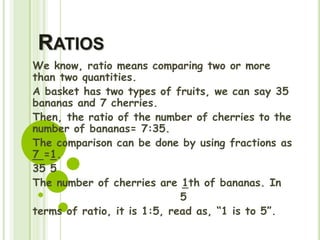
We know, ratio means comparing two or more
than two quantities.
A basket has two types of fruits, we can say 35
bananas and 7 cherries.
Then, the ratio of the number of cherries to the
number of bananas= 7:35.
The comparison can be done by using fractions as
7 =1.
35 5
The number of cherries are 1th of bananas. In
5
terms of ratio, it is 1:5, read as, “1 is to 5”.
PERCENT
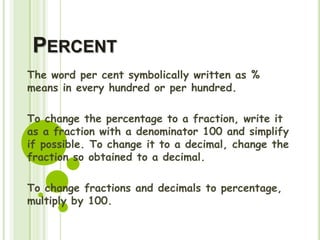
The word per cent symbolically written as %
means in every hundred or per hundred.
To change the percentage to a fraction, write it
as a fraction with a denominator 100 and simplify
if possible. To change it to a decimal, change the
fraction so obtained to a decimal.
To change fractions and decimals to percentage,
multiply by 100.
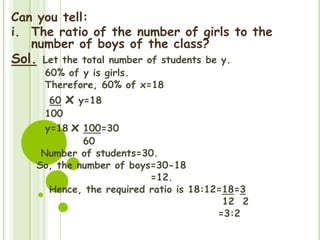
Can you tell:
i. The ratio of the number of girls to the
number of boys of the class?
Sol. Let the total number of students be y.
60% of y is girls.
Therefore, 60% of x=18
60 x y=18
100
y=18 x 100=30
60
Number of students=30.
So, the number of boys=30-18
=12.
Hence, the required ratio is 18:12=18=3
12 2
=3:2
EXAMPLE
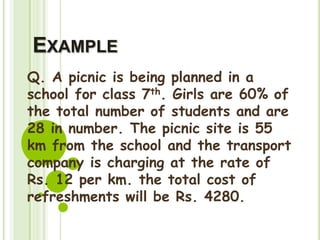
Q. A picnic is being planned in a
school for class 7th. Girls are 60% of
the total number of students and are
28 in number. The picnic site is 55
km from the school and the transport
company is charging at the rate of
Rs. 12 per km. the total cost of
refreshments will be Rs. 4280.
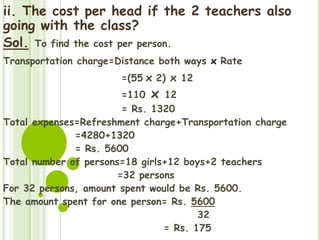
ii. The cost per head if the 2 teachers also
going with the class?
Sol. To find the cost per person.
Transportation charge=Distance both ways x Rate
=(55 x 2) x 12
=110 x 12
= Rs. 1320
Total expenses=Refreshment charge+Transportation charge
=4280+1320
= Rs. 5600
Total number of persons=18 girls+12 boys+2 teachers
=32 persons
For 32 persons, amount spent would be Rs. 5600.
The amount spent for one person= Rs. 5600
32
= Rs. 175
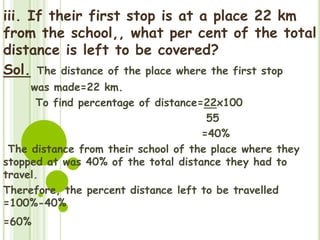
iii. If their first stop is at a place 22 km
from the school,, what per cent of the total
distance is left to be covered?
Sol. The distance of the place where the first stop
was made=22 km.
To find percentage of distance=22x100
55
=40%
The distance from their school of the place where they
stopped at was 40% of the total distance they had to
travel.
Therefore, the percent distance left to be travelled
=100%-40%
=60%
PERCENTAGE INCREASE OR
DECREASE
 To increase a quantity by a percentage, find the
percentage of the quantity and add it to the original
quantity.
 To decrease a quantity by a percentage, find the
percentage of the quantity and subtract it from the
original quantity.
We often come across such information in our daily life as:
i. 25% off on marked prices.
ii. 10% hike in the price of petrol.
EXAMPLE
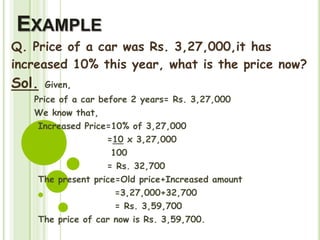
Q. Price of a car was Rs. 3,27,000,it has
increased 10% this year, what is the price now?
Sol. Given,
Price of a car before 2 years= Rs. 3,27,000
We know that,
Increased Price=10% of 3,27,000
=10 x 3,27,000
100
= Rs. 32,700
The present price=Old price+Increased amount
=3,27,000+32,700
= Rs. 3,59,700
The price of car now is Rs. 3,59,700.
DISCOUNT
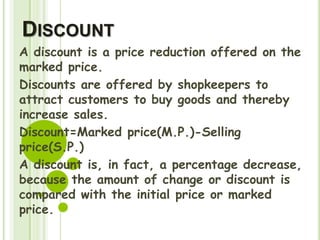
A discount is a price reduction offered on the
marked price.
Discounts are offered by shopkeepers to
attract customers to buy goods and thereby
increase sales.
Discount=Marked price(M.P.)-Selling
price(S.P.)
A discount is, in fact, a percentage decrease,
because the amount of change or discount is
compared with the initial price or marked
price.
DISCOUNT PERCENTAGE
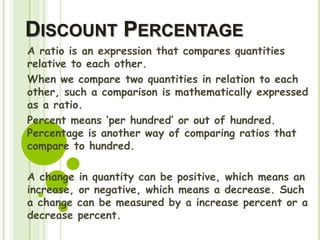
A ratio is an expression that compares quantities
relative to each other.
When we compare two quantities in relation to each
other, such a comparison is mathematically expressed
as a ratio.
Percent means ‘per hundred’ or out of hundred.
Percentage is another way of comparing ratios that
compare to hundred.
A change in quantity can be positive, which means an
increase, or negative, which means a decrease. Such
a change can be measured by a increase percent or a
decrease percent.
FORMULAE WITH DISCOUNT
GIVEN
A) Rate of Discount=Discount x 100
M.P.
B) S.P.=[100-Discount%] x M.P.
100
C) M.P.=[ 100 ] x S.P.
100-Discount%
SALES TAX, VAT, PROFIT AND
LOSS
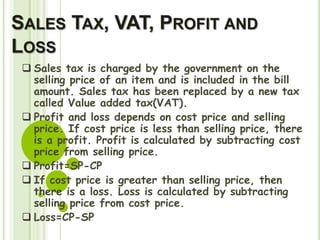
 Sales tax is charged by the government on the
selling price of an item and is included in the bill
amount. Sales tax has been replaced by a new tax
called Value added tax(VAT).
 Profit and loss depends on cost price and selling
price. If cost price is less than selling price, there
is a profit. Profit is calculated by subtracting cost
price from selling price.
 Profit=SP-CP
 If cost price is greater than selling price, then
there is a loss. Loss is calculated by subtracting
selling price from cost price.
 Loss=CP-SP
FORMULAE
A) Percentage change=Actual change x 100
Original amount
B) Profit%=Profit x 100
C.P.
C) Loss%=Loss x 100
C.P.
D) S.P.=[100+Gain%] x C.P. OR [100-Loss%] x C.P.
100 100
E) C.P.=[ 100 ] X S.P. OR [ 100 ] X S.P.
100+Gain% 100-Loss%
EXAMPLES
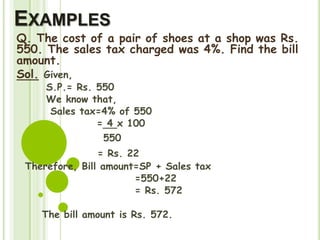
Q. The cost of a pair of shoes at a shop was Rs.
550. The sales tax charged was 4%. Find the bill
amount.
Sol. Given,
S.P.= Rs. 550
We know that,
Sales tax=4% of 550
= 4 x 100
550
= Rs. 22
Therefore, Bill amount=SP + Sales tax
=550+22
= Rs. 572
The bill amount is Rs. 572.
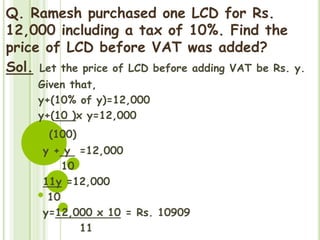
Q. Ramesh purchased one LCD for Rs.
12,000 including a tax of 10%. Find the
price of LCD before VAT was added?
Sol. Let the price of LCD before adding VAT be Rs. y.
Given that,
y+(10% of y)=12,000
y+(10 )x y=12,000
(100)
y + y =12,000
10
11y =12,000
10
y=12,000 x 10 = Rs. 10909
11
SIMPLE AND COMPOUND INTEREST
 Interest is the extra money that a bank gives you for
saving or depositing your money with them. Similarly,
when you borrow money, you pay interest.
 With simple interest, the interest is calculated on the
same amount of money in each time period, therefore,
the interest earned in the each time period is the same.
 On the other hand, the compound interest is calculated
on principal plus the interest for the previous period.
The principal amount increases with every time period,
as the interest payable is added to the principal. This
means interest is not only earned on the principal, but
also on the interests of the previous time periods.
 So we can say that the compound interest calculated is
more than simple interest on the same amount of money
deposited.
 When interest is compounded, the total is calculated
n
using the formula, A=P[1+R ]
100
 Interest is generally calculated on a yearly basis.
Sometimes, it can be compounded more than once
within a year. It can be compounded half yearly,
which means twice a year, or quarterly, which means
four times a year.
 The period for which interest is calculated is called
the conversion period. At the end of the conversion
period, the interest is added to the principal to get
the new principal.
FORMULAE
A) Simple Interest=Principal x Rate x Time period
100
B) Amount=Principal + Simple interest
C) Compound Interest=Amount-Principal
n
D) Amount=P[1+ R ]
100
EXAMPLES
Q. Find the compound interest for Rs. 5000 at
the rate of 10% p.a. for 3 years compounded
annually.
Sol. Given,
P=5000, R=10% p.a. , n=3 Years
We know, n 3
A=P[1+ R ] = 5000[1+ 10]
100 100
=5000 x 11 x 11 x 11
10 x 10 x 10
= Rs. 6655
Compound interest= Amount- Principal
= 6655-5000
= Rs. 1655
Q. What amount is to be repaid on a loan of Rs.
12000 for 1 year at 10% p.a. compounded half
yearly?
Sol. Given,
P=12,000 , R=10% p.a. , n=1 Year
As interest is compounded half yearly,
n=1 x 2=2 Years
R=half of 10%=5% half yearly
We know that, n 2
A=P[1+ R ] = 12,000[1+ 5 ]
100 100
= 12000 x 21 x 21
20 x 20
= Rs. 13230
The amount to be repaid is Rs. 13230.
Q. In a Laboratory, the count of bacteria in certain
experiment was increasing at the rate of 2.5% per hour.
Find the bacteria at the end of 2 hours if the count was
initially 5,06,000.
Sol. Given,
Number of bacteria at present=5,06,000
Rate of increase=2.5% per hour
We know that, 2
No. of bacteria after 2 hours= 5,06,000[1+2.5]
100 2
=5,06,000[1+ 25 ]
1000
=5,06,000 x 41 x 41
40 x 40
=5,31,616.25
There will be approximately 5,31,616 bacteria after 2 hours.
THANK YOU

Maths ppt

  • 1.
  • 2.
    RATIOS We know, ratiomeans comparing two or more than two quantities. A basket has two types of fruits, we can say 35 bananas and 7 cherries. Then, the ratio of the number of cherries to the number of bananas= 7:35. The comparison can be done by using fractions as 7 =1. 35 5 The number of cherries are 1th of bananas. In 5 terms of ratio, it is 1:5, read as, “1 is to 5”.
  • 3.
    PERCENT The word percent symbolically written as % means in every hundred or per hundred. To change the percentage to a fraction, write it as a fraction with a denominator 100 and simplify if possible. To change it to a decimal, change the fraction so obtained to a decimal. To change fractions and decimals to percentage, multiply by 100.
  • 4.
    Can you tell: i.The ratio of the number of girls to the number of boys of the class? Sol. Let the total number of students be y. 60% of y is girls. Therefore, 60% of x=18 60 x y=18 100 y=18 x 100=30 60 Number of students=30. So, the number of boys=30-18 =12. Hence, the required ratio is 18:12=18=3 12 2 =3:2
  • 5.
    EXAMPLE Q. A picnicis being planned in a school for class 7th. Girls are 60% of the total number of students and are 28 in number. The picnic site is 55 km from the school and the transport company is charging at the rate of Rs. 12 per km. the total cost of refreshments will be Rs. 4280.
  • 6.
    ii. The costper head if the 2 teachers also going with the class? Sol. To find the cost per person. Transportation charge=Distance both ways x Rate =(55 x 2) x 12 =110 x 12 = Rs. 1320 Total expenses=Refreshment charge+Transportation charge =4280+1320 = Rs. 5600 Total number of persons=18 girls+12 boys+2 teachers =32 persons For 32 persons, amount spent would be Rs. 5600. The amount spent for one person= Rs. 5600 32 = Rs. 175
  • 7.
    iii. If theirfirst stop is at a place 22 km from the school,, what per cent of the total distance is left to be covered? Sol. The distance of the place where the first stop was made=22 km. To find percentage of distance=22x100 55 =40% The distance from their school of the place where they stopped at was 40% of the total distance they had to travel. Therefore, the percent distance left to be travelled =100%-40% =60%
  • 8.
    PERCENTAGE INCREASE OR DECREASE To increase a quantity by a percentage, find the percentage of the quantity and add it to the original quantity.  To decrease a quantity by a percentage, find the percentage of the quantity and subtract it from the original quantity. We often come across such information in our daily life as: i. 25% off on marked prices. ii. 10% hike in the price of petrol.
  • 9.
    EXAMPLE Q. Price ofa car was Rs. 3,27,000,it has increased 10% this year, what is the price now? Sol. Given, Price of a car before 2 years= Rs. 3,27,000 We know that, Increased Price=10% of 3,27,000 =10 x 3,27,000 100 = Rs. 32,700 The present price=Old price+Increased amount =3,27,000+32,700 = Rs. 3,59,700 The price of car now is Rs. 3,59,700.
  • 10.
    DISCOUNT A discount isa price reduction offered on the marked price. Discounts are offered by shopkeepers to attract customers to buy goods and thereby increase sales. Discount=Marked price(M.P.)-Selling price(S.P.) A discount is, in fact, a percentage decrease, because the amount of change or discount is compared with the initial price or marked price.
  • 11.
    DISCOUNT PERCENTAGE A ratiois an expression that compares quantities relative to each other. When we compare two quantities in relation to each other, such a comparison is mathematically expressed as a ratio. Percent means ‘per hundred’ or out of hundred. Percentage is another way of comparing ratios that compare to hundred. A change in quantity can be positive, which means an increase, or negative, which means a decrease. Such a change can be measured by a increase percent or a decrease percent.
  • 12.
    FORMULAE WITH DISCOUNT GIVEN A)Rate of Discount=Discount x 100 M.P. B) S.P.=[100-Discount%] x M.P. 100 C) M.P.=[ 100 ] x S.P. 100-Discount%
  • 13.
    SALES TAX, VAT,PROFIT AND LOSS  Sales tax is charged by the government on the selling price of an item and is included in the bill amount. Sales tax has been replaced by a new tax called Value added tax(VAT).  Profit and loss depends on cost price and selling price. If cost price is less than selling price, there is a profit. Profit is calculated by subtracting cost price from selling price.  Profit=SP-CP  If cost price is greater than selling price, then there is a loss. Loss is calculated by subtracting selling price from cost price.  Loss=CP-SP
  • 14.
    FORMULAE A) Percentage change=Actualchange x 100 Original amount B) Profit%=Profit x 100 C.P. C) Loss%=Loss x 100 C.P. D) S.P.=[100+Gain%] x C.P. OR [100-Loss%] x C.P. 100 100 E) C.P.=[ 100 ] X S.P. OR [ 100 ] X S.P. 100+Gain% 100-Loss%
  • 15.
    EXAMPLES Q. The costof a pair of shoes at a shop was Rs. 550. The sales tax charged was 4%. Find the bill amount. Sol. Given, S.P.= Rs. 550 We know that, Sales tax=4% of 550 = 4 x 100 550 = Rs. 22 Therefore, Bill amount=SP + Sales tax =550+22 = Rs. 572 The bill amount is Rs. 572.
  • 16.
    Q. Ramesh purchasedone LCD for Rs. 12,000 including a tax of 10%. Find the price of LCD before VAT was added? Sol. Let the price of LCD before adding VAT be Rs. y. Given that, y+(10% of y)=12,000 y+(10 )x y=12,000 (100) y + y =12,000 10 11y =12,000 10 y=12,000 x 10 = Rs. 10909 11
  • 17.
    SIMPLE AND COMPOUNDINTEREST  Interest is the extra money that a bank gives you for saving or depositing your money with them. Similarly, when you borrow money, you pay interest.  With simple interest, the interest is calculated on the same amount of money in each time period, therefore, the interest earned in the each time period is the same.  On the other hand, the compound interest is calculated on principal plus the interest for the previous period. The principal amount increases with every time period, as the interest payable is added to the principal. This means interest is not only earned on the principal, but also on the interests of the previous time periods.  So we can say that the compound interest calculated is more than simple interest on the same amount of money deposited.
  • 18.
     When interestis compounded, the total is calculated n using the formula, A=P[1+R ] 100  Interest is generally calculated on a yearly basis. Sometimes, it can be compounded more than once within a year. It can be compounded half yearly, which means twice a year, or quarterly, which means four times a year.  The period for which interest is calculated is called the conversion period. At the end of the conversion period, the interest is added to the principal to get the new principal.
  • 19.
    FORMULAE A) Simple Interest=Principalx Rate x Time period 100 B) Amount=Principal + Simple interest C) Compound Interest=Amount-Principal n D) Amount=P[1+ R ] 100
  • 20.
    EXAMPLES Q. Find thecompound interest for Rs. 5000 at the rate of 10% p.a. for 3 years compounded annually. Sol. Given, P=5000, R=10% p.a. , n=3 Years We know, n 3 A=P[1+ R ] = 5000[1+ 10] 100 100 =5000 x 11 x 11 x 11 10 x 10 x 10 = Rs. 6655 Compound interest= Amount- Principal = 6655-5000 = Rs. 1655
  • 21.
    Q. What amountis to be repaid on a loan of Rs. 12000 for 1 year at 10% p.a. compounded half yearly? Sol. Given, P=12,000 , R=10% p.a. , n=1 Year As interest is compounded half yearly, n=1 x 2=2 Years R=half of 10%=5% half yearly We know that, n 2 A=P[1+ R ] = 12,000[1+ 5 ] 100 100 = 12000 x 21 x 21 20 x 20 = Rs. 13230 The amount to be repaid is Rs. 13230.
  • 22.
    Q. In aLaboratory, the count of bacteria in certain experiment was increasing at the rate of 2.5% per hour. Find the bacteria at the end of 2 hours if the count was initially 5,06,000. Sol. Given, Number of bacteria at present=5,06,000 Rate of increase=2.5% per hour We know that, 2 No. of bacteria after 2 hours= 5,06,000[1+2.5] 100 2 =5,06,000[1+ 25 ] 1000 =5,06,000 x 41 x 41 40 x 40 =5,31,616.25 There will be approximately 5,31,616 bacteria after 2 hours.
  • 23.