2e Identify the following properties using variables and apply them in solving problems. (DOK 1)• Zero property of multiplication• Inverse operations of addition/subtraction and multiplication/division• Commutative and associative properties of addition and multiplication• Identity properties of addition and multiplication• Distributive properties of multiplication over addition and subtractionBy: Deia Sanders
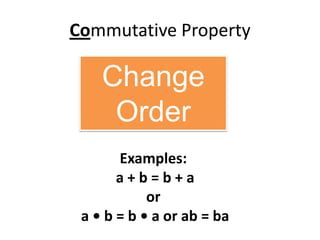
Commutative PropertyChange OrderExamples:a + b = b + aor a • b = b • a or ab = ba
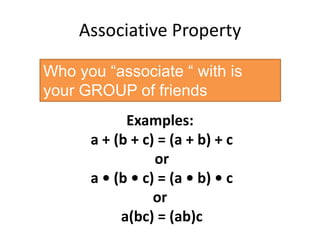
Associative PropertyWho you “associate “ with is your GROUP of friends Examples:a + (b + c) = (a + b) + c ora • (b • c) = (a • b) • c ora(bc) = (ab)c
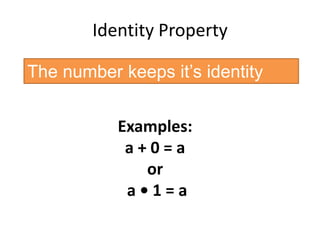
Identity PropertyThe number keeps it’s identityExamples: a + 0 = a or a • 1 = a
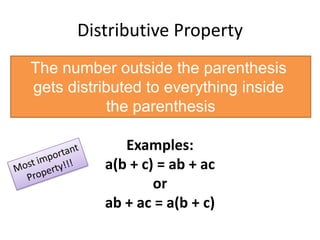
Distributive PropertyThe number outside the parenthesis gets distributed to everything inside the parenthesisExamples: a(b + c) = ab + ac or ab+ ac = a(b + c)Most importantProperty!!!
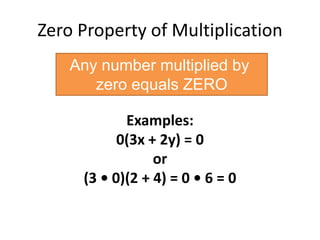
Zero Property of MultiplicationAny number multiplied by zero equals ZEROExamples: 0(3x + 2y) = 0 or(3 • 0)(2 + 4) = 0 • 6 = 0
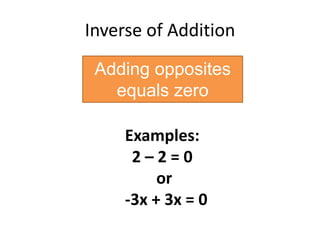
Inverse of AdditionAdding opposites equals zeroExamples: 2 – 2 = 0 or-3x + 3x = 0
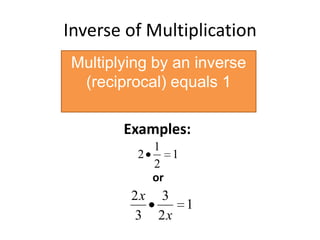
Inverse of MultiplicationMultiplying by an inverse (reciprocal) equals 1Examples: or
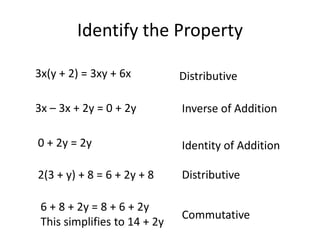
Identify the Property3x(y + 2) = 3xy + 6xDistributive3x – 3x + 2y = 0 + 2yInverse of Addition0 + 2y = 2yIdentity of Addition2(3 + y) + 8 = 6 + 2y + 8Distributive6 + 8 + 2y = 8 + 6 + 2yThis simplifies to 14 + 2yCommutative
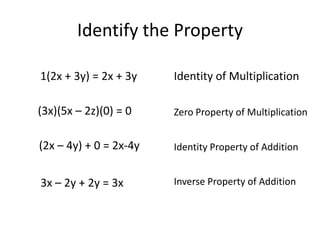
Identify the Property1(2x + 3y) = 2x + 3yIdentity of Multiplication(3x)(5x – 2z)(0) = 0Zero Property of Multiplication(2x – 4y) + 0 = 2x-4yIdentity Property of AdditionInverse Property of Addition3x – 2y + 2y = 3x
Complete Handout #1 page 73

2e properties

  • 1.
    2e Identify thefollowing properties using variables and apply them in solving problems. (DOK 1)• Zero property of multiplication• Inverse operations of addition/subtraction and multiplication/division• Commutative and associative properties of addition and multiplication• Identity properties of addition and multiplication• Distributive properties of multiplication over addition and subtractionBy: Deia Sanders
  • 2.
    Commutative PropertyChange OrderExamples:a+ b = b + aor a • b = b • a or ab = ba
  • 3.
    Associative PropertyWho you“associate “ with is your GROUP of friends Examples:a + (b + c) = (a + b) + c ora • (b • c) = (a • b) • c ora(bc) = (ab)c
  • 4.
    Identity PropertyThe numberkeeps it’s identityExamples: a + 0 = a or a • 1 = a
  • 5.
    Distributive PropertyThe numberoutside the parenthesis gets distributed to everything inside the parenthesisExamples: a(b + c) = ab + ac or ab+ ac = a(b + c)Most importantProperty!!!
  • 6.
    Zero Property ofMultiplicationAny number multiplied by zero equals ZEROExamples: 0(3x + 2y) = 0 or(3 • 0)(2 + 4) = 0 • 6 = 0
  • 7.
    Inverse of AdditionAddingopposites equals zeroExamples: 2 – 2 = 0 or-3x + 3x = 0
  • 8.
    Inverse of MultiplicationMultiplyingby an inverse (reciprocal) equals 1Examples: or
  • 9.
    Identify the Property3x(y+ 2) = 3xy + 6xDistributive3x – 3x + 2y = 0 + 2yInverse of Addition0 + 2y = 2yIdentity of Addition2(3 + y) + 8 = 6 + 2y + 8Distributive6 + 8 + 2y = 8 + 6 + 2yThis simplifies to 14 + 2yCommutative
  • 10.
    Identify the Property1(2x+ 3y) = 2x + 3yIdentity of Multiplication(3x)(5x – 2z)(0) = 0Zero Property of Multiplication(2x – 4y) + 0 = 2x-4yIdentity Property of AdditionInverse Property of Addition3x – 2y + 2y = 3x
  • 11.