Dr Frost Learningis a registered charity
in England and Wales (no 1194954)
www.drfrost.org
@DrFrostMaths
Last modified:
Contact the resource team:
resources@drfrost.org
@DrFrostResource
Jasmine Vincent
Divisibility Tests
7th
January 2025
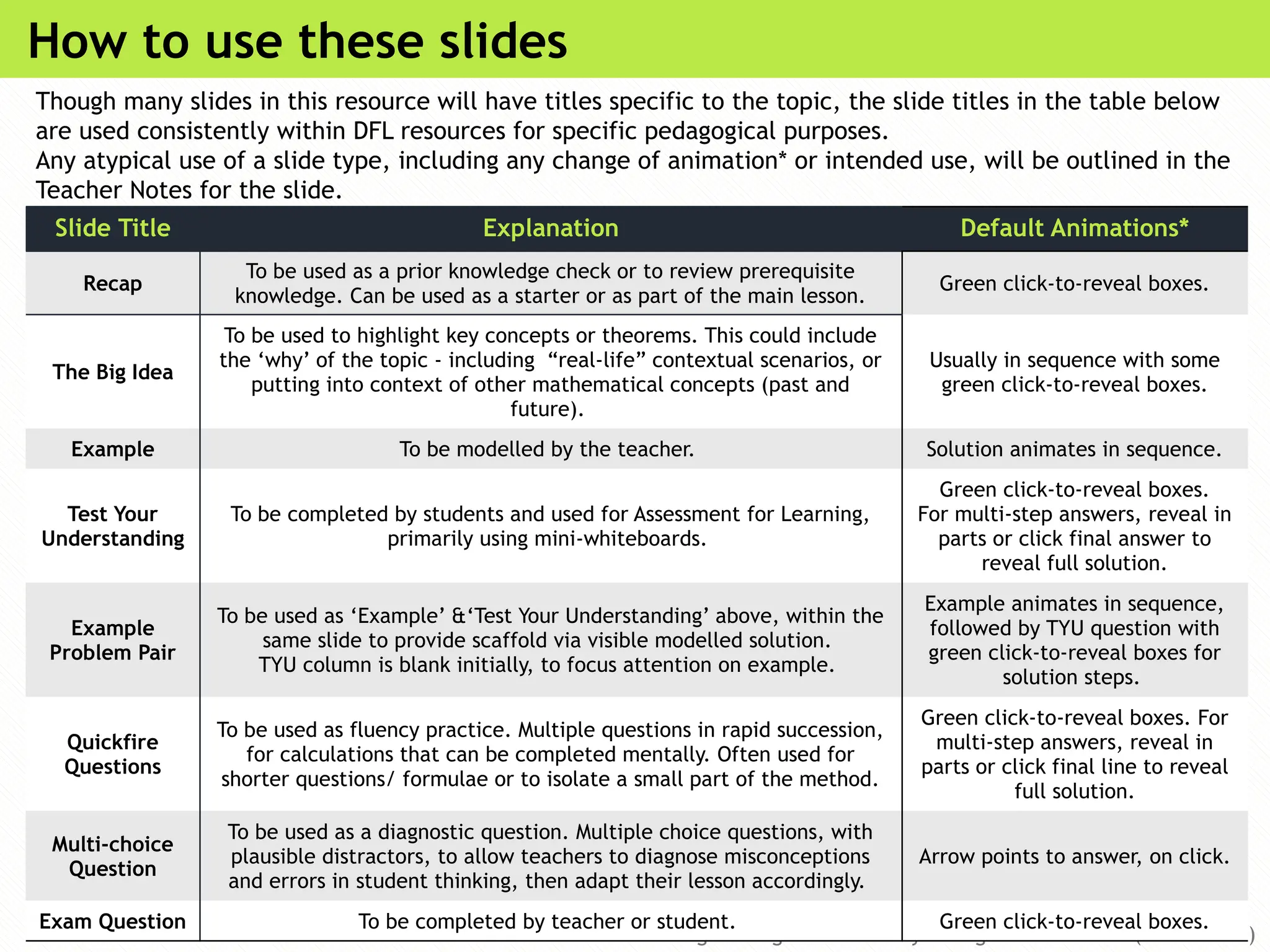
2.
How to usethese slides
Dr Frost Learning is a registered charity in England and Wales (no 1194954)
Slide Title Explanation Default Animations*
Recap
To be used as a prior knowledge check or to review prerequisite
knowledge. Can be used as a starter or as part of the main lesson.
Green click-to-reveal boxes.
The Big Idea
To be used to highlight key concepts or theorems. This could include
the ‘why’ of the topic - including “real-life” contextual scenarios, or
putting into context of other mathematical concepts (past and
future).
Usually in sequence with some
green click-to-reveal boxes.
Example To be modelled by the teacher. Solution animates in sequence.
Test Your
Understanding
To be completed by students and used for Assessment for Learning,
primarily using mini-whiteboards.
Green click-to-reveal boxes.
For multi-step answers, reveal in
parts or click final answer to
reveal full solution.
Example
Problem Pair
To be used as ‘Example’ &‘Test Your Understanding’ above, within the
same slide to provide scaffold via visible modelled solution.
TYU column is blank initially, to focus attention on example.
Reveal question by clicking ‘Test Your Understanding’ banner.
Example animates in sequence.
Click the header to reveal TYU
question, then green click-to-
reveal boxes.
Quickfire
Questions
To be used as fluency practice. Multiple questions in rapid succession,
for calculations that can be completed mentally. Often used for
shorter questions/ formulae or to isolate a small part of the method.
Green click-to-reveal boxes. For
multi-step answers, reveal in
parts or click final line to reveal
full solution.
Multi-choice
Question
To be used as a diagnostic question. Multiple choice questions, with
plausible distractors, to allow teachers to diagnose misconceptions
and errors in student thinking, then adapt their lesson accordingly.
Arrow points to answer, on click.
Exam Question To be completed by teacher or student. Green click-to-reveal boxes.
Though many slides in this resource will have titles specific to the topic, the slide titles in the table below
are used consistently within DFL resources for specific pedagogical purposes.
Any atypical use of a slide type, including any change of animation* or intended use, will be outlined in the
Teacher Notes for the slide.
How to use these slides
Dr Frost Learning is a registered charity in England and Wales (no 1194954)
Slide Title Explanation Default Animations*
Recap
To be used as a prior knowledge check or to review prerequisite
knowledge. Can be used as a starter or as part of the main lesson.
Green click-to-reveal boxes.
The Big Idea
To be used to highlight key concepts or theorems. This could include
the ‘why’ of the topic - including “real-life” contextual scenarios, or
putting into context of other mathematical concepts (past and
future).
Usually in sequence with some
green click-to-reveal boxes.
Example To be modelled by the teacher. Solution animates in sequence.
Test Your
Understanding
To be completed by students and used for Assessment for Learning,
primarily using mini-whiteboards.
Green click-to-reveal boxes.
For multi-step answers, reveal in
parts or click final answer to
reveal full solution.
Example
Problem Pair
To be used as ‘Example’ &‘Test Your Understanding’ above, within the
same slide to provide scaffold via visible modelled solution.
TYU column is blank initially, to focus attention on example.
Example animates in sequence,
followed by TYU question with
green click-to-reveal boxes for
solution steps.
Quickfire
Questions
To be used as fluency practice. Multiple questions in rapid succession,
for calculations that can be completed mentally. Often used for
shorter questions/ formulae or to isolate a small part of the method.
Green click-to-reveal boxes. For
multi-step answers, reveal in
parts or click final line to reveal
full solution.
Multi-choice
Question
To be used as a diagnostic question. Multiple choice questions, with
plausible distractors, to allow teachers to diagnose misconceptions
and errors in student thinking, then adapt their lesson accordingly.
Arrow points to answer, on click.
Exam Question To be completed by teacher or student. Green click-to-reveal boxes.
Though many slides in this resource will have titles specific to the topic, the slide titles in the table below
are used consistently within DFL resources for specific pedagogical purposes.
Any atypical use of a slide type, including any change of animation* or intended use, will be outlined in the
Teacher Notes for the slide.
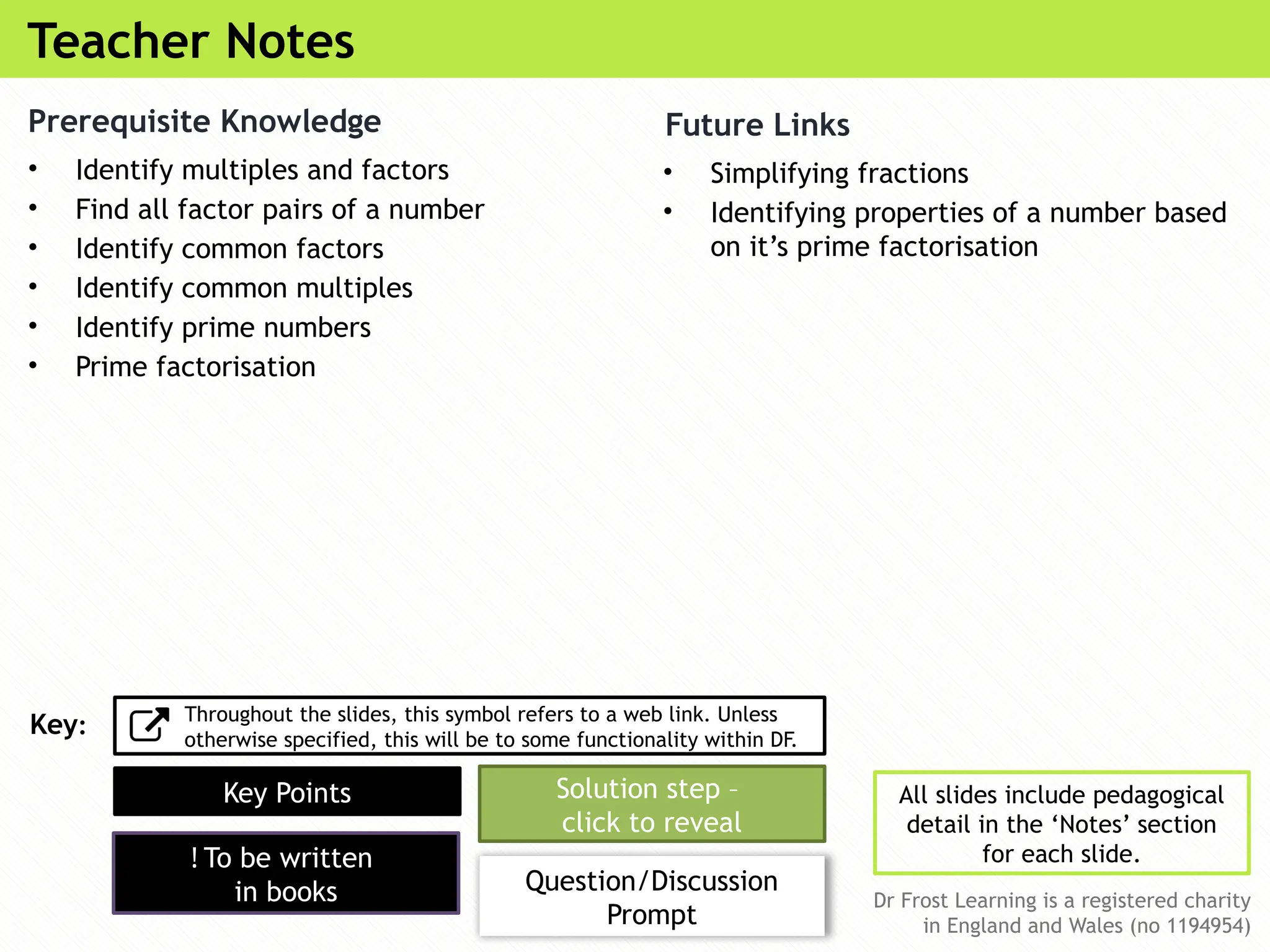
3.
Teacher Notes
Dr FrostLearning is a registered charity
in England and Wales (no 1194954)
Key Points Solution step –
click to reveal
Question/Discussion
Prompt
Key:
! To be written
in books
All slides include pedagogical
detail in the ‘Notes’ section
for each slide.
Throughout the slides, this symbol refers to a web link. Unless
otherwise specified, this will be to some functionality within DF.
Future Links
• Simplifying fractions
• Identifying properties of a number based
on it’s prime factorisation
Prerequisite Knowledge
• Identify multiples and factors
• Find all factor pairs of a number
• Identify common factors
• Identify common multiples
• Identify prime numbers
• Prime factorisation
4.
Dr Frost Learningis a registered charity
in England and Wales (no 1194954)
Dr Frost Learning is a registered charity
in England and Wales (no 1194954)
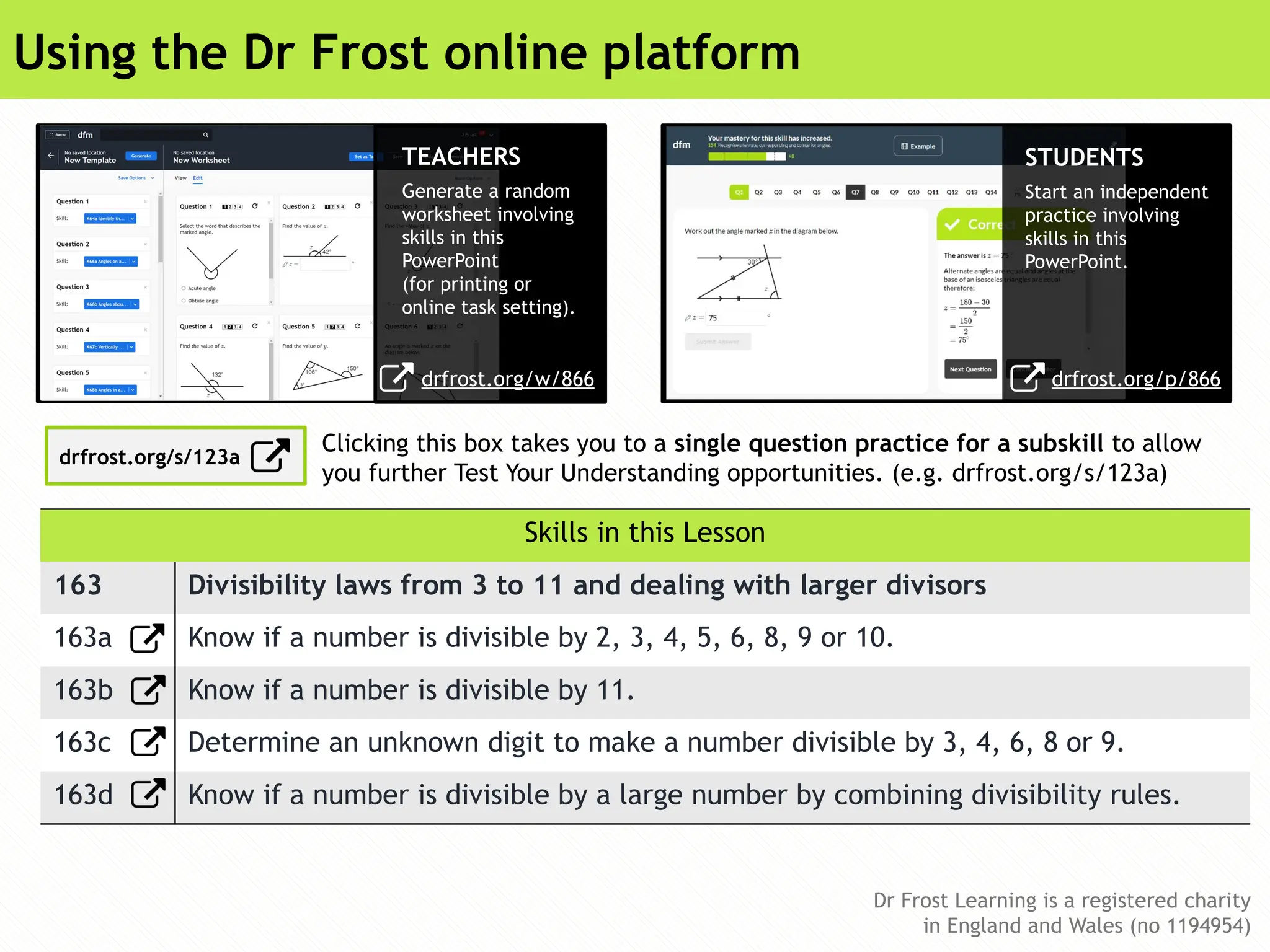
Using the Dr Frost online platform
Skills in this Lesson
163 Divisibility laws from 3 to 11 and dealing with larger divisors
163a Know if a number is divisible by 2, 3, 4, 5, 6, 8, 9 or 10.
163b Know if a number is divisible by 11.
163c Determine an unknown digit to make a number divisible by 3, 4, 6, 8 or 9.
163d Know if a number is divisible by a large number by combining divisibility rules.
TEACHERS
Generate a random
worksheet involving
skills in this
PowerPoint
(for printing or
online task setting).
STUDENTS
Start an independent
practice involving
skills in this
PowerPoint.
drfrost.org/w/866
Clicking this box takes you to a single question practice for a subskill to allow
you further Test Your Understanding opportunities. (e.g. drfrost.org/s/123a)
drfrost.org/p/866
drfrost.org/s/123a
5.
Dr Frost Learningis a registered charity
in England and Wales (no 1194954)
Dr Frost Learning is a registered charity
in England and Wales (no 1194954)
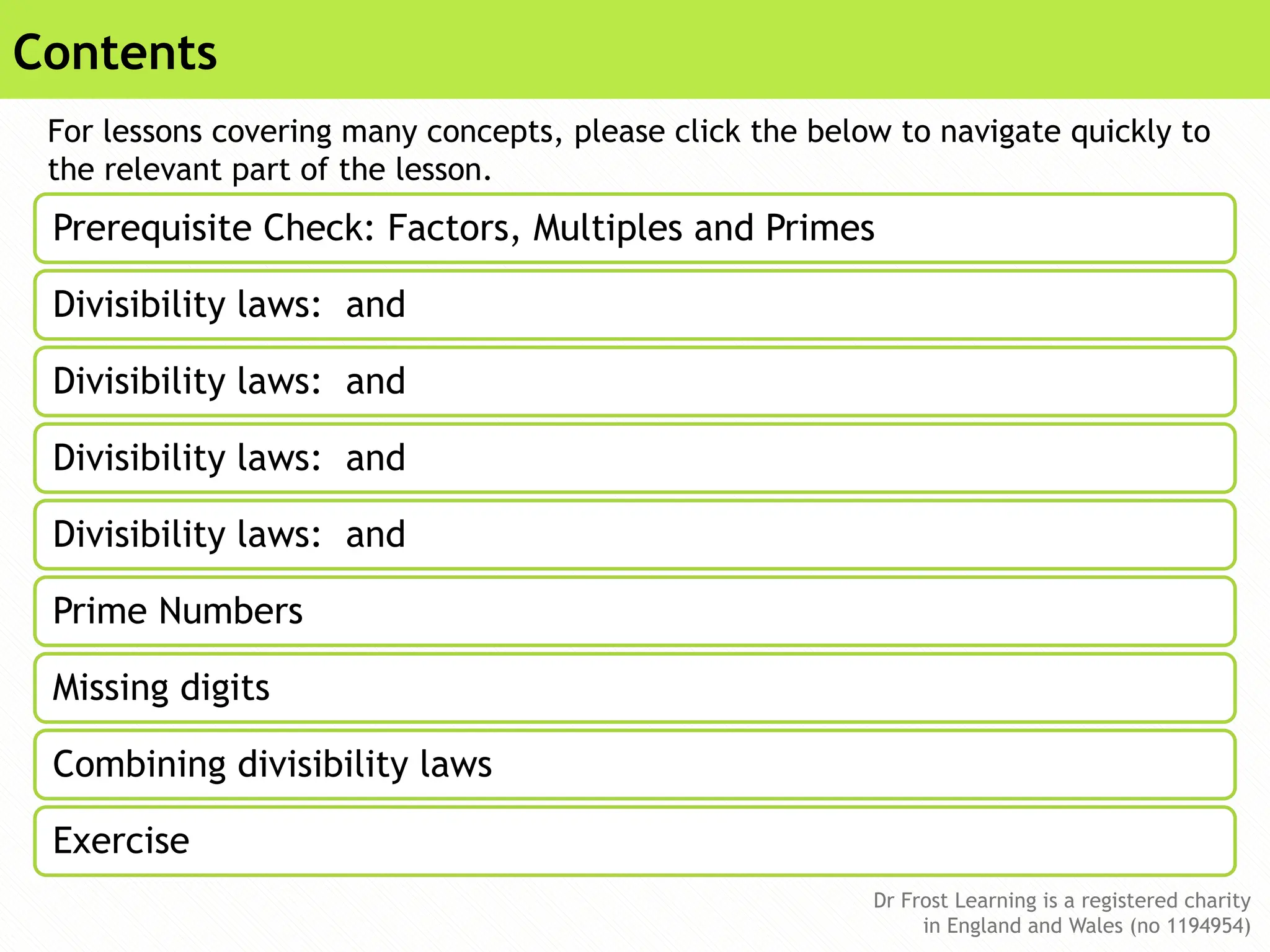
Contents
Prerequisite Check: Factors, Multiples and Primes
Divisibility laws: and
Divisibility laws: and
Divisibility laws: and
Divisibility laws: and
Prime Numbers
Missing digits
Combining divisibility laws
Exercise
For lessons covering many concepts, please click the below to navigate quickly to
the relevant part of the lesson.
6.
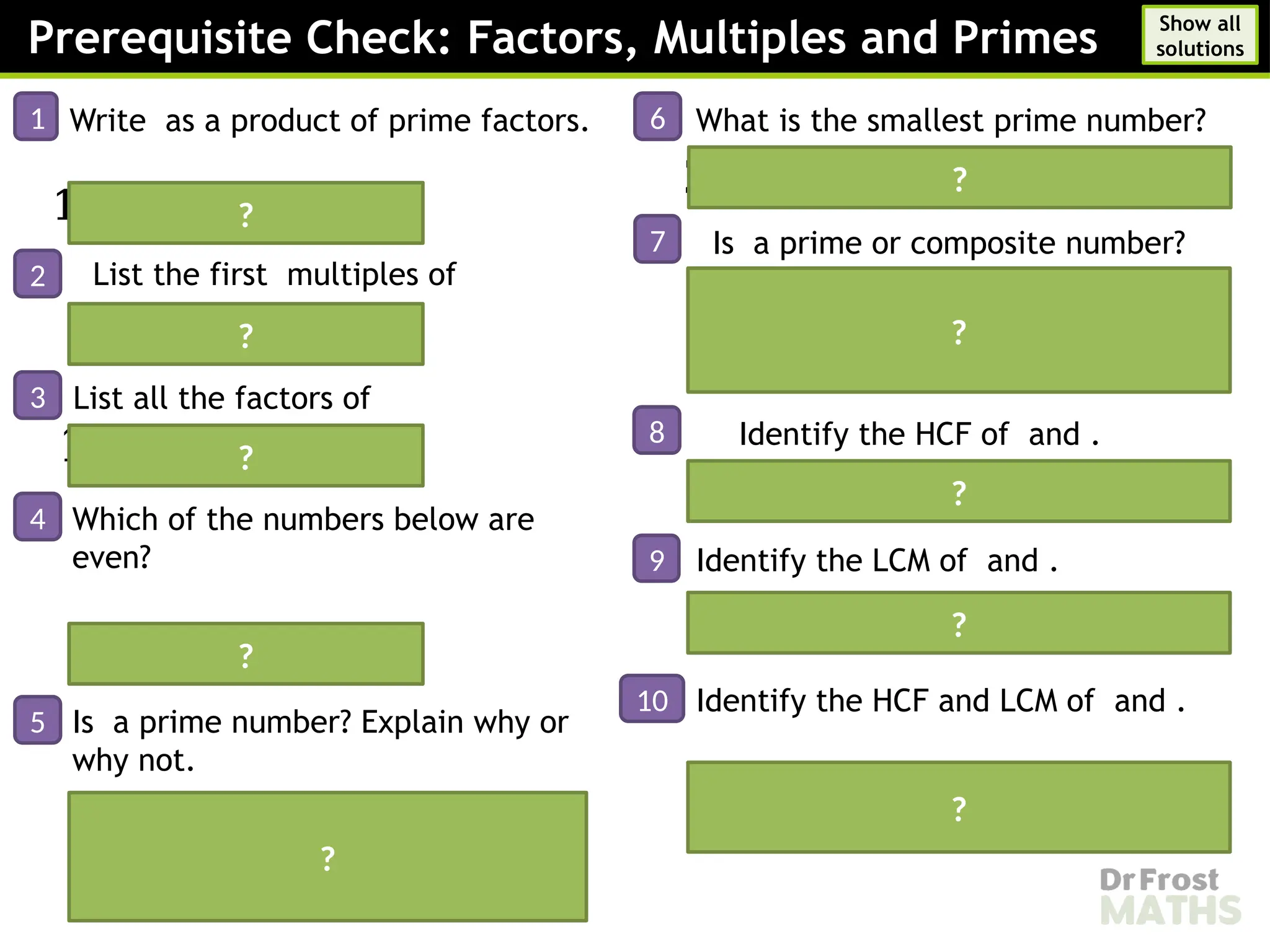
Prerequisite Check: Factors,Multiples and Primes
1 Write as a product of prime factors.
𝟏𝟖𝟎=𝟐𝟐
×𝟑𝟐
×𝟓
2 List the first multiples of
𝟖,𝟏𝟔,𝟐𝟒,𝟑𝟐,𝟒𝟎
3 List all the factors of
𝟏,𝟐,𝟑,𝟒,𝟔,𝟗,𝟏𝟐,𝟏𝟖,𝟑𝟔
4
5
Which of the numbers below are
even?
and
6 What is the smallest prime number?
𝟐
7 Is a prime or composite number?
so is divisible by and making it a
composite number
8 Identify the HCF of and .
𝟏𝟐
9 Identify the LCM of and .
?
?
?
?
?
?
?
?
10 Identify the HCF and LCM of and .
HCF:
LCM:
?
Is a prime number? Explain why or
why not.
Yes, is a prime number because
it has exactly factors; and itself.
?
Show all
solutions
7.
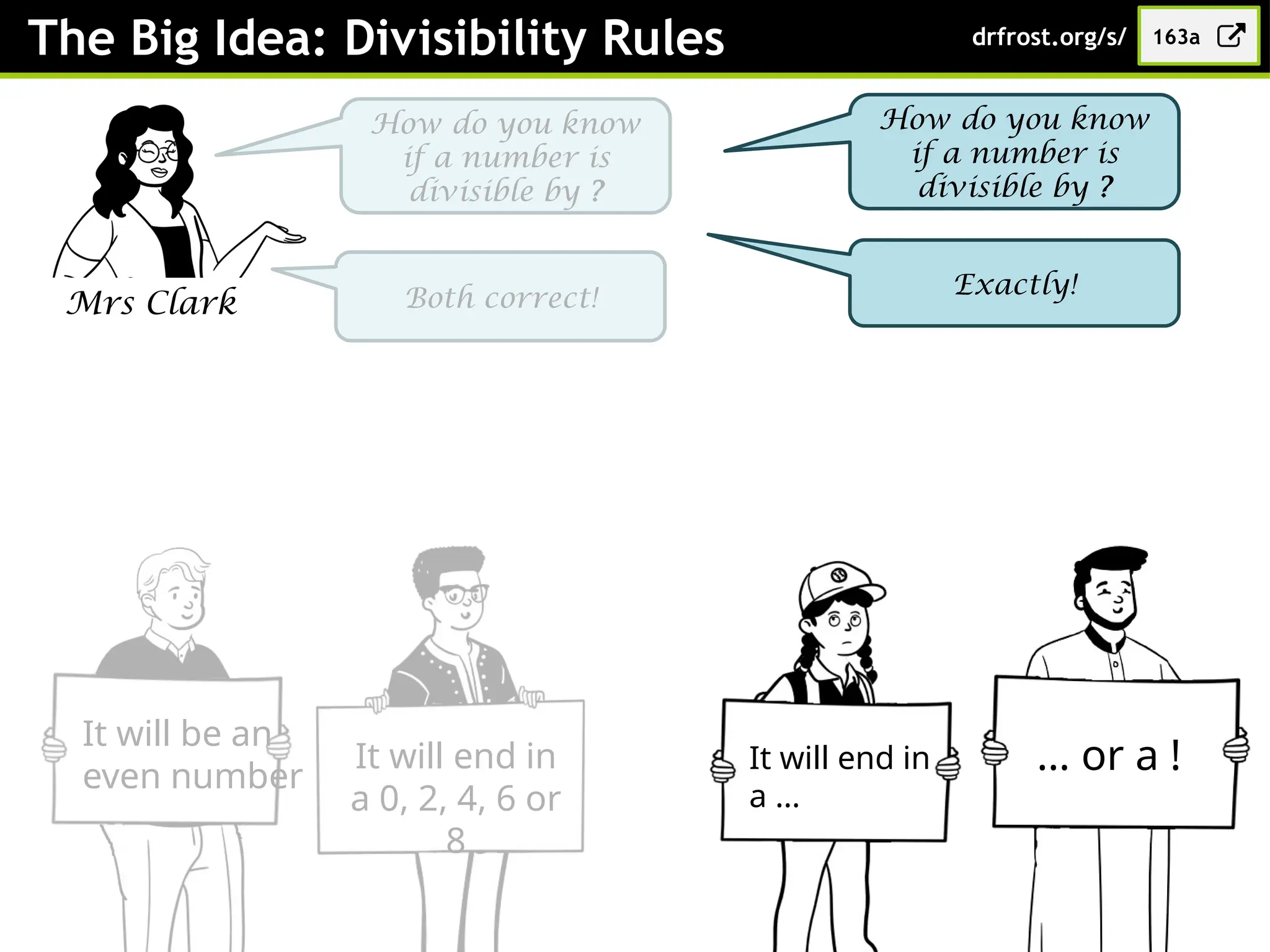
The Big Idea:Divisibility Rules
Mrs Clark
How do you know
if a number is
divisible by ?
It will end in
a 0, 2, 4, 6 or
8
It will be an
even number
Both correct!
How do you know
if a number is
divisible by ?
It will end in
a …
… or a !
Exactly!
163a
drfrost.org/s/
8.
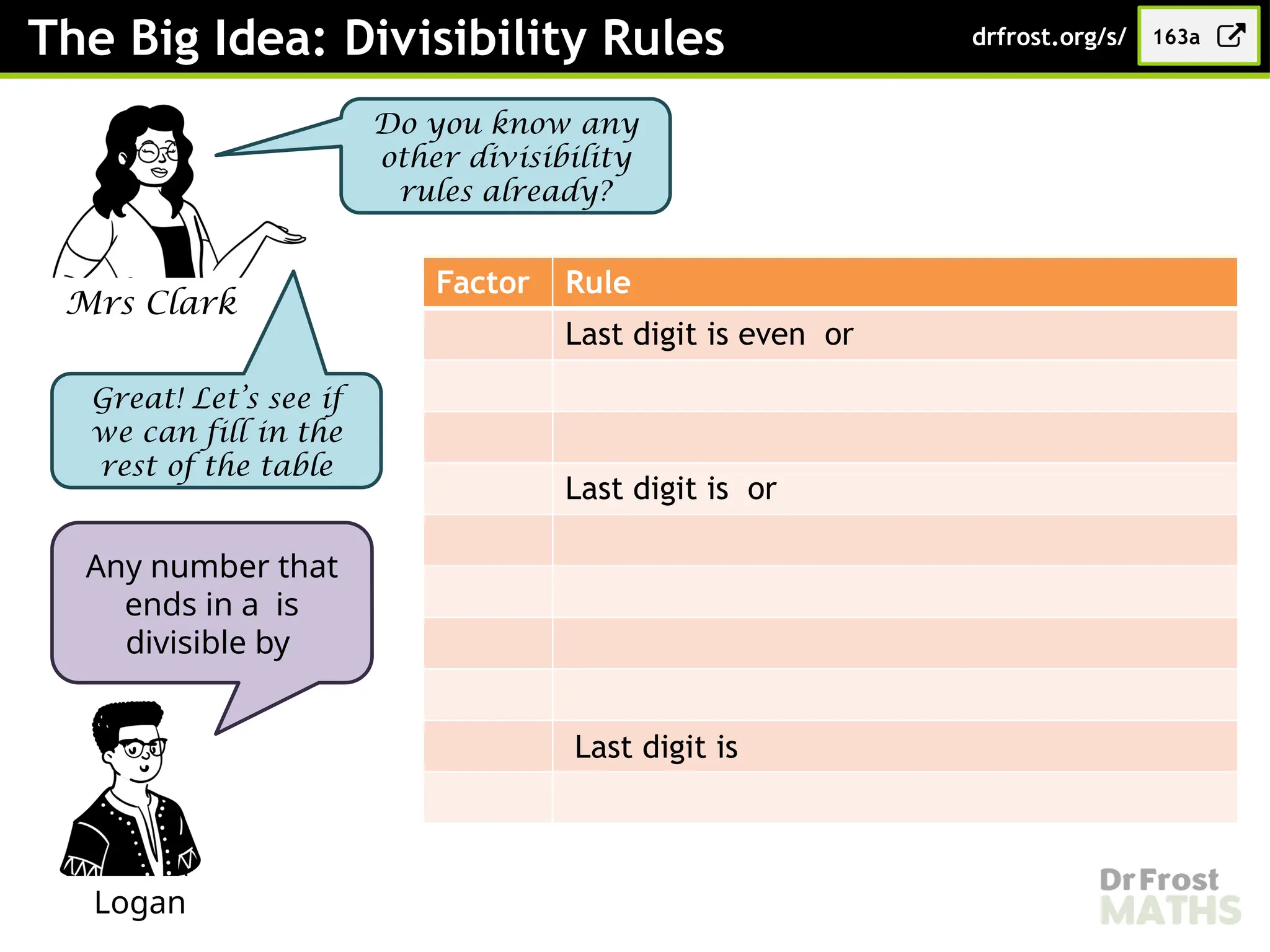
The Big Idea:Divisibility Rules
Mrs Clark
Do you know any
other divisibility
rules already?
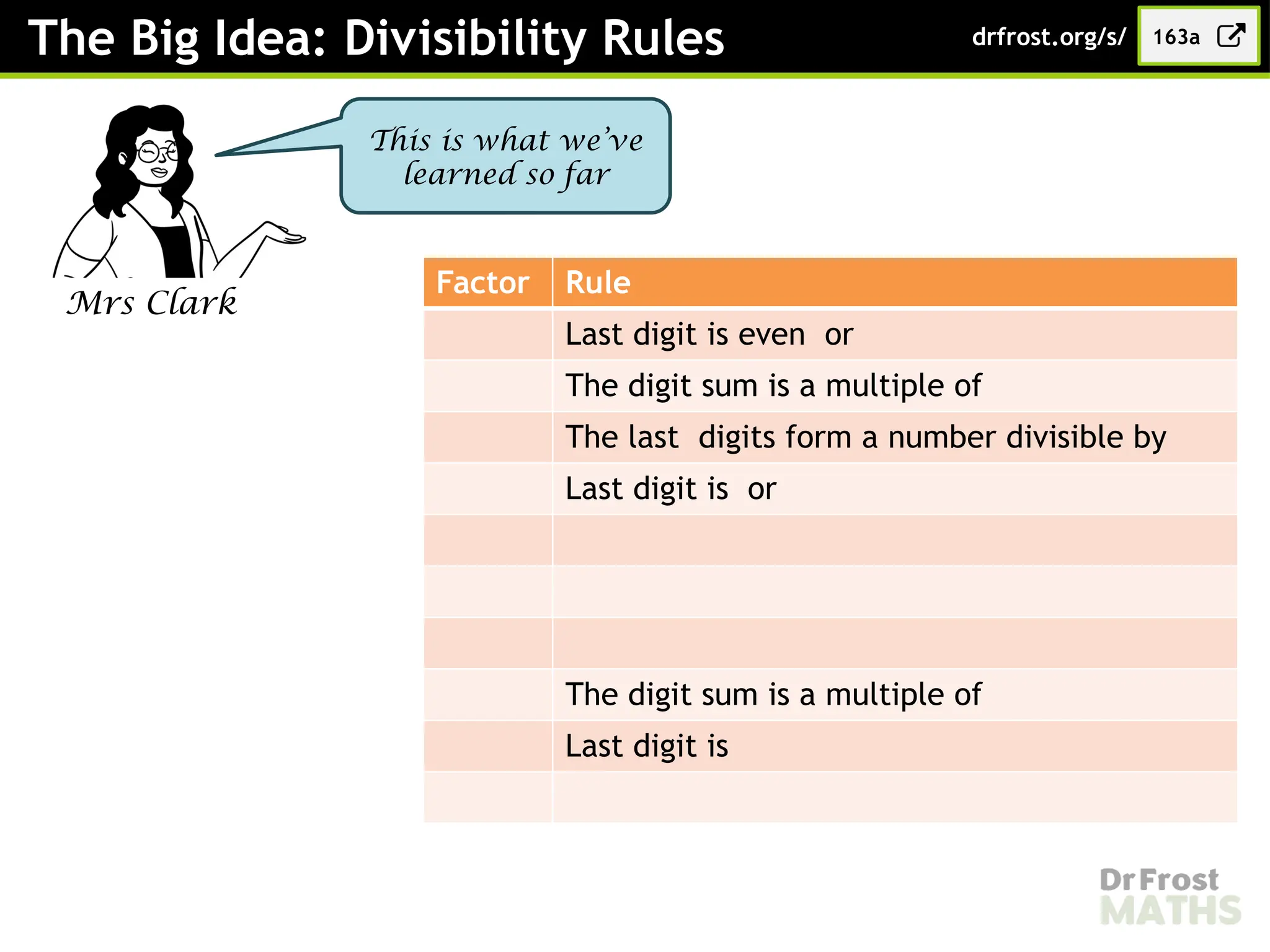
Factor Rule
Last digit is even or
Last digit is or
Logan
Any number that
ends in a is
divisible by
Great! Let’s see if
we can fill in the
rest of the table
Last digit is
163a
drfrost.org/s/
9.
is divisible byand
?
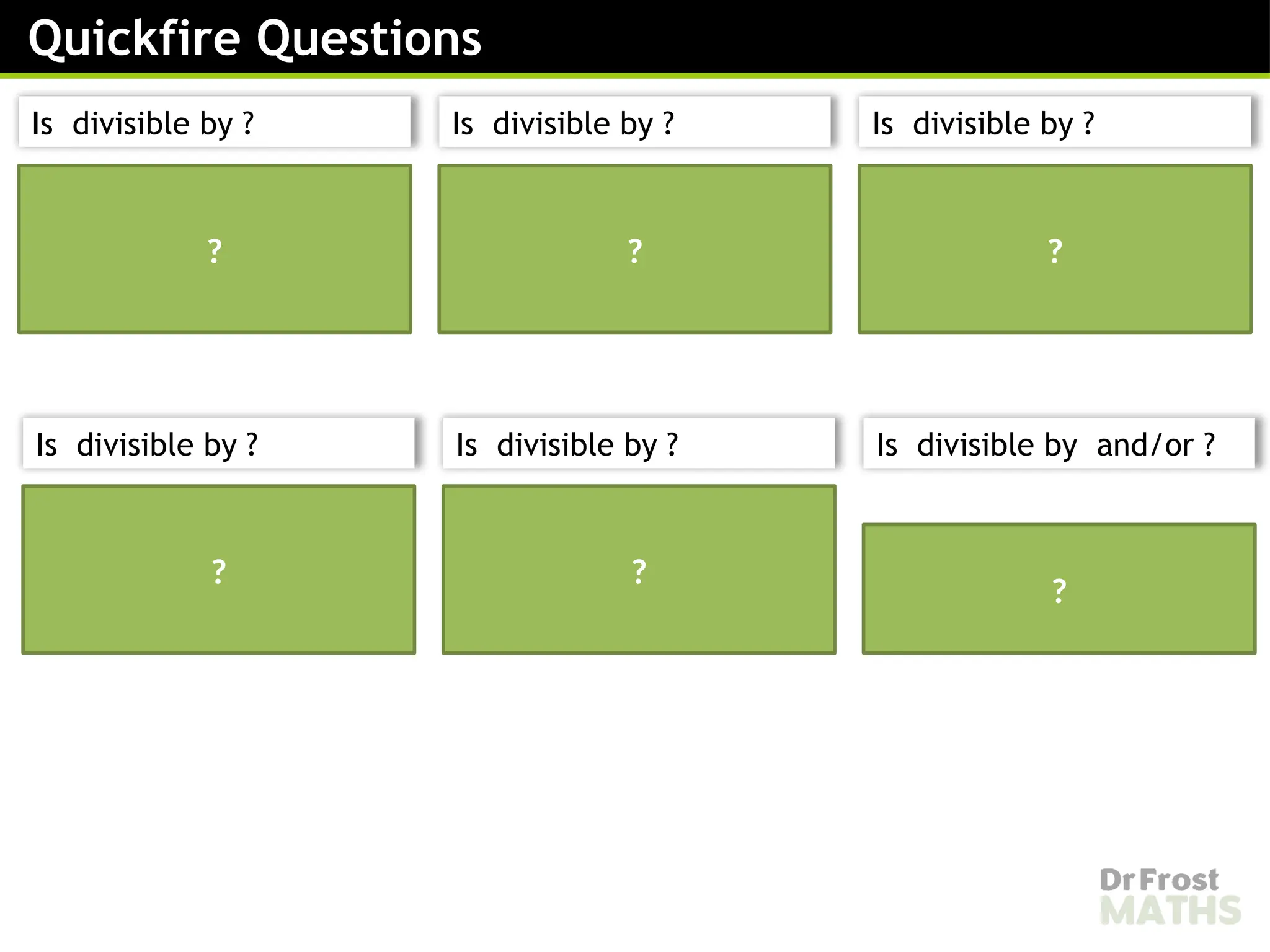
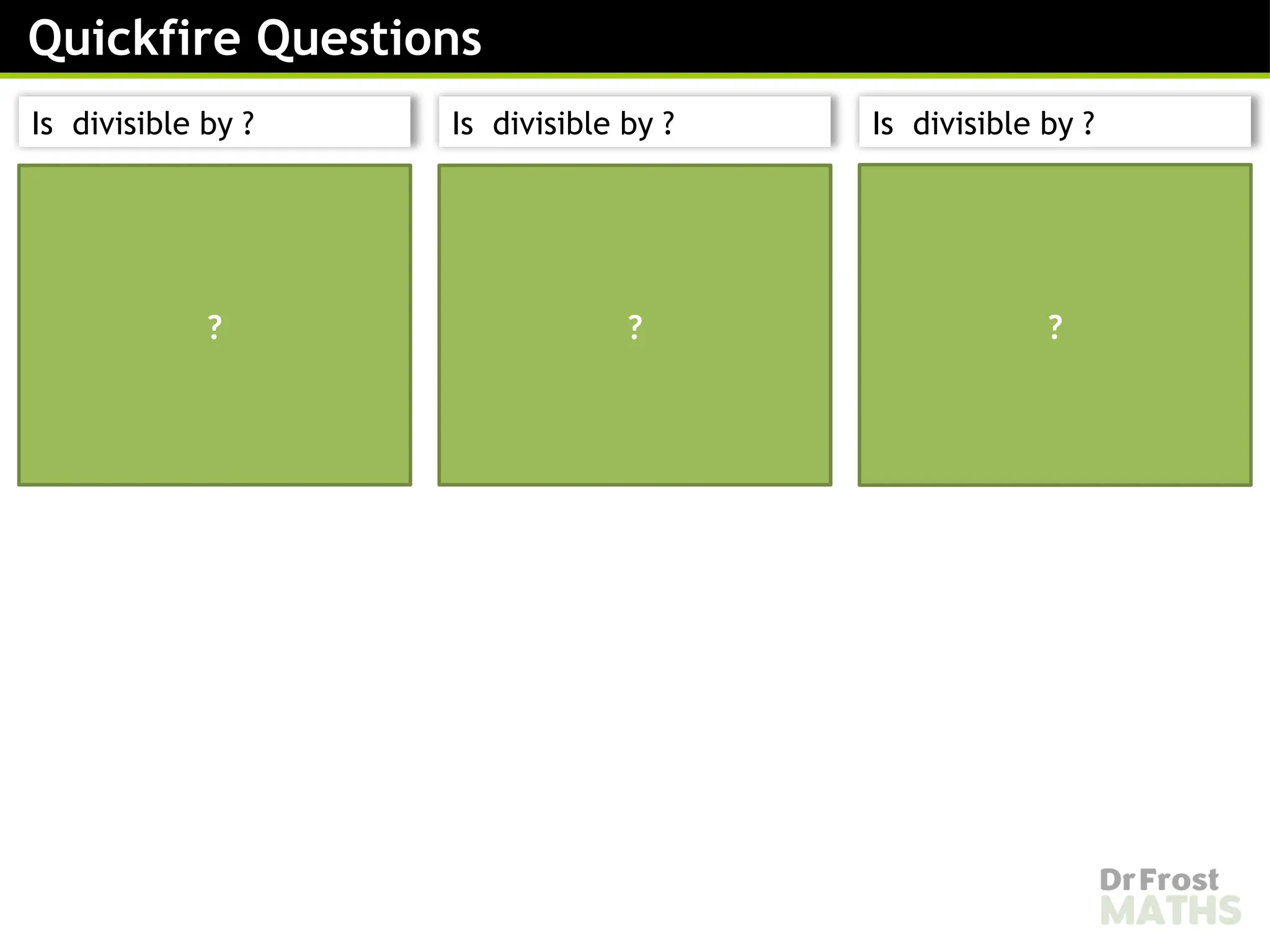
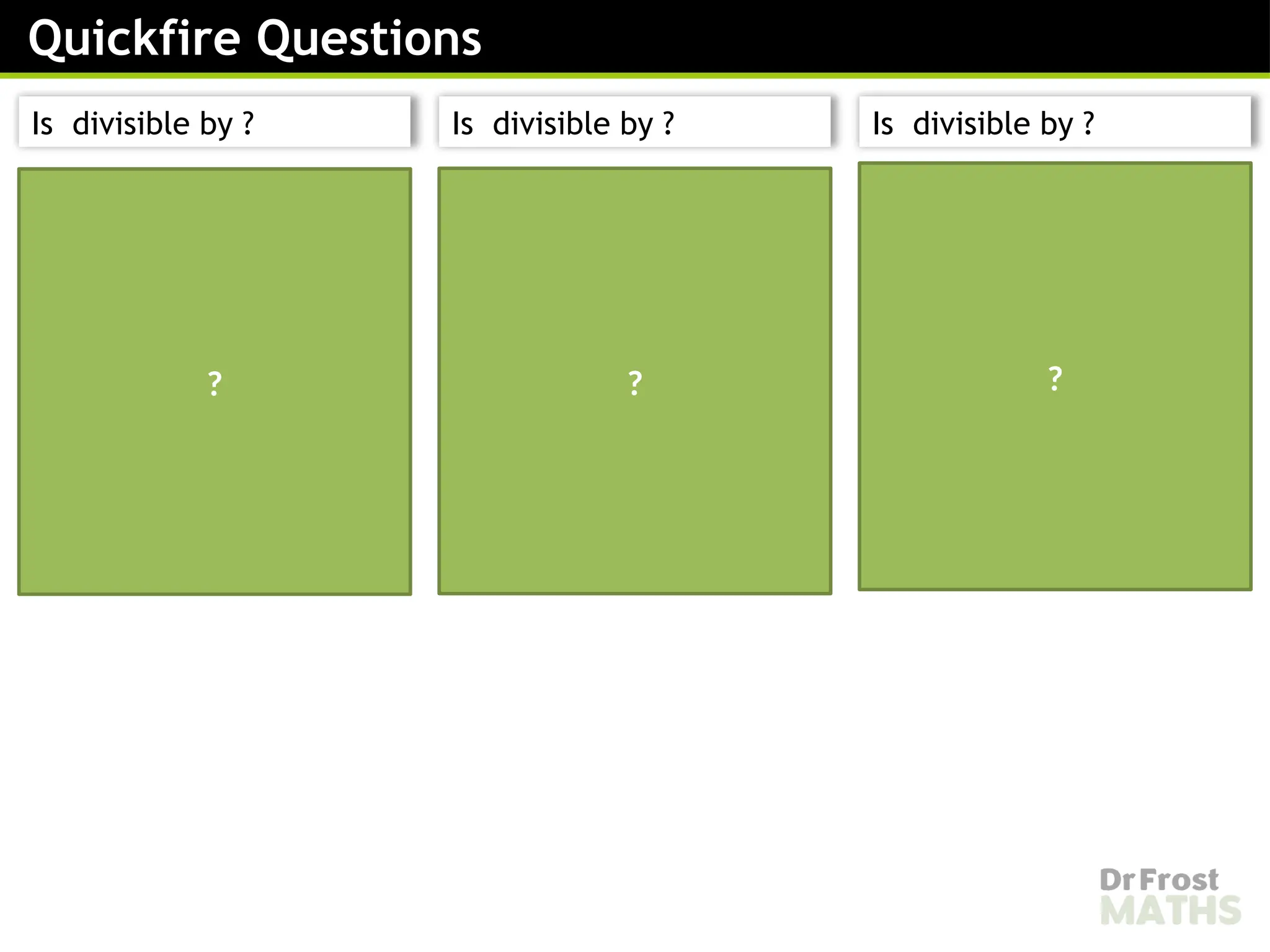
Quickfire Questions
Is divisible by ? Is divisible by ? Is divisible by ?
Is divisible by ? Is divisible by ? Is divisible by and/or ?
Yes, because it ends in
an even digit.
No, because it doesn’t
end in a or a .
Yes, because it ends in a
.
No, because it doesn’t
end in a .
Yes, because it ends in
an even digit.
? ? ?
? ?
10.
The Big Idea:Divisibility Rules 163a
drfrost.org/s/
Mrs Clark
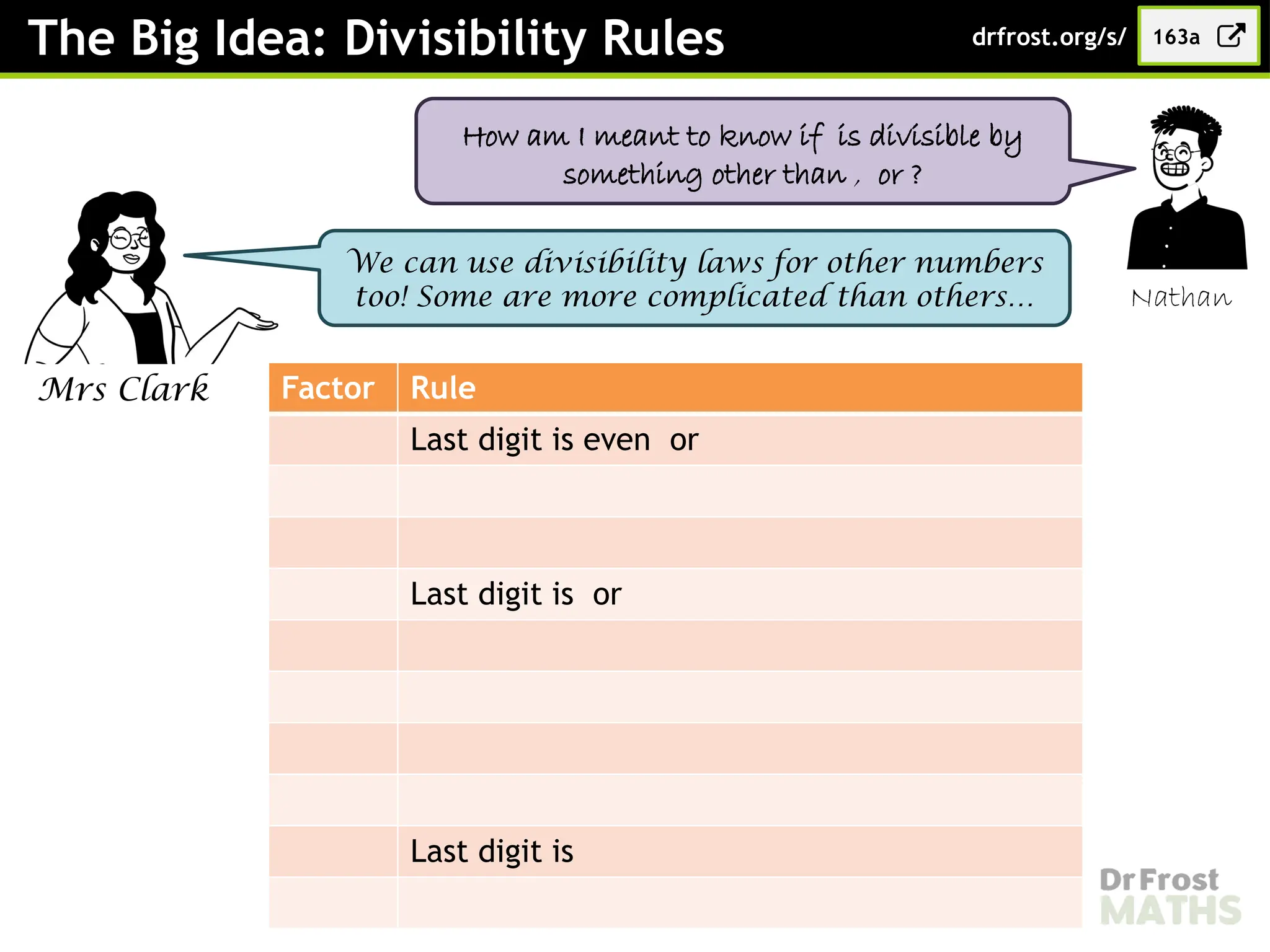
We can use divisibility laws for other numbers
too! Some are more complicated than others… Nathan
How am I meant to know if is divisible by
something other than , or ?
Factor Rule
Last digit is even or
Last digit is or
Last digit is
11.
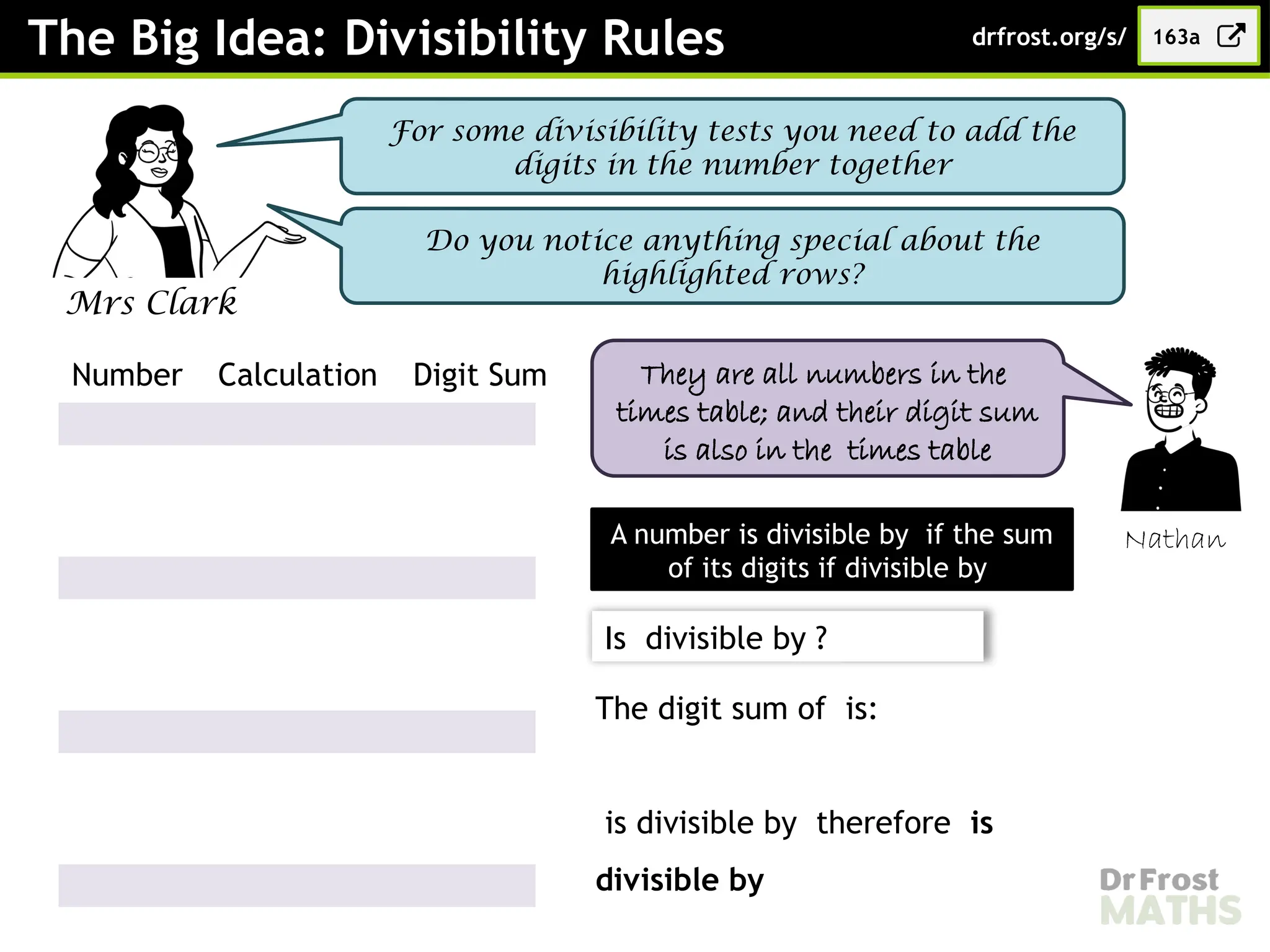
Do you noticeanything special about the
highlighted rows?
The Big Idea: Divisibility Rules
Mrs Clark
For some divisibility tests you need to add the
digits in the number together
163a
drfrost.org/s/
Number Calculation Digit Sum
Nathan
They are all numbers in the
times table; and their digit sum
is also in the times table
A number is divisible by if the sum
of its digits if divisible by
Is divisible by ?
The digit sum of is:
is divisible by therefore is
divisible by
12.
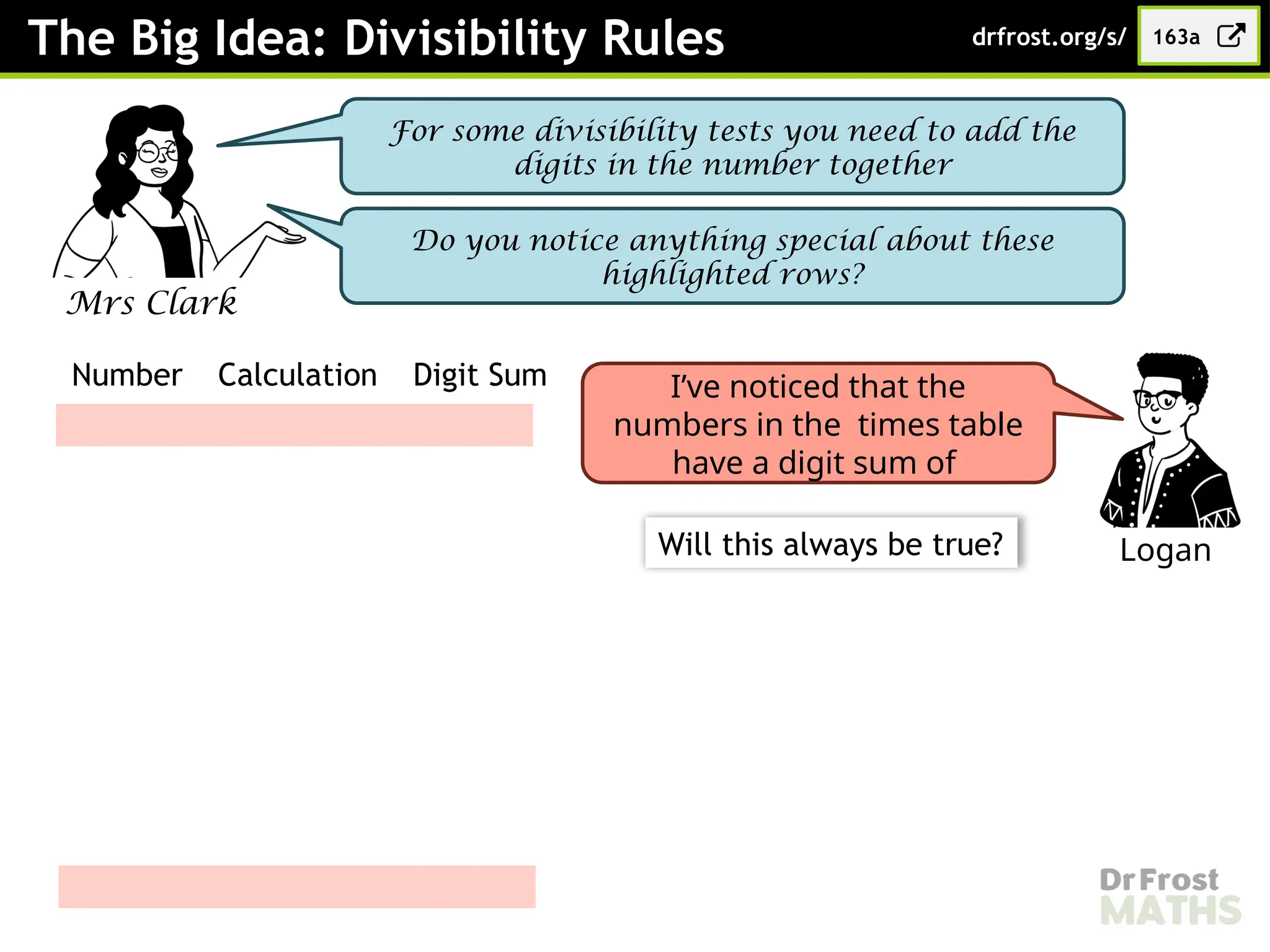
Number Calculation DigitSum
Do you notice anything special about these
highlighted rows?
The Big Idea: Divisibility Rules
Mrs Clark
For some divisibility tests you need to add the
digits in the number together
163a
drfrost.org/s/
Logan
I’ve noticed that the
numbers in the times table
have a digit sum of
Will this always be true?
13.
The Big Idea:Divisibility Rules 163a
drfrost.org/s/
Mrs Clark
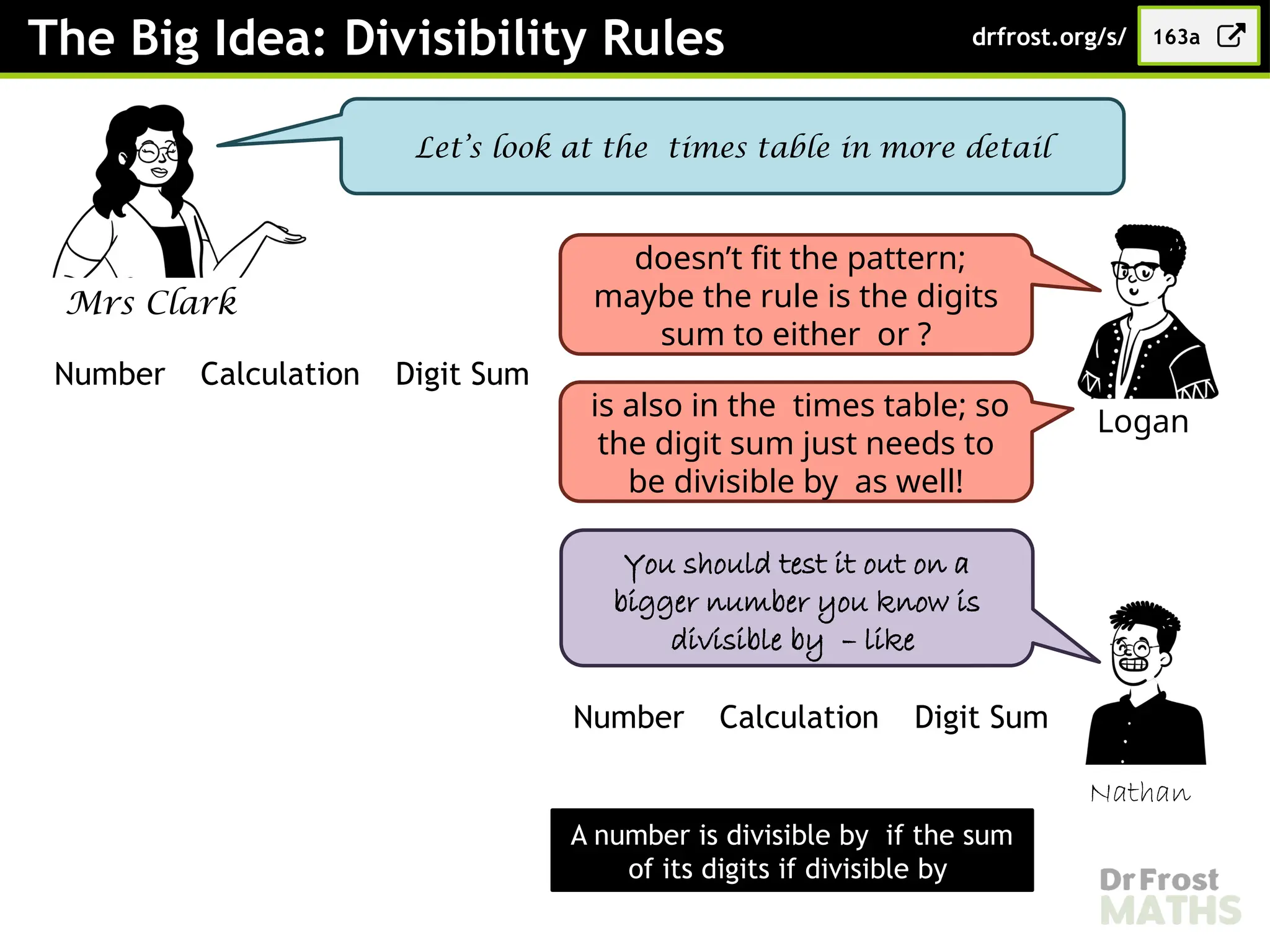
Let’s look at the times table in more detail
Number Calculation Digit Sum
Logan
doesn’t fit the pattern;
maybe the rule is the digits
sum to either or ?
Nathan
You should test it out on a
bigger number you know is
divisible by – like
Number Calculation Digit Sum
is also in the times table; so
the digit sum just needs to
be divisible by as well!
A number is divisible by if the sum
of its digits if divisible by
14.
is not divisibleby or
therefore is not
divisible by or
?
is divisible by therefore
is divisible by .
is divisible by therefore
is divisible by
is not divisible by
therefore is not
divisible by .
is divisible by and
therefore is divisible by
both and .
is divisible by but not
by , therefore is
divisible by but not by
? ? ?
? ?
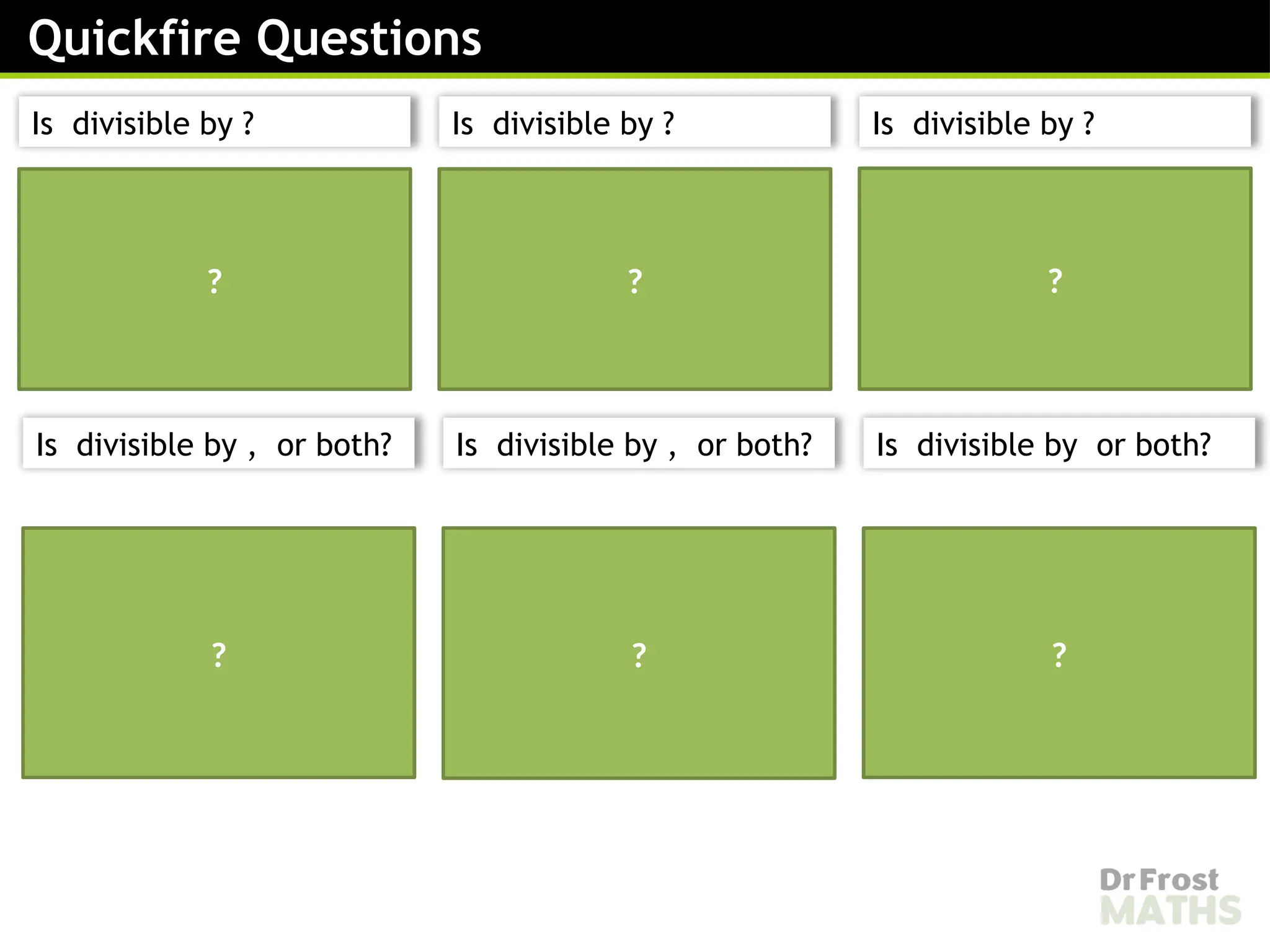
Quickfire Questions
Is divisible by ? Is divisible by ? Is divisible by ?
Is divisible by , or both? Is divisible by , or both? Is divisible by or both?
15.
The Big Idea:Divisibility Rules
Mrs Clark
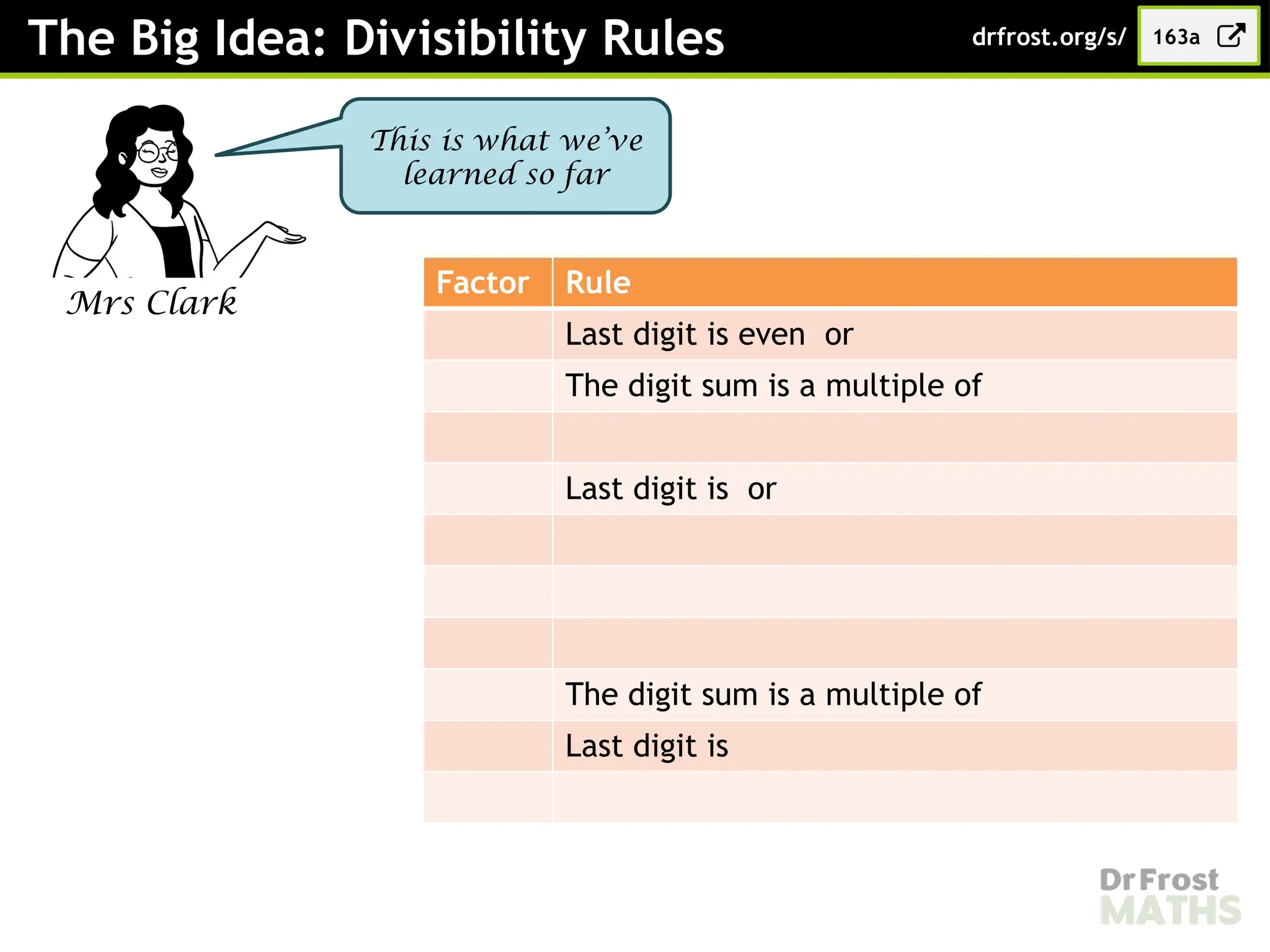
This is what we’ve
learned so far
Factor Rule
Last digit is even or
The digit sum is a multiple of
Last digit is or
The digit sum is a multiple of
Last digit is
163a
drfrost.org/s/
16.
Example: Checking divisibilityby or
Factor Rule
Last digit is even or
The digit sum is a multiple of
Last digit is or
The digit sum is a multiple of
Last digit is
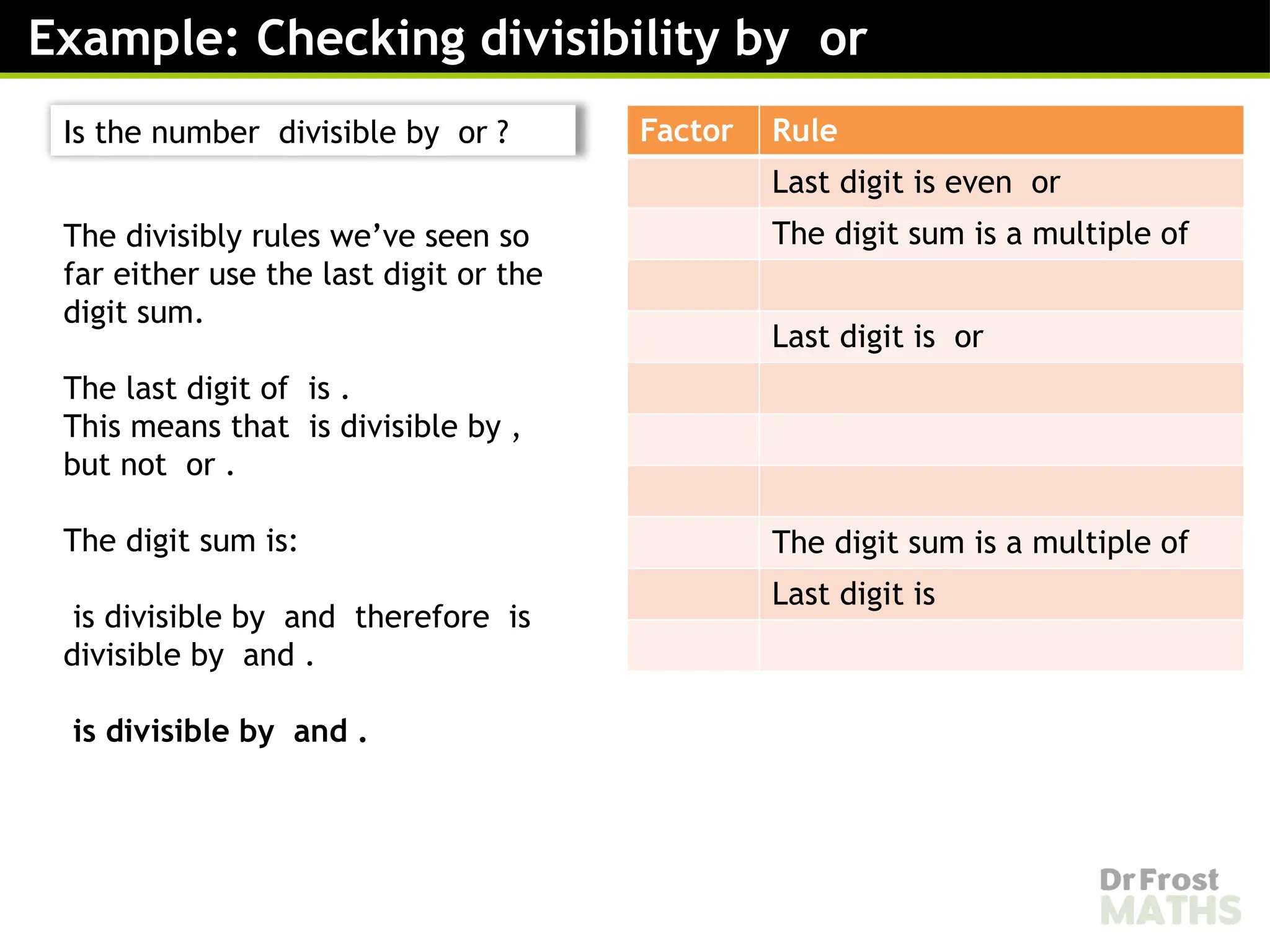
Is the number divisible by or ?
The divisibly rules we’ve seen so
far either use the last digit or the
digit sum.
The last digit of is .
This means that is divisible by ,
but not or .
The digit sum is:
is divisible by and therefore is
divisible by and .
is divisible by and .
17.
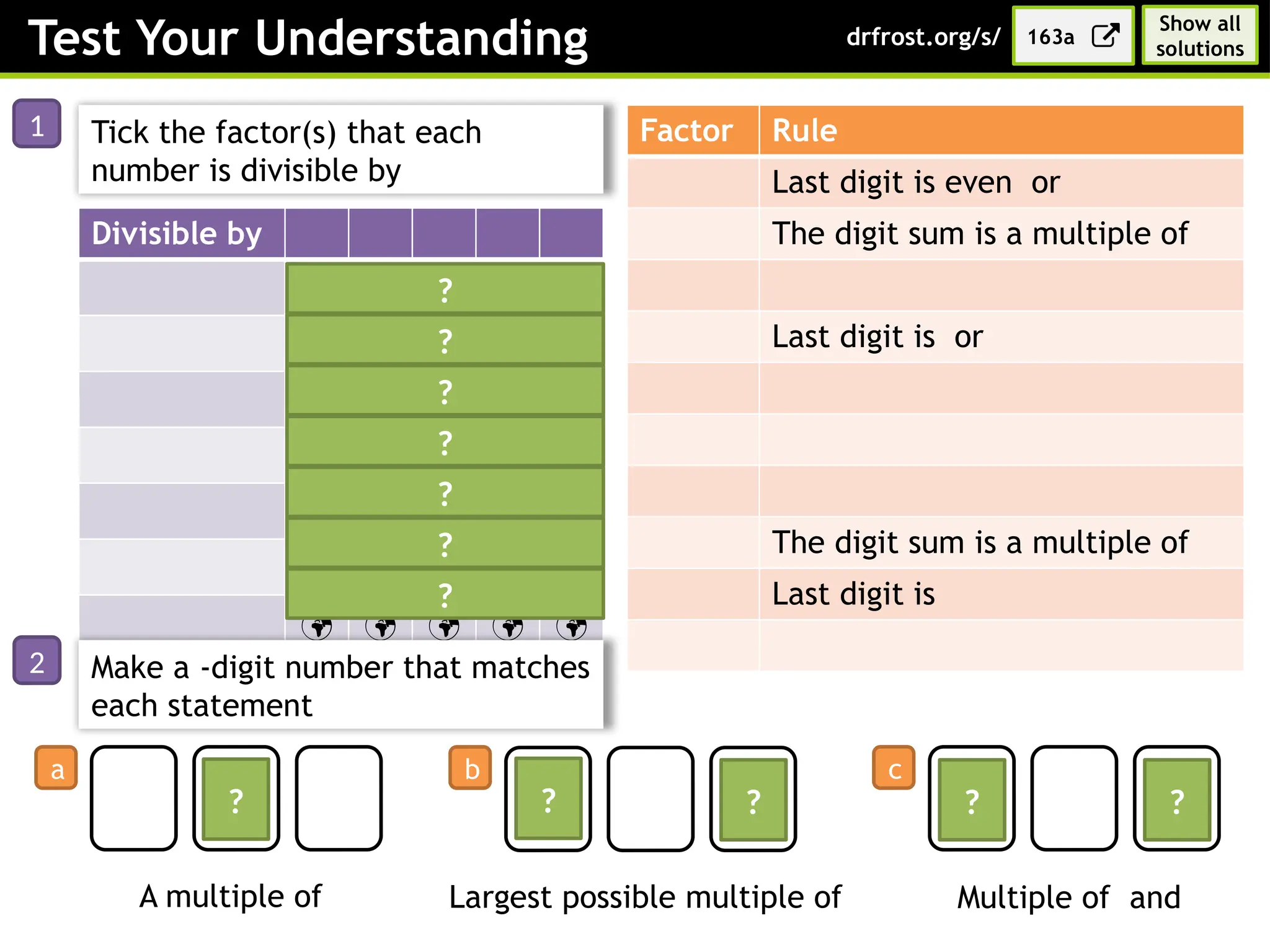
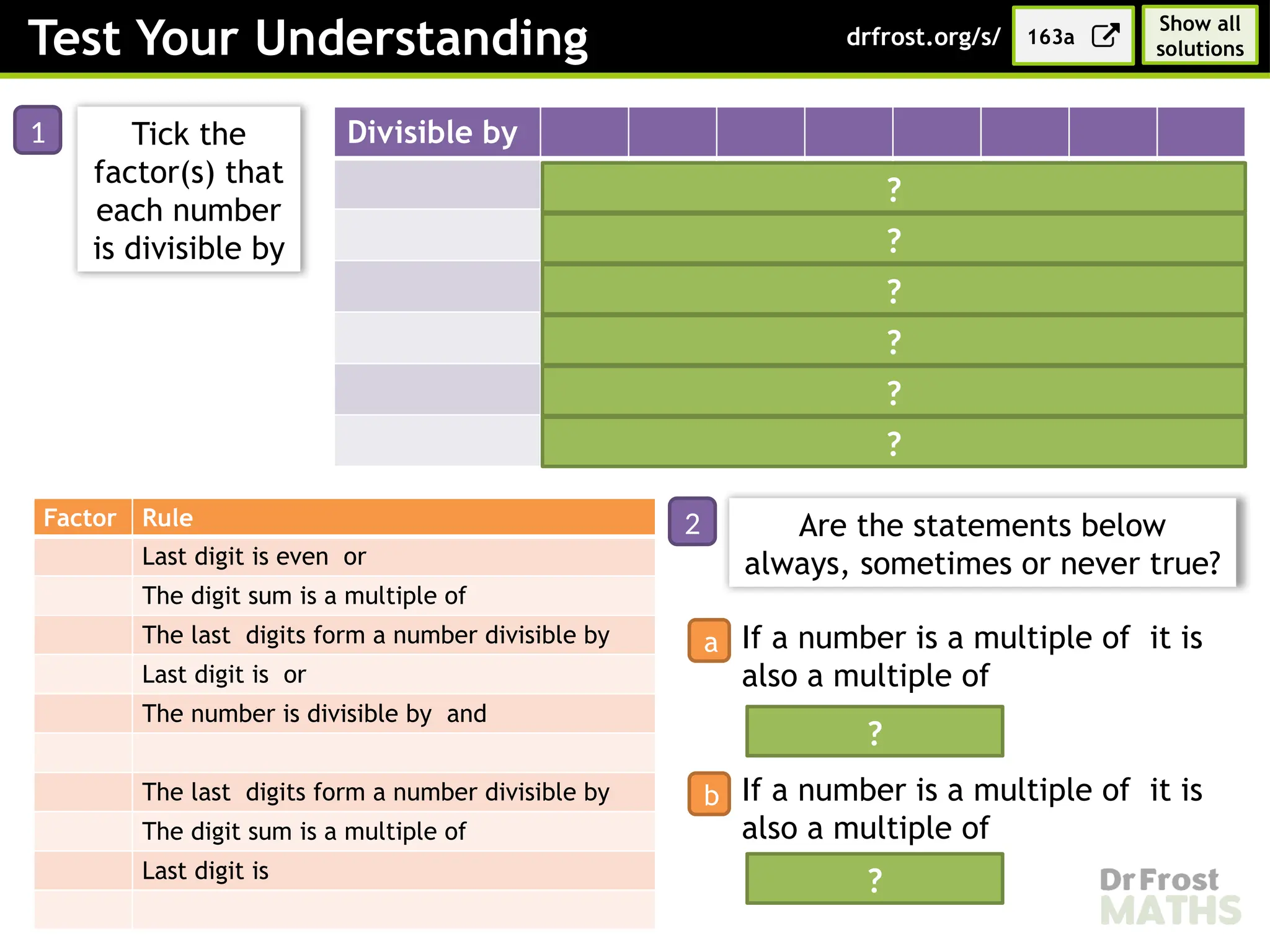
Test Your Understanding
FactorRule
Last digit is even or
The digit sum is a multiple of
Last digit is or
The digit sum is a multiple of
Last digit is
Divisible by
Tick the factor(s) that each
number is divisible by
?
?
?
?
?
?
?
Make a -digit number that matches
each statement
A multiple of Largest possible multiple of Multiple of and
? ? ? ? ?
163a
drfrost.org/s/
1
2
a b c
Show all
solutions
18.
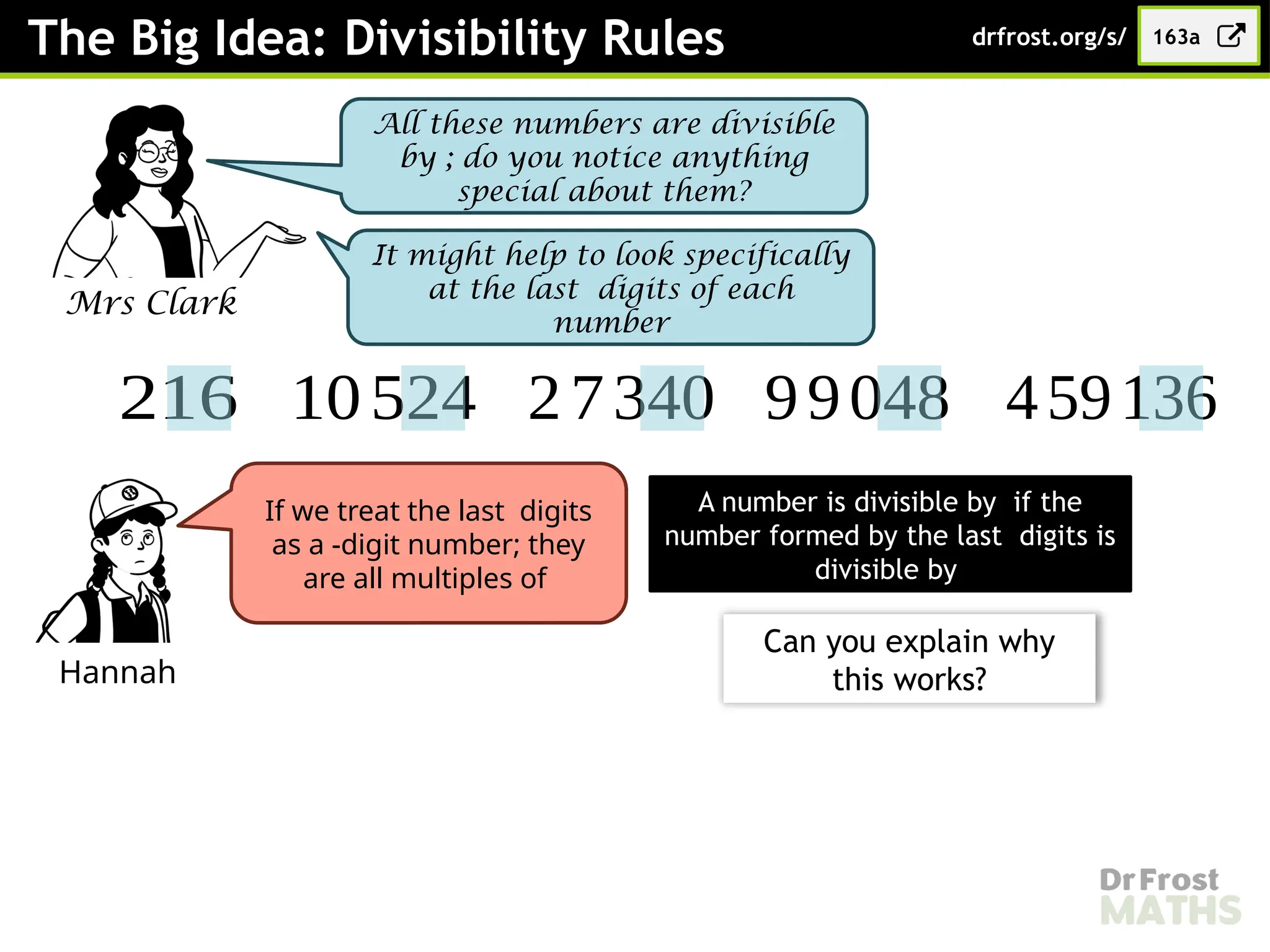
The Big Idea:Divisibility Rules
Mrs Clark
All these numbers are divisible
by ; do you notice anything
special about them?
163a
drfrost.org/s/
216 10524 27340 99048 459136
It might help to look specifically
at the last digits of each
number
Hannah
If we treat the last digits
as a -digit number; they
are all multiples of
A number is divisible by if the
number formed by the last digits is
divisible by
Can you explain why
this works?
19.
The Big Idea:Divisibility Rules 163a
drfrost.org/s/
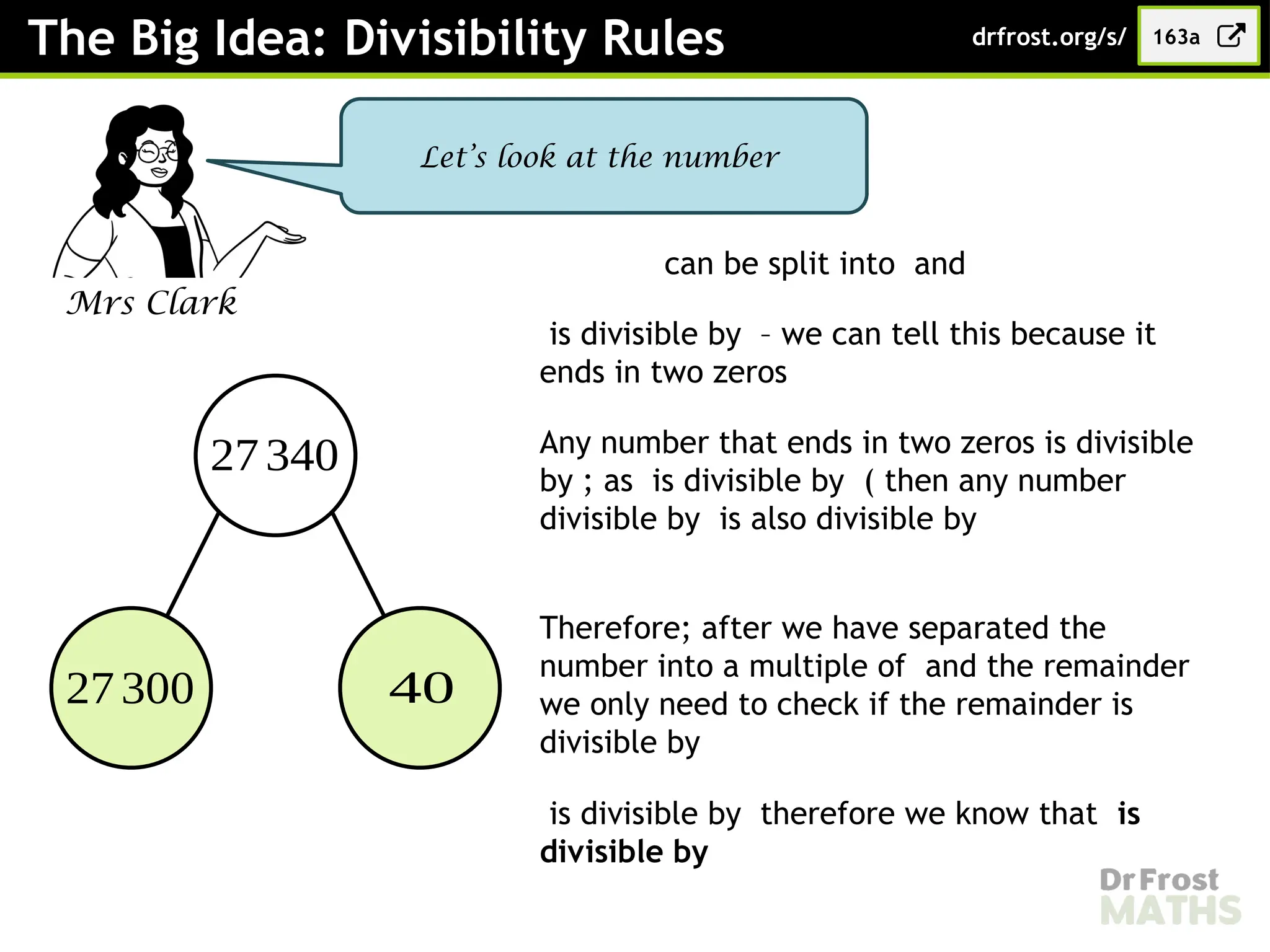
Mrs Clark
Let’s look at the number
27340
27300 40
can be split into and
is divisible by – we can tell this because it
ends in two zeros
Any number that ends in two zeros is divisible
by ; as is divisible by ( then any number
divisible by is also divisible by
Therefore; after we have separated the
number into a multiple of and the remainder
we only need to check if the remainder is
divisible by
is divisible by therefore we know that is
divisible by
20.
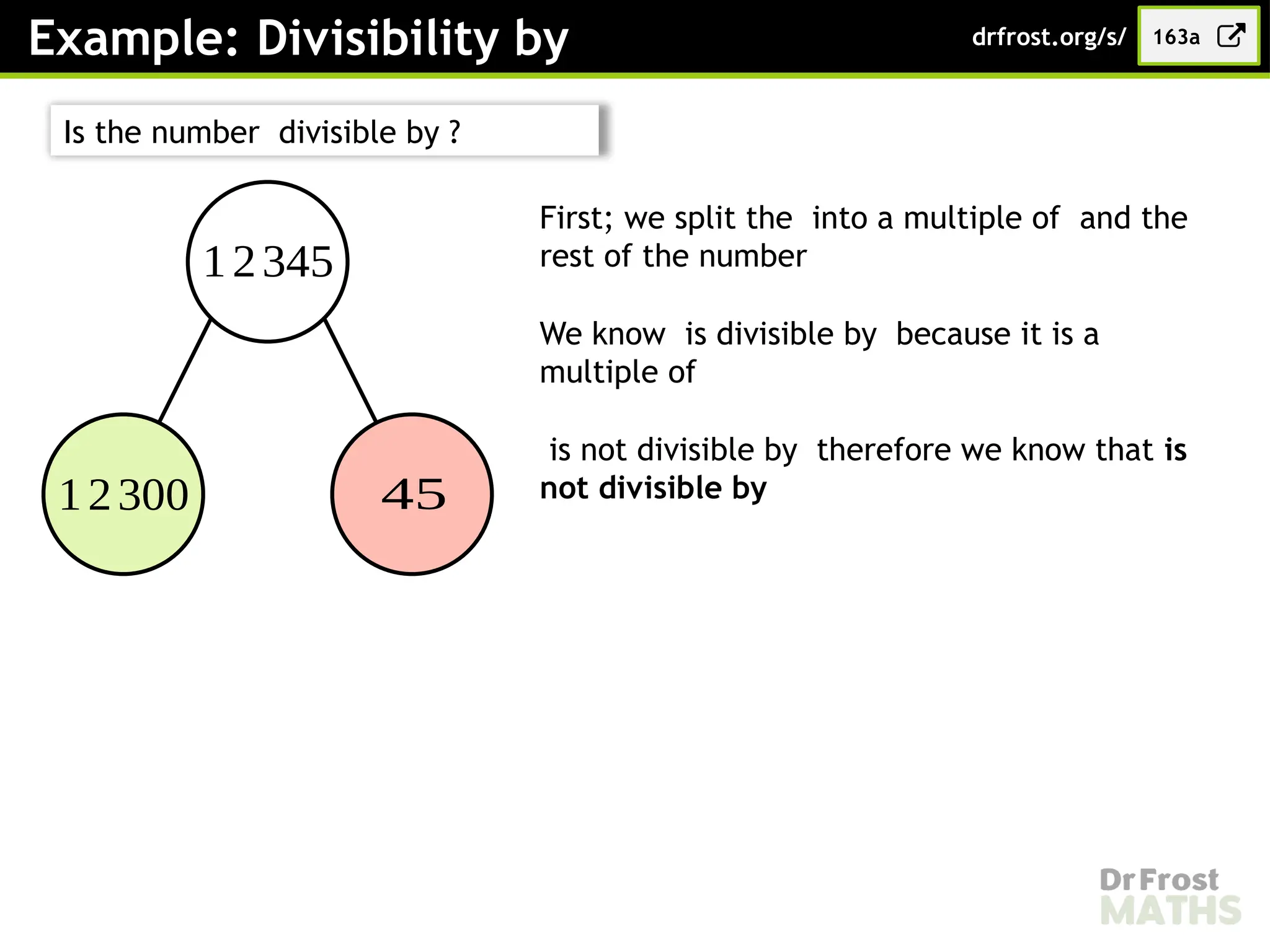
Example: Divisibility by163a
drfrost.org/s/
12345
12300 45
First; we split the into a multiple of and the
rest of the number
We know is divisible by because it is a
multiple of
is not divisible by therefore we know that is
not divisible by
Is the number divisible by ?
21.
is divisible by
isalso divisible by
Therefore is divisible
by .
is divisible by
is not divisible by
Therefore is not
divisible by .
is divisible by
is divisible by
Therefore is divisible
by
? ? ?
Quickfire Questions
Is divisible by ? Is divisible by ? Is divisible by ?
22.
The Big Idea:Divisibility Rules
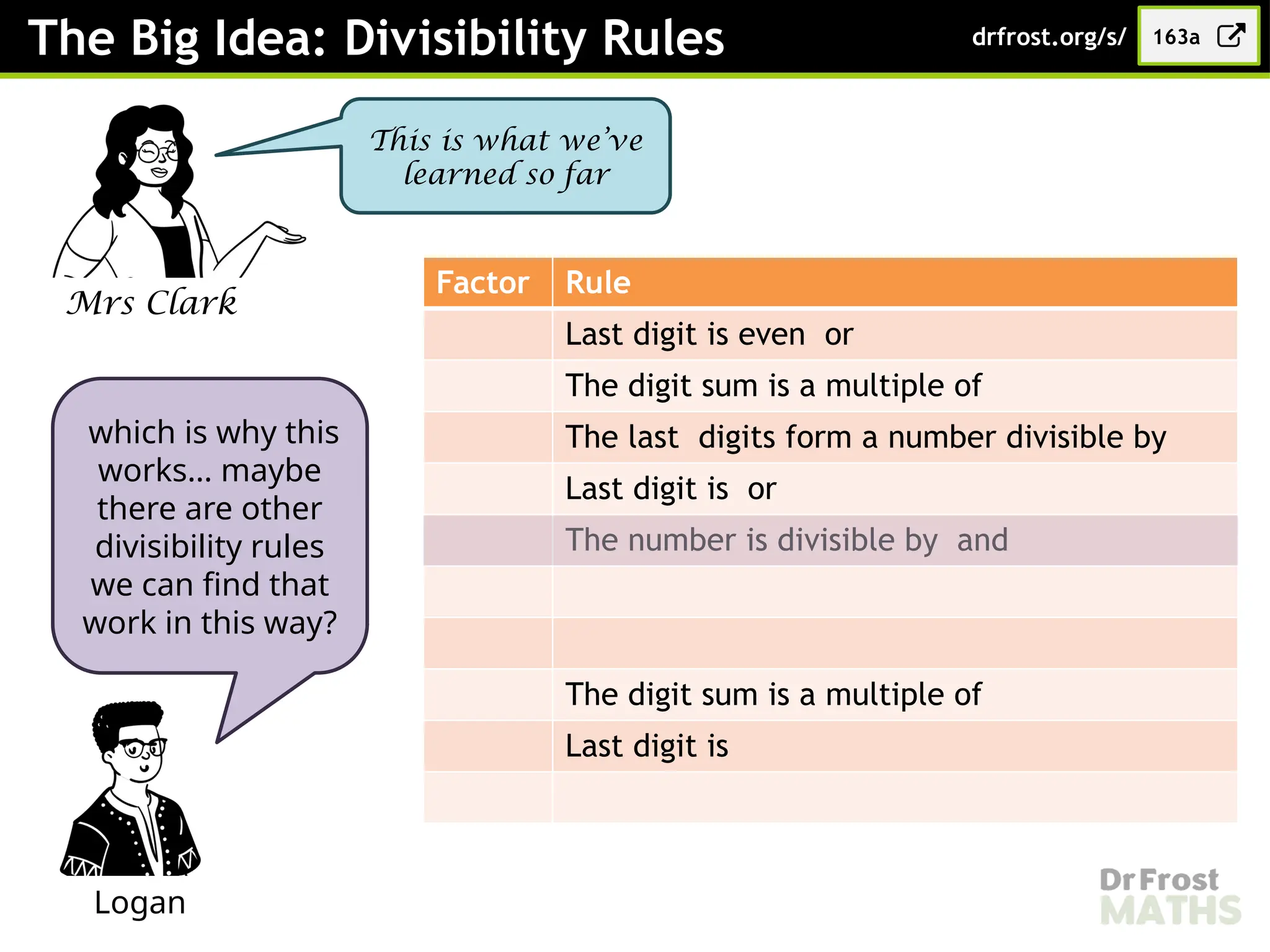
Mrs Clark
This is what we’ve
learned so far
Factor Rule
Last digit is even or
The digit sum is a multiple of
The last digits form a number divisible by
Last digit is or
The digit sum is a multiple of
Last digit is
163a
drfrost.org/s/
23.
The Big Idea:Divisibility Rules 163a
drfrost.org/s/
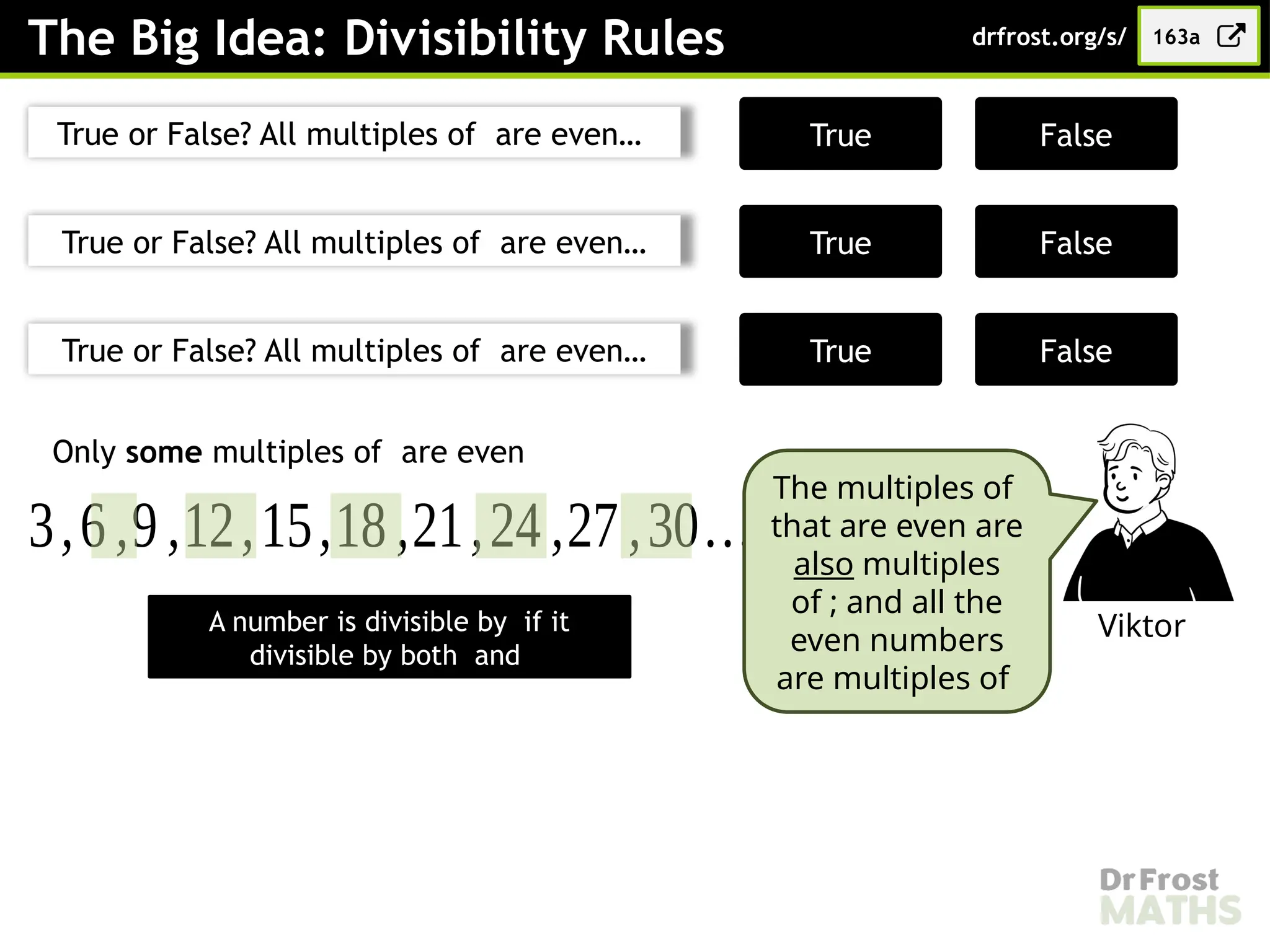
True or False? All multiples of are even…
True or False? All multiples of are even…
True or False? All multiples of are even…
False
True
True False
False
True
Only some multiples of are even
3,6,9,12,15,18,21,24 ,27 ,30…
Viktor
The multiples of
that are even are
also multiples
of ; and all the
even numbers
are multiples of
A number is divisible by if it
divisible by both and
24.
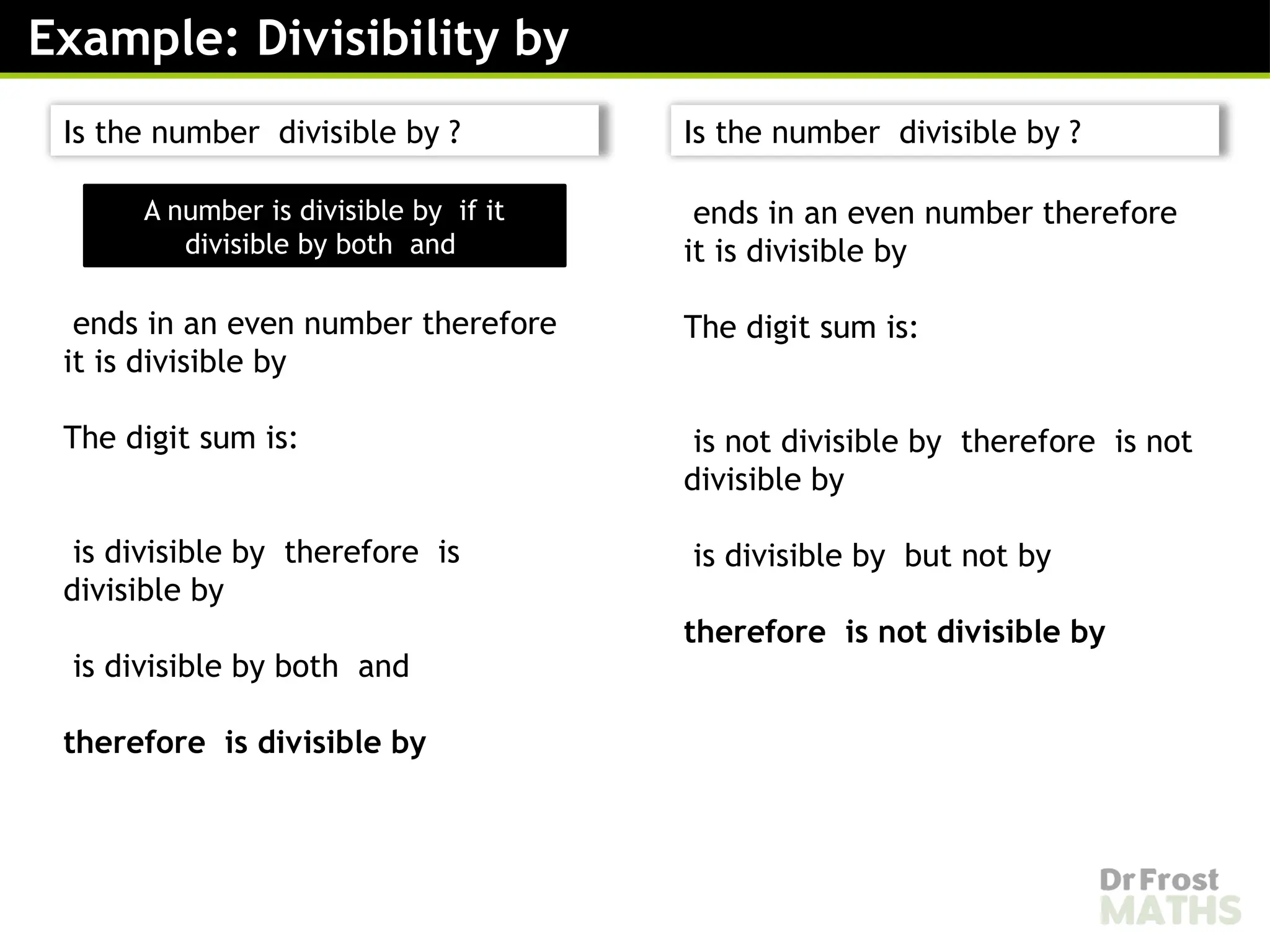
Example: Divisibility by
Isthe number divisible by ?
ends in an even number therefore
it is divisible by
The digit sum is:
is divisible by therefore is
divisible by
is divisible by both and
therefore is divisible by
A number is divisible by if it
divisible by both and
Is the number divisible by ?
ends in an even number therefore
it is divisible by
The digit sum is:
is not divisible by therefore is not
divisible by
is divisible by but not by
therefore is not divisible by
25.
ends in aneven digit
therefore is divisible by
The digit sum is:
is not divisible by
therefore is not divisible
by
is not divisible by
ends in an even digit
therefore is divisible by
The digit sum is:
is divisible by therefore
is divisible by
is divisible by
ends in an odd digit
therefore is not divisible
by
We don’t need to check
if the number is divisible
by as well
is not divisible by
? ? ?
Quickfire Questions
Is divisible by ? Is divisible by ? Is divisible by ?
26.
The Big Idea:Divisibility Rules
Mrs Clark
This is what we’ve
learned so far
Factor Rule
Last digit is even or
The digit sum is a multiple of
The last digits form a number divisible by
Last digit is or
The number is divisible by and
The digit sum is a multiple of
Last digit is
163a
drfrost.org/s/
Logan
which is why this
works… maybe
there are other
divisibility rules
we can find that
work in this way?
27.
The Big Idea:Divisibility Rules
Mrs Clark
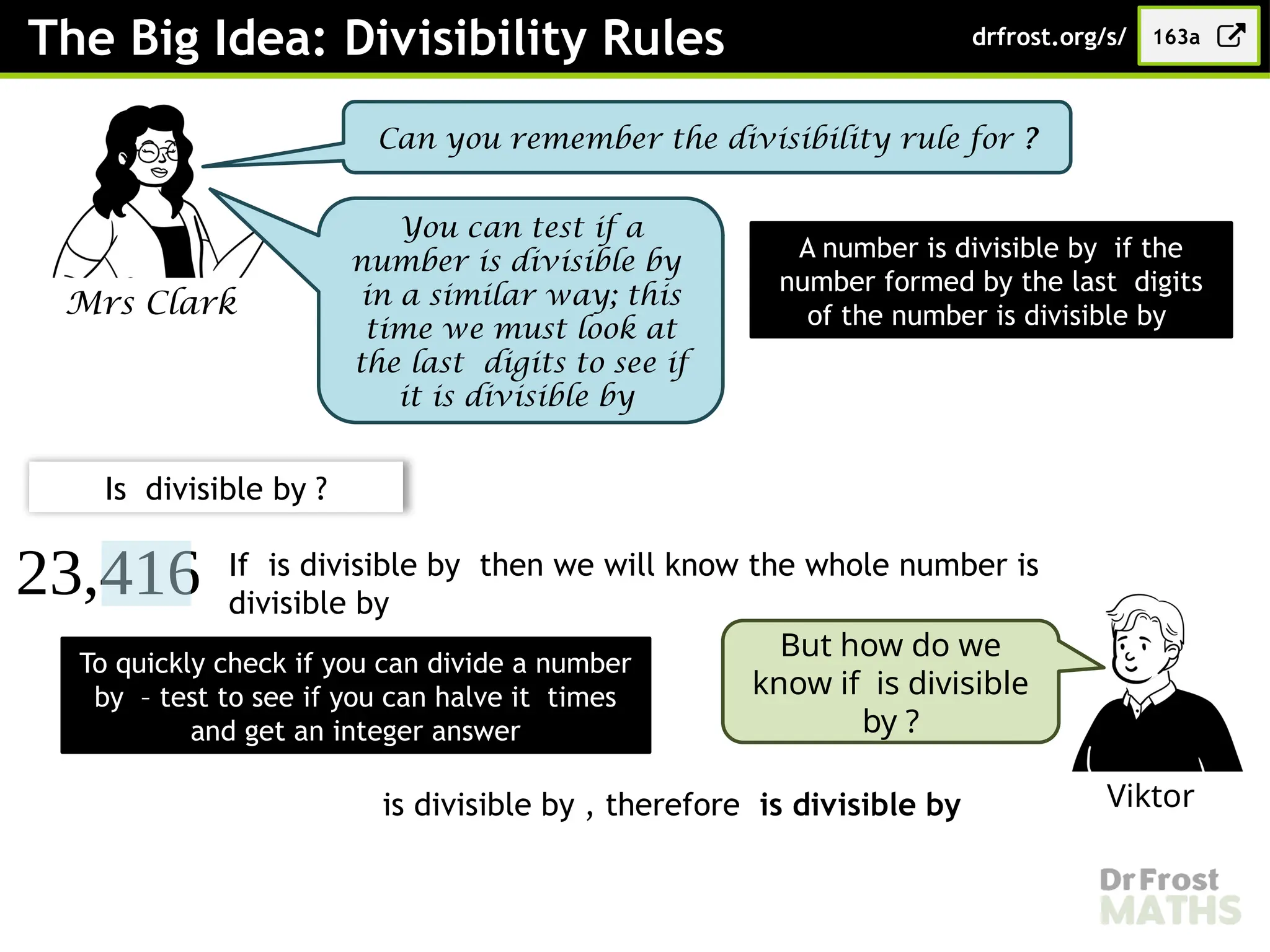
Can you remember the divisibility rule for ?
163a
drfrost.org/s/
A number is divisible by if the
number formed by the last digits
of the number is divisible by
You can test if a
number is divisible by
in a similar way; this
time we must look at
the last digits to see if
it is divisible by
23,416
Is divisible by ?
If is divisible by then we will know the whole number is
divisible by
Viktor
But how do we
know if is divisible
by ?
To quickly check if you can divide a number
by – test to see if you can halve it times
and get an integer answer
is divisible by , therefore is divisible by
28.
FYI: For YourInterest
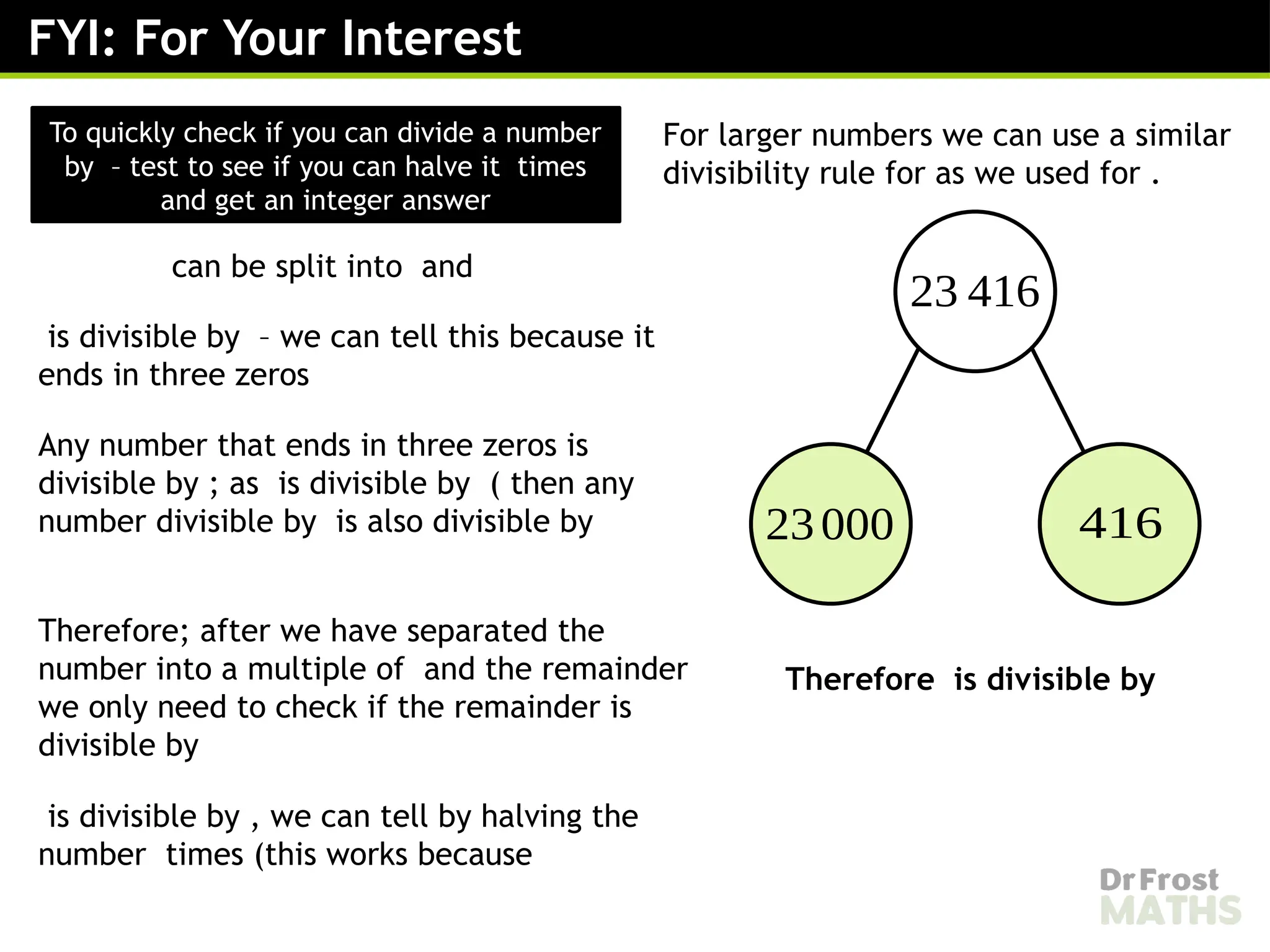
To quickly check if you can divide a number
by – test to see if you can halve it times
and get an integer answer
For larger numbers we can use a similar
divisibility rule for as we used for .
23 416
23000 416
can be split into and
is divisible by – we can tell this because it
ends in three zeros
Any number that ends in three zeros is
divisible by ; as is divisible by ( then any
number divisible by is also divisible by
Therefore; after we have separated the
number into a multiple of and the remainder
we only need to check if the remainder is
divisible by
is divisible by , we can tell by halving the
number times (this works because
Therefore is divisible by
29.
is divisible by
isnot an integer
therefore is not divisible
by
Therefore is not
divisible by .
is divisible by
is an integer therefore
is divisible by
Therefore is divisible
by .
is divisible by
is an integer therefore
is divisible by
Therefore is divisible
by
? ? ?
Quickfire Questions
Is divisible by ? Is divisible by ? Is divisible by ?
30.
Test Your Understanding
FactorRule
Last digit is even or
The digit sum is a multiple of
The last digits form a number divisible by
Last digit is or
The number is divisible by and
The last digits form a number divisible by
The digit sum is a multiple of
Last digit is
163a
drfrost.org/s/
Divisible by
Tick the
factor(s) that
each number
is divisible by
?
?
?
?
?
?
Are the statements below
always, sometimes or never true?
If a number is a multiple of it is
also a multiple of
If a number is a multiple of it is
also a multiple of
Always true
Sometimes true
?
?
1
2
a
b
Show all
solutions
31.
Example Test YourUnderstanding
Mrs Clark
The divisibility
rules for and
are slightly less
intuitive
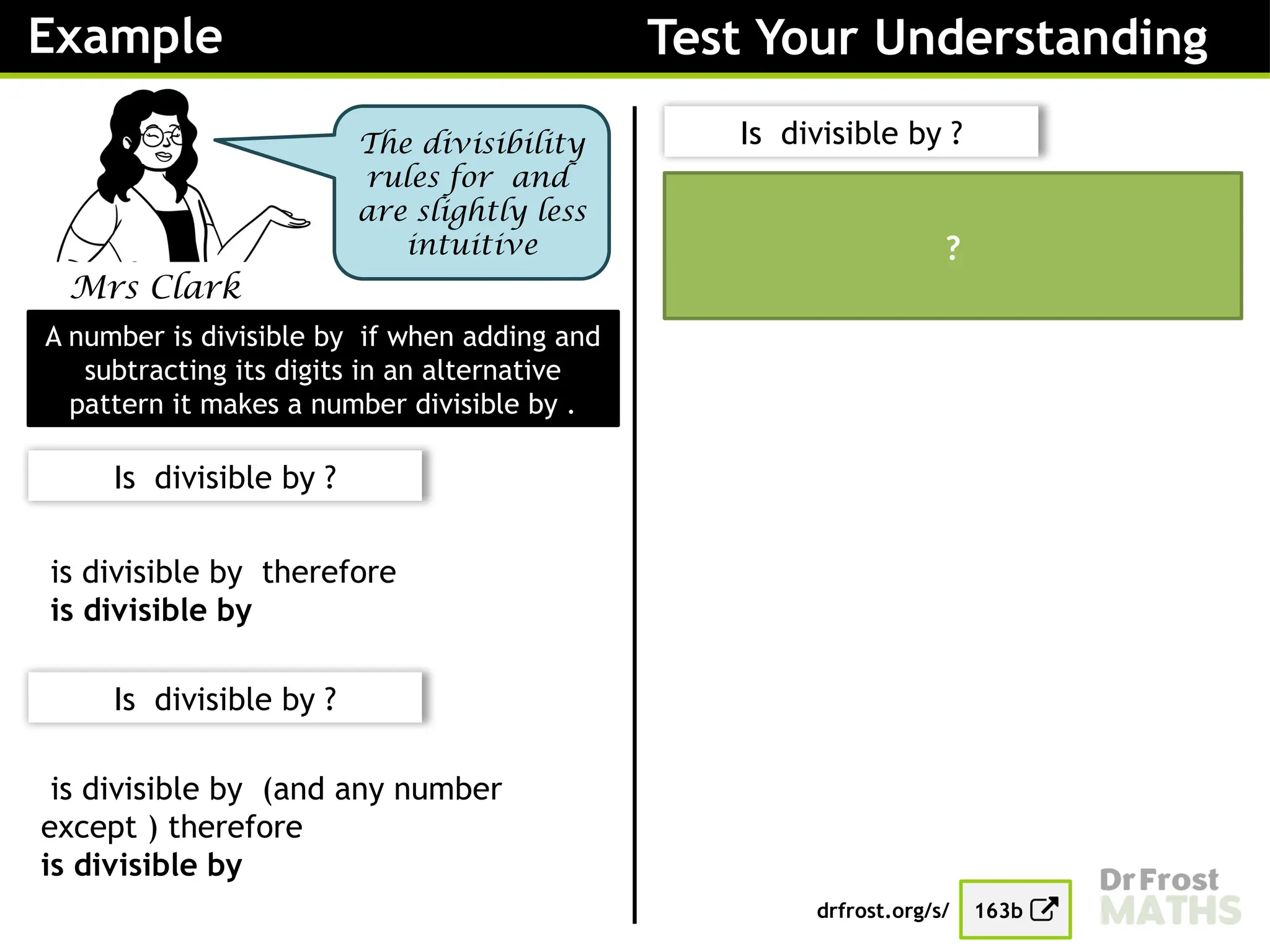
A number is divisible by if when adding and
subtracting its digits in an alternative
pattern it makes a number divisible by .
Is divisible by ?
is divisible by therefore
is divisible by
Is divisible by ?
drfrost.org/s/ 163b
Is divisible by ?
is divisible by (and any number
except ) therefore
is divisible by
is not divisible by therefore
is not divisible by
?
32.
Example Test YourUnderstanding
Mrs Clark
The divisibility
rules for and
are slightly less
intuitive
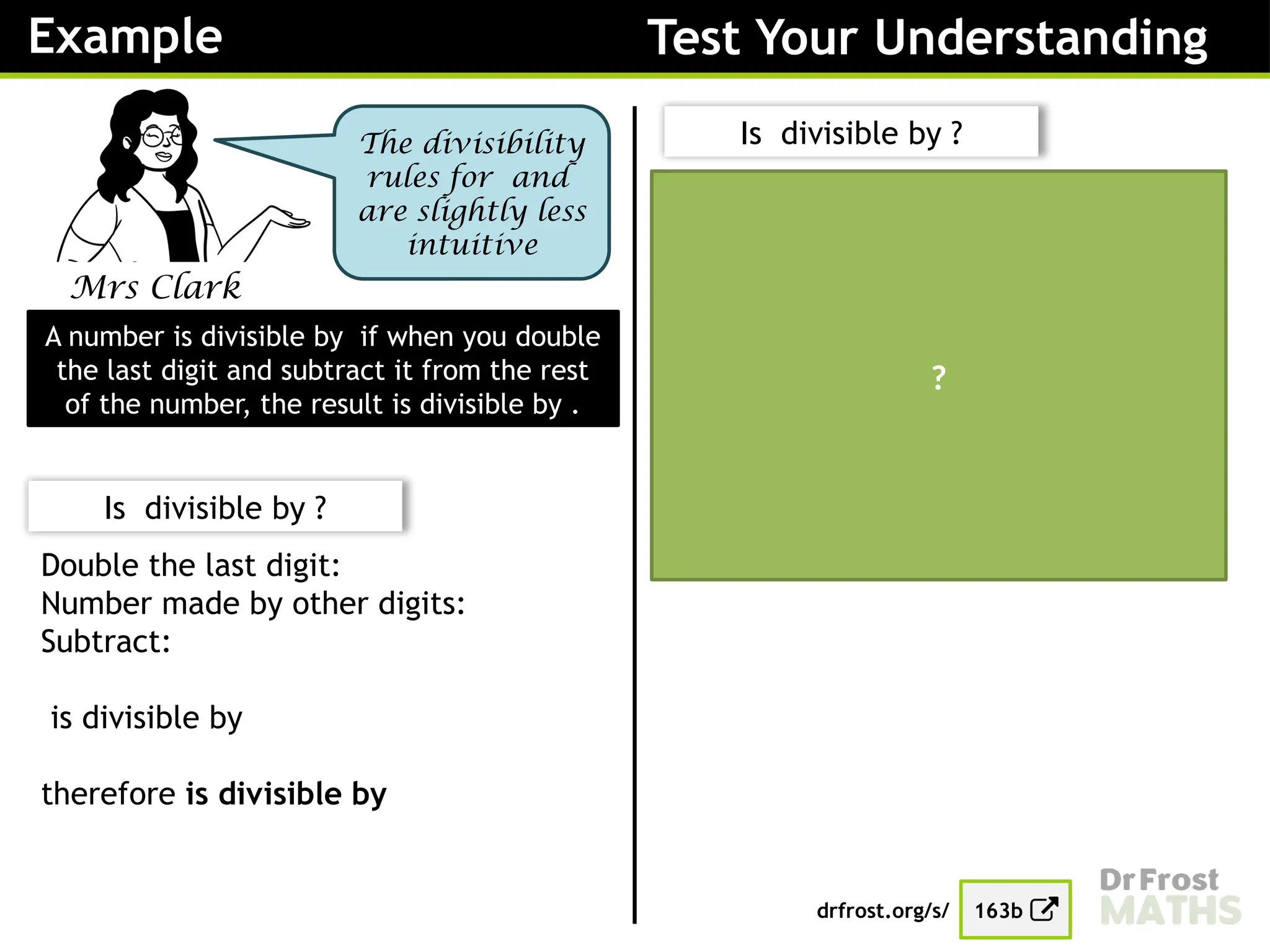
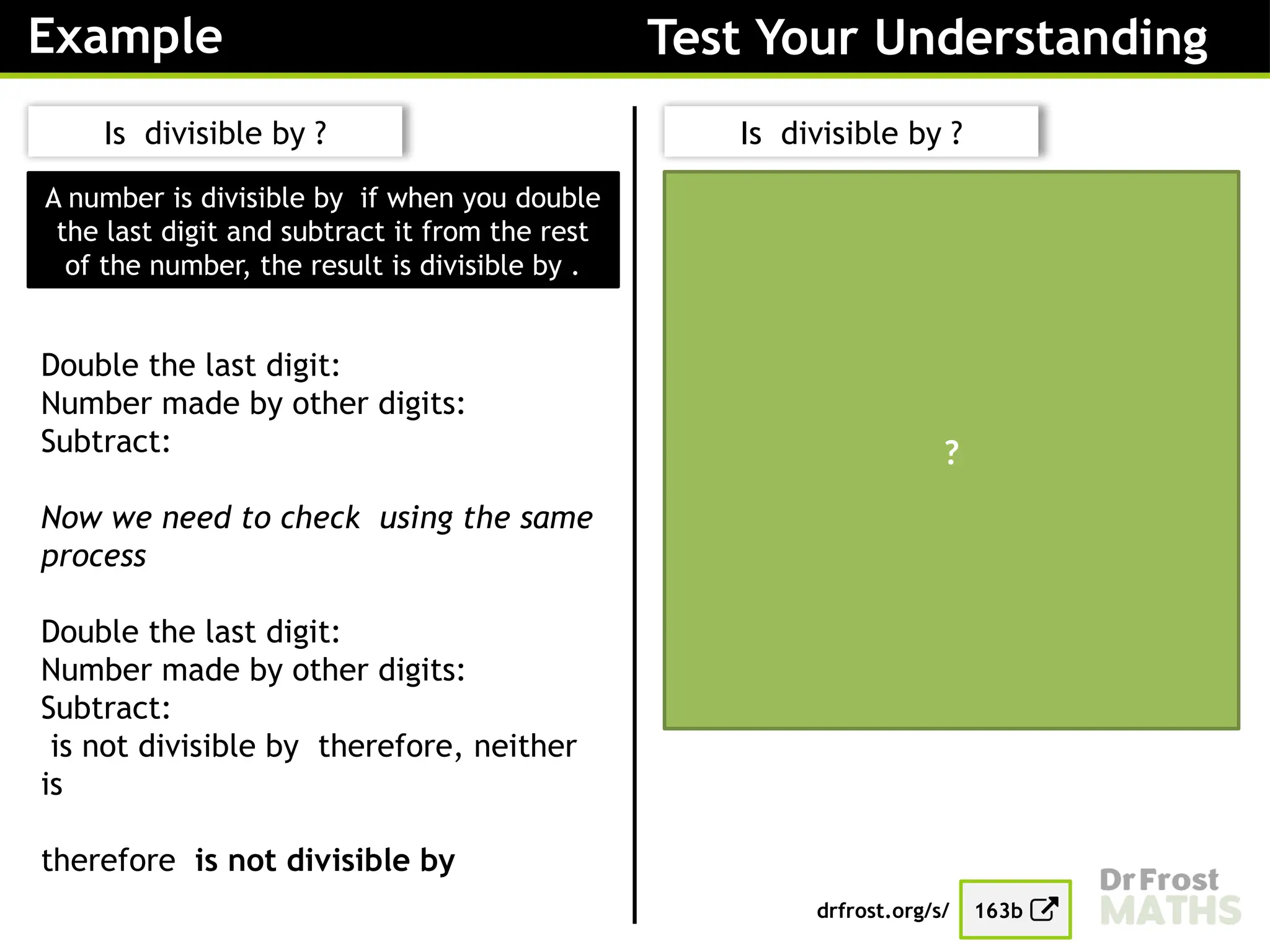
A number is divisible by if when you double
the last digit and subtract it from the rest
of the number, the result is divisible by .
Is divisible by ?
Double the last digit:
Number made by other digits:
Subtract:
is divisible by
therefore is divisible by
Is divisible by ?
Double the last digit:
Number made by other digits:
Subtract:
is divisible by
therefore is divisible by
drfrost.org/s/ 163b
?
33.
Example Test YourUnderstanding
Double the last digit:
Number made by other digits:
Subtract:
Now we need to check
Double the last digit:
Number made by other digits:
Subtract:
is not divisible by therefore, neither
is
therefore is not divisible by
?
A number is divisible by if when you double
the last digit and subtract it from the rest
of the number, the result is divisible by .
Is divisible by ?
Double the last digit:
Number made by other digits:
Subtract:
Now we need to check using the same
process
Double the last digit:
Number made by other digits:
Subtract:
is not divisible by therefore, neither
is
therefore is not divisible by
Is divisible by ?
drfrost.org/s/ 163b
34.
The Big Idea:Divisibility Rules
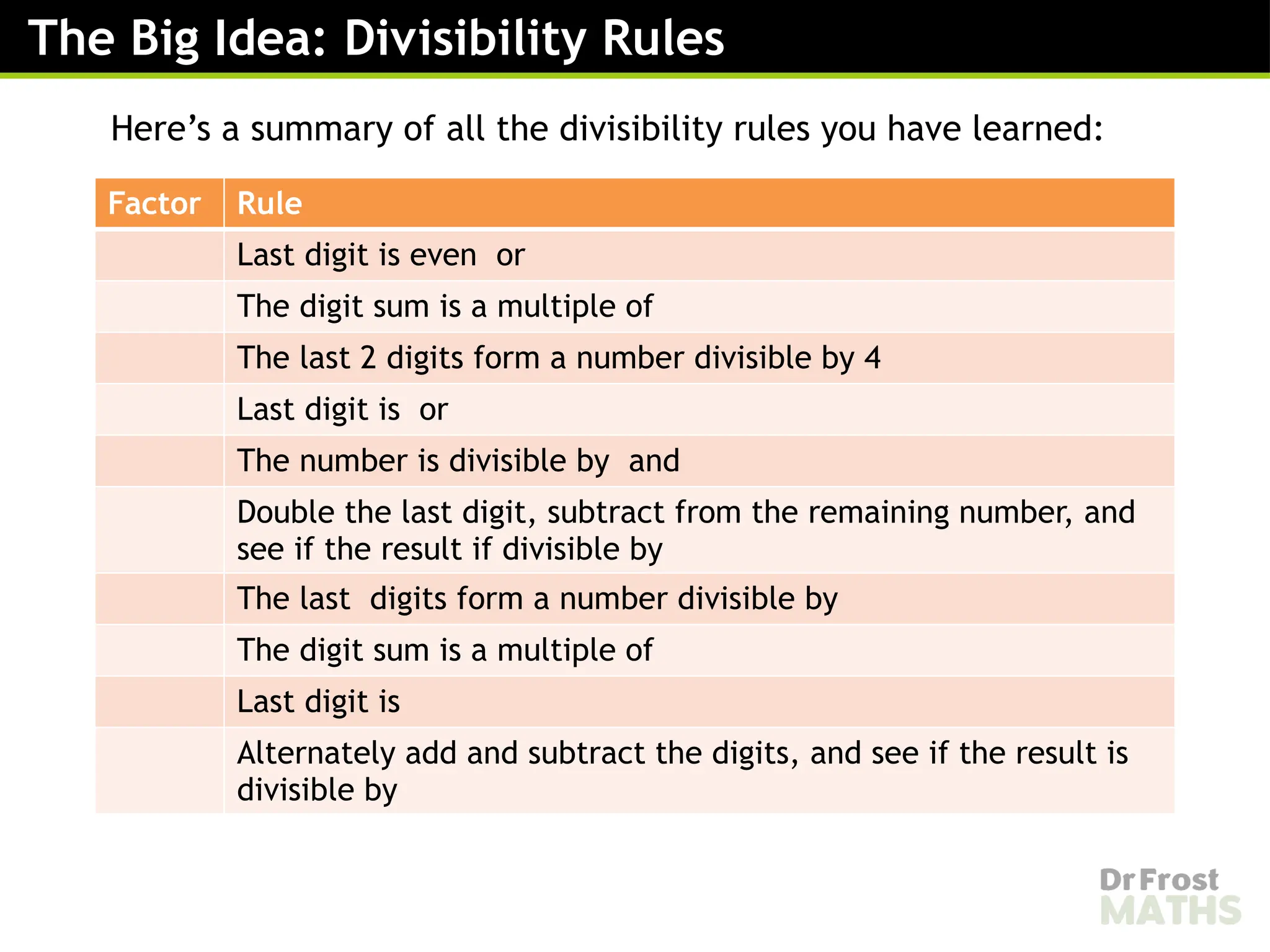
Factor Rule
Last digit is even or
The digit sum is a multiple of
The last 2 digits form a number divisible by 4
Last digit is or
The number is divisible by and
Double the last digit, subtract from the remaining number, and
see if the result if divisible by
The last digits form a number divisible by
The digit sum is a multiple of
Last digit is
Alternately add and subtract the digits, and see if the result is
divisible by
Here’s a summary of all the divisibility rules you have learned:
35.
Test Your Understanding
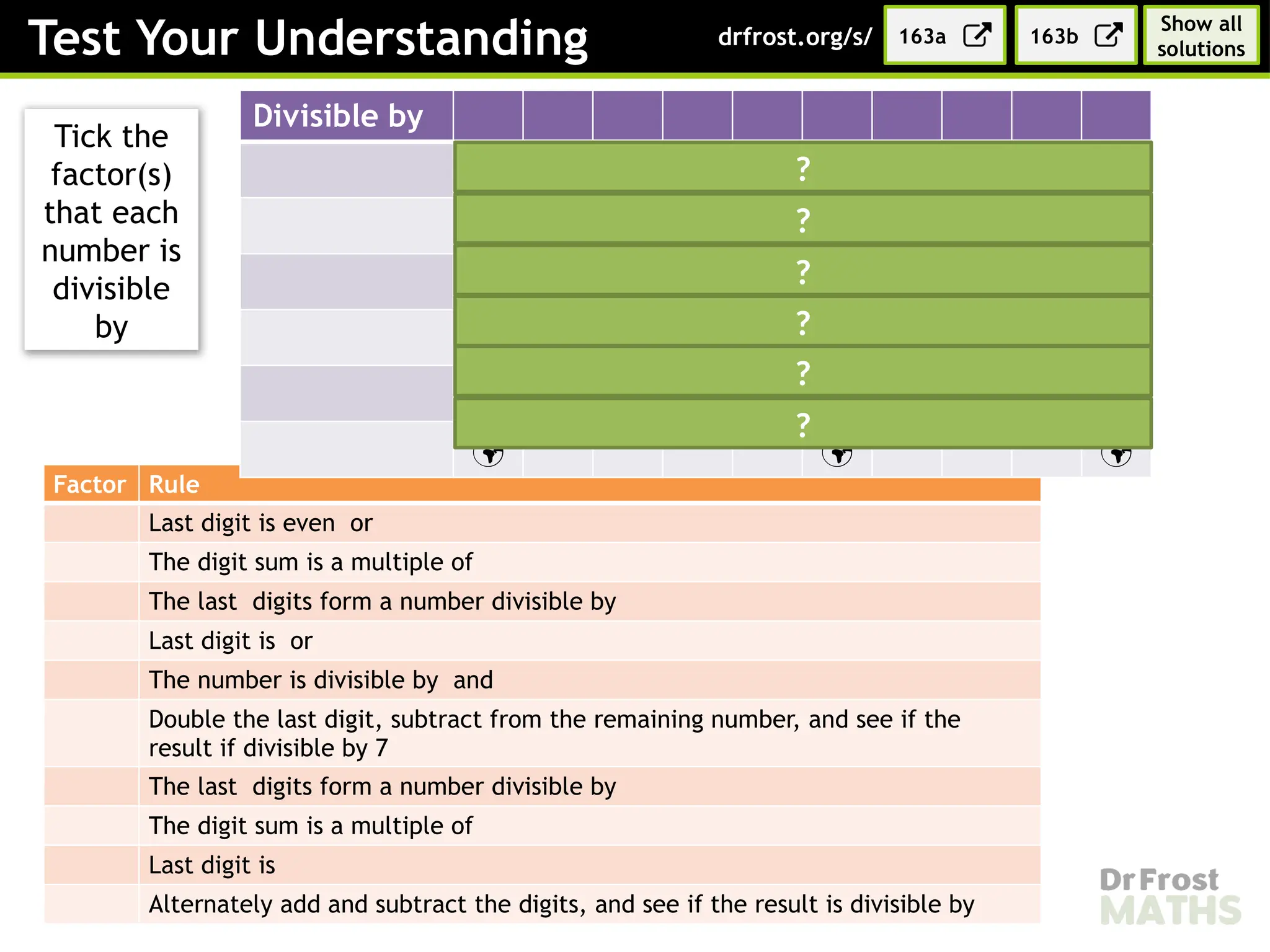
FactorRule
Last digit is even or
The digit sum is a multiple of
The last digits form a number divisible by
Last digit is or
The number is divisible by and
Double the last digit, subtract from the remaining number, and see if the
result if divisible by 7
The last digits form a number divisible by
The digit sum is a multiple of
Last digit is
Alternately add and subtract the digits, and see if the result is divisible by
Divisible by
Tick the
factor(s)
that each
number is
divisible
by
?
?
?
?
?
?
163a
drfrost.org/s/
Show all
solutions
163b
36.
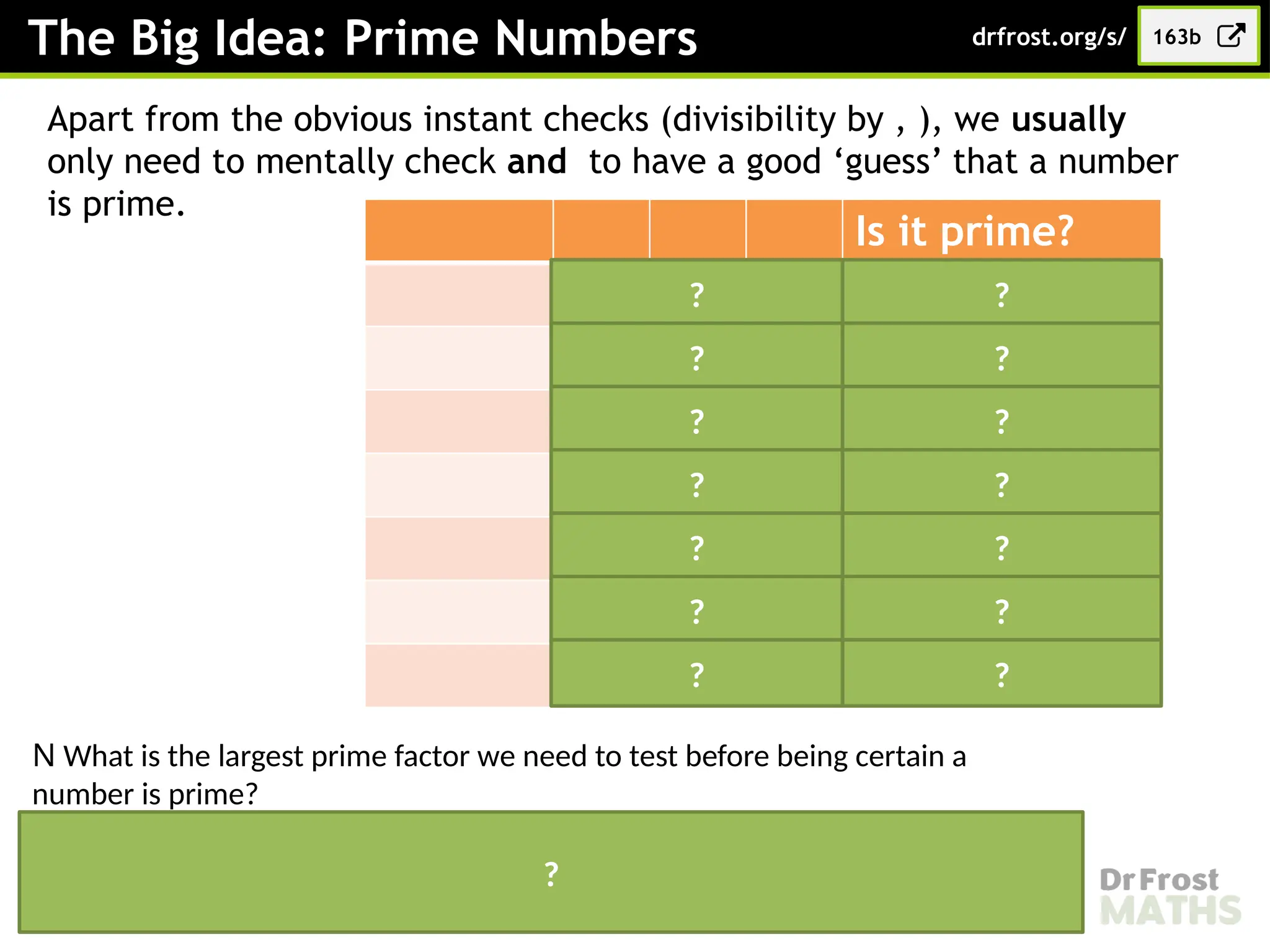
Apart from theobvious instant checks (divisibility by , ), we usually
only need to mentally check and to have a good ‘guess’ that a number
is prime.
Is it prime?
No
Yes
No
Yes
No
Yes
No! ()
N What is the largest prime factor we need to test before being certain a
number is prime?
We can use the square root of the number we are testing; for example so we
would need to check up to 14. All composite numbers have a factor (other than
1) up to the square root.
? ?
The Big Idea: Prime Numbers
? ?
? ?
? ?
? ?
? ?
? ?
?
163b
drfrost.org/s/
37.
Example Test YourUnderstanding
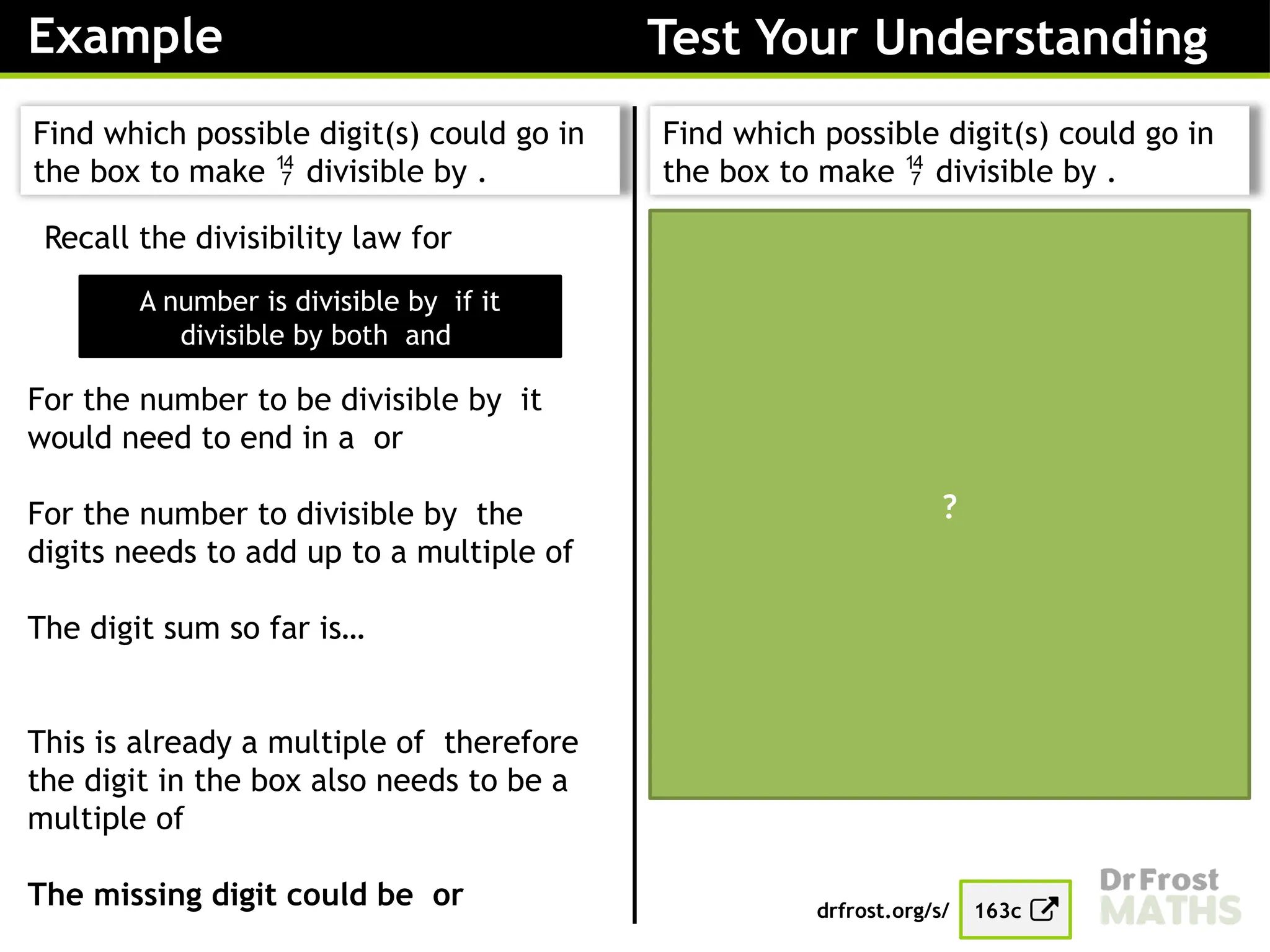
Find which possible digit(s) could go in
the box to make divisible by .
Recall the divisibility law for
A number is divisible by if it
divisible by both and
For the number to be divisible by it
would need to end in a or
For the number to divisible by the
digits needs to add up to a multiple of
The digit sum so far is…
This is already a multiple of therefore
the digit in the box also needs to be a
multiple of
The missing digit could be or
Find which possible digit(s) could go in
the box to make divisible by .
Recall the divisibility law for
The two digit number needs to be
divisible by
Consider the numbers in the times
table around the number …
…
The missing digit could be or
A number is divisible by if the
number formed by the last digits
of the number is divisible by
drfrost.org/s/ 163c
?
38.
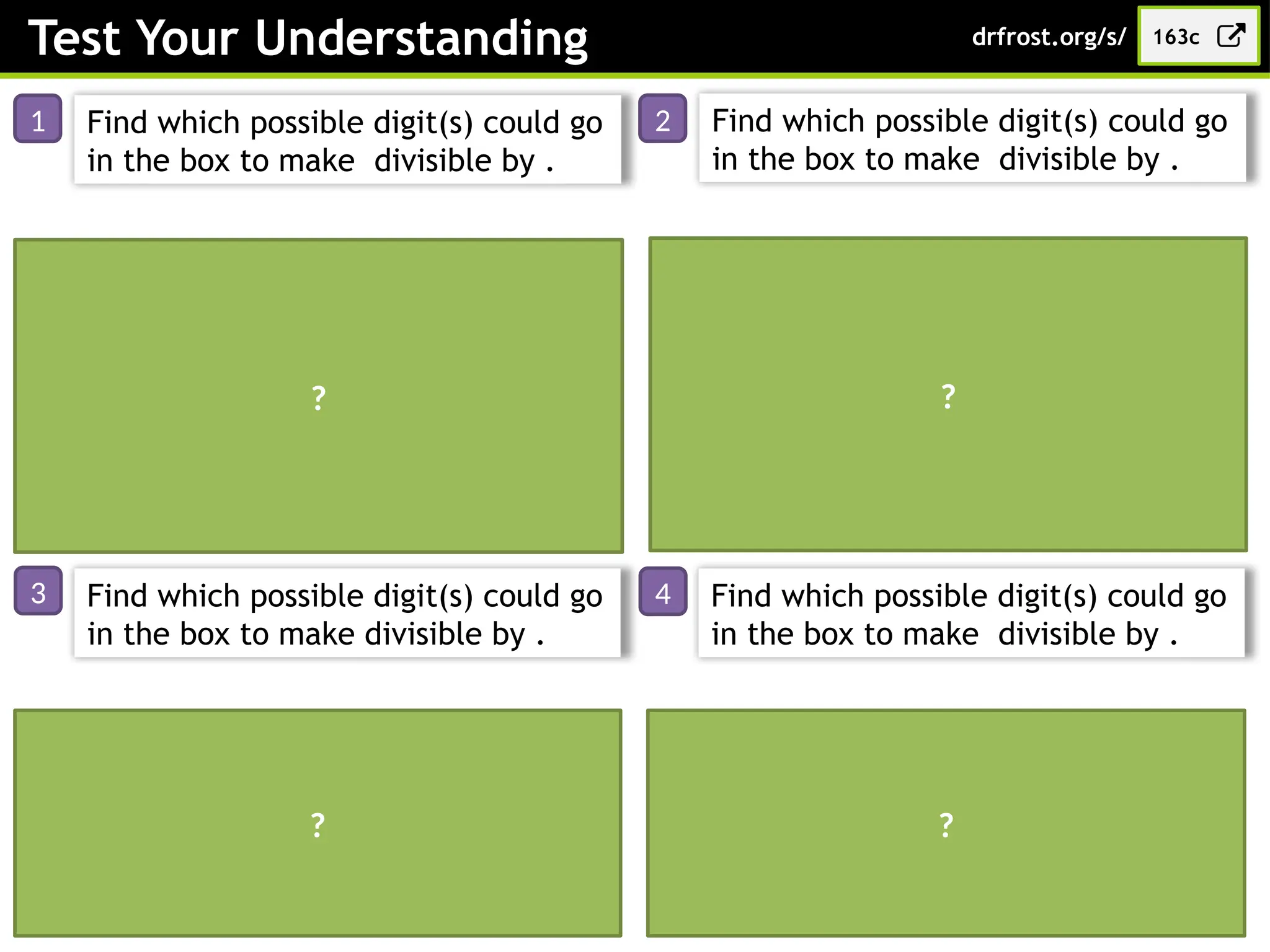
For the numberto be divisible by it
needs to be divisible by and
The number is already divisible by as it
ends in a
Digit sum:
The digit sum is already a multiple of
therefore the missing digit must also be
divisible by : it could be or
For the number to be divisible by the
last digits need to make a multiple of
The last digits could be: or
Out of this list only some are multiples
of : the missing digit could be or
For the number to be divisible by the
last digits needs to make a multiple of
Thinking of the times table…
……
The missing digit must be
Test Your Understanding
Find which possible digit(s) could go
in the box to make divisible by .
Find which possible digit(s) could go
in the box to make divisible by .
?
Find which possible digit(s) could go
in the box to make divisible by .
For the number to be divisible by the
digit sum needs to be a multiple of
Digit sum:
To make the digit sum a multiple of it
would need to sum to : the missing
digit must be
Find which possible digit(s) could go
in the box to make divisible by .
? ?
?
163c
drfrost.org/s/
1 2
3 4
39.
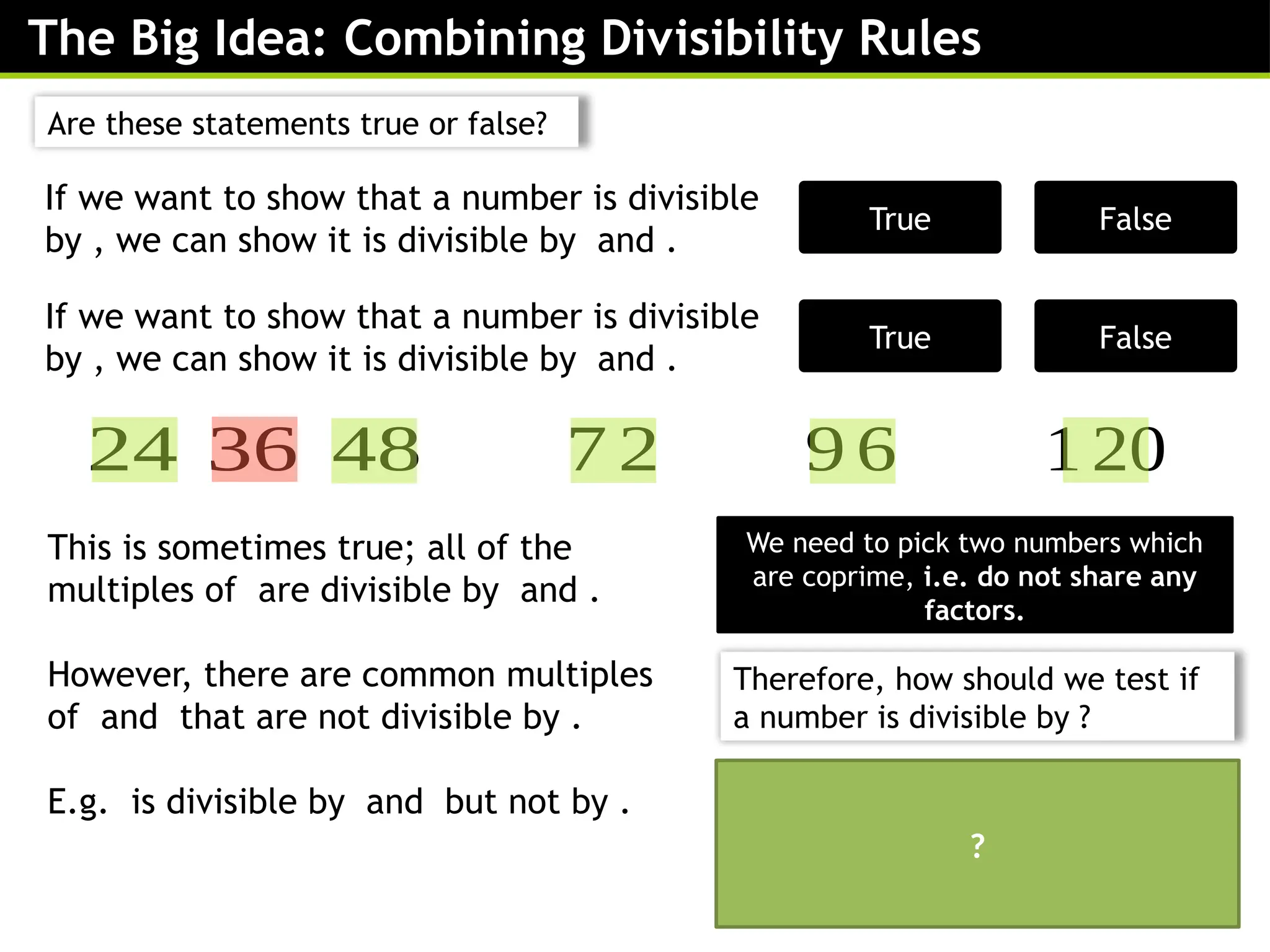
If we wantto check if a number is
divisible by , we can show it is
divisible by and , they are
coprime and have a product of
Are these statements true or false?
If we want to show that a number is divisible
by , we can show it is divisible by and .
If we want to show that a number is divisible
by , we can show it is divisible by and .
The Big Idea: Combining Divisibility Rules
False
True
True False
24 48 7 2 9 6 120
This is sometimes true; all of the
multiples of are divisible by and .
However, there are common multiples
of and that are not divisible by .
E.g. is divisible by and but not by .
36
We need to pick two numbers which
are coprime, i.e. do not share any
factors.
Therefore, how should we test if
a number is divisible by ?
?
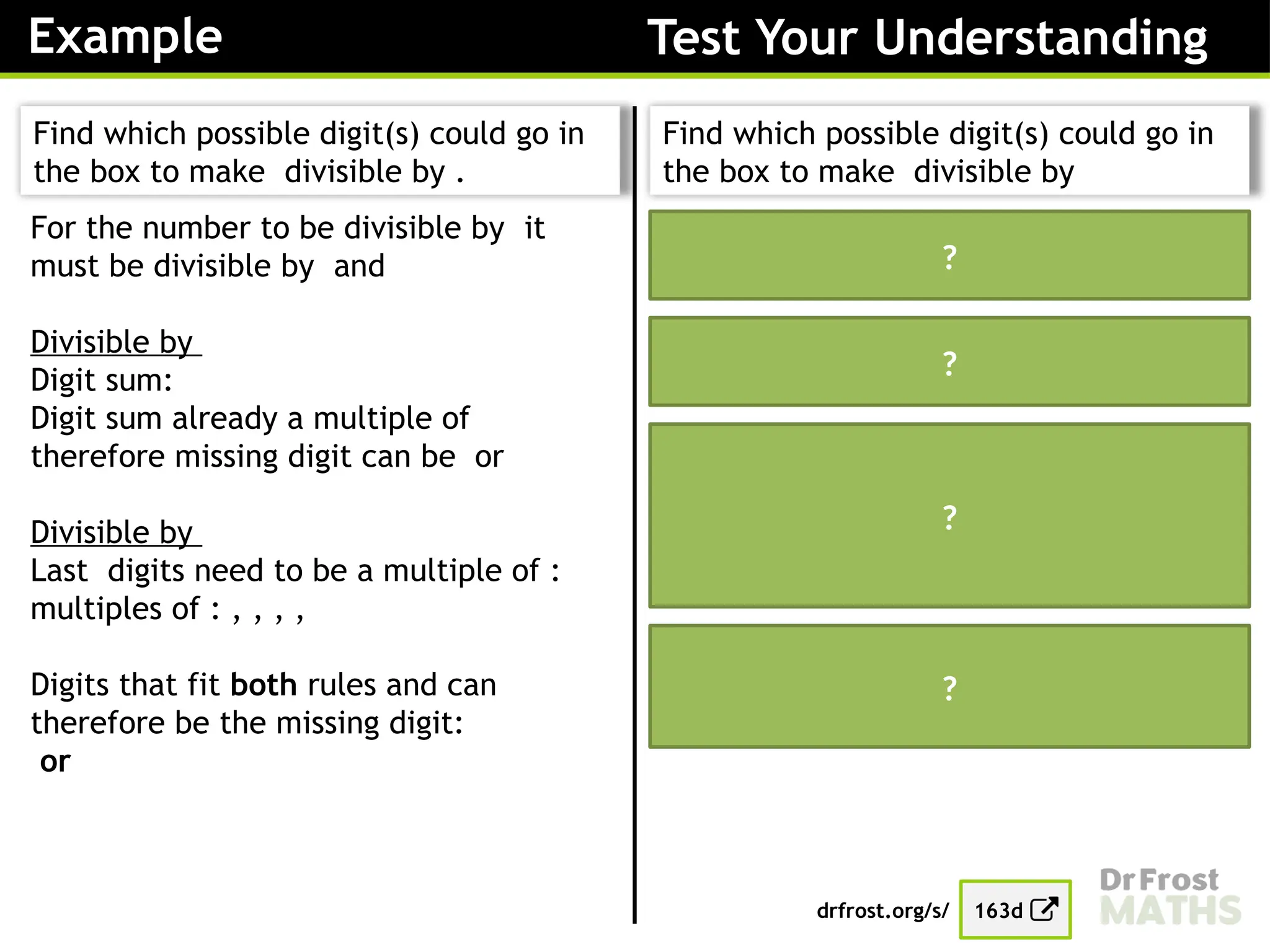
Example Test YourUnderstanding
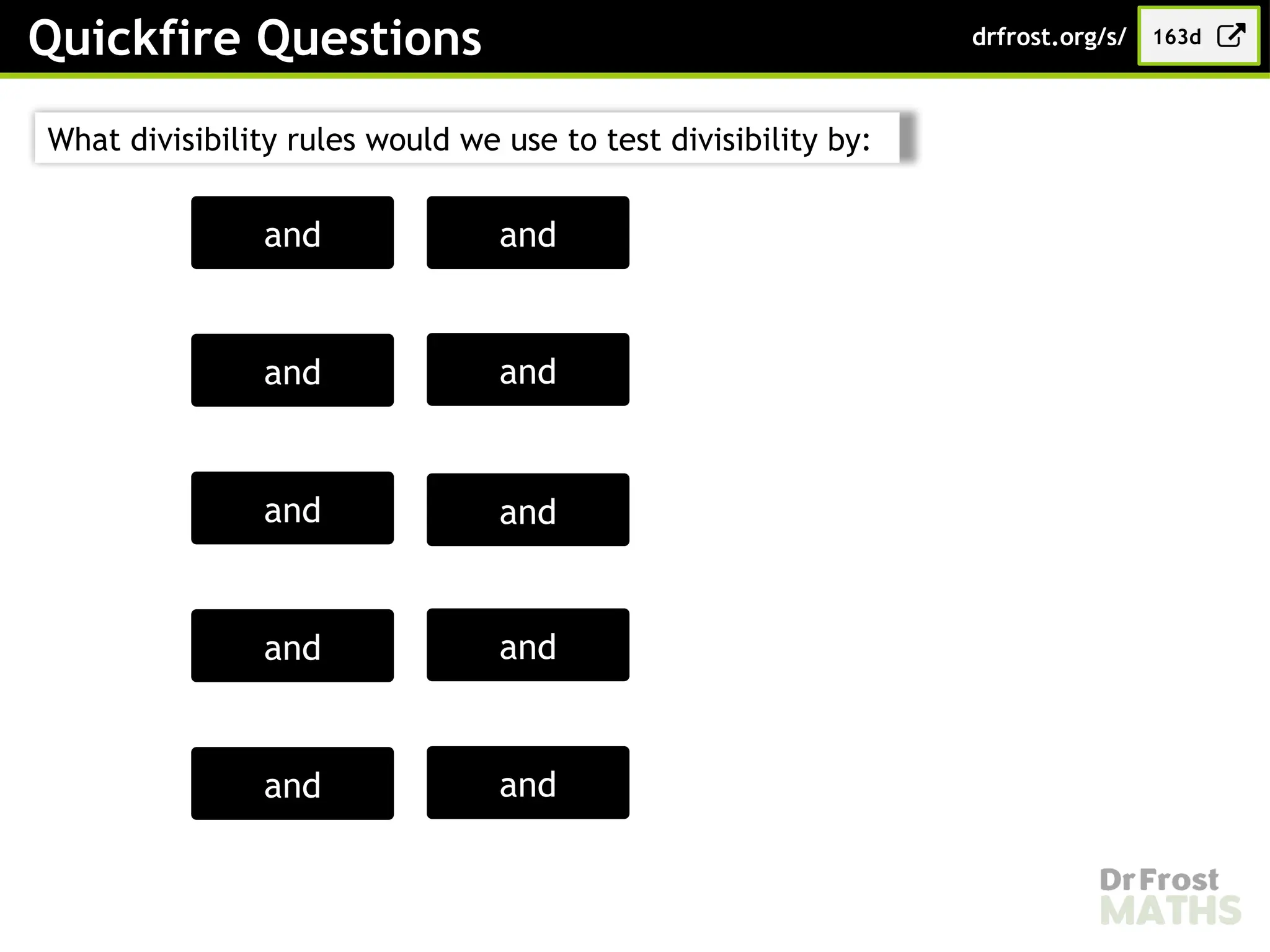
Find which possible digit(s) could go in
the box to make divisible by .
For the number to be divisible by it
must be divisible by and
Divisible by
Digit sum:
Digit sum already a multiple of
therefore missing digit can be or
Divisible by
Last digits need to be a multiple of :
multiples of : , , , ,
Digits that fit both rules and can
therefore be the missing digit:
or
Find which possible digit(s) could go in
the box to make divisible by
For the number to be divisible by it
must be divisible by and
Divisible by
Must end in a or
Divisible by
Digit sum:
Digit sum already a multiple of
therefore missing digit can be or
The only digit that fits both rules and is
therefore the missing digit:
drfrost.org/s/ 163d
?
?
?
?
42.
Exercise (Available asa separate worksheet)
Show all
solutions
1 Tick the factor(s) that each number is divisible by
Divisible by Prime
?
?
?
?
?
?
[JMC 2011 Q2]
How many of the integers are multiples
of ?
[ ] [ ] [ ] [ ] [ ]
Answer: (all numbers have a digit
sum that is a multiple of )
2 [JMC 2004 Q2]
Which of the following numbers is
exactly divisible by ?
3
Answer: ?
?
?
43.
The number needsto be divisible by
and ; the digit sum is and needs to be
a multiple of
Answer:
[JMC 2016 Q11]
Which of the following statements is
false?
[ ] is a multiple of
[ ] is a multiple of
[ ] is a multiple of
[ ] is a multiple of
[ ] is a multiple of
[JMC 2003 Q13]
was a prime year, since is a prime number.
In the following ten years there was just one
prime year. Which was it?
Hint: Use your divisibility rules!
[ ] [ ] [ ]
[ ] [ ]
Answer:
is divisible by
is divisible by and
is divisible by
is divisible by
[JMC 1999 Q17]
The -digit number is a multiple of . Which
digit is represented by ?
Answer:
Therefore which creates a final sum of
Exercise (Available as a separate worksheet)
Show all
solutions
4
5
6
Answer: ( is not a multiple of )
7
8
?
?
Find which possible digit(s) could go in
the box to make divisible by .
Current digit sum is ; this is already a
multiple of
Answer: or
?
Find which possible digit(s) could go in
the box to make divisible by
?
?
44.
[JMC 2000 Q17]
Thefirst and third digits of the five-
digit number are the same. If the
number is exactly divisible by , what is
the sum of its five digits?
Answer:
Digit sum:
must be an odd number between and ,
and the only odd multiple of in this
interval is .
[JMC 1997 Q20]
A four-digit number was written on a
piece of paper.
The last two digits were then blotted
out (as shown). If the complete number
is exactly divisible by three, by four,
and by five, what is the sum of the two
missing digits?
Answer:
The missing digits are and
[JMC 2012 Q23]
Peter wrote a list of all the numbers that
could be produced by changing one digit
of the number . How many of the
numbers on Peter’s list are prime?
[ ] [ ] [ ] [ ] [ ]
Answer:
[Pink Kangaroo 2020 Q16]
The digits from to are randomly
arranged to make a -digit number.
What is the probability that the resulting
number is divisible by ?
Answer:
Exercise (Available as a separate worksheet)
Show all
solutions
9
?
?
?
?
10
11
12
8 6
45.
[SMC 2012 Q6]
Whatis the sum of the digits of the
largest -digit palindromic number which
is divisible by ?
Palindromic numbers read the same
backwards and forwards, e.g. .
Answer:
For the number to be divisible by it
eithers ends in a or a . It cannot end in a
as the first digit cannot be . Therefore,
the number is 5**5
The digit sum needs to be a multiple of ,
this is true if * or therefore the largest is
when * which makes the digit sum
Exercise (Available as a separate worksheet)
Show all
solutions
13 The letters , and stand for non-zero
digits. The integer ‘’ is a multiple of ; the
integer ‘’ is a multiple of ; and the integer
‘’ is a multiple of .
What is the integer ‘’?
Answer:
• is a multiple of , therefore is a
multiple of
• is a multiple of , the digit sum for
would be the same therefore is a
multiple of and
• Hence is a multiple of
• is a multiple of ; it must be a multiple
of and as the digits are non-zero and
is a multiple of
• The digit multiples of that start with a
() are: and
• Only has a as a multiple of
• Therefore and
N
? ?
#7 Teacher notes:
Get students to recall any divisibility tests they already know
#8 Teacher notes:
We will add to this table as we go through this section of the lesson.
A blank printable version is available on slide 10 and a filled in printable version is available on slide 38
#9 Teacher notes:
Blank version to print – a filled in version is also available to print on slide XXXX
#10 Teacher notes:
Quickfire questions to check understanding of divisibility laws for 2, 5 and 10
#25 Teacher notes:
Introduction to the divisibility law for 6
#26 Teacher notes:
Further examples for the divisibility law for 6
#27 Teacher notes:
Quickfire questions to check understanding of the divisibility law for 6
#28 Teacher notes:
Summary so far and linking the divisibility law for 6 to future laws
#29 Teacher notes:
Introduction to divisibility law for 8
#30 Teacher notes:
Explanation of the divisibility law for 8 and how it links to the divisibility law for 4
#31 Teacher notes:
Quickfire questions to check understanding of the divisibility law for 8
#32 Teacher notes:
Test your understanding questions to check understanding of the laws covered so far
#33 Teacher notes:
Introduction to the divisibility law for 11
This divisibility test was discovered through mathematical exploration and an understanding of modular arithmetic
#34 Teacher notes:
Introduction to the divisibility law for 7
This divisibility test was discovered through mathematical exploration and an understanding of modular arithmetic
#35 Teacher notes:
Further example using the divisibility law for 7 where the process has to be repeated
This divisibility test was discovered through mathematical exploration and an understanding of modular arithmetic
#36 Teacher notes:
Completed printable version of this table available on the next slide
![Exercise (Available as a separate worksheet)
Show all
solutions
1 Tick the factor(s) that each number is divisible by
Divisible by Prime
?
?
?
?
?
?
[JMC 2011 Q2]
How many of the integers are multiples
of ?
[ ] [ ] [ ] [ ] [ ]
Answer: (all numbers have a digit
sum that is a multiple of )
2 [JMC 2004 Q2]
Which of the following numbers is
exactly divisible by ?
3
Answer: ?
?
?](https://image.slidesharecdn.com/divisibilitytests-lesson-250309143154-df2b9f63/75/Divisibility-Tests-Lesson-Year-7-Maths-42-2048.jpg)
![The number needs to be divisible by
and ; the digit sum is and needs to be
a multiple of
Answer:
[JMC 2016 Q11]
Which of the following statements is
false?
[ ] is a multiple of
[ ] is a multiple of
[ ] is a multiple of
[ ] is a multiple of
[ ] is a multiple of
[JMC 2003 Q13]
was a prime year, since is a prime number.
In the following ten years there was just one
prime year. Which was it?
Hint: Use your divisibility rules!
[ ] [ ] [ ]
[ ] [ ]
Answer:
is divisible by
is divisible by and
is divisible by
is divisible by
[JMC 1999 Q17]
The -digit number is a multiple of . Which
digit is represented by ?
Answer:
Therefore which creates a final sum of
Exercise (Available as a separate worksheet)
Show all
solutions
4
5
6
Answer: ( is not a multiple of )
7
8
?
?
Find which possible digit(s) could go in
the box to make divisible by .
Current digit sum is ; this is already a
multiple of
Answer: or
?
Find which possible digit(s) could go in
the box to make divisible by
?
?](https://image.slidesharecdn.com/divisibilitytests-lesson-250309143154-df2b9f63/75/Divisibility-Tests-Lesson-Year-7-Maths-43-2048.jpg)
![[JMC 2000 Q17]
The first and third digits of the five-
digit number are the same. If the
number is exactly divisible by , what is
the sum of its five digits?
Answer:
Digit sum:
must be an odd number between and ,
and the only odd multiple of in this
interval is .
[JMC 1997 Q20]
A four-digit number was written on a
piece of paper.
The last two digits were then blotted
out (as shown). If the complete number
is exactly divisible by three, by four,
and by five, what is the sum of the two
missing digits?
Answer:
The missing digits are and
[JMC 2012 Q23]
Peter wrote a list of all the numbers that
could be produced by changing one digit
of the number . How many of the
numbers on Peter’s list are prime?
[ ] [ ] [ ] [ ] [ ]
Answer:
[Pink Kangaroo 2020 Q16]
The digits from to are randomly
arranged to make a -digit number.
What is the probability that the resulting
number is divisible by ?
Answer:
Exercise (Available as a separate worksheet)
Show all
solutions
9
?
?
?
?
10
11
12
8 6](https://image.slidesharecdn.com/divisibilitytests-lesson-250309143154-df2b9f63/75/Divisibility-Tests-Lesson-Year-7-Maths-44-2048.jpg)
![[SMC 2012 Q6]
What is the sum of the digits of the
largest -digit palindromic number which
is divisible by ?
Palindromic numbers read the same
backwards and forwards, e.g. .
Answer:
For the number to be divisible by it
eithers ends in a or a . It cannot end in a
as the first digit cannot be . Therefore,
the number is 5**5
The digit sum needs to be a multiple of ,
this is true if * or therefore the largest is
when * which makes the digit sum
Exercise (Available as a separate worksheet)
Show all
solutions
13 The letters , and stand for non-zero
digits. The integer ‘’ is a multiple of ; the
integer ‘’ is a multiple of ; and the integer
‘’ is a multiple of .
What is the integer ‘’?
Answer:
• is a multiple of , therefore is a
multiple of
• is a multiple of , the digit sum for
would be the same therefore is a
multiple of and
• Hence is a multiple of
• is a multiple of ; it must be a multiple
of and as the digits are non-zero and
is a multiple of
• The digit multiples of that start with a
() are: and
• Only has a as a multiple of
• Therefore and
N
? ?](https://image.slidesharecdn.com/divisibilitytests-lesson-250309143154-df2b9f63/75/Divisibility-Tests-Lesson-Year-7-Maths-45-2048.jpg)


