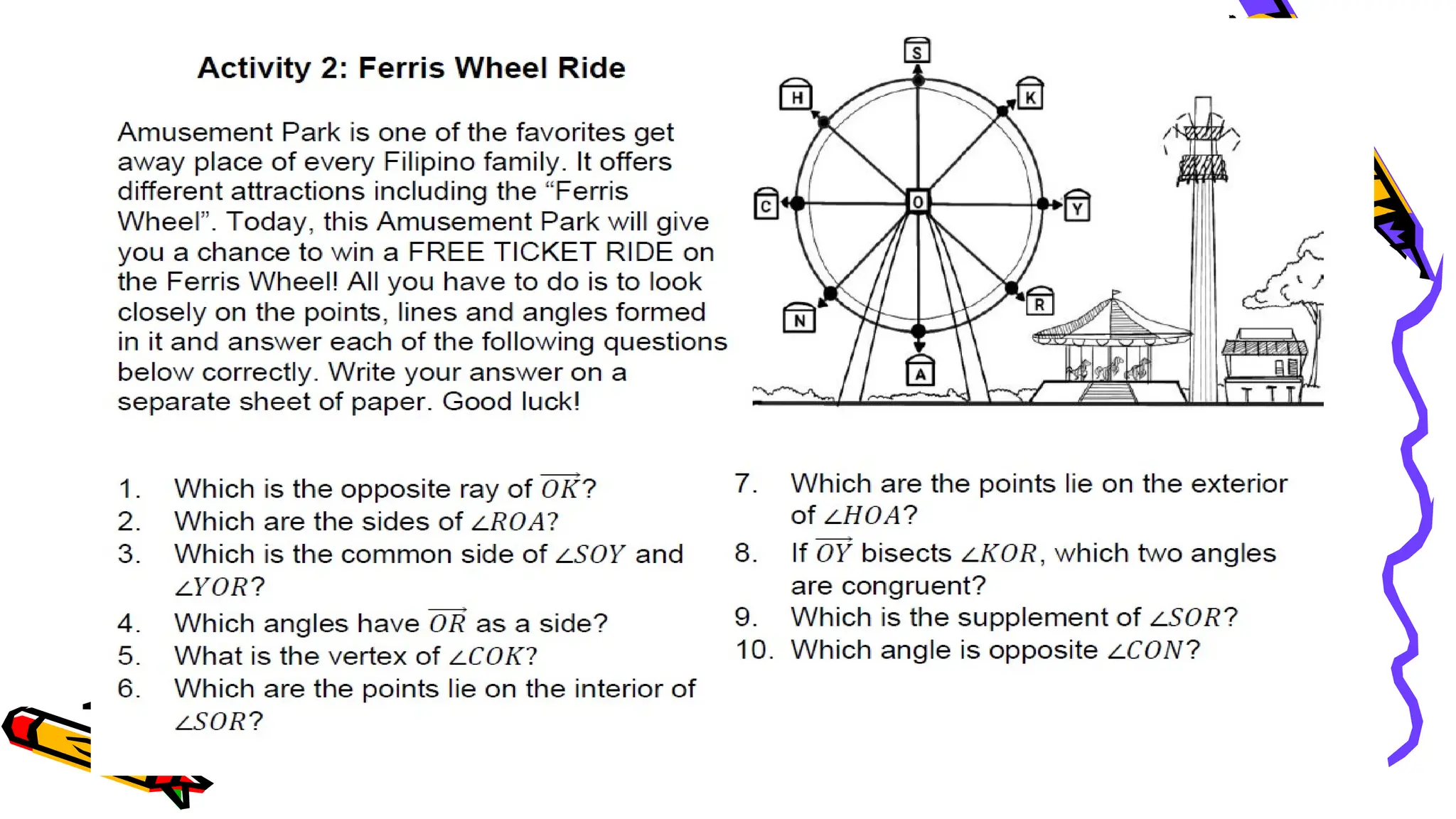
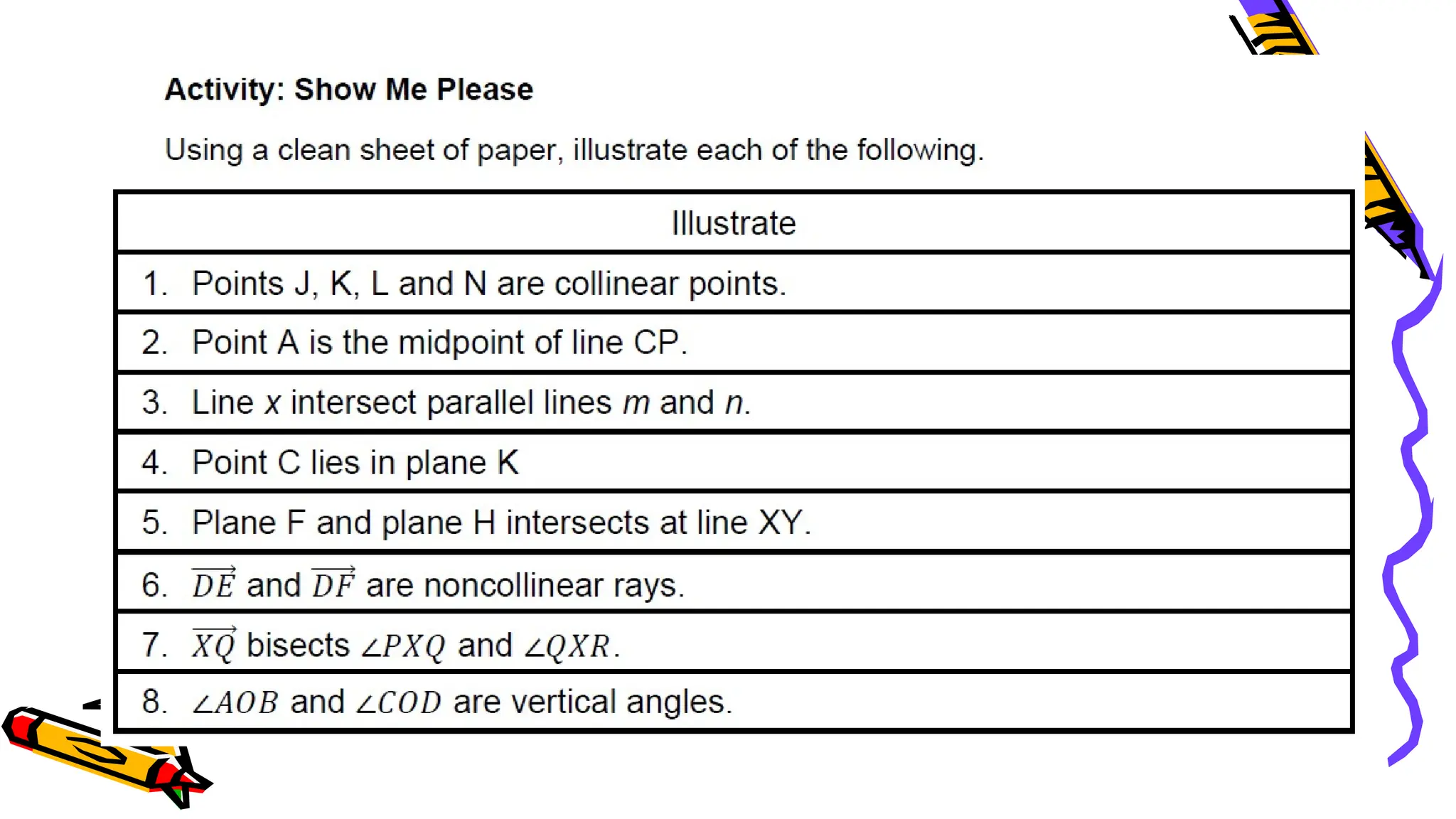
Describing
Mathematical
Systems
Mathematics 8 – week 1
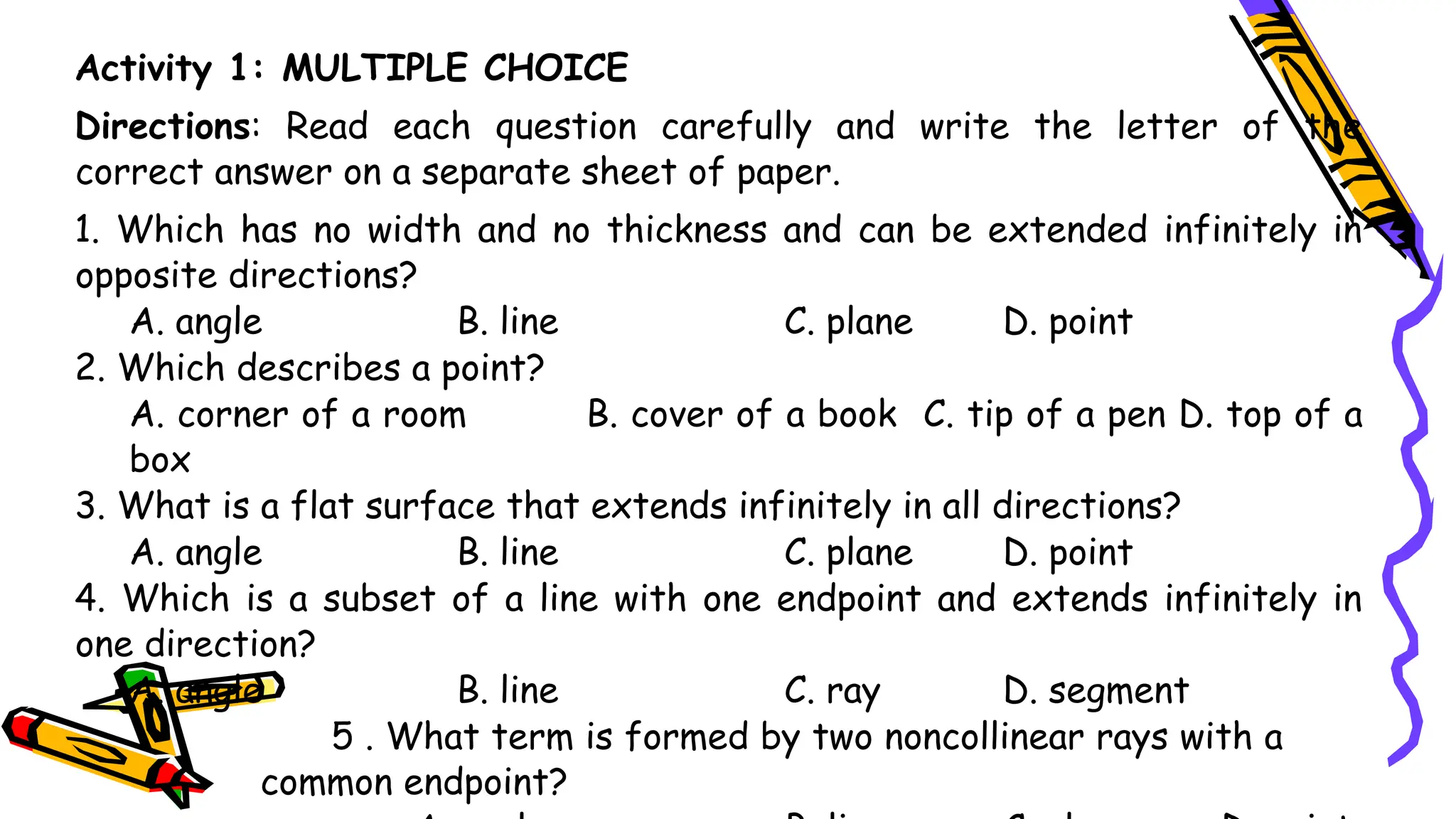
Activity 1: MULTIPLE CHOICE
Directions: Read each question carefully and write the letter of the
correct answer on a separate sheet of paper.
1. Which has no width and no thickness and can be extended infinitely in
opposite directions?
A. angle B. line C. plane D. point
2. Which describes a point?
A. corner of a room B. cover of a book C. tip of a pen D. top of a
box
3. What is a flat surface that extends infinitely in all directions?
A. angle B. line C. plane D. point
4. Which is a subset of a line with one endpoint and extends infinitely in
one direction?
A. angle B. line C. ray D. segment
5 . What term is formed by two noncollinear rays with a
common endpoint?
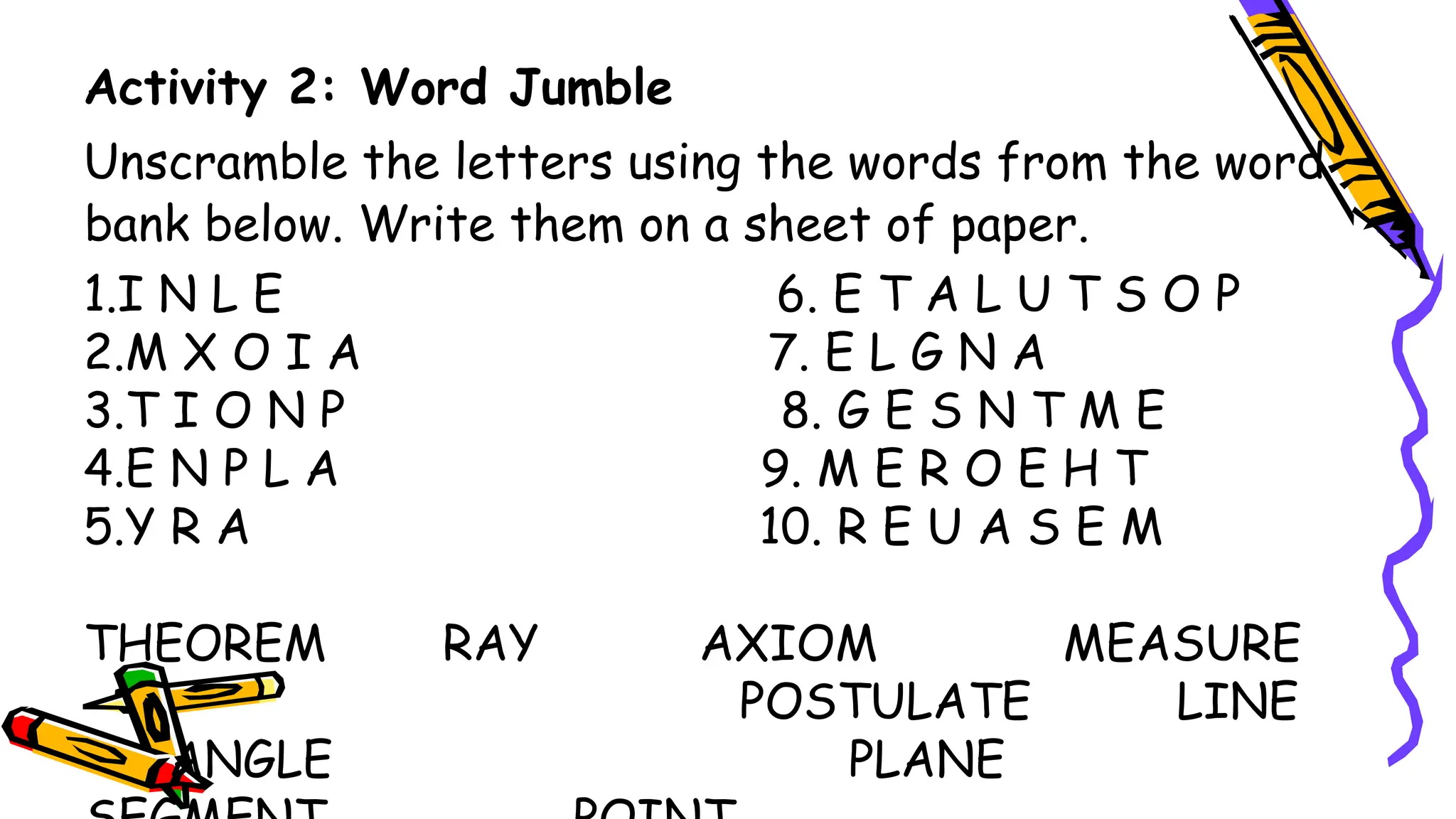
Activity 2: Word Jumble
Unscramble the letters using the words from the word
bank below. Write them on a sheet of paper.
1.I N L E 6. E T A L U T S O P
2.M X O I A 7. E L G N A
3.T I O N P 8. G E S N T M E
4.E N P L A 9. M E R O E H T
5.Y R A 10. R E U A S E M
THEOREM RAY AXIOM MEASURE
POSTULATE LINE
ANGLE PLANE
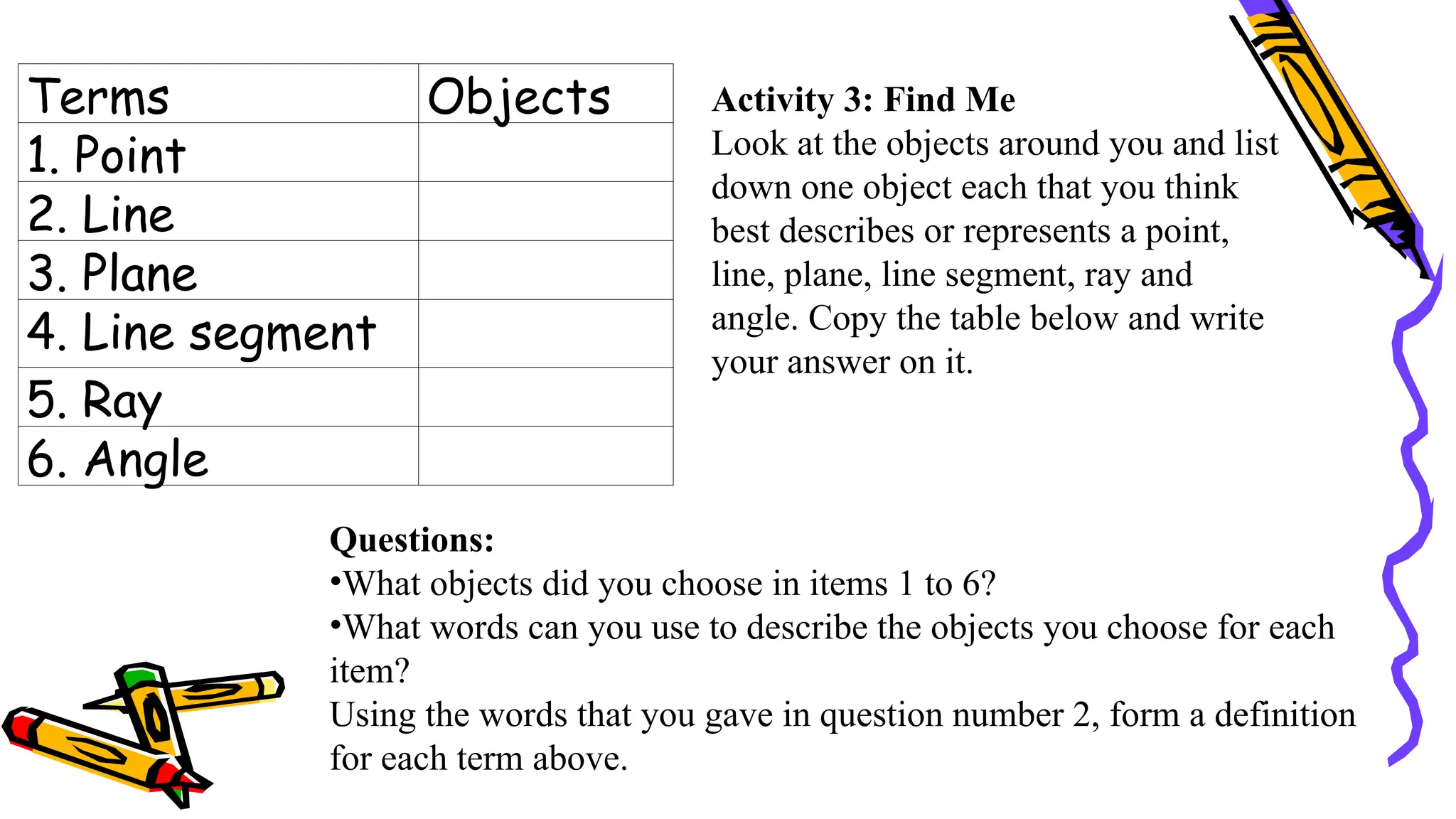
Terms Objects
1. Point
2. Line
3. Plane
4. Line segment
5. Ray
6. Angle
Questions:
•What objects did you choose in items 1 to 6?
•What words can you use to describe the objects you choose for each
item?
Using the words that you gave in question number 2, form a definition
for each term above.
Activity 3: Find Me
Look at the objects around you and list
down one object each that you think
best describes or represents a point,
line, plane, line segment, ray and
angle. Copy the table below and write
your answer on it.
God has given us bountiful
nature with different shapes
and measurements that are
connected with Geometry
DESCRIBING
MATHEMATICAL
SYSTEM
Geometry is the measurement of earthly objects.
“geo” which means earth
“metrein” which means to measure.
But Euclid gave geometry a new definition
and developed it into a formal study of
statements that involve reasoning. He then
defined geometry as the study of a body of
logically connected statements. This makes
completely clear that in geometry, a statement
leads to another statement in an arrangement
that is supported by reasons.
In the mathematical system designed
by Euclid, there are four parts namely:
1. Undefined Terms
2. Defined Terms
3. Axioms and postulates
4. Theorems
The undefined terms in geometry are points, lines and planes
which are said to be the building blocks of geometry.
How will you describe these undefined terms?
Undefined Terms
Term Description Representation Naming
Real-life
Example
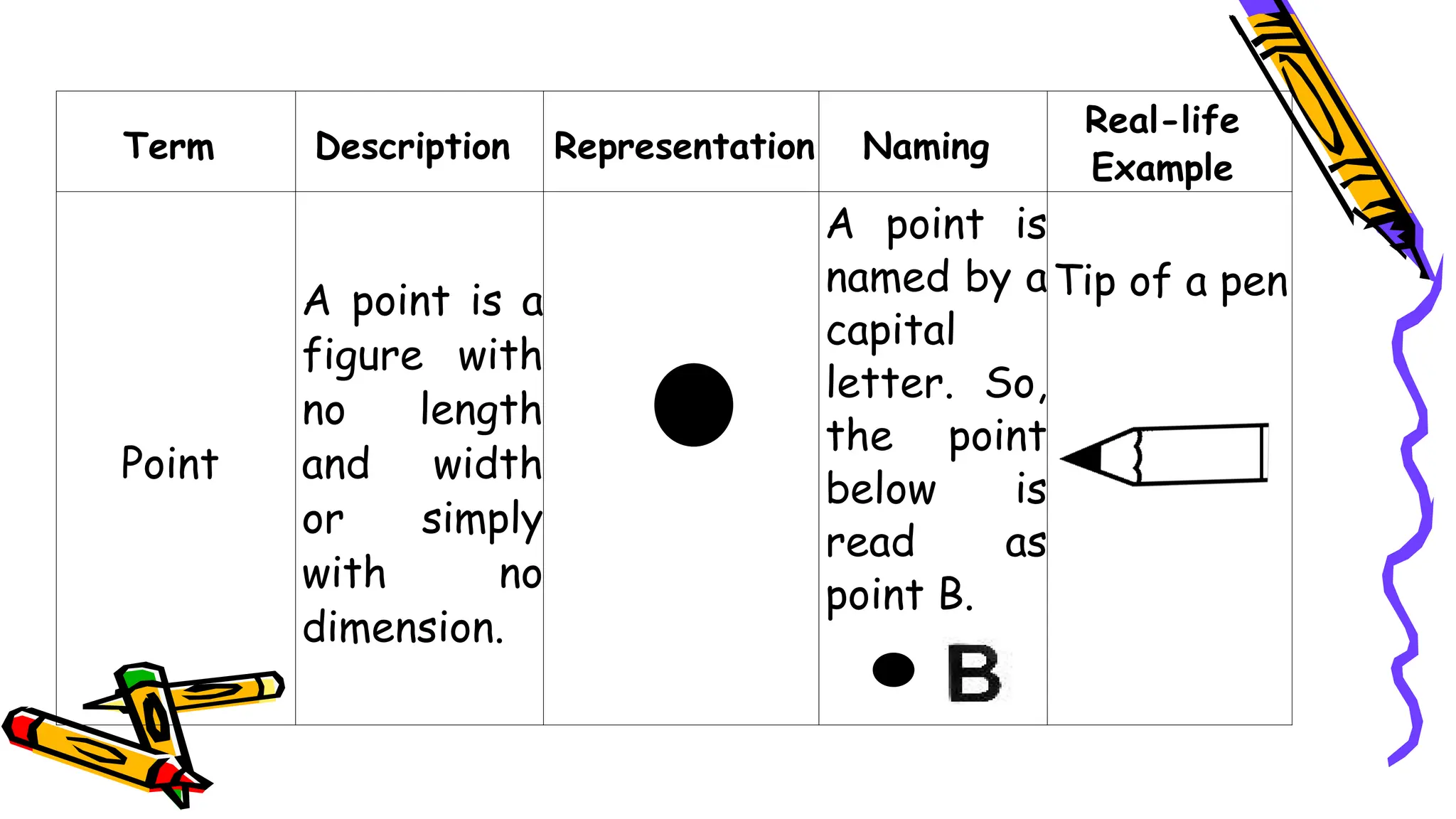
Point
A point is a
figure with
no length
and width
or simply
with no
dimension.
A point is
named by a
capital
letter. So,
the point
below is
read as
point B.
Tip of a pen
Term Description Representation Naming
Real-life
Example
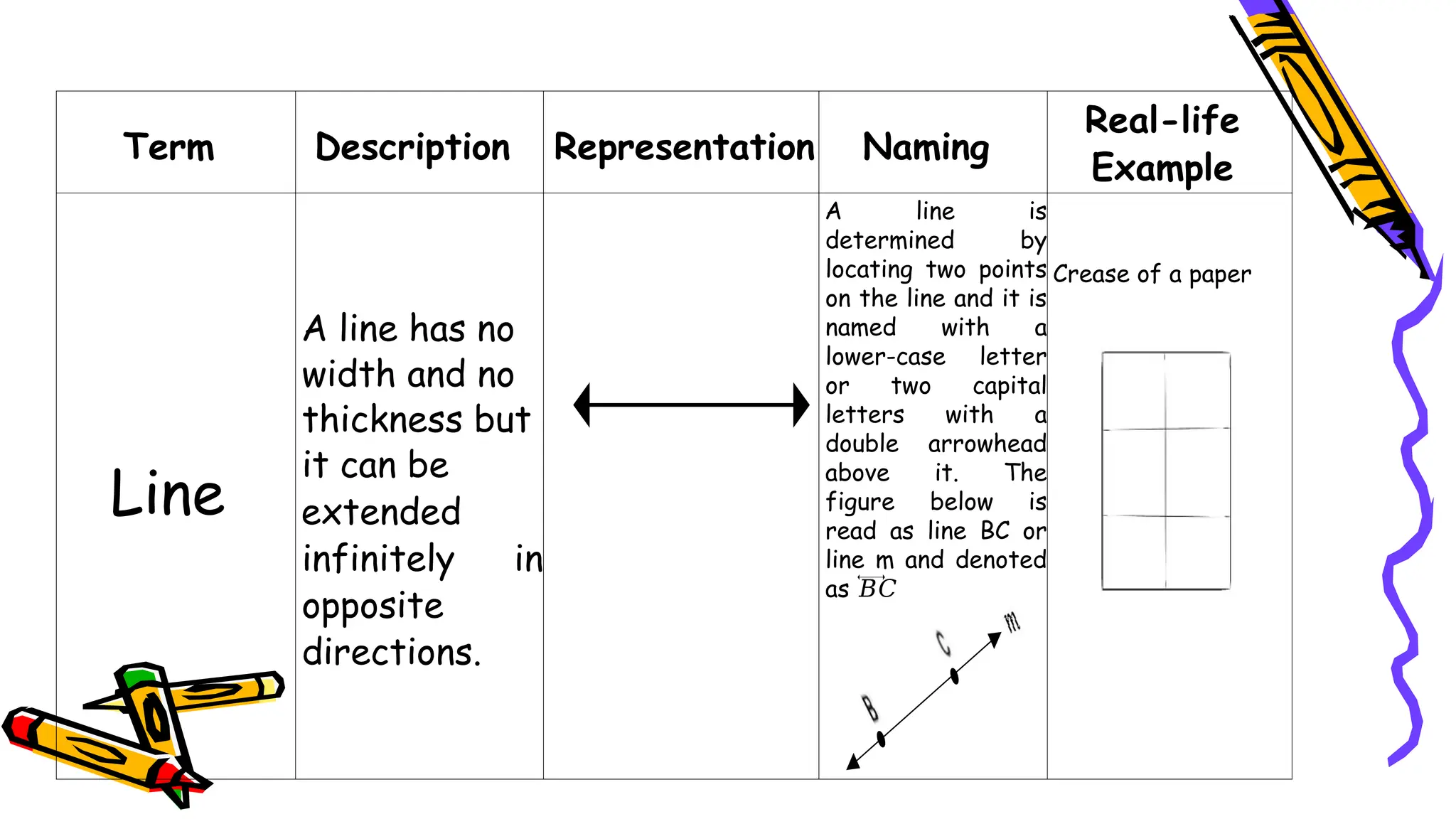
Line
A line has no
width and no
thickness but
it can be
extended
infinitely in
opposite
directions.
A line is
determined by
locating two points
on the line and it is
named with a
lower-case letter
or two capital
letters with a
double arrowhead
above it. The
figure below is
read as line BC or
line m and denoted
as 𝐵𝐶
Crease of a paper
Term Description Representation Naming
Real-life
Example
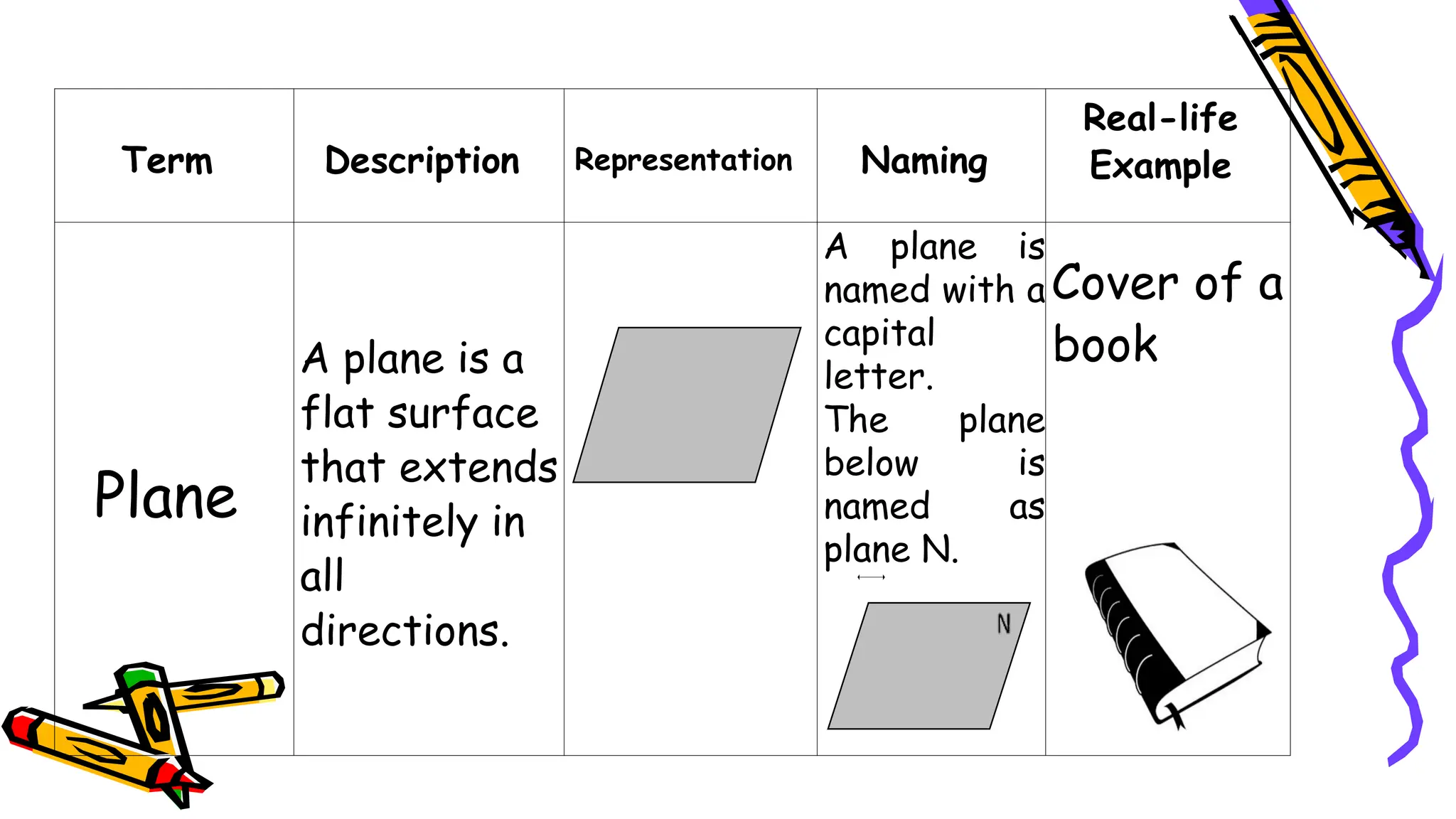
Plane
A plane is a
flat surface
that extends
infinitely in
all
directions.
A plane is
named with a
capital
letter.
The plane
below is
named as
plane N.
Cover of a
book
Can you cite other real-life
examples of points, lines and
planes that you see around
you?
In geometry, defined terms are terms that
have a proper definition and can be defined by
means of other geometrical terms.
The basic defined terms in geometry are line
segments, rays, opposite rays and angles.

Defined Terms
Term Description Representation Naming
Real-life
Example
Line
Segment
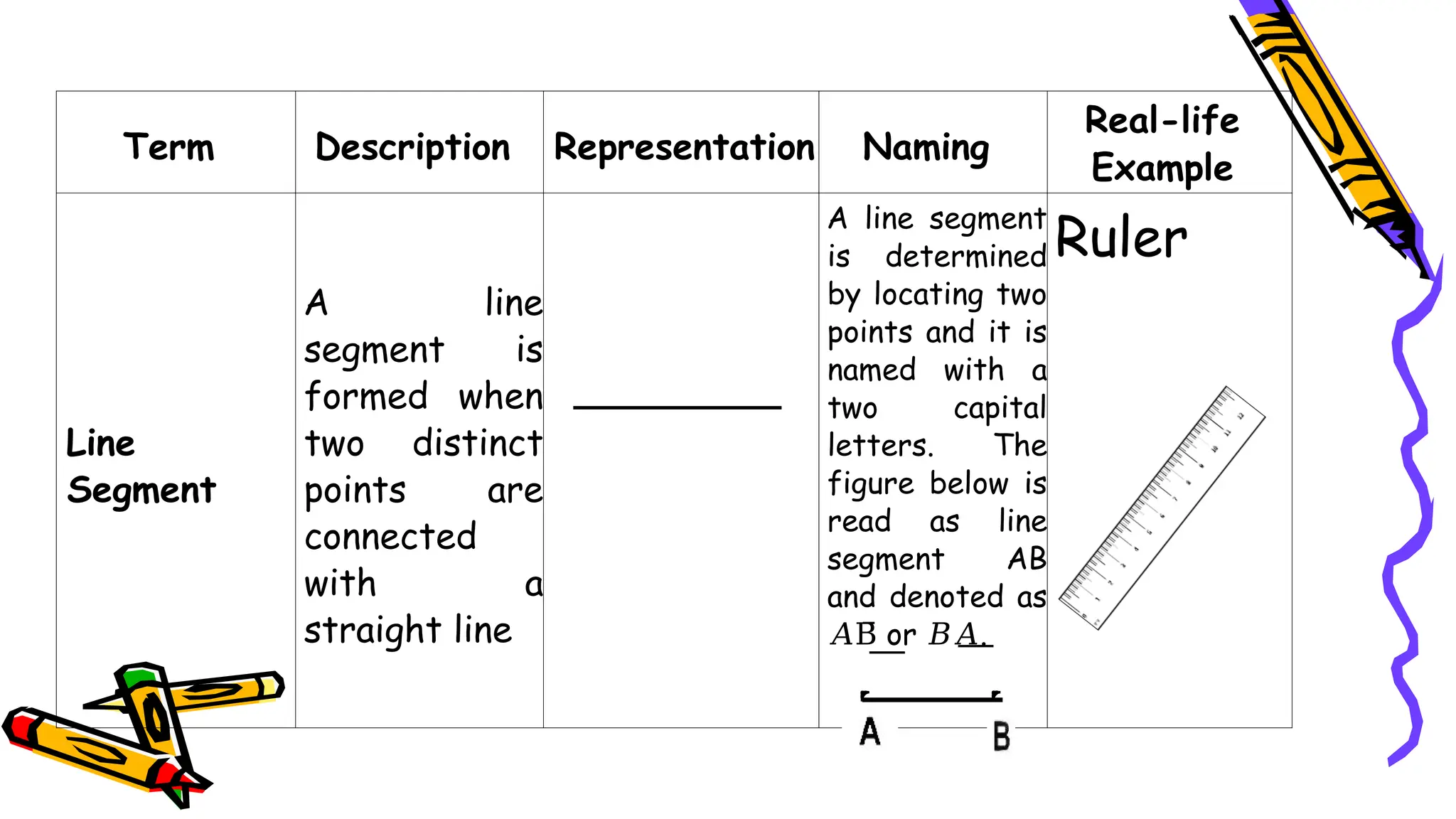
A line
segment is
formed when
two distinct
points are
connected
with a
straight line
A line segment
is determined
by locating two
points and it is
named with a
two capital
letters. The
figure below is
read as line
segment AB
and denoted as
or
𝐴B̅ 𝐵𝐴.
Ruler
Term Description Representation Naming
Real-life
Example
Ray
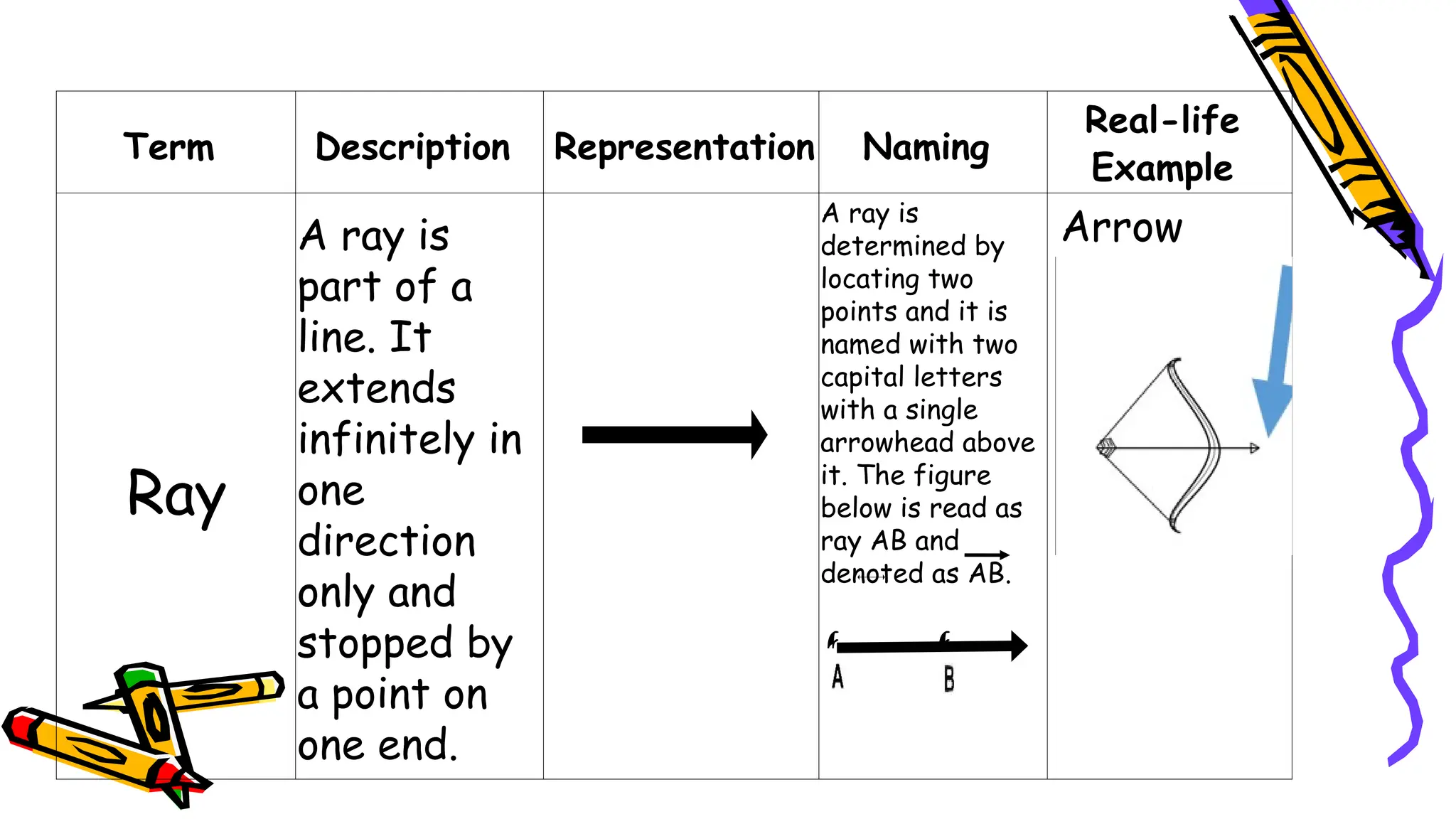
A ray is
part of a
line. It
extends
infinitely in
one
direction
only and
stopped by
a point on
one end.
A ray is
determined by
locating two
points and it is
named with two
capital letters
with a single
arrowhead above
it. The figure
below is read as
ray AB and
denoted as AB.
Arrow
Term Description Representation Naming
Real-life
Example
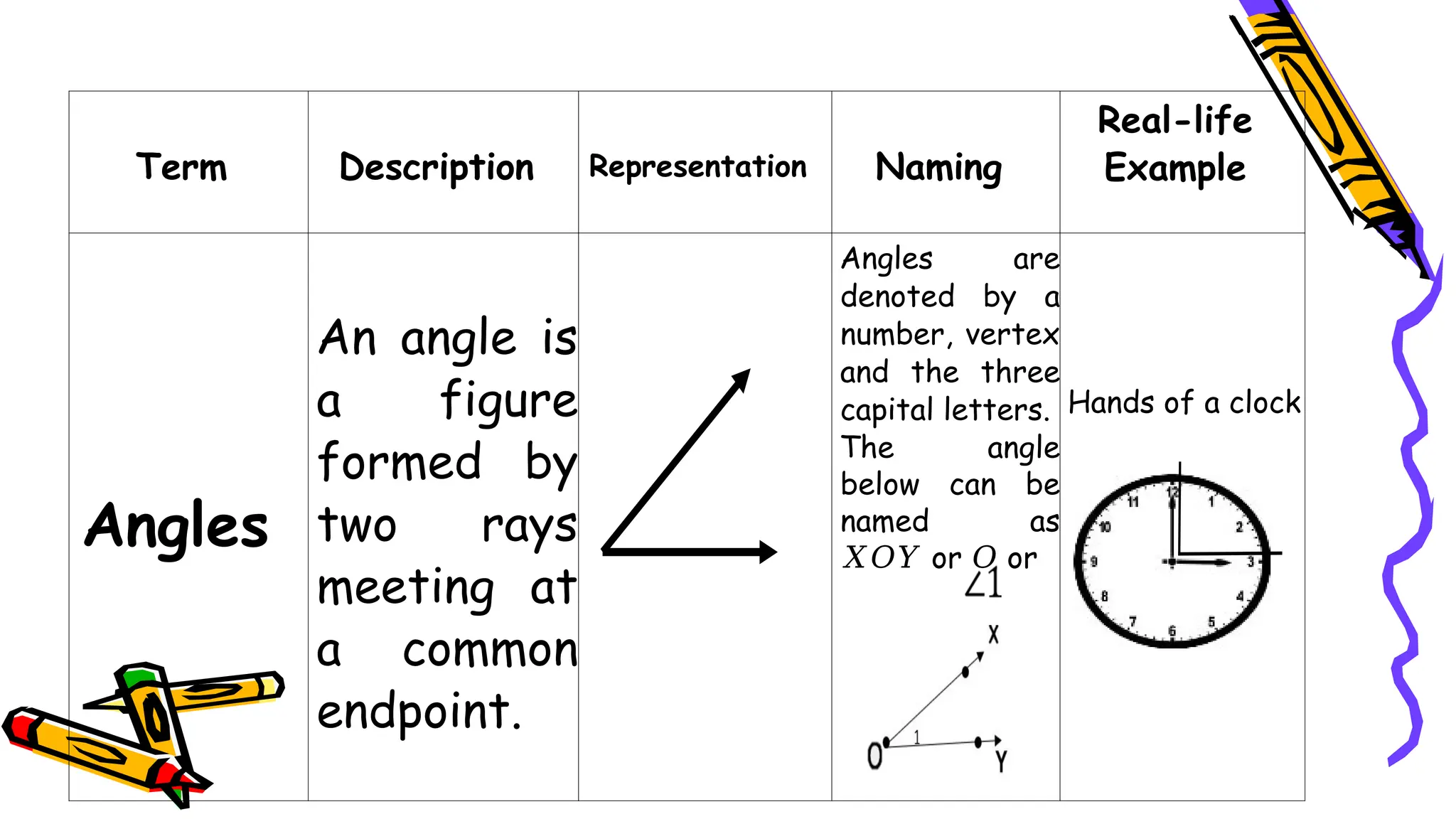
Angles
An angle is
a figure
formed by
two rays
meeting at
a common
endpoint.
Angles are
denoted by a
number, vertex
and the three
capital letters.
The angle
below can be
named as
or or
𝑋𝑂𝑌 𝑂
Hands of a clock
Can you think of other
real-life examples of line
segments, rays, opposite
rays and angles around you?
Here are some common terms that you
may encounter along with the defined
terms.
Term Description Representation Explanation
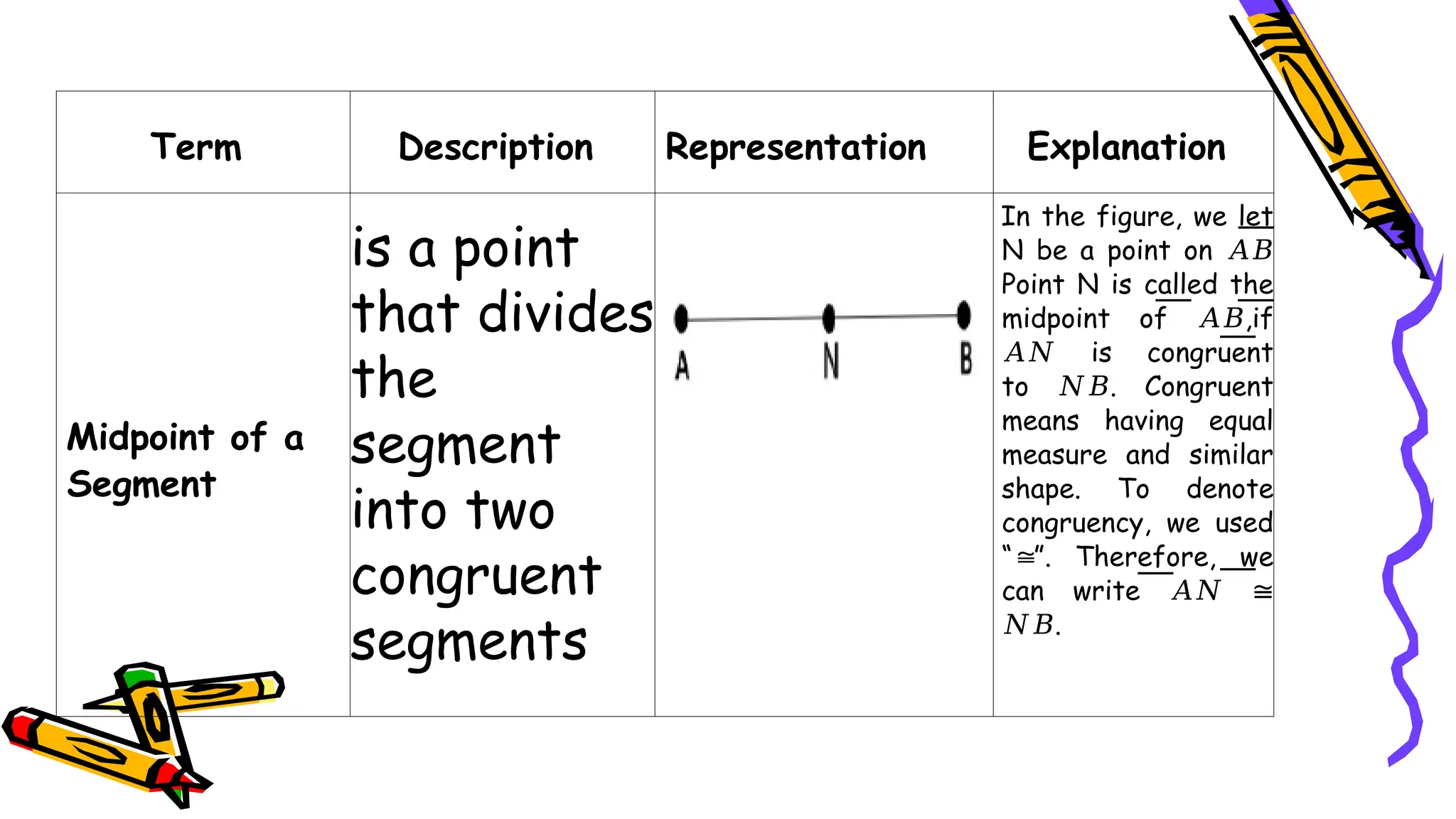
Midpoint of a
Segment
is a point
that divides
the
segment
into two
congruent
segments
In the figure, we let
N be a point on 𝐴𝐵
Point N is called the
midpoint of ,if
𝐴𝐵
is congruent
𝐴𝑁
to . Congruent
𝑁𝐵
means having equal
measure and similar
shape. To denote
congruency, we used
“ ”. Therefore, we
≅
can write 𝐴𝑁 ≅
.
𝑁𝐵
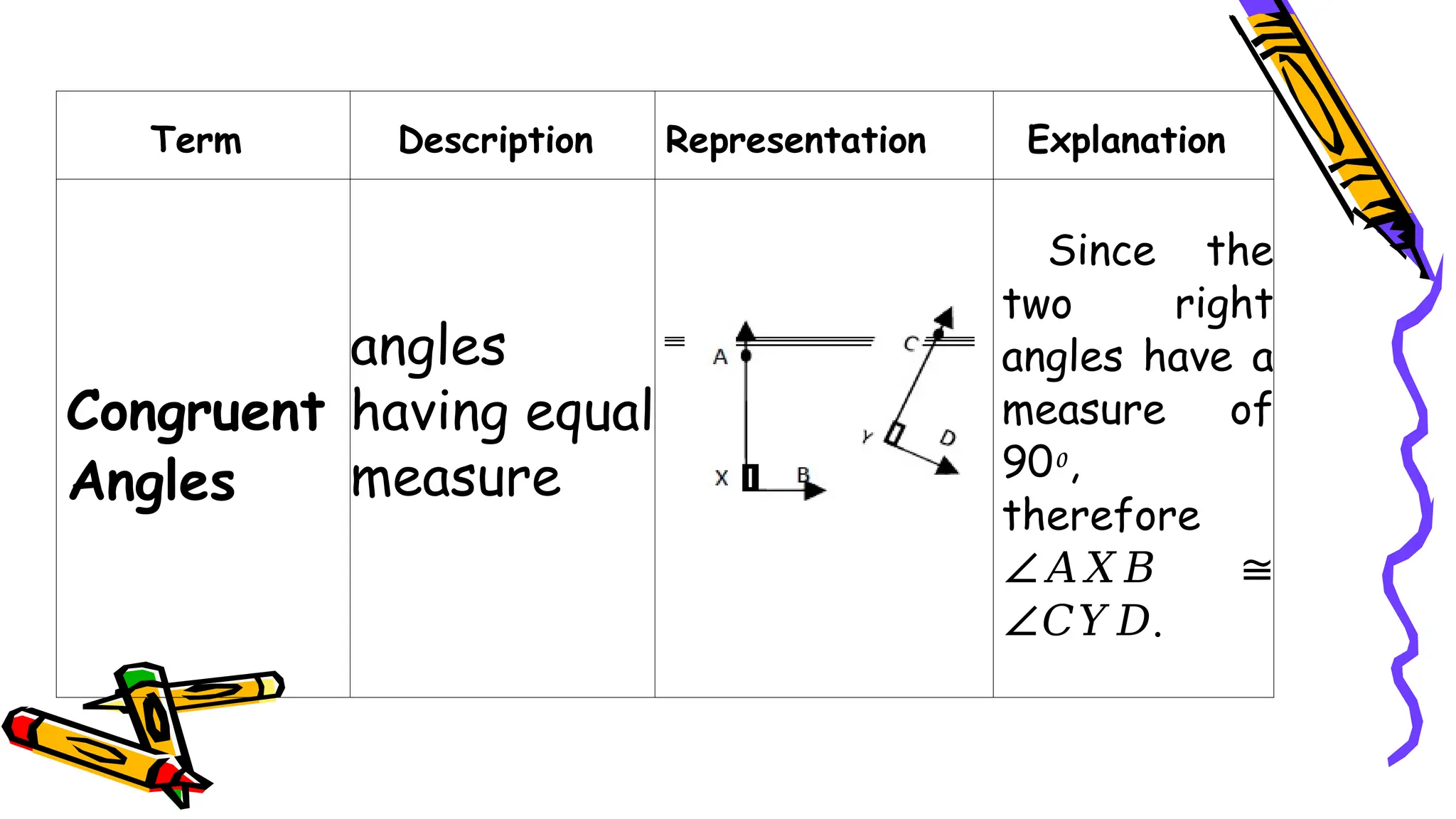
Term Description Representation Explanation
Congruent
Angles
angles
having equal
measure
Since the
two right
angles have a
measure of
90 ,
⁰
therefore
∠𝐴𝑋𝐵 ≅
.
∠𝐶𝑌𝐷
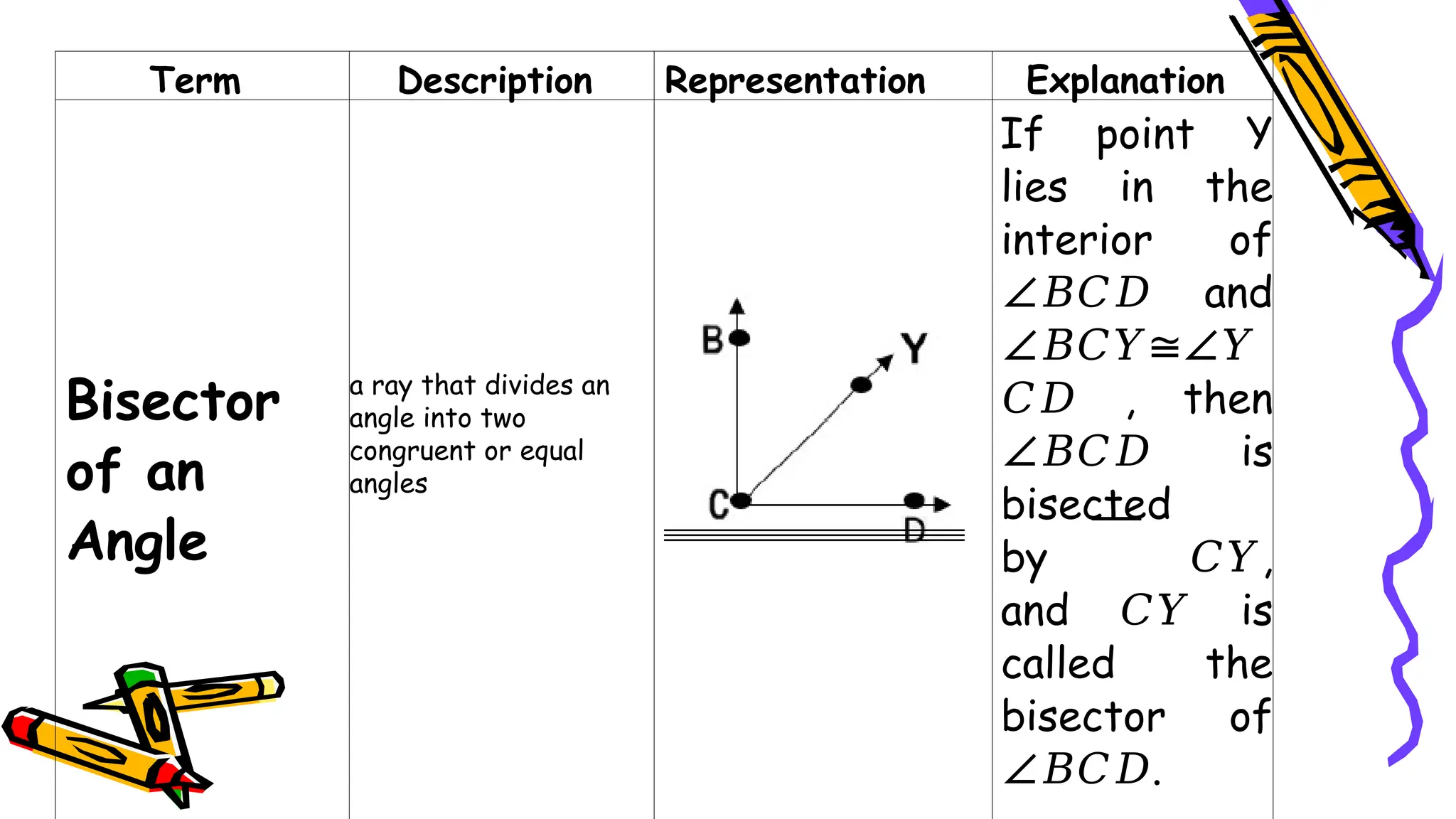
Term Description Representation Explanation
Bisector
of an
Angle
a ray that divides an
angle into two
congruent or equal
angles
If point Y
lies in the
interior of
and
∠𝐵𝐶𝐷
∠𝐵𝐶𝑌≅∠𝑌
, then
𝐶𝐷
is
∠𝐵𝐶𝐷
bisected
by ,
𝐶𝑌
and is
𝐶𝑌
called the
bisector of
.
∠𝐵𝐶𝐷
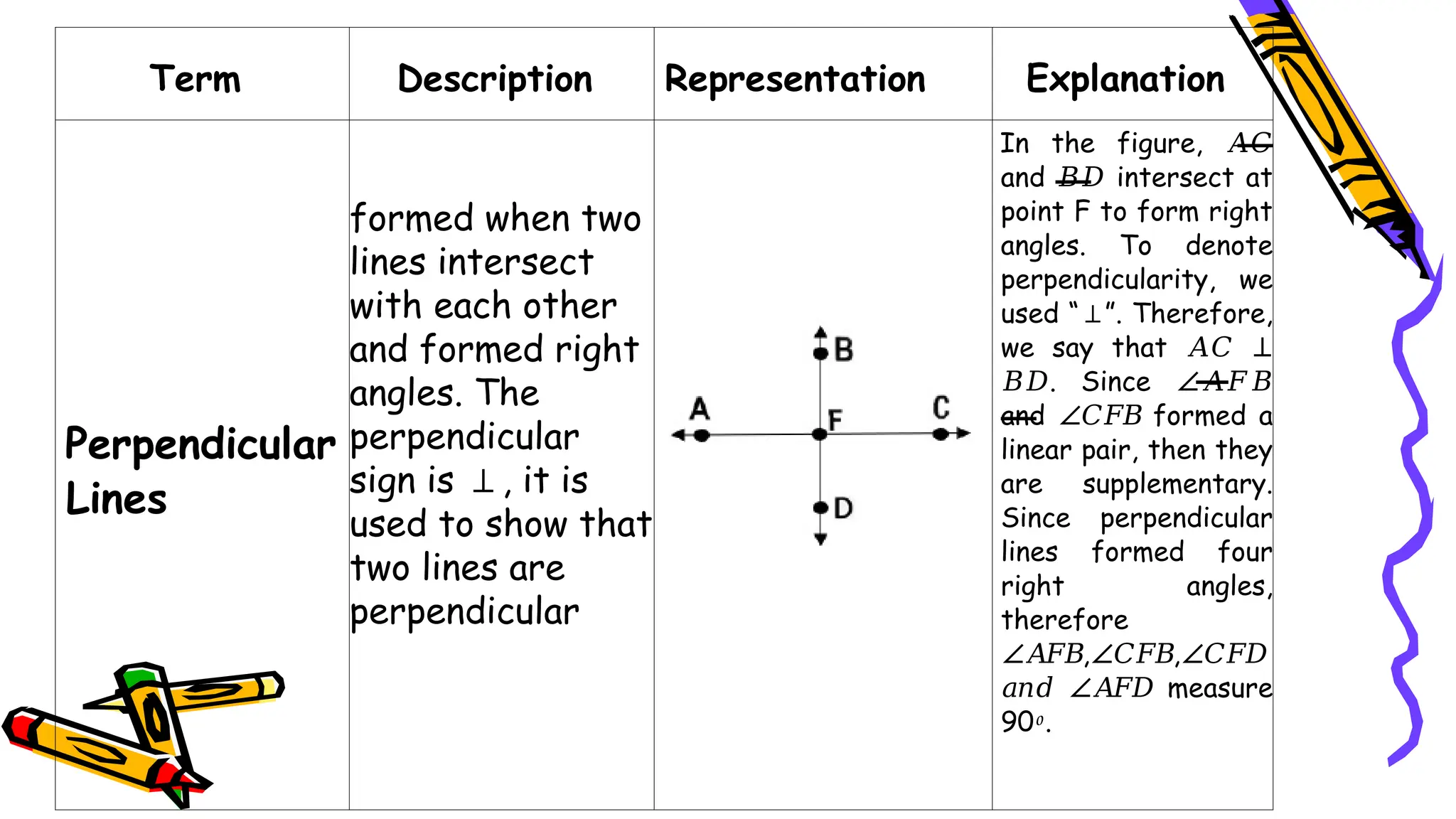
Term Description Representation Explanation
Perpendicular
Lines
formed when two
lines intersect
with each other
and formed right
angles. The
perpendicular
sign is , it is
⊥
used to show that
two lines are
perpendicular
In the figure, 𝐴𝐶
and intersect at
𝐵𝐷
point F to form right
angles. To denote
perpendicularity, we
used “ ”. Therefore,
⊥
we say that 𝐴𝐶 ⊥
. Since
𝐵𝐷 ∠𝐴𝐹𝐵
and formed a
∠𝐶𝐹
𝐵
linear pair, then they
are supplementary.
Since perpendicular
lines formed four
right angles,
therefore
, ,
∠𝐴𝐹
𝐵 ∠𝐶𝐹
𝐵 ∠𝐶𝐹
𝐷
measure
𝑎𝑛𝑑 ∠𝐴𝐹
𝐷
90 .
⁰
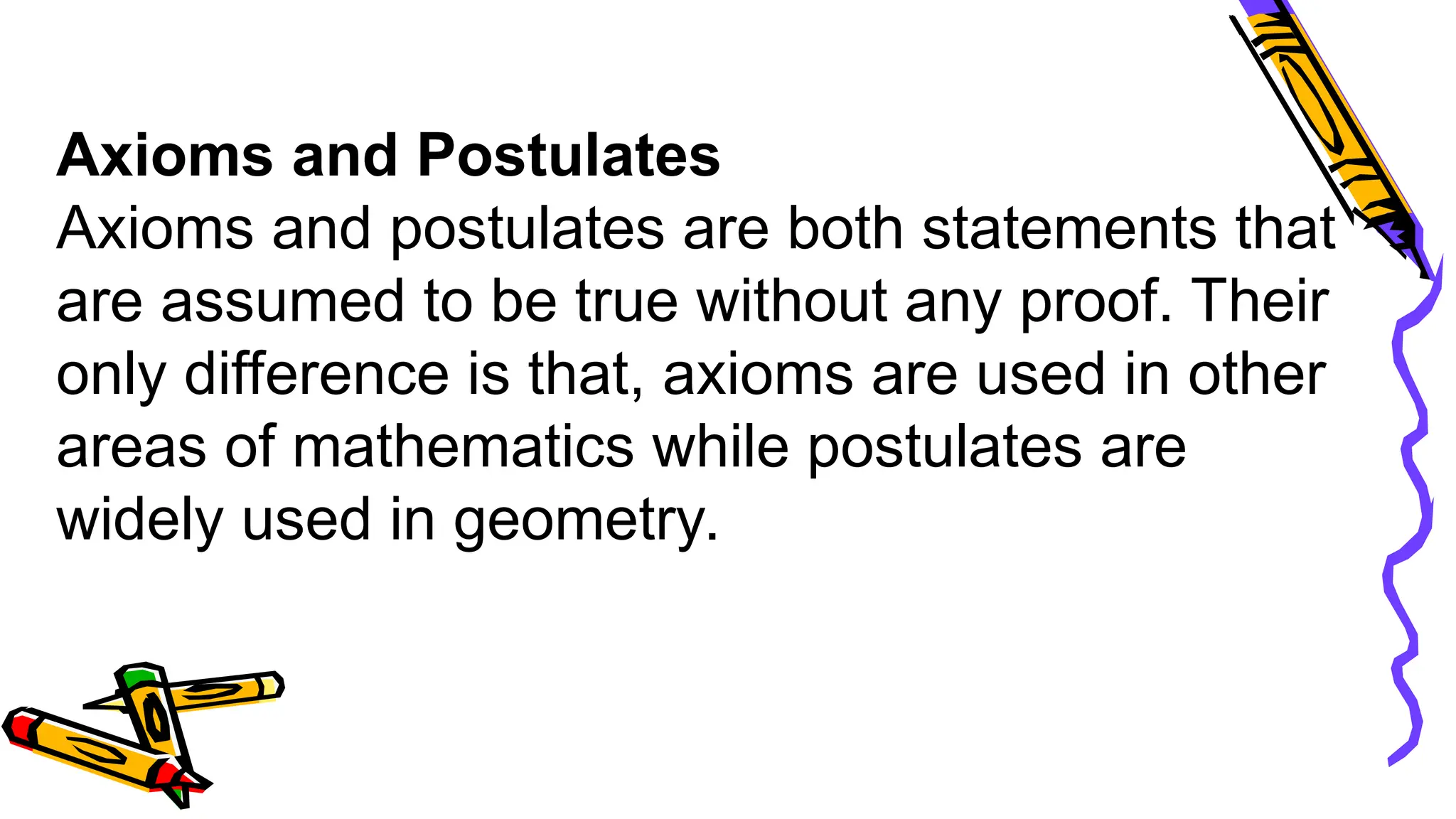
Axioms and Postulates
Axioms and postulates are both statements that
are assumed to be true without any proof. Their
only difference is that, axioms are used in other
areas of mathematics while postulates are
widely used in geometry.
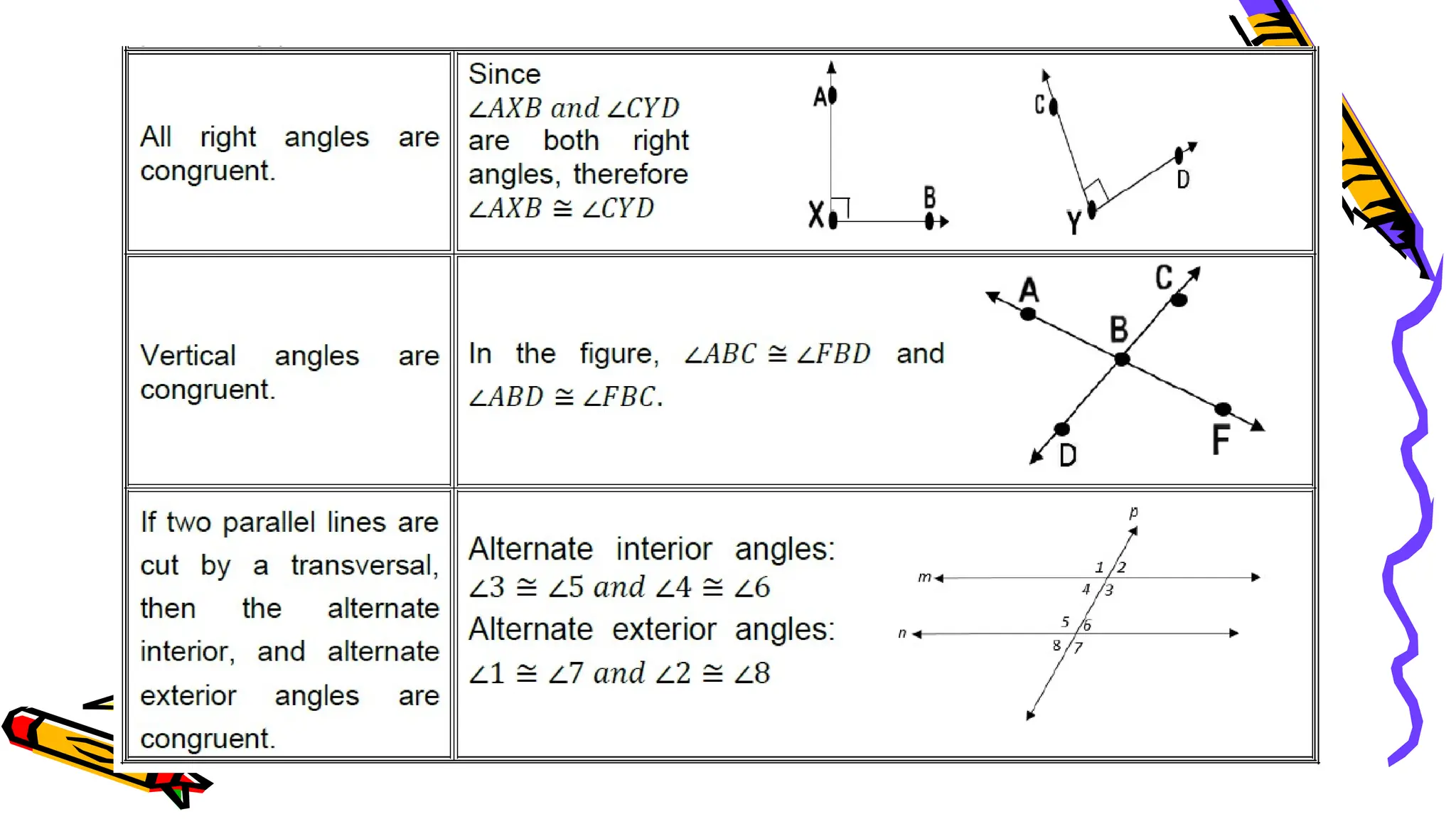
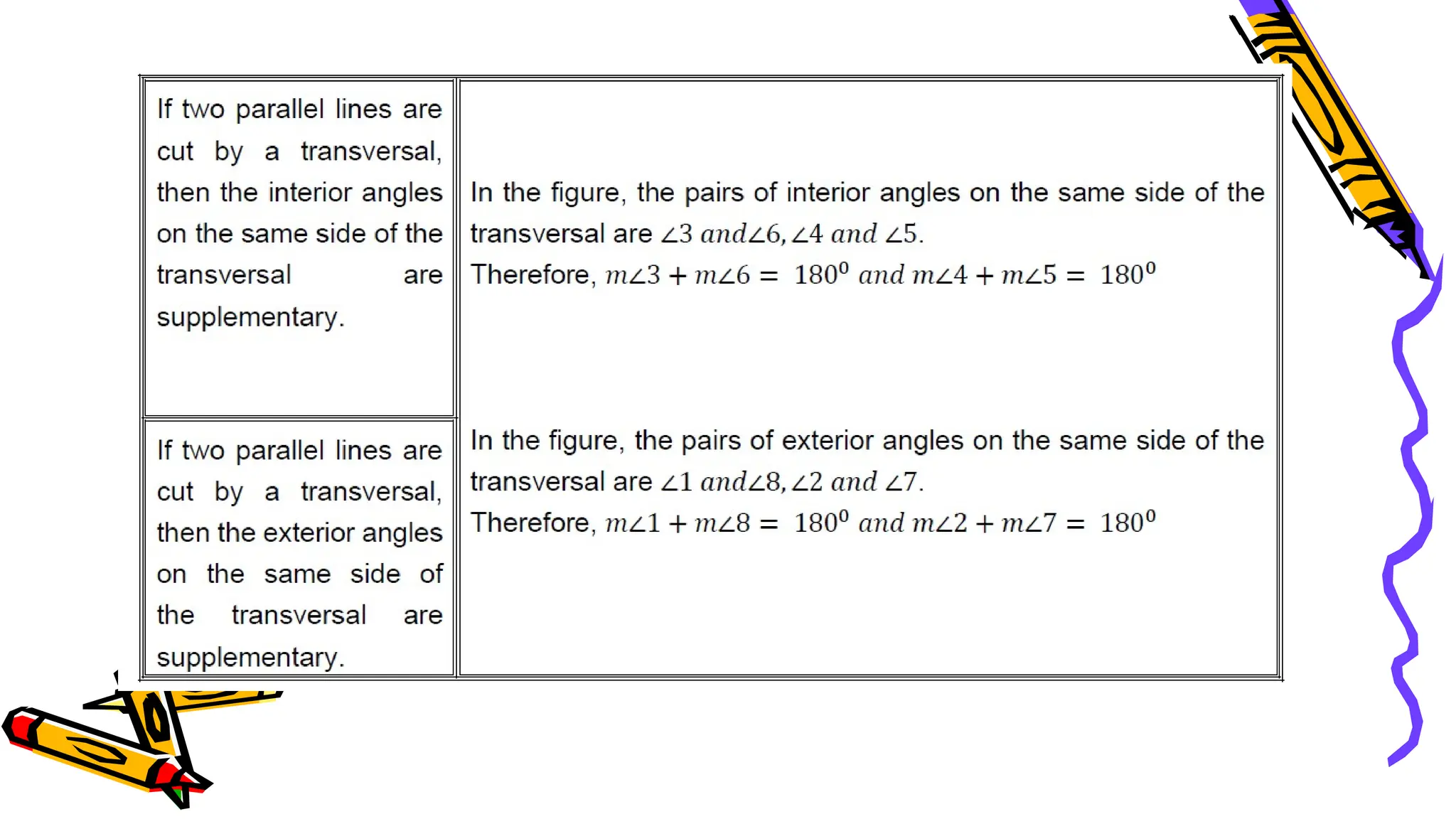
Theorems
A theorem is a basic geometric principle
which are proven to be true by making
connections between accepted definitions,
postulates, mathematical operations, and
previously proven theorems.
Generalization:
•What is mathematical system?
•Enumerate and explain the four
mathematical system.
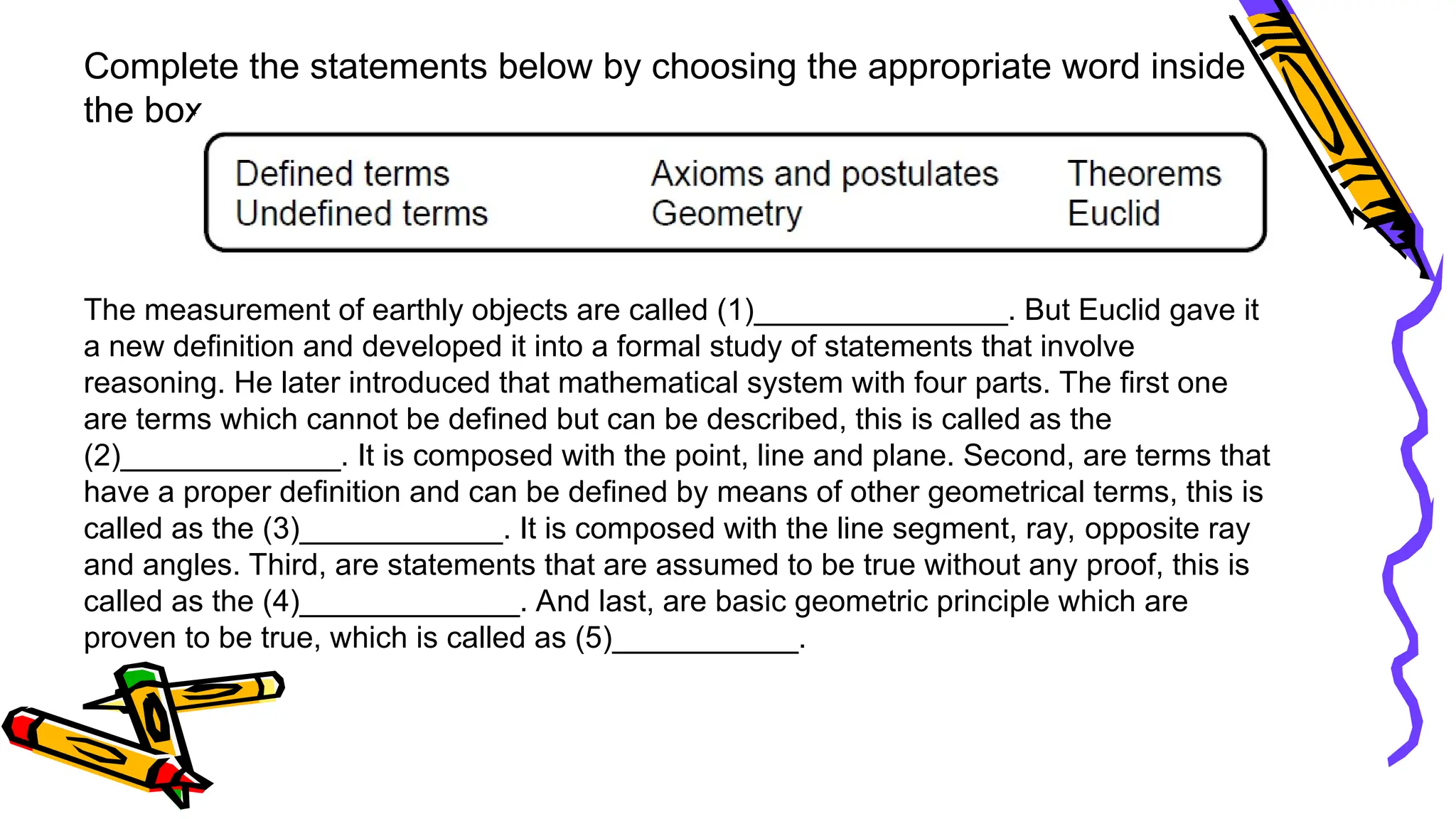
Complete the statements below by choosing the appropriate word inside
the box.
The measurement of earthly objects are called (1)_______________. But Euclid gave it
a new definition and developed it into a formal study of statements that involve
reasoning. He later introduced that mathematical system with four parts. The first one
are terms which cannot be defined but can be described, this is called as the
(2)_____________. It is composed with the point, line and plane. Second, are terms that
have a proper definition and can be defined by means of other geometrical terms, this is
called as the (3)____________. It is composed with the line segment, ray, opposite ray
and angles. Third, are statements that are assumed to be true without any proof, this is
called as the (4)_____________. And last, are basic geometric principle which are
proven to be true, which is called as (5)___________.
Thank You!
Illustrating
Illustrating
Axiomatic System
Axiomatic System
Everything around us involves
dimensions, space, shapes and all
other things related to Geometry.
It is very important for us to know
how things fit together.
Activity 2: Sharing is Caring.
Students explain their
understanding about mathematical
system.
Activity 3: Charade
An axiomatic system is a way to
establish the mathematical truth that
flows from a fixed set of assumptions.
An axiomatic system is a collection of
axioms, or statements about undefined
terms. You can build proofs and
theorems from axioms. Logical
arguments are built from with axioms.
The following properties of an axiomatic system should
be considered to establish mathematical truth.
Consistency – A statement is said to be consistent if
there are no axioms or theorems that contradict each
other
Independence – An axiom is called independent if it
cannot be proved or disproved from the other axioms of
the axiomatic system. An axiomatic system is said to be
independent if each of its axioms is independent.
Completeness – An axiomatic system is called
complete if every statement expressible in the
terms of the system is either provable or has a
provable negation.
Proof is a logical argument in which
each statement is
supported/justified by given
information, definitions, axioms,
postulates, theorems and previously
proven statements.
Example 1
Axiom 1. Every computer set has at least two players.
Axiom 2. Every player has at least two computer set.
Axiom 3. There exist at least one computer set.
Explanation:
This might describe a routine for a shop owner to control activity in a
computer shop, but it is also a set of axioms. We have two undefined
terms, "computer set" and "player." We have not defined "computer
set" or "player," but we can build on those undefined terms to
construct various proofs.
Let's prove a player exist
By the third axiom, a computer set exist.
By the first axiom, the existing computer set must have at least one
player.
Therefore, at least one player for a computer set exist.
This limited axiomatic system would be enough to
build a network of computers to work in a computer shop.
Example 2
Axiom 1. Every line is an intersection of two planes.
Axiom 2. The plane has at least two lines.
Axiom 3. A minimum of one plane exist.
Explanation
Let's prove a plane exist
By the third axiom, a plane exist.
By the first axiom, the line intersect two planes.
By the second axiom, the plane contains at least two
lines.
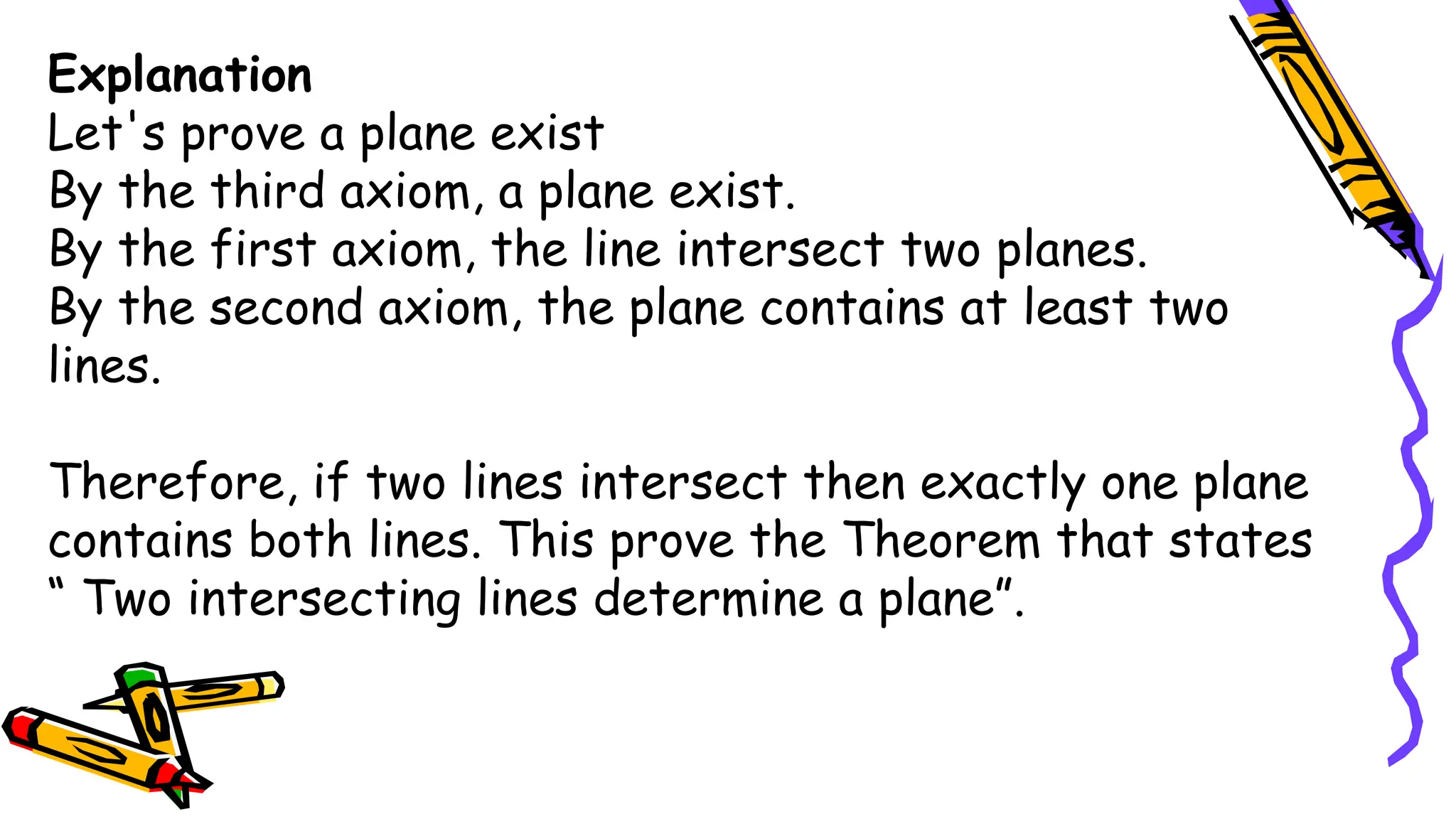
Therefore, if two lines intersect then exactly one plane
contains both lines. This prove the Theorem that states
“ Two intersecting lines determine a plane”.
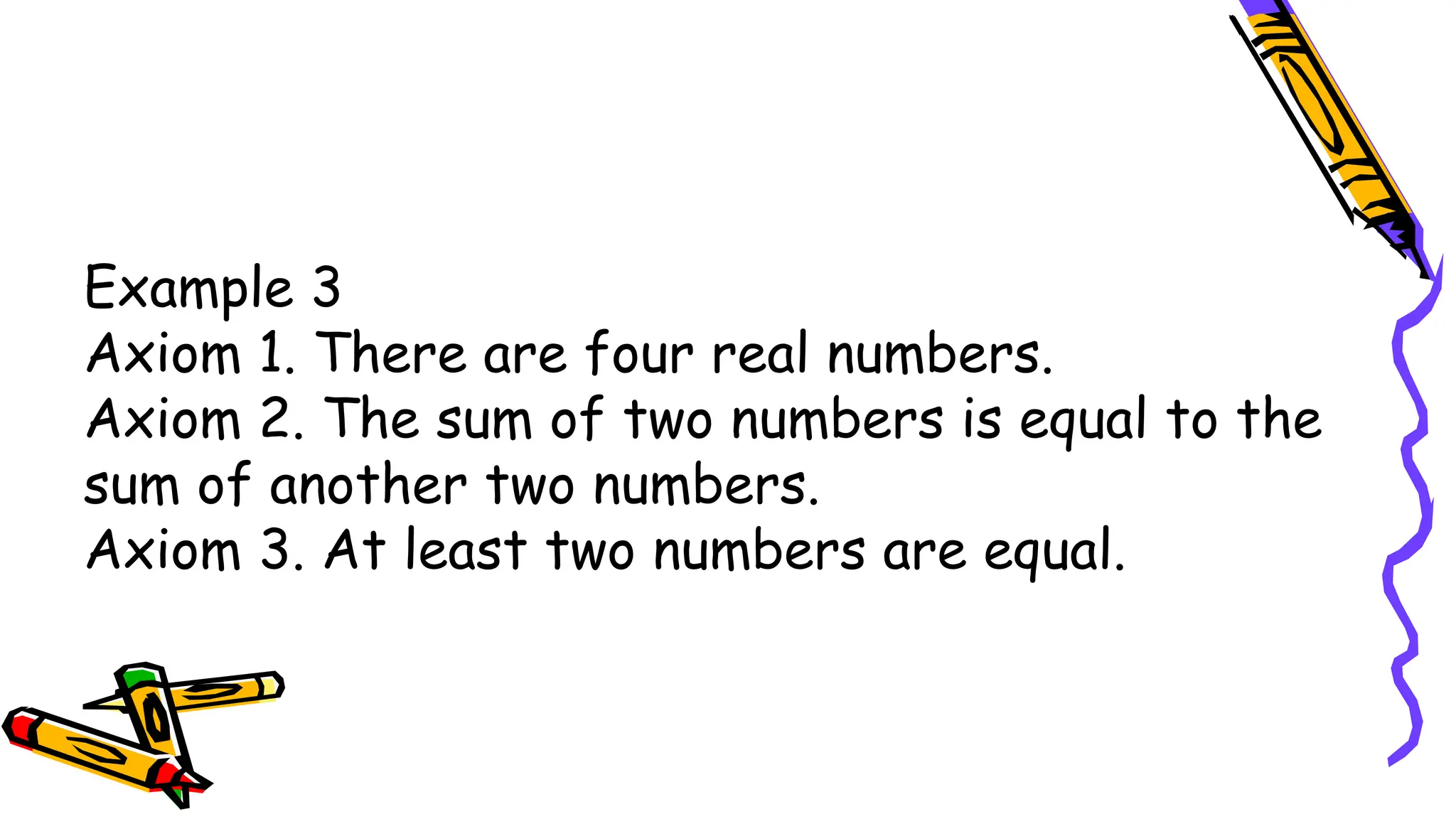
Example 3
Axiom 1. There are four real numbers.
Axiom 2. The sum of two numbers is equal to the
sum of another two numbers.
Axiom 3. At least two numbers are equal.
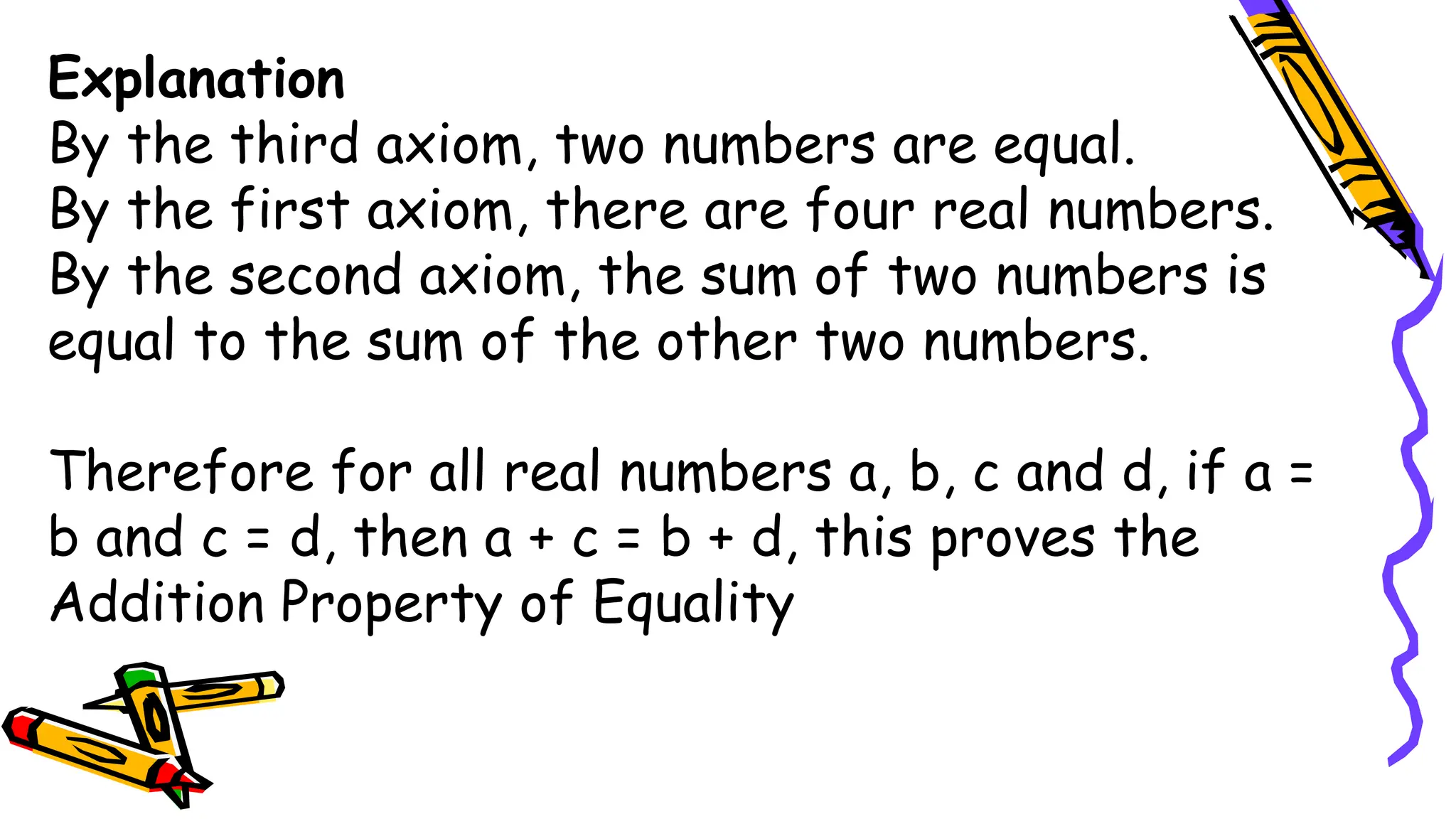
Explanation
By the third axiom, two numbers are equal.
By the first axiom, there are four real numbers.
By the second axiom, the sum of two numbers is
equal to the sum of the other two numbers.
Therefore for all real numbers a, b, c and d, if a =
b and c = d, then a + c = b + d, this proves the
Addition Property of Equality
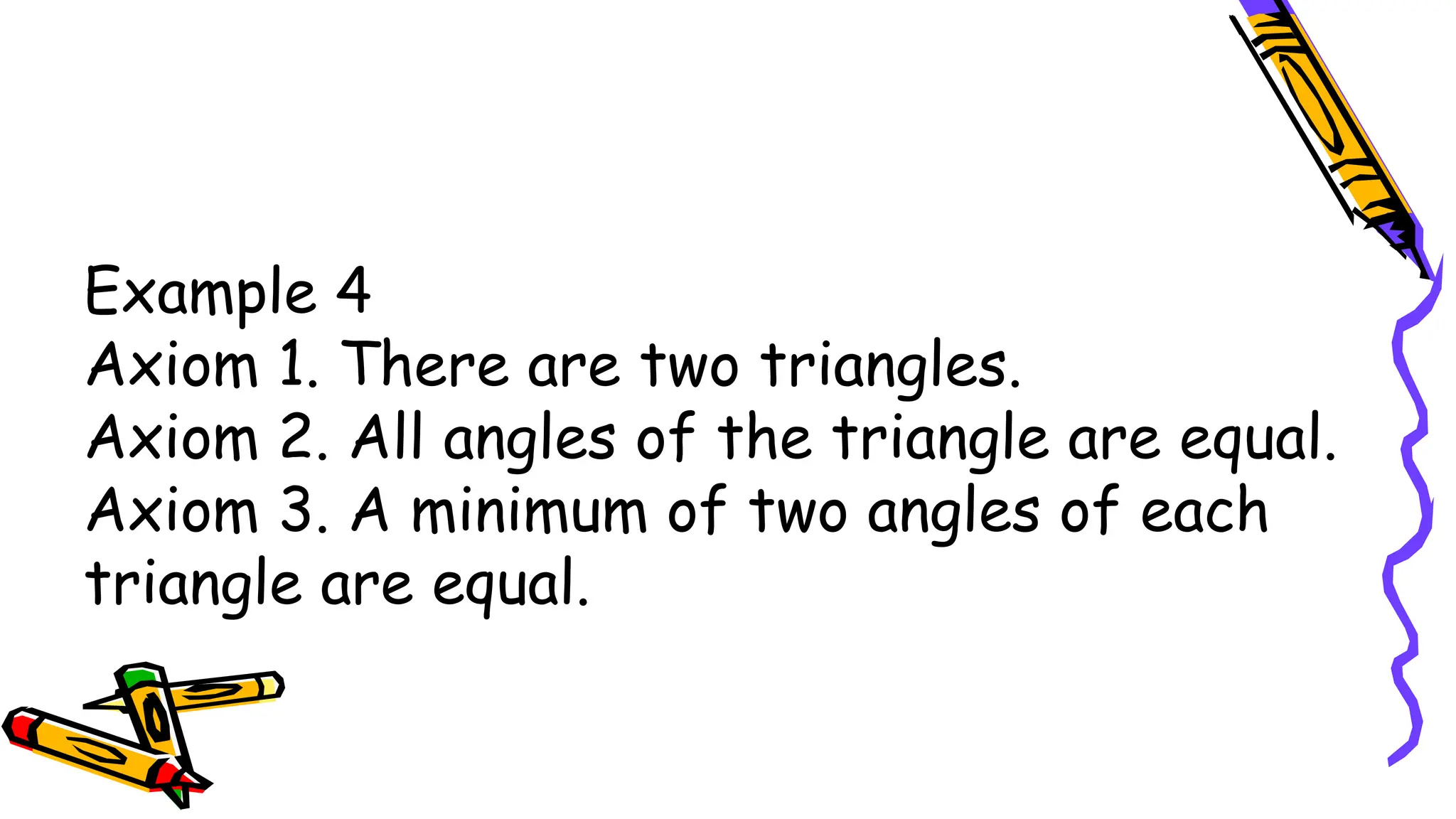
Example 4
Axiom 1. There are two triangles.
Axiom 2. All angles of the triangle are equal.
Axiom 3. A minimum of two angles of each
triangle are equal.
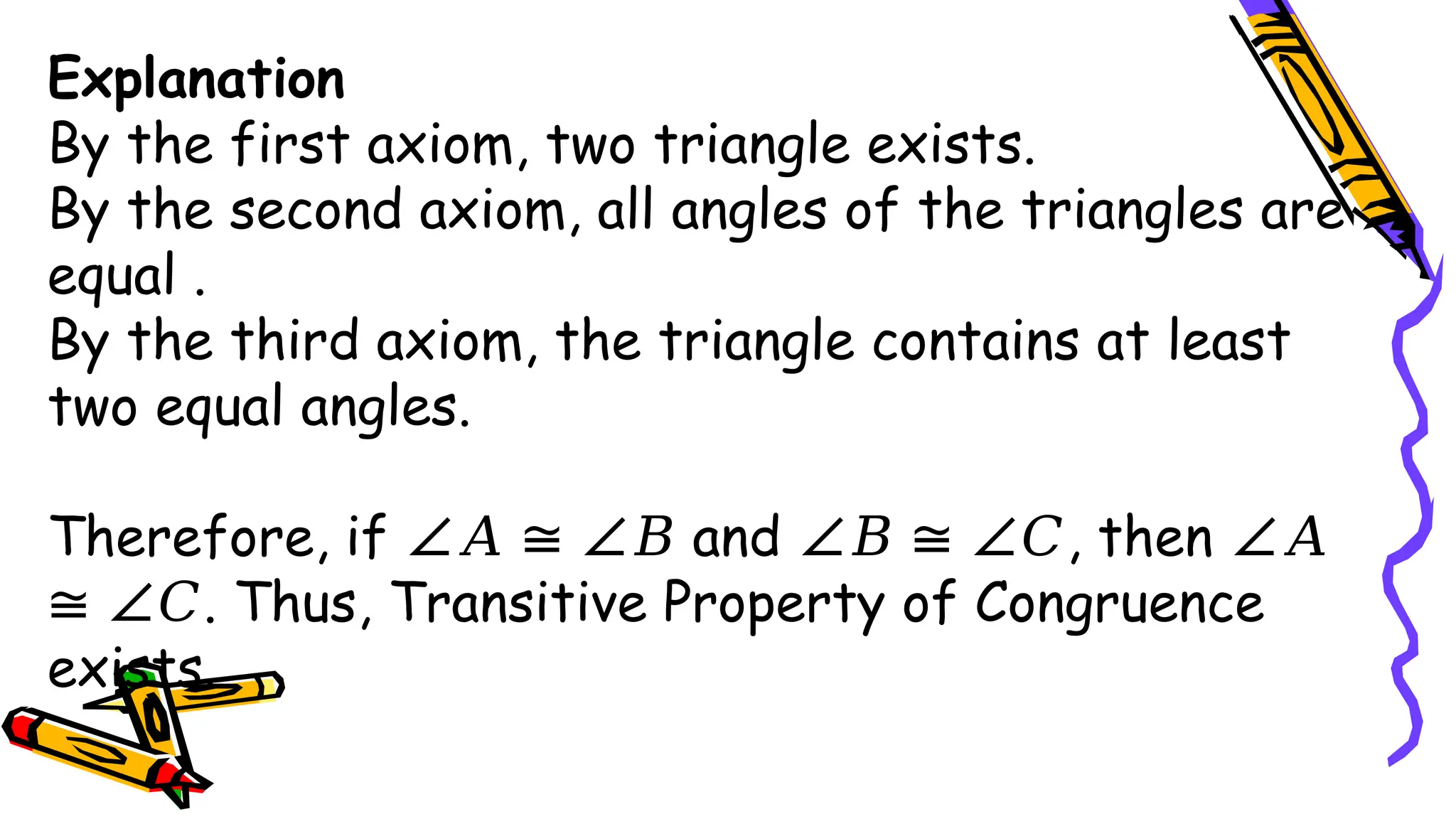
Explanation
By the first axiom, two triangle exists.
By the second axiom, all angles of the triangles are
equal .
By the third axiom, the triangle contains at least
two equal angles.
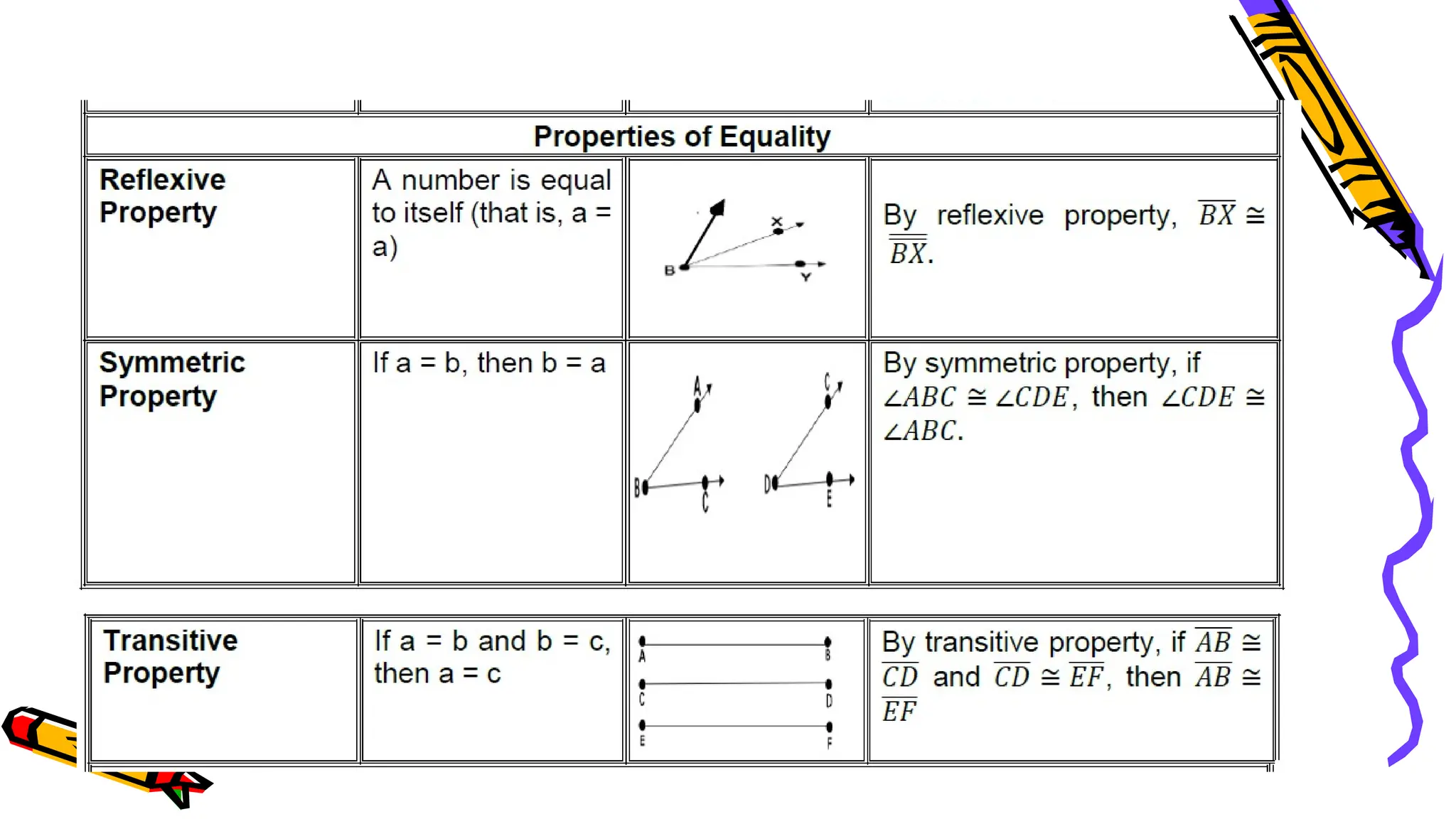
Therefore, if and , then
∠𝐴 ≅ ∠𝐵 ∠𝐵 ≅ ∠𝐶 ∠𝐴
. Thus, Transitive Property of Congruence
≅ ∠𝐶
exists.
Thank You!

MATH-8-Q3-WEEK-1-DESCRIBING-MATHEMATICAL-SYSTEM-AND-ILLUSTRATING-AXIOMATIC-SYSTEM.ppt

  • 1.
  • 2.
    Activity 1: MULTIPLECHOICE Directions: Read each question carefully and write the letter of the correct answer on a separate sheet of paper. 1. Which has no width and no thickness and can be extended infinitely in opposite directions? A. angle B. line C. plane D. point 2. Which describes a point? A. corner of a room B. cover of a book C. tip of a pen D. top of a box 3. What is a flat surface that extends infinitely in all directions? A. angle B. line C. plane D. point 4. Which is a subset of a line with one endpoint and extends infinitely in one direction? A. angle B. line C. ray D. segment 5 . What term is formed by two noncollinear rays with a common endpoint?
  • 3.
    Activity 2: WordJumble Unscramble the letters using the words from the word bank below. Write them on a sheet of paper. 1.I N L E 6. E T A L U T S O P 2.M X O I A 7. E L G N A 3.T I O N P 8. G E S N T M E 4.E N P L A 9. M E R O E H T 5.Y R A 10. R E U A S E M THEOREM RAY AXIOM MEASURE POSTULATE LINE ANGLE PLANE
  • 4.
    Terms Objects 1. Point 2.Line 3. Plane 4. Line segment 5. Ray 6. Angle Questions: •What objects did you choose in items 1 to 6? •What words can you use to describe the objects you choose for each item? Using the words that you gave in question number 2, form a definition for each term above. Activity 3: Find Me Look at the objects around you and list down one object each that you think best describes or represents a point, line, plane, line segment, ray and angle. Copy the table below and write your answer on it.
  • 5.
    God has givenus bountiful nature with different shapes and measurements that are connected with Geometry
  • 6.
  • 7.
    Geometry is themeasurement of earthly objects. “geo” which means earth “metrein” which means to measure. But Euclid gave geometry a new definition and developed it into a formal study of statements that involve reasoning. He then defined geometry as the study of a body of logically connected statements. This makes completely clear that in geometry, a statement leads to another statement in an arrangement that is supported by reasons.
  • 8.
    In the mathematicalsystem designed by Euclid, there are four parts namely: 1. Undefined Terms 2. Defined Terms 3. Axioms and postulates 4. Theorems
  • 9.
    The undefined termsin geometry are points, lines and planes which are said to be the building blocks of geometry. How will you describe these undefined terms? Undefined Terms
  • 10.
    Term Description RepresentationNaming Real-life Example Point A point is a figure with no length and width or simply with no dimension. A point is named by a capital letter. So, the point below is read as point B. Tip of a pen
  • 11.
    Term Description RepresentationNaming Real-life Example Line A line has no width and no thickness but it can be extended infinitely in opposite directions. A line is determined by locating two points on the line and it is named with a lower-case letter or two capital letters with a double arrowhead above it. The figure below is read as line BC or line m and denoted as 𝐵𝐶 Crease of a paper
  • 12.
    Term Description RepresentationNaming Real-life Example Plane A plane is a flat surface that extends infinitely in all directions. A plane is named with a capital letter. The plane below is named as plane N. Cover of a book
  • 13.
    Can you citeother real-life examples of points, lines and planes that you see around you?
  • 14.
    In geometry, definedterms are terms that have a proper definition and can be defined by means of other geometrical terms. The basic defined terms in geometry are line segments, rays, opposite rays and angles. Defined Terms
  • 15.
    Term Description RepresentationNaming Real-life Example Line Segment A line segment is formed when two distinct points are connected with a straight line A line segment is determined by locating two points and it is named with a two capital letters. The figure below is read as line segment AB and denoted as or 𝐴B̅ 𝐵𝐴. Ruler
  • 16.
    Term Description RepresentationNaming Real-life Example Ray A ray is part of a line. It extends infinitely in one direction only and stopped by a point on one end. A ray is determined by locating two points and it is named with two capital letters with a single arrowhead above it. The figure below is read as ray AB and denoted as AB. Arrow
  • 17.
    Term Description RepresentationNaming Real-life Example Angles An angle is a figure formed by two rays meeting at a common endpoint. Angles are denoted by a number, vertex and the three capital letters. The angle below can be named as or or 𝑋𝑂𝑌 𝑂 Hands of a clock
  • 18.
    Can you thinkof other real-life examples of line segments, rays, opposite rays and angles around you?
  • 19.
    Here are somecommon terms that you may encounter along with the defined terms.
  • 20.
    Term Description RepresentationExplanation Midpoint of a Segment is a point that divides the segment into two congruent segments In the figure, we let N be a point on 𝐴𝐵 Point N is called the midpoint of ,if 𝐴𝐵 is congruent 𝐴𝑁 to . Congruent 𝑁𝐵 means having equal measure and similar shape. To denote congruency, we used “ ”. Therefore, we ≅ can write 𝐴𝑁 ≅ . 𝑁𝐵
  • 21.
    Term Description RepresentationExplanation Congruent Angles angles having equal measure Since the two right angles have a measure of 90 , ⁰ therefore ∠𝐴𝑋𝐵 ≅ . ∠𝐶𝑌𝐷
  • 22.
    Term Description RepresentationExplanation Bisector of an Angle a ray that divides an angle into two congruent or equal angles If point Y lies in the interior of and ∠𝐵𝐶𝐷 ∠𝐵𝐶𝑌≅∠𝑌 , then 𝐶𝐷 is ∠𝐵𝐶𝐷 bisected by , 𝐶𝑌 and is 𝐶𝑌 called the bisector of . ∠𝐵𝐶𝐷
  • 23.
    Term Description RepresentationExplanation Perpendicular Lines formed when two lines intersect with each other and formed right angles. The perpendicular sign is , it is ⊥ used to show that two lines are perpendicular In the figure, 𝐴𝐶 and intersect at 𝐵𝐷 point F to form right angles. To denote perpendicularity, we used “ ”. Therefore, ⊥ we say that 𝐴𝐶 ⊥ . Since 𝐵𝐷 ∠𝐴𝐹𝐵 and formed a ∠𝐶𝐹 𝐵 linear pair, then they are supplementary. Since perpendicular lines formed four right angles, therefore , , ∠𝐴𝐹 𝐵 ∠𝐶𝐹 𝐵 ∠𝐶𝐹 𝐷 measure 𝑎𝑛𝑑 ∠𝐴𝐹 𝐷 90 . ⁰
  • 25.
    Axioms and Postulates Axiomsand postulates are both statements that are assumed to be true without any proof. Their only difference is that, axioms are used in other areas of mathematics while postulates are widely used in geometry.
  • 29.
    Theorems A theorem isa basic geometric principle which are proven to be true by making connections between accepted definitions, postulates, mathematical operations, and previously proven theorems.
  • 34.
    Generalization: •What is mathematicalsystem? •Enumerate and explain the four mathematical system.
  • 36.
    Complete the statementsbelow by choosing the appropriate word inside the box. The measurement of earthly objects are called (1)_______________. But Euclid gave it a new definition and developed it into a formal study of statements that involve reasoning. He later introduced that mathematical system with four parts. The first one are terms which cannot be defined but can be described, this is called as the (2)_____________. It is composed with the point, line and plane. Second, are terms that have a proper definition and can be defined by means of other geometrical terms, this is called as the (3)____________. It is composed with the line segment, ray, opposite ray and angles. Third, are statements that are assumed to be true without any proof, this is called as the (4)_____________. And last, are basic geometric principle which are proven to be true, which is called as (5)___________.
  • 37.
  • 38.
  • 39.
    Everything around usinvolves dimensions, space, shapes and all other things related to Geometry. It is very important for us to know how things fit together.
  • 40.
    Activity 2: Sharingis Caring. Students explain their understanding about mathematical system.
  • 41.
  • 42.
    An axiomatic systemis a way to establish the mathematical truth that flows from a fixed set of assumptions. An axiomatic system is a collection of axioms, or statements about undefined terms. You can build proofs and theorems from axioms. Logical arguments are built from with axioms.
  • 43.
    The following propertiesof an axiomatic system should be considered to establish mathematical truth. Consistency – A statement is said to be consistent if there are no axioms or theorems that contradict each other Independence – An axiom is called independent if it cannot be proved or disproved from the other axioms of the axiomatic system. An axiomatic system is said to be independent if each of its axioms is independent. Completeness – An axiomatic system is called complete if every statement expressible in the terms of the system is either provable or has a provable negation.
  • 44.
    Proof is alogical argument in which each statement is supported/justified by given information, definitions, axioms, postulates, theorems and previously proven statements.
  • 45.
    Example 1 Axiom 1.Every computer set has at least two players. Axiom 2. Every player has at least two computer set. Axiom 3. There exist at least one computer set.
  • 46.
    Explanation: This might describea routine for a shop owner to control activity in a computer shop, but it is also a set of axioms. We have two undefined terms, "computer set" and "player." We have not defined "computer set" or "player," but we can build on those undefined terms to construct various proofs. Let's prove a player exist By the third axiom, a computer set exist. By the first axiom, the existing computer set must have at least one player. Therefore, at least one player for a computer set exist. This limited axiomatic system would be enough to build a network of computers to work in a computer shop.
  • 47.
    Example 2 Axiom 1.Every line is an intersection of two planes. Axiom 2. The plane has at least two lines. Axiom 3. A minimum of one plane exist.
  • 48.
    Explanation Let's prove aplane exist By the third axiom, a plane exist. By the first axiom, the line intersect two planes. By the second axiom, the plane contains at least two lines. Therefore, if two lines intersect then exactly one plane contains both lines. This prove the Theorem that states “ Two intersecting lines determine a plane”.
  • 49.
    Example 3 Axiom 1.There are four real numbers. Axiom 2. The sum of two numbers is equal to the sum of another two numbers. Axiom 3. At least two numbers are equal.
  • 50.
    Explanation By the thirdaxiom, two numbers are equal. By the first axiom, there are four real numbers. By the second axiom, the sum of two numbers is equal to the sum of the other two numbers. Therefore for all real numbers a, b, c and d, if a = b and c = d, then a + c = b + d, this proves the Addition Property of Equality
  • 51.
    Example 4 Axiom 1.There are two triangles. Axiom 2. All angles of the triangle are equal. Axiom 3. A minimum of two angles of each triangle are equal.
  • 52.
    Explanation By the firstaxiom, two triangle exists. By the second axiom, all angles of the triangles are equal . By the third axiom, the triangle contains at least two equal angles. Therefore, if and , then ∠𝐴 ≅ ∠𝐵 ∠𝐵 ≅ ∠𝐶 ∠𝐴 . Thus, Transitive Property of Congruence ≅ ∠𝐶 exists.
  • 54.

Editor's Notes

  • #5 . Shapes like circles, rectangles, squares and triangles are some examples, that can be found in our cars, roads, bridges and buildings or other resources that are available around us. To be able to know, understand and value these, it is important to have basic knowledge and concepts of Geometry.
  • #7 It started as a way of calculating land measurement particularly in Egypt and Babylon, WHERE
  • #9 There are terms which cannot be defined but can be described. These terms are called Undefined Terms. The undefined terms in geometry are points, lines and planes which are said to be the building blocks of geometry. How will you describe these undefined terms? Examine the following description and real-life examples below.
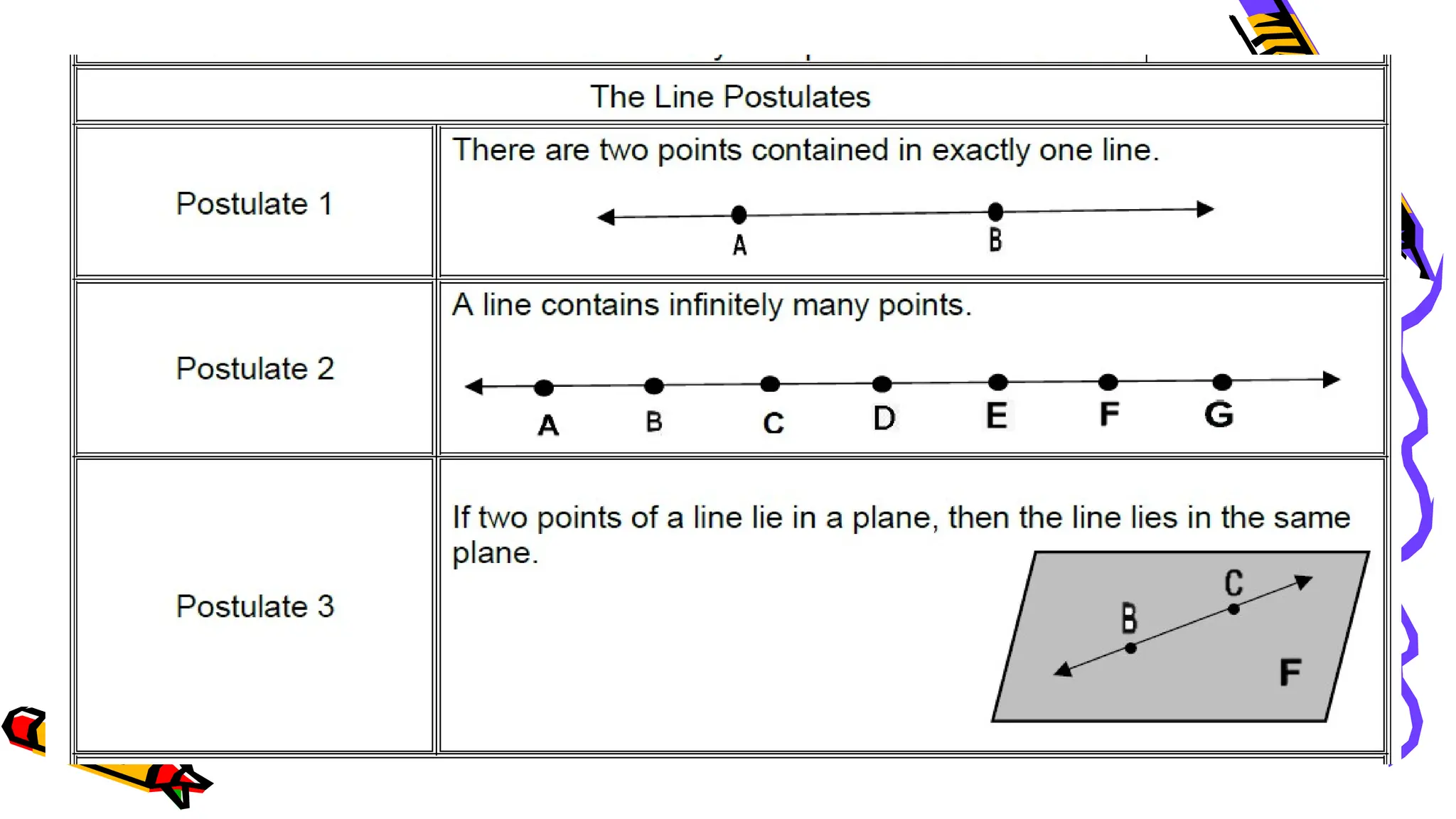
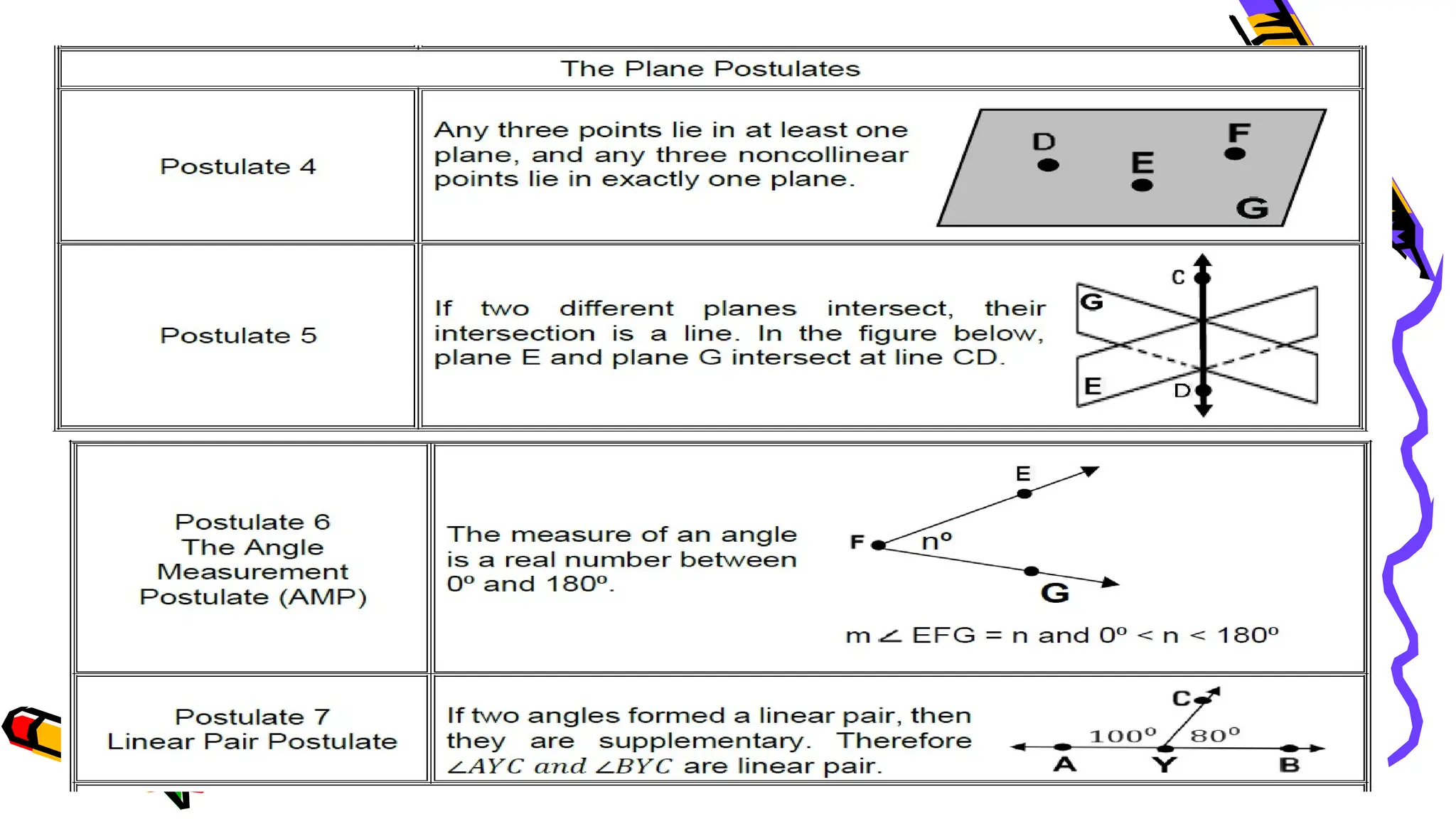
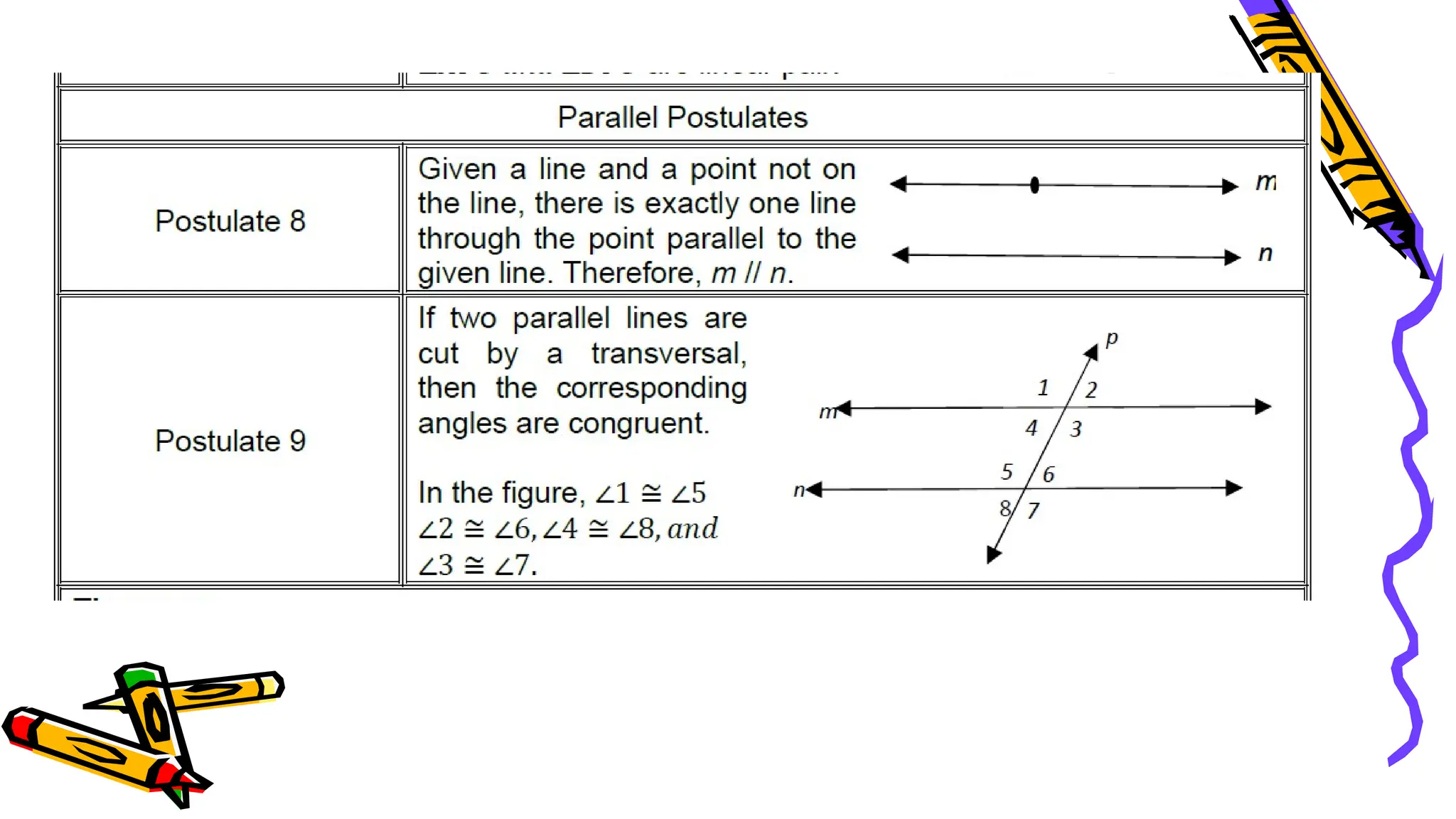
  • #25 Listed below are some of the postulates which are used as guiding rules or assumptions from which other statements on the undefined terms can be derived. Remember that these statements are already accepted as true statements.
  • #29 .