Math 7 Notes
Unit 2: Integers
2.1 Representing Integers
• One of the coldest places on Earth is Antarctica, with an
average annual temperature of about -58oC. This is a
negative integer.
• One of the hottest places on Earth is Ethiopia, with an
average annual temperature of about +34oC. This is a
positive integer.
2.1 Representing Integers
We can use yellow tiles to represent positive integers and red
tiles to represent negative tiles.
• One yellow tile can represent +1.
• One red tile can represent -1.
A red tile and a yellow tile combine to model 0:
We call this a zero pair.
Examples
What integers do these groups represent?
= ___
= ___
Examples
What integer does this represent? Explain how you know.
= ___
Examples
Remember:
One of the coldest places on Earth is Antarctica, with an average annual
temperature of about -58oC. This is a negative integer.
One of the hottest places on Earth is Ethiopia, with an average annual
temperature of about +34oC. This is a positive integer.
How would you represent the average annual
temperature in Antarctica with tiles?
How would you represent the average annual
temperature of Ethiopia with tiles?
2.1 Representing Integers
Remember: you can represent positive and negative integers
with any colours of tiles.
2.1 Representing Integers
Explore
Some of you use 9 tiles and some use 10 tiles. You can use any
combination of red and yellow tiles each time, but you have to use
ALL of the tiles each time.
How many different integers can you model with 9 tiles?
How many different integers can your partner model with 10 tiles?
2.1 Representing Integers
In your notes:
1. Draw a picture to show the tiles you used for each integer you
modelled.
2. Circle the zero pairs.
3. Write the integer each picture represents. How do you know?
2.1 Representing Integers
Connect
• We can model any integer in many ways. Each
set of tiles below models +5.
1.
2.
3.
2.1 Representing Integers
Example
Use coloured tiles to model -4 in three different ways.
Use coloured tiles to model 7 in three different ways.
Use coloured tiles to model 0 in three different ways.
2.1 Representing Integers
Practice
In your textbook try:
Page 246-247
Questions #3-11 (omit #4)
2.2 Adding Integers with
Tiles
Get 10 yellow and 10 red tiles.
2.1 Adding Integers with Tiles
Recall:
When you add two numbers, such as 5 + 3, you can show the
addition by combining 5 tiles and 3 tiles to obtain 8 tiles.
• You can add two integers in a similar way.
• We know that +1 and -1 combine to make a
zero pair.
2.1 Adding Integers with Tiles
Explore:​
You will need coloured tiles.​
1. Choose two different positive integers.
2. Add the integers.
3. Draw a picture of the tiles you used.
4. Write the addition equation.​
• Repeat the activity for a positive integer and a negative integer.​
• Repeat the activity for two different negative integers.
2.1 Adding Integers with Tiles
Connect
To add two positive integers: (+5) + (+4). We can model
each integer with tiles.
Combine the tiles. There are 9 yellow tiles. They model
+9. So, (+5) + (+4) = (+9)
2.1 Adding Integers with Tiles
Connect
To add a negative integer and a positive integer: (-6) + (+9)
We can model each integer with tiles. Circle the zero pairs.
There are _____ zero pairs.
There are _____ yellow tiles left.
They model ______.
Write your complete equation.
2.1 Adding Integers with Tiles
Connect
To add two negative integers: (-3) + (-7)
We can model each integer with tiles.
Combine the tiles.
There are _____ red tiles.
They model _______.
Write your complete equation.
2.1 Adding Integers with Tiles
Example
The temperature rises 5oC, then falls 8oC.
a) Represent the above sentence with integers.
b) Find the overall change in temperature.
2.1 Adding Integers with Tiles
Example
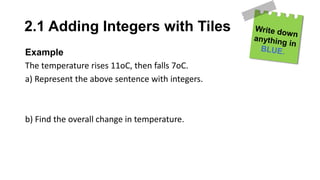
The temperature rises 11oC, then falls 7oC.
a) Represent the above sentence with integers.
b) Find the overall change in temperature.
2.3 Adding Integers on a
Number Line
2.3 Adding Integers on a
Number Line
We can show the addition of whole numbers on a
number line: 4 + 2 = 6
We can also show the addition of integers on a number line.
2.3 Adding Integers on a
Number Line
Connect
• To add a positive integer, move right (in the positive direction).
(-2) + (+3)
• Start at 0.
• Draw an arrow 2 units long, pointing left. This arrow represents -2.
• From -2, draw an arrow 3 units long pointing right. This arrow
represents +3.
• The arrow head is at +1.
2.3 Adding Integers on a
Number Line
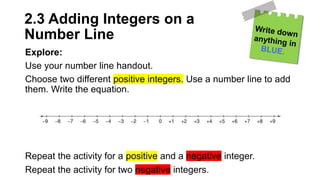
Explore:
Use your number line handout.
Choose two different positive integers. Use a number line to add
them. Write the equation.
Repeat the activity for a positive and a negative integer.
Repeat the activity for two negative integers.
2.3 Adding Integers on a
Number Line
In Conclusion
• To add a positive integer, move right (in
the postive direction)
• To add a negative integer, move left (in the
negative direction)
Represent (-2) + (-3) on a number line.
Start at -2. Draw an arrow 3 units long, pointing
left. This represents -3. The arrow head is at -5
2.3 Adding Integers on a
Number Line
We can also use vertical number lines (used most
often for temperature).
Example
The temperature is 12oC. It falls 5oC. Find the
final temperature.
1. Start at +12.
2. Draw an arrow 5 units long, pointing down.
3. This arrow represents -5.
4. The arrow head is at ______
5. In conclusion, the final temperature is _______
2.3 Adding Integers on a
Number Line
Example
Sandra and Joe buy and sell CDs at a flea market. One day in
August, they bought 3 CDs for $5 each. They sold 2 CDs for $9
each.
a) Write the expenses and income as integers.
b) Did Sandra and Joe make money or lose money that day in
August? Explain.
2.3 Adding Integers on a
Number Line
Examples
Complete each example on a white board. Write your number
line, arrows, and equation.
1. (+3) + (+9) =
2. (-6) + (-3) =
3. (-7) + (+12) =
4.1. It is 3oC outside. Tonight the temperature will fall 11oC. What
will the temperature be tonight?
2.3 Adding Integers on a
Number Line
Assignment
Complete the handout.
When you are done your practice, you can play integer card
games in groups of 2-3.
2.4 Subtracting Integers with
Tiles
2.4 Subtracting Integers with Tiles
Connect
To use tiles to subtract integers, we model the first
integers, then take away the number of tiles
indicated by the second.
We can use tiles to subtract: (+5) – (+9).
1. Model +5.
2. There are not enough tiles to take away +9. To
take away +9, we need 4 more yellow tiles.
3. We add zero pairs without changing the clue.
Add 4 yellow tiles and 4 red tiles. They represent
0.
4. By adding 0, the integer the tiles represent
has not changed , but now we can take away
9 yellow tiles.
5. Since 4 yellow tiles remain, we write:
2.4 Subtracting Integers with Tiles
Connect
Example
Use tiles to subtract.
(-2) – (-6)
(-6) – (+2)
(+2) – (-6)
2.4 Subtracting Integers with Tiles
Note: When we reverse the order in which we subtract 2
integers, the answer is the opposite integer.
(-6) – (+2) = -8 (+2) – (-6) = +8
2.4 Subtracting Integers with Tiles
TEXTBOOK
Complete the practice on
Page 264-265.
Numbers 1, 7-9.
2.5 Subtracting Integers on a
Number Line
Upcoming Dates
NEXT WEEK
•Thursday—Review
•Friday—Unit Test
2.5 Subtracting Integers on a
Number Line
Recall
Modelling subtraction with coloured tiles: 7 - 5 = 2
Modelling subtraction on a number line.
2.5 Subtracting Integers on a
Number Line
Opposite Integer: integers that are the same
distance from 0, but on opposite sides of 0.
Examples:
2.5 Subtracting Integers on a
Number Line
Connect
To subtract two whole numbers, such as 5 – 2,
we can think, “What do we add to 2 to get to
5?”
We add 3 to 2 to get 5, so. 5 – 2 = 3
2.5 Subtracting Integers on a
Number Line
We can do the same to subtract two integers.
For example, to subtract (+5) – (-2).
Think: “what do we add to -2 to get +5?” We
add _____ to -2 to get +5.
2.5 Subtracting Integers on a
Number Line
(+5) – (-2)
• When subtracting on a number line, we start with the 2nd integer, then move
to the first to see the DIFFERENCE.
• If your arrow moves left, the difference is ____________________.
• If your arrow moves right, the difference is ___________________.
2.5 Subtracting Integers on a
Number Line
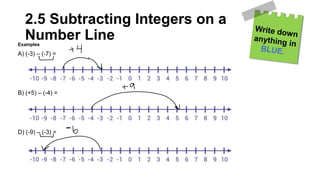
Examples
A) (-3) – (-7) =
B) (+5) – (-4) =
D) (-9) – (-3) =
2.5 Subtracting Integers on a Number Line
Connect
We can look at other subtraction equations
and related addition equations.
(+9) – (+4) = (+9) + (-4) =
(-9) – (-4) = (-9) + (+4) =
(-9) – (+4)= (-9) + (-4) =
(+9) – (-4) = (+9) + (+4) =
In each case, the result of subtracting an integer is the same
as adding the opposite integer.
2.5 Subtracting Integers on a
Number Line
To subtract an integer, we add the opposite integer.
For example, to subtract: (-3) – (-6), we can add the
opposite: (-3) _____________
So, (-3) – (-6) =
2.5 Subtracting Integers on a
Number Line
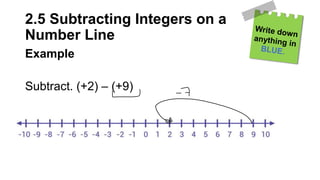
Example
Subtract. (+2) – (+9)
2.5 Subtracting Integers on a
Number Line
Example
Subtract. (-2) – (+9)
2.5 Subtracting Integers on a
Number Line
Assignment
TEXTBOOK
Page 271-272
Numbers 1-10

Math 7, Integers Notes.pptx

  • 1.
  • 2.
  • 4.
    2.1 Representing Integers •One of the coldest places on Earth is Antarctica, with an average annual temperature of about -58oC. This is a negative integer. • One of the hottest places on Earth is Ethiopia, with an average annual temperature of about +34oC. This is a positive integer.
  • 5.
    2.1 Representing Integers Wecan use yellow tiles to represent positive integers and red tiles to represent negative tiles. • One yellow tile can represent +1. • One red tile can represent -1. A red tile and a yellow tile combine to model 0: We call this a zero pair.
  • 6.
    Examples What integers dothese groups represent? = ___ = ___
  • 7.
    Examples What integer doesthis represent? Explain how you know. = ___
  • 8.
    Examples Remember: One of thecoldest places on Earth is Antarctica, with an average annual temperature of about -58oC. This is a negative integer. One of the hottest places on Earth is Ethiopia, with an average annual temperature of about +34oC. This is a positive integer. How would you represent the average annual temperature in Antarctica with tiles? How would you represent the average annual temperature of Ethiopia with tiles?
  • 9.
    2.1 Representing Integers Remember:you can represent positive and negative integers with any colours of tiles.
  • 10.
    2.1 Representing Integers Explore Someof you use 9 tiles and some use 10 tiles. You can use any combination of red and yellow tiles each time, but you have to use ALL of the tiles each time. How many different integers can you model with 9 tiles? How many different integers can your partner model with 10 tiles?
  • 11.
    2.1 Representing Integers Inyour notes: 1. Draw a picture to show the tiles you used for each integer you modelled. 2. Circle the zero pairs. 3. Write the integer each picture represents. How do you know?
  • 12.
    2.1 Representing Integers Connect •We can model any integer in many ways. Each set of tiles below models +5. 1. 2. 3.
  • 13.
    2.1 Representing Integers Example Usecoloured tiles to model -4 in three different ways. Use coloured tiles to model 7 in three different ways. Use coloured tiles to model 0 in three different ways.
  • 14.
    2.1 Representing Integers Practice Inyour textbook try: Page 246-247 Questions #3-11 (omit #4)
  • 15.
    2.2 Adding Integerswith Tiles Get 10 yellow and 10 red tiles.
  • 16.
    2.1 Adding Integerswith Tiles Recall: When you add two numbers, such as 5 + 3, you can show the addition by combining 5 tiles and 3 tiles to obtain 8 tiles. • You can add two integers in a similar way. • We know that +1 and -1 combine to make a zero pair.
  • 17.
    2.1 Adding Integerswith Tiles Explore:​ You will need coloured tiles.​ 1. Choose two different positive integers. 2. Add the integers. 3. Draw a picture of the tiles you used. 4. Write the addition equation.​ • Repeat the activity for a positive integer and a negative integer.​ • Repeat the activity for two different negative integers.
  • 18.
    2.1 Adding Integerswith Tiles Connect To add two positive integers: (+5) + (+4). We can model each integer with tiles. Combine the tiles. There are 9 yellow tiles. They model +9. So, (+5) + (+4) = (+9)
  • 19.
    2.1 Adding Integerswith Tiles Connect To add a negative integer and a positive integer: (-6) + (+9) We can model each integer with tiles. Circle the zero pairs. There are _____ zero pairs. There are _____ yellow tiles left. They model ______. Write your complete equation.
  • 20.
    2.1 Adding Integerswith Tiles Connect To add two negative integers: (-3) + (-7) We can model each integer with tiles. Combine the tiles. There are _____ red tiles. They model _______. Write your complete equation.
  • 21.
    2.1 Adding Integerswith Tiles Example The temperature rises 5oC, then falls 8oC. a) Represent the above sentence with integers. b) Find the overall change in temperature.
  • 22.
    2.1 Adding Integerswith Tiles Example The temperature rises 11oC, then falls 7oC. a) Represent the above sentence with integers. b) Find the overall change in temperature.
  • 23.
    2.3 Adding Integerson a Number Line
  • 24.
    2.3 Adding Integerson a Number Line We can show the addition of whole numbers on a number line: 4 + 2 = 6 We can also show the addition of integers on a number line.
  • 25.
    2.3 Adding Integerson a Number Line Connect • To add a positive integer, move right (in the positive direction). (-2) + (+3) • Start at 0. • Draw an arrow 2 units long, pointing left. This arrow represents -2. • From -2, draw an arrow 3 units long pointing right. This arrow represents +3. • The arrow head is at +1.
  • 26.
    2.3 Adding Integerson a Number Line Explore: Use your number line handout. Choose two different positive integers. Use a number line to add them. Write the equation. Repeat the activity for a positive and a negative integer. Repeat the activity for two negative integers.
  • 27.
    2.3 Adding Integerson a Number Line In Conclusion • To add a positive integer, move right (in the postive direction) • To add a negative integer, move left (in the negative direction) Represent (-2) + (-3) on a number line. Start at -2. Draw an arrow 3 units long, pointing left. This represents -3. The arrow head is at -5
  • 28.
    2.3 Adding Integerson a Number Line We can also use vertical number lines (used most often for temperature). Example The temperature is 12oC. It falls 5oC. Find the final temperature. 1. Start at +12. 2. Draw an arrow 5 units long, pointing down. 3. This arrow represents -5. 4. The arrow head is at ______ 5. In conclusion, the final temperature is _______
  • 29.
    2.3 Adding Integerson a Number Line Example Sandra and Joe buy and sell CDs at a flea market. One day in August, they bought 3 CDs for $5 each. They sold 2 CDs for $9 each. a) Write the expenses and income as integers. b) Did Sandra and Joe make money or lose money that day in August? Explain.
  • 30.
    2.3 Adding Integerson a Number Line Examples Complete each example on a white board. Write your number line, arrows, and equation. 1. (+3) + (+9) = 2. (-6) + (-3) = 3. (-7) + (+12) = 4.1. It is 3oC outside. Tonight the temperature will fall 11oC. What will the temperature be tonight?
  • 31.
    2.3 Adding Integerson a Number Line Assignment Complete the handout. When you are done your practice, you can play integer card games in groups of 2-3.
  • 32.
  • 33.
    2.4 Subtracting Integerswith Tiles Connect To use tiles to subtract integers, we model the first integers, then take away the number of tiles indicated by the second. We can use tiles to subtract: (+5) – (+9). 1. Model +5. 2. There are not enough tiles to take away +9. To take away +9, we need 4 more yellow tiles. 3. We add zero pairs without changing the clue. Add 4 yellow tiles and 4 red tiles. They represent 0. 4. By adding 0, the integer the tiles represent has not changed , but now we can take away 9 yellow tiles. 5. Since 4 yellow tiles remain, we write:
  • 34.
    2.4 Subtracting Integerswith Tiles Connect Example Use tiles to subtract. (-2) – (-6) (-6) – (+2) (+2) – (-6)
  • 35.
    2.4 Subtracting Integerswith Tiles Note: When we reverse the order in which we subtract 2 integers, the answer is the opposite integer. (-6) – (+2) = -8 (+2) – (-6) = +8
  • 36.
    2.4 Subtracting Integerswith Tiles TEXTBOOK Complete the practice on Page 264-265. Numbers 1, 7-9.
  • 37.
    2.5 Subtracting Integerson a Number Line
  • 38.
  • 39.
    2.5 Subtracting Integerson a Number Line Recall Modelling subtraction with coloured tiles: 7 - 5 = 2 Modelling subtraction on a number line.
  • 40.
    2.5 Subtracting Integerson a Number Line Opposite Integer: integers that are the same distance from 0, but on opposite sides of 0. Examples:
  • 41.
    2.5 Subtracting Integerson a Number Line Connect To subtract two whole numbers, such as 5 – 2, we can think, “What do we add to 2 to get to 5?” We add 3 to 2 to get 5, so. 5 – 2 = 3
  • 42.
    2.5 Subtracting Integerson a Number Line We can do the same to subtract two integers. For example, to subtract (+5) – (-2). Think: “what do we add to -2 to get +5?” We add _____ to -2 to get +5.
  • 43.
    2.5 Subtracting Integerson a Number Line (+5) – (-2) • When subtracting on a number line, we start with the 2nd integer, then move to the first to see the DIFFERENCE. • If your arrow moves left, the difference is ____________________. • If your arrow moves right, the difference is ___________________.
  • 44.
    2.5 Subtracting Integerson a Number Line Examples A) (-3) – (-7) = B) (+5) – (-4) = D) (-9) – (-3) =
  • 45.
    2.5 Subtracting Integerson a Number Line Connect We can look at other subtraction equations and related addition equations. (+9) – (+4) = (+9) + (-4) = (-9) – (-4) = (-9) + (+4) = (-9) – (+4)= (-9) + (-4) = (+9) – (-4) = (+9) + (+4) = In each case, the result of subtracting an integer is the same as adding the opposite integer.
  • 46.
    2.5 Subtracting Integerson a Number Line To subtract an integer, we add the opposite integer. For example, to subtract: (-3) – (-6), we can add the opposite: (-3) _____________ So, (-3) – (-6) =
  • 47.
    2.5 Subtracting Integerson a Number Line Example Subtract. (+2) – (+9)
  • 48.
    2.5 Subtracting Integerson a Number Line Example Subtract. (-2) – (+9)
  • 49.
    2.5 Subtracting Integerson a Number Line Assignment TEXTBOOK Page 271-272 Numbers 1-10

Editor's Notes

  • #4 How can you calculate the time in Newfoundland when you know the time in Saskatchewan? How can you calculate the time in BC when you know the time in Saskatchewan? Why do we have different time zones? Why are the time zones different sizes/shapes?