Operations on
Integers
Presented by: Mark Ian Nicolas Olivar
Teacher
Objectives
At the end of the Lesson, students will be able
to:
1. add, subtract, multiply, and divide integers;
2. display accuracy and precision in
performing fundamental operations on
integers; and
3. solve a given problem involving performing
fundamental operations on integers.
Adding and
Subtracting
Integers
Adding and Subtracting Integers
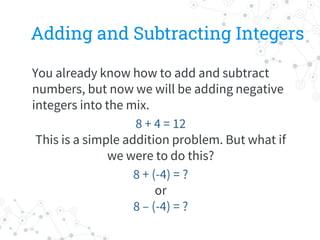
You already know how to add and subtract
numbers, but now we will be adding negative
integers into the mix.
8 + 4 = 12
This is a simple addition problem. But what if
we were to do this?
8 + (-4) = ?
or
8 – (-4) = ?
Adding and Subtracting Integers
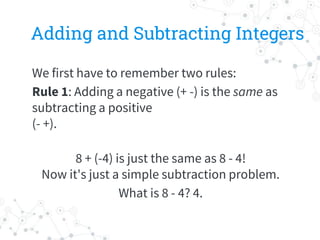
We first have to remember two rules:
Rule 1: Adding a negative (+ -) is the same as
subtracting a positive
(- +).
8 + (-4) is just the same as 8 - 4!
Now it's just a simple subtraction problem.
What is 8 - 4? 4.
Adding and Subtracting Integers
We first have to remember two rules:
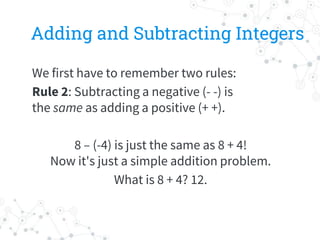
Rule 2: Subtracting a negative (- -) is
the same as adding a positive (+ +).
8 – (-4) is just the same as 8 + 4!
Now it's just a simple addition problem.
What is 8 + 4? 12.
Examples
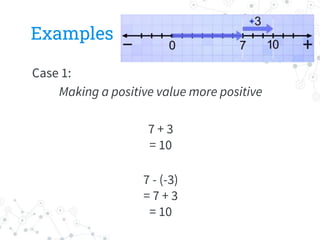
Case 1:
Making a positive value more positive
7 + 3
= 10
7 - (-3)
= 7 + 3
= 10
Examples
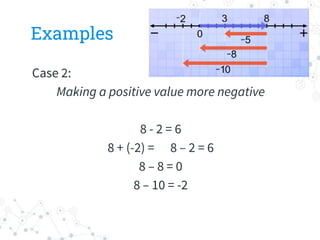
Case 2:
Making a positive value more negative
8 - 2 = 6
8 + (-2) = 8 – 2 = 6
8 – 8 = 0
8 – 10 = -2
Examples
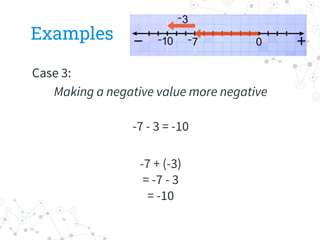
Case 3:
Making a negative value more negative
-7 - 3 = -10
-7 + (-3)
= -7 - 3
= -10
Examples
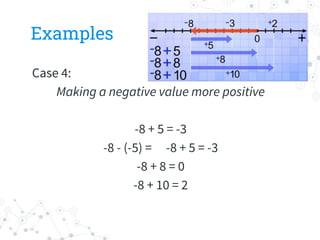
Case 4:
Making a negative value more positive
-8 + 5 = -3
-8 - (-5) = -8 + 5 = -3
-8 + 8 = 0
-8 + 10 = 2
Self-practice
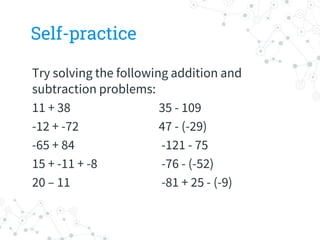
Try solving the following addition and
subtraction problems:
11 + 38 35 - 109
-12 + -72 47 - (-29)
-65 + 84 -121 - 75
15 + -11 + -8 -76 - (-52)
20 – 11 -81 + 25 - (-9)
Self-practice
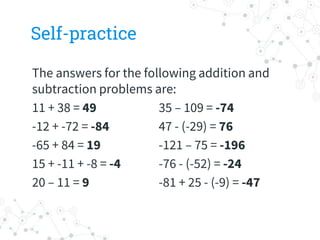
The answers for the following addition and
subtraction problems are:
11 + 38 = 49 35 – 109 = -74
-12 + -72 = -84 47 - (-29) = 76
-65 + 84 = 19 -121 – 75 = -196
15 + -11 + -8 = -4 -76 - (-52) = -24
20 – 11 = 9 -81 + 25 - (-9) = -47
Multiplying and Dividing Integers
You already know how to multiply and divide
numbers, but now we will be adding negative
numbers to the mix.
But don't worry, it's actually much simpler to
multiply and divide integers than it is to add
and subtract them.
Multiplying and Dividing Integers
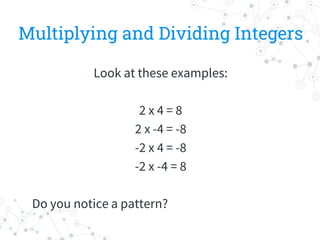
Look at these examples:
2 x 4 = 8
2 x -4 = -8
-2 x 4 = -8
-2 x -4 = 8
Do you notice a pattern?
Multiplying and Dividing Integers
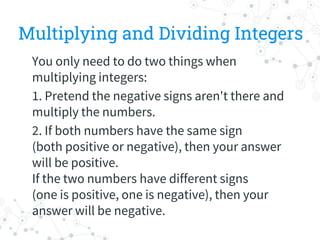
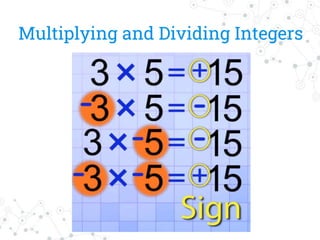
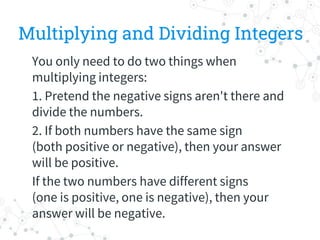
You only need to do two things when
multiplying integers:
1. Pretend the negative signs aren't there and
multiply the numbers.
2. If both numbers have the same sign
(both positive or negative), then your answer
will be positive.
If the two numbers have different signs
(one is positive, one is negative), then your
answer will be negative.
Multiplying and Dividing Integers
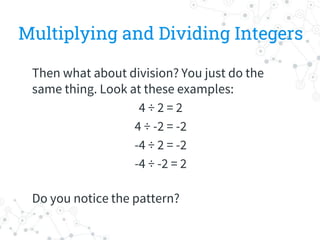
Then what about division? You just do the
same thing. Look at these examples:
4 ÷ 2 = 2
4 ÷ -2 = -2
-4 ÷ 2 = -2
-4 ÷ -2 = 2
Do you notice the pattern?
Multiplying and Dividing Integers
You only need to do two things when
multiplying integers:
1. Pretend the negative signs aren't there and
divide the numbers.
2. If both numbers have the same sign
(both positive or negative), then your answer
will be positive.
If the two numbers have different signs
(one is positive, one is negative), then your
answer will be negative.
Self-practice
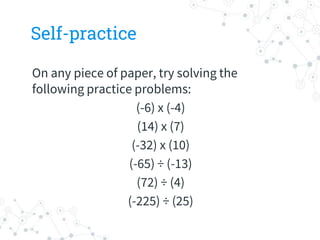
On any piece of paper, try solving the
following practice problems:
(-6) x (-4)
(14) x (7)
(-32) x (10)
(-65) ÷ (-13)
(72) ÷ (4)
(-225) ÷ (25)
Self-practice
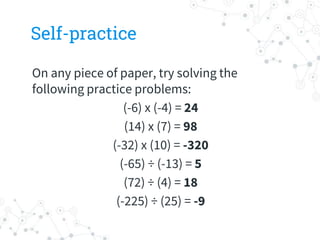
On any piece of paper, try solving the
following practice problems:
(-6) x (-4) = 24
(14) x (7) = 98
(-32) x (10) = -320
(-65) ÷ (-13) = 5
(72) ÷ (4) = 18
(-225) ÷ (25) = -9
Self-practice
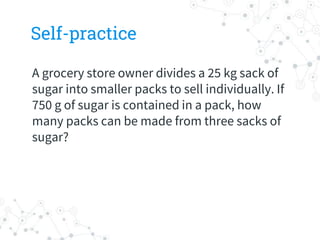
A grocery store owner divides a 25 kg sack of
sugar into smaller packs to sell individually. If
750 g of sugar is contained in a pack, how
many packs can be made from three sacks of
sugar?
Self-practice
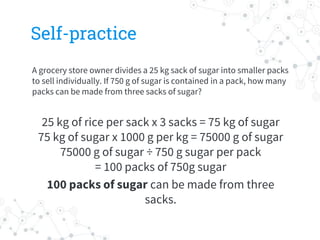
A grocery store owner divides a 25 kg sack of sugar into smaller packs
to sell individually. If 750 g of sugar is contained in a pack, how many
packs can be made from three sacks of sugar?
25 kg of rice per sack x 3 sacks = 75 kg of sugar
75 kg of sugar x 1000 g per kg = 75000 g of sugar
75000 g of sugar ÷ 750 g sugar per pack
= 100 packs of 750g sugar
100 packs of sugar can be made from three
sacks.
Self-practice
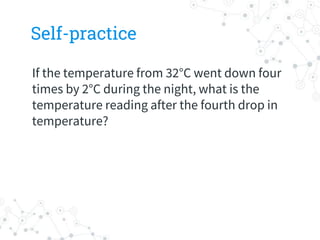
If the temperature from 32°C went down four
times by 2°C during the night, what is the
temperature reading after the fourth drop in
temperature?
Self-practice
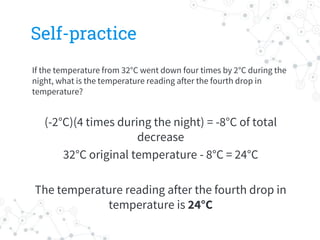
If the temperature from 32°C went down four times by 2°C during the
night, what is the temperature reading after the fourth drop in
temperature?
(-2°C)(4 times during the night) = -8°C of total
decrease
32°C original temperature - 8°C = 24°C
The temperature reading after the fourth drop in
temperature is 24°C
Why do you think it is
important to always
get the correct and
exact answer when
doing math
operations?
Question to ponder
You can check the following links to delve deeper into the
topic if you want
Fundamental Operations on Integers | Jai Olmo
◎https://youtu.be/_y6y-k4Yv7Q
Math Antics – Adding & Subtracting | Math Antics
◎https://youtu.be/_BgblvF90UE
Math Antics – Integer Multiplication & Division | Math
Antics
◎https://youtu.be/K_tPbVPfHgk
End of Lesson

05 Performing Fundamental Operations on Integers.pptx

  • 1.
    Operations on Integers Presented by:Mark Ian Nicolas Olivar Teacher
  • 2.
    Objectives At the endof the Lesson, students will be able to: 1. add, subtract, multiply, and divide integers; 2. display accuracy and precision in performing fundamental operations on integers; and 3. solve a given problem involving performing fundamental operations on integers.
  • 3.
  • 4.
    Adding and SubtractingIntegers You already know how to add and subtract numbers, but now we will be adding negative integers into the mix. 8 + 4 = 12 This is a simple addition problem. But what if we were to do this? 8 + (-4) = ? or 8 – (-4) = ?
  • 5.
    Adding and SubtractingIntegers We first have to remember two rules: Rule 1: Adding a negative (+ -) is the same as subtracting a positive (- +). 8 + (-4) is just the same as 8 - 4! Now it's just a simple subtraction problem. What is 8 - 4? 4.
  • 6.
    Adding and SubtractingIntegers We first have to remember two rules: Rule 2: Subtracting a negative (- -) is the same as adding a positive (+ +). 8 – (-4) is just the same as 8 + 4! Now it's just a simple addition problem. What is 8 + 4? 12.
  • 7.
    Examples Case 1: Making apositive value more positive 7 + 3 = 10 7 - (-3) = 7 + 3 = 10
  • 8.
    Examples Case 2: Making apositive value more negative 8 - 2 = 6 8 + (-2) = 8 – 2 = 6 8 – 8 = 0 8 – 10 = -2
  • 9.
    Examples Case 3: Making anegative value more negative -7 - 3 = -10 -7 + (-3) = -7 - 3 = -10
  • 10.
    Examples Case 4: Making anegative value more positive -8 + 5 = -3 -8 - (-5) = -8 + 5 = -3 -8 + 8 = 0 -8 + 10 = 2
  • 11.
    Self-practice Try solving thefollowing addition and subtraction problems: 11 + 38 35 - 109 -12 + -72 47 - (-29) -65 + 84 -121 - 75 15 + -11 + -8 -76 - (-52) 20 – 11 -81 + 25 - (-9)
  • 12.
    Self-practice The answers forthe following addition and subtraction problems are: 11 + 38 = 49 35 – 109 = -74 -12 + -72 = -84 47 - (-29) = 76 -65 + 84 = 19 -121 – 75 = -196 15 + -11 + -8 = -4 -76 - (-52) = -24 20 – 11 = 9 -81 + 25 - (-9) = -47
  • 13.
    Multiplying and DividingIntegers You already know how to multiply and divide numbers, but now we will be adding negative numbers to the mix. But don't worry, it's actually much simpler to multiply and divide integers than it is to add and subtract them.
  • 14.
    Multiplying and DividingIntegers Look at these examples: 2 x 4 = 8 2 x -4 = -8 -2 x 4 = -8 -2 x -4 = 8 Do you notice a pattern?
  • 15.
    Multiplying and DividingIntegers You only need to do two things when multiplying integers: 1. Pretend the negative signs aren't there and multiply the numbers. 2. If both numbers have the same sign (both positive or negative), then your answer will be positive. If the two numbers have different signs (one is positive, one is negative), then your answer will be negative.
  • 16.
  • 17.
    Multiplying and DividingIntegers Then what about division? You just do the same thing. Look at these examples: 4 ÷ 2 = 2 4 ÷ -2 = -2 -4 ÷ 2 = -2 -4 ÷ -2 = 2 Do you notice the pattern?
  • 18.
    Multiplying and DividingIntegers You only need to do two things when multiplying integers: 1. Pretend the negative signs aren't there and divide the numbers. 2. If both numbers have the same sign (both positive or negative), then your answer will be positive. If the two numbers have different signs (one is positive, one is negative), then your answer will be negative.
  • 19.
    Self-practice On any pieceof paper, try solving the following practice problems: (-6) x (-4) (14) x (7) (-32) x (10) (-65) ÷ (-13) (72) ÷ (4) (-225) ÷ (25)
  • 20.
    Self-practice On any pieceof paper, try solving the following practice problems: (-6) x (-4) = 24 (14) x (7) = 98 (-32) x (10) = -320 (-65) ÷ (-13) = 5 (72) ÷ (4) = 18 (-225) ÷ (25) = -9
  • 21.
    Self-practice A grocery storeowner divides a 25 kg sack of sugar into smaller packs to sell individually. If 750 g of sugar is contained in a pack, how many packs can be made from three sacks of sugar?
  • 22.
    Self-practice A grocery storeowner divides a 25 kg sack of sugar into smaller packs to sell individually. If 750 g of sugar is contained in a pack, how many packs can be made from three sacks of sugar? 25 kg of rice per sack x 3 sacks = 75 kg of sugar 75 kg of sugar x 1000 g per kg = 75000 g of sugar 75000 g of sugar ÷ 750 g sugar per pack = 100 packs of 750g sugar 100 packs of sugar can be made from three sacks.
  • 23.
    Self-practice If the temperaturefrom 32°C went down four times by 2°C during the night, what is the temperature reading after the fourth drop in temperature?
  • 24.
    Self-practice If the temperaturefrom 32°C went down four times by 2°C during the night, what is the temperature reading after the fourth drop in temperature? (-2°C)(4 times during the night) = -8°C of total decrease 32°C original temperature - 8°C = 24°C The temperature reading after the fourth drop in temperature is 24°C
  • 25.
    Why do youthink it is important to always get the correct and exact answer when doing math operations? Question to ponder
  • 26.
    You can checkthe following links to delve deeper into the topic if you want Fundamental Operations on Integers | Jai Olmo ◎https://youtu.be/_y6y-k4Yv7Q Math Antics – Adding & Subtracting | Math Antics ◎https://youtu.be/_BgblvF90UE Math Antics – Integer Multiplication & Division | Math Antics ◎https://youtu.be/K_tPbVPfHgk End of Lesson