Chapter 2
Basic Structures
Sets, Functions
Sequences, and Sums
Objectives
 Sets
 Set operations
 Functions
 Sequences
 Summations
2.1- Sets
 An unordered collection of objects
 The objects in a set are called the elements, or members. A
set is said to contain its elements.
 Some important sets in discrete mathematics
N = { 0,1,2,3,4,… }
Z = { … , -2,-1,0,1,2,…} Z+ = {0,1,2,…}
R: the set of real numbers
aA : a is an element of the set A // a belongs to A
aA: a is not an element of A
 
,0
, , , ,
p
Q r p Z q Z
q
V a u o i e
 
    
 
 

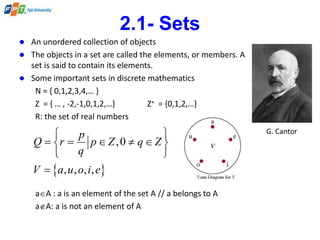
G. Cantor
Sets…
Definitions:
 Finite set: Set has n elements, n is a nonnegative integer
 A set is an infinite set if it is not finite
 Cardinality of a set |S|: Number of elements of S
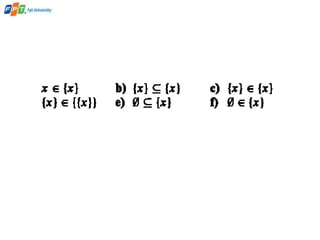
 : empty set (null set), the set with no element
 Two sets are equal  they have the same elements
A = B if and only if x (xA  x B)
 A B: the set A is a subset of the set B
A  B if and only if x (xA  x B)
 A  B: A is a proper subset of B
A  B if and only if (A  B) ^ (A ≠ B)
Venn diagram shows that A
is a subset of B
Theorem 1
 
 
Pr
For every set S ,
i)
) (x )
x True
ii) S
ii) x
S
oof
x S x S T
i False
So x x S
r
S
ue
 

    
   
  
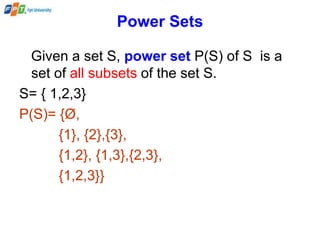
Power Sets
Given a set S, power set P(S) of S is a
set of all subsets of the set S.
S= { 1,2,3}
P(S)= {Ø,
{1}, {2},{3},
{1,2}, {1,3},{2,3},
{1,2,3}}
Cartesian Products
 The ordered n-tuple (a1,a2,…,an) is the ordered
collection that has a1 as its first element, a2 as
its second element, …, and an as its nth element.
 Let A and B be sets. The Cartesian product of A
and B, denoted by AxB,
 
 
   
           
 
example
A= , B= 1,2,
,1 , ,2 , ,3 , ,1 , ,2 , ,
, ,
3
3
A B a a a
A B a b a A
b b b
b
For
a b
B
 
   
Cartesian Products…
 The Cartesian product of A1,A2,…,An , denoted
A1xA2x…xAn, is the set of ordered n- tuples
(a1,a2,…,an),
 AxBxC= {(a,1,0),(a,1,1),(a,2,0),(a,2,1),(a,3,0),(a,3,1),
(b,1,0),(b,1,1),(b,2,0),(b,2,1),(b,3,0),(b,3,1) }
 
 
     
1 2 1 2
... , ,..
example
A= , B= 1,2
., , 1
,3 ,
,
, 0 1
n n i i
A A A a a a a A i
For
a b
n
C
      

2.2- Set Operations
 
 
 
The of sets A and B, denoted by A B
of A and B, denoted by
symmetric differenc
A-B
of A
diffe
e
A B=A B-A B= ( ) (
and B, denoted b
rence
A-B
y A
=
B
sec :
)
Unio
x x A x B
Inter t
n
A B x x A x B
x x A
The
The
io
x B B
n
x A



 
    
        
 
 
is the universal set, complement of A is denoted by
=U-A=
U A
A B x
x A
x
A
A x B
x
  

 
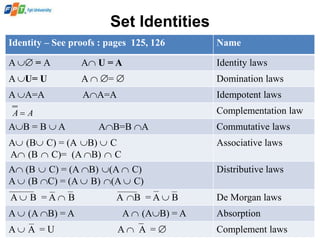
Set Identities
Identity – See proofs : pages 125, 126 Name
A  = A A U = A Identity laws
A U= U A  =  Domination laws
A A=A AA=A Idempotent laws
Complementation law
AB = B  A AB=B A Commutative laws
A (B C) = (A B)  C
A (B  C)= (A B)  C
Associative laws
A (B  C) = (A B) (A  C)
A  (B C) = (A  B) (A  C)
Distributive laws
A  B = A  B A B = A  B De Morgan laws
A  (A B) = A A  (AB) = A Absorption
A  A = U A A =  Complement laws
A
A 
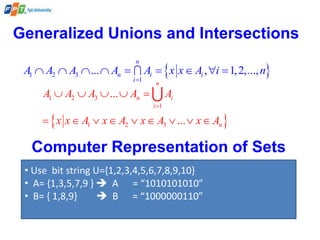
Generalized Unions and Intersections
 
1 2 3
1
... , 1,2,...,
n
n i i
i
A A A A A x x A i n

        
 
1 2 3
1
1 2 3
...
...
n
n i
i
n
A A A A A
x x A x A x A x A

    
        
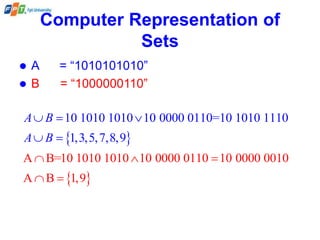
Computer Representation of Sets
• Use bit string U={1,2,3,4,5,6,7,8,9,10}
• A= {1,3,5,7,9 }  A = “1010101010”
• B= { 1,8,9}  B = “1000000110”
Computer Representation of
Sets
 A = “1010101010”
 B = “1000000110”
 
 
10 1010 1010 10 0000 0110=10 1010 1110
1,3,5,7,
A B=10 1010 1010 10 0000 0110 10 0000 0010
A B
8,9
1,9
A B
A B
  



  

 f: A → B : function f from A to B (or function f maps A to B)
 A: domain of f
 B: codomain of f
2.3. Functions / Mappings /
Transformations…
Functions as sets of ordered pairs
Functions / Mappings /
Transformations…
What are functions?
 f: →  : f(x) = x2 + 2
 f: →  : f(x) = 1/(x-1)2 + 5x
 f: →  : f(x) = (2x+5)/7
 f: →  : f(x) = (2x+5)2/(7-2x)
Some Important Functions
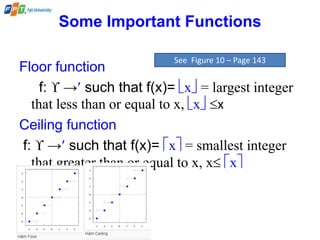
Floor function
f:  → such that f(x)= x = largest integer
that less than or equal to x, x x
Ceiling function
f:  → such that f(x)= x = smallest integer
that greater than or equal to x, x x
See Figure 10 – Page 143
One-to-One/ Injective functions
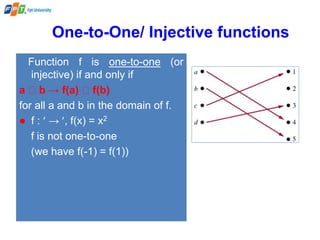
Function f is one-to-one (or
injective) if and only if
a b → f(a) f(b)
for all a and b in the domain of f.
 f :  → , f(x) = x2
f is not one-to-one
(we have f(-1) = f(1))
Onto Functions
A function f from A to B is called onto, or
surjective, iff
for every element b in B there is an element
a in A with f(a)=b.
 f:  → , f(m) =m-1
f is onto because y , y=f(m)=m-1,
where m=y+1
One-to-one Correspodent / Bijective
Functions
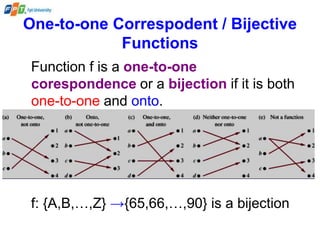
Function f is a one-to-one
corespondence or a bijection if it is both
one-to-one and onto.
f: {A,B,…,Z} →{65,66,…,90} is a bijection
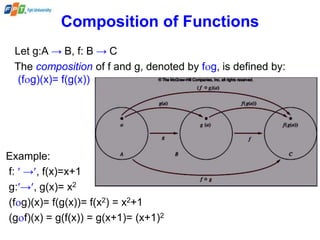
Inverse Functions
Let f is a bijection from A to B. The inverse function,
denoted by f-1, of f is the function that assigns to an
element b belonging to B the unique element a in A such
that f(a)=b. Hence f-1(b)=a when f(a)=b.
Inverse Functions…
f:→ such that f(x)=x+1
Is f invertible? And if it is, what is its inverse?
Step 1: Show that f is onto
f(y-1)=y for all y
 f is onto
Step 2: Show that f is one-to-one
f(a)=a+1= f(b)=b+1  a=b  f is one-to-one
 f is bijection  f is invertible
Step 3: Find inverse function
f(x)= y=x+1 x=f-1(y)
x=y-1  f-1(y)=y-1
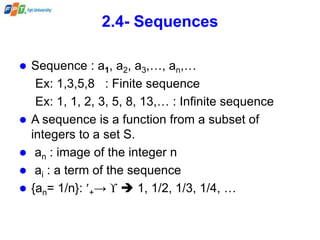
Composition of Functions
Let g:A → B, f: B → C
The composition of f and g, denoted by fg, is defined by:
(fg)(x)= f(g(x))
Example:
f:  →, f(x)=x+1
g:→, g(x)= x2
(fg)(x)= f(g(x))= f(x2) = x2+1
(gf)(x) = g(f(x)) = g(x+1)= (x+1)2
2.4- Sequences
 Sequence : a1, a2, a3,…, an,…
Ex: 1,3,5,8 : Finite sequence
Ex: 1, 1, 2, 3, 5, 8, 13,… : Infinite sequence
 A sequence is a function from a subset of
integers to a set S.
 an : image of the integer n
 ai : a term of the sequence
 {an= 1/n}: +→   1, 1/2, 1/3, 1/4, …
Sequences…
Geometric progression
f(n) = arn  a, ar, ar2, ar3, …, arn
Arithmetic progression
f(n) = a + nd  a, a+d, a+ 2d, … , a+nd
a: initial term,
r: common ratio, a real number
d: common difference, real number
Do yourself
bn= (-1)n , n>=0 cn= 2(5)n , n>=0
tn= 7-3n, n>=0 an= -1 + 4n, n>=0
Some Useful Sequences
Summations


 




 





 n
j
m j
n
m
j j
n
m
j
j
n
m
m
m a
a
a
a
a
a
a ...
2
1
a : Sequence
j : Index of summation
m: Lower limit
n : Upper limit
See examples 10, 11. Page 154
// 1 + 2 +3+4+…+n
long sum1 ( int n) // n additions
{ long S=0;
for (int i=1; i<=n; i++) S+= i;
return S;
}
// 1 addition, 1 multiplication, 1 division
long sum2 (int n)
{ return ((long)n) * (n+1)/2;
}
Summations….
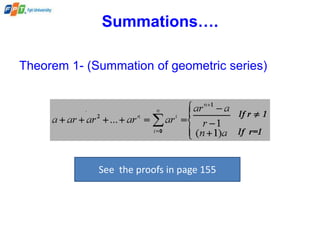
Theorem 1- (Summation of geometric series)
See the proofs in page 155
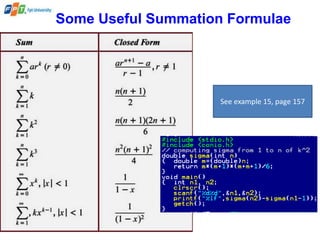
Some Useful Summation Formulae
See example 15, page 157
Cardinality
 Cardinality = number of elements in a set.
 The sets A and B have the same cardinality if and only if
there is a one-to-one correspondence from A to B
 A set that is either finite or has the same cardinality as
the set of positive integers is called countable.
 A set that is not countable is called uncountable.
 When a infinite set S is countable, we denote the
cardinality of S is |S|= ‫א‬0 (aleph null)
 For example, || ‫א‬0 because  is countable and infinite
but  is uncountable and infinite, and we say ||2 ‫א‬0
Examples p.159, 160
sets countable uncountable cardinality
{a, b, …, z}, {x| x5 -3x2 – 11 = 0},
…
  <
{0, 2, 4, …, }   ‫א‬0
N, Z+, Z, Q, Z Z, …   ‫א‬0
{x| 0 < x < 1}, R,…   2‫א‬0
Summary
 Sets
 Set operations
 Functions
 Sequences
 Summations
Thanks

02-Basic Structures .ppt

  • 1.
    Chapter 2 Basic Structures Sets,Functions Sequences, and Sums
  • 2.
    Objectives  Sets  Setoperations  Functions  Sequences  Summations
  • 3.
    2.1- Sets  Anunordered collection of objects  The objects in a set are called the elements, or members. A set is said to contain its elements.  Some important sets in discrete mathematics N = { 0,1,2,3,4,… } Z = { … , -2,-1,0,1,2,…} Z+ = {0,1,2,…} R: the set of real numbers aA : a is an element of the set A // a belongs to A aA: a is not an element of A   ,0 , , , , p Q r p Z q Z q V a u o i e             G. Cantor
  • 4.
    Sets… Definitions:  Finite set:Set has n elements, n is a nonnegative integer  A set is an infinite set if it is not finite  Cardinality of a set |S|: Number of elements of S  : empty set (null set), the set with no element  Two sets are equal  they have the same elements A = B if and only if x (xA  x B)  A B: the set A is a subset of the set B A  B if and only if x (xA  x B)  A  B: A is a proper subset of B A  B if and only if (A  B) ^ (A ≠ B) Venn diagram shows that A is a subset of B
  • 5.
    Theorem 1    Pr For every set S , i) ) (x ) x True ii) S ii) x S oof x S x S T i False So x x S r S ue               
  • 8.
    Power Sets Given aset S, power set P(S) of S is a set of all subsets of the set S. S= { 1,2,3} P(S)= {Ø, {1}, {2},{3}, {1,2}, {1,3},{2,3}, {1,2,3}}
  • 9.
    Cartesian Products  Theordered n-tuple (a1,a2,…,an) is the ordered collection that has a1 as its first element, a2 as its second element, …, and an as its nth element.  Let A and B be sets. The Cartesian product of A and B, denoted by AxB,                       example A= , B= 1,2, ,1 , ,2 , ,3 , ,1 , ,2 , , , , 3 3 A B a a a A B a b a A b b b b For a b B      
  • 10.
    Cartesian Products…  TheCartesian product of A1,A2,…,An , denoted A1xA2x…xAn, is the set of ordered n- tuples (a1,a2,…,an),  AxBxC= {(a,1,0),(a,1,1),(a,2,0),(a,2,1),(a,3,0),(a,3,1), (b,1,0),(b,1,1),(b,2,0),(b,2,1),(b,3,0),(b,3,1) }           1 2 1 2 ... , ,.. example A= , B= 1,2 ., , 1 ,3 , , , 0 1 n n i i A A A a a a a A i For a b n C        
  • 11.
    2.2- Set Operations      The of sets A and B, denoted by A B of A and B, denoted by symmetric differenc A-B of A diffe e A B=A B-A B= ( ) ( and B, denoted b rence A-B y A = B sec : ) Unio x x A x B Inter t n A B x x A x B x x A The The io x B B n x A                        is the universal set, complement of A is denoted by =U-A= U A A B x x A x A A x B x      
  • 12.
    Set Identities Identity –See proofs : pages 125, 126 Name A  = A A U = A Identity laws A U= U A  =  Domination laws A A=A AA=A Idempotent laws Complementation law AB = B  A AB=B A Commutative laws A (B C) = (A B)  C A (B  C)= (A B)  C Associative laws A (B  C) = (A B) (A  C) A  (B C) = (A  B) (A  C) Distributive laws A  B = A  B A B = A  B De Morgan laws A  (A B) = A A  (AB) = A Absorption A  A = U A A =  Complement laws A A 
  • 13.
    Generalized Unions andIntersections   1 2 3 1 ... , 1,2,..., n n i i i A A A A A x x A i n             1 2 3 1 1 2 3 ... ... n n i i n A A A A A x x A x A x A x A                Computer Representation of Sets • Use bit string U={1,2,3,4,5,6,7,8,9,10} • A= {1,3,5,7,9 }  A = “1010101010” • B= { 1,8,9}  B = “1000000110”
  • 14.
    Computer Representation of Sets A = “1010101010”  B = “1000000110”     10 1010 1010 10 0000 0110=10 1010 1110 1,3,5,7, A B=10 1010 1010 10 0000 0110 10 0000 0010 A B 8,9 1,9 A B A B          
  • 15.
     f: A→ B : function f from A to B (or function f maps A to B)  A: domain of f  B: codomain of f 2.3. Functions / Mappings / Transformations…
  • 16.
    Functions as setsof ordered pairs
  • 17.
    Functions / Mappings/ Transformations… What are functions?  f: →  : f(x) = x2 + 2  f: →  : f(x) = 1/(x-1)2 + 5x  f: →  : f(x) = (2x+5)/7  f: →  : f(x) = (2x+5)2/(7-2x)
  • 18.
    Some Important Functions Floorfunction f:  → such that f(x)= x = largest integer that less than or equal to x, x x Ceiling function f:  → such that f(x)= x = smallest integer that greater than or equal to x, x x See Figure 10 – Page 143
  • 19.
    One-to-One/ Injective functions Functionf is one-to-one (or injective) if and only if a b → f(a) f(b) for all a and b in the domain of f.  f :  → , f(x) = x2 f is not one-to-one (we have f(-1) = f(1))
  • 20.
    Onto Functions A functionf from A to B is called onto, or surjective, iff for every element b in B there is an element a in A with f(a)=b.  f:  → , f(m) =m-1 f is onto because y , y=f(m)=m-1, where m=y+1
  • 21.
    One-to-one Correspodent /Bijective Functions Function f is a one-to-one corespondence or a bijection if it is both one-to-one and onto. f: {A,B,…,Z} →{65,66,…,90} is a bijection
  • 22.
    Inverse Functions Let fis a bijection from A to B. The inverse function, denoted by f-1, of f is the function that assigns to an element b belonging to B the unique element a in A such that f(a)=b. Hence f-1(b)=a when f(a)=b.
  • 23.
    Inverse Functions… f:→ suchthat f(x)=x+1 Is f invertible? And if it is, what is its inverse? Step 1: Show that f is onto f(y-1)=y for all y  f is onto Step 2: Show that f is one-to-one f(a)=a+1= f(b)=b+1  a=b  f is one-to-one  f is bijection  f is invertible Step 3: Find inverse function f(x)= y=x+1 x=f-1(y) x=y-1  f-1(y)=y-1
  • 24.
    Composition of Functions Letg:A → B, f: B → C The composition of f and g, denoted by fg, is defined by: (fg)(x)= f(g(x)) Example: f:  →, f(x)=x+1 g:→, g(x)= x2 (fg)(x)= f(g(x))= f(x2) = x2+1 (gf)(x) = g(f(x)) = g(x+1)= (x+1)2
  • 25.
    2.4- Sequences  Sequence: a1, a2, a3,…, an,… Ex: 1,3,5,8 : Finite sequence Ex: 1, 1, 2, 3, 5, 8, 13,… : Infinite sequence  A sequence is a function from a subset of integers to a set S.  an : image of the integer n  ai : a term of the sequence  {an= 1/n}: +→   1, 1/2, 1/3, 1/4, …
  • 26.
    Sequences… Geometric progression f(n) =arn  a, ar, ar2, ar3, …, arn Arithmetic progression f(n) = a + nd  a, a+d, a+ 2d, … , a+nd a: initial term, r: common ratio, a real number d: common difference, real number Do yourself bn= (-1)n , n>=0 cn= 2(5)n , n>=0 tn= 7-3n, n>=0 an= -1 + 4n, n>=0
  • 27.
  • 28.
    Summations                n j m j n m j j n m j j n m m m a a a a a a a ... 2 1 a : Sequence j : Index of summation m: Lower limit n : Upper limit See examples 10, 11. Page 154 // 1 + 2 +3+4+…+n long sum1 ( int n) // n additions { long S=0; for (int i=1; i<=n; i++) S+= i; return S; } // 1 addition, 1 multiplication, 1 division long sum2 (int n) { return ((long)n) * (n+1)/2; }
  • 29.
    Summations…. Theorem 1- (Summationof geometric series) See the proofs in page 155
  • 30.
    Some Useful SummationFormulae See example 15, page 157
  • 31.
    Cardinality  Cardinality =number of elements in a set.  The sets A and B have the same cardinality if and only if there is a one-to-one correspondence from A to B  A set that is either finite or has the same cardinality as the set of positive integers is called countable.  A set that is not countable is called uncountable.  When a infinite set S is countable, we denote the cardinality of S is |S|= ‫א‬0 (aleph null)  For example, || ‫א‬0 because  is countable and infinite but  is uncountable and infinite, and we say ||2 ‫א‬0
  • 32.
    Examples p.159, 160 setscountable uncountable cardinality {a, b, …, z}, {x| x5 -3x2 – 11 = 0}, …   < {0, 2, 4, …, }   ‫א‬0 N, Z+, Z, Q, Z Z, …   ‫א‬0 {x| 0 < x < 1}, R,…   2‫א‬0
  • 33.
    Summary  Sets  Setoperations  Functions  Sequences  Summations
  • 34.

Editor's Notes

  • #4 GEORG CANTOR (1845-1 918), the father of set theory.
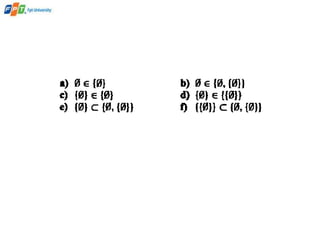
  • #5 No confusion between two sets {} and . The first set has one element, the second set has no element.
  • #9 If the set S has n elements, then the power set P(S) has 2n elements. No confusion between “subsets” and “element” when dealing with a power set. Every “subset” of S is an “element” of P(S) (the power set of S).
  • #10 The word “ordered” is important. That means, (a , b) and (b, a) are not equal unless a = b. In general, AB is different from BA. Note that if A or B is empty, then AB and BA are also empty. A subset R of the Cartesian product AB is called a relation from A to B. We will study relations in the Chapter 8.
  • #12 - The difference of A and B is also called the complement of B with respect to A.
  • #13 Note that some students forget using De Morgan Laws to form complements of sets. They sometimes make similar errors in propositional logic, such as, incorrectly, that (p  q)  p  q.
  • #14 - The universal set U is represented by the string 1111111111
  • #15 Suppose that two sets A and B are represented by the strings ai and bj. The string ci representing the union of A and B can be found as: for all values of i, if ai = bi =0 then ci = 0 else ci = 1. The string ci representing the intersection of A and B can be found as: for all values of i, if ai = bi =1 then ci = 1 else ci = 0. The string ci representing the complement of A can be found as: ci = 1-ai.
  • #16 The function f: A B is not A, it is not B, it is not an element of A or B. It is not an action on just one element of A. The function f: A B means that f is a rule that apply to every element of A and in each case yield EXACTLY ONE result in B. The function f: R R, f(x) = x2 is a many-to-one action, but f: R R, f(x) = ±x is not a function (one-to-many action).
  • #18 f: →  : f(x) = 1/(x-1)2 + 5x is not a function because f cannot apply to 1. f: →  : f(x) = (2x+5)2/(7-2x) is a function. Note that domain of the function is . So, 7-2x is nonzero.
  • #19 - Floor and ceiling functions always produce integers.
  • #20 On-to-one function is a function that all images are different. One-to-one: a b (a  b  f(a)  f(b))  a b (f(a) = f(b)  a = b). Not one-to-one: a b (a  b  f(a) = f(b)).
  • #21 f: A  B is onto if yBxA (f(x) = y). f: A  B is not onto if yBxA (f(x)  y).
  • #23 Note that f-1 is NOT 1/f, which is defined by (1/f) = 1/f(x). For example, if f(x) = 2x + 3 then (1/f)(x) = 1/(2x+3), but f-1(x) = (x-3)/2
  • #25 - If a function f is invertible and f-1 is the inverse function of f, then (ff-1)(x) = x and (f-1f)(x) = x.
  • #32 - The function f:{0, 1, 2, 3, …}  {0, 2, 4, 6, …}, f(m) = 2m is a bijection. So, {0, 1, 2, 3, …} has the same cardinality as {0, 2, 4, 6, …}.
  • #33 - Cardinalities of some countable/uncountable sets.