Quality Control Programs
Minimum Testing Requirements
Basic Testing Equipment
Materials Sampling
MATERIALS QUALITY CONTROL AND ITS SIGNIFICANCE
A. Definitions
QUALITY - is a judgement by the costumer or users of a product or service. It is the extent to which the
costumers or users feel the product or service surpasses their needs and expectations.
- Howard S. Gitton
University of Miami
The term QUALITY is the characteristic of a product that provides a level of performance in terms of service
and life. “QUALITY” does not mean perfect.
QUALITY CONTROL WORK
Quality Control work consists of all work elements carried out by the manager or by those in his organization,
which contribute to the quality of the output of the organization.
QUALITY ASSURANCE WORK
Quality assurance work consists of all work elements carried out by the manager or by those in his organization,
which contribute to the quality of the output of some other organization.
- J. R. Taylor
Quality Control System
Therefore, in project implementation, quality control activities and specific steps undertaken by the contractor (if
the project is by contract) during construction or maintenance, to control the quality of materials and workmanship,
which Quality Assurance refers to all the activities undertaken by the Implementing Office necessary to verify, audit
and evaluate the quality of work of contractor and materials delivered/used in the project.
B. Purpose of Quality Control in Project Implementation
 To insure the highest quality of work and extend the service life of
any structure by constructing according to the prescribed plans and
specifications. The plans indicate the specific type of the structure
and the specifications present the characteristic in which it is built,
as well as the materials that are to be incorporated into the work.
 To check and regulate the use of construction materials and to
economize on the cost of construction. Fulfilling these, requires
adequate control of materials prior to and after placing to their final
position in the structure. Normally, every material should be
subjected to testing, inspection and verification before acceptance.
C. Quality Control Procedures
1. Selection of Materials
Information regarding the location of materials sources that will be incorporated into
the work may be represented by the following:
a. Raw materials such as soil, sand and bank or river gravel (with little or no
processing)
b. Materials that are processed without basically changing their properties
such as washed/manufactured sand, crushed rock and gravel, and etc.
c. Manufactured materials such as bituminous materials, cement, paint,
structural reinforcing steel bar.
d. Combination of materials that may be partly or totally manufactured, such
as bituminous and portland cement concrete.
Materials to be procured or obtained from selected portions of any area of
materials sources such as mentioned above should be known in advance so that
the required tests can be made or arrangement for testing the materials involved
may be done to avoid unnecessary delays in construction due to rejection of
unacceptable quality of materials.
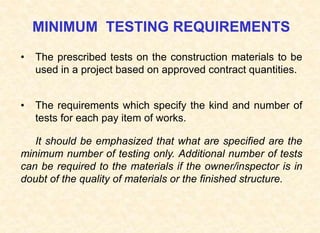
MINIMUM TESTING REQUIREMENTS
• The prescribed tests on the construction materials to be
used in a project based on approved contract quantities.
• The requirements which specify the kind and number of
tests for each pay item of works.
It should be emphasized that what are specified are the
minimum number of testing only. Additional number of tests
can be required to the materials if the owner/inspector is in
doubt of the quality of materials or the finished structure.
SCHEDULE OF MINIMUM TEST REQUIREMENTS GOVERNING
ITEMS OF WORK OF THE DPWH STANDARD SPECIFICATIONS
FOR HIGHWAYS, BRIDGES AND AIRPORTS, 1998
(VOLUME II)
Same tests as for Item 104
Item 105 - Sub-grade Preparation
For every 1,500 cu.m. or fraction thereof:
1-G, Grading Test
1-P, Plasticity Test (LL, PL)
1-C, Laboratory Compaction Test
For each 500 sq.m of each layer of compacted fill or fraction
thereof at least one group of three in-situ density tests. The
layers shall be placed not exceeding 200 mm in loose
measurement or based on the result of compaction trials.
Item 104 - Embankment
If excavated materials are incorporated into the work:
For every 1,500 cu.m. or fraction thereof:
1-G, Grading Test
1-P, Plasticity Test (LL, PL)
1-C, Laboratory Compaction Test
For every 150 mm layer in uncompacted depth:
1-D, Field Density
Item 103 - Structure Excavation
If excavated materials are wasted, the volume
involved shall be reported so that Quality Control
requirements may be adjusted accordingly.
Submit Project Engineer Certificate of Waste
Same tests as for Items 103, 104 and 105, whichever is
applicable.
Item 102 - Excavation
None
Item 101 - Removal of Structures & Obstruction
None
Item 100 - Clearing and Grubbing
MINIMUM TEST RTEQUIREMENTS
ITEMS OF WORK
Part C - EARTHWORK
For every 300 cu.m. or fraction thereof:
1-G, Grading Test
1-P, Plasticity Test (LL, PL)
For every 1,500 cu.m. or fraction thereof:
1-Q, Quality Test for Grading, Plasticity and
Abrasion
1-C, Laboratory Compaction Test
For every layer of 150 mm of compacted depth/based
on the results of compaction trials:
At least one group of three in-situ density tests
for each 500 sq.m or fraction thereof.
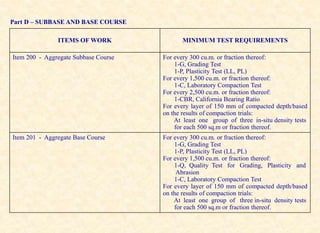
Item 201 - Aggregate Base Course
For every 300 cu.m. or fraction thereof:
1-G, Grading Test
1-P, Plasticity Test (LL, PL)
For every 1,500 cu.m. or fraction thereof:
1-C, Laboratory Compaction Test
For every 2,500 cu.m. or fraction thereof:
1-CBR, California Bearing Ratio
For every layer of 150 mm of compacted depth/based
on the results of compaction trials:
At least one group of three in-situ density tests
for each 500 sq.m or fraction thereof.
Item 200 - Aggregate Subbase Course
MINIMUM TEST REQUIREMENTS
ITEMS OF WORK
Part D – SUBBASE AND BASE COURSE
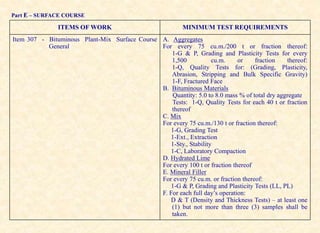
A. Aggregates
For every 75 cu.m./200 t or fraction thereof:
1-G & P, Grading and Plasticity Tests for every
1,500 cu.m. or fraction thereof:
1-Q, Quality Tests for: (Grading, Plasticity,
Abrasion, Stripping and Bulk Specific Gravity)
1-F, Fractured Face
B. Bituminous Materials
Quantity: 5.0 to 8.0 mass % of total dry aggregate
Tests: 1-Q, Quality Tests for each 40 t or fraction
thereof
C. Mix
For every 75 cu.m./130 t or fraction thereof:
1-G, Grading Test
1-Ext., Extraction
1-Sty., Stability
1-C, Laboratory Compaction
D. Hydrated Lime
For every 100 t or fraction thereof
E. Mineral Filler
For every 75 cu.m. or fraction thereof:
1-G & P, Grading and Plasticity Tests (LL, PL)
F. For each full day’s operation:
D & T (Density and Thickness Tests) – at least one
(1) but not more than three (3) samples shall be
taken.
Item 307 - Bituminous Plant-Mix Surface Course
General
MINIMUM TEST REQUIREMENTS
ITEMS OF WORK
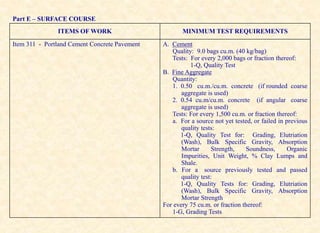
Part E – SURFACE COURSE
A. Cement
Quality: 9.0 bags cu.m. (40 kg/bag)
Tests: For every 2,000 bags or fraction thereof:
1-Q, Quality Test
B. Fine Aggregate
Quantity:
1. 0.50 cu.m./cu.m. concrete (if rounded coarse
aggregate is used)
2. 0.54 cu.m/cu.m. concrete (if angular coarse
aggregate is used)
Tests: For every 1,500 cu.m. or fraction thereof:
a. For a source not yet tested, or failed in previous
quality tests:
1-Q, Quality Test for: Grading, Elutriation
(Wash), Bulk Specific Gravity, Absorption
Mortar Strength, Soundness, Organic
Impurities, Unit Weight, % Clay Lumps and
Shale.
b. For a source previously tested and passed
quality test:
1-Q, Quality Tests for: Grading, Elutriation
(Wash), Bulk Specific Gravity, Absorption
Mortar Strength
For every 75 cu.m. or fraction thereof:
1-G, Grading Tests
Item 311 - Portland Cement Concrete Pavement
MINIMUM TEST REQUIREMENTS
ITEMS OF WORK
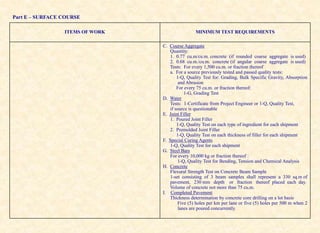
Part E – SURFACE COURSE
C. Course Aggregate
Quantity:
1. 0.77 cu.m/cu.m. concrete (if rounded coarse aggregate is used)
2. 0.68 cu.m./cu.m. concrete (if angular coarse aggregate is used)
Tests: For every 1,500 cu.m. or fraction thereof
a. For a source previously tested and passed quality tests:
1-Q, Quality Test for: Grading, Bulk Specific Gravity, Absorption
and Abrasion
For every 75 cu.m. or fraction thereof:
1-G, Grading Test
D. Water
Tests: 1-Certificate from Project Engineer or 1-Q, Quality Test,
if source is questionable
E. Joint Filler
1. Poured Joint Filler
1-Q, Quality Test on each type of ingredient for each shipment
2. Premolded Joint Filler
1-Q, Quality Test on each thickness of filler for each shipment
F. Special Curing Agents
1-Q, Quality Test for each shipment
G. Steel Bars
For every 10,000 kg or fraction thereof :
1-Q, Quality Test for Bending, Tension and Chemical Analysis
H. Concrete
Flexural Strength Test on Concrete Beam Sample
1-set consisting of 3 beam samples shall represent a 330 sq.m of
pavement, 230 mm depth or fraction thereof placed each day.
Volume of concrete not more than 75 cu.m.
I. Completed Pavement
Thickness determination by concrete core drilling on a lot basis
Five (5) holes per km per lane or five (5) holes per 500 m when 2
lanes are poured concurrently.
MINIMUM TEST REQUIREMENTS
ITEMS OF WORK
Part E – SURFACE COURSE
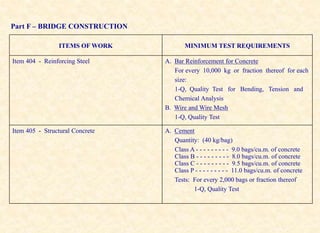
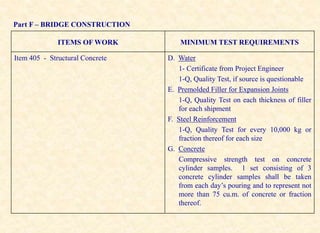
Part F – BRIDGE CONSTRUCTION
A. Cement
Quantity: (40 kg/bag)
Class A - - - - - - - - - 9.0 bags/cu.m. of concrete
Class B - - - - - - - - - 8.0 bags/cu.m. of concrete
Class C - - - - - - - - - 9.5 bags/cu.m. of concrete
Class P - - - - - - - - - 11.0 bags/cu.m. of concrete
Tests: For every 2,000 bags or fraction thereof
1-Q, Quality Test
Item 405 - Structural Concrete
A. Bar Reinforcement for Concrete
For every 10,000 kg or fraction thereof for each
size:
1-Q, Quality Test for Bending, Tension and
Chemical Analysis
B. Wire and Wire Mesh
1-Q, Quality Test
Item 404 - Reinforcing Steel
MINIMUM TEST REQUIREMENTS
ITEMS OF WORK
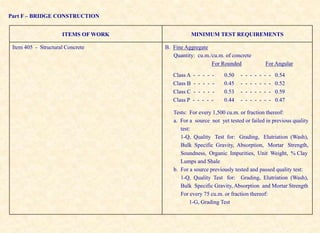
Part F – BRIDGE CONSTRUCTION
B. Fine Aggregate
Quantity: cu.m./cu.m. of concrete
For Rounded For Angular
Tests: For every 1,500 cu.m. or fraction thereof:
a. For a source not yet tested or failed in previous quality
test:
1-Q, Quality Test for: Grading, Elutriation (Wash),
Bulk Specific Gravity, Absorption, Mortar Strength,
Soundness, Organic Impurities, Unit Weight, % Clay
Lumps and Shale
b. For a source previously tested and passed quality test:
1-Q, Quality Test for: Grading, Elutriation (Wash),
Bulk Specific Gravity, Absorption and Mortar Strength
For every 75 cu.m. or fraction thereof:
1-G, Grading Test
Item 405 - Structural Concrete
MINIMUM TEST REQUIREMENTS
ITEMS OF WORK
- - - - - - - 0.59
0.53
Class C - - - - -
- - - - - - - 0.52
0.45
Class B - - - - -
- - - - - - - 0.47
0.44
Class P - - - - -
- - - - - - - 0.54
0.50
Class A - - - - -
Part F – BRIDGE CONSTRUCTION
C. Coarse Aggregates
Quantity: cu.m./cu.m. of concrete
For Rounded For Angular
Tests: For every 1,500 cu.m. or fraction thereof:
a. For a source not yet tested or failed in previous
quality tests:
1-Q, Quality Test for: Grading, Bulk Specific
Gravity, Absorption, Abrasion, Soundness and
Unit Weight
b. For a source previously tested and passed
quality test:
1-Q, Quality Test for Grading, Absorption, Bulk
Specific Gravity and Abrasion
For every 75 cu.m. or fraction thereof:
1-G, Grading Test
Item 405 - Structural Concrete
MINIMUM TEST REQUIREMENTS
ITEMS OF WORK
- - - - - - - 0.68
0.70
Class C - - - - -
- - - - - - - 0.73
0.82
Class B - - - - -
- - - - - - - 0.65
0.68
Class P - - - - -
- - - - - - - 0.68
0.77
Class A - - - - -
Part F – BRIDGE CONSTRUCTION
D. Water
1- Certificate from Project Engineer
1-Q, Quality Test, if source is questionable
E. Premolded Filler for Expansion Joints
1-Q, Quality Test on each thickness of filler
for each shipment
F. Steel Reinforcement
1-Q, Quality Test for every 10,000 kg or
fraction thereof for each size
G. Concrete
Compressive strength test on concrete
cylinder samples. 1 set consisting of 3
concrete cylinder samples shall be taken
from each day’s pouring and to represent not
more than 75 cu.m. of concrete or fraction
thereof.
Item 405 - Structural Concrete
MINIMUM TEST REQUIREMENTS
ITEMS OF WORK
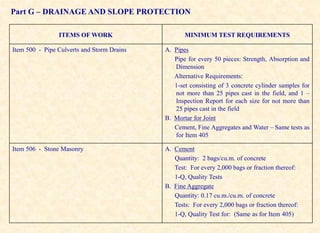
Part G – DRAINAGE AND SLOPE PROTECTION
A. Cement
Quantity: 2 bags/cu.m. of concrete
Test: For every 2,000 bags or fraction thereof:
1-Q, Quality Tests
B. Fine Aggregate
Quantity: 0.17 cu.m./cu.m. of concrete
Tests: For every 2,000 bags or fraction thereof:
1-Q, Quality Test for: (Same as for Item 405)
Item 506 - Stone Masonry
A. Pipes
Pipe for every 50 pieces: Strength, Absorption and
Dimension
Alternative Requirements:
1-set consisting of 3 concrete cylinder samples for
not more than 25 pipes cast in the field, and 1 –
Inspection Report for each size for not more than
25 pipes cast in the field
B. Mortar for Joint
Cement, Fine Aggregates and Water – Same tests as
for Item 405
Item 500 - Pipe Culverts and Storm Drains
MINIMUM TEST REQUIREMENTS
ITEMS OF WORK
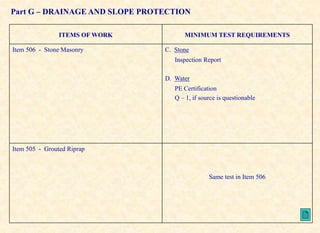
Part G – DRAINAGE AND SLOPE PROTECTION
Same test in Item 506
Item 505 - Grouted Riprap
C. Stone
Inspection Report
D. Water
PE Certification
Q – 1, if source is questionable
Item 506 - Stone Masonry
MINIMUM TEST REQUIREMENTS
ITEMS OF WORK
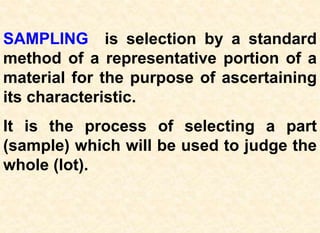
SAMPLING is selection by a standard
method of a representative portion of a
material for the purpose of ascertaining
its characteristic.
It is the process of selecting a part
(sample) which will be used to judge the
whole (lot).
SAMPLING AND TESTING
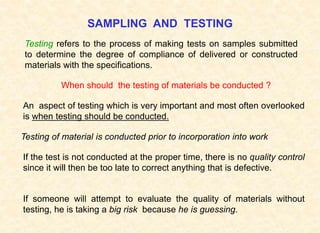
When should the testing of materials be conducted ?
An aspect of testing which is very important and most often overlooked
is when testing should be conducted.
Testing of material is conducted prior to incorporation into work
If the test is not conducted at the proper time, there is no quality control
since it will then be too late to correct anything that is defective.
If someone will attempt to evaluate the quality of materials without
testing, he is taking a big risk because he is guessing.
Testing refers to the process of making tests on samples submitted
to determine the degree of compliance of delivered or constructed
materials with the specifications.
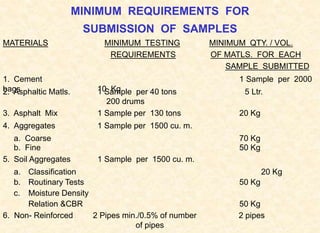
MINIMUM REQUIREMENTS FOR
SUBMISSION OF SAMPLES
a. Coarse 70 Kg
b. Fine 50 Kg
MATERIALS MINIMUM TESTING MINIMUM QTY. / VOL.
REQUIREMENTS OF MATLS. FOR EACH
SAMPLE SUBMITTED
1. Cement 1 Sample per 2000
bags 10 Kg
2. Asphaltic Matls. 1 Sample per 40 tons 5 Ltr.
200 drums
3. Asphalt Mix 1 Sample per 130 tons 20 Kg
4. Aggregates 1 Sample per 1500 cu. m.
5. Soil Aggregates 1 Sample per 1500 cu. m.
a. Classification 20 Kg
b. Routinary Tests 50 Kg
c. Moisture Density
Relation &CBR 50 Kg
6. Non- Reinforced 2 Pipes min./0.5% of number 2 pipes
of pipes
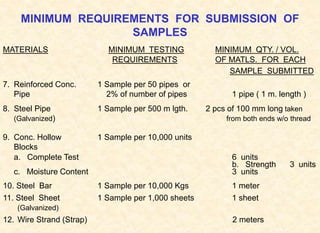
MINIMUM REQUIREMENTS FOR SUBMISSION OF
SAMPLES
MATERIALS MINIMUM TESTING MINIMUM QTY. / VOL.
REQUIREMENTS OF MATLS. FOR EACH
SAMPLE SUBMITTED
7. Reinforced Conc. 1 Sample per 50 pipes or
Pipe 2% of number of pipes 1 pipe ( 1 m. length )
8. Steel Pipe 1 Sample per 500 m lgth. 2 pcs of 100 mm long taken
(Galvanized) from both ends w/o thread
9. Conc. Hollow 1 Sample per 10,000 units
Blocks
a. Complete Test 6 units
b. Strength 3 units
c. Moisture Content 3 units
10. Steel Bar 1 Sample per 10,000 Kgs 1 meter
11. Steel Sheet 1 Sample per 1,000 sheets 1 sheet
(Galvanized)
12. Wire Strand (Strap) 2 meters
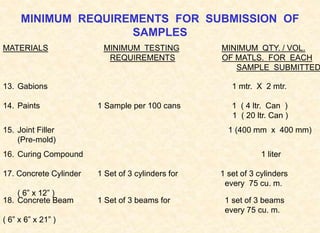
MINIMUM REQUIREMENTS FOR SUBMISSION OF
SAMPLES
MATERIALS MINIMUM TESTING MINIMUM QTY. / VOL.
REQUIREMENTS OF MATLS. FOR EACH
SAMPLE SUBMITTED
14. Paints 1 Sample per 100 cans 1 ( 4 ltr. Can )
1 ( 20 ltr. Can )
13. Gabions 1 mtr. X 2 mtr.
15. Joint Filler 1 (400 mm x 400 mm)
(Pre-mold)
16. Curing Compound 1 liter
17. Concrete Cylinder 1 Set of 3 cylinders for 1 set of 3 cylinders
every 75 cu. m.
( 6” x 12” )
18. Concrete Beam 1 Set of 3 beams for 1 set of 3 beams
every 75 cu. m.
( 6” x 6” x 21” )
MINIMUM REQUIREMENTS FOR SUBMISSION OF
SAMPLES
MATERIALS MINIMUM TESTING MINIMUM QTY. / VOL.
REQUIREMENTS OF MATLS. FOR EACH
SAMPLE SUBMITTED
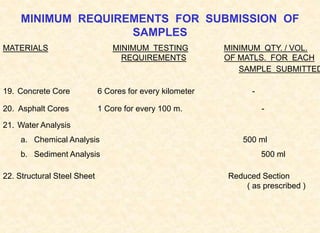
20. Asphalt Cores 1 Core for every 100 m. -
19. Concrete Core 6 Cores for every kilometer -
21. Water Analysis
a. Chemical Analysis 500 ml
22. Structural Steel Sheet Reduced Section
( as prescribed )
b. Sediment Analysis 500 ml
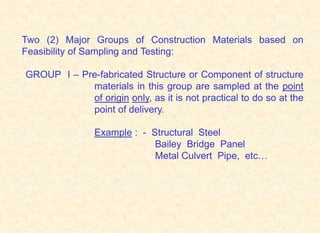
Two (2) Major Groups of Construction Materials based on
Feasibility of Sampling and Testing:
GROUP I – Pre-fabricated Structure or Component of structure
materials in this group are sampled at the point
of origin only, as it is not practical to do so at the
point of delivery.
Example : - Structural Steel
Bailey Bridge Panel
Metal Culvert Pipe, etc…
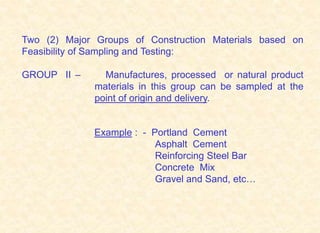
Two (2) Major Groups of Construction Materials based on
Feasibility of Sampling and Testing:
GROUP II – Manufactures, processed or natural product
materials in this group can be sampled at the
point of origin and delivery.
Example : - Portland Cement
Asphalt Cement
Reinforcing Steel Bar
Concrete Mix
Gravel and Sand, etc…
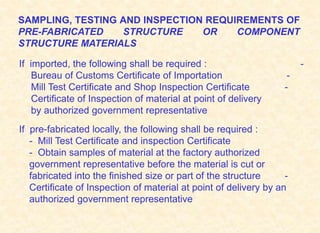
SAMPLING, TESTING AND INSPECTION REQUIREMENTS OF
PRE-FABRICATED STRUCTURE OR COMPONENT
STRUCTURE MATERIALS
If imported, the following shall be required : -
Bureau of Customs Certificate of Importation -
Mill Test Certificate and Shop Inspection Certificate -
Certificate of Inspection of material at point of delivery
by authorized government representative
If pre-fabricated locally, the following shall be required :
- Mill Test Certificate and inspection Certificate
- Obtain samples of material at the factory authorized
government representative before the material is cut or
fabricated into the finished size or part of the structure -
Certificate of Inspection of material at point of delivery by an
authorized government representative
SAMPLING, TESTING AND INSPECTION REQUIREMENTS
ON MANUFACTURED, PROCESSED OR NATURAL
PRODUCTS
 ACCEPTANCE TEST
- The results of this test shall be the basis of acceptance of
the materials.
 RE-TEST OR REFEREE TEST
- The results of this test shall be final.
In case the result of the acceptance test is unsatisfactory,
the supplier shall have the option to request a re-test at his
expense. The delivered material shall be re-sampled by
authorized government representative in the presence of the
supplier or his representative.
SAMPLING, TESTING AND INSPECTION REQUIREMENTS
ON MANUFACTURED, PROCESSED OR NATURAL
PRODUCTS
 PRE-TESTING
Pre-testing of material is applicable to materials manufactured in
bulk, such as portland cement, asphalt reinforcing steel bars, etc…
Arrangement shall be made with the concerned implementing office to
assign a Materials Technician who shall obtain the necessary samples at
the plant.
If the result of the test is satisfactory, the Material Technician, upon
receipt of the test report, shall identify the stock represented, witness the
loading of the material and issue a Pretesting Certificate.
The material may be re-sampled at the point of delivery at the option
of the consignee especially if there are evidences of deterioration or
tampering. Otherwise, the Pretesting Certificate shall be the basis of
acceptance of the material.
HANDLING AND STORAGE OF MATERIALS
- Handling and storage of delivered construction
materials should be carefully and properly
planned to avoid damage and maintain the
desired quality. It should be placed or deposited
in a safe place protected from contamination or
the action of weather. The proposed source of
material to be used should be accessible to the
project.
INSPECTION
 An activity which is complimentary to quality control
 It is done on items of works not subject to testing. Such
things as proper placing of forms, building up an
embankment in layers, benching of the hillside prior to
filling, placing of reinforcement or curing of concrete are
encompassed by inspection.
Purpose of Inspection
- The purpose of inspection is to ensure that the materials
and workmanship provided by the contractor comply with
the requirements of the project.
INSPECTION
- Like in testing, it is also important that inspection be done
at the proper time and should be done as the work
progresses.
When should inspection be done ?
Therefore, inspectors assigned in the field should be
competent, experienced, and committed to public service.
They should also be familiar with the approved plans and
specifications and various DPWH issuances relative to
quality control and construction procedures.
COMMON ABUSES IN MATERIALS TESTING
& QUALITY CONTROL
Submission of materials samples to Testing Laboratory
not truly representing the actual delivered materials on
the project site
 Special fabricated samples of materials submitted to the
testing laboratory to ensure that the result of tests will
pass the required specifications.
 Material samples of good quality taken from good source
and not the actual delivered materials on site.
COMMON ABUSES IN MATERIALS TESTING
& QUALITY CONTROL
Actual delivered construction materials incompatible to
the result of tests
 Poor and substandard materials purchased and delivered
to the project site on the succeeding deliveries.
 Samples tested different from the actual materials being
incorporated into the work.
COMMON ABUSES IN MATERIALS TESTING
& QUALITY CONTROL
Unreliable and dubious Test Results of materials
 This can only be determined thru thorough review of the
worksheets of tests performed by the laboratory
technician. Inspectors with vast experience in the
laboratory work have the edge in distinguishing this type of
abuses.
COMMON ABUSES IN MATERIALS TESTING
& QUALITY CONTROL
Pouring of concrete mix on a structure without approved
pouring permit
 This malpractice was commonly done by the contractor in
concreting works without the knowledge/ permission of the
owner’s Field Engineers/ Inspectors.
 Prepared structure for pouring should be properly
inspected to check its compliance to plans’ requirements
and the availability of the required equipment to be utilized
during pouring of mix. This malpractice is embodied in
Department Order No. 211, series of 2000.
COMMON ABUSES IN MATERIALS TESTING
& QUALITY CONTROL
Bloated Monthly Status of Test Reports and Certificates
of Quality Control Assurance Reports
 Status of monthly test reports are bloated by reporting
higher number of tests performed but not yet done just to
comply to the required scheduled tests.
 Quantities of accomplished on-going items of works are
reported bloated as against the actual accomplishment.

Material Quality Control Program presentation.ppt

  • 1.
    Quality Control Programs MinimumTesting Requirements Basic Testing Equipment Materials Sampling
  • 2.
    MATERIALS QUALITY CONTROLAND ITS SIGNIFICANCE A. Definitions QUALITY - is a judgement by the costumer or users of a product or service. It is the extent to which the costumers or users feel the product or service surpasses their needs and expectations. - Howard S. Gitton University of Miami The term QUALITY is the characteristic of a product that provides a level of performance in terms of service and life. “QUALITY” does not mean perfect. QUALITY CONTROL WORK Quality Control work consists of all work elements carried out by the manager or by those in his organization, which contribute to the quality of the output of the organization. QUALITY ASSURANCE WORK Quality assurance work consists of all work elements carried out by the manager or by those in his organization, which contribute to the quality of the output of some other organization. - J. R. Taylor Quality Control System Therefore, in project implementation, quality control activities and specific steps undertaken by the contractor (if the project is by contract) during construction or maintenance, to control the quality of materials and workmanship, which Quality Assurance refers to all the activities undertaken by the Implementing Office necessary to verify, audit and evaluate the quality of work of contractor and materials delivered/used in the project.
  • 3.
    B. Purpose ofQuality Control in Project Implementation  To insure the highest quality of work and extend the service life of any structure by constructing according to the prescribed plans and specifications. The plans indicate the specific type of the structure and the specifications present the characteristic in which it is built, as well as the materials that are to be incorporated into the work.  To check and regulate the use of construction materials and to economize on the cost of construction. Fulfilling these, requires adequate control of materials prior to and after placing to their final position in the structure. Normally, every material should be subjected to testing, inspection and verification before acceptance.
  • 4.
    C. Quality ControlProcedures 1. Selection of Materials Information regarding the location of materials sources that will be incorporated into the work may be represented by the following: a. Raw materials such as soil, sand and bank or river gravel (with little or no processing) b. Materials that are processed without basically changing their properties such as washed/manufactured sand, crushed rock and gravel, and etc. c. Manufactured materials such as bituminous materials, cement, paint, structural reinforcing steel bar. d. Combination of materials that may be partly or totally manufactured, such as bituminous and portland cement concrete. Materials to be procured or obtained from selected portions of any area of materials sources such as mentioned above should be known in advance so that the required tests can be made or arrangement for testing the materials involved may be done to avoid unnecessary delays in construction due to rejection of unacceptable quality of materials.
  • 5.
    MINIMUM TESTING REQUIREMENTS •The prescribed tests on the construction materials to be used in a project based on approved contract quantities. • The requirements which specify the kind and number of tests for each pay item of works. It should be emphasized that what are specified are the minimum number of testing only. Additional number of tests can be required to the materials if the owner/inspector is in doubt of the quality of materials or the finished structure.
  • 6.
    SCHEDULE OF MINIMUMTEST REQUIREMENTS GOVERNING ITEMS OF WORK OF THE DPWH STANDARD SPECIFICATIONS FOR HIGHWAYS, BRIDGES AND AIRPORTS, 1998 (VOLUME II) Same tests as for Item 104 Item 105 - Sub-grade Preparation For every 1,500 cu.m. or fraction thereof: 1-G, Grading Test 1-P, Plasticity Test (LL, PL) 1-C, Laboratory Compaction Test For each 500 sq.m of each layer of compacted fill or fraction thereof at least one group of three in-situ density tests. The layers shall be placed not exceeding 200 mm in loose measurement or based on the result of compaction trials. Item 104 - Embankment If excavated materials are incorporated into the work: For every 1,500 cu.m. or fraction thereof: 1-G, Grading Test 1-P, Plasticity Test (LL, PL) 1-C, Laboratory Compaction Test For every 150 mm layer in uncompacted depth: 1-D, Field Density Item 103 - Structure Excavation If excavated materials are wasted, the volume involved shall be reported so that Quality Control requirements may be adjusted accordingly. Submit Project Engineer Certificate of Waste Same tests as for Items 103, 104 and 105, whichever is applicable. Item 102 - Excavation None Item 101 - Removal of Structures & Obstruction None Item 100 - Clearing and Grubbing MINIMUM TEST RTEQUIREMENTS ITEMS OF WORK Part C - EARTHWORK
  • 7.
    For every 300cu.m. or fraction thereof: 1-G, Grading Test 1-P, Plasticity Test (LL, PL) For every 1,500 cu.m. or fraction thereof: 1-Q, Quality Test for Grading, Plasticity and Abrasion 1-C, Laboratory Compaction Test For every layer of 150 mm of compacted depth/based on the results of compaction trials: At least one group of three in-situ density tests for each 500 sq.m or fraction thereof. Item 201 - Aggregate Base Course For every 300 cu.m. or fraction thereof: 1-G, Grading Test 1-P, Plasticity Test (LL, PL) For every 1,500 cu.m. or fraction thereof: 1-C, Laboratory Compaction Test For every 2,500 cu.m. or fraction thereof: 1-CBR, California Bearing Ratio For every layer of 150 mm of compacted depth/based on the results of compaction trials: At least one group of three in-situ density tests for each 500 sq.m or fraction thereof. Item 200 - Aggregate Subbase Course MINIMUM TEST REQUIREMENTS ITEMS OF WORK Part D – SUBBASE AND BASE COURSE
  • 8.
    A. Aggregates For every75 cu.m./200 t or fraction thereof: 1-G & P, Grading and Plasticity Tests for every 1,500 cu.m. or fraction thereof: 1-Q, Quality Tests for: (Grading, Plasticity, Abrasion, Stripping and Bulk Specific Gravity) 1-F, Fractured Face B. Bituminous Materials Quantity: 5.0 to 8.0 mass % of total dry aggregate Tests: 1-Q, Quality Tests for each 40 t or fraction thereof C. Mix For every 75 cu.m./130 t or fraction thereof: 1-G, Grading Test 1-Ext., Extraction 1-Sty., Stability 1-C, Laboratory Compaction D. Hydrated Lime For every 100 t or fraction thereof E. Mineral Filler For every 75 cu.m. or fraction thereof: 1-G & P, Grading and Plasticity Tests (LL, PL) F. For each full day’s operation: D & T (Density and Thickness Tests) – at least one (1) but not more than three (3) samples shall be taken. Item 307 - Bituminous Plant-Mix Surface Course General MINIMUM TEST REQUIREMENTS ITEMS OF WORK Part E – SURFACE COURSE
  • 9.
    A. Cement Quality: 9.0bags cu.m. (40 kg/bag) Tests: For every 2,000 bags or fraction thereof: 1-Q, Quality Test B. Fine Aggregate Quantity: 1. 0.50 cu.m./cu.m. concrete (if rounded coarse aggregate is used) 2. 0.54 cu.m/cu.m. concrete (if angular coarse aggregate is used) Tests: For every 1,500 cu.m. or fraction thereof: a. For a source not yet tested, or failed in previous quality tests: 1-Q, Quality Test for: Grading, Elutriation (Wash), Bulk Specific Gravity, Absorption Mortar Strength, Soundness, Organic Impurities, Unit Weight, % Clay Lumps and Shale. b. For a source previously tested and passed quality test: 1-Q, Quality Tests for: Grading, Elutriation (Wash), Bulk Specific Gravity, Absorption Mortar Strength For every 75 cu.m. or fraction thereof: 1-G, Grading Tests Item 311 - Portland Cement Concrete Pavement MINIMUM TEST REQUIREMENTS ITEMS OF WORK Part E – SURFACE COURSE
  • 10.
    C. Course Aggregate Quantity: 1.0.77 cu.m/cu.m. concrete (if rounded coarse aggregate is used) 2. 0.68 cu.m./cu.m. concrete (if angular coarse aggregate is used) Tests: For every 1,500 cu.m. or fraction thereof a. For a source previously tested and passed quality tests: 1-Q, Quality Test for: Grading, Bulk Specific Gravity, Absorption and Abrasion For every 75 cu.m. or fraction thereof: 1-G, Grading Test D. Water Tests: 1-Certificate from Project Engineer or 1-Q, Quality Test, if source is questionable E. Joint Filler 1. Poured Joint Filler 1-Q, Quality Test on each type of ingredient for each shipment 2. Premolded Joint Filler 1-Q, Quality Test on each thickness of filler for each shipment F. Special Curing Agents 1-Q, Quality Test for each shipment G. Steel Bars For every 10,000 kg or fraction thereof : 1-Q, Quality Test for Bending, Tension and Chemical Analysis H. Concrete Flexural Strength Test on Concrete Beam Sample 1-set consisting of 3 beam samples shall represent a 330 sq.m of pavement, 230 mm depth or fraction thereof placed each day. Volume of concrete not more than 75 cu.m. I. Completed Pavement Thickness determination by concrete core drilling on a lot basis Five (5) holes per km per lane or five (5) holes per 500 m when 2 lanes are poured concurrently. MINIMUM TEST REQUIREMENTS ITEMS OF WORK Part E – SURFACE COURSE
  • 11.
    Part F –BRIDGE CONSTRUCTION A. Cement Quantity: (40 kg/bag) Class A - - - - - - - - - 9.0 bags/cu.m. of concrete Class B - - - - - - - - - 8.0 bags/cu.m. of concrete Class C - - - - - - - - - 9.5 bags/cu.m. of concrete Class P - - - - - - - - - 11.0 bags/cu.m. of concrete Tests: For every 2,000 bags or fraction thereof 1-Q, Quality Test Item 405 - Structural Concrete A. Bar Reinforcement for Concrete For every 10,000 kg or fraction thereof for each size: 1-Q, Quality Test for Bending, Tension and Chemical Analysis B. Wire and Wire Mesh 1-Q, Quality Test Item 404 - Reinforcing Steel MINIMUM TEST REQUIREMENTS ITEMS OF WORK
  • 12.
    Part F –BRIDGE CONSTRUCTION B. Fine Aggregate Quantity: cu.m./cu.m. of concrete For Rounded For Angular Tests: For every 1,500 cu.m. or fraction thereof: a. For a source not yet tested or failed in previous quality test: 1-Q, Quality Test for: Grading, Elutriation (Wash), Bulk Specific Gravity, Absorption, Mortar Strength, Soundness, Organic Impurities, Unit Weight, % Clay Lumps and Shale b. For a source previously tested and passed quality test: 1-Q, Quality Test for: Grading, Elutriation (Wash), Bulk Specific Gravity, Absorption and Mortar Strength For every 75 cu.m. or fraction thereof: 1-G, Grading Test Item 405 - Structural Concrete MINIMUM TEST REQUIREMENTS ITEMS OF WORK - - - - - - - 0.59 0.53 Class C - - - - - - - - - - - - 0.52 0.45 Class B - - - - - - - - - - - - 0.47 0.44 Class P - - - - - - - - - - - - 0.54 0.50 Class A - - - - -
  • 13.
    Part F –BRIDGE CONSTRUCTION C. Coarse Aggregates Quantity: cu.m./cu.m. of concrete For Rounded For Angular Tests: For every 1,500 cu.m. or fraction thereof: a. For a source not yet tested or failed in previous quality tests: 1-Q, Quality Test for: Grading, Bulk Specific Gravity, Absorption, Abrasion, Soundness and Unit Weight b. For a source previously tested and passed quality test: 1-Q, Quality Test for Grading, Absorption, Bulk Specific Gravity and Abrasion For every 75 cu.m. or fraction thereof: 1-G, Grading Test Item 405 - Structural Concrete MINIMUM TEST REQUIREMENTS ITEMS OF WORK - - - - - - - 0.68 0.70 Class C - - - - - - - - - - - - 0.73 0.82 Class B - - - - - - - - - - - - 0.65 0.68 Class P - - - - - - - - - - - - 0.68 0.77 Class A - - - - -
  • 14.
    Part F –BRIDGE CONSTRUCTION D. Water 1- Certificate from Project Engineer 1-Q, Quality Test, if source is questionable E. Premolded Filler for Expansion Joints 1-Q, Quality Test on each thickness of filler for each shipment F. Steel Reinforcement 1-Q, Quality Test for every 10,000 kg or fraction thereof for each size G. Concrete Compressive strength test on concrete cylinder samples. 1 set consisting of 3 concrete cylinder samples shall be taken from each day’s pouring and to represent not more than 75 cu.m. of concrete or fraction thereof. Item 405 - Structural Concrete MINIMUM TEST REQUIREMENTS ITEMS OF WORK
  • 15.
    Part G –DRAINAGE AND SLOPE PROTECTION A. Cement Quantity: 2 bags/cu.m. of concrete Test: For every 2,000 bags or fraction thereof: 1-Q, Quality Tests B. Fine Aggregate Quantity: 0.17 cu.m./cu.m. of concrete Tests: For every 2,000 bags or fraction thereof: 1-Q, Quality Test for: (Same as for Item 405) Item 506 - Stone Masonry A. Pipes Pipe for every 50 pieces: Strength, Absorption and Dimension Alternative Requirements: 1-set consisting of 3 concrete cylinder samples for not more than 25 pipes cast in the field, and 1 – Inspection Report for each size for not more than 25 pipes cast in the field B. Mortar for Joint Cement, Fine Aggregates and Water – Same tests as for Item 405 Item 500 - Pipe Culverts and Storm Drains MINIMUM TEST REQUIREMENTS ITEMS OF WORK
  • 16.
    Part G –DRAINAGE AND SLOPE PROTECTION Same test in Item 506 Item 505 - Grouted Riprap C. Stone Inspection Report D. Water PE Certification Q – 1, if source is questionable Item 506 - Stone Masonry MINIMUM TEST REQUIREMENTS ITEMS OF WORK
  • 17.
    SAMPLING is selectionby a standard method of a representative portion of a material for the purpose of ascertaining its characteristic. It is the process of selecting a part (sample) which will be used to judge the whole (lot).
  • 18.
    SAMPLING AND TESTING Whenshould the testing of materials be conducted ? An aspect of testing which is very important and most often overlooked is when testing should be conducted. Testing of material is conducted prior to incorporation into work If the test is not conducted at the proper time, there is no quality control since it will then be too late to correct anything that is defective. If someone will attempt to evaluate the quality of materials without testing, he is taking a big risk because he is guessing. Testing refers to the process of making tests on samples submitted to determine the degree of compliance of delivered or constructed materials with the specifications.
  • 19.
    MINIMUM REQUIREMENTS FOR SUBMISSIONOF SAMPLES a. Coarse 70 Kg b. Fine 50 Kg MATERIALS MINIMUM TESTING MINIMUM QTY. / VOL. REQUIREMENTS OF MATLS. FOR EACH SAMPLE SUBMITTED 1. Cement 1 Sample per 2000 bags 10 Kg 2. Asphaltic Matls. 1 Sample per 40 tons 5 Ltr. 200 drums 3. Asphalt Mix 1 Sample per 130 tons 20 Kg 4. Aggregates 1 Sample per 1500 cu. m. 5. Soil Aggregates 1 Sample per 1500 cu. m. a. Classification 20 Kg b. Routinary Tests 50 Kg c. Moisture Density Relation &CBR 50 Kg 6. Non- Reinforced 2 Pipes min./0.5% of number 2 pipes of pipes
  • 20.
    MINIMUM REQUIREMENTS FORSUBMISSION OF SAMPLES MATERIALS MINIMUM TESTING MINIMUM QTY. / VOL. REQUIREMENTS OF MATLS. FOR EACH SAMPLE SUBMITTED 7. Reinforced Conc. 1 Sample per 50 pipes or Pipe 2% of number of pipes 1 pipe ( 1 m. length ) 8. Steel Pipe 1 Sample per 500 m lgth. 2 pcs of 100 mm long taken (Galvanized) from both ends w/o thread 9. Conc. Hollow 1 Sample per 10,000 units Blocks a. Complete Test 6 units b. Strength 3 units c. Moisture Content 3 units 10. Steel Bar 1 Sample per 10,000 Kgs 1 meter 11. Steel Sheet 1 Sample per 1,000 sheets 1 sheet (Galvanized) 12. Wire Strand (Strap) 2 meters
  • 21.
    MINIMUM REQUIREMENTS FORSUBMISSION OF SAMPLES MATERIALS MINIMUM TESTING MINIMUM QTY. / VOL. REQUIREMENTS OF MATLS. FOR EACH SAMPLE SUBMITTED 14. Paints 1 Sample per 100 cans 1 ( 4 ltr. Can ) 1 ( 20 ltr. Can ) 13. Gabions 1 mtr. X 2 mtr. 15. Joint Filler 1 (400 mm x 400 mm) (Pre-mold) 16. Curing Compound 1 liter 17. Concrete Cylinder 1 Set of 3 cylinders for 1 set of 3 cylinders every 75 cu. m. ( 6” x 12” ) 18. Concrete Beam 1 Set of 3 beams for 1 set of 3 beams every 75 cu. m. ( 6” x 6” x 21” )
  • 22.
    MINIMUM REQUIREMENTS FORSUBMISSION OF SAMPLES MATERIALS MINIMUM TESTING MINIMUM QTY. / VOL. REQUIREMENTS OF MATLS. FOR EACH SAMPLE SUBMITTED 20. Asphalt Cores 1 Core for every 100 m. - 19. Concrete Core 6 Cores for every kilometer - 21. Water Analysis a. Chemical Analysis 500 ml 22. Structural Steel Sheet Reduced Section ( as prescribed ) b. Sediment Analysis 500 ml
  • 23.
    Two (2) MajorGroups of Construction Materials based on Feasibility of Sampling and Testing: GROUP I – Pre-fabricated Structure or Component of structure materials in this group are sampled at the point of origin only, as it is not practical to do so at the point of delivery. Example : - Structural Steel Bailey Bridge Panel Metal Culvert Pipe, etc…
  • 24.
    Two (2) MajorGroups of Construction Materials based on Feasibility of Sampling and Testing: GROUP II – Manufactures, processed or natural product materials in this group can be sampled at the point of origin and delivery. Example : - Portland Cement Asphalt Cement Reinforcing Steel Bar Concrete Mix Gravel and Sand, etc…
  • 25.
    SAMPLING, TESTING ANDINSPECTION REQUIREMENTS OF PRE-FABRICATED STRUCTURE OR COMPONENT STRUCTURE MATERIALS If imported, the following shall be required : - Bureau of Customs Certificate of Importation - Mill Test Certificate and Shop Inspection Certificate - Certificate of Inspection of material at point of delivery by authorized government representative If pre-fabricated locally, the following shall be required : - Mill Test Certificate and inspection Certificate - Obtain samples of material at the factory authorized government representative before the material is cut or fabricated into the finished size or part of the structure - Certificate of Inspection of material at point of delivery by an authorized government representative
  • 26.
    SAMPLING, TESTING ANDINSPECTION REQUIREMENTS ON MANUFACTURED, PROCESSED OR NATURAL PRODUCTS  ACCEPTANCE TEST - The results of this test shall be the basis of acceptance of the materials.  RE-TEST OR REFEREE TEST - The results of this test shall be final. In case the result of the acceptance test is unsatisfactory, the supplier shall have the option to request a re-test at his expense. The delivered material shall be re-sampled by authorized government representative in the presence of the supplier or his representative.
  • 27.
    SAMPLING, TESTING ANDINSPECTION REQUIREMENTS ON MANUFACTURED, PROCESSED OR NATURAL PRODUCTS  PRE-TESTING Pre-testing of material is applicable to materials manufactured in bulk, such as portland cement, asphalt reinforcing steel bars, etc… Arrangement shall be made with the concerned implementing office to assign a Materials Technician who shall obtain the necessary samples at the plant. If the result of the test is satisfactory, the Material Technician, upon receipt of the test report, shall identify the stock represented, witness the loading of the material and issue a Pretesting Certificate. The material may be re-sampled at the point of delivery at the option of the consignee especially if there are evidences of deterioration or tampering. Otherwise, the Pretesting Certificate shall be the basis of acceptance of the material.
  • 28.
    HANDLING AND STORAGEOF MATERIALS - Handling and storage of delivered construction materials should be carefully and properly planned to avoid damage and maintain the desired quality. It should be placed or deposited in a safe place protected from contamination or the action of weather. The proposed source of material to be used should be accessible to the project.
  • 29.
    INSPECTION  An activitywhich is complimentary to quality control  It is done on items of works not subject to testing. Such things as proper placing of forms, building up an embankment in layers, benching of the hillside prior to filling, placing of reinforcement or curing of concrete are encompassed by inspection. Purpose of Inspection - The purpose of inspection is to ensure that the materials and workmanship provided by the contractor comply with the requirements of the project.
  • 30.
    INSPECTION - Like intesting, it is also important that inspection be done at the proper time and should be done as the work progresses. When should inspection be done ? Therefore, inspectors assigned in the field should be competent, experienced, and committed to public service. They should also be familiar with the approved plans and specifications and various DPWH issuances relative to quality control and construction procedures.
  • 31.
    COMMON ABUSES INMATERIALS TESTING & QUALITY CONTROL Submission of materials samples to Testing Laboratory not truly representing the actual delivered materials on the project site  Special fabricated samples of materials submitted to the testing laboratory to ensure that the result of tests will pass the required specifications.  Material samples of good quality taken from good source and not the actual delivered materials on site.
  • 32.
    COMMON ABUSES INMATERIALS TESTING & QUALITY CONTROL Actual delivered construction materials incompatible to the result of tests  Poor and substandard materials purchased and delivered to the project site on the succeeding deliveries.  Samples tested different from the actual materials being incorporated into the work.
  • 33.
    COMMON ABUSES INMATERIALS TESTING & QUALITY CONTROL Unreliable and dubious Test Results of materials  This can only be determined thru thorough review of the worksheets of tests performed by the laboratory technician. Inspectors with vast experience in the laboratory work have the edge in distinguishing this type of abuses.
  • 34.
    COMMON ABUSES INMATERIALS TESTING & QUALITY CONTROL Pouring of concrete mix on a structure without approved pouring permit  This malpractice was commonly done by the contractor in concreting works without the knowledge/ permission of the owner’s Field Engineers/ Inspectors.  Prepared structure for pouring should be properly inspected to check its compliance to plans’ requirements and the availability of the required equipment to be utilized during pouring of mix. This malpractice is embodied in Department Order No. 211, series of 2000.
  • 35.
    COMMON ABUSES INMATERIALS TESTING & QUALITY CONTROL Bloated Monthly Status of Test Reports and Certificates of Quality Control Assurance Reports  Status of monthly test reports are bloated by reporting higher number of tests performed but not yet done just to comply to the required scheduled tests.  Quantities of accomplished on-going items of works are reported bloated as against the actual accomplishment.