Expertise. Reliability. Compliance.
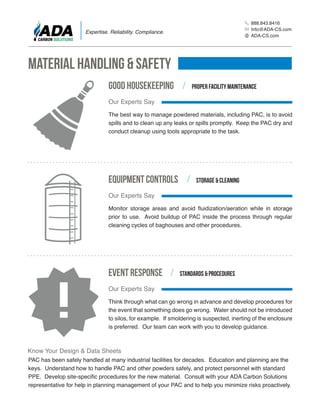
The best way to manage powdered materials, including PAC, is to avoid
spills and to clean up any leaks or spills promptly. Keep the PAC dry and
conduct cleanup using tools appropriate to the task.
Monitor storage areas and avoid fluidization/aeration while in storage
prior to use. Avoid buildup of PAC inside the process through regular
cleaning cycles of baghouses and other procedures.
Think through what can go wrong in advance and develop procedures for
the event that something does go wrong. Water should not be introduced
to silos, for example. If smoldering is suspected, inerting of the enclosure
is preferred. Our team can work with you to develop guidance.
Good Housekeeping
Equipment Controls
Event Response
Our Experts Say
Our Experts Say
Our Experts Say
/
/
/
Proper Facility Maintenance
Storage & cleaning
Standards & procedures
Material Handling & Safety
PAC has been safely handled at many industrial facilities for decades. Education and planning are the
keys. Understand how to handle PAC and other powders safely, and protect personnel with standard
PPE. Develop site-specific procedures for the new material. Consult with your ADA Carbon Solutions
representative for help in planning management of your PAC and to help you minimize risks proactively.
Know Your Design & Data Sheets
888.843.8416
Info@ADA-CS.com
ADA-CS.com
Expertise. Reliability. Compliance.
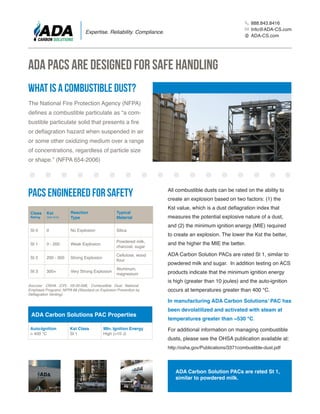
All combustible dusts can be rated on the ability to
create an explosion based on two factors: (1) the
Kst value, which is a dust deflagration index that
measures the potential explosive nature of a dust,
and (2) the minimum ignition energy (MIE) required
to create an explosion. The lower the Kst the better,
and the higher the MIE the better.
ADA Carbon Solution PACs are rated St 1, similar to
powdered milk and sugar. In addition testing on ACS
products indicate that the minimum ignition energy
is high (greater than 10 joules) and the auto-ignition
occurs at temperatures greater than 400 °C.
In manufacturing ADA Carbon Solutions’ PAC has
been devolatilized and activated with steam at
temperatures greater than ~530 °C.
For additional information on managing combustible
dusts, please see the OHSA publication available at:
http://osha.gov/Publications/3371combustible-dust.pdf
The National Fire Protection Agency (NFPA)
defines a combustible particulate as “a com-
bustible particulate solid that presents a fire
or deflagration hazard when suspended in air
or some other oxidizing medium over a range
of concentrations, regardless of particle size
or shape.” (NFPA 654-2006)
PACs Engineered For Safety
ADA PACs Are Designed For Safe Handling
ADA Carbon Solution PACs are rated St 1,
similar to powdered milk.
What is a combustible dust?
Class
Rating
Kst
(bar.m/s)
Reaction
Type
Typical
Material
St 0 0 No Explosion Silica
St 1 0 - 200 Weak Explosion
Powdered milk,
charcoal, sugar
St 2 200 - 300 Strong Explosion
Cellulose, wood
flour
St 3 300+ Very Strong Explosion
Aluminum,
magnesium
ADA Carbon Solutions PAC Properties
Auto-Ignition
> 400 °C
Kst Class
St 1
MIn. Ignition Energy
High (>10 J)
Sources: OSHA (CPL 03-00-008, Combustible Dust National
Emphasis Program); NFPA 68 (Standard on Explosion Prevention by
Deflagration Venting).
888.843.8416
Info@ADA-CS.com
ADA-CS.com

Material Handling & Safety for Powder Activated Carbon

  • 1.
    Expertise. Reliability. Compliance. Thebest way to manage powdered materials, including PAC, is to avoid spills and to clean up any leaks or spills promptly. Keep the PAC dry and conduct cleanup using tools appropriate to the task. Monitor storage areas and avoid fluidization/aeration while in storage prior to use. Avoid buildup of PAC inside the process through regular cleaning cycles of baghouses and other procedures. Think through what can go wrong in advance and develop procedures for the event that something does go wrong. Water should not be introduced to silos, for example. If smoldering is suspected, inerting of the enclosure is preferred. Our team can work with you to develop guidance. Good Housekeeping Equipment Controls Event Response Our Experts Say Our Experts Say Our Experts Say / / / Proper Facility Maintenance Storage & cleaning Standards & procedures Material Handling & Safety PAC has been safely handled at many industrial facilities for decades. Education and planning are the keys. Understand how to handle PAC and other powders safely, and protect personnel with standard PPE. Develop site-specific procedures for the new material. Consult with your ADA Carbon Solutions representative for help in planning management of your PAC and to help you minimize risks proactively. Know Your Design & Data Sheets 888.843.8416 Info@ADA-CS.com ADA-CS.com
  • 2.
    Expertise. Reliability. Compliance. Allcombustible dusts can be rated on the ability to create an explosion based on two factors: (1) the Kst value, which is a dust deflagration index that measures the potential explosive nature of a dust, and (2) the minimum ignition energy (MIE) required to create an explosion. The lower the Kst the better, and the higher the MIE the better. ADA Carbon Solution PACs are rated St 1, similar to powdered milk and sugar. In addition testing on ACS products indicate that the minimum ignition energy is high (greater than 10 joules) and the auto-ignition occurs at temperatures greater than 400 °C. In manufacturing ADA Carbon Solutions’ PAC has been devolatilized and activated with steam at temperatures greater than ~530 °C. For additional information on managing combustible dusts, please see the OHSA publication available at: http://osha.gov/Publications/3371combustible-dust.pdf The National Fire Protection Agency (NFPA) defines a combustible particulate as “a com- bustible particulate solid that presents a fire or deflagration hazard when suspended in air or some other oxidizing medium over a range of concentrations, regardless of particle size or shape.” (NFPA 654-2006) PACs Engineered For Safety ADA PACs Are Designed For Safe Handling ADA Carbon Solution PACs are rated St 1, similar to powdered milk. What is a combustible dust? Class Rating Kst (bar.m/s) Reaction Type Typical Material St 0 0 No Explosion Silica St 1 0 - 200 Weak Explosion Powdered milk, charcoal, sugar St 2 200 - 300 Strong Explosion Cellulose, wood flour St 3 300+ Very Strong Explosion Aluminum, magnesium ADA Carbon Solutions PAC Properties Auto-Ignition > 400 °C Kst Class St 1 MIn. Ignition Energy High (>10 J) Sources: OSHA (CPL 03-00-008, Combustible Dust National Emphasis Program); NFPA 68 (Standard on Explosion Prevention by Deflagration Venting). 888.843.8416 Info@ADA-CS.com ADA-CS.com