Combustible Sawdust
How to Protect Your Workers
& Your Business
Welcome
! Today’s Webcast
Bill Esler
Editorial Director,
WoodworkingNetwork.com
CombustibleDustWebinar
March2015-Woodworkingnetwork.com
Today’s Webcast:
Combustible Sawdust
How to Protect Your Workers & Your Business
CombustibleDustWebinar
March2015-Woodworkingnetwork.com
• Veneer Utilization – Watch it on demand
• Combustible Sawdust – March 4
• Optimizing Solid Wood Production - March 26
• Cabinets & Closets Expo 2015 – April 14-16
• WMS Woodworking Machinery & Supply Expo– November 5-7
Webcasts & Live Events:
CombustibleDustWebinar
March2015-Woodworkingnetwork.com
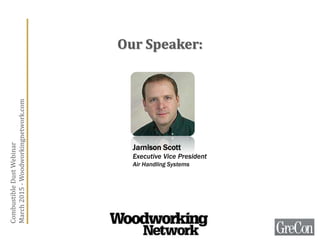
Our Speaker:
Jamison Scott
Executive Vice President
Air Handling Systems
CombustibleDustWebinar
March2015-Woodworkingnetwork.com
Our Sponsor:
CombustibleDustWebinar
March2015-Woodworkingnetwork.com
QUESTIONS??
“Ask A Question” on the
upper left area above the
Webcast screen.
CombustibleDustWebinar
March2015-Woodworkingnetwork.com
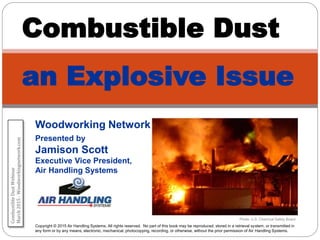
Woodworking Network
Presented by
Jamison Scott
Executive Vice President,
Air Handling Systems
Combustible Dust
an Explosive Issue
Copyright © 2015 Air Handling Systems. All rights reserved. No part of this book may be reproduced, stored in a retrieval system, or transmitted in
any form or by any means, electronic, mechanical, photocopying, recording, or otherwise, without the prior permission of Air Handling Systems.
Photo: U.S. Chemical Safety Board
CombustibleDustWebinar
March2015-Woodworkingnetwork.com
Air Handling Systems - Copyright 2015 For informational use only
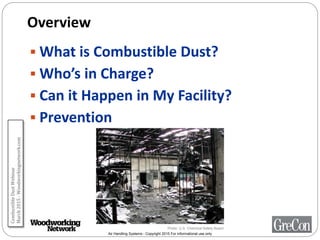
Overview
 What is Combustible Dust?
 Who’s in Charge?
 Can it Happen in My Facility?
 Prevention
Photo: U.S. Chemical Safety Board
CombustibleDustWebinar
March2015-Woodworkingnetwork.com
Air Handling Systems - Copyright 2015 For informational use only
What is Combustible Dust?
Examples
 Air Handling Systems
 Sawdust Cannon, courtesy of Navy Island
 Mythbusters - Creamer Cannon
 FM Global – Dust Explosion
CombustibleDustWebinar
March2015-Woodworkingnetwork.com
Air Handling Systems - Copyright 2015 For informational use only
What is Combustible Dust?
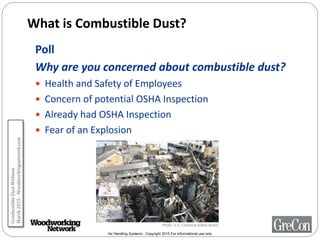
Poll
Why are you concerned about combustible dust?
 Health and Safety of Employees
 Concern of potential OSHA Inspection
 Already had OSHA Inspection
 Fear of an Explosion
Photo: U.S. Chemical Safety Board
CombustibleDustWebinar
March2015-Woodworkingnetwork.com
Air Handling Systems - Copyright 2015 For informational use only
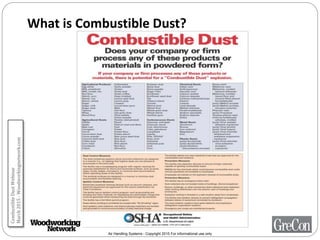
What is Combustible Dust?
CombustibleDustWebinar
March2015-Woodworkingnetwork.com
Air Handling Systems - Copyright 2015 For informational use only
What is Combustible Dust?
bP
P
P
P
P
P
P
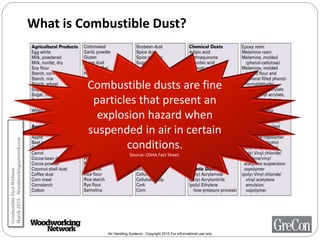
Combustible dusts are fine
particles that present an
explosion hazard when
suspended in air in certain
conditions.
Source: OSHA Fact Sheet.
CombustibleDustWebinar
March2015-Woodworkingnetwork.com
Air Handling Systems - Copyright 2015 For informational use only
What is Combustible Dust?
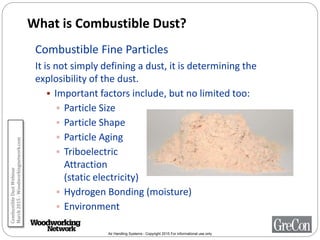
Combustible Fine Particles
It is not simply defining a dust, it is determining the
explosibility of the dust.
 Important factors include, but no limited too:
 Particle Size
 Particle Shape
 Particle Aging
 Triboelectric
Attraction
(static electricity)
 Hydrogen Bonding (moisture)
 Environment
CombustibleDustWebinar
March2015-Woodworkingnetwork.com
Air Handling Systems - Copyright 2015 For informational use only
What is Combustible Dust?
Combustible Fine Particles
Additionally…
Kst value is used as a factor in the deflagration of your dust.
 e.g. Wood flour has a Kst Value of >200 and < 300
meaning it has a strong explosion characteristic.
Dust explosion class rating system from St 0 – St 3
 e.g. Dust explosion class of wood flour is St 2.
NFPA defines the size of “Deflagrable Wood Dust” as 500
microns (.5 mm, 0.0196”) or less and has a moisture content
of less than 25%. Another way to measure is to see if the
material will pass through U.S. No. 35 Standard Sieve which is
approx. the “size of fairly coarse sand”. (NFPA 664 (3.3.27.1)
CombustibleDustWebinar
March2015-Woodworkingnetwork.com
Air Handling Systems - Copyright 2015 For informational use only
What is Combustible Dust?
Combustible Fine Particles
Layer Depth Criterion – In general mfg – 1/32 in.+ depending
on bulk density and total area. (NFPA 654-2013 6.1.3.1)
Layer Thickness Criterion - In woodworking facilities, a dust
layer of 1/8 in. thick (over 5% of area) can be sufficient to
warrant immediate cleaning of area. (NFPA 664-2012 4.2.1)
CombustibleDustWebinar
March2015-Woodworkingnetwork.com
Air Handling Systems - Copyright 2015 For informational use only
What is Combustible Dust?
Combustible Fine Particles
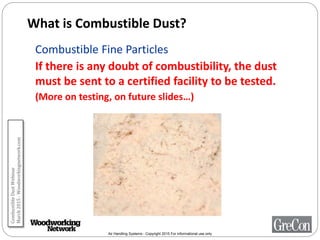
If there is any doubt of combustibility, the dust
must be sent to a certified facility to be tested.
(More on testing, on future slides…)
CombustibleDustWebinar
March2015-Woodworkingnetwork.com
Air Handling Systems - Copyright 2015 For informational use only
What is Combustible Dust?
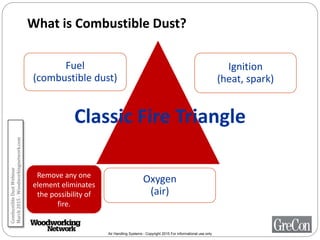
Fuel
(combustible dust)
Ignition
(heat, spark)
Oxygen
(air)
Remove any one
element eliminates
the possibility of
fire.
Classic Fire Triangle
CombustibleDustWebinar
March2015-Woodworkingnetwork.com
Air Handling Systems - Copyright 2015 For informational use only
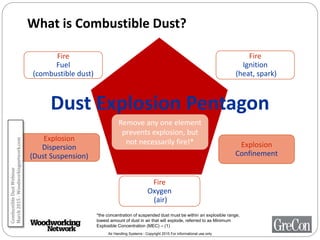
What is Combustible Dust?
Fire
Fuel
(combustible dust)
Fire
Ignition
(heat, spark)
Fire
Oxygen
(air)
Explosion
Dispersion
(Dust Suspension)
Explosion
Confinement
Remove any one element
prevents explosion, but
not necessarily fire!*
*the concentration of suspended dust must be within an explosible range,
lowest amount of dust in air that will explode, referred to as Minimum
Explosible Concentration (MEC) – (1)
Dust Explosion Pentagon
CombustibleDustWebinar
March2015-Woodworkingnetwork.com
Air Handling Systems - Copyright 2015 For informational use only
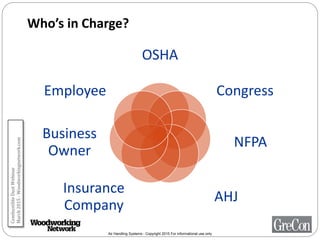
Who’s in Charge?
OSHA
Congress
NFPA
AHJ
Insurance
Company
Business
Owner
Employee
CombustibleDustWebinar
March2015-Woodworkingnetwork.com
Air Handling Systems - Copyright 2015 For informational use only
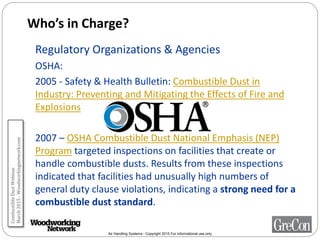
Who’s in Charge?
Regulatory Organizations & Agencies
OSHA:
2005 - Safety & Health Bulletin: Combustible Dust in
Industry: Preventing and Mitigating the Effects of Fire and
Explosions
2007 – OSHA Combustible Dust National Emphasis (NEP)
Program targeted inspections on facilities that create or
handle combustible dusts. Results from these inspections
indicated that facilities had unusually high numbers of
general duty clause violations, indicating a strong need for a
combustible dust standard.
CombustibleDustWebinar
March2015-Woodworkingnetwork.com
Air Handling Systems - Copyright 2015 For informational use only
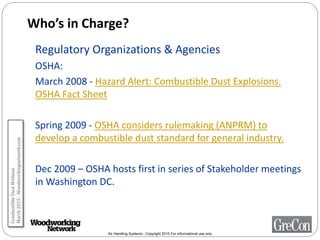
Who’s in Charge?
Regulatory Organizations & Agencies
OSHA:
March 2008 - Hazard Alert: Combustible Dust Explosions.
OSHA Fact Sheet
Spring 2009 - OSHA considers rulemaking (ANPRM) to
develop a combustible dust standard for general industry.
Dec 2009 – OSHA hosts first in series of Stakeholder meetings
in Washington DC.
CombustibleDustWebinar
March2015-Woodworkingnetwork.com
Air Handling Systems - Copyright 2015 For informational use only
Who’s in Charge?
Regulatory Organizations & Agencies
OSHA:
2013 - Updated Hazard Communication Standard
• Employers required to train workers by Dec, 2013 on the
new labels elements and safety data sheets format to
facilitate recognition and understanding.
• According to OSHA - ”Hazardous chemical” means any
chemical which is classified as a physical hazard or a
health hazard, a simple asphyxiant, combustible dust,
pyrophoric gas, or hazard not otherwise classified.
CombustibleDustWebinar
March2015-Woodworkingnetwork.com
Air Handling Systems - Copyright 2015 For informational use only
Who’s in Charge?
Regulatory Organizations & Agencies
OSHA:
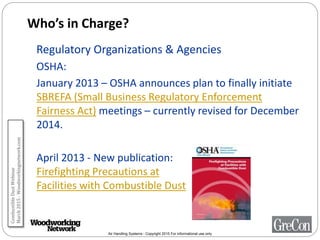
January 2013 – OSHA announces plan to finally initiate
SBREFA (Small Business Regulatory Enforcement
Fairness Act) meetings – currently revised for December
2014.
April 2013 - New publication:
Firefighting Precautions at
Facilities with Combustible Dust
CombustibleDustWebinar
March2015-Woodworkingnetwork.com
Air Handling Systems - Copyright 2015 For informational use only
Who’s in Charge?
Regulatory Organizations & Agencies
OSHA:
Dec. 2013 - Classification of Combustible Dusts under the
Revised Hazard Communication Standard.
“This memorandum provides guidance for compliance safety and
health officers (CSHOs) to use in determining whether manufacturers
or importers have properly classified their products for combustible
dust hazards under the revised Hazard Communication Standard
(HCS).”
WHY? According to OSHA “the GHS does not contain a classification
for combustible dust hazards, and to maintain coverage of this hazard
under the HCS, OSHA amended the standard's definition of
"hazardous chemical" to include "combustible dust”.”
CombustibleDustWebinar
March2015-Woodworkingnetwork.com
Air Handling Systems - Copyright 2015 For informational use only
Who’s in Charge?
Regulatory Organizations & Agencies
OSHA:
Dec. 2013 - Classification of Combustible Dusts (con’t.)
“If the classifier knows that its product has been involved in a
deflagration or dust explosion event, the classifier should classify the
product as a combustible dust”
“Where there is no test data, or if the testing is inconclusive,
classification may be based on particle size, if particle size information
is available. If the material will burn and contains a sufficient
concentration of particles 420 microns or smaller to create a fire or
deflagration hazard, it should be classified as a combustible dust”
CombustibleDustWebinar
March2015-Woodworkingnetwork.com
Air Handling Systems - Copyright 2015 For informational use only
Who’s in Charge?
Regulatory Organizations & Agencies
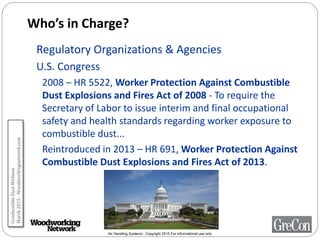
U.S. Congress
2008 – HR 5522, Worker Protection Against Combustible
Dust Explosions and Fires Act of 2008 - To require the
Secretary of Labor to issue interim and final occupational
safety and health standards regarding worker exposure to
combustible dust...
Reintroduced in 2013 – HR 691, Worker Protection Against
Combustible Dust Explosions and Fires Act of 2013.
CombustibleDustWebinar
March2015-Woodworkingnetwork.com
Air Handling Systems - Copyright 2015 For informational use only
Who’s in Charge?
Regulatory Organizations & Agencies
NFPA – National Fire Protection Association -
International Codes and Standards Organization that
creates voluntary consensus standards.
Voluntary Consensus Standards – According to OSHA:
“These standards are NOT OSHA regulations. However,
they do provide guidance from their originating
organizations related to worker protection. In some cases,
they may be mandated by State or local governments, or
individual companies.”
CombustibleDustWebinar
March2015-Woodworkingnetwork.com
Air Handling Systems - Copyright 2015 For informational use only
Who’s in Charge?
Regulatory Organizations & Agencies
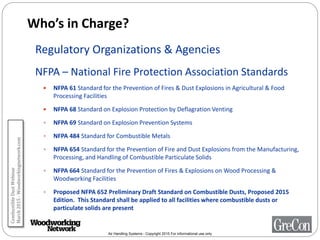
NFPA – National Fire Protection Association Standards
 NFPA 61 Standard for the Prevention of Fires & Dust Explosions in Agricultural & Food
Processing Facilities
 NFPA 68 Standard on Explosion Protection by Deflagration Venting
 NFPA 69 Standard on Explosion Prevention Systems
 NFPA 484 Standard for Combustible Metals
 NFPA 654 Standard for the Prevention of Fire and Dust Explosions from the Manufacturing,
Processing, and Handling of Combustible Particulate Solids
 NFPA 664 Standard for the Prevention of Fires & Explosions on Wood Processing &
Woodworking Facilities
 Proposed NFPA 652 Preliminary Draft Standard on Combustible Dusts, Proposed 2015
Edition. This Standard shall be applied to all facilities where combustible dusts or
particulate solids are present
CombustibleDustWebinar
March2015-Woodworkingnetwork.com
Air Handling Systems - Copyright 2015 For informational use only
Who’s in Charge?
Regulatory Organizations & Agencies
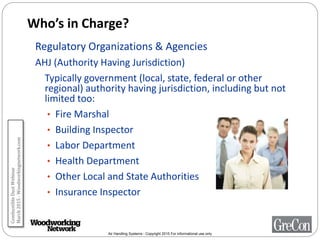
AHJ (Authority Having Jurisdiction)
Typically government (local, state, federal or other
regional) authority having jurisdiction, including but not
limited too:
• Fire Marshal
• Building Inspector
• Labor Department
• Health Department
• Other Local and State Authorities
• Insurance Inspector
CombustibleDustWebinar
March2015-Woodworkingnetwork.com
Air Handling Systems - Copyright 2015 For informational use only
Who’s in Charge?
Regulatory Organizations & Agencies
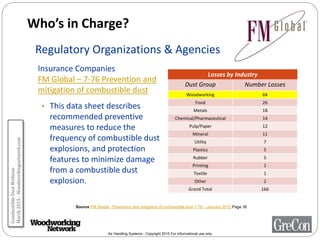
Source FM Global - Prevention and mitigation of combustible dust 7-76 – January 2012 Page 36
Losses by Industry
Dust Group Number Losses
Woodworking 64
Food 26
Metals 18
Chemical/Pharmaceutical 14
Pulp/Paper 12
Mineral 11
Utility 7
Plastics 5
Rubber 5
Printing 1
Textile 1
Other 2
Grand Total 166
Insurance Companies
FM Global – 7-76 Prevention and
mitigation of combustible dust
• This data sheet describes
recommended preventive
measures to reduce the
frequency of combustible dust
explosions, and protection
features to minimize damage
from a combustible dust
explosion.
CombustibleDustWebinar
March2015-Woodworkingnetwork.com
Air Handling Systems - Copyright 2015 For informational use only
Regulatory Organizations & Agencies
Who’s in Charge?
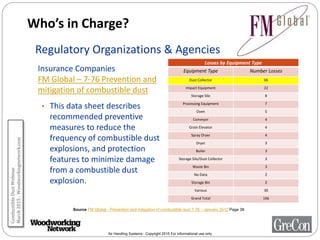
Losses by Equipment Type
Equipment Type Number Losses
Dust Collector 66
Impact Equipment 22
Storage Silo 8
Processing Equipment 7
Oven 5
Conveyor 4
Grain Elevator 4
Spray Dryer 4
Dryer 3
Boiler 3
Storage Silo/Dust Collector 3
Waste Bin 3
No Data 2
Storage Bin 2
Various 30
Grand Total 166
Source FM Global - Prevention and mitigation of combustible dust 7-76 – January 2012 Page 38
Insurance Companies
FM Global – 7-76 Prevention and
mitigation of combustible dust
• This data sheet describes
recommended preventive
measures to reduce the
frequency of combustible dust
explosions, and protection
features to minimize damage
from a combustible dust
explosion.
CombustibleDustWebinar
March2015-Woodworkingnetwork.com
Air Handling Systems - Copyright 2015 For informational use only
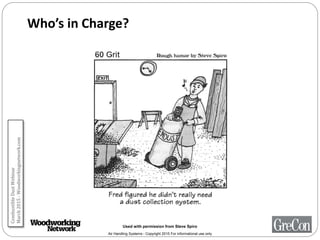
Who’s in Charge?
Used with permission from Steve Spiro
CombustibleDustWebinar
March2015-Woodworkingnetwork.com
Air Handling Systems - Copyright 2015 For informational use only
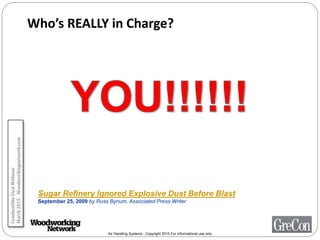
Who’s REALLY in Charge?
Sugar Refinery Ignored Explosive Dust Before Blast
September 25, 2009 by Russ Bynum, Associated Press Writer
CombustibleDustWebinar
March2015-Woodworkingnetwork.com
Air Handling Systems - Copyright 2015 For informational use only
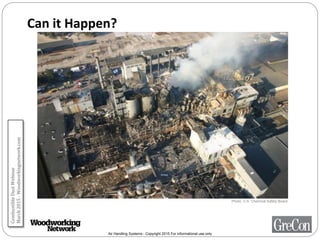
Can it Happen?
<iframe width="640" height="360"
src="http://www.youtube.com/embed/HTxI
CEh7Kv0?feature=player_detailpage"
frameborder="0" allowfullscreen></iframe>
Photo: U.S. Chemical Safety Board
CombustibleDustWebinar
March2015-Woodworkingnetwork.com
Air Handling Systems - Copyright 2015 For informational use only
Can it Happen?
1785 – First recorded dust explosion at a flour mill in
Italy.
Feb 2008 - Georgia sugar refinery explosion – Imperial
Sugar refinery explosion was an industrial disaster
that occurred in Port Wentworth, Georgia. Primary
explosion, then secondary explosion.
CombustibleDustWebinar
March2015-Woodworkingnetwork.com
Air Handling Systems - Copyright 2015 For informational use only
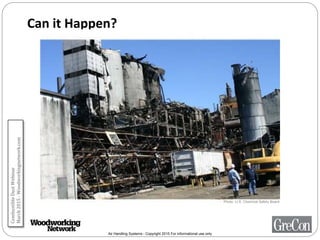
Can it Happen?
Photo: U.S. Chemical Safety Board
CombustibleDustWebinar
March2015-Woodworkingnetwork.com
Air Handling Systems - Copyright 2015 For informational use only
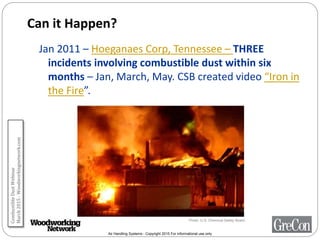
Can it Happen?
Jan 2011 – Hoeganaes Corp, Tennessee – THREE
incidents involving combustible dust within six
months – Jan, March, May. CSB created video “Iron in
the Fire”.
Photo: U.S. Chemical Safety Board
CombustibleDustWebinar
March2015-Woodworkingnetwork.com
Air Handling Systems - Copyright 2015 For informational use only
Can it Happen?
Feb 2011 - Mississippi mill slapped with ComDust violations
- $67,800 - OSHA has cited the mill for a variety of
violations, including for having an electrical junction box
open in an area where combustible wood dust
accumulates.
Feb 2011 - Combustible Dust Exposure Leads to Georgia
Company's Fine - $55,250 - OSHA has cited U.S. Erosion
Control Products Inc., following an inspection that
uncovered 46 alleged safety and health hazards including
worker exposure to heavy accumulations of combustible
dust. Proposed penalties total $55,250.
CombustibleDustWebinar
March2015-Woodworkingnetwork.com
Air Handling Systems - Copyright 2015 For informational use only
Can it Happen?
Mar 2011 - Gov. Malloy tours CT firm cited by OSHA -
$83,400 OSHA cited Volvo Aero on specific safety
violations. They include improperly designed
combustible dust collection system.
• Employees were exposed to fire and explosion hazards
caused by the presence of combustible dust: Penalty:
$5000
• The Donaldson Torit Model VS1200 dust collection
system provided was not designed and installed to be
used with combustible metal dust.
CombustibleDustWebinar
March2015-Woodworkingnetwork.com
Air Handling Systems - Copyright 2015 For informational use only
Can it Happen?
Mar 2011 - Gov. Malloy tours CT firm cited by OSHA (con’t)
Specifically:
• The collection hood provided at the de-burring
workstation was not designed and maintained so that
fine particles would either fall or be projected in the
direction of airflow. (NFPA 484, Section 6.3.2.2)
• The dry-type dust collector was located inside of the
building. (NFPA 484, Section 6.3.2.5)
• The dust collection system was not dedicated to the
collection of aluminum or aluminum alloy dust. (NFPA
484, Section 6.3.2.6)
CombustibleDustWebinar
March2015-Woodworkingnetwork.com
Air Handling Systems - Copyright 2015 For informational use only
Can it Happen?
Mar 2011 - Gov. Malloy tours CT firm cited by OSHA (con’t)
Specifically:
• The plastic hose that connected the exhaust hood to the
dust collector was not short, straight, conductive and
provided with a smooth interior surface. (NFPA 484,
Sections 6.3.3.4, & 6.3.3.5.1 & 10.4.4.2)
• The pneumatic hand tools provided for use were not
interlocked with the dust collector to ensure that the
dust collector was on and properly functioning before
deburring. (NFPA 484, Section 6.3.4.7.1, 6.3.4.7.2,
10.4.4.6.1 & 10.4.4.6.2)
CombustibleDustWebinar
March2015-Woodworkingnetwork.com
Air Handling Systems - Copyright 2015 For informational use only
Can it Happen?
Mar 2011 - Gov. Malloy tours CT firm cited by OSHA (con’t)
Specifically:
• Exhaust air from the dust collector was recycled into the
work area. (NFPA 484, Section 6.3.6 & 10.4.9)
• “Among other methods, one feasible and acceptable
abatement method to correct this hazard is to design
and install a dust collection system that complies with
generally accepted guidelines such as NFPA 484
Standard for Combustible Metals.”
CombustibleDustWebinar
March2015-Woodworkingnetwork.com
Air Handling Systems - Copyright 2015 For informational use only
Can it Happen?
Mar 2011 - OSHA: Carolina Skiff (GA) cited for combustible
dust - $95,000 - OSHA fines Waycross, Ga., manufacturer
for safety and health violations.
Apr 2011 - RY Timber (MT) cited by OSHA for worker
ComDust exposure - $79,200 - Repeat violations address
deficiencies involving inadequate housekeeping in areas
where combustible dust build-up had exceeded allowable
limits.
CombustibleDustWebinar
March2015-Woodworkingnetwork.com
Air Handling Systems - Copyright 2015 For informational use only
Can it Happen?
Apr 2011 - Seating Company Slapped with fines for
Combustible Dust - $117,600 - “Combustible dust, with its
fine particulate composition, has the ability to create an
explosive atmosphere and rapidly engulf a facility in fire,”
said Area Director. “The accumulations of combustible
dust must be removed, and a program must be put in
place to prevent any potential build up from occurring.”
Jun 2011 - ComDust explosion at Universal Woods injures
two workers - Two injured workers were using a metal
rod to unclog the dust collection filter when it
apparently touched something causing a spark and
triggering an explosion and resulting fireball that blasted
more than 50 feet into the air.
CombustibleDustWebinar
March2015-Woodworkingnetwork.com
Air Handling Systems - Copyright 2015 For informational use only
Can it Happen?
Jul 2011 - OSHA Slaps Pilgrim’s Pride with fines - $85,000
Allegedly discovered an “excessive accumulation of grain
dust” as the result of a housekeeping program that was
neither followed nor maintained. They allowed electrical
components such as motors and drop lights to be subject to
the accumulation of combustible dust.
Aug 2011 - OSHA proposes fine for Opelika packaging company
- $54,880 Company spokesman said that the fines were
unfortunate because at the time of the OSHA inspection a
new dust collection system was on site and being prepared
for installation. OSHA violations involve improper
housekeeping for allowing up to 36 inches of combustible
wood dust to accumulate.
CombustibleDustWebinar
March2015-Woodworkingnetwork.com
Air Handling Systems - Copyright 2015 For informational use only
Can it Happen?
Oct 2011 - Fine for exposing employees to combustible dust
hazards - $58,800 "Failing to provide appropriate personal
protective equipment and monitoring workers for
exposure to hazards such as combustible dust puts them
at an unacceptable risk for injury and illness”.
Oct 2011 – 4-alarm blaze at wood pellet plant in Jaffrey, NH -
It was a long night for firefighters who battled a blaze at
the New England Wood Pellet plant in a 14 hour fight.
(more details on future slide).
Jan 2012 - Cardell Cabinetry faces fines by OSHA - $45,000
OSHA said it found combustible dust accumulation,
inadequate guarding of machines and unsanitary
working conditions.
CombustibleDustWebinar
March2015-Woodworkingnetwork.com
Air Handling Systems - Copyright 2015 For informational use only
Can it Happen?
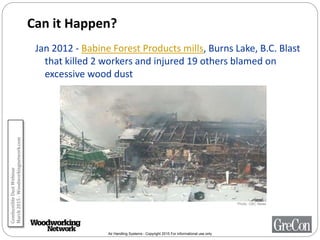
Jan 2012 - Babine Forest Products mills, Burns Lake, B.C. Blast
that killed 2 workers and injured 19 others blamed on
excessive wood dust
Photo: CBC News
CombustibleDustWebinar
March2015-Woodworkingnetwork.com
Air Handling Systems - Copyright 2015 For informational use only
Can it Happen?
Feb 2012 - Sandersville sawmill fined for health and safety
violations - $78,000 Several of the alleged violations
involved combustible dust in the sawmill.
Feb 2012 - Franklin Lumber Co. in Bude cited for 22 safety
violations - $103,356. OSHA initiated its inspection as part
of the agency's national emphasis program (NEP) to reduce
employees' exposure to combustible dust hazards.
CombustibleDustWebinar
March2015-Woodworkingnetwork.com
Air Handling Systems - Copyright 2015 For informational use only
Can it Happen?
Apr 2012 - Prince George, BC, Canada, Lakeland Mills sawmill
‘ball of flame’ kills 1, injures 24 (CBC Video)
• Workers say building exploded around them
• Flames at the sawmill, located about one kilometre
outside the city, were reported to have shot more than
60 metres in the air at one point, according to
witnesses.
• It's the second devastating explosion in B.C. in recent
months.
• Some outside experts have pointed to high dust levels
and limited ventilation at the Burns Lake mills as a
possible cause.
CombustibleDustWebinar
March2015-Woodworkingnetwork.com
Air Handling Systems - Copyright 2015 For informational use only
Can it Happen?
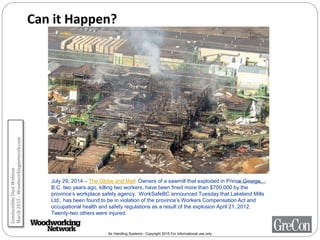
Photo: CBC NewsJuly 29, 2014 – The Globe and Mail: Owners of a sawmill that exploded in Prince George,
B.C. two years ago, killing two workers, have been fined more than $700,000 by the
province’s workplace safety agency. WorkSafeBC announced Tuesday that Lakeland Mills
Ltd., has been found to be in violation of the province’s Workers Compensation Act and
occupational health and safety regulations as a result of the explosion April 21, 2012.
Twenty-two others were injured.
CombustibleDustWebinar
March2015-Woodworkingnetwork.com
Air Handling Systems - Copyright 2015 For informational use only
Can it Happen?
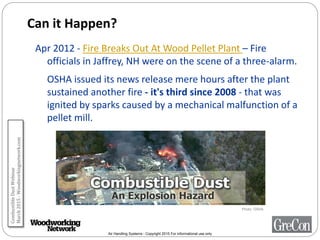
Apr 2012 - Fire Breaks Out At Wood Pellet Plant – Fire
officials in Jaffrey, NH were on the scene of a three-alarm.
OSHA issued its news release mere hours after the plant
sustained another fire - it's third since 2008 - that was
ignited by sparks caused by a mechanical malfunction of a
pellet mill.
Photo: OSHA
CombustibleDustWebinar
March2015-Woodworkingnetwork.com
Air Handling Systems - Copyright 2015 For informational use only
Can it Happen?
New England Wood Pellet officials acknowledged ”that the
fundamental nature of wood dust and wood pellet
manufacturing presents challenges to all wood pellet mill
operators.”
In its inspection following the Oct. 20 fire, OSHA cited
New England Wood Pellet for two repeat citations
bearing $147,000 in fines, including failing to provide a
workplace free of recognized fire & explosion hazards, and
for using unapproved electrical equipment to vacuum
combustible dust. The wood pellet maker was previously
was fined $135,000 by OSHA in July 2008 for combustible
dust-related and other violations.
CombustibleDustWebinar
March2015-Woodworkingnetwork.com
Air Handling Systems - Copyright 2015 For informational use only
Can it Happen?
May 2012 – Pellet maker faults OSHA $147,000 – Analysis
Citation 1. 29 CFR 1910.22(a)(1) Places of employment
were not kept clean and orderly.
CFR 29 (Labor) Subpart d – Walking-Work Surfaces general
requirements 1910.22 (a)(1) “Housekeeping.” Also
referenced NFPA 664 (2012) 11.2.1.1 Surfaces shall be
cleaned in a manner that minimizes the generation of
dust clouds.
Instance A – Layers of combustible wood dust were
allowed to accumulate to depths and over surface areas
in quantities that exposed workers to fire and/or
explosion hazards. i.e. on overhead and wall horizontal
surfaces, where one location it ignited in a fireball.
CombustibleDustWebinar
March2015-Woodworkingnetwork.com
Air Handling Systems - Copyright 2015 For informational use only
Can it Happen?
May 2012 – Pellet maker faults OSHA $147,000 - Con’t.
Instance B – When combustible wood dust was cleared from
surfaces, the employer used cleaning methods that
increased the potential for a combustible dust deflagration
and/or explosion:
the employer used 30 psi compressed air to blowdown and
clear combustible wood dust.
Blowing down with steam or compressed air or even
vigorous sweeping shall be permitted only if the following
requirements are met: specifically…only a low gauge
pressure of 15psi steam or compressed air shall be used.
The floor area & equipment shall be vacuumed prior to
blowdown.
CombustibleDustWebinar
March2015-Woodworkingnetwork.com
Air Handling Systems - Copyright 2015 For informational use only
Can it Happen?
Aug 2012 - Alabama furniture manufacturer cited by OSHA
for exposing workers to combustible dust, other hazards
• Scholar Craft Products Inc., has been cited by OSHA for
25 safety and health violations at its Birmingham
furniture manufacturing plant . OSHA initiated an
inspection in Feb. as part of the agency's NEP on
Amputations and its Local Emphasis Program on High
Noise Industries. Proposed penalties $94,500.
NOTE: Nothing related to combustible dust initiated
this inspection.
CombustibleDustWebinar
March2015-Woodworkingnetwork.com
Air Handling Systems - Copyright 2015 For informational use only
Can it Happen?
Aug 2012 - Alabama furniture manufacturer (cont.)
• 19 serious safety and health violations involve:
• maintain the dust collection system to prevent
potential fires or explosions,
• install dust collection systems in areas where
combustible dust is present,
• ensure danger signs are posted on equipment
generating combustible dust,
• reduce the pressure on an air hose to less than 30 psi
CombustibleDustWebinar
March2015-Woodworkingnetwork.com
Air Handling Systems - Copyright 2015 For informational use only
Can it Happen?
Aug 2012 - Alabama furniture manufacturer (cont.)
• 19 serious safety and health violations involve (con’t):
• train workers on the hazards associated with
combustible dust and provide medical evaluations for
respirator users.
• Additional violations include allowing combustible
dust to accumulate on floors, equipment and walls;
• "This inspection identified a broad range of hazards
that, if left uncorrected, expose workers to combustible
dust hazards," said OSHA's acting area director.
"Employers cannot wait for an OSHA inspection to
identify the hazards that expose their employees to
serious injury."
CombustibleDustWebinar
March2015-Woodworkingnetwork.com
Air Handling Systems - Copyright 2015 For informational use only
Can it Happen?
Aug 2013 - Cardell Cabinetry LLC has been cited for
combustible dust and other safety and health violations by
OSHA.
• The semi-custom cabinet company faces a penalty of
$267,434 for 29 violations at the San Antonio, TX, facility.
• Cardell faces penalties of $99,000 for the repeat failure
to "remove combustible wood dust, cover electrical
boxes and reduce the pressure of compressed air."
• The repeated failure to remove wood dust from the
parts mill area is a $34,034 penalty for the failure-to-
abate violation.
CombustibleDustWebinar
March2015-Woodworkingnetwork.com
Air Handling Systems - Copyright 2015 For informational use only
Can it Happen?
Aug 2013 - Cardell Cabinetry LLC (cont.)
• "The sizable penalties proposed here reflect the severity
of the various hazardous conditions found at this facility,
including the accumulation of combustible dust that can
lead to a needless catastrophic incident,“
• "The fact that such an incident has not occurred does not
absolve Cardell Cabinetry of its responsibility to find and
eliminate hazards that could endanger workers' lives."
stated director of OSHA's San Antonio Area Office. See
more at Woodworking Network.
• September 9, 2013 Cardell Cabinetry closed it doors.
• 900,000 sq. ft facility/900 unemployed.
CombustibleDustWebinar
March2015-Woodworkingnetwork.com
Air Handling Systems - Copyright 2015 For informational use only
Can it Happen?
Sept 2013 – Merritt B.C. - WorkSafeBC shuts down Merritt
mill temporarily due to dust. Source Vancouver Sun.
• Buildup of wood dust at the Aspen Planers sawmill took
place despite several industry wide regulatory warnings.
• After the stop-work order was issued Sept. 11, Aspen
Planers cleaned up the wood dust by the next day.
• WorkSafeBC lifted the order, but told the company it
must provide a written plan that specifies the steps it
will take to ensure it follows the regulations and lays out
its own dust-control program.
CombustibleDustWebinar
March2015-Woodworkingnetwork.com
Air Handling Systems - Copyright 2015 For informational use only
Can it Happen?
Sept 2013 – Merritt Mill B.C. (con’t).
• During the inspection WorkSafeBC found dust had collected
on beams, duct work and heat sources such as lights.
• According to the inspection report, the accumulations were
in excess of 1/8 inch over more than 5% of the enclosed
area, the safety standard set by WorkSafeBC last year.
"Given that the enclosed areas are confined by floor, walls
and ceiling structures, the dust accumulations could be
dispersed into the air, and could come into contact with
ignition sources… Dispersion of these accumulations in the
presence of ignition sources poses a high risk of fire or
explosion.”
CombustibleDustWebinar
March2015-Woodworkingnetwork.com
Air Handling Systems - Copyright 2015 For informational use only
Can it Happen?
Apr 2014 – Albany, NY - OSHA cites cabinetry, countertop
manufacturer for combustible dust, chemical hazards
• Salko Kitchens Inc. faces proposed fines of $51,800 for
combustible dust and potential carcinogen exposure
violations.
• "These workers face both immediate and long-term health
and safety hazards from on-site conditions," said OSHA's
area director in Albany. "The combustible dust can ignite
and explode in seconds. For the health and well-being of its
employees, it's imperative that this employer correct these
hazards and take effective steps to prevent them from
happening again."
CombustibleDustWebinar
March2015-Woodworkingnetwork.com
Air Handling Systems - Copyright 2015 For informational use only
Can it Happen?
July 2014 – U.S. Chemical Safety Board: CSB Releases Safety
Video, “Combustible Dust: Solutions Delayed”
Charleston, WV, July 16, 2014 – Today the CSB released its
final report, safety recommendations and accompanying
safety video into a fatal combustible dust explosion at the
AL Solutions metal recycling facility in New Cumberland,
West Virginia. The report reiterates a recommendation
that OSHA promulgate a general industry combustible
dust standard, something the agency has been calling for
since its definitive 2006 study on these preventable
accidents.
CombustibleDustWebinar
March2015-Woodworkingnetwork.com
Air Handling Systems - Copyright 2015 For informational use only
Can it Happen?
October July 2014 – OSHA Cites Combustible Dust at West
Hartford Stairs; $60,000 Fine. Source www.woodworkingnetwork.com
 West Hartford Stairs and Cabinets was cited by OSHA for 16 serious violations
of workplace safety and health standards at its manufacturing plant in
Newington, CT.
 The inspections by OSHA in response to an April, 2014, accident in which an
employee lost parts of two fingers in a machine.
 OSHA says it found that employees were exposed to fire hazards from a dust
collection system that lacked a spark detector to prevent hot metal from
entering the dust collector and igniting an explosion.
 Other hazards cited were (but not limited too) combustible dust in electrical
outlets.
CombustibleDustWebinar
March2015-Woodworkingnetwork.com
Air Handling Systems - Copyright 2015 For informational use only
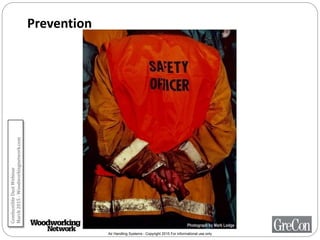
Prevention
Photograph by Mark Lodge
CombustibleDustWebinar
March2015-Woodworkingnetwork.com
Air Handling Systems - Copyright 2015 For informational use only
What is Combustible Dust?
Poll
Which combustible dust safeguards do you use?
Abort Gate
Air Cleaner (self contained, ceiling suspended)
Dust Collection
Explosion Protection Venting/Suppression
Housekeeping
Spark Detection System
Other
CombustibleDustWebinar
March2015-Woodworkingnetwork.com
Air Handling Systems - Copyright 2015 For informational use only
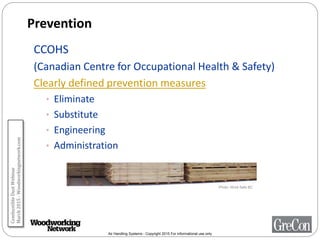
Prevention
CCOHS
(Canadian Centre for Occupational Health & Safety)
Clearly defined prevention measures
• Eliminate
• Substitute
• Engineering
• Administration
Photo: Work Safe BC
CombustibleDustWebinar
March2015-Woodworkingnetwork.com
Air Handling Systems - Copyright 2015 For informational use only
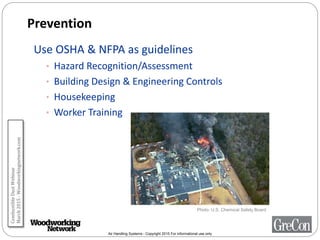
Prevention
Use OSHA & NFPA as guidelines
• Hazard Recognition/Assessment
• Building Design & Engineering Controls
• Housekeeping
• Worker Training
Photo: U.S. Chemical Safety Board
CombustibleDustWebinar
March2015-Woodworkingnetwork.com
Air Handling Systems - Copyright 2015 For informational use only
Prevention
Hazard Recognition/Assessment
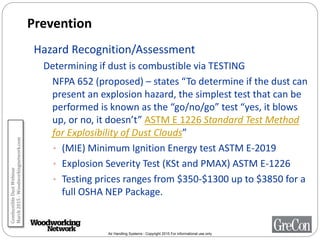
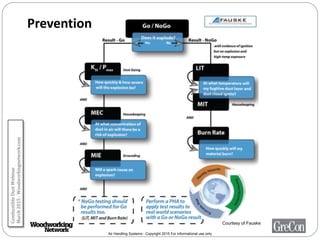
Determining if dust is combustible via TESTING
NFPA 652 (proposed) – states “To determine if the dust can
present an explosion hazard, the simplest test that can be
performed is known as the “go/no/go” test “yes, it blows
up, or no, it doesn’t” ASTM E 1226 Standard Test Method
for Explosibility of Dust Clouds”
• (MIE) Minimum Ignition Energy test ASTM E-2019
• Explosion Severity Test (KSt and PMAX) ASTM E-1226
• Testing prices ranges from $350-$1300 up to $3850 for a
full OSHA NEP Package.
CombustibleDustWebinar
March2015-Woodworkingnetwork.com
Air Handling Systems - Copyright 2015 For informational use only
Prevention
Courtesy of Fauske
CombustibleDustWebinar
March2015-Woodworkingnetwork.com
Air Handling Systems - Copyright 2015 For informational use only
Prevention
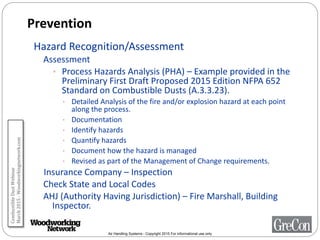
Hazard Recognition/Assessment
Assessment
• Process Hazards Analysis (PHA) – Example provided in the
Preliminary First Draft Proposed 2015 Edition NFPA 652
Standard on Combustible Dusts (A.3.3.23).
• Detailed Analysis of the fire and/or explosion hazard at each point
along the process.
• Documentation
• Identify hazards
• Quantify hazards
• Document how the hazard is managed
• Revised as part of the Management of Change requirements.
Insurance Company – Inspection
Check State and Local Codes
AHJ (Authority Having Jurisdiction) – Fire Marshall, Building
Inspector.
CombustibleDustWebinar
March2015-Woodworkingnetwork.com
Air Handling Systems - Copyright 2015 For informational use only
Prevention
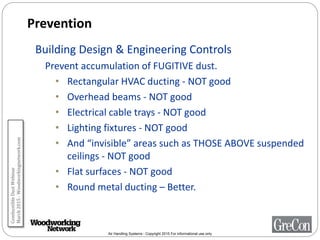
Building Design & Engineering Controls
Prevent accumulation of FUGITIVE dust.
• Rectangular HVAC ducting - NOT good
• Overhead beams - NOT good
• Electrical cable trays - NOT good
• Lighting fixtures - NOT good
• And “invisible” areas such as THOSE ABOVE suspended
ceilings - NOT good
• Flat surfaces - NOT good
• Round metal ducting – Better.
CombustibleDustWebinar
March2015-Woodworkingnetwork.com
Air Handling Systems - Copyright 2015 For informational use only
Prevention
Building Design & Engineering Controls
Equipment
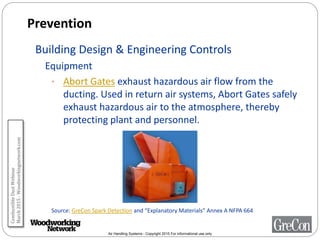
• Abort Gates exhaust hazardous air flow from the
ducting. Used in return air systems, Abort Gates safely
exhaust hazardous air to the atmosphere, thereby
protecting plant and personnel.
Source: GreCon Spark Detection and “Explanatory Materials” Annex A NFPA 664
CombustibleDustWebinar
March2015-Woodworkingnetwork.com
Air Handling Systems - Copyright 2015 For informational use only
Prevention
Building Design & Engineering Controls
Equipment
• Explosion Protection VENTING Video
• Explosion Protection SUPPRESION Video
• Additional information - Explosion Protection Annex B
NFPA 664
CombustibleDustWebinar
March2015-Woodworkingnetwork.com
Air Handling Systems - Copyright 2015 For informational use only
Prevention
Building Design & Engineering Controls
Equipment
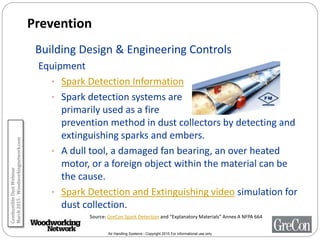
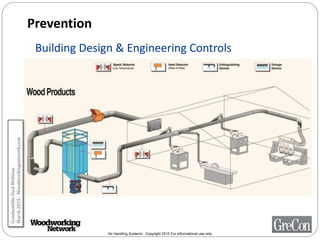
• Spark Detection Information
• Spark detection systems are
primarily used as a fire
prevention method in dust collectors by detecting and
extinguishing sparks and embers.
• A dull tool, a damaged fan bearing, an over heated
motor, or a foreign object within the material can be
the cause.
• Spark Detection and Extinguishing video simulation for
dust collection.
Source: GreCon Spark Detection and “Explanatory Materials” Annex A NFPA 664
CombustibleDustWebinar
March2015-Woodworkingnetwork.com
Air Handling Systems - Copyright 2015 For informational use only
Prevention
Building Design & Engineering Controls
For more information go to Informational Primer on Spark Detection and Extinguishing Systems – Annex C NFPA 664
CombustibleDustWebinar
March2015-Woodworkingnetwork.com
Air Handling Systems - Copyright 2015 For informational use only
Prevention
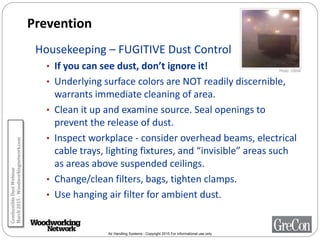
Housekeeping – FUGITIVE Dust Control
• If you can see dust, don’t ignore it!
• Underlying surface colors are NOT readily discernible,
warrants immediate cleaning of area.
• Clean it up and examine source. Seal openings to
prevent the release of dust.
• Inspect workplace - consider overhead beams, electrical
cable trays, lighting fixtures, and “invisible” areas such
as areas above suspended ceilings.
• Change/clean filters, bags, tighten clamps.
• Use hanging air filter for ambient dust.
Photo: OSHA
CombustibleDustWebinar
March2015-Woodworkingnetwork.com
Air Handling Systems - Copyright 2015 For informational use only
Prevention
Housekeeping – FUGITIVE Dust Control
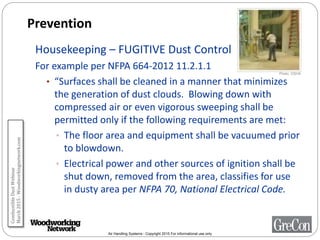
For example per NFPA 664-2012 11.2.1.1
• “Surfaces shall be cleaned in a manner that minimizes
the generation of dust clouds. Blowing down with
compressed air or even vigorous sweeping shall be
permitted only if the following requirements are met:
• The floor area and equipment shall be vacuumed prior
to blowdown.
• Electrical power and other sources of ignition shall be
shut down, removed from the area, classifies for use
in dusty area per NFPA 70, National Electrical Code.
Photo: OSHA
CombustibleDustWebinar
March2015-Woodworkingnetwork.com
Air Handling Systems - Copyright 2015 For informational use only
Prevention
Housekeeping – FUGITIVE Dust Control
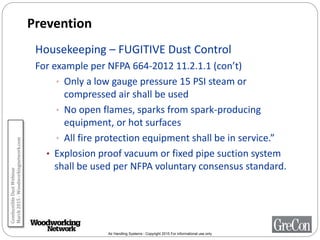
For example per NFPA 664-2012 11.2.1.1 (con’t)
• Only a low gauge pressure 15 PSI steam or
compressed air shall be used
• No open flames, sparks from spark-producing
equipment, or hot surfaces
• All fire protection equipment shall be in service.”
• Explosion proof vacuum or fixed pipe suction system
shall be used per NFPA voluntary consensus standard.
CombustibleDustWebinar
March2015-Woodworkingnetwork.com
Air Handling Systems - Copyright 2015 For informational use only
Prevention
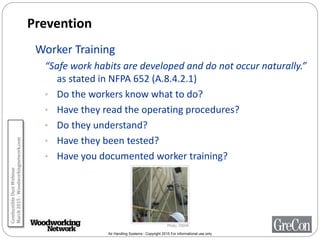
Worker Training
“Safe work habits are developed and do not occur naturally.”
as stated in NFPA 652 (A.8.4.2.1)
• Do the workers know what to do?
• Have they read the operating procedures?
• Do they understand?
• Have they been tested?
• Have you documented worker training?
Photo: OSHA
CombustibleDustWebinar
March2015-Woodworkingnetwork.com
Air Handling Systems - Copyright 2015 For informational use only
 What is Combustible Dust?
 Who’s in Charge?
 Can it Happen in Your Facility?
 Prevention
Conclusion – What we discussed:
CombustibleDustWebinar
March2015-Woodworkingnetwork.com
Air Handling Systems - Copyright 2015 For informational use only
Resources
FM Global Insurance Company
• Loss Prevention Data Sheet 7-76, Prevention and Mitigation of Combustible Dust Explosions and Fires
NFPA – National Fire Protection Association
• NFPA 61 Standard for the Prevention of Fires ad Dust Explosions in Agricultural and Food Processing Facilities
• NFPA 68 Standard on Explosion Protection by Deflagration Venting
• NFPA 69 Standard on Explosion Prevention Systems
• NFPA 484 Standard for Combustible Metals
• NFPA 654 Standard for the Prevention of Fire and Dust Explosions from the Manufacturing, Processing, and Handling
of Combustible Particulate Solids
• NFPA 664 Standard for the Prevention of Fires and Explosions in Wood Processing and Woodworking Facilities
• NFPA 652 (Proposed) Standard on Combustible Dusts
OSHA – Occupational Safety & Health Administration
• Combustible Dust
U.S Chemical Safety Board
 Combustible Dust
CombustibleDustWebinar
March2015-Woodworkingnetwork.com
Air Handling Systems - Copyright 2015 For informational use only
While there is NO specific
Combustible Dust REGULATION there
is plenty to be concerned about:
OSHA
U.S. Congress
NFPA
AHJ
Insurance Co.
and more.
CombustibleDustWebinar
March2015-Woodworkingnetwork.com
Air Handling Systems - Copyright 2015 For informational use only
Most importantly
Be prepared to avoid
An INSPECTION
or much worse
An EXPLOSION.
CombustibleDustWebinar
March2015-Woodworkingnetwork.com
Air Handling Systems - Copyright 2015 For informational use only
Jamison Scott
jscott@airhand.com
www.airhand.com
More info on combustible dust:
http://www.airhand.com/combustibledust.aspx
Contact
CombustibleDustWebinar
March2015-Woodworkingnetwork.com
QUESTIONS??
“Ask A Question” on the
upper left area above the
Webcast screen.
CombustibleDustWebinar
March2015-Woodworkingnetwork.com
Thanks to our speaker!
Jamison Scott
Executive Vice President
Air Handling Systems
CombustibleDustWebinar
March2015-Woodworkingnetwork.com
Thanks to our sponsor!
CombustibleDustWebinar
March2015-Woodworkingnetwork.com
Thanks for listening!
View all of our on demand
webcasts at:
woodworkingnetwork.com/webcasts
CombustibleDustWebinar
March2015-Woodworkingnetwork.com

Combustible Dust Webcast March 2015rev1

  • 1.
    Combustible Sawdust How toProtect Your Workers & Your Business Welcome ! Today’s Webcast
  • 2.
  • 3.
    Today’s Webcast: Combustible Sawdust Howto Protect Your Workers & Your Business CombustibleDustWebinar March2015-Woodworkingnetwork.com
  • 4.
    • Veneer Utilization– Watch it on demand • Combustible Sawdust – March 4 • Optimizing Solid Wood Production - March 26 • Cabinets & Closets Expo 2015 – April 14-16 • WMS Woodworking Machinery & Supply Expo– November 5-7 Webcasts & Live Events: CombustibleDustWebinar March2015-Woodworkingnetwork.com
  • 5.
    Our Speaker: Jamison Scott ExecutiveVice President Air Handling Systems CombustibleDustWebinar March2015-Woodworkingnetwork.com
  • 6.
  • 7.
    QUESTIONS?? “Ask A Question”on the upper left area above the Webcast screen. CombustibleDustWebinar March2015-Woodworkingnetwork.com
  • 8.
    Woodworking Network Presented by JamisonScott Executive Vice President, Air Handling Systems Combustible Dust an Explosive Issue Copyright © 2015 Air Handling Systems. All rights reserved. No part of this book may be reproduced, stored in a retrieval system, or transmitted in any form or by any means, electronic, mechanical, photocopying, recording, or otherwise, without the prior permission of Air Handling Systems. Photo: U.S. Chemical Safety Board CombustibleDustWebinar March2015-Woodworkingnetwork.com
  • 9.
    Air Handling Systems- Copyright 2015 For informational use only Overview  What is Combustible Dust?  Who’s in Charge?  Can it Happen in My Facility?  Prevention Photo: U.S. Chemical Safety Board CombustibleDustWebinar March2015-Woodworkingnetwork.com
  • 10.
    Air Handling Systems- Copyright 2015 For informational use only What is Combustible Dust? Examples  Air Handling Systems  Sawdust Cannon, courtesy of Navy Island  Mythbusters - Creamer Cannon  FM Global – Dust Explosion CombustibleDustWebinar March2015-Woodworkingnetwork.com
  • 11.
    Air Handling Systems- Copyright 2015 For informational use only What is Combustible Dust? Poll Why are you concerned about combustible dust?  Health and Safety of Employees  Concern of potential OSHA Inspection  Already had OSHA Inspection  Fear of an Explosion Photo: U.S. Chemical Safety Board CombustibleDustWebinar March2015-Woodworkingnetwork.com
  • 12.
    Air Handling Systems- Copyright 2015 For informational use only What is Combustible Dust? CombustibleDustWebinar March2015-Woodworkingnetwork.com
  • 13.
    Air Handling Systems- Copyright 2015 For informational use only What is Combustible Dust? bP P P P P P P Combustible dusts are fine particles that present an explosion hazard when suspended in air in certain conditions. Source: OSHA Fact Sheet. CombustibleDustWebinar March2015-Woodworkingnetwork.com
  • 14.
    Air Handling Systems- Copyright 2015 For informational use only What is Combustible Dust? Combustible Fine Particles It is not simply defining a dust, it is determining the explosibility of the dust.  Important factors include, but no limited too:  Particle Size  Particle Shape  Particle Aging  Triboelectric Attraction (static electricity)  Hydrogen Bonding (moisture)  Environment CombustibleDustWebinar March2015-Woodworkingnetwork.com
  • 15.
    Air Handling Systems- Copyright 2015 For informational use only What is Combustible Dust? Combustible Fine Particles Additionally… Kst value is used as a factor in the deflagration of your dust.  e.g. Wood flour has a Kst Value of >200 and < 300 meaning it has a strong explosion characteristic. Dust explosion class rating system from St 0 – St 3  e.g. Dust explosion class of wood flour is St 2. NFPA defines the size of “Deflagrable Wood Dust” as 500 microns (.5 mm, 0.0196”) or less and has a moisture content of less than 25%. Another way to measure is to see if the material will pass through U.S. No. 35 Standard Sieve which is approx. the “size of fairly coarse sand”. (NFPA 664 (3.3.27.1) CombustibleDustWebinar March2015-Woodworkingnetwork.com
  • 16.
    Air Handling Systems- Copyright 2015 For informational use only What is Combustible Dust? Combustible Fine Particles Layer Depth Criterion – In general mfg – 1/32 in.+ depending on bulk density and total area. (NFPA 654-2013 6.1.3.1) Layer Thickness Criterion - In woodworking facilities, a dust layer of 1/8 in. thick (over 5% of area) can be sufficient to warrant immediate cleaning of area. (NFPA 664-2012 4.2.1) CombustibleDustWebinar March2015-Woodworkingnetwork.com
  • 17.
    Air Handling Systems- Copyright 2015 For informational use only What is Combustible Dust? Combustible Fine Particles If there is any doubt of combustibility, the dust must be sent to a certified facility to be tested. (More on testing, on future slides…) CombustibleDustWebinar March2015-Woodworkingnetwork.com
  • 18.
    Air Handling Systems- Copyright 2015 For informational use only What is Combustible Dust? Fuel (combustible dust) Ignition (heat, spark) Oxygen (air) Remove any one element eliminates the possibility of fire. Classic Fire Triangle CombustibleDustWebinar March2015-Woodworkingnetwork.com
  • 19.
    Air Handling Systems- Copyright 2015 For informational use only What is Combustible Dust? Fire Fuel (combustible dust) Fire Ignition (heat, spark) Fire Oxygen (air) Explosion Dispersion (Dust Suspension) Explosion Confinement Remove any one element prevents explosion, but not necessarily fire!* *the concentration of suspended dust must be within an explosible range, lowest amount of dust in air that will explode, referred to as Minimum Explosible Concentration (MEC) – (1) Dust Explosion Pentagon CombustibleDustWebinar March2015-Woodworkingnetwork.com
  • 20.
    Air Handling Systems- Copyright 2015 For informational use only Who’s in Charge? OSHA Congress NFPA AHJ Insurance Company Business Owner Employee CombustibleDustWebinar March2015-Woodworkingnetwork.com
  • 21.
    Air Handling Systems- Copyright 2015 For informational use only Who’s in Charge? Regulatory Organizations & Agencies OSHA: 2005 - Safety & Health Bulletin: Combustible Dust in Industry: Preventing and Mitigating the Effects of Fire and Explosions 2007 – OSHA Combustible Dust National Emphasis (NEP) Program targeted inspections on facilities that create or handle combustible dusts. Results from these inspections indicated that facilities had unusually high numbers of general duty clause violations, indicating a strong need for a combustible dust standard. CombustibleDustWebinar March2015-Woodworkingnetwork.com
  • 22.
    Air Handling Systems- Copyright 2015 For informational use only Who’s in Charge? Regulatory Organizations & Agencies OSHA: March 2008 - Hazard Alert: Combustible Dust Explosions. OSHA Fact Sheet Spring 2009 - OSHA considers rulemaking (ANPRM) to develop a combustible dust standard for general industry. Dec 2009 – OSHA hosts first in series of Stakeholder meetings in Washington DC. CombustibleDustWebinar March2015-Woodworkingnetwork.com
  • 23.
    Air Handling Systems- Copyright 2015 For informational use only Who’s in Charge? Regulatory Organizations & Agencies OSHA: 2013 - Updated Hazard Communication Standard • Employers required to train workers by Dec, 2013 on the new labels elements and safety data sheets format to facilitate recognition and understanding. • According to OSHA - ”Hazardous chemical” means any chemical which is classified as a physical hazard or a health hazard, a simple asphyxiant, combustible dust, pyrophoric gas, or hazard not otherwise classified. CombustibleDustWebinar March2015-Woodworkingnetwork.com
  • 24.
    Air Handling Systems- Copyright 2015 For informational use only Who’s in Charge? Regulatory Organizations & Agencies OSHA: January 2013 – OSHA announces plan to finally initiate SBREFA (Small Business Regulatory Enforcement Fairness Act) meetings – currently revised for December 2014. April 2013 - New publication: Firefighting Precautions at Facilities with Combustible Dust CombustibleDustWebinar March2015-Woodworkingnetwork.com
  • 25.
    Air Handling Systems- Copyright 2015 For informational use only Who’s in Charge? Regulatory Organizations & Agencies OSHA: Dec. 2013 - Classification of Combustible Dusts under the Revised Hazard Communication Standard. “This memorandum provides guidance for compliance safety and health officers (CSHOs) to use in determining whether manufacturers or importers have properly classified their products for combustible dust hazards under the revised Hazard Communication Standard (HCS).” WHY? According to OSHA “the GHS does not contain a classification for combustible dust hazards, and to maintain coverage of this hazard under the HCS, OSHA amended the standard's definition of "hazardous chemical" to include "combustible dust”.” CombustibleDustWebinar March2015-Woodworkingnetwork.com
  • 26.
    Air Handling Systems- Copyright 2015 For informational use only Who’s in Charge? Regulatory Organizations & Agencies OSHA: Dec. 2013 - Classification of Combustible Dusts (con’t.) “If the classifier knows that its product has been involved in a deflagration or dust explosion event, the classifier should classify the product as a combustible dust” “Where there is no test data, or if the testing is inconclusive, classification may be based on particle size, if particle size information is available. If the material will burn and contains a sufficient concentration of particles 420 microns or smaller to create a fire or deflagration hazard, it should be classified as a combustible dust” CombustibleDustWebinar March2015-Woodworkingnetwork.com
  • 27.
    Air Handling Systems- Copyright 2015 For informational use only Who’s in Charge? Regulatory Organizations & Agencies U.S. Congress 2008 – HR 5522, Worker Protection Against Combustible Dust Explosions and Fires Act of 2008 - To require the Secretary of Labor to issue interim and final occupational safety and health standards regarding worker exposure to combustible dust... Reintroduced in 2013 – HR 691, Worker Protection Against Combustible Dust Explosions and Fires Act of 2013. CombustibleDustWebinar March2015-Woodworkingnetwork.com
  • 28.
    Air Handling Systems- Copyright 2015 For informational use only Who’s in Charge? Regulatory Organizations & Agencies NFPA – National Fire Protection Association - International Codes and Standards Organization that creates voluntary consensus standards. Voluntary Consensus Standards – According to OSHA: “These standards are NOT OSHA regulations. However, they do provide guidance from their originating organizations related to worker protection. In some cases, they may be mandated by State or local governments, or individual companies.” CombustibleDustWebinar March2015-Woodworkingnetwork.com
  • 29.
    Air Handling Systems- Copyright 2015 For informational use only Who’s in Charge? Regulatory Organizations & Agencies NFPA – National Fire Protection Association Standards  NFPA 61 Standard for the Prevention of Fires & Dust Explosions in Agricultural & Food Processing Facilities  NFPA 68 Standard on Explosion Protection by Deflagration Venting  NFPA 69 Standard on Explosion Prevention Systems  NFPA 484 Standard for Combustible Metals  NFPA 654 Standard for the Prevention of Fire and Dust Explosions from the Manufacturing, Processing, and Handling of Combustible Particulate Solids  NFPA 664 Standard for the Prevention of Fires & Explosions on Wood Processing & Woodworking Facilities  Proposed NFPA 652 Preliminary Draft Standard on Combustible Dusts, Proposed 2015 Edition. This Standard shall be applied to all facilities where combustible dusts or particulate solids are present CombustibleDustWebinar March2015-Woodworkingnetwork.com
  • 30.
    Air Handling Systems- Copyright 2015 For informational use only Who’s in Charge? Regulatory Organizations & Agencies AHJ (Authority Having Jurisdiction) Typically government (local, state, federal or other regional) authority having jurisdiction, including but not limited too: • Fire Marshal • Building Inspector • Labor Department • Health Department • Other Local and State Authorities • Insurance Inspector CombustibleDustWebinar March2015-Woodworkingnetwork.com
  • 31.
    Air Handling Systems- Copyright 2015 For informational use only Who’s in Charge? Regulatory Organizations & Agencies Source FM Global - Prevention and mitigation of combustible dust 7-76 – January 2012 Page 36 Losses by Industry Dust Group Number Losses Woodworking 64 Food 26 Metals 18 Chemical/Pharmaceutical 14 Pulp/Paper 12 Mineral 11 Utility 7 Plastics 5 Rubber 5 Printing 1 Textile 1 Other 2 Grand Total 166 Insurance Companies FM Global – 7-76 Prevention and mitigation of combustible dust • This data sheet describes recommended preventive measures to reduce the frequency of combustible dust explosions, and protection features to minimize damage from a combustible dust explosion. CombustibleDustWebinar March2015-Woodworkingnetwork.com
  • 32.
    Air Handling Systems- Copyright 2015 For informational use only Regulatory Organizations & Agencies Who’s in Charge? Losses by Equipment Type Equipment Type Number Losses Dust Collector 66 Impact Equipment 22 Storage Silo 8 Processing Equipment 7 Oven 5 Conveyor 4 Grain Elevator 4 Spray Dryer 4 Dryer 3 Boiler 3 Storage Silo/Dust Collector 3 Waste Bin 3 No Data 2 Storage Bin 2 Various 30 Grand Total 166 Source FM Global - Prevention and mitigation of combustible dust 7-76 – January 2012 Page 38 Insurance Companies FM Global – 7-76 Prevention and mitigation of combustible dust • This data sheet describes recommended preventive measures to reduce the frequency of combustible dust explosions, and protection features to minimize damage from a combustible dust explosion. CombustibleDustWebinar March2015-Woodworkingnetwork.com
  • 33.
    Air Handling Systems- Copyright 2015 For informational use only Who’s in Charge? Used with permission from Steve Spiro CombustibleDustWebinar March2015-Woodworkingnetwork.com
  • 34.
    Air Handling Systems- Copyright 2015 For informational use only Who’s REALLY in Charge? Sugar Refinery Ignored Explosive Dust Before Blast September 25, 2009 by Russ Bynum, Associated Press Writer CombustibleDustWebinar March2015-Woodworkingnetwork.com
  • 35.
    Air Handling Systems- Copyright 2015 For informational use only Can it Happen? <iframe width="640" height="360" src="http://www.youtube.com/embed/HTxI CEh7Kv0?feature=player_detailpage" frameborder="0" allowfullscreen></iframe> Photo: U.S. Chemical Safety Board CombustibleDustWebinar March2015-Woodworkingnetwork.com
  • 36.
    Air Handling Systems- Copyright 2015 For informational use only Can it Happen? 1785 – First recorded dust explosion at a flour mill in Italy. Feb 2008 - Georgia sugar refinery explosion – Imperial Sugar refinery explosion was an industrial disaster that occurred in Port Wentworth, Georgia. Primary explosion, then secondary explosion. CombustibleDustWebinar March2015-Woodworkingnetwork.com
  • 37.
    Air Handling Systems- Copyright 2015 For informational use only Can it Happen? Photo: U.S. Chemical Safety Board CombustibleDustWebinar March2015-Woodworkingnetwork.com
  • 38.
    Air Handling Systems- Copyright 2015 For informational use only Can it Happen? Jan 2011 – Hoeganaes Corp, Tennessee – THREE incidents involving combustible dust within six months – Jan, March, May. CSB created video “Iron in the Fire”. Photo: U.S. Chemical Safety Board CombustibleDustWebinar March2015-Woodworkingnetwork.com
  • 39.
    Air Handling Systems- Copyright 2015 For informational use only Can it Happen? Feb 2011 - Mississippi mill slapped with ComDust violations - $67,800 - OSHA has cited the mill for a variety of violations, including for having an electrical junction box open in an area where combustible wood dust accumulates. Feb 2011 - Combustible Dust Exposure Leads to Georgia Company's Fine - $55,250 - OSHA has cited U.S. Erosion Control Products Inc., following an inspection that uncovered 46 alleged safety and health hazards including worker exposure to heavy accumulations of combustible dust. Proposed penalties total $55,250. CombustibleDustWebinar March2015-Woodworkingnetwork.com
  • 40.
    Air Handling Systems- Copyright 2015 For informational use only Can it Happen? Mar 2011 - Gov. Malloy tours CT firm cited by OSHA - $83,400 OSHA cited Volvo Aero on specific safety violations. They include improperly designed combustible dust collection system. • Employees were exposed to fire and explosion hazards caused by the presence of combustible dust: Penalty: $5000 • The Donaldson Torit Model VS1200 dust collection system provided was not designed and installed to be used with combustible metal dust. CombustibleDustWebinar March2015-Woodworkingnetwork.com
  • 41.
    Air Handling Systems- Copyright 2015 For informational use only Can it Happen? Mar 2011 - Gov. Malloy tours CT firm cited by OSHA (con’t) Specifically: • The collection hood provided at the de-burring workstation was not designed and maintained so that fine particles would either fall or be projected in the direction of airflow. (NFPA 484, Section 6.3.2.2) • The dry-type dust collector was located inside of the building. (NFPA 484, Section 6.3.2.5) • The dust collection system was not dedicated to the collection of aluminum or aluminum alloy dust. (NFPA 484, Section 6.3.2.6) CombustibleDustWebinar March2015-Woodworkingnetwork.com
  • 42.
    Air Handling Systems- Copyright 2015 For informational use only Can it Happen? Mar 2011 - Gov. Malloy tours CT firm cited by OSHA (con’t) Specifically: • The plastic hose that connected the exhaust hood to the dust collector was not short, straight, conductive and provided with a smooth interior surface. (NFPA 484, Sections 6.3.3.4, & 6.3.3.5.1 & 10.4.4.2) • The pneumatic hand tools provided for use were not interlocked with the dust collector to ensure that the dust collector was on and properly functioning before deburring. (NFPA 484, Section 6.3.4.7.1, 6.3.4.7.2, 10.4.4.6.1 & 10.4.4.6.2) CombustibleDustWebinar March2015-Woodworkingnetwork.com
  • 43.
    Air Handling Systems- Copyright 2015 For informational use only Can it Happen? Mar 2011 - Gov. Malloy tours CT firm cited by OSHA (con’t) Specifically: • Exhaust air from the dust collector was recycled into the work area. (NFPA 484, Section 6.3.6 & 10.4.9) • “Among other methods, one feasible and acceptable abatement method to correct this hazard is to design and install a dust collection system that complies with generally accepted guidelines such as NFPA 484 Standard for Combustible Metals.” CombustibleDustWebinar March2015-Woodworkingnetwork.com
  • 44.
    Air Handling Systems- Copyright 2015 For informational use only Can it Happen? Mar 2011 - OSHA: Carolina Skiff (GA) cited for combustible dust - $95,000 - OSHA fines Waycross, Ga., manufacturer for safety and health violations. Apr 2011 - RY Timber (MT) cited by OSHA for worker ComDust exposure - $79,200 - Repeat violations address deficiencies involving inadequate housekeeping in areas where combustible dust build-up had exceeded allowable limits. CombustibleDustWebinar March2015-Woodworkingnetwork.com
  • 45.
    Air Handling Systems- Copyright 2015 For informational use only Can it Happen? Apr 2011 - Seating Company Slapped with fines for Combustible Dust - $117,600 - “Combustible dust, with its fine particulate composition, has the ability to create an explosive atmosphere and rapidly engulf a facility in fire,” said Area Director. “The accumulations of combustible dust must be removed, and a program must be put in place to prevent any potential build up from occurring.” Jun 2011 - ComDust explosion at Universal Woods injures two workers - Two injured workers were using a metal rod to unclog the dust collection filter when it apparently touched something causing a spark and triggering an explosion and resulting fireball that blasted more than 50 feet into the air. CombustibleDustWebinar March2015-Woodworkingnetwork.com
  • 46.
    Air Handling Systems- Copyright 2015 For informational use only Can it Happen? Jul 2011 - OSHA Slaps Pilgrim’s Pride with fines - $85,000 Allegedly discovered an “excessive accumulation of grain dust” as the result of a housekeeping program that was neither followed nor maintained. They allowed electrical components such as motors and drop lights to be subject to the accumulation of combustible dust. Aug 2011 - OSHA proposes fine for Opelika packaging company - $54,880 Company spokesman said that the fines were unfortunate because at the time of the OSHA inspection a new dust collection system was on site and being prepared for installation. OSHA violations involve improper housekeeping for allowing up to 36 inches of combustible wood dust to accumulate. CombustibleDustWebinar March2015-Woodworkingnetwork.com
  • 47.
    Air Handling Systems- Copyright 2015 For informational use only Can it Happen? Oct 2011 - Fine for exposing employees to combustible dust hazards - $58,800 "Failing to provide appropriate personal protective equipment and monitoring workers for exposure to hazards such as combustible dust puts them at an unacceptable risk for injury and illness”. Oct 2011 – 4-alarm blaze at wood pellet plant in Jaffrey, NH - It was a long night for firefighters who battled a blaze at the New England Wood Pellet plant in a 14 hour fight. (more details on future slide). Jan 2012 - Cardell Cabinetry faces fines by OSHA - $45,000 OSHA said it found combustible dust accumulation, inadequate guarding of machines and unsanitary working conditions. CombustibleDustWebinar March2015-Woodworkingnetwork.com
  • 48.
    Air Handling Systems- Copyright 2015 For informational use only Can it Happen? Jan 2012 - Babine Forest Products mills, Burns Lake, B.C. Blast that killed 2 workers and injured 19 others blamed on excessive wood dust Photo: CBC News CombustibleDustWebinar March2015-Woodworkingnetwork.com
  • 49.
    Air Handling Systems- Copyright 2015 For informational use only Can it Happen? Feb 2012 - Sandersville sawmill fined for health and safety violations - $78,000 Several of the alleged violations involved combustible dust in the sawmill. Feb 2012 - Franklin Lumber Co. in Bude cited for 22 safety violations - $103,356. OSHA initiated its inspection as part of the agency's national emphasis program (NEP) to reduce employees' exposure to combustible dust hazards. CombustibleDustWebinar March2015-Woodworkingnetwork.com
  • 50.
    Air Handling Systems- Copyright 2015 For informational use only Can it Happen? Apr 2012 - Prince George, BC, Canada, Lakeland Mills sawmill ‘ball of flame’ kills 1, injures 24 (CBC Video) • Workers say building exploded around them • Flames at the sawmill, located about one kilometre outside the city, were reported to have shot more than 60 metres in the air at one point, according to witnesses. • It's the second devastating explosion in B.C. in recent months. • Some outside experts have pointed to high dust levels and limited ventilation at the Burns Lake mills as a possible cause. CombustibleDustWebinar March2015-Woodworkingnetwork.com
  • 51.
    Air Handling Systems- Copyright 2015 For informational use only Can it Happen? Photo: CBC NewsJuly 29, 2014 – The Globe and Mail: Owners of a sawmill that exploded in Prince George, B.C. two years ago, killing two workers, have been fined more than $700,000 by the province’s workplace safety agency. WorkSafeBC announced Tuesday that Lakeland Mills Ltd., has been found to be in violation of the province’s Workers Compensation Act and occupational health and safety regulations as a result of the explosion April 21, 2012. Twenty-two others were injured. CombustibleDustWebinar March2015-Woodworkingnetwork.com
  • 52.
    Air Handling Systems- Copyright 2015 For informational use only Can it Happen? Apr 2012 - Fire Breaks Out At Wood Pellet Plant – Fire officials in Jaffrey, NH were on the scene of a three-alarm. OSHA issued its news release mere hours after the plant sustained another fire - it's third since 2008 - that was ignited by sparks caused by a mechanical malfunction of a pellet mill. Photo: OSHA CombustibleDustWebinar March2015-Woodworkingnetwork.com
  • 53.
    Air Handling Systems- Copyright 2015 For informational use only Can it Happen? New England Wood Pellet officials acknowledged ”that the fundamental nature of wood dust and wood pellet manufacturing presents challenges to all wood pellet mill operators.” In its inspection following the Oct. 20 fire, OSHA cited New England Wood Pellet for two repeat citations bearing $147,000 in fines, including failing to provide a workplace free of recognized fire & explosion hazards, and for using unapproved electrical equipment to vacuum combustible dust. The wood pellet maker was previously was fined $135,000 by OSHA in July 2008 for combustible dust-related and other violations. CombustibleDustWebinar March2015-Woodworkingnetwork.com
  • 54.
    Air Handling Systems- Copyright 2015 For informational use only Can it Happen? May 2012 – Pellet maker faults OSHA $147,000 – Analysis Citation 1. 29 CFR 1910.22(a)(1) Places of employment were not kept clean and orderly. CFR 29 (Labor) Subpart d – Walking-Work Surfaces general requirements 1910.22 (a)(1) “Housekeeping.” Also referenced NFPA 664 (2012) 11.2.1.1 Surfaces shall be cleaned in a manner that minimizes the generation of dust clouds. Instance A – Layers of combustible wood dust were allowed to accumulate to depths and over surface areas in quantities that exposed workers to fire and/or explosion hazards. i.e. on overhead and wall horizontal surfaces, where one location it ignited in a fireball. CombustibleDustWebinar March2015-Woodworkingnetwork.com
  • 55.
    Air Handling Systems- Copyright 2015 For informational use only Can it Happen? May 2012 – Pellet maker faults OSHA $147,000 - Con’t. Instance B – When combustible wood dust was cleared from surfaces, the employer used cleaning methods that increased the potential for a combustible dust deflagration and/or explosion: the employer used 30 psi compressed air to blowdown and clear combustible wood dust. Blowing down with steam or compressed air or even vigorous sweeping shall be permitted only if the following requirements are met: specifically…only a low gauge pressure of 15psi steam or compressed air shall be used. The floor area & equipment shall be vacuumed prior to blowdown. CombustibleDustWebinar March2015-Woodworkingnetwork.com
  • 56.
    Air Handling Systems- Copyright 2015 For informational use only Can it Happen? Aug 2012 - Alabama furniture manufacturer cited by OSHA for exposing workers to combustible dust, other hazards • Scholar Craft Products Inc., has been cited by OSHA for 25 safety and health violations at its Birmingham furniture manufacturing plant . OSHA initiated an inspection in Feb. as part of the agency's NEP on Amputations and its Local Emphasis Program on High Noise Industries. Proposed penalties $94,500. NOTE: Nothing related to combustible dust initiated this inspection. CombustibleDustWebinar March2015-Woodworkingnetwork.com
  • 57.
    Air Handling Systems- Copyright 2015 For informational use only Can it Happen? Aug 2012 - Alabama furniture manufacturer (cont.) • 19 serious safety and health violations involve: • maintain the dust collection system to prevent potential fires or explosions, • install dust collection systems in areas where combustible dust is present, • ensure danger signs are posted on equipment generating combustible dust, • reduce the pressure on an air hose to less than 30 psi CombustibleDustWebinar March2015-Woodworkingnetwork.com
  • 58.
    Air Handling Systems- Copyright 2015 For informational use only Can it Happen? Aug 2012 - Alabama furniture manufacturer (cont.) • 19 serious safety and health violations involve (con’t): • train workers on the hazards associated with combustible dust and provide medical evaluations for respirator users. • Additional violations include allowing combustible dust to accumulate on floors, equipment and walls; • "This inspection identified a broad range of hazards that, if left uncorrected, expose workers to combustible dust hazards," said OSHA's acting area director. "Employers cannot wait for an OSHA inspection to identify the hazards that expose their employees to serious injury." CombustibleDustWebinar March2015-Woodworkingnetwork.com
  • 59.
    Air Handling Systems- Copyright 2015 For informational use only Can it Happen? Aug 2013 - Cardell Cabinetry LLC has been cited for combustible dust and other safety and health violations by OSHA. • The semi-custom cabinet company faces a penalty of $267,434 for 29 violations at the San Antonio, TX, facility. • Cardell faces penalties of $99,000 for the repeat failure to "remove combustible wood dust, cover electrical boxes and reduce the pressure of compressed air." • The repeated failure to remove wood dust from the parts mill area is a $34,034 penalty for the failure-to- abate violation. CombustibleDustWebinar March2015-Woodworkingnetwork.com
  • 60.
    Air Handling Systems- Copyright 2015 For informational use only Can it Happen? Aug 2013 - Cardell Cabinetry LLC (cont.) • "The sizable penalties proposed here reflect the severity of the various hazardous conditions found at this facility, including the accumulation of combustible dust that can lead to a needless catastrophic incident,“ • "The fact that such an incident has not occurred does not absolve Cardell Cabinetry of its responsibility to find and eliminate hazards that could endanger workers' lives." stated director of OSHA's San Antonio Area Office. See more at Woodworking Network. • September 9, 2013 Cardell Cabinetry closed it doors. • 900,000 sq. ft facility/900 unemployed. CombustibleDustWebinar March2015-Woodworkingnetwork.com
  • 61.
    Air Handling Systems- Copyright 2015 For informational use only Can it Happen? Sept 2013 – Merritt B.C. - WorkSafeBC shuts down Merritt mill temporarily due to dust. Source Vancouver Sun. • Buildup of wood dust at the Aspen Planers sawmill took place despite several industry wide regulatory warnings. • After the stop-work order was issued Sept. 11, Aspen Planers cleaned up the wood dust by the next day. • WorkSafeBC lifted the order, but told the company it must provide a written plan that specifies the steps it will take to ensure it follows the regulations and lays out its own dust-control program. CombustibleDustWebinar March2015-Woodworkingnetwork.com
  • 62.
    Air Handling Systems- Copyright 2015 For informational use only Can it Happen? Sept 2013 – Merritt Mill B.C. (con’t). • During the inspection WorkSafeBC found dust had collected on beams, duct work and heat sources such as lights. • According to the inspection report, the accumulations were in excess of 1/8 inch over more than 5% of the enclosed area, the safety standard set by WorkSafeBC last year. "Given that the enclosed areas are confined by floor, walls and ceiling structures, the dust accumulations could be dispersed into the air, and could come into contact with ignition sources… Dispersion of these accumulations in the presence of ignition sources poses a high risk of fire or explosion.” CombustibleDustWebinar March2015-Woodworkingnetwork.com
  • 63.
    Air Handling Systems- Copyright 2015 For informational use only Can it Happen? Apr 2014 – Albany, NY - OSHA cites cabinetry, countertop manufacturer for combustible dust, chemical hazards • Salko Kitchens Inc. faces proposed fines of $51,800 for combustible dust and potential carcinogen exposure violations. • "These workers face both immediate and long-term health and safety hazards from on-site conditions," said OSHA's area director in Albany. "The combustible dust can ignite and explode in seconds. For the health and well-being of its employees, it's imperative that this employer correct these hazards and take effective steps to prevent them from happening again." CombustibleDustWebinar March2015-Woodworkingnetwork.com
  • 64.
    Air Handling Systems- Copyright 2015 For informational use only Can it Happen? July 2014 – U.S. Chemical Safety Board: CSB Releases Safety Video, “Combustible Dust: Solutions Delayed” Charleston, WV, July 16, 2014 – Today the CSB released its final report, safety recommendations and accompanying safety video into a fatal combustible dust explosion at the AL Solutions metal recycling facility in New Cumberland, West Virginia. The report reiterates a recommendation that OSHA promulgate a general industry combustible dust standard, something the agency has been calling for since its definitive 2006 study on these preventable accidents. CombustibleDustWebinar March2015-Woodworkingnetwork.com
  • 65.
    Air Handling Systems- Copyright 2015 For informational use only Can it Happen? October July 2014 – OSHA Cites Combustible Dust at West Hartford Stairs; $60,000 Fine. Source www.woodworkingnetwork.com  West Hartford Stairs and Cabinets was cited by OSHA for 16 serious violations of workplace safety and health standards at its manufacturing plant in Newington, CT.  The inspections by OSHA in response to an April, 2014, accident in which an employee lost parts of two fingers in a machine.  OSHA says it found that employees were exposed to fire hazards from a dust collection system that lacked a spark detector to prevent hot metal from entering the dust collector and igniting an explosion.  Other hazards cited were (but not limited too) combustible dust in electrical outlets. CombustibleDustWebinar March2015-Woodworkingnetwork.com
  • 66.
    Air Handling Systems- Copyright 2015 For informational use only Prevention Photograph by Mark Lodge CombustibleDustWebinar March2015-Woodworkingnetwork.com
  • 67.
    Air Handling Systems- Copyright 2015 For informational use only What is Combustible Dust? Poll Which combustible dust safeguards do you use? Abort Gate Air Cleaner (self contained, ceiling suspended) Dust Collection Explosion Protection Venting/Suppression Housekeeping Spark Detection System Other CombustibleDustWebinar March2015-Woodworkingnetwork.com
  • 68.
    Air Handling Systems- Copyright 2015 For informational use only Prevention CCOHS (Canadian Centre for Occupational Health & Safety) Clearly defined prevention measures • Eliminate • Substitute • Engineering • Administration Photo: Work Safe BC CombustibleDustWebinar March2015-Woodworkingnetwork.com
  • 69.
    Air Handling Systems- Copyright 2015 For informational use only Prevention Use OSHA & NFPA as guidelines • Hazard Recognition/Assessment • Building Design & Engineering Controls • Housekeeping • Worker Training Photo: U.S. Chemical Safety Board CombustibleDustWebinar March2015-Woodworkingnetwork.com
  • 70.
    Air Handling Systems- Copyright 2015 For informational use only Prevention Hazard Recognition/Assessment Determining if dust is combustible via TESTING NFPA 652 (proposed) – states “To determine if the dust can present an explosion hazard, the simplest test that can be performed is known as the “go/no/go” test “yes, it blows up, or no, it doesn’t” ASTM E 1226 Standard Test Method for Explosibility of Dust Clouds” • (MIE) Minimum Ignition Energy test ASTM E-2019 • Explosion Severity Test (KSt and PMAX) ASTM E-1226 • Testing prices ranges from $350-$1300 up to $3850 for a full OSHA NEP Package. CombustibleDustWebinar March2015-Woodworkingnetwork.com
  • 71.
    Air Handling Systems- Copyright 2015 For informational use only Prevention Courtesy of Fauske CombustibleDustWebinar March2015-Woodworkingnetwork.com
  • 72.
    Air Handling Systems- Copyright 2015 For informational use only Prevention Hazard Recognition/Assessment Assessment • Process Hazards Analysis (PHA) – Example provided in the Preliminary First Draft Proposed 2015 Edition NFPA 652 Standard on Combustible Dusts (A.3.3.23). • Detailed Analysis of the fire and/or explosion hazard at each point along the process. • Documentation • Identify hazards • Quantify hazards • Document how the hazard is managed • Revised as part of the Management of Change requirements. Insurance Company – Inspection Check State and Local Codes AHJ (Authority Having Jurisdiction) – Fire Marshall, Building Inspector. CombustibleDustWebinar March2015-Woodworkingnetwork.com
  • 73.
    Air Handling Systems- Copyright 2015 For informational use only Prevention Building Design & Engineering Controls Prevent accumulation of FUGITIVE dust. • Rectangular HVAC ducting - NOT good • Overhead beams - NOT good • Electrical cable trays - NOT good • Lighting fixtures - NOT good • And “invisible” areas such as THOSE ABOVE suspended ceilings - NOT good • Flat surfaces - NOT good • Round metal ducting – Better. CombustibleDustWebinar March2015-Woodworkingnetwork.com
  • 74.
    Air Handling Systems- Copyright 2015 For informational use only Prevention Building Design & Engineering Controls Equipment • Abort Gates exhaust hazardous air flow from the ducting. Used in return air systems, Abort Gates safely exhaust hazardous air to the atmosphere, thereby protecting plant and personnel. Source: GreCon Spark Detection and “Explanatory Materials” Annex A NFPA 664 CombustibleDustWebinar March2015-Woodworkingnetwork.com
  • 75.
    Air Handling Systems- Copyright 2015 For informational use only Prevention Building Design & Engineering Controls Equipment • Explosion Protection VENTING Video • Explosion Protection SUPPRESION Video • Additional information - Explosion Protection Annex B NFPA 664 CombustibleDustWebinar March2015-Woodworkingnetwork.com
  • 76.
    Air Handling Systems- Copyright 2015 For informational use only Prevention Building Design & Engineering Controls Equipment • Spark Detection Information • Spark detection systems are primarily used as a fire prevention method in dust collectors by detecting and extinguishing sparks and embers. • A dull tool, a damaged fan bearing, an over heated motor, or a foreign object within the material can be the cause. • Spark Detection and Extinguishing video simulation for dust collection. Source: GreCon Spark Detection and “Explanatory Materials” Annex A NFPA 664 CombustibleDustWebinar March2015-Woodworkingnetwork.com
  • 77.
    Air Handling Systems- Copyright 2015 For informational use only Prevention Building Design & Engineering Controls For more information go to Informational Primer on Spark Detection and Extinguishing Systems – Annex C NFPA 664 CombustibleDustWebinar March2015-Woodworkingnetwork.com
  • 78.
    Air Handling Systems- Copyright 2015 For informational use only Prevention Housekeeping – FUGITIVE Dust Control • If you can see dust, don’t ignore it! • Underlying surface colors are NOT readily discernible, warrants immediate cleaning of area. • Clean it up and examine source. Seal openings to prevent the release of dust. • Inspect workplace - consider overhead beams, electrical cable trays, lighting fixtures, and “invisible” areas such as areas above suspended ceilings. • Change/clean filters, bags, tighten clamps. • Use hanging air filter for ambient dust. Photo: OSHA CombustibleDustWebinar March2015-Woodworkingnetwork.com
  • 79.
    Air Handling Systems- Copyright 2015 For informational use only Prevention Housekeeping – FUGITIVE Dust Control For example per NFPA 664-2012 11.2.1.1 • “Surfaces shall be cleaned in a manner that minimizes the generation of dust clouds. Blowing down with compressed air or even vigorous sweeping shall be permitted only if the following requirements are met: • The floor area and equipment shall be vacuumed prior to blowdown. • Electrical power and other sources of ignition shall be shut down, removed from the area, classifies for use in dusty area per NFPA 70, National Electrical Code. Photo: OSHA CombustibleDustWebinar March2015-Woodworkingnetwork.com
  • 80.
    Air Handling Systems- Copyright 2015 For informational use only Prevention Housekeeping – FUGITIVE Dust Control For example per NFPA 664-2012 11.2.1.1 (con’t) • Only a low gauge pressure 15 PSI steam or compressed air shall be used • No open flames, sparks from spark-producing equipment, or hot surfaces • All fire protection equipment shall be in service.” • Explosion proof vacuum or fixed pipe suction system shall be used per NFPA voluntary consensus standard. CombustibleDustWebinar March2015-Woodworkingnetwork.com
  • 81.
    Air Handling Systems- Copyright 2015 For informational use only Prevention Worker Training “Safe work habits are developed and do not occur naturally.” as stated in NFPA 652 (A.8.4.2.1) • Do the workers know what to do? • Have they read the operating procedures? • Do they understand? • Have they been tested? • Have you documented worker training? Photo: OSHA CombustibleDustWebinar March2015-Woodworkingnetwork.com
  • 82.
    Air Handling Systems- Copyright 2015 For informational use only  What is Combustible Dust?  Who’s in Charge?  Can it Happen in Your Facility?  Prevention Conclusion – What we discussed: CombustibleDustWebinar March2015-Woodworkingnetwork.com
  • 83.
    Air Handling Systems- Copyright 2015 For informational use only Resources FM Global Insurance Company • Loss Prevention Data Sheet 7-76, Prevention and Mitigation of Combustible Dust Explosions and Fires NFPA – National Fire Protection Association • NFPA 61 Standard for the Prevention of Fires ad Dust Explosions in Agricultural and Food Processing Facilities • NFPA 68 Standard on Explosion Protection by Deflagration Venting • NFPA 69 Standard on Explosion Prevention Systems • NFPA 484 Standard for Combustible Metals • NFPA 654 Standard for the Prevention of Fire and Dust Explosions from the Manufacturing, Processing, and Handling of Combustible Particulate Solids • NFPA 664 Standard for the Prevention of Fires and Explosions in Wood Processing and Woodworking Facilities • NFPA 652 (Proposed) Standard on Combustible Dusts OSHA – Occupational Safety & Health Administration • Combustible Dust U.S Chemical Safety Board  Combustible Dust CombustibleDustWebinar March2015-Woodworkingnetwork.com
  • 84.
    Air Handling Systems- Copyright 2015 For informational use only While there is NO specific Combustible Dust REGULATION there is plenty to be concerned about: OSHA U.S. Congress NFPA AHJ Insurance Co. and more. CombustibleDustWebinar March2015-Woodworkingnetwork.com
  • 85.
    Air Handling Systems- Copyright 2015 For informational use only Most importantly Be prepared to avoid An INSPECTION or much worse An EXPLOSION. CombustibleDustWebinar March2015-Woodworkingnetwork.com
  • 86.
    Air Handling Systems- Copyright 2015 For informational use only Jamison Scott jscott@airhand.com www.airhand.com More info on combustible dust: http://www.airhand.com/combustibledust.aspx Contact CombustibleDustWebinar March2015-Woodworkingnetwork.com
  • 87.
    QUESTIONS?? “Ask A Question”on the upper left area above the Webcast screen. CombustibleDustWebinar March2015-Woodworkingnetwork.com
  • 88.
    Thanks to ourspeaker! Jamison Scott Executive Vice President Air Handling Systems CombustibleDustWebinar March2015-Woodworkingnetwork.com
  • 89.
    Thanks to oursponsor! CombustibleDustWebinar March2015-Woodworkingnetwork.com
  • 90.
    Thanks for listening! Viewall of our on demand webcasts at: woodworkingnetwork.com/webcasts CombustibleDustWebinar March2015-Woodworkingnetwork.com