Republic of the Philippines
Department of Education
DepEd Complex, Meralco Avenue, Pasig City
MATATAG CURRICULUM
KINDERGARTEN
Page 2 of 33
THE SHAPE OF THE KINDERGARTEN CURRICULUM
I. CURRICULUM FRAMEWORK
A. Curriculum Goals
The Kindergarten curriculum aims to produce active young Filipino learners who are holistically developed and equipped with 21st
century skills. Hence, the Curriculum is designed to:
● Foster development of learners’ identity, social and emotional development, cognitive ability, physical health, and positive
attitudes.
● Develop learners’ 21st century skills.
● Provide learners with experiences that are actively engaging in meaning-making through hands-on activities.
● Provide learners with varied opportunities to enjoy activities that are developmentally appropriate.
● Stimulate learners’ intellectual ability, creativity, communication skills, and critical thinking.
● Enhance learners’ spirit of teamwork through collaborative activities.
● Foster learning experiences and content that are nationalistic and culturally responsive, compatible, and relevant to the
learner.
Kindergarten Education espouses a learner-centered curriculum that aims to develop holistic learners equipped with foundational
skills imbued with physical, social, emotional, cognitive, and values development. This is attained through play-based learning which
is anchored on the developmentally - appropriate practices and theories with consideration of learners’ expanding environment toward
life-long learning.
Page 3 of 33
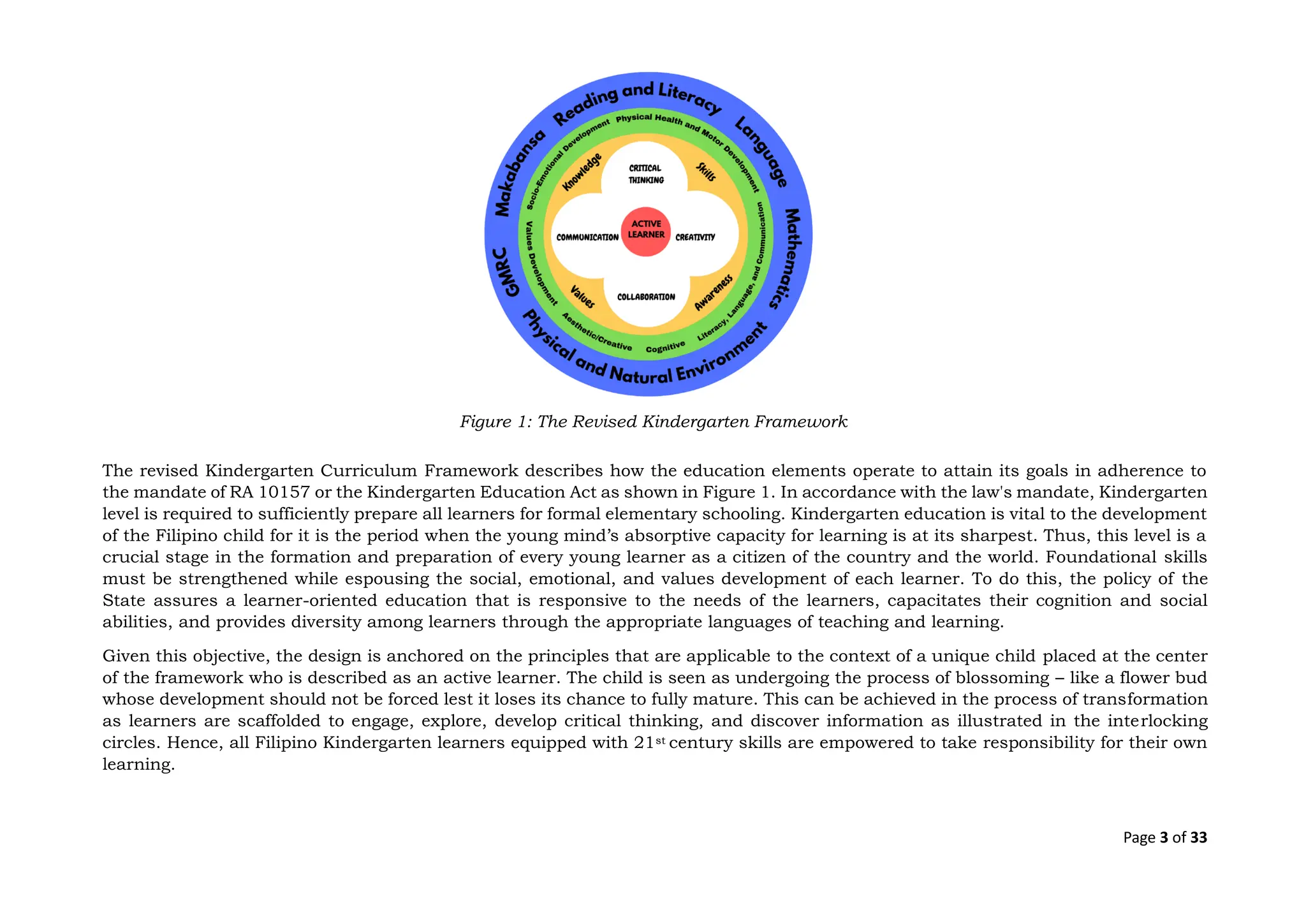
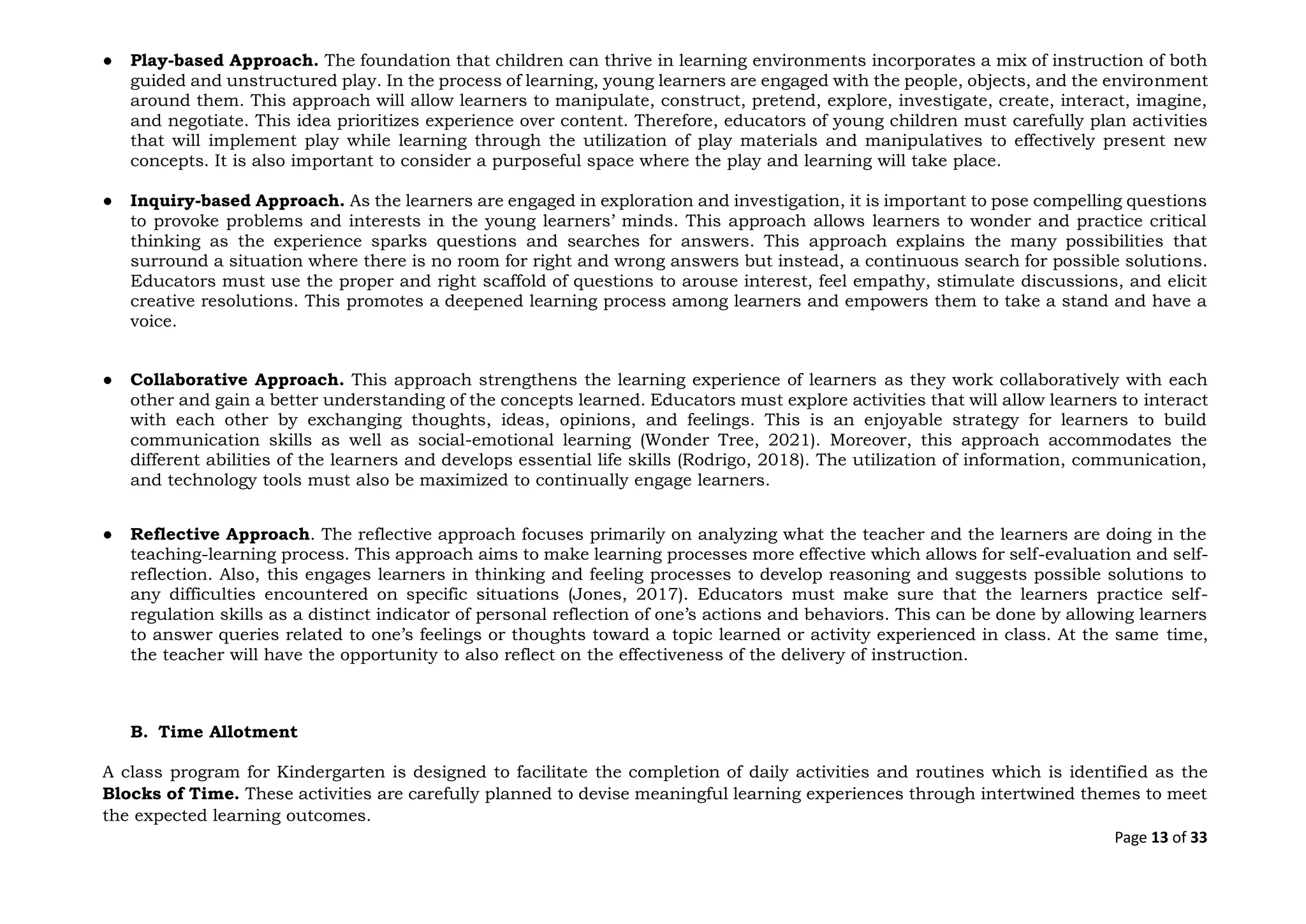
The revised Kindergarten Curriculum Framework describes how the education elements operate to attain its goals in adherence to
the mandate of RA 10157 or the Kindergarten Education Act as shown in Figure 1. In accordance with the law's mandate, Kindergarten
level is required to sufficiently prepare all learners for formal elementary schooling. Kindergarten education is vital to the development
of the Filipino child for it is the period when the young mind’s absorptive capacity for learning is at its sharpest. Thus, this level is a
crucial stage in the formation and preparation of every young learner as a citizen of the country and the world. Foundational skills
must be strengthened while espousing the social, emotional, and values development of each learner. To do this, the policy of the
State assures a learner-oriented education that is responsive to the needs of the learners, capacitates their cognition and social
abilities, and provides diversity among learners through the appropriate languages of teaching and learning.
Given this objective, the design is anchored on the principles that are applicable to the context of a unique child placed at the center
of the framework who is described as an active learner. The child is seen as undergoing the process of blossoming – like a flower bud
whose development should not be forced lest it loses its chance to fully mature. This can be achieved in the process of transformation
as learners are scaffolded to engage, explore, develop critical thinking, and discover information as illustrated in the interlocking
circles. Hence, all Filipino Kindergarten learners equipped with 21st century skills are empowered to take responsibility for their own
learning.
Figure 1: The Revised Kindergarten Framework
Page 4 of 33
In addition to the knowledge, skills, and attitude (KSA), and awareness of basic concepts that are developed through play-based
approach and other developmentally - appropriate practices to teaching and learning, Kindergartners also attain the 21st century
skills. These skills are reflected in the Kindergarten Curriculum Framework through the integration of activities in the different
learning experiences that evolve around the topics related to the curricular themes. Learners must be immersed in thinking creatively,
work collaboratively with others, reason effectively, and communicate clearly to achieve the knowledge, skills, values, and awareness
necessary for lifelong learning. (P21Framework).
The MATATAG KCG highlights the target learning competencies that are emanated from the developmental domains such as Literacy,
Language and Communication, Cognitive, Socio-emotional, Aesthetic/Creative, Physical Health and Motor, and Values Development.
These are presented in a thematic way which are captured in the learning areas of Makabansa, Languages, Mathematics, GMRC and
eventually in Science in Grade 3 through Understanding Physical and Natural Environment that are presented in the outermost layer
of the framework which will help every Kindergartner to transition seamlessly to the next grade level.
B. Curriculum Design Principles
The curriculum is designed and developed based on the following principles:
● Learner-centered. The needs, interests, and context of every learner are given premium through the provision of necessary
skills and opportunities that will contribute to the growth and development of every young Filipino learner in the 21st century.
● Learning-centered. The curriculum focuses on providing holistic learning experiences that engage all learners in active and
deep learning which are physically, cognitively, socially, and emotionally relevant and appropriate.
● Integrated. The six domains of learning (Socio-emotional, Values Development, Cognitive, Physical Health, Motor Development,
Aesthetic/Creative Development, and Literacy, Language, and Communication) are cohesively interrelated to help young
Filipino learners realize the connection between what and why they are learning.
● Developmentally Appropriate. Every aspect of growth and development is interrelated and interdependent, involving a series
of complex and dynamic learning processes that are empowering for the attainment of the learners’ optimal potential. It is a
method that promotes learners’ optimal growth and development which involves a series of dynamic, engaging, and empowering
learning processes.
Page 5 of 33
● Play-based. The curriculum emphasizes play experiences as an approach to learning to young learners. Play is a child’s natural
activity that helps discover and make meaning in the world around them. Children engage in play activities while the teacher
acknowledges the learning process and reflects their observations as means to determine what activities should be supported
and extended.
● Nationalistic. The curriculum provides content and learning experiences that are culturally and contextually relevant,
responsive, and appropriate.
C. Philosophical Underpinnings
Kindergarten education is essential in the development of young Filipino learners in preparation for their future. Hence, it is the duty
of the state to provide an education that is inclusive, holistic, and learner-centered which will prepare them for their responsibilities
as citizens of the world. The curriculum is built upon the following beliefs:
● Every school is a home.
● The curriculum is learner and learning-centered, integrated, developmentally appropriate, play-based, and nationalistic.
● Filipino Kindergarten learners are active.
● The Kindergarten teachers guide, support, and encourage their learners in honing creativity, talents, and skills to reach their
full potential.
● The families of Kindergarten learners share the responsibilities of supporting and providing opportunities for learning
engagement.
● The community supports networks, engagements for parents, resources for teachers and learners, and collaboration in schools
and other stakeholders.
II. STRUCTURE AND PURPOSE OF THE KINDERGARTEN CURRICULUM
A. Curricular Themes
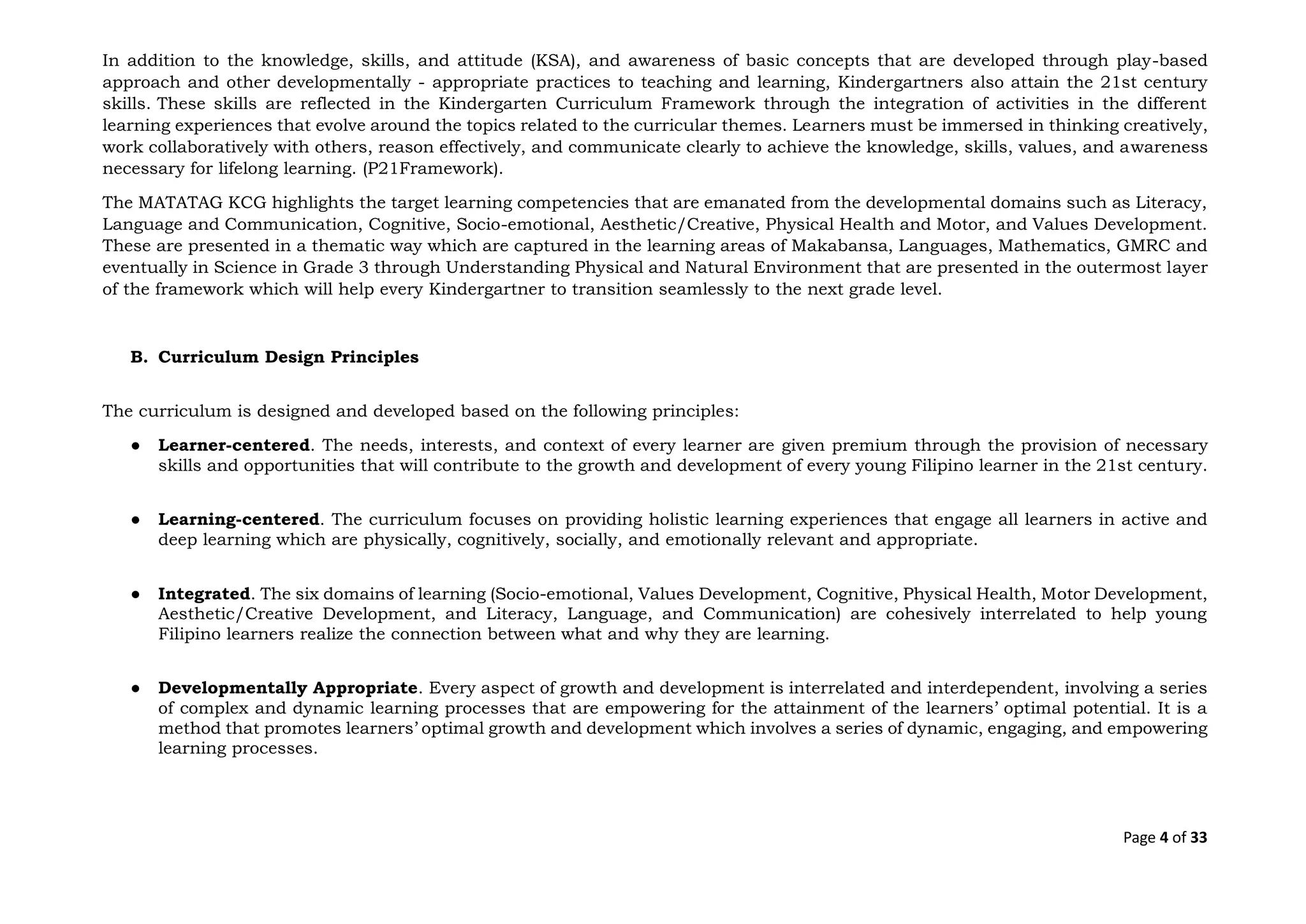
Curricular themes adapt to Urie Bronfenbrenner’s Bioecological Theory that defines the “layers of the environment” as reflected in the
curriculum guide, such as Knowing Who We Are and Our Families, Exploring our Community, Appreciating Our Country, and Caring
for Our World, each having an effect on a child’s holistic development. Young children, according to Jean Piaget, develop beliefs about
Page 6 of 33
who they are and how they fit into the world. By the time children reach the Foundation Stage, they have already begun to form views
regarding the value of both themselves and others. The connection of the themes shows how the learner will be introduced to bigger
perspectives of one’s environment, thus, making Kindergartners aware that their actions and experiences are linked with those living
around the world.
Developmental domains refer to specific aspects of growth and changes in children. The major domains of development are physical,
cognitive, language, and social-emotional. These developmental domains are unique to kindergarten that can be developed across the
Learning Areas. The contents of each developmental domain are defined by learning expectations, as follows:
1. Knowing Who We are and Our Families. The theme focuses on concepts and ideas that help the learners understand themselves
better to develop self-concept. As the learners discover more about themselves, they also understand their responsibility as proud
members of their family.
2. Exploring our Community. The theme includes concepts, ideas, practices, situations, and responsibilities that learners should
acquire and understand so that they become functional and responsive members of the community.
3. Appreciating our Country. The theme revolves around concepts and ideas pertaining to the awareness of one's rights and
responsibilities as a citizen of the country. The Filipino Kindergarten learners demonstrate abilities to respond to situations and
events to showcase appreciation to Philippine culture and traditions.
4. Caring for our World. The theme focuses on one's responsibility as a citizen of the world through embodying the values of care
and respect to one's surroundings. All Filipino Kindergarten learners will learn to accept diversity, build friendship, and show
appreciation to the beauty of people and nature.
Figure 2: The Curricular Themes
Page 7 of 33
B. Developmental Domains
Developmental domains refer to specific aspects of growth and changes in children. The major domains of development are physical,
cognitive, language, and social-emotional. These developmental domains are unique to kindergarten and can be developed across the
Learning Areas. The contents of each developmental domain are defined by learning expectations, as follows:
1. Literacy, Language, and Communication. Learners are expected to develop communicative skills in their first language. They
are also expected to develop more positive attitudes toward reading and writing, and to view themselves as effective users and
learners of the language. This domain provides opportunities for early literacy learning for self-expression through language using
the mother tongue or the child’s first language as a literacy resource.
2. Socio-Emotional Development. Learners are expected to develop emotional skills, basic concepts pertaining to themselves, how
to relate well with other people in their immediate environment, demonstrate awareness of one's social identity, and appreciate
cultural diversity among the school, community, and other people.
3. Values Development. Learners are expected to demonstrate positive attitudes, self-concept, respect, concern for self and others,
behave appropriately in various situations and places, and manifest love for our creator, country, and fellowmen. These learning
expectations are to be taught with the integration of Good Manners and Right Conduct (GMRC) as stipulated in Republic Act
11476.
4. Physical Health and Motor Development. Learners are expected to develop both their fine and gross motor skills to be efficient
and effective movers when engaging in wholesome physical and health activities. They are also expected to acquire an
understanding of good health habits and develop their awareness about the importance of safety and how they protect themselves
from harm at home, in school, and in public places.
5. Aesthetic/Creative Development. Learners are expected to develop their aesthetic sense and creative expression through
drawing, painting, and manipulative activities. Aesthetic development involves the love and pursuit of beauty in art, music, and
movement, and creates opportunities for the creative expression of emotions, thoughts, feelings, and ideas.
6. Cognitive Development. Learners are expected to develop thinking skills, and insights into patterns of mathematics, concepts of
numbers, length, capacity, mass, and time using concrete objects or materials, and apply these meaningfully in their daily
experiences through the provision of varied manipulative activities to help them see relationships and interconnections in math
and enable them to deal flexibly with mathematical ideas and concepts. Moreover, learners are also expected to demonstrate a
basic understanding of concepts pertaining to living and nonliving things, including weather, and use these in categorizing things
Page 8 of 33
in their environment. They are also expected to acquire the essential skills and sustain their natural curiosity in their immediate
environment through exploration, discovery, observation, and relate their everyday experiences using their senses (touch, sight,
smell, taste, and hearing).
III. RATIONALE AND INFLUENCES ON THE CURRICULUM STRUCTURE
The Basic Education Report 2023 highlights the role of the curriculum in basic education as it lays down all the necessary elements
that contribute to the attainment of the K to 12 Curriculum goals. Since the implementation of the Kindergarten curriculum, society
has drastically changed, from pre-COVID to pandemic era, which has altered the landscape of formal and informal education system
around the globe. With this phenomenon, the Department of Education (DepEd), through the Bureau of Curriculum Development
(BCD), has initiated the review of the Kindergarten Curriculum Guide (KCG) to identify the gaps that need to be addressed in response
to the needs of the young Filipino learners in the 21st century.
Findings revealed that the curriculum is congested due to redundancy and repetition of learning competencies (LCs). Also, these LCs
prescribe very specific skills that need improvement to accommodate the diversity of Kindergartners.
In addition, extensive research on early childhood education stresses that the majority of a child's social concepts—the norms by
which they live—are picked up from role models they observe in daily life and experiences (Gordon & Brown, 2016). These experiences
which important adults provide them eventually lead towards the formation of habits that are not easily changed in later years
(Whitebread & Bingham, 2013). Hence, the mandatory Kindergarten Education serves as an avenue to foster the domains of child
development and model appropriate behavior of five-year-old Filipino children. This will help in the gradual development of good
habits and productive patterns in the behavior of Filipino children to become functional citizens of the country.
Furthermore, there are necessary skills that need to be developed among Filipino children to equip them to function in today’s world
including literacy and numeracy. This is aligned with the MATATAG basic education agenda of DepEd that targets the development
of foundational skills including reading among early grades imbued with strong nationalistic values and identity.
The results of the review directed the redesigning of the Kindergarten Curriculum Guide (KCG) which aimed at articulating the learning
standards that enable Kindergarten learners to attain emergent literacy and basic numeracy along with developmentally - appropriate
competencies under physical, emotional, social and values which help them in seamless transition to formal elementary schooling.
To highlight, emergent literacy encompasses the knowledge, skills, and attitudes that a child develops in relation to reading and
writing before the onset of conventional reading and writing instruction (Save the Children, 2013). This includes the following emergent
literacy knowledge areas:
Page 9 of 33
• Oral Language. Ability to understand and use language through listening, speaking, and acquiring new vocabulary.
• Print Awareness. Ability to understand the functions of printed symbols (letters, words, and picture) and of printed text, and
how it relates to meaning.
• Book Knowledge. Ability to state what a book is and how it is to be used or read (relates to having exposure to books and print-
rich environments)
• Alphabet Knowledge. Ability to identify and say the names of letters in an alphabet paves the way to phonological awareness.
• Phonological Awareness. Ability to identify and manipulate sounds and the understanding that sounds (and letters) are
combined to make words.
It is noted that the development of early reading and numeracy skills are interrelated which means that a child does not learn reading
first then learn to count as these skills are learned in parallel.
Numeracy for Kindergarten level, on the other hand, is the ability to understand and apply mathematical skills in daily life. As part
of the developmental domains under cognitive aspect, a child is expected to develop insights into patterns and concepts of numbers,
measurement, and time using concrete objects, and apply these meaningfully in their daily experiences.
With these changes and demands of the society, and benchmarks on Kindergarten Education, DepEd deemed it necessary to redesign
the Kindergarten Curriculum to make it relevant and responsive to the needs of 21st century young Filipino children.
A. Articulation of Learning Competencies
The findings of curriculum review, both intended and implemented, revealed that the Philippine basic education curriculum is
congested, resulting in gaps in critical skills of the learners. In order to decongest the curriculum, a different path of the review
process was conducted as it was deemed necessary to study the state of play of Kindergarten Education in the Philippines and hold
consultations regarding its implementation prior to analysis of relevant documents. This involved the review of the articulation of
learning competencies (LCs) vertically and horizontally in the 2016 Kindergarten Curriculum Guide (KCG).
The results of horizontal alignment review revealed that the LCs under each developmental domain are aligned with the content and
performance standards while the vertical alignment ensures that the Kindergarten LCs prepare learners to transition to Grade 1 as
they develop the needed foundational skills ensuring that the progression of learning through the curriculum is achieved.
Page 10 of 33
The Kindergarten curriculum develops the necessary skills of five year old Filipino learners and in the process ensures the
preparedness of young learners to enter Grade 1. This is guaranteed by both the horizontal and vertical alignment processes to
accommodate the diversity of Kindergarten learners, hence, the redesigning of the KCG.
B. Development of the 21st Century Skills
Professionals working with children acknowledge that all learners deserve educational opportunities both within and outside of the
classroom, to develop the information and abilities needed for success in a world that is internationally and digitally connected. In
order to make learning relevant, individualized, and engaging for 21st-century learners, an innovative support system is needed. It
should involve relevant skills and knowledge, appropriate technologies, and real-world linkages.
The Kindergarten Curriculum acknowledges that in order for all learners to develop knowledge and skills to be globally competent,
learners should be immersed in meaningful experiences from school and beyond. This can be attained through mastery of significant
concepts and skills as this is a key factor in determining learners’ achievement. In addition, the role of significant adults to foster
their curiosity and enthusiasm for learning enables the emerging skills in different learning areas and 21st century skills to be
developed. These include information and media literacy that allows critical and functioning skills to be fostered in a media-driven
and technology environment. Alongside are the life skills such as the development of thinking, social and emotional skills of the
learner as one navigates the complexities of the learning environment. Hence, the Kindergarten Curriculum highlights the 4 C’s that
describe the learning and innovation skills that enable the Filipino Kindergarten learners to thrive in their environments (Partnership
with 21st Century Learning, 2019).
● Creativity. Children have an intrinsic sense of wonder and imagination. They are capable of expressing their thoughts and feelings
in many forms. The learners are provided opportunities for play and meaningful experiences as avenues to unlock the potential to
innovate and be creative. In this way, their ideas become unique solutions to obstacles encountered.
● Critical Thinking. Children engage in problem-solving when they try different solutions until they find one that works. They can
notice, consider, and apply an answer to a dilemma. With a variety of problem-solving techniques, a learner can develop critical
thinking skills. These techniques include sorting, categorizing, comparing, grouping, and utilizing logic and reasoning to carry out
a plan in order to achieve a goal in both common and innovative ways.
● Communication. Children acquire an understanding of themselves and their environment through communication. The skills
that learners acquire include speaking, listening, telling stories, and exchanging ideas. According to a number of studies, early
literacy success is directly correlated with strong communication abilities. Strong patterns of verbal and non-verbal
Page 11 of 33
communication are also supportive of a healthy sense of self and social abilities. The more skillfully a learner converses at an early
age, the simpler it will be for them to comprehend what they read in the future.
● Collaboration. Children develop skills for working with others and forming friendships through collaboration. Learners initially
observe others before sharing or playing with one another. They become conscious of the thoughts and feelings of others as they
interact and become motivated by acceptance when they participate in cooperative activities. Kindergarten learners develop respect
for others, make compromises, and appreciate others’ perspectives and abilities.
These skills will be fostered in the most beneficial time because of the brain’s rapid growth and development during the early years.
It is significantly influenced by early experiences, according to neuroscientists, educators, and specialists in early childhood
development (P21 Century Learning, 2019). It incorporates the continuous establishment and provision of opportunities for learning
through interactions, being in a relationship and connecting with others (Moss & Petrie, 2019). From birth until age five, the brain is
at its most flexible and malleable, or able to adapt to a variety of events, interactions, and situations. Therefore, it is important that
children are provided with age-appropriate activities in which 21st century skills are honed and fostered.
C. Social Issues and Government Thrusts
One of the important facets of the Kindergarten Curriculum is its adherence to children’s rights. In accordance with DepEd Order No.
31, s. 2022 on Child Rights Policy, this gives premium to children’s participation and involvement by having a voice and contribution
to society and the world even at a young age. Its evident inclusion as a learning competency is one of the vital parts in its revision.
Based on the Council for Welfare of Children and UNICEF’s 2015 National Baseline Survey on Violence Against Children (2016), social
issues related to exploitation, violence, abuse, and bullying are still prevalent among 80% of Filipino children. The said violence may
be experienced at home, in school, in their respective communities or even online. Hence, this issue is taken into consideration in the
construction of competencies by empowering the young learners to speak out and express themselves through the provision of a safe,
positive, and conducive learning environment. This includes awareness of one’s rights and responsibilities in the digital world.
Moreover, the Kindergarten curriculum recognizes one’s uniqueness amidst diversity. It accommodates possibilities as it
acknowledges learners with disabilities or exceptionalities regardless of gender, race, culture, ethnicity, religion, and economic status
without hindering their full potential of learning (DepEd Order No. 44, s. 2021).
Through the revision of the curricular themes, every young Filipino Kindergarten learner is engaged in learning activities that will
translate understanding of the connection of oneself to others, the environment, and the world. Imbued in these points is the
consideration of the issues on mental health and well-being brought about by malnutrition, poverty, pandemic, or war. Then, the
curriculum has embedded flexible learning competencies evolving on learning experiences that are compatible and relevant with the
learners’ context by provoking inquiry and critical thinking in the lens of a young learner.
Page 12 of 33
To fully achieve the holistic development of the Kindergarten learners, the curriculum also gives emphasis on the shared responsibility
among families, networks, and other stakeholders. It is important that all significant adults that surround the learner should ensure
partnership and supervision with the school as this contributes to the total development of the learner.
Overall, these understandings hope to equip the Kindergarten learners with 21st century knowledge and skills, armed with values
and attitudes, that will aid them in their bright journey in a brittle, anxious, non-linear and incomprehensible (BANI) world.
IV. PEDAGOGIES
A. Pedagogical Approaches
Pedagogical approach refers to the way of teaching learners by taking into consideration the relationship between culture and
techniques of learning. This enables learners to get a thorough understanding of the subject and help them in applying those learnings
in their daily lives outside the classroom.
To realize the aim of the Kindergarten curriculum, there are pedagogical approaches that are employed to ensure the provision of
foundational learning among young Filipino learners. These approaches, namely constructivist, inquiry-based, reflective,
collaborative, and integrative approaches will equip the learners with the knowledge, skills, attitudes, and values to prepare them for
the future. These approaches also consider the adaptability to the learners’ context and learning environment.
● Constructivist Approach. The active participation of the young learners, as the center of all learning processes, fosters
development. Teachers must provide an integrated curriculum where themes and contents are presented and explored through
seamless interconnection. This will help learners link together information and expand their understanding of anything around
them. Learners are exposed to activities that will provoke learners’ interest.
The teacher, who acts as a facilitator, must be able to create creative and meaningful learning opportunities to allow learners to
continuously inquire, engage, and learn. It is important to note that educators must veer away from the traditional concept of
lecturing in front of the classroom and instead, must become partners in the learning journey. Therefore, teachers must craft well-
planned classroom activities that will show cohesiveness, clarity, and logic in the relationship between and among the concepts
presented. Moreover, the use of themes also helps in crafting activities that can easily be related to daily life experiences that lead
to more relevant learning (Dewey, 1938).
Page 13 of 33
● Play-based Approach. The foundation that children can thrive in learning environments incorporates a mix of instruction of both
guided and unstructured play. In the process of learning, young learners are engaged with the people, objects, and the environment
around them. This approach will allow learners to manipulate, construct, pretend, explore, investigate, create, interact, imagine,
and negotiate. This idea prioritizes experience over content. Therefore, educators of young children must carefully plan activities
that will implement play while learning through the utilization of play materials and manipulatives to effectively present new
concepts. It is also important to consider a purposeful space where the play and learning will take place.
● Inquiry-based Approach. As the learners are engaged in exploration and investigation, it is important to pose compelling questions
to provoke problems and interests in the young learners’ minds. This approach allows learners to wonder and practice critical
thinking as the experience sparks questions and searches for answers. This approach explains the many possibilities that
surround a situation where there is no room for right and wrong answers but instead, a continuous search for possible solutions.
Educators must use the proper and right scaffold of questions to arouse interest, feel empathy, stimulate discussions, and elicit
creative resolutions. This promotes a deepened learning process among learners and empowers them to take a stand and have a
voice.
● Collaborative Approach. This approach strengthens the learning experience of learners as they work collaboratively with each
other and gain a better understanding of the concepts learned. Educators must explore activities that will allow learners to interact
with each other by exchanging thoughts, ideas, opinions, and feelings. This is an enjoyable strategy for learners to build
communication skills as well as social-emotional learning (Wonder Tree, 2021). Moreover, this approach accommodates the
different abilities of the learners and develops essential life skills (Rodrigo, 2018). The utilization of information, communication,
and technology tools must also be maximized to continually engage learners.
● Reflective Approach. The reflective approach focuses primarily on analyzing what the teacher and the learners are doing in the
teaching-learning process. This approach aims to make learning processes more effective which allows for self-evaluation and self-
reflection. Also, this engages learners in thinking and feeling processes to develop reasoning and suggests possible solutions to
any difficulties encountered on specific situations (Jones, 2017). Educators must make sure that the learners practice self-
regulation skills as a distinct indicator of personal reflection of one’s actions and behaviors. This can be done by allowing learners
to answer queries related to one’s feelings or thoughts toward a topic learned or activity experienced in class. At the same time,
the teacher will have the opportunity to also reflect on the effectiveness of the delivery of instruction.
B. Time Allotment
A class program for Kindergarten is designed to facilitate the completion of daily activities and routines which is identified as the
Blocks of Time. These activities are carefully planned to devise meaningful learning experiences through intertwined themes to meet
the expected learning outcomes.
Page 14 of 33
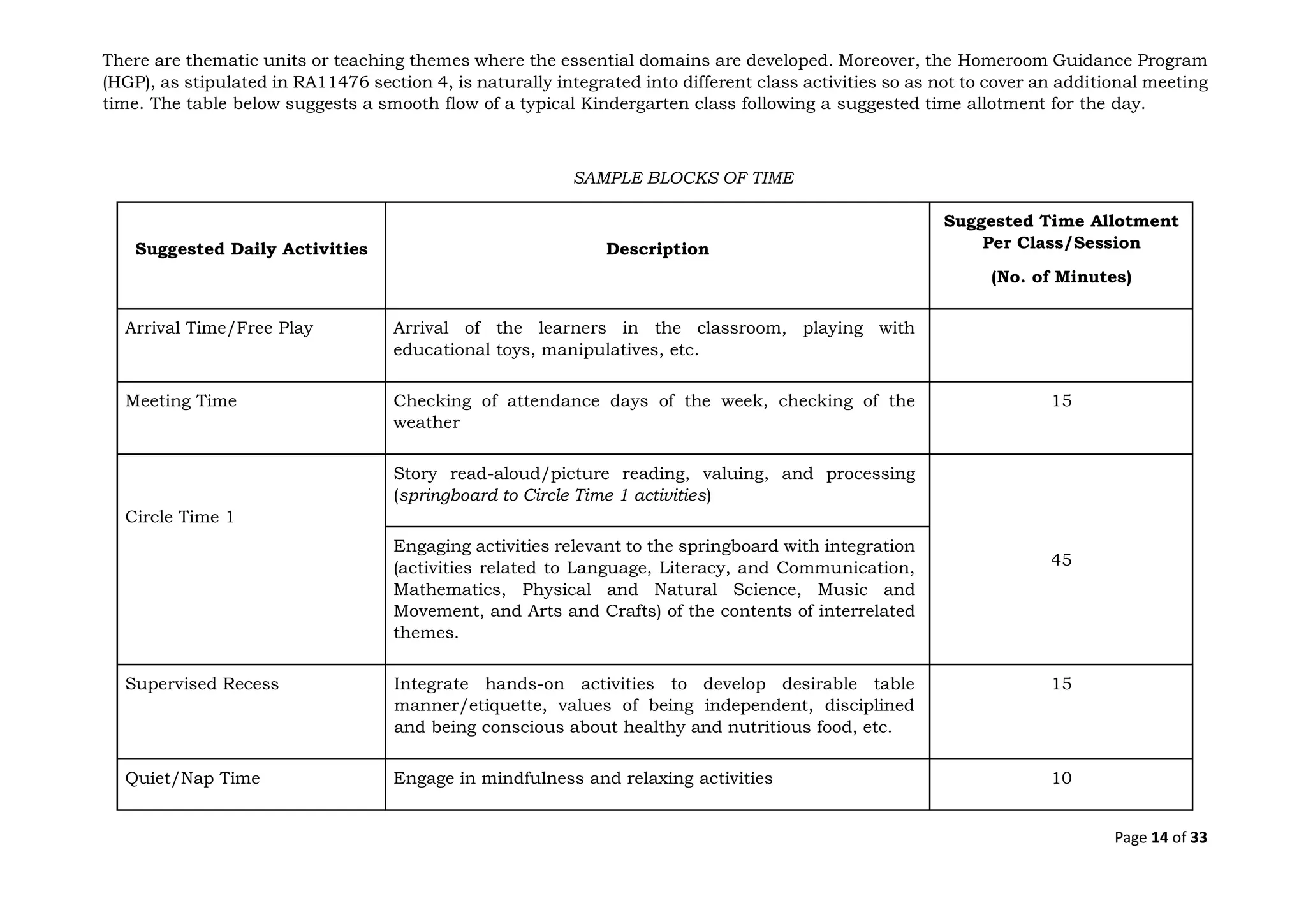
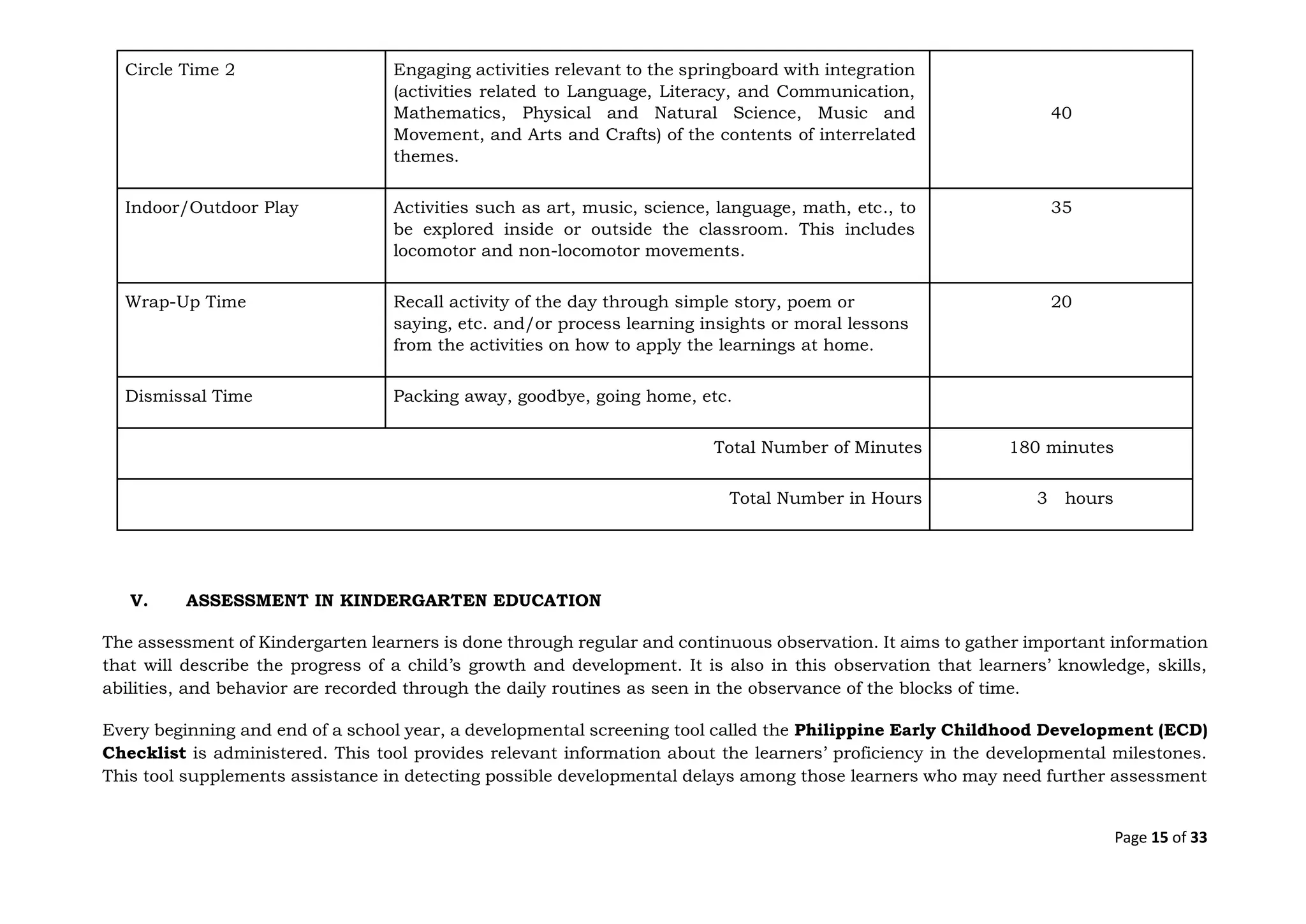
There are thematic units or teaching themes where the essential domains are developed. Moreover, the Homeroom Guidance Program
(HGP), as stipulated in RA11476 section 4, is naturally integrated into different class activities so as not to cover an additional meeting
time. The table below suggests a smooth flow of a typical Kindergarten class following a suggested time allotment for the day.
SAMPLE BLOCKS OF TIME
Suggested Daily Activities Description
Suggested Time Allotment
Per Class/Session
(No. of Minutes)
Arrival Time/Free Play Arrival of the learners in the classroom, playing with
educational toys, manipulatives, etc.
Meeting Time Checking of attendance days of the week, checking of the
weather
15
Circle Time 1
Story read-aloud/picture reading, valuing, and processing
(springboard to Circle Time 1 activities)
45
Engaging activities relevant to the springboard with integration
(activities related to Language, Literacy, and Communication,
Mathematics, Physical and Natural Science, Music and
Movement, and Arts and Crafts) of the contents of interrelated
themes.
Supervised Recess Integrate hands-on activities to develop desirable table
manner/etiquette, values of being independent, disciplined
and being conscious about healthy and nutritious food, etc.
15
Quiet/Nap Time Engage in mindfulness and relaxing activities 10
Page 15 of 33
Circle Time 2 Engaging activities relevant to the springboard with integration
(activities related to Language, Literacy, and Communication,
Mathematics, Physical and Natural Science, Music and
Movement, and Arts and Crafts) of the contents of interrelated
themes.
40
Indoor/Outdoor Play Activities such as art, music, science, language, math, etc., to
be explored inside or outside the classroom. This includes
locomotor and non-locomotor movements.
35
Wrap-Up Time Recall activity of the day through simple story, poem or
saying, etc. and/or process learning insights or moral lessons
from the activities on how to apply the learnings at home.
20
Dismissal Time Packing away, goodbye, going home, etc.
Total Number of Minutes 180 minutes
Total Number in Hours 3 hours
V. ASSESSMENT IN KINDERGARTEN EDUCATION
The assessment of Kindergarten learners is done through regular and continuous observation. It aims to gather important information
that will describe the progress of a child’s growth and development. It is also in this observation that learners’ knowledge, skills,
abilities, and behavior are recorded through the daily routines as seen in the observance of the blocks of time.
Every beginning and end of a school year, a developmental screening tool called the Philippine Early Childhood Development (ECD)
Checklist is administered. This tool provides relevant information about the learners’ proficiency in the developmental milestones.
This tool supplements assistance in detecting possible developmental delays among those learners who may need further assessment
Page 16 of 33
or special intervention. Thus, it establishes individual profiles of the learners that guide the teachers in designing appropriate learning
activities and meet the individual needs of the learners.
Learners who are identified with developmental delays upon the completion of the ECD Checklist post-test will be recommended to
further special interventions. Similarly, teachers must report this concern to the parents/guardians to address concerns immediately.
Daily classroom activities provide opportune time to observe notable learning experiences in the classroom. Teachers write descriptive
narratives known as Anecdotal Records that contain essential details about the learners’ strengths, difficulties, achievements, and
the like. All these notes will be useful when teachers give feedback to parents/guardians regarding the learners’ progress. Teachers
accomplish these records at any time as significant observations happen.
A portfolio further supports all these observations by collecting key outputs as evidence of learning. These key outputs are all
compiled to showcase attainment of expected competencies and shown to the parents/guardians every quarter together with the
Progress Report.
The Progress Report summarizes the quarterly performance of the learner. This contains components that are aligned with the
learning competencies in the Kindergarten Curriculum Guide. Hence, this is a checklist form that details the learners’ areas of
achievement and areas for improvement using a qualitative and descriptive rating.
Above all, the most important part of the Kindergarten assessment is feedback. This is done through a regular conference with
parents/guardians as they play a significant role in the learners’ continuous learning. This strong home-school partnership assists
learners in achieving their maximum potential. Moreover, teachers are encouraged to be involved in conversations with the learners
to talk about their progress and achievements. These discussions build confidence and motivation to learners and lead them to set
their own learning goals.
Page 17 of 33
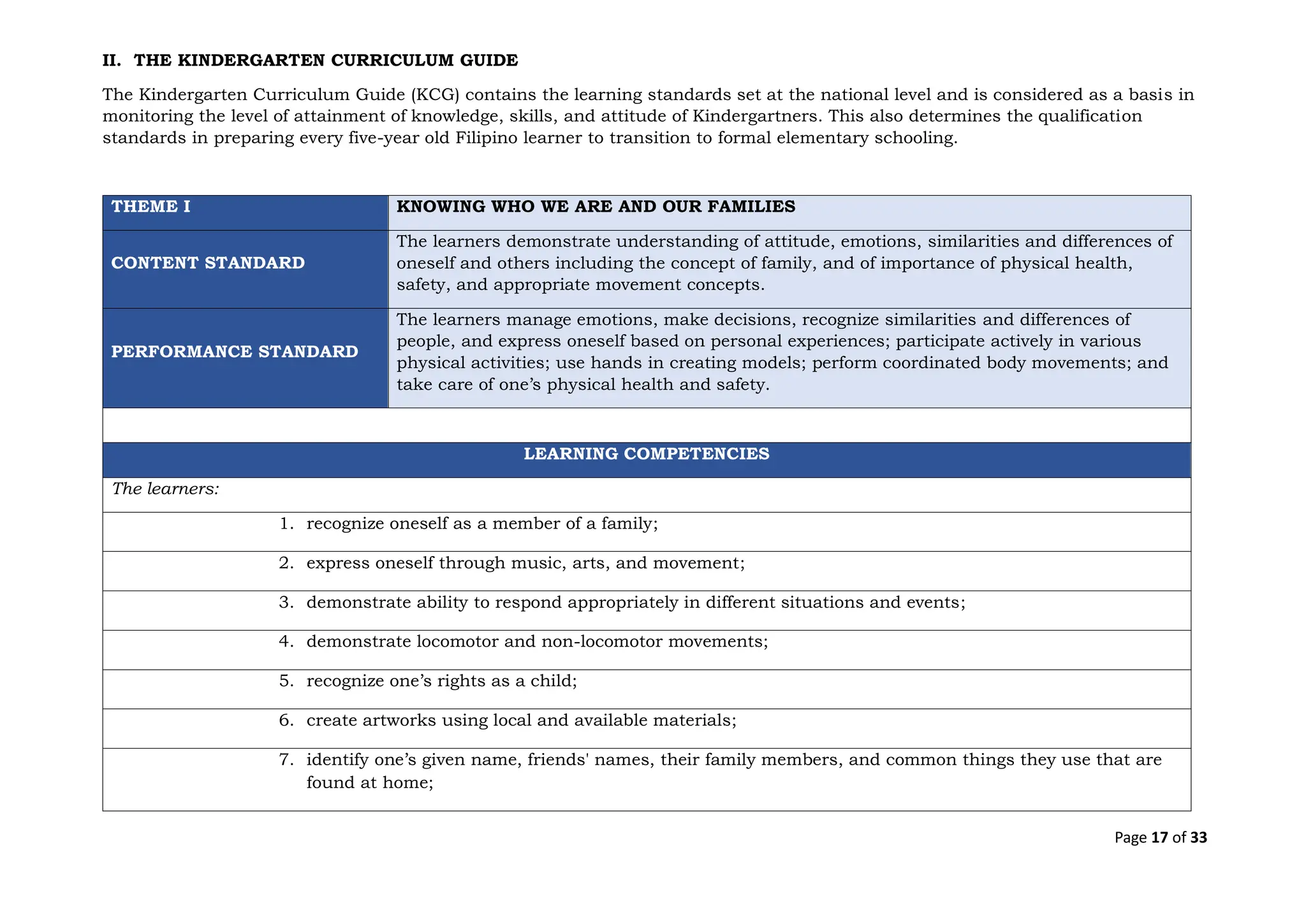
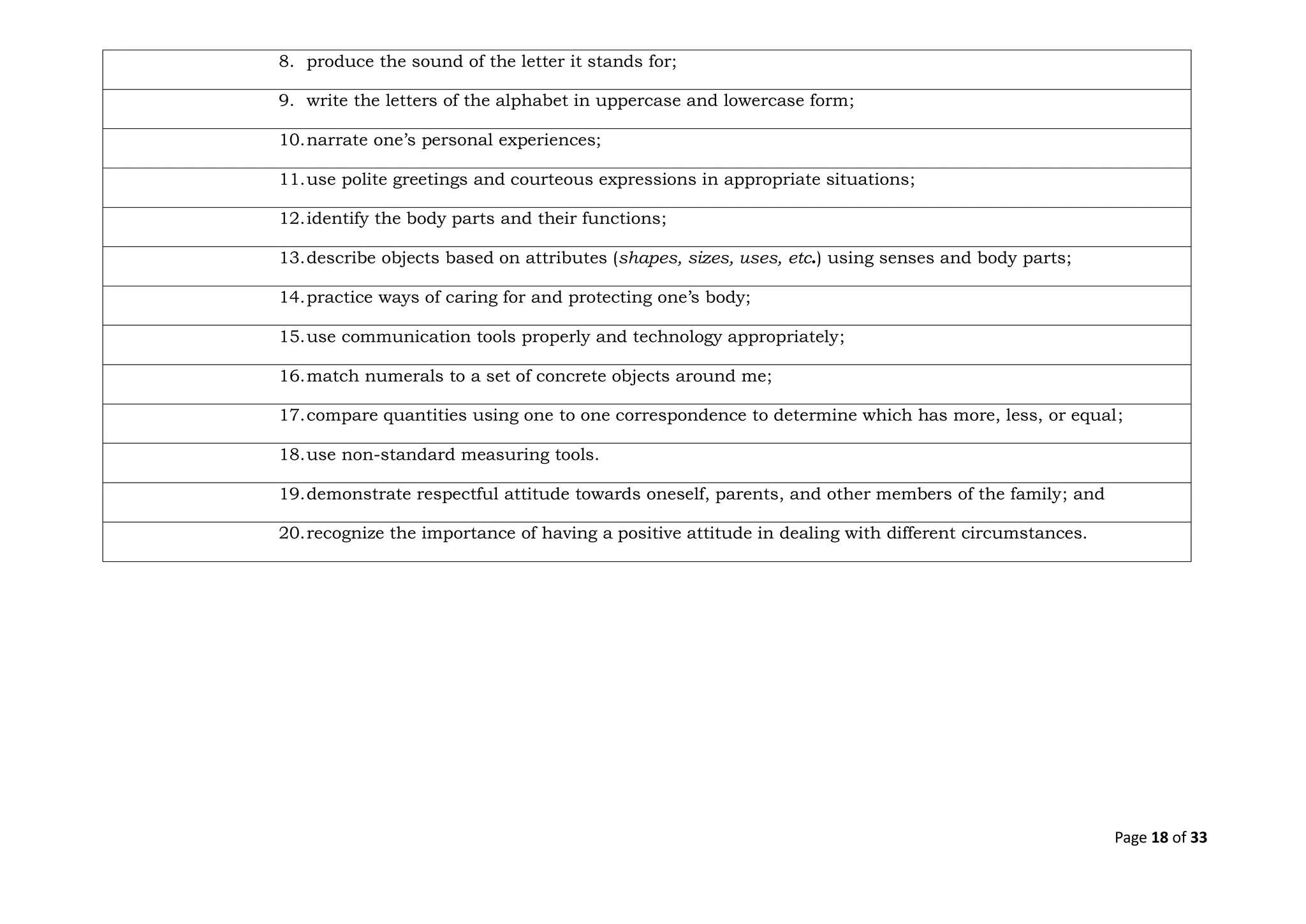
II. THE KINDERGARTEN CURRICULUM GUIDE
The Kindergarten Curriculum Guide (KCG) contains the learning standards set at the national level and is considered as a basis in
monitoring the level of attainment of knowledge, skills, and attitude of Kindergartners. This also determines the qualification
standards in preparing every five-year old Filipino learner to transition to formal elementary schooling.
THEME I KNOWING WHO WE ARE AND OUR FAMILIES
CONTENT STANDARD
The learners demonstrate understanding of attitude, emotions, similarities and differences of
oneself and others including the concept of family, and of importance of physical health,
safety, and appropriate movement concepts.
PERFORMANCE STANDARD
The learners manage emotions, make decisions, recognize similarities and differences of
people, and express oneself based on personal experiences; participate actively in various
physical activities; use hands in creating models; perform coordinated body movements; and
take care of one’s physical health and safety.
LEARNING COMPETENCIES
The learners:
1. recognize oneself as a member of a family;
2. express oneself through music, arts, and movement;
3. demonstrate ability to respond appropriately in different situations and events;
4. demonstrate locomotor and non-locomotor movements;
5. recognize one’s rights as a child;
6. create artworks using local and available materials;
7. identify one’s given name, friends' names, their family members, and common things they use that are
found at home;
Page 18 of 33
8. produce the sound of the letter it stands for;
9. write the letters of the alphabet in uppercase and lowercase form;
10.narrate one’s personal experiences;
11.use polite greetings and courteous expressions in appropriate situations;
12.identify the body parts and their functions;
13.describe objects based on attributes (shapes, sizes, uses, etc.) using senses and body parts;
14.practice ways of caring for and protecting one’s body;
15.use communication tools properly and technology appropriately;
16.match numerals to a set of concrete objects around me;
17.compare quantities using one to one correspondence to determine which has more, less, or equal;
18.use non-standard measuring tools.
19.demonstrate respectful attitude towards oneself, parents, and other members of the family; and
20.recognize the importance of having a positive attitude in dealing with different circumstances.
Page 19 of 33
THEME II EXPLORING OUR COMMUNITY
CONTENT STANDARD
The learners understand the value of discipline, honesty, respect, friendship, and care and
concern.
PERFORMANCE
STANDARD
The learners demonstrate proper discipline, honesty, respect, friendship, and care towards other
people.
LEARNING COMPETENCIES
The learners:
21.follow rules and regulations in going to different places;
22.demonstrate proper ways of caring and protecting one’s community;
23.recognize that sounding off letters form words;
24.identify familiar sounds in the environment;
25.describe the different places and persons belonging in one’s community;
26.give the correct sequence of events in a local text listened to;
27.tell the names of the days in a week and months in a year;
28.recognize different modes of transportation on land, water, and air used in the community;
29.classify common objects in the environment according to colors and shapes;
30.create own patterns using local concrete objects;
31.identify the positions (in, on, over, under, top, and bottom) and directions (left and right, front and back) of
objects in one’s environment;
32.demonstrate proper behavior in various situations and places in the community.
Page 20 of 33
THEME III APPRECIATING OUR COUNTRY
CONTENT STANDARD
The learners demonstrate understanding of one’s identity, rights, and responsibilities as a
Filipino citizen.
PERFORMANCE STANDARD
The learners show appreciation for one’s culture; understand one’s right as a Filipino citizen;
and demonstrate a sense of responsibility as a Filipino citizen.
LEARNING COMPETENCIES
The learners:
33.show appreciation of one’s culture and traditions;
34.participate in dialogues or conversations about familiar events;
35.identify solutions to a problem based on a local text listened to;
36.appreciate the natural and physical environment in the country;
37.apply basic mathematical operations (formal and non-formal applications) using locally available
materials; and
38.recognize Philippine coins and bills and their importance; and
39.show respect and concern for our country.
Page 21 of 33
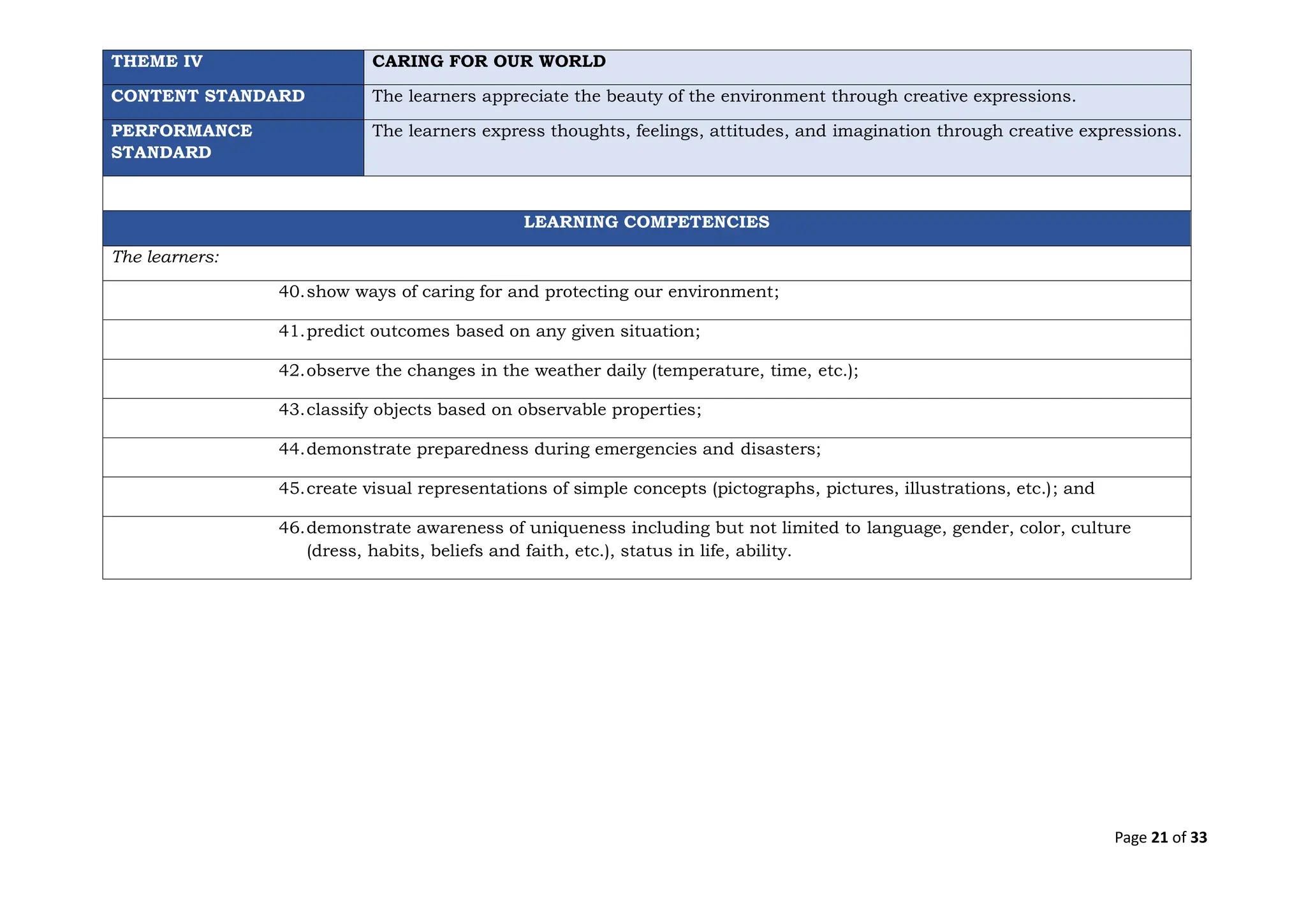
THEME IV CARING FOR OUR WORLD
CONTENT STANDARD The learners appreciate the beauty of the environment through creative expressions.
PERFORMANCE
STANDARD
The learners express thoughts, feelings, attitudes, and imagination through creative expressions.
LEARNING COMPETENCIES
The learners:
40.show ways of caring for and protecting our environment;
41.predict outcomes based on any given situation;
42.observe the changes in the weather daily (temperature, time, etc.);
43.classify objects based on observable properties;
44.demonstrate preparedness during emergencies and disasters;
45.create visual representations of simple concepts (pictographs, pictures, illustrations, etc.); and
46.demonstrate awareness of uniqueness including but not limited to language, gender, color, culture
(dress, habits, beliefs and faith, etc.), status in life, ability.
Page 22 of 33
III. APPENDICES
A. NUMBER OF LEARNING COMPETENCIES
Themes Makabansa Languages
Physical and
Natural
Environment
Mathematics
Good
Manners
and Right
Conduct
Total
Knowing Who We Are and Our Families 6 5 4 3 2 20
Exploring Our Community 2 5 1 3 1 12
Appreciating Our Country 1 2 1 2 1 7
Caring for Our World 1 1 3 1 1 7
Total 10 13 9 9 5 46
Page 23 of 33
B. SUGGESTED CONTENTS IN THE KINDERGARTEN CURRICULUM
The table contains a list of suggested contents under subthemes that may be attained by a Kindergarten learner within a school year
including those that should be taught across quarters.
THEME I: KNOWING WHO WE ARE AND OUR FAMILIES
SUBTHEMES SUGGESTED CONTENTS
1. We are unique. Basic information about oneself (likes and dislikes, favorite things, etc.)
2. We have feelings. Basic emotions (sad, happy, surprised, etc.)
3. We have different body parts and senses.
Body parts and their functions
Senses and their functions
4. We can do many things with our body. Non-standard measurement using body parts
5. We belong to a family.
Uniqueness of one’s family
The members of one’s family
The roles of each family member
6. We have basic needs.
Needs - food, shelter, clothing
Go, grow, glow foods
7. We celebrate special occasions.
Celebrations (birthdays, monthly events, holidays, etc.)
Sequencing of events and following directions
8. We are healthy and safe.
Parts of the house
Common things found at home
Safety measures at home
Contents that should be taught across quarters
Alphabet (letter names, letter sounds)
Numbers (number names, quantities and symbols)
Page 24 of 33
Communication tools and technology
Locomotor and non-locomotor movements
Music (singing songs and reciting nursery rhymes)
Arts - fine motor activities
Rights and responsibilities
Personal experiences.
Polite greetings and courteous expressions
One to one correspondence
Independence and agency (self-regulation)
THEME II: EXPLORING OUR COMMUNITY
SUBTHEMES SUGGESTED CONTENTS
1. We belong to a class.
My teacher, my classmates, and I
Classroom Rules
Things I do and celebrate in school (Family Day, Buwan ng Wika, United
Nations, etc.)
Non-standard measurement using common objects
2. We love our school.
Places in my school
People in my school
Familiar sounds in school
3. We belong to a community.
Places in the community
Community Helpers
Page 25 of 33
Roles and responsibilities of the Community Helpers
Patterns I see around me
Caring for and protecting one's community
4. We go to different places.
Directions and positions
Modes of transportation (land, water, air)
Essential Contents
(should be taught across quarters)
Alphabet (letter names, letter sounds and blending)
Numbers (number names, quantities and symbols)
Communication tools and technology
Locomotor and non-locomotor movements
Music (singing songs and reciting nursery rhymes)
Arts (fine motor activities)
Rights and responsibilities
Personal experiences.
Polite greetings and courteous expressions
One to one correspondence
Independence and agency (self-regulation)
Page 26 of 33
THEME III: APPRECIATING IN OUR COUNTRY
SUBTHEMES SUGGESTED CONTENTS
1. We are Filipino children.
Identity (culture and traditions)
Rights and responsibilities
Respect and concern for our country
Philippine coins and bills
2. We can see plants everywhere.
Common plants
Parts of a plant
Classification of common plants
Uses of plants
Caring for plants
Grouping and ungrouping of sets
3. We know animals around us.
Common animals
Parts of an animal
Classification of common animals
Habitats
Animals and their young
How animals help us
Caring for animals
Contents that should be taught across quarters
Alphabet (letter names, letter sounds and blending)
Numbers (number names, quantities and symbols)
Page 27 of 33
Communication tools and technology
Locomotor and non-locomotor movements
Music - singing songs and reciting nursery rhymes
Arts - fine motor activities
Rights and responsibilities
Personal experiences.
Polite greetings and courteous expressions
One to one correspondence
Independence and agency (self-regulation)
Match numerals to a set of concrete objects around me.
Recognize the importance of having a positive attitude in dealing with
different circumstances.
Show appreciation of one’s culture and traditions.
Participate in dialogues or conversations about familiar events.
Basic mathematical operations (Formal and Non-formal applications)
● putting together
● taking away
● mathematical estimations - more, less, greater than, less than
Page 28 of 33
THEME IV: CARING FOR OUR WORLD
SUBTHEMES SUGGESTED CONTENTS
1. We live in a beautiful world.
Weather
Telling time
Properties of objects
Visual representations
● Pictograph
● pictures
● illustrations
2. We are citizens of the world. Accepting uniqueness
3. We care for our world.
Preparedness in disasters and emergencies
Predicting outcomes in a text (Cause and effect)
Contents that should be taught across quarters
Alphabet (letter names, letter sounds and blending)
Numbers (number names, quantities and symbols)
Communication tools and technology
Locomotor and non-locomotor movements
Music - singing songs and reciting nursery rhymes
Arts - fine motor activities
Rights and responsibilities
Personal experiences.
Polite greetings and courteous expressions
One to one correspondence
Page 29 of 33
Independence and agency (self-regulation)
Match numerals to a set of concrete objects around me.
Recognize the importance of having a positive attitude in dealing with different
circumstances.
Show appreciation of one’s culture and traditions.
Participate in dialogues or conversations about familiar events.
Basic mathematical operations (Formal and Non-formal applications)
● Putting together
● taking away
● mathematical estimations - more, less, greater than, less than
Page 30 of 33
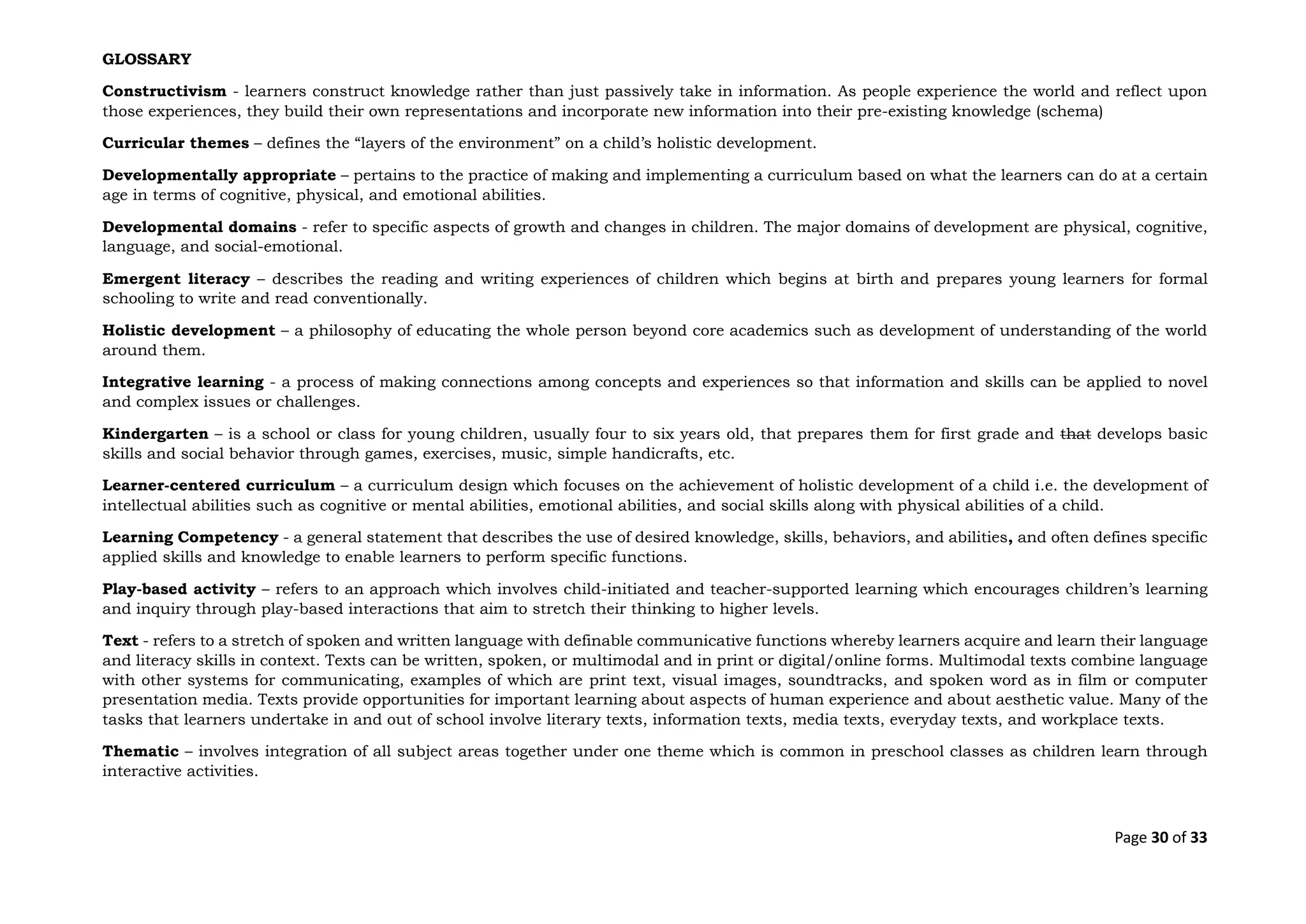
GLOSSARY
Constructivism - learners construct knowledge rather than just passively take in information. As people experience the world and reflect upon
those experiences, they build their own representations and incorporate new information into their pre-existing knowledge (schema)
Curricular themes – defines the “layers of the environment” on a child’s holistic development.
Developmentally appropriate – pertains to the practice of making and implementing a curriculum based on what the learners can do at a certain
age in terms of cognitive, physical, and emotional abilities.
Developmental domains - refer to specific aspects of growth and changes in children. The major domains of development are physical, cognitive,
language, and social-emotional.
Emergent literacy – describes the reading and writing experiences of children which begins at birth and prepares young learners for formal
schooling to write and read conventionally.
Holistic development – a philosophy of educating the whole person beyond core academics such as development of understanding of the world
around them.
Integrative learning - a process of making connections among concepts and experiences so that information and skills can be applied to novel
and complex issues or challenges.
Kindergarten – is a school or class for young children, usually four to six years old, that prepares them for first grade and that develops basic
skills and social behavior through games, exercises, music, simple handicrafts, etc.
Learner-centered curriculum – a curriculum design which focuses on the achievement of holistic development of a child i.e. the development of
intellectual abilities such as cognitive or mental abilities, emotional abilities, and social skills along with physical abilities of a child.
Learning Competency - a general statement that describes the use of desired knowledge, skills, behaviors, and abilities, and often defines specific
applied skills and knowledge to enable learners to perform specific functions.
Play-based activity – refers to an approach which involves child-initiated and teacher-supported learning which encourages children’s learning
and inquiry through play-based interactions that aim to stretch their thinking to higher levels.
Text - refers to a stretch of spoken and written language with definable communicative functions whereby learners acquire and learn their language
and literacy skills in context. Texts can be written, spoken, or multimodal and in print or digital/online forms. Multimodal texts combine language
with other systems for communicating, examples of which are print text, visual images, soundtracks, and spoken word as in film or computer
presentation media. Texts provide opportunities for important learning about aspects of human experience and about aesthetic value. Many of the
tasks that learners undertake in and out of school involve literary texts, information texts, media texts, everyday texts, and workplace texts.
Thematic – involves integration of all subject areas together under one theme which is common in preschool classes as children learn through
interactive activities.
Page 31 of 33
REFERENCES:
Council for the Welfare of Children, UNICEF. (2016, October). National Baseline
Study on Violence Against Children in the Philippines. UNICEF Philippines. Retrieved from
https://www.unicef.org/philippines/reports/national-baseline-study-violence-against-children-philippines
Dalcor, J. (2020). What Is a Child-Centered Constructivist Approach to Early Childhood Education?. Classroom.Synonym.
https://classroom.synonym.com/childcentered-approach-early-childhood-education-8614207.html
DepEd Order No. 47, s. 2016 on Omnibus Policy on Kindergarten Education
2016 Kindergarten Curriculum Guide
DepEd Order No. 31, s. 2022 on Child Rights Policy: Adopting the Rights-Based
Education Framework in the Philippine Basic Education
DepEd Order No. 44, s. 2021 on Policy Guidelines on the Provision of Education
Programs and Services for Learners with Disabilities in the K to 12 Basic Education Program
Dewey, J. (1938). Experience and education. New York: Macmillan.
GMRC and Value Education Act, Republic Act No. 11476, (June 25, 2020), (Phils.),
https://www.officialgazette.gov.ph/2020/06/25/republic-act-no-11476/
Page 32 of 33
Hussain, M. (2022b, March 18). Benefits of Collaborative Learning in Early
Childhood Education. WonderTree.
https://wondertree.co/benefits-of-collaborative-learning-in-early-childhood-
education/#:~:text=Collaborative%20learning%20involves%20children%20learning,and%20social%20skills%20of%20childre
n
Jones, C. (2018, May 12). Reflective Practices for Early Years - Children’s Centre - Medium. Medium.
https://medium.com/children-s-centre/reflective-practices-for-early-years-54ea50fb9bcb
Kindergarten Education Act of 2012, Republic Act No. 10157, (January 20, 2012), (Phils.),
https://www.officialgazette.gov.ph/2012/01/20/republic-act-no-10157/
Moss. P. and Petrie, P. (2019) ‘Education and social pedagogy: What relationship?’. London Review of Education, 17 (3): 393–405.
DOI https://doi.org/10.18546/LRE.17.3.13
National Early Learning Framework of the Philippines. (2011). Early Childhood
Care and Development Council (ECCD Council), Pasig City, Philippines
P21 Frameworks & Resources | Battelle for Kids. (n.d.). P21 Frameworks & Resources | Battelle for Kids.
https://www.battelleforkids.org/networks/p21/frameworks-resources
Play-based learning. (n.d.). Early Childhood Education and Care. https://earlychildhood.qld.gov.au/early-years/age-appropriate-
pedagogies/approaches/play-based-learning
Page 33 of 33
Piaget, J. (1964). Cognitive Development in Children: Development and Learning. Journal of Research in Science Teaching, 2, 176-
186.
Quality Teacher. (n.d.). The integrated approach: Giving kids a meaningful learning experience
Resilient Educator. (2023, February 23). Play-based Learning: The Concept of Kids Learning by Playing | Resilient Educator.
ResilientEducator.com. https://resilienteducator.com/classroom-resources/play-based-learning/
Rodrigo, G. (2018, July 12). Why Kids Should Develop Collaboration As A Life Skill.
Fun Academy. https://funacademy.fi/collaboration-as-a-life-
skill/#:~:text=Collaboration%20helps%20children%20to%20discover,a%20fun%20and%20efficient%20way
Save the Children. (2013). Emergent Literacy: Investing Early for Exponential Outcomes.
What Are the Different Pedagogical Approaches to Learning? (n.d.) Learning
Journals. https://learningjournals.co.uk/what-are-the-different-pedagogical-approaches-to-learning/
Whitebread, D., & Bingham, S. (2013). Habit Formation and Learning in Young Children. Money Advice Service.

matatag curriculum education for Kindergarten

  • 1.
    Republic of thePhilippines Department of Education DepEd Complex, Meralco Avenue, Pasig City MATATAG CURRICULUM KINDERGARTEN
  • 2.
    Page 2 of33 THE SHAPE OF THE KINDERGARTEN CURRICULUM I. CURRICULUM FRAMEWORK A. Curriculum Goals The Kindergarten curriculum aims to produce active young Filipino learners who are holistically developed and equipped with 21st century skills. Hence, the Curriculum is designed to: ● Foster development of learners’ identity, social and emotional development, cognitive ability, physical health, and positive attitudes. ● Develop learners’ 21st century skills. ● Provide learners with experiences that are actively engaging in meaning-making through hands-on activities. ● Provide learners with varied opportunities to enjoy activities that are developmentally appropriate. ● Stimulate learners’ intellectual ability, creativity, communication skills, and critical thinking. ● Enhance learners’ spirit of teamwork through collaborative activities. ● Foster learning experiences and content that are nationalistic and culturally responsive, compatible, and relevant to the learner. Kindergarten Education espouses a learner-centered curriculum that aims to develop holistic learners equipped with foundational skills imbued with physical, social, emotional, cognitive, and values development. This is attained through play-based learning which is anchored on the developmentally - appropriate practices and theories with consideration of learners’ expanding environment toward life-long learning.
  • 3.
    Page 3 of33 The revised Kindergarten Curriculum Framework describes how the education elements operate to attain its goals in adherence to the mandate of RA 10157 or the Kindergarten Education Act as shown in Figure 1. In accordance with the law's mandate, Kindergarten level is required to sufficiently prepare all learners for formal elementary schooling. Kindergarten education is vital to the development of the Filipino child for it is the period when the young mind’s absorptive capacity for learning is at its sharpest. Thus, this level is a crucial stage in the formation and preparation of every young learner as a citizen of the country and the world. Foundational skills must be strengthened while espousing the social, emotional, and values development of each learner. To do this, the policy of the State assures a learner-oriented education that is responsive to the needs of the learners, capacitates their cognition and social abilities, and provides diversity among learners through the appropriate languages of teaching and learning. Given this objective, the design is anchored on the principles that are applicable to the context of a unique child placed at the center of the framework who is described as an active learner. The child is seen as undergoing the process of blossoming – like a flower bud whose development should not be forced lest it loses its chance to fully mature. This can be achieved in the process of transformation as learners are scaffolded to engage, explore, develop critical thinking, and discover information as illustrated in the interlocking circles. Hence, all Filipino Kindergarten learners equipped with 21st century skills are empowered to take responsibility for their own learning. Figure 1: The Revised Kindergarten Framework
  • 4.
    Page 4 of33 In addition to the knowledge, skills, and attitude (KSA), and awareness of basic concepts that are developed through play-based approach and other developmentally - appropriate practices to teaching and learning, Kindergartners also attain the 21st century skills. These skills are reflected in the Kindergarten Curriculum Framework through the integration of activities in the different learning experiences that evolve around the topics related to the curricular themes. Learners must be immersed in thinking creatively, work collaboratively with others, reason effectively, and communicate clearly to achieve the knowledge, skills, values, and awareness necessary for lifelong learning. (P21Framework). The MATATAG KCG highlights the target learning competencies that are emanated from the developmental domains such as Literacy, Language and Communication, Cognitive, Socio-emotional, Aesthetic/Creative, Physical Health and Motor, and Values Development. These are presented in a thematic way which are captured in the learning areas of Makabansa, Languages, Mathematics, GMRC and eventually in Science in Grade 3 through Understanding Physical and Natural Environment that are presented in the outermost layer of the framework which will help every Kindergartner to transition seamlessly to the next grade level. B. Curriculum Design Principles The curriculum is designed and developed based on the following principles: ● Learner-centered. The needs, interests, and context of every learner are given premium through the provision of necessary skills and opportunities that will contribute to the growth and development of every young Filipino learner in the 21st century. ● Learning-centered. The curriculum focuses on providing holistic learning experiences that engage all learners in active and deep learning which are physically, cognitively, socially, and emotionally relevant and appropriate. ● Integrated. The six domains of learning (Socio-emotional, Values Development, Cognitive, Physical Health, Motor Development, Aesthetic/Creative Development, and Literacy, Language, and Communication) are cohesively interrelated to help young Filipino learners realize the connection between what and why they are learning. ● Developmentally Appropriate. Every aspect of growth and development is interrelated and interdependent, involving a series of complex and dynamic learning processes that are empowering for the attainment of the learners’ optimal potential. It is a method that promotes learners’ optimal growth and development which involves a series of dynamic, engaging, and empowering learning processes.
  • 5.
    Page 5 of33 ● Play-based. The curriculum emphasizes play experiences as an approach to learning to young learners. Play is a child’s natural activity that helps discover and make meaning in the world around them. Children engage in play activities while the teacher acknowledges the learning process and reflects their observations as means to determine what activities should be supported and extended. ● Nationalistic. The curriculum provides content and learning experiences that are culturally and contextually relevant, responsive, and appropriate. C. Philosophical Underpinnings Kindergarten education is essential in the development of young Filipino learners in preparation for their future. Hence, it is the duty of the state to provide an education that is inclusive, holistic, and learner-centered which will prepare them for their responsibilities as citizens of the world. The curriculum is built upon the following beliefs: ● Every school is a home. ● The curriculum is learner and learning-centered, integrated, developmentally appropriate, play-based, and nationalistic. ● Filipino Kindergarten learners are active. ● The Kindergarten teachers guide, support, and encourage their learners in honing creativity, talents, and skills to reach their full potential. ● The families of Kindergarten learners share the responsibilities of supporting and providing opportunities for learning engagement. ● The community supports networks, engagements for parents, resources for teachers and learners, and collaboration in schools and other stakeholders. II. STRUCTURE AND PURPOSE OF THE KINDERGARTEN CURRICULUM A. Curricular Themes Curricular themes adapt to Urie Bronfenbrenner’s Bioecological Theory that defines the “layers of the environment” as reflected in the curriculum guide, such as Knowing Who We Are and Our Families, Exploring our Community, Appreciating Our Country, and Caring for Our World, each having an effect on a child’s holistic development. Young children, according to Jean Piaget, develop beliefs about
  • 6.
    Page 6 of33 who they are and how they fit into the world. By the time children reach the Foundation Stage, they have already begun to form views regarding the value of both themselves and others. The connection of the themes shows how the learner will be introduced to bigger perspectives of one’s environment, thus, making Kindergartners aware that their actions and experiences are linked with those living around the world. Developmental domains refer to specific aspects of growth and changes in children. The major domains of development are physical, cognitive, language, and social-emotional. These developmental domains are unique to kindergarten that can be developed across the Learning Areas. The contents of each developmental domain are defined by learning expectations, as follows: 1. Knowing Who We are and Our Families. The theme focuses on concepts and ideas that help the learners understand themselves better to develop self-concept. As the learners discover more about themselves, they also understand their responsibility as proud members of their family. 2. Exploring our Community. The theme includes concepts, ideas, practices, situations, and responsibilities that learners should acquire and understand so that they become functional and responsive members of the community. 3. Appreciating our Country. The theme revolves around concepts and ideas pertaining to the awareness of one's rights and responsibilities as a citizen of the country. The Filipino Kindergarten learners demonstrate abilities to respond to situations and events to showcase appreciation to Philippine culture and traditions. 4. Caring for our World. The theme focuses on one's responsibility as a citizen of the world through embodying the values of care and respect to one's surroundings. All Filipino Kindergarten learners will learn to accept diversity, build friendship, and show appreciation to the beauty of people and nature. Figure 2: The Curricular Themes
  • 7.
    Page 7 of33 B. Developmental Domains Developmental domains refer to specific aspects of growth and changes in children. The major domains of development are physical, cognitive, language, and social-emotional. These developmental domains are unique to kindergarten and can be developed across the Learning Areas. The contents of each developmental domain are defined by learning expectations, as follows: 1. Literacy, Language, and Communication. Learners are expected to develop communicative skills in their first language. They are also expected to develop more positive attitudes toward reading and writing, and to view themselves as effective users and learners of the language. This domain provides opportunities for early literacy learning for self-expression through language using the mother tongue or the child’s first language as a literacy resource. 2. Socio-Emotional Development. Learners are expected to develop emotional skills, basic concepts pertaining to themselves, how to relate well with other people in their immediate environment, demonstrate awareness of one's social identity, and appreciate cultural diversity among the school, community, and other people. 3. Values Development. Learners are expected to demonstrate positive attitudes, self-concept, respect, concern for self and others, behave appropriately in various situations and places, and manifest love for our creator, country, and fellowmen. These learning expectations are to be taught with the integration of Good Manners and Right Conduct (GMRC) as stipulated in Republic Act 11476. 4. Physical Health and Motor Development. Learners are expected to develop both their fine and gross motor skills to be efficient and effective movers when engaging in wholesome physical and health activities. They are also expected to acquire an understanding of good health habits and develop their awareness about the importance of safety and how they protect themselves from harm at home, in school, and in public places. 5. Aesthetic/Creative Development. Learners are expected to develop their aesthetic sense and creative expression through drawing, painting, and manipulative activities. Aesthetic development involves the love and pursuit of beauty in art, music, and movement, and creates opportunities for the creative expression of emotions, thoughts, feelings, and ideas. 6. Cognitive Development. Learners are expected to develop thinking skills, and insights into patterns of mathematics, concepts of numbers, length, capacity, mass, and time using concrete objects or materials, and apply these meaningfully in their daily experiences through the provision of varied manipulative activities to help them see relationships and interconnections in math and enable them to deal flexibly with mathematical ideas and concepts. Moreover, learners are also expected to demonstrate a basic understanding of concepts pertaining to living and nonliving things, including weather, and use these in categorizing things
  • 8.
    Page 8 of33 in their environment. They are also expected to acquire the essential skills and sustain their natural curiosity in their immediate environment through exploration, discovery, observation, and relate their everyday experiences using their senses (touch, sight, smell, taste, and hearing). III. RATIONALE AND INFLUENCES ON THE CURRICULUM STRUCTURE The Basic Education Report 2023 highlights the role of the curriculum in basic education as it lays down all the necessary elements that contribute to the attainment of the K to 12 Curriculum goals. Since the implementation of the Kindergarten curriculum, society has drastically changed, from pre-COVID to pandemic era, which has altered the landscape of formal and informal education system around the globe. With this phenomenon, the Department of Education (DepEd), through the Bureau of Curriculum Development (BCD), has initiated the review of the Kindergarten Curriculum Guide (KCG) to identify the gaps that need to be addressed in response to the needs of the young Filipino learners in the 21st century. Findings revealed that the curriculum is congested due to redundancy and repetition of learning competencies (LCs). Also, these LCs prescribe very specific skills that need improvement to accommodate the diversity of Kindergartners. In addition, extensive research on early childhood education stresses that the majority of a child's social concepts—the norms by which they live—are picked up from role models they observe in daily life and experiences (Gordon & Brown, 2016). These experiences which important adults provide them eventually lead towards the formation of habits that are not easily changed in later years (Whitebread & Bingham, 2013). Hence, the mandatory Kindergarten Education serves as an avenue to foster the domains of child development and model appropriate behavior of five-year-old Filipino children. This will help in the gradual development of good habits and productive patterns in the behavior of Filipino children to become functional citizens of the country. Furthermore, there are necessary skills that need to be developed among Filipino children to equip them to function in today’s world including literacy and numeracy. This is aligned with the MATATAG basic education agenda of DepEd that targets the development of foundational skills including reading among early grades imbued with strong nationalistic values and identity. The results of the review directed the redesigning of the Kindergarten Curriculum Guide (KCG) which aimed at articulating the learning standards that enable Kindergarten learners to attain emergent literacy and basic numeracy along with developmentally - appropriate competencies under physical, emotional, social and values which help them in seamless transition to formal elementary schooling. To highlight, emergent literacy encompasses the knowledge, skills, and attitudes that a child develops in relation to reading and writing before the onset of conventional reading and writing instruction (Save the Children, 2013). This includes the following emergent literacy knowledge areas:
  • 9.
    Page 9 of33 • Oral Language. Ability to understand and use language through listening, speaking, and acquiring new vocabulary. • Print Awareness. Ability to understand the functions of printed symbols (letters, words, and picture) and of printed text, and how it relates to meaning. • Book Knowledge. Ability to state what a book is and how it is to be used or read (relates to having exposure to books and print- rich environments) • Alphabet Knowledge. Ability to identify and say the names of letters in an alphabet paves the way to phonological awareness. • Phonological Awareness. Ability to identify and manipulate sounds and the understanding that sounds (and letters) are combined to make words. It is noted that the development of early reading and numeracy skills are interrelated which means that a child does not learn reading first then learn to count as these skills are learned in parallel. Numeracy for Kindergarten level, on the other hand, is the ability to understand and apply mathematical skills in daily life. As part of the developmental domains under cognitive aspect, a child is expected to develop insights into patterns and concepts of numbers, measurement, and time using concrete objects, and apply these meaningfully in their daily experiences. With these changes and demands of the society, and benchmarks on Kindergarten Education, DepEd deemed it necessary to redesign the Kindergarten Curriculum to make it relevant and responsive to the needs of 21st century young Filipino children. A. Articulation of Learning Competencies The findings of curriculum review, both intended and implemented, revealed that the Philippine basic education curriculum is congested, resulting in gaps in critical skills of the learners. In order to decongest the curriculum, a different path of the review process was conducted as it was deemed necessary to study the state of play of Kindergarten Education in the Philippines and hold consultations regarding its implementation prior to analysis of relevant documents. This involved the review of the articulation of learning competencies (LCs) vertically and horizontally in the 2016 Kindergarten Curriculum Guide (KCG). The results of horizontal alignment review revealed that the LCs under each developmental domain are aligned with the content and performance standards while the vertical alignment ensures that the Kindergarten LCs prepare learners to transition to Grade 1 as they develop the needed foundational skills ensuring that the progression of learning through the curriculum is achieved.
  • 10.
    Page 10 of33 The Kindergarten curriculum develops the necessary skills of five year old Filipino learners and in the process ensures the preparedness of young learners to enter Grade 1. This is guaranteed by both the horizontal and vertical alignment processes to accommodate the diversity of Kindergarten learners, hence, the redesigning of the KCG. B. Development of the 21st Century Skills Professionals working with children acknowledge that all learners deserve educational opportunities both within and outside of the classroom, to develop the information and abilities needed for success in a world that is internationally and digitally connected. In order to make learning relevant, individualized, and engaging for 21st-century learners, an innovative support system is needed. It should involve relevant skills and knowledge, appropriate technologies, and real-world linkages. The Kindergarten Curriculum acknowledges that in order for all learners to develop knowledge and skills to be globally competent, learners should be immersed in meaningful experiences from school and beyond. This can be attained through mastery of significant concepts and skills as this is a key factor in determining learners’ achievement. In addition, the role of significant adults to foster their curiosity and enthusiasm for learning enables the emerging skills in different learning areas and 21st century skills to be developed. These include information and media literacy that allows critical and functioning skills to be fostered in a media-driven and technology environment. Alongside are the life skills such as the development of thinking, social and emotional skills of the learner as one navigates the complexities of the learning environment. Hence, the Kindergarten Curriculum highlights the 4 C’s that describe the learning and innovation skills that enable the Filipino Kindergarten learners to thrive in their environments (Partnership with 21st Century Learning, 2019). ● Creativity. Children have an intrinsic sense of wonder and imagination. They are capable of expressing their thoughts and feelings in many forms. The learners are provided opportunities for play and meaningful experiences as avenues to unlock the potential to innovate and be creative. In this way, their ideas become unique solutions to obstacles encountered. ● Critical Thinking. Children engage in problem-solving when they try different solutions until they find one that works. They can notice, consider, and apply an answer to a dilemma. With a variety of problem-solving techniques, a learner can develop critical thinking skills. These techniques include sorting, categorizing, comparing, grouping, and utilizing logic and reasoning to carry out a plan in order to achieve a goal in both common and innovative ways. ● Communication. Children acquire an understanding of themselves and their environment through communication. The skills that learners acquire include speaking, listening, telling stories, and exchanging ideas. According to a number of studies, early literacy success is directly correlated with strong communication abilities. Strong patterns of verbal and non-verbal
  • 11.
    Page 11 of33 communication are also supportive of a healthy sense of self and social abilities. The more skillfully a learner converses at an early age, the simpler it will be for them to comprehend what they read in the future. ● Collaboration. Children develop skills for working with others and forming friendships through collaboration. Learners initially observe others before sharing or playing with one another. They become conscious of the thoughts and feelings of others as they interact and become motivated by acceptance when they participate in cooperative activities. Kindergarten learners develop respect for others, make compromises, and appreciate others’ perspectives and abilities. These skills will be fostered in the most beneficial time because of the brain’s rapid growth and development during the early years. It is significantly influenced by early experiences, according to neuroscientists, educators, and specialists in early childhood development (P21 Century Learning, 2019). It incorporates the continuous establishment and provision of opportunities for learning through interactions, being in a relationship and connecting with others (Moss & Petrie, 2019). From birth until age five, the brain is at its most flexible and malleable, or able to adapt to a variety of events, interactions, and situations. Therefore, it is important that children are provided with age-appropriate activities in which 21st century skills are honed and fostered. C. Social Issues and Government Thrusts One of the important facets of the Kindergarten Curriculum is its adherence to children’s rights. In accordance with DepEd Order No. 31, s. 2022 on Child Rights Policy, this gives premium to children’s participation and involvement by having a voice and contribution to society and the world even at a young age. Its evident inclusion as a learning competency is one of the vital parts in its revision. Based on the Council for Welfare of Children and UNICEF’s 2015 National Baseline Survey on Violence Against Children (2016), social issues related to exploitation, violence, abuse, and bullying are still prevalent among 80% of Filipino children. The said violence may be experienced at home, in school, in their respective communities or even online. Hence, this issue is taken into consideration in the construction of competencies by empowering the young learners to speak out and express themselves through the provision of a safe, positive, and conducive learning environment. This includes awareness of one’s rights and responsibilities in the digital world. Moreover, the Kindergarten curriculum recognizes one’s uniqueness amidst diversity. It accommodates possibilities as it acknowledges learners with disabilities or exceptionalities regardless of gender, race, culture, ethnicity, religion, and economic status without hindering their full potential of learning (DepEd Order No. 44, s. 2021). Through the revision of the curricular themes, every young Filipino Kindergarten learner is engaged in learning activities that will translate understanding of the connection of oneself to others, the environment, and the world. Imbued in these points is the consideration of the issues on mental health and well-being brought about by malnutrition, poverty, pandemic, or war. Then, the curriculum has embedded flexible learning competencies evolving on learning experiences that are compatible and relevant with the learners’ context by provoking inquiry and critical thinking in the lens of a young learner.
  • 12.
    Page 12 of33 To fully achieve the holistic development of the Kindergarten learners, the curriculum also gives emphasis on the shared responsibility among families, networks, and other stakeholders. It is important that all significant adults that surround the learner should ensure partnership and supervision with the school as this contributes to the total development of the learner. Overall, these understandings hope to equip the Kindergarten learners with 21st century knowledge and skills, armed with values and attitudes, that will aid them in their bright journey in a brittle, anxious, non-linear and incomprehensible (BANI) world. IV. PEDAGOGIES A. Pedagogical Approaches Pedagogical approach refers to the way of teaching learners by taking into consideration the relationship between culture and techniques of learning. This enables learners to get a thorough understanding of the subject and help them in applying those learnings in their daily lives outside the classroom. To realize the aim of the Kindergarten curriculum, there are pedagogical approaches that are employed to ensure the provision of foundational learning among young Filipino learners. These approaches, namely constructivist, inquiry-based, reflective, collaborative, and integrative approaches will equip the learners with the knowledge, skills, attitudes, and values to prepare them for the future. These approaches also consider the adaptability to the learners’ context and learning environment. ● Constructivist Approach. The active participation of the young learners, as the center of all learning processes, fosters development. Teachers must provide an integrated curriculum where themes and contents are presented and explored through seamless interconnection. This will help learners link together information and expand their understanding of anything around them. Learners are exposed to activities that will provoke learners’ interest. The teacher, who acts as a facilitator, must be able to create creative and meaningful learning opportunities to allow learners to continuously inquire, engage, and learn. It is important to note that educators must veer away from the traditional concept of lecturing in front of the classroom and instead, must become partners in the learning journey. Therefore, teachers must craft well- planned classroom activities that will show cohesiveness, clarity, and logic in the relationship between and among the concepts presented. Moreover, the use of themes also helps in crafting activities that can easily be related to daily life experiences that lead to more relevant learning (Dewey, 1938).
  • 13.
    Page 13 of33 ● Play-based Approach. The foundation that children can thrive in learning environments incorporates a mix of instruction of both guided and unstructured play. In the process of learning, young learners are engaged with the people, objects, and the environment around them. This approach will allow learners to manipulate, construct, pretend, explore, investigate, create, interact, imagine, and negotiate. This idea prioritizes experience over content. Therefore, educators of young children must carefully plan activities that will implement play while learning through the utilization of play materials and manipulatives to effectively present new concepts. It is also important to consider a purposeful space where the play and learning will take place. ● Inquiry-based Approach. As the learners are engaged in exploration and investigation, it is important to pose compelling questions to provoke problems and interests in the young learners’ minds. This approach allows learners to wonder and practice critical thinking as the experience sparks questions and searches for answers. This approach explains the many possibilities that surround a situation where there is no room for right and wrong answers but instead, a continuous search for possible solutions. Educators must use the proper and right scaffold of questions to arouse interest, feel empathy, stimulate discussions, and elicit creative resolutions. This promotes a deepened learning process among learners and empowers them to take a stand and have a voice. ● Collaborative Approach. This approach strengthens the learning experience of learners as they work collaboratively with each other and gain a better understanding of the concepts learned. Educators must explore activities that will allow learners to interact with each other by exchanging thoughts, ideas, opinions, and feelings. This is an enjoyable strategy for learners to build communication skills as well as social-emotional learning (Wonder Tree, 2021). Moreover, this approach accommodates the different abilities of the learners and develops essential life skills (Rodrigo, 2018). The utilization of information, communication, and technology tools must also be maximized to continually engage learners. ● Reflective Approach. The reflective approach focuses primarily on analyzing what the teacher and the learners are doing in the teaching-learning process. This approach aims to make learning processes more effective which allows for self-evaluation and self- reflection. Also, this engages learners in thinking and feeling processes to develop reasoning and suggests possible solutions to any difficulties encountered on specific situations (Jones, 2017). Educators must make sure that the learners practice self- regulation skills as a distinct indicator of personal reflection of one’s actions and behaviors. This can be done by allowing learners to answer queries related to one’s feelings or thoughts toward a topic learned or activity experienced in class. At the same time, the teacher will have the opportunity to also reflect on the effectiveness of the delivery of instruction. B. Time Allotment A class program for Kindergarten is designed to facilitate the completion of daily activities and routines which is identified as the Blocks of Time. These activities are carefully planned to devise meaningful learning experiences through intertwined themes to meet the expected learning outcomes.
  • 14.
    Page 14 of33 There are thematic units or teaching themes where the essential domains are developed. Moreover, the Homeroom Guidance Program (HGP), as stipulated in RA11476 section 4, is naturally integrated into different class activities so as not to cover an additional meeting time. The table below suggests a smooth flow of a typical Kindergarten class following a suggested time allotment for the day. SAMPLE BLOCKS OF TIME Suggested Daily Activities Description Suggested Time Allotment Per Class/Session (No. of Minutes) Arrival Time/Free Play Arrival of the learners in the classroom, playing with educational toys, manipulatives, etc. Meeting Time Checking of attendance days of the week, checking of the weather 15 Circle Time 1 Story read-aloud/picture reading, valuing, and processing (springboard to Circle Time 1 activities) 45 Engaging activities relevant to the springboard with integration (activities related to Language, Literacy, and Communication, Mathematics, Physical and Natural Science, Music and Movement, and Arts and Crafts) of the contents of interrelated themes. Supervised Recess Integrate hands-on activities to develop desirable table manner/etiquette, values of being independent, disciplined and being conscious about healthy and nutritious food, etc. 15 Quiet/Nap Time Engage in mindfulness and relaxing activities 10
  • 15.
    Page 15 of33 Circle Time 2 Engaging activities relevant to the springboard with integration (activities related to Language, Literacy, and Communication, Mathematics, Physical and Natural Science, Music and Movement, and Arts and Crafts) of the contents of interrelated themes. 40 Indoor/Outdoor Play Activities such as art, music, science, language, math, etc., to be explored inside or outside the classroom. This includes locomotor and non-locomotor movements. 35 Wrap-Up Time Recall activity of the day through simple story, poem or saying, etc. and/or process learning insights or moral lessons from the activities on how to apply the learnings at home. 20 Dismissal Time Packing away, goodbye, going home, etc. Total Number of Minutes 180 minutes Total Number in Hours 3 hours V. ASSESSMENT IN KINDERGARTEN EDUCATION The assessment of Kindergarten learners is done through regular and continuous observation. It aims to gather important information that will describe the progress of a child’s growth and development. It is also in this observation that learners’ knowledge, skills, abilities, and behavior are recorded through the daily routines as seen in the observance of the blocks of time. Every beginning and end of a school year, a developmental screening tool called the Philippine Early Childhood Development (ECD) Checklist is administered. This tool provides relevant information about the learners’ proficiency in the developmental milestones. This tool supplements assistance in detecting possible developmental delays among those learners who may need further assessment
  • 16.
    Page 16 of33 or special intervention. Thus, it establishes individual profiles of the learners that guide the teachers in designing appropriate learning activities and meet the individual needs of the learners. Learners who are identified with developmental delays upon the completion of the ECD Checklist post-test will be recommended to further special interventions. Similarly, teachers must report this concern to the parents/guardians to address concerns immediately. Daily classroom activities provide opportune time to observe notable learning experiences in the classroom. Teachers write descriptive narratives known as Anecdotal Records that contain essential details about the learners’ strengths, difficulties, achievements, and the like. All these notes will be useful when teachers give feedback to parents/guardians regarding the learners’ progress. Teachers accomplish these records at any time as significant observations happen. A portfolio further supports all these observations by collecting key outputs as evidence of learning. These key outputs are all compiled to showcase attainment of expected competencies and shown to the parents/guardians every quarter together with the Progress Report. The Progress Report summarizes the quarterly performance of the learner. This contains components that are aligned with the learning competencies in the Kindergarten Curriculum Guide. Hence, this is a checklist form that details the learners’ areas of achievement and areas for improvement using a qualitative and descriptive rating. Above all, the most important part of the Kindergarten assessment is feedback. This is done through a regular conference with parents/guardians as they play a significant role in the learners’ continuous learning. This strong home-school partnership assists learners in achieving their maximum potential. Moreover, teachers are encouraged to be involved in conversations with the learners to talk about their progress and achievements. These discussions build confidence and motivation to learners and lead them to set their own learning goals.
  • 17.
    Page 17 of33 II. THE KINDERGARTEN CURRICULUM GUIDE The Kindergarten Curriculum Guide (KCG) contains the learning standards set at the national level and is considered as a basis in monitoring the level of attainment of knowledge, skills, and attitude of Kindergartners. This also determines the qualification standards in preparing every five-year old Filipino learner to transition to formal elementary schooling. THEME I KNOWING WHO WE ARE AND OUR FAMILIES CONTENT STANDARD The learners demonstrate understanding of attitude, emotions, similarities and differences of oneself and others including the concept of family, and of importance of physical health, safety, and appropriate movement concepts. PERFORMANCE STANDARD The learners manage emotions, make decisions, recognize similarities and differences of people, and express oneself based on personal experiences; participate actively in various physical activities; use hands in creating models; perform coordinated body movements; and take care of one’s physical health and safety. LEARNING COMPETENCIES The learners: 1. recognize oneself as a member of a family; 2. express oneself through music, arts, and movement; 3. demonstrate ability to respond appropriately in different situations and events; 4. demonstrate locomotor and non-locomotor movements; 5. recognize one’s rights as a child; 6. create artworks using local and available materials; 7. identify one’s given name, friends' names, their family members, and common things they use that are found at home;
  • 18.
    Page 18 of33 8. produce the sound of the letter it stands for; 9. write the letters of the alphabet in uppercase and lowercase form; 10.narrate one’s personal experiences; 11.use polite greetings and courteous expressions in appropriate situations; 12.identify the body parts and their functions; 13.describe objects based on attributes (shapes, sizes, uses, etc.) using senses and body parts; 14.practice ways of caring for and protecting one’s body; 15.use communication tools properly and technology appropriately; 16.match numerals to a set of concrete objects around me; 17.compare quantities using one to one correspondence to determine which has more, less, or equal; 18.use non-standard measuring tools. 19.demonstrate respectful attitude towards oneself, parents, and other members of the family; and 20.recognize the importance of having a positive attitude in dealing with different circumstances.
  • 19.
    Page 19 of33 THEME II EXPLORING OUR COMMUNITY CONTENT STANDARD The learners understand the value of discipline, honesty, respect, friendship, and care and concern. PERFORMANCE STANDARD The learners demonstrate proper discipline, honesty, respect, friendship, and care towards other people. LEARNING COMPETENCIES The learners: 21.follow rules and regulations in going to different places; 22.demonstrate proper ways of caring and protecting one’s community; 23.recognize that sounding off letters form words; 24.identify familiar sounds in the environment; 25.describe the different places and persons belonging in one’s community; 26.give the correct sequence of events in a local text listened to; 27.tell the names of the days in a week and months in a year; 28.recognize different modes of transportation on land, water, and air used in the community; 29.classify common objects in the environment according to colors and shapes; 30.create own patterns using local concrete objects; 31.identify the positions (in, on, over, under, top, and bottom) and directions (left and right, front and back) of objects in one’s environment; 32.demonstrate proper behavior in various situations and places in the community.
  • 20.
    Page 20 of33 THEME III APPRECIATING OUR COUNTRY CONTENT STANDARD The learners demonstrate understanding of one’s identity, rights, and responsibilities as a Filipino citizen. PERFORMANCE STANDARD The learners show appreciation for one’s culture; understand one’s right as a Filipino citizen; and demonstrate a sense of responsibility as a Filipino citizen. LEARNING COMPETENCIES The learners: 33.show appreciation of one’s culture and traditions; 34.participate in dialogues or conversations about familiar events; 35.identify solutions to a problem based on a local text listened to; 36.appreciate the natural and physical environment in the country; 37.apply basic mathematical operations (formal and non-formal applications) using locally available materials; and 38.recognize Philippine coins and bills and their importance; and 39.show respect and concern for our country.
  • 21.
    Page 21 of33 THEME IV CARING FOR OUR WORLD CONTENT STANDARD The learners appreciate the beauty of the environment through creative expressions. PERFORMANCE STANDARD The learners express thoughts, feelings, attitudes, and imagination through creative expressions. LEARNING COMPETENCIES The learners: 40.show ways of caring for and protecting our environment; 41.predict outcomes based on any given situation; 42.observe the changes in the weather daily (temperature, time, etc.); 43.classify objects based on observable properties; 44.demonstrate preparedness during emergencies and disasters; 45.create visual representations of simple concepts (pictographs, pictures, illustrations, etc.); and 46.demonstrate awareness of uniqueness including but not limited to language, gender, color, culture (dress, habits, beliefs and faith, etc.), status in life, ability.
  • 22.
    Page 22 of33 III. APPENDICES A. NUMBER OF LEARNING COMPETENCIES Themes Makabansa Languages Physical and Natural Environment Mathematics Good Manners and Right Conduct Total Knowing Who We Are and Our Families 6 5 4 3 2 20 Exploring Our Community 2 5 1 3 1 12 Appreciating Our Country 1 2 1 2 1 7 Caring for Our World 1 1 3 1 1 7 Total 10 13 9 9 5 46
  • 23.
    Page 23 of33 B. SUGGESTED CONTENTS IN THE KINDERGARTEN CURRICULUM The table contains a list of suggested contents under subthemes that may be attained by a Kindergarten learner within a school year including those that should be taught across quarters. THEME I: KNOWING WHO WE ARE AND OUR FAMILIES SUBTHEMES SUGGESTED CONTENTS 1. We are unique. Basic information about oneself (likes and dislikes, favorite things, etc.) 2. We have feelings. Basic emotions (sad, happy, surprised, etc.) 3. We have different body parts and senses. Body parts and their functions Senses and their functions 4. We can do many things with our body. Non-standard measurement using body parts 5. We belong to a family. Uniqueness of one’s family The members of one’s family The roles of each family member 6. We have basic needs. Needs - food, shelter, clothing Go, grow, glow foods 7. We celebrate special occasions. Celebrations (birthdays, monthly events, holidays, etc.) Sequencing of events and following directions 8. We are healthy and safe. Parts of the house Common things found at home Safety measures at home Contents that should be taught across quarters Alphabet (letter names, letter sounds) Numbers (number names, quantities and symbols)
  • 24.
    Page 24 of33 Communication tools and technology Locomotor and non-locomotor movements Music (singing songs and reciting nursery rhymes) Arts - fine motor activities Rights and responsibilities Personal experiences. Polite greetings and courteous expressions One to one correspondence Independence and agency (self-regulation) THEME II: EXPLORING OUR COMMUNITY SUBTHEMES SUGGESTED CONTENTS 1. We belong to a class. My teacher, my classmates, and I Classroom Rules Things I do and celebrate in school (Family Day, Buwan ng Wika, United Nations, etc.) Non-standard measurement using common objects 2. We love our school. Places in my school People in my school Familiar sounds in school 3. We belong to a community. Places in the community Community Helpers
  • 25.
    Page 25 of33 Roles and responsibilities of the Community Helpers Patterns I see around me Caring for and protecting one's community 4. We go to different places. Directions and positions Modes of transportation (land, water, air) Essential Contents (should be taught across quarters) Alphabet (letter names, letter sounds and blending) Numbers (number names, quantities and symbols) Communication tools and technology Locomotor and non-locomotor movements Music (singing songs and reciting nursery rhymes) Arts (fine motor activities) Rights and responsibilities Personal experiences. Polite greetings and courteous expressions One to one correspondence Independence and agency (self-regulation)
  • 26.
    Page 26 of33 THEME III: APPRECIATING IN OUR COUNTRY SUBTHEMES SUGGESTED CONTENTS 1. We are Filipino children. Identity (culture and traditions) Rights and responsibilities Respect and concern for our country Philippine coins and bills 2. We can see plants everywhere. Common plants Parts of a plant Classification of common plants Uses of plants Caring for plants Grouping and ungrouping of sets 3. We know animals around us. Common animals Parts of an animal Classification of common animals Habitats Animals and their young How animals help us Caring for animals Contents that should be taught across quarters Alphabet (letter names, letter sounds and blending) Numbers (number names, quantities and symbols)
  • 27.
    Page 27 of33 Communication tools and technology Locomotor and non-locomotor movements Music - singing songs and reciting nursery rhymes Music - singing songs and reciting nursery rhymes Arts - fine motor activities Rights and responsibilities Personal experiences. Polite greetings and courteous expressions One to one correspondence Independence and agency (self-regulation) Match numerals to a set of concrete objects around me. Recognize the importance of having a positive attitude in dealing with different circumstances. Show appreciation of one’s culture and traditions. Participate in dialogues or conversations about familiar events. Basic mathematical operations (Formal and Non-formal applications) ● putting together ● taking away ● mathematical estimations - more, less, greater than, less than
  • 28.
    Page 28 of33 THEME IV: CARING FOR OUR WORLD SUBTHEMES SUGGESTED CONTENTS 1. We live in a beautiful world. Weather Telling time Properties of objects Visual representations ● Pictograph ● pictures ● illustrations 2. We are citizens of the world. Accepting uniqueness 3. We care for our world. Preparedness in disasters and emergencies Predicting outcomes in a text (Cause and effect) Contents that should be taught across quarters Alphabet (letter names, letter sounds and blending) Numbers (number names, quantities and symbols) Communication tools and technology Locomotor and non-locomotor movements Music - singing songs and reciting nursery rhymes Arts - fine motor activities Rights and responsibilities Personal experiences. Polite greetings and courteous expressions One to one correspondence
  • 29.
    Page 29 of33 Independence and agency (self-regulation) Match numerals to a set of concrete objects around me. Recognize the importance of having a positive attitude in dealing with different circumstances. Show appreciation of one’s culture and traditions. Participate in dialogues or conversations about familiar events. Basic mathematical operations (Formal and Non-formal applications) ● Putting together ● taking away ● mathematical estimations - more, less, greater than, less than
  • 30.
    Page 30 of33 GLOSSARY Constructivism - learners construct knowledge rather than just passively take in information. As people experience the world and reflect upon those experiences, they build their own representations and incorporate new information into their pre-existing knowledge (schema) Curricular themes – defines the “layers of the environment” on a child’s holistic development. Developmentally appropriate – pertains to the practice of making and implementing a curriculum based on what the learners can do at a certain age in terms of cognitive, physical, and emotional abilities. Developmental domains - refer to specific aspects of growth and changes in children. The major domains of development are physical, cognitive, language, and social-emotional. Emergent literacy – describes the reading and writing experiences of children which begins at birth and prepares young learners for formal schooling to write and read conventionally. Holistic development – a philosophy of educating the whole person beyond core academics such as development of understanding of the world around them. Integrative learning - a process of making connections among concepts and experiences so that information and skills can be applied to novel and complex issues or challenges. Kindergarten – is a school or class for young children, usually four to six years old, that prepares them for first grade and that develops basic skills and social behavior through games, exercises, music, simple handicrafts, etc. Learner-centered curriculum – a curriculum design which focuses on the achievement of holistic development of a child i.e. the development of intellectual abilities such as cognitive or mental abilities, emotional abilities, and social skills along with physical abilities of a child. Learning Competency - a general statement that describes the use of desired knowledge, skills, behaviors, and abilities, and often defines specific applied skills and knowledge to enable learners to perform specific functions. Play-based activity – refers to an approach which involves child-initiated and teacher-supported learning which encourages children’s learning and inquiry through play-based interactions that aim to stretch their thinking to higher levels. Text - refers to a stretch of spoken and written language with definable communicative functions whereby learners acquire and learn their language and literacy skills in context. Texts can be written, spoken, or multimodal and in print or digital/online forms. Multimodal texts combine language with other systems for communicating, examples of which are print text, visual images, soundtracks, and spoken word as in film or computer presentation media. Texts provide opportunities for important learning about aspects of human experience and about aesthetic value. Many of the tasks that learners undertake in and out of school involve literary texts, information texts, media texts, everyday texts, and workplace texts. Thematic – involves integration of all subject areas together under one theme which is common in preschool classes as children learn through interactive activities.
  • 31.
    Page 31 of33 REFERENCES: Council for the Welfare of Children, UNICEF. (2016, October). National Baseline Study on Violence Against Children in the Philippines. UNICEF Philippines. Retrieved from https://www.unicef.org/philippines/reports/national-baseline-study-violence-against-children-philippines Dalcor, J. (2020). What Is a Child-Centered Constructivist Approach to Early Childhood Education?. Classroom.Synonym. https://classroom.synonym.com/childcentered-approach-early-childhood-education-8614207.html DepEd Order No. 47, s. 2016 on Omnibus Policy on Kindergarten Education 2016 Kindergarten Curriculum Guide DepEd Order No. 31, s. 2022 on Child Rights Policy: Adopting the Rights-Based Education Framework in the Philippine Basic Education DepEd Order No. 44, s. 2021 on Policy Guidelines on the Provision of Education Programs and Services for Learners with Disabilities in the K to 12 Basic Education Program Dewey, J. (1938). Experience and education. New York: Macmillan. GMRC and Value Education Act, Republic Act No. 11476, (June 25, 2020), (Phils.), https://www.officialgazette.gov.ph/2020/06/25/republic-act-no-11476/
  • 32.
    Page 32 of33 Hussain, M. (2022b, March 18). Benefits of Collaborative Learning in Early Childhood Education. WonderTree. https://wondertree.co/benefits-of-collaborative-learning-in-early-childhood- education/#:~:text=Collaborative%20learning%20involves%20children%20learning,and%20social%20skills%20of%20childre n Jones, C. (2018, May 12). Reflective Practices for Early Years - Children’s Centre - Medium. Medium. https://medium.com/children-s-centre/reflective-practices-for-early-years-54ea50fb9bcb Kindergarten Education Act of 2012, Republic Act No. 10157, (January 20, 2012), (Phils.), https://www.officialgazette.gov.ph/2012/01/20/republic-act-no-10157/ Moss. P. and Petrie, P. (2019) ‘Education and social pedagogy: What relationship?’. London Review of Education, 17 (3): 393–405. DOI https://doi.org/10.18546/LRE.17.3.13 National Early Learning Framework of the Philippines. (2011). Early Childhood Care and Development Council (ECCD Council), Pasig City, Philippines P21 Frameworks & Resources | Battelle for Kids. (n.d.). P21 Frameworks & Resources | Battelle for Kids. https://www.battelleforkids.org/networks/p21/frameworks-resources Play-based learning. (n.d.). Early Childhood Education and Care. https://earlychildhood.qld.gov.au/early-years/age-appropriate- pedagogies/approaches/play-based-learning
  • 33.
    Page 33 of33 Piaget, J. (1964). Cognitive Development in Children: Development and Learning. Journal of Research in Science Teaching, 2, 176- 186. Quality Teacher. (n.d.). The integrated approach: Giving kids a meaningful learning experience Resilient Educator. (2023, February 23). Play-based Learning: The Concept of Kids Learning by Playing | Resilient Educator. ResilientEducator.com. https://resilienteducator.com/classroom-resources/play-based-learning/ Rodrigo, G. (2018, July 12). Why Kids Should Develop Collaboration As A Life Skill. Fun Academy. https://funacademy.fi/collaboration-as-a-life- skill/#:~:text=Collaboration%20helps%20children%20to%20discover,a%20fun%20and%20efficient%20way Save the Children. (2013). Emergent Literacy: Investing Early for Exponential Outcomes. What Are the Different Pedagogical Approaches to Learning? (n.d.) Learning Journals. https://learningjournals.co.uk/what-are-the-different-pedagogical-approaches-to-learning/ Whitebread, D., & Bingham, S. (2013). Habit Formation and Learning in Young Children. Money Advice Service.