Detection
of
anomaly in human crowd
using
dynamic motion vector modeling
Abhishek Kumar
MASc., Video and Image Processing Lab
Supervisors: Profs. David Clausi and Paul Fieguth
Outline
• What is an anomaly in the crowd?
• Why do we anomaly detection?
• What is currently available?
• What do we want?
• How?
• My work
• Results.
• Conclusion
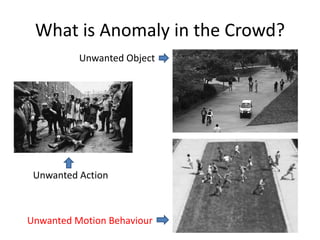
What is Anomaly in the Crowd?
Unwanted Object
Unwanted Action
Unwanted Motion Behaviour
Why do we need Anomaly detection?
• Avoid any hazardous situation
• Catch rule breakers
• Fix system problems which may lead to
greater problem
What is currently available?
 A couple of
surveillance
operator
keeps vigil on
a set of
monitors.
• Limitations:
• Monotonous
• Privacy issues
• Prone to Human
error
What do we want?
Methods of motion detection
• Frame difference
• Template matching
• Tracking
• Optical flow
Optical Flow
Time: t
Optical Flow
Time: t+1
Optical Flow
Time: t
Time: t+1
Algorithm of anomaly detection:
Start Frame(0) Frame(t)
Motion Parameters, i.e.
Optical Flow (t-1, t)
Motion
Model
Localized Outlier
detection for Current
Frame
Validation of outliers
Is
Verified
Alarm
t = t+1
t=1
Possible strategies of motion model
1. Model motion vector for a fixed pixel (static
model)
 Advantage: easier to model
 Disadvantage: May not do well in fast changing
crowd.
2. Model motion vector for trajectory of a fixed
point (dynamic model)
 Advantage: Can be very effective for changing crowd.
 Disadvantage: Difficult to model
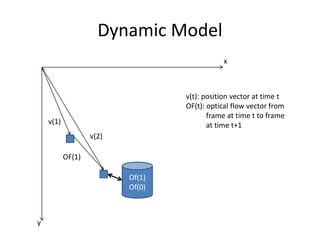
Dynamic Model
Of(0)
x
y
v(0)
OF(0)v(1)
v(t): position vector at time t
OF(t): optical flow vector from
frame at time t to frame
at time t+1
Dynamic Model
Of(1)
Of(0)
x
y
v(2)
OF(1)
v(1)
v(t): position vector at time t
OF(t): optical flow vector from
frame at time t to frame
at time t+1
Dynamic Model
Of(2)
Of(1)
Of(0)
x
y
v(2)
OF(2)
v(3)
v(t): position vector at time t
OF(t): optical flow vector from
frame at time t to frame
at time t+1
Flow Mapping
• Pixels are quantized but motion vectors are
not.
• Ex. OF Vector: (x =3.3, y = 2.6)
• Just rounding looses information.
• Probabilistic mapping, 0.4*0.7 0.4*0.3
0.6*0.7 0.6*0.3
(2.6, 3.3)
Mapping (rounding based)
Three color channels
Green: OF based second
image
Blue: Second image
Red: missing OF based
Mapping.
Mapping (Probability based)
Three color channels
Green: OF based second
image
Blue: Second image
Red: missing OF based
Mapping.
Problems
• Frequent loss of track because of
 Occlusion
 Errors in Optical flow
Losing track implies losing model for that pixel.
• Noisy optical flow
Lots of unwanted outliers in the collected data
• Shadows
Low contrast, causes corrupt optical flow
Unwanted extended blob.
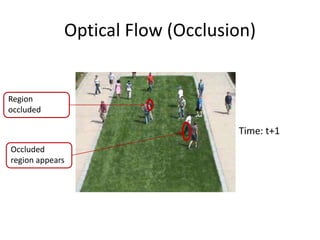
Optical Flow (Occlusion)
Time: t
Optical Flow (Occlusion)
Time: t+1
Optical Flow (Occlusion)
Time: t+1
Occluded
region appears
Region
occluded
Example (Anomaly situation)
Frame 457 Frame 499
Example
Frame 463 Frame 505
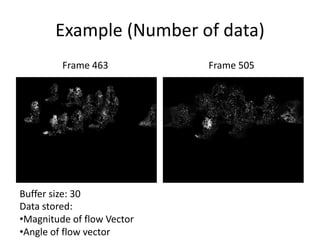
Example (Number of data)
Frame 463 Frame 505
Buffer size: 30
Data stored:
•Magnitude of flow Vector
•Angle of flow vector
Example (Segmented on motion
model)
Frame 463 Frame 505
Assumption of Normal Model
Closing operation on pixels with probability > 0.05
Example (Few trails)
Frame 463 Frame 505
Example : Flow magnitude and angle
Frame 463 Frame 505
Flowmagnitude
Flowmagnitude
Anglemagnitude
Anglemagnitude
What next?
• Given current situation, we are still trying to
find out ways to extract useful information out
of this model.
• To make this system robust against noise and
local variations, we can think of doing similar
modeling on larger homogenous regions.
Questions?

masters seminar_Detection

Editor's Notes

  • #23 May give a very brief of optical flow computation.