Data Modeling
Prepared by:
Maheshwor Shrestha
Developer @ LIS Nepal Pvt. Ltd.
rowhseham@yahoo.com
Overview
• Introduction
• Example
• Data Modeling Steps/Processes
• Data Model Types
• Data Model Stake Holders
• Data Modeling Tools
Introduction
• Data Modeling is modeling of data.
• It is representation of data and its relationship with other data entity to
reflect the insights of information system as a whole in terms of flow of
data in the system.
• It is documentation or formalization of some existing or proposed system.
• Data modeling is often first step of database or data warehouse design.
Also during some large scale application development where data flow is
critical, data modeling comes into play.
• It is blue-print/design/plan for a database that needs to be constructed,
similar to a blue-print of house that needs to be constructed.
Example
• Retail Data Model
• Retail is a domain in business which has a very large and complex set of data
objects and relationship among them.
• Data Entity: Here products to be sold, location of sales, person buying the
products, class & types of products, sales point, buyer, supplier and
hundreds of other things that appear in sales and mostly can be represented
mostly by a noun are data entities.
• Relationship: The relationship like a product falls in some category, products
are bought by buyer, supplier supplies to store and hundreds of other
relationship that can be represented mostly by a verb are relationships.
• Communication data model, Archive File Data Model, Enterprise
resource data model etc.
Steps/Processes
• So there are 5 steps
• Requirement gathering and analysis
• Conceptual Modeling
• Logical Modeling
• Physical Modeling
• Deployment
• Note: First and last are not actually modeling phase but they are
important to start and end modeling task.
Steps/Processes continued
• Generally data modeling process flows from top to bottom but
sometimes reverse is also true specially during reverse engineering.
Reverse engineering process of data modeling is useful while
updating existing data model. Get conceptual model from physical
model, update and optimize it and again get physical data model to
deploy.
Steps/Processes continued
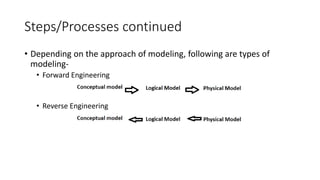
• Depending on the approach of modeling, following are types of
modeling-
• Forward Engineering
• Reverse Engineering
Types
• Operational
• It is data model where database is normalized.
• Data Warehouse
• It is data model where database is de-normalized.
Stakeholders
• End Users
• Business Specialist, Business Analyst, Domain Expert
• Database modeler, Data Architect, Database developer.
Data Modeling Tools & Techniques
• Data Modeling Tools and Techniques simplify the complex task of data
designing, visualizing and modeling for a business process resulting
into a data model blueprint.
• Example: Infosphere Data Architect, Erwin Data Modeler, ERStudio
etc.

Data modeling

  • 1.
    Data Modeling Prepared by: MaheshworShrestha Developer @ LIS Nepal Pvt. Ltd. rowhseham@yahoo.com
  • 2.
    Overview • Introduction • Example •Data Modeling Steps/Processes • Data Model Types • Data Model Stake Holders • Data Modeling Tools
  • 3.
    Introduction • Data Modelingis modeling of data. • It is representation of data and its relationship with other data entity to reflect the insights of information system as a whole in terms of flow of data in the system. • It is documentation or formalization of some existing or proposed system. • Data modeling is often first step of database or data warehouse design. Also during some large scale application development where data flow is critical, data modeling comes into play. • It is blue-print/design/plan for a database that needs to be constructed, similar to a blue-print of house that needs to be constructed.
  • 4.
    Example • Retail DataModel • Retail is a domain in business which has a very large and complex set of data objects and relationship among them. • Data Entity: Here products to be sold, location of sales, person buying the products, class & types of products, sales point, buyer, supplier and hundreds of other things that appear in sales and mostly can be represented mostly by a noun are data entities. • Relationship: The relationship like a product falls in some category, products are bought by buyer, supplier supplies to store and hundreds of other relationship that can be represented mostly by a verb are relationships. • Communication data model, Archive File Data Model, Enterprise resource data model etc.
  • 5.
    Steps/Processes • So thereare 5 steps • Requirement gathering and analysis • Conceptual Modeling • Logical Modeling • Physical Modeling • Deployment • Note: First and last are not actually modeling phase but they are important to start and end modeling task.
  • 6.
    Steps/Processes continued • Generallydata modeling process flows from top to bottom but sometimes reverse is also true specially during reverse engineering. Reverse engineering process of data modeling is useful while updating existing data model. Get conceptual model from physical model, update and optimize it and again get physical data model to deploy.
  • 7.
    Steps/Processes continued • Dependingon the approach of modeling, following are types of modeling- • Forward Engineering • Reverse Engineering
  • 8.
    Types • Operational • Itis data model where database is normalized. • Data Warehouse • It is data model where database is de-normalized.
  • 9.
    Stakeholders • End Users •Business Specialist, Business Analyst, Domain Expert • Database modeler, Data Architect, Database developer.
  • 10.
    Data Modeling Tools& Techniques • Data Modeling Tools and Techniques simplify the complex task of data designing, visualizing and modeling for a business process resulting into a data model blueprint. • Example: Infosphere Data Architect, Erwin Data Modeler, ERStudio etc.