Data Virtualisation for Business Consumption
November 2020
Enabling digital
transformation by
connecting expression,
experience and
enablement
600+
Consultants
100+
Active
Clients
ASX
Listed
Company
4
Australian
Locations
EnablementExperienceExpression
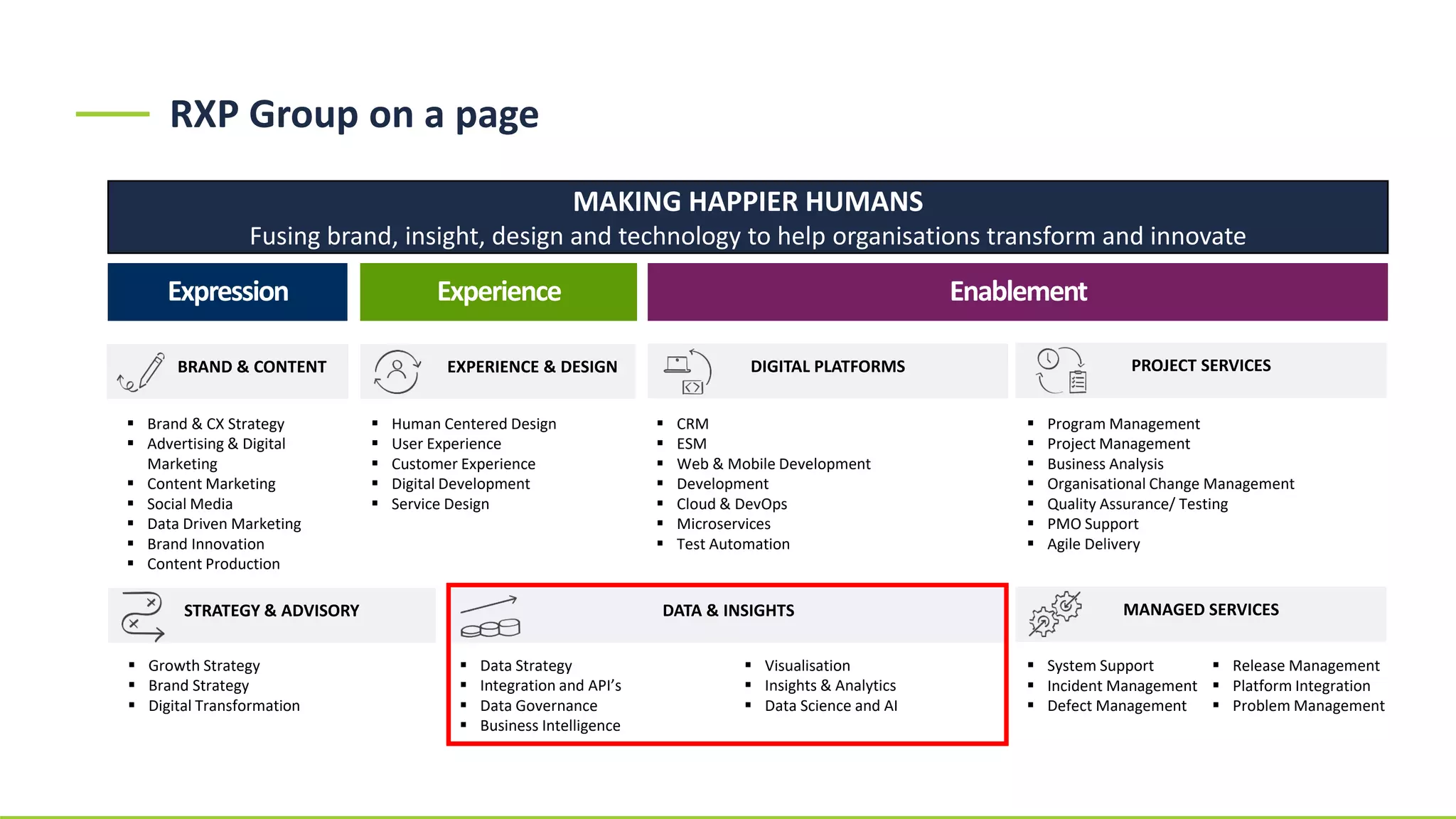
RXP Group on a page
MAKING HAPPIER HUMANS
Fusing brand, insight, design and technology to help organisations transform and innovate
STRATEGY & ADVISORY
EXPERIENCE & DESIGN
DATA & INSIGHTS
DIGITAL PLATFORMS
▪ Growth Strategy
▪ Brand Strategy
▪ Digital Transformation
▪ Human Centered Design
▪ User Experience
▪ Customer Experience
▪ Digital Development
▪ Service Design
▪ Program Management
▪ Project Management
▪ Business Analysis
▪ Organisational Change Management
▪ Quality Assurance/ Testing
▪ PMO Support
▪ Agile Delivery
▪ CRM
▪ ESM
▪ Web & Mobile Development
▪ Development
▪ Cloud & DevOps
▪ Microservices
▪ Test Automation
BRAND & CONTENT PROJECT SERVICES
▪ Brand & CX Strategy
▪ Advertising & Digital
Marketing
▪ Content Marketing
▪ Social Media
▪ Data Driven Marketing
▪ Brand Innovation
▪ Content Production
▪ Data Strategy
▪ Integration and API’s
▪ Data Governance
▪ Business Intelligence
▪ Visualisation
▪ Insights & Analytics
▪ Data Science and AI
MANAGED SERVICES
▪ System Support
▪ Incident Management
▪ Defect Management
▪ Release Management
▪ Platform Integration
▪ Problem Management
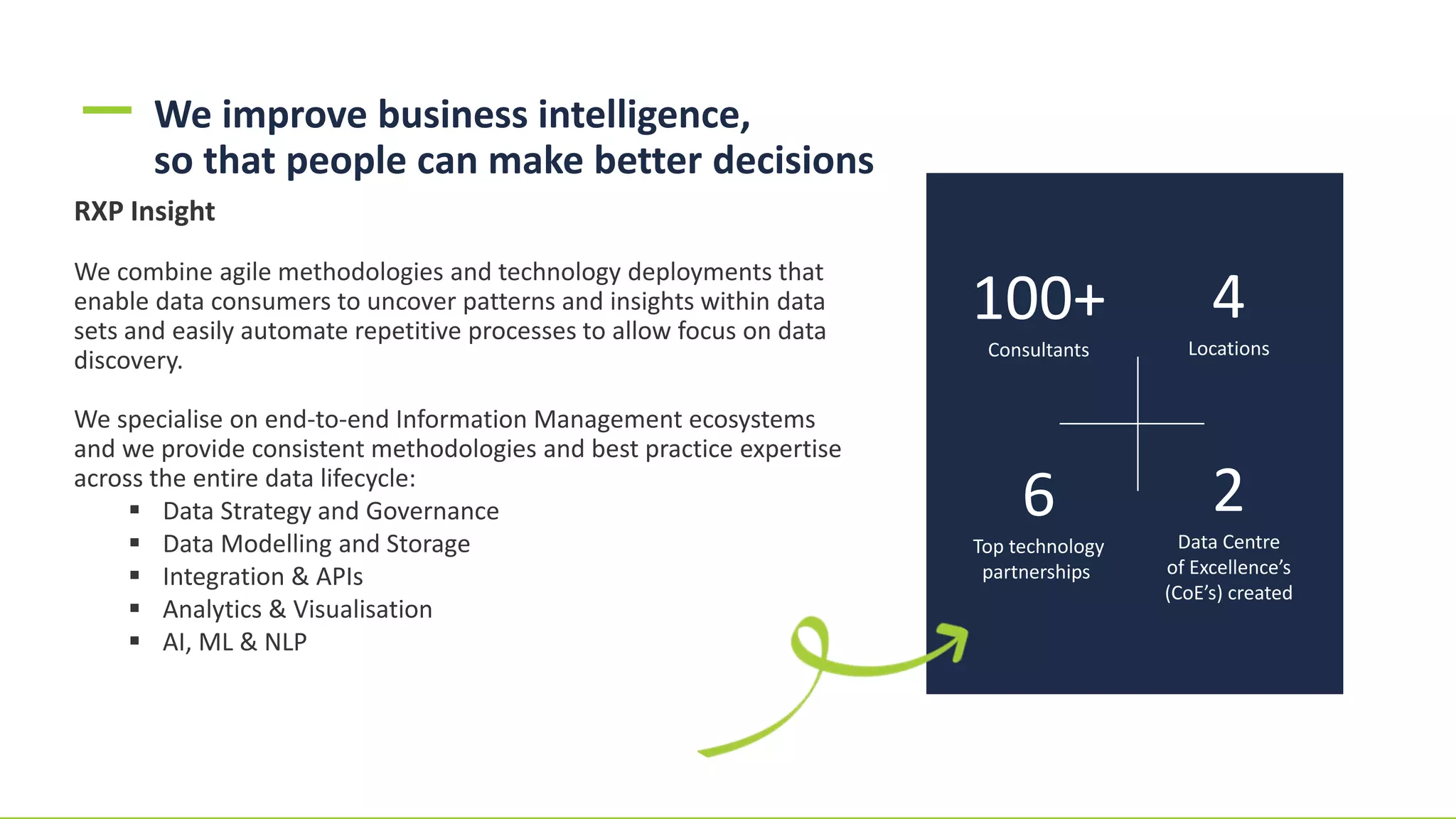
We improve business intelligence,
so that people can make better decisions
DATA & INSIGHTS
100+
Consultants
4
Locations
2
Data Centre
of Excellence’s
(CoE’s) created
6
Top technology
partnerships
RXP Insight
We combine agile methodologies and technology deployments that
enable data consumers to uncover patterns and insights within data
sets and easily automate repetitive processes to allow focus on data
discovery.
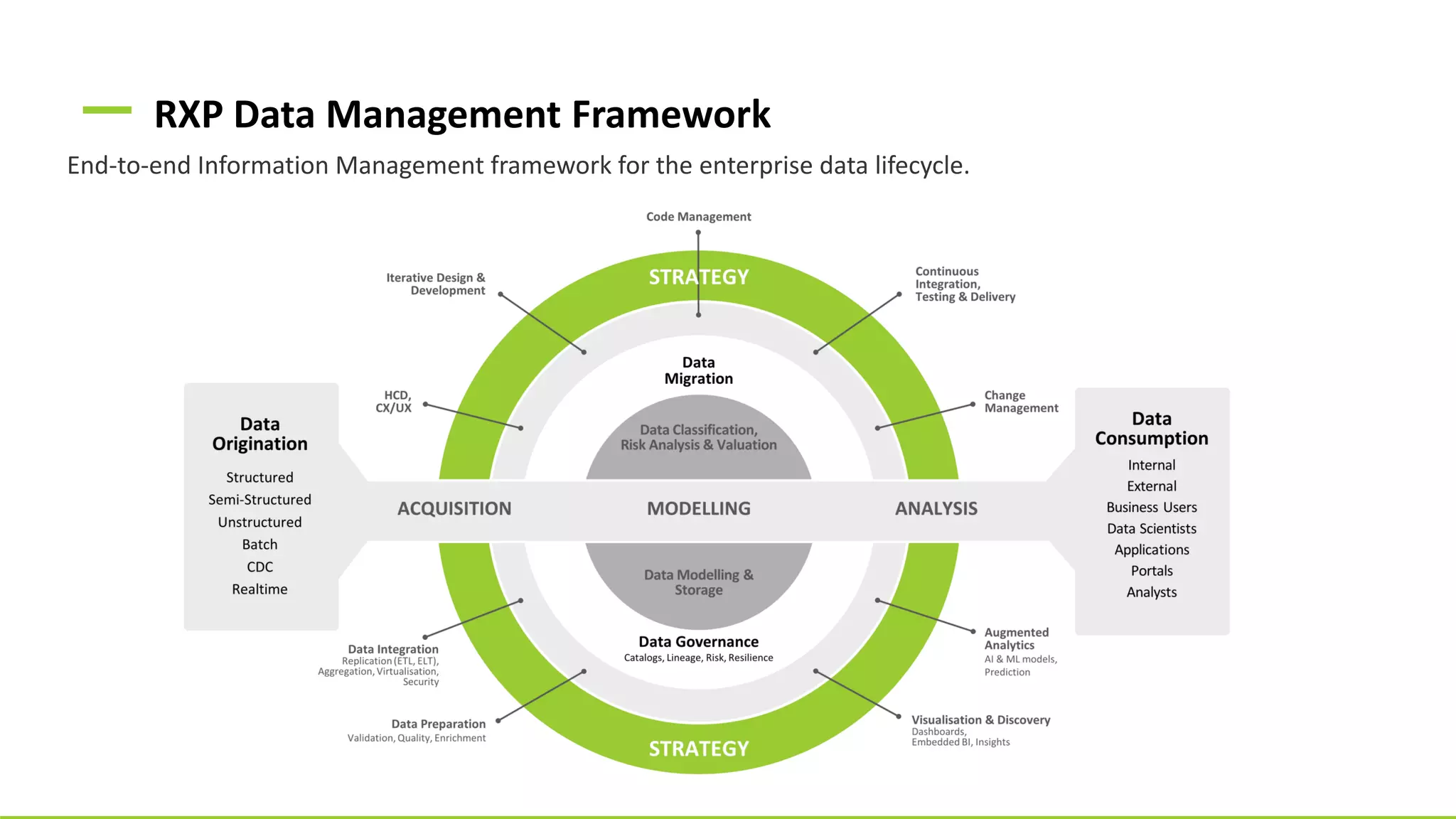
We specialise on end-to-end Information Management ecosystems
and we provide consistent methodologies and best practice expertise
across the entire data lifecycle:
▪ Data Strategy and Governance
▪ Data Modelling and Storage
▪ Integration & APIs
▪ Analytics & Visualisation
▪ AI, ML & NLP
RXP Data Management Framework
End-to-end Information Management framework for the enterprise data lifecycle.
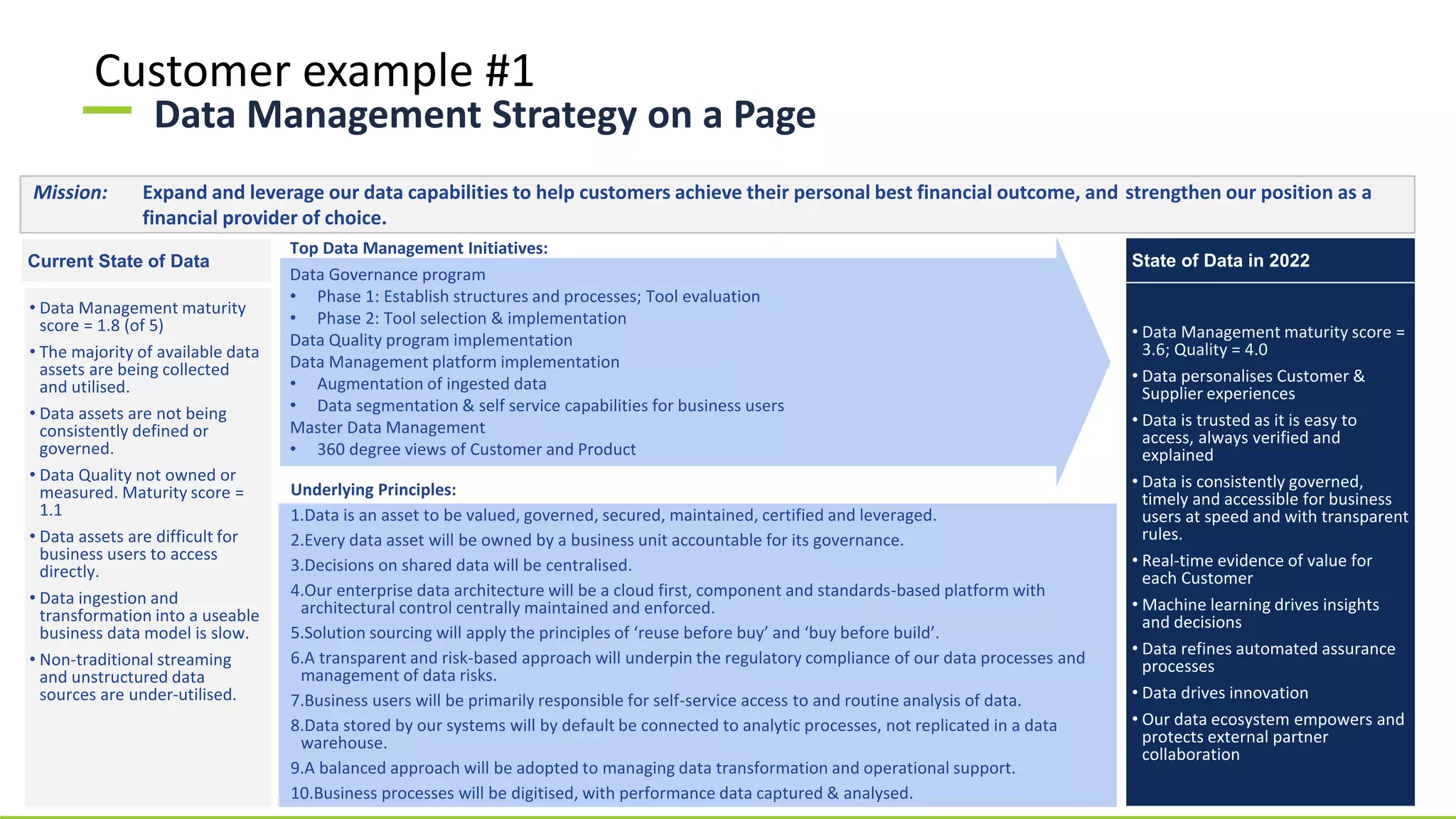
Data Management Strategy on a Page
Mission: Expand and leverage our data capabilities to help customers achieve their personal best financial outcome, and strengthen our position as a
financial provider of choice.
Current State of Data
• Data Management maturity score =
3.6; Quality = 4.0
• Data personalises Customer &
Supplier experiences
• Data is trusted as it is easy to
access, always verified and
explained
• Data is consistently governed,
timely and accessible for business
users at speed and with transparent
rules.
• Real-time evidence of value for
each Customer
• Machine learning drives insights
and decisions
• Data refines automated assurance
processes
• Data drives innovation
• Our data ecosystem empowers and
protects external partner
collaboration
Top Data Management Initiatives:
Data Governance program
• Phase 1: Establish structures and processes; Tool evaluation
• Phase 2: Tool selection & implementation
Data Quality program implementation
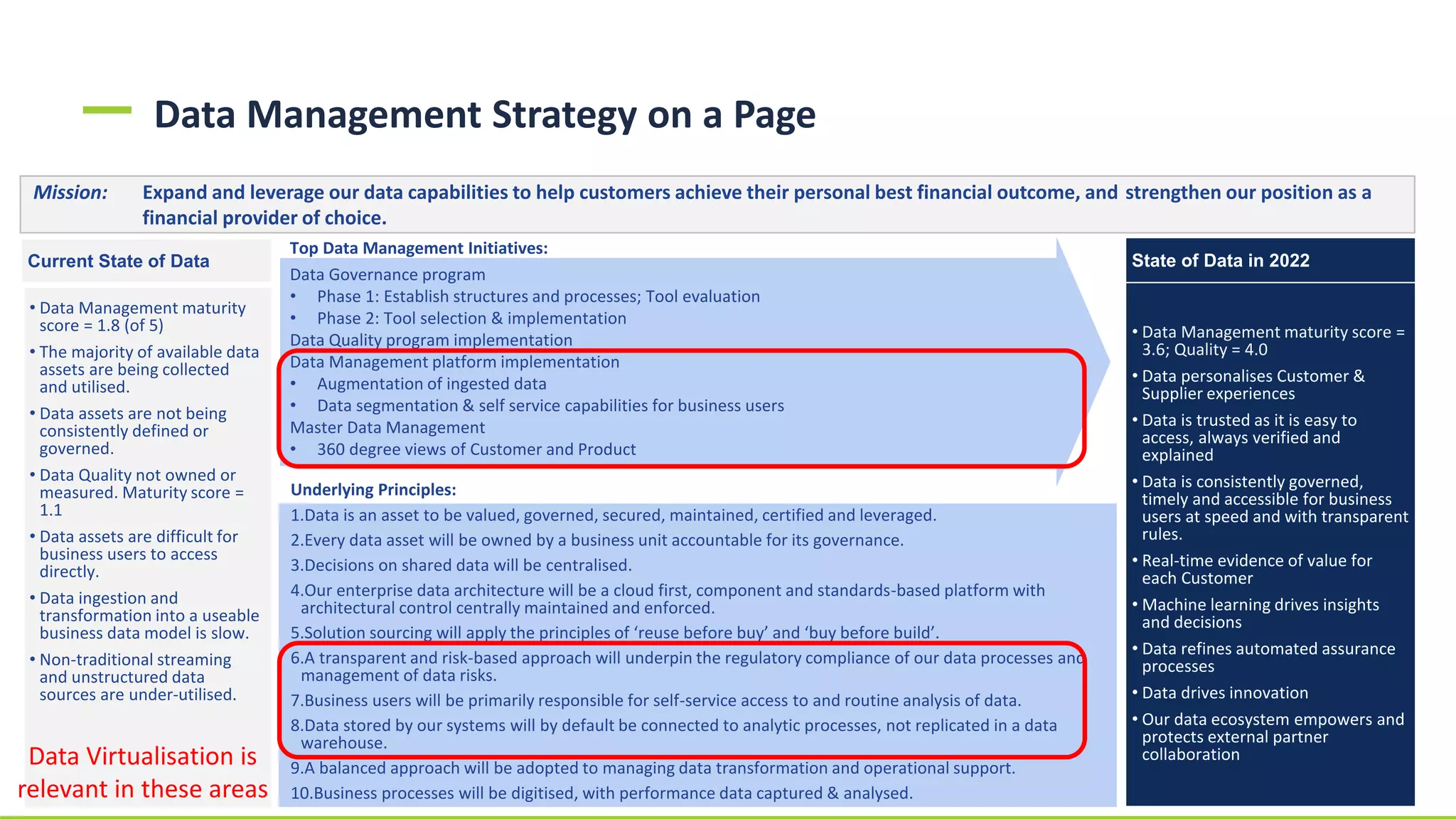
Data Management platform implementation
• Augmentation of ingested data
• Data segmentation & self service capabilities for business users
Master Data Management
• 360 degree views of Customer and Product
Underlying Principles:
1.Data is an asset to be valued, governed, secured, maintained, certified and leveraged.
2.Every data asset will be owned by a business unit accountable for its governance.
3.Decisions on shared data will be centralised.
4.Our enterprise data architecture will be a cloud first, component and standards-based platform with
architectural control centrally maintained and enforced.
5.Solution sourcing will apply the principles of ‘reuse before buy’ and ‘buy before build’.
6.A transparent and risk-based approach will underpin the regulatory compliance of our data processes and
management of data risks.
7.Business users will be primarily responsible for self-service access to and routine analysis of data.
8.Data stored by our systems will by default be connected to analytic processes, not replicated in a data
warehouse.
9.A balanced approach will be adopted to managing data transformation and operational support.
10.Business processes will be digitised, with performance data captured & analysed.
• Data Management maturity
score = 1.8 (of 5)
• The majority of available data
assets are being collected
and utilised.
• Data assets are not being
consistently defined or
governed.
• Data Quality not owned or
measured. Maturity score =
1.1
• Data assets are difficult for
business users to access
directly.
• Data ingestion and
transformation into a useable
business data model is slow.
• Non-traditional streaming
and unstructured data
sources are under-utilised.
State of Data in 2022
Customer example #1
Data Management Strategy on a Page
Mission: Expand and leverage our data capabilities to help customers achieve their personal best financial outcome, and strengthen our position as a
financial provider of choice.
Current State of Data
• Data Management maturity score =
3.6; Quality = 4.0
• Data personalises Customer &
Supplier experiences
• Data is trusted as it is easy to
access, always verified and
explained
• Data is consistently governed,
timely and accessible for business
users at speed and with transparent
rules.
• Real-time evidence of value for
each Customer
• Machine learning drives insights
and decisions
• Data refines automated assurance
processes
• Data drives innovation
• Our data ecosystem empowers and
protects external partner
collaboration
Top Data Management Initiatives:
Data Governance program
• Phase 1: Establish structures and processes; Tool evaluation
• Phase 2: Tool selection & implementation
Data Quality program implementation
Data Management platform implementation
• Augmentation of ingested data
• Data segmentation & self service capabilities for business users
Master Data Management
• 360 degree views of Customer and Product
Underlying Principles:
1.Data is an asset to be valued, governed, secured, maintained, certified and leveraged.
2.Every data asset will be owned by a business unit accountable for its governance.
3.Decisions on shared data will be centralised.
4.Our enterprise data architecture will be a cloud first, component and standards-based platform with
architectural control centrally maintained and enforced.
5.Solution sourcing will apply the principles of ‘reuse before buy’ and ‘buy before build’.
6.A transparent and risk-based approach will underpin the regulatory compliance of our data processes and
management of data risks.
7.Business users will be primarily responsible for self-service access to and routine analysis of data.
8.Data stored by our systems will by default be connected to analytic processes, not replicated in a data
warehouse.
9.A balanced approach will be adopted to managing data transformation and operational support.
10.Business processes will be digitised, with performance data captured & analysed.
• Data Management maturity
score = 1.8 (of 5)
• The majority of available data
assets are being collected
and utilised.
• Data assets are not being
consistently defined or
governed.
• Data Quality not owned or
measured. Maturity score =
1.1
• Data assets are difficult for
business users to access
directly.
• Data ingestion and
transformation into a useable
business data model is slow.
• Non-traditional streaming
and unstructured data
sources are under-utilised.
State of Data in 2022
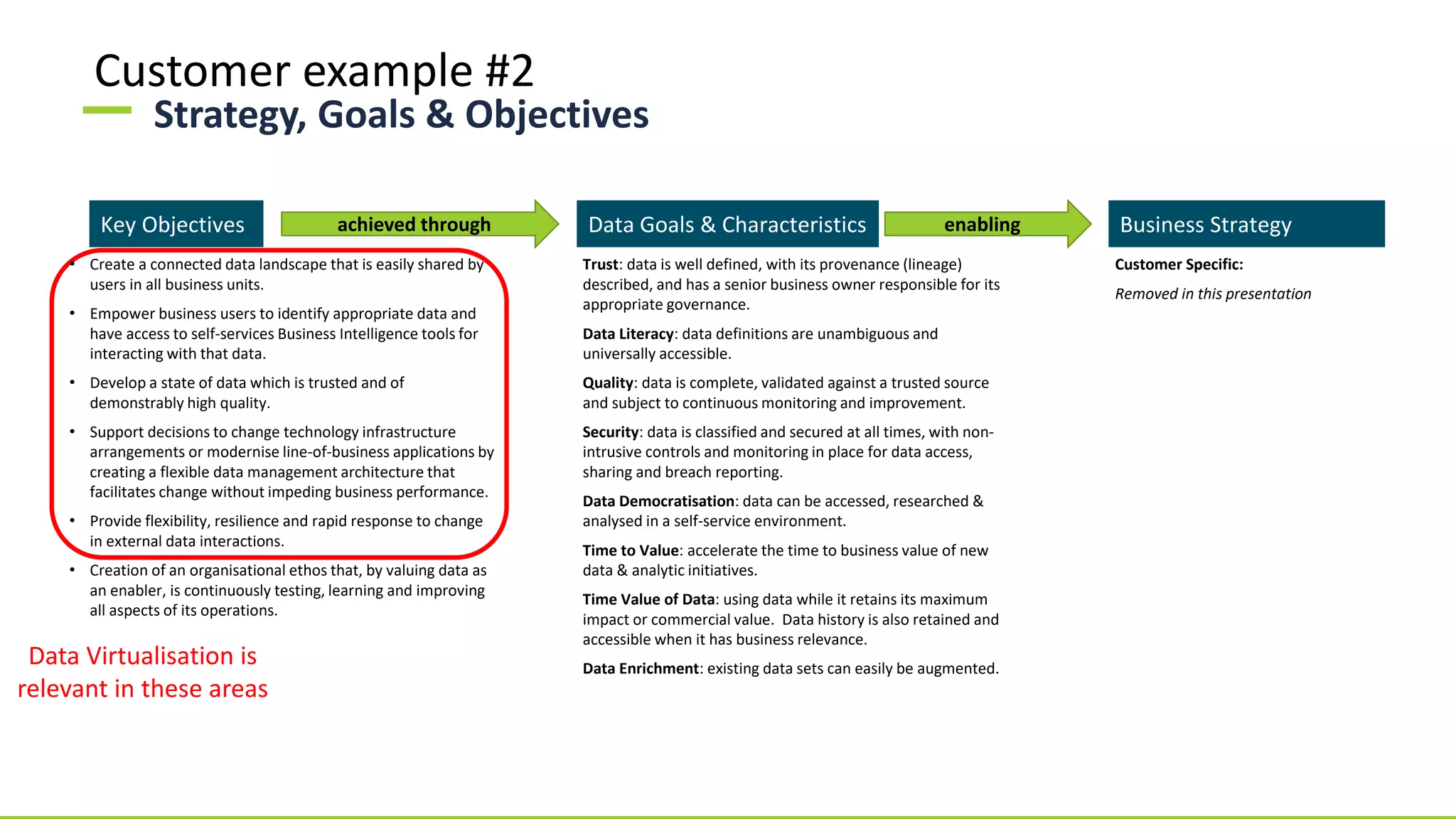
Data Virtualisation is
relevant in these areas
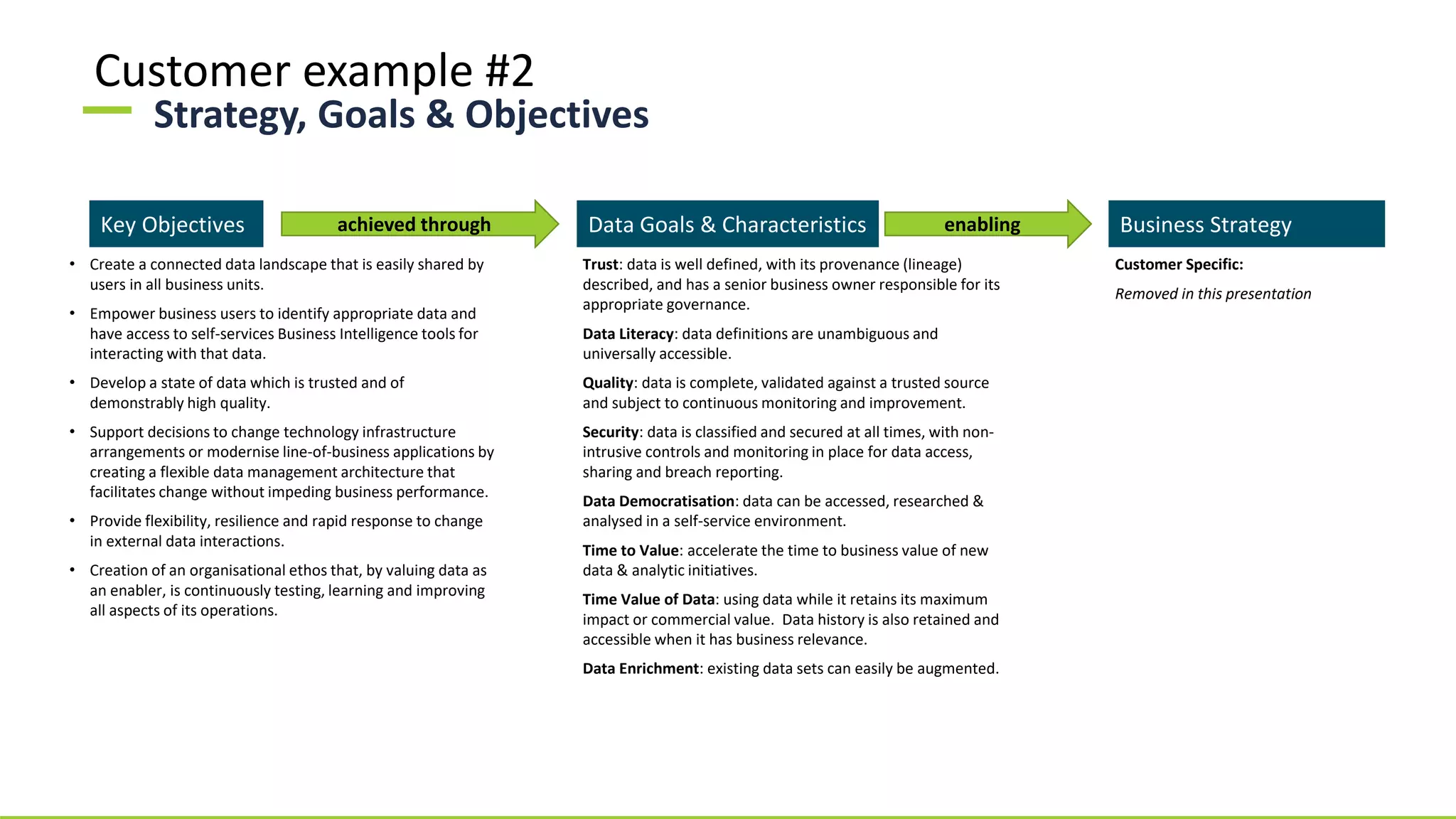
Strategy, Goals & Objectives
Key Objectives
• Create a connected data landscape that is easily shared by
users in all business units.
• Empower business users to identify appropriate data and
have access to self-services Business Intelligence tools for
interacting with that data.
• Develop a state of data which is trusted and of
demonstrably high quality.
• Support decisions to change technology infrastructure
arrangements or modernise line-of-business applications by
creating a flexible data management architecture that
facilitates change without impeding business performance.
• Provide flexibility, resilience and rapid response to change
in external data interactions.
• Creation of an organisational ethos that, by valuing data as
an enabler, is continuously testing, learning and improving
all aspects of its operations.
Trust: data is well defined, with its provenance (lineage)
described, and has a senior business owner responsible for its
appropriate governance.
Data Literacy: data definitions are unambiguous and
universally accessible.
Quality: data is complete, validated against a trusted source
and subject to continuous monitoring and improvement.
Security: data is classified and secured at all times, with non-
intrusive controls and monitoring in place for data access,
sharing and breach reporting.
Data Democratisation: data can be accessed, researched &
analysed in a self-service environment.
Time to Value: accelerate the time to business value of new
data & analytic initiatives.
Time Value of Data: using data while it retains its maximum
impact or commercial value. Data history is also retained and
accessible when it has business relevance.
Data Enrichment: existing data sets can easily be augmented.
Data Goals & Characteristicsachieved through enabling
Customer Specific:
Removed in this presentation
Business Strategy
Customer example #2
Strategy, Goals & Objectives
Data Virtualisation is
relevant in these areas
Key Objectives
• Create a connected data landscape that is easily shared by
users in all business units.
• Empower business users to identify appropriate data and
have access to self-services Business Intelligence tools for
interacting with that data.
• Develop a state of data which is trusted and of
demonstrably high quality.
• Support decisions to change technology infrastructure
arrangements or modernise line-of-business applications by
creating a flexible data management architecture that
facilitates change without impeding business performance.
• Provide flexibility, resilience and rapid response to change
in external data interactions.
• Creation of an organisational ethos that, by valuing data as
an enabler, is continuously testing, learning and improving
all aspects of its operations.
Trust: data is well defined, with its provenance (lineage)
described, and has a senior business owner responsible for its
appropriate governance.
Data Literacy: data definitions are unambiguous and
universally accessible.
Quality: data is complete, validated against a trusted source
and subject to continuous monitoring and improvement.
Security: data is classified and secured at all times, with non-
intrusive controls and monitoring in place for data access,
sharing and breach reporting.
Data Democratisation: data can be accessed, researched &
analysed in a self-service environment.
Time to Value: accelerate the time to business value of new
data & analytic initiatives.
Time Value of Data: using data while it retains its maximum
impact or commercial value. Data history is also retained and
accessible when it has business relevance.
Data Enrichment: existing data sets can easily be augmented.
Data Goals & Characteristicsachieved through enabling
Customer Specific:
Removed in this presentation
Business Strategy
Customer example #2
What do Business Users Need
11
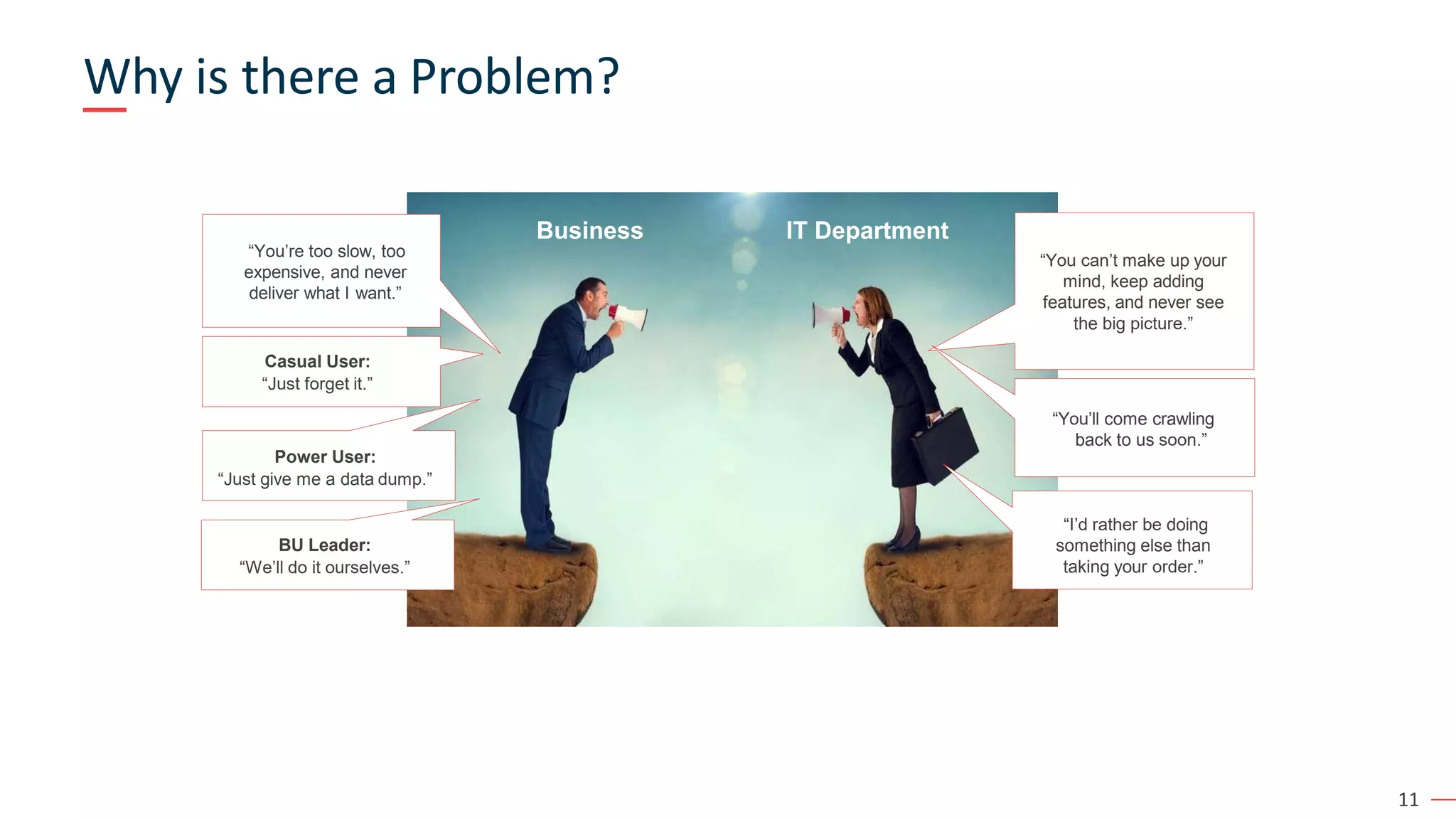
IT DepartmentBusiness
“You’re too slow, too
expensive, and never
deliver what I want.”
“You can’t make up your
mind, keep adding
features, and never see
the big picture.”
Casual User:
“Just forget it.”
Power User:
“Just give me a data dump.”
BU Leader:
“We’ll do it ourselves.”
“I’d rather be doing
something else than
taking your order.”
“You’ll come crawling
back to us soon.”
Why is there a Problem?
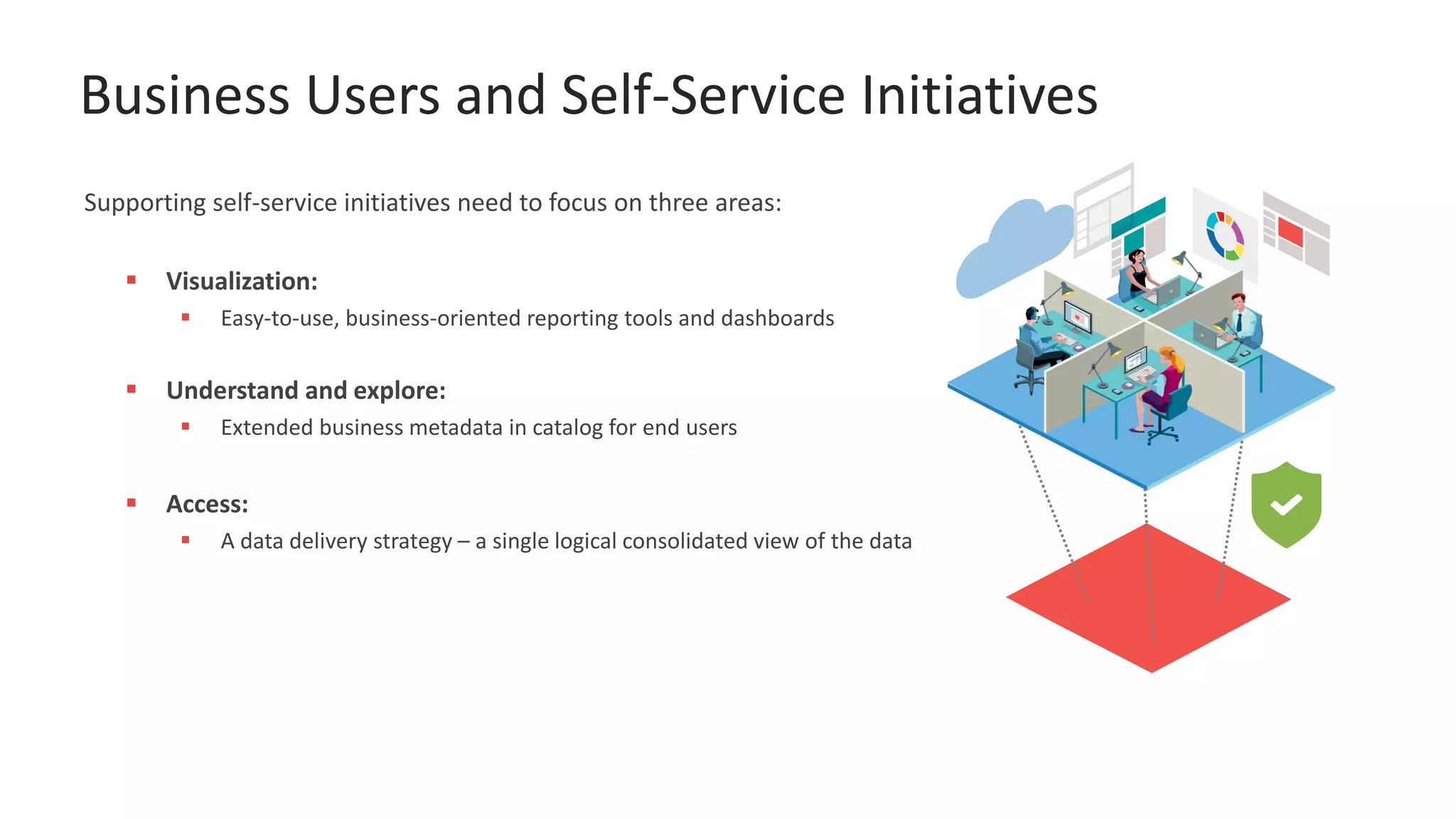
Business Users and Self-Service Initiatives
Supporting self-service initiatives need to focus on three areas:
▪ Visualization:
▪ Easy-to-use, business-oriented reporting tools and dashboards
▪ Understand and explore:
▪ Extended business metadata in catalog for end users
▪ Access:
▪ A data delivery strategy – a single logical consolidated view of the data
Data Access Layer
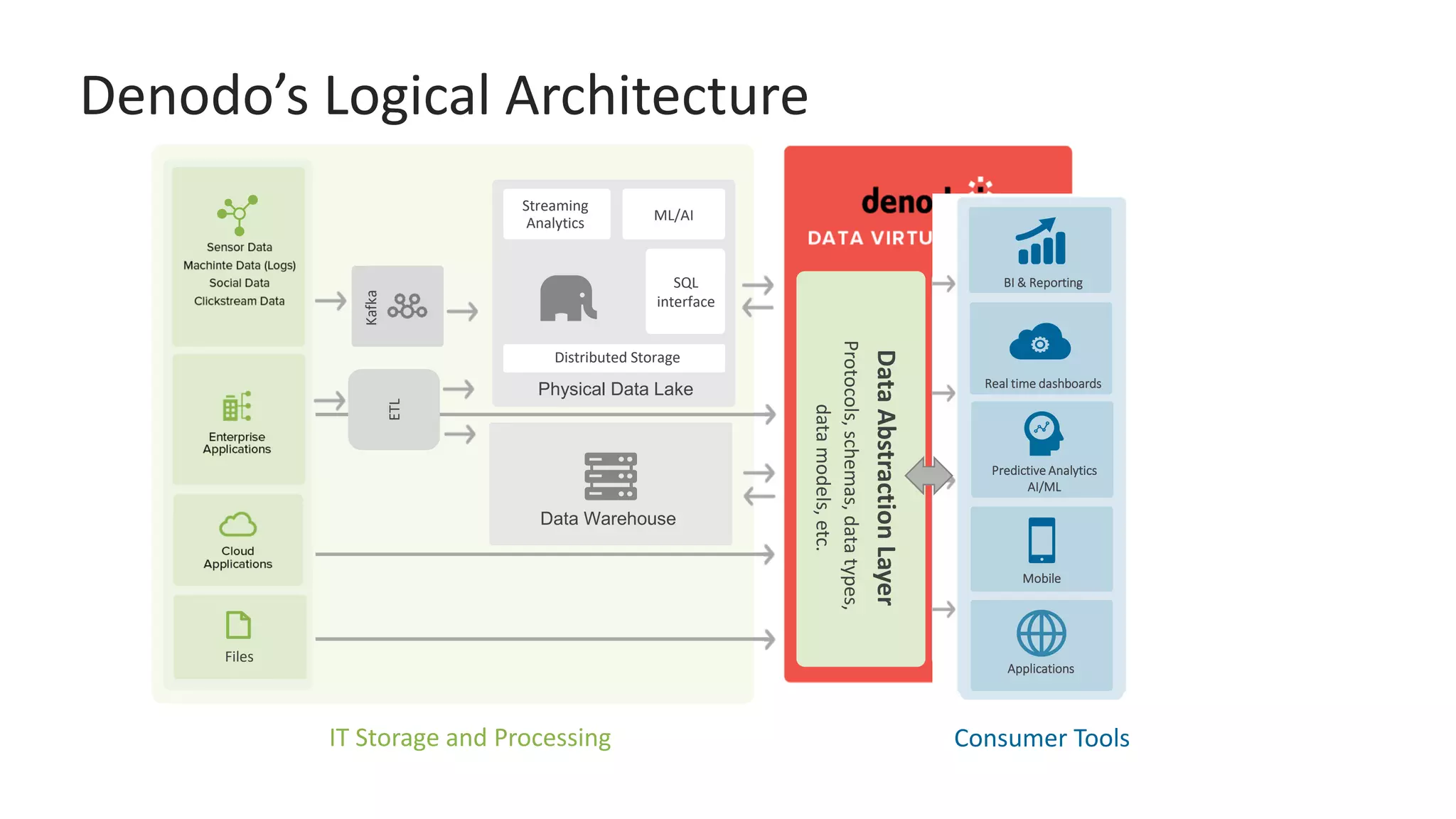
Denodo’s Logical Architecture
ETL
Data Warehouse
Kafka
Physical Data Lake
ML/AI
SQL
interface
Logical Data Layer
Streaming
Analytics
Distributed Storage
Files
DataAbstractionLayer
Protocols,schemas,datatypes,
datamodels,etc.
DataCatalog
BusinessSemantics,Explorationand
Search,etc.
ETL
Data Warehouse
Kafka
Physical Data Lake
ML/AI
SQL
interface
Streaming
Analytics
Distributed Storage
Files
IT Storage and Processing
BI & Reporting
Mobile
Applications
Predictive Analytics
AI/ML
Real time dashboards
Consumer Tools
15
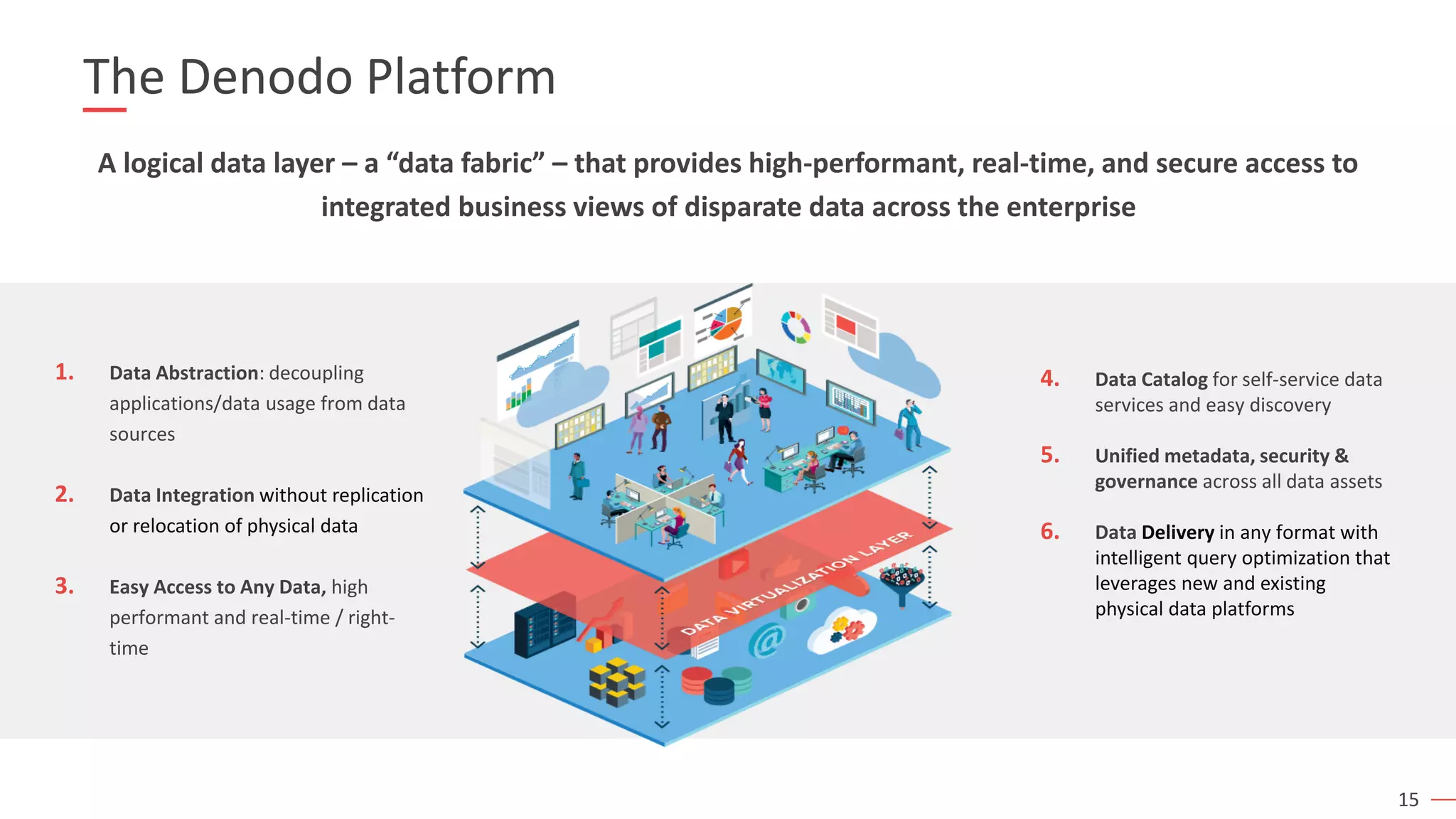
A logical data layer – a “data fabric” – that provides high-performant, real-time, and secure access to
integrated business views of disparate data across the enterprise
The Denodo Platform
1. Data Abstraction: decoupling
applications/data usage from data
sources
2. Data Integration without replication
or relocation of physical data
3. Easy Access to Any Data, high
performant and real-time / right-
time
4. Data Catalog for self-service data
services and easy discovery
5. Unified metadata, security &
governance across all data assets
6. Data Delivery in any format with
intelligent query optimization that
leverages new and existing
physical data platforms
16
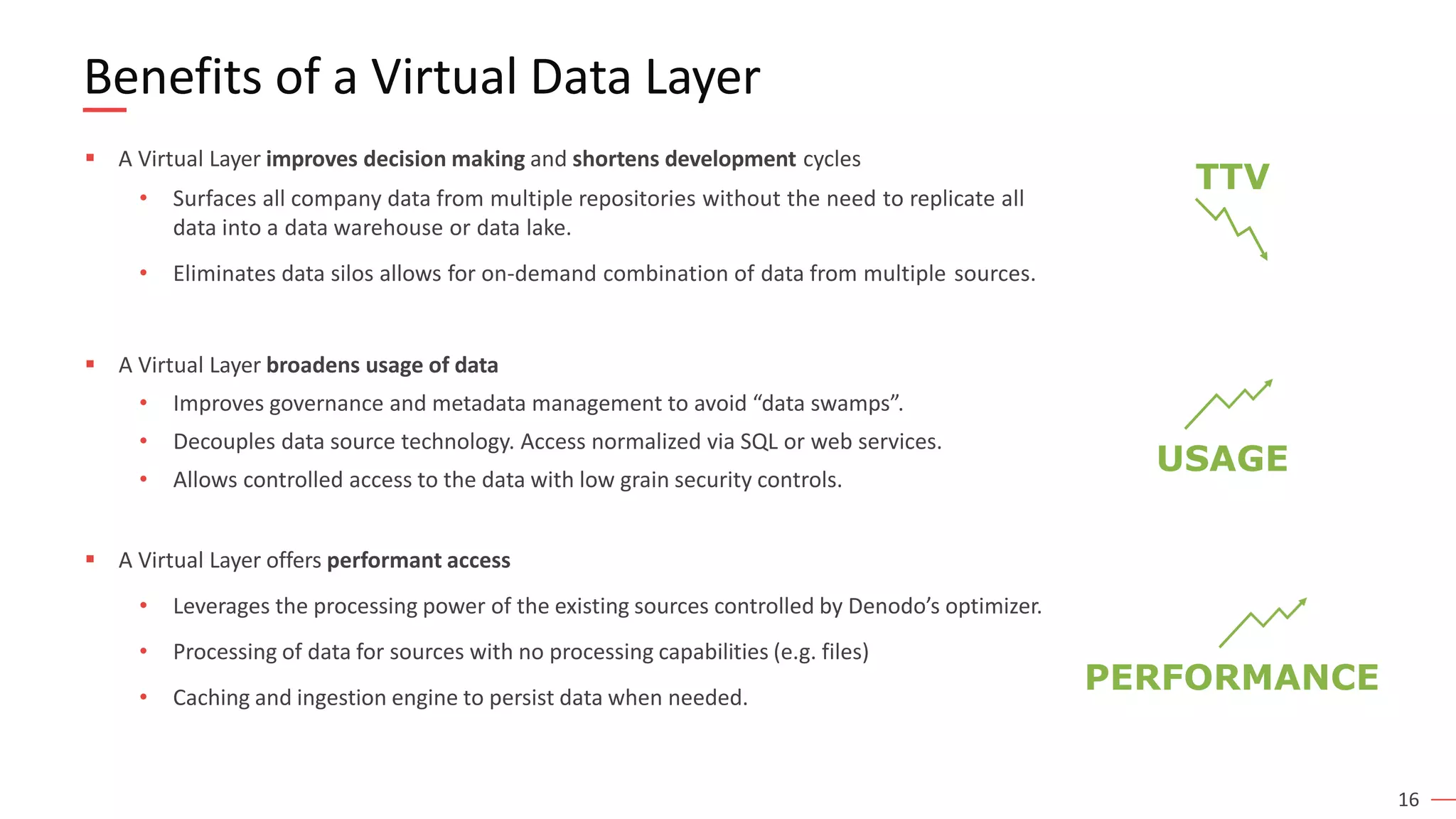
Benefits of a Virtual Data Layer
▪ A Virtual Layer improves decision making and shortens development cycles
• Surfaces all company data from multiple repositories without the need to replicate all
data into a data warehouse or data lake.
• Eliminates data silos allows for on-demand combination of data from multiple sources.
▪ A Virtual Layer broadens usage of data
• Improves governance and metadata management to avoid “data swamps”.
• Decouples data source technology. Access normalized via SQL or web services.
• Allows controlled access to the data with low grain security controls.
▪ A Virtual Layer offers performant access
• Leverages the processing power of the existing sources controlled by Denodo’s optimizer.
• Processing of data for sources with no processing capabilities (e.g. files)
• Caching and ingestion engine to persist data when needed.
TTV
USAGE
PERFORMANCE
Demonstration
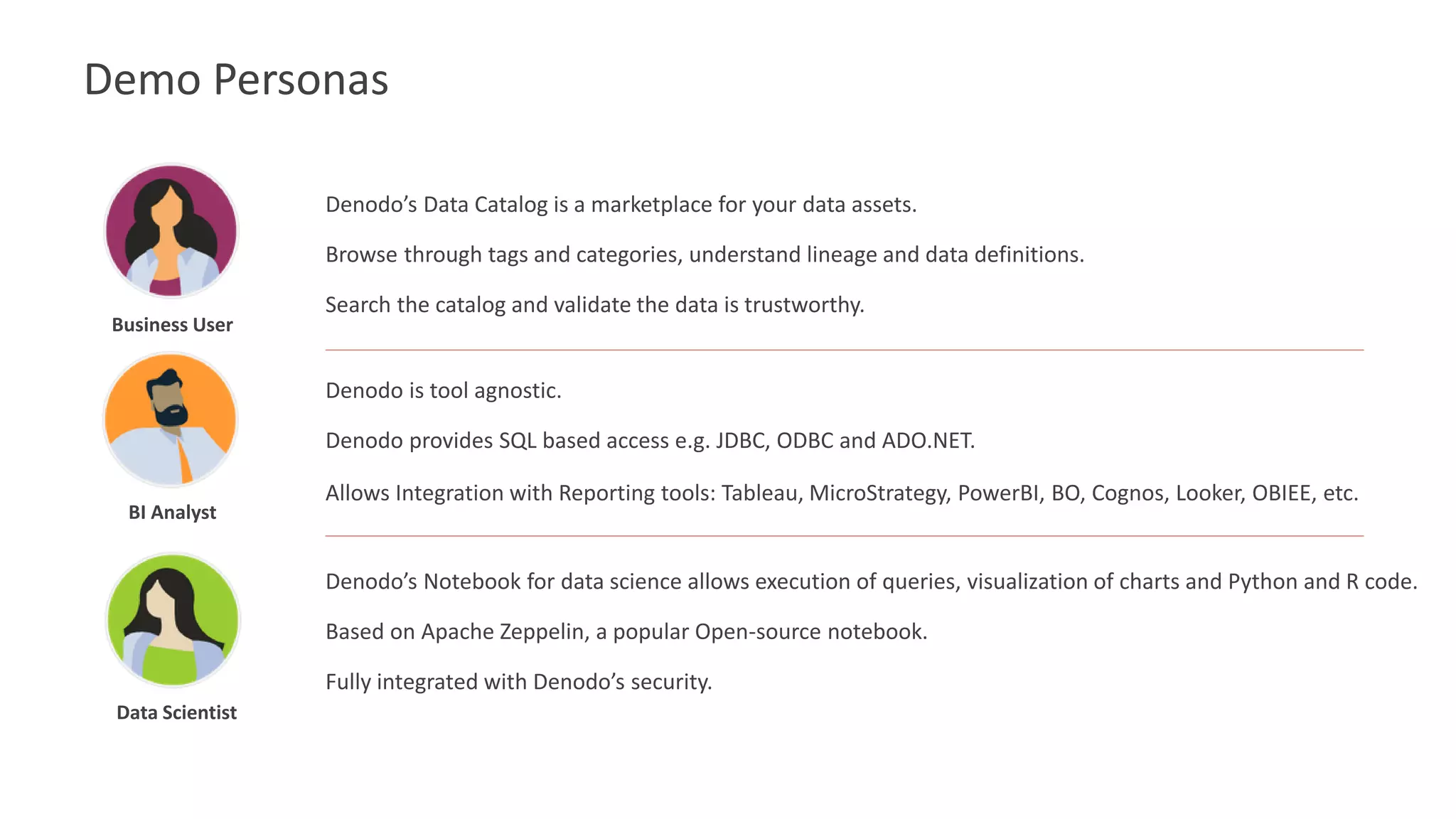
Demo Personas
Data Scientist
Business User
BI Analyst
Denodo is tool agnostic.
Denodo provides SQL based access e.g. JDBC, ODBC and ADO.NET.
Allows Integration with Reporting tools: Tableau, MicroStrategy, PowerBI, BO, Cognos, Looker, OBIEE, etc.
Denodo’s Data Catalog is a marketplace for your data assets.
Browse through tags and categories, understand lineage and data definitions.
Search the catalog and validate the data is trustworthy.
Denodo’s Notebook for data science allows execution of queries, visualization of charts and Python and R code.
Based on Apache Zeppelin, a popular Open-source notebook.
Fully integrated with Denodo’s security.
19
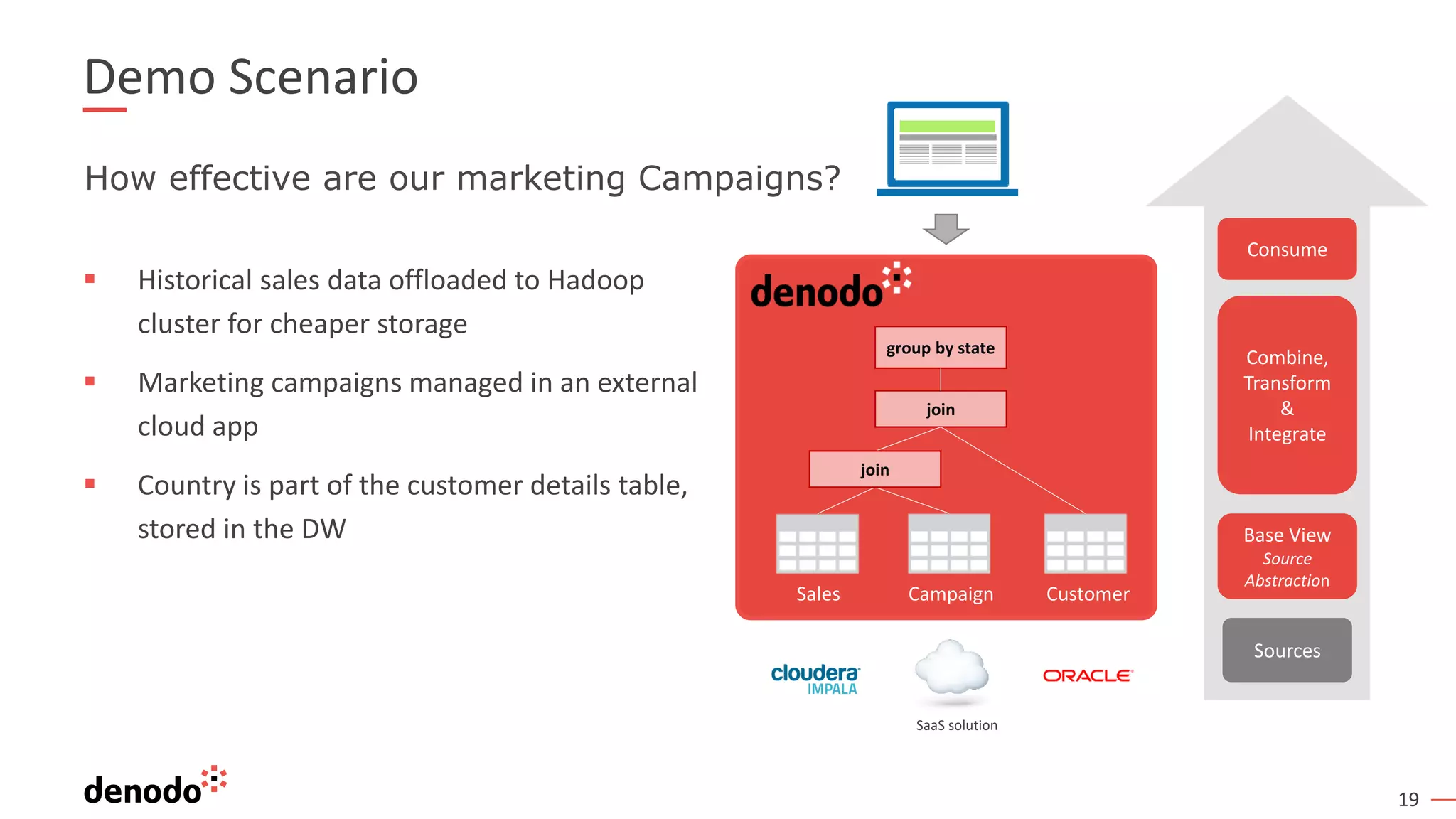
Demo Scenario
▪ Historical sales data offloaded to Hadoop
cluster for cheaper storage
▪ Marketing campaigns managed in an external
cloud app
▪ Country is part of the customer details table,
stored in the DW
Sources
Combine,
Transform
&
Integrate
Consume
Base View
Source
Abstraction
join
group by state
join
Sales Campaign Customer
SaaS solution
How effective are our marketing Campaigns?
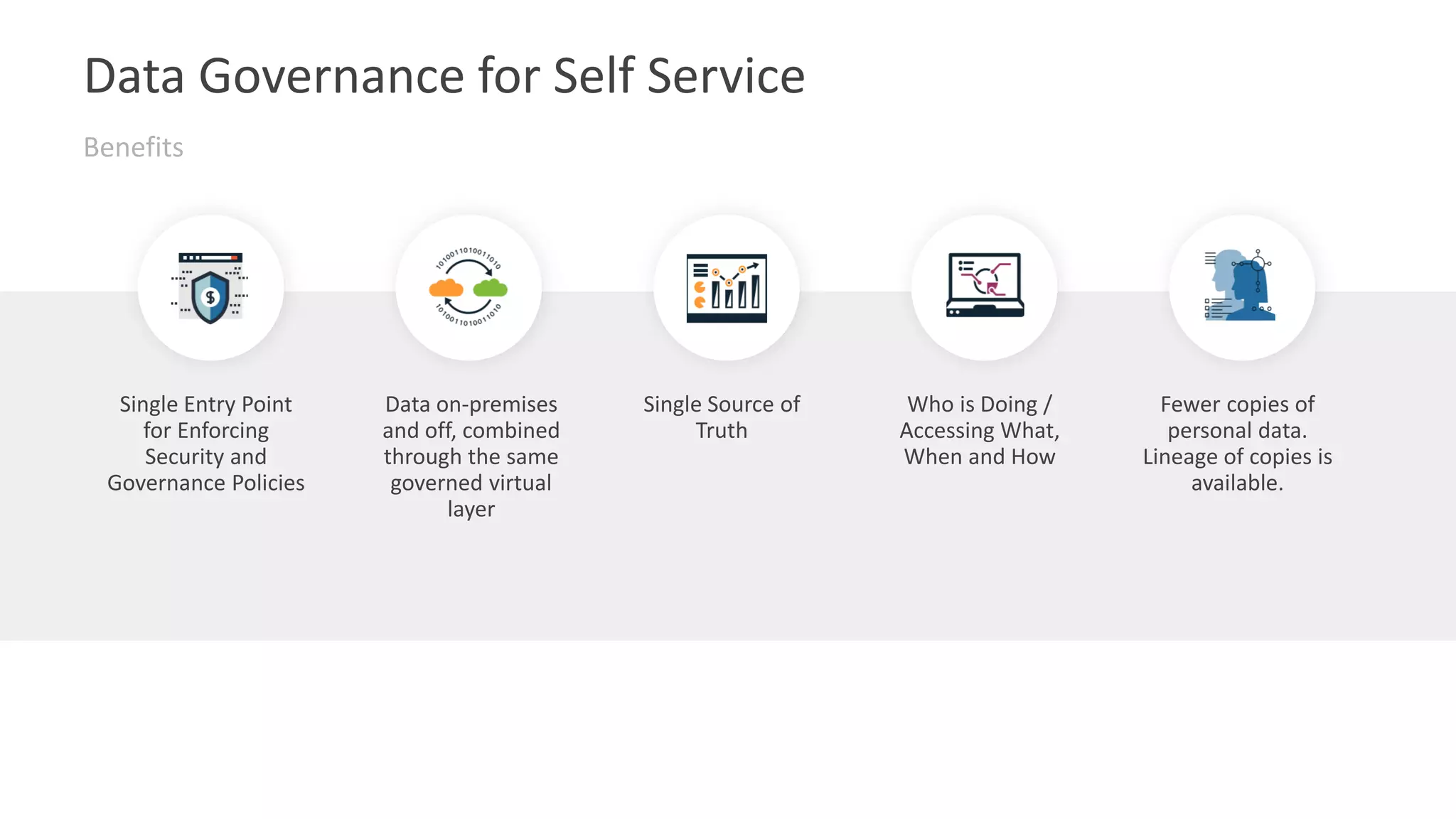
Data Governance for Self Service
Benefits
Single Entry Point
for Enforcing
Security and
Governance Policies
Data on-premises
and off, combined
through the same
governed virtual
layer
Single Source of
Truth
Who is Doing /
Accessing What,
When and How
Fewer copies of
personal data.
Lineage of copies is
available.
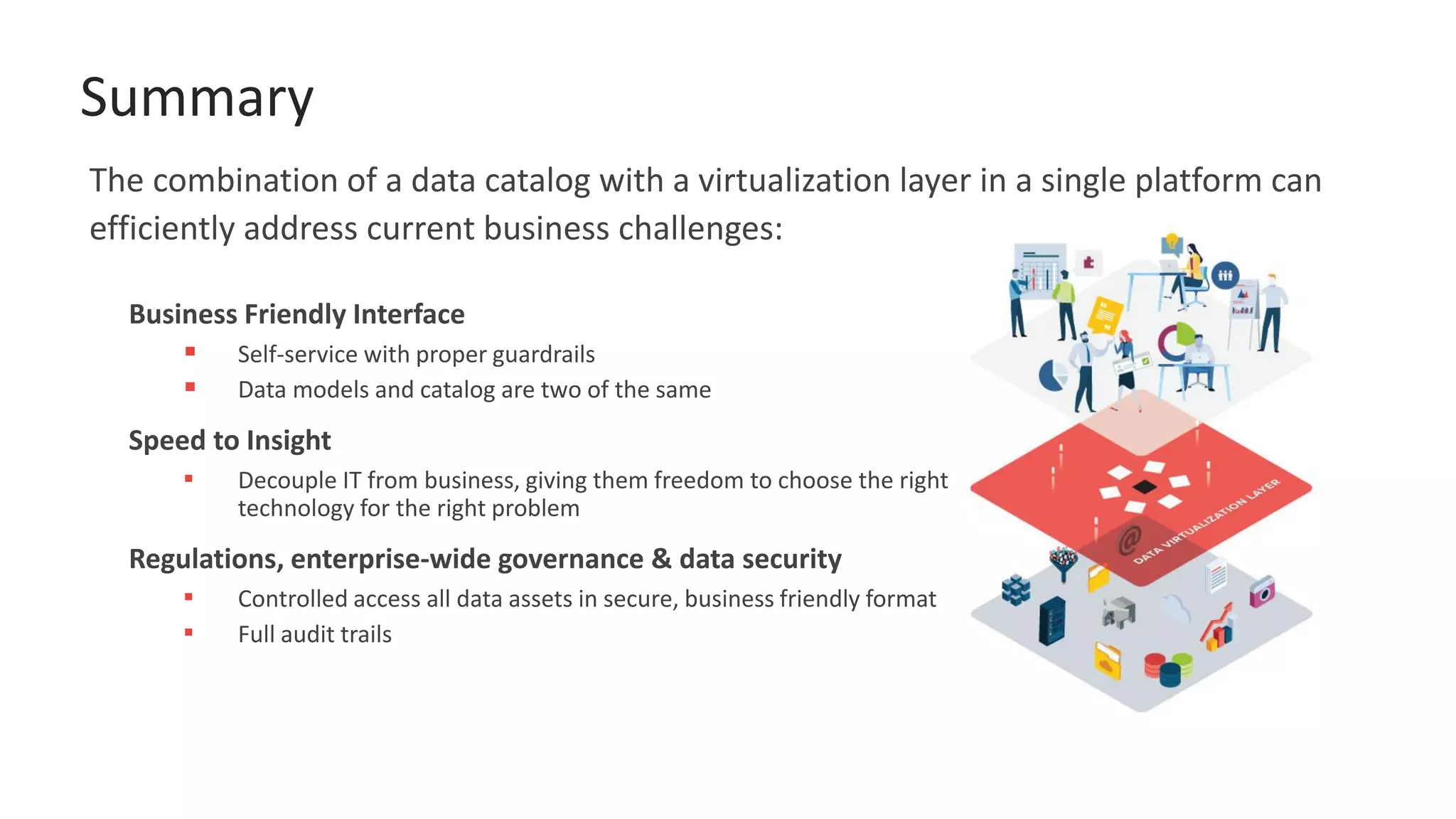
Summary
Business Friendly Interface
▪ Self-service with proper guardrails
▪ Data models and catalog are two of the same
Speed to Insight
▪ Decouple IT from business, giving them freedom to choose the right
technology for the right problem
Regulations, enterprise-wide governance & data security
▪ Controlled access all data assets in secure, business friendly format
▪ Full audit trails
The combination of a data catalog with a virtualization layer in a single platform can
efficiently address current business challenges:
Next Steps
Workshop offer:
For today’s participants we are offering a two-hour
assessment workshop to help you pinpoint where data
virtualisation will have the greatest impact in your
organisation.
Please contact either Adrian or Chris using the details below.
Contact information:
Adrian Bridge
Principal Consultant
RXP Group
0417 875 919
adrian.bridge@rxpservices.com
Chris Day
Director, APAC Sales Engineering
Denodo
+61 433 370 083
cday@denodo.com
VIRTUAL
November 24-25, 2020 | 9:00am SGT | 12:00pm AEDT
The Agile Data Management and Analytics
Conference
Advancing Cloud, Analytics & Data Science with Logical Data Fabric
REGISTER NOW
denodo.link/32Q70XC
Thank you

Data Virtualization for Business Consumption (Australia)

  • 1.
    Data Virtualisation forBusiness Consumption November 2020
  • 2.
    Enabling digital transformation by connectingexpression, experience and enablement 600+ Consultants 100+ Active Clients ASX Listed Company 4 Australian Locations
  • 3.
    EnablementExperienceExpression RXP Group ona page MAKING HAPPIER HUMANS Fusing brand, insight, design and technology to help organisations transform and innovate STRATEGY & ADVISORY EXPERIENCE & DESIGN DATA & INSIGHTS DIGITAL PLATFORMS ▪ Growth Strategy ▪ Brand Strategy ▪ Digital Transformation ▪ Human Centered Design ▪ User Experience ▪ Customer Experience ▪ Digital Development ▪ Service Design ▪ Program Management ▪ Project Management ▪ Business Analysis ▪ Organisational Change Management ▪ Quality Assurance/ Testing ▪ PMO Support ▪ Agile Delivery ▪ CRM ▪ ESM ▪ Web & Mobile Development ▪ Development ▪ Cloud & DevOps ▪ Microservices ▪ Test Automation BRAND & CONTENT PROJECT SERVICES ▪ Brand & CX Strategy ▪ Advertising & Digital Marketing ▪ Content Marketing ▪ Social Media ▪ Data Driven Marketing ▪ Brand Innovation ▪ Content Production ▪ Data Strategy ▪ Integration and API’s ▪ Data Governance ▪ Business Intelligence ▪ Visualisation ▪ Insights & Analytics ▪ Data Science and AI MANAGED SERVICES ▪ System Support ▪ Incident Management ▪ Defect Management ▪ Release Management ▪ Platform Integration ▪ Problem Management
  • 4.
    We improve businessintelligence, so that people can make better decisions DATA & INSIGHTS 100+ Consultants 4 Locations 2 Data Centre of Excellence’s (CoE’s) created 6 Top technology partnerships RXP Insight We combine agile methodologies and technology deployments that enable data consumers to uncover patterns and insights within data sets and easily automate repetitive processes to allow focus on data discovery. We specialise on end-to-end Information Management ecosystems and we provide consistent methodologies and best practice expertise across the entire data lifecycle: ▪ Data Strategy and Governance ▪ Data Modelling and Storage ▪ Integration & APIs ▪ Analytics & Visualisation ▪ AI, ML & NLP
  • 5.
    RXP Data ManagementFramework End-to-end Information Management framework for the enterprise data lifecycle.
  • 6.
    Data Management Strategyon a Page Mission: Expand and leverage our data capabilities to help customers achieve their personal best financial outcome, and strengthen our position as a financial provider of choice. Current State of Data • Data Management maturity score = 3.6; Quality = 4.0 • Data personalises Customer & Supplier experiences • Data is trusted as it is easy to access, always verified and explained • Data is consistently governed, timely and accessible for business users at speed and with transparent rules. • Real-time evidence of value for each Customer • Machine learning drives insights and decisions • Data refines automated assurance processes • Data drives innovation • Our data ecosystem empowers and protects external partner collaboration Top Data Management Initiatives: Data Governance program • Phase 1: Establish structures and processes; Tool evaluation • Phase 2: Tool selection & implementation Data Quality program implementation Data Management platform implementation • Augmentation of ingested data • Data segmentation & self service capabilities for business users Master Data Management • 360 degree views of Customer and Product Underlying Principles: 1.Data is an asset to be valued, governed, secured, maintained, certified and leveraged. 2.Every data asset will be owned by a business unit accountable for its governance. 3.Decisions on shared data will be centralised. 4.Our enterprise data architecture will be a cloud first, component and standards-based platform with architectural control centrally maintained and enforced. 5.Solution sourcing will apply the principles of ‘reuse before buy’ and ‘buy before build’. 6.A transparent and risk-based approach will underpin the regulatory compliance of our data processes and management of data risks. 7.Business users will be primarily responsible for self-service access to and routine analysis of data. 8.Data stored by our systems will by default be connected to analytic processes, not replicated in a data warehouse. 9.A balanced approach will be adopted to managing data transformation and operational support. 10.Business processes will be digitised, with performance data captured & analysed. • Data Management maturity score = 1.8 (of 5) • The majority of available data assets are being collected and utilised. • Data assets are not being consistently defined or governed. • Data Quality not owned or measured. Maturity score = 1.1 • Data assets are difficult for business users to access directly. • Data ingestion and transformation into a useable business data model is slow. • Non-traditional streaming and unstructured data sources are under-utilised. State of Data in 2022 Customer example #1
  • 7.
    Data Management Strategyon a Page Mission: Expand and leverage our data capabilities to help customers achieve their personal best financial outcome, and strengthen our position as a financial provider of choice. Current State of Data • Data Management maturity score = 3.6; Quality = 4.0 • Data personalises Customer & Supplier experiences • Data is trusted as it is easy to access, always verified and explained • Data is consistently governed, timely and accessible for business users at speed and with transparent rules. • Real-time evidence of value for each Customer • Machine learning drives insights and decisions • Data refines automated assurance processes • Data drives innovation • Our data ecosystem empowers and protects external partner collaboration Top Data Management Initiatives: Data Governance program • Phase 1: Establish structures and processes; Tool evaluation • Phase 2: Tool selection & implementation Data Quality program implementation Data Management platform implementation • Augmentation of ingested data • Data segmentation & self service capabilities for business users Master Data Management • 360 degree views of Customer and Product Underlying Principles: 1.Data is an asset to be valued, governed, secured, maintained, certified and leveraged. 2.Every data asset will be owned by a business unit accountable for its governance. 3.Decisions on shared data will be centralised. 4.Our enterprise data architecture will be a cloud first, component and standards-based platform with architectural control centrally maintained and enforced. 5.Solution sourcing will apply the principles of ‘reuse before buy’ and ‘buy before build’. 6.A transparent and risk-based approach will underpin the regulatory compliance of our data processes and management of data risks. 7.Business users will be primarily responsible for self-service access to and routine analysis of data. 8.Data stored by our systems will by default be connected to analytic processes, not replicated in a data warehouse. 9.A balanced approach will be adopted to managing data transformation and operational support. 10.Business processes will be digitised, with performance data captured & analysed. • Data Management maturity score = 1.8 (of 5) • The majority of available data assets are being collected and utilised. • Data assets are not being consistently defined or governed. • Data Quality not owned or measured. Maturity score = 1.1 • Data assets are difficult for business users to access directly. • Data ingestion and transformation into a useable business data model is slow. • Non-traditional streaming and unstructured data sources are under-utilised. State of Data in 2022 Data Virtualisation is relevant in these areas
  • 8.
    Strategy, Goals &Objectives Key Objectives • Create a connected data landscape that is easily shared by users in all business units. • Empower business users to identify appropriate data and have access to self-services Business Intelligence tools for interacting with that data. • Develop a state of data which is trusted and of demonstrably high quality. • Support decisions to change technology infrastructure arrangements or modernise line-of-business applications by creating a flexible data management architecture that facilitates change without impeding business performance. • Provide flexibility, resilience and rapid response to change in external data interactions. • Creation of an organisational ethos that, by valuing data as an enabler, is continuously testing, learning and improving all aspects of its operations. Trust: data is well defined, with its provenance (lineage) described, and has a senior business owner responsible for its appropriate governance. Data Literacy: data definitions are unambiguous and universally accessible. Quality: data is complete, validated against a trusted source and subject to continuous monitoring and improvement. Security: data is classified and secured at all times, with non- intrusive controls and monitoring in place for data access, sharing and breach reporting. Data Democratisation: data can be accessed, researched & analysed in a self-service environment. Time to Value: accelerate the time to business value of new data & analytic initiatives. Time Value of Data: using data while it retains its maximum impact or commercial value. Data history is also retained and accessible when it has business relevance. Data Enrichment: existing data sets can easily be augmented. Data Goals & Characteristicsachieved through enabling Customer Specific: Removed in this presentation Business Strategy Customer example #2
  • 9.
    Strategy, Goals &Objectives Data Virtualisation is relevant in these areas Key Objectives • Create a connected data landscape that is easily shared by users in all business units. • Empower business users to identify appropriate data and have access to self-services Business Intelligence tools for interacting with that data. • Develop a state of data which is trusted and of demonstrably high quality. • Support decisions to change technology infrastructure arrangements or modernise line-of-business applications by creating a flexible data management architecture that facilitates change without impeding business performance. • Provide flexibility, resilience and rapid response to change in external data interactions. • Creation of an organisational ethos that, by valuing data as an enabler, is continuously testing, learning and improving all aspects of its operations. Trust: data is well defined, with its provenance (lineage) described, and has a senior business owner responsible for its appropriate governance. Data Literacy: data definitions are unambiguous and universally accessible. Quality: data is complete, validated against a trusted source and subject to continuous monitoring and improvement. Security: data is classified and secured at all times, with non- intrusive controls and monitoring in place for data access, sharing and breach reporting. Data Democratisation: data can be accessed, researched & analysed in a self-service environment. Time to Value: accelerate the time to business value of new data & analytic initiatives. Time Value of Data: using data while it retains its maximum impact or commercial value. Data history is also retained and accessible when it has business relevance. Data Enrichment: existing data sets can easily be augmented. Data Goals & Characteristicsachieved through enabling Customer Specific: Removed in this presentation Business Strategy Customer example #2
  • 10.
    What do BusinessUsers Need
  • 11.
    11 IT DepartmentBusiness “You’re tooslow, too expensive, and never deliver what I want.” “You can’t make up your mind, keep adding features, and never see the big picture.” Casual User: “Just forget it.” Power User: “Just give me a data dump.” BU Leader: “We’ll do it ourselves.” “I’d rather be doing something else than taking your order.” “You’ll come crawling back to us soon.” Why is there a Problem?
  • 12.
    Business Users andSelf-Service Initiatives Supporting self-service initiatives need to focus on three areas: ▪ Visualization: ▪ Easy-to-use, business-oriented reporting tools and dashboards ▪ Understand and explore: ▪ Extended business metadata in catalog for end users ▪ Access: ▪ A data delivery strategy – a single logical consolidated view of the data
  • 13.
  • 14.
    Denodo’s Logical Architecture ETL DataWarehouse Kafka Physical Data Lake ML/AI SQL interface Logical Data Layer Streaming Analytics Distributed Storage Files DataAbstractionLayer Protocols,schemas,datatypes, datamodels,etc. DataCatalog BusinessSemantics,Explorationand Search,etc. ETL Data Warehouse Kafka Physical Data Lake ML/AI SQL interface Streaming Analytics Distributed Storage Files IT Storage and Processing BI & Reporting Mobile Applications Predictive Analytics AI/ML Real time dashboards Consumer Tools
  • 15.
    15 A logical datalayer – a “data fabric” – that provides high-performant, real-time, and secure access to integrated business views of disparate data across the enterprise The Denodo Platform 1. Data Abstraction: decoupling applications/data usage from data sources 2. Data Integration without replication or relocation of physical data 3. Easy Access to Any Data, high performant and real-time / right- time 4. Data Catalog for self-service data services and easy discovery 5. Unified metadata, security & governance across all data assets 6. Data Delivery in any format with intelligent query optimization that leverages new and existing physical data platforms
  • 16.
    16 Benefits of aVirtual Data Layer ▪ A Virtual Layer improves decision making and shortens development cycles • Surfaces all company data from multiple repositories without the need to replicate all data into a data warehouse or data lake. • Eliminates data silos allows for on-demand combination of data from multiple sources. ▪ A Virtual Layer broadens usage of data • Improves governance and metadata management to avoid “data swamps”. • Decouples data source technology. Access normalized via SQL or web services. • Allows controlled access to the data with low grain security controls. ▪ A Virtual Layer offers performant access • Leverages the processing power of the existing sources controlled by Denodo’s optimizer. • Processing of data for sources with no processing capabilities (e.g. files) • Caching and ingestion engine to persist data when needed. TTV USAGE PERFORMANCE
  • 17.
  • 18.
    Demo Personas Data Scientist BusinessUser BI Analyst Denodo is tool agnostic. Denodo provides SQL based access e.g. JDBC, ODBC and ADO.NET. Allows Integration with Reporting tools: Tableau, MicroStrategy, PowerBI, BO, Cognos, Looker, OBIEE, etc. Denodo’s Data Catalog is a marketplace for your data assets. Browse through tags and categories, understand lineage and data definitions. Search the catalog and validate the data is trustworthy. Denodo’s Notebook for data science allows execution of queries, visualization of charts and Python and R code. Based on Apache Zeppelin, a popular Open-source notebook. Fully integrated with Denodo’s security.
  • 19.
    19 Demo Scenario ▪ Historicalsales data offloaded to Hadoop cluster for cheaper storage ▪ Marketing campaigns managed in an external cloud app ▪ Country is part of the customer details table, stored in the DW Sources Combine, Transform & Integrate Consume Base View Source Abstraction join group by state join Sales Campaign Customer SaaS solution How effective are our marketing Campaigns?
  • 20.
    Data Governance forSelf Service Benefits Single Entry Point for Enforcing Security and Governance Policies Data on-premises and off, combined through the same governed virtual layer Single Source of Truth Who is Doing / Accessing What, When and How Fewer copies of personal data. Lineage of copies is available.
  • 21.
    Summary Business Friendly Interface ▪Self-service with proper guardrails ▪ Data models and catalog are two of the same Speed to Insight ▪ Decouple IT from business, giving them freedom to choose the right technology for the right problem Regulations, enterprise-wide governance & data security ▪ Controlled access all data assets in secure, business friendly format ▪ Full audit trails The combination of a data catalog with a virtualization layer in a single platform can efficiently address current business challenges:
  • 22.
    Next Steps Workshop offer: Fortoday’s participants we are offering a two-hour assessment workshop to help you pinpoint where data virtualisation will have the greatest impact in your organisation. Please contact either Adrian or Chris using the details below. Contact information: Adrian Bridge Principal Consultant RXP Group 0417 875 919 adrian.bridge@rxpservices.com Chris Day Director, APAC Sales Engineering Denodo +61 433 370 083 cday@denodo.com
  • 23.
    VIRTUAL November 24-25, 2020| 9:00am SGT | 12:00pm AEDT The Agile Data Management and Analytics Conference Advancing Cloud, Analytics & Data Science with Logical Data Fabric REGISTER NOW denodo.link/32Q70XC
  • 24.