CA ERwin
Data Modeling
Visualize the Power of Your Data
On Premise or in the Cloud

Donna Burbank
VP, Product Marketing
Who am I?

— More than more than 15 years of experience in the areas of
  data management, metadata management, and enterprise
  architecture.
   − Currently VP of Product Marketing for CA’s data modeling
     solutions.
   − Brand Strategy and Product Management roles at Computer
     Associates and Embarcadero Technologies
   − Senior consultant for PLATINUM technology’s information
     management consulting division in both the U.S. and Europe.
   − Worked with dozens of Fortune 500 companies worldwide in the
     U.S., Europe, Asia, and Africa and speaks regularly at industry
     conferences.
   − Co-author of several books including:
      • Data Modeling for the Business
      • Data Modeling Made Simple with CA ERwin Data Modeler r8
Where I Live
(Photo taken on Saturday)


3   February 8, 2012
Who Are You? Survey


—How would you describe your role?
   A. Data Architect, Data Modeler, or Analyst

   B. Businessperson or Business Analyst

   C. DBA or Technical IT

   D. A combination of the above

   E. Other
Are you Using CA ERwin? Survey


—Are you using CA ERwin currently?
    A. Yes! 

    B. No. 

    C. I’m not sure
What Version of ERwin? Survey


—What version of ERwin are you using?
    A. 8.x

    B. 7.x

    C. 4.x

    D. 3.x or earlier

    E. I’m not using ERwin, which is very sad. 
Agenda


    1         The Challenge: Managing Data Complexity


    2          The CA ERwin Solution: Visualize the Power of Your Data

    3         How a High-Level (Conceptual) Model Can Help

    4
    4
              ase Study: Major Oil Company
              What’s New in the CA ERwin Product Family


7       February 8, 2012   CA ERwin Data Modeling   Copyright © 2012 CA. All rights reserved.
The Challenge
Managing Data Complexity
The Challenge: Managing Data Complexity
 “Too Much Data, Too Little Time”
More Data & Platforms to Support
 Most organizations have more than one database platform—it’s hard to be an expert in all
 The number of databases is growing, with more & more applications to support
 Many organizations are trying to integrate multiple systems – as a result of mergers and
acquisitions, or for data warehousing or master data management projects
 The decision of what data to move to the Cloud is an important consideration


Fewer Staff and Resources
 Organizations are cutting back on IT staff, making it difficult to manage these growing
databases
 Skill sets for individual databases are very specialized. It is unrealistic (and expensive) to
have multiple experts for all platforms


  9   February 8, 2012   CA ERwin Data Modeling          Copyright © 2012 CA. All rights reserved.
The Business Challenge:
  Data Drives the Business – Make sure it’s Correct

 In today’s information age, data drives key business decisions.
 Executives ask questions such as:
   How many customers do I have?
   What is total revenue by region for last fiscal year?
   Which products drove the most revenue this quarter?
 Behind the answers to those questions lies a data model.
   Documenting the source and structure of data
        What database(s) store customer information
        How are these databases structure to store customer information
   Defining key business terms
        What is a product? e.g. Finished goods only? Raw materials?
   Regulating business rules
        Can a customer have more than one account?


  10   February 8, 2012   CA ERwin Data Modeling           Copyright © 2012 CA. All rights reserved.
Information in Context
There’s more to data than meets the eye
                                                                                              A customer is
                   I’d like a report                                                          someone who
                                                                                               wants to buy
                   showing all of                                             A customer is    our product.
                                                                              someone who                       A person’s not a
                   our customers                                                owns our                      customer if they don’t
                                                                                 product.                        have an active
                                                                                                              maintenance account.


                                                                                                    Sales
 Business                                                                                       My customers
 Executive                                                                       Accounting      are internal
                                                                                                 employees.

                                       Which customer                                                                     Support
                                       database do you                                                                    Engineer
                                        want me to pull
                                        this from? We
                                           have 25.                                                           HR
                                                           And, by the way, the
         Sybase
                                                            databases all store
                  Oracle                               customer information in a
 DB2                             DBA                  different format. “CUST_NM”
                                                       on DB2, “cust_last_nm” on
           Informix                                      Oracle, etc. It’s a mess.
 SQL                  Teradata
Server
                                           Data
          MS           SAP
                                         Architect
          SQL
         Azure
The CA ERwin Solution
Visualize the Power of Your Data
On-Premise or in the Cloud
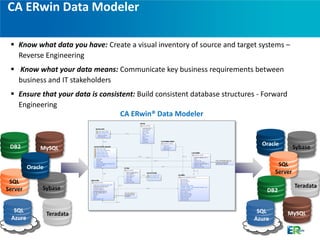
CA ERwin Data Modeler

  Know what data you have: Create a visual inventory of source and target systems –
   Reverse Engineering
  Know what your data means: Communicate key business requirements between
   business and IT stakeholders
  Ensure that your data is consistent: Build consistent database structures - Forward
   Engineering
                                  CA ERwin® Data Modeler


 DB2                                                                          Oracle
             MySQL                                                                          Sybase


         Oracle                                                                     SQL
                                                                                   Server
 SQL
              Sybase                                                                        Teradata
Server                                                                         DB2


  SQL                                                                       SQL          MySQL
                  Teradata
 Azure                                                                     Azure
CA ERwin Data Modeling
CA ERwin® Data Modeling
 At the Center of Your Data Management Initiatives
                               Cloud or SaaS BI +
                               Data Management

Master Data Management                              Business Intelligence +
         (MDM)                                      Data Warehousing


   Data                                                    Data Governance
Management


            ERP
        Integration                                  Application Developme


                                 Data Quality
CA ERwin Data Modeler
Product Editions
Why High-Level (Conceptual) Data Modeling
Is Important
The Challenge


—You’ve been tasked to assist in the creation of a Business
 Intelligence (BI) project
—Trying to obtain a single view of ‘customer’
—Technical and political challenges exist
  − Numerous systems have been built already—different platforms and databases
  − Parties cannot agree on a single definition of what a ‘customer’ is

—Solution: Need to build a High-Level Data Model
What is a High-Level Data Model?

—A high-level data model (HDM) uses simple graphical images to
 describe core concepts and principles of an organization and what
 they mean
—The main audience of a HDM is businesspeople
—An HDM is used to facilitate communication
—It needs to be high-level enough to be intuitive, but still capture
 the rules and definitions needed to create database systems.
“A Picture is Worth a Thousand Words”
Examples of High-Level Data Models
“A Picture is Worth a Thousand Words”
Examples of High-Level Data Models


             Product                    Location


                             Customer              Region
           Order
                                          Raw
                                         Material
                       Ingredient
“A Picture is Worth a Thousand Words”
Examples of High-Level Data Models
“A Picture is Worth a Thousand Words”
Examples of High-Level Data Models
“A Picture is Worth a Thousand Words”
Examples of High-Level Data Models
“A Picture is Worth a Thousand Words”
Examples of High-Level Data Models
Levels of Data Models


—Models can be built
  − Top-Down
  − Bottom-Up
  − Using a Hybrid Approach
How is this Different from a Logical Model?
                  VHDM                                        HDM                                         LDM
Defines the scope, audience, context for     Defines key business concepts and their     Represents core business rules and data
information                                  definitions                                 relationships at a detailed level
Main purpose is for communication and        Main purpose is for communication and       Provides enough detail for subsequent
agreement of scope and context               agreement of definitions and business       first cut physical design
                                             logic
Relationships optional. If shown,            Many-to-Many relationships OK               Many-to-Many relationships resolved
represent hierarchy.
Cardinality not shown                        Cardinality shown                           Cardinality shown
No attributes shown                          Attributes are optional. If shown, can be   Attributes required and all attributes are
                                             composite attributes to convey business     atomic. Primary and foreign keys
                                             meaning.                                    defined.
Not normalized (Relational models)           Not normalized (Relational models)          Fully normalized (Relational models)

Subject names should represent high-         Concept names should use business           Entity names may be more abstract
level data subjects or functional areas of   terminology
the business
Subjects link to 1-M HDMs                    Many concepts are supertypes, although      Supertypes all broken out to include sub-
                                             subtypes may be shown for clarity           types
‘One pager’                                  Should be a ‘one pager’                     May be larger than one page
Business-driven                              Cross-functional & more senior people       Multiple smaller groups of specialists
                                             involved in HDM process with fewer IT.      and IT folks involved in LDM process.
Informal notation                            ‘Looser’ notation required – some format    Formal notation required
                                             construct needed, but ultimate goal is to
                                             be understood by a business user
< 20 objects                                 < 100 objects                               > 100 objects
Building a High-Level Data Model


—Let’s go back to our challenge, to achieve a ‘single version of the
 truth’ for Customer information
—We have 5 different systems with customer information in them:
  − 2 on Oracle
  − 1 on DB2
  − 1 SAP system
  − 1 using MS SQL Server
                                                          Oracle
                                                 DB2                Oracle


                                                  SQL         SAP
                                                 Server
Building a High-Level Data Model


—We start with a very simple HDM, with just one object on it, called
 “Customer”.
—We use an ER Model and show business definitions


                     Too Simple??
Too simple?


—Our team thought so, so went ahead and focused on the technical
 integration, including:
  − Reverse engineering a physical model from each system
  − Creating ETL scripts
  − Migrating the data into a single hub
  − Building a reporting system off of the data
Focusing on the Business


—This implementation went “perfectly”, with no errors in the scripts,
 no data type inconsistencies, no delays in schedule, etc.
—We built a complex BI reporting system to show our upper
 management the results.
—We even sent out a welcome email to all of our customers, giving
 them a 50% off coupon, and thanking them for their support.
Focusing on the Business

—Until we showed the report to the business sponsor:
  − We can’t have 2000 customers in this region! I know we only have around 400!
  − Why is Global Bank Company on this list? They are still evaluating our product!
    Sales was negotiating a 10% discount with them, and you just sent them a 50%
    coupon!?!?
  − You just spent all of that money in IT to build this report with bad data???
Back to the Drawing Board


—After doing an extensive review of the six source systems, and
 talking with the system owners we discovered that:
  − The DB2 system was actually used by Sales to track their prospective “customers”
  − These “customers” didn’t match our definition—they didn’t own a product of ours!!
Oops!


—We were mixing current customers, with prospects (non-
 customers).
  − We just sent a discount coupon to 1600 of the wrong people!
  − We gave upper management a report showing the wrong figure for our total number
    of customers!
  − We are now significantly over budget to have to go back and fix this!!

—We started over, this time with a High-Level Data Model
Achieving Consensus


 We created a report of the various definitions of customer


 And verified with the various stakeholders that:
    There were 2 (and only 2 definitions) of customer

    Sales was OK with calling their “customer” a “prospect”
Resolving Differences


—Our new high-level data model looked like this:
Identify Model Stakeholders


— Make sure ALL relevant parties are involved in the design process
 Get buy-in!
Identify Model Stakeholders


— Make sure ALL relevant parties are involved in the design process
 Get buy-in!
A HDM Facilitates Communication

—A High-Level Data Model Facilitates Communication between
 Business and IT
  − Focus on your (business) audience
     • Intuitive display
     • Capture the business rules and definitions in your model
  − Simplicity does not mean lack of importance
     • A simple model can express important concepts
     • Ignoring the key business definitions can have negative affects
  − A model or tool is only part of the solution
     • Communication is key
     • Process and Best Practices are critical to achieve consensus and buy-in
Communication is the Main Goal
                of a High-Level Data Model

—Wouldn’t it be helpful if we did this in daily life, too?
—i.e. “Let’s go on a family vacation!”


       Person     Concept    Definition
       Father     Vacation   An opportunity to take the time to achieve new goals
       Mother     Vacation   Time to relax and read a book
       Jane       Vacation   A chance to get outside and exercise
       Bobby      Vacation   Time to be with friends
       Donna      Vacation   More time to build data models
Some Creative Ways to Facilitate Conversations with
Stakeholders

— Food!
  − “Lunch and Learn”
  − Bring candy to meetings
— Force?
  − “No bathroom breaks until we reach consensus!”
— Active Listening
  − Understand why there is disagreement (e.g. “Ingredient” vs. Raw Material)
— Fit into their schedule
  − Webinars
  − The “5 minute rule” for business execs – small, bite-sized models or questions.
— Publish in an easily-accessible, intuitive format
  − Web-based publishing
  − Spreadsheet-style reporting
Identify Model Purpose


— Key to success of any project is finding the right pain-point and
 solving it.
— Make sure your model focuses on a particular pain point, i.e.
 migrating an application or understanding an area of the business
                               Existing                Proposed
   Business             “Today an Account can    “By next quarter, an
                        only be owned by one     Account can be owned by
                        Customer.”               more than one Customer.”

   Application          “In the legacy Account   “When we migrate to
                        Management system, we    SAP/R3, Account Holder
                        call the customer an     will be represented as
                        Account Holder.”         Object.”
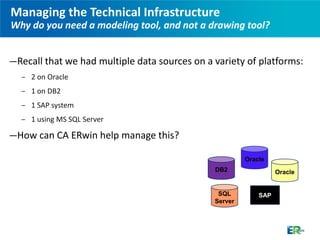
Managing the Technical Infrastructure
Why do you need a modeling tool, and not a drawing tool?


—Recall that we had multiple data sources on a variety of platforms:
  − 2 on Oracle
  − 1 on DB2
  − 1 SAP system
  − 1 using MS SQL Server

—How can CA ERwin help manage this?

                                                        Oracle
                                               DB2                Oracle


                                                SQL         SAP
                                               Server
Creating a Data Inventory


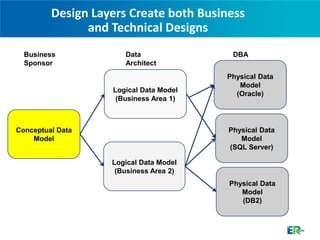
— “Design Once, Reuse Many Times” across heterogeneous platforms
— Design layers allow you to have a single high-level/logical model pointing to
  numerous physical model platforms.


                                                     Oracle


                                                                 DB2


                                                    SQL Server
Design Layers Create both Business
               and Technical Designs
  Business            Data               DBA
  Sponsor             Architect
                                        Physical Data
                                           Model
                   Logical Data Model
                                          (Oracle)
                    (Business Area 1)


Conceptual Data                         Physical Data
    Model                                  Model
                                        (SQL Server)

                   Logical Data Model
                    (Business Area 2)
                                        Physical Data
                                           Model
                                           (DB2)
A Data Model can be your Filter

—A Data Model can add:
  − Focus – by Subject Area, by Platform, etc.
  − Visualization – Different Views for Different Audiences
  − Translation – to different DMBS AND to non DBMS formats such as UML, BI tools,
    Excel, XML, etc, etc.


                                    Data Model
           Oracle

                    Oracle
  DB2                                                         Developers     Business
                                                                             Sponsors
           ETC!                                                       ETC!
                             DB2
 SQL                                                          3NF
Server   IDMS
                      SAP
                                                        Data Architects       DBAs
Create Different Displays for Different
 Audiences: BUSINESS
—Business
Create Different Displays for Different
Audiences: TECHNICAL
Generate Intuitive Reports for End Users
Many users want to see definitions, but not read a data model.
Use the Web to Share Information
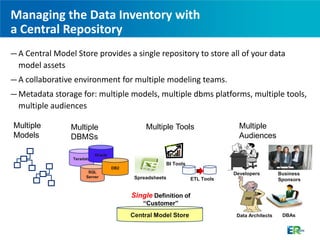
Managing the Data Inventory with
a Central Repository
— A Central Model Store provides a single repository to store all of your data
  model assets
— A collaborative environment for multiple modeling teams.
— Metadata storage for: multiple models, multiple dbms platforms, multiple tools,
  multiple audiences

Multiple         Multiple                       Multiple Tools                  Multiple
Models           DBMSs                                                          Audiences

                            Oracle
                 Teradata
                                                       BI Tools
                                     DB2
                        SQL                                                   Developers         Business
                       Server               Spreadsheets          ETL Tools                      Sponsors


                                           Single Definition of                   3NF
                                               “Customer”
                                           Central Model Store                 Data Architects    DBAs
Understanding ERP Systems with
CA ERwin Saphir Option
       Important metadata is found beyond traditional databases.
       ERP Systems also contain critical information about customers, employees, etc.
           SAP, Oracle, JD Edwards, etc.
       These ERP systems are difficult to manage with a traditional “reverse
        engineering” process using a data modeling tool
         There are thousands of tables
         When we reverse engineer them, we get unintuitive technical names
Understanding ERP Systems with
CA ERwin Saphir Option
 Using the CA ERwin Saphir Option, we can easily group tables by
  subject area, and can translate table and column names into
  intuitive, English versions.
 And can more easily integrate ERP data models into our enterprise
  data architecture.
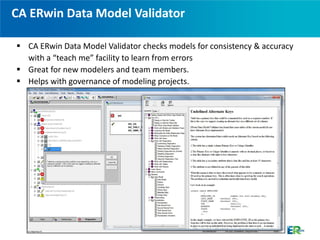
CA ERwin Data Model Validator

 CA ERwin Data Model Validator checks models for consistency & accuracy
  with a “teach me” facility to learn from errors
 Great for new modelers and team members.
 Helps with governance of modeling projects.
What’s New in the CA ERwin Product Family
CA ERwin Data Modeling r8.2
Three New Offerings


CA ERwin® Web Portal      CA ERwin® Data        CA ERwin® Data
                         Model for Microsoft     Modeler r8.2
                            SQL Azure
 Visualize Information    Managing Data –       Collaboration
from the Web – for All   Both On-Premise + in    Facilitated
      Audiences               the Cloud
Data Management – Moving to the Cloud

 Many customers are nervous moving their data to the Cloud.
  Concerns include:
   Security/Privacy
   Learning curve for new technologies
   Integration with other data mgt. systems or applications
 A data model can help allay these fears
   Assurance that your data is managed securely—using a data model as your roadmap. You
    decide what data stays on premise and what moves to the Cloud. Once in the Cloud,
    understand and manage the data stored off-premises.
   Use Existing Skills: Customers can use the same familiar data modeling paradigm for Cloud-
    based data as for their on-premises data using CA ERwin Data Modeler.
   Visualize both on-premises (Oracle, Sybase, SQL Server, DB2, etc.) and Cloud-based
    databases (MS SQL Azure) from a single data modeling environment
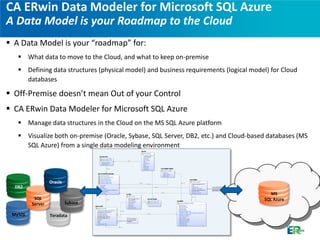
CA ERwin Data Modeler for Microsoft SQL Azure
A Data Model is your Roadmap to the Cloud
 A Data Model is your “roadmap” for:
    What data to move to the Cloud, and what to keep on-premise
    Defining data structures (physical model) and business requirements (logical model) for Cloud
     databases

 Off-Premise doesn’t mean Out of your Control
 CA ERwin Data Modeler for Microsoft SQL Azure
    Manage data structures in the Cloud on the MS SQL Azure platform
    Visualize both on-premise (Oracle, Sybase, SQL Server, DB2, etc.) and Cloud-based databases (MS
     SQL Azure) from a single data modeling environment


                  Oracle
  DB2
                                                                                         MS
          SQL                                                                         SQL Azure
         Server            Sybase

 MySQL            Teradata
CA ERwin Web Portal
   Sharing Information with All Audiences
— While some users need a                       — Many more can access &
  desktop tool to build and                       understand information via
  analyze data models,                            a web-based interface.


   Data        Database      Data Modeler                          Business
 Architect   Administrator                                          Analyst
                (DBA)
                                                                                 Developer
                                                 Business User /
                                                    Steward


                                      Data         Data Modeler                  BI Analyst
                                    Architect

                                                 DBA               MDM Analyst
   60
CA ERwin Web Portal
Web-Based Search, Impact Analysis, Reporting


 The CA ERwin Web Portal makes it easy to share metadata
  (information in context) with both Business and Technical users
   Internet-Style Keyword Search
   Diagram Visualization
   Graphical Impact Analysis
   Reporting
   Interfaces for Business vs. Technical Users
   Easy to roll-out to multiple users (no local install)
                                                            CA ERwin
                                                            Web Portal
CA ERwin Web Portal
Diagram Visualization with Drill-Down

                                                                                  View models in a variety of
                                                                                   formats
                                                                                         IE, IDEF, UML, and more

                                                                                  Drill-down to see object
                                                                                   details
                                                                                         Definitions, Comments, User-
                                                                                          Defined Data Types, etc.


  62   February 8, 2012   CA ERwin Data Modeling   Copyright © 2012 CA. All rights reserved.
CA ERwin Web Portal
Internet-style Keyword Search


63   February 8, 2012   CA ERwin Data Modeling   Copyright © 2012 CA. All rights reserved.
CA ERwin Web Portal
Graphical Impact Analysis & Lineage


64   February 8, 2012   CA ERwin Data Modeling   Copyright © 2012 CA. All rights reserved.
CA ERwin Data Modeler r8.2
  Collaboration Facilitated
 CA ERwin Data Modeler r8.2 has two main features to facilitate
  collaboration across the enterprise:

       Active Model Templates
        Allows more granular reuse of model object (tables, entities, domains)
        Supports reuse and object sharing to help reduce costs and increase quality
        Intuitive, wizard-driven interface


       Concurrent Licensing
        Licenses can be more easily shared and managed across the organization via a
       web-based interface
        Helping customers get the most our of their ERwin investment


  65     February 8, 2012   CA ERwin Data Modeling   Copyright © 2012 CA. All rights reserved.
Active Model Templates
 Creating Enterprise Standards
— Ability to Reuse and Synchronize Enterprise Model Objects
  with other models across the Organization.


Enterprise Model Objects
                                                              Project 1


                           Synchronize


                                                              Project 2


 66   February 8, 2012
Active Model Templates

— Ability to define “Enterprise” objects for Reuse
     − Share individual model objects, not just models
        • tables, entities, domains, etc.
     − Wizard-driven
     − Synchronize with other model objects
        • Automatically on model load
        • Or manually, user-driven through Wizard

— First phase in “Data Dictionary” style model sharing
     − Next Step is Repository (Mart)-based sharing in r9


67   February 8, 2012
To Learn More, visit www.erwin.com/br


68   February 8, 2012   CA ERwin Data Modeling   Copyright © 2012 CA. All rights reserved.
Summary


— CA ERwin helps you manage the data complexity in your
  organization
— Using high-level models can help increase communication with
  the business and achieve better results
— CA ERwin Data Modeler r8.2 offers three new solutions
  − CA ERwin Web Portal
  − CA ERwin Data Modeler for SQL Azure
  − CA ERwin Data Modeler r8.2 point release

— Helping you Visualize the Power of Your Data: On Premise or in
  the Cloud

   February 8, 2012   CA ERwin Data Modeling   Copyright © 2012 CA. All rights reserved.
thank you

Lançamento ERwin 08/02

  • 1.
    CA ERwin Data Modeling Visualizethe Power of Your Data On Premise or in the Cloud Donna Burbank VP, Product Marketing
  • 2.
    Who am I? —More than more than 15 years of experience in the areas of data management, metadata management, and enterprise architecture. − Currently VP of Product Marketing for CA’s data modeling solutions. − Brand Strategy and Product Management roles at Computer Associates and Embarcadero Technologies − Senior consultant for PLATINUM technology’s information management consulting division in both the U.S. and Europe. − Worked with dozens of Fortune 500 companies worldwide in the U.S., Europe, Asia, and Africa and speaks regularly at industry conferences. − Co-author of several books including: • Data Modeling for the Business • Data Modeling Made Simple with CA ERwin Data Modeler r8
  • 3.
    Where I Live (Phototaken on Saturday) 3 February 8, 2012
  • 4.
    Who Are You?Survey —How would you describe your role? A. Data Architect, Data Modeler, or Analyst B. Businessperson or Business Analyst C. DBA or Technical IT D. A combination of the above E. Other
  • 5.
    Are you UsingCA ERwin? Survey —Are you using CA ERwin currently? A. Yes!  B. No.  C. I’m not sure
  • 6.
    What Version ofERwin? Survey —What version of ERwin are you using? A. 8.x B. 7.x C. 4.x D. 3.x or earlier E. I’m not using ERwin, which is very sad. 
  • 7.
    Agenda 1 The Challenge: Managing Data Complexity 2 The CA ERwin Solution: Visualize the Power of Your Data 3 How a High-Level (Conceptual) Model Can Help 4 4 ase Study: Major Oil Company What’s New in the CA ERwin Product Family 7 February 8, 2012 CA ERwin Data Modeling Copyright © 2012 CA. All rights reserved.
  • 8.
  • 9.
    The Challenge: ManagingData Complexity “Too Much Data, Too Little Time” More Data & Platforms to Support  Most organizations have more than one database platform—it’s hard to be an expert in all  The number of databases is growing, with more & more applications to support  Many organizations are trying to integrate multiple systems – as a result of mergers and acquisitions, or for data warehousing or master data management projects  The decision of what data to move to the Cloud is an important consideration Fewer Staff and Resources  Organizations are cutting back on IT staff, making it difficult to manage these growing databases  Skill sets for individual databases are very specialized. It is unrealistic (and expensive) to have multiple experts for all platforms 9 February 8, 2012 CA ERwin Data Modeling Copyright © 2012 CA. All rights reserved.
  • 10.
    The Business Challenge: Data Drives the Business – Make sure it’s Correct  In today’s information age, data drives key business decisions.  Executives ask questions such as:  How many customers do I have?  What is total revenue by region for last fiscal year?  Which products drove the most revenue this quarter?  Behind the answers to those questions lies a data model.  Documenting the source and structure of data  What database(s) store customer information  How are these databases structure to store customer information  Defining key business terms  What is a product? e.g. Finished goods only? Raw materials?  Regulating business rules  Can a customer have more than one account? 10 February 8, 2012 CA ERwin Data Modeling Copyright © 2012 CA. All rights reserved.
  • 11.
    Information in Context There’smore to data than meets the eye A customer is I’d like a report someone who wants to buy showing all of A customer is our product. someone who A person’s not a our customers owns our customer if they don’t product. have an active maintenance account. Sales Business My customers Executive Accounting are internal employees. Which customer Support database do you Engineer want me to pull this from? We have 25. HR And, by the way, the Sybase databases all store Oracle customer information in a DB2 DBA different format. “CUST_NM” on DB2, “cust_last_nm” on Informix Oracle, etc. It’s a mess. SQL Teradata Server Data MS SAP Architect SQL Azure
  • 12.
    The CA ERwinSolution Visualize the Power of Your Data On-Premise or in the Cloud
  • 13.
    CA ERwin DataModeler  Know what data you have: Create a visual inventory of source and target systems – Reverse Engineering  Know what your data means: Communicate key business requirements between business and IT stakeholders  Ensure that your data is consistent: Build consistent database structures - Forward Engineering CA ERwin® Data Modeler DB2 Oracle MySQL Sybase Oracle SQL Server SQL Sybase Teradata Server DB2 SQL SQL MySQL Teradata Azure Azure
  • 14.
    CA ERwin DataModeling
  • 15.
    CA ERwin® DataModeling At the Center of Your Data Management Initiatives Cloud or SaaS BI + Data Management Master Data Management Business Intelligence + (MDM) Data Warehousing Data Data Governance Management ERP Integration Application Developme Data Quality
  • 16.
    CA ERwin DataModeler Product Editions
  • 17.
    Why High-Level (Conceptual)Data Modeling Is Important
  • 18.
    The Challenge —You’ve beentasked to assist in the creation of a Business Intelligence (BI) project —Trying to obtain a single view of ‘customer’ —Technical and political challenges exist − Numerous systems have been built already—different platforms and databases − Parties cannot agree on a single definition of what a ‘customer’ is —Solution: Need to build a High-Level Data Model
  • 19.
    What is aHigh-Level Data Model? —A high-level data model (HDM) uses simple graphical images to describe core concepts and principles of an organization and what they mean —The main audience of a HDM is businesspeople —An HDM is used to facilitate communication —It needs to be high-level enough to be intuitive, but still capture the rules and definitions needed to create database systems.
  • 20.
    “A Picture isWorth a Thousand Words” Examples of High-Level Data Models
  • 21.
    “A Picture isWorth a Thousand Words” Examples of High-Level Data Models Product Location Customer Region Order Raw Material Ingredient
  • 22.
    “A Picture isWorth a Thousand Words” Examples of High-Level Data Models
  • 23.
    “A Picture isWorth a Thousand Words” Examples of High-Level Data Models
  • 24.
    “A Picture isWorth a Thousand Words” Examples of High-Level Data Models
  • 25.
    “A Picture isWorth a Thousand Words” Examples of High-Level Data Models
  • 26.
  • 27.
    Levels of DataModels —Models can be built − Top-Down − Bottom-Up − Using a Hybrid Approach
  • 28.
    How is thisDifferent from a Logical Model? VHDM HDM LDM Defines the scope, audience, context for Defines key business concepts and their Represents core business rules and data information definitions relationships at a detailed level Main purpose is for communication and Main purpose is for communication and Provides enough detail for subsequent agreement of scope and context agreement of definitions and business first cut physical design logic Relationships optional. If shown, Many-to-Many relationships OK Many-to-Many relationships resolved represent hierarchy. Cardinality not shown Cardinality shown Cardinality shown No attributes shown Attributes are optional. If shown, can be Attributes required and all attributes are composite attributes to convey business atomic. Primary and foreign keys meaning. defined. Not normalized (Relational models) Not normalized (Relational models) Fully normalized (Relational models) Subject names should represent high- Concept names should use business Entity names may be more abstract level data subjects or functional areas of terminology the business Subjects link to 1-M HDMs Many concepts are supertypes, although Supertypes all broken out to include sub- subtypes may be shown for clarity types ‘One pager’ Should be a ‘one pager’ May be larger than one page Business-driven Cross-functional & more senior people Multiple smaller groups of specialists involved in HDM process with fewer IT. and IT folks involved in LDM process. Informal notation ‘Looser’ notation required – some format Formal notation required construct needed, but ultimate goal is to be understood by a business user < 20 objects < 100 objects > 100 objects
  • 29.
    Building a High-LevelData Model —Let’s go back to our challenge, to achieve a ‘single version of the truth’ for Customer information —We have 5 different systems with customer information in them: − 2 on Oracle − 1 on DB2 − 1 SAP system − 1 using MS SQL Server Oracle DB2 Oracle SQL SAP Server
  • 30.
    Building a High-LevelData Model —We start with a very simple HDM, with just one object on it, called “Customer”. —We use an ER Model and show business definitions Too Simple??
  • 31.
    Too simple? —Our teamthought so, so went ahead and focused on the technical integration, including: − Reverse engineering a physical model from each system − Creating ETL scripts − Migrating the data into a single hub − Building a reporting system off of the data
  • 32.
    Focusing on theBusiness —This implementation went “perfectly”, with no errors in the scripts, no data type inconsistencies, no delays in schedule, etc. —We built a complex BI reporting system to show our upper management the results. —We even sent out a welcome email to all of our customers, giving them a 50% off coupon, and thanking them for their support.
  • 33.
    Focusing on theBusiness —Until we showed the report to the business sponsor: − We can’t have 2000 customers in this region! I know we only have around 400! − Why is Global Bank Company on this list? They are still evaluating our product! Sales was negotiating a 10% discount with them, and you just sent them a 50% coupon!?!? − You just spent all of that money in IT to build this report with bad data???
  • 34.
    Back to theDrawing Board —After doing an extensive review of the six source systems, and talking with the system owners we discovered that: − The DB2 system was actually used by Sales to track their prospective “customers” − These “customers” didn’t match our definition—they didn’t own a product of ours!!
  • 35.
    Oops! —We were mixingcurrent customers, with prospects (non- customers). − We just sent a discount coupon to 1600 of the wrong people! − We gave upper management a report showing the wrong figure for our total number of customers! − We are now significantly over budget to have to go back and fix this!! —We started over, this time with a High-Level Data Model
  • 36.
    Achieving Consensus  Wecreated a report of the various definitions of customer  And verified with the various stakeholders that:  There were 2 (and only 2 definitions) of customer  Sales was OK with calling their “customer” a “prospect”
  • 37.
    Resolving Differences —Our newhigh-level data model looked like this:
  • 38.
    Identify Model Stakeholders —Make sure ALL relevant parties are involved in the design process Get buy-in!
  • 39.
    Identify Model Stakeholders —Make sure ALL relevant parties are involved in the design process Get buy-in!
  • 40.
    A HDM FacilitatesCommunication —A High-Level Data Model Facilitates Communication between Business and IT − Focus on your (business) audience • Intuitive display • Capture the business rules and definitions in your model − Simplicity does not mean lack of importance • A simple model can express important concepts • Ignoring the key business definitions can have negative affects − A model or tool is only part of the solution • Communication is key • Process and Best Practices are critical to achieve consensus and buy-in
  • 41.
    Communication is theMain Goal of a High-Level Data Model —Wouldn’t it be helpful if we did this in daily life, too? —i.e. “Let’s go on a family vacation!” Person Concept Definition Father Vacation An opportunity to take the time to achieve new goals Mother Vacation Time to relax and read a book Jane Vacation A chance to get outside and exercise Bobby Vacation Time to be with friends Donna Vacation More time to build data models
  • 42.
    Some Creative Waysto Facilitate Conversations with Stakeholders — Food! − “Lunch and Learn” − Bring candy to meetings — Force? − “No bathroom breaks until we reach consensus!” — Active Listening − Understand why there is disagreement (e.g. “Ingredient” vs. Raw Material) — Fit into their schedule − Webinars − The “5 minute rule” for business execs – small, bite-sized models or questions. — Publish in an easily-accessible, intuitive format − Web-based publishing − Spreadsheet-style reporting
  • 43.
    Identify Model Purpose —Key to success of any project is finding the right pain-point and solving it. — Make sure your model focuses on a particular pain point, i.e. migrating an application or understanding an area of the business Existing Proposed Business “Today an Account can “By next quarter, an only be owned by one Account can be owned by Customer.” more than one Customer.” Application “In the legacy Account “When we migrate to Management system, we SAP/R3, Account Holder call the customer an will be represented as Account Holder.” Object.”
  • 44.
    Managing the TechnicalInfrastructure Why do you need a modeling tool, and not a drawing tool? —Recall that we had multiple data sources on a variety of platforms: − 2 on Oracle − 1 on DB2 − 1 SAP system − 1 using MS SQL Server —How can CA ERwin help manage this? Oracle DB2 Oracle SQL SAP Server
  • 45.
    Creating a DataInventory — “Design Once, Reuse Many Times” across heterogeneous platforms — Design layers allow you to have a single high-level/logical model pointing to numerous physical model platforms. Oracle DB2 SQL Server
  • 46.
    Design Layers Createboth Business and Technical Designs Business Data DBA Sponsor Architect Physical Data Model Logical Data Model (Oracle) (Business Area 1) Conceptual Data Physical Data Model Model (SQL Server) Logical Data Model (Business Area 2) Physical Data Model (DB2)
  • 47.
    A Data Modelcan be your Filter —A Data Model can add: − Focus – by Subject Area, by Platform, etc. − Visualization – Different Views for Different Audiences − Translation – to different DMBS AND to non DBMS formats such as UML, BI tools, Excel, XML, etc, etc. Data Model Oracle Oracle DB2 Developers Business Sponsors ETC! ETC! DB2 SQL 3NF Server IDMS SAP Data Architects DBAs
  • 48.
    Create Different Displaysfor Different Audiences: BUSINESS —Business
  • 49.
    Create Different Displaysfor Different Audiences: TECHNICAL
  • 50.
    Generate Intuitive Reportsfor End Users Many users want to see definitions, but not read a data model.
  • 51.
    Use the Webto Share Information
  • 52.
    Managing the DataInventory with a Central Repository — A Central Model Store provides a single repository to store all of your data model assets — A collaborative environment for multiple modeling teams. — Metadata storage for: multiple models, multiple dbms platforms, multiple tools, multiple audiences Multiple Multiple Multiple Tools Multiple Models DBMSs Audiences Oracle Teradata BI Tools DB2 SQL Developers Business Server Spreadsheets ETL Tools Sponsors Single Definition of 3NF “Customer” Central Model Store Data Architects DBAs
  • 53.
    Understanding ERP Systemswith CA ERwin Saphir Option  Important metadata is found beyond traditional databases.  ERP Systems also contain critical information about customers, employees, etc.  SAP, Oracle, JD Edwards, etc.  These ERP systems are difficult to manage with a traditional “reverse engineering” process using a data modeling tool  There are thousands of tables  When we reverse engineer them, we get unintuitive technical names
  • 54.
    Understanding ERP Systemswith CA ERwin Saphir Option  Using the CA ERwin Saphir Option, we can easily group tables by subject area, and can translate table and column names into intuitive, English versions.  And can more easily integrate ERP data models into our enterprise data architecture.
  • 55.
    CA ERwin DataModel Validator  CA ERwin Data Model Validator checks models for consistency & accuracy with a “teach me” facility to learn from errors  Great for new modelers and team members.  Helps with governance of modeling projects.
  • 56.
    What’s New inthe CA ERwin Product Family CA ERwin Data Modeling r8.2
  • 57.
    CA ERwin DataModeling r8.2 Three New Offerings CA ERwin® Web Portal CA ERwin® Data CA ERwin® Data Model for Microsoft Modeler r8.2 SQL Azure Visualize Information Managing Data – Collaboration from the Web – for All Both On-Premise + in Facilitated Audiences the Cloud
  • 58.
    Data Management –Moving to the Cloud  Many customers are nervous moving their data to the Cloud. Concerns include:  Security/Privacy  Learning curve for new technologies  Integration with other data mgt. systems or applications  A data model can help allay these fears  Assurance that your data is managed securely—using a data model as your roadmap. You decide what data stays on premise and what moves to the Cloud. Once in the Cloud, understand and manage the data stored off-premises.  Use Existing Skills: Customers can use the same familiar data modeling paradigm for Cloud- based data as for their on-premises data using CA ERwin Data Modeler.  Visualize both on-premises (Oracle, Sybase, SQL Server, DB2, etc.) and Cloud-based databases (MS SQL Azure) from a single data modeling environment
  • 59.
    CA ERwin DataModeler for Microsoft SQL Azure A Data Model is your Roadmap to the Cloud  A Data Model is your “roadmap” for:  What data to move to the Cloud, and what to keep on-premise  Defining data structures (physical model) and business requirements (logical model) for Cloud databases  Off-Premise doesn’t mean Out of your Control  CA ERwin Data Modeler for Microsoft SQL Azure  Manage data structures in the Cloud on the MS SQL Azure platform  Visualize both on-premise (Oracle, Sybase, SQL Server, DB2, etc.) and Cloud-based databases (MS SQL Azure) from a single data modeling environment Oracle DB2 MS SQL SQL Azure Server Sybase MySQL Teradata
  • 60.
    CA ERwin WebPortal Sharing Information with All Audiences — While some users need a — Many more can access & desktop tool to build and understand information via analyze data models, a web-based interface. Data Database Data Modeler Business Architect Administrator Analyst (DBA) Developer Business User / Steward Data Data Modeler BI Analyst Architect DBA MDM Analyst 60
  • 61.
    CA ERwin WebPortal Web-Based Search, Impact Analysis, Reporting  The CA ERwin Web Portal makes it easy to share metadata (information in context) with both Business and Technical users  Internet-Style Keyword Search  Diagram Visualization  Graphical Impact Analysis  Reporting  Interfaces for Business vs. Technical Users  Easy to roll-out to multiple users (no local install) CA ERwin Web Portal
  • 62.
    CA ERwin WebPortal Diagram Visualization with Drill-Down  View models in a variety of formats  IE, IDEF, UML, and more  Drill-down to see object details  Definitions, Comments, User- Defined Data Types, etc. 62 February 8, 2012 CA ERwin Data Modeling Copyright © 2012 CA. All rights reserved.
  • 63.
    CA ERwin WebPortal Internet-style Keyword Search 63 February 8, 2012 CA ERwin Data Modeling Copyright © 2012 CA. All rights reserved.
  • 64.
    CA ERwin WebPortal Graphical Impact Analysis & Lineage 64 February 8, 2012 CA ERwin Data Modeling Copyright © 2012 CA. All rights reserved.
  • 65.
    CA ERwin DataModeler r8.2 Collaboration Facilitated  CA ERwin Data Modeler r8.2 has two main features to facilitate collaboration across the enterprise: Active Model Templates  Allows more granular reuse of model object (tables, entities, domains)  Supports reuse and object sharing to help reduce costs and increase quality  Intuitive, wizard-driven interface Concurrent Licensing  Licenses can be more easily shared and managed across the organization via a web-based interface  Helping customers get the most our of their ERwin investment 65 February 8, 2012 CA ERwin Data Modeling Copyright © 2012 CA. All rights reserved.
  • 66.
    Active Model Templates Creating Enterprise Standards — Ability to Reuse and Synchronize Enterprise Model Objects with other models across the Organization. Enterprise Model Objects Project 1 Synchronize Project 2 66 February 8, 2012
  • 67.
    Active Model Templates —Ability to define “Enterprise” objects for Reuse − Share individual model objects, not just models • tables, entities, domains, etc. − Wizard-driven − Synchronize with other model objects • Automatically on model load • Or manually, user-driven through Wizard — First phase in “Data Dictionary” style model sharing − Next Step is Repository (Mart)-based sharing in r9 67 February 8, 2012
  • 68.
    To Learn More,visit www.erwin.com/br 68 February 8, 2012 CA ERwin Data Modeling Copyright © 2012 CA. All rights reserved.
  • 69.
    Summary — CA ERwinhelps you manage the data complexity in your organization — Using high-level models can help increase communication with the business and achieve better results — CA ERwin Data Modeler r8.2 offers three new solutions − CA ERwin Web Portal − CA ERwin Data Modeler for SQL Azure − CA ERwin Data Modeler r8.2 point release — Helping you Visualize the Power of Your Data: On Premise or in the Cloud February 8, 2012 CA ERwin Data Modeling Copyright © 2012 CA. All rights reserved.
  • 70.