SALES & DISTRIBUTION (SD)SALES & DISTRIBUTION (SD)
OverviewOverview
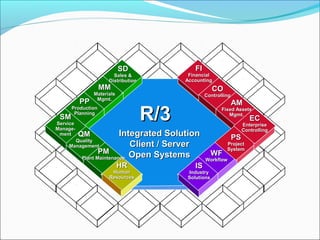
R/3R/3
FIFI
FinancialFinancial
AccountingAccounting
COCO
ControllingControlling
PSPS
ProjectProject
SystemSystem
WFWF
WorkflowWorkflow
ISIS
IndustryIndustry
SolutionsSolutions
MMMM
MaterialsMaterials
Mgmt.Mgmt.
HRHR
HumanHuman
ResourcesResources
SDSD
Sales &Sales &
DistributionDistribution
PPPP
ProductionProduction
PlanningPlanning
QMQM
QualityQuality
ManagementManagement
PMPM
Plant MaintenancePlant Maintenance
SMSM
ServiceService
Manage-Manage-
mentment Integrated SolutionIntegrated Solution
Client / ServerClient / Server
Open SystemsOpen Systems
ECEC
EnterpriseEnterprise
ControllingControlling
AMAM
Fixed AssetsFixed Assets
Mgmt.Mgmt.
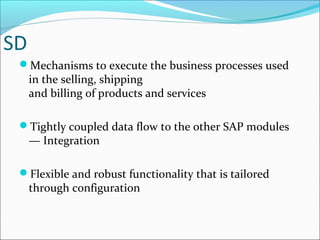
SD
Mechanisms to execute the business processes used
in the selling, shipping
and billing of products and services
Tightly coupled data flow to the other SAP modules
— Integration
Flexible and robust functionality that is tailored
through configuration
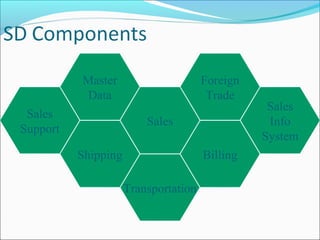
Sales
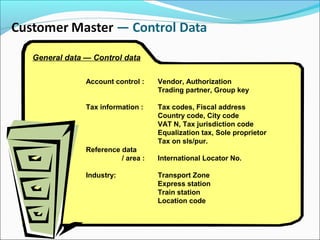
Support
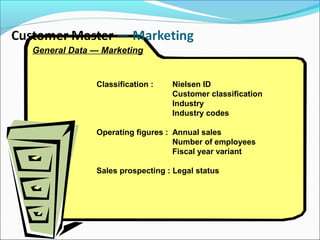
Master
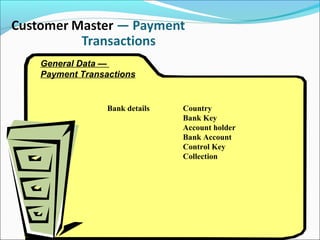
Data
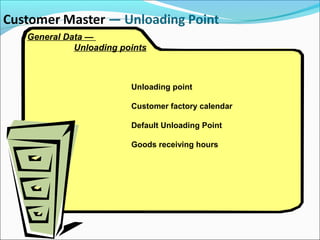
Shipping
Sales
Foreign
Trade
Billing
Sales
Info
System
Transportation
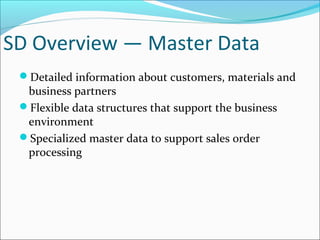
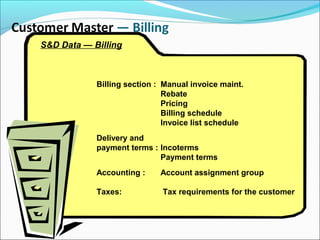
SD Overview — Master Data
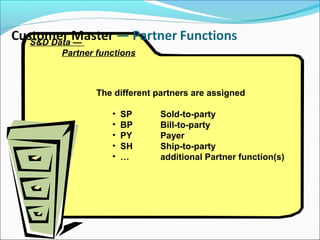
Detailed information about customers, materials and
business partners
Flexible data structures that support the business
environment
Specialized master data to support sales order
processing
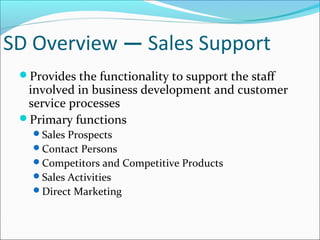
SD Overview — Sales Support
Provides the functionality to support the staff
involved in business development and customer
service processes
Primary functions
Sales Prospects
Contact Persons
Competitors and Competitive Products
Sales Activities
Direct Marketing
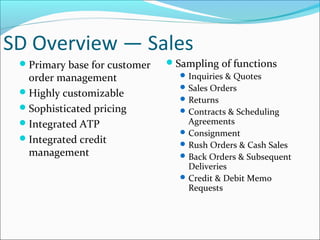
SD Overview — Sales
Primary base for customer
order management
Highly customizable
Sophisticated pricing
Integrated ATP
Integrated credit
management
Sampling of functions
Inquiries & Quotes
Sales Orders
Returns
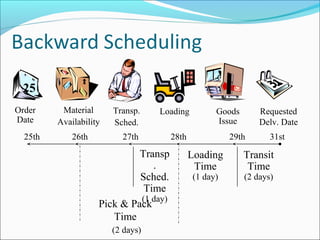
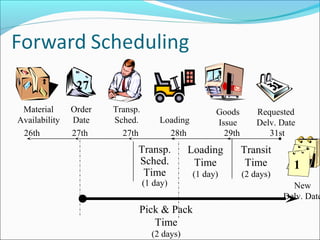
Contracts & Scheduling
Agreements
Consignment
Rush Orders & Cash Sales
Back Orders & Subsequent
Deliveries
Credit & Debit Memo
Requests
SD Overview — Shipping
Main functions
 Picking, Packing & Inventory management
 Generate Shipping Documents
Transportation Management
Routes
Transportation Scheduling
Delivery Scheduling, Returns Deliveries & Stock
Transfer
SD Overview — Billing
Invoice Generation — automatic or manual
Comprehensive set of billing functions
Linked documents — e.g. invoice & credit memo
Real-time integration with finance (FI)
Fully integrated and comprehensive pricing
SD Overview — S I S
Flexible tool that allows one to collect, consolidate,
and utilize data from sales and distribution
processing
A component of the Logistic Information System
(LIS)
TransportationTransportation
Foreign TradeForeign Trade
Sales & DistributionSales & Distribution
- Process Flow -- Process Flow -
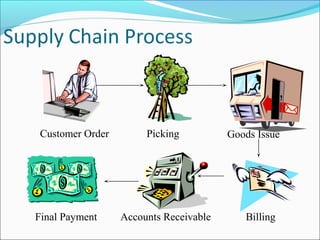
Customer Order Picking Goods Issue
BillingAccounts ReceivableFinal Payment
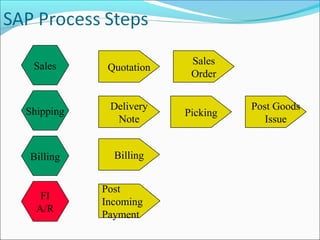
Quotation
Sales
Order
Sales
Shipping Delivery
Note
Picking
Post Goods
Issue
Billing Billing
FI
A/R
Post
Incoming
Payment
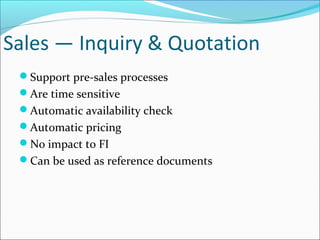
Sales — Inquiry & Quotation
Support pre-sales processes
Are time sensitive
Automatic availability check
Automatic pricing
No impact to FI
Can be used as reference documents
Sales — Sales Order
Core of customer order
management
No impact to G/L
Can reference existing
documents
Copies key information
from master data
Automated standard
functions ...
availability check
MRP updating
pricing
credit check
delivery scheduling
export control
shipping & route
determination
Shipping — Delivery Note
Initiates the shipping process
Control document for shipping processes —
maintains status of each processing step
Re-confirms: availability, credit, foreign trade,
delivery scheduling
Facilitates transportation planning
Shipping — Picking & Packing
Picking: Physical activity of moving goods from the
warehouse for further processing (packing, loading)
Packing: Determines packing materials and packing
details
Advanced processing includes, e.g. batch mgmt.,
serial number control
Shipping — Post Goods Issue
Completes the shipping process
Typically performed when customer takes ownership
Updates inventory
Updates G/L accounts
Cost of goods sold
Inventory
Billing
Generate customer invoice
Updates FI
Customer account
G/L accounts: revenue, discount, etc.
Applies relevant pricing
Updates customer credit
Sales & DistributionSales & Distribution
- Organizational Structures -- Organizational Structures -
Sales Organization
Baseball
Division
BB
Softball
Division
SB
Direct
Distribution Channel
DI
Baseball
Division
BB
Softball
Division
SB
Wholesale
Distribution Channel
WH
Baseball
Division
BB
Softball
Division
SB
Retail
Distribution Channel
RE
Domestic Sales
Sales Organization
So00
Baseball
Division
BB
Cricket
Division
SB
Wholesale
Distribution Channel
WH
Europe
Sales Organization
EURO
Baseball
Division
BB
Wholesale
Distribution Channel
WH
Asia Pacific
Sales Organization
APAC
Pastime Corporation
Company Code
CC00
Client
860
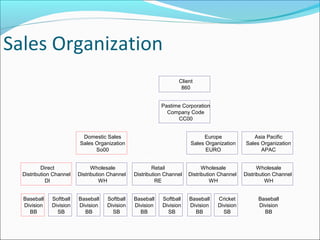
Sales Organization
Sells and distributes products, negotiates terms of
sales and is responsible for these business
transactions
Critical organization element to the definition of
business markets
A business transaction is linked to one Sales
Organization
Distribution Channel
Identifies how products and services reach the
customer
Can be assigned to one or more Sales Organizations
Division
Often times used to define product line distribution
Organization level to which customer specific
information and requirements are maintained — e.g.
pricing, partial delivery
Assigned to one or more Sales Organizations
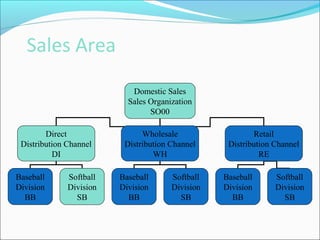
Sales Area
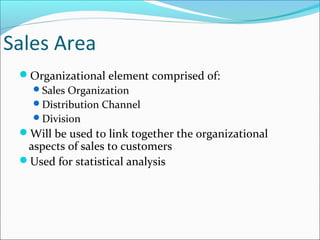
Organizational element comprised of:
Sales Organization
Distribution Channel
Division
Will be used to link together the organizational
aspects of sales to customers
Used for statistical analysis
Sales Area
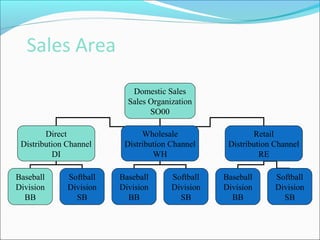
Domestic Sales
Sales Organization
SO00
Direct
Distribution Channel
DI
Wholesale
Distribution Channel
WH
Retail
Distribution Channel
RE
Baseball
Division
BB
Softball
Division
SB
Baseball
Division
BB
Softball
Division
SB
Baseball
Division
BB
Softball
Division
SB
Sales Area
Domestic Sales
Sales Organization
SO00
Direct
Distribution Channel
DI
Wholesale
Distribution Channel
WH
Retail
Distribution Channel
RE
Baseball
Division
BB
Softball
Division
SB
Baseball
Division
BB
Softball
Division
SB
Baseball
Division
BB
Softball
Division
SB
Sales Office
Typically defines a territory or market area
Linked to one or more Sales Areas
Optional organization structure
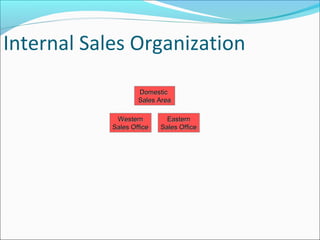
Internal Sales Organization
DomesticDomestic
Sales AreaSales Area
WesternWestern
Sales OfficeSales Office
EasternEastern
Sales OfficeSales Office
Sales Group
Sales Group
Sub-division of a sales office, territory or market
Sales Person
Sales Person
Defined in HR — Personnel Admin.
Specifically defines an individual rather than a position
(sales rep.) in sales processing
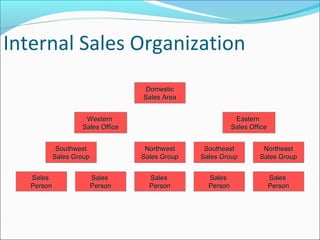
Internal Sales Organization
DomesticDomestic
Sales AreaSales Area
WesternWestern
Sales OfficeSales Office
EasternEastern
Sales OfficeSales Office
SouthwestSouthwest
Sales GroupSales Group
NorthwestNorthwest
Sales GroupSales Group
SalesSales
PersonPerson
SalesSales
PersonPerson
SalesSales
PersonPerson
SoutheastSoutheast
Sales GroupSales Group
NortheastNortheast
Sales GroupSales Group
SalesSales
PersonPerson
SalesSales
PersonPerson
Shipping Point & Loading Point
Shipping Point
Location that performs all delivery related activities
Assigned a factory calendar
A delivery can be processed from only one shipping
point
Loading Point
A subdivision of the shipping point used for more
specialized handling
Shipping Organization
D o c k # 1
L o a d in g P t
D 1
D o c k # 2
L o a d in g P t
D 2
F r e ig h t D o c k
S h ip p in g P t
S P 0 0
D o c k # 3
L o a d in g P t
E X
E x p r e s s
S h ip p in g P t
Q U I K
D o c k # 2
L o a d in g P t
X P
E x p o r t
S h ip p in g P t
E X P T
S io u x F a lls
P L A N T
P T 0 0
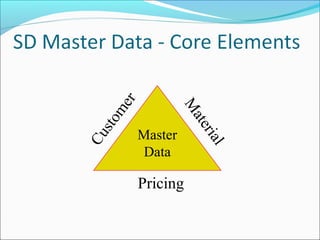
Sales & DistributionSales & Distribution
- Master Data -- Master Data -
Master
Data
Customer
M
aterial
Pricing
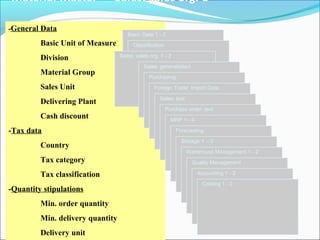
-General Data
Basic Unit of Measure
Division
Material Group
Sales Unit
Delivering Plant
Cash discount
-Tax data
Country
Tax category
Tax classification
-Quantity stipulations
Min. order quantity
Min. delivery quantity
Delivery unit
Basic Data 1 - 2
Classification
Sales: sales org. 1 - 2
Sales: general/plant
Purchasing
Foreign Trade: Import Data
Sales: text
Purchase order: text
MRP 1 - 4
Forecasting
Storage 1 - 2
Warehouse Management 1 - 2
Quality Management
Accounting 1 - 2
Costing 1 - 2
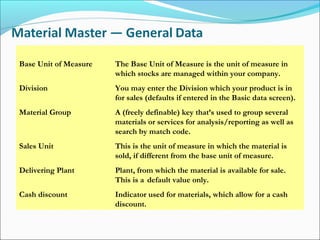
Base Unit of Measure The Base Unit of Measure is the unit of measure in
which stocks are managed within your company.
Division You may enter the Division which your product is in
for sales (defaults if entered in the Basic data screen).
Material Group A (freely definable) key that’s used to group several
materials or services for analysis/reporting as well as
search by match code.
Sales Unit This is the unit of measure in which the material is
sold, if different from the base unit of measure.
Delivering Plant Plant, from which the material is available for sale.
This is a default value only.
Cash discount Indicator used for materials, which allow for a cash
discount.
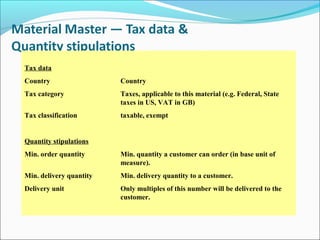
Tax data
Country Country
Tax category Taxes, applicable to this material (e.g. Federal, State
taxes in US, VAT in GB)
Tax classification taxable, exempt
Quantity stipulations
Min. order quantity Min. quantity a customer can order (in base unit of
measure).
Min. delivery quantity Min. delivery quantity to a customer.
Delivery unit Only multiples of this number will be delivered to the
customer.
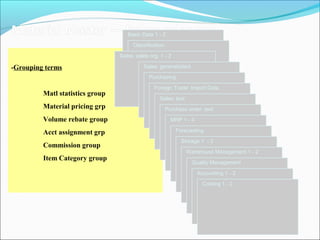
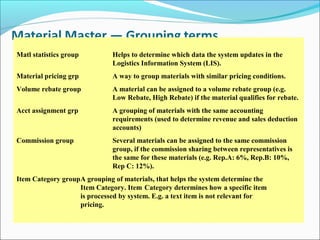
-Grouping terms
Matl statistics group
Material pricing grp
Volume rebate group
Acct assignment grp
Commission group
Item Category group
Basic Data 1 - 2
Classification
Sales: sales org. 1 - 2
Sales: general/plant
Purchasing
Foreign Trade: Import Data
Sales: text
Purchase order: text
MRP 1 - 4
Forecasting
Storage 1 - 2
Warehouse Management 1 - 2
Quality Management
Accounting 1 - 2
Costing 1 - 2
Matl statistics group Helps to determine which data the system updates in the
Logistics Information System (LIS).
Material pricing grp A way to group materials with similar pricing conditions.
Volume rebate group A material can be assigned to a volume rebate group (e.g.
Low Rebate, High Rebate) if the material qualifies for rebate.
Acct assignment grp A grouping of materials with the same accounting
requirements (used to determine revenue and sales deduction
accounts)
Commission group Several materials can be assigned to the same commission
group, if the commission sharing between representatives is
the same for these materials (e.g. Rep.A: 6%, Rep.B: 10%,
Rep C: 12%).
Item Category groupA grouping of materials, that helps the system determine the
Item Category. Item Category determines how a specific item
is processed by system. E.g. a text item is not relevant for
pricing.
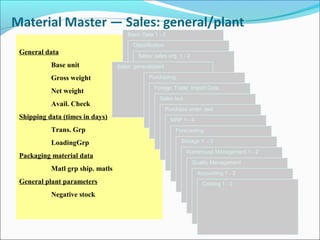
General data
Base unit
Gross weight
Net weight
Avail. Check
Shipping data (times in days)
Trans. Grp
LoadingGrp
Packaging material data
Matl grp ship. matls
General plant parameters
Negative stock
Basic Data 1 - 2
Classification
Sales: sales org. 1 - 2
Sales: general/plant
Purchasing
Foreign Trade: Import Data
Sales text
Purchase order: text
MRP 1 - 4
Forecasting
Storage 1 - 2
Warehouse Management 1 - 2
Quality Management
Accounting 1 - 2
Costing 1 - 2
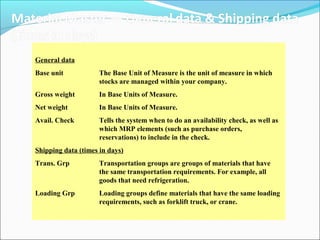
General data
Base unit The Base Unit of Measure is the unit of measure in which
stocks are managed within your company.
Gross weight In Base Units of Measure.
Net weight In Base Units of Measure.
Avail. Check Tells the system when to do an availability check, as well as
which MRP elements (such as purchase orders,
reservations) to include in the check.
Shipping data (times in days)
Trans. Grp Transportation groups are groups of materials that have
the same transportation requirements. For example, all
goods that need refrigeration.
Loading Grp Loading groups define materials that have the same loading
requirements, such as forklift truck, or crane.
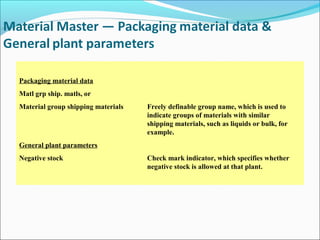
Packaging material data
Matl grp ship. matls, or
Material group shipping materials Freely definable group name, which is used to
indicate groups of materials with similar
shipping materials, such as liquids or bulk, for
example.
General plant parameters
Negative stock Check mark indicator, which specifies whether
negative stock is allowed at that plant.
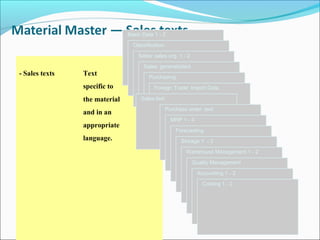
- Sales texts Text
specific to
the material
and in an
appropriate
language.
Basic Data 1 - 2
Classification
Sales: sales org. 1 - 2
Sales: general/plant
Purchasing
Foreign Trade: Import Data
Sales text
Purchase order: text
MRP 1 - 4
Forecasting
Storage 1 - 2
Warehouse Management 1 - 2
Quality Management
Accounting 1 - 2
Costing 1 - 2
Account Groups
Account group determines which fields are to be
used in defining customer master data
Field Status
Field status controls the use of each field within the
customer master determining whether a field is
required, optional, suppressed or display only
Field status controls are also relevant to a specific
activity — create, change, or display
Sales & DistributionSales & Distribution
-- Customer MasterCustomer Master --
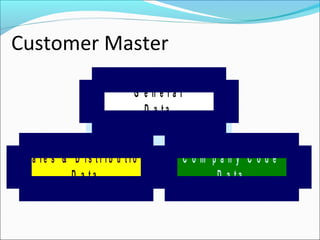
Customer Master
S a l e s & D i s t r i b u t i o n
D a t a
C o m p a n y C o d e
D a t a
G e n e r a l
D a t a
Customer Master
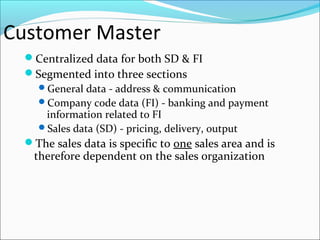
Centralized data for both SD & FI
Segmented into three sections
General data - address & communication
Company code data (FI) - banking and payment
information related to FI
Sales data (SD) - pricing, delivery, output
The sales data is specific to one sales area and is
therefore dependent on the sales organization
Customer Master by Sales Area
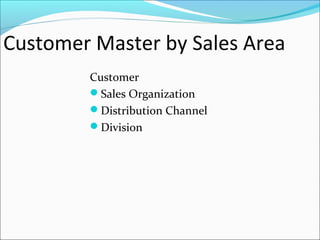
Customer
Sales Organization
Distribution Channel
Division
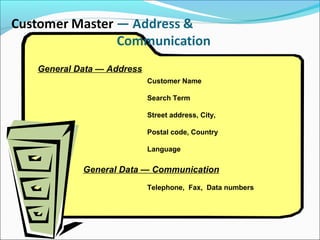
General Data — Address
Customer Name
Search Term
Street address, City,
Postal code, Country
Language
General Data — Communication
Telephone, Fax, Data numbers
General data — Control data
Account control : Vendor, Authorization
Trading partner, Group key
Tax information : Tax codes, Fiscal address
Country code, City code
VAT N, Tax jurisdiction code
Equalization tax, Sole proprietor
Tax on sls/pur.
Reference data
/ area : International Locator No.
Industry: Transport Zone
Express station
Train station
Location code
General Data — Marketing
Classification : Nielsen ID
Customer classification
Industry
Industry codes
Operating figures : Annual sales
Number of employees
Fiscal year variant
Sales prospecting : Legal status
General Data —
Payment Transactions
Bank details Country
Bank Key
Account holder
Bank Account
Control Key
Collection
General Data —
Unloading points
Unloading point
Customer factory calendar
Default Unloading Point
Goods receiving hours
General Data —
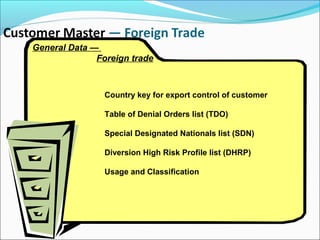
Foreign trade
Country key for export control of customer
Table of Denial Orders list (TDO)
Special Designated Nationals list (SDN)
Diversion High Risk Profile list (DHRP)
Usage and Classification
General Data —
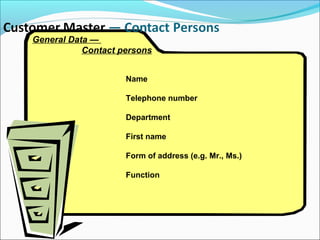
Contact persons
Name
Telephone number
Department
First name
Form of address (e.g. Mr., Ms.)
Function
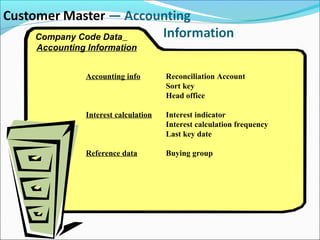
Accounting info Reconciliation Account
Sort key
Head office
Interest calculation Interest indicator
Interest calculation frequency
Last key date
Reference data Buying group
Company Code Data
Accounting Information
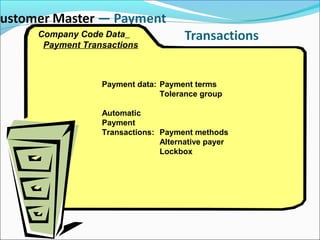
Company Code Data
Payment Transactions
Payment data: Payment terms
Tolerance group
Automatic
Payment
Transactions: Payment methods
Alternative payer
Lockbox
Company Code Data
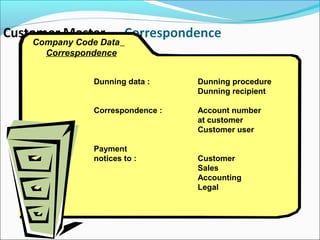
Correspondence
Dunning data : Dunning procedure
Dunning recipient
Correspondence : Account number
at customer
Customer user
Payment
notices to : Customer
Sales
Accounting
Legal
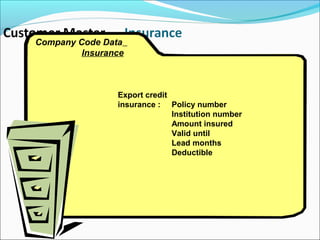
Company Code Data
Insurance
Export credit
insurance : Policy number
Institution number
Amount insured
Valid until
Lead months
Deductible
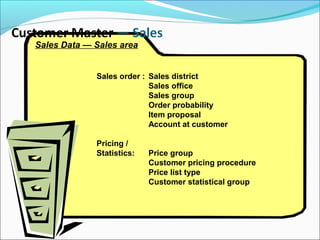
Sales Data — Sales area
Sales order : Sales district
Sales office
Sales group
Order probability
Item proposal
Account at customer
Pricing /
Statistics: Price group
Customer pricing procedure
Price list type
Customer statistical group
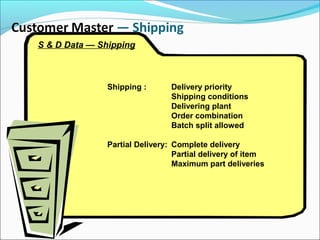
S & D Data — Shipping
Shipping : Delivery priority
Shipping conditions
Delivering plant
Order combination
Batch split allowed
Partial Delivery: Complete delivery
Partial delivery of item
Maximum part deliveries
S&D Data — Billing
Billing section : Manual invoice maint.
Rebate
Pricing
Billing schedule
Invoice list schedule
Delivery and
payment terms : Incoterms
Payment terms
Accounting : Account assignment group
Taxes: Tax requirements for the customer
S&D Data —
Partner functions
The different partners are assigned
• SP Sold-to-party
• BP Bill-to-party
• PY Payer
• SH Ship-to-party
• … additional Partner function(s)
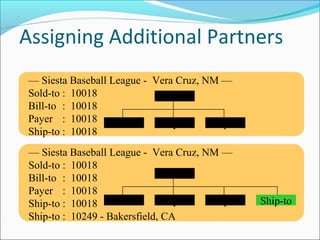
Assigning Additional Partners
— Siesta Baseball League - Vera Cruz, NM —
Sold-to : 10018
Bill-to : 10018
Payer : 10018
Ship-to : 10018
— Siesta Baseball League - Vera Cruz, NM —
Sold-to : 10018
Bill-to : 10018
Payer : 10018
Ship-to : 10018
Ship-to : 10249 - Bakersfield, CA
Sold-to
Payer Ship-toBill-to
Sold-to
Payer Ship-toBill-to Ship-to
Sales & DistributionSales & Distribution
-- Business PartnersBusiness Partners --
Business Partners
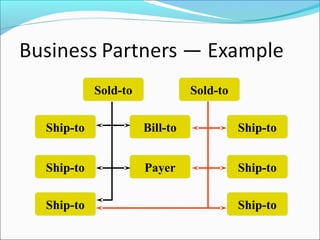
Defines all of the parties involved in a business
transaction and differentiates between their roles
— customer, carrier, employees, customer contact,
etc.
Through customizing the system automatically
assigns partners to the customer master and to
transactions
Sold-to Ship-to Bill-to Payer
Business Partners
The system creates these four business
partners by default. All four are required.
All four may be the same or may be different.
Since these are automatically assigned
partners you may need to add additional
partners to carry out your business
transactions.
Sold-to Ship-to Bill-to Payer
Business partners — Sold-to
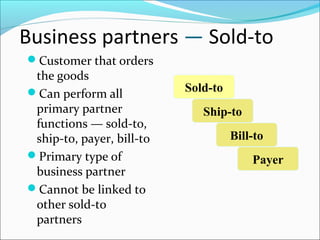
Customer that orders
the goods
Can perform all
primary partner
functions — sold-to,
ship-to, payer, bill-to
Primary type of
business partner
Cannot be linked to
other sold-to
partners
Sold-to
Ship-to
Bill-to
Payer
Business partners — Ship-to
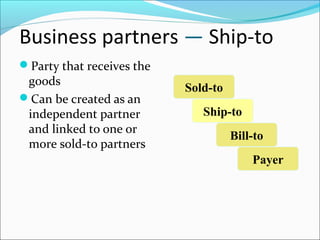
Party that receives the
goods
Can be created as an
independent partner
and linked to one or
more sold-to partners
Sold-to
Ship-to
Bill-to
Payer
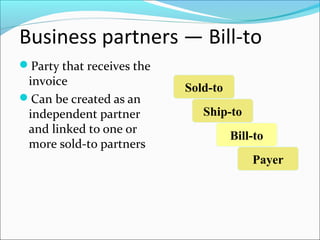
Business partners — Bill-to
Party that receives the
invoice
Can be created as an
independent partner
and linked to one or
more sold-to partners
Sold-to
Ship-to
Bill-to
Payer
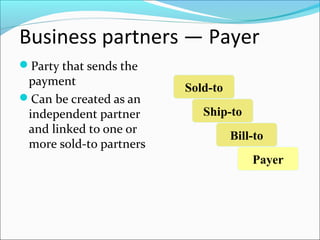
Business partners — Payer
Party that sends the
payment
Can be created as an
independent partner
and linked to one or
more sold-to partners
Sold-to
Ship-to
Bill-to
Payer
Sold-to
Bill-to
Payer
Ship-to
Ship-to
Ship-to
Ship-to
Ship-to
Ship-to
Sold-to
Sales & DistributionSales & Distribution
-- PricingPricing --
Pricing
“World-class” functionality
Highly customizable & extendible
One of the most complex features of SAP
Used to determine the net price for a material or an
order
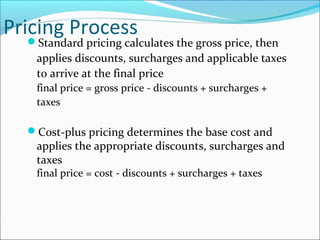
Pricing Process
Standard pricing calculates the gross price, then
applies discounts, surcharges and applicable taxes
to arrive at the final price
final price = gross price - discounts + surcharges +
taxes
Cost-plus pricing determines the base cost and
applies the appropriate discounts, surcharges and
taxes
final price = cost - discounts + surcharges + taxes
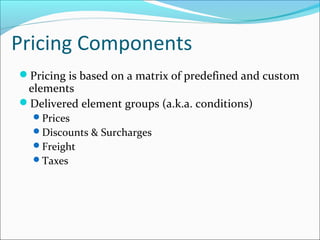
Pricing Components
Pricing is based on a matrix of predefined and custom
elements
Delivered element groups (a.k.a. conditions)
Prices
Discounts & Surcharges
Freight
Taxes
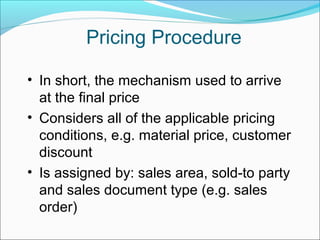
Pricing Procedure
• In short, the mechanism used to arrive
at the final price
• Considers all of the applicable pricing
conditions, e.g. material price, customer
discount
• Is assigned by: sales area, sold-to party
and sales document type (e.g. sales
order)
Pricing Procedure
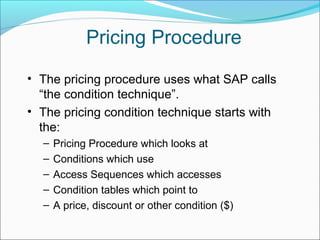
• The pricing procedure uses what SAP calls
“the condition technique”.
• The pricing condition technique starts with
the:
– Pricing Procedure which looks at
– Conditions which use
– Access Sequences which accesses
– Condition tables which point to
– A price, discount or other condition ($)
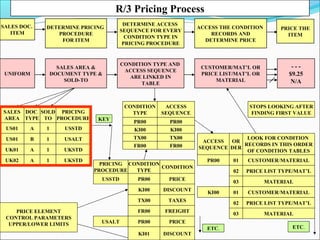
R/3 Pricing Process
SALES DOC.
ITEM
DETERMINE PRICING
PROCEDURE
FOR ITEM
PRICE THE
ITEM
DETERMINE ACCESS
SEQUENCE FOR EVERY
CONDITION TYPE IN
PRICING PROCEDURE
ACCESS THE CONDITION
RECORDS AND
DETERMINE PRICE
UNIFORM
SALES AREA &
DOCUMENT TYPE &
SOLD-TO
CONDITION TYPE AND
ACCESS SEQUENCE
ARE LINKED IN
TABLE
PR00
KI00
TX00
FR00
CONDITION
TYPE
ACCESS
SEQUENCE
TX00
FR00
KI00
PR00
- - -
$9.25
N/A
STOPS LOOKING AFTER
FINDING FIRST VALUE
ETC.
PRICE ELEMENT
CONTROL PARAMETERS
UPPER/LOWER LIMITS
PRICING
PROCEDURE
USSTD PR00
TX00
KI00
FR00
USALT
DISCOUNT
CONDITION
TYPE
CONDITION
PRICE
FREIGHT
TAXES
DISCOUNT
PRICE
KI01
PR00
KEY
CUSTOMER/MAT’L OR
PRICE LIST/MAT’L OR
MATERIAL
LOOK FOR CONDITION
RECORDS IN THIS ORDER
OF CONDITION TABLES
ACCESS
SEQUENCE
01
02
03
PR00 CUSTOMER/MATERIAL
PRICE LIST TYPE/MAT’L
MATERIAL
OR
DER
ETC.
KI00 01
02
03
CUSTOMER/MATERIAL
PRICE LIST TYPE/MAT’L
MATERIAL
SALES
AREA
DOC.
TYPE
SOLD
TO
PRICING
PROCEDURE
US01
US01
UK01
UK02
USSTD
USALT
UKSTD
UKSTD
A
B
1
1
1
1
A
A
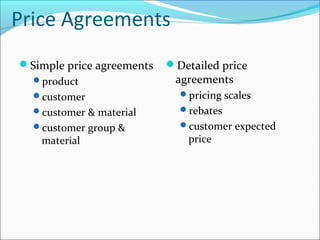
Price Agreements
Simple price agreements
product
customer
customer & material
customer group &
material
Detailed price
agreements
pricing scales
rebates
customer expected
price
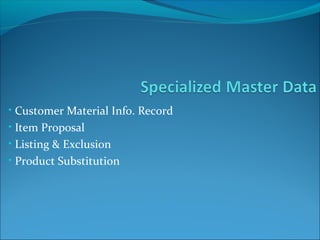
• Customer Material Info. Record
• Item Proposal
• Listing & Exclusion
• Product Substitution
Customer/Material Info. Record
Defines a customer alias for a material &
description, for example:
Material # : Glove Customer # : Pastime Glove
Can further define attributes of the material,
shipping and partial delivery information specific
to the product and customer
Referenced in the sales order using the Ordering
Party overview
Item Proposal
Used to define frequently ordered combinations
or special assortments of products and quantities
Either products or products with quantities can
be selected during order entry
An item proposal can be defined for a customer
via the customer master record
Material Listing & Exclusion
Used to control what products are available for a
customer or group
Material Listing — defines products that can be sold
to a customer
Material Exclusion — defines products that cannot be
sold to a customer
Product Substitution
Material Determination
Enables automatic or manual substitution of
materials during sales order processing
Examples:
substitute a standard product with a promotional
material
substitute based on a customer preference
substitute based on selection list (manual)
Customizing For Transactions
Shipping Functions
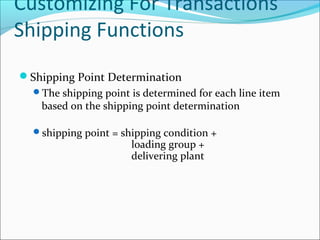
Shipping Point Determination
The shipping point is determined for each line item
based on the shipping point determination
shipping point = shipping condition +
loading group +
delivering plant
Customizing For Transactions Shipping
Functions
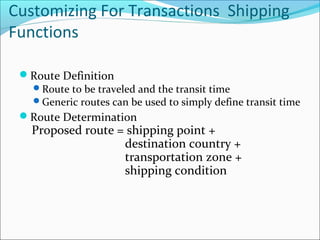
Route Definition
Route to be traveled and the transit time
Generic routes can be used to simply define transit time
Route Determination
Proposed route = shipping point +
destination country +
transportation zone +
shipping condition
Sales & DistributionSales & Distribution
- Transactions -- Transactions -
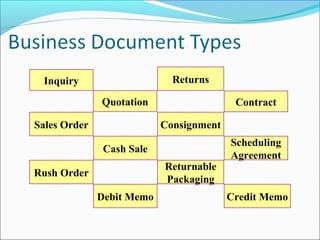
Inquiry
Credit Memo
Returns
Quotation
Sales Order
Cash Sale
Rush Order
Consignment
Contract
Scheduling
Agreement
Debit Memo
Returnable
Packaging
Order Processing Functionality
Delivery scheduling
Availability check
Transfer of requirements to MRP
Pricing
Credit check
Shipping point & route determination
Foreign trade & license processing
Document flow
Delivery Scheduling
Automatic scheduling of essential shipping
activities ...
Calculated using defined activity times ...
Resulting in scheduled activity dates
Determined using backward and forward scheduling
rules
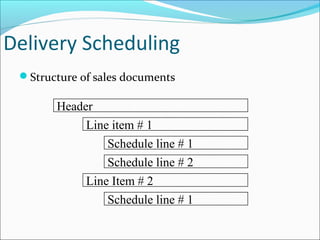
Delivery Scheduling
Structure of sales documents
Header
Line item # 1
Line Item # 2
Schedule line # 1
Schedule line # 1
Schedule line # 2
Delivery Scheduling —
Terminology
Transportation lead time — time required to
schedule transportation
Pick/Pack time — time required for picking and
packing
Load time — time required to load
Transit time — time required to transport goods from
shipping point to ship-to
Requested
Delv. Date
Goods
Issue
LoadingMaterial
Availability
Order
Date
Transp.
Sched.
Transit
Time
(2 days)
Loading
Time
(1 day)
Pick & Pack
Time
(2 days)
Transp
.
Sched.
Time
(1 day)
26th 27th 28th 29th 31st25th
25
Requested
Delv. Date
Goods
IssueLoading
Material
Availability
Order
Date
Transp.
Sched.
Transit
Time
(2 days)
Loading
Time
(1 day)
Transp.
Sched.
Time
(1 day) New
Delv. Date
27th 27th 28th 29th 31st26th
27
1
Pick & Pack
Time
(2 days)
Availability Check
Determines the material availability date
Considers inward and outward movement of
inventory — customizable
Influences partial deliveries by
proposing a quantity that can be delivered on the
requested date (complete delivery)
determines the earliest date for full delivery
determines the number and dates for partial deliveries
to fulfill the order
Availability Check
In determining the material availability date the
system can include specific stocks if selected, such as:
Safety stock
Stock in transfer
Quality inspection stock
Blocked stock
Restricted use stock
Transfer of Requirements to MRP
Ordered quantities are passed to MRP (MM)
Controlled by the schedule line category
Blocking of documents can affect requirements
passing — delivery block
Credit Check
Efficient means to implement credit management
Integrated with FI — via credit control area
Automatically alerts when a credit check fails
Comprehensive credit management reporting
Shipping Point & Route Determination
A shipping point is determined for each line
item — shipping point determination
A delivery can only be processed from one
shipping point
Routes - route to be traveled & transit time
are determined using customized rules
Routes can be used to simply define transit
time
Foreign Trade & License Processing
Predefined trade areas — NAFTA, EU
Automated reporting for trade areas
Automated controls
license management
embargo lists
control by customer, country, product, point in time
Shipping Overview
Comprehensive functionality to support picking,
packing and loading functions
Work list and deadline monitoring
Functions with backorder processing
Tightly coupled to the MM and FI modules
Facility for transportation management
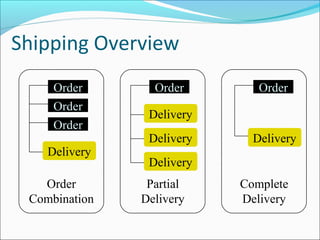
Shipping Overview
Order
Order
Order
Delivery
Order
Combination
Order
Delivery
Partial
Delivery
Delivery
Order
Complete
Delivery
Delivery
Delivery
Shipping Overview
Delivery creation activities
checks order and materials to determine if a delivery is
possible — delivery block, incompleteness
confirms availability
confirms export/foreign trade requirements
determines total weight & volume
Shipping Overview
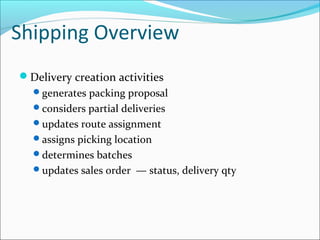
Delivery creation activities
generates packing proposal
considers partial deliveries
updates route assignment
assigns picking location
determines batches
updates sales order — status, delivery qty
Deliveries & Delivery Notes
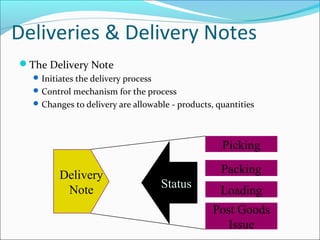
The Delivery Note
Initiates the delivery process
Control mechanism for the process
Changes to delivery are allowable - products, quantities
Delivery
Note
Picking
Packing
Loading
Post Goods
Issue
Status
Delivery Due List
Produces a work-list of deliveries
Encompasses deliveries and transfers
Can be scheduled to run in batch
Automatically combines deliveries
Picking
Quantities based on delivery
Assigned date when picking should begin
Automated storage location assignment
Supports serial number tracking and batch
management
Integrated with Warehouse Management (WM)
Packing
Identifies which packaging is to be used for specified
products
Identifies and updates accounts associated with
returnable packaging
Tracks the packed product by container
Insures weight/volume restrictions are enforced
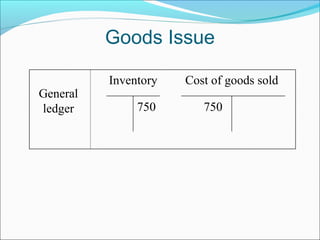
Goods Issue
Event that indicates the change in ownership of
the products
Reduces inventory
Automatically updates the G/L accounts
Ends the shipping process and prevents changes
to the shipping documents
General
ledger
Inventory
750
Cost of goods sold
750
Goods Issue
Billing Overview
Automated invoicing based on sales orders and/or
deliveries
Functionality for processing credit/debit memos and
rebates
Integration with FI & CO-PA
Updates customer’s credit data
Can create pro forma invoices
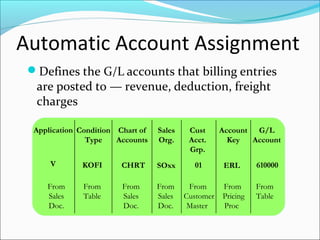
Automatic Account Assignment
Defines the G/L accounts that billing entries
are posted to — revenue, deduction, freight
charges
Cust
Acct.
Grp.
01
Application
V
Sales
Org.
SOxxKOFI
Chart of
Accounts
CHRT
From
Table
From
Sales
Doc.
Account
Key
ERL
From
Pricing
Proc
Condition
Type
610000
From
Table
G/L
Account
From
Customer
Master
From
Sales
Doc.
From
Sales
Doc.
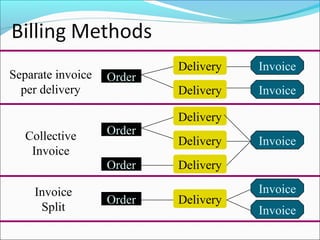
Separate invoice
per delivery
Delivery
Order
Delivery
Invoice
Invoice
Delivery
Order
Delivery Invoice
DeliveryOrder
Collective
Invoice
Order Delivery
Invoice
Invoice
Invoice
Split
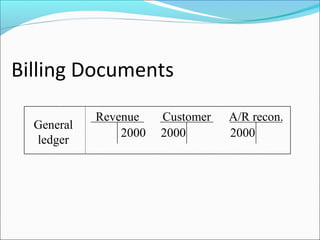
Billing Documents
Explicitly specify documents
Billing due list — builds a worklist of invoices that
should be generated
Automatic posting to FI
Billing Documents
General
ledger
Revenue
2000
A/R recon.
2000
Customer
2000
Billing Plans
Periodic — total amount for a planned billing
period
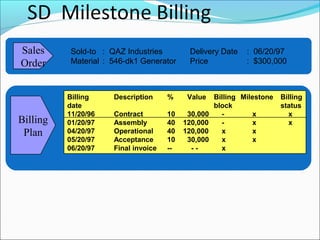
Milestone — distributing the total amount over
multiple billing dates - typically used with the
project system (PS)
Installment — evenly proportioned amounts and
defined payment dates
Resource related — consumed resources such as
service or consulting
Billing Description % Value Billing Milestone Billing
date block status
11/20/96 Contract 10 30,000 - x x
01/20/97 Assembly 40 120,000 - x x
04/20/97 Operational 40 120,000 x x
05/20/97 Acceptance 10 30,000 x x
06/20/97 Final invoice -- - - x
Sold-to : QAZ Industries Delivery Date : 06/20/97
Material : 546-dk1 Generator Price : $300,000
Sales
Order
Billing
Plan
• Contracts
• Schedule Agreements
Contracts
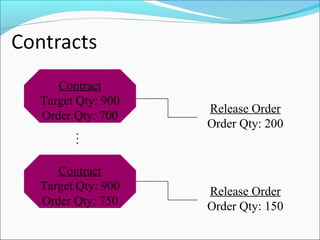
Defined quantities and validity period for a customer
The contract is fulfilled by orders placed against the
contract - release orders
Contracts are automatically updated through release
order processing
Pricing can be assigned to a contract
Contract
Target Qty: 900
Order Qty: 700
Contract
Target Qty: 900
Order Qty: 750
...
Release Order
Order Qty: 200
Release Order
Order Qty: 150
Scheduling Agreements
Defines specific product quantities and delivery
dates for a customer
Schedule lines and processed through standard
delivery processing
Availability check is performed during creation
and quantities are passed to MRP
System automatically updates delivered
quantities
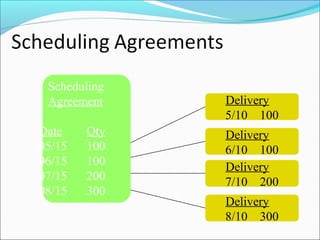
Delivery
5/10 100
Delivery
6/10 100
Delivery
7/10 200
Delivery
8/10 300
Scheduling
Agreement
Date Qty
05/15 100
06/15 100
07/15 200
08/15 300
Backorder Processing
Rescheduling
Backorders
Backorder processing
determines which orders have unconfirmed quantities
by customer or material
sort the orders according to priority
assign available stock to outstanding orders or reassign
confirmed quantities to high-profile orders
Backorders
Rescheduling
updates the orders with the results of the availability
check
can be used to manage the distribution of available
inventory when demand is greater than supply
Best if run in batch mode, rescheduling can be very
time consuming
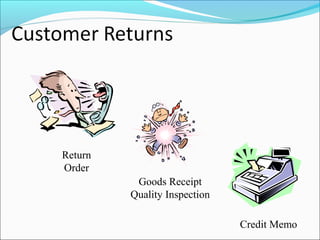
Return
Order
Goods Receipt
Quality Inspection
Credit Memo
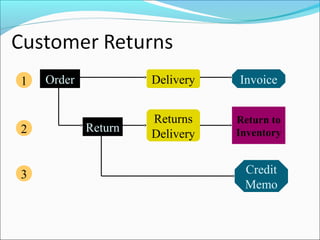
Order Delivery Invoice
Returns
DeliveryReturn
Credit
Memo
1
2
3
Return to
Inventory
Customer Returns
Returns document
Billing block can be proposed
Use the Order reason field to identify the reason for the
return
Full access to pricing and ability to re-price
Return delivery
Issues a goods receipt to place material into inventory
Customer Returns
Credit memo
Billing block must be cleared from Return
Posts to FI
Can be processed in batch (background)
Can be processed collectively (grouped)
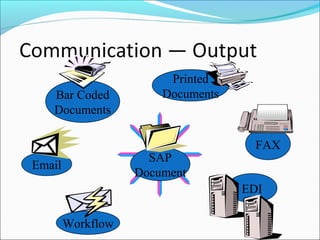
SAP
Document
FAX
Printed
Documents
Email
EDI
Bar Coded
Documents
Workflow
Communication — Output
Output — traditional forms or electronic
communications produced for internal or external
partners
Assigned to business partners & sales documents
Definable media — EDI, fax, print
Highly customizable — Sapscript
Communication — Text
Texts are used for internal and external
communication
Created for business partners, materials, header or
item level of sales documents — order, delivery,
billing, picking lists
SIS Overview
Flexible information system designed to support
business planning, forecasting and reporting
Pre-defined catalog of performance measures and
reports
On-demand access to reports and exceptions
Data maintained in a separate database
Logistics Information System
Inventory Management
Purchasing
Sales and Distribution
Production
Plant Maintenance
Quality Management
Inventory Information System
Standard Analysis
Material
Plant
Storage Location
MRP Controller
Material Groupings
Purchasing Information System
Standard Analysis
Material
Vendor
Material Group
Purchasing Group
Purchasing Documents
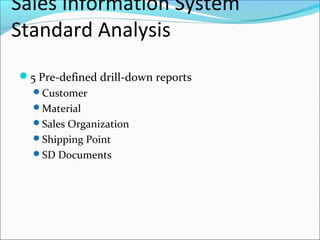
Sales Information System
Standard Analysis
5 Pre-defined drill-down reports
Customer
Material
Sales Organization
Shipping Point
SD Documents
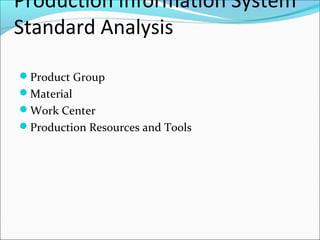
Production Information System
Standard Analysis
Product Group
Material
Work Center
Production Resources and Tools
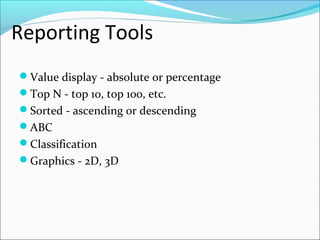
Reporting Tools
Value display - absolute or percentage
Top N - top 10, top 100, etc.
Sorted - ascending or descending
ABC
Classification
Graphics - 2D, 3D

Sappowerpointpresentationdownloadfrom 120302002505-phpapp01

  • 1.
    SALES & DISTRIBUTION(SD)SALES & DISTRIBUTION (SD) OverviewOverview
  • 2.
    R/3R/3 FIFI FinancialFinancial AccountingAccounting COCO ControllingControlling PSPS ProjectProject SystemSystem WFWF WorkflowWorkflow ISIS IndustryIndustry SolutionsSolutions MMMM MaterialsMaterials Mgmt.Mgmt. HRHR HumanHuman ResourcesResources SDSD Sales &Sales & DistributionDistribution PPPP ProductionProduction PlanningPlanning QMQM QualityQuality ManagementManagement PMPM PlantMaintenancePlant Maintenance SMSM ServiceService Manage-Manage- mentment Integrated SolutionIntegrated Solution Client / ServerClient / Server Open SystemsOpen Systems ECEC EnterpriseEnterprise ControllingControlling AMAM Fixed AssetsFixed Assets Mgmt.Mgmt.
  • 3.
    SD Mechanisms to executethe business processes used in the selling, shipping and billing of products and services Tightly coupled data flow to the other SAP modules — Integration Flexible and robust functionality that is tailored through configuration
  • 4.
  • 5.
    SD Overview —Master Data Detailed information about customers, materials and business partners Flexible data structures that support the business environment Specialized master data to support sales order processing
  • 6.
    SD Overview —Sales Support Provides the functionality to support the staff involved in business development and customer service processes Primary functions Sales Prospects Contact Persons Competitors and Competitive Products Sales Activities Direct Marketing
  • 7.
    SD Overview —Sales Primary base for customer order management Highly customizable Sophisticated pricing Integrated ATP Integrated credit management Sampling of functions Inquiries & Quotes Sales Orders Returns Contracts & Scheduling Agreements Consignment Rush Orders & Cash Sales Back Orders & Subsequent Deliveries Credit & Debit Memo Requests
  • 8.
    SD Overview —Shipping Main functions  Picking, Packing & Inventory management  Generate Shipping Documents Transportation Management Routes Transportation Scheduling Delivery Scheduling, Returns Deliveries & Stock Transfer
  • 9.
    SD Overview —Billing Invoice Generation — automatic or manual Comprehensive set of billing functions Linked documents — e.g. invoice & credit memo Real-time integration with finance (FI) Fully integrated and comprehensive pricing
  • 10.
    SD Overview —S I S Flexible tool that allows one to collect, consolidate, and utilize data from sales and distribution processing A component of the Logistic Information System (LIS)
  • 11.
  • 12.
    Sales & DistributionSales& Distribution - Process Flow -- Process Flow -
  • 13.
    Customer Order PickingGoods Issue BillingAccounts ReceivableFinal Payment
  • 14.
  • 15.
    Sales — Inquiry& Quotation Support pre-sales processes Are time sensitive Automatic availability check Automatic pricing No impact to FI Can be used as reference documents
  • 16.
    Sales — SalesOrder Core of customer order management No impact to G/L Can reference existing documents Copies key information from master data Automated standard functions ... availability check MRP updating pricing credit check delivery scheduling export control shipping & route determination
  • 17.
    Shipping — DeliveryNote Initiates the shipping process Control document for shipping processes — maintains status of each processing step Re-confirms: availability, credit, foreign trade, delivery scheduling Facilitates transportation planning
  • 18.
    Shipping — Picking& Packing Picking: Physical activity of moving goods from the warehouse for further processing (packing, loading) Packing: Determines packing materials and packing details Advanced processing includes, e.g. batch mgmt., serial number control
  • 19.
    Shipping — PostGoods Issue Completes the shipping process Typically performed when customer takes ownership Updates inventory Updates G/L accounts Cost of goods sold Inventory
  • 20.
    Billing Generate customer invoice UpdatesFI Customer account G/L accounts: revenue, discount, etc. Applies relevant pricing Updates customer credit
  • 21.
    Sales & DistributionSales& Distribution - Organizational Structures -- Organizational Structures -
  • 22.
    Sales Organization Baseball Division BB Softball Division SB Direct Distribution Channel DI Baseball Division BB Softball Division SB Wholesale DistributionChannel WH Baseball Division BB Softball Division SB Retail Distribution Channel RE Domestic Sales Sales Organization So00 Baseball Division BB Cricket Division SB Wholesale Distribution Channel WH Europe Sales Organization EURO Baseball Division BB Wholesale Distribution Channel WH Asia Pacific Sales Organization APAC Pastime Corporation Company Code CC00 Client 860
  • 23.
    Sales Organization Sells anddistributes products, negotiates terms of sales and is responsible for these business transactions Critical organization element to the definition of business markets A business transaction is linked to one Sales Organization
  • 24.
    Distribution Channel Identifies howproducts and services reach the customer Can be assigned to one or more Sales Organizations
  • 25.
    Division Often times usedto define product line distribution Organization level to which customer specific information and requirements are maintained — e.g. pricing, partial delivery Assigned to one or more Sales Organizations
  • 26.
    Sales Area Organizational elementcomprised of: Sales Organization Distribution Channel Division Will be used to link together the organizational aspects of sales to customers Used for statistical analysis
  • 27.
    Sales Area Domestic Sales SalesOrganization SO00 Direct Distribution Channel DI Wholesale Distribution Channel WH Retail Distribution Channel RE Baseball Division BB Softball Division SB Baseball Division BB Softball Division SB Baseball Division BB Softball Division SB
  • 28.
    Sales Area Domestic Sales SalesOrganization SO00 Direct Distribution Channel DI Wholesale Distribution Channel WH Retail Distribution Channel RE Baseball Division BB Softball Division SB Baseball Division BB Softball Division SB Baseball Division BB Softball Division SB
  • 29.
    Sales Office Typically definesa territory or market area Linked to one or more Sales Areas Optional organization structure
  • 30.
    Internal Sales Organization DomesticDomestic SalesAreaSales Area WesternWestern Sales OfficeSales Office EasternEastern Sales OfficeSales Office
  • 31.
    Sales Group Sales Group Sub-divisionof a sales office, territory or market
  • 32.
    Sales Person Sales Person Definedin HR — Personnel Admin. Specifically defines an individual rather than a position (sales rep.) in sales processing
  • 33.
    Internal Sales Organization DomesticDomestic SalesAreaSales Area WesternWestern Sales OfficeSales Office EasternEastern Sales OfficeSales Office SouthwestSouthwest Sales GroupSales Group NorthwestNorthwest Sales GroupSales Group SalesSales PersonPerson SalesSales PersonPerson SalesSales PersonPerson SoutheastSoutheast Sales GroupSales Group NortheastNortheast Sales GroupSales Group SalesSales PersonPerson SalesSales PersonPerson
  • 34.
    Shipping Point &Loading Point Shipping Point Location that performs all delivery related activities Assigned a factory calendar A delivery can be processed from only one shipping point Loading Point A subdivision of the shipping point used for more specialized handling
  • 35.
    Shipping Organization D oc k # 1 L o a d in g P t D 1 D o c k # 2 L o a d in g P t D 2 F r e ig h t D o c k S h ip p in g P t S P 0 0 D o c k # 3 L o a d in g P t E X E x p r e s s S h ip p in g P t Q U I K D o c k # 2 L o a d in g P t X P E x p o r t S h ip p in g P t E X P T S io u x F a lls P L A N T P T 0 0
  • 36.
    Sales & DistributionSales& Distribution - Master Data -- Master Data -
  • 37.
  • 38.
    -General Data Basic Unitof Measure Division Material Group Sales Unit Delivering Plant Cash discount -Tax data Country Tax category Tax classification -Quantity stipulations Min. order quantity Min. delivery quantity Delivery unit Basic Data 1 - 2 Classification Sales: sales org. 1 - 2 Sales: general/plant Purchasing Foreign Trade: Import Data Sales: text Purchase order: text MRP 1 - 4 Forecasting Storage 1 - 2 Warehouse Management 1 - 2 Quality Management Accounting 1 - 2 Costing 1 - 2
  • 39.
    Base Unit ofMeasure The Base Unit of Measure is the unit of measure in which stocks are managed within your company. Division You may enter the Division which your product is in for sales (defaults if entered in the Basic data screen). Material Group A (freely definable) key that’s used to group several materials or services for analysis/reporting as well as search by match code. Sales Unit This is the unit of measure in which the material is sold, if different from the base unit of measure. Delivering Plant Plant, from which the material is available for sale. This is a default value only. Cash discount Indicator used for materials, which allow for a cash discount.
  • 40.
    Tax data Country Country Taxcategory Taxes, applicable to this material (e.g. Federal, State taxes in US, VAT in GB) Tax classification taxable, exempt Quantity stipulations Min. order quantity Min. quantity a customer can order (in base unit of measure). Min. delivery quantity Min. delivery quantity to a customer. Delivery unit Only multiples of this number will be delivered to the customer.
  • 41.
    -Grouping terms Matl statisticsgroup Material pricing grp Volume rebate group Acct assignment grp Commission group Item Category group Basic Data 1 - 2 Classification Sales: sales org. 1 - 2 Sales: general/plant Purchasing Foreign Trade: Import Data Sales: text Purchase order: text MRP 1 - 4 Forecasting Storage 1 - 2 Warehouse Management 1 - 2 Quality Management Accounting 1 - 2 Costing 1 - 2
  • 42.
    Matl statistics groupHelps to determine which data the system updates in the Logistics Information System (LIS). Material pricing grp A way to group materials with similar pricing conditions. Volume rebate group A material can be assigned to a volume rebate group (e.g. Low Rebate, High Rebate) if the material qualifies for rebate. Acct assignment grp A grouping of materials with the same accounting requirements (used to determine revenue and sales deduction accounts) Commission group Several materials can be assigned to the same commission group, if the commission sharing between representatives is the same for these materials (e.g. Rep.A: 6%, Rep.B: 10%, Rep C: 12%). Item Category groupA grouping of materials, that helps the system determine the Item Category. Item Category determines how a specific item is processed by system. E.g. a text item is not relevant for pricing.
  • 43.
    General data Base unit Grossweight Net weight Avail. Check Shipping data (times in days) Trans. Grp LoadingGrp Packaging material data Matl grp ship. matls General plant parameters Negative stock Basic Data 1 - 2 Classification Sales: sales org. 1 - 2 Sales: general/plant Purchasing Foreign Trade: Import Data Sales text Purchase order: text MRP 1 - 4 Forecasting Storage 1 - 2 Warehouse Management 1 - 2 Quality Management Accounting 1 - 2 Costing 1 - 2
  • 44.
    General data Base unitThe Base Unit of Measure is the unit of measure in which stocks are managed within your company. Gross weight In Base Units of Measure. Net weight In Base Units of Measure. Avail. Check Tells the system when to do an availability check, as well as which MRP elements (such as purchase orders, reservations) to include in the check. Shipping data (times in days) Trans. Grp Transportation groups are groups of materials that have the same transportation requirements. For example, all goods that need refrigeration. Loading Grp Loading groups define materials that have the same loading requirements, such as forklift truck, or crane.
  • 45.
    Packaging material data Matlgrp ship. matls, or Material group shipping materials Freely definable group name, which is used to indicate groups of materials with similar shipping materials, such as liquids or bulk, for example. General plant parameters Negative stock Check mark indicator, which specifies whether negative stock is allowed at that plant.
  • 46.
    - Sales textsText specific to the material and in an appropriate language. Basic Data 1 - 2 Classification Sales: sales org. 1 - 2 Sales: general/plant Purchasing Foreign Trade: Import Data Sales text Purchase order: text MRP 1 - 4 Forecasting Storage 1 - 2 Warehouse Management 1 - 2 Quality Management Accounting 1 - 2 Costing 1 - 2
  • 47.
    Account Groups Account groupdetermines which fields are to be used in defining customer master data
  • 48.
    Field Status Field statuscontrols the use of each field within the customer master determining whether a field is required, optional, suppressed or display only Field status controls are also relevant to a specific activity — create, change, or display
  • 49.
    Sales & DistributionSales& Distribution -- Customer MasterCustomer Master --
  • 50.
    Customer Master S al e s & D i s t r i b u t i o n D a t a C o m p a n y C o d e D a t a G e n e r a l D a t a
  • 51.
    Customer Master Centralized datafor both SD & FI Segmented into three sections General data - address & communication Company code data (FI) - banking and payment information related to FI Sales data (SD) - pricing, delivery, output The sales data is specific to one sales area and is therefore dependent on the sales organization
  • 52.
    Customer Master bySales Area Customer Sales Organization Distribution Channel Division
  • 53.
    General Data —Address Customer Name Search Term Street address, City, Postal code, Country Language General Data — Communication Telephone, Fax, Data numbers
  • 54.
    General data —Control data Account control : Vendor, Authorization Trading partner, Group key Tax information : Tax codes, Fiscal address Country code, City code VAT N, Tax jurisdiction code Equalization tax, Sole proprietor Tax on sls/pur. Reference data / area : International Locator No. Industry: Transport Zone Express station Train station Location code
  • 55.
    General Data —Marketing Classification : Nielsen ID Customer classification Industry Industry codes Operating figures : Annual sales Number of employees Fiscal year variant Sales prospecting : Legal status
  • 56.
    General Data — PaymentTransactions Bank details Country Bank Key Account holder Bank Account Control Key Collection
  • 57.
    General Data — Unloadingpoints Unloading point Customer factory calendar Default Unloading Point Goods receiving hours
  • 58.
    General Data — Foreigntrade Country key for export control of customer Table of Denial Orders list (TDO) Special Designated Nationals list (SDN) Diversion High Risk Profile list (DHRP) Usage and Classification
  • 59.
    General Data — Contactpersons Name Telephone number Department First name Form of address (e.g. Mr., Ms.) Function
  • 60.
    Accounting info ReconciliationAccount Sort key Head office Interest calculation Interest indicator Interest calculation frequency Last key date Reference data Buying group Company Code Data Accounting Information
  • 61.
    Company Code Data PaymentTransactions Payment data: Payment terms Tolerance group Automatic Payment Transactions: Payment methods Alternative payer Lockbox
  • 62.
    Company Code Data Correspondence Dunningdata : Dunning procedure Dunning recipient Correspondence : Account number at customer Customer user Payment notices to : Customer Sales Accounting Legal
  • 63.
    Company Code Data Insurance Exportcredit insurance : Policy number Institution number Amount insured Valid until Lead months Deductible
  • 64.
    Sales Data —Sales area Sales order : Sales district Sales office Sales group Order probability Item proposal Account at customer Pricing / Statistics: Price group Customer pricing procedure Price list type Customer statistical group
  • 65.
    S & DData — Shipping Shipping : Delivery priority Shipping conditions Delivering plant Order combination Batch split allowed Partial Delivery: Complete delivery Partial delivery of item Maximum part deliveries
  • 66.
    S&D Data —Billing Billing section : Manual invoice maint. Rebate Pricing Billing schedule Invoice list schedule Delivery and payment terms : Incoterms Payment terms Accounting : Account assignment group Taxes: Tax requirements for the customer
  • 67.
    S&D Data — Partnerfunctions The different partners are assigned • SP Sold-to-party • BP Bill-to-party • PY Payer • SH Ship-to-party • … additional Partner function(s)
  • 68.
    Assigning Additional Partners —Siesta Baseball League - Vera Cruz, NM — Sold-to : 10018 Bill-to : 10018 Payer : 10018 Ship-to : 10018 — Siesta Baseball League - Vera Cruz, NM — Sold-to : 10018 Bill-to : 10018 Payer : 10018 Ship-to : 10018 Ship-to : 10249 - Bakersfield, CA Sold-to Payer Ship-toBill-to Sold-to Payer Ship-toBill-to Ship-to
  • 69.
    Sales & DistributionSales& Distribution -- Business PartnersBusiness Partners --
  • 70.
    Business Partners Defines allof the parties involved in a business transaction and differentiates between their roles — customer, carrier, employees, customer contact, etc. Through customizing the system automatically assigns partners to the customer master and to transactions Sold-to Ship-to Bill-to Payer
  • 71.
    Business Partners The systemcreates these four business partners by default. All four are required. All four may be the same or may be different. Since these are automatically assigned partners you may need to add additional partners to carry out your business transactions. Sold-to Ship-to Bill-to Payer
  • 72.
    Business partners —Sold-to Customer that orders the goods Can perform all primary partner functions — sold-to, ship-to, payer, bill-to Primary type of business partner Cannot be linked to other sold-to partners Sold-to Ship-to Bill-to Payer
  • 73.
    Business partners —Ship-to Party that receives the goods Can be created as an independent partner and linked to one or more sold-to partners Sold-to Ship-to Bill-to Payer
  • 74.
    Business partners —Bill-to Party that receives the invoice Can be created as an independent partner and linked to one or more sold-to partners Sold-to Ship-to Bill-to Payer
  • 75.
    Business partners —Payer Party that sends the payment Can be created as an independent partner and linked to one or more sold-to partners Sold-to Ship-to Bill-to Payer
  • 76.
  • 77.
    Sales & DistributionSales& Distribution -- PricingPricing --
  • 78.
    Pricing “World-class” functionality Highly customizable& extendible One of the most complex features of SAP Used to determine the net price for a material or an order
  • 79.
    Pricing Process Standard pricingcalculates the gross price, then applies discounts, surcharges and applicable taxes to arrive at the final price final price = gross price - discounts + surcharges + taxes Cost-plus pricing determines the base cost and applies the appropriate discounts, surcharges and taxes final price = cost - discounts + surcharges + taxes
  • 80.
    Pricing Components Pricing isbased on a matrix of predefined and custom elements Delivered element groups (a.k.a. conditions) Prices Discounts & Surcharges Freight Taxes
  • 81.
    Pricing Procedure • Inshort, the mechanism used to arrive at the final price • Considers all of the applicable pricing conditions, e.g. material price, customer discount • Is assigned by: sales area, sold-to party and sales document type (e.g. sales order)
  • 82.
    Pricing Procedure • Thepricing procedure uses what SAP calls “the condition technique”. • The pricing condition technique starts with the: – Pricing Procedure which looks at – Conditions which use – Access Sequences which accesses – Condition tables which point to – A price, discount or other condition ($)
  • 83.
    R/3 Pricing Process SALESDOC. ITEM DETERMINE PRICING PROCEDURE FOR ITEM PRICE THE ITEM DETERMINE ACCESS SEQUENCE FOR EVERY CONDITION TYPE IN PRICING PROCEDURE ACCESS THE CONDITION RECORDS AND DETERMINE PRICE UNIFORM SALES AREA & DOCUMENT TYPE & SOLD-TO CONDITION TYPE AND ACCESS SEQUENCE ARE LINKED IN TABLE PR00 KI00 TX00 FR00 CONDITION TYPE ACCESS SEQUENCE TX00 FR00 KI00 PR00 - - - $9.25 N/A STOPS LOOKING AFTER FINDING FIRST VALUE ETC. PRICE ELEMENT CONTROL PARAMETERS UPPER/LOWER LIMITS PRICING PROCEDURE USSTD PR00 TX00 KI00 FR00 USALT DISCOUNT CONDITION TYPE CONDITION PRICE FREIGHT TAXES DISCOUNT PRICE KI01 PR00 KEY CUSTOMER/MAT’L OR PRICE LIST/MAT’L OR MATERIAL LOOK FOR CONDITION RECORDS IN THIS ORDER OF CONDITION TABLES ACCESS SEQUENCE 01 02 03 PR00 CUSTOMER/MATERIAL PRICE LIST TYPE/MAT’L MATERIAL OR DER ETC. KI00 01 02 03 CUSTOMER/MATERIAL PRICE LIST TYPE/MAT’L MATERIAL SALES AREA DOC. TYPE SOLD TO PRICING PROCEDURE US01 US01 UK01 UK02 USSTD USALT UKSTD UKSTD A B 1 1 1 1 A A
  • 84.
    Price Agreements Simple priceagreements product customer customer & material customer group & material Detailed price agreements pricing scales rebates customer expected price
  • 85.
    • Customer MaterialInfo. Record • Item Proposal • Listing & Exclusion • Product Substitution
  • 86.
    Customer/Material Info. Record Definesa customer alias for a material & description, for example: Material # : Glove Customer # : Pastime Glove Can further define attributes of the material, shipping and partial delivery information specific to the product and customer Referenced in the sales order using the Ordering Party overview
  • 87.
    Item Proposal Used todefine frequently ordered combinations or special assortments of products and quantities Either products or products with quantities can be selected during order entry An item proposal can be defined for a customer via the customer master record
  • 88.
    Material Listing &Exclusion Used to control what products are available for a customer or group Material Listing — defines products that can be sold to a customer Material Exclusion — defines products that cannot be sold to a customer
  • 89.
    Product Substitution Material Determination Enablesautomatic or manual substitution of materials during sales order processing Examples: substitute a standard product with a promotional material substitute based on a customer preference substitute based on selection list (manual)
  • 90.
    Customizing For Transactions ShippingFunctions Shipping Point Determination The shipping point is determined for each line item based on the shipping point determination shipping point = shipping condition + loading group + delivering plant
  • 91.
    Customizing For TransactionsShipping Functions Route Definition Route to be traveled and the transit time Generic routes can be used to simply define transit time Route Determination Proposed route = shipping point + destination country + transportation zone + shipping condition
  • 92.
    Sales & DistributionSales& Distribution - Transactions -- Transactions -
  • 93.
    Inquiry Credit Memo Returns Quotation Sales Order CashSale Rush Order Consignment Contract Scheduling Agreement Debit Memo Returnable Packaging
  • 94.
    Order Processing Functionality Deliveryscheduling Availability check Transfer of requirements to MRP Pricing Credit check Shipping point & route determination Foreign trade & license processing Document flow
  • 95.
    Delivery Scheduling Automatic schedulingof essential shipping activities ... Calculated using defined activity times ... Resulting in scheduled activity dates Determined using backward and forward scheduling rules
  • 96.
    Delivery Scheduling Structure ofsales documents Header Line item # 1 Line Item # 2 Schedule line # 1 Schedule line # 1 Schedule line # 2
  • 97.
    Delivery Scheduling — Terminology Transportationlead time — time required to schedule transportation Pick/Pack time — time required for picking and packing Load time — time required to load Transit time — time required to transport goods from shipping point to ship-to
  • 98.
    Requested Delv. Date Goods Issue LoadingMaterial Availability Order Date Transp. Sched. Transit Time (2 days) Loading Time (1day) Pick & Pack Time (2 days) Transp . Sched. Time (1 day) 26th 27th 28th 29th 31st25th 25
  • 99.
    Requested Delv. Date Goods IssueLoading Material Availability Order Date Transp. Sched. Transit Time (2 days) Loading Time (1day) Transp. Sched. Time (1 day) New Delv. Date 27th 27th 28th 29th 31st26th 27 1 Pick & Pack Time (2 days)
  • 100.
    Availability Check Determines thematerial availability date Considers inward and outward movement of inventory — customizable Influences partial deliveries by proposing a quantity that can be delivered on the requested date (complete delivery) determines the earliest date for full delivery determines the number and dates for partial deliveries to fulfill the order
  • 101.
    Availability Check In determiningthe material availability date the system can include specific stocks if selected, such as: Safety stock Stock in transfer Quality inspection stock Blocked stock Restricted use stock
  • 102.
    Transfer of Requirementsto MRP Ordered quantities are passed to MRP (MM) Controlled by the schedule line category Blocking of documents can affect requirements passing — delivery block
  • 103.
    Credit Check Efficient meansto implement credit management Integrated with FI — via credit control area Automatically alerts when a credit check fails Comprehensive credit management reporting
  • 104.
    Shipping Point &Route Determination A shipping point is determined for each line item — shipping point determination A delivery can only be processed from one shipping point Routes - route to be traveled & transit time are determined using customized rules Routes can be used to simply define transit time
  • 105.
    Foreign Trade &License Processing Predefined trade areas — NAFTA, EU Automated reporting for trade areas Automated controls license management embargo lists control by customer, country, product, point in time
  • 107.
    Shipping Overview Comprehensive functionalityto support picking, packing and loading functions Work list and deadline monitoring Functions with backorder processing Tightly coupled to the MM and FI modules Facility for transportation management
  • 108.
  • 109.
    Shipping Overview Delivery creationactivities checks order and materials to determine if a delivery is possible — delivery block, incompleteness confirms availability confirms export/foreign trade requirements determines total weight & volume
  • 110.
    Shipping Overview Delivery creationactivities generates packing proposal considers partial deliveries updates route assignment assigns picking location determines batches updates sales order — status, delivery qty
  • 111.
    Deliveries & DeliveryNotes The Delivery Note Initiates the delivery process Control mechanism for the process Changes to delivery are allowable - products, quantities Delivery Note Picking Packing Loading Post Goods Issue Status
  • 112.
    Delivery Due List Producesa work-list of deliveries Encompasses deliveries and transfers Can be scheduled to run in batch Automatically combines deliveries
  • 113.
    Picking Quantities based ondelivery Assigned date when picking should begin Automated storage location assignment Supports serial number tracking and batch management Integrated with Warehouse Management (WM)
  • 114.
    Packing Identifies which packagingis to be used for specified products Identifies and updates accounts associated with returnable packaging Tracks the packed product by container Insures weight/volume restrictions are enforced
  • 115.
    Goods Issue Event thatindicates the change in ownership of the products Reduces inventory Automatically updates the G/L accounts Ends the shipping process and prevents changes to the shipping documents
  • 116.
  • 117.
    Billing Overview Automated invoicingbased on sales orders and/or deliveries Functionality for processing credit/debit memos and rebates Integration with FI & CO-PA Updates customer’s credit data Can create pro forma invoices
  • 118.
    Automatic Account Assignment Definesthe G/L accounts that billing entries are posted to — revenue, deduction, freight charges Cust Acct. Grp. 01 Application V Sales Org. SOxxKOFI Chart of Accounts CHRT From Table From Sales Doc. Account Key ERL From Pricing Proc Condition Type 610000 From Table G/L Account From Customer Master From Sales Doc. From Sales Doc.
  • 119.
    Separate invoice per delivery Delivery Order Delivery Invoice Invoice Delivery Order DeliveryInvoice DeliveryOrder Collective Invoice Order Delivery Invoice Invoice Invoice Split
  • 120.
    Billing Documents Explicitly specifydocuments Billing due list — builds a worklist of invoices that should be generated Automatic posting to FI
  • 121.
  • 122.
    Billing Plans Periodic —total amount for a planned billing period Milestone — distributing the total amount over multiple billing dates - typically used with the project system (PS) Installment — evenly proportioned amounts and defined payment dates Resource related — consumed resources such as service or consulting
  • 123.
    Billing Description %Value Billing Milestone Billing date block status 11/20/96 Contract 10 30,000 - x x 01/20/97 Assembly 40 120,000 - x x 04/20/97 Operational 40 120,000 x x 05/20/97 Acceptance 10 30,000 x x 06/20/97 Final invoice -- - - x Sold-to : QAZ Industries Delivery Date : 06/20/97 Material : 546-dk1 Generator Price : $300,000 Sales Order Billing Plan
  • 124.
  • 125.
    Contracts Defined quantities andvalidity period for a customer The contract is fulfilled by orders placed against the contract - release orders Contracts are automatically updated through release order processing Pricing can be assigned to a contract
  • 126.
    Contract Target Qty: 900 OrderQty: 700 Contract Target Qty: 900 Order Qty: 750 ... Release Order Order Qty: 200 Release Order Order Qty: 150
  • 127.
    Scheduling Agreements Defines specificproduct quantities and delivery dates for a customer Schedule lines and processed through standard delivery processing Availability check is performed during creation and quantities are passed to MRP System automatically updates delivered quantities
  • 128.
    Delivery 5/10 100 Delivery 6/10 100 Delivery 7/10200 Delivery 8/10 300 Scheduling Agreement Date Qty 05/15 100 06/15 100 07/15 200 08/15 300
  • 129.
  • 130.
    Backorders Backorder processing determines whichorders have unconfirmed quantities by customer or material sort the orders according to priority assign available stock to outstanding orders or reassign confirmed quantities to high-profile orders
  • 131.
    Backorders Rescheduling updates the orderswith the results of the availability check can be used to manage the distribution of available inventory when demand is greater than supply Best if run in batch mode, rescheduling can be very time consuming
  • 132.
  • 133.
  • 134.
    Customer Returns Returns document Billingblock can be proposed Use the Order reason field to identify the reason for the return Full access to pricing and ability to re-price Return delivery Issues a goods receipt to place material into inventory
  • 135.
    Customer Returns Credit memo Billingblock must be cleared from Return Posts to FI Can be processed in batch (background) Can be processed collectively (grouped)
  • 137.
  • 138.
    Communication — Output Output— traditional forms or electronic communications produced for internal or external partners Assigned to business partners & sales documents Definable media — EDI, fax, print Highly customizable — Sapscript
  • 139.
    Communication — Text Textsare used for internal and external communication Created for business partners, materials, header or item level of sales documents — order, delivery, billing, picking lists
  • 140.
    SIS Overview Flexible informationsystem designed to support business planning, forecasting and reporting Pre-defined catalog of performance measures and reports On-demand access to reports and exceptions Data maintained in a separate database
  • 141.
    Logistics Information System InventoryManagement Purchasing Sales and Distribution Production Plant Maintenance Quality Management
  • 142.
    Inventory Information System StandardAnalysis Material Plant Storage Location MRP Controller Material Groupings
  • 143.
    Purchasing Information System StandardAnalysis Material Vendor Material Group Purchasing Group Purchasing Documents
  • 144.
    Sales Information System StandardAnalysis 5 Pre-defined drill-down reports Customer Material Sales Organization Shipping Point SD Documents
  • 145.
    Production Information System StandardAnalysis Product Group Material Work Center Production Resources and Tools
  • 146.
    Reporting Tools Value display- absolute or percentage Top N - top 10, top 100, etc. Sorted - ascending or descending ABC Classification Graphics - 2D, 3D

Editor's Notes

  • #40 Base Unit of Measure = EA Sales Unit of Measue = BOX (Table: 1 BOX = 20 EA) Delivery Unit of Measure = PAL (Table: 1 PAL = 12 BOX)
  • #42 Item Category Group + Document Type = Item Category (Item Category Group is freely definable in Controlling - Product Cost Controlling - Product Cost by Sales Order - Control of Sales-Order-Related Production - Selection of Requirements Type Through SD Item Category - Check Item Category Groups). Item Categories defined in (same path) - Check Item Categories. Table that links: Item Categroy Groups with Document Types is populated in (same path) - Assign Item Categories. Item Category dettermines how a specific item is processed by system. E.g. a text item is not relevant for pricing.
  • #43 Material Pricing Group: A way to group materials to which you want to apply he same conditions. Item Category Group + Document Type = Item Category (Item Category Group is freely definable in Controlling - Product Cost Controlling - Product Cost by Sales Order - Control of Sales-Order-Related Production - Selection of Requirements Type Through SD Item Category - Check Item Category Groups). Item Categories defined in (same path) - Check Item Categories. Table that links: Item Categroy Groups with Document Types is populated in (same path) - Assign Item Categories. Item Category determines how a specific item is processed by system. E.g. a text item is not relevant for pricing.
  • #54 Address Name: Name of the customer. Search Term: A method to find your customer by match-codes. Street:Optional entry. City:Mandatory entry. Postal Code: Mandatory entry. Country:Mandatory entry. Communication Language keyMandatory entry
  • #55 Account control Vendor If the Customer is a Vendor as well, enter the Vendor number here. Group key Freely definable key for reporting Tax information Tax code 1Number, with which the customer reports to the tax authorities. Tax code 2Number, with which the customer reports to the tax authorities. Fiscal addressAccount number of the master record containing the fiscal address. Tax information County codeKey for county taxes. City codeKey is used for city taxes. Tax jurisdiction codeThis code is used in the US to determine tax rates. Reference data / area IndustryFreely definable name for a group of companies (e.g.trade, manufacturing). Transport ZoneRegion, where the ship-to party is located.
  • #56 Nielsen IDNielsen indicator. The regional division of the company according to the Nielsen Institute, allows market analysis of your market by the A.C. Nielsen Company. Customer classificationFreely definable customer classification field. IndustryBranch of industry classification of customer. Industry code 1 Standard Industry Codes (SIC). Operating figures Annual salesAnnual sales in currency in year. Number of employeesNumber of employees in year. Fiscal year variantThe fiscal year variant of the company. Sales prospecting Legal statusA coding of the legal status of the company i.e. Limited, Incorporated.
  • #57 CountryCountry. Bank KeyCountry-specific bank key. Account holderName of account holder, if different from customer name. Bank AccountNumber, under which the account is managed at the bank. Control KeyThis field has different uses in different countries. In the US, this number is used to identify checking vs. savings account. CollectionThis checkmark is selected, when the customer allows for direct payment collection through the bank.
  • #58 Unloading pointThe customer point at which deliveries are to be unloaded. Customer calendarDefines the factory calendar that your customer uses, specifying days on which deliveries will be accepted. Unloading point defaultIf more than one unloading point is specified, this check box is used to identify which unloading point is to be defaulted. Goods receiving hours Customer specific schedule of receiving hours.
  • #59 Country key for exportCountry key for the country that placed this customer on the boycott list. control of customer Table of Denial Orders Check mark indicator for customer who is listed in the Table of Denial Orders list. (US) list (TDO) TDO dateDate, on which the customer was last checked on the TDO list. Special Designated List of individuals and companies that US companies shouldn’t trade with or only on a limited basis. Nationals list (SDN) SDN dateLast check date for customer on SDN list BoycottCheck mark for customers on your company’s boycott list. Boycott dateDate, on which the customer was last checked on the company boycott list. Mainly civilian usageIndicators for customer’s product usage. Mainly military usageIndicators for customer’s product usage. ClassificationIndicators for: Chemical/Biological Warfare, Nuclear Nonproliferation, National security and Missile technology.
  • #60 NameName of contact. Telephone1First telephone number of the contact. DepartmentDescription of the department of the contact for internal purposes. First nameFirst name of contact Form of address e.g. Mr., Ms. FunctionJob function of contact.
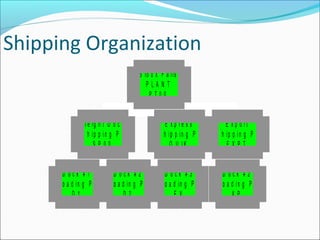
  • #61 Reconciliation AccountReconciliation account Sort keyThis field indicates the standard sort sequence for the display of the line items. Head officeThis field contains the account number of the head office. Interest calculation Interest indicatorCheckmark for automatic interest calculation. Interest calculation frequencyFrequency of automatic interest calculation (in months). Last key dateSystem generated date of last interest calculation. Reference data Buying groupNumber of buying group (if applicable).
  • #62 Payment termsPayment terms including optional cash discount. Tolerance groupFreely definable group term for the business partner, customer and vendor, which determines the amount up to which payment differences are posted automatically to expense or revenue accounts when clearing items. Record payment historyIndicator, which determines that the payment history of this customer is to be recorded. Payment methodsList of payment method(s) for automatic payments to this customer/vendor. Alternative payerAccount number for alternative payer, if bank collections are not to made via the customer’s account. LockboxLockbox identification, to which customer is to make payments.
  • #63 Dunning data Dunning procedureKey for dunning procedure used. Dunning recipientAccount number of recipient of dunning letters. Dunning levelSystem generated entry, which indicates dunning level reached by the last dunning run. Last dunned Date of last dunning notice to this customer.
  • #64 Correspondence Account at customerAccount number our company is listed under at the customer. Account statementIndicator ID, which states when to create periodic account statements for this account Customer userName of accounting contact at customer. Payment notices to (Indicators) Customer (with or without cleared items), Sales, Accounting, Legal department.
  • #65 Sales districtRegion where customer is located. Sales officeYour branch office or sales department that has responsibility for sales in a certain region Sales groupSub section of a sales office. Group of sales people. Order probabilityStatistical value based on the percentage set in the document type master record and the percentage set in the customer master record. Item proposalDefault value Account at customerAccount number, our company is listed under at customer. Price groupGrouping of customers for pricing purposes Customer pricing procedureDetermines, together with other values, the pricing procedure for this customer. Price list type Grouping of customers for pricing purposes Customer statistical groupIndicates, which data will be updated in the Logistics Information System.
  • #66 Delivery priorityAllows deliveries to be processed based on different priorities. Shipping conditionsDetermines, how the customer in general wants the goods to be shipped. Delivering plantPlant, from which goods are (default) delivered to the customer. Order combinationIndicator, set when customer allows for different orders to be combined for delivery. Partial delivery data Complete deliveryIndicator, set for customers, which don’t allow for partial deliveries to take place. Maximum part deliveriesEnter here the number of partial deliveries allowed by this customer. (Maximum 9). General transportation data Transport zoneLocation zone of ship-to party Route determination = shipping conditions + transportation group + transportation zone Transportation time defined per Route in IMG
  • #67 Billing section Manual invoice maintenanceIndicates, if invoice should be printed for further manual processing. RebateIndicates, if customer is eligible for rebates. Billing scheduleIdentifies the calendar, which determines the billing schedule for this customer. Delivery and payment terms Incoterms 1Assigns transportation responsibilities and ownership transfer. Incoterms 2Additional information. Payment terms Payment terms including optional cash discount. Accounting Account assignment groupDetermines the revenue accounts for this customer’s sales transactions. Tax data CountryCountry Tax categoryTaxes, applicable to this material Tax classificationtaxable or exempt