MIDTERMS REVIEW QUESTIONS
FOR CHAPTERS 5, 10 & 15

          GROUP#4
Review Questions for
               Midterms
(from Chapter 5, 10 & 15)
           Kristoffer Z. Jongco
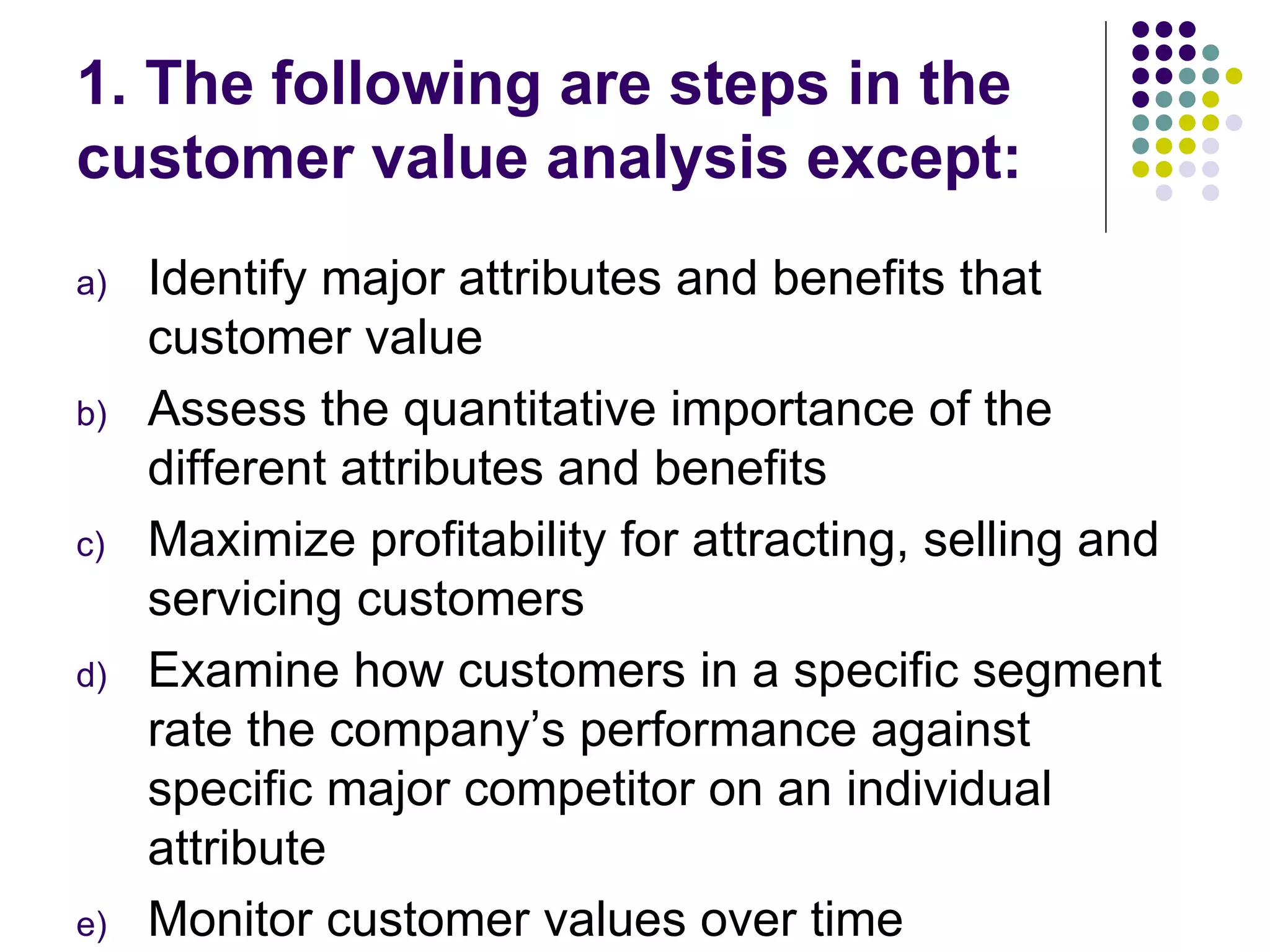
1. The following are steps in the
customer value analysis except:
a)   Identify major attributes and benefits that
     customer value
b)   Assess the quantitative importance of the
     different attributes and benefits
c)   Maximize profitability for attracting, selling and
     servicing customers
d)   Examine how customers in a specific segment
     rate the company’s performance against
     specific major competitor on an individual
     attribute
e)   Monitor customer values over time
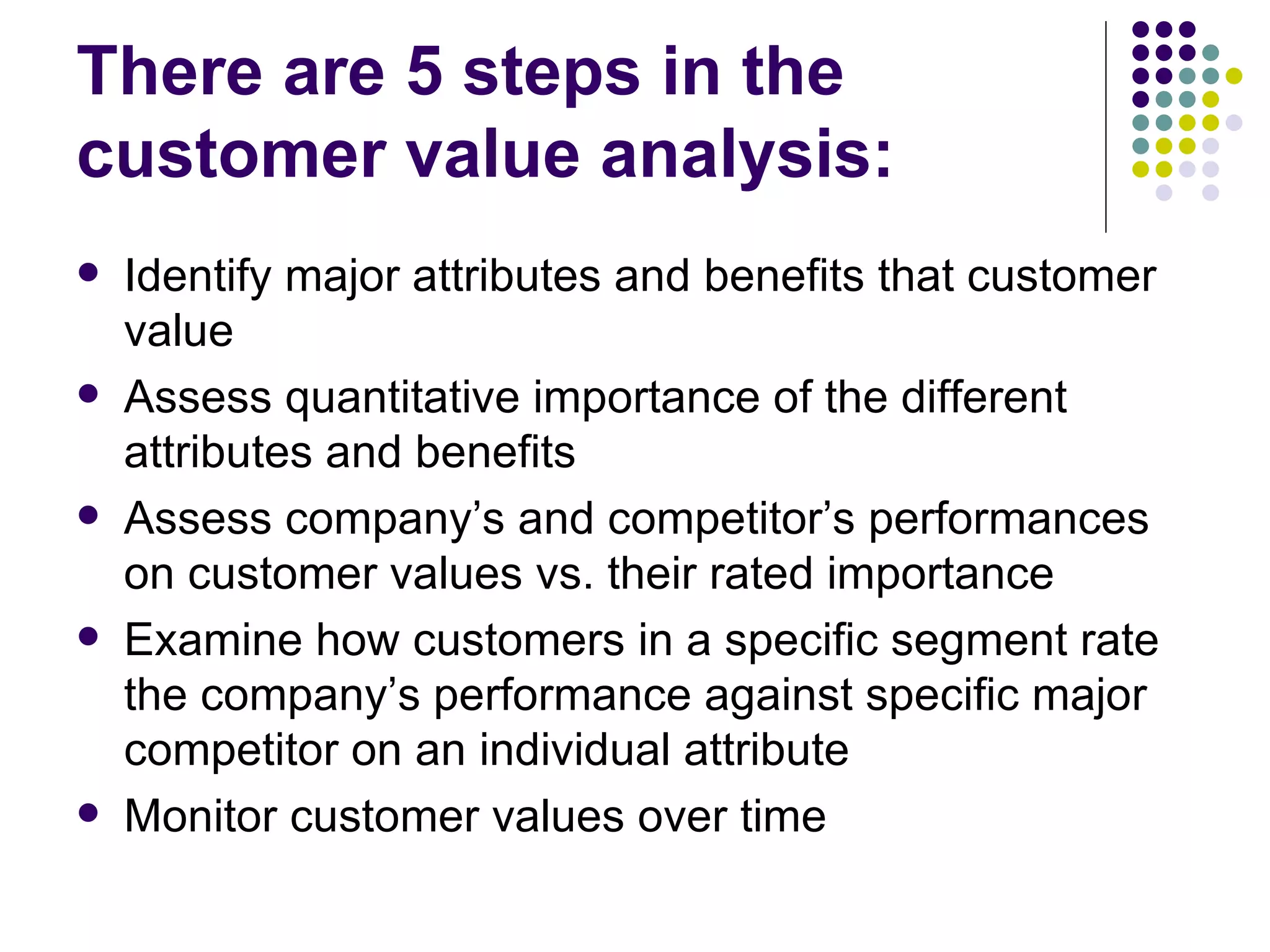
There are 5 steps in the
customer value analysis:
   Identify major attributes and benefits that customer
    value
   Assess quantitative importance of the different
    attributes and benefits
   Assess company’s and competitor’s performances
    on customer values vs. their rated importance
   Examine how customers in a specific segment rate
    the company’s performance against specific major
    competitor on an individual attribute
   Monitor customer values over time
Step 1: Customer Value
Analysis
 Identify the major attributes and benefits that
 customer value- customers are asked which
 attributes, benefits and performance levels
 they look for in choosing a product
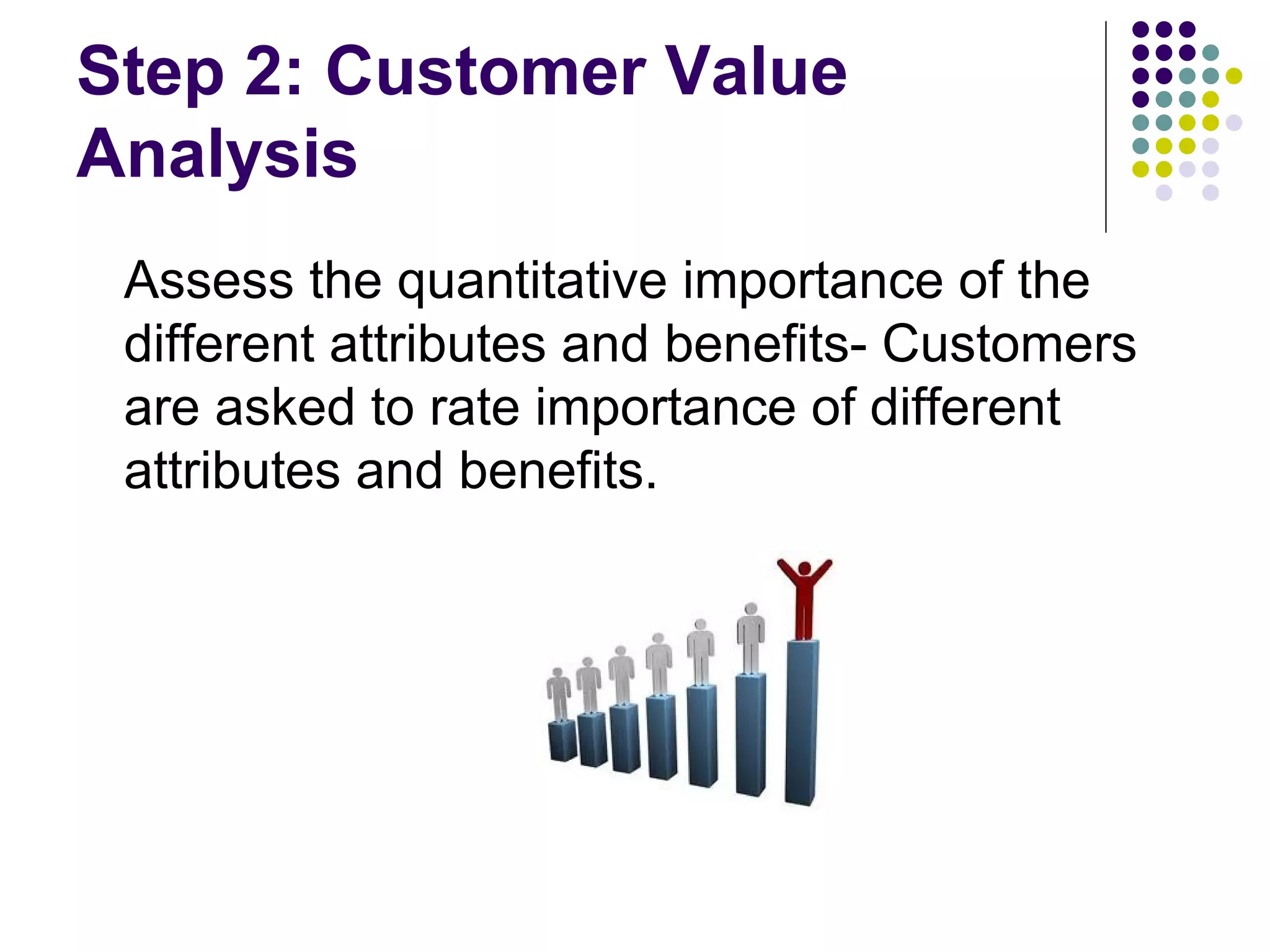
Step 2: Customer Value
Analysis
 Assess the quantitative importance of the
 different attributes and benefits- Customers
 are asked to rate importance of different
 attributes and benefits.
Step 3: Customer Value
Analysis
 Assess company’s and competitor’s
 performances on customer values vs. their
 rated importance- Customers describe where
 they see the company’s and competitor’s
 performances on each attribute/benefit
Step 4: Customer Value
Analysis
 Examine how customers in a specific
 segment rate the company’s performance
 against specific major competitor on an
 individual attribute- If company’s offer
 exceeds competitor’s offer, the company can
 charge a higher price (higher profits) or
 charge same price (gain market share)
Step 5: Customer Value
Analysis
 Monitor customer values over time- Company
 must periodically redo studies of customer
 values and competitors’ standings as
 changes happen
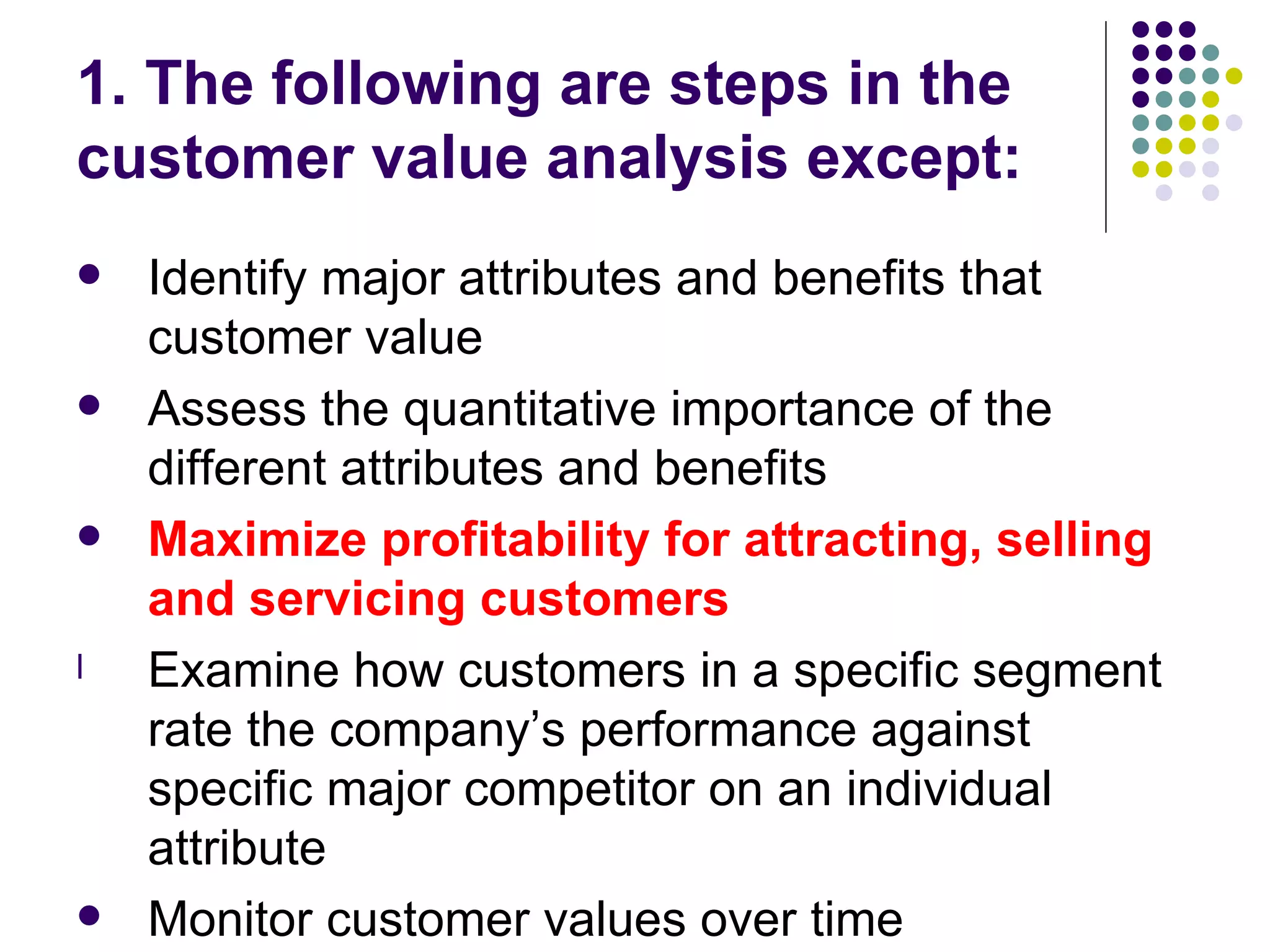
1. The following are steps in the
customer value analysis except:
   Identify major attributes and benefits that
    customer value
   Assess the quantitative importance of the
    different attributes and benefits
   Maximize profitability for attracting, selling
    and servicing customers
l   Examine how customers in a specific segment
    rate the company’s performance against
    specific major competitor on an individual
    attribute
   Monitor customer values over time
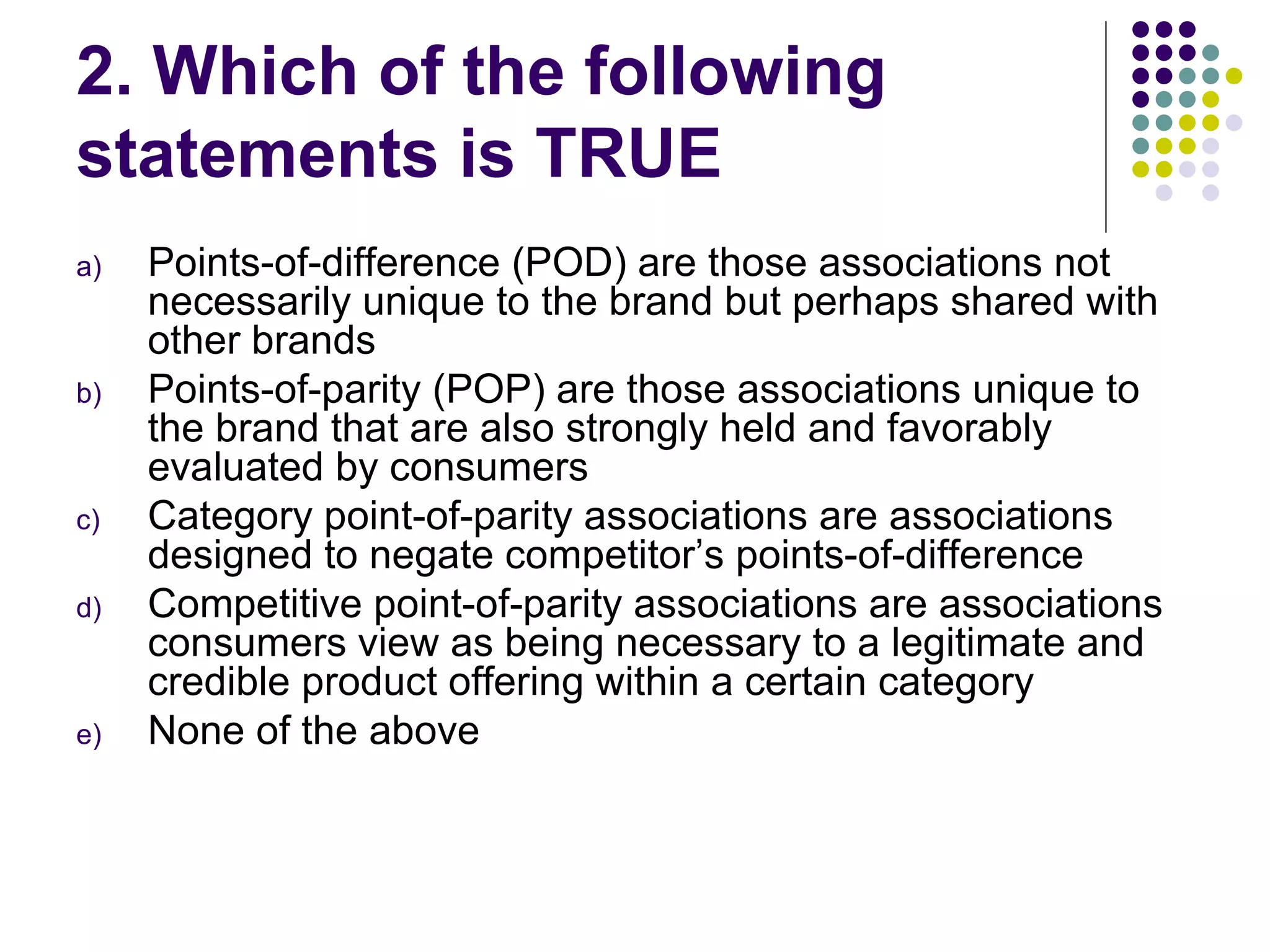
2. Which of the following
statements is TRUE
a)   Points-of-difference (POD) are those associations not
     necessarily unique to the brand but perhaps shared with
     other brands
b)   Points-of-parity (POP) are those associations unique to
     the brand that are also strongly held and favorably
     evaluated by consumers
c)   Category point-of-parity associations are associations
     designed to negate competitor’s points-of-difference
d)   Competitive point-of-parity associations are associations
     consumers view as being necessary to a legitimate and
     credible product offering within a certain category
e)   None of the above
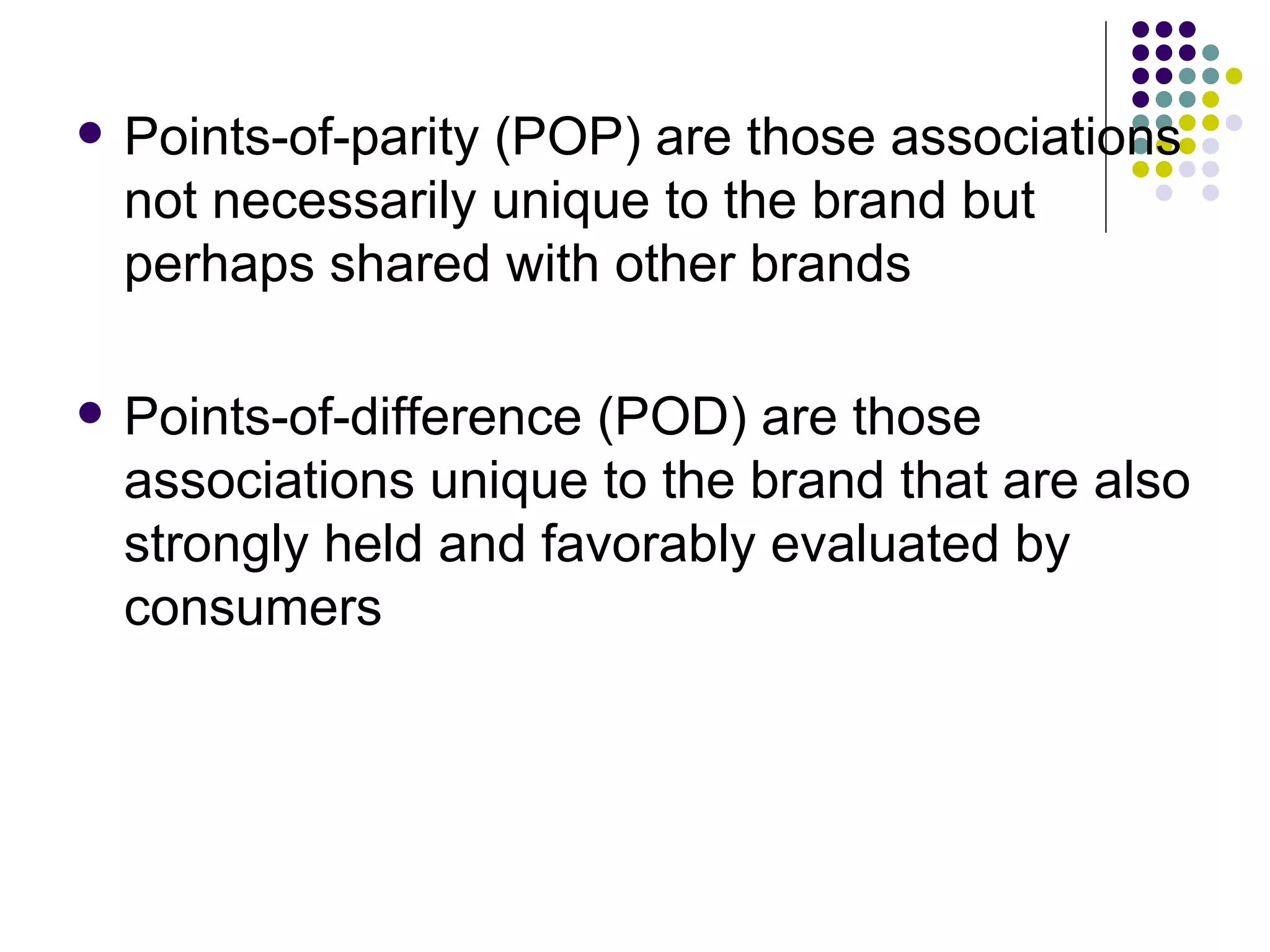
   Points-of-parity (POP) are those associations
    not necessarily unique to the brand but
    perhaps shared with other brands

   Points-of-difference (POD) are those
    associations unique to the brand that are also
    strongly held and favorably evaluated by
    consumers
   Competitive point-of-parity associations are
    associations designed to negate
    competitor’s points-of-difference

   Category point-of-parity associations are
    associations consumers view as being
    necessary to a legitimate and credible
    product offering within a certain category
2. Which of the following
statements is TRUE
   Points-of-difference (POD) are those associations not
    necessarily unique to the brand but perhaps shared with
    other brands
   Points-of-parity (POP) are those associations unique to
    the brand that are also strongly held and favorably
    evaluated by consumers
   Category point-of-parity associations are associations
    designed to negate competitor’s points-of-difference
   Competitive point-of-parity associations are associations
    consumers view as being necessary to a legitimate and
    credible product offering within a certain category
   None of the above
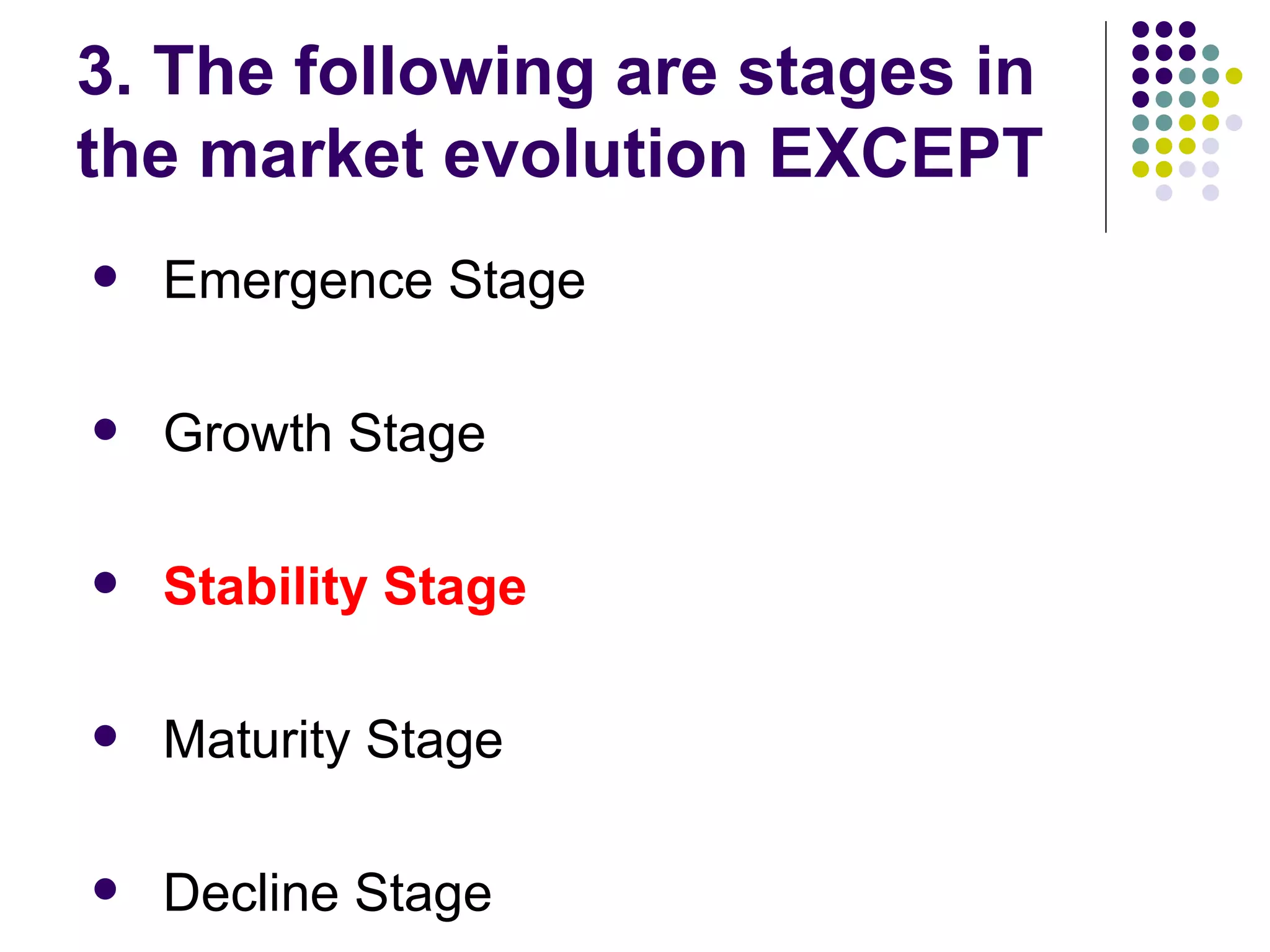
3. The following are stages in
the market evolution EXCEPT
a)   Emergence Stage

c)   Growth Stage

e)   Stability Stage

g)   Maturity Stage

i)   Decline Stage
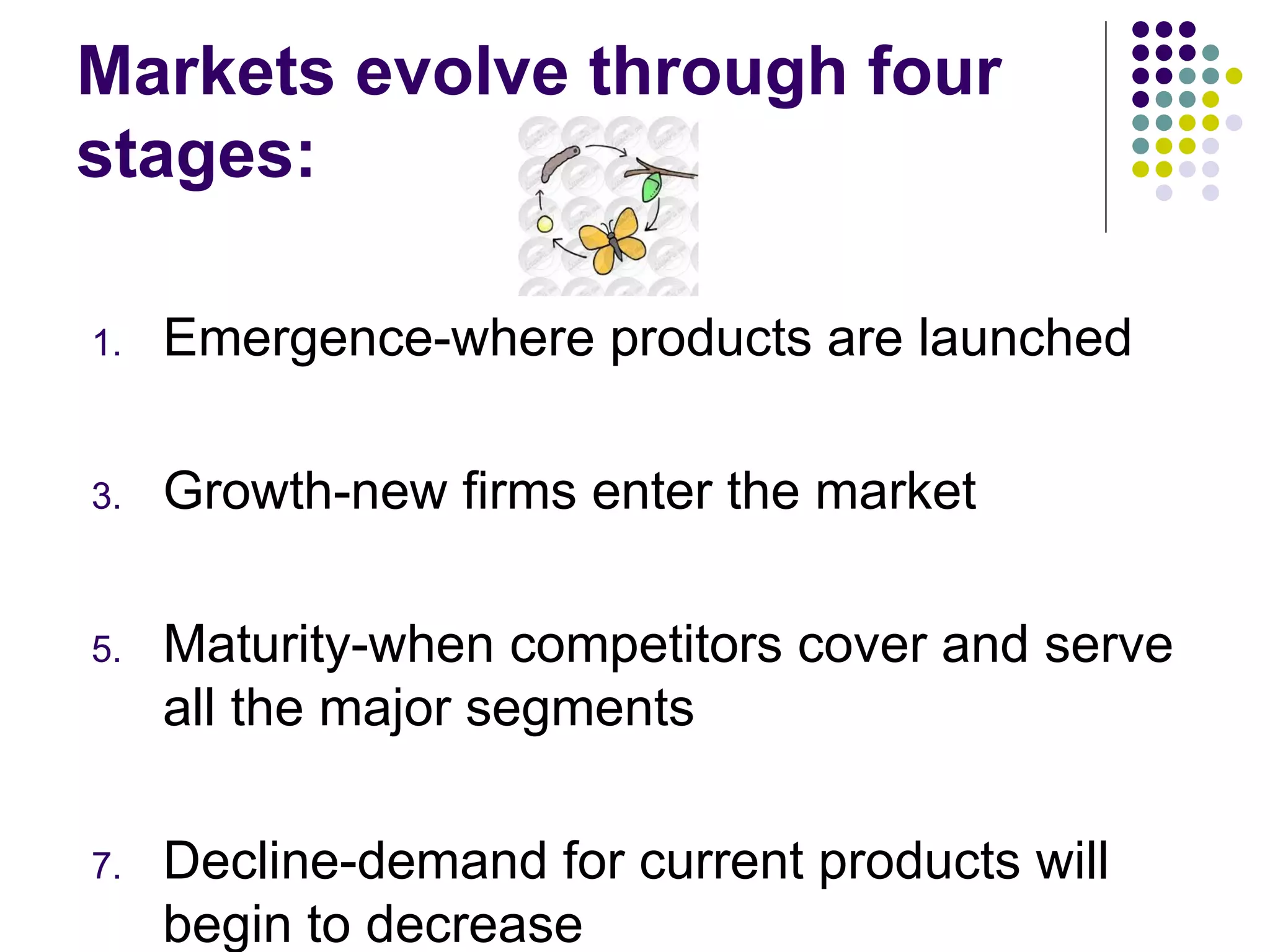
Markets evolve through four
stages:

1.   Emergence-where products are launched

3.   Growth-new firms enter the market

5.   Maturity-when competitors cover and serve
     all the major segments

7.   Decline-demand for current products will
     begin to decrease
3. The following are stages in
the market evolution EXCEPT
   Emergence Stage

   Growth Stage

   Stability Stage

   Maturity Stage

   Decline Stage
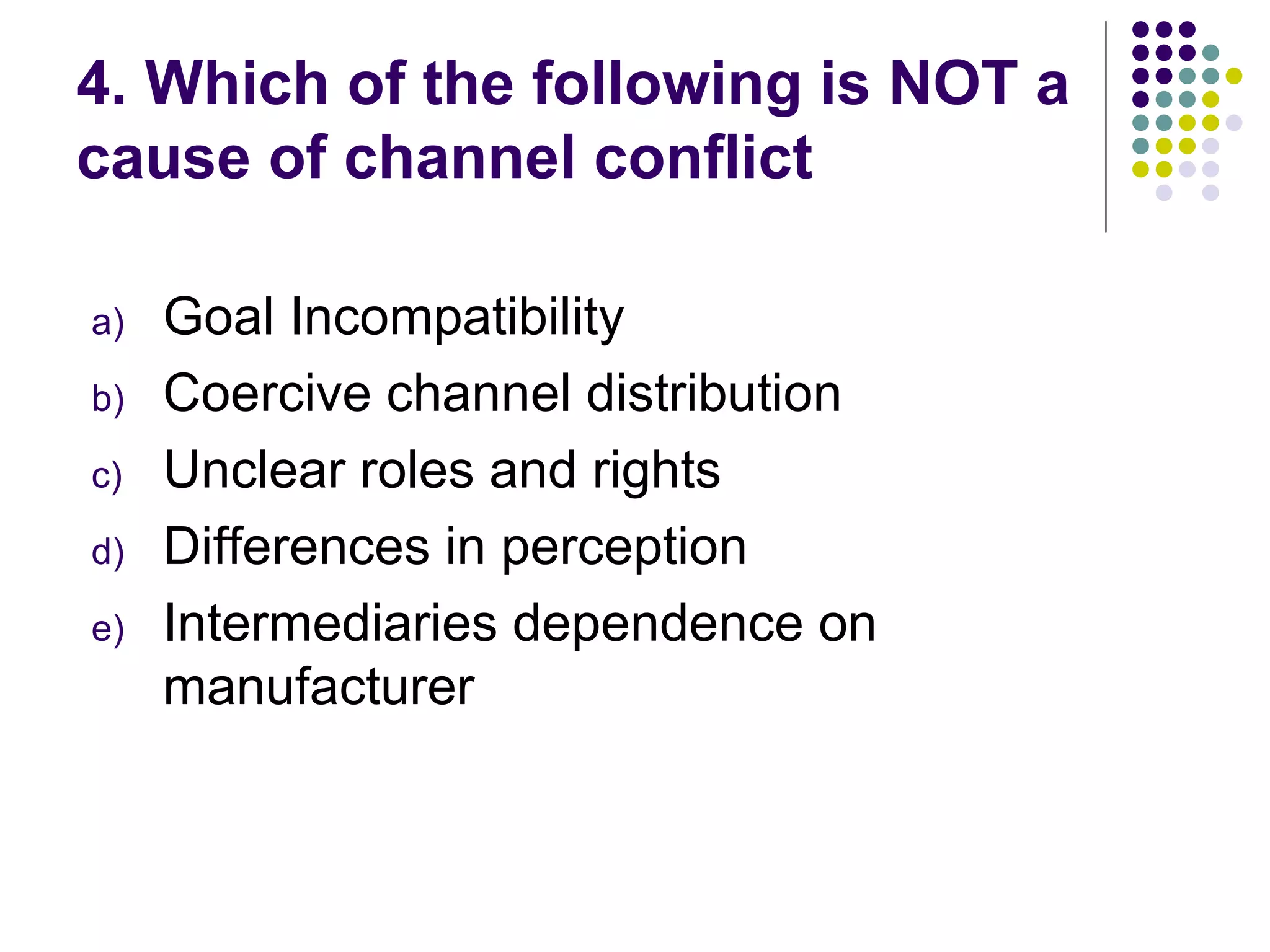
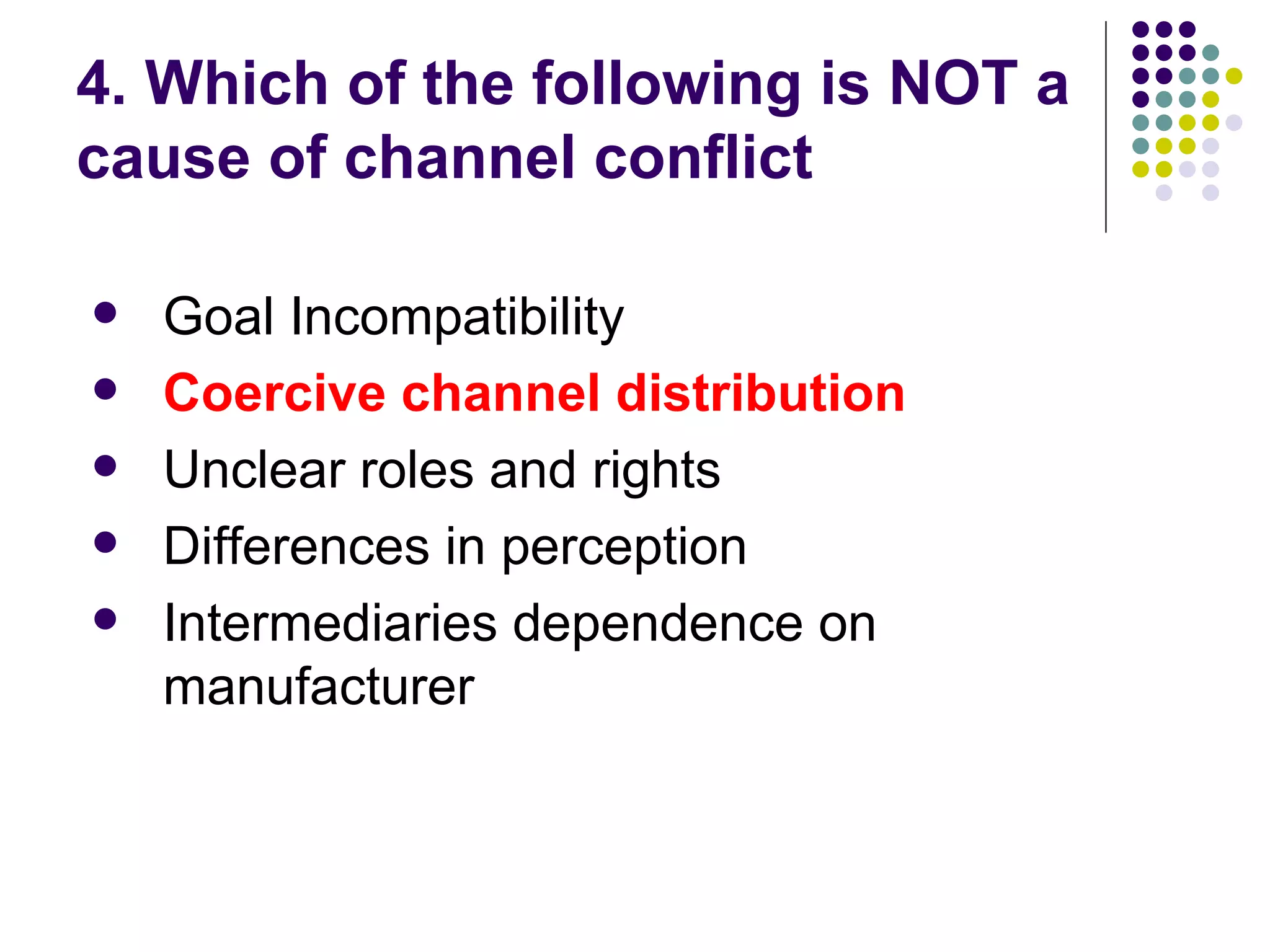
4. Which of the following is NOT a
cause of channel conflict

a)   Goal Incompatibility
b)   Coercive channel distribution
c)   Unclear roles and rights
d)   Differences in perception
e)   Intermediaries dependence on
     manufacturer
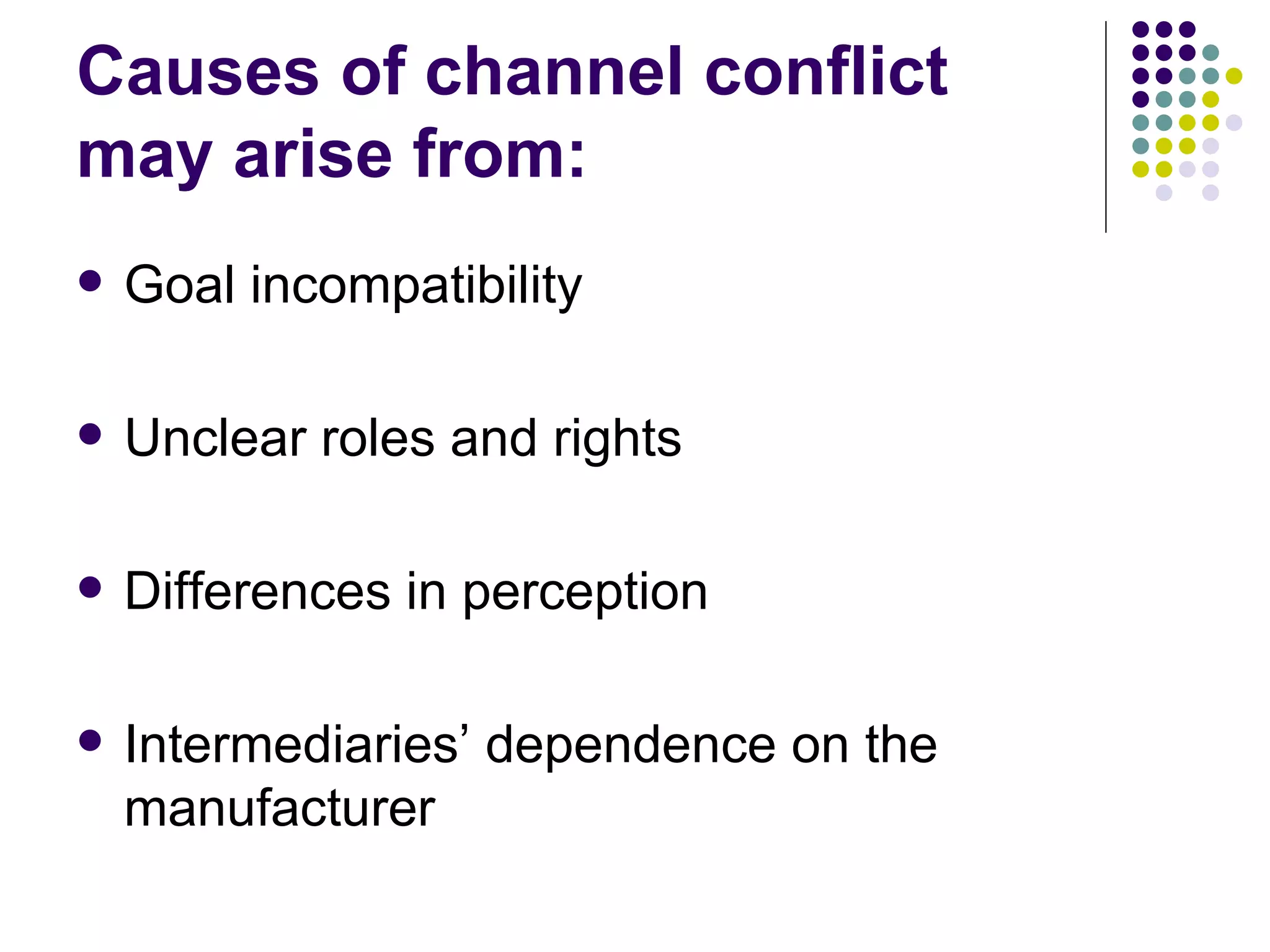
Causes of channel conflict
may arise from:
   Goal incompatibility

   Unclear roles and rights

   Differences in perception

   Intermediaries’ dependence on the
    manufacturer
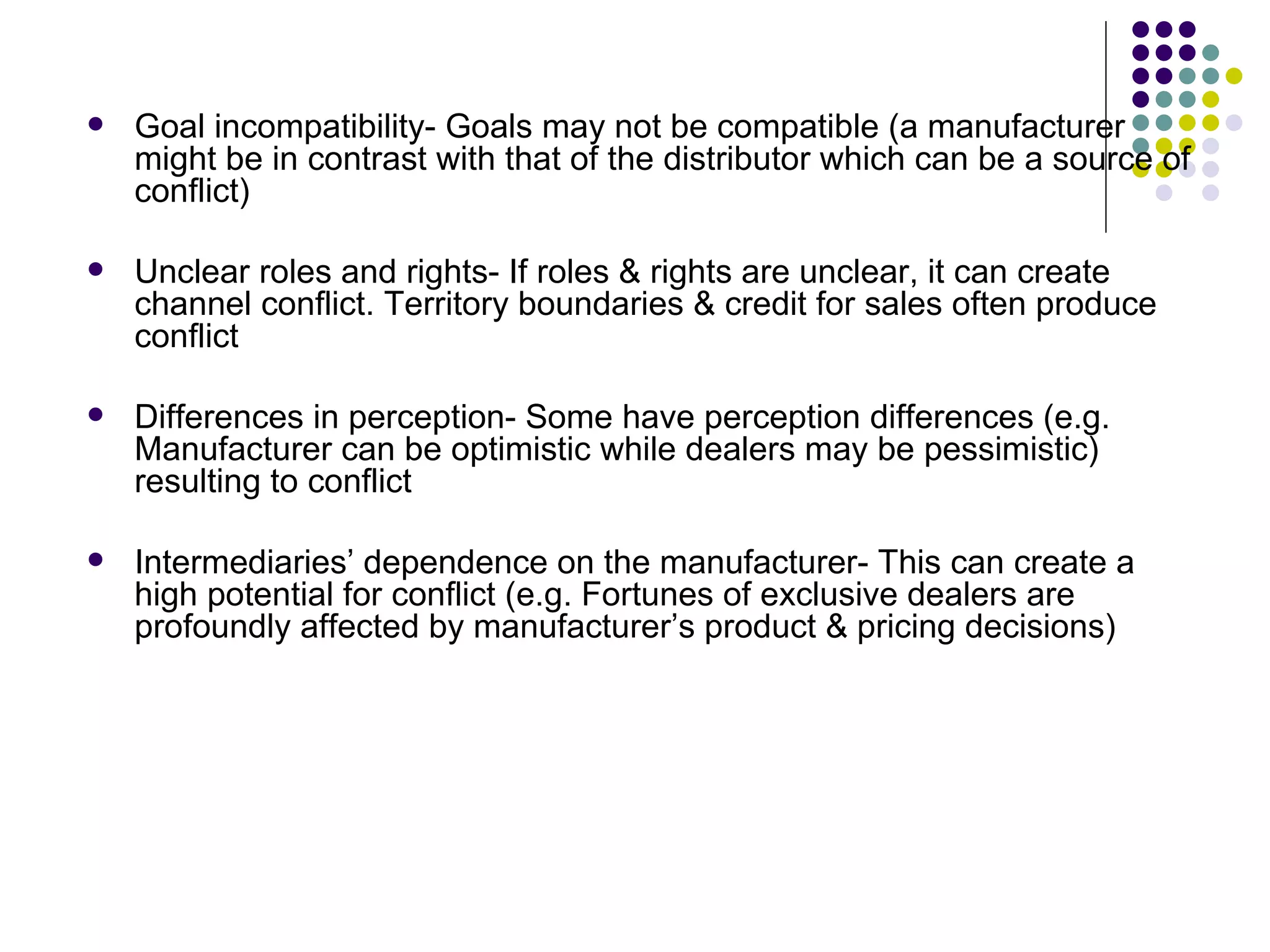
   Goal incompatibility- Goals may not be compatible (a manufacturer
    might be in contrast with that of the distributor which can be a source of
    conflict)

   Unclear roles and rights- If roles & rights are unclear, it can create
    channel conflict. Territory boundaries & credit for sales often produce
    conflict

   Differences in perception- Some have perception differences (e.g.
    Manufacturer can be optimistic while dealers may be pessimistic)
    resulting to conflict

   Intermediaries’ dependence on the manufacturer- This can create a
    high potential for conflict (e.g. Fortunes of exclusive dealers are
    profoundly affected by manufacturer’s product & pricing decisions)
4. Which of the following is NOT a
cause of channel conflict

   Goal Incompatibility
   Coercive channel distribution
   Unclear roles and rights
   Differences in perception
   Intermediaries dependence on
    manufacturer
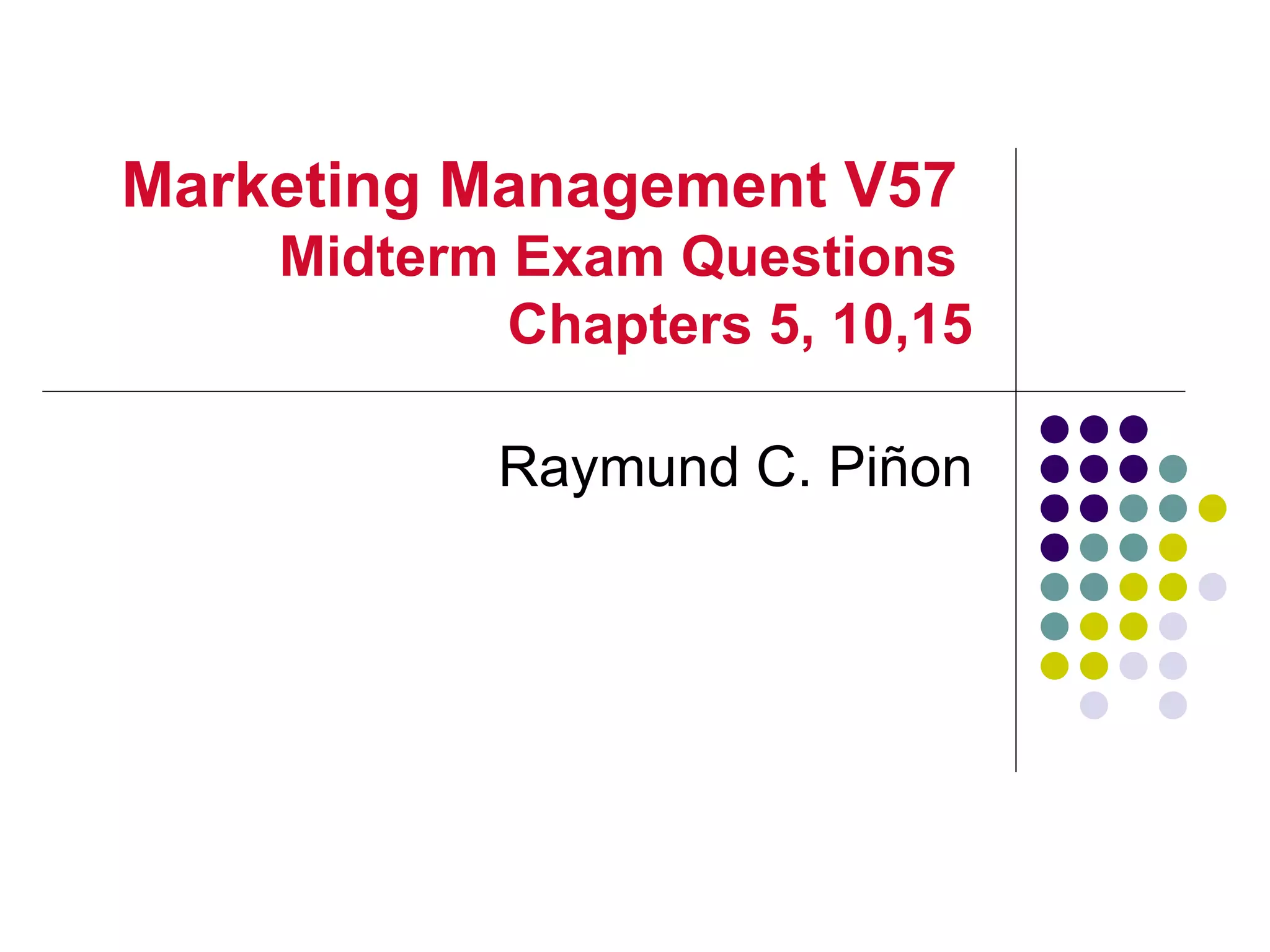
Marketing Management V57
    Midterm Exam Questions
            Chapters 5, 10,15

           Raymund C. Piñon
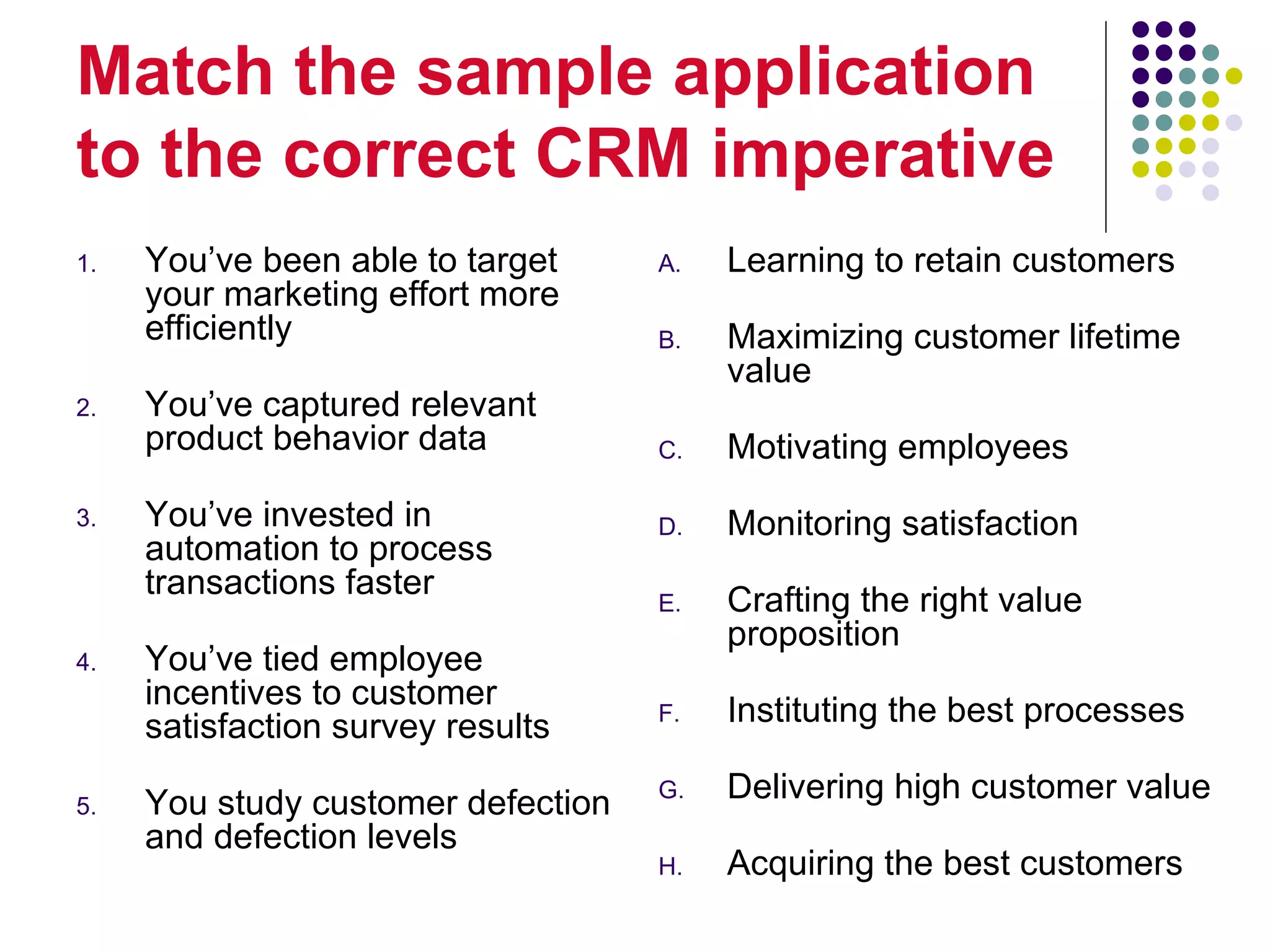
Match the sample application
to the correct CRM imperative
1.   You’ve been able to target     A.   Learning to retain customers
     your marketing effort more
     efficiently                    B.   Maximizing customer lifetime
                                         value
2.   You’ve captured relevant
     product behavior data          C.   Motivating employees
3.   You’ve invested in             D.   Monitoring satisfaction
     automation to process
     transactions faster            E.   Crafting the right value
                                         proposition
4.   You’ve tied employee
     incentives to customer         F.   Instituting the best processes
     satisfaction survey results

5.   You study customer defection   G.   Delivering high customer value
     and defection levels
                                    H.   Acquiring the best customers
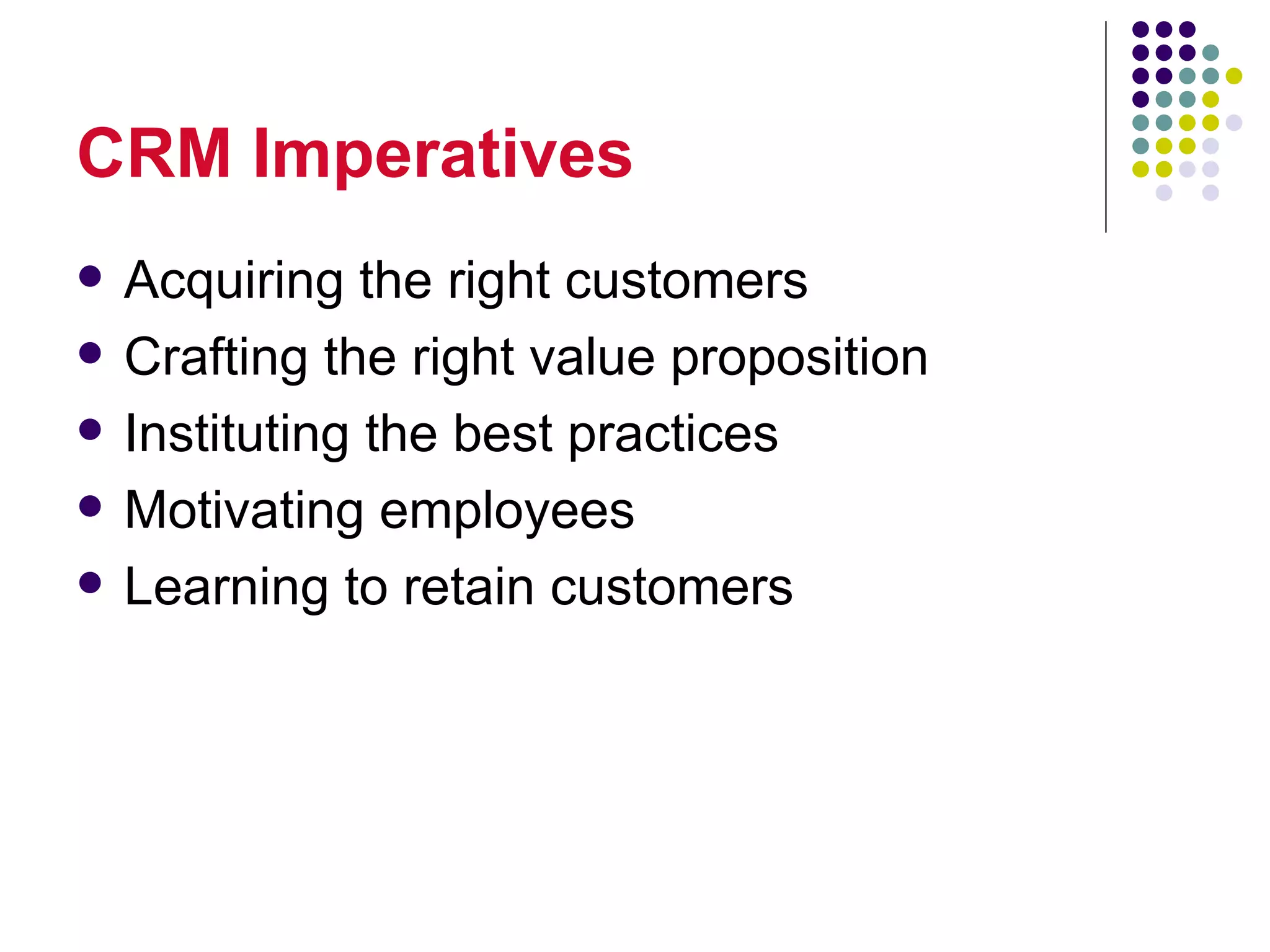
CRM Imperatives
   Acquiring the right customers
   Crafting the right value proposition
   Instituting the best practices
   Motivating employees
   Learning to retain customers
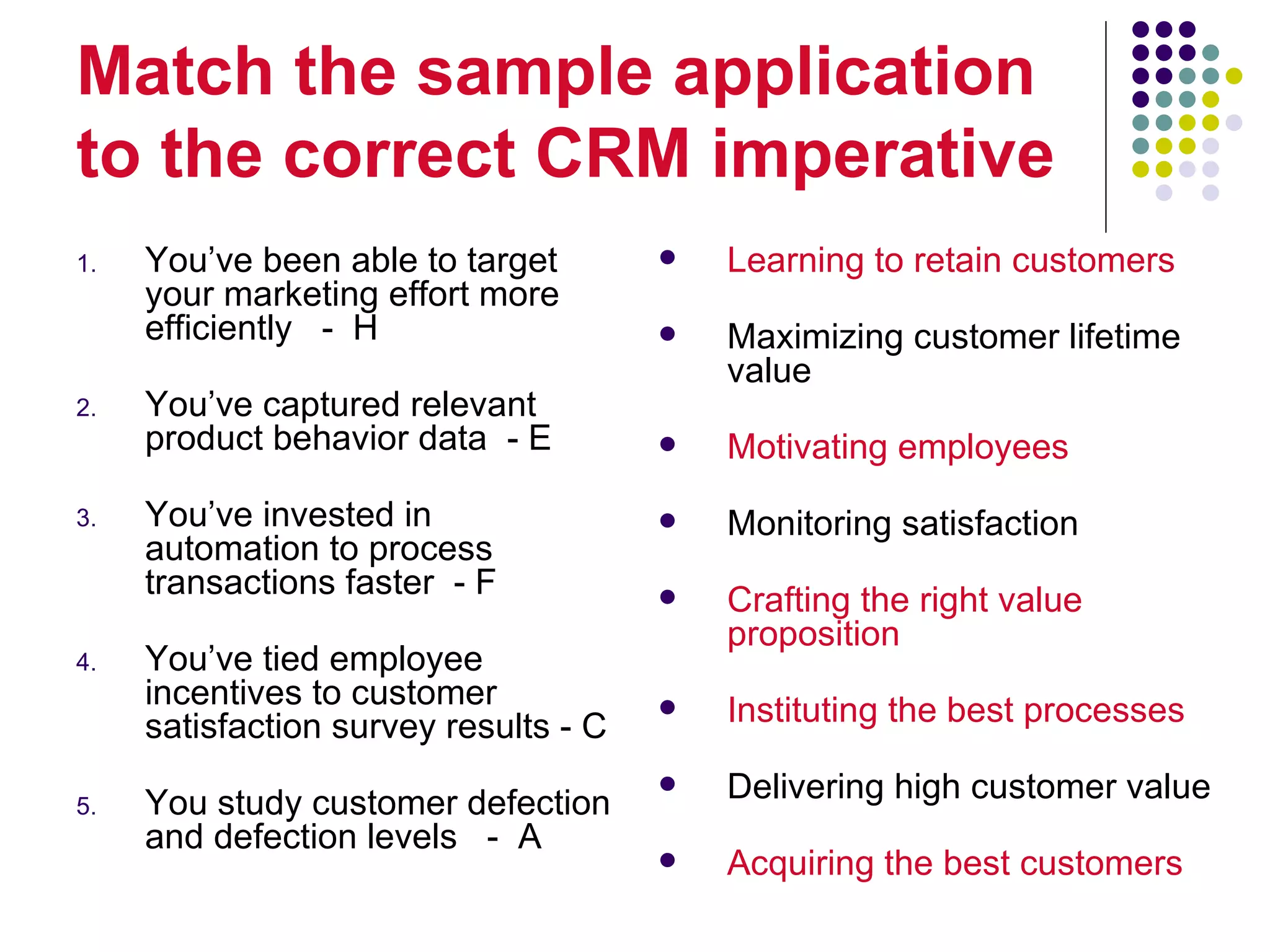
Match the sample application
to the correct CRM imperative
1.   You’ve been able to target           Learning to retain customers
     your marketing effort more
     efficiently - H                      Maximizing customer lifetime
                                           value
2.   You’ve captured relevant
     product behavior data - E            Motivating employees
3.   You’ve invested in                   Monitoring satisfaction
     automation to process
     transactions faster - F              Crafting the right value
                                           proposition
4.   You’ve tied employee
     incentives to customer               Instituting the best processes
     satisfaction survey results - C

5.   You study customer defection
                                          Delivering high customer value
     and defection levels - A
                                          Acquiring the best customers
To communicate a positioning, marketing plans
often include a positioning statement. Match the
contents of the statement to the appropriate
elements of a positioning statement
1.   To young, active             A.   Point-of-Difference
     consumers of soft-drink
                                  B.   Relevance
2.   who have little time to
     sleep,                       C.   Customer need

3.   Mountain Dew is the          D.   Brand and category
     soft-drink                        membership

4.   That gives you more          E.   Concept
     energy than any other
     brand                        F.   Target segment
5.   because it has the highest   G.   Believability
     level of caffeine
Elements of a Positioning Statement

   Target segment
   Category membership
   Customer need
   Brand name
   Concept
   Point-of-Difference
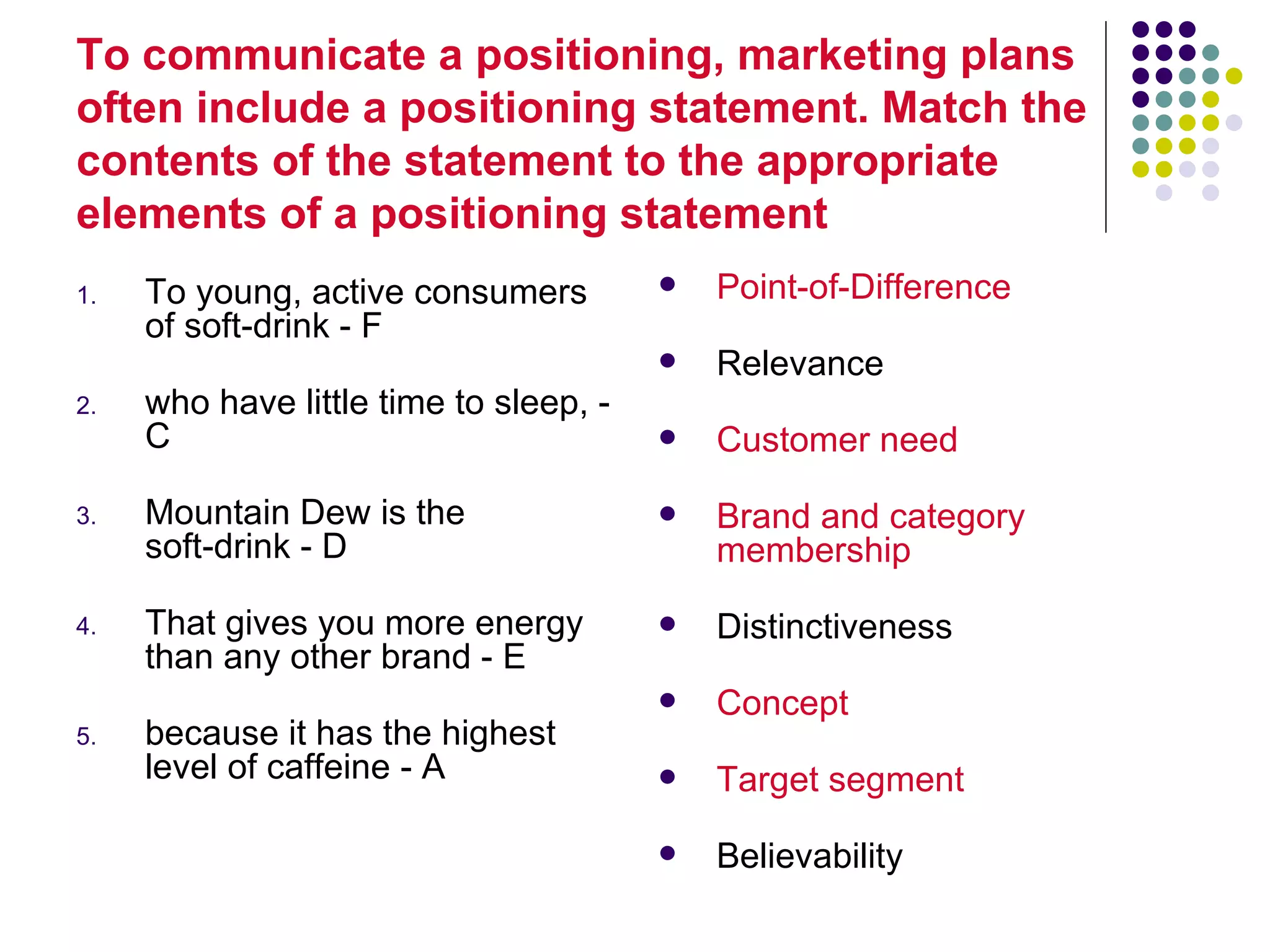
To communicate a positioning, marketing plans
often include a positioning statement. Match the
contents of the statement to the appropriate
elements of a positioning statement
1.   To young, active consumers            Point-of-Difference
     of soft-drink - F
                                           Relevance
2.   who have little time to sleep, -
     C                                     Customer need

3.   Mountain Dew is the                   Brand and category
     soft-drink - D                         membership

4.   That gives you more energy            Distinctiveness
     than any other brand - E
                                           Concept
5.   because it has the highest
     level of caffeine - A                 Target segment

                                           Believability
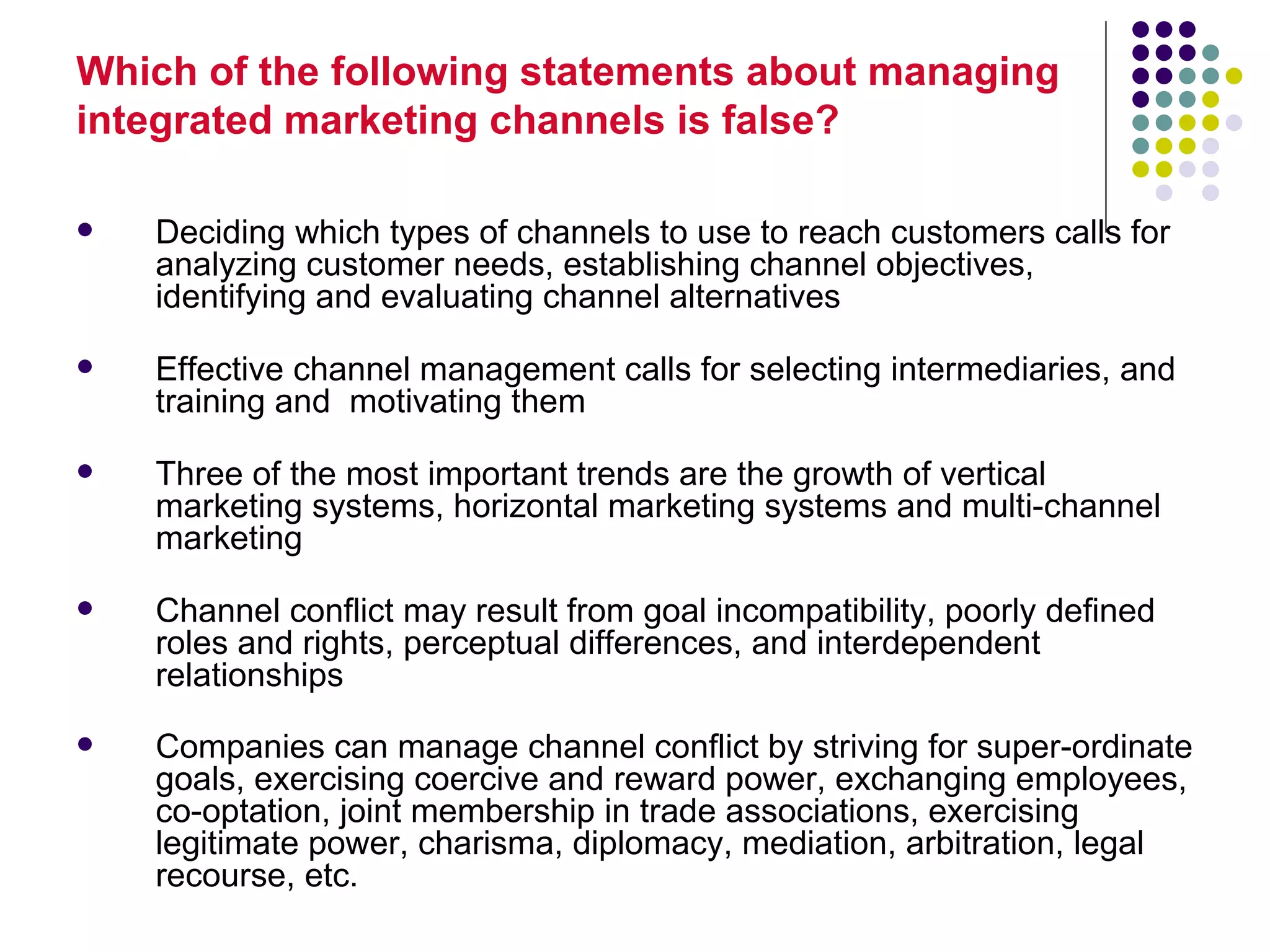
Which of the following statements about managing
integrated marketing channels is false?

   Deciding which types of channels to use to reach customers calls for
    analyzing customer needs, establishing channel objectives,
    identifying and evaluating channel alternatives

   Effective channel management calls for selecting intermediaries, and
    training and motivating them

   Three of the most important trends are the growth of vertical
    marketing systems, horizontal marketing systems and multi-channel
    marketing

   Channel conflict may result from goal incompatibility, poorly defined
    roles and rights, perceptual differences, and interdependent
    relationships
   Companies can manage channel conflict by striving for super-ordinate
    goals, exercising coercive and reward power, exchanging employees,
    co-optation, joint membership in trade associations, exercising
    legitimate power, charisma, diplomacy, mediation, arbitration, legal
    recourse, etc.
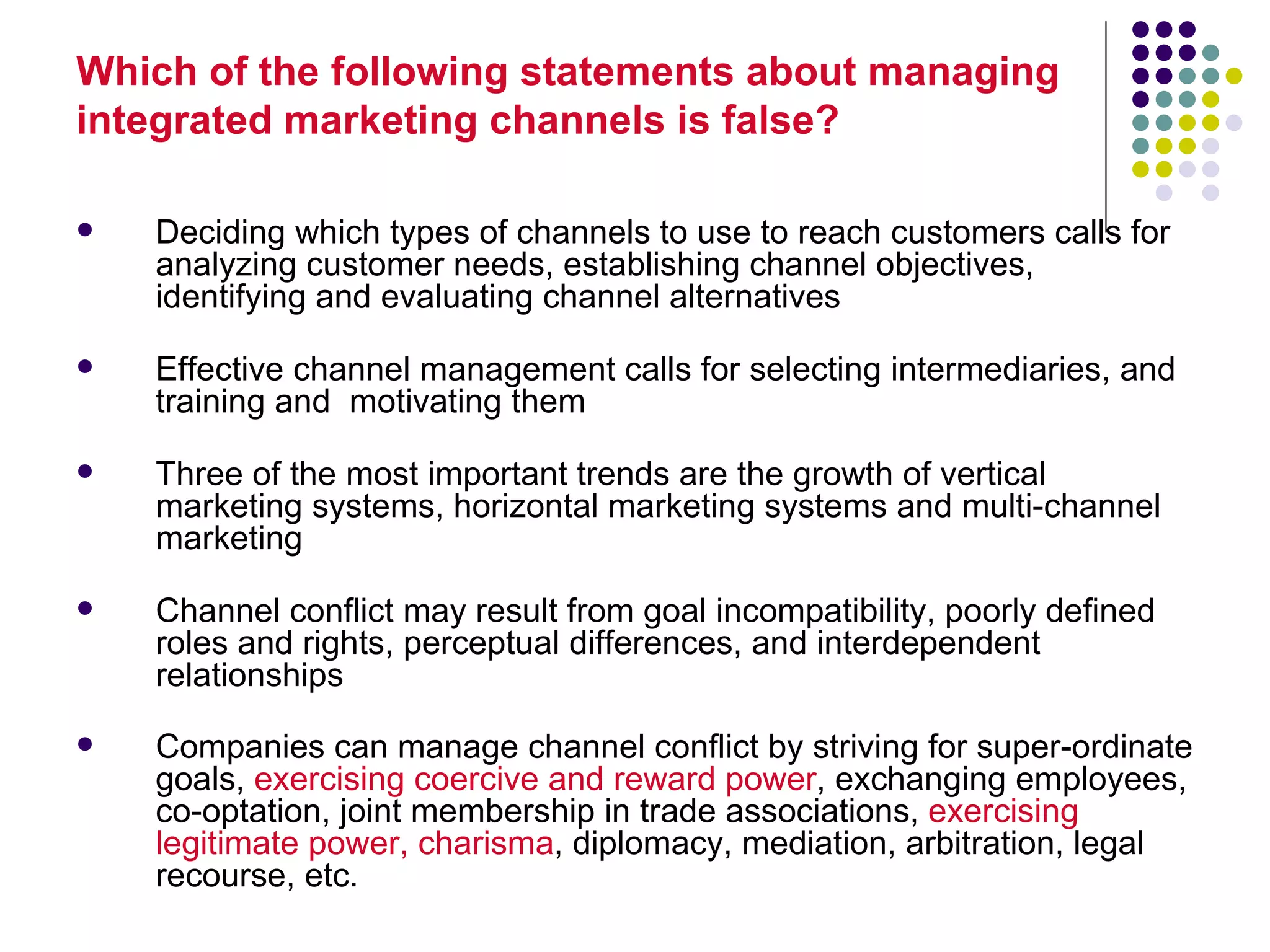
Which of the following statements about managing
integrated marketing channels is false?

   Deciding which types of channels to use to reach customers calls for
    analyzing customer needs, establishing channel objectives,
    identifying and evaluating channel alternatives

   Effective channel management calls for selecting intermediaries, and
    training and motivating them

   Three of the most important trends are the growth of vertical
    marketing systems, horizontal marketing systems and multi-channel
    marketing

   Channel conflict may result from goal incompatibility, poorly defined
    roles and rights, perceptual differences, and interdependent
    relationships
   Companies can manage channel conflict by striving for super-ordinate
    goals, exercising coercive and reward power, exchanging employees,
    co-optation, joint membership in trade associations, exercising
    legitimate power, charisma, diplomacy, mediation, arbitration, legal
    recourse, etc.

Markma V57 Midterm exam review questions for chapters 5, 10,15

  • 1.
    MIDTERMS REVIEW QUESTIONS FORCHAPTERS 5, 10 & 15 GROUP#4
  • 2.
    Review Questions for Midterms (from Chapter 5, 10 & 15) Kristoffer Z. Jongco
  • 3.
    1. The followingare steps in the customer value analysis except: a) Identify major attributes and benefits that customer value b) Assess the quantitative importance of the different attributes and benefits c) Maximize profitability for attracting, selling and servicing customers d) Examine how customers in a specific segment rate the company’s performance against specific major competitor on an individual attribute e) Monitor customer values over time
  • 4.
    There are 5steps in the customer value analysis:  Identify major attributes and benefits that customer value  Assess quantitative importance of the different attributes and benefits  Assess company’s and competitor’s performances on customer values vs. their rated importance  Examine how customers in a specific segment rate the company’s performance against specific major competitor on an individual attribute  Monitor customer values over time
  • 5.
    Step 1: CustomerValue Analysis Identify the major attributes and benefits that customer value- customers are asked which attributes, benefits and performance levels they look for in choosing a product
  • 6.
    Step 2: CustomerValue Analysis Assess the quantitative importance of the different attributes and benefits- Customers are asked to rate importance of different attributes and benefits.
  • 7.
    Step 3: CustomerValue Analysis Assess company’s and competitor’s performances on customer values vs. their rated importance- Customers describe where they see the company’s and competitor’s performances on each attribute/benefit
  • 8.
    Step 4: CustomerValue Analysis Examine how customers in a specific segment rate the company’s performance against specific major competitor on an individual attribute- If company’s offer exceeds competitor’s offer, the company can charge a higher price (higher profits) or charge same price (gain market share)
  • 9.
    Step 5: CustomerValue Analysis Monitor customer values over time- Company must periodically redo studies of customer values and competitors’ standings as changes happen
  • 10.
    1. The followingare steps in the customer value analysis except:  Identify major attributes and benefits that customer value  Assess the quantitative importance of the different attributes and benefits  Maximize profitability for attracting, selling and servicing customers l Examine how customers in a specific segment rate the company’s performance against specific major competitor on an individual attribute  Monitor customer values over time
  • 11.
    2. Which ofthe following statements is TRUE a) Points-of-difference (POD) are those associations not necessarily unique to the brand but perhaps shared with other brands b) Points-of-parity (POP) are those associations unique to the brand that are also strongly held and favorably evaluated by consumers c) Category point-of-parity associations are associations designed to negate competitor’s points-of-difference d) Competitive point-of-parity associations are associations consumers view as being necessary to a legitimate and credible product offering within a certain category e) None of the above
  • 12.
    Points-of-parity (POP) are those associations not necessarily unique to the brand but perhaps shared with other brands  Points-of-difference (POD) are those associations unique to the brand that are also strongly held and favorably evaluated by consumers
  • 13.
    Competitive point-of-parity associations are associations designed to negate competitor’s points-of-difference  Category point-of-parity associations are associations consumers view as being necessary to a legitimate and credible product offering within a certain category
  • 14.
    2. Which ofthe following statements is TRUE  Points-of-difference (POD) are those associations not necessarily unique to the brand but perhaps shared with other brands  Points-of-parity (POP) are those associations unique to the brand that are also strongly held and favorably evaluated by consumers  Category point-of-parity associations are associations designed to negate competitor’s points-of-difference  Competitive point-of-parity associations are associations consumers view as being necessary to a legitimate and credible product offering within a certain category  None of the above
  • 15.
    3. The followingare stages in the market evolution EXCEPT a) Emergence Stage c) Growth Stage e) Stability Stage g) Maturity Stage i) Decline Stage
  • 16.
    Markets evolve throughfour stages: 1. Emergence-where products are launched 3. Growth-new firms enter the market 5. Maturity-when competitors cover and serve all the major segments 7. Decline-demand for current products will begin to decrease
  • 17.
    3. The followingare stages in the market evolution EXCEPT  Emergence Stage  Growth Stage  Stability Stage  Maturity Stage  Decline Stage
  • 18.
    4. Which ofthe following is NOT a cause of channel conflict a) Goal Incompatibility b) Coercive channel distribution c) Unclear roles and rights d) Differences in perception e) Intermediaries dependence on manufacturer
  • 19.
    Causes of channelconflict may arise from:  Goal incompatibility  Unclear roles and rights  Differences in perception  Intermediaries’ dependence on the manufacturer
  • 20.
    Goal incompatibility- Goals may not be compatible (a manufacturer might be in contrast with that of the distributor which can be a source of conflict)  Unclear roles and rights- If roles & rights are unclear, it can create channel conflict. Territory boundaries & credit for sales often produce conflict  Differences in perception- Some have perception differences (e.g. Manufacturer can be optimistic while dealers may be pessimistic) resulting to conflict  Intermediaries’ dependence on the manufacturer- This can create a high potential for conflict (e.g. Fortunes of exclusive dealers are profoundly affected by manufacturer’s product & pricing decisions)
  • 21.
    4. Which ofthe following is NOT a cause of channel conflict  Goal Incompatibility  Coercive channel distribution  Unclear roles and rights  Differences in perception  Intermediaries dependence on manufacturer
  • 22.
    Marketing Management V57 Midterm Exam Questions Chapters 5, 10,15 Raymund C. Piñon
  • 23.
    Match the sampleapplication to the correct CRM imperative 1. You’ve been able to target A. Learning to retain customers your marketing effort more efficiently B. Maximizing customer lifetime value 2. You’ve captured relevant product behavior data C. Motivating employees 3. You’ve invested in D. Monitoring satisfaction automation to process transactions faster E. Crafting the right value proposition 4. You’ve tied employee incentives to customer F. Instituting the best processes satisfaction survey results 5. You study customer defection G. Delivering high customer value and defection levels H. Acquiring the best customers
  • 24.
    CRM Imperatives  Acquiring the right customers  Crafting the right value proposition  Instituting the best practices  Motivating employees  Learning to retain customers
  • 25.
    Match the sampleapplication to the correct CRM imperative 1. You’ve been able to target  Learning to retain customers your marketing effort more efficiently - H  Maximizing customer lifetime value 2. You’ve captured relevant product behavior data - E  Motivating employees 3. You’ve invested in  Monitoring satisfaction automation to process transactions faster - F  Crafting the right value proposition 4. You’ve tied employee incentives to customer  Instituting the best processes satisfaction survey results - C 5. You study customer defection  Delivering high customer value and defection levels - A  Acquiring the best customers
  • 26.
    To communicate apositioning, marketing plans often include a positioning statement. Match the contents of the statement to the appropriate elements of a positioning statement 1. To young, active A. Point-of-Difference consumers of soft-drink B. Relevance 2. who have little time to sleep, C. Customer need 3. Mountain Dew is the D. Brand and category soft-drink membership 4. That gives you more E. Concept energy than any other brand F. Target segment 5. because it has the highest G. Believability level of caffeine
  • 27.
    Elements of aPositioning Statement  Target segment  Category membership  Customer need  Brand name  Concept  Point-of-Difference
  • 28.
    To communicate apositioning, marketing plans often include a positioning statement. Match the contents of the statement to the appropriate elements of a positioning statement 1. To young, active consumers  Point-of-Difference of soft-drink - F  Relevance 2. who have little time to sleep, - C  Customer need 3. Mountain Dew is the  Brand and category soft-drink - D membership 4. That gives you more energy  Distinctiveness than any other brand - E  Concept 5. because it has the highest level of caffeine - A  Target segment  Believability
  • 29.
    Which of thefollowing statements about managing integrated marketing channels is false?  Deciding which types of channels to use to reach customers calls for analyzing customer needs, establishing channel objectives, identifying and evaluating channel alternatives  Effective channel management calls for selecting intermediaries, and training and motivating them  Three of the most important trends are the growth of vertical marketing systems, horizontal marketing systems and multi-channel marketing  Channel conflict may result from goal incompatibility, poorly defined roles and rights, perceptual differences, and interdependent relationships  Companies can manage channel conflict by striving for super-ordinate goals, exercising coercive and reward power, exchanging employees, co-optation, joint membership in trade associations, exercising legitimate power, charisma, diplomacy, mediation, arbitration, legal recourse, etc.
  • 30.
    Which of thefollowing statements about managing integrated marketing channels is false?  Deciding which types of channels to use to reach customers calls for analyzing customer needs, establishing channel objectives, identifying and evaluating channel alternatives  Effective channel management calls for selecting intermediaries, and training and motivating them  Three of the most important trends are the growth of vertical marketing systems, horizontal marketing systems and multi-channel marketing  Channel conflict may result from goal incompatibility, poorly defined roles and rights, perceptual differences, and interdependent relationships  Companies can manage channel conflict by striving for super-ordinate goals, exercising coercive and reward power, exchanging employees, co-optation, joint membership in trade associations, exercising legitimate power, charisma, diplomacy, mediation, arbitration, legal recourse, etc.