Marking the ESL HSC Area of Study - Paper 1 Section 2  Report and Strategies
The syllabus - Area of study ‘Belonging’  The Area of Study requires students to explore the ways in which the concept of belonging is considered and expressed in and through texts.  Through close language study, and by experimenting with different language choices, students will examine how perceptions of belonging, or not belonging, vary.
Key concepts include (but are not limited to…) How perceptions of belonging are shaped within different contexts How a sense of belonging can emerge from connections made with people, places, groups, communities How experiences and notions of identity, relationships, acceptance and understanding affect belonging How choices not to belong, or barriers prevent belonging
The choices for Prescribed texts: Heat and Dust  by Ruth Prawer Jhabvala The China Coin  by Allan Baillie Unpolished Gem  by Alice Pung Swallow the Air  by Tara Winch Billy Elliot  by Stephen Daldry Rabbit Proof Fence  by Phillip Noyce Immigrant Chronicle  by Peter Skrzynecki Poems by Emily Dickinson
And drama … Rainbows End  by Jane Harrison Educating Rita  by Willy Russell
General Comments Black pen is easier to read when scanned Numbered pages helps to easily establish sequence of the response Many students only used one book (3 pages) however better responses were at least 2 books long – students need to be told to ask for more paper!
The marking guidelines In your answer you will be assessed on how well you: Demonstrate understanding of  the ways language shapes and expresses  perceptions Organize, develop and express ideas using language appropriate to  audience, purpose  and  context .
The question You have been asked to give a  speech  to your class on the following topic: ‘ Acceptance  and  understanding  are  necessary for  a sense of  belonging .’ Write the script of your speech. In your speech, refer to your  TWO prescribed  texts and  ONE  text of your  own choosing .
The marking criteria
The marking criteria Highly effective response fully addresses question and demonstrates insightful understanding of belonging Comprehensive knowledge of texts and highly developed skills in interpretation  Incisive understanding of the ways in which ideas are communicated Skilful use of language forms and features and highly effective synthesis of ideas and information Skilful and efficient use of language with sustained control of expression
Criterion 1 - ‘an Effective response’ Strong emphasis on answering the question as a key criterion ‘ Speech’ text type NOT vital ‘ insightful ideas’ required student to have a sophisticated thesis about belonging that connects texts PLUS detailed analysis of other ideas about belonging  ‘ effective’ means consistently addressing question and writing about ideas of belonging
Criterion 2 - knowledge /interpretation of texts Students need to show detailed knowledge of [ideas of belonging in] ALL 3 texts For poetry, 2 poems necessary Detailed descriptions of events / situations in texts with explanation of how they demonstrate ideas about understanding being necessary for belonging At least 3 quotes from each text
Criterion 3 - ‘the ways’ Analysis of language forms and features is mandatory - even if the question doesn’t appear to ask for it Analysis of techniques must be directed to how they convey ideas about acceptance and understanding Poetry analysis seems to invite greater analysis of techniques than analysis of prose fiction texts
and… For prose fiction characterisation, setting, narrative structure and symbolism are ‘ways’ For plays, students must analyse stage directions as well as dialogue etc There is a hierarchy of language forms - figurative devices, metonymy, pathetic fallacy will promote more incisive ideas about belonging
Criteria 4 – skilful use of language forms There are 2 main ways students use to structure their responses…
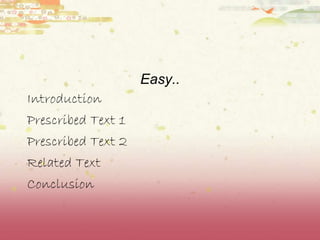
Easy.. Introduction Prescribed Text 1 Prescribed Text 2 Related Text Conclusion
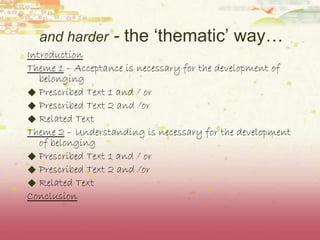
and harder  -  the ‘thematic’ way… Introduction Theme 1  – Acceptance is necessary for the development of belonging Prescribed Text 1 and / or Prescribed Text 2 and /or Related Text Theme 2  – Understanding is necessary for the development of belonging Prescribed Text 1 and / or Prescribed Text 2 and /or Related Text Conclusion
Criterion 4  (cont.) The more sophisticated responses used the second, thematic way of structuring – it promoted greater opportunities for synthesis Speech form not essential  this time ‘ A’ range texts characterised by sustained integration of ideas that did not need linking words like ‘similarly’ or ‘on the other hand’ ‘ B’ range ‘effective synthesis’ could be achieved by connectives at beginning of body paragraphs linking discussion of texts
Criteria 5 – use of language  ‘ Efficient’ means no waffling.  ‘Concision’ is valued! ‘ A’ range scripts use highly sophisticated formal language, complex sentence structure and read like they were written by a native speaker.  They also use idioms in a ‘literary’ way. ‘ B’ range scripts use sustained sophisticated formal language with a few ‘ESL’ type mistakes ‘ C’ range scripts have quite a few grammatical and other errors, but these do not interfere with meaning, register may vary. ‘ D’ range – as for ‘C’ but meaning is sometimes compromised
Any Questions?

Marking HSC ESL Paper1 Section2 2010

  • 1.
    Marking the ESLHSC Area of Study - Paper 1 Section 2 Report and Strategies
  • 2.
    The syllabus -Area of study ‘Belonging’ The Area of Study requires students to explore the ways in which the concept of belonging is considered and expressed in and through texts. Through close language study, and by experimenting with different language choices, students will examine how perceptions of belonging, or not belonging, vary.
  • 3.
    Key concepts include(but are not limited to…) How perceptions of belonging are shaped within different contexts How a sense of belonging can emerge from connections made with people, places, groups, communities How experiences and notions of identity, relationships, acceptance and understanding affect belonging How choices not to belong, or barriers prevent belonging
  • 4.
    The choices forPrescribed texts: Heat and Dust by Ruth Prawer Jhabvala The China Coin by Allan Baillie Unpolished Gem by Alice Pung Swallow the Air by Tara Winch Billy Elliot by Stephen Daldry Rabbit Proof Fence by Phillip Noyce Immigrant Chronicle by Peter Skrzynecki Poems by Emily Dickinson
  • 5.
    And drama …Rainbows End by Jane Harrison Educating Rita by Willy Russell
  • 6.
    General Comments Blackpen is easier to read when scanned Numbered pages helps to easily establish sequence of the response Many students only used one book (3 pages) however better responses were at least 2 books long – students need to be told to ask for more paper!
  • 7.
    The marking guidelinesIn your answer you will be assessed on how well you: Demonstrate understanding of the ways language shapes and expresses perceptions Organize, develop and express ideas using language appropriate to audience, purpose and context .
  • 8.
    The question Youhave been asked to give a speech to your class on the following topic: ‘ Acceptance and understanding are necessary for a sense of belonging .’ Write the script of your speech. In your speech, refer to your TWO prescribed texts and ONE text of your own choosing .
  • 9.
  • 10.
    The marking criteriaHighly effective response fully addresses question and demonstrates insightful understanding of belonging Comprehensive knowledge of texts and highly developed skills in interpretation Incisive understanding of the ways in which ideas are communicated Skilful use of language forms and features and highly effective synthesis of ideas and information Skilful and efficient use of language with sustained control of expression
  • 11.
    Criterion 1 -‘an Effective response’ Strong emphasis on answering the question as a key criterion ‘ Speech’ text type NOT vital ‘ insightful ideas’ required student to have a sophisticated thesis about belonging that connects texts PLUS detailed analysis of other ideas about belonging ‘ effective’ means consistently addressing question and writing about ideas of belonging
  • 12.
    Criterion 2 -knowledge /interpretation of texts Students need to show detailed knowledge of [ideas of belonging in] ALL 3 texts For poetry, 2 poems necessary Detailed descriptions of events / situations in texts with explanation of how they demonstrate ideas about understanding being necessary for belonging At least 3 quotes from each text
  • 13.
    Criterion 3 -‘the ways’ Analysis of language forms and features is mandatory - even if the question doesn’t appear to ask for it Analysis of techniques must be directed to how they convey ideas about acceptance and understanding Poetry analysis seems to invite greater analysis of techniques than analysis of prose fiction texts
  • 14.
    and… For prosefiction characterisation, setting, narrative structure and symbolism are ‘ways’ For plays, students must analyse stage directions as well as dialogue etc There is a hierarchy of language forms - figurative devices, metonymy, pathetic fallacy will promote more incisive ideas about belonging
  • 15.
    Criteria 4 –skilful use of language forms There are 2 main ways students use to structure their responses…
  • 16.
    Easy.. Introduction PrescribedText 1 Prescribed Text 2 Related Text Conclusion
  • 17.
    and harder - the ‘thematic’ way… Introduction Theme 1 – Acceptance is necessary for the development of belonging Prescribed Text 1 and / or Prescribed Text 2 and /or Related Text Theme 2 – Understanding is necessary for the development of belonging Prescribed Text 1 and / or Prescribed Text 2 and /or Related Text Conclusion
  • 18.
    Criterion 4 (cont.) The more sophisticated responses used the second, thematic way of structuring – it promoted greater opportunities for synthesis Speech form not essential this time ‘ A’ range texts characterised by sustained integration of ideas that did not need linking words like ‘similarly’ or ‘on the other hand’ ‘ B’ range ‘effective synthesis’ could be achieved by connectives at beginning of body paragraphs linking discussion of texts
  • 19.
    Criteria 5 –use of language ‘ Efficient’ means no waffling. ‘Concision’ is valued! ‘ A’ range scripts use highly sophisticated formal language, complex sentence structure and read like they were written by a native speaker. They also use idioms in a ‘literary’ way. ‘ B’ range scripts use sustained sophisticated formal language with a few ‘ESL’ type mistakes ‘ C’ range scripts have quite a few grammatical and other errors, but these do not interfere with meaning, register may vary. ‘ D’ range – as for ‘C’ but meaning is sometimes compromised
  • 20.