The International
Baccalaureate Programme
Language A – Language and Literature
 Duration: 2 years
 Goal: Encourage students to feel the desire to
know more, to ask more questions, to take care of
others and to be compassionate.
 Development of INTERCULTURAL awareness,
OPEN-MINDEDNESS, and ATTITUDES to
evaluate different points of view.
The Diploma Programme
 Inquirers: They develop their natural curiosity. They acquire
the skills necessary to conduct inquiry and research
and show independence in learning.
 Knowledgeable: They explore concepts, ideas and issues that have
local and global significance. In so doing, they
acquire in-depth knowledge and develop
understanding across a broad range of disciplines.
 Thinkers: They exercise initiative in applying thinking skills
critically and creatively to recognize and approach
complex problems, and make reasoned, ethical
decisions.
 Communicators: They understand and express ideas and information
confidently and creatively in more than one
language and in a variety of modes of
communication.
IB learner profile
 Principled: They act with integrity and honesty, with a
strong sense of fairness, justice and respect
for the dignity of the individual, groups and
communities.
 Open-minded: They understand and appreciate their own
cultures and personal histories, and are
open to the perspectives, values and
traditions of other individuals and
communities.
 Caring: They show empathy, compassion and
respect towards the needs and feelings of
others. They have a personal commitment to
service.
 Risk-takers: They approach unfamiliar situations and
uncertainty with courage and forethought,
and have the independence of spirit to
explore new roles, ideas and strategies.
 Balanced: They understand the importance
of intellectual, physical and emotional
balance to achieve personal well-
being for themselves and others.
 Reflective: They give thoughtful consideration
to their own learning and
experience. They are able to assess
and understand their strengths and
limitations in order to support their
learning and personal
development.
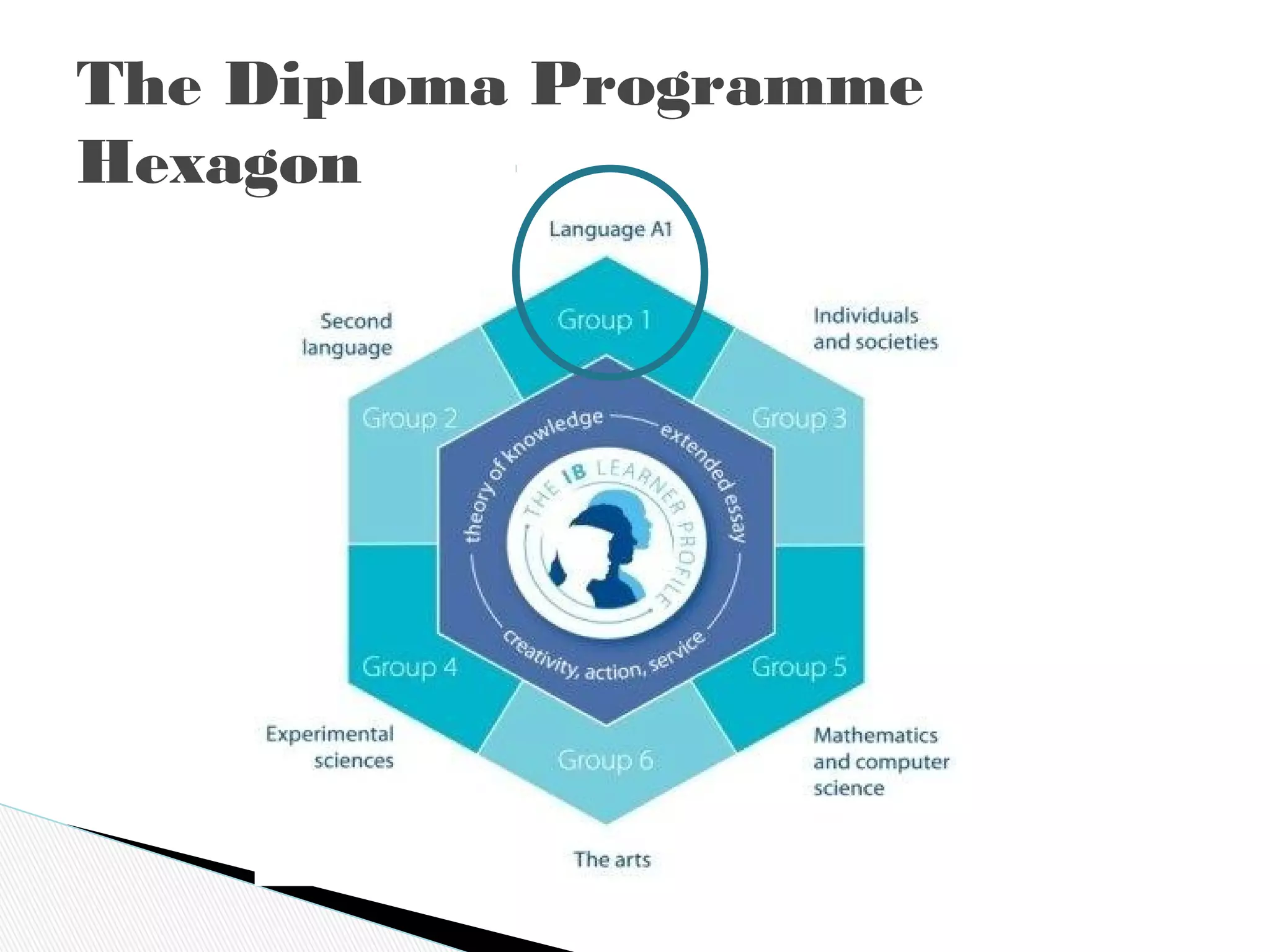
The Diploma Programme
Hexagon
 Focus: To develop in students skills
of textual analysis and the understanding
that texts, both literary and non-literary,
can be seen as autonomous and yet
simultaneously to culturally determined
reading practices.
 An understanding of the ways in which formal elements are
used to create meaning in a text is combined with an exploration
of how that meaning is affected by reading practices that
are culturally defined and by the circumstances of
production and reception.
Language and Literature
Syllabus Outline
Part 1: Language in
cultural context
Texts are chosen from a
variety of sources, genres
and media
Part 2: Language and mass
communication
Texts are chosen from a variety
of sources, genres and media
Part 3: Literature – texts and
contexts
Two texts, one of which is a text
in translation from the prescribed
literature in translation (PLT) list
and one, written in the language
A studied, from the prescribed list
of authors (PLA) for the language
A studied, or chosen freely.
Part 4: Literature –
critical study
Two texts, both of which are
chosen from the prescribed
list of authors (PLA) for the
language A studied
Year 10 LL
I Period
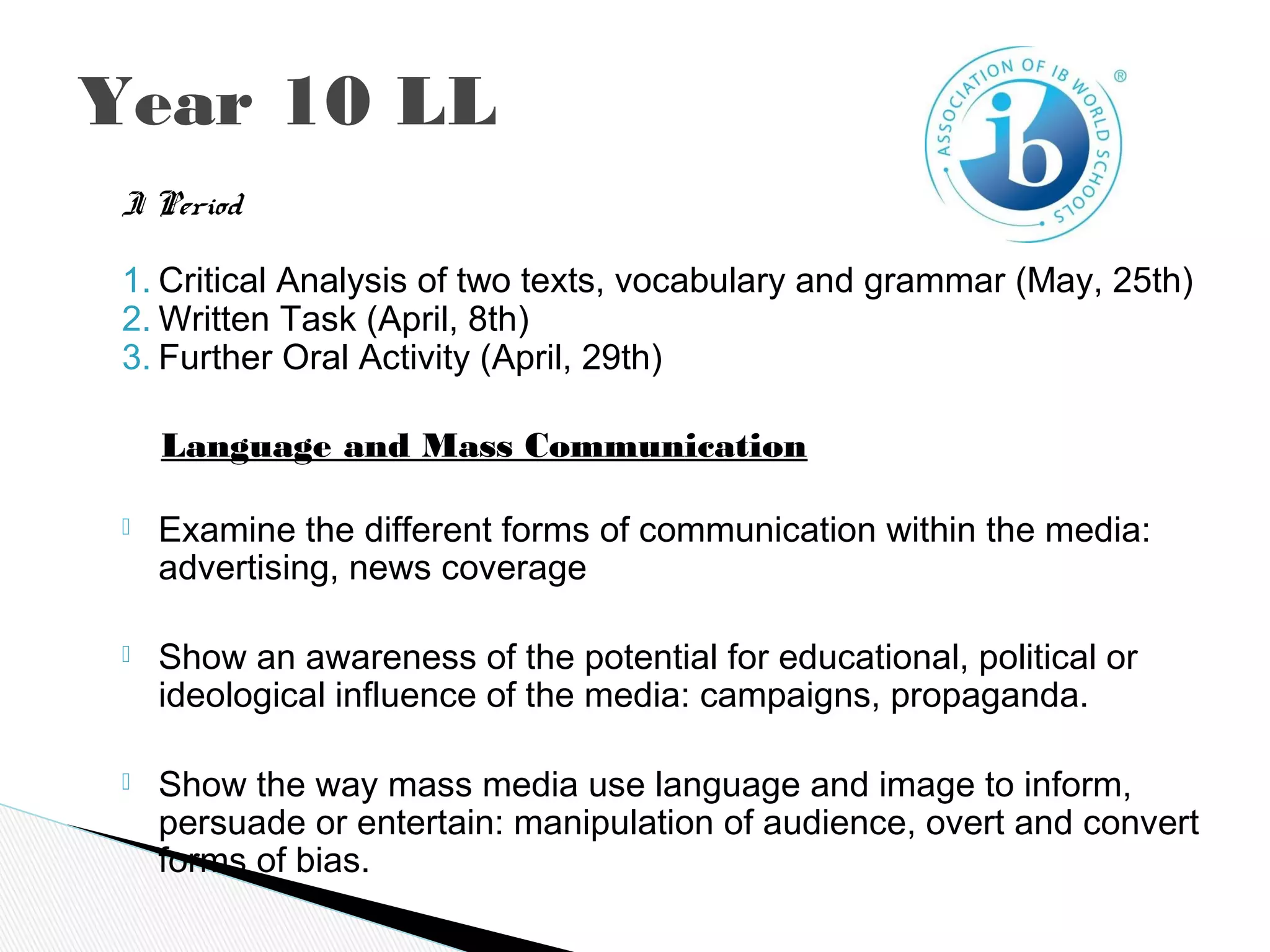
1. Critical Analysis of two texts, vocabulary and grammar (May, 25th)
2. Written Task (April, 8th)
3. Further Oral Activity (April, 29th)
    Language and Mass Communication
 Examine the different forms of communication within the media:
advertising, news coverage
 Show an awareness of the potential for educational, political or
ideological influence of the media: campaigns, propaganda.
 Show the way mass media use language and image to inform,
persuade or entertain: manipulation of audience, overt and convert
forms of bias.
Year 10 LL
II Period
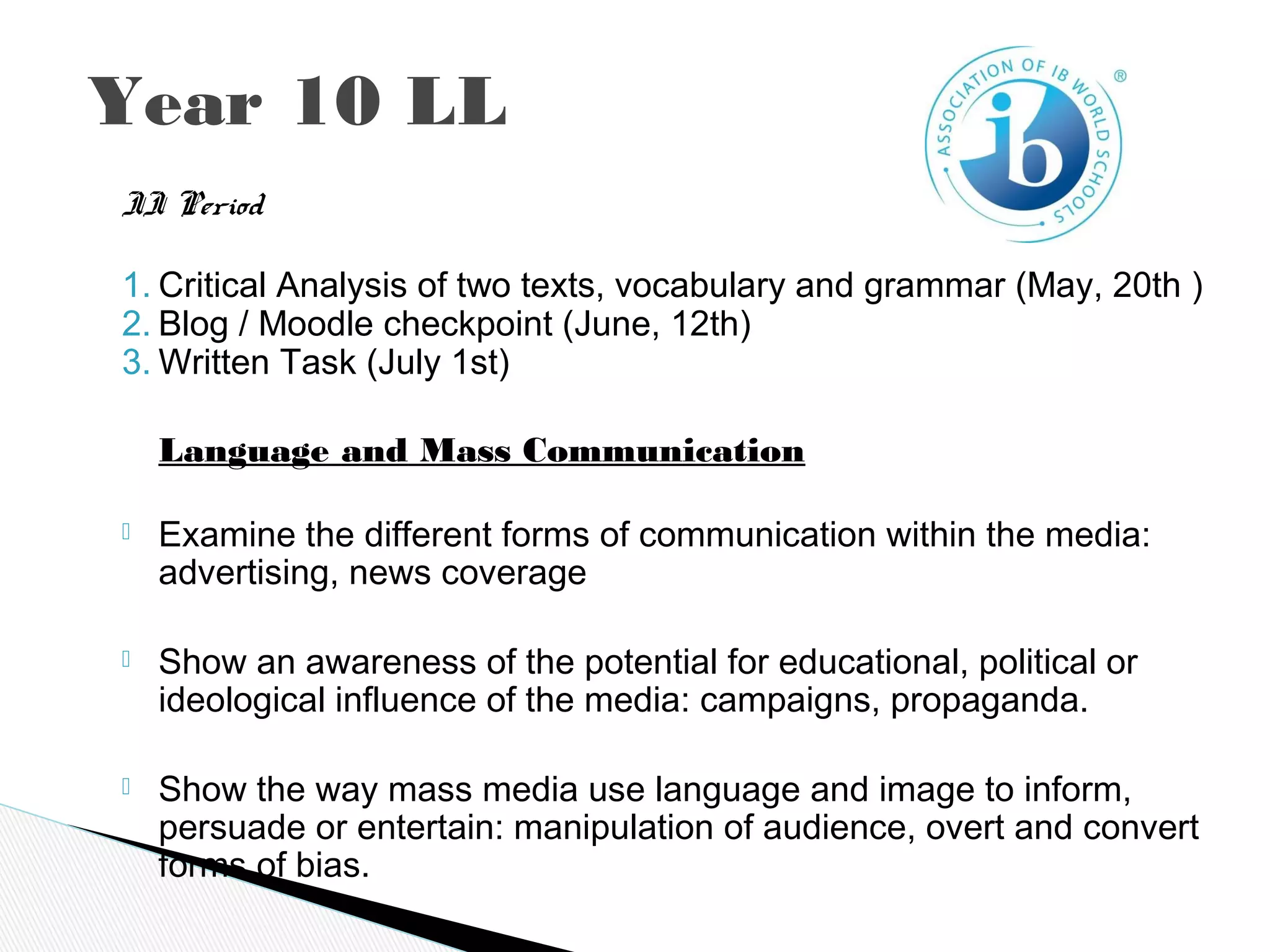
1. Critical Analysis of two texts, vocabulary and grammar (May, 20th )
2. Blog / Moodle checkpoint (June, 12th)
3. Written Task (July 1st)
Language and Mass Communication
 Examine the different forms of communication within the media:
advertising, news coverage
 Show an awareness of the potential for educational, political or
ideological influence of the media: campaigns, propaganda.
 Show the way mass media use language and image to inform,
persuade or entertain: manipulation of audience, overt and convert
forms of bias.
III Period
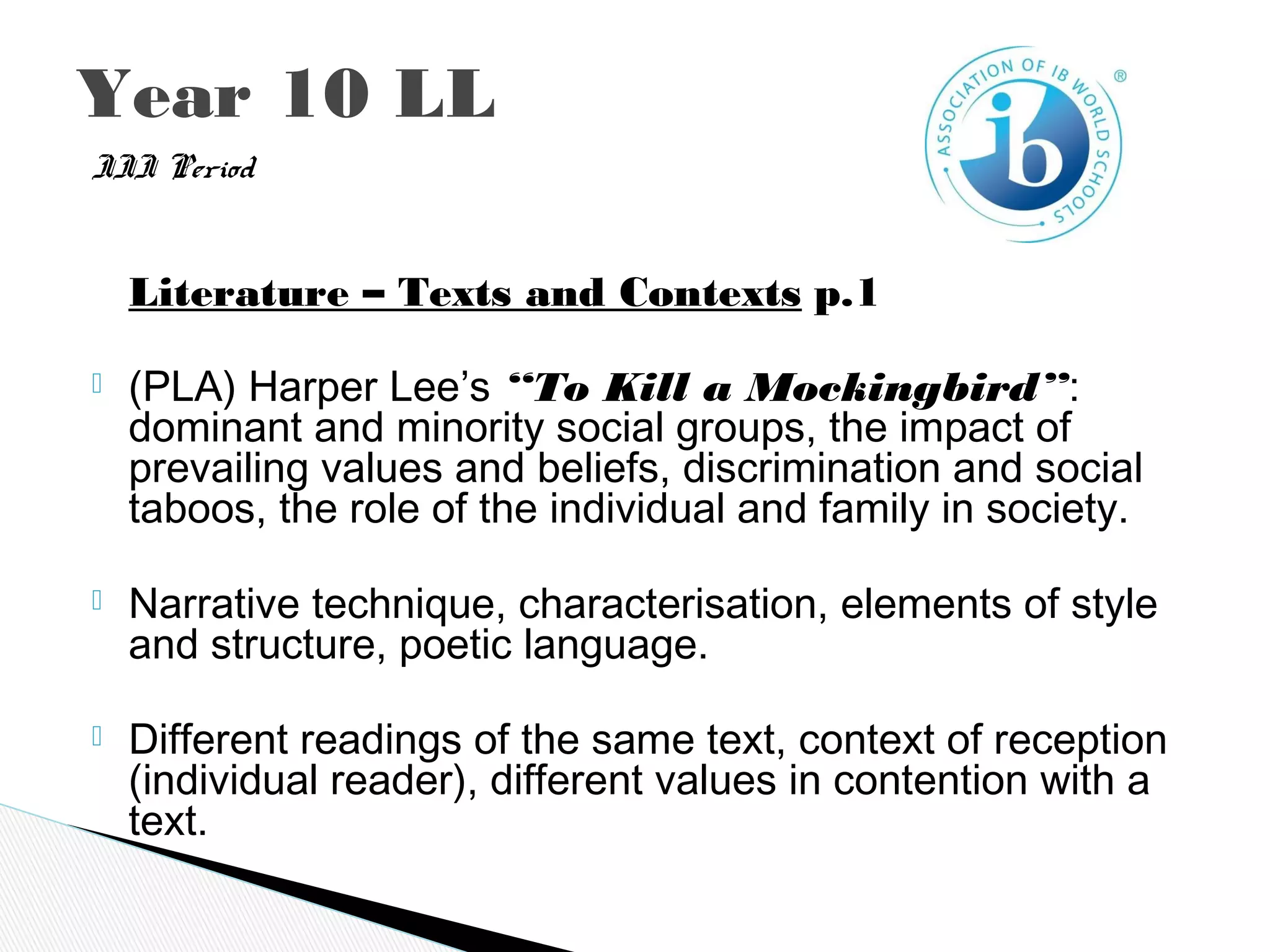
   Literature – Texts and Contexts p.1
 (PLA) Harper Lee’s “To Kill a Mockingbird”:
dominant and minority social groups, the impact of
prevailing values and beliefs, discrimination and social
taboos, the role of the individual and family in society.
 Narrative technique, characterisation, elements of style
and structure, poetic language.
 Different readings of the same text, context of reception
(individual reader), different values in contention with a
text.
Year 10 LL
IV Period
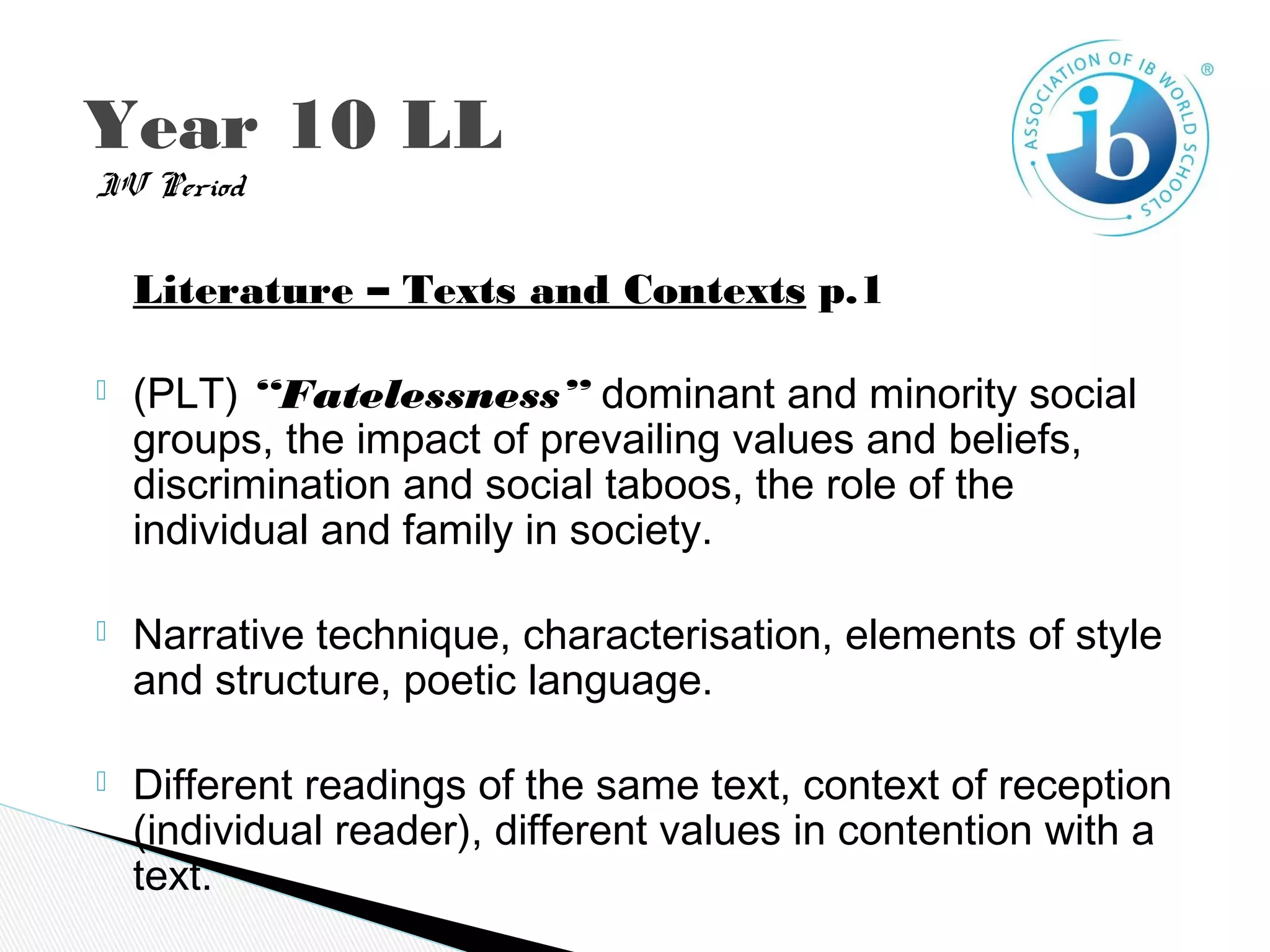
Literature – Texts and Contexts p.1
 (PLT) “Fatelessness” dominant and minority social
groups, the impact of prevailing values and beliefs,
discrimination and social taboos, the role of the
individual and family in society.
 Narrative technique, characterisation, elements of style
and structure, poetic language.
 Different readings of the same text, context of reception
(individual reader), different values in contention with a
text.
Year 10 LL
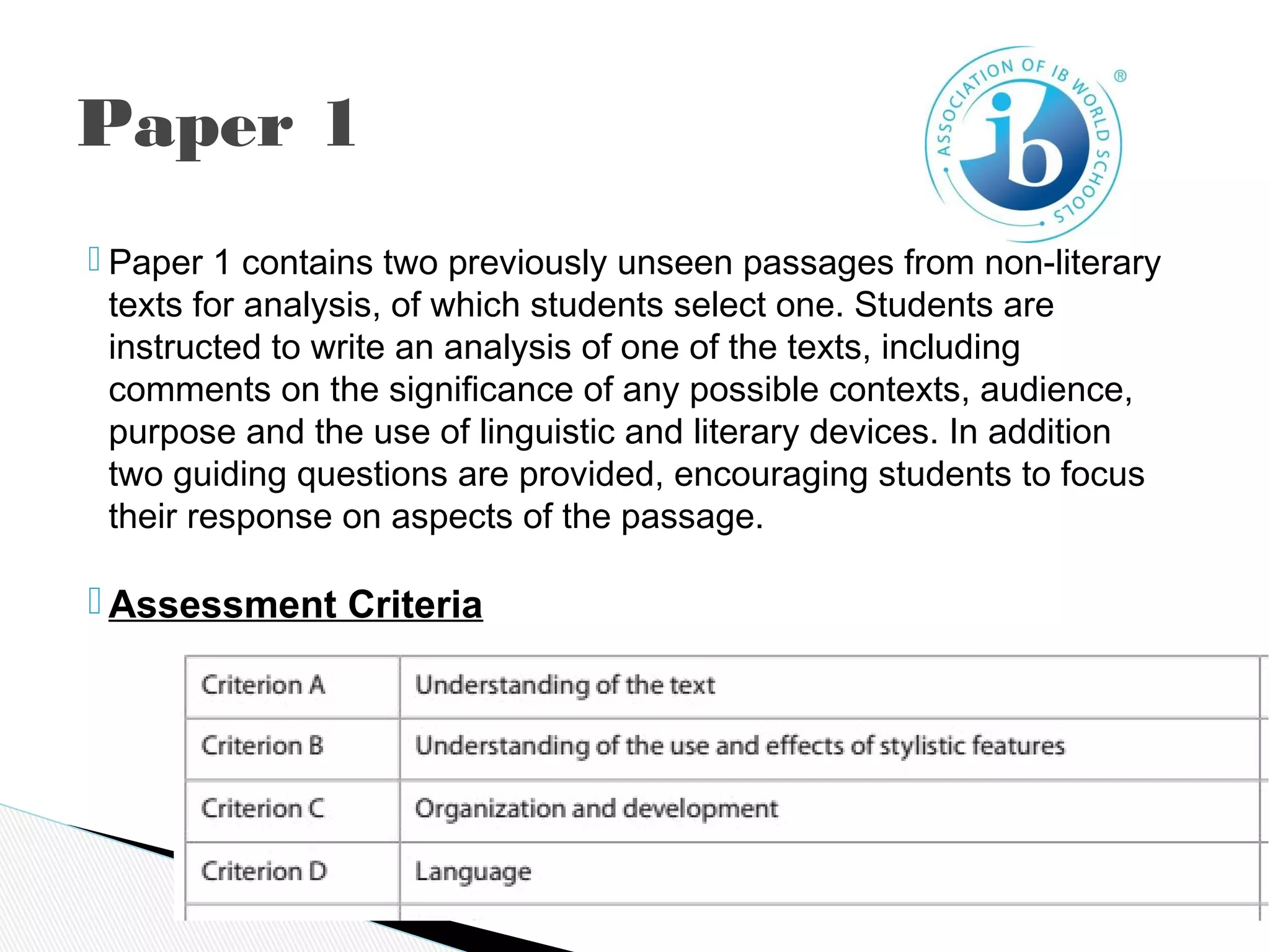
 Paper 1 contains two previously unseen passages from non-literary
texts for analysis, of which students select one. Students are
instructed to write an analysis of one of the texts, including
comments on the significance of any possible contexts, audience,
purpose and the use of linguistic and literary devices. In addition
two guiding questions are provided, encouraging students to focus
their response on aspects of the passage.
 Assessment Criteria
Paper 1
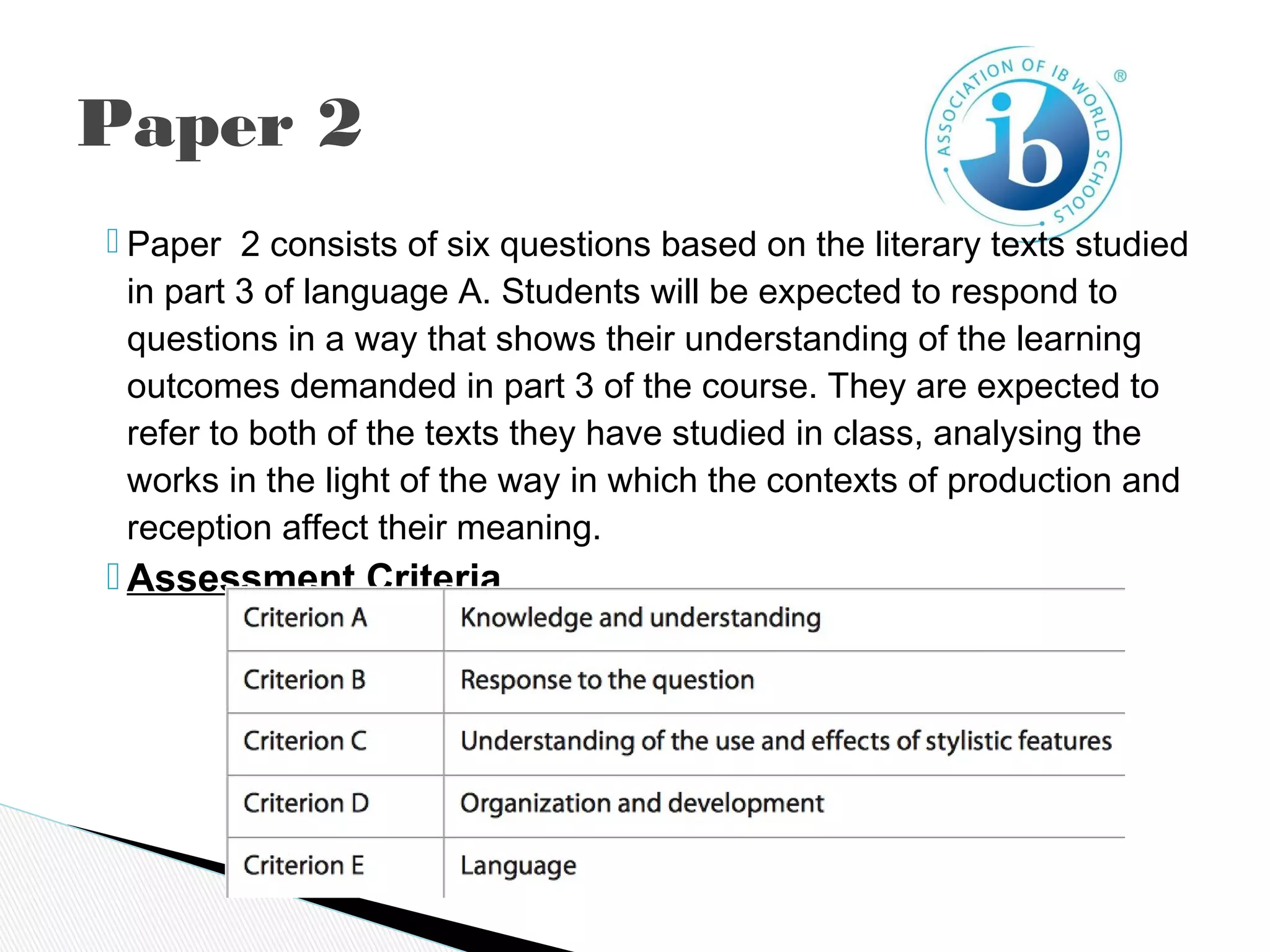
Paper 2
 Paper 2 consists of six questions based on the literary texts studied
in part 3 of language A. Students will be expected to respond to
questions in a way that shows their understanding of the learning
outcomes demanded in part 3 of the course. They are expected to
refer to both of the texts they have studied in class, analysing the
works in the light of the way in which the contexts of production and
reception affect their meaning.
 Assessment Criteria
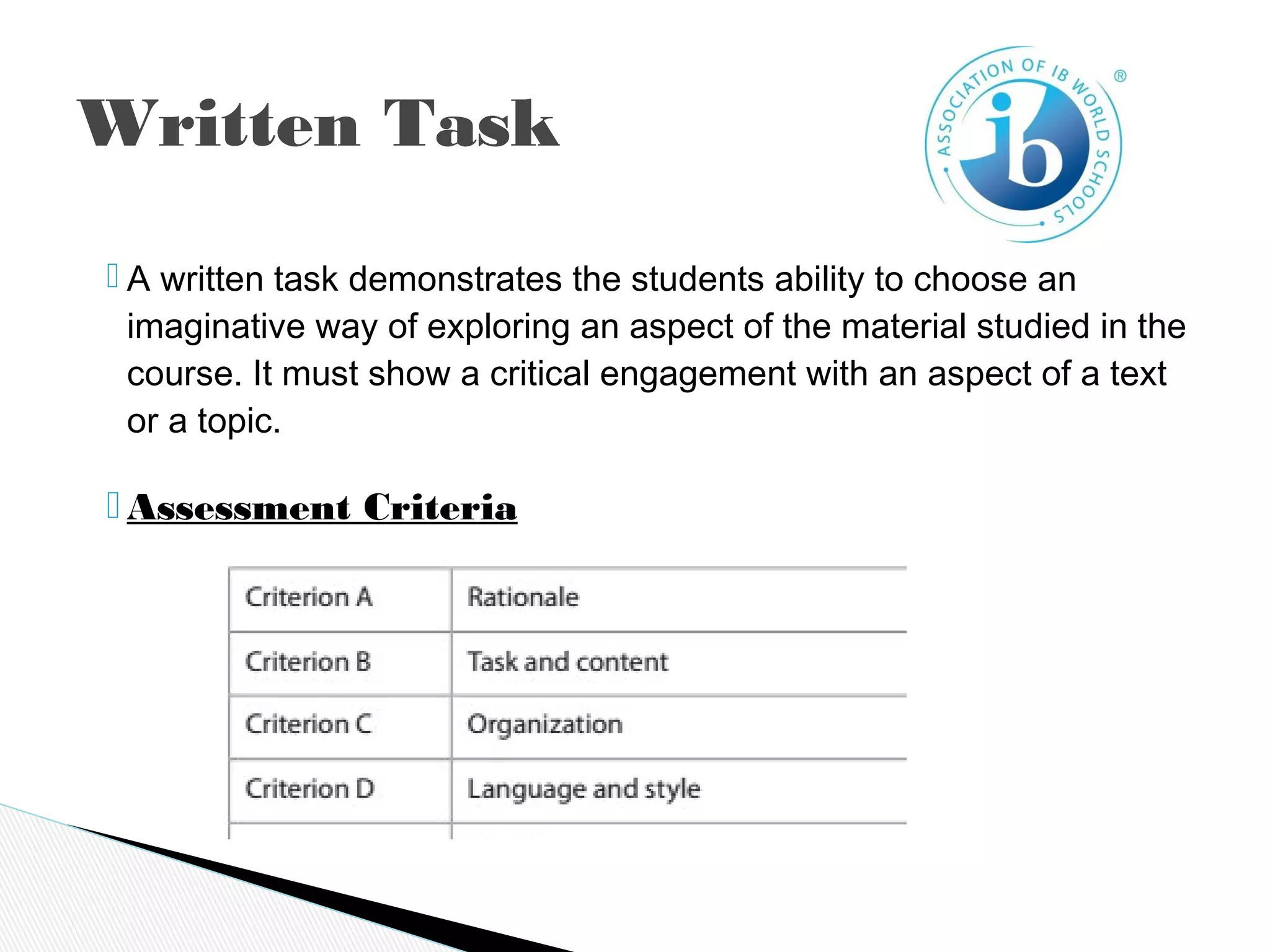
 A written task demonstrates the students ability to choose an
imaginative way of exploring an aspect of the material studied in the
course. It must show a critical engagement with an aspect of a text
or a topic.
 Assessment Criteria
Written Task
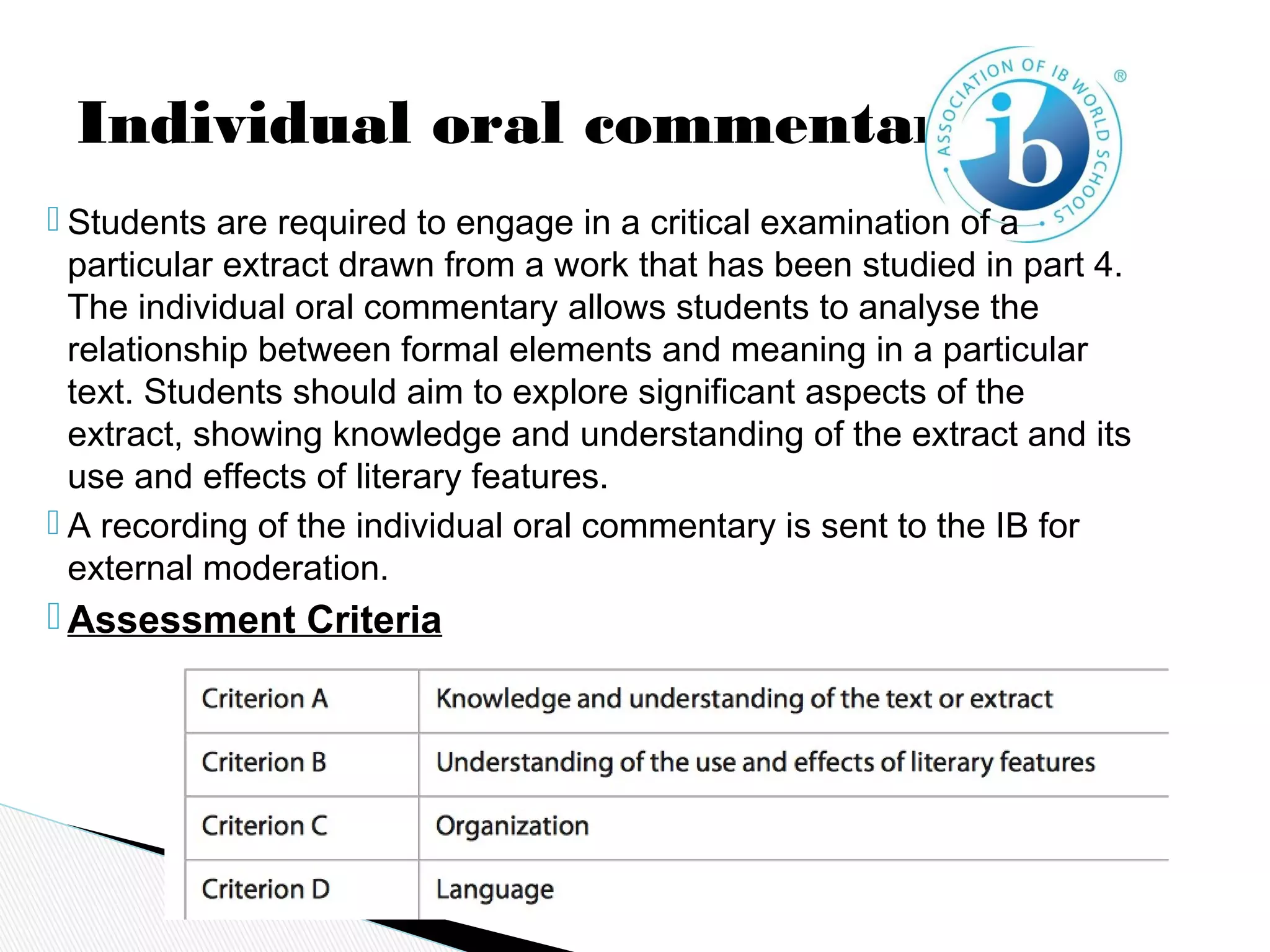
Individual oral commentary
 Students are required to engage in a critical examination of a
particular extract drawn from a work that has been studied in part 4.
The individual oral commentary allows students to analyse the
relationship between formal elements and meaning in a particular
text. Students should aim to explore significant aspects of the
extract, showing knowledge and understanding of the extract and its
use and effects of literary features.
 A recording of the individual oral commentary is sent to the IB for
external moderation.
 Assessment Criteria
 These activities are intended to address the relationship between
language meaning an context. Underpinning these is the issue of
intercultural understanding. Through the examination of the cultural
context of a text, students will be able to engage with the process of
intercultural understanding and thereby reflect on their own cultural
practices.
 Assessment Criteria
Further oral activity

IB Language and Literature outline 2015

  • 1.
  • 2.
     Duration: 2years  Goal: Encourage students to feel the desire to know more, to ask more questions, to take care of others and to be compassionate.  Development of INTERCULTURAL awareness, OPEN-MINDEDNESS, and ATTITUDES to evaluate different points of view. The Diploma Programme
  • 3.
     Inquirers: Theydevelop their natural curiosity. They acquire the skills necessary to conduct inquiry and research and show independence in learning.  Knowledgeable: They explore concepts, ideas and issues that have local and global significance. In so doing, they acquire in-depth knowledge and develop understanding across a broad range of disciplines.  Thinkers: They exercise initiative in applying thinking skills critically and creatively to recognize and approach complex problems, and make reasoned, ethical decisions.  Communicators: They understand and express ideas and information confidently and creatively in more than one language and in a variety of modes of communication. IB learner profile
  • 4.
     Principled: Theyact with integrity and honesty, with a strong sense of fairness, justice and respect for the dignity of the individual, groups and communities.  Open-minded: They understand and appreciate their own cultures and personal histories, and are open to the perspectives, values and traditions of other individuals and communities.  Caring: They show empathy, compassion and respect towards the needs and feelings of others. They have a personal commitment to service.  Risk-takers: They approach unfamiliar situations and uncertainty with courage and forethought, and have the independence of spirit to explore new roles, ideas and strategies.
  • 5.
     Balanced: Theyunderstand the importance of intellectual, physical and emotional balance to achieve personal well- being for themselves and others.  Reflective: They give thoughtful consideration to their own learning and experience. They are able to assess and understand their strengths and limitations in order to support their learning and personal development.
  • 6.
  • 7.
     Focus: Todevelop in students skills of textual analysis and the understanding that texts, both literary and non-literary, can be seen as autonomous and yet simultaneously to culturally determined reading practices.  An understanding of the ways in which formal elements are used to create meaning in a text is combined with an exploration of how that meaning is affected by reading practices that are culturally defined and by the circumstances of production and reception. Language and Literature
  • 8.
    Syllabus Outline Part 1:Language in cultural context Texts are chosen from a variety of sources, genres and media Part 2: Language and mass communication Texts are chosen from a variety of sources, genres and media Part 3: Literature – texts and contexts Two texts, one of which is a text in translation from the prescribed literature in translation (PLT) list and one, written in the language A studied, from the prescribed list of authors (PLA) for the language A studied, or chosen freely. Part 4: Literature – critical study Two texts, both of which are chosen from the prescribed list of authors (PLA) for the language A studied
  • 9.
    Year 10 LL IPeriod 1. Critical Analysis of two texts, vocabulary and grammar (May, 25th) 2. Written Task (April, 8th) 3. Further Oral Activity (April, 29th)     Language and Mass Communication  Examine the different forms of communication within the media: advertising, news coverage  Show an awareness of the potential for educational, political or ideological influence of the media: campaigns, propaganda.  Show the way mass media use language and image to inform, persuade or entertain: manipulation of audience, overt and convert forms of bias.
  • 10.
    Year 10 LL IIPeriod 1. Critical Analysis of two texts, vocabulary and grammar (May, 20th ) 2. Blog / Moodle checkpoint (June, 12th) 3. Written Task (July 1st) Language and Mass Communication  Examine the different forms of communication within the media: advertising, news coverage  Show an awareness of the potential for educational, political or ideological influence of the media: campaigns, propaganda.  Show the way mass media use language and image to inform, persuade or entertain: manipulation of audience, overt and convert forms of bias.
  • 11.
    III Period    Literature– Texts and Contexts p.1  (PLA) Harper Lee’s “To Kill a Mockingbird”: dominant and minority social groups, the impact of prevailing values and beliefs, discrimination and social taboos, the role of the individual and family in society.  Narrative technique, characterisation, elements of style and structure, poetic language.  Different readings of the same text, context of reception (individual reader), different values in contention with a text. Year 10 LL
  • 12.
    IV Period Literature –Texts and Contexts p.1  (PLT) “Fatelessness” dominant and minority social groups, the impact of prevailing values and beliefs, discrimination and social taboos, the role of the individual and family in society.  Narrative technique, characterisation, elements of style and structure, poetic language.  Different readings of the same text, context of reception (individual reader), different values in contention with a text. Year 10 LL
  • 13.
     Paper 1contains two previously unseen passages from non-literary texts for analysis, of which students select one. Students are instructed to write an analysis of one of the texts, including comments on the significance of any possible contexts, audience, purpose and the use of linguistic and literary devices. In addition two guiding questions are provided, encouraging students to focus their response on aspects of the passage.  Assessment Criteria Paper 1
  • 14.
    Paper 2  Paper2 consists of six questions based on the literary texts studied in part 3 of language A. Students will be expected to respond to questions in a way that shows their understanding of the learning outcomes demanded in part 3 of the course. They are expected to refer to both of the texts they have studied in class, analysing the works in the light of the way in which the contexts of production and reception affect their meaning.  Assessment Criteria
  • 15.
     A writtentask demonstrates the students ability to choose an imaginative way of exploring an aspect of the material studied in the course. It must show a critical engagement with an aspect of a text or a topic.  Assessment Criteria Written Task
  • 16.
    Individual oral commentary Students are required to engage in a critical examination of a particular extract drawn from a work that has been studied in part 4. The individual oral commentary allows students to analyse the relationship between formal elements and meaning in a particular text. Students should aim to explore significant aspects of the extract, showing knowledge and understanding of the extract and its use and effects of literary features.  A recording of the individual oral commentary is sent to the IB for external moderation.  Assessment Criteria
  • 17.
     These activitiesare intended to address the relationship between language meaning an context. Underpinning these is the issue of intercultural understanding. Through the examination of the cultural context of a text, students will be able to engage with the process of intercultural understanding and thereby reflect on their own cultural practices.  Assessment Criteria Further oral activity

Editor's Notes

  • #3 I can give info about group 1, ask Silvio in case of Qs. This subject contributes about the diplo.
  • #7 I can give info about group 1, ask Silvio in case of Qs. This subject contributes about the diplo.
  • #8 Texts analysis (not learning comm. fx)//rhetorical devices, punc., comparison metaphor, rhetorical Qs. --You get the meaning of the text