September 2016
Feeding the Machines:
A Prognosis for
Programmatic
Andrew Green
Executive Summary
1
•	 Programmatically traded media represents less
than 4% of total adspend. This is about one-third
the size of printed newspaper ad revenues, half
the size of radio and 10% of the television total.
•	 On a good day, programmatic technology enables
media buyers to save time, increase efficiency and
improve effectiveness. 				
			
•	 On a bad day, programmatically targeted advertising
will be seen by almost nobody, as a result of ad blocking,
fraud and viewability issues. 					
					
•	 On an average day digital display advertising
struggles to be seen, due to heavy clutter and poor
positioning. Viewability tends to be lower for ads placed
programmatically,asopposedtothoseplacedbyahuman.
•	 Whatever day it is, programmatic technology will
continue to grow strongly and will begin to make its
presence felt beyond the digital space – in television,
radio, Out of Home, newspapers and magazines. It is
being driven by the quest for better efficiency, improved
targeting, measurable ROI – and by undoubted
pressure to embrace everything new and digital.
Feeding the Machines:
A Prognosis for Programmatic
•	 It is being challenged by ad blocking, fraud, viewability
issues, poor data quality and brand safety concerns, as
well as by skills shortages and a reluctance on the part of
traditional media companies to release premium inventory
into the system. 						
•	 Many of the challenges inherent in getting an ad
seen and acted on in the digital environment can
be managed through careful stewarding and use
of existing technologies. New kinds of media buyer,
more conversant with data science than with wining
and dining, will emerge to master the necessary skills.
				
•	 The measurement challenge lies in linking short-term
behavioural responses to longer-term brand building
efforts. Not every brand is searched for online and online
is not the only place people look to help them make
buying decisions.
•	 GRPs (Gross Rating Points) will remain a robust
and useful measure of audiences, even amidst the
promise of greater precision in targeting ads. Like
all media, digital display advertising can really only
guarantee ‘opportunities’ to see to its advertisers.
•	 At the end of the day, brands live inside people’s minds.
So it is people’s minds we, as market researchers, must
seek to understand and to help brands influence.
2
Introduction
“Programmatic is
growing bigger, it’s
not going away.
And it’s not just
digital media; it’s
going to print and
TV as well.”
Sital Banerjee, Philips
“Programmatic” media buying can be defined as the use of
software programmes to buy advertising space. The software
replicates and automates what, in some media, can be a lengthy
manual process.
It starts with a buyer briefing his requirements to the media
(target audience, campaign objectives, budgets, qualitative
considerations etc.)
Options for meeting the brief are considered and analysed and
negotiations take place around what the options will deliver and
the price the client will pay.
Programmatic buying does not remove the need for these
steps - it still needs to begin with a brief and to work within
parameters set by the buyer. But it eliminates much of the
interim drudgery and speeds the process up considerably.
The traditional buying process originated in a time of media
scarcity and limited technology. Programmatic buying began
in response to an almost infinite supply of digital inventory, the
impossibility of a human being sifting through every possible
permutation to create an optimum campaign and a massive
advance in technology.
Instead of placing an ad on a website (as one might in a
newspaper or within a television programme), programmatic
buying aims to place the message in front of the people it
wants to talk to – whichever sites they are browsing.
As a result, it offers the ability to show ads to some people on a
particular site and not to others. And to stay with those people
– identified as a core target – and reach them on other sites.
An IAB Europe survey in June 2016 found that only 13% of
advertisers and 7% of media agencies claimed not to be using
programmatic technology to some degree. 90% expected to
increase investment over the coming year.
This enthusiasm is based around reducing media wastage,
targeting more precisely and operating more efficiently.
Bottlenecks cited in the survey included the difficulty of
finding suitably skilled people to navigate the emerging
digital ecosystem, as well as concerns around viewability,
brand safety, data quality and fraud. Concern was also
expressed about the cost of implementing the programmatic
technology itself.
Feeding the Machines:
A Prognosis for Programmatic
3
Feeding the Machines:
A Prognosis for ProgrammaticAndrew Green
TOO MANY ADS
There is no real limit on the number of ads that can be ‘served’
on many of these pages, which leads to an unfortunate side
effect: too many ads clutter users’ screens. Some of these ads
may even contain viruses and other malware.
This has prompted as many as one in five online users
according to a recent study1
to install ad blockers to prevent
ad messages reaching them. So while the total number of
web users continues to grow, those available to advertise to
are shrinking.
What cannot be contested is that digital advertising spend has
now overtaken television in many countries to become the
largest single advertising medium.
Globally, according to ZenithOptimedia, internet and mobile
advertising will reach $175 billion in 2016, almost exactly one
third of the total advertising market (valued at $537 billion). It will
overtake television globally in 2017 according to the forecaster.
In this paper we look at the current state of programmatic
advertising, including the forces driving it forward and those
holding it back from growing even more quickly.
We also look at the data feeding the programmatic machines
and compare it to the ‘legacy’ audience measurement data
that have long driven media placement decisions.
The Programmatic Market
“Programmatic is
the new norm.”
Mediapost, 21 June 2016
The programmatic advertising market is far smaller than the
headlines might suggest, at least when seen in the context of
the entire advertising market.
Programmatic represents less than 4% of total
adspend. This is about one-third the size of
printed newspaper ad revenues, half the size
of radio and 10% of the television total.
Programmatic is growing, it’s changing, it’s digital and it’s
the future. So, of course, even though small, it dominates
the advertising trade press. And remains the hot topic for
the young, digitally-savvy practitioners in charge of spending
marketing budgets at media agencies and anybody else who
likes to make the headlines...
But it’s worth delving into the numbers a little. Just under half of
the $175 billion spent on digital media around the world in 2016
went into Paid Search - where marketers bid to place their own
content against words used (typically) in a Google search.
They bid more to have their content appearing higher on the
search results page. Paid search is not usually considered
to be ‘programmatic’ (although it certainly shares some of
its characteristics).
A further 9% of the digital total flows to classified advertising
(for jobs, property, used cars etc).
1 https://www.statista.com/chart/5048/the-use-of-ad-blocking-around-the-world/
4
Andrew Green
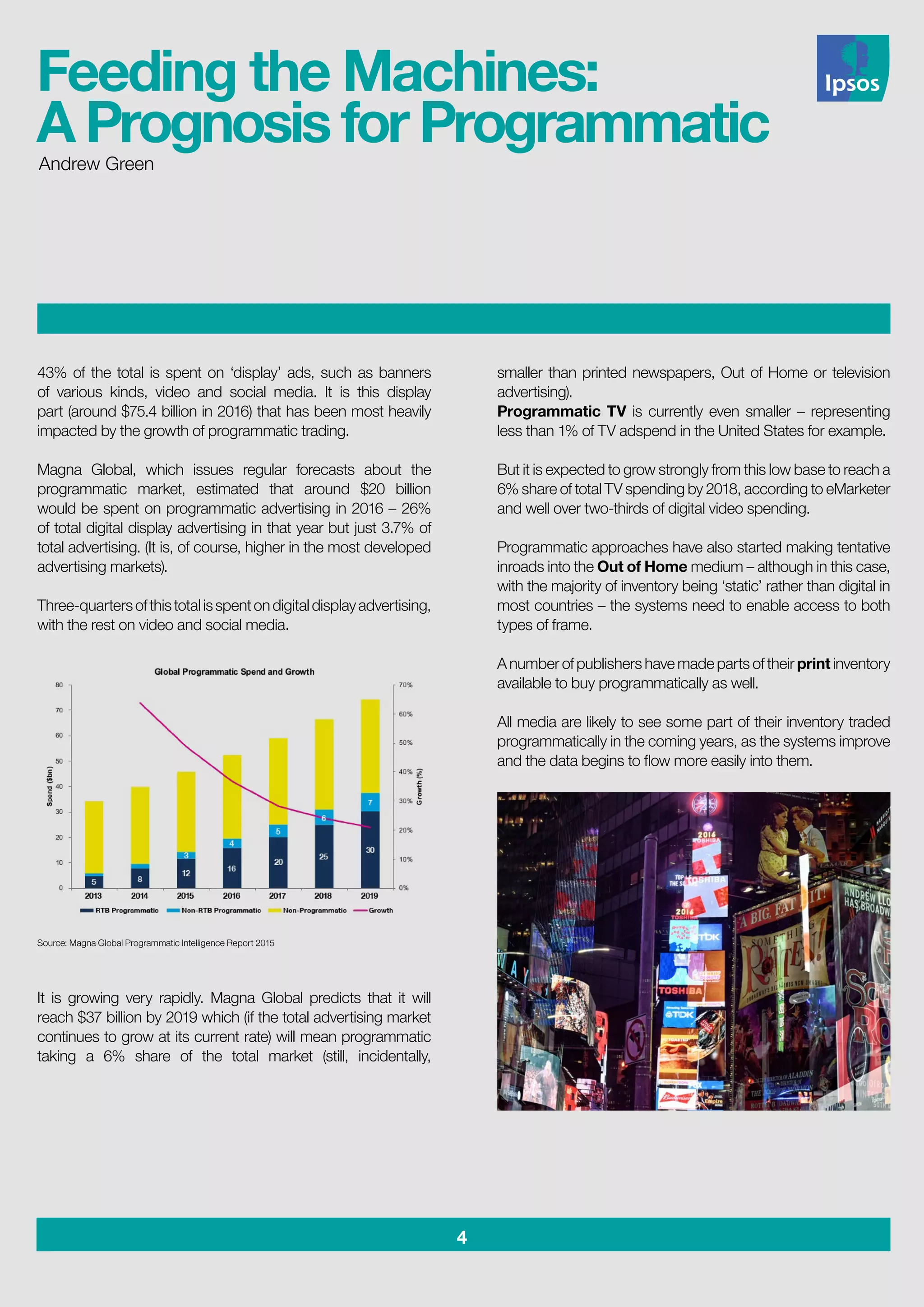
It is growing very rapidly. Magna Global predicts that it will
reach $37 billion by 2019 which (if the total advertising market
continues to grow at its current rate) will mean programmatic
taking a 6% share of the total market (still, incidentally,
43% of the total is spent on ‘display’ ads, such as banners
of various kinds, video and social media. It is this display
part (around $75.4 billion in 2016) that has been most heavily
impacted by the growth of programmatic trading.
Magna Global, which issues regular forecasts about the
programmatic market, estimated that around $20 billion
would be spent on programmatic advertising in 2016 – 26%
of total digital display advertising in that year but just 3.7% of
total advertising. (It is, of course, higher in the most developed
advertising markets).
Three-quartersofthistotalisspentondigitaldisplayadvertising,
with the rest on video and social media.
smaller than printed newspapers, Out of Home or television
advertising).
Programmatic TV is currently even smaller – representing
less than 1% of TV adspend in the United States for example.
But it is expected to grow strongly from this low base to reach a
6% share of total TV spending by 2018, according to eMarketer
and well over two-thirds of digital video spending.
Programmatic approaches have also started making tentative
inroads into the Out of Home medium – although in this case,
with the majority of inventory being ‘static’ rather than digital in
most countries – the systems need to enable access to both
types of frame.
A number of publishers have made parts of their print inventory
available to buy programmatically as well.
All media are likely to see some part of their inventory traded
programmatically in the coming years, as the systems improve
and the data begins to flow more easily into them.
Feeding the Machines:
A Prognosis for Programmatic
Source: Magna Global Programmatic Intelligence Report 2015
5
the few hundred TV or radio stations and couple of thousand
publications a planner/buyer might have been faced with in
the past.
Programmatic technology, which starts with the audiences
ratherthanwiththemediaoutlets,candealwiththeburgeoning
number of permutations without breaking sweat.
The process of sending out buying briefs, sorting through
options and negotiating prices can be time-consuming and
inefficient when done by a human buyer. Programmatic
technology automates much of the drudgery.
This means that fewer man hours need to be spent on the
buying process and more can be spent on the strategy and
the thinking.
Trading decisions can be made almost in real time (as people
in a target audience initiate a web page load, an ad can be
immediately served to them as the page loads).
RTB (Real Time Bidding) is not the only – or even the major –
form of programmatic buying. Most inventory is, in fact, bought
directly at a fixed price and is simply an automated version of
traditional media buying.
Drivers of Growth
The drivers of the rapid
growth in programmatic
advertising in recent years
revolve around generating
efficiencies, increasing
speed and exploiting the
power of digital media
to identify and target
people with the greatest
propensity to respond to an
advertising message.
GENERATING EFFICIENCIES
For buyers, it is about driving efficiencies in the buying process,
optimising ad campaigns across an almost infinite number of
choices and doing it all at very high speed.
For sellers, programmatic can drive efficiencies and also
provide a way to offload lower-demand inventory.
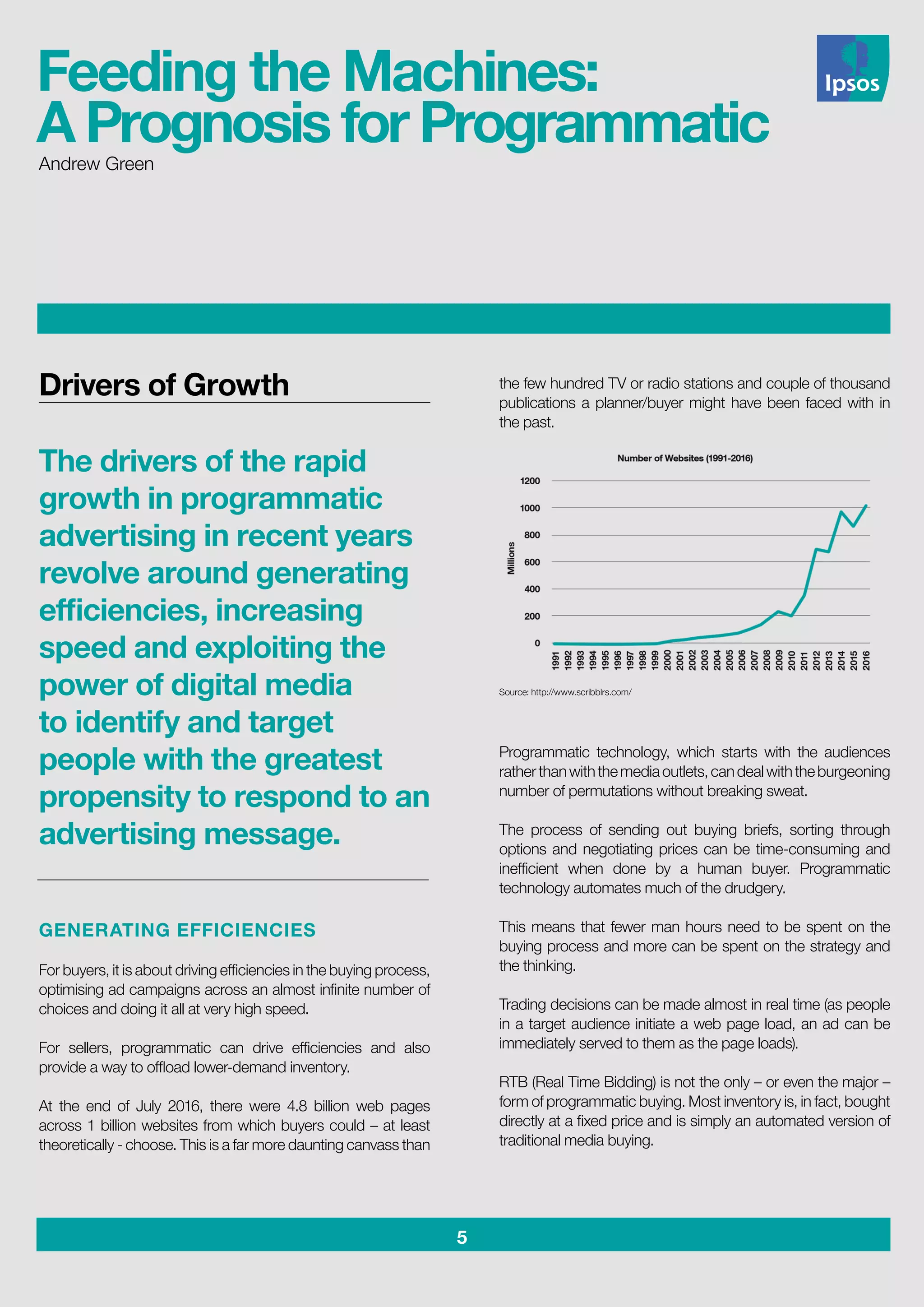
At the end of July 2016, there were 4.8 billion web pages
across 1 billion websites from which buyers could – at least
theoretically - choose. This is a far more daunting canvass than
Source: http://www.scribblrs.com/
Andrew Green
Feeding the Machines:
A Prognosis for Programmatic
6
TARGETING
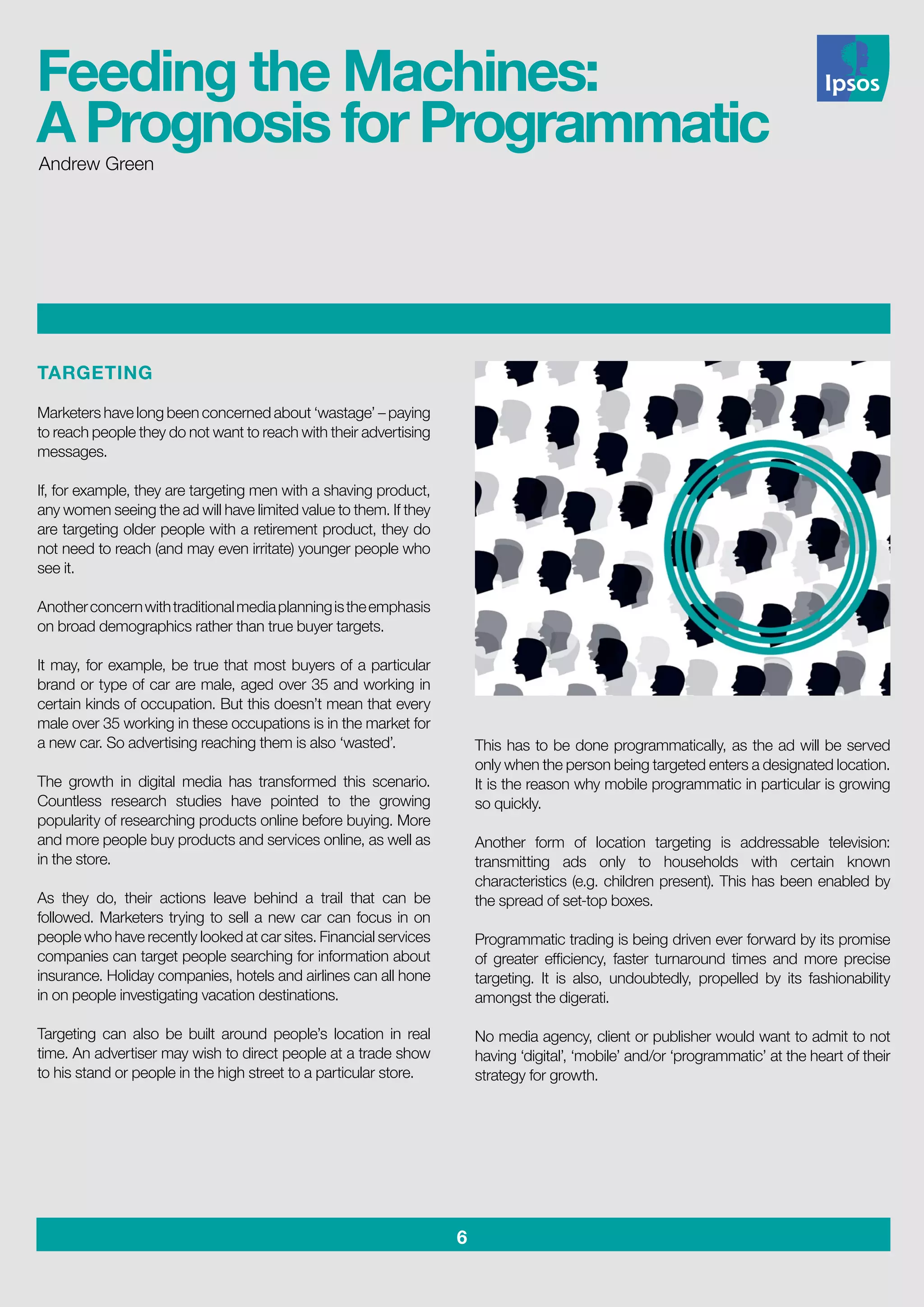
Marketers have long been concerned about ‘wastage’ – paying
to reach people they do not want to reach with their advertising
messages.
If, for example, they are targeting men with a shaving product,
any women seeing the ad will have limited value to them. If they
are targeting older people with a retirement product, they do
not need to reach (and may even irritate) younger people who
see it.
Anotherconcernwithtraditionalmediaplanningistheemphasis
on broad demographics rather than true buyer targets.
It may, for example, be true that most buyers of a particular
brand or type of car are male, aged over 35 and working in
certain kinds of occupation. But this doesn’t mean that every
male over 35 working in these occupations is in the market for
a new car. So advertising reaching them is also ‘wasted’.
The growth in digital media has transformed this scenario.
Countless research studies have pointed to the growing
popularity of researching products online before buying. More
and more people buy products and services online, as well as
in the store.
As they do, their actions leave behind a trail that can be
followed. Marketers trying to sell a new car can focus in on
people who have recently looked at car sites. Financial services
companies can target people searching for information about
insurance. Holiday companies, hotels and airlines can all hone
in on people investigating vacation destinations.
Targeting can also be built around people’s location in real
time. An advertiser may wish to direct people at a trade show
to his stand or people in the high street to a particular store.
This has to be done programmatically, as the ad will be served
only when the person being targeted enters a designated location.
It is the reason why mobile programmatic in particular is growing
so quickly.
Another form of location targeting is addressable television:
transmitting ads only to households with certain known
characteristics (e.g. children present). This has been enabled by
the spread of set-top boxes.
Programmatic trading is being driven ever forward by its promise
of greater efficiency, faster turnaround times and more precise
targeting. It is also, undoubtedly, propelled by its fashionability
amongst the digerati.
No media agency, client or publisher would want to admit to not
having ‘digital’, ‘mobile’ and/or ‘programmatic’ at the heart of their
strategy for growth.
Andrew Green
Feeding the Machines:
A Prognosis for Programmatic
7
Andrew Green
fraud, brand safety and data quality. As well as this, the whole
issue of inventory control is limiting the spread of programmatic
trading into more traditional media.
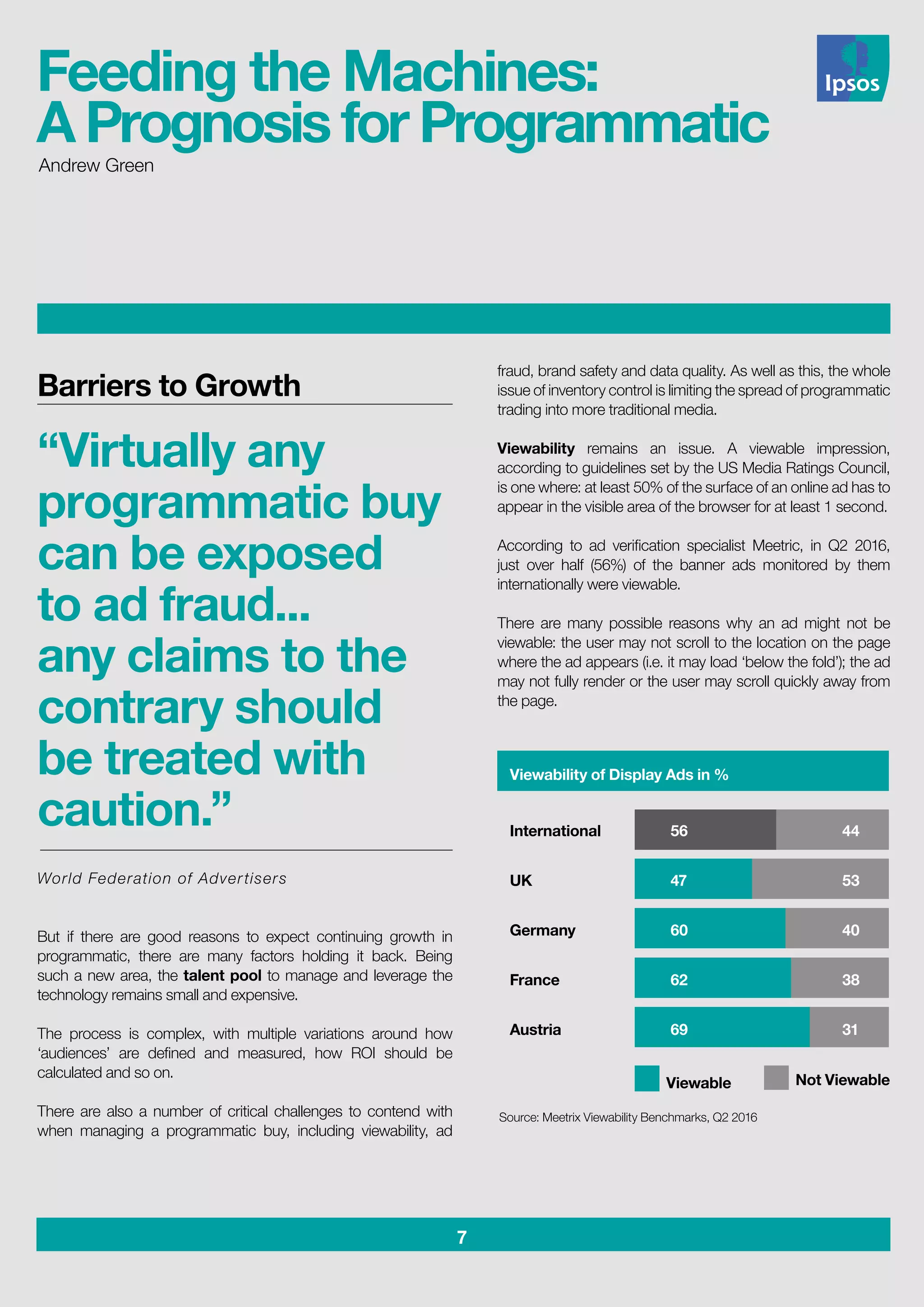
Viewability remains an issue. A viewable impression,
according to guidelines set by the US Media Ratings Council,
is one where: at least 50% of the surface of an online ad has to
appear in the visible area of the browser for at least 1 second.
According to ad verification specialist Meetric, in Q2 2016,
just over half (56%) of the banner ads monitored by them
internationally were viewable.
There are many possible reasons why an ad might not be
viewable: the user may not scroll to the location on the page
where the ad appears (i.e. it may load ‘below the fold’); the ad
may not fully render or the user may scroll quickly away from
the page.
Feeding the Machines:
A Prognosis for Programmatic
Barriers to Growth
“Virtually any
programmatic buy
can be exposed
to ad fraud...
any claims to the
contrary should
be treated with
caution.”
World Federation of Advertisers
But if there are good reasons to expect continuing growth in
programmatic, there are many factors holding it back. Being
such a new area, the talent pool to manage and leverage the
technology remains small and expensive.
The process is complex, with multiple variations around how
‘audiences’ are defined and measured, how ROI should be
calculated and so on.
There are also a number of critical challenges to contend with
when managing a programmatic buy, including viewability, ad
Viewability of Display Ads in %
International
UK
Germany
France
Austria
56
47
60
62
69
44
53
40
38
31
Viewable Not Viewable
Source: Meetrix Viewability Benchmarks, Q2 2016
8
Andrew Green
Although more and more marketers are taking account of
viewability, many are not – meaning they are paying for ads
that cannot be seen.
The IAB Europe study referred to earlier found that just 38%
of advertisers included the level of viewability as one of the key
metrics they used to evaluate programmatic display campaigns.
While the technology exists for this challenge to be tackled,
many will question whether loading half an ad for just a second
is, in fact, enough…
A UK study by Lumen in 2016 using special eye-tracking
cameras embedded with a panel of PC and laptop users found
that just 9% of ads served were actually looked at for more than
a second, falling to 4% looked at for more than 2 seconds. This,
perhaps, is a more accurate use of the word ‘viewability.’
One reason for this may be ad fraud. Essentially, this is where
online behaviour is simulated to look as if real people have
visited a website or clicked on an ad. Advertisers pay for these
‘views’ even though they are not seen by the people they are
intended to reach. Fraudulent visits can be made by machines,
by people or by a mix of the two.
The World Federation of Advertisers believes that ad fraud
could easily represent between 10 and 30% of digital ad
impressions – but admits a precise figure does not yet exist.
US comScore data for Q1 2016 confirms that levels of IVT
(Invalid Traffic) are much higher with programmatic buys than
with direct buys.
It is possible for advertisers to reduce fraud by vigilance,
insisting on full transparency, setting up proper controls and
by building capabilities within their own organisations to
understand what they are buying. But it remains an important
barrier to the development of programmatic trading.
...“just 9% of ads
served were looked
at for more than a
second, falling to 4%
looked at for more
than 2 seconds”
Ad blockers are estimated to have been installed by as
many as 25% of US online users. Combined with the 20%
having no access to broadband either at home or via a
Smartphone (Pew, 2015), this means that only 60% of
the US adult population are even reachable
through digital means.
Blockers are notably skewed towards younger, male and
more technically savvy users of great interest to marketers.
This unreachable population is growing, effectively cancelling
out the overall growth in online and mobile users seen around
the world.
Brand Safety is an issue for many marketers. Programmatic
advertising tends to prioritise reaching a targeted audience
over picking individual sites – which is part of the reason it is
such an efficient way to trade. The more this is constrained to
exclude or include particular sites, the less efficient it will be.
Typically, marketers can whitelist sites they trust and
blacklist those they believe carry content which would be
an inappropriate environment for their brands to appear in.
But things can always fall through the cracks, meaning that
constant vigilance is needed.
Feeding the Machines:
A Prognosis for Programmatic
9
COSTS
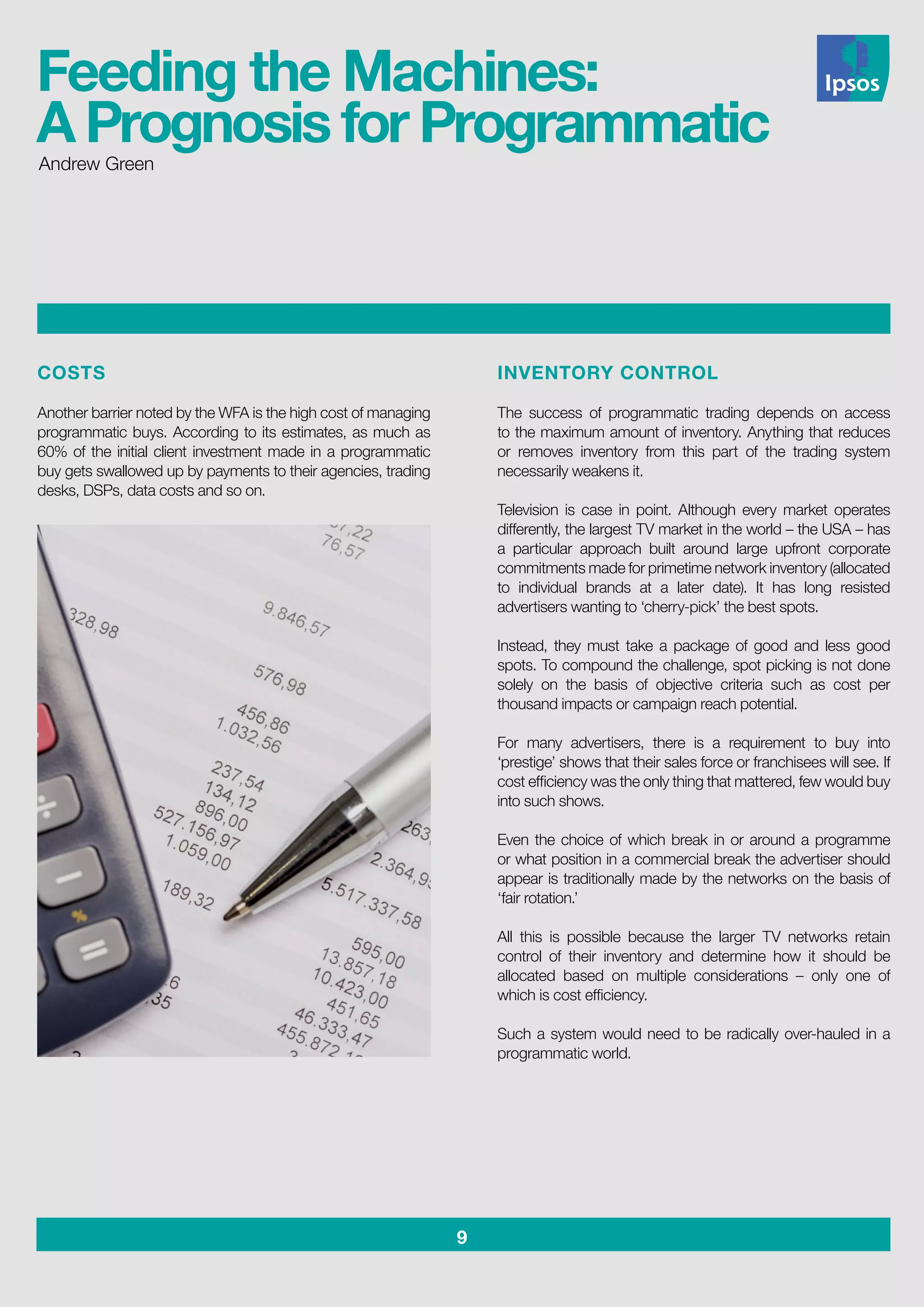
Another barrier noted by the WFA is the high cost of managing
programmatic buys. According to its estimates, as much as
60% of the initial client investment made in a programmatic
buy gets swallowed up by payments to their agencies, trading
desks, DSPs, data costs and so on.
INVENTORY CONTROL
The success of programmatic trading depends on access
to the maximum amount of inventory. Anything that reduces
or removes inventory from this part of the trading system
necessarily weakens it.
Television is case in point. Although every market operates
differently, the largest TV market in the world – the USA – has
a particular approach built around large upfront corporate
commitments made for primetime network inventory (allocated
to individual brands at a later date). It has long resisted
advertisers wanting to ‘cherry-pick’ the best spots.
Instead, they must take a package of good and less good
spots. To compound the challenge, spot picking is not done
solely on the basis of objective criteria such as cost per
thousand impacts or campaign reach potential.
For many advertisers, there is a requirement to buy into
‘prestige’ shows that their sales force or franchisees will see. If
cost efficiency was the only thing that mattered, few would buy
into such shows.
Even the choice of which break in or around a programme
or what position in a commercial break the advertiser should
appear is traditionally made by the networks on the basis of
‘fair rotation.’
All this is possible because the larger TV networks retain
control of their inventory and determine how it should be
allocated based on multiple considerations – only one of
which is cost efficiency.
Such a system would need to be radically over-hauled in a
programmatic world.
Andrew Green
Feeding the Machines:
A Prognosis for Programmatic
10
THE END OF NEGOTIATION?
Importantly, in the US and many other TV markets, the ability
to negotiate pricing (so that one advertiser will pay a different
price to another for the same airtime) has long been a central
feature of the process.
There are plenty of ways in which one advertiser might secure
a lower price than another. Budgets might be higher. The share
of revenue offered to one network versus another either by the
advertiser or his media agency may be greater. Those willing
to commit further ahead can benefit. And other, less objective
factors can come into play.
In a programmatic system, much of this would presumably
change. A fixed price would need to be attached to every
piece of inventory (although these could vary triggered by
overall spend levels etc.).
All would have to be connected to an audience measurement
system that allowed buyers to look both at each spot
individually (e.g. by number of target viewers) and as part of an
overall campaign (the number of viewers seeing at least one,
two, three or more messages for example).
The additional value placed by advertisers on advertising in
‘prestige’ programmes would have to be priced in.
Today’s markets are ‘cleared’ by packaging: the best
programmes are bundled with less good programmes.
All of this is perfectly conceivable. Money could be saved by
the re-allocation or elimination of buying and selling teams.
Competitive advantage could be sought in how data is used or
how programmatic strategies are executed.
Markets would clear based on price, with (assuming demand
patterns remain similar to now) high prices being paid for the
most highly demanded slots and lower prices for others.
But it would be a very big change. In the US in particular,
national, network TV is usually distinguished from ‘spot’ or
local TV, which may move more quickly towards embracing
programmatic trading, driven by opportunities to ‘address’
individual households with known characteristics.
Similar observations can be made for other media. Ways can
be designed for programmatic technology to play an increasing
role in oiling the buying and selling process. But it will demand
commitment from the media owners and, critically, investment
in inventory management systems to enable it.
Andrew Green
Feeding the Machines:
A Prognosis for Programmatic
11
readership data and Out of Home media have traffic data.
There are many flaws and weaknesses in these audience
measurement systems. For example:
•	 Survey data, based on samples, can only ever
measure the media with the highest audiences. The
long-tail will be excluded.					
		
•	 Rather than measuring true exposure to a
commercial, the data counts ‘opportunities to see’
an exposure.						
•	 Audience segmentation tends to be based around
broad demographics.					
		
•	 Non-TV data is typically averaged over long
periods (e.g. 3 or 6 months) with slow and
infrequent reporting.
In the UK, for example, more than 1,000 TV channels are
licenced to broadcast. But BARB, the official measurement
organisation, reports on just 275 of these.
The vast majority of commercial breaks have nobody at all
from the metered sample watching them. It is the same for
newspapers and magazines. With more than 3,000 titles
circulating in the UK, less than 200 can boast official readership
numbers in the National Readership Survey. Audiences to
individual pages are not measured.
Feeding the Machines
“Nobody measures a car
commercial’s effectiveness
by the number of people
who saw the ad, got off
the couch and drove to
the dealership within
ten seconds of seeing it.
People don’t behave that
way. Yet lots of digital
advertising is measured
and optimised against this
exact type of behaviour.”	
Deacon Webster
Programmatic starts and ends with data. Trading decisions need
to be based on data. In practice, this has meant the use of ‘re-
targeting’ (following internet users around the web and pushing ad
messages to them) and employing other kinds of behavioural data
like page views and clicks.
This is nothing new: media have always been planned and bought
using data of one kind or another. Television and radio have their
ratings data, newspapers and magazines have circulation and
Andrew Green
Feeding the Machines:
A Prognosis for Programmatic
12
Digital data come in several forms:
•	 FIRST-PARTY data is information the advertiser
owns and controls; usually data it has collected
itself on visitors to its website, social media data,
customer email addresses and purchase histories
and any other information about its customers
or people it comes into contact with.	
					
•	 SECOND-PARTY data is somebody else’s first-
party data which can be usefully exploited by an
advertiser. This can include retailers co-operating
with brands or selling them data and even non-
competing marketers sharing information (e.g. a
car company and a petrol retailer).			
		
•	 THIRD-PARTY data is collected by others and
available to anybody to licence or buy. For
example, a credit rating agency like Experian
might offer to sell marketers access to
audiences with known financial characteristics
or behaviours. 						
	
•	 Other kinds of data can also be utilised within
the programmatic system to provide additional
insight.
Programmatic evangelists talk up how media buying will
move from broad demographics that act as proxies for client
prospects to ‘strategic’ targets, such as beer drinkers, new car
buyers or frequent movie goers.
But digital audience data has its own flaws. It measures devices
rather than people. Internet audience data uses cookies which
are deleted after a time. TV set-top box data is fraught with
limitations as a measure of human audiences.
All the issues of viewability, visibility, ad fraud and ad blocking
described earlier remain challenges.
Then there is the whole topic of ‘wastage.’ It is true that people
visiting a website to research a product are likely to have a
higher than average interest in buying the product.
But it is equally true that other potential buyers may not be
searching the internet for information about the product – or
may have done so a long time before. So they would be missed
if a campaign precisely targeted only those showing an active
interest in looking for information about the product online.
There are many examples, too, where the ad messaging
misses the boat. People who have recently returned from
holiday do not want to see ads for holidays. Recent car buyers
will have no interest in special offers for a new car.
Targeting people digitally can only be as good as the data
available. While there are many cases where digital behavioural
data can clearly help an advertiser get his message in front
of a potential consumer quickly and efficiently, there are many
others where it might not be so helpful.
All media have ‘Big Data’ potential. TV has set-top box data
which, combined with addressable technology, may allow
advertisers to pinpoint households with a greater propensity
to buy their brands.
They will know, for example, whether children are present,
where the household is located and possibly other information
collected when the household signs on.
Newspapers and magazines have sales and circulation data,
available for every issue sold. Out of Home audience data is
often built around very detailed traffic data.
Andrew Green
Feeding the Machines:
A Prognosis for Programmatic
13
BEYOND OPPORTUNITY TO SEE
AlltheseBigDatasourcesovercomeatsomelevelthechallenge
of small samples, low granularity and slow speeds. But they do
not take us any closer to measuring true commercial exposure
than the traditional measures do.
As noted earlier, a small-scale eye-tracking study carried out
by Lumen in the UK found that only a third of advertisements
served to websites are actually looked at (eyes on) by people
exposed to them on PCs and laptops. The rest are either non-
viewable or simply not noticed.
Even when they are, few are actually looked at for longer than
a second (9% of those served) or two (4% of those served).
This does not make digital media somehow less good than
non-digital media; but it does highlight the clear difference
between serving an ad message and people actually seeing
it. Just like ‘traditional’ media, digital media are serving up
‘opportunities’ to see.
The speed and granularity of digital data has had some impact
on the speed and granularity ambitions of traditional audience
measurement services.
TV data has been available overnight for many years, but in
Australia – a good example of newspaper publishers being
spurred on by digital advances – readership survey updates
were made available monthly instead of quarterly in 2013.
In 2017, Belgian publishers will begin to publish daily, dated
readership data for individual newspaper titles.
Many other stakeholder groups are looking into how they
can develop their studies from single-platform, infrequently-
published, broadly-based surveys to multi-platform studies
with faster and more frequent updates.
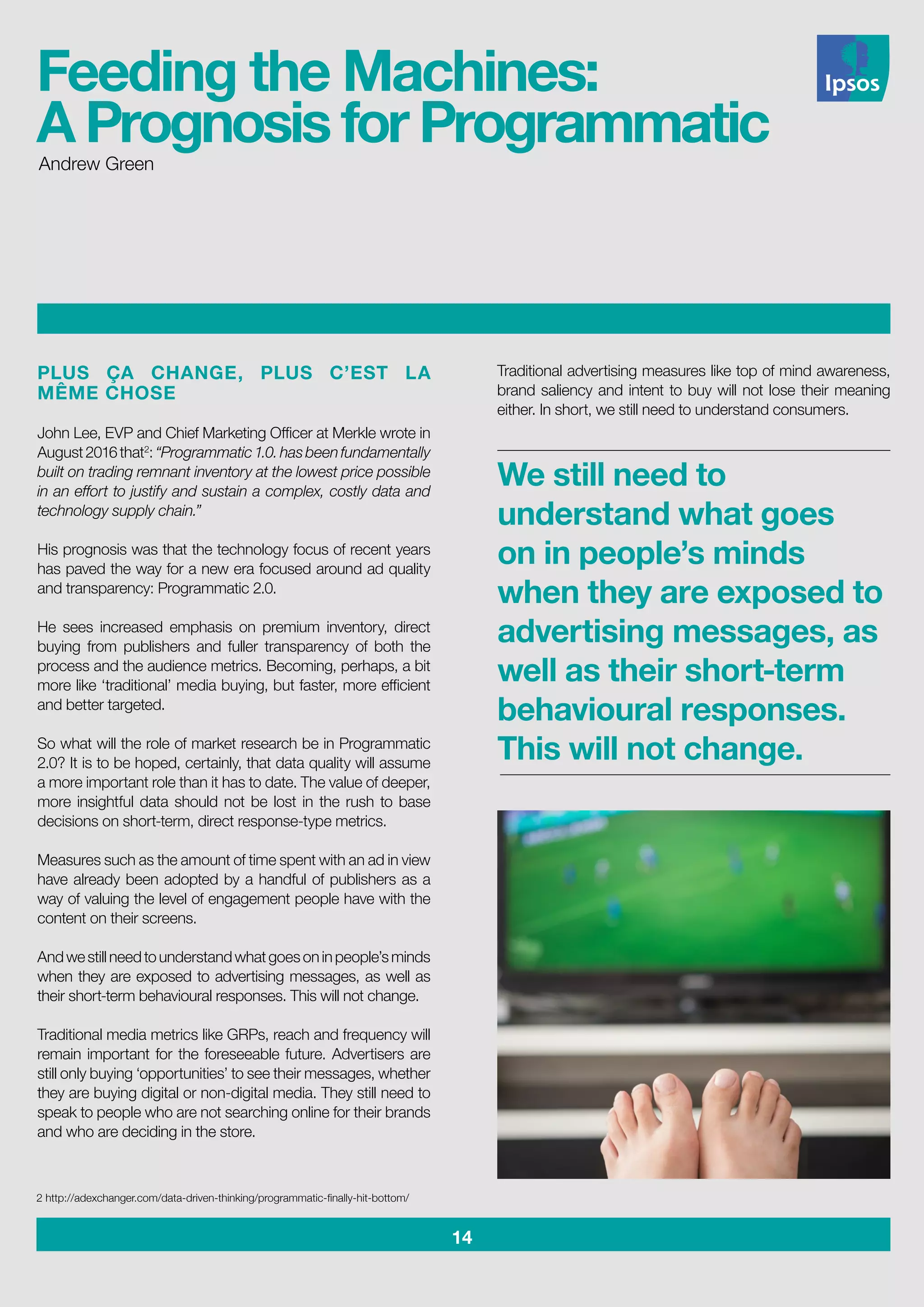
BRAND EQUITY
But building brands is about more than generating short
term response. 43% of advertisers in the IAB Europe survey
still use brand awareness as one of their key effectiveness
metrics to evaluate programmatic display campaigns. 37%
use Purchase Intent.
But far more employed the number clicking on an ad or other
direct response-type measures than used the more traditional
measures of brand equity.
Brand-building is a long-term game. People having a strong
affinity with a brand will react far more positively to short-term
stimuli than those with a weaker affinity. This much is obvious.
It is time for advertisers to look back at the brand data they have
collected over the years and see how it can be incorporated
into the programmatic data stream.
2 http://adexchanger.com/data-driven-thinking/programmatic-finally-hit-bottom/
Andrew Green
Feeding the Machines:
A Prognosis for Programmatic
14
PLUS ÇA CHANGE, PLUS C’EST LA
MÊME CHOSE
John Lee, EVP and Chief Marketing Officer at Merkle wrote in
August2016that2
:“Programmatic1.0.hasbeenfundamentally
built on trading remnant inventory at the lowest price possible
in an effort to justify and sustain a complex, costly data and
technology supply chain.”
His prognosis was that the technology focus of recent years
has paved the way for a new era focused around ad quality
and transparency: Programmatic 2.0.
He sees increased emphasis on premium inventory, direct
buying from publishers and fuller transparency of both the
process and the audience metrics. Becoming, perhaps, a bit
more like ‘traditional’ media buying, but faster, more efficient
and better targeted.
So what will the role of market research be in Programmatic
2.0? It is to be hoped, certainly, that data quality will assume
a more important role than it has to date. The value of deeper,
more insightful data should not be lost in the rush to base
decisions on short-term, direct response-type metrics.
Measures such as the amount of time spent with an ad in view
have already been adopted by a handful of publishers as a
way of valuing the level of engagement people have with the
content on their screens.
Andwestillneedtounderstandwhatgoesoninpeople’sminds
when they are exposed to advertising messages, as well as
their short-term behavioural responses. This will not change.
Traditional media metrics like GRPs, reach and frequency will
remain important for the foreseeable future. Advertisers are
still only buying ‘opportunities’ to see their messages, whether
they are buying digital or non-digital media. They still need to
speak to people who are not searching online for their brands
and who are deciding in the store.
Traditional advertising measures like top of mind awareness,
brand saliency and intent to buy will not lose their meaning
either. In short, we still need to understand consumers.
2 http://adexchanger.com/data-driven-thinking/programmatic-finally-hit-bottom/
We still need to
understand what goes
on in people’s minds
when they are exposed to
advertising messages, as
well as their short-term
behavioural responses.
This will not change.
Andrew Green
Feeding the Machines:
A Prognosis for Programmatic
GAME CHANGERS
<< Game Changers >> is the Ipsos signature.
At Ipsos we are passionately curious about people,
markets, brands and society. We make our changing
world easier and faster to navigate and inspire clients
to make smarter decisions. We deliver with security,
simplicity, speed and substance. We are Game Changers.
Ipsos Connect is a global specialised business to
co-ordinate Ipsos services in the domains of Brand
Communications, Advertising and Media. As the world of
brand communications, advertising and media become
increasingly complex, fragmented and digitalised, Ipsos is
helping clients better embrace this modern complexity with
investment in new approaches and products that will fit
with the digital age. Ipsos Connect aims to be the preferred
global partner for companies to measure and amplify how
media, brands and consumers connect through compelling
content, great communication and relevant media planning.
Andrew Green is Global Head of Audience Solutions at Ipsos Connect
September 2016
This Ipsos Views paper is
produced by the
Ipsos Knowledge Centre.
www.ipsos.com
@_Ipsos
IKC@ipsos.com
Feeding the Machines:
A Prognosis for Programmatic

L'achat programmatique vu par Ipsos

  • 1.
    September 2016 Feeding theMachines: A Prognosis for Programmatic Andrew Green
  • 2.
    Executive Summary 1 • Programmaticallytraded media represents less than 4% of total adspend. This is about one-third the size of printed newspaper ad revenues, half the size of radio and 10% of the television total. • On a good day, programmatic technology enables media buyers to save time, increase efficiency and improve effectiveness. • On a bad day, programmatically targeted advertising will be seen by almost nobody, as a result of ad blocking, fraud and viewability issues. • On an average day digital display advertising struggles to be seen, due to heavy clutter and poor positioning. Viewability tends to be lower for ads placed programmatically,asopposedtothoseplacedbyahuman. • Whatever day it is, programmatic technology will continue to grow strongly and will begin to make its presence felt beyond the digital space – in television, radio, Out of Home, newspapers and magazines. It is being driven by the quest for better efficiency, improved targeting, measurable ROI – and by undoubted pressure to embrace everything new and digital. Feeding the Machines: A Prognosis for Programmatic • It is being challenged by ad blocking, fraud, viewability issues, poor data quality and brand safety concerns, as well as by skills shortages and a reluctance on the part of traditional media companies to release premium inventory into the system. • Many of the challenges inherent in getting an ad seen and acted on in the digital environment can be managed through careful stewarding and use of existing technologies. New kinds of media buyer, more conversant with data science than with wining and dining, will emerge to master the necessary skills. • The measurement challenge lies in linking short-term behavioural responses to longer-term brand building efforts. Not every brand is searched for online and online is not the only place people look to help them make buying decisions. • GRPs (Gross Rating Points) will remain a robust and useful measure of audiences, even amidst the promise of greater precision in targeting ads. Like all media, digital display advertising can really only guarantee ‘opportunities’ to see to its advertisers. • At the end of the day, brands live inside people’s minds. So it is people’s minds we, as market researchers, must seek to understand and to help brands influence.
  • 3.
    2 Introduction “Programmatic is growing bigger,it’s not going away. And it’s not just digital media; it’s going to print and TV as well.” Sital Banerjee, Philips “Programmatic” media buying can be defined as the use of software programmes to buy advertising space. The software replicates and automates what, in some media, can be a lengthy manual process. It starts with a buyer briefing his requirements to the media (target audience, campaign objectives, budgets, qualitative considerations etc.) Options for meeting the brief are considered and analysed and negotiations take place around what the options will deliver and the price the client will pay. Programmatic buying does not remove the need for these steps - it still needs to begin with a brief and to work within parameters set by the buyer. But it eliminates much of the interim drudgery and speeds the process up considerably. The traditional buying process originated in a time of media scarcity and limited technology. Programmatic buying began in response to an almost infinite supply of digital inventory, the impossibility of a human being sifting through every possible permutation to create an optimum campaign and a massive advance in technology. Instead of placing an ad on a website (as one might in a newspaper or within a television programme), programmatic buying aims to place the message in front of the people it wants to talk to – whichever sites they are browsing. As a result, it offers the ability to show ads to some people on a particular site and not to others. And to stay with those people – identified as a core target – and reach them on other sites. An IAB Europe survey in June 2016 found that only 13% of advertisers and 7% of media agencies claimed not to be using programmatic technology to some degree. 90% expected to increase investment over the coming year. This enthusiasm is based around reducing media wastage, targeting more precisely and operating more efficiently. Bottlenecks cited in the survey included the difficulty of finding suitably skilled people to navigate the emerging digital ecosystem, as well as concerns around viewability, brand safety, data quality and fraud. Concern was also expressed about the cost of implementing the programmatic technology itself. Feeding the Machines: A Prognosis for Programmatic
  • 4.
    3 Feeding the Machines: APrognosis for ProgrammaticAndrew Green TOO MANY ADS There is no real limit on the number of ads that can be ‘served’ on many of these pages, which leads to an unfortunate side effect: too many ads clutter users’ screens. Some of these ads may even contain viruses and other malware. This has prompted as many as one in five online users according to a recent study1 to install ad blockers to prevent ad messages reaching them. So while the total number of web users continues to grow, those available to advertise to are shrinking. What cannot be contested is that digital advertising spend has now overtaken television in many countries to become the largest single advertising medium. Globally, according to ZenithOptimedia, internet and mobile advertising will reach $175 billion in 2016, almost exactly one third of the total advertising market (valued at $537 billion). It will overtake television globally in 2017 according to the forecaster. In this paper we look at the current state of programmatic advertising, including the forces driving it forward and those holding it back from growing even more quickly. We also look at the data feeding the programmatic machines and compare it to the ‘legacy’ audience measurement data that have long driven media placement decisions. The Programmatic Market “Programmatic is the new norm.” Mediapost, 21 June 2016 The programmatic advertising market is far smaller than the headlines might suggest, at least when seen in the context of the entire advertising market. Programmatic represents less than 4% of total adspend. This is about one-third the size of printed newspaper ad revenues, half the size of radio and 10% of the television total. Programmatic is growing, it’s changing, it’s digital and it’s the future. So, of course, even though small, it dominates the advertising trade press. And remains the hot topic for the young, digitally-savvy practitioners in charge of spending marketing budgets at media agencies and anybody else who likes to make the headlines... But it’s worth delving into the numbers a little. Just under half of the $175 billion spent on digital media around the world in 2016 went into Paid Search - where marketers bid to place their own content against words used (typically) in a Google search. They bid more to have their content appearing higher on the search results page. Paid search is not usually considered to be ‘programmatic’ (although it certainly shares some of its characteristics). A further 9% of the digital total flows to classified advertising (for jobs, property, used cars etc). 1 https://www.statista.com/chart/5048/the-use-of-ad-blocking-around-the-world/
  • 5.
    4 Andrew Green It isgrowing very rapidly. Magna Global predicts that it will reach $37 billion by 2019 which (if the total advertising market continues to grow at its current rate) will mean programmatic taking a 6% share of the total market (still, incidentally, 43% of the total is spent on ‘display’ ads, such as banners of various kinds, video and social media. It is this display part (around $75.4 billion in 2016) that has been most heavily impacted by the growth of programmatic trading. Magna Global, which issues regular forecasts about the programmatic market, estimated that around $20 billion would be spent on programmatic advertising in 2016 – 26% of total digital display advertising in that year but just 3.7% of total advertising. (It is, of course, higher in the most developed advertising markets). Three-quartersofthistotalisspentondigitaldisplayadvertising, with the rest on video and social media. smaller than printed newspapers, Out of Home or television advertising). Programmatic TV is currently even smaller – representing less than 1% of TV adspend in the United States for example. But it is expected to grow strongly from this low base to reach a 6% share of total TV spending by 2018, according to eMarketer and well over two-thirds of digital video spending. Programmatic approaches have also started making tentative inroads into the Out of Home medium – although in this case, with the majority of inventory being ‘static’ rather than digital in most countries – the systems need to enable access to both types of frame. A number of publishers have made parts of their print inventory available to buy programmatically as well. All media are likely to see some part of their inventory traded programmatically in the coming years, as the systems improve and the data begins to flow more easily into them. Feeding the Machines: A Prognosis for Programmatic Source: Magna Global Programmatic Intelligence Report 2015
  • 6.
    5 the few hundredTV or radio stations and couple of thousand publications a planner/buyer might have been faced with in the past. Programmatic technology, which starts with the audiences ratherthanwiththemediaoutlets,candealwiththeburgeoning number of permutations without breaking sweat. The process of sending out buying briefs, sorting through options and negotiating prices can be time-consuming and inefficient when done by a human buyer. Programmatic technology automates much of the drudgery. This means that fewer man hours need to be spent on the buying process and more can be spent on the strategy and the thinking. Trading decisions can be made almost in real time (as people in a target audience initiate a web page load, an ad can be immediately served to them as the page loads). RTB (Real Time Bidding) is not the only – or even the major – form of programmatic buying. Most inventory is, in fact, bought directly at a fixed price and is simply an automated version of traditional media buying. Drivers of Growth The drivers of the rapid growth in programmatic advertising in recent years revolve around generating efficiencies, increasing speed and exploiting the power of digital media to identify and target people with the greatest propensity to respond to an advertising message. GENERATING EFFICIENCIES For buyers, it is about driving efficiencies in the buying process, optimising ad campaigns across an almost infinite number of choices and doing it all at very high speed. For sellers, programmatic can drive efficiencies and also provide a way to offload lower-demand inventory. At the end of July 2016, there were 4.8 billion web pages across 1 billion websites from which buyers could – at least theoretically - choose. This is a far more daunting canvass than Source: http://www.scribblrs.com/ Andrew Green Feeding the Machines: A Prognosis for Programmatic
  • 7.
    6 TARGETING Marketers have longbeen concerned about ‘wastage’ – paying to reach people they do not want to reach with their advertising messages. If, for example, they are targeting men with a shaving product, any women seeing the ad will have limited value to them. If they are targeting older people with a retirement product, they do not need to reach (and may even irritate) younger people who see it. Anotherconcernwithtraditionalmediaplanningistheemphasis on broad demographics rather than true buyer targets. It may, for example, be true that most buyers of a particular brand or type of car are male, aged over 35 and working in certain kinds of occupation. But this doesn’t mean that every male over 35 working in these occupations is in the market for a new car. So advertising reaching them is also ‘wasted’. The growth in digital media has transformed this scenario. Countless research studies have pointed to the growing popularity of researching products online before buying. More and more people buy products and services online, as well as in the store. As they do, their actions leave behind a trail that can be followed. Marketers trying to sell a new car can focus in on people who have recently looked at car sites. Financial services companies can target people searching for information about insurance. Holiday companies, hotels and airlines can all hone in on people investigating vacation destinations. Targeting can also be built around people’s location in real time. An advertiser may wish to direct people at a trade show to his stand or people in the high street to a particular store. This has to be done programmatically, as the ad will be served only when the person being targeted enters a designated location. It is the reason why mobile programmatic in particular is growing so quickly. Another form of location targeting is addressable television: transmitting ads only to households with certain known characteristics (e.g. children present). This has been enabled by the spread of set-top boxes. Programmatic trading is being driven ever forward by its promise of greater efficiency, faster turnaround times and more precise targeting. It is also, undoubtedly, propelled by its fashionability amongst the digerati. No media agency, client or publisher would want to admit to not having ‘digital’, ‘mobile’ and/or ‘programmatic’ at the heart of their strategy for growth. Andrew Green Feeding the Machines: A Prognosis for Programmatic
  • 8.
    7 Andrew Green fraud, brandsafety and data quality. As well as this, the whole issue of inventory control is limiting the spread of programmatic trading into more traditional media. Viewability remains an issue. A viewable impression, according to guidelines set by the US Media Ratings Council, is one where: at least 50% of the surface of an online ad has to appear in the visible area of the browser for at least 1 second. According to ad verification specialist Meetric, in Q2 2016, just over half (56%) of the banner ads monitored by them internationally were viewable. There are many possible reasons why an ad might not be viewable: the user may not scroll to the location on the page where the ad appears (i.e. it may load ‘below the fold’); the ad may not fully render or the user may scroll quickly away from the page. Feeding the Machines: A Prognosis for Programmatic Barriers to Growth “Virtually any programmatic buy can be exposed to ad fraud... any claims to the contrary should be treated with caution.” World Federation of Advertisers But if there are good reasons to expect continuing growth in programmatic, there are many factors holding it back. Being such a new area, the talent pool to manage and leverage the technology remains small and expensive. The process is complex, with multiple variations around how ‘audiences’ are defined and measured, how ROI should be calculated and so on. There are also a number of critical challenges to contend with when managing a programmatic buy, including viewability, ad Viewability of Display Ads in % International UK Germany France Austria 56 47 60 62 69 44 53 40 38 31 Viewable Not Viewable Source: Meetrix Viewability Benchmarks, Q2 2016
  • 9.
    8 Andrew Green Although moreand more marketers are taking account of viewability, many are not – meaning they are paying for ads that cannot be seen. The IAB Europe study referred to earlier found that just 38% of advertisers included the level of viewability as one of the key metrics they used to evaluate programmatic display campaigns. While the technology exists for this challenge to be tackled, many will question whether loading half an ad for just a second is, in fact, enough… A UK study by Lumen in 2016 using special eye-tracking cameras embedded with a panel of PC and laptop users found that just 9% of ads served were actually looked at for more than a second, falling to 4% looked at for more than 2 seconds. This, perhaps, is a more accurate use of the word ‘viewability.’ One reason for this may be ad fraud. Essentially, this is where online behaviour is simulated to look as if real people have visited a website or clicked on an ad. Advertisers pay for these ‘views’ even though they are not seen by the people they are intended to reach. Fraudulent visits can be made by machines, by people or by a mix of the two. The World Federation of Advertisers believes that ad fraud could easily represent between 10 and 30% of digital ad impressions – but admits a precise figure does not yet exist. US comScore data for Q1 2016 confirms that levels of IVT (Invalid Traffic) are much higher with programmatic buys than with direct buys. It is possible for advertisers to reduce fraud by vigilance, insisting on full transparency, setting up proper controls and by building capabilities within their own organisations to understand what they are buying. But it remains an important barrier to the development of programmatic trading. ...“just 9% of ads served were looked at for more than a second, falling to 4% looked at for more than 2 seconds” Ad blockers are estimated to have been installed by as many as 25% of US online users. Combined with the 20% having no access to broadband either at home or via a Smartphone (Pew, 2015), this means that only 60% of the US adult population are even reachable through digital means. Blockers are notably skewed towards younger, male and more technically savvy users of great interest to marketers. This unreachable population is growing, effectively cancelling out the overall growth in online and mobile users seen around the world. Brand Safety is an issue for many marketers. Programmatic advertising tends to prioritise reaching a targeted audience over picking individual sites – which is part of the reason it is such an efficient way to trade. The more this is constrained to exclude or include particular sites, the less efficient it will be. Typically, marketers can whitelist sites they trust and blacklist those they believe carry content which would be an inappropriate environment for their brands to appear in. But things can always fall through the cracks, meaning that constant vigilance is needed. Feeding the Machines: A Prognosis for Programmatic
  • 10.
    9 COSTS Another barrier notedby the WFA is the high cost of managing programmatic buys. According to its estimates, as much as 60% of the initial client investment made in a programmatic buy gets swallowed up by payments to their agencies, trading desks, DSPs, data costs and so on. INVENTORY CONTROL The success of programmatic trading depends on access to the maximum amount of inventory. Anything that reduces or removes inventory from this part of the trading system necessarily weakens it. Television is case in point. Although every market operates differently, the largest TV market in the world – the USA – has a particular approach built around large upfront corporate commitments made for primetime network inventory (allocated to individual brands at a later date). It has long resisted advertisers wanting to ‘cherry-pick’ the best spots. Instead, they must take a package of good and less good spots. To compound the challenge, spot picking is not done solely on the basis of objective criteria such as cost per thousand impacts or campaign reach potential. For many advertisers, there is a requirement to buy into ‘prestige’ shows that their sales force or franchisees will see. If cost efficiency was the only thing that mattered, few would buy into such shows. Even the choice of which break in or around a programme or what position in a commercial break the advertiser should appear is traditionally made by the networks on the basis of ‘fair rotation.’ All this is possible because the larger TV networks retain control of their inventory and determine how it should be allocated based on multiple considerations – only one of which is cost efficiency. Such a system would need to be radically over-hauled in a programmatic world. Andrew Green Feeding the Machines: A Prognosis for Programmatic
  • 11.
    10 THE END OFNEGOTIATION? Importantly, in the US and many other TV markets, the ability to negotiate pricing (so that one advertiser will pay a different price to another for the same airtime) has long been a central feature of the process. There are plenty of ways in which one advertiser might secure a lower price than another. Budgets might be higher. The share of revenue offered to one network versus another either by the advertiser or his media agency may be greater. Those willing to commit further ahead can benefit. And other, less objective factors can come into play. In a programmatic system, much of this would presumably change. A fixed price would need to be attached to every piece of inventory (although these could vary triggered by overall spend levels etc.). All would have to be connected to an audience measurement system that allowed buyers to look both at each spot individually (e.g. by number of target viewers) and as part of an overall campaign (the number of viewers seeing at least one, two, three or more messages for example). The additional value placed by advertisers on advertising in ‘prestige’ programmes would have to be priced in. Today’s markets are ‘cleared’ by packaging: the best programmes are bundled with less good programmes. All of this is perfectly conceivable. Money could be saved by the re-allocation or elimination of buying and selling teams. Competitive advantage could be sought in how data is used or how programmatic strategies are executed. Markets would clear based on price, with (assuming demand patterns remain similar to now) high prices being paid for the most highly demanded slots and lower prices for others. But it would be a very big change. In the US in particular, national, network TV is usually distinguished from ‘spot’ or local TV, which may move more quickly towards embracing programmatic trading, driven by opportunities to ‘address’ individual households with known characteristics. Similar observations can be made for other media. Ways can be designed for programmatic technology to play an increasing role in oiling the buying and selling process. But it will demand commitment from the media owners and, critically, investment in inventory management systems to enable it. Andrew Green Feeding the Machines: A Prognosis for Programmatic
  • 12.
    11 readership data andOut of Home media have traffic data. There are many flaws and weaknesses in these audience measurement systems. For example: • Survey data, based on samples, can only ever measure the media with the highest audiences. The long-tail will be excluded. • Rather than measuring true exposure to a commercial, the data counts ‘opportunities to see’ an exposure. • Audience segmentation tends to be based around broad demographics. • Non-TV data is typically averaged over long periods (e.g. 3 or 6 months) with slow and infrequent reporting. In the UK, for example, more than 1,000 TV channels are licenced to broadcast. But BARB, the official measurement organisation, reports on just 275 of these. The vast majority of commercial breaks have nobody at all from the metered sample watching them. It is the same for newspapers and magazines. With more than 3,000 titles circulating in the UK, less than 200 can boast official readership numbers in the National Readership Survey. Audiences to individual pages are not measured. Feeding the Machines “Nobody measures a car commercial’s effectiveness by the number of people who saw the ad, got off the couch and drove to the dealership within ten seconds of seeing it. People don’t behave that way. Yet lots of digital advertising is measured and optimised against this exact type of behaviour.” Deacon Webster Programmatic starts and ends with data. Trading decisions need to be based on data. In practice, this has meant the use of ‘re- targeting’ (following internet users around the web and pushing ad messages to them) and employing other kinds of behavioural data like page views and clicks. This is nothing new: media have always been planned and bought using data of one kind or another. Television and radio have their ratings data, newspapers and magazines have circulation and Andrew Green Feeding the Machines: A Prognosis for Programmatic
  • 13.
    12 Digital data comein several forms: • FIRST-PARTY data is information the advertiser owns and controls; usually data it has collected itself on visitors to its website, social media data, customer email addresses and purchase histories and any other information about its customers or people it comes into contact with. • SECOND-PARTY data is somebody else’s first- party data which can be usefully exploited by an advertiser. This can include retailers co-operating with brands or selling them data and even non- competing marketers sharing information (e.g. a car company and a petrol retailer). • THIRD-PARTY data is collected by others and available to anybody to licence or buy. For example, a credit rating agency like Experian might offer to sell marketers access to audiences with known financial characteristics or behaviours. • Other kinds of data can also be utilised within the programmatic system to provide additional insight. Programmatic evangelists talk up how media buying will move from broad demographics that act as proxies for client prospects to ‘strategic’ targets, such as beer drinkers, new car buyers or frequent movie goers. But digital audience data has its own flaws. It measures devices rather than people. Internet audience data uses cookies which are deleted after a time. TV set-top box data is fraught with limitations as a measure of human audiences. All the issues of viewability, visibility, ad fraud and ad blocking described earlier remain challenges. Then there is the whole topic of ‘wastage.’ It is true that people visiting a website to research a product are likely to have a higher than average interest in buying the product. But it is equally true that other potential buyers may not be searching the internet for information about the product – or may have done so a long time before. So they would be missed if a campaign precisely targeted only those showing an active interest in looking for information about the product online. There are many examples, too, where the ad messaging misses the boat. People who have recently returned from holiday do not want to see ads for holidays. Recent car buyers will have no interest in special offers for a new car. Targeting people digitally can only be as good as the data available. While there are many cases where digital behavioural data can clearly help an advertiser get his message in front of a potential consumer quickly and efficiently, there are many others where it might not be so helpful. All media have ‘Big Data’ potential. TV has set-top box data which, combined with addressable technology, may allow advertisers to pinpoint households with a greater propensity to buy their brands. They will know, for example, whether children are present, where the household is located and possibly other information collected when the household signs on. Newspapers and magazines have sales and circulation data, available for every issue sold. Out of Home audience data is often built around very detailed traffic data. Andrew Green Feeding the Machines: A Prognosis for Programmatic
  • 14.
    13 BEYOND OPPORTUNITY TOSEE AlltheseBigDatasourcesovercomeatsomelevelthechallenge of small samples, low granularity and slow speeds. But they do not take us any closer to measuring true commercial exposure than the traditional measures do. As noted earlier, a small-scale eye-tracking study carried out by Lumen in the UK found that only a third of advertisements served to websites are actually looked at (eyes on) by people exposed to them on PCs and laptops. The rest are either non- viewable or simply not noticed. Even when they are, few are actually looked at for longer than a second (9% of those served) or two (4% of those served). This does not make digital media somehow less good than non-digital media; but it does highlight the clear difference between serving an ad message and people actually seeing it. Just like ‘traditional’ media, digital media are serving up ‘opportunities’ to see. The speed and granularity of digital data has had some impact on the speed and granularity ambitions of traditional audience measurement services. TV data has been available overnight for many years, but in Australia – a good example of newspaper publishers being spurred on by digital advances – readership survey updates were made available monthly instead of quarterly in 2013. In 2017, Belgian publishers will begin to publish daily, dated readership data for individual newspaper titles. Many other stakeholder groups are looking into how they can develop their studies from single-platform, infrequently- published, broadly-based surveys to multi-platform studies with faster and more frequent updates. BRAND EQUITY But building brands is about more than generating short term response. 43% of advertisers in the IAB Europe survey still use brand awareness as one of their key effectiveness metrics to evaluate programmatic display campaigns. 37% use Purchase Intent. But far more employed the number clicking on an ad or other direct response-type measures than used the more traditional measures of brand equity. Brand-building is a long-term game. People having a strong affinity with a brand will react far more positively to short-term stimuli than those with a weaker affinity. This much is obvious. It is time for advertisers to look back at the brand data they have collected over the years and see how it can be incorporated into the programmatic data stream. 2 http://adexchanger.com/data-driven-thinking/programmatic-finally-hit-bottom/ Andrew Green Feeding the Machines: A Prognosis for Programmatic
  • 15.
    14 PLUS ÇA CHANGE,PLUS C’EST LA MÊME CHOSE John Lee, EVP and Chief Marketing Officer at Merkle wrote in August2016that2 :“Programmatic1.0.hasbeenfundamentally built on trading remnant inventory at the lowest price possible in an effort to justify and sustain a complex, costly data and technology supply chain.” His prognosis was that the technology focus of recent years has paved the way for a new era focused around ad quality and transparency: Programmatic 2.0. He sees increased emphasis on premium inventory, direct buying from publishers and fuller transparency of both the process and the audience metrics. Becoming, perhaps, a bit more like ‘traditional’ media buying, but faster, more efficient and better targeted. So what will the role of market research be in Programmatic 2.0? It is to be hoped, certainly, that data quality will assume a more important role than it has to date. The value of deeper, more insightful data should not be lost in the rush to base decisions on short-term, direct response-type metrics. Measures such as the amount of time spent with an ad in view have already been adopted by a handful of publishers as a way of valuing the level of engagement people have with the content on their screens. Andwestillneedtounderstandwhatgoesoninpeople’sminds when they are exposed to advertising messages, as well as their short-term behavioural responses. This will not change. Traditional media metrics like GRPs, reach and frequency will remain important for the foreseeable future. Advertisers are still only buying ‘opportunities’ to see their messages, whether they are buying digital or non-digital media. They still need to speak to people who are not searching online for their brands and who are deciding in the store. Traditional advertising measures like top of mind awareness, brand saliency and intent to buy will not lose their meaning either. In short, we still need to understand consumers. 2 http://adexchanger.com/data-driven-thinking/programmatic-finally-hit-bottom/ We still need to understand what goes on in people’s minds when they are exposed to advertising messages, as well as their short-term behavioural responses. This will not change. Andrew Green Feeding the Machines: A Prognosis for Programmatic
  • 16.
    GAME CHANGERS << GameChangers >> is the Ipsos signature. At Ipsos we are passionately curious about people, markets, brands and society. We make our changing world easier and faster to navigate and inspire clients to make smarter decisions. We deliver with security, simplicity, speed and substance. We are Game Changers. Ipsos Connect is a global specialised business to co-ordinate Ipsos services in the domains of Brand Communications, Advertising and Media. As the world of brand communications, advertising and media become increasingly complex, fragmented and digitalised, Ipsos is helping clients better embrace this modern complexity with investment in new approaches and products that will fit with the digital age. Ipsos Connect aims to be the preferred global partner for companies to measure and amplify how media, brands and consumers connect through compelling content, great communication and relevant media planning. Andrew Green is Global Head of Audience Solutions at Ipsos Connect September 2016 This Ipsos Views paper is produced by the Ipsos Knowledge Centre. www.ipsos.com @_Ipsos IKC@ipsos.com Feeding the Machines: A Prognosis for Programmatic