Marketing and Public
                                                  Relations Guide


Advertising
Paid advertising will deliver your message exactly as you want in the media you select. Your
only limitation is your budget. Advertising will raise the visibility of your event/activity, etc. and
you have complete control over the contents (which you don’t have with articles in the press,
for example). Advertising options include newspapers, magazines, television, radio, transit,
Web site, billboards, the Yellow Pages and more.

Direct mail
If you have an established mailing list you can write directly to these individuals, telling them
about your event or current news. Techniques for successful direct mail include letting
recipients know why you are writing and giving them an incentive.

Newsletters (Electronic newsletters recommended)
Newsletters convey specific information to a specific audience. Newsletters can be mailed, e-
mailed or posted on a web site with a combination of articles that educate the target audience
about you or your organization. Newsletters should be published on a regular schedule.

Promotion
Special offers provide incentives for people to buy. Incentives include concessions (for groups,
seniors, students, etc.), discounts (buy two, get one free), time-limited offers (10% discount for
purchases made before a certain date), and special offers for subscribers (receive a free
catalogue and a voucher for something).

Special Events
Consider special events, such as groundbreakings for new facilities, sneak previews of
performances or exhibitions, anniversary celebrations, new art installations, and member
appreciation.

Websites
A well designed website should be part of your overall marketing efforts. Today’s technology
makes it pretty simple to create your own.
The Power of E-Mail
Can’t imagine conducting business without e-mail? You’re not alone. More than 60 billion e-
mail messages are sent a day from more than 125 million e-mail addresses. E-mail is quick,
economical and a powerful business tool.

Get Permission
To keep your e-mail from being considered spam, follow these tips to deliver your marketing
message.

   1. Aside from always keeping your message brief, e-mails used for marketing should have
      the “affirmative consent” of the person you are sending it to. Specifically, this means the
      person has to take an action before being added to an e-mail list, such as a check-off
      box.

   2. The overriding principle for distributing mass e-mails and e-newsletters is that everyone
      on your lists, and on any lists you receive from other organizations or an e-mail broker,
      has agreed to receive e-mails.

   3. In each e-mail sent you should provide the receiver with a mechanism so that they can
      request to not receive further solicitations (opt-out) and request that the marketer not
      rent, sell, or exchange their e-mail address. An example of this mechanism would be
      "To unsubscribe from this e-mail list, reply to this e-mail with unsubscribe in the subject
      line."

This is permission marketing and following basic guidelines will keep your members,
subscribers and visitors happy and eager to receiver your e-mails. It’s always helpful to
remember to include specific contact information for your organization, including your physical
address, and telephone number.

Anti-spam techniques
Spammers use huge mailing lists to increase individual or company profitability. You should
use small, targeted lists. Spammers can only personalize their e-mail address and subject
lines. You should personalize the content with personal references. Don’t use hype. Stay away
from ALL CAPS, repetitive punctuation, such as !!!! or $$$$ symbols.

Additional tips include:
   1. All e-mail from your organization, whether it’s personal or broadcast, should come from
       one place and that should be your organization’s domain.

   2. Implement an e-mail policy. The policy should cover all e-mails—business, broadcast
      and personal. The policy should address who is authorized to send broadcast e-mails
      and what mandatory elements, such as design, content and distribution standards,
      should be included.
3. Post your privacy policy on your Web site. Don’t ask for personal or financial
      information. Post links to secured pages.

   4. Leverage reader relationships. Make it easy for your subscribers, members and visitors
      to contact you, to forward your e-newsletter to a friend, etc.

   5. Keep your e-mail addresses up-to-date. Make sure to confirm subscription,
      unsubscribe, address change, format changes (e.g. HTML, text), etc. Keep good
      records. Subscribers may forget they subscribed so you should be able to tell them
      specifically.

The Power of E-Newsletters
Another important tool is the e-Newsletter. It’s free to distribute, easy to produce and can be an
effective way to engage your members, potential audience and stakeholders.

Tips for E-Mail Newsletters:
   1. Before you start, identify your goals and objectives.

   2. Create an editorial calendar.

   3. Ask your members or constituents what they think and what they would like to see in the
      e-newsletter.

   4. Determine if you will use a professional e-mail service provider or e-mail software.
     Advantages:
     • Bounces (undeliverable addresses) are handled automatically
     • Unsubscribers are handled automatically
     • Subscribers are handled automatically
     • Confirmations are handled automatically
     • Change of e-mail address and format (html or plain text) are handled automatically
     • Determine tracking and reporting:
     • Unsubscribe rate
     • Bounce rate
     • Unique open rate
     • Conversion rate (if applicable)

E-Mail Newsletter Checklist:
   Getting Subscribers:
    • Have opt in permission from everyone on your e-mail list before launching your first e-
       newsletter.
    • Collect more than e-mail addresses. Use this as a time to update your database.
    • Make it easy and quick to subscribe.
    • Make sure e-mail subscription sign up is on all relevant pages of your Web site,
       including contact and feedback pages.
    • Make sure your privacy policy is published on the Web site and referenced, with
       hyperlink, on all subscription confirmation e-mails
Make sure:
    • Unsubscribing is easy
    • The “Reply to” function works
    • Messages are from people, not organizations
    • Content is relevant and beneficial to the reader
    • Content is timely
    • There is at least one call to action or compelling offer in each newsletter
    • There is a privacy statement
    • The e-newsletter links to your Web site
    • All links have been tested, work and are relevant to the reader
    • That your e-newsletter avoids spam filter triggers. (Triggers include: Free, !!!, Forward to
      a Friend, $$$$. etc.)
    • There are no attachments


Target Marketing
Your database/mailing list is the most important tool in target marketing. You want to reach the
people who are most likely to be interested in your arts activity. These are “inclined” guests or
visitors. Target markets may include:
      • Previous visitors/guests.
      • People who are interested in the subject matter (specific age groups or people with a
        special interest or cultural background.
      • People who have seen similar work in the same place or venue.
      • People who hear about you by word of mouth.*

How can you create “buzz?” Here are a few suggestions:
    • Use informal networks to spread the word
    • Talk to targeted groups or individuals (Civic groups/organizations)
    • Invite “movers/shakers” in key organizations to see works-in-progress, dress rehearsals,
    etc.
    • Establish a Community Marketing Committee prior to your openings/event.

Once you have decided WHO is your target, think about HOW to target these potential guests.
It is important to consider the appropriate tone, style and language when developing flyers,
advertising and other components of your marketing campaign.


Communications Planning
Communication plans organize messages and resources so maximum advantage can be
taken of publicity opportunities. Strategic plans can be developed for one particular event or for
the entire organizational structure. Working with the media is a cost-effective way to inform the
community about who you are and what you do.
Media relations work. It isn’t expensive and is one of the most effective ways to reach your
audience and get your message out.

These questions should be addressed when creating a communication plan:
    • What is the main goal?
    • What should the media tell the public about the event, program or organization?
    • Who is the audience?
    • What media will be the most effective in reaching the audience?
    • What resources are available?

Once these questions are answered, the communication plan can be constructed. This plan
may employ a number of elements to foster communication.

These elements include:
    • News releases
    • Media alerts or advisories
    • Pitches (e-mails or letters)
    • News conferences
    • Letters to the editor
    • Guest columns

No matter what method you use to contact the media, it’s important to understand who the
media are, how they work and what is considered “news.”

What is news?
News is:
    • Timely
    • Informative
    • Educational
    • Significant
    • Unique
    • Interesting
    • Entertaining

News is now. It’s timely, immediate and sometimes bad. It’s local. It’s about here and now. It’s
about people, our neighbors, stakeholders, celebrities, eccentrics, guardian angels, artists,
young heroes, pet heroes, etc.

It’s innovative, useful, amusing. It’s “I never thought of it that way…” News is novelty. It’s
unique, a contradiction, conflict or controversy. It’s a snapshot of a rapidly changing world.

The bottom line is that news is what journalists decide it is. That’s why it’s important to think,
write and speak like a reporter. Ask yourself why would a reporter consider this news? Why
would a reporter care?
What’s Not News?
   • Internal awards, retirement
   • Anniversaries, unless significant
   • Organization cooperation and people working together are not normally news (although
      “human interest” stories can provide material for features)

Developing a positive relationship with the news media takes a lot of work. Building
relationships with your local reporters can be one of the most beneficial things you can do to
help your organization grow.
These relationships will:
      • Get information into the hands of your audience
      • Raise awareness of events, programs and activities, organizational profiles
      • Rally community support (and financial support) for your programs

Who are journalists?
    • People who are short on time
    • Friendly people who are not necessarily your friend
    • Smarter than you think
    • Probably less knowledgeable about your subject matter than you are

What Do Journalists Want?
    • A good story and as much information as they can capture
    • Good quotes
    • To know what you know: They need/want to understand the issue after 20 minutes.
    • Your respect
    • Recognition of media’s importance
    • You to be open and honest

Get to know the reporter
     • Don’t assume reporters know the background
     • Arts & Culture may be covered as a beat by the entertainment or feature reporter.
     • Get to know other reporters who cover your area

The First Meeting
    • Find out how a reporter likes to get news and tips
    • Understand their deadlines
    • Tell reporters how you can help them
    • Bring resources
    • No agenda (story pitches) the first time, but have some ideas in mind

Follow Up
     • The best gift: Call with story tips
     • Invite reporters to an event where they can make contacts or get story ideas
     • Positive feedback: Comment on a story they’ve written/produced
Professional Courtesies
     • Learn the best time to call (Newspapers, TV stations and radio stations differ)
     • Honor exclusivity or advance notice agreements
     • Consider all remarks as “on the record”
     • Never say “no comment” in an interview: it sounds evasive

Press and News Releases
Press releases provide information about an issue, an event, performance or other
newsworthy item in a standardized format. In deciding to write a release on a certain subject
you might consider asking the following questions:
    • Will this story be of interest to a large number of readers?
    • Does this story talk about a large number of people in the community?
    • Does this story speak of a special noteworthy event or something that would have
    special significance to the community?
    • Is this story out of the ordinary?

Preparing the release
Press releases should answer the five W’s in the first paragraph:
     • Who? Who will make / is making the announcement?
     • What? What does the media need to know?
     • Where? If an event or news conference is being announced, include where it will take
     place. Be sure to include clear directions and parking information.
     • When? When will/ did the event/ announcement take place?
     • Why? Why is this event important? A release should give a reporter a compelling
     reason to cover your event or announcement
     .
Tips for Effective Writing
     • Be concise. Edit your copy to remove excess words and puff terminology.
     • Try to keep your message on one page.
     • All facts should be correct. Check and double-check the copy.
     • Every name should be spelled correctly. Check and double-check the copy.
     • Check for grammatical errors. Check and double-check the copy.
     • Avoid clichés, hype words, euphemisms and flowery adjectives.
     • Beware of negative connotations.
     • Avoid discriminatory language.
     • Never lie or stretch the truth.

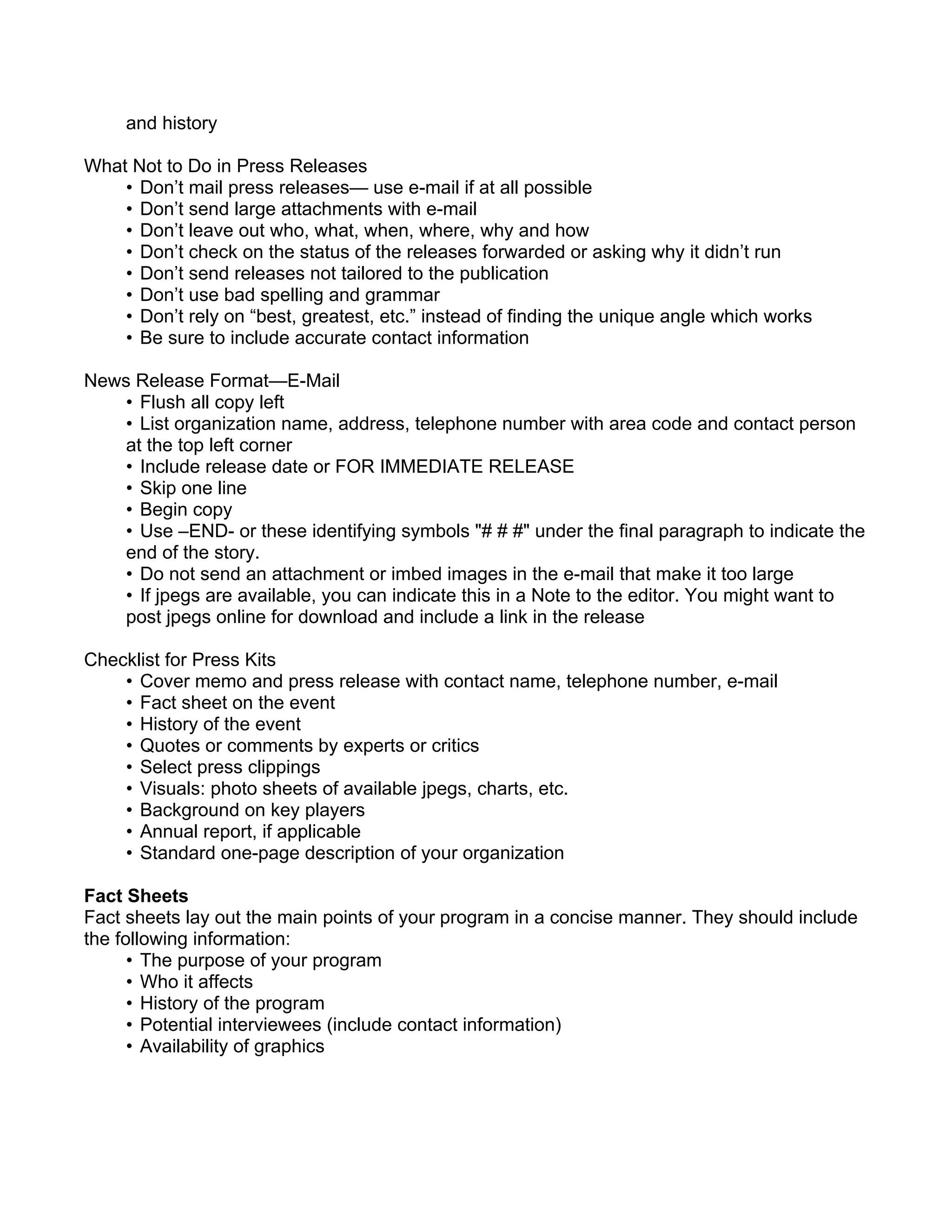
Inverted Pyramid

A useful guide for organizing your news release is the inverted
pyramid. Readers start at the top, editors cut from the bottom.

Your pyramid would look like this:
    • Top of pyramid: Who, What, When, Where, Why
    • Middle: Information that helps readers
    • Bottom: Information that provides context; Useful details
and history

What Not to Do in Press Releases
    • Don’t mail press releases— use e-mail if at all possible
    • Don’t send large attachments with e-mail
    • Don’t leave out who, what, when, where, why and how
    • Don’t check on the status of the releases forwarded or asking why it didn’t run
    • Don’t send releases not tailored to the publication
    • Don’t use bad spelling and grammar
    • Don’t rely on “best, greatest, etc.” instead of finding the unique angle which works
    • Be sure to include accurate contact information

News Release Format—E-Mail
    • Flush all copy left
    • List organization name, address, telephone number with area code and contact person
    at the top left corner
    • Include release date or FOR IMMEDIATE RELEASE
    • Skip one line
    • Begin copy
    • Use –END- or these identifying symbols "# # #" under the final paragraph to indicate the
    end of the story.
    • Do not send an attachment or imbed images in the e-mail that make it too large
    • If jpegs are available, you can indicate this in a Note to the editor. You might want to
    post jpegs online for download and include a link in the release

Checklist for Press Kits
    • Cover memo and press release with contact name, telephone number, e-mail
    • Fact sheet on the event
    • History of the event
    • Quotes or comments by experts or critics
    • Select press clippings
    • Visuals: photo sheets of available jpegs, charts, etc.
    • Background on key players
    • Annual report, if applicable
    • Standard one-page description of your organization

Fact Sheets
Fact sheets lay out the main points of your program in a concise manner. They should include
the following information:
      • The purpose of your program
      • Who it affects
      • History of the program
      • Potential interviewees (include contact information)
      • Availability of graphics
It is helpful to always have fact sheets available so they may easily be distributed to individuals
who want information. Fact sheets are also good templates for Web material.

PSAs (Public Service Announcements for Non-profit Arts Organizations)
How to Produce and Air a PSA
Both radio and television stations commit a portion of air time for free public service spots on
behalf of nonprofit organizations. PSAs are announcements or reminders of events or services
helpful to the public.

First call your radio and TV stations and ask to speak to the Public Service Director or check
their Web site. Find out what kind of spots they run, what rules apply, what their time limits and
formats are and to whom and by when should the PSAs be submitted.

Most stations will not accept any political messages in PSA’s.

Your PSA should focus on free events that provide accessibility to the general public to special
performances, events, festivals, etc. Submit your TV or radio PSA script to the station for
approval before you go into production. This can save you from wasting time and money.

Your nonprofit name should be heard and seen twice during a PSA. Some stations are very
particular about identifying 501c (3) status. Check on this in advance. A phone number and
Web site address should also be given.

Digital BETA SP is the best option for TV PSAs. Thirty-second (80 words) PSAs are aired
often; 15-second PSAs are also in demand. Every station has different preferences. Check
first. Leave three to five seconds at the end of your PSA for your logo.

TV PSAs can easily be made into radio PSAs. Most radio stations accept CDs or digital files.
Develop a 15-second, 30-second and 60-second hard copy PSA for local radio stations.

Submit your PSA at least one to two months before a specific event. Write a “Kill Date” (date
on which PSA must be taken off the air) on your PSA. This is very important.

Be sure to make follow up calls, but don’t be pushy.

If the station is lukewarm to your PSA, suggest that you work together on a partnership/
sponsorship that would encourage participation in the arts and culture. Involve your local
station in your outreach efforts.
Other Media Options

Interviews
It can be helpful to spend some time with a reporter to discuss particular issues of the
organization. Some newspapers and television stations have reporters who cover particular
beats, such as arts and leisure. Discussing issues with these reporters is an excellent tactic
particularly if an employee is new to a situation, the program is new, or the reporter is new. A
published story is not guaranteed after an interview, but it is an excellent way for employees to
establish themselves as an expert on a particular issue. Update interested reporters or
reporters who have already covered the story with small developments regarding the issue.

An important thing to remember about interviews is that the interviewee is the expert on the
topic and should always remain in control. It is also important to either record interviews or
take excellent notes.

It is common for an individual to get nervous when a reporter asks for an interview. Some
techniques for dealing with nerves include a few deep breaths, a moment of meditation, or a
walk to organize thoughts. It can also be helpful to think of the interview as a conversation with
a close friend or relative. The best way to deal with nerves is through preparation.

Prepare for the interview
In order to find out what a reporter wants out of an interview, talk with him or her informally
about the requests.
Ask the following questions:
     • Does the reporter want cursory or in-depth information?
     • Is the reporter doing an historical interview, or is this related to a current event?
     • How long does the reporter expect the interview to last?
     • What kind of a deadline is the reporter working on?

It is important to take the time needed to prepare for an interview. Never feel pressured to
respond off-the-cuff. Simply inform the reporter that time is needed to become familiar with the
issue.

Ask the following questions:
     • What points should be made?
     • How should these points be expressed?
     • Is there a colorful phrase that will best express the point?
     • What are some good examples and illustrations that can be used to express the point?
     • Can confusing or complicated data be distilled to a simple and concise thought?


Television Interviews
When being interviewed, the most important thing is to appear honest, straightforward, and
concerned. Those being interviewed are not expected to look like professional news anchors.
Professional attire such as suits and dresses are not required. It is only important that the
person being interviewed is comfortable with him or herself.

While being interviewed, look at the reporter, not the camera.

Be prepared to suggest visuals that may help make the story better. Consider options outside
of the office for a more visual location. For instance, an interview about a festival could take
place at the festival location.

Radio Interviews
Most radio interviews are conducted over the phone. In order to prepare for the interview,
eliminate all distractions. Hold all other phone calls and shut the office door. Always remember
to speak in a normal, understandable voice when being interviewed.

Print Interviews
Print interviews usually last longer than radio or television interviews and the reporter usually
wants more detailed information. Make sure that ample time is scheduled for the interview. It
may also be helpful to pull other individuals from the office to sit in during the interview. This
will round out the interview by including many people with different areas of expertise.

Tips for Interviewing
     • Prepare for the interview. Know the message and review the major points. Focus on no
     more than two or three major points to make during the interview. For each point, be sure
     to have two or three good facts to back it up. Don’t let the reporter’s questions get you off
     track. Keep coming back to your major points. Don’t forget the reason you are there.
     • Be sure to watch or listen to the program or host that will be interviewing you. Get to
     know the style and format of the show.
     • Always frame answers in a positive manner.
     • Avoid bureaucratic language, jargon, and acronyms—explain what you mean in
     layman’s terms. Don’t use long sentences. You want to be quoted. Explain complex
     programs in simple, human terms.
     • Give facts, not opinions. Never lie. Don’t speculate. If you can’t answer a question, be
     honest and say so.
     • Never say, “no comment.” Always answer coming back to the main points you want to
     make. Never answer with a simple yes or no. The easier you make it on the reporter, the
     more likely she/he is to have you back. Don’t comment about things outside your area of
     expertise.
     • Stay on the record. Remember, you represent your organization. Don’t give personal
     opinions that might compromise the group. Never make partisan statements or your quote
     could end up as a headline in tomorrow’s paper.
     • Don’t be afraid of silence.
     • Be patient. You’re the expert. The reporter is not. If the reporter wants facts/figures you
     don’t have—tell him/her you’ll find out the information and go back to making your
     important points. If you are not sure about a fact or figure, don’t use it. You want the
     media to rely on you as a reliable source of nonpartisan facts.
• Never be argumentative, confrontational, or lose your temper with a reporter. You want
     the media on your side. Maintain a sense of humor. If the reporter is antagonistic, use
     your charm. Keep cool. Never be condescending to a reporter or try to “set them straight.”
     • Announce your bad news. Be proactive.
     • You have a serious message to deliver. Don’t wear clothes that are too flashy. Stripes,
     checks and white are not good on TV. Don’t wear dangling jewelry. Don’t fiddle on
     camera. Assume microphones are on at all times. Assume you are on camera until they
     tell you that you’re not.
     • Maintain good eye contact with reporters. Ignore the camera. Speak clearly and
     distinctly in a normal conversational tone.
     • Record your interview. Review it. Ask a friend or coworker to critique it. Correct your
     problem areas in the next interview.

Columns
Small or weekly newspapers may be interested in a regular column from a division or a large
program.

Characteristics of Different Types of Media
The different types of media have specific characteristics that set them apart from other media.
Each has pros and cons and should be dealt with in a particular way in order to fully take
advantage of all that the medium has to offer.

Television
When planning a television story it is important to think of the pictures that most accurately and
effectively express the situation. This is often a fun opportunity to be creative. If television is to
cover a news release someone must be on hand to do an on-camera interview and pictures
must be selected to go with the release material. Television reporters prefer pictures to “talking
heads,” or individuals simply talking into a camera. The more opportunity a reporter has to
obtain pictures, the more likely the story will be covered on television. It is helpful if the location
of the news conference is a major part of the story.

Assignment Editors
The assignment editor is responsible for deciding what stories will be covered and by whom.
Since assignment editors are multi-taskers with demanding jobs, make only one or two brief
calls. Try to keep calls under a minute unless the assignment editor lengthens the call by
asking questions. Make a short pitch that is clear and concise and thank the assignment editor
for his or her time at the end of the call. Most stations have a day and night assignment editor.

Radio
Because there are no pictures to distract the audience, sound is a powerful feature for radio.
Finding and identifying sound for a radio reporter will give the story a better presence. Sound
for the radio can be as simple as a taped interview or more involved.
Newspapers
Details and background information are the unique qualities of a newspaper story. The larger
newspapers assign reporters to arts, leisure and cultural stories. Because these reporters are
assigned to one segment, they generally have more time to spend on stories. It is beneficial to
foster good communication by inviting reporters to everything you are involved in or just call
them with any new details.

Smaller newspapers such as weeklies may not have arts reporters. Reporters may cover a
variety of issues, but they may still have more time to spend on a story. Invite new reporters to
sit down and chat or go into the field. Be sure to keep them informed on the stories that are in
progress. Remember that today’s weekly reporter is often tomorrow’s daily newspaper
reporter.

Share the Arts Story at Your Events
Your events provide an opportunity to publicly acknowledge state funding through the
Mississippi Arts Commission. During the opening of an exhibition or at the beginning of a
performance or literary reading or other activity supported in part with Arts Commission funds,
please take a moment to speak to your audience about the importance of public support.


                                    501 North West Street
                               Suite 1101A – Woolfolk Building
                                     Jackson, Mississippi
                                     Phone 601/359-6030
                                       Fax 601/359-6008
                                    www.arts.state.ms.us

Marketingand Public Relations Guide 000

  • 1.
    Marketing and Public Relations Guide Advertising Paid advertising will deliver your message exactly as you want in the media you select. Your only limitation is your budget. Advertising will raise the visibility of your event/activity, etc. and you have complete control over the contents (which you don’t have with articles in the press, for example). Advertising options include newspapers, magazines, television, radio, transit, Web site, billboards, the Yellow Pages and more. Direct mail If you have an established mailing list you can write directly to these individuals, telling them about your event or current news. Techniques for successful direct mail include letting recipients know why you are writing and giving them an incentive. Newsletters (Electronic newsletters recommended) Newsletters convey specific information to a specific audience. Newsletters can be mailed, e- mailed or posted on a web site with a combination of articles that educate the target audience about you or your organization. Newsletters should be published on a regular schedule. Promotion Special offers provide incentives for people to buy. Incentives include concessions (for groups, seniors, students, etc.), discounts (buy two, get one free), time-limited offers (10% discount for purchases made before a certain date), and special offers for subscribers (receive a free catalogue and a voucher for something). Special Events Consider special events, such as groundbreakings for new facilities, sneak previews of performances or exhibitions, anniversary celebrations, new art installations, and member appreciation. Websites A well designed website should be part of your overall marketing efforts. Today’s technology makes it pretty simple to create your own.
  • 2.
    The Power ofE-Mail Can’t imagine conducting business without e-mail? You’re not alone. More than 60 billion e- mail messages are sent a day from more than 125 million e-mail addresses. E-mail is quick, economical and a powerful business tool. Get Permission To keep your e-mail from being considered spam, follow these tips to deliver your marketing message. 1. Aside from always keeping your message brief, e-mails used for marketing should have the “affirmative consent” of the person you are sending it to. Specifically, this means the person has to take an action before being added to an e-mail list, such as a check-off box. 2. The overriding principle for distributing mass e-mails and e-newsletters is that everyone on your lists, and on any lists you receive from other organizations or an e-mail broker, has agreed to receive e-mails. 3. In each e-mail sent you should provide the receiver with a mechanism so that they can request to not receive further solicitations (opt-out) and request that the marketer not rent, sell, or exchange their e-mail address. An example of this mechanism would be "To unsubscribe from this e-mail list, reply to this e-mail with unsubscribe in the subject line." This is permission marketing and following basic guidelines will keep your members, subscribers and visitors happy and eager to receiver your e-mails. It’s always helpful to remember to include specific contact information for your organization, including your physical address, and telephone number. Anti-spam techniques Spammers use huge mailing lists to increase individual or company profitability. You should use small, targeted lists. Spammers can only personalize their e-mail address and subject lines. You should personalize the content with personal references. Don’t use hype. Stay away from ALL CAPS, repetitive punctuation, such as !!!! or $$$$ symbols. Additional tips include: 1. All e-mail from your organization, whether it’s personal or broadcast, should come from one place and that should be your organization’s domain. 2. Implement an e-mail policy. The policy should cover all e-mails—business, broadcast and personal. The policy should address who is authorized to send broadcast e-mails and what mandatory elements, such as design, content and distribution standards, should be included.
  • 3.
    3. Post yourprivacy policy on your Web site. Don’t ask for personal or financial information. Post links to secured pages. 4. Leverage reader relationships. Make it easy for your subscribers, members and visitors to contact you, to forward your e-newsletter to a friend, etc. 5. Keep your e-mail addresses up-to-date. Make sure to confirm subscription, unsubscribe, address change, format changes (e.g. HTML, text), etc. Keep good records. Subscribers may forget they subscribed so you should be able to tell them specifically. The Power of E-Newsletters Another important tool is the e-Newsletter. It’s free to distribute, easy to produce and can be an effective way to engage your members, potential audience and stakeholders. Tips for E-Mail Newsletters: 1. Before you start, identify your goals and objectives. 2. Create an editorial calendar. 3. Ask your members or constituents what they think and what they would like to see in the e-newsletter. 4. Determine if you will use a professional e-mail service provider or e-mail software. Advantages: • Bounces (undeliverable addresses) are handled automatically • Unsubscribers are handled automatically • Subscribers are handled automatically • Confirmations are handled automatically • Change of e-mail address and format (html or plain text) are handled automatically • Determine tracking and reporting: • Unsubscribe rate • Bounce rate • Unique open rate • Conversion rate (if applicable) E-Mail Newsletter Checklist: Getting Subscribers: • Have opt in permission from everyone on your e-mail list before launching your first e- newsletter. • Collect more than e-mail addresses. Use this as a time to update your database. • Make it easy and quick to subscribe. • Make sure e-mail subscription sign up is on all relevant pages of your Web site, including contact and feedback pages. • Make sure your privacy policy is published on the Web site and referenced, with hyperlink, on all subscription confirmation e-mails
  • 4.
    Make sure: • Unsubscribing is easy • The “Reply to” function works • Messages are from people, not organizations • Content is relevant and beneficial to the reader • Content is timely • There is at least one call to action or compelling offer in each newsletter • There is a privacy statement • The e-newsletter links to your Web site • All links have been tested, work and are relevant to the reader • That your e-newsletter avoids spam filter triggers. (Triggers include: Free, !!!, Forward to a Friend, $$$$. etc.) • There are no attachments Target Marketing Your database/mailing list is the most important tool in target marketing. You want to reach the people who are most likely to be interested in your arts activity. These are “inclined” guests or visitors. Target markets may include: • Previous visitors/guests. • People who are interested in the subject matter (specific age groups or people with a special interest or cultural background. • People who have seen similar work in the same place or venue. • People who hear about you by word of mouth.* How can you create “buzz?” Here are a few suggestions: • Use informal networks to spread the word • Talk to targeted groups or individuals (Civic groups/organizations) • Invite “movers/shakers” in key organizations to see works-in-progress, dress rehearsals, etc. • Establish a Community Marketing Committee prior to your openings/event. Once you have decided WHO is your target, think about HOW to target these potential guests. It is important to consider the appropriate tone, style and language when developing flyers, advertising and other components of your marketing campaign. Communications Planning Communication plans organize messages and resources so maximum advantage can be taken of publicity opportunities. Strategic plans can be developed for one particular event or for the entire organizational structure. Working with the media is a cost-effective way to inform the community about who you are and what you do.
  • 5.
    Media relations work.It isn’t expensive and is one of the most effective ways to reach your audience and get your message out. These questions should be addressed when creating a communication plan: • What is the main goal? • What should the media tell the public about the event, program or organization? • Who is the audience? • What media will be the most effective in reaching the audience? • What resources are available? Once these questions are answered, the communication plan can be constructed. This plan may employ a number of elements to foster communication. These elements include: • News releases • Media alerts or advisories • Pitches (e-mails or letters) • News conferences • Letters to the editor • Guest columns No matter what method you use to contact the media, it’s important to understand who the media are, how they work and what is considered “news.” What is news? News is: • Timely • Informative • Educational • Significant • Unique • Interesting • Entertaining News is now. It’s timely, immediate and sometimes bad. It’s local. It’s about here and now. It’s about people, our neighbors, stakeholders, celebrities, eccentrics, guardian angels, artists, young heroes, pet heroes, etc. It’s innovative, useful, amusing. It’s “I never thought of it that way…” News is novelty. It’s unique, a contradiction, conflict or controversy. It’s a snapshot of a rapidly changing world. The bottom line is that news is what journalists decide it is. That’s why it’s important to think, write and speak like a reporter. Ask yourself why would a reporter consider this news? Why would a reporter care?
  • 6.
    What’s Not News? • Internal awards, retirement • Anniversaries, unless significant • Organization cooperation and people working together are not normally news (although “human interest” stories can provide material for features) Developing a positive relationship with the news media takes a lot of work. Building relationships with your local reporters can be one of the most beneficial things you can do to help your organization grow. These relationships will: • Get information into the hands of your audience • Raise awareness of events, programs and activities, organizational profiles • Rally community support (and financial support) for your programs Who are journalists? • People who are short on time • Friendly people who are not necessarily your friend • Smarter than you think • Probably less knowledgeable about your subject matter than you are What Do Journalists Want? • A good story and as much information as they can capture • Good quotes • To know what you know: They need/want to understand the issue after 20 minutes. • Your respect • Recognition of media’s importance • You to be open and honest Get to know the reporter • Don’t assume reporters know the background • Arts & Culture may be covered as a beat by the entertainment or feature reporter. • Get to know other reporters who cover your area The First Meeting • Find out how a reporter likes to get news and tips • Understand their deadlines • Tell reporters how you can help them • Bring resources • No agenda (story pitches) the first time, but have some ideas in mind Follow Up • The best gift: Call with story tips • Invite reporters to an event where they can make contacts or get story ideas • Positive feedback: Comment on a story they’ve written/produced
  • 7.
    Professional Courtesies • Learn the best time to call (Newspapers, TV stations and radio stations differ) • Honor exclusivity or advance notice agreements • Consider all remarks as “on the record” • Never say “no comment” in an interview: it sounds evasive Press and News Releases Press releases provide information about an issue, an event, performance or other newsworthy item in a standardized format. In deciding to write a release on a certain subject you might consider asking the following questions: • Will this story be of interest to a large number of readers? • Does this story talk about a large number of people in the community? • Does this story speak of a special noteworthy event or something that would have special significance to the community? • Is this story out of the ordinary? Preparing the release Press releases should answer the five W’s in the first paragraph: • Who? Who will make / is making the announcement? • What? What does the media need to know? • Where? If an event or news conference is being announced, include where it will take place. Be sure to include clear directions and parking information. • When? When will/ did the event/ announcement take place? • Why? Why is this event important? A release should give a reporter a compelling reason to cover your event or announcement . Tips for Effective Writing • Be concise. Edit your copy to remove excess words and puff terminology. • Try to keep your message on one page. • All facts should be correct. Check and double-check the copy. • Every name should be spelled correctly. Check and double-check the copy. • Check for grammatical errors. Check and double-check the copy. • Avoid clichés, hype words, euphemisms and flowery adjectives. • Beware of negative connotations. • Avoid discriminatory language. • Never lie or stretch the truth. Inverted Pyramid A useful guide for organizing your news release is the inverted pyramid. Readers start at the top, editors cut from the bottom. Your pyramid would look like this: • Top of pyramid: Who, What, When, Where, Why • Middle: Information that helps readers • Bottom: Information that provides context; Useful details
  • 8.
    and history What Notto Do in Press Releases • Don’t mail press releases— use e-mail if at all possible • Don’t send large attachments with e-mail • Don’t leave out who, what, when, where, why and how • Don’t check on the status of the releases forwarded or asking why it didn’t run • Don’t send releases not tailored to the publication • Don’t use bad spelling and grammar • Don’t rely on “best, greatest, etc.” instead of finding the unique angle which works • Be sure to include accurate contact information News Release Format—E-Mail • Flush all copy left • List organization name, address, telephone number with area code and contact person at the top left corner • Include release date or FOR IMMEDIATE RELEASE • Skip one line • Begin copy • Use –END- or these identifying symbols "# # #" under the final paragraph to indicate the end of the story. • Do not send an attachment or imbed images in the e-mail that make it too large • If jpegs are available, you can indicate this in a Note to the editor. You might want to post jpegs online for download and include a link in the release Checklist for Press Kits • Cover memo and press release with contact name, telephone number, e-mail • Fact sheet on the event • History of the event • Quotes or comments by experts or critics • Select press clippings • Visuals: photo sheets of available jpegs, charts, etc. • Background on key players • Annual report, if applicable • Standard one-page description of your organization Fact Sheets Fact sheets lay out the main points of your program in a concise manner. They should include the following information: • The purpose of your program • Who it affects • History of the program • Potential interviewees (include contact information) • Availability of graphics
  • 9.
    It is helpfulto always have fact sheets available so they may easily be distributed to individuals who want information. Fact sheets are also good templates for Web material. PSAs (Public Service Announcements for Non-profit Arts Organizations) How to Produce and Air a PSA Both radio and television stations commit a portion of air time for free public service spots on behalf of nonprofit organizations. PSAs are announcements or reminders of events or services helpful to the public. First call your radio and TV stations and ask to speak to the Public Service Director or check their Web site. Find out what kind of spots they run, what rules apply, what their time limits and formats are and to whom and by when should the PSAs be submitted. Most stations will not accept any political messages in PSA’s. Your PSA should focus on free events that provide accessibility to the general public to special performances, events, festivals, etc. Submit your TV or radio PSA script to the station for approval before you go into production. This can save you from wasting time and money. Your nonprofit name should be heard and seen twice during a PSA. Some stations are very particular about identifying 501c (3) status. Check on this in advance. A phone number and Web site address should also be given. Digital BETA SP is the best option for TV PSAs. Thirty-second (80 words) PSAs are aired often; 15-second PSAs are also in demand. Every station has different preferences. Check first. Leave three to five seconds at the end of your PSA for your logo. TV PSAs can easily be made into radio PSAs. Most radio stations accept CDs or digital files. Develop a 15-second, 30-second and 60-second hard copy PSA for local radio stations. Submit your PSA at least one to two months before a specific event. Write a “Kill Date” (date on which PSA must be taken off the air) on your PSA. This is very important. Be sure to make follow up calls, but don’t be pushy. If the station is lukewarm to your PSA, suggest that you work together on a partnership/ sponsorship that would encourage participation in the arts and culture. Involve your local station in your outreach efforts.
  • 10.
    Other Media Options Interviews Itcan be helpful to spend some time with a reporter to discuss particular issues of the organization. Some newspapers and television stations have reporters who cover particular beats, such as arts and leisure. Discussing issues with these reporters is an excellent tactic particularly if an employee is new to a situation, the program is new, or the reporter is new. A published story is not guaranteed after an interview, but it is an excellent way for employees to establish themselves as an expert on a particular issue. Update interested reporters or reporters who have already covered the story with small developments regarding the issue. An important thing to remember about interviews is that the interviewee is the expert on the topic and should always remain in control. It is also important to either record interviews or take excellent notes. It is common for an individual to get nervous when a reporter asks for an interview. Some techniques for dealing with nerves include a few deep breaths, a moment of meditation, or a walk to organize thoughts. It can also be helpful to think of the interview as a conversation with a close friend or relative. The best way to deal with nerves is through preparation. Prepare for the interview In order to find out what a reporter wants out of an interview, talk with him or her informally about the requests. Ask the following questions: • Does the reporter want cursory or in-depth information? • Is the reporter doing an historical interview, or is this related to a current event? • How long does the reporter expect the interview to last? • What kind of a deadline is the reporter working on? It is important to take the time needed to prepare for an interview. Never feel pressured to respond off-the-cuff. Simply inform the reporter that time is needed to become familiar with the issue. Ask the following questions: • What points should be made? • How should these points be expressed? • Is there a colorful phrase that will best express the point? • What are some good examples and illustrations that can be used to express the point? • Can confusing or complicated data be distilled to a simple and concise thought? Television Interviews When being interviewed, the most important thing is to appear honest, straightforward, and concerned. Those being interviewed are not expected to look like professional news anchors.
  • 11.
    Professional attire suchas suits and dresses are not required. It is only important that the person being interviewed is comfortable with him or herself. While being interviewed, look at the reporter, not the camera. Be prepared to suggest visuals that may help make the story better. Consider options outside of the office for a more visual location. For instance, an interview about a festival could take place at the festival location. Radio Interviews Most radio interviews are conducted over the phone. In order to prepare for the interview, eliminate all distractions. Hold all other phone calls and shut the office door. Always remember to speak in a normal, understandable voice when being interviewed. Print Interviews Print interviews usually last longer than radio or television interviews and the reporter usually wants more detailed information. Make sure that ample time is scheduled for the interview. It may also be helpful to pull other individuals from the office to sit in during the interview. This will round out the interview by including many people with different areas of expertise. Tips for Interviewing • Prepare for the interview. Know the message and review the major points. Focus on no more than two or three major points to make during the interview. For each point, be sure to have two or three good facts to back it up. Don’t let the reporter’s questions get you off track. Keep coming back to your major points. Don’t forget the reason you are there. • Be sure to watch or listen to the program or host that will be interviewing you. Get to know the style and format of the show. • Always frame answers in a positive manner. • Avoid bureaucratic language, jargon, and acronyms—explain what you mean in layman’s terms. Don’t use long sentences. You want to be quoted. Explain complex programs in simple, human terms. • Give facts, not opinions. Never lie. Don’t speculate. If you can’t answer a question, be honest and say so. • Never say, “no comment.” Always answer coming back to the main points you want to make. Never answer with a simple yes or no. The easier you make it on the reporter, the more likely she/he is to have you back. Don’t comment about things outside your area of expertise. • Stay on the record. Remember, you represent your organization. Don’t give personal opinions that might compromise the group. Never make partisan statements or your quote could end up as a headline in tomorrow’s paper. • Don’t be afraid of silence. • Be patient. You’re the expert. The reporter is not. If the reporter wants facts/figures you don’t have—tell him/her you’ll find out the information and go back to making your important points. If you are not sure about a fact or figure, don’t use it. You want the media to rely on you as a reliable source of nonpartisan facts.
  • 12.
    • Never beargumentative, confrontational, or lose your temper with a reporter. You want the media on your side. Maintain a sense of humor. If the reporter is antagonistic, use your charm. Keep cool. Never be condescending to a reporter or try to “set them straight.” • Announce your bad news. Be proactive. • You have a serious message to deliver. Don’t wear clothes that are too flashy. Stripes, checks and white are not good on TV. Don’t wear dangling jewelry. Don’t fiddle on camera. Assume microphones are on at all times. Assume you are on camera until they tell you that you’re not. • Maintain good eye contact with reporters. Ignore the camera. Speak clearly and distinctly in a normal conversational tone. • Record your interview. Review it. Ask a friend or coworker to critique it. Correct your problem areas in the next interview. Columns Small or weekly newspapers may be interested in a regular column from a division or a large program. Characteristics of Different Types of Media The different types of media have specific characteristics that set them apart from other media. Each has pros and cons and should be dealt with in a particular way in order to fully take advantage of all that the medium has to offer. Television When planning a television story it is important to think of the pictures that most accurately and effectively express the situation. This is often a fun opportunity to be creative. If television is to cover a news release someone must be on hand to do an on-camera interview and pictures must be selected to go with the release material. Television reporters prefer pictures to “talking heads,” or individuals simply talking into a camera. The more opportunity a reporter has to obtain pictures, the more likely the story will be covered on television. It is helpful if the location of the news conference is a major part of the story. Assignment Editors The assignment editor is responsible for deciding what stories will be covered and by whom. Since assignment editors are multi-taskers with demanding jobs, make only one or two brief calls. Try to keep calls under a minute unless the assignment editor lengthens the call by asking questions. Make a short pitch that is clear and concise and thank the assignment editor for his or her time at the end of the call. Most stations have a day and night assignment editor. Radio Because there are no pictures to distract the audience, sound is a powerful feature for radio. Finding and identifying sound for a radio reporter will give the story a better presence. Sound for the radio can be as simple as a taped interview or more involved.
  • 13.
    Newspapers Details and backgroundinformation are the unique qualities of a newspaper story. The larger newspapers assign reporters to arts, leisure and cultural stories. Because these reporters are assigned to one segment, they generally have more time to spend on stories. It is beneficial to foster good communication by inviting reporters to everything you are involved in or just call them with any new details. Smaller newspapers such as weeklies may not have arts reporters. Reporters may cover a variety of issues, but they may still have more time to spend on a story. Invite new reporters to sit down and chat or go into the field. Be sure to keep them informed on the stories that are in progress. Remember that today’s weekly reporter is often tomorrow’s daily newspaper reporter. Share the Arts Story at Your Events Your events provide an opportunity to publicly acknowledge state funding through the Mississippi Arts Commission. During the opening of an exhibition or at the beginning of a performance or literary reading or other activity supported in part with Arts Commission funds, please take a moment to speak to your audience about the importance of public support. 501 North West Street Suite 1101A – Woolfolk Building Jackson, Mississippi Phone 601/359-6030 Fax 601/359-6008 www.arts.state.ms.us