Financial Survival
Strategies in a Loss Making
    or Declining Profits
        Environment
What do shareholders   The only
look at?               thing that
                       matters
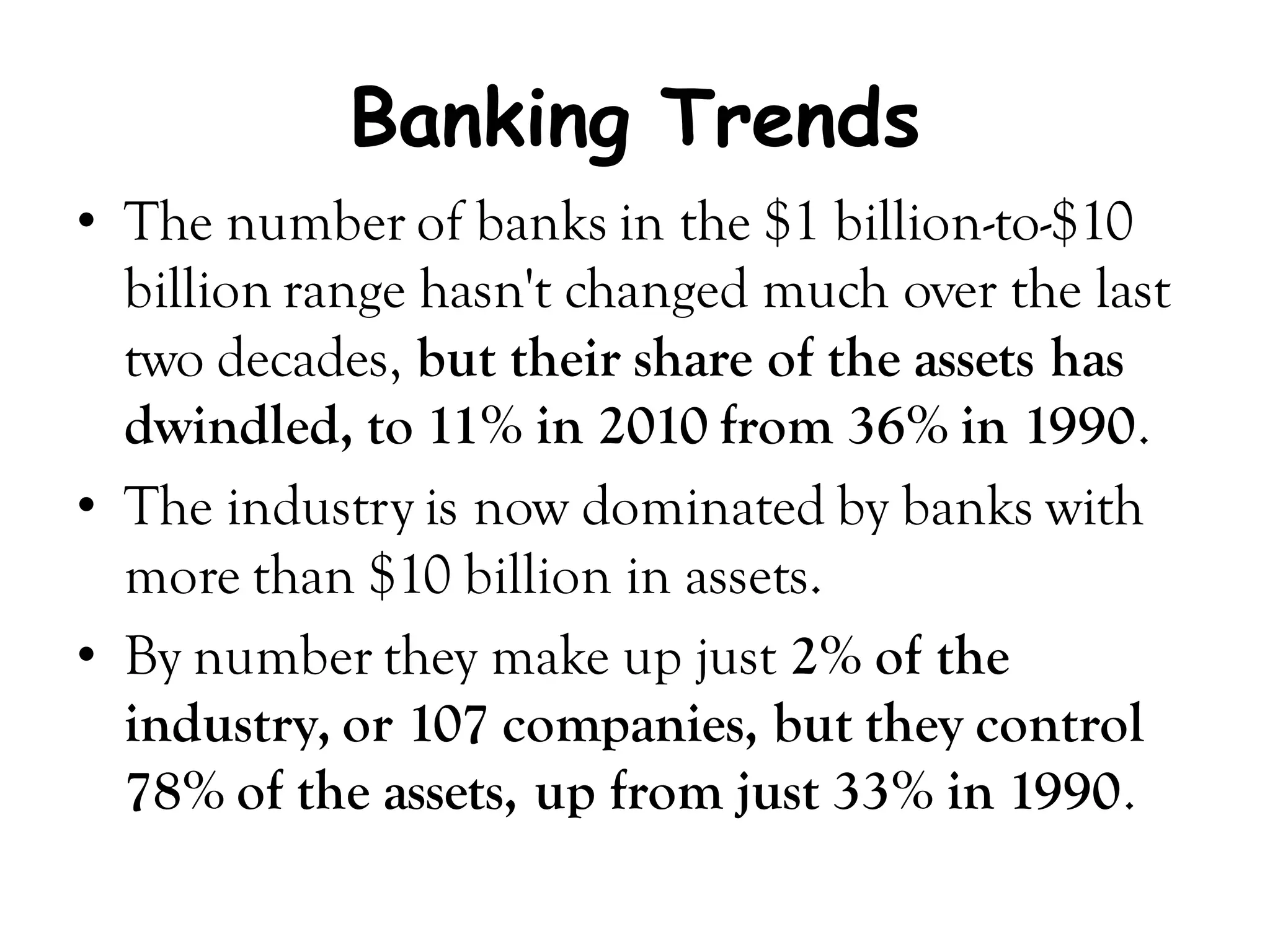
Banking Trends
• The number of banks in the $1 billion-to-$10
  billion range hasn't changed much over the last
  two decades, but their share of the assets has
  dwindled, to 11% in 2010 from 36% in 1990.
• The industry is now dominated by banks with
  more than $10 billion in assets.
• By number they make up just 2% of the
  industry, or 107 companies, but they control
  78% of the assets, up from just 33% in 1990.
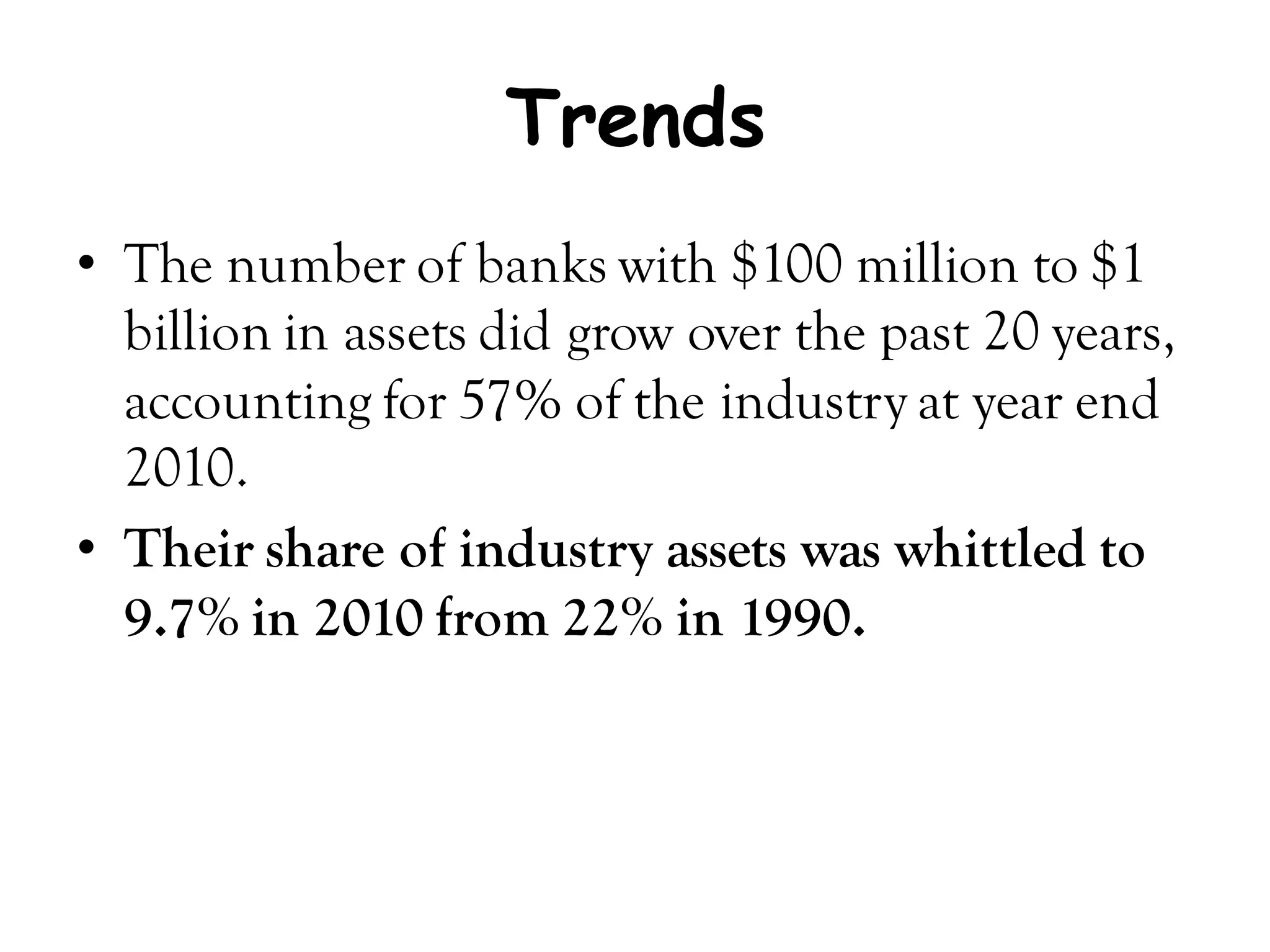
Trends
• The number of banks with $100 million to $1
  billion in assets did grow over the past 20 years,
  accounting for 57% of the industry at year end
  2010.
• Their share of industry assets was whittled to
  9.7% in 2010 from 22% in 1990.
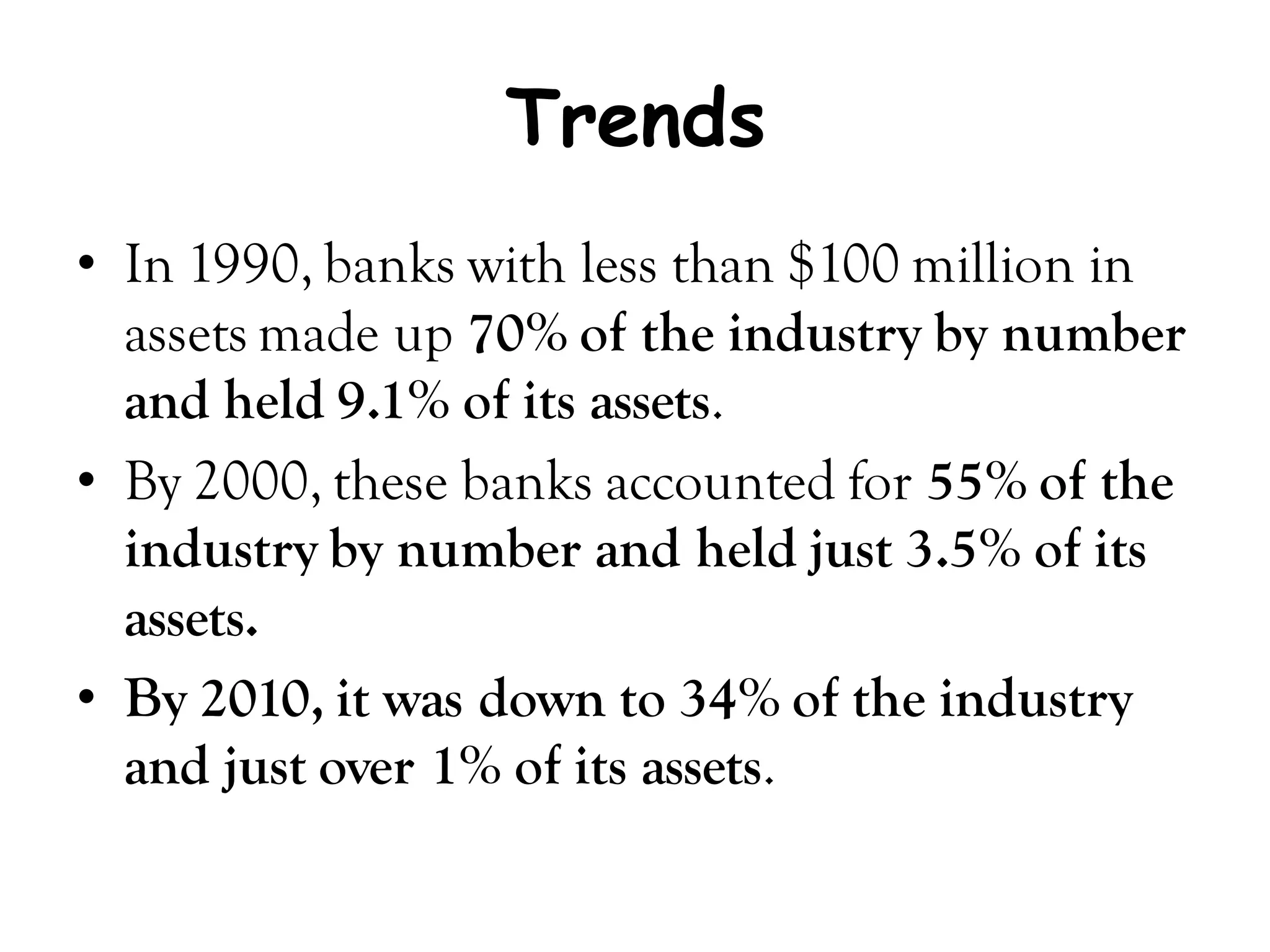
Trends
• In 1990, banks with less than $100 million in
  assets made up 70% of the industry by number
  and held 9.1% of its assets.
• By 2000, these banks accounted for 55% of the
  industry by number and held just 3.5% of its
  assets.
• By 2010, it was down to 34% of the industry
  and just over 1% of its assets.
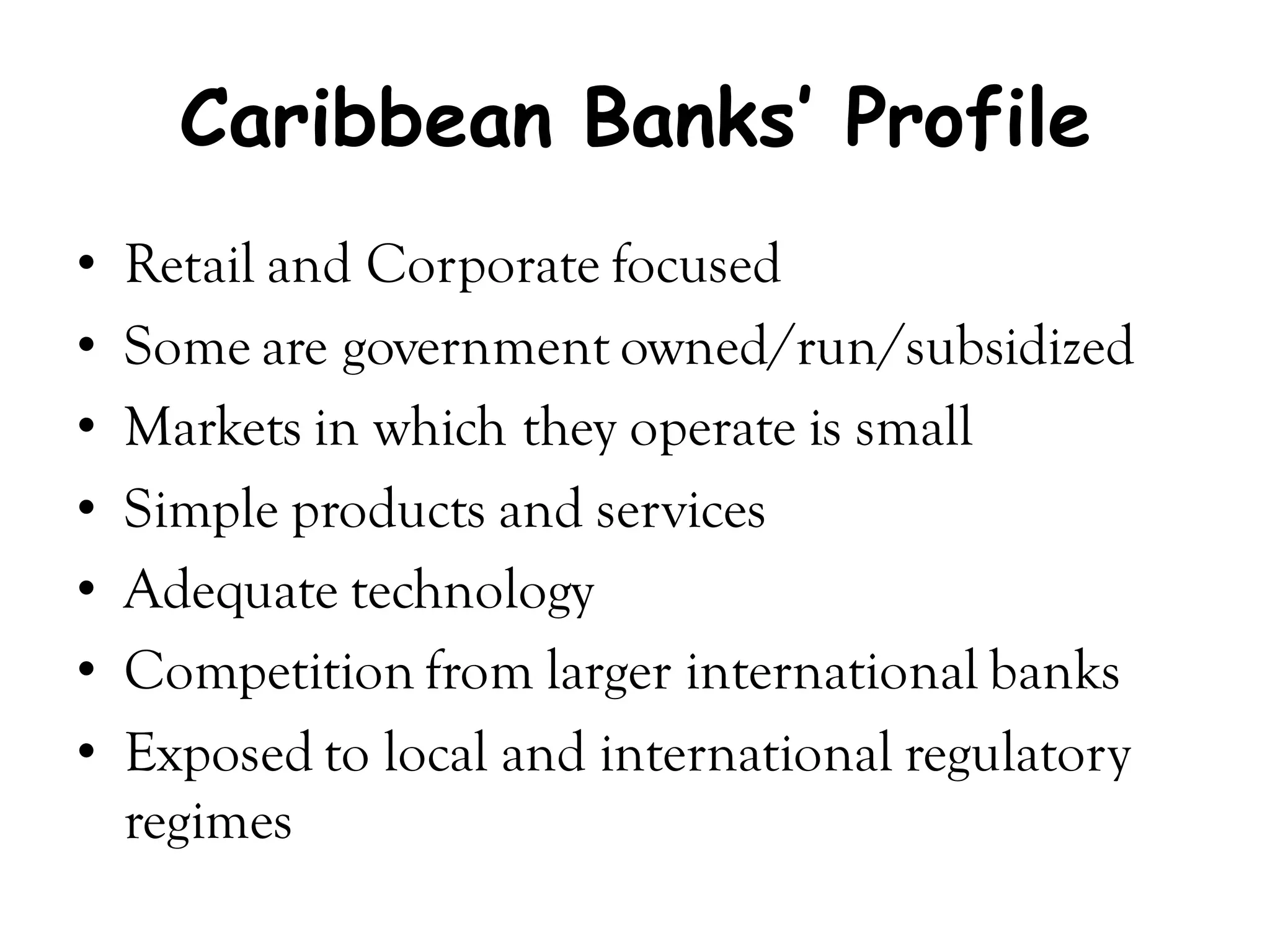
Caribbean Banks’ Profile
•   Retail and Corporate focused
•   Some are government owned/run/subsidized
•   Markets in which they operate is small
•   Simple products and services
•   Adequate technology
•   Competition from larger international banks
•   Exposed to local and international regulatory
    regimes
What we see
• Fee income is getting killed and difficult to secure
• Weak loan demand and low rates are crushing
  interest income
• Compliance costs are climbing
• Regulators are demanding ever higher capital levels
• Low interest rates relieve some pressure on
  operating revenue.
• Rising interest rates can cause disaster on operating
  revenues
Operating Revenue
• It's net interest income + non-interest income;
• It shows how much banks are making on loans,
  products and services before deducting
  noninterest expenses and loan-loss provisions.

• Operating revenues are directly related to the
  customer base
• Today the operating revenue number will
  continue to decline and decline until the bank
  becomes irrelevant or simply sells
FDIC Chairman
• "We're at a tipping point. There is a limit to
  how far reductions in loan-loss provisions can
  boost industry earnings," FDIC Chairman
  Sheila Bair said when she unveiled the
  industry's first-quarter results. "At some point,
  if banks are to continue to increase their
  profitability, they will have to grow their
  revenues."
Where is the revenue and how do we get
it
What can we do to survive
• Banks have to sell more to more people.
• They have to figure out which:
     •    customers,
     •   products,
     •   business lines,
     •   employees
     •   branches
make money and focus capital, training,
 technology those areas
Building success
service as a strategy?
service partnership
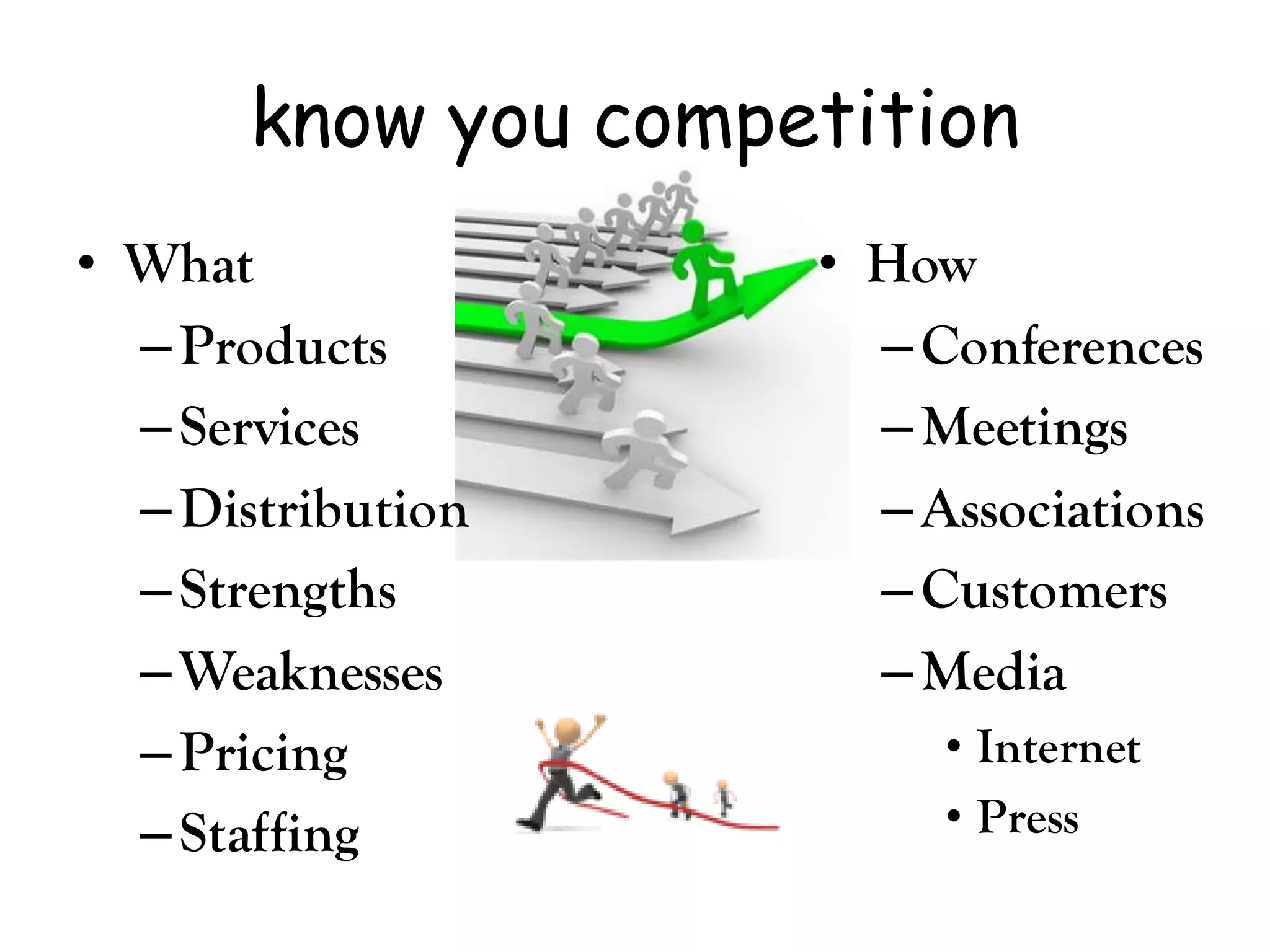
know your competition


     or they will sink you
know you competition
• What               • How
  – Products           – Conferences
  – Services           – Meetings
  – Distribution       – Associations
  – Strengths          – Customers
  – Weaknesses         – Media
  – Pricing               • Internet
  – Staffing              • Press
Where is revenue found
Branch sales
Leverage what you have
• Revamp your branches to make them more
  product centric
• View the branch as the distribution focal point.
• Train branch managers to identify different
  types of business customer needs and upgrade
  the skill sets of branch personnel to enable
  them to feel confident when talking to
  business owners.
Leverage what you have
• Augment        branch-based     expertise   with
  dedicated small business credit specialists and,
  where appropriate, business development
  officers out in the marketplace who work closely
  with branch managers.
• Empower branches with information about the
  businesses in their local market and invest to
  position branch managers in leadership
  positions with local chambers of commerce and
  influential business organizations
Add value to your customers
                        We are the
                         best at
                        what we do
Work with your customers
• Non Performing Assets kills your balance
  sheet
• Work with your best customers to make sure
  they survive – they will never forget it
• Refinance customers that are in a viable
  business environment
• Convert non performing to performing by
  sharing the lower cost of funds and possibly
  longer terms
Consider more credit
• Small businesses have long been considered
  underserved (or perhaps, more appropriately,
  ignored) by much of the banking industry
• Consider the potentially pent-up demand for
  credit among small businesses. During the
  recession, banks dramatically curtailed the
  extension of credit to small business owners.
• According to a January 21, 2010 Bloomberg
  Businessweek report, banks originated $73
  billion in loans to small businesses in 2009, a
  47% decline from 2007.
Cross Sell
• Use the credit process to identify cross-sell/up-
  sell opportunities.
• A lot of great information about business
  finances and operating results are shared with
  banks as part of the credit underwriting
  process.
• Few banks, however, really leverage this wealth
  of information to advise their business clients
  on strategies to improve the health of their
  businesses.
Cross Sell
• Loan officers can develop recommendations for
  strategies, products and partners (such as trust and
  wealth management) that enable customers to improve
  business performance and manage life cycle events.
• Tools can be developed that use data captured in the
  credit process to help loan officers provide advice,
  analyses, checklists to help customers fund growth,
  better manage cash flow, lower financing costs, plan
  for succession, and identify personal wealth
  management needs
Leverage technology
• Provide robust online information and
  transaction capabilities.
• Online banking platforms should minimize the
  time spent performing basic banking
  transactions and enable business owners
  conduct a variety of more sophisticated
  transactions, access detailed account histories,
  manage payments and move funds across
  accounts and to other financial providers.
Leverage technology
• Recent surveys show that small business
  customers are increasing their rate of online
  banking logins and decreasing the number of
  visits to their local branches.
• Provide mobile banking opportunities.
• Leverage the mobile network and the fact that
  more people have mobile devices than PCs
• Find ways to increase Straight Through
  Processing – less branch time and investigations
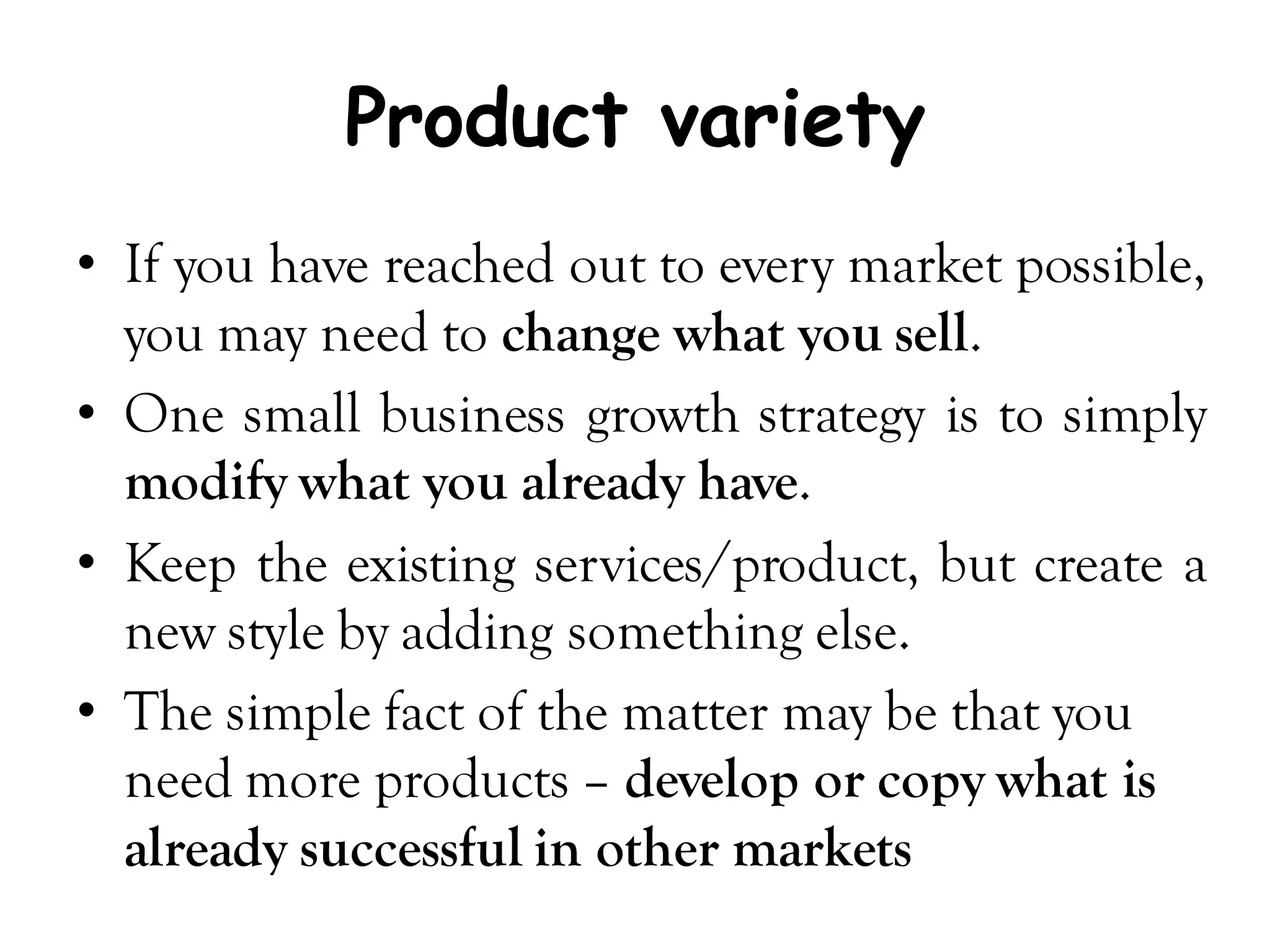
Product variety
• If you have reached out to every market possible,
  you may need to change what you sell.
• One small business growth strategy is to simply
  modify what you already have.
• Keep the existing services/product, but create a
  new style by adding something else.
• The simple fact of the matter may be that you
  need more products – develop or copy what is
  already successful in other markets
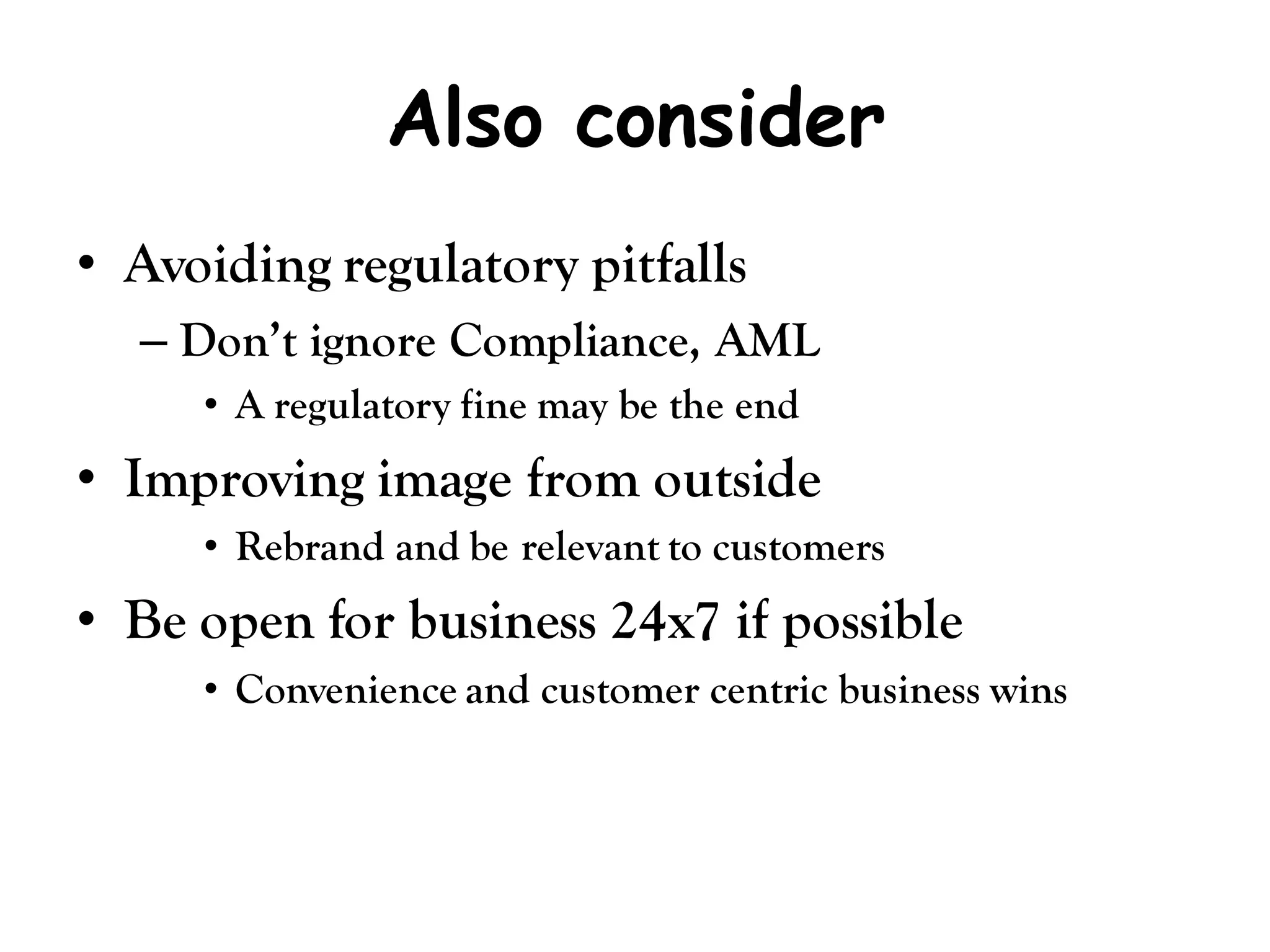
Also consider
• Avoiding regulatory pitfalls
  – Don’t ignore Compliance, AML
     • A regulatory fine may be the end
• Improving image from outside
     • Rebrand and be relevant to customers
• Be open for business 24x7 if possible
     • Convenience and customer centric business wins
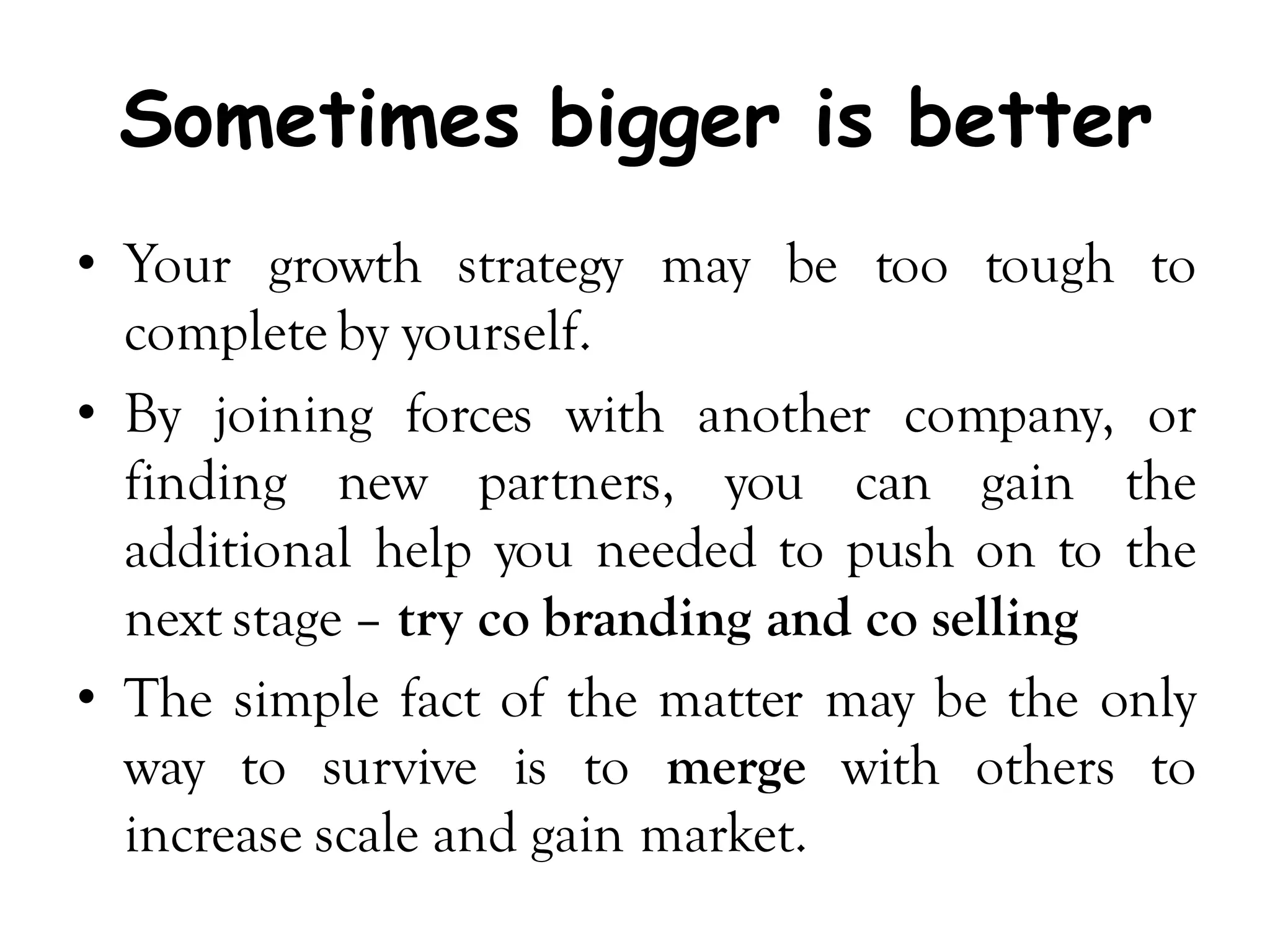
Sometimes bigger is better
• Your growth strategy may be too tough to
  complete by yourself.
• By joining forces with another company, or
  finding new partners, you can gain the
  additional help you needed to push on to the
  next stage – try co branding and co selling
• The simple fact of the matter may be the only
  way to survive is to merge with others to
  increase scale and gain market.
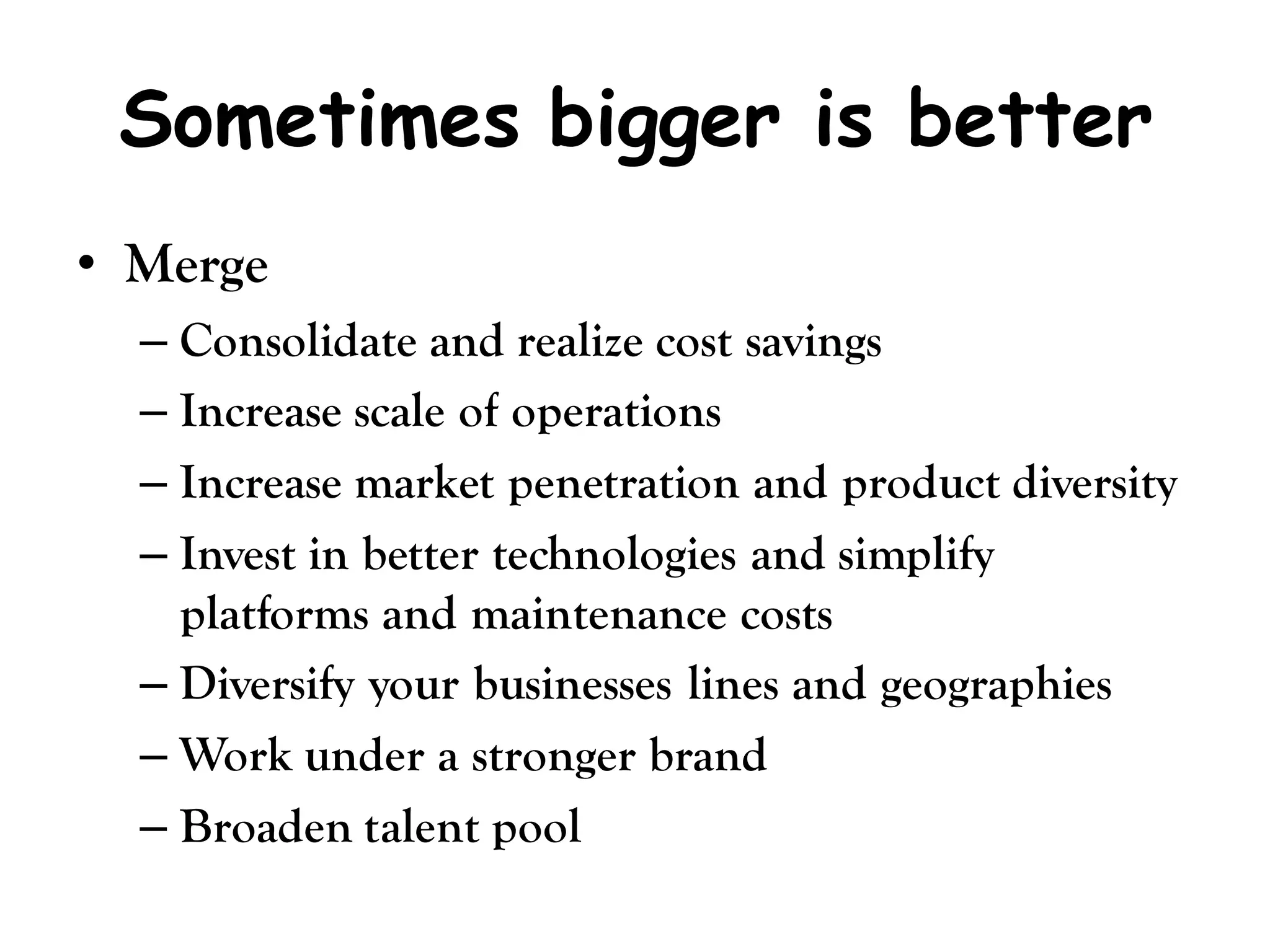
Sometimes bigger is better
• Merge
  – Consolidate and realize cost savings
  – Increase scale of operations
  – Increase market penetration and product diversity
  – Invest in better technologies and simplify
    platforms and maintenance costs
  – Diversify your businesses lines and geographies
  – Work under a stronger brand
  – Broaden talent pool
Sometimes bigger is better
• Margaret Irvine Weir, president, NexTier Bank: ―We’ve
  acquired a few insurance agencies, and we’re always looking to
  add more in that line, and we always have feelers out for wealth
  management.‖
• Charlotte Zuschlag, president and CEO, ESB Bank          ―We’ve
  acquired (small banks) since 1994, and we’re hoping to do some
  more deals. And we’d look at branches anyone was selling in
  our area. If, for example, PNC were to get rid of some National
  City branches or some of their own, we’d love an opportunity
  (to buy).‖
Sometimes bigger is better
• Todd Brice, president and CEO, S&T Bancorp: ―We would
  certainly have an interest in partnering up with the right
  institution if the opportunity should arise. Historically, we like
  contingent markets. You’ll see some people buying in Florida, but
  we’re not going to do that.‖

• Richard Spencer, president and CEO, Fidelity Bancorp Inc.
  ―We’re not actively looking, but if the right opportunity came up,
  we’ll look at it. We’re expecting organic growth over the next
  couple of years.‖
Sometimes bigger is better
• William Wagner, president and CEO, Northwest Bancshares
  Inc.: ―If we don’t find (bank) acquisition properties, there are
  still opportunities for us to grow through di novo branching.
  We have a history of acquiring other lines of business —
  insurance, trust and investment management — and we’re
  always open to growing them.‖
To Summarize
• Improve existing products and get new ones
• Focus on service and build customer partnerships
• Know your competition well
• Leverage the Branch as a product centric
  distribution point
• Target small business lending and mine credit
  data
• Work with customers to ensure they survive too --
  -- reduce NPA
To Summarize
•   Cross Sell, Cross Sell, Cross Sell
•   Rebrand and be relevant to customers
•   Extended operating hours 24x7 if possible
•   Leverage Technology – mobile banking
•   Make sure Compliance and AML are up to Snuff
•   Merge and or Acquire
    – To survive
    – To access other markets
    – To gain business line diversity
Banking Survival Strategies

Banking Survival Strategies

  • 1.
    Financial Survival Strategies ina Loss Making or Declining Profits Environment
  • 3.
    What do shareholders The only look at? thing that matters
  • 4.
    Banking Trends • Thenumber of banks in the $1 billion-to-$10 billion range hasn't changed much over the last two decades, but their share of the assets has dwindled, to 11% in 2010 from 36% in 1990. • The industry is now dominated by banks with more than $10 billion in assets. • By number they make up just 2% of the industry, or 107 companies, but they control 78% of the assets, up from just 33% in 1990.
  • 5.
    Trends • The numberof banks with $100 million to $1 billion in assets did grow over the past 20 years, accounting for 57% of the industry at year end 2010. • Their share of industry assets was whittled to 9.7% in 2010 from 22% in 1990.
  • 6.
    Trends • In 1990,banks with less than $100 million in assets made up 70% of the industry by number and held 9.1% of its assets. • By 2000, these banks accounted for 55% of the industry by number and held just 3.5% of its assets. • By 2010, it was down to 34% of the industry and just over 1% of its assets.
  • 7.
    Caribbean Banks’ Profile • Retail and Corporate focused • Some are government owned/run/subsidized • Markets in which they operate is small • Simple products and services • Adequate technology • Competition from larger international banks • Exposed to local and international regulatory regimes
  • 8.
    What we see •Fee income is getting killed and difficult to secure • Weak loan demand and low rates are crushing interest income • Compliance costs are climbing • Regulators are demanding ever higher capital levels • Low interest rates relieve some pressure on operating revenue. • Rising interest rates can cause disaster on operating revenues
  • 9.
    Operating Revenue • It'snet interest income + non-interest income; • It shows how much banks are making on loans, products and services before deducting noninterest expenses and loan-loss provisions. • Operating revenues are directly related to the customer base • Today the operating revenue number will continue to decline and decline until the bank becomes irrelevant or simply sells
  • 10.
    FDIC Chairman • "We'reat a tipping point. There is a limit to how far reductions in loan-loss provisions can boost industry earnings," FDIC Chairman Sheila Bair said when she unveiled the industry's first-quarter results. "At some point, if banks are to continue to increase their profitability, they will have to grow their revenues."

  • 11.
    Where is therevenue and how do we get it
  • 12.
    What can wedo to survive • Banks have to sell more to more people. • They have to figure out which: • customers, • products, • business lines, • employees • branches make money and focus capital, training, technology those areas
  • 13.
  • 14.
    service as astrategy?
  • 15.
  • 16.
    know your competition or they will sink you
  • 17.
    know you competition •What • How – Products – Conferences – Services – Meetings – Distribution – Associations – Strengths – Customers – Weaknesses – Media – Pricing • Internet – Staffing • Press
  • 18.
  • 19.
  • 20.
    Leverage what youhave • Revamp your branches to make them more product centric • View the branch as the distribution focal point. • Train branch managers to identify different types of business customer needs and upgrade the skill sets of branch personnel to enable them to feel confident when talking to business owners.
  • 21.
    Leverage what youhave • Augment branch-based expertise with dedicated small business credit specialists and, where appropriate, business development officers out in the marketplace who work closely with branch managers. • Empower branches with information about the businesses in their local market and invest to position branch managers in leadership positions with local chambers of commerce and influential business organizations
  • 22.
    Add value toyour customers We are the best at what we do
  • 23.
    Work with yourcustomers • Non Performing Assets kills your balance sheet • Work with your best customers to make sure they survive – they will never forget it • Refinance customers that are in a viable business environment • Convert non performing to performing by sharing the lower cost of funds and possibly longer terms
  • 24.
    Consider more credit •Small businesses have long been considered underserved (or perhaps, more appropriately, ignored) by much of the banking industry • Consider the potentially pent-up demand for credit among small businesses. During the recession, banks dramatically curtailed the extension of credit to small business owners. • According to a January 21, 2010 Bloomberg Businessweek report, banks originated $73 billion in loans to small businesses in 2009, a 47% decline from 2007.
  • 25.
    Cross Sell • Usethe credit process to identify cross-sell/up- sell opportunities. • A lot of great information about business finances and operating results are shared with banks as part of the credit underwriting process. • Few banks, however, really leverage this wealth of information to advise their business clients on strategies to improve the health of their businesses.
  • 26.
    Cross Sell • Loanofficers can develop recommendations for strategies, products and partners (such as trust and wealth management) that enable customers to improve business performance and manage life cycle events. • Tools can be developed that use data captured in the credit process to help loan officers provide advice, analyses, checklists to help customers fund growth, better manage cash flow, lower financing costs, plan for succession, and identify personal wealth management needs
  • 27.
    Leverage technology • Providerobust online information and transaction capabilities. • Online banking platforms should minimize the time spent performing basic banking transactions and enable business owners conduct a variety of more sophisticated transactions, access detailed account histories, manage payments and move funds across accounts and to other financial providers.
  • 28.
    Leverage technology • Recentsurveys show that small business customers are increasing their rate of online banking logins and decreasing the number of visits to their local branches. • Provide mobile banking opportunities. • Leverage the mobile network and the fact that more people have mobile devices than PCs • Find ways to increase Straight Through Processing – less branch time and investigations
  • 29.
    Product variety • Ifyou have reached out to every market possible, you may need to change what you sell. • One small business growth strategy is to simply modify what you already have. • Keep the existing services/product, but create a new style by adding something else. • The simple fact of the matter may be that you need more products – develop or copy what is already successful in other markets
  • 30.
    Also consider • Avoidingregulatory pitfalls – Don’t ignore Compliance, AML • A regulatory fine may be the end • Improving image from outside • Rebrand and be relevant to customers • Be open for business 24x7 if possible • Convenience and customer centric business wins
  • 31.
    Sometimes bigger isbetter • Your growth strategy may be too tough to complete by yourself. • By joining forces with another company, or finding new partners, you can gain the additional help you needed to push on to the next stage – try co branding and co selling • The simple fact of the matter may be the only way to survive is to merge with others to increase scale and gain market.
  • 32.
    Sometimes bigger isbetter • Merge – Consolidate and realize cost savings – Increase scale of operations – Increase market penetration and product diversity – Invest in better technologies and simplify platforms and maintenance costs – Diversify your businesses lines and geographies – Work under a stronger brand – Broaden talent pool
  • 33.
    Sometimes bigger isbetter • Margaret Irvine Weir, president, NexTier Bank: ―We’ve acquired a few insurance agencies, and we’re always looking to add more in that line, and we always have feelers out for wealth management.‖ • Charlotte Zuschlag, president and CEO, ESB Bank ―We’ve acquired (small banks) since 1994, and we’re hoping to do some more deals. And we’d look at branches anyone was selling in our area. If, for example, PNC were to get rid of some National City branches or some of their own, we’d love an opportunity (to buy).‖
  • 34.
    Sometimes bigger isbetter • Todd Brice, president and CEO, S&T Bancorp: ―We would certainly have an interest in partnering up with the right institution if the opportunity should arise. Historically, we like contingent markets. You’ll see some people buying in Florida, but we’re not going to do that.‖ • Richard Spencer, president and CEO, Fidelity Bancorp Inc. ―We’re not actively looking, but if the right opportunity came up, we’ll look at it. We’re expecting organic growth over the next couple of years.‖
  • 35.
    Sometimes bigger isbetter • William Wagner, president and CEO, Northwest Bancshares Inc.: ―If we don’t find (bank) acquisition properties, there are still opportunities for us to grow through di novo branching. We have a history of acquiring other lines of business — insurance, trust and investment management — and we’re always open to growing them.‖
  • 36.
    To Summarize • Improveexisting products and get new ones • Focus on service and build customer partnerships • Know your competition well • Leverage the Branch as a product centric distribution point • Target small business lending and mine credit data • Work with customers to ensure they survive too -- -- reduce NPA
  • 37.
    To Summarize • Cross Sell, Cross Sell, Cross Sell • Rebrand and be relevant to customers • Extended operating hours 24x7 if possible • Leverage Technology – mobile banking • Make sure Compliance and AML are up to Snuff • Merge and or Acquire – To survive – To access other markets – To gain business line diversity