







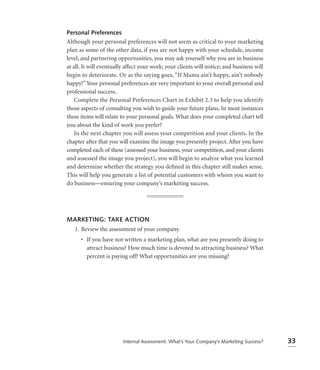










About Pfeiffer
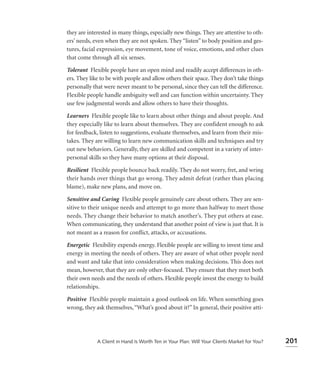
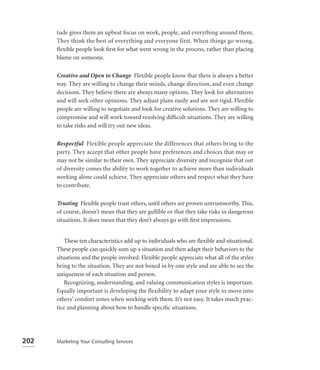
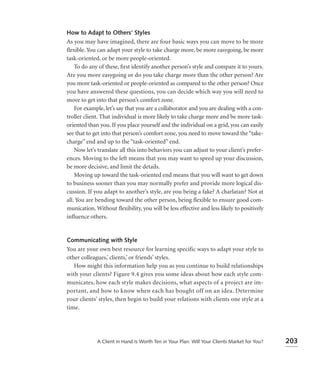
Pfeiffer serves the professional development and hands-on resource needs of
training and human resource practitioners and gives them products to do their
jobs better. We deliver proven ideas and solutions from experts in HR devel-
opment and HR management, and we offer effective and customizable tools
to improve workplace performance. From novice to seasoned professional,
Pfeiffer is the source you can trust to make yourself and your organization
more successful.

            Essential Knowledge Pfeiffer produces insightful, practical, and
        comprehensive materials on topics that matter the most to training
and HR professionals. Our Essential Knowledge resources translate the expertise
of seasoned professionals into practical, how-to guidance on critical workplace
issues and problems. These resources are supported by case studies, worksheets,
and job aids and are frequently supplemented with CD-ROMs, websites, and
other means of making the content easier to read, understand, and use.

           Essential Tools Pfeiffer’s Essential Tools resources save time and
         expense by offering proven, ready-to-use materials—including exercises,
activities, games, instruments, and assessments—for use during a training
or team-learning event. These resources are frequently offered in loose-leaf or
CD-ROM format to facilitate copying and customization of the material.
    Pfeiffer also recognizes the remarkable power of new technologies in ex-
panding the reach and effectiveness of training. While e-hype has often cre-
ated whizbang solutions in search of a problem, we are dedicated to bringing
convenience and enhancements to proven training solutions. All our e-tools
comply with rigorous functionality standards. The most appropriate technology
wrapped around essential content yields the perfect solution for today’s on-the-
go trainers and human resource professionals.


                                 Essential resources for training and HR professionals
 w w w. p f e i f f e r. c o m
“Elaine’s practical zest of ‘yes, you can do it now—here, let me show you how’ takes you by the hand
to build the marketing plan of your business and gets you into action immediately. An easy read and
helpful resource that makes marketing the game to play.”
    —Aviv Shahar, president, Amber Network
“What a treasure of proven marketing insights! Elaine Biech has the market cornered on advice for suc-
cessful consulting, and her latest effort is rich with tips and tricks of the trade. She asks the right ques-
tions to guide the consultant to a new understanding of a true marketing approach. I recommend this
book to every consulting professional as a must-have reference.”
    —Rex Gatto, Ph.D., Gatto Training Associates
“The subtitle of this book could be ‘The Great Idea Dream Factory.’ Imaginative tips fill each page.
Elaine’s marketing lessons are useful and easy to apply to every consulting practice. If you are starting
a career as a consultant Monday morning, be sure to read this book by Sunday night.”
    —Jean Lamkin, director of career development, Landmark Publishing Group
“For anyone who has had a great service or product, you learn painfully fast that it’s the marketing that
makes it viable. This book is a great ‘how to’ in making marketing easier and more engaging than you
thought possible. I have been a client of ebb associates for years and have personally experienced these
‘tips.’ The actionable tips in this book make ebb stand out from the crowd.”
    —Shirley Krsinich, executive and management talent consultant, American Family Insurance
“I continue to utilize techniques learned from Elaine and ebb associates when they first worked with
Lands’ End: organization, analysis, research, creativity, and simplicity are a few of the principles. These
concepts once again come through in this publication. She continues to make complex ideas simple
and enjoyable. This book is a great resource to focus priorities to market your consulting business.”
    —Mindy Meads, executive vice president, Lands’ End
“Marketing is the key ingredient to any successful business. Elaine makes the marketing process for
consultants easy. I recommend that if you must market, keep this book on your desk. It is that good—
and that indispensable.”
    —Maribeth Kuzmeski, author, Red Zone Marketing
“Elaine Biech has done it again! Like her other books, Marketing Your Consulting Services is bursting
with ideas that any professional can implement immediately. This is an indispensable guide for any-
one who is building a consulting business. I’m convinced that even people who thought that they
dreaded marketing will get inspiration from the perspectives and practical suggestions in this book.”
    —Diane Hessan, president and CEO, Communispace Corporation
“If you entertain the assumption that there is nothing new in ‘marketing,’ then this book both confirms
and denies that mind-set! Elaine Biech does it again—she adds an additional ‘P’ to the marketing lex-
icon: practical. I especially enjoy her ‘Fast Fourteen’ and the ‘Quick tips’ as common sense reminders
of what we often forget when we struggle with the marketing dilemma.”
    —Ronald E. Galbraith, CEO, Management 21, Inc.
“I could have used this book when I was a marketing manager at Apple, marketing ‘programs.’ As Biech
points out early on in this fascinating book, consulting is a profession unlike any other. Therefore, you
need a marketing plan that is different from someone who sells a tangible product like, say, comput-
ers. Let Marketing Your Consulting Services teach you how to get your service, expertise, knowledge,
and experience in front of the prospects that are the right fit for you.”
    —Sue Fox, author, Business Etiquette For Dummies, and former program marketing manager, Apple
“In her new book, Elaine continues her contribution to consultants’ success, giving very practical, us-
able, and time-tested information and ideas. There is definitely something for everybody in Marketing
Your Consulting Services, whether you’re just starting out in consulting or have been in the field for
years. A truly valuable handbook!”
    —Linda Growney, vice president of strategic development, CUNA Mutual Group
“This book replaces the twenty-five books on marketing currently on my shelf. Within the first five
minutes of reading this book you are guaranteed to get practical, actionable ideas to grow your busi-
ness. Elaine knows what to do, when to do it, and takes ‘I am not a marketer’ off of every consultant’s
lips. Want to grow your business? Buy this book + read it + use just 10 percent of what you learn =
marketing success. Why wait?”
    —Ann Herrmann-Nehdi, president, Herrmann International
“Successful consultants must market themselves twenty-four hours a day, 365 days a year. Sure, it sounds
daunting. Yet somehow, Elaine Biech makes the process seem as natural as breathing. Her creative tips
and techniques—many of which can be done on a shoestring budget—will have you rolling up your
sleeves and digging into the dreaded task of marketing your services with more enthusiasm than you’ve
felt in a long, long time!”
    —Celia Rocks, author, Brilliance Marketing Management
“Another surefire winner from Elaine Biech that takes the mystery out of successful marketing. Elaine
can make anything doable and this book is just another example of her all-inclusive but down-to-earth
guidance that demystifies a key element of business for the ordinary and the extraordinary entrepre-
neur. Insightful! Practical! Comprehensive!”
    —Edie West, executive director, National Skills Standards Board
“This book is a must-read for any independent or small consulting company that is far more interested
and skilled in doing the work than in getting the work. This easy-to-read book provides practical sug-
gestions and methods that will go a long way in keeping less marketing-oriented colleagues aware of
what marketing really is and how to go about it.”
    —Hank Karp, co-author, Bridging the Boomer-Xer Gap
“In competitive sports the game plan is rarely divulged. So, too, in the consulting arena, trade secrets
are usually well-guarded, because maintaining the competitive edge is seen as key to success. Not so
with Elaine Biech (ebb), a star of the business. In her latest book, Marketing Your Consulting Services,
she dares to reveal her proven, practical, and fun marketing techniques to anyone who will heed and
apply them. As a client, a competitor, and ultimately a co-operative of ebb over the past fifteen years,
I can testify that these techniques really work—and you can take that to the bank.”
    —Captain Garland F. Skinner, United States Navy (Ret), and former CEO, The Skinner Group, Inc.
“A readable, and useful book with stand-alone chapters and specific advice to guarantee success.”
    —Lieutenant General Carol Mutter, United States Marine Corps (Ret), and consultant
“Elaine has done it again. This is not only an extremely practical hands-on approach to marketing
your consulting business and generating clients, it’s also a great overview of the entire process. Whether
you’re new or a veteran, struggling or successful, you’ll find this book packed with lots of tools, tech-
niques, advice, and directions that you can use right away. Elaine doesn’t withhold any secrets; she
shares all the successes as well as the failures, and provides a range of approaches that you can choose
from. This book needs to be on your desk right next to The Business of Consulting.”
    —Joe Willmore, president, Willmore Consulting Group, and author, Managing Virtual Teams
“Marketing Your Consulting Services takes the mystery and complexity out of marketing. If you’re as
tired of the marketing mystery and rhetoric as I am, this book will restore your faith.”
    —Pamela J. Schmidt, executive director, Instructional Systems Association
“Elaine Biech gives new meaning to marketing as she shares her experiences as well as her insights into
the world of marketing. It’s a book that every consultant should read and offers a wealth of informa-
tion including great tips and what pitfalls to look for. A very readable book that provides simple de-
tails on how to make marketing fun.”
    —Kathleen Talton, program manager, Precise Systems, Inc.
“Once again, Elaine has written a book that provides valuable, practical tips for consultants. I have a
marketing background, and I am still challenged marketing my consulting services to clients. I learned
many useful ideas that I employ today to increase my client base. As consultants, we are nothing with-
out the clients we serve. Elaine shares her many years of successful marketing tips for getting clients.
Don’t put together this year’s marketing plan without reading this book. Put it on your book shelf if
you are a consultant!”
    —Maureen Moriarty, consultant and executive coach, Pathways to Change
“Elaine has written another must-have book for consultants! Full of useful and concrete steps to iden-
tify how to conduct a successful marketing campaign, she presents a creative and compelling plan to
develop a marketing strategy. She removes the fear and intimidation factors surrounding the concept
of marketing by providing a clear practical how-to guide. Elaine shares her many years of professional
experience with her competition. We are all the beneficiaries of her generosity.”
    —Maggie Hutchison, consultant
“Elaine promises practicality, and she delivers! From the ‘Fast Fourteen’ to the concept of marketing
all the time, she presents surefire ideas to fit any consultant’s marketing comfort level.”
    —Judith Free, senior consultant, Free Associates, Inc.
“Elaine’s dynamic personal style comes through in this book. It’s high energy, refreshingly straightfor-
ward, creative, and just packed full of useful information.”
    —Kathy Armstrong, illustrator and designer
“As with all her previous books, Elaine has again written a very practical, straightforward, and easy-to-
read guide for consulting professionals that will bring immense and immediate value to them and their
practices.”
    —Bob Sautter, consultant
“Elaine Biech is the consummate pro at consulting. Her earlier books establish her credentials; watch-
ing her in practice proves her mastery. Now she closes the loop with practical advice on how to select
and win the clients who will benefit from skilled, capable consultancy.”
    —Joseph Wojtecki, Center for Risk Communication
“Elaine has done it again! Marketing Your Consulting Services is the best practical guide available for
new and experienced consultants alike. How often have I said that I hate to market and sell, that I just
want to consult? Elaine takes that attitude and shows how the marketing challenge is really an easy and
practical exercise even for those of us who shun the very idea. Instantly useful, applicable, and practi-
cal, this book avoids the theory and jargon of marketing that make it a foreign and frightening con-
cept. Marketing Your Consulting Services complements Elaine’s previous volumes that guide the
consultant to a successful business practice.”
    —Barbara Pate Glacel, Ph.D., principal, The Glacel Group, and author, Light Bulbs for Leaders
“Elaine has done it again—a book chock-full of ideas, tips, and techniques specifically targeted to help
your consulting business grow. Elaine distilled boring, humdrum marketing theory, combined it with
her experience, and shares her knowledge in a practical, engaging way. A must-have for any consul-
tant who wants clients!”
    —Kristin Arnold, president, Quality Process Consultants, Inc., and author, Team Basics and Email Basics
“As always, Elaine promises to be practical, and, as always, Elaine delivers what she promises! This book
is practical from the start. A busy individual can open this book to any page and gather new, practical
ideas. The ‘Fast Fourteen’ have helped me stay current and in touch with existing clients and have helped
me build a dynamic potential client list. This book is an easy read and it gets two thumbs up from me!”
    —Steve Kuper, managing partner, Kuper/Kemen & Associates, LLC
“This book is more than Marketing 101 for consultants. It’s a recipe for success in a very competitive
field! Thanks for sharing your secrets in a way anyone can grasp. Bravo Elaine! No wonder you are one
of the busiest and most successful consultants out there!”
    —Linda Byars Swindling, J.D., Passports to Success, and author, Get What You Want and Set the
     Standard & Meet the Challenge
“With all the noise and hubris surrounding the topic of marketing, it was refreshing to discover Biech’s
shining jewel, Marketing Your Consulting Services. Whether you are a sole practitioner just starting out
or the starch-shirt managing director of a solidly entrenched firm, this is a must-read if you are inter-
ested in thoughtfully growing your enterprise.”
    —James Olan Hutcheson, CEO, ReGENERATION Partners, and author, Portraits of Success: 9 Keys to
     Creating Sustainable Success in Any Business
“I have purchased and used two of Elaine’s books already, The Business of Consulting and The Consul-
tant’s Quick Start Guide. Both books have proven to be invaluable as I moved my consulting practice
from Washington, D.C. (where I grew up and had worked for 20 years), to Seattle. Her experience and
practical advice made starting up in a new town with no networking in place so much easier! I am ob-
viously looking forward to her newest release, Marketing Your Consulting Services.”
    —Lynne A. Lazaroff, Action Management Training & Consulting
“Are you a consultant? Then you need this book. Whether you’re a one-man shop devoted to helping
start-ups get off the ground or a thriving firm who serves Fortune 500 corporations, Elaine Biech’s
been-there-done-that advice will help you find (and keep) the clients you need to keep your practice
growing. And in these lean economic times, that’s no small feat.”
    —Greg Smith, lead navigator and president, Chart Your Course International
“Ever practical and pragmatic, Elaine Biech offers easy-to-implement, innovative approaches to mar-
keting that will help consultants be more successful.”
    —Lynn McManus, project acquisitions manager, Milmanco Corporation
“The hardest part of my business is marketing. I never took a course in college about how to market
and sell. Elaine’s book makes soooo much sense and gives me great ideas that I can put to use imme-
diately. I recommend it to anyone who needs to—but doesn’t want to—market.”
    —JR Holt, JRH Associates, Inc.
“Elaine consistently offers practical information that works. She packs her books with down-to-earth
solutions that start with A (for action) and end with A (for more action!). Elaine provides bottom-line
advice to consultants who aren’t afraid to be creative and want to have fun growing their businesses.”
    —Lola Hilton, marketing and events planner, First Flight Centennial Celebration
Marketing Your
Consulting Services


                            L
                            elaine biech


Foreword by Geoff Bellman
Copyright © 2003 by John Wiley & Sons, Inc.
Published by Pfeiffer
An Imprint of John Wiley & Sons, Inc.
989 Market Street, San Francisco, CA 94103-1741 www.pfeiffer.com
No part of this publication, except as noted below, may be reproduced, stored in a retrieval system, or trans-
mitted in any form or by any means, electronic, mechanical, photocopying, recording, scanning, or otherwise,
except as permitted under Section 107 or 108 of the 1976 United States Copyright Act, without either the prior
written permission of the Publisher, or authorization through payment of the appropriate per-copy fee to the
Copyright Clearance Center, Inc., 222 Rosewood Drive, Danvers, MA 01923, 978-750-8400, fax 978-750-4470,
or on the web at www.copyright.com. Requests to the Publisher for permission should be addressed to the Per-
missions Department, John Wiley & Sons, Inc., 111 River Street, Hoboken, NJ 07030, (201) 748-6011, fax (201)
748-6008, e-mail: permcoordinator@wiley.com.
Certain figures and exhibits from this book are designed for use in a group setting and may be reproduced for
educational/training purposes. The following copyright notice must appear on all reproductions as printed:


  Reproduced from Marketing Your Consulting Services by elaine biech with permission of the Publisher.
  Copyright © 2003 by John Wiley & Sons, Inc. Published by Pfeiffer.


This free permission is limited to the paper reproduction of such materials for educational/training events. It does
not allow for systematic or large-scale reproduction or distribution (more than 100 copies per page, per year),
electronic reproduction or inclusion in any publications offered for sale or used for commercial purposes—none
of which may be done without prior written permission of the Publisher, or authorization through payment of
the appropriate per-copy fee to the Copyright Clearance Center, Inc., 222 Rosewood Drive, Danvers, MA 01923,
(978) 750-8400, fax (978) 750-4470, or on the web at www.copyright.com. Requests to the Publisher for permis-
sion should be addressed to the Permissions Department, John Wiley & Sons, Inc., 111 River Street, Hoboken, NJ
07030, (201) 748-6011, fax (201) 748-6008, or e-mail: permcoordinator@wiley.com.
Pfeiffer books and products are available through most bookstores. To contact Pfeiffer directly call our Customer
Care Department within the U.S. at (800) 274-4434, outside the U.S. at (317) 572-3985 or fax (317) 572-4002.
Pfeiffer also publishes its books in a variety of electronic formats. Some content that appears in print may not
be available in electronic books.
Printed in the United States of America
ISBN: 0-7879-6543-X
Library of Congress Cataloging-in-Publication Data
Biech, Elaine.
 Marketing your consulting services / Elaine Biech ; foreword by Geoff
Bellman.
    p. cm.
Includes index.
 ISBN 0-7879-6543-X (alk. paper)
 1. Consultants—Marketing. I. Title.
 HD69.C6B44 2003
 001'.068'8—dc21
                                 2002156553

Acquiring Editor: Matthew Davis                                Associate Art Director: Bruce Lundquist
Director of Development: Kathleen Dolan Davies                 Interior Design: Claudia Smelser and Gene Crofts
Editor: Rebecca Taff                                           Cover Design: Laurie Anderson and Hatty Lee
Production Editor: Nina Kreiden                                Illustrations: Lotus Art
Manufacturing Supervisor: Bill Matherly
Printing   10   9   8   7   6   5   4 3 2 1
For Shane and Thad,

 who marketed all

    their ideas

    to me first
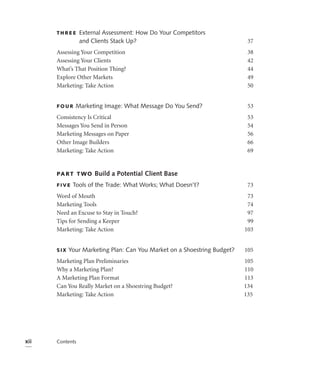
CONTENTS


Dedication                                            ix
List of Figures and Exhibits                          xv
Foreword                                             xix
Preface                                             xxiii
Acknowledgments                                     xxix


ONE    Marketing: What’s It All About?                 1
Marketing 101                                          1
Consultants and Marketing                              5
The ABCs of Marketing                                 11
Marketing from Day One                                15
Marketing: Take Action                                16


PA R T O N E   Assess The Situation
T WO   Internal Assessment: What’s Your Company’s
       Marketing Success?                             21
Why Market Research?                                  22
Assessing Your Consulting Company                     23
SWOT Your Company                                     27
Other Data Required                                   29
Clarify Your Present Preferences                      30
Marketing: Take Action                                33

                                                            xi
THREE      External Assessment: How Do Your Competitors
                 and Clients Stack Up?                                     37
      Assessing Your Competition                                           38
      Assessing Your Clients                                               42
      What’s That Position Thing?                                          44
      Explore Other Markets                                                49
      Marketing: Take Action                                               50


      FOUR    Marketing Image: What Message Do You Send?                   53
      Consistency Is Critical                                              53
      Messages You Send in Person                                          54
      Marketing Messages on Paper                                          56
      Other Image Builders                                                 66
      Marketing: Take Action                                               69


      PA R T T WO     Build a Potential Client Base
      FIVE   Tools of the Trade: What Works; What Doesn’t?                 73
      Word of Mouth                                                        73
      Marketing Tools                                                      74
      Need an Excuse to Stay in Touch?                                     97
      Tips for Sending a Keeper                                            99
      Marketing: Take Action                                              103


      SIX   Your Marketing Plan: Can You Market on a Shoestring Budget?   105
      Marketing Plan Preliminaries                                        105
      Why a Marketing Plan?                                               110
      A Marketing Plan Format                                             113
      Can You Really Market on a Shoestring Budget?                       134
      Marketing: Take Action                                              135


xii   Contents
SEVEN   Prospecting in All the Right Places: How Do You Find Clients? 137
Prospecting Is a Transition                                          138
Find New Clients                                                     139
Prospecting Process                                                  140
Prospecting in Other Ways and Places                                 155
Marketing: Take Action                                               159


PA R T T H R E E   Contact Potential Clients
EIGHT   Selling Services: How Do You Sell You?                       163
Rainmaker?                                                           164
Value-Added Selling                                                  164
You Have an Appointment—Now What?                                    166
Other Meeting Places                                                 179
Contracts                                                            180
Stay in Business                                                     181
Marketing: Take Action                                               181


NINE   A Client in Hand Is Worth Ten in Your Plan:
       Will Your Clients Market for You?                             183
Customer Loyalty and Retention                                       184
Why Retain Clients?                                                  185
Build a Relationship with the Organization                           186
Build a Relationship with the Individuals                            191
Customer Satisfaction Is Marketing                                   205
Marketing: Take Action                                               211


TEN   Marketing Technology: What Will Work for You?                  213
Establish a Website                                                  214
E-mail Marketing                                                     217
Electronic Newsletters                                               218
Other Technologies to Explore                                        218
Marketing: Take Action                                               220


                                                                 Contents   xiii
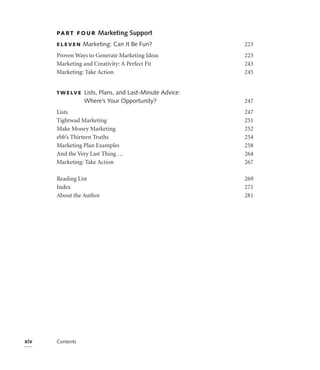
PA R T F O U R    Marketing Support
      ELEVEN       Marketing: Can It Be Fun?               223
      Proven Ways to Generate Marketing Ideas              223
      Marketing and Creativity: A Perfect Fit              243
      Marketing: Take Action                               245


      T W E LV E   Lists, Plans, and Last-Minute Advice:
                   Where’s Your Opportunity?               247
      Lists                                                247
      Tightwad Marketing                                   251
      Make Money Marketing                                 252
      ebb’s Thirteen Truths                                254
      Marketing Plan Examples                              258
      And the Very Last Thing …                            264
      Marketing: Take Action                               267

      Reading List                                         269
      Index                                                271
      About the Author                                     281


xiv   Contents
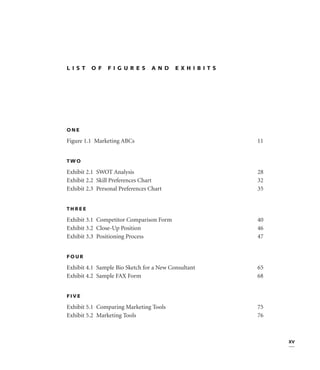
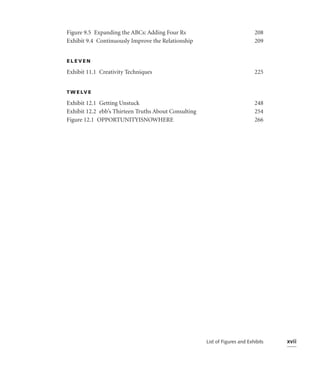
LIST     OF     FIGURES          AND      EXHIBITS


ONE

Figure 1.1 Marketing ABCs                            11


TWO

Exhibit 2.1 SWOT Analysis                            28
Exhibit 2.2 Skill Preferences Chart                  32
Exhibit 2.3 Personal Preferences Chart               35


THREE

Exhibit 3.1 Competitor Comparison Form               40
Exhibit 3.2 Close-Up Position                        46
Exhibit 3.3 Positioning Process                      47


FOUR

Exhibit 4.1 Sample Bio Sketch for a New Consultant   65
Exhibit 4.2 Sample FAX Form                          68


FIVE

Exhibit 5.1 Comparing Marketing Tools                75
Exhibit 5.2 Marketing Tools                          76


                                                          xv
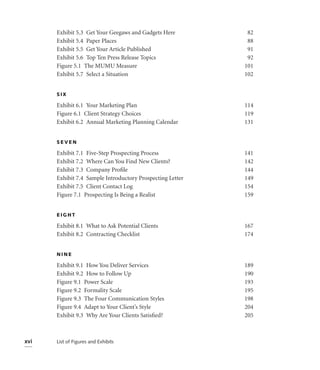
Exhibit 5.3 Get Your Geegaws and Gadgets Here         82
      Exhibit 5.4 Paper Places                              88
      Exhibit 5.5 Get Your Article Published                91
      Exhibit 5.6 Top Ten Press Release Topics              92
      Figure 5.1 The MUMU Measure                          101
      Exhibit 5.7 Select a Situation                       102


      SIX

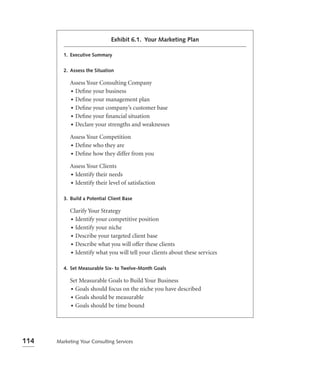
      Exhibit 6.1 Your Marketing Plan                      114
      Figure 6.1 Client Strategy Choices                   119
      Exhibit 6.2 Annual Marketing Planning Calendar       131


      SEVEN

      Exhibit 7.1 Five-Step Prospecting Process            141
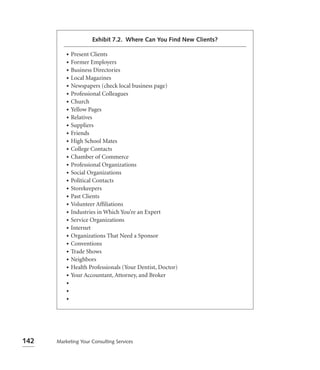
      Exhibit 7.2 Where Can You Find New Clients?          142
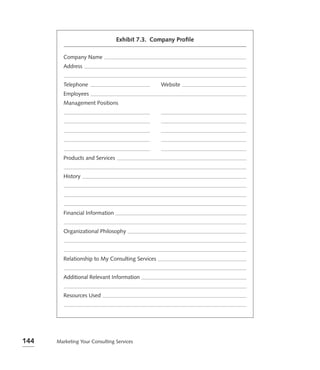
      Exhibit 7.3 Company Profile                           144
      Exhibit 7.4 Sample Introductory Prospecting Letter   149
      Exhibit 7.5 Client Contact Log                       154
      Figure 7.1 Prospecting Is Being a Realist            159


      EIGHT

      Exhibit 8.1 What to Ask Potential Clients            167
      Exhibit 8.2 Contracting Checklist                    174


      NINE

      Exhibit 9.1 How You Deliver Services                 189
      Exhibit 9.2 How to Follow Up                         190
      Figure 9.1 Power Scale                               193
      Figure 9.2 Formality Scale                           195
      Figure 9.3 The Four Communication Styles             198
      Figure 9.4 Adapt to Your Client’s Style              204
      Exhibit 9.3 Why Are Your Clients Satisfied?           205


xvi   List of Figures and Exhibits
Figure 9.5 Expanding the ABCs: Adding Four Rs                                208
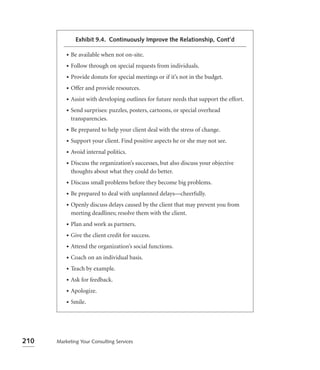
Exhibit 9.4 Continuously Improve the Relationship                            209


ELEVEN

Exhibit 11.1 Creativity Techniques                                           225


T W E LV E

Exhibit 12.1 Getting Unstuck                                                 248
Exhibit 12.2 ebb’s Thirteen Truths About Consulting                          254
Figure 12.1 OPPORTUNITYISNOWHERE                                             266


                                                      List of Figures and Exhibits   xvii
F O R E WO R D


I f consultants did not have to market and sell themselves, I am sure
  that the number of consultants would at least quadruple. Just the
thought of submitting our work and ourselves to the judgment of oth-
ers scares many people away from making a living as an independent
consultant. Marketing and sales helps define the boundary between
those who choose to consult and those who do not. I’ve been on my
own for years, and I am still uneasy about new encounters with po-
tential clients. The phrase “standing naked before strangers” captures
my worst fears.

   Elaine Biech wrote this book to provide me and you with some of the consul-
tant clothing we need. And not just our outer attire (yes, she does tell us how to
present ourselves in person and in print), but also the “inner attire”: the habits of
mind and heart that give us the confidence we need to present ourselves in the
marketplace. I dearly needed this guidance twenty-five years ago when I was start-
ing my business in the basement coal-bin-converted-to-office that was the “world
headquarters” for my new consulting firm. I found it very difficult to get out of
that coal bin and go find the clients. Elaine deals directly with these new consul-
tant dilemmas by telling you what you could do, helping you decide, and then get-
ting you up off your laurels to do something about it.
   You will not read long before Elaine puts you to work. She is particularly good
at offering many actions for you to choose from, or add to. In her immediate,


                                                                                        xix
almost hands-on guidance, she intends to move you to action. Don’t just study
     marketing and sales; do something about it! And soon! I agree with Elaine. You
     can take a year to put together the best consulting marketing plan in the world,
     and then not have the time and money left to implement it. Early on, find ways of
     investing more of your energy getting out there with your potential clients, instead
     of hanging back, buried in your books and research. (If this is the fourth market-
     ing book you’ve read in the last two weeks and you have not reached out to one
     potential client, chances are, you are not on the path to consulting success!)
         This book is useful in its suggested actions, and in its many questions. The au-
     thor repeatedly asks you what you think. I didn’t always like this, and I suspect you
     won’t either. But to be honest, when I didn’t like the questions, I usually didn’t have
     very good answers. Elaine’s questions are pointed, relevant, and maddeningly use-
     ful. She puts dozens before you, and more than once you will look at a question—
     pen poised ready to answer—and you will have NO idea what to write! When her
     searching questions meet your blank mind, there lies opportunity.
         What I especially value about each of Elaine’s consulting books is captured in
     this sentence: “I’ve done the research for you and boiled it down to its key elements;
     now read it and do something, dammit!” She does this with a twinkle in her eye.
     She draws on her own marketing experience; she offers charts, lists, and frame-
     works to fit over the apparent chaos of the marketplace; and she helps us learn and
     face what we need to know to be successful consultants.
         Each month, I am contacted by four or five people who are either new consul-
     tants, or are considering making the leap to consulting. We spend an hour or so
     together talking about their aspirations and their attractions to consulting, and
     marketing concerns are almost always part of these conversations. While helping
     them, I get a privileged look into their lives. There is something quite wonderful
     about having people tell me about what they want from their lives, their hopes and
     dreams, and their concerns and fears. I am the invited guest at their life table. Vis-
     iting with them causes me to think again about my own life, how I got where I am,
     and how my choice to be a consultant figures in all of that. And, what do I find
     myself saying, time after time, to these people who come to me with their ques-
     tions? Here are a few samples that might be useful to you:

      • Consult for love of the work, not for the money. Money will likely come, but
        see it as the frosting on the cake of doing work you love to do.


xx   Foreword
• Create work that asks you to be your better self. Do not build a role for your-
   self that is so artificial that you have to put it on each day like a lead suit.
 • Respect and care for your clients. It is possible to make a living while disliking,
   punishing, or ridiculing your clients, but you cannot make a good life.
 • Take good care of yourself. You cannot serve your clients well by living and
   working in ways that conflict with what you would advise them to do.
 • This choice is about life first, not work. Create a life for yourself; use this work
   to help you do that.

    Well, at least I hope that’s what I say to people. When I follow my own guidance
(I often do not), I live a better life, do better work, and more clients invite me back.
Some of the best marketing I’ve done is based on the advice I give to others: Build
a practice that is a part of the life you want to create.
    Succeeding in this work means finding and keeping clients, no small feat—es-
pecially in today’s world where the marketplace is filled with consultants parading,
displaying, and revealing their wares. There are more consultants than ever before,
all acting like they know what they are doing. Your challenge is to know what you
are doing, to find clients who value what you do, and to consult in a way that fits
with your larger life. Use this work of consulting to become your better self.

March 2003                                                          Geoff Bellman
                                                    Author, The Consultant’s Calling


                                                                              Foreword     xxi
PREFACE


I t is rare that I am writing this preface prior to starting this book.
  I have always written this part last to provide you with a roadmap
of what to expect or to discuss insights I’ve had while writing the
book. However, I find myself writing this preface now facing the very
reason that I decided to write this book. It is the fact that there are
probably more business books written about marketing and selling
than about any other topic. Yet few portray marketing as practical and
enjoyable. This is frustrating.

    Before I write a book I usually read as much as I can about the topic. As I write
this book, I am surrounded by stacks of marketing books—eighty-seven volumes
to be exact. In addition I have a stack of marketing periodicals and the past
year’s issues of four different newsletters. Many of them lack the practicality that
I search for.
    Few of these resources will make it into the marketing reading list that you will
find at the end of this book. Why? Because most are theoretically based and con-
tain few practical ideas. In some cases the practical ideas are there, but you spend
much time digging for them and may even miss them if they are buried in a chap-
ter of text.
    In my reading I examined graphs that display the demand curve and fluctua-
tions; wouldn’t you prefer to know how to get your clients to refer you to other
clients?


                                                                                        xxiii
I examined a three-dimensional grid that displays product life cycles and mar-
       keting strategies; wouldn’t you prefer a few inexpensive marketing tools?
          I examined rules for qualifying sales questions; wouldn’t you prefer a list of
       practical questions to ask clients?
          I examined charts explaining major segmentation of consumer markets; wouldn’t
       you prefer knowing how to find new clients?
          I examined lists of 162 closing techniques; wouldn’t you prefer several practi-
       cal excuses for getting in touch with dormant clients?
          I examined a diagram of a “need-driven sales process”; wouldn’t you prefer to
       learn how to develop creative marketing ideas?
          I read admonishments to those of us who do not know the difference between
       advertising and marketing. I have been chided for not knowing the real definition
       of promotion, and insulted for not taking the time to qualify a client. I think you
       want to know how to make marketing fun and practical. Well, that’s what I
       promise: fun and practical.


       I PROMISE PRACTICAL
       I am certain that you bought this book to learn something about marketing. But
       my guess is the real reason you plunked down the money is because you want to
       know the fastest, cheapest, most effective way to drum up business for your con-
       sulting company. Here’s what I promise you.

        • I promise to discuss only enough about market research to give you a basis
          for building a solid plan.
        • I promise to provide an easy, but thorough, process for developing your mar-
          keting plan.
        • I promise to identify tools you can use and what you may wish to consider
          for each.
        • I promise to discuss the advantages and disadvantages of marketing for a
          small consulting firm.
        • I promise to help you cut through to the most critical selling concepts.
        • I promise to show you how to retain the customers you have today and why
          this is your best marketing strategy.


xxiv   Preface
• I promise to teach you creativity tools that will help you to invent your own
   clever marketing ideas.
 • But most of all: I promise practical.

   I will live up to my promise to make this book practical and easy-to-use. And I
will fill it with the kind of useful guidance, practical ideas, special consulting con-
siderations, and creative tips I think you want.
   “Practical and fun is just what I need,” you say, “but I can’t wait! I need to do
something today!”

BUT I NEED TO DO SOMETHING TODAY
You will find hundreds of ideas throughout this book that you can implement im-
mediately. If that is your main reason for picking up this book, here are a fast four-
teen marketing ideas. Select one and do it today.
    What about a plan? What about research? What about determining the best way
to invest my marketing dollars? Yes, planning will save you money and a focus on
your niche will save you time. But neither will guarantee your success. You should
have a “market all the time” mindset. But if you are not doing any marketing and
you need to do something today, any one of these ideas will get you started as you
read the rest of the book. Most of these fourteen ideas will require fewer than eight
hours of your time. Most of these fourteen ideas cost little or no money.

Fast Fourteen to Do Today
   1.   Print mailing labels for fourteen of your best clients; then purchase fourteen
        appropriate (funny, thank you, thinking of you) cards from your local card
        shop. Write a sentence or two in each and mail them off.
   2.   Find a great article in a recent business magazine issue. Purchase fourteen
        copies of the magazine and mark the article with a Post-it® and a note from
        you. Send it to fourteen potential clients.
   3.   Attend your next professional or service organization meeting. Select four-
        teen people and give each person two business cards—one to keep and one
        to pass on.
   4.   Call people you know and ask them to suggest others you might help. Do
        not stop until you have fourteen names and phone numbers.


                                                                               Preface   xxv
5.   Call the fourteen names provided to you in the previous idea. Ask for time
               on their calendars to chat with you about how you might be able to help
               them.
          6.   Add fourteen names to your mailing list. Send each a brochure with a note
               from you.
          7.   Identify fourteen dormant clients (people you have not spoken to in two
               years) and call them to see what they have been doing.
          8.   Read a good book? Seen a great website? E-mail the title and author or the
               website address with fourteen words about why you liked it to fourteen peo-
               ple who could refer you to new clients.
          9.   Write a fourteen-paragraph article for your website. Then contact fourteen
               clients and ask them to read it and provide you with feedback.
         10.   Take fourteen minutes to decide how you could improve your answering ma-
               chine messages. Then implement the ideas.
         11.   Go to your local bookstore. Scan at least fourteen of the newest books that
               focus on your area of expertise. Identify phrases, concepts, and thoughts you
               could use in your next prospecting letter.
         12.   Identify fourteen events, such as conferences, meetings, or social gatherings,
               that will occur in the next year, where you could touch base with potential
               clients. Add all fourteen to your annual calendar.
         13.   Identify fourteen strangers to whom you would like to sell your services. Skip
               ahead and read Chapter Seven to determine how to prospect.
         14.   Identify fourteen journals, magazines, and newspapers to which you could
               submit an article or a press release.

          Select one of these items and do it today. Follow up with a call or another next
       step fourteen days from today. And in between begin to read this book so that you
       can learn the rest of the marketing story.

       Tips
       Several tips are highlighted in each chapter. Most are not dependent on the chap-
       ter, so you may use them as stand-alone ideas. Many will initiate thoughts you
       may not have had in the past. Try some of them. Use others as thought-starters
       for your own ideas.

xxvi   Preface
One Last Thing
I have lots of last-minute thoughts, so you will find many of the chapters end with
one last idea—kind of a p.s. to the chapter. In addition, each chapter ends with a
list of Marketing Actions. You should consider adding the actions to your daily to-
do list. Take action toward your marketing plan.


March 2003                                                      elaine biech
                                                                ebb associates inc
                                                                virginia beach, va


                                                                            Preface   xxvii
ACKNOWLEDGMENTS


E  very author needs a supporting cast of many who coach, critique,
   and encourage. I am fortunate to have found that in the Pfeiffer
publishing team:

 • Kathleen Dolan Davies, director of development, who carries a big stick but
   has a soft touch. She trusts me to meet deadlines, yet pushes me when she
   must. She has become a friend and confidante.
 • Nina Kreiden and Dawn Kilgore, production editors, who skillfully keep all
   the pieces of the puzzle together to ensure a tight production schedule. An
   author could not ask for better communication and support.
 • Susan Rachmeler, development editor and word maestro, for going above and
   beyond to provide her expertise and insight.
 • Rebecca Taff, who manages my stray sentence structure, prods my preposi-
   tions into place, reduces redundancies, corrects capitalization, and still man-
   ages to ferret out all the “gets.”
 • Jeanenne Ray, whose marketing magic will create another success story with
   this book.
 • Matt Davis, acquisitions editor, who agreed to take a chance at yet another
   book about consulting.
 • Cedric Crocker, publisher, for creating a synergistic climate in which the pub-
   lishing team excels.

Thank you all.

                                                                                     xxix
Celia Rocks, publicist, thanks for your brilliance-to-be on yet another project.
         Thanks also to the people who kept the rest of my life in order as I wrote: Mag-
      gie Hutchison, Emma Meredith, and my family who stayed in touch while I ig-
      nored them.
         Thank you clients who have always allowed me to explore creative marketing
      ideas with you.
         And especially, Dan, love of my life, who took care of me for a month so that I
      could write—no one has ever done that for me.


xxx   Acknowledgments
L
                                                                                       chapter
                                                                                        ONE


Marketing
What’s It All About?


M        any consultants never think about marketing . . . until some-
         thing goes wrong. The company that was your bread and but-
ter has just been bought out by its competitor. The person who hired
you to conduct an organizational assessment was offered a better job
and the new guy wants to bring in his own consultant. The market has
taken a downward turn and your regular clients are not calling you.
Guess it’s time to think about marketing!


MARKETING 101
My college marketing class dictated that the market must first be identified using
research and surveys by experts. The next step was to reach the market using huge
outlays of time and money in the form of advertising. Consultants may interpret
this as follows: They will rent a mailing list from the industry to which they con-
sult (research) and then mail a pricey four-color brochure (reach) to everyone on
the list. They may accompany this with a full-page ad in the industry’s journal.
They pat themselves on the back and sit back and wait for the calls to roll in. When
no one calls they are at a loss about what happened.


                                                                                         1
Market Research and Market Plans
    What is marketing? Must it really be research-based? Should consultants have mar-
    keting plans? Marketing is everything you do to find or keep a client. Most suc-
    cessful consultants know more about marketing than they believe they do. That’s
    because if you keep all the jargon out of marketing it can be an intuitive process.
        To be the most successful, marketing is generally based on some research, even
    if that research is unsophisticated and subjective. For example, you as a consult-
    ant decide to contact one client over another, or to write one proposal over an-
    other, and you make those decisions based on the “research” you have done. Do
    you have some inside scoop about one client? Perhaps you spoke to the director of
    human resources and you know they are looking for some sales training, your spe-
    cialty. Is the other client notoriously late with payments to other consultants? The
    answers to these questions will lead you to the next step.
        You will most likely plan some marketing strategies to use with the first com-
    pany. Perhaps you will write a personal letter to the vice president of sales that
    shows you are familiar with the company and outline your credentials and what
    you do. You may follow up with a telephone call that leads to a sales call. You plan
    carefully what you will say during the sales call: What questions you will ask, what
    information you will share, and how you will position yourself to ensure that you
    are hired for the job. Congratulations! You have just completed your market re-
    search and market planning for one client.
        Now how did you choose to respond to one proposal over another? Again, you
    conducted some minimal amount of research. Perhaps you called a colleague to
    learn more about one of the organizations. Perhaps you looked the organization
    up on the Internet. Once you read the Request for Proposals, you learned which
    one would utilize your skills more. Again, this is the research. Your marketing plan
    will be to write the best proposal they’ve ever seen, showing how you will solve the
    organization’s problem, add value to their mission, and do it all for a reasonable
    price and within their time frame.

    Guarantee Your Business Success
    Want to guarantee the success of your business? You can essentially predict success
    if you do two things: (1) Research and answer the following questions correctly
    and (2) plan and implement the effort to accomplish the actions suggested by the
    questions.


2   Marketing Your Consulting Services
• What does your business do? What do you do well? What do you not do well?
 • What do your customers want? How do you ensure excelling at meeting their
   needs? How do you predict their future needs?
 • Who is your competition? What do you do better than they do? How do you
   stay ahead of your competition?
 • How do you keep yourself in front of your customers?
 • Where is your business heading? What is your vision? What do you need to do
   to get there?
 • What will you do differently once you get there?

    The answers to these questions should be found in your business plan. It is a
working document that you keep in front of you and your staff. When done
thoughtfully, it becomes your roadmap to success. It is also the precursor for your
marketing plan. If you have not completed a business plan, you will want to back
up and complete one before moving forward. If you need a format to follow, use
one of my earlier books, either The Business of Consulting or The Consultant’s Quick
Start Guide. Both provide guidance for writing a business plan.
    Alan Kay, author and consultant, has said that the best way to predict the future
is to invent it. Do you want to predict your success? This is the way to invent it.

The 4 Ps
Probably one of the things you remember from your marketing classes is the 4 Ps.
Product, price, placement, and promotion are the four elements of the marketing
mix. Manipulating them in the best way brings the greatest number of sales.
“Whoa!” you may say, “I don’t have a product to sell. How can marketing help me?”
   The 4 Ps were first presented in an article titled “The Concept of the Marketing
Mix” in the Harvard Business Review. The author, Harvard professor Neil Borden,
coined the term “marketing mix” to describe the variety of different marketing el-
ements that must come together to produce an effective marketing plan. The 4 Ps
seem to work well for planning a marketing campaign for products such as tooth-
paste, computers, and Halloween masks. In the consulting business you will need
to expand the definition a bit.
   On the other hand, the fact that consulting is a service rather than a product is
not a reason to think marketing will not work. Just because your client doesn’t


                                                       Marketing: What’s It All About?   3
receive something to put in a box, it doesn’t mean there is no value. However, your
    clients can’t see, hear, taste, smell, or feel your services before they purchase them. So
    what are they buying? They are buying a promise that your consulting will solve their
    problems. They must have faith that you will deliver as you state in your proposal.
        People buy solutions, not products. The tried-and-true example is the hardware
    store that sells drills. People really don’t buy drills; they buy holes. They want a hole
    in a particular place and of a particular size. So the hardware store owner is sell-
    ing solutions: holes. As consultants we are in the solution-selling business.
        How do the 4 Ps relate to consulting? Let’s look at each one.

    Product As mentioned earlier, a consultant’s product is the service you offer your
    clients. Whether you are a consultant in real estate, publishing, electrical engi-
    neering, computer-aided design, finance, weddings, or dog grooming, your prod-
    uct is you and the expertise, knowledge, and experience you bring to your clients.

    Price Price is always a hot topic for consultants. In my seminars I always have more
    questions about pricing consulting services than anything else. For an in-depth
    discussion about how and what to charge, see one of my earlier books, The Busi-
    ness of Consulting, published by Jossey-Bass.
        What is most interesting to contemplate here is that if clients cannot see your
    expertise, cannot touch your knowledge, cannot hear your experience, it may be
    difficult for them to make a decision. How can they know the value you have placed
    on the service you will offer?
        Clients have a difficult time understanding why we charge as much as we do;
    it’s even more difficult when they must have faith in the outcome. Clients usually
    like and trust you before they agree to your price.


    Luick tip . . .
                 When your clients purchase your consulting, they are buying a promise
                 of satisfaction. Why not give them a 100 percent money-back guarantee.
                 Nervous about doing that? Think about how your client may feel. If you
                 don’t believe in yourself, who will?


    Placement Placement is another concept that is difficult to explain in the service
    arena. In product sales, placement is actually distribution. But what is placement in


4   Marketing Your Consulting Services
consulting? Whether you work alone or with other consultants, the service resides
within the people who are delivering it. Your services are inseparable from you.
   Another way to look at placement is where you complete the services. Do you
do all, some, or none of your work at the client’s place of business? This may af-
fect price in the market mix. For example, if you are an executive coach you may
charge one price for the time you spend in your office compiling data, designing
questionnaires, and putting materials together. You may charge a much higher price
when you work one-to-one with the executives.

Promotion Typically when marketing products, the term promotion refers to
things like coupons that push sales or persuade buyers to ask for a brand. We can
broaden the definition of promotion of services. For example, in consulting it in-
cludes all the marketing methods available for you to use in marketing your con-
sulting services. What mix of personal sales, publicity, advertising, direct mail, and
telemarketing should you use?


CONSULTANTS AND MARKETING
Consultants in my workshop, So You Want to Be a Consultant, made the follow-
ing statements. How would you respond to these consultants?

 • “Marketing takes too long and it doesn’t work for consultants anyway!”
 • “I am not a salesman and I would never have become a consultant if I knew I
   had to market and sell!”
 • “Marketing? It’s a mystery to me. Isn’t that what big companies like Coca-Cola
   do; they have entire departments and they conduct research, do taste tests, and
   study the buyers’ habits to know what kind of ads to buy and how to sell more
   Coke.”
 • “I’ve been in business for nine months and have already spent thousands of dol-
   lars on my brochure. I don’t see a payoff.”
 • “I don’t do any marketing. It’s too expensive and takes too much time. Besides,
   my clients wouldn’t like it if I became a pushy salesperson.”

  If any of these consultants are successful, they have done some kind of market
analysis, goal setting, market planning, and customer sales. They just may not call


                                                        Marketing: What’s It All About?   5
it that. Whether you like it or not, you are marketing all the time. Your present
    clients are making judgments about your work and at least subconsciously are de-
    ciding whether they would hire you again or whether they would refer you to an-
    other colleague. Anyone you come in contact with at work, while shopping, in an
    airplane, at church, or at Rotary is a potential client or could lead you to a poten-
    tial client.
        So the argument goes, if you are researching, marketing, and selling anyway,
    why not organize it in a way that you can draw on lessons learned, make decisions
    based on data, and plan the most efficient path to success. Let’s get back to our
    consultant comments.

     • “Marketing takes too long and it doesn’t work for consultants anyway!”

       Marketing does take time. It takes time in two ways. You must invest time in
    marketing activities and it takes some time before you will see results, perhaps six
    months to a year or more. We maintained a relationship with one client for three
    years before something came to fruition. This is common for consultants, for a
    couple of reasons. First, we sell a high-ticket item and it generally takes longer to
    make a decision about a large purchase than a small one. Second, what we sell is
    intangible. In many cases we sell ideas and concepts. It is sometimes difficult for
    people to buy what they can’t see, so they ask us to write proposals. This gives them
    something tangible to hold. It does take time, but like every other business, you’d
    better market some way or you won’t be in business for very long.

     • “I am not a salesman and I would never have become a consultant if I knew I
       had to market and sell!”

       You are a salesman. We are all salesmen and women in all that we do. Your first
    day as a salesman was the day you first tried to convince your parents to purchase
    a box of cereal because it had a treasure buried deep inside the box of flakes. You
    were directly affected by the cereal company’s marketing, and you did exactly what
    they hoped you would. You became a miniature salesperson for them by begging
    your parents to purchase the cereal. Now you regularly sell your ideas about local
    politics to your friends; sell your rationale for why they cannot stay out past mid-
    night to your children; and sell your need for a new car to your spouse. Face it, you
    are a salesperson.


6   Marketing Your Consulting Services
Luick tip . . .
            Post a positive affirmation about marketing where you can see it every day:
            on your computer, in your Day-Timer ®, in your wallet’s clear window.


 • “Marketing? It’s a mystery to me. Isn’t that what big companies like Coca-Cola
   do? They have entire departments and they conduct research, do taste tests, and
   study the buyers’ habits to know what kind of ads to buy and how to sell more
   Coke.”

   Marketing is all of these things and more. For the consultant, you will do some
research about your clients and your competition. You also need to assess yourself.
Once you put your data on paper, you will be able to develop a solid marketing
strategy for your consulting business. But it’s not a mystery. You can follow the
ABCs of marketing and select some effective as well as enjoyable marketing tools
and activities. You will learn a lot about how to market in this book. You will not
learn a great deal about marketing theory. My intent is to make creating your mar-
keting plan as easy as drinking a Coke!

 • “I’ve been in business for nine months and have already spent thousands of dol-
   lars on my brochure. I don’t see a payoff.”

   Brochures alone will not sell your services. I learned that the hard way. We de-
signed and printed a great brochure to market a product. But it failed. The entire
campaign barely paid for the brochures! What went wrong? Lots. Timing was bad.
The price point was too high. The concept was too difficult to sell in a brochure.
But there is good news too. We learned a huge amount with that failed effort. As
Tom Peters is fond of saying, “Fail faster!” Fail faster and get on with the successes.

 • “I don’t do any marketing. It’s too expensive and takes too much time. Besides,
   my clients wouldn’t like it if I became a pushy salesperson.”

   This is the comment of an uninformed person. Must you become a pushy sales-
person to sell your consulting services? Of course not. In actuality, if the person
who was quoted above has any business at all, some marketing is happening. It
may be subtle personal marketing, but marketing is occurring. Do you believe you


                                                        Marketing: What’s It All About?   7
add value for your clients? Do you have vendors that add value for you? Do you
    welcome those vendors’ calls? If you answered “yes” three times, the message should
    be clear. If you view yourself as a pest, it will undermine your persistence. This
    book will show you how to help your clients see that you add value.
         Do all consultants have the same attitude? Absolutely not! Although I do re-
    member when I fell into this same uninformed category. In business for five years,
    I made a sales call (though I refused to call it that) to Coopers and Lybrand. I
    scheduled the “visit” with Ian Littman by phone and corrected him when he called
    it a “sales call” by saying, “I don’t do sales and marketing, but I will come and talk
    to you.” After we reached an agreement on what we would do for them, Ian said,
    “Well, that was the best non-sales call sale I’ve ever been a part of.” His tongue-in-
    cheek comment felt like someone had dumped a pail of cold water over me! I got
    it. I had a great sales and marketing routine going and I needed to recognize what
    I was doing. As consultants, our main job is to help our clients. However, we can’t
    help them if they don’t know what we can do, or even that we exist! And that’s what
    marketing is all about.
         My real estate consultant, Marianne Scott, has a very healthy attitude about
    marketing and selling her services. When she learned that I was writing this book,
    she said, “Marketing is all about selling yourself and you need to use what you do
    best to market. Some real estate consultants are good at baking chocolate chip
    cookies, some are good at cold calling, and some know how to hang a banner
    from an airplane to drum up business; I know people who have done all of those
    things. I don’t do any of them because I’m not good at them. I am knowledgeable
    about the real estate market and the area, and providing service. My marketing
    strategy is to go after referrals and repeat business by providing excellent service.”
    And it must be working, because 90 percent of Marianne’s business is from re-
    ferrals and repeat clients.


       Marketing for Consultants Quiz
       1. Marketing is a peripheral part of consulting; the only thing that’s important
            is doing the best work for your clients.
       2.   A marketing plan is critical for large consulting firms, but I can get along
            without one since I practice alone.


8   Marketing Your Consulting Services
3.   Marketing is expensive and takes a great deal of time if you are going to do it
        right.
   4.   I am just getting started and already have more work than I can handle, so
        marketing now would be a waste of my time.
   5.   Marketing is a mystery to most people, and the techniques must be studied
        carefully before developing or implementing a plan.
   6.   Selling will ruin the professional image my partners and I have created.
   7.   My clients already know what we do, so there is no reason to market.
   8.   Marketing on the web is only for big consulting companies.
   9.   It’s best to hire an outside firm to develop your marketing plans.
  10.   Word-of-mouth marketing is the only thing a consultant must do.


   Many consultants have some or all of these thoughts. It should be clear that
each of these statements is false or mostly false, but why are they false? Let’s ex-
plore some of the reasons.


   1.   Yes, it is critical that you do a superb job for your client, but marketing is
        more than a peripheral part of what a consultant does. No marketing; no
        work. Do remember that one of the best things you can do is to get your sat-
        isfied clients to provide referrals for new business for you. So if you do good
        work, ask for more business. That’s marketing.
   2.   Consultants are busy. You need to put your plan on paper or you will not do
        what needs to be done.
   3.   This book is filled with fast, easy, and free marketing techniques and ideas.
   4.   Eventually that work will be completed and then what will you do? The most
        important time to market is when you are too busy to do so.
   5.   Like most topics, marketing is filled with theory. You do not need to know
        all the theory to start. In fact, you will learn throughout this book how much
        you know already. Marketing can be practical. It is common sense with a
        dash of creativity thrown in for fun.


                                                         Marketing: What’s It All About?   9
6.   If your attitude about selling is that you are helping your client, it can only
             enhance your image. Isn’t that what you are trying to do? You have a prod-
             uct or service that can help your clients if they take advantage of it.
        7.   Yes, your current clients probably do. But you won’t be working for your cur-
             rent clients forever. You need to inform potential clients what you do so they
             can make an informed choice.
        8.   Marketing on the web is perfect for small companies. Asking for your web
             address is almost as common as asking for your telephone number.
        9.   You will want to hire an expert for certain things, such as designing your logo
             and your business stationery, but you can develop your own marketing plan.
       10.   Word-of-mouth marketing is the best kind of marketing a consultant can
             have. However, word-of-mouth marketing does not appear out of thin air.
             The consultant did something first—completed a difficult task that resulted
             in a satisfied client or perhaps gained a reputation as an internal expert.
             Eventually, the consultant sold services. In either case, that word of mouth
             must be maintained in order to continue to grow the business. It’s going to
             need a little help from a marketing plan.


     Marketing Pitfalls for Consultants
     There are four common pitfalls for consultants. I see these occurring over and over.
     We will examine each of these throughout the book. Decide whether or not you
     have fallen into any of these. If so, why has this occurred? Next, think about why I
     might be calling these pitfalls.


      • Obtaining a big contract that doesn’t allow you the time for marketing.
      • Conducting sporadic marketing activities rather than regularly scheduled
        events.
      • Having a plan but not on paper.
      • Avoiding cold calls at all cost.


        Watch for the reasons throughout the book.


10   Marketing Your Consulting Services
THE ABCs OF MARKETING
So what’s a consultant to do? Well, unlike the consultants that you heard about at
the beginning of the chapter, you do not wait until your business is in trouble to
market—after you’ve lost your key client, after your sponsor has left the company,
or after the market goes south. You must plan ahead. You must have a marketing
plan in place.
   Must it be a time-consuming, difficult process? The answer is “no.” It can be
as easy as ABC. To be successful you must have assessed your situation, built a
client base, and contacted potential clients. I call these the ABCs of Marketing.
With these in place you will safeguard yourself against the potential perils of own-
ing your own business.
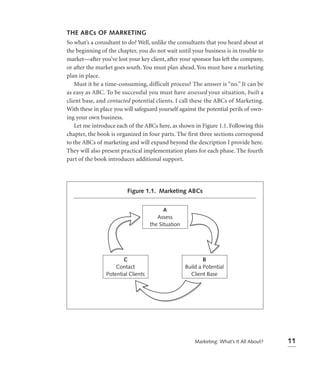
   Let me introduce each of the ABCs here, as shown in Figure 1.1. Following this
chapter, the book is organized in four parts. The first three sections correspond
to the ABCs of marketing and will expand beyond the description I provide here.
They will also present practical implementation plans for each phase. The fourth
part of the book introduces additional support.


                         Figure 1.1. Marketing ABCs


                                          A
                                       Assess
                                    the Situation


                       C                                    B
                    Contact                         Build a Potential
                Potential Clients                     Client Base


                                                        Marketing: What’s It All About?   11
A: Assess the Situation
     Assessing the situation means examining from an internal and an external per-
     spective. Internally you will examine your consulting company. Externally you will
     examine your competition and your customers.
        Why an internal assessment of you and your consulting company? A solid mar-
     keting plan will be based on where you are today and where you want to be in the
     future. Before developing a marketing plan, review your business plan and strategy.
     They will provide a foundation for your marketing plan. If you have recently com-
     pleted or updated your business plan, you may not need to do much here. Starting
     with who you are, what services and products your company offers, what unique
     position your company holds to set it aside from your competition, as well as what
     financial situation exists, creates a basis from which many assumptions are made.
        For example, if you are the only computer consultant in your small city, you
     have a unique advantage that probably allows you to charge a premium price for
     your services. On the other hand, if your specialty is time management and your
     local community college offers a time management class for $75, you will need to
     keep its competitive price in mind when you set fees and when you determine who
     you will target as your audience. What strengths and weaknesses define your pres-
     ent company? What opportunities and threats could define your future company?
        Why assess your competition? You may be surprised about who your competi-
     tors are. In addition to consulting firms that are the same size, in the same location,
     and who deliver the same services, you will want to consider those that are larger
     who can offer more services and those in other states whose employees don’t mind
     traveling. You may want to consider other organizations such as colleges, associa-
     tions, and retail stores that provide consulting with the products they sell. You will
     want to examine your competitors’ positions in the marketplace and how you might
     position yourself against their weaknesses or in spite of their strengths. For example,
     a waste-management consulting firm may have a national reputation and employ-
     ees who have written a book that is respected by the industry. You may be able to
     underbid them if you have a smaller organization with lower overhead. Consultants
     frequently overlook college professors as possible competitors, when in fact they
     can be a strong competitive force for several reasons. First, they have a university
     name behind them and second, they can easily underbid you, since they already
     have a full-time job and no overhead. Frequently, universities encourage their pro-
     fessors to consult to obtain practical experience and to gain community exposure.


12   Marketing Your Consulting Services
Why assess your customers? You will want to assess your present as well as your
potential clients. Examine your present clients. Where are they now? Where do they
want to be? And how can you help them get there? What services do they use now
and what services do you offer that they have not utilized? Is there some opportu-
nity for cross-selling? For taking your services to another department? Look for
new clients. Who is in your geographic area that you have not contacted? Perhaps
you have been reluctant to call on the larger companies in your area. What can you
offer them? If you focus on a specific industry, have you marketed to all the com-
panies in the industry? How about related industries? An assessment will remind
you of the many marketing opportunities available to you.
   After completing an internal and external assessment of your firm, your com-
petition, and your clients, you will want to assess the messages you are already send-
ing to clients and potential clients. The message is your image or what the client
sees and hears from you already. It is important that the image be clear and consis-
tent. Your assessment provides the input you will need to build a strong client base.

B: Build a Potential Client Base
Building a potential client base will require that you complete three key actions.
First, you will analyze the data you gathered in the Assessment Phase. Second, you
will develop a marketing plan. Third, you will target and identify specific clients
or groups of clients. This phase can be a lot of work. It can also be confusing. But
it is also exciting.
    It is a lot of work because you will analyze what you learned in the Assessment
Phase to determine which clients you should target. You cannot pursue every po-
tential client in the universe, so you will need to make difficult decisions to nar-
row the field. Put everything you learned in Phase A about you and your company,
about your competitors, and about your potential clients in the mix. Then begin
to look for the opportunities. The analysis will lead you to the answer.
    This phase can also be confusing. Unless you are a marketing major, you may
have many questions about all the marketing tools available to you. What’s the dif-
ference between advertising and publicity? What are promotional activities? What’s
the relationship between PR, publicity, and a press release? What’s a media blitz and
do you need one? Is there a marketing mix that’s best for consultants? Should you
buy a mailing list? What about a brochure? Business cards? Pricing? Direct mail?
Telemarketing? Trade shows? Or does any of it matter? There are many marketing


                                                        Marketing: What’s It All About?   13
tools available to you. Try to see this as many opportunities rather than confusing.
     Consulting is a unique profession that requires a unique marketing plan. Although
     all of the options can be confusing at first, a little common sense and a lot of cre-
     ativity will help you make practical decisions.
         In the end, however, this phase is exciting. It is now that you will prepare a mar-
     keting plan—putting your ideas on paper. Don’t be dismayed if you have a small
     (or even non-existent) marketing budget. You will be surprised about how much
     you can do with very little money. You will also begin a plan for prospecting for
     new clients and new opportunities. Starting something new is always exciting.

     C: Contact Potential Clients
     This is actually the sales part of the marketing process. In this phase you contact
     potential clients and convince them to use your services. You will come across con-
     cepts such as opening and closing sales, cold calls, client-centered selling, and rain-
     making. This is the place in the process when you will also want to figure out how
     you can get your clients to market and sell for you and how to find more repeat
     business.
        As I stated, this is the “sales” step in the process. In a sense, selling is the culmi-
     nation of the marketing process when you are increasing work with present clients
     and convincing new clients to use your services. The words “sales” and “market-
     ing” are often linked. They are separate and distinct activities, and yet they are so
     related that it is difficult to tell when one ends and the other begins.
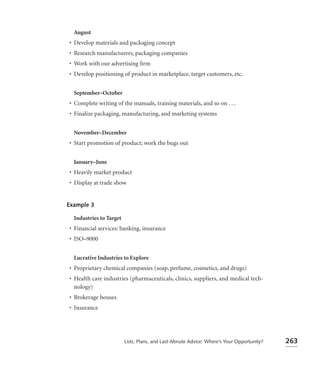
        This book presents marketing as prior to sales. Typically a consultant would put
     together a marketing plan; then a potential client would hear about the consult-
     ant due to the marketing and contact the consultant. After meeting with the con-
     sultant, the client might decide to purchase the consultant’s services.
        Now when does the “marketing” end and the “sale” begin? Is it when the po-
     tential client hears about the consultant? When the client contacts the consultant?
     When the consultant meets with the client? When the consultant opens a sales
     pitch? When the client decides the services are necessary? When the client agrees
     to purchase the consultant’s services? When the consultant closes the sale? When
     the consultant sends the proposal? When a contract is signed? When the consult-
     ant delivers the services? When the client writes the check? It could be any of these.
     For a consultant, these actions may occur over several weeks. For larger sales, the
     actions may even occur over several months.


14   Marketing Your Consulting Services
It is difficult to clearly determine the exact point where marketing and sales split.
And this is good. If you can accept how intertwined the two processes are and how
dependent on each other they are, you will appreciate how important marketing
your business is. If you absolutely need to define the difference, I think of market-
ing as focusing on many people and organizations at once; I think of sales as fo-
cusing on only one person or organization. Marketing is a broader effort; sales is a
specifically defined, concentrated effort. Even with my definition, it is still difficult
to determine whether a particular activity is sales or marketing. Even though many
large organizations have separate sales and marketing departments, I firmly believe
that both are occurring all the time no matter what the size of your business.
   To expand on this, remember that what happens both during the delivery of
services and after the sale is completely over and the consultant has cashed the
check are all marketing moments. As a consultant you are always “on” with re-
spect to marketing. You are marketing during delivery of services when you are
on time and under budget. You are marketing during delivery if you are honest,
ethical, and easy to work with. You are marketing after the work is completed
when you have given more than you promised or when you follow up to ensure
that progress continues. On the other hand, you are also undermining any mar-
keting efforts when you are rude or short with employees, when you bad-mouth
the competition, when you miss deadlines, or when you deliver shoddy work. The
point is that marketing and selling consulting services never stops. You are sell-
ing you. And that means there is only one time to market: all the time.


MARKETING FROM DAY ONE
The most successful consultants recognized the importance of marketing and
started marketing activities long before they had their business cards printed, in
fact long before they became consultants. Actions you have probably taken since
starting your consulting practice will be helpful now as you develop a solid mar-
keting plan. From the start, from day one you should:

 • Start a mailing list. Every person you come in contact with who has the poten-
   tial of being a client or knowing someone who could be a client should be on
   this list. As the list grows, you will organize it so that you can easily print labels
   for specialty mailings, for example, CEOs, personal contacts, female executives,
   petroleum industry, or retail contacts.


                                                         Marketing: What’s It All About?    15
• Start a file of marketing ideas. If you see an AT&T ad, a Dilbert® cartoon, an item
        in a catalog, or hundreds of other things that suggest marketing ideas, file them
        in one place. You will be busy with other things, and you will forget them if you
        don’t clip them right away. We use an accordion file. The extra space gives us
        room to add small items that could be sent, such as pins, clips, or small toys.
      • Print business cards early. The least costly, high-impact marketing tool you have
        is your business card. It will take a few months to work with a designer to create
        a logo and design for your stationery. Therefore, print a few hundred cards to get
        you started. However, do not let these cards be a substitute for high quality very
        long. They send a message and project your image. Ensure that they are as pro-
        fessional looking as possible and start working with a designer as soon as you can.
      • Begin a testimonial file. Your clients will begin to rave about your work. Collect
        those statements. You may receive unsolicited thank-you letters or notes. Place
        them in a file. If clients compliment your work verbally, you may ask them to
        put it in writing. You will use these testimonials for brochure copy, in prospect-
        ing letters, or in proposals.

        Initiating these activities from the first day you are in business ensures that you
     will be better prepared to implement many of the marketing tools presented in
     Chapter Five.
        So what’s marketing all about? It’s about getting your name in front of clients
     and keeping it there. It’s about keeping work flowing and your consulting practice
     growing. It’s all about staying in business. Part One of this book will ensure that
     you assess your situation adequately.


     MARKETING: TAKE ACTION
      1. The 4 Ps of marketing are Product, Price, Placement, and Promotion. What
         could you do differently in each that might expand your client base?


16   Marketing Your Consulting Services
2.   What was your score on the Marketing for Consultants Quiz? How satisfied
     were you with your score? What do you think you need to do about it?


3.   The ABCs of marketing are Assess the Situation, Build a Potential Client
     Base, and Contact Potential Clients. How would you rate what you do in each
     of these three areas? What will you need to do to improve in each area?


4.   As a consultant you are always “on” with regard to marketing your business.
     In what areas, when, and where might you improve your attention to mar-
     keting?


5.   Examine the four common pitfalls. Have you fallen into any of them? What
     do you predict will be discussed about each?


                                                   Marketing: What’s It All About?   17
L
                       part
                       ONE


Assess the Situation
L
                                                                                       chapter
                                                                                        TWO


Internal Assessment
What’s Your Company’s Marketing Success?


H     ow do you get started with a marketing plan? What do you do?
      How do you do it? Like the consultants in Chapter One, you can-
not just send brochures to a purchased mailing list, then sit back and
wait for clients to call. To be a successful consultant, you must market
your services—getting the word out to the right people. Granted, you
may market to whomever and to whatever extent you would like. But
you cannot successfully market to the world. You must get the word
out, but you need to narrow your scope.

   You might be the best consultant in the world, know the most innovative solu-
tions, be the most knowledgeable in your field, and provide the most return on in-
vestment of any in your area. But if no one knows you exist, how will clients find
you? You need to let people know that you and your business are available to serve
them. You need to promote yourself. And as stated at the end of the last chapter,
you need to do it all the time. However, before you promote yourself you need to
determine exactly what you are promoting and to whom. You have established a
strategy in your business plan. It is time to reassess that strategy now from a mar-
keting perspective.


                                                                                         21
As mentioned earlier, a marketing class will most likely cover market research
     and market reach. This chapter begins to explore the research phase—the A: As-
     sessing the Situation Phase as I defined it in the last chapter. You will conduct re-
     search by assessing your consulting company, competition, and clients. This chapter
     focuses on your consulting company.


     WHY MARKET RESEARCH?
     You probably do very little in life without conducting some form of research and
     then devising a plan. For example, if you are planning a party, you will conduct re-
     search in your mind that might include some of the following data points:

      • Whose parties have you recently attended?
      • Who gets along with whom?
      • Which of your friends know or do not know each other?
      • What statement do you want to make with refreshments?
      • What happened at the last parties you attended?
      • What is on your personal or the community calendar in the near future?

        Next you will devise a plan for the party that may include some or all of these
     items:

      • Date and time you will hold the party.
      • List of people you will invite.
      • Food you will serve.
      • Location of the party.

         Here’s another example. Think about the last time you took the car to have its
     oil changed. You determined the date and mileage of the last oil change (research).
     You decided whether you would take the car in after work or wait until Saturday
     morning (plan).
         This exercise demonstrates how you research and plan almost everything you
     do. Therefore, shouldn’t you do the same when it comes to marketing your busi-


22   Marketing Your Consulting Services
ness? Yet many people do not and then wonder why they have not been successful.
Research and planning provide the foundation for a successful marketing execution.


ASSESSING YOUR CONSULTING COMPANY
The first step in the Assessing the Situation Phase is to assess your company. This
in essence is researching yourself. Consulting is a personal service business. There-
fore, if you are a single practitioner, this may mean assessing your personal desires,
qualifications, successes, and failures as well as those of your company.
   The next few pages will help you assess your business.

Define Your Business
Begin by defining your business with a narrative. As mentioned earlier, if you have
recently completed your business plan, you may review and/or revise it. The fol-
lowing narrative will help you think through the basic information about your
consulting business and prepare you to use the diagnostic tools that follow.
Demographics What’s the name of your business? The address? Telephone and
fax numbers? What’s the e-mail address? What’s the website? Who is the owner(s)?
What’s the business structure and, if incorporated, where?
General Information What business are you in? What are the mission, vision, and
purpose of your consulting business? That is, why are you in business? What work
do you conduct? Where is your business located?
Changes What information is important about the start of this business? For ex-
ample, is it a new business or an expansion of an existing business? What was the
start-up date?
The Work What specific activities does the business conduct to raise revenue?
What services and/or products does it provide?
Success Expectations How successful is your business? How do you measure suc-
cess? Why do you believe your business will continue to succeed? Do you believe
the business will grow? How will it grow? What relevant experience do you bring to
the business of consulting?
Reputation How are you perceived in the marketplace? How satisfied are your
clients?


                        Internal Assessment: What’s Your Company’s Marketing Success?    23
Luick tip . . .
                 Subscribe to the Wall Street Journal and Fortune magazine to continue
                 to be knowledgeable about what is happening in the industries you are
                 serving. Knowing what is happening will help you predict what your
                 clients will need and what you might need to change in your strategy.


     Future Plans What plans do you have for your business? What are your goals for
     the business? Are your goals specific, measurable, and time bound?

        Pull this section together by completing this statement.

       I am a consultant who helps my client to ______________________________
     _________________________________________________________________.
     This benefits them __________________________________________________
     _________________________________________________________________.


     Define Your Management Plan
     Defining your management plan will help you think through the resources you
     have to construct and implement a marketing plan for your consulting business.

     Management Who are the key players in your business? What are their duties,
     compensations, and benefits? If you are the sole employee, how do you manage all
     that needs to be completed? What is your salary?

     Support Staff When do you expect to hire additional personnel—if ever? How
     often do you use specialty contract assistance to complete the work? What percent
     of your income is spent on support personnel? What percent of the time do you
     believe you are using your time wisely?

     Expertise What experience do you have in marketing, sales, managing a business,
     and other supporting roles? What is your education level? What professional sup-
     port do you use, such as an attorney, accountant, or banker? What banking serv-
     ices do you use and where? What process are you using to establish credit?


24   Marketing Your Consulting Services
My management plan suggests:

 • Amount of time I have available for marketing is ________________________.
 • Amount of expertise I have for marketing is ____________________________.
 • Other expertise I have available to me is _______________________________.
 • Kind and amount of expertise I will call upon is _________________________.
 • Ideas for managing the time required to implement marketing: _____________
   _______________________________________________________________.


Define Your Company’s Customer Base
Defining your company’s customer base will clarify the kind of customers you now
serve. You should begin thinking about whether you have limited yourself through
size, industry, or scope of work. You will want to think outside these parameters
when you create a new marketing plan for your consulting business.

Companies Who are your current customers? How many clients do you serve
now? Who are you serving in those companies? Which departments and/or divi-
sions are you serving? Who are your potential customers? How satisfied are your
customers?

Corporate Demographics What is the size of each of the companies you serve?
Where are your customers located?

Customer Demographics At what level of the organization are you working? Are
you working with individuals, teams, departments, or the entire company?

Industry What industry or industries are you targeting? Are you in a stable, grow-
ing, or declining industry? What is the primary geographic location of the indus-
try? How are the companies you serve perceived in their industry?

Future What is occurring now or is expected to occur in the future that will af-
fect your business? How will it affect your business? Is this a negative or a positive
change? What is the size of the entire potential market? What percent do you ex-
pect to penetrate?


                        Internal Assessment: What’s Your Company’s Marketing Success?    25
My customer base suggests that:

      • The kind of companies I presently serve are ____________________________
        _______________________________________________________________.
      • The industries I focused on are ______________________________________
        _______________________________________________________________.
      • My expectations for customers are ___________________________________
        _______________________________________________________________.


     Define Your Financial Situation
     Examining your financial situation will help you think through the resources you
     have available to implement a marketing plan for your consulting business. A large
     investment does not determine success. Your creativity and a wise plan will be more
     important.

     Income Are your gross sales increasing, decreasing, or remaining the same? What
     percent of your income is profit? Are profits increasing, decreasing, or remaining
     the same? Why? Are expenses increasing, decreasing, or remaining the same? Why?

     Market What is the estimated total market in dollar value of the industry you are
     serving? Is this market and/or industry in a growth or declining mode?

     Projections What assumptions are you making at this time, such as market health,
     gross profit margin, required overhead, payroll, and other expenses? What are your
     cash-flow projections for each month of this year? What are your three-year cash-
     flow projections?

     Emergency Funds Do you have a line of credit? How much? What is your personal
     net worth as displayed in a financial statement? What personal funds can you tap
     if necessary? What other resources are available if you need assistance?


        My financial situation suggests:

      • The income trend is _______________________________________________
        _______________________________________________________________.


26   Marketing Your Consulting Services
• The opportunities for the market are __________________________________
   _______________________________________________________________.
 • The challenges for the market are ____________________________________
   _______________________________________________________________.
 • Investing in a marketing plan is ______________________________________
   _______________________________________________________________.


Summarizing Your Narrative Assessment
Now that you have defined your business, your management situation, your cus-
tomer base, and your financial situation, you are in a better position to establish
successful marketing strategies and tactics.


Luick tip . . .
            Ask another consultant to read your strategy and your analysis to
            determine whether you have missed an opportunity or if you have
            forgotten something in your assessment.


SWOT YOUR COMPANY
As a consultant you have perhaps conducted a SWOT analysis on other organiza-
tions. Now it’s time to conduct one on yourself. SWOT stands for strengths, weak-
nesses, opportunities, and threats. The strengths and weaknesses typically focus
on internal factors such as service quality, financial situation, available technology,
and expertise. Your strengths might be that you provide the highest quality pos-
sible and that your small size allows competitive pricing. Your weakness might be
that you lack capital for expansion.
   The opportunities and threats typically focus on external factors such as market
demand, competitors, suppliers, the economy, social changes, or government reg-
ulations. Opportunities available to you might include a change in regulations that
will require internal training by your clients or a growing dissatisfaction with the
services provided by your competition. A threat might be that a new consulting
firm is entering the market. Use your narrative responses from the last section to
complete your SWOT analysis on Exhibit 2.1.


                        Internal Assessment: What’s Your Company’s Marketing Success?    27
Exhibit 2.1. SWOT Analysis

                      Strengths                         Weaknesses


                    Opportunities                            Threats


28   Marketing Your Consulting Services
The most difficult part will be to remain objective during this analysis. You may
ask a colleague to spend an afternoon challenging you to complete each section of
the SWOT analysis. The two of you may want to use a creativity technique to gain
another perspective. Try this: Imagine that your business is actually your own com-
petitor. How would you view your business from a competitor’s vantage point?
   Whatever process you select, answer the following questions about your business:

   1.   What are your company’s major strengths?
   2.   What are your company’s major weaknesses?
   3.   What are your company’s major opportunities?
   4.   What are your company’s major threats?

   Summarize these responses and prioritize the top two to four factors in each
area. Hold these to use as a part of the analysis you will conduct in Chapter Five.


OTHER DATA REQUIRED
You will want to gather other data as a resource as you design your marketing plans.

 • Gather historical data that might include why you formed your business and
   the philosophical perspective on which it was based. This will help to position
   your business against your competition.
 • List the income and expense data that defines the profitability of each of your
   services and products for the last year or two. This will help you determine the
   most profitable focus for your business.
 • Break down your sales by geographic area and company.
 • Outline your present marketing plans and the results. This will help you decide
   what has worked best in the past.
 • Gather cost of marketing projects you completed during the past year or two.
 • Gather customer comment cards, training evaluations, letters of endorsement,
   or other customer feedback. This will explain what your customers like most
   about your services.


                        Internal Assessment: What’s Your Company’s Marketing Success?   29
Luick tip . . .
                 One of the easiest and fastest measures of the effectiveness of your
                 marketing strategy is to ask all new contacts how they heard about your
                 company. Track the responses, and soon you will see trends about the
                 strongest marketing paths to your door.


      • Ask your employees or colleagues about their views of trends and how well you
        are meeting the needs of the marketplace.


     CLARIFY YOUR PRESENT PREFERENCES
     One of the reasons you are an entrepreneur is that your preferences can guide your
     business strategy. This section will assist you to clarify the type of clients and busi-
     ness you would like to acquire. The three activities will provide clarity about your
     business preferences, your skill preferences, and your personal preferences.

     Business Preferences
     You may change your marketing strategy in the next phase, but for now you will
     probably want to clarify the business preferences that have defined your strategy
     to date. These questions should provide you with your strategy definition. Answer
     the questions to the best of your knowledge. If you do not have definitive answers
     at this time, simply jot down what you believe has been behind your choices to
     date. Your responses will help you clarify how you have been thinking about your
     preferred client base—even if it hasn’t been declared in a specific marketing plan.

      • Describe your market niche in detail.


      • Where is your business heading?


      • What size companies do you want to serve?


30   Marketing Your Consulting Services
• What specific geographical area do you want to serve?


 • Do you want to work for government, non-profit, or for-profit organizations?


 • In what industry are you specializing? What is desirable about this industry?
   Should you change or expand industries?


 • Do you wish to serve groups or individuals?


 • Do you wish to serve special markets such as start-ups or mergers?


 • What is your pricing strategy and structure? How do your pricing strategy and
   structure differ from your competitors’?


 • What kinds of projects do you want to conduct?


    Your answers to questions like these will reflect the kind of business you wish
to develop. For example, your strategy may be to focus on medium to large finan-
cial institutions, located along the East Coast, that are facing mergers and need as-
sistance working toward efficient, shared visions of the future.

Skill Preferences
The knowledge, skills, and talents you use on each job help you to enjoy the work
you do. The Skill Preferences Chart in Exhibit 2.2 will help you analyze some of
the tasks you do for various clients. The degree to which you prefer one kind of
work over another will guide you to the kind of work you will want to repeat for
other clients.
   Complete the Skill Preferences Chart to help you identify the kind of work you
would prefer to do with clients in the future. What does your completed chart tell
you about the kind of work you prefer?


                        Internal Assessment: What’s Your Company’s Marketing Success?   31
Exhibit 2.2. Skill Preferences Chart

        Identify projects you’ve completed for various organizations. Then identify
        the skill, knowledge, or talent required. Prioritize the list according to which
        you liked the most.

             Project          Company       Skills, Knowledge, or Talent Used   Priority


32   Marketing Your Consulting Services
Personal Preferences
Although your personal preferences will not seem as critical to your marketing
plan as some of the other data, if you are not happy with your schedule, income
level, and partnering opportunities, you may ask yourself why you are in business
at all. It will eventually affect your work; your clients will notice; and business will
begin to deteriorate. Or as the saying goes, “If Mama ain’t happy, ain’t nobody
happy!” Your personal preferences are very important to your overall personal and
professional success.
    Complete the Personal Preferences Chart in Exhibit 2.3 to help you identify
those aspects of consulting you wish to guide your future plans. In most instances
these items will relate to your personal goals. What does your completed chart tell
you about the kind of work you prefer?
    In the next chapter you will assess your competition and your clients. In the
chapter after that you will examine the image you presently project. After you have
completed each of these (assessed your business, your competition, and your clients
and assessed the image you project), you will begin to analyze what you learned
and determine whether the strategy you defined in this chapter still makes sense.
This will help you generate a list of potential customers with whom you want to
do business—ensuring your company’s marketing success.


MARKETING: TAKE ACTION
 1. Review the assessment of your company.
      • If you have not written a marketing plan, what are you presently doing to
        attract business? How much time is devoted to attracting business? What
        percent is paying off? What opportunities are you missing?


                         Internal Assessment: What’s Your Company’s Marketing Success?     33
• If you are currently using a marketing plan, what are you doing that is at-
               tracting the business you desire? What are you doing that is attracting
               business you do not desire? What are you not doing that could attract the
               business you desire?


        2.   What did the examination of your management and financial plan uncover
             about your company?


        3.   What did you learn about your company from the SWOT analysis?


        4.   After a preliminary examination of your present marketing strategy, what
             opportunities do you think you might be missing?


        5.   Analyze with care your responses to the Skill Preferences and Personal Pref-
             erences charts. What is most important for you to consider as you develop
             your marketing plan?


34   Marketing Your Consulting Services
Exhibit 2.3. Personal Preferences Chart

Rate the following items using the following scale:
4 – A high priority for me
3 – A medium priority for me
2 – A low priority for me
1 – Neutral
0 – Prefer never to do this
____ International travel
____ Travel out of the state
____ Travel out of the area
____ Overnight travel
____ Work in single industry
____ Deliver same topic
____ Obtain additional education
____ Team with others
____ Work for various firms
____ Observe religious practices
____ Maintain current income
____ Increase current income
____ Reduce living expense
____ More leisure time
____ Combine work and leisure
____ High-risk jobs
____ Many short/small projects
____ Few large projects
____ Build personal relationships with clients
____ Weekends free
____ Forty-hour work week
____ Regularly scheduled vacations
____ Awards and recognition
____ Volunteer work
____ Professional growth opportunities
____ Tap my creativity
____ Pursue my hobbies
____ Time for family


                      Internal Assessment: What’s Your Company’s Marketing Success?   35
L
                                                                                         chapter
                                                                                         THREE


External Assessment
How Do Your Competitors
and Clients Stack Up?


T    he last chapter impressed on you the importance of research to
     any marketing effort. We are still in the Assessing the Situation
Phase. And while the last chapter started you down the research path
by having you conduct an internal assessment of your own consult-
ing company, this chapter will move you along your research trip by
having you conduct external assessment of your competition and your
clients.

   How do you check out your competition? How do you check up on your clients?
And more importantly, why assess both of them? Living in the competitive society
that we do, it is easy to understand that the last thing you want is for your consult-
ing competitors to offer a better value to your clients and potential clients than you
do. Your goal is to provide a unique service that is higher quality, completed faster,
and more economical than what your competition offers. You must also be certain
that you know what services your customers need—preferably before they know—
as well as the quality they expect, the turnaround time they desire, and the cost that
they believe is acceptable. We will begin by assessing your competition.


                                                                                           37
ASSESSING YOUR COMPETITION
     One of the most important, but also one of the most difficult, aspects of your mar-
     keting research is to learn as much as you can about your competition—those or-
     ganizations that are competing for the same consulting dollars that you are.
     Identifying the strengths and weaknesses of your competition will help to illumi-
     nate the unique attributes of your company. It will also help you define your niche
     later in this chapter.

     Competitive Analysis
     You should spend some time examining the competition you have now as well as
     the competition you expect to face in the near future. Your competition consists
     of more than just other consulting companies. Remember to include colleges and
     universities, industry associations, non-profits, governmental agencies, and those
     located outside your immediate geographical area.
        You can compile your data in three different formats. You may wish to use the
     questions here to tell a story and put it in a narrative format. A second option
     would be to use the Competitor Comparison Form shown in Exhibit 3.1. I suggest
     that you expand the form to at least two or three times the size in this book in
     order for you to have enough space to list everything you will need. I like to do this
     on a flip-chart page, using a small marker. A third option is to use the SWOT for-
     mat from the previous chapter and complete one on each of your competitors.

        1.   Who is your competition?


        2.   How do you describe your competition in the geographical area you service?


        3.   How do you describe your competitors’ ability to deliver in the specialty areas
             you have targeted?


        4.   How do your consulting products and/or services differ from your competitors’?


38   Marketing Your Consulting Services
5.   How do your competitors’ pricing structures compare to yours?


   6.   How much experience do your competitors have?


   7.   How strong is each of your competitors’ name recognition?


   8.   What share of the market do these competitors have?


   9.   Is your competitors’ business increasing, decreasing, or remaining steady?


  10.   Why would someone buy from them instead of you?


  11.   How do your competitors market themselves?


  12.   What are your comparative strengths and weaknesses in sales or marketing?


  13.   What differentiates you from your competitors?


   Temper any industry statistics, sales information, and other information that
you may have with your experience and a dose of common sense as you fill out the
form.


                    External Assessment: How Do Your Competitors and Clients Stack Up?   39
Exhibit 3.1. Competitor Comparison Form

                                Your Practice Competitor 1 Competitor 2 Competitor 3

        Name

        Location

        Fees Charged

        Time in Business

        Specialty Area

        Client Type

        Client Location

        Why Clients Use

        Client Loyalty

        Name Recognition

        Marketing Plan

        Image

        Quality of Service

        Financial Strength

        Personnel

        Other


40   Marketing Your Consulting Services
Where to Get the Scoop
Where can you find information about your competitors? First check out their
own advertising. The junk mail that appears in your mailbox is valuable. It’s a mar-
keting research gift. Also check out the journals from industries they serve. You
may find ads or articles written by them. Check the Internet, of course, and also
make friends of your local librarians. They can direct you to resources you may
not have known existed.
    When you attend conferences, listen to your competitors’ speeches. If they par-
ticipate in a trade show, visit their booth and talk to their sales reps. Check the
newspapers for press releases and news stories. Can you obtain additional infor-
mation from former employees, customers, suppliers, other competitors, or your
employees? Each of these has very different levels of reliability and you need to
consider that fact. Remember that every bit of information will help.


Luick tip . . .
            Know your competition. Read the direct mail pieces from your
            competition. Visit their booths at trade shows. Attend their presentations
            at conferences. Read their ads and articles in your trade journal.


Assessing Beyond Your Immediate Competitors
Okay, so you’ve dug up all the dirt on your competitors that you can, but you know
there must be some data about consulting in general that is available to include in
your assessment. Where can you find it?
    Your market analysis will be more beneficial if you can quote general statistics
about consulting, your consulting specialty, or the industry you have chosen. This
will help you determine how distinctive or similar you are compared with other
consulting firms. You may find some of this data in industry journals or on the In-
ternet. Training magazine and the American Society for Training and Development
conduct research each year that might provide data for some of you. Kennedy Pub-
lishing is another good source for data about consulting firms.


                   External Assessment: How Do Your Competitors and Clients Stack Up?    41
ASSESSING YOUR CLIENTS
     The second aspect of external research is assessing your clients’ needs and their
     level of satisfaction. It goes beyond just knowing what they need to knowing what
     they desire, what motivates them, and how satisfied they are. Client research will
     give you insight into what your clients will purchase and why.
         If you have been in business for any period of time, you should have some
     customer data from evaluation forms, testimonial letters, client satisfaction re-
     ports, or just informal comments from your clients. You may want to take time
     now to conduct a more formal client needs assessment or customer satisfaction
     survey.
         Are you thinking about conducting a needs assessment? You do not have to have
     sophisticated software to track the results. You can use a simple Excel® spreadsheet
     to track responses. Our first collection process utilized colored index cards. What
     is more important is to ensure consistency. Ask the same questions in the same
     way to a large enough sample of clients. Answers to open-ended questions are al-
     ways delightful to read and provide ideas and insight. The problem is quantifying
     the responses so that you have some baseline established for comparison the next
     time. You can use “yes” or “no” questions or provide a 1-to-5 rating scale to quan-
     tify level of agreement or satisfaction. The solution is to use a complementary mix
     of both kinds of questions—open-ended and quantitative.
         What might you ask about?


      • The kinds of services they need now
      • What they anticipate needing in the future
      • The criteria used to select one product/service over another
      • What process is used to make purchasing decisions
      • What they expect to happen within their own organizations
      • Their preferred marketing methods for finding consultants or learning about
        your services
      • Who your competition is
      • Their past experience and satisfaction with you and/or others
      • Their ideas and suggestions for improving the quality of service


42   Marketing Your Consulting Services
If you decide that the survey will focus mostly on customer satisfaction, you
may want to consider asking a two-part question. First, how well does your com-
pany meet customer expectations and, second, how important is it to the customer?
For example, you may ask about how well you do on speed and meeting deadlines.
Clients may rate you as excellent, but they may say that speed is only slightly im-
portant. That may be hard to imagine in this day of speed, but it may be a message
that suggests that your clients want you to spend more time with them, rather than
being totally focused on the job.
   You might also hire an external resource to conduct focus groups for you. If you
decide to do this, think about a time when many of your clients might be in the
same area at the same time—at an industry convention, for example.
   One last idea is one that I prefer because it is personal and we are a small com-
pany: I write a letter to our clients letting them know that we are gathering infor-
mation that will help us improve our services. I enclose a second sheet with four
questions and ask them to take a couple of minutes to complete it and place it in
the self-addressed stamped envelope that is also enclosed. The questions are:

 • What do you like about working with ebb associates?
 • What would you like us to do differently?
 • What would you like us to continue to provide for our clients?
 • What would you like us to add to what we do now?

   We thank them and let them know that they do not need to sign the page, but
that we would like to talk to them if they are interested.
   Never stop asking your clients questions. They are the best source of informa-
tion for ensuring that you offer and deliver the things that they want.


Luick tip . . .
            Need to conduct customer service research, but don’t have the time
            or resources? Contact your local college or university to utilize business
            students to design and conduct the research. Be sure to plan far enough
            in advance, since it may take longer than if you hired a marketing firm or
            if your company completed the research.


                   External Assessment: How Do Your Competitors and Clients Stack Up?    43
WHAT’S THAT POSITION THING?
     In Chapter One we discussed the 4 Ps: Product, Price, Placement, and Promotion.
     Positioning is a fifth P that is critical to your marketing plan. Your position is how
     you are presently perceived by your clients and competitors. The concept identi-
     fies various dimensions that set you and your competition apart. Where you ap-
     pear on these dimensions is your position. To determine position you need two
     pieces of information. First, what is unique about the products and services you
     deliver? Second, what is unique about what your competition offers?

     Positioning and Your Niche
     Your niche is related to your position; however, it is where you wish to be perceived.
     People often refer to finding a hole and filling it. If you can determine whether there
     is a niche,“the hole” that is not filled for your clients, you will have a ready-made mar-
     ket. You need to identify what your clients need that is not readily available to them.
         Your niche is the place you wish to occupy that will set you apart from most of
     your competition. It might be the specific services you provide, how you provide
     those services, the people to whom you provide the services, or even the expertise
     and/or experience you have when providing these services. Your niche is the unique
     position you hold when compared to the rest of your competition. Your niche is your
     unique combination of components that gives you an unfair advantage over your
     competition. A combination of your position and your niche defines how you por-
     tray yourself and the services you offer to your targeted marketplace. So your con-
     sulting company’s position will be determined by the niche you have selected.
         One of the reasons new consulting companies fail is because they are unable to
     identify a specific niche. They print business cards, begin to network with poten-
     tial clients, land a few contracts, and then when they need to move out to the next
     circle of clients, they have difficulty finding work. Part of the reason is that they
     have not established something unique that they offer. If a consultant is just like
     the rest of the pack and the other consultants arrived at the client’s door first, the
     new consultant has little chance of landing new work. Start-up companies do best
     if they narrow their focus to a specifically defined market. Sometimes that seems
     scary to new companies that worry that a narrow niche will not generate enough
     business to sustain them.
         If you are a small company, it is usually easier to create your own position than
     to compete against larger companies for theirs. In The 22 Immutable Laws of Mar-


44   Marketing Your Consulting Services
keting, authors Ries and Trout claim, “If you can’t be the first in a category, set up
a new category that you can be first in.”
    When ebb associates first started in the late 1970s, we decided to offer cus-
tomized training programs. We had no idea whether the niche we had chosen was
unique. This was a time when the giants were selling training programs accompa-
nied by videotapes and training manuals. Videotapes were created with a huge
budget and training materials were designed generically to use in many organiza-
tions. Trainers were scripted and activities were timed. It was a time before PCs
and easy tailoring. In fact, I remember using a Kroy headline machine that was like
a giant typewriter on which we typed titles on clear tape and pasted them on paper
to create large title pages and headers for overhead transparencies. Desktop pub-
lishing was a dream of the future.
    Indeed, it was a time when the concept of customization was too difficult and
too costly—at least for the large training consulting firms. A small company like
ebb associates could focus on one client at a time and offer a special service, cus-
tomizing exactly what the client needed. We offered the service and clients hired
us. One of the most finely customized training programs we designed was a time
management module for janitors on a specific ward in a hospital.
    How did we know there was a need? As a trainer, I had heard complaints from
participants for years that they could not transfer what they learned in training
sessions. How, they would demand, could they be expected to transfer examples
from a candy bar manufacturer back to their job as an environmentalist? The train-
ing gurus of the time were adamant that the required skills were the same, so the
transfer of skills should be natural. We decided that no matter who was right, learn-
ing would not transfer to the workplace if the learner did not believe it would.
Richard Bach’s quote in Illusions sums up the situation, “Argue for your limita-
tions, and sure enough they’re yours.”
    So the niche we had chosen met the criteria for potential success. There was a
hole to fill. The industry leaders were not filling it. Clients were asking for the hole
to be filled. And it appeared that a small company like ours could accomplish fast
delivery of the service. This was a recipe for success and it launched ebb associates
quickly.
    You, too, can position yourself and create your own niche. Use this process to
discover where your competition is, what potential clients want, and how you de-
termine your own niche.


                   External Assessment: How Do Your Competitors and Clients Stack Up?    45
Determine Your Position and Identify Your Niche
     Positioning may sound complicated, especially if you read about how 7-Up® posi-
     tioned itself against the cola market as the UnCola. Or how Close-Up® positioned
     itself as the toothpaste for young adults who care more about relationships than
     cavities. The position grid in Exhibit 3.2 shows how Close-Up created a unique
     niche away from its competitors.


                                 Exhibit 3.2. Close-Up Position

          No Cavities
          Benefit


           Whiteness
                        Family                                           Singles
                                                 Audience


46   Marketing Your Consulting Services
It doesn’t have to be that difficult. Think about positioning as a way for you to
clearly identify what you do better than your competition. Are you the low-cost
alternative? Are you the premium quality leader? Are you the full-service provider?
When you talk to your clients, they compare you to other consulting groups. How?
What comparisons do they use?
    The following process will assist with your thinking. Use the instructions below
and complete the form provided in Exhibit 3.3.


                         Exhibit 3.3. Positioning Process

  1.   Identify your competitors.

  2.   Identify attributes for each competitor.

  3.   Identify the attributes that are used for selecting consultants.

  4.                                                    Position your
                                                        competition on this grid.


  5.   Identify your unique advantages and place yourself on the grid.

  6.   Identify anything your clients might desire that competitors do not provide.

  7.   Describe your proposed niche in one phrase.


                    External Assessment: How Do Your Competitors and Clients Stack Up?   47
To complete the form, first identify everyone who is competing for your clients.
     Yes, you will list all the consultants who live in your geographic area, but remem-
     ber also those who come from out of town, out of state, perhaps even out of the
     country. Also remember universities, colleges, and other schools that may conduct
     classes or offer services that may take potential clients away from you. Remember,
     too, the professors who have sideline businesses that compete with you. Sometimes
     your professional association may offer similar services.
         Next, briefly describe the position of each competitor by identifying a couple of
     attributes for each. You may use some of the information that you gathered on your
     Competitor Comparison Form in Exhibit 3.1. That might include how the service
     is delivered: fast, inexpensively, high quality, and so on. Identify who receives the serv-
     ices: a specific industry, level in the organization, and so forth. Describe the basis of
     the service: research based, experience based, creative, customized, repeatable. Con-
     sider also how the competitors are perceived, such as their image, size, or reputation.
         Examine the attributes you defined in the second step and determine which
     ones clients seem to use most often to select consultants. You will use these in the
     next step to create a grid for consultants in your area. For example, one axis might
     be high quality or price. A second axis might be to whom services are provided
     with executives at one end and line workers at the other.
         Now select the attributes as names for the two axes. Estimate where the con-
     sultants you listed in step one would be positioned.
         Identify your unique strengths and place yourself on the grid. You may need to
     try this a couple of times before you discover what’s unique to you. Some of the
     things you might consider include your time in the market, number of prestigious
     clients you serve, your business philosophy, your industry experience, your com-
     munity involvement, and your professional affiliations. If you have difficulty pin-
     pointing your position, you have probably not been specific enough about your
     niche. If this is the case, you may want to revisit your vision and mission. If you
     think you just need to do some tweaking, move to the next step.
         Next examine the consultant’s positions and what they offer to clients. Is any-
     thing missing? Do you hear clients requesting attributes that are not being met? If
     so, is this a “hole that needs to be filled”? Is it a potential niche for you?
         Last, describe your proposed niche. What benefits do you offer your clients?
     This can be a takeoff of your elevator speech (describing what you do in sixty sec-
     onds or less), but may be shorter and has a marketing twist to it. It identifies what


48   Marketing Your Consulting Services
you are known for and of what you are most proud. It may also include the in-
dustry you work in. These might include:

 • The most successful change management process for Fortune 500 companies
 • The fastest audit in the state
 • The most accurate audit in the region
 • The premier provider of human resource services
 • The most creative computer graphics for the music industry
 • The fastest time-management design
 • The most practical team-building skills program

    Discovering your niche and positioning your company is the first step. Next you
must back it up with action by delivering what you say you will. To drive your po-
sition home to clients, you will sell your niche. Every aspect of your marketing plan
should embody the unique niche you fill for clients. Your niche becomes your com-
pany’s personality.


EXPLORE OTHER MARKETS
Now that you have established a niche and position for yourself, let’s consider what
clients you might focus on. Identify individual clients that you do not serve that
you believe could use the attributes you offer. Identify industries that you do not
serve that you believe could use the services and attributes you offer.
    Did you describe the size of client you would like to serve? If not, don’t limit
yourself to small clients if you are a small company. I tell all consultants to “Go
after the big fish because it takes the same amount of time to bait the hook.” That
means that it will take the same amount of time to market to large clients and the
payoff may be greater in potential repeat business. If you think you might be ques-
tioned by potential clients about why you could do the job better, there are many
answers. Over the years I have found these reasons to be important to my clients.
    First, we are faster. We are small, so there is no bureaucracy or delays. The cus-
tomer will know everyone’s name in our company. They will get fast turnaround
time and quick responses. Since we are small, almost anyone who answers the
phone can provide information with the first call.


                   External Assessment: How Do Your Competitors and Clients Stack Up?    49
Second, the client will have our undivided attention. Because we are small, we
     handle fewer clients at one time and the client will not be competing with nu-
     merous other clients.
        Third, we are less expensive. Since we bid a fixed price per project, there is no
     meter running, no additional fee for a phone call, no billable hours to contend
     with, no quotas to reach. In addition there is no huge overhead, partner perks, or
     extensive administrative support to pay for.
        Fourth, the client will have the best expertise. The client will work with a princi-
     ple and not deal with a handoff to a junior employee. We provide experts on an as-
     needed basis. So the client does not pay the overhead for expertise that is not used.
        I am sure you can identify many similar advantages of working with your firm.
     The point is, don’t rule out large clients because you are small. It does take the same
     amount of time to bait the hook for the big ones, but you will also need to know
     where the big fish swim before you catch them. So you should start thinking now
     about large companies that you may have avoided in the past due to their size. Know
     where the large ones are so that you can cast your marketing net to catch them.
        The next chapter addresses your image—another critical aspect of your total
     assessment before you begin to design your marketing plan.


     MARKETING: TAKE ACTION
      1. The assessment of your competitors revealed a great deal about them. Com-
         pleting those tasks also revealed a great deal about you and your consulting
         practice. What did you learn about yourself and the services you offer while
         assessing your competitors?


50   Marketing Your Consulting Services
2.   Most consultants offer similar services. What advantages do you offer over
     your competitors? Have you identified all the reasons your clients would pick
     you over your competitors?


3.   List characteristics of your current customers and your desired customers.
     How do they differ? What does this tell you about your marketing plans now?
     What might you do differently to attract the desired customers?


4.   Think about the attributes of your company’s niche. What is unique about
     what you offer? How many of your competitors offer a similar service or
     product? Do you know whether clients would pay more for this special at-
     tribute? How could you find out?


5.   Identify at least five potential clients who are large—much larger than the
     ones you now serve.


                 External Assessment: How Do Your Competitors and Clients Stack Up?   51
L
                                                                                        chapter
                                                                                         FOUR


Marketing Image
What Message Do You Send?


W       hen consultants think about marketing, often the first thing
        that comes to mind is a brochure. Quite honestly many con-
sultants are successful without ever designing a brochure. You should
be aware that many other items send messages to your clients as well.
“Send” in this case means in the mail and/or in person. You will want
to ensure that all of your messages, on paper or in person, are consis-
tently professional.

    Developing a powerful, consistent marketing message that establishes the image
you desire is critical. Doing so provides repetition for potential clients, and repe-
tition is what helps people remember you. You send marketing messages by means
of who you are, what you do, and what your marketing materials look like. Your
consulting company’s image will influence those who hire you.


CONSISTENCY IS CRITICAL
One of the biggest marketing mistakes new consultants make is sending inconsis-
tent messages to potential clients. This is done inadvertently. They don’t mean to do
it, but as their businesses evolve, their marketing strategies do too. A consultant


                                                                                          53
may start out with a white business card with black ink—practical and inexpen-
     sive. She later finds folders in a nice shade of blue. A couple of months into the
     business she has enough money to have stationery professionally designed. The
     designer convinces the consultant that gray stationery with burgundy ink looks
     very professional. Each of these evolutions is good, but when you put all of these
     together, the result is an undefined look and a confused client. No, of course clients
     won’t know they are confused, but you certainly have not left them with an image
     that’s easy to remember.
        Repetition and consistency are the keys to ensuring that potential clients re-
     member you. If clients see the same colors and logo often enough they will remem-
     ber you. Sometimes they may not remember your name, or your business name, or
     what you do, but they will remember you. That is why “who you are” must also be
     consistent with the image you are sending your clients. Consistency means that all
     your paper products look like they belong together. Consistency means that you
     project an image that is congruent with the work you do. Every time a note from
     you crosses a desk, every time someone looks at your business card, every time
     someone sees your logo on your holiday gift he or she will think of you.


     MESSAGES YOU SEND IN PERSON
     You may be wondering what your appearance has to do with marketing. Every-
     thing. You are your company. Your company is you. The image you project is the
     image your company will be known for. What do you need to consider?

     Appearance
     Consider your appearance, not just what you wear, but everything that adds to or
     detracts from your professional image. Arrive at your first meeting with a new
     client early enough to stop at the restroom to take a look in the mirror. Dandruff
     on your new blue suit? Wind-swept hair? Need a lipstick touch-up? Take care of
     it. And what should you wear? The best rule is to try to match your appearance to
     that of your potential client. When in doubt wear the better of your two choices.
         In addition, keep your briefcase organized and nearly empty. Use two briefcases
     if you must—one to use when you visit clients and another that is stuffed with
     your laptop, your current file folders, Post-its, your PDF, and your airline tickets.


54   Marketing Your Consulting Services
Carrying an overstuffed briefcase, as I sometimes do, may make you look more
like a pack horse than a consultant. Also consider using a leather portfolio for tak-
ing notes. No one will notice if it’s leather; they may notice if it’s not. And certainly
think twice before using one with any advertising on its cover.
   A friend of mine consults with pharmaceutical companies. He had lined up a
meeting with the vice president of sales in a company that he had not worked with.
His greeting was professional, his handshake was firm, and during small talk he
learned that they had something in common. Both liked to fly fish in the same
stream in a neighboring state. He sat down, placed his portfolio on the table, and
began to ask about the company’s needs. The vice president was staring at his port-
folio. He looked at it as well and was mortified to see the logo of the company’s
arch rival. It was the portfolio that the other pharmaceutical company had given
away at its last trade show. Don’t let this happen to you.


Style
Next consider your style and any mannerisms that project who you are. Always
shake hands firmly. Introduce yourself to others and look people in the eye. Ad-
dress people by name. These will all send a message to your clients at your first in-
troduction and each time you meet afterward.
    Attend every meeting well-prepared. Know what questions you wish to ask and
listen well. Remember, if you are doing most of the talking you have most likely
lost the sale.


Activities Outside of Work
Next consider your life outside of work. How much of your time do you spend
meeting and greeting others outside of your work life? Are you known as a family
man who attends piano recitals and soccer games? Are you a mother who balances
her career and home life and still has time to give to Rotary? Are you a member of
a service organization? This says something about you. Do you volunteer at the
community center, give blood when it’s needed, or lead fund-raising drives? Does
your professional organization depend on you to assist them at conferences or local
chapter meetings? Giving back to the community or your professional organiza-
tion is not just a noble thing to do; it enhances your image as well.


                                          Marketing Image: What Message Do You Send?        55
You may also serve on advisory boards or boards of directors for the local hos-
     pital, non-profit organizations, or corporate businesses. This kind of involvement
     is a valuable marketing tool—showing that you are in a respected advisory role.
     It’s important to note that all of these are opportunities to be around people who
     are potential clients. Even more important, however, is the image you project to
     others about who you are—someone who cares about your community and your
     professional organization, as well as someone whose advice is sought and respected
     by others.


     MARKETING MESSAGES ON PAPER
     Continue your professional look on paper. Your business cards, stationery,
     brochures, and other paper products all tell your present clients and potential
     clients something about you and your business. They project an image—be sure
     it is the one you want. I do not recommend that you purchase the identity pack-
     ages that are available at office stores or from catalogs. They are bland and unin-
     spiring and usually printed on mediocre paper, although a professional image need
     not be expensive.


     Business Cards and Stationery
     Your business card is often the first contact someone has with your business. It is
     also the least expensive, yet the most important marketing tool you have. Don’t
     take shortcuts. Don’t cut quality to save money. It will cost you in the end. Have it
     printed on heavy card stock—at least 80 pound. Use a professional to help you de-
     sign your business card and your stationery. You can expect to pay $500 to $5,000
     or more for a corporate identity design. Printing will be additional.
         There are many philosophies about business cards. Again, you will need to de-
     termine the image you are trying to project. I prefer something that sends a quiet,
     professional message. Thus we use gray ink on light gray paper and all lowercase
     letters. Some of you will want to add an accent color. You could try some of the
     new tactile papers or stick with the classics: laid or linen. If you can, consider at
     least two ink colors to add impact. Be sure to include all the pertinent information
     and then proof it several times and give it to someone else to proof.


56   Marketing Your Consulting Services
Luick tip . . .
            Use the name you want to be called on your business card, for example,
            Bill instead of William.


    Imagine you have handed your card out at the last conference you attended,
along with 13,000 other participants. You gave business cards to one hundred par-
ticipants and now they are sifting through the cards they collected. What is going
to make someone stop and look at your card a little longer? Heavier card stock? A
unique paper or color? A great logo? If you want something that stands out among
other cards, try some of these ideas:

 • Try a vertical layout
 • Print your picture on the card
 • Add embossing or foil stamping for an elegant look
 • Treat the edges creatively, deckled for example
 • Use card stock that has a different color on each side
 • Design a folded card that might look like a miniature brochure
 • Use unusual paper, perhaps with flecks of color (remember if you use this for
   stationery it will not copy well)
 • Have your cards cut larger or smaller
 • Print a quote on the front or back
 • Print tips that relate to your business on the back
 • Give yourself an unusual title
 • Add a picture of a book you’ve written
 • Add a tag line, a four-word description of what you do

   The choice is yours. You’ve got to love your business cards. They are the best
marketing tool you have. You should challenge yourself to give away as many as
possible. The easy way to do that is to ask others for a business card and then hand
them yours. You might even hand the person two—one for a friend.


                                        Marketing Image: What Message Do You Send?     57
Luick tip . . .
                 If you might use your letterhead as the front page of a bound proposal,
                 ensure that the left margin will be wide enough to accommodate the
                 binding system you use.


         Once you have figured out your business cards, the rest is easy. Select paper
     stock like the card stock you used for your business cards. Have your designer cre-
     ate letterhead, envelopes, note cards (to jot off a quick note), and mailing labels.
     Note that you will probably be able to save money by having your business cards
     and stationery printed at the same time. Pay as much attention to your envelopes
     as to the other items. Clients will see these first, so ensure that they recognize that
     something came from you.


     Luick tip . . .
                 When you print stationery, print cards approximately 33⁄4 by 51⁄2 inches.
                 You can use this as a note card inside an envelope or as a postcard and
                 use the back for the address.


     Presentation Materials
     If you use presentation materials at seminars, speaking engagements, or even sales
     calls, print them on the best paper you can get your hands on and, of course, re-
     member to put your company name and complete contact information on the
     cover. Make it easy for potential clients to reach you. If you have a logo, it should
     also be on the cover.

     The Name
     You have probably selected a name for your company. There are no rules about
     naming your company. You should consider two things. Your name should be easy
     to remember and it should project the image you desire.
        The name of your company should also tell a prospective client something
     about what you do. One of my favorites in this category is Toys “R” Us. If your


58   Marketing Your Consulting Services
name does not explicitly state what you do, like mine, you may want to add a “tag
line.” A tag line is three or four words that explain what you do. My tag line is “con-
sulting, training, design” to better define the work we do.
    The name can also project size. “Connie Sultant, Inc.” is clearly a one-person
shop. This limits your clients’ perception to one person. Even if you have a dozen
employees, the name does not project that fact.
    What plans do you have for changes in your company’s future? Will they in-
clude more people than you? “Connie Sultant and Associates” suggests that there
are more consultants than Connie. However, it also suggests that Connie is the
owner. This may be a problem for those who work for her now or if someone joins
her firm in the future. Since all clients want the best, they will assume that Connie
is the one they want without even knowing the skills of other people in the firm.
On the other hand, if you have strong name recognition, such as “The Tom Peters
Group,” you may want to take advantage of it.
    “Sultant Associates” or “CSS Consulting” conjures up a group of people work-
ing together with less emphasis on Connie. Another consideration is that the sec-
ond one tells you what the company does. “Sultant Website Designers” or “Sultant
Marine Engineers” clearly defines each company’s area of expertise. Be sure that
the names do not limit you for future growth. For example if “Sultant Website De-
signers” wants to branch out to software design, computer security, or general com-
puter graphics, the name will no longer be inclusive of the work they perform.
    Some company names are related to the location. Again, just be sure you do not
limit yourself. “Midwest Marketing” may have a certain ring to it, but when you
gain a reputation, will the name project an image that will encourage a store on
Madison Avenue to hire you?
    Also remember that your name will be a marketing tool, and even though you
want something that is easy to remember, you do not want to be too cute. Select a
name and add a graphic that adds to your marketing image, rather than detracts
from it. For example, “Get Better” for a wellness training company or “Bank On
Us” for a financial management consulting firm might project a less professional
image than either of the companies desires—especially if they intend to provide
services to Fortune 500 companies.
    Your logo may be more important than the name. McDonald’s golden arches are
a great example. You don’t need to be as big as McDonald’s to have name recognition


                                         Marketing Image: What Message Do You Send?       59
through your logo. I have had people say, “the consultant with the three little let-
     ters,” referring to my lowercase name, which is an important part of my image.
     And although they did not remember the company, they remembered the logo and
     knew with whom they wanted to work.
        If you are not satisfied with your name, it is never too late to change it. After
     being in business for four years, I was less than satisfied with the name of my com-
     pany. At the time, I thought I could not change it since I had a client list and a good
     reputation. Now after being in business for almost a quarter of a century, I look
     back in amazement about how small the reach of that reputation actually was and
     how much easier it would have been to change it then, rather than now. In fact, al-
     though I am not contemplating a name change, I now see it as a potential mar-
     keting opportunity!
        One last thing: If you have not yet done so, ask your attorney to determine
     whether the name you choose must be registered with the Secretary of State’s office
     or whether it is already registered to someone else.

     Logos
     A logo identifies your business to the public. Like the name of your company, your
     logo should say something about your consulting business. It should be easy to
     find a designer who can create your logo for you as well as design your business
     cards and stationery. Your logo should be displayed proudly on your business cards,
     letterhead, envelopes, mailing labels, fax sheets, invoices, presentation materials,
     folders, table tents, t-shirts, newsletters, and advertising specialty items. Have your
     designer provide you with your logo in a format for your desktop. You will be sur-
     prised at how many opportunities arise for you to use it.
         Let me expand on advertising specialty items. You’ve all seen them. They are the
     pens or calendars that you receive during the holidays. If you decide to send one
     of these items to your clients, have fun with it. Don’t send them another pen. How
     about a stress reducer ball, or a yo-yo that lights up, or a mug filled with anything
     (jaw breakers, gold paper clips, coffee beans). Then create a card to go with it. For
     example, the yo-yo could be accompanied by a card that says, “It’s been a year of
     ups and downs. Hope this lights up your New Year.” The idea is to be creative, stand
     out from the crowd, and keep your name in front of your clients. Choose carefully
     and these will build your image quickly.


60   Marketing Your Consulting Services
One last idea: Have your logo printed on stickers. Ours are 11/2'' by 13/4''. We use
them on the outside of folders for seminars and on some marketing materials. Like
your company name, you should discuss your logo with your attorney, who will advise
you about filing it with the U.S. Patent and Trademark Office in order to protect it.

Brochures
A brochure is a big step for most consultants. Our first brochure was a long itera-
tive process that lasted over six months. It was worth it. Many consultants never
have a brochure. We realized we needed one as a “leave behind” when we called on
prospective clients. Potential clients often asked if I had something about the com-
pany that they could read. Again, this is one more time people will be reminded of
you, so it must send the same message as the rest of your materials.
   A brochure is a critical piece of your entire marketing package, and it will most
likely be the most expensive. Therefore you should hire a professional designer—
preferably the same one who designed your business cards. In fact, if you can af-
ford it, design all your stationery and your brochure at the same time.
   Select a designer who takes the time to ask questions about what you do and
how you do it. Be certain the designer is knowledgeable of marketing and sales
strategy. In addition the designer must be a good writer, or work with a good
writer. It is a good sign if the designer is interested in helping you and your con-
sulting practice overall, as opposed to simply wanting to design a brochure. Your
professional will help you, but here are a few things to think about:

 • Before you begin, gather some of your competitors’ brochures to examine.
 • Create a brochure that is flexible and timeless yet communicates enough to
   make a purchase decision.
 • Project professional confidence, not just an expensive image.
 • Use action-oriented words such as “results you can document,” “seize new op-
   portunities,” “profits you can measure.”
 • Consider using questions instead of prose; questions increase the odds that the
   reader will read on to get the answers.
 • Colored printing escalates the cost; avoid printing in four color when black and
   white could be more effective.


                                         Marketing Image: What Message Do You Send?       61
• Produce just enough brochures; don’t let a printer convince you to print five
        thousand (for just a small difference) if one thousand will do. Most likely they
        will need to be updated by the time you get through one thousand.
      • Pitch brochures that are dated; it’s better than outdating you or your business.

        A brochure is a serious decision for a consultant. It sends one of the strongest
     and longest-lasting marketing messages. It should represent you and your busi-
     ness in the best way possible. If you can’t do it well, don’t do it at all. Your brochure
     should project professional confidence—both in how it looks and in what it says.

     Less Expensive than a Brochure
     What if you are just starting out and you cannot afford to hire a designer to assist
     you? You could go to your local college and hire a design or marketing student.
     Professors are often looking for projects for their classes. In this case the brochure’s
     schedule will conform to the class, not to your needs. One thing to remember, if
     you do have a student or the entire class working on your brochure, logo, business
     card, or whatever, you will need to be the expert in the content. Unlike a profes-
     sional designer, you cannot count on students to pull out of you the powerful mes-
     sage you want to send. One last thing, realize that in the end you may not like the
     final product at all. Professional designers will ensure that they are heading in the
     right direction by discussing options and gathering input from you along the way.
     Students or a class may not have the kind of experience and expertise needed to
     deliver an acceptable product that delights you.
        A second option if money is short is to print a one-sheet promotional flier. You
     may choose a tri-fold design or a single page. Keep a single page short. Neverthe-
     less, remember to put all essential information on the front, that is, who you are,
     what you do, and how to reach you. Busy prospects may skim the front and make
     an instant decision. The following hints will help you produce a useful tool. Use
     bold headers to help them key in on what’s important to them. Identify what you
     do, the benefits you provide, and some of the clients you have served. Add credi-
     bility by including your credentials, certifications, and awards. You may want to
     add your company’s vision and mission statements. Add testimonials from satis-
     fied clients who rave about your work. If you include a photo, you might consider
     an action shot instead of simply a head shot.


62   Marketing Your Consulting Services
Promotional Package
A promotional package is a portfolio (or a two-pocket folder) containing a résumé
or bio sketch, an introductory press release, a list of references or a client list, and
a company history and description. You might also include a list of publications
you’ve written and a list of your services and/or products. Testimonials can be used
effectively here. Include either a page of your clients’ rave reviews or several letters
written by your clients on their letterhead. If you are just getting started as a con-
sultant, ask your former employer to write a testimonial letter. You may also be
able to obtain testimonials from people for whom you are doing small start-up
projects or even pro bono work. Add photos and a brochure to complete your
package if you have them available.


Luick tip . . .
            Collect testimonials from satisfied clients to use in your marketing pieces.
            You cannot start too soon.


    You could print the pocket folders or purchase one off the shelf and buy stick-
ers imprinted with your logo to add to the front. Stickers can be a part of your en-
tire stationery design plan. We use Stephen Fossler Company (800/762–0017) in
Crystal Lake, Illinois. They are probably the best in the business. Give them a call
for a catalog and samples.
    Your promotional package will be used by publicity folks. In fact, they expect
you to have a promotional package. If you are speaking or presenting a seminar
covered by the media, you will want to take it along. You could probably get by
without one. However, I do mention it here because with a slight variation it could
serve you well until your brochure is printed.
    As your business grows, your image will evolve. If you cannot afford a complete
marketing package at once, plan ahead and try to maintain one look as much as
you can. You may pay for the design of a logo, business cards, and a brochure but
print only the business cards at first, adding the other pieces as you have money.
This will ensure a singular image. Besides projecting the image you desire, you also
want your business to be easily identifiable from others. You will need to find the
right balance between looking professional and standing out from the crowd.


                                         Marketing Image: What Message Do You Send?        63
Your Bio Sketch
     If you’ve been a consultant for even a short time, you probably have a bio sketch. A
     bio may be used in proposals, as an introduction to corporate personnel, or to sim-
     ply answer the question, “Who are you?” A well-written bio gives you credibility
     and is a practical marketing tool, usually printed on high-quality paper (or you
     can use the second page of your stationery). It describes you and your business to
     all who might hire you. Yet all too often a consultant will dash one off with little
     thought and no plan for updating it.
         Your bio should tell the potential client that you have the experience and ex-
     pertise for the job. You are writing this for the client. So what do clients want to
     know? Clients will want to know what companies you have worked with and
     whether those companies are in the same industry. Clients want to know whether
     you are a recognized expert and in what areas. Clients will want to know what ex-
     perience you have had. Clients will also use your bio to determine whether there
     is a fit between their task and your skills. This is one of those times you need to
     brag about yourself, but not exaggerate. Be sure to include publications, awards,
     memberships, patents, speaking engagements, and citations. Plan to update your
     bio at least annually. Perhaps you should pull your bio out now and see if it con-
     veys what it should. Consider these tips for writing or updating your bio:

      • Keep it to one page.
      • Use a professional, crisp tone.
      • Write in complete sentences.
      • Use the third person and active voice.
      • Define acronyms.
      • Use Mr., Ms., or Dr. rather than your first name.
      • Specify the names of organizations and publications.
      • Do not include employment or graduation dates.

        If you are a new consultant, you may rely on your internal work and other ex-
     perience to start a bio. The bio in Exhibit 4.1 is for someone who has internal expe-
     rience and has just started her consulting firm.


64   Marketing Your Consulting Services
Exhibit 4.1. Sample Bio Sketch for a New Consultant

Ms. Trey Hutchison is the president of the Unison Group, Inc., a firm spe-
cializing in human performance and teamwork.

Ms. Hutchison is a former assistant VP for loans at Towne Bank in Virginia
Beach, Virginia, where she worked for fifteen years. She has managed both
line and staff functions and had gained the reputation as the organization’s
team builder. Ms. Hutchison led the Towne Bank buyout of Southeast Vir-
ginia Bank and coordinated the redesign of the human resources function
to serve all employees. Her expertise in mergers in the financial industry has
resulted in numerous speaking engagements. She has been a featured speaker
at several industry conferences and has had articles published in Finance
Today and Professional Women in Banking. She has also published articles in
the Hampton Roads Business News.

The Southern Virginia Chapter of Women in Banking named Ms. Hutchison
Loan Officer of the Year in 2000 in recognition of her “outstanding and in-
novative work in maximizing opportunities for women in banking.” She has
served as a board member for her local Kiwanis, where she recently led the
strategic planning effort. She is presently serving her second term on the
Alumni Board at Old Dominion University and is a member of the Institute
of Management Consultants and national ASTD.

Ms. Hutchison focuses on the financial industry, facilitating team-building
sessions and providing training in customer service, business ethics, men-
toring, and strategic planning.

Ms. Hutchison has a bachelor’s degree from Old Dominion University in
business and education consulting and a master’s degree in human resource
development.


                                    Marketing Image: What Message Do You Send?   65
OTHER IMAGE BUILDERS
     Sometimes the littlest things can make a big difference in what someone might
     think of you and your business.

     Telephones
     Purchase the best telephone equipment you can. If you are working out of your
     home, a second line is a basic requirement. Nothing can ruin your reputation faster
     that having your children start to squabble just as you get on the phone with a new
     client or to have your three-year-old answer the phone when the vice president of
     sales calls you about some work she would like you to do.
         Staff should be trained to answer the phone cheerfully and professionally. Es-
     tablish a standard greeting and then ensure that everyone uses it. Ours is, “Good
     morning, ebb associates, this is Emma.” Establish telephone guidelines as well, in-
     cluding such things as no eating while on the phone, using the hold button, and
     using good listening and note-taking skills. I recently hired, then quickly fired,
     someone who could not understand the rule, “Do not eat while talking on the tele-
     phone.” Listen carefully when you call your office. Your clients hear the same greet-
     ing and tone of voice. Is it what you want them to hear?


     Luick tip . . .
                 Develop a ten-minute training program for your staff for how to answer
                 the telephone in your office. Ask your staff for ideas to improve your
                 telephone image to your clients.


     Answering Machines
     If you do not have office staff, ensure that your answering machine is equally high
     quality. Use your answering machine like voice mail. And be certain to change
     your message regularly. Three times a day is not too much if you need to. What
     do you say three different times? “Hello, this is Kim. It’s Tuesday, October 30th. I
     am in the office today, but have stepped away from my desk. Please leave a mes-
     sage and I will call you when I return.” Later in the day, use the same opening (this
     lets callers know that the message they hear is current) and add, “I’m out of the


66   Marketing Your Consulting Services
office and will return at 3 o’clock. Please let me know that you have called and I
will return your call at that time.” Finally, at the end of the day use the same open-
ing and add, “Our office is closed at this time and will reopen tomorrow morn-
ing at 8 o’clock.”
   Why all of this? First, it shows that you care enough about your clients to keep
them informed about your whereabouts. Second, anyone who heard your mes-
sages will know exactly when to call you. Third, it adds credibility to your profes-
sional image. One last thing, refer to your message system as “voice mail,” not
“answering machine.” And please don’t refer to the signal to start speaking as a
“beep”; use the word “tone” or don’t use anything at all. Most people know when
to start talking.


Websites
You need a website. Most of my new clients assume we have one and ask if they
can obtain certain information off of it. If you can’t create a website yourself, hire
it out. If well done, it could be a great substitute for a brochure. Keep your website
up-to-date and refresh it with something new at least monthly. A later chapter dis-
cusses websites in more depth.


Forms
Personalize your forms. Yes, you can print a fax sheet and an invoice off your com-
puter program, but it isn’t the same as displaying your logo and using your cor-
porate font. You don’t even need to hire a designer to do it. Get a black and white
of your logo or use the one the designer has provided for your desktop. Use your
favorite graphics program to design both forms. We have a master fax sheet from
which we make copies (see Exhibit 4.2). The invoice form resides on the desktop
ready and waiting to bill clients.


Luick tip . . .
            Enhance your image by sending handwritten thank-you notes. Don’t
            even bother with a thank-you e-mail. If someone has done something
            that deserves a thank you, a minute on e-mail is not enough.


                                        Marketing Image: What Message Do You Send?       67
Exhibit 4.2. Sample FAX Form


                                    ebb associates inc          ebb associates inc
                                    box 657                     box 8349
                                    portage, wi 53901           norfolk, va 23503
                                    608-742-5005                757-588-3939
                                    608-742-8657/FAX            757-480-1311/FAX


        Fax To: ______________________              Location:_____________________
        From: ______________________                Location: ❑ WI Office ❑ VA Office
        Date: ______________________                Total Pages: ___________________
                                                                        (Including Cover)


        From E. Biech, The Business of Consulting (San Francisco: Jossey-Bass/Pfeiffer, 1998).


68   Marketing Your Consulting Services
Little Touches
Find something that is uniquely you, that adds to your image, and that will in-
crease your chances of being remembered. I use gold paperclips on all documents.
Most recently I have purchased uniquely shaped paperclips: spirals and @ sym-
bols. I also include a small card that can be opened to reveal a quote. I have differ-
ent categories for different people: service, quality, teamwork, and women’s quotes.


MARKETING: TAKE ACTION
 1. Think about the image you project. Is it the one you want your clients to
    have? If not what can you do about it?


   2.   Take a look at your business card. Does it say what you want it to say? Does
        it send the message you want it to send? Do you love it?


   3.   Review your paper products. Do they project the professional image you de-
        sire? What do you need to change?


   4.   Read your bio sketch. Does it sell you from the client’s perspective? Does it
        show the breadth and depth of your expertise?


                                         Marketing Image: What Message Do You Send?      69
L
                    part
                    TWO


Build a Potential
Client Base
L
                                                                                    chapter
                                                                                     FIVE


Tools of the Trade
What Works; What Doesn’t?


Y    ou have assessed your consulting company’s marketing success,
     your competition’s position, your client’s needs, and your com-
pany’s image. It is now time to move to the second phase of the mar-
keting ABCs. Phase B is Build a Potential Client Base. In this phase we
will begin by introducing all the marketing tools and what works in
consulting.

   In an effort to make this the most practical book about marketing possible for
consultants, I am not going to lecture you on the difference between marketing
and advertising, philosophize about your promotional mix, nor will I defend my
definition of “promotional.” I won’t even entertain a discussion about whether
these are actually tools, tactics, or strategies.
   Remember, I promised practical.


WORD OF MOUTH
Are you tempted to skip this chapter because you think that all your marketing is
done by word of mouth? I might have a few years ago. But word of mouth must
come from some place. Perhaps someone has used your services, you have written


                                                                                      73
dozens of personal notes, or you have spoken at conferences. Yes, your name is
     passed around by past, current, and potential clients. But you must have completed
     some marketing activities that fed the word of mouth. And you must continue to
     feed the word of mouth.
         I remember reading a quote that said, “It’s funny, the harder I work the luckier
     I become!”
         Marketing is like that as well. The more you market, the more work comes your
     way. A few years ago I dealt with a personal tragedy. I did not conduct the mar-
     keting activities that I usually did for over twelve months. In a year’s time when I
     normally sent about eighty articles, I sent no more than two; when I normally sent
     350 handwritten notes, I sent about two dozen; when I normally sent fifty books,
     I sent fewer than five; when I normally attended about eighteen conference days,
     I attended about six; when I normally initiated hundreds of phone calls, I returned
     only those that I had to. The result was that the phone stopped ringing during that
     year and the word-of-mouth marketing dried up. It was quite dramatic! My clients
     had not forgotten about me, but without the regular reminders, they turned to
     other consultants who kept themselves in front of my clients.
         Word-of-mouth marketing is the most effective. But it must be fed with the
     marketing tools and techniques you will find in this chapter. Don’t delude your-
     self into believing that word of mouth is a standalone marketing technique. It is
     not. You must feed it with other marketing techniques.


     MARKETING TOOLS
     In his book Guerrilla Marketing, Secrets for Making Big Profits from Your Small
     Business, Jay Conrad Levinson, states, “A great deal of marketing isn’t merely poorly
     executed these days; it’s not executed at all! I’d venture a bold guess that fewer than
     10 percent of the new and small business owners in America have explored most
     of the marketing methods available to them.” It is with this spirit that I present any
     and all marketing tools that have a possibility of making it into your marketing
     plan—even blimps.
         I present an exhaustive list of marketing tools. Some, like prospecting letters,
     slide into the selling arena. Don’t worry about that. Now—before you develop your
     marketing plan—is when you should be thinking about all the tools. As you go


74   Marketing Your Consulting Services
through this list, check off the ones that you think are the most practical for your
clients and the most comfortable for you to use. Note also that some will provide
an immediate response and others will require time to produce results. Take that
into consideration.
    The marketing tools are divided into two categories. The categories I have cho-
sen are Personal Marketing Tools and Promotional Marketing Tools. The personal
tools are those that put you in direct contact with potential and current clients. The
opportunity for one-to-one communication is greater and the impact is generally
stronger, but you reach fewer people at one time. The promotional tools gener-
ally reach a larger number of people efficiently, but the impact is usually not as great
and the cost is higher. The things for you to consider will help you make the deci-
sion about which tools may be best for you. Exhibit 5.1 provides you an overview
of the differences.


                       Exhibit 5.1. Comparing Marketing Tools

     Characteristics             Personal Tools              Promotional Tools

   Client Contact             Direct Contact             Indirect Contact

   One-on-One                 Great Opportunity          Little Opportunity
   Communication

   Reach                      Fewer People               Large Number of People

   Impact                     High                       Low to Medium

   Cost                       Low                        High


Personal Marketing Tools
Over three dozen marketing tools are presented in Exhibit 5.2 and described below.
They are not always the traditional marketing list. They are the ones, however, that
consultants could use to market their organizations.


                                         Tools of the Trade: What Works; What Doesn’t?    75
Exhibit 5.2. Marketing Tools

        PERSONAL MARKETING TOOLS                 PROMOTIONAL MARKETING TOOLS

         • Paper Products                         • Direct Mail
         • Deliver Conference Presentations       • Brochures, Fliers, and Catalogs
           or Speeches                            • Newsletters
         • Demonstrations or Showcases            • Website
         • Networking                             • Send an E-mail or an
         • Maintain Client Relationships            Electronic Newsletter
         • Join Organizations                     • Publish
         • Teach a Class or Conduct a             • Publicity
           Seminar or Workshop                    • Promotional Packages
         • Send Greetings                         • Advertising
         • Send Information                       • Directories
         • Send Congratulations                   • Phone Hold Messages
         • Send or Give Gifts                     • Trade Shows
         • Accept Pro Bono Work                   • Sponsorships
         • Novelty Items, Geegaws, and            • Radio
           Gadgets                                • Television
         • Shirts, Briefcases, and Portfolios     • Balloons, Billboards, and Blimps
         • Go to Lunch
         • Make a Telephone Call
         • Customer Appreciation Programs
         • Prospecting Letters
         • Telemarketing
         • Obtain Referrals
         • Obtain Endorsements and
           Testimonials
         • Respond to Requests for
           Proposals


76   Marketing Your Consulting Services
Paper Products Your paper products (stationery, business cards, envelopes, labels,
note cards) are listed first because this is usually the first thing consultants think
about as they start their businesses. And you should, too. Your business cards and
other paper products often project the first image to your clients, so they may also
be the most important marketing tool you have. With this level of importance to
your business, do not skimp on quality or design. Since we covered this in Chapter
Four, you know how important this marketing tool is to your image.
   Considerations:

 • Hire a professional designer to help you.
 • Order twice as many cards as you think you will need and hand them out to
   everyone.
 • Remember that your envelope is as important as your business card; carry the
   design through.
 • Have cards printed for all of your staff, including your receptionist, and en-
   courage them to hand them out to everyone they meet.

Deliver Conference Presentations or Speeches Organizations and associations fre-
quently need interesting, educational, motivational, or entertaining speakers to ad-
dress their employees or members at conferences or special events. This is one way
to establish yourself as an expert in your field. You can register with speakers bu-
reaus, who will charge a booking fee, to help get your name and your special area
of expertise in front of organizations. Speeches are typically thirty to ninety min-
utes in length.
   Considerations:

 • Contact the National Speakers Association to learn more about speaking op-
   portunities and to get expert advice.
 • This is a great opportunity to put yourself in front of a large audience to
   demonstrate your talent.
 • It requires considerable skill to develop and deliver a speech; speaking is not the
   same as training.
 • Plan a significant amount of time for developing and practicing your speech.


                                        Tools of the Trade: What Works; What Doesn’t?    77
Demonstrations or Showcases Demonstrations at conferences or showcases that
     may be by invitation only provide a way for you to display your expertise to a select
     group of people. This is a popular way for consultants to demonstrate what they
     can do. It is usually reserved for large clients or those who will provide repeat busi-
     ness over a long period of time.
        Considerations:

      • It may be costly to rent a hotel suite and food for the showcase.
      • A showcase needs to impress and hook clients quickly to cover expenses.
      • It is great to generate leads for later follow-up.
      • It provides high visibility and creates the impression that you are a leader in
        the field.

     Networking Network with other professionals, colleagues, your banker, your ac-
     countant, community leaders, mentors, and your competition. Attend professional
     meetings where you will meet them. Join teams and get involved in social events
     to have fun together. Network during conferences. You could set a goal to gather
     and give out one hundred business cards at your next professional conference.
        Considerations:

      • Keep a list of colleagues in other cities and set up dinners with them.
      • To be most successful, networking must be about caring for and helping people.
      • Networking is as much about giving as getting, giving leads to others as well as
        gathering them when they come your way.
      • Be selective about whom you network with.

     Maintain Client Relationships Chapter Nine focuses on this topic very thor-
     oughly. Remember that it takes ten times the money and energy to land a new
     client as to retain a former client.
         Considerations:

      • Develop the relationship as early as you can.
      • Read Harvey Mackay’s books about building client relationships.
      • Personalize every relationship.

78   Marketing Your Consulting Services
• If maintaining a relationship is only about marketing, don’t do it; sincerity is
   critical.

Join Organizations Joining civic, social, service, religious, or professional organ-
izations helps to put the name of your business out there. They will offer you an
opportunity to discuss your business with people who may not otherwise know
about you. Some organizations such as Kiwanis, Rotary, or Optimists even provide
an opportunity for you to speak about a topic related to your business. Even
though you will be mixing with your competition, there may be an opportunity
to refer or be referred when time is limited or a match is absent between the client
and your competitor.
   Considerations:

 • Membership enables you to become knowledgeable about other professions
   that may lead to joint ventures.
 • It provides visibility and a source of referrals.
 • It helps you stay well-rounded and informed, besides giving something back to
   society and your community.
 • Prepare yourself for how to handle volunteer activities unrelated to marketing.
 • Take on a leadership role to have the most effect.

Teach a Class or Conduct a Seminar or Workshop These are opportunities to ed-
ucate potential clients. You may provide information, offer hands-on experience, or
build skills. Even though you may charge a fee, this is also an opportunity to mar-
ket your consulting practice. A typical situation would be an accountant who
teaches how to use a computer accounting program who may actually be market-
ing her services at tax time.
   Considerations:

 • Use the face-to-face time to subtly promote your consulting services by having
   brochures and business cards available.
 • The fee should at least cover all your expenses, including design time, materi-
   als, and travel expenses.
 • This is an opportunity to enhance your professional reputation.

                                         Tools of the Trade: What Works; What Doesn’t?   79
• Once your basic presentation and marketing plan have been developed, it is easy
        to repeat.

     Send Greetings Aha! One of my favorite personal marketing tools is sending let-
     ters, notes, birthday cards, and holiday greetings to clients, colleagues, and friends.
     I found a wonderful card designer in Minnesota who designs and hand makes spe-
     cial cards for me. Everyone should have a Janah designing cards for clients. Many
     of my clients keep the cards or even frame them!
         Considerations:

      • Find your own comfort zone on this one.
      • Postcards are an alternative.
      • Keep cards available so that you don’t need to rush out to buy one for every
        event.
      • Keep a list of client, employee, and colleague birthdays; add to it regularly.


     Luick tip . . .
                 Check out your local card shop. You will be amazed at how many
                 celebration cards are available besides birthdays, for example,
                 congratulations on your new grandchild and congratulations on
                 your new position.


     Send Information Send articles, books, or tapes. If you present at a conference,
     purchase copies of the tape to send to your clients. If an article is written about
     you in a magazine or newspaper, purchase reprints to send. If you come across
     books or articles that would be appropriate for special clients, buy the book or the
     magazine and send to the clients.
       Considerations:

      • Take care to follow all copyright laws.
      • Purchasing reprints of a good article in bulk is less expensive than you think,
        has a professional look to it, and will impress your clients.
      • Write notes to your clients in the books you give them; they will always re-
        member who gave them the books.

80   Marketing Your Consulting Services
Send Congratulations Watch the newspapers and keep your ears open for op-
portunities to congratulate your clients and colleagues. Many newspapers have a
daily or weekly column featuring people who received promotions or other recog-
nition. Cut out the article and place it in a card with a congratulations note from
you. I usually do not write on the article in case the person needs one more copy
to send to Aunt June. We also have a supply of chocolate stars and glass stars that
accompany a “You’re a real star!” message.
   Considerations:

 • Create your own ideas for congratulations.
 • Never, never pass up an opportunity to congratulate someone; often it’s more
   important than remembering a birthday.
 • Tuck some star-shaped glitter in a congratulations card to create a mini cele-
   bration.
 • Try something other than stars, such as miniature champagne bottles filled with
   bubbles or a party horn with a message like “You should toot your horn!”

Send or Give Gifts Gifts are always fun for everyone to receive. Stay alert for ideas.
I tend to shop all year long for everyone. If I find something for someone, I buy it
on the spot. This saves time (since I’m right there) and I rarely need to scramble
at the last minute.
    Considerations:

 • Be sure to include money in your advertising budget for gifts.
 • Choose carefully for whom and for what occasion you will present gifts.
 • Toy stores are great places to search for adult gifts.

Accept Pro Bono Work Providing work for clients who cannot afford your serv-
ices is a way to give back to society and also market your services. We should all do
these things because they are good for us and the world, but if one of your reasons
is to enhance your marketing, choose your projects well. They should be non-
controversial to the clients you are trying to attract. I’ve done pro bono work for
the Women Marine Association, American Society for Training and Development,
a small college in Virginia, and a battered women’s shelter. In each case I received
one referral as well as that warm feeling of having done something good.

                                         Tools of the Trade: What Works; What Doesn’t?   81
Considerations:

      • Select a cause you support and can rally behind.
      • Ask for a letter outlining your out-of-pocket expenses for tax purposes.
      • Take this on only if you will do your best and stick with it to the end.
      • Stay in touch with the people for whom you did the work.

     Novelty Items, Geegaws, and Gadgets Sending a lumpy envelope to my clients is
     my favorite marketing tool. I rely on little things that are memorable, unique, mail-
     able, and useful. A number of catalogs provide these items. The items are basically
     a memory reinforcer, so personalize them to help your clients remember you. Ex-
     hibit 5.3 provides you with a list of catalog suppliers for interesting items to send
     to your clients. See the end of this chapter for tips on selecting a “keeper,” some-
     thing your clients will keep and that will remind them of you.


                   Exhibit 5.3. Get Your Geegaws and Gadgets Here

         • 4imprint                              • Genesis Productions, Inc.
           101 Commerce St.                        1672 Barclay Blvd.
           P.O. Box 320                            Buffalo Grove, IL 60089
           Oshkosh, WI 54903-0320                  847-291-7263
           877-446-7746                            www.logomall.com/genesis
           www. 4imprint.com
                                                 • M&N International
         • Best Impressions Catalog Company        Bright Idea Book
           345 N. Lewis Ave.                       P.O. Box 64784
           Oglesby, IL 61348                       St. Paul, MN 55164-0784
           800-635-2378                            800-479-2043
           www.bestimpressions.com                 www.mninternational.com

         • Crestline Company, Inc.               • Oriental Trading Company
           P.O. Box 1810                           P.O. Box 2659
           33 Omni Circle                          Omaha, NE 68103-2659
           Auburn, ME 04211                        800-228-7450
           800-221-7797                            www.orientaltrading.com
           www.crestline.com


82   Marketing Your Consulting Services
Considerations:

 • Pick a theme, then pick an item. If that doesn’t work, do the opposite. Ensure
   that the theme matches the item and create a message. Send a hat with a con-
   gratulatory note that says, “My hat’s off to you . . .”
 • Determine the number of recipients and the budgeted amount for each.
 • Select something that will stay on your clients’ desks. Fruit is nice, but will they
   remember you and that orange next May?
 • Take a risk, be a little crazy, have some fun with this one.


Luick tip . . .
            Never assume your mailing will meet postal requirements. Always check
            with the post office before printing. Always double-check the weight.


Shirts, Briefcases, and Portfolios Have your name printed on items that others
will see. Briefcases and portfolios that you carry with you become an excellent mar-
keting tool. Shirts with an embroidered corporate logo worn by your team to a
conference or other event keeps your name in front of other attendees.
   Considerations:

 • High quality is key.
 • Shop around; prices vary greatly.
 • A first-time set-up charge may be expensive.
 • Have enough items personalized so that you can give some away to your clients.

Go to Lunch Lunch, dinner, breakfast, a cup of coffee, whatever the occasion, these
are a great opportunity to share a meal and complete a bit of business. As Ameri-
cans we tend to plan lots of things around meals. Business is no exception. Meals
tend to break down barriers and add a personal touch to the work at hand.
   Considerations:

 • Have your credit card ready so that you can easily pick up the bill without
   discussion.


                                         Tools of the Trade: What Works; What Doesn’t?    83
• Select something that is easy to eat while doing business.
      • If you select the restaurant, call ahead for reservations; even request a table in
        a quiet, out-of-the-way spot.
      • If you are familiar with the restaurant, make suggestions to your guests.

     Make a Telephone Call Like the movie E.T., call home. It is critical to stay in touch
     with clients, colleagues, potential clients, friends, competitors, vendors, suppliers,
     and a host of others. Keep a list of who you need to call and then stay on top of
     your calls.
        Considerations:

      • Stay in touch with others and you will have a natural network.
      • Keep updated telephone numbers in your Day-Timer or your PDA so that you
        can call while waiting in an airport or on a long taxi ride.

     Customer Appreciation Programs Have a plan to specifically thank your cus-
     tomers and tell them how much you appreciate their business. It can be tied to
     some of the other ideas on this list, such as gifts at various holidays. It could also
     be a standalone event where you invite your top customers to a dinner party, or
     you could tie it to business and invite them to the rollout of a new program you
     will introduce to the public in the near future.
        Considerations:

      • You could develop a customer-of-the-month award, providing an engraved
        plaque to each one.
      • Keep programs simple and measurable.
      • Do it with class.

     Prospecting Letters This is a letter that introduces you to your client and tells your
     client how you think you could work together. I recommend personalized letters
     for each organization. Any letter that tries to address a large number of potential
     clients will be tossed in the trash. If you are going in that direction, I suggest you
     use a flier, as described in the promotional marketing tools. Prospecting letters are


84   Marketing Your Consulting Services
detailed in Chapter Seven; when used as a complete process these can have dra-
matic results.
   Considerations:

 • Letters provide an opportunity for you to impress a client by demonstrating
   your knowledge of the organization.
 • Be sure to target the recipient carefully.
 • Take time to research the organization if you are going to customize.
 • These usually provide you with an entrée into an organization.
 • The p.s. is the most-read portion of any letter.


Luick tip . . .
            For every one hundred words you write, seventy-five should be five
            letters or fewer.


Telemarketing I know few small consulting firms who use telemarketing, although
many large firms have an entire department dedicated to telemarketing. It is an ef-
ficient way to reach large numbers of potential clients on a personal level and
should not be discarded as a possibility.
   Considerations:

 • Contact a large consulting firm to see if they will share telemarketing tips with
   you.
 • Your local telephone company may offer training on telemarketing.
 • Use it to quickly build a client base.
 • Remember that it may be considered intrusive by potential clients.

Obtain Referrals Friends, current and past clients, colleagues, and even your com-
petition can be a source of referrals for business. You need to ask. Remember, the
referral alone will not get you new business; you will need to follow up on it, but
it is a great foot-in-the-door technique. To encourage referrals in some consulting


                                         Tools of the Trade: What Works; What Doesn’t?   85
professions it is appropriate to pay a referral fee. Consult with your professional
     association to determine the etiquette in your field.
        Considerations:

      • Be sure to ask whether you can use the individual’s name. This quadruples the
        value of the referral.
      • Always, always, always follow up the referral immediately with a thank-you note;
        later let the person know what happened.
      • There is minimal work and no expense to set a meeting with a potential client.
      • Early on this may be a quick survival technique to get business started.

     Obtain Endorsements and Testimonials Asking current and past clients for en-
     dorsements and testimonials should be a regular part of your marketing plan. This
     powerful tool can be sprinkled in catalogs, brochures, or other written marketing
     materials, as references in proposals, or to vouch for your skills and abilities as a
     speaker for a conference. They might appear on the outside of a direct mail enve-
     lope or on your website.
        Considerations:

      • Immediate thank-you notes are a requirement.
      • Get over the tendency to avoid doing this because you don’t want to “bother”
        someone.
      • Keep a file and update it regularly. Store the original letters in plastic sleeves in
        a binder.
      • Collect both endorsement letters as well as short quotes to use in a variety of
        situations.


     Luick tip . . .
                 There are four types of testimonials: customer, expert, celebrity, and
                 groups of experts. The fourth group gets the best results.


     Respond to Requests for Proposals Requests for proposals (RFPs) or quotes
     (RFQs) are offered as a way for consultants to bid on a project. The RFP is the for-
     mal written description of a project’s scope. An RFQ provides the same statement

86   Marketing Your Consulting Services
of work, but it requires less in the form of a proposal. Both require a price quote.
The process is competitive, and usually the client is looking for best value.
   Considerations:


 • Use the clients’ language; they will understand your proposal better.
 • Be clear, concise, and complete.
 • Give the requesters exactly what they ask for and in the format they ask for it.


Promotional Marketing Tools

Direct Mail You touch direct mail every day that you go through your mail, the
brochures, letters, or samples that are sent to you by companies hoping to obtain
your business. Specialized mailing lists are used so that the piece is targeted to the
most likely buyer. Direct mail pieces usually describe a client’s needs and how you
will satisfy those needs. A good strategy is to pair direct mail with telemarketing.
The direct mail piece breaks the ice and the follow-up phone call adds a personal
touch and an opportunity to schedule a meeting. Note that a recent survey I con-
ducted showed that 60 percent of the training managers interviewed received over
150 pieces of direct mail each month; 8 percent received five hundred or more
pieces each month. Your direct mail piece will need to stand out to compete with
that kind of volume. You should begin your own corporate mailing list of contacts,
clients, and potential clients from the first day you are in business. Update it at least
twice each year and use it to send announcements, greetings, and information.
    Considerations:


 • Direct mail is usually not successful alone when selling a product or service that
   is valued over $1,000.
 • Contact your local chapter of the Direct Marketing Association to locate a firm
   that can assist you.
 • Purchase the most specific mailing list you can by identifying geographic loca-
   tions, industry types, job categories and levels, and organizational departments.
 • Develop a thorough and detailed budget for the project so that you are not
   caught off guard about the expense and involvement.
 • Realize that the response rate is usually less than 2 percent.

                                         Tools of the Trade: What Works; What Doesn’t?     87
Luick tip . . .
                  Three of the most response-generating words in direct mail are “you,”
                  “free,” and “guarantee.”


     Brochures, Fliers, and Catalogs Your brochure embodies the image and position
     you hold in the consulting field. They are a serious purchase and require the assis-
     tance and advice of a professional designer. You may need both a graphic designer
     as well as a copy writer. Don’t try to do it yourself. It will hurt your image and your
     business. Brochures serve as a great leave-behind when you pay a visit to potential
     clients. A well-designed brochure gives the appearance of a well-established firm.
         Fliers are an inexpensive alternative to a brochure. Discussed in the last chapter,
     they are an inexpensive way to inform potential clients about your business. They
     can be created to describe your business in general or you can create special fliers
     for special occasions, such as introducing a conference presentation or a new prod-
     uct, or announcing that you published a book. Exhibit 5.4 provides you with a list
     of places to obtain interesting papers for printing fliers.


                                  Exhibit 5.4. Paper Places

         •   Baudville                           •   Idea Art
             5380 52nd Street, S.E.                  P.O. Box 291505
             Grand Rapids, MI 49512-9765             Nashville, TN 37229-1505
             800-728-0888                            800-433-2278
             www.baudville.com                       www.ideaart.com

         •   Flax Art & Design                   •   Paper Direct
             240 Valley Drive                        P.O. Box 2970
             Brisbane, CA 94005-1206                 Colorado Springs, CO 80901-2970
             888-727-3763                            800-272-7377
             www.flaxart.com                          www.paperdirect.com


88   Marketing Your Consulting Services
Catalogs are useful if you offer numerous products that you sell in addition to
your consulting. Be sure the descriptions are complete and accurate. Your buyers
will expect to see prices as well.
   Considerations:

 • Design brochures so that they are timeless or easily updated.
 • Use clip art, graphics, or clear black-and-white photos to add appeal.
 • Design fliers for their specific use, for example, flat to hang on bulletin boards
   or post in prominent places; tri-folded to mail to your clients, as doorknob
   hangers for hotel doors at conferences; or on colorful paper if you want poten-
   tial clients to pick one up at a trade show.
 • Have several people check the details from different perspectives before your
   catalog is printed.


Luick tip . . .
            Avoid putting dates on any promotional material to ensure its shelf life is
            as long as possible.

Newsletters Writing a newsletter can be a lot of fun. You do need to recognize the
responsibility you incur by sending out your first issue of a “monthly” newsletter.
No matter what happens that month, your readers will expect your newsletter to
arrive on time. Newsletters can be one to twelve pages long and usually contain
short articles that will interest your readers. It is also an opportunity for you to
keep your readers informed about your organization: new clients, new services,
new employees, new products. However, it must contain something beyond what’s
happening with you. That’s why it is called a NEWS-letter.
   Considerations:

 • Check into bulk mail rates and postal regulations for mailing; for example, you
   can no longer staple a fold-over newsletter.
 • Plan for articles that are short, practical, and helpful to your readers.
 • Include quizzes, self-assessments, interviews, and checklists to keep interest high.
 • Some organizations publish newsletters that can be income-producing. Sub-
   scribers pay for the information they receive in the newsletter.


                                         Tools of the Trade: What Works; What Doesn’t?    89
Website Your website should be state of the art. I find that my website is similar
     to my brochure twenty years ago. Everyone expected me to have one, but few re-
     ally use it for anything beyond the first visit. Realize that your website does not re-
     place your brochure—not yet anyway. Your website should be easy to maneuver
     and exciting to visit. Use a professional to help you design it.
         Considerations:

      • Your home page should be appealing and easy to understand.
      • Provide immediate value with downloads of quizzes, articles, and tools that will
        appeal to potential clients.
      • Have a process that makes it easy to contact you.
      • Print your website address on your business cards, brochures, and other paper
        products.

     Send an E-mail or an Electronic Newsletter E-mail promotions and electronic
     newsletters are different. While an e-mail is usually used to promote a seminar or
     your book, an e-newsletter should be non-promotional. Make your electronic cam-
     paigns successful by obtaining permission to send them first and identifying the
     kind of information potential clients want. Also give users the option to remove
     their names each time (this is required by law).
        Considerations:

      • Keep the message short; you have three to six seconds to grab and keep their at-
        tention; even e-newsletters should be no more than one screen long.
      • Keep promotion separate from news.
      • Use an informative subject line.
      • Be prepared to reply within twelve to twenty-four hours.
      • Ask current subscribers for referrals.

     Publish Articles, books, a newspaper column, letters to the editor, and book re-
     views are all ways to put your name in front of potential clients. This is a great way
     to share your knowledge repeatedly. When submitting articles, always include a


90   Marketing Your Consulting Services
cover letter. Writing a book is a huge undertaking, but earns you instant respect
and high visibility. Once you have written any of the above, you can reprint the in-
formation and use in a variety of ways. See Exhibit 5.5 for some suggestions to
please editors.


                     Exhibit 5.5. Get Your Article Published

  Comply with all submission guidelines and follow these suggestions for the
  article and the cover letter you submit.

  Article
    •   Select a catchy title
    •   Leave wide margins
    •   Include your last name and article title on all pages
    •   Number the pages
    •   Use a paper clip, not staples
    •   Provide word count on the last page
    •   Liven up the narration with pull quotes, charts, checklists, photos, or
        sidebars

  Cover Letter
    • Specify why the article is relevant to the readers
    • State whether the article is exclusive to the publication
    • Briefly describe the article
    • Provide a brief author bio similar to those in the publication


   Considerations:

 • Don’t write unless you enjoy writing; there are other marketing tools and you
   do not need to put yourself in agony, as writing can do to those who do not like
   to write.
 • Always check for guidelines with the publisher before beginning to write.


                                         Tools of the Trade: What Works; What Doesn’t?   91
• Be sure to check the copyright with the publisher before you sign away your
        rights to the document.
      • Cost is low, but time involvement is high.

     Publicity Savvy marketers know that the press needs them as much as they need the
     media. You can create your own public relations plan by developing a series of pub-
     lic interest stories. The free publicity can be worth thousands of dollars in advertis-
     ing. The topics can be anything from announcements about your business to insight
     into a newsworthy topic. If the announcement is of interest to an identifiable segment
     of the public, it will be accepted. Publicity can be a press release, an appearance on a
     radio or TV talk show, or a reference to your activities in a journal article. When each
     of my books is first published, I hire a publicist, Celia Rocks (I think she is the best),
     who helps with the book’s publicity campaign. See Exhibit 5.6 for ideas.


                        Exhibit 5.6. Top Ten Press Release Topics

         1.   Related to national news
         2.   Related to community events
         3.   Solving a problem
         4.   Giving an award or scholarship
         5.   Staging an event, like a Guinness World Record
         6.   Reporting a special event
         7.   Giving away anything
         8.   Success story
         9.   Overcoming adversity
        10.   Celebrating an opening or anniversary


        Considerations:

      • For best results, know the media your prospective clients use; then target your
        efforts.
      • Try a couple of press releases on your own; you have nothing to lose. Be sure
        they are accurate and timely.


92   Marketing Your Consulting Services
• You control the content, so it becomes an inexpensive way to bolster your image
   and visibility; however, don’t ignore the journalists’ needs.
 • A press release has the potential to reach thousands of people.

Promotional Packages Originally these kits were used to give to the press when
they covered an event. Now they can be useful in many other ways; for example,
you can pass them out at trade shows, provide information for your bank’s loan of-
ficer, or list information for your clients. They are usually a two-pocket folder with
information about you and your company inside. I like to use the shiny Duo-Tang®
folders available at office supply stores. I have purchased self-sticking metallic logo
stamps that I apply to the lower right-hand corner of the folders. Inside you can put
information about your firm, your bio sketch, your picture, press releases, a back-
ground sheet, facts and history about your company, and price lists if appropriate.
   Considerations:


 • For real class, you may have the folders printed with your logo, name, and con-
   tact information.
 • Keep the kit up-to-date and keep the masters in plastic sleeves in a binder.
 • The kit can be used to introduce new employees to your company.
 • Add endorsement letters and testimonials when appropriate.

Advertising Card decks, magazines, yellow pages, television, and radio are just a
few places to advertise. Before embarking on any of these, contact a mass media
specialist who will help guide you through the advertising jungle. Discuss costs
early. Some may be shockingly high, while others may be much lower than you
expected.
   Considerations:


 • Realize that the time or the space you purchase is just one piece of the cost; you
   will still need someone to script, direct, and read a radio spot or design, write
   copy, and create a magazine ad.
 • When done right, high advertising costs may be balanced with quick responses
   and an abundance of work.


                                        Tools of the Trade: What Works; What Doesn’t?    93
• Be aware of the many variables that are out of your control.
      • Once a successful ad is designed it can be repeated.
      • Only you can decide whether or not a yellow pages ad will help you to sell your
        services. A study showed that people go to the yellow pages with an open mind
        and the most effective ads are those that show a benefit in the headline and
        build trust by announcing the number of years in business.

     Directories Directories are a way to list your business so that people can locate you.
     Industry-related or professional directories are abundant, and most are now acces-
     sible by computer. When you place your ad there will most likely be a small fee.
     When you develop your ad think about all the ways it could be cross-referenced:
     consultant, management consultant, change agent, team building, and so forth.
        Considerations:

      • Don’t fall for the direct mail ads that congratulate you for being selected as one
        of the world’s greatest, youngest, best of anything. There is usually a fee con-
        nected with very little promotional opportunity.
      • If you are going to place an ad, include your logo and picture for more impact.
      • Determine who the directory’s audience is and who will see your ad.
      • Check with your local librarian, the Internet, your professional organization, and
        others to identify all the directories available to you before signing on with one.

     Phone Hold Messages If you absolutely must put your clients on hold, a little light
     music helps to pass the time. You can also include some information about your
     company.
       Considerations:

      • Avoid using radios; you can never be sure what the music or the ad will be when
        your most important client calls.
      • If you do not take advantage of messages, it may be best to avoid doing this at all.

     Trade Shows You may rent a booth at trade shows or expositions that are often con-
     nected to conferences. Remember, you will most likely pay for the space as well as
     rent for everything else you need, such as electrical hookups, carpeting, tables, table


94   Marketing Your Consulting Services
covers, backdrops, and even the wastebasket. It’s a great way to interact with po-
tential clients, to collect a list of names, and to display your wares. Check SETON’s
website at www.events.seton.com to view some basic trade show accessories.
   Considerations:

 • Booth space can be very expensive.
 • You will need to design and purchase or build an exhibit.
 • Be sure to have something that will encourage people to come to your booth,
   something interactive or something you can give away.
 • Attend potential trade shows before registering for a booth. Each one will be
   different.

Sponsorships You can sponsor a conference or an event at a conference and have
your name placed in the program or on the backdrop of the stage. Conference
planners are frequently looking for someone to sponsor breaks, entertainment, or
keynote speakers. We have sponsored the briefcases for two conferences. The first
was as a gift to the speakers. For the second it was for all attendees. In both cases
we had our logo and the association’s logo embroidered on the cases. You could
also sponsor community events, a youth sports team, races, or fund raisers.
   Considerations:

 • Price can be all over, from a couple hundred dollars to several thousand, de-
   pending on the event and the number of attendees.
 • If you are required to provide something, like bags for attendees, be sure they
   are the highest quality you can afford.
 • Sponsor events that will provide you with the kind of visibility you want.
 • If the sponsorship is too costly, find another firm to partner with you.

Radio Talk shows, radio programs, or radio ads are all possible. If you have just
written a book or released some new information, you should be able to schedule
time on one of your local talk radio shows. You could also host your own radio
program. Either of these gives you instant credibility and the ability to reach a very
large audience.


                                        Tools of the Trade: What Works; What Doesn’t?    95
Considerations:

      • Identify the time that the majority of your potential clients will be listening.
      • Know when and how to promote your own business during the show.
      • Use professionals to assist you with writing an ad.

     Television You could do a presentation, host your own show, or do an infomer-
     cial. Sound crazy? Not necessarily. Television is a mass medium, so your service or
     program or infomercial should have mass appeal. Many television programs are
     not broadcast live, but are taped at times that may be more convenient for you. As
     an advertiser you could purchase one half-hour time slot to sell your services on
     an infomercial. Just in case you are curious, the cost is about $500,000 per month,
     plus $250,000 to produce the show, plus another $40,000 for a media test market
     run and other incidentals.
        Considerations:

      • Be sure that your audience will watch the station you choose.
      • Use the unique selling power of television—sight, sound, and motion—to cre-
        ate emotional appeal.
      • Check into the cost before you nix television as an idea. You might be surprised
        at how low the costs have become.
      • Infomercials provide a balance between entertainment and information; use
        lots of testimonials.

     Balloons, Billboards, and Blimps While these are probably not practical for mar-
     keting a consulting firm, they should push you to think creatively about how you
     might use them. No way, you say? How about sending a balloon printed with your
     logo to your clients with a message such as, “We’re so proud we’re about to burst
     about . . .” How about using mini billboards at the entrance to a seminar. How
     about flying a miniature blimp-shaped balloon filled with helium above your
     booth at a trade show so attendees can find your booth. The point of this last ex-
     ample is to suggest that, with a little creativity, you can market in ways that others
     may never have considered.

        Entire books are written about each of these tools. Once you have selected
     a couple that interest you, pay a visit to your local bookstore to find more in-

96   Marketing Your Consulting Services
formation about what you should consider before embarking on any of these
journeys.
   Several of the marketing tools require you to contact people. If a long time has
passed, it may be uncomfortable to call or write. Sometimes we need a good ex-
cuse to make the call.


NEED AN EXCUSE TO STAY IN TOUCH?
At the end of a successful project, most good-byes include assurances such as “Let’s
stay in touch” or “We’ll get together for lunch.” But time passes, everyone gets
wrapped up in other activities, and staying in touch becomes a vague memory. A
couple of months later it may even be uncomfortable to pick up the phone and
contact the individuals with whom you spent a huge amount of time. You may feel
like a pest.
   The best thing to do, of course, is to prevent the passage of time from occur-
ring. That means you need to plan time to follow up. When that doesn’t happen,
you may feel better if you have an excuse to make the call: “I ran across this article
and thought of you” or “I need some advice and you are the best person to help.”
   The worst thing that can happen—but what happens most often—is that you
come across these opportunities and you pass them by. If reports to me from my
own clients are correct, I believe that people pass up on these opportunities over
90 percent of the time. Almost every time I contact someone whom I have not seen
or heard from in some time, I get a response such as, “I was just thinking about
you” or “I was reading the newspaper last week and meant to cut out an article for
you” or “I was going to call you last month, but I got sucked into another project.”
The message? Don’t hesitate to contact the other person, either by mail, by e-mail,
by phone, or in person.
   In Chapter Nine, I make a strong case for the reason to maintain relationships
and retain clients for marketing your services. But common sense should tell you
the importance of this for both personal and professional reasons. For those of you
who need an excuse to stay in touch and to maintain the relationship, I present
some practical ideas.

   Giving Information
 • Inform your client of an upcoming vendor fair.
 • Provide free tickets to your client for an industry expo.

                                        Tools of the Trade: What Works; What Doesn’t?    97
Obtaining Information
      • Request the name of a supplier.

        Staying Current with Business Changes
      • Inform your client that you moved.
      • Announce a new employee.
      • Send a newspaper clipping in which your business is featured.

        Recognition
      • Thank your client for a referral.
      • Deliver congratulations about a promotion or new job.
      • Congratulate the client’s company for being mentioned in a magazine article.

        Personal Support
      • Provide your client with data for an upcoming speech.
      • Send a magazine article about a favorite vacation spot.
      • Provide a contact at a child’s desired college.
      • Send an article about something of personal interest.

        Professional Support
      • Refer potential job candidates to your client.
      • Offer assistance on an association project.
      • Provide information on potential customers.
      • Send articles related to an employee situation.
      • Offer a contact for a job search.

        Free Service
      • Offer consulting.
      • Provide information about something you just learned.

        Asking for Help
      • Request advice about a book or an article content.
      • Ask for coaching about a possible new client.

98   Marketing Your Consulting Services
Each of these ideas will give you a great excuse to connect with someone you
haven’t been in touch with for a long time. Once you hear that person’s voice on
the other end of the line, you will wonder why it took you so long to call.


TIPS FOR SENDING A KEEPER
A “keeper” is a novelty item that you send your clients. You have done such a great
job of selecting it that your client wants to “keep” it. In our office we call these items
“geegaws” and they can range anywhere from animal-shaped paper clips and cof-
fee mugs filled with coffee beans to xylophones and ZIP code directories.


Getting Started
If you would like to send a keeper, these nine steps will get you started.


   1.   Decide the purpose of the novelty item. Will it be given away at a trade show
        or sent as a thank you to your clients for Thanksgiving?
   2.   Decide who will receive the mailing. Will everyone on your mailing list re-
        ceive the item or will it be sent to a select number of people? For example,
        you might want something special if a couple dozen of your clients wrote en-
        dorsements for a book you recently published. How many items do you need?
   3.   Determine the budget for your mailing. How much will you invest in this
        marketing tool? Divide that amount by the number of people and you will
        have an approximate cost per item. Note: Remember that if you have the
        items personalized (which I HIGHLY recommend), there will be an addi-
        tional personalization and set-up fee charged.
   4.   Select a novelty-item catalog and page through it looking for items in your
        price range. Several companies that we have used were identified in Exhibit
        5.3. They will be happy to send you their catalogs or you can check them out
        on the web.
   5.   Once you have selected an item or two, brainstorm a few catchy messages that
        you would like to deliver to your clients with the item. For example, perhaps
        you have decided to send your clients a questionnaire, as suggested in Chap-
        ter Three. You have selected a round tape measure as one of your items. Your
        phrases might include things like, “We’re checking to see how we measure up,”

                                          Tools of the Trade: What Works; What Doesn’t?     99
“We’re getting ‘around’ to asking our clients about our performance,”“We be-
              lieve improvement can be measured,”“We’re ‘inching’ to improve our service
              to you,” or many others. Allow a couple of days for these ideas to simmer be-
              fore you finalize them. We usually try to work several into our message.
         6.   Contact the supplier and be ready with all your questions about turnaround
              time, cost, special charges for logo, camera-ready art, and so on.
         7.   Decide what the card will look like. You may purchase specialty paper or de-
              sign your own. Exhibit 5.4 lists specialty-paper catalog companies. You
              should get on their mailing lists; their catalogs are great creativity joggers on
              their own. If you decide to print your own, the easy way to design it is a full
              sheet of paper folded twice to one-fourth the size. That way you only need
              to print on one side and your office printer can do it easily. For example, the
              outside of your card might have a clip-art picture of a tape measure with the
              question, “How do we measure up?” Inside you would explain the purpose
              of the questionnaire you are sending.
         8.   If the item will be sent, you will need to determine how: in a padded enve-
              lope, a box, or something else. You will need to purchase enough supplies for
              the mailing. Be sure that you take a sample of the item, card, and packing
              material to the post office for weighing. If you attach stamps, be sure you do
              that before you have it weighed. Believe it or not, once we did not add the
              stamps. When we returned to the post office with nine hundred filled boxes,
              the weight of the stamps pushed the package into the next ounce and we had
              to return to the office again to add another stamp!
         9.   I suggest that you complete the previous three steps (ordering the item, cre-
              ating the card, and organizing your mailing supplies) simultaneously. This
              will save you time. You can usually get a sample item from the supplier so
              that you can determine dimensions and weight for the mailing supplies.


      The MUMU Measure
      How can you be certain that you have chosen an item wisely? I have created the
      MUMU Measure (see Figure 5.1). It measures whether the item is memorable,
      unique, mailable, and useful. If your answer to all four is a resounding “yes,” you
      have probably selected wisely. What should you look for in each?


100   Marketing Your Consulting Services
Figure 5.1. The MUMU Measure


                                     Memorable
                                     Unique
                                     Mailable
                                     Useful


Memorable How do you ensure that it is memorable? Make sure the item has your
corporate name and logo imprinted on it. If you cannot personalize it, it is almost
not worth sending. I believe food items fall into this category, unless you can im-
print the container. Once the food is eaten, your gift is gone. No matter how deli-
cious those big Florida oranges were, there will be nothing for your client to
remember two months from now.
Unique You know what makes a unique item—something you would never ex-
pect to receive in the mail. It might be a toy such as a jump rope or jacks. It might
be some new gizmo or gadget like the new flat flashlights or a digital tire gauge.
You could mail golf tees, emery boards, sponges, puzzles, recipes, light bulbs, flat
glass candy, or hundreds of things. Keep your eyes open for ideas. Unique does not
mean sending a pen.
Mailable This simply means that you can mail it easily. The items I prefer are flat
and can slip into a padded envelope. It also means they are not perishable. We had
a creative idea using lucky bamboo, but quickly gave it up when we thought about
the logistics of mailing the bamboo! Even if the item does not fit in an envelope,
boxes are easily ordered from shipping suppliers. And don’t forget the packing ma-
terial if it is fragile.
Useful If you want your clients to keep the item on their desks, it should have
some utility or reason to stay on their desks, credenzas, or other place nearby. The


                                        Tools of the Trade: What Works; What Doesn’t?   101
reason is so that they will see what you gave them daily and think of you. A paper-
      clip holder filled with gold paper clips, a very special mug, a staple remover, a PDA
      cover, a computer gadget, a bottle opener, a unique paperweight, a Post-it dis-
      penser, a Rolodex® punch, or you name it.

      Apply the MUMU Measure
      Once you have selected your item, run it through the MUMU check. If you can
      answer yes to all four, you’ve chosen a winner.
          Now it’s time for you to practice. Exhibit 5.7 offers you some situations when you
      might need to provide a “keeper.” Select one or two of the situations and find at least
      one item you could send for the occasion. Determine the message that would go with
      it. Apply the MUMU Measure. And remember to have fun.


                                 Exhibit 5.7. Select a Situation

         Imagine that you are in one of the following situations and you need to select
         a “keeper” for the occasion. Identify at least one item you could purchase and
         determine the message that would go with it. Apply the MUMU Measure.
         Have fun!

         1.   Hosting an open house for 200 and want to provide a memento for the
              event that will remain on guests’ desks. Your budget is $10 per person.
         2.   Identifying something your sales staff will leave at a client’s office after
              introducing them to your newest customer service program. Your
              budget is $5 per item.
         3.   Providing the “take away” for a professional association’s leadership
              conference for 350 chapter leaders. Your budget is $3 per person.
         4.   Creating a Thanksgiving “thank you” for 2,000 of your top clients that
              will be mailed to them. Your budget is $.50 per person plus printing,
              paper, and postage.
         5.   Sending a lumpy envelope that entices recipients to request information
              about your new sales training package to 10,000 sales managers. You can
              spend $3,000 plus printing and mailing costs.
         6.   Creating a give-away from your newly formed executive coaching com-
              pany for a trade show that will be attended by 5,000 people. Your budget
              is $7,000.


102   Marketing Your Consulting Services
The tools of the trade must work. Only you can determine that based on the
kind of consulting you do and the kind of consultant you are. In the next chapter
you will create a marketing plan and determine which of these tools you will use.


MARKETING: TAKE ACTION
 1. Examine the characteristics of the personal and promotional marketing
    tools. Which are the most important to you?


   2.   Based on your response to the first question, select at least six potential mar-
        keting tools for consideration in your marketing plan. Be prepared to explain
        why you selected each one.


   3.   Identify one of the marketing tools that you will most likely never use. Now,
        however, create an argument for why it will be your first choice one year from
        today.


   4.   Identify two clients with whom you have built relationships in the past. Find
        excuses to call them today.


   5.   If you skipped the “select a situation” project in the last section, go back and
        do it now in preparation for the next chapter.


                                          Tools of the Trade: What Works; What Doesn’t?    103
L
                                                                                       chapter
                                                                                         SIX


Your Marketing Plan
Can You Market on a Shoestring Budget?


A    s a consultant, you are most likely not on the Fortune 500 list.
     You are not a large business, but most likely a small entrepre-
neurial firm facing cash flow concerns, limited time availability, and
a lack of marketing moxie. These issues can be viewed as insur-
mountable and the reason you cannot create a marketing plan or they
can be viewed as the very impetus to create a marketing plan. Prob-
lem or opportunity? It’s all in how you view it. If you have given up,
don’t read any further. Get back to the grindstone. If you see this as
an opportunity, let’s begin to plan for what you can do to keep sales
flowing and growing.


MARKETING PLAN PRELIMINARIES
Let’s first alleviate your concerns of a lack of money, time, and marketing expert-
ise. Then let’s examine the advantages you have as a small consulting organization.
Then we will discuss a marketing plan that works. Finally, let’s identify some ideas
that will make your marketing work for you.


                                                                                        105
But I’m Not a Large Business
      Not being a large business is not all that bad. What do you think you lack that large
      companies have? Well, money, time, and expertise for starters. Let’s consider each.

      Money Money is relative. The larger you are, the more money your company
      needs for everything, including marketing. Are you aware that there are many mar-
      keting things you can do with no money? Yes, that’s right—$00.00. You may not
      be able to afford a thirty-second ad on Super Bowl Sunday, but you can probably
      afford a stamp to send a prospecting letter.
         It costs very little to write an article and send it to a magazine. It costs a few
      cents to make prospecting phone calls. It costs nothing but the overnight package
      to respond to requests for proposals. It is free to call a satisfied client and request an
      endorsement. Newsletters can be designed, written, copied, and sent for less than
      a dollar each. It is free to clip articles from your local newspaper or business jour-
      nal about local businesspeople and send them.

      Time We all have the same amount, yet none of us thinks there is enough. If you
      have read the first five chapters of this book and have completed all the exercises,
      you will breeze through developing a marketing plan. After that you simply need to
      be disciplined enough to complete each item when you are supposed to. Remem-
      ber to delegate portions to others. My staff has always helped with brainstorming
      ideas for our holiday mailing and the theme that would accompany it.
         Many marketing activities do not take much time—especially if you have a mar-
      keting calendar to follow. It can act as a to-do list and you can check off items as
      they are completed. For example, you will probably read your business journals
      anyway—why not read them keeping in mind which clients would appreciate re-
      ceiving a copy of one of the articles? If you have greeting cards available, it takes
      very little time to dash off a note and send it to a client. You need to eat lunch any-
      way; why not eat it with a client?
         There are other things you can do to save time. For example, when you are de-
      veloping your plan, one thing you can do is to stick with a narrow niche by tar-
      geting just one industry at a time. For example, you might focus on the banking
      industry this year and then add the communications industry next year. This al-
      lows you to concentrate on one area of research, one area of networking, and one
      area for submitting proposals to speak at conferences.


106   Marketing Your Consulting Services
You could also save time by finding multiple uses of marketing tools. For ex-
ample, you could deliver the same speech to different groups. You could use that
same speech for the basis of an article, you could tailor the article for different pub-
lications, and you could use the article as the basis of a press release. Once they are
published, you could use the article and the press release as direct mail pieces. If
you intend to attend a conference to network, you could submit a speaking pro-
posal to the same conference. You could conduct a survey at the conference and
use that as a basis for an article, a direct mail piece, or a prospecting letter. Start
thinking about how you could get multiple uses from the marketing tools you
choose.

Expertise You may not have your own marketing department to develop slick tele-
vision commercials, but there are ad agencies that can give you a fresh perspective
on your logo or your new brochure. You may be surprised at how much you can
do without hiring a graphic designer or a copy writer.
   Desktop publishing plus a little creativity gives you your own mini marketing
department. And this book will help you start creating ideas of your own. The
chapter on creativity at the end of this book will teach you creativity tools and give
you examples of how others have been creative.
   In addition, this chapter features additional support for small businesses like
yours. The ebbvice inserts are select, sure-fire marketing techniques. Each is a
nugget of advice guaranteed to blow away your competition. ebbvice for your mar-
keting plan—just when you need it the most!


The Marketing Advantages of Being a Small Consulting Firm
Flexibility is the greatest advantage you have as a small firm. You do not have a
large board of directors to please. You can concentrate on your customers. You do
not have a management group that expects things to be “the way we’ve always done
it before.” You have the flexibility to react to market changes quickly, to adjust your
marketing plans as needed. You do not have a large marketing and sales force that
have been indoctrinated in a corporate marketing style. You have just your desire
to be as creative as you choose. Although flexibility is an advantage, there are still
a couple of minimum expectations that you must adhere to for maximum mar-
keting success.


                           Your Marketing Plan: Can You Market on a Shoestring Budget?     107
Luick tip . . .
                  Flexibility is an advantage you have as a small business. It is important
                  that you have a plan. It is equally important to build in flexibility that
                  allows you to work around the projects you accept. For example, a
                  project at the opposite end of the country affords you the opportunity
                  to market to other companies in that area.


      The Three Cs of Marketing: Minimums You Should Consider
      You are about to put a marketing plan together, and there are a few things you
      should think about before you begin. These will also be important as you imple-
      ment your plan. To achieve the maximum marketing success you must be com-
      mitted, deliver a consistent message, and highlight it all with your creative touch.
      Consider these Three Cs to be a minimum to start.

      Commitment You must be committed to your plan. Commitment begins with
      ensuring that you have established time and set aside a budget to implement your
      plan. Most important, however, is your personal commitment to continue with
      the plan. There is little instant gratification in marketing. You will need to be per-
      sistent. Calvin Coolidge said, “Press on. Nothing in the world can take the place of
      persistence. Talent will not; nothing is more common than unsuccessful men with
      talent. Genius will not; unrewarded genius is almost a proverb. Education alone
      will not; the world is full of educated derelicts. Persistence and determination alone
      are omnipotent.”
          An annual marketing plan ensures commitment. It will keep you organized. There
      will be days when you walk into your office after spending a day with a client and see
      forty-three e-mails and four telephone messages that need to be answered, six bills
      that need to be paid, two invoices that must be created, and a semi-developed plan
      for next week all screaming for your attention. At this time your marketing plan will
      also scream for your attention. You can do two things. You can add it to the stack of
      things that are weighting you down with their need for attention, or you can be
      buoyed up by the fact that you took the time to develop your plan six months ago.
      Indeed, probably the results of that marketing plan are keeping you busy! Perhaps
      it’s time to think about hiring someone to keep your desk cleared of the adminis-
      trative items.


108   Marketing Your Consulting Services
Commitment also means that you continue to market even after the sale, even
after the work has been completed. Remember, the only time to market is all the time!

Consistency You must be consistent in delivering your plan. The reason you in-
vested time in Chapters Two, Three, and Four is to ensure that you knew what serv-
ices you wanted to deliver to your clients, as well knowing what niche you would
fill. If you have developed this with care and trust your assessment, you need to
use it to develop a clear message for your clients. They need to understand what
you have to offer them. Don’t confuse them by changing messages or media. Don’t
disappear for long; put your marketing message out regularly.
    Consistency also requires that your materials be consistent throughout. Besides
a consistent message, maintain consistency through the colors you use and the de-
signs you choose. Consistency helps to send the message that you are established,
and this will raise the confidence level of your clients. Their confidence will lead
to sales, and that’s the reason you are marketing your services.

Creativity You must add your creative touch to your plan. Just as you found your
niche in the services that you provide, you must find your “creativity niche” in what
you will do to attract your clients’ attention. That creativity might be translated in
many different ways. It might be in a “wow” factor, or in the practicality, or the
beauty. What does this mean?
   Your marketing must stand out from the rest. Your clients receive hundreds of
direct mail pieces each week. You are competing against hundreds of other con-
sultants for the same consulting dollars. You need to grab potential clients’ atten-
tion. How do you do that?
   Let’s consider the “wow,” practicality, or beauty marketing possibilities. Re-
member, you are going to be consistent as well. A “wow” factor might be that you
offer a 100 percent money-back guarantee if your clients are not satisfied. Won’t
that get their attention? We made this offer right from the start. After a successful
project, one of our first clients, Bill Williams from NASA, said, “We decided that
either she was very, very good or crazy, but with a money-back guarantee, what
did we have to lose?”
   A practicality twist might be that every marketing opportunity is a chance for
the recipient to benefit in some way. It might be that the memorable gifts you send
are useful items with a twist, such as staple removers that are actually desk art,
paper clips that happen to be gold, or pens that happen to light up in the night.


                          Your Marketing Plan: Can You Market on a Shoestring Budget?    109
Your direct mail might send a list of “ten tips to . . .” and your newsletter may be
      filled with time-saving ideas or suggestions for improvement.
         Using beauty as your creative focus means your marketing materials will have
      a certain aura about them because you have taken care in choosing perfect paper
      with lovely ink and beautiful graphics. Your messages will be soft and will never
      shout (like those car dealers on the radio!). Your marketing may send a stress-
      relieving message. Flowers, clouds, and other items from nature will make their
      way into your messages and provide a serene backdrop.
         Remember that even though we are focused on creativity, your marketing must
      send a message of benefit to your potential client. “Wow” probably sends the mes-
      sage: “We’re going to knock your socks off with service!” Practicality probably
      sends the message: “We’re going to solve your problems.” And the beauty theme
      might send a message that says, “We’re going to ensure a pleasant, productive
      experience.”
         “But I’m not creative,” you may be wailing. We will provide you with some ideas
      in this chapter. In addition, Chapter Eleven focuses completely on creativity and
      making marketing fun.


      WHY A MARKETING PLAN?
      Consultants must be marketing-oriented. In the beginning you may need to mar-
      ket yourself tirelessly using every tactic that’s at your disposal. If the term “mar-
      keting” scares you, think in terms of simply getting the word out that you are in
      business. You must get the word out. You must promote yourself. Companies need
      to know you are here. You must make sales. Or . . . you will be out of business.
         You may argue that preparing a marketing plan and putting it on paper is a
      waste of time. But there are several reasons why it is the best use of your time.

       • It can help you focus on what’s important.
       • Establishing deadlines will help you pace yourself and achieve your goals.
       • Setting goals allows you a way to measure progress.
       • A marketing plan is a good financial tool to show how you intend to build your
         business.


110   Marketing Your Consulting Services
What’s the Minimum I Need to Know About Marketing?
There must be more volumes written about marketing than about any other busi-
ness topic. At times marketing appears to be glitzy and glamorous. On the other
hand marketing can be complicated and mysterious. You may find yourself read-
ing about marketing goals, objectives, strategies, tactics, promotional mix, seg-
mentation, targeted audiences, niche, product lifecycles, and media scheduling.
Some marketing experts discuss the four Ps of the marketing mix: product, price,
place, and promotion. Other experts discuss the eight Ps and an S: product, price,
place, promotion, positioning, people, profits, politics, and service. In addition you
will read about advertising, public relations, and media. Then there are discussions
about personal versus impersonal promotion or direct versus indirect marketing.
You can read about personal selling, client-centered marketing, leveraging your
clients—well, you get the idea. There are lots of words published about market-
ing. But what do you really need to know?
    At this point you don’t need a degree in marketing. You need to know how to
get the word out that you have consulting services to offer. This may seem like a
daunting task, and one you’d rather skip. But don’t be tempted. Developing a mar-
keting plan is critical if you are to stay in business. You can make it as useful and
as simple as you like.
    Your marketing plan will convert your ideas and intentions into commitment
and action. Your marketing plan will guide you through the year so that the im-
portant task of marketing is never pushed to the back burner. Putting your plan
in writing puts discipline into your ideas, enables you to measure success, and pro-
vides data for future use. Implementing your marketing plan will keep you in front
of your clients. Done correctly, it helps you plan your most efficient and effective
networking activities.
    All of the time you spent in the first five chapters comes to fruition now. As you
begin to think about your marketing plan, recognize that it should be a very natural
part of your business. Let’s look at how natural marketing can be.

Marketing Naturally
Phone clients regularly. When I telephone clients, I am amazed again and again by
those who say, “I was just thinking about you” or “We have a situation and perhaps
you’re the one who . . .” or “I just got out of a meeting in which I was tasked to . . .”


                           Your Marketing Plan: Can You Market on a Shoestring Budget?      111
Once you cease contact you will be forgotten and they will be answering the com-
      petition’s calls instead with, “I was just thinking about you. . . .” Clients are more
      important to you than you will ever be to them.
          Listen.
          Use the mail system to send . . . everything! Congratulatory notes, magazine ar-
      ticles, newspaper stories, conference tapes, books, recipes, cards, letters, information
      about a problem the client is solving, a lunch invitation, bubbles, crayons, rulers,
      pie, umbrellas, even information about our competitors if it will help the client.
          Listen.
          Accept public speaking engagements for civic functions, conferences, after-
      dinner meetings, associations, universities, political organizations.
          Listen.
          Focus on class, not mass. Develop a few wonderful clients rather than a multi-
      tude of problem clients. Your goal is to serve your clients above and beyond their
      wildest dreams so that you create a client with such high expectations no one else
      will be able to achieve them. If your goal is to work fewer hours at a higher level
      of quality, think profit, not volume.
          Listen.
          Make any training so successful that those who attend will sell it to the next
      group and to the person paying the bill. How? Be genuinely interested in partici-
      pants as individuals, keep things participative, and help them grow. Talk to people
      between tasks. Go to lunch with them at noon. Stay in touch after sessions. Follow
      up with additional materials and a personally written note. The best marketing
      tactic is a satisfied client.
          Listen.
          Create work for yourself. Go out of your way to locate information about what-
      ever a client or potential client needs. Then send it with a personal note from you.
      And follow up again with a phone call—just to see if it arrived. And then start the
      process all over again with the same client or a new one. People seldom have time
      to conduct their own research. Do it for them.
          Listen.
          Listen for what? Hints about birth dates or special anniversaries. Honors. Fa-
      vorite sports, topics, food, teams, hobbies, authors—even children’s interests—
      favorite anything. Problems, concerns, corporate changes, challenges, needs. Per-
      haps you’ll even hear about a new service or product you can provide!


112   Marketing Your Consulting Services
Listen.
    Listen to whom? Everyone. The president, CEO, CIO, CO, receptionist, admin-
istrative staff, training director. Listen to the participants. You’ll learn how you can
better serve them, things you need to know about the organization, and tidbits that
you probably shouldn’t know. You’ll also hear information that will give you an
excuse to talk to the person who hired you or people who should hire you. Listen
to secretaries. They often know more about the organization than anyone else.
They’ll remember the thank-you note you sent the next time you’re having trou-
ble tracking down their bosses.
    And finally, don’t depend on your brain. Keep records, to-do lists, files, tickler
files, notes, note cards, Post-its, and calendars.
    Marketing can be this natural. But you must do it.


A MARKETING PLAN FORMAT
A marketing plan can become quite complex, using marketing jargon, formulas,
and lots of analysis. Some of the ones I’ve seen have a heavy emphasis on the word
“plan” and little emphasis on “implement.” If you are a small consulting firm, you
know that it is important to plan, but you must also not become paralyzed by
planning.
   The eight easy steps to a marketing plan displayed in Exhibit 6.1 are somewhat
unconventional, but they are realistic. They require that you do some assessment
and analysis. They require that you know some of the jargon. But marketing is
a combination of intuition and logic. This process forces you to complete the
assessment and analysis and then encourages you to be creative and to trust your
intuition.
   The eight-step format will move you through the process comfortably. It will
ensure that your final marketing plan does what it is supposed to do—get your
name out there! Let’s examine what you might include in each step.
   The eight-step plan is expanded here to help you with the actual writing. I sug-
gest that you pull out your notes from the first five chapters, put the outline on
your desktop computer, and begin filling in the words as you read each step. Don’t
get hung up on wording, spelling, and grammar. You will become discouraged. Just
move quickly through the steps, filling in thoughts and ideas as you read the next
few pages.


                           Your Marketing Plan: Can You Market on a Shoestring Budget?     113
Exhibit 6.1. Your Marketing Plan

         1. Executive Summary


         2. Assess the Situation

           Assess Your Consulting Company
           • Define your business
           • Define your management plan
           • Define your company’s customer base
           • Define your financial situation
           • Declare your strengths and weaknesses

           Assess Your Competition
           • Define who they are
           • Define how they differ from you

           Assess Your Clients
           • Identify their needs
           • Identify their level of satisfaction


         3. Build a Potential Client Base

           Clarify Your Strategy
           • Identify your competitive position
           • Identify your niche
           • Describe your targeted client base
           • Describe what you will offer these clients
           • Identify what you will tell your clients about these services


         4. Set Measurable Six- to Twelve-Month Goals

           Set Measurable Goals to Build Your Business
           • Goals should focus on the niche you have described
           • Goals should be measurable
           • Goals should be time bound


114   Marketing Your Consulting Services
Exhibit 6.1. Your Marketing Plan, Cont’d

5. Select Marketing Tools to Accomplish Your Goals

  Identify Tools You Will Use to Reach
  • New clients
  • Current clients
  • Past clients

  Identify Tools You Will Use to Ensure a Fit for Your
  • Clients
  • Budget
  • Personality


6. Identify Resources

  Identify Resources Required
  • Person responsible
  • Time required
  • Cost


7. Develop an Annual Marketing Planning Calendar

   •   Lay out your plan for the year

8. Implement and Monitor Your Plan

   •   Identify how you will track results

   •   Identify how you will know if you need to adjust your plans

   •   Identify how you will reward yourself for completion


                        Your Marketing Plan: Can You Market on a Shoestring Budget?   115
1. Executive Summary
      Your executive summary provides an overview of your plan in about two minutes.
      You should not assume that everyone who reads your plan will know your busi-
      ness well. Therefore this summary gives the reader that background. The opening
      sentence lists your business name, what it does, where it is located, and your tar-
      get audience. For example, “Write for Results is a Madison, Wisconsin, consulting
      firm that focuses on enhancing writing skills for employees of Fortune 500 com-
      panies.” If more description is needed, add another sentence that might include
      sales growth or marketing strategy over the past year or two
         Add a sentence or two about the changing situation with regard to your com-
      petitors and your customers. Discuss expansion into new markets and expansion
      of current business as well as what opportunities and threats this poses. Then add
      an explanation of how you intend to address these opportunities and threats.
         Close with your positioning plan and your sales objectives. For example, “Write
      for Results will maintain its position as the premier writing skills firm that guar-
      antees fast results. The company plans to increase sales by 15 percent and add five
      new clients during the year.”

      2. Assess the Situation
      Return to Chapters Two and Three to obtain information for this section. You
      should be able to summarize all the assessing and exploring you did about your
      organization, your competition, and your clients.
      Assess Your Consulting Company Define your business by going into more depth
      than you did in the executive summary. Add how long you have been in business
      and why you started your consulting firm. Discuss the kind of work you conduct,
      your specialty, and the reputation you have earned. Include your mission state-
      ment and your vision as well.
         Add the information about your management plan, who is in your organization,
      and what marketing responsibilities they have. If you subcontract, briefly discuss
      these arrangements. Briefly discuss your customer base, the size, the industries that
      are represented, and changes you anticipate that may affect your business. Explain
      your financial situation and provide your projections. Summarize your strengths
      and weaknesses.
      Assess Your Competition Rely on your assessment in Chapter Three to complete
      this section. Define who your competitors are and how they differ from you in

116   Marketing Your Consulting Services
products and services, position, pricing, marketing strategy, strengths, and weak-
nesses. Add any statistics about your kind of consulting and add an industry pro-
file if you completed one.
   Keep an eye on your competition. As a consultant, being alone and outside
the employment loop can be psychologically difficult. But it can be financially
devastating if you do not keep up with what’s going on in your field. What’s your
competition doing? You must be aware of the trends around you. Changes in the
economy, technology, management fads, and others will all affect your business.
   To keep up with your competition, read your professional journals: Who’s ad-
vertising? What are they selling? Who’s writing articles? Attend conferences: Who’s
presenting? What are they expounding? What’s the buzz in the hallways? Visit
bookstores: Who’s writing? What topics are being published? Even if you will not
lead the profession, you must at least stay in touch. You owe it to your clients.


ebbvice           Wallow in Your Junk Mail

      Junk mail is a marketing research gift. Read it! You can spend thousands to find
      out what your competition is doing. Or you can acknowledge the free research
      delivered to your door every day. Consultants often complain about the piles of
      advertising they receive, especially in conjunction with conferences they’ve at-
      tended. Instead, welcome your junk mail as the gift it is.
         Why wallow in your junk mail? You can get a sense of the trends in the field.
      Trends are ever-changing. Is stress management in this year or out? Junk mail
      can spark ideas for your own marketing. Notice I said spark ideas—not steal
      them. Junk mail can keep you informed of new organizations that have entered
      the field.
         Don’t bemoan your junk mail delivery. Instead, be grateful for all the com-
      petitive information that has just been dumped in your lap. Don’t throw it away!
      Read it. Study it. Wallow in your junk mail.


Assess Your Clients Identify your clients’ needs and their level of satisfaction in
this section. Whether you conducted a survey, completed interviews, or hired an
external source to conduct your research, this is where you will summarize it. You
certainly might guess at what they would say if you had asked them, but it seems

                          Your Marketing Plan: Can You Market on a Shoestring Budget?    117
to me that if you do not ask, you are missing an essential opportunity to get your-
      self in front of them again—and that’s marketing.
          When you discuss their needs, summarize needs of today and anticipated needs of
      the future. Also add what criteria they use to select a consultant. When you discuss
      their level of satisfaction, identify the aspects of service that are important to them
      and how well they are met. Add any suggestions for improving the quality of serv-
      ice. This sets you up for the next section to discuss how you might meet these needs.


      Luick tip . . .
                  A fast strategy for marketing is to determine where your last five
                  clients came from. Were they referrals? From advertising? Someone
                  who purchased your book? Think about whether it would be worth
                  your while to invest additional time and money in the areas that
                  resulted in clients or perhaps to eliminate those that did not.


      3. Build a Potential Client Base
      In this section you will clarify your strategy. Return to Chapter Three and review
      what you have written with regard to your position and your niche.

      Clarify Your Strategy First, of course, you need to be certain that you have one.
      Clarify your position and how it differs from your competition. Clearly state the
      niche that you have selected. You must have a strategy for several reasons. The first
      is so that you know where to focus your energy. If you have decided to focus on
      large businesses as your niche and you continue to work with the federal govern-
      ment, you may work the same number of days but may not reach the financial
      goals you set. Even with a strategy, many consultants stray from it and lead their
      business into trouble. So it’s not enough to have a strategy; you must also pay at-
      tention to it. Besides, if you don’t have a strategy, how will you know when you
      stray from it?
          Determine the targeted client base on which you will focus, what size compa-
      nies, what type of organizations, and in what industry. What skills will you pro-
      mote? What services will you provide? And in response to the previous section,
      describe what you will offer these clients and identify what you will tell your clients
      about these services.


118   Marketing Your Consulting Services
You need to determine whether you will target your current clients or new clients
and whether you will market current services or new services. That means four com-
binations. Figure 6.1 shows you the risk, cost, and growth potential of each combina-
tion. Obviously, marketing the same services to the same clients is little or no risk or
cost, but also results in little growth. Marketing new services to new clients is the high-
est risk and cost and results in slow growth. Marketing current services to new clients
is a moderate risk and cost that results in moderate growth. Marketing new services to
current clients is a low risk and moderate cost with significant growth potential. These
decisions should fall out of the research you completed in Chapters Two and Three.


                             Figure 6.1. Client Strategy Choices


                        Risk: Little                       Risk: High


                        Cost: Moderate                     Cost: High
                New


                        Result: Significant Growth         Result: Probable Slow
                                Potential                          Growth
   Services


                        Risk: Little                       Risk: Moderate


              Current   Cost: Little                       Cost: Moderate


                        Result: Little Growth              Result: Moderate Growth


                                   Current                              New
                                                     Clients


                                  Your Marketing Plan: Can You Market on a Shoestring Budget?   119
What increases the risk in two of the four combinations? It is the potential of
      new clients. In general, new clients also require more marketing dollars and result
      in slower growth. It may take months—even years—of marketing to acquire a new
      client. That is why a client in hand is worth ten in your marketing plan.


      ebbvice          Go for the Big Fish;
                       You’ll Spend the Same Time Baiting the Hook

            If you are going after new clients, don’t let the size of the organization scare
            you. The people who manage large organizations need good consulting just like
            those who run the smaller ones. You will invest the same amount of time mar-
            keting your services to a large organization as a small one. Your payoff, how-
            ever, may be much greater.
               Many new consultants focus on small businesses first, perhaps because large
            organizations are more intimidating. However, when you realize that small busi-
            nesses have smaller training and consulting budgets and that the decision to hire
            a consultant may be the one and only budgeted consulting expense for the year,
            you realize the problems you face.
               On the other hand, large businesses make numerous training and consulting
            purchases in a year. They often feel more comfortable taking a risk on a new
            consultant. In addition, if you did a great job, you will have a better chance at
            repeat business with a larger organization. Small organizations may want to have
            you return, but may not be able to with this year’s budget.


      4. Set Measurable Six- to Twelve-Month Goals
      You will set measurable goals to build your business. You know how important
      goal setting is. Be specific. These goals should focus on the niche you have de-
      scribed. In addition, your goals should be measurable and time-bound. Think of
      them this way. Exactly what will you do by when? I like to suggest a six- to twelve-
      month time frame. That means you have a few that you plan to achieve soon and


120   Marketing Your Consulting Services
some that require the entire year. You can set goals for two years out if you wish;
however, with the marketplace changing as rapidly as it does, they may be more
visionary. Do go ahead and establish longer-range goals if you choose. No matter
what your timeline is, make certain that you believe all are achievable.
   Here are a few examples of measurable goals:

 • Generate $80,000 in repeat business from 1/1 to 5/31.
 • Generate $70,000 in new business from 1/1 to 5/31.
 • Retain all current clients.
 • Expand services to current clients.
 • Acquire two new clients with billable hours valued at $45,000 by 12/31.
 • Acquire four new clients in the tri-state area by 2/28.
 • Acquire one new client in the pharmaceutical industry by 2/28.
 • Acquire three new clients in the Seattle area by October 31.
 • Secure two major clients to occupy 40 percent of my time.
 • Generate four prospective client leads within sixty days.
 • Ask present clients for six referrals within thirty days.
 • Acquire two new referral clients by mid-May.
 • Acquire two contracts to install personnel tracking systems within six months.
 • Select one new industry before the end of the year.
 • Identify three new trade associations to support the newly selected industry.
 • Increase client inquiries by 15 percent by next year.
 • Present at one new conference in the next calendar year.
 • Make twenty-five contacts in the banking industry by the end of April.
 • Sell Communication Styles program to five current clients by June 30.
 • Submit proposals to at least three new conferences within nine months.
 • Offer to write another ASTD Info-Line.
 • Teach one technical course at the local community college each semester.


                          Your Marketing Plan: Can You Market on a Shoestring Budget?   121
• Improve relationship with current clients.
       • Improve customer satisfaction by 10 percentage points over last year.

          Notice that these goals all fall into two categories. They are a mix of promo-
      tional activities (such as presenting at conferences) that lead to an ultimate growth
      goal, as well as the ultimate growth goals. I generally establish at least one finan-
      cial goal for repeat business and one financial goal for new business. I also estab-
      lish a specific number of new clients with whom I would like to work. In addition
      I add one more goal that is industry or geographic specific and one goal related to
      promotional activities such as writing or speaking. It depends on my business goals
      for the year, but generally I have five to seven goals each year.
          I post my sales goals on my bulletin board next to my desk. I still have some
      faded copies of those from 1985 and 1986. There is a huge amount of value in writ-
      ing your goals down and keeping them in front of you. It helps keep you focused
      on where you are going.
          There are many things that you have a choice of whether to include in your
      marketing plan. Establishing measurable marketing goals, however, is not some-
      thing that you can choose. You must have goals. Once you set your goals, you can
      get as wild and crazy as you like in choosing the tools and tactics you will use to
      put your message out to potential clients. The next section of your marketing plan
      is the most fun.

      5. Select Marketing Tools to Accomplish Your Goals
      This step is the best part of the entire process. It’s time to identify the tools you will
      use to reach your current and past clients. Examine your goals and determine
      which tools listed in Chapter Five are the most likely to achieve them. Your first
      decision is to determine whether you believe you should focus on personal or pro-
      fessional marketing tools. You may decide to use a mix. As you examine your goals,
      select tools that will do double duty for you. For example, if two of your goals are
      to “acquire three clients in the Seattle area” and to “generate four prospective client
      leads in the manufacturing industry,” you may decide to speak at the Greater
      Northwest Manufacturing Association’s fall conference.
          You will also want to check around with your colleagues to determine what
      seems to be the most effective. I have found that, in general, advertising and direct


122   Marketing Your Consulting Services
mail do not work very well for promoting small consulting practices. Trade shows
and newsletters seem to work if they are paired with a personal follow-up phone
call. My friends in larger consulting firms use all four of these tools and claim that
the success is in the marketing mix.
   You will also want to ensure that the tools you select are a fit in several ways.
First, they should fit comfortably with your clients’ expectations; second, they
should fit your budget and what you have decided to invest in marketing; and last,
they should be a comfortable fit for your personality.

Client Fit The marketing tools you select should have your client in mind first
and foremost. Where does your client expect to see your name? In what medium
will your client expect to see your services? The marketing climate is changing for
professionals, so don’t be too conservative. Only a short time ago it was unethical
and/or unprofessional for attorneys to purchase display ads in the yellow pages.
Now it is considered quite normal to see billboards ablaze or television spots shout-
ing the reason you should hire a specific lawyer.
   Also remember to think beyond the obvious to the “what if?” I worked with
some folks who owned motivational tourist shops called “Last Flight Out.” The
shops were somewhat related to aviation, but mostly geared to positive thinking
and doing what you love. One of the shop owners wanted to advertise on the
fuselage of one of the stunt planes. Initially this sounded like a great idea until
one of the owners thought about how the Last Flight Out logo might appear in
a picture of a crumpled plane should a mishap occur. They decided not to ad-
vertise in that way.
   Your client would certainly expect to see you advertise in industry-related di-
rectories, journals, trade shows, or direct mail card decks. However, it might be
unusual to see your services on television or on a billboard. A sponsorship for the
printed program at a professional conference would be expected; sponsorship of
a racecar might be questionable. Bottles of wine customized with your name on
the label is creative, but may not be a wise choice if your clients disapprove of the
subtle message it may send. Does the fact that something is unusual mean you
should not do it? Of course not. If you believe a prospective client will see, recog-
nize, and continue to respect your consulting name, it should be a consideration.
Just remember to think about your clients’ expectations.


                          Your Marketing Plan: Can You Market on a Shoestring Budget?   123
ebbvice          Mail a Lumpy Envelope

            Direct mail can have a big payoff. You must get the recipient’s attention so that
            the envelope is opened. You certainly don’t want to think that your envelopes
            could be placed in someone’s junk mail stack!
               Over the years we have mailed dozens of lumpy envelopes. We’ve mailed
            typical things such as pens, staple removers, and holiday ornaments, but we’ve
            mailed the unusual, too:

            • Tree-shaped pasta in January to send greetings for a “tree-mendous” new
               year with many “pasta-bilities.”
            • Polished stones to thank someone who has been a “real gem.”
            • Glass stars to congratulate champions and tell them they are “real stars.”
            • Miniature books that contained quotes for business, for people, or for life.
            • Tape measures asking the recipients how they “measure up.”
            • Crayons to complete an interactive creativity brochure.
            • Pumpkin pokes (black wire in the shape of bats that you “poke” into pump-
               kins) in October.

               And when there is nothing to make a large lump, we may add confetti to cel-
            ebrate a business success or tiny stars to say congratulations. We have acquired
            a reputation for our lumpy envelopes. Some clients open our envelopes over a
            wastebasket—just in case. We have gained a reputation for mailing things that
            brighten people’s days.


      Budget Fit It might seem like a blinding flash of the obvious, but you do need to
      remember your budget and what you are trying to accomplish with it. A rule of
      thumb is to invest 10 percent of your gross in marketing. Estimate how much you
      will sell next year and build your marketing plan around one-tenth of that amount.
      You will establish a specific budget in the next step. For now think in terms of
      whether you will be using tools that require large outlays of money, such as mag-


124   Marketing Your Consulting Services
azine advertising or sponsorships, or whether you will be selecting tools that are
free or cost very little, such as telephone calls or publishing a book.
    As you think through the questions about the budget, you will want to deter-
mine whether your budget will affect the image you project to your customers and,
if so, whether it is the one you wish to project.

Personality Fit Finally, you will want to ensure that the tools you select are ones
that enhance the image you wish to project. You will first need to examine the var-
ious marketing tools available to you and determine which will match your per-
sonality and the image you have chosen to project for your company. Do the
personal marketing tools seem to be a match? Or are the promotional tools a bet-
ter match?
   Will the technical tools such as a website and an electronic newsletter project
what you want? Or will a paper newsletter with tear-out tips be more like you? Is
sending birthday cards with a handwritten greeting something you wish to do?
Or do you prefer to send a brochure with a typed cover letter? Will you be com-
fortable sending a box of shamrock cookies on St. Patrick’s Day? Or will you pre-
fer the tried-and-true holiday card in December? Only you can answer these
questions. Typically, consultants shy away from the more personalized tools avail-
able. (For additional thoughts on this issue, see the ebbvice section that addresses
personalizing your marketing.)
   When you begin to select tools, also think about whether they will be consis-
tent with your corporate image.

Idea Jump-Start Need a quick start on things you can do once you select the tools?
Here are three things you can do. First, you can examine lists that are already cre-
ated. Two that I recommend are 113 ideas in The Business of Consulting and 105
ideas in Marketing Your Services: For People Who Hate to Sell. Both books are listed
in the reading list at the back. The ideas will encompass everything from a hot new
theme to cold calls.
    Second, you can go to the actions listed at the end of the chapter and work
through several of these. If you need stimulation, invite friends over to brain-
storm with you. Third, you can skip ahead to Chapter Eleven and use several of
the creativity techniques to begin to develop ideas for how you will use your mar-
keting tools.


                         Your Marketing Plan: Can You Market on a Shoestring Budget?   125
ebbvice          Personalize Your Marketing

            I am a strong proponent of personalized marketing tools. When I first started
            my business most of my exchanges with clients were very informal and personal.
            I claimed that we did no marketing, until Ian, one of my clients, asked what I
            thought I was doing when I sent him a hand-made thank-you card. Whether it’s
            marketing or not, I do believe it built a strong relationship with my clients and
            potential clients. I suggest that you conduct more personalized marketing than
            you might originally consider. It can be fun, and it does work. It can be serious
            or hokey, but one thing’s for sure: Few people do it, and you will stand out.
            What have we done?
               Probably the most unusual thing I did was to send a pie to a bank vice pres-
            ident (usually a conservative industry) based on a personal discussion we had
            about how to coach employees. It worked. I was invited for a sales call and
            landed some work with them. Certainly this is not something I would have done
            with everyone. In fact it’s the only time I used it. I believe, however, that most
            of you have opportunities like that and that 99 percent of the time they are not
            completed. One of three things happens:


            1. The opportunity floats right over your head and you miss it. ebbvice: keep
               your ears and eyes open for those unique opportunities and write them down
               so you don’t forget. Right now I have three items on my to-do list that are
               like this: Send flowers to a client’s mother in the hospital, call a colleague who
               is writing a book to offer my publicist’s name, and purchase and send a book
               about fly fishing to a client.
            2. You recognize the opportunity, have a creative idea, perhaps even share it
               with someone. Then for some reason you discard the idea as either too fool-
               ish, too expensive, too risky, or for some other reason that seems perfectly
               plausible. ebbvice: do it anyway. Get it on your to-do list. Ask one other per-
               son (not too conservative) and if the individual gives you a thumbs up, put
               it in your A priorities.
            3. You recognize the opportunity, perhaps you even write it on your to-do list,
               but you run out of time and do not follow up. It eventually becomes too late
               to be effective and you remove it from your actions. ebbvice: establish a


126   Marketing Your Consulting Services
process that ensures you can complete these actions with minimal effort. If
        you have an assistant, determine how that person can help. Establish an
        easy place to list these items. For ease in mailing, purchase a label maker
        and have a designated area for all your mailing supplies. For telephone calls,
        have all phone numbers in one location and update the list regularly. De-
        velop templates so that you do not need to reinvent a note each time. Use
        your downtime effectively, for example, take note cards with you to write
        while you are on a plane.


        What else do we do that constitutes personalized marketing? We send cards
     filled with confetti to congratulate clients on job promotions. We send birth-
     day cards. We send custom-designed cards to celebrate graduations, births, en-
     gagements, weddings, anniversaries, new cars, trips, a new life focus, a new
     house, a move. We send articles of interest about a favorite subject, hobby,
     child’s college, vacation site, competitor, mutual friend. We may send items
     that have a special meaning such as Georgia O’Keeffe stamps, job ads, special
     coffee, music CDs, books (lots of books), pens, photos, good-luck tokens,
     stones.
        We send many notes to follow up on conversations. Sometimes items are
     added. I once had a discussion with Kathleen Dolan Davies, my editor, in which
     we both marveled at the magic of television. I followed up by sending her a chil-
     dren’s book, How Things Work, including the magic of television.
        I do these things because I like people and I enjoy a personalized marketing
     focus. Personal marketing tools have been more powerful for me than the pro-
     motional marketing tools. While the personal tools are marketing tactics, I see
     them as relationship-building tools. If it’s not comfortable for you (a fit to your
     personality), don’t do it. If it’s not sincere, it could backfire. If you are doing it
     “just to market your services,” don’t do it.


6. Identify Resources
Now you need to identify the resources you require to complete the marketing
plans you have identified. There is a cost to marketing. Whether you speak at
a local service organization meeting, complete prospecting calls, send a public


                          Your Marketing Plan: Can You Market on a Shoestring Budget?        127
relations letter to a newspaper, display at a tradeshow, publish an online newslet-
      ter, or advertise in your industry journal, there is a cost. As stated in the section
      above, you will need to determine the return on investment. You will need to com-
      pare the cost and the results to determine whether you will continue to use a mar-
      keting tool you have selected.
          Of course, resources mean more than just your cash outlay. Resources include
      the cost, the time required, and the person who will actually complete the task. If
      one of your marketing goals is to target a specific industry, you could do several
      different things. You could purchase booth space at the industry trade show, pur-
      chase an ad in the industry’s directory, submit an article to their journal, or take
      someone to lunch to identify ways to introduce your services to specific organiza-
      tions within the industry.
          The first two cost more money than the last two. The booth and the article will
      both take several days of your time. The booth and the lunch provide more per-
      sonal contact. Submitting an article and purchasing an ad are indirect, but you
      could follow each with a copy and a personalized letter. The ad will probably re-
      quire you to hire an expert to assist you. You may decide to do all, some, or none
      of these ideas.
          In the last step we suggested that you use about 10 percent of your sales to ex-
      pend on marketing. Use that information as a starting point. You will also need to
      determine how much the marketing activities you have developed will cost.
          Obtain prices for the various marketing tools you expect to use. This may re-
      quire that you speak to some of the specific vendors of these services. For exam-
      ple, if you decide to advertise in directories or journals, you will want to call them
      directly. You can usually find their phone numbers in the publication. Realize that
      you will be speaking to sales folks (account reps) and they will push to get your
      name and contact information. Ask them to send you their advertising package
      with spec sheets. In addition, you can expect them to follow up with you. Instead
      of thinking of these follow-up contacts as a nuisance, listen carefully and learn
      something from their sales techniques.
          As you make plans, take care that you do not commit yourself to one medium
      too soon. Most print media (newspapers, yellow pages, magazines), for example,
      will sign you up for a series of ads. You might commit to a year of advertising in
      the yellow pages at $250 per month, only to find out that the ad does not garner


128   Marketing Your Consulting Services
one phone call after five months. You are still committed to the last seven months
and the payments that equal another $1,750. Try to maintain as much flexibility
as possible in your plans.
    Compare what you know about your budget to what you have learned about
the cost of marketing. Don’t be surprised if you have identified more activities than
you have budget. That is a typical situation. So now the difficulty comes in decid-
ing what to cut.
    The most important message here is that you must have a budget. It is easy
to spend more than you intended. Some consultants run a couple of ads and, as
business (and budget) is acquired, they run a few more. This does not create a
reliable plan. It will be hard to determine the right mix and the right investment.
A successful business wants to find the right marketing plan—enough to ensure
the business thrives, but not so much that you waste money. A budget gives you
one of the data pieces you need to determine your return on this marketing in-
vestment. Make informed decisions about your marketing tools based on the
cost of each.


7. Develop an Annual Marketing Planning Calendar
This is the step where it all comes together on several pages. You will lay out your
plan for the year on an annual marketing planning calendar like the one in Exhibit
6.2. Each of your goals will be broken down into substeps using the activities you
chose and listed on the calendar. Notice that this format also tracks estimated costs.
You will of course need more detail for some of the activities, but this format will
help you see everything at a glance: how time will be expended each month and
the anticipated marketing cost for the month.
   Suppose that one of your marketing goals is to “have two new clients in the
banking industry by the end of the year.” In addition you have decided that you
will use mostly personal marketing tools that will include conference attendance,
presentations, referrals, and personal contacts. Your marketing activities for the
first couple of months might look something like this:


   Contact my banker for ideas                                     January 15
   Speak at banking conference                                     February 8


                          Your Marketing Plan: Can You Market on a Shoestring Budget?    129
Make twenty-five contacts at conference                           February 7–9
         Conduct additional research on contacts                           February 10–11
         Follow up all conference contacts                                February 14
         Brainstorm special mailing to contacts                            February 16
         Send special mailing to contacts                                  March 1
         Follow-up calls to contacts                                      March 8
         Include banking contacts in spring mailing                        March 21
         Submit article (presentation) to Banking Today                    March 28
         Send brochures to twenty-five contacts with personal note          April 22


          This format allows you to track the dates and the expected cost of each month.
      You can tell at a glance what you intend to do each month, where your focus is,
      and which months are heavy or light in activities. You can look ahead to see what
      is coming up.
          Use another format if you have one. The key is that you do need to put your
      plan on paper. This keeps it in front of you at all times. You will find three actual
      marketing plans in the last chapter. Each plan uses a different format, but they are
      all short, focused, and practical.


      Luick tip . . .
                  Have your marketing plan developed free. Most business schools
                  require their marketing majors to develop a marketing plan. Students
                  usually write plans for the school itself or non-profit agencies connected
                  to it. Most would rather write a marketing plan for a real business.
                  Allow enough time. Writing the plan will probably be a long process
                  occurring over a full semester. Speak with the professor the semester
                  before. Also, stay involved. You will need to provide the correct data so
                  the plan is based on accurate assumptions. Even if the plan is less than
                  perfect due to the students’ inexperience, you may get good advice from
                  the professor.


130   Marketing Your Consulting Services
Exhibit 6.2. Annual Marketing Planning Calendar

Marketing Activity for (year)           Jan   Feb    Mar    April   May    June    July   Aug   Sept   Oct   Nov   Dec
                                Dates
                                Cost


              Total Budgeted Costs


From E. Biech, The Business of Consulting (San Francisco: Jossey-Bass/Pfeiffer, 1998).
ebbvice          The Time to Market Is All the Time

            A calendar of marketing activities suggests that you will market on only certain
            days of the month. The truth is you are marketing all the time. Every experience
            with every client, every conversation with a colleague, every visit to a profes-
            sional meeting, every comment to a friend is a marketing event. You are selling
            you. As a consultant, you represent your product or service. The people you
            meet are making decisions about whether they will use your services or recom-
            mend you to someone else.
               “The time to market is all the time” also means that you must complete the
            activities on your marketing calendar (for example, call a friend who was just
            hired by Microsoft or begin the article for the technology magazine). At times
            you may feel too busy with a current project to market. Of course you must
            complete the project. If you tell yourself that you are too busy to also complete
            the marketing, you will come to the end of the current project and not have an-
            other project lined up. Yes, the time to market is all the time. And the most im-
            portant time to market is when you are too busy to market!


      8. Implement and Monitor Your Plan
      This step is really the reason you put the plan together in the first place. You are
      ready to implement what you decided to do. Stay on top of your marketing activ-
      ities. Your marketing may not yield any results for six months. Start now. Stay on
      top of your plan.
          The monitoring portion means that you will track your progress as well as re-
      sults. How do you do that? I do not believe that more paperwork will help you. I
      track my progress by simply checking off the items as I complete them. How about
      tracking results?
          Typically each quarter I sit down to examine the marketing plan. Just because
      you have completed everything on your list doesn’t mean it’s over. You need to de-
      termine whether your marketing is having an effect on new business. You can do
      that by recording how many new clients, new work with former clients, and new
      potential clients you have. I identify these in a running list on my computer by


132   Marketing Your Consulting Services
quarter. Contract amount is also listed. I then determine how the connection was
made. If clients initiate the contact, they will usually tell you how the work came
about. And if you initiate the contact you will know. So this part is easier than you
might imagine.
   This information tells you whether you need to adjust your plans. For exam-
ple, if the ad in Training magazine has not yielded any inquiries the first month,
you may want to talk to your account rep to determine whether placement might
be a problem. Perhaps it doesn’t sell the benefits as it should. It may not appeal to
this audience. If the ad still doesn’t provide any activity after another month or
two, you may want to reconsider its value.
   You may also need to adjust your marketing plans due to your business. Have
you targeted one market but learned that it was a mistake? For example, you may
have targeted Fortune 500 companies only to discover that their projects were too
large for you to manage. If you decide to change your target audience, you will
need to change your marketing plans.
   How do you know whether or not your marketing plan is working? Your clients
are your best barometer. Ask them how they found you, then track their responses.
As a consultant you will usually know immediately. It is still important to gather
the data so that at the end of the year you will be able to review it and determine
what is paying off.
   Finally, you need to identify how you will reward yourself for completion. You
have planned and implemented your marketing effort—just like any large com-
pany would do. Congratulations.


ebbvice          Keep Yourself in Front of Your Clients

      The bottom line is to keep yourself in front of your clients. You can accomplish
      this in three ways. First, you can physically be in their presence. When work-
      ing on-site, be sure that you stop in to visit those with whom you’ve worked
      in the past or the person who hired you for this project. I stop in unannounced;
      you may need to schedule meetings. Whatever is comfortable, make the time.
      If you travel to the city of former clients, call to schedule time to meet with
      them while you are there.


                          Your Marketing Plan: Can You Market on a Shoestring Budget?    133
Second, keep yourself in front of your clients with permanent, practical year-
              end gifts. We always look for something unique, something special. We have
              gained a reputation for creative gifts. For example, one year we sent miniature
              mugs filled with gold paper clips. They were high quality, useful, and had our
              logo sitting on everyone’s desk every day. In 2001 we sent yo-yos that lit up and
              our card read, “It’s been a year of ups and downs, but we want to help light up
              your new year.”
                 Third, keep yourself in front of your clients by ensuring that things go across
              their desks throughout the year, for example, articles, notes of interest, books,
              announcements, cards, seasonal greetings, candy, or even cartoons! Find a rea-
              son. When someone joins our firm, we send a special announcement. For ex-
              ample, when Garland joined our firm, we sent a miniature chalkboard and chalk
              with the message, “Chalk another one up for ebb associates. . . .”


      CAN YOU REALLY MARKET ON A SHOESTRING BUDGET?
      Let’s face it. You need business or you will go out of business. Marketing leads to
      business. You want to promote yourself and build a positive reputation. Market-
      ing can do this as well. Marketing costs money, and that’s one thing you may not
      have. Can you really market on a shoestring budget? Let’s wrap this chapter up
      with some things you can do that require a small financial investment. Many of
      these are things you may have thought of in the past. But thinking doesn’t get them
      done. Select a few of these and do them now—even if you have not completed your
      marketing plan. Remember: “The time to market is all the time.”

         Ten Ideas to Market on a Shoestring Budget
         1.   Call your college roommate and ask for a referral.
         2.   Call a dormant client and renew the relationship.
         3.   Slip an envelope stuffer in with your invoice to mention a new service or
              product.
         4.   Write a press release for your local newspaper.
         5.   Write an article to send to your clients.


134   Marketing Your Consulting Services
6.   List your company in free directories.
   7.   Submit a proposal to speak to an industry conference.
   8.   Begin to pass out two business cards to everyone you meet: one to keep and
        one to pass on.
   9.   Be a guest on a local talk show.
  10.   Do such a great job for your clients that they will want to market for you.

  The next chapter introduces prospecting for new clients: the transition from
your marketing plan in this chapter to selling your services.


MARKETING: TAKE ACTION
 1. Review the three Cs of marketing: Commitment, Consistency, and Creativ-
    ity. Identify three things you need to remember about each as you develop
    your marketing plan.

   2.   Your marketing plan should be fun to develop. To generate some ideas of
        what you can do, use this list of nouns to get your creative juices flowing:
        business cards, letters, seminars, television, speeches, brochures, conferences,
        articles, clubs, postcards, network, lunch, e-mail, Internet, directories, mail-
        ings, trade show, ads, news releases, friends, past bosses, books, phone calls,
        associations, journals, direct mail, newsletter, stunts, greeting cards, tele-
        marketing, logo, competitors, church, community college, parties, civic or-
        ganizations, radio, newspapers, free presentation, press release, celebrations,
        congratulations notes, holidays, pictures, charity, rumors, awards, testimo-
        nials, audiotapes, interviews.
        Select a noun and brainstorm a list of marketing actions you could conduct.
        Each has many possibilities. For example for “newspapers,” you could:
        • Survey twenty industry leaders and publish the results in a newspaper.
        • Interview a well-respected person at a conference and submit the article
          to the newspaper’s business section.


                            Your Marketing Plan: Can You Market on a Shoestring Budget?    135
• Be interviewed by a newspaper about your specialty.
              • Submit a public relations release.
              • Take an ad out in the newspaper.
              • Submit a review of your book to a newspaper.
              • Complete a publicity stunt (the largest team-building group) and submit
                a picture.
              Now it’s your turn. Use the nouns to create at least fifteen actions that you
              could complete that will get your name in front of the potential clients you’ve
              targeted.

         3.   Establish a budget for your marketing plan. How much can you invest in
              putting the word out that you exist? It may be anywhere from $0 to thou-
              sands of dollars. Examine your budget to determine what that amount is
              today. Now determine some contingencies. If some of the projects come
              through that you have in the works, what percent of the profits for each of
              those can be added to your marketing budget?


136   Marketing Your Consulting Services
L
                                                                                       chapter
                                                                                       SEVEN


Prospecting in
All the Right Places
How Do You Find Clients?


Y     ou’ve written your marketing plan. In your plan you have com-
      pleted the assessment of your company, your competitors, and
your clients. You have clarified your strategy by describing your com-
petitive position, your niche, and your clients. You have even consid-
ered whether you will market new or current services to potential or
current clients. You have established goals and have selected tools. Your
resources are in place and your calendar is ready to keep you focused
and moving.

   But how do you find the clients? Who are they? Do you throw darts at the yel-
low pages to select them? Do you just start dialing the phone? Well, no. The
process for prospecting for clients is one that I have used for twenty years. I pre-
sented it in The Business of Consulting and will present it here with more detail
and additional tips.
   We will also examine the dreaded cold call and how it can be fun when you
warm it up and refocus your attitude.


                                                                                        137
PROSPECTING IS A TRANSITION
      Prospecting is the transition between developing your market plan and selling your
      services. It’s a transition for a couple of reasons.
         First, it is the transition between marketing and selling. When you read mar-
      keting books you will find prospecting covered; when you read books about sell-
      ing you will find prospecting covered. Some authors do not differentiate between
      marketing and selling and, quite honestly (remember that stack of eighty-seven
      books I mentioned in the preface?), I’m not so sure I can either. I do know that you
      need a marketing plan and you need to sell. Where the two divide is less impor-
      tant to me than what you need to do to move from one to the other (Remember, I
      promised practical), and that’s where prospecting comes in.
         Second, I consider prospecting a transition because it is this process that at times
      leads to changes in your marketing plan. You have a plan now. Once you begin to
      implement the promotional and personal marketing tools, you may find that you
      need to tweak the marketing plan. Perhaps you targeted small local businesses, but
      once you started prospecting you found that they had less to invest than you ex-
      pected. Perhaps you targeted state government agencies and found that their
      process was too slow. Perhaps you targeted an industry that is now going through
      a difficult financial time. You will want to adjust your marketing plan on paper,
      but it is the prospecting process that helped you discover the issue. The change to
      your marketing plan will be implemented in future prospecting actions.
         This chapter will focus on a prospecting process for targeting, identifying,
      and locating specific clients: the right clients, in the right industry, for the right
      consultant—you.


      Take the Chill Out of Cold Calls
      I’ve made very few cold calls as a consultant. I prefer to make warm calls. Making
      warm calls takes more preparation time. Cold calls take more execution time. In
      the end, I think that it takes the same amount of time to land a client. I enjoy the
      warm call process more.
          What’s the greatest fear about making cold calls? Rejection. And what can pos-
      itively be guaranteed about making cold calls? Rejection. So create a positive cold
      call attitude. So what if someone says “no”? Hangs up? Or is rude? Don’t let it
      bother you. You must refocus your attitude. You were not rejected; your services
      were rejected. The person did not need your services at this time. When you run

138   Marketing Your Consulting Services
into someone who frankly cannot use your services and cuts the phone call short,
you should silently thank him or her for not wasting your valuable time. So rather
than feeling rejected, you can feel thankful. And what do you say? “Thank you for
your candor and have a great day!” Create your own cold call attitude.
    In addition to creating your own cold call attitude, you can build a process to
take the chill out of your cold calls. To start the process, I warm up the client with
a letter. Not just any old letter, but one that I have written specifically to the client.
In most cases the client reacts positively right from the start. With cold calls, the
client is frequently negative initially. And the rejection, quite frankly, is not fun—
and yes, I know I should not take it personally!
    Cold calls, warm calls. The choice is yours. This chapter addresses prospecting
for specific clients and then identifies a process to warm up your cold calls. Chap-
ter Eight will take the process to the next step—selling. In that chapter we will cover
more about what to do to open and close your sale, whether it is a warm call or a
cold call.


FIND NEW CLIENTS
You have clarified your niche. Now it’s time to specify the organizations by name.
Who will be your first clients? To some extent it will depend on your marketing
plan. If you intend to sell only to your current clients, you can skip this chapter.
However, I am guessing that you are reading this book because you are looking for
new clients.
    Your new clients may come from referrals, networking, or prospecting. The refer-
ral work may come through your friends, family, colleagues, or even a past employer.
Your networking may come your way through people you meet at professional meet-
ings, conferences, or volunteer work. You have little control over the kind of work
that comes from referrals or networking.
    Some of the referral or network clients may be related to the niche you identi-
fied, but many of them may not. As these come your way, however, you will most
likely not turn any of the work down. As you take on new work, your marketing
plans may need to change. You will not likely turn down a great opportunity just
because it is not in the geographical area you targeted. You may need to change the
targeted area to coincide with your new client if all else is equal. It is more efficient
to travel to the same area for several clients than to travel in opposite directions.
Bottom line? Keep your marketing plans flexible.

                             Prospecting in All the Right Places: How Do You Find Clients?   139
The advantage of prospecting is that you have more control over the organiza-
      tions with whom you will explore business opportunities.


      Luick tip . . .
                  Set aside one full day each month for researching potential new clients.
                  Make a date with yourself on your calendar, just as if you were working
                  with a client. Accept no phone calls; and if you are at the library, do not
                  call in for messages. You will find it easier to stay focused and will be
                  surprised at how much you accomplish.

      Who Ya Gonna Call?
      How will you decide whom to call? You may have already decided to contact spe-
      cific organizations that meet your criteria and with whom you would like to do
      business. List those organizations. Remember what I said in the last chapter about
      going after large organizations. This is not the time to be shy, timid, or modest. Go
      for it. Are you thinking that Microsoft is too large? Perhaps Harvard is too presti-
      gious? Or General Motors is too impenetrable? Don’t let size, prestige, or reputa-
      tion scare you. The people who manage organizations need good consulting, no
      matter what the size. You will invest the same amount of time marketing to large
      organizations as small. However, the payoff may be much greater.
          As I stated in the last chapter, larger organizations have larger consulting budg-
      ets, they generally have a greater need, they are more likely to hire for repeat work,
      and they are often willing to take a risk with new consultants. Don’t be intimidated
      by the size. To whom do you want to provide consulting services? If you hope that
      your image is respected by larger organizations, this may be a great opportunity
      to test it.
          It’s unlikely that you will be able to easily identify a large number of clients and
      even more unlikely that you will have adequate knowledge about them. How do
      you do this? Let’s examine a five-step prospecting process, which is shown in Ex-
      hibit 7.1 and described below.


      PROSPECTING PROCESS
      The five-step prospecting process in Exhibit 7.1 is the one I have used for over
      twenty years.


140   Marketing Your Consulting Services
Exhibit 7.1. Five-Step Prospecting Process

  Step 1. Identify twenty candidates

  Step 2. Assign one company profile for each organization you have targeted

  Step 3. Gather information about each organization electronically and at
         libraries
  Step 4. Compose a letter to each of   the organizations
  Step 5. Mail your letter and follow up as promised


Step 1. Identify Twenty Candidates
List organizations that are potential clients for you. Perhaps you do not have spe-
cific organizations identified. You may have an industry or a geographical area tar-
geted. This is where you may need to complete some investigation. You most likely
have some experience in the targeted area or you would not have chosen to mar-
ket to the “Norfolk, Virginia, area” or to the “fast food industry.”
   Start by identifying twenty or thirty organizations you wish to target. You will
begin with that many because some may drop out along the way. You may have
difficulty locating information about them or, in some cases, you may change your
mind about wanting to work with them based on information your learn. Start-
ing with twenty or more gives you some flexibility. If you cannot identify thirty
organizations, check Exhibit 7.2 for ideas of whom to ask.
   If you are identifying companies in your area, your banker, insurance provider,
accountant, and attorney are all good places to start. As you continue to compile
your list, remember to ask others in your network for suggestions. Ask people in
your professional organizations as well. Even if they are competitors, you may re-
ceive suggestions that you may not have otherwise considered. Others you could
ask include your mentors or those you have mentored, college contacts, members
of organizations to which you belong, current or former clients, anyone you have
referred, former coworkers, and other family or friends.
   If you are identifying organizations in a specific industry, you can check out
trade or professional directories that you will find online or in your library.


                           Prospecting in All the Right Places: How Do You Find Clients?   141
Exhibit 7.2. Where Can You Find New Clients?

          •   Present Clients
          •   Former Employers
          •   Business Directories
          •   Local Magazines
          •   Newspapers (check local business page)
          •   Professional Colleagues
          •   Church
          •   Yellow Pages
          •   Relatives
          •   Suppliers
          •   Friends
          •   High School Mates
          •   College Contacts
          •   Chamber of Commerce
          •   Professional Organizations
          •   Social Organizations
          •   Political Contacts
          •   Storekeepers
          •   Past Clients
          •   Volunteer Affiliations
          •   Industries in Which You’re an Expert
          •   Service Organizations
          •   Internet
          •   Organizations That Need a Sponsor
          •   Conventions
          •   Trade Shows
          •   Neighbors
          •   Health Professionals (Your Dentist, Doctor)
          •   Your Accountant, Attorney, and Broker
          •
          •
          •


142   Marketing Your Consulting Services
Luick tip . . .
            Examine your mailing list at least every six weeks. This action alone
            will remind you of people you should contact. Start at the beginning
            sometimes. At other times start at the end or in the middle so you see
            the entire list throughout the year.


   If you do not have a list of companies, move to Steps 2 and 3 with an open
mind. The research in Step 3 will open you to more potential companies than you
can imagine. Conduct preliminary research, then return to Step 1 to regroup.


Step 2. Assign One Company Profile for
          Each Organization You Have Targeted
Make fifty copies of the company profile shown in Exhibit 7.3. You will want one
copy for each organization you have targeted. You will also want extras to capture
information about other interesting companies you discover during your research.
The company profile will keep you organized during your research. It will help you
focus on finding all the pieces of information you need to write a prospecting let-
ter to potential clients. You will capture logistics such as the telephone number, ad-
dress, and website; corporate information about locations and management; and
other background about products and services, history, finances, and philosophy.
It also allows a place for you to note relationships to your consulting services so
that you can begin to build bridges between yourself and the potential new client.
Organizing your research on the profile will make it a breeze to write your
prospecting letter.
    Complete whatever information you know about the companies you have tar-
geted. If you know their website address or some of the key players, begin to fill in
the blanks.
    What if you start and for some reason determine that you need to select an-
other industry? Perhaps you had not selected one and once you started research-
ing you decided it would be easier to have an industry focus. Perhaps your research
is revealing that you selected an industry that is not as strong as you thought it was.


                            Prospecting in All the Right Places: How Do You Find Clients?   143
Exhibit 7.3. Company Profile

         Company Name
         Address


         Telephone                                Website
         Employees
         Management Positions


         Products and Services


         History


         Financial Information


         Organizational Philosophy


         Relationship to My Consulting Services


         Additional Relevant Information


         Resources Used


144   Marketing Your Consulting Services
How can you select another industry? These questions should help you make de-
cisions about one industry over another:


 • Is the industry growing or shrinking?
 • How strong financially are individual companies in this industry?
 • Can you reach this industry in a cost-effective way?
 • How does geographic location affect your work with this industry?
 • Will this industry embrace your services?
 • Do you have a competitive advantage within this industry?
 • How strong is your competition in this industry?
 • Do you have referrals to this industry?
 • Do you have the experience and reputation necessary to work within this
   industry?


Step 3. Gather Information About Each Organization
        Electronically and at Libraries
Electronically Begin by spending half a day in front of your computer. Check out
the organization’s website. Capture all the information that might be pertinent to
services you could offer the organization. You are trying to gather enough infor-
mation for two reasons: First, to learn as much as you can about the organization,
and, second, to have enough information to compose a unique, personalized let-
ter that will grab the reader’s attention. Synthesize the information you uncover
on the company profile. In addition, you will want to copy articles about the or-
ganization that you find. You can often pull quotes or statistics from articles to per-
sonalize the letters.
    If the organization is publicly traded, you should be able to obtain its annual
report. Continue to add information to the company profile. You probably will not
find all that you need from the website. Therefore, you will continue your research
at other sites. First, conduct a general search on the Internet. This may uncover a
wide variety of information—some useful, some not. Continue searching through
it looking for what you need.


                            Prospecting in All the Right Places: How Do You Find Clients?   145
As you are looking for information about companies you have targeted, you
      may come across other companies that you did not think of earlier. I highly
      recommend that you start a company profile for each of them as well. Remember,
      this is round one of a continuous process. Even if you do not continue to gather
      information about every company this time, having new candidates will give you
      a jump-start on round two.

      At the Library You will probably not find all the information you need on the web.
      You may be able to find additional information at your libraries. Yes, that is plu-
      ral. Your public library is a good start. You should also check out Department of
      Commerce libraries and university business libraries.


      Luick tip . . .
                  Become good friends with your local librarians. They can lead you to
                  resources you never knew existed.


         If you are looking for a local company, check the local business magazines,
      journals and periodicals, local business newsletters, local newspaper, the city
      directory, manufacturer and business directories, and any other resources avail-
      able. Each of these has an index that makes it easy to research a list of clients in
      a couple of hours. Several specific sources you may wish to ask for by name
      include:


       • The Advertising Red Book—provides a considerable amount of information,
         including key executive names, company size, subsidiaries, and nature of the
         business.
       • Thomas Register—indexed by industry, provides detailed information about
         each company to categorize companies within an industry.
       • The Over the Counter 1000—published by Monitor Publishing, a directory of
         the people who manage the one thousand younger growth companies in the
         United States. Check other directories published by Monitor.


146   Marketing Your Consulting Services
If you have not conducted this kind of research in the past, expect to be pleas-
antly surprised at the wealth of knowledge housed in your library. If you can’t find
what you are looking for, ask your friendly local librarians. They are sure to assist.

In Other Places There is no shortage of data sources. You could contact the trade
or professional associations that serve a particular industry. Most associations will
provide a membership list either free or for a small fee. The amount of informa-
tion will vary, but if you have targeted a specific industry, this is a good reference
tool. Gather information whenever you attend a trade show or a conference. Speak
with your best clients and ask them directly for referrals or ask about the kind of
publications they read.
   If you have a specific city in mind, be sure to check the business development
department and the city’s Chamber of Commerce. You could gather lists of com-
panies as well as specific information about the companies you have targeted. Both
probably have newsletters and you should ask to be added to their mailing lists. If
you anticipate having lots of work in a particular city, you may even want to join
their Chamber of Commerce.
   Remember your personal network. Do you know anyone who works in the
company? Do you know anyone who knows someone who works in the company?
Anyone who is a customer or vendor of the company? Any of these individuals
may be able to give you some inside information that is not available in print.

   Now use the company profile to organize all the information you found.
   By the way, at this point you may not have all twenty of the candidates you
started with. You may have dropped some because you found out they had filed
for Chapter 11 or that they were in some other turmoil that was not conducive
to the kind of consulting services you offer. On the other hand, perhaps restruc-
turing organizations is your specialty and that is exactly the kind of work you de-
sire. You may have dropped some organizations because you could not find
enough information about them. I would not toss their company profiles just yet
for lack of information. Place them in a pending file and try again during round
two. I only toss ideas once I am absolutely certain that I will not want to research
in the future.
   You also may have added organizations. As you read interesting articles or conduct
searches on the web, other names will pop up that interest you. You may as well at least


                            Prospecting in All the Right Places: How Do You Find Clients?   147
start profiles for them. I encourage you to focus on fewer than twenty companies—
      especially this first round. Trying to keep track of more than twenty can become con-
      fusing and frustrating—which is why you have the profiles to summarize the infor-
      mation. Therefore, continue to sift through the list of names, continuing to maintain
      fewer than twenty. In addition, if you begin to collect many magazine, newspaper,
      or web articles that you want to keep, begin a file for each company. I find these files
      handy later when I have an appointment to speak with someone or when I write a
      proposal for a project for the company. One last thing about your research—don’t
      keep everything. Prioritize what you believe you may use and toss the rest.


      Step 4. Compose a Letter to Each of the Organizations
      You’ve researched your twenty top candidates. Now how do you reach them? You
      could just make a phone call and speak to someone. That’s called cold calling and
      usually isn’t much fun. Articles about selling suggest that you must make one hun-
      dred phone calls to find ten people who will speak to you. Of these ten, two will
      agree to meet with you, and one will purchase your service or product. Since con-
      sulting is an expensive service, I’d bet that the odds are even greater. That doesn’t
      sound like fun to me. There is a way to warm up your sales calls. And that’s why
      you have worked so hard at your research.
          Once you have gathered all your information, you will compose a letter to each
      client. Each letter will be customized for each organization. A sample prospecting
      letter is included in this chapter (Exhibit 7.4). Be sure to read them to understand
      the flow of the content and to get a sense of the climate they are meant to estab-
      lish. It may sound like a lot of work, but once you are in the rhythm the letters will
      flow off your pen (or out of your computer). If it still sounds like a huge amount
      of work, remember the one hundred cold calls to schedule two meetings. Besides,
      even if you do decide to go the cold call route, you will need to conduct some re-
      search before your meeting to have maximum success. The person you meet with
      will expect that you know something about the company. You will be able to rely
      on the folders you have created.


      Letter Composition It will be most effective when the body of your letter addresses
      three different but connected content areas. As you compose your letter, think in
      terms of these three questions: What’s important to them? What do they need that
      you can provide? And what can they expect next?

148   Marketing Your Consulting Services
Exhibit 7.4. Sample Introductory Prospecting Letter

July 12, 20xx

Mr. Roger Brown, President
Rocky Rococo Corporation
333 West Mifflin Street
Madison, WI 53703

Dear Mr. Brown,

From Brown’s Diner to fifteen units and franchising plans is a success story that
could only be written by the best Chicago pan-style pizza. This exceptional prod-
uct is a result of your high standard for consistency and quality. In addition, we
know how highly Rocky Rococo values people. You do not want customers to wait,
yet you want them to experience the best pan-style pizza in the nation. You want
to offer variety yet consistency, thus your unique system of selling pizza by the
slice. You want families to feel at home, thus your new Hostess Program.

We at ebb associates value people, too. In fact, staying in touch with the needs
of a company and its employees is our specialty. We work with companies and or-
ganizations who are interested in improving their productivity through improved
communications. Managers and supervisors who participate in our training pro-
grams have found as their communication and management skills improve, so do
the quality and quantity of work. ebb associates presents workshops and seminars
on supervisory training, management development, sales training, and customer
relations. Our clients, including Land O’ Lakes, Dorman-Roth Foods, Hershey
Chocolate, and many others, recognize our commitment to meeting their needs,
providing exceptional training, and getting results.

Opening eight new stores in the next year in such places as Oshkosh, La Crosse,
and Milwaukee is not an easy task. We at ebb associates would like to show you
how improved communications can result in a smoother expansion plan, and
how it can reduce mistakes and continue to improve customer relations.

I will call you within the week to schedule an appointment to discuss how we can
assist you to meet your goals at Rocky Rococo. I am enclosing a list of the course
titles that we will individualize for your specific needs.

Sincerely,


Elaine Biech
ebb associates


                          Prospecting in All the Right Places: How Do You Find Clients?   149
The first paragraph should focus on the recipient’s company. It should discuss
      what is important to the company. It depends on what your research uncovered.
      You might focus on the company’s principles of doing business, service values,
      most recent challenge, corporate award or milestone, why the business was started,
      its growth rate, corporate goals, length of time in business, recent breakthrough,
      employee policies, or even something intriguing about their clients. Let your re-
      search guide your writing. As you are thinking about the most salient pieces of in-
      formation, you should also be thinking ahead to the next section in your letter that
      alludes to why the company should hire you.


      Luick tip . . .
                  Start your letters with “you” to grab attention every time. End letters
                  with a p.s. to get them to read the most important line.


          The next one or two paragraphs connect the recipient to the need for your con-
      sulting services and establish your qualifications. You must customize these para-
      graphs as well. Your research should have uncovered something that the company
      needs or something that is challenging to them. Once you hone in on this, you will
      state how you could help. For example, you might refer to your expertise and how
      it relates to the recipient’s need. You might mention your experience in the indus-
      try. You might mention a similar challenge you solved for another organization.
          When referring to past clients, select those who are related to the recipient by
      industry, location, or size. If that’s not possible, select a couple of your most im-
      pressive clients. Whatever you provide, be sure it clearly relates to the company’s
      needs.
          The final paragraph tells the person what to expect. You will want to maintain
      control of the process by saying, “I will call you within the week to schedule an ap-
      pointment to . . .” Before you put that message in your letter, check your calendar
      to ensure that you can truly follow up as you promised. Make a note in your PDA
      or Day-Timer to make the call.
          By the way, you will want to try to keep your letter to one page. Most of the peo-
      ple I speak with do not have time to read much more than that. You can find ad-
      ditional examples of this type of letter in The Business of Consulting.


150   Marketing Your Consulting Services
Letter Mechanics The mechanics of this letter are not unlike any other important
letter you write. It should be neat, organized, and on your best stationery. Be cer-
tain you are sending the letter to the right person. What a waste to go through all
that you have, only to learn later that you sent the letter to someone who retired
last week! It could be worse. The person you have targeted may have been pro-
moted from assistant director of sales to the director last year. Your attention to
detail may be questioned if you used an older reference and missed that change.
So check your facts out. Call the corporate receptionist and ask to speak to some-
one in the department where your letter is headed. Double-check the person’s title
and spelling of the person’s name. Check the address.
    Before you send the letter have it proofed by two other people. Proof it for
spelling and grammar, of course. You will also want to have it proofed for clarity
and whether your message is coming across. Have you identified your area of ex-
pertise and how you could partner with the company? I try to have another con-
sultant read my letters before they are sent.
    Do not send brochures or business cards with this letter. If you are considering
it, you have missed the entire point of this exercise. The letter should be a personal
marketing tool that stands on its own.
    I usually send these letters in my regular stationery envelopes. Some consult-
ants send them flat in a priority envelope. Yes, it costs a couple of dollars as op-
posed to a few cents, but it might be worth it to grab a potential client’s attention.
    One last thing. I usually affix stamps to these letters, as opposed to putting them
through our postage meter. Metered mail always sends me the message of mass
mailings.

Step 5. Mail Your Letter and Follow Up as Promised
I find it best to call soon after I believe the individual has received my letter. I
start early in case the person is traveling. If you have targeted someone at the top
of the organization, you may encounter a gatekeeper, someone whose main job
is to protect the person. If a gatekeeper prevents you from reaching the person,
you can say, “I believe she is expecting my call.” You might also ask, “Can you
help me find a good time to call him?” When the gatekeeper specifies a time to
call, keep that call time religiously. I have even had one gatekeeper prevent oth-
ers from getting through when she knew that she had given a specific time to me.
By the way, gatekeepers can often tell you whether the individual has received


                            Prospecting in All the Right Places: How Do You Find Clients?   151
and read your letter. That’s an important piece of information to have before
      talking to him or her.
          Gatekeepers usually take their jobs very seriously. You will never get through if
      you come across as arrogant and short. Be polite, ask for help, say please and thank
      you, use the person’s name. Manners work.
          By the way, try calling during off-peak hours—before 9:00 a.m. and after 4:00 p.m.
      Think about it. You are probably trying to reach people with lots of responsibil-
      ity, which means that they most likely come in early and stay late. You may find
      that you get through directly more often. I also seem to have good results on Fri-
      day afternoons.
          You have the person on the phone. Now what? I use the person’s name first,
      identify myself, and ask if the person received my letter. If the person has read the
      letter, he or she usually takes control of the conversation from that point, com-
      menting on the letter or asking how I knew all that I did about the organization.
      By the way, don’t forget to smile. Yes, I said smile. Your listener can hear you smile
      over the phone.
          During the phone call the prospective clients will be listening to determine
      whether you live up to the expectations you presented in your letter. Will you come
      across as articulate, straightforward, knowledgeable, enthusiastic, intelligent, and
      caring as you did on paper?
          What if the recipients have not read the letter? If they have not received or read
      the letter, I usually provide a brief statement from the letter and then ask a ques-
      tion, also based on the content of the letter. Don’t, I repeat DON’T in capital let-
      ters, ask the obvious questions you have read in some script such as, “Would you
      like to increase your profitability?” or “Would you like to double sales?” Do you ex-
      pect them to say “no”? This trick has been used before, and the listeners suspect
      that as soon as they say “yes” you will use it later in the conversation. Ask them real
      questions based on your research and what you learned about their companies.
          Your key goal for these phone calls is to schedule appointments with the indi-
      viduals. So keep the calls short. You are selling the appointment, not your services.
      If they are willing to meet, set a date and time. I usually ask if the individuals have
      their calendars handy or if I should make the appointment through the secretary,
      whom I call by name. I know others who insist that you should not ask open-ended
      questions when setting up the meeting. These consultants say something like, “I


152   Marketing Your Consulting Services
will be in your area next Tuesday or Wednesday. Will either of these days work?”
or even, “How does next Tuesday at 3:00 sound?” I’ve never tried this, but it seems
to me that you may eliminate other possible times if you use this strategy.
   By the way, I usually try to schedule the meeting within seventy-two hours. This
helps to maintain the client’s enthusiasm.
   If the individuals are not ready to meet with you at this time, ask if you can keep
them on your contact list or if you could follow up with something. Send thank-
you notes the same day. Thank them for the time they spent with you on the phone
and say you look forward to meeting them in the future. Within the week send
something pertinent to the conversation or something you uncovered in the re-
search. The next chapter covers meeting with potential clients to sell your services.
Here are some preliminary thoughts about the meeting:


   1.   Use the individuals’ names when you meet them.
   2.   Remember to carry through the thread in your letters that connects you to
        the clients during the meetings.
   3.   Ask a question, such as, “How do you handle your needs for . . . ?”
   4.   Be a good listener.
   5.   I rarely take my business brochure with me for two reasons. First, it seems
        too sales-like for me. Second, it gives me a great excuse to follow up later.


Luick tip . . .
              Most consultants obtain information about clients before meeting with
              them. Go one step further; learn something about your client’s
              competition before the meeting.


    This is the end of the prospecting process. You have made a contact. You will
not want to lose track of this person. The client contact log in Exhibit 7.5 is a tool
to track your prospecting list. Add your new contact to the log. Keep the log on the
top of your desk as a reminder to stay in touch.


                              Prospecting in All the Right Places: How Do You Find Clients?   153
Exhibit 7.5. Client Contact Log

   Organization/       Contact                  First                        Second                    Third
   Phone Number        Person       Date       Contact     FU*     Date      Contact     FU*   Date   Contact   FU*


*FU = Follow-Up
From E. Biech, The Business of Consulting (San Francisco: Jossey-Bass/Pfeiffer, 1998).
How About Results?
I enjoy the process of ferreting out information about potential clients. I devel-
oped this process over twenty years ago and continue to use it with remarkable
success. I usually find enough information for at least one-half the potential clients
I target. Ninety-five percent of all recipients are interested enough to speak to me.
More than half of them agree to meet me within the month. And of those half be-
come clients within a year. The rest become contacts, resources, or clients in the
future because I stay in touch with them.
    These odds are much better than the success rates for cold calls and the process
is more fun. I enjoy the challenge of the research and the creativity of the letter
composition. And I particularly like beginning a relationship in this positive way.
    I once read a formula that went something like this: Make five prospecting
calls every week and send five prospecting letters every week for fifty weeks each
year. That results in five hundred contacts every year. If you close just 2 percent,
or ten projects, at an average project fee of $25,000, it equals $250,000 in rev-
enue for the year.
    You can have this same success rate. Although the process takes some invest-
ment up-front, the odds of an immediate sale are much greater than with cold call-
ing, you will begin to build relationships for future sales, and it’s much more fun.
    And you too will find that this is a very positive way to begin a client-consultant
relationship.


PROSPECTING IN OTHER WAYS AND PLACES
What About the Referrals You Receive?
You have a marketing plan and you have targeted specific companies or industries.
Should you follow up on unsolicited referrals? Absolutely yes. Follow up with every
referral you receive from friends, family, and colleagues. Even if the project is not
quite right for you now, the meeting may lead to other work in the future. And you
may also ask these new contacts if they can refer you to someone who might be
able to use your services. This is networking at its finest.
   In addition, if the project isn’t right for you, you could pass it on to someone
who could do it. Passing it on to another colleague will prompt that person to
consider you for referrals too. Recognizing leads for others is critical to success-
ful networking.


                            Prospecting in All the Right Places: How Do You Find Clients?   155
Besides, some of these may have originated with your prospecting. How do you
      know? Ask. Make it a practice to ask how clients found out about you.
         Be alert for direct referrals, too. On occasion I have attended sales meetings as an
      observer. I am always amazed that individuals can become so involved in their goals
      of selling one service or product that they miss other sales opportunities zinging
      overhead. Comments about meeting someone else in the company or someone in
      another company should all be probed for more information.


      Luick tip . . .
                    Obtaining referrals is important. It is equally important to provide referrals
                    to others. Think of someone you could refer today.


      Should You Respond with Proposals?
      Should you respond to a request for proposal (RFP)? You will have opportunities
      to write proposals. Proposals are often one of the steps in the prospecting process.
      You may be asked to write one at the beginning of the process as a part of a com-
      petitive bidding process. You may also be asked to write one at the end of the process
      summarizing how you have defined and clarified your prospective client’s needs.
         The secret to writing a good proposal is to listen carefully to the client, take good
      notes, and then use the client’s words to write the proposal. Let me repeat that. Use
      the client’s words to write the proposal. Even if you are the expert and you believe
      you have the correct phrase, use the client’s phrase. For example, if the client asks
      for a “needs assessment,” but you know the technical term is a “situational analysis,”
      use the client’s terminology. The client will not understand what you propose if
      you use your phrase. Use their words and you may be surprised about how often
      you hear new clients say, “That’s exactly what we needed! How did you know?”
         Your proposal should be similar to a newspaper article. It should tell the client
      who will do what, by when, and for how much. I recommend the following five
      steps to write your proposal:

         1.   Gather as much information as you can.
         2.   Design a structure that is easy for your clients to read and understand. I pre-
              fer categories that include a purpose statement, a description of the situa-


156   Marketing Your Consulting Services
tion, a proposed approach, a timeline, your qualifications, and the invest-
        ment (cost) required to complete the plan.
   3.   Write each section from your clients’ perspective in their language. Follow
        their rules. If it says only two pages for resumes, do not submit more. You
        will most likely be penalized if you do not follow the directions.
   4.   Have someone read the proposal before you send it. Check for clarity, typos,
        accuracy, and understanding.
   5.   Print the proposal on the best paper you can buy. Attach supplemental ma-
        terial as allowed. Add a cover and have it professionally bound. Send the ap-
        propriate number of copies in an overnight package. This is your insurance
        against losing it.


   One concern that consultants have is how much information to include in
their proposals. I believe that the more you can show prospective clients, the
more likely they will hire you. You probably do not have all the answers at
the proposal-writing stage. If you do, it seems the problem is so simple that it
doesn’t require a consultant to solve it. My advice is to tell them what you know.
In today’s market, even if you give them the complete answer, they probably do
not have the right people to implement it.


Prioritize Your Prospects
What if you do such a great job of prospecting that you have too many potential
clients? Like many other things, you may want to prioritize your list. Ask these
questions:


 • Has the client defined a specific project?
 • Has a budget been approved?
 • Is the budget at least as large as the contracts you have targeted for your
   business?
 • Will the job be assigned without a competitive process?


                             Prospecting in All the Right Places: How Do You Find Clients?   157
• Is there a possibility of repeat business?
       • Do you have the credibility to be the final choice?


         Potential clients who receive six “yes” responses should be your top priorities.
      Now arrange these prospects in order of placement in the sales cycle that could be
      like this:


         1.   Everything’s a go except a signed contract.
         2.   High possibility of project approval within the month.
         3.   Solid lead, close to closing the deal.
         4.   Qualified prospect.
         5.   Initial contact.


         How do you prioritize your time with these clients? I have created a half-of-
      halves priority. That means that I start out by assigning 50 percent of my market-
      ing effort to the number-one clients. The next group gets half of that amount of
      time, or 25 percent. The next group gets half of that, or 13 percent, and so on to 7
      percent, and 4 percent. This adds up to 99 percent.
         Of course, once you have landed the projects for your top-priority clients, you
      reprioritize. If you have lots of clients, you may want to write your priorities and
      assign the percentage formula on paper. I tend to do this in my head. It is just a
      way to think about how you are expending your time. And remember, this is only
      necessary when you have too many potential clients.


      Be a Realist—Prospect
      I have an anonymous quote in my Day-Timer that says, “Consultants should be
      realists, not optimists. Optimists always look for the light at the end of the tun-
      nel; realists look for the next tunnel” (see Figure 7.1). Prospecting is being a real-
      ist. Reality is that you have work. The work will end. You need more work.
      Prospecting is the way to obtain more work. You need to be looking for the next
      tunnel.


158   Marketing Your Consulting Services
Figure 7.1. Prospecting Is Being a Realist


   How do you find clients? Remember: “The only time to market is all the time.”
So chances are that you will find clients everywhere. It is nice to know, however,
that you can find clients in all the right places—the clients you have pre-qualified
as clients with whom you choose to work. In the next section we will examine how
to contact these clients.


MARKETING: TAKE ACTION
 1. Complete a trial run for the research you are about to begin. Select one com-
    pany you would like to use your services. Spend about forty-five minutes in
    front of your computer gathering as much information as you can about the


                          Prospecting in All the Right Places: How Do You Find Clients?   159
company. Now compose a rough draft letter. Think about what you learned.
              How can this help you to market to this organization?


         2.   Select a referral that you have received recently. If you do not have one, con-
              tact someone off the “Where Can You Find New Clients?” list (Exhibit 7.2).
              Make an appointment to explore possibilities with the client. Consider this
              appointment a practice run. You will find this meeting helpful in several
              ways. First, you will understand what to expect when you visit a potential
              client on a cold call. Second, you will have an opportunity to practice selling
              your services when you are not sure what to expect. Third, you will have a
              better idea of the kind of information you may want to identify for each
              client during your investigations.


         3.   Visit your public library. Spend thirty minutes with the librarian. Explain
              what you are looking for and ask her to tell you how the library might be
              able to assist. Take good notes. This will help you immeasurably when you
              prepare to gather data about an organization. Send a thank-you card to the
              librarian after your visit.


         4.   Visit your library and locate a copy of the Business Commerce Daily. Identify
              at least one RFP that identifies your qualifications. Request a copy of the RFP
              and decide whether or not you will submit a proposal.


160   Marketing Your Consulting Services
L
                             part
                            THREE


Contact Potential Clients
L
                                                                                        chapter
                                                                                         EIGHT


Selling Services
How Do You Sell You?


I t’s time to sell. You need to be face-to-face with a prospective client
  to make a sale. Oh, sure, some deals are closed through a proposal
process and sometimes you will be called based on a referral. But nor-
mally you need to go eyeball-to-eyeball with a potential client in order
to sell your services—sell you. The potential client most likely learned
about your work from one of the marketing tools you have employed.
That means your marketing mix is working. The next step is to meet
the individual in person to discuss the company’s needs. The sale is
the ultimate marketing event.

   This chapter will discuss the rainmaker concept—that is, how to create busi-
ness. It will address using a value-added selling concept and introduce a selling
process for consultants. Do you know how to prepare for a sales call? What should
you do during the sales call? And how can you be more effective at marketing by
following up your sales call? Like the other chapters, this one is filled with practi-
cal suggestions and tips for you to use on your next sales call.


                                                                                         163
RAINMAKER?
      The term rainmaker comes from Native American traditions. Some tribes revered
      the rainmaker, whom it was believed had spiritual powers to bring rain during times
      of drought. This term is loosely used to describe individuals within organizations
      who bring revenue to an organization. Like the Native American rainmakers, today’s
      organizational rainmakers bring a flow required for life, except instead of a flow of
      water, it is a flow of income-generating sales. The rainmaker title is usually bestowed
      upon the one or two top salespeople in an organization. They usually bring in a
      much greater proportion of the sales than others and usually close the largest deals.
         The term has been around for some time, but not widely used outside the sales
      profession in several industries including consulting, advertising, accounting, in-
      vestment banking, and other professional service industries.
         Do rainmakers have magical powers? Not really. They most likely use the same
      skills and techniques we will discuss in this chapter. However, they may employ
      them with a greater amount of expertise and more confidence than most of us.
         Selling—is it really just for a special few? The rainmakers of an organization? I
      think not. We could all perfect the art of selling and increase revenue flow—like
      the rainmakers.


      Luick tip . . .
                   Read How to Become a Rainmaker by Jeffrey J. Fox.


      VALUE-ADDED SELLING
      You will find many definitions and many names for the value-added selling concept.
      The definition I prefer is to “be a resource, not a salesperson.” You may also read
      about client-centered selling or relationship selling or consultative selling. Except for
      minor variations, the philosophy is the same. Be a resource. Be helpful. When clients
      need assistance, they will frequently call a (sales) person whom they trust the most;
      they call someone they believe will have an answer. They call a resource.
         Harvey Mackay, author of Swim with the Sharks Without Being Eaten Alive, says
      that the mark of good salespeople is that clients don’t think of them as salespeo-
      ple, but as “trusted and indispensable advisors, auxiliary employees who, fortu-
      nately, are on someone else’s payroll.” It is important to recognize that, as the title
      of this chapter indicates, your clients buy you.

164   Marketing Your Consulting Services
Selling has changed over the years. A value-driven relationship is taking over the old
lists of tactics and techniques. It is more important to know the person than a list of
closing techniques. And it is especially more important to ask questions than to tell.
    An important aspect of value-added selling is availability. You need to keep your-
self in front of your clients and prospective clients regularly. You need to be helpful
and thoughtful if you want your clients to view you as a resource. We have discussed
how to do that in other parts of this book. You will be seen as a resource when you
send your clients pertinent articles or information about upcoming trade shows or
whatever you do to keep them in the know. You are adding value to your clients when
you take advantage of opportunities to exceed their expectations—being available
and being of value.
    Value-added selling goes outside the sales call. It means that you do whatever
you can to help build their businesses as well. I continue to use and sell Land
O’ Lakes and Lands’ End products everywhere I am, even though I have not done
business with them for several years. It means that you put your client first with
few unreasonable demands. It means that you continue to grow and learn so that
you become more valuable to your clients.
    What skills are required to be successful conducting value-added selling? First
and foremost, excellent listening and questioning skills. Followed quickly behind
that you need to be knowledgeable about your prospective client and know how
to gather that information. This includes information about the potential client
and the industry. You will need to be articulate about the services you provide and
how you can add value for the client. Knowing how to respond to objections, close
the sale, and follow up after the meeting are important to make the sale. And last
but not least, building trust and relationships should be a natural skill.
    What is your selling attitude? Do you send yourself messages such as, “I hate to
sell!” or “I don’t know how to sell”? If these are the messages you plant firmly in
your brain, you will not be successful at selling. However, if you are in business,
you must be selling. My guess is that your selling style is one of value added and
that the definition of selling is not the one to which you subscribe. Selling is about
building relationships and helping. It is about providing value, not taking your
share of the consulting budget. It is about reaching agreement, not manipulation.
    In summary, you will want to develop and impart your consulting philosophy.
My philosophy is to build a relationship with my clients, add value in all situations,
and to get up every day to have fun. If you do not have a philosophy to guide your
work, it may be time to determine what it is.

                                                   Selling Services: How Do You Sell You?    165
YOU HAVE AN APPOINTMENT—NOW WHAT?
      It will be easiest for you if you break your sales call into three parts: what you will
      do to prepare before the meeting; what you will do during the meeting; and what
      you will do to follow up the meeting.


      Luick tip . . .
                   Work with a colleague to do each other’s cold calls for a week.


      Before Your Sales Call
      Okay, you have a meeting scheduled with a potential client. What do you need
      to know before you go? Be sure you know at least the following: meeting pur-
      pose, who will attend, how long the meeting will last, and exactly where it will
      be (office, conference room, or wherever). What do you do once you go in the
      door? If more than two people will attend the meeting, I generally ask for a list
      and their positions in the company. Commit that list to memory before going to
      the meeting.
          Your initial meeting is critical. It sets a tone for the rest of your relationship. You
      may come prepared with a PowerPoint® presentation, materials in a bound folder,
      and a precisely worded presentation. My preference is to create a conversation with
      the client, learning as much about the client as possible. That means that my prepa-
      ration includes reviewing the notes that I wrote during the research, making a copy
      of the letter I sent, and identifying a list of questions that I will ask to gather the
      information I need. I jot a few phrases, numbers, or other notes that will be per-
      tinent to the meeting. These are things I want to remember to say or to ask about
      during the meeting.
          Exhibit 8.1 provides examples of the kinds of questions you might ask. Notice
      they are divided into two categories. The “general” questions refer to a situation
      where no specific project has been identified. The “questions specific to a project”
      list can be used to gather more information about a clearly identified project. Even
      if you are meeting to discuss a specific project, you may still begin with some of
      the questions from the first list. Don’t take the entire list to the meeting, but select
      the few questions that will be appropriate. Also note that you will need to rephrase
      them, since these are generically worded.


166   Marketing Your Consulting Services
Exhibit 8.1. What to Ask Potential Clients

General Questions

 1.   What does your company (division, department) value most?
 2.   What are your company’s (division’s, department’s) vision and
      mission?
 3.   What is your strategy to achieve your vision and mission?
 4.   What are your company’s (division’s, department’s, leadership team’s)
      strengths?
 5.   What’s going well for your company (division, department, team)?
 6.   What are the greatest challenges you are facing?
 7.   What prevents you from achieving your goals (objectives, mission)?
 8.   Where is the greatest need for improvement?
 9.   What prevents you from making that improvement?
10.   Describe the communication process. How well does it work?
11.   What experience have you had working with consultants?
12.   What kind of provisions do you have for training?
13.   If you had one message to give your president (CEO, board, manager),
      what would it be?
14.   What have you heard about our services?
15.   Are you aware of the work we’ve completed with other organizations?
16.   How would our services help your organization?
17.   What past experiences have you had with other consultants?
18.   Who usually makes scheduling decisions?
19.   What should I have asked, but didn’t?


                                                                      (Continued)

                                              Selling Services: How Do You Sell You?   167
Exhibit 8.1. What to Ask Potential Clients, Cont’d

         Questions Specific to a Project

          1.   Has anything changed since we last spoke?
          2.   Why are you considering this project?
          3.   Can you define the scope of this project?
          4.   What is the situation (problem, issue, concern) you need to address?
          5.   Why do you think the situation exists?
          6.   How long has this been occurring?
          7.   What have you tried to resolve it?
          8.   How will you know that you have received a return on the investment
               for the money and time you will spend on this project?
          9.   What will be different as a result of this project?
         10.   What behavioral changes do you expect when this project is successful?
         11.   What is your goal? What measurable outcomes do you desire?
         12.   What specific improvements and changes would you like to see occur?
         13.   What obstacles to success can you predict?
         14.   What organizational barriers exist that might prevent success?
         15.   How will you be involved in this project?
         16.   Do you have any concerns about being involved in this project?
         17.   What is your timeline?
         18.   What is the budget for this project?
         19.   How will a decision be made about proceeding with this project? Who
               will make the decision?
         20.   What’s the next step? Do you want a proposal?


168   Marketing Your Consulting Services
Questions the Client Will Ask
If you have not attended many sales calls, you may want to prepare yourself for
questions that may come from the client. Usually clients who have used consult-
ants in the past ask many of the same questions. Most will want to know what you
do. Know how to tell your story in a sixty-second sound-bite. I experience the fol-
lowing question variations:

 • What are the deliverables? What will the final product look like?
 • What are the critical milestones? At what point will progress, quality, quantity be
   checked? How?
 • How much will this cost me? (Answer this one using the word investment. For
   example, “Your investment for completing this project will be $13,900.”)
 • What are your billing practices? How often will you invoice me?
 • How can you help me with the kickoff of this project?
 • Whom do I contact if there are problems or concerns?
 • How can we stay in contact?
 • How can you help me communicate with my boss?
 • What is our responsibility at each phase? How will you involve our employees?
 • How will you evaluate the success of this project?

Clarify Your Meeting Objective
Prior to the meeting, I clarify my meeting objective. Is it to gather more data or to
close the sale, or something in between? You will probably have more than one ob-
jective. Your primary objective may be related to how close to making the sale you
find yourself. But there are other objectives. Discover something about your client
to use as follow-up material. Learn more about the organization. Identify how you
could help the organization. Begin to build a partnership with the client. Define
project goals and deliverables. Define the scope of the effort. Establish your cred-
ibility. These are all viable objectives for your meeting. Write your objectives on
your notes and check them just before walking in the door.
   I usually take a leather portfolio into these meetings with me in which I have
tucked my notes and questions, a nice-looking pen, and a few business cards. As I
previously mentioned, I rarely take my business brochure with me for two reasons.


                                                 Selling Services: How Do You Sell You?   169
First, it seems too sales-like for me. Second, it gives me a great excuse to follow up
      later. I usually leave my purse in the car (it’s just a problem). I never take a pager
      or cell phone into the meeting either.


      During Your Sales Call
      In Chapter Seven I provided you with a few things to think about before your sales
      call. Let’s review them. First, remember to use the individuals’ names when you
      meet them. A firm handshake and a solid greeting will start you on the right foot.
      Again, forget the brochures and the business card. Focus only on your client.
          Remember the letter you wrote in Chapter Seven? You connected your com-
      pany with the client in that letter. Now weave that same thread during the meet-
      ing. Ask questions to learn as much as you can. You should spend twice as much
      time listening as talking. Be a good listener. Listen for understanding. Read be-
      tween the lines. Does the client mean what was said? Remember that there are al-
      ways two messages in every statement: the content and the intent. Also read the
      client. Take cues from what the client says and does to determine whether to make
      small talk or get right down to business.
          Ask pertinent, thought-provoking questions. Use the list of prepared questions
      based on what you know about the situation. If others attend the meeting, greet
      and address them by name as well. Make a personal connection with each indi-
      vidual. If more than three people attend the meeting, I subtly make a seating chart
      with their names on my notes. This gives me an accurate reference without worry-
      ing about remembering everyone’s names throughout the meeting.
          Exude self-confidence without arrogance. Your firm handshake, appropriate at-
      tire, and high-quality materials will project a professional image when you arrive.
      You will continue to project self-confidence with your body language: good eye
      contact, a pleasant demeanor, and confident posture. The client will most likely
      ask you about your past experience. If you provide examples and relate similar sit-
      uations rather than use a string of superlatives, your expertise will shine through.
      Be careful that you do not give too much detail or sound like you have a rehearsed
      speech. You do not want to use up your precious time.
          I remember a sales call I made with a client whose office was over one thousand
      miles from our office. When I arrived, we started out with small talk. Bill told me


170   Marketing Your Consulting Services
about his kids, his wife, his headaches, his sailing, his dream to become a college
professor, and many other things I would be able to follow up with later. But he
didn’t tell me about the project we were supposed to discuss. After an hour, he said
thanks for coming in and that I would hear from him. I flew back home feeling
dejected. I always knew I wasn’t that good at closing a sale, but now I couldn’t even
open the discussion! I was sure it was a lost opportunity. A couple days later an ac-
quaintance from inside the company called and said, “I don’t know what you did to
Bill, but he said it was the best darned sales call he’d ever had and that we would
be doing lots of work with you!” What did I do? I listened. Although I do not rec-
ommend that you never open the discussion, I do want to point out how impor-
tant listening is to building a relationship.
   The real display of your professionalism will occur when you demonstrate a
genuine interest in the client. You will begin by determining your client’s commu-
nication style, that is, whether the client is more task-oriented or people-oriented
and whether the client is more take-charge or easygoing. Knowing these dimen-
sions of your client’s style will help you to get into your client’s comfort zone. You
will learn the specifics about communication style in the next chapter.

Add Value Early
Show that you can add value early in the relationship. Ask the questions from the
list you brought with you. Allow your potential client to answer them completely.
As your client speaks, take notes—lots of them. If you are asked to write a proposal
following this meeting, you have just been given the words to use. It’s almost like
being given the right answers before the test! In addition, you will impress your
clients with the importance you are putting on their words.
    Learn as much as you can about your client’s business and its problems. Your
earlier research should have given you some information to start with. And now
you can talk intelligently about the situation. What are your client’s goals and how
can you link your services to those goals? Again, you started this process with the
letter you wrote.
    During your conversation you can begin to build a partnership with the client
by offering suggestions based on your experience or something you’ve read. You
could recommend a book or article, or even reference a contact who has had a sim-
ilar experience. Be sure to ask questions for clarity and to acknowledge the person


                                                 Selling Services: How Do You Sell You?   171
for what is working well or for trying something different. Recognize the individ-
      ual for doing the best given the situation.

      You Can Expect the Client to Ask Questions . . . and If the Client Doesn’t Ask?
      What if the client doesn’t ask questions? Perhaps your client has little experience
      working with consultants. You will still want to ensure that certain basics have been
      covered in your discussion. If your client doesn’t ask, you can introduce the topic
      by saying, “You probably want to know . . .” This gets the topic on the table in an
      efficient way.
         You may also be meeting with someone who is more of a thinker than a talker.
      Chapter Nine, the next chapter, identifies a communication styles model. If you
      have a non-talker on your hands, you are dealing with either a controller or an
      analyzer. Since you will most likely read that chapter before you go off on your
      first sales call, I will not say much more here, but that chapter provides some
      ideas for addressing each style. Even more important, use the research you have
      about the client to start a conversation. Refer to the prospecting letter you sent.

      How Do You Handle Objections and Other Challenges?
      The most successful salespeople believe that an objection is simply the way clients
      identify their needs. An objection is a request to provide more information about
      why a client should buy from you. If a client says, “Your price is too high,” it may
      simply be a desire to get full value for the project. If a client says, “There will be
      too much delay to start the project,” the real issue might be a concern for com-
      pleting it on time. If a client says, “We’ve used that approach and it’s been un-
      successful,” it may be a desire to for reassurance that you will provide success.
         Your responses might be something like the following:


       • Regarding price: “So you need information that ensures that you will receive
         maximum value for the price. Is that correct?”
       • Regarding schedule: “Your objective is to ensure that the work is completed on
         time, correct?”
       • Regarding the approach: “You would like some proof that this approach works.
         Is that right?”


172   Marketing Your Consulting Services
If you have identified the desire or the need correctly, you can address the objec-
tion. The client’s objection is really just a way to inform you about an objective
that must be met.
    If you are a small consulting firm, you may also want to prepare for these
objections:


 • Whether you have the required experience.
 • Whether the client’s employees would respect someone from a larger, more well-
   known firm than yours.
 • Whether you will be available on-site often enough.
 • Whether you have experience in the specific industry.
 • And for me, the fact that I am a woman in a “man’s” world (yes, this still
   occurs).


    What if the client mentions your competition? You should state that your com-
petition is good at what they do and ask whether the client wants to know how you
differ. Your response will, of course, not criticize your competition, but will clar-
ify the differences.
    What if your client becomes obnoxious and demands a response, such as, “Why
should we choose you?” or “Why do you think you can solve this?” or “What’s this
going to cost?” Diffuse the aggression by stating: “That’s a good question, and I
can’t answer it yet. I will be able to with some additional information.”


Contracting
If you’ve read Peter Block’s Flawless Consulting (and you should have if you are
considering a consulting career), you recognize that you are moving into the con-
tracting phase of the consulting process. Contracting is ensuring that both you and
your client are as explicit as possible about your needs, wants, and expectations of
each other. The contracting discussion is an important link to writing a good pro-
posal. Exhibit 8.2 provides several questions you may wish to ask yourself after the
meeting. You may also want to pull that copy of Flawless Consulting off your book-
shelf and review Peter’s advice.


                                                Selling Services: How Do You Sell You?   173
Exhibit 8.2. Contracting Checklist

          Evaluate the contracting meeting with your client.

          Did I:                                                                                           Yes

          1. Do my homework before the meeting? .............................................

          2. Determine the primary client? ...........................................................

          3. Determine the secondary clients and stakeholders? ...........................

          4. Define the scope of the effort? ..........................................................

          5. Elicit the client’s specific needs and expectations? ..............................

          6. Identify shared values and differences? .............................................

          7. Evaluate the client’s expertise and abilities to support the effort? .......

          8. Discuss my rates and consulting approach? .......................................

          9. Clearly state my needs and expectations? .........................................

         10. Obtain a sense of client commitment to the effort? ...........................

         11. Provide references? ...........................................................................


      Ask About Money
      During first meetings with prospective clients, the cost of your services should be
      discussed. If the client does not bring it up, you may want to. Some clients are un-
      comfortable talking about money. I generally take the lead by saying, “You are
      probably wondering how much a project like this will cost.” I then answer my own
      question by stating when I will have a clear idea of the cost based on the scope of
      the project.
         Many clients think that consulting fees are ridiculously expensive, so you need
      to be prepared to explain your fees. It is usually better to spend more time ex-


174   Marketing Your Consulting Services
plaining the value of the benefits to the client. Firms that have studied this subject
find that the benefits are about 10:1. In other words, the firm receives about
$300,000 worth of tangible value for every $30,000 invested in a consultant. This
is usually a better approach then trying to explain that as a consultant you are bill-
able only 40 percent of the time, pay all your own taxes and insurance, have staff
and office overhead, and so on.
    If I think I have enough information to submit a proposal, I will usually tell
them when they can expect the proposal (usually within a day or two). If we have
not identified a specific proposal, I will talk about my pricing structure. I explain
that I generally price by project, identifying the advantages. Don’t quote your price
before you are ready. Erring in either direction can be a disaster. And that’s not the
way you want to start a value-added relationship.


Luick tip . . .
            Never be forced to provide a price quote before you are ready—and
            especially while in the potential client’s office. When pushed you can
            say, “Let me go back to my office and put a proposal together that will
            outline a work plan and cost. It will be on your desk tomorrow.” Then
            do it.


Closing the Sale
Harvey Mackay, author of Swim with the Sharks Without Being Eaten Alive, says
that he closes every sale—some just take him years of follow-through. That’s an
optimistic salesman! But it says a lot more. Harvey lives the value-added sales
process. And he will stay with a client, continuing to add value and build a rela-
tionship until the prospect becomes a customer. What’s the secret of closings?
   Those in a professional sales position study and use specific closing techniques.
A few of the most common include:

 • Direct close: Ask if the client is ready to buy, place an order, or use your services.
 • Process close: Take the client to the next step in the process, perhaps begin to cre-
   ate a schedule.
 • Analytical close: Use an analysis such as identifying the pros and cons to lead to
   the sales conclusion.


                                                   Selling Services: How Do You Sell You?   175
• Wrap-up close: Summarize the client’s needs and your services and show the re-
         lationship to reach a buying decision.
       • Trial close: Suggest that the project be broken into smaller milestones and that
         the client use you for an initial step or two.

         Do these techniques work? Sure. Salespeople have been using them for years.
      What I find, however, is that I am usually too busy building the relationship and
      adding value to have time to think about closing techniques.
         Instead of closing techniques, think in terms of mutual problem solving. If you
      are solving a problem and truly communicating with the client, you will spot the
      closing signals, words, gestures, requests for more information, or even returning
      to earlier discussion. You may take the lead in the discussion at that point, but it
      may not be a contrived “close,” but rather a natural flow into a discussion of next
      steps. A sale is not something you close; it closes itself while you are busy serving
      your client.

      What If You Can’t Help Them?
      State clearly that you cannot help. If you believe they can solve the problem them-
      selves, tell them so. If you do not have the skills the project requires and you know
      someone else who does, recommend that person. If you don’t know, volunteer to
      find someone for them. Value-added selling approaches the problem of finding a
      solution, no matter what that might be.
         Remember the movie Miracle on 34th Street ? Macy’s Santa Claus sent people
      to other department stores that had better toys than could be found in Macy’s. This
      so impressed Macy’s customers that their loyalty increased. If you know that an-
      other consultant offers a better solution, a better toy than you, tell your prospec-
      tive client. Like Macy’s, you will still win the relationship, build loyalty, and most
      likely will obtain work in the future.

      Learn Something
      You will most likely follow up with this prospective client, whether your call ends
      on a let’s-do-business note or a never-no-way note. You should follow up. Whoa!
      Why would you follow up if the individual says, “No!” First, you want to thank the
      person for the time spent in the meeting and for sharing information with you.
      Second, a no today is not necessarily a no tomorrow. Remember Harvey Mackay’s


176   Marketing Your Consulting Services
comment a few paragraphs back. Things change. Jobs change. Needs change. Peo-
ple change. I stay in touch with all the no’s I have had in the past.
   If you intend to follow up, you need to learn something new about the client.
You will certainly learn from the questions you ask and the responses you receive.
You can also pick up information by reading their walls. That is, looking around
the office to check the client’s bookshelves and walls. What books line the shelves?
What diplomas and certificates grace the wall? What pictures smile back at you?
What magazines lie waiting on the table? Trophies or memorabilia can tell you
what’s important. All of these are clues. Don’t be so focused on closing the sale that
you forget to learn something about the client as a person. You can use the clues
to open discussion. You can also use these clues as information about the kind of
meaningful follow-up you could complete. What could you do to add personal
value to your relationship with this client?


Leave Behinds
As they wrap up a meeting, many consultants like to provide a “leave behind,” some
written material that the client will most likely keep. It could be your brochure or
an article you’ve written. The purpose is to provide something to remind the client
that you were there. Be sure it represents your image. You may also decide to just
leave your business card. If you leave both a card and material, paper-clip the two
together. A gold paper clip or one in an unusual shape is a nice touch.
   The most important step at this point is to ensure that you have a next step.
Next steps might be a meeting scheduled in the near future, information you will
send to the client, some research you may do, or dozens of other things. Before you
leave and after you thank the client for the meeting, briefly reiterate what you have
agreed will happen next. It might sound like this: “Thanks for taking the time to
help me better understand your situation. I look forward to meeting you next
week, and you can expect that article in the mail in a day or two.”


Luick tip . . .
            When you make your first sales call, be sure to get the individual’s
            e-mail address. Don’t misuse it, but it does guarantee direct access to
            the person in the future.


                                                  Selling Services: How Do You Sell You?   177
After Your Sales Call
      Follow Up Every Sales Call
      Get in the habit of following up every meeting with a written note thanking
      prospects for their time. Even if you will submit a proposal, dash off a quick note
      to maintain the momentum of a positive meeting. This is not a common practice.
      You will stand out as someone who cares and appreciates the time investment.
      What do you say?
         I usually begin each note with a “you” or a specific quote from the individual.
      I might say something like, “You certainly have a challenge with . . .” and then fol-
      low up by saying that I am looking forward to working on the project. I mention
      any deliverables that I have promised and thank the individual for taking time to
      meet with me, for agreeing to meet in the future, or for the business if we struck a
      deal. That’s it. I try to mail it the same day, or the next day at the latest.

      Review Your Meeting
      Did you achieve your objectives? Were you as prepared as you needed to be? Did
      you get the information you need for the next step? Did you build rapport? Did
      you build credibility? Trust? Did you perform as you would expect a rainmaker to
      perform? Do you know what you will do better next time?
         Four of the most common mistakes I witness during sales meetings is that the
      consultant talks too much, jumps in with a solution too early, fails to build a rela-
      tionship, and is unprepared. Think back to the meeting. If you were talking more
      than one third of the time, it was probably too much. You can’t learn anything
      while you are talking.
         Which brings me to the second mistake. What were you talking about? You can-
      not solve a problem without knowing what the problem is. If you were talking
      about the effective process you use or the model you have created, you may still
      not know whether the client even needs them. One of the books on the stacks
      around my desk is entitled Shut Up and Sell. Although it doesn’t present the con-
      cept I am relating to you, the title sums up my message.
         The third mistake, failing to build a relationship, is a result of the first two. As a
      consultant you most likely build trust and work to solve your clients’ problems. Sell-
      ing is the same. You build the relationship and help the client solve a problem—who
      to hire. The only difference is that you may not be a part of the final solution—this
      time. However, you will have built a relationship for the next opportunity.


178   Marketing Your Consulting Services
The fourth mistake, attending the meeting unprepared, may very well be the
root cause for the other three mistakes. If you are well-prepared, you may not use
80 percent of the information you gathered. You may ask only half of the ques-
tions you chose. But you were prepared. Don’t allow one meeting to fool you into
thinking you can get by with less preparation next time.

Track Client Contacts
Once you begin to contact clients, you will want to track more of the detail: what
they said, what you sent them, and when they have asked you to call again. The
client contact log that was presented in the last chapter will keep this information
organized for you.
    Enter the information from your meeting on the client contact log. Sometimes
I do this as soon as I get back to my car. I add a few words to the client contact log
to help me remember critical information and next steps. I also add action items
to my to-do list and sometimes even call my office and ask my staff to pull infor-
mation, find something on the web, or print a label so I am ready to write my
thank-you note as soon as I return. I generally keep a file for each prospect so that
all my notes can be kept in one place.


OTHER MEETING PLACES
Meet at Your Place
Although most busy clients will prefer that you meet them in their offices, it is pos-
sible that the meeting may be held at your office. It may make the most sense if
you have a demonstration such as software that will be important to the project.
It really depends on your office. Do you have a real office or are you operating out
of the den? If you are, you may want to meet at the client’s office.
    You might also consider meeting at a neutral location, a restaurant, or a gour-
met coffeehouse. The location allows you to get away from the office turf. In my
experience, however, I accomplish less in a social setting like this. Restaurants are
noisy, it’s difficult to take notes while juggling your soup and salad, and food al-
ways adds a disaster dimension.

Out-of-Town Clients
What if the client lives out of town—three thousand miles out of town? You will
need to consider the benefits and compare them to the cost of going that far. How


                                                 Selling Services: How Do You Sell You?   179
much will it cost? How long will it take? What are the chances you will get the
      work? Do you want the work? How will work on the other side of the country
      affect the work that you are now completing or work that you anticipate coming
      through? What are the chances that you might get another client in the same
      geographic area? How badly do you want this company as a client? There are other
      questions that you can ask as well. But only you will be able to make the final
      decision.
         There was a time when I paid my own travel fees for sales calls like this one.
      Now, however, when asked to travel to a client’s site, I ask, “Shall I talk to your
      staff about travel arrangements or would you like me to make them and bill you
      at cost?”


      CONTRACTS
      Contracts are legal documents that bind both parties to the content stated. I rarely
      require a contract, but my co-author (on a previous book, The Consultant’s Legal
      Guide) and legal guru, Linda Byars Swindling, will advise you differently. I believe
      they start the relationship on a trust-questioning level. Contracts involve the legal
      department, and that may delay the project. Except for our government work, most
      of our work is conducted on the basis of a clarifying proposal or a handshake.
          Linda on the other hand will tell you that a contract prevents misunderstand-
      ings later on in the relationship and it may actually be a relationship saver. So I guess
      from a marketing perspective, I would lean toward using a well-crafted contract.
          I recommend that you allow the client’s legal department to initiate the con-
      tract. It will save you a great deal of time and frustration. If you believe a contract
      will provide you with security or clarity, use it. And by all means use them when
      it makes the client feel more comfortable with the new relationship.
          What should be included? Contracts usually cover the terms of the project: ef-
      fective dates, project scope, deliverables, confidentiality, communication, staffing,
      supervision of the consultant, scheduling, payment schedule, incentives and penal-
      ties, termination terms, cancellation policy, arbitration arrangements, transfer of
      responsibilities, taxes, and modifications to the contract.
          As I said, if a contract is required, let their attorney draw one up. Share it with
      your attorney and, unless something is truly awry, sign it and get on with business.


180   Marketing Your Consulting Services
STAY IN BUSINESS
Selling You Many things can ensure that you stay in business. Only one thing will
ensure that you go out of business—a lack of work. Staying in business is de-
pendent on a steady flow of clients. Those clients will be there only if you sell your
services. To succeed as a consultant, you must attain personal mastery in selling.
You must be confident, professional, consistent, patient, committed, and excited
about what you do. You are selling the best product in the world. You are selling
you. So close a sale today. You will starve waiting for the phone to ring!


MARKETING: TAKE ACTION
 1. Suspend any negative thoughts you have toward selling for four weeks. Con-
    tact four new prospects each day. Use a 4:1 ratio of four cold calls to each
    “warm” call described in Chapter Seven. (That’s eighty calls total, sixty-four
    cold calls, and sixteen “warm” calls.) Track your calls and your appointments.
    How many phone calls does it take to find someone who will talk to you with
    each kind of call? How does this information affect your marketing plan?


   2.   Determine your consulting philosophy. How does this fit together with what
        you believe about selling?


   3.   Think back to your last sales call. What do you think you did well? What
        would you have changed if you could?


                                                Selling Services: How Do You Sell You?   181
4.   The last paragraph of this chapter states that entrepreneurial salespeople
              must be, “confident, professional, consistent, patient, committed, and ex-
              cited” about what they do. Place these six adjectives in order of your assess-
              ment of yourself as a salesperson. Put them along a continuum from “great,
              no improvement necessary” to “needs lots of improvement.” Now select the
              one that needs the most work. Identify something you can begin doing to-
              morrow that will improve that aspect of your selling attitude.


182   Marketing Your Consulting Services
L
                                                                                         chapter
                                                                                          NINE


A Client in Hand Is
Worth Ten in Your Plan
Will Your Clients Market for You?


A   cquiring a new client requires ten times the effort that acquiring
    repeat business does. So what does that mean with regard to
marketing? Up to this point we have:

 • Determined your strengths and weaknesses;
 • Established your competition;
 • Identified the clients you want to serve;
 • Examined the effect of your image on clients;
 • Established a marketing plan;
 • Discussed prospecting; and
 • Designed a selling process.

    After all that work to bring in new clients, it is easy to see why acquiring new
clients requires ten times the effort as acquiring repeat business. That makes it easy
to see why we ought to dedicate at least a chapter to how to retain clients in a book
about marketing.


                                                                                          183
Gerald Weinberg, author of The Secrets of Consulting, states, “The best way to
      get clients is to have clients.” It makes sense because satisfied clients will recom-
      mend you to other clients. In addition, your clients will invite you back for addi-
      tional projects.
          Retention is an ultimate goal. You can’t simply say, “I will retain 100 percent of
      my clients this year.” You need to determine what it is that will ultimately lead your
      customers to want to do business with you again. How do you hold on to your
      clients and ensure that they will want to use you again? Customer loyalty is an in-
      teresting topic.


      CUSTOMER LOYALTY AND RETENTION
      How’s your customer loyalty quotient? Do you swear by a certain “quick lube”
      franchise? You have been taking your car there every 3,000 miles for a couple
      years. Service is fast and friendly. They seem to go the extra mile, washing your
      car’s windows inside and out, vacuuming the floor and the dash, and thoroughly
      explaining the services they completed on your vehicle. They use a brand of oil
      you trust and always call you by name and thank you for your business. So why
      are you tempted by that 50 percent–off coupon that arrived in the mail yesterday
      from their competitor? Pretty tempting, isn’t it, especially since you’re going in
      that direction anyway.
          Just as it is difficult for you to pass up a real deal when the coupon floats across
      your counter, it is equally difficult for your client to pass up a seemingly real deal
      offered by your competitor, especially since he is sitting across the desk from your
      client. Your quick lube owner is not there when you are facing that decision; you
      are not there when your client is facing your competitor. If your client has not
      heard from you in a while, it will be easier to make the decision in your competi-
      tor’s favor. What can you do? How can you retain clients after the work has been
      completed?


      Luick tip . . .
                  Read any of Harvey Mackay’s books. They will provide you with
                  hundreds of ways to build relationships with your clients.


184   Marketing Your Consulting Services
WHY RETAIN CLIENTS?
If you’ve been in business for a while, you know there are several strong arguments
for why it makes sense to retain your clients—in addition to the fact that it takes
ten times the effort, ten times the money, and perhaps one hundred times the
amount of time to land a new client as to obtain repeat business. Let’s consider
why this is worth a chapter in this book.
    Retaining clients for repeat business means you will be able to save time,
money, and energy on marketing, as mentioned. In addition, there is less time
delay from the time the client hires you to the time you can begin the work. This
is good for the client because you will be able to start the project sooner than a
new consultant could. And while I don’t mean to sound crass, this is good for you,
too, because it translates into less time before money can be deposited into your
bank account.
    Retaining clients means that you are aware of the idiosyncrasies of the organi-
zation. You will spend less time getting up-to-speed about the politics, an advantage
for both you and your client. If there is a glitch, you will know how to resolve it
faster than if you were working with a new client. For example, you may already
know your way around the accounts payable department should there be a delay
with your check.
    Retaining clients means that you will become more and more valuable to the
organization. The client will call you regularly to assist on many projects. Each as-
signment will build on past work. In addition, you can expect to be referred from
department to department. This is good for your client because you will be able
to get up-to-speed faster. It’s good for you because you will not need to do as much
research and background work.
    Should work be presented for competitive bid, you will have an unspoken ad-
vantage both in what you know about the client and in what the client knows
about you. And during difficult economic times, a client who know your work will
not even second-guess the need to call on you for your assistance—without ask-
ing for bids.
    Finally, you will have developed one of the most valuable marketing tools—far
surpassing any we discussed in Chapter Five. A client’s referral is gold in your mar-
keting plan. A solid relationship with clients ensures that they will give you glow-
ing referrals. In addition, they will refer you to others without you asking them to


             A Client in Hand Is Worth Ten in Your Plan: Will Your Clients Market for You?   185
do so. The ebb associates vision states: “Our clients are so satisfied that they will
      market for us.” It has taken a long time to achieve that vision, but it is a vision in
      action today. We can trace more than 80 percent of our business back to three of
      our original clients.
          So why is it important to retain clients? I think it is quite clear there are bene-
      fits to both you and the client. Now how do you ensure that this occurs? To retain
      clients you need to build a relationship with the organization as well as the people
      who work there.


      BUILD A RELATIONSHIP WITH THE ORGANIZATION
      Every organization that you work with will be unique. What is not unique is the
      list of things you can do to build a relationship with each of them. You may already
      be involved in some of these activities. In addition, some of the things we discussed
      in Chapters Five and Six may be useful.


      Know Where You Stand
      There are four things: (1) Ask them if they are satisfied; (2) Find out what is im-
      portant; (3) Gather data to determine how you compare to your competition re-
      garding what is important; and (4) Develop an action plan. “Wait a minute,” you
      might say, “that sounds suspiciously familiar.” It should. It is the same thing we did
      in Chapters Two, Three, Four, and Six. Conduct a customer satisfaction audit. That
      might be as simple as a letter or a telephone call. You might also take them to lunch
      and ask how you are doing. Do you know where you stand with your clients? All
      of them?


      Continue to Learn More About Them
      Learn as much as you can about your clients while you are on the job. Inter-
      view employees throughout your project and gather data to add to what you may
      have learned at the beginning of the project. For example, after implementing a
      new software, conduct a mini survey to learn what skills employees still need in
      order to be successful. Always share your findings with management. Tour stores,
      plants, branch offices, and other locations to better understand the entire organi-


186   Marketing Your Consulting Services
zation. Observe meetings to learn about communication, politics, meeting man-
agement, the culture, and other things that give an organization its personality.


Keep Yourself in Front of Your Clients
The key is to keep yourself in front of your clients. By that I don’t mean you need
to be in their faces or stop in for lunch on Wednesdays. There are other ways. Find
reasons to connect with them. This might be anything from handwritten notes
to telephone calls when you are in their cities. You might invite them out to lunch
or send them copies of an article or book you have published. You can find excuses
to connect with them, such as introducing a new client or congratulating some-
one on a recent personal or professional accomplishment. Include them on your
holiday greeting list. Or send them information that you know would interest
them. I can’t begin to tell you how often I have done one of the things listed and
two days later received a phone call from the individual saying, “We have this new
project and I was wondering if you . . .” or “I got your note and it reminded me
that I need someone who . . .” Out of sight, out of mind is a saying that covers it
all. How do you stay in your clients’ sight?


Be Unique
Chapters Two and Three helped you explore your niche. What do you offer clients
that other consultants do not offer? What do clients want? Perhaps it is high-quality
paper in your materials. Perhaps it is free graphic design. Perhaps it is free and con-
tinued follow-up. Perhaps it is a money-back guarantee. Whatever it is, be sure that
it is something that your clients want and that they are aware of it. We stand out
for all of the items listed here. In addition, many of our clients love the practical
marketing items we send. Some claim that they would pay to be on our mailing
list. We add fun to their lives. What makes you unique?


Make Your Customers Number One
Customers need to feel as if they are your number-one priority. Whenever I think
of making customers number one, I remember a pizza company that I used in an-
other city. Their motto was “Pizza delivered to your door, fast, hot, and friendly.”
They identified and intended to achieve everything their customers wanted: fast


             A Client in Hand Is Worth Ten in Your Plan: Will Your Clients Market for You?   187
service, hot food, and a friendly exchange. This made the customers feel like they
      were number one. This is easier than you might think. Try some of these ideas. Al-
      ways give your clients your undivided attention—do not accept or make phone
      calls to other clients while at a client’s site. Be easy to work with—prima donnas
      are not successful for long as consultants. Communicate clearly and often—I’ve
      never heard a client complain that a consultant was over-communicating.


      Do Good Work
      Seems like this might go without saying. You might be surprised at how many con-
      sultants I work with who think that good work and marketing are not connected.
      No matter what you do in the way of marketing, you must do great work to earn
      repeat business. Determine how you can add value. You might be surprised at how
      easy it is to be above average. You might assist your clients to develop the specifi-
      cations for a job before you submit a proposal. Most clients have little experience
      with that part of the job. You might also simply consider completing the job early
      or charging less than you originally bid.
          Most of my clients tell tales of woe of consultants who request time extensions
      or additional money to complete a project. Unless there is scope creep (which, of
      course, you have discussed as it arises with your client), you should never miss a
      deadline or request additional money. If you are behind schedule, work overtime
      to complete it on time. If you underestimated the cost of the project, keep it to
      yourself and bid better next time. So if the majority of consultants are missing
      deadlines, simply complete the project earlier than you promised. You will be a
      hero. How you deliver your services is as critical as what you deliver. Always give a
      little more than you promised. See the list in Exhibit 9.1 for ideas. What can you
      do to add unexpected value to your projects?


      What the Client Wants
      A few years ago a huge consulting firm hired an expensive marketing firm to con-
      duct research to determine what was most important to its clients. After inter-
      viewing the clients, the top three items included: Be honest about what you can
      do; take time to understand our needs; and be responsive to our schedule. That’s
      Consulting 101. Reminders are good for us. Remember the basics when you are
      building a relationship with your clients.


188   Marketing Your Consulting Services
Exhibit 9.1. How You Deliver Services

How you deliver consulting services is as important as the service you provide.
Build your relationship with your client by providing superb service. These
commonly accepted elements of service apply to all businesses, including your
consulting practice.

1.   Time. How much time are you spending on the project? Too little
     and your clients will wonder what they are paying for; too much and
     your clients will wonder if you have moved in! In addition, plan time
     to build the client relationship. It’s a key element in delivering high-
     quality service.

2.   Timeliness. Do you do what you say you are going to do when you say
     you will? Do you return your phone calls promptly?

3.   Completeness. Do you do everything you say you will? Do you do
     everything you should do? Always?

4.   Courtesy. Do you treat everyone in your client’s firm respectfully,
     politely, and cheerfully? Do you greet the receptionist with the same
     positive attention with which you greet the CEO?

5.   Consistency. Do you provide the same high-quality services to all
     clients?

6.   Convenience. Are you easy to reach? Are you able to turn on a dime to
     meet special needs that may come up?

7.   Accuracy. Is your service provided right the first time? Do you aim for
     “flawless consulting”? Do the results demonstrate the accuracy that was
     agreed on initially?

8.   Responsiveness. How quickly do you respond if something goes awry?
     Do you accept the responsibility for problems?


            A Client in Hand Is Worth Ten in Your Plan: Will Your Clients Market for You?   189
In Closing
      As you end your work with your client—don’t. Yes, that’s right. Don’t end your work
      with your client. It may be a relief to end one project and move on to another be-
      cause sometimes there is overlap between the two and you may have had difficulty
      balancing both projects. However, it is important that you build in time to finalize
      the project in a way that continues to build the relationship. First, be certain that
      you tie up all the loose ends; there’s always a final report or something that needs
      to be completed. Second, build in time for the follow-up and you will reap the ben-
      efits for a long time. How can you follow up? Develop a system of continued com-
      munication before you leave. Follow up with a phone call to find out if there are
      any questions or problems you might be able to solve. Follow up with articles or a
      list of ideas that add value to the project. See the list in Exhibit 9.2 for ideas. What
      can you do to follow up after completing the project you are working on now?


                                  Exhibit 9.2. How to Follow Up

          • Purchase article reprints that will be interesting to your clients and send them
              on a regular basis.
          •   Stay in touch. Continue to send notes and cards. If you’ve learned a great deal
              about your client’s likes, dislikes, pet peeves, hobbies, and interests, you may
              find items or reading materials about any of these.
          •   Find a reason to call them.
          •   If you are near a previous client’s location, call the client and plan to have
              breakfast, lunch, dinner, or just a visit. Drop in and visit their business location
              when you can.
          •   Encourage your clients to call at any time. Help them find resources or ma-
              terials or track down a bit of information or someone who could help them.
          •   When they call for information, respond immediately. It is a sign of a solid
              partnership to have requests coming your way regularly.
          •   Sell your clients to others. Find new customers for them. Recommend them to
              serve on boards. Sell their products.
          •   Call clients if you need help. Call them if you know of available jobs or good
              employees. Call them to serve as a resource for someone else. Call them to ask
              if you can use their names as references. Always ask permission before you use
              a client as a reference for another project. Even this continues to maintain the
              relationship.


190   Marketing Your Consulting Services
BUILD A RELATIONSHIP WITH THE INDIVIDUALS
Although it is important to build a relationship with the organization, all organ-
izations are made up of people. Although you are consulting for Microsoft, Ross
actually decided to use you over other consultants. And although Hershey’s pays
your invoices, it is Jaquell with whom you communicate on a daily basis. So it is
very important to build relationships on a more personal level and with the in-
dividuals. You might participate in the organization’s social events to which you
are invited, such as holiday parties and summer picnics. If possible, participate in
fundraising or charity events. Attend on-site birthday parties and going-away par-
ties for people you have worked with. Of course you are NOT charging for this
time—right?
   On a more personal level you might go to lunch with individuals. If you talk
business, it is only appropriate business with the appropriate individuals. Other-
wise just try to get to know people better. During a one-hour lunch you can see
pictures of the grandchildren, hear about the latest vacation, and understand the
person’s views of the most recent political faux pas. All of this information is fod-
der for follow-ups. To be certain that I remember the detail, I jot notes in my Day-
Timer immediately following lunch and transfer the notes to a note card for a
permanent record. What do I capture? Things such as favorite sports team, spouse
and children’s names, golf handicap, favorite author, hobbies, hometown, alma
mater, awards, career aspirations, and anything else I want to remember for our
next visit.
   Provide people with informal coaching. I frequently go to lunch with people
who are considering a career move or retirement or who just want to brainstorm
ideas for new projects (work-related and personal). I am sometimes asked for ad-
vice about difficult employees or bosses. I certainly do not consider myself an ex-
pert and dispense very little advice. However, I am good at asking questions and
helping people find the answers that are within themselves.
   Let people in on who you are. You don’t have to spill any deep, dark secrets, but
people are usually interested in your family, your hobbies, where you grew up, or
where you attended college. This makes you human and allows people to connect
with you on a personal level rather than just a consulting level.
   Show how dependable you are. If you are there for a full day, arrive early and
stay late. It doesn’t matter what you were doing between 5:00 and 9:00 a.m.; if you
waltz in at 10 o’clock, it will be perceived that you slept in.

             A Client in Hand Is Worth Ten in Your Plan: Will Your Clients Market for You?   191
One of the most important things you can do to build relationships in your
      professional as well as your personal life is to use information about their com-
      munication styles. You can attend a workshop or you can pick up a book about the
      subject. From the first time I learned about the information, it changed the way I
      view others and their behaviors. Let me whet your appetite about the subject by
      telling you a bit about communication styles.

      Communication Styles Background
      The communication style model is based on the work of Carl G. Jung. Jung be-
      lieved that people form personality preferences early in life and that these prefer-
      ences form the basis of an individual’s behavior. Jung also believed that these
      preferences remained constant throughout life.
          The communication style model measures observable aspects of your behavior
      to create a composite that explains how you come across to others—your style. Al-
      though everyone exhibits characteristics from all style types, it has been shown we
      prefer one style type (out of twenty-one) and that our behavior generally reflects
      this preference. No one style is better or worse than the others. Each style brings
      with it a unique set of strengths and weaknesses.
          In general, your ability to move into others’ comfort zones when working with
      them will set the stage for positive working relationships. Knowing your own style
      can help you be a better communicator, consultant, marketer, salesperson, as well
      as friend.

      Why Communication Style?
      We are all unique, all different. Because of this, our needs, goals, and desires may
      clash with those of others. Without a clear understanding that these differences are
      natural, we may label these differences negatively—“I’m right; you’re wrong!” Un-
      derstanding communication style provides the foundation for improving inter-
      personal relationships. It provides you with a clearer understanding of how you
      come across to others as well as why others do the things they do. How could this
      information be useful to you as you market to new clients, make sales calls, or re-
      tain present clients?
         First, it will simply help you communicate better because you will better un-
      derstand how you come across to others. You will be able to adapt how you deliver
      your message, whether you are working with a client or selling your services, so
      that it is easier for your client to hear, understand, and respond to your message.

192   Marketing Your Consulting Services
Second, once you know individuals’ styles, you will be able to predict how they
will make decisions, what’s important to them, how they use time, deal with stress,
build trust, and act when they have bought into an idea. And you can predict this
with at least 90 percent accuracy.

What Does It Measure?
The communication style model measures three observable aspects of your be-
havior: power, formality, and flexibility. To obtain this information, surveys are
sent to five people who know you well—that is, individuals who have seen you in
a variety of situations. The surveys are completed and returned anonymously. The
power and formality characteristics are plotted on a grid to form your communi-
cation profile.
   In addition, you also learn about your flexibility. Your flexibility rating tells you
how easily you adapt to the needs of others and to changing situations.
   First, let’s look at the two scales that make up your communication style pro-
file. As characteristics at each end of a continuum are described, think about how
you see yourself. Perhaps you will not relate to all of the characteristics or to the
extreme in which they are described, but you will probably get a good sense of
which end of the continuum more accurately reflects your comfort zone. Also keep
in mind that, while you could probably demonstrate characteristics at both ends
of the continuum, you want to think about preferences, not abilities.

The Power Scale
Figure 9.1, the “Power Scale,” identifies the horizontal continuum. The Power Scale
reflects the amount of control we try to exert in our communication with others.
The following characteristics will add meaning to the continuum. As you continue
reading, you may wish to fill in some of your own ideas.


                             Figure 9.1. Power Scale

                     The amount of control we try to exert is one
                       dimension of our communication style.

  Take Charge                                                              Easygoing


             A Client in Hand Is Worth Ten in Your Plan: Will Your Clients Market for You?   193
Individuals at the “take-charge” end (left) of the Power Scale:

       • Dominate conversations, meetings, and most situations in which they participate;
       • Are direct, outspoken communicators—you always know where you stand with
         them;
       • Have thoughts about everything and always have an answer to a question;
       • Get to the point quickly and offer an opinion early in conversation, even if it
         hasn’t been requested;
       • Are seen as risk takers;
       • Talk fast and usually loudly;
       • Make many decisions and make them quickly;
       • Prefer working on multiple tasks;
       • Appear intense, assertive;
       • Prefer to focus on the big picture;
       • Have a sense of urgency about everything they do and say; and
       • Do everything fast . . . talk, walk, eat, sleep.

         Individuals at the “easygoing” end (right) of the Power Scale:

       • Go along with—the agenda, the group decision, the flow of the discussion;
       • Are indirect, tentative communicators—they listen more often than they speak
         and ask questions more often than they make statements, even when a state-
         ment is required;
       • Are cautious, calculated risk takers;
       • Speak more softly;
       • Make fewer decisions, deliberating carefully over them;
       • Prefer working on consecutive tasks—taking one thing at a time through to
         completion when possible;
       • Appear relaxed, calm, easygoing, patient, cooperative;
       • Prefer to focus on the details; and
       • Are cautious, reserved, slower-paced communicators.

         Which is better? The answer is “neither.” It depends on the situation and the
      person with whom you are communicating. In some cases you may need to take

194   Marketing Your Consulting Services
time making decisions; at other times you may be required to make a quick deci-
sion. In addition, consulting projects may require you to be detail-oriented at
times; they may require you to focus on the big picture at other times.
   The most successful people are flexible and able to easily move along the contin-
uum depending on the situation. This is critical for you as a consultant. You will need
to be able to move often depending on each client with whom you may be working.
   While the most successful people are flexible, each of us has a favorite, most
comfortable spot. Take a few moments to place an “x” at the point on the Power
Continuum where you believe you are most comfortable.
   Remember, this means where you would be when you are being yourself. We
are all a combination of all of these characteristics. Yet when no one is asking us
to be anything other than what we really are, we all have one favorite spot along
the continuum that feels natural to us.

The Formality Scale
The “Formality Scale” in Figure 9.2 identifies the vertical continuum. While we all
have emotions, the Formality Scale reflects how much of our emotions we exhibit to
others. Let’s take a look at the characteristics on the vertical continuum, the Formal-
ity Scale.


                           Figure 9.2. Formality Scale

                 We all have emotions. The level of formality describes
                        how much of our emotions we exhibit.

                                     Task Oriented


                                   People Oriented


             A Client in Hand Is Worth Ten in Your Plan: Will Your Clients Market for You?   195
Individuals at the “task-oriented” end (top) of the Formality Scale:


       • Speak with efficiency and can say a lot in few words;
       • Withhold feelings and are viewed as reserved;
       • Appear cool and distant and may seem “hard to get to know”;
       • Exercise self-control in all they do and say;
       • Prefer to make fact-based decisions;
       • Work more comfortably with objective, fact-based data;
       • Are structured and systematic in most of what they do, including how they
         think;
       • Express their thoughts in flat, monotone voices;
       • Appear unemotional, which leads others to believe that feelings, relationships,
         and people are irrelevant. (Note that this is not true. It only appears that way.
         We all have emotions, but do not display them in the same way.);
       • Have difficulty making small talk;
       • Are the efficiency experts of the world. Few squeeze as much into a day as these
         folks (or would want to). They manage their time themselves; and
       • Create and follow rigid plans and schedules.


         Individuals at the “people-oriented” end (bottom) of the Formality Scale:


       • Speak with anecdotes or “side trips” and use many words to communicate a
         message (building a watch, when you’ve only asked for the time);
       • Express feelings—verbally, nonverbally, or both; most often you will know ex-
         actly how they feel about a topic, a person, or a situation;
       • Avoid being alone;
       • Appear warm and friendly and are easy to talk with;
       • Speak and take action with spontaneity, sometimes talking before they think;
       • Prefer to make gut-feel decisions;
       • Are more comfortable working with subjective, opinion-based data;


196   Marketing Your Consulting Services
• Are unstructured in most of what they do and how they think;
 • Use an expressive tone of voice;
 • Appear highly emotional, which makes it seem that feelings drive all else;
 • Are small-talk experts who like the personal side of communication;
 • Often become physically and mentally close to people; and
 • Like free-flowing communication and often digress during conversations.

   Which end of the continuum do you believe is better? Of course, the answer
again is, “Neither end is better.” However, again recognize that the most successful
people easily move along this continuum as needed by the individuals with whom
they are communicating or by the demands of the situation. Again, this is critical
to remember as a consultant.
   Take a few moments to decide where you believe you are on the Formality Con-
tinuum. Where do you believe you fall most often when you are not being anyone
but who you are? Place an “x” at the point on the Formality Continuum where you
believe you are most comfortable.
   Again, remember that we are all a combination of all of these characteristics.
Yet when the situation calls for nothing more than for you to be yourself, you have
one favorite spot along the continuum that feels most natural to you. Where is this
comfortable spot for you?
   You have probably guessed by this time that the two continuums are put to-
gether to form a grid. And your two “x’s” will be a tentative placement for you on
that grid. There are several other ways to identify your style as well, but this is the
most we can accomplish in this chapter.


The Communication Style Grid
When you superimpose the Power Scale over the Formality Scale, you create a for-
mat to identify your own and others’ styles. The communication style grid forms
four quadrants, shown in Figure 9.3.
   Individuals can be anywhere in those quadrants. Their position in a quadrant
signifies the strength of the style. Someone near the center would be moderate,
while someone near the outer edges would be considered strong in the defined
style. Someone close to one of the lines or on a line is considered a combination


             A Client in Hand Is Worth Ten in Your Plan: Will Your Clients Market for You?   197
Figure 9.3. The Four Communication Styles

                                            Task Oriented
                        Controller                               Analyzer
                           Results-Focused             Detail-Focused
                           Organized                   Exact
                           Candid                      Careful
                           Efficient                   Thoughtful
                           Decisive                    Factual
                           Confident                   Methodical
                           Independent                 Cautious
                           Direct                      Consistent
                           Tenacious                   Logical
                           Competitive                 Quality-Conscious
                           Ambitious                   Serious
                           Busy                        Practical
        Take Charge                                                         Easygoing
                        Socializer                          Collaborator
                           Idea-Focused                Team-Focused
                           Optimistic                  Supportive
                           Imaginative                 Faithful
                           Animated                    Agreeable
                           Lively                      Patient
                           Talkative                   Responds to People
                           Changeable                  Amiable
                           Dynamic                     Sensitive
                           Playful                     Respectful
                           Spontaneous                 Helpful
                           Outgoing                    Understanding
                           Fun-Loving                  Win-Win Attitude
                                           People Oriented


      of the styles on both sides of the lines. The figure presents some other words that
      describe individuals in each of the quadrants.
         When you combine the task-oriented end of the scale with the take-charge end,
      you have people who prefer to be on top of things and in control of themselves,
      situations, and others. We call this style the controller.


198   Marketing Your Consulting Services
The quadrant diagonally opposite the controller is the people-oriented, easy-
going quadrant. These are people who are easy to be with, relationship-oriented,
have a win-win attitude, and make time for others. They are accepting and prefer
being with people who will accept them and work toward consensus. We call this
style the collaborator.
    The task-oriented, easygoing quadrant refers to people who have a “show me”
attitude. They are inquisitive, persistent, detail-oriented, introspective, and prefer
proven alternatives. Logical thinkers, they are quality conscious and prefer to ana-
lyze situations, others, and themselves. Therefore, we call this style the analyzer.
    The people-oriented, take-charge quadrant describes people who thrive on
change. They can easily change direction, change a plan, or change their minds.
They are outgoing, fun-loving, expressive people and prefer to generate ideas,
avoid the routine, and get involved in everything. They enjoy meeting people
and are usually the first to introduce themselves. We call this style the socializer.
    Grab a pen and circle the following words for each style in the figure. These key
words will help you get a quick picture of each style. In the controller quadrant,
circle the word “competitive.” Controllers can make competition out of anything
from mowing the lawn to being the first to arrive at the airport luggage carousel.
This may manifest itself with one of your clients wanting to have the best depart-
ment or taking a project over from you.
    In the analyzer quadrant, circle “quality-conscious.” Analyzers are first and fore-
most interested in quality. You will hear them say, “If you can’t do it right, don’t do
it.” An analytical-style client will want you to prove as much as possible that what
you are about to do will certainly work.
    In the collaborator quadrant, circle “win-win attitude.” Collaborators want to
ensure that everyone is happy. They work toward a true team spirit. You will see
collaborators offering to help others at your client’s place of work. They are often
the ones who start collections for the employee who had a baby or initiate holiday
parties.
    And in the socializer quadrant, circle “outgoing.” Socializers want and need peo-
ple around them. You will see them in extended conversations at other colleagues’
desks, on the phone regularly, or meeting and greeting people as they come to
work. They may tend to be late in the morning or returning from lunch. It is usu-
ally because they have been chatting with someone—perhaps resolving a problem


             A Client in Hand Is Worth Ten in Your Plan: Will Your Clients Market for You?   199
for someone they met coming in. They are enthusiastic and will provide the most
      creative energy for your projects.


      Luick tip . . .
                   Sign up for a communication styles course. It will be the best investment
                   you have ever made in yourself.


      Most Important: Flexibility
      Knowing styles is important to improve communication and increase your impact
      on others. However, the ability to adapt to others’ styles and to be flexible in any
      given situation is even more important. This can’t be stressed enough for consult-
      ants who regularly interact with many different styles. Flexibility is the invisible
      shield that lets you glide with influence from person to person.
         Most successful people easily move along the two continuums. This is called
      flexibility. Flexibility is your ability and willingness to adapt to the situation, as well
      as to the individuals with whom you are communicating. You can be flexible or
      inflexible. Imagine a sheet of ice between you and another person. If you are highly
      flexible, the ice is smooth and slippery, making it easy to glide to another person’s
      comfort zone. If you are not very flexible, the ice is rough, making it difficult to
      glide to another’s comfort zone. Let’s consider what it takes to be flexible.
         There are many characteristics to consider when describing flexibility. We have
      selected ten of the most important. You will see that some of these may be more
      natural to some styles than others. For example, it would seem that analyzers and
      collaborators have a tendency to be better listeners because they do more asking.
      Of course, you realize that just because they aren’t “talking,” it doesn’t mean that
      they are listening!
         As you examine the list of flexibility characteristics that are described below,
      you will probably recognize that they are all skills required of consultants, whether
      or not they are using the communication styles model.

      Listeners Flexible people are naturally good listeners. This is probably not due to
      learning and practicing listening skills, but because they genuinely like to listen to
      others. Flexible people ask questions and are interested in others’ answers. In fact


200   Marketing Your Consulting Services
they are interested in many things, especially new things. They are attentive to oth-
ers’ needs, even when they are not spoken. They “listen” to body position and ges-
tures, facial expression, eye movement, tone of voice, emotions, and other clues
that come through all six senses.

Tolerant Flexible people have an open mind and readily accept differences in oth-
ers. They like to be with people and allow others their space. They don’t take things
personally that were never meant to be personal, since they can tell the difference.
Flexible people handle ambiguity well and can function within uncertainty. They
use few judgmental words and allow others to have their thoughts.

Learners Flexible people like to learn about other things and about people. And
they especially like to learn about themselves. They are confident enough to ask
for feedback, listen to suggestions, evaluate themselves, and learn from their mis-
takes. They are willing to learn new communication skills and techniques and try
out new behaviors. Generally, they are skilled and competent in a variety of inter-
personal skills so they have many options at their disposal.

Resilient Flexible people bounce back readily. They do not worry, fret, and wring
their hands over things that go wrong. They admit defeat (rather than placing
blame), make new plans, and move on.

Sensitive and Caring Flexible people genuinely care about others. They are sen-
sitive to their unique needs and attempt to go more than halfway to meet those
needs. They change their behavior to match another’s. They put others at ease.
When communicating, they understand that another point of view is just that. It is
not meant as a reason for conflict, attacks, or accusations.

Energetic Flexibility expends energy. Flexible people are willing to invest time and
energy in meeting the needs of others. They are aware of what other people need
and want and take that into consideration when making decisions. This does not
mean, however, that they are only other-focused. They ensure that they meet both
their own needs and the needs of others. Flexible people invest the energy to build
relationships.

Positive Flexible people maintain a good outlook on life. When something goes
wrong, they ask themselves, “What’s good about it?” In general, their positive atti-


             A Client in Hand Is Worth Ten in Your Plan: Will Your Clients Market for You?   201
tude gives them an upbeat focus on work, people, and everything around them.
      They think the best of everything and everyone first. When things go wrong,
      flexible people look first for what went wrong in the process, rather than placing
      blame on someone.

      Creative and Open to Change Flexible people know that there is always a better
      way. They are willing to change their minds, change direction, and even change
      decisions. They believe there are always many options. They look for alternatives
      and will seek other opinions. They adjust plans easily and are not rigid. Flexible
      people are willing to negotiate and look for creative solutions. They are willing to
      compromise and will work toward resolving difficult situations. They are willing
      to take risks and will try out new ideas.

      Respectful Flexible people appreciate the differences that others bring to the
      party. They accept that other people have preferences and choices that may or
      may not be similar to their own. They appreciate diversity and recognize that out
      of diversity comes the ability to work together to achieve more than individuals
      working alone could achieve. They appreciate others and respect what they have
      to contribute.

      Trusting Flexible people trust others, until others are proven untrustworthy. This,
      of course, doesn’t mean that they are gullible or that they take risks in dangerous
      situations. It does mean that they don’t always go with first impressions.


          These ten characteristics add up to individuals who are flexible and situational.
      These people can quickly sum up a situation and then adapt their behaviors to the
      situations and the people involved. Flexible people appreciate what all of the styles
      bring to the situation. They are not boxed in by one style and are able to see the
      uniqueness of each situation and person.
          Recognizing, understanding, and valuing communication styles is important.
      Equally important is developing the flexibility to adapt your style to move into
      others’ comfort zones when working with them. It’s not easy. It takes much prac-
      tice and planning about how to handle specific situations.


202   Marketing Your Consulting Services
How to Adapt to Others’ Styles
As you may have imagined, there are four basic ways you can move to be more
flexible. You can adapt your style to take charge more, be more easygoing, be more
task-oriented, or be more people-oriented.
    To do any of these, first identify another person’s style and compare it to yours.
Are you more easygoing or do you take charge more than the other person? Are
you more task-oriented or people-oriented as compared to the other person? Once
you have answered these questions, you can decide which way you will need to
move to get into that person’s comfort zone.
    For example, let’s say that you are a collaborator and you are dealing with a con-
troller client. That individual is more likely to take charge more and be more task-
oriented than you. If you place yourself and the individual on a grid, you can easily
see that to get into that person’s comfort zone, you need to move toward the “take-
charge” end and up to the “task-oriented” end.
    Now let’s translate all this into behaviors you can adjust to your client’s prefer-
ences. Moving to the left means that you may want to speed up your discussion,
be more decisive, and limit the details.
    Moving up toward the task-oriented end means that you will want to get down
to business sooner than you may normally prefer and provide more logical dis-
cussion. If you adapt to another’s style, are you being a fake? A charlatan? Not at
all. You are bending toward the other person, being flexible to ensure good com-
munication. Without flexibility, you will be less effective and less likely to positively
influence others.


Communicating with Style
You are your own best resource for learning specific ways to adapt your style to
other colleagues,’ clients,’ or friends’ styles.
   How might this information help you as you continue to build relationships
with your clients? Figure 9.4 gives you some ideas about how each style com-
municates, how each style makes decisions, what aspects of a project are im-
portant, and how to know when each has bought off on an idea. Determine
your clients’ styles, then begin to build your relations with clients one style at a
time.


             A Client in Hand Is Worth Ten in Your Plan: Will Your Clients Market for You?   203
Figure 9.4. Adapt to Your Client’s Style

Controller                                                                             Analyzer
 Communicates:                                 Communicates:
  Businesslike, fast, direct                    Project focus, deliberate

 Making Decisions:                             Making Decisions:
  Make many, quickly, fact-based                Make few, deliberately, fact-based

 Project Aspects:                              Project Aspects:
  Complete on time and under budget             Require data to support

 How to Know When They’ve Bought:              How to Know When They’ve Bought:
  Take over discussion and begin to organize    Say “I’ll think about it,” or discuss pros and cons


 Communicates:                                 Communicates:
  Informal, fast, spontaneous                   People focus, casual, friendly

 Making Decisions:                             Making Decisions:
  Make many, quickly, gut feel                  Make fewer, deliberately, opinion-based

 Project Aspects:                              Project Aspects:
  Desire creativity                             Work as a team, collaborative effort

 How to Know When They’ve Bought:              How to Know When They’ve Bought:
  Begin to talk about the ideas as their own    Begin to discuss who they wish to “run this past”

Socializer                                                                        Collaborator
CUSTOMER SATISFACTION IS MARKETING
Customer satisfaction is marketing. Doing a good job is marketing. That is why
the only time to market is all the time. You must stay in touch with your clients
and know where you stand with them—how satisfied they are with your work,
present and past. You should regularly ask yourself, “What can I do to maintain
and improve customer satisfaction?” There is always room for improvement.

Do You Know Where You Stand?
In Chapter Three I provided a four-question letter that you could send to your
clients to determine their level of satisfaction with your work. If you did not send
it then, this is a great time to reconsider. In Chapter Three you sent it because it
was a good market research tool. This time you would send it because it is a good
client retention tool. Your clients will appreciate that you asked and usually will
respond with good feedback. People like to be asked their opinions. The second-
ary message here is that you need to market all the time.

Do You Know What Satisfaction You Provide?
If your clients have a high level of satisfaction with your work and provide repeat
work as well as referrals for you, you are obviously doing something right. But do
you know what you are doing right? The list in Exhibit 9.3 provides some ques-
tions you may wish to ask yourself. Your responses will provide insight for you to
ensure clarity and consistency in your marketing efforts. Your responses will also
remind you of the things you may wish to continue to do to improve client satis-
faction and to increase client retention.


                 Exhibit 9.3. Why Are Your Clients Satisfied?

  1.   Why do clients want to work with you?
  2.   What has changed the most for your clients at project’s end?
  3.   What have prior clients said about your work?
  4.   Why have clients hired you for repeat work?
  5.   Why have clients referred you to others?
  6.   What product or service has gained you the greatest reputation?


              A Client in Hand Is Worth Ten in Your Plan: Will Your Clients Market for You?   205
How Much Time Can Referrals Save?
      Many consultants suggest that you should regularly spend 25 to 40 percent of your
      time in marketing activities. During the first six to nine months of business, I
      spent about 35 hours each week in marketing activities. At first glance that ap-
      pears to be over 80 percent of a normal work week. However, keep in mind that
      I was working 60 to 80 hours each week as well. That early investment in mar-
      keting resulted in new customers. During the mid-years, I personally spent a full
      day on marketing activities each week. In addition, other members of our team
      conducted marketing activities. Now I spend less than 10 percent of my time mar-
      keting, and most of that is of a very personal nature—personal notes, cards, or
      phone calls.
          Why the decrease and should that be a goal? The decrease is because customer
      satisfaction has led to a large portion of repeat and referral work. Clients are sat-
      isfied and hire us back or refer us to another organization. Should it be a goal? It
      depends on the kind of consulting you do and the kind of work you want to do.
      Although I love to stay in touch with my clients, I don’t see it as much marketing
      as trying to continue a positive relationship.

      How Can You Measure Retention Success?
      You might guess by this time that I am going to suggest that you measure your re-
      tention success by how much repeat work and how many referrals you receive.

      Repeat Work Are your clients bringing you back for more work? The best meas-
      ure of your marketing success may very well be how many clients you keep, not
      how many you acquire. I believe there is a fine line between trying to keep a client
      for life to line your own pockets and keeping a client for life because you continue
      to add value to their organization. For your own sake, know the difference. If it is
      new work, or continued work that no one else in the company can do, it is value-
      added. If it is repeat work that you should train someone internal to the organi-
      zation to complete, it may not be value-added. Only you and the client can
      determine this. You should at least discuss it with your client.
         Repeat work is a wonderful measure of the confidence your clients have in you
      and the satisfaction they have in your work. Examine your workload today. How
      much of it is repeat work from the same clients? Are you satisfied with that level?


206   Marketing Your Consulting Services
Luick tip . . .
            Identify people to whom you are comfortable referring clients.
            Contact each of these people to be certain that you are on their
            referral lists as well.


Referrals Are your clients selling for you? Not a month goes by when I don’t get
a couple of calls from individuals who say something like, “Joe suggested I call
you to see if you could . . .” I call these “referrals in action”—referrals from pres-
ent or past clients who pass your name on to someone else. This is the best kind
of marketing. They found you. They called you. They hire you. So in the end, one
of the best measures of successful retention is whether your clients will market
for you.
   The ideal situation for any consultant is to find that clients speak highly of you
and recommend you to other clients. Nothing, I repeat, nothing is more valuable
to you than a client’s recommendation. You earn that by exceeding your customers’
expectations, adding value in everything you do, completing the highest quality
work, building trusting relationships, and modeling the highest ethics. In other
words, doing a good job.

Expanding the ABCs: Adding Four Rs It is time to expand the ABC model pre-
sented in Chapter One. It’s clear at this point that marketing is much more than
assessing the situation, building a potential client base, and contacting potential
clients. There are other important spin-offs: Building Relationships, Reaping New
Business and Repeat Business, and Receiving Referrals.
    If the C of the ABCs is successful, it will result in reaping new business. Even if
you do not obtain immediate business, you will most likely build relationships with
potential clients. And these relationships will someday lead to more new business.
The new business will spin off into either repeat business or, at the minimum, new
referrals. And these new referrals will come back into the original ABC model as
building your client base.
    I hope this chapter has clearly shown you how critical it is to build relationships
with your clients. And the model in Figure 9.5 is a picture of how it happens.


             A Client in Hand Is Worth Ten in Your Plan: Will Your Clients Market for You?   207
Figure 9.5. Expanding the ABCs: Adding Four Rs


                                                Repeat
                                               Business


                                                                        Receive
                                                                        Referrals


                           Reap New
                            Business                                 A
                                                                  Assess
                                                               the Situation


               Build                              C                                    B
           Relationships                       Contact                         Build a Potential
                                           Potential Clients                     Client Base


      Send Thanks Thank your referral sources!!! The least you can do is to acknowl-
      edge the referral. You can do this in hundreds of different ways. I always recom-
      mend a handwritten note on very nice stationery. You can certainly do more. Be
      aware, however, that some clients cannot ethically accept gifts or dinners or other
      gratuities because their corporate guidelines define this as unethical. Sometimes
      companies have dollar limits. Be sure that you follow them. You would not want
      to put a client in a difficult situation.

      One Last Thing An effective marketing plan can’t ensure that your current clients
      are your greatest fans. Only you can do that. Make that happen. Exhibit 9.4 shows
      you how you can continue to improve the relationship. Do good consulting. And
      your clients will market for you.


208   Marketing Your Consulting Services
Exhibit 9.4. Continuously Improve the Relationship

What can you do so that your client will brag about you?

 •   Deliver more than you promise.
 •   Make opportunities to meet as many employees as possible.
 •   Request copies of the organization’s newsletter and telephone directory.
 •   Learn something personal about your most frequent contacts.
 •   Keep everyone informed, publicize status as appropriate.
 •   Keep both company and individual information confidential.
 •   Arrive early, stay late.
 •   Adapt your work style to that of the organization.
 •   Meet all deadlines.
 •   Find ways to build trust.
 •   If you cannot meet a deadline, inform your clients as soon as you know
     and tell them why.
 •   Invite the client to shadow you when appropriate.
 •   Make the client feel like the “only” client.
 •   Send articles and share books that would be helpful to individuals.
 •   Be tough on the problem, but supportive of the person.
 •   Openly offer information about yourself.
 •   Explore a non-business-related topic you both enjoy discussing.
 •   Discover common acquaintances.
 •   Discover locations where you have both lived or visited.
 •   Discover common experiences you have both had.
 •   Write thank-you notes or how-are-you-doing notes.
 •   Call frequently when not on-site.

                                                                           (Continued)

            A Client in Hand Is Worth Ten in Your Plan: Will Your Clients Market for You?   209
Exhibit 9.4. Continuously Improve the Relationship, Cont’d

          •   Be available when not on-site.
          •   Follow through on special requests from individuals.
          •   Provide donuts for special meetings or if it’s not in the budget.
          •   Offer and provide resources.
          •   Assist with developing outlines for future needs that support the effort.
          •   Send surprises: puzzles, posters, cartoons, or special overhead
              transparencies.
          •   Be prepared to help your client deal with the stress of change.
          •   Support your client. Find positive aspects he or she may not see.
          •   Avoid internal politics.
          •   Discuss the organization’s successes, but also discuss your objective
              thoughts about what they could do better.
          •   Discuss small problems before they become big problems.
          •   Be prepared to deal with unplanned delays—cheerfully.
          •   Openly discuss delays caused by the client that may prevent you from
              meeting deadlines; resolve them with the client.
          •   Plan and work as partners.
          •   Give the client credit for success.
          •   Attend the organization’s social functions.
          •   Coach on an individual basis.
          •   Teach by example.
          •   Ask for feedback.
          •   Apologize.
          •   Smile.


210   Marketing Your Consulting Services
MARKETING: TAKE ACTION
 1. Think about your retention strategy. What percent of your work would you
    like to be repeat work and what percent would you like to be new work?
    Make a case for why you have chosen this breakdown.


   2.   List what you do to build relationships with organizations. Determine
        whether you need to do more. If so, select three things you will do over the
        next six months with specific clients. Now schedule these events with your-
        self in your Day-Timer or on your PDA.


   3.   Review the communication styles information. What do you think your style
        is? What do you think your most important client’s communication style is?
        What do the similarities and differences tell you about what you should do to
        build that relationship? Do this same analysis with other clients.


              A Client in Hand Is Worth Ten in Your Plan: Will Your Clients Market for You?   211
4.   Determine how many of your clients are referrals in action. Complete a client
              historical path. List all your clients, equally spaced, down the right side of a
              large sheet of paper. Next go through each client one-by-one. If the client
              was referred to you by anyone (colleague, another client, anyone), list that
              to the left of the present client in the next column. Draw a line connecting
              the referral source and your client. If someone referred more than one client,
              you do not need to list them again, but draw multiple lines from the refer-
              ral source. Now examine this second column. Did anyone refer you to these
              clients? Complete the same process. What did you learn about referrals and
              where your business is today? What can you learn from this? What can you
              repeat? What can you do better?


         5.   Identify three clients you would like to be references for your business. Cre-
              ate a four-question letter that identifies their customer satisfaction level. De-
              liver it to them to determine what you need to improve.


212   Marketing Your Consulting Services
L
                                                                                       chapter
                                                                                         TEN


Marketing Technology
What Will Work for You?


D      omain name, hyperlinks, host, browser, search engines, URL.
       The Internet introduced a foreign language to most of us. Yet
just as everyone expects a consultant to have a telephone number, peo-
ple also expect us to have a website address. You won’t be asked, “Do
you have a website?” You will be asked, “What is your website ad-
dress?” with the assumption that you have one.

   This chapter will discuss marketing on the web, electronic newsletters, e-mail
marketing, and a few other ideas about using technology in your marketing mix.
   This chapter will be relatively short. Living up to my earlier promise to make
this practical, I will provide you with ideas and tips that I have learned. However,
I am not an expert in the technical arena. Therefore, I am short on practical!
   Even so, I think you should consider technology and all that it has to offer. I
highly advise that you find your own consultant to help you through the cyber-
space and technology issues and concerns.


Luick tip . . .
            Get your own domain—a .com is best.


                                                                                        213
ESTABLISH A WEBSITE
      What can you put on your website? Start with a homepage that provides general
      information. The other information emanates from your homepage. You may pub-
      lish client lists, samples of your materials, in-depth descriptions of some of your
      services, reviews of books you’ve written, an expert’s column, articles written by
      guest consultants, or anything else you believe will interest the individuals you
      want to visit your website. Know the reason for your website. Then design it to
      meet that need.
          What is the reason for your website? To create a place where you can sell your
      products and services? To build relationships with prospects? To provide clients and
      potential clients with information about you and your consulting? To provide a serv-
      ice where clients can go to find updated information (for example, if you conduct
      research for your clients, they could visit the site to respond or to find information)?
      Like almost everything you do as a business owner, you need to have a clear objec-
      tive before you set out to establish a website. In many cases your objective may be a
      combination of the above four. You still need to determine the key reason.

      Design Your Website
      Like everything else you do, your website should project the image you desire.
      Therefore, hire a highly qualified web designer to assist you. Check out other sites
      that the individual has designed. You will want someone who has expertise, but
      like your paper product designer in Chapter Four, you will want someone who lis-
      tens to your needs and meets them. Ask for references and establish costs for both
      the initial design and any annual or ongoing charges. The initial design will most
      likely cost somewhere in the neighborhood of $2,000 to $7,000. You won’t need
      the most expensive designer, but, as with your brochures, this is not the time to
      cut corners.
          Your website should be one that is effective but simple. Don’t let the designer
      overload it so that it takes a long time to download. Most people will become frus-
      trated—even if the cause is their slow modem. Ask potential designers how they
      will ensure that your website is easy to navigate. Ensure that visitors can easily e-
      mail you while visiting your site. And for marketing purposes, ask your designer
      how you could capture names of interested visitors for follow-up. You should also
      provide a way for individuals to contact you directly beyond e-mail, such as your
      mailing address, telephone number, and fax number.


214   Marketing Your Consulting Services
Your designer should speak with you about selecting a provider and the kind
of services you will want to have. Your designer should also discuss sending no-
tices to Internet directories and search engines to attract visitors to your site. Con-
tact your attorney if you intend to accept online credit card transactions or conduct
contests. These raise legal issues for which you need an expert’s advice.
    The address you choose should be something that is easy to remember and that
makes sense to your potential clients. Using your corporate name is the easiest.
Ours was not available. One of our employees, Garland, came up with something
that is almost as good. Our address is www.ebbweb.com. The advantage of our
name is that it is easy to remember. However, it is not easy to say clearly. A clear
domain name is necessary; a great domain name is a competitive tool. Leslie
Charles’ website is www.whyiseveryonesocranky.com, the name of her book. Very
practical and clever. I highly recommend that you choose a .com address. It is an
assumption in the world of business. Also keep it simple.


Luick tip . . .
            Unify your web address and e-mail address. For example,
            elaine@ebbweb.com.


Maintain Your Website
You will want to post new information to your website every month or two. This is
a responsibility that can become a burden if you are not clear about it up-front.
You want people to return to your site. Seeing the same thing after the second or
third visit will not encourage them to return.
   Visit your site regularly. Respond to e-mail and requests within twenty-four
hours. If you have an order process, complete an order yourself to ensure that the
process remains as smooth as you desire.
   Ask your clients to visit your website and provide you with suggestions. What
would they like to see more of, less off, deleted, changed, or added? Would they like
how-to advice? Articles they could download for their own newsletters? More in-
formation about your services? You won’t know until you ask.
   Your visitors should learn enough about you and your firm from your website
to gain confidence in your skills and abilities. Your website should not only exude
the kind of image you desire, but also the credibility you have earned.


                                        Marketing Technology: What Will Work for You?     215
Your website is the only marketing tool that must be combined with other tools
      to work. It is not intended to broadcast information like your other marketing
      tools. It will not replace any other marketing tools. Instead, you will need to pub-
      lish your website address in conjunction with your other marketing items so that
      potential clients can find you and your information.

      Website Tips
      There is so much to remember about websites! I think it is much better digested
      in little “bytes.” The tips listed here are a few of the practical ideas I discovered as we
      put our website together. I think they will be helpful to you as well.

       • Before you launch your site, test it with four or five colleagues who will give you
         candid feedback about the site.
       • Keep your first paragraph short and grab your readers’ attention immediately.
         Less than 5 percent of the readers will scroll beyond what they see on the screen.
       • Keep your site up-to-date. Changes create interest and encourage repeat visits.
         So update yours every month or two.
       • Promote your site through all of your other marketing tools. Your website
         should be listed on articles you publish, on your stationery, business cards, any
         ads or direct mail, and every other form of marketing you conduct.
       • Ensure that your website continues to have the same look and project the same
         image as your other marketing materials. The message, the graphics, and the
         typeface should all be congruent.
       • Give something away. The climate of the web is one of sharing. You may con-
         sider giving away an article you’ve written or tips for doing something.
       • Make it interactive. Post quizzes, puzzles, self-assessments, or other activity-
         based materials that your visitors can have fun with or have scored.
       • Be sure to link your site to others that share your philosophy or that provide
         information that will interest your visitors. Update your links as you discover
         others. Make these links a different color from the rest of the text.
       • Finally, remember that the strength of the Internet is not in the technology, or
         the convenience, or even the speed. The strength lies in the message that you
         deliver. You must find a way to offer value to the visitors.


216   Marketing Your Consulting Services
If after all this you still think you would like to take a shot at designing your own
website, you will find a simple process with a CD-ROM for support in Alexander
Hiam’s book Marketing Kit for Dummies.
    One last thing. Do you realize that launching your website is just one more reason
to contact your clients? It is. So once it is up and running and all the bugs are worked
out, determine how you can grab the attention of everyone on your mailing list. We
conducted two direct mailings. One included an @-shaped flashlight and the other
one was a giant silver @-shaped paper clip. The items were perfect for the launch and
they met the MUMU Measure. They were memorable, unique, mailable, and useful.


Luick tip . . .
             Purchase and read Permission Marketing by Seth Godin, the founder
             of Yahoo.


E-MAIL MARKETING
Weigh the option to market by e-mail. It can backfire. All of us have felt the frus-
tration when we begin to open e-mail and find eight of them from mortgage com-
panies! E-mail marketing works best in two cases.
    The first is to your present clients to inform them of something new that is
going on with you. The second is to potential clients who have asked for some-
thing specific.
    To be effective, you should follow the same guidelines that you do for any direct-
mail piece. The e-mail should have a headline that grabs attention, a short mes-
sage that emphasizes benefits, and a call to action. Check your spelling and
grammar, personalize it if you can, and use a short, descriptive subject line. Include
instructions for how readers can be removed from the list if they wish.
    If you still think that you have a service or product you wish to promote via e-
mail, I suggest that you use an organization that specializes in Internet mass mail-
ings to help you. An e-mail mass mailing may cost as little as $29 or as much as
$500. It is inexpensive, but the rate of return is very low. Since it is possible to e-
mail to millions of potential clients in a matter of minutes, you need to zero in on
the market you want to receive your e-mail. Ensure that the person you hire uses
a list that targets the individuals and companies you wish.


                                         Marketing Technology: What Will Work for You?      217
Luick tip . . .
                   If you have written a book, check into linking your website with
                   www.Amazon.com. The website will tell you how to join their affiliate
                   program.


      ELECTRONIC NEWSLETTERS
      Electronic newsletters are used frequently by consultants. They are easy to dis-
      tribute, inexpensive, and good for building a relationship with your clients. Be-
      cause they are inexpensive, it is easy to add individuals to your mailing list. Your
      electronic newsletter can do the same things your printed one does for your busi-
      ness. You can include the same kind of articles, tips, news, and updates.
          The design that works the best is one that lists all the articles by title at the be-
      ginning. I especially appreciate the ones that number the articles. When I see the
      list, I can easily scroll down to the number of the article that I want to read. Keep
      the rest of the page as clean as possible. Use a font in a size and style that is easy to
      read, because most people will read it on the screen. Articles that are rated the
      highest by readers include workplace advice and book recommendations.
          If you have a website, be sure you include a way for visitors to sign up for your
      newsletter. Be sure you offer the subscribers the opportunity to remove themselves
      from your mailing list.


      OTHER TECHNOLOGIES TO EXPLORE
      The Internet brings other marketing opportunities besides a website. You may find
      some of these helpful to your marketing efforts.

      Learn About Bulletin Boards
      Bulletin boards are a great way to network with other professionals. A wide vari-
      ety of professionals “talk” to each other by posting messages to ask questions and
      to give and receive advice. Sometimes the desire is to get emotional support when
      going through a difficult situation, such as firing an employee. The major online
      services offer bulletin boards, but if you are not associated with one, you can still do


218   Marketing Your Consulting Services
the same thing through Internet newsgroups or mailing lists. Check into this one.
It is definitely something you should consider for networking or marketing ideas.


Join a Consultant Referral Service
You may wish to join a service that has a presence on the Internet. If you belong to a
professional organization such as the Association of Professional Consultants,
www.consultapc.org, you may list your consulting firm on its referral service. You may
also check into a listing on the Expert Marketplace, www.expert-market.com/em,
which considers itself the resource for technical and consulting services. Expert Mar-
ketplace maintains a database of almost 300,000 consultants.


Personal Selling
Whatever you decide about technology, you must admit that it’s here and it has its
benefits. The Internet can help you do your job more effectively and efficiently, es-
pecially during prospecting. The internet, e-mail, and a laptop computer are al-
most a necessity if you travel a great deal.


Luick tip . . .
            Internet interviews are an easy way to market on the web. These folks
            find your name as the author of journal articles, books, or public relations
            pieces you author.


    What marketing technology will work for you? Only you can answer that. A
website is a no-brainer. You most likely need to have one to be viewed as a viable
consultant. Some estimate there are over six billion URLs in cyberspace. So the
likelihood of you putting up your website, then sitting back and waiting for po-
tential clients to stumble on your site, is not very likely. That means you will need
to identify ways to bring visitors to your website. Also remember, you want them to
return. Determine what you will do to ensure that it happens. The next section of
the book, Marketing Support, will present ways for you to do just that.


                                        Marketing Technology: What Will Work for You?     219
MARKETING: TAKE ACTION
       1. Visit five other consultants’ websites. Identify all the things you like and do
          not like about their websites. What will you want your web designer to in-
          corporate in your website?


         2.   Make a list of at least ten things that you have right now that you could put
              on your website. What could you develop for the website in the future?


         3.   If you have a website, visit it and identify how you might improve it. Con-
              tact five colleagues and ask them for recommendations for improvement.


         4.   Amazon.com is one of the most well-known websites. Visit the site at
              www.amazon.com and determine how they enhance their customers’ buy-
              ing experience. How could you translate some of the techniques that Ama-
              zon uses to add value to your website?


220   Marketing Your Consulting Services
L
                    part
                    FOUR


Marketing Support
L
                                                                                          chapter
                                                                                          ELEVEN


Marketing
Can It Be Fun?


A      s a consultant, I have the most fun when I am involved with sales
       and marketing. That’s a long way from my declaring to a poten-
tial client fifteen years ago that “I don’t do sales and marketing!” But
why? Why do I have the most fun by marketing?

    Marketing is a combination of creativity and logic. Up to this point we have
spent a great deal of time discussing the logic side, such as how to research your
competition, how to write a marketing plan, how to retain clients, and how to
warm up a sales call. While all of those are critical to successful marketing, it’s re-
ally the creative side that is the most fun. Creativity makes marketing pop and gives
selling a sizzle.
    So how do you come up with creative ideas? How do you create that pop and
sizzle? Let’s have some fun.


PROVEN WAYS TO GENERATE MARKETING IDEAS
Where can you find creative ideas? How do you generate something that will grab
people’s attention and send your message as well? How do you turn them into
marketing ideas? And how do you implement them? Can you use the MUMU


                                                                                           223
Measure (memorable, unique, mailable, useful) from Chapter Six and still be
      creative?
         If you are interested in developing your own creative marketing ideas, you
      should probably read a couple of books about creativity or take a creativity class.
      You will learn creativity techniques, but in addition, you will learn what limits you
      and prevents you from being creative as well as tips to help your creativity flour-
      ish. In the meantime, try the ten creativity techniques listed here.

      Ten Creativity Techniques
      I have been teaching creativity techniques for over twenty years. I am still amazed
      at how often creativity is important in the various things we do every day. For ex-
      ample, I recently was in a hotel and realized that I forgot to pack a belt for the dress
      I was wearing to see a client. Sometimes this would not be a problem, but in this
      case, the dress reached almost to my ankles and I depended on the belt to shorten
      it a bit. I yanked the shoestring from my sneaker, tied it around my waist, pulled
      the dress up so that it overlapped the shoestring, put my jacket over the top, and
      was off to my first meeting. I am sure you have had the same kind of situation
      where you needed to be creative on the spot and you came through.
          But can you always be creative on-demand? Wouldn’t it be nice if there were a
      handful of techniques to jump-start the flow of creative ideas? To whet your cre-
      ative juices? Well, there are techniques that can do just that.
          The following ten creativity techniques are based on research and ideas from
      many sources, including Edward de Bono, Roger von Oech, and Michael Michalko.
      These creativity experts have helped to shape my creative thinking over the years
      and influenced my ability to compile a list of practical techniques. I have revised,
      reworked, and refined these ten techniques so that they can be easily implemented
      in almost any situation. They are easy to remember since the first letter of each
      technique spells CREATIVITY (see Exhibit 11.1). They are practical and fun to use.
      Because of all these reasons, they have become a natural way for me to approach
      problems requiring creative solutions.
          You will find a challenge at the end of each of the creativity technique descrip-
      tions. I suggest you grab a note pad and work through each activity. If you do, I
      guarantee that at the end of reading this section you will have at least two dozen
      ideas for marketing your business: marketing themes, how to generate ideas, or
      places you could find ideas.


224   Marketing Your Consulting Services
Exhibit 11.1. Creativity Techniques

  Compare and Combine
  Risk Taking
  Expand and Shrink
  Ask What’s Good? And What If?
  Transform Your Viewpoint
  In Another Sequence
  Visit Other Places
  Incubate
  Trigger Concepts
  Youth’s Advantage


1. Compare and Combine
The first technique is actually two-in-one. They are somewhat related, in that they
involve putting together unrelated concepts. Both, however, are standalone ideas.
   The first, Compare, conjures up analogies to determine how something is like
or unlike something else. Consulting is like climbing a mountain because . . .
Pringles® used this technique to create a new way to package potato chips. If you
were a potato chip manufacturer, you would know that your greatest challenge
would be packaging and shipping your product to avoid breakage. No one wants
to buy a bag of chip crumbs. Pringles established an analogy that stated: potato
chips are like leaves because . . . Because when they are dry they break. Because
when they are moist they are pliable. The way that Pringles are shaped and pack-
aged while still moist occurred due to exploring the similarities between two dis-
similar items.
   The second, Combine, is a technique in which your thrust two concepts together
for a unique result. Once you force the two concepts together, you pretty much
stand back and see what transpires. When Gutenberg combined a wine press and
a coin punch, the printing press was invented. When Swift combined a refrigerator


                                                          Marketing: Can It Be Fun?   225
and a railroad car, the refrigerated railroad car was invented. When Bowerman
      combined rubber and a waffle iron, he discovered a sole for his Nike® shoe.

      Your Challenges Complete this analogy to identify at least three ideas that could
      lead you to marketing ideas. My services are like a Monopoly™ Game because . . .
      For example, you might say, “because you collect money only when you pass go.”
      You might then consider whether you could market a product that would comple-
      ment your services and make money even when you were not passing go.
         Your second challenge is to combine your marketing plan with anything that
      you see on your desk. For example, you see your telephone. Perhaps you could
      make four cold calls every Friday afternoon (the best time to make a phone call,
      by the way). Or you see the Post-its and wonder whether it’s time you explored
      having your logos printed on them.


      Luick tip . . .
                  On your next business trip, purchase a magazine that you have never
                  read. This will jog you out of your normal routine and make way for
                  creativity to enter.


      2. Risk Taking
      Critical as it is, we sometimes forget to think about the relationship of risk taking
      to creativity. Creativity is virtually nothing unless you take a risk and do something
      with it. For example, when the creative designer, Kathy Armstrong, suggested that
      I use waves in my logo, my initial reaction was, “No way! Waves? I live in Wiscon-
      sin. The only waves Wisconsin is known for are at the football games in the uni-
      versity stadium!” She persisted, saying that the name ebb associates suggests waves
      and that it would be a marketing faux pas to ignore it. She was right. The risk paid
      off. Our logo is known among peers, clients, and the consulting field.
         By the way, as soon as we decided to keep the waves on the logo we had some
      interesting water events occur: Kohler Company hired us to teach a creativity class,
      the Newport News Shipbuilding Company hired us, and we opened an office in
      Virginia on the Chesapeake Bay. Not long after that, our first Navy client hired us
      as well. It was just coincidental. Wasn’t it?


226   Marketing Your Consulting Services
The year Babe Ruth hit the most home runs, he also struck out the most often.
Wayne Gretzky says you miss 100 percent of the shots you do not take. What are
these two athletes telling us? Perhaps that if you really want to succeed you need
to take a few more risks. Tom Peters states in his presentations that failure is a sign
that someone is doing something. He also says that companies ought to fail
faster—that is, take more risks. Some will fail, but get the failures out of the way,
learn something from them, and move on to success.

Your Challenge Identify five risky things you could do to enhance your marketing
plan. Need one for starters? The owners of Ben & Jerry’s ice cream challenged their
company to meet a goal. If the goal was reached, they promised to dance the hula on
Wall Street. The company achieved the goal and owners danced away. Now it’s your
turn to think of five risky things you could do. Try these words to get you started:
fire, mud, hot pink, jalapeño peppers. And remember James Bryant Conant’s quote:
“Behold the turtle. He makes progress only when he sticks his neck out.”

3. Expand and Shrink
Again, a bonus of two related but different techniques. I am amazed at how often
I have used this technique in its simplest form with great results. This technique
suggests that you expand or shrink the problem, the marketing challenge, or the
situation to another size to determine what you might do differently.
   Have you ever plucked a chicken? Few of us have, so let me explain the process.
First you plunge the beheaded chicken into scalding water to loosen the feathers.
Next you pluck the feathers out, but you are left with hair on the chicken’s skin.
The best way to remove the hair is to singe it. But the chicken is wet and wet any-
thing doesn’t burn. Okay, how would you dry the chicken hair if you were in a
hurry? Of course! A hair dryer. But that’s a small problem. You have a huge prob-
lem if you are Frank Perdue with thousands of chickens to dry. If you expanded
on the hair dryer idea, what might you use? Well, Frank used the expand technique
and uses a jet engine to dry his birds.
   I am presently working on new business cards to advertise my book, The Busi-
ness of Consulting. In the past I had a very simple white card with a picture of the
cover of the book, a quote from Peter Block, and my contact information. That’s
a very simple example of how you can use the “shrink” concept. I shrunk the cover


                                                             Marketing: Can It Be Fun?    227
to fit on a business card. I am now expanding that idea to make the entire front of
      the business card a replica of the book cover. The business card will be folded,
      opening on the side like a book, and the contact information will be located on
      the inside.
         The advantages of this latest idea are that it is creative and looks like what it is
      meant to market. The drawbacks are that it will be costly to print and a pain for
      people who like the traditional business-card shape and size. The next step is
      whether I take the risk (see the second creativity technique above, risk taking) that
      people may complain that the business card is too far outside the box. The reason
      that I mention this example is that you can see that you can shrink and expand the
      same idea: shrink the picture of the book cover to fit on a business card, then ex-
      pand it to be the entire business card.

      Your Challenge Imagine that you want to do something that will be remembered
      by your clients for its size. It might be larger than life or it might be miniature.
      What could you do? In the first instance you might consider spending all your
      budget on a billboard advertisement. Or you might say, “What if my staff size ex-
      panded by fifty tomorrow. How would I market?”
         In the second, you might consider going to a novelty shop to find miniature any-
      thing. For example, right now we have a box of miniature dice in our marketing idea
      box. We have no ideas for how we will use the 1⁄8-inch cubes. Perhaps to accompany
      a card that reads, “You won’t be gambling when you use us. . . .” Your turn. Take
      something you are doing at this time in the marketing arena and expand it some way.
      Then take something else, perhaps a product or a client effort, and shrink it.

      4. Ask What’s Good? and What If?
      Probably two of the most important questions you can ask to generate a bundle
      of ideas are “What’s good about this situation?” and “What if we did something
      differently?”
         In my workshops I like to ask the question: “What’s good about being fired?” At
      first people look askance at me, but then the creative ideas start flowing: “I could
      get a job I really love”“I would have time to finish painting my house”“I would get
      away from the office politics” “I could sleep late every day” “I could move closer to
      my grandchildren.” Although this example is wishful thinking, it can pay off. The
      engineers at Conoco asked, “What’s good about toxic waste?” and discovered a sub-
      stance in the water that could be turned into a lubricant.


228   Marketing Your Consulting Services
Asking “What if?” can be just as much fun and with the same kind of payoff.
What if your marketing problems were actually the solutions? DuPont Informa-
tion Systems found themselves in a situation of needing to provide more training
services that were increasing in cost with budgets that could not keep up. They
were paying more and getting less. What if their problem was actually the solu-
tion? What if they paid more money? What if they paid more money to fewer ven-
dors? DuPont asked the question and initially saved $400,000.
   Our office headquarters recently moved to Virginia after being in Wisconsin for
over twenty years. At first that looked like lots of problems: finding new support
staff, changing telephone service, alerting people of address changes. It seemed like
a never-ending list until we asked, “What’s good about the move?” Well, in addi-
tion to that’s what we really wanted to do, it gave us a great excuse to personally
connect with clients and past clients we had not spoken with in a long time. What
a great marketing opportunity!

Your Challenge Think of something that is not going the way you wish it would.
Perhaps it is that you have fewer clients than you wish you had. First ask, “What’s
good about it?” Maybe you have clients that you need to get rid of because they are
unethical, don’t pay their bills, or are not profitable. Maybe this is an opportunity
to select the clients you want to have.
    Now ask, “What if?” What if the problem was the solution? What if having fewer
clients gave you the time to develop some dynamite materials or write a book or
develop a knock-their-socks-off marketing campaign? What if those few clients
were actually the leads you needed to get your second tier of clients (because you
asked them for help)? What if having too few clients forced you to examine the
products and services you offered to identify others in greater demand? What
would happen to those few clients if you changed your corporate values and/or
philosophy? Create your own “what if ” questions. And of course, answer them.

5. Transform Your Viewpoint
Seeing things from a different perspective is something we do daily and probably
should do more often. If we always saw things from our adversary’s perspective,
there would be fewer disagreements. You can transform your viewpoint from many
perspectives. Let’s examine a few of those possibilities.
   First, as mentioned above, you can transform your viewpoint from negative to
positive. Or the reverse. If you were trying to determine the best marketing plan,


                                                            Marketing: Can It Be Fun?   229
you might determine all the reasons you want to market. Then again, you could
      determine all the reasons you do NOT want to market. How might this help you?
      Well, it might determine the things you would not want to do. For example, a radio
      or newspaper ad campaign might overwhelm your switchboard with calls, but re-
      sult in clients who have too little money or are too small to use your services.
          Second, you can transform your viewpoint to someone else. How would your
      clients look at your marketing strategy? How would your competitors view it? How
      would your mother view your strategy? How would your diversity coordinator
      view it? How about a CEO? A preschooler? A teacher? A musician? A soccer coach?
      Charlie Brown or Lucy?
          Third, you can transform your viewpoint to another time. What would your
      marketing plan look like if you were developing it in 1899? 1944? 1959? 1976? What
      would your marketing plan look like if you were developing it in 2030? If you have
      been in business for a long time, how would you be developing it if this was your
      first year in business? If this is your first year in business, how do you expect to de-
      velop it once you are in business for ten years?
          Fourth, you can transform your viewpoint by transforming the circumstances.
      How would you market your consulting practice if money were no object? How
      would you market if the U.S. Postal Service went out of business? How would you
      market if you were a cosmetics company? How would you market if you wanted
      to work just nine months each year? How would you market if you had too many
      customers?

      Your Challenge Think of one of the marketing ideas you have. Then transform
      your viewpoint in two ways. Use some of the ideas above or create your own trans-
      formed viewpoint.

      6. In Another Sequence
      This technique suggests that you can generate a new way to accomplish something
      that may deliver different results. Everything we do has a process, and once we find
      the most efficient way to complete the process we rarely change our ways.
         We tend to stay with the same order and, whether due to logic, habit, or stub-
      bornness, we find suggestions to do things in a different order uncomfortable. But
      what would happen if we did the steps in the process backward? Or put the solu-
      tion up-front instead of at the end of a problem? What if we mixed all the steps
      around? Might it save time or money?


230   Marketing Your Consulting Services
A friend of mine who had never served stuffed turkey put the unstuffed bird in
the oven to bake. While the turkey baked, he made the stuffing and baked it in a
separate dish. He then stuffed the baked stuffing into the bird and continued bak-
ing until his guests arrived. His guests claimed that it was the best turkey and dress-
ing they had ever had. It wasn’t until cleaning up that guests discovered the extra
dish he had used to bake the stuffing. And that’s when he learned that his turkey
baking process had been accomplished in an unconventional sequence of steps.
    Prudential Insurance asked whether there was a better sequence for paying life
insurance benefits. Typically people must die before receiving their benefits. What
about those suffering a terminal illness? What if they received their death benefits
before they died? Prudential asked this question and devised the living benefit life
insurance. It pays death benefits when people who have a terminal illness need
them, before they die. While this insurance has been with us for a while, it was a
revolutionary idea in its time because the sequence was different.
    How can this translate to marketing? What if you got information from poten-
tial clients before you made your first cold call? What if you marketed first and de-
veloped a marketing plan last? What if you sold something to your clients first and
marketed to them last?

Your Challenge Think about the sequence that you are using for developing your
marketing plan. Is there something that you might want to move up earlier or back
later? What would change? What might be better? What might be the drawback?

7. Visit Other Places
Sometimes our physical surroundings may inhibit our creative ideas from flowing
freely. Is your office conducive to creative thinking? Do you work in a busy office
with the phone ringing constantly, interrupting your train of thought? Or perhaps
the stimulation induces creative ideas?
    You may want to determine what enhances your creativity. Does the noise level
inhibit your creative thought process? Or does the activity stimulate it? Does a win-
dow in your office open you to new ideas? Or is it distracting? Does music disrupt
your flow of ideas? Or does it enrich the ideas?
    Get in touch with what makes you feel creative. What sights (picture of a lake,
a tree waving in the breeze, vacation souvenirs); what sounds (jazz music, silence,
ocean waves); what scents (spices, flowers, candles); what tastes (jasmine tea,
chocolate, pretzels); or what feelings (autumn breeze, comfortable sweats, warm


                                                             Marketing: Can It Be Fun?    231
beverage) enhance your ability to think creatively? Then surround yourself with as
      many of these as possible before you settle into a creative idea–generating session.
         Are you in touch with the times when you are the most creative? When did your
      last creative ideas occur? While you were running? Driving? In the shower? Mow-
      ing the lawn? All of these are times that we move into our right brain and the in-
      tuitive thought process takes over. At times like these be sure to capture your idea
      on paper so you don’t forget it!
         Knowing when you are the most creative helps. The office setting to which you
      aspire, the senses you require, and the opportunities you desire all help. However,
      you can still go someplace else. That may mean to physically move yourself to an-
      other location or to go someplace else in your mind.
         What creative physical locations do people select? Walks on the beach or in the
      woods or even their neighborhoods; shopping in bookstores, toy stores, card
      shops, antique malls, or hardware stores; visiting museums, art galleries, libraries,
      a farm, or the zoo; enjoying nature such as a starry night, a rainy day, a park, or
      the sunrise; or something more personal such as lunch with a friend or taking a
      mini vacation.
         Does this pay off in the business world? Hallmark Cards, Inc., must think so.
      They send their people on what may appear to be vacations, for example, two
      weeks in Mexico to “soak up inspiration.” Hallmark must believe it is worth the
      investment.
         How can you go to a creative place without leaving home? Try some of these
      ideas. Watch your favorite movie. Sit down with a stack of catalogs. Take a long
      soaking bubble bath and let the ideas flow. Page through a magazine like Fast Com-
      pany, Town & Country, Rolling Stone, Condé Nast Traveler, or Mechanix Illustrated.
      Read a creative book. Start a journal. Join a creativity chat room. Listen to a day’s
      worth of music you love.

      Your Challenge Identify six places you could go (physical or not) this weekend for
      creative thinking time. Then select your top three and go to at least one of those.
      Save the other two for the next two weeks and use the rest as backups. When you
      get there, browse, walk, write, or do whatever is appropriate to generate at least two
      dozen marketing ideas. Think that’s pushing too hard? It’s not. Try it. The key is
      to write them all down without judgment.


232   Marketing Your Consulting Services
8. Incubate
Remember all those times that your English composition teachers encouraged you
to complete your assignments early so that you could “put them on the back
burner”? Well, improving the product by allowing creativity to enter the process is
one of the reasons. When creating something new, the results will improve in most
instances if you start the project and then set it aside to allow the creative juices in
your brain to gurgle and bubble, to splash and splutter about. What happens? Your
subconscious gets involved; your teachers were allowing time for that to occur.
    How do you implement this technique? Do your marketing planning early.
Whether it is the entire plan or just one idea of the plan. Gather your data, define
your idea, and design it as best you can. Now let it sit. Let it simmer on that “back
burner.” Go do something else. Think about a different problem. Take a couple
days away from your plan. Uh uhh! No peeking!
    You should sleep on it, though. And if you awaken in the middle of the night
with new ideas, capture them. If you do not, you will most likely forget them by
morning. So sleep with a pencil and paper (and maybe a flashlight) next to your
bed. What’s going on? Your conscious mind can focus on only one idea at a time.
Your subconscious, however, can tap into everything that has ever happened to
you at the same time. This is mega-combine technique! Sleep allows your mind to
wander about and connect ideas in your brain to each other.
    The 3M Company encourages employees to create new ideas. No, they don’t
allow employees to sleep at work. They do, however, encourage them to spend time
on the job thinking of and creating new products for the company.

Your Challenge Remember the weekend when you were supposed to “visit an-
other place” to generate two dozen marketing ideas? Examine those ideas now. Take
one or two that you think have the most potential. Gather your data, define your
idea, and design it as best you can. Then put it away for a couple of days. Let it in-
cubate so that your subconscious can hatch another great idea.

9. Trigger Concepts
This technique is really powerful! Or maybe I think it is because I have used it for
so long and have fantastic results. It is easy to personalize, and that also makes it a
powerful creativity technique.


                                                              Marketing: Can It Be Fun?    233
Using this technique, you will tap into a list of concepts that “trigger” new ideas
      for you. It is similar to the combine technique in that you have something (prob-
      lem, product, thought, or challenge) that you want to think differently about. How-
      ever, one big difference is that you will always have your lists available to you rather
      than thinking of something new each time. Here are some ways that you can cre-
      ate your personal “trigger lists.”
         You may want to create a list of your favorite words. These are words that may
      suggest actions or favorite nouns. It may, like mine, be a combination of both with
      some adjectives tossed in. My list includes words such as serendipity, ocean, hot
      fudge sundae, books, dancing, writing, design, Costa Rica, birds of paradise, des-
      tiny, exotic, snow, suspenders, avocado, sapphires, pink, profits, eat, magnify, dis-
      solve, and gems. Update your list of words regularly, adding a word when you
      stumble on one you like, removing words as you tire of them.
         Some people like to use a list of prepositions to trigger new ideas. A preposi-
      tion list might include about, above, among, around, as, at, before, behind, be-
      tween, beyond, by, despite, except, from, in, of, on, outside, to, under, with, and any
      others you choose. This list becomes action-oriented and may help you see the idea
      from a different perspective.
         When it comes time to think of a new idea for anything, just pull out one of
      your lists and go through it, combining each word with your situation. As you use
      these trigger lists, allow your brain to rest for a time on each combination to allow
      inspiration to link the situation and the trigger word.
         You may wish to refresh your entire list at least once per year. Some people use
      the items on their desks as a trigger list. You may choose some other place that has a
      variety of “things,” such as your child’s toy box or the supply cabinet in your office.
         You may also use readymade lists. Roger von Oech has developed a Creative
      Whack Pack, a card deck that will stimulate ideas. I have developed a deck of Idea
      Sparkers that you can have in exchange for a marketing idea or story. E-mail your
      idea to us (remember to include your physical mailing address), and we will send
      you a set of Idea Sparkers. You might also pull up a chair to your computer and
      work with software programs that unleash creativity, such as the granddaddy of
      them all, IdeaFisher™. The Chicago Tribune called it a thesaurus on steroids. One
      model even has an advertising/promotion module. More information is available
      at www.IdeaFisher.com.


234   Marketing Your Consulting Services
Personally I like to sit down with catalogs—a picture list that generates ideas
for me. Your company probably receives corporate promotional catalogs and cor-
porate paper catalogs. These are great for identifying a theme and a concept to get
you started.
   ebb associates also keeps boxes, files, and drawers full of ideas. It may be a car-
toon someone read, an ad we clipped, a picture we found, a geegaw or gadget we
purchased, or just the bud of an idea described in words. When we need an idea,
we may turn to our idea files for inspiration.

Your Challenge Create at least one “trigger list” of your own. Personalize it for your
use. If you have strong auditory senses, you may choose word lists. If you have
strong visual senses, you may choose pictures or catalogs. If you have strong tactile
senses, you may choose to collect a box of miniature things or toys. Then identify
one marketing tool, for example, publicity, direct mail, or trade shows, and pair it
with the items on your list. The challenge is to add at least four possibilities—no
matter how wild and crazy—to your marketing ideas.

10. Youth’s Advantage
Remember as a kid how creative and free you felt to put on a red cape (your
mother’s dishtowel) and imagine that you could fly through the air like Superman?
Well, the “youth’s advantage” creativity technique asks that you tap into that same
Superman feeling. As a child you had the advantage that you had not yet been in-
fluenced by adult thinking that might have suggested that “You look ridiculous
with that red dishtowel flying from your neck” or that “It isn’t logical to think you
can fly” or that “You should stop fooling around and get to work!” (All of which
you may notice inhibit creativity.)
    “Youth’s advantage” suggests that creativity will flow (just like that red cape) if
you think like a child. Look at your marketing plan and think “fun.” Your brain is
more likely to create new ideas when you are having fun. A child’s thought process
is innocent and curious. It asks lots of “why” questions. It is playful and sponta-
neous. There is an easy free-association of ideas. To emulate a child you will most
likely need to loosen up a bit.
    How can you loosen up? How can you get in touch with that child inside? Try
doing what a kid does. Play. Get down on the floor and play with your own child or


                                                             Marketing: Can It Be Fun?   235
a niece or nephew or grandchild. You can always “rent” a kid from someone in the
      neighborhood. The idea is to find a playmate. You might remember that a NASA
      space telescope problem was solved while the scientist was playing with his child’s
      Tinkertoys®.
          Now you’ve got the kid, what can you do? Try crayons, Pla-Doh® clay, or bub-
      bles. Build something (fort, truck, house, dog, castle) with anything (blocks, snow,
      sheets, straws, Legos®, or dirt). Play with a yo-yo, jacks, Nerf ® ball, Frisbee®, or a
      jump rope. Learn to juggle or teach the child to whistle. Go fishing or camping.
      Pretend you’re a bird or a dinosaur or a dump truck. Take a trip to the library or
      a toy store. Go for a walk around the block, checking all the sidewalk cracks, tree
      bark, and clouds along the way.
          While you have a captive audience, why not involve the child in your idea? Pre-
      sent it in a simple way and then ask for advice or ideas. Maybe you will get a series
      of “Why’s?” That’s good. Follow the child’s thought process and you may hear ques-
      tions that you should have asked yourself.

      Your Challenge Buy a box of crayons. Not just any box of crayons. Buy the big box
      with sixty-four crayons or buy some of the new glitter, metallic swirl, scented, flu-
      orescent, color-change, or any of the others that are on the market today. Heck, why
      not buy one of every kind? After all, they are deductible as a marketing expense.
      Now sit down and start to doodle for at least twenty minutes. During that time let
      your mind wander on any pleasant thought you desire. What’s the goal? Uh uhh!
      No goals. Just see what happens. And whatever it is, it will be the correct answer.


      Luick tip . . .
                  Go to your local bookstore and browse through the creative book section.
                  Then go to the children’s section and page through a few of the picture
                  books. This should spark a few creative ideas.


      Ten Successful Marketing Campaigns
      You may be asking, “But do these techniques work?” The answer is a resounding
      “Yes!” Listed here are ten successful uses of the techniques by many consulting
      firms and training suppliers that you will most likely know by name. Although


236   Marketing Your Consulting Services
most were probably unaware that they were using a specific technique, their re-
sults were creative and the implementation successful.


Compare and Combine
Barbara Pate Glacel, co-author of Light Bulbs for Leaders and former CEO of VIMA
International, Oak Hill, Virginia, needed a marketing piece that would address sev-
eral needs and also be reasonable to produce. She needed a mailing piece to mar-
ket her book, something that she could send to potential buyers as well as a thank
you to those who purchased the book. She also needed something that could be
used for corporate correspondence, something that could be used to jot a note off
to a client. And in addition she needed something that could be mailed to clients as
a follow-up to the workshops that VIMA conducted. Addressing all these needs
with one useful product was the challenge.
    Barbara combined the book with a need for correspondence. The result was one
reasonably priced, customized, oversized postcard. One side of the card is an exact
replica of the attractive cover of Light Bulbs for Leaders. The other side was printed
in three different ways. First with advertising copy about the book, second with in-
formation about the company, and third left blank for a personal message written by
the sender. In addition, the card has become a calling card at workshops and pre-
sentations and is useful as a bookmark. The company mails the card regularly, and
it serves as a constant marketing tool and reminder of a good book to everyone—
including the postman!
    What problems could you combine toward one solution? What could you com-
pare your company to for marketing purposes?


Risk Taking
Performance Systems Corporation (PSC) of Dallas, Texas, needed a trade show
giveaway. PSC was a company that taught the importance of living their values to
corporations, walking the talk. An employee of the company came across a set of
plastic teeth with feet. When wound up, the teeth would open and close, hopping
on miniature feet across any flat surface. What a way to visually display their fa-
vorite quote, “Walk the Talk!” Chomping teeth with feet seemed just too corny for
a conservative consulting firm. Should they take the risk or not?


                                                             Marketing: Can It Be Fun?   237
As time drew near and no other ideas surfaced, the employees started to accept
      the idea. The trade show attendees bit too. The teeth were a smashing success. They
      were printed with the company’s 800 number so that clients and potential clients
      could reach PSC easily. In addition, PSC paid attention to the packaging to ensure
      that the message they were conveying was professionally presented.
         The miniature walking teeth were nestled in red shredded paper and packaged
      in a glossy white box. Walk the Talk was emblazoned on the cover in metallic blue
      and gold on the lid. Accompanying the teeth was a printed fable about the impor-
      tance of living your values, “The Legend of the Walking Teeth.” On the back of the
      fable is this quote, “Words to live by are just words . . . unless you live by them. You
      have to Walk the Talk.”
         The teeth have impacted business significantly and changed the image of the
      company. In fact, the campaign was so successful that the company changed its
      name to The Walk the Talk Company! What a payoff for taking a risk.
         What could you do that might be just a little risky but would attract client
      attention?

      Expand and Shrink
      MasteryWorks, Inc., was looking for something that could be mailed or used as an
      ad to hook people into the services they provided. They wanted something that
      would teach readers something about themselves and entice them to want to pur-
      chase more of their products. They had many books, articles, and workshops, but
      these were too large and valuable to give away on a large scale.
         One day, Caela Farren, president of MasteryWorks, was sitting on an airplane
      and realized how much she enjoyed learning something about herself from the
      ten-question quiz she had just completed in a magazine. That was it! When she re-
      turned from her trip, she took some of the materials the organization presented
      and shrunk them down to a ten-question quiz that provided insight about the per-
      son who completed it.
         Like MasteryWorks, you may have something that hooks potential new clients
      personally to your materials. For example, if you are a financial consultant it may
      be a quick assessment about your chances of retiring rich. If you are a nursing
      home administration consultant, it may be ten tips for selecting a nursing home
      for your parents. Look through your files. What do you have that could be ex-
      panded or shrunk to use as a marketing tool?


238   Marketing Your Consulting Services
Ask What’s Good? and What If?
The Times Mirror Group was a firm, like many today, that was created of several
smaller firms. Each of the smaller companies had its own booth at trade shows.
The group wanted to display teamwork and make the point that they were all a
part of one company. How could they do that? One year at the American Society
for Training and Development’s (ASTD) Expo, they decided to ask the question:
“What if we tried to get attendees to all of our booths?” They decided to play on
attendees’ love of gadgets and need for completing a project.
    They decided that each of the companies would hand out one tool of a total
toolkit. Attendees needed to visit all of the companies to complete a full tool set.
Once attendees had all the tools, they would also receive a zippered case to hold
all the tools. Because the companies shared the expense, the cost was reasonable.
And the message was easy: “We have all the tools you need!”
    Was it successful? Learning International, one of the companies involved, more
than tripled inquiries from the year before. What “what if” question could you ask to
boost sales? What barrier have you recently encountered to which you could ask,
“What’s good about it?”

Transform Your Viewpoint
There are many ways that this technique can be used. Eagle’s Flight of Ontario,
Canada, used it to help their clients transform their viewpoint of what was im-
portant to a consulting company.
    Eagle’s Flight’s corporate values are not what you would expect of a successful
consulting firm with employees numbering close to one hundred. Eagle’s Flight
wants its employees to love what they do and to express that in significant ways to
its customers. In addition, they want their customers to know that life is for more
than work. They remind their customers of this through their marketing cam-
paigns. For example, on the inside back cover of their catalog they had printed,
“P.S. Don’t forget to call your mother!” to remind clients to remember people who
are important to them.
    In previous marketing schemes they sent greetings for Valentine’s Day and
Groundhog Day. When it was time for another message to their clients, they de-
cided to play off their catalog and send a Mother’s Day greeting complete with a
ten-minute calling card so that clients could call their mothers on “Eagle’s Flight’s
dime.”


                                                            Marketing: Can It Be Fun?   239
Eagle’s Flight chose to use this creativity technique to help their clients view a
      training company as more than an entrepreneurial company that made money.
      You could use the technique in many different ways.
         How could you transform your view of marketing to education? How could
      you change your view of cold calls to hot calls? How could you transform your
      view of selling? How would you view marketing if this was 1921? Or if you were
      the buyer instead of the seller?

      In Another Sequence
      Several years ago, Learning Solutions Alliance, Santa Clara, California, had ini-
      tiated a service that was new to the industry. It began brokering other consult-
      ants’ services. This required a new name, a new brochure, and a new way to
      explain its services to potential clients. While we as consultants always gather
      input about what the client needs (you do, don’t you?) before beginning a
      project, few of us have ever asked our clients what they would like to see in our
      marketing materials. Well, Sally Ewald of Learning Solutions Alliance did just
      that.
         Sally asked her potential clients not only what they wanted to have available in
      services, but also what they wanted to have in the company’s marketing materials.
      And clients told them. They said, “We want something that is fast to read.” They
      also wanted something that outlined the benefits in bullet format that they could
      use in their in-house proposals. Now that’s a backward approach! The clients would
      use material from the marketing brochure to sell their own bosses on the services
      Sally and her gang provided. Quite a turnabout!
         What could you rearrange or do in a different sequence that might lead you to
      a better marketing position?

      Visit Other Places
      Blanchard Training and Development is a name that you will recognize. Ken Blan-
      chard, author of The One Minute Manager and more than a dozen other books, is
      a household name with most consultants. Even consultants who are well-known
      need to continue to market to keep their names in front of their clients. You can
      be assured that Ken and company do many things to keep the Blanchard name in
      front of clients and potential clients.


240   Marketing Your Consulting Services
The company remembers the first time it hosted a client conference. They attrib-
ute the idea to attending an Instructional Systems Association (ISA) conference and
hearing ideas from other participants. While attending the conference they conceived
the concept of hosting a client conference. The result was an event that lasted over
several days that was a cross between a client appreciation and a learning conference.
The event has become the training supplier event of the year. Blanchard has pur-
posefully kept it small with a limited number of invitations each year. This maintains
the intimacy and the exclusivity of the event. And even though customers pay to at-
tend this event, many more clamor for a chance to attend than can be accommodated.
   Going to the ISA conference led them to a marketing solution that has paid off
well for the company. Where could you go to be energized about new marketing ideas?

Incubate
This is the creativity technique that we, ebb associates inc, are best at doing. We
constantly collect drawers and boxes, files and folders full of gadgets and geegaws,
pictures and cartoons, advertisements and brochures. The entire staff has always
been involved. When an occasion arises—a holiday, someone new joins the staff,
or a special thank you is required—we turn to the collection. We pull items out of
the collection, toss ideas about, sleep on them, and allow them to incubate until
an idea is hatched.
    So what might you expect to find in our collection? You’ve already read about
some of the ideas we have implemented, but how might the thought process go
with the items that are in the collection now? One item in the box right now is a
miniature Swiss army knife. First of all, this is a good item because it passes the
MUMU measure test. It is memorable (can be printed with the ebb logo), it will
be useful to the recipient, it is easy to mail, and it is unique—meaning that it is un-
likely the recipient would have received one in the past.
    What message could a Swiss army knife deliver? How about a good-luck wish such
as, “Good luck! You have all the tools for success!” How about a congratulations note
that said, “Congratulations! Is there anything you can’t do?” Or perhaps a customer
appreciation gift that says, “Let’s cut to the chase! You’re a great customer!” And of
course you can always use the “We have all the tools you need to . . . ,” just as Times
Mirror did in an earlier example.
    What do you do to ensure your ideas have time to incubate?


                                                             Marketing: Can It Be Fun?    241
Trigger Concepts
      Sometimes an idea is so good it just must be used again. And that’s the rest of the
      story from Debra Dinnocenzo, creator of the Times Mirror tool-kit example men-
      tioned under the “ask what if ” technique.
         The idea had its beginnings when DDI (Development Dimensions Interna-
      tional) first used the tool kit as an internal incentive to close a big sale, which also
      included hosting a team breakfast complete with “Team Flakes” and engraved
      spoons. The tools were representative of the “tool” each person would contribute
      to closing the sale. The twist in this case, however, was that the handles of the tools
      were not included in the kit. And they were not provided until the deal was
      signed—suggesting that all the “tools” had to do their part for the entire “kit” to
      be useful.
         In this case the marketing idea itself was the trigger for another idea. That may
      not happen very often, but you can create your own trigger concepts. What trig-
      gers new ideas for you? What catalogs or idea lists do you have available to plant
      an idea seed for your next marketing campaign? What trigger system have you in-
      stalled to keep marketing ideas flowing for your business?


      Youth’s Advantage
      Hughes and Associates wanted to create a newsletter that was fun, youthful, easy, and
      colorful. They did not want the readers to be bored; they wanted a “ho-hum extin-
      guisher”—one that clients would actually read. And they did just that with the cre-
      ation of News from the Jungle, a newsletter that was exciting, bright, and colorful.
         News from the Jungle had a different look and it was designed for a fast, easy
      read. The metaphors used were built around an “it’s a jungle out there” theme. It
      had a collage and bulletin-board look. Many of the articles were less narrative and
      more brainstormed lists. How about results? The clients loved the lighter, less se-
      rious, yet helpful information. The company believes that the newsletter probably
      generates business, but more importantly, it met their criteria for being fun, both
      for the organization and for their clients. In addition, it was relatively inexpensive
      to produce. It was sent quarterly to about five hundred present and potential clients
      for the cost of copying and postage. Layout, design, and clip-art graphics were all
      done in-house.
         Remember when you were young and life wasn’t so serious? How have you used
      that childhood life-should-be-fun attitude in your marketing ideas lately?


242   Marketing Your Consulting Services
MARKETING AND CREATIVITY: A PERFECT FIT
Marketing and creativity are a perfect fit. You need to grab your client’s attention.
Creativity is the tool that can help you do that. You need to stand out from the
crowd. Creativity can do that. You need fresh, new ideas. Creativity is your answer
again.
   You’ve just reviewed ten creativity techniques. You can use them in almost every
aspect of your professional and personal life. Let’s examine how they might be used
in the other aspects of marketing.

Practicing Creativity on Other Marketing Needs
As you implement your marketing plan, you will bump up against other aspects
that will require your creative input; for example, how to make your package stand
out in the mail or identifying a unique occasion to celebrate. I have identified some
of these situations and have provided a half-dozen ideas for each. Some may be
useful to you right now. Go ahead and use them. In addition, take a few minutes
to identify another half-dozen. You may be surprised at how creative you can be
using the techniques above.

Public Relations Ideas This book suggests a number of occasions for which you
may want to consider writing and sending a press release about you and your busi-
ness. Chapter Five provides you with the categories that seem to appear interest-
ing to the media. What can you submit that would be interesting enough to
publish? Examine every item about you and try to connect it to your business. For
example, if you are a computer consultant and your hobby is genealogy, you could
write about how to design and file your family tree on a computer or how to use
a computer to research a family genealogy. If you do volunteer work, write an ar-
ticle about something special you did, provide pictures, and mention your busi-
ness. If a holiday is coming up, write an article connected to it. For example, to
celebrate Martin Luther King Jr. Day you could write an article about the impor-
tance of vision to the success of a business. Submit a human-interest story about
one of your clients (perhaps you could share the byline with one of their employ-
ees). Announce the publishing of a book or article. Submit an interview of a well-
known individual in your field.

Creative Packaging Getting your items to your clients safely is your first priority.
But you can add an element of intrigue by sending items in a package that looks


                                                           Marketing: Can It Be Fun?   243
different. You could use a tube, brightly colored envelopes, stickers that signal the
      surprise inside, a brown paper bag, CD jewel cases, a paint can, or a coconut. (Yes,
      coconuts can be mailed.)

      Trade Show Gotchas You will want to have something that will bring people to
      your booth. You could put intriguing messages under the participants’ hotel doors.
      Candy is always a draw once they are in the area. You could send a piece of a puz-
      zle before the show. You could send a series of postcards prior to the show that
      begin to build a story. You could offer a drawing. Have a celebrity appear in your
      booth to sign autographs.

      Web Page Grabbers People will return to your website if you update it frequently
      and include something of value for each visit. These items could be a quiz, self-
      evaluation, quote of the day, crossword puzzle, tip about anything, time-saving
      idea of the month, or new business book review.

      Reasons to Call You After Seeing Your Ad If you placed an expensive ad in the in-
      dustry journal, you will want some way to know whether the ad garnered any in-
      terest. Give the reader a reason to call or e-mail you. Make it easy for the readers
      to reach you and have a way to obtain contact data from them. To do that you
      could offer something related to what you do, such as “Ten Tips to Solve . . .” or a
      free half-hour consultation. You could offer something indirectly related, such as
      an article about “How to Select a Consultant” or an ethics quiz. You could offer
      something from which they learn more about themselves or their companies, such
      as a self-assessment about their communication skills or how their companies rate
      against the top three in the industry.

      Holidays Worthy of Celebration Early in this chapter I told you about how one
      organization celebrated Mother’s Day with their clients. Here are some other days
      to celebrate, and this one is a bonus, because I have identified a full baker’s dozen.
      Also, if you conduct business internationally, be sure to determine what holidays
      your clients in other countries celebrate and join in their fun as well. Try these here
      in the United States for starters: New Year’s Day, Martin Luther King Day, Ground-
      hog Day, Washington’s Birthday, St. Patrick’s Day, first day of spring, Secretary’s
      Day, May Day, longest day of the year, Labor Day, Halloween, Thanksgiving, and
      Pearl Harbor Day.


244   Marketing Your Consulting Services
Where to Look for New Ideas Sometimes the really creative ideas listed earlier in
this chapter are more creative than you need. What other places can you look for
ideas besides visiting toy stores? Check out the industry journals that are read by
your clients, reading both the articles and the ads. Read the Wall Street Journal.
Walk the floors of your industry trade show, collect brochures, talk to the sales
reps, and ask questions. Attend presentations at local, regional, and national con-
ferences. Listen to talk shows on radio. Take a tour of one of your client’s plants,
offices, or wherever the work is completed.

Marketing, Creativity, and Fun
So can marketing be fun? You bet! Remember to send me your most creative mar-
keting idea and I will send you a deck of Idea Sparkers!


MARKETING: TAKE ACTION
 1. Select one of the ten creativity techniques. Use it to attack your most diffi-
    cult marketing challenge.


   2.   Select one of the ten successful marketing campaigns and adapt it to your
        situation. How could you use it?


   3.   Select one of the holidays worth celebrating and add it to your marketing
        plan. Highlight it on your office calendar and in your PDA or Day-Timer.


                                                           Marketing: Can It Be Fun?   245
L
                                                                                      chapter
                                                                                      T W E LV E


Lists, Plans, and
Last-Minute Advice
Where’s Your Opportunity?


O      ne of the best things about writing a book is that I have the op-
       portunity to include what I think is most important. In this
case, a few things did not fit in the other chapters, so I have created a
chapter just for these loose pieces.


LISTS
Several lists did not make it into other chapters. So they appear here. The Getting
Unstuck list in Exhibit 12.1 can be used at any time, but is presented here for you
to use, especially when you are stuck about any aspect of marketing. Use the sug-
gestions to push you into a creative mode when you do not feel very creative. I
originally wrote the list when I consulted for Land O’Lakes. The list later made it
into a creativity book that I wrote called The ASTD Trainer’s Sourcebook: Creativ-
ity and Innovation.


                                                                                        247
Exhibit 12.1. Getting Unstuck

         Do Things Differently
          •   Visit a museum
          •   Take a different route to work
          •   Read a book you know you’ll hate
          •   Visit a building you’ve never been in
          •   Make a phone call to a friend you’ve not talked to in over a year
          •   Visit a kindergarten
          •   Go for a swim
          •   Listen to a different radio station
          •   Walk around your block backward
          •   Cross your eyes
          •   Visit an art gallery
          •   Take a shower
          •   Watch a silent movie
          •   Go dancing

         Visioning
          •   Think about your favorite sport
          •   See the task complete
          •   See the same situation in 1850 or in 2030
          •   Imagine yourself dancing with Fred Astaire or Ginger Rogers
          •   See yourself in a blizzard
          •   Envision yourself on a tropical island
          •   Imagine you are a millionaire

         Word Ideas
          •   Play Scrabble®
          •   Read the dictionary
          •   Read the sports page—or not
          •   Do a cryptogram
          •   Read a comic book
          •   Visit a magazine stand; buy three magazines you’ve never read
          •   Look through the Yellow Pages


248   Marketing Your Consulting Services
Exhibit 12.1. Getting Unstuck, Cont’d

Get Ideas From Others
 •   Hold a crazy idea meeting at lunch
 •   Offer to pay $10 for every idea you use
 •   Ask your child or someone under ten years young
 •   Ask your father-in-law
 •   Ask the librarian
 •   Ask a cab driver
 •   Start talking with someone, anyone, and ask the individual to challenge
     you and push you to continue

Time-Related
 • Establish a completion time
 • Break the task into small parts; assign a reward to the completion of
   each
 • Establish a portion that must be done by a certain time. If successful,
   you quit; if not, work another hour.

Get Crazy
 •   Wear a costume to work
 •   Read only the ads in a magazine
 •   Watch TV with the sound off
 •   Blindly choose a word from the dictionary and list twenty-five ways it’s
     related to your need
 •   Play a computer game
 •   Visit an arcade
 •   Read children’s books

Stimulate Your Senses
 •   Eat an unusual fruit
 •   Eat chocolate
 •   Use an air scenting machine
 •   Burn a scented candle
 •   Go to sleep

                                                                         (Continued)

                        Lists, Plans, and Last-Minute Advice: Where’s Your Opportunity?   249
Exhibit 12.1. Getting Unstuck, Cont’d

          • Dream about it
          • Listen to music you don’t usually listen to
          • Listen to your favorite music
          • Listen to an environmental tape of the ocean or jungle


         Writing-Related
          •   Create a mind map on a large piece of paper
          •   Start writing with crayons
          •   Write with scented markers
          •   Start writing and don’t stop for twenty minutes no matter what is
              flowing from the pen
          •   Write about all the things you can’t do
          •   Write the plan from your secretary’s view
          •   Write with colored chalk on your sidewalk
          •   Write as fast as you can

         Shock Your Dominance
          •   Cross your arms the opposite way for five minutes
          •   Cross your legs the opposite way for five minutes
          •   Use your more dominate eye to read a magazine article
          •   List ideas with your nondominant hand
          •   Doodle with your nondominant hand
          •   Call someone and keep the receiver on the opposite ear you usually use
          •   Breathe through only one nostril at a time for ten minutes

         Your Favorites
          •
          •
          •
          •
          •


250   Marketing Your Consulting Services
The Tightwad Marketing list in the next section is one I’ve been carrying around
in my head for a long time. It was fun to put it on paper in this chapter.
   Make Money Marketing is another list that just didn’t quite make it to any other
chapter, but you may wish to think about some of the items.
   “ebb’s 13 truths” (Exhibit 12.2) has been around for a long time. I put them to-
gether as a presentation for our company’s first off-site retreat. They were meant as
an overview for employees who had never been consultants. We initially used them
as discussion starters. And I frequently use them in conference presentations. Until
I wrote this book, I was unaware of the strong marketing focus each item has.
   This chapter also includes several actual marketing plans. They do not present
the assessment, but the plans help you see the direction the consultant wants to
take. They also demonstrate that a few well-chosen ideas can provide a direction
and focus for a consultant.
   And of course, I end with “one last thing.”


TIGHTWAD MARKETING
I suspect that this list has been formulating itself in my mind for nearly a quarter
of a century. I have always had to do more with less, so being a tightwad comes
naturally. Tightwad marketing requires more imagination than finances.

   1.   Don’t hire a marketing firm. You can create great ideas. Just let your imagi-
        nation flow. Or use some of the creativity techniques in Chapter Eleven. In
        the case of a holiday gift, forget developing the theme first. That’s the way
        everyone else does it, but it’s harder that way. Select the gift you like (and can
        afford), and then come up with the theme by brainstorming words or
        phrases. For example, a lighted magnifying glass could support a theme such
        as “finding something,” “help with your big problems,” “magnifying the best
        of . . . ,” “light up your . . . ,” or others.
   2.   Make what you can’t afford. We wanted to send fortune cookies with cus-
        tomized messages. We learned that they would cost almost $1 each. We de-
        cided we could do it at a better cost. We bought the fortune cookies, used
        tweezers to pull the old fortune out, and inserted our own, all for less than
        30 cents each.


                           Lists, Plans, and Last-Minute Advice: Where’s Your Opportunity?   251
3.   Share the load. Find someone to partner with. We already mentioned part-
              nering to sponsor an item for a conference. But you can partner in other
              ways as well. You could co-sponsor an ad or put a brochure together. I part-
              nered with someone else when we wanted to send a direct mail piece to an-
              nounce our books. We shared mailing lists and split the cost of the printing
              and mailing in half.
         4.   Hire cheap labor. Use college students to assist you with everything from
              doing your market research and developing your marketing plan to design-
              ing your website and packing and mailing a direct mail piece.
         5.   Get your name in print. Write your own public relations articles. Compose a
              letter to the editor. You can figure out how to obtain that free publicity.
         6.   Send a freebie. Create a handout of tips. No matter what your specialty, you
              can identify ten things that would help most of us. If you are an accountant,
              “Ten Tips to Organize for the Tax Season.” If you are a time management
              consultant, “Ten Tips to Organize Your Office.” If you are a computer con-
              sultant, “Ten Tips to Buying Your Next Computer.” Send your tips to your
              clients. These tips will help to establish your credibility, and clients are likely
              to keep them around. They are practically free!
         7.   Attend a free marketing seminar in your area sponsored by SCORE or SBA or
              other nonprofit and government organizations.
         8.   Give a cheap thrill. Write thank-you notes to everyone for everything. The
              personal note is quickly becoming a lost art. You will be a phenomenon.
         9.   Write. Take stamps and a stack of client labels on your next vacation. Send
              your clients quick notes on postcards from your vacation spot.
        10.   Speak up. Find a way to be interviewed on television or radio.

         You will find many more ideas in The Business of Consulting and Marketing Your
      Services: For People Who Hate to Sell.

      MAKE MONEY MARKETING
      Marketing is the vehicle to place you and your business in front of potential clients
      to ensure that work (and money) come through the door. But did you ever consider
      that you might be able to make money with your marketing tools? As a consultant


252   Marketing Your Consulting Services
the only time you usually make money is when you are working directly for a
client, and usually that also means when you are physically on-site. You spend
money and time creating marketing tools, but is there a possibility that they could
also be sold to make money? Consider the following:
    Your newsletter could be sold as a subscription. You may already write a newslet-
ter as a marketing tool. People will subscribe to it if they believe it provides valuable
information. Your newsletter will succeed if you offer information that is difficult
to locate or if you compile it in a way that is useful to your subscribers. This means
that you may need to ratchet up the level of sophistication, reliability, and content.
It means more work, but it could also mean income.
    You could become a paid speaker. You may already speak at conferences as one
of your marketing tactics. You have many experiences from your consulting work,
and perhaps your name can begin to appear on the speaker circuit and you can be
paid for these presentations in a different venue. Depending on your expertise, ex-
perience, and skills, you could be paid anywhere from $500 to thousands of dol-
lars for one speech. Many companies, clubs, and associations hire speakers for their
conferences and special events. If you are interested, contact the National Speak-
ers Association at 480/968-2552 or check their website at www.nsaspeaker.org.
    You could charge for seminars. If you presently use showcases or demonstrations
as a marketing tool, you might ask yourself if these could be expanded to be a full
day or two-day workshop or seminar. Advertising to a cold list can be time-
consuming and costly. But if you have a built-in audience with some of your
clients, it could be worthwhile to check into this as another marketing tool turned
into additional income.
    You could write a book. You have been writing articles for magazines and jour-
nals to ensure that your name is in front of potential clients. Take a look at these
articles—even the ones that have not been published. Could they be the beginning
of a book? It is rare that you will make a large amount of money on the book un-
less it is a best-seller. But it will most likely at least cover costs, and it then becomes
another marketing tool for you.
    You could sell a special report. Perhaps you have conducted research and you are
using it as leverage to obtain new clients. It could also be a spin-off from an arti-
cle you wrote, for example, “A Dozen Ways to Increase Your Retail Sales.” If it is
valuable enough, clients may pay for it. The price can be as low as $5 or as high as
$1,000 or more.


                          Lists, Plans, and Last-Minute Advice: Where’s Your Opportunity?     253
ebb’s THIRTEEN TRUTHS
      I introduced “ebb’s 13 truths” to the ebb associates fledgling staff in 1990 at our
      newly opened Norfolk office. They have served me, ebb associates, and the con-
      sultants I coach well over the years. I had never analyzed them until I started writ-
      ing this marketing book. I was fascinated to discover that nearly all of them are
      related to advice about marking! Let’s take a look at them. They are listed in Ex-
      hibit 12.2 and explained in detail below.


                  Exhibit 12.2. ebb’s Thirteen Truths About Consulting


                                            ebb’s 13 truths
                   1. You need clients more than they need you.
                   2. Listening is imperative.
                   3. Do your homework.
                   4. You must believe in what you do.
                   5. The more specialized you are, the more difficult it is to
                      obtain business; the more generalized you are, the less
                      credible you’ll be in potential clients’ eyes.
                   6. The time to market is all the time.
                   7. The most important time to market is when you’re too
                      busy to do so.
                   8. A billable day is a billable day.
                   9. If you’re in it only for the money, you may not succeed.
                 10. Satisfying your client is your most important responsibility.
                 11. Your personality, not your expertise, will land most contracts.
                 12. Dress for success.
                 13. Quality: first, last, and everything in-between.


254   Marketing Your Consulting Services
1. You Need Clients More Than They Need You
This is the entire purpose of marketing and selling your consulting services. You
need clients or you will not be in business very long. Sometimes I talk to consult-
ants who are certain that they have the magic elixir to solve every client’s needs.
That kind of attitude will get you in trouble and in debt. Your marketing should
be focused on how you can serve your clients. Help your clients and they will help
you with your marketing.

2. Listening Is Imperative
In Chapter Six I provided a list of natural marketing techniques, and “listening”
was repeated again and again. Listening is the least expensive and most important
marketing tool you have at your disposal. The payoff is immeasurable. A couple
of years ago I was involved in a confidential survey of clients that confirmed how
important listening is. One of the questions was: “What is the most important fac-
tor in a relationship with a consultant?” The second most common response (of
twenty different responses) was: “Take time to understand our needs.” The fourth
most common was: “Listen to us.” I consider both of these listening responses, and
the fact that they were listed as two in the top four does not surprise me. I have
often thought that every organization should have an official listener on staff. And
when they do not, I serve that purpose.

3. Do Your Homework
Spend time finding out about your clients before you meet with them, and then
don’t ever stop learning. Everything that you learn will help you in two ways.
Clients begin to trust you when they realize you have put effort into researching
them. First, it is your responsibility to do the best job possible for your clients. You
can’t if you do not do your homework. Second, everything you learn about your
clients personally and their organization is potential input into your next market-
ing idea. Keep your ears and eyes wide open and do your homework. Marketing is
all about doing your homework.

4. You Must Believe in What You Do
Marketing and selling can come across as quite crass and pushy. But it doesn’t have
to be that way. If you believe in what you do and truly believe that you add value


                         Lists, Plans, and Last-Minute Advice: Where’s Your Opportunity?   255
for your clients, you will see selling as providing assistance and help to your clients.
      Everyone has a great opening line, but the real test is behind the scenes and dur-
      ing the difficult times. Believing in what you do will come across sincerely in your
      work and in your marketing message.

      5. The More Specialized You Are, the More Difficult
      It Is to Obtain Business; the More Generalized You Are,
      the Less Credible You’ll Be in Potential Clients’ Eyes
      This has always been a dilemma for consultants. If you narrow your services too
      much, it may be difficult to find clients who require your services. On the other
      hand, if you claim to be able to do everything, your clients will wonder about your
      credibility. Finding the right mix—what you offer is what your clients need—is
      the key. In purest marketing jargon, this is called the product mix.

      6. The Time to Market Is All the Time
      More is written about this in Chapter Six. You simply cannot stop marketing. You
      are selling you and the image you project. That means you are “on” all the time—
      when you attend church or a service organization meeting, when you meet your
      children’s teachers and friends, and when you are shopping or having your oil
      changed. You are marketing all the time. The secretary you were short with last
      week may be this week’s gatekeeper who will not let you in to see his boss. Re-
      member, you are your own marketing billboard.

      7. The Most Important Time to Market Is When You’re Too Busy to Do So
      You are working on the biggest contract you’ve ever landed. You have lists of mar-
      keting activities to do, but the current client is counting on you and that market-
      ing stuff seems so nebulous. Besides, you don’t know if anything will come of it
      anyway. Well, without completing the marketing activities, nothing will come of
      it for sure. If you do not market yourself today when you are too busy to market,
      you will soon have plenty of time to market—all of it!

      8. A Billable Day Is a Billable Day
      Once a day is gone you can never have it back. If you are selling products and you
      stop selling for the day, you may be able to sell twice as many products the next


256   Marketing Your Consulting Services
day. But you are selling a service and that service is embodied in you. You can’t sell
two days’ worth of yourself on the same day. This does not suggest that you should
be billable full-time. It simply admonishes you to use your time wisely. And a very
important part of that wise time use is marketing. Your billable time is critical to
keep the cash flowing. And your marketing efforts ensure that your billable time
is maximized.

9. If You’re in It Only for the Money, You May Not Succeed
I believe in this one so strongly that I want to replace “may” with “will.” You must
be in consulting because you believe in what you are doing. Your marketing plan
will have less of a chance of success if you are only trying to promote your busi-
ness rather than provide a service.

10. Satisfying Your Client Is Your Most Important Responsibility
This cannot be emphasized too much. It is your job. But beyond that, it leads to
more work. A satisfied client is your best marketing weapon. Your goal should be
to have your clients marketing for you. A satisfied client leads to repeat work and
referrals to other organizations. Satisfying your client is not only your most im-
portant responsibility, it is your only responsibility. Sage marketers know that to
be a fact.

11. Your Personality, Not Your Expertise, Will Land Most Contracts
Unbelievable, but true. You will be promoting your services and your skills, but
time and time again a client will hire consultants on “how they come across” rather
than their expertise. You might be the best aeronautical systems engineering con-
sultant in the world, but if you come across as arrogant, ignorant, or uninterested,
you won’t acquire much work. If you have a personality flaw, correct it. If you do
not, no amount of marketing in the world is going to bring business your way.

12. Dress for Success
Although this one may sound a bit 1970s outdated, remember what was discussed
in Chapter Four. You are selling you, so your image is critical to marketing your
consulting services. While “dress for success” conjures up being concerned about
whether you wear a navy blue or a gray suit, whether you should add a touch of


                         Lists, Plans, and Last-Minute Advice: Where’s Your Opportunity?   257
red to connote power, or making certain your shoes are polished, it goes beyond
      that. Examine your marketing tools—your business cards, letterhead, brochures,
      fliers, and any other paper materials. Are they dressed for success? Designed and
      printed by professionals? Printed on high-quality paper stock? Do they have a con-
      sistent look? Make sure you are dressed from head to toe and from card to logo.


      13. Quality: First, Last, and Everything In-Between
      If I have not stressed how important quality is in everything you do as a consultant,
      I have not done my job. You should exude quality in all that you do from the first
      contact to the follow-up. With regard to marketing, if you can’t do it well, don’t
      bother doing it at all. A brochure with typos, a business card on cheap, flimsy card-
      stock, a poorly written yellow pages ad, or a poorly delivered conference speech
      will all detract from the message you are trying to send to your clients and poten-
      tial clients. Go beyond that. Everyone connected to your office must have a pro-
      fessional demeanor and a client-centered attitude. If they do not, you are wasting
      marketing dollars.


         The fact that all of these are related to marketing and selling in one way or an-
      other simply underscores the significance these activities have in your consulting
      practice.


      MARKETING PLAN EXAMPLES
      Example 1
      This marketing plan is aimed at acquiring work for early next year. Other market-
      ing efforts have been in place for months for the remainder of this year. Since es-
      timates suggest that the cost to develop new clients is four to twenty times the cost
      to maintain present clients, a portion of this plan focuses on maintenance of pres-
      ent clients.


         Goals
       • To generate $150,000 in repeat business from 7/1 to 1/31
       • To generate $120,000 in new business from 7/1 to 1/31


258   Marketing Your Consulting Services
• To acquire five new clients by 1/31
• To present at one new conference next year
• To be published at least two times next calendar year


 Focus
• Geographic area: the United States and Western Europe
• Industry: any new, different, exciting, profitable company that has high stan-
  dards and expectations


 New Clients
• Choose ten potential clients that we have never worked with, for example, Ciba-
  Geigy, or Pioneer. Work with Robin and Sonya to develop a personalized blitz
  over the next six months to include:
 Identify the clients                        July 5
 Research the clients                        July 15
 Create six mailings for each                August 1
 First mailing out                           August 5
 Continue mailings through                   January
 Make at least six phone calls to each       over the next six months
• Call five friends to ask for leads
   • Brainstorm with the WI office
   • Make phone calls by July 20
   • Research by July 30
   • Call by August 5
   • Continue to follow up
• Call four clients to ask for leads
   • Brainstorm with the WI office
   • Make phone call by August 30


                        Lists, Plans, and Last-Minute Advice: Where’s Your Opportunity?   259
• Research by September 10
          • Call by September 15
          • Continue to follow up
       • Other contacts
          • Call two competitors for leads
          • Make four international contacts by January 1
          • Accept book offer by Wiley
          • Call Cat about writing another Info-Line
          • Submit proposals to at least four conferences
          • Make a list of people who owe me a favor (for potential clients)


         Former Clients
       • Contact nine former clients/contacts each month for four months, starting in
         August
          • Write initial contact note for each—something around “haven’t heard from
            you in a while.” Include something that encourages them to write back, e.g.,
            a pen, SASE
          • Follow up all with a phone call
       • Mail fifty Creativity brochures to selected past and present clients
          • Brainstorm list with WI office
          • Mail out by August 1


         Ongoing
       • Continue to send approximately one hundred articles and/or notes per month
         to present, past, and future clients focusing on their specific needs
          • Make monthly “how’s it going?” phone calls to present clients
          • Maintain list of contacts


260   Marketing Your Consulting Services
Other Collaboration
• Work with Dan on developing products
• Work with Dan to open Richmond
• Work with anyone who requests my assistance
• Begin a monthly circulated contact list to keep all consultants informed of
  everyone’s activities


Example 2
New Clients

  July–first three weeks
• Develop list of top thirty organizations in Tidewater, Williamsburg, and Rich-
  mond area that I want to target for new clients
   • Get names, addresses, positions, and phone numbers
   • Resources—Hampton Roads Quality Management Council roster, Rich-
     mond’s Quality Council Roster, Virginia magazine, and Monday’s Business
     Section
   • With Carol’s help, devise a “phone call—then mail—then phone—then
     (hopefully) initial meeting” approach for each one with regular follow-up
     after that
   • Identify present friends and business acquaintances for personal introduc-
     tions where possible—Jack Perry and others


  July 26–August 27
• Work on ten potential clients from the list of thirty to develop a relationship
  utilizing the phone-mail-phone-meeting follow-up system


  August 30–September 30
• Work on the next ten potential clients from the list of thirty


                        Lists, Plans, and Last-Minute Advice: Where’s Your Opportunity?   261
September 30–November 5
       • Work on last ten potential clients


      Objectives
       • To have at least fifteen solid relationships by December 1
       • Two to three contracts from the fifteen during first half of next calendar year
       • Two more contracts during the rest of the year


      Present and Past Clients

         July–August
       • Meet with present and past clients (lunch, breakfast, refreshments after work);
         discuss their plans for training and consulting. My approach to them will be:
         “In our efforts to continue to support you, what planning can we do so we can
         be better prepared to meet your needs in the coming calendar year?”


      Local Networking

         July–December
       • Continue to network with local contacts via mail, phone, and meetings; maxi-
         mum of sixty days between hearing from me


      Associations/Councils
       • Volunteer to present at local ASTD, ASQC meetings
       • Investigate AQP, Quality Council in Richmond


      Product Development

         July
       • Start patent development with lawyer
       • Decide on a name


262   Marketing Your Consulting Services
August
• Develop materials and packaging concept
• Research manufacturers, packaging companies
• Work with our advertising firm
• Develop positioning of product in marketplace, target customers, etc.


  September–October
• Complete writing of the manuals, training materials, and so on . . .
• Finalize packaging, manufacturing, and marketing systems


  November–December
• Start promotion of product; work the bugs out


  January–June
• Heavily market product
• Display at trade show


Example 3

  Industries to Target
• Financial services: banking, insurance
• ISO–9000


  Lucrative Industries to Explore
• Proprietary chemical companies (soap, perfume, cosmetics, and drugs)
• Health care industries (pharmaceuticals, clinics, suppliers, and medical tech-
  nology)
• Brokerage houses
• Insurance


                         Lists, Plans, and Last-Minute Advice: Where’s Your Opportunity?   263
Goal: Bring in Six New Clients per Year
       • Financial services industry: Develop expertise in the area through work with
         present clients. Focus attention on opportunities for new work in the financial
         services area, target LocalLoans Bank as a new client
       • ISO–9000: Send out letters for potential partnering, follow up on ISO leads,
         serve on the ASQC ISO–9000 Committee
       • Community marketing opportunities: Take advantage of various marketing
         opportunities, through associations such as school activities, church, Masons,
         etc., . . . to let people know what we do and how we can help.


         Other Activities
       • Exhibit at Consultant’s Showcase
       • Partner with Better Business Bureau, Quality Awards Program
       • Create a one-page quarterly newsletter to send to prospects, past clients, and
         current clients
       • Send five prospecting letters each week
       • Make ten follow-up phone calls every week
       • Seasonal: Send appropriate greeting cards to every person on my database
       • Hire marketing firm to develop a brochure last quarter


      Luick tip . . .
                  Check out the Reading List at the end of this book. You still have much
                  more to learn about marketing.


      AND THE VERY LAST THING …
      Ever go off to a great conference or workshop? When you left you were all set to
      move forward, but in less than a week you had all kinds of excuses for why “it won’t
      work here” or you “did not have enough time” or “I can’t do it”?


264   Marketing Your Consulting Services
What changed from the time you left the session? Probably nothing more than
the fact that you stopped believing that it was a high priority in your life.
   Marketing is a high priority for the success of your business. And you have a
choice. You can either believe that the time is right, and you can make a difference
in your business by developing and deploying a marketing plan and implement-
ing some of the ideas in this book—or you can choose not to believe it. Whatever
you decide, it will make a difference one way or another. The circumstances are
the same. You will make a choice.
   You can choose to see it as an opportunity whose time has come . . . or not.

Before You Turn the Page
Before you turn the page, please read this paragraph completely. When you turn
the page you will see some letters in Figure 12.1 that spell a phrase. When you see
the letters, quickly read the words out loud. Then look at them a second time.


                        Lists, Plans, and Last-Minute Advice: Where’s Your Opportunity?   265
Figure 12.1. OPPORTUNITYISNOWHERE


              OPPORTUNITYISNOWHERE


          Now read the letters a second time. What do you read this time? Did the letters
      change? No. Did the message change? Yes.
          It is all in how you interpret everything around you. You may view marketing
      as fun or not. You may view marketing as an opportunity or not. Either way you
      will prove your decision to be true. You have a choice to interpret things from a
      positive view or a negative view. You may either see that the opportunity for you
      to begin to market your business is “now here” or that the opportunity to market
      your business is “no where.” Whatever you decide, you will prove the statement to
      be true. I hope you decide to prove that the opportunity is now here. Because I be-
      lieve it is always here. Market like your business depends on it—because it does!
      Your opportunity is now here!


266   Marketing Your Consulting Services
MARKETING: TAKE ACTION
 1. Develop your own set of consulting truths. What do you “know” about con-
    sulting that guides you? Will all of these “truths” help you? Should you begin
    to incorporate other truths in your daily work?


                       Lists, Plans, and Last-Minute Advice: Where’s Your Opportunity?   267
READING              LIST


Beckwith, H. (1997). Selling the invisible: A field guide to modern marketing. New York:
   Warner Books.
Bellman, G.M. (2002). The consultant’s calling (2nd ed.). San Francisco, CA: Jossey-Bass,
   Inc.
Biech, E. (1996). The ASTD trainer’s sourcebook: Creativity & innovation. New York:
   McGraw-Hill.
Biech, E. (1999). The business of consulting. San Francisco, CA: Jossey-Bass/Pfeiffer.
Biech, E. (2001). The consultant’s quick start guide. San Francisco, CA: Jossey-Bass/Pfeiffer.
Biech, E., & Byers-Swindling, L. (2000). The consultant’s legal guide. San Francisco, CA:
   Jossey-Bass/Pfeiffer.
Block, P. (2000). Flawless consulting (2nd ed.). San Francisco, CA: Jossey-Bass/Pfeiffer.
Carucci, R.A., & Tetenbaum, T.J. (2000). The value-creating consultant. New York:
   AMACOM.
Connor, D., & Davidson, J. (1997). Marketing your consulting and professional services.
   New York: John Wiley & Sons.
Crandall, R. (1996). Marketing your services: For people who hate to sell. Chicago: Con-
   temporary Books.
Debelak, D. (2000). Streetwise marketing plan: Winning strategies for every small business.
   Holbrook, MA: Adams Media Corporation.
Decker, S. (Ed.). (1997). 301 do-it-yourself marketing ideas. Boston, MA: Goldhirsh
   Group, Inc.
Fisher, D., & Vilas, S. (1995). Power networking: 55 secrets for personal & professional suc-
   cess. Austin, TX: Mountain Harbour Publications.
Fox, J.J. (2000). How to become a rainmaker. New York: Hyperion.
Franklin, R. (1996). The consultant’s guide to publicity: How to make a name for yourself
   by promoting your expertise. New York: John Wiley & Sons.
Godin, S., & Peppers, D. (1999). Permission marketing. New York: Simon & Schuster.


                                                                                                 269
Hiam, A. (2000). Marketing kit for dummies. Foster City, CA: IDG Books Worldwide.
      Levinson, J., & Godin, S. (1994). The guerrilla marketing handbook. Boston, MA:
         Houghton Mifflin.
      Levinson, J., & Godin, S. (1997). Guerrilla marketing with technology: Unleashing the full
         potential of your small business. Reading, MA: Addison-Wesley.
      Lewin, M.D. (1997). The consultant’s survival guide. New York: John Wiley & Sons.
      Mackay, H. (1989). Swim with the sharks without being eaten alive. New York: Cur-
         rency/Doubleday.
      Mackay, H. (1997). Dig your well before you’re thirsty. New York: Currency/Doubleday.
      Michaels, N., & Karpowicz, D. (2000). Off-the-wall marketing ideas. Avon, MA: Adams
         Media Corporation.
      Misner, I., & Davis, R. (1998). Business by referral: A sure-fire way to generate new busi-
         ness. Austin, TX: Bard Press.
      Parinello, A. (1994). Selling to vito: The very important top officer. Holbrook, MA: Bob
         Adams, Inc.
      Rackham, N. (1996). Getting partnering right: How market leaders are creating long-term
         competitive advantage. New York: McGraw-Hill.
      Spoelstra, J. (2001). Marketing outrageously: How to increase your revenue by staggering
         amounts! Austin, TX: Bard Press.
      Weiss, A. (2002). How to establish a unique brand in the consulting profession. San Fran-
         cisco, CA: Jossey-Bass/Pfeiffer.


270   Reading List
INDEX


A                                                     B
ABCs of marketing: description of three, 11f,         Bach, R., 45
   12–15; expanding the, 207–208f; putting into       Balloons, billboards, and blimps, 96
   action, 17. See also Assessing the Situation       Bio sketch, 64–65e
   Phase; Building Potential Client Base Phase;       Blanchard, K., 240
   Contacting Potential Clients Phase                 Block, P., 173, 227
Advertising: creativity to garner interest through,   Borden, N., 3
   244; radio, 95–96; types of promotional, 93–94     Brochures, 61–62, 88–89
The Advertising Red Book, 146                         Budgets: defining your financial situation and,
Amazon.com, 218, 220                                     26–27; fitting marketing plant to, 124–125;
Analyzer communication style, 198f, 199                  marketing on shoestring, 134–135; Tightwad
Annual marketing planning calendar, 129–130,             Marketing list for limited, 251–252
   131e                                               Building a Potential Client Base Phase: descrip-
Answering machines, 66–67                                tion of, 13–14; marketing plan for, 105–136;
Ask what’s good? and what if? technique: gener-          prospecting for clients, 137–160; tools of
   ating marketing ideas using, 228–229; market-         the trade for, 73–103. See also ABCs of
   ing campaign based on, 239                            marketing
Assessing the Situation Phase: assessing market-      Bulletin boards, 218–219
   ing image, 53–69; described, 12–13; external       Business cards: getting your, 16; marketing
   assessment, 37–51; internal assessment,               messages through your, 56–58; quick tip
   21–34; as marketing plan step, 116–118.               on, 57
   See also ABCs of marketing                         The Business of Consulting (Biech), 3, 4, 125, 137,
ASTD (American Society for Training and Devel-           150, 227, 252
   opment) Expo, 239                                  Business forms, 67–68e
The ASTD Trainer’s Sourcebook: Creativity and         Business preferences, 30–31
   Innovation (Biech), 247                            Business strategies. See Client strategies


                                                                                                            271
C                                                         97–99; finding solutions for your, 176; fitting
      Chamber of Commerce, 147                                  marketing tools to, 123–124; giving money-
      Charles, L., 215                                          back guarantee to, 4; going for the big fish,
      Chicago Tribune, 234                                      120; going to lunch/telephone contacts with,
      Client base: building potential, 13–14; defining           83–84; keeping yourself in front of, 133–
         your company’s, 25–26; positioning your,               134; loyalty and retention of, 184–186; out-
         44–46e, 47e–49                                         of-town, 179–180; referrals from, 85–86,
      Client base building: excuses to stay in touch            155–156, 206–207, 212; repeat work from,
         with clients, 97–99; marketing plan for,               206–207, 208f; sending congratulations, greet-
         118–120; marketing tools for, 74–76e, 77–97;           ings, information to, 80–81; sending gifts to,
         MUMU Measure and, 100–102e, 101f, 241;                 81, 82e–83, 99–102e, 101f, 241; testimonials
         taking action toward, 103; tips for sending            from, 16, 63, 86. See also Potential clients;
         “keeper” novelty item, 99–100; word of                 Prospecting for clients
         mouth, 73–74                                        Close-Up Position, 46e
      Client Contact Log, 154e, 179                          Closing the sale, 175–176
      Client contact tracking, 30, 118, 179                  Cold calls, 138–139
      Client gifts: MUMU Measure for, 100–102e, 101f,        Collaborator communication style, 198f, 199
         241; selecting “keeper,” 99–100; sending/giving,    .com address, 214, 215
         81; sources for novelty, 82e–83                     Communication style: adapting to client,
      Client relationship building: communication               203–204f; benefits of taking course in, 200;
         styles model/communication and, 192–204f;              described, 192–193; easygoing, 194, 198f, 199;
         as one of the four Rs, 207, 208f; suggestions          grid showing four types of, 197–200, 198f; im-
         for, 191–192                                           portance of flexibility in, 200–202; marketing
      Client relationships: built with individuals, 191–        actions on, 211; people oriented, 195f, 196–
         204f; built with organizations, 186–189e,              197, 198f, 199; Power Scale of, 193f–195; take-
         190e; continuously improving the, 209e–210e;           charge, 194, 198f; task oriented, 195f–196,
         customer loyalty/retention through, 184–186;           198f–199
         personal marketing tool through maintaining,        Communication style grid: analyzer, 198f, 199;
         78–79; sales call and building, 178; techniques        collaborator, 198f, 199; controller, 198f; illus-
         for maintaining, 80–84                                 tration of, 198f; overview of, 197–200; social-
      Client retention. See Retaining clients                   izer, 198f, 199–200
      Client strategies: asking another consultant to re-    Communication style model: described, 192;
         view, 27; available choices for, 119f; for build-      Formality Scale of, 195f–197; observable be-
         ing relationship with organization, 186–189e,          havior measured by, 193
         190e; clarifying present preferences, 30–32e,       Company name, 58–60
         33; tracking successful, 30, 118, 179               Company profiles, 143–144e,145
      Clients: accepting pro bono, 81–82; adapting to        Compare and combine technique: generating
         communication style of, 203–204f; assessing            marketing idea using, 225f–226; successful
         your, 42–43, 117–118; customer appreciation            campaign based on, 237
         programs for, 84; customer satisfaction and,        Competition: assessing beyond immediate, 41;
         205e–208; excuses to stay in touch with,               assessing your, 38–40e, 41; learning about


272   Index
your client’s, 153; marketing plan and assess-    Customer loyalty, 184–186
   ment of, 116–117; where to get information        Customer satisfaction: getting referrals through,
   on, 41                                              206; measuring retention success due to,
Competitive analysis, 38–39                            206–208; understanding your client’s, 205e
Competitor Comparison Form, 40e                      Customer service research, 43
“The Concept of the Marketing Mix” (Borden), 3
Conference presentations, 77                         D
Conoco, 228                                          Davies, K. D., 127
Consultants: answering marketing comments            Defining your business, 23–24
   made by, 5–8; bio sketch for, 64–65e; com-        Demonstrations, 78
   ments on marketing made by, 5; marketing          Direct mail, 87–88
   for consultants quiz, 8–10; marketing pitfalls    Directories, 94
   for, 10
The Consultant’s Quick Start Guide (Biech), 3        E
Consulting company assessment: clarifying            E-mail marketing: promotions through, 90;
   present preferences, 30–32e, 33, 35e; gathering      weighing option of, 217
   additional data for, 29–30; as marketing plan     E-mails: getting client’s, 177; unifying the ad-
   step, 116; steps in, 23–27; SWOT analysis for,       dresses of your website and, 215
   27–28e, 29; taking marketing actions follow-      Eagle’s Flight, 239–240
   ing, 33–34                                        Easygoing communication style, 194, 198f, 199
Consulting truths: ebb’s list of, 254e–258; taking   ebb associates, inc., 241
   marketing action using, 267                       ebb’s Thirteen Truths About Consulting, 251,
Contacting Potential Clients Phase: marketing           254e–258
   by your client, 183–212; marketing technol-       ebbvice: going for the big fish clients, 120; on junk
   ogy and, 213–220; selling services, 163–182.         mail, 117; keeping yourself in front of clients,
   See also ABCs of marketing                           133–134; mailing a lumpy envelope, 124; on
Contracting Checklist, 174e                             marketing all the time, 132; personalizing
Contracts: functions of/what to include in, 180;        your marketing, 126–127
   sales call and, 173–174e                          Electronic newsletters, 90, 218
Controller communication style, 198f                 Endorsements, 86
Coolidge, C., 108                                    Energetic communicators, 201
Creative packaging, 243–244                          Ewald, S., 240
Creative Whack Pack (von Oech), 234                  Expand and shrink technique: generating mar-
Creative/open to change communicators, 202              keting ideas using, 227–228; marketing cam-
Creativity: communicators open to change and,           paign based on, 238
   202; CREATIVITY techniques for, 224–225e;         Expert Marketplace, 219
   marketing actions and, 245; practiced on          External assessment: actions to take following,
   other marketing needs, 243–245; quick tips           50–51; assessing your competition, 38–40e,
   on, 226, 236; sources for new ideas and, 245.        41; of clients, 42–43; exploring other mar-
   See also Generating marketing ideas                  kets, 49–50; positioning client base, 44–46e,
Customer appreciation programs, 84                      47e–49


                                                                                                   Index    273
F                                                    H
      Farren, C., 238                                      Hallmark Cards, Inc., 232
      FAX Form, 68e                                        The Harvard Business Review, 3
      Financial issues. See Budgets                        Hiam, A., 217
      Flawless Consulting (Block), 173                     Holiday celebration promotions, 244
      Following up: to organization-client relation-       How Things Work (Davies and Porter), 127
         ship building, 190e; to prospecting letters,      How to Become a Rainmaker (Fox), 164
         151–154e                                          How to Follow Up, 190e
      Formality Scale of communication, 195f–197           How You Deliver Services, 189e
      4 Rs (building relationships, reaping new busi-      Hughes and Associates, 242
         ness, repeat business, receiving referrals),
         207–208f                                          I
      4 Ps (product, price, placement, promotion):         Idea jump-start, 125
         overview of, 3–5; putting into action,            Idea Sparkers, 234
         16–17                                             Illusions (Bach), 45
      Fox, J. J., 164                                      In another sequence technique: generating mar-
                                                               keting ideas using, 230–231; marketing cam-
      G                                                        paign based on, 240
      Generating marketing ideas: ask what’s good?         Incubate technique: generating marketing ideas
         and what if? technique for, 228–229, 239;             using, 233; marketing campaign based on, 241
         compare and combine technique for, 225f–          Internal assessment: clarifying your present pref-
         226, 237; developing ways for, 223–224; ex-           erences, 30–32e, 33, 34e; defining customer
         pand and shrink technique for, 227–228, 238;          base, 25–26; defining financial situation,
         in another sequence technique for, 230–231,           26–27; defining management plan for, 24–25;
         240; incubate technique for, 233, 241; risk           defining your, 23–24
         taking technique for, 225e, 226–227, 237–         Internet: consultant referral services and, 219;
         238; ten creativity techniques for, 224–225e;         electronic newsletter using, 90; gathering
         transform your viewpoint technique for,               information about organizations using,
         229–230, 239–240; trigger concepts tech-              145–148; interviews using, 219. See also
         nique for, 233–235, 242; visit other places           Marketing technology; Websites
         technique for, 231–232, 240–241; youth’s ad-
         vantage technique for, 235–236, 242. See also     J
         Creativity                                        Jung, C. G., 192
      The Getting Unstuck list, 247, 248e–250e             Junk mail, 117
      Glacel, B. P., 237
      Goals: selecting marketing tools to accomplish,      K
         122–127; setting measurable, 120–122              “Keeper” novelty items, 99–100
      Godin, S., 217
      Guaranteed business success, 2–3                     L
      Guerrilla Marketing, Secrets for Making Big Profits   Land O’Lakes, 247
         from Your Small Business (Levinson), 74           Learner communicators, 201


274   Index
Learning International, 239                            market plans, 2; marketing steps dictated
Learning Solutions Alliance, 240                       in, 1
“Leave behinds,” 177                                 Marketing: ABCs of, 11f, 12–15, 17, 207–208f;
Letters: follow up to prospecting, 151–154e; writ-     activities from day one, 15–16; answering
    ing prospecting, 84–85, 148–149e, 150–151          consultant comments on, 8–10; consultant
Levinson, C., 74                                       comments on, 5; consultants and pitfalls of,
Light Bulbs for Leaders (Glacel and Robert), 237       10; customer satisfaction as, 205e–208; e-mail,
Listeners, 200–201                                     90, 217; generating ideas for, 223–236; mini-
Lists: ebb’s Thirteen Truths About Consulting,         mum knowledge requirements about, 111;
    251, 254e–258; Getting Unstuck, 247, 248e–         natural process of, 111–113; three Cs of,
    250e; Make Money Marketing, 252–253; Mar-          108–110, 135
    keting Plan Examples, 258–264; Tightwad          Marketing campaigns: based on ask what’s good?
    Marketing, 251–252                                 and what if? technique, 239; based on com-
Littman, I., 8                                         pare and combine technique, 237; based on
Logos: marketing message sent by, 60–61; on            expand and shrink technique, 238; based on
    shirts, briefcases, portfolios, 83                 in another sequence technique, 240; based
Lumpy envelopes, 124                                   on incubate technique, 241; based on risk tak-
                                                       ing technique, 237–238; based on transform
M                                                      your viewpoint technique, 239–240; based on
Mackay, H., 78, 164, 175, 176, 184                     trigger concepts technique, 242; based on visit
Mailing list, 15                                       other places technique, 240–241; based on
Make Money Marketing list, 252–253                     youth’s advantage technique, 242
Management plan, 24–25                               Marketing comments/answers: being a salesman,
Market research: business success and, 2–3; con-       6; effective sale of your services, 7–8; failure to
  ducting customer service, 43; using junk mail        learn lessons, 7; marketing takes time, 6; role
  in, 117; on potential clients, 140, 145–148;         of marketing research and planning, 7
  reasons to conduct, 22–23; role and impor-         Marketing for consultants quiz, 8–10
  tance of, 2                                        Marketing ideas: file for, 16; generating, 223–236;
Marketing: take action: on client retention, rela-     jump-starting, 125
  tionship building, communication, referrals,       Marketing image: actions to take to enhance, 69;
  211–212; consulting truths and, 267; follow-         answering machines and, 66–67; consistency
  ing assessment of your company, 33–34; fol-          in, 53–54; little touches that add to, 69; mes-
  lowing external assessment, 50–51; following         sages you send in person about, 54–56;
  marketing plan, 135–136; to increase creativ-        messages you send on paper, 56–65e;
  ity, 245; on marketing image, 69; marketing          telephone equipment/greetings and, 66;
  technologies and, 220; marketing tools and,          websites/business forms, 67–68e
  103; prospecting for clients and, 159–160; re-     Marketing image messages: activities outside
  viewing 4 Ps and ABCs of marketing, 16–17;           of work and, 55–56; brochures/promotional
  selling services, 181–182                            fliers and, 61–62; business cards/stationery
Marketing 101: the 4 Ps of, 3–5; how to guarantee      and, 56–58; company name and, 58–60; logos
  business success, 2–3; market research and           and, 60–61; presentation materials and, 58;


                                                                                                    Index    275
promotional package and, 63; your appear-        Marketing tools: client fit and, 123–124; com-
        ance and, 54–55; your bio sketch and, 64–65e;      paring, 75e; overview of, 74–75; personal,
        your style/mannerisms and, 55                      75–76e, 77–87, 126–127; promotional, 61–62,
      Marketing Kit for Dummies (Hiam), 217                76e, 87–97, 88e, 244; selected to accomplish
      Marketing niche: identifying, 46–49, 46e, 47e;       goals, 122–127
        positioning and your, 44–45                      Marketing Your Services: For People Who Hate to
      Marketing Plan Examples list: example 1: mainte-     Sell (Crandall), 125, 252
        nance of present clients, 258–261; example 2:    MasteryWorks, Inc., 238
        new clients, 261–263; example 3: industries to   Measurable goals, 120–122
        target, 263–264                                  Miracle on 34th Street (film), 176
      Marketing plan format: assessing the situation,    Monitor Publishing, 146
        116–118; building potential client base,         MUMU Measure: applying the, 102e; described,
        118–120, 119f; developing annual marketing         100–102, 101f; marketing campaign and, 241
        planning calendar, 129–130, 131e; eight easy
        steps to, 113, 114e–115e; executive summary,     N
        1; identifying resources, 127–129; imple-        Name (company), 58–60
        menting and monitoring your plan, 132–133;       National Speakers Association, 77, 253
        selecting marketing tools to accomplish goals,   Natural marketing, 111–113
        122–125; setting measurable six- to twelve-      Networking, 78
        month goals, 120–122                             News from the Jungle (Hughes and Associates),
      Marketing plan preliminaries: considering             242
        advantages of being small firm, 107–108;          Newsletters: electronic, 90, 218; News from the
        considering commitment, consistency, and            Jungle (Hughes and Associates), 242; as pro-
        creativity, 108–110; considering money, time,       motional marketing tool, 89; sold as a sub-
        and expertise, 106–107; identifying, 105            scription, 253
      Marketing plans: annual marketing planning         Novelty gift items: MUMU Measure for,
        calendar, 129–130, 131e; business success and,      100–102e, 101f, 241; sources for, 82e–83; tips
        2–3; gathering data as resource for, 29–30;         for selecting “keeper,” 99–100
        preliminaries to, 105–110; reasons to develop,
        110–113; role and importance of, 2; taking       O
        action following, 135–136; three examples        The One Minute Manager (Blanchard), 240
        of, 258–264                                      Opportunityisnowhere, 266f
      Marketing resources: gathered data as, 29–30;      Organization-client relationship building: be
        identifying your, 127–129                          unique, 187; closing thoughts on, 190; con-
      Marketing technology: bulletin boards, 218–219;      tinuing to learn more about client, 186–187;
        consultant referral services, 219; electronic      do good work, 188; how to follow up, 190e;
        newsletters, 90, 218; establishing a website,      how you deliver services, 189e; keeping your-
        213, 214–218; marketing actions using, 220;        self in front of the client, 187; know where
        personal selling using, 219; quick tips on,        you stand, 186; making customer number
        213, 215, 217, 218, 219. See also Internet;        one, 187–188; remainders on what the client
        Websites                                           wants, 188


276   Index
Out-of-town clients, 179–180                          Potential clients: completing company profiles
The Over the Counter 1000, 146                           for, 143–144e, 145; contacting, 14–15; obtain-
                                                         ing referrals to, 85–86, 156, 206; promotional
P                                                        marketing tools and, 76e, 87–97; prospecting
Paper products: business cards/stationery, 16,           letters sent to, 84–85, 148–154e, 149e; ques-
   56–58; as personal marketing tool, 77; supply         tions asked by, 169; researching, 140, 145–148;
   sources for, 88e                                      what to ask, 167e–168e. See also Clients;
People oriented communication style, 195f,               Prospecting for clients
   196–197, 198f, 199                                 Power Scale of communication, 193f–195
Permission Marketing (Godin), 217                     Presentation materials, 58
Personal marketing tools: accepting pro bono          Price, 4
   work, 81–82; comparing promotional and,            Pringles, 225
   75e; customer appreciation programs, 84; de-       Pro bono work, 81–82
   livering conference presentations or speeches,     Product, 4
   77; demonstrations or showcases, 78; ebbvice       Promotion, 5
   on, 126–127; join organizations, 79; keeping       Promotional fliers, 62, 88–89
   telephone contact with clients, 84; listed, 76e;   Promotional marketing tools: advertising,
   logos on shirts, briefcases, portfolios, 83;          93–94; balloons, billboards, and blimps, 96;
   maintain client relationships, 78–79; network-        brochures, fliers, and catalogs, 61–62, 88–89;
   ing, 78; obtaining referrals, 85–86, 156, 206;        direct mail, 87–88; directories, 94; e-mail/
   paper products, 77; prospecting letters, 84–85,       electronic newsletter, 90, 218; holiday cele-
   148–154e, 149e; RFPs (requests for proposals)         bration, 244; newsletters, 89, 242, 253; paper
   or quotes (RFQs), 86–87, 156–157; sending             supply sources for, 88e; phone hold messages,
   congratulations to clients, 81; sending greet-        94; promotional packages, 63, 93; publicity,
   ings to clients, 80; sending information to           92e–93; publishing as, 90–92, 91e, 253; radio
   clients, 80; sending/giving gifts to clients,         talk shows, programs, ads, 95–96; sponsor-
   81–83, 82e; taking clients to lunch, 83–84;           ships, 95; television presentations/infomercial,
   teaching class/conducting seminar or work-            96; trade shows, 94–95; websites, 90. See also
   shop, 79–80, 253; telemarketing, 85. See also         Personal marketing tools
   Promotional marketing tools                        Promotional packages, 63, 93
Personal Preferences Chart, 34e                       Prospecting for clients: being a realist when,
Personal preferences, 33                                 158–159; cold calls, 138–139; finding new
Personality/marketing fit, 125                            clients, 139–140; five-step process for, 140–
Personalizing forms, 67–68e                              155; marketing actions to take, 159–160; pri-
Peters, T., 7                                            oritizing your prospects, 157–158; referrals
Placement, 4–5                                           and, 85–86, 155–156, 206; RFPs (request for
Positioning: identifying your niche and deter-           proposals) and, 86–87, 156–157; as transition
   mining, 46–49, 46e, 47e; your niche and,              phase, 138. See also Clients; Potential clients
   44–45                                              Prospecting for clients process: five-steps listed,
Positioning Process, 47e                                 140–141e; results of, 155; step 1: identify
Positive communicators, 201–202                          twenty candidates, 141–142e, 143; step 2:


                                                                                                   Index    277
complete company profile for targeted orga-             ing up on, 155–156; identifying clients likely
         nizations, 143–144e, 145; step 3: gathering            to give, 207; marketing actions on, 212; ob-
         information about organizations, 145–148;              taining, 85–86, 156; as one of the four Rs, 207,
         step 4: composing letter to organizations,             208f; as retention success measurement, 207
         148–149e, 150–151; step 5: follow up to             Repeat work, 206–207, 208f
         prospect letter, 151–154e                           Resilient communicators, 201
      Prospecting letters: follow up to, 151–154e; writ-     Respectful communicators, 202
         ing, 84–85, 148–149e                                Retaining clients: customer loyalty and, 184–186;
      PSC (Performance Systems Corporation), 237–238            customer satisfaction and, 206–208; market-
      Public relations ideas, 243                               ing actions on, 211
      Publicity activities, 92e–93                           Retention success measurements: expanding
      Publishing activities, 90–92, 91e, 253                    ABCs/adding four Rs, 207–208f; getting refer-
                                                                rals as, 207, 208; repeat work, 206
      Q                                                      RFPs (requests for proposals), 86–87, 156–157
      Quick tips: on answering the phone, 66; asking an-
                                                             RFQs (requests for quotes), 86–87
        other consultant to review your strategy, 27; on
                                                             Ries, A., 45
        being small firm, 108; business cards, 57; client
                                                             Risk taking technique: generating marketing
        testimonials, 63; communication styles course,
                                                                ideas using, 225e, 226–227; marketing cam-
        200; conducting customer service research, 43;
                                                                paign based on, 237–238
        on creativity, 226, 236; dating promotional
                                                             Robert, E. A., 237
        materials, 89; on direct mail, 88; on free help
        for marketing plan development, 130; getting
                                                             S
        client’s e-mail address, 177; handwritten thank-
                                                             Sales call: adding value early, 171–172; asking
        you notes, 67; How to Become a Rainmaker
                                                                 about money, 174–175; before your, 166;
        (Fox), 164; identifying clients likely to give re-
                                                                 clarifying meeting objective, 169–170; closing
        ferrals, 207; know your competition, 41; learn
                                                                 the sale, 175–176; cold, 138–139; contracting
        about your client’s competition, 153; letterhead
                                                                 phase of, 173–174e, 180; during your, 170–171;
        and stationery, 58; library research, 146; on
                                                                 finding solutions for client, 176; following up
        mailing and postal requirements, 83; offering
                                                                 the, 178; getting client’s e-mail address, 177;
        money-back guarantees, 4; posting positive
                                                                 handling objections/other challenges, 172–173;
        affirmation about marketing, 7; on providing
                                                                 learning something during, 176–177; “leave be-
        price quote, 175; on referrals, 156; researching
                                                                 hinds” after, 177; questions asked by client, 169;
        potential clients, 140; sending personal greet-
                                                                 reviewing the, 178–179; tracking client con-
        ings to clients, 80; on testimonials, 86; tracking
                                                                 tacts, 179; what to ask potential clients, 167e–
        marketing paths to your company, 30, 118; on
                                                                 168e; when client fails to ask questions, 172
        websites/marketing technology, 213, 215, 217,
                                                             Sample Bio Sketch for a New Consultant, 65e
        218, 219; on writing prospecting letters, 85, 150
                                                             Sample Introductory Prospecting Letter, 149e
      R                                                      Scott, M., 8
      Radio talk shows, programs, ads, 95–96                 Select a Situation, 102e
      Rainmaker concept, 163–164                             Selling services: contracts and, 180; marketing
      Reaping new business, 207, 208f                            actions to take, 181–182; meeting client at
      Referrals: customer satisfaction and, 206; follow-         your place, 179; out-of-town clients and,

278   Index
179–180; rainmaker concept of, 163–164;          Transform your viewpoint technique: generating
   sales appointment and, 166–179; staying in          marketing ideas using, 229–230; marketing
   business by, 181; value-added selling and,          campaign based on, 239–240
   164–165, 171–172                                 Trigger concepts technique: generating marketing
Seminars: charging for, 253; marketing by con-         ideas using, 233–235; marketing campaign
   ducting, 79–80                                      based on, 242
Sensitive/caring communicators, 201                 Trout, J., 45
Setting measurable goals, 120–122                   Trusting communicators, 202
Shoestring budgets, 134–135                         The 22 Immutable Laws of Marketing (Ries and
Showcases, 78                                          Trout), 44–45
Shut Up and Sell (Sheehan), 178
Skill Preferences Chart, 32e                        V
Skill preferences, 31                               Value-added selling, 164–165, 171–172
Socializer communication style, 198f, 199–200       VIMA International, 237
Speeches, 77                                        Visit other places technique: generating market-
Sponsorships, 95                                       ing ideas using, 231–232; marketing campaign
Stationery, 58, 77                                     based on, 240–241
Swim with the Sharks Without Being Eaten Alive      von Oech, R., 234
   (Mackay), 164, 175
SWOT analysis, 27–28e, 29                           W
                                                    “Walk the Talk!” campaign (PSC), 237–238
T                                                   The Wall Street Journal, 245
Take-charge communication style, 194, 198f          Websites: Amazon.com, 218, 220; business image
Task oriented communication style, 195f–196,          and, 67; consultant referral services, 219; cre-
   198f–199                                           ative web page grabbers on, 244; designing
Teaching classes, 79–80                               your, 214–215; establishing your own,
Technology. See Marketing technology                  214–217; Expert Marketplace, 219; getting
Telemarketing, 85                                     own .com address, 214, 215; IdeaFisher.com,
Telephone: answering machines, 66–67; phone           234; maintaining your, 215–216; National
   hold messages, 94; selecting equipment, 66;        Speakers Association, 253; as promotional
   training staff to answer, 66                       marketing tools, 90; quick tips on, 213, 215,
Television presentations/infomercial, 96              217, 218; tips on, 216–217. See also Internet;
Testimonials: building file of, 16, 63; four types     Marketing technology
   of, 86; obtaining client endorsements and, 86    Where Can You Find New Clients?, 142e
Thomas Register, 146                                Word of mouth, 73–74
Three Cs of marketing, 108–110, 135                 Workshops, 79–80
Tightwad Marketing list, 251–252                    “Wow” factor, 109
Tolerant communicators, 201
Tools of the trade. See Client base building        Y
Tracking client contacts, 30, 118, 179              Youth’s advantage technique: generating market-
Trade shows: creative gotchas for, 244; promotion      ing ideas using, 235–236; marketing campaign
   through, 94–95                                      based on, 242

                                                                                                 Index   279
ABOUT          THE      AUTHOR


E  laine Biech is president and managing principal of ebb associates
   inc, an organizational development firm that helps organizations
work through large-scale change. Elaine has been in the training and
consulting field for twenty-three years, working with business, gov-
ernment, and non-profit organizations.

    Elaine specializes in helping people work as teams to maximize their effectiveness.
Customizing all of her work for individual clients, she conducts strategic planning
sessions and implements corporate-wide systems such as quality improvement,
reengineering of business processes, and mentoring programs. She facilitates top-
ics such as coaching today’s employees, fostering creativity, customer service, time
management, stress management, speaking skills, training competence, conducting
productive meetings, managing change, handling the difficult employee, organi-
zational communication, conflict resolution, and effective listening.
    She has developed media presentations and training materials and has presented
at dozens of national and international conferences. Known as the trainer’s trainer,
she custom-designs training programs for managers, leaders, trainers, and con-
sultants. Elaine has been featured in dozens of publications, including the Wall
Street Journal, Harvard Management Update, and Fortune magazine.
    As a management and executive consultant, trainer, and designer she has pro-
vided consulting services to Land O’ Lakes, McDonald’s, Lands’ End, General Ca-
sualty Insurance, PricewaterhouseCoopers, American Family Insurance, Marathon
Oil, Hershey Chocolate, Johnson Wax, Federal Reserve Bank, the U.S. Navy, NASA,


                                                                                          281
Newport News Shipbuilding, Kohler Company, ASTD, American Red Cross, As-
      sociation of Independent Certified Public Accountants, the University of Wiscon-
      sin, The College of William and Mary, Old Dominion University, and numerous
      other public and private-sector organizations to help them prepare for the chal-
      lenges of the new millennium.
         She is the author or editor of dozens of books and articles, including The Con-
      sultant’s Quick Start Guide, 2001; Successful Team-Building Tools, 2001; the Pfeif-
      fer Annual (1999, 2000, 2001, 2002, 2003); The Business of Consulting, 1999; The
      Consultant’s Legal Guide, 2000; Interpersonal Skills: Understanding Your Impact on
      Others, 1996; The ASTD Sourcebook: Creativity and Innovation—Widen Your Spec-
      trum, 1996; The HR Handbook, 1996; “Ten Mistakes CEOs Make About Training,”
      1995; TQM for Training, 1994; Diagnostic Tools for Total Quality, INFO-LINE, 1991;
      Managing Teamwork, 1994; Process Improvement: Achieving Quality Together, 1994;
      Business Communications, 1992; Delegating for Results, 1992; “So You Want to Be
      a Consultant,” 1994; “Increased Productivity Through Effective Meetings,” 1987;
      and Stress Management, Building Healthy Families, 1984. Her books have been
      translated into Norwegian, Chinese, and Dutch.
         Elaine earned her B.S. degree from the University of Wisconsin-Superior in
      business and education consulting and her M.S. in human resource development.
      She is active at the national level of ASTD, serving on the 1990 National Confer-
      ence Design Committee, a member of the National ASTD Board of Directors and
      the society’s secretary from 1991–1994, initiating and chairing Consultant’s Day
      for the past seven years, and as the International Conference Design Chair in 2000.
      In addition to her work with ASTD, she is also an active member of Instructional
      Systems Association (ISA), Organization Development Network (ODN), and the
      National Professional Speakers Association (NSA).
         Elaine is the recipient of the 1992 national ASTD Torch Award. She was selected
      for the 1995 Wisconsin Women Entrepreneur’s Mentor Award. In 2001 she received
      the Instructional Systems Association’s highest award, the ISA Spirit Award. She is
      the consulting editor for the prestigious Annual series published by Pfeiffer. She
      can be reached at P.O. Box 8249, Norfolk, VA 23503; www.ebbweb.com;
      ebbiech@aol.com; or 757-588-3939.


282   About the Author
Pfeiffer Publications Guide
This guide is designed to familiarize you with the various types of Pfeiffer publications. The
formats section describes the various types of products that we publish; the methodologies
section describes the many different ways that content might be provided within a product.
We also provide a list of the topic areas in which we publish.


     FORMATS
In addition to its extensive book-publishing program, Pfeiffer offers content in an array of
formats, from fieldbooks for the practitioner to complete, ready-to-use training packages that
support group learning.

FIELDBOOK Designed to provide information and guidance to practitioners in the midst of
action. Most fieldbooks are companions to another, sometimes earlier, work, from which its ideas
are derived; the fieldbook makes practical what was theoretical in the original text. Fieldbooks can
certainly be read from cover to cover. More likely, though, you’ll find yourself bouncing around
following a particular theme, or dipping in as the mood, and the situation, dictates.

HANDBOOK A contributed volume of work on a single topic, comprising an eclectic mix of
ideas, case studies, and best practices sourced by practitioners and experts in the field.
   An editor or team of editors usually is appointed to seek out contributors and to evaluate
content for relevance to the topic. Think of a handbook not as a ready-to-eat meal, but as a
cookbook of ingredients that enables you to create the most fitting experience for the occasion.

RESOURCE M aterials designed to support group learning. They come in many forms: a com-
plete, ready-to-use exercise (such as a game); a comprehensive resource on one topic (such as
conflict management) containing a variety of methods and approaches; or a collection of like-
minded activities (such as icebreakers) on multiple subjects and situations.

TRAINING PACKAGE An entire, ready-to-use learning program that focuses on a par-
ticular topic or skill. All packages comprise a guide for the facilitator/trainer and a workbook
for the participants. Some packages are supported with additional media—such as video—or
learning aids, instruments, or other devices to help participants understand concepts or practice
and develop skills.
   • Facilitator/trainer’s guide Contains an introduction to the program, advice on how to
     organize and facilitate the learning event, and step-by-step instructor notes. The guide also
     contains copies of presentation materials—handouts, presentations, and overhead designs,
     for example—used in the program.
• Participant’s workbook Contains exercises and reading materials that support the learn-
     ing goal and serves as a valuable reference and support guide for participants in the weeks
     and months that follow the learning event. Typically, each participant will require his or
     her own workbook.

ELECTRONIC CD-ROMs and web-based products transform static Pfeiffer content into
dynamic, interactive experiences. Designed to take advantage of the searchability, automation,
and ease-of-use that technology provides, our e-products bring convenience and immediate
accessibility to your workspace.


     METHODOLOGIES
CASE STUDY A presentation, in narrative form, of an actual event that has occurred inside
an organization. Case studies are not prescriptive, nor are they used to prove a point; they are
designed to develop critical analysis and decision-making skills. A case study has a specific time
frame, specifies a sequence of events, is narrative in structure, and contains a plot structure—
an issue (what should be/have been done?). Use case studies when the goal is to enable partic-
ipants to apply previously learned theories to the circumstances in the case, decide what is
pertinent, identify the real issues, decide what should have been done, and develop a plan of
action.

ENERGIZER A short activity that develops readiness for the next session or learning event.
Energizers are most commonly used after a break or lunch to stimulate or refocus the group.
Many involve some form of physical activity, so they are a useful way to counter post-lunch
lethargy. Other uses include transitioning from one topic to another, where “mental” distancing
is important.

EXPERIENTIAL LEARNING ACTIVITY (ELA) A facilitator-led intervention that moves
participants through the learning cycle from experience to application (also known as a Structured
Experience). ELAs are carefully thought-out designs in which there is a definite learning pur-
pose and intended outcome. Each step—everything that participants do during the activity—
facilitates the accomplishment of the stated goal. Each ELA includes complete instructions for
facilitating the intervention and a clear statement of goals, suggested group size and timing,
materials required, an explanation of the process, and, where appropriate, possible variations to
the activity. (For more detail on Experiential Learning Activities, see the Introduction to the
Reference Guide to Handbooks and Annuals, 1999 edition, Pfeiffer, San Francisco.)
GAME A group activity that has the purpose of fostering team sprit and togetherness in
addition to the achievement of a pre-stated goal. Usually contrived—undertaking a desert
expedition, for example—this type of learning method offers an engaging means for participants
to demonstrate and practice business and interpersonal skills. Games are effective for team-
building and personal development mainly because the goal is subordinate to the process—
the means through which participants reach decisions, collaborate, communicate, and generate
trust and understanding. Games often engage teams in “friendly” competition.

ICEBREAKER A (usually) short activity designed to help participants overcome initial
anxiety in a training session and/or to acquaint the participants with one another. An icebreaker
can be a fun activity or can be tied to specific topics or training goals. While a useful tool in
itself, the icebreaker comes into its own in situations where tension or resistance exists within
a group.

INSTRUMENT A device used to assess, appraise, evaluate, describe, classify, and summarize
various aspects of human behavior. The term used to describe an instrument depends primarily
on its format and purpose. These terms include survey, questionnaire, inventory, diagnostic,
survey, and poll. Some uses of instruments include providing instrumental feedback to group
members, studying here-and-now processes or functioning within a group, manipulating group
composition, and evaluating outcomes of training and other interventions.
     Instruments are popular in the training and HR field because, in general, more growth can
occur if an individual is provided with a method for focusing specifically on his or her own behav-
ior. Instruments also are used to obtain information that will serve as a basis for change and to
assist in workforce planning efforts.
     Paper-and-pencil tests still dominate the instrument landscape with a typical package com-
prising a facilitator’s guide, which offers advice on administering the instrument and interpreting
the collected data, and an initial set of instruments. Additional instruments are available
separately. Pfeiffer, though, is investing heavily in e-instruments. Electronic instrumentation
provides effortless distribution and, for larger groups particularly, offers advantages over paper-
and-pencil tests in the time it takes to analyze data and provide feedback.

LECTURETTE A short talk that provides an explanation of a principle, model, or process
that is pertinent to the participants’ current learning needs. A lecturette is intended to estab-
lish a common language bond between the trainer and the participants by providing a mutual
frame of reference. Use a lecturette as an introduction to a group activity or event, as an
interjection during an event, or as a handout.
MODEL A graphic depiction of a system or process and the relationship among its elements.
Models provide a frame of reference and something more tangible, and more easily remembered,
than a verbal explanation. They also give participants something to “go on,” enabling them to
track their own progress as they experience the dynamics, processes, and relationships being
depicted in the model.

ROLE PLAY A technique in which people assume a role in a situation/scenario: a customer
service rep in an angry-customer exchange, for example. The way in which the role is approached
is then discussed and feedback is offered. The role play is often repeated using a different
approach and/or incorporating changes made based on feedback received. In other words, role
playing is a spontaneous interaction involving realistic behavior under artificial (and safe)
conditions.

SIMULATION A methodology for understanding the interrelationships among components
of a system or process. Simulations differ from games in that they test or use a model that
depicts or mirrors some aspect of reality in form, if not necessarily in content. Learning occurs
by studying the effects of change on one or more factors of the model. Simulations are com-
monly used to test hypotheses about what happens in a system—often referred to as “what if?”
analysis—or to examine best-case/worst-case scenarios.

THEORY A presentation of an idea from a conjectural perspective. Theories are useful because
they encourage us to examine behavior and phenomena through a different lens.


     TOPICS
The twin goals of providing effective and practical solutions for workforce training and orga-
nization development and meeting the educational needs of training and human resource
professionals shape Pfeiffer’s publishing program. Core topics include the following:
     Leadership & Management
     Communication & Presentation
     Coaching & Mentoring
     Training & Development
     E-Learning
     Teams & Collaboration
     OD & Strategic Planning
     Human Resources
     Consulting

Marketing your consulting services

  • 3.
    About Pfeiffer Pfeiffer servesthe professional development and hands-on resource needs of training and human resource practitioners and gives them products to do their jobs better. We deliver proven ideas and solutions from experts in HR devel- opment and HR management, and we offer effective and customizable tools to improve workplace performance. From novice to seasoned professional, Pfeiffer is the source you can trust to make yourself and your organization more successful. Essential Knowledge Pfeiffer produces insightful, practical, and comprehensive materials on topics that matter the most to training and HR professionals. Our Essential Knowledge resources translate the expertise of seasoned professionals into practical, how-to guidance on critical workplace issues and problems. These resources are supported by case studies, worksheets, and job aids and are frequently supplemented with CD-ROMs, websites, and other means of making the content easier to read, understand, and use. Essential Tools Pfeiffer’s Essential Tools resources save time and expense by offering proven, ready-to-use materials—including exercises, activities, games, instruments, and assessments—for use during a training or team-learning event. These resources are frequently offered in loose-leaf or CD-ROM format to facilitate copying and customization of the material. Pfeiffer also recognizes the remarkable power of new technologies in ex- panding the reach and effectiveness of training. While e-hype has often cre- ated whizbang solutions in search of a problem, we are dedicated to bringing convenience and enhancements to proven training solutions. All our e-tools comply with rigorous functionality standards. The most appropriate technology wrapped around essential content yields the perfect solution for today’s on-the- go trainers and human resource professionals. Essential resources for training and HR professionals w w w. p f e i f f e r. c o m
  • 5.
    “Elaine’s practical zestof ‘yes, you can do it now—here, let me show you how’ takes you by the hand to build the marketing plan of your business and gets you into action immediately. An easy read and helpful resource that makes marketing the game to play.” —Aviv Shahar, president, Amber Network “What a treasure of proven marketing insights! Elaine Biech has the market cornered on advice for suc- cessful consulting, and her latest effort is rich with tips and tricks of the trade. She asks the right ques- tions to guide the consultant to a new understanding of a true marketing approach. I recommend this book to every consulting professional as a must-have reference.” —Rex Gatto, Ph.D., Gatto Training Associates “The subtitle of this book could be ‘The Great Idea Dream Factory.’ Imaginative tips fill each page. Elaine’s marketing lessons are useful and easy to apply to every consulting practice. If you are starting a career as a consultant Monday morning, be sure to read this book by Sunday night.” —Jean Lamkin, director of career development, Landmark Publishing Group “For anyone who has had a great service or product, you learn painfully fast that it’s the marketing that makes it viable. This book is a great ‘how to’ in making marketing easier and more engaging than you thought possible. I have been a client of ebb associates for years and have personally experienced these ‘tips.’ The actionable tips in this book make ebb stand out from the crowd.” —Shirley Krsinich, executive and management talent consultant, American Family Insurance “I continue to utilize techniques learned from Elaine and ebb associates when they first worked with Lands’ End: organization, analysis, research, creativity, and simplicity are a few of the principles. These concepts once again come through in this publication. She continues to make complex ideas simple and enjoyable. This book is a great resource to focus priorities to market your consulting business.” —Mindy Meads, executive vice president, Lands’ End “Marketing is the key ingredient to any successful business. Elaine makes the marketing process for consultants easy. I recommend that if you must market, keep this book on your desk. It is that good— and that indispensable.” —Maribeth Kuzmeski, author, Red Zone Marketing “Elaine Biech has done it again! Like her other books, Marketing Your Consulting Services is bursting with ideas that any professional can implement immediately. This is an indispensable guide for any- one who is building a consulting business. I’m convinced that even people who thought that they dreaded marketing will get inspiration from the perspectives and practical suggestions in this book.” —Diane Hessan, president and CEO, Communispace Corporation “If you entertain the assumption that there is nothing new in ‘marketing,’ then this book both confirms and denies that mind-set! Elaine Biech does it again—she adds an additional ‘P’ to the marketing lex- icon: practical. I especially enjoy her ‘Fast Fourteen’ and the ‘Quick tips’ as common sense reminders of what we often forget when we struggle with the marketing dilemma.” —Ronald E. Galbraith, CEO, Management 21, Inc. “I could have used this book when I was a marketing manager at Apple, marketing ‘programs.’ As Biech points out early on in this fascinating book, consulting is a profession unlike any other. Therefore, you need a marketing plan that is different from someone who sells a tangible product like, say, comput- ers. Let Marketing Your Consulting Services teach you how to get your service, expertise, knowledge, and experience in front of the prospects that are the right fit for you.” —Sue Fox, author, Business Etiquette For Dummies, and former program marketing manager, Apple
  • 6.
    “In her newbook, Elaine continues her contribution to consultants’ success, giving very practical, us- able, and time-tested information and ideas. There is definitely something for everybody in Marketing Your Consulting Services, whether you’re just starting out in consulting or have been in the field for years. A truly valuable handbook!” —Linda Growney, vice president of strategic development, CUNA Mutual Group “This book replaces the twenty-five books on marketing currently on my shelf. Within the first five minutes of reading this book you are guaranteed to get practical, actionable ideas to grow your busi- ness. Elaine knows what to do, when to do it, and takes ‘I am not a marketer’ off of every consultant’s lips. Want to grow your business? Buy this book + read it + use just 10 percent of what you learn = marketing success. Why wait?” —Ann Herrmann-Nehdi, president, Herrmann International “Successful consultants must market themselves twenty-four hours a day, 365 days a year. Sure, it sounds daunting. Yet somehow, Elaine Biech makes the process seem as natural as breathing. Her creative tips and techniques—many of which can be done on a shoestring budget—will have you rolling up your sleeves and digging into the dreaded task of marketing your services with more enthusiasm than you’ve felt in a long, long time!” —Celia Rocks, author, Brilliance Marketing Management “Another surefire winner from Elaine Biech that takes the mystery out of successful marketing. Elaine can make anything doable and this book is just another example of her all-inclusive but down-to-earth guidance that demystifies a key element of business for the ordinary and the extraordinary entrepre- neur. Insightful! Practical! Comprehensive!” —Edie West, executive director, National Skills Standards Board “This book is a must-read for any independent or small consulting company that is far more interested and skilled in doing the work than in getting the work. This easy-to-read book provides practical sug- gestions and methods that will go a long way in keeping less marketing-oriented colleagues aware of what marketing really is and how to go about it.” —Hank Karp, co-author, Bridging the Boomer-Xer Gap “In competitive sports the game plan is rarely divulged. So, too, in the consulting arena, trade secrets are usually well-guarded, because maintaining the competitive edge is seen as key to success. Not so with Elaine Biech (ebb), a star of the business. In her latest book, Marketing Your Consulting Services, she dares to reveal her proven, practical, and fun marketing techniques to anyone who will heed and apply them. As a client, a competitor, and ultimately a co-operative of ebb over the past fifteen years, I can testify that these techniques really work—and you can take that to the bank.” —Captain Garland F. Skinner, United States Navy (Ret), and former CEO, The Skinner Group, Inc. “A readable, and useful book with stand-alone chapters and specific advice to guarantee success.” —Lieutenant General Carol Mutter, United States Marine Corps (Ret), and consultant “Elaine has done it again. This is not only an extremely practical hands-on approach to marketing your consulting business and generating clients, it’s also a great overview of the entire process. Whether you’re new or a veteran, struggling or successful, you’ll find this book packed with lots of tools, tech- niques, advice, and directions that you can use right away. Elaine doesn’t withhold any secrets; she shares all the successes as well as the failures, and provides a range of approaches that you can choose from. This book needs to be on your desk right next to The Business of Consulting.” —Joe Willmore, president, Willmore Consulting Group, and author, Managing Virtual Teams
  • 7.
    “Marketing Your ConsultingServices takes the mystery and complexity out of marketing. If you’re as tired of the marketing mystery and rhetoric as I am, this book will restore your faith.” —Pamela J. Schmidt, executive director, Instructional Systems Association “Elaine Biech gives new meaning to marketing as she shares her experiences as well as her insights into the world of marketing. It’s a book that every consultant should read and offers a wealth of informa- tion including great tips and what pitfalls to look for. A very readable book that provides simple de- tails on how to make marketing fun.” —Kathleen Talton, program manager, Precise Systems, Inc. “Once again, Elaine has written a book that provides valuable, practical tips for consultants. I have a marketing background, and I am still challenged marketing my consulting services to clients. I learned many useful ideas that I employ today to increase my client base. As consultants, we are nothing with- out the clients we serve. Elaine shares her many years of successful marketing tips for getting clients. Don’t put together this year’s marketing plan without reading this book. Put it on your book shelf if you are a consultant!” —Maureen Moriarty, consultant and executive coach, Pathways to Change “Elaine has written another must-have book for consultants! Full of useful and concrete steps to iden- tify how to conduct a successful marketing campaign, she presents a creative and compelling plan to develop a marketing strategy. She removes the fear and intimidation factors surrounding the concept of marketing by providing a clear practical how-to guide. Elaine shares her many years of professional experience with her competition. We are all the beneficiaries of her generosity.” —Maggie Hutchison, consultant “Elaine promises practicality, and she delivers! From the ‘Fast Fourteen’ to the concept of marketing all the time, she presents surefire ideas to fit any consultant’s marketing comfort level.” —Judith Free, senior consultant, Free Associates, Inc. “Elaine’s dynamic personal style comes through in this book. It’s high energy, refreshingly straightfor- ward, creative, and just packed full of useful information.” —Kathy Armstrong, illustrator and designer “As with all her previous books, Elaine has again written a very practical, straightforward, and easy-to- read guide for consulting professionals that will bring immense and immediate value to them and their practices.” —Bob Sautter, consultant “Elaine Biech is the consummate pro at consulting. Her earlier books establish her credentials; watch- ing her in practice proves her mastery. Now she closes the loop with practical advice on how to select and win the clients who will benefit from skilled, capable consultancy.” —Joseph Wojtecki, Center for Risk Communication “Elaine has done it again! Marketing Your Consulting Services is the best practical guide available for new and experienced consultants alike. How often have I said that I hate to market and sell, that I just want to consult? Elaine takes that attitude and shows how the marketing challenge is really an easy and practical exercise even for those of us who shun the very idea. Instantly useful, applicable, and practi- cal, this book avoids the theory and jargon of marketing that make it a foreign and frightening con- cept. Marketing Your Consulting Services complements Elaine’s previous volumes that guide the consultant to a successful business practice.” —Barbara Pate Glacel, Ph.D., principal, The Glacel Group, and author, Light Bulbs for Leaders
  • 8.
    “Elaine has doneit again—a book chock-full of ideas, tips, and techniques specifically targeted to help your consulting business grow. Elaine distilled boring, humdrum marketing theory, combined it with her experience, and shares her knowledge in a practical, engaging way. A must-have for any consul- tant who wants clients!” —Kristin Arnold, president, Quality Process Consultants, Inc., and author, Team Basics and Email Basics “As always, Elaine promises to be practical, and, as always, Elaine delivers what she promises! This book is practical from the start. A busy individual can open this book to any page and gather new, practical ideas. The ‘Fast Fourteen’ have helped me stay current and in touch with existing clients and have helped me build a dynamic potential client list. This book is an easy read and it gets two thumbs up from me!” —Steve Kuper, managing partner, Kuper/Kemen & Associates, LLC “This book is more than Marketing 101 for consultants. It’s a recipe for success in a very competitive field! Thanks for sharing your secrets in a way anyone can grasp. Bravo Elaine! No wonder you are one of the busiest and most successful consultants out there!” —Linda Byars Swindling, J.D., Passports to Success, and author, Get What You Want and Set the Standard & Meet the Challenge “With all the noise and hubris surrounding the topic of marketing, it was refreshing to discover Biech’s shining jewel, Marketing Your Consulting Services. Whether you are a sole practitioner just starting out or the starch-shirt managing director of a solidly entrenched firm, this is a must-read if you are inter- ested in thoughtfully growing your enterprise.” —James Olan Hutcheson, CEO, ReGENERATION Partners, and author, Portraits of Success: 9 Keys to Creating Sustainable Success in Any Business “I have purchased and used two of Elaine’s books already, The Business of Consulting and The Consul- tant’s Quick Start Guide. Both books have proven to be invaluable as I moved my consulting practice from Washington, D.C. (where I grew up and had worked for 20 years), to Seattle. Her experience and practical advice made starting up in a new town with no networking in place so much easier! I am ob- viously looking forward to her newest release, Marketing Your Consulting Services.” —Lynne A. Lazaroff, Action Management Training & Consulting “Are you a consultant? Then you need this book. Whether you’re a one-man shop devoted to helping start-ups get off the ground or a thriving firm who serves Fortune 500 corporations, Elaine Biech’s been-there-done-that advice will help you find (and keep) the clients you need to keep your practice growing. And in these lean economic times, that’s no small feat.” —Greg Smith, lead navigator and president, Chart Your Course International “Ever practical and pragmatic, Elaine Biech offers easy-to-implement, innovative approaches to mar- keting that will help consultants be more successful.” —Lynn McManus, project acquisitions manager, Milmanco Corporation “The hardest part of my business is marketing. I never took a course in college about how to market and sell. Elaine’s book makes soooo much sense and gives me great ideas that I can put to use imme- diately. I recommend it to anyone who needs to—but doesn’t want to—market.” —JR Holt, JRH Associates, Inc. “Elaine consistently offers practical information that works. She packs her books with down-to-earth solutions that start with A (for action) and end with A (for more action!). Elaine provides bottom-line advice to consultants who aren’t afraid to be creative and want to have fun growing their businesses.” —Lola Hilton, marketing and events planner, First Flight Centennial Celebration
  • 9.
    Marketing Your Consulting Services L elaine biech Foreword by Geoff Bellman
  • 10.
    Copyright © 2003by John Wiley & Sons, Inc. Published by Pfeiffer An Imprint of John Wiley & Sons, Inc. 989 Market Street, San Francisco, CA 94103-1741 www.pfeiffer.com No part of this publication, except as noted below, may be reproduced, stored in a retrieval system, or trans- mitted in any form or by any means, electronic, mechanical, photocopying, recording, scanning, or otherwise, except as permitted under Section 107 or 108 of the 1976 United States Copyright Act, without either the prior written permission of the Publisher, or authorization through payment of the appropriate per-copy fee to the Copyright Clearance Center, Inc., 222 Rosewood Drive, Danvers, MA 01923, 978-750-8400, fax 978-750-4470, or on the web at www.copyright.com. Requests to the Publisher for permission should be addressed to the Per- missions Department, John Wiley & Sons, Inc., 111 River Street, Hoboken, NJ 07030, (201) 748-6011, fax (201) 748-6008, e-mail: permcoordinator@wiley.com. Certain figures and exhibits from this book are designed for use in a group setting and may be reproduced for educational/training purposes. The following copyright notice must appear on all reproductions as printed: Reproduced from Marketing Your Consulting Services by elaine biech with permission of the Publisher. Copyright © 2003 by John Wiley & Sons, Inc. Published by Pfeiffer. This free permission is limited to the paper reproduction of such materials for educational/training events. It does not allow for systematic or large-scale reproduction or distribution (more than 100 copies per page, per year), electronic reproduction or inclusion in any publications offered for sale or used for commercial purposes—none of which may be done without prior written permission of the Publisher, or authorization through payment of the appropriate per-copy fee to the Copyright Clearance Center, Inc., 222 Rosewood Drive, Danvers, MA 01923, (978) 750-8400, fax (978) 750-4470, or on the web at www.copyright.com. Requests to the Publisher for permis- sion should be addressed to the Permissions Department, John Wiley & Sons, Inc., 111 River Street, Hoboken, NJ 07030, (201) 748-6011, fax (201) 748-6008, or e-mail: permcoordinator@wiley.com. Pfeiffer books and products are available through most bookstores. To contact Pfeiffer directly call our Customer Care Department within the U.S. at (800) 274-4434, outside the U.S. at (317) 572-3985 or fax (317) 572-4002. Pfeiffer also publishes its books in a variety of electronic formats. Some content that appears in print may not be available in electronic books. Printed in the United States of America ISBN: 0-7879-6543-X Library of Congress Cataloging-in-Publication Data Biech, Elaine. Marketing your consulting services / Elaine Biech ; foreword by Geoff Bellman. p. cm. Includes index. ISBN 0-7879-6543-X (alk. paper) 1. Consultants—Marketing. I. Title. HD69.C6B44 2003 001'.068'8—dc21 2002156553 Acquiring Editor: Matthew Davis Associate Art Director: Bruce Lundquist Director of Development: Kathleen Dolan Davies Interior Design: Claudia Smelser and Gene Crofts Editor: Rebecca Taff Cover Design: Laurie Anderson and Hatty Lee Production Editor: Nina Kreiden Illustrations: Lotus Art Manufacturing Supervisor: Bill Matherly Printing 10 9 8 7 6 5 4 3 2 1
  • 11.
    For Shane andThad, who marketed all their ideas to me first
  • 13.
    CONTENTS Dedication ix List of Figures and Exhibits xv Foreword xix Preface xxiii Acknowledgments xxix ONE Marketing: What’s It All About? 1 Marketing 101 1 Consultants and Marketing 5 The ABCs of Marketing 11 Marketing from Day One 15 Marketing: Take Action 16 PA R T O N E Assess The Situation T WO Internal Assessment: What’s Your Company’s Marketing Success? 21 Why Market Research? 22 Assessing Your Consulting Company 23 SWOT Your Company 27 Other Data Required 29 Clarify Your Present Preferences 30 Marketing: Take Action 33 xi
  • 14.
    THREE External Assessment: How Do Your Competitors and Clients Stack Up? 37 Assessing Your Competition 38 Assessing Your Clients 42 What’s That Position Thing? 44 Explore Other Markets 49 Marketing: Take Action 50 FOUR Marketing Image: What Message Do You Send? 53 Consistency Is Critical 53 Messages You Send in Person 54 Marketing Messages on Paper 56 Other Image Builders 66 Marketing: Take Action 69 PA R T T WO Build a Potential Client Base FIVE Tools of the Trade: What Works; What Doesn’t? 73 Word of Mouth 73 Marketing Tools 74 Need an Excuse to Stay in Touch? 97 Tips for Sending a Keeper 99 Marketing: Take Action 103 SIX Your Marketing Plan: Can You Market on a Shoestring Budget? 105 Marketing Plan Preliminaries 105 Why a Marketing Plan? 110 A Marketing Plan Format 113 Can You Really Market on a Shoestring Budget? 134 Marketing: Take Action 135 xii Contents
  • 15.
    SEVEN Prospecting in All the Right Places: How Do You Find Clients? 137 Prospecting Is a Transition 138 Find New Clients 139 Prospecting Process 140 Prospecting in Other Ways and Places 155 Marketing: Take Action 159 PA R T T H R E E Contact Potential Clients EIGHT Selling Services: How Do You Sell You? 163 Rainmaker? 164 Value-Added Selling 164 You Have an Appointment—Now What? 166 Other Meeting Places 179 Contracts 180 Stay in Business 181 Marketing: Take Action 181 NINE A Client in Hand Is Worth Ten in Your Plan: Will Your Clients Market for You? 183 Customer Loyalty and Retention 184 Why Retain Clients? 185 Build a Relationship with the Organization 186 Build a Relationship with the Individuals 191 Customer Satisfaction Is Marketing 205 Marketing: Take Action 211 TEN Marketing Technology: What Will Work for You? 213 Establish a Website 214 E-mail Marketing 217 Electronic Newsletters 218 Other Technologies to Explore 218 Marketing: Take Action 220 Contents xiii
  • 16.
    PA R TF O U R Marketing Support ELEVEN Marketing: Can It Be Fun? 223 Proven Ways to Generate Marketing Ideas 223 Marketing and Creativity: A Perfect Fit 243 Marketing: Take Action 245 T W E LV E Lists, Plans, and Last-Minute Advice: Where’s Your Opportunity? 247 Lists 247 Tightwad Marketing 251 Make Money Marketing 252 ebb’s Thirteen Truths 254 Marketing Plan Examples 258 And the Very Last Thing … 264 Marketing: Take Action 267 Reading List 269 Index 271 About the Author 281 xiv Contents
  • 17.
    LIST OF FIGURES AND EXHIBITS ONE Figure 1.1 Marketing ABCs 11 TWO Exhibit 2.1 SWOT Analysis 28 Exhibit 2.2 Skill Preferences Chart 32 Exhibit 2.3 Personal Preferences Chart 35 THREE Exhibit 3.1 Competitor Comparison Form 40 Exhibit 3.2 Close-Up Position 46 Exhibit 3.3 Positioning Process 47 FOUR Exhibit 4.1 Sample Bio Sketch for a New Consultant 65 Exhibit 4.2 Sample FAX Form 68 FIVE Exhibit 5.1 Comparing Marketing Tools 75 Exhibit 5.2 Marketing Tools 76 xv
  • 18.
    Exhibit 5.3 GetYour Geegaws and Gadgets Here 82 Exhibit 5.4 Paper Places 88 Exhibit 5.5 Get Your Article Published 91 Exhibit 5.6 Top Ten Press Release Topics 92 Figure 5.1 The MUMU Measure 101 Exhibit 5.7 Select a Situation 102 SIX Exhibit 6.1 Your Marketing Plan 114 Figure 6.1 Client Strategy Choices 119 Exhibit 6.2 Annual Marketing Planning Calendar 131 SEVEN Exhibit 7.1 Five-Step Prospecting Process 141 Exhibit 7.2 Where Can You Find New Clients? 142 Exhibit 7.3 Company Profile 144 Exhibit 7.4 Sample Introductory Prospecting Letter 149 Exhibit 7.5 Client Contact Log 154 Figure 7.1 Prospecting Is Being a Realist 159 EIGHT Exhibit 8.1 What to Ask Potential Clients 167 Exhibit 8.2 Contracting Checklist 174 NINE Exhibit 9.1 How You Deliver Services 189 Exhibit 9.2 How to Follow Up 190 Figure 9.1 Power Scale 193 Figure 9.2 Formality Scale 195 Figure 9.3 The Four Communication Styles 198 Figure 9.4 Adapt to Your Client’s Style 204 Exhibit 9.3 Why Are Your Clients Satisfied? 205 xvi List of Figures and Exhibits
  • 19.
    Figure 9.5 Expandingthe ABCs: Adding Four Rs 208 Exhibit 9.4 Continuously Improve the Relationship 209 ELEVEN Exhibit 11.1 Creativity Techniques 225 T W E LV E Exhibit 12.1 Getting Unstuck 248 Exhibit 12.2 ebb’s Thirteen Truths About Consulting 254 Figure 12.1 OPPORTUNITYISNOWHERE 266 List of Figures and Exhibits xvii
  • 21.
    F O RE WO R D I f consultants did not have to market and sell themselves, I am sure that the number of consultants would at least quadruple. Just the thought of submitting our work and ourselves to the judgment of oth- ers scares many people away from making a living as an independent consultant. Marketing and sales helps define the boundary between those who choose to consult and those who do not. I’ve been on my own for years, and I am still uneasy about new encounters with po- tential clients. The phrase “standing naked before strangers” captures my worst fears. Elaine Biech wrote this book to provide me and you with some of the consul- tant clothing we need. And not just our outer attire (yes, she does tell us how to present ourselves in person and in print), but also the “inner attire”: the habits of mind and heart that give us the confidence we need to present ourselves in the marketplace. I dearly needed this guidance twenty-five years ago when I was start- ing my business in the basement coal-bin-converted-to-office that was the “world headquarters” for my new consulting firm. I found it very difficult to get out of that coal bin and go find the clients. Elaine deals directly with these new consul- tant dilemmas by telling you what you could do, helping you decide, and then get- ting you up off your laurels to do something about it. You will not read long before Elaine puts you to work. She is particularly good at offering many actions for you to choose from, or add to. In her immediate, xix
  • 22.
    almost hands-on guidance,she intends to move you to action. Don’t just study marketing and sales; do something about it! And soon! I agree with Elaine. You can take a year to put together the best consulting marketing plan in the world, and then not have the time and money left to implement it. Early on, find ways of investing more of your energy getting out there with your potential clients, instead of hanging back, buried in your books and research. (If this is the fourth market- ing book you’ve read in the last two weeks and you have not reached out to one potential client, chances are, you are not on the path to consulting success!) This book is useful in its suggested actions, and in its many questions. The au- thor repeatedly asks you what you think. I didn’t always like this, and I suspect you won’t either. But to be honest, when I didn’t like the questions, I usually didn’t have very good answers. Elaine’s questions are pointed, relevant, and maddeningly use- ful. She puts dozens before you, and more than once you will look at a question— pen poised ready to answer—and you will have NO idea what to write! When her searching questions meet your blank mind, there lies opportunity. What I especially value about each of Elaine’s consulting books is captured in this sentence: “I’ve done the research for you and boiled it down to its key elements; now read it and do something, dammit!” She does this with a twinkle in her eye. She draws on her own marketing experience; she offers charts, lists, and frame- works to fit over the apparent chaos of the marketplace; and she helps us learn and face what we need to know to be successful consultants. Each month, I am contacted by four or five people who are either new consul- tants, or are considering making the leap to consulting. We spend an hour or so together talking about their aspirations and their attractions to consulting, and marketing concerns are almost always part of these conversations. While helping them, I get a privileged look into their lives. There is something quite wonderful about having people tell me about what they want from their lives, their hopes and dreams, and their concerns and fears. I am the invited guest at their life table. Vis- iting with them causes me to think again about my own life, how I got where I am, and how my choice to be a consultant figures in all of that. And, what do I find myself saying, time after time, to these people who come to me with their ques- tions? Here are a few samples that might be useful to you: • Consult for love of the work, not for the money. Money will likely come, but see it as the frosting on the cake of doing work you love to do. xx Foreword
  • 23.
    • Create workthat asks you to be your better self. Do not build a role for your- self that is so artificial that you have to put it on each day like a lead suit. • Respect and care for your clients. It is possible to make a living while disliking, punishing, or ridiculing your clients, but you cannot make a good life. • Take good care of yourself. You cannot serve your clients well by living and working in ways that conflict with what you would advise them to do. • This choice is about life first, not work. Create a life for yourself; use this work to help you do that. Well, at least I hope that’s what I say to people. When I follow my own guidance (I often do not), I live a better life, do better work, and more clients invite me back. Some of the best marketing I’ve done is based on the advice I give to others: Build a practice that is a part of the life you want to create. Succeeding in this work means finding and keeping clients, no small feat—es- pecially in today’s world where the marketplace is filled with consultants parading, displaying, and revealing their wares. There are more consultants than ever before, all acting like they know what they are doing. Your challenge is to know what you are doing, to find clients who value what you do, and to consult in a way that fits with your larger life. Use this work of consulting to become your better self. March 2003 Geoff Bellman Author, The Consultant’s Calling Foreword xxi
  • 25.
    PREFACE I t israre that I am writing this preface prior to starting this book. I have always written this part last to provide you with a roadmap of what to expect or to discuss insights I’ve had while writing the book. However, I find myself writing this preface now facing the very reason that I decided to write this book. It is the fact that there are probably more business books written about marketing and selling than about any other topic. Yet few portray marketing as practical and enjoyable. This is frustrating. Before I write a book I usually read as much as I can about the topic. As I write this book, I am surrounded by stacks of marketing books—eighty-seven volumes to be exact. In addition I have a stack of marketing periodicals and the past year’s issues of four different newsletters. Many of them lack the practicality that I search for. Few of these resources will make it into the marketing reading list that you will find at the end of this book. Why? Because most are theoretically based and con- tain few practical ideas. In some cases the practical ideas are there, but you spend much time digging for them and may even miss them if they are buried in a chap- ter of text. In my reading I examined graphs that display the demand curve and fluctua- tions; wouldn’t you prefer to know how to get your clients to refer you to other clients? xxiii
  • 26.
    I examined athree-dimensional grid that displays product life cycles and mar- keting strategies; wouldn’t you prefer a few inexpensive marketing tools? I examined rules for qualifying sales questions; wouldn’t you prefer a list of practical questions to ask clients? I examined charts explaining major segmentation of consumer markets; wouldn’t you prefer knowing how to find new clients? I examined lists of 162 closing techniques; wouldn’t you prefer several practi- cal excuses for getting in touch with dormant clients? I examined a diagram of a “need-driven sales process”; wouldn’t you prefer to learn how to develop creative marketing ideas? I read admonishments to those of us who do not know the difference between advertising and marketing. I have been chided for not knowing the real definition of promotion, and insulted for not taking the time to qualify a client. I think you want to know how to make marketing fun and practical. Well, that’s what I promise: fun and practical. I PROMISE PRACTICAL I am certain that you bought this book to learn something about marketing. But my guess is the real reason you plunked down the money is because you want to know the fastest, cheapest, most effective way to drum up business for your con- sulting company. Here’s what I promise you. • I promise to discuss only enough about market research to give you a basis for building a solid plan. • I promise to provide an easy, but thorough, process for developing your mar- keting plan. • I promise to identify tools you can use and what you may wish to consider for each. • I promise to discuss the advantages and disadvantages of marketing for a small consulting firm. • I promise to help you cut through to the most critical selling concepts. • I promise to show you how to retain the customers you have today and why this is your best marketing strategy. xxiv Preface
  • 27.
    • I promiseto teach you creativity tools that will help you to invent your own clever marketing ideas. • But most of all: I promise practical. I will live up to my promise to make this book practical and easy-to-use. And I will fill it with the kind of useful guidance, practical ideas, special consulting con- siderations, and creative tips I think you want. “Practical and fun is just what I need,” you say, “but I can’t wait! I need to do something today!” BUT I NEED TO DO SOMETHING TODAY You will find hundreds of ideas throughout this book that you can implement im- mediately. If that is your main reason for picking up this book, here are a fast four- teen marketing ideas. Select one and do it today. What about a plan? What about research? What about determining the best way to invest my marketing dollars? Yes, planning will save you money and a focus on your niche will save you time. But neither will guarantee your success. You should have a “market all the time” mindset. But if you are not doing any marketing and you need to do something today, any one of these ideas will get you started as you read the rest of the book. Most of these fourteen ideas will require fewer than eight hours of your time. Most of these fourteen ideas cost little or no money. Fast Fourteen to Do Today 1. Print mailing labels for fourteen of your best clients; then purchase fourteen appropriate (funny, thank you, thinking of you) cards from your local card shop. Write a sentence or two in each and mail them off. 2. Find a great article in a recent business magazine issue. Purchase fourteen copies of the magazine and mark the article with a Post-it® and a note from you. Send it to fourteen potential clients. 3. Attend your next professional or service organization meeting. Select four- teen people and give each person two business cards—one to keep and one to pass on. 4. Call people you know and ask them to suggest others you might help. Do not stop until you have fourteen names and phone numbers. Preface xxv
  • 28.
    5. Call the fourteen names provided to you in the previous idea. Ask for time on their calendars to chat with you about how you might be able to help them. 6. Add fourteen names to your mailing list. Send each a brochure with a note from you. 7. Identify fourteen dormant clients (people you have not spoken to in two years) and call them to see what they have been doing. 8. Read a good book? Seen a great website? E-mail the title and author or the website address with fourteen words about why you liked it to fourteen peo- ple who could refer you to new clients. 9. Write a fourteen-paragraph article for your website. Then contact fourteen clients and ask them to read it and provide you with feedback. 10. Take fourteen minutes to decide how you could improve your answering ma- chine messages. Then implement the ideas. 11. Go to your local bookstore. Scan at least fourteen of the newest books that focus on your area of expertise. Identify phrases, concepts, and thoughts you could use in your next prospecting letter. 12. Identify fourteen events, such as conferences, meetings, or social gatherings, that will occur in the next year, where you could touch base with potential clients. Add all fourteen to your annual calendar. 13. Identify fourteen strangers to whom you would like to sell your services. Skip ahead and read Chapter Seven to determine how to prospect. 14. Identify fourteen journals, magazines, and newspapers to which you could submit an article or a press release. Select one of these items and do it today. Follow up with a call or another next step fourteen days from today. And in between begin to read this book so that you can learn the rest of the marketing story. Tips Several tips are highlighted in each chapter. Most are not dependent on the chap- ter, so you may use them as stand-alone ideas. Many will initiate thoughts you may not have had in the past. Try some of them. Use others as thought-starters for your own ideas. xxvi Preface
  • 29.
    One Last Thing Ihave lots of last-minute thoughts, so you will find many of the chapters end with one last idea—kind of a p.s. to the chapter. In addition, each chapter ends with a list of Marketing Actions. You should consider adding the actions to your daily to- do list. Take action toward your marketing plan. March 2003 elaine biech ebb associates inc virginia beach, va Preface xxvii
  • 31.
    ACKNOWLEDGMENTS E veryauthor needs a supporting cast of many who coach, critique, and encourage. I am fortunate to have found that in the Pfeiffer publishing team: • Kathleen Dolan Davies, director of development, who carries a big stick but has a soft touch. She trusts me to meet deadlines, yet pushes me when she must. She has become a friend and confidante. • Nina Kreiden and Dawn Kilgore, production editors, who skillfully keep all the pieces of the puzzle together to ensure a tight production schedule. An author could not ask for better communication and support. • Susan Rachmeler, development editor and word maestro, for going above and beyond to provide her expertise and insight. • Rebecca Taff, who manages my stray sentence structure, prods my preposi- tions into place, reduces redundancies, corrects capitalization, and still man- ages to ferret out all the “gets.” • Jeanenne Ray, whose marketing magic will create another success story with this book. • Matt Davis, acquisitions editor, who agreed to take a chance at yet another book about consulting. • Cedric Crocker, publisher, for creating a synergistic climate in which the pub- lishing team excels. Thank you all. xxix
  • 32.
    Celia Rocks, publicist,thanks for your brilliance-to-be on yet another project. Thanks also to the people who kept the rest of my life in order as I wrote: Mag- gie Hutchison, Emma Meredith, and my family who stayed in touch while I ig- nored them. Thank you clients who have always allowed me to explore creative marketing ideas with you. And especially, Dan, love of my life, who took care of me for a month so that I could write—no one has ever done that for me. xxx Acknowledgments
  • 33.
    L chapter ONE Marketing What’s It All About? M any consultants never think about marketing . . . until some- thing goes wrong. The company that was your bread and but- ter has just been bought out by its competitor. The person who hired you to conduct an organizational assessment was offered a better job and the new guy wants to bring in his own consultant. The market has taken a downward turn and your regular clients are not calling you. Guess it’s time to think about marketing! MARKETING 101 My college marketing class dictated that the market must first be identified using research and surveys by experts. The next step was to reach the market using huge outlays of time and money in the form of advertising. Consultants may interpret this as follows: They will rent a mailing list from the industry to which they con- sult (research) and then mail a pricey four-color brochure (reach) to everyone on the list. They may accompany this with a full-page ad in the industry’s journal. They pat themselves on the back and sit back and wait for the calls to roll in. When no one calls they are at a loss about what happened. 1
  • 34.
    Market Research andMarket Plans What is marketing? Must it really be research-based? Should consultants have mar- keting plans? Marketing is everything you do to find or keep a client. Most suc- cessful consultants know more about marketing than they believe they do. That’s because if you keep all the jargon out of marketing it can be an intuitive process. To be the most successful, marketing is generally based on some research, even if that research is unsophisticated and subjective. For example, you as a consult- ant decide to contact one client over another, or to write one proposal over an- other, and you make those decisions based on the “research” you have done. Do you have some inside scoop about one client? Perhaps you spoke to the director of human resources and you know they are looking for some sales training, your spe- cialty. Is the other client notoriously late with payments to other consultants? The answers to these questions will lead you to the next step. You will most likely plan some marketing strategies to use with the first com- pany. Perhaps you will write a personal letter to the vice president of sales that shows you are familiar with the company and outline your credentials and what you do. You may follow up with a telephone call that leads to a sales call. You plan carefully what you will say during the sales call: What questions you will ask, what information you will share, and how you will position yourself to ensure that you are hired for the job. Congratulations! You have just completed your market re- search and market planning for one client. Now how did you choose to respond to one proposal over another? Again, you conducted some minimal amount of research. Perhaps you called a colleague to learn more about one of the organizations. Perhaps you looked the organization up on the Internet. Once you read the Request for Proposals, you learned which one would utilize your skills more. Again, this is the research. Your marketing plan will be to write the best proposal they’ve ever seen, showing how you will solve the organization’s problem, add value to their mission, and do it all for a reasonable price and within their time frame. Guarantee Your Business Success Want to guarantee the success of your business? You can essentially predict success if you do two things: (1) Research and answer the following questions correctly and (2) plan and implement the effort to accomplish the actions suggested by the questions. 2 Marketing Your Consulting Services
  • 35.
    • What doesyour business do? What do you do well? What do you not do well? • What do your customers want? How do you ensure excelling at meeting their needs? How do you predict their future needs? • Who is your competition? What do you do better than they do? How do you stay ahead of your competition? • How do you keep yourself in front of your customers? • Where is your business heading? What is your vision? What do you need to do to get there? • What will you do differently once you get there? The answers to these questions should be found in your business plan. It is a working document that you keep in front of you and your staff. When done thoughtfully, it becomes your roadmap to success. It is also the precursor for your marketing plan. If you have not completed a business plan, you will want to back up and complete one before moving forward. If you need a format to follow, use one of my earlier books, either The Business of Consulting or The Consultant’s Quick Start Guide. Both provide guidance for writing a business plan. Alan Kay, author and consultant, has said that the best way to predict the future is to invent it. Do you want to predict your success? This is the way to invent it. The 4 Ps Probably one of the things you remember from your marketing classes is the 4 Ps. Product, price, placement, and promotion are the four elements of the marketing mix. Manipulating them in the best way brings the greatest number of sales. “Whoa!” you may say, “I don’t have a product to sell. How can marketing help me?” The 4 Ps were first presented in an article titled “The Concept of the Marketing Mix” in the Harvard Business Review. The author, Harvard professor Neil Borden, coined the term “marketing mix” to describe the variety of different marketing el- ements that must come together to produce an effective marketing plan. The 4 Ps seem to work well for planning a marketing campaign for products such as tooth- paste, computers, and Halloween masks. In the consulting business you will need to expand the definition a bit. On the other hand, the fact that consulting is a service rather than a product is not a reason to think marketing will not work. Just because your client doesn’t Marketing: What’s It All About? 3
  • 36.
    receive something toput in a box, it doesn’t mean there is no value. However, your clients can’t see, hear, taste, smell, or feel your services before they purchase them. So what are they buying? They are buying a promise that your consulting will solve their problems. They must have faith that you will deliver as you state in your proposal. People buy solutions, not products. The tried-and-true example is the hardware store that sells drills. People really don’t buy drills; they buy holes. They want a hole in a particular place and of a particular size. So the hardware store owner is sell- ing solutions: holes. As consultants we are in the solution-selling business. How do the 4 Ps relate to consulting? Let’s look at each one. Product As mentioned earlier, a consultant’s product is the service you offer your clients. Whether you are a consultant in real estate, publishing, electrical engi- neering, computer-aided design, finance, weddings, or dog grooming, your prod- uct is you and the expertise, knowledge, and experience you bring to your clients. Price Price is always a hot topic for consultants. In my seminars I always have more questions about pricing consulting services than anything else. For an in-depth discussion about how and what to charge, see one of my earlier books, The Busi- ness of Consulting, published by Jossey-Bass. What is most interesting to contemplate here is that if clients cannot see your expertise, cannot touch your knowledge, cannot hear your experience, it may be difficult for them to make a decision. How can they know the value you have placed on the service you will offer? Clients have a difficult time understanding why we charge as much as we do; it’s even more difficult when they must have faith in the outcome. Clients usually like and trust you before they agree to your price. Luick tip . . . When your clients purchase your consulting, they are buying a promise of satisfaction. Why not give them a 100 percent money-back guarantee. Nervous about doing that? Think about how your client may feel. If you don’t believe in yourself, who will? Placement Placement is another concept that is difficult to explain in the service arena. In product sales, placement is actually distribution. But what is placement in 4 Marketing Your Consulting Services
  • 37.
    consulting? Whether youwork alone or with other consultants, the service resides within the people who are delivering it. Your services are inseparable from you. Another way to look at placement is where you complete the services. Do you do all, some, or none of your work at the client’s place of business? This may af- fect price in the market mix. For example, if you are an executive coach you may charge one price for the time you spend in your office compiling data, designing questionnaires, and putting materials together. You may charge a much higher price when you work one-to-one with the executives. Promotion Typically when marketing products, the term promotion refers to things like coupons that push sales or persuade buyers to ask for a brand. We can broaden the definition of promotion of services. For example, in consulting it in- cludes all the marketing methods available for you to use in marketing your con- sulting services. What mix of personal sales, publicity, advertising, direct mail, and telemarketing should you use? CONSULTANTS AND MARKETING Consultants in my workshop, So You Want to Be a Consultant, made the follow- ing statements. How would you respond to these consultants? • “Marketing takes too long and it doesn’t work for consultants anyway!” • “I am not a salesman and I would never have become a consultant if I knew I had to market and sell!” • “Marketing? It’s a mystery to me. Isn’t that what big companies like Coca-Cola do; they have entire departments and they conduct research, do taste tests, and study the buyers’ habits to know what kind of ads to buy and how to sell more Coke.” • “I’ve been in business for nine months and have already spent thousands of dol- lars on my brochure. I don’t see a payoff.” • “I don’t do any marketing. It’s too expensive and takes too much time. Besides, my clients wouldn’t like it if I became a pushy salesperson.” If any of these consultants are successful, they have done some kind of market analysis, goal setting, market planning, and customer sales. They just may not call Marketing: What’s It All About? 5
  • 38.
    it that. Whetheryou like it or not, you are marketing all the time. Your present clients are making judgments about your work and at least subconsciously are de- ciding whether they would hire you again or whether they would refer you to an- other colleague. Anyone you come in contact with at work, while shopping, in an airplane, at church, or at Rotary is a potential client or could lead you to a poten- tial client. So the argument goes, if you are researching, marketing, and selling anyway, why not organize it in a way that you can draw on lessons learned, make decisions based on data, and plan the most efficient path to success. Let’s get back to our consultant comments. • “Marketing takes too long and it doesn’t work for consultants anyway!” Marketing does take time. It takes time in two ways. You must invest time in marketing activities and it takes some time before you will see results, perhaps six months to a year or more. We maintained a relationship with one client for three years before something came to fruition. This is common for consultants, for a couple of reasons. First, we sell a high-ticket item and it generally takes longer to make a decision about a large purchase than a small one. Second, what we sell is intangible. In many cases we sell ideas and concepts. It is sometimes difficult for people to buy what they can’t see, so they ask us to write proposals. This gives them something tangible to hold. It does take time, but like every other business, you’d better market some way or you won’t be in business for very long. • “I am not a salesman and I would never have become a consultant if I knew I had to market and sell!” You are a salesman. We are all salesmen and women in all that we do. Your first day as a salesman was the day you first tried to convince your parents to purchase a box of cereal because it had a treasure buried deep inside the box of flakes. You were directly affected by the cereal company’s marketing, and you did exactly what they hoped you would. You became a miniature salesperson for them by begging your parents to purchase the cereal. Now you regularly sell your ideas about local politics to your friends; sell your rationale for why they cannot stay out past mid- night to your children; and sell your need for a new car to your spouse. Face it, you are a salesperson. 6 Marketing Your Consulting Services
  • 39.
    Luick tip .. . Post a positive affirmation about marketing where you can see it every day: on your computer, in your Day-Timer ®, in your wallet’s clear window. • “Marketing? It’s a mystery to me. Isn’t that what big companies like Coca-Cola do? They have entire departments and they conduct research, do taste tests, and study the buyers’ habits to know what kind of ads to buy and how to sell more Coke.” Marketing is all of these things and more. For the consultant, you will do some research about your clients and your competition. You also need to assess yourself. Once you put your data on paper, you will be able to develop a solid marketing strategy for your consulting business. But it’s not a mystery. You can follow the ABCs of marketing and select some effective as well as enjoyable marketing tools and activities. You will learn a lot about how to market in this book. You will not learn a great deal about marketing theory. My intent is to make creating your mar- keting plan as easy as drinking a Coke! • “I’ve been in business for nine months and have already spent thousands of dol- lars on my brochure. I don’t see a payoff.” Brochures alone will not sell your services. I learned that the hard way. We de- signed and printed a great brochure to market a product. But it failed. The entire campaign barely paid for the brochures! What went wrong? Lots. Timing was bad. The price point was too high. The concept was too difficult to sell in a brochure. But there is good news too. We learned a huge amount with that failed effort. As Tom Peters is fond of saying, “Fail faster!” Fail faster and get on with the successes. • “I don’t do any marketing. It’s too expensive and takes too much time. Besides, my clients wouldn’t like it if I became a pushy salesperson.” This is the comment of an uninformed person. Must you become a pushy sales- person to sell your consulting services? Of course not. In actuality, if the person who was quoted above has any business at all, some marketing is happening. It may be subtle personal marketing, but marketing is occurring. Do you believe you Marketing: What’s It All About? 7
  • 40.
    add value foryour clients? Do you have vendors that add value for you? Do you welcome those vendors’ calls? If you answered “yes” three times, the message should be clear. If you view yourself as a pest, it will undermine your persistence. This book will show you how to help your clients see that you add value. Do all consultants have the same attitude? Absolutely not! Although I do re- member when I fell into this same uninformed category. In business for five years, I made a sales call (though I refused to call it that) to Coopers and Lybrand. I scheduled the “visit” with Ian Littman by phone and corrected him when he called it a “sales call” by saying, “I don’t do sales and marketing, but I will come and talk to you.” After we reached an agreement on what we would do for them, Ian said, “Well, that was the best non-sales call sale I’ve ever been a part of.” His tongue-in- cheek comment felt like someone had dumped a pail of cold water over me! I got it. I had a great sales and marketing routine going and I needed to recognize what I was doing. As consultants, our main job is to help our clients. However, we can’t help them if they don’t know what we can do, or even that we exist! And that’s what marketing is all about. My real estate consultant, Marianne Scott, has a very healthy attitude about marketing and selling her services. When she learned that I was writing this book, she said, “Marketing is all about selling yourself and you need to use what you do best to market. Some real estate consultants are good at baking chocolate chip cookies, some are good at cold calling, and some know how to hang a banner from an airplane to drum up business; I know people who have done all of those things. I don’t do any of them because I’m not good at them. I am knowledgeable about the real estate market and the area, and providing service. My marketing strategy is to go after referrals and repeat business by providing excellent service.” And it must be working, because 90 percent of Marianne’s business is from re- ferrals and repeat clients. Marketing for Consultants Quiz 1. Marketing is a peripheral part of consulting; the only thing that’s important is doing the best work for your clients. 2. A marketing plan is critical for large consulting firms, but I can get along without one since I practice alone. 8 Marketing Your Consulting Services
  • 41.
    3. Marketing is expensive and takes a great deal of time if you are going to do it right. 4. I am just getting started and already have more work than I can handle, so marketing now would be a waste of my time. 5. Marketing is a mystery to most people, and the techniques must be studied carefully before developing or implementing a plan. 6. Selling will ruin the professional image my partners and I have created. 7. My clients already know what we do, so there is no reason to market. 8. Marketing on the web is only for big consulting companies. 9. It’s best to hire an outside firm to develop your marketing plans. 10. Word-of-mouth marketing is the only thing a consultant must do. Many consultants have some or all of these thoughts. It should be clear that each of these statements is false or mostly false, but why are they false? Let’s ex- plore some of the reasons. 1. Yes, it is critical that you do a superb job for your client, but marketing is more than a peripheral part of what a consultant does. No marketing; no work. Do remember that one of the best things you can do is to get your sat- isfied clients to provide referrals for new business for you. So if you do good work, ask for more business. That’s marketing. 2. Consultants are busy. You need to put your plan on paper or you will not do what needs to be done. 3. This book is filled with fast, easy, and free marketing techniques and ideas. 4. Eventually that work will be completed and then what will you do? The most important time to market is when you are too busy to do so. 5. Like most topics, marketing is filled with theory. You do not need to know all the theory to start. In fact, you will learn throughout this book how much you know already. Marketing can be practical. It is common sense with a dash of creativity thrown in for fun. Marketing: What’s It All About? 9
  • 42.
    6. If your attitude about selling is that you are helping your client, it can only enhance your image. Isn’t that what you are trying to do? You have a prod- uct or service that can help your clients if they take advantage of it. 7. Yes, your current clients probably do. But you won’t be working for your cur- rent clients forever. You need to inform potential clients what you do so they can make an informed choice. 8. Marketing on the web is perfect for small companies. Asking for your web address is almost as common as asking for your telephone number. 9. You will want to hire an expert for certain things, such as designing your logo and your business stationery, but you can develop your own marketing plan. 10. Word-of-mouth marketing is the best kind of marketing a consultant can have. However, word-of-mouth marketing does not appear out of thin air. The consultant did something first—completed a difficult task that resulted in a satisfied client or perhaps gained a reputation as an internal expert. Eventually, the consultant sold services. In either case, that word of mouth must be maintained in order to continue to grow the business. It’s going to need a little help from a marketing plan. Marketing Pitfalls for Consultants There are four common pitfalls for consultants. I see these occurring over and over. We will examine each of these throughout the book. Decide whether or not you have fallen into any of these. If so, why has this occurred? Next, think about why I might be calling these pitfalls. • Obtaining a big contract that doesn’t allow you the time for marketing. • Conducting sporadic marketing activities rather than regularly scheduled events. • Having a plan but not on paper. • Avoiding cold calls at all cost. Watch for the reasons throughout the book. 10 Marketing Your Consulting Services
  • 43.
    THE ABCs OFMARKETING So what’s a consultant to do? Well, unlike the consultants that you heard about at the beginning of the chapter, you do not wait until your business is in trouble to market—after you’ve lost your key client, after your sponsor has left the company, or after the market goes south. You must plan ahead. You must have a marketing plan in place. Must it be a time-consuming, difficult process? The answer is “no.” It can be as easy as ABC. To be successful you must have assessed your situation, built a client base, and contacted potential clients. I call these the ABCs of Marketing. With these in place you will safeguard yourself against the potential perils of own- ing your own business. Let me introduce each of the ABCs here, as shown in Figure 1.1. Following this chapter, the book is organized in four parts. The first three sections correspond to the ABCs of marketing and will expand beyond the description I provide here. They will also present practical implementation plans for each phase. The fourth part of the book introduces additional support. Figure 1.1. Marketing ABCs A Assess the Situation C B Contact Build a Potential Potential Clients Client Base Marketing: What’s It All About? 11
  • 44.
    A: Assess theSituation Assessing the situation means examining from an internal and an external per- spective. Internally you will examine your consulting company. Externally you will examine your competition and your customers. Why an internal assessment of you and your consulting company? A solid mar- keting plan will be based on where you are today and where you want to be in the future. Before developing a marketing plan, review your business plan and strategy. They will provide a foundation for your marketing plan. If you have recently com- pleted or updated your business plan, you may not need to do much here. Starting with who you are, what services and products your company offers, what unique position your company holds to set it aside from your competition, as well as what financial situation exists, creates a basis from which many assumptions are made. For example, if you are the only computer consultant in your small city, you have a unique advantage that probably allows you to charge a premium price for your services. On the other hand, if your specialty is time management and your local community college offers a time management class for $75, you will need to keep its competitive price in mind when you set fees and when you determine who you will target as your audience. What strengths and weaknesses define your pres- ent company? What opportunities and threats could define your future company? Why assess your competition? You may be surprised about who your competi- tors are. In addition to consulting firms that are the same size, in the same location, and who deliver the same services, you will want to consider those that are larger who can offer more services and those in other states whose employees don’t mind traveling. You may want to consider other organizations such as colleges, associa- tions, and retail stores that provide consulting with the products they sell. You will want to examine your competitors’ positions in the marketplace and how you might position yourself against their weaknesses or in spite of their strengths. For example, a waste-management consulting firm may have a national reputation and employ- ees who have written a book that is respected by the industry. You may be able to underbid them if you have a smaller organization with lower overhead. Consultants frequently overlook college professors as possible competitors, when in fact they can be a strong competitive force for several reasons. First, they have a university name behind them and second, they can easily underbid you, since they already have a full-time job and no overhead. Frequently, universities encourage their pro- fessors to consult to obtain practical experience and to gain community exposure. 12 Marketing Your Consulting Services
  • 45.
    Why assess yourcustomers? You will want to assess your present as well as your potential clients. Examine your present clients. Where are they now? Where do they want to be? And how can you help them get there? What services do they use now and what services do you offer that they have not utilized? Is there some opportu- nity for cross-selling? For taking your services to another department? Look for new clients. Who is in your geographic area that you have not contacted? Perhaps you have been reluctant to call on the larger companies in your area. What can you offer them? If you focus on a specific industry, have you marketed to all the com- panies in the industry? How about related industries? An assessment will remind you of the many marketing opportunities available to you. After completing an internal and external assessment of your firm, your com- petition, and your clients, you will want to assess the messages you are already send- ing to clients and potential clients. The message is your image or what the client sees and hears from you already. It is important that the image be clear and consis- tent. Your assessment provides the input you will need to build a strong client base. B: Build a Potential Client Base Building a potential client base will require that you complete three key actions. First, you will analyze the data you gathered in the Assessment Phase. Second, you will develop a marketing plan. Third, you will target and identify specific clients or groups of clients. This phase can be a lot of work. It can also be confusing. But it is also exciting. It is a lot of work because you will analyze what you learned in the Assessment Phase to determine which clients you should target. You cannot pursue every po- tential client in the universe, so you will need to make difficult decisions to nar- row the field. Put everything you learned in Phase A about you and your company, about your competitors, and about your potential clients in the mix. Then begin to look for the opportunities. The analysis will lead you to the answer. This phase can also be confusing. Unless you are a marketing major, you may have many questions about all the marketing tools available to you. What’s the dif- ference between advertising and publicity? What are promotional activities? What’s the relationship between PR, publicity, and a press release? What’s a media blitz and do you need one? Is there a marketing mix that’s best for consultants? Should you buy a mailing list? What about a brochure? Business cards? Pricing? Direct mail? Telemarketing? Trade shows? Or does any of it matter? There are many marketing Marketing: What’s It All About? 13
  • 46.
    tools available toyou. Try to see this as many opportunities rather than confusing. Consulting is a unique profession that requires a unique marketing plan. Although all of the options can be confusing at first, a little common sense and a lot of cre- ativity will help you make practical decisions. In the end, however, this phase is exciting. It is now that you will prepare a mar- keting plan—putting your ideas on paper. Don’t be dismayed if you have a small (or even non-existent) marketing budget. You will be surprised about how much you can do with very little money. You will also begin a plan for prospecting for new clients and new opportunities. Starting something new is always exciting. C: Contact Potential Clients This is actually the sales part of the marketing process. In this phase you contact potential clients and convince them to use your services. You will come across con- cepts such as opening and closing sales, cold calls, client-centered selling, and rain- making. This is the place in the process when you will also want to figure out how you can get your clients to market and sell for you and how to find more repeat business. As I stated, this is the “sales” step in the process. In a sense, selling is the culmi- nation of the marketing process when you are increasing work with present clients and convincing new clients to use your services. The words “sales” and “market- ing” are often linked. They are separate and distinct activities, and yet they are so related that it is difficult to tell when one ends and the other begins. This book presents marketing as prior to sales. Typically a consultant would put together a marketing plan; then a potential client would hear about the consult- ant due to the marketing and contact the consultant. After meeting with the con- sultant, the client might decide to purchase the consultant’s services. Now when does the “marketing” end and the “sale” begin? Is it when the po- tential client hears about the consultant? When the client contacts the consultant? When the consultant meets with the client? When the consultant opens a sales pitch? When the client decides the services are necessary? When the client agrees to purchase the consultant’s services? When the consultant closes the sale? When the consultant sends the proposal? When a contract is signed? When the consult- ant delivers the services? When the client writes the check? It could be any of these. For a consultant, these actions may occur over several weeks. For larger sales, the actions may even occur over several months. 14 Marketing Your Consulting Services
  • 47.
    It is difficultto clearly determine the exact point where marketing and sales split. And this is good. If you can accept how intertwined the two processes are and how dependent on each other they are, you will appreciate how important marketing your business is. If you absolutely need to define the difference, I think of market- ing as focusing on many people and organizations at once; I think of sales as fo- cusing on only one person or organization. Marketing is a broader effort; sales is a specifically defined, concentrated effort. Even with my definition, it is still difficult to determine whether a particular activity is sales or marketing. Even though many large organizations have separate sales and marketing departments, I firmly believe that both are occurring all the time no matter what the size of your business. To expand on this, remember that what happens both during the delivery of services and after the sale is completely over and the consultant has cashed the check are all marketing moments. As a consultant you are always “on” with re- spect to marketing. You are marketing during delivery of services when you are on time and under budget. You are marketing during delivery if you are honest, ethical, and easy to work with. You are marketing after the work is completed when you have given more than you promised or when you follow up to ensure that progress continues. On the other hand, you are also undermining any mar- keting efforts when you are rude or short with employees, when you bad-mouth the competition, when you miss deadlines, or when you deliver shoddy work. The point is that marketing and selling consulting services never stops. You are sell- ing you. And that means there is only one time to market: all the time. MARKETING FROM DAY ONE The most successful consultants recognized the importance of marketing and started marketing activities long before they had their business cards printed, in fact long before they became consultants. Actions you have probably taken since starting your consulting practice will be helpful now as you develop a solid mar- keting plan. From the start, from day one you should: • Start a mailing list. Every person you come in contact with who has the poten- tial of being a client or knowing someone who could be a client should be on this list. As the list grows, you will organize it so that you can easily print labels for specialty mailings, for example, CEOs, personal contacts, female executives, petroleum industry, or retail contacts. Marketing: What’s It All About? 15
  • 48.
    • Start afile of marketing ideas. If you see an AT&T ad, a Dilbert® cartoon, an item in a catalog, or hundreds of other things that suggest marketing ideas, file them in one place. You will be busy with other things, and you will forget them if you don’t clip them right away. We use an accordion file. The extra space gives us room to add small items that could be sent, such as pins, clips, or small toys. • Print business cards early. The least costly, high-impact marketing tool you have is your business card. It will take a few months to work with a designer to create a logo and design for your stationery. Therefore, print a few hundred cards to get you started. However, do not let these cards be a substitute for high quality very long. They send a message and project your image. Ensure that they are as pro- fessional looking as possible and start working with a designer as soon as you can. • Begin a testimonial file. Your clients will begin to rave about your work. Collect those statements. You may receive unsolicited thank-you letters or notes. Place them in a file. If clients compliment your work verbally, you may ask them to put it in writing. You will use these testimonials for brochure copy, in prospect- ing letters, or in proposals. Initiating these activities from the first day you are in business ensures that you will be better prepared to implement many of the marketing tools presented in Chapter Five. So what’s marketing all about? It’s about getting your name in front of clients and keeping it there. It’s about keeping work flowing and your consulting practice growing. It’s all about staying in business. Part One of this book will ensure that you assess your situation adequately. MARKETING: TAKE ACTION 1. The 4 Ps of marketing are Product, Price, Placement, and Promotion. What could you do differently in each that might expand your client base? 16 Marketing Your Consulting Services
  • 49.
    2. What was your score on the Marketing for Consultants Quiz? How satisfied were you with your score? What do you think you need to do about it? 3. The ABCs of marketing are Assess the Situation, Build a Potential Client Base, and Contact Potential Clients. How would you rate what you do in each of these three areas? What will you need to do to improve in each area? 4. As a consultant you are always “on” with regard to marketing your business. In what areas, when, and where might you improve your attention to mar- keting? 5. Examine the four common pitfalls. Have you fallen into any of them? What do you predict will be discussed about each? Marketing: What’s It All About? 17
  • 51.
    L part ONE Assess the Situation
  • 53.
    L chapter TWO Internal Assessment What’s Your Company’s Marketing Success? H ow do you get started with a marketing plan? What do you do? How do you do it? Like the consultants in Chapter One, you can- not just send brochures to a purchased mailing list, then sit back and wait for clients to call. To be a successful consultant, you must market your services—getting the word out to the right people. Granted, you may market to whomever and to whatever extent you would like. But you cannot successfully market to the world. You must get the word out, but you need to narrow your scope. You might be the best consultant in the world, know the most innovative solu- tions, be the most knowledgeable in your field, and provide the most return on in- vestment of any in your area. But if no one knows you exist, how will clients find you? You need to let people know that you and your business are available to serve them. You need to promote yourself. And as stated at the end of the last chapter, you need to do it all the time. However, before you promote yourself you need to determine exactly what you are promoting and to whom. You have established a strategy in your business plan. It is time to reassess that strategy now from a mar- keting perspective. 21
  • 54.
    As mentioned earlier,a marketing class will most likely cover market research and market reach. This chapter begins to explore the research phase—the A: As- sessing the Situation Phase as I defined it in the last chapter. You will conduct re- search by assessing your consulting company, competition, and clients. This chapter focuses on your consulting company. WHY MARKET RESEARCH? You probably do very little in life without conducting some form of research and then devising a plan. For example, if you are planning a party, you will conduct re- search in your mind that might include some of the following data points: • Whose parties have you recently attended? • Who gets along with whom? • Which of your friends know or do not know each other? • What statement do you want to make with refreshments? • What happened at the last parties you attended? • What is on your personal or the community calendar in the near future? Next you will devise a plan for the party that may include some or all of these items: • Date and time you will hold the party. • List of people you will invite. • Food you will serve. • Location of the party. Here’s another example. Think about the last time you took the car to have its oil changed. You determined the date and mileage of the last oil change (research). You decided whether you would take the car in after work or wait until Saturday morning (plan). This exercise demonstrates how you research and plan almost everything you do. Therefore, shouldn’t you do the same when it comes to marketing your busi- 22 Marketing Your Consulting Services
  • 55.
    ness? Yet manypeople do not and then wonder why they have not been successful. Research and planning provide the foundation for a successful marketing execution. ASSESSING YOUR CONSULTING COMPANY The first step in the Assessing the Situation Phase is to assess your company. This in essence is researching yourself. Consulting is a personal service business. There- fore, if you are a single practitioner, this may mean assessing your personal desires, qualifications, successes, and failures as well as those of your company. The next few pages will help you assess your business. Define Your Business Begin by defining your business with a narrative. As mentioned earlier, if you have recently completed your business plan, you may review and/or revise it. The fol- lowing narrative will help you think through the basic information about your consulting business and prepare you to use the diagnostic tools that follow. Demographics What’s the name of your business? The address? Telephone and fax numbers? What’s the e-mail address? What’s the website? Who is the owner(s)? What’s the business structure and, if incorporated, where? General Information What business are you in? What are the mission, vision, and purpose of your consulting business? That is, why are you in business? What work do you conduct? Where is your business located? Changes What information is important about the start of this business? For ex- ample, is it a new business or an expansion of an existing business? What was the start-up date? The Work What specific activities does the business conduct to raise revenue? What services and/or products does it provide? Success Expectations How successful is your business? How do you measure suc- cess? Why do you believe your business will continue to succeed? Do you believe the business will grow? How will it grow? What relevant experience do you bring to the business of consulting? Reputation How are you perceived in the marketplace? How satisfied are your clients? Internal Assessment: What’s Your Company’s Marketing Success? 23
  • 56.
    Luick tip .. . Subscribe to the Wall Street Journal and Fortune magazine to continue to be knowledgeable about what is happening in the industries you are serving. Knowing what is happening will help you predict what your clients will need and what you might need to change in your strategy. Future Plans What plans do you have for your business? What are your goals for the business? Are your goals specific, measurable, and time bound? Pull this section together by completing this statement. I am a consultant who helps my client to ______________________________ _________________________________________________________________. This benefits them __________________________________________________ _________________________________________________________________. Define Your Management Plan Defining your management plan will help you think through the resources you have to construct and implement a marketing plan for your consulting business. Management Who are the key players in your business? What are their duties, compensations, and benefits? If you are the sole employee, how do you manage all that needs to be completed? What is your salary? Support Staff When do you expect to hire additional personnel—if ever? How often do you use specialty contract assistance to complete the work? What percent of your income is spent on support personnel? What percent of the time do you believe you are using your time wisely? Expertise What experience do you have in marketing, sales, managing a business, and other supporting roles? What is your education level? What professional sup- port do you use, such as an attorney, accountant, or banker? What banking serv- ices do you use and where? What process are you using to establish credit? 24 Marketing Your Consulting Services
  • 57.
    My management plansuggests: • Amount of time I have available for marketing is ________________________. • Amount of expertise I have for marketing is ____________________________. • Other expertise I have available to me is _______________________________. • Kind and amount of expertise I will call upon is _________________________. • Ideas for managing the time required to implement marketing: _____________ _______________________________________________________________. Define Your Company’s Customer Base Defining your company’s customer base will clarify the kind of customers you now serve. You should begin thinking about whether you have limited yourself through size, industry, or scope of work. You will want to think outside these parameters when you create a new marketing plan for your consulting business. Companies Who are your current customers? How many clients do you serve now? Who are you serving in those companies? Which departments and/or divi- sions are you serving? Who are your potential customers? How satisfied are your customers? Corporate Demographics What is the size of each of the companies you serve? Where are your customers located? Customer Demographics At what level of the organization are you working? Are you working with individuals, teams, departments, or the entire company? Industry What industry or industries are you targeting? Are you in a stable, grow- ing, or declining industry? What is the primary geographic location of the indus- try? How are the companies you serve perceived in their industry? Future What is occurring now or is expected to occur in the future that will af- fect your business? How will it affect your business? Is this a negative or a positive change? What is the size of the entire potential market? What percent do you ex- pect to penetrate? Internal Assessment: What’s Your Company’s Marketing Success? 25
  • 58.
    My customer basesuggests that: • The kind of companies I presently serve are ____________________________ _______________________________________________________________. • The industries I focused on are ______________________________________ _______________________________________________________________. • My expectations for customers are ___________________________________ _______________________________________________________________. Define Your Financial Situation Examining your financial situation will help you think through the resources you have available to implement a marketing plan for your consulting business. A large investment does not determine success. Your creativity and a wise plan will be more important. Income Are your gross sales increasing, decreasing, or remaining the same? What percent of your income is profit? Are profits increasing, decreasing, or remaining the same? Why? Are expenses increasing, decreasing, or remaining the same? Why? Market What is the estimated total market in dollar value of the industry you are serving? Is this market and/or industry in a growth or declining mode? Projections What assumptions are you making at this time, such as market health, gross profit margin, required overhead, payroll, and other expenses? What are your cash-flow projections for each month of this year? What are your three-year cash- flow projections? Emergency Funds Do you have a line of credit? How much? What is your personal net worth as displayed in a financial statement? What personal funds can you tap if necessary? What other resources are available if you need assistance? My financial situation suggests: • The income trend is _______________________________________________ _______________________________________________________________. 26 Marketing Your Consulting Services
  • 59.
    • The opportunitiesfor the market are __________________________________ _______________________________________________________________. • The challenges for the market are ____________________________________ _______________________________________________________________. • Investing in a marketing plan is ______________________________________ _______________________________________________________________. Summarizing Your Narrative Assessment Now that you have defined your business, your management situation, your cus- tomer base, and your financial situation, you are in a better position to establish successful marketing strategies and tactics. Luick tip . . . Ask another consultant to read your strategy and your analysis to determine whether you have missed an opportunity or if you have forgotten something in your assessment. SWOT YOUR COMPANY As a consultant you have perhaps conducted a SWOT analysis on other organiza- tions. Now it’s time to conduct one on yourself. SWOT stands for strengths, weak- nesses, opportunities, and threats. The strengths and weaknesses typically focus on internal factors such as service quality, financial situation, available technology, and expertise. Your strengths might be that you provide the highest quality pos- sible and that your small size allows competitive pricing. Your weakness might be that you lack capital for expansion. The opportunities and threats typically focus on external factors such as market demand, competitors, suppliers, the economy, social changes, or government reg- ulations. Opportunities available to you might include a change in regulations that will require internal training by your clients or a growing dissatisfaction with the services provided by your competition. A threat might be that a new consulting firm is entering the market. Use your narrative responses from the last section to complete your SWOT analysis on Exhibit 2.1. Internal Assessment: What’s Your Company’s Marketing Success? 27
  • 60.
    Exhibit 2.1. SWOTAnalysis Strengths Weaknesses Opportunities Threats 28 Marketing Your Consulting Services
  • 61.
    The most difficultpart will be to remain objective during this analysis. You may ask a colleague to spend an afternoon challenging you to complete each section of the SWOT analysis. The two of you may want to use a creativity technique to gain another perspective. Try this: Imagine that your business is actually your own com- petitor. How would you view your business from a competitor’s vantage point? Whatever process you select, answer the following questions about your business: 1. What are your company’s major strengths? 2. What are your company’s major weaknesses? 3. What are your company’s major opportunities? 4. What are your company’s major threats? Summarize these responses and prioritize the top two to four factors in each area. Hold these to use as a part of the analysis you will conduct in Chapter Five. OTHER DATA REQUIRED You will want to gather other data as a resource as you design your marketing plans. • Gather historical data that might include why you formed your business and the philosophical perspective on which it was based. This will help to position your business against your competition. • List the income and expense data that defines the profitability of each of your services and products for the last year or two. This will help you determine the most profitable focus for your business. • Break down your sales by geographic area and company. • Outline your present marketing plans and the results. This will help you decide what has worked best in the past. • Gather cost of marketing projects you completed during the past year or two. • Gather customer comment cards, training evaluations, letters of endorsement, or other customer feedback. This will explain what your customers like most about your services. Internal Assessment: What’s Your Company’s Marketing Success? 29
  • 62.
    Luick tip .. . One of the easiest and fastest measures of the effectiveness of your marketing strategy is to ask all new contacts how they heard about your company. Track the responses, and soon you will see trends about the strongest marketing paths to your door. • Ask your employees or colleagues about their views of trends and how well you are meeting the needs of the marketplace. CLARIFY YOUR PRESENT PREFERENCES One of the reasons you are an entrepreneur is that your preferences can guide your business strategy. This section will assist you to clarify the type of clients and busi- ness you would like to acquire. The three activities will provide clarity about your business preferences, your skill preferences, and your personal preferences. Business Preferences You may change your marketing strategy in the next phase, but for now you will probably want to clarify the business preferences that have defined your strategy to date. These questions should provide you with your strategy definition. Answer the questions to the best of your knowledge. If you do not have definitive answers at this time, simply jot down what you believe has been behind your choices to date. Your responses will help you clarify how you have been thinking about your preferred client base—even if it hasn’t been declared in a specific marketing plan. • Describe your market niche in detail. • Where is your business heading? • What size companies do you want to serve? 30 Marketing Your Consulting Services
  • 63.
    • What specificgeographical area do you want to serve? • Do you want to work for government, non-profit, or for-profit organizations? • In what industry are you specializing? What is desirable about this industry? Should you change or expand industries? • Do you wish to serve groups or individuals? • Do you wish to serve special markets such as start-ups or mergers? • What is your pricing strategy and structure? How do your pricing strategy and structure differ from your competitors’? • What kinds of projects do you want to conduct? Your answers to questions like these will reflect the kind of business you wish to develop. For example, your strategy may be to focus on medium to large finan- cial institutions, located along the East Coast, that are facing mergers and need as- sistance working toward efficient, shared visions of the future. Skill Preferences The knowledge, skills, and talents you use on each job help you to enjoy the work you do. The Skill Preferences Chart in Exhibit 2.2 will help you analyze some of the tasks you do for various clients. The degree to which you prefer one kind of work over another will guide you to the kind of work you will want to repeat for other clients. Complete the Skill Preferences Chart to help you identify the kind of work you would prefer to do with clients in the future. What does your completed chart tell you about the kind of work you prefer? Internal Assessment: What’s Your Company’s Marketing Success? 31
  • 64.
    Exhibit 2.2. SkillPreferences Chart Identify projects you’ve completed for various organizations. Then identify the skill, knowledge, or talent required. Prioritize the list according to which you liked the most. Project Company Skills, Knowledge, or Talent Used Priority 32 Marketing Your Consulting Services
  • 65.
    Personal Preferences Although yourpersonal preferences will not seem as critical to your marketing plan as some of the other data, if you are not happy with your schedule, income level, and partnering opportunities, you may ask yourself why you are in business at all. It will eventually affect your work; your clients will notice; and business will begin to deteriorate. Or as the saying goes, “If Mama ain’t happy, ain’t nobody happy!” Your personal preferences are very important to your overall personal and professional success. Complete the Personal Preferences Chart in Exhibit 2.3 to help you identify those aspects of consulting you wish to guide your future plans. In most instances these items will relate to your personal goals. What does your completed chart tell you about the kind of work you prefer? In the next chapter you will assess your competition and your clients. In the chapter after that you will examine the image you presently project. After you have completed each of these (assessed your business, your competition, and your clients and assessed the image you project), you will begin to analyze what you learned and determine whether the strategy you defined in this chapter still makes sense. This will help you generate a list of potential customers with whom you want to do business—ensuring your company’s marketing success. MARKETING: TAKE ACTION 1. Review the assessment of your company. • If you have not written a marketing plan, what are you presently doing to attract business? How much time is devoted to attracting business? What percent is paying off? What opportunities are you missing? Internal Assessment: What’s Your Company’s Marketing Success? 33
  • 66.
    • If youare currently using a marketing plan, what are you doing that is at- tracting the business you desire? What are you doing that is attracting business you do not desire? What are you not doing that could attract the business you desire? 2. What did the examination of your management and financial plan uncover about your company? 3. What did you learn about your company from the SWOT analysis? 4. After a preliminary examination of your present marketing strategy, what opportunities do you think you might be missing? 5. Analyze with care your responses to the Skill Preferences and Personal Pref- erences charts. What is most important for you to consider as you develop your marketing plan? 34 Marketing Your Consulting Services
  • 67.
    Exhibit 2.3. PersonalPreferences Chart Rate the following items using the following scale: 4 – A high priority for me 3 – A medium priority for me 2 – A low priority for me 1 – Neutral 0 – Prefer never to do this ____ International travel ____ Travel out of the state ____ Travel out of the area ____ Overnight travel ____ Work in single industry ____ Deliver same topic ____ Obtain additional education ____ Team with others ____ Work for various firms ____ Observe religious practices ____ Maintain current income ____ Increase current income ____ Reduce living expense ____ More leisure time ____ Combine work and leisure ____ High-risk jobs ____ Many short/small projects ____ Few large projects ____ Build personal relationships with clients ____ Weekends free ____ Forty-hour work week ____ Regularly scheduled vacations ____ Awards and recognition ____ Volunteer work ____ Professional growth opportunities ____ Tap my creativity ____ Pursue my hobbies ____ Time for family Internal Assessment: What’s Your Company’s Marketing Success? 35
  • 69.
    L chapter THREE External Assessment How Do Your Competitors and Clients Stack Up? T he last chapter impressed on you the importance of research to any marketing effort. We are still in the Assessing the Situation Phase. And while the last chapter started you down the research path by having you conduct an internal assessment of your own consult- ing company, this chapter will move you along your research trip by having you conduct external assessment of your competition and your clients. How do you check out your competition? How do you check up on your clients? And more importantly, why assess both of them? Living in the competitive society that we do, it is easy to understand that the last thing you want is for your consult- ing competitors to offer a better value to your clients and potential clients than you do. Your goal is to provide a unique service that is higher quality, completed faster, and more economical than what your competition offers. You must also be certain that you know what services your customers need—preferably before they know— as well as the quality they expect, the turnaround time they desire, and the cost that they believe is acceptable. We will begin by assessing your competition. 37
  • 70.
    ASSESSING YOUR COMPETITION One of the most important, but also one of the most difficult, aspects of your mar- keting research is to learn as much as you can about your competition—those or- ganizations that are competing for the same consulting dollars that you are. Identifying the strengths and weaknesses of your competition will help to illumi- nate the unique attributes of your company. It will also help you define your niche later in this chapter. Competitive Analysis You should spend some time examining the competition you have now as well as the competition you expect to face in the near future. Your competition consists of more than just other consulting companies. Remember to include colleges and universities, industry associations, non-profits, governmental agencies, and those located outside your immediate geographical area. You can compile your data in three different formats. You may wish to use the questions here to tell a story and put it in a narrative format. A second option would be to use the Competitor Comparison Form shown in Exhibit 3.1. I suggest that you expand the form to at least two or three times the size in this book in order for you to have enough space to list everything you will need. I like to do this on a flip-chart page, using a small marker. A third option is to use the SWOT for- mat from the previous chapter and complete one on each of your competitors. 1. Who is your competition? 2. How do you describe your competition in the geographical area you service? 3. How do you describe your competitors’ ability to deliver in the specialty areas you have targeted? 4. How do your consulting products and/or services differ from your competitors’? 38 Marketing Your Consulting Services
  • 71.
    5. How do your competitors’ pricing structures compare to yours? 6. How much experience do your competitors have? 7. How strong is each of your competitors’ name recognition? 8. What share of the market do these competitors have? 9. Is your competitors’ business increasing, decreasing, or remaining steady? 10. Why would someone buy from them instead of you? 11. How do your competitors market themselves? 12. What are your comparative strengths and weaknesses in sales or marketing? 13. What differentiates you from your competitors? Temper any industry statistics, sales information, and other information that you may have with your experience and a dose of common sense as you fill out the form. External Assessment: How Do Your Competitors and Clients Stack Up? 39
  • 72.
    Exhibit 3.1. CompetitorComparison Form Your Practice Competitor 1 Competitor 2 Competitor 3 Name Location Fees Charged Time in Business Specialty Area Client Type Client Location Why Clients Use Client Loyalty Name Recognition Marketing Plan Image Quality of Service Financial Strength Personnel Other 40 Marketing Your Consulting Services
  • 73.
    Where to Getthe Scoop Where can you find information about your competitors? First check out their own advertising. The junk mail that appears in your mailbox is valuable. It’s a mar- keting research gift. Also check out the journals from industries they serve. You may find ads or articles written by them. Check the Internet, of course, and also make friends of your local librarians. They can direct you to resources you may not have known existed. When you attend conferences, listen to your competitors’ speeches. If they par- ticipate in a trade show, visit their booth and talk to their sales reps. Check the newspapers for press releases and news stories. Can you obtain additional infor- mation from former employees, customers, suppliers, other competitors, or your employees? Each of these has very different levels of reliability and you need to consider that fact. Remember that every bit of information will help. Luick tip . . . Know your competition. Read the direct mail pieces from your competition. Visit their booths at trade shows. Attend their presentations at conferences. Read their ads and articles in your trade journal. Assessing Beyond Your Immediate Competitors Okay, so you’ve dug up all the dirt on your competitors that you can, but you know there must be some data about consulting in general that is available to include in your assessment. Where can you find it? Your market analysis will be more beneficial if you can quote general statistics about consulting, your consulting specialty, or the industry you have chosen. This will help you determine how distinctive or similar you are compared with other consulting firms. You may find some of this data in industry journals or on the In- ternet. Training magazine and the American Society for Training and Development conduct research each year that might provide data for some of you. Kennedy Pub- lishing is another good source for data about consulting firms. External Assessment: How Do Your Competitors and Clients Stack Up? 41
  • 74.
    ASSESSING YOUR CLIENTS The second aspect of external research is assessing your clients’ needs and their level of satisfaction. It goes beyond just knowing what they need to knowing what they desire, what motivates them, and how satisfied they are. Client research will give you insight into what your clients will purchase and why. If you have been in business for any period of time, you should have some customer data from evaluation forms, testimonial letters, client satisfaction re- ports, or just informal comments from your clients. You may want to take time now to conduct a more formal client needs assessment or customer satisfaction survey. Are you thinking about conducting a needs assessment? You do not have to have sophisticated software to track the results. You can use a simple Excel® spreadsheet to track responses. Our first collection process utilized colored index cards. What is more important is to ensure consistency. Ask the same questions in the same way to a large enough sample of clients. Answers to open-ended questions are al- ways delightful to read and provide ideas and insight. The problem is quantifying the responses so that you have some baseline established for comparison the next time. You can use “yes” or “no” questions or provide a 1-to-5 rating scale to quan- tify level of agreement or satisfaction. The solution is to use a complementary mix of both kinds of questions—open-ended and quantitative. What might you ask about? • The kinds of services they need now • What they anticipate needing in the future • The criteria used to select one product/service over another • What process is used to make purchasing decisions • What they expect to happen within their own organizations • Their preferred marketing methods for finding consultants or learning about your services • Who your competition is • Their past experience and satisfaction with you and/or others • Their ideas and suggestions for improving the quality of service 42 Marketing Your Consulting Services
  • 75.
    If you decidethat the survey will focus mostly on customer satisfaction, you may want to consider asking a two-part question. First, how well does your com- pany meet customer expectations and, second, how important is it to the customer? For example, you may ask about how well you do on speed and meeting deadlines. Clients may rate you as excellent, but they may say that speed is only slightly im- portant. That may be hard to imagine in this day of speed, but it may be a message that suggests that your clients want you to spend more time with them, rather than being totally focused on the job. You might also hire an external resource to conduct focus groups for you. If you decide to do this, think about a time when many of your clients might be in the same area at the same time—at an industry convention, for example. One last idea is one that I prefer because it is personal and we are a small com- pany: I write a letter to our clients letting them know that we are gathering infor- mation that will help us improve our services. I enclose a second sheet with four questions and ask them to take a couple of minutes to complete it and place it in the self-addressed stamped envelope that is also enclosed. The questions are: • What do you like about working with ebb associates? • What would you like us to do differently? • What would you like us to continue to provide for our clients? • What would you like us to add to what we do now? We thank them and let them know that they do not need to sign the page, but that we would like to talk to them if they are interested. Never stop asking your clients questions. They are the best source of informa- tion for ensuring that you offer and deliver the things that they want. Luick tip . . . Need to conduct customer service research, but don’t have the time or resources? Contact your local college or university to utilize business students to design and conduct the research. Be sure to plan far enough in advance, since it may take longer than if you hired a marketing firm or if your company completed the research. External Assessment: How Do Your Competitors and Clients Stack Up? 43
  • 76.
    WHAT’S THAT POSITIONTHING? In Chapter One we discussed the 4 Ps: Product, Price, Placement, and Promotion. Positioning is a fifth P that is critical to your marketing plan. Your position is how you are presently perceived by your clients and competitors. The concept identi- fies various dimensions that set you and your competition apart. Where you ap- pear on these dimensions is your position. To determine position you need two pieces of information. First, what is unique about the products and services you deliver? Second, what is unique about what your competition offers? Positioning and Your Niche Your niche is related to your position; however, it is where you wish to be perceived. People often refer to finding a hole and filling it. If you can determine whether there is a niche,“the hole” that is not filled for your clients, you will have a ready-made mar- ket. You need to identify what your clients need that is not readily available to them. Your niche is the place you wish to occupy that will set you apart from most of your competition. It might be the specific services you provide, how you provide those services, the people to whom you provide the services, or even the expertise and/or experience you have when providing these services. Your niche is the unique position you hold when compared to the rest of your competition. Your niche is your unique combination of components that gives you an unfair advantage over your competition. A combination of your position and your niche defines how you por- tray yourself and the services you offer to your targeted marketplace. So your con- sulting company’s position will be determined by the niche you have selected. One of the reasons new consulting companies fail is because they are unable to identify a specific niche. They print business cards, begin to network with poten- tial clients, land a few contracts, and then when they need to move out to the next circle of clients, they have difficulty finding work. Part of the reason is that they have not established something unique that they offer. If a consultant is just like the rest of the pack and the other consultants arrived at the client’s door first, the new consultant has little chance of landing new work. Start-up companies do best if they narrow their focus to a specifically defined market. Sometimes that seems scary to new companies that worry that a narrow niche will not generate enough business to sustain them. If you are a small company, it is usually easier to create your own position than to compete against larger companies for theirs. In The 22 Immutable Laws of Mar- 44 Marketing Your Consulting Services
  • 77.
    keting, authors Riesand Trout claim, “If you can’t be the first in a category, set up a new category that you can be first in.” When ebb associates first started in the late 1970s, we decided to offer cus- tomized training programs. We had no idea whether the niche we had chosen was unique. This was a time when the giants were selling training programs accompa- nied by videotapes and training manuals. Videotapes were created with a huge budget and training materials were designed generically to use in many organiza- tions. Trainers were scripted and activities were timed. It was a time before PCs and easy tailoring. In fact, I remember using a Kroy headline machine that was like a giant typewriter on which we typed titles on clear tape and pasted them on paper to create large title pages and headers for overhead transparencies. Desktop pub- lishing was a dream of the future. Indeed, it was a time when the concept of customization was too difficult and too costly—at least for the large training consulting firms. A small company like ebb associates could focus on one client at a time and offer a special service, cus- tomizing exactly what the client needed. We offered the service and clients hired us. One of the most finely customized training programs we designed was a time management module for janitors on a specific ward in a hospital. How did we know there was a need? As a trainer, I had heard complaints from participants for years that they could not transfer what they learned in training sessions. How, they would demand, could they be expected to transfer examples from a candy bar manufacturer back to their job as an environmentalist? The train- ing gurus of the time were adamant that the required skills were the same, so the transfer of skills should be natural. We decided that no matter who was right, learn- ing would not transfer to the workplace if the learner did not believe it would. Richard Bach’s quote in Illusions sums up the situation, “Argue for your limita- tions, and sure enough they’re yours.” So the niche we had chosen met the criteria for potential success. There was a hole to fill. The industry leaders were not filling it. Clients were asking for the hole to be filled. And it appeared that a small company like ours could accomplish fast delivery of the service. This was a recipe for success and it launched ebb associates quickly. You, too, can position yourself and create your own niche. Use this process to discover where your competition is, what potential clients want, and how you de- termine your own niche. External Assessment: How Do Your Competitors and Clients Stack Up? 45
  • 78.
    Determine Your Positionand Identify Your Niche Positioning may sound complicated, especially if you read about how 7-Up® posi- tioned itself against the cola market as the UnCola. Or how Close-Up® positioned itself as the toothpaste for young adults who care more about relationships than cavities. The position grid in Exhibit 3.2 shows how Close-Up created a unique niche away from its competitors. Exhibit 3.2. Close-Up Position No Cavities Benefit Whiteness Family Singles Audience 46 Marketing Your Consulting Services
  • 79.
    It doesn’t haveto be that difficult. Think about positioning as a way for you to clearly identify what you do better than your competition. Are you the low-cost alternative? Are you the premium quality leader? Are you the full-service provider? When you talk to your clients, they compare you to other consulting groups. How? What comparisons do they use? The following process will assist with your thinking. Use the instructions below and complete the form provided in Exhibit 3.3. Exhibit 3.3. Positioning Process 1. Identify your competitors. 2. Identify attributes for each competitor. 3. Identify the attributes that are used for selecting consultants. 4. Position your competition on this grid. 5. Identify your unique advantages and place yourself on the grid. 6. Identify anything your clients might desire that competitors do not provide. 7. Describe your proposed niche in one phrase. External Assessment: How Do Your Competitors and Clients Stack Up? 47
  • 80.
    To complete theform, first identify everyone who is competing for your clients. Yes, you will list all the consultants who live in your geographic area, but remem- ber also those who come from out of town, out of state, perhaps even out of the country. Also remember universities, colleges, and other schools that may conduct classes or offer services that may take potential clients away from you. Remember, too, the professors who have sideline businesses that compete with you. Sometimes your professional association may offer similar services. Next, briefly describe the position of each competitor by identifying a couple of attributes for each. You may use some of the information that you gathered on your Competitor Comparison Form in Exhibit 3.1. That might include how the service is delivered: fast, inexpensively, high quality, and so on. Identify who receives the serv- ices: a specific industry, level in the organization, and so forth. Describe the basis of the service: research based, experience based, creative, customized, repeatable. Con- sider also how the competitors are perceived, such as their image, size, or reputation. Examine the attributes you defined in the second step and determine which ones clients seem to use most often to select consultants. You will use these in the next step to create a grid for consultants in your area. For example, one axis might be high quality or price. A second axis might be to whom services are provided with executives at one end and line workers at the other. Now select the attributes as names for the two axes. Estimate where the con- sultants you listed in step one would be positioned. Identify your unique strengths and place yourself on the grid. You may need to try this a couple of times before you discover what’s unique to you. Some of the things you might consider include your time in the market, number of prestigious clients you serve, your business philosophy, your industry experience, your com- munity involvement, and your professional affiliations. If you have difficulty pin- pointing your position, you have probably not been specific enough about your niche. If this is the case, you may want to revisit your vision and mission. If you think you just need to do some tweaking, move to the next step. Next examine the consultant’s positions and what they offer to clients. Is any- thing missing? Do you hear clients requesting attributes that are not being met? If so, is this a “hole that needs to be filled”? Is it a potential niche for you? Last, describe your proposed niche. What benefits do you offer your clients? This can be a takeoff of your elevator speech (describing what you do in sixty sec- onds or less), but may be shorter and has a marketing twist to it. It identifies what 48 Marketing Your Consulting Services
  • 81.
    you are knownfor and of what you are most proud. It may also include the in- dustry you work in. These might include: • The most successful change management process for Fortune 500 companies • The fastest audit in the state • The most accurate audit in the region • The premier provider of human resource services • The most creative computer graphics for the music industry • The fastest time-management design • The most practical team-building skills program Discovering your niche and positioning your company is the first step. Next you must back it up with action by delivering what you say you will. To drive your po- sition home to clients, you will sell your niche. Every aspect of your marketing plan should embody the unique niche you fill for clients. Your niche becomes your com- pany’s personality. EXPLORE OTHER MARKETS Now that you have established a niche and position for yourself, let’s consider what clients you might focus on. Identify individual clients that you do not serve that you believe could use the attributes you offer. Identify industries that you do not serve that you believe could use the services and attributes you offer. Did you describe the size of client you would like to serve? If not, don’t limit yourself to small clients if you are a small company. I tell all consultants to “Go after the big fish because it takes the same amount of time to bait the hook.” That means that it will take the same amount of time to market to large clients and the payoff may be greater in potential repeat business. If you think you might be ques- tioned by potential clients about why you could do the job better, there are many answers. Over the years I have found these reasons to be important to my clients. First, we are faster. We are small, so there is no bureaucracy or delays. The cus- tomer will know everyone’s name in our company. They will get fast turnaround time and quick responses. Since we are small, almost anyone who answers the phone can provide information with the first call. External Assessment: How Do Your Competitors and Clients Stack Up? 49
  • 82.
    Second, the clientwill have our undivided attention. Because we are small, we handle fewer clients at one time and the client will not be competing with nu- merous other clients. Third, we are less expensive. Since we bid a fixed price per project, there is no meter running, no additional fee for a phone call, no billable hours to contend with, no quotas to reach. In addition there is no huge overhead, partner perks, or extensive administrative support to pay for. Fourth, the client will have the best expertise. The client will work with a princi- ple and not deal with a handoff to a junior employee. We provide experts on an as- needed basis. So the client does not pay the overhead for expertise that is not used. I am sure you can identify many similar advantages of working with your firm. The point is, don’t rule out large clients because you are small. It does take the same amount of time to bait the hook for the big ones, but you will also need to know where the big fish swim before you catch them. So you should start thinking now about large companies that you may have avoided in the past due to their size. Know where the large ones are so that you can cast your marketing net to catch them. The next chapter addresses your image—another critical aspect of your total assessment before you begin to design your marketing plan. MARKETING: TAKE ACTION 1. The assessment of your competitors revealed a great deal about them. Com- pleting those tasks also revealed a great deal about you and your consulting practice. What did you learn about yourself and the services you offer while assessing your competitors? 50 Marketing Your Consulting Services
  • 83.
    2. Most consultants offer similar services. What advantages do you offer over your competitors? Have you identified all the reasons your clients would pick you over your competitors? 3. List characteristics of your current customers and your desired customers. How do they differ? What does this tell you about your marketing plans now? What might you do differently to attract the desired customers? 4. Think about the attributes of your company’s niche. What is unique about what you offer? How many of your competitors offer a similar service or product? Do you know whether clients would pay more for this special at- tribute? How could you find out? 5. Identify at least five potential clients who are large—much larger than the ones you now serve. External Assessment: How Do Your Competitors and Clients Stack Up? 51
  • 85.
    L chapter FOUR Marketing Image What Message Do You Send? W hen consultants think about marketing, often the first thing that comes to mind is a brochure. Quite honestly many con- sultants are successful without ever designing a brochure. You should be aware that many other items send messages to your clients as well. “Send” in this case means in the mail and/or in person. You will want to ensure that all of your messages, on paper or in person, are consis- tently professional. Developing a powerful, consistent marketing message that establishes the image you desire is critical. Doing so provides repetition for potential clients, and repe- tition is what helps people remember you. You send marketing messages by means of who you are, what you do, and what your marketing materials look like. Your consulting company’s image will influence those who hire you. CONSISTENCY IS CRITICAL One of the biggest marketing mistakes new consultants make is sending inconsis- tent messages to potential clients. This is done inadvertently. They don’t mean to do it, but as their businesses evolve, their marketing strategies do too. A consultant 53
  • 86.
    may start outwith a white business card with black ink—practical and inexpen- sive. She later finds folders in a nice shade of blue. A couple of months into the business she has enough money to have stationery professionally designed. The designer convinces the consultant that gray stationery with burgundy ink looks very professional. Each of these evolutions is good, but when you put all of these together, the result is an undefined look and a confused client. No, of course clients won’t know they are confused, but you certainly have not left them with an image that’s easy to remember. Repetition and consistency are the keys to ensuring that potential clients re- member you. If clients see the same colors and logo often enough they will remem- ber you. Sometimes they may not remember your name, or your business name, or what you do, but they will remember you. That is why “who you are” must also be consistent with the image you are sending your clients. Consistency means that all your paper products look like they belong together. Consistency means that you project an image that is congruent with the work you do. Every time a note from you crosses a desk, every time someone looks at your business card, every time someone sees your logo on your holiday gift he or she will think of you. MESSAGES YOU SEND IN PERSON You may be wondering what your appearance has to do with marketing. Every- thing. You are your company. Your company is you. The image you project is the image your company will be known for. What do you need to consider? Appearance Consider your appearance, not just what you wear, but everything that adds to or detracts from your professional image. Arrive at your first meeting with a new client early enough to stop at the restroom to take a look in the mirror. Dandruff on your new blue suit? Wind-swept hair? Need a lipstick touch-up? Take care of it. And what should you wear? The best rule is to try to match your appearance to that of your potential client. When in doubt wear the better of your two choices. In addition, keep your briefcase organized and nearly empty. Use two briefcases if you must—one to use when you visit clients and another that is stuffed with your laptop, your current file folders, Post-its, your PDF, and your airline tickets. 54 Marketing Your Consulting Services
  • 87.
    Carrying an overstuffedbriefcase, as I sometimes do, may make you look more like a pack horse than a consultant. Also consider using a leather portfolio for tak- ing notes. No one will notice if it’s leather; they may notice if it’s not. And certainly think twice before using one with any advertising on its cover. A friend of mine consults with pharmaceutical companies. He had lined up a meeting with the vice president of sales in a company that he had not worked with. His greeting was professional, his handshake was firm, and during small talk he learned that they had something in common. Both liked to fly fish in the same stream in a neighboring state. He sat down, placed his portfolio on the table, and began to ask about the company’s needs. The vice president was staring at his port- folio. He looked at it as well and was mortified to see the logo of the company’s arch rival. It was the portfolio that the other pharmaceutical company had given away at its last trade show. Don’t let this happen to you. Style Next consider your style and any mannerisms that project who you are. Always shake hands firmly. Introduce yourself to others and look people in the eye. Ad- dress people by name. These will all send a message to your clients at your first in- troduction and each time you meet afterward. Attend every meeting well-prepared. Know what questions you wish to ask and listen well. Remember, if you are doing most of the talking you have most likely lost the sale. Activities Outside of Work Next consider your life outside of work. How much of your time do you spend meeting and greeting others outside of your work life? Are you known as a family man who attends piano recitals and soccer games? Are you a mother who balances her career and home life and still has time to give to Rotary? Are you a member of a service organization? This says something about you. Do you volunteer at the community center, give blood when it’s needed, or lead fund-raising drives? Does your professional organization depend on you to assist them at conferences or local chapter meetings? Giving back to the community or your professional organiza- tion is not just a noble thing to do; it enhances your image as well. Marketing Image: What Message Do You Send? 55
  • 88.
    You may alsoserve on advisory boards or boards of directors for the local hos- pital, non-profit organizations, or corporate businesses. This kind of involvement is a valuable marketing tool—showing that you are in a respected advisory role. It’s important to note that all of these are opportunities to be around people who are potential clients. Even more important, however, is the image you project to others about who you are—someone who cares about your community and your professional organization, as well as someone whose advice is sought and respected by others. MARKETING MESSAGES ON PAPER Continue your professional look on paper. Your business cards, stationery, brochures, and other paper products all tell your present clients and potential clients something about you and your business. They project an image—be sure it is the one you want. I do not recommend that you purchase the identity pack- ages that are available at office stores or from catalogs. They are bland and unin- spiring and usually printed on mediocre paper, although a professional image need not be expensive. Business Cards and Stationery Your business card is often the first contact someone has with your business. It is also the least expensive, yet the most important marketing tool you have. Don’t take shortcuts. Don’t cut quality to save money. It will cost you in the end. Have it printed on heavy card stock—at least 80 pound. Use a professional to help you de- sign your business card and your stationery. You can expect to pay $500 to $5,000 or more for a corporate identity design. Printing will be additional. There are many philosophies about business cards. Again, you will need to de- termine the image you are trying to project. I prefer something that sends a quiet, professional message. Thus we use gray ink on light gray paper and all lowercase letters. Some of you will want to add an accent color. You could try some of the new tactile papers or stick with the classics: laid or linen. If you can, consider at least two ink colors to add impact. Be sure to include all the pertinent information and then proof it several times and give it to someone else to proof. 56 Marketing Your Consulting Services
  • 89.
    Luick tip .. . Use the name you want to be called on your business card, for example, Bill instead of William. Imagine you have handed your card out at the last conference you attended, along with 13,000 other participants. You gave business cards to one hundred par- ticipants and now they are sifting through the cards they collected. What is going to make someone stop and look at your card a little longer? Heavier card stock? A unique paper or color? A great logo? If you want something that stands out among other cards, try some of these ideas: • Try a vertical layout • Print your picture on the card • Add embossing or foil stamping for an elegant look • Treat the edges creatively, deckled for example • Use card stock that has a different color on each side • Design a folded card that might look like a miniature brochure • Use unusual paper, perhaps with flecks of color (remember if you use this for stationery it will not copy well) • Have your cards cut larger or smaller • Print a quote on the front or back • Print tips that relate to your business on the back • Give yourself an unusual title • Add a picture of a book you’ve written • Add a tag line, a four-word description of what you do The choice is yours. You’ve got to love your business cards. They are the best marketing tool you have. You should challenge yourself to give away as many as possible. The easy way to do that is to ask others for a business card and then hand them yours. You might even hand the person two—one for a friend. Marketing Image: What Message Do You Send? 57
  • 90.
    Luick tip .. . If you might use your letterhead as the front page of a bound proposal, ensure that the left margin will be wide enough to accommodate the binding system you use. Once you have figured out your business cards, the rest is easy. Select paper stock like the card stock you used for your business cards. Have your designer cre- ate letterhead, envelopes, note cards (to jot off a quick note), and mailing labels. Note that you will probably be able to save money by having your business cards and stationery printed at the same time. Pay as much attention to your envelopes as to the other items. Clients will see these first, so ensure that they recognize that something came from you. Luick tip . . . When you print stationery, print cards approximately 33⁄4 by 51⁄2 inches. You can use this as a note card inside an envelope or as a postcard and use the back for the address. Presentation Materials If you use presentation materials at seminars, speaking engagements, or even sales calls, print them on the best paper you can get your hands on and, of course, re- member to put your company name and complete contact information on the cover. Make it easy for potential clients to reach you. If you have a logo, it should also be on the cover. The Name You have probably selected a name for your company. There are no rules about naming your company. You should consider two things. Your name should be easy to remember and it should project the image you desire. The name of your company should also tell a prospective client something about what you do. One of my favorites in this category is Toys “R” Us. If your 58 Marketing Your Consulting Services
  • 91.
    name does notexplicitly state what you do, like mine, you may want to add a “tag line.” A tag line is three or four words that explain what you do. My tag line is “con- sulting, training, design” to better define the work we do. The name can also project size. “Connie Sultant, Inc.” is clearly a one-person shop. This limits your clients’ perception to one person. Even if you have a dozen employees, the name does not project that fact. What plans do you have for changes in your company’s future? Will they in- clude more people than you? “Connie Sultant and Associates” suggests that there are more consultants than Connie. However, it also suggests that Connie is the owner. This may be a problem for those who work for her now or if someone joins her firm in the future. Since all clients want the best, they will assume that Connie is the one they want without even knowing the skills of other people in the firm. On the other hand, if you have strong name recognition, such as “The Tom Peters Group,” you may want to take advantage of it. “Sultant Associates” or “CSS Consulting” conjures up a group of people work- ing together with less emphasis on Connie. Another consideration is that the sec- ond one tells you what the company does. “Sultant Website Designers” or “Sultant Marine Engineers” clearly defines each company’s area of expertise. Be sure that the names do not limit you for future growth. For example if “Sultant Website De- signers” wants to branch out to software design, computer security, or general com- puter graphics, the name will no longer be inclusive of the work they perform. Some company names are related to the location. Again, just be sure you do not limit yourself. “Midwest Marketing” may have a certain ring to it, but when you gain a reputation, will the name project an image that will encourage a store on Madison Avenue to hire you? Also remember that your name will be a marketing tool, and even though you want something that is easy to remember, you do not want to be too cute. Select a name and add a graphic that adds to your marketing image, rather than detracts from it. For example, “Get Better” for a wellness training company or “Bank On Us” for a financial management consulting firm might project a less professional image than either of the companies desires—especially if they intend to provide services to Fortune 500 companies. Your logo may be more important than the name. McDonald’s golden arches are a great example. You don’t need to be as big as McDonald’s to have name recognition Marketing Image: What Message Do You Send? 59
  • 92.
    through your logo.I have had people say, “the consultant with the three little let- ters,” referring to my lowercase name, which is an important part of my image. And although they did not remember the company, they remembered the logo and knew with whom they wanted to work. If you are not satisfied with your name, it is never too late to change it. After being in business for four years, I was less than satisfied with the name of my com- pany. At the time, I thought I could not change it since I had a client list and a good reputation. Now after being in business for almost a quarter of a century, I look back in amazement about how small the reach of that reputation actually was and how much easier it would have been to change it then, rather than now. In fact, al- though I am not contemplating a name change, I now see it as a potential mar- keting opportunity! One last thing: If you have not yet done so, ask your attorney to determine whether the name you choose must be registered with the Secretary of State’s office or whether it is already registered to someone else. Logos A logo identifies your business to the public. Like the name of your company, your logo should say something about your consulting business. It should be easy to find a designer who can create your logo for you as well as design your business cards and stationery. Your logo should be displayed proudly on your business cards, letterhead, envelopes, mailing labels, fax sheets, invoices, presentation materials, folders, table tents, t-shirts, newsletters, and advertising specialty items. Have your designer provide you with your logo in a format for your desktop. You will be sur- prised at how many opportunities arise for you to use it. Let me expand on advertising specialty items. You’ve all seen them. They are the pens or calendars that you receive during the holidays. If you decide to send one of these items to your clients, have fun with it. Don’t send them another pen. How about a stress reducer ball, or a yo-yo that lights up, or a mug filled with anything (jaw breakers, gold paper clips, coffee beans). Then create a card to go with it. For example, the yo-yo could be accompanied by a card that says, “It’s been a year of ups and downs. Hope this lights up your New Year.” The idea is to be creative, stand out from the crowd, and keep your name in front of your clients. Choose carefully and these will build your image quickly. 60 Marketing Your Consulting Services
  • 93.
    One last idea:Have your logo printed on stickers. Ours are 11/2'' by 13/4''. We use them on the outside of folders for seminars and on some marketing materials. Like your company name, you should discuss your logo with your attorney, who will advise you about filing it with the U.S. Patent and Trademark Office in order to protect it. Brochures A brochure is a big step for most consultants. Our first brochure was a long itera- tive process that lasted over six months. It was worth it. Many consultants never have a brochure. We realized we needed one as a “leave behind” when we called on prospective clients. Potential clients often asked if I had something about the com- pany that they could read. Again, this is one more time people will be reminded of you, so it must send the same message as the rest of your materials. A brochure is a critical piece of your entire marketing package, and it will most likely be the most expensive. Therefore you should hire a professional designer— preferably the same one who designed your business cards. In fact, if you can af- ford it, design all your stationery and your brochure at the same time. Select a designer who takes the time to ask questions about what you do and how you do it. Be certain the designer is knowledgeable of marketing and sales strategy. In addition the designer must be a good writer, or work with a good writer. It is a good sign if the designer is interested in helping you and your con- sulting practice overall, as opposed to simply wanting to design a brochure. Your professional will help you, but here are a few things to think about: • Before you begin, gather some of your competitors’ brochures to examine. • Create a brochure that is flexible and timeless yet communicates enough to make a purchase decision. • Project professional confidence, not just an expensive image. • Use action-oriented words such as “results you can document,” “seize new op- portunities,” “profits you can measure.” • Consider using questions instead of prose; questions increase the odds that the reader will read on to get the answers. • Colored printing escalates the cost; avoid printing in four color when black and white could be more effective. Marketing Image: What Message Do You Send? 61
  • 94.
    • Produce justenough brochures; don’t let a printer convince you to print five thousand (for just a small difference) if one thousand will do. Most likely they will need to be updated by the time you get through one thousand. • Pitch brochures that are dated; it’s better than outdating you or your business. A brochure is a serious decision for a consultant. It sends one of the strongest and longest-lasting marketing messages. It should represent you and your busi- ness in the best way possible. If you can’t do it well, don’t do it at all. Your brochure should project professional confidence—both in how it looks and in what it says. Less Expensive than a Brochure What if you are just starting out and you cannot afford to hire a designer to assist you? You could go to your local college and hire a design or marketing student. Professors are often looking for projects for their classes. In this case the brochure’s schedule will conform to the class, not to your needs. One thing to remember, if you do have a student or the entire class working on your brochure, logo, business card, or whatever, you will need to be the expert in the content. Unlike a profes- sional designer, you cannot count on students to pull out of you the powerful mes- sage you want to send. One last thing, realize that in the end you may not like the final product at all. Professional designers will ensure that they are heading in the right direction by discussing options and gathering input from you along the way. Students or a class may not have the kind of experience and expertise needed to deliver an acceptable product that delights you. A second option if money is short is to print a one-sheet promotional flier. You may choose a tri-fold design or a single page. Keep a single page short. Neverthe- less, remember to put all essential information on the front, that is, who you are, what you do, and how to reach you. Busy prospects may skim the front and make an instant decision. The following hints will help you produce a useful tool. Use bold headers to help them key in on what’s important to them. Identify what you do, the benefits you provide, and some of the clients you have served. Add credi- bility by including your credentials, certifications, and awards. You may want to add your company’s vision and mission statements. Add testimonials from satis- fied clients who rave about your work. If you include a photo, you might consider an action shot instead of simply a head shot. 62 Marketing Your Consulting Services
  • 95.
    Promotional Package A promotionalpackage is a portfolio (or a two-pocket folder) containing a résumé or bio sketch, an introductory press release, a list of references or a client list, and a company history and description. You might also include a list of publications you’ve written and a list of your services and/or products. Testimonials can be used effectively here. Include either a page of your clients’ rave reviews or several letters written by your clients on their letterhead. If you are just getting started as a con- sultant, ask your former employer to write a testimonial letter. You may also be able to obtain testimonials from people for whom you are doing small start-up projects or even pro bono work. Add photos and a brochure to complete your package if you have them available. Luick tip . . . Collect testimonials from satisfied clients to use in your marketing pieces. You cannot start too soon. You could print the pocket folders or purchase one off the shelf and buy stick- ers imprinted with your logo to add to the front. Stickers can be a part of your en- tire stationery design plan. We use Stephen Fossler Company (800/762–0017) in Crystal Lake, Illinois. They are probably the best in the business. Give them a call for a catalog and samples. Your promotional package will be used by publicity folks. In fact, they expect you to have a promotional package. If you are speaking or presenting a seminar covered by the media, you will want to take it along. You could probably get by without one. However, I do mention it here because with a slight variation it could serve you well until your brochure is printed. As your business grows, your image will evolve. If you cannot afford a complete marketing package at once, plan ahead and try to maintain one look as much as you can. You may pay for the design of a logo, business cards, and a brochure but print only the business cards at first, adding the other pieces as you have money. This will ensure a singular image. Besides projecting the image you desire, you also want your business to be easily identifiable from others. You will need to find the right balance between looking professional and standing out from the crowd. Marketing Image: What Message Do You Send? 63
  • 96.
    Your Bio Sketch If you’ve been a consultant for even a short time, you probably have a bio sketch. A bio may be used in proposals, as an introduction to corporate personnel, or to sim- ply answer the question, “Who are you?” A well-written bio gives you credibility and is a practical marketing tool, usually printed on high-quality paper (or you can use the second page of your stationery). It describes you and your business to all who might hire you. Yet all too often a consultant will dash one off with little thought and no plan for updating it. Your bio should tell the potential client that you have the experience and ex- pertise for the job. You are writing this for the client. So what do clients want to know? Clients will want to know what companies you have worked with and whether those companies are in the same industry. Clients want to know whether you are a recognized expert and in what areas. Clients will want to know what ex- perience you have had. Clients will also use your bio to determine whether there is a fit between their task and your skills. This is one of those times you need to brag about yourself, but not exaggerate. Be sure to include publications, awards, memberships, patents, speaking engagements, and citations. Plan to update your bio at least annually. Perhaps you should pull your bio out now and see if it con- veys what it should. Consider these tips for writing or updating your bio: • Keep it to one page. • Use a professional, crisp tone. • Write in complete sentences. • Use the third person and active voice. • Define acronyms. • Use Mr., Ms., or Dr. rather than your first name. • Specify the names of organizations and publications. • Do not include employment or graduation dates. If you are a new consultant, you may rely on your internal work and other ex- perience to start a bio. The bio in Exhibit 4.1 is for someone who has internal expe- rience and has just started her consulting firm. 64 Marketing Your Consulting Services
  • 97.
    Exhibit 4.1. SampleBio Sketch for a New Consultant Ms. Trey Hutchison is the president of the Unison Group, Inc., a firm spe- cializing in human performance and teamwork. Ms. Hutchison is a former assistant VP for loans at Towne Bank in Virginia Beach, Virginia, where she worked for fifteen years. She has managed both line and staff functions and had gained the reputation as the organization’s team builder. Ms. Hutchison led the Towne Bank buyout of Southeast Vir- ginia Bank and coordinated the redesign of the human resources function to serve all employees. Her expertise in mergers in the financial industry has resulted in numerous speaking engagements. She has been a featured speaker at several industry conferences and has had articles published in Finance Today and Professional Women in Banking. She has also published articles in the Hampton Roads Business News. The Southern Virginia Chapter of Women in Banking named Ms. Hutchison Loan Officer of the Year in 2000 in recognition of her “outstanding and in- novative work in maximizing opportunities for women in banking.” She has served as a board member for her local Kiwanis, where she recently led the strategic planning effort. She is presently serving her second term on the Alumni Board at Old Dominion University and is a member of the Institute of Management Consultants and national ASTD. Ms. Hutchison focuses on the financial industry, facilitating team-building sessions and providing training in customer service, business ethics, men- toring, and strategic planning. Ms. Hutchison has a bachelor’s degree from Old Dominion University in business and education consulting and a master’s degree in human resource development. Marketing Image: What Message Do You Send? 65
  • 98.
    OTHER IMAGE BUILDERS Sometimes the littlest things can make a big difference in what someone might think of you and your business. Telephones Purchase the best telephone equipment you can. If you are working out of your home, a second line is a basic requirement. Nothing can ruin your reputation faster that having your children start to squabble just as you get on the phone with a new client or to have your three-year-old answer the phone when the vice president of sales calls you about some work she would like you to do. Staff should be trained to answer the phone cheerfully and professionally. Es- tablish a standard greeting and then ensure that everyone uses it. Ours is, “Good morning, ebb associates, this is Emma.” Establish telephone guidelines as well, in- cluding such things as no eating while on the phone, using the hold button, and using good listening and note-taking skills. I recently hired, then quickly fired, someone who could not understand the rule, “Do not eat while talking on the tele- phone.” Listen carefully when you call your office. Your clients hear the same greet- ing and tone of voice. Is it what you want them to hear? Luick tip . . . Develop a ten-minute training program for your staff for how to answer the telephone in your office. Ask your staff for ideas to improve your telephone image to your clients. Answering Machines If you do not have office staff, ensure that your answering machine is equally high quality. Use your answering machine like voice mail. And be certain to change your message regularly. Three times a day is not too much if you need to. What do you say three different times? “Hello, this is Kim. It’s Tuesday, October 30th. I am in the office today, but have stepped away from my desk. Please leave a mes- sage and I will call you when I return.” Later in the day, use the same opening (this lets callers know that the message they hear is current) and add, “I’m out of the 66 Marketing Your Consulting Services
  • 99.
    office and willreturn at 3 o’clock. Please let me know that you have called and I will return your call at that time.” Finally, at the end of the day use the same open- ing and add, “Our office is closed at this time and will reopen tomorrow morn- ing at 8 o’clock.” Why all of this? First, it shows that you care enough about your clients to keep them informed about your whereabouts. Second, anyone who heard your mes- sages will know exactly when to call you. Third, it adds credibility to your profes- sional image. One last thing, refer to your message system as “voice mail,” not “answering machine.” And please don’t refer to the signal to start speaking as a “beep”; use the word “tone” or don’t use anything at all. Most people know when to start talking. Websites You need a website. Most of my new clients assume we have one and ask if they can obtain certain information off of it. If you can’t create a website yourself, hire it out. If well done, it could be a great substitute for a brochure. Keep your website up-to-date and refresh it with something new at least monthly. A later chapter dis- cusses websites in more depth. Forms Personalize your forms. Yes, you can print a fax sheet and an invoice off your com- puter program, but it isn’t the same as displaying your logo and using your cor- porate font. You don’t even need to hire a designer to do it. Get a black and white of your logo or use the one the designer has provided for your desktop. Use your favorite graphics program to design both forms. We have a master fax sheet from which we make copies (see Exhibit 4.2). The invoice form resides on the desktop ready and waiting to bill clients. Luick tip . . . Enhance your image by sending handwritten thank-you notes. Don’t even bother with a thank-you e-mail. If someone has done something that deserves a thank you, a minute on e-mail is not enough. Marketing Image: What Message Do You Send? 67
  • 100.
    Exhibit 4.2. SampleFAX Form ebb associates inc ebb associates inc box 657 box 8349 portage, wi 53901 norfolk, va 23503 608-742-5005 757-588-3939 608-742-8657/FAX 757-480-1311/FAX Fax To: ______________________ Location:_____________________ From: ______________________ Location: ❑ WI Office ❑ VA Office Date: ______________________ Total Pages: ___________________ (Including Cover) From E. Biech, The Business of Consulting (San Francisco: Jossey-Bass/Pfeiffer, 1998). 68 Marketing Your Consulting Services
  • 101.
    Little Touches Find somethingthat is uniquely you, that adds to your image, and that will in- crease your chances of being remembered. I use gold paperclips on all documents. Most recently I have purchased uniquely shaped paperclips: spirals and @ sym- bols. I also include a small card that can be opened to reveal a quote. I have differ- ent categories for different people: service, quality, teamwork, and women’s quotes. MARKETING: TAKE ACTION 1. Think about the image you project. Is it the one you want your clients to have? If not what can you do about it? 2. Take a look at your business card. Does it say what you want it to say? Does it send the message you want it to send? Do you love it? 3. Review your paper products. Do they project the professional image you de- sire? What do you need to change? 4. Read your bio sketch. Does it sell you from the client’s perspective? Does it show the breadth and depth of your expertise? Marketing Image: What Message Do You Send? 69
  • 103.
    L part TWO Build a Potential Client Base
  • 105.
    L chapter FIVE Tools of the Trade What Works; What Doesn’t? Y ou have assessed your consulting company’s marketing success, your competition’s position, your client’s needs, and your com- pany’s image. It is now time to move to the second phase of the mar- keting ABCs. Phase B is Build a Potential Client Base. In this phase we will begin by introducing all the marketing tools and what works in consulting. In an effort to make this the most practical book about marketing possible for consultants, I am not going to lecture you on the difference between marketing and advertising, philosophize about your promotional mix, nor will I defend my definition of “promotional.” I won’t even entertain a discussion about whether these are actually tools, tactics, or strategies. Remember, I promised practical. WORD OF MOUTH Are you tempted to skip this chapter because you think that all your marketing is done by word of mouth? I might have a few years ago. But word of mouth must come from some place. Perhaps someone has used your services, you have written 73
  • 106.
    dozens of personalnotes, or you have spoken at conferences. Yes, your name is passed around by past, current, and potential clients. But you must have completed some marketing activities that fed the word of mouth. And you must continue to feed the word of mouth. I remember reading a quote that said, “It’s funny, the harder I work the luckier I become!” Marketing is like that as well. The more you market, the more work comes your way. A few years ago I dealt with a personal tragedy. I did not conduct the mar- keting activities that I usually did for over twelve months. In a year’s time when I normally sent about eighty articles, I sent no more than two; when I normally sent 350 handwritten notes, I sent about two dozen; when I normally sent fifty books, I sent fewer than five; when I normally attended about eighteen conference days, I attended about six; when I normally initiated hundreds of phone calls, I returned only those that I had to. The result was that the phone stopped ringing during that year and the word-of-mouth marketing dried up. It was quite dramatic! My clients had not forgotten about me, but without the regular reminders, they turned to other consultants who kept themselves in front of my clients. Word-of-mouth marketing is the most effective. But it must be fed with the marketing tools and techniques you will find in this chapter. Don’t delude your- self into believing that word of mouth is a standalone marketing technique. It is not. You must feed it with other marketing techniques. MARKETING TOOLS In his book Guerrilla Marketing, Secrets for Making Big Profits from Your Small Business, Jay Conrad Levinson, states, “A great deal of marketing isn’t merely poorly executed these days; it’s not executed at all! I’d venture a bold guess that fewer than 10 percent of the new and small business owners in America have explored most of the marketing methods available to them.” It is with this spirit that I present any and all marketing tools that have a possibility of making it into your marketing plan—even blimps. I present an exhaustive list of marketing tools. Some, like prospecting letters, slide into the selling arena. Don’t worry about that. Now—before you develop your marketing plan—is when you should be thinking about all the tools. As you go 74 Marketing Your Consulting Services
  • 107.
    through this list,check off the ones that you think are the most practical for your clients and the most comfortable for you to use. Note also that some will provide an immediate response and others will require time to produce results. Take that into consideration. The marketing tools are divided into two categories. The categories I have cho- sen are Personal Marketing Tools and Promotional Marketing Tools. The personal tools are those that put you in direct contact with potential and current clients. The opportunity for one-to-one communication is greater and the impact is generally stronger, but you reach fewer people at one time. The promotional tools gener- ally reach a larger number of people efficiently, but the impact is usually not as great and the cost is higher. The things for you to consider will help you make the deci- sion about which tools may be best for you. Exhibit 5.1 provides you an overview of the differences. Exhibit 5.1. Comparing Marketing Tools Characteristics Personal Tools Promotional Tools Client Contact Direct Contact Indirect Contact One-on-One Great Opportunity Little Opportunity Communication Reach Fewer People Large Number of People Impact High Low to Medium Cost Low High Personal Marketing Tools Over three dozen marketing tools are presented in Exhibit 5.2 and described below. They are not always the traditional marketing list. They are the ones, however, that consultants could use to market their organizations. Tools of the Trade: What Works; What Doesn’t? 75
  • 108.
    Exhibit 5.2. MarketingTools PERSONAL MARKETING TOOLS PROMOTIONAL MARKETING TOOLS • Paper Products • Direct Mail • Deliver Conference Presentations • Brochures, Fliers, and Catalogs or Speeches • Newsletters • Demonstrations or Showcases • Website • Networking • Send an E-mail or an • Maintain Client Relationships Electronic Newsletter • Join Organizations • Publish • Teach a Class or Conduct a • Publicity Seminar or Workshop • Promotional Packages • Send Greetings • Advertising • Send Information • Directories • Send Congratulations • Phone Hold Messages • Send or Give Gifts • Trade Shows • Accept Pro Bono Work • Sponsorships • Novelty Items, Geegaws, and • Radio Gadgets • Television • Shirts, Briefcases, and Portfolios • Balloons, Billboards, and Blimps • Go to Lunch • Make a Telephone Call • Customer Appreciation Programs • Prospecting Letters • Telemarketing • Obtain Referrals • Obtain Endorsements and Testimonials • Respond to Requests for Proposals 76 Marketing Your Consulting Services
  • 109.
    Paper Products Yourpaper products (stationery, business cards, envelopes, labels, note cards) are listed first because this is usually the first thing consultants think about as they start their businesses. And you should, too. Your business cards and other paper products often project the first image to your clients, so they may also be the most important marketing tool you have. With this level of importance to your business, do not skimp on quality or design. Since we covered this in Chapter Four, you know how important this marketing tool is to your image. Considerations: • Hire a professional designer to help you. • Order twice as many cards as you think you will need and hand them out to everyone. • Remember that your envelope is as important as your business card; carry the design through. • Have cards printed for all of your staff, including your receptionist, and en- courage them to hand them out to everyone they meet. Deliver Conference Presentations or Speeches Organizations and associations fre- quently need interesting, educational, motivational, or entertaining speakers to ad- dress their employees or members at conferences or special events. This is one way to establish yourself as an expert in your field. You can register with speakers bu- reaus, who will charge a booking fee, to help get your name and your special area of expertise in front of organizations. Speeches are typically thirty to ninety min- utes in length. Considerations: • Contact the National Speakers Association to learn more about speaking op- portunities and to get expert advice. • This is a great opportunity to put yourself in front of a large audience to demonstrate your talent. • It requires considerable skill to develop and deliver a speech; speaking is not the same as training. • Plan a significant amount of time for developing and practicing your speech. Tools of the Trade: What Works; What Doesn’t? 77
  • 110.
    Demonstrations or ShowcasesDemonstrations at conferences or showcases that may be by invitation only provide a way for you to display your expertise to a select group of people. This is a popular way for consultants to demonstrate what they can do. It is usually reserved for large clients or those who will provide repeat busi- ness over a long period of time. Considerations: • It may be costly to rent a hotel suite and food for the showcase. • A showcase needs to impress and hook clients quickly to cover expenses. • It is great to generate leads for later follow-up. • It provides high visibility and creates the impression that you are a leader in the field. Networking Network with other professionals, colleagues, your banker, your ac- countant, community leaders, mentors, and your competition. Attend professional meetings where you will meet them. Join teams and get involved in social events to have fun together. Network during conferences. You could set a goal to gather and give out one hundred business cards at your next professional conference. Considerations: • Keep a list of colleagues in other cities and set up dinners with them. • To be most successful, networking must be about caring for and helping people. • Networking is as much about giving as getting, giving leads to others as well as gathering them when they come your way. • Be selective about whom you network with. Maintain Client Relationships Chapter Nine focuses on this topic very thor- oughly. Remember that it takes ten times the money and energy to land a new client as to retain a former client. Considerations: • Develop the relationship as early as you can. • Read Harvey Mackay’s books about building client relationships. • Personalize every relationship. 78 Marketing Your Consulting Services
  • 111.
    • If maintaininga relationship is only about marketing, don’t do it; sincerity is critical. Join Organizations Joining civic, social, service, religious, or professional organ- izations helps to put the name of your business out there. They will offer you an opportunity to discuss your business with people who may not otherwise know about you. Some organizations such as Kiwanis, Rotary, or Optimists even provide an opportunity for you to speak about a topic related to your business. Even though you will be mixing with your competition, there may be an opportunity to refer or be referred when time is limited or a match is absent between the client and your competitor. Considerations: • Membership enables you to become knowledgeable about other professions that may lead to joint ventures. • It provides visibility and a source of referrals. • It helps you stay well-rounded and informed, besides giving something back to society and your community. • Prepare yourself for how to handle volunteer activities unrelated to marketing. • Take on a leadership role to have the most effect. Teach a Class or Conduct a Seminar or Workshop These are opportunities to ed- ucate potential clients. You may provide information, offer hands-on experience, or build skills. Even though you may charge a fee, this is also an opportunity to mar- ket your consulting practice. A typical situation would be an accountant who teaches how to use a computer accounting program who may actually be market- ing her services at tax time. Considerations: • Use the face-to-face time to subtly promote your consulting services by having brochures and business cards available. • The fee should at least cover all your expenses, including design time, materi- als, and travel expenses. • This is an opportunity to enhance your professional reputation. Tools of the Trade: What Works; What Doesn’t? 79
  • 112.
    • Once yourbasic presentation and marketing plan have been developed, it is easy to repeat. Send Greetings Aha! One of my favorite personal marketing tools is sending let- ters, notes, birthday cards, and holiday greetings to clients, colleagues, and friends. I found a wonderful card designer in Minnesota who designs and hand makes spe- cial cards for me. Everyone should have a Janah designing cards for clients. Many of my clients keep the cards or even frame them! Considerations: • Find your own comfort zone on this one. • Postcards are an alternative. • Keep cards available so that you don’t need to rush out to buy one for every event. • Keep a list of client, employee, and colleague birthdays; add to it regularly. Luick tip . . . Check out your local card shop. You will be amazed at how many celebration cards are available besides birthdays, for example, congratulations on your new grandchild and congratulations on your new position. Send Information Send articles, books, or tapes. If you present at a conference, purchase copies of the tape to send to your clients. If an article is written about you in a magazine or newspaper, purchase reprints to send. If you come across books or articles that would be appropriate for special clients, buy the book or the magazine and send to the clients. Considerations: • Take care to follow all copyright laws. • Purchasing reprints of a good article in bulk is less expensive than you think, has a professional look to it, and will impress your clients. • Write notes to your clients in the books you give them; they will always re- member who gave them the books. 80 Marketing Your Consulting Services
  • 113.
    Send Congratulations Watchthe newspapers and keep your ears open for op- portunities to congratulate your clients and colleagues. Many newspapers have a daily or weekly column featuring people who received promotions or other recog- nition. Cut out the article and place it in a card with a congratulations note from you. I usually do not write on the article in case the person needs one more copy to send to Aunt June. We also have a supply of chocolate stars and glass stars that accompany a “You’re a real star!” message. Considerations: • Create your own ideas for congratulations. • Never, never pass up an opportunity to congratulate someone; often it’s more important than remembering a birthday. • Tuck some star-shaped glitter in a congratulations card to create a mini cele- bration. • Try something other than stars, such as miniature champagne bottles filled with bubbles or a party horn with a message like “You should toot your horn!” Send or Give Gifts Gifts are always fun for everyone to receive. Stay alert for ideas. I tend to shop all year long for everyone. If I find something for someone, I buy it on the spot. This saves time (since I’m right there) and I rarely need to scramble at the last minute. Considerations: • Be sure to include money in your advertising budget for gifts. • Choose carefully for whom and for what occasion you will present gifts. • Toy stores are great places to search for adult gifts. Accept Pro Bono Work Providing work for clients who cannot afford your serv- ices is a way to give back to society and also market your services. We should all do these things because they are good for us and the world, but if one of your reasons is to enhance your marketing, choose your projects well. They should be non- controversial to the clients you are trying to attract. I’ve done pro bono work for the Women Marine Association, American Society for Training and Development, a small college in Virginia, and a battered women’s shelter. In each case I received one referral as well as that warm feeling of having done something good. Tools of the Trade: What Works; What Doesn’t? 81
  • 114.
    Considerations: • Select a cause you support and can rally behind. • Ask for a letter outlining your out-of-pocket expenses for tax purposes. • Take this on only if you will do your best and stick with it to the end. • Stay in touch with the people for whom you did the work. Novelty Items, Geegaws, and Gadgets Sending a lumpy envelope to my clients is my favorite marketing tool. I rely on little things that are memorable, unique, mail- able, and useful. A number of catalogs provide these items. The items are basically a memory reinforcer, so personalize them to help your clients remember you. Ex- hibit 5.3 provides you with a list of catalog suppliers for interesting items to send to your clients. See the end of this chapter for tips on selecting a “keeper,” some- thing your clients will keep and that will remind them of you. Exhibit 5.3. Get Your Geegaws and Gadgets Here • 4imprint • Genesis Productions, Inc. 101 Commerce St. 1672 Barclay Blvd. P.O. Box 320 Buffalo Grove, IL 60089 Oshkosh, WI 54903-0320 847-291-7263 877-446-7746 www.logomall.com/genesis www. 4imprint.com • M&N International • Best Impressions Catalog Company Bright Idea Book 345 N. Lewis Ave. P.O. Box 64784 Oglesby, IL 61348 St. Paul, MN 55164-0784 800-635-2378 800-479-2043 www.bestimpressions.com www.mninternational.com • Crestline Company, Inc. • Oriental Trading Company P.O. Box 1810 P.O. Box 2659 33 Omni Circle Omaha, NE 68103-2659 Auburn, ME 04211 800-228-7450 800-221-7797 www.orientaltrading.com www.crestline.com 82 Marketing Your Consulting Services
  • 115.
    Considerations: • Picka theme, then pick an item. If that doesn’t work, do the opposite. Ensure that the theme matches the item and create a message. Send a hat with a con- gratulatory note that says, “My hat’s off to you . . .” • Determine the number of recipients and the budgeted amount for each. • Select something that will stay on your clients’ desks. Fruit is nice, but will they remember you and that orange next May? • Take a risk, be a little crazy, have some fun with this one. Luick tip . . . Never assume your mailing will meet postal requirements. Always check with the post office before printing. Always double-check the weight. Shirts, Briefcases, and Portfolios Have your name printed on items that others will see. Briefcases and portfolios that you carry with you become an excellent mar- keting tool. Shirts with an embroidered corporate logo worn by your team to a conference or other event keeps your name in front of other attendees. Considerations: • High quality is key. • Shop around; prices vary greatly. • A first-time set-up charge may be expensive. • Have enough items personalized so that you can give some away to your clients. Go to Lunch Lunch, dinner, breakfast, a cup of coffee, whatever the occasion, these are a great opportunity to share a meal and complete a bit of business. As Ameri- cans we tend to plan lots of things around meals. Business is no exception. Meals tend to break down barriers and add a personal touch to the work at hand. Considerations: • Have your credit card ready so that you can easily pick up the bill without discussion. Tools of the Trade: What Works; What Doesn’t? 83
  • 116.
    • Select somethingthat is easy to eat while doing business. • If you select the restaurant, call ahead for reservations; even request a table in a quiet, out-of-the-way spot. • If you are familiar with the restaurant, make suggestions to your guests. Make a Telephone Call Like the movie E.T., call home. It is critical to stay in touch with clients, colleagues, potential clients, friends, competitors, vendors, suppliers, and a host of others. Keep a list of who you need to call and then stay on top of your calls. Considerations: • Stay in touch with others and you will have a natural network. • Keep updated telephone numbers in your Day-Timer or your PDA so that you can call while waiting in an airport or on a long taxi ride. Customer Appreciation Programs Have a plan to specifically thank your cus- tomers and tell them how much you appreciate their business. It can be tied to some of the other ideas on this list, such as gifts at various holidays. It could also be a standalone event where you invite your top customers to a dinner party, or you could tie it to business and invite them to the rollout of a new program you will introduce to the public in the near future. Considerations: • You could develop a customer-of-the-month award, providing an engraved plaque to each one. • Keep programs simple and measurable. • Do it with class. Prospecting Letters This is a letter that introduces you to your client and tells your client how you think you could work together. I recommend personalized letters for each organization. Any letter that tries to address a large number of potential clients will be tossed in the trash. If you are going in that direction, I suggest you use a flier, as described in the promotional marketing tools. Prospecting letters are 84 Marketing Your Consulting Services
  • 117.
    detailed in ChapterSeven; when used as a complete process these can have dra- matic results. Considerations: • Letters provide an opportunity for you to impress a client by demonstrating your knowledge of the organization. • Be sure to target the recipient carefully. • Take time to research the organization if you are going to customize. • These usually provide you with an entrée into an organization. • The p.s. is the most-read portion of any letter. Luick tip . . . For every one hundred words you write, seventy-five should be five letters or fewer. Telemarketing I know few small consulting firms who use telemarketing, although many large firms have an entire department dedicated to telemarketing. It is an ef- ficient way to reach large numbers of potential clients on a personal level and should not be discarded as a possibility. Considerations: • Contact a large consulting firm to see if they will share telemarketing tips with you. • Your local telephone company may offer training on telemarketing. • Use it to quickly build a client base. • Remember that it may be considered intrusive by potential clients. Obtain Referrals Friends, current and past clients, colleagues, and even your com- petition can be a source of referrals for business. You need to ask. Remember, the referral alone will not get you new business; you will need to follow up on it, but it is a great foot-in-the-door technique. To encourage referrals in some consulting Tools of the Trade: What Works; What Doesn’t? 85
  • 118.
    professions it isappropriate to pay a referral fee. Consult with your professional association to determine the etiquette in your field. Considerations: • Be sure to ask whether you can use the individual’s name. This quadruples the value of the referral. • Always, always, always follow up the referral immediately with a thank-you note; later let the person know what happened. • There is minimal work and no expense to set a meeting with a potential client. • Early on this may be a quick survival technique to get business started. Obtain Endorsements and Testimonials Asking current and past clients for en- dorsements and testimonials should be a regular part of your marketing plan. This powerful tool can be sprinkled in catalogs, brochures, or other written marketing materials, as references in proposals, or to vouch for your skills and abilities as a speaker for a conference. They might appear on the outside of a direct mail enve- lope or on your website. Considerations: • Immediate thank-you notes are a requirement. • Get over the tendency to avoid doing this because you don’t want to “bother” someone. • Keep a file and update it regularly. Store the original letters in plastic sleeves in a binder. • Collect both endorsement letters as well as short quotes to use in a variety of situations. Luick tip . . . There are four types of testimonials: customer, expert, celebrity, and groups of experts. The fourth group gets the best results. Respond to Requests for Proposals Requests for proposals (RFPs) or quotes (RFQs) are offered as a way for consultants to bid on a project. The RFP is the for- mal written description of a project’s scope. An RFQ provides the same statement 86 Marketing Your Consulting Services
  • 119.
    of work, butit requires less in the form of a proposal. Both require a price quote. The process is competitive, and usually the client is looking for best value. Considerations: • Use the clients’ language; they will understand your proposal better. • Be clear, concise, and complete. • Give the requesters exactly what they ask for and in the format they ask for it. Promotional Marketing Tools Direct Mail You touch direct mail every day that you go through your mail, the brochures, letters, or samples that are sent to you by companies hoping to obtain your business. Specialized mailing lists are used so that the piece is targeted to the most likely buyer. Direct mail pieces usually describe a client’s needs and how you will satisfy those needs. A good strategy is to pair direct mail with telemarketing. The direct mail piece breaks the ice and the follow-up phone call adds a personal touch and an opportunity to schedule a meeting. Note that a recent survey I con- ducted showed that 60 percent of the training managers interviewed received over 150 pieces of direct mail each month; 8 percent received five hundred or more pieces each month. Your direct mail piece will need to stand out to compete with that kind of volume. You should begin your own corporate mailing list of contacts, clients, and potential clients from the first day you are in business. Update it at least twice each year and use it to send announcements, greetings, and information. Considerations: • Direct mail is usually not successful alone when selling a product or service that is valued over $1,000. • Contact your local chapter of the Direct Marketing Association to locate a firm that can assist you. • Purchase the most specific mailing list you can by identifying geographic loca- tions, industry types, job categories and levels, and organizational departments. • Develop a thorough and detailed budget for the project so that you are not caught off guard about the expense and involvement. • Realize that the response rate is usually less than 2 percent. Tools of the Trade: What Works; What Doesn’t? 87
  • 120.
    Luick tip .. . Three of the most response-generating words in direct mail are “you,” “free,” and “guarantee.” Brochures, Fliers, and Catalogs Your brochure embodies the image and position you hold in the consulting field. They are a serious purchase and require the assis- tance and advice of a professional designer. You may need both a graphic designer as well as a copy writer. Don’t try to do it yourself. It will hurt your image and your business. Brochures serve as a great leave-behind when you pay a visit to potential clients. A well-designed brochure gives the appearance of a well-established firm. Fliers are an inexpensive alternative to a brochure. Discussed in the last chapter, they are an inexpensive way to inform potential clients about your business. They can be created to describe your business in general or you can create special fliers for special occasions, such as introducing a conference presentation or a new prod- uct, or announcing that you published a book. Exhibit 5.4 provides you with a list of places to obtain interesting papers for printing fliers. Exhibit 5.4. Paper Places • Baudville • Idea Art 5380 52nd Street, S.E. P.O. Box 291505 Grand Rapids, MI 49512-9765 Nashville, TN 37229-1505 800-728-0888 800-433-2278 www.baudville.com www.ideaart.com • Flax Art & Design • Paper Direct 240 Valley Drive P.O. Box 2970 Brisbane, CA 94005-1206 Colorado Springs, CO 80901-2970 888-727-3763 800-272-7377 www.flaxart.com www.paperdirect.com 88 Marketing Your Consulting Services
  • 121.
    Catalogs are usefulif you offer numerous products that you sell in addition to your consulting. Be sure the descriptions are complete and accurate. Your buyers will expect to see prices as well. Considerations: • Design brochures so that they are timeless or easily updated. • Use clip art, graphics, or clear black-and-white photos to add appeal. • Design fliers for their specific use, for example, flat to hang on bulletin boards or post in prominent places; tri-folded to mail to your clients, as doorknob hangers for hotel doors at conferences; or on colorful paper if you want poten- tial clients to pick one up at a trade show. • Have several people check the details from different perspectives before your catalog is printed. Luick tip . . . Avoid putting dates on any promotional material to ensure its shelf life is as long as possible. Newsletters Writing a newsletter can be a lot of fun. You do need to recognize the responsibility you incur by sending out your first issue of a “monthly” newsletter. No matter what happens that month, your readers will expect your newsletter to arrive on time. Newsletters can be one to twelve pages long and usually contain short articles that will interest your readers. It is also an opportunity for you to keep your readers informed about your organization: new clients, new services, new employees, new products. However, it must contain something beyond what’s happening with you. That’s why it is called a NEWS-letter. Considerations: • Check into bulk mail rates and postal regulations for mailing; for example, you can no longer staple a fold-over newsletter. • Plan for articles that are short, practical, and helpful to your readers. • Include quizzes, self-assessments, interviews, and checklists to keep interest high. • Some organizations publish newsletters that can be income-producing. Sub- scribers pay for the information they receive in the newsletter. Tools of the Trade: What Works; What Doesn’t? 89
  • 122.
    Website Your websiteshould be state of the art. I find that my website is similar to my brochure twenty years ago. Everyone expected me to have one, but few re- ally use it for anything beyond the first visit. Realize that your website does not re- place your brochure—not yet anyway. Your website should be easy to maneuver and exciting to visit. Use a professional to help you design it. Considerations: • Your home page should be appealing and easy to understand. • Provide immediate value with downloads of quizzes, articles, and tools that will appeal to potential clients. • Have a process that makes it easy to contact you. • Print your website address on your business cards, brochures, and other paper products. Send an E-mail or an Electronic Newsletter E-mail promotions and electronic newsletters are different. While an e-mail is usually used to promote a seminar or your book, an e-newsletter should be non-promotional. Make your electronic cam- paigns successful by obtaining permission to send them first and identifying the kind of information potential clients want. Also give users the option to remove their names each time (this is required by law). Considerations: • Keep the message short; you have three to six seconds to grab and keep their at- tention; even e-newsletters should be no more than one screen long. • Keep promotion separate from news. • Use an informative subject line. • Be prepared to reply within twelve to twenty-four hours. • Ask current subscribers for referrals. Publish Articles, books, a newspaper column, letters to the editor, and book re- views are all ways to put your name in front of potential clients. This is a great way to share your knowledge repeatedly. When submitting articles, always include a 90 Marketing Your Consulting Services
  • 123.
    cover letter. Writinga book is a huge undertaking, but earns you instant respect and high visibility. Once you have written any of the above, you can reprint the in- formation and use in a variety of ways. See Exhibit 5.5 for some suggestions to please editors. Exhibit 5.5. Get Your Article Published Comply with all submission guidelines and follow these suggestions for the article and the cover letter you submit. Article • Select a catchy title • Leave wide margins • Include your last name and article title on all pages • Number the pages • Use a paper clip, not staples • Provide word count on the last page • Liven up the narration with pull quotes, charts, checklists, photos, or sidebars Cover Letter • Specify why the article is relevant to the readers • State whether the article is exclusive to the publication • Briefly describe the article • Provide a brief author bio similar to those in the publication Considerations: • Don’t write unless you enjoy writing; there are other marketing tools and you do not need to put yourself in agony, as writing can do to those who do not like to write. • Always check for guidelines with the publisher before beginning to write. Tools of the Trade: What Works; What Doesn’t? 91
  • 124.
    • Be sureto check the copyright with the publisher before you sign away your rights to the document. • Cost is low, but time involvement is high. Publicity Savvy marketers know that the press needs them as much as they need the media. You can create your own public relations plan by developing a series of pub- lic interest stories. The free publicity can be worth thousands of dollars in advertis- ing. The topics can be anything from announcements about your business to insight into a newsworthy topic. If the announcement is of interest to an identifiable segment of the public, it will be accepted. Publicity can be a press release, an appearance on a radio or TV talk show, or a reference to your activities in a journal article. When each of my books is first published, I hire a publicist, Celia Rocks (I think she is the best), who helps with the book’s publicity campaign. See Exhibit 5.6 for ideas. Exhibit 5.6. Top Ten Press Release Topics 1. Related to national news 2. Related to community events 3. Solving a problem 4. Giving an award or scholarship 5. Staging an event, like a Guinness World Record 6. Reporting a special event 7. Giving away anything 8. Success story 9. Overcoming adversity 10. Celebrating an opening or anniversary Considerations: • For best results, know the media your prospective clients use; then target your efforts. • Try a couple of press releases on your own; you have nothing to lose. Be sure they are accurate and timely. 92 Marketing Your Consulting Services
  • 125.
    • You controlthe content, so it becomes an inexpensive way to bolster your image and visibility; however, don’t ignore the journalists’ needs. • A press release has the potential to reach thousands of people. Promotional Packages Originally these kits were used to give to the press when they covered an event. Now they can be useful in many other ways; for example, you can pass them out at trade shows, provide information for your bank’s loan of- ficer, or list information for your clients. They are usually a two-pocket folder with information about you and your company inside. I like to use the shiny Duo-Tang® folders available at office supply stores. I have purchased self-sticking metallic logo stamps that I apply to the lower right-hand corner of the folders. Inside you can put information about your firm, your bio sketch, your picture, press releases, a back- ground sheet, facts and history about your company, and price lists if appropriate. Considerations: • For real class, you may have the folders printed with your logo, name, and con- tact information. • Keep the kit up-to-date and keep the masters in plastic sleeves in a binder. • The kit can be used to introduce new employees to your company. • Add endorsement letters and testimonials when appropriate. Advertising Card decks, magazines, yellow pages, television, and radio are just a few places to advertise. Before embarking on any of these, contact a mass media specialist who will help guide you through the advertising jungle. Discuss costs early. Some may be shockingly high, while others may be much lower than you expected. Considerations: • Realize that the time or the space you purchase is just one piece of the cost; you will still need someone to script, direct, and read a radio spot or design, write copy, and create a magazine ad. • When done right, high advertising costs may be balanced with quick responses and an abundance of work. Tools of the Trade: What Works; What Doesn’t? 93
  • 126.
    • Be awareof the many variables that are out of your control. • Once a successful ad is designed it can be repeated. • Only you can decide whether or not a yellow pages ad will help you to sell your services. A study showed that people go to the yellow pages with an open mind and the most effective ads are those that show a benefit in the headline and build trust by announcing the number of years in business. Directories Directories are a way to list your business so that people can locate you. Industry-related or professional directories are abundant, and most are now acces- sible by computer. When you place your ad there will most likely be a small fee. When you develop your ad think about all the ways it could be cross-referenced: consultant, management consultant, change agent, team building, and so forth. Considerations: • Don’t fall for the direct mail ads that congratulate you for being selected as one of the world’s greatest, youngest, best of anything. There is usually a fee con- nected with very little promotional opportunity. • If you are going to place an ad, include your logo and picture for more impact. • Determine who the directory’s audience is and who will see your ad. • Check with your local librarian, the Internet, your professional organization, and others to identify all the directories available to you before signing on with one. Phone Hold Messages If you absolutely must put your clients on hold, a little light music helps to pass the time. You can also include some information about your company. Considerations: • Avoid using radios; you can never be sure what the music or the ad will be when your most important client calls. • If you do not take advantage of messages, it may be best to avoid doing this at all. Trade Shows You may rent a booth at trade shows or expositions that are often con- nected to conferences. Remember, you will most likely pay for the space as well as rent for everything else you need, such as electrical hookups, carpeting, tables, table 94 Marketing Your Consulting Services
  • 127.
    covers, backdrops, andeven the wastebasket. It’s a great way to interact with po- tential clients, to collect a list of names, and to display your wares. Check SETON’s website at www.events.seton.com to view some basic trade show accessories. Considerations: • Booth space can be very expensive. • You will need to design and purchase or build an exhibit. • Be sure to have something that will encourage people to come to your booth, something interactive or something you can give away. • Attend potential trade shows before registering for a booth. Each one will be different. Sponsorships You can sponsor a conference or an event at a conference and have your name placed in the program or on the backdrop of the stage. Conference planners are frequently looking for someone to sponsor breaks, entertainment, or keynote speakers. We have sponsored the briefcases for two conferences. The first was as a gift to the speakers. For the second it was for all attendees. In both cases we had our logo and the association’s logo embroidered on the cases. You could also sponsor community events, a youth sports team, races, or fund raisers. Considerations: • Price can be all over, from a couple hundred dollars to several thousand, de- pending on the event and the number of attendees. • If you are required to provide something, like bags for attendees, be sure they are the highest quality you can afford. • Sponsor events that will provide you with the kind of visibility you want. • If the sponsorship is too costly, find another firm to partner with you. Radio Talk shows, radio programs, or radio ads are all possible. If you have just written a book or released some new information, you should be able to schedule time on one of your local talk radio shows. You could also host your own radio program. Either of these gives you instant credibility and the ability to reach a very large audience. Tools of the Trade: What Works; What Doesn’t? 95
  • 128.
    Considerations: • Identify the time that the majority of your potential clients will be listening. • Know when and how to promote your own business during the show. • Use professionals to assist you with writing an ad. Television You could do a presentation, host your own show, or do an infomer- cial. Sound crazy? Not necessarily. Television is a mass medium, so your service or program or infomercial should have mass appeal. Many television programs are not broadcast live, but are taped at times that may be more convenient for you. As an advertiser you could purchase one half-hour time slot to sell your services on an infomercial. Just in case you are curious, the cost is about $500,000 per month, plus $250,000 to produce the show, plus another $40,000 for a media test market run and other incidentals. Considerations: • Be sure that your audience will watch the station you choose. • Use the unique selling power of television—sight, sound, and motion—to cre- ate emotional appeal. • Check into the cost before you nix television as an idea. You might be surprised at how low the costs have become. • Infomercials provide a balance between entertainment and information; use lots of testimonials. Balloons, Billboards, and Blimps While these are probably not practical for mar- keting a consulting firm, they should push you to think creatively about how you might use them. No way, you say? How about sending a balloon printed with your logo to your clients with a message such as, “We’re so proud we’re about to burst about . . .” How about using mini billboards at the entrance to a seminar. How about flying a miniature blimp-shaped balloon filled with helium above your booth at a trade show so attendees can find your booth. The point of this last ex- ample is to suggest that, with a little creativity, you can market in ways that others may never have considered. Entire books are written about each of these tools. Once you have selected a couple that interest you, pay a visit to your local bookstore to find more in- 96 Marketing Your Consulting Services
  • 129.
    formation about whatyou should consider before embarking on any of these journeys. Several of the marketing tools require you to contact people. If a long time has passed, it may be uncomfortable to call or write. Sometimes we need a good ex- cuse to make the call. NEED AN EXCUSE TO STAY IN TOUCH? At the end of a successful project, most good-byes include assurances such as “Let’s stay in touch” or “We’ll get together for lunch.” But time passes, everyone gets wrapped up in other activities, and staying in touch becomes a vague memory. A couple of months later it may even be uncomfortable to pick up the phone and contact the individuals with whom you spent a huge amount of time. You may feel like a pest. The best thing to do, of course, is to prevent the passage of time from occur- ring. That means you need to plan time to follow up. When that doesn’t happen, you may feel better if you have an excuse to make the call: “I ran across this article and thought of you” or “I need some advice and you are the best person to help.” The worst thing that can happen—but what happens most often—is that you come across these opportunities and you pass them by. If reports to me from my own clients are correct, I believe that people pass up on these opportunities over 90 percent of the time. Almost every time I contact someone whom I have not seen or heard from in some time, I get a response such as, “I was just thinking about you” or “I was reading the newspaper last week and meant to cut out an article for you” or “I was going to call you last month, but I got sucked into another project.” The message? Don’t hesitate to contact the other person, either by mail, by e-mail, by phone, or in person. In Chapter Nine, I make a strong case for the reason to maintain relationships and retain clients for marketing your services. But common sense should tell you the importance of this for both personal and professional reasons. For those of you who need an excuse to stay in touch and to maintain the relationship, I present some practical ideas. Giving Information • Inform your client of an upcoming vendor fair. • Provide free tickets to your client for an industry expo. Tools of the Trade: What Works; What Doesn’t? 97
  • 130.
    Obtaining Information • Request the name of a supplier. Staying Current with Business Changes • Inform your client that you moved. • Announce a new employee. • Send a newspaper clipping in which your business is featured. Recognition • Thank your client for a referral. • Deliver congratulations about a promotion or new job. • Congratulate the client’s company for being mentioned in a magazine article. Personal Support • Provide your client with data for an upcoming speech. • Send a magazine article about a favorite vacation spot. • Provide a contact at a child’s desired college. • Send an article about something of personal interest. Professional Support • Refer potential job candidates to your client. • Offer assistance on an association project. • Provide information on potential customers. • Send articles related to an employee situation. • Offer a contact for a job search. Free Service • Offer consulting. • Provide information about something you just learned. Asking for Help • Request advice about a book or an article content. • Ask for coaching about a possible new client. 98 Marketing Your Consulting Services
  • 131.
    Each of theseideas will give you a great excuse to connect with someone you haven’t been in touch with for a long time. Once you hear that person’s voice on the other end of the line, you will wonder why it took you so long to call. TIPS FOR SENDING A KEEPER A “keeper” is a novelty item that you send your clients. You have done such a great job of selecting it that your client wants to “keep” it. In our office we call these items “geegaws” and they can range anywhere from animal-shaped paper clips and cof- fee mugs filled with coffee beans to xylophones and ZIP code directories. Getting Started If you would like to send a keeper, these nine steps will get you started. 1. Decide the purpose of the novelty item. Will it be given away at a trade show or sent as a thank you to your clients for Thanksgiving? 2. Decide who will receive the mailing. Will everyone on your mailing list re- ceive the item or will it be sent to a select number of people? For example, you might want something special if a couple dozen of your clients wrote en- dorsements for a book you recently published. How many items do you need? 3. Determine the budget for your mailing. How much will you invest in this marketing tool? Divide that amount by the number of people and you will have an approximate cost per item. Note: Remember that if you have the items personalized (which I HIGHLY recommend), there will be an addi- tional personalization and set-up fee charged. 4. Select a novelty-item catalog and page through it looking for items in your price range. Several companies that we have used were identified in Exhibit 5.3. They will be happy to send you their catalogs or you can check them out on the web. 5. Once you have selected an item or two, brainstorm a few catchy messages that you would like to deliver to your clients with the item. For example, perhaps you have decided to send your clients a questionnaire, as suggested in Chap- ter Three. You have selected a round tape measure as one of your items. Your phrases might include things like, “We’re checking to see how we measure up,” Tools of the Trade: What Works; What Doesn’t? 99
  • 132.
    “We’re getting ‘around’to asking our clients about our performance,”“We be- lieve improvement can be measured,”“We’re ‘inching’ to improve our service to you,” or many others. Allow a couple of days for these ideas to simmer be- fore you finalize them. We usually try to work several into our message. 6. Contact the supplier and be ready with all your questions about turnaround time, cost, special charges for logo, camera-ready art, and so on. 7. Decide what the card will look like. You may purchase specialty paper or de- sign your own. Exhibit 5.4 lists specialty-paper catalog companies. You should get on their mailing lists; their catalogs are great creativity joggers on their own. If you decide to print your own, the easy way to design it is a full sheet of paper folded twice to one-fourth the size. That way you only need to print on one side and your office printer can do it easily. For example, the outside of your card might have a clip-art picture of a tape measure with the question, “How do we measure up?” Inside you would explain the purpose of the questionnaire you are sending. 8. If the item will be sent, you will need to determine how: in a padded enve- lope, a box, or something else. You will need to purchase enough supplies for the mailing. Be sure that you take a sample of the item, card, and packing material to the post office for weighing. If you attach stamps, be sure you do that before you have it weighed. Believe it or not, once we did not add the stamps. When we returned to the post office with nine hundred filled boxes, the weight of the stamps pushed the package into the next ounce and we had to return to the office again to add another stamp! 9. I suggest that you complete the previous three steps (ordering the item, cre- ating the card, and organizing your mailing supplies) simultaneously. This will save you time. You can usually get a sample item from the supplier so that you can determine dimensions and weight for the mailing supplies. The MUMU Measure How can you be certain that you have chosen an item wisely? I have created the MUMU Measure (see Figure 5.1). It measures whether the item is memorable, unique, mailable, and useful. If your answer to all four is a resounding “yes,” you have probably selected wisely. What should you look for in each? 100 Marketing Your Consulting Services
  • 133.
    Figure 5.1. TheMUMU Measure Memorable Unique Mailable Useful Memorable How do you ensure that it is memorable? Make sure the item has your corporate name and logo imprinted on it. If you cannot personalize it, it is almost not worth sending. I believe food items fall into this category, unless you can im- print the container. Once the food is eaten, your gift is gone. No matter how deli- cious those big Florida oranges were, there will be nothing for your client to remember two months from now. Unique You know what makes a unique item—something you would never ex- pect to receive in the mail. It might be a toy such as a jump rope or jacks. It might be some new gizmo or gadget like the new flat flashlights or a digital tire gauge. You could mail golf tees, emery boards, sponges, puzzles, recipes, light bulbs, flat glass candy, or hundreds of things. Keep your eyes open for ideas. Unique does not mean sending a pen. Mailable This simply means that you can mail it easily. The items I prefer are flat and can slip into a padded envelope. It also means they are not perishable. We had a creative idea using lucky bamboo, but quickly gave it up when we thought about the logistics of mailing the bamboo! Even if the item does not fit in an envelope, boxes are easily ordered from shipping suppliers. And don’t forget the packing ma- terial if it is fragile. Useful If you want your clients to keep the item on their desks, it should have some utility or reason to stay on their desks, credenzas, or other place nearby. The Tools of the Trade: What Works; What Doesn’t? 101
  • 134.
    reason is sothat they will see what you gave them daily and think of you. A paper- clip holder filled with gold paper clips, a very special mug, a staple remover, a PDA cover, a computer gadget, a bottle opener, a unique paperweight, a Post-it dis- penser, a Rolodex® punch, or you name it. Apply the MUMU Measure Once you have selected your item, run it through the MUMU check. If you can answer yes to all four, you’ve chosen a winner. Now it’s time for you to practice. Exhibit 5.7 offers you some situations when you might need to provide a “keeper.” Select one or two of the situations and find at least one item you could send for the occasion. Determine the message that would go with it. Apply the MUMU Measure. And remember to have fun. Exhibit 5.7. Select a Situation Imagine that you are in one of the following situations and you need to select a “keeper” for the occasion. Identify at least one item you could purchase and determine the message that would go with it. Apply the MUMU Measure. Have fun! 1. Hosting an open house for 200 and want to provide a memento for the event that will remain on guests’ desks. Your budget is $10 per person. 2. Identifying something your sales staff will leave at a client’s office after introducing them to your newest customer service program. Your budget is $5 per item. 3. Providing the “take away” for a professional association’s leadership conference for 350 chapter leaders. Your budget is $3 per person. 4. Creating a Thanksgiving “thank you” for 2,000 of your top clients that will be mailed to them. Your budget is $.50 per person plus printing, paper, and postage. 5. Sending a lumpy envelope that entices recipients to request information about your new sales training package to 10,000 sales managers. You can spend $3,000 plus printing and mailing costs. 6. Creating a give-away from your newly formed executive coaching com- pany for a trade show that will be attended by 5,000 people. Your budget is $7,000. 102 Marketing Your Consulting Services
  • 135.
    The tools ofthe trade must work. Only you can determine that based on the kind of consulting you do and the kind of consultant you are. In the next chapter you will create a marketing plan and determine which of these tools you will use. MARKETING: TAKE ACTION 1. Examine the characteristics of the personal and promotional marketing tools. Which are the most important to you? 2. Based on your response to the first question, select at least six potential mar- keting tools for consideration in your marketing plan. Be prepared to explain why you selected each one. 3. Identify one of the marketing tools that you will most likely never use. Now, however, create an argument for why it will be your first choice one year from today. 4. Identify two clients with whom you have built relationships in the past. Find excuses to call them today. 5. If you skipped the “select a situation” project in the last section, go back and do it now in preparation for the next chapter. Tools of the Trade: What Works; What Doesn’t? 103
  • 137.
    L chapter SIX Your Marketing Plan Can You Market on a Shoestring Budget? A s a consultant, you are most likely not on the Fortune 500 list. You are not a large business, but most likely a small entrepre- neurial firm facing cash flow concerns, limited time availability, and a lack of marketing moxie. These issues can be viewed as insur- mountable and the reason you cannot create a marketing plan or they can be viewed as the very impetus to create a marketing plan. Prob- lem or opportunity? It’s all in how you view it. If you have given up, don’t read any further. Get back to the grindstone. If you see this as an opportunity, let’s begin to plan for what you can do to keep sales flowing and growing. MARKETING PLAN PRELIMINARIES Let’s first alleviate your concerns of a lack of money, time, and marketing expert- ise. Then let’s examine the advantages you have as a small consulting organization. Then we will discuss a marketing plan that works. Finally, let’s identify some ideas that will make your marketing work for you. 105
  • 138.
    But I’m Nota Large Business Not being a large business is not all that bad. What do you think you lack that large companies have? Well, money, time, and expertise for starters. Let’s consider each. Money Money is relative. The larger you are, the more money your company needs for everything, including marketing. Are you aware that there are many mar- keting things you can do with no money? Yes, that’s right—$00.00. You may not be able to afford a thirty-second ad on Super Bowl Sunday, but you can probably afford a stamp to send a prospecting letter. It costs very little to write an article and send it to a magazine. It costs a few cents to make prospecting phone calls. It costs nothing but the overnight package to respond to requests for proposals. It is free to call a satisfied client and request an endorsement. Newsletters can be designed, written, copied, and sent for less than a dollar each. It is free to clip articles from your local newspaper or business jour- nal about local businesspeople and send them. Time We all have the same amount, yet none of us thinks there is enough. If you have read the first five chapters of this book and have completed all the exercises, you will breeze through developing a marketing plan. After that you simply need to be disciplined enough to complete each item when you are supposed to. Remem- ber to delegate portions to others. My staff has always helped with brainstorming ideas for our holiday mailing and the theme that would accompany it. Many marketing activities do not take much time—especially if you have a mar- keting calendar to follow. It can act as a to-do list and you can check off items as they are completed. For example, you will probably read your business journals anyway—why not read them keeping in mind which clients would appreciate re- ceiving a copy of one of the articles? If you have greeting cards available, it takes very little time to dash off a note and send it to a client. You need to eat lunch any- way; why not eat it with a client? There are other things you can do to save time. For example, when you are de- veloping your plan, one thing you can do is to stick with a narrow niche by tar- geting just one industry at a time. For example, you might focus on the banking industry this year and then add the communications industry next year. This al- lows you to concentrate on one area of research, one area of networking, and one area for submitting proposals to speak at conferences. 106 Marketing Your Consulting Services
  • 139.
    You could alsosave time by finding multiple uses of marketing tools. For ex- ample, you could deliver the same speech to different groups. You could use that same speech for the basis of an article, you could tailor the article for different pub- lications, and you could use the article as the basis of a press release. Once they are published, you could use the article and the press release as direct mail pieces. If you intend to attend a conference to network, you could submit a speaking pro- posal to the same conference. You could conduct a survey at the conference and use that as a basis for an article, a direct mail piece, or a prospecting letter. Start thinking about how you could get multiple uses from the marketing tools you choose. Expertise You may not have your own marketing department to develop slick tele- vision commercials, but there are ad agencies that can give you a fresh perspective on your logo or your new brochure. You may be surprised at how much you can do without hiring a graphic designer or a copy writer. Desktop publishing plus a little creativity gives you your own mini marketing department. And this book will help you start creating ideas of your own. The chapter on creativity at the end of this book will teach you creativity tools and give you examples of how others have been creative. In addition, this chapter features additional support for small businesses like yours. The ebbvice inserts are select, sure-fire marketing techniques. Each is a nugget of advice guaranteed to blow away your competition. ebbvice for your mar- keting plan—just when you need it the most! The Marketing Advantages of Being a Small Consulting Firm Flexibility is the greatest advantage you have as a small firm. You do not have a large board of directors to please. You can concentrate on your customers. You do not have a management group that expects things to be “the way we’ve always done it before.” You have the flexibility to react to market changes quickly, to adjust your marketing plans as needed. You do not have a large marketing and sales force that have been indoctrinated in a corporate marketing style. You have just your desire to be as creative as you choose. Although flexibility is an advantage, there are still a couple of minimum expectations that you must adhere to for maximum mar- keting success. Your Marketing Plan: Can You Market on a Shoestring Budget? 107
  • 140.
    Luick tip .. . Flexibility is an advantage you have as a small business. It is important that you have a plan. It is equally important to build in flexibility that allows you to work around the projects you accept. For example, a project at the opposite end of the country affords you the opportunity to market to other companies in that area. The Three Cs of Marketing: Minimums You Should Consider You are about to put a marketing plan together, and there are a few things you should think about before you begin. These will also be important as you imple- ment your plan. To achieve the maximum marketing success you must be com- mitted, deliver a consistent message, and highlight it all with your creative touch. Consider these Three Cs to be a minimum to start. Commitment You must be committed to your plan. Commitment begins with ensuring that you have established time and set aside a budget to implement your plan. Most important, however, is your personal commitment to continue with the plan. There is little instant gratification in marketing. You will need to be per- sistent. Calvin Coolidge said, “Press on. Nothing in the world can take the place of persistence. Talent will not; nothing is more common than unsuccessful men with talent. Genius will not; unrewarded genius is almost a proverb. Education alone will not; the world is full of educated derelicts. Persistence and determination alone are omnipotent.” An annual marketing plan ensures commitment. It will keep you organized. There will be days when you walk into your office after spending a day with a client and see forty-three e-mails and four telephone messages that need to be answered, six bills that need to be paid, two invoices that must be created, and a semi-developed plan for next week all screaming for your attention. At this time your marketing plan will also scream for your attention. You can do two things. You can add it to the stack of things that are weighting you down with their need for attention, or you can be buoyed up by the fact that you took the time to develop your plan six months ago. Indeed, probably the results of that marketing plan are keeping you busy! Perhaps it’s time to think about hiring someone to keep your desk cleared of the adminis- trative items. 108 Marketing Your Consulting Services
  • 141.
    Commitment also meansthat you continue to market even after the sale, even after the work has been completed. Remember, the only time to market is all the time! Consistency You must be consistent in delivering your plan. The reason you in- vested time in Chapters Two, Three, and Four is to ensure that you knew what serv- ices you wanted to deliver to your clients, as well knowing what niche you would fill. If you have developed this with care and trust your assessment, you need to use it to develop a clear message for your clients. They need to understand what you have to offer them. Don’t confuse them by changing messages or media. Don’t disappear for long; put your marketing message out regularly. Consistency also requires that your materials be consistent throughout. Besides a consistent message, maintain consistency through the colors you use and the de- signs you choose. Consistency helps to send the message that you are established, and this will raise the confidence level of your clients. Their confidence will lead to sales, and that’s the reason you are marketing your services. Creativity You must add your creative touch to your plan. Just as you found your niche in the services that you provide, you must find your “creativity niche” in what you will do to attract your clients’ attention. That creativity might be translated in many different ways. It might be in a “wow” factor, or in the practicality, or the beauty. What does this mean? Your marketing must stand out from the rest. Your clients receive hundreds of direct mail pieces each week. You are competing against hundreds of other con- sultants for the same consulting dollars. You need to grab potential clients’ atten- tion. How do you do that? Let’s consider the “wow,” practicality, or beauty marketing possibilities. Re- member, you are going to be consistent as well. A “wow” factor might be that you offer a 100 percent money-back guarantee if your clients are not satisfied. Won’t that get their attention? We made this offer right from the start. After a successful project, one of our first clients, Bill Williams from NASA, said, “We decided that either she was very, very good or crazy, but with a money-back guarantee, what did we have to lose?” A practicality twist might be that every marketing opportunity is a chance for the recipient to benefit in some way. It might be that the memorable gifts you send are useful items with a twist, such as staple removers that are actually desk art, paper clips that happen to be gold, or pens that happen to light up in the night. Your Marketing Plan: Can You Market on a Shoestring Budget? 109
  • 142.
    Your direct mailmight send a list of “ten tips to . . .” and your newsletter may be filled with time-saving ideas or suggestions for improvement. Using beauty as your creative focus means your marketing materials will have a certain aura about them because you have taken care in choosing perfect paper with lovely ink and beautiful graphics. Your messages will be soft and will never shout (like those car dealers on the radio!). Your marketing may send a stress- relieving message. Flowers, clouds, and other items from nature will make their way into your messages and provide a serene backdrop. Remember that even though we are focused on creativity, your marketing must send a message of benefit to your potential client. “Wow” probably sends the mes- sage: “We’re going to knock your socks off with service!” Practicality probably sends the message: “We’re going to solve your problems.” And the beauty theme might send a message that says, “We’re going to ensure a pleasant, productive experience.” “But I’m not creative,” you may be wailing. We will provide you with some ideas in this chapter. In addition, Chapter Eleven focuses completely on creativity and making marketing fun. WHY A MARKETING PLAN? Consultants must be marketing-oriented. In the beginning you may need to mar- ket yourself tirelessly using every tactic that’s at your disposal. If the term “mar- keting” scares you, think in terms of simply getting the word out that you are in business. You must get the word out. You must promote yourself. Companies need to know you are here. You must make sales. Or . . . you will be out of business. You may argue that preparing a marketing plan and putting it on paper is a waste of time. But there are several reasons why it is the best use of your time. • It can help you focus on what’s important. • Establishing deadlines will help you pace yourself and achieve your goals. • Setting goals allows you a way to measure progress. • A marketing plan is a good financial tool to show how you intend to build your business. 110 Marketing Your Consulting Services
  • 143.
    What’s the MinimumI Need to Know About Marketing? There must be more volumes written about marketing than about any other busi- ness topic. At times marketing appears to be glitzy and glamorous. On the other hand marketing can be complicated and mysterious. You may find yourself read- ing about marketing goals, objectives, strategies, tactics, promotional mix, seg- mentation, targeted audiences, niche, product lifecycles, and media scheduling. Some marketing experts discuss the four Ps of the marketing mix: product, price, place, and promotion. Other experts discuss the eight Ps and an S: product, price, place, promotion, positioning, people, profits, politics, and service. In addition you will read about advertising, public relations, and media. Then there are discussions about personal versus impersonal promotion or direct versus indirect marketing. You can read about personal selling, client-centered marketing, leveraging your clients—well, you get the idea. There are lots of words published about market- ing. But what do you really need to know? At this point you don’t need a degree in marketing. You need to know how to get the word out that you have consulting services to offer. This may seem like a daunting task, and one you’d rather skip. But don’t be tempted. Developing a mar- keting plan is critical if you are to stay in business. You can make it as useful and as simple as you like. Your marketing plan will convert your ideas and intentions into commitment and action. Your marketing plan will guide you through the year so that the im- portant task of marketing is never pushed to the back burner. Putting your plan in writing puts discipline into your ideas, enables you to measure success, and pro- vides data for future use. Implementing your marketing plan will keep you in front of your clients. Done correctly, it helps you plan your most efficient and effective networking activities. All of the time you spent in the first five chapters comes to fruition now. As you begin to think about your marketing plan, recognize that it should be a very natural part of your business. Let’s look at how natural marketing can be. Marketing Naturally Phone clients regularly. When I telephone clients, I am amazed again and again by those who say, “I was just thinking about you” or “We have a situation and perhaps you’re the one who . . .” or “I just got out of a meeting in which I was tasked to . . .” Your Marketing Plan: Can You Market on a Shoestring Budget? 111
  • 144.
    Once you ceasecontact you will be forgotten and they will be answering the com- petition’s calls instead with, “I was just thinking about you. . . .” Clients are more important to you than you will ever be to them. Listen. Use the mail system to send . . . everything! Congratulatory notes, magazine ar- ticles, newspaper stories, conference tapes, books, recipes, cards, letters, information about a problem the client is solving, a lunch invitation, bubbles, crayons, rulers, pie, umbrellas, even information about our competitors if it will help the client. Listen. Accept public speaking engagements for civic functions, conferences, after- dinner meetings, associations, universities, political organizations. Listen. Focus on class, not mass. Develop a few wonderful clients rather than a multi- tude of problem clients. Your goal is to serve your clients above and beyond their wildest dreams so that you create a client with such high expectations no one else will be able to achieve them. If your goal is to work fewer hours at a higher level of quality, think profit, not volume. Listen. Make any training so successful that those who attend will sell it to the next group and to the person paying the bill. How? Be genuinely interested in partici- pants as individuals, keep things participative, and help them grow. Talk to people between tasks. Go to lunch with them at noon. Stay in touch after sessions. Follow up with additional materials and a personally written note. The best marketing tactic is a satisfied client. Listen. Create work for yourself. Go out of your way to locate information about what- ever a client or potential client needs. Then send it with a personal note from you. And follow up again with a phone call—just to see if it arrived. And then start the process all over again with the same client or a new one. People seldom have time to conduct their own research. Do it for them. Listen. Listen for what? Hints about birth dates or special anniversaries. Honors. Fa- vorite sports, topics, food, teams, hobbies, authors—even children’s interests— favorite anything. Problems, concerns, corporate changes, challenges, needs. Per- haps you’ll even hear about a new service or product you can provide! 112 Marketing Your Consulting Services
  • 145.
    Listen. Listen to whom? Everyone. The president, CEO, CIO, CO, receptionist, admin- istrative staff, training director. Listen to the participants. You’ll learn how you can better serve them, things you need to know about the organization, and tidbits that you probably shouldn’t know. You’ll also hear information that will give you an excuse to talk to the person who hired you or people who should hire you. Listen to secretaries. They often know more about the organization than anyone else. They’ll remember the thank-you note you sent the next time you’re having trou- ble tracking down their bosses. And finally, don’t depend on your brain. Keep records, to-do lists, files, tickler files, notes, note cards, Post-its, and calendars. Marketing can be this natural. But you must do it. A MARKETING PLAN FORMAT A marketing plan can become quite complex, using marketing jargon, formulas, and lots of analysis. Some of the ones I’ve seen have a heavy emphasis on the word “plan” and little emphasis on “implement.” If you are a small consulting firm, you know that it is important to plan, but you must also not become paralyzed by planning. The eight easy steps to a marketing plan displayed in Exhibit 6.1 are somewhat unconventional, but they are realistic. They require that you do some assessment and analysis. They require that you know some of the jargon. But marketing is a combination of intuition and logic. This process forces you to complete the assessment and analysis and then encourages you to be creative and to trust your intuition. The eight-step format will move you through the process comfortably. It will ensure that your final marketing plan does what it is supposed to do—get your name out there! Let’s examine what you might include in each step. The eight-step plan is expanded here to help you with the actual writing. I sug- gest that you pull out your notes from the first five chapters, put the outline on your desktop computer, and begin filling in the words as you read each step. Don’t get hung up on wording, spelling, and grammar. You will become discouraged. Just move quickly through the steps, filling in thoughts and ideas as you read the next few pages. Your Marketing Plan: Can You Market on a Shoestring Budget? 113
  • 146.
    Exhibit 6.1. YourMarketing Plan 1. Executive Summary 2. Assess the Situation Assess Your Consulting Company • Define your business • Define your management plan • Define your company’s customer base • Define your financial situation • Declare your strengths and weaknesses Assess Your Competition • Define who they are • Define how they differ from you Assess Your Clients • Identify their needs • Identify their level of satisfaction 3. Build a Potential Client Base Clarify Your Strategy • Identify your competitive position • Identify your niche • Describe your targeted client base • Describe what you will offer these clients • Identify what you will tell your clients about these services 4. Set Measurable Six- to Twelve-Month Goals Set Measurable Goals to Build Your Business • Goals should focus on the niche you have described • Goals should be measurable • Goals should be time bound 114 Marketing Your Consulting Services
  • 147.
    Exhibit 6.1. YourMarketing Plan, Cont’d 5. Select Marketing Tools to Accomplish Your Goals Identify Tools You Will Use to Reach • New clients • Current clients • Past clients Identify Tools You Will Use to Ensure a Fit for Your • Clients • Budget • Personality 6. Identify Resources Identify Resources Required • Person responsible • Time required • Cost 7. Develop an Annual Marketing Planning Calendar • Lay out your plan for the year 8. Implement and Monitor Your Plan • Identify how you will track results • Identify how you will know if you need to adjust your plans • Identify how you will reward yourself for completion Your Marketing Plan: Can You Market on a Shoestring Budget? 115
  • 148.
    1. Executive Summary Your executive summary provides an overview of your plan in about two minutes. You should not assume that everyone who reads your plan will know your busi- ness well. Therefore this summary gives the reader that background. The opening sentence lists your business name, what it does, where it is located, and your tar- get audience. For example, “Write for Results is a Madison, Wisconsin, consulting firm that focuses on enhancing writing skills for employees of Fortune 500 com- panies.” If more description is needed, add another sentence that might include sales growth or marketing strategy over the past year or two Add a sentence or two about the changing situation with regard to your com- petitors and your customers. Discuss expansion into new markets and expansion of current business as well as what opportunities and threats this poses. Then add an explanation of how you intend to address these opportunities and threats. Close with your positioning plan and your sales objectives. For example, “Write for Results will maintain its position as the premier writing skills firm that guar- antees fast results. The company plans to increase sales by 15 percent and add five new clients during the year.” 2. Assess the Situation Return to Chapters Two and Three to obtain information for this section. You should be able to summarize all the assessing and exploring you did about your organization, your competition, and your clients. Assess Your Consulting Company Define your business by going into more depth than you did in the executive summary. Add how long you have been in business and why you started your consulting firm. Discuss the kind of work you conduct, your specialty, and the reputation you have earned. Include your mission state- ment and your vision as well. Add the information about your management plan, who is in your organization, and what marketing responsibilities they have. If you subcontract, briefly discuss these arrangements. Briefly discuss your customer base, the size, the industries that are represented, and changes you anticipate that may affect your business. Explain your financial situation and provide your projections. Summarize your strengths and weaknesses. Assess Your Competition Rely on your assessment in Chapter Three to complete this section. Define who your competitors are and how they differ from you in 116 Marketing Your Consulting Services
  • 149.
    products and services,position, pricing, marketing strategy, strengths, and weak- nesses. Add any statistics about your kind of consulting and add an industry pro- file if you completed one. Keep an eye on your competition. As a consultant, being alone and outside the employment loop can be psychologically difficult. But it can be financially devastating if you do not keep up with what’s going on in your field. What’s your competition doing? You must be aware of the trends around you. Changes in the economy, technology, management fads, and others will all affect your business. To keep up with your competition, read your professional journals: Who’s ad- vertising? What are they selling? Who’s writing articles? Attend conferences: Who’s presenting? What are they expounding? What’s the buzz in the hallways? Visit bookstores: Who’s writing? What topics are being published? Even if you will not lead the profession, you must at least stay in touch. You owe it to your clients. ebbvice Wallow in Your Junk Mail Junk mail is a marketing research gift. Read it! You can spend thousands to find out what your competition is doing. Or you can acknowledge the free research delivered to your door every day. Consultants often complain about the piles of advertising they receive, especially in conjunction with conferences they’ve at- tended. Instead, welcome your junk mail as the gift it is. Why wallow in your junk mail? You can get a sense of the trends in the field. Trends are ever-changing. Is stress management in this year or out? Junk mail can spark ideas for your own marketing. Notice I said spark ideas—not steal them. Junk mail can keep you informed of new organizations that have entered the field. Don’t bemoan your junk mail delivery. Instead, be grateful for all the com- petitive information that has just been dumped in your lap. Don’t throw it away! Read it. Study it. Wallow in your junk mail. Assess Your Clients Identify your clients’ needs and their level of satisfaction in this section. Whether you conducted a survey, completed interviews, or hired an external source to conduct your research, this is where you will summarize it. You certainly might guess at what they would say if you had asked them, but it seems Your Marketing Plan: Can You Market on a Shoestring Budget? 117
  • 150.
    to me thatif you do not ask, you are missing an essential opportunity to get your- self in front of them again—and that’s marketing. When you discuss their needs, summarize needs of today and anticipated needs of the future. Also add what criteria they use to select a consultant. When you discuss their level of satisfaction, identify the aspects of service that are important to them and how well they are met. Add any suggestions for improving the quality of serv- ice. This sets you up for the next section to discuss how you might meet these needs. Luick tip . . . A fast strategy for marketing is to determine where your last five clients came from. Were they referrals? From advertising? Someone who purchased your book? Think about whether it would be worth your while to invest additional time and money in the areas that resulted in clients or perhaps to eliminate those that did not. 3. Build a Potential Client Base In this section you will clarify your strategy. Return to Chapter Three and review what you have written with regard to your position and your niche. Clarify Your Strategy First, of course, you need to be certain that you have one. Clarify your position and how it differs from your competition. Clearly state the niche that you have selected. You must have a strategy for several reasons. The first is so that you know where to focus your energy. If you have decided to focus on large businesses as your niche and you continue to work with the federal govern- ment, you may work the same number of days but may not reach the financial goals you set. Even with a strategy, many consultants stray from it and lead their business into trouble. So it’s not enough to have a strategy; you must also pay at- tention to it. Besides, if you don’t have a strategy, how will you know when you stray from it? Determine the targeted client base on which you will focus, what size compa- nies, what type of organizations, and in what industry. What skills will you pro- mote? What services will you provide? And in response to the previous section, describe what you will offer these clients and identify what you will tell your clients about these services. 118 Marketing Your Consulting Services
  • 151.
    You need todetermine whether you will target your current clients or new clients and whether you will market current services or new services. That means four com- binations. Figure 6.1 shows you the risk, cost, and growth potential of each combina- tion. Obviously, marketing the same services to the same clients is little or no risk or cost, but also results in little growth. Marketing new services to new clients is the high- est risk and cost and results in slow growth. Marketing current services to new clients is a moderate risk and cost that results in moderate growth. Marketing new services to current clients is a low risk and moderate cost with significant growth potential. These decisions should fall out of the research you completed in Chapters Two and Three. Figure 6.1. Client Strategy Choices Risk: Little Risk: High Cost: Moderate Cost: High New Result: Significant Growth Result: Probable Slow Potential Growth Services Risk: Little Risk: Moderate Current Cost: Little Cost: Moderate Result: Little Growth Result: Moderate Growth Current New Clients Your Marketing Plan: Can You Market on a Shoestring Budget? 119
  • 152.
    What increases therisk in two of the four combinations? It is the potential of new clients. In general, new clients also require more marketing dollars and result in slower growth. It may take months—even years—of marketing to acquire a new client. That is why a client in hand is worth ten in your marketing plan. ebbvice Go for the Big Fish; You’ll Spend the Same Time Baiting the Hook If you are going after new clients, don’t let the size of the organization scare you. The people who manage large organizations need good consulting just like those who run the smaller ones. You will invest the same amount of time mar- keting your services to a large organization as a small one. Your payoff, how- ever, may be much greater. Many new consultants focus on small businesses first, perhaps because large organizations are more intimidating. However, when you realize that small busi- nesses have smaller training and consulting budgets and that the decision to hire a consultant may be the one and only budgeted consulting expense for the year, you realize the problems you face. On the other hand, large businesses make numerous training and consulting purchases in a year. They often feel more comfortable taking a risk on a new consultant. In addition, if you did a great job, you will have a better chance at repeat business with a larger organization. Small organizations may want to have you return, but may not be able to with this year’s budget. 4. Set Measurable Six- to Twelve-Month Goals You will set measurable goals to build your business. You know how important goal setting is. Be specific. These goals should focus on the niche you have de- scribed. In addition, your goals should be measurable and time-bound. Think of them this way. Exactly what will you do by when? I like to suggest a six- to twelve- month time frame. That means you have a few that you plan to achieve soon and 120 Marketing Your Consulting Services
  • 153.
    some that requirethe entire year. You can set goals for two years out if you wish; however, with the marketplace changing as rapidly as it does, they may be more visionary. Do go ahead and establish longer-range goals if you choose. No matter what your timeline is, make certain that you believe all are achievable. Here are a few examples of measurable goals: • Generate $80,000 in repeat business from 1/1 to 5/31. • Generate $70,000 in new business from 1/1 to 5/31. • Retain all current clients. • Expand services to current clients. • Acquire two new clients with billable hours valued at $45,000 by 12/31. • Acquire four new clients in the tri-state area by 2/28. • Acquire one new client in the pharmaceutical industry by 2/28. • Acquire three new clients in the Seattle area by October 31. • Secure two major clients to occupy 40 percent of my time. • Generate four prospective client leads within sixty days. • Ask present clients for six referrals within thirty days. • Acquire two new referral clients by mid-May. • Acquire two contracts to install personnel tracking systems within six months. • Select one new industry before the end of the year. • Identify three new trade associations to support the newly selected industry. • Increase client inquiries by 15 percent by next year. • Present at one new conference in the next calendar year. • Make twenty-five contacts in the banking industry by the end of April. • Sell Communication Styles program to five current clients by June 30. • Submit proposals to at least three new conferences within nine months. • Offer to write another ASTD Info-Line. • Teach one technical course at the local community college each semester. Your Marketing Plan: Can You Market on a Shoestring Budget? 121
  • 154.
    • Improve relationshipwith current clients. • Improve customer satisfaction by 10 percentage points over last year. Notice that these goals all fall into two categories. They are a mix of promo- tional activities (such as presenting at conferences) that lead to an ultimate growth goal, as well as the ultimate growth goals. I generally establish at least one finan- cial goal for repeat business and one financial goal for new business. I also estab- lish a specific number of new clients with whom I would like to work. In addition I add one more goal that is industry or geographic specific and one goal related to promotional activities such as writing or speaking. It depends on my business goals for the year, but generally I have five to seven goals each year. I post my sales goals on my bulletin board next to my desk. I still have some faded copies of those from 1985 and 1986. There is a huge amount of value in writ- ing your goals down and keeping them in front of you. It helps keep you focused on where you are going. There are many things that you have a choice of whether to include in your marketing plan. Establishing measurable marketing goals, however, is not some- thing that you can choose. You must have goals. Once you set your goals, you can get as wild and crazy as you like in choosing the tools and tactics you will use to put your message out to potential clients. The next section of your marketing plan is the most fun. 5. Select Marketing Tools to Accomplish Your Goals This step is the best part of the entire process. It’s time to identify the tools you will use to reach your current and past clients. Examine your goals and determine which tools listed in Chapter Five are the most likely to achieve them. Your first decision is to determine whether you believe you should focus on personal or pro- fessional marketing tools. You may decide to use a mix. As you examine your goals, select tools that will do double duty for you. For example, if two of your goals are to “acquire three clients in the Seattle area” and to “generate four prospective client leads in the manufacturing industry,” you may decide to speak at the Greater Northwest Manufacturing Association’s fall conference. You will also want to check around with your colleagues to determine what seems to be the most effective. I have found that, in general, advertising and direct 122 Marketing Your Consulting Services
  • 155.
    mail do notwork very well for promoting small consulting practices. Trade shows and newsletters seem to work if they are paired with a personal follow-up phone call. My friends in larger consulting firms use all four of these tools and claim that the success is in the marketing mix. You will also want to ensure that the tools you select are a fit in several ways. First, they should fit comfortably with your clients’ expectations; second, they should fit your budget and what you have decided to invest in marketing; and last, they should be a comfortable fit for your personality. Client Fit The marketing tools you select should have your client in mind first and foremost. Where does your client expect to see your name? In what medium will your client expect to see your services? The marketing climate is changing for professionals, so don’t be too conservative. Only a short time ago it was unethical and/or unprofessional for attorneys to purchase display ads in the yellow pages. Now it is considered quite normal to see billboards ablaze or television spots shout- ing the reason you should hire a specific lawyer. Also remember to think beyond the obvious to the “what if?” I worked with some folks who owned motivational tourist shops called “Last Flight Out.” The shops were somewhat related to aviation, but mostly geared to positive thinking and doing what you love. One of the shop owners wanted to advertise on the fuselage of one of the stunt planes. Initially this sounded like a great idea until one of the owners thought about how the Last Flight Out logo might appear in a picture of a crumpled plane should a mishap occur. They decided not to ad- vertise in that way. Your client would certainly expect to see you advertise in industry-related di- rectories, journals, trade shows, or direct mail card decks. However, it might be unusual to see your services on television or on a billboard. A sponsorship for the printed program at a professional conference would be expected; sponsorship of a racecar might be questionable. Bottles of wine customized with your name on the label is creative, but may not be a wise choice if your clients disapprove of the subtle message it may send. Does the fact that something is unusual mean you should not do it? Of course not. If you believe a prospective client will see, recog- nize, and continue to respect your consulting name, it should be a consideration. Just remember to think about your clients’ expectations. Your Marketing Plan: Can You Market on a Shoestring Budget? 123
  • 156.
    ebbvice Mail a Lumpy Envelope Direct mail can have a big payoff. You must get the recipient’s attention so that the envelope is opened. You certainly don’t want to think that your envelopes could be placed in someone’s junk mail stack! Over the years we have mailed dozens of lumpy envelopes. We’ve mailed typical things such as pens, staple removers, and holiday ornaments, but we’ve mailed the unusual, too: • Tree-shaped pasta in January to send greetings for a “tree-mendous” new year with many “pasta-bilities.” • Polished stones to thank someone who has been a “real gem.” • Glass stars to congratulate champions and tell them they are “real stars.” • Miniature books that contained quotes for business, for people, or for life. • Tape measures asking the recipients how they “measure up.” • Crayons to complete an interactive creativity brochure. • Pumpkin pokes (black wire in the shape of bats that you “poke” into pump- kins) in October. And when there is nothing to make a large lump, we may add confetti to cel- ebrate a business success or tiny stars to say congratulations. We have acquired a reputation for our lumpy envelopes. Some clients open our envelopes over a wastebasket—just in case. We have gained a reputation for mailing things that brighten people’s days. Budget Fit It might seem like a blinding flash of the obvious, but you do need to remember your budget and what you are trying to accomplish with it. A rule of thumb is to invest 10 percent of your gross in marketing. Estimate how much you will sell next year and build your marketing plan around one-tenth of that amount. You will establish a specific budget in the next step. For now think in terms of whether you will be using tools that require large outlays of money, such as mag- 124 Marketing Your Consulting Services
  • 157.
    azine advertising orsponsorships, or whether you will be selecting tools that are free or cost very little, such as telephone calls or publishing a book. As you think through the questions about the budget, you will want to deter- mine whether your budget will affect the image you project to your customers and, if so, whether it is the one you wish to project. Personality Fit Finally, you will want to ensure that the tools you select are ones that enhance the image you wish to project. You will first need to examine the var- ious marketing tools available to you and determine which will match your per- sonality and the image you have chosen to project for your company. Do the personal marketing tools seem to be a match? Or are the promotional tools a bet- ter match? Will the technical tools such as a website and an electronic newsletter project what you want? Or will a paper newsletter with tear-out tips be more like you? Is sending birthday cards with a handwritten greeting something you wish to do? Or do you prefer to send a brochure with a typed cover letter? Will you be com- fortable sending a box of shamrock cookies on St. Patrick’s Day? Or will you pre- fer the tried-and-true holiday card in December? Only you can answer these questions. Typically, consultants shy away from the more personalized tools avail- able. (For additional thoughts on this issue, see the ebbvice section that addresses personalizing your marketing.) When you begin to select tools, also think about whether they will be consis- tent with your corporate image. Idea Jump-Start Need a quick start on things you can do once you select the tools? Here are three things you can do. First, you can examine lists that are already cre- ated. Two that I recommend are 113 ideas in The Business of Consulting and 105 ideas in Marketing Your Services: For People Who Hate to Sell. Both books are listed in the reading list at the back. The ideas will encompass everything from a hot new theme to cold calls. Second, you can go to the actions listed at the end of the chapter and work through several of these. If you need stimulation, invite friends over to brain- storm with you. Third, you can skip ahead to Chapter Eleven and use several of the creativity techniques to begin to develop ideas for how you will use your mar- keting tools. Your Marketing Plan: Can You Market on a Shoestring Budget? 125
  • 158.
    ebbvice Personalize Your Marketing I am a strong proponent of personalized marketing tools. When I first started my business most of my exchanges with clients were very informal and personal. I claimed that we did no marketing, until Ian, one of my clients, asked what I thought I was doing when I sent him a hand-made thank-you card. Whether it’s marketing or not, I do believe it built a strong relationship with my clients and potential clients. I suggest that you conduct more personalized marketing than you might originally consider. It can be fun, and it does work. It can be serious or hokey, but one thing’s for sure: Few people do it, and you will stand out. What have we done? Probably the most unusual thing I did was to send a pie to a bank vice pres- ident (usually a conservative industry) based on a personal discussion we had about how to coach employees. It worked. I was invited for a sales call and landed some work with them. Certainly this is not something I would have done with everyone. In fact it’s the only time I used it. I believe, however, that most of you have opportunities like that and that 99 percent of the time they are not completed. One of three things happens: 1. The opportunity floats right over your head and you miss it. ebbvice: keep your ears and eyes open for those unique opportunities and write them down so you don’t forget. Right now I have three items on my to-do list that are like this: Send flowers to a client’s mother in the hospital, call a colleague who is writing a book to offer my publicist’s name, and purchase and send a book about fly fishing to a client. 2. You recognize the opportunity, have a creative idea, perhaps even share it with someone. Then for some reason you discard the idea as either too fool- ish, too expensive, too risky, or for some other reason that seems perfectly plausible. ebbvice: do it anyway. Get it on your to-do list. Ask one other per- son (not too conservative) and if the individual gives you a thumbs up, put it in your A priorities. 3. You recognize the opportunity, perhaps you even write it on your to-do list, but you run out of time and do not follow up. It eventually becomes too late to be effective and you remove it from your actions. ebbvice: establish a 126 Marketing Your Consulting Services
  • 159.
    process that ensuresyou can complete these actions with minimal effort. If you have an assistant, determine how that person can help. Establish an easy place to list these items. For ease in mailing, purchase a label maker and have a designated area for all your mailing supplies. For telephone calls, have all phone numbers in one location and update the list regularly. De- velop templates so that you do not need to reinvent a note each time. Use your downtime effectively, for example, take note cards with you to write while you are on a plane. What else do we do that constitutes personalized marketing? We send cards filled with confetti to congratulate clients on job promotions. We send birth- day cards. We send custom-designed cards to celebrate graduations, births, en- gagements, weddings, anniversaries, new cars, trips, a new life focus, a new house, a move. We send articles of interest about a favorite subject, hobby, child’s college, vacation site, competitor, mutual friend. We may send items that have a special meaning such as Georgia O’Keeffe stamps, job ads, special coffee, music CDs, books (lots of books), pens, photos, good-luck tokens, stones. We send many notes to follow up on conversations. Sometimes items are added. I once had a discussion with Kathleen Dolan Davies, my editor, in which we both marveled at the magic of television. I followed up by sending her a chil- dren’s book, How Things Work, including the magic of television. I do these things because I like people and I enjoy a personalized marketing focus. Personal marketing tools have been more powerful for me than the pro- motional marketing tools. While the personal tools are marketing tactics, I see them as relationship-building tools. If it’s not comfortable for you (a fit to your personality), don’t do it. If it’s not sincere, it could backfire. If you are doing it “just to market your services,” don’t do it. 6. Identify Resources Now you need to identify the resources you require to complete the marketing plans you have identified. There is a cost to marketing. Whether you speak at a local service organization meeting, complete prospecting calls, send a public Your Marketing Plan: Can You Market on a Shoestring Budget? 127
  • 160.
    relations letter toa newspaper, display at a tradeshow, publish an online newslet- ter, or advertise in your industry journal, there is a cost. As stated in the section above, you will need to determine the return on investment. You will need to com- pare the cost and the results to determine whether you will continue to use a mar- keting tool you have selected. Of course, resources mean more than just your cash outlay. Resources include the cost, the time required, and the person who will actually complete the task. If one of your marketing goals is to target a specific industry, you could do several different things. You could purchase booth space at the industry trade show, pur- chase an ad in the industry’s directory, submit an article to their journal, or take someone to lunch to identify ways to introduce your services to specific organiza- tions within the industry. The first two cost more money than the last two. The booth and the article will both take several days of your time. The booth and the lunch provide more per- sonal contact. Submitting an article and purchasing an ad are indirect, but you could follow each with a copy and a personalized letter. The ad will probably re- quire you to hire an expert to assist you. You may decide to do all, some, or none of these ideas. In the last step we suggested that you use about 10 percent of your sales to ex- pend on marketing. Use that information as a starting point. You will also need to determine how much the marketing activities you have developed will cost. Obtain prices for the various marketing tools you expect to use. This may re- quire that you speak to some of the specific vendors of these services. For exam- ple, if you decide to advertise in directories or journals, you will want to call them directly. You can usually find their phone numbers in the publication. Realize that you will be speaking to sales folks (account reps) and they will push to get your name and contact information. Ask them to send you their advertising package with spec sheets. In addition, you can expect them to follow up with you. Instead of thinking of these follow-up contacts as a nuisance, listen carefully and learn something from their sales techniques. As you make plans, take care that you do not commit yourself to one medium too soon. Most print media (newspapers, yellow pages, magazines), for example, will sign you up for a series of ads. You might commit to a year of advertising in the yellow pages at $250 per month, only to find out that the ad does not garner 128 Marketing Your Consulting Services
  • 161.
    one phone callafter five months. You are still committed to the last seven months and the payments that equal another $1,750. Try to maintain as much flexibility as possible in your plans. Compare what you know about your budget to what you have learned about the cost of marketing. Don’t be surprised if you have identified more activities than you have budget. That is a typical situation. So now the difficulty comes in decid- ing what to cut. The most important message here is that you must have a budget. It is easy to spend more than you intended. Some consultants run a couple of ads and, as business (and budget) is acquired, they run a few more. This does not create a reliable plan. It will be hard to determine the right mix and the right investment. A successful business wants to find the right marketing plan—enough to ensure the business thrives, but not so much that you waste money. A budget gives you one of the data pieces you need to determine your return on this marketing in- vestment. Make informed decisions about your marketing tools based on the cost of each. 7. Develop an Annual Marketing Planning Calendar This is the step where it all comes together on several pages. You will lay out your plan for the year on an annual marketing planning calendar like the one in Exhibit 6.2. Each of your goals will be broken down into substeps using the activities you chose and listed on the calendar. Notice that this format also tracks estimated costs. You will of course need more detail for some of the activities, but this format will help you see everything at a glance: how time will be expended each month and the anticipated marketing cost for the month. Suppose that one of your marketing goals is to “have two new clients in the banking industry by the end of the year.” In addition you have decided that you will use mostly personal marketing tools that will include conference attendance, presentations, referrals, and personal contacts. Your marketing activities for the first couple of months might look something like this: Contact my banker for ideas January 15 Speak at banking conference February 8 Your Marketing Plan: Can You Market on a Shoestring Budget? 129
  • 162.
    Make twenty-five contactsat conference February 7–9 Conduct additional research on contacts February 10–11 Follow up all conference contacts February 14 Brainstorm special mailing to contacts February 16 Send special mailing to contacts March 1 Follow-up calls to contacts March 8 Include banking contacts in spring mailing March 21 Submit article (presentation) to Banking Today March 28 Send brochures to twenty-five contacts with personal note April 22 This format allows you to track the dates and the expected cost of each month. You can tell at a glance what you intend to do each month, where your focus is, and which months are heavy or light in activities. You can look ahead to see what is coming up. Use another format if you have one. The key is that you do need to put your plan on paper. This keeps it in front of you at all times. You will find three actual marketing plans in the last chapter. Each plan uses a different format, but they are all short, focused, and practical. Luick tip . . . Have your marketing plan developed free. Most business schools require their marketing majors to develop a marketing plan. Students usually write plans for the school itself or non-profit agencies connected to it. Most would rather write a marketing plan for a real business. Allow enough time. Writing the plan will probably be a long process occurring over a full semester. Speak with the professor the semester before. Also, stay involved. You will need to provide the correct data so the plan is based on accurate assumptions. Even if the plan is less than perfect due to the students’ inexperience, you may get good advice from the professor. 130 Marketing Your Consulting Services
  • 163.
    Exhibit 6.2. AnnualMarketing Planning Calendar Marketing Activity for (year) Jan Feb Mar April May June July Aug Sept Oct Nov Dec Dates Cost Total Budgeted Costs From E. Biech, The Business of Consulting (San Francisco: Jossey-Bass/Pfeiffer, 1998).
  • 164.
    ebbvice The Time to Market Is All the Time A calendar of marketing activities suggests that you will market on only certain days of the month. The truth is you are marketing all the time. Every experience with every client, every conversation with a colleague, every visit to a profes- sional meeting, every comment to a friend is a marketing event. You are selling you. As a consultant, you represent your product or service. The people you meet are making decisions about whether they will use your services or recom- mend you to someone else. “The time to market is all the time” also means that you must complete the activities on your marketing calendar (for example, call a friend who was just hired by Microsoft or begin the article for the technology magazine). At times you may feel too busy with a current project to market. Of course you must complete the project. If you tell yourself that you are too busy to also complete the marketing, you will come to the end of the current project and not have an- other project lined up. Yes, the time to market is all the time. And the most im- portant time to market is when you are too busy to market! 8. Implement and Monitor Your Plan This step is really the reason you put the plan together in the first place. You are ready to implement what you decided to do. Stay on top of your marketing activ- ities. Your marketing may not yield any results for six months. Start now. Stay on top of your plan. The monitoring portion means that you will track your progress as well as re- sults. How do you do that? I do not believe that more paperwork will help you. I track my progress by simply checking off the items as I complete them. How about tracking results? Typically each quarter I sit down to examine the marketing plan. Just because you have completed everything on your list doesn’t mean it’s over. You need to de- termine whether your marketing is having an effect on new business. You can do that by recording how many new clients, new work with former clients, and new potential clients you have. I identify these in a running list on my computer by 132 Marketing Your Consulting Services
  • 165.
    quarter. Contract amountis also listed. I then determine how the connection was made. If clients initiate the contact, they will usually tell you how the work came about. And if you initiate the contact you will know. So this part is easier than you might imagine. This information tells you whether you need to adjust your plans. For exam- ple, if the ad in Training magazine has not yielded any inquiries the first month, you may want to talk to your account rep to determine whether placement might be a problem. Perhaps it doesn’t sell the benefits as it should. It may not appeal to this audience. If the ad still doesn’t provide any activity after another month or two, you may want to reconsider its value. You may also need to adjust your marketing plans due to your business. Have you targeted one market but learned that it was a mistake? For example, you may have targeted Fortune 500 companies only to discover that their projects were too large for you to manage. If you decide to change your target audience, you will need to change your marketing plans. How do you know whether or not your marketing plan is working? Your clients are your best barometer. Ask them how they found you, then track their responses. As a consultant you will usually know immediately. It is still important to gather the data so that at the end of the year you will be able to review it and determine what is paying off. Finally, you need to identify how you will reward yourself for completion. You have planned and implemented your marketing effort—just like any large com- pany would do. Congratulations. ebbvice Keep Yourself in Front of Your Clients The bottom line is to keep yourself in front of your clients. You can accomplish this in three ways. First, you can physically be in their presence. When work- ing on-site, be sure that you stop in to visit those with whom you’ve worked in the past or the person who hired you for this project. I stop in unannounced; you may need to schedule meetings. Whatever is comfortable, make the time. If you travel to the city of former clients, call to schedule time to meet with them while you are there. Your Marketing Plan: Can You Market on a Shoestring Budget? 133
  • 166.
    Second, keep yourselfin front of your clients with permanent, practical year- end gifts. We always look for something unique, something special. We have gained a reputation for creative gifts. For example, one year we sent miniature mugs filled with gold paper clips. They were high quality, useful, and had our logo sitting on everyone’s desk every day. In 2001 we sent yo-yos that lit up and our card read, “It’s been a year of ups and downs, but we want to help light up your new year.” Third, keep yourself in front of your clients by ensuring that things go across their desks throughout the year, for example, articles, notes of interest, books, announcements, cards, seasonal greetings, candy, or even cartoons! Find a rea- son. When someone joins our firm, we send a special announcement. For ex- ample, when Garland joined our firm, we sent a miniature chalkboard and chalk with the message, “Chalk another one up for ebb associates. . . .” CAN YOU REALLY MARKET ON A SHOESTRING BUDGET? Let’s face it. You need business or you will go out of business. Marketing leads to business. You want to promote yourself and build a positive reputation. Market- ing can do this as well. Marketing costs money, and that’s one thing you may not have. Can you really market on a shoestring budget? Let’s wrap this chapter up with some things you can do that require a small financial investment. Many of these are things you may have thought of in the past. But thinking doesn’t get them done. Select a few of these and do them now—even if you have not completed your marketing plan. Remember: “The time to market is all the time.” Ten Ideas to Market on a Shoestring Budget 1. Call your college roommate and ask for a referral. 2. Call a dormant client and renew the relationship. 3. Slip an envelope stuffer in with your invoice to mention a new service or product. 4. Write a press release for your local newspaper. 5. Write an article to send to your clients. 134 Marketing Your Consulting Services
  • 167.
    6. List your company in free directories. 7. Submit a proposal to speak to an industry conference. 8. Begin to pass out two business cards to everyone you meet: one to keep and one to pass on. 9. Be a guest on a local talk show. 10. Do such a great job for your clients that they will want to market for you. The next chapter introduces prospecting for new clients: the transition from your marketing plan in this chapter to selling your services. MARKETING: TAKE ACTION 1. Review the three Cs of marketing: Commitment, Consistency, and Creativ- ity. Identify three things you need to remember about each as you develop your marketing plan. 2. Your marketing plan should be fun to develop. To generate some ideas of what you can do, use this list of nouns to get your creative juices flowing: business cards, letters, seminars, television, speeches, brochures, conferences, articles, clubs, postcards, network, lunch, e-mail, Internet, directories, mail- ings, trade show, ads, news releases, friends, past bosses, books, phone calls, associations, journals, direct mail, newsletter, stunts, greeting cards, tele- marketing, logo, competitors, church, community college, parties, civic or- ganizations, radio, newspapers, free presentation, press release, celebrations, congratulations notes, holidays, pictures, charity, rumors, awards, testimo- nials, audiotapes, interviews. Select a noun and brainstorm a list of marketing actions you could conduct. Each has many possibilities. For example for “newspapers,” you could: • Survey twenty industry leaders and publish the results in a newspaper. • Interview a well-respected person at a conference and submit the article to the newspaper’s business section. Your Marketing Plan: Can You Market on a Shoestring Budget? 135
  • 168.
    • Be interviewedby a newspaper about your specialty. • Submit a public relations release. • Take an ad out in the newspaper. • Submit a review of your book to a newspaper. • Complete a publicity stunt (the largest team-building group) and submit a picture. Now it’s your turn. Use the nouns to create at least fifteen actions that you could complete that will get your name in front of the potential clients you’ve targeted. 3. Establish a budget for your marketing plan. How much can you invest in putting the word out that you exist? It may be anywhere from $0 to thou- sands of dollars. Examine your budget to determine what that amount is today. Now determine some contingencies. If some of the projects come through that you have in the works, what percent of the profits for each of those can be added to your marketing budget? 136 Marketing Your Consulting Services
  • 169.
    L chapter SEVEN Prospecting in All the Right Places How Do You Find Clients? Y ou’ve written your marketing plan. In your plan you have com- pleted the assessment of your company, your competitors, and your clients. You have clarified your strategy by describing your com- petitive position, your niche, and your clients. You have even consid- ered whether you will market new or current services to potential or current clients. You have established goals and have selected tools. Your resources are in place and your calendar is ready to keep you focused and moving. But how do you find the clients? Who are they? Do you throw darts at the yel- low pages to select them? Do you just start dialing the phone? Well, no. The process for prospecting for clients is one that I have used for twenty years. I pre- sented it in The Business of Consulting and will present it here with more detail and additional tips. We will also examine the dreaded cold call and how it can be fun when you warm it up and refocus your attitude. 137
  • 170.
    PROSPECTING IS ATRANSITION Prospecting is the transition between developing your market plan and selling your services. It’s a transition for a couple of reasons. First, it is the transition between marketing and selling. When you read mar- keting books you will find prospecting covered; when you read books about sell- ing you will find prospecting covered. Some authors do not differentiate between marketing and selling and, quite honestly (remember that stack of eighty-seven books I mentioned in the preface?), I’m not so sure I can either. I do know that you need a marketing plan and you need to sell. Where the two divide is less impor- tant to me than what you need to do to move from one to the other (Remember, I promised practical), and that’s where prospecting comes in. Second, I consider prospecting a transition because it is this process that at times leads to changes in your marketing plan. You have a plan now. Once you begin to implement the promotional and personal marketing tools, you may find that you need to tweak the marketing plan. Perhaps you targeted small local businesses, but once you started prospecting you found that they had less to invest than you ex- pected. Perhaps you targeted state government agencies and found that their process was too slow. Perhaps you targeted an industry that is now going through a difficult financial time. You will want to adjust your marketing plan on paper, but it is the prospecting process that helped you discover the issue. The change to your marketing plan will be implemented in future prospecting actions. This chapter will focus on a prospecting process for targeting, identifying, and locating specific clients: the right clients, in the right industry, for the right consultant—you. Take the Chill Out of Cold Calls I’ve made very few cold calls as a consultant. I prefer to make warm calls. Making warm calls takes more preparation time. Cold calls take more execution time. In the end, I think that it takes the same amount of time to land a client. I enjoy the warm call process more. What’s the greatest fear about making cold calls? Rejection. And what can pos- itively be guaranteed about making cold calls? Rejection. So create a positive cold call attitude. So what if someone says “no”? Hangs up? Or is rude? Don’t let it bother you. You must refocus your attitude. You were not rejected; your services were rejected. The person did not need your services at this time. When you run 138 Marketing Your Consulting Services
  • 171.
    into someone whofrankly cannot use your services and cuts the phone call short, you should silently thank him or her for not wasting your valuable time. So rather than feeling rejected, you can feel thankful. And what do you say? “Thank you for your candor and have a great day!” Create your own cold call attitude. In addition to creating your own cold call attitude, you can build a process to take the chill out of your cold calls. To start the process, I warm up the client with a letter. Not just any old letter, but one that I have written specifically to the client. In most cases the client reacts positively right from the start. With cold calls, the client is frequently negative initially. And the rejection, quite frankly, is not fun— and yes, I know I should not take it personally! Cold calls, warm calls. The choice is yours. This chapter addresses prospecting for specific clients and then identifies a process to warm up your cold calls. Chap- ter Eight will take the process to the next step—selling. In that chapter we will cover more about what to do to open and close your sale, whether it is a warm call or a cold call. FIND NEW CLIENTS You have clarified your niche. Now it’s time to specify the organizations by name. Who will be your first clients? To some extent it will depend on your marketing plan. If you intend to sell only to your current clients, you can skip this chapter. However, I am guessing that you are reading this book because you are looking for new clients. Your new clients may come from referrals, networking, or prospecting. The refer- ral work may come through your friends, family, colleagues, or even a past employer. Your networking may come your way through people you meet at professional meet- ings, conferences, or volunteer work. You have little control over the kind of work that comes from referrals or networking. Some of the referral or network clients may be related to the niche you identi- fied, but many of them may not. As these come your way, however, you will most likely not turn any of the work down. As you take on new work, your marketing plans may need to change. You will not likely turn down a great opportunity just because it is not in the geographical area you targeted. You may need to change the targeted area to coincide with your new client if all else is equal. It is more efficient to travel to the same area for several clients than to travel in opposite directions. Bottom line? Keep your marketing plans flexible. Prospecting in All the Right Places: How Do You Find Clients? 139
  • 172.
    The advantage ofprospecting is that you have more control over the organiza- tions with whom you will explore business opportunities. Luick tip . . . Set aside one full day each month for researching potential new clients. Make a date with yourself on your calendar, just as if you were working with a client. Accept no phone calls; and if you are at the library, do not call in for messages. You will find it easier to stay focused and will be surprised at how much you accomplish. Who Ya Gonna Call? How will you decide whom to call? You may have already decided to contact spe- cific organizations that meet your criteria and with whom you would like to do business. List those organizations. Remember what I said in the last chapter about going after large organizations. This is not the time to be shy, timid, or modest. Go for it. Are you thinking that Microsoft is too large? Perhaps Harvard is too presti- gious? Or General Motors is too impenetrable? Don’t let size, prestige, or reputa- tion scare you. The people who manage organizations need good consulting, no matter what the size. You will invest the same amount of time marketing to large organizations as small. However, the payoff may be much greater. As I stated in the last chapter, larger organizations have larger consulting budg- ets, they generally have a greater need, they are more likely to hire for repeat work, and they are often willing to take a risk with new consultants. Don’t be intimidated by the size. To whom do you want to provide consulting services? If you hope that your image is respected by larger organizations, this may be a great opportunity to test it. It’s unlikely that you will be able to easily identify a large number of clients and even more unlikely that you will have adequate knowledge about them. How do you do this? Let’s examine a five-step prospecting process, which is shown in Ex- hibit 7.1 and described below. PROSPECTING PROCESS The five-step prospecting process in Exhibit 7.1 is the one I have used for over twenty years. 140 Marketing Your Consulting Services
  • 173.
    Exhibit 7.1. Five-StepProspecting Process Step 1. Identify twenty candidates Step 2. Assign one company profile for each organization you have targeted Step 3. Gather information about each organization electronically and at libraries Step 4. Compose a letter to each of the organizations Step 5. Mail your letter and follow up as promised Step 1. Identify Twenty Candidates List organizations that are potential clients for you. Perhaps you do not have spe- cific organizations identified. You may have an industry or a geographical area tar- geted. This is where you may need to complete some investigation. You most likely have some experience in the targeted area or you would not have chosen to mar- ket to the “Norfolk, Virginia, area” or to the “fast food industry.” Start by identifying twenty or thirty organizations you wish to target. You will begin with that many because some may drop out along the way. You may have difficulty locating information about them or, in some cases, you may change your mind about wanting to work with them based on information your learn. Start- ing with twenty or more gives you some flexibility. If you cannot identify thirty organizations, check Exhibit 7.2 for ideas of whom to ask. If you are identifying companies in your area, your banker, insurance provider, accountant, and attorney are all good places to start. As you continue to compile your list, remember to ask others in your network for suggestions. Ask people in your professional organizations as well. Even if they are competitors, you may re- ceive suggestions that you may not have otherwise considered. Others you could ask include your mentors or those you have mentored, college contacts, members of organizations to which you belong, current or former clients, anyone you have referred, former coworkers, and other family or friends. If you are identifying organizations in a specific industry, you can check out trade or professional directories that you will find online or in your library. Prospecting in All the Right Places: How Do You Find Clients? 141
  • 174.
    Exhibit 7.2. WhereCan You Find New Clients? • Present Clients • Former Employers • Business Directories • Local Magazines • Newspapers (check local business page) • Professional Colleagues • Church • Yellow Pages • Relatives • Suppliers • Friends • High School Mates • College Contacts • Chamber of Commerce • Professional Organizations • Social Organizations • Political Contacts • Storekeepers • Past Clients • Volunteer Affiliations • Industries in Which You’re an Expert • Service Organizations • Internet • Organizations That Need a Sponsor • Conventions • Trade Shows • Neighbors • Health Professionals (Your Dentist, Doctor) • Your Accountant, Attorney, and Broker • • • 142 Marketing Your Consulting Services
  • 175.
    Luick tip .. . Examine your mailing list at least every six weeks. This action alone will remind you of people you should contact. Start at the beginning sometimes. At other times start at the end or in the middle so you see the entire list throughout the year. If you do not have a list of companies, move to Steps 2 and 3 with an open mind. The research in Step 3 will open you to more potential companies than you can imagine. Conduct preliminary research, then return to Step 1 to regroup. Step 2. Assign One Company Profile for Each Organization You Have Targeted Make fifty copies of the company profile shown in Exhibit 7.3. You will want one copy for each organization you have targeted. You will also want extras to capture information about other interesting companies you discover during your research. The company profile will keep you organized during your research. It will help you focus on finding all the pieces of information you need to write a prospecting let- ter to potential clients. You will capture logistics such as the telephone number, ad- dress, and website; corporate information about locations and management; and other background about products and services, history, finances, and philosophy. It also allows a place for you to note relationships to your consulting services so that you can begin to build bridges between yourself and the potential new client. Organizing your research on the profile will make it a breeze to write your prospecting letter. Complete whatever information you know about the companies you have tar- geted. If you know their website address or some of the key players, begin to fill in the blanks. What if you start and for some reason determine that you need to select an- other industry? Perhaps you had not selected one and once you started research- ing you decided it would be easier to have an industry focus. Perhaps your research is revealing that you selected an industry that is not as strong as you thought it was. Prospecting in All the Right Places: How Do You Find Clients? 143
  • 176.
    Exhibit 7.3. CompanyProfile Company Name Address Telephone Website Employees Management Positions Products and Services History Financial Information Organizational Philosophy Relationship to My Consulting Services Additional Relevant Information Resources Used 144 Marketing Your Consulting Services
  • 177.
    How can youselect another industry? These questions should help you make de- cisions about one industry over another: • Is the industry growing or shrinking? • How strong financially are individual companies in this industry? • Can you reach this industry in a cost-effective way? • How does geographic location affect your work with this industry? • Will this industry embrace your services? • Do you have a competitive advantage within this industry? • How strong is your competition in this industry? • Do you have referrals to this industry? • Do you have the experience and reputation necessary to work within this industry? Step 3. Gather Information About Each Organization Electronically and at Libraries Electronically Begin by spending half a day in front of your computer. Check out the organization’s website. Capture all the information that might be pertinent to services you could offer the organization. You are trying to gather enough infor- mation for two reasons: First, to learn as much as you can about the organization, and, second, to have enough information to compose a unique, personalized let- ter that will grab the reader’s attention. Synthesize the information you uncover on the company profile. In addition, you will want to copy articles about the or- ganization that you find. You can often pull quotes or statistics from articles to per- sonalize the letters. If the organization is publicly traded, you should be able to obtain its annual report. Continue to add information to the company profile. You probably will not find all that you need from the website. Therefore, you will continue your research at other sites. First, conduct a general search on the Internet. This may uncover a wide variety of information—some useful, some not. Continue searching through it looking for what you need. Prospecting in All the Right Places: How Do You Find Clients? 145
  • 178.
    As you arelooking for information about companies you have targeted, you may come across other companies that you did not think of earlier. I highly recommend that you start a company profile for each of them as well. Remember, this is round one of a continuous process. Even if you do not continue to gather information about every company this time, having new candidates will give you a jump-start on round two. At the Library You will probably not find all the information you need on the web. You may be able to find additional information at your libraries. Yes, that is plu- ral. Your public library is a good start. You should also check out Department of Commerce libraries and university business libraries. Luick tip . . . Become good friends with your local librarians. They can lead you to resources you never knew existed. If you are looking for a local company, check the local business magazines, journals and periodicals, local business newsletters, local newspaper, the city directory, manufacturer and business directories, and any other resources avail- able. Each of these has an index that makes it easy to research a list of clients in a couple of hours. Several specific sources you may wish to ask for by name include: • The Advertising Red Book—provides a considerable amount of information, including key executive names, company size, subsidiaries, and nature of the business. • Thomas Register—indexed by industry, provides detailed information about each company to categorize companies within an industry. • The Over the Counter 1000—published by Monitor Publishing, a directory of the people who manage the one thousand younger growth companies in the United States. Check other directories published by Monitor. 146 Marketing Your Consulting Services
  • 179.
    If you havenot conducted this kind of research in the past, expect to be pleas- antly surprised at the wealth of knowledge housed in your library. If you can’t find what you are looking for, ask your friendly local librarians. They are sure to assist. In Other Places There is no shortage of data sources. You could contact the trade or professional associations that serve a particular industry. Most associations will provide a membership list either free or for a small fee. The amount of informa- tion will vary, but if you have targeted a specific industry, this is a good reference tool. Gather information whenever you attend a trade show or a conference. Speak with your best clients and ask them directly for referrals or ask about the kind of publications they read. If you have a specific city in mind, be sure to check the business development department and the city’s Chamber of Commerce. You could gather lists of com- panies as well as specific information about the companies you have targeted. Both probably have newsletters and you should ask to be added to their mailing lists. If you anticipate having lots of work in a particular city, you may even want to join their Chamber of Commerce. Remember your personal network. Do you know anyone who works in the company? Do you know anyone who knows someone who works in the company? Anyone who is a customer or vendor of the company? Any of these individuals may be able to give you some inside information that is not available in print. Now use the company profile to organize all the information you found. By the way, at this point you may not have all twenty of the candidates you started with. You may have dropped some because you found out they had filed for Chapter 11 or that they were in some other turmoil that was not conducive to the kind of consulting services you offer. On the other hand, perhaps restruc- turing organizations is your specialty and that is exactly the kind of work you de- sire. You may have dropped some organizations because you could not find enough information about them. I would not toss their company profiles just yet for lack of information. Place them in a pending file and try again during round two. I only toss ideas once I am absolutely certain that I will not want to research in the future. You also may have added organizations. As you read interesting articles or conduct searches on the web, other names will pop up that interest you. You may as well at least Prospecting in All the Right Places: How Do You Find Clients? 147
  • 180.
    start profiles forthem. I encourage you to focus on fewer than twenty companies— especially this first round. Trying to keep track of more than twenty can become con- fusing and frustrating—which is why you have the profiles to summarize the infor- mation. Therefore, continue to sift through the list of names, continuing to maintain fewer than twenty. In addition, if you begin to collect many magazine, newspaper, or web articles that you want to keep, begin a file for each company. I find these files handy later when I have an appointment to speak with someone or when I write a proposal for a project for the company. One last thing about your research—don’t keep everything. Prioritize what you believe you may use and toss the rest. Step 4. Compose a Letter to Each of the Organizations You’ve researched your twenty top candidates. Now how do you reach them? You could just make a phone call and speak to someone. That’s called cold calling and usually isn’t much fun. Articles about selling suggest that you must make one hun- dred phone calls to find ten people who will speak to you. Of these ten, two will agree to meet with you, and one will purchase your service or product. Since con- sulting is an expensive service, I’d bet that the odds are even greater. That doesn’t sound like fun to me. There is a way to warm up your sales calls. And that’s why you have worked so hard at your research. Once you have gathered all your information, you will compose a letter to each client. Each letter will be customized for each organization. A sample prospecting letter is included in this chapter (Exhibit 7.4). Be sure to read them to understand the flow of the content and to get a sense of the climate they are meant to estab- lish. It may sound like a lot of work, but once you are in the rhythm the letters will flow off your pen (or out of your computer). If it still sounds like a huge amount of work, remember the one hundred cold calls to schedule two meetings. Besides, even if you do decide to go the cold call route, you will need to conduct some re- search before your meeting to have maximum success. The person you meet with will expect that you know something about the company. You will be able to rely on the folders you have created. Letter Composition It will be most effective when the body of your letter addresses three different but connected content areas. As you compose your letter, think in terms of these three questions: What’s important to them? What do they need that you can provide? And what can they expect next? 148 Marketing Your Consulting Services
  • 181.
    Exhibit 7.4. SampleIntroductory Prospecting Letter July 12, 20xx Mr. Roger Brown, President Rocky Rococo Corporation 333 West Mifflin Street Madison, WI 53703 Dear Mr. Brown, From Brown’s Diner to fifteen units and franchising plans is a success story that could only be written by the best Chicago pan-style pizza. This exceptional prod- uct is a result of your high standard for consistency and quality. In addition, we know how highly Rocky Rococo values people. You do not want customers to wait, yet you want them to experience the best pan-style pizza in the nation. You want to offer variety yet consistency, thus your unique system of selling pizza by the slice. You want families to feel at home, thus your new Hostess Program. We at ebb associates value people, too. In fact, staying in touch with the needs of a company and its employees is our specialty. We work with companies and or- ganizations who are interested in improving their productivity through improved communications. Managers and supervisors who participate in our training pro- grams have found as their communication and management skills improve, so do the quality and quantity of work. ebb associates presents workshops and seminars on supervisory training, management development, sales training, and customer relations. Our clients, including Land O’ Lakes, Dorman-Roth Foods, Hershey Chocolate, and many others, recognize our commitment to meeting their needs, providing exceptional training, and getting results. Opening eight new stores in the next year in such places as Oshkosh, La Crosse, and Milwaukee is not an easy task. We at ebb associates would like to show you how improved communications can result in a smoother expansion plan, and how it can reduce mistakes and continue to improve customer relations. I will call you within the week to schedule an appointment to discuss how we can assist you to meet your goals at Rocky Rococo. I am enclosing a list of the course titles that we will individualize for your specific needs. Sincerely, Elaine Biech ebb associates Prospecting in All the Right Places: How Do You Find Clients? 149
  • 182.
    The first paragraphshould focus on the recipient’s company. It should discuss what is important to the company. It depends on what your research uncovered. You might focus on the company’s principles of doing business, service values, most recent challenge, corporate award or milestone, why the business was started, its growth rate, corporate goals, length of time in business, recent breakthrough, employee policies, or even something intriguing about their clients. Let your re- search guide your writing. As you are thinking about the most salient pieces of in- formation, you should also be thinking ahead to the next section in your letter that alludes to why the company should hire you. Luick tip . . . Start your letters with “you” to grab attention every time. End letters with a p.s. to get them to read the most important line. The next one or two paragraphs connect the recipient to the need for your con- sulting services and establish your qualifications. You must customize these para- graphs as well. Your research should have uncovered something that the company needs or something that is challenging to them. Once you hone in on this, you will state how you could help. For example, you might refer to your expertise and how it relates to the recipient’s need. You might mention your experience in the indus- try. You might mention a similar challenge you solved for another organization. When referring to past clients, select those who are related to the recipient by industry, location, or size. If that’s not possible, select a couple of your most im- pressive clients. Whatever you provide, be sure it clearly relates to the company’s needs. The final paragraph tells the person what to expect. You will want to maintain control of the process by saying, “I will call you within the week to schedule an ap- pointment to . . .” Before you put that message in your letter, check your calendar to ensure that you can truly follow up as you promised. Make a note in your PDA or Day-Timer to make the call. By the way, you will want to try to keep your letter to one page. Most of the peo- ple I speak with do not have time to read much more than that. You can find ad- ditional examples of this type of letter in The Business of Consulting. 150 Marketing Your Consulting Services
  • 183.
    Letter Mechanics Themechanics of this letter are not unlike any other important letter you write. It should be neat, organized, and on your best stationery. Be cer- tain you are sending the letter to the right person. What a waste to go through all that you have, only to learn later that you sent the letter to someone who retired last week! It could be worse. The person you have targeted may have been pro- moted from assistant director of sales to the director last year. Your attention to detail may be questioned if you used an older reference and missed that change. So check your facts out. Call the corporate receptionist and ask to speak to some- one in the department where your letter is headed. Double-check the person’s title and spelling of the person’s name. Check the address. Before you send the letter have it proofed by two other people. Proof it for spelling and grammar, of course. You will also want to have it proofed for clarity and whether your message is coming across. Have you identified your area of ex- pertise and how you could partner with the company? I try to have another con- sultant read my letters before they are sent. Do not send brochures or business cards with this letter. If you are considering it, you have missed the entire point of this exercise. The letter should be a personal marketing tool that stands on its own. I usually send these letters in my regular stationery envelopes. Some consult- ants send them flat in a priority envelope. Yes, it costs a couple of dollars as op- posed to a few cents, but it might be worth it to grab a potential client’s attention. One last thing. I usually affix stamps to these letters, as opposed to putting them through our postage meter. Metered mail always sends me the message of mass mailings. Step 5. Mail Your Letter and Follow Up as Promised I find it best to call soon after I believe the individual has received my letter. I start early in case the person is traveling. If you have targeted someone at the top of the organization, you may encounter a gatekeeper, someone whose main job is to protect the person. If a gatekeeper prevents you from reaching the person, you can say, “I believe she is expecting my call.” You might also ask, “Can you help me find a good time to call him?” When the gatekeeper specifies a time to call, keep that call time religiously. I have even had one gatekeeper prevent oth- ers from getting through when she knew that she had given a specific time to me. By the way, gatekeepers can often tell you whether the individual has received Prospecting in All the Right Places: How Do You Find Clients? 151
  • 184.
    and read yourletter. That’s an important piece of information to have before talking to him or her. Gatekeepers usually take their jobs very seriously. You will never get through if you come across as arrogant and short. Be polite, ask for help, say please and thank you, use the person’s name. Manners work. By the way, try calling during off-peak hours—before 9:00 a.m. and after 4:00 p.m. Think about it. You are probably trying to reach people with lots of responsibil- ity, which means that they most likely come in early and stay late. You may find that you get through directly more often. I also seem to have good results on Fri- day afternoons. You have the person on the phone. Now what? I use the person’s name first, identify myself, and ask if the person received my letter. If the person has read the letter, he or she usually takes control of the conversation from that point, com- menting on the letter or asking how I knew all that I did about the organization. By the way, don’t forget to smile. Yes, I said smile. Your listener can hear you smile over the phone. During the phone call the prospective clients will be listening to determine whether you live up to the expectations you presented in your letter. Will you come across as articulate, straightforward, knowledgeable, enthusiastic, intelligent, and caring as you did on paper? What if the recipients have not read the letter? If they have not received or read the letter, I usually provide a brief statement from the letter and then ask a ques- tion, also based on the content of the letter. Don’t, I repeat DON’T in capital let- ters, ask the obvious questions you have read in some script such as, “Would you like to increase your profitability?” or “Would you like to double sales?” Do you ex- pect them to say “no”? This trick has been used before, and the listeners suspect that as soon as they say “yes” you will use it later in the conversation. Ask them real questions based on your research and what you learned about their companies. Your key goal for these phone calls is to schedule appointments with the indi- viduals. So keep the calls short. You are selling the appointment, not your services. If they are willing to meet, set a date and time. I usually ask if the individuals have their calendars handy or if I should make the appointment through the secretary, whom I call by name. I know others who insist that you should not ask open-ended questions when setting up the meeting. These consultants say something like, “I 152 Marketing Your Consulting Services
  • 185.
    will be inyour area next Tuesday or Wednesday. Will either of these days work?” or even, “How does next Tuesday at 3:00 sound?” I’ve never tried this, but it seems to me that you may eliminate other possible times if you use this strategy. By the way, I usually try to schedule the meeting within seventy-two hours. This helps to maintain the client’s enthusiasm. If the individuals are not ready to meet with you at this time, ask if you can keep them on your contact list or if you could follow up with something. Send thank- you notes the same day. Thank them for the time they spent with you on the phone and say you look forward to meeting them in the future. Within the week send something pertinent to the conversation or something you uncovered in the re- search. The next chapter covers meeting with potential clients to sell your services. Here are some preliminary thoughts about the meeting: 1. Use the individuals’ names when you meet them. 2. Remember to carry through the thread in your letters that connects you to the clients during the meetings. 3. Ask a question, such as, “How do you handle your needs for . . . ?” 4. Be a good listener. 5. I rarely take my business brochure with me for two reasons. First, it seems too sales-like for me. Second, it gives me a great excuse to follow up later. Luick tip . . . Most consultants obtain information about clients before meeting with them. Go one step further; learn something about your client’s competition before the meeting. This is the end of the prospecting process. You have made a contact. You will not want to lose track of this person. The client contact log in Exhibit 7.5 is a tool to track your prospecting list. Add your new contact to the log. Keep the log on the top of your desk as a reminder to stay in touch. Prospecting in All the Right Places: How Do You Find Clients? 153
  • 186.
    Exhibit 7.5. ClientContact Log Organization/ Contact First Second Third Phone Number Person Date Contact FU* Date Contact FU* Date Contact FU* *FU = Follow-Up From E. Biech, The Business of Consulting (San Francisco: Jossey-Bass/Pfeiffer, 1998).
  • 187.
    How About Results? Ienjoy the process of ferreting out information about potential clients. I devel- oped this process over twenty years ago and continue to use it with remarkable success. I usually find enough information for at least one-half the potential clients I target. Ninety-five percent of all recipients are interested enough to speak to me. More than half of them agree to meet me within the month. And of those half be- come clients within a year. The rest become contacts, resources, or clients in the future because I stay in touch with them. These odds are much better than the success rates for cold calls and the process is more fun. I enjoy the challenge of the research and the creativity of the letter composition. And I particularly like beginning a relationship in this positive way. I once read a formula that went something like this: Make five prospecting calls every week and send five prospecting letters every week for fifty weeks each year. That results in five hundred contacts every year. If you close just 2 percent, or ten projects, at an average project fee of $25,000, it equals $250,000 in rev- enue for the year. You can have this same success rate. Although the process takes some invest- ment up-front, the odds of an immediate sale are much greater than with cold call- ing, you will begin to build relationships for future sales, and it’s much more fun. And you too will find that this is a very positive way to begin a client-consultant relationship. PROSPECTING IN OTHER WAYS AND PLACES What About the Referrals You Receive? You have a marketing plan and you have targeted specific companies or industries. Should you follow up on unsolicited referrals? Absolutely yes. Follow up with every referral you receive from friends, family, and colleagues. Even if the project is not quite right for you now, the meeting may lead to other work in the future. And you may also ask these new contacts if they can refer you to someone who might be able to use your services. This is networking at its finest. In addition, if the project isn’t right for you, you could pass it on to someone who could do it. Passing it on to another colleague will prompt that person to consider you for referrals too. Recognizing leads for others is critical to success- ful networking. Prospecting in All the Right Places: How Do You Find Clients? 155
  • 188.
    Besides, some ofthese may have originated with your prospecting. How do you know? Ask. Make it a practice to ask how clients found out about you. Be alert for direct referrals, too. On occasion I have attended sales meetings as an observer. I am always amazed that individuals can become so involved in their goals of selling one service or product that they miss other sales opportunities zinging overhead. Comments about meeting someone else in the company or someone in another company should all be probed for more information. Luick tip . . . Obtaining referrals is important. It is equally important to provide referrals to others. Think of someone you could refer today. Should You Respond with Proposals? Should you respond to a request for proposal (RFP)? You will have opportunities to write proposals. Proposals are often one of the steps in the prospecting process. You may be asked to write one at the beginning of the process as a part of a com- petitive bidding process. You may also be asked to write one at the end of the process summarizing how you have defined and clarified your prospective client’s needs. The secret to writing a good proposal is to listen carefully to the client, take good notes, and then use the client’s words to write the proposal. Let me repeat that. Use the client’s words to write the proposal. Even if you are the expert and you believe you have the correct phrase, use the client’s phrase. For example, if the client asks for a “needs assessment,” but you know the technical term is a “situational analysis,” use the client’s terminology. The client will not understand what you propose if you use your phrase. Use their words and you may be surprised about how often you hear new clients say, “That’s exactly what we needed! How did you know?” Your proposal should be similar to a newspaper article. It should tell the client who will do what, by when, and for how much. I recommend the following five steps to write your proposal: 1. Gather as much information as you can. 2. Design a structure that is easy for your clients to read and understand. I pre- fer categories that include a purpose statement, a description of the situa- 156 Marketing Your Consulting Services
  • 189.
    tion, a proposedapproach, a timeline, your qualifications, and the invest- ment (cost) required to complete the plan. 3. Write each section from your clients’ perspective in their language. Follow their rules. If it says only two pages for resumes, do not submit more. You will most likely be penalized if you do not follow the directions. 4. Have someone read the proposal before you send it. Check for clarity, typos, accuracy, and understanding. 5. Print the proposal on the best paper you can buy. Attach supplemental ma- terial as allowed. Add a cover and have it professionally bound. Send the ap- propriate number of copies in an overnight package. This is your insurance against losing it. One concern that consultants have is how much information to include in their proposals. I believe that the more you can show prospective clients, the more likely they will hire you. You probably do not have all the answers at the proposal-writing stage. If you do, it seems the problem is so simple that it doesn’t require a consultant to solve it. My advice is to tell them what you know. In today’s market, even if you give them the complete answer, they probably do not have the right people to implement it. Prioritize Your Prospects What if you do such a great job of prospecting that you have too many potential clients? Like many other things, you may want to prioritize your list. Ask these questions: • Has the client defined a specific project? • Has a budget been approved? • Is the budget at least as large as the contracts you have targeted for your business? • Will the job be assigned without a competitive process? Prospecting in All the Right Places: How Do You Find Clients? 157
  • 190.
    • Is therea possibility of repeat business? • Do you have the credibility to be the final choice? Potential clients who receive six “yes” responses should be your top priorities. Now arrange these prospects in order of placement in the sales cycle that could be like this: 1. Everything’s a go except a signed contract. 2. High possibility of project approval within the month. 3. Solid lead, close to closing the deal. 4. Qualified prospect. 5. Initial contact. How do you prioritize your time with these clients? I have created a half-of- halves priority. That means that I start out by assigning 50 percent of my market- ing effort to the number-one clients. The next group gets half of that amount of time, or 25 percent. The next group gets half of that, or 13 percent, and so on to 7 percent, and 4 percent. This adds up to 99 percent. Of course, once you have landed the projects for your top-priority clients, you reprioritize. If you have lots of clients, you may want to write your priorities and assign the percentage formula on paper. I tend to do this in my head. It is just a way to think about how you are expending your time. And remember, this is only necessary when you have too many potential clients. Be a Realist—Prospect I have an anonymous quote in my Day-Timer that says, “Consultants should be realists, not optimists. Optimists always look for the light at the end of the tun- nel; realists look for the next tunnel” (see Figure 7.1). Prospecting is being a real- ist. Reality is that you have work. The work will end. You need more work. Prospecting is the way to obtain more work. You need to be looking for the next tunnel. 158 Marketing Your Consulting Services
  • 191.
    Figure 7.1. ProspectingIs Being a Realist How do you find clients? Remember: “The only time to market is all the time.” So chances are that you will find clients everywhere. It is nice to know, however, that you can find clients in all the right places—the clients you have pre-qualified as clients with whom you choose to work. In the next section we will examine how to contact these clients. MARKETING: TAKE ACTION 1. Complete a trial run for the research you are about to begin. Select one com- pany you would like to use your services. Spend about forty-five minutes in front of your computer gathering as much information as you can about the Prospecting in All the Right Places: How Do You Find Clients? 159
  • 192.
    company. Now composea rough draft letter. Think about what you learned. How can this help you to market to this organization? 2. Select a referral that you have received recently. If you do not have one, con- tact someone off the “Where Can You Find New Clients?” list (Exhibit 7.2). Make an appointment to explore possibilities with the client. Consider this appointment a practice run. You will find this meeting helpful in several ways. First, you will understand what to expect when you visit a potential client on a cold call. Second, you will have an opportunity to practice selling your services when you are not sure what to expect. Third, you will have a better idea of the kind of information you may want to identify for each client during your investigations. 3. Visit your public library. Spend thirty minutes with the librarian. Explain what you are looking for and ask her to tell you how the library might be able to assist. Take good notes. This will help you immeasurably when you prepare to gather data about an organization. Send a thank-you card to the librarian after your visit. 4. Visit your library and locate a copy of the Business Commerce Daily. Identify at least one RFP that identifies your qualifications. Request a copy of the RFP and decide whether or not you will submit a proposal. 160 Marketing Your Consulting Services
  • 193.
    L part THREE Contact Potential Clients
  • 195.
    L chapter EIGHT Selling Services How Do You Sell You? I t’s time to sell. You need to be face-to-face with a prospective client to make a sale. Oh, sure, some deals are closed through a proposal process and sometimes you will be called based on a referral. But nor- mally you need to go eyeball-to-eyeball with a potential client in order to sell your services—sell you. The potential client most likely learned about your work from one of the marketing tools you have employed. That means your marketing mix is working. The next step is to meet the individual in person to discuss the company’s needs. The sale is the ultimate marketing event. This chapter will discuss the rainmaker concept—that is, how to create busi- ness. It will address using a value-added selling concept and introduce a selling process for consultants. Do you know how to prepare for a sales call? What should you do during the sales call? And how can you be more effective at marketing by following up your sales call? Like the other chapters, this one is filled with practi- cal suggestions and tips for you to use on your next sales call. 163
  • 196.
    RAINMAKER? The term rainmaker comes from Native American traditions. Some tribes revered the rainmaker, whom it was believed had spiritual powers to bring rain during times of drought. This term is loosely used to describe individuals within organizations who bring revenue to an organization. Like the Native American rainmakers, today’s organizational rainmakers bring a flow required for life, except instead of a flow of water, it is a flow of income-generating sales. The rainmaker title is usually bestowed upon the one or two top salespeople in an organization. They usually bring in a much greater proportion of the sales than others and usually close the largest deals. The term has been around for some time, but not widely used outside the sales profession in several industries including consulting, advertising, accounting, in- vestment banking, and other professional service industries. Do rainmakers have magical powers? Not really. They most likely use the same skills and techniques we will discuss in this chapter. However, they may employ them with a greater amount of expertise and more confidence than most of us. Selling—is it really just for a special few? The rainmakers of an organization? I think not. We could all perfect the art of selling and increase revenue flow—like the rainmakers. Luick tip . . . Read How to Become a Rainmaker by Jeffrey J. Fox. VALUE-ADDED SELLING You will find many definitions and many names for the value-added selling concept. The definition I prefer is to “be a resource, not a salesperson.” You may also read about client-centered selling or relationship selling or consultative selling. Except for minor variations, the philosophy is the same. Be a resource. Be helpful. When clients need assistance, they will frequently call a (sales) person whom they trust the most; they call someone they believe will have an answer. They call a resource. Harvey Mackay, author of Swim with the Sharks Without Being Eaten Alive, says that the mark of good salespeople is that clients don’t think of them as salespeo- ple, but as “trusted and indispensable advisors, auxiliary employees who, fortu- nately, are on someone else’s payroll.” It is important to recognize that, as the title of this chapter indicates, your clients buy you. 164 Marketing Your Consulting Services
  • 197.
    Selling has changedover the years. A value-driven relationship is taking over the old lists of tactics and techniques. It is more important to know the person than a list of closing techniques. And it is especially more important to ask questions than to tell. An important aspect of value-added selling is availability. You need to keep your- self in front of your clients and prospective clients regularly. You need to be helpful and thoughtful if you want your clients to view you as a resource. We have discussed how to do that in other parts of this book. You will be seen as a resource when you send your clients pertinent articles or information about upcoming trade shows or whatever you do to keep them in the know. You are adding value to your clients when you take advantage of opportunities to exceed their expectations—being available and being of value. Value-added selling goes outside the sales call. It means that you do whatever you can to help build their businesses as well. I continue to use and sell Land O’ Lakes and Lands’ End products everywhere I am, even though I have not done business with them for several years. It means that you put your client first with few unreasonable demands. It means that you continue to grow and learn so that you become more valuable to your clients. What skills are required to be successful conducting value-added selling? First and foremost, excellent listening and questioning skills. Followed quickly behind that you need to be knowledgeable about your prospective client and know how to gather that information. This includes information about the potential client and the industry. You will need to be articulate about the services you provide and how you can add value for the client. Knowing how to respond to objections, close the sale, and follow up after the meeting are important to make the sale. And last but not least, building trust and relationships should be a natural skill. What is your selling attitude? Do you send yourself messages such as, “I hate to sell!” or “I don’t know how to sell”? If these are the messages you plant firmly in your brain, you will not be successful at selling. However, if you are in business, you must be selling. My guess is that your selling style is one of value added and that the definition of selling is not the one to which you subscribe. Selling is about building relationships and helping. It is about providing value, not taking your share of the consulting budget. It is about reaching agreement, not manipulation. In summary, you will want to develop and impart your consulting philosophy. My philosophy is to build a relationship with my clients, add value in all situations, and to get up every day to have fun. If you do not have a philosophy to guide your work, it may be time to determine what it is. Selling Services: How Do You Sell You? 165
  • 198.
    YOU HAVE ANAPPOINTMENT—NOW WHAT? It will be easiest for you if you break your sales call into three parts: what you will do to prepare before the meeting; what you will do during the meeting; and what you will do to follow up the meeting. Luick tip . . . Work with a colleague to do each other’s cold calls for a week. Before Your Sales Call Okay, you have a meeting scheduled with a potential client. What do you need to know before you go? Be sure you know at least the following: meeting pur- pose, who will attend, how long the meeting will last, and exactly where it will be (office, conference room, or wherever). What do you do once you go in the door? If more than two people will attend the meeting, I generally ask for a list and their positions in the company. Commit that list to memory before going to the meeting. Your initial meeting is critical. It sets a tone for the rest of your relationship. You may come prepared with a PowerPoint® presentation, materials in a bound folder, and a precisely worded presentation. My preference is to create a conversation with the client, learning as much about the client as possible. That means that my prepa- ration includes reviewing the notes that I wrote during the research, making a copy of the letter I sent, and identifying a list of questions that I will ask to gather the information I need. I jot a few phrases, numbers, or other notes that will be per- tinent to the meeting. These are things I want to remember to say or to ask about during the meeting. Exhibit 8.1 provides examples of the kinds of questions you might ask. Notice they are divided into two categories. The “general” questions refer to a situation where no specific project has been identified. The “questions specific to a project” list can be used to gather more information about a clearly identified project. Even if you are meeting to discuss a specific project, you may still begin with some of the questions from the first list. Don’t take the entire list to the meeting, but select the few questions that will be appropriate. Also note that you will need to rephrase them, since these are generically worded. 166 Marketing Your Consulting Services
  • 199.
    Exhibit 8.1. Whatto Ask Potential Clients General Questions 1. What does your company (division, department) value most? 2. What are your company’s (division’s, department’s) vision and mission? 3. What is your strategy to achieve your vision and mission? 4. What are your company’s (division’s, department’s, leadership team’s) strengths? 5. What’s going well for your company (division, department, team)? 6. What are the greatest challenges you are facing? 7. What prevents you from achieving your goals (objectives, mission)? 8. Where is the greatest need for improvement? 9. What prevents you from making that improvement? 10. Describe the communication process. How well does it work? 11. What experience have you had working with consultants? 12. What kind of provisions do you have for training? 13. If you had one message to give your president (CEO, board, manager), what would it be? 14. What have you heard about our services? 15. Are you aware of the work we’ve completed with other organizations? 16. How would our services help your organization? 17. What past experiences have you had with other consultants? 18. Who usually makes scheduling decisions? 19. What should I have asked, but didn’t? (Continued) Selling Services: How Do You Sell You? 167
  • 200.
    Exhibit 8.1. Whatto Ask Potential Clients, Cont’d Questions Specific to a Project 1. Has anything changed since we last spoke? 2. Why are you considering this project? 3. Can you define the scope of this project? 4. What is the situation (problem, issue, concern) you need to address? 5. Why do you think the situation exists? 6. How long has this been occurring? 7. What have you tried to resolve it? 8. How will you know that you have received a return on the investment for the money and time you will spend on this project? 9. What will be different as a result of this project? 10. What behavioral changes do you expect when this project is successful? 11. What is your goal? What measurable outcomes do you desire? 12. What specific improvements and changes would you like to see occur? 13. What obstacles to success can you predict? 14. What organizational barriers exist that might prevent success? 15. How will you be involved in this project? 16. Do you have any concerns about being involved in this project? 17. What is your timeline? 18. What is the budget for this project? 19. How will a decision be made about proceeding with this project? Who will make the decision? 20. What’s the next step? Do you want a proposal? 168 Marketing Your Consulting Services
  • 201.
    Questions the ClientWill Ask If you have not attended many sales calls, you may want to prepare yourself for questions that may come from the client. Usually clients who have used consult- ants in the past ask many of the same questions. Most will want to know what you do. Know how to tell your story in a sixty-second sound-bite. I experience the fol- lowing question variations: • What are the deliverables? What will the final product look like? • What are the critical milestones? At what point will progress, quality, quantity be checked? How? • How much will this cost me? (Answer this one using the word investment. For example, “Your investment for completing this project will be $13,900.”) • What are your billing practices? How often will you invoice me? • How can you help me with the kickoff of this project? • Whom do I contact if there are problems or concerns? • How can we stay in contact? • How can you help me communicate with my boss? • What is our responsibility at each phase? How will you involve our employees? • How will you evaluate the success of this project? Clarify Your Meeting Objective Prior to the meeting, I clarify my meeting objective. Is it to gather more data or to close the sale, or something in between? You will probably have more than one ob- jective. Your primary objective may be related to how close to making the sale you find yourself. But there are other objectives. Discover something about your client to use as follow-up material. Learn more about the organization. Identify how you could help the organization. Begin to build a partnership with the client. Define project goals and deliverables. Define the scope of the effort. Establish your cred- ibility. These are all viable objectives for your meeting. Write your objectives on your notes and check them just before walking in the door. I usually take a leather portfolio into these meetings with me in which I have tucked my notes and questions, a nice-looking pen, and a few business cards. As I previously mentioned, I rarely take my business brochure with me for two reasons. Selling Services: How Do You Sell You? 169
  • 202.
    First, it seemstoo sales-like for me. Second, it gives me a great excuse to follow up later. I usually leave my purse in the car (it’s just a problem). I never take a pager or cell phone into the meeting either. During Your Sales Call In Chapter Seven I provided you with a few things to think about before your sales call. Let’s review them. First, remember to use the individuals’ names when you meet them. A firm handshake and a solid greeting will start you on the right foot. Again, forget the brochures and the business card. Focus only on your client. Remember the letter you wrote in Chapter Seven? You connected your com- pany with the client in that letter. Now weave that same thread during the meet- ing. Ask questions to learn as much as you can. You should spend twice as much time listening as talking. Be a good listener. Listen for understanding. Read be- tween the lines. Does the client mean what was said? Remember that there are al- ways two messages in every statement: the content and the intent. Also read the client. Take cues from what the client says and does to determine whether to make small talk or get right down to business. Ask pertinent, thought-provoking questions. Use the list of prepared questions based on what you know about the situation. If others attend the meeting, greet and address them by name as well. Make a personal connection with each indi- vidual. If more than three people attend the meeting, I subtly make a seating chart with their names on my notes. This gives me an accurate reference without worry- ing about remembering everyone’s names throughout the meeting. Exude self-confidence without arrogance. Your firm handshake, appropriate at- tire, and high-quality materials will project a professional image when you arrive. You will continue to project self-confidence with your body language: good eye contact, a pleasant demeanor, and confident posture. The client will most likely ask you about your past experience. If you provide examples and relate similar sit- uations rather than use a string of superlatives, your expertise will shine through. Be careful that you do not give too much detail or sound like you have a rehearsed speech. You do not want to use up your precious time. I remember a sales call I made with a client whose office was over one thousand miles from our office. When I arrived, we started out with small talk. Bill told me 170 Marketing Your Consulting Services
  • 203.
    about his kids,his wife, his headaches, his sailing, his dream to become a college professor, and many other things I would be able to follow up with later. But he didn’t tell me about the project we were supposed to discuss. After an hour, he said thanks for coming in and that I would hear from him. I flew back home feeling dejected. I always knew I wasn’t that good at closing a sale, but now I couldn’t even open the discussion! I was sure it was a lost opportunity. A couple days later an ac- quaintance from inside the company called and said, “I don’t know what you did to Bill, but he said it was the best darned sales call he’d ever had and that we would be doing lots of work with you!” What did I do? I listened. Although I do not rec- ommend that you never open the discussion, I do want to point out how impor- tant listening is to building a relationship. The real display of your professionalism will occur when you demonstrate a genuine interest in the client. You will begin by determining your client’s commu- nication style, that is, whether the client is more task-oriented or people-oriented and whether the client is more take-charge or easygoing. Knowing these dimen- sions of your client’s style will help you to get into your client’s comfort zone. You will learn the specifics about communication style in the next chapter. Add Value Early Show that you can add value early in the relationship. Ask the questions from the list you brought with you. Allow your potential client to answer them completely. As your client speaks, take notes—lots of them. If you are asked to write a proposal following this meeting, you have just been given the words to use. It’s almost like being given the right answers before the test! In addition, you will impress your clients with the importance you are putting on their words. Learn as much as you can about your client’s business and its problems. Your earlier research should have given you some information to start with. And now you can talk intelligently about the situation. What are your client’s goals and how can you link your services to those goals? Again, you started this process with the letter you wrote. During your conversation you can begin to build a partnership with the client by offering suggestions based on your experience or something you’ve read. You could recommend a book or article, or even reference a contact who has had a sim- ilar experience. Be sure to ask questions for clarity and to acknowledge the person Selling Services: How Do You Sell You? 171
  • 204.
    for what isworking well or for trying something different. Recognize the individ- ual for doing the best given the situation. You Can Expect the Client to Ask Questions . . . and If the Client Doesn’t Ask? What if the client doesn’t ask questions? Perhaps your client has little experience working with consultants. You will still want to ensure that certain basics have been covered in your discussion. If your client doesn’t ask, you can introduce the topic by saying, “You probably want to know . . .” This gets the topic on the table in an efficient way. You may also be meeting with someone who is more of a thinker than a talker. Chapter Nine, the next chapter, identifies a communication styles model. If you have a non-talker on your hands, you are dealing with either a controller or an analyzer. Since you will most likely read that chapter before you go off on your first sales call, I will not say much more here, but that chapter provides some ideas for addressing each style. Even more important, use the research you have about the client to start a conversation. Refer to the prospecting letter you sent. How Do You Handle Objections and Other Challenges? The most successful salespeople believe that an objection is simply the way clients identify their needs. An objection is a request to provide more information about why a client should buy from you. If a client says, “Your price is too high,” it may simply be a desire to get full value for the project. If a client says, “There will be too much delay to start the project,” the real issue might be a concern for com- pleting it on time. If a client says, “We’ve used that approach and it’s been un- successful,” it may be a desire to for reassurance that you will provide success. Your responses might be something like the following: • Regarding price: “So you need information that ensures that you will receive maximum value for the price. Is that correct?” • Regarding schedule: “Your objective is to ensure that the work is completed on time, correct?” • Regarding the approach: “You would like some proof that this approach works. Is that right?” 172 Marketing Your Consulting Services
  • 205.
    If you haveidentified the desire or the need correctly, you can address the objec- tion. The client’s objection is really just a way to inform you about an objective that must be met. If you are a small consulting firm, you may also want to prepare for these objections: • Whether you have the required experience. • Whether the client’s employees would respect someone from a larger, more well- known firm than yours. • Whether you will be available on-site often enough. • Whether you have experience in the specific industry. • And for me, the fact that I am a woman in a “man’s” world (yes, this still occurs). What if the client mentions your competition? You should state that your com- petition is good at what they do and ask whether the client wants to know how you differ. Your response will, of course, not criticize your competition, but will clar- ify the differences. What if your client becomes obnoxious and demands a response, such as, “Why should we choose you?” or “Why do you think you can solve this?” or “What’s this going to cost?” Diffuse the aggression by stating: “That’s a good question, and I can’t answer it yet. I will be able to with some additional information.” Contracting If you’ve read Peter Block’s Flawless Consulting (and you should have if you are considering a consulting career), you recognize that you are moving into the con- tracting phase of the consulting process. Contracting is ensuring that both you and your client are as explicit as possible about your needs, wants, and expectations of each other. The contracting discussion is an important link to writing a good pro- posal. Exhibit 8.2 provides several questions you may wish to ask yourself after the meeting. You may also want to pull that copy of Flawless Consulting off your book- shelf and review Peter’s advice. Selling Services: How Do You Sell You? 173
  • 206.
    Exhibit 8.2. ContractingChecklist Evaluate the contracting meeting with your client. Did I: Yes 1. Do my homework before the meeting? ............................................. 2. Determine the primary client? ........................................................... 3. Determine the secondary clients and stakeholders? ........................... 4. Define the scope of the effort? .......................................................... 5. Elicit the client’s specific needs and expectations? .............................. 6. Identify shared values and differences? ............................................. 7. Evaluate the client’s expertise and abilities to support the effort? ....... 8. Discuss my rates and consulting approach? ....................................... 9. Clearly state my needs and expectations? ......................................... 10. Obtain a sense of client commitment to the effort? ........................... 11. Provide references? ........................................................................... Ask About Money During first meetings with prospective clients, the cost of your services should be discussed. If the client does not bring it up, you may want to. Some clients are un- comfortable talking about money. I generally take the lead by saying, “You are probably wondering how much a project like this will cost.” I then answer my own question by stating when I will have a clear idea of the cost based on the scope of the project. Many clients think that consulting fees are ridiculously expensive, so you need to be prepared to explain your fees. It is usually better to spend more time ex- 174 Marketing Your Consulting Services
  • 207.
    plaining the valueof the benefits to the client. Firms that have studied this subject find that the benefits are about 10:1. In other words, the firm receives about $300,000 worth of tangible value for every $30,000 invested in a consultant. This is usually a better approach then trying to explain that as a consultant you are bill- able only 40 percent of the time, pay all your own taxes and insurance, have staff and office overhead, and so on. If I think I have enough information to submit a proposal, I will usually tell them when they can expect the proposal (usually within a day or two). If we have not identified a specific proposal, I will talk about my pricing structure. I explain that I generally price by project, identifying the advantages. Don’t quote your price before you are ready. Erring in either direction can be a disaster. And that’s not the way you want to start a value-added relationship. Luick tip . . . Never be forced to provide a price quote before you are ready—and especially while in the potential client’s office. When pushed you can say, “Let me go back to my office and put a proposal together that will outline a work plan and cost. It will be on your desk tomorrow.” Then do it. Closing the Sale Harvey Mackay, author of Swim with the Sharks Without Being Eaten Alive, says that he closes every sale—some just take him years of follow-through. That’s an optimistic salesman! But it says a lot more. Harvey lives the value-added sales process. And he will stay with a client, continuing to add value and build a rela- tionship until the prospect becomes a customer. What’s the secret of closings? Those in a professional sales position study and use specific closing techniques. A few of the most common include: • Direct close: Ask if the client is ready to buy, place an order, or use your services. • Process close: Take the client to the next step in the process, perhaps begin to cre- ate a schedule. • Analytical close: Use an analysis such as identifying the pros and cons to lead to the sales conclusion. Selling Services: How Do You Sell You? 175
  • 208.
    • Wrap-up close:Summarize the client’s needs and your services and show the re- lationship to reach a buying decision. • Trial close: Suggest that the project be broken into smaller milestones and that the client use you for an initial step or two. Do these techniques work? Sure. Salespeople have been using them for years. What I find, however, is that I am usually too busy building the relationship and adding value to have time to think about closing techniques. Instead of closing techniques, think in terms of mutual problem solving. If you are solving a problem and truly communicating with the client, you will spot the closing signals, words, gestures, requests for more information, or even returning to earlier discussion. You may take the lead in the discussion at that point, but it may not be a contrived “close,” but rather a natural flow into a discussion of next steps. A sale is not something you close; it closes itself while you are busy serving your client. What If You Can’t Help Them? State clearly that you cannot help. If you believe they can solve the problem them- selves, tell them so. If you do not have the skills the project requires and you know someone else who does, recommend that person. If you don’t know, volunteer to find someone for them. Value-added selling approaches the problem of finding a solution, no matter what that might be. Remember the movie Miracle on 34th Street ? Macy’s Santa Claus sent people to other department stores that had better toys than could be found in Macy’s. This so impressed Macy’s customers that their loyalty increased. If you know that an- other consultant offers a better solution, a better toy than you, tell your prospec- tive client. Like Macy’s, you will still win the relationship, build loyalty, and most likely will obtain work in the future. Learn Something You will most likely follow up with this prospective client, whether your call ends on a let’s-do-business note or a never-no-way note. You should follow up. Whoa! Why would you follow up if the individual says, “No!” First, you want to thank the person for the time spent in the meeting and for sharing information with you. Second, a no today is not necessarily a no tomorrow. Remember Harvey Mackay’s 176 Marketing Your Consulting Services
  • 209.
    comment a fewparagraphs back. Things change. Jobs change. Needs change. Peo- ple change. I stay in touch with all the no’s I have had in the past. If you intend to follow up, you need to learn something new about the client. You will certainly learn from the questions you ask and the responses you receive. You can also pick up information by reading their walls. That is, looking around the office to check the client’s bookshelves and walls. What books line the shelves? What diplomas and certificates grace the wall? What pictures smile back at you? What magazines lie waiting on the table? Trophies or memorabilia can tell you what’s important. All of these are clues. Don’t be so focused on closing the sale that you forget to learn something about the client as a person. You can use the clues to open discussion. You can also use these clues as information about the kind of meaningful follow-up you could complete. What could you do to add personal value to your relationship with this client? Leave Behinds As they wrap up a meeting, many consultants like to provide a “leave behind,” some written material that the client will most likely keep. It could be your brochure or an article you’ve written. The purpose is to provide something to remind the client that you were there. Be sure it represents your image. You may also decide to just leave your business card. If you leave both a card and material, paper-clip the two together. A gold paper clip or one in an unusual shape is a nice touch. The most important step at this point is to ensure that you have a next step. Next steps might be a meeting scheduled in the near future, information you will send to the client, some research you may do, or dozens of other things. Before you leave and after you thank the client for the meeting, briefly reiterate what you have agreed will happen next. It might sound like this: “Thanks for taking the time to help me better understand your situation. I look forward to meeting you next week, and you can expect that article in the mail in a day or two.” Luick tip . . . When you make your first sales call, be sure to get the individual’s e-mail address. Don’t misuse it, but it does guarantee direct access to the person in the future. Selling Services: How Do You Sell You? 177
  • 210.
    After Your SalesCall Follow Up Every Sales Call Get in the habit of following up every meeting with a written note thanking prospects for their time. Even if you will submit a proposal, dash off a quick note to maintain the momentum of a positive meeting. This is not a common practice. You will stand out as someone who cares and appreciates the time investment. What do you say? I usually begin each note with a “you” or a specific quote from the individual. I might say something like, “You certainly have a challenge with . . .” and then fol- low up by saying that I am looking forward to working on the project. I mention any deliverables that I have promised and thank the individual for taking time to meet with me, for agreeing to meet in the future, or for the business if we struck a deal. That’s it. I try to mail it the same day, or the next day at the latest. Review Your Meeting Did you achieve your objectives? Were you as prepared as you needed to be? Did you get the information you need for the next step? Did you build rapport? Did you build credibility? Trust? Did you perform as you would expect a rainmaker to perform? Do you know what you will do better next time? Four of the most common mistakes I witness during sales meetings is that the consultant talks too much, jumps in with a solution too early, fails to build a rela- tionship, and is unprepared. Think back to the meeting. If you were talking more than one third of the time, it was probably too much. You can’t learn anything while you are talking. Which brings me to the second mistake. What were you talking about? You can- not solve a problem without knowing what the problem is. If you were talking about the effective process you use or the model you have created, you may still not know whether the client even needs them. One of the books on the stacks around my desk is entitled Shut Up and Sell. Although it doesn’t present the con- cept I am relating to you, the title sums up my message. The third mistake, failing to build a relationship, is a result of the first two. As a consultant you most likely build trust and work to solve your clients’ problems. Sell- ing is the same. You build the relationship and help the client solve a problem—who to hire. The only difference is that you may not be a part of the final solution—this time. However, you will have built a relationship for the next opportunity. 178 Marketing Your Consulting Services
  • 211.
    The fourth mistake,attending the meeting unprepared, may very well be the root cause for the other three mistakes. If you are well-prepared, you may not use 80 percent of the information you gathered. You may ask only half of the ques- tions you chose. But you were prepared. Don’t allow one meeting to fool you into thinking you can get by with less preparation next time. Track Client Contacts Once you begin to contact clients, you will want to track more of the detail: what they said, what you sent them, and when they have asked you to call again. The client contact log that was presented in the last chapter will keep this information organized for you. Enter the information from your meeting on the client contact log. Sometimes I do this as soon as I get back to my car. I add a few words to the client contact log to help me remember critical information and next steps. I also add action items to my to-do list and sometimes even call my office and ask my staff to pull infor- mation, find something on the web, or print a label so I am ready to write my thank-you note as soon as I return. I generally keep a file for each prospect so that all my notes can be kept in one place. OTHER MEETING PLACES Meet at Your Place Although most busy clients will prefer that you meet them in their offices, it is pos- sible that the meeting may be held at your office. It may make the most sense if you have a demonstration such as software that will be important to the project. It really depends on your office. Do you have a real office or are you operating out of the den? If you are, you may want to meet at the client’s office. You might also consider meeting at a neutral location, a restaurant, or a gour- met coffeehouse. The location allows you to get away from the office turf. In my experience, however, I accomplish less in a social setting like this. Restaurants are noisy, it’s difficult to take notes while juggling your soup and salad, and food al- ways adds a disaster dimension. Out-of-Town Clients What if the client lives out of town—three thousand miles out of town? You will need to consider the benefits and compare them to the cost of going that far. How Selling Services: How Do You Sell You? 179
  • 212.
    much will itcost? How long will it take? What are the chances you will get the work? Do you want the work? How will work on the other side of the country affect the work that you are now completing or work that you anticipate coming through? What are the chances that you might get another client in the same geographic area? How badly do you want this company as a client? There are other questions that you can ask as well. But only you will be able to make the final decision. There was a time when I paid my own travel fees for sales calls like this one. Now, however, when asked to travel to a client’s site, I ask, “Shall I talk to your staff about travel arrangements or would you like me to make them and bill you at cost?” CONTRACTS Contracts are legal documents that bind both parties to the content stated. I rarely require a contract, but my co-author (on a previous book, The Consultant’s Legal Guide) and legal guru, Linda Byars Swindling, will advise you differently. I believe they start the relationship on a trust-questioning level. Contracts involve the legal department, and that may delay the project. Except for our government work, most of our work is conducted on the basis of a clarifying proposal or a handshake. Linda on the other hand will tell you that a contract prevents misunderstand- ings later on in the relationship and it may actually be a relationship saver. So I guess from a marketing perspective, I would lean toward using a well-crafted contract. I recommend that you allow the client’s legal department to initiate the con- tract. It will save you a great deal of time and frustration. If you believe a contract will provide you with security or clarity, use it. And by all means use them when it makes the client feel more comfortable with the new relationship. What should be included? Contracts usually cover the terms of the project: ef- fective dates, project scope, deliverables, confidentiality, communication, staffing, supervision of the consultant, scheduling, payment schedule, incentives and penal- ties, termination terms, cancellation policy, arbitration arrangements, transfer of responsibilities, taxes, and modifications to the contract. As I said, if a contract is required, let their attorney draw one up. Share it with your attorney and, unless something is truly awry, sign it and get on with business. 180 Marketing Your Consulting Services
  • 213.
    STAY IN BUSINESS SellingYou Many things can ensure that you stay in business. Only one thing will ensure that you go out of business—a lack of work. Staying in business is de- pendent on a steady flow of clients. Those clients will be there only if you sell your services. To succeed as a consultant, you must attain personal mastery in selling. You must be confident, professional, consistent, patient, committed, and excited about what you do. You are selling the best product in the world. You are selling you. So close a sale today. You will starve waiting for the phone to ring! MARKETING: TAKE ACTION 1. Suspend any negative thoughts you have toward selling for four weeks. Con- tact four new prospects each day. Use a 4:1 ratio of four cold calls to each “warm” call described in Chapter Seven. (That’s eighty calls total, sixty-four cold calls, and sixteen “warm” calls.) Track your calls and your appointments. How many phone calls does it take to find someone who will talk to you with each kind of call? How does this information affect your marketing plan? 2. Determine your consulting philosophy. How does this fit together with what you believe about selling? 3. Think back to your last sales call. What do you think you did well? What would you have changed if you could? Selling Services: How Do You Sell You? 181
  • 214.
    4. The last paragraph of this chapter states that entrepreneurial salespeople must be, “confident, professional, consistent, patient, committed, and ex- cited” about what they do. Place these six adjectives in order of your assess- ment of yourself as a salesperson. Put them along a continuum from “great, no improvement necessary” to “needs lots of improvement.” Now select the one that needs the most work. Identify something you can begin doing to- morrow that will improve that aspect of your selling attitude. 182 Marketing Your Consulting Services
  • 215.
    L chapter NINE A Client in Hand Is Worth Ten in Your Plan Will Your Clients Market for You? A cquiring a new client requires ten times the effort that acquiring repeat business does. So what does that mean with regard to marketing? Up to this point we have: • Determined your strengths and weaknesses; • Established your competition; • Identified the clients you want to serve; • Examined the effect of your image on clients; • Established a marketing plan; • Discussed prospecting; and • Designed a selling process. After all that work to bring in new clients, it is easy to see why acquiring new clients requires ten times the effort as acquiring repeat business. That makes it easy to see why we ought to dedicate at least a chapter to how to retain clients in a book about marketing. 183
  • 216.
    Gerald Weinberg, authorof The Secrets of Consulting, states, “The best way to get clients is to have clients.” It makes sense because satisfied clients will recom- mend you to other clients. In addition, your clients will invite you back for addi- tional projects. Retention is an ultimate goal. You can’t simply say, “I will retain 100 percent of my clients this year.” You need to determine what it is that will ultimately lead your customers to want to do business with you again. How do you hold on to your clients and ensure that they will want to use you again? Customer loyalty is an in- teresting topic. CUSTOMER LOYALTY AND RETENTION How’s your customer loyalty quotient? Do you swear by a certain “quick lube” franchise? You have been taking your car there every 3,000 miles for a couple years. Service is fast and friendly. They seem to go the extra mile, washing your car’s windows inside and out, vacuuming the floor and the dash, and thoroughly explaining the services they completed on your vehicle. They use a brand of oil you trust and always call you by name and thank you for your business. So why are you tempted by that 50 percent–off coupon that arrived in the mail yesterday from their competitor? Pretty tempting, isn’t it, especially since you’re going in that direction anyway. Just as it is difficult for you to pass up a real deal when the coupon floats across your counter, it is equally difficult for your client to pass up a seemingly real deal offered by your competitor, especially since he is sitting across the desk from your client. Your quick lube owner is not there when you are facing that decision; you are not there when your client is facing your competitor. If your client has not heard from you in a while, it will be easier to make the decision in your competi- tor’s favor. What can you do? How can you retain clients after the work has been completed? Luick tip . . . Read any of Harvey Mackay’s books. They will provide you with hundreds of ways to build relationships with your clients. 184 Marketing Your Consulting Services
  • 217.
    WHY RETAIN CLIENTS? Ifyou’ve been in business for a while, you know there are several strong arguments for why it makes sense to retain your clients—in addition to the fact that it takes ten times the effort, ten times the money, and perhaps one hundred times the amount of time to land a new client as to obtain repeat business. Let’s consider why this is worth a chapter in this book. Retaining clients for repeat business means you will be able to save time, money, and energy on marketing, as mentioned. In addition, there is less time delay from the time the client hires you to the time you can begin the work. This is good for the client because you will be able to start the project sooner than a new consultant could. And while I don’t mean to sound crass, this is good for you, too, because it translates into less time before money can be deposited into your bank account. Retaining clients means that you are aware of the idiosyncrasies of the organi- zation. You will spend less time getting up-to-speed about the politics, an advantage for both you and your client. If there is a glitch, you will know how to resolve it faster than if you were working with a new client. For example, you may already know your way around the accounts payable department should there be a delay with your check. Retaining clients means that you will become more and more valuable to the organization. The client will call you regularly to assist on many projects. Each as- signment will build on past work. In addition, you can expect to be referred from department to department. This is good for your client because you will be able to get up-to-speed faster. It’s good for you because you will not need to do as much research and background work. Should work be presented for competitive bid, you will have an unspoken ad- vantage both in what you know about the client and in what the client knows about you. And during difficult economic times, a client who know your work will not even second-guess the need to call on you for your assistance—without ask- ing for bids. Finally, you will have developed one of the most valuable marketing tools—far surpassing any we discussed in Chapter Five. A client’s referral is gold in your mar- keting plan. A solid relationship with clients ensures that they will give you glow- ing referrals. In addition, they will refer you to others without you asking them to A Client in Hand Is Worth Ten in Your Plan: Will Your Clients Market for You? 185
  • 218.
    do so. Theebb associates vision states: “Our clients are so satisfied that they will market for us.” It has taken a long time to achieve that vision, but it is a vision in action today. We can trace more than 80 percent of our business back to three of our original clients. So why is it important to retain clients? I think it is quite clear there are bene- fits to both you and the client. Now how do you ensure that this occurs? To retain clients you need to build a relationship with the organization as well as the people who work there. BUILD A RELATIONSHIP WITH THE ORGANIZATION Every organization that you work with will be unique. What is not unique is the list of things you can do to build a relationship with each of them. You may already be involved in some of these activities. In addition, some of the things we discussed in Chapters Five and Six may be useful. Know Where You Stand There are four things: (1) Ask them if they are satisfied; (2) Find out what is im- portant; (3) Gather data to determine how you compare to your competition re- garding what is important; and (4) Develop an action plan. “Wait a minute,” you might say, “that sounds suspiciously familiar.” It should. It is the same thing we did in Chapters Two, Three, Four, and Six. Conduct a customer satisfaction audit. That might be as simple as a letter or a telephone call. You might also take them to lunch and ask how you are doing. Do you know where you stand with your clients? All of them? Continue to Learn More About Them Learn as much as you can about your clients while you are on the job. Inter- view employees throughout your project and gather data to add to what you may have learned at the beginning of the project. For example, after implementing a new software, conduct a mini survey to learn what skills employees still need in order to be successful. Always share your findings with management. Tour stores, plants, branch offices, and other locations to better understand the entire organi- 186 Marketing Your Consulting Services
  • 219.
    zation. Observe meetingsto learn about communication, politics, meeting man- agement, the culture, and other things that give an organization its personality. Keep Yourself in Front of Your Clients The key is to keep yourself in front of your clients. By that I don’t mean you need to be in their faces or stop in for lunch on Wednesdays. There are other ways. Find reasons to connect with them. This might be anything from handwritten notes to telephone calls when you are in their cities. You might invite them out to lunch or send them copies of an article or book you have published. You can find excuses to connect with them, such as introducing a new client or congratulating some- one on a recent personal or professional accomplishment. Include them on your holiday greeting list. Or send them information that you know would interest them. I can’t begin to tell you how often I have done one of the things listed and two days later received a phone call from the individual saying, “We have this new project and I was wondering if you . . .” or “I got your note and it reminded me that I need someone who . . .” Out of sight, out of mind is a saying that covers it all. How do you stay in your clients’ sight? Be Unique Chapters Two and Three helped you explore your niche. What do you offer clients that other consultants do not offer? What do clients want? Perhaps it is high-quality paper in your materials. Perhaps it is free graphic design. Perhaps it is free and con- tinued follow-up. Perhaps it is a money-back guarantee. Whatever it is, be sure that it is something that your clients want and that they are aware of it. We stand out for all of the items listed here. In addition, many of our clients love the practical marketing items we send. Some claim that they would pay to be on our mailing list. We add fun to their lives. What makes you unique? Make Your Customers Number One Customers need to feel as if they are your number-one priority. Whenever I think of making customers number one, I remember a pizza company that I used in an- other city. Their motto was “Pizza delivered to your door, fast, hot, and friendly.” They identified and intended to achieve everything their customers wanted: fast A Client in Hand Is Worth Ten in Your Plan: Will Your Clients Market for You? 187
  • 220.
    service, hot food,and a friendly exchange. This made the customers feel like they were number one. This is easier than you might think. Try some of these ideas. Al- ways give your clients your undivided attention—do not accept or make phone calls to other clients while at a client’s site. Be easy to work with—prima donnas are not successful for long as consultants. Communicate clearly and often—I’ve never heard a client complain that a consultant was over-communicating. Do Good Work Seems like this might go without saying. You might be surprised at how many con- sultants I work with who think that good work and marketing are not connected. No matter what you do in the way of marketing, you must do great work to earn repeat business. Determine how you can add value. You might be surprised at how easy it is to be above average. You might assist your clients to develop the specifi- cations for a job before you submit a proposal. Most clients have little experience with that part of the job. You might also simply consider completing the job early or charging less than you originally bid. Most of my clients tell tales of woe of consultants who request time extensions or additional money to complete a project. Unless there is scope creep (which, of course, you have discussed as it arises with your client), you should never miss a deadline or request additional money. If you are behind schedule, work overtime to complete it on time. If you underestimated the cost of the project, keep it to yourself and bid better next time. So if the majority of consultants are missing deadlines, simply complete the project earlier than you promised. You will be a hero. How you deliver your services is as critical as what you deliver. Always give a little more than you promised. See the list in Exhibit 9.1 for ideas. What can you do to add unexpected value to your projects? What the Client Wants A few years ago a huge consulting firm hired an expensive marketing firm to con- duct research to determine what was most important to its clients. After inter- viewing the clients, the top three items included: Be honest about what you can do; take time to understand our needs; and be responsive to our schedule. That’s Consulting 101. Reminders are good for us. Remember the basics when you are building a relationship with your clients. 188 Marketing Your Consulting Services
  • 221.
    Exhibit 9.1. HowYou Deliver Services How you deliver consulting services is as important as the service you provide. Build your relationship with your client by providing superb service. These commonly accepted elements of service apply to all businesses, including your consulting practice. 1. Time. How much time are you spending on the project? Too little and your clients will wonder what they are paying for; too much and your clients will wonder if you have moved in! In addition, plan time to build the client relationship. It’s a key element in delivering high- quality service. 2. Timeliness. Do you do what you say you are going to do when you say you will? Do you return your phone calls promptly? 3. Completeness. Do you do everything you say you will? Do you do everything you should do? Always? 4. Courtesy. Do you treat everyone in your client’s firm respectfully, politely, and cheerfully? Do you greet the receptionist with the same positive attention with which you greet the CEO? 5. Consistency. Do you provide the same high-quality services to all clients? 6. Convenience. Are you easy to reach? Are you able to turn on a dime to meet special needs that may come up? 7. Accuracy. Is your service provided right the first time? Do you aim for “flawless consulting”? Do the results demonstrate the accuracy that was agreed on initially? 8. Responsiveness. How quickly do you respond if something goes awry? Do you accept the responsibility for problems? A Client in Hand Is Worth Ten in Your Plan: Will Your Clients Market for You? 189
  • 222.
    In Closing As you end your work with your client—don’t. Yes, that’s right. Don’t end your work with your client. It may be a relief to end one project and move on to another be- cause sometimes there is overlap between the two and you may have had difficulty balancing both projects. However, it is important that you build in time to finalize the project in a way that continues to build the relationship. First, be certain that you tie up all the loose ends; there’s always a final report or something that needs to be completed. Second, build in time for the follow-up and you will reap the ben- efits for a long time. How can you follow up? Develop a system of continued com- munication before you leave. Follow up with a phone call to find out if there are any questions or problems you might be able to solve. Follow up with articles or a list of ideas that add value to the project. See the list in Exhibit 9.2 for ideas. What can you do to follow up after completing the project you are working on now? Exhibit 9.2. How to Follow Up • Purchase article reprints that will be interesting to your clients and send them on a regular basis. • Stay in touch. Continue to send notes and cards. If you’ve learned a great deal about your client’s likes, dislikes, pet peeves, hobbies, and interests, you may find items or reading materials about any of these. • Find a reason to call them. • If you are near a previous client’s location, call the client and plan to have breakfast, lunch, dinner, or just a visit. Drop in and visit their business location when you can. • Encourage your clients to call at any time. Help them find resources or ma- terials or track down a bit of information or someone who could help them. • When they call for information, respond immediately. It is a sign of a solid partnership to have requests coming your way regularly. • Sell your clients to others. Find new customers for them. Recommend them to serve on boards. Sell their products. • Call clients if you need help. Call them if you know of available jobs or good employees. Call them to serve as a resource for someone else. Call them to ask if you can use their names as references. Always ask permission before you use a client as a reference for another project. Even this continues to maintain the relationship. 190 Marketing Your Consulting Services
  • 223.
    BUILD A RELATIONSHIPWITH THE INDIVIDUALS Although it is important to build a relationship with the organization, all organ- izations are made up of people. Although you are consulting for Microsoft, Ross actually decided to use you over other consultants. And although Hershey’s pays your invoices, it is Jaquell with whom you communicate on a daily basis. So it is very important to build relationships on a more personal level and with the in- dividuals. You might participate in the organization’s social events to which you are invited, such as holiday parties and summer picnics. If possible, participate in fundraising or charity events. Attend on-site birthday parties and going-away par- ties for people you have worked with. Of course you are NOT charging for this time—right? On a more personal level you might go to lunch with individuals. If you talk business, it is only appropriate business with the appropriate individuals. Other- wise just try to get to know people better. During a one-hour lunch you can see pictures of the grandchildren, hear about the latest vacation, and understand the person’s views of the most recent political faux pas. All of this information is fod- der for follow-ups. To be certain that I remember the detail, I jot notes in my Day- Timer immediately following lunch and transfer the notes to a note card for a permanent record. What do I capture? Things such as favorite sports team, spouse and children’s names, golf handicap, favorite author, hobbies, hometown, alma mater, awards, career aspirations, and anything else I want to remember for our next visit. Provide people with informal coaching. I frequently go to lunch with people who are considering a career move or retirement or who just want to brainstorm ideas for new projects (work-related and personal). I am sometimes asked for ad- vice about difficult employees or bosses. I certainly do not consider myself an ex- pert and dispense very little advice. However, I am good at asking questions and helping people find the answers that are within themselves. Let people in on who you are. You don’t have to spill any deep, dark secrets, but people are usually interested in your family, your hobbies, where you grew up, or where you attended college. This makes you human and allows people to connect with you on a personal level rather than just a consulting level. Show how dependable you are. If you are there for a full day, arrive early and stay late. It doesn’t matter what you were doing between 5:00 and 9:00 a.m.; if you waltz in at 10 o’clock, it will be perceived that you slept in. A Client in Hand Is Worth Ten in Your Plan: Will Your Clients Market for You? 191
  • 224.
    One of themost important things you can do to build relationships in your professional as well as your personal life is to use information about their com- munication styles. You can attend a workshop or you can pick up a book about the subject. From the first time I learned about the information, it changed the way I view others and their behaviors. Let me whet your appetite about the subject by telling you a bit about communication styles. Communication Styles Background The communication style model is based on the work of Carl G. Jung. Jung be- lieved that people form personality preferences early in life and that these prefer- ences form the basis of an individual’s behavior. Jung also believed that these preferences remained constant throughout life. The communication style model measures observable aspects of your behavior to create a composite that explains how you come across to others—your style. Al- though everyone exhibits characteristics from all style types, it has been shown we prefer one style type (out of twenty-one) and that our behavior generally reflects this preference. No one style is better or worse than the others. Each style brings with it a unique set of strengths and weaknesses. In general, your ability to move into others’ comfort zones when working with them will set the stage for positive working relationships. Knowing your own style can help you be a better communicator, consultant, marketer, salesperson, as well as friend. Why Communication Style? We are all unique, all different. Because of this, our needs, goals, and desires may clash with those of others. Without a clear understanding that these differences are natural, we may label these differences negatively—“I’m right; you’re wrong!” Un- derstanding communication style provides the foundation for improving inter- personal relationships. It provides you with a clearer understanding of how you come across to others as well as why others do the things they do. How could this information be useful to you as you market to new clients, make sales calls, or re- tain present clients? First, it will simply help you communicate better because you will better un- derstand how you come across to others. You will be able to adapt how you deliver your message, whether you are working with a client or selling your services, so that it is easier for your client to hear, understand, and respond to your message. 192 Marketing Your Consulting Services
  • 225.
    Second, once youknow individuals’ styles, you will be able to predict how they will make decisions, what’s important to them, how they use time, deal with stress, build trust, and act when they have bought into an idea. And you can predict this with at least 90 percent accuracy. What Does It Measure? The communication style model measures three observable aspects of your be- havior: power, formality, and flexibility. To obtain this information, surveys are sent to five people who know you well—that is, individuals who have seen you in a variety of situations. The surveys are completed and returned anonymously. The power and formality characteristics are plotted on a grid to form your communi- cation profile. In addition, you also learn about your flexibility. Your flexibility rating tells you how easily you adapt to the needs of others and to changing situations. First, let’s look at the two scales that make up your communication style pro- file. As characteristics at each end of a continuum are described, think about how you see yourself. Perhaps you will not relate to all of the characteristics or to the extreme in which they are described, but you will probably get a good sense of which end of the continuum more accurately reflects your comfort zone. Also keep in mind that, while you could probably demonstrate characteristics at both ends of the continuum, you want to think about preferences, not abilities. The Power Scale Figure 9.1, the “Power Scale,” identifies the horizontal continuum. The Power Scale reflects the amount of control we try to exert in our communication with others. The following characteristics will add meaning to the continuum. As you continue reading, you may wish to fill in some of your own ideas. Figure 9.1. Power Scale The amount of control we try to exert is one dimension of our communication style. Take Charge Easygoing A Client in Hand Is Worth Ten in Your Plan: Will Your Clients Market for You? 193
  • 226.
    Individuals at the“take-charge” end (left) of the Power Scale: • Dominate conversations, meetings, and most situations in which they participate; • Are direct, outspoken communicators—you always know where you stand with them; • Have thoughts about everything and always have an answer to a question; • Get to the point quickly and offer an opinion early in conversation, even if it hasn’t been requested; • Are seen as risk takers; • Talk fast and usually loudly; • Make many decisions and make them quickly; • Prefer working on multiple tasks; • Appear intense, assertive; • Prefer to focus on the big picture; • Have a sense of urgency about everything they do and say; and • Do everything fast . . . talk, walk, eat, sleep. Individuals at the “easygoing” end (right) of the Power Scale: • Go along with—the agenda, the group decision, the flow of the discussion; • Are indirect, tentative communicators—they listen more often than they speak and ask questions more often than they make statements, even when a state- ment is required; • Are cautious, calculated risk takers; • Speak more softly; • Make fewer decisions, deliberating carefully over them; • Prefer working on consecutive tasks—taking one thing at a time through to completion when possible; • Appear relaxed, calm, easygoing, patient, cooperative; • Prefer to focus on the details; and • Are cautious, reserved, slower-paced communicators. Which is better? The answer is “neither.” It depends on the situation and the person with whom you are communicating. In some cases you may need to take 194 Marketing Your Consulting Services
  • 227.
    time making decisions;at other times you may be required to make a quick deci- sion. In addition, consulting projects may require you to be detail-oriented at times; they may require you to focus on the big picture at other times. The most successful people are flexible and able to easily move along the contin- uum depending on the situation. This is critical for you as a consultant. You will need to be able to move often depending on each client with whom you may be working. While the most successful people are flexible, each of us has a favorite, most comfortable spot. Take a few moments to place an “x” at the point on the Power Continuum where you believe you are most comfortable. Remember, this means where you would be when you are being yourself. We are all a combination of all of these characteristics. Yet when no one is asking us to be anything other than what we really are, we all have one favorite spot along the continuum that feels natural to us. The Formality Scale The “Formality Scale” in Figure 9.2 identifies the vertical continuum. While we all have emotions, the Formality Scale reflects how much of our emotions we exhibit to others. Let’s take a look at the characteristics on the vertical continuum, the Formal- ity Scale. Figure 9.2. Formality Scale We all have emotions. The level of formality describes how much of our emotions we exhibit. Task Oriented People Oriented A Client in Hand Is Worth Ten in Your Plan: Will Your Clients Market for You? 195
  • 228.
    Individuals at the“task-oriented” end (top) of the Formality Scale: • Speak with efficiency and can say a lot in few words; • Withhold feelings and are viewed as reserved; • Appear cool and distant and may seem “hard to get to know”; • Exercise self-control in all they do and say; • Prefer to make fact-based decisions; • Work more comfortably with objective, fact-based data; • Are structured and systematic in most of what they do, including how they think; • Express their thoughts in flat, monotone voices; • Appear unemotional, which leads others to believe that feelings, relationships, and people are irrelevant. (Note that this is not true. It only appears that way. We all have emotions, but do not display them in the same way.); • Have difficulty making small talk; • Are the efficiency experts of the world. Few squeeze as much into a day as these folks (or would want to). They manage their time themselves; and • Create and follow rigid plans and schedules. Individuals at the “people-oriented” end (bottom) of the Formality Scale: • Speak with anecdotes or “side trips” and use many words to communicate a message (building a watch, when you’ve only asked for the time); • Express feelings—verbally, nonverbally, or both; most often you will know ex- actly how they feel about a topic, a person, or a situation; • Avoid being alone; • Appear warm and friendly and are easy to talk with; • Speak and take action with spontaneity, sometimes talking before they think; • Prefer to make gut-feel decisions; • Are more comfortable working with subjective, opinion-based data; 196 Marketing Your Consulting Services
  • 229.
    • Are unstructuredin most of what they do and how they think; • Use an expressive tone of voice; • Appear highly emotional, which makes it seem that feelings drive all else; • Are small-talk experts who like the personal side of communication; • Often become physically and mentally close to people; and • Like free-flowing communication and often digress during conversations. Which end of the continuum do you believe is better? Of course, the answer again is, “Neither end is better.” However, again recognize that the most successful people easily move along this continuum as needed by the individuals with whom they are communicating or by the demands of the situation. Again, this is critical to remember as a consultant. Take a few moments to decide where you believe you are on the Formality Con- tinuum. Where do you believe you fall most often when you are not being anyone but who you are? Place an “x” at the point on the Formality Continuum where you believe you are most comfortable. Again, remember that we are all a combination of all of these characteristics. Yet when the situation calls for nothing more than for you to be yourself, you have one favorite spot along the continuum that feels most natural to you. Where is this comfortable spot for you? You have probably guessed by this time that the two continuums are put to- gether to form a grid. And your two “x’s” will be a tentative placement for you on that grid. There are several other ways to identify your style as well, but this is the most we can accomplish in this chapter. The Communication Style Grid When you superimpose the Power Scale over the Formality Scale, you create a for- mat to identify your own and others’ styles. The communication style grid forms four quadrants, shown in Figure 9.3. Individuals can be anywhere in those quadrants. Their position in a quadrant signifies the strength of the style. Someone near the center would be moderate, while someone near the outer edges would be considered strong in the defined style. Someone close to one of the lines or on a line is considered a combination A Client in Hand Is Worth Ten in Your Plan: Will Your Clients Market for You? 197
  • 230.
    Figure 9.3. TheFour Communication Styles Task Oriented Controller Analyzer Results-Focused Detail-Focused Organized Exact Candid Careful Efficient Thoughtful Decisive Factual Confident Methodical Independent Cautious Direct Consistent Tenacious Logical Competitive Quality-Conscious Ambitious Serious Busy Practical Take Charge Easygoing Socializer Collaborator Idea-Focused Team-Focused Optimistic Supportive Imaginative Faithful Animated Agreeable Lively Patient Talkative Responds to People Changeable Amiable Dynamic Sensitive Playful Respectful Spontaneous Helpful Outgoing Understanding Fun-Loving Win-Win Attitude People Oriented of the styles on both sides of the lines. The figure presents some other words that describe individuals in each of the quadrants. When you combine the task-oriented end of the scale with the take-charge end, you have people who prefer to be on top of things and in control of themselves, situations, and others. We call this style the controller. 198 Marketing Your Consulting Services
  • 231.
    The quadrant diagonallyopposite the controller is the people-oriented, easy- going quadrant. These are people who are easy to be with, relationship-oriented, have a win-win attitude, and make time for others. They are accepting and prefer being with people who will accept them and work toward consensus. We call this style the collaborator. The task-oriented, easygoing quadrant refers to people who have a “show me” attitude. They are inquisitive, persistent, detail-oriented, introspective, and prefer proven alternatives. Logical thinkers, they are quality conscious and prefer to ana- lyze situations, others, and themselves. Therefore, we call this style the analyzer. The people-oriented, take-charge quadrant describes people who thrive on change. They can easily change direction, change a plan, or change their minds. They are outgoing, fun-loving, expressive people and prefer to generate ideas, avoid the routine, and get involved in everything. They enjoy meeting people and are usually the first to introduce themselves. We call this style the socializer. Grab a pen and circle the following words for each style in the figure. These key words will help you get a quick picture of each style. In the controller quadrant, circle the word “competitive.” Controllers can make competition out of anything from mowing the lawn to being the first to arrive at the airport luggage carousel. This may manifest itself with one of your clients wanting to have the best depart- ment or taking a project over from you. In the analyzer quadrant, circle “quality-conscious.” Analyzers are first and fore- most interested in quality. You will hear them say, “If you can’t do it right, don’t do it.” An analytical-style client will want you to prove as much as possible that what you are about to do will certainly work. In the collaborator quadrant, circle “win-win attitude.” Collaborators want to ensure that everyone is happy. They work toward a true team spirit. You will see collaborators offering to help others at your client’s place of work. They are often the ones who start collections for the employee who had a baby or initiate holiday parties. And in the socializer quadrant, circle “outgoing.” Socializers want and need peo- ple around them. You will see them in extended conversations at other colleagues’ desks, on the phone regularly, or meeting and greeting people as they come to work. They may tend to be late in the morning or returning from lunch. It is usu- ally because they have been chatting with someone—perhaps resolving a problem A Client in Hand Is Worth Ten in Your Plan: Will Your Clients Market for You? 199
  • 232.
    for someone theymet coming in. They are enthusiastic and will provide the most creative energy for your projects. Luick tip . . . Sign up for a communication styles course. It will be the best investment you have ever made in yourself. Most Important: Flexibility Knowing styles is important to improve communication and increase your impact on others. However, the ability to adapt to others’ styles and to be flexible in any given situation is even more important. This can’t be stressed enough for consult- ants who regularly interact with many different styles. Flexibility is the invisible shield that lets you glide with influence from person to person. Most successful people easily move along the two continuums. This is called flexibility. Flexibility is your ability and willingness to adapt to the situation, as well as to the individuals with whom you are communicating. You can be flexible or inflexible. Imagine a sheet of ice between you and another person. If you are highly flexible, the ice is smooth and slippery, making it easy to glide to another person’s comfort zone. If you are not very flexible, the ice is rough, making it difficult to glide to another’s comfort zone. Let’s consider what it takes to be flexible. There are many characteristics to consider when describing flexibility. We have selected ten of the most important. You will see that some of these may be more natural to some styles than others. For example, it would seem that analyzers and collaborators have a tendency to be better listeners because they do more asking. Of course, you realize that just because they aren’t “talking,” it doesn’t mean that they are listening! As you examine the list of flexibility characteristics that are described below, you will probably recognize that they are all skills required of consultants, whether or not they are using the communication styles model. Listeners Flexible people are naturally good listeners. This is probably not due to learning and practicing listening skills, but because they genuinely like to listen to others. Flexible people ask questions and are interested in others’ answers. In fact 200 Marketing Your Consulting Services
  • 233.
    they are interestedin many things, especially new things. They are attentive to oth- ers’ needs, even when they are not spoken. They “listen” to body position and ges- tures, facial expression, eye movement, tone of voice, emotions, and other clues that come through all six senses. Tolerant Flexible people have an open mind and readily accept differences in oth- ers. They like to be with people and allow others their space. They don’t take things personally that were never meant to be personal, since they can tell the difference. Flexible people handle ambiguity well and can function within uncertainty. They use few judgmental words and allow others to have their thoughts. Learners Flexible people like to learn about other things and about people. And they especially like to learn about themselves. They are confident enough to ask for feedback, listen to suggestions, evaluate themselves, and learn from their mis- takes. They are willing to learn new communication skills and techniques and try out new behaviors. Generally, they are skilled and competent in a variety of inter- personal skills so they have many options at their disposal. Resilient Flexible people bounce back readily. They do not worry, fret, and wring their hands over things that go wrong. They admit defeat (rather than placing blame), make new plans, and move on. Sensitive and Caring Flexible people genuinely care about others. They are sen- sitive to their unique needs and attempt to go more than halfway to meet those needs. They change their behavior to match another’s. They put others at ease. When communicating, they understand that another point of view is just that. It is not meant as a reason for conflict, attacks, or accusations. Energetic Flexibility expends energy. Flexible people are willing to invest time and energy in meeting the needs of others. They are aware of what other people need and want and take that into consideration when making decisions. This does not mean, however, that they are only other-focused. They ensure that they meet both their own needs and the needs of others. Flexible people invest the energy to build relationships. Positive Flexible people maintain a good outlook on life. When something goes wrong, they ask themselves, “What’s good about it?” In general, their positive atti- A Client in Hand Is Worth Ten in Your Plan: Will Your Clients Market for You? 201
  • 234.
    tude gives theman upbeat focus on work, people, and everything around them. They think the best of everything and everyone first. When things go wrong, flexible people look first for what went wrong in the process, rather than placing blame on someone. Creative and Open to Change Flexible people know that there is always a better way. They are willing to change their minds, change direction, and even change decisions. They believe there are always many options. They look for alternatives and will seek other opinions. They adjust plans easily and are not rigid. Flexible people are willing to negotiate and look for creative solutions. They are willing to compromise and will work toward resolving difficult situations. They are willing to take risks and will try out new ideas. Respectful Flexible people appreciate the differences that others bring to the party. They accept that other people have preferences and choices that may or may not be similar to their own. They appreciate diversity and recognize that out of diversity comes the ability to work together to achieve more than individuals working alone could achieve. They appreciate others and respect what they have to contribute. Trusting Flexible people trust others, until others are proven untrustworthy. This, of course, doesn’t mean that they are gullible or that they take risks in dangerous situations. It does mean that they don’t always go with first impressions. These ten characteristics add up to individuals who are flexible and situational. These people can quickly sum up a situation and then adapt their behaviors to the situations and the people involved. Flexible people appreciate what all of the styles bring to the situation. They are not boxed in by one style and are able to see the uniqueness of each situation and person. Recognizing, understanding, and valuing communication styles is important. Equally important is developing the flexibility to adapt your style to move into others’ comfort zones when working with them. It’s not easy. It takes much prac- tice and planning about how to handle specific situations. 202 Marketing Your Consulting Services
  • 235.
    How to Adaptto Others’ Styles As you may have imagined, there are four basic ways you can move to be more flexible. You can adapt your style to take charge more, be more easygoing, be more task-oriented, or be more people-oriented. To do any of these, first identify another person’s style and compare it to yours. Are you more easygoing or do you take charge more than the other person? Are you more task-oriented or people-oriented as compared to the other person? Once you have answered these questions, you can decide which way you will need to move to get into that person’s comfort zone. For example, let’s say that you are a collaborator and you are dealing with a con- troller client. That individual is more likely to take charge more and be more task- oriented than you. If you place yourself and the individual on a grid, you can easily see that to get into that person’s comfort zone, you need to move toward the “take- charge” end and up to the “task-oriented” end. Now let’s translate all this into behaviors you can adjust to your client’s prefer- ences. Moving to the left means that you may want to speed up your discussion, be more decisive, and limit the details. Moving up toward the task-oriented end means that you will want to get down to business sooner than you may normally prefer and provide more logical dis- cussion. If you adapt to another’s style, are you being a fake? A charlatan? Not at all. You are bending toward the other person, being flexible to ensure good com- munication. Without flexibility, you will be less effective and less likely to positively influence others. Communicating with Style You are your own best resource for learning specific ways to adapt your style to other colleagues,’ clients,’ or friends’ styles. How might this information help you as you continue to build relationships with your clients? Figure 9.4 gives you some ideas about how each style com- municates, how each style makes decisions, what aspects of a project are im- portant, and how to know when each has bought off on an idea. Determine your clients’ styles, then begin to build your relations with clients one style at a time. A Client in Hand Is Worth Ten in Your Plan: Will Your Clients Market for You? 203
  • 236.
    Figure 9.4. Adaptto Your Client’s Style Controller Analyzer Communicates: Communicates: Businesslike, fast, direct Project focus, deliberate Making Decisions: Making Decisions: Make many, quickly, fact-based Make few, deliberately, fact-based Project Aspects: Project Aspects: Complete on time and under budget Require data to support How to Know When They’ve Bought: How to Know When They’ve Bought: Take over discussion and begin to organize Say “I’ll think about it,” or discuss pros and cons Communicates: Communicates: Informal, fast, spontaneous People focus, casual, friendly Making Decisions: Making Decisions: Make many, quickly, gut feel Make fewer, deliberately, opinion-based Project Aspects: Project Aspects: Desire creativity Work as a team, collaborative effort How to Know When They’ve Bought: How to Know When They’ve Bought: Begin to talk about the ideas as their own Begin to discuss who they wish to “run this past” Socializer Collaborator
  • 237.
    CUSTOMER SATISFACTION ISMARKETING Customer satisfaction is marketing. Doing a good job is marketing. That is why the only time to market is all the time. You must stay in touch with your clients and know where you stand with them—how satisfied they are with your work, present and past. You should regularly ask yourself, “What can I do to maintain and improve customer satisfaction?” There is always room for improvement. Do You Know Where You Stand? In Chapter Three I provided a four-question letter that you could send to your clients to determine their level of satisfaction with your work. If you did not send it then, this is a great time to reconsider. In Chapter Three you sent it because it was a good market research tool. This time you would send it because it is a good client retention tool. Your clients will appreciate that you asked and usually will respond with good feedback. People like to be asked their opinions. The second- ary message here is that you need to market all the time. Do You Know What Satisfaction You Provide? If your clients have a high level of satisfaction with your work and provide repeat work as well as referrals for you, you are obviously doing something right. But do you know what you are doing right? The list in Exhibit 9.3 provides some ques- tions you may wish to ask yourself. Your responses will provide insight for you to ensure clarity and consistency in your marketing efforts. Your responses will also remind you of the things you may wish to continue to do to improve client satis- faction and to increase client retention. Exhibit 9.3. Why Are Your Clients Satisfied? 1. Why do clients want to work with you? 2. What has changed the most for your clients at project’s end? 3. What have prior clients said about your work? 4. Why have clients hired you for repeat work? 5. Why have clients referred you to others? 6. What product or service has gained you the greatest reputation? A Client in Hand Is Worth Ten in Your Plan: Will Your Clients Market for You? 205
  • 238.
    How Much TimeCan Referrals Save? Many consultants suggest that you should regularly spend 25 to 40 percent of your time in marketing activities. During the first six to nine months of business, I spent about 35 hours each week in marketing activities. At first glance that ap- pears to be over 80 percent of a normal work week. However, keep in mind that I was working 60 to 80 hours each week as well. That early investment in mar- keting resulted in new customers. During the mid-years, I personally spent a full day on marketing activities each week. In addition, other members of our team conducted marketing activities. Now I spend less than 10 percent of my time mar- keting, and most of that is of a very personal nature—personal notes, cards, or phone calls. Why the decrease and should that be a goal? The decrease is because customer satisfaction has led to a large portion of repeat and referral work. Clients are sat- isfied and hire us back or refer us to another organization. Should it be a goal? It depends on the kind of consulting you do and the kind of work you want to do. Although I love to stay in touch with my clients, I don’t see it as much marketing as trying to continue a positive relationship. How Can You Measure Retention Success? You might guess by this time that I am going to suggest that you measure your re- tention success by how much repeat work and how many referrals you receive. Repeat Work Are your clients bringing you back for more work? The best meas- ure of your marketing success may very well be how many clients you keep, not how many you acquire. I believe there is a fine line between trying to keep a client for life to line your own pockets and keeping a client for life because you continue to add value to their organization. For your own sake, know the difference. If it is new work, or continued work that no one else in the company can do, it is value- added. If it is repeat work that you should train someone internal to the organi- zation to complete, it may not be value-added. Only you and the client can determine this. You should at least discuss it with your client. Repeat work is a wonderful measure of the confidence your clients have in you and the satisfaction they have in your work. Examine your workload today. How much of it is repeat work from the same clients? Are you satisfied with that level? 206 Marketing Your Consulting Services
  • 239.
    Luick tip .. . Identify people to whom you are comfortable referring clients. Contact each of these people to be certain that you are on their referral lists as well. Referrals Are your clients selling for you? Not a month goes by when I don’t get a couple of calls from individuals who say something like, “Joe suggested I call you to see if you could . . .” I call these “referrals in action”—referrals from pres- ent or past clients who pass your name on to someone else. This is the best kind of marketing. They found you. They called you. They hire you. So in the end, one of the best measures of successful retention is whether your clients will market for you. The ideal situation for any consultant is to find that clients speak highly of you and recommend you to other clients. Nothing, I repeat, nothing is more valuable to you than a client’s recommendation. You earn that by exceeding your customers’ expectations, adding value in everything you do, completing the highest quality work, building trusting relationships, and modeling the highest ethics. In other words, doing a good job. Expanding the ABCs: Adding Four Rs It is time to expand the ABC model pre- sented in Chapter One. It’s clear at this point that marketing is much more than assessing the situation, building a potential client base, and contacting potential clients. There are other important spin-offs: Building Relationships, Reaping New Business and Repeat Business, and Receiving Referrals. If the C of the ABCs is successful, it will result in reaping new business. Even if you do not obtain immediate business, you will most likely build relationships with potential clients. And these relationships will someday lead to more new business. The new business will spin off into either repeat business or, at the minimum, new referrals. And these new referrals will come back into the original ABC model as building your client base. I hope this chapter has clearly shown you how critical it is to build relationships with your clients. And the model in Figure 9.5 is a picture of how it happens. A Client in Hand Is Worth Ten in Your Plan: Will Your Clients Market for You? 207
  • 240.
    Figure 9.5. Expandingthe ABCs: Adding Four Rs Repeat Business Receive Referrals Reap New Business A Assess the Situation Build C B Relationships Contact Build a Potential Potential Clients Client Base Send Thanks Thank your referral sources!!! The least you can do is to acknowl- edge the referral. You can do this in hundreds of different ways. I always recom- mend a handwritten note on very nice stationery. You can certainly do more. Be aware, however, that some clients cannot ethically accept gifts or dinners or other gratuities because their corporate guidelines define this as unethical. Sometimes companies have dollar limits. Be sure that you follow them. You would not want to put a client in a difficult situation. One Last Thing An effective marketing plan can’t ensure that your current clients are your greatest fans. Only you can do that. Make that happen. Exhibit 9.4 shows you how you can continue to improve the relationship. Do good consulting. And your clients will market for you. 208 Marketing Your Consulting Services
  • 241.
    Exhibit 9.4. ContinuouslyImprove the Relationship What can you do so that your client will brag about you? • Deliver more than you promise. • Make opportunities to meet as many employees as possible. • Request copies of the organization’s newsletter and telephone directory. • Learn something personal about your most frequent contacts. • Keep everyone informed, publicize status as appropriate. • Keep both company and individual information confidential. • Arrive early, stay late. • Adapt your work style to that of the organization. • Meet all deadlines. • Find ways to build trust. • If you cannot meet a deadline, inform your clients as soon as you know and tell them why. • Invite the client to shadow you when appropriate. • Make the client feel like the “only” client. • Send articles and share books that would be helpful to individuals. • Be tough on the problem, but supportive of the person. • Openly offer information about yourself. • Explore a non-business-related topic you both enjoy discussing. • Discover common acquaintances. • Discover locations where you have both lived or visited. • Discover common experiences you have both had. • Write thank-you notes or how-are-you-doing notes. • Call frequently when not on-site. (Continued) A Client in Hand Is Worth Ten in Your Plan: Will Your Clients Market for You? 209
  • 242.
    Exhibit 9.4. ContinuouslyImprove the Relationship, Cont’d • Be available when not on-site. • Follow through on special requests from individuals. • Provide donuts for special meetings or if it’s not in the budget. • Offer and provide resources. • Assist with developing outlines for future needs that support the effort. • Send surprises: puzzles, posters, cartoons, or special overhead transparencies. • Be prepared to help your client deal with the stress of change. • Support your client. Find positive aspects he or she may not see. • Avoid internal politics. • Discuss the organization’s successes, but also discuss your objective thoughts about what they could do better. • Discuss small problems before they become big problems. • Be prepared to deal with unplanned delays—cheerfully. • Openly discuss delays caused by the client that may prevent you from meeting deadlines; resolve them with the client. • Plan and work as partners. • Give the client credit for success. • Attend the organization’s social functions. • Coach on an individual basis. • Teach by example. • Ask for feedback. • Apologize. • Smile. 210 Marketing Your Consulting Services
  • 243.
    MARKETING: TAKE ACTION 1. Think about your retention strategy. What percent of your work would you like to be repeat work and what percent would you like to be new work? Make a case for why you have chosen this breakdown. 2. List what you do to build relationships with organizations. Determine whether you need to do more. If so, select three things you will do over the next six months with specific clients. Now schedule these events with your- self in your Day-Timer or on your PDA. 3. Review the communication styles information. What do you think your style is? What do you think your most important client’s communication style is? What do the similarities and differences tell you about what you should do to build that relationship? Do this same analysis with other clients. A Client in Hand Is Worth Ten in Your Plan: Will Your Clients Market for You? 211
  • 244.
    4. Determine how many of your clients are referrals in action. Complete a client historical path. List all your clients, equally spaced, down the right side of a large sheet of paper. Next go through each client one-by-one. If the client was referred to you by anyone (colleague, another client, anyone), list that to the left of the present client in the next column. Draw a line connecting the referral source and your client. If someone referred more than one client, you do not need to list them again, but draw multiple lines from the refer- ral source. Now examine this second column. Did anyone refer you to these clients? Complete the same process. What did you learn about referrals and where your business is today? What can you learn from this? What can you repeat? What can you do better? 5. Identify three clients you would like to be references for your business. Cre- ate a four-question letter that identifies their customer satisfaction level. De- liver it to them to determine what you need to improve. 212 Marketing Your Consulting Services
  • 245.
    L chapter TEN Marketing Technology What Will Work for You? D omain name, hyperlinks, host, browser, search engines, URL. The Internet introduced a foreign language to most of us. Yet just as everyone expects a consultant to have a telephone number, peo- ple also expect us to have a website address. You won’t be asked, “Do you have a website?” You will be asked, “What is your website ad- dress?” with the assumption that you have one. This chapter will discuss marketing on the web, electronic newsletters, e-mail marketing, and a few other ideas about using technology in your marketing mix. This chapter will be relatively short. Living up to my earlier promise to make this practical, I will provide you with ideas and tips that I have learned. However, I am not an expert in the technical arena. Therefore, I am short on practical! Even so, I think you should consider technology and all that it has to offer. I highly advise that you find your own consultant to help you through the cyber- space and technology issues and concerns. Luick tip . . . Get your own domain—a .com is best. 213
  • 246.
    ESTABLISH A WEBSITE What can you put on your website? Start with a homepage that provides general information. The other information emanates from your homepage. You may pub- lish client lists, samples of your materials, in-depth descriptions of some of your services, reviews of books you’ve written, an expert’s column, articles written by guest consultants, or anything else you believe will interest the individuals you want to visit your website. Know the reason for your website. Then design it to meet that need. What is the reason for your website? To create a place where you can sell your products and services? To build relationships with prospects? To provide clients and potential clients with information about you and your consulting? To provide a serv- ice where clients can go to find updated information (for example, if you conduct research for your clients, they could visit the site to respond or to find information)? Like almost everything you do as a business owner, you need to have a clear objec- tive before you set out to establish a website. In many cases your objective may be a combination of the above four. You still need to determine the key reason. Design Your Website Like everything else you do, your website should project the image you desire. Therefore, hire a highly qualified web designer to assist you. Check out other sites that the individual has designed. You will want someone who has expertise, but like your paper product designer in Chapter Four, you will want someone who lis- tens to your needs and meets them. Ask for references and establish costs for both the initial design and any annual or ongoing charges. The initial design will most likely cost somewhere in the neighborhood of $2,000 to $7,000. You won’t need the most expensive designer, but, as with your brochures, this is not the time to cut corners. Your website should be one that is effective but simple. Don’t let the designer overload it so that it takes a long time to download. Most people will become frus- trated—even if the cause is their slow modem. Ask potential designers how they will ensure that your website is easy to navigate. Ensure that visitors can easily e- mail you while visiting your site. And for marketing purposes, ask your designer how you could capture names of interested visitors for follow-up. You should also provide a way for individuals to contact you directly beyond e-mail, such as your mailing address, telephone number, and fax number. 214 Marketing Your Consulting Services
  • 247.
    Your designer shouldspeak with you about selecting a provider and the kind of services you will want to have. Your designer should also discuss sending no- tices to Internet directories and search engines to attract visitors to your site. Con- tact your attorney if you intend to accept online credit card transactions or conduct contests. These raise legal issues for which you need an expert’s advice. The address you choose should be something that is easy to remember and that makes sense to your potential clients. Using your corporate name is the easiest. Ours was not available. One of our employees, Garland, came up with something that is almost as good. Our address is www.ebbweb.com. The advantage of our name is that it is easy to remember. However, it is not easy to say clearly. A clear domain name is necessary; a great domain name is a competitive tool. Leslie Charles’ website is www.whyiseveryonesocranky.com, the name of her book. Very practical and clever. I highly recommend that you choose a .com address. It is an assumption in the world of business. Also keep it simple. Luick tip . . . Unify your web address and e-mail address. For example, elaine@ebbweb.com. Maintain Your Website You will want to post new information to your website every month or two. This is a responsibility that can become a burden if you are not clear about it up-front. You want people to return to your site. Seeing the same thing after the second or third visit will not encourage them to return. Visit your site regularly. Respond to e-mail and requests within twenty-four hours. If you have an order process, complete an order yourself to ensure that the process remains as smooth as you desire. Ask your clients to visit your website and provide you with suggestions. What would they like to see more of, less off, deleted, changed, or added? Would they like how-to advice? Articles they could download for their own newsletters? More in- formation about your services? You won’t know until you ask. Your visitors should learn enough about you and your firm from your website to gain confidence in your skills and abilities. Your website should not only exude the kind of image you desire, but also the credibility you have earned. Marketing Technology: What Will Work for You? 215
  • 248.
    Your website isthe only marketing tool that must be combined with other tools to work. It is not intended to broadcast information like your other marketing tools. It will not replace any other marketing tools. Instead, you will need to pub- lish your website address in conjunction with your other marketing items so that potential clients can find you and your information. Website Tips There is so much to remember about websites! I think it is much better digested in little “bytes.” The tips listed here are a few of the practical ideas I discovered as we put our website together. I think they will be helpful to you as well. • Before you launch your site, test it with four or five colleagues who will give you candid feedback about the site. • Keep your first paragraph short and grab your readers’ attention immediately. Less than 5 percent of the readers will scroll beyond what they see on the screen. • Keep your site up-to-date. Changes create interest and encourage repeat visits. So update yours every month or two. • Promote your site through all of your other marketing tools. Your website should be listed on articles you publish, on your stationery, business cards, any ads or direct mail, and every other form of marketing you conduct. • Ensure that your website continues to have the same look and project the same image as your other marketing materials. The message, the graphics, and the typeface should all be congruent. • Give something away. The climate of the web is one of sharing. You may con- sider giving away an article you’ve written or tips for doing something. • Make it interactive. Post quizzes, puzzles, self-assessments, or other activity- based materials that your visitors can have fun with or have scored. • Be sure to link your site to others that share your philosophy or that provide information that will interest your visitors. Update your links as you discover others. Make these links a different color from the rest of the text. • Finally, remember that the strength of the Internet is not in the technology, or the convenience, or even the speed. The strength lies in the message that you deliver. You must find a way to offer value to the visitors. 216 Marketing Your Consulting Services
  • 249.
    If after allthis you still think you would like to take a shot at designing your own website, you will find a simple process with a CD-ROM for support in Alexander Hiam’s book Marketing Kit for Dummies. One last thing. Do you realize that launching your website is just one more reason to contact your clients? It is. So once it is up and running and all the bugs are worked out, determine how you can grab the attention of everyone on your mailing list. We conducted two direct mailings. One included an @-shaped flashlight and the other one was a giant silver @-shaped paper clip. The items were perfect for the launch and they met the MUMU Measure. They were memorable, unique, mailable, and useful. Luick tip . . . Purchase and read Permission Marketing by Seth Godin, the founder of Yahoo. E-MAIL MARKETING Weigh the option to market by e-mail. It can backfire. All of us have felt the frus- tration when we begin to open e-mail and find eight of them from mortgage com- panies! E-mail marketing works best in two cases. The first is to your present clients to inform them of something new that is going on with you. The second is to potential clients who have asked for some- thing specific. To be effective, you should follow the same guidelines that you do for any direct- mail piece. The e-mail should have a headline that grabs attention, a short mes- sage that emphasizes benefits, and a call to action. Check your spelling and grammar, personalize it if you can, and use a short, descriptive subject line. Include instructions for how readers can be removed from the list if they wish. If you still think that you have a service or product you wish to promote via e- mail, I suggest that you use an organization that specializes in Internet mass mail- ings to help you. An e-mail mass mailing may cost as little as $29 or as much as $500. It is inexpensive, but the rate of return is very low. Since it is possible to e- mail to millions of potential clients in a matter of minutes, you need to zero in on the market you want to receive your e-mail. Ensure that the person you hire uses a list that targets the individuals and companies you wish. Marketing Technology: What Will Work for You? 217
  • 250.
    Luick tip .. . If you have written a book, check into linking your website with www.Amazon.com. The website will tell you how to join their affiliate program. ELECTRONIC NEWSLETTERS Electronic newsletters are used frequently by consultants. They are easy to dis- tribute, inexpensive, and good for building a relationship with your clients. Be- cause they are inexpensive, it is easy to add individuals to your mailing list. Your electronic newsletter can do the same things your printed one does for your busi- ness. You can include the same kind of articles, tips, news, and updates. The design that works the best is one that lists all the articles by title at the be- ginning. I especially appreciate the ones that number the articles. When I see the list, I can easily scroll down to the number of the article that I want to read. Keep the rest of the page as clean as possible. Use a font in a size and style that is easy to read, because most people will read it on the screen. Articles that are rated the highest by readers include workplace advice and book recommendations. If you have a website, be sure you include a way for visitors to sign up for your newsletter. Be sure you offer the subscribers the opportunity to remove themselves from your mailing list. OTHER TECHNOLOGIES TO EXPLORE The Internet brings other marketing opportunities besides a website. You may find some of these helpful to your marketing efforts. Learn About Bulletin Boards Bulletin boards are a great way to network with other professionals. A wide vari- ety of professionals “talk” to each other by posting messages to ask questions and to give and receive advice. Sometimes the desire is to get emotional support when going through a difficult situation, such as firing an employee. The major online services offer bulletin boards, but if you are not associated with one, you can still do 218 Marketing Your Consulting Services
  • 251.
    the same thingthrough Internet newsgroups or mailing lists. Check into this one. It is definitely something you should consider for networking or marketing ideas. Join a Consultant Referral Service You may wish to join a service that has a presence on the Internet. If you belong to a professional organization such as the Association of Professional Consultants, www.consultapc.org, you may list your consulting firm on its referral service. You may also check into a listing on the Expert Marketplace, www.expert-market.com/em, which considers itself the resource for technical and consulting services. Expert Mar- ketplace maintains a database of almost 300,000 consultants. Personal Selling Whatever you decide about technology, you must admit that it’s here and it has its benefits. The Internet can help you do your job more effectively and efficiently, es- pecially during prospecting. The internet, e-mail, and a laptop computer are al- most a necessity if you travel a great deal. Luick tip . . . Internet interviews are an easy way to market on the web. These folks find your name as the author of journal articles, books, or public relations pieces you author. What marketing technology will work for you? Only you can answer that. A website is a no-brainer. You most likely need to have one to be viewed as a viable consultant. Some estimate there are over six billion URLs in cyberspace. So the likelihood of you putting up your website, then sitting back and waiting for po- tential clients to stumble on your site, is not very likely. That means you will need to identify ways to bring visitors to your website. Also remember, you want them to return. Determine what you will do to ensure that it happens. The next section of the book, Marketing Support, will present ways for you to do just that. Marketing Technology: What Will Work for You? 219
  • 252.
    MARKETING: TAKE ACTION 1. Visit five other consultants’ websites. Identify all the things you like and do not like about their websites. What will you want your web designer to in- corporate in your website? 2. Make a list of at least ten things that you have right now that you could put on your website. What could you develop for the website in the future? 3. If you have a website, visit it and identify how you might improve it. Con- tact five colleagues and ask them for recommendations for improvement. 4. Amazon.com is one of the most well-known websites. Visit the site at www.amazon.com and determine how they enhance their customers’ buy- ing experience. How could you translate some of the techniques that Ama- zon uses to add value to your website? 220 Marketing Your Consulting Services
  • 253.
    L part FOUR Marketing Support
  • 255.
    L chapter ELEVEN Marketing Can It Be Fun? A s a consultant, I have the most fun when I am involved with sales and marketing. That’s a long way from my declaring to a poten- tial client fifteen years ago that “I don’t do sales and marketing!” But why? Why do I have the most fun by marketing? Marketing is a combination of creativity and logic. Up to this point we have spent a great deal of time discussing the logic side, such as how to research your competition, how to write a marketing plan, how to retain clients, and how to warm up a sales call. While all of those are critical to successful marketing, it’s re- ally the creative side that is the most fun. Creativity makes marketing pop and gives selling a sizzle. So how do you come up with creative ideas? How do you create that pop and sizzle? Let’s have some fun. PROVEN WAYS TO GENERATE MARKETING IDEAS Where can you find creative ideas? How do you generate something that will grab people’s attention and send your message as well? How do you turn them into marketing ideas? And how do you implement them? Can you use the MUMU 223
  • 256.
    Measure (memorable, unique,mailable, useful) from Chapter Six and still be creative? If you are interested in developing your own creative marketing ideas, you should probably read a couple of books about creativity or take a creativity class. You will learn creativity techniques, but in addition, you will learn what limits you and prevents you from being creative as well as tips to help your creativity flour- ish. In the meantime, try the ten creativity techniques listed here. Ten Creativity Techniques I have been teaching creativity techniques for over twenty years. I am still amazed at how often creativity is important in the various things we do every day. For ex- ample, I recently was in a hotel and realized that I forgot to pack a belt for the dress I was wearing to see a client. Sometimes this would not be a problem, but in this case, the dress reached almost to my ankles and I depended on the belt to shorten it a bit. I yanked the shoestring from my sneaker, tied it around my waist, pulled the dress up so that it overlapped the shoestring, put my jacket over the top, and was off to my first meeting. I am sure you have had the same kind of situation where you needed to be creative on the spot and you came through. But can you always be creative on-demand? Wouldn’t it be nice if there were a handful of techniques to jump-start the flow of creative ideas? To whet your cre- ative juices? Well, there are techniques that can do just that. The following ten creativity techniques are based on research and ideas from many sources, including Edward de Bono, Roger von Oech, and Michael Michalko. These creativity experts have helped to shape my creative thinking over the years and influenced my ability to compile a list of practical techniques. I have revised, reworked, and refined these ten techniques so that they can be easily implemented in almost any situation. They are easy to remember since the first letter of each technique spells CREATIVITY (see Exhibit 11.1). They are practical and fun to use. Because of all these reasons, they have become a natural way for me to approach problems requiring creative solutions. You will find a challenge at the end of each of the creativity technique descrip- tions. I suggest you grab a note pad and work through each activity. If you do, I guarantee that at the end of reading this section you will have at least two dozen ideas for marketing your business: marketing themes, how to generate ideas, or places you could find ideas. 224 Marketing Your Consulting Services
  • 257.
    Exhibit 11.1. CreativityTechniques Compare and Combine Risk Taking Expand and Shrink Ask What’s Good? And What If? Transform Your Viewpoint In Another Sequence Visit Other Places Incubate Trigger Concepts Youth’s Advantage 1. Compare and Combine The first technique is actually two-in-one. They are somewhat related, in that they involve putting together unrelated concepts. Both, however, are standalone ideas. The first, Compare, conjures up analogies to determine how something is like or unlike something else. Consulting is like climbing a mountain because . . . Pringles® used this technique to create a new way to package potato chips. If you were a potato chip manufacturer, you would know that your greatest challenge would be packaging and shipping your product to avoid breakage. No one wants to buy a bag of chip crumbs. Pringles established an analogy that stated: potato chips are like leaves because . . . Because when they are dry they break. Because when they are moist they are pliable. The way that Pringles are shaped and pack- aged while still moist occurred due to exploring the similarities between two dis- similar items. The second, Combine, is a technique in which your thrust two concepts together for a unique result. Once you force the two concepts together, you pretty much stand back and see what transpires. When Gutenberg combined a wine press and a coin punch, the printing press was invented. When Swift combined a refrigerator Marketing: Can It Be Fun? 225
  • 258.
    and a railroadcar, the refrigerated railroad car was invented. When Bowerman combined rubber and a waffle iron, he discovered a sole for his Nike® shoe. Your Challenges Complete this analogy to identify at least three ideas that could lead you to marketing ideas. My services are like a Monopoly™ Game because . . . For example, you might say, “because you collect money only when you pass go.” You might then consider whether you could market a product that would comple- ment your services and make money even when you were not passing go. Your second challenge is to combine your marketing plan with anything that you see on your desk. For example, you see your telephone. Perhaps you could make four cold calls every Friday afternoon (the best time to make a phone call, by the way). Or you see the Post-its and wonder whether it’s time you explored having your logos printed on them. Luick tip . . . On your next business trip, purchase a magazine that you have never read. This will jog you out of your normal routine and make way for creativity to enter. 2. Risk Taking Critical as it is, we sometimes forget to think about the relationship of risk taking to creativity. Creativity is virtually nothing unless you take a risk and do something with it. For example, when the creative designer, Kathy Armstrong, suggested that I use waves in my logo, my initial reaction was, “No way! Waves? I live in Wiscon- sin. The only waves Wisconsin is known for are at the football games in the uni- versity stadium!” She persisted, saying that the name ebb associates suggests waves and that it would be a marketing faux pas to ignore it. She was right. The risk paid off. Our logo is known among peers, clients, and the consulting field. By the way, as soon as we decided to keep the waves on the logo we had some interesting water events occur: Kohler Company hired us to teach a creativity class, the Newport News Shipbuilding Company hired us, and we opened an office in Virginia on the Chesapeake Bay. Not long after that, our first Navy client hired us as well. It was just coincidental. Wasn’t it? 226 Marketing Your Consulting Services
  • 259.
    The year BabeRuth hit the most home runs, he also struck out the most often. Wayne Gretzky says you miss 100 percent of the shots you do not take. What are these two athletes telling us? Perhaps that if you really want to succeed you need to take a few more risks. Tom Peters states in his presentations that failure is a sign that someone is doing something. He also says that companies ought to fail faster—that is, take more risks. Some will fail, but get the failures out of the way, learn something from them, and move on to success. Your Challenge Identify five risky things you could do to enhance your marketing plan. Need one for starters? The owners of Ben & Jerry’s ice cream challenged their company to meet a goal. If the goal was reached, they promised to dance the hula on Wall Street. The company achieved the goal and owners danced away. Now it’s your turn to think of five risky things you could do. Try these words to get you started: fire, mud, hot pink, jalapeño peppers. And remember James Bryant Conant’s quote: “Behold the turtle. He makes progress only when he sticks his neck out.” 3. Expand and Shrink Again, a bonus of two related but different techniques. I am amazed at how often I have used this technique in its simplest form with great results. This technique suggests that you expand or shrink the problem, the marketing challenge, or the situation to another size to determine what you might do differently. Have you ever plucked a chicken? Few of us have, so let me explain the process. First you plunge the beheaded chicken into scalding water to loosen the feathers. Next you pluck the feathers out, but you are left with hair on the chicken’s skin. The best way to remove the hair is to singe it. But the chicken is wet and wet any- thing doesn’t burn. Okay, how would you dry the chicken hair if you were in a hurry? Of course! A hair dryer. But that’s a small problem. You have a huge prob- lem if you are Frank Perdue with thousands of chickens to dry. If you expanded on the hair dryer idea, what might you use? Well, Frank used the expand technique and uses a jet engine to dry his birds. I am presently working on new business cards to advertise my book, The Busi- ness of Consulting. In the past I had a very simple white card with a picture of the cover of the book, a quote from Peter Block, and my contact information. That’s a very simple example of how you can use the “shrink” concept. I shrunk the cover Marketing: Can It Be Fun? 227
  • 260.
    to fit ona business card. I am now expanding that idea to make the entire front of the business card a replica of the book cover. The business card will be folded, opening on the side like a book, and the contact information will be located on the inside. The advantages of this latest idea are that it is creative and looks like what it is meant to market. The drawbacks are that it will be costly to print and a pain for people who like the traditional business-card shape and size. The next step is whether I take the risk (see the second creativity technique above, risk taking) that people may complain that the business card is too far outside the box. The reason that I mention this example is that you can see that you can shrink and expand the same idea: shrink the picture of the book cover to fit on a business card, then ex- pand it to be the entire business card. Your Challenge Imagine that you want to do something that will be remembered by your clients for its size. It might be larger than life or it might be miniature. What could you do? In the first instance you might consider spending all your budget on a billboard advertisement. Or you might say, “What if my staff size ex- panded by fifty tomorrow. How would I market?” In the second, you might consider going to a novelty shop to find miniature any- thing. For example, right now we have a box of miniature dice in our marketing idea box. We have no ideas for how we will use the 1⁄8-inch cubes. Perhaps to accompany a card that reads, “You won’t be gambling when you use us. . . .” Your turn. Take something you are doing at this time in the marketing arena and expand it some way. Then take something else, perhaps a product or a client effort, and shrink it. 4. Ask What’s Good? and What If? Probably two of the most important questions you can ask to generate a bundle of ideas are “What’s good about this situation?” and “What if we did something differently?” In my workshops I like to ask the question: “What’s good about being fired?” At first people look askance at me, but then the creative ideas start flowing: “I could get a job I really love”“I would have time to finish painting my house”“I would get away from the office politics” “I could sleep late every day” “I could move closer to my grandchildren.” Although this example is wishful thinking, it can pay off. The engineers at Conoco asked, “What’s good about toxic waste?” and discovered a sub- stance in the water that could be turned into a lubricant. 228 Marketing Your Consulting Services
  • 261.
    Asking “What if?”can be just as much fun and with the same kind of payoff. What if your marketing problems were actually the solutions? DuPont Informa- tion Systems found themselves in a situation of needing to provide more training services that were increasing in cost with budgets that could not keep up. They were paying more and getting less. What if their problem was actually the solu- tion? What if they paid more money? What if they paid more money to fewer ven- dors? DuPont asked the question and initially saved $400,000. Our office headquarters recently moved to Virginia after being in Wisconsin for over twenty years. At first that looked like lots of problems: finding new support staff, changing telephone service, alerting people of address changes. It seemed like a never-ending list until we asked, “What’s good about the move?” Well, in addi- tion to that’s what we really wanted to do, it gave us a great excuse to personally connect with clients and past clients we had not spoken with in a long time. What a great marketing opportunity! Your Challenge Think of something that is not going the way you wish it would. Perhaps it is that you have fewer clients than you wish you had. First ask, “What’s good about it?” Maybe you have clients that you need to get rid of because they are unethical, don’t pay their bills, or are not profitable. Maybe this is an opportunity to select the clients you want to have. Now ask, “What if?” What if the problem was the solution? What if having fewer clients gave you the time to develop some dynamite materials or write a book or develop a knock-their-socks-off marketing campaign? What if those few clients were actually the leads you needed to get your second tier of clients (because you asked them for help)? What if having too few clients forced you to examine the products and services you offered to identify others in greater demand? What would happen to those few clients if you changed your corporate values and/or philosophy? Create your own “what if ” questions. And of course, answer them. 5. Transform Your Viewpoint Seeing things from a different perspective is something we do daily and probably should do more often. If we always saw things from our adversary’s perspective, there would be fewer disagreements. You can transform your viewpoint from many perspectives. Let’s examine a few of those possibilities. First, as mentioned above, you can transform your viewpoint from negative to positive. Or the reverse. If you were trying to determine the best marketing plan, Marketing: Can It Be Fun? 229
  • 262.
    you might determineall the reasons you want to market. Then again, you could determine all the reasons you do NOT want to market. How might this help you? Well, it might determine the things you would not want to do. For example, a radio or newspaper ad campaign might overwhelm your switchboard with calls, but re- sult in clients who have too little money or are too small to use your services. Second, you can transform your viewpoint to someone else. How would your clients look at your marketing strategy? How would your competitors view it? How would your mother view your strategy? How would your diversity coordinator view it? How about a CEO? A preschooler? A teacher? A musician? A soccer coach? Charlie Brown or Lucy? Third, you can transform your viewpoint to another time. What would your marketing plan look like if you were developing it in 1899? 1944? 1959? 1976? What would your marketing plan look like if you were developing it in 2030? If you have been in business for a long time, how would you be developing it if this was your first year in business? If this is your first year in business, how do you expect to de- velop it once you are in business for ten years? Fourth, you can transform your viewpoint by transforming the circumstances. How would you market your consulting practice if money were no object? How would you market if the U.S. Postal Service went out of business? How would you market if you were a cosmetics company? How would you market if you wanted to work just nine months each year? How would you market if you had too many customers? Your Challenge Think of one of the marketing ideas you have. Then transform your viewpoint in two ways. Use some of the ideas above or create your own trans- formed viewpoint. 6. In Another Sequence This technique suggests that you can generate a new way to accomplish something that may deliver different results. Everything we do has a process, and once we find the most efficient way to complete the process we rarely change our ways. We tend to stay with the same order and, whether due to logic, habit, or stub- bornness, we find suggestions to do things in a different order uncomfortable. But what would happen if we did the steps in the process backward? Or put the solu- tion up-front instead of at the end of a problem? What if we mixed all the steps around? Might it save time or money? 230 Marketing Your Consulting Services
  • 263.
    A friend ofmine who had never served stuffed turkey put the unstuffed bird in the oven to bake. While the turkey baked, he made the stuffing and baked it in a separate dish. He then stuffed the baked stuffing into the bird and continued bak- ing until his guests arrived. His guests claimed that it was the best turkey and dress- ing they had ever had. It wasn’t until cleaning up that guests discovered the extra dish he had used to bake the stuffing. And that’s when he learned that his turkey baking process had been accomplished in an unconventional sequence of steps. Prudential Insurance asked whether there was a better sequence for paying life insurance benefits. Typically people must die before receiving their benefits. What about those suffering a terminal illness? What if they received their death benefits before they died? Prudential asked this question and devised the living benefit life insurance. It pays death benefits when people who have a terminal illness need them, before they die. While this insurance has been with us for a while, it was a revolutionary idea in its time because the sequence was different. How can this translate to marketing? What if you got information from poten- tial clients before you made your first cold call? What if you marketed first and de- veloped a marketing plan last? What if you sold something to your clients first and marketed to them last? Your Challenge Think about the sequence that you are using for developing your marketing plan. Is there something that you might want to move up earlier or back later? What would change? What might be better? What might be the drawback? 7. Visit Other Places Sometimes our physical surroundings may inhibit our creative ideas from flowing freely. Is your office conducive to creative thinking? Do you work in a busy office with the phone ringing constantly, interrupting your train of thought? Or perhaps the stimulation induces creative ideas? You may want to determine what enhances your creativity. Does the noise level inhibit your creative thought process? Or does the activity stimulate it? Does a win- dow in your office open you to new ideas? Or is it distracting? Does music disrupt your flow of ideas? Or does it enrich the ideas? Get in touch with what makes you feel creative. What sights (picture of a lake, a tree waving in the breeze, vacation souvenirs); what sounds (jazz music, silence, ocean waves); what scents (spices, flowers, candles); what tastes (jasmine tea, chocolate, pretzels); or what feelings (autumn breeze, comfortable sweats, warm Marketing: Can It Be Fun? 231
  • 264.
    beverage) enhance yourability to think creatively? Then surround yourself with as many of these as possible before you settle into a creative idea–generating session. Are you in touch with the times when you are the most creative? When did your last creative ideas occur? While you were running? Driving? In the shower? Mow- ing the lawn? All of these are times that we move into our right brain and the in- tuitive thought process takes over. At times like these be sure to capture your idea on paper so you don’t forget it! Knowing when you are the most creative helps. The office setting to which you aspire, the senses you require, and the opportunities you desire all help. However, you can still go someplace else. That may mean to physically move yourself to an- other location or to go someplace else in your mind. What creative physical locations do people select? Walks on the beach or in the woods or even their neighborhoods; shopping in bookstores, toy stores, card shops, antique malls, or hardware stores; visiting museums, art galleries, libraries, a farm, or the zoo; enjoying nature such as a starry night, a rainy day, a park, or the sunrise; or something more personal such as lunch with a friend or taking a mini vacation. Does this pay off in the business world? Hallmark Cards, Inc., must think so. They send their people on what may appear to be vacations, for example, two weeks in Mexico to “soak up inspiration.” Hallmark must believe it is worth the investment. How can you go to a creative place without leaving home? Try some of these ideas. Watch your favorite movie. Sit down with a stack of catalogs. Take a long soaking bubble bath and let the ideas flow. Page through a magazine like Fast Com- pany, Town & Country, Rolling Stone, Condé Nast Traveler, or Mechanix Illustrated. Read a creative book. Start a journal. Join a creativity chat room. Listen to a day’s worth of music you love. Your Challenge Identify six places you could go (physical or not) this weekend for creative thinking time. Then select your top three and go to at least one of those. Save the other two for the next two weeks and use the rest as backups. When you get there, browse, walk, write, or do whatever is appropriate to generate at least two dozen marketing ideas. Think that’s pushing too hard? It’s not. Try it. The key is to write them all down without judgment. 232 Marketing Your Consulting Services
  • 265.
    8. Incubate Remember allthose times that your English composition teachers encouraged you to complete your assignments early so that you could “put them on the back burner”? Well, improving the product by allowing creativity to enter the process is one of the reasons. When creating something new, the results will improve in most instances if you start the project and then set it aside to allow the creative juices in your brain to gurgle and bubble, to splash and splutter about. What happens? Your subconscious gets involved; your teachers were allowing time for that to occur. How do you implement this technique? Do your marketing planning early. Whether it is the entire plan or just one idea of the plan. Gather your data, define your idea, and design it as best you can. Now let it sit. Let it simmer on that “back burner.” Go do something else. Think about a different problem. Take a couple days away from your plan. Uh uhh! No peeking! You should sleep on it, though. And if you awaken in the middle of the night with new ideas, capture them. If you do not, you will most likely forget them by morning. So sleep with a pencil and paper (and maybe a flashlight) next to your bed. What’s going on? Your conscious mind can focus on only one idea at a time. Your subconscious, however, can tap into everything that has ever happened to you at the same time. This is mega-combine technique! Sleep allows your mind to wander about and connect ideas in your brain to each other. The 3M Company encourages employees to create new ideas. No, they don’t allow employees to sleep at work. They do, however, encourage them to spend time on the job thinking of and creating new products for the company. Your Challenge Remember the weekend when you were supposed to “visit an- other place” to generate two dozen marketing ideas? Examine those ideas now. Take one or two that you think have the most potential. Gather your data, define your idea, and design it as best you can. Then put it away for a couple of days. Let it in- cubate so that your subconscious can hatch another great idea. 9. Trigger Concepts This technique is really powerful! Or maybe I think it is because I have used it for so long and have fantastic results. It is easy to personalize, and that also makes it a powerful creativity technique. Marketing: Can It Be Fun? 233
  • 266.
    Using this technique,you will tap into a list of concepts that “trigger” new ideas for you. It is similar to the combine technique in that you have something (prob- lem, product, thought, or challenge) that you want to think differently about. How- ever, one big difference is that you will always have your lists available to you rather than thinking of something new each time. Here are some ways that you can cre- ate your personal “trigger lists.” You may want to create a list of your favorite words. These are words that may suggest actions or favorite nouns. It may, like mine, be a combination of both with some adjectives tossed in. My list includes words such as serendipity, ocean, hot fudge sundae, books, dancing, writing, design, Costa Rica, birds of paradise, des- tiny, exotic, snow, suspenders, avocado, sapphires, pink, profits, eat, magnify, dis- solve, and gems. Update your list of words regularly, adding a word when you stumble on one you like, removing words as you tire of them. Some people like to use a list of prepositions to trigger new ideas. A preposi- tion list might include about, above, among, around, as, at, before, behind, be- tween, beyond, by, despite, except, from, in, of, on, outside, to, under, with, and any others you choose. This list becomes action-oriented and may help you see the idea from a different perspective. When it comes time to think of a new idea for anything, just pull out one of your lists and go through it, combining each word with your situation. As you use these trigger lists, allow your brain to rest for a time on each combination to allow inspiration to link the situation and the trigger word. You may wish to refresh your entire list at least once per year. Some people use the items on their desks as a trigger list. You may choose some other place that has a variety of “things,” such as your child’s toy box or the supply cabinet in your office. You may also use readymade lists. Roger von Oech has developed a Creative Whack Pack, a card deck that will stimulate ideas. I have developed a deck of Idea Sparkers that you can have in exchange for a marketing idea or story. E-mail your idea to us (remember to include your physical mailing address), and we will send you a set of Idea Sparkers. You might also pull up a chair to your computer and work with software programs that unleash creativity, such as the granddaddy of them all, IdeaFisher™. The Chicago Tribune called it a thesaurus on steroids. One model even has an advertising/promotion module. More information is available at www.IdeaFisher.com. 234 Marketing Your Consulting Services
  • 267.
    Personally I liketo sit down with catalogs—a picture list that generates ideas for me. Your company probably receives corporate promotional catalogs and cor- porate paper catalogs. These are great for identifying a theme and a concept to get you started. ebb associates also keeps boxes, files, and drawers full of ideas. It may be a car- toon someone read, an ad we clipped, a picture we found, a geegaw or gadget we purchased, or just the bud of an idea described in words. When we need an idea, we may turn to our idea files for inspiration. Your Challenge Create at least one “trigger list” of your own. Personalize it for your use. If you have strong auditory senses, you may choose word lists. If you have strong visual senses, you may choose pictures or catalogs. If you have strong tactile senses, you may choose to collect a box of miniature things or toys. Then identify one marketing tool, for example, publicity, direct mail, or trade shows, and pair it with the items on your list. The challenge is to add at least four possibilities—no matter how wild and crazy—to your marketing ideas. 10. Youth’s Advantage Remember as a kid how creative and free you felt to put on a red cape (your mother’s dishtowel) and imagine that you could fly through the air like Superman? Well, the “youth’s advantage” creativity technique asks that you tap into that same Superman feeling. As a child you had the advantage that you had not yet been in- fluenced by adult thinking that might have suggested that “You look ridiculous with that red dishtowel flying from your neck” or that “It isn’t logical to think you can fly” or that “You should stop fooling around and get to work!” (All of which you may notice inhibit creativity.) “Youth’s advantage” suggests that creativity will flow (just like that red cape) if you think like a child. Look at your marketing plan and think “fun.” Your brain is more likely to create new ideas when you are having fun. A child’s thought process is innocent and curious. It asks lots of “why” questions. It is playful and sponta- neous. There is an easy free-association of ideas. To emulate a child you will most likely need to loosen up a bit. How can you loosen up? How can you get in touch with that child inside? Try doing what a kid does. Play. Get down on the floor and play with your own child or Marketing: Can It Be Fun? 235
  • 268.
    a niece ornephew or grandchild. You can always “rent” a kid from someone in the neighborhood. The idea is to find a playmate. You might remember that a NASA space telescope problem was solved while the scientist was playing with his child’s Tinkertoys®. Now you’ve got the kid, what can you do? Try crayons, Pla-Doh® clay, or bub- bles. Build something (fort, truck, house, dog, castle) with anything (blocks, snow, sheets, straws, Legos®, or dirt). Play with a yo-yo, jacks, Nerf ® ball, Frisbee®, or a jump rope. Learn to juggle or teach the child to whistle. Go fishing or camping. Pretend you’re a bird or a dinosaur or a dump truck. Take a trip to the library or a toy store. Go for a walk around the block, checking all the sidewalk cracks, tree bark, and clouds along the way. While you have a captive audience, why not involve the child in your idea? Pre- sent it in a simple way and then ask for advice or ideas. Maybe you will get a series of “Why’s?” That’s good. Follow the child’s thought process and you may hear ques- tions that you should have asked yourself. Your Challenge Buy a box of crayons. Not just any box of crayons. Buy the big box with sixty-four crayons or buy some of the new glitter, metallic swirl, scented, flu- orescent, color-change, or any of the others that are on the market today. Heck, why not buy one of every kind? After all, they are deductible as a marketing expense. Now sit down and start to doodle for at least twenty minutes. During that time let your mind wander on any pleasant thought you desire. What’s the goal? Uh uhh! No goals. Just see what happens. And whatever it is, it will be the correct answer. Luick tip . . . Go to your local bookstore and browse through the creative book section. Then go to the children’s section and page through a few of the picture books. This should spark a few creative ideas. Ten Successful Marketing Campaigns You may be asking, “But do these techniques work?” The answer is a resounding “Yes!” Listed here are ten successful uses of the techniques by many consulting firms and training suppliers that you will most likely know by name. Although 236 Marketing Your Consulting Services
  • 269.
    most were probablyunaware that they were using a specific technique, their re- sults were creative and the implementation successful. Compare and Combine Barbara Pate Glacel, co-author of Light Bulbs for Leaders and former CEO of VIMA International, Oak Hill, Virginia, needed a marketing piece that would address sev- eral needs and also be reasonable to produce. She needed a mailing piece to mar- ket her book, something that she could send to potential buyers as well as a thank you to those who purchased the book. She also needed something that could be used for corporate correspondence, something that could be used to jot a note off to a client. And in addition she needed something that could be mailed to clients as a follow-up to the workshops that VIMA conducted. Addressing all these needs with one useful product was the challenge. Barbara combined the book with a need for correspondence. The result was one reasonably priced, customized, oversized postcard. One side of the card is an exact replica of the attractive cover of Light Bulbs for Leaders. The other side was printed in three different ways. First with advertising copy about the book, second with in- formation about the company, and third left blank for a personal message written by the sender. In addition, the card has become a calling card at workshops and pre- sentations and is useful as a bookmark. The company mails the card regularly, and it serves as a constant marketing tool and reminder of a good book to everyone— including the postman! What problems could you combine toward one solution? What could you com- pare your company to for marketing purposes? Risk Taking Performance Systems Corporation (PSC) of Dallas, Texas, needed a trade show giveaway. PSC was a company that taught the importance of living their values to corporations, walking the talk. An employee of the company came across a set of plastic teeth with feet. When wound up, the teeth would open and close, hopping on miniature feet across any flat surface. What a way to visually display their fa- vorite quote, “Walk the Talk!” Chomping teeth with feet seemed just too corny for a conservative consulting firm. Should they take the risk or not? Marketing: Can It Be Fun? 237
  • 270.
    As time drewnear and no other ideas surfaced, the employees started to accept the idea. The trade show attendees bit too. The teeth were a smashing success. They were printed with the company’s 800 number so that clients and potential clients could reach PSC easily. In addition, PSC paid attention to the packaging to ensure that the message they were conveying was professionally presented. The miniature walking teeth were nestled in red shredded paper and packaged in a glossy white box. Walk the Talk was emblazoned on the cover in metallic blue and gold on the lid. Accompanying the teeth was a printed fable about the impor- tance of living your values, “The Legend of the Walking Teeth.” On the back of the fable is this quote, “Words to live by are just words . . . unless you live by them. You have to Walk the Talk.” The teeth have impacted business significantly and changed the image of the company. In fact, the campaign was so successful that the company changed its name to The Walk the Talk Company! What a payoff for taking a risk. What could you do that might be just a little risky but would attract client attention? Expand and Shrink MasteryWorks, Inc., was looking for something that could be mailed or used as an ad to hook people into the services they provided. They wanted something that would teach readers something about themselves and entice them to want to pur- chase more of their products. They had many books, articles, and workshops, but these were too large and valuable to give away on a large scale. One day, Caela Farren, president of MasteryWorks, was sitting on an airplane and realized how much she enjoyed learning something about herself from the ten-question quiz she had just completed in a magazine. That was it! When she re- turned from her trip, she took some of the materials the organization presented and shrunk them down to a ten-question quiz that provided insight about the per- son who completed it. Like MasteryWorks, you may have something that hooks potential new clients personally to your materials. For example, if you are a financial consultant it may be a quick assessment about your chances of retiring rich. If you are a nursing home administration consultant, it may be ten tips for selecting a nursing home for your parents. Look through your files. What do you have that could be ex- panded or shrunk to use as a marketing tool? 238 Marketing Your Consulting Services
  • 271.
    Ask What’s Good?and What If? The Times Mirror Group was a firm, like many today, that was created of several smaller firms. Each of the smaller companies had its own booth at trade shows. The group wanted to display teamwork and make the point that they were all a part of one company. How could they do that? One year at the American Society for Training and Development’s (ASTD) Expo, they decided to ask the question: “What if we tried to get attendees to all of our booths?” They decided to play on attendees’ love of gadgets and need for completing a project. They decided that each of the companies would hand out one tool of a total toolkit. Attendees needed to visit all of the companies to complete a full tool set. Once attendees had all the tools, they would also receive a zippered case to hold all the tools. Because the companies shared the expense, the cost was reasonable. And the message was easy: “We have all the tools you need!” Was it successful? Learning International, one of the companies involved, more than tripled inquiries from the year before. What “what if” question could you ask to boost sales? What barrier have you recently encountered to which you could ask, “What’s good about it?” Transform Your Viewpoint There are many ways that this technique can be used. Eagle’s Flight of Ontario, Canada, used it to help their clients transform their viewpoint of what was im- portant to a consulting company. Eagle’s Flight’s corporate values are not what you would expect of a successful consulting firm with employees numbering close to one hundred. Eagle’s Flight wants its employees to love what they do and to express that in significant ways to its customers. In addition, they want their customers to know that life is for more than work. They remind their customers of this through their marketing cam- paigns. For example, on the inside back cover of their catalog they had printed, “P.S. Don’t forget to call your mother!” to remind clients to remember people who are important to them. In previous marketing schemes they sent greetings for Valentine’s Day and Groundhog Day. When it was time for another message to their clients, they de- cided to play off their catalog and send a Mother’s Day greeting complete with a ten-minute calling card so that clients could call their mothers on “Eagle’s Flight’s dime.” Marketing: Can It Be Fun? 239
  • 272.
    Eagle’s Flight choseto use this creativity technique to help their clients view a training company as more than an entrepreneurial company that made money. You could use the technique in many different ways. How could you transform your view of marketing to education? How could you change your view of cold calls to hot calls? How could you transform your view of selling? How would you view marketing if this was 1921? Or if you were the buyer instead of the seller? In Another Sequence Several years ago, Learning Solutions Alliance, Santa Clara, California, had ini- tiated a service that was new to the industry. It began brokering other consult- ants’ services. This required a new name, a new brochure, and a new way to explain its services to potential clients. While we as consultants always gather input about what the client needs (you do, don’t you?) before beginning a project, few of us have ever asked our clients what they would like to see in our marketing materials. Well, Sally Ewald of Learning Solutions Alliance did just that. Sally asked her potential clients not only what they wanted to have available in services, but also what they wanted to have in the company’s marketing materials. And clients told them. They said, “We want something that is fast to read.” They also wanted something that outlined the benefits in bullet format that they could use in their in-house proposals. Now that’s a backward approach! The clients would use material from the marketing brochure to sell their own bosses on the services Sally and her gang provided. Quite a turnabout! What could you rearrange or do in a different sequence that might lead you to a better marketing position? Visit Other Places Blanchard Training and Development is a name that you will recognize. Ken Blan- chard, author of The One Minute Manager and more than a dozen other books, is a household name with most consultants. Even consultants who are well-known need to continue to market to keep their names in front of their clients. You can be assured that Ken and company do many things to keep the Blanchard name in front of clients and potential clients. 240 Marketing Your Consulting Services
  • 273.
    The company remembersthe first time it hosted a client conference. They attrib- ute the idea to attending an Instructional Systems Association (ISA) conference and hearing ideas from other participants. While attending the conference they conceived the concept of hosting a client conference. The result was an event that lasted over several days that was a cross between a client appreciation and a learning conference. The event has become the training supplier event of the year. Blanchard has pur- posefully kept it small with a limited number of invitations each year. This maintains the intimacy and the exclusivity of the event. And even though customers pay to at- tend this event, many more clamor for a chance to attend than can be accommodated. Going to the ISA conference led them to a marketing solution that has paid off well for the company. Where could you go to be energized about new marketing ideas? Incubate This is the creativity technique that we, ebb associates inc, are best at doing. We constantly collect drawers and boxes, files and folders full of gadgets and geegaws, pictures and cartoons, advertisements and brochures. The entire staff has always been involved. When an occasion arises—a holiday, someone new joins the staff, or a special thank you is required—we turn to the collection. We pull items out of the collection, toss ideas about, sleep on them, and allow them to incubate until an idea is hatched. So what might you expect to find in our collection? You’ve already read about some of the ideas we have implemented, but how might the thought process go with the items that are in the collection now? One item in the box right now is a miniature Swiss army knife. First of all, this is a good item because it passes the MUMU measure test. It is memorable (can be printed with the ebb logo), it will be useful to the recipient, it is easy to mail, and it is unique—meaning that it is un- likely the recipient would have received one in the past. What message could a Swiss army knife deliver? How about a good-luck wish such as, “Good luck! You have all the tools for success!” How about a congratulations note that said, “Congratulations! Is there anything you can’t do?” Or perhaps a customer appreciation gift that says, “Let’s cut to the chase! You’re a great customer!” And of course you can always use the “We have all the tools you need to . . . ,” just as Times Mirror did in an earlier example. What do you do to ensure your ideas have time to incubate? Marketing: Can It Be Fun? 241
  • 274.
    Trigger Concepts Sometimes an idea is so good it just must be used again. And that’s the rest of the story from Debra Dinnocenzo, creator of the Times Mirror tool-kit example men- tioned under the “ask what if ” technique. The idea had its beginnings when DDI (Development Dimensions Interna- tional) first used the tool kit as an internal incentive to close a big sale, which also included hosting a team breakfast complete with “Team Flakes” and engraved spoons. The tools were representative of the “tool” each person would contribute to closing the sale. The twist in this case, however, was that the handles of the tools were not included in the kit. And they were not provided until the deal was signed—suggesting that all the “tools” had to do their part for the entire “kit” to be useful. In this case the marketing idea itself was the trigger for another idea. That may not happen very often, but you can create your own trigger concepts. What trig- gers new ideas for you? What catalogs or idea lists do you have available to plant an idea seed for your next marketing campaign? What trigger system have you in- stalled to keep marketing ideas flowing for your business? Youth’s Advantage Hughes and Associates wanted to create a newsletter that was fun, youthful, easy, and colorful. They did not want the readers to be bored; they wanted a “ho-hum extin- guisher”—one that clients would actually read. And they did just that with the cre- ation of News from the Jungle, a newsletter that was exciting, bright, and colorful. News from the Jungle had a different look and it was designed for a fast, easy read. The metaphors used were built around an “it’s a jungle out there” theme. It had a collage and bulletin-board look. Many of the articles were less narrative and more brainstormed lists. How about results? The clients loved the lighter, less se- rious, yet helpful information. The company believes that the newsletter probably generates business, but more importantly, it met their criteria for being fun, both for the organization and for their clients. In addition, it was relatively inexpensive to produce. It was sent quarterly to about five hundred present and potential clients for the cost of copying and postage. Layout, design, and clip-art graphics were all done in-house. Remember when you were young and life wasn’t so serious? How have you used that childhood life-should-be-fun attitude in your marketing ideas lately? 242 Marketing Your Consulting Services
  • 275.
    MARKETING AND CREATIVITY:A PERFECT FIT Marketing and creativity are a perfect fit. You need to grab your client’s attention. Creativity is the tool that can help you do that. You need to stand out from the crowd. Creativity can do that. You need fresh, new ideas. Creativity is your answer again. You’ve just reviewed ten creativity techniques. You can use them in almost every aspect of your professional and personal life. Let’s examine how they might be used in the other aspects of marketing. Practicing Creativity on Other Marketing Needs As you implement your marketing plan, you will bump up against other aspects that will require your creative input; for example, how to make your package stand out in the mail or identifying a unique occasion to celebrate. I have identified some of these situations and have provided a half-dozen ideas for each. Some may be useful to you right now. Go ahead and use them. In addition, take a few minutes to identify another half-dozen. You may be surprised at how creative you can be using the techniques above. Public Relations Ideas This book suggests a number of occasions for which you may want to consider writing and sending a press release about you and your busi- ness. Chapter Five provides you with the categories that seem to appear interest- ing to the media. What can you submit that would be interesting enough to publish? Examine every item about you and try to connect it to your business. For example, if you are a computer consultant and your hobby is genealogy, you could write about how to design and file your family tree on a computer or how to use a computer to research a family genealogy. If you do volunteer work, write an ar- ticle about something special you did, provide pictures, and mention your busi- ness. If a holiday is coming up, write an article connected to it. For example, to celebrate Martin Luther King Jr. Day you could write an article about the impor- tance of vision to the success of a business. Submit a human-interest story about one of your clients (perhaps you could share the byline with one of their employ- ees). Announce the publishing of a book or article. Submit an interview of a well- known individual in your field. Creative Packaging Getting your items to your clients safely is your first priority. But you can add an element of intrigue by sending items in a package that looks Marketing: Can It Be Fun? 243
  • 276.
    different. You coulduse a tube, brightly colored envelopes, stickers that signal the surprise inside, a brown paper bag, CD jewel cases, a paint can, or a coconut. (Yes, coconuts can be mailed.) Trade Show Gotchas You will want to have something that will bring people to your booth. You could put intriguing messages under the participants’ hotel doors. Candy is always a draw once they are in the area. You could send a piece of a puz- zle before the show. You could send a series of postcards prior to the show that begin to build a story. You could offer a drawing. Have a celebrity appear in your booth to sign autographs. Web Page Grabbers People will return to your website if you update it frequently and include something of value for each visit. These items could be a quiz, self- evaluation, quote of the day, crossword puzzle, tip about anything, time-saving idea of the month, or new business book review. Reasons to Call You After Seeing Your Ad If you placed an expensive ad in the in- dustry journal, you will want some way to know whether the ad garnered any in- terest. Give the reader a reason to call or e-mail you. Make it easy for the readers to reach you and have a way to obtain contact data from them. To do that you could offer something related to what you do, such as “Ten Tips to Solve . . .” or a free half-hour consultation. You could offer something indirectly related, such as an article about “How to Select a Consultant” or an ethics quiz. You could offer something from which they learn more about themselves or their companies, such as a self-assessment about their communication skills or how their companies rate against the top three in the industry. Holidays Worthy of Celebration Early in this chapter I told you about how one organization celebrated Mother’s Day with their clients. Here are some other days to celebrate, and this one is a bonus, because I have identified a full baker’s dozen. Also, if you conduct business internationally, be sure to determine what holidays your clients in other countries celebrate and join in their fun as well. Try these here in the United States for starters: New Year’s Day, Martin Luther King Day, Ground- hog Day, Washington’s Birthday, St. Patrick’s Day, first day of spring, Secretary’s Day, May Day, longest day of the year, Labor Day, Halloween, Thanksgiving, and Pearl Harbor Day. 244 Marketing Your Consulting Services
  • 277.
    Where to Lookfor New Ideas Sometimes the really creative ideas listed earlier in this chapter are more creative than you need. What other places can you look for ideas besides visiting toy stores? Check out the industry journals that are read by your clients, reading both the articles and the ads. Read the Wall Street Journal. Walk the floors of your industry trade show, collect brochures, talk to the sales reps, and ask questions. Attend presentations at local, regional, and national con- ferences. Listen to talk shows on radio. Take a tour of one of your client’s plants, offices, or wherever the work is completed. Marketing, Creativity, and Fun So can marketing be fun? You bet! Remember to send me your most creative mar- keting idea and I will send you a deck of Idea Sparkers! MARKETING: TAKE ACTION 1. Select one of the ten creativity techniques. Use it to attack your most diffi- cult marketing challenge. 2. Select one of the ten successful marketing campaigns and adapt it to your situation. How could you use it? 3. Select one of the holidays worth celebrating and add it to your marketing plan. Highlight it on your office calendar and in your PDA or Day-Timer. Marketing: Can It Be Fun? 245
  • 279.
    L chapter T W E LV E Lists, Plans, and Last-Minute Advice Where’s Your Opportunity? O ne of the best things about writing a book is that I have the op- portunity to include what I think is most important. In this case, a few things did not fit in the other chapters, so I have created a chapter just for these loose pieces. LISTS Several lists did not make it into other chapters. So they appear here. The Getting Unstuck list in Exhibit 12.1 can be used at any time, but is presented here for you to use, especially when you are stuck about any aspect of marketing. Use the sug- gestions to push you into a creative mode when you do not feel very creative. I originally wrote the list when I consulted for Land O’Lakes. The list later made it into a creativity book that I wrote called The ASTD Trainer’s Sourcebook: Creativ- ity and Innovation. 247
  • 280.
    Exhibit 12.1. GettingUnstuck Do Things Differently • Visit a museum • Take a different route to work • Read a book you know you’ll hate • Visit a building you’ve never been in • Make a phone call to a friend you’ve not talked to in over a year • Visit a kindergarten • Go for a swim • Listen to a different radio station • Walk around your block backward • Cross your eyes • Visit an art gallery • Take a shower • Watch a silent movie • Go dancing Visioning • Think about your favorite sport • See the task complete • See the same situation in 1850 or in 2030 • Imagine yourself dancing with Fred Astaire or Ginger Rogers • See yourself in a blizzard • Envision yourself on a tropical island • Imagine you are a millionaire Word Ideas • Play Scrabble® • Read the dictionary • Read the sports page—or not • Do a cryptogram • Read a comic book • Visit a magazine stand; buy three magazines you’ve never read • Look through the Yellow Pages 248 Marketing Your Consulting Services
  • 281.
    Exhibit 12.1. GettingUnstuck, Cont’d Get Ideas From Others • Hold a crazy idea meeting at lunch • Offer to pay $10 for every idea you use • Ask your child or someone under ten years young • Ask your father-in-law • Ask the librarian • Ask a cab driver • Start talking with someone, anyone, and ask the individual to challenge you and push you to continue Time-Related • Establish a completion time • Break the task into small parts; assign a reward to the completion of each • Establish a portion that must be done by a certain time. If successful, you quit; if not, work another hour. Get Crazy • Wear a costume to work • Read only the ads in a magazine • Watch TV with the sound off • Blindly choose a word from the dictionary and list twenty-five ways it’s related to your need • Play a computer game • Visit an arcade • Read children’s books Stimulate Your Senses • Eat an unusual fruit • Eat chocolate • Use an air scenting machine • Burn a scented candle • Go to sleep (Continued) Lists, Plans, and Last-Minute Advice: Where’s Your Opportunity? 249
  • 282.
    Exhibit 12.1. GettingUnstuck, Cont’d • Dream about it • Listen to music you don’t usually listen to • Listen to your favorite music • Listen to an environmental tape of the ocean or jungle Writing-Related • Create a mind map on a large piece of paper • Start writing with crayons • Write with scented markers • Start writing and don’t stop for twenty minutes no matter what is flowing from the pen • Write about all the things you can’t do • Write the plan from your secretary’s view • Write with colored chalk on your sidewalk • Write as fast as you can Shock Your Dominance • Cross your arms the opposite way for five minutes • Cross your legs the opposite way for five minutes • Use your more dominate eye to read a magazine article • List ideas with your nondominant hand • Doodle with your nondominant hand • Call someone and keep the receiver on the opposite ear you usually use • Breathe through only one nostril at a time for ten minutes Your Favorites • • • • • 250 Marketing Your Consulting Services
  • 283.
    The Tightwad Marketinglist in the next section is one I’ve been carrying around in my head for a long time. It was fun to put it on paper in this chapter. Make Money Marketing is another list that just didn’t quite make it to any other chapter, but you may wish to think about some of the items. “ebb’s 13 truths” (Exhibit 12.2) has been around for a long time. I put them to- gether as a presentation for our company’s first off-site retreat. They were meant as an overview for employees who had never been consultants. We initially used them as discussion starters. And I frequently use them in conference presentations. Until I wrote this book, I was unaware of the strong marketing focus each item has. This chapter also includes several actual marketing plans. They do not present the assessment, but the plans help you see the direction the consultant wants to take. They also demonstrate that a few well-chosen ideas can provide a direction and focus for a consultant. And of course, I end with “one last thing.” TIGHTWAD MARKETING I suspect that this list has been formulating itself in my mind for nearly a quarter of a century. I have always had to do more with less, so being a tightwad comes naturally. Tightwad marketing requires more imagination than finances. 1. Don’t hire a marketing firm. You can create great ideas. Just let your imagi- nation flow. Or use some of the creativity techniques in Chapter Eleven. In the case of a holiday gift, forget developing the theme first. That’s the way everyone else does it, but it’s harder that way. Select the gift you like (and can afford), and then come up with the theme by brainstorming words or phrases. For example, a lighted magnifying glass could support a theme such as “finding something,” “help with your big problems,” “magnifying the best of . . . ,” “light up your . . . ,” or others. 2. Make what you can’t afford. We wanted to send fortune cookies with cus- tomized messages. We learned that they would cost almost $1 each. We de- cided we could do it at a better cost. We bought the fortune cookies, used tweezers to pull the old fortune out, and inserted our own, all for less than 30 cents each. Lists, Plans, and Last-Minute Advice: Where’s Your Opportunity? 251
  • 284.
    3. Share the load. Find someone to partner with. We already mentioned part- nering to sponsor an item for a conference. But you can partner in other ways as well. You could co-sponsor an ad or put a brochure together. I part- nered with someone else when we wanted to send a direct mail piece to an- nounce our books. We shared mailing lists and split the cost of the printing and mailing in half. 4. Hire cheap labor. Use college students to assist you with everything from doing your market research and developing your marketing plan to design- ing your website and packing and mailing a direct mail piece. 5. Get your name in print. Write your own public relations articles. Compose a letter to the editor. You can figure out how to obtain that free publicity. 6. Send a freebie. Create a handout of tips. No matter what your specialty, you can identify ten things that would help most of us. If you are an accountant, “Ten Tips to Organize for the Tax Season.” If you are a time management consultant, “Ten Tips to Organize Your Office.” If you are a computer con- sultant, “Ten Tips to Buying Your Next Computer.” Send your tips to your clients. These tips will help to establish your credibility, and clients are likely to keep them around. They are practically free! 7. Attend a free marketing seminar in your area sponsored by SCORE or SBA or other nonprofit and government organizations. 8. Give a cheap thrill. Write thank-you notes to everyone for everything. The personal note is quickly becoming a lost art. You will be a phenomenon. 9. Write. Take stamps and a stack of client labels on your next vacation. Send your clients quick notes on postcards from your vacation spot. 10. Speak up. Find a way to be interviewed on television or radio. You will find many more ideas in The Business of Consulting and Marketing Your Services: For People Who Hate to Sell. MAKE MONEY MARKETING Marketing is the vehicle to place you and your business in front of potential clients to ensure that work (and money) come through the door. But did you ever consider that you might be able to make money with your marketing tools? As a consultant 252 Marketing Your Consulting Services
  • 285.
    the only timeyou usually make money is when you are working directly for a client, and usually that also means when you are physically on-site. You spend money and time creating marketing tools, but is there a possibility that they could also be sold to make money? Consider the following: Your newsletter could be sold as a subscription. You may already write a newslet- ter as a marketing tool. People will subscribe to it if they believe it provides valuable information. Your newsletter will succeed if you offer information that is difficult to locate or if you compile it in a way that is useful to your subscribers. This means that you may need to ratchet up the level of sophistication, reliability, and content. It means more work, but it could also mean income. You could become a paid speaker. You may already speak at conferences as one of your marketing tactics. You have many experiences from your consulting work, and perhaps your name can begin to appear on the speaker circuit and you can be paid for these presentations in a different venue. Depending on your expertise, ex- perience, and skills, you could be paid anywhere from $500 to thousands of dol- lars for one speech. Many companies, clubs, and associations hire speakers for their conferences and special events. If you are interested, contact the National Speak- ers Association at 480/968-2552 or check their website at www.nsaspeaker.org. You could charge for seminars. If you presently use showcases or demonstrations as a marketing tool, you might ask yourself if these could be expanded to be a full day or two-day workshop or seminar. Advertising to a cold list can be time- consuming and costly. But if you have a built-in audience with some of your clients, it could be worthwhile to check into this as another marketing tool turned into additional income. You could write a book. You have been writing articles for magazines and jour- nals to ensure that your name is in front of potential clients. Take a look at these articles—even the ones that have not been published. Could they be the beginning of a book? It is rare that you will make a large amount of money on the book un- less it is a best-seller. But it will most likely at least cover costs, and it then becomes another marketing tool for you. You could sell a special report. Perhaps you have conducted research and you are using it as leverage to obtain new clients. It could also be a spin-off from an arti- cle you wrote, for example, “A Dozen Ways to Increase Your Retail Sales.” If it is valuable enough, clients may pay for it. The price can be as low as $5 or as high as $1,000 or more. Lists, Plans, and Last-Minute Advice: Where’s Your Opportunity? 253
  • 286.
    ebb’s THIRTEEN TRUTHS I introduced “ebb’s 13 truths” to the ebb associates fledgling staff in 1990 at our newly opened Norfolk office. They have served me, ebb associates, and the con- sultants I coach well over the years. I had never analyzed them until I started writ- ing this marketing book. I was fascinated to discover that nearly all of them are related to advice about marking! Let’s take a look at them. They are listed in Ex- hibit 12.2 and explained in detail below. Exhibit 12.2. ebb’s Thirteen Truths About Consulting ebb’s 13 truths 1. You need clients more than they need you. 2. Listening is imperative. 3. Do your homework. 4. You must believe in what you do. 5. The more specialized you are, the more difficult it is to obtain business; the more generalized you are, the less credible you’ll be in potential clients’ eyes. 6. The time to market is all the time. 7. The most important time to market is when you’re too busy to do so. 8. A billable day is a billable day. 9. If you’re in it only for the money, you may not succeed. 10. Satisfying your client is your most important responsibility. 11. Your personality, not your expertise, will land most contracts. 12. Dress for success. 13. Quality: first, last, and everything in-between. 254 Marketing Your Consulting Services
  • 287.
    1. You NeedClients More Than They Need You This is the entire purpose of marketing and selling your consulting services. You need clients or you will not be in business very long. Sometimes I talk to consult- ants who are certain that they have the magic elixir to solve every client’s needs. That kind of attitude will get you in trouble and in debt. Your marketing should be focused on how you can serve your clients. Help your clients and they will help you with your marketing. 2. Listening Is Imperative In Chapter Six I provided a list of natural marketing techniques, and “listening” was repeated again and again. Listening is the least expensive and most important marketing tool you have at your disposal. The payoff is immeasurable. A couple of years ago I was involved in a confidential survey of clients that confirmed how important listening is. One of the questions was: “What is the most important fac- tor in a relationship with a consultant?” The second most common response (of twenty different responses) was: “Take time to understand our needs.” The fourth most common was: “Listen to us.” I consider both of these listening responses, and the fact that they were listed as two in the top four does not surprise me. I have often thought that every organization should have an official listener on staff. And when they do not, I serve that purpose. 3. Do Your Homework Spend time finding out about your clients before you meet with them, and then don’t ever stop learning. Everything that you learn will help you in two ways. Clients begin to trust you when they realize you have put effort into researching them. First, it is your responsibility to do the best job possible for your clients. You can’t if you do not do your homework. Second, everything you learn about your clients personally and their organization is potential input into your next market- ing idea. Keep your ears and eyes wide open and do your homework. Marketing is all about doing your homework. 4. You Must Believe in What You Do Marketing and selling can come across as quite crass and pushy. But it doesn’t have to be that way. If you believe in what you do and truly believe that you add value Lists, Plans, and Last-Minute Advice: Where’s Your Opportunity? 255
  • 288.
    for your clients,you will see selling as providing assistance and help to your clients. Everyone has a great opening line, but the real test is behind the scenes and dur- ing the difficult times. Believing in what you do will come across sincerely in your work and in your marketing message. 5. The More Specialized You Are, the More Difficult It Is to Obtain Business; the More Generalized You Are, the Less Credible You’ll Be in Potential Clients’ Eyes This has always been a dilemma for consultants. If you narrow your services too much, it may be difficult to find clients who require your services. On the other hand, if you claim to be able to do everything, your clients will wonder about your credibility. Finding the right mix—what you offer is what your clients need—is the key. In purest marketing jargon, this is called the product mix. 6. The Time to Market Is All the Time More is written about this in Chapter Six. You simply cannot stop marketing. You are selling you and the image you project. That means you are “on” all the time— when you attend church or a service organization meeting, when you meet your children’s teachers and friends, and when you are shopping or having your oil changed. You are marketing all the time. The secretary you were short with last week may be this week’s gatekeeper who will not let you in to see his boss. Re- member, you are your own marketing billboard. 7. The Most Important Time to Market Is When You’re Too Busy to Do So You are working on the biggest contract you’ve ever landed. You have lists of mar- keting activities to do, but the current client is counting on you and that market- ing stuff seems so nebulous. Besides, you don’t know if anything will come of it anyway. Well, without completing the marketing activities, nothing will come of it for sure. If you do not market yourself today when you are too busy to market, you will soon have plenty of time to market—all of it! 8. A Billable Day Is a Billable Day Once a day is gone you can never have it back. If you are selling products and you stop selling for the day, you may be able to sell twice as many products the next 256 Marketing Your Consulting Services
  • 289.
    day. But youare selling a service and that service is embodied in you. You can’t sell two days’ worth of yourself on the same day. This does not suggest that you should be billable full-time. It simply admonishes you to use your time wisely. And a very important part of that wise time use is marketing. Your billable time is critical to keep the cash flowing. And your marketing efforts ensure that your billable time is maximized. 9. If You’re in It Only for the Money, You May Not Succeed I believe in this one so strongly that I want to replace “may” with “will.” You must be in consulting because you believe in what you are doing. Your marketing plan will have less of a chance of success if you are only trying to promote your busi- ness rather than provide a service. 10. Satisfying Your Client Is Your Most Important Responsibility This cannot be emphasized too much. It is your job. But beyond that, it leads to more work. A satisfied client is your best marketing weapon. Your goal should be to have your clients marketing for you. A satisfied client leads to repeat work and referrals to other organizations. Satisfying your client is not only your most im- portant responsibility, it is your only responsibility. Sage marketers know that to be a fact. 11. Your Personality, Not Your Expertise, Will Land Most Contracts Unbelievable, but true. You will be promoting your services and your skills, but time and time again a client will hire consultants on “how they come across” rather than their expertise. You might be the best aeronautical systems engineering con- sultant in the world, but if you come across as arrogant, ignorant, or uninterested, you won’t acquire much work. If you have a personality flaw, correct it. If you do not, no amount of marketing in the world is going to bring business your way. 12. Dress for Success Although this one may sound a bit 1970s outdated, remember what was discussed in Chapter Four. You are selling you, so your image is critical to marketing your consulting services. While “dress for success” conjures up being concerned about whether you wear a navy blue or a gray suit, whether you should add a touch of Lists, Plans, and Last-Minute Advice: Where’s Your Opportunity? 257
  • 290.
    red to connotepower, or making certain your shoes are polished, it goes beyond that. Examine your marketing tools—your business cards, letterhead, brochures, fliers, and any other paper materials. Are they dressed for success? Designed and printed by professionals? Printed on high-quality paper stock? Do they have a con- sistent look? Make sure you are dressed from head to toe and from card to logo. 13. Quality: First, Last, and Everything In-Between If I have not stressed how important quality is in everything you do as a consultant, I have not done my job. You should exude quality in all that you do from the first contact to the follow-up. With regard to marketing, if you can’t do it well, don’t bother doing it at all. A brochure with typos, a business card on cheap, flimsy card- stock, a poorly written yellow pages ad, or a poorly delivered conference speech will all detract from the message you are trying to send to your clients and poten- tial clients. Go beyond that. Everyone connected to your office must have a pro- fessional demeanor and a client-centered attitude. If they do not, you are wasting marketing dollars. The fact that all of these are related to marketing and selling in one way or an- other simply underscores the significance these activities have in your consulting practice. MARKETING PLAN EXAMPLES Example 1 This marketing plan is aimed at acquiring work for early next year. Other market- ing efforts have been in place for months for the remainder of this year. Since es- timates suggest that the cost to develop new clients is four to twenty times the cost to maintain present clients, a portion of this plan focuses on maintenance of pres- ent clients. Goals • To generate $150,000 in repeat business from 7/1 to 1/31 • To generate $120,000 in new business from 7/1 to 1/31 258 Marketing Your Consulting Services
  • 291.
    • To acquirefive new clients by 1/31 • To present at one new conference next year • To be published at least two times next calendar year Focus • Geographic area: the United States and Western Europe • Industry: any new, different, exciting, profitable company that has high stan- dards and expectations New Clients • Choose ten potential clients that we have never worked with, for example, Ciba- Geigy, or Pioneer. Work with Robin and Sonya to develop a personalized blitz over the next six months to include: Identify the clients July 5 Research the clients July 15 Create six mailings for each August 1 First mailing out August 5 Continue mailings through January Make at least six phone calls to each over the next six months • Call five friends to ask for leads • Brainstorm with the WI office • Make phone calls by July 20 • Research by July 30 • Call by August 5 • Continue to follow up • Call four clients to ask for leads • Brainstorm with the WI office • Make phone call by August 30 Lists, Plans, and Last-Minute Advice: Where’s Your Opportunity? 259
  • 292.
    • Research bySeptember 10 • Call by September 15 • Continue to follow up • Other contacts • Call two competitors for leads • Make four international contacts by January 1 • Accept book offer by Wiley • Call Cat about writing another Info-Line • Submit proposals to at least four conferences • Make a list of people who owe me a favor (for potential clients) Former Clients • Contact nine former clients/contacts each month for four months, starting in August • Write initial contact note for each—something around “haven’t heard from you in a while.” Include something that encourages them to write back, e.g., a pen, SASE • Follow up all with a phone call • Mail fifty Creativity brochures to selected past and present clients • Brainstorm list with WI office • Mail out by August 1 Ongoing • Continue to send approximately one hundred articles and/or notes per month to present, past, and future clients focusing on their specific needs • Make monthly “how’s it going?” phone calls to present clients • Maintain list of contacts 260 Marketing Your Consulting Services
  • 293.
    Other Collaboration • Workwith Dan on developing products • Work with Dan to open Richmond • Work with anyone who requests my assistance • Begin a monthly circulated contact list to keep all consultants informed of everyone’s activities Example 2 New Clients July–first three weeks • Develop list of top thirty organizations in Tidewater, Williamsburg, and Rich- mond area that I want to target for new clients • Get names, addresses, positions, and phone numbers • Resources—Hampton Roads Quality Management Council roster, Rich- mond’s Quality Council Roster, Virginia magazine, and Monday’s Business Section • With Carol’s help, devise a “phone call—then mail—then phone—then (hopefully) initial meeting” approach for each one with regular follow-up after that • Identify present friends and business acquaintances for personal introduc- tions where possible—Jack Perry and others July 26–August 27 • Work on ten potential clients from the list of thirty to develop a relationship utilizing the phone-mail-phone-meeting follow-up system August 30–September 30 • Work on the next ten potential clients from the list of thirty Lists, Plans, and Last-Minute Advice: Where’s Your Opportunity? 261
  • 294.
    September 30–November 5 • Work on last ten potential clients Objectives • To have at least fifteen solid relationships by December 1 • Two to three contracts from the fifteen during first half of next calendar year • Two more contracts during the rest of the year Present and Past Clients July–August • Meet with present and past clients (lunch, breakfast, refreshments after work); discuss their plans for training and consulting. My approach to them will be: “In our efforts to continue to support you, what planning can we do so we can be better prepared to meet your needs in the coming calendar year?” Local Networking July–December • Continue to network with local contacts via mail, phone, and meetings; maxi- mum of sixty days between hearing from me Associations/Councils • Volunteer to present at local ASTD, ASQC meetings • Investigate AQP, Quality Council in Richmond Product Development July • Start patent development with lawyer • Decide on a name 262 Marketing Your Consulting Services
  • 295.
    August • Develop materialsand packaging concept • Research manufacturers, packaging companies • Work with our advertising firm • Develop positioning of product in marketplace, target customers, etc. September–October • Complete writing of the manuals, training materials, and so on . . . • Finalize packaging, manufacturing, and marketing systems November–December • Start promotion of product; work the bugs out January–June • Heavily market product • Display at trade show Example 3 Industries to Target • Financial services: banking, insurance • ISO–9000 Lucrative Industries to Explore • Proprietary chemical companies (soap, perfume, cosmetics, and drugs) • Health care industries (pharmaceuticals, clinics, suppliers, and medical tech- nology) • Brokerage houses • Insurance Lists, Plans, and Last-Minute Advice: Where’s Your Opportunity? 263
  • 296.
    Goal: Bring inSix New Clients per Year • Financial services industry: Develop expertise in the area through work with present clients. Focus attention on opportunities for new work in the financial services area, target LocalLoans Bank as a new client • ISO–9000: Send out letters for potential partnering, follow up on ISO leads, serve on the ASQC ISO–9000 Committee • Community marketing opportunities: Take advantage of various marketing opportunities, through associations such as school activities, church, Masons, etc., . . . to let people know what we do and how we can help. Other Activities • Exhibit at Consultant’s Showcase • Partner with Better Business Bureau, Quality Awards Program • Create a one-page quarterly newsletter to send to prospects, past clients, and current clients • Send five prospecting letters each week • Make ten follow-up phone calls every week • Seasonal: Send appropriate greeting cards to every person on my database • Hire marketing firm to develop a brochure last quarter Luick tip . . . Check out the Reading List at the end of this book. You still have much more to learn about marketing. AND THE VERY LAST THING … Ever go off to a great conference or workshop? When you left you were all set to move forward, but in less than a week you had all kinds of excuses for why “it won’t work here” or you “did not have enough time” or “I can’t do it”? 264 Marketing Your Consulting Services
  • 297.
    What changed fromthe time you left the session? Probably nothing more than the fact that you stopped believing that it was a high priority in your life. Marketing is a high priority for the success of your business. And you have a choice. You can either believe that the time is right, and you can make a difference in your business by developing and deploying a marketing plan and implement- ing some of the ideas in this book—or you can choose not to believe it. Whatever you decide, it will make a difference one way or another. The circumstances are the same. You will make a choice. You can choose to see it as an opportunity whose time has come . . . or not. Before You Turn the Page Before you turn the page, please read this paragraph completely. When you turn the page you will see some letters in Figure 12.1 that spell a phrase. When you see the letters, quickly read the words out loud. Then look at them a second time. Lists, Plans, and Last-Minute Advice: Where’s Your Opportunity? 265
  • 298.
    Figure 12.1. OPPORTUNITYISNOWHERE OPPORTUNITYISNOWHERE Now read the letters a second time. What do you read this time? Did the letters change? No. Did the message change? Yes. It is all in how you interpret everything around you. You may view marketing as fun or not. You may view marketing as an opportunity or not. Either way you will prove your decision to be true. You have a choice to interpret things from a positive view or a negative view. You may either see that the opportunity for you to begin to market your business is “now here” or that the opportunity to market your business is “no where.” Whatever you decide, you will prove the statement to be true. I hope you decide to prove that the opportunity is now here. Because I be- lieve it is always here. Market like your business depends on it—because it does! Your opportunity is now here! 266 Marketing Your Consulting Services
  • 299.
    MARKETING: TAKE ACTION 1. Develop your own set of consulting truths. What do you “know” about con- sulting that guides you? Will all of these “truths” help you? Should you begin to incorporate other truths in your daily work? Lists, Plans, and Last-Minute Advice: Where’s Your Opportunity? 267
  • 301.
    READING LIST Beckwith, H. (1997). Selling the invisible: A field guide to modern marketing. New York: Warner Books. Bellman, G.M. (2002). The consultant’s calling (2nd ed.). San Francisco, CA: Jossey-Bass, Inc. Biech, E. (1996). The ASTD trainer’s sourcebook: Creativity & innovation. New York: McGraw-Hill. Biech, E. (1999). The business of consulting. San Francisco, CA: Jossey-Bass/Pfeiffer. Biech, E. (2001). The consultant’s quick start guide. San Francisco, CA: Jossey-Bass/Pfeiffer. Biech, E., & Byers-Swindling, L. (2000). The consultant’s legal guide. San Francisco, CA: Jossey-Bass/Pfeiffer. Block, P. (2000). Flawless consulting (2nd ed.). San Francisco, CA: Jossey-Bass/Pfeiffer. Carucci, R.A., & Tetenbaum, T.J. (2000). The value-creating consultant. New York: AMACOM. Connor, D., & Davidson, J. (1997). Marketing your consulting and professional services. New York: John Wiley & Sons. Crandall, R. (1996). Marketing your services: For people who hate to sell. Chicago: Con- temporary Books. Debelak, D. (2000). Streetwise marketing plan: Winning strategies for every small business. Holbrook, MA: Adams Media Corporation. Decker, S. (Ed.). (1997). 301 do-it-yourself marketing ideas. Boston, MA: Goldhirsh Group, Inc. Fisher, D., & Vilas, S. (1995). Power networking: 55 secrets for personal & professional suc- cess. Austin, TX: Mountain Harbour Publications. Fox, J.J. (2000). How to become a rainmaker. New York: Hyperion. Franklin, R. (1996). The consultant’s guide to publicity: How to make a name for yourself by promoting your expertise. New York: John Wiley & Sons. Godin, S., & Peppers, D. (1999). Permission marketing. New York: Simon & Schuster. 269
  • 302.
    Hiam, A. (2000).Marketing kit for dummies. Foster City, CA: IDG Books Worldwide. Levinson, J., & Godin, S. (1994). The guerrilla marketing handbook. Boston, MA: Houghton Mifflin. Levinson, J., & Godin, S. (1997). Guerrilla marketing with technology: Unleashing the full potential of your small business. Reading, MA: Addison-Wesley. Lewin, M.D. (1997). The consultant’s survival guide. New York: John Wiley & Sons. Mackay, H. (1989). Swim with the sharks without being eaten alive. New York: Cur- rency/Doubleday. Mackay, H. (1997). Dig your well before you’re thirsty. New York: Currency/Doubleday. Michaels, N., & Karpowicz, D. (2000). Off-the-wall marketing ideas. Avon, MA: Adams Media Corporation. Misner, I., & Davis, R. (1998). Business by referral: A sure-fire way to generate new busi- ness. Austin, TX: Bard Press. Parinello, A. (1994). Selling to vito: The very important top officer. Holbrook, MA: Bob Adams, Inc. Rackham, N. (1996). Getting partnering right: How market leaders are creating long-term competitive advantage. New York: McGraw-Hill. Spoelstra, J. (2001). Marketing outrageously: How to increase your revenue by staggering amounts! Austin, TX: Bard Press. Weiss, A. (2002). How to establish a unique brand in the consulting profession. San Fran- cisco, CA: Jossey-Bass/Pfeiffer. 270 Reading List
  • 303.
    INDEX A B ABCs of marketing: description of three, 11f, Bach, R., 45 12–15; expanding the, 207–208f; putting into Balloons, billboards, and blimps, 96 action, 17. See also Assessing the Situation Bio sketch, 64–65e Phase; Building Potential Client Base Phase; Blanchard, K., 240 Contacting Potential Clients Phase Block, P., 173, 227 Advertising: creativity to garner interest through, Borden, N., 3 244; radio, 95–96; types of promotional, 93–94 Brochures, 61–62, 88–89 The Advertising Red Book, 146 Budgets: defining your financial situation and, Amazon.com, 218, 220 26–27; fitting marketing plant to, 124–125; Analyzer communication style, 198f, 199 marketing on shoestring, 134–135; Tightwad Annual marketing planning calendar, 129–130, Marketing list for limited, 251–252 131e Building a Potential Client Base Phase: descrip- Answering machines, 66–67 tion of, 13–14; marketing plan for, 105–136; Ask what’s good? and what if? technique: gener- prospecting for clients, 137–160; tools of ating marketing ideas using, 228–229; market- the trade for, 73–103. See also ABCs of ing campaign based on, 239 marketing Assessing the Situation Phase: assessing market- Bulletin boards, 218–219 ing image, 53–69; described, 12–13; external Business cards: getting your, 16; marketing assessment, 37–51; internal assessment, messages through your, 56–58; quick tip 21–34; as marketing plan step, 116–118. on, 57 See also ABCs of marketing The Business of Consulting (Biech), 3, 4, 125, 137, ASTD (American Society for Training and Devel- 150, 227, 252 opment) Expo, 239 Business forms, 67–68e The ASTD Trainer’s Sourcebook: Creativity and Business preferences, 30–31 Innovation (Biech), 247 Business strategies. See Client strategies 271
  • 304.
    C 97–99; finding solutions for your, 176; fitting Chamber of Commerce, 147 marketing tools to, 123–124; giving money- Charles, L., 215 back guarantee to, 4; going for the big fish, Chicago Tribune, 234 120; going to lunch/telephone contacts with, Client base: building potential, 13–14; defining 83–84; keeping yourself in front of, 133– your company’s, 25–26; positioning your, 134; loyalty and retention of, 184–186; out- 44–46e, 47e–49 of-town, 179–180; referrals from, 85–86, Client base building: excuses to stay in touch 155–156, 206–207, 212; repeat work from, with clients, 97–99; marketing plan for, 206–207, 208f; sending congratulations, greet- 118–120; marketing tools for, 74–76e, 77–97; ings, information to, 80–81; sending gifts to, MUMU Measure and, 100–102e, 101f, 241; 81, 82e–83, 99–102e, 101f, 241; testimonials taking action toward, 103; tips for sending from, 16, 63, 86. See also Potential clients; “keeper” novelty item, 99–100; word of Prospecting for clients mouth, 73–74 Close-Up Position, 46e Client Contact Log, 154e, 179 Closing the sale, 175–176 Client contact tracking, 30, 118, 179 Cold calls, 138–139 Client gifts: MUMU Measure for, 100–102e, 101f, Collaborator communication style, 198f, 199 241; selecting “keeper,” 99–100; sending/giving, .com address, 214, 215 81; sources for novelty, 82e–83 Communication style: adapting to client, Client relationship building: communication 203–204f; benefits of taking course in, 200; styles model/communication and, 192–204f; described, 192–193; easygoing, 194, 198f, 199; as one of the four Rs, 207, 208f; suggestions grid showing four types of, 197–200, 198f; im- for, 191–192 portance of flexibility in, 200–202; marketing Client relationships: built with individuals, 191– actions on, 211; people oriented, 195f, 196– 204f; built with organizations, 186–189e, 197, 198f, 199; Power Scale of, 193f–195; take- 190e; continuously improving the, 209e–210e; charge, 194, 198f; task oriented, 195f–196, customer loyalty/retention through, 184–186; 198f–199 personal marketing tool through maintaining, Communication style grid: analyzer, 198f, 199; 78–79; sales call and building, 178; techniques collaborator, 198f, 199; controller, 198f; illus- for maintaining, 80–84 tration of, 198f; overview of, 197–200; social- Client retention. See Retaining clients izer, 198f, 199–200 Client strategies: asking another consultant to re- Communication style model: described, 192; view, 27; available choices for, 119f; for build- Formality Scale of, 195f–197; observable be- ing relationship with organization, 186–189e, havior measured by, 193 190e; clarifying present preferences, 30–32e, Company name, 58–60 33; tracking successful, 30, 118, 179 Company profiles, 143–144e,145 Clients: accepting pro bono, 81–82; adapting to Compare and combine technique: generating communication style of, 203–204f; assessing marketing idea using, 225f–226; successful your, 42–43, 117–118; customer appreciation campaign based on, 237 programs for, 84; customer satisfaction and, Competition: assessing beyond immediate, 41; 205e–208; excuses to stay in touch with, assessing your, 38–40e, 41; learning about 272 Index
  • 305.
    your client’s, 153;marketing plan and assess- Customer loyalty, 184–186 ment of, 116–117; where to get information Customer satisfaction: getting referrals through, on, 41 206; measuring retention success due to, Competitive analysis, 38–39 206–208; understanding your client’s, 205e Competitor Comparison Form, 40e Customer service research, 43 “The Concept of the Marketing Mix” (Borden), 3 Conference presentations, 77 D Conoco, 228 Davies, K. D., 127 Consultants: answering marketing comments Defining your business, 23–24 made by, 5–8; bio sketch for, 64–65e; com- Demonstrations, 78 ments on marketing made by, 5; marketing Direct mail, 87–88 for consultants quiz, 8–10; marketing pitfalls Directories, 94 for, 10 The Consultant’s Quick Start Guide (Biech), 3 E Consulting company assessment: clarifying E-mail marketing: promotions through, 90; present preferences, 30–32e, 33, 35e; gathering weighing option of, 217 additional data for, 29–30; as marketing plan E-mails: getting client’s, 177; unifying the ad- step, 116; steps in, 23–27; SWOT analysis for, dresses of your website and, 215 27–28e, 29; taking marketing actions follow- Eagle’s Flight, 239–240 ing, 33–34 Easygoing communication style, 194, 198f, 199 Consulting truths: ebb’s list of, 254e–258; taking ebb associates, inc., 241 marketing action using, 267 ebb’s Thirteen Truths About Consulting, 251, Contacting Potential Clients Phase: marketing 254e–258 by your client, 183–212; marketing technol- ebbvice: going for the big fish clients, 120; on junk ogy and, 213–220; selling services, 163–182. mail, 117; keeping yourself in front of clients, See also ABCs of marketing 133–134; mailing a lumpy envelope, 124; on Contracting Checklist, 174e marketing all the time, 132; personalizing Contracts: functions of/what to include in, 180; your marketing, 126–127 sales call and, 173–174e Electronic newsletters, 90, 218 Controller communication style, 198f Endorsements, 86 Coolidge, C., 108 Energetic communicators, 201 Creative packaging, 243–244 Ewald, S., 240 Creative Whack Pack (von Oech), 234 Expand and shrink technique: generating mar- Creative/open to change communicators, 202 keting ideas using, 227–228; marketing cam- Creativity: communicators open to change and, paign based on, 238 202; CREATIVITY techniques for, 224–225e; Expert Marketplace, 219 marketing actions and, 245; practiced on External assessment: actions to take following, other marketing needs, 243–245; quick tips 50–51; assessing your competition, 38–40e, on, 226, 236; sources for new ideas and, 245. 41; of clients, 42–43; exploring other mar- See also Generating marketing ideas kets, 49–50; positioning client base, 44–46e, Customer appreciation programs, 84 47e–49 Index 273
  • 306.
    F H Farren, C., 238 Hallmark Cards, Inc., 232 FAX Form, 68e The Harvard Business Review, 3 Financial issues. See Budgets Hiam, A., 217 Flawless Consulting (Block), 173 Holiday celebration promotions, 244 Following up: to organization-client relation- How Things Work (Davies and Porter), 127 ship building, 190e; to prospecting letters, How to Become a Rainmaker (Fox), 164 151–154e How to Follow Up, 190e Formality Scale of communication, 195f–197 How You Deliver Services, 189e 4 Rs (building relationships, reaping new busi- Hughes and Associates, 242 ness, repeat business, receiving referrals), 207–208f I 4 Ps (product, price, placement, promotion): Idea jump-start, 125 overview of, 3–5; putting into action, Idea Sparkers, 234 16–17 Illusions (Bach), 45 Fox, J. J., 164 In another sequence technique: generating mar- keting ideas using, 230–231; marketing cam- G paign based on, 240 Generating marketing ideas: ask what’s good? Incubate technique: generating marketing ideas and what if? technique for, 228–229, 239; using, 233; marketing campaign based on, 241 compare and combine technique for, 225f– Internal assessment: clarifying your present pref- 226, 237; developing ways for, 223–224; ex- erences, 30–32e, 33, 34e; defining customer pand and shrink technique for, 227–228, 238; base, 25–26; defining financial situation, in another sequence technique for, 230–231, 26–27; defining management plan for, 24–25; 240; incubate technique for, 233, 241; risk defining your, 23–24 taking technique for, 225e, 226–227, 237– Internet: consultant referral services and, 219; 238; ten creativity techniques for, 224–225e; electronic newsletter using, 90; gathering transform your viewpoint technique for, information about organizations using, 229–230, 239–240; trigger concepts tech- 145–148; interviews using, 219. See also nique for, 233–235, 242; visit other places Marketing technology; Websites technique for, 231–232, 240–241; youth’s ad- vantage technique for, 235–236, 242. See also J Creativity Jung, C. G., 192 The Getting Unstuck list, 247, 248e–250e Junk mail, 117 Glacel, B. P., 237 Goals: selecting marketing tools to accomplish, K 122–127; setting measurable, 120–122 “Keeper” novelty items, 99–100 Godin, S., 217 Guaranteed business success, 2–3 L Guerrilla Marketing, Secrets for Making Big Profits Land O’Lakes, 247 from Your Small Business (Levinson), 74 Learner communicators, 201 274 Index
  • 307.
    Learning International, 239 market plans, 2; marketing steps dictated Learning Solutions Alliance, 240 in, 1 “Leave behinds,” 177 Marketing: ABCs of, 11f, 12–15, 17, 207–208f; Letters: follow up to prospecting, 151–154e; writ- activities from day one, 15–16; answering ing prospecting, 84–85, 148–149e, 150–151 consultant comments on, 8–10; consultant Levinson, C., 74 comments on, 5; consultants and pitfalls of, Light Bulbs for Leaders (Glacel and Robert), 237 10; customer satisfaction as, 205e–208; e-mail, Listeners, 200–201 90, 217; generating ideas for, 223–236; mini- Lists: ebb’s Thirteen Truths About Consulting, mum knowledge requirements about, 111; 251, 254e–258; Getting Unstuck, 247, 248e– natural process of, 111–113; three Cs of, 250e; Make Money Marketing, 252–253; Mar- 108–110, 135 keting Plan Examples, 258–264; Tightwad Marketing campaigns: based on ask what’s good? Marketing, 251–252 and what if? technique, 239; based on com- Littman, I., 8 pare and combine technique, 237; based on Logos: marketing message sent by, 60–61; on expand and shrink technique, 238; based on shirts, briefcases, portfolios, 83 in another sequence technique, 240; based Lumpy envelopes, 124 on incubate technique, 241; based on risk tak- ing technique, 237–238; based on transform M your viewpoint technique, 239–240; based on Mackay, H., 78, 164, 175, 176, 184 trigger concepts technique, 242; based on visit Mailing list, 15 other places technique, 240–241; based on Make Money Marketing list, 252–253 youth’s advantage technique, 242 Management plan, 24–25 Marketing comments/answers: being a salesman, Market research: business success and, 2–3; con- 6; effective sale of your services, 7–8; failure to ducting customer service, 43; using junk mail learn lessons, 7; marketing takes time, 6; role in, 117; on potential clients, 140, 145–148; of marketing research and planning, 7 reasons to conduct, 22–23; role and impor- Marketing for consultants quiz, 8–10 tance of, 2 Marketing ideas: file for, 16; generating, 223–236; Marketing: take action: on client retention, rela- jump-starting, 125 tionship building, communication, referrals, Marketing image: actions to take to enhance, 69; 211–212; consulting truths and, 267; follow- answering machines and, 66–67; consistency ing assessment of your company, 33–34; fol- in, 53–54; little touches that add to, 69; mes- lowing external assessment, 50–51; following sages you send in person about, 54–56; marketing plan, 135–136; to increase creativ- messages you send on paper, 56–65e; ity, 245; on marketing image, 69; marketing telephone equipment/greetings and, 66; technologies and, 220; marketing tools and, websites/business forms, 67–68e 103; prospecting for clients and, 159–160; re- Marketing image messages: activities outside viewing 4 Ps and ABCs of marketing, 16–17; of work and, 55–56; brochures/promotional selling services, 181–182 fliers and, 61–62; business cards/stationery Marketing 101: the 4 Ps of, 3–5; how to guarantee and, 56–58; company name and, 58–60; logos business success, 2–3; market research and and, 60–61; presentation materials and, 58; Index 275
  • 308.
    promotional package and,63; your appear- Marketing tools: client fit and, 123–124; com- ance and, 54–55; your bio sketch and, 64–65e; paring, 75e; overview of, 74–75; personal, your style/mannerisms and, 55 75–76e, 77–87, 126–127; promotional, 61–62, Marketing Kit for Dummies (Hiam), 217 76e, 87–97, 88e, 244; selected to accomplish Marketing niche: identifying, 46–49, 46e, 47e; goals, 122–127 positioning and your, 44–45 Marketing Your Services: For People Who Hate to Marketing Plan Examples list: example 1: mainte- Sell (Crandall), 125, 252 nance of present clients, 258–261; example 2: MasteryWorks, Inc., 238 new clients, 261–263; example 3: industries to Measurable goals, 120–122 target, 263–264 Miracle on 34th Street (film), 176 Marketing plan format: assessing the situation, Monitor Publishing, 146 116–118; building potential client base, MUMU Measure: applying the, 102e; described, 118–120, 119f; developing annual marketing 100–102, 101f; marketing campaign and, 241 planning calendar, 129–130, 131e; eight easy steps to, 113, 114e–115e; executive summary, N 1; identifying resources, 127–129; imple- Name (company), 58–60 menting and monitoring your plan, 132–133; National Speakers Association, 77, 253 selecting marketing tools to accomplish goals, Natural marketing, 111–113 122–125; setting measurable six- to twelve- Networking, 78 month goals, 120–122 News from the Jungle (Hughes and Associates), Marketing plan preliminaries: considering 242 advantages of being small firm, 107–108; Newsletters: electronic, 90, 218; News from the considering commitment, consistency, and Jungle (Hughes and Associates), 242; as pro- creativity, 108–110; considering money, time, motional marketing tool, 89; sold as a sub- and expertise, 106–107; identifying, 105 scription, 253 Marketing plans: annual marketing planning Novelty gift items: MUMU Measure for, calendar, 129–130, 131e; business success and, 100–102e, 101f, 241; sources for, 82e–83; tips 2–3; gathering data as resource for, 29–30; for selecting “keeper,” 99–100 preliminaries to, 105–110; reasons to develop, 110–113; role and importance of, 2; taking O action following, 135–136; three examples The One Minute Manager (Blanchard), 240 of, 258–264 Opportunityisnowhere, 266f Marketing resources: gathered data as, 29–30; Organization-client relationship building: be identifying your, 127–129 unique, 187; closing thoughts on, 190; con- Marketing technology: bulletin boards, 218–219; tinuing to learn more about client, 186–187; consultant referral services, 219; electronic do good work, 188; how to follow up, 190e; newsletters, 90, 218; establishing a website, how you deliver services, 189e; keeping your- 213, 214–218; marketing actions using, 220; self in front of the client, 187; know where personal selling using, 219; quick tips on, you stand, 186; making customer number 213, 215, 217, 218, 219. See also Internet; one, 187–188; remainders on what the client Websites wants, 188 276 Index
  • 309.
    Out-of-town clients, 179–180 Potential clients: completing company profiles The Over the Counter 1000, 146 for, 143–144e, 145; contacting, 14–15; obtain- ing referrals to, 85–86, 156, 206; promotional P marketing tools and, 76e, 87–97; prospecting Paper products: business cards/stationery, 16, letters sent to, 84–85, 148–154e, 149e; ques- 56–58; as personal marketing tool, 77; supply tions asked by, 169; researching, 140, 145–148; sources for, 88e what to ask, 167e–168e. See also Clients; People oriented communication style, 195f, Prospecting for clients 196–197, 198f, 199 Power Scale of communication, 193f–195 Permission Marketing (Godin), 217 Presentation materials, 58 Personal marketing tools: accepting pro bono Price, 4 work, 81–82; comparing promotional and, Pringles, 225 75e; customer appreciation programs, 84; de- Pro bono work, 81–82 livering conference presentations or speeches, Product, 4 77; demonstrations or showcases, 78; ebbvice Promotion, 5 on, 126–127; join organizations, 79; keeping Promotional fliers, 62, 88–89 telephone contact with clients, 84; listed, 76e; Promotional marketing tools: advertising, logos on shirts, briefcases, portfolios, 83; 93–94; balloons, billboards, and blimps, 96; maintain client relationships, 78–79; network- brochures, fliers, and catalogs, 61–62, 88–89; ing, 78; obtaining referrals, 85–86, 156, 206; direct mail, 87–88; directories, 94; e-mail/ paper products, 77; prospecting letters, 84–85, electronic newsletter, 90, 218; holiday cele- 148–154e, 149e; RFPs (requests for proposals) bration, 244; newsletters, 89, 242, 253; paper or quotes (RFQs), 86–87, 156–157; sending supply sources for, 88e; phone hold messages, congratulations to clients, 81; sending greet- 94; promotional packages, 63, 93; publicity, ings to clients, 80; sending information to 92e–93; publishing as, 90–92, 91e, 253; radio clients, 80; sending/giving gifts to clients, talk shows, programs, ads, 95–96; sponsor- 81–83, 82e; taking clients to lunch, 83–84; ships, 95; television presentations/infomercial, teaching class/conducting seminar or work- 96; trade shows, 94–95; websites, 90. See also shop, 79–80, 253; telemarketing, 85. See also Personal marketing tools Promotional marketing tools Promotional packages, 63, 93 Personal Preferences Chart, 34e Prospecting for clients: being a realist when, Personal preferences, 33 158–159; cold calls, 138–139; finding new Personality/marketing fit, 125 clients, 139–140; five-step process for, 140– Personalizing forms, 67–68e 155; marketing actions to take, 159–160; pri- Peters, T., 7 oritizing your prospects, 157–158; referrals Placement, 4–5 and, 85–86, 155–156, 206; RFPs (request for Positioning: identifying your niche and deter- proposals) and, 86–87, 156–157; as transition mining, 46–49, 46e, 47e; your niche and, phase, 138. See also Clients; Potential clients 44–45 Prospecting for clients process: five-steps listed, Positioning Process, 47e 140–141e; results of, 155; step 1: identify Positive communicators, 201–202 twenty candidates, 141–142e, 143; step 2: Index 277
  • 310.
    complete company profilefor targeted orga- ing up on, 155–156; identifying clients likely nizations, 143–144e, 145; step 3: gathering to give, 207; marketing actions on, 212; ob- information about organizations, 145–148; taining, 85–86, 156; as one of the four Rs, 207, step 4: composing letter to organizations, 208f; as retention success measurement, 207 148–149e, 150–151; step 5: follow up to Repeat work, 206–207, 208f prospect letter, 151–154e Resilient communicators, 201 Prospecting letters: follow up to, 151–154e; writ- Respectful communicators, 202 ing, 84–85, 148–149e Retaining clients: customer loyalty and, 184–186; PSC (Performance Systems Corporation), 237–238 customer satisfaction and, 206–208; market- Public relations ideas, 243 ing actions on, 211 Publicity activities, 92e–93 Retention success measurements: expanding Publishing activities, 90–92, 91e, 253 ABCs/adding four Rs, 207–208f; getting refer- rals as, 207, 208; repeat work, 206 Q RFPs (requests for proposals), 86–87, 156–157 Quick tips: on answering the phone, 66; asking an- RFQs (requests for quotes), 86–87 other consultant to review your strategy, 27; on Ries, A., 45 being small firm, 108; business cards, 57; client Risk taking technique: generating marketing testimonials, 63; communication styles course, ideas using, 225e, 226–227; marketing cam- 200; conducting customer service research, 43; paign based on, 237–238 on creativity, 226, 236; dating promotional Robert, E. A., 237 materials, 89; on direct mail, 88; on free help for marketing plan development, 130; getting S client’s e-mail address, 177; handwritten thank- Sales call: adding value early, 171–172; asking you notes, 67; How to Become a Rainmaker about money, 174–175; before your, 166; (Fox), 164; identifying clients likely to give re- clarifying meeting objective, 169–170; closing ferrals, 207; know your competition, 41; learn the sale, 175–176; cold, 138–139; contracting about your client’s competition, 153; letterhead phase of, 173–174e, 180; during your, 170–171; and stationery, 58; library research, 146; on finding solutions for client, 176; following up mailing and postal requirements, 83; offering the, 178; getting client’s e-mail address, 177; money-back guarantees, 4; posting positive handling objections/other challenges, 172–173; affirmation about marketing, 7; on providing learning something during, 176–177; “leave be- price quote, 175; on referrals, 156; researching hinds” after, 177; questions asked by client, 169; potential clients, 140; sending personal greet- reviewing the, 178–179; tracking client con- ings to clients, 80; on testimonials, 86; tracking tacts, 179; what to ask potential clients, 167e– marketing paths to your company, 30, 118; on 168e; when client fails to ask questions, 172 websites/marketing technology, 213, 215, 217, Sample Bio Sketch for a New Consultant, 65e 218, 219; on writing prospecting letters, 85, 150 Sample Introductory Prospecting Letter, 149e R Scott, M., 8 Radio talk shows, programs, ads, 95–96 Select a Situation, 102e Rainmaker concept, 163–164 Selling services: contracts and, 180; marketing Reaping new business, 207, 208f actions to take, 181–182; meeting client at Referrals: customer satisfaction and, 206; follow- your place, 179; out-of-town clients and, 278 Index
  • 311.
    179–180; rainmaker conceptof, 163–164; Transform your viewpoint technique: generating sales appointment and, 166–179; staying in marketing ideas using, 229–230; marketing business by, 181; value-added selling and, campaign based on, 239–240 164–165, 171–172 Trigger concepts technique: generating marketing Seminars: charging for, 253; marketing by con- ideas using, 233–235; marketing campaign ducting, 79–80 based on, 242 Sensitive/caring communicators, 201 Trout, J., 45 Setting measurable goals, 120–122 Trusting communicators, 202 Shoestring budgets, 134–135 The 22 Immutable Laws of Marketing (Ries and Showcases, 78 Trout), 44–45 Shut Up and Sell (Sheehan), 178 Skill Preferences Chart, 32e V Skill preferences, 31 Value-added selling, 164–165, 171–172 Socializer communication style, 198f, 199–200 VIMA International, 237 Speeches, 77 Visit other places technique: generating market- Sponsorships, 95 ing ideas using, 231–232; marketing campaign Stationery, 58, 77 based on, 240–241 Swim with the Sharks Without Being Eaten Alive von Oech, R., 234 (Mackay), 164, 175 SWOT analysis, 27–28e, 29 W “Walk the Talk!” campaign (PSC), 237–238 T The Wall Street Journal, 245 Take-charge communication style, 194, 198f Websites: Amazon.com, 218, 220; business image Task oriented communication style, 195f–196, and, 67; consultant referral services, 219; cre- 198f–199 ative web page grabbers on, 244; designing Teaching classes, 79–80 your, 214–215; establishing your own, Technology. See Marketing technology 214–217; Expert Marketplace, 219; getting Telemarketing, 85 own .com address, 214, 215; IdeaFisher.com, Telephone: answering machines, 66–67; phone 234; maintaining your, 215–216; National hold messages, 94; selecting equipment, 66; Speakers Association, 253; as promotional training staff to answer, 66 marketing tools, 90; quick tips on, 213, 215, Television presentations/infomercial, 96 217, 218; tips on, 216–217. See also Internet; Testimonials: building file of, 16, 63; four types Marketing technology of, 86; obtaining client endorsements and, 86 Where Can You Find New Clients?, 142e Thomas Register, 146 Word of mouth, 73–74 Three Cs of marketing, 108–110, 135 Workshops, 79–80 Tightwad Marketing list, 251–252 “Wow” factor, 109 Tolerant communicators, 201 Tools of the trade. See Client base building Y Tracking client contacts, 30, 118, 179 Youth’s advantage technique: generating market- Trade shows: creative gotchas for, 244; promotion ing ideas using, 235–236; marketing campaign through, 94–95 based on, 242 Index 279
  • 313.
    ABOUT THE AUTHOR E laine Biech is president and managing principal of ebb associates inc, an organizational development firm that helps organizations work through large-scale change. Elaine has been in the training and consulting field for twenty-three years, working with business, gov- ernment, and non-profit organizations. Elaine specializes in helping people work as teams to maximize their effectiveness. Customizing all of her work for individual clients, she conducts strategic planning sessions and implements corporate-wide systems such as quality improvement, reengineering of business processes, and mentoring programs. She facilitates top- ics such as coaching today’s employees, fostering creativity, customer service, time management, stress management, speaking skills, training competence, conducting productive meetings, managing change, handling the difficult employee, organi- zational communication, conflict resolution, and effective listening. She has developed media presentations and training materials and has presented at dozens of national and international conferences. Known as the trainer’s trainer, she custom-designs training programs for managers, leaders, trainers, and con- sultants. Elaine has been featured in dozens of publications, including the Wall Street Journal, Harvard Management Update, and Fortune magazine. As a management and executive consultant, trainer, and designer she has pro- vided consulting services to Land O’ Lakes, McDonald’s, Lands’ End, General Ca- sualty Insurance, PricewaterhouseCoopers, American Family Insurance, Marathon Oil, Hershey Chocolate, Johnson Wax, Federal Reserve Bank, the U.S. Navy, NASA, 281
  • 314.
    Newport News Shipbuilding,Kohler Company, ASTD, American Red Cross, As- sociation of Independent Certified Public Accountants, the University of Wiscon- sin, The College of William and Mary, Old Dominion University, and numerous other public and private-sector organizations to help them prepare for the chal- lenges of the new millennium. She is the author or editor of dozens of books and articles, including The Con- sultant’s Quick Start Guide, 2001; Successful Team-Building Tools, 2001; the Pfeif- fer Annual (1999, 2000, 2001, 2002, 2003); The Business of Consulting, 1999; The Consultant’s Legal Guide, 2000; Interpersonal Skills: Understanding Your Impact on Others, 1996; The ASTD Sourcebook: Creativity and Innovation—Widen Your Spec- trum, 1996; The HR Handbook, 1996; “Ten Mistakes CEOs Make About Training,” 1995; TQM for Training, 1994; Diagnostic Tools for Total Quality, INFO-LINE, 1991; Managing Teamwork, 1994; Process Improvement: Achieving Quality Together, 1994; Business Communications, 1992; Delegating for Results, 1992; “So You Want to Be a Consultant,” 1994; “Increased Productivity Through Effective Meetings,” 1987; and Stress Management, Building Healthy Families, 1984. Her books have been translated into Norwegian, Chinese, and Dutch. Elaine earned her B.S. degree from the University of Wisconsin-Superior in business and education consulting and her M.S. in human resource development. She is active at the national level of ASTD, serving on the 1990 National Confer- ence Design Committee, a member of the National ASTD Board of Directors and the society’s secretary from 1991–1994, initiating and chairing Consultant’s Day for the past seven years, and as the International Conference Design Chair in 2000. In addition to her work with ASTD, she is also an active member of Instructional Systems Association (ISA), Organization Development Network (ODN), and the National Professional Speakers Association (NSA). Elaine is the recipient of the 1992 national ASTD Torch Award. She was selected for the 1995 Wisconsin Women Entrepreneur’s Mentor Award. In 2001 she received the Instructional Systems Association’s highest award, the ISA Spirit Award. She is the consulting editor for the prestigious Annual series published by Pfeiffer. She can be reached at P.O. Box 8249, Norfolk, VA 23503; www.ebbweb.com; ebbiech@aol.com; or 757-588-3939. 282 About the Author
  • 315.
    Pfeiffer Publications Guide Thisguide is designed to familiarize you with the various types of Pfeiffer publications. The formats section describes the various types of products that we publish; the methodologies section describes the many different ways that content might be provided within a product. We also provide a list of the topic areas in which we publish. FORMATS In addition to its extensive book-publishing program, Pfeiffer offers content in an array of formats, from fieldbooks for the practitioner to complete, ready-to-use training packages that support group learning. FIELDBOOK Designed to provide information and guidance to practitioners in the midst of action. Most fieldbooks are companions to another, sometimes earlier, work, from which its ideas are derived; the fieldbook makes practical what was theoretical in the original text. Fieldbooks can certainly be read from cover to cover. More likely, though, you’ll find yourself bouncing around following a particular theme, or dipping in as the mood, and the situation, dictates. HANDBOOK A contributed volume of work on a single topic, comprising an eclectic mix of ideas, case studies, and best practices sourced by practitioners and experts in the field. An editor or team of editors usually is appointed to seek out contributors and to evaluate content for relevance to the topic. Think of a handbook not as a ready-to-eat meal, but as a cookbook of ingredients that enables you to create the most fitting experience for the occasion. RESOURCE M aterials designed to support group learning. They come in many forms: a com- plete, ready-to-use exercise (such as a game); a comprehensive resource on one topic (such as conflict management) containing a variety of methods and approaches; or a collection of like- minded activities (such as icebreakers) on multiple subjects and situations. TRAINING PACKAGE An entire, ready-to-use learning program that focuses on a par- ticular topic or skill. All packages comprise a guide for the facilitator/trainer and a workbook for the participants. Some packages are supported with additional media—such as video—or learning aids, instruments, or other devices to help participants understand concepts or practice and develop skills. • Facilitator/trainer’s guide Contains an introduction to the program, advice on how to organize and facilitate the learning event, and step-by-step instructor notes. The guide also contains copies of presentation materials—handouts, presentations, and overhead designs, for example—used in the program.
  • 316.
    • Participant’s workbookContains exercises and reading materials that support the learn- ing goal and serves as a valuable reference and support guide for participants in the weeks and months that follow the learning event. Typically, each participant will require his or her own workbook. ELECTRONIC CD-ROMs and web-based products transform static Pfeiffer content into dynamic, interactive experiences. Designed to take advantage of the searchability, automation, and ease-of-use that technology provides, our e-products bring convenience and immediate accessibility to your workspace. METHODOLOGIES CASE STUDY A presentation, in narrative form, of an actual event that has occurred inside an organization. Case studies are not prescriptive, nor are they used to prove a point; they are designed to develop critical analysis and decision-making skills. A case study has a specific time frame, specifies a sequence of events, is narrative in structure, and contains a plot structure— an issue (what should be/have been done?). Use case studies when the goal is to enable partic- ipants to apply previously learned theories to the circumstances in the case, decide what is pertinent, identify the real issues, decide what should have been done, and develop a plan of action. ENERGIZER A short activity that develops readiness for the next session or learning event. Energizers are most commonly used after a break or lunch to stimulate or refocus the group. Many involve some form of physical activity, so they are a useful way to counter post-lunch lethargy. Other uses include transitioning from one topic to another, where “mental” distancing is important. EXPERIENTIAL LEARNING ACTIVITY (ELA) A facilitator-led intervention that moves participants through the learning cycle from experience to application (also known as a Structured Experience). ELAs are carefully thought-out designs in which there is a definite learning pur- pose and intended outcome. Each step—everything that participants do during the activity— facilitates the accomplishment of the stated goal. Each ELA includes complete instructions for facilitating the intervention and a clear statement of goals, suggested group size and timing, materials required, an explanation of the process, and, where appropriate, possible variations to the activity. (For more detail on Experiential Learning Activities, see the Introduction to the Reference Guide to Handbooks and Annuals, 1999 edition, Pfeiffer, San Francisco.)
  • 317.
    GAME A groupactivity that has the purpose of fostering team sprit and togetherness in addition to the achievement of a pre-stated goal. Usually contrived—undertaking a desert expedition, for example—this type of learning method offers an engaging means for participants to demonstrate and practice business and interpersonal skills. Games are effective for team- building and personal development mainly because the goal is subordinate to the process— the means through which participants reach decisions, collaborate, communicate, and generate trust and understanding. Games often engage teams in “friendly” competition. ICEBREAKER A (usually) short activity designed to help participants overcome initial anxiety in a training session and/or to acquaint the participants with one another. An icebreaker can be a fun activity or can be tied to specific topics or training goals. While a useful tool in itself, the icebreaker comes into its own in situations where tension or resistance exists within a group. INSTRUMENT A device used to assess, appraise, evaluate, describe, classify, and summarize various aspects of human behavior. The term used to describe an instrument depends primarily on its format and purpose. These terms include survey, questionnaire, inventory, diagnostic, survey, and poll. Some uses of instruments include providing instrumental feedback to group members, studying here-and-now processes or functioning within a group, manipulating group composition, and evaluating outcomes of training and other interventions. Instruments are popular in the training and HR field because, in general, more growth can occur if an individual is provided with a method for focusing specifically on his or her own behav- ior. Instruments also are used to obtain information that will serve as a basis for change and to assist in workforce planning efforts. Paper-and-pencil tests still dominate the instrument landscape with a typical package com- prising a facilitator’s guide, which offers advice on administering the instrument and interpreting the collected data, and an initial set of instruments. Additional instruments are available separately. Pfeiffer, though, is investing heavily in e-instruments. Electronic instrumentation provides effortless distribution and, for larger groups particularly, offers advantages over paper- and-pencil tests in the time it takes to analyze data and provide feedback. LECTURETTE A short talk that provides an explanation of a principle, model, or process that is pertinent to the participants’ current learning needs. A lecturette is intended to estab- lish a common language bond between the trainer and the participants by providing a mutual frame of reference. Use a lecturette as an introduction to a group activity or event, as an interjection during an event, or as a handout.
  • 318.
    MODEL A graphicdepiction of a system or process and the relationship among its elements. Models provide a frame of reference and something more tangible, and more easily remembered, than a verbal explanation. They also give participants something to “go on,” enabling them to track their own progress as they experience the dynamics, processes, and relationships being depicted in the model. ROLE PLAY A technique in which people assume a role in a situation/scenario: a customer service rep in an angry-customer exchange, for example. The way in which the role is approached is then discussed and feedback is offered. The role play is often repeated using a different approach and/or incorporating changes made based on feedback received. In other words, role playing is a spontaneous interaction involving realistic behavior under artificial (and safe) conditions. SIMULATION A methodology for understanding the interrelationships among components of a system or process. Simulations differ from games in that they test or use a model that depicts or mirrors some aspect of reality in form, if not necessarily in content. Learning occurs by studying the effects of change on one or more factors of the model. Simulations are com- monly used to test hypotheses about what happens in a system—often referred to as “what if?” analysis—or to examine best-case/worst-case scenarios. THEORY A presentation of an idea from a conjectural perspective. Theories are useful because they encourage us to examine behavior and phenomena through a different lens. TOPICS The twin goals of providing effective and practical solutions for workforce training and orga- nization development and meeting the educational needs of training and human resource professionals shape Pfeiffer’s publishing program. Core topics include the following: Leadership & Management Communication & Presentation Coaching & Mentoring Training & Development E-Learning Teams & Collaboration OD & Strategic Planning Human Resources Consulting