ACADEMIC PARTNERSHIP UNIT
SAKINAH MOHD SHUKRI
MSc International Business ( First Class Hons)
Content
1.Background & Objective
2.Literature review
3.Research plan
4.Analysis and Discussion
5.Conclusion
6.Recommendation
Background
 What is TNE?

“ Education in which the learner are located in a country
that is different from the institution award is based in”
(UNESCO,2000)
 Which Market?
 Kazakhstan
 Uzbekistan
 Azerbaijan
 Burma
Research Objective
 To analyze the UK TNE activity demand in the









potential market
To develop an in - depth analysis
To illustrate the strength of the market
To make recommendation on strategy
To create warm leads for Coventry University
To predict the best TNE activity
To improve Coventry University brand
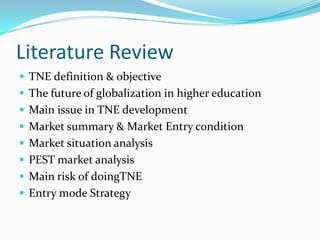
Literature Review
 TNE definition & objective
 The future of globalization in higher education
 Main issue in TNE development
 Market summary & Market Entry condition

 Market situation analysis
 PEST market analysis
 Main risk of doingTNE

 Entry mode Strategy
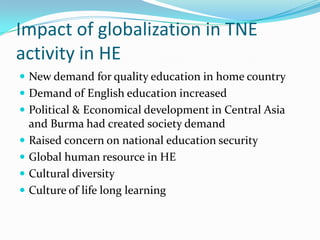
Impact of globalization in TNE
activity in HE
 New demand for quality education in home country
 Demand of English education increased
 Political & Economical development in Central Asia







and Burma had created society demand
Raised concern on national education security
Global human resource in HE
Cultural diversity
Culture of life long learning
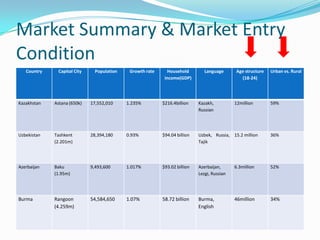
Market Summary & Market Entry
Condition
Country

Capital City

Population

Growth rate

Household
income(GDP)

Language

Age structure
(18-24)

Kazakhstan

Astana (650k)

17,552,010

1.235%

$216.4billion

Kazakh,
Russian

Uzbekistan

Tashkent
(2.201m)

28,394,180

0.93%

$94.04 billion

Uzbek, Russia, 15.2 million
Tajik

36%

Azerbaijan

Baku
(1.95m)

9,493,600

1.017%

$93.02 billion

Azerbaijan,
Lezgi, Russian

6.3million

52%

Burma

Rangoon
(4.259m)

54,584,650

1.07%

58.72 billion

Burma,
English

46million

34%

12million

Urban vs. Rural

59%
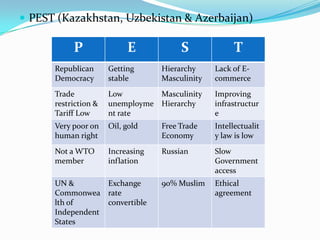
 PEST (Kazakhstan, Uzbekistan & Azerbaijan)

P

E

S

Republican
Democracy

Getting
stable

Trade
restriction &
Tariff Low

Low
Masculinity
unemployme Hierarchy
nt rate

Improving
infrastructur
e

Very poor on
human right

Oil, gold

Free Trade
Economy

Intellectualit
y law is low

Not a WTO
member

Increasing
inflation

Russian

Slow
Government
access

90% Muslim

Ethical
agreement

UN &
Exchange
Commonwea rate
lth of
convertible
Independent
States

Hierarchy
Masculinity

T
Lack of Ecommerce
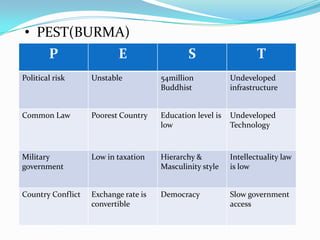
• PEST(BURMA)
P

E

S

T

Political risk

Unstable

54million
Buddhist

Undeveloped
infrastructure

Common Law

Poorest Country

Education level is
low

Undeveloped
Technology

Military
government

Low in taxation

Hierarchy &
Masculinity style

Intellectuality law
is low

Country Conflict

Exchange rate is
convertible

Democracy

Slow government
access
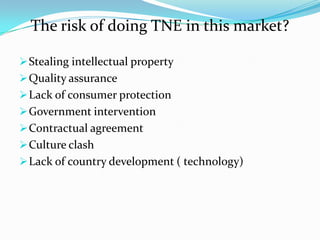
The risk of doing TNE in this market?
 Stealing intellectual property
 Quality assurance
 Lack of consumer protection
 Government intervention
 Contractual agreement
 Culture clash

 Lack of country development ( technology)
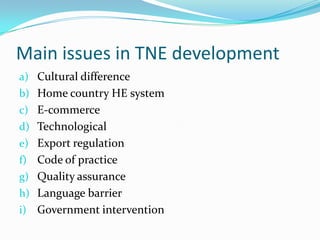
Main issues in TNE development
a) Cultural difference
b) Home country HE system
c) E-commerce
d) Technological

e) Export regulation
f) Code of practice
g) Quality assurance

h) Language barrier
i) Government intervention
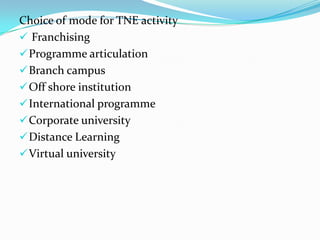
Choice of mode for TNE activity
 Franchising
 Programme articulation
 Branch campus
 Off shore institution
 International programme
 Corporate university
 Distance Learning
 Virtual university
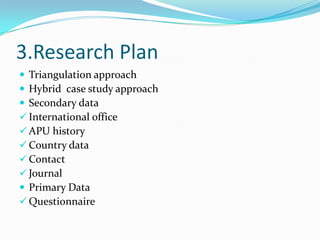
3.Research Plan
 Triangulation approach
 Hybrid case study approach
 Secondary data
 International office
 APU history
 Country data
 Contact
 Journal
 Primary Data
 Questionnaire
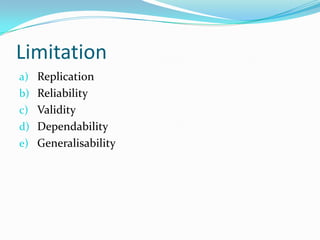
Limitation
a) Replication
b) Reliability
c) Validity
d) Dependability

e) Generalisability
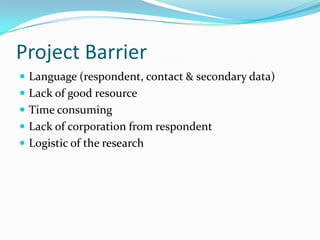
Project Barrier
 Language (respondent, contact & secondary data)
 Lack of good resource
 Time consuming
 Lack of corporation from respondent

 Logistic of the research
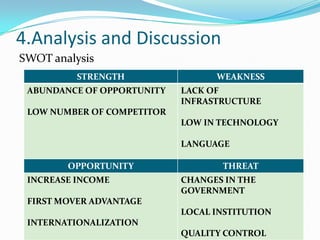
4.Analysis and Discussion
SWOT analysis
STRENGTH
ABUNDANCE OF OPPORTUNITY

WEAKNESS
LACK OF
INFRASTRUCTURE

LOW NUMBER OF COMPETITOR
LOW IN TECHNOLOGY
LANGUAGE
OPPORTUNITY
INCREASE INCOME

THREAT
CHANGES IN THE
GOVERNMENT

FIRST MOVER ADVANTAGE
LOCAL INSTITUTION
INTERNATIONALIZATION
QUALITY CONTROL
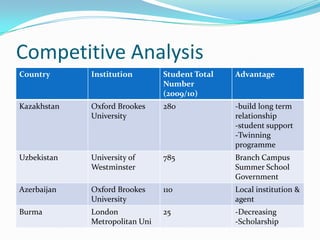
Competitive Analysis
Country

Institution

Student Total
Number
(2009/10)

Advantage

Kazakhstan

Oxford Brookes
University

280

-build long term
relationship
-student support
-Twinning
programme

Uzbekistan

University of
Westminster

785

Branch Campus
Summer School
Government

Azerbaijan

Oxford Brookes
University

110

Local institution &
agent

Burma

London
Metropolitan Uni

25

-Decreasing
-Scholarship
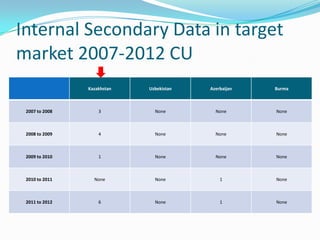
Internal Secondary Data in target
market 2007-2012 CU
Kazakhstan

Uzbekistan

Azerbaijan

Burma

2007 to 2008

3

None

None

None

2008 to 2009

4

None

None

None

2009 to 2010

1

None

None

None

2010 to 2011

None

None

1

None

2011 to 2012

6

None

1

None
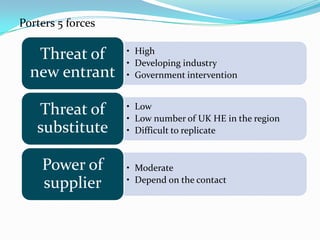
Porters 5 forces

Threat of
new entrant
Threat of
substitute
Power of
supplier

• High
• Developing industry
• Government intervention
• Low
• Low number of UK HE in the region
• Difficult to replicate

• Moderate
• Depend on the contact
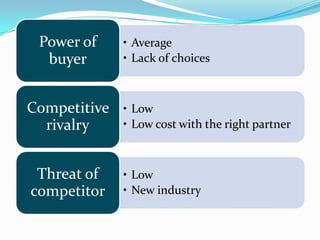
Power of
buyer
Competitive
rivalry
Threat of
competitor

• Average
• Lack of choices

• Low
• Low cost with the right partner

• Low
• New industry
SURVEY FINDING


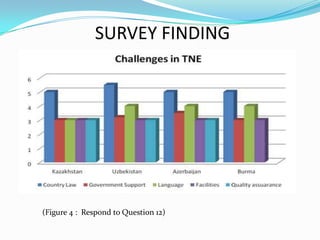
The demand for English education in targeted
countries are growing
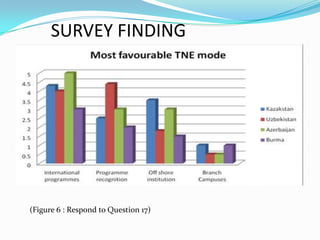
 Four TNE mode identified
1) International programmes
2) Programme recognition
3) Off shore institution
4) Branch campuses
SURVEY FINDING

SURVEY FINDING

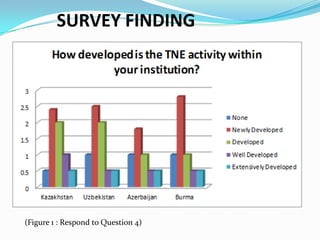
(Figure 1 : Respond to Question 4)
SURVEY FINDING

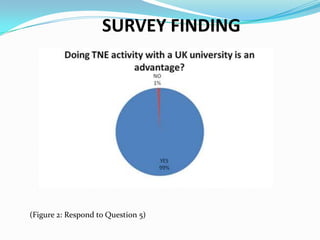
(Figure 2: Respond to Question 5)
SURVEY FINDING

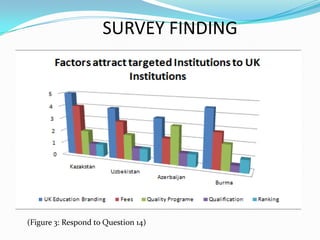
(Figure 3: Respond to Question 14)
SURVEY FINDING

(Figure 4 : Respond to Question 12)
SURVEY FINDING

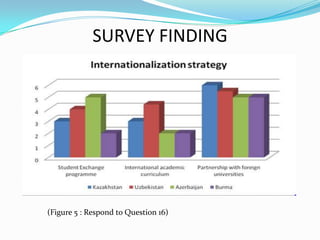
(Figure 5 : Respond to Question 16)
SURVEY FINDING

SURVEY FINDING

(Figure 6 : Respond to Question 17)
5.Conclusion
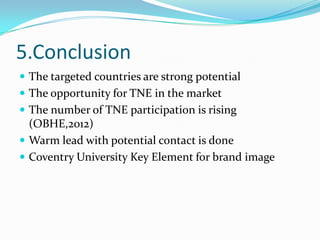
 The targeted countries are strong potential
 The opportunity for TNE in the market
 The number of TNE participation is rising

(OBHE,2012)
 Warm lead with potential contact is done
 Coventry University Key Element for brand image
CONTRIBUTION TO APU, CU
 First market- Kazakhstan
 Why? Demand, bigger potential
 Partnership & Internalization programme exchange
 Build promotion- E expo , partner with local agent &

institution
 Promote on the UK Higher Education Branding
 Aware on Country Law
 Build relationship with government
Potential contact (KAZAKHSTAN)
 International Academy of business
 +7(3272) 423545
 52, Abai ave Almaty 480008 Kazakhstan
 info@iab.kz

 www.iab.kz

7TH August 2012
Coventry University Key Element
for brand image
 Emphasize on the student services to live up the UK

education branding perception
 Clear overview of the potential contact, how to make
the agreement fair (long term partnership agreement)
 Protect intellectual property
 Innovation subjects to suit market
6.Recommendation
 Further Research - in -depth analysis
 Build better promotion awareness
 Competitor analysis
 Appointment of agents +partner institutions

 Aware on the political & legal situation
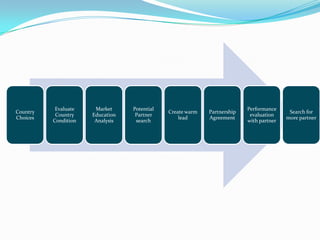
 Steps in building partnership
 Strategic alignment
Country
Choices

Evaluate
Country
Condition

Market
Education
Analysis

Potential
Partner
search

Create warm
lead

Partnership
Agreement

Performance
evaluation
with partner

Search for
more partner
Coventry University Benefits
 Internal growth
 Export market
 Internationalization
 Financial gain

Thank You
Reference
 McBurnie.G., Ziguras,C(2007) Transnational

Education Issues and trends in offshore higher
education.1st edn.New York: Routledge
 University World News (2012) Higher education
trends, challenges and recommendation [online]
available from
http://www.universityworldnews.com/article.php?stor
y=20120609110849181
 UNESCO/Council of Europe (2000) Code of Good
Practice in the provision of transnational
education:Bucharest:UNESCO-CEPES

Transnational Marketing Strategy for New East Asia Market (2012)

  • 1.
    ACADEMIC PARTNERSHIP UNIT SAKINAHMOHD SHUKRI MSc International Business ( First Class Hons)
  • 2.
    Content 1.Background & Objective 2.Literaturereview 3.Research plan 4.Analysis and Discussion 5.Conclusion 6.Recommendation
  • 3.
    Background  What isTNE? “ Education in which the learner are located in a country that is different from the institution award is based in” (UNESCO,2000)  Which Market?  Kazakhstan  Uzbekistan  Azerbaijan  Burma
  • 4.
    Research Objective  Toanalyze the UK TNE activity demand in the       potential market To develop an in - depth analysis To illustrate the strength of the market To make recommendation on strategy To create warm leads for Coventry University To predict the best TNE activity To improve Coventry University brand
  • 5.
    Literature Review  TNEdefinition & objective  The future of globalization in higher education  Main issue in TNE development  Market summary & Market Entry condition  Market situation analysis  PEST market analysis  Main risk of doingTNE  Entry mode Strategy
  • 6.
    Impact of globalizationin TNE activity in HE  New demand for quality education in home country  Demand of English education increased  Political & Economical development in Central Asia     and Burma had created society demand Raised concern on national education security Global human resource in HE Cultural diversity Culture of life long learning
  • 7.
    Market Summary &Market Entry Condition Country Capital City Population Growth rate Household income(GDP) Language Age structure (18-24) Kazakhstan Astana (650k) 17,552,010 1.235% $216.4billion Kazakh, Russian Uzbekistan Tashkent (2.201m) 28,394,180 0.93% $94.04 billion Uzbek, Russia, 15.2 million Tajik 36% Azerbaijan Baku (1.95m) 9,493,600 1.017% $93.02 billion Azerbaijan, Lezgi, Russian 6.3million 52% Burma Rangoon (4.259m) 54,584,650 1.07% 58.72 billion Burma, English 46million 34% 12million Urban vs. Rural 59%
  • 8.
     PEST (Kazakhstan,Uzbekistan & Azerbaijan) P E S Republican Democracy Getting stable Trade restriction & Tariff Low Low Masculinity unemployme Hierarchy nt rate Improving infrastructur e Very poor on human right Oil, gold Free Trade Economy Intellectualit y law is low Not a WTO member Increasing inflation Russian Slow Government access 90% Muslim Ethical agreement UN & Exchange Commonwea rate lth of convertible Independent States Hierarchy Masculinity T Lack of Ecommerce
  • 9.
    • PEST(BURMA) P E S T Political risk Unstable 54million Buddhist Undeveloped infrastructure CommonLaw Poorest Country Education level is low Undeveloped Technology Military government Low in taxation Hierarchy & Masculinity style Intellectuality law is low Country Conflict Exchange rate is convertible Democracy Slow government access
  • 10.
    The risk ofdoing TNE in this market?  Stealing intellectual property  Quality assurance  Lack of consumer protection  Government intervention  Contractual agreement  Culture clash  Lack of country development ( technology)
  • 11.
    Main issues inTNE development a) Cultural difference b) Home country HE system c) E-commerce d) Technological e) Export regulation f) Code of practice g) Quality assurance h) Language barrier i) Government intervention
  • 12.
    Choice of modefor TNE activity  Franchising  Programme articulation  Branch campus  Off shore institution  International programme  Corporate university  Distance Learning  Virtual university
  • 13.
    3.Research Plan  Triangulationapproach  Hybrid case study approach  Secondary data  International office  APU history  Country data  Contact  Journal  Primary Data  Questionnaire
  • 14.
    Limitation a) Replication b) Reliability c)Validity d) Dependability e) Generalisability
  • 15.
    Project Barrier  Language(respondent, contact & secondary data)  Lack of good resource  Time consuming  Lack of corporation from respondent  Logistic of the research
  • 16.
    4.Analysis and Discussion SWOTanalysis STRENGTH ABUNDANCE OF OPPORTUNITY WEAKNESS LACK OF INFRASTRUCTURE LOW NUMBER OF COMPETITOR LOW IN TECHNOLOGY LANGUAGE OPPORTUNITY INCREASE INCOME THREAT CHANGES IN THE GOVERNMENT FIRST MOVER ADVANTAGE LOCAL INSTITUTION INTERNATIONALIZATION QUALITY CONTROL
  • 17.
    Competitive Analysis Country Institution Student Total Number (2009/10) Advantage Kazakhstan OxfordBrookes University 280 -build long term relationship -student support -Twinning programme Uzbekistan University of Westminster 785 Branch Campus Summer School Government Azerbaijan Oxford Brookes University 110 Local institution & agent Burma London Metropolitan Uni 25 -Decreasing -Scholarship
  • 18.
    Internal Secondary Datain target market 2007-2012 CU Kazakhstan Uzbekistan Azerbaijan Burma 2007 to 2008 3 None None None 2008 to 2009 4 None None None 2009 to 2010 1 None None None 2010 to 2011 None None 1 None 2011 to 2012 6 None 1 None
  • 19.
    Porters 5 forces Threatof new entrant Threat of substitute Power of supplier • High • Developing industry • Government intervention • Low • Low number of UK HE in the region • Difficult to replicate • Moderate • Depend on the contact
  • 20.
    Power of buyer Competitive rivalry Threat of competitor •Average • Lack of choices • Low • Low cost with the right partner • Low • New industry
  • 21.
    SURVEY FINDING  The demandfor English education in targeted countries are growing  Four TNE mode identified 1) International programmes 2) Programme recognition 3) Off shore institution 4) Branch campuses
  • 22.
    SURVEY FINDING SURVEY FINDING (Figure1 : Respond to Question 4)
  • 23.
    SURVEY FINDING (Figure 2:Respond to Question 5)
  • 24.
    SURVEY FINDING (Figure 3:Respond to Question 14)
  • 25.
    SURVEY FINDING (Figure 4: Respond to Question 12)
  • 26.
    SURVEY FINDING (Figure 5: Respond to Question 16)
  • 27.
    SURVEY FINDING SURVEY FINDING (Figure6 : Respond to Question 17)
  • 28.
    5.Conclusion  The targetedcountries are strong potential  The opportunity for TNE in the market  The number of TNE participation is rising (OBHE,2012)  Warm lead with potential contact is done  Coventry University Key Element for brand image
  • 29.
    CONTRIBUTION TO APU,CU  First market- Kazakhstan  Why? Demand, bigger potential  Partnership & Internalization programme exchange  Build promotion- E expo , partner with local agent & institution  Promote on the UK Higher Education Branding  Aware on Country Law  Build relationship with government
  • 30.
    Potential contact (KAZAKHSTAN) International Academy of business  +7(3272) 423545  52, Abai ave Almaty 480008 Kazakhstan  info@iab.kz  www.iab.kz 7TH August 2012
  • 31.
    Coventry University KeyElement for brand image  Emphasize on the student services to live up the UK education branding perception  Clear overview of the potential contact, how to make the agreement fair (long term partnership agreement)  Protect intellectual property  Innovation subjects to suit market
  • 32.
    6.Recommendation  Further Research- in -depth analysis  Build better promotion awareness  Competitor analysis  Appointment of agents +partner institutions  Aware on the political & legal situation  Steps in building partnership  Strategic alignment
  • 33.
  • 34.
    Coventry University Benefits Internal growth  Export market  Internationalization  Financial gain Thank You
  • 35.
    Reference  McBurnie.G., Ziguras,C(2007)Transnational Education Issues and trends in offshore higher education.1st edn.New York: Routledge  University World News (2012) Higher education trends, challenges and recommendation [online] available from http://www.universityworldnews.com/article.php?stor y=20120609110849181  UNESCO/Council of Europe (2000) Code of Good Practice in the provision of transnational education:Bucharest:UNESCO-CEPES