Company and Marketing Strategy:
Partnering to Build Customer
Relationships
Chapter 2
Learning Goals
1. Explain strategic planning
2. Describe business portfolios and growth strategies
3. Detail marketing’s role in strategic planning
4. Describe elements of customer-driven marketing
strategy and marketing mix
5. List the marketing management functions
2
What is Strategic Planning?
•Strategic Planning Defined:
• The process of developing and maintaining a strategic fit between the
organization’s goals and capabilities and its changing marketing opportunities
3
Goal 1: Explain strategic planning
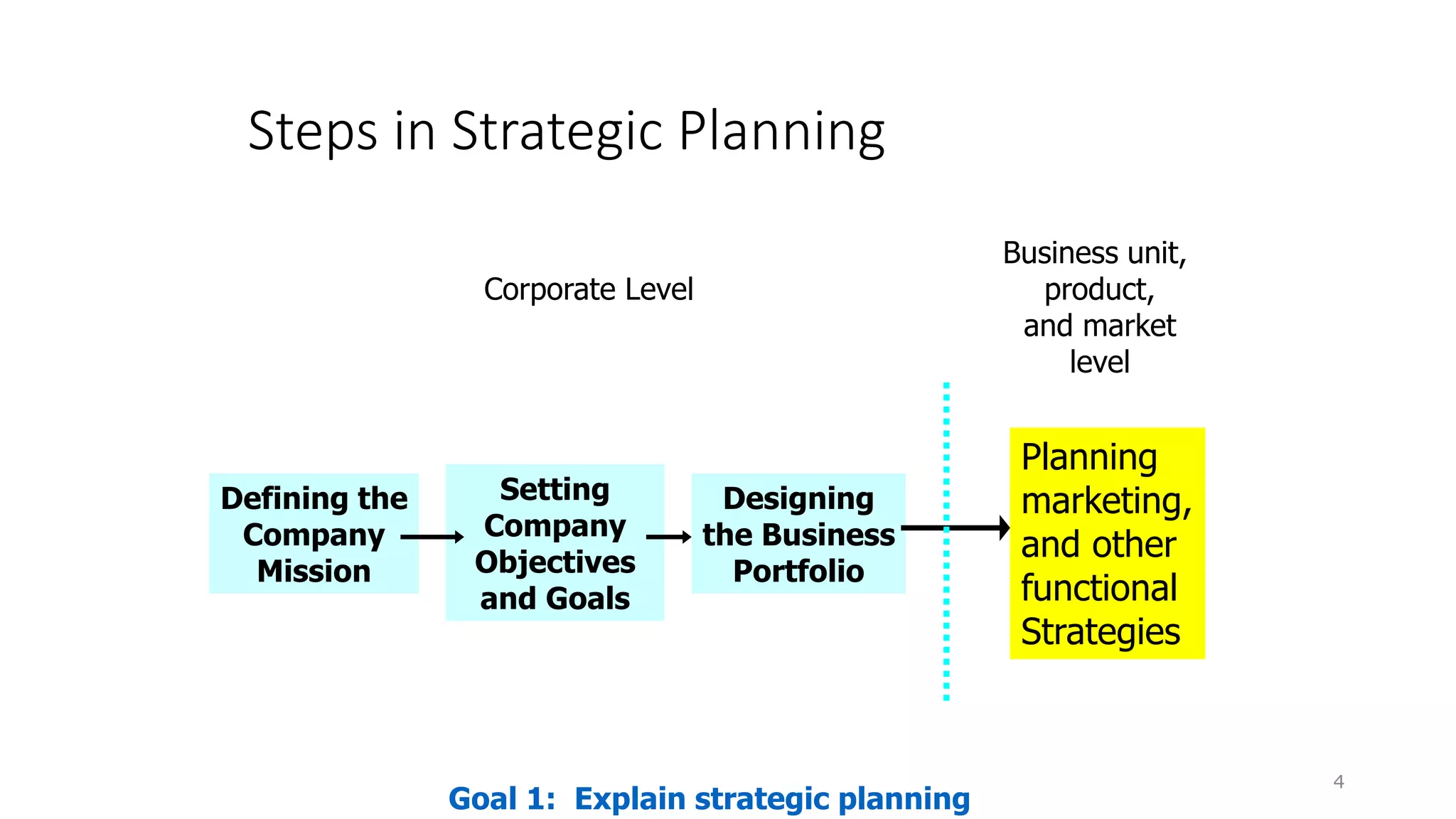
Steps in Strategic Planning
4
Defining the
Company
Mission
Setting
Company
Objectives
and Goals
Designing
the Business
Portfolio
Planning
marketing,
and other
functional
Strategies
Corporate Level
Business unit,
product,
and market
level
Goal 1: Explain strategic planning
Mission Statement
• A statement of the organization’s purpose- what it wants to
accomplish in the larger environment.
• A mission statement asks..
• What is our business?
• Who is the customer?
• What do consumers value?
• What should our business be?
5
Goal 1: Explain strategic planning
Defining a market-oriented Mission
6
Market Oriented
Realistic
Fit Market Environment
Distinctive Competencies
Motivating
Specific
Characteristics of
a Good Mission
Statement:
Goal 1: Explain strategic planning
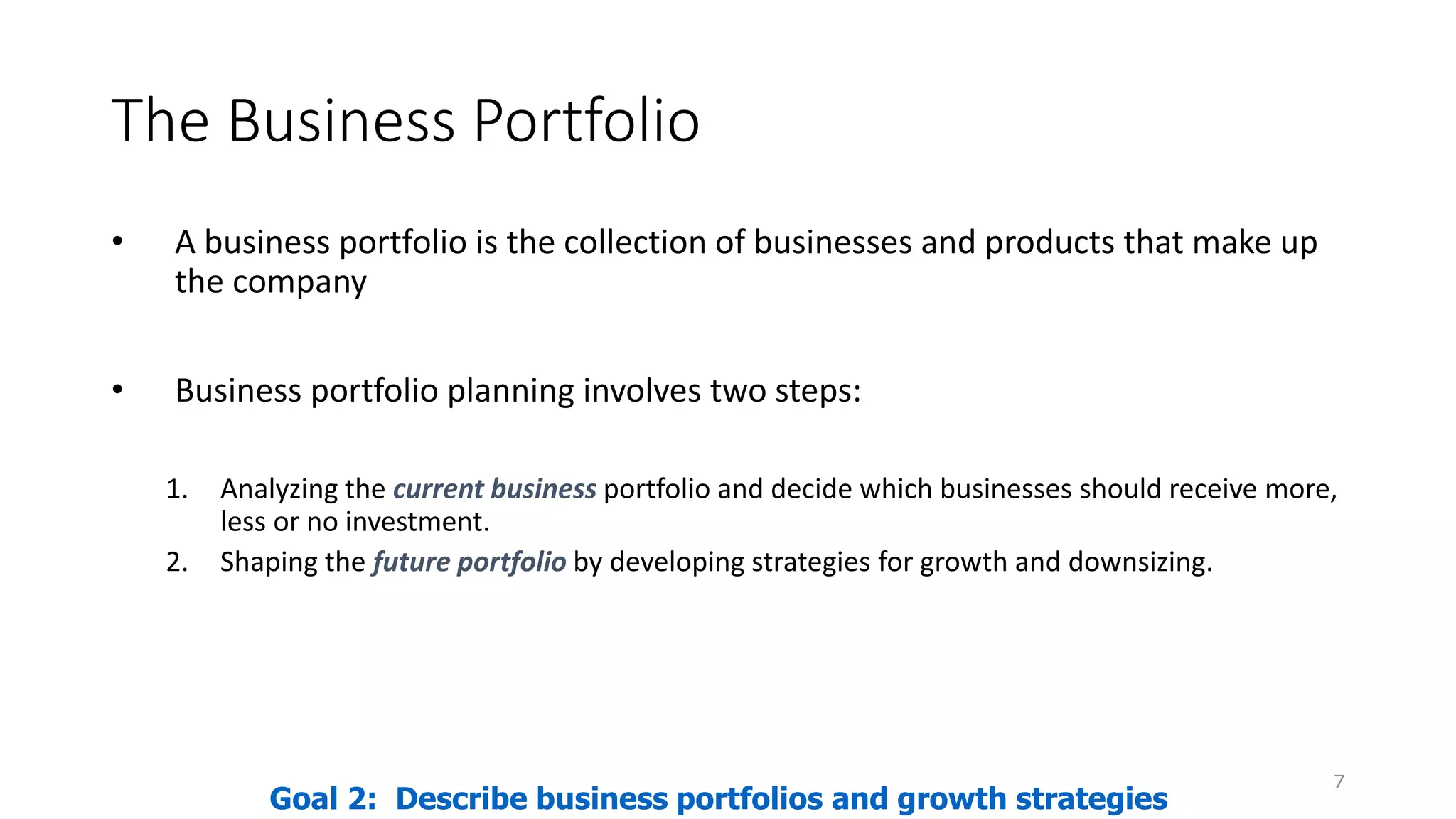
The Business Portfolio
• A business portfolio is the collection of businesses and products that make up
the company
• Business portfolio planning involves two steps:
1. Analyzing the current business portfolio and decide which businesses should receive more,
less or no investment.
2. Shaping the future portfolio by developing strategies for growth and downsizing.
7
Goal 2: Describe business portfolios and growth strategies
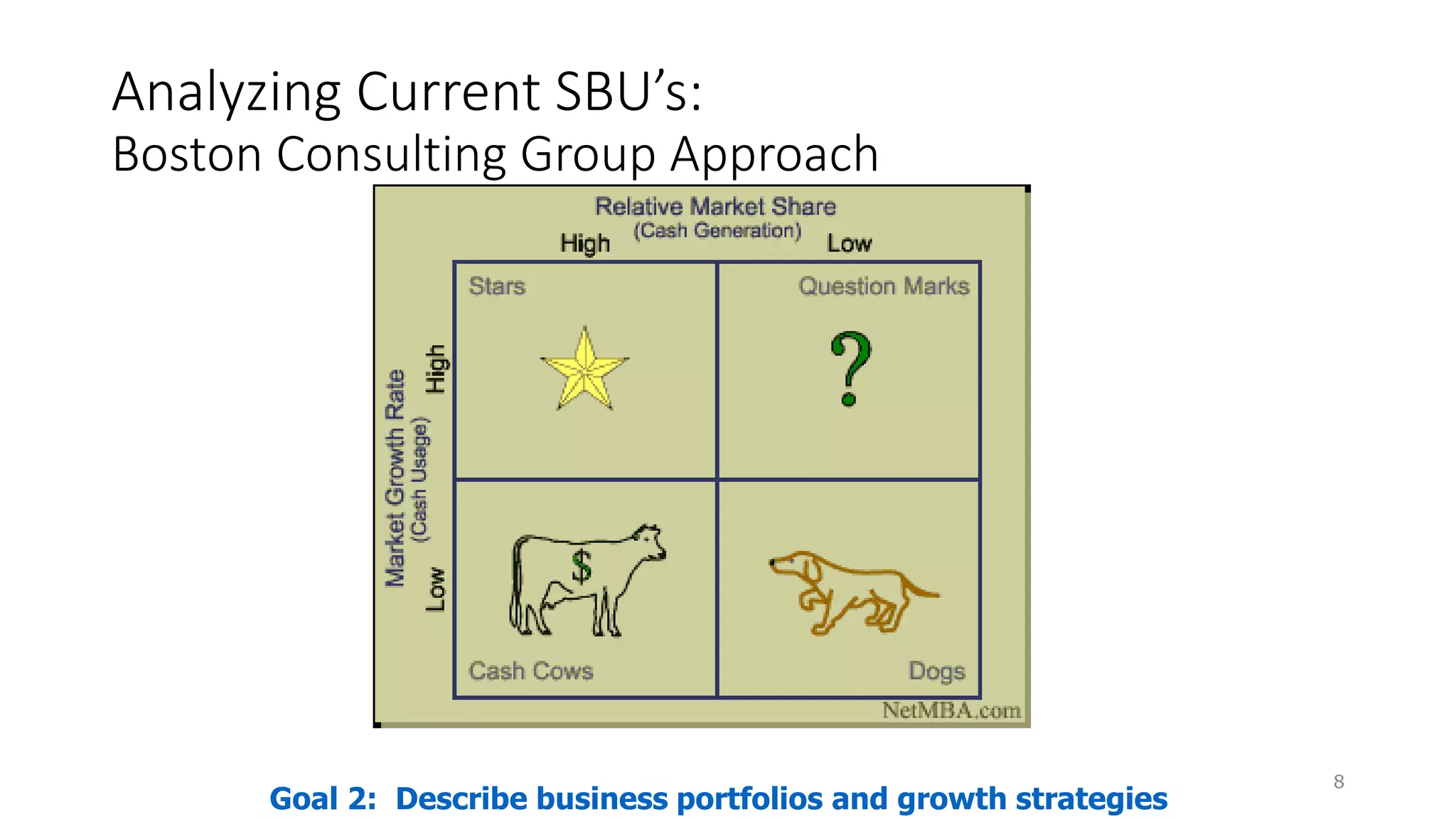
Analyzing Current SBU’s:
Boston Consulting Group Approach
8
Goal 2: Describe business portfolios and growth strategies
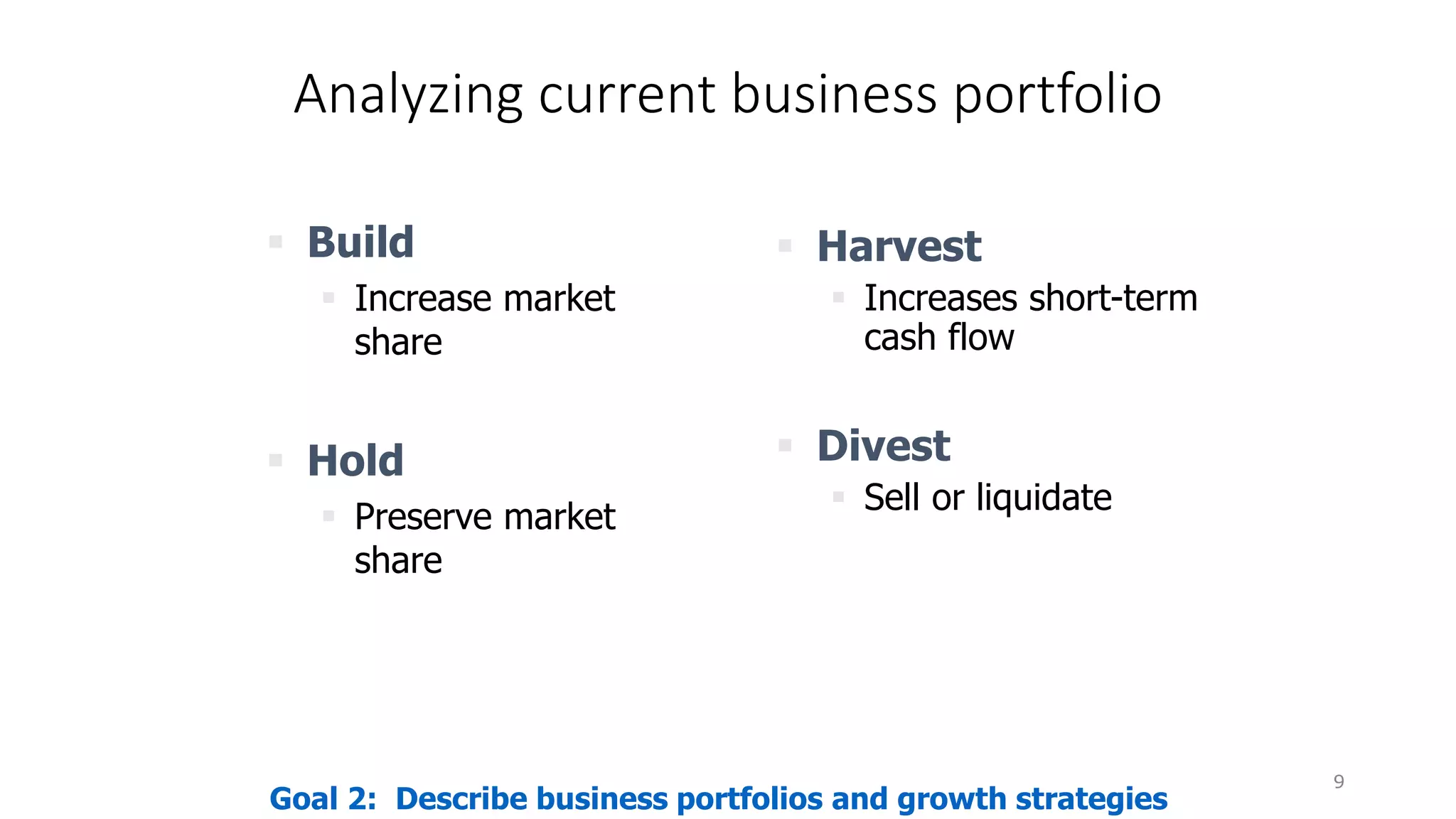
Analyzing current business portfolio
9
 Build
 Increase market
share
 Hold
 Preserve market
share
 Harvest
 Increases short-term
cash flow
 Divest
 Sell or liquidate
Goal 2: Describe business portfolios and growth strategies
Developing Strategies for Growth
10
1. Market
Penetration
2. Market
Development
3. Product
Development
4. Diversification
Existing
Markets
New
Markets
Existing
Products
New
Products
Product/ Market Expansion Grid
Goal 2: Describe business portfolios and growth strategies
Product/ Market Expansion Grid
• Market Penetration: making more sales to current customers
without changing its products.
• How? Add new stores in current market areas, improve advertising,
prices, service or store design.
• Market Development: develop new markets for its current
products
• How? Identify new demographic or geographic markets.
11
Goal 2: Describe business portfolios and growth strategies
Product/ Market Expansion Grid
• Product Development: offering modified or new products to
current markets.
• How? New styles, flavors, colors, or modified products.
• Diversification: new products for new markets.
• How? Start up or buy new businesses.
12
Goal 2: Describe business portfolios and growth strategies
Marketing’s Role in Strategic Planning
• Provide a guiding philosophy
• Identify attractive opportunities
• Design effective strategies
• Build strong value chains
• Form superior value delivery networks
13
Goal 3: Detail marketing's role in strategic planning
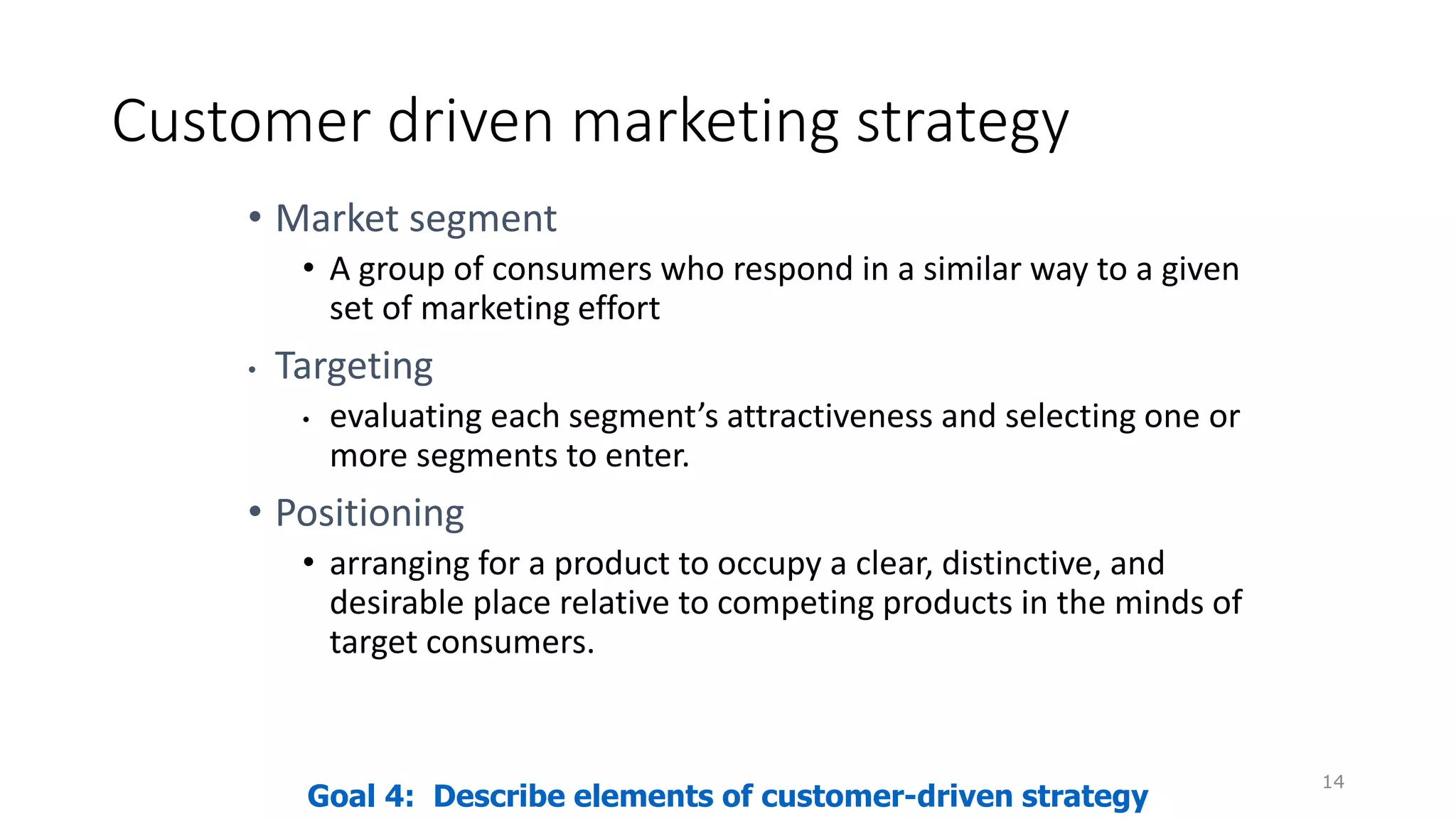
Customer driven marketing strategy
• Market segment
• A group of consumers who respond in a similar way to a given
set of marketing effort
• Targeting
• evaluating each segment’s attractiveness and selecting one or
more segments to enter.
• Positioning
• arranging for a product to occupy a clear, distinctive, and
desirable place relative to competing products in the minds of
target consumers.
14
Goal 4: Describe elements of customer-driven strategy
Marketing Mix
• The marketing mix includes controllable and tactical marketing tools
knows as the 4P’s
• The 4P’s include
• Product
• Place
• Promotion
• Price
15
Goal 4: Describe elements of customer-driven strategy
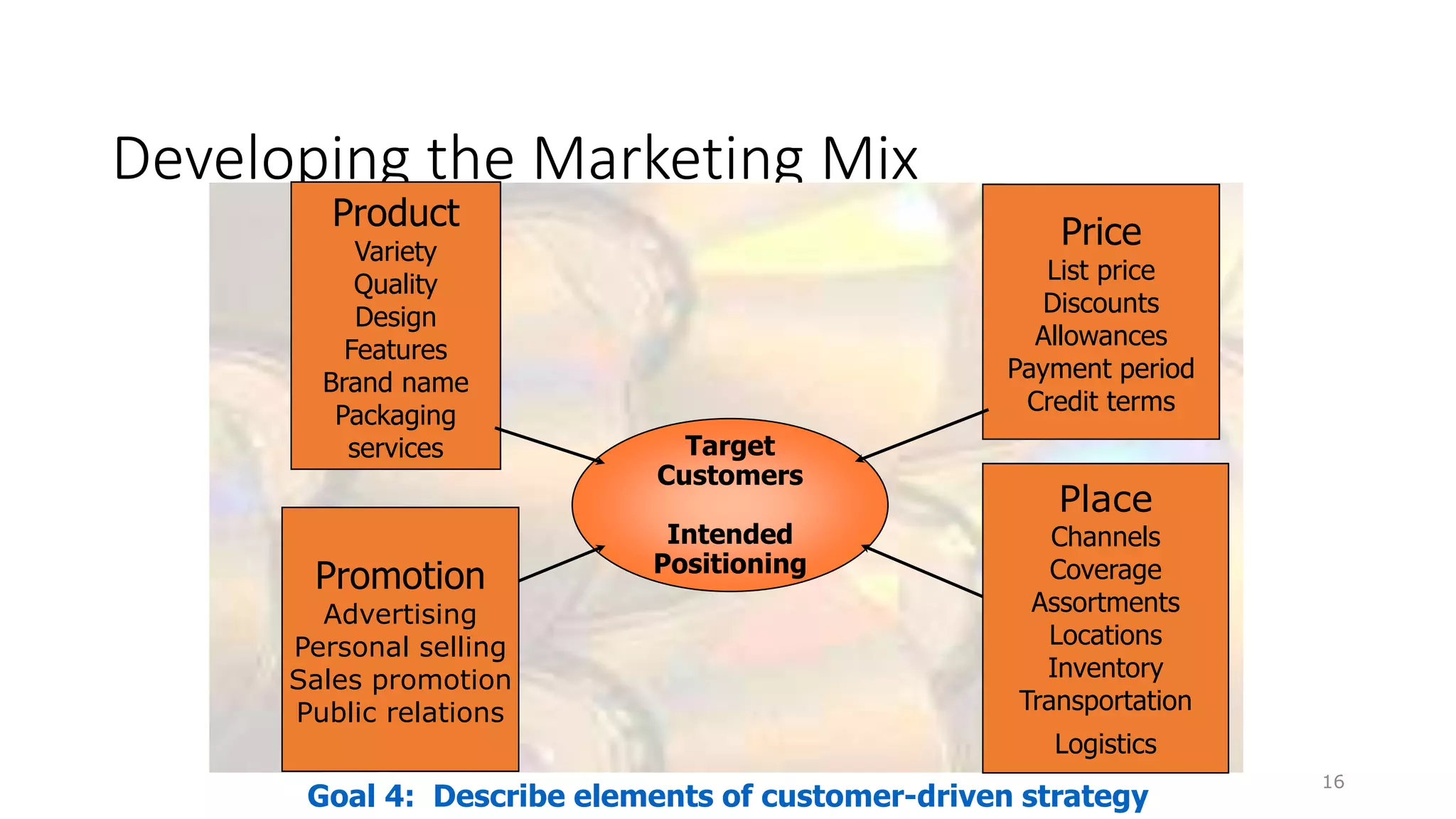
Developing the Marketing Mix
16
Target
Customers
Intended
Positioning
Product
Variety
Quality
Design
Features
Brand name
Packaging
services
Price
List price
Discounts
Allowances
Payment period
Credit terms
Promotion
Advertising
Personal selling
Sales promotion
Public relations
Place
Channels
Coverage
Assortments
Locations
Inventory
Transportation
Logistics
Goal 4: Describe elements of customer-driven strategy
The 4 P’s & 4C’s of the Marketing Mix
17
Goal 4: Describe elements of customer-driven strategy
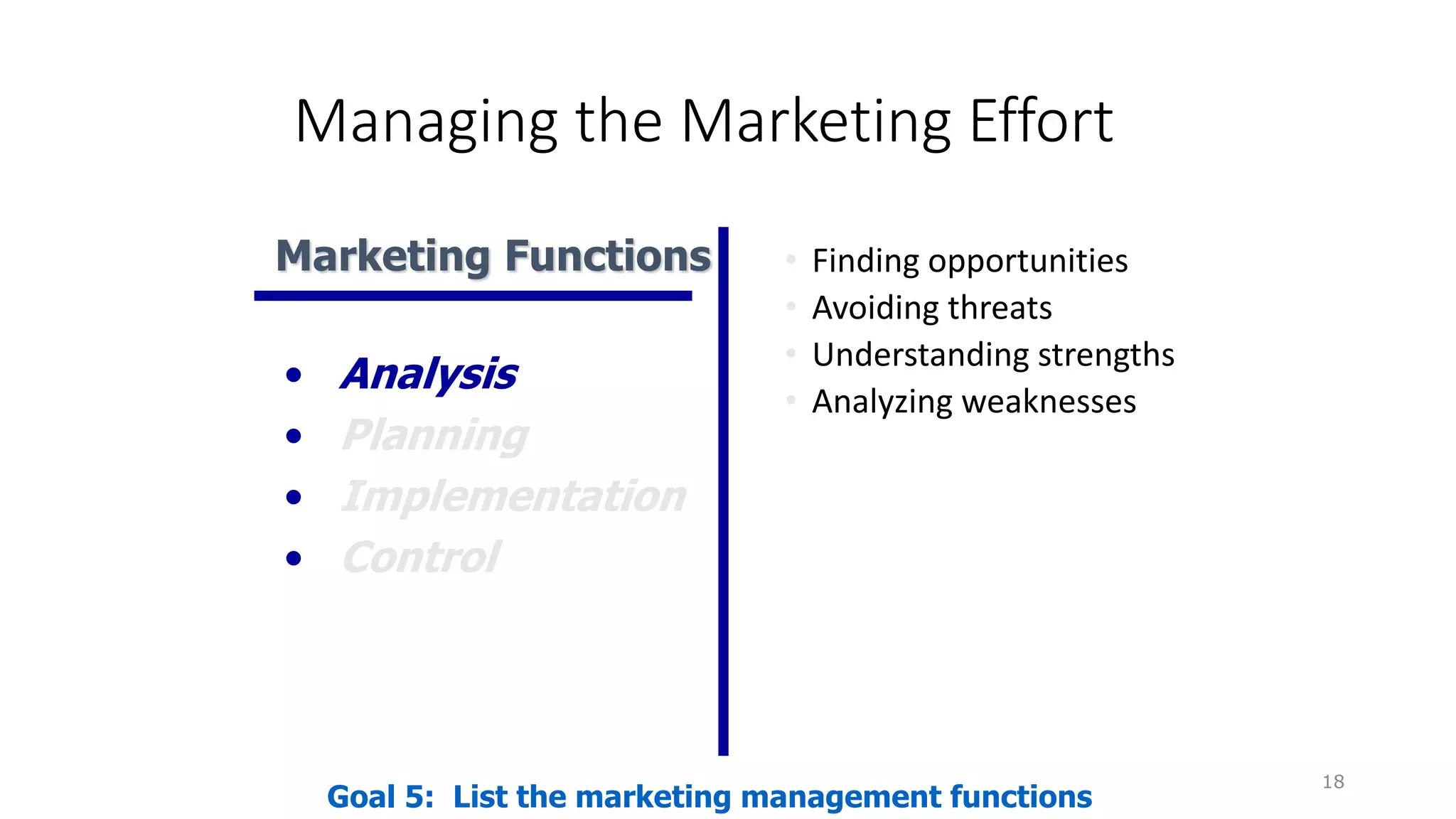
Managing the Marketing Effort
• Finding opportunities
• Avoiding threats
• Understanding strengths
• Analyzing weaknesses
18
Goal 5: List the marketing management functions
• Analysis
• Planning
• Implementation
• Control
Marketing Functions
Managing the Marketing Effort
• Marketing plans include:
• Executive summary
• Current market situation
• Threats and opportunities analysis
• Objectives and issues
• Marketing strategy
• Action programs
• Budget
• Controls
19
Goal 5: List the marketing management functions
Marketing Functions
• Analysis
• Planning
• Implementation
• Control
Managing the Marketing Effort
• Plans are turned into
action with day-to-day
activities
• Good implementation is a
challenge
20
Goal 5: List the marketing management functions
Marketing Functions
• Analysis
• Planning
• Implementation
• Control
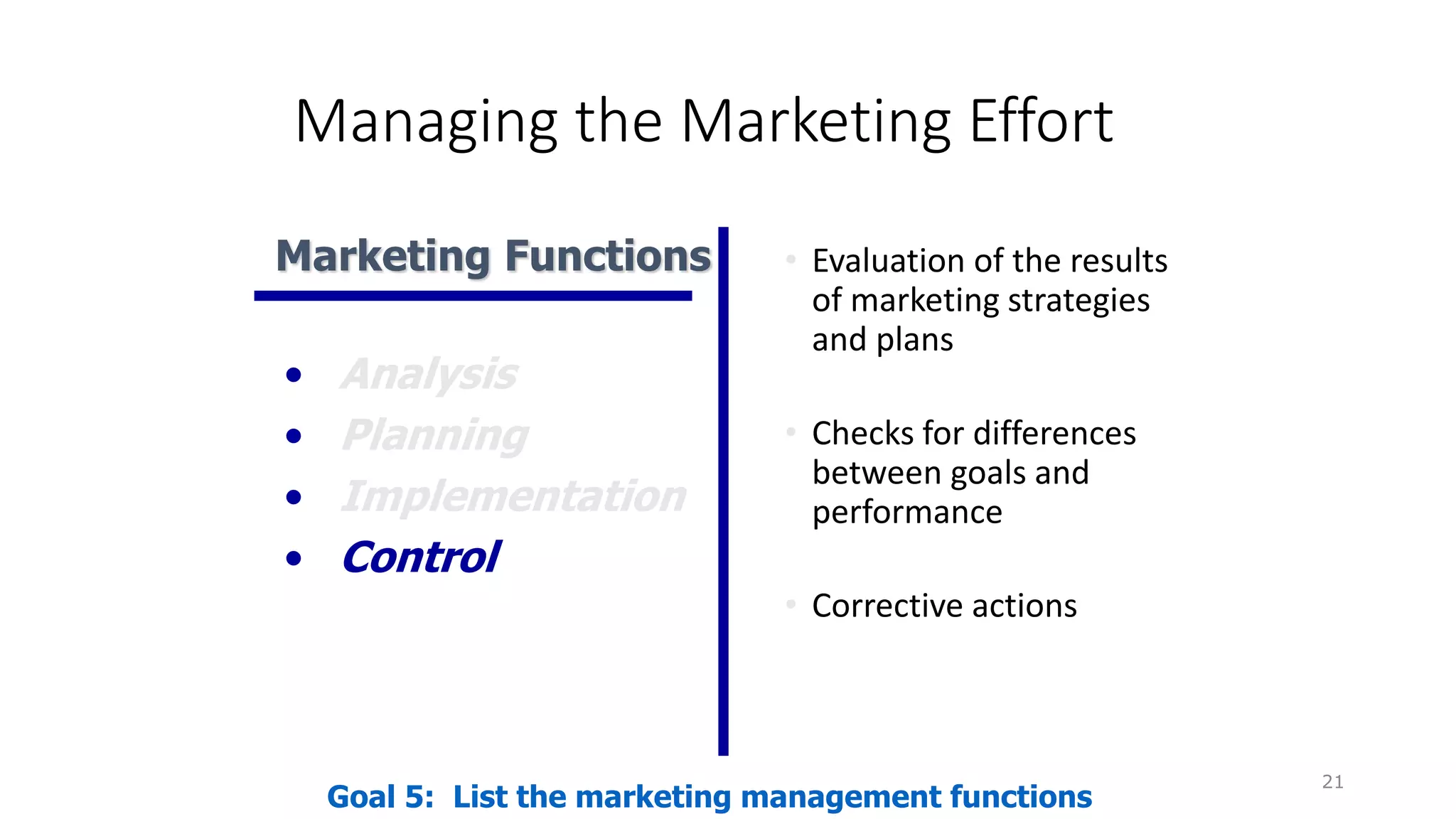
Managing the Marketing Effort
• Evaluation of the results
of marketing strategies
and plans
• Checks for differences
between goals and
performance
• Corrective actions
21
Goal 5: List the marketing management functions
Marketing Functions
• Analysis
• Planning
• Implementation
• Control

ch_2.ppt

  • 1.
    Company and MarketingStrategy: Partnering to Build Customer Relationships Chapter 2
  • 2.
    Learning Goals 1. Explainstrategic planning 2. Describe business portfolios and growth strategies 3. Detail marketing’s role in strategic planning 4. Describe elements of customer-driven marketing strategy and marketing mix 5. List the marketing management functions 2
  • 3.
    What is StrategicPlanning? •Strategic Planning Defined: • The process of developing and maintaining a strategic fit between the organization’s goals and capabilities and its changing marketing opportunities 3 Goal 1: Explain strategic planning
  • 4.
    Steps in StrategicPlanning 4 Defining the Company Mission Setting Company Objectives and Goals Designing the Business Portfolio Planning marketing, and other functional Strategies Corporate Level Business unit, product, and market level Goal 1: Explain strategic planning
  • 5.
    Mission Statement • Astatement of the organization’s purpose- what it wants to accomplish in the larger environment. • A mission statement asks.. • What is our business? • Who is the customer? • What do consumers value? • What should our business be? 5 Goal 1: Explain strategic planning
  • 6.
    Defining a market-orientedMission 6 Market Oriented Realistic Fit Market Environment Distinctive Competencies Motivating Specific Characteristics of a Good Mission Statement: Goal 1: Explain strategic planning
  • 7.
    The Business Portfolio •A business portfolio is the collection of businesses and products that make up the company • Business portfolio planning involves two steps: 1. Analyzing the current business portfolio and decide which businesses should receive more, less or no investment. 2. Shaping the future portfolio by developing strategies for growth and downsizing. 7 Goal 2: Describe business portfolios and growth strategies
  • 8.
    Analyzing Current SBU’s: BostonConsulting Group Approach 8 Goal 2: Describe business portfolios and growth strategies
  • 9.
    Analyzing current businessportfolio 9  Build  Increase market share  Hold  Preserve market share  Harvest  Increases short-term cash flow  Divest  Sell or liquidate Goal 2: Describe business portfolios and growth strategies
  • 10.
    Developing Strategies forGrowth 10 1. Market Penetration 2. Market Development 3. Product Development 4. Diversification Existing Markets New Markets Existing Products New Products Product/ Market Expansion Grid Goal 2: Describe business portfolios and growth strategies
  • 11.
    Product/ Market ExpansionGrid • Market Penetration: making more sales to current customers without changing its products. • How? Add new stores in current market areas, improve advertising, prices, service or store design. • Market Development: develop new markets for its current products • How? Identify new demographic or geographic markets. 11 Goal 2: Describe business portfolios and growth strategies
  • 12.
    Product/ Market ExpansionGrid • Product Development: offering modified or new products to current markets. • How? New styles, flavors, colors, or modified products. • Diversification: new products for new markets. • How? Start up or buy new businesses. 12 Goal 2: Describe business portfolios and growth strategies
  • 13.
    Marketing’s Role inStrategic Planning • Provide a guiding philosophy • Identify attractive opportunities • Design effective strategies • Build strong value chains • Form superior value delivery networks 13 Goal 3: Detail marketing's role in strategic planning
  • 14.
    Customer driven marketingstrategy • Market segment • A group of consumers who respond in a similar way to a given set of marketing effort • Targeting • evaluating each segment’s attractiveness and selecting one or more segments to enter. • Positioning • arranging for a product to occupy a clear, distinctive, and desirable place relative to competing products in the minds of target consumers. 14 Goal 4: Describe elements of customer-driven strategy
  • 15.
    Marketing Mix • Themarketing mix includes controllable and tactical marketing tools knows as the 4P’s • The 4P’s include • Product • Place • Promotion • Price 15 Goal 4: Describe elements of customer-driven strategy Goal 4: Describe elements of customer-driven strategy
  • 16.
    Developing the MarketingMix 16 Target Customers Intended Positioning Product Variety Quality Design Features Brand name Packaging services Price List price Discounts Allowances Payment period Credit terms Promotion Advertising Personal selling Sales promotion Public relations Place Channels Coverage Assortments Locations Inventory Transportation Logistics Goal 4: Describe elements of customer-driven strategy
  • 17.
    The 4 P’s& 4C’s of the Marketing Mix 17 Goal 4: Describe elements of customer-driven strategy
  • 18.
    Managing the MarketingEffort • Finding opportunities • Avoiding threats • Understanding strengths • Analyzing weaknesses 18 Goal 5: List the marketing management functions • Analysis • Planning • Implementation • Control Marketing Functions
  • 19.
    Managing the MarketingEffort • Marketing plans include: • Executive summary • Current market situation • Threats and opportunities analysis • Objectives and issues • Marketing strategy • Action programs • Budget • Controls 19 Goal 5: List the marketing management functions Marketing Functions • Analysis • Planning • Implementation • Control
  • 20.
    Managing the MarketingEffort • Plans are turned into action with day-to-day activities • Good implementation is a challenge 20 Goal 5: List the marketing management functions Marketing Functions • Analysis • Planning • Implementation • Control
  • 21.
    Managing the MarketingEffort • Evaluation of the results of marketing strategies and plans • Checks for differences between goals and performance • Corrective actions 21 Goal 5: List the marketing management functions Marketing Functions • Analysis • Planning • Implementation • Control