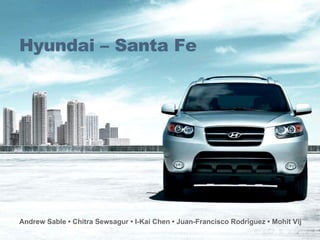
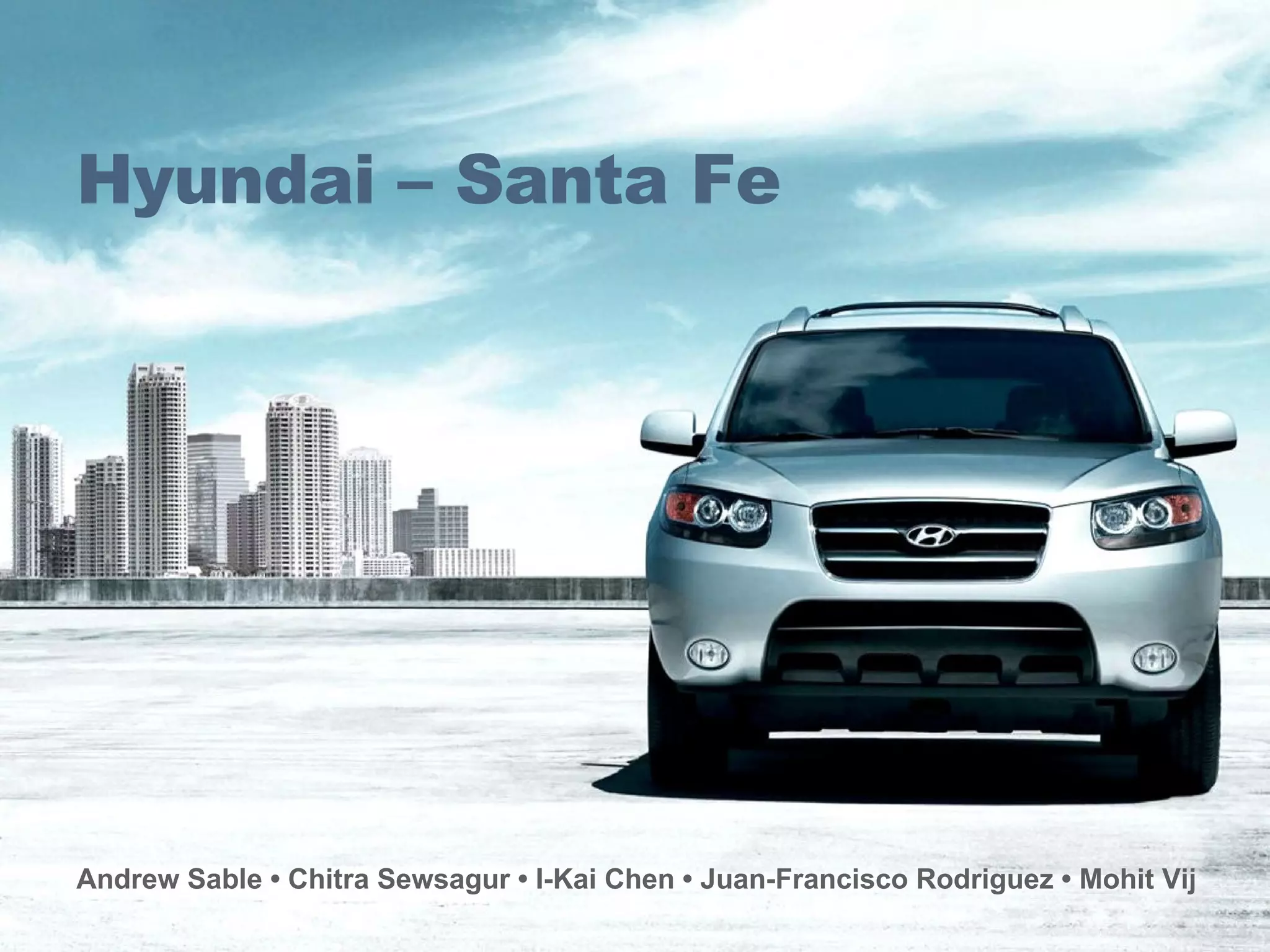
Hyundai – Santa Fe Andrew Sable • Chitra Sewsagur • I-Kai Chen • Juan-Francisco Rodriguez • Mohit Vij
Hyundai History phase I (1980s): Pony, Excel, and Stellar  Phase II (1990s):  "it’s nice ... for a Hyundai“ Phase III (2000 – present):
Hyundai – Santa Fe Hyundai's best seller in the States in late 90s. Santa Fe falls between a compact and midsize    crossover SUV, also known as CUV.   Sleek design.
Segmentation Process Hyundai generally employs  LifeMatrix,   NOP World’s segmentation 1  that details the consumer landscape using values, lifestyle, life stages and demographics.  Such research addresses three general areas of questioning.  A product perspective  A consumer perspective  A brand perception standpoint  However ….. SANTA FE…..  was born differently!!
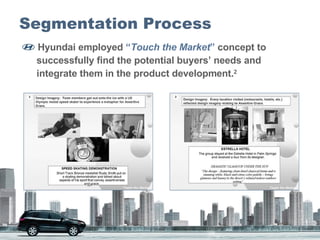
Segmentation Process Hyundai employed  “ Touch the Market ”  concept to    successfully find the potential buyers’ needs and    integrate them in the product development. 2
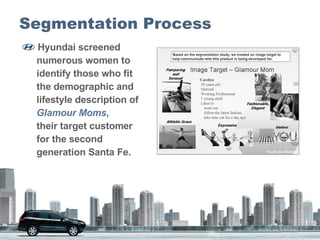
Segmentation Process Hyundai screened    numerous women to    identify those who fit    the demographic and   lifestyle description of    Glamour Moms ,   their target customer    for the second    generation Santa Fe.
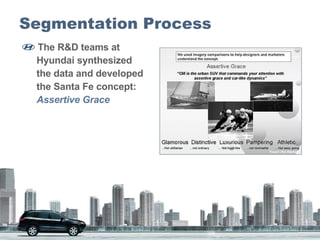
Segmentation Process The R&D teams at    Hyundai synthesized    the data and developed   the Santa Fe concept:    Assertive Grace
Target Market Eventually, Santa Fe's target market constituted of  practical buyers with limited means 60 percent of whom were males who placed a high priority on hardware and appearance and  who could not afford the premium brands but  liked to make a statement. Precisely it was a broad customer base of in the age category of 25-40 urban class with safety and comfort as prime orientation. young professionals or entrepreneurs who want a spacious yet elegant vehicle
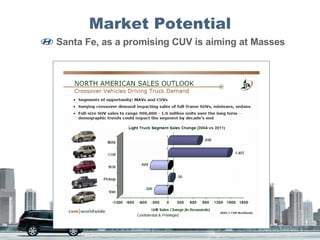
Market Potential Santa Fe, as a promising CUV is aiming at Masses
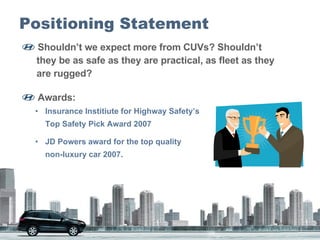
Positioning Statement  Shouldn’t we expect more from CUVs? Shouldn’t    they be as safe as they are practical, as fleet as they    are rugged?  Awards: Insurance Institiute for Highway Safety’s  Top Safety Pick Award 2007 JD Powers award for the top quality  non-luxury car 2007.
Santa Fe versus Land Rover
Communication  Clear and unambiguous in communicating their    positioning statement recently Santa Fe versus a known prestigous and high quality    SUV in the Land Rover Well rounded SUV with high quality at a reasonable price You can’t win Everything!
Santa Fe's positioning statement and competitors   Toyota RAV-4: "No matter how you define performance,    Toyota Canada's 2008 RAV4 re-defines it"  Honda CRV: “Something new to crave.”  Hyundai Santa Fe: Same level of quality and best safety    feature for a lower price
Evolution of Positioning statements 2002 : “The thinking person’s SUV”  2004 : “Stylish SUV”  2006 : “Flexible, Agile and for whatever shape life takes” “Refresh, rejuvenate and a welcome respite from the everyday” 2007 : "Presenting a new reference, recipient of the Insurance Institute for Highway Safety’s Top Safety Pick award for 2007 and thoughtfully designed to pursue adventure while giving up nothing to performance. Think about it.”
Recommendation Be consistent with its positioning statement Standardized slogan and advertisement Clear defined differentiating strategy Apply “touch the market” qualitative method to new and existing product
Q & A period
Appendix Source :  http://www.mediamark.com/mri/TheSource/sorc2005_03.htm Source:  http://www.pdma.org/visions/june07/cover-story.php

Marketing Santa Fe

  • 1.
    Hyundai – SantaFe Andrew Sable • Chitra Sewsagur • I-Kai Chen • Juan-Francisco Rodriguez • Mohit Vij
  • 2.
    Hyundai History phaseI (1980s): Pony, Excel, and Stellar Phase II (1990s): "it’s nice ... for a Hyundai“ Phase III (2000 – present):
  • 3.
    Hyundai – SantaFe Hyundai's best seller in the States in late 90s. Santa Fe falls between a compact and midsize crossover SUV, also known as CUV. Sleek design.
  • 4.
    Segmentation Process Hyundaigenerally employs LifeMatrix, NOP World’s segmentation 1 that details the consumer landscape using values, lifestyle, life stages and demographics. Such research addresses three general areas of questioning.  A product perspective  A consumer perspective A brand perception standpoint However ….. SANTA FE….. was born differently!!
  • 5.
    Segmentation Process Hyundaiemployed “ Touch the Market ” concept to successfully find the potential buyers’ needs and integrate them in the product development. 2
  • 6.
    Segmentation Process Hyundaiscreened numerous women to identify those who fit the demographic and lifestyle description of Glamour Moms , their target customer for the second generation Santa Fe.
  • 7.
    Segmentation Process TheR&D teams at Hyundai synthesized the data and developed the Santa Fe concept: Assertive Grace
  • 8.
    Target Market Eventually,Santa Fe's target market constituted of practical buyers with limited means 60 percent of whom were males who placed a high priority on hardware and appearance and who could not afford the premium brands but liked to make a statement. Precisely it was a broad customer base of in the age category of 25-40 urban class with safety and comfort as prime orientation. young professionals or entrepreneurs who want a spacious yet elegant vehicle
  • 9.
    Market Potential SantaFe, as a promising CUV is aiming at Masses
  • 10.
    Positioning Statement Shouldn’t we expect more from CUVs? Shouldn’t they be as safe as they are practical, as fleet as they are rugged? Awards: Insurance Institiute for Highway Safety’s Top Safety Pick Award 2007 JD Powers award for the top quality non-luxury car 2007.
  • 11.
    Santa Fe versusLand Rover
  • 12.
    Communication Clearand unambiguous in communicating their positioning statement recently Santa Fe versus a known prestigous and high quality SUV in the Land Rover Well rounded SUV with high quality at a reasonable price You can’t win Everything!
  • 13.
    Santa Fe's positioningstatement and competitors Toyota RAV-4: "No matter how you define performance, Toyota Canada's 2008 RAV4 re-defines it" Honda CRV: “Something new to crave.” Hyundai Santa Fe: Same level of quality and best safety feature for a lower price
  • 14.
    Evolution of Positioningstatements 2002 : “The thinking person’s SUV” 2004 : “Stylish SUV” 2006 : “Flexible, Agile and for whatever shape life takes” “Refresh, rejuvenate and a welcome respite from the everyday” 2007 : "Presenting a new reference, recipient of the Insurance Institute for Highway Safety’s Top Safety Pick award for 2007 and thoughtfully designed to pursue adventure while giving up nothing to performance. Think about it.”
  • 15.
    Recommendation Be consistentwith its positioning statement Standardized slogan and advertisement Clear defined differentiating strategy Apply “touch the market” qualitative method to new and existing product
  • 16.
    Q & Aperiod
  • 17.
    Appendix Source : http://www.mediamark.com/mri/TheSource/sorc2005_03.htm Source: http://www.pdma.org/visions/june07/cover-story.php