The Marketing Process
Kimberly Limanto 201605008
Siting Cheng 201605048
Seka Gerod Strivane 201709025
Doing Business in China
SolBridge International School of Business
MBA – Fall 2017
Contents
Introduction
I. Market Research in China
• Published Sources
• Bespoke Quantitative Research
• Qualitative Research
• Other Information
II. Planning
Conclusion
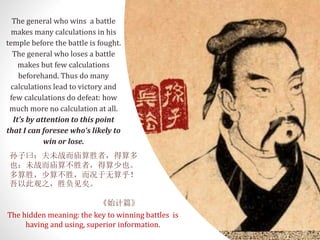
The general who wins a battle
makes many calculations in his
temple before the battle is fought.
The general who loses a battle
makes but few calculations
beforehand. Thus do many
calculations lead to victory and
few calculations do defeat: how
much more no calculation at all.
It’s by attention to this point
that I can foresee who‘s likely to
win or lose.
孙子曰:夫未战而庙算胜者,得算多
也;未战而庙算不胜者,得算少也。
多算胜,少算不胜,而况于无算乎!
吾以此观之,胜负见矣。
《始计篇》
The hidden meaning: the key to winning battles is
having and using, superior information.
Introduction
• The difficulty of acquiring reliable factual information .
• The principal need to understand Chinese markets rather
than handling over to local affiliates
• Apart from three main ways of market research in PRC,
practical strategy for integrating information is also
required.
• Be aware that guanxi is some sort of local peculiarity,
businessman should take it into consideration when
making business plan.
1. Market Research in China
Published Sources in China
Getting accurate and reliable information before in China
was not easy because they were:
• A big system that collected and analyzed information for central
planning purposes. The centralization of information in many agencies
like (commissions, ministries, national corporation and industries
councils) make things difficult for western and even for local company,
the most issue their faced is sometime is really tricky to identify the
right person to address your issue because he is undefinable.
Published Sources in China
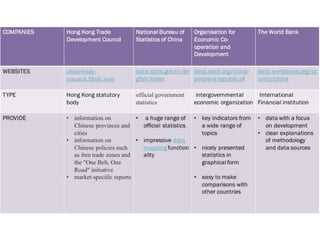
But nowadays the situation changed because technology and
internet. Many basic and generics information are online because
the state statistical bureau and some ministries set up a service
Centre that ensure data's availability.
However trusting in local intermediaries is more recommended
because they are more near to customers, also independent
verification and checking is required because data accuracy and
unreliability.
Quantitative Research
• Making research is very easy because nowadays :
• There are many Western and Chinese market research agencies including
states and J.V agencies.
• But, the issues concerning these agencies are the fact that most of them
are one-man bands working from home or small agencies so sometime
they just copy and past information from internet without any
intellectual input.
• Also there are a lack of serious companies that follow all the steps to
conduct good quantitative research by doing survey, questionnaire
detailed audits and so one..
• That’s why consultants in Beijing and shanghai advice their consumers
to ask for references before employing any market research agencies and
customer feedbacks also.
Survey Research Group
• SGR is the first major market research agency created in 1984 in
Hong Kong then enlarged its’ business in some big cities as
Shanghai and Beijing.
• It presents in worldwide market and works mostly for US foreign
companies
• The company is using the logic of "you get what you pay for"
• The company evolve in desk research and in-depth interview by
using standard methodology similar to Western Research
Agencies
• The issue with the company is sometime they results are
unreliable because they are using Western methodologies in
Chinese market , hence facing some contradictions issues.
3 Reasons of The Unreliability
of Market Research in China
1. Different Nature of Chinese Consumer Psychology:
• People responses sometimes do not fit with the research
purposes
• Providing information is seen as valuable
2. Regional Differences
• People mind-set change according to its’ region - impossible to
make the same approaches everywhere
• Every new region is a new market
• Languages issue – regions have their own language so an
adaptation should be done (e.g. we can’t use mandarin as
Chinese Language to conduct a survey in local market)
3 Reasons of The Unreliability
of Market Research in China
Should Western companies conduct 2 market researches?
NOT really, because it will be costly and it can have a possibility of mismatching
answer in both. But it’s feasible if company budget is high.
However to be near to reality company could use sales force report because they
more close to customer and can provide reliable feedbacks.
Also Quantitative research is a quite difficult because figure can easily be wrong (e.g
Chinese Population)
Western Companies think that being in big cities in China is the key for their success
because of the amount of population and consumers.
HOWEVER…
3 Reasons of The Unreliability
of Market Research in China
Chinese consultants think that no matter where
your business is located (big or small city),
a good product that following a good 5Ps strategy is the
main key to succeed in Chinese market.
Qualitative Research
• Definition: a method of inquiry employed in many different academic
disciplines, including in the social sciences and natural sciences. (retrieve
from Wikipedia) The purpose is get close to end users.
• Become less reliant on Chinese partners for marketing, but there is one
exception: qualitative research into what makes consumers tick in China
must be done by Chinese.
• The presence of a foreigner during interview can taint the proceedings, but
luxury products are less to be affected.
• Through various ways like focus group or listening to tape recordings, foreign
firms might attain crucial information.
• More empathy a skilled researcher has with client, more efficient it would be.
Qualitative Research
• When setting up focus group, researchers should notice that Chinese are
more visually and less aurally focused than westerners.
• Chinese consumers should see names and other stimuli more than hearing
them. Research group should provide more visual stimuli than in the west.
• Research should endeavor to bring cultural values, also need to consider the
usage occasion and the product altogether as realistically as much as they
could.
2. Planning
Plans are not important; planning is.
One can get ahead of the game by engaging the brain sooner rather than later.
Planning
• Is learning from the past, from other business units, functions and
competitors and from seniors and juniors in the hierarchy.
• Understand why something works ➝ extend principles in new situations.
• Most plans are adaptation from those that went before; evolutionary, not
revolutionary.
• Extend the one that works, cut back the one that does not.
• Darwinism – successful behaviour is more convincing than theoretical
calculations but this is no help to those preparing their first ever plan in
China
• Should they bring experts (consultants, etc.) with previous experience? –
nothing is guaranteed but it obviously helps
Planning
• Experiential (early) plans vs. experienced plans
• Experienced plans – build on experiences
• Experiential plans; little or no experience exists – planning process has to
provide the best proxy for that experience
• Planning process – stimulates what will happen as best as it can
• Most Western firms – spend too long working on a plan around the
hierarchy
• Few Chinese family businesses have formal marketing plans.
• React to external stimuli and based on the firm’s own abilities and the
nature of its’ business – sometimes leads to decisions that made no sense,
but still works on terms of CF and profitability
• It continues if it’s bringing profitability
• If new strategy is required – top team will analyse and test alternatives
Planning
• Experimentation, trial and error are endemic to market research
• Sunzi “calculation” – from a range of possibilities, one can calculate which
ideas can be tested on the smallest possible scale, whether the full-scale
model is feasible
• From the result, one can single out which idea is the best to pursue
• Well-managed business frequently fail small in order to win big
• China has the great advantage of providing plenty opportunities for failure;
but
Can one learn enough and survive long enough to win big?
Planning
Reasons why Western companies think
its important to write marketing plans
down:
• Managers change in the West 5 times
faster than in family businesses
• Approvals are needed from different
sites
• Budgeting system is more formalised
and a main plan function is to gain
financial approval
• Lack of trust
• Intolerance for ambiguity
has many advantages but also drives
out the opportunity for unusual
solutions to gradually evolve
• Explicit information-sharing is given
greater weight than implicit
• To develop strategically new business
better – need to be more patient with
implicit information and codify it (make
it explicit) carefully.
• Small cross-functional team need to be
formed both to plan and to implement it.
• Bridging the East-West cultural gap with
written word; aide memoire – indicating
the market learning is reached; as long as
the Western side does not give the plan
itself too much authority
• Flexibility and the door to new learning
must be left open
Planning
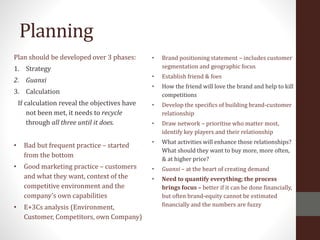
Plan should be developed over 3 phases:
1. Strategy
2. Guanxi
3. Calculation
If calculation reveal the objectives have
not been met, it needs to recycle
through all three until it does.
• Bad but frequent practice – started
from the bottom
• Good marketing practice – customers
and what they want, context of the
competitive environment and the
company’s own capabilities
• E+3Cs analysis (Environment,
Customer, Competitors, own Company)
• Brand positioning statement – includes customer
segmentation and geographic focus
• Establish friend & foes
• How the friend will love the brand and help to kill
competitions
• Develop the specifics of building brand-customer
relationship
• Draw network – prioritise who matter most,
identify key players and their relationship
• What activities will enhance those relationships?
What should they want to buy more, more often,
& at higher price?
• Guanxi – at the heart of creating demand
• Need to quantify everything; the process
brings focus – better if it can be done financially,
but often brand-equity cannot be estimated
financially and the numbers are fuzzy
Planning
Annual opportunity to learn, to be creative, and to play
wild with ideas
Conclusion
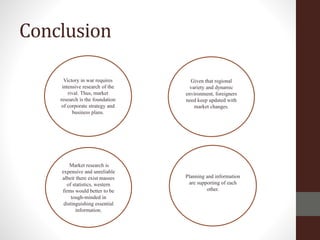
Given that regional
variety and dynamic
environment, foreigners
need keep updated with
market changes.
Victory in war requires
intensive research of the
rival. Thus, market
research is the foundation
of corporate strategy and
business plans.
Market research is
expensive and unreliable
albeit there exist masses
of statistics, western
firms would better to be
tough-minded in
distinguishing essential
information.
Planning and information
are supporting of each
other.
MARKETING PROCESS IN CHINA

MARKETING PROCESS IN CHINA

  • 1.
    The Marketing Process KimberlyLimanto 201605008 Siting Cheng 201605048 Seka Gerod Strivane 201709025 Doing Business in China SolBridge International School of Business MBA – Fall 2017
  • 2.
    Contents Introduction I. Market Researchin China • Published Sources • Bespoke Quantitative Research • Qualitative Research • Other Information II. Planning Conclusion
  • 3.
    The general whowins a battle makes many calculations in his temple before the battle is fought. The general who loses a battle makes but few calculations beforehand. Thus do many calculations lead to victory and few calculations do defeat: how much more no calculation at all. It’s by attention to this point that I can foresee who‘s likely to win or lose. 孙子曰:夫未战而庙算胜者,得算多 也;未战而庙算不胜者,得算少也。 多算胜,少算不胜,而况于无算乎! 吾以此观之,胜负见矣。 《始计篇》 The hidden meaning: the key to winning battles is having and using, superior information.
  • 4.
    Introduction • The difficultyof acquiring reliable factual information . • The principal need to understand Chinese markets rather than handling over to local affiliates • Apart from three main ways of market research in PRC, practical strategy for integrating information is also required. • Be aware that guanxi is some sort of local peculiarity, businessman should take it into consideration when making business plan.
  • 5.
  • 6.
    Published Sources inChina Getting accurate and reliable information before in China was not easy because they were: • A big system that collected and analyzed information for central planning purposes. The centralization of information in many agencies like (commissions, ministries, national corporation and industries councils) make things difficult for western and even for local company, the most issue their faced is sometime is really tricky to identify the right person to address your issue because he is undefinable.
  • 7.
    Published Sources inChina But nowadays the situation changed because technology and internet. Many basic and generics information are online because the state statistical bureau and some ministries set up a service Centre that ensure data's availability. However trusting in local intermediaries is more recommended because they are more near to customers, also independent verification and checking is required because data accuracy and unreliability.
  • 9.
    Quantitative Research • Makingresearch is very easy because nowadays : • There are many Western and Chinese market research agencies including states and J.V agencies. • But, the issues concerning these agencies are the fact that most of them are one-man bands working from home or small agencies so sometime they just copy and past information from internet without any intellectual input. • Also there are a lack of serious companies that follow all the steps to conduct good quantitative research by doing survey, questionnaire detailed audits and so one.. • That’s why consultants in Beijing and shanghai advice their consumers to ask for references before employing any market research agencies and customer feedbacks also.
  • 10.
    Survey Research Group •SGR is the first major market research agency created in 1984 in Hong Kong then enlarged its’ business in some big cities as Shanghai and Beijing. • It presents in worldwide market and works mostly for US foreign companies • The company is using the logic of "you get what you pay for" • The company evolve in desk research and in-depth interview by using standard methodology similar to Western Research Agencies • The issue with the company is sometime they results are unreliable because they are using Western methodologies in Chinese market , hence facing some contradictions issues.
  • 11.
    3 Reasons ofThe Unreliability of Market Research in China 1. Different Nature of Chinese Consumer Psychology: • People responses sometimes do not fit with the research purposes • Providing information is seen as valuable 2. Regional Differences • People mind-set change according to its’ region - impossible to make the same approaches everywhere • Every new region is a new market • Languages issue – regions have their own language so an adaptation should be done (e.g. we can’t use mandarin as Chinese Language to conduct a survey in local market)
  • 12.
    3 Reasons ofThe Unreliability of Market Research in China Should Western companies conduct 2 market researches? NOT really, because it will be costly and it can have a possibility of mismatching answer in both. But it’s feasible if company budget is high. However to be near to reality company could use sales force report because they more close to customer and can provide reliable feedbacks. Also Quantitative research is a quite difficult because figure can easily be wrong (e.g Chinese Population) Western Companies think that being in big cities in China is the key for their success because of the amount of population and consumers. HOWEVER…
  • 13.
    3 Reasons ofThe Unreliability of Market Research in China Chinese consultants think that no matter where your business is located (big or small city), a good product that following a good 5Ps strategy is the main key to succeed in Chinese market.
  • 14.
    Qualitative Research • Definition:a method of inquiry employed in many different academic disciplines, including in the social sciences and natural sciences. (retrieve from Wikipedia) The purpose is get close to end users. • Become less reliant on Chinese partners for marketing, but there is one exception: qualitative research into what makes consumers tick in China must be done by Chinese. • The presence of a foreigner during interview can taint the proceedings, but luxury products are less to be affected. • Through various ways like focus group or listening to tape recordings, foreign firms might attain crucial information. • More empathy a skilled researcher has with client, more efficient it would be.
  • 15.
    Qualitative Research • Whensetting up focus group, researchers should notice that Chinese are more visually and less aurally focused than westerners. • Chinese consumers should see names and other stimuli more than hearing them. Research group should provide more visual stimuli than in the west. • Research should endeavor to bring cultural values, also need to consider the usage occasion and the product altogether as realistically as much as they could.
  • 16.
    2. Planning Plans arenot important; planning is. One can get ahead of the game by engaging the brain sooner rather than later.
  • 17.
    Planning • Is learningfrom the past, from other business units, functions and competitors and from seniors and juniors in the hierarchy. • Understand why something works ➝ extend principles in new situations. • Most plans are adaptation from those that went before; evolutionary, not revolutionary. • Extend the one that works, cut back the one that does not. • Darwinism – successful behaviour is more convincing than theoretical calculations but this is no help to those preparing their first ever plan in China • Should they bring experts (consultants, etc.) with previous experience? – nothing is guaranteed but it obviously helps
  • 18.
    Planning • Experiential (early)plans vs. experienced plans • Experienced plans – build on experiences • Experiential plans; little or no experience exists – planning process has to provide the best proxy for that experience • Planning process – stimulates what will happen as best as it can • Most Western firms – spend too long working on a plan around the hierarchy • Few Chinese family businesses have formal marketing plans. • React to external stimuli and based on the firm’s own abilities and the nature of its’ business – sometimes leads to decisions that made no sense, but still works on terms of CF and profitability • It continues if it’s bringing profitability • If new strategy is required – top team will analyse and test alternatives
  • 19.
    Planning • Experimentation, trialand error are endemic to market research • Sunzi “calculation” – from a range of possibilities, one can calculate which ideas can be tested on the smallest possible scale, whether the full-scale model is feasible • From the result, one can single out which idea is the best to pursue • Well-managed business frequently fail small in order to win big • China has the great advantage of providing plenty opportunities for failure; but Can one learn enough and survive long enough to win big?
  • 20.
    Planning Reasons why Westerncompanies think its important to write marketing plans down: • Managers change in the West 5 times faster than in family businesses • Approvals are needed from different sites • Budgeting system is more formalised and a main plan function is to gain financial approval • Lack of trust • Intolerance for ambiguity has many advantages but also drives out the opportunity for unusual solutions to gradually evolve • Explicit information-sharing is given greater weight than implicit • To develop strategically new business better – need to be more patient with implicit information and codify it (make it explicit) carefully. • Small cross-functional team need to be formed both to plan and to implement it. • Bridging the East-West cultural gap with written word; aide memoire – indicating the market learning is reached; as long as the Western side does not give the plan itself too much authority • Flexibility and the door to new learning must be left open
  • 21.
    Planning Plan should bedeveloped over 3 phases: 1. Strategy 2. Guanxi 3. Calculation If calculation reveal the objectives have not been met, it needs to recycle through all three until it does. • Bad but frequent practice – started from the bottom • Good marketing practice – customers and what they want, context of the competitive environment and the company’s own capabilities • E+3Cs analysis (Environment, Customer, Competitors, own Company) • Brand positioning statement – includes customer segmentation and geographic focus • Establish friend & foes • How the friend will love the brand and help to kill competitions • Develop the specifics of building brand-customer relationship • Draw network – prioritise who matter most, identify key players and their relationship • What activities will enhance those relationships? What should they want to buy more, more often, & at higher price? • Guanxi – at the heart of creating demand • Need to quantify everything; the process brings focus – better if it can be done financially, but often brand-equity cannot be estimated financially and the numbers are fuzzy
  • 22.
    Planning Annual opportunity tolearn, to be creative, and to play wild with ideas
  • 23.
    Conclusion Given that regional varietyand dynamic environment, foreigners need keep updated with market changes. Victory in war requires intensive research of the rival. Thus, market research is the foundation of corporate strategy and business plans. Market research is expensive and unreliable albeit there exist masses of statistics, western firms would better to be tough-minded in distinguishing essential information. Planning and information are supporting of each other.