PLACE
A TOOLS OF
MARKETING MIX
VIKASH
srivastav
Marketing mix ;
place
• How you will get the product where it belongs?
• How will you manage inventory ?
• How warehouse operation will be carried out and if distribution
centres will be established ?
• When you consider place , you also must consider where you percive
the product will be sell best.
Place : in the marketing sense refer to the Distribution of
the product.
Place consideration involve decision that effect ;
2
╸ • Place (or Placement ) decisions are those associated with channels
of distributions that serve as the means for getting the product to the
Target Customers.
╸ Channel Distribution System Performs :
1. Transactional
2. Logistical
3. Facilitating functions
╸ Distribution Decisions include Location , Market Coverage, Channe
member Selection, Logistics and Levels of Service.
3
Marketing Mix : Place
“
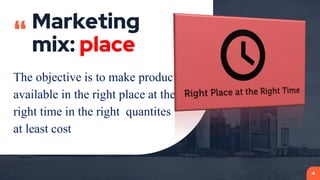
The objective is to make product
available in the right place at the
right time in the right quantites
at least cost
4
Marketing
mix: place
Objectives of
Distribution
5
• Movement of goods:- The major objective of distribution is to effectively move the product from the place of
production to the place of consumption through the marketing channel system. Products move from
manufacture to wholesaler to retailer and finally moved to consumer from retailer.
• Safety of product:- Distribution facilities safety of the product. Distribution makes the channel members
responsible to the proper storage and handling of the product, so that the product reaches to the buyer in
proper condition.
• Cost reduction:- Distribution involves several channel members. They assist in delivering goods and services
to the end consumer. So, manufacture do not need to reach to the door step of every consumer. Distribution
helps in minimizing the cost of manufacture's transportation and travelling
• Availability of goods: Effective distribution channels facilities easy availability of goods. Distribution channel
also helps consumers to assort the required products. Any product demanded by consumers becomes
available at any place and any time. Different products in different countries and continents are assorted at the
same place by channel members. It ensures right goods at reasonable price at right place
• Customer satisfaction:- Distribution is often termed as other halves of marketing. It fulfill the customer's
satisfaction by delivering right product at the right place at right time. Thus, distribution channel sets objectives
to render crucial services of regular supply of goods.
Marketing Channel
Strategy
Place:-The fourth “P” in the Marketing Mix has been largely neglected
But this is changing....
Marketing Channel Strategy Has Become Critically Important For Most
Businesses
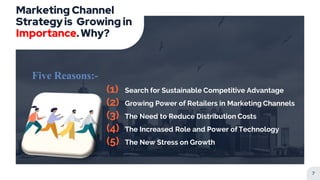
Marketing Channel
Strategyis Growing in
Importance.Why?
Five Reasons:-
(1) Search for Sustainable Competitive Advantage
(2) Growing Power of Retailers in Marketing Channels
(3) The Need to Reduce Distribution Costs
(4) The Increased Role and Power of Technology
(5) The New Stress on Growth
7
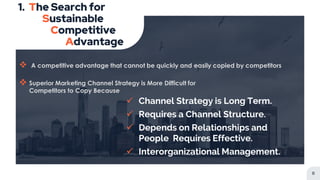
 A competitive advantage that cannot be quickly and easily copied by competitors
 Superior Marketing Channel Strategy is More Difficult for
Competitors to Copy Because
1. The Search for
Sustainable
Competitive
Advantage
8
 Channel Strategy is Long Term.
 Requires a Channel Structure.
 Depends on Relationships and
People Requires Effective.
 Interorganizational Management.
2.Growing Power of
Retailers in
Marketing Channels
9
Retailers:-
 Are Growing Larger
 Enjoy Substantial Channel Power
 Act as Buying Agents for Customers
 Often Operate on Low Price / Low
Margin Model
 Operate in Saturated Markets and Fight for
Market Share
“
10
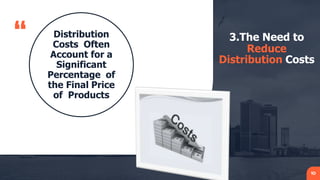
3.The Need to
Reduce
Distribution Costs
Distribution
Costs Often
Account for a
Significant
Percentage of
the Final Price
of Products
“╸ Firms that make
effective use of these
technologies in their
channel strategy can
gain a substantial
competitive advantage
11
4.Increasing
Role and
Usefulness of
Technology
“5.The New Stress on
Growth Strategy”
12
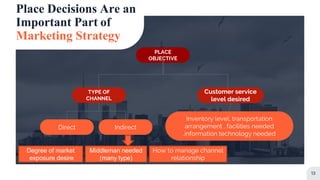
Place Decisions Are an
Important Part of
Marketing Strategy
13
PLACE
OBJECTIVE
Customer service
level desired
TYPE OF
CHANNEL
Direct Indirect
Inventory level, transportation
arrangement , facilities needed
,information technology needed
How to manage channel
relationship
Middleman needed
(many type)
Degree of market
exposure desire
Marketing
Channels:-
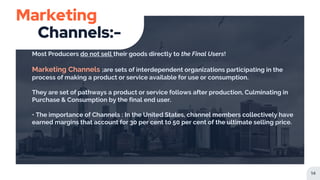
Most Producers do not sell their goods directly to the Final Users!
Marketing Channels ;are sets of interdependent organizations participating in the
process of making a product or service available for use or consumption.
They are set of pathways a product or service follows after production, Culminating in
Purchase & Consumption by the final end user.
• The importance of Channels : In the United States, channel members collectively have
earned margins that account for 30 per cent to 50 per cent of the ultimate selling price.
14
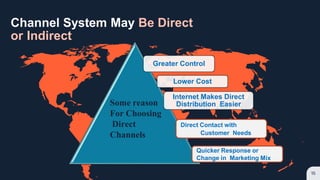
Channel System May Be Direct
or Indirect
15
Greater Control
Lower Cost
Internet Makes Direct
Distribution Easier
Direct Contact with
Customer Needs
Quicker Response or
Change in Marketing Mix
Some reason
For Choosing
Direct
Channels
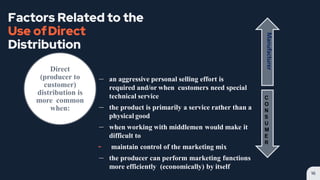
Factors Related to the
Use ofDirect
Distribution
– an aggressive personal selling effort is
required and/or when customers need special
technical service
– the product is primarily a service rather than a
physical good
– when working with middlemen would make it
difficult to
╸ maintain control of the marketing mix
– the producer can perform marketing functions
more efficiently (economically) by itself
16
Direct
(producer to
customer)
distribution is
more common
when:
Manufacturer
C
O
N
S
U
M
E
R
Indirect
Distribution
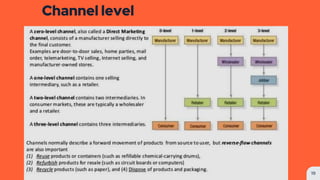
 Goods may move through a set of intermediaries
 Most FMCG companies follow this route
 The intermediary has a far better reach thanthe company
 The cost of operations of an intermediary likea wholesaler / retailer is
shared with many businesses.
18
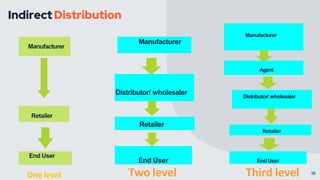
Indirect Distribution
Manufacturer
Manufacturer
Retailer
End User
Retailer
End User
Distributor/ wholesaler
Two levelOne level
Manufacturer
Retailer
Distributor/ wholesaler
End User
Agent
Third level
Channel level
19
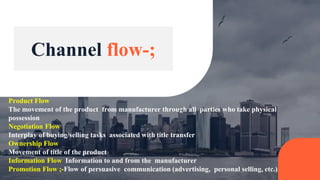
Product Flow
The movement of the product from manufacturer through all parties who take physical
possession
Negotiation Flow
Interplay of buying/selling tasks associated with title transfer
Ownership Flow
Movement of title of the product
Information Flow Information to and from the manufacturer
Promotion Flow ;-Flow of persuasive communication (advertising, personal selling, etc.)
Channel flow-;
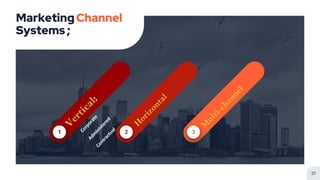
MarketingChannel
Systems ;
21
1 2 3
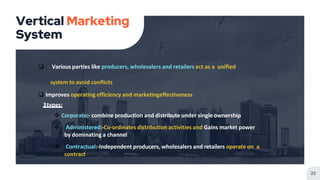
Vertical Marketing
System
22
 Various parties like producers, wholesalers and retailers act as a unified
system to avoid conflicts
 Improves operating efficiency and marketingeffectiveness
3types:
 Corporate:- combine production and distribute under single ownership
 Administered:-Co-ordinates distribution activities and Gains market power
by dominating a channel
 Contractual:-Independent producers, wholesalers and retailers operate on a
contract
Horizontal Marketing
System
 Two or more unrelated companies join together to pool resources and exploit an emerging
market opportunity.
 In-store banking in hotels, bigstores
 Retail outlets in petrolbunks
 Coffee Day outlets inairports 23
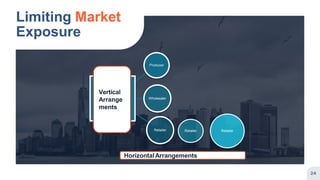
Limiting Market
Exposure
24
Producer
Wholesaler
Retailer Retailer Retailer
HorizontalArrangements
Vertical
Arrange
ments
“Multi-channel Distribution
25
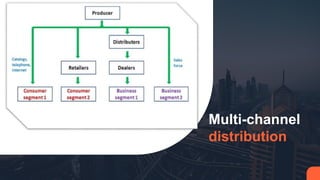
 Company uses different channels to reach /
same or different market segments
 Most FMCG companies have separate networks
for retail market and institutions
 Pharma companies may use different
channels to reach doctors, chemists and
hospitals
“
Multi-channel
distribution
27
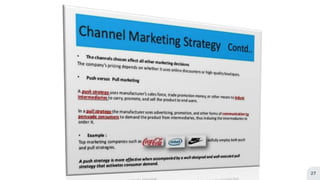
push & pull strategy
 Push Strategy;
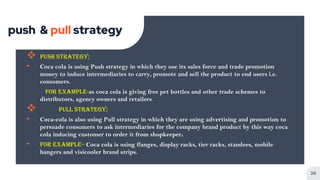
╸ Coca cola is using Push strategy in which they use its sales force and trade promotion
money to induce intermediaries to carry, promote and sell the product to end users i.e.
consumers.
For example-as coca cola is giving free pet bottles and other trade schemes to
distributors, agency owners and retailers.
 PULL STRATEGY;
╸ Coca-cola is also using Pull strategy in which they are using advertising and promotion to
persuade consumers to ask intermediaries for the company brand product by this way coca
cola inducing customer to order it from shopkeeper.
╸ For example– Coca cola is using flanges, display racks, tier racks, standees, mobile
hangers and visicooler brand strips.
28
“
30
EXAMPLE
31
THANK
YOU
ANY QUESTION
SUBMITTED BY -;
VIKASH KUMAR SRIVASTAV
TO,
SHUBHAM AGGARWAL

Marketing place mix

  • 1.
    PLACE A TOOLS OF MARKETINGMIX VIKASH srivastav
  • 2.
    Marketing mix ; place •How you will get the product where it belongs? • How will you manage inventory ? • How warehouse operation will be carried out and if distribution centres will be established ? • When you consider place , you also must consider where you percive the product will be sell best. Place : in the marketing sense refer to the Distribution of the product. Place consideration involve decision that effect ; 2
  • 3.
    ╸ • Place(or Placement ) decisions are those associated with channels of distributions that serve as the means for getting the product to the Target Customers. ╸ Channel Distribution System Performs : 1. Transactional 2. Logistical 3. Facilitating functions ╸ Distribution Decisions include Location , Market Coverage, Channe member Selection, Logistics and Levels of Service. 3 Marketing Mix : Place
  • 4.
    “ The objective isto make product available in the right place at the right time in the right quantites at least cost 4 Marketing mix: place
  • 5.
    Objectives of Distribution 5 • Movementof goods:- The major objective of distribution is to effectively move the product from the place of production to the place of consumption through the marketing channel system. Products move from manufacture to wholesaler to retailer and finally moved to consumer from retailer. • Safety of product:- Distribution facilities safety of the product. Distribution makes the channel members responsible to the proper storage and handling of the product, so that the product reaches to the buyer in proper condition. • Cost reduction:- Distribution involves several channel members. They assist in delivering goods and services to the end consumer. So, manufacture do not need to reach to the door step of every consumer. Distribution helps in minimizing the cost of manufacture's transportation and travelling • Availability of goods: Effective distribution channels facilities easy availability of goods. Distribution channel also helps consumers to assort the required products. Any product demanded by consumers becomes available at any place and any time. Different products in different countries and continents are assorted at the same place by channel members. It ensures right goods at reasonable price at right place • Customer satisfaction:- Distribution is often termed as other halves of marketing. It fulfill the customer's satisfaction by delivering right product at the right place at right time. Thus, distribution channel sets objectives to render crucial services of regular supply of goods.
  • 6.
    Marketing Channel Strategy Place:-The fourth“P” in the Marketing Mix has been largely neglected But this is changing.... Marketing Channel Strategy Has Become Critically Important For Most Businesses
  • 7.
    Marketing Channel Strategyis Growingin Importance.Why? Five Reasons:- (1) Search for Sustainable Competitive Advantage (2) Growing Power of Retailers in Marketing Channels (3) The Need to Reduce Distribution Costs (4) The Increased Role and Power of Technology (5) The New Stress on Growth 7
  • 8.
     A competitiveadvantage that cannot be quickly and easily copied by competitors  Superior Marketing Channel Strategy is More Difficult for Competitors to Copy Because 1. The Search for Sustainable Competitive Advantage 8  Channel Strategy is Long Term.  Requires a Channel Structure.  Depends on Relationships and People Requires Effective.  Interorganizational Management.
  • 9.
    2.Growing Power of Retailersin Marketing Channels 9 Retailers:-  Are Growing Larger  Enjoy Substantial Channel Power  Act as Buying Agents for Customers  Often Operate on Low Price / Low Margin Model  Operate in Saturated Markets and Fight for Market Share
  • 10.
    “ 10 3.The Need to Reduce DistributionCosts Distribution Costs Often Account for a Significant Percentage of the Final Price of Products
  • 11.
    “╸ Firms thatmake effective use of these technologies in their channel strategy can gain a substantial competitive advantage 11 4.Increasing Role and Usefulness of Technology
  • 12.
    “5.The New Stresson Growth Strategy” 12
  • 13.
    Place Decisions Arean Important Part of Marketing Strategy 13 PLACE OBJECTIVE Customer service level desired TYPE OF CHANNEL Direct Indirect Inventory level, transportation arrangement , facilities needed ,information technology needed How to manage channel relationship Middleman needed (many type) Degree of market exposure desire
  • 14.
    Marketing Channels:- Most Producers donot sell their goods directly to the Final Users! Marketing Channels ;are sets of interdependent organizations participating in the process of making a product or service available for use or consumption. They are set of pathways a product or service follows after production, Culminating in Purchase & Consumption by the final end user. • The importance of Channels : In the United States, channel members collectively have earned margins that account for 30 per cent to 50 per cent of the ultimate selling price. 14
  • 15.
    Channel System MayBe Direct or Indirect 15 Greater Control Lower Cost Internet Makes Direct Distribution Easier Direct Contact with Customer Needs Quicker Response or Change in Marketing Mix Some reason For Choosing Direct Channels
  • 16.
    Factors Related tothe Use ofDirect Distribution – an aggressive personal selling effort is required and/or when customers need special technical service – the product is primarily a service rather than a physical good – when working with middlemen would make it difficult to ╸ maintain control of the marketing mix – the producer can perform marketing functions more efficiently (economically) by itself 16 Direct (producer to customer) distribution is more common when: Manufacturer C O N S U M E R
  • 17.
    Indirect Distribution  Goods maymove through a set of intermediaries  Most FMCG companies follow this route  The intermediary has a far better reach thanthe company  The cost of operations of an intermediary likea wholesaler / retailer is shared with many businesses.
  • 18.
    18 Indirect Distribution Manufacturer Manufacturer Retailer End User Retailer EndUser Distributor/ wholesaler Two levelOne level Manufacturer Retailer Distributor/ wholesaler End User Agent Third level
  • 19.
  • 20.
    Product Flow The movementof the product from manufacturer through all parties who take physical possession Negotiation Flow Interplay of buying/selling tasks associated with title transfer Ownership Flow Movement of title of the product Information Flow Information to and from the manufacturer Promotion Flow ;-Flow of persuasive communication (advertising, personal selling, etc.) Channel flow-;
  • 21.
  • 22.
    Vertical Marketing System 22  Variousparties like producers, wholesalers and retailers act as a unified system to avoid conflicts  Improves operating efficiency and marketingeffectiveness 3types:  Corporate:- combine production and distribute under single ownership  Administered:-Co-ordinates distribution activities and Gains market power by dominating a channel  Contractual:-Independent producers, wholesalers and retailers operate on a contract
  • 23.
    Horizontal Marketing System  Twoor more unrelated companies join together to pool resources and exploit an emerging market opportunity.  In-store banking in hotels, bigstores  Retail outlets in petrolbunks  Coffee Day outlets inairports 23
  • 24.
    Limiting Market Exposure 24 Producer Wholesaler Retailer RetailerRetailer HorizontalArrangements Vertical Arrange ments
  • 25.
    “Multi-channel Distribution 25  Companyuses different channels to reach / same or different market segments  Most FMCG companies have separate networks for retail market and institutions  Pharma companies may use different channels to reach doctors, chemists and hospitals
  • 26.
  • 27.
  • 28.
    push & pullstrategy  Push Strategy; ╸ Coca cola is using Push strategy in which they use its sales force and trade promotion money to induce intermediaries to carry, promote and sell the product to end users i.e. consumers. For example-as coca cola is giving free pet bottles and other trade schemes to distributors, agency owners and retailers.  PULL STRATEGY; ╸ Coca-cola is also using Pull strategy in which they are using advertising and promotion to persuade consumers to ask intermediaries for the company brand product by this way coca cola inducing customer to order it from shopkeeper. ╸ For example– Coca cola is using flanges, display racks, tier racks, standees, mobile hangers and visicooler brand strips. 28
  • 30.
  • 31.
  • 32.
    ANY QUESTION SUBMITTED BY-; VIKASH KUMAR SRIVASTAV TO, SHUBHAM AGGARWAL

Editor's Notes

  • #17 The use of aggressive personal selling and trade advertising by a manufacturer to convince a wholesaler or retailer to carry and sell its merchandise is known as a push
  • #21 Channel flows refer to the marketing functions performed by manufacturers, wholesalers, retailers, and other channel members within the channel. The Product Flow – The product flow involves the movement of goods from a supplier to a customer. This supply chain management flow also concerns customer returns and service needs. The Information Flow – The information flow centers on transmitting orders and updating the status of delivery
  • #23 A vertical marketing system (VMS) is one in which the main members of a distribution channel—producer, wholesaler, and retailer—work together as a unified group in order to meet consumer needs. ... Vertical marketing systems can take several forms. The contractual system is a vertical marketing system where all parties maintain their independence and operate as individual companies, but they work together to help achieve greater efficiency. They are also called 'value-added partnerships' because they work together to help create values for all parties involved.
  • #24 Example- automobile industry
  • #25 Market exposure refers to the dollar amount of funds, or percentage of a portfolio, invested in a particular type of security, market sector or industry, which is usually expressed as a percentage of total portfolio holding